EP0646588A1 - Cyclische Verbindungen des dreiwertigen Phosphors - Google Patents
Cyclische Verbindungen des dreiwertigen Phosphors Download PDFInfo
- Publication number
- EP0646588A1 EP0646588A1 EP94115104A EP94115104A EP0646588A1 EP 0646588 A1 EP0646588 A1 EP 0646588A1 EP 94115104 A EP94115104 A EP 94115104A EP 94115104 A EP94115104 A EP 94115104A EP 0646588 A1 EP0646588 A1 EP 0646588A1
- Authority
- EP
- European Patent Office
- Prior art keywords
- compounds
- compounds according
- different
- radical
- numbers
- Prior art date
- Legal status (The legal status is an assumption and is not a legal conclusion. Google has not performed a legal analysis and makes no representation as to the accuracy of the status listed.)
- Granted
Links
- 229910052698 phosphorus Inorganic materials 0.000 title description 7
- 125000004122 cyclic group Chemical group 0.000 title description 3
- OAICVXFJPJFONN-UHFFFAOYSA-N Phosphorus Chemical compound [P] OAICVXFJPJFONN-UHFFFAOYSA-N 0.000 title description 2
- 239000011574 phosphorus Substances 0.000 title description 2
- 150000001875 compounds Chemical class 0.000 claims abstract description 31
- 239000003054 catalyst Substances 0.000 claims abstract description 25
- -1 cyclic phosphorus(III) compounds Chemical class 0.000 claims abstract description 13
- 238000000034 method Methods 0.000 claims abstract description 6
- 238000002360 preparation method Methods 0.000 claims abstract description 6
- 229910052739 hydrogen Inorganic materials 0.000 claims description 19
- UHOVQNZJYSORNB-UHFFFAOYSA-N Benzene Chemical compound C1=CC=CC=C1 UHOVQNZJYSORNB-UHFFFAOYSA-N 0.000 claims description 15
- 239000001257 hydrogen Substances 0.000 claims description 8
- UFHFLCQGNIYNRP-UHFFFAOYSA-N Hydrogen Chemical compound [H][H] UFHFLCQGNIYNRP-UHFFFAOYSA-N 0.000 claims description 7
- 125000004432 carbon atom Chemical group C* 0.000 claims description 7
- 150000003254 radicals Chemical class 0.000 claims description 4
- 229920006395 saturated elastomer Polymers 0.000 claims description 4
- 229910000799 K alloy Inorganic materials 0.000 claims description 3
- 229910052783 alkali metal Inorganic materials 0.000 claims description 3
- 150000001340 alkali metals Chemical class 0.000 claims description 3
- 229910052794 bromium Inorganic materials 0.000 claims description 3
- 125000005843 halogen group Chemical group 0.000 claims description 3
- WCYWZMWISLQXQU-UHFFFAOYSA-N methyl Chemical compound [CH3] WCYWZMWISLQXQU-UHFFFAOYSA-N 0.000 claims description 3
- 125000001624 naphthyl group Chemical group 0.000 claims description 3
- 125000000217 alkyl group Chemical group 0.000 claims description 2
- 125000003710 aryl alkyl group Chemical group 0.000 claims description 2
- 229910052801 chlorine Inorganic materials 0.000 claims description 2
- 150000002431 hydrogen Chemical class 0.000 claims description 2
- 125000004957 naphthylene group Chemical group 0.000 claims description 2
- 125000000843 phenylene group Chemical group C1(=C(C=CC=C1)*)* 0.000 claims description 2
- IFVTZJHWGZSXFD-UHFFFAOYSA-N biphenylene Chemical group C1=CC=C2C3=CC=CC=C3C2=C1 IFVTZJHWGZSXFD-UHFFFAOYSA-N 0.000 claims 1
- 229910052736 halogen Inorganic materials 0.000 claims 1
- 150000002367 halogens Chemical class 0.000 claims 1
- 235000021190 leftovers Nutrition 0.000 claims 1
- BITYAPCSNKJESK-UHFFFAOYSA-N potassiosodium Chemical compound [Na].[K] BITYAPCSNKJESK-UHFFFAOYSA-N 0.000 claims 1
- 239000003446 ligand Substances 0.000 abstract description 14
- 229910052751 metal Inorganic materials 0.000 abstract description 8
- 239000002184 metal Substances 0.000 abstract description 8
- 150000002739 metals Chemical class 0.000 abstract description 4
- 150000003018 phosphorus compounds Chemical group 0.000 abstract description 4
- 230000000737 periodic effect Effects 0.000 abstract description 3
- 239000000470 constituent Substances 0.000 abstract description 2
- WYURNTSHIVDZCO-UHFFFAOYSA-N Tetrahydrofuran Chemical compound C1CCOC1 WYURNTSHIVDZCO-UHFFFAOYSA-N 0.000 description 14
- 238000006243 chemical reaction Methods 0.000 description 13
- YXFVVABEGXRONW-UHFFFAOYSA-N Toluene Chemical compound CC1=CC=CC=C1 YXFVVABEGXRONW-UHFFFAOYSA-N 0.000 description 12
- 150000001336 alkenes Chemical class 0.000 description 12
- 239000010948 rhodium Substances 0.000 description 12
- 239000003921 oil Substances 0.000 description 11
- HEDRZPFGACZZDS-MICDWDOJSA-N Trichloro(2H)methane Chemical compound [2H]C(Cl)(Cl)Cl HEDRZPFGACZZDS-MICDWDOJSA-N 0.000 description 10
- 229910052703 rhodium Inorganic materials 0.000 description 10
- MHOVAHRLVXNVSD-UHFFFAOYSA-N rhodium atom Chemical compound [Rh] MHOVAHRLVXNVSD-UHFFFAOYSA-N 0.000 description 10
- 238000007037 hydroformylation reaction Methods 0.000 description 9
- 239000000203 mixture Substances 0.000 description 9
- 238000003786 synthesis reaction Methods 0.000 description 9
- VLKZOEOYAKHREP-UHFFFAOYSA-N n-Hexane Chemical compound CCCCCC VLKZOEOYAKHREP-UHFFFAOYSA-N 0.000 description 8
- 239000000047 product Substances 0.000 description 8
- 239000000725 suspension Substances 0.000 description 8
- 230000015572 biosynthetic process Effects 0.000 description 7
- 239000007789 gas Substances 0.000 description 7
- 238000010992 reflux Methods 0.000 description 7
- YLQBMQCUIZJEEH-UHFFFAOYSA-N tetrahydrofuran Natural products C=1C=COC=1 YLQBMQCUIZJEEH-UHFFFAOYSA-N 0.000 description 7
- RTZKZFJDLAIYFH-UHFFFAOYSA-N Diethyl ether Chemical compound CCOCC RTZKZFJDLAIYFH-UHFFFAOYSA-N 0.000 description 6
- PCLIMKBDDGJMGD-UHFFFAOYSA-N N-bromosuccinimide Chemical compound BrN1C(=O)CCC1=O PCLIMKBDDGJMGD-UHFFFAOYSA-N 0.000 description 6
- JRZJOMJEPLMPRA-UHFFFAOYSA-N olefin Natural products CCCCCCCC=C JRZJOMJEPLMPRA-UHFFFAOYSA-N 0.000 description 6
- 239000002904 solvent Substances 0.000 description 6
- VEXZGXHMUGYJMC-UHFFFAOYSA-N Hydrochloric acid Chemical compound Cl VEXZGXHMUGYJMC-UHFFFAOYSA-N 0.000 description 5
- 239000007788 liquid Substances 0.000 description 5
- 238000003756 stirring Methods 0.000 description 5
- IJGRMHOSHXDMSA-UHFFFAOYSA-N Atomic nitrogen Chemical compound N#N IJGRMHOSHXDMSA-UHFFFAOYSA-N 0.000 description 4
- 125000000623 heterocyclic group Chemical group 0.000 description 4
- 238000001819 mass spectrum Methods 0.000 description 4
- 239000011541 reaction mixture Substances 0.000 description 4
- KZNICNPSHKQLFF-UHFFFAOYSA-N succinimide Chemical compound O=C1CCC(=O)N1 KZNICNPSHKQLFF-UHFFFAOYSA-N 0.000 description 4
- VZGDMQKNWNREIO-UHFFFAOYSA-N tetrachloromethane Chemical compound ClC(Cl)(Cl)Cl VZGDMQKNWNREIO-UHFFFAOYSA-N 0.000 description 4
- RIOQSEWOXXDEQQ-UHFFFAOYSA-N triphenylphosphine Chemical compound C1=CC=CC=C1P(C=1C=CC=CC=1)C1=CC=CC=C1 RIOQSEWOXXDEQQ-UHFFFAOYSA-N 0.000 description 4
- XLYOFNOQVPJJNP-UHFFFAOYSA-N water Substances O XLYOFNOQVPJJNP-UHFFFAOYSA-N 0.000 description 4
- WKBOTKDWSSQWDR-UHFFFAOYSA-N Bromine atom Chemical compound [Br] WKBOTKDWSSQWDR-UHFFFAOYSA-N 0.000 description 3
- YMWUJEATGCHHMB-UHFFFAOYSA-N Dichloromethane Chemical compound ClCCl YMWUJEATGCHHMB-UHFFFAOYSA-N 0.000 description 3
- DGAQECJNVWCQMB-PUAWFVPOSA-M Ilexoside XXIX Chemical compound C[C@@H]1CC[C@@]2(CC[C@@]3(C(=CC[C@H]4[C@]3(CC[C@@H]5[C@@]4(CC[C@@H](C5(C)C)OS(=O)(=O)[O-])C)C)[C@@H]2[C@]1(C)O)C)C(=O)O[C@H]6[C@@H]([C@H]([C@@H]([C@H](O6)CO)O)O)O.[Na+] DGAQECJNVWCQMB-PUAWFVPOSA-M 0.000 description 3
- XYFCBTPGUUZFHI-UHFFFAOYSA-N Phosphine Chemical class P XYFCBTPGUUZFHI-UHFFFAOYSA-N 0.000 description 3
- ZLMJMSJWJFRBEC-UHFFFAOYSA-N Potassium Chemical compound [K] ZLMJMSJWJFRBEC-UHFFFAOYSA-N 0.000 description 3
- 125000004429 atom Chemical group 0.000 description 3
- 238000001816 cooling Methods 0.000 description 3
- 230000000694 effects Effects 0.000 description 3
- 239000012074 organic phase Substances 0.000 description 3
- 229910052700 potassium Inorganic materials 0.000 description 3
- 239000011591 potassium Substances 0.000 description 3
- 238000000607 proton-decoupled 31P nuclear magnetic resonance spectroscopy Methods 0.000 description 3
- 238000001953 recrystallisation Methods 0.000 description 3
- 239000011734 sodium Substances 0.000 description 3
- 239000000243 solution Substances 0.000 description 3
- PAAZPARNPHGIKF-UHFFFAOYSA-N 1,2-dibromoethane Chemical compound BrCCBr PAAZPARNPHGIKF-UHFFFAOYSA-N 0.000 description 2
- VXNZUUAINFGPBY-UHFFFAOYSA-N 1-Butene Chemical compound CCC=C VXNZUUAINFGPBY-UHFFFAOYSA-N 0.000 description 2
- CMIMBQIBIZZZHQ-UHFFFAOYSA-N 1-bromo-2-methylnaphthalene Chemical compound C1=CC=CC2=C(Br)C(C)=CC=C21 CMIMBQIBIZZZHQ-UHFFFAOYSA-N 0.000 description 2
- IBSQPLPBRSHTTG-UHFFFAOYSA-N 1-chloro-2-methylbenzene Chemical compound CC1=CC=CC=C1Cl IBSQPLPBRSHTTG-UHFFFAOYSA-N 0.000 description 2
- ABMKWMASVFVTMD-UHFFFAOYSA-N 1-methyl-2-(2-methylphenyl)benzene Chemical group CC1=CC=CC=C1C1=CC=CC=C1C ABMKWMASVFVTMD-UHFFFAOYSA-N 0.000 description 2
- 238000005160 1H NMR spectroscopy Methods 0.000 description 2
- SDJHPPZKZZWAKF-UHFFFAOYSA-N 2,3-dimethylbuta-1,3-diene Chemical compound CC(=C)C(C)=C SDJHPPZKZZWAKF-UHFFFAOYSA-N 0.000 description 2
- VUUUEDHFRJQSSY-UHFFFAOYSA-N 2-(bromomethyl)-1-[2-(bromomethyl)naphthalen-1-yl]naphthalene Chemical group C1=CC=C2C(C3=C4C=CC=CC4=CC=C3CBr)=C(CBr)C=CC2=C1 VUUUEDHFRJQSSY-UHFFFAOYSA-N 0.000 description 2
- KDHFKMDVFWYSPT-UHFFFAOYSA-N 2-methyl-1-(2-methylnaphthalen-1-yl)naphthalene Chemical group C1=CC=C2C(C3=C4C=CC=CC4=CC=C3C)=C(C)C=CC2=C1 KDHFKMDVFWYSPT-UHFFFAOYSA-N 0.000 description 2
- BSKHPKMHTQYZBB-UHFFFAOYSA-N 2-methylpyridine Chemical compound CC1=CC=CC=N1 BSKHPKMHTQYZBB-UHFFFAOYSA-N 0.000 description 2
- ACKPJROCIAWGID-UHFFFAOYSA-N 3,4-dimethyl-1-phenylphosphole Chemical compound C1=C(C)C(C)=CP1C1=CC=CC=C1 ACKPJROCIAWGID-UHFFFAOYSA-N 0.000 description 2
- CSCPPACGZOOCGX-UHFFFAOYSA-N Acetone Chemical compound CC(C)=O CSCPPACGZOOCGX-UHFFFAOYSA-N 0.000 description 2
- NLXLAEXVIDQMFP-UHFFFAOYSA-N Ammonia chloride Chemical compound [NH4+].[Cl-] NLXLAEXVIDQMFP-UHFFFAOYSA-N 0.000 description 2
- UGFAIRIUMAVXCW-UHFFFAOYSA-N Carbon monoxide Chemical compound [O+]#[C-] UGFAIRIUMAVXCW-UHFFFAOYSA-N 0.000 description 2
- NAVSMPLQPIFLBK-UHFFFAOYSA-N Cc1c[pH]c([Na])c1C Chemical compound Cc1c[pH]c([Na])c1C NAVSMPLQPIFLBK-UHFFFAOYSA-N 0.000 description 2
- LFQSCWFLJHTTHZ-UHFFFAOYSA-N Ethanol Chemical compound CCO LFQSCWFLJHTTHZ-UHFFFAOYSA-N 0.000 description 2
- CSNNHWWHGAXBCP-UHFFFAOYSA-L Magnesium sulfate Chemical compound [Mg+2].[O-][S+2]([O-])([O-])[O-] CSNNHWWHGAXBCP-UHFFFAOYSA-L 0.000 description 2
- 238000005481 NMR spectroscopy Methods 0.000 description 2
- 229910000528 Na alloy Inorganic materials 0.000 description 2
- 150000001299 aldehydes Chemical class 0.000 description 2
- 125000003118 aryl group Chemical group 0.000 description 2
- GDTBXPJZTBHREO-UHFFFAOYSA-N bromine Substances BrBr GDTBXPJZTBHREO-UHFFFAOYSA-N 0.000 description 2
- 229910002091 carbon monoxide Inorganic materials 0.000 description 2
- 229910017052 cobalt Inorganic materials 0.000 description 2
- 239000010941 cobalt Substances 0.000 description 2
- GUTLYIVDDKVIGB-UHFFFAOYSA-N cobalt atom Chemical compound [Co] GUTLYIVDDKVIGB-UHFFFAOYSA-N 0.000 description 2
- 230000009918 complex formation Effects 0.000 description 2
- CJSBUWDGPXGFGA-UHFFFAOYSA-N dimethyl-butadiene Natural products CC(C)=CC=C CJSBUWDGPXGFGA-UHFFFAOYSA-N 0.000 description 2
- 238000004821 distillation Methods 0.000 description 2
- 238000000921 elemental analysis Methods 0.000 description 2
- 150000002148 esters Chemical class 0.000 description 2
- 239000011521 glass Substances 0.000 description 2
- 239000011491 glass wool Substances 0.000 description 2
- 239000012456 homogeneous solution Substances 0.000 description 2
- 239000011777 magnesium Substances 0.000 description 2
- 230000014759 maintenance of location Effects 0.000 description 2
- 238000002844 melting Methods 0.000 description 2
- 230000008018 melting Effects 0.000 description 2
- 229910052757 nitrogen Inorganic materials 0.000 description 2
- 239000012071 phase Substances 0.000 description 2
- 150000003003 phosphines Chemical class 0.000 description 2
- 125000004437 phosphorous atom Chemical group 0.000 description 2
- 230000026731 phosphorylation Effects 0.000 description 2
- 238000006366 phosphorylation reaction Methods 0.000 description 2
- 239000000376 reactant Substances 0.000 description 2
- JHJLBTNAGRQEKS-UHFFFAOYSA-M sodium bromide Chemical compound [Na+].[Br-] JHJLBTNAGRQEKS-UHFFFAOYSA-M 0.000 description 2
- 239000007787 solid Substances 0.000 description 2
- 239000007858 starting material Substances 0.000 description 2
- 229960002317 succinimide Drugs 0.000 description 2
- QFMZQPDHXULLKC-UHFFFAOYSA-N 1,2-bis(diphenylphosphino)ethane Chemical compound C=1C=CC=CC=1P(C=1C=CC=CC=1)CCP(C=1C=CC=CC=1)C1=CC=CC=C1 QFMZQPDHXULLKC-UHFFFAOYSA-N 0.000 description 1
- VDXGURZGBXUKES-UHFFFAOYSA-N 1-(bromomethyl)-2-[2-(bromomethyl)phenyl]benzene Chemical group BrCC1=CC=CC=C1C1=CC=CC=C1CBr VDXGURZGBXUKES-UHFFFAOYSA-N 0.000 description 1
- ZGEGCLOFRBLKSE-UHFFFAOYSA-N 1-Heptene Chemical class CCCCCC=C ZGEGCLOFRBLKSE-UHFFFAOYSA-N 0.000 description 1
- 125000000094 2-phenylethyl group Chemical group [H]C1=C([H])C([H])=C(C([H])=C1[H])C([H])([H])C([H])([H])* 0.000 description 1
- JHYNEQNPKGIOQF-UHFFFAOYSA-N 3,4-dihydro-2h-phosphole Chemical class C1CC=PC1 JHYNEQNPKGIOQF-UHFFFAOYSA-N 0.000 description 1
- BCJVBDBJSMFBRW-UHFFFAOYSA-N 4-diphenylphosphanylbutyl(diphenyl)phosphane Chemical compound C=1C=CC=CC=1P(C=1C=CC=CC=1)CCCCP(C=1C=CC=CC=1)C1=CC=CC=C1 BCJVBDBJSMFBRW-UHFFFAOYSA-N 0.000 description 1
- QLWGKJFSBIKMDN-UHFFFAOYSA-N 5-(bromomethylidene)-6-[6-(bromomethylidene)cyclohexa-2,4-dien-1-ylidene]cyclohexa-1,3-diene Chemical group BrC=C1C(C=CC=C1)=C1C(C=CC=C1)=CBr QLWGKJFSBIKMDN-UHFFFAOYSA-N 0.000 description 1
- HBAQYPYDRFILMT-UHFFFAOYSA-N 8-[3-(1-cyclopropylpyrazol-4-yl)-1H-pyrazolo[4,3-d]pyrimidin-5-yl]-3-methyl-3,8-diazabicyclo[3.2.1]octan-2-one Chemical class C1(CC1)N1N=CC(=C1)C1=NNC2=C1N=C(N=C2)N1C2C(N(CC1CC2)C)=O HBAQYPYDRFILMT-UHFFFAOYSA-N 0.000 description 1
- KZBUYRJDOAKODT-UHFFFAOYSA-N Chlorine Chemical compound ClCl KZBUYRJDOAKODT-UHFFFAOYSA-N 0.000 description 1
- ZAMOUSCENKQFHK-UHFFFAOYSA-N Chlorine atom Chemical compound [Cl] ZAMOUSCENKQFHK-UHFFFAOYSA-N 0.000 description 1
- WHXSMMKQMYFTQS-UHFFFAOYSA-N Lithium Chemical compound [Li] WHXSMMKQMYFTQS-UHFFFAOYSA-N 0.000 description 1
- FYYHWMGAXLPEAU-UHFFFAOYSA-N Magnesium Chemical compound [Mg] FYYHWMGAXLPEAU-UHFFFAOYSA-N 0.000 description 1
- 101100030361 Neurospora crassa (strain ATCC 24698 / 74-OR23-1A / CBS 708.71 / DSM 1257 / FGSC 987) pph-3 gene Proteins 0.000 description 1
- CTQNGGLPUBDAKN-UHFFFAOYSA-N O-Xylene Chemical compound CC1=CC=CC=C1C CTQNGGLPUBDAKN-UHFFFAOYSA-N 0.000 description 1
- OFBQJSOFQDEBGM-UHFFFAOYSA-N Pentane Chemical class CCCCC OFBQJSOFQDEBGM-UHFFFAOYSA-N 0.000 description 1
- PMZURENOXWZQFD-UHFFFAOYSA-L Sodium Sulfate Chemical compound [Na+].[Na+].[O-]S([O-])(=O)=O PMZURENOXWZQFD-UHFFFAOYSA-L 0.000 description 1
- 125000005396 acrylic acid ester group Chemical group 0.000 description 1
- 150000001298 alcohols Chemical class 0.000 description 1
- 150000001338 aliphatic hydrocarbons Chemical class 0.000 description 1
- 150000001339 alkali metal compounds Chemical class 0.000 description 1
- 235000019270 ammonium chloride Nutrition 0.000 description 1
- 239000008346 aqueous phase Substances 0.000 description 1
- 150000004945 aromatic hydrocarbons Chemical class 0.000 description 1
- 125000001797 benzyl group Chemical group [H]C1=C([H])C([H])=C(C([H])=C1[H])C([H])([H])* 0.000 description 1
- 125000002529 biphenylenyl group Chemical group C1(=CC=CC=2C3=CC=CC=C3C12)* 0.000 description 1
- 238000007664 blowing Methods 0.000 description 1
- 238000009835 boiling Methods 0.000 description 1
- 230000031709 bromination Effects 0.000 description 1
- 238000005893 bromination reaction Methods 0.000 description 1
- 125000001246 bromo group Chemical group Br* 0.000 description 1
- IAQRGUVFOMOMEM-UHFFFAOYSA-N butene Natural products CC=CC IAQRGUVFOMOMEM-UHFFFAOYSA-N 0.000 description 1
- CREMABGTGYGIQB-UHFFFAOYSA-N carbon carbon Chemical compound C.C CREMABGTGYGIQB-UHFFFAOYSA-N 0.000 description 1
- 239000011203 carbon fibre reinforced carbon Substances 0.000 description 1
- 125000002915 carbonyl group Chemical group [*:2]C([*:1])=O 0.000 description 1
- 230000003197 catalytic effect Effects 0.000 description 1
- 239000003153 chemical reaction reagent Substances 0.000 description 1
- 239000000460 chlorine Substances 0.000 description 1
- 238000009833 condensation Methods 0.000 description 1
- 230000005494 condensation Effects 0.000 description 1
- 230000008878 coupling Effects 0.000 description 1
- 238000010168 coupling process Methods 0.000 description 1
- 238000005859 coupling reaction Methods 0.000 description 1
- 239000013078 crystal Substances 0.000 description 1
- SDJKREQSNPYHJT-UHFFFAOYSA-N dibromo(phenyl)phosphane Chemical compound BrP(Br)C1=CC=CC=C1 SDJKREQSNPYHJT-UHFFFAOYSA-N 0.000 description 1
- XAYGGTDUZQMQAR-UHFFFAOYSA-N dichloro-(2-phenylphenyl)phosphane Chemical compound ClP(Cl)C1=CC=CC=C1C1=CC=CC=C1 XAYGGTDUZQMQAR-UHFFFAOYSA-N 0.000 description 1
- 125000004982 dihaloalkyl group Chemical group 0.000 description 1
- 239000003814 drug Substances 0.000 description 1
- 150000002170 ethers Chemical class 0.000 description 1
- 239000000284 extract Substances 0.000 description 1
- 239000000706 filtrate Substances 0.000 description 1
- 238000001914 filtration Methods 0.000 description 1
- 239000012847 fine chemical Substances 0.000 description 1
- 238000010438 heat treatment Methods 0.000 description 1
- 150000002391 heterocyclic compounds Chemical class 0.000 description 1
- 125000004836 hexamethylene group Chemical class [H]C([H])([*:2])C([H])([H])C([H])([H])C([H])([H])C([H])([H])C([H])([H])[*:1] 0.000 description 1
- 238000005984 hydrogenation reaction Methods 0.000 description 1
- 230000007062 hydrolysis Effects 0.000 description 1
- 238000006460 hydrolysis reaction Methods 0.000 description 1
- 238000011065 in-situ storage Methods 0.000 description 1
- 239000003350 kerosene Substances 0.000 description 1
- 238000010667 large scale reaction Methods 0.000 description 1
- 229910052744 lithium Inorganic materials 0.000 description 1
- 229910052749 magnesium Inorganic materials 0.000 description 1
- 229910052943 magnesium sulfate Inorganic materials 0.000 description 1
- 235000019341 magnesium sulphate Nutrition 0.000 description 1
- 229910001092 metal group alloy Inorganic materials 0.000 description 1
- CSJDCSCTVDEHRN-UHFFFAOYSA-N methane;molecular oxygen Chemical compound C.O=O CSJDCSCTVDEHRN-UHFFFAOYSA-N 0.000 description 1
- 239000002480 mineral oil Substances 0.000 description 1
- 150000007522 mineralic acids Chemical class 0.000 description 1
- 230000007935 neutral effect Effects 0.000 description 1
- 150000007524 organic acids Chemical class 0.000 description 1
- 235000005985 organic acids Nutrition 0.000 description 1
- 239000003960 organic solvent Substances 0.000 description 1
- 125000004817 pentamethylene group Chemical class [H]C([H])([*:2])C([H])([H])C([H])([H])C([H])([H])C([H])([H])[*:1] 0.000 description 1
- FFZANLXOAFSSGC-UHFFFAOYSA-N phosphide(1-) Chemical compound [P-] FFZANLXOAFSSGC-UHFFFAOYSA-N 0.000 description 1
- AQSJGOWTSHOLKH-UHFFFAOYSA-N phosphite(3-) Chemical class [O-]P([O-])[O-] AQSJGOWTSHOLKH-UHFFFAOYSA-N 0.000 description 1
- 150000004850 phospholanes Chemical class 0.000 description 1
- 150000004857 phospholes Chemical class 0.000 description 1
- 239000000843 powder Substances 0.000 description 1
- 239000002244 precipitate Substances 0.000 description 1
- 238000000746 purification Methods 0.000 description 1
- 150000003839 salts Chemical class 0.000 description 1
- 229910052708 sodium Inorganic materials 0.000 description 1
- 229910052938 sodium sulfate Inorganic materials 0.000 description 1
- 235000011152 sodium sulphate Nutrition 0.000 description 1
- 230000000707 stereoselective effect Effects 0.000 description 1
- 239000000126 substance Substances 0.000 description 1
- 125000001424 substituent group Chemical group 0.000 description 1
- 239000010414 supernatant solution Substances 0.000 description 1
- NBRKLOOSMBRFMH-UHFFFAOYSA-N tert-butyl chloride Chemical compound CC(C)(C)Cl NBRKLOOSMBRFMH-UHFFFAOYSA-N 0.000 description 1
- 125000003944 tolyl group Chemical group 0.000 description 1
- IAQRGUVFOMOMEM-ONEGZZNKSA-N trans-but-2-ene Chemical compound C\C=C\C IAQRGUVFOMOMEM-ONEGZZNKSA-N 0.000 description 1
- 238000010792 warming Methods 0.000 description 1
- 239000008096 xylene Substances 0.000 description 1
- 239000004711 α-olefin Substances 0.000 description 1
Classifications
-
- B—PERFORMING OPERATIONS; TRANSPORTING
- B01—PHYSICAL OR CHEMICAL PROCESSES OR APPARATUS IN GENERAL
- B01J—CHEMICAL OR PHYSICAL PROCESSES, e.g. CATALYSIS OR COLLOID CHEMISTRY; THEIR RELEVANT APPARATUS
- B01J31/00—Catalysts comprising hydrides, coordination complexes or organic compounds
- B01J31/16—Catalysts comprising hydrides, coordination complexes or organic compounds containing coordination complexes
- B01J31/24—Phosphines, i.e. phosphorus bonded to only carbon atoms, or to both carbon and hydrogen atoms, including e.g. sp2-hybridised phosphorus compounds such as phosphabenzene, phosphole or anionic phospholide ligands
- B01J31/2404—Cyclic ligands, including e.g. non-condensed polycyclic ligands, the phosphine-P atom being a ring member or a substituent on the ring
- B01J31/2442—Cyclic ligands, including e.g. non-condensed polycyclic ligands, the phosphine-P atom being a ring member or a substituent on the ring comprising condensed ring systems
- B01J31/2461—Cyclic ligands, including e.g. non-condensed polycyclic ligands, the phosphine-P atom being a ring member or a substituent on the ring comprising condensed ring systems and phosphine-P atoms as ring members in the condensed ring system or in a further ring
- B01J31/2471—Cyclic ligands, including e.g. non-condensed polycyclic ligands, the phosphine-P atom being a ring member or a substituent on the ring comprising condensed ring systems and phosphine-P atoms as ring members in the condensed ring system or in a further ring with more than one complexing phosphine-P atom
-
- C—CHEMISTRY; METALLURGY
- C07—ORGANIC CHEMISTRY
- C07F—ACYCLIC, CARBOCYCLIC OR HETEROCYCLIC COMPOUNDS CONTAINING ELEMENTS OTHER THAN CARBON, HYDROGEN, HALOGEN, OXYGEN, NITROGEN, SULFUR, SELENIUM OR TELLURIUM
- C07F9/00—Compounds containing elements of Groups 5 or 15 of the Periodic Table
- C07F9/02—Phosphorus compounds
- C07F9/547—Heterocyclic compounds, e.g. containing phosphorus as a ring hetero atom
- C07F9/6564—Heterocyclic compounds, e.g. containing phosphorus as a ring hetero atom having phosphorus atoms, with or without nitrogen, oxygen, sulfur, selenium or tellurium atoms, as ring hetero atoms
- C07F9/6568—Heterocyclic compounds, e.g. containing phosphorus as a ring hetero atom having phosphorus atoms, with or without nitrogen, oxygen, sulfur, selenium or tellurium atoms, as ring hetero atoms having phosphorus atoms as the only ring hetero atoms
- C07F9/65683—Heterocyclic compounds, e.g. containing phosphorus as a ring hetero atom having phosphorus atoms, with or without nitrogen, oxygen, sulfur, selenium or tellurium atoms, as ring hetero atoms having phosphorus atoms as the only ring hetero atoms the ring phosphorus atom being part of a phosphine
-
- B—PERFORMING OPERATIONS; TRANSPORTING
- B01—PHYSICAL OR CHEMICAL PROCESSES OR APPARATUS IN GENERAL
- B01J—CHEMICAL OR PHYSICAL PROCESSES, e.g. CATALYSIS OR COLLOID CHEMISTRY; THEIR RELEVANT APPARATUS
- B01J31/00—Catalysts comprising hydrides, coordination complexes or organic compounds
- B01J31/16—Catalysts comprising hydrides, coordination complexes or organic compounds containing coordination complexes
- B01J31/24—Phosphines, i.e. phosphorus bonded to only carbon atoms, or to both carbon and hydrogen atoms, including e.g. sp2-hybridised phosphorus compounds such as phosphabenzene, phosphole or anionic phospholide ligands
- B01J31/2404—Cyclic ligands, including e.g. non-condensed polycyclic ligands, the phosphine-P atom being a ring member or a substituent on the ring
- B01J31/2419—Cyclic ligands, including e.g. non-condensed polycyclic ligands, the phosphine-P atom being a ring member or a substituent on the ring comprising P as ring member
- B01J31/2428—Cyclic ligands, including e.g. non-condensed polycyclic ligands, the phosphine-P atom being a ring member or a substituent on the ring comprising P as ring member with more than one complexing phosphine-P atom
-
- B—PERFORMING OPERATIONS; TRANSPORTING
- B01—PHYSICAL OR CHEMICAL PROCESSES OR APPARATUS IN GENERAL
- B01J—CHEMICAL OR PHYSICAL PROCESSES, e.g. CATALYSIS OR COLLOID CHEMISTRY; THEIR RELEVANT APPARATUS
- B01J31/00—Catalysts comprising hydrides, coordination complexes or organic compounds
- B01J31/16—Catalysts comprising hydrides, coordination complexes or organic compounds containing coordination complexes
- B01J31/24—Phosphines, i.e. phosphorus bonded to only carbon atoms, or to both carbon and hydrogen atoms, including e.g. sp2-hybridised phosphorus compounds such as phosphabenzene, phosphole or anionic phospholide ligands
- B01J31/2404—Cyclic ligands, including e.g. non-condensed polycyclic ligands, the phosphine-P atom being a ring member or a substituent on the ring
- B01J31/2442—Cyclic ligands, including e.g. non-condensed polycyclic ligands, the phosphine-P atom being a ring member or a substituent on the ring comprising condensed ring systems
- B01J31/2461—Cyclic ligands, including e.g. non-condensed polycyclic ligands, the phosphine-P atom being a ring member or a substituent on the ring comprising condensed ring systems and phosphine-P atoms as ring members in the condensed ring system or in a further ring
- B01J31/2471—Cyclic ligands, including e.g. non-condensed polycyclic ligands, the phosphine-P atom being a ring member or a substituent on the ring comprising condensed ring systems and phosphine-P atoms as ring members in the condensed ring system or in a further ring with more than one complexing phosphine-P atom
- B01J31/2476—Cyclic ligands, including e.g. non-condensed polycyclic ligands, the phosphine-P atom being a ring member or a substituent on the ring comprising condensed ring systems and phosphine-P atoms as ring members in the condensed ring system or in a further ring with more than one complexing phosphine-P atom comprising aliphatic or saturated rings
-
- C—CHEMISTRY; METALLURGY
- C07—ORGANIC CHEMISTRY
- C07C—ACYCLIC OR CARBOCYCLIC COMPOUNDS
- C07C17/00—Preparation of halogenated hydrocarbons
- C07C17/093—Preparation of halogenated hydrocarbons by replacement by halogens
- C07C17/10—Preparation of halogenated hydrocarbons by replacement by halogens of hydrogen atoms
- C07C17/14—Preparation of halogenated hydrocarbons by replacement by halogens of hydrogen atoms in the side-chain of aromatic compounds
-
- B—PERFORMING OPERATIONS; TRANSPORTING
- B01—PHYSICAL OR CHEMICAL PROCESSES OR APPARATUS IN GENERAL
- B01J—CHEMICAL OR PHYSICAL PROCESSES, e.g. CATALYSIS OR COLLOID CHEMISTRY; THEIR RELEVANT APPARATUS
- B01J2231/00—Catalytic reactions performed with catalysts classified in B01J31/00
- B01J2231/30—Addition reactions at carbon centres, i.e. to either C-C or C-X multiple bonds
- B01J2231/32—Addition reactions to C=C or C-C triple bonds
- B01J2231/321—Hydroformylation, metalformylation, carbonylation or hydroaminomethylation
-
- B—PERFORMING OPERATIONS; TRANSPORTING
- B01—PHYSICAL OR CHEMICAL PROCESSES OR APPARATUS IN GENERAL
- B01J—CHEMICAL OR PHYSICAL PROCESSES, e.g. CATALYSIS OR COLLOID CHEMISTRY; THEIR RELEVANT APPARATUS
- B01J2531/00—Additional information regarding catalytic systems classified in B01J31/00
- B01J2531/80—Complexes comprising metals of Group VIII as the central metal
- B01J2531/82—Metals of the platinum group
- B01J2531/822—Rhodium
-
- B—PERFORMING OPERATIONS; TRANSPORTING
- B01—PHYSICAL OR CHEMICAL PROCESSES OR APPARATUS IN GENERAL
- B01J—CHEMICAL OR PHYSICAL PROCESSES, e.g. CATALYSIS OR COLLOID CHEMISTRY; THEIR RELEVANT APPARATUS
- B01J31/00—Catalysts comprising hydrides, coordination complexes or organic compounds
- B01J31/16—Catalysts comprising hydrides, coordination complexes or organic compounds containing coordination complexes
- B01J31/24—Phosphines, i.e. phosphorus bonded to only carbon atoms, or to both carbon and hydrogen atoms, including e.g. sp2-hybridised phosphorus compounds such as phosphabenzene, phosphole or anionic phospholide ligands
- B01J31/2404—Cyclic ligands, including e.g. non-condensed polycyclic ligands, the phosphine-P atom being a ring member or a substituent on the ring
- B01J31/2419—Cyclic ligands, including e.g. non-condensed polycyclic ligands, the phosphine-P atom being a ring member or a substituent on the ring comprising P as ring member
- B01J31/2428—Cyclic ligands, including e.g. non-condensed polycyclic ligands, the phosphine-P atom being a ring member or a substituent on the ring comprising P as ring member with more than one complexing phosphine-P atom
- B01J31/2433—Cyclic ligands, including e.g. non-condensed polycyclic ligands, the phosphine-P atom being a ring member or a substituent on the ring comprising P as ring member with more than one complexing phosphine-P atom comprising aliphatic or saturated rings
-
- C—CHEMISTRY; METALLURGY
- C07—ORGANIC CHEMISTRY
- C07C—ACYCLIC OR CARBOCYCLIC COMPOUNDS
- C07C45/00—Preparation of compounds having >C = O groups bound only to carbon or hydrogen atoms; Preparation of chelates of such compounds
- C07C45/49—Preparation of compounds having >C = O groups bound only to carbon or hydrogen atoms; Preparation of chelates of such compounds by reaction with carbon monoxide
- C07C45/50—Preparation of compounds having >C = O groups bound only to carbon or hydrogen atoms; Preparation of chelates of such compounds by reaction with carbon monoxide by oxo-reactions
Definitions
- the invention relates to new cyclic phosphorus (III) compounds which form complex compounds as bidentate ligands with metals, in particular metals of the 8th group of the Periodic Table of the Elements, and a process for their preparation.
- the complex compounds dissolved homogeneously, are used as constituents of catalysts, in particular hydroformylation catalysts.
- the object was therefore to develop suitable phosphorus compounds as components of homogeneously soluble catalyst systems, the molecule of which contains two phosphorus (III) atoms capable of complex formation, in particular with rhodium.
- the catalyst systems should have high activity and regioselectivity and, for example, also enable stereospecific syntheses.
- the invention accordingly consists in new phosphorus compounds of the general formula
- R3 and R4 are identical or different and denote hydrogen or the methyl radical
- R1 and R2 are likewise identical or different and represent hydrogen, an alkyl, aralkyl or alkoxy radical, each with 1 up to 5 carbon atoms or for a halogen atom
- R1 and R2 can also stand for fused benzene or naphthalene rings.
- m and n are the same or different and stand for the numbers 0 or 1
- s and t are the same or different and stand for the numbers 4 or 5.
- p, q, r are the same or different and stand for the numbers 0, 1, 2 or 3
- Preferred ligands are those compounds which correspond to the general formula given above, in which p and r each represent the number 1 and q is 0 or 1 and in which R3 and R4 are hydrogen.
- the aromatic radical characterized by Ar in the above formula can be unsubstituted or substituted and can be a multinuclear or condensed ring system.
- Ar preferably represents an unsubstituted or substituted phenylene, naphthylene, biphenylene or binaphthylene radical.
- the P (III) atoms contained in the new compounds are part of saturated or unsaturated five- or six-membered heterocyclic compounds.
- Heterocycles which contain four carbon atoms in addition to the phosphorus atom ie compounds which are derived from substituted or unsubstituted phospholanes, phospholines and in particular phospholes, are preferred.
- s and t are preferably 4.
- R 1 and R 2 are the same or different and each preferably denotes a straight-chain or branched alkyl radical having up to 5 carbon atoms, the benzyl, phenethyl, tolyl, xylolyl or mesityl radical.
- R1 and R2 can also represent fused benzene or naphthalene rings.
- the residues of corresponding phosphorus-containing heterocycles derive e.g. from 2,3-benzophospholes, 2,3,4,5-dibenzophospholes, 2,3-indenophosphole.
- the new compounds can easily be obtained in good yields.
- a proven synthesis is the phosphorylation of dihaloalkyl compounds of the general formula in which p, q, r, R3, R4 and Ar have the meanings described above and Hal represents a halogen atom, preferably chlorine or bromine and in particular bromine.
- the bromine compounds are obtained, for example, from the non-halogenated basic substances by bromination using N-bromosuccinimide.
- Alkali metal compounds with heterocyclic phosphorus anion are successfully used as the phosphorylation reagent. They are produced by reacting the heterocycles phenylated on the phosphorus atom with an alkali metal, preferably lithium, sodium or potassium and in particular with a sodium / potassium alloy. The metal derivative, when reacted with the dihalogen compound, gives the desired cyclic phosphorus compounds.
- the phosphorus compounds according to the invention form complex compounds with numerous metal atoms.
- the complex compounds of rhodium are of particular importance as highly active catalysts for the low-pressure hydroformylation of olefins to aldehydes.
- the reaction results in a very high proportion of straight-chain compounds compared to only minor amounts of branched-chain isomers.
- the compounds 2,2'-bis (3,4-dimethylphospholmethylene) -1,1'-biphenyl and 2,2'-bis (3,4-dimethylphospholmethylene) -1,1'-binaphthyl have proven particularly useful as catalyst components.
- the hydroformylation of olefins using catalyst systems made of rhodium and the new phosphorus (III) compounds takes place at pressures of about 0.1 to about 6 MPa, preferably 0.5 to 3 MPa and in particular 1.5 to 2.0 MPa.
- the reaction temperature can be about 20 to about 200 ° C., the range from about 50 to about 170 ° C. and in particular about 80 to about 150 ° C. is preferred.
- the catalyst is preformed to the reaction mixture, appropriately dissolved in a solvent, fed or else formed from the components under the conditions of the hydroformylation reaction in a mixture of the reactants.
- the rhodium can be used as a metal in finely divided form or as a compound, e.g. the oxides, the salts of inorganic or organic acids or as carbonyl.
- the required amounts of rhodium are very small, about 1 x 10 ⁇ 6 mol Rh per mol olefin are effective.
- increasing the reaction rate preferably about 1 x 10 Cred2 to about 1 x 10 ⁇ 5 mol and in particular 1 x 10 ⁇ 2 to 1 x 10 ⁇ 4 mol Rh per mol of olefin is used.
- the molar ratio of rhodium to ligand in the reaction mixture is approximately 1 to 1 to 200, preferably approximately 1 to 2 to 10 and in particular approximately 1 to 2.5 to 4.
- Syngas and olefin are continuously fed to the reactor in proportion to their consumption.
- the molar ratio of carbon monoxide and hydrogen in the synthesis gas can vary within wide ranges and be from about 1 to 10 to about 10 to 1, the type of olefin to be reacted Can influence the ratio to be selected. Mixtures which contain carbon monoxide and hydrogen in a ratio of about 1 to 2 to about 2 to 1 and in particular about 1 to 1.5 to 1.5 to 1 are preferred.
- Synthesis gas, based on olefin is always used in excess, a molar excess of synthesis gas (CO + H2), based on olefin, from about 0.5 to about 20, is customary, from about 1 to about 10 preferred.
- the reaction can be carried out in the presence of solvents which are inert to reactants and products under the reaction conditions.
- solvents include e.g. aromatic hydrocarbons such as benzene, toluene, xylene, aliphatic hydrocarbons such as pentanes, kerosene and mineral oils as well as alcohols, ethers and esters.
- the hydroformylation takes place in conventional reactors and can be carried out continuously or batchwise. If the reaction is carried out continuously, the product is continuously drawn off together with unreacted synthesis gas, separated from the gas phase by condensation and further processed conventionally, e.g. purified by distillation. The synthesis gas is returned to the reaction zone. In order to keep the activity of the catalyst system at a uniformly high level, it may be advisable to withdraw catalyst from the reactor from time to time and to replace it with fresh catalyst.
- the new class of bidentate ligands is successfully used in the hydroformylation of different olefins.
- olefins include ⁇ -olefins having 2 to 20 carbon atoms, which may contain substituents which are inert under the reaction conditions.
- suitable olefins are ethylene, propylene, Butene-1, butene-2, furthermore the pentenes, hexenes and heptenes.
- the new ligands are particularly important because of their stereospecificity in the hydroformylation of prochiral olefins.
- the suspension is filtered through glass wool and added to a solution of 70 ml (0.6 mol) of 2-chlorotoluene and 3.0 g (4.5 mmol) of cis-dichloro-bis (triphenylphosphine) nickel (II) in 250 ml of tetrahydrofuran over 2 h Dropped at room temperature. After refluxing for 20 hours, the liquid is placed in a 1000 cc separatory funnel and slowly cooled by carefully adding 400 ml of toluene and 200 ml of a saturated aqueous ammonium chloride solution.
- the organic phase is separated off and washed successively with 250 ml of 10% by weight HCl and three times with 125 ml of water each.
- the solvent is removed in vacuo from an oil pump, leaving a brown-yellow oil. Distillation at 66.7 to 133.3 Pa provides the desired product as a colorless liquid in a boiling temperature range of 75 - 77 ° C. Yield: 77.31 g (70.7% of theory).
- the suspension is added in portions from a dropping funnel to 74 g (0.335 mol) of 1-bromo-2-methylnaphthalene, dissolved in 250 ml of ether and 2.5 g (3.8 mmol) of [(PPh3) 2Ni] Cl2 (coupling catalyst).
- the mixture is then heated under reflux for 24 h, cooled to room temperature and hydrolyzed with 200 ml of water and 200 ml of 20% by weight hydrochloric acid.
- the organic phase separated from the aqueous phase is washed twice with 200 ml of water and separated again and dried with magnesium sulfate.
- the organic solvents are removed in vacuo, the residue is distilled through a small Vigreux column at pressures ⁇ 1.3 Pa.
- the desired compound passes under the given conditions in a range of 169-173 ° C as a green oil, which is recrystallized with 10 ml of acetone at -18 ° C. Yield: 74.9 g (0.265 mol, 69% of theory)
Landscapes
- Chemical & Material Sciences (AREA)
- Organic Chemistry (AREA)
- Chemical Kinetics & Catalysis (AREA)
- Materials Engineering (AREA)
- Engineering & Computer Science (AREA)
- Inorganic Chemistry (AREA)
- General Health & Medical Sciences (AREA)
- Molecular Biology (AREA)
- Health & Medical Sciences (AREA)
- Biochemistry (AREA)
- Life Sciences & Earth Sciences (AREA)
- Organic Low-Molecular-Weight Compounds And Preparation Thereof (AREA)
- Lubricants (AREA)
- Compositions Of Macromolecular Compounds (AREA)
- Catalysts (AREA)
- Nitrogen And Oxygen Or Sulfur-Condensed Heterocyclic Ring Systems (AREA)
Abstract
Description
- Die Erfindung betrifft neue cyclische Phosphor(III)-verbindungen, die als zweizähnige Liganden mit Metallen, insbesondere Metallen der 8. Gruppe des Periodensystems der Elemente, Komplexverbindungen bilden, sowie ein Verfahren zu ihrer Herstellung. Die Komplexverbindungen werden, homogen gelöst, als Bestandteile von Katalysatoren, insbesondere Hydroformylierungskatalysatoren, eingesetzt.
- Komplexverbindungen, die als Zentralatom ein Metall der 8. Gruppe des Periodensystems der Elemente und als Liganden Phosphor(III)-verbindungen, Phosphine oder Phospite und daneben gegebenenfalls noch weitere, zur Komplexbildung befähigte Gruppen enthalten, haben in den letzten Jahren zunehmend als Katalysatoren Bedeutung gewonnen. So erfolgt die technisch in großem Umfang ausgeübte Reaktion von Olefinen mit Synthesegas zu Aldehyden (Hydroformylierung) in Gegenwart von Katalysatorsystemen, die aus Kobalt und insbesondere aus Rhodium und Triphenylphosphin bestehen. Auch zur Hydrierung ungesättigter, KohlenstoffKohlenstoff- oder Kohlenstoff-Sauerstoff-Mehrfachbindungen mit molekularem Wasserstoff haben sich Katalysatoren auf Basis Phosphine enthaltender Komplexverbindungen bewährt. Üblicherweise liegen in den genannten Fällen die Liganden im Überschuß vor, so daß das Katalysatorsystem aus Komplexverbindung und freiem Ligand besteht. Entsprechend der Löslichkeit der Katalysatoren in organischen Medien erfolgen die Reaktionen in homogener Lösung.
- Die bekannten katalytischen Verfahren haben sich in technischem Maßstab sehr gut bewährt. Dennoch bemüht man sich um eine weitere Vervollkommnung der bekannten Prozesse.
- So versucht man, die Aktivität der Katalysatoren durch Modifizieren der Komplexliganden zu erhöhen und ihre Wirksamkeit zu verlängern, um den spezifischen Katalysatorbedarf zu vermindern. Darüber hinaus strebt man an, angepaßte Ligandensysteme zu entwickeln, die individuelle Probleme lösen. Als Beispiel sei die Steuerung der Regio- und Stereoselektivität chemischer Synthesen genannt, mit dem Ziel, reine Enantiomere aus prochiralen Ausgangsstoffen zu erhalten. Derartige Reaktionen gewinnen insbesondere auf dem Gebiet der Feinchemikalien und der Pharmazeutika immer größere Bedeutung.
- Die Beeinflussung der Stereoselektivität ist mit einzähnigen Liganden nicht mehr oder nur unzureichend möglich. Daher werden zur Gewinnung reiner enantiomerer Produkte vorwiegend zweizähnige Liganden eingesetzt. Unter ihnen haben bisher vorwiegend Diphosphine Bedeutung erlangt. So werden z.B. zur selektiven Hydroformylierung α,β-ungesättigter Ester, wie Acrylsäureester als prochirale Verbindungen, Katalysatorsysteme auf Basis Kobalt/1,2-bis(diphenylphosphino)-ethan und Rhodium/1,4-bis(diphenylphosphino)-butan eingesetzt. Die Reaktionen erfordern energische Reaktionsbedingungen, d.h. Temperaturen von 120 bis 150°C und Drücke von 5 bis 10 MPa. Überdies haben sich die Katalysatorsysteme als wenig stabil erwiesen. Unter milderen Bedingungen werden mit dem Rhodiumkatalysator die Ausgangsverbindungen vorwiegend hydriert.
- Es bestand daher die Aufgabe, als Bestandteile homogen löslicher Katalysatorsysteme geeignete Phosphorverbindungen zu entwickeln, in deren Molekül zwei zur Komplexbildung insbesondere mit Rhodium befähigte Phosphor(III)-atome enthalten sind. Die Katalysatorsysteme sollen hohe Aktivität und Regioselektivität besitzen und z.B. auch stereospezifische Synthesen ermöglichen.
- Die Erfindung besteht dementsprechend in neuen Phosphorverbindungen der allgemeinen Formel
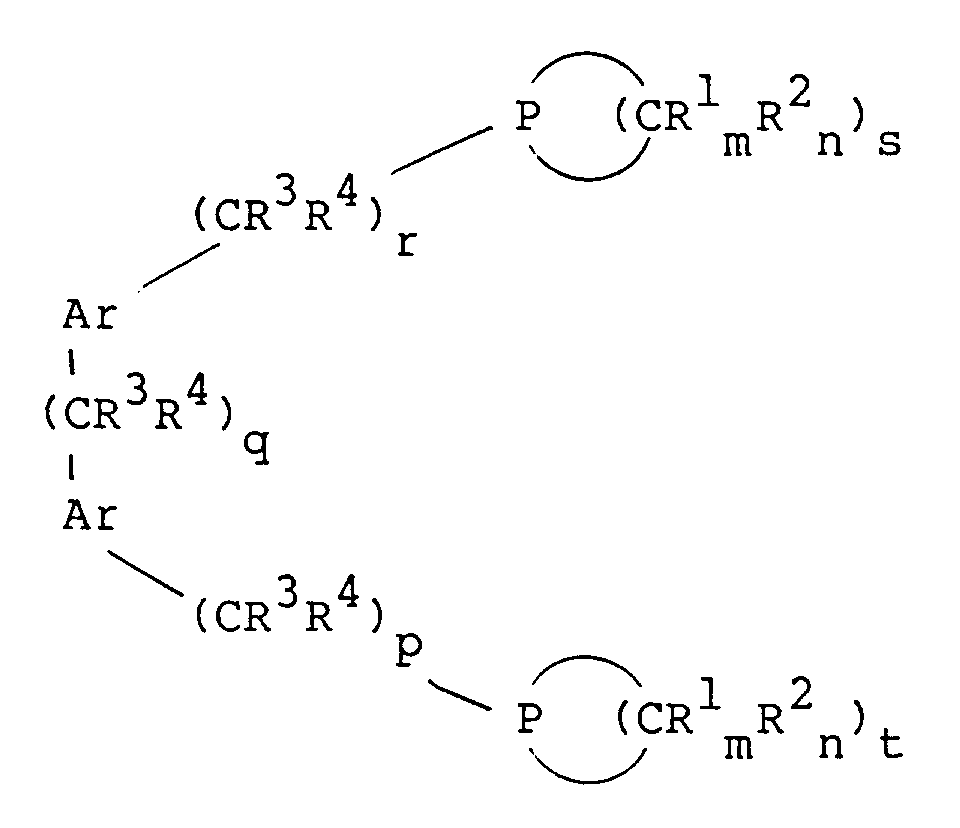
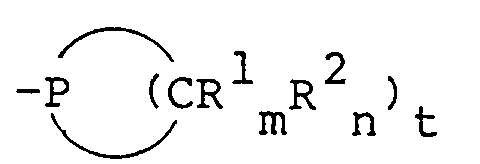
In der Formel sind die cyclischen Reste
und
gesättigt oder einfach oder mehrfach ungesättigt und fünf- oder sechsgliedrig, R³ und R⁴ sind gleich oder verschieden und bedeuten Wasserstoff oder den Methylrest, R¹ und R² sind ebenfalls gleich oder verschieden und stehen für Wasserstoff, einen Alkyl-, Aralkyl- oder Alkoxyrest mit jeweils 1 bis 5 Kohlenstoffatomen oder für ein Halogenatom, R¹ und R² können auch für annelierte Benzol- oder Naphthalinringe stehen. m und n sind gleich oder verschieden und stehen für die Zahlen 0 oder 1, s und t sind gleich oder verschieden und stehen für die Zahlen 4 oder 5. p, q, r sind gleich oder verschieden und stehen für die Zahlen 0, 1, 2 oder 3, Ar schließlich bedeutet einen substituierten oder nicht substituierten aromatischen Rest mit 6 bis 18 Kohlenstoffatomen. - Als Liganden werden solche Verbindungen, die der oben wiedergegebenen allgemeinen Formel entsprechen bevorzugt, in denen p und r jeweils für die Zahl 1 stehen und q 0 oder 1 ist und in denen R³ und R⁴ Wasserstoff bedeuten.
- Der in der obigen Formel durch Ar charakterisierte aromatische Rest kann unsubstituiert oder substituiert sowie ein mehrkerniges oder kondensiertes Ringsystem sein. Bevorzugt steht Ar für einen jeweils nicht substituierten oder substituierten Phenylen-, Naphthylen-, Biphenylen- oder Binaphthylenrest.
- Die in den neuen Verbindungen enthaltenen P(III)-atome sind Bestandteil gesättigter oder ungesättigter fünf- oder sechsgliedriger heterocyclischer Verbindungen. Bevorzugt sind Heterocyclen, die neben dem Phosphoratom noch vier Kohlenstoffatome enthalten, also Verbindungen, die sich von substituierten oder nicht substituierten Phospholanen, Phospholinen und insbesondere Phospholen ableiten. Dementsprechend stehen in der allgemeinen Formel s und t bevorzugt für 4. R¹ und R² sind gleich oder verschieden und bedeuten vorzugsweise jeweils einen geradkettigen oder verzweigten Alkylrest mit bis zu 5 Kohlenstoffatomen, den Benzyl-, Phenethyl-, Tolyl-, Xylolyl oder Mesitylrest. R¹ und R² können auch für annelierte Benzol- oder Naphthalinringe stehen. Die Reste entsprechender Phosphor enthaltender Heterocyclen leiten sich z.B. von 2,3-Benzophospholen, 2,3,4,5-Dibenzophospholen, 2,3-Indenophosphol ab.
- Die neuen Verbindungen sind auf einfachem Wege in guten Ausbeuten zu erhalten. Eine bewährte Synthese ist die Phosphorylierung von Dihalogenalkylverbindungen der allgemeinen Formel

in der p, q, r, R³, R⁴ und Ar die vorstehend beschriebenen Bedeutungen haben und Hal ein Halogenatom, vorzugsweise Chlor oder Brom und insbesondere Brom bedeutet. Man gewinnt die Bromverbindungen z.B. aus den nichthalogenierten Grundsubstanzen durch Bromierung mit Hilfe von N-Bromsuccinimid. - Als Phosphorylierungsreagenz setzt man mit Erfolg Alkalimetallverbindungen mit heterocyclischem Phosphoranion ein. Ihre Herstellung erfolgt durch Umsetzung der am Phosphoratom phenylierten Heterocyclen mit einem Alkalimetall, vorzugsweise Lithium, Natrium oder Kalium und insbesondere mit einer Natrium-/Kaliumlegierung. Das Metallderivat ergibt, mit der Dihalogenverbindung umgesetzt, die gewünschten cyclischen Phosphorverbindungen.
- Die erfindungsgemäßen Phosphorverbindungen bilden als zweizähniger Ligand Komplexverbindungen mit zahlreichen Metallatomen. Unter ihnen haben die Komplexverbindungen des Rhodiums besondere Bedeutung als hochaktive Katalysatoren für die Niederdruckhydroformylierung von Olefinen zu Aldehyden. Die Umsetzung ergibt einen sehr hohen Anteil geradkettiger Verbindungen gegenüber lediglich untergeordneten Mengen verzweigtkettiger Isomeren. Als Katalysatorkomponenten besonders bewährt haben sich die Verbindungen 2,2'-Bis(3,4-dimethylphospholmethylen)-1,1'-biphenyl und 2,2'-Bis(3,4-dimethylphospholmethylen)-1,1'-binaphthyl.
- Die Hydroformylierung von Olefinen unter Verwendung von Katalysatorsystemen aus Rhodium und den neuen Phosphor(III)-verbindungen erfolgt bei Drücken von etwa 0,1 bis etwa 6 MPa, vorzugsweise 0,5 bis 3 MPa und insbesondere 1,5 bis 2,0 MPa. Die Reaktionstemperatur kann etwa 20 bis etwa 200°C betragen, bevorzugt wird der Bereich von etwa 50 bis etwa 170°C und insbesondere etwa 80 bis etwa 150°C.
- Der Katalysator wird dem Reaktionsgemisch präformiert, zweckmäßig in einem Lösungsmittel gelöst, zugeführt oder aber aus den Komponenten unter den Bedingungen der Hydroformylierungsreaktion im Gemisch der Reaktanten gebildet. Sowohl bei der vorherigen, als auch im Falle der in-situ-Herstellung des Katalysators kann das Rhodium als Metall in fein verteilter Form oder als Verbindung, z.B. den Oxiden, den Salzen anorganischer oder organischer Säuren oder als Carbonyl eingesetzt werden.
- Die erforderlichen Rhodiummengen sind sehr gering, schon etwa 1 x 10⁻⁶ mol Rh je mol Olefin sind wirksam. Aus wirtschaftlichen Gründen, Steigerung der Reaktionsgeschwindigkeit, wendet man jedoch bevorzugt etwa 1 x 10⁻² bis etwa 1 x 10⁻⁵ mol und insbesondere 1 x 10⁻² bis 1 x 10⁻⁴ mol Rh je mol Olefin an. Das molare Verhältnis von Rhodium zu Ligand im Reaktionsgemisch beträgt etwa 1 zu 1 bis 200, vorzugsweise etwa 1 zu 2 bis 10 und insbesondere etwa 1 zu 2,5 bis 4.
- Synthesegas und Olefin werden im Maße ihres Verbrauchs dem Reaktor kontinuierlich zugeführt. Das molare Verhältnis von Kohlenmonoxid und Wasserstoff im Synthesegas kann in weiten Bereichen variieren und etwa 1 zu 10 bis etwa 10 zu 1 betragen, wobei die Art des umzusetzenden Olefins Einfluß auf das zu wählende Verhältnis haben kann. Bevorzugt werden Gemische, die Kohlenmonoxid und Wasserstoff im Verhältnis von etwa 1 zu 2 bis etwa 2 zu 1 und insbesondere etwa 1 zu 1,5 bis 1,5 zu 1 enthalten. Synthesegas wird, bezogen auf Olefin, immer im Überschuß eingesetzt, ein molarer Überschuß von Synthesegas (CO+H₂), bezogen auf Olefin von etwa 0,5 bis etwa 20, ist gebräuchlich, von etwa 1 bis etwa 10 bevorzugt.
- Die Umsetzung kann in Gegenwart von Lösungsmitteln durchgeführt werden, die unter den Reaktionsbedingungen inert gegenüber Reaktanten und Produkten sind. Zu diesen Lösungsmitteln zählen z.B. aromatische Kohlenwasserstoffe wie Benzol, Toluol, Xylol, aliphatische Kohlenwasserstoffe wie Pentane, Kerosin und Mineralöle sowie Alkohole, Ether und Ester.
- Die Hydroformylierung erfolgt in konventionellen Reaktoren, sie kann kontinuierlich oder absatzweise erfolgen. Bei kontinuierlicher Reaktionsführung wird das Produkt laufend zusammen mit nicht umgesetztem Synthesegas abgezogen, aus der Gasphase durch Kondensation abgeschieden und konventionell weiterbehandelt, z.B. destillativ gereinigt. Das Synthesegas wird in die Reaktionszone zurückgeführt. Um die Aktivität des Katalysatorsystems auf gleichmäßig hohem Niveau zu halten kann es sich empfehlen, von Zeit zu Zeit Katalysator aus dem Reaktor abzuziehen und durch frischen Katalysator zu ersetzen.
- Die neue Klasse zweizähniger Liganden wird, zusammen mit Rhodium, mit Erfolg bei der Hydroformylierung unterschiedlicher Olefine eingesetzt. Zu ihnen gehören α-Olefine mit 2 bis 20 Kohlenstoffatomen, die unter Reaktionsbedingungen inerte Substituenten enthalten können. Beispiele für geeignete Olefine sind Ethylen, Propylen, Buten-1, Buten-2, ferner die Pentene, Hexene und Heptene. Besondere Bedeutung haben die neuen Liganden wegen ihrer Stereospezifität bei der Hydroformylierung prochiraler Olefine.
- Die folgenden Beispiele erläutern die Erfindung, ohne sie auf die näher beschriebenen Ausführungsformen zu beschränken.
- In einem 1000 ml Rührkolben werden unter Stickstoff 44,7 g (250 mmol) Phenyldichlorphenylphosphin und 66,9 g (250 mmol) Phenyldibromphosphin 30 min bei Raumtemperatur zusammen gerührt. Dann gibt man zu der homogenen Lösung unter Eiskühlung 42,0 g (511 mmol) Dimethylbutadien und rührt unter weiterer Kühlung 24 h. Die entstehende Suspension läßt man weitere 10 d bei Raumtemperatur stehen. Sie wandelt sich dabei vollständig in eine weiße, kristalline Masse um, die im Kolben in möglichst kleine Stücke zerteilt und mit 300 ml Hexan und 200 ml Dichlomethan überschichtet wird.
- Durch Einblasen von Stickstoff über einen Zeitraum von 30 min wird die Suspension von überschüssigem Dimethylbutadien befreit. Unter starkem Rühren fügt man bei Raumtemperatur tropfenweise eine Lösung von 103 g (1094 mmol) 2-Methylpyridin in 100 ml Dichlormethan zu. Im Verlauf von 24 h entsteht eine Mischung, die sich in zwei flüssige Phasen trennen läßt. Nach der Hydrolyse mit 100 ml 3 n Salzsäure trennt man die organische Phase ab und wäscht dreimal mit 100 ml Wasser bis zur Neutralität. Man trocknet über Natriumsulfat, filtriert und dampft ein. Die zurückbleibende Flüssigkeit wird mit 300 ml Hexan extrahiert, der Extrakt filtriert und eingedampft. Das so erhaltene gelbe Öl bedarf keiner weiteren Reinigung.
Ausbeute: 71,17 g (378 mmol, 74,15 % der Theorie).
³¹P-NMR (161,8 MHz, DC₂Cl₂): = -1,3 ppm (s, 1P). - In einem 500 cm³-Kolben werden zu 18.59 g (0.75 mol) Mg-Späne in 200 ml Tetrahydrofuran über einen Zeitraum von 1 h unter Rühren 70 ml (0.6 mol) 2-Chlortoluol und 2 ml 1,2-Dibromethan getropft, wobei Graufärbung und schwache Erwärmung erfolgen. Anschließend erhitzt man 18 h unter Rückfluß. Die Suspension wird nach dem Abkühlen über Glaswolle filtriert und zu einer Lösung von 70 ml (0.6 mol) 2-Chlortoluol und 3.0 g (4.5 mmol) cis-Dichloro-bis(triphenylphosphin)nickel(II) in 250 ml Tetrahydrofuran über 2 h bei Raumtemperatur getropft. Nach 20 h Erhitzen unter Rückfluß wird die Flüssigkeit in einen 1000-cm³-Scheidetrichter gegeben und durch vorsichtige Zugabe von 400 ml Toluol und 200 ml einer gesättigten, wäßrigen Ammoniumchloridlösung langsam abgekühlt. Die organische Phase wird abgetrennt und sukzessive mit 250 ml 10 Gew.-%iger HCl und dreimal mit je 125 ml Wasser gewaschen. Das Lösungsmittel wird im Vakuum einer Ölpumpe entfernt, wobei ein braun-gelbes Öl zurückbleibt. Destillation bei 66,7 bis 133,3 Pa liefert das erwünschte Produkt als farblose Flüssigkeit in einem Siedetemperaturbereich von 75 - 77°C.
Ausbeute: 77.31 g (70.7 % der Theorie).
GC-Massenspektrum (AS 60, Retentionszeit 12.796 min): m/z = 182 (55%, [(M)⁺.]), 167 (100%, [(M-CH₃)⁺.]), 152 (20%, [(C₁₂H₈)⁺.]), 128 (10%), 115 (12%), 89 (18%), 76 (10%, [(C₆H₄)⁺.]), 63 (15%), 39 (18%), 27 (12%). - Zu 7.1 g (0.039 mol) 2,2'-Bismethyl-1,1'-biphenyl in 15 ml Tetrachlorkohlenstoff werden 20.0 g (0.11 mol) N-Bromosuccinimid und 0.2 g Azo-iso-butyronitril gegeben und unter leichtem Rückfluß erhitzt. Nach 9 h wird das Succinimid bei Raumtemperatur über eine G3 Glasfritte abfiltriert und die zurückbleibende Flüssigkeit bei 40°C im Ölpumpenvakuum zu einem zähen, gelben Öl eingeengt. Das Produkt wird durch Umkristallisieren aus 15 ml Ligroin in Form feiner, weißer Kristalle erhalten, die über eine G4 Glasfritte abfiltriert und im Ölpumpenvakuum getrocknet werden.
Ausbeute: 11.5 g (84 % der Theorie)
Schmelzpunkt: 82°C
GC-Massenspektrum (SA60, Retentionszeit 17.273 min): m/z = 340 (6%, [(M)⁺.]), 259 (15%, [(M-Br)⁺.]), 179 (100%, [(M-2*Br)⁺.]), 152 (12%, [(C₁₂H₈)⁺.].Elementaranalyse: (C₁₄H₁₂Br₂; 340.07) Ber. C 49.45 H 3.55 Br 47.00, Gef. C 49.20 H 3.58 Br 46.09 - 1.88 g (10 mmol) 1-Phenyl-3,4-dimethylphosphol in 40 ml Tetrahydrofuran werden langsam mit 0.62 g (20 mmol) Natrium/Kalium-Legierung bei Raumtemperatur portionsweise unter starkem Rühren versetzt. Nach 2 h wird überschüssige Metallegierung über Glaswolle filtriert. Die dunkelbraune Suspension wird auf -30°C gekühlt und mit 0.16 g (0.19 ml, 17 mmol) 2-Chloro-2-methylpropan versetzt. Erwärmen innerhalb 1 h führt zu einer dunkelroten Suspension, die ohne Isolierung des Produkts weiterverarbeitet wird. Nach ³¹P-NMR erfolgt die Umsetzung quantitativ.
³¹P-{1H}-NMR (CDCl₃): δ = 55.40 ppm (s, 1P), 52.36 ppm (s, 1P). - Zu 15.8 g (84 mmol) in 150 ml Tetrahydrofuran suspendiertem (3,4-Dimethylphospholyl)-natrium/kalium werden 12.0 g (35 mmol) 2,2'-Bis(bromomethyl)-1,1'-biphenyl in 30 ml Tetrahydrofuran getropft. Nach 12 h Rühren verfärbt sich die Suspension von dunkelrot nach hellbraun und das Lösungsmittel wird im Vakuum einer Ölpumpe entfernt. Der zurückbleibende braune Rückstand wird in Toluol aufgenommen, wobei KBr und NaBr ausfallen. Die überstehende, klare Lösung wird zu einem dunkelbraunen Öl eingeengt und das Produkt durch Umkristallisation mit 10 ml Ethanol als weißes, mikrokristallines Pulver gewonnen.
Ausbeute: 8.52 g (21 mmol, 60 % der Theorie)
Schmelzpunkt: 120°C
Massenspektrum (CI): m/e = 402.2 (36.99%, [(M)⁺.]), 291.2 (14.87%, [(M-C₄H₁₀P)⁺.]), 179.1 (4.14%, [(M-2*C₄H₁₀P)⁺.]), 154 (2.66%, [(M-2*C₅H₁₁P⁺.])
³¹P-{1H}-NMR (CDCl₃): δ = 3.99 (s, 2P)
¹H-NMR (CDCl₃): δ = 0.89 (t, 6H, -CH₃, 2J(H,H) = 7.4 Hz), 1.19 (t, 6H, -C'H₃, ²J(H,H) = 7.4 Hz), 1.54 (dd, 2 H, - CHaHb-, ²J(H,H) = 14.8 Hz, ²J(P,H) = 6.78 Hz), 1.97 (d, 2 H, -CHaHb-, ²J(H,H) = 20.34 Hz) 3.55 (7, 2 H, :CH-, ²J(P,H) = 6.78), 3.67 (t, 2 H, :C'H-, ²J(P,H) = 6.78), 8.6 (m, 8 H, Aromat)Elementaranalyse: (C₂₆H₂₈P₂; 402.26) Ber. C 77.60 H 7.00 P 15.39 Gef. C 77.08 H 7.05 P 15.68 - 83.8 g (0.379 mol) 1-Bromo-2-methylnapthalin, gelöst in 150 ml Ether und 150 ml Benzol, werden bei Raumtemperatur langsam zu 10 g (0,415 mol) Magnesiumspänen (zuvor mit wenigen Tropfen 1,2-Dibromethan versetzt), suspendiert in 30 ml Ether, getropft. Das Zutropfen des halogenierten Aromaten erfolgt über einen Zeitraum von 4 h. Die Zutropfgeschwindigkeit wird dabei so gewählt, daß der Reaktionsansatz immer handwarm bleibt. Anschließend wird das Reaktionsgemisch noch eine Stunde am Rückfluß erhitzt und weiter über Nacht bei Raumtemperatur gerührt. Die Suspension wird aus einem Tropftrichter portionssweise zu 74 g (0,335 mol) 1-Bromo-2-methylnaphthalin, gelöst in 250 ml Ether und 2,5 g (3,8 mmol) [(PPh₃)₂Ni]Cl₂ (Kupplungskatalysator) gegeben. Darauf erhitzt man 24 h unter Rückfluß, kühlt auf Raumtemperatur ab und hydrolysiert mit 200 ml Wasser und 200 ml 20 Gew.-%iger Salzsäure. Die von der wäßrigen Phase getrennte organische Phase wird noch zweimal mit 200 ml Wasser nachgewaschen, erneut abgetrennt und mit Magnesiumsulfat getrocknet. Die organischen Lösungsmittel werden im Vakuum abgezogen, der Rückstand wird über eine kleine Vigreux-Kolonne bei Drücken < 1,3 Pa destilliert. Die gewünschte Verbindung geht unter den gegebenen Bedingungen in einem Bereich von 169 - 173°C als grünes Öl über, das mit 10 ml Aceton bei -18°C umkristallisiert wird.
Ausbeute: 74,9 g (0,265 mol, 69 % der Theorie) - 28,2 g (0,1 mol) 2,2'-Dimethyl-1,1'-binaphthyl werden mit 35,6 g (0,2 mol) N-Bromosuccinimid in 65 ml Tetrachlorkohlenstoff suspendiert. Unter Rückfluß werden 0,43 g Azo-iso-butyronitril in mehreren Anteilen über 4 h zugegeben und weitere 9 h unter Rückfluß erhitzt. Nach Abfiltrieren des Succinimids und Einengen des Filtrats bleibt ein gelbes, zähes Öl zurück. Es wird aus 20 ml Ligroin (Leichtbenzinmischung) umkristallisiert und der erwünschte weiße Feststoff abfiltriert.
Ausbeute: 35,55 g (0,08 mol, 80 % der Theorie)
¹H-NMR (CDCl₃): δ = 8,0 - 9,0 (m, aromat., 12 H), 5,3 ppm (s, CH₂, 4H) - Zu einer Suspension von 5,0 g (0,045 mol) 3,4-Dimethylphospholylanion in 120 ml Tetrahydrofuran, werden 9,9 g (0,022 mol) 2,2'-Bisbromomethyl-1,1'-binaphthyl in 20 ml Tetrahydrofuran über 2 h zugetropft. Nach 18 h Rühren bei Raumtemperatur wird das Lösungsmittel vollständig entfernt und der weiß-braune Rückstand mit 80 ml Toluol in einer Soxhlet-Apparatur extrahiert. Anschließendes Einengen führt zu einem braunen Öl, aus dem sich das Produkt als hellbrauner Feststoff durch Umkristallisieren mit 30 ml n-Hexan gewinnen läßt.
Ausbeute: 5,46 g (0,01 mol, 49 % der Theorie)
³¹P-{1H}-NMR (CDCl₃): δ = -5,4 ppm (s, 2P)
Massenspektrum (CI): m/e = 503,1 (5,6%, [(M)⁺.]), 391,1 (15,1% [(M-C₄H₁₀P)⁺.]), 281,1, (15,4%, [(M-2*C₄H₁₀P)⁺.]), 154 (2.66%, [(M-2*C₅H₁₁P)⁺.]).
Claims (12)
- Verbindungen der allgemeinen Formel


- Verbindungen nach Anspruch 1, dadurch gekennzeichnet, daß die Reste R³ und R⁴ für H stehen.
- Verbindungen nach Anspruch 1 oder 2, dadurch gekennzeichnet, daß die Reste R¹ und R² für Wasserstoff oder den Methylrest stehen.
- Verbindungen nach einem oder mehreren der Ansprüche 1 bis 3, dadurch gekennzeichnet, daß Ar ein Phenylen-, ein Naphthylen-, ein 1,1'-Biphenylen- oder ein 1,1'-Binaphthylenrest ist.
- Verbindungen nach einem oder mehreren der Ansprüche 1 bis 4, dadurch gekennzeichnet, daß s und t für die Zahl 4 steht.
- Verbindungen nach einem oder mehreren der Ansprüche 1 bis 5, dadurch gekennzeichnet, daß p und r gleich oder verschieden sind und für die Zahl 1 stehen.
- Verbindungen nach einem oder mehreren der Ansprüche 1 bis 6, dadurch gekennzeichnet, daß q für die Zahlen 0 oder 1 steht.
- Die chemische Verbindung 2,2'-Bis(3,4-dimethylphospholmethylen)-1,1'-biphenyl.
- Die chemische Verbindung 2,2'-Bis(3,4-dimethylphospholmethylen)-1,1'-binaphthyl.
- Verfahren zur Herstellung von Verbindungen nach einem oder mehreren der Ansprüche 1 bis 9, dadurch gekennzeichnet, daß man Verbindungen der allgemeinen Formel


- Verfahren nach Anspruch 10, dadurch gekennzeichnet, daß als Alkalimetalle eine Natrium-Kaliumlegierung eingesetzt wird.
- Verwendung von Verbindungen nach einem oder mehreren der Ansprüche 1 bis 9 als Bestandteil homogen löslicher Katalysatorsysteme.
Applications Claiming Priority (2)
| Application Number | Priority Date | Filing Date | Title |
|---|---|---|---|
| DE4333307A DE4333307A1 (de) | 1993-09-30 | 1993-09-30 | Cyclische Verbindungen des dreiwertigen Phosphors |
| DE4333307 | 1993-09-30 |
Publications (2)
| Publication Number | Publication Date |
|---|---|
| EP0646588A1 true EP0646588A1 (de) | 1995-04-05 |
| EP0646588B1 EP0646588B1 (de) | 2000-01-26 |
Family
ID=6499053
Family Applications (1)
| Application Number | Title | Priority Date | Filing Date |
|---|---|---|---|
| EP94115104A Expired - Lifetime EP0646588B1 (de) | 1993-09-30 | 1994-09-26 | Cyclische Verbindungen des dreiwertigen Phosphors |
Country Status (13)
| Country | Link |
|---|---|
| EP (1) | EP0646588B1 (de) |
| JP (1) | JP2644976B2 (de) |
| KR (1) | KR100350814B1 (de) |
| CN (1) | CN1106816A (de) |
| AT (1) | ATE189225T1 (de) |
| AU (1) | AU7430394A (de) |
| BR (1) | BR9403827A (de) |
| CA (1) | CA2132673A1 (de) |
| DE (2) | DE4333307A1 (de) |
| ES (1) | ES2143515T3 (de) |
| PL (1) | PL305159A1 (de) |
| TW (1) | TW283149B (de) |
| ZA (1) | ZA947456B (de) |
Cited By (8)
| Publication number | Priority date | Publication date | Assignee | Title |
|---|---|---|---|---|
| WO1997046507A1 (de) * | 1996-05-31 | 1997-12-11 | Basf Aktiengesellschaft | Verfahren zur hydroformylierung und dafür geeignete katalysatoren, die phosphorverbindungen als liganden enthalten |
| DE19702025A1 (de) * | 1997-01-23 | 1998-07-30 | Studiengesellschaft Kohle Mbh | Verwendung perfluoralkylsubstituierter Phosphorverbindungen als Liganden für die homogene Katalyse in überkritischem Kohlendioxid |
| WO2002000580A1 (de) * | 2000-06-26 | 2002-01-03 | Basf Aktiengesellschaft | Alkoholgemische mit 13 und 15 kohlenstoffatomen und deren verwendung in der herstellung von oberflächenaktiven substanzen |
| WO2002000669A3 (de) * | 2000-06-26 | 2002-06-20 | Basf Ag | Phosphacyclohexane und ihre verwendung in der hydroformylierung von olefinen |
| WO2002064249A3 (de) * | 2001-02-09 | 2003-03-20 | Basf Ag | Als katalysator oder zur herstellung eines katalysatorsystems geeignete verbindung abgeleitet von einem bis-phosphorinan |
| DE102008044783A1 (de) | 2008-08-28 | 2010-03-04 | Oxea Gmbh | Verfahren zur Gewinnung von aliphatischen C3- bis C10- Aldehyden aus Hochsiedern durch thermische Behandlung |
| DE102009004655A1 (de) | 2009-01-15 | 2010-07-22 | Oxea Gmbh | Verfahren zur Herstellung von Aldehyden |
| DE102009016651A1 (de) | 2009-04-07 | 2010-10-14 | Oxea Gmbh | Verfahren zur Herstellung von Aldehyden |
Families Citing this family (2)
| Publication number | Priority date | Publication date | Assignee | Title |
|---|---|---|---|---|
| US6794553B2 (en) * | 2001-11-09 | 2004-09-21 | Shell Oil Company | Process for the telomerization of a conjugated diene, catalyst and bidentate ligand useful therein |
| CN106083551A (zh) * | 2016-06-30 | 2016-11-09 | 成都欣华源科技有限责任公司 | 一种丙烯氢甲酰化制备丁醛的方法 |
Citations (5)
| Publication number | Priority date | Publication date | Assignee | Title |
|---|---|---|---|---|
| WO1987007600A2 (en) * | 1986-06-13 | 1987-12-17 | Eastman Kodak Company | Chelate ligands for low pressure hydroformylation catalyst and process employing same |
| WO1992019630A1 (en) * | 1991-04-26 | 1992-11-12 | E.I. Du Pont De Nemours And Company | Chiral tridentate bis(phospholane) ligands |
| US5171892A (en) * | 1991-07-02 | 1992-12-15 | E. I. Du Pont De Nemours And Company | Chiral phospholanes via chiral 1,4-diol cyclic sulfates |
| WO1993015089A1 (de) * | 1992-01-31 | 1993-08-05 | F. Hoffmann-La Roche Ag | Diphosphinliganden |
| EP0627439A1 (de) * | 1993-06-01 | 1994-12-07 | Eastman Chemical Company | Hydroformylierungs-Verfahren unter Benutzung eines neuen Phosphin-Rhodium Katalysator-Systems |
-
1993
- 1993-09-30 DE DE4333307A patent/DE4333307A1/de not_active Withdrawn
-
1994
- 1994-07-22 TW TW083106718A patent/TW283149B/zh active
- 1994-09-22 CA CA002132673A patent/CA2132673A1/en not_active Abandoned
- 1994-09-22 JP JP6228268A patent/JP2644976B2/ja not_active Expired - Lifetime
- 1994-09-23 BR BR9403827A patent/BR9403827A/pt not_active IP Right Cessation
- 1994-09-23 PL PL94305159A patent/PL305159A1/xx unknown
- 1994-09-23 ZA ZA947456A patent/ZA947456B/xx unknown
- 1994-09-23 KR KR1019940023934A patent/KR100350814B1/ko not_active Expired - Fee Related
- 1994-09-26 DE DE59409100T patent/DE59409100D1/de not_active Expired - Fee Related
- 1994-09-26 EP EP94115104A patent/EP0646588B1/de not_active Expired - Lifetime
- 1994-09-26 AT AT94115104T patent/ATE189225T1/de not_active IP Right Cessation
- 1994-09-26 ES ES94115104T patent/ES2143515T3/es not_active Expired - Lifetime
- 1994-09-27 CN CN94116587A patent/CN1106816A/zh active Pending
- 1994-09-28 AU AU74303/94A patent/AU7430394A/en not_active Abandoned
Patent Citations (5)
| Publication number | Priority date | Publication date | Assignee | Title |
|---|---|---|---|---|
| WO1987007600A2 (en) * | 1986-06-13 | 1987-12-17 | Eastman Kodak Company | Chelate ligands for low pressure hydroformylation catalyst and process employing same |
| WO1992019630A1 (en) * | 1991-04-26 | 1992-11-12 | E.I. Du Pont De Nemours And Company | Chiral tridentate bis(phospholane) ligands |
| US5171892A (en) * | 1991-07-02 | 1992-12-15 | E. I. Du Pont De Nemours And Company | Chiral phospholanes via chiral 1,4-diol cyclic sulfates |
| WO1993015089A1 (de) * | 1992-01-31 | 1993-08-05 | F. Hoffmann-La Roche Ag | Diphosphinliganden |
| EP0627439A1 (de) * | 1993-06-01 | 1994-12-07 | Eastman Chemical Company | Hydroformylierungs-Verfahren unter Benutzung eines neuen Phosphin-Rhodium Katalysator-Systems |
Cited By (10)
| Publication number | Priority date | Publication date | Assignee | Title |
|---|---|---|---|---|
| WO1997046507A1 (de) * | 1996-05-31 | 1997-12-11 | Basf Aktiengesellschaft | Verfahren zur hydroformylierung und dafür geeignete katalysatoren, die phosphorverbindungen als liganden enthalten |
| DE19702025A1 (de) * | 1997-01-23 | 1998-07-30 | Studiengesellschaft Kohle Mbh | Verwendung perfluoralkylsubstituierter Phosphorverbindungen als Liganden für die homogene Katalyse in überkritischem Kohlendioxid |
| WO2002000580A1 (de) * | 2000-06-26 | 2002-01-03 | Basf Aktiengesellschaft | Alkoholgemische mit 13 und 15 kohlenstoffatomen und deren verwendung in der herstellung von oberflächenaktiven substanzen |
| WO2002000669A3 (de) * | 2000-06-26 | 2002-06-20 | Basf Ag | Phosphacyclohexane und ihre verwendung in der hydroformylierung von olefinen |
| WO2002064249A3 (de) * | 2001-02-09 | 2003-03-20 | Basf Ag | Als katalysator oder zur herstellung eines katalysatorsystems geeignete verbindung abgeleitet von einem bis-phosphorinan |
| US7105689B2 (en) | 2001-02-09 | 2006-09-12 | Basf Aktiengesellschaft | Compound suitable for use as a catalyst or for producing a catalyst system derived from a bis-phosphorinane |
| DE102008044783A1 (de) | 2008-08-28 | 2010-03-04 | Oxea Gmbh | Verfahren zur Gewinnung von aliphatischen C3- bis C10- Aldehyden aus Hochsiedern durch thermische Behandlung |
| DE102009004655A1 (de) | 2009-01-15 | 2010-07-22 | Oxea Gmbh | Verfahren zur Herstellung von Aldehyden |
| DE102009016651A1 (de) | 2009-04-07 | 2010-10-14 | Oxea Gmbh | Verfahren zur Herstellung von Aldehyden |
| WO2010115509A1 (de) | 2009-04-07 | 2010-10-14 | Oxea Gmbh | Verfarhen zur herstellung von aldehyden |
Also Published As
| Publication number | Publication date |
|---|---|
| JPH07173183A (ja) | 1995-07-11 |
| DE4333307A1 (de) | 1995-04-06 |
| KR950008526A (ko) | 1995-04-19 |
| JP2644976B2 (ja) | 1997-08-25 |
| PL305159A1 (en) | 1995-04-03 |
| ZA947456B (en) | 1995-05-15 |
| EP0646588B1 (de) | 2000-01-26 |
| ATE189225T1 (de) | 2000-02-15 |
| BR9403827A (pt) | 1995-05-30 |
| CN1106816A (zh) | 1995-08-16 |
| DE59409100D1 (de) | 2000-03-02 |
| CA2132673A1 (en) | 1995-03-31 |
| AU7430394A (en) | 1995-04-13 |
| ES2143515T3 (es) | 2000-05-16 |
| KR100350814B1 (ko) | 2002-10-31 |
| TW283149B (de) | 1996-08-11 |
Similar Documents
| Publication | Publication Date | Title |
|---|---|---|
| DE19717359B4 (de) | Bisphosphitverbindungen und Verfahren zu deren Herstellung | |
| DE10114868C1 (de) | Verfahren zur Herstellung von Diphosphinen und deren Verwendung | |
| EP0647648A1 (de) | Optisch aktive phosphorverbindungen | |
| EP0579797B1 (de) | Diphosphinliganden | |
| EP0263259B1 (de) | Verfahren und Katalysatorsystem zur Trimerisierung von Acetylen und Acetylenverbindungen | |
| WO1993015089A1 (de) | Diphosphinliganden | |
| DE69412309T2 (de) | Phosphinverbindung und diese als Ligand enthaltender Übergangsmetall-Phosphinkomplex | |
| DE69203629T2 (de) | Optisch-aktive Diphenylphosphinobinaphtyl-Verbindungen und katalytische Übergangsmetalkomplexe davon. | |
| EP0646588B1 (de) | Cyclische Verbindungen des dreiwertigen Phosphors | |
| DE68904558T2 (de) | Verfahren zu herstellung von bidentatliganden. | |
| DE19523335A1 (de) | Verfahren zur Herstellung von ungesättigten Alkoholen | |
| EP0345653B1 (de) | Übergangsmetallkomplexe | |
| DE19983354C2 (de) | Verfahren zur Hydroformylierung | |
| EP2207783A1 (de) | Verfahren zur hydroformylierung | |
| DE69709159T2 (de) | Kreuz-dimierisierung von olefinen | |
| EP1311517A1 (de) | Cycloaliphatisch-aromatische diphosphine und ihre verwendung in der katalyse | |
| DE10085448B4 (de) | Alkenylphosphonsäureester und Verfahren zu ihrer Herstellung | |
| EP2147007A1 (de) | Stabile katalysatorvorstufe von rh-komplexkatalysatoren | |
| US4166076A (en) | Cyclodimerization of isoprene | |
| EP0491240B1 (de) | Verfahren zur Herstellung wasserlöslicher sulfonierter Diphosphane | |
| DE4427836A1 (de) | Verbindungen aus der Reihe der Phosphane, Verfahren zu ihrer Herstellung sowie ihre Verwendung | |
| US4189403A (en) | Catalyst for cyclodimerization of isoprene | |
| DE102004052725B4 (de) | Verfahren zur Herstellung substituierter Phosphane und nach dem Verfahren hergestellte substituierte Phosphane | |
| EP1152005B1 (de) | Verfahren zur Herstellung von substituierten 10-Chlor-phenoxaphosphinen oder 10-Brom-phenoxaphosphinen | |
| EP0570869B1 (de) | Phosphinigsäure-arylester |
Legal Events
| Date | Code | Title | Description |
|---|---|---|---|
| PUAI | Public reference made under article 153(3) epc to a published international application that has entered the european phase |
Free format text: ORIGINAL CODE: 0009012 |
|
| AK | Designated contracting states |
Kind code of ref document: A1 Designated state(s): AT BE DE ES FR GB IT NL SE |
|
| RIN1 | Information on inventor provided before grant (corrected) |
Inventor name: MANETSBERGER, RAINER DR. Inventor name: ALBANESE, GUIDO Inventor name: HERRMANN, WOLFGANG A., PROF. DR. Inventor name: LAPPE, PETER, DR. Inventor name: BAHRMANN, HELMUT, DR. |
|
| 17P | Request for examination filed |
Effective date: 19951005 |
|
| RAP1 | Party data changed (applicant data changed or rights of an application transferred) |
Owner name: CELANESE GMBH |
|
| 17Q | First examination report despatched |
Effective date: 19980617 |
|
| RTI1 | Title (correction) |
Free format text: CYCLIC DERIVATIVES OF TRIVALENT PHOSPHORUS |
|
| GRAG | Despatch of communication of intention to grant |
Free format text: ORIGINAL CODE: EPIDOS AGRA |
|
| GRAG | Despatch of communication of intention to grant |
Free format text: ORIGINAL CODE: EPIDOS AGRA |
|
| GRAH | Despatch of communication of intention to grant a patent |
Free format text: ORIGINAL CODE: EPIDOS IGRA |
|
| GRAH | Despatch of communication of intention to grant a patent |
Free format text: ORIGINAL CODE: EPIDOS IGRA |
|
| GRAA | (expected) grant |
Free format text: ORIGINAL CODE: 0009210 |
|
| AK | Designated contracting states |
Kind code of ref document: B1 Designated state(s): AT BE DE ES FR GB IT NL SE |
|
| RAP1 | Party data changed (applicant data changed or rights of an application transferred) |
Owner name: CELANESE CHEMICALS EUROPE GMBH |
|
| REF | Corresponds to: |
Ref document number: 189225 Country of ref document: AT Date of ref document: 20000215 Kind code of ref document: T |
|
| REF | Corresponds to: |
Ref document number: 59409100 Country of ref document: DE Date of ref document: 20000302 |
|
| ITF | It: translation for a ep patent filed | ||
| REG | Reference to a national code |
Ref country code: ES Ref legal event code: FG2A Ref document number: 2143515 Country of ref document: ES Kind code of ref document: T3 |
|
| GBT | Gb: translation of ep patent filed (gb section 77(6)(a)/1977) |
Effective date: 20000425 |
|
| ET | Fr: translation filed | ||
| PG25 | Lapsed in a contracting state [announced via postgrant information from national office to epo] |
Ref country code: GB Free format text: LAPSE BECAUSE OF NON-PAYMENT OF DUE FEES Effective date: 20000926 Ref country code: AT Free format text: LAPSE BECAUSE OF NON-PAYMENT OF DUE FEES Effective date: 20000926 |
|
| PLBE | No opposition filed within time limit |
Free format text: ORIGINAL CODE: 0009261 |
|
| STAA | Information on the status of an ep patent application or granted ep patent |
Free format text: STATUS: NO OPPOSITION FILED WITHIN TIME LIMIT |
|
| 26N | No opposition filed | ||
| GBPC | Gb: european patent ceased through non-payment of renewal fee |
Effective date: 20000926 |
|
| PGFP | Annual fee paid to national office [announced via postgrant information from national office to epo] |
Ref country code: SE Payment date: 20010827 Year of fee payment: 8 Ref country code: NL Payment date: 20010827 Year of fee payment: 8 |
|
| PGFP | Annual fee paid to national office [announced via postgrant information from national office to epo] |
Ref country code: ES Payment date: 20010918 Year of fee payment: 8 |
|
| PGFP | Annual fee paid to national office [announced via postgrant information from national office to epo] |
Ref country code: BE Payment date: 20010919 Year of fee payment: 8 |
|
| PG25 | Lapsed in a contracting state [announced via postgrant information from national office to epo] |
Ref country code: SE Free format text: LAPSE BECAUSE OF NON-PAYMENT OF DUE FEES Effective date: 20020927 Ref country code: ES Free format text: LAPSE BECAUSE OF NON-PAYMENT OF DUE FEES Effective date: 20020927 |
|
| PG25 | Lapsed in a contracting state [announced via postgrant information from national office to epo] |
Ref country code: BE Free format text: LAPSE BECAUSE OF NON-PAYMENT OF DUE FEES Effective date: 20020930 |
|
| BERE | Be: lapsed |
Owner name: *CELANESE CHEMICALS EUROPE G.M.B.H. Effective date: 20020930 |
|
| PG25 | Lapsed in a contracting state [announced via postgrant information from national office to epo] |
Ref country code: NL Free format text: LAPSE BECAUSE OF NON-PAYMENT OF DUE FEES Effective date: 20030401 |
|
| EUG | Se: european patent has lapsed | ||
| REG | Reference to a national code |
Ref country code: ES Ref legal event code: FD2A Effective date: 20031011 |
|
| PGFP | Annual fee paid to national office [announced via postgrant information from national office to epo] |
Ref country code: FR Payment date: 20050823 Year of fee payment: 12 |
|
| PGFP | Annual fee paid to national office [announced via postgrant information from national office to epo] |
Ref country code: DE Payment date: 20050912 Year of fee payment: 12 |
|
| PG25 | Lapsed in a contracting state [announced via postgrant information from national office to epo] |
Ref country code: IT Free format text: LAPSE BECAUSE OF NON-PAYMENT OF DUE FEES;WARNING: LAPSES OF ITALIAN PATENTS WITH EFFECTIVE DATE BEFORE 2007 MAY HAVE OCCURRED AT ANY TIME BEFORE 2007. THE CORRECT EFFECTIVE DATE MAY BE DIFFERENT FROM THE ONE RECORDED. Effective date: 20050926 |
|
| PG25 | Lapsed in a contracting state [announced via postgrant information from national office to epo] |
Ref country code: DE Free format text: LAPSE BECAUSE OF NON-PAYMENT OF DUE FEES Effective date: 20070403 |
|
| REG | Reference to a national code |
Ref country code: FR Ref legal event code: ST Effective date: 20070531 |
|
| PG25 | Lapsed in a contracting state [announced via postgrant information from national office to epo] |
Ref country code: FR Free format text: LAPSE BECAUSE OF NON-PAYMENT OF DUE FEES Effective date: 20061002 |