EP0651700B1 - Textile oberböden in kraftfahrzeugen - Google Patents
Textile oberböden in kraftfahrzeugen Download PDFInfo
- Publication number
- EP0651700B1 EP0651700B1 EP93915764A EP93915764A EP0651700B1 EP 0651700 B1 EP0651700 B1 EP 0651700B1 EP 93915764 A EP93915764 A EP 93915764A EP 93915764 A EP93915764 A EP 93915764A EP 0651700 B1 EP0651700 B1 EP 0651700B1
- Authority
- EP
- European Patent Office
- Prior art keywords
- foam
- mixture
- binder
- process according
- layer
- Prior art date
- Legal status (The legal status is an assumption and is not a legal conclusion. Google has not performed a legal analysis and makes no representation as to the accuracy of the status listed.)
- Expired - Lifetime
Links
- 239000004753 textile Substances 0.000 title claims abstract description 33
- 239000006260 foam Substances 0.000 claims abstract description 60
- 239000011230 binding agent Substances 0.000 claims abstract description 35
- 239000000203 mixture Substances 0.000 claims abstract description 26
- 238000000034 method Methods 0.000 claims abstract description 18
- 230000003213 activating effect Effects 0.000 claims abstract description 4
- 238000003825 pressing Methods 0.000 claims abstract description 4
- 239000010410 layer Substances 0.000 claims description 25
- 239000012790 adhesive layer Substances 0.000 claims description 10
- 239000000853 adhesive Substances 0.000 claims description 7
- 230000001070 adhesive effect Effects 0.000 claims description 7
- -1 polypropylene Polymers 0.000 claims description 6
- 239000004743 Polypropylene Substances 0.000 claims description 4
- 239000000835 fiber Substances 0.000 claims description 4
- 239000004816 latex Substances 0.000 claims description 4
- 229920000126 latex Polymers 0.000 claims description 4
- 229920001155 polypropylene Polymers 0.000 claims description 4
- 229920002943 EPDM rubber Polymers 0.000 claims description 3
- 239000000945 filler Substances 0.000 claims description 3
- 239000004814 polyurethane Substances 0.000 claims description 3
- 238000010345 tape casting Methods 0.000 claims description 3
- 239000004831 Hot glue Substances 0.000 claims description 2
- 239000004698 Polyethylene Substances 0.000 claims description 2
- 239000000839 emulsion Substances 0.000 claims description 2
- 239000005011 phenolic resin Substances 0.000 claims description 2
- 229920000573 polyethylene Polymers 0.000 claims description 2
- 229920000098 polyolefin Polymers 0.000 claims description 2
- 229920002635 polyurethane Polymers 0.000 claims description 2
- XLYOFNOQVPJJNP-UHFFFAOYSA-N water Chemical compound O XLYOFNOQVPJJNP-UHFFFAOYSA-N 0.000 claims description 2
- 239000011159 matrix material Substances 0.000 claims 1
- 238000002360 preparation method Methods 0.000 claims 1
- 238000010521 absorption reaction Methods 0.000 abstract description 22
- 239000011888 foil Substances 0.000 abstract description 6
- 238000004519 manufacturing process Methods 0.000 description 5
- 239000000463 material Substances 0.000 description 5
- 229920001169 thermoplastic Polymers 0.000 description 4
- 239000004416 thermosoftening plastic Substances 0.000 description 4
- 229920005830 Polyurethane Foam Polymers 0.000 description 3
- 230000005540 biological transmission Effects 0.000 description 3
- 239000011496 polyurethane foam Substances 0.000 description 3
- 238000013016 damping Methods 0.000 description 2
- 230000000694 effects Effects 0.000 description 2
- 238000009413 insulation Methods 0.000 description 2
- 239000002699 waste material Substances 0.000 description 2
- KXGFMDJXCMQABM-UHFFFAOYSA-N 2-methoxy-6-methylphenol Chemical compound [CH]OC1=CC=CC([CH])=C1O KXGFMDJXCMQABM-UHFFFAOYSA-N 0.000 description 1
- 229920002261 Corn starch Polymers 0.000 description 1
- JOYRKODLDBILNP-UHFFFAOYSA-N Ethyl urethane Chemical compound CCOC(N)=O JOYRKODLDBILNP-UHFFFAOYSA-N 0.000 description 1
- 229920002472 Starch Polymers 0.000 description 1
- 240000008042 Zea mays Species 0.000 description 1
- 235000005824 Zea mays ssp. parviglumis Nutrition 0.000 description 1
- 235000002017 Zea mays subsp mays Nutrition 0.000 description 1
- 230000004913 activation Effects 0.000 description 1
- 239000002131 composite material Substances 0.000 description 1
- 235000005822 corn Nutrition 0.000 description 1
- 230000008878 coupling Effects 0.000 description 1
- 238000010168 coupling process Methods 0.000 description 1
- 238000005859 coupling reaction Methods 0.000 description 1
- 230000001419 dependent effect Effects 0.000 description 1
- 230000006866 deterioration Effects 0.000 description 1
- 238000011161 development Methods 0.000 description 1
- 230000018109 developmental process Effects 0.000 description 1
- 244000144992 flock Species 0.000 description 1
- 238000010438 heat treatment Methods 0.000 description 1
- 238000002347 injection Methods 0.000 description 1
- 239000007924 injection Substances 0.000 description 1
- 238000003780 insertion Methods 0.000 description 1
- 230000037431 insertion Effects 0.000 description 1
- 239000012774 insulation material Substances 0.000 description 1
- 239000006082 mold release agent Substances 0.000 description 1
- 239000003960 organic solvent Substances 0.000 description 1
- 229920001568 phenolic resin Polymers 0.000 description 1
- 239000004033 plastic Substances 0.000 description 1
- 229920003023 plastic Polymers 0.000 description 1
- 239000000243 solution Substances 0.000 description 1
- 229920001187 thermosetting polymer Polymers 0.000 description 1
- 238000009827 uniform distribution Methods 0.000 description 1
- 238000009736 wetting Methods 0.000 description 1
- 229940100445 wheat starch Drugs 0.000 description 1
Images
Classifications
-
- B—PERFORMING OPERATIONS; TRANSPORTING
- B32—LAYERED PRODUCTS
- B32B—LAYERED PRODUCTS, i.e. PRODUCTS BUILT-UP OF STRATA OF FLAT OR NON-FLAT, e.g. CELLULAR OR HONEYCOMB, FORM
- B32B37/00—Methods or apparatus for laminating, e.g. by curing or by ultrasonic bonding
- B32B37/14—Methods or apparatus for laminating, e.g. by curing or by ultrasonic bonding characterised by the properties of the layers
- B32B37/24—Methods or apparatus for laminating, e.g. by curing or by ultrasonic bonding characterised by the properties of the layers with at least one layer not being coherent before laminating, e.g. made up from granular material sprinkled onto a substrate
-
- B—PERFORMING OPERATIONS; TRANSPORTING
- B29—WORKING OF PLASTICS; WORKING OF SUBSTANCES IN A PLASTIC STATE IN GENERAL
- B29C—SHAPING OR JOINING OF PLASTICS; SHAPING OF MATERIAL IN A PLASTIC STATE, NOT OTHERWISE PROVIDED FOR; AFTER-TREATMENT OF THE SHAPED PRODUCTS, e.g. REPAIRING
- B29C44/00—Shaping by internal pressure generated in the material, e.g. swelling or foaming ; Producing porous or cellular expanded plastics articles
- B29C44/34—Auxiliary operations
- B29C44/56—After-treatment of articles, e.g. for altering the shape
-
- B—PERFORMING OPERATIONS; TRANSPORTING
- B60—VEHICLES IN GENERAL
- B60N—SEATS SPECIALLY ADAPTED FOR VEHICLES; VEHICLE PASSENGER ACCOMMODATION NOT OTHERWISE PROVIDED FOR
- B60N3/00—Arrangements or adaptations of other passenger fittings, not otherwise provided for
- B60N3/04—Arrangements or adaptations of other passenger fittings, not otherwise provided for of floor mats or carpets
- B60N3/048—Arrangements or adaptations of other passenger fittings, not otherwise provided for of floor mats or carpets characterised by their structure
-
- B—PERFORMING OPERATIONS; TRANSPORTING
- B29—WORKING OF PLASTICS; WORKING OF SUBSTANCES IN A PLASTIC STATE IN GENERAL
- B29K—INDEXING SCHEME ASSOCIATED WITH SUBCLASSES B29B, B29C OR B29D, RELATING TO MOULDING MATERIALS OR TO MATERIALS FOR MOULDS, REINFORCEMENTS, FILLERS OR PREFORMED PARTS, e.g. INSERTS
- B29K2105/00—Condition, form or state of moulded material or of the material to be shaped
- B29K2105/26—Scrap or recycled material
-
- B—PERFORMING OPERATIONS; TRANSPORTING
- B32—LAYERED PRODUCTS
- B32B—LAYERED PRODUCTS, i.e. PRODUCTS BUILT-UP OF STRATA OF FLAT OR NON-FLAT, e.g. CELLULAR OR HONEYCOMB, FORM
- B32B2305/00—Condition, form or state of the layers or laminate
- B32B2305/70—Scrap or recycled material
-
- B—PERFORMING OPERATIONS; TRANSPORTING
- B60—VEHICLES IN GENERAL
- B60R—VEHICLES, VEHICLE FITTINGS, OR VEHICLE PARTS, NOT OTHERWISE PROVIDED FOR
- B60R13/00—Elements for body-finishing, identifying, or decorating; Arrangements or adaptations for advertising purposes
- B60R13/08—Insulating elements, e.g. for sound insulation
- B60R13/0815—Acoustic or thermal insulation of passenger compartments
- B60R13/083—Acoustic or thermal insulation of passenger compartments for fire walls or floors
-
- Y—GENERAL TAGGING OF NEW TECHNOLOGICAL DEVELOPMENTS; GENERAL TAGGING OF CROSS-SECTIONAL TECHNOLOGIES SPANNING OVER SEVERAL SECTIONS OF THE IPC; TECHNICAL SUBJECTS COVERED BY FORMER USPC CROSS-REFERENCE ART COLLECTIONS [XRACs] AND DIGESTS
- Y10—TECHNICAL SUBJECTS COVERED BY FORMER USPC
- Y10T—TECHNICAL SUBJECTS COVERED BY FORMER US CLASSIFICATION
- Y10T156/00—Adhesive bonding and miscellaneous chemical manufacture
- Y10T156/10—Methods of surface bonding and/or assembly therefor
- Y10T156/1002—Methods of surface bonding and/or assembly therefor with permanent bending or reshaping or surface deformation of self sustaining lamina
Definitions
- the invention relates to textile top floors for motor vehicles and a method for their production.
- Textile top floors in motor vehicles are known per se. These are usually produced by first forming a textile floor covering in a die shape of the floor panel of the motor vehicle. Due to the transmission tunnel or ridges or depressions on the floor panels, height differences of a few millimeters to several centimeters occur.
- the floor coverings of high-quality vehicles are provided with a so-called heavy film.
- This is, for example, an EPDM film containing up to 70% by weight of filler.
- the laminate of back-coated carpet and heavy film thus obtained is usually subjected to the deformation.
- an absorption foam backing is placed on the top with the aid of the back injection method called laminate applied.
- laminate applied the use of a filled two-component polyurethane foam (heavy foam) is preferred in the prior art, which is injected into the tool. This polyurethane foam is acoustically effective in combination with the heavy film.
- DE 40 15 413 A1 discloses the production of a molded part of any shape and size from recycled materials.
- the molded part consists of foams or foam wastes, which are torn into flakes and mixed intimately with a one-component binder based on corn and / or wheat starch. Bonding the molded parts to other objects is not described.
- DE 34 30 775 C2 relates to a carpet part, a process for its production and its use.
- a carpet part for sound insulation, in particular in motor vehicles, is then provided from a carpet and a heavy layer arranged underneath or with the carpet forming a unitary whole and a synthetic lower layer arranged underneath, the lower layer consisting of a combination of foam or nonwoven layers with different resistance to interference .
- the layer sequence consists for example of carpet, heavy layer, foam layer with a relatively high Flow resistance and a foam layer with a relatively low flow resistance.
- an elastic covering material is also known, but in which shredded carpet residues, shredded polyurethane foam residues and a solution of a urethane prepolymer in an organic solvent are used to produce non-woven textile coverings.
- the material thus obtained is used as a cushioning material, in particular as a sound insulation material with improved elasticity and damping effect.
- the object of the present invention is to provide a rear damping material of a textile floor covering for motor vehicles using foam curls.
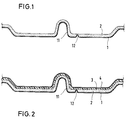
- the transmission tunnel 11 and a cable duct 12 protrude from the otherwise flat die shape. While the cable duct 12 is not visible from the top of the doctored layer 2 of foam curls and self-curing binder, the transmission tunnel 11 is enclosed by the mixture with a constant layer thickness.
- FIG. 2 shows the complete structure of the textile top floors according to the invention in motor vehicles in the form of a die of the floor panel 1. This is on layer 2 of foam curls and self-curing binder Heavy film 3, which in turn is connected to the textile top floor 4.
- the method according to the invention thus enables the reuse of foam curls to a large extent, which are produced, for example, in the production of objects other than waste materials.
- a mixture of 70 to 99% by volume of foam flakes and 1 to 30% by volume of binder is doctored into a die shape of the floor panel 1 of the motor vehicle.
- a further preferred embodiment of the present invention consists in knife coating a mixture of 75 to 90 vol.% Foam foam and 10 to 25 vol.% Binder.
- the size of the foam curls is of minor importance, but it should not exceed the minimum layer thickness of the absorption foam, for example above the cable duct 12, since otherwise a sufficiently smooth surface for applying the textile floor covering 4 is not created. Accordingly, it is particularly preferred to use foam curls in a size of 1 to 30 mm. Since the thickness of the absorption foam for the production of textile top floors 4 in motor vehicles is usually approximately 2 to 100 mm, in particular 5 to 80 mm in places, it is ensured with a size of the foam curls that is selected that the restoring forces of the foam curls do not lead to a deterioration in the surface quality of the Lead absorption foam.
- the selection of the self-curing binder is practically unlimited, as long as the binder is suitable for firmly connecting the foam curls used and has sufficient elasticity to be acoustically effective. In addition, sufficient wetting of the foam curls is required to create a firm bond. A good connection with the heavy foil 3 must also be possible.
- a preferred embodiment of the present invention is that a phenolic resin, a one-component polyurethane or a latex emulsion, optionally filled with polyolefin fibers, for example polypropylene fibers, is used as the binder.
- the binder activities can be activated, for example by the action of temperature, water vapor and / or pressure.
- This causes the optionally thermoplastic elastic binder to harden, which leads to an acoustically effective absorption foam which has approximately the same density over the entire volume. The sound absorption properties are therefore approximately the same over the entire volume.
- the absorption foam on the one hand and the heavy film 3 on the other hand are bonded without the adhesive layer in between by the self-hardening of the binder.
- the optionally preformed laminate of heavy film 3 and textile floor covering 4 is applied to the not yet cured absorption foam and by appropriate Activation, for example temperature increase, the binder cured and thus connected to the heavy film 3.
- the binders can be pure thermoplastics, thermosets or a suitable combination of both.
- a heavy EPDM heavy film filled with up to 70% by weight of filler can be used as the heavy film 3.
- the mixture 2 of foam curls and self-hardening binder is activated and the adhesive is applied by means of an adhesive layer between the mixture 2 and the heavy foil 3.
- an adhesive layer for example made of hot-melt adhesives known per se or an optionally heat-activatable polyethylene adhesive, polypropylene adhesive and / or a latex adhesive.
- a back-coated velor or needle felt known in the prior art can be used as a textile floor covering 4 in the sense of the present invention.
- the laminate of back-coated velor or needle felt covering and heavy film 3 is preferably preformed accordingly before being applied to the absorption foam. In the same way, however possible to deform the textile covering when connecting it to the absorption foam.
Landscapes
- Engineering & Computer Science (AREA)
- Transportation (AREA)
- Mechanical Engineering (AREA)
- Laminated Bodies (AREA)
- Vehicle Interior And Exterior Ornaments, Soundproofing, And Insulation (AREA)
- Carpets (AREA)
Abstract
Description
- Die Erfindung betrifft textile Oberböden für Kraftfahrzeuge und ein Verfahren zu ihrer Herstellung.
- Textile Oberböden in Kraftfahrzeugen an sich sind bekannt. Diese werden üblicherweise dadurch hergestellt, daß man zunächst einen textilen Bodenbelag in einer Matrizenform des Bodenbleches des Kraftfahrzeuges formt. Bedingt durch den Getriebetunnel oder auf den Bodenblechen befindlichen Erhöhungen oder Vertiefungen treten hierbei Höhendifferenzen von wenigen Millimetern bis mehreren Zentimetern auf.
- Üblicherweise werden rückenbeschichtete, Velours- oder Nadelfilzbodenbeläge eingesetzt. Zur verbesserten Schallisolierung werden bei hochwertigen Fahrzeugen die Bodenbeläge mit einer sogenannten Schwerfolie versehen. Hierbei handelt es sich beispielsweise um eine bis zu 70 Gew.-% Füllstoff enthaltende EPDM-Folie.
- Das so erhaltene Laminat aus rückenbeschichtetem Teppichboden und Schwerfolie wird üblicherweise der Verformung unterzogen.
- Zum Ausgleich der Bodenunebenheiten des Bodenbleches und zur Schallabsorption wird im Stand der Technik mit Hilfe des Hinterspritzverfahrens ein Absorptions-Schaumrücken auf das oben genannte Laminat aufgebracht. Insbesondere ist im Stand der Technik die Verwendung eines gefüllten Zweikomponenten-Polyurethanschaums (Schwerschaum) bevorzugt, der in das Werkzeug eingespritzt wird. Dieser Polyurethanschaum ist im Verbund mit der Schwerfolie akustisch wirksam.
- Ein besonderes Problem ist gegeben, wenn Schaumstofflocken, beispielsweise recyclierte Flocken, mit in das System eingebracht werden sollen. Schwierigkeiten treten dadurch auf, daß über die gesamte Fläche des textilen Bodenbelags die Dichte des hinterspritzten Absorptionsschaums möglichst gleichmäßig sein sollte. Unterschiedliche Dichten bewirken Störungen des Schallabsorptionssystems und damit eine verminderte akustische Wirksamkeit. Bedingt durch die geringe Dichte der Flocken gestaltet sich das Einbringen in das Werkzeug durch Rückstellkräfte der Schaumstofflocken schwierig. Auch das Vorhandensein eines geeigneten Bindemittels kann diese Probleme nicht beseitigen.
- Aus DE 40 15 413 A1 ist die Herstellung eines Formteils beliebiger Form und Größe aus Recyclierungstoffen bekannt. Das Formteil besteht aus Schaumstoffen bzw. Schaumstoffabfällen, die in Flockenform gerissen und mit einem Ein-Komponenten-Binder auf der Basis von Mais- und/oder Weizenstärke innig vermischt werden. Eine Verklebung der Formteile mit anderen Gegenständen wird nicht beschrieben.
- Die DE 34 30 775 C2 betrifft ein Teppichteil, ein Verfahren zu seiner Herstellung und seine Verwendung. Danach wird ein Teppichteil zur Schallisolation, insbesondere in Kraftfahrzeugen, aus einem Teppich und einer darunter angeordneten oder mit dem Teppich eine ein einheitliches Ganzes bildenden Schwerschicht und einer darunter angeordneten synthetischen Unterschicht bereitgestellt, wobei die Unterschicht aus einer Kombination von Schaumstoff oder Vliesschichten mit verschiedenen Störmungswiderständen besteht. Die Schichtfolge besteht beispielsweise aus Teppich, Schwerschicht, Schaumstoffschicht mit relativ hohem Strömungswiderstand und einer Schaumstoffschicht mit relativ niedrigem Strömungswiderstand.
- DE 36 23 789 A1 betrifft ein zweidimensional verformtes Abdeckelement für schwingende Flächen, vorzugsweise in Kraftfahrzeugen, gekennzeichnet durch die Kombination folgender Merkmale:
- viskoelstischer PUR-Schaum mit eingeschäumten, mechanisch hartelastischen Verbundschaumstücken,
- Kupplungsvlies,
- thermoplastische Schwerschicht,
- Textilteppich mit Kunststoffbindung und
- Thermoplastfolie.
- Aus der JP-A-61-0611842 ist ebenfalls ein elastisches Abdeckmaterial bekannt, bei dem jedoch zerkleinerte Teppichbodenreste, zerkleinerte Polyurethanschaumreste sowie eine Lösung eines Urethanprepolymers in einem organischen Lösungsmittel zur Herstellung von ungewebten textilen Belägen eingesetzt werden. Das so erhaltene Material wird als Polstermaterial, inbesondere als Schallisolationsmaterial mit verbesserter Elastizität und Dämpfungswirkung eingesetzt.
- Die Aufgabe der vorliegenden Erfindung besteht darin, unter Verwendung von Schaumstofflocken ein Rückseitendämpfungsmaterial eines textilen Bodenbelags für Kraftfahrzeuge zur Verfügung zu stellen.
- Dementsprechend war es bisher im Stand der Technik nicht möglich, Schaumstofflocken in einer gewünschten Dichte in befriedigender Weise als Ersatz von Absorptionsschaum bei textilen Oberböden in Kraftfahrzeugen zu integrieren.
- Die vorstehende Aufgabe wird erfindungsgemäß gelöst durch
- (a) Aufrakeln eines Gemisches aus Schaumstofflocken und einem selbsthärtenden Bindemittel in einer Matrizenform des Bodenblechs 1 des Kraftfahrzeugs in einem gewünschten Schichtdickenprofil,
- (b) Aufbringen mittels Pressen des mit einer Schwerfolie versehenen, gegebenenfalls vorgeformten textilen Bodenbelages auf das Gemisch, unter Einstellung der gewünschten Schaumstofflockendichte,
- (c) Aktivieren des Bindemittels und
- (d) Verkleben des Gemisches aus mit der Schwerfolie des textilen Bodenbelages.
- Desweiteren wird die gestellte Aufgabe durch einen textilen Oberboden gemäß Anspruch 12 gelöst.
Zweckmäßige Weiterbildungen der Erfindung sind in den abhängigen Ansprüchen beschrieben.
Ausführungsbeispiele der Erfindung sind in der Zeichnung dargestellt und werden im folgenden näher erörtert. - In der Fig. 1 ist eine Matrizenform eines Bodenblechs 1 eines Kraftfahrzeuges wiedergegeben. Der Getriebetunnel 11 und ein Kabelschacht 12 ragen aus der ansonsten ebenen Matrizenform heraus. Während der Kabelschacht 12 von der Oberseite der aufgerakelten Schicht 2 aus Schaumstofflocken und selbsthärtendem Bindemittel nicht sichtbar ist, wird der Getriebetunnel 11 von dem Gemisch mit konstanter Schichtdicke umschlossen.
- Das Aufrakeln des Gemisches 2 aus Schaumstofflocken und selbsthärtendem Bindemittel als Absorptionsschaum in die Matrizenform 1 erlaubt ein Freisetzen der Rückstellkräfte der bereits in der Matrizenform 1 bei Raumtemperatur. Dadurch kann eine weitgehend ebene Oberfläche dieses Gemisches 2 mit Inselstruktur und eine gleichmäßige Dichte entsprechend einer gleichmäßigen Verteilung des Schaumstoffs in dem Bindemittel erhalten werden, die besonders gut zur Verklebung mit der Schwerfolie 3 geeignet ist. Zur Vermeidung von Verklebungen des Absorptionsschaums mit der Matrizenform 1 können gegebenenfalls an sich bekannte Formtrennungsmittel eingesetzt werden.
- In der Fig.2 wird der vollständige Aufbau der erfindungsggemäßen textilen Oberböden in Kraftfahrzeugen in der Matrizenform des Bodenblechs 1 wiedergegeben. Auf der Schicht 2 aus Schaumstofflocken und selbsthärtendem Bindemittel befindet sich die Schwerfolie 3, die ihrerseits mit dem textilen Oberboden 4 verbunden ist.
- Beispielsweise durch Verpressen des mit einer Schwerfolie 3 versehenen textilen Bodenbelages 4 und Erhitzen des Laminats ist es möglich, eine gut haftende Verklebung des Absorptionsschaums mit der Schwerfolie 3 zu erreichen. Die gleichmäßige Dichte des Absorptionsschaums über das gesamte Volumen des Gemisches 2 bewirkt eine gleichmäßige Schallabsorptions-Qualität.
- Das erfindungsgemäße Verfahren ermöglicht somit in einem großen Umfang die Wiederverwendung von Schaumstofflocken, die beispielsweise bei der Herstellung von anderen Gegenständen als Abfallmaterialien anfallen. In einer bevorzugten Ausführungsform der vorliegenden Erfindung wird ein Gemisch aus 70 bis 99 Vol.-% Schaumstofflocken und 1 bis 30 Vol.-% Bindemittel in eine Matrizenform des Bodenblechs 1 des Kraftfahrzeuges aufgerakelt. Eine weiter bevorzugte Ausführungsform der vorliegenden Erfindung besteht im Aufrakeln eines Gemisches aus 75 bis 90 Vol.-% Schaumstofflocken und 10 bis 25 Vol.-% Bindemittel.
- Die Größe der Schaumstofflocken ist von geringerer Bedeutung, sie sollte jedoch nicht die geringste Schichtdicke des Absorptionsschaumes, beispielsweise oberhalb des Kabelschachtes 12, überschreiten, da sonst keine ausreichend glatte Oberfläche zum Aufbringen des textilen Bodenbelags 4 geschaffen wird. Dementsprechend ist es besonders bevorzugt, Schaumstofflocken in einer Größe von 1 bis 30 mm einzusetzen. Da üblicherweise die Dicke des Absorptionsschaums zur Herstellung von textilen Oberböden 4 in Kraftfahrzeugen stellenweise etwa 2 bis 100 mm, insbesondere 5 bis 80 mm beträgt, ist bei einer so gewählten Größe der Schaumstofflocken gewährleistet, daß die Rückstellkräfte der Schaumstofflocken nicht zu einer Verschlechterung der Oberflächenqualität des Absorptionsschaums führen.
- Die Auswahl des selbsthärtenden Bindemittels unterliegt praktisch keinen Begrenzungen, solange das Bindemittel geeignet ist, die eingesetzten Schaumstofflocken ausreichend fest zu verbinden und eine ausreichende Elastizität aufweist, um akustisch wirksam zu sein. Darüberhinaus ist eine ausreichende Benetzung der Schaumstofflocken erforderlich, um einen festen Verbund zu schaffen. Auch muß eine gute Verbindung mit der Schwerfolie 3 möglich sein.
- Dementsprechend besteht eine bevorzugte Ausführungsform der vorliegenden Erfindung darin, daß man als Bindemittel ein Phenolharz, ein Einkomponenten-Polyurethan oder eine Latexemulsion, gegebenenfalls gefüllt mit Polyolefinfasern, beispielsweise Polypropylenfasern, einsetzt.
- In derartigen Gemischen 1 aus Schaumstofflocken und Bindemittel können die Bindemittelaktivitäten, beispielsweise durch Einwirkung von Temperatur, Wasserdampf und/oder Druck aktiviert werden. Hierbei tritt eine Aushärtung des gegebenenfalls thermoplastischen elastischen Bindemittels ein, die zu einem akustisch wirksamen Absorptionsschaum führt, der über das gesamte Volumen in etwa die gleiche Dichte aufweist. Somit sind die Schallabsorptionseigenschaften über das gesamte Volumen annähernd gleich.
- Zur Schaffung der Verbindung zwischen dem Gemisch 2 aus Schaumstofflocken und selbsthärtendem Bindemittel einerseits und der Schwerfolie 3 andererseits gibt es verschiedene Möglichkeiten.
- In einer ersten Variante des erfindungsgemäßen Verfahrens werden daher der Absorptionsschaum einerseits und die Schwerfolie 3 andererseits ohne dazwischenliegende Klebeschicht durch die Selbsthärtung des Bindemittels verklebt. Bei dieser Variante wird beispielsweise das gegebenenfalls vorgeformte Laminat aus Schwerfolie 3 und textilem Bodenbelag 4 auf den noch nicht ausgehärteten Absorptionsschaum aufgebracht und durch entsprechende Aktivierung, beispielsweise Temperaturerhöhung, das Bindemittel ausgehärtet und so mit der Schwerfolie 3 verbunden. Die Bindemittel können reine Thermoplaste, Duroplaste oder eine geeignete Kombination von beiden sein.
- Als Schwerfolie 3 kann beispielsweise im Rahmen der vorliegenden Erfindung eine handelsübliche, mit bis zu 70 Gew.-% Füllstoffanteilen gefüllte EPDM-Schwerfolie, eingesetzt werden.
- In einer weiteren Variante der vorliegenden Erfindung ist es möglich, daß man vor dem Aufbringen des mit einer Schwerfolie 3 versehenen texilen Bodenbelages 4 das Gemisch 2 aus Schaumstofflocken und selbsthärtendem Bindemittel aktiviert und die Verklebung mittels einer Klebstoffschicht zwischen dem Gemisch 2 und der Schwerfolie 3 vornimmt. Gemäß dieser Variante ist es geboten, zunächst das selbsthärtende Bindemittel zu aktivieren und den Absorptionsschaum in seiner späteren geometrischen Form zu bilden,bevor die Klebstoffschicht aufgebracht wird. Nach Aufbringen einer Klebstoffschicht auf das ausgehärtete Gemisch 2 aus Schaumstofflocken und selbsthärtendem Bindemittel und/oder der Schwerfolie und Aktivieren der Klebstoffschicht nach dem Verbinden der Teile miteinander kann so der gewünschte textile Oberboden erhalten werden.
- Besonders bevorzugt im Sinne der vorliegenden Erfindung ist der Einsatz einer Klebstoffschicht, beispielsweise aus an sich bekannten Schmelzklebern oder einem gegebenenfalls wärmeaktivierbaren Polyethylenkleber, Polypropylenkleber und/oder einem Latexkleber.
- Als textiler Bodenbelag 4 im Sinne der vorliegenden Erfindung kann ein im Stand der Technik bekannter rückenbeschichteter Velours- oder Nadelfilz eingesetzt werden. Vorzugsweise wird das Laminat aus rückenbeschichtetem Velours- oder Nadelfilz-Belag und Schwerfolie 3 vor dem Aufbringen auf den Absorptionsschaum entsprechend vorgeformt. In gleicher Weise ist es jedoch möglich, die Verformung des textilen Belages beim Verbinden mit dem Absorptionsschaum vorzunehmen.
Claims (12)
- Verfahren zur Herstellung von textilen Oberböden in Kraftfahrzeugen durcha) Aufrakeln eines Gemisches (2) aus Schaumstofflocken und einem selbsthärtenden Bindemittel in einer Matrizenform des Bodenblechs des Kraftfahrzeugs (1) in einem gewünschten Schichtdickenprofil,b) Aufbringen mittels Pressen des mit einer Schwerfolie (3) versehenen, gegebenenfalls vorgeformten textilen Bodenbelages (4) auf das Gemisch (2) unter Einstellung der gewünschten Schaumstofflockendichte,c) Aktivieren des Bindemittels undd) Verkleben des Gemisches (2) mit der Schwerfolie (3) des textilen Bodenbelages.
- Verfahren nach Anspruch 1, dadurch gekennzeichnet, daß man ein Gemisch (2) aus 70 bis 99 Vol.-% Schaumstofflocken und 1 bis 30 Vol.-% Bindemittel aufrakelt.
- Verfahren nach Anspruch 1, dadurch gekennzeichnet, daß man ein Gemisch aus 75 bis 90 Vol.-% Schaumstofflocken und 10 bis 25 Vol.-% Bindemittel aufrakelt.
- Verfahren nach einem oder mehreren der Ansprüche 1 bis 3, dadurch gekennzeichnet, daß man Schaumstofflocken einer Größe von 1 bis 30 mm einsetzt.
- Verfahren nach einem oder mehreren der Ansprüche 1 bis 4, dadurch gekennzeichnet, daß man als Bindemittel ein Phenolharz, ein Einkomponenten-Polyurethan oder eine Latexemulsion, gegebenenfalls gefüllt mit Polyolefinfasern, insbesondere Polypropylenfasern, einsetzt.
- Verfahren nach einem oder mehreren der Ansprüche 1 bis 5, dadurch gekennzeichnet, daß man das Bindemittel durch Einwirkung von Temperatur, Wasserdampf und/oder Druck aktiviert.
- Verfahren nach einem oder mehreren der Ansprüche 1 bis 6, dadurch gekennzeichnet, daß man als Schwerfolie (3) eine mit bis zu 70 Gew.-% Füllstoffanteilen gefüllte EPDM-Schwerfolie einsetzt.
- Verfahren nach einem oder mehreren der Ansprüche 1 bis 7, dadurch gekennzeichnet, daß man das Gemisch (2) einerseits und Schwerfolie (3) andererseits ohne dazwischenliegende Klebstoffschicht durch die Selbsthärtung des Bindemittels verklebt.
- Verfahren nach einem oder mehreren der Ansprüche 1 bis 7, dadurch gekennzeichnet, daß man vor dem Aufbringen des mit einer Schwerfolie (3) versehenen textilen Bodenbelages (4) das Gemisch (2) aktiviert und die Verklebung mittels einer Klebstoffschicht zwischen dem Gemisch (2) und der Schwerfolie (3) vornimmt.
- Verfahren nach Anspruch 9, dadurch gekennzeichnet, daß man als Klebstoffschicht einen Schmelzkleber, einen gegebenenfalls wärmeaktivierbaren Polyethylenkleber, einen Polypropylenkleber und/oder einen Latexkleber einsetzt.
- Verfahren nach einem oder mehreren der Ansprüche 1 bis 10, dadurch gekennzeichnet, daß man als textilen Bodenbelag (4) einen rückenbeschichteten Velours- oder Nadelfilz-Belag einsetzt.
- Textiler Oberboden für Kraftfahrzeuge, erhältlich nach einem Verfahren gemäß einem oder mehreren der Ansprüche 1 bis 11, umfassend die Schichtenfolge:a) Schaumstofflocken in einem selbsthärtenden Bindemittel,b) Schwerfolie (3) undc) textiler Bodenbelag (4),wobei die Verbindung zwischen dem Gemisch (2) und der Schwerfolie (3) und dem textilen Bodenbelag (4) gegebenenfalls durch eine Klebstoffschicht gebildet ist.
Applications Claiming Priority (3)
| Application Number | Priority Date | Filing Date | Title |
|---|---|---|---|
| DE4222023 | 1992-07-04 | ||
| DE4222023A DE4222023A1 (de) | 1992-07-04 | 1992-07-04 | Textile Oberböden in Kraftfahrzeugen |
| PCT/EP1993/001699 WO1994001278A1 (de) | 1992-07-04 | 1993-07-01 | Textile oberböden in kraftfahrzeugen |
Publications (2)
| Publication Number | Publication Date |
|---|---|
| EP0651700A1 EP0651700A1 (de) | 1995-05-10 |
| EP0651700B1 true EP0651700B1 (de) | 1997-03-05 |
Family
ID=6462502
Family Applications (1)
| Application Number | Title | Priority Date | Filing Date |
|---|---|---|---|
| EP93915764A Expired - Lifetime EP0651700B1 (de) | 1992-07-04 | 1993-07-01 | Textile oberböden in kraftfahrzeugen |
Country Status (6)
| Country | Link |
|---|---|
| US (1) | US5935677A (de) |
| EP (1) | EP0651700B1 (de) |
| CZ (1) | CZ286078B6 (de) |
| DE (2) | DE4222023A1 (de) |
| ES (1) | ES2099959T3 (de) |
| WO (1) | WO1994001278A1 (de) |
Cited By (1)
| Publication number | Priority date | Publication date | Assignee | Title |
|---|---|---|---|---|
| DE10101112B4 (de) * | 2001-01-10 | 2008-12-18 | Michael Rosner | Verfahren zur Herstellung wiederverwertbarer mehrschichtiger Platten |
Families Citing this family (11)
| Publication number | Priority date | Publication date | Assignee | Title |
|---|---|---|---|---|
| DE19507591A1 (de) * | 1995-03-04 | 1996-09-05 | Hp Chemie Pelzer Res & Dev | Mehrschichtige trennbare textile Oberböden |
| DE4444290A1 (de) * | 1994-12-13 | 1996-06-20 | Hp Chemie Pelzer Res & Dev | Wiederverwertbare textile Oberböden |
| CZ292856B6 (cs) | 1994-12-13 | 2003-12-17 | Hp-Chemie Pelzer Research And Development Ltd. | Textilní podlahová krytina a způsob její výroby |
| WO1998021066A1 (de) | 1996-11-12 | 1998-05-22 | Hp-Chemie Pelzer Research And Development Ltd. | Wiederverwertbares teppichbodenformteil |
| DE19925661A1 (de) * | 1999-06-04 | 2000-12-07 | Volkswagen Ag | Akustische Kompaktisolation |
| IT1320505B1 (it) * | 2000-06-16 | 2003-12-10 | Selmat Automotive S R L | Pannello di copertura per un piano di carico di un veicolo. |
| US20050098379A1 (en) * | 2003-10-09 | 2005-05-12 | Takahiko Sato | Noise absorbing structure and noise absorbing/insulating structure |
| FR2986207B1 (fr) * | 2012-01-26 | 2014-02-21 | Faurecia Automotive Ind | Piece d'equipement de vehicule automobile et vehicule automobile associe |
| JP5486656B2 (ja) * | 2012-09-18 | 2014-05-07 | 株式会社イノアックコーポレーション | 車両用フロアカーペット |
| DE102018103462A1 (de) * | 2018-02-15 | 2019-08-22 | Adler Pelzer Holding Gmbh | Kraftfahrzeugteppichboden |
| US11774043B1 (en) * | 2019-02-21 | 2023-10-03 | Oceanit Laboratories, Inc. | Methods, products, and systems for monitoring and improving pipeline infrastructure |
Family Cites Families (20)
| Publication number | Priority date | Publication date | Assignee | Title |
|---|---|---|---|---|
| US4014826A (en) * | 1974-03-19 | 1977-03-29 | E. I. Du Pont De Nemours And Company | Process for preparing rebonded foam structures |
| US3952126A (en) * | 1975-03-20 | 1976-04-20 | Dycks Christian C | Resilient carpet padding sheet |
| US4082703A (en) * | 1975-04-07 | 1978-04-04 | Union Carbide Corporation | Polyurethane prepolymers, rebonded polyurethane foam and methods of forming the same |
| US4255482A (en) * | 1978-07-05 | 1981-03-10 | Takara Kenzai Seisakusho & Co. | Vibration-absorbing fire-resisting floor for vehicles, vessels or the like |
| US4243617A (en) * | 1979-11-16 | 1981-01-06 | Mobay Chemical Corporation | Flexible foam rebonding process and apparatus |
| DE3104835A1 (de) * | 1981-02-11 | 1982-09-02 | Dura Tufting Gmbh, 6400 Fulda | Hinterschaeumte textile flaechenverkleidung und verfahren zu ihrer herstellung |
| US4579764A (en) * | 1984-06-27 | 1986-04-01 | Collins & Aikman Corporation | Molded carpet assembly with sound deadening foam backing |
| DE3430775C2 (de) * | 1984-08-21 | 1993-01-28 | Dr. Alois Stankiewicz GmbH, 3101 Adelheidsdorf | Teppichteil, Verfahren zu seiner Herstellung und seine Verwendung |
| US4557774B2 (en) * | 1984-09-04 | 1995-02-14 | Step Loc Corp | System for holding carpet in place without stretching |
| DE3510722A1 (de) * | 1985-03-23 | 1986-09-25 | Schaeffler Teppichboden Gmbh, 8600 Bamberg | Fahrzeugbodenauflage |
| US4683246A (en) * | 1986-03-14 | 1987-07-28 | Wm. T. Burnett & Co., Inc. | Polyurethane foam-fiber composites |
| US4990399A (en) * | 1986-07-07 | 1991-02-05 | Step Loc Corporation | Carpet cushion with adhesive |
| DE3623789C2 (de) * | 1986-07-15 | 1998-02-05 | Helmut Pelzer | Mehrschichtiges, dreidimensional verformtes schalldämpfendes und dämmendes Abdeckelement |
| IT1217124B (it) * | 1987-02-10 | 1990-03-14 | Studi E Prototipi S R L Centro | Pannelli insonorizzanti per applicazioni nel settore automobilistico e procedimenti per il loro ottenimento |
| DE3710731A1 (de) * | 1987-03-31 | 1989-04-27 | Stankiewicz Alois Dr Gmbh | Polyurethanweichschaumstoff mit schallisolierenden und entdroehnenden eigenschaften |
| DE4015413A1 (de) * | 1990-05-14 | 1991-11-21 | Of Ray Recycling Gmbh | Formteil und verfahren zu seiner herstellung |
| US5045389A (en) * | 1990-05-23 | 1991-09-03 | Pmc, Inc. | Carpet padding comprising cover film, and prime and rebond foam layers |
| DE4020602C1 (de) * | 1990-06-28 | 1992-03-19 | Stankiewicz Gmbh, 3101 Adelheisdorf, De | |
| DE4038025A1 (de) * | 1990-11-29 | 1992-06-11 | Schaeffler Teppichboden Gmbh | Verfahren zur herstellung eines auskleidungsteils und auskleidungsteil |
| US5096623A (en) * | 1991-08-12 | 1992-03-17 | Triad-Fabco, Inc. | Process and composition for producing flame retardant rebonded foam products |
-
1992
- 1992-07-04 DE DE4222023A patent/DE4222023A1/de not_active Withdrawn
-
1993
- 1993-07-01 DE DE59305653T patent/DE59305653D1/de not_active Expired - Fee Related
- 1993-07-01 WO PCT/EP1993/001699 patent/WO1994001278A1/de not_active Ceased
- 1993-07-01 ES ES93915764T patent/ES2099959T3/es not_active Expired - Lifetime
- 1993-07-01 EP EP93915764A patent/EP0651700B1/de not_active Expired - Lifetime
- 1993-07-01 CZ CZ19958A patent/CZ286078B6/cs not_active IP Right Cessation
-
1997
- 1997-09-29 US US08/939,201 patent/US5935677A/en not_active Expired - Fee Related
Cited By (1)
| Publication number | Priority date | Publication date | Assignee | Title |
|---|---|---|---|---|
| DE10101112B4 (de) * | 2001-01-10 | 2008-12-18 | Michael Rosner | Verfahren zur Herstellung wiederverwertbarer mehrschichtiger Platten |
Also Published As
| Publication number | Publication date |
|---|---|
| EP0651700A1 (de) | 1995-05-10 |
| DE4222023A1 (de) | 1994-01-05 |
| US5935677A (en) | 1999-08-10 |
| ES2099959T3 (es) | 1997-06-01 |
| CZ895A3 (en) | 1995-05-17 |
| WO1994001278A1 (de) | 1994-01-20 |
| DE59305653D1 (de) | 1997-04-10 |
| CZ286078B6 (cs) | 2000-01-12 |
Similar Documents
| Publication | Publication Date | Title |
|---|---|---|
| EP0384420B1 (de) | Bodenverkleidung für Kraftfahrzeuge und Verfahren zur Herstellung | |
| EP0262092B2 (de) | Lärmminderndes Bauelement | |
| DE69211562T2 (de) | Elastischer teppich mit schaumruecken und verfahren zu dessen herstellung | |
| DE2910234C2 (de) | Verfahren zur Herstellung eines Formkörpers aus einer Trägerplatte mit einer Dekorschicht | |
| EP0692409A1 (de) | Auskleidungsteil für Kraftfahrzeuge sowie Verfahren zu dessen Herstellung | |
| EP0797700B1 (de) | Wiederverwertbare textile oberböden | |
| WO1994001278A1 (de) | Textile oberböden in kraftfahrzeugen | |
| DE3206468C2 (de) | ||
| DE4400894A1 (de) | Verfahren zur Herstellung von Innenbauteilen für Kraftfahrzeuge | |
| DE2237266A1 (de) | Selbsttragendes bauelement fuer die innere auskleidung eines fahrzeugs, und verfahren zu dessen herstellung | |
| EP0083435A2 (de) | Formteil mit formgepresster, polyesterharzgetränkter Kokos-, Baumwoll- oder Jutefaservliesmatte sowie Verfahren zu seiner Herstellung | |
| DE3034799A1 (de) | Teppichbodenbelag mit angeschaeumtem ruecken fuer den innenraum eines kraftfahrzeugs | |
| DE2611855A1 (de) | Kraftfahrzeugteppichzuschnitt und verfahren zu seiner herstellung | |
| DE2605592A1 (de) | Verbesserungen an schallschutzmaterialien | |
| DE3335669A1 (de) | Hinterspritzbares bahnfoermiges kunststoff-verbundmaterial, verfahren zu seiner herstellung und dessen verwendung | |
| DE69628590T2 (de) | Verfahren zur herstellung eines dreidimensional geformten teppichs für kraftfahrzeuge | |
| DE2924197A1 (de) | Vorgeformte textile wandverkleidung fuer geraeuschbelastete raeume sowie ein verfahren zu ihrer herstellung | |
| EP0014973B1 (de) | Verfahren zur Herstellung eines Formteiles | |
| DE3220768C2 (de) | Verfahren zum Herstellen von mit einer strukturierten Dekorschicht versehenen Formteilen aus Faservliesen | |
| DE2831640A1 (de) | Mehrschichtiger verbundwerkstoff, insbesondere fuer die auskleidung eines personenkraftwagens | |
| EP0997265B1 (de) | Verfahren zur Herstellung einer Dachversteifung für Fahrzeuge und Dachversteifung | |
| EP0598876A1 (de) | Flächengebilde, insbesondere fussbodenbelag und verfahren zu seiner herstellung | |
| WO1998021066A1 (de) | Wiederverwertbares teppichbodenformteil | |
| DE2809347C2 (de) | Verfahren zur Herstellung eines geformten, schallisolierenden Boden- oder Wandbelags | |
| DE3151296A1 (de) | Verfahren zum herstellen einer raeumlich bleibend geformten schalldaempf-verbundmatte und danach hergestellte schalldaempf-verbundmatte |
Legal Events
| Date | Code | Title | Description |
|---|---|---|---|
| PUAI | Public reference made under article 153(3) epc to a published international application that has entered the european phase |
Free format text: ORIGINAL CODE: 0009012 |
|
| 17P | Request for examination filed |
Effective date: 19941206 |
|
| AK | Designated contracting states |
Kind code of ref document: A1 Designated state(s): BE DE ES FR GB SE |
|
| 17Q | First examination report despatched |
Effective date: 19951129 |
|
| GRAG | Despatch of communication of intention to grant |
Free format text: ORIGINAL CODE: EPIDOS AGRA |
|
| GRAG | Despatch of communication of intention to grant |
Free format text: ORIGINAL CODE: EPIDOS AGRA |
|
| GRAH | Despatch of communication of intention to grant a patent |
Free format text: ORIGINAL CODE: EPIDOS IGRA |
|
| GRAH | Despatch of communication of intention to grant a patent |
Free format text: ORIGINAL CODE: EPIDOS IGRA |
|
| GRAA | (expected) grant |
Free format text: ORIGINAL CODE: 0009210 |
|
| AK | Designated contracting states |
Kind code of ref document: B1 Designated state(s): BE DE ES FR GB SE |
|
| REF | Corresponds to: |
Ref document number: 59305653 Country of ref document: DE Date of ref document: 19970410 |
|
| ET | Fr: translation filed | ||
| REG | Reference to a national code |
Ref country code: ES Ref legal event code: FG2A Ref document number: 2099959 Country of ref document: ES Kind code of ref document: T3 |
|
| GBT | Gb: translation of ep patent filed (gb section 77(6)(a)/1977) |
Effective date: 19970523 |
|
| PLBE | No opposition filed within time limit |
Free format text: ORIGINAL CODE: 0009261 |
|
| STAA | Information on the status of an ep patent application or granted ep patent |
Free format text: STATUS: NO OPPOSITION FILED WITHIN TIME LIMIT |
|
| 26N | No opposition filed | ||
| REG | Reference to a national code |
Ref country code: GB Ref legal event code: IF02 |
|
| PGFP | Annual fee paid to national office [announced via postgrant information from national office to epo] |
Ref country code: FR Payment date: 20040720 Year of fee payment: 12 |
|
| PGFP | Annual fee paid to national office [announced via postgrant information from national office to epo] |
Ref country code: GB Payment date: 20040722 Year of fee payment: 12 |
|
| PGFP | Annual fee paid to national office [announced via postgrant information from national office to epo] |
Ref country code: SE Payment date: 20040723 Year of fee payment: 12 Ref country code: BE Payment date: 20040723 Year of fee payment: 12 |
|
| PGFP | Annual fee paid to national office [announced via postgrant information from national office to epo] |
Ref country code: ES Payment date: 20040726 Year of fee payment: 12 |
|
| PGFP | Annual fee paid to national office [announced via postgrant information from national office to epo] |
Ref country code: DE Payment date: 20040820 Year of fee payment: 12 |
|
| PG25 | Lapsed in a contracting state [announced via postgrant information from national office to epo] |
Ref country code: GB Free format text: LAPSE BECAUSE OF NON-PAYMENT OF DUE FEES Effective date: 20050701 |
|
| PG25 | Lapsed in a contracting state [announced via postgrant information from national office to epo] |
Ref country code: SE Free format text: LAPSE BECAUSE OF NON-PAYMENT OF DUE FEES Effective date: 20050702 Ref country code: ES Free format text: LAPSE BECAUSE OF NON-PAYMENT OF DUE FEES Effective date: 20050702 |
|
| PG25 | Lapsed in a contracting state [announced via postgrant information from national office to epo] |
Ref country code: BE Free format text: LAPSE BECAUSE OF NON-PAYMENT OF DUE FEES Effective date: 20050731 |
|
| PG25 | Lapsed in a contracting state [announced via postgrant information from national office to epo] |
Ref country code: DE Free format text: LAPSE BECAUSE OF NON-PAYMENT OF DUE FEES Effective date: 20060201 |
|
| EUG | Se: european patent has lapsed | ||
| GBPC | Gb: european patent ceased through non-payment of renewal fee |
Effective date: 20050701 |
|
| PG25 | Lapsed in a contracting state [announced via postgrant information from national office to epo] |
Ref country code: FR Free format text: LAPSE BECAUSE OF NON-PAYMENT OF DUE FEES Effective date: 20060331 |
|
| REG | Reference to a national code |
Ref country code: FR Ref legal event code: ST Effective date: 20060331 |
|
| REG | Reference to a national code |
Ref country code: ES Ref legal event code: FD2A Effective date: 20050702 |
|
| BERE | Be: lapsed |
Owner name: *HP-CHEMIE PELZER RESEARCH & DEVELOPMENT LTD Effective date: 20050731 |