EP0660598B1 - Dispositif de prise de vue à l'état solide avec pixel de contrÔle - Google Patents
Dispositif de prise de vue à l'état solide avec pixel de contrÔle Download PDFInfo
- Publication number
- EP0660598B1 EP0660598B1 EP94120669A EP94120669A EP0660598B1 EP 0660598 B1 EP0660598 B1 EP 0660598B1 EP 94120669 A EP94120669 A EP 94120669A EP 94120669 A EP94120669 A EP 94120669A EP 0660598 B1 EP0660598 B1 EP 0660598B1
- Authority
- EP
- European Patent Office
- Prior art keywords
- signal
- output
- signal charges
- monitor
- pixel
- Prior art date
- Legal status (The legal status is an assumption and is not a legal conclusion. Google has not performed a legal analysis and makes no representation as to the accuracy of the status listed.)
- Expired - Lifetime
Links
Images






Classifications
-
- H—ELECTRICITY
- H10—SEMICONDUCTOR DEVICES; ELECTRIC SOLID-STATE DEVICES NOT OTHERWISE PROVIDED FOR
- H10F—INORGANIC SEMICONDUCTOR DEVICES SENSITIVE TO INFRARED RADIATION, LIGHT, ELECTROMAGNETIC RADIATION OF SHORTER WAVELENGTH OR CORPUSCULAR RADIATION
- H10F99/00—Subject matter not provided for in other groups of this subclass
-
- H—ELECTRICITY
- H04—ELECTRIC COMMUNICATION TECHNIQUE
- H04N—PICTORIAL COMMUNICATION, e.g. TELEVISION
- H04N23/00—Cameras or camera modules comprising electronic image sensors; Control thereof
- H04N23/70—Circuitry for compensating brightness variation in the scene
- H04N23/71—Circuitry for evaluating the brightness variation
-
- H—ELECTRICITY
- H04—ELECTRIC COMMUNICATION TECHNIQUE
- H04N—PICTORIAL COMMUNICATION, e.g. TELEVISION
- H04N25/00—Circuitry of solid-state image sensors [SSIS]; Control thereof
- H04N25/70—SSIS architectures; Circuits associated therewith
- H04N25/701—Line sensors
-
- H—ELECTRICITY
- H04—ELECTRIC COMMUNICATION TECHNIQUE
- H04N—PICTORIAL COMMUNICATION, e.g. TELEVISION
- H04N25/00—Circuitry of solid-state image sensors [SSIS]; Control thereof
- H04N25/70—SSIS architectures; Circuits associated therewith
- H04N25/703—SSIS architectures incorporating pixels for producing signals other than image signals
- H04N25/706—Pixels for exposure or ambient light measuring
-
- H—ELECTRICITY
- H04—ELECTRIC COMMUNICATION TECHNIQUE
- H04N—PICTORIAL COMMUNICATION, e.g. TELEVISION
- H04N25/00—Circuitry of solid-state image sensors [SSIS]; Control thereof
- H04N25/70—SSIS architectures; Circuits associated therewith
- H04N25/71—Charge-coupled device [CCD] sensors; Charge-transfer registers specially adapted for CCD sensors
-
- H—ELECTRICITY
- H04—ELECTRIC COMMUNICATION TECHNIQUE
- H04N—PICTORIAL COMMUNICATION, e.g. TELEVISION
- H04N25/00—Circuitry of solid-state image sensors [SSIS]; Control thereof
- H04N25/70—SSIS architectures; Circuits associated therewith
- H04N25/71—Charge-coupled device [CCD] sensors; Charge-transfer registers specially adapted for CCD sensors
- H04N25/75—Circuitry for providing, modifying or processing image signals from the pixel array
Definitions
- the present invention relates to a solid state imaging device including a photosensitive pixel for monitoring, and applicable to an automatic focusing device for a camera and the like.
- a charge coupled device (CCD) image sensor has been well known as a solid state imaging device.
- CCD image sensor including a photosensitive pixel for monitoring, which is applicable to the sensor used in an automatic focusing device of the camera and like, in order to control a storage time of a signal charge in each photosensitive pixel (for a picture) and a gain of an output circuit which converts the signal charge into an output signal.
- a solid state imaging device according to the preamble of claim 1 is known from US-A-4 701 626.
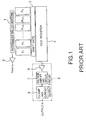
- FIG. 1 a plurality of photosensitive pixels for a picture are arranged in a matrix shape on a semiconductor substrate (not shown) so as to form a plurality of pixel trains P 1 through P n .
- a photosensitive pixel 1 for a monitor generates signal charges in proportion to a mean value of an incident light amount of the photosensitive pixels for a picture.
- the signal charges generated in the photosensitive pixel 1 for a monitor are outputted as a signal V AGC through an output buffer 2 so as to supply to a control circuit (not shown) externally provided.
- the control circuit opens a shift gate 3 at each time when the supplied signal V AGC reaches a predetermined threshold value, so as to transfer the signal charges to a charge coupled device (CCD) register 4.
- CCD charge coupled device
- Each of the signal charges transferred into the CCD register 4 are converted into an output signal in an output circuit 5 so as to be externally outputted.
- the output circuit 5 comprises an output buffer 6, a voltage amplifying circuit 7, and a clamp circuit 8.
- the voltage amplifying circuit 7 changes over a gain according to an instruction from the control circuit when the signal V AGC is less than the threshold value, for example, because an incident light amount is little. Furthermore, the clamp circuit 8 causes the output signal of the output circuit 5 to be within an input range of an analog/digital (A/D) converter provided in the latter stage, in which the lower and upper most values are set by the control circuit.
- A/D analog/digital
- the monitor photosensitive Pixel 1 is provided as means for measuring the mean value of the signal charges of each picture photosensitive pixel constituting the pixel trains P 1 -P n .
- the monitor photosensitive pixel 1 since the conventional CCD image sensor includes the output circuit 5 having the output signal of the output buffer 2 and the output signal V AGC which have different voltage gain and off-set voltage, the monitor photosensitive pixel 1 has a very bad accuracy as the measuring means for the mean value as described above.
- the CCD image sensor as shown in FIG. 1 also has the bad accuracy at the time when the threshold value is determined at opening the shift gate 3. Accordingly, such the CCD image sensor can not set the optimum threshold value corresponding to the incident light amount.
- US-A-4 809 077 discloses a solid state imaging device including a plurality of picture photosensitive pixels for generating first signal charges corresponding to an incident light amount, signal charge transfer means for transferring the first signal charges outputted from the picture photosensitive pixels, and a monitor photosensitive pixel for generating second signal charges, wherein an amplifying circuit for amplifying an output signal is controlled for setting a gain of the amplifying circuit.
- the solid state imaging device includes a plurality of picture photosensitive pixels for generating first signal charges corresponding to an incident light amount, signal charge transfer means for transferring in order the first signal charges outputted from the picture photosensitive pixels, and a monitor photosensitive pixels for generating second signal charges in proportion to the means value of the incident light amount of the picture photosensitive pixels having a predetermined number, in which the solid state imaging device comprises output means for converting both of the first and second signal charges into first and second output signals, in which the first signal charges are generated in the picture photosensitive pixels and transferred by the signal charge transfer means, and the second signal charges are generated in the monitor photosensitive pixels.
- the solid state imaging device is desired to further comprise a clamp circuit which is provided in the output means for clamping the output signal which is generated by converting the first signal charges transferred from the signal charge transfer means, and a control circuit for setting an upper limit or low limit voltage of the clamp circuit on the basis of the output signal which is generated by converting the second signal charges of the monitor photosensitive pixels by the output means.
- the solid state imaging device is desired to further comprise an amplifying circuit for amplifying the output signal which is converted from the first signal charges transferred from the signal charge transfer means, and a control circuit for setting a gain of the amplifying circuit on the basis of the output signal which is converted from the second signal charges outputted from the monitor photosensitive pixels.
- the optimum value can accurately be set with respect to the gain of the voltage amplifying circuit and the upper limit and low limit values of the clamp circuit by using the mean value.
- the solid state imaging device can accurately measure the mean value of the signal charges of the picture photosensitive pixels.
- FIG. 2 shows a block diagram schematically showing a constitution of a CCD image sensor according to a first embodiment of the present invention.
- a plurality of picture photosensitive pixels are arranged in a matrix shape on a semiconductor substrate (not shown), in which each line of the picture photosensitive pixels forms pixel trains P 1 -P n .
- signal charges. occurring in each picture photosensitive pixel can be transferred to the direction for a shift gate 12.
- Monitor photosensitive pixel 11 is arranged along two sides of a region in which the pixel trains P 1 -P n are arranged as shown in FIG. 2, so as to generate signal charges in proportion to a mean value of an incident light amount of these picture photosensitive pixels.
- a shift gate 12 comprises a portion which transfers the signal charges from the pixel trains P 1 -P n to the CCD register 13, and a portion which transfers the signal charges from the monitor photosensitive pixel 11. Opening and closing of the shift gate 12 are controlled by a control circuit 18 which will be mentioned later.
- the CCD register 13 takes into the signal charges occurring in the pixel trains P 1 -P n from the shift register 12 as a parallel signal so as to convert the parallel signal into a serial signal, thereby outputting the serial signal to an output circuit 14 which will be mentioned later.
- the signal charges occurring in the monitor photosensitive pixel 11 are taken by the shift gate 12, the signal charges are transferred to the output circuit 14 as they are.
- the output circuit 14 comprises an output buffer 15, a voltage amplifying circuit 16, and a clamping circuit 17, which are the same constitution as the conventional CCD image sensor.
- a control circuit 18 takes in order an output signal V AGC which is obtained by converting in the output circuit 14 the signal charges occurring in the monitor photosensitive pixel 11. At each time when an integral value of the signal V AGC reaches to a predetermined threshold value, any gate of the shift gate 12 is opened for transferring the signal charges occurring in the corresponding pixel in the picture photosensitive pixels P 1 -P n to the CCD register 13. Furthermore, the control circuit 18 changes over the gain in the voltage amplifying circuit 16 corresponding to a value of the signal V AGC . Moreover, the circuit 18 changes over the upper limit or low limit value of the clamping circuit 17 corresponding to the value of the signal V AGC .
- FIG. 3 is a graph showing a change with lapse of time of a voltage level in an output signal of the output circuit 14.
- the control circuit 18 opens a gate corresponding to the monitor photosensitive pixel 11 the shift gate 12.
- the signal charges occurring in the monitor photosensitive pixel 11 are transferred by the CCD register 13 into the output circuit 14 in which the signal charges are converted into the output signal V AGC .
- the signal V AGC is supplied to the control circuit 18 in which the value of the signal V AGC accurately corresponds to the mean value of the signal charges of the picture photosensitive pixels constituting the pixel trains P 1 -P n .
- the control circuit 18 uses the inputted signal V AGC and determines the threshold value for opening and closing the shift gate 12, the gain of the voltage amplifying circuit 18, and the upper limit and low limit values of the clamp in the clamping circuit 17 during a time T 1 .
- the gain of the voltage amplifying circuit 16 is controlled by comparing the signal V AGC with a plurality of judge levels (represented here as V 1 , V 2 , ...) in order.
- the gain may be set to the different values when V 1 > V AGC > V 2 , or when V 2 > V AGC > V 3 .
- the signal V AGC is clamped by the clamping circuit 17, it is possible to easily set the judge levels from the upper or low limit value of a clamping.
- the upper and low limit values of a clamp in the clamping circuit 17 are determined along the standard of the signal V AGC . Accordingly, since the value of the signal V AGC precisely corresponds to the mean value of the signal charges of the picture photosensitive pixels as has been described, it is unnecessary to determine the upper and low limit values of the clamp by using as the standard the signal charges which are generated in the shaded pixels. Therefore, in the first embodiment, since it is easy to set the optimum value with respect to the upper and low limit values, a high quality picture signal can be obtained even though there is a case where a contrast is small with respect to each signal charge in the picture photosensitive pixels.
- the threshold value for opening and closing the shift gate 12 is determined by an integral result of the signal V AGC supplied during the time T 1 .
- the control circuit 18 continuously inputs the signal V AGC and integrates the inputted signal V AGC .
- the circuit 18 closes the gate corresponding to the monitor photosensitive pixel 11 in the shift gate 12, and opens the gate corresponding to the picture photosensitive pixel trains P 1 -P n .
- the signal charges occurring in the picture photosensitive pixels are transferred to the CCD register 13 in which the charges are converted from a parallel signal into a serial signal so as to sequentially input into the output circuit 14.
- These signal charges are converted into voltage signals by an output buffer 15, which are amplified in the voltage amplifying circuit 16.
- the clamping circuit 17 clamps the amplified voltage signals so as to be outputted to an analog/digital converter (not shown) as the next stage.
- the single output circuit 14 converts the first signal charges occurring in the pixel trains P 1 -P n and the second signal charges occurring in the monitor photosensitive pixel 11 into the output signal to be outputted.
- the first embodiment to precisely set the optimum value with respect to the gain of the voltage amplifying circuit 16 and the upper and low limit values of the clamping circuit 17.
- the monitor photosensitive pixel is arranged along two sides of the region in which the pixels P 1 -P n are arranged.
- the present invention may comprise means for transferring the signal charges into the output circuit 14.
- the first embodiment comprises only one monitor photosensitive pixel
- another monitor photosensitive pixel and output buffer- may be provided in addition to the pixel 11 and output buffer 15.
- the CCD register 13 comprises an N-channel metal oxide semiconductor (MOS) transistor 131, and a capacitor 132, in which a signal V 1 is detected from a junction point between a drain of the transistor 131 and the capacitor 132. Furthermore, a control potential C 4 is detected from an electrode of the CCD register 13, and a control potential C 1 is supplied to a gate of the MOS transistor 131.
- MOS metal oxide semiconductor
- the output buffer 15 comprises an N-channel MOS transistor 151 having a gate to which the signal V 1 is supplied, and an N-MOS transistor 152 as a constant current source which is connected in series with the transistor 151. A potential of a junction point between the transistors 151 and 152 is stored in a capacitor 161 in the voltage amplifier circuit 16.
- the voltage amplifier circuit 16 comprises the capacitor 161, and N-MOS transistors 162-164, and has a characteristic in which an output operating point of the voltage amplifier circuit 16 is determined by a junction voltage V 20 between a drain-gate of the transistors 162 and 164 and the capacitor 161 and a junction potential V 2 between a source of the transistor 162 and a junction point of the transistors 163 and 164, as shown in FIG. 6.
- the control potential C 2 is supplied to a gate of the transistor 162.
- the clamping circuit 17 comprises a capacitor 171 and transistors 172-174, in which the capacitor 171 stores a junction potential V 2 of the voltage amplifier circuit 16.
- a control potential C 3 is supplied to a gate of the transistor 172, and a source of the transistor 172 is connected to a reference potential V ref .
- a potential of a junction point between the capacitor 171 and a drain of the transistor 172 is supplied to a gate of the transistor 173, and a potential V 3 of a junction point between a drain of the transistor 173 and a source of the transistor 174 as a constant current source is supplied to a control circuit 18 as the signal V AGC .
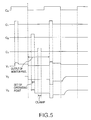
- a potential of each portion in FIG. 4 can be shown in a timing chart of FIG. 5, in which an output potential V 1 , V 2 and V 3 of the output buffer 15, voltage amplifying circuit 16 and clamping circuit 17 respectively have a wave form shown in FIG. 5.
- Control potentials C 1 -C 4 respective have timings shown in FIG. 5. In this manner, the mean value is clamped.
- FIG. 7 shows an output circuit 30 as a modified example of the output circuit 20 shown in FIG. 4.
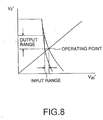
- the output circuit 30 includes a voltage amplifying circuit 16A comprising transistors 165 and 169 both gates of which gains G 1 and G 2 are supplied in the manner that signal levels "H” and "L” are alternatively changed over, in the place of the voltage amplifying circuit 16 as shown in FIG. 4.
- FIG. 8 An output operating point of the voltage amplifying circuit 16A is shown in FIG. 8, and also a relationship between an output potential V' 2 and input potential V' 20 of the voltage amplifying circuit 16A is shown in FIG. 8.
- FIG. 9 shows a solid state imaging device according to a fourth embodiment, and is a modified example of the first embodiment shown in FIG. 2.
- a plurality of storage portions 40 and a plurality of charge drain portions 41 are provided between the picture photosensitive pixels P 1 -P n and shift gates 12.
- Each of the charge drain portions 41 comprises a gate 42 and a drain portion 43.
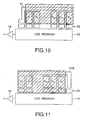
- FIGS. 10-13 show various modifications with respect to an arrangement between the picture photosensitive pixels P 1 -P n and the monitor photosensitive pixel 11.
- a solid state imaging device has the same constitution as the solid state imaging device according to the first embodiment.
- shift gates 12 are provided corresponding to the monitor photosensitive pixel 11 and the picture photosensitive pixels P 1 -P n , respectively.
- a region shown by an oblique line is a photosensitive pixel region. In this example, it is possible to clamp at a head of one line output.
- a solid state imaging device shows an example for clamping at the end of one line to the contrary with the solid state imaging according to the ninth embodiment. Accordingly, the monitor photosensitive pixel 11B is provided at a latter stage of the last picture photosensitive pixel P n .
- FIG. 12 shows a constitution of a solid state imaging device according to an seventh embodiment,
- a monitor photosensitive pixel 11C passes through second and third picture photosensitive pixels P 2 and P 3 , and opposes to the shift gate 12.
- the solid state imaging device according to the seventh embodiment is an example of changing over AGC/gain by an output of the monitor photosensitive pixel 11C.
- a clamp/operating point is set during a time interval W 1 by outputs of the shaded pixels P 1 and P 2 . Then, an AGC/gain are changed over by an output W 2 of the monitor photosensitive pixel. The judgement of the gain and the set of clamp/operating point are simultaneously performed during the time interval W 3 by an output of the shaded pixel P 3 .
Landscapes
- Engineering & Computer Science (AREA)
- Multimedia (AREA)
- Signal Processing (AREA)
- Transforming Light Signals Into Electric Signals (AREA)
Claims (4)
- Dispositif imageur à l'état solide incluant :caractérisé par :une pluralité de pixels photosensibles d'image (P1-Pn) pour générer des premières charges de signal correspondant à une quantité de lumière incidente ;un moyen de transfert de charge de signal (13) pour transférer dans l'ordre les premières charges de signal émises en sortie depuis les pixels photosensibles d'image (P1-Pn) ; etun pixel photosensible de surveillance (11 ; 11B ; 11C) pour générer des secondes charges de signal en proportion d'une valeur moyenne de la quantité de lumière qui arrive en incidence sur les pixels photosensibles d'image (P1-Pn),un moyen de sortie commun (14) pour convertir à la fois lesdites premières et secondes charges de signal selon des premier et second signaux de sortie où les premières charges de signal sont générées dans les pixels photosensibles d'image (P1-Pn) et sont transférées par le moyen de transfert de charge de signal (13) et les secondes charges de signal sont générées dans le pixel photosensible de surveillance (11 ; 11B ; 11C) et sont transférées par le moyen de transfert de charge de signal (13) ; etune voie de charge de signal commune incluant un registre CCD et prévue entre ledit moyen de sortie commun (14) et lesdits pixels photosensibles d'image (P1-Pn) et ledit pixel photosensible de surveillance (11 ; 11B ; 11C),dans lequel ledit pixel photosensible de surveillance (11 ; 11B ; 11C) présente une aire prédéterminée s'étendant suivant deux côtés d'une région dans laquelle lesdits pixels photosensibles d'image (P1-Pn) sont agencés de manière à générer des charges de signal en proportion de ladite valeur moyenne de la quantité de lumière qui arrive en incidence sur lesdits pixels photosensibles d'image (P1-Pn).
- Dispositif imageur à l'état solide selon la revendication 1, caractérisé par :un circuit de verrouillage (17) prévu dans le moyen de sortie (14) pour verrouiller le signal de sortie qui est généré en convertissant les premières charges de signal transférées depuis le moyen de transfert de charge de signal (13) ; etun circuit de commande (18) pour établir une tension de limite supérieure ou de limite inférieure du circuit de verrouillage (17) sur la base du signal de sortie qui est généré par ledit moyen de sortie (14) en convertissant les secondes charges de signal du pixel photosensible de surveillance (11 ; 11B ; 11C).
- Dispositif imageur à l'état solide selon la revendication 1 ou 2, caractérisé par :un circuit d'amplification (16) pour amplifier le signal de sortie qui est converti à partir des premières charges de signal transférées depuis le moyen de transfert de charge de signal (13) ; etun circuit de commande (18) pour établir un gain du circuit d'amplification (16) sur la base du signal de sortie qui est converti à partir des secondes charges de signal qui sont émises en sortie depuis le pixel photosensible de surveillance (11 ; 11B ; 11C).
- Dispositif imageur à l'état solide selon l'une quelconque des revendications 1 à 3, caractérisé en ce qu'un autre pixel photosensible de surveillance et un autre tampon de sortie sont prévus en plus dudit pixel photosensible de surveillance (11 ; 11B ; 11C) et dudit tampon de sortie (15).
Applications Claiming Priority (3)
| Application Number | Priority Date | Filing Date | Title |
|---|---|---|---|
| JP33156293 | 1993-12-27 | ||
| JP331562/93 | 1993-12-27 | ||
| JP33156293 | 1993-12-27 |
Publications (2)
| Publication Number | Publication Date |
|---|---|
| EP0660598A1 EP0660598A1 (fr) | 1995-06-28 |
| EP0660598B1 true EP0660598B1 (fr) | 1999-07-28 |
Family
ID=18245051
Family Applications (1)
| Application Number | Title | Priority Date | Filing Date |
|---|---|---|---|
| EP94120669A Expired - Lifetime EP0660598B1 (fr) | 1993-12-27 | 1994-12-27 | Dispositif de prise de vue à l'état solide avec pixel de contrÔle |
Country Status (4)
| Country | Link |
|---|---|
| US (1) | US5606367A (fr) |
| EP (1) | EP0660598B1 (fr) |
| KR (1) | KR100196818B1 (fr) |
| DE (1) | DE69419704T2 (fr) |
Families Citing this family (5)
| Publication number | Priority date | Publication date | Assignee | Title |
|---|---|---|---|---|
| US6469289B1 (en) * | 2000-01-21 | 2002-10-22 | Symagery Microsystems Inc. | Ambient light detection technique for an imaging array |
| CA2330433A1 (fr) * | 2000-01-21 | 2001-07-21 | Symagery Microsystems Inc. | Determination intelligente de l'exposition pour imageurs |
| JP2002044421A (ja) * | 2000-07-28 | 2002-02-08 | Ricoh Co Ltd | 画像読取装置および画像読取装置の制御方法および画像処理装置 |
| GB0020857D0 (en) | 2000-08-25 | 2000-10-11 | Vlsi Vision Ltd | Method of detecting flicker and video camera using the method |
| RU2699805C1 (ru) * | 2018-10-08 | 2019-09-11 | Вячеслав Михайлович Смелков | Способ управления чувствительностью телевизионной камеры на матрице ПЗС и воспроизведения её видеосигнала в составе мобильного устройства в условиях сложной освещённости и/или сложной яркости объектов |
Family Cites Families (13)
| Publication number | Priority date | Publication date | Assignee | Title |
|---|---|---|---|---|
| JPS5795771A (en) * | 1980-12-05 | 1982-06-14 | Fuji Photo Film Co Ltd | Solid-state image pickup device |
| US4635126A (en) * | 1981-12-18 | 1987-01-06 | Canon Kabushiki Kaisha | Image pick-up system |
| JP2514314B2 (ja) * | 1983-04-22 | 1996-07-10 | 旭光学工業株式会社 | 蓄積型光電変換器の蓄積時間制御方法および装置 |
| JPS6058780A (ja) * | 1983-09-09 | 1985-04-04 | Olympus Optical Co Ltd | 測光機能を備えた固体撮像装置 |
| JPS6074878A (ja) * | 1983-09-30 | 1985-04-27 | Canon Inc | 光電変換器の蓄積時間補正装置 |
| JPS62230269A (ja) * | 1986-03-31 | 1987-10-08 | Toshiba Corp | 電子スチルカメラ |
| JP2623530B2 (ja) * | 1986-04-22 | 1997-06-25 | ミノルタ株式会社 | 固体撮像素子駆動装置 |
| JPH07114474B2 (ja) * | 1987-01-05 | 1995-12-06 | 株式会社東芝 | 電子スチルカメラ |
| US5162913A (en) * | 1990-02-26 | 1992-11-10 | Medical Concepts, Inc. | Apparatus for modulating the output of a ccd camera |
| JP3086696B2 (ja) * | 1990-08-24 | 2000-09-11 | 株式会社東芝 | 画像信号処理装置 |
| US5267015A (en) * | 1990-10-09 | 1993-11-30 | Nikon Corporation | Photometric apparatus |
| JP3061410B2 (ja) * | 1990-11-15 | 2000-07-10 | ソニー株式会社 | 固体撮像装置 |
| JP3100762B2 (ja) * | 1992-06-11 | 2000-10-23 | 株式会社東芝 | デジタルカメラ用クランプ回路 |
-
1994
- 1994-12-23 KR KR1019940036227A patent/KR100196818B1/ko not_active Expired - Fee Related
- 1994-12-27 US US08/364,326 patent/US5606367A/en not_active Expired - Lifetime
- 1994-12-27 EP EP94120669A patent/EP0660598B1/fr not_active Expired - Lifetime
- 1994-12-27 DE DE69419704T patent/DE69419704T2/de not_active Expired - Lifetime
Also Published As
| Publication number | Publication date |
|---|---|
| DE69419704D1 (de) | 1999-09-02 |
| KR950021702A (ko) | 1995-07-26 |
| DE69419704T2 (de) | 1999-12-16 |
| KR100196818B1 (ko) | 1999-06-15 |
| US5606367A (en) | 1997-02-25 |
| EP0660598A1 (fr) | 1995-06-28 |
Similar Documents
| Publication | Publication Date | Title |
|---|---|---|
| EP0458030B1 (fr) | Correction de défaut pour des capteurs d'images à CCD et CID | |
| US6483541B1 (en) | Solid state imaging device, signal processing method and driving method therefor and camera | |
| US7423676B2 (en) | Asymmetric comparator for use in pixel oversaturation detection | |
| EP0700195A2 (fr) | Procédé de calibration des circuits de traitement de signal d'un dispositif de bayalage d'images | |
| US8948584B2 (en) | Photoelectric conversion device and camera system | |
| US7623171B2 (en) | Multiple crawbar switching in charge domain linear operations | |
| EP0417397A1 (fr) | Caméra à l'état solide | |
| EP2538659B1 (fr) | Appareil de prise d'images | |
| US5008698A (en) | Control apparatus for image sensor | |
| JPS6135684A (ja) | 固体撮像装置 | |
| US6881944B2 (en) | Solid state image sensor with signal line potential adjustment circuit and method of driving the same | |
| US4620236A (en) | Image picture reading device | |
| EP0660598B1 (fr) | Dispositif de prise de vue à l'état solide avec pixel de contrÔle | |
| JPH05502309A (ja) | 基準レベル設定回路付きオートフォーカスチップ | |
| US6201617B1 (en) | Image sensing device | |
| US6466267B1 (en) | System for performing selective detection of image signal peaks and camera employing the system | |
| KR100213958B1 (ko) | 영상 신호 처리 장치 | |
| US6867409B2 (en) | Solid-state image sensing device | |
| JP2770795B2 (ja) | 多素子センサの校正方法及びその装置 | |
| JP3310123B2 (ja) | 固体撮像装置 | |
| JPH06311441A (ja) | 固体撮像装置 | |
| US6259087B1 (en) | Calibration apparatus for multi-element sensor | |
| JPH07327174A (ja) | 固体撮像装置 | |
| JPH0695764B2 (ja) | 撮像装置 | |
| US5757426A (en) | Photoelectric converter output processing system for providing reliable output amplification |
Legal Events
| Date | Code | Title | Description |
|---|---|---|---|
| PUAI | Public reference made under article 153(3) epc to a published international application that has entered the european phase |
Free format text: ORIGINAL CODE: 0009012 |
|
| 17P | Request for examination filed |
Effective date: 19941227 |
|
| AK | Designated contracting states |
Kind code of ref document: A1 Designated state(s): DE FR GB |
|
| 17Q | First examination report despatched |
Effective date: 19951117 |
|
| GRAG | Despatch of communication of intention to grant |
Free format text: ORIGINAL CODE: EPIDOS AGRA |
|
| GRAG | Despatch of communication of intention to grant |
Free format text: ORIGINAL CODE: EPIDOS AGRA |
|
| GRAH | Despatch of communication of intention to grant a patent |
Free format text: ORIGINAL CODE: EPIDOS IGRA |
|
| GRAH | Despatch of communication of intention to grant a patent |
Free format text: ORIGINAL CODE: EPIDOS IGRA |
|
| GRAA | (expected) grant |
Free format text: ORIGINAL CODE: 0009210 |
|
| AK | Designated contracting states |
Kind code of ref document: B1 Designated state(s): DE FR GB |
|
| REF | Corresponds to: |
Ref document number: 69419704 Country of ref document: DE Date of ref document: 19990902 |
|
| ET | Fr: translation filed | ||
| PG25 | Lapsed in a contracting state [announced via postgrant information from national office to epo] |
Ref country code: GB Free format text: LAPSE BECAUSE OF NON-PAYMENT OF DUE FEES Effective date: 19991227 |
|
| PLBE | No opposition filed within time limit |
Free format text: ORIGINAL CODE: 0009261 |
|
| STAA | Information on the status of an ep patent application or granted ep patent |
Free format text: STATUS: NO OPPOSITION FILED WITHIN TIME LIMIT |
|
| 26N | No opposition filed | ||
| GBPC | Gb: european patent ceased through non-payment of renewal fee |
Effective date: 19991227 |
|
| PGFP | Annual fee paid to national office [announced via postgrant information from national office to epo] |
Ref country code: DE Payment date: 20131224 Year of fee payment: 20 |
|
| PGFP | Annual fee paid to national office [announced via postgrant information from national office to epo] |
Ref country code: FR Payment date: 20131209 Year of fee payment: 20 |
|
| REG | Reference to a national code |
Ref country code: DE Ref legal event code: R071 Ref document number: 69419704 Country of ref document: DE |
|
| REG | Reference to a national code |
Ref country code: DE Ref legal event code: R071 Ref document number: 69419704 Country of ref document: DE |