EP0665901B1 - Reduction d'anisotropie de resistance dans des alliages d'aluminium-lithium par faconnage a froid et vieillissement - Google Patents
Reduction d'anisotropie de resistance dans des alliages d'aluminium-lithium par faconnage a froid et vieillissement Download PDFInfo
- Publication number
- EP0665901B1 EP0665901B1 EP93923256A EP93923256A EP0665901B1 EP 0665901 B1 EP0665901 B1 EP 0665901B1 EP 93923256 A EP93923256 A EP 93923256A EP 93923256 A EP93923256 A EP 93923256A EP 0665901 B1 EP0665901 B1 EP 0665901B1
- Authority
- EP
- European Patent Office
- Prior art keywords
- aluminum
- lithium
- magnesium
- product
- type alloys
- Prior art date
- Legal status (The legal status is an assumption and is not a legal conclusion. Google has not performed a legal analysis and makes no representation as to the accuracy of the status listed.)
- Expired - Lifetime
Links
- 229910001148 Al-Li alloy Inorganic materials 0.000 title claims abstract description 68
- JFBZPFYRPYOZCQ-UHFFFAOYSA-N [Li].[Al] Chemical compound [Li].[Al] JFBZPFYRPYOZCQ-UHFFFAOYSA-N 0.000 title claims abstract description 66
- 239000001989 lithium alloy Substances 0.000 title claims abstract description 60
- 230000032683 aging Effects 0.000 title claims abstract description 30
- 230000009467 reduction Effects 0.000 title claims abstract description 25
- 238000005482 strain hardening Methods 0.000 title description 3
- 229910045601 alloy Inorganic materials 0.000 claims abstract description 55
- 239000000956 alloy Substances 0.000 claims abstract description 55
- 238000005097 cold rolling Methods 0.000 claims abstract description 40
- 230000035882 stress Effects 0.000 claims description 48
- 238000000034 method Methods 0.000 claims description 42
- 230000008569 process Effects 0.000 claims description 21
- -1 aluminum-lithium-copper Chemical compound 0.000 claims description 19
- VCHVXUQQZMQWIY-UHFFFAOYSA-N [AlH3].[Mg].[Li] Chemical compound [AlH3].[Mg].[Li] VCHVXUQQZMQWIY-UHFFFAOYSA-N 0.000 claims description 4
- 238000005098 hot rolling Methods 0.000 claims description 4
- 238000001953 recrystallisation Methods 0.000 claims 1
- 238000010791 quenching Methods 0.000 abstract description 6
- 230000000171 quenching effect Effects 0.000 abstract description 5
- 239000000047 product Substances 0.000 description 52
- 230000006872 improvement Effects 0.000 description 10
- 238000000265 homogenisation Methods 0.000 description 9
- 238000012545 processing Methods 0.000 description 9
- 238000005096 rolling process Methods 0.000 description 9
- 230000000694 effects Effects 0.000 description 8
- 238000009864 tensile test Methods 0.000 description 8
- WHXSMMKQMYFTQS-UHFFFAOYSA-N Lithium Chemical compound [Li] WHXSMMKQMYFTQS-UHFFFAOYSA-N 0.000 description 7
- 229910052782 aluminium Inorganic materials 0.000 description 7
- XAGFODPZIPBFFR-UHFFFAOYSA-N aluminium Chemical compound [Al] XAGFODPZIPBFFR-UHFFFAOYSA-N 0.000 description 7
- 229910052744 lithium Inorganic materials 0.000 description 7
- XEEYBQQBJWHFJM-UHFFFAOYSA-N Iron Chemical compound [Fe] XEEYBQQBJWHFJM-UHFFFAOYSA-N 0.000 description 6
- FYYHWMGAXLPEAU-UHFFFAOYSA-N Magnesium Chemical compound [Mg] FYYHWMGAXLPEAU-UHFFFAOYSA-N 0.000 description 6
- QCWXUUIWCKQGHC-UHFFFAOYSA-N Zirconium Chemical compound [Zr] QCWXUUIWCKQGHC-UHFFFAOYSA-N 0.000 description 6
- 229910052749 magnesium Inorganic materials 0.000 description 6
- 239000011777 magnesium Substances 0.000 description 6
- 229910052726 zirconium Inorganic materials 0.000 description 6
- RYGMFSIKBFXOCR-UHFFFAOYSA-N Copper Chemical compound [Cu] RYGMFSIKBFXOCR-UHFFFAOYSA-N 0.000 description 5
- BQCADISMDOOEFD-UHFFFAOYSA-N Silver Chemical compound [Ag] BQCADISMDOOEFD-UHFFFAOYSA-N 0.000 description 5
- 239000010949 copper Substances 0.000 description 5
- 229910052802 copper Inorganic materials 0.000 description 5
- 238000010438 heat treatment Methods 0.000 description 5
- 239000012535 impurity Substances 0.000 description 5
- 229910052709 silver Inorganic materials 0.000 description 5
- 239000004332 silver Substances 0.000 description 5
- 238000012360 testing method Methods 0.000 description 5
- 229910000838 Al alloy Inorganic materials 0.000 description 4
- 238000005275 alloying Methods 0.000 description 4
- 238000013461 design Methods 0.000 description 4
- 239000000203 mixture Substances 0.000 description 4
- HCHKCACWOHOZIP-UHFFFAOYSA-N Zinc Chemical compound [Zn] HCHKCACWOHOZIP-UHFFFAOYSA-N 0.000 description 3
- 230000008901 benefit Effects 0.000 description 3
- 229910052742 iron Inorganic materials 0.000 description 3
- 229910052710 silicon Inorganic materials 0.000 description 3
- 239000010703 silicon Substances 0.000 description 3
- XLYOFNOQVPJJNP-UHFFFAOYSA-N water Substances O XLYOFNOQVPJJNP-UHFFFAOYSA-N 0.000 description 3
- 239000011701 zinc Substances 0.000 description 3
- 229910052725 zinc Inorganic materials 0.000 description 3
- 241000616244 Thetys Species 0.000 description 2
- RTAQQCXQSZGOHL-UHFFFAOYSA-N Titanium Chemical compound [Ti] RTAQQCXQSZGOHL-UHFFFAOYSA-N 0.000 description 2
- 230000002411 adverse Effects 0.000 description 2
- 230000003247 decreasing effect Effects 0.000 description 2
- 230000007812 deficiency Effects 0.000 description 2
- 238000002474 experimental method Methods 0.000 description 2
- 239000012467 final product Substances 0.000 description 2
- WPBNNNQJVZRUHP-UHFFFAOYSA-L manganese(2+);methyl n-[[2-(methoxycarbonylcarbamothioylamino)phenyl]carbamothioyl]carbamate;n-[2-(sulfidocarbothioylamino)ethyl]carbamodithioate Chemical compound [Mn+2].[S-]C(=S)NCCNC([S-])=S.COC(=O)NC(=S)NC1=CC=CC=C1NC(=S)NC(=O)OC WPBNNNQJVZRUHP-UHFFFAOYSA-L 0.000 description 2
- 229910052751 metal Inorganic materials 0.000 description 2
- 239000002184 metal Substances 0.000 description 2
- 230000004044 response Effects 0.000 description 2
- 239000010936 titanium Substances 0.000 description 2
- 229910052719 titanium Inorganic materials 0.000 description 2
- 229910001316 Ag alloy Inorganic materials 0.000 description 1
- ZOXJGFHDIHLPTG-UHFFFAOYSA-N Boron Chemical compound [B] ZOXJGFHDIHLPTG-UHFFFAOYSA-N 0.000 description 1
- VYZAMTAEIAYCRO-UHFFFAOYSA-N Chromium Chemical compound [Cr] VYZAMTAEIAYCRO-UHFFFAOYSA-N 0.000 description 1
- 229910000861 Mg alloy Inorganic materials 0.000 description 1
- FCVHBUFELUXTLR-UHFFFAOYSA-N [Li].[AlH3] Chemical compound [Li].[AlH3] FCVHBUFELUXTLR-UHFFFAOYSA-N 0.000 description 1
- 239000000654 additive Substances 0.000 description 1
- 230000000996 additive effect Effects 0.000 description 1
- 230000004075 alteration Effects 0.000 description 1
- 229910052796 boron Inorganic materials 0.000 description 1
- 238000005266 casting Methods 0.000 description 1
- 239000007795 chemical reaction product Substances 0.000 description 1
- 229910052804 chromium Inorganic materials 0.000 description 1
- 239000011651 chromium Substances 0.000 description 1
- 238000010276 construction Methods 0.000 description 1
- 230000001419 dependent effect Effects 0.000 description 1
- 238000011156 evaluation Methods 0.000 description 1
- 230000002431 foraging effect Effects 0.000 description 1
- 229910052735 hafnium Inorganic materials 0.000 description 1
- VBJZVLUMGGDVMO-UHFFFAOYSA-N hafnium atom Chemical compound [Hf] VBJZVLUMGGDVMO-UHFFFAOYSA-N 0.000 description 1
- 238000012986 modification Methods 0.000 description 1
- 230000004048 modification Effects 0.000 description 1
- 238000001556 precipitation Methods 0.000 description 1
- 238000002360 preparation method Methods 0.000 description 1
- 238000007670 refining Methods 0.000 description 1
- 238000007493 shaping process Methods 0.000 description 1
- 238000005728 strengthening Methods 0.000 description 1
- 229910002058 ternary alloy Inorganic materials 0.000 description 1
- 229910052720 vanadium Inorganic materials 0.000 description 1
- LEONUFNNVUYDNQ-UHFFFAOYSA-N vanadium atom Chemical compound [V] LEONUFNNVUYDNQ-UHFFFAOYSA-N 0.000 description 1
Images




Classifications
-
- C—CHEMISTRY; METALLURGY
- C22—METALLURGY; FERROUS OR NON-FERROUS ALLOYS; TREATMENT OF ALLOYS OR NON-FERROUS METALS
- C22F—CHANGING THE PHYSICAL STRUCTURE OF NON-FERROUS METALS AND NON-FERROUS ALLOYS
- C22F1/00—Changing the physical structure of non-ferrous metals or alloys by heat treatment or by hot or cold working
- C22F1/04—Changing the physical structure of non-ferrous metals or alloys by heat treatment or by hot or cold working of aluminium or alloys based thereon
Definitions
- the invention is directed to minimizing strength anisotropy in aluminum-lithium alloy wrought products by subjecting a solution heated treated wrought product to a particular sequence of cold rolling followed by stretching and aging.
- alloys AAX2094 and AAX2095 have been registered with the Aluminum Association.
- alloys AAX2094 and AAX2095 registered in 1990, include alloying elements of copper, magnesium, zirconium, silver, lithium and inevitable impurities.
- these alloys consist essentially of 2.0-9.8 wt.% of an alloying element which may be copper, magnesium, or mixtures thereof, the magnesium being at least 0.01 wt.%, with about 0.01-2.0 wt.% silver, 0.05-4.1 wt.% lithium, less than 1.0 wt.% of a grain refining additive which may be zirconium, chromium, manganese, titanium, boron, hafnium, vanadium, titanium di-boride or mixtures thereof.
- an alloying element which may be copper, magnesium, or mixtures thereof, the magnesium being at least 0.01 wt.%, with about 0.01-2.0 wt.% silver, 0.05-4.1 wt.% lithium, less than 1.0 wt.% of a grain refining additive which may be zirconium, chromium, manganese, titanium, boron, hafnium, vanadium, titanium di-boride or mixtures thereof.
- an aluminum-based alloy comprising 0.5-4.0 wt.% lithium, 0-5.0 wt.% magnesium, up to 5.0 wt.% copper, 0-1.0 wt.% zirconium, 0-2.0 wt.% manganese, 0-7.0 wt.% zinc, 0.5 wt.% maximum iron, 0.5 wt.% maximum silicon, the balance aluminum and incidental impurities.
- This alloy is subjected to heat treating and working steps to improve strength and toughness characteristics.
- the T8 temper designation includes solution heat treatment, strain hardening and then artificial aging.
- the tensile yield strength of a given product can vary up to almost 20 ksi between different thicknesses and locations in the wrought product.
- the present invention provides a method of improving strength anisotropy in aluminum-lithium alloys by imparting a sequence of cold rolling and stretching steps between the solution heat treating steps and aging steps used in T8 temper practice. None of the prior art discussed above teaches or fairly suggests minimizing strength anisotropy in aluminum-lithium alloys by modifying the T8 temper practice.
- the present invention comprises an improvement over prior art methods of producing aluminum-lithium alloy wrought products that includes the steps of solution heat treating, strain hardening and aging.
- the solution heat treated aluminum-lithium alloy wrought product is cold rolled in at least one pass between 3 and 20% reduction.
- the cold rolled product is then stretched between about 1.5 and 10%, followed by aging the product at a predetermined temperature for a predetermined time to achieve a desired strength level.
- the steps of cold rolling, stretching and aging minimize strength anisotropy in the wrought product.
- the cold rolling step is performed in a plurality of passes. The percent reduction in each pass may be distributed equally or unequally to achieve the total percent reduction.
- the cold rolling step is performed in a plurality of passes wherein at least two of the passes are made in different directions.
- the inventive method also produces an aluminum-lithium wrought product having improved strength levels in all thickness locations and directions.
- an aluminum-lithium alloy wrought product is produced wherein a minimum tensile yield stress is at least about 85% of the alloy wrought product's maximum tensile yield stress.
- the present invention produces an improved aluminum-lithium wrought alloy product having minimal strength anisotropy. This minimization of strength anisotropy results in a reduction in the difference between minimum and maximum tensile yield stresses for various directions and through thicknesses in the wrought product.
- aluminum-lithium wrought alloy products processed according to the present invention provide higher tensile yield stresses throughout the thickness of the wrought product as well as in different directions. This increase in minimum tensile yield stress makes the aluminum-lithium alloy wrought product more attractive for commercial applications since the minimum design strength has effectively been increased by the inventive process.
- the present invention is an improvement over conventional T8 temper practice.
- conventional practice an aluminum alloy wrought product is solution heat treated, quenched, stretched and aged to achieve a desired strength level.
- the stretching is usually in amounts between about 3% and 6%, with the previously mentioned United States patent No. 4,961,792 describing a range of cold work of 1 to 14% for a zinc-containing aluminum-lithium alloy, with all of the patent examples using stretching to provide the cold work.
- the cold rolling and stretching steps according to the invention follow a solution heat treating and quenching step and precede an aging step for desired strength.
- the amount of cold rolling and stretching may range from about 3-20% cold rolling and 1.5-10% stretch. More preferably, an amount of cold rolling and stretching ranges between 3-14% cold rolling and 1.5-6% stretch. In a most preferred embodiment, cold rolling ranges between 6-12%, with stretching ranging between 1.5 and 3% stretch.
- the aluminum-lithium alloy wrought product can be subjected to multiple steps of cold rolling to further improve strength anisotropy.
- the multiple steps of cold rolling can be divided to achieve equal amounts of cold work.
- unequal amounts of cold rolling in multiple passes can also be utilized to achieve the target amount of cold work. For example, an 8% target of cold work can be achieved in two passes of 4% each.
- a 12% cold work can be achieved with two passes of 6% each.
- the 12% cold work target can be divided between 2 passes, one 4% and one 8%.
- the multiple cold rolling passes may be performed in different directions.
- This combination of cold rolling in different directions provides even further improved strength anisotropy than multiple cold rolling in the same direction.
- an aluminum-lithium alloy wrought product can be cold rolled in the longitudinal direction followed by a second pass of cold rolling in the opposite direction.
- the wrought product may be cold rolled in a 45° direction in one pass with a second pass conducted in a -45° direction.
- Additional passes in yet another direction may also be included, for example, following the 45° and -45° directions with a third pass in a longitudinal direction.
- the 45 degree and -45 degree directions are measured with respect to the longitudinal direction for which hot rolling was done on the wrought product.
- Other directions of rolling than those disclosed may also be used.
- inventive process is adaptable for any aluminum-lithium alloy products capable of achieving desired strength properties when subjected to T8 temper practice.
- ternary alloys such as aluminum-lithium-copper or aluminum-lithium-magnesium may be subjected to the inventive processing.
- Other more complex alloys such as an aluminum-lithium-copper-magnesium alloy, may also be utilized with the present invention. All of these types of alloys may also include additional alloying elements such as zirconium, silver and/or zinc, as well as impurity elements such as iron, silicon and other inevitable impurities found in aluminum-lithium alloys.
- More preferred alloys are the aluminum-lithium alloys including copper, magnesium, silver and zirconium as main alloying components.
- An alloy exemplary of this class of alloys includes the AAX2095 alloy registered with the Aluminum Association. This alloy typically includes about 3.9-4.6% copper, 0.25-0.6% magnesium, 0.04-0.18% zirconium, 0.25-0.6 silver, 1.0-1.6 lithium, with the remainder iron, silicon and inevitable impurities and aluminum.
- the aging times and temperatures for the inventive process may vary dependent upon the desired strength levels in the final wrought product. Temperatures may range from about 250°F (121°C) up to 360°F (182°C). The time period for aging can range from 1 to up to several hundred hours depending on the particular strength properties desired. Aging also can be accomplished in multiple steps using different combinations of aging times and temperatures.
- the alloy may be provided as an ingot or billet which may be preliminarily worked or shaped to provide suitable stock for subsequent working operations.
- the alloy stock Prior to the principle working operation, the alloy stock is preferably subjected to stress relieving, sawing and homogenization.
- the homogenization may be conducted at temperatures in the range of 900-1060°F (482-571°C) for a sufficient period of time to dissolve the soluble elements and homogenize the internal structure of the metal.
- a preferred homogenization residence time includes 1-48 hours, while longer times may be used without adverse effect on the product. Homogenization is also believed to precipitate dispersoids to help control and refine the final grain structure.
- the homogenization can be done at either one temperature or at multiple steps utilizing several temperatures.
- the inventive method also produces an aluminum-lithium wrought alloy product comprising shapes adaptable for further cold rolling or structural components in aircraft or aerospace use or the like.
- sheets or plates may be fabricated using the inventive process.
- the final product sheets or plate exhibit a minimum of strength anisotropy.
- the aluminum-lithium alloy wrought product derived from the inventive method exhibits up to 50% reduction in differences between maximum and minimum yield stresses.
- an aluminum-lithium alloy subjected to conventional practice exhibits an 18.9 ksi difference between high and low tensile yield stresses.
- an aluminum-lithium alloy wrought product subjected to the inventive processing exhibits a difference of only 10.2 ksi.
- An Aluminum Association alloy X2095 was selected as an aluminum-lithium type alloy to demonstrate the unexpected results associated with the inventive process.
- the aluminum-lithium alloy was DC cast into a 12 inch thick by 45 inch wide rectangular ingot having the following composition: Cu Li Mg Ag Zr Fe Si Al 4.01 .96 .36 .38 .14 .06 .04 balance
- the cast ingot was then processed conventionally, including stress relief and homogenization.
- the homogenized ingot was then hot rolled using a combination of cross rolling and straight rolling.
- the hot rolled 1.6 inch gauge plates were then solution heat treated and cold water quenched to room temperature to a W-temper condition.
- the conventional T8 temper practice included stretching the W-tempered plate by 6% followed by aging at 290°F (143°C) for about 20 hours. The aging was done to put the plate in the range of 85-90 ksi tensile yield stress in the longitudinal direction.
- tensile specimens were machined in the three directions including longitudinal (L), long transverse (LT) and 45 degree direction (45) relative to the rolling direction.
- Tensile tests in the short transverse direction (ST) were conducted on all samples to meet 2% minimum elongation and ensure against poor short transverse (ST) ductility.
- Tables I-IV Tensile test results for the conventional T8 temper practice and the T8 temper practice according to the invention are listed in Tables I-IV.
- the tensile test specimens were machined at three locations of T/2, T/4 and T/8 representing the through-thickness strength variations of the plates tested. It should be noted that the tensile test results in L, LT and 45 deg. direction at T/2, T/4 and T/8 locations are average values from duplicates tested with 0.113" diameter subsize specimens for Table I.
- the average values set forth in Tables II-IV were derived from duplicates tested with 0.100" thick subsize sheet specimens.
- Tables I-IV the ST-dir. tensile tests were derived from 0.113" diameter subsize specimens from duplicates.
- Tables I-IV illustrates test results on the X2095 plate obtained according to the above-described processing conditions.
- Table I illustrates the results of the conventional 6% stretch and aging practice, i.e. aged for 20 hours at 290°F. This stretch and aging practice will be hereinafter referred to as the conventional practice.
- Tensile yield stress (TYS) results after conventional T8 temper practice are represented for each location (T/2, T/4 and T/8) and each direction (L, LT and 45 deg.).
- the longitudinal TYS of 85.9 ksi at the T/2 location compared with the longitudinal TYS of 71.5 ksi at the T/8 location yields a difference of 14.4 ksi.
- the longitudinal T/2 TYS of 85.9 ksi compared with the 45 degree direction TYS of 67.0 ksi at the T/8 location represent a difference of 18.9 ksi.
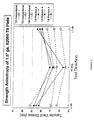
- Figure 1 compares the results from Table I and Table II. Practice A improved the uniformity of the tensile yield stresses in the L and LT directions and reduced the through-thickness variability significantly. The minimum strength increases are an improvement over the conventional T8 temper practice.
- Table III data illustrates the effect of another mode of the inventive practice, Practice B: 6% cold work by cold rolling and an additional 6% cold work by cold rolling in the same direction, then 2% stretch and aging: age for 24 hours at 290°F.
- the difference between the highest tensile yield stress (i.e. TYS at T/2 in longitudinal direction) and the lowest tensile yield stress (i.e. TYS at T/2 in 45 degree direction) is 13.8 ksi.
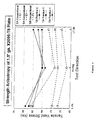
- Figure 2 compares the results from Table I and Table III.
- Practice B unexpectedly improved the uniformity of the tensile yield stresses in all three directions at all three locations, T/2, T/4 and T/8, in the plate.
- Table IV data illustrates the effect of yet another mode of the inventive practice, Practice C: 6% cold work by cold rolling and an additional 6% cold work by cold rolling in the reversed direction, then 2% stretch and aging for 24 hours at 290°F.
- the difference between the highest tensile yield stress (i.e. TYS at T/2 in longitudinal direction) and the lowest tensile yield stress (i.e. TYS at T/2 in 45 degree direction) is 10.2 ksi.
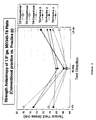
- Figure 3 compares the results from Table I and Table IV.
- Practice C further unexpectedly improved the uniformity of the tensile yield stresses over the Practice B in all three directions at all three locations, T/2, T/4 and T/8, in the plate.
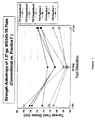
- Table V and Figure 4 summarize the effectiveness of the inventive T8 temper practices (Practice A, B and C) in reducing strength anisotropy by increasing the lowest TYS values. While all three new T8 temper practices were effective in reducing strength anisotropy of the plate, Practice C was the most effective in increasing the lowest TYS value and minimizing the strength anisotropy.
- the aluminum-lithium alloy was DC cast into a 12" thick by 45" rectangular ingot having the following composition: Cu Li Mg Ag Zr Fe Si Al 2.53 1.63 .38 .35 .14 .03 .02 balance
- the cast ingot was then processed conventionally, including stress relief and homogenization.
- the homogenized ingot was hot rolled using a combination of cross rolling and straight rolling.
- the 1.6" gauge F-temper plates were solution heat treated and cold water quenched to W-temper condition.
- Example II For the aluminum-lithium alloy of Example II, a comparison was made between a conventional T8 temper practice and 3 different modes of the inventive T8 temper practice.
- the conventional T8 temper practice was as follows:
- the W-temper plate was stretched by 6% followed by aging at 320°F (160°C) for about 24 hours to approximately 75 ksi to 80 ksi tensile yield stress in the longitudinal direction at T/2 location.
- Example II The evaluation of the directional strength anisotropy for Example II with respect to tensile specimens was done in the same manner as for Example I.
- Table VI data illustrate the effect of the conventional 6% stretch and aging practice: age for 24 hours at 320°F (hereinafter referred to as conventional practice).
- the maximum TYS values for the inventive processes were lower than the values for the conventional processes.
- the alloys aged with the inventive processes could have been aged longer to obtain higher maximum and minimum TYS values, without a significant adverse impact on fracture toughness properties.
- the longitudinal TYS of 78 ksi at the T/2 location compared with the longitudinal TYS of 69 ksi at the T/8 location yields a difference of 9 ksi
- the longitudinal T/2 TYS of 78 ksi compared with the 45 degree direction TYS of 64.9 ksi at the T/8 location represent a significant difference of 13.1 ksi.
- Figure 5 compares the results from Table VI and Table VII.
- Practice D improved the uniformity of the tensile yield stresses by increasing the lowest strength by 1 ksi and decreasing the highest strength by 2.9 ksi.
- Practice D shows an improvement over the conventional T8 temper practice in that a higher minimum value is achieved.
- the product if aged longer, could have a maximum strength value comparable to the maximum strength value achieved with the conventional practices. Longer aging would also increase the minimum TYS value achieved with the inventive practice.
- Table VIII data illustrates the effect of another inventive practice, Practice E: 4% cold work by cold rolling in the 45 degree direction and an additional 4% cold work by cold rolling in the -45 degree direction, then 4% stretch and aging for 24 hours at 320°F.
- the difference between the highest tensile yield stress (i.e. TYS of 76.3 ksi at T/2 in long transverse direction) and the lowest tensile yield stress (i.e. TYS of 66.2 ksi at T/4 in 45 degree direction) is 10.1 ksi.
- Figure 6 compares the results from Table VI and Table VIII. Practice E improved the uniformity of the tensile yield stresses by decreasing the highest strength by 2 ksi and increasing the lowest strength by 1.3 ksi. Practice E also shows improvement over the conventional practice.
- Table IX data illustrates the effect of another mode of the inventive practice, Practice F: 4% cold work by cold rolling in the 45 degree direction, an additional 4% cold work by cold rolling in the -45 degree direction, 2% cold work by cold rolling in the straight longitudinal direction and then 2% stretch and aging: age for 24 hours at 320°F.
- the difference between the highest tensile yield stress (i.e. TYS at T/2 in longitudinal direction) and the lowest tensile yield stress (i.e. TYS at T/2 in 45 degree direction) is only 7.7 ksi.
- Figure 7 compares the results from Table VI and Table IX. Practice F significantly and unexpectedly improves the uniformity of the tensile yield stresses over the conventional T8 type temper practice.
- Table X and Figure 8 summarize the effectiveness of the new T8 temper practices (Practices D, E and F) in reducing strength anisotropy by increasing the lowest TYS values. While all three new T8 temper practices were effective in reducing strength anisotropy of the plate, Practice F was the most effective in increasing the lowest TYS value and minimizing the strength anisotropy.
Landscapes
- Chemical & Material Sciences (AREA)
- Physics & Mathematics (AREA)
- Thermal Sciences (AREA)
- Crystallography & Structural Chemistry (AREA)
- Engineering & Computer Science (AREA)
- Materials Engineering (AREA)
- Mechanical Engineering (AREA)
- Metallurgy (AREA)
- Organic Chemistry (AREA)
- Metal Rolling (AREA)
Claims (13)
- Procédé pour réduire l'anisotropie en matière de résistance mécanique dans un produit corroyé en alliage d'aluminium-lithium ayant subi un traitement thermique de mise en solution et trempé, qui n'a pas subi de recristallisation préalable, le procédé comprenant les étapes consistant à :a) laminer à froid un produit corroyé en alliage d'aluminium-lithium ayant subi un traitement thermique de mise en solution et trempé, en au moins une passe, en une quantité d'au moins 3 % de réduction ;b) étirer ledit produit laminé à froid en une quantité comprise entre 1,5 et 10 % et ;c) vieillir ledit produit laminé à froid et étiré pour augmenter sa résistance mécanique de telle manière que le laminage à froid et l'étirage combiné donne un produit en alliage d'aluminium-lithium laminé ayant une anisotropie réduite en matière de résistance mécanique, et dans lequel ledit produit d'alliage laminé à froid et étiré a une limite apparente d'élasticité minimale à la traction représentant au moins 85 % environ d'une limite apparente d'élasticité à la traction maximale.
- Procédé selon la revendication 1, dans lequel ladite étape de laminage à froid comprend une pluralité de passes et dans lequel ladite réduction en pourcentage est répartie de manière inégale entre ladite pluralité de passes.
- Procédé selon la revendication 1 ou 2, dans lequel ledit produit corroyé en alliage d'aluminium-lithium est choisi dans le groupe constitué par les alliages de type aluminium-lithium-cuivre, les alliages de type aluminium-lithium-magnésium, les alliages de type aluminium-lithium-cuivre-magnésium, les alliages de type aluminium-lithium-cuivre-magnésium-argent, les alliages de type aluminium-magnésium-lithium-argent, les alliages de type aluminium-magnésium-lithium-argent-zinc et les alliages de type aluminium-magnésium-lithium-zinc.
- Produit en alliage d'aluminium-lithium laminé ayant une anisotropie réduite en matière de résistance mécanique préparé par le procédé de la revendication 1.
- Procédé pour réduire l'anisotropie en matière de résistance mécanique dans un produit corroyé en alliage d'aluminium-lithium selon la revendication 1, dans lequel le laminage à froid dudit produit corroyé est réalisé à une réduction en pourcentage prédéterminée dans une pluralité de passes, au moins deux desdites passes étant en sens inverses.
- Procédé selon la revendication 5, dans lequel une desdites passes est dans le sens longitudinal dudit produit corroyé, une autre desdites passes étant en sens inverse par rapport audit sens longitudinal.
- Procédé selon la revendication 5, dans lequel une desdites passes est dans la direction à 45 degrés par rapport à un sens de laminage à chaud pour ledit produit corroyé, une autre desdites passes étant dans la direction à -45 degrés par rapport audit produit corroyé.
- Procédé selon l'une quelconque des revendications précédentes, dans lequel ladite réduction en pourcentage pour le laminage à froid est comprise entre 3 et 14 % et ladite réduction en pourcentage pour l'étirage est comprise entre 1,5 et 6 %.
- Procédé selon la revendication 8, dans lequel ladite réduction en pourcentage pour le laminage à froid est comprise entre 6 et 12 % et ladite réduction en pourcentage pour l'étirage est comprise entre 1,5 et 3 %.
- Procédé selon la revendication 7, dans lequel ledit alliage d'aluminium-lithium est sélectionné dans le groupe constitué par les alliages de type aluminium-lithium-cuivre, les alliages de type aluminium-lithium-magnésium, les alliages de type aluminium-lithium-cuivre-magnésium et les alliages de type aluminium-lithium-cuivre-magnésium-argent.
- Produit en alliage d'aluminium-lithium laminé ayant une anisotropie réduite en matière de résistance mécanique préparé par le procédé de la revendication 5.
- Produit en alliage d'aluminium-lithium laminé ayant une anisotropie réduite en matière de résistance préparé par le procédé de la revendication 5, dans lequel ledit produit corroyé en alliage d'aluminium-lithium est dans le groupe constitué par les alliages de type aluminium-lithium-cuivre, les alliages de type aluminium-lithium-magnésium, les alliages de type aluminium-lithium-cuivre-magnésium, les alliages de type aluminium-lithium-cuivre-magnésium-argent, les alliages de type aluminium-magnésium-lithium-argent, les alliages de type aluminium-magnésium-lithium-argent-zinc et les alliages de type aluminium-magnésium-lithium-zinc.
- Produit en alliage d'aluminium-lithium laminé selon la revendication 12, dans lequel ledit produit corroyé est une plaque (« plate »), un feuillard (« strip ») ou une tôle (« sheet ») d'un alliage de type aluminium-lithium-cuivre-magnésium-argent.
Applications Claiming Priority (3)
| Application Number | Priority Date | Filing Date | Title |
|---|---|---|---|
| US07/957,318 US5393357A (en) | 1992-10-06 | 1992-10-06 | Method of minimizing strength anisotropy in aluminum-lithium alloy wrought product by cold rolling, stretching and aging |
| US957318 | 1992-10-06 | ||
| PCT/US1993/009505 WO1994008060A1 (fr) | 1992-10-06 | 1993-10-05 | Reduction d'anisotropie de resistance dans des alliages d'aluminium-lithium par façonnage a froid et vieillissement |
Publications (3)
| Publication Number | Publication Date |
|---|---|
| EP0665901A1 EP0665901A1 (fr) | 1995-08-09 |
| EP0665901A4 EP0665901A4 (fr) | 1995-11-08 |
| EP0665901B1 true EP0665901B1 (fr) | 2001-08-29 |
Family
ID=25499410
Family Applications (1)
| Application Number | Title | Priority Date | Filing Date |
|---|---|---|---|
| EP93923256A Expired - Lifetime EP0665901B1 (fr) | 1992-10-06 | 1993-10-05 | Reduction d'anisotropie de resistance dans des alliages d'aluminium-lithium par faconnage a froid et vieillissement |
Country Status (6)
| Country | Link |
|---|---|
| US (2) | US5393357A (fr) |
| EP (1) | EP0665901B1 (fr) |
| CA (1) | CA2145293A1 (fr) |
| DE (1) | DE69330679T2 (fr) |
| ES (1) | ES2161721T3 (fr) |
| WO (1) | WO1994008060A1 (fr) |
Families Citing this family (26)
| Publication number | Priority date | Publication date | Assignee | Title |
|---|---|---|---|---|
| GB9424970D0 (en) * | 1994-12-10 | 1995-02-08 | British Aerospace | Thermal stabilisation of Al-Li alloy |
| WO2000037696A1 (fr) * | 1998-12-18 | 2000-06-29 | Corus Aluminium Walzprodukte Gmbh | Procede de fabrication d'un produit d'alliage aluminium-magnesium-lithium |
| EP1409759A4 (fr) * | 2000-10-20 | 2004-05-06 | Pechiney Rolled Products Llc | Alliage d'aluminium a haute resistance |
| NL1018815C2 (nl) * | 2001-08-24 | 2003-02-25 | Corus Technology B V | Werkwijze voor het bewerken van een metalen plak of knuppel, en daarmee vervaardigd product. |
| US7105067B2 (en) * | 2003-06-05 | 2006-09-12 | The Boeing Company | Method to increase the toughness of aluminum-lithium alloys at cryogenic temperatures |
| US20060118217A1 (en) * | 2004-12-07 | 2006-06-08 | Alcoa Inc. | Method of manufacturing heat treated sheet and plate with reduced levels of residual stress and improved flatness |
| US20090028744A1 (en) * | 2007-07-23 | 2009-01-29 | Heraeus, Inc. | Ultra-high purity NiPt alloys and sputtering targets comprising same |
| CN103266246B (zh) * | 2007-09-21 | 2016-09-21 | 阿勒里斯铝业科布伦茨有限公司 | 适于航空应用的Al-Cu-Li合金产品 |
| BRPI0820679A2 (pt) * | 2007-12-04 | 2019-09-10 | Alcoa Inc | ligas alumínio-cobre-lítio melhoradas |
| FR2925523B1 (fr) * | 2007-12-21 | 2010-05-21 | Alcan Rhenalu | Produit lamine ameliore en alliage aluminium-lithium pour applications aeronautiques |
| US20100180427A1 (en) * | 2009-01-16 | 2010-07-22 | Ford Motor Company | Texturing of thin metal sheets/foils for enhanced formability and manufacturability |
| US9314826B2 (en) | 2009-01-16 | 2016-04-19 | Aleris Rolled Products Germany Gmbh | Method for the manufacture of an aluminium alloy plate product having low levels of residual stress |
| US8333853B2 (en) * | 2009-01-16 | 2012-12-18 | Alcoa Inc. | Aging of aluminum alloys for improved combination of fatigue performance and strength |
| US20100330389A1 (en) * | 2009-06-25 | 2010-12-30 | Ford Motor Company | Skin pass for cladding thin metal sheets |
| US9359660B2 (en) | 2010-09-08 | 2016-06-07 | Alcoa Inc. | 6XXX aluminum alloys, and methods for producing the same |
| EP3187603B1 (fr) | 2011-02-17 | 2024-06-26 | Arconic Technologies LLC | Alliages d'aluminium-lithium de la série 2xxx |
| WO2013172910A2 (fr) | 2012-03-07 | 2013-11-21 | Alcoa Inc. | Alliages d'aluminium 2xxx améliorés et procédés de production correspondants |
| JP6480733B2 (ja) * | 2012-12-21 | 2019-03-13 | 川崎重工業株式会社 | アルミニウム合金製航空機用成形部品の製造方法 |
| US9587298B2 (en) | 2013-02-19 | 2017-03-07 | Arconic Inc. | Heat treatable aluminum alloys having magnesium and zinc and methods for producing the same |
| FR3044682B1 (fr) | 2015-12-04 | 2018-01-12 | Constellium Issoire | Alliage aluminium cuivre lithium a resistance mecanique et tenacite ameliorees |
| WO2018037390A2 (fr) | 2016-08-26 | 2018-03-01 | Shape Corp. | Procédé de formage à chaud et appareil de pliage transversal d'une poutre d'aluminium profilée pour former à chaud un composant structural de véhicule |
| US11072844B2 (en) | 2016-10-24 | 2021-07-27 | Shape Corp. | Multi-stage aluminum alloy forming and thermal processing method for the production of vehicle components |
| FR3080861B1 (fr) * | 2018-05-02 | 2021-03-19 | Constellium Issoire | Procede de fabrication d'un alliage aluminium cuivre lithium a resistance en compression et tenacite ameliorees |
| CN110735060A (zh) * | 2019-11-25 | 2020-01-31 | 兰州理工大学 | 一种改善铝合金性能的连续正交轧制方法 |
| CN112981284B (zh) * | 2021-02-09 | 2022-04-05 | 北京理工大学 | 一种应力时效态高强铝锂合金的制备方法 |
| US20220307388A1 (en) | 2021-03-24 | 2022-09-29 | General Electric Company | Hybrid composite components |
Family Cites Families (10)
| Publication number | Priority date | Publication date | Assignee | Title |
|---|---|---|---|---|
| BR8401499A (pt) * | 1983-03-31 | 1984-11-13 | Alcan Int Ltd | Liga a base de aluminio e processo para produzir uma chapa ou tira |
| US4648913A (en) * | 1984-03-29 | 1987-03-10 | Aluminum Company Of America | Aluminum-lithium alloys and method |
| US5135713A (en) * | 1984-03-29 | 1992-08-04 | Aluminum Company Of America | Aluminum-lithium alloys having high zinc |
| US4797165A (en) * | 1984-03-29 | 1989-01-10 | Aluminum Company Of America | Aluminum-lithium alloys having improved corrosion resistance and method |
| US4961792A (en) * | 1984-12-24 | 1990-10-09 | Aluminum Company Of America | Aluminum-lithium alloys having improved corrosion resistance containing Mg and Zn |
| US4921548A (en) * | 1985-10-31 | 1990-05-01 | Aluminum Company Of America | Aluminum-lithium alloys and method of making same |
| US4816087A (en) * | 1985-10-31 | 1989-03-28 | Aluminum Company Of America | Process for producing duplex mode recrystallized high strength aluminum-lithium alloy products with high fracture toughness and method of making the same |
| US5032359A (en) * | 1987-08-10 | 1991-07-16 | Martin Marietta Corporation | Ultra high strength weldable aluminum-lithium alloys |
| US5066342A (en) * | 1988-01-28 | 1991-11-19 | Aluminum Company Of America | Aluminum-lithium alloys and method of making the same |
| US5194102A (en) * | 1991-06-20 | 1993-03-16 | Aluminum Company Of America | Method for increasing the strength of aluminum alloy products through warm working |
-
1992
- 1992-10-06 US US07/957,318 patent/US5393357A/en not_active Expired - Lifetime
-
1993
- 1993-10-05 ES ES93923256T patent/ES2161721T3/es not_active Expired - Lifetime
- 1993-10-05 EP EP93923256A patent/EP0665901B1/fr not_active Expired - Lifetime
- 1993-10-05 WO PCT/US1993/009505 patent/WO1994008060A1/fr not_active Ceased
- 1993-10-05 DE DE69330679T patent/DE69330679T2/de not_active Expired - Lifetime
- 1993-10-05 CA CA002145293A patent/CA2145293A1/fr not_active Abandoned
-
1994
- 1994-05-02 US US08/236,811 patent/US5439536A/en not_active Expired - Lifetime
Also Published As
| Publication number | Publication date |
|---|---|
| ES2161721T3 (es) | 2001-12-16 |
| US5439536A (en) | 1995-08-08 |
| EP0665901A4 (fr) | 1995-11-08 |
| EP0665901A1 (fr) | 1995-08-09 |
| DE69330679D1 (de) | 2001-10-04 |
| US5393357A (en) | 1995-02-28 |
| DE69330679T2 (de) | 2002-06-27 |
| CA2145293A1 (fr) | 1994-04-14 |
| WO1994008060A1 (fr) | 1994-04-14 |
Similar Documents
| Publication | Publication Date | Title |
|---|---|---|
| EP0665901B1 (fr) | Reduction d'anisotropie de resistance dans des alliages d'aluminium-lithium par faconnage a froid et vieillissement | |
| EP0584271B1 (fr) | ALLIAGE DE Al-Li A RESISTANCE ELEVEE ET A FAIBLE DENSITE | |
| US10301710B2 (en) | Aluminum alloy that is not sensitive to quenching, as well as method for the production of a semi-finished product | |
| US5133931A (en) | Lithium aluminum alloy system | |
| EP0157600B1 (fr) | Alliages aluminium-lithium | |
| US7229509B2 (en) | Al-Cu-Li-Mg-Ag-Mn-Zr alloy for use as structural members requiring high strength and high fracture toughness | |
| EP1359232B1 (fr) | Procédé servant a améliorer la ténacité d'alliages d'aluminium et de lithium | |
| EP0642598B1 (fr) | Alliage al-li de faible densite a haute resistance presentant une tenacite elevee a temperatures elevees | |
| US9970090B2 (en) | Aluminum alloy combining high strength, elongation and extrudability | |
| US4961792A (en) | Aluminum-lithium alloys having improved corrosion resistance containing Mg and Zn | |
| EP0504218B1 (fr) | Ameliorations apportees aux alliages d'aluminium | |
| EP0325937B1 (fr) | Alliages aluminium-lithium | |
| EP0694085B1 (fr) | Amelioration des proprietes mecaniques des alliages aluminium-lithium | |
| JP2000212673A (ja) | 耐応力腐食割れ性に優れた航空機ストリンガ―用アルミニウム合金板およびその製造方法 | |
| JPS602644A (ja) | アルミニウム合金 | |
| US6322647B1 (en) | Methods of improving hot working productivity and corrosion resistance in AA7000 series aluminum alloys and products therefrom |
Legal Events
| Date | Code | Title | Description |
|---|---|---|---|
| PUAI | Public reference made under article 153(3) epc to a published international application that has entered the european phase |
Free format text: ORIGINAL CODE: 0009012 |
|
| 17P | Request for examination filed |
Effective date: 19950317 |
|
| AK | Designated contracting states |
Kind code of ref document: A1 Designated state(s): DE ES FR GB |
|
| A4 | Supplementary search report drawn up and despatched |
Effective date: 19950921 |
|
| AK | Designated contracting states |
Kind code of ref document: A4 Designated state(s): DE ES FR GB |
|
| 17Q | First examination report despatched |
Effective date: 19980407 |
|
| GRAG | Despatch of communication of intention to grant |
Free format text: ORIGINAL CODE: EPIDOS AGRA |
|
| GRAG | Despatch of communication of intention to grant |
Free format text: ORIGINAL CODE: EPIDOS AGRA |
|
| GRAG | Despatch of communication of intention to grant |
Free format text: ORIGINAL CODE: EPIDOS AGRA |
|
| GRAH | Despatch of communication of intention to grant a patent |
Free format text: ORIGINAL CODE: EPIDOS IGRA |
|
| GRAG | Despatch of communication of intention to grant |
Free format text: ORIGINAL CODE: EPIDOS AGRA |
|
| GRAH | Despatch of communication of intention to grant a patent |
Free format text: ORIGINAL CODE: EPIDOS IGRA |
|
| GRAH | Despatch of communication of intention to grant a patent |
Free format text: ORIGINAL CODE: EPIDOS IGRA |
|
| RAP1 | Party data changed (applicant data changed or rights of an application transferred) |
Owner name: MCCOOK METALS L.L.C. |
|
| GRAA | (expected) grant |
Free format text: ORIGINAL CODE: 0009210 |
|
| AK | Designated contracting states |
Kind code of ref document: B1 Designated state(s): DE ES FR GB |
|
| REF | Corresponds to: |
Ref document number: 69330679 Country of ref document: DE Date of ref document: 20011004 |
|
| REG | Reference to a national code |
Ref country code: ES Ref legal event code: FG2A Ref document number: 2161721 Country of ref document: ES Kind code of ref document: T3 |
|
| REG | Reference to a national code |
Ref country code: GB Ref legal event code: IF02 |
|
| ET | Fr: translation filed | ||
| PLBE | No opposition filed within time limit |
Free format text: ORIGINAL CODE: 0009261 |
|
| STAA | Information on the status of an ep patent application or granted ep patent |
Free format text: STATUS: NO OPPOSITION FILED WITHIN TIME LIMIT |
|
| 26N | No opposition filed | ||
| REG | Reference to a national code |
Ref country code: FR Ref legal event code: TP |
|
| PGFP | Annual fee paid to national office [announced via postgrant information from national office to epo] |
Ref country code: ES Payment date: 20051010 Year of fee payment: 13 |
|
| REG | Reference to a national code |
Ref country code: FR Ref legal event code: CD |
|
| REG | Reference to a national code |
Ref country code: ES Ref legal event code: FD2A Effective date: 20061006 |
|
| PG25 | Lapsed in a contracting state [announced via postgrant information from national office to epo] |
Ref country code: ES Free format text: LAPSE BECAUSE OF NON-PAYMENT OF DUE FEES Effective date: 20061006 |
|
| PGFP | Annual fee paid to national office [announced via postgrant information from national office to epo] |
Ref country code: DE Payment date: 20091028 Year of fee payment: 17 |
|
| PGFP | Annual fee paid to national office [announced via postgrant information from national office to epo] |
Ref country code: FR Payment date: 20101105 Year of fee payment: 18 |
|
| PGFP | Annual fee paid to national office [announced via postgrant information from national office to epo] |
Ref country code: GB Payment date: 20101025 Year of fee payment: 18 |
|
| REG | Reference to a national code |
Ref country code: DE Ref legal event code: R119 Ref document number: 69330679 Country of ref document: DE Effective date: 20110502 |
|
| GBPC | Gb: european patent ceased through non-payment of renewal fee |
Effective date: 20111005 |
|
| REG | Reference to a national code |
Ref country code: FR Ref legal event code: ST Effective date: 20120629 |
|
| PG25 | Lapsed in a contracting state [announced via postgrant information from national office to epo] |
Ref country code: GB Free format text: LAPSE BECAUSE OF NON-PAYMENT OF DUE FEES Effective date: 20111005 Ref country code: FR Free format text: LAPSE BECAUSE OF NON-PAYMENT OF DUE FEES Effective date: 20111102 |
|
| PG25 | Lapsed in a contracting state [announced via postgrant information from national office to epo] |
Ref country code: DE Free format text: LAPSE BECAUSE OF NON-PAYMENT OF DUE FEES Effective date: 20110502 |