EP0672849B1 - Kolbenabdichtungszusammenbau - Google Patents
Kolbenabdichtungszusammenbau Download PDFInfo
- Publication number
- EP0672849B1 EP0672849B1 EP95301445A EP95301445A EP0672849B1 EP 0672849 B1 EP0672849 B1 EP 0672849B1 EP 95301445 A EP95301445 A EP 95301445A EP 95301445 A EP95301445 A EP 95301445A EP 0672849 B1 EP0672849 B1 EP 0672849B1
- Authority
- EP
- European Patent Office
- Prior art keywords
- groove
- assembly
- bore wall
- cylinder bore
- piston
- Prior art date
- Legal status (The legal status is an assumption and is not a legal conclusion. Google has not performed a legal analysis and makes no representation as to the accuracy of the status listed.)
- Expired - Lifetime
Links
- 238000007789 sealing Methods 0.000 title claims description 40
- 239000010408 film Substances 0.000 claims description 13
- 230000013011 mating Effects 0.000 claims description 10
- 239000000314 lubricant Substances 0.000 claims description 5
- 239000007787 solid Substances 0.000 claims description 5
- 229920001971 elastomer Polymers 0.000 claims description 4
- 239000000806 elastomer Substances 0.000 claims description 4
- 239000011248 coating agent Substances 0.000 claims description 3
- 238000000576 coating method Methods 0.000 claims description 3
- 239000010409 thin film Substances 0.000 claims description 2
- 238000003754 machining Methods 0.000 claims 5
- 229920000642 polymer Polymers 0.000 claims 2
- 229910052582 BN Inorganic materials 0.000 claims 1
- PZNSFCLAULLKQX-UHFFFAOYSA-N Boron nitride Chemical compound N#B PZNSFCLAULLKQX-UHFFFAOYSA-N 0.000 claims 1
- OKTJSMMVPCPJKN-UHFFFAOYSA-N Carbon Chemical compound [C] OKTJSMMVPCPJKN-UHFFFAOYSA-N 0.000 claims 1
- 229910002804 graphite Inorganic materials 0.000 claims 1
- 239000010439 graphite Substances 0.000 claims 1
- 238000004519 manufacturing process Methods 0.000 claims 1
- CWQXQMHSOZUFJS-UHFFFAOYSA-N molybdenum disulfide Chemical compound S=[Mo]=S CWQXQMHSOZUFJS-UHFFFAOYSA-N 0.000 claims 1
- 239000003921 oil Substances 0.000 description 20
- 238000002485 combustion reaction Methods 0.000 description 13
- 239000007789 gas Substances 0.000 description 8
- 230000002572 peristaltic effect Effects 0.000 description 7
- 238000005086 pumping Methods 0.000 description 7
- 230000006835 compression Effects 0.000 description 6
- 238000007906 compression Methods 0.000 description 6
- 239000000446 fuel Substances 0.000 description 4
- 229910052751 metal Inorganic materials 0.000 description 4
- 239000002184 metal Substances 0.000 description 4
- 239000004215 Carbon black (E152) Substances 0.000 description 3
- 239000000567 combustion gas Substances 0.000 description 3
- 238000010276 construction Methods 0.000 description 3
- 229930195733 hydrocarbon Natural products 0.000 description 3
- 150000002430 hydrocarbons Chemical class 0.000 description 3
- 239000000203 mixture Substances 0.000 description 3
- 230000000712 assembly Effects 0.000 description 2
- 238000000429 assembly Methods 0.000 description 2
- 238000006243 chemical reaction Methods 0.000 description 2
- 238000011109 contamination Methods 0.000 description 2
- 238000013461 design Methods 0.000 description 2
- 230000000694 effects Effects 0.000 description 2
- 239000013536 elastomeric material Substances 0.000 description 2
- 230000002708 enhancing effect Effects 0.000 description 2
- 238000007790 scraping Methods 0.000 description 2
- 238000012546 transfer Methods 0.000 description 2
- 229910000838 Al alloy Inorganic materials 0.000 description 1
- 229910000831 Steel Inorganic materials 0.000 description 1
- 230000002411 adverse Effects 0.000 description 1
- 239000004411 aluminium Substances 0.000 description 1
- 229910052782 aluminium Inorganic materials 0.000 description 1
- XAGFODPZIPBFFR-UHFFFAOYSA-N aluminium Chemical compound [Al] XAGFODPZIPBFFR-UHFFFAOYSA-N 0.000 description 1
- 230000015572 biosynthetic process Effects 0.000 description 1
- 238000009835 boiling Methods 0.000 description 1
- 239000000470 constituent Substances 0.000 description 1
- 238000001816 cooling Methods 0.000 description 1
- 238000005516 engineering process Methods 0.000 description 1
- 239000012530 fluid Substances 0.000 description 1
- 230000006870 function Effects 0.000 description 1
- 238000003780 insertion Methods 0.000 description 1
- 230000037431 insertion Effects 0.000 description 1
- 239000010687 lubricating oil Substances 0.000 description 1
- 238000005461 lubrication Methods 0.000 description 1
- 239000000463 material Substances 0.000 description 1
- 238000000034 method Methods 0.000 description 1
- 230000000630 rising effect Effects 0.000 description 1
- 238000005096 rolling process Methods 0.000 description 1
- 238000009751 slip forming Methods 0.000 description 1
- 239000010959 steel Substances 0.000 description 1
- 238000012360 testing method Methods 0.000 description 1
Images


Classifications
-
- F—MECHANICAL ENGINEERING; LIGHTING; HEATING; WEAPONS; BLASTING
- F16—ENGINEERING ELEMENTS AND UNITS; GENERAL MEASURES FOR PRODUCING AND MAINTAINING EFFECTIVE FUNCTIONING OF MACHINES OR INSTALLATIONS; THERMAL INSULATION IN GENERAL
- F16J—PISTONS; CYLINDERS; SEALINGS
- F16J9/00—Piston-rings, e.g. non-metallic piston-rings, seats therefor; Ring sealings of similar construction
- F16J9/12—Details
- F16J9/20—Rings with special cross-section; Oil-scraping rings
Definitions
- This invention relates to the technology of sealing relatively moveable surfaces and more particularly to piston sealing assemblies that can substantially reduce friction, blow-by and peristaltic pumping.
- piston rings which are usually made of flat heat-resistant metal (split to allow for assembly and to exert a radial resiliency) sized to fit within straight sided grooves that allow for upward and downward shifting of the rings within their grooves.
- High pressure combustion gases at one side of the rings tend to force the ring against the opposite side of the groove, producing high frictional contact that prevents the ring from adjusting radially to maintain good sealing contact.
- Gases will migrate behind the ring and leak as the ring changes position between strokes or the gases will migrate past the outer periphery of the rings and leak as the rings fail to maintain annular contact (both effects are often referred to as blow-by).
- blow-by is the charge mass in the combustion chamber that leaks past the piston rings and accounts for about 4% of the brake specific fuel consumption (BSFC); friction is the useful energy expanded to overcome the friction between the piston/piston rings and the cylinder bore used is usually around 12% BSFC.
- BSFC brake specific fuel consumption
- the upward and downward shifting of the rings within their grooves allows liquid lubricants, such as oil splashed on the lower portion of the cylinder bore wall, to be unwantedly pumped upward into the combustion chamber as the oil gets trapped between the rings and released on a change of stroke. This is sometimes referred to as unintended peristaltic pumping.
- the shifting of the ring within the groove may involve twisting or inversion of its radial plane about it axis, sometimes referred to as flutter. This flutter can eventually wear away the sharp corners of the groove allowing even more exaggerated flutter, blow-by and peristaltic pumping.
- US Patent 4,350,352 is concerned with piston ring and groove assemblies which provide a seal between a piston ring side and an adjacent wall of a piston ring groove during engine operation even when the piston is eccentric or tilted relative to a cylinder within which said piston moves,
- An annular sealing element is positioned in the groove and is provided with smoothly curved and diverging concave side surfaces which are mateable with diverging convex shoulders on the groove.
- a sealing assembly for a cylinder bore wall having a piston moveable closely along such wall with a controlled gap therebetween.
- the assembly comprising: (a) walls, in at least one of said cylinder bore wall and piston, defining an annular groove facing the other of said cylinder bore wall or piston, the outer radial regions of said groove being smoothly curved to form a pair of oppositely facing and diverging convex shoulders; (b) an annular sealing element positioned in said groove and having (i) smoothly curved and diverging concave side surfaces mateable with said groove shoulders for supporting said element in said groove and (ii) a curved crown surface effective to tangentially contact said cylinder bore wall characterised in that (c) said pair of mating groove shoulders and element side surfaces each having defined curvatures effective to maintain tangency in the sense that the seal element is capable of articulating within said groove while said element side surfaces each tangentially contacts their respective mating groove surface and said curved crown surface maintains contact with the cylinder bore wall, so that any load
- the crown is effective to tangentially contact the cylinder wall while the element side surfaces each tangentially contact their respective mating groove shoulders.
- the pair of mating groove shoulders and element side walls each have defined curvatures which are effective to maintain the tangency and transfer any load from the sealing element (resulting from contact between the element crown and the cylinder wall contact) to the groove shoulders in a substantially equal manner regardless of some tilting of the element with respect to the groove.
- the curvature of the groove shoulders, side surfaces and crown surfaces all adhere to a tractrix relationship whereby the tangential contact is free to shift along the defined curvature as the element changes orientation.
- the effectiveness of the sealing assembly can be further enhanced by coating the mating surfaces with a thin film of solid lubricant and assuring that the gap between the sealing element and cylinder wall is regularly limited to about .0002 inches or less so that the mixture of charge or combustion gases can act as a squeeze film lubrication therebetween.
- the sealing assembly can eliminate thermally caused gap disparities between the piston and cylinder bore wall to ensure high performance of the seal construction by using one or more of the following: (a) use of an elastomer ring acting between the root of the groove and the sealing element to bias the element lightly against the cylinder bore wall in spite of thermal divergences; (b) the sealing element may be hollowed out to provide slightly flexible side legs (the legs carry the side surfaces of the element) so that the sealing element can more readily maintain tangential contact of the shoulders and side walls while experiencing thermal growth divergences; (c) continuous oil cooling of the internal surfaces of the piston to extract heat and restrict thermal growth divergences; and (d) deploy essentially the same metal in both the piston ring and cylinder bore wall to better respond to thermal changes.
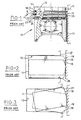
- the upper ring 11 (commonly called the top compression ring) is located approximately 5-6 millimetres below the piston crown 12 within a groove 13; the piston surface from the crown 12 to the top groove 13 is generally known as the top land 14.
- the axial clearance between the groove 13 and the ring 11 is around 40-50 microns (.002 inches).
- the clearance 17 between the top land 14 and the cylinder bore wall 16 is designed to prevent interference during cold starts or other conditions that induce rapid expansion of the piston crown ahead of the cylinder bore.
- the ring face 18 (the surface riding on the cylinder bore surface 16 and oil film 14) is of a barrel profile to promote rapid hydrodynamic film formation and easy glide during both upward as well as downward piston travel.
- the second ring 20 (also commonly called a scraper or second compression ring) is located in the second groove 21; the second groove 21 is located 4-5 millimetres below the top groove 13.
- the piston outer surface between the top ring 11 and the second ring 20 is referred to as the second land or middle land 22 (in the case of gasoline or spark ignition engines the ring pack usually consists of three rings, or four or more rings for diesel engines).
- the face 23 of the second ring face can be a tapered wedge profile, slightly rounded at the lower edge; this rounding facilitates scraping off the oil layer during the piston downward travel without incurring excessive friction losses. It also serves to scrape off the excessive oil to maintain a thin oil film.
- the ring-groove clearance is usually around 50 microns (.002 inches).
- the third ring 24 is the oil control ring, designed to maintain an oil film on the bore surface while scraping off and returning any excess oil to the sump.
- crevice volume is defined as remote spaces of the combustion chamber which trap the gas mixture charge during the compression stroke and effectively isolate the trapped charge from flame and thereby combustion. This trapped charge is released into the combustion chamber during the expansion stroke and is expelled along with the combustion products.
- the largest single constituent of crevice volume is the piston assembly. More specifically, this includes the top and second ring clearance volumes 29,30, and the piston land-bore annuli volumes 25,26 generated by the top and second ring lands.
- blow-by A significant part of blow-by results from the gas flow behind the rings through the ring-groove clearances. Blow-by is that portion of the gas mixture of the combustion chamber (mainly the charge during the compression stroke and the combustion products after ignition and during expansion strokes) that flow past the ring pack into the oil sump.
- Two adverse consequences of blow-by are (i) loss of engine power and fuel economy (normal blow-by is around .75-1% of the volume of the change ), and (ii) the boiling of oil due to contamination with acidified oil and contamination from combustion products.
- the rings Due to the large ring-groove clearance (29,30), the rings are permitted axial ring twist as shown in Figure 3.
- the twisting action also eventually wears away the corners (such as 27,28 of groove 13) during piston strokes.
- the twisting or ring flutter generates a pounding action and causes wear at the groove edges 27,28. This enhances peristaltic pumping action and increases oil consumption, hydrocarbon emissions and blow-by.
- the combustion gases can fill the crevice volume behind the rings 11,20 and during the compression stroke, can escape by being pumped past the rings into the crankcase. Conversely, the oil can migrate behind the rings in the groove during the exhaust stroke and be pumped upwards into the combustion chamber.
- each seal element 34 provides a piston assembly 36 that has, for each groove 31, radially outer regions 32,33 and for each seal element 34 has radially outer surface portions 35,37 of the side walls 39,40, all contoured with substantially tractrix surfaces.
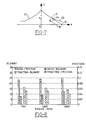
- the tractrix mathematical relationship is one where a curve 41 is described by the locus of one end P of a tangent line 42 (of length L) as the other end Q is moved along the X axis. As the X coordinate exceeds the length of the tangent line, the curve becomes asymptotic to the X axis.
- the crown surface 43 of the seal element may also have essentially mirror image tractrix surfaces 43a,43b, one in the upper half and one in the lower half of the crown surface. Each tractrix surface can rotate or translate and still maintain contact with the other tractrix surface.
- X L cosh -1 (L/Y) - ⁇ (L 2 -Y 2 )
- the length of the tangent line is multiplied by the inverse hyperbole of the cosine of the length over Y less the square root of length squared minus y squared.
- X L cosh -1 (L/Y) - ⁇ (L 2 -Y 2 )
- the length of the tangent line is multiplied by the inverse hyperbole of the cosine of the length over Y less the square root of length squared minus y squared.
- the height of the groove influences the choice of Y intercept for the shoulders 43a and 43b of the element crown 43. It is desirable to merge or integrate the shoulders 43a, 43b with no straight or connecting surface therebetween.
- the reaction contact points A and B of the groove shoulders with the element side surfaces 35,37 form a triangle 52 with the load contact point C of the crown 43 on the film of the bore wall 47.
- the triangle will shift (see broken line triangle) and contacts will move to A', B' and C'.
- the load contact point will consistently stay at the bore wall allowing at most only about 0.0005 cm (0.0002 inch) spacing between the sealing element and bore wall. This permits a squeeze film of fluid (gas or oil) to reside therebetween enhancing the friction reduced sliding contact with the bore wall without allowing blow-by.
- the sealing assembly of this invention has a piston 45 with a side wall 46 moveable closely along a bore wall 47 with a controlled squeeze film gap 48 therebetween.
- the assembly defines surfaces in at least one of the bore wall 47 or piston 45 to form a groove 31 facing the other of the piston or bore wall, the groove having its outer radial regions 32,33 of the surfaces smoothly curved to form a pair of oppositely facing shoulders.
- the assembly further has a sealing element 34 with (i) smoothly curved side surfaces 35,37 mateable with the groove shoulders for supporting the element in the groove and (ii) a curved crown surface effective to tangentially contact the cylinder bore wall 47 while the side surfaces 35,37 each tangentially contact their respective mating groove shoulders 32,33.
- the pair of mating groove shoulders 32,33 and element side walls 35,37 each have defined curvatures as indicated above that are effective to maintain tangency and transfer any load in the element, resulting from the crown-cylinder bore wall contact, to the shoulders in a substantially equal manner regardless of articulation of the element with respect to the groove.
- the load at the contact points is virtually the same throughout because of the tractrix relationship and behaviour.
- the seal assembly may further incorporate a hollowing of the sealing element 34 at its base or root 55 and insertion of an elastomeric ring 56 into the hollow cavity 57 to exert a resilient pressure between the root 58 of the groove 31 and the walls of cavity 57.
- the elastomeric ring (that fills the hollow ring and groove space) should have a resilient compressibility of about 20% when installed; the elastomeric material should be stable up to a temperature of 300°F or higher. To prevent the material from rising above such temperature, means for splashing oil or other heat removing medium on the interior of the piston (proximate to the groove for the sealing element).
- the elastomeric ring will assist the inherent element tension to maintain contact [within 0.0005 cm (0,0002 inches)] with the bore wall even under extreme low or high temperature conditions.
- the hollowness of the ring promotes or defines thin flexible element flanges 59,60 which, as urged by the memory of the elastomeric material, flex the flanges to maintain contact with the shoulders 32,33 (an axial deflection vector).
- the piston, tractrix sealing element and bore wall are fabricated of a similar lightweight metal, such as aluminium. Thermal growth of each of such components will thus be essentially the same thereby enhancing the ability of the sealing element to maintain a friction reducing squeeze film along the bore wall.
- the sealing element is desirably an extruded aluminium alloy having a solid film lubricant coating impregnated into a prepared dimpled surface of such element. Extrudability facilitates making a hollow ring to receive the precompressed elastomer therein.
- the ring could be a soft steel that is continuously formed with a hollow shape by bellows expansion techniques where a charge is progressively exploded to form the metal strip to a continuous die.
- Figure 8 shows the friction and blow-by using a conventional piston ring (commercially used in Ford Motor Company 1.9L-CUH engines) as the base, at different engine speeds.
- Figure 8 shows the friction and blow-by results of a piston assembly using the tractrix surfaces of this invention at various engine speeds for the same type of piston assembly. The comparison demonstrates friction is reduced from about .14 to .03-.045 and blow-by is reduced from 14-17 cubic centimetres to about 10-13 cubic centimetres.
Landscapes
- Engineering & Computer Science (AREA)
- General Engineering & Computer Science (AREA)
- Mechanical Engineering (AREA)
- Pistons, Piston Rings, And Cylinders (AREA)
Claims (10)
- Dichtungseinheit für eine Zylinderbohrungswand mit einem eng an dieser Wand (47) anliegend beweglichen Kolben (45) mit einem bestimmten Spalt dazwischen, welche Einheit folgendes aufweist:(a) Wände in wenigstens einer/einem der besagten Zylinderbohrungswand (47) und Kolben (45), welche eine der/dem anderen der besagten Zylinderbohrungswand oder Kolben gegenüberliegende Ringnut (31) bilden, wobei die äußeren Radialbereiche (32, 33) der besagten Nut (31) sanft gekrümmt sind, so daß sie zwei einander gegenüberliegende divergente und konvexe Schultern bilden;(b) ein ringförmiges Dichtelement (34), welches in besagter Nut (31) angeordnet ist und (i) sanft gekrümmte und divergente konkave Seitenflächen (35, 37) aufweist, die passend an den besagten Nutschultern anlegbar sind, so daß sie besagtes Element (34) in besagter Nut (31) abstützen, sowie (ii) eine gewölbte Scheitelfläche (43), die derart wirkt, daß sie sich tangential an besagte Zylinderbohrungswand (47) anlegt,
dadurch gekennzeichnet, daß(c) besagtes Paar aneinander passender Nutschultern (32, 33) und Dichtelement-Seitenflächen (35, 37) je eine definierte Krümmung aufweisen, die so wirkt, daß sie die Tangentialität aufrecht erhält, in dem Sinne daß das Dichtelement in besagter Nut hin- und herschwenkbar ist, während besagte Element-Seitenflächen stets tangential an den ihnen zugeordneten passenden Nutenflächen anliegen, und während besagte gewölbte Scheitelfläche den Kontakt mit der Zylinderbohrungswand aufrecht erhält, so daß jede auf das Dichtelement (34) aufgebrachte und von dem Kontakt zwischen Scheitelfläche und Zylinderbohrungswand herrührende Last in einer im wesentlichen gleichmäßigen Art und Weise auf die Schultern abgeleitet wird, ungeachtet der Verschwenkung des Elementes (34) in besagter Nut (31). - Einheit nach Anspruch 1, in welcher besagte definierte Krümmungen in X-Y-Koordinaten von einem Endpunkt einer Tangente auf die Krümmung beschrieben werden, während der andere Endpunkt der Tangente an der X-Achse entlanggleitet.
- Einheit nach Anspruch 1, in welcher die Krümmung der besagten Schultern und der Element-Seitenflächen einer Schleppkurven-Relation gehorcht, in welcher der tangentiale Kontakt zwischen einer passenden Nutschulter und einer Element-Seitenwand frei entlang besagter definierter Krümmung verfahrbar ist, wenn das Element verschwenkt wird.
- Einheit nach einem beliebigen der vorangehenden Ansprüche, in welcher besagte Einheit wenigstens drei der besagten Dichtelemente (34) und besagten Nuten (31) aufweist.
- Einheit nach einem beliebigen der vorangehenden Ansprüche, in welcher jede der besagten Schultern und Element-Seitenflächen mit einem dünnen Film eines Feststoff-Schmiermittels in einem Polymerträgerstoff beschichtet ist.
- Einheit nach Anspruch 5, in welcher besagter Feststoff-Schmierfilm aus einer Gruppe ausgewählt ist, welche Bornitrid, Graphit und Molybdändisulfid beinhaltet.
- Einheit nach einem beliebigen der vorangehenden Ansprüche, welche außerdem Mittel (56) aufweist, welche das Dichtelement in tangentialen Kontakt mit der Zylinderbohrungswand vorspannt.
- Einheit nach Anspruch 7, in welcher besagte Mittel von einem Elastomerring (56) gebildet werden, der zwischen dem Boden (58) der Nut (31) und dem Dichtelement die besagte Vorspannung ausübend wirkt.
- Einheit nach Anspruch 8, in welcher besagte Mittel einen Hohlraum in besagtem Dichtelement (34) aufweisen, welcher flexible Seitenflansche (59, 60) im Dichtelement (34) bildet, die in seitlicher Richtung in bezug auf die Zylinderbohrungswand federnd auslenkbar sind.
- Verfahren zur Herstellung einer Dichtungseinheit für eine Zylinderbohrungswand mit einem entlang derselben verschiebbaren Kolben, nach einem beliebigen der Ansprüche 1 bis 9, folgendes beinhaltend:(a) Formen einer Ringnut in wenigstens einem der/des besagten Zylinderbohrungswand und Kolben durch Elektroerosionsbearbeitung zur Erzeugung einer porösen Nutenoberfläche und zur Konturbearbeitung der freiliegenden konvexen Schultern entlang der Nut, mit einem in axialer Richtung gemäß der Relation X = L cos h-1(L/Y)-√(L2-Y2) variierenden Radius, wobei X und Y Koordinaten eines Punktes auf einer Schleppkurvenfläche 43a und 43b sind, und wo L die Länge der Tangente 42 ist;(b) Formen eines geteilten metallenen überlappenden Dichtringes mit trapezförmigem Querschnitt;(c) Bearbeiten der nach außen gekehrten Oberfläche des Dichtringes gemäß einer Krümmung, welche von einem nach besagter Relation variierenden Radius definiert ist, und Bearbeiten der Flanken des besagten Dichtringes, so daß diese eine konkave Krümmung mit einem nach besagter Relation variierenden Radius aufweisen;(d) Bearbeiten der Oberfläche der Bohrung durch Elektroerosionsbearbeitung;(e) Beschichten der Nuten, Ringe und Zylinderbohrungswand mit einem Feststoff-Schmiermittelfilm in einem Polymerträgerstoff; und(f) Anordnen eines Elastomereinsatzes, so daß dieser zwischen dem Nutenboden und dem Dichtring wirksam ist.
Applications Claiming Priority (2)
| Application Number | Priority Date | Filing Date | Title |
|---|---|---|---|
| US08/213,335 US5695199A (en) | 1994-03-14 | 1994-03-14 | Piston sealing assembly |
| US213335 | 1994-03-14 |
Publications (2)
| Publication Number | Publication Date |
|---|---|
| EP0672849A1 EP0672849A1 (de) | 1995-09-20 |
| EP0672849B1 true EP0672849B1 (de) | 2001-07-11 |
Family
ID=22794704
Family Applications (1)
| Application Number | Title | Priority Date | Filing Date |
|---|---|---|---|
| EP95301445A Expired - Lifetime EP0672849B1 (de) | 1994-03-14 | 1995-03-06 | Kolbenabdichtungszusammenbau |
Country Status (4)
| Country | Link |
|---|---|
| US (1) | US5695199A (de) |
| EP (1) | EP0672849B1 (de) |
| CA (1) | CA2144356A1 (de) |
| DE (1) | DE69521639D1 (de) |
Families Citing this family (15)
| Publication number | Priority date | Publication date | Assignee | Title |
|---|---|---|---|---|
| DE19908542A1 (de) | 1999-02-27 | 2000-08-31 | Mahle Gmbh | Kolben mit zumindest einer Ringnut und zumindest einem Kolbenring |
| JP2002115759A (ja) * | 2000-10-05 | 2002-04-19 | Hino Motors Ltd | 圧力ピストンリング |
| US6685193B2 (en) * | 2001-08-30 | 2004-02-03 | Illinois Tool Works Inc. | Self lubricating, non-sealing piston ring for an internal combustion fastener driving tool |
| DE102006058945A1 (de) * | 2006-02-07 | 2007-08-23 | Schaeffler Kg | Dichtungselement für rotierbare Teile mit Traktrix-Form |
| JP5293914B2 (ja) * | 2006-02-21 | 2013-09-18 | Nok株式会社 | 往復動用密封リング |
| DE102007045465A1 (de) * | 2007-09-24 | 2009-04-02 | Federal-Mogul Nürnberg GmbH | Kolben mit Ölversorgungsrinne für Nabenbohrungen |
| EP2245269B1 (de) | 2008-01-11 | 2020-01-01 | McVan Aerospace, Llc | Hubkolbenverbrennungsmotor |
| US8267821B2 (en) * | 2009-07-15 | 2012-09-18 | Schaeffler Technologies AG & Co. KG | Mechanical tensioner with damping mechanism |
| DE112010004763T5 (de) * | 2009-12-09 | 2012-10-11 | Ecomotors International, Inc. | Dichtungsbaugruppe für einen Verbrennungsmotor |
| EP2882319B1 (de) * | 2012-08-08 | 2018-10-31 | Henny Penny Corporation | Lippendichtungsringe für eine kochvorrichtung und kochvorrichtung einer lippendichtung |
| DE102014108973A1 (de) * | 2014-06-26 | 2015-12-31 | Federal-Mogul Burscheid Gmbh | Kolbenring |
| WO2015199183A1 (ja) | 2014-06-27 | 2015-12-30 | 株式会社リケン | ピストンリング |
| DE102018122258B3 (de) | 2018-09-12 | 2019-12-24 | Federal-Mogul Burscheid Gmbh | Kolbenring und kolben mit innenliegender nutversiegelung |
| US11060403B2 (en) | 2019-06-19 | 2021-07-13 | Achates Power, Inc. | Piston combinations for opposed-piston engines |
| US12281706B2 (en) * | 2020-05-11 | 2025-04-22 | Danfoss A/S | Floating ring seal for refrigerant compressor |
Family Cites Families (20)
| Publication number | Priority date | Publication date | Assignee | Title |
|---|---|---|---|---|
| US1532937A (en) * | 1922-06-03 | 1925-04-07 | Dock J Peeler | Piston for internal-combustion motors |
| US1901199A (en) * | 1931-12-11 | 1933-03-14 | Lyman M King Jr | Piston and ring therefor |
| DE1110480B (de) * | 1957-07-01 | 1961-07-06 | Goetzewerke | Abdichtung von hin- und hergehenden oder drehbar gegeneinander beweglichen, zylindrischen Maschinenteilen, insbesondere Kolben |
| US3727927A (en) * | 1968-09-06 | 1973-04-17 | Int Harvester Co | Ring manufacture, productive of line contact seal |
| US3907310A (en) * | 1971-02-25 | 1975-09-23 | Gas Dev Corp | Floating seal construction |
| US3751047A (en) * | 1971-06-10 | 1973-08-07 | Gould Inc | Piston ring assembly |
| US3806139A (en) * | 1972-03-30 | 1974-04-23 | Nippon Piston Ring Co Ltd | Piston ring |
| DE2417045C3 (de) * | 1973-05-21 | 1979-05-23 | Ramsey Corp., Manchester, Mo. (V.St.A.) | Brennkraftmaschinenkolben mit einem Abdichtungsring mit U-Profil |
| US4123072A (en) * | 1977-03-18 | 1978-10-31 | Dana Corporation | Piston ring assembly and method of making same |
| DE2854662C2 (de) * | 1978-12-18 | 1983-08-25 | WOCO Franz-Josef Wolf & Co, 6483 Bad Soden-Salmünster | Dichtungsring für Rippenrohre |
| US4289264A (en) * | 1979-03-23 | 1981-09-15 | The United States Of America As Represented By The Secretary Of The Air Force | Uniform load piston ring |
| US4350352A (en) * | 1981-07-24 | 1982-09-21 | Mack Trucks, Inc. | Piston ring and groove assemblies |
| GB2117868A (en) * | 1982-04-08 | 1983-10-19 | Ae Plc | Improved piston ring seal |
| US4438937A (en) * | 1982-12-06 | 1984-03-27 | Moriarty Maurice J | Piston ring |
| US4890849A (en) * | 1983-05-17 | 1990-01-02 | James Walker & Company Limited | Shaft seals |
| US4846051A (en) * | 1988-02-23 | 1989-07-11 | Ford Motor Company | Uncooled oilless internal combustion engine having uniform gas squeeze film lubrication |
| JPH02118177U (de) * | 1989-03-09 | 1990-09-21 | ||
| US5275422A (en) * | 1989-03-31 | 1994-01-04 | Leber Corporation | Sealing assembly |
| DE3940301A1 (de) * | 1989-12-06 | 1991-06-13 | Friedhelm Stecher | Kolbenring |
| US5169159A (en) * | 1991-09-30 | 1992-12-08 | General Electric Company | Effective sealing device for engine flowpath |
-
1994
- 1994-03-14 US US08/213,335 patent/US5695199A/en not_active Expired - Lifetime
-
1995
- 1995-03-06 EP EP95301445A patent/EP0672849B1/de not_active Expired - Lifetime
- 1995-03-06 DE DE69521639T patent/DE69521639D1/de not_active Expired - Lifetime
- 1995-03-10 CA CA002144356A patent/CA2144356A1/en not_active Abandoned
Also Published As
| Publication number | Publication date |
|---|---|
| EP0672849A1 (de) | 1995-09-20 |
| DE69521639D1 (de) | 2001-08-16 |
| US5695199A (en) | 1997-12-09 |
| CA2144356A1 (en) | 1995-09-15 |
Similar Documents
| Publication | Publication Date | Title |
|---|---|---|
| EP0672849B1 (de) | Kolbenabdichtungszusammenbau | |
| US6357341B1 (en) | Piston of internal combustion engine | |
| EP2045488B1 (de) | Kolbenring eines Kolbenmotors | |
| EP0672850B1 (de) | Kolben und Kolbenringaufbau | |
| US5490445A (en) | Ultra low device volume piston system | |
| US5430938A (en) | Method of making and using a piston ring assembly | |
| US7506575B2 (en) | Piston | |
| KR102639899B1 (ko) | 극저온 피스톤링 | |
| CA1118650A (en) | Low-friction piston | |
| KR950007629B1 (ko) | 압축 기체 이용의 왕복 기계용 피스톤 및 상기 피스톤을 장착한 기계 | |
| US6065438A (en) | Continuous piston rings for an internal combustion engine | |
| US6196179B1 (en) | Internal combustion engine | |
| JPS6236147B2 (de) | ||
| US4235447A (en) | Low friction oil control piston ring | |
| EP3115654B1 (de) | Zur verringerung der reibung konfigurierter kolbenring | |
| US4230027A (en) | Reciprocating piston | |
| JP7393567B2 (ja) | コンプレッションリング | |
| EP1943444B1 (de) | Kolben | |
| US20170299056A1 (en) | Oil Ring for a Piston Assembly | |
| JPH08261325A (ja) | エキスパンダ付きオイルリング | |
| KR100409572B1 (ko) | 윤활성과 실링 성능향상을 위한 피스톤 링의 구조 | |
| RU2121591C1 (ru) | Поршень двигателя внутреннего сгорания | |
| US4540185A (en) | Gas-lubricated seal for sealing between a piston and a cylinder wall | |
| CN214577419U (zh) | 低磨损式发动机活塞 | |
| JPS6346680Y2 (de) |
Legal Events
| Date | Code | Title | Description |
|---|---|---|---|
| PUAI | Public reference made under article 153(3) epc to a published international application that has entered the european phase |
Free format text: ORIGINAL CODE: 0009012 |
|
| AK | Designated contracting states |
Kind code of ref document: A1 Designated state(s): DE FR GB |
|
| 17P | Request for examination filed |
Effective date: 19960205 |
|
| 17Q | First examination report despatched |
Effective date: 19990201 |
|
| GRAG | Despatch of communication of intention to grant |
Free format text: ORIGINAL CODE: EPIDOS AGRA |
|
| GRAG | Despatch of communication of intention to grant |
Free format text: ORIGINAL CODE: EPIDOS AGRA |
|
| GRAH | Despatch of communication of intention to grant a patent |
Free format text: ORIGINAL CODE: EPIDOS IGRA |
|
| GRAH | Despatch of communication of intention to grant a patent |
Free format text: ORIGINAL CODE: EPIDOS IGRA |
|
| GRAA | (expected) grant |
Free format text: ORIGINAL CODE: 0009210 |
|
| AK | Designated contracting states |
Kind code of ref document: B1 Designated state(s): DE FR GB |
|
| PG25 | Lapsed in a contracting state [announced via postgrant information from national office to epo] |
Ref country code: FR Free format text: LAPSE BECAUSE OF FAILURE TO SUBMIT A TRANSLATION OF THE DESCRIPTION OR TO PAY THE FEE WITHIN THE PRESCRIBED TIME-LIMIT Effective date: 20010711 |
|
| REF | Corresponds to: |
Ref document number: 69521639 Country of ref document: DE Date of ref document: 20010816 |
|
| PG25 | Lapsed in a contracting state [announced via postgrant information from national office to epo] |
Ref country code: DE Free format text: LAPSE BECAUSE OF FAILURE TO SUBMIT A TRANSLATION OF THE DESCRIPTION OR TO PAY THE FEE WITHIN THE PRESCRIBED TIME-LIMIT Effective date: 20011012 |
|
| EN | Fr: translation not filed | ||
| REG | Reference to a national code |
Ref country code: GB Ref legal event code: IF02 |
|
| PG25 | Lapsed in a contracting state [announced via postgrant information from national office to epo] |
Ref country code: GB Free format text: LAPSE BECAUSE OF NON-PAYMENT OF DUE FEES Effective date: 20020306 |
|
| PLBE | No opposition filed within time limit |
Free format text: ORIGINAL CODE: 0009261 |
|
| STAA | Information on the status of an ep patent application or granted ep patent |
Free format text: STATUS: NO OPPOSITION FILED WITHIN TIME LIMIT |
|
| 26N | No opposition filed | ||
| GBPC | Gb: european patent ceased through non-payment of renewal fee |
Effective date: 20020306 |