EP0678771B1 - Stabile wässrige Festpartikeldispersionen - Google Patents
Stabile wässrige Festpartikeldispersionen Download PDFInfo
- Publication number
- EP0678771B1 EP0678771B1 EP95105023A EP95105023A EP0678771B1 EP 0678771 B1 EP0678771 B1 EP 0678771B1 EP 95105023 A EP95105023 A EP 95105023A EP 95105023 A EP95105023 A EP 95105023A EP 0678771 B1 EP0678771 B1 EP 0678771B1
- Authority
- EP
- European Patent Office
- Prior art keywords
- dispersion
- imaging
- dispersant
- poly
- dyes
- Prior art date
- Legal status (The legal status is an assumption and is not a legal conclusion. Google has not performed a legal analysis and makes no representation as to the accuracy of the status listed.)
- Expired - Lifetime
Links
- 239000006185 dispersion Substances 0.000 title claims description 94
- 239000002245 particle Substances 0.000 title claims description 51
- 239000007787 solid Substances 0.000 title claims description 37
- 239000000975 dye Substances 0.000 claims description 62
- 239000002270 dispersing agent Substances 0.000 claims description 53
- 150000001875 compounds Chemical class 0.000 claims description 52
- 238000003384 imaging method Methods 0.000 claims description 49
- -1 poly(ethylene oxide) Polymers 0.000 claims description 38
- XLYOFNOQVPJJNP-UHFFFAOYSA-N water Substances O XLYOFNOQVPJJNP-UHFFFAOYSA-N 0.000 claims description 22
- 238000003801 milling Methods 0.000 claims description 21
- 239000002002 slurry Substances 0.000 claims description 15
- 229920003171 Poly (ethylene oxide) Polymers 0.000 claims description 14
- 229920001577 copolymer Polymers 0.000 claims description 11
- 230000001235 sensitizing effect Effects 0.000 claims description 11
- 238000000034 method Methods 0.000 claims description 10
- 238000002360 preparation method Methods 0.000 claims description 10
- 125000003118 aryl group Chemical group 0.000 claims description 7
- 125000004432 carbon atom Chemical group C* 0.000 claims description 7
- 125000000217 alkyl group Chemical group 0.000 claims description 6
- 229920001400 block copolymer Polymers 0.000 claims description 6
- 239000011248 coating agent Substances 0.000 claims description 6
- 238000000576 coating method Methods 0.000 claims description 6
- 239000000203 mixture Substances 0.000 claims description 6
- 230000008569 process Effects 0.000 claims description 6
- 150000002894 organic compounds Chemical class 0.000 claims description 5
- 229920000642 polymer Polymers 0.000 claims description 5
- 229920001451 polypropylene glycol Polymers 0.000 claims description 5
- 229920002451 polyvinyl alcohol Polymers 0.000 claims description 5
- 150000001768 cations Chemical group 0.000 claims description 4
- 125000005647 linker group Chemical group 0.000 claims description 4
- WHNWPMSKXPGLAX-UHFFFAOYSA-N N-Vinyl-2-pyrrolidone Chemical group C=CN1CCCC1=O WHNWPMSKXPGLAX-UHFFFAOYSA-N 0.000 claims description 3
- GOOHAUXETOMSMM-UHFFFAOYSA-N Propylene oxide Chemical compound CC1CO1 GOOHAUXETOMSMM-UHFFFAOYSA-N 0.000 claims description 3
- 125000002877 alkyl aryl group Chemical group 0.000 claims description 3
- 125000002947 alkylene group Chemical group 0.000 claims description 3
- 229920006187 aquazol Polymers 0.000 claims description 3
- 125000003710 aryl alkyl group Chemical group 0.000 claims description 2
- 150000002148 esters Chemical class 0.000 claims description 2
- 239000004215 Carbon black (E152) Substances 0.000 claims 1
- 229940126062 Compound A Drugs 0.000 claims 1
- NLDMNSXOCDLTTB-UHFFFAOYSA-N Heterophylliin A Natural products O1C2COC(=O)C3=CC(O)=C(O)C(O)=C3C3=C(O)C(O)=C(O)C=C3C(=O)OC2C(OC(=O)C=2C=C(O)C(O)=C(O)C=2)C(O)C1OC(=O)C1=CC(O)=C(O)C(O)=C1 NLDMNSXOCDLTTB-UHFFFAOYSA-N 0.000 claims 1
- 229930195733 hydrocarbon Natural products 0.000 claims 1
- 150000002430 hydrocarbons Chemical class 0.000 claims 1
- 239000011324 bead Substances 0.000 description 21
- 239000012153 distilled water Substances 0.000 description 16
- 239000011521 glass Substances 0.000 description 15
- RVTZCBVAJQQJTK-UHFFFAOYSA-N oxygen(2-);zirconium(4+) Chemical compound [O-2].[O-2].[Zr+4] RVTZCBVAJQQJTK-UHFFFAOYSA-N 0.000 description 15
- 229910001928 zirconium oxide Inorganic materials 0.000 description 15
- 239000010410 layer Substances 0.000 description 13
- 239000004094 surface-active agent Substances 0.000 description 13
- 230000016615 flocculation Effects 0.000 description 12
- 238000005189 flocculation Methods 0.000 description 12
- 239000007864 aqueous solution Substances 0.000 description 11
- 0 C*(c(*C=*=C(C1=*)*(C)=NN1c(cc1)ccc1C(O)=O)c1C=O)n[n]1-c(cc1)ccc1C(O)=O Chemical compound C*(c(*C=*=C(C1=*)*(C)=NN1c(cc1)ccc1C(O)=O)c1C=O)n[n]1-c(cc1)ccc1C(O)=O 0.000 description 10
- 239000000839 emulsion Substances 0.000 description 9
- 239000000126 substance Substances 0.000 description 9
- 101000702720 Caenorhabditis elegans Phosphatidylcholine:ceramide cholinephosphotransferase 1 Proteins 0.000 description 8
- 239000004332 silver Substances 0.000 description 8
- 229910052709 silver Inorganic materials 0.000 description 8
- 229920002359 Tetronic® Polymers 0.000 description 7
- 239000000084 colloidal system Substances 0.000 description 7
- 239000000463 material Substances 0.000 description 7
- 101000825946 Caenorhabditis elegans Phosphatidylcholine:ceramide cholinephosphotransferase 2 Proteins 0.000 description 6
- VYPSYNLAJGMNEJ-UHFFFAOYSA-N Silicium dioxide Chemical compound O=[Si]=O VYPSYNLAJGMNEJ-UHFFFAOYSA-N 0.000 description 6
- 230000000694 effects Effects 0.000 description 6
- DZVCFNFOPIZQKX-LTHRDKTGSA-M merocyanine Chemical compound [Na+].O=C1N(CCCC)C(=O)N(CCCC)C(=O)C1=C\C=C\C=C/1N(CCCS([O-])(=O)=O)C2=CC=CC=C2O\1 DZVCFNFOPIZQKX-LTHRDKTGSA-M 0.000 description 6
- 239000003960 organic solvent Substances 0.000 description 6
- 229920000036 polyvinylpyrrolidone Polymers 0.000 description 6
- 239000001267 polyvinylpyrrolidone Substances 0.000 description 6
- 235000013855 polyvinylpyrrolidone Nutrition 0.000 description 6
- QGKMIGUHVLGJBR-UHFFFAOYSA-M (4z)-1-(3-methylbutyl)-4-[[1-(3-methylbutyl)quinolin-1-ium-4-yl]methylidene]quinoline;iodide Chemical compound [I-].C12=CC=CC=C2N(CCC(C)C)C=CC1=CC1=CC=[N+](CCC(C)C)C2=CC=CC=C12 QGKMIGUHVLGJBR-UHFFFAOYSA-M 0.000 description 5
- 108010010803 Gelatin Proteins 0.000 description 5
- 229920000159 gelatin Polymers 0.000 description 5
- 239000008273 gelatin Substances 0.000 description 5
- 235000019322 gelatine Nutrition 0.000 description 5
- 235000011852 gelatine desserts Nutrition 0.000 description 5
- 239000007788 liquid Substances 0.000 description 5
- 230000002411 adverse Effects 0.000 description 4
- 239000012736 aqueous medium Substances 0.000 description 4
- 229920002678 cellulose Polymers 0.000 description 4
- 239000003795 chemical substances by application Substances 0.000 description 4
- 239000013078 crystal Substances 0.000 description 4
- 150000003384 small molecules Chemical class 0.000 description 4
- 239000003381 stabilizer Substances 0.000 description 4
- 239000011230 binding agent Substances 0.000 description 3
- 229920001519 homopolymer Polymers 0.000 description 3
- 238000010951 particle size reduction Methods 0.000 description 3
- 229920005862 polyol Polymers 0.000 description 3
- 150000003077 polyols Chemical class 0.000 description 3
- LFQSCWFLJHTTHZ-UHFFFAOYSA-N Ethanol Chemical compound CCO LFQSCWFLJHTTHZ-UHFFFAOYSA-N 0.000 description 2
- IAYPIBMASNFSPL-UHFFFAOYSA-N Ethylene oxide Chemical group C1CO1 IAYPIBMASNFSPL-UHFFFAOYSA-N 0.000 description 2
- 239000004372 Polyvinyl alcohol Substances 0.000 description 2
- RTAQQCXQSZGOHL-UHFFFAOYSA-N Titanium Chemical compound [Ti] RTAQQCXQSZGOHL-UHFFFAOYSA-N 0.000 description 2
- PNEYBMLMFCGWSK-UHFFFAOYSA-N aluminium oxide Inorganic materials [O-2].[O-2].[O-2].[Al+3].[Al+3] PNEYBMLMFCGWSK-UHFFFAOYSA-N 0.000 description 2
- 239000003945 anionic surfactant Substances 0.000 description 2
- 230000008901 benefit Effects 0.000 description 2
- 239000001913 cellulose Substances 0.000 description 2
- 235000010980 cellulose Nutrition 0.000 description 2
- 230000006870 function Effects 0.000 description 2
- 125000000623 heterocyclic group Chemical group 0.000 description 2
- 230000002209 hydrophobic effect Effects 0.000 description 2
- 230000003993 interaction Effects 0.000 description 2
- 239000011229 interlayer Substances 0.000 description 2
- 239000004816 latex Substances 0.000 description 2
- 229920000126 latex Polymers 0.000 description 2
- 238000002156 mixing Methods 0.000 description 2
- KIDHWZJUCRJVML-UHFFFAOYSA-N putrescine Chemical compound NCCCCN KIDHWZJUCRJVML-UHFFFAOYSA-N 0.000 description 2
- 150000003254 radicals Chemical class 0.000 description 2
- 239000004576 sand Substances 0.000 description 2
- 239000000377 silicon dioxide Substances 0.000 description 2
- 238000001228 spectrum Methods 0.000 description 2
- 230000006641 stabilisation Effects 0.000 description 2
- 238000011105 stabilization Methods 0.000 description 2
- 229910052719 titanium Inorganic materials 0.000 description 2
- 239000010936 titanium Substances 0.000 description 2
- 229920003169 water-soluble polymer Polymers 0.000 description 2
- XBYRMPXUBGMOJC-UHFFFAOYSA-N 1,2-dihydropyrazol-3-one Chemical class OC=1C=CNN=1 XBYRMPXUBGMOJC-UHFFFAOYSA-N 0.000 description 1
- AIGNCQCMONAWOL-UHFFFAOYSA-N 1,3-benzoselenazole Chemical class C1=CC=C2[se]C=NC2=C1 AIGNCQCMONAWOL-UHFFFAOYSA-N 0.000 description 1
- BCMCBBGGLRIHSE-UHFFFAOYSA-N 1,3-benzoxazole Chemical class C1=CC=C2OC=NC2=C1 BCMCBBGGLRIHSE-UHFFFAOYSA-N 0.000 description 1
- ODIRBFFBCSTPTO-UHFFFAOYSA-N 1,3-selenazole Chemical class C1=C[se]C=N1 ODIRBFFBCSTPTO-UHFFFAOYSA-N 0.000 description 1
- IXPNQXFRVYWDDI-UHFFFAOYSA-N 1-methyl-2,4-dioxo-1,3-diazinane-5-carboximidamide Chemical compound CN1CC(C(N)=N)C(=O)NC1=O IXPNQXFRVYWDDI-UHFFFAOYSA-N 0.000 description 1
- 150000001473 2,4-thiazolidinediones Chemical class 0.000 description 1
- SMZOUWXMTYCWNB-UHFFFAOYSA-N 2-(2-methoxy-5-methylphenyl)ethanamine Chemical compound COC1=CC=C(C)C=C1CCN SMZOUWXMTYCWNB-UHFFFAOYSA-N 0.000 description 1
- BIEFDNUEROKZRA-UHFFFAOYSA-N 2-(2-phenylethenyl)aniline Chemical group NC1=CC=CC=C1C=CC1=CC=CC=C1 BIEFDNUEROKZRA-UHFFFAOYSA-N 0.000 description 1
- NIXOWILDQLNWCW-UHFFFAOYSA-N 2-Propenoic acid Natural products OC(=O)C=C NIXOWILDQLNWCW-UHFFFAOYSA-N 0.000 description 1
- 125000003504 2-oxazolinyl group Chemical class O1C(=NCC1)* 0.000 description 1
- UGWULZWUXSCWPX-UHFFFAOYSA-N 2-sulfanylideneimidazolidin-4-one Chemical class O=C1CNC(=S)N1 UGWULZWUXSCWPX-UHFFFAOYSA-N 0.000 description 1
- RVBUGGBMJDPOST-UHFFFAOYSA-N 2-thiobarbituric acid Chemical class O=C1CC(=O)NC(=S)N1 RVBUGGBMJDPOST-UHFFFAOYSA-N 0.000 description 1
- FWBHETKCLVMNFS-UHFFFAOYSA-N 4',6-Diamino-2-phenylindol Chemical compound C1=CC(C(=N)N)=CC=C1C1=CC2=CC=C(C(N)=N)C=C2N1 FWBHETKCLVMNFS-UHFFFAOYSA-N 0.000 description 1
- 125000002373 5 membered heterocyclic group Chemical group 0.000 description 1
- 125000004070 6 membered heterocyclic group Chemical group 0.000 description 1
- 229920001817 Agar Polymers 0.000 description 1
- IUWZAKVWGLMMHM-NABYESNCSA-N CC(CC(C(N(c(cc1)ccc1OC)C(N1)=O)O)C1=O)/C=C/C=C(\C(NC(N1c(cc2)ccc2OC)=O)=O)/C1=O Chemical compound CC(CC(C(N(c(cc1)ccc1OC)C(N1)=O)O)C1=O)/C=C/C=C(\C(NC(N1c(cc2)ccc2OC)=O)=O)/C1=O IUWZAKVWGLMMHM-NABYESNCSA-N 0.000 description 1
- 101100421745 Caenorhabditis elegans sms-1 gene Proteins 0.000 description 1
- 101100366043 Caenorhabditis elegans sms-2 gene Proteins 0.000 description 1
- 101100366058 Caenorhabditis elegans sms-3 gene Proteins 0.000 description 1
- 229920002134 Carboxymethyl cellulose Polymers 0.000 description 1
- SNRUBQQJIBEYMU-UHFFFAOYSA-N Dodecane Natural products CCCCCCCCCCCC SNRUBQQJIBEYMU-UHFFFAOYSA-N 0.000 description 1
- PIICEJLVQHRZGT-UHFFFAOYSA-N Ethylenediamine Chemical compound NCCN PIICEJLVQHRZGT-UHFFFAOYSA-N 0.000 description 1
- 239000004354 Hydroxyethyl cellulose Substances 0.000 description 1
- DGAQECJNVWCQMB-PUAWFVPOSA-M Ilexoside XXIX Chemical compound C[C@@H]1CC[C@@]2(CC[C@@]3(C(=CC[C@H]4[C@]3(CC[C@@H]5[C@@]4(CC[C@@H](C5(C)C)OS(=O)(=O)[O-])C)C)[C@@H]2[C@]1(C)O)C)C(=O)O[C@H]6[C@@H]([C@H]([C@@H]([C@H](O6)CO)O)O)O.[Na+] DGAQECJNVWCQMB-PUAWFVPOSA-M 0.000 description 1
- SJEYSFABYSGQBG-UHFFFAOYSA-M Patent blue Chemical compound [Na+].C1=CC(N(CC)CC)=CC=C1C(C=1C(=CC(=CC=1)S([O-])(=O)=O)S([O-])(=O)=O)=C1C=CC(=[N+](CC)CC)C=C1 SJEYSFABYSGQBG-UHFFFAOYSA-M 0.000 description 1
- 206010070834 Sensitisation Diseases 0.000 description 1
- 229910052581 Si3N4 Inorganic materials 0.000 description 1
- 229920002125 Sokalan® Polymers 0.000 description 1
- 229920002472 Starch Polymers 0.000 description 1
- QCWXUUIWCKQGHC-UHFFFAOYSA-N Zirconium Chemical compound [Zr] QCWXUUIWCKQGHC-UHFFFAOYSA-N 0.000 description 1
- 239000006096 absorbing agent Substances 0.000 description 1
- 239000000980 acid dye Substances 0.000 description 1
- 239000008272 agar Substances 0.000 description 1
- 235000010419 agar Nutrition 0.000 description 1
- 125000002723 alicyclic group Chemical group 0.000 description 1
- 150000001336 alkenes Chemical class 0.000 description 1
- 238000004873 anchoring Methods 0.000 description 1
- 125000000129 anionic group Chemical group 0.000 description 1
- 239000001000 anthraquinone dye Substances 0.000 description 1
- 239000002518 antifoaming agent Substances 0.000 description 1
- 239000003963 antioxidant agent Substances 0.000 description 1
- 125000002029 aromatic hydrocarbon group Chemical group 0.000 description 1
- 239000000987 azo dye Substances 0.000 description 1
- 230000004888 barrier function Effects 0.000 description 1
- 239000000981 basic dye Substances 0.000 description 1
- 125000003785 benzimidazolyl group Chemical class N1=C(NC2=C1C=CC=C2)* 0.000 description 1
- KXNQKOAQSGJCQU-UHFFFAOYSA-N benzo[e][1,3]benzothiazole Chemical class C1=CC=C2C(N=CS3)=C3C=CC2=C1 KXNQKOAQSGJCQU-UHFFFAOYSA-N 0.000 description 1
- WMUIZUWOEIQJEH-UHFFFAOYSA-N benzo[e][1,3]benzoxazole Chemical class C1=CC=C2C(N=CO3)=C3C=CC2=C1 WMUIZUWOEIQJEH-UHFFFAOYSA-N 0.000 description 1
- IOJUPLGTWVMSFF-UHFFFAOYSA-N benzothiazole Chemical class C1=CC=C2SC=NC2=C1 IOJUPLGTWVMSFF-UHFFFAOYSA-N 0.000 description 1
- 230000015572 biosynthetic process Effects 0.000 description 1
- 150000001661 cadmium Chemical class 0.000 description 1
- 239000001768 carboxy methyl cellulose Substances 0.000 description 1
- 235000010948 carboxy methyl cellulose Nutrition 0.000 description 1
- 229920003090 carboxymethyl hydroxyethyl cellulose Polymers 0.000 description 1
- 239000008112 carboxymethyl-cellulose Substances 0.000 description 1
- 239000005018 casein Substances 0.000 description 1
- BECPQYXYKAMYBN-UHFFFAOYSA-N casein, tech. Chemical compound NCCCCC(C(O)=O)N=C(O)C(CC(O)=O)N=C(O)C(CCC(O)=N)N=C(O)C(CC(C)C)N=C(O)C(CCC(O)=O)N=C(O)C(CC(O)=O)N=C(O)C(CCC(O)=O)N=C(O)C(C(C)O)N=C(O)C(CCC(O)=N)N=C(O)C(CCC(O)=N)N=C(O)C(CCC(O)=N)N=C(O)C(CCC(O)=O)N=C(O)C(CCC(O)=O)N=C(O)C(COP(O)(O)=O)N=C(O)C(CCC(O)=N)N=C(O)C(N)CC1=CC=CC=C1 BECPQYXYKAMYBN-UHFFFAOYSA-N 0.000 description 1
- 235000021240 caseins Nutrition 0.000 description 1
- 239000003093 cationic surfactant Substances 0.000 description 1
- 230000003247 decreasing effect Effects 0.000 description 1
- 125000000664 diazo group Chemical group [N-]=[N+]=[*] 0.000 description 1
- USIUVYZYUHIAEV-UHFFFAOYSA-N diphenyl ether Chemical compound C=1C=CC=CC=1OC1=CC=CC=C1 USIUVYZYUHIAEV-UHFFFAOYSA-N 0.000 description 1
- 239000000982 direct dye Substances 0.000 description 1
- DDLNJHAAABRHFY-UHFFFAOYSA-L disodium 8-amino-7-[[4-[4-[(4-oxidophenyl)diazenyl]phenyl]phenyl]diazenyl]-2-phenyldiazenyl-3,6-disulfonaphthalen-1-olate Chemical compound [Na+].[Na+].NC1=C(C(=CC2=CC(=C(C(=C12)O)N=NC1=CC=CC=C1)S(=O)(=O)[O-])S(=O)(=O)[O-])N=NC1=CC=C(C=C1)C1=CC=C(C=C1)N=NC1=CC=C(C=C1)O DDLNJHAAABRHFY-UHFFFAOYSA-L 0.000 description 1
- XPRMZBUQQMPKCR-UHFFFAOYSA-L disodium;8-anilino-5-[[4-[(3-sulfonatophenyl)diazenyl]naphthalen-1-yl]diazenyl]naphthalene-1-sulfonate Chemical compound [Na+].[Na+].[O-]S(=O)(=O)C1=CC=CC(N=NC=2C3=CC=CC=C3C(N=NC=3C4=CC=CC(=C4C(NC=4C=CC=CC=4)=CC=3)S([O-])(=O)=O)=CC=2)=C1 XPRMZBUQQMPKCR-UHFFFAOYSA-L 0.000 description 1
- 125000003438 dodecyl group Chemical group [H]C([H])([H])C([H])([H])C([H])([H])C([H])([H])C([H])([H])C([H])([H])C([H])([H])C([H])([H])C([H])([H])C([H])([H])C([H])([H])C([H])([H])* 0.000 description 1
- 230000007613 environmental effect Effects 0.000 description 1
- 239000010419 fine particle Substances 0.000 description 1
- WSFSSNUMVMOOMR-UHFFFAOYSA-N formaldehyde Substances O=C WSFSSNUMVMOOMR-UHFFFAOYSA-N 0.000 description 1
- 238000000227 grinding Methods 0.000 description 1
- 125000001183 hydrocarbyl group Chemical group 0.000 description 1
- 150000002440 hydroxy compounds Chemical class 0.000 description 1
- 125000002887 hydroxy group Chemical group [H]O* 0.000 description 1
- 235000019447 hydroxyethyl cellulose Nutrition 0.000 description 1
- 150000002460 imidazoles Chemical class 0.000 description 1
- RKJUIXBNRJVNHR-UHFFFAOYSA-N indolenine group Chemical group N1=CCC2=CC=CC=C12 RKJUIXBNRJVNHR-UHFFFAOYSA-N 0.000 description 1
- 150000002475 indoles Chemical class 0.000 description 1
- 230000001939 inductive effect Effects 0.000 description 1
- 125000003010 ionic group Chemical group 0.000 description 1
- FDZZZRQASAIRJF-UHFFFAOYSA-M malachite green Chemical compound [Cl-].C1=CC(N(C)C)=CC=C1C(C=1C=CC=CC=1)=C1C=CC(=[N+](C)C)C=C1 FDZZZRQASAIRJF-UHFFFAOYSA-M 0.000 description 1
- FPYJFEHAWHCUMM-UHFFFAOYSA-N maleic anhydride Chemical compound O=C1OC(=O)C=C1 FPYJFEHAWHCUMM-UHFFFAOYSA-N 0.000 description 1
- 238000004519 manufacturing process Methods 0.000 description 1
- 239000000155 melt Substances 0.000 description 1
- QJGQUHMNIGDVPM-UHFFFAOYSA-N nitrogen group Chemical group [N] QJGQUHMNIGDVPM-UHFFFAOYSA-N 0.000 description 1
- 239000002736 nonionic surfactant Substances 0.000 description 1
- 150000002916 oxazoles Chemical class 0.000 description 1
- WXZMFSXDPGVJKK-UHFFFAOYSA-N pentaerythritol Chemical compound OCC(CO)(CO)CO WXZMFSXDPGVJKK-UHFFFAOYSA-N 0.000 description 1
- 239000000049 pigment Substances 0.000 description 1
- 229920002401 polyacrylamide Polymers 0.000 description 1
- 239000004584 polyacrylic acid Substances 0.000 description 1
- 229920000768 polyamine Polymers 0.000 description 1
- 235000019422 polyvinyl alcohol Nutrition 0.000 description 1
- XAEFZNCEHLXOMS-UHFFFAOYSA-M potassium benzoate Chemical compound [K+].[O-]C(=O)C1=CC=CC=C1 XAEFZNCEHLXOMS-UHFFFAOYSA-M 0.000 description 1
- 150000003222 pyridines Chemical class 0.000 description 1
- 150000003233 pyrroles Chemical class 0.000 description 1
- 150000003236 pyrrolines Chemical class 0.000 description 1
- 150000003248 quinolines Chemical class 0.000 description 1
- 230000005855 radiation Effects 0.000 description 1
- 239000002516 radical scavenger Substances 0.000 description 1
- 230000009257 reactivity Effects 0.000 description 1
- 238000000518 rheometry Methods 0.000 description 1
- KIWUVOGUEXMXSV-UHFFFAOYSA-N rhodanine Chemical class O=C1CSC(=S)N1 KIWUVOGUEXMXSV-UHFFFAOYSA-N 0.000 description 1
- 230000035945 sensitivity Effects 0.000 description 1
- 230000008313 sensitization Effects 0.000 description 1
- 238000010008 shearing Methods 0.000 description 1
- HBMJWWWQQXIZIP-UHFFFAOYSA-N silicon carbide Chemical compound [Si+]#[C-] HBMJWWWQQXIZIP-UHFFFAOYSA-N 0.000 description 1
- 229910010271 silicon carbide Inorganic materials 0.000 description 1
- HQVNEWCFYHHQES-UHFFFAOYSA-N silicon nitride Chemical compound N12[Si]34N5[Si]62N3[Si]51N64 HQVNEWCFYHHQES-UHFFFAOYSA-N 0.000 description 1
- 239000011734 sodium Substances 0.000 description 1
- 229910052708 sodium Inorganic materials 0.000 description 1
- ZFMRLFXUPVQYAU-UHFFFAOYSA-N sodium 5-[[4-[4-[(7-amino-1-hydroxy-3-sulfonaphthalen-2-yl)diazenyl]phenyl]phenyl]diazenyl]-2-hydroxybenzoic acid Chemical compound C1=CC(=CC=C1C2=CC=C(C=C2)N=NC3=C(C=C4C=CC(=CC4=C3O)N)S(=O)(=O)O)N=NC5=CC(=C(C=C5)O)C(=O)O.[Na+] ZFMRLFXUPVQYAU-UHFFFAOYSA-N 0.000 description 1
- 239000000661 sodium alginate Substances 0.000 description 1
- 235000010413 sodium alginate Nutrition 0.000 description 1
- 229940005550 sodium alginate Drugs 0.000 description 1
- 239000000243 solution Substances 0.000 description 1
- 229910001220 stainless steel Inorganic materials 0.000 description 1
- 239000010935 stainless steel Substances 0.000 description 1
- 239000008107 starch Substances 0.000 description 1
- 235000019698 starch Nutrition 0.000 description 1
- 125000005504 styryl group Chemical group 0.000 description 1
- BDHFUVZGWQCTTF-UHFFFAOYSA-M sulfonate Chemical compound [O-]S(=O)=O BDHFUVZGWQCTTF-UHFFFAOYSA-M 0.000 description 1
- 150000003536 tetrazoles Chemical class 0.000 description 1
- 150000003557 thiazoles Chemical class 0.000 description 1
- 150000003549 thiazolines Chemical class 0.000 description 1
- KAKZBPTYRLMSJV-UHFFFAOYSA-N vinyl-ethylene Natural products C=CC=C KAKZBPTYRLMSJV-UHFFFAOYSA-N 0.000 description 1
- 229910052726 zirconium Inorganic materials 0.000 description 1
- 239000002888 zwitterionic surfactant Substances 0.000 description 1
Images

Classifications
-
- G—PHYSICS
- G03—PHOTOGRAPHY; CINEMATOGRAPHY; ANALOGOUS TECHNIQUES USING WAVES OTHER THAN OPTICAL WAVES; ELECTROGRAPHY; HOLOGRAPHY
- G03C—PHOTOSENSITIVE MATERIALS FOR PHOTOGRAPHIC PURPOSES; PHOTOGRAPHIC PROCESSES, e.g. CINE, X-RAY, COLOUR, STEREO-PHOTOGRAPHIC PROCESSES; AUXILIARY PROCESSES IN PHOTOGRAPHY
- G03C1/00—Photosensitive materials
- G03C1/005—Silver halide emulsions; Preparation thereof; Physical treatment thereof; Incorporation of additives therein
- G03C1/06—Silver halide emulsions; Preparation thereof; Physical treatment thereof; Incorporation of additives therein with non-macromolecular additives
- G03C1/38—Dispersants; Agents facilitating spreading
-
- C—CHEMISTRY; METALLURGY
- C09—DYES; PAINTS; POLISHES; NATURAL RESINS; ADHESIVES; COMPOSITIONS NOT OTHERWISE PROVIDED FOR; APPLICATIONS OF MATERIALS NOT OTHERWISE PROVIDED FOR
- C09B—ORGANIC DYES OR CLOSELY-RELATED COMPOUNDS FOR PRODUCING DYES, e.g. PIGMENTS; MORDANTS; LAKES
- C09B67/00—Influencing the physical, e.g. the dyeing or printing properties of dyestuffs without chemical reactions, e.g. by treating with solvents grinding or grinding assistants, coating of pigments or dyes; Process features in the making of dyestuff preparations; Dyestuff preparations of a special physical nature, e.g. tablets, films
- C09B67/0001—Post-treatment of organic pigments or dyes
- C09B67/0022—Wet grinding of pigments
-
- C—CHEMISTRY; METALLURGY
- C09—DYES; PAINTS; POLISHES; NATURAL RESINS; ADHESIVES; COMPOSITIONS NOT OTHERWISE PROVIDED FOR; APPLICATIONS OF MATERIALS NOT OTHERWISE PROVIDED FOR
- C09B—ORGANIC DYES OR CLOSELY-RELATED COMPOUNDS FOR PRODUCING DYES, e.g. PIGMENTS; MORDANTS; LAKES
- C09B67/00—Influencing the physical, e.g. the dyeing or printing properties of dyestuffs without chemical reactions, e.g. by treating with solvents grinding or grinding assistants, coating of pigments or dyes; Process features in the making of dyestuff preparations; Dyestuff preparations of a special physical nature, e.g. tablets, films
- C09B67/0071—Process features in the making of dyestuff preparations; Dehydrating agents; Dispersing agents; Dustfree compositions
- C09B67/0084—Dispersions of dyes
-
- G—PHYSICS
- G03—PHOTOGRAPHY; CINEMATOGRAPHY; ANALOGOUS TECHNIQUES USING WAVES OTHER THAN OPTICAL WAVES; ELECTROGRAPHY; HOLOGRAPHY
- G03C—PHOTOSENSITIVE MATERIALS FOR PHOTOGRAPHIC PURPOSES; PHOTOGRAPHIC PROCESSES, e.g. CINE, X-RAY, COLOUR, STEREO-PHOTOGRAPHIC PROCESSES; AUXILIARY PROCESSES IN PHOTOGRAPHY
- G03C1/00—Photosensitive materials
- G03C1/005—Silver halide emulsions; Preparation thereof; Physical treatment thereof; Incorporation of additives therein
-
- G—PHYSICS
- G03—PHOTOGRAPHY; CINEMATOGRAPHY; ANALOGOUS TECHNIQUES USING WAVES OTHER THAN OPTICAL WAVES; ELECTROGRAPHY; HOLOGRAPHY
- G03C—PHOTOSENSITIVE MATERIALS FOR PHOTOGRAPHIC PURPOSES; PHOTOGRAPHIC PROCESSES, e.g. CINE, X-RAY, COLOUR, STEREO-PHOTOGRAPHIC PROCESSES; AUXILIARY PROCESSES IN PHOTOGRAPHY
- G03C7/00—Multicolour photographic processes or agents therefor; Regeneration of such processing agents; Photosensitive materials for multicolour processes
- G03C7/30—Colour processes using colour-coupling substances; Materials therefor; Preparing or processing such materials
- G03C7/388—Processes for the incorporation in the emulsion of substances liberating photographically active agents or colour-coupling substances; Solvents therefor
- G03C7/3882—Processes for the incorporation in the emulsion of substances liberating photographically active agents or colour-coupling substances; Solvents therefor characterised by the use of a specific polymer or latex
-
- G—PHYSICS
- G03—PHOTOGRAPHY; CINEMATOGRAPHY; ANALOGOUS TECHNIQUES USING WAVES OTHER THAN OPTICAL WAVES; ELECTROGRAPHY; HOLOGRAPHY
- G03C—PHOTOSENSITIVE MATERIALS FOR PHOTOGRAPHIC PURPOSES; PHOTOGRAPHIC PROCESSES, e.g. CINE, X-RAY, COLOUR, STEREO-PHOTOGRAPHIC PROCESSES; AUXILIARY PROCESSES IN PHOTOGRAPHY
- G03C1/00—Photosensitive materials
- G03C1/74—Applying photosensitive compositions to the base; Drying processes therefor
- G03C2001/7448—Dispersion
-
- G—PHYSICS
- G03—PHOTOGRAPHY; CINEMATOGRAPHY; ANALOGOUS TECHNIQUES USING WAVES OTHER THAN OPTICAL WAVES; ELECTROGRAPHY; HOLOGRAPHY
- G03C—PHOTOSENSITIVE MATERIALS FOR PHOTOGRAPHIC PURPOSES; PHOTOGRAPHIC PROCESSES, e.g. CINE, X-RAY, COLOUR, STEREO-PHOTOGRAPHIC PROCESSES; AUXILIARY PROCESSES IN PHOTOGRAPHY
- G03C2200/00—Details
- G03C2200/47—Polymer
Definitions
- This invention relates to an aqueous solid particle dispersion of a substantially water-insoluble nonpolymeric organic compound useful in imaging, to a process for the preparation of said dispersion, to an imaging element comprising said dispersion and to a process for the preparation of said element.
- Substantially water-insoluble compounds useful in imaging are generally crystalline solids and are incorporated into imaging materials as dispersions or emulsions.
- the compound useful in imaging is dissolved in one or more organic solvents, and the resulting oily liquid is then dispersed into an aqueous solution containing, optionally, dispersing aids such as surfactants and/or hydrophilic colloids such as gelatin.
- Dispersal of the oily liquid into the aqueous medium is accomplished using high shearing rates or high turbulence in devices such as colloid mills, ultrasonicators, or homogenizers.
- the use of organic solvents has traditionally been considered necessary to achieve small particle sizes, to achieve stable dispersions, and to achieve the desired reactivity of the compound useful in imaging.
- Some compounds that might be useful in imaging cannot be dispersed in the above manner, however, because of their poor solubility in most organic solvents.
- the compound of interest may have sufficient solubility in organic solvents, but it may be desirable to eliminate the use of the organic solvent to reduce the attendant adverse effects, for example, to reduce coated layer thickness, to reduce undesirable interactions of the organic solvent with other materials in the imaging element, to reduce risk of fire or operator exposure in manufacturing, or for environmental reasons or to improve the sharpness of the resulting image.
- solid particle dispersions are very different from the techniques used to make dispersions of oily liquids.
- solid particle dispersions are made by mixing the crystalline solid of interest with an aqueous solution that may contain one or more stabilizers or grinding aids.
- Particle size reduction is accomplished by subjecting the solid crystals in the slurry to repeated collisions with beads of hard, inorganic milling media, such as sand, spheres of silica, stainless steel, silicon carbide, glass, zirconium, zirconium oxide, alumina or titanium, which fracture the crystals.
- the bead sizes typically range from 0.25 to 3.0 mm in diameter.
- Ball mills, media mills, attritor mills, jet mills, vibratory mills, etc. are frequently used to accomplish particle size reduction. Milling techniques are described, for example, in U.S. Patent Nos. 3,008,657 to Szegvari, 3,075,710 to Feld et al and 3,149,789 to Szegvari.
- US Patent No. 5,300,394 discloses a solid particle aqueous dispersion of a compound useful in imaging prepared by milling an aqueous slurry of the compound in the presence of a fluorosurfactant. The resulting dispersion has improved stability to particle growth.
- TX200 having the structure is disclosed as a control dispersant therein.
- WO 90/16011 discloses use of polymeric surfactants comprising hydrophobic and hydrophilic block groups for incorporating already formed dispersions of imaging compounds into gelatin melts without inducing an undesirable increase in viscosity and enabling a low level of surfactant addition.
- hydrophobic dyes such as the polymethine dyes
- ionogenic groups such as carboxylic, hydroxyl etc.
- these dyes cannot be dispersed in water at concentrations higher than about 5 weight % to yield stable finely divided solid particle dispersions.
- the viscosities of the dispersions tend to rise with decreasing particle size due to interparticle interaction leading to flocculation. It has been found that the protection provided by the small molecule surfactant or certain homopolymer surfactants against flocculation is insufficient.
- One aspect of the present invention comprises a milled fine solid particle aqueous dispersion which comprises dispersed solid particles of a substantially water-insoluble nonpolymeric compound useful in imaging, characterized in that the dispersion comprises from 5 to 200 wt%, based on the weight of the compound useful in imaging, of a polymeric dispersant having an HLB (hydrophilic/lipophilic balance) number of at least 8 wherein the dispersant is selected from the group of amphipathic water-dispersible or water-soluble polymers represented by the generic structures I-IV shown below: wherein each A independently represents a poly(ethylene oxide), polyethyloxazoline, poly(vinyl alcohol), or poly(vinyl pyrrolidone) unit, B and C each represent a linear or branched alkyl, aryl, alkaryl or cyclic alkyl radical containing at least 7 carbon atoms, or 3 to about 100 repeat units of a propylene oxide or higher alkylene oxide or combinations thereof, Q represents a multi
- Another aspect of this invention comprises a process for the preparation of a fine solid particle aqueous dispersion of a substantially water-insoluble nonpolymeric organic compound useful in imaging as described above which comprises the steps of:
- a further aspect of this invention comprises an imaging element comprising a support having thereon at least one layer comprising a dispersion as described above in an imaging vehicle.
- Yet another aspect of this invention comprises a process for the preparation of an imaging element which comprises the steps of dispersing a solid particle dispersion as described above in an imaging vehicle and coating the resulting composition onto a support.
- This invention utilizes polymeric dispersants having an HLB value of at least 8, preferably amphipathic block copolymers, that enable fine particle aqueous dispersions of substantially water insoluble nonpolymeric organic compounds useful in imaging to be prepared at relatively high concentrations without adverse effects on the rheology of the dispersion and colloidal stability.
- a further advantage of such dispersions is that they can be mixed with imaging vehicles such as aqueous solutions of a film-forming hydrophilic binder, for example a hydrophilic colloid, such as gelatin, without adverse effects on the degree of flocculation or the viscosity of the resulting mixture.
- imaging vehicles such as aqueous solutions of a film-forming hydrophilic binder, for example a hydrophilic colloid, such as gelatin, without adverse effects on the degree of flocculation or the viscosity of the resulting mixture.
- a still further advantage of such dispersions is that they do not in general adversely interact with photographic emulsions.
- Fig. 1 is a photomicrograph of dye D7 dispersed, using PVP, as set forth below in Example 1 at 1110x magnification.
- Fig. 2 is a photomicrograph of dye D7 dispersed using Syn Fac 8210, as set forth below in Example 1 at 1110x magnification.
- the stable, solid particle dispersion of this invention comprises dispersed solid particles of a substantially water insoluble, nonpolymeric, organic compounds useful in imaging.
- the compound useful in imaging dispersed in accordance with this invention can be, for example, a coupler, filter dye, sensitizing dye, thermal transfer dye, UV absorbing dye or oxidized developer scavenger. Examples of such compounds can be found in Research Disclosure, December 1989, Item 308,119 published by Kenneth Mason Publications, Ltd., Dudley Annex, 12a North Street, Emsworth, Hampshire P010 7DQ, England, Sections VII and VIII. Typical preferred compounds useful in imaging that can be used in solid particle dispersions in accordance with this invention are described below. It is to be understood that this list is representative only, and not meant to be exclusive. In particularly preferred embodiments of the invention, the compound useful in imaging is a sensitizing dye, thermal transfer dye or filter dye.
- filter dyes that can be used in accordance with this invention are those described in European patent applications EP 549,089 of Texter et al, and EP 430,180 and U.S. Patents Nos. U.S. 4,803,150; U.S. 4,855,221; U.S. 4,857,446; U.S. 4,900,652; U.S. 4,900,653; U.S. 4,940,654; U.S. 4,948,717; U.S. 4,948,718; U.S. 4,950,586; U.S. 4,988,611; U.S. 4,994,356; U.S. 5,098,820; U.S. 5,213,956; U.S. 5,260,179; and U.S. 5,266,454.
- sensitizing dyes that can be used in accordance with this invention include cyanine dyes, merocyanine dyes, complex cyanine dyes, complex merocyanine dyes, homopolar cyanine dyes, hemicyanine dyes, styryl dyes, and hemioxonol dyes.
- cyanine dyes, merocyanine dyes and complex merocyanine dyes are particularly useful.
- nuclei for cyanine dyes are applicable to these dyes as basic heterocyclic nuclei. That is, a pyrroline nucleus, an oxazoline nucleus, a thiazoline nucleus, a pyrrole nucleus, an oxazole nucleus, a thiazole nucleus, a selenazole nucleus, an imidazole nucleus, a tetrazole nucleus or a pyridine nucleus, and further, nuclei formed by condensing alicyclic hydrocarbon rings with these nuclei and nuclei formed by condensing aromatic hydrocarbon rings with these nuclei, that is, an indolenine nucleus, a benzindolenine nucleus, an indole nucleus, a benzoxazole nucleus, a naphthoxazole nucleus, a benzothiazole nucleus, a naphthothi
- the merocyanine dyes and the complex merocyanine dyes that can be employed contain 5- or 6-membered heterocyclic nuclei such as pyrazolin-5-one nucleus, a thiohydantoin nucleus, a 2-thioxazolidin-2,4-dione nucleus, a thiazolidine-2,4-dione nucleus, a rhodanine nucleus or a thiobarbituric acid nucleus.
- 5- or 6-membered heterocyclic nuclei such as pyrazolin-5-one nucleus, a thiohydantoin nucleus, a 2-thioxazolidin-2,4-dione nucleus, a thiazolidine-2,4-dione nucleus, a rhodanine nucleus or a thiobarbituric acid nucleus.
- Solid particle dispersions of sensitizing dyes may be added to a silver halide emulsion together with dyes which themselves do not give rise to spectrally sensitizing effects but exhibit a supersensitizing effect or materials which do not substantially absorb visible light but exhibit a supersensitizing effect.
- dyes which themselves do not give rise to spectrally sensitizing effects but exhibit a supersensitizing effect or materials which do not substantially absorb visible light but exhibit a supersensitizing effect.
- aminostilbene compounds substituted with a nitrogen-containing heterocyclic group e.g., those described in U.S. Patent Nos. 2,933,390 and 3,635,721
- aromatic organic acid-formaldehyde condensates e.g., those described in U.S. Patent No, 3,743,510
- cadmium salts or azaindene compounds can be present.
- the sensitizing dye may be added to an emulsion comprising silver halide grains and, typically, a hydrophilic colloid at any time prior to (e.g., during or after chemical sensitization) or simultaneous with the coating of the emulsion on a photographic support).
- the dye/silver halide emulsion may be mixed with a dispersion of color image-forming coupler immediately before coating or in advance of coating (for example, 2 hours).
- the above-described sensitizing dyes can be used individually, or may be used in combination, e.g. to also provide the silver halide with additional sensitivity to wavelengths of light outside that provided by one dye or to supersensitize the silver halide.
- the dispersed solid particles preferably have a particle size of less than 0.5 ⁇ m (micron), preferably less that 0.3 ⁇ m (micron). In preferred embodiments of the invention the dispersed particles have a particle size of between 0.01 to 1.0 ⁇ m (microns), more preferably 0.01 to 0.5 and most preferably 0.05 to 0.3 ⁇ m (micron).
- the solid particle dispersion is prepared by forming a coarse slurry of particles of said compound and a polymeric dispersant having an HLB number of at least 8.
- the particles In the coarse slurry the particles have an average particle size of 2 to 5000 ⁇ m preferably 2 to 1000 ⁇ m and more preferably 2 to 600 ⁇ m.
- the HLB number of a polymer is a measure of the hydrophilic/lipophilic balance of the polymer and can be determined as described in "Polymeric Surfactants", Surfactant Science Series, Volume 42, page 221, by I. Piirma.
- the general class of dispersants are those which are water soluble or dispersible and are represented by one of the following structures.
- each A independently represents a poly(ethylene oxide), polyethyloxazoline, poly(vinyl alcohol) or poly(vinyl pyrrolidone) unit
- B and C each represent a linear or branched alkyl, aryl, alkaryl or cyclic alkyl radical containing at least 7 carbon atoms, or 3 to 100 repeat units of a propylene oxide or higher alkylene oxide or combinations thereof
- B and C are radicals containing at least 7 carbon atoms, preferably 7 to 500 carbon atoms and more preferably, 15 to 300 carbon atoms.
- Illustrative radicals include, for example, C20-C50 alkyl, copolymer of maleic anhydride and alkene, arylphenoxy, alkylphenoxy, poly(propylene oxide) or poly(butylene oxide).
- Q is a multivalent linking group having the valence of x + z.
- Q is a polyamine such as ethylene diamine, tetramethylene diamine or a poly hydroxy compound, such as pentaerythritol.
- dispersants useful in the present invention are well known in the art and some of them are commercially available.
- Preferred dispersants comprise various poly(ethylene oxide) containing block copolymers. Examples of preferred dispersants are illustrated for example by the ethoxylated compounds as listed below.
- the dispersants are amphipathic in nature. Such a dispersant comprises in its structure an oleophilic group of sufficient length to adsorb firmly to the surface of the dispersed particles and also comprises a hydrophilic group of sufficient length to provide a large enough steric barrier to interparticle attraction.
- the dispersant may be nonionic or ionic in nature.
- amphipathic dispersants are generally block copolymers, either linear or branched and have segmented hydrophilic and oleophilic portions.
- the hydrophilic segment may or may not comprise ionic groups and the oleophilic segment may or may not comprise polarizable groups.
- the dispersants utilized in the present invention are believed to function essentially as steric stabilizers in protecting the dispersion against formation of elastic and other flocs leading to increased viscosity of the aqueous dispersion.
- the polarizable groups, if present, in the oleophilic segment of the polymer further enhance association of the dispersant through these anchoring sites with certain flocculation-prone solid particles that are polar in nature.
- the stabilized dispersion of this invention can be prepared by mixing together a block copolymer dispersant, described above, and a coarse aqueous slurry of the desired solid compound useful in imaging. The resulting mixture is then loaded into a mill.
- the amount of dispersant used is generally in the range of 5 to 200%, preferably 5 to 75% and more preferably 10 to 50%, the percentages being by weight, based on the weight of the compound useful in imaging.
- the mill used can be for example a colloid mill, swinging mill, ball mill, media mill, attritor mill, jet mill or vibratory mill.
- the mill can be charged with the appropriate milling media such as, for example, beads of silica, silicon nitride, sand, zirconium oxide, alumina, titanium or glass.
- the bead sizes typically range from 0.25 to 3.0 mm in diameter.
- the slurry is then added to the mill where repeated collisions of the milling media with the solid crystals in the slurry of the compound useful in imaging result in crystal fracture and consequent particle size reduction.
- the length of time required to mill the particles to the desired particle size depends on the milling device used. Generally, the desired particle size can be achieved by milling the slurry for 30 minutes to 31 days, preferably 60 minutes to 14 days, depending on the mill used.
- Additional components for example, additional imaging compounds, defoaming agents including but not limited to, other copolymer dispersions can be present during the milling step.
- additional imaging compounds, defoaming agents including but not limited to, other copolymer dispersions can be present during the milling step.
- an ionic small molecule (i.e. nonpolymeric) surfactant for providing added stability through ionic repulsions. These act as antiflocculating agents and are usually ionic in nature. They can be added before or after the milling step.
- the resulting dispersion of the compound useful in imaging can then be added to an aqueous medium, if desired, for coating, onto a photographic support.
- the aqueous medium preferably contains other components, such as stabilizers and dispersants, for example, anionic, nonionic, zwitterionic, and cationic surfactants, gelatin and/or other hydrophilic colloids, such as polyvinyl pyrrolidone, polyvinyl alcohol, polyethylene oxide, cellulose, copolymers of polyvinyl pyrrolidone and acrylic acid or polyacrylamide.
- the resulting solid particle dispersions can be used in the preparation of an imaging element comprising a support, such as paper or film, having coated thereon at least one imaging layer.
- the dispersion can be coated as a component of a non-imaging layer, such as an interlayer or antihalation layer.
- the dispersion is mixed with imaging components, such as a silver halide emulsion, and coated as an imaging layer onto the support. If desired, the dispersion can be stored either separately or as a mixture with other components until needed.
- Imaging elements are well known in the art. For example, the preparation of single and multilayer imaging elements is described in Research Disclosure 308119 dated December 1989.
- the solid particle dispersions of this invention are used in coated layers of imaging elements.
- the dispersion is added to a vehicle such as an aqueous solution of a film-forming binder, such as a hydrophilic colloid.
- a vehicle such as an aqueous solution of a film-forming binder, such as a hydrophilic colloid.
- a hydrophilic colloid such as a hydrophilic colloid.
- a hydrophilic colloid include water-soluble polymers, cellulose esters, latex derivatives, casein, agar, sodium alginate, starch, polyvinyl alcohol, polyacrylic acid copolymers and maleic anhydride copolymers and mixtures thereof.
- the cellulose esters include hydroxyl propyl cellulose, carboxymethyl cellulose and hydroxyethyl cellulose.
- the latex polymers include vinyl chloride copolymers, vinylidene chloride copolymers, acrylic ester copolymers, vinyl acetate copolymers and
- the support of image forming elements of this invention can be coated with a magnetic recording layer as discussed in Research Disclosure 34390 of November 1992.
- the solid particle dispersions of this invention can be used as filter dyes to absorb light from different regions of the spectrum, such as red, green, blue, ultraviolet and infrared light. These filter dyes are often required to perform the function of absorbing light during the exposure to the photographic element so as to prevent or at least inhibit light of a certain region of the spectrum from reaching at least one of the radiation sensitive layers of the element.
- the solid particle filter dye dispersion is typically coated in an interlayer between dye-forming layers, or in an antihalation layer directly above the support. Filter dyes of this type are usually solubilized and removed or at least decolorized during photographic processing. Details of such materials are given in U.S. Patent No. 4,900,653 to Factor and Diehl.
- the thermal transfer dyes for use in this invention are used in coated layers of thermal transfer imaging elements in donor materials and provide a source of thermally mobile image dye that transfers imagewise onto an appropriate receiver material.
- the support of image forming elements of this invention can be coated with a magnetic recording layer as discussed in Research Disclosure 34390 of November 1992.
- Illustrative compounds useful in imaging which can be dispersed in aqueous media in accordance with this invention include, for example, couplers, DIRs, DI(A)Rs, sensitizing dyes, filter dyes, UV absorbers, antioxidants, oxidized developer scavengers, trimmer dyes, anti-stain agents, anti-fade agents, silver halide developing agents, toners and pigments for electrophotography, and silver halide emulsion addenda such as sensitizing dyes and antifoggants.
- couplers DIRs, DI(A)Rs
- sensitizing dyes filter dyes
- UV absorbers antioxidants
- oxidized developer scavengers trimmer dyes
- anti-stain agents anti-fade agents
- silver halide developing agents silver halide developing agents
- toners and pigments for electrophotography and silver halide emulsion addenda
- silver halide emulsion addenda such as sensitizing dye
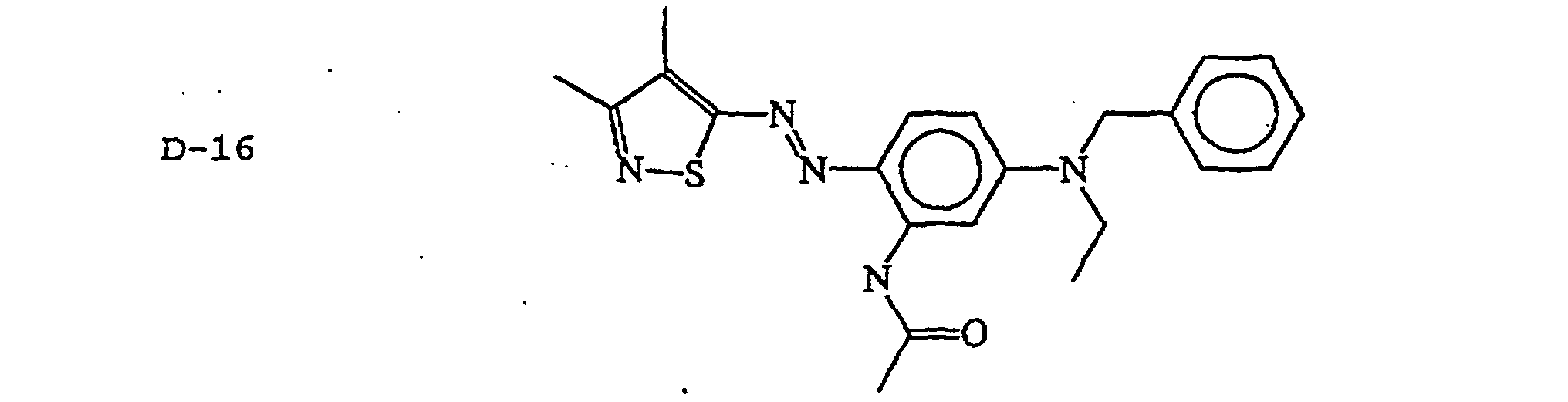
- a dispersion of thermal transfer dye was made by placing 2.4 g of compound D7 in a 4 oz glass jar containing 3.6 g of a 10% aqueous solution of dispersant Syn Fac 8210, 18.0 g distilled water and 60 ml of 1.8 mm zirconium oxide beads.
- a second dispersion was made by placing 2.4 g of compound D7 in an 4 oz glass jar containing 3.6 g of a 10% aqueous solution of dispersant Tetronic 908, 18.0 g of distilled water and 60 ml of 1.8 mm of zirconium oxide beads.
- a control dispersion was made by placing 2.4 g of compound D7 in an 4 oz glass jar containing 3.6 g of a 10% aqueous solution of PVP (polyvinylpyrrolidone), 18.0 g distilled water and 60 ml of 1.8 mm zirconium oxide beads. All three jars were rolled at a speed of 65 feet/minute for 10 days. After milling, each dispersion was separated from the milling beads, and the dispersion viscosity and stability to flocculation was evaluated. Results are given in Table I.
- a dispersion of a filter dye was made by placing 4.0 g of compound D1 in an 8 oz glass jar containing 2.0 g of dispersant Dapral GE202, 0.9g of a 45% aqueous solution of a small molecule surfactant sodium dodecyl diphenyloxide disulfonate, (SMS-8) 43.1 g distilled water, and 125 ml of 1.8 mm zirconium oxide beads.
- SMS-8 small molecule surfactant sodium dodecyl diphenyloxide disulfonate
- a second dispersion was made by placing 5.0g of compound D1 in an 8 oz glass jar containing 17.5 g of a 10% aqueous solution of an ethoxylated n-alkane alcohol having a molecular weight of 2250, containing 80 weight % PEO and having an HLB number of 16 (Unithox 480), 27.5 g distilled water and 125 ml of 1.8 mm zirconium oxide beads.
- a control dispersion was made by placing 4.0 g of compound D1 in an 8 oz glass jar containing 9.0 g of a 6.7% aqueous solution of octyl phenoxy polyethylene oxide sulfonate, (SMS-2), 37.0 g distilled water and 125 ml of 1.8 mm zirconium oxide beads. All three jars were placed on a SWECO vibratory mill for 3 days. After milling, each dispersion was separated from the milling beads, and the dispersion viscosity and stability to flocculation was evaluated. Results are given in Table II.
- a dispersion of a filter dye was made by placing 8.0g of compound D4 in an 8 oz glass jar containing 2.0 g of dispersant Tetronic 908, 40.0 g distilled water, and 125 ml of 1.8 mm zirconium oxide beads.
- a second dispersion was made by placing 8.0 g of compound D4 in an 8 oz glass jar containing 3.84 g of a 25% aqueous solution of an ethoxylated n-alkane alcohol having a molecular weight of 1100, containing 50 weight % PEO and having an HLB number of 10 (Unithox 550), 0.48 g SMS-1, 37.68 g distilled water and 125 ml of 1.8 mm zirconium oxide beads.
- a control dispersion was made by placing 8.0g of compound D4 in an 8oz glass jar containing 2.0 g SMS-1, 40.0 g distilled water and 125 ml of 1.8 mm zirconium oxide beads.
- a dispersion of a filter dye was made by placing 5.0 g of compound D5 in an 8 oz glass jar containing 17.5 g of dispersant Syn Fac 8216, 27.5 g distilled water, and 12 5ml of 1.8 mm zirconium oxide beads.
- a control dispersion was made by placing 4.0 g of compound D5 in an 8 oz glass jar containing 0.4 g SMS-1 45.6g distilled water and 125 ml of 1.8 mm zirconium oxide beads. Each jar was placed on a SWECO vibratory mill for 4 days. After milling, the dispersion containing dispersant Syn Fac 8216 was diluted to 8% dye with distilled water, and each dispersion was separated from the milling beads.
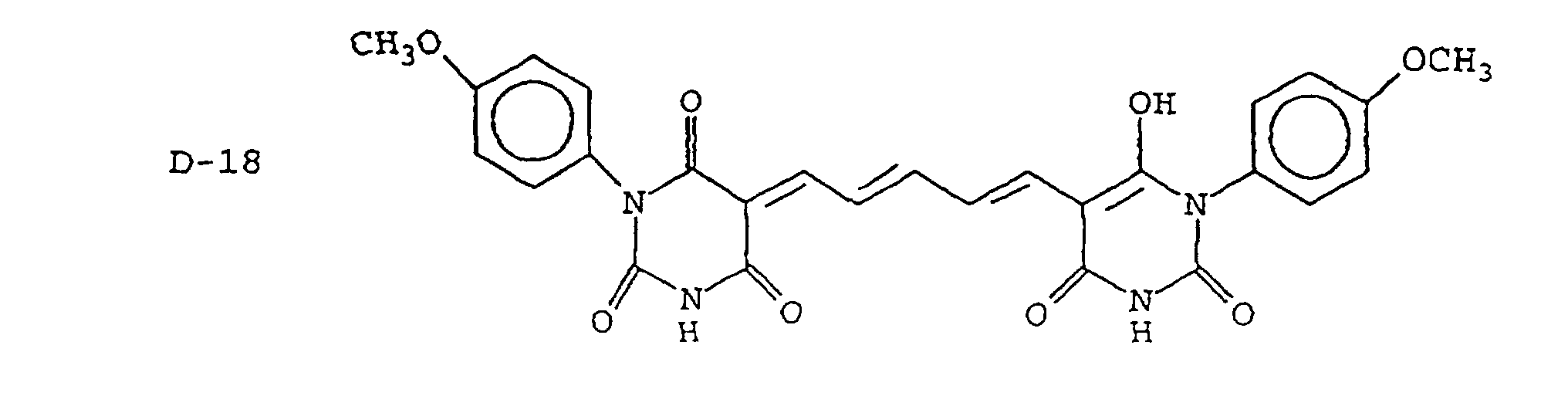
- a dispersion of a sensitizing dye was made by combining 5.0g of compound D9 with 0.75 g dispersant Dapral GE202 and 44.25 g distilled water to give a concentration of 10% dye, 1.5% dispersant Dapral GE202) and 88.5% distilled water.
- the slurry was milled in a glass jar filled 50% by volume with 1.8 mm zirconium oxide beads.
- a control dispersion was made by combining 5.04 g of compound D9 with 3.59g of a 21% by weight solution of SMS-2 and 41.44 g of distilled water to give a concentration of 10% dye, 1.5% SMS-2 and 88.5% distilled water.
Landscapes
- Chemical & Material Sciences (AREA)
- Chemical Kinetics & Catalysis (AREA)
- Physics & Mathematics (AREA)
- General Physics & Mathematics (AREA)
- Engineering & Computer Science (AREA)
- Materials Engineering (AREA)
- Organic Chemistry (AREA)
- Spectroscopy & Molecular Physics (AREA)
- Dispersion Chemistry (AREA)
- Colloid Chemistry (AREA)
- Emulsifying, Dispersing, Foam-Producing Or Wetting Agents (AREA)
Claims (10)
- Vermahlene, wäßrige Dispersion von feinen Feststoff-Teilchen, die dispergierte Teilchen einer in Wasser praktisch unlöslichen, nicht-polymeren, organischen Verbindung enthält, die für die Bildaufzeichnung geeignet ist,
dadurch gekennzeichnet, daß
die Dispersion 5 bis 200 Gew.-% eines polymeren Dispersionsmittels mit einer HLB-Zahl von mindestens 8, hezogen auf das Gewicht der für die Bildaufzeichnung geeigneten Verbindung, enthält, worin das Dispersionsmittel ausgewählt ist aus der Gruppe von amphipatischen, in Wasser löslichen oder in Wasser dispergierbaren Polymeren, die dargestellt werden durch die folgenden Strukturen I-IV:worin A jeweils unabhängig voneinander steht für eine Poly(ethylenoxid)-, Polyethyloxazolin-, Poly(vinylalkohol)- oder Poly(vinylpyrrolidon)-Einheit; B und C jeweils stehen für einen linearen oder verzweigten Alkyl-, Aryl-, Alkaryl- oder zyklischen Alkyl-Rest mit mindestens 7 Kohlenstoffatomen, oder 3 bis 100 wiederkehrende Einheiten eines Propylenoxides oder höheren Alkylenoxides oder Kombinationen hiervon; Q für eine mehrwertige, verbindende Gruppe steht; m = 50-100 Mol-% darstellt, und n = 1-50 Mol-% darstellt; wobei gilt, daß m + n = 100 Mol-% sind, x = 1 oder 2 ist, und z = 1 oder 2 ist, und wobei ferner gilt, daß das polymere Dispersionsmittel die folgende Verbindung ausschließt:

- Dispersion nach Anspruch 1, worin das Dispersionsmittel der Formel entspricht:x = 24-50z= 8-20M = H, SO3 -X+, oder PO3 2- 2X+worin X ein Kation ist;
 n = 10-25R = Aryl, Alkyl, AralkylM = H, SO3 - X+, oder PO3 2- 2X+worin X ein Kation ist;
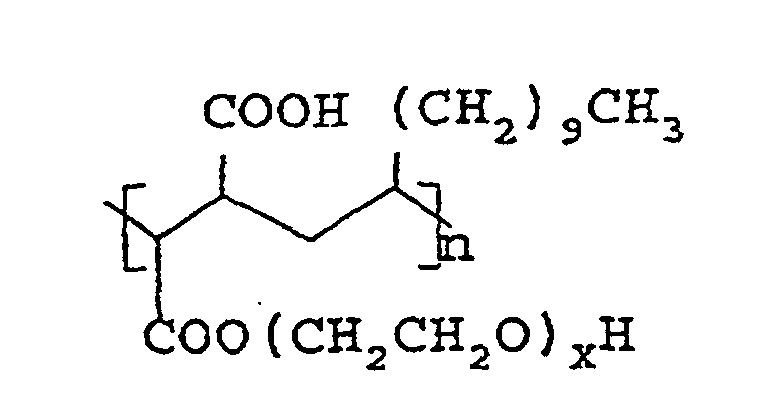 odern = 10-20x = 7-8;
 PEO = Poly(ethylenoxid)PPO = Poly(propylenoxid).
 - Dispersion nach Anspruch 2, worin das Dispersionsmittel ein polyalkoxylierter Kohlenwasserstoff ist.
- Dispersion nach Anspruch 2, worin das Dispersionsmittel ein Teilester eines verzweigten Carboxylsäure-Copolymeren ist.
- Dispersion nach Anspruch 2, worin das Dispersionsmittel ein Block-Copolymer von Polyethylenoxid und Polypropylenoxid ist.
- Dispersion nach einem der Ansprüche 1-5, worin die für die Bildaufzeichnung geeignete Verbindung ein Farbstoff ist, der ausgewählt ist aus der Gruppe, bestehend aus Sensibilisierungs-Farbstoffen, Farbstoffen für die thermische Übertragung und Filter-Farbstoffen.
- Dispersion nach Anspruch 6, worin der Farbstoff die Formel hat:
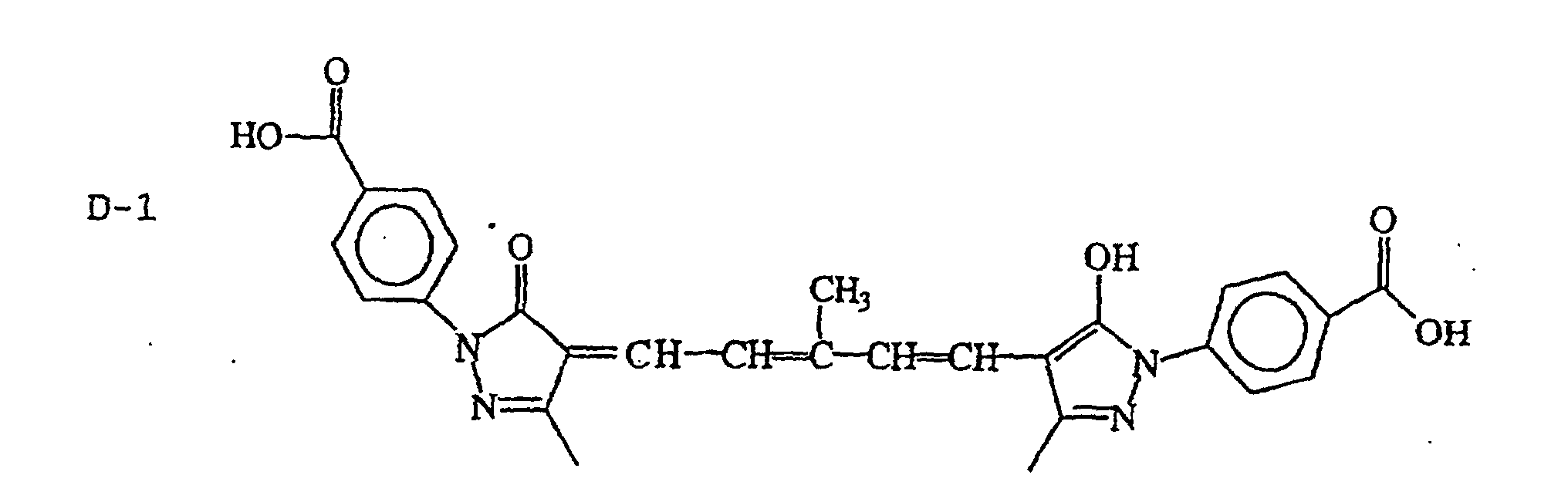


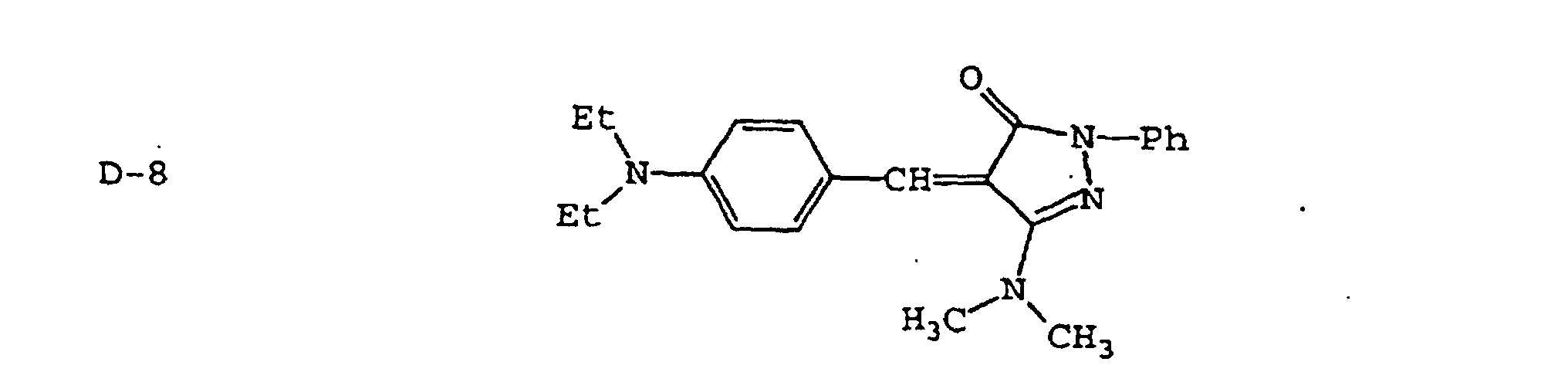

 n = 0-2, R = C2-C10 Alkyl, Aryl
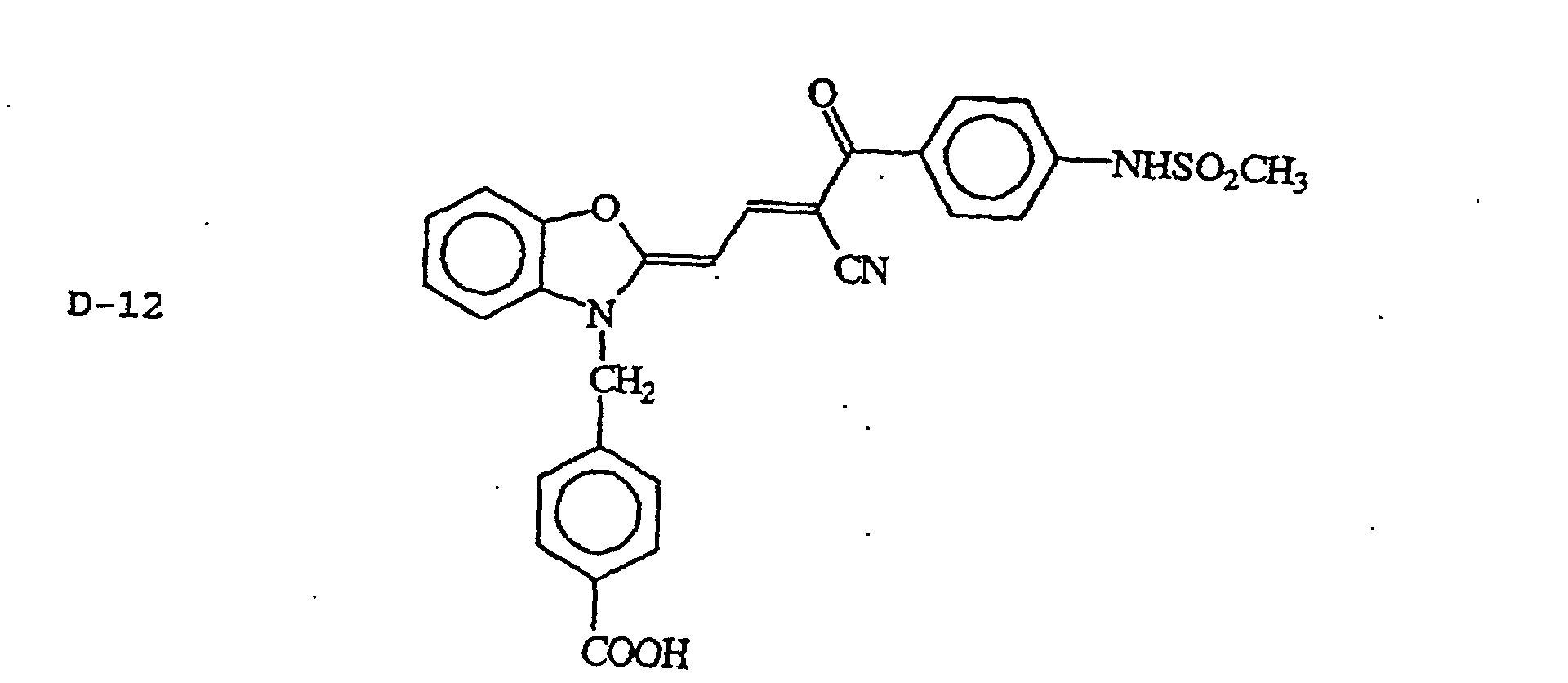


 oder
oder
- Bildaufzeichnungs-Element mit einem Träger, auf dem sich mindestens eine Schicht befindet, die eine Dispersion nach einem der Ansprüche 1-7 in einem Bildaufzeichnungs-Bindemittel enthält.
- Verfahren zur Herstellung eines Bildaufzeichnungs-Elementes nach Anspruch 8, das umfaßt die Stufen der Dispergierung der vermahlenen, wäßrigen Dispersion von feinen Feststoff-Teilchen, gemäß einem der Ansprüche 1-7, in einem Bildaufzeichnungs-Bindemittel, und das Auftragen der erhaltenen Zusammensetzung auf einen Träger.
- Verfahren zur Herstellung einer wäßrigen Dispersion von feinen Feststoff-Teilchen nach einem der Ansprüche 1-7, das umfaßt die Stufen:(a) der Herstellung einer groben, wäßrigen Aufschlämmung von Feststoff-Teilchen der Verbindung, die für die Bildaufzeichnung geeignet ist, und des polymeren Dispersionsmittels mit einer HLB-Zahl von mindestens 8; und(b) des Vermahlens der Aufschlämmung eine Zeitspanne lang, die ausreicht, um Teilchen der erwünschten Teilchengröße von weniger als 0,5 Mikrometern (Mikron) zu erzeugen.
Applications Claiming Priority (2)
| Application Number | Priority Date | Filing Date | Title |
|---|---|---|---|
| US22897194A | 1994-04-18 | 1994-04-18 | |
| US228971 | 1994-04-18 |
Publications (3)
| Publication Number | Publication Date |
|---|---|
| EP0678771A2 EP0678771A2 (de) | 1995-10-25 |
| EP0678771A3 EP0678771A3 (de) | 1996-01-24 |
| EP0678771B1 true EP0678771B1 (de) | 2001-11-21 |
Family
ID=22859298
Family Applications (1)
| Application Number | Title | Priority Date | Filing Date |
|---|---|---|---|
| EP95105023A Expired - Lifetime EP0678771B1 (de) | 1994-04-18 | 1995-04-04 | Stabile wässrige Festpartikeldispersionen |
Country Status (4)
| Country | Link |
|---|---|
| US (1) | US5657931A (de) |
| EP (1) | EP0678771B1 (de) |
| JP (1) | JP3440162B2 (de) |
| DE (1) | DE69523971T2 (de) |
Families Citing this family (15)
| Publication number | Priority date | Publication date | Assignee | Title |
|---|---|---|---|---|
| JP3412320B2 (ja) | 1995-03-14 | 2003-06-03 | 三菱化学フォームプラスティック株式会社 | 懸濁剤含有スラリーとその製造法、及び、それを用いた懸濁重合法 |
| US6025111A (en) * | 1996-10-23 | 2000-02-15 | Eastman Kodak Company | Stable matte formulation for imaging elements |
| US5925701A (en) * | 1997-12-22 | 1999-07-20 | Eastman Kodak Company | Stable aqueous polymeric dispersions containing hydrated metal salts of strong acids |
| US6019667A (en) * | 1998-05-26 | 2000-02-01 | Dow Corning Corporation | Method for grinding silicon metalloid |
| US6610317B2 (en) | 1999-05-27 | 2003-08-26 | Acusphere, Inc. | Porous paclitaxel matrices and methods of manufacture thereof |
| US6395300B1 (en) | 1999-05-27 | 2002-05-28 | Acusphere, Inc. | Porous drug matrices and methods of manufacture thereof |
| US7919119B2 (en) * | 1999-05-27 | 2011-04-05 | Acusphere, Inc. | Porous drug matrices and methods of manufacture thereof |
| JP4763957B2 (ja) | 2000-05-10 | 2011-08-31 | オバン・エナジー・リミテッド | メディアミリング |
| EP1313451B1 (de) | 2000-08-31 | 2009-03-11 | Jagotec AG | Gemahlene partikel |
| GB0127896D0 (en) | 2001-11-21 | 2002-01-16 | Eastman Kodak Co | Solid particle dispersions and their use in the preparation of laser thermal media |
| US6750002B2 (en) | 2002-01-28 | 2004-06-15 | Eastman Kodak Company | Process for the preparation of concentrated dye-water compositions |
| TW553767B (en) * | 2002-12-30 | 2003-09-21 | Ind Tech Res Inst | Method for producing ultra-fine dispersion solution |
| EP2269962B1 (de) * | 2008-03-31 | 2013-01-02 | Sekisui Chemical Co., Ltd. | Zwischenfilm für schichtglas, schichtglas und zinkoxidmikropartikeldispersion |
| CN101977864B (zh) * | 2008-03-31 | 2014-02-19 | 积水化学工业株式会社 | 夹层玻璃用中间膜、夹层玻璃及氧化锌微粒分散液 |
| JP6277719B2 (ja) * | 2013-01-09 | 2018-02-14 | 日油株式会社 | 非水系分散剤、および非水系分散体組成物 |
Family Cites Families (45)
| Publication number | Priority date | Publication date | Assignee | Title |
|---|---|---|---|---|
| US2378283A (en) * | 1941-12-10 | 1945-06-12 | Swiss Firm Of Soc Of Chemical | Pigment dyestuffs and process for the improvement of the tinctorial properties of pigments |
| US2844486A (en) * | 1956-12-26 | 1958-07-22 | Sierra Talc & Clay Company | Water dispersible talc pigment composition |
| US3030370A (en) * | 1959-08-24 | 1962-04-17 | Du Pont | Particle size reduction of quinacridone and phthalocyanine pigments |
| AU423098B2 (en) * | 1967-07-12 | 1972-04-10 | I. C. I. Australia Limited | Process of comminution ofan aqueous suspension of copper phthalocyanine |
| US3947287A (en) * | 1971-11-15 | 1976-03-30 | Badische Anilin- & Soda-Fabrik Aktiengesellschaft | Aqueous pigment dispersions |
| GB1460894A (en) * | 1973-03-19 | 1977-01-06 | Agfa Gevaert | Method of incorporating photographic ingredients into hydrophilic colloids |
| IT1021282B (it) * | 1973-10-11 | 1978-01-30 | Basf Ag | Processo per la preparazione di dispersioni di poliesterimidi |
| US3911091A (en) * | 1974-06-21 | 1975-10-07 | Xerox Corp | Milling trigonal selenium particles to improve xerographic performance |
| US4006025A (en) * | 1975-06-06 | 1977-02-01 | Polaroid Corporation | Process for dispersing sensitizing dyes |
| GB1551829A (en) * | 1975-09-15 | 1979-09-05 | Ici Ltd | Process for the preparation of dispersions |
| FR2344050A1 (fr) * | 1976-03-09 | 1977-10-07 | Agfa Gevaert Ag | Technique d'introduction d'additifs photographiques dans des emulsions d'un sel d'argent |
| GB1544991A (en) * | 1976-10-15 | 1979-04-25 | Ciba Geigy Ag | Pigment treatment |
| CH639518B (de) * | 1977-11-02 | Rohner Ag | Hochkonzentrierte, stabile, fliessfaehige waessrige dispersion von elektrophil substituierten, diazotierbaren aromatischen aminen. | |
| JPS55151544A (en) * | 1979-05-12 | 1980-11-26 | Wako Pure Chem Ind Ltd | Fine particle of organic azonitrile and its production |
| US4284709A (en) * | 1979-05-15 | 1981-08-18 | Ciba-Geigy Aktiengesellschaft | Process for incorporating photographic additives in hydrophilic colloid preparations |
| US4294917A (en) * | 1979-05-22 | 1981-10-13 | Ciba-Geigy Ag | Photographic silver halide material containing a dye filter or a dye anti-halation layer |
| US4294916A (en) * | 1979-05-22 | 1981-10-13 | Ciba-Geigy Ag | Photographic silver halide material containing a dye filter or a dye anti-halation layer |
| CH657493GA3 (de) * | 1980-02-22 | 1986-09-15 | ||
| US4427810A (en) * | 1981-05-04 | 1984-01-24 | Inmont Corporation | Continuous method of producing aqueous phthalocyanine pigment dispersions |
| US4523923A (en) * | 1983-02-28 | 1985-06-18 | Ciba-Geigy Corporation | Solid disperse dye formulations containing non-ionic dispersants for transfer printing inks |
| US4522654A (en) * | 1983-12-23 | 1985-06-11 | Inmont Corporation | Continuous method of producing phthalocyanine pigment dispersions in organic solvent |
| US4740370A (en) * | 1984-03-16 | 1988-04-26 | Faryniarz Joseph R | Process for preparing nail coating compositions |
| JPS61172810A (ja) * | 1985-01-29 | 1986-08-04 | Pentel Kk | 液状化粧料 |
| US4725394A (en) * | 1985-02-19 | 1988-02-16 | E. I. Du Pont De Nemours And Company | Process for preparing high stength cellulosic fibers |
| US4665107A (en) * | 1986-03-21 | 1987-05-12 | Koh-I-Noor Rapidograph, Inc. | Pigment encapsulated latex aqueous colorant dispersions |
| JPS63112519A (ja) * | 1986-10-28 | 1988-05-17 | Shin Etsu Chem Co Ltd | ニフエジピン製剤の製造方法 |
| DE3734491A1 (de) * | 1987-10-12 | 1989-04-20 | Henkel Kgaa | Verfahren zur herstellung eines als kleisterbasis geeigneten trockenproduktes |
| US4940654A (en) * | 1987-12-23 | 1990-07-10 | Eastman Kodak Company | Solid particle dispersion filter dyes for photographic compositions |
| US4900653A (en) * | 1987-12-23 | 1990-02-13 | Eastman Kodak Company | Photographic elements containing filter dye particle dispersions |
| US4957857A (en) * | 1988-12-23 | 1990-09-18 | Eastman Kodak Company | Stabilization of precipitated dispersions of hydrophobic couplers |
| US5135844A (en) * | 1989-06-15 | 1992-08-04 | Eastman Kodak Company | Preparation of low viscosity small particle photographic dispersions in gelatin |
| US5013640A (en) * | 1989-06-15 | 1991-05-07 | Eastman Kodak Company | Preparation of low viscosity small-particle photographic dispersions in gelatin |
| JP2750173B2 (ja) * | 1989-10-17 | 1998-05-13 | 三共株式会社 | 難溶性化合物の湿式粉砕方法 |
| DE59010009D1 (de) * | 1989-10-27 | 1996-02-08 | Ciba Geigy Ag | Wässrige Farbstoff-Präparate |
| US5154361A (en) * | 1989-11-06 | 1992-10-13 | United States Gypsum Company | Comminution of plastic scrap |
| US5104776A (en) * | 1989-11-29 | 1992-04-14 | Eastman Kodak Company | Increased photographic activity precipitated coupler dispersions prepared by coprecipitation with liquid carboxylic acids |
| US5071076A (en) * | 1990-08-10 | 1991-12-10 | Omni Quest Corporation | Method for producing magnetic microparticles from metallocenes |
| US5145684A (en) * | 1991-01-25 | 1992-09-08 | Sterling Drug Inc. | Surface modified drug nanoparticles |
| JPH04289856A (ja) * | 1991-03-18 | 1992-10-14 | Konica Corp | 熱現像感光材料 |
| CA2073951C (en) * | 1991-08-02 | 1996-12-03 | Jiann-Yang Hwang | Separation of normally hydrophobic plastic materials by froth flotation |
| US5491052A (en) * | 1992-03-13 | 1996-02-13 | Eastman Kodak Company | Yellow layer for color photographic elements |
| US5401623A (en) * | 1992-10-05 | 1995-03-28 | Eastman Kodak Company | Reactivity control in microcrystalline coupler dispersions |
| US5300394A (en) * | 1992-12-16 | 1994-04-05 | Eastman Kodak Company | Dispersions for imaging systems |
| US5360695A (en) * | 1993-01-26 | 1994-11-01 | Eastman Kodak Company | Aqueous developable dye diffusion transfer elements containing solid particle thermal solvent dispersions |
| US5455155A (en) * | 1993-04-22 | 1995-10-03 | Eastman Kodak Company | Photographic element having reduced dye stain |
-
1995
- 1995-04-04 EP EP95105023A patent/EP0678771B1/de not_active Expired - Lifetime
- 1995-04-04 DE DE69523971T patent/DE69523971T2/de not_active Expired - Fee Related
- 1995-04-17 JP JP11402795A patent/JP3440162B2/ja not_active Expired - Fee Related
- 1995-05-19 US US08/445,321 patent/US5657931A/en not_active Expired - Lifetime
Also Published As
| Publication number | Publication date |
|---|---|
| US5657931A (en) | 1997-08-19 |
| DE69523971D1 (de) | 2002-01-03 |
| EP0678771A3 (de) | 1996-01-24 |
| JP3440162B2 (ja) | 2003-08-25 |
| JPH07306494A (ja) | 1995-11-21 |
| DE69523971T2 (de) | 2002-08-29 |
| EP0678771A2 (de) | 1995-10-25 |
Similar Documents
| Publication | Publication Date | Title |
|---|---|---|
| EP0678771B1 (de) | Stabile wässrige Festpartikeldispersionen | |
| EP0602428B1 (de) | Verbesserte Dispersionen für Aufzeichnungssysteme | |
| US5513803A (en) | Continuous media recirculation milling process | |
| DE69511936T2 (de) | Zerkleinern mit feinteiligen Mahl-Medien | |
| EP0703494B1 (de) | Infrarot absorbierenden Farbstoff photographisches Silberhalogenidmaterial | |
| EP0678770B1 (de) | Festpartikeldispersionen für Aufzeichnungssysteme | |
| JP3187738B2 (ja) | ヘプタメチンシアニン化合物、近赤外光吸収インク、近赤外光吸収シートおよびハロゲン化銀写真感光材料 | |
| JPH05505255A (ja) | 無定形粒子分散液の安定性改良 | |
| US4657846A (en) | Silver halide photographic printing paper | |
| JPH05262994A (ja) | 写真フィルター色素分散用ミクロ沈澱法 | |
| EP0762194A1 (de) | Verbesserte Festpartikeldispersionen für Aufzeichnungselemente | |
| US5750321A (en) | Process for buffering concentrated aqueous slurries | |
| JPH10140082A (ja) | 画像形成要素用の安定な艶消配合物 | |
| US5709983A (en) | Nonaqueous solid particle dye dispersions | |
| US5994041A (en) | Process for buffering concentrated aqueous slurries | |
| JP2001290235A (ja) | 非イオンオリゴマー界面活性剤並びに分散剤及び安定剤としてのそれらの使用 | |
| US6750002B2 (en) | Process for the preparation of concentrated dye-water compositions | |
| EP0656401B1 (de) | Neue Farbstoffe brauchbar für verschiedene Anwendungen | |
| EP0345444B1 (de) | Lichtempfindliches photographisches Element ohne Silber und Verfahren, um hydrophobe Zusammensetzungen in hydrophile kolloidale Zusammensetzungen einzusetzen | |
| US5753390A (en) | Method of preparing dispersions of photographically useful compounds | |
| JP2000075435A (ja) | 写真用素材の分散方法 | |
| JP2000227641A (ja) | ハロゲン化銀写真感光材料 | |
| JPH05162456A (ja) | 4−ヒドロキシ−4’−イソプロポキシジフェニルスルホンの湿式粉砕方法 | |
| JPH0452308B2 (de) | ||
| JPH08229303A (ja) | 固体微粒子の製造方法 |
Legal Events
| Date | Code | Title | Description |
|---|---|---|---|
| PUAI | Public reference made under article 153(3) epc to a published international application that has entered the european phase |
Free format text: ORIGINAL CODE: 0009012 |
|
| AK | Designated contracting states |
Kind code of ref document: A2 Designated state(s): DE FR GB |
|
| PUAL | Search report despatched |
Free format text: ORIGINAL CODE: 0009013 |
|
| AK | Designated contracting states |
Kind code of ref document: A3 Designated state(s): BE CH DE FR GB IT LI NL |
|
| 17P | Request for examination filed |
Effective date: 19960621 |
|
| 17Q | First examination report despatched |
Effective date: 19991109 |
|
| GRAG | Despatch of communication of intention to grant |
Free format text: ORIGINAL CODE: EPIDOS AGRA |
|
| GRAG | Despatch of communication of intention to grant |
Free format text: ORIGINAL CODE: EPIDOS AGRA |
|
| GRAH | Despatch of communication of intention to grant a patent |
Free format text: ORIGINAL CODE: EPIDOS IGRA |
|
| RBV | Designated contracting states (corrected) |
Designated state(s): DE FR GB |
|
| GRAH | Despatch of communication of intention to grant a patent |
Free format text: ORIGINAL CODE: EPIDOS IGRA |
|
| GRAA | (expected) grant |
Free format text: ORIGINAL CODE: 0009210 |
|
| AK | Designated contracting states |
Kind code of ref document: B1 Designated state(s): DE FR GB |
|
| REG | Reference to a national code |
Ref country code: GB Ref legal event code: IF02 |
|
| REF | Corresponds to: |
Ref document number: 69523971 Country of ref document: DE Date of ref document: 20020103 |
|
| ET | Fr: translation filed | ||
| PLBE | No opposition filed within time limit |
Free format text: ORIGINAL CODE: 0009261 |
|
| STAA | Information on the status of an ep patent application or granted ep patent |
Free format text: STATUS: NO OPPOSITION FILED WITHIN TIME LIMIT |
|
| 26N | No opposition filed | ||
| PGFP | Annual fee paid to national office [announced via postgrant information from national office to epo] |
Ref country code: GB Payment date: 20050314 Year of fee payment: 11 |
|
| PGFP | Annual fee paid to national office [announced via postgrant information from national office to epo] |
Ref country code: FR Payment date: 20050401 Year of fee payment: 11 |
|
| PGFP | Annual fee paid to national office [announced via postgrant information from national office to epo] |
Ref country code: DE Payment date: 20050429 Year of fee payment: 11 |
|
| PG25 | Lapsed in a contracting state [announced via postgrant information from national office to epo] |
Ref country code: GB Free format text: LAPSE BECAUSE OF NON-PAYMENT OF DUE FEES Effective date: 20060404 |
|
| PG25 | Lapsed in a contracting state [announced via postgrant information from national office to epo] |
Ref country code: DE Free format text: LAPSE BECAUSE OF NON-PAYMENT OF DUE FEES Effective date: 20061101 |
|
| GBPC | Gb: european patent ceased through non-payment of renewal fee |
Effective date: 20060404 |
|
| REG | Reference to a national code |
Ref country code: FR Ref legal event code: ST Effective date: 20061230 |
|
| PG25 | Lapsed in a contracting state [announced via postgrant information from national office to epo] |
Ref country code: FR Free format text: LAPSE BECAUSE OF NON-PAYMENT OF DUE FEES Effective date: 20060502 |