EP0694549B1 - Herstellung von Organohaloboranen und Alkoxyorganoboranen - Google Patents
Herstellung von Organohaloboranen und Alkoxyorganoboranen Download PDFInfo
- Publication number
- EP0694549B1 EP0694549B1 EP95304096A EP95304096A EP0694549B1 EP 0694549 B1 EP0694549 B1 EP 0694549B1 EP 95304096 A EP95304096 A EP 95304096A EP 95304096 A EP95304096 A EP 95304096A EP 0694549 B1 EP0694549 B1 EP 0694549B1
- Authority
- EP
- European Patent Office
- Prior art keywords
- group
- case
- olefin
- alkyne
- alkyl group
- Prior art date
- Legal status (The legal status is an assumption and is not a legal conclusion. Google has not performed a legal analysis and makes no representation as to the accuracy of the status listed.)
- Expired - Lifetime
Links
- 230000015572 biosynthetic process Effects 0.000 title description 5
- 238000003786 synthesis reaction Methods 0.000 title description 4
- 238000000034 method Methods 0.000 claims description 36
- 150000001336 alkenes Chemical class 0.000 claims description 31
- 125000000217 alkyl group Chemical group 0.000 claims description 31
- 150000001345 alkine derivatives Chemical class 0.000 claims description 30
- JRZJOMJEPLMPRA-UHFFFAOYSA-N olefin Natural products CCCCCCCC=C JRZJOMJEPLMPRA-UHFFFAOYSA-N 0.000 claims description 29
- ZOXJGFHDIHLPTG-UHFFFAOYSA-N Boron Chemical compound [B] ZOXJGFHDIHLPTG-UHFFFAOYSA-N 0.000 claims description 18
- 229910052796 boron Inorganic materials 0.000 claims description 18
- 125000003342 alkenyl group Chemical group 0.000 claims description 13
- 125000003118 aryl group Chemical group 0.000 claims description 10
- 238000002360 preparation method Methods 0.000 claims description 9
- 150000001875 compounds Chemical class 0.000 claims description 8
- 125000004122 cyclic group Chemical group 0.000 claims description 8
- 239000000376 reactant Substances 0.000 claims description 8
- -1 alkyl borate Chemical compound 0.000 claims description 7
- 125000003710 aryl alkyl group Chemical group 0.000 claims description 7
- 125000004432 carbon atom Chemical group C* 0.000 claims description 7
- 125000001246 bromo group Chemical group Br* 0.000 claims description 6
- 125000001309 chloro group Chemical group Cl* 0.000 claims description 6
- 239000001257 hydrogen Substances 0.000 claims description 6
- 229910052739 hydrogen Inorganic materials 0.000 claims description 6
- 125000004435 hydrogen atom Chemical class [H]* 0.000 claims description 6
- 125000002346 iodo group Chemical group I* 0.000 claims description 5
- 125000001153 fluoro group Chemical group F* 0.000 claims description 4
- 125000000113 cyclohexyl group Chemical group [H]C1([H])C([H])([H])C([H])([H])C([H])(*)C([H])([H])C1([H])[H] 0.000 claims 1
- VLKZOEOYAKHREP-UHFFFAOYSA-N n-Hexane Chemical compound CCCCCC VLKZOEOYAKHREP-UHFFFAOYSA-N 0.000 description 63
- 238000006243 chemical reaction Methods 0.000 description 30
- IJGRMHOSHXDMSA-UHFFFAOYSA-N Atomic nitrogen Chemical compound N#N IJGRMHOSHXDMSA-UHFFFAOYSA-N 0.000 description 22
- GRWFGVWFFZKLTI-UHFFFAOYSA-N rac-alpha-Pinene Natural products CC1=CCC2C(C)(C)C1C2 GRWFGVWFFZKLTI-UHFFFAOYSA-N 0.000 description 17
- FAQYAMRNWDIXMY-UHFFFAOYSA-N trichloroborane Chemical compound ClB(Cl)Cl FAQYAMRNWDIXMY-UHFFFAOYSA-N 0.000 description 15
- RTZKZFJDLAIYFH-UHFFFAOYSA-N ether Substances CCOCC RTZKZFJDLAIYFH-UHFFFAOYSA-N 0.000 description 13
- GRWFGVWFFZKLTI-IUCAKERBSA-N (-)-α-pinene Chemical compound CC1=CC[C@@H]2C(C)(C)[C@H]1C2 GRWFGVWFFZKLTI-IUCAKERBSA-N 0.000 description 12
- 239000002904 solvent Substances 0.000 description 12
- 229910052757 nitrogen Inorganic materials 0.000 description 11
- 239000011521 glass Substances 0.000 description 10
- 239000011541 reaction mixture Substances 0.000 description 10
- YXFVVABEGXRONW-UHFFFAOYSA-N Toluene Chemical compound CC1=CC=CC=C1 YXFVVABEGXRONW-UHFFFAOYSA-N 0.000 description 9
- 239000000203 mixture Substances 0.000 description 9
- 238000004607 11B NMR spectroscopy Methods 0.000 description 8
- UOALEFQKAOQICC-UHFFFAOYSA-N chloroborane Chemical class ClB UOALEFQKAOQICC-UHFFFAOYSA-N 0.000 description 8
- MVNCAPSFBDBCGF-UHFFFAOYSA-N alpha-pinene Natural products CC1=CCC23C1CC2C3(C)C MVNCAPSFBDBCGF-UHFFFAOYSA-N 0.000 description 6
- 238000004458 analytical method Methods 0.000 description 6
- HGCIXCUEYOPUTN-UHFFFAOYSA-N cyclohexene Chemical compound C1CCC=CC1 HGCIXCUEYOPUTN-UHFFFAOYSA-N 0.000 description 6
- 230000003287 optical effect Effects 0.000 description 6
- 238000010992 reflux Methods 0.000 description 6
- 239000000047 product Substances 0.000 description 5
- 229930006720 (-)-alpha-pinene Natural products 0.000 description 4
- LIKMAJRDDDTEIG-UHFFFAOYSA-N 1-hexene Chemical compound CCCCC=C LIKMAJRDDDTEIG-UHFFFAOYSA-N 0.000 description 4
- XKRFYHLGVUSROY-UHFFFAOYSA-N Argon Chemical compound [Ar] XKRFYHLGVUSROY-UHFFFAOYSA-N 0.000 description 4
- 229910015844 BCl3 Inorganic materials 0.000 description 4
- 238000005481 NMR spectroscopy Methods 0.000 description 4
- WTARULDDTDQWMU-UHFFFAOYSA-N Pseudopinene Natural products C1C2C(C)(C)C1CCC2=C WTARULDDTDQWMU-UHFFFAOYSA-N 0.000 description 4
- UCKMPCXJQFINFW-UHFFFAOYSA-N Sulphide Chemical compound [S-2] UCKMPCXJQFINFW-UHFFFAOYSA-N 0.000 description 4
- 229930006718 (+)-alpha-pinene Natural products 0.000 description 3
- GRWFGVWFFZKLTI-RKDXNWHRSA-N (+)-α-pinene Chemical compound CC1=CC[C@H]2C(C)(C)[C@@H]1C2 GRWFGVWFFZKLTI-RKDXNWHRSA-N 0.000 description 3
- UHOVQNZJYSORNB-UHFFFAOYSA-N Benzene Chemical compound C1=CC=CC=C1 UHOVQNZJYSORNB-UHFFFAOYSA-N 0.000 description 3
- RQRCEGLLWXERDH-UHFFFAOYSA-N ClB.CSC Chemical compound ClB.CSC RQRCEGLLWXERDH-UHFFFAOYSA-N 0.000 description 3
- QMMFVYPAHWMCMS-UHFFFAOYSA-N Dimethyl sulfide Chemical compound CSC QMMFVYPAHWMCMS-UHFFFAOYSA-N 0.000 description 3
- OKKJLVBELUTLKV-UHFFFAOYSA-N Methanol Chemical compound OC OKKJLVBELUTLKV-UHFFFAOYSA-N 0.000 description 3
- HEMHJVSKTPXQMS-UHFFFAOYSA-M Sodium hydroxide Chemical compound [OH-].[Na+] HEMHJVSKTPXQMS-UHFFFAOYSA-M 0.000 description 3
- HEDRZPFGACZZDS-MICDWDOJSA-N Trichloro(2H)methane Chemical compound [2H]C(Cl)(Cl)Cl HEDRZPFGACZZDS-MICDWDOJSA-N 0.000 description 3
- 238000001897 boron-11 nuclear magnetic resonance spectrum Methods 0.000 description 3
- 238000005356 chiral GC Methods 0.000 description 3
- PBBOKJIYEZCTEH-UHFFFAOYSA-N chloro(dicyclohexyl)borane Chemical compound C1CCCCC1B(Cl)C1CCCCC1 PBBOKJIYEZCTEH-UHFFFAOYSA-N 0.000 description 3
- 125000005843 halogen group Chemical group 0.000 description 3
- 238000006197 hydroboration reaction Methods 0.000 description 3
- 150000002430 hydrocarbons Chemical class 0.000 description 3
- 239000003446 ligand Substances 0.000 description 3
- MLSKXPOBNQFGHW-UHFFFAOYSA-N methoxy(dioxido)borane Chemical compound COB([O-])[O-] MLSKXPOBNQFGHW-UHFFFAOYSA-N 0.000 description 3
- 239000002243 precursor Substances 0.000 description 3
- 239000007787 solid Substances 0.000 description 3
- 229910001220 stainless steel Inorganic materials 0.000 description 3
- 239000010935 stainless steel Substances 0.000 description 3
- WYURNTSHIVDZCO-UHFFFAOYSA-N tetrahydrofuran Substances C1CCOC1 WYURNTSHIVDZCO-UHFFFAOYSA-N 0.000 description 3
- 150000003568 thioethers Chemical class 0.000 description 3
- UPAXWIAOGNDSPP-UHFFFAOYSA-N 9-chloro-9-borabicyclo[3.3.1]nonane Chemical compound C1CCC2CCCC1B2Cl UPAXWIAOGNDSPP-UHFFFAOYSA-N 0.000 description 2
- 239000004215 Carbon black (E152) Substances 0.000 description 2
- VGGSQFUCUMXWEO-UHFFFAOYSA-N Ethene Chemical compound C=C VGGSQFUCUMXWEO-UHFFFAOYSA-N 0.000 description 2
- 239000005977 Ethylene Substances 0.000 description 2
- IMNFDUFMRHMDMM-UHFFFAOYSA-N N-Heptane Chemical compound CCCCCCC IMNFDUFMRHMDMM-UHFFFAOYSA-N 0.000 description 2
- OFBQJSOFQDEBGM-UHFFFAOYSA-N Pentane Chemical compound CCCCC OFBQJSOFQDEBGM-UHFFFAOYSA-N 0.000 description 2
- 229910052786 argon Inorganic materials 0.000 description 2
- 125000004429 atom Chemical group 0.000 description 2
- 238000009835 boiling Methods 0.000 description 2
- UORVGPXVDQYIDP-UHFFFAOYSA-N borane Chemical compound B UORVGPXVDQYIDP-UHFFFAOYSA-N 0.000 description 2
- 229910000085 borane Inorganic materials 0.000 description 2
- 239000011203 carbon fibre reinforced carbon Substances 0.000 description 2
- 239000003054 catalyst Substances 0.000 description 2
- 125000004185 ester group Chemical group 0.000 description 2
- 150000002148 esters Chemical class 0.000 description 2
- 125000001033 ether group Chemical group 0.000 description 2
- 125000001495 ethyl group Chemical group [H]C([H])([H])C([H])([H])* 0.000 description 2
- 239000012467 final product Substances 0.000 description 2
- 238000004817 gas chromatography Methods 0.000 description 2
- 238000010574 gas phase reaction Methods 0.000 description 2
- 229930195733 hydrocarbon Natural products 0.000 description 2
- 125000001449 isopropyl group Chemical group [H]C([H])([H])C([H])(*)C([H])([H])[H] 0.000 description 2
- 125000002496 methyl group Chemical group [H]C([H])([H])* 0.000 description 2
- 125000000449 nitro group Chemical group [O-][N+](*)=O 0.000 description 2
- 125000002524 organometallic group Chemical group 0.000 description 2
- 125000001997 phenyl group Chemical group [H]C1=C([H])C([H])=C(*)C([H])=C1[H] 0.000 description 2
- 125000003808 silyl group Chemical group [H][Si]([H])([H])[*] 0.000 description 2
- 229910052708 sodium Inorganic materials 0.000 description 2
- 239000011734 sodium Substances 0.000 description 2
- VYXHVRARDIDEHS-UHFFFAOYSA-N 1,5-cyclooctadiene Chemical compound C1CC=CCCC=C1 VYXHVRARDIDEHS-UHFFFAOYSA-N 0.000 description 1
- 239000004912 1,5-cyclooctadiene Substances 0.000 description 1
- CGHIBGNXEGJPQZ-UHFFFAOYSA-N 1-hexyne Chemical compound CCCCC#C CGHIBGNXEGJPQZ-UHFFFAOYSA-N 0.000 description 1
- 238000005160 1H NMR spectroscopy Methods 0.000 description 1
- HBAQYPYDRFILMT-UHFFFAOYSA-N 8-[3-(1-cyclopropylpyrazol-4-yl)-1H-pyrazolo[4,3-d]pyrimidin-5-yl]-3-methyl-3,8-diazabicyclo[3.2.1]octan-2-one Chemical class C1(CC1)N1N=CC(=C1)C1=NNC2=C1N=C(N=C2)N1C2C(N(CC1CC2)C)=O HBAQYPYDRFILMT-UHFFFAOYSA-N 0.000 description 1
- JTEAHFKMVZQOJU-UHFFFAOYSA-N BCC(OC)OC Chemical compound BCC(OC)OC JTEAHFKMVZQOJU-UHFFFAOYSA-N 0.000 description 1
- VEXZGXHMUGYJMC-UHFFFAOYSA-M Chloride anion Chemical compound [Cl-] VEXZGXHMUGYJMC-UHFFFAOYSA-M 0.000 description 1
- GLHXHWUDOMEPFT-UHFFFAOYSA-N ClB.C1CCOC1 Chemical compound ClB.C1CCOC1 GLHXHWUDOMEPFT-UHFFFAOYSA-N 0.000 description 1
- XDTMQSROBMDMFD-UHFFFAOYSA-N Cyclohexane Chemical compound C1CCCCC1 XDTMQSROBMDMFD-UHFFFAOYSA-N 0.000 description 1
- VEXZGXHMUGYJMC-UHFFFAOYSA-N Hydrochloric acid Chemical compound Cl VEXZGXHMUGYJMC-UHFFFAOYSA-N 0.000 description 1
- DGAQECJNVWCQMB-PUAWFVPOSA-M Ilexoside XXIX Chemical compound C[C@@H]1CC[C@@]2(CC[C@@]3(C(=CC[C@H]4[C@]3(CC[C@@H]5[C@@]4(CC[C@@H](C5(C)C)OS(=O)(=O)[O-])C)C)[C@@H]2[C@]1(C)O)C)C(=O)O[C@H]6[C@@H]([C@H]([C@@H]([C@H](O6)CO)O)O)O.[Na+] DGAQECJNVWCQMB-PUAWFVPOSA-M 0.000 description 1
- WHXSMMKQMYFTQS-UHFFFAOYSA-N Lithium Chemical compound [Li] WHXSMMKQMYFTQS-UHFFFAOYSA-N 0.000 description 1
- 239000012448 Lithium borohydride Substances 0.000 description 1
- NINIDFKCEFEMDL-UHFFFAOYSA-N Sulfur Chemical compound [S] NINIDFKCEFEMDL-UHFFFAOYSA-N 0.000 description 1
- 125000003545 alkoxy group Chemical group 0.000 description 1
- 125000002619 bicyclic group Chemical group 0.000 description 1
- MPQAQJSAYDDROO-VMAIWCPRSA-N bis[(1r,3r,4s,5r)-4,6,6-trimethyl-3-bicyclo[3.1.1]heptanyl]boron Chemical compound C([C@H]([C@@H]1C)[B][C@@H]2C[C@@H]3C[C@@H](C3(C)C)[C@H]2C)[C@H]2C(C)(C)[C@@H]1C2 MPQAQJSAYDDROO-VMAIWCPRSA-N 0.000 description 1
- UYANAUSDHIFLFQ-UHFFFAOYSA-N borinic acid Chemical class OB UYANAUSDHIFLFQ-UHFFFAOYSA-N 0.000 description 1
- MCQRPQCQMGVWIQ-UHFFFAOYSA-N boron;methylsulfanylmethane Chemical compound [B].CSC MCQRPQCQMGVWIQ-UHFFFAOYSA-N 0.000 description 1
- UWTDFICHZKXYAC-UHFFFAOYSA-N boron;oxolane Chemical compound [B].C1CCOC1 UWTDFICHZKXYAC-UHFFFAOYSA-N 0.000 description 1
- 125000005620 boronic acid group Chemical class 0.000 description 1
- 244000309464 bull Species 0.000 description 1
- 239000006227 byproduct Substances 0.000 description 1
- 239000012159 carrier gas Substances 0.000 description 1
- 239000003153 chemical reaction reagent Substances 0.000 description 1
- 239000003638 chemical reducing agent Substances 0.000 description 1
- TXQLVRNJJDEGRU-UHFFFAOYSA-N chloro(dihexyl)borane Chemical compound CCCCCCB(Cl)CCCCCC TXQLVRNJJDEGRU-UHFFFAOYSA-N 0.000 description 1
- PSEHHVRCDVOTID-YYNWCRCSSA-N chloro-bis[(1r,3s,4r,5r)-4,6,6-trimethyl-3-bicyclo[3.1.1]heptanyl]borane Chemical compound C([C@@H]([C@H]1C)B(Cl)[C@H]2C[C@@H]3C[C@@H](C3(C)C)[C@@H]2C)[C@H]2C(C)(C)[C@@H]1C2 PSEHHVRCDVOTID-YYNWCRCSSA-N 0.000 description 1
- 238000001816 cooling Methods 0.000 description 1
- UFZGRTWOMWCMLE-UHFFFAOYSA-N dichloro(cyclohexyl)borane Chemical compound ClB(Cl)C1CCCCC1 UFZGRTWOMWCMLE-UHFFFAOYSA-N 0.000 description 1
- LHCGBIFHSCCRRG-UHFFFAOYSA-N dichloroborane Chemical compound ClBCl LHCGBIFHSCCRRG-UHFFFAOYSA-N 0.000 description 1
- GKWKOCYSCDZTAX-UHFFFAOYSA-N dichloroboron Chemical compound Cl[B]Cl GKWKOCYSCDZTAX-UHFFFAOYSA-N 0.000 description 1
- FESAXEDIWWXCNG-UHFFFAOYSA-N diethyl(methoxy)borane Chemical compound CCB(CC)OC FESAXEDIWWXCNG-UHFFFAOYSA-N 0.000 description 1
- WDUMCCCPYLSETM-UHFFFAOYSA-N diethylboranyl(diethyl)borane Chemical compound CCB(CC)B(CC)CC WDUMCCCPYLSETM-UHFFFAOYSA-N 0.000 description 1
- 150000002170 ethers Chemical class 0.000 description 1
- 238000002474 experimental method Methods 0.000 description 1
- 239000007789 gas Substances 0.000 description 1
- 150000004820 halides Chemical class 0.000 description 1
- 239000001307 helium Substances 0.000 description 1
- 229910052734 helium Inorganic materials 0.000 description 1
- SWQJXJOGLNCZEY-UHFFFAOYSA-N helium atom Chemical compound [He] SWQJXJOGLNCZEY-UHFFFAOYSA-N 0.000 description 1
- 238000009396 hybridization Methods 0.000 description 1
- IXCSERBJSXMMFS-UHFFFAOYSA-N hydrogen chloride Substances Cl.Cl IXCSERBJSXMMFS-UHFFFAOYSA-N 0.000 description 1
- 229910000041 hydrogen chloride Inorganic materials 0.000 description 1
- 150000002466 imines Chemical class 0.000 description 1
- 150000002576 ketones Chemical class 0.000 description 1
- 229910052744 lithium Inorganic materials 0.000 description 1
- 238000003760 magnetic stirring Methods 0.000 description 1
- 238000010907 mechanical stirring Methods 0.000 description 1
- XIVQMBJJCVVPCF-UHFFFAOYSA-N methylcyclohexane;toluene Chemical compound CC1CCCCC1.CC1=CC=CC=C1 XIVQMBJJCVVPCF-UHFFFAOYSA-N 0.000 description 1
- AYEIJQRLYWJQHC-UHFFFAOYSA-N methylsulfanylmethane;trichloroborane Chemical compound CSC.ClB(Cl)Cl AYEIJQRLYWJQHC-UHFFFAOYSA-N 0.000 description 1
- 239000002808 molecular sieve Substances 0.000 description 1
- 238000000655 nuclear magnetic resonance spectrum Methods 0.000 description 1
- 238000005580 one pot reaction Methods 0.000 description 1
- 230000003647 oxidation Effects 0.000 description 1
- 238000007254 oxidation reaction Methods 0.000 description 1
- XOKSLPVRUOBDEW-UHFFFAOYSA-N pinane of uncertain configuration Natural products CC1CCC2C(C)(C)C1C2 XOKSLPVRUOBDEW-UHFFFAOYSA-N 0.000 description 1
- 239000002244 precipitate Substances 0.000 description 1
- 238000000425 proton nuclear magnetic resonance spectrum Methods 0.000 description 1
- 238000009877 rendering Methods 0.000 description 1
- 229930195734 saturated hydrocarbon Natural products 0.000 description 1
- URGAHOPLAPQHLN-UHFFFAOYSA-N sodium aluminosilicate Chemical compound [Na+].[Al+3].[O-][Si]([O-])=O.[O-][Si]([O-])=O URGAHOPLAPQHLN-UHFFFAOYSA-N 0.000 description 1
- 239000012279 sodium borohydride Substances 0.000 description 1
- 229910000033 sodium borohydride Inorganic materials 0.000 description 1
- 239000000126 substance Substances 0.000 description 1
- 229910052717 sulfur Inorganic materials 0.000 description 1
- 239000011593 sulfur Substances 0.000 description 1
- 150000003505 terpenes Chemical class 0.000 description 1
- 235000007586 terpenes Nutrition 0.000 description 1
- YLQBMQCUIZJEEH-UHFFFAOYSA-N tetrahydrofuran Natural products C=1C=COC=1 YLQBMQCUIZJEEH-UHFFFAOYSA-N 0.000 description 1
- CZDYPVPMEAXLPK-UHFFFAOYSA-N tetramethylsilane Chemical compound C[Si](C)(C)C CZDYPVPMEAXLPK-UHFFFAOYSA-N 0.000 description 1
- 238000004448 titration Methods 0.000 description 1
- WXRGABKACDFXMG-UHFFFAOYSA-N trimethylborane Chemical compound CB(C)C WXRGABKACDFXMG-UHFFFAOYSA-N 0.000 description 1
- 239000002699 waste material Substances 0.000 description 1
- XLYOFNOQVPJJNP-UHFFFAOYSA-N water Substances O XLYOFNOQVPJJNP-UHFFFAOYSA-N 0.000 description 1
Classifications
-
- C—CHEMISTRY; METALLURGY
- C07—ORGANIC CHEMISTRY
- C07F—ACYCLIC, CARBOCYCLIC OR HETEROCYCLIC COMPOUNDS CONTAINING ELEMENTS OTHER THAN CARBON, HYDROGEN, HALOGEN, OXYGEN, NITROGEN, SULFUR, SELENIUM OR TELLURIUM
- C07F5/00—Compounds containing elements of Groups 3 or 13 of the Periodic Table
- C07F5/02—Boron compounds
Definitions
- the present invention relates to a novel process for the synthesis of organohaloboranes and alkoxyorganoboranes, and especially to the synthesis of diorganomonohaloboranes and organodihaloboranes.
- Chloroborane complexes the precursors to organohaloboranes, have been prepared by a variety of methods. See H.C. Brown, S. U. Kulkarni, J. Organomet. Chem. 1982, 239, 23-41.
- DMSB Borane-dimethylsulfide adduct
- dimethylsulfide boron trichloride give dimethylsulfide chloroborane according to the following reaction: 2 Me 2 S ⁇ BH 3 + Me 2 S ⁇ BCl 3 ⁇ 3 H 2 BCl ⁇ Me 2 S See K. Kinberger and W. Sierbert, Z. Naturforsch., B 1975, 30, 55; H.C. Brown and N. Ravindran, J. Org. Chem. 1977, 42, 2533; H.C. Brown, Inorg. Chem. 1977, 16, 2938. These chloroborane ether and sulfide adducts have been used in hydroboration reactions as described in detail below.
- DPC Diisopinocampheylchloroborane
- DPC is a very useful chiral reducing agent for prochiral ketones and imines.
- DPC can be prepared from ⁇ -pinene and chloroborane diethyl etherate. H.C. Brown, P.K. Jadhav. J. Am. Chem. Soc. 1983, 105, 2092.
- a variation of this process using dimethyl sulfide chloroborane has been elaborated by G. Bir and A.O. King. G. Bir, D. Kaufmann, Tetr. Letters 1987, 28, 777; and A.O. King et al., J. Org. Chem. 1993, 58, 3731-3735.
- the present invention provides a process for the generation of diorganohaloboranes and organodihaloboranes without the use of ether chloroborane adduct or sulfide chloroborane adduct.
- Diorganohaloboranes are useful precursors to borinic acids and esters by methods known in the art. See D.S. Matteson et al., Organometallics 1984, 7, 1284-1288; H.C. Brown ibid. 1983, 2, 1311-1316; ibid. 1986, 5, 994-997.
- Organodihaloboranes are precursors to boronic acids and esters See H.C. Brown, Organometallics 1982, 1, 212.
- the present invention provides a novel process for the preparation of organohaloboranes of the formula, R 2 R 3 BX (a diorganohaloborane) and RBX 2 (an organodihaloborane), comprising the step of reacting in a single reactor an olefin(s) and/or alkyne(s) with boron trihalide and diborane according to the following general reactions: 3R + 3R 1 + B 2 H 6 + BX 3 ⁇ 3R 2 R 3 BX 6R + B 2 H 6 + 4BX 3 ⁇ 6R 2 BX 2 wherein X is a fluoro, a chloro, a bromo, or an iodo group, R is an olefin or an alkyne and R 1 is an olefin or an alkyne.
- R 1 can be the same as or different from R.
- R 2 is the corresponding alkyl group. If R is an alkyne, R 2 is the corresponding alkenyl group.
- R 3 is the corresponding alkyl group. If R 1 is an alkyne, R 3 is the corresponding alkenyl group.
- R 2 R 3 BX R 2 and R 3 can be linked together to form a ring or bicyclic system, such as B-chloro-9-borabicyclo[3.3.1]nonane.
- the reaction can be run neat or in any solvent compatible with the reagents and product.
- Suitable solvents for a number of reactions under the present invention include the following hydrocarbon solvents: pentane, hexane, heptane, cyclohexane, methylcyclohexane toluene or benzene.
- alkoxydiorganoboranes and dialkoxyorganoboranes can be prepared under the above general reactions wherein X is an alkoxy group.
- a dialkylborane or tetraalkyldiborane may be added to the reaction mixture as a catalyst.
- Olefins for use in the above reactions have the general formula: wherein R 4 , R 5 , R 6 and R 7 are any combination of hydrogen, an aryl group, an aralkyl, a branched alkyl group, an unbranched alkyl group or a cyclic group, such groups containing from one to ten carbon atoms.
- the aryl and alkyl groups may comprise functionalities such as ester groups, ether groups, halo groups, silyl groups or nitro groups.
- the olefin group may also be a terpene from a naturally derived source.
- the aryl and alkyl groups may comprise functionalities such as ester groups, ether groups, halo groups, silyl groups or nitro groups.
- the present single reactor or "one-pot" process eliminates the need for coordinating ligands such as ethers or sulfides.
- the process generates substantially no waste by-products and can easily be run on a large scale.
- Particularly useful compounds for preparation using the present process are DPC, diisocampheylchloroborane and dicyclohexylchloroborane.
- Dicyclohexylchloroborane is useful for the preparation of boron enolates.
- alkyl means a branched, an unbranched, or a cyclic saturated hydrocarbon group containing one to twenty carbon atoms;
- aralkyl means an ⁇ -aryl-alkyl group, wherein the aryl group may be a phenyl group, a substituted phenyl group or any other aromatic ring system;
- halo or “halide” mean a fluoro, a chloro, a bromo, or an iodo group;
- alkyne means a compound containing a carbon-carbon triple bond;
- olefin means a compound containing a carbon-carbon double bond;
- enantiomeric excess (or e.e.) is defined as the excess of one of a pair of enantiomers, usually expressed as a percentage derived from the formula: [(R-S)/(R+S)] x 100; the term “prochiral” describes
- diorganohaloboranes are synthesized by reacting an olefin and/or alkyne (neat or in a suitable solvent) with boron trihalide and diborane.
- the mole ratio of olefin/alkyne to boron trihalide is in the range of approximately 4:1 to 10:1 and preferably in the range of approximately 6:1 and 9:1.
- the ratio of boron trihalide to diborane is in the range of approximately 1:1.5 and 1.5:1 and preferably in the range of approximately 1:1 and 1:1.5.
- the resulting reaction mixture is agitated at a temperature between about -20°C and the reflux temperature of the system, preferably between ambient temperature and the reflux temperature of the system under an inert atmosphere (e.g., nitrogen, argon, etc.) at ambient or moderately superambient pressure, e.g. 1 to 10 bar, until the reaction is complete, typically for a time between 1 and 72 hours.
- the reflux temperature of the system is generally the boiling point of the solvent at the pressure of the reaction.
- the resulting diorganohaloborane may be used "as is" in solution or isolated from the solvent.
- DPC can be crystallized and isolated as a solid with enhanced optical purity. Certain diorganohaloboranes may precipitate from the hydrocarbon solvent and can be easily filtered.
- Alkoxydioganoboranes can be prepared under the above synthetic scheme by substituting an alkyl borate of the general formula B(OR 10 ) 3 , wherein R 10 is an alkyl group, for the boron trihalide reactant.
- R 10 is a methyl, an ethyl or an isopropyl group.
- organodihaloboranes are synthesized under the present invention by reacting an olefin or alkyne (neat or in a suitable solvent) with boron trihalide and diborane.
- the mole ratio of olefin or alkyne to boron trihalide is typically in the range of approximately 1:1 and 2:1 and preferably 3:2.
- the ratio of boron trihalide to diborane is in the range of approximately 3:1 and 5:1 and preferably 4:1.
- the resulting reaction mixture is agitated at a temperature between -20°C and the reflux temperature of the system, preferably between ambient temperature and the reflux temperature of the system under an inert atmosphere (e.g.
- the reflux temperature of the system is generally the boiling point of the solvent at the pressure of the reaction.
- the resulting organodihaloborane may be used as a solution or isolated from the solvent.
- Dialkoxyorganoboranes can be prepared under the above synthetic scheme by substituting an alkyl borate of the general formula B(OR 10 ) 3 , wherein R 10 is an alkyl group, for the boron trihalide reactant.
- R 10 is a methyl, an ethyl or an isopropyl group.
- GC Analytical gas chromatography
- (+)- ⁇ -pinene (100.0g, 0.734 mol) and hexane (200 ml) were loaded into a dry nitrogen-filled, glass pressure reactor.
- Boron trichloride (55.3 g, 0.472 mol) was added, followed by diborane (4.0 g, 0.14 mol).
- the reaction mixture was then heated to 40 to 60°C for 4 days.
- 11 Boron NMR spectra of the reaction mixture showed 91% isopinocampheyldichloroborane at ⁇ 63.
- Cyclohexene (61.2 g, 0.745 mol) and hexane (200 ml) were loaded into a nitrogen-filled glass pressure reactor.
- Boron trichloride (59.9 g, 0.511 mol) was added.
- the back-pressure regulator was set to 2 bar.
- Diborane (50 g, 0.18 mol) was added.
- the reaction mixture was heated to 50-60°C for 5 days. The reaction was monitored by 11 Boron NMR and shown to contain 86% cyclohexyl dichloroborane ⁇ 64.
- (+)- ⁇ -pinene (271 g, 1.98 mol) and hexane (100 ml) were loaded into a dry nitrogen-filled, glass pressure reactor.
- Methyl borate (29.0 g, 0.28 mol) was loaded to the ⁇ -pinene/hexane solution.
- a back-pressure relief valve was set at 2 bar. The mixture was stirred while diborane (7.8 g, 0.28 mol) was added over 30 minutes. The reaction was exothermic during the diborane addition. The reaction mixture was then heated to 40°C for 5 hours.
- Tetraethyldiborane (62.5 g, 0.447 mol) was loaded into the glass pressure vessel as a catalyst.
- the back-pressure regulator was set to 2 bar.
- Diborane (5.0 g, 0.149 mol) was added followed by methylborate (62.0 g, 0.596 mol).
- Ethylene (50 g, 1.8 mol) was bubbled into the solution over 4.5 hours.
- the reaction was exothermic and was kept between 20-35°C with a refrigerated bath. When ethylene uptake ceased the reaction mixture contained 61% methoxydiethylborane, 27% trimethylborane and 10% dimethoxyethylborane as determined by 11 Boron NMR.
Landscapes
- Chemical & Material Sciences (AREA)
- Organic Chemistry (AREA)
Claims (21)
- Verfahren zur Herstellung einer Diorganohalogenboran-Verbindung der Strukturformel R2R3BX, wobei in einer Reaktionsstufe in einem einzigen Reaktor ein erster Reaktant R aus der Gruppe der Olefine und Alkine mit einem zweiten Reaktanten R1 aus der Gruppe der Olefine und Alkine, Diboran und einem Bortrihalogenid der Formel BX3, worin X aus der Gruppe Fluor, Chlor, Brom und Jod ausgewählt ist, umgesetzt wird, wobei R2 ein dem R entsprechender Alkylrest ist, wenn R ein Olefin ist, wobei R2 ein dem R entsprechender Alkenylrest ist, wenn R ein Alkin ist, wobei R3 ein dem R1 entsprechender Alkylrest ist, wenn R1 ein Olefin ist, und wobei R3 ein dem R1 entsprechender Alkenylrest ist, wenn R1 ein Alkin ist.
- Verfahren nach Anspruch 1, wobei das Molverhältnis von Bortrihalogenid zu Diboran im Bereich von etwa 1:1,5 bis 1,5:1 liegt, wobei R2 ein dem R entsprechender Alkylrest ist, wenn R ein Olefin ist, wobei R2 ein dem R ensprechender Alkenylrest ist, wenn R ein Alkin ist, wobei R3 ein dem R1 entsprechender Alkylrest ist, wenn R1 ein Olefin ist, und wobei R3 ein dem R1 entsprechender Alkenylrest ist, wenn R1 ein Alkin ist.
- Verfahren nach Anspruch 1 oder 2 , wobei R2 und R3 Isopinocampheyl-Gruppen sind und X aus der Gruppe Chlor und Brom ausgewählt ist.
- Verfahren nach Anspruch 1 oder 2 , wobei R2 und R3 Cyclohexyl-Gruppen sind und X aus der Gruppe Chlor, Brom und Jod ausgewählt ist.
- Verfahren nach einem der voranstehenden Ansprüche, wobei R2 und R3 kovalent zu einem Ringsystem verbunden sind.
- Verfahren nach einem der voranstehenden Ansprüche, wobei mindestens einer der Reste R und R1 ein Olefin der allgemeinen Formelist, wobei jeder der Reste R4, R5, R6 und R7 aus der Gruppe Wasserstoff, Aryl-, Aralkyl-, verzweigter Alkyl-, unverzweigter Alkyl- und cyclischer Rest mit 1-10 Kohlenstoffatomen ausgewählt ist.

- Verfahren nach Anspruch 6, wobei R4 und R5 kovalent mit einer Cn-Kette verknüpft sind, worin n = 2-10 ist.
- Verfahren nach Anspruch 6, wobei R4 und R6 kovalent mit einer Cn-Kette verknüpft sind, worin n = 2-10 ist.
- Verfahren nach einem der voranstehenden Ansprüche, wobei mindestens eine der Gruppen R und R1 ein Alkin der allgemeinen Formelist, wobei jeder der Reste R8 und R9 individuell aus der Gruppe Wasserstoff, Aryl-, Aralkyl-, verzweigter Alkyl-, unverzweigter Alkyl- und cyclischer Rest mit 1-10 Kohlenstoffatomen ausgewählt ist.
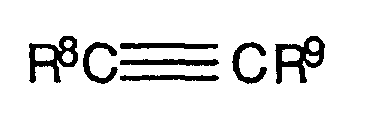
- Verfahren nach Anspruch 9, wobei R8 und R9 kovalent mit einer Cn-Kette verknüpft sind, worin n = 8-15 ist.
- Verfahren zur Herstellung einer Organodihalogenboran-Verbindung der Strukturformel R2BX2, wobei in einer Reaktionsstufe in einem einzigen Reaktor ein Reaktant R aus der Gruppe der Olefine und Alkine, mit Diboran und einem Bortrihalogenid der Formel BX3, wobei X aus der Gruppe Fluor, Chlor, Brom und Jod ausgewählt ist, umgesetzt wird, wobei R2 ein dem R entsprechender Alkylrest ist, wenn R ein Olefin ist, und wobei R2 ein dem R entsprechender Alkenylrest ist, wenn R ein Alkin ist.
- Verfahren nach Anspruch 11, wobei das Molverhältnis von Bortrihalogenid zu Diboran im Bereich von etwa 3:1 bis 5:1 liegt und wobei R2 ein dem R entsprechender Alkylrest ist, wenn R ein Olefin ist, und wobei R2 ein dem R entsprechender Alkenylrest ist, wenn R ein Alkin ist.
- Verfahren nach den Ansprüchen 11 oder 12, wobei der Rest R ein Olefin der allgemeinen Formelist, wobei jeder der Reste R4, R5, R6 und R7 aus der Gruppe Wasserstoff, Aryl-, Aralkyl-, verzweigter Alkyl-, unverzweigter Alkyl- und cyclischer Rest mit 1-10 Kohlenstoffatomen ausgewählt ist.

- Verfahren nach Anspruch 13, wobei R4 und R5 kovalent mit einer Cn-Kette verknüpft sind, worin n = 2-10 ist.
- Verfahren nach Anspruch 13, wobei R4 und R6 kovalent mit einer Cn-Kette verknüpft sind, worin n = 2-10 ist.
- Verfahren nach einem der voranstehenden Ansprüche 11 bis 15, wobei der Rest R ein Alkin der allgemeinen Formelist, wobei jeder der Reste R8 und R9 individuell ausgewählt ist aus der Gruppe Wasserstoff, Aryl-, Aralkyl-, verzweigter Alkyl-, unverzweigter Alkyl- und cyclischer Rest mit 1-10 Kohlenstoffatomen.

- Verfahren nach Anspruch 16, wobei R8 und R9 kovalent mit einer Cn-Kette verknüpft sind, worin n = 8-15 ist.
- Verfahren zur Herstellung einer Alkoxydiorganoboran-Verbindung der Strukturformel R2R3BOR10, wobei in einer Reaktionsstufe in einem einzigen Reaktor ein erster Reaktant R aus der Gruppe der Olefine und Alkine mit einem zweiten Reaktanten R1 aus der Gruppe der Olefine und Alkine, Diboran und einem Alkylborat der Strukturformel B(OR10)3, wobei R10 eine Alkylgruppe ist, umgesetzt wird, wobei R2 ein dem R entsprechender Alkylrest ist, wenn R ein Olefin ist, wobei R2 ein dem R entsprechender Alkenylrest ist, wenn R ein Alkin ist, wobei R3 ein dem R1 entsprechender Alkylrest ist, wenn R1 ein Olefin ist, und wobei R3 ein dem R1 entsprechender Alkenylrest ist, wenn R1 ein Alkin ist.
- Verfahren nach Anspruch 18, wobei das Molverhältnis von Alkylborat zu Diboran im Bereich von etwa 1:1,5 bis 1,5:1 liegt, wobei R2 ein dem R entsprechender Alkylrest ist, wenn R ein Olefin ist, wobei R2 ein dem R entsprechender Alkenylrest ist, wenn R ein Alkin ist, wobei R3 ein dem R1 entsprechender Alkylrest ist, wenn R1 ein Olefin ist, und wobei R3 ein dem R1 entsprechender Alkenylrest ist, wenn R1 ein Alkin ist.
- Verfahren zur Herstellung einer Dialkoxyorganoboran-Verbindung der Strukturformel R2B(OR10)2, wobei in einer Reaktionsstufe in einem einzigen Reaktor ein erster Reaktant R aus der Gruppe der Olefine und Alkine mit Diboran und einem Alkylborat der Strukturformel B(OR10)3, wobei R10 ein Alkylrest ist, umgesetzt wird.
- Verfahren nach Anspruch 20, wobei das Molverhältnis von Alkylborat zu Diboran im Bereich von etwa 3:1 bis 5:1 liegt, wobei R2 ein dem R entsprechender Alkylrest ist, wenn R ein Olefin ist, und wobei R2 ein dem R entsprechender Alkenylrest ist, wenn R ein Alkin ist.
Applications Claiming Priority (2)
| Application Number | Priority Date | Filing Date | Title |
|---|---|---|---|
| US268304 | 1994-06-30 | ||
| US08/268,304 US5463131A (en) | 1994-06-30 | 1994-06-30 | Synthesis of organohaloboranes and alkoxyorganoboranes |
Publications (3)
| Publication Number | Publication Date |
|---|---|
| EP0694549A2 EP0694549A2 (de) | 1996-01-31 |
| EP0694549A3 EP0694549A3 (de) | 1998-05-20 |
| EP0694549B1 true EP0694549B1 (de) | 2002-04-03 |
Family
ID=23022357
Family Applications (1)
| Application Number | Title | Priority Date | Filing Date |
|---|---|---|---|
| EP95304096A Expired - Lifetime EP0694549B1 (de) | 1994-06-30 | 1995-06-14 | Herstellung von Organohaloboranen und Alkoxyorganoboranen |
Country Status (4)
| Country | Link |
|---|---|
| US (1) | US5463131A (de) |
| EP (1) | EP0694549B1 (de) |
| JP (1) | JPH0853466A (de) |
| DE (1) | DE69526154T2 (de) |
Families Citing this family (2)
| Publication number | Priority date | Publication date | Assignee | Title |
|---|---|---|---|---|
| US6008414A (en) * | 1999-02-16 | 1999-12-28 | Aldrich Chemical Company, Inc. | Dioxane-monochloroborane and dioxane-dichloroborane |
| AU2006259086B2 (en) * | 2005-06-13 | 2011-05-26 | Basf Se | Process for synthesis of dialkoxyorganoboranes |
Family Cites Families (4)
| Publication number | Priority date | Publication date | Assignee | Title |
|---|---|---|---|---|
| US3026329A (en) * | 1957-07-11 | 1962-03-20 | Purdue Research Foundation | Mono-and di-chloroborane etherates |
| US4772752A (en) * | 1986-08-29 | 1988-09-20 | Aldrich-Boranes, Inc. | Mono- and diisopinocampheylhaloboranes as new chiral reducing agents |
| US5043479A (en) * | 1986-08-29 | 1991-08-27 | Aldrich Chemical Company, Inc. | Chemically and optically pure diisopinocampheylhaloboranes |
| US5159116A (en) * | 1991-07-15 | 1992-10-27 | Aldrich Chemical Company, Inc. | Chemically and optically pure B-halodiiso-2-ethylapopinocampheylboranes |
-
1994
- 1994-06-30 US US08/268,304 patent/US5463131A/en not_active Expired - Lifetime
-
1995
- 1995-06-14 DE DE69526154T patent/DE69526154T2/de not_active Expired - Lifetime
- 1995-06-14 EP EP95304096A patent/EP0694549B1/de not_active Expired - Lifetime
- 1995-06-28 JP JP7161729A patent/JPH0853466A/ja active Pending
Also Published As
| Publication number | Publication date |
|---|---|
| EP0694549A2 (de) | 1996-01-31 |
| EP0694549A3 (de) | 1998-05-20 |
| JPH0853466A (ja) | 1996-02-27 |
| US5463131A (en) | 1995-10-31 |
| DE69526154T2 (de) | 2002-09-26 |
| DE69526154D1 (de) | 2002-05-08 |
Similar Documents
| Publication | Publication Date | Title |
|---|---|---|
| Joshi et al. | Chiral oxazaborolidines as catalysts for the enantioselective addition of diethylzinc to aldehydes | |
| Matteson | Stereodirected synthesis with organoboranes | |
| Tomita et al. | Nucleophilic activation of alkenyl and aryl boronates by a chiral CuIF complex: catalytic enantioselective alkenylation and arylation of aldehydes | |
| Salunkhe et al. | Highly enantioselective reduction of prochiral ketones with N, N-diethylaniline· borane (DEANB) in oxazaborolidine-catalyzed reductions | |
| EP0698028B1 (de) | Enantioselektive oxazaborolidin-katalysatoren | |
| EP0640089B1 (de) | Enantioselektive katalysatoren aus oxazaborolidin | |
| Smith | Preparation of organoboranes: reagents for organic synthesis | |
| Eisch et al. | Organometallic compounds of Group III: XLIV. Molecular hydrogen and aluminum hydride transfers mediated by nickel (0) complexes: the intermediacy of nickel hydrides in the Ziegler nickel effect | |
| Brown et al. | Organoboranes. 26. Boron-11 NMR investigation of reactions of 2, 3-dimethyl-2-butene with monochloroborane complexes. Preparation and hydroboration characteristics of thexylchloroborane reagents | |
| Köster | Heterocyclic Organoboranes | |
| KR100582048B1 (ko) | 알칼리 금속 치환된 수소화붕소 시약의 합성 | |
| EP0694549B1 (de) | Herstellung von Organohaloboranen und Alkoxyorganoboranen | |
| Srebnik et al. | Hydroboration. 84. Controlled and sequential hydroboration of simple representative alkenes with monoorganylboranes in tetrahydrofuran. A convenient synthesis of mixed borinic esters, R1R2BOR3, and mixed trialkylboranes, R1R2R3B. An examination of positional selectivity in the first and second states of hydroboration | |
| EP0599633B1 (de) | Herstellung von Borester | |
| EP1274666B1 (de) | Verbesserung der enantioselektivität bei reduktionen mit boranreagenzien | |
| US4713380A (en) | Production of optically pure organoboranes | |
| CN105665025B (zh) | 一种pnn配体‑钴络合物催化剂及其制备方法和应用 | |
| EP1144419B1 (de) | Herstellung von alkalimetall-substituierten borohydridreagenzien | |
| Desrosiers et al. | Acid-catalyzed hydrogenolysis of osmium-alkyl bonds | |
| Kabalka | Boron: Boranes in organic synthesis: Annual survey covering the year 1982 | |
| Zhurakovskyi | Novel dual Lewis acid-Lewis base binders as potential hydrogen and carbonyl activators | |
| Betancourt | Novel silyl-modified borane reagents and organoborane analysis via Borohydride NMR | |
| Higa | Preparation of tetrakis (dimethylamino) diboron (IV) | |
| MacKay | A new reaction for coordinated dinitrogen | |
| Blagg et al. | The diastereoselective functionalisation of arene tricarbonylchromium complexes containing a benzylic heteroatom substituent |
Legal Events
| Date | Code | Title | Description |
|---|---|---|---|
| PUAI | Public reference made under article 153(3) epc to a published international application that has entered the european phase |
Free format text: ORIGINAL CODE: 0009012 |
|
| AK | Designated contracting states |
Kind code of ref document: A2 Designated state(s): CH DE FR GB IE LI |
|
| RIN1 | Information on inventor provided before grant (corrected) |
Inventor name: GRAY, SHAWN R. Inventor name: BURKHARDT, ELIZABETH R. |
|
| PUAL | Search report despatched |
Free format text: ORIGINAL CODE: 0009013 |
|
| AK | Designated contracting states |
Kind code of ref document: A3 Designated state(s): CH DE FR GB IE LI |
|
| 17P | Request for examination filed |
Effective date: 19980714 |
|
| 17Q | First examination report despatched |
Effective date: 20001229 |
|
| GRAG | Despatch of communication of intention to grant |
Free format text: ORIGINAL CODE: EPIDOS AGRA |
|
| GRAG | Despatch of communication of intention to grant |
Free format text: ORIGINAL CODE: EPIDOS AGRA |
|
| GRAH | Despatch of communication of intention to grant a patent |
Free format text: ORIGINAL CODE: EPIDOS IGRA |
|
| GRAG | Despatch of communication of intention to grant |
Free format text: ORIGINAL CODE: EPIDOS AGRA |
|
| GRAH | Despatch of communication of intention to grant a patent |
Free format text: ORIGINAL CODE: EPIDOS IGRA |
|
| GRAH | Despatch of communication of intention to grant a patent |
Free format text: ORIGINAL CODE: EPIDOS IGRA |
|
| REG | Reference to a national code |
Ref country code: GB Ref legal event code: IF02 |
|
| GRAA | (expected) grant |
Free format text: ORIGINAL CODE: 0009210 |
|
| AK | Designated contracting states |
Kind code of ref document: B1 Designated state(s): CH DE FR GB IE LI |
|
| REG | Reference to a national code |
Ref country code: CH Ref legal event code: NV Representative=s name: E. BLUM & CO. PATENTANWAELTE Ref country code: CH Ref legal event code: EP |
|
| REF | Corresponds to: |
Ref document number: 69526154 Country of ref document: DE Date of ref document: 20020508 |
|
| REG | Reference to a national code |
Ref country code: IE Ref legal event code: FG4D |
|
| ET | Fr: translation filed | ||
| PLBE | No opposition filed within time limit |
Free format text: ORIGINAL CODE: 0009261 |
|
| STAA | Information on the status of an ep patent application or granted ep patent |
Free format text: STATUS: NO OPPOSITION FILED WITHIN TIME LIMIT |
|
| 26N | No opposition filed |
Effective date: 20030106 |
|
| REG | Reference to a national code |
Ref country code: GB Ref legal event code: 732E |
|
| REG | Reference to a national code |
Ref country code: CH Ref legal event code: PUE Owner name: BASF AKTIENGESELLSCHAFT Free format text: MINE SAFETY APPLIANCES COMPANY#121 GAMMA DRIVE#PITTSBURGH PENNSYLVANIA 15238 (US) -TRANSFER TO- BASF AKTIENGESELLSCHAFT##67056 LUDWIGSHAFEN (DE) Ref country code: CH Ref legal event code: NV Representative=s name: SCHMAUDER & PARTNER AG PATENTANWALTSBUERO |
|
| REG | Reference to a national code |
Ref country code: FR Ref legal event code: TP |
|
| REG | Reference to a national code |
Ref country code: CH Ref legal event code: PCAR Free format text: SCHMAUDER & PARTNER AG PATENT- UND MARKENANWAELTE VSP;ZWAENGIWEG 7;8038 ZUERICH (CH) |
|
| PGFP | Annual fee paid to national office [announced via postgrant information from national office to epo] |
Ref country code: CH Payment date: 20110630 Year of fee payment: 17 Ref country code: IE Payment date: 20110621 Year of fee payment: 17 |
|
| PGFP | Annual fee paid to national office [announced via postgrant information from national office to epo] |
Ref country code: GB Payment date: 20110630 Year of fee payment: 17 |
|
| PGFP | Annual fee paid to national office [announced via postgrant information from national office to epo] |
Ref country code: FR Payment date: 20110721 Year of fee payment: 17 |
|
| PGFP | Annual fee paid to national office [announced via postgrant information from national office to epo] |
Ref country code: DE Payment date: 20110830 Year of fee payment: 17 |
|
| REG | Reference to a national code |
Ref country code: CH Ref legal event code: PL |
|
| REG | Reference to a national code |
Ref country code: CH Ref legal event code: PL |
|
| GBPC | Gb: european patent ceased through non-payment of renewal fee |
Effective date: 20120614 |
|
| REG | Reference to a national code |
Ref country code: IE Ref legal event code: MM4A |
|
| REG | Reference to a national code |
Ref country code: FR Ref legal event code: ST Effective date: 20130228 |
|
| REG | Reference to a national code |
Ref country code: DE Ref legal event code: R119 Ref document number: 69526154 Country of ref document: DE Effective date: 20130101 |
|
| PG25 | Lapsed in a contracting state [announced via postgrant information from national office to epo] |
Ref country code: DE Free format text: LAPSE BECAUSE OF NON-PAYMENT OF DUE FEES Effective date: 20130101 Ref country code: CH Free format text: LAPSE BECAUSE OF NON-PAYMENT OF DUE FEES Effective date: 20120630 Ref country code: FR Free format text: LAPSE BECAUSE OF NON-PAYMENT OF DUE FEES Effective date: 20120702 Ref country code: GB Free format text: LAPSE BECAUSE OF NON-PAYMENT OF DUE FEES Effective date: 20120614 Ref country code: IE Free format text: LAPSE BECAUSE OF NON-PAYMENT OF DUE FEES Effective date: 20120614 Ref country code: LI Free format text: LAPSE BECAUSE OF NON-PAYMENT OF DUE FEES Effective date: 20120630 |