EP0699700B1 - Verfahren zur Herstellung thermostabiler, farbneutraler, antimonfreier Polyester und die danach herstellbaren Produkten - Google Patents
Verfahren zur Herstellung thermostabiler, farbneutraler, antimonfreier Polyester und die danach herstellbaren Produkten Download PDFInfo
- Publication number
- EP0699700B1 EP0699700B1 EP95112912A EP95112912A EP0699700B1 EP 0699700 B1 EP0699700 B1 EP 0699700B1 EP 95112912 A EP95112912 A EP 95112912A EP 95112912 A EP95112912 A EP 95112912A EP 0699700 B1 EP0699700 B1 EP 0699700B1
- Authority
- EP
- European Patent Office
- Prior art keywords
- radicals
- mol
- ppm
- carbon atoms
- polycondensation
- Prior art date
- Legal status (The legal status is an assumption and is not a legal conclusion. Google has not performed a legal analysis and makes no representation as to the accuracy of the status listed.)
- Expired - Lifetime
Links
- 229920000728 polyester Polymers 0.000 title claims abstract description 85
- 238000000034 method Methods 0.000 title claims description 31
- 230000008569 process Effects 0.000 title claims description 27
- 230000007935 neutral effect Effects 0.000 title claims description 5
- 238000006068 polycondensation reaction Methods 0.000 claims abstract description 43
- -1 aliphatic diols Chemical class 0.000 claims abstract description 39
- 238000005809 transesterification reaction Methods 0.000 claims abstract description 38
- 239000003054 catalyst Substances 0.000 claims abstract description 37
- NBIIXXVUZAFLBC-UHFFFAOYSA-N Phosphoric acid Chemical compound OP(O)(O)=O NBIIXXVUZAFLBC-UHFFFAOYSA-N 0.000 claims abstract description 34
- GUTLYIVDDKVIGB-UHFFFAOYSA-N cobalt atom Chemical compound [Co] GUTLYIVDDKVIGB-UHFFFAOYSA-N 0.000 claims abstract description 28
- 239000008139 complexing agent Substances 0.000 claims abstract description 25
- 229910017052 cobalt Inorganic materials 0.000 claims abstract description 24
- 239000010941 cobalt Substances 0.000 claims abstract description 24
- 150000001869 cobalt compounds Chemical class 0.000 claims abstract description 19
- 229910052751 metal Inorganic materials 0.000 claims abstract description 18
- 239000002184 metal Substances 0.000 claims abstract description 18
- RTAQQCXQSZGOHL-UHFFFAOYSA-N Titanium Chemical compound [Ti] RTAQQCXQSZGOHL-UHFFFAOYSA-N 0.000 claims abstract description 17
- 230000032050 esterification Effects 0.000 claims abstract description 17
- 238000005886 esterification reaction Methods 0.000 claims abstract description 17
- 239000010936 titanium Substances 0.000 claims abstract description 17
- 229910052719 titanium Inorganic materials 0.000 claims abstract description 14
- WATWJIUSRGPENY-UHFFFAOYSA-N antimony atom Chemical compound [Sb] WATWJIUSRGPENY-UHFFFAOYSA-N 0.000 claims abstract description 13
- 229910052787 antimony Inorganic materials 0.000 claims abstract description 12
- 150000002009 diols Chemical class 0.000 claims abstract description 12
- 150000003609 titanium compounds Chemical class 0.000 claims abstract description 12
- 150000001875 compounds Chemical class 0.000 claims abstract description 11
- 125000001931 aliphatic group Chemical group 0.000 claims abstract description 7
- 150000001991 dicarboxylic acids Chemical class 0.000 claims abstract description 6
- 125000004432 carbon atom Chemical group C* 0.000 claims description 43
- 229910000147 aluminium phosphate Inorganic materials 0.000 claims description 13
- 125000003178 carboxy group Chemical group [H]OC(*)=O 0.000 claims description 13
- 239000000155 melt Substances 0.000 claims description 13
- ISIJQEHRDSCQIU-UHFFFAOYSA-N tert-butyl 2,7-diazaspiro[4.5]decane-7-carboxylate Chemical compound C1N(C(=O)OC(C)(C)C)CCCC11CNCC1 ISIJQEHRDSCQIU-UHFFFAOYSA-N 0.000 claims description 13
- 150000003009 phosphonic acids Chemical class 0.000 claims description 11
- JXTHNDFMNIQAHM-UHFFFAOYSA-N dichloroacetic acid Chemical compound OC(=O)C(Cl)Cl JXTHNDFMNIQAHM-UHFFFAOYSA-N 0.000 claims description 10
- BVKZGUZCCUSVTD-UHFFFAOYSA-N carbonic acid Chemical class OC(O)=O BVKZGUZCCUSVTD-UHFFFAOYSA-N 0.000 claims description 9
- 238000004132 cross linking Methods 0.000 claims description 8
- 230000003287 optical effect Effects 0.000 claims description 8
- 125000002947 alkylene group Chemical group 0.000 claims description 7
- 150000001924 cycloalkanes Chemical class 0.000 claims description 6
- 229960005215 dichloroacetic acid Drugs 0.000 claims description 5
- QMKYBPDZANOJGF-UHFFFAOYSA-N benzene-1,3,5-tricarboxylic acid Chemical compound OC(=O)C1=CC(C(O)=O)=CC(C(O)=O)=C1 QMKYBPDZANOJGF-UHFFFAOYSA-N 0.000 claims description 4
- WXZMFSXDPGVJKK-UHFFFAOYSA-N pentaerythritol Chemical compound OCC(CO)(CO)CO WXZMFSXDPGVJKK-UHFFFAOYSA-N 0.000 claims description 4
- CYIDZMCFTVVTJO-UHFFFAOYSA-N pyromellitic acid Chemical compound OC(=O)C1=CC(C(O)=O)=C(C(O)=O)C=C1C(O)=O CYIDZMCFTVVTJO-UHFFFAOYSA-N 0.000 claims description 4
- ARCGXLSVLAOJQL-UHFFFAOYSA-N trimellitic acid Chemical compound OC(=O)C1=CC=C(C(O)=O)C(C(O)=O)=C1 ARCGXLSVLAOJQL-UHFFFAOYSA-N 0.000 claims description 4
- ZJCCRDAZUWHFQH-UHFFFAOYSA-N Trimethylolpropane Chemical compound CCC(CO)(CO)CO ZJCCRDAZUWHFQH-UHFFFAOYSA-N 0.000 claims description 2
- 150000002894 organic compounds Chemical class 0.000 claims description 2
- 239000007790 solid phase Substances 0.000 claims description 2
- 125000003118 aryl group Chemical group 0.000 abstract description 11
- 238000006243 chemical reaction Methods 0.000 abstract description 5
- 150000003839 salts Chemical class 0.000 abstract description 4
- 239000002253 acid Substances 0.000 abstract description 3
- 230000002779 inactivation Effects 0.000 abstract description 2
- ABLZXFCXXLZCGV-UHFFFAOYSA-N Phosphorous acid Chemical compound OP(O)=O ABLZXFCXXLZCGV-UHFFFAOYSA-N 0.000 abstract 2
- BHEPBYXIRTUNPN-UHFFFAOYSA-N hydridophosphorus(.) (triplet) Chemical compound [PH] BHEPBYXIRTUNPN-UHFFFAOYSA-N 0.000 abstract 2
- LYCAIKOWRPUZTN-UHFFFAOYSA-N Ethylene glycol Chemical compound OCCO LYCAIKOWRPUZTN-UHFFFAOYSA-N 0.000 description 19
- IJGRMHOSHXDMSA-UHFFFAOYSA-N Atomic nitrogen Chemical compound N#N IJGRMHOSHXDMSA-UHFFFAOYSA-N 0.000 description 16
- MTHSVFCYNBDYFN-UHFFFAOYSA-N diethylene glycol Chemical compound OCCOCCO MTHSVFCYNBDYFN-UHFFFAOYSA-N 0.000 description 15
- 230000000712 assembly Effects 0.000 description 14
- 238000000429 assembly Methods 0.000 description 14
- 238000007792 addition Methods 0.000 description 9
- 239000000203 mixture Substances 0.000 description 9
- 238000004519 manufacturing process Methods 0.000 description 8
- 229910052757 nitrogen Inorganic materials 0.000 description 8
- 239000000654 additive Substances 0.000 description 7
- 150000001463 antimony compounds Chemical class 0.000 description 7
- QTBSBXVTEAMEQO-UHFFFAOYSA-N Acetic acid Chemical compound CC(O)=O QTBSBXVTEAMEQO-UHFFFAOYSA-N 0.000 description 6
- 229940058905 antimony compound for treatment of leishmaniasis and trypanosomiasis Drugs 0.000 description 6
- 238000013459 approach Methods 0.000 description 6
- 150000002148 esters Chemical class 0.000 description 6
- QQVIHTHCMHWDBS-UHFFFAOYSA-N isophthalic acid Chemical compound OC(=O)C1=CC=CC(C(O)=O)=C1 QQVIHTHCMHWDBS-UHFFFAOYSA-N 0.000 description 6
- 238000012545 processing Methods 0.000 description 6
- 125000001424 substituent group Chemical group 0.000 description 6
- VGGSQFUCUMXWEO-UHFFFAOYSA-N Ethene Chemical compound C=C VGGSQFUCUMXWEO-UHFFFAOYSA-N 0.000 description 5
- PWHULOQIROXLJO-UHFFFAOYSA-N Manganese Chemical compound [Mn] PWHULOQIROXLJO-UHFFFAOYSA-N 0.000 description 5
- 239000011572 manganese Substances 0.000 description 5
- 239000000047 product Substances 0.000 description 5
- 239000005977 Ethylene Substances 0.000 description 4
- KKEYFWRCBNTPAC-UHFFFAOYSA-N Terephthalic acid Chemical compound OC(=O)C1=CC=C(C(O)=O)C=C1 KKEYFWRCBNTPAC-UHFFFAOYSA-N 0.000 description 4
- 230000000996 additive effect Effects 0.000 description 4
- WNLRTRBMVRJNCN-UHFFFAOYSA-N adipic acid Chemical compound OC(=O)CCCCC(O)=O WNLRTRBMVRJNCN-UHFFFAOYSA-N 0.000 description 4
- 125000000217 alkyl group Chemical group 0.000 description 4
- 230000015572 biosynthetic process Effects 0.000 description 4
- 230000015556 catabolic process Effects 0.000 description 4
- 238000009833 condensation Methods 0.000 description 4
- 230000005494 condensation Effects 0.000 description 4
- 238000006731 degradation reaction Methods 0.000 description 4
- GKMXREIWPASRMP-UHFFFAOYSA-J dipotassium;oxalate;oxygen(2-);titanium(4+) Chemical compound [O-2].[K+].[K+].[Ti+4].[O-]C(=O)C([O-])=O.[O-]C(=O)C([O-])=O GKMXREIWPASRMP-UHFFFAOYSA-J 0.000 description 4
- 229910052748 manganese Inorganic materials 0.000 description 4
- 239000008188 pellet Substances 0.000 description 4
- 239000003381 stabilizer Substances 0.000 description 4
- XLYOFNOQVPJJNP-UHFFFAOYSA-N water Chemical compound O XLYOFNOQVPJJNP-UHFFFAOYSA-N 0.000 description 4
- 239000004971 Cross linker Substances 0.000 description 3
- OKKJLVBELUTLKV-UHFFFAOYSA-N Methanol Chemical compound OC OKKJLVBELUTLKV-UHFFFAOYSA-N 0.000 description 3
- 235000013361 beverage Nutrition 0.000 description 3
- 238000004043 dyeing Methods 0.000 description 3
- 150000002739 metals Chemical class 0.000 description 3
- 125000002496 methyl group Chemical group [H]C([H])([H])* 0.000 description 3
- 230000004048 modification Effects 0.000 description 3
- 238000012986 modification Methods 0.000 description 3
- 229920000137 polyphosphoric acid Polymers 0.000 description 3
- 239000007787 solid Substances 0.000 description 3
- 238000003756 stirring Methods 0.000 description 3
- 239000000126 substance Substances 0.000 description 3
- 238000012360 testing method Methods 0.000 description 3
- 125000001989 1,3-phenylene group Chemical group [H]C1=C([H])C([*:1])=C([H])C([*:2])=C1[H] 0.000 description 2
- AZUYLZMQTIKGSC-UHFFFAOYSA-N 1-[6-[4-(5-chloro-6-methyl-1H-indazol-4-yl)-5-methyl-3-(1-methylindazol-5-yl)pyrazol-1-yl]-2-azaspiro[3.3]heptan-2-yl]prop-2-en-1-one Chemical compound ClC=1C(=C2C=NNC2=CC=1C)C=1C(=NN(C=1C)C1CC2(CN(C2)C(C=C)=O)C1)C=1C=C2C=NN(C2=CC=1)C AZUYLZMQTIKGSC-UHFFFAOYSA-N 0.000 description 2
- OFOBLEOULBTSOW-UHFFFAOYSA-N Malonic acid Chemical compound OC(=O)CC(O)=O OFOBLEOULBTSOW-UHFFFAOYSA-N 0.000 description 2
- 239000001361 adipic acid Substances 0.000 description 2
- 235000011037 adipic acid Nutrition 0.000 description 2
- 125000004453 alkoxycarbonyl group Chemical group 0.000 description 2
- ADCOVFLJGNWWNZ-UHFFFAOYSA-N antimony trioxide Chemical compound O=[Sb]O[Sb]=O ADCOVFLJGNWWNZ-UHFFFAOYSA-N 0.000 description 2
- 125000003710 aryl alkyl group Chemical group 0.000 description 2
- 230000008901 benefit Effects 0.000 description 2
- 125000001797 benzyl group Chemical group [H]C1=C([H])C([H])=C(C([H])=C1[H])C([H])([H])* 0.000 description 2
- 230000003197 catalytic effect Effects 0.000 description 2
- 239000007795 chemical reaction product Substances 0.000 description 2
- ZBYYWKJVSFHYJL-UHFFFAOYSA-L cobalt(2+);diacetate;tetrahydrate Chemical compound O.O.O.O.[Co+2].CC([O-])=O.CC([O-])=O ZBYYWKJVSFHYJL-UHFFFAOYSA-L 0.000 description 2
- 125000001142 dicarboxylic acid group Chemical group 0.000 description 2
- WOZVHXUHUFLZGK-UHFFFAOYSA-N dimethyl terephthalate Chemical compound COC(=O)C1=CC=C(C(=O)OC)C=C1 WOZVHXUHUFLZGK-UHFFFAOYSA-N 0.000 description 2
- 125000001495 ethyl group Chemical group [H]C([H])([H])C([H])([H])* 0.000 description 2
- 238000001125 extrusion Methods 0.000 description 2
- 239000002657 fibrous material Substances 0.000 description 2
- 125000000524 functional group Chemical group 0.000 description 2
- 239000007789 gas Substances 0.000 description 2
- 230000007062 hydrolysis Effects 0.000 description 2
- 238000006460 hydrolysis reaction Methods 0.000 description 2
- 238000009434 installation Methods 0.000 description 2
- 229940071125 manganese acetate Drugs 0.000 description 2
- UOGMEBQRZBEZQT-UHFFFAOYSA-L manganese(2+);diacetate Chemical compound [Mn+2].CC([O-])=O.CC([O-])=O UOGMEBQRZBEZQT-UHFFFAOYSA-L 0.000 description 2
- WPBNNNQJVZRUHP-UHFFFAOYSA-L manganese(2+);methyl n-[[2-(methoxycarbonylcarbamothioylamino)phenyl]carbamothioyl]carbamate;n-[2-(sulfidocarbothioylamino)ethyl]carbamodithioate Chemical compound [Mn+2].[S-]C(=S)NCCNC([S-])=S.COC(=O)NC(=S)NC1=CC=CC=C1NC(=S)NC(=O)OC WPBNNNQJVZRUHP-UHFFFAOYSA-L 0.000 description 2
- 238000002156 mixing Methods 0.000 description 2
- 125000001997 phenyl group Chemical group [H]C1=C([H])C([H])=C(*)C([H])=C1[H] 0.000 description 2
- 230000001681 protective effect Effects 0.000 description 2
- 238000004064 recycling Methods 0.000 description 2
- 230000009467 reduction Effects 0.000 description 2
- 229920006395 saturated elastomer Polymers 0.000 description 2
- CXMXRPHRNRROMY-UHFFFAOYSA-N sebacic acid Chemical compound OC(=O)CCCCCCCCC(O)=O CXMXRPHRNRROMY-UHFFFAOYSA-N 0.000 description 2
- 239000007858 starting material Substances 0.000 description 2
- 125000000020 sulfo group Chemical group O=S(=O)([*])O[H] 0.000 description 2
- VXUYXOFXAQZZMF-UHFFFAOYSA-N titanium(IV) isopropoxide Chemical compound CC(C)O[Ti](OC(C)C)(OC(C)C)OC(C)C VXUYXOFXAQZZMF-UHFFFAOYSA-N 0.000 description 2
- 238000004383 yellowing Methods 0.000 description 2
- JPBHXVRMWGWSMX-UHFFFAOYSA-N 1,4-dimethylidenecyclohexane Chemical group C=C1CCC(=C)CC1 JPBHXVRMWGWSMX-UHFFFAOYSA-N 0.000 description 1
- RTBFRGCFXZNCOE-UHFFFAOYSA-N 1-methylsulfonylpiperidin-4-one Chemical compound CS(=O)(=O)N1CCC(=O)CC1 RTBFRGCFXZNCOE-UHFFFAOYSA-N 0.000 description 1
- RNFJDJUURJAICM-UHFFFAOYSA-N 2,2,4,4,6,6-hexaphenoxy-1,3,5-triaza-2$l^{5},4$l^{5},6$l^{5}-triphosphacyclohexa-1,3,5-triene Chemical compound N=1P(OC=2C=CC=CC=2)(OC=2C=CC=CC=2)=NP(OC=2C=CC=CC=2)(OC=2C=CC=CC=2)=NP=1(OC=1C=CC=CC=1)OC1=CC=CC=C1 RNFJDJUURJAICM-UHFFFAOYSA-N 0.000 description 1
- 125000004959 2,6-naphthylene group Chemical group [H]C1=C([H])C2=C([H])C([*:1])=C([H])C([H])=C2C([H])=C1[*:2] 0.000 description 1
- YZTJKOLMWJNVFH-UHFFFAOYSA-N 2-sulfobenzene-1,3-dicarboxylic acid Chemical compound OC(=O)C1=CC=CC(C(O)=O)=C1S(O)(=O)=O YZTJKOLMWJNVFH-UHFFFAOYSA-N 0.000 description 1
- MMINFSMURORWKH-UHFFFAOYSA-N 3,6-dioxabicyclo[6.2.2]dodeca-1(10),8,11-triene-2,7-dione Chemical group O=C1OCCOC(=O)C2=CC=C1C=C2 MMINFSMURORWKH-UHFFFAOYSA-N 0.000 description 1
- ZAMOUSCENKQFHK-UHFFFAOYSA-N Chlorine atom Chemical compound [Cl] ZAMOUSCENKQFHK-UHFFFAOYSA-N 0.000 description 1
- 239000006057 Non-nutritive feed additive Substances 0.000 description 1
- OAICVXFJPJFONN-UHFFFAOYSA-N Phosphorus Chemical compound [P] OAICVXFJPJFONN-UHFFFAOYSA-N 0.000 description 1
- 230000002378 acidificating effect Effects 0.000 description 1
- 150000007513 acids Chemical class 0.000 description 1
- 150000007933 aliphatic carboxylic acids Chemical class 0.000 description 1
- 125000003545 alkoxy group Chemical group 0.000 description 1
- JFCQEDHGNNZCLN-UHFFFAOYSA-N anhydrous glutaric acid Natural products OC(=O)CCCC(O)=O JFCQEDHGNNZCLN-UHFFFAOYSA-N 0.000 description 1
- 239000003963 antioxidant agent Substances 0.000 description 1
- 125000000732 arylene group Chemical group 0.000 description 1
- 150000001541 aziridines Chemical class 0.000 description 1
- 239000000981 basic dye Substances 0.000 description 1
- CDQSJQSWAWPGKG-UHFFFAOYSA-N butane-1,1-diol Chemical compound CCCC(O)O CDQSJQSWAWPGKG-UHFFFAOYSA-N 0.000 description 1
- 150000001718 carbodiimides Chemical class 0.000 description 1
- 150000001244 carboxylic acid anhydrides Chemical group 0.000 description 1
- 125000002843 carboxylic acid group Chemical group 0.000 description 1
- 239000003638 chemical reducing agent Substances 0.000 description 1
- 239000003795 chemical substances by application Substances 0.000 description 1
- 239000000460 chlorine Substances 0.000 description 1
- 229910052801 chlorine Inorganic materials 0.000 description 1
- 238000004140 cleaning Methods 0.000 description 1
- 229940011182 cobalt acetate Drugs 0.000 description 1
- QAHREYKOYSIQPH-UHFFFAOYSA-L cobalt(II) acetate Chemical compound [Co+2].CC([O-])=O.CC([O-])=O QAHREYKOYSIQPH-UHFFFAOYSA-L 0.000 description 1
- 230000000536 complexating effect Effects 0.000 description 1
- 238000010668 complexation reaction Methods 0.000 description 1
- 238000007796 conventional method Methods 0.000 description 1
- 238000012937 correction Methods 0.000 description 1
- 239000003431 cross linking reagent Substances 0.000 description 1
- GYZLOYUZLJXAJU-UHFFFAOYSA-N diglycidyl ether Chemical class C1OC1COCC1CO1 GYZLOYUZLJXAJU-UHFFFAOYSA-N 0.000 description 1
- VNGOYPQMJFJDLV-UHFFFAOYSA-N dimethyl benzene-1,3-dicarboxylate Chemical compound COC(=O)C1=CC=CC(C(=O)OC)=C1 VNGOYPQMJFJDLV-UHFFFAOYSA-N 0.000 description 1
- 238000009826 distribution Methods 0.000 description 1
- 239000000975 dye Substances 0.000 description 1
- 230000000694 effects Effects 0.000 description 1
- 230000008030 elimination Effects 0.000 description 1
- 238000003379 elimination reaction Methods 0.000 description 1
- 238000005516 engineering process Methods 0.000 description 1
- 239000000945 filler Substances 0.000 description 1
- 239000003063 flame retardant Substances 0.000 description 1
- 125000003827 glycol group Chemical group 0.000 description 1
- 125000002887 hydroxy group Chemical group [H]O* 0.000 description 1
- 125000002768 hydroxyalkyl group Chemical group 0.000 description 1
- 230000006872 improvement Effects 0.000 description 1
- 230000000937 inactivator Effects 0.000 description 1
- 239000011261 inert gas Substances 0.000 description 1
- 239000012948 isocyanate Substances 0.000 description 1
- 150000002513 isocyanates Chemical class 0.000 description 1
- 150000002531 isophthalic acids Chemical class 0.000 description 1
- 150000003932 ketenimines Chemical class 0.000 description 1
- 150000002697 manganese compounds Chemical class 0.000 description 1
- 238000002074 melt spinning Methods 0.000 description 1
- 150000002736 metal compounds Chemical class 0.000 description 1
- 239000003607 modifier Substances 0.000 description 1
- 125000001624 naphthyl group Chemical group 0.000 description 1
- 150000007524 organic acids Chemical class 0.000 description 1
- 235000005985 organic acids Nutrition 0.000 description 1
- 239000005022 packaging material Substances 0.000 description 1
- 230000000737 periodic effect Effects 0.000 description 1
- NFBAXHOPROOJAW-UHFFFAOYSA-N phenindione Chemical class O=C1C2=CC=CC=C2C(=O)C1C1=CC=CC=C1 NFBAXHOPROOJAW-UHFFFAOYSA-N 0.000 description 1
- 125000000843 phenylene group Chemical group C1(=C(C=CC=C1)*)* 0.000 description 1
- 150000003008 phosphonic acid esters Chemical class 0.000 description 1
- 150000003013 phosphoric acid derivatives Chemical class 0.000 description 1
- OJMIONKXNSYLSR-UHFFFAOYSA-N phosphorous acid Chemical compound OP(O)O OJMIONKXNSYLSR-UHFFFAOYSA-N 0.000 description 1
- 229910052698 phosphorus Inorganic materials 0.000 description 1
- 239000011574 phosphorus Substances 0.000 description 1
- XNGIFLGASWRNHJ-UHFFFAOYSA-N phthalic acid Chemical class OC(=O)C1=CC=CC=C1C(O)=O XNGIFLGASWRNHJ-UHFFFAOYSA-N 0.000 description 1
- 239000000049 pigment Substances 0.000 description 1
- 229920000151 polyglycol Polymers 0.000 description 1
- 239000010695 polyglycol Substances 0.000 description 1
- 229920000642 polymer Polymers 0.000 description 1
- 229910052700 potassium Inorganic materials 0.000 description 1
- 238000003672 processing method Methods 0.000 description 1
- ULWHHBHJGPPBCO-UHFFFAOYSA-N propane-1,1-diol Chemical compound CCC(O)O ULWHHBHJGPPBCO-UHFFFAOYSA-N 0.000 description 1
- 230000001105 regulatory effect Effects 0.000 description 1
- 230000004044 response Effects 0.000 description 1
- 230000000630 rising effect Effects 0.000 description 1
- 230000035945 sensitivity Effects 0.000 description 1
- 238000009987 spinning Methods 0.000 description 1
- 125000000542 sulfonic acid group Chemical group 0.000 description 1
- 239000004753 textile Substances 0.000 description 1
- 230000008542 thermal sensitivity Effects 0.000 description 1
- 230000008646 thermal stress Effects 0.000 description 1
- ZIBGPFATKBEMQZ-UHFFFAOYSA-N triethylene glycol Chemical compound OCCOCCOCCO ZIBGPFATKBEMQZ-UHFFFAOYSA-N 0.000 description 1
- 239000002351 wastewater Substances 0.000 description 1
Images
Classifications
-
- C—CHEMISTRY; METALLURGY
- C08—ORGANIC MACROMOLECULAR COMPOUNDS; THEIR PREPARATION OR CHEMICAL WORKING-UP; COMPOSITIONS BASED THEREON
- C08G—MACROMOLECULAR COMPOUNDS OBTAINED OTHERWISE THAN BY REACTIONS ONLY INVOLVING UNSATURATED CARBON-TO-CARBON BONDS
- C08G63/00—Macromolecular compounds obtained by reactions forming a carboxylic ester link in the main chain of the macromolecule
- C08G63/02—Polyesters derived from hydroxycarboxylic acids or from polycarboxylic acids and polyhydroxy compounds
- C08G63/12—Polyesters derived from hydroxycarboxylic acids or from polycarboxylic acids and polyhydroxy compounds derived from polycarboxylic acids and polyhydroxy compounds
- C08G63/16—Dicarboxylic acids and dihydroxy compounds
- C08G63/20—Polyesters having been prepared in the presence of compounds having one reactive group or more than two reactive groups
-
- C—CHEMISTRY; METALLURGY
- C08—ORGANIC MACROMOLECULAR COMPOUNDS; THEIR PREPARATION OR CHEMICAL WORKING-UP; COMPOSITIONS BASED THEREON
- C08G—MACROMOLECULAR COMPOUNDS OBTAINED OTHERWISE THAN BY REACTIONS ONLY INVOLVING UNSATURATED CARBON-TO-CARBON BONDS
- C08G63/00—Macromolecular compounds obtained by reactions forming a carboxylic ester link in the main chain of the macromolecule
- C08G63/02—Polyesters derived from hydroxycarboxylic acids or from polycarboxylic acids and polyhydroxy compounds
- C08G63/60—Polyesters derived from hydroxycarboxylic acids or from polycarboxylic acids and polyhydroxy compounds derived from the reaction of a mixture of hydroxy carboxylic acids, polycarboxylic acids and polyhydroxy compounds
-
- C—CHEMISTRY; METALLURGY
- C08—ORGANIC MACROMOLECULAR COMPOUNDS; THEIR PREPARATION OR CHEMICAL WORKING-UP; COMPOSITIONS BASED THEREON
- C08G—MACROMOLECULAR COMPOUNDS OBTAINED OTHERWISE THAN BY REACTIONS ONLY INVOLVING UNSATURATED CARBON-TO-CARBON BONDS
- C08G63/00—Macromolecular compounds obtained by reactions forming a carboxylic ester link in the main chain of the macromolecule
- C08G63/78—Preparation processes
- C08G63/82—Preparation processes characterised by the catalyst used
-
- C—CHEMISTRY; METALLURGY
- C08—ORGANIC MACROMOLECULAR COMPOUNDS; THEIR PREPARATION OR CHEMICAL WORKING-UP; COMPOSITIONS BASED THEREON
- C08G—MACROMOLECULAR COMPOUNDS OBTAINED OTHERWISE THAN BY REACTIONS ONLY INVOLVING UNSATURATED CARBON-TO-CARBON BONDS
- C08G63/00—Macromolecular compounds obtained by reactions forming a carboxylic ester link in the main chain of the macromolecule
- C08G63/78—Preparation processes
- C08G63/82—Preparation processes characterised by the catalyst used
- C08G63/85—Germanium, tin, lead, arsenic, antimony, bismuth, titanium, zirconium, hafnium, vanadium, niobium, tantalum, or compounds thereof
-
- C—CHEMISTRY; METALLURGY
- C08—ORGANIC MACROMOLECULAR COMPOUNDS; THEIR PREPARATION OR CHEMICAL WORKING-UP; COMPOSITIONS BASED THEREON
- C08G—MACROMOLECULAR COMPOUNDS OBTAINED OTHERWISE THAN BY REACTIONS ONLY INVOLVING UNSATURATED CARBON-TO-CARBON BONDS
- C08G63/00—Macromolecular compounds obtained by reactions forming a carboxylic ester link in the main chain of the macromolecule
- C08G63/78—Preparation processes
- C08G63/82—Preparation processes characterised by the catalyst used
- C08G63/87—Non-metals or inter-compounds thereof
Definitions
- the present invention relates to a method for producing thermostable, color-neutral, antimony-free polyester using a titanium polycondensation catalyst, which is very reproducible, a very high polycondensation rate even with very small additions of the titanium polycondensation catalyst has and in which there is a significant reduction in thermal degradation and the uncontrolled crosslinking of the polyester formed results.
- Polyesters are very important in many areas of application won.
- saturated polyesters are used for the production of Fiber materials also from other types of shaped bodies, such as Beverage bottles, widely used.
- the processing and application properties of polyester types for certain Processing is always the same within very narrow limits.
- the Processing by extrusion processes e.g. by melt spinning, it is from of crucial importance that they always have a uniform molecular weight and always have a reproducible molecular weight distribution, are free of gel components, and if possible not for yellowing or for thermal degradation tend.
- dyeing processes should be as possible do not remove any catalyst metals from the fiber material, as these elaborate cleaning operations removed from the dyeing wastewater and must be disposed of.
- Polyesters are usually produced by esterifying aromatic ones Dicarboxylic acids or transesterification of lower aliphatic aromatic esters Dicarboxylic acids with aliphatic diols and subsequent polycondensation until the molecular weight required for the intended use has been reached.
- transesterification is carried out in the presence of transesterification catalysts carried out after completion of the transesterification by adding complexing agents must be deactivated.
- Most of the complexing agents used are phosphoric acid, phosphorous acid and / or phosphonic acids or derivatives thereof are used.
- the polycondensation to the desired molecular weight also in the presence of a suitable Catalyst is running.
- a polycondensation catalyst Large-scale technology antimony compounds, mostly antimony trioxide. Here it can happen that a part of the antimony compound by reducing Agents is reduced to antimony metal, causing graying of the Polyester leads. This results in poor clarity and not neutral hue.
- JP-PS-28006 (1979), JP-PS-123311 (1976), JP-PS-43564 (1979), JP-PS-111985 (1980) or JP-PS-280048 (1989) is a manufacturing method known from polyesters in which to improve the hue of the polyester a cobalt compound is added, which - like the transesterification catalyst - before Beginning of the polycondensation must be complexed, and in which the Polycondensation is carried out in the presence of a titanium compound.
- the Amount of complexing agent used to complex the cobalt additive according to these publications in the range of 0.5 to 7.5 moles per mole Cobalt compound. So the JP-PS-28006 will have a P / Co ratio of 0.5 to 1.5, in JP-PS 111985 from 0.7 to 3, in JP-PS-280048 from 0.5 to 7.5 [mol / mol] applied.
- This known method has the significant advantage that all with the use Disadvantages associated with antimony compounds are eliminated and that it so that it is actually possible to produce color-neutral and clear polyesters that are suitable for demanding processing methods and applications.
- the disadvantage of this known method is that it is reproducible leaves a lot to be desired. So sometimes you don't get the ones you want Receive products, but there are disturbances in the polycondensation reaction, the required molecular weights are not achieved, and with a necessary extension of the polycondensation time the polyester yellows and gel forms uncontrolled crosslinking and the thermal sensitivity of the products significantly affect further processing. So the advantages are that Process offers itself, not always feasible.
- Suitable transesterification catalysts are known from the literature.
- Group Ia e.g. Li, Na, K
- IIa e.g. Mg, Ca
- Vlla e.g. Mn
- metals Periodic table especially those that have a certain solubility in the Have a transesterification approach, e.g. Salts of organic acids.
- Vlla group salts especially manganese, with lower aliphatic Carboxylic acids, especially acetic acid.
- the cobalt compound added to improve the color tone of the polyester is expediently also a salt of cobalt with an organic one Acid, for example with acetic acid or adipic acid.
- the minimum amount of Cobalt compound depends on the extent of the color shift that occurs in the Individual cases are required to achieve a neutral shade. Become additional optical brighteners are used for color correction
- the amount of cobalt compound can be reduced.
- the required one Amount of cobalt addition as stated above, at a maximum of 50 ppm (calculated as metal), always based on the weight of the polyester.
- the Transesterification catalyst before the start of the polycondensation by adding a Complexing agent inactivated because otherwise the polycondensation is impeded, i.e. the required high molecular weights of the polyesters are not achieved can be and in addition the polyester obtained an increased Has sensitivity to thermal stress.
- the front of the are also isolated Polycondensation added cobalt compounds have been complexed around the to improve thermal stability of the polyester produced.
- the amount of complexing agent is therefore measured so that the Transesterification catalyst is 100% deactivated by complexation, but only 90 to 99% of the cobalt compound are complexed.
- esterification or transesterification it is particularly advantageous if after completion of the esterification or transesterification the esterification or transesterification approach 100% of that used Transesterification catalyst equivalent amount and 90 to 99% of that Cobalt equivalent amount of phosphoric acid to be used, more phosphorous Acid and / or of phosphonic acids or a derivative thereof as Complexing agent is added.
- the polyesters obtained correspond highest quality requirements regarding clarity and color neutrality.
- complexing agents and inactivators for transesterification catalysts are suitable as complexing agents for the process according to the invention.
- Compounds containing phosphorus such as phosphoric acid, polyphosphoric acid, phosphorous acid and phosphonic acids and derivatives thereof, have proven to be particularly suitable.
- Specific examples of phosphoric acid derivatives are the "PHM esters", which are mixtures of oxalkylated alkyl-hydroxyalkyl-phosphoric acid esters of the formula 1 or phosphonic acid esters of the formula II.
- O P (OR 1 ) 3 wherein the R 1 radicals are the same or different alkyl, hydroxyalkyl or alkoxylated hydroxyalkyl radicals. (R 2 O) 2 -PO-R 3 -COOR 4 wherein R 2 and R 4 are alkyl radicals and R 3 is an alkylene radical.
- Titanium compounds used used.
- All are suitable for this purpose Titanium compounds already described, in particular potassium titanyl oxalate or Titanium isopropylate.
- the polycondensation without Antimony additive in the presence of 1 to 10 ppm titanium up to one IV, measured in dichloroacetic acid at 25 ° C, from 0.4 to 0.9 dl / g, preferably from 0.5 to 0.7 dl / g, and up to one Carboxyl group concentration of 10 to 50 mmol / kg, preferably from 10 to 40 mmol / kg, in the melt, and then up to the desired final viscosity in the solid phase.
- the final viscosity of the polyesters according to the invention should be in the range from 0.7 to 2.0 dl / g, preferably from 0.7 to 1.5 dl / g, measured under the conditions specified above.
- the polycondensation time and the polycondensation temperature are regulated in a known manner so that the desired final viscosity is achieved.
- the polycondensation is carried out as is customary in the art of polyester production, depending on the type of polyester, at a temperature of 260 to 350 ° C., preferably under an inert gas, for example under nitrogen, and / or under reduced pressure in the range from 0.2 to 10 mbar, preferably from 0.4 to 5 mbar.
- the polycondensation is carried out without the addition of antimony in the presence of 2-8 ppm of titanium and in the presence of up to 1000 ppm, preferably from 100 to 500 ppm, of organic compounds (crosslinking agents) providing crosslinking structural groups.
- Connections which have at least three serve as crosslinkers have functional groups capable of ester formation.
- Functional groups capable of ester formation are the OH group, the carboxyl group, alkoxycarbonyl, especially lower alkoxycarbonyl, the carboxylic anhydride group, and of these derived reactive groups.
- Examples of common crosslinkers are pentaerythritol, trimethylolpropane, trimellitic acid, Trimesic acid, pyromellitic acid and the like.
- X based on the total amount of di- and hydroxycarboxylic acids, is 93 to 99 mol%, preferably 95 to 98 mol % p-phenylene radicals, 1 to 7 mol%, preferably 2 to 5 mol%, m-phenylene radicals.
- the aromatic radicals represented by X and X 1 can be unsubstituted or, if certain properties of the polyester are to be modified, can carry one or two substituents.
- the radicals are preferably predominantly unsubstituted, ie not more than 10 mol% of the aromatic radicals carry substituents. The exact proportion of substituted residues is determined according to the effect to be achieved.
- the substituents are preferably the methyl group and the Sulfonic acid group in question.
- Modifiers Up to 10% by weight of modification additives, fillers, pigments, dyes, antioxidants, hydrolysis, light and temperature stabilizers and / or processing aids can be added to the esterification, transesterification or polycondensation batches, provided that these additives do not inhibit the titanium catalyst.
- Particularly advantageous stabilizers are those compounds which can react with terminal carboxyl groups of the polyester to form non-acidic end groups, such as, for example, glycidyl ethers, ketenimines, aziridines, isocyanates.
- Carbodiimides and polycarbodiimides are particularly advantageous as stabilizers, particularly when they are used in combination with one another.
- cobalt is catalytic in form ineffective complexes with phosphoric acid, phosphorous acid and / or phosphonic acids or a derivative thereof, and / or that the polyester Contains 5 to 25 ppm of an optical brightener.
- the catalytically ineffective complexes of the transesterification catalyst preferably manganese and cobalt can in principle all be used for inactivation of these metals known complexing agents. They are preferably catalytic ineffective complexes of the transesterification catalyst, especially the manganese and cobalt with phosphoric acid, polyphosphoric acid or in particular phosphorous acid or a derivative, especially an ester of these acids.
- polyester chain Is of particular importance for the totality of the technical characteristics of course the structure of the polyester chain. It can be said purely qualitatively that they constructed from the assemblies customary in known fiber-forming polyesters is. Predominantly, i.e. at least 80 mol%, they consist of building blocks that are derived from aromatic dicarboxylic acids and from aliphatic diols. Common aromatic dicarboxylic acid building blocks are the divalent residues of Benzenedicarboxylic acids, especially terephthalic acid and isophthalic acid; Common diols have 2-4 carbon atoms, with the ethylene glycol being particularly suitable is. Modified polyesters preferably contain at least 80 mol% of ethylene terephthalate units.
- dicarboxylic acid units and glycol units which act as so-called modifiers act and allow the expert, the physical and chemical properties of the products made from the polyesters, such as e.g. Filaments and packaging materials (e.g. beverage bottles) influence.
- dicarboxylic acid units are residues of Isophthalic acids or aliphatic dicarboxylic acids such as e.g. Glutaric acid, Adipic acid, sebacic acid;
- modifying diol residues are those of longer chain diols, e.g. of propanediol or butanediol, of di- or Tri-ethylene glycol or, if available in small quantities, of polyglycol a molecular weight of approx. 500-2000.
- polyesters which consist of assemblies of the formula IV exist in which X is 93 to 99 mol% of p-phenylene radicals and 1 to 7 mol% m-phenylene radicals means.
- the polyester be up to 1000 ppm of the above-mentioned crosslinking assemblies.
- melt polycondensation Polyester has an intrinsic viscosity (IV) of 0.600 to 0.900 measured in Dichloroacetic acid at 25 ° C.
- Polyesters which have assemblies of the formula VIII preferably contain 70 up to 100 mol%, in particular 85 to 100 mol%, assemblies of the formula VII and 0 to 30 mol%, in particular 0 to 15 mol%, of components of the formula VIII.
- the aromatic radicals for which X stands can be used within the scope of the given Definition all be the same or they can be different.
- the above-mentioned assemblies represented by X which are at least 80 Mol% form the polyester chain, individually or mixed in the polyester chain available. It is preferred if the at least 80 mol% of the polyester chain of only one or two individuals from the group of for these main components specified residues are formed. Any other desired
- the polyester chain is then preferably modified by others Assemblies within the scope of the definition, which for a maximum of 20 mol% existing assemblies represented by X has been given.
- the at least 80% by weight of aromatic radicals can all 1,4-phenylene radicals or they can be, for example, in a molar ratio of 95: 5 to 99: 1 from 1,4- and 1,3-phenylene residues or in a molar ratio of 4: 6 to 6: 4 from 2,6-naphthylene residues and biphenyl-4,4'-diyl residues.
- Y stands can all be used within the scope of the given definition be the same or they can be different.
- the above mentioned assemblies represented by Y which are at least 80 mol% Form a polyester chain, present individually or mixed in the polyester chain. It is preferred if the at least 80 mol% of the polyester chain is from only one or two individuals from the group for these main components specified residues are formed.
- any further desired modification of the polyester chain then takes place preferably by other assemblies within the scope of the definition for which to given a maximum of 20 mol% of existing assemblies represented by Y. has been. So the at least 80 wt .-% aliphatic radicals for example all. Be ethylene residues or they can, for example, in Molar ratio of 10: 1 to 1:10 from ethylene and 1,4-dimethylene-cyclohexane residues put together. Polyesters in which Y are at least 95 mole% ethylene residues.
- Preferred aromatic radicals for which X is 1,4- and 1,3-phenylene are also 1,4-, 1,5-, 1,8-, 2,6- and 2,7-naphthylene, 4,4'-biphenylene, furylene and radicals of the formula IX wherein Z is polymethylene or alkylene having 1 to 4 carbon atoms, -SO 2 -, -COO-, -O- or -S-.
- the aromatic radicals for which X stands can in turn be one or two Bear substituents. In this case, however, it is preferred that only a portion up to 15%, in particular up to 7%, of the aromatic substances present Radicals is substituted.
- the substituted aromatic radicals preferably bear only one substituent at a time.
- Particularly suitable substituents are alkyl with 1 to 4 carbon atoms, alkoxy with 1 to 4 carbon atoms, chlorine and the sulfo group.
- Residues derived from aliphatic dicarboxylic acids and aromatic Residues that give angled chains, for example isophthalic acid residues, or the bulky aromatic nuclei, such as the naphthalene core, as well as the longer-chain, Y-standing assemblies are then particularly in the Polyester chain installed if a modification of the properties of the Polyester is desired.
- Preferred are polyesters, the less than 7% of these contain modifying components.
- a transesterification reactor is charged with 9.75 kg of dimethyl terephthalate, 0.25 kg of dimethyl isophthalate, 6 kg of ethylene glycol and 3 g of manganese acetate 4 H 2 O (68 ppm manganese, based on polyester) and the mixture is stirred and under nitrogen as a protective gas at 140 ° C warmed up.
- the reaction temperature is increased to 230 ° C. in the course of 4 hours and the methanol which is split off and the excess of ethylene glycol are distilled off.
- the molten reaction product is then transferred to a polycondensation vessel, with 1.65 g (165 ppm) H 3 PO 3 as complexing agent, and 1.27 g (127 ppm) cobalt acetate (corresponding to 30 ppm Co) and added for 10 to 15 minutes Stirred at 230 ° C. Then 0.27 g (27 ppm) of potassium titanyl oxalate (corresponding to 3.6 ppm of Ti) are added and the mixture is stirred under nitrogen at 240 ° C., ethylene glycol being distilled off under a slight vacuum. Then the internal pressure is reduced to 1.13 mbar over the course of an hour and the temperature of the melt is increased from 240 to 270 ° C.
- the temperature is then increased to 280 ° C. and stirring is continued until a sample of the melt has a specific solution viscosity, measured in a solution of 1 g of the melt in 100 ml of dichloroacetic acid at 25 ° C., from 0. 83 has.
- melt viscosity can be continued if the melt viscosity in preliminary tests was determined at 280 ° C, which corresponds to the solution viscosity of 0.83.
- the polyester produced in this way can still further by solid condensation be condensed.
- the pellets produced above are in usually with slow mixing in vacuo or under nitrogen Heated to 220 ° C for 17 hours. You get a polyester with one as above measured specific viscosity of 1.014.
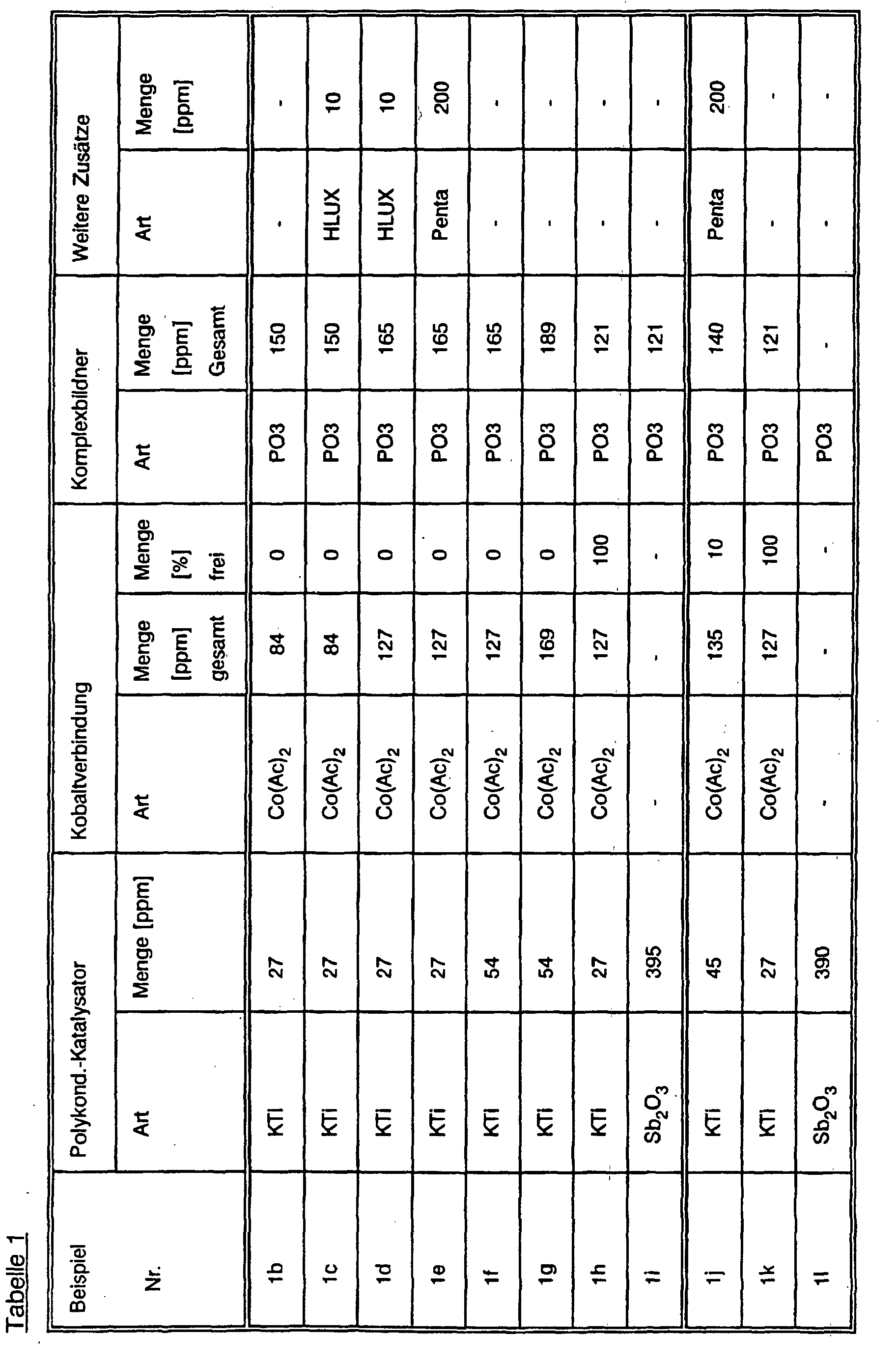
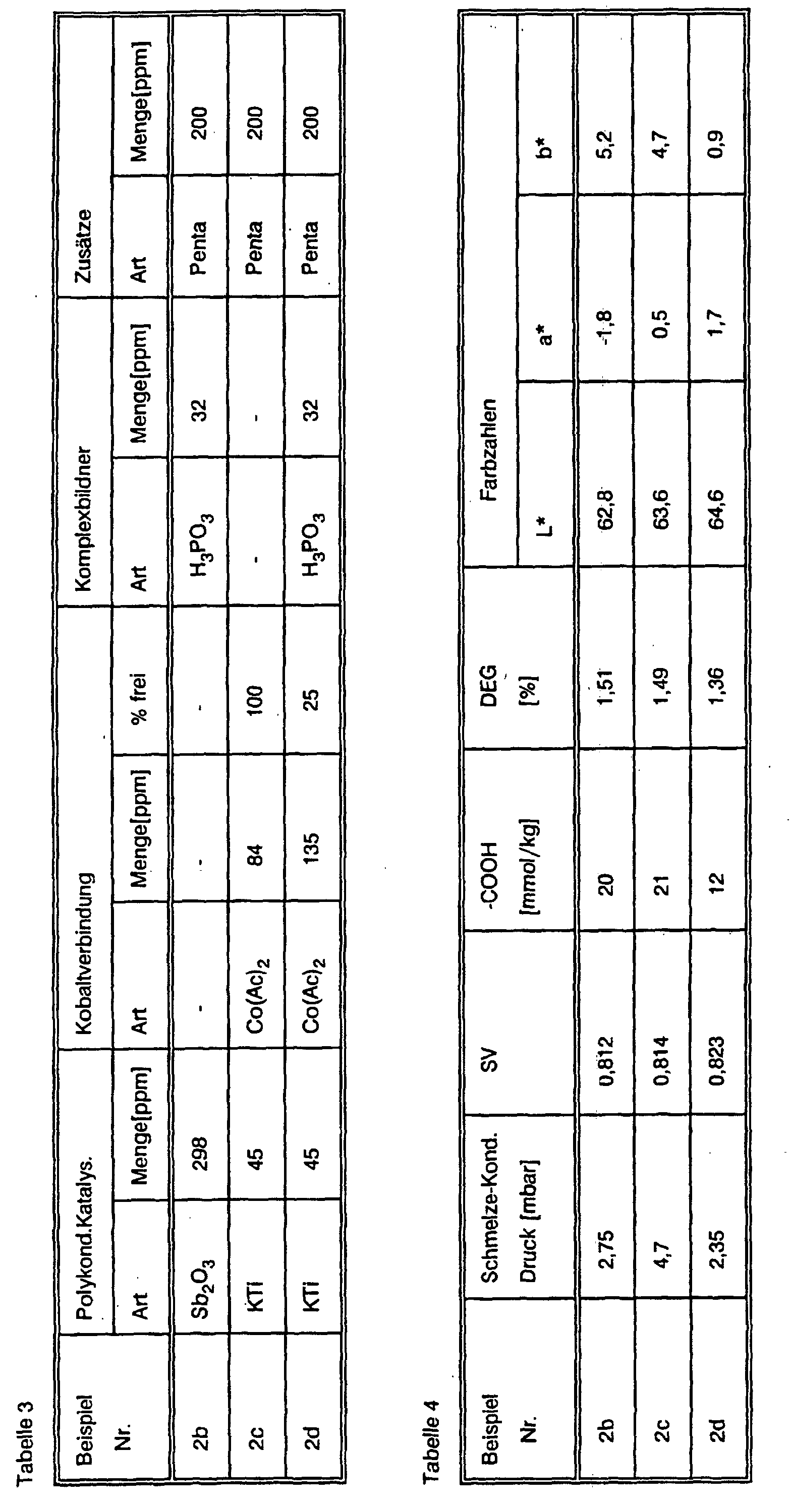
- Example 1a Examples 1j to 1l or analogously in a continuous manner Operation (Examples 1b to 1i) repeated, the amount of cobalt addition being the
- the type and amount of the complexing agent and the type and amount of the titanium catalyst was modified and in some cases an additional commercial optical one Brightener (® HOSTALUX KS from Hoechst AG) or a crosslinker (pentaerythritol) was added.
- the polycondensation in the melt was under different prints and with varied response times and at the Solid condensation, the duration and temperature of the condensation were varied.
- ppm figures relate to the amount of the polyester which can theoretically be obtained in the batch.
- the name of the compound abbreviation means that the ppm indication denotes the amount of the compound, if the metal symbol is indicated, the ppm indication means the amount of the metal contained in the additive.
- the melt is cooled and processed in the usual way to pellets with a diameter of 2 to 3 mm.
- the polyester thus produced can be further condensed by solid condensation.
- the pellets produced above are heated to 220 ° C. for 9.5 hours with slow mixing under nitrogen or in vacuo. This gives a polyester with a specific viscosity, as measured above, of 1.087.
Landscapes
- Chemical & Material Sciences (AREA)
- Health & Medical Sciences (AREA)
- Chemical Kinetics & Catalysis (AREA)
- Medicinal Chemistry (AREA)
- Polymers & Plastics (AREA)
- Organic Chemistry (AREA)
- Polyesters Or Polycarbonates (AREA)
- Compositions Of Macromolecular Compounds (AREA)
Description
- 100% der zu dem eingesetzten Umesterungskatalysator äquivalenten Menge und
- 90 bis 99 % der zu dem einzusetzenden Kobalt äquivalenten Menge von Phosphorsäure, phosphoriger Säure und/oder Phosphonsäuren oder einem Derivat derselben als Komplexierungsmittel und
- dann dem Ansatz 20 bis 80 ppm Kobalt in Form einer Kobaltverbindung
In der Regel wird die Polykondensation wie in der Technik der Polyesterherstellung üblich, je nach Art des Polyesters bei einer Temperatur von 260 bis 350 °C, vorzugsweise unter einem indifferenten Gas, beispielsweise unter Stickstoff, und/oder unter vermindertem Druck, der im Bereich von 0,2 bis 10 mbar, vorzugsweise von 0,4 bis 5 mbar, liegt, ausgeführt.
Zu diesem Zweck wird die Polykondensation ohne Antimonzusatz in Gegenwart von 2-8 ppm Titan und in Gegenwart von bis zu 1000 ppm, vorzugsweise von 100 bis 500 ppm, vernetzende Baugruppen liefernden organischen Verbindungen (Vernetzern) ausgeführt.
Die aromatischen Reste, für die X und X1 stehen, können unsubstituiert sein oder, sofern bestimmte Eigenschaften des Polyesters modifiziert werden sollen, einen oder zwei Substituenten tragen.
Vorzugsweise sind die Reste überwiegend unsubstituiert, d.h. nicht mehr als 10 Mol% der aromatischen Reste tragen Substituenten. Der genaue Anteil substituierter Reste wird festgelegt entsprechend dem zu erzielenden Effekt.
Beispielsweise können nach dem erfindungsgemäßen Verfahren schwer entflambare Polyester hergestellt werden, wenn man in den Polyester, bezogen auf die Gesamtheit der einkondensierten Dicarbonsäuren und ggf. Hydroxycarbonsäuren, 1 bis 10 Mol% der aus den DE-C-23 46 787 und 24 54 189 bekannten Verbindungen einkondensiert, die Polyesterbaugruppen der Formel VI

- R
- ein gesättigter offenkettiger oder cyclischer Alkylen-, Arylen- oder Aralkylenrest, vorzugsweise Alkan-diyl mit 2 bis 6 C-Atomen, Cycloalkan-diyl mit 6 C-Atomen, Methylenphenyl oder Phenylen, insbesondere Ethylen, und
- R1
- ein Alkylrest mit bis zu 6 C-Atomen oder ein Aryl- oder Aralkylrest, vorzugsweise Alkyl mit 1 bis C-Atomen, oder Aryl oder Aralkyl mit 6 bis 7 C-Atomen, insbesondere Methyl, Ethyl, Phenyl oder Benzyl bedeuten.
Bevorzugt ist beim erfindungsgemäßen Verfahren insbesondere der Zusatz von bis zu 10 Gew%, vorzugsweise bis zu 5 Gew.-% Polyesterstabilisatoren, die den Polyesteranteil der Mischung gegen Hydrolyse und thermischen Abbau schützen. Besonders vorteilhaft als Stabilisatoren sind solche Verbindungen, die mit endständigen Carboxylgruppen des Polyesters zu nicht sauren Endgruppen reagieren können, wie beispielsweise Glycidylether, Ketenimine, Aziridine, Isocyanate. Besonders vorteilhaft als Stabilisatoren sind Carbodiimide und Polycarbodiimide, insbesondere wenn sie in Kombination miteinander eingesetzt werden.
- 1 bis 10 ppm
- frei ist von Antimon, Titan (gerechnet als Metall),
- 20 bis 120 ppm
- eines Umesterungskatalysatormetalls in Form katalytisch unwirksamer Komplexe mit Phosphorsäure, phosphoriger Säure und/oder Phosphonsäuren oder einem Derivat derselben,
- 0 bis 80 ppm
- Kobalt (gerechnet als Metall), das teilweise in Form katalytisch unwirksamer Komplexe mit Phosphorsäure, phosphoriger Säure und/oder Phosphonsäuren oder einem Derivat derselben vorliegt, und
- ggf. bis zu 50 ppm
- eines optischen Aufhellers enthält.
- 2 bis 8 ppm
- Titan (gerechnet als Metall),
- 50 bis 90 ppm
- Mangan (gerechnet als Metall) in Form katalytisch unwirksamer Komplexe mit Phosphorsäure, phosphoriger Säure und/oder Phosphonsäuren oder einem Derivat derselben,
- 20 bis 40 ppm
- Kobalt, das teilweise in Form katalytisch unwirksamer Komplexe mit Phosphorsäure, phosphoriger Säure und/oder Phosphonsäuren oder einem Derivat derselben vorliegt, und
- ggf. bis zu 25 ppm
- eines optischen Aufhellers.


- X
- zu mehr als 80 Mol-% aromatische Reste mit 5 bis 16, vorzugsweise 6 bis 12 C-Atomen und maximal 20 Mol-% aliphatische Reste mit 4 bis 10 Kohlenstoffatomen, vorzugsweise 6 bis 8 Kohlenstoffatomen,
- X1
- den p-Phenylenrest,
- Y
- zu mindestens 80 Mol-% Alkylen- oder Polymethylengruppen mit 2 bis 4 Kohlenstoffatomen oder Cycloalkan- oder Dimethylen-cycloalkangruppen mit 6 bis 10 C-Atomen und zu maximal 20 Mol-% geradkettiges oder verzweigtes Alkandiyl mit 4 bis 16, vorzugsweise 4 bis 8, C-Atomen oder Reste der Formel -(C2H4-O)n-C2H4-, worin n eine ganze Zahl von 1 bis 40 bedeutet, wobei n = 1 oder 2 für Anteile bis zu 20 Mol-% bevorzugt sind und Gruppen mit n = 10 bis 40 vorzugsweise nur in Anteilen von unter 5 Mol-% vorhanden sind.
- X
- zu 90 bis 100 Mol-% p-Phenylenresten, zu 0 bis 7 Mol-% m-Phenylenreste und zu 0 bis 5 Mol-% aliphatische Reste mit 4 bis 10 Kohlenstoffatomen, vorzugsweise 6 bis 8 Kohlenstoffatomen und
- Y
- zu mindestens 90 Mol-% Alkylen- oder Polymethylengruppen mit 2 bis 4, Kohlenstoffatomen oder Cycloalkan- oder Dimethylen-cycloalkangruppen mit 6 bis 10 C-Atomen und zu maximal 10 Mol-% geradkettiges oder verzweigtes Alkandiyl mit 4 bis 16, vorzugsweise 4 bis 8, C-Atomen oder Reste der Formel -(C2H4-O)n-C2H4-, worin n für die Zahlen 1 oder 2 steht, bedeuten.


Dann wird der Innendruck im Verlauf von einer Stunde auf 1,13 mbar gesenkt und dabei die Temperatur der Schmelze von 240 auf 270°C erhöht. Im Verlauf einer weiteren halben Stunde wird dann die Temperatur auf 280 °C gesteigert und dabei solange weitergerührt, bis eine Probe der Schmelze eine spezifische Lösungsviskosität, gemessen in einer Lösung von 1 g der Schmelze in 100 ml Dichloressigsäure bei 25 °C, von 0,83 aufweist.
Die Schmelze wird abgekühlt und in üblicher Weise zu Pellets mit einem Durchmesser von 2 bis 3 mm verarbeitet.
Der so erhaltene Polyester hat folgende Kennzahlen:
| Gehalt an Carboxylgruppen [mmol/kg] | 13 |
| Gehalt an Diethylenglycol [%] | 1,19 |
| Farbzahlen | L* = 63,6; a* = 1,90; b* = -1,5 |
Hierzu werden die oben hergestellten Pellets unter langsamer Durchmischung unter Stickstoff oder im Vakuum 9,5 Stunden auf 220 °C erhitzt. Man erhält so einen Polyester mit einer, wie oben gemessenen, spezifischen Viskosität von 1,087.
Claims (9)
- Verfahren zur Herstellung thermostabiler, farbneutraler, antimonfreier Polyester durchdadurch gekennzeichnet, daß nach Abschluß der Veresterung oder Umesterung dem Veresterungs- oder Umesterungsansatza)(i) Veresterung aromatischer Dicarbonsäuren mit aliphatischen Diolen oder(ii) Umesterung niederer aliphatischer Ester aromatischer Dicarbonsäuren mit aliphatischen Diolen in Gegenwart von 20 bis 120 ppm, bezogen auf das Katalysatormetall, eines Umesterungskatalysators, der nach Abschluß der Umesterung durch Zusatz eines Komplexierungsmittels inaktiviert wird, undb) anschließende Polykondensation in Gegenwart einer Titanverbindung als Katalysator,zugefügt werden und daß die Polykondensation ohne Antimonzusatz in Gegenwart von 1 bis 10 ppm Titan, das in Form einer Titanverbindung zugesetzt wird, ausgeführt wird.100% der zu dem eingesetzten Umesterungskatalysator äquivalenten Menge und90 bis 99 % der zu dem einzusetzenden Kobalt äquivalenten Menge von Phosphorsäure, phosphoriger Säure und/oder Phosphonsäuren oder einem Derivat derselben als Komplexierungsmittel unddann dem Ansatz 20 bis 80 ppm Kobalt in Form einer Kobaltverbindung
- Verfahren gemäß Anspruch 1, dadurch gekennzeichnet, daß die Polykondensation in Gegenwart von bis zu 1.000 ppm, bevorzugt 100 bis 500 ppm, vemetzende Baugruppen liefernden organischen Verbindung, bevorzugt Pentaerythrit, Trimethylolpropan, Trimellitsäure, Trimesinsäure oder Pyromellitsäure, ausgeführt wird.
- Verfahren gemäß Anspruch 1 oder 2, dadurch gekennzeichnet, daß die Polykondensation in Gegenwart von bis zu 50 ppm, bevorzugt bis zu 25 ppm, eines optischen Aufhellers ausgeführt wird.
- Verfahren gemäß mindestens einem der Ansprüche 1 bis 3, dadurch gekennzeichnet, daß die Polykondensation bis zu einer intrinsischen Viskosität (IV), gemessen in Dichloressigsäure bei 25 °C, von 0,4 bis 0,9 dl/g, bevorzugt 0,5 bis 0,7 dl/g, und bis zu einer Carboxylgruppenkonzentration von 10 bis 50 mmol/kg in der Schmelze, und anschließend bis zu der gewünschten Endviskosität in der Festphase ausgeführt wird.
- Verfahren gemäß mindestens einem der Ansprüche 1 bis 4, dadurch gekennzeichnet, daß dem Ansatz 20 bis 40 ppm Kobalt in Form einer Kobaltverbindung zugefügt werden.
- Verfahren gemäß mindestens einem der Ansprüche 1 bis 5, dadurch gekennzeichnet, daß die Polykondensation in Gegenwart von 2 bis 8 ppm Titan ausgeführt wird.
- Verfahren zur Herstellung thermostabiler, farbneutraler, antimonfreier Polyester durch(i) Veresterung aromatischer Dicarbonsäuren oder Hydroxycarbonsäuren mit aliphatischen Diolen oder(ii) Umesterung niederer aliphatischer Ester aromatischer Dicarbonsäuren oder Hydroxycarbonsäuren mit aliphatischen Diolen in Gegenwart von 20 bis 120 ppm, bezogen auf das Katalysatormetall, eines Umesterungskatalysators, der nach Abschluß der Umesterung durch Zusatz eines Komplexierungsmittels inaktiviert wird, und anschließende Polykondensation in Gegenwart einer Titanverbindung als Katalysator, dadurch gekennzeichnet, daß
80 bis 100 mol-% Dicarbonsäuren der Formel (III) HOOC-X-COOH oder deren niedere aliphatische Ester und 0 bis 20 mol-% aromatische Hydroxycarbonsäuren der Formel (IV) HO-X1-COOH oder deren niedere aliphatische Ester - X
- zu mehr als 80 mol-%, bezogen auf die Gesamtmenge der Dicarbonsäuren und Hydroxycarbonsäuren, aromatische Reste mit 5 bis 16 C-Atomen und maximal 20 Mol-% aliphatische Reste mit 4 bis 10 C-Atomen,
- X1
- den p-Phenylenrest und
- Y
- zu mindestens 80 Mol-%, bezogen auf die Gesamtmenge der umgeesterten oder veresterten Diole, Alkylen- oder Polymethylengruppen mit 2 bis 4 C-Atomen oder Cycloalkan- oder Dimethylen-cycloalkangruppen mit 6 bis 10 C-Atomen und zu maximal 20 Mol-% geradkettiges oder verzweigtes Alkandiyl mit 4 bis 16 C-Atomen oder Reste der Formel -(C2H4-O)n-C2H4-, worin n eine ganze Zahl von 1 bis 40 ist,
zugefügt werden und daß die Polykondensation ohne Antimonzusatz in Gegenwart von 1 bis 10 ppm Titan, zugesetzt in Form einer Titanverbindung, ausgeführt wird.100% der zu dem eingesetzten Umesterungskatalysator äquivalenten Menge und90 bis 99 % der zu dem einzusetzenden Kobalt äquivalenten Menge von Phosphorsäure, phosphoriger Säure und/oder Phosphonsäuren oder einem Derivat derselben als Komplexierungsmittel unddann dem Ansatz 20 bis 80 ppm Kobalt in Form einer Kobaltverbindung - Verfahren gemäß Anspruch 7, dadurch gekennzeichnet, daß die aromatischen Reste X 6 bis 12 C-Atome, die aliphatischen Reste X 6 bis 8 C-Atome und/oder das geradkettige oder verzweigte Alkandiyl Y 4 bis 8 C-Atome enthalten und daß für Anteile bis zu 20 mol-% bevorzugt n = 1 oder 2 ist und Gruppen mit n = 10 bis 40 vorzugsweise nur in Anteilen von unter 5 mol-% vorhanden sind.
- Verfahren gemäß Anspruch 7, dadurch gekennzeichnet, daß
X zu 90 bis 100 mol-% p-Phenylenreste, zu 0 bis 7 mol-% m-Phenylenreste und zu 0 bis 5 mol-% aliphatische Reste mit 4 bis 10, vorzugsweise 6 bis 8 C-Atomen, - X1
- den p-Phenylenrest,
- Y
- zu mindestens 90 mol-% Alkylen- oder Polymethylengruppen mit 2 bis 4 C-Atomen oder Cycloalkan- oder Dimethylen-cycloalkan gruppen mit 6 bis 10 C-Atomen und zu maximal 10 mol-% geradkettiges oder verzweigtes Alkandiyl mit 4 bis 16, vorzugsweise 4 bis 8 C-Atomen oder Reste der Formel -(C2H4-O)n-C2H4-, worin n für die Zahlen 1 oder 2 steht, bezogen auf die Gesamtmenge der um- oder veresterten Diole,
Priority Applications (1)
| Application Number | Priority Date | Filing Date | Title |
|---|---|---|---|
| EP00121946A EP1065230A3 (de) | 1994-08-29 | 1995-08-17 | Thermostabile, farbneutrale, antimonfreie Polyester und Verfahren zu deren Herstellung |
Applications Claiming Priority (2)
| Application Number | Priority Date | Filing Date | Title |
|---|---|---|---|
| DE4430634A DE4430634A1 (de) | 1994-08-29 | 1994-08-29 | Verfahren zur Herstellung thermostabiler, farbneutraler, antimonfreier Polyester und die danach herstellbaren Produkte |
| DE4430634 | 1994-08-29 |
Related Child Applications (1)
| Application Number | Title | Priority Date | Filing Date |
|---|---|---|---|
| EP00121946.8 Division-Into | 2000-10-09 |
Publications (3)
| Publication Number | Publication Date |
|---|---|
| EP0699700A2 EP0699700A2 (de) | 1996-03-06 |
| EP0699700A3 EP0699700A3 (de) | 1996-05-01 |
| EP0699700B1 true EP0699700B1 (de) | 2001-12-19 |
Family
ID=6526831
Family Applications (2)
| Application Number | Title | Priority Date | Filing Date |
|---|---|---|---|
| EP95112912A Expired - Lifetime EP0699700B1 (de) | 1994-08-29 | 1995-08-17 | Verfahren zur Herstellung thermostabiler, farbneutraler, antimonfreier Polyester und die danach herstellbaren Produkten |
| EP00121946A Withdrawn EP1065230A3 (de) | 1994-08-29 | 1995-08-17 | Thermostabile, farbneutrale, antimonfreie Polyester und Verfahren zu deren Herstellung |
Family Applications After (1)
| Application Number | Title | Priority Date | Filing Date |
|---|---|---|---|
| EP00121946A Withdrawn EP1065230A3 (de) | 1994-08-29 | 1995-08-17 | Thermostabile, farbneutrale, antimonfreie Polyester und Verfahren zu deren Herstellung |
Country Status (8)
| Country | Link |
|---|---|
| US (1) | US6787630B1 (de) |
| EP (2) | EP0699700B1 (de) |
| JP (1) | JPH0873581A (de) |
| AT (1) | ATE211154T1 (de) |
| BR (1) | BR9503818A (de) |
| DE (2) | DE4430634A1 (de) |
| ES (1) | ES2170115T3 (de) |
| PT (1) | PT699700E (de) |
Cited By (6)
| Publication number | Priority date | Publication date | Assignee | Title |
|---|---|---|---|---|
| US7033530B2 (en) | 2002-11-05 | 2006-04-25 | E.I. Du Pont De Nemours And Company | Process for preparing poly(trimethylene terephthalate) bicomponent fibers |
| US7655746B2 (en) | 2005-09-16 | 2010-02-02 | Eastman Chemical Company | Phosphorus containing compounds for reducing acetaldehyde in polyesters polymers |
| US7838596B2 (en) | 2005-09-16 | 2010-11-23 | Eastman Chemical Company | Late addition to effect compositional modifications in condensation polymers |
| US8022168B2 (en) | 2004-09-02 | 2011-09-20 | Grupo Petrotexmex, S.A. de C.V. | Spheroidal polyester polymer particles |
| US8987408B2 (en) | 2005-06-16 | 2015-03-24 | Grupo Petrotemex, S.A. De C.V. | High intrinsic viscosity melt phase polyester polymers with acceptable acetaldehyde generation rates |
| US9267007B2 (en) | 2005-09-16 | 2016-02-23 | Grupo Petrotemex, S.A. De C.V. | Method for addition of additives into a polymer melt |
Families Citing this family (70)
| Publication number | Priority date | Publication date | Assignee | Title |
|---|---|---|---|---|
| GB9610939D0 (en) * | 1996-05-24 | 1996-07-31 | Ici Plc | Process for preparing a copolyester |
| DE19631069A1 (de) * | 1996-08-01 | 1998-02-05 | Zimmer Ag | POY-Polyesterfaser für Strecktexturierung und Verfahren zu deren Herstellung |
| US5922828A (en) * | 1996-09-03 | 1999-07-13 | Hoechst Celanese Corp. | Process for producing polyethylene terephthalate using a specific catalyst stabilizer system |
| DE19638549A1 (de) * | 1996-09-20 | 1998-03-26 | Zimmer Ag | Zeolith-Katalysator zur Polykondensation von Polyester |
| DE19705249A1 (de) * | 1997-02-12 | 1998-08-13 | Zimmer Ag | Verfahren zur Herstellung von Polypropylenterphthalat |
| EP0864596A1 (de) * | 1997-03-14 | 1998-09-16 | Hoechst Diafoil GmbH | Verfahren zur Produktion von Polyethylenterephthalat |
| DE69828802T2 (de) | 1997-09-03 | 2005-12-22 | Asahi Kasei Kabushiki Kaisha | Polyesterfaser und gewebe daraus |
| US5874515A (en) * | 1997-12-23 | 1999-02-23 | Hoechst Celanese Corporation | Method to reduce gel formation in pet resin |
| US5874517A (en) * | 1997-12-23 | 1999-02-23 | Hoechst Celanese Corporation | Method to reduce regenerated acetaldehyde in pet resin |
| US6380348B1 (en) * | 1998-07-07 | 2002-04-30 | Atofina Chemicals, Inc. | Polyester polycondensation with lithium titanyl oxalate catalyst |
| US6376642B1 (en) | 1998-07-07 | 2002-04-23 | Atofina Chemicals, Inc. | Polyester polycondensation with lithium titanyl oxalate catalyst |
| US7208565B1 (en) | 1999-08-24 | 2007-04-24 | Toyo Boseki Kabushiki Kaisha | Polymerization catalyst for polyesters, polyester produced with the same, and process for production of polyester |
| AU780389B2 (en) | 1999-11-11 | 2005-03-17 | Mitsubishi Chemical Corporation | Polyester resin and its production process |
| WO2001049771A1 (fr) | 2000-01-05 | 2001-07-12 | Toyo Boseki Kabushiki Kaisha | Catalyseur de polymerisation pour polyesters, polyesters obtenus et leur procede de production |
| US6258925B1 (en) * | 2000-01-07 | 2001-07-10 | Atofina Chemicals, Inc. | Polyester polycondensation with titanyl oxalate catalyst and a catalyst enhancer |
| US6372879B1 (en) | 2000-01-07 | 2002-04-16 | Atofina Chemicals, Inc. | Polyester polycondensation with catalyst and a catalyst enhancer |
| DE60012149T2 (de) * | 2000-05-17 | 2005-08-04 | SK Chemicals Co., Ltd., Suwon | Verfahren zur Herstellung von mit 1,4-Cyclohexandimethanol copolymersierten Polyestern |
| US6645623B2 (en) | 2000-07-20 | 2003-11-11 | E. I. Du Pont De Nemours And Company | Polyphenylene sulfide alloy coated wire |
| KR100748289B1 (ko) | 2000-09-12 | 2007-08-09 | 토요 보세키 가부시기가이샤 | 폴리에스테르 중합촉매, 이를 사용하여 제조된폴리에스테르 및 폴리에스테르의 제조방법 |
| US6914107B2 (en) | 2001-01-24 | 2005-07-05 | E. I. Du Pont De Nemours And Company | Catalyst composition and process therewith |
| JP4393004B2 (ja) * | 2001-02-06 | 2010-01-06 | 三菱化学株式会社 | ポリエステル樹脂 |
| MXPA03007471A (es) | 2001-02-23 | 2003-12-04 | Toyo Boseki | Catalizador de polimerizacion para poliester, poliester producido con el mismo y proceso para producir poliester. |
| US6489433B2 (en) | 2001-02-23 | 2002-12-03 | E. I. Du Pont De Nemours And Company | Metal-containing composition and process therewith |
| US6506853B2 (en) * | 2001-02-28 | 2003-01-14 | E. I. Du Pont De Nemours And Company | Copolymer comprising isophthalic acid |
| US6723768B2 (en) * | 2002-03-27 | 2004-04-20 | Eastman Chemical Company | Polyester/polycarbonate blends with reduced yellowness |
| US6855797B2 (en) | 2002-04-25 | 2005-02-15 | E. I. Du Pont De Nemours And Company | Stable aqueous solutions comprising titanium and zinc and process therewith |
| US20030203811A1 (en) | 2002-04-25 | 2003-10-30 | Putzig Donald Edward | Stable aqueous solutions comprising titanium and zinc and process therewith |
| TWI311995B (en) * | 2002-08-05 | 2009-07-11 | Mitsubishi Chemical Corporatio | Polyester resin and its production process |
| US7005093B2 (en) | 2003-02-05 | 2006-02-28 | E. I. Du Pont De Nemours And Company | Spin annealed poly(trimethylene terephthalate) yarn |
| US20050261462A1 (en) * | 2004-05-20 | 2005-11-24 | Nichols Carl S | Methods of making titanium-catalyzed polyester resins |
| US20070059465A1 (en) * | 2004-05-20 | 2007-03-15 | Thompson David E | Polyester Resins for High-Strength Articles |
| US7094863B2 (en) | 2003-05-21 | 2006-08-22 | Wellman, Inc. | Polyester preforms useful for enhanced heat-set bottles |
| KR20060015284A (ko) | 2003-05-21 | 2006-02-16 | 웰만 인코포레이티드 | 저속 결정화 폴리에스테르 수지 |
| US6998462B2 (en) * | 2003-06-11 | 2006-02-14 | E.I. Du Pont De Nemours And Company | Polyester process |
| US20050010017A1 (en) * | 2003-07-11 | 2005-01-13 | Blakely Dale Milton | Addition of UV inhibitors to pet process for maximum yield |
| GB0316708D0 (en) * | 2003-07-16 | 2003-08-20 | Dupont Teijin Films Us Ltd | Polymeric film |
| EP1535946A1 (de) * | 2003-11-28 | 2005-06-01 | Futura Polymers | Verfahren zur Herstellung von Polyethyleneterephthalat (pet) |
| US7459113B2 (en) | 2004-03-08 | 2008-12-02 | Eastman Chemical Company | Process of making a container from polyester polymer particles having a small surface to center intrinsic-viscosity gradient |
| US7358322B2 (en) | 2004-03-09 | 2008-04-15 | Eastman Chemical Company | High IV melt phase polyester polymer catalyzed with antimony containing compounds |
| US7541407B2 (en) | 2004-05-27 | 2009-06-02 | Eastman Chemical Company | Process for adding methine UV light absorbers to PET prepared by direct esterification |
| US20050267283A1 (en) * | 2004-05-27 | 2005-12-01 | Weaver Max A | Process for adding nitrogen containing methine light absorbers to poly(ethylene terephthalate) |
| US20060041039A1 (en) * | 2004-08-20 | 2006-02-23 | Gyorgyi Fenyvesi | Fluorescent poly(alkylene terephthalate) compositions |
| US7935399B2 (en) | 2004-09-02 | 2011-05-03 | Grupo Petrotemex, S.A. De C.V. | Low melting polyester polymers |
| DE102004046771A1 (de) | 2004-09-24 | 2006-04-06 | Zimmer Ag | Mischung, Polyesterzusammensetzung, Folie sowie Verfahren zu deren Herstellung |
| GB0500907D0 (en) * | 2005-01-17 | 2005-02-23 | Dupont Teijin Films Us Ltd | Self-venting polymeric film IV |
| US7390869B2 (en) * | 2005-06-13 | 2008-06-24 | Eastman Chemical Company | Process for removing metal species in the presence of hydrogen and a porous material and polyester polymer containing reduced amounts of metal species |
| US7932345B2 (en) | 2005-09-16 | 2011-04-26 | Grupo Petrotemex, S.A. De C.V. | Aluminum containing polyester polymers having low acetaldehyde generation rates |
| US8431202B2 (en) | 2005-09-16 | 2013-04-30 | Grupo Petrotemex, S.A. De C.V. | Aluminum/alkaline or alkali/titanium containing polyesters having improved reheat, color and clarity |
| US7357985B2 (en) * | 2005-09-19 | 2008-04-15 | E.I. Du Pont De Nemours And Company | High crimp bicomponent fibers |
| US7666501B2 (en) | 2005-12-07 | 2010-02-23 | E. I. Du Pont De Nemours And Company | Poly(trimethylene terephthalate)/poly(alpha-hydroxy acid) bi-constituent filaments |
| ES2378338T3 (es) * | 2006-09-19 | 2012-04-11 | Basf Se | Procedimiento para producir poliéster con catalizadores de complejo de metal-ácido fosfónico |
| US8901272B2 (en) | 2007-02-02 | 2014-12-02 | Grupo Petrotemex, S.A. De C.V. | Polyester polymers with low acetaldehyde generation rates and high vinyl ends concentration |
| US20080197122A1 (en) * | 2007-02-21 | 2008-08-21 | Kenneth Parks Gober | Combination defroster panel and sunshade for vehicle glass |
| US20110034662A1 (en) * | 2008-04-15 | 2011-02-10 | Basf Se | Method for the continuous production of biodegradable polyesters |
| US8614280B2 (en) * | 2008-04-15 | 2013-12-24 | Basf Se | Method for the continuous production of biodegradable polyesters |
| US8791225B2 (en) | 2008-06-06 | 2014-07-29 | Dak Americas Mississippi Inc. | Titanium-nitride catalyzed polyester |
| TW201100460A (en) | 2009-03-18 | 2011-01-01 | Saudi Basic Ind Corp | Process for making thermoplastic polyesters |
| WO2012121117A1 (ja) * | 2011-03-09 | 2012-09-13 | 富士フイルム株式会社 | ポリエステルフィルムの製造方法、ポリエステルフィルム及び太陽電池用バックシート |
| WO2013149222A1 (en) | 2012-03-30 | 2013-10-03 | E. I. Du Pont De Nemours And Company | Polyesters and fibers made therefrom |
| WO2013149157A1 (en) | 2012-03-30 | 2013-10-03 | E. I. Du Pont De Nemours And Company | Polyesters and fibers made therefrom |
| DE202012102110U1 (de) * | 2012-06-08 | 2012-07-03 | Bodet & Horst Gmbh & Co. Kg | Matratzen- oder Kissenbezugsstoff |
| US8653224B1 (en) * | 2013-02-08 | 2014-02-18 | Lotte Chemical Corporation | Resin composition for manufacturing thermoplastic polyester resin by using green catalyst |
| US20190127519A1 (en) | 2016-04-28 | 2019-05-02 | Sabic Global Technologies B.V. | Methods of Forming Dynamic Cross-Linked Polymer Compositions Using Functional Monomeric Chain Extenders Under Batch Process |
| US20190119455A1 (en) | 2016-04-28 | 2019-04-25 | Sabic Global Technologies B.V. | Methods of forming dynamic cross-linked polymer compositions using functional, polymeric chain extenders under batch process |
| EP3500615B1 (de) | 2016-08-18 | 2025-08-06 | Eastman Chemical Company | Orientierte folien und schrumpffolien mit polyestern mit tetramethylcyclobutandiol und ethylenglykol |
| CN109863197A (zh) | 2016-09-26 | 2019-06-07 | 沙特基础工业全球技术公司 | 包含非网络化阻燃剂的动态交联网络 |
| EP3515980A1 (de) | 2016-09-26 | 2019-07-31 | SABIC Global Technologies B.V. | Vernetzung flammhemmender dynamischer vernetzter netzwerke |
| WO2018093823A1 (en) | 2016-11-15 | 2018-05-24 | Sabic Global Technologies B.V. | Methods of forming dynamic cross-linked polymer compositions using functional chain extenders under continuous process |
| US20190270847A1 (en) | 2016-11-15 | 2019-09-05 | Sabic Global Technologies B.V. | Methods of forming dynamic cross-linked polymer compositions using functional chain extenders under batch process |
| US20200399433A1 (en) | 2016-11-30 | 2020-12-24 | Sabic Global Technologies B.V. | Improvement of impact properties of dynamically cross-linked networks by using reactive impact modifiers |
Family Cites Families (12)
| Publication number | Priority date | Publication date | Assignee | Title |
|---|---|---|---|---|
| US3962189A (en) | 1974-11-01 | 1976-06-08 | Eastman Kodak Company | Process and catalyst-inhibitor systems for preparing synthetic linear polyesters |
| JPS51123311A (en) | 1975-04-16 | 1976-10-28 | Murata Mach Ltd | An apparatus for accomodating high speed fiber tows |
| JPS5262398A (en) * | 1975-11-18 | 1977-05-23 | Teijin Ltd | Preparation of polyester |
| JPS5328006A (en) | 1976-08-27 | 1978-03-15 | Hitachi Zosen Corp | Ore feeder for sintering equipment |
| JPS5946258B2 (ja) * | 1976-10-05 | 1984-11-12 | 帝人株式会社 | ポリエステルの製造方法 |
| JPS5428006A (en) | 1977-08-03 | 1979-03-02 | Hitachi Ltd | Method for manufacturing closed impeller |
| NL7709231A (nl) | 1977-08-22 | 1979-02-26 | Koninkl Philips Electronics Nv | Kathodefolie voor elektrolytische condensatoren. |
| DE2811982A1 (de) * | 1978-03-18 | 1979-09-27 | Huels Chemische Werke Ag | Verfahren zur herstellung von hochmolekularem poly(ethylenterephthalat) |
| JPS5938591B2 (ja) | 1979-02-20 | 1984-09-18 | シャープ株式会社 | 液晶表示装置 |
| JPH01280048A (ja) | 1988-05-02 | 1989-11-10 | Toyota Central Res & Dev Lab Inc | ジエツト織機のよこ入れ方法および装置 |
| US4983711A (en) * | 1989-12-04 | 1991-01-08 | Eastman Kodak Company | Copolyesters and articles extrusion blow-molded therefrom |
| US5340907A (en) * | 1993-06-28 | 1994-08-23 | Eastman Chemical Company | Copolyester of cyclohexanedimethanol and process for producing such polyester |
-
1994
- 1994-08-29 DE DE4430634A patent/DE4430634A1/de not_active Withdrawn
-
1995
- 1995-08-17 EP EP95112912A patent/EP0699700B1/de not_active Expired - Lifetime
- 1995-08-17 PT PT95112912T patent/PT699700E/pt unknown
- 1995-08-17 EP EP00121946A patent/EP1065230A3/de not_active Withdrawn
- 1995-08-17 DE DE59509960T patent/DE59509960D1/de not_active Expired - Fee Related
- 1995-08-17 ES ES95112912T patent/ES2170115T3/es not_active Expired - Lifetime
- 1995-08-17 AT AT95112912T patent/ATE211154T1/de not_active IP Right Cessation
- 1995-08-28 US US08/520,662 patent/US6787630B1/en not_active Expired - Fee Related
- 1995-08-28 BR BR9503818A patent/BR9503818A/pt not_active Application Discontinuation
- 1995-08-29 JP JP7220708A patent/JPH0873581A/ja active Pending
Cited By (7)
| Publication number | Priority date | Publication date | Assignee | Title |
|---|---|---|---|---|
| US7033530B2 (en) | 2002-11-05 | 2006-04-25 | E.I. Du Pont De Nemours And Company | Process for preparing poly(trimethylene terephthalate) bicomponent fibers |
| US8022168B2 (en) | 2004-09-02 | 2011-09-20 | Grupo Petrotexmex, S.A. de C.V. | Spheroidal polyester polymer particles |
| US8987408B2 (en) | 2005-06-16 | 2015-03-24 | Grupo Petrotemex, S.A. De C.V. | High intrinsic viscosity melt phase polyester polymers with acceptable acetaldehyde generation rates |
| US7655746B2 (en) | 2005-09-16 | 2010-02-02 | Eastman Chemical Company | Phosphorus containing compounds for reducing acetaldehyde in polyesters polymers |
| US7799891B2 (en) | 2005-09-16 | 2010-09-21 | Eastman Chemical Company | Phosphorus containing compounds for reducing acetaldehyde in polyesters polymers |
| US7838596B2 (en) | 2005-09-16 | 2010-11-23 | Eastman Chemical Company | Late addition to effect compositional modifications in condensation polymers |
| US9267007B2 (en) | 2005-09-16 | 2016-02-23 | Grupo Petrotemex, S.A. De C.V. | Method for addition of additives into a polymer melt |
Also Published As
| Publication number | Publication date |
|---|---|
| BR9503818A (pt) | 1996-04-16 |
| ES2170115T3 (es) | 2002-08-01 |
| EP1065230A2 (de) | 2001-01-03 |
| US6787630B1 (en) | 2004-09-07 |
| DE4430634A1 (de) | 1996-03-07 |
| DE59509960D1 (de) | 2002-01-31 |
| EP0699700A3 (de) | 1996-05-01 |
| EP0699700A2 (de) | 1996-03-06 |
| JPH0873581A (ja) | 1996-03-19 |
| EP1065230A3 (de) | 2001-04-18 |
| ATE211154T1 (de) | 2002-01-15 |
| PT699700E (pt) | 2002-06-28 |
Similar Documents
| Publication | Publication Date | Title |
|---|---|---|
| EP0699700B1 (de) | Verfahren zur Herstellung thermostabiler, farbneutraler, antimonfreier Polyester und die danach herstellbaren Produkten | |
| EP0827518B1 (de) | Verfahren zur herstellung von polyestern unter verwendung von titanhaltigen katalysator-inhibitor-kombinationen | |
| DE2646218C3 (de) | Phosphorhaltige Verbindungen, Verfahren zu deren Herstellung und Verwendung derselben zur Flammfestmachung | |
| DE2313903A1 (de) | Verzweigte thermoplastische copolyester | |
| DE2811982A1 (de) | Verfahren zur herstellung von hochmolekularem poly(ethylenterephthalat) | |
| DE1495876B2 (de) | Verfahren zur Herstellung von niedermolekularen Polyestern | |
| DE19631068A1 (de) | Verfahren zur Beschleunigung der Polykondensation von Polyester | |
| DE10330774A1 (de) | Flammhemmend modifizierte, phosphorhaltige Copolyester, deren Verwendung und Verfahren zu ihrer Herstellung | |
| DE10322099A1 (de) | Polymerisationskatalysator für die Herstellung von Polyestern, Verfahren zur Herstellung von Polyethylenterephthalat und Verwendung des Polymerisationskatalysators | |
| DE2113442B2 (de) | Verfahren zur herstellung von im wesentlichen linearen, hochmolekularen polyestern | |
| DE2340559A1 (de) | Herstellung von hochmolekularen polyestern des butandiols-(1,4) | |
| DE2637813A1 (de) | Verfahren zur herstellung hochmolekularer polyester | |
| DE69914508T2 (de) | Herstellung von copolyätherestern | |
| CH626381A5 (de) | ||
| DE3785425T2 (de) | Thermoplastische Polyätherimidester-Polymere mit erhöhter Biegsamkeit. | |
| DE69612709T2 (de) | Polyesterharz mit verbesserter Farbekarakteristik | |
| US4940772A (en) | Process for producing flame resistant polyester | |
| EP0639602A2 (de) | Verfahren zur Herstellung von Polyestern mit verbessertem Weissgrad | |
| DE10144745A1 (de) | Verfahren zur Herstellung aliphatischer Polyester sowie durch das Verfahren erhältliche Polyester | |
| DE3785646T2 (de) | Thermoplastische Polyätherimidester-Elastomere mit erhöhter hydrolytischer Stabilität. | |
| DE2126217C3 (de) | Verfahren zur Herstellung von Polyestern | |
| WO1992013022A1 (de) | Verfahren zur herstellung eines polyesters, einen polyester sowie dessen verwendung | |
| DE2705230A1 (de) | Verfahren zur herstellung von polyestern | |
| DE3710643A1 (de) | Aromatische polyester auf basis von phenoxyterephthalsaeure, verfahren zu ihrer herstellung und ihre verwendung | |
| DE1271397B (de) | Verfahren zur Herstellung von spinnfaehigem Poly-(aethylenglykolterephthalat) |
Legal Events
| Date | Code | Title | Description |
|---|---|---|---|
| PUAI | Public reference made under article 153(3) epc to a published international application that has entered the european phase |
Free format text: ORIGINAL CODE: 0009012 |
|
| AK | Designated contracting states |
Kind code of ref document: A2 Designated state(s): AT BE CH DE ES FR GB IT LI LU NL PT |
|
| PUAL | Search report despatched |
Free format text: ORIGINAL CODE: 0009013 |
|
| AK | Designated contracting states |
Kind code of ref document: A3 Designated state(s): AT BE CH DE ES FR GB IT LI LU NL PT |
|
| 17P | Request for examination filed |
Effective date: 19961104 |
|
| 17Q | First examination report despatched |
Effective date: 19980519 |
|
| RAP1 | Party data changed (applicant data changed or rights of an application transferred) |
Owner name: ARTEVA TECHNOLOGIES S.A.R.L. |
|
| GRAG | Despatch of communication of intention to grant |
Free format text: ORIGINAL CODE: EPIDOS AGRA |
|
| GRAG | Despatch of communication of intention to grant |
Free format text: ORIGINAL CODE: EPIDOS AGRA |
|
| GRAH | Despatch of communication of intention to grant a patent |
Free format text: ORIGINAL CODE: EPIDOS IGRA |
|
| GRAH | Despatch of communication of intention to grant a patent |
Free format text: ORIGINAL CODE: EPIDOS IGRA |
|
| GRAA | (expected) grant |
Free format text: ORIGINAL CODE: 0009210 |
|
| AK | Designated contracting states |
Kind code of ref document: B1 Designated state(s): AT BE CH DE ES FR GB IT LI LU NL PT |
|
| REF | Corresponds to: |
Ref document number: 211154 Country of ref document: AT Date of ref document: 20020115 Kind code of ref document: T |
|
| REG | Reference to a national code |
Ref country code: CH Ref legal event code: EP |
|
| REG | Reference to a national code |
Ref country code: GB Ref legal event code: IF02 |
|
| REF | Corresponds to: |
Ref document number: 59509960 Country of ref document: DE Date of ref document: 20020131 |
|
| GBT | Gb: translation of ep patent filed (gb section 77(6)(a)/1977) |
Effective date: 20020315 |
|
| REG | Reference to a national code |
Ref country code: PT Ref legal event code: SC4A Free format text: AVAILABILITY OF NATIONAL TRANSLATION Effective date: 20020312 |
|
| REG | Reference to a national code |
Ref country code: ES Ref legal event code: FG2A Ref document number: 2170115 Country of ref document: ES Kind code of ref document: T3 |
|
| PLBQ | Unpublished change to opponent data |
Free format text: ORIGINAL CODE: EPIDOS OPPO |
|
| PLBI | Opposition filed |
Free format text: ORIGINAL CODE: 0009260 |
|
| 26 | Opposition filed |
Opponent name: ACMA LIMITED THE HEATH Effective date: 20020919 |
|
| NLR1 | Nl: opposition has been filed with the epo |
Opponent name: ACMA LIMITED THE HEATH |
|
| PLBF | Reply of patent proprietor to notice(s) of opposition |
Free format text: ORIGINAL CODE: EPIDOS OBSO |
|
| PLBP | Opposition withdrawn |
Free format text: ORIGINAL CODE: 0009264 |
|
| PLAX | Notice of opposition and request to file observation + time limit sent |
Free format text: ORIGINAL CODE: EPIDOSNOBS2 |
|
| PLBB | Reply of patent proprietor to notice(s) of opposition received |
Free format text: ORIGINAL CODE: EPIDOSNOBS3 |
|
| PLBD | Termination of opposition procedure: decision despatched |
Free format text: ORIGINAL CODE: EPIDOSNOPC1 |
|
| PLBM | Termination of opposition procedure: date of legal effect published |
Free format text: ORIGINAL CODE: 0009276 |
|
| STAA | Information on the status of an ep patent application or granted ep patent |
Free format text: STATUS: OPPOSITION PROCEDURE CLOSED |
|
| 27C | Opposition proceedings terminated |
Effective date: 20040531 |
|
| REG | Reference to a national code |
Ref country code: GB Ref legal event code: 732E |
|
| NLR2 | Nl: decision of opposition |
Effective date: 20040531 |
|
| PGFP | Annual fee paid to national office [announced via postgrant information from national office to epo] |
Ref country code: AT Payment date: 20050622 Year of fee payment: 11 |
|
| REG | Reference to a national code |
Ref country code: CH Ref legal event code: PFA Owner name: INVISTA TECHNOLOGIES S.A.R.L. Free format text: ARTEVA TECHNOLOGIES S.A.R.L.#TALSTRASSE 80#8001 ZUERICH (CH) -TRANSFER TO- INVISTA TECHNOLOGIES S.A.R.L.#TALSTRASSE 80#8001 ZUERICH (CH) |
|
| PGFP | Annual fee paid to national office [announced via postgrant information from national office to epo] |
Ref country code: NL Payment date: 20050803 Year of fee payment: 11 |
|
| PGFP | Annual fee paid to national office [announced via postgrant information from national office to epo] |
Ref country code: PT Payment date: 20050808 Year of fee payment: 11 |
|
| PGFP | Annual fee paid to national office [announced via postgrant information from national office to epo] |
Ref country code: FR Payment date: 20050809 Year of fee payment: 11 |
|
| PGFP | Annual fee paid to national office [announced via postgrant information from national office to epo] |
Ref country code: DE Payment date: 20050811 Year of fee payment: 11 |
|
| PGFP | Annual fee paid to national office [announced via postgrant information from national office to epo] |
Ref country code: CH Payment date: 20050815 Year of fee payment: 11 |
|
| PGFP | Annual fee paid to national office [announced via postgrant information from national office to epo] |
Ref country code: GB Payment date: 20050817 Year of fee payment: 11 |
|
| NLT1 | Nl: modifications of names registered in virtue of documents presented to the patent office pursuant to art. 16 a, paragraph 1 |
Owner name: INVISTA TECHNOLOGIES S.A.R.L. |
|
| PGFP | Annual fee paid to national office [announced via postgrant information from national office to epo] |
Ref country code: LU Payment date: 20050921 Year of fee payment: 11 |
|
| PGFP | Annual fee paid to national office [announced via postgrant information from national office to epo] |
Ref country code: ES Payment date: 20050927 Year of fee payment: 11 |
|
| PGFP | Annual fee paid to national office [announced via postgrant information from national office to epo] |
Ref country code: BE Payment date: 20051013 Year of fee payment: 11 |
|
| REG | Reference to a national code |
Ref country code: PT Ref legal event code: PD4A Owner name: INVISTA TECHNOLOGIES S. A. R. L., CH Effective date: 20050913 |
|
| REG | Reference to a national code |
Ref country code: FR Ref legal event code: CD |
|
| PG25 | Lapsed in a contracting state [announced via postgrant information from national office to epo] |
Ref country code: AT Free format text: LAPSE BECAUSE OF NON-PAYMENT OF DUE FEES Effective date: 20060817 |
|
| PG25 | Lapsed in a contracting state [announced via postgrant information from national office to epo] |
Ref country code: LI Free format text: LAPSE BECAUSE OF NON-PAYMENT OF DUE FEES Effective date: 20060831 Ref country code: CH Free format text: LAPSE BECAUSE OF NON-PAYMENT OF DUE FEES Effective date: 20060831 Ref country code: BE Free format text: LAPSE BECAUSE OF NON-PAYMENT OF DUE FEES Effective date: 20060831 |
|
| PGFP | Annual fee paid to national office [announced via postgrant information from national office to epo] |
Ref country code: IT Payment date: 20060831 Year of fee payment: 12 |
|
| PG25 | Lapsed in a contracting state [announced via postgrant information from national office to epo] |
Ref country code: PT Free format text: LAPSE BECAUSE OF NON-PAYMENT OF DUE FEES Effective date: 20070219 |
|
| PG25 | Lapsed in a contracting state [announced via postgrant information from national office to epo] |
Ref country code: NL Free format text: LAPSE BECAUSE OF NON-PAYMENT OF DUE FEES Effective date: 20070301 Ref country code: DE Free format text: LAPSE BECAUSE OF NON-PAYMENT OF DUE FEES Effective date: 20070301 |
|
| REG | Reference to a national code |
Ref country code: PT Ref legal event code: MM4A Free format text: LAPSE DUE TO NON-PAYMENT OF FEES Effective date: 20070219 |
|
| REG | Reference to a national code |
Ref country code: CH Ref legal event code: PL |
|
| GBPC | Gb: european patent ceased through non-payment of renewal fee |
Effective date: 20060817 |
|
| NLV4 | Nl: lapsed or anulled due to non-payment of the annual fee |
Effective date: 20070301 |
|
| REG | Reference to a national code |
Ref country code: FR Ref legal event code: ST Effective date: 20070430 |
|
| REG | Reference to a national code |
Ref country code: ES Ref legal event code: FD2A Effective date: 20060818 |
|
| PG25 | Lapsed in a contracting state [announced via postgrant information from national office to epo] |
Ref country code: GB Free format text: LAPSE BECAUSE OF NON-PAYMENT OF DUE FEES Effective date: 20060817 |
|
| BERE | Be: lapsed |
Owner name: *INVISTA TECHNOLOGIES S.A.R.L. Effective date: 20060831 |
|
| PG25 | Lapsed in a contracting state [announced via postgrant information from national office to epo] |
Ref country code: ES Free format text: LAPSE BECAUSE OF NON-PAYMENT OF DUE FEES Effective date: 20060818 |
|
| PG25 | Lapsed in a contracting state [announced via postgrant information from national office to epo] |
Ref country code: FR Free format text: LAPSE BECAUSE OF NON-PAYMENT OF DUE FEES Effective date: 20060831 |
|
| PG25 | Lapsed in a contracting state [announced via postgrant information from national office to epo] |
Ref country code: LU Free format text: LAPSE BECAUSE OF NON-PAYMENT OF DUE FEES Effective date: 20060817 |
|
| PG25 | Lapsed in a contracting state [announced via postgrant information from national office to epo] |
Ref country code: IT Free format text: LAPSE BECAUSE OF NON-PAYMENT OF DUE FEES Effective date: 20070817 |