EP0703222A1 - 3-aminoazepine compound and pharmaceutical use thereof - Google Patents
3-aminoazepine compound and pharmaceutical use thereof Download PDFInfo
- Publication number
- EP0703222A1 EP0703222A1 EP94914613A EP94914613A EP0703222A1 EP 0703222 A1 EP0703222 A1 EP 0703222A1 EP 94914613 A EP94914613 A EP 94914613A EP 94914613 A EP94914613 A EP 94914613A EP 0703222 A1 EP0703222 A1 EP 0703222A1
- Authority
- EP
- European Patent Office
- Prior art keywords
- phenyl
- benzazepin
- dihydro
- oxo
- formula
- Prior art date
- Legal status (The legal status is an assumption and is not a legal conclusion. Google has not performed a legal analysis and makes no representation as to the accuracy of the status listed.)
- Withdrawn
Links
- SXAOAHHJTHGZPQ-YVMONPNESA-N CC(/C=N\C)C(C)=C Chemical compound CC(/C=N\C)C(C)=C SXAOAHHJTHGZPQ-YVMONPNESA-N 0.000 description 1
Classifications
-
- C—CHEMISTRY; METALLURGY
- C07—ORGANIC CHEMISTRY
- C07D—HETEROCYCLIC COMPOUNDS
- C07D223/00—Heterocyclic compounds containing seven-membered rings having one nitrogen atom as the only ring hetero atom
- C07D223/14—Heterocyclic compounds containing seven-membered rings having one nitrogen atom as the only ring hetero atom condensed with carbocyclic rings or ring systems
- C07D223/16—Benzazepines; Hydrogenated benzazepines
-
- A—HUMAN NECESSITIES
- A61—MEDICAL OR VETERINARY SCIENCE; HYGIENE
- A61K—PREPARATIONS FOR MEDICAL, DENTAL OR TOILETRY PURPOSES
- A61K31/00—Medicinal preparations containing organic active ingredients
- A61K31/33—Heterocyclic compounds
- A61K31/395—Heterocyclic compounds having nitrogen as a ring hetero atom, e.g. guanethidine or rifamycins
- A61K31/55—Heterocyclic compounds having nitrogen as a ring hetero atom, e.g. guanethidine or rifamycins having seven-membered rings, e.g. azelastine, pentylenetetrazole
-
- C—CHEMISTRY; METALLURGY
- C07—ORGANIC CHEMISTRY
- C07D—HETEROCYCLIC COMPOUNDS
- C07D401/00—Heterocyclic compounds containing two or more hetero rings, having nitrogen atoms as the only ring hetero atoms, at least one ring being a six-membered ring with only one nitrogen atom
-
- C—CHEMISTRY; METALLURGY
- C07—ORGANIC CHEMISTRY
- C07D—HETEROCYCLIC COMPOUNDS
- C07D487/00—Heterocyclic compounds containing nitrogen atoms as the only ring hetero atoms in the condensed system, not provided for by groups C07D451/00 - C07D477/00
- C07D487/02—Heterocyclic compounds containing nitrogen atoms as the only ring hetero atoms in the condensed system, not provided for by groups C07D451/00 - C07D477/00 in which the condensed system contains two hetero rings
- C07D487/04—Ortho-condensed systems
-
- C—CHEMISTRY; METALLURGY
- C07—ORGANIC CHEMISTRY
- C07D—HETEROCYCLIC COMPOUNDS
- C07D495/00—Heterocyclic compounds containing in the condensed system at least one hetero ring having sulfur atoms as the only ring hetero atoms
- C07D495/02—Heterocyclic compounds containing in the condensed system at least one hetero ring having sulfur atoms as the only ring hetero atoms in which the condensed system contains two hetero rings
- C07D495/04—Ortho-condensed systems
-
- C—CHEMISTRY; METALLURGY
- C07—ORGANIC CHEMISTRY
- C07D—HETEROCYCLIC COMPOUNDS
- C07D495/00—Heterocyclic compounds containing in the condensed system at least one hetero ring having sulfur atoms as the only ring hetero atoms
- C07D495/12—Heterocyclic compounds containing in the condensed system at least one hetero ring having sulfur atoms as the only ring hetero atoms in which the condensed system contains three hetero rings
- C07D495/14—Ortho-condensed systems
-
- C—CHEMISTRY; METALLURGY
- C07—ORGANIC CHEMISTRY
- C07K—PEPTIDES
- C07K5/00—Peptides containing up to four amino acids in a fully defined sequence; Derivatives thereof
- C07K5/04—Peptides containing up to four amino acids in a fully defined sequence; Derivatives thereof containing only normal peptide links
- C07K5/06—Dipeptides
- C07K5/06008—Dipeptides with the first amino acid being neutral
- C07K5/06078—Dipeptides with the first amino acid being neutral and aromatic or cycloaliphatic
-
- C—CHEMISTRY; METALLURGY
- C07—ORGANIC CHEMISTRY
- C07K—PEPTIDES
- C07K5/00—Peptides containing up to four amino acids in a fully defined sequence; Derivatives thereof
- C07K5/04—Peptides containing up to four amino acids in a fully defined sequence; Derivatives thereof containing only normal peptide links
- C07K5/06—Dipeptides
- C07K5/06139—Dipeptides with the first amino acid being heterocyclic
-
- C—CHEMISTRY; METALLURGY
- C07—ORGANIC CHEMISTRY
- C07K—PEPTIDES
- C07K5/00—Peptides containing up to four amino acids in a fully defined sequence; Derivatives thereof
- C07K5/04—Peptides containing up to four amino acids in a fully defined sequence; Derivatives thereof containing only normal peptide links
- C07K5/06—Dipeptides
- C07K5/06191—Dipeptides containing heteroatoms different from O, S, or N
-
- C—CHEMISTRY; METALLURGY
- C07—ORGANIC CHEMISTRY
- C07K—PEPTIDES
- C07K5/00—Peptides containing up to four amino acids in a fully defined sequence; Derivatives thereof
- C07K5/04—Peptides containing up to four amino acids in a fully defined sequence; Derivatives thereof containing only normal peptide links
- C07K5/08—Tripeptides
- C07K5/0802—Tripeptides with the first amino acid being neutral
- C07K5/0812—Tripeptides with the first amino acid being neutral and aromatic or cycloaliphatic
-
- C—CHEMISTRY; METALLURGY
- C07—ORGANIC CHEMISTRY
- C07K—PEPTIDES
- C07K5/00—Peptides containing up to four amino acids in a fully defined sequence; Derivatives thereof
- C07K5/04—Peptides containing up to four amino acids in a fully defined sequence; Derivatives thereof containing only normal peptide links
- C07K5/08—Tripeptides
- C07K5/0821—Tripeptides with the first amino acid being heterocyclic, e.g. His, Pro, Trp
-
- A—HUMAN NECESSITIES
- A61—MEDICAL OR VETERINARY SCIENCE; HYGIENE
- A61K—PREPARATIONS FOR MEDICAL, DENTAL OR TOILETRY PURPOSES
- A61K38/00—Medicinal preparations containing peptides
Definitions
- the present invention relates to novel 3-aminoazepine compounds having superior antagonistic action against cholecystokinin and gastrin, and pharmaceutically acceptable salts thereof.
- Cholecystokin (CCK) and gastrin are peptidergic hormones in gastrointestinal tract and control movements in the gastrointestinal tract and secretion of gastrointestinal juice.
- the two peptides have very similar chemical structures. That is, they both have a common C-terminal pentapeptide sequence.
- gastrin mainly controls secretion of gastric acid and CCK, including CCK-58, CCK-33 and CCK-8 in biologically active forms, mainly controls contraction of gall bladder and secretion of pancreatic enzymes.
- CCK is widely present in brain as well and considered to function as a neurotransmitter or neuromodulater.
- the CCK present in the central nervous system is mostly CCK-8 and is either sulfuric acid type or desulfuric acid type.
- CCK acting at periphery (digestive tract) functions via a receptor subtype called CCK-A which is locally present at gall bladder, pancreas and intestinum ileum.
- the function of a CCK-A receptor found to be present in brain has not been elucidated.
- the central nervous action of CCK is mainly through a receptor subtype called CCK-B.
- the minimum agonist ligand thereof is a tetragastrin (CCK-4).
- a third receptor subtype is a gastrin receptor present in stomach.
- the gastrin receptor and CCK-B receptor are considered to be extremely similar.
- CCK-A receptor The main action at periphery via CCK-A receptor is gall bladder contraction and secretion of pancreatic enzyme.
- CCK-B receptor The role of CCK in the central nervous system via CCK-B receptor varies and the typical action thereof is anxiogenic action, panicking action, satiety action, pain action and control of dopamine nervous system.
- the action via gastrin receptor is gastric acid secretion.
- the substance having an antagonistic action against these CCK and gastrin is effective for the prevention and treatment of various central nervous diseases such as anxiety, depression and schizophrenia, and various peripheral diseases such as pancreatic disorder and gastrointestinal ulcer, and there have been studied numerous antagonistic substances.
- CCK antagonistic substance Proc. Natl. Acad. Sci. USA, vol. 78, p 6304 (1981) and Eur. J. Med. Chem., vol. 21, p 9 (1986) report compounds represented by glutamic acid derivative represented by proglumide and lorglumide and aspartic acid derivative. However, these derivatives have problems in that they have weak CCK receptor affinity.
- the compounds thus reported have problems in that they have low selectivity of receptor subtype, they are unstable in vivo, they have low effects, they have side-effects, they have low bioavailability or they have short duration of effects.
- benzazepine compounds having hypotensive action Japanese Patent Unexamined Publication No. 38074/1989
- benzazepine compounds having brain function-improving action Japanese Patent Unexamined Publication No. 250354/1989
- benzazepine compounds having CCK antagonistic action and gastrin antagonistic action EP-A-487207
- the 4-position carbon atom and the 5-position carbon atom are bonded by a single bond in these derivatives, and a substituent considered to be necessary for the expression of effects was pointed out.
- International Application WO89/16524 benzazepine compounds having growth hormone release stimulating action has been disclosed.
- the present invention aims at providing
- the present inventors have conducted intensive studies for the purpose of developing a more superior CCK antagonist and gastrin antagonist. That is, they designed a 3-aminoazepine structure so that they can avoid the unstable amidine structure of the 3-aminodiazepin skeleton to improve the stability in vivo of the compound, and linked the 4-position carbon atom and 5-position carbon atom of 3-aminoazepine skeleton by a double bond, so that the substituent considered to be necessary for the manifestation of effects can be located at a suitable stereoposition which is not achieved by a single bond [Bioorganic and Medicinal Chemistry Letters, vol. 3, pp 875-880 (1993)].
- novel 3-aminoazepine compounds having high and selective affinity for CCK-A receptor, CCK-B receptor and gastrin receptor, as well as superior stability in vivo has been developed.
- the present invention has enabled elimination of the isomers posing problems of side-effects, by reducing asymmetric carbon atoms and provision of highly safe CCK antagonist and gastrin antagonist.
- the 3-aminoazepine compound of the present invention shows good solubility, high intracerebral transition, high bioavailability and superior duration of effects.
- the present invention provides the following.
- the optionally substituted aryl represented by Ar is phenyl, 1-naphthyl, 2-naphthyl and the like, which may have, on its aromatic ring, 1 to 3 substituents selected from the group of halogen, alkyl having 1 to 4 carbon atoms, alkoxy having 1 to 4 carbon atoms, trifluoromethyl, nitro, amino, cyano and hydroxy.
- the optionally substituted heteroaryl is pyridyl (e.g., 2-pyridyl, 3-pyridyl and 4-pyridyl), quinolyl (e.g., 2-quinolyl and 3-quinolyl), indolyl (e.g., 2-indolyl and 3-indolyl), thienyl (e.g., 2-thienyl and 3-thienyl), furyl (e.g., 2-furyl and 3-furyl), benzofuranyl (e.g., 2-benzofuranyl and 3-benzofuranyl), 1H-benzoimidazol-2-yl, 2-benzothiazolyl and the like, which may have, on its ring, 1 to 3 substituents selected from the group of halogen, alkyl having 1 to 4 carbon atoms, alkoxy having 1 to 4 carbon atoms, trifluoromethyl, nitro, amino, cyano and hydroxy.
- Ar is aryl having substituent
- the benzene, thiophene or pyridine as the cyclic A denotes the following, with particular preference given to benzene.
- the alkyl is that having 1 to 20 carbon atoms, such as methyl, ethyl, propyl, isopropyl, butyl, isobutyl, tert-butyl, pentyl, isopentyl, tert-pentyl, hexyl, octyl, 2-ethylhexyl, 1,1,3,3-tetramethylbutyl, nonyl, decyl, dodecyl, tetradecyl, octadecyl and icosyl, with preference given to alkyl having 1 to 4 carbon atoms and particular preference given to methyl.
- the cycloalkyl is that having 3 to 8 carbon atoms such as cyclopropyl, cyclobutyl, cyclopentyl, cyclohexyl, cycloheptyl and cyclooctyl, with preference given to cyclohexyl.
- the cycloalkylalkyl is the above-mentioned alkyl substituted by cycloalkyl having 3 to 8 carbon atoms, and is exemplified by cyclopropylmethyl, cyclobutylmethyl, cyclopentylmethyl, cyclohexylmethyl, cycloheptylmethyl, cyclooctylmethyl, 2-cyclopentylethyl, 2-cyclohexylethyl and 3-cyclohexylpropyl.
- the aralkyl is benzyl, 1-phenylethyl, 2-phenylethyl, 3-phenylpropyl, 4-phenylbutyl, 1-naphthylmethyl, 2-naphthylmethyl, diphenylmethyl and the like, which may have, on its aromatic ring, 1 to 3 substituents selected from the group of halogen, alkyl having 1 to 4 carbon atoms, alkoxy having 1 to 4 carbon atoms, trifluoromethyl, nitro, amino, cyano and hydroxy, with preference given to benzyl.
- the alkoxy is that having 1 to 20 carbon atoms such as methoxy, ethoxy, propoxy, isopropoxy, butoxy, isobutoxy, tert-butoxy, pentyloxy, hexyloxy, octyloxy, decyloxy, dodecyloxy, octadecyloxy and icosyloxy, with preference given to alkoxy having 1 to 4 carbon atoms. Particularly preferred is methoxy.
- the alkylamino is that having 1 to 8 carbon atoms such as methylamino, ethylamino, propylamino, isopropylamino, butylamino, isobutylamino, tert-butylamino, pentylamino, isopentylamino, hexylamino, heptylamino and octylamino, with preference given to alkylamino having 1 to 4 carbon atoms.
- the halogen is chlorine, bromine, fluorine or iodine.
- the optionally substituted aryl is phenyl or naphthyl, and may have 1 to 3 substituents selected from halogen, alkyl having 1 to 4 carbon atoms, alkoxy having 1 to 4 carbon atoms, trifluoromethyl, nitro, amino, cyano and hydroxy.
- the aryl at R7 may have a substituent on its ring, such as carboxyalkyl (e.g., carboxymethyl, 2-carboxyethyl, 1-carboxyethyl, 1-carboxypropyl and 1-carboxybutyl, with preference given to carboxymethyl), alkoxycarbonylalkyl (e.g., methoxycarbonylmethyl, ethoxycarbonylmethyl, 2-methoxycarbonylethyl, 1-methoxycarbonylethyl, 1-methoxycarbonylpropyl and 1-methoxycarbonylbutyl, with preference given to methoxycarbonylmethyl) and 1H-tetrazol-5-yl.
- Preferred aryl is phenyl.
- Aryl at R7 is preferably phenyl substituted by, for example, methyl, methoxy, halogen, carboxymethyl or 1H-tetrazol-5-yl.
- the optionally substituted heteroaryl is, for example, pyridyl (e.g., 2-pyridyl, 3-pyridyl and 4-pyridyl), quinolyl (e.g., 2-quinolyl and 3-quinolyl), indolyl (e.g., 2-indolyl and 3-indolyl), thienyl (e.g., 2-thienyl and 3-thienyl), furyl (e.g., 2-furyl and 3-furyl), benzofuranyl (e.g., 2-benzofuranyl and 3-benzofuranyl), 1H-benzimidazol-2-yl or 2-benzothiazolyl, which may be substituted by 1 to 3 substituents selected from halogen, alkyl having 1 to 4 carbon atoms, alkoxy having 1 to 4 carbon atoms, trifluoromethyl, nitro, amino, cyano and hydroxy.
- pyridyl e.g., 2-pyr
- the heteroaryl at R6, R7 and R8 may have a substituent on its ring, such as carboxyalkyl (e.g., carboxymethyl, 2-carboxyethyl, 1-carboxyethyl, 1-carboxypropyl and 1-carboxybutyl) and alkoxycarbonylalkyl (e.g., methoxycarbonylmethyl, ethoxycarbonylmethyl, 2-methoxycarbonylethyl, 1-methoxycarbonylethyl, 1-methoxycarbonylpropyl and 1-methoxycarbonylbutyl), and heteroaryl at R6 is preferably indolyl (e.g., 2-indolyl and 3-indolyl).
- the heteroaryl at R7 is preferably pyridyl or pyridyl substituted by methyl or methoxy.
- the arylamino is, for example, phenylamino or naphthylamino, and may have 1 to 3 substituents selected from halogen, alkyl having 1 to 4 carbon atoms, alkoxy having 1 to 4 carbon atoms, trifluoromethyl, nitro, amino, cyano and hydroxy, with preference given to phenylamino.
- the aralkylamino is, for example, benzylamino, 2-phenylethylamino, 3-phenylpropylamino or 4-phenylbutylamino, and may have 1 to 3 substituents selected from halogen, alkyl having 1 to 4 carbon atoms, alkoxy having 1 to 4 carbon atoms, trifluoromethyl, nitro, amino, cyano and hydroxy.
- the amino protected by a protecting group is, for example, phthalimide, benzyloxycarbonylamino, tert-butoxycarbonylamino or triphenylmethylamino.
- the alkenyl is that having 2 to 8 carbon atoms, such as vinyl, 1-propenyl, 2-propenyl, 2-pentenyl, 3-hexenyl and 6-octenyl.
- the compound of the formula (I) has a carboxyl group.
- the present invention embraces carboxylate which is easily hydrolyzed in the body and becomes free carboxylic acid or its salt, such as alkanoyloxyalkyl ester (e.g., acetoxymethyl, pivaloyloxymethyl, 1-acetoxyethyl and 1-pivaloyloxyethyl), alkoxycarbonyloxyalkyl ester (e.g., ethoxycarbonyloxymethyl and 1-ethoxycarbonyloxyethyl), ester (e.g., phthalidyl and dimethoxyphthalidyl), carbamoylalkyl ester (e.g., carbamoylmethyl, 2-carbamoylethyl, N-methylcarbamoylmethyl, N,N-dimethylcarbamoylmethyl and N,N-diethylcarbamoylmethyl
- the cyclic amino represented by the formula (a) at R9 is, for example, 1-pyrrolidinyl, piperidino, morpholino, 1-piperazinyl or 1-piperazinyl substituted by alkyl having 1 to 4 carbon atoms, acyl (e.g., acetyl, propionyl and benzoyl) or benzyl, at the 4-position.
- halogen means chlorine, fluorine, bromine or iodine
- alkyl having 1 to 4 carbon atoms means methyl, ethyl, propyl, isopropyl, butyl, isobutyl or tert-butyl, with preference given to methyl
- alkoxy having 1 to 4 carbon atoms means methoxy, ethoxy, propoxy, isopropoxy, butoxy, isobutoxy and tert-butoxy, with preference given to methoxy.
- the preferable compounds of the formula (I) are: (+)-N-(1-methyl-2-oxo-5-phenyl-2,3-dihydro-1H-1-benzazepin-3-yl)-2-indolecarboxamide, (+)-N-(1-ethoxycarbonylmethyl-2-oxo-5-phenyl-2,3-dihydro-1H-1-benzazepin-3-yl)-2-indolecarboxamide, (+)-N-(1-(2'-methylphenacyl)-2-oxo-5-phenyl-2,3-dihydro-1H-1-benzazepin-3-yl)-2-indolecarboxamide, (+)-N-(1-tert-butoxycarbonylmethyl-2-oxo-5-phenyl-2,3-dihydro-1H-1-benzazepin-3-yl)-2-indolecarboxamide, (+)-N-(1-isopropoxycarbonylmethyl-2-ox
- the pharmaceutically acceptable salts of the compound of the formula (I) include addition salts with inorganic acid or organic acid, and salts with inorganic base, organic base or amino acid, which are preferably substantially nontoxic in view of the object of the present invention.
- the compounds of the present invention can be prepared, for example, by the following method.
- a compound which can be produced according to the method described in J. Med. Chem., vol. 14, p 40 (1971) and is represented by the formula wherein each symbol is as defined above, is converted to a compound (III) by a method known in the field, which comprises introducing the compound (II) into a 3-halogen derivative (e.g., 3-chloro compound) by a treatment with phosphorus pentachloride and then hydrogenation, subjecting the obtained derivative to a treatment with phthalimide salt (e.g., potassium phthalimide), metal azide and the like, and reduction and hydrolysis as necessary, whereby a 3-aminoazepine compound of the formula wherein each symbol is as defined above, can be obtained.
- a 3-halogen derivative e.g., 3-chloro compound
- the compound of the formula (III) is protected with a suitable amino protecting group such as phthaloyl, benzyloxycarbonyl, tert-butyloxycarbonyl and triphenylmethyl) to give a compound of the formula wherein R12 is a conventional protecting group of amino group, such as phthaloyl, benzyloxycarbonyl, tert-butoxycarbonyl and triphenylmethyl, and other symbols are as defined above.
- a suitable amino protecting group such as phthaloyl, benzyloxycarbonyl, tert-butyloxycarbonyl and triphenylmethyl
- a compound of the formula wherein each symbol is as defined above can be obtained according to the method described in Japanese Patent Unexamined Publication No. 250354/1989).
- the compound of the formula (IV) or (V) is treated with a suitable halogenating agent, for example, by treating with halogen such as chlorine and bromine, or a halogenating agent such as NBS (N-bromosuccinimide) and NCS (N-chlorosuccinimide), in an inert solvent such as carbon tetrachloride.
- a suitable halogenating agent for example, by treating with halogen such as chlorine and bromine, or a halogenating agent such as NBS (N-bromosuccinimide) and NCS (N-chlorosuccinimide), in an inert solvent such as carbon tetrachloride.
- halogen such as chlorine and bromine
- a halogenating agent such as NBS (N-bromosuccinimide) and NCS (N-chlorosuccinimide)
- an inert solvent such as carbon tetrachloride.
- AIBN azobisisobutyronit
- the obtained compound is subsequently treated under the basic conditions as necessary, for example, by treating in an inert solvent such as toluene and tetrahydrofuran using an organic base such as DBU (1,8-diazabicyclo[5.4.0]undeca-7-ene), potassium tert-butoxide, sodium methylate and sodium ethylate, at room temperature or under heating, or by the use of an aqueous solution of alkali such as sodium hydroxide and potassium hydroxide. Alternatively, the compound is heated. Then, the obtained compound is subjected to the elimination of the protecting group under suitable conditions to give a compound of the formula wherein each symbol is as defined above.
- an organic base such as DBU (1,8-diazabicyclo[5.4.0]undeca-7-ene
- potassium tert-butoxide sodium methylate and sodium ethylate
- the compound of the present invention can be also obtained by treating the compound of the formula (III), (IV), (V) or (VI) by one or two from the following methods in combination.
- the reaction proceeds in an inert solvent in the presence of a tertiary base such as triethylamine, pyridine and N,N-dimethylaniline, or an alkali such as sodium hydrogencarbonate, sodium carbonate, potassium carbonate, sodium hydroxide, potassium hydroxide, sodium hydride, sodium methoxide, sodium ethoxide, potassium tert-butoxide and lithium diisopropylamide, under cooling, at room temperature or under heating.
- a tertiary base such as triethylamine, pyridine and N,N-dimethylaniline
- an alkali such as sodium hydrogencarbonate, sodium carbonate, potassium carbonate, sodium hydroxide, potassium hydroxide, sodium hydride, sodium methoxide, sodium ethoxide, potassium tert-butoxide and lithium diisopropylamide
- inert solvent examples include benzene, toluene, xylene, methanol, ethanol, ethyl ether, dioxane, tetrahydrofuran, chloroform, dichloromethane, dichloroethane, hexamethylphosphoric amide, diethylene glycol, dimethylformamide and mixed solvent thereof.
- the reaction proceeds in a suitable solvent which does not inhibit the instant reaction.
- suitable solvent include organic solvents such as tetrahydrofuran, diethyl ether, diisopropyl ether, dioxane, dichloromethane, chloroform, ethyl acetate, benzene, toluene, xylene, dimethylformamide and dimethylacetamide. While the temperature of condensation varies depending on the reagent and solvent to be used, it is generally preferred to be between -20°C and the boiling point of the solvent.
- the compound is reacted with a carboxylic acid of the formula R6-COOH (IX) wherein R6 is as defined above, or a reactive derivative thereof.
- the reaction substantially belongs to amidation and the following amidation method and peptide synthesis known per se can be applied.
- Examples of the inert solvent to be used in the aforementioned respective condensation reactions include benzene, toluene, xylene, methanol, ethanol, ethyl ether, dioxane, tetrahydrofuran, chloroform, dichloromethane, dichloroethane, hexamethylphosphoric amide, diethylene glycol, dimethylformamide and mixed solvent thereof, which is appropriately selected according to the kind of the reactive derivative.
- examples of the thionating reagent include phosphorus pentasulfide and Lawesson's reagent [2,4-bis(4-methoxyphenyl)-1,3,2,4-dithiadiphosphetane-2,4-disulfide], and examples of the reactive derivative of the compound of the formula (XIV) include acid halide, acid anhydride, mixed acid anhydride, C1-C5 alkyl ester and benzyl ester.
- the reaction between the compound of the formula (X) and the thionating reagent generally proceeds in a solvent inert to the reaction, such as benzene, toluene, xylene, tetrahydrofuran, chloroform, dioxane and mixed solvent thereof, at 30-100°C for 30 minutes to 5 hours.
- a solvent inert such as benzene, toluene, xylene, tetrahydrofuran, chloroform, dioxane and mixed solvent thereof
- the reaction between the compound of the formula (XI) and the compound of the formula (XII) generally proceeds in a solvent inert to the reaction, such as benzene, toluene, xylene, tetrahydrofuran, dioxane and mixed solvent thereof, in the presence of an organic acid such as acetic acid and propionic acid, inorganic acid such as hydrochloric acid and sulfuric acid or silica gel, at room temperature to the refluxing temperature of the solvent used, for 30 minutes to 5 hours.
- a solvent inert such as benzene, toluene, xylene, tetrahydrofuran, dioxane and mixed solvent thereof
- an organic acid such as acetic acid and propionic acid
- inorganic acid such as hydrochloric acid and sulfuric acid or silica gel
- the reaction between the compound of the formula (XI) and the hydrazine hydrate generally proceeds in a solvent inert to the reaction, such as methanol, ethanol, propanol, isopropyl alcohol and butanol, at 0-40°C for 5 minutes to about 3 hours.
- a solvent inert such as methanol, ethanol, propanol, isopropyl alcohol and butanol
- reaction between the compound of the formula (XIII) and the compound of the formula (XIV) or a reactive derivative thereof or a compound of the formula (XV) proceeds in a solvent inert to the reaction, such as benzene, toluene, xylene, tetrahydrofuran, dioxane and mixed solvent thereof, in the presence of an organic acid such as acetic acid and propionic acid, inorganic acid such as hydrochloric acid and sulfuric acid or silica gel, at room temperature to the refluxing temperature of the solvent used, for 30 minutes to 6 hours.
- a solvent inert such as benzene, toluene, xylene, tetrahydrofuran, dioxane and mixed solvent thereof
- a more preferable production method includes the following steps.
- a compound of the formula wherein each symbol is as defined above which can be obtained according to the process described in J. Med. Chem., vol. 14, p 40 (1971), is converted to a 3-halogen derivative according to the process of Method 1, and reacted with a phthalimide salt (e.g., potassium phthalimide) in a solvent inert to the reaction, such as dimethylformamide, toluene, xylene, benzene and mixed solvent thereof, at room temperature to the refluxing temperature of the solvent used, for 1 to 24 hours to give a compound of the formula wherein each symbol is as defined above.
- a phthalimide salt e.g., potassium phthalimide
- reaction between the compound of the formula (XVII) and the compound of the formula (XVIII) is carried out in an inert solvent in the presence of a tertiary base such as triethylamine, pyridine and N,N-dimethylaniline, or an alkali such as sodium hydrogencarbonate, sodium carbonate, potassium carbonate, sodium hydroxide, potassium hydroxide, sodium hydride, sodium methoxide, sodium ethoxide, potassium tert-butoxide and lithium diisopropylamide, under cooling, at room temperature or under heating.
- a tertiary base such as triethylamine, pyridine and N,N-dimethylaniline
- an alkali such as sodium hydrogencarbonate, sodium carbonate, potassium carbonate, sodium hydroxide, potassium hydroxide, sodium hydride, sodium methoxide, sodium ethoxide, potassium tert-butoxide and lithium diisopropylamide
- inert solvent examples include benzene, toluene, xylene, methanol, ethanol, ethyl ether, dioxane, tetrahydrofuran, chloroform, dichloromethane, dichloroethane, hexamethylphosphoric amide, diethylene glycol, dimethylformamide and mixed solvent thereof.
- the compound of the formula (I) wherein R4 is represented by the formula -(CH2) p COR9 wherein p is 0 or an integer of 1-6 and R9 is hydroxy, namely, the compound of the formula wherein each symbol is as defined above, can be easily produced by subjecting the compound of the formula (I) wherein R4 is represented by the formula -(CH2) p COR9 wherein p is 0 or an integer of 1-6 and R9 is alkoxy, to hydrolysis known in the pertinent field.
- the compound of the formula (I) wherein R4 is represented by the formula -(CH2) p COR9 wherein p is 0 or an integer of 1-6 and R9 is amino, alkylamino, arylamino, aralkylamino, or a cyclic amino of the formula (a) can be produced by condensing the compound of the formula (XX) with an amine of the formula R9-H (XXI) wherein R9 is as defined above, or a reactive derivative thereof.
- the reaction substantially belongs to amidation and the following amidation method and peptide synthesis known per se can be applied.
- Examples of the inert solvent to be used in the aforementioned respective condensation reactions include benzene, toluene, xylene, methanol, ethanol, ethyl ether, dioxane, tetrahydrofuran, chloroform, dichloromethane, dichloroethane, hexamethylphosphoric amide, diethylene glycol, dimethylformamide and mixed solvent thereof, which is appropriately selected according to the kind of the reactive derivative.
- the compound of the formula (I) thus obtained can be separated and purified from the reaction mixture by a method known per se , such as recrystallization and column chromatography.
- the compound of the formula (I) can be converted to a salt by treating with an inorganic acid such as hydrochloric acid, hydrobromic acid, sulfuric acid, phosphoric acid and nitric acid, organic acid such as acetic acid, propionic acid, succinic acid, glycolic acid, lactic acid, malic acid, tartaric acid, citric acid, ascorbic acid, maleic acid, fumaric acid, methanesulfonic acid, toluenesulfonic acid and benzenesulfonic acid, inorganic base such as sodium hydroxide, potassium hydroxide, calcium hydroxide, magnesium hydroxide, zinc hydroxide and ammonium hydroxide, organic base such as methylamine, diethylamine, triethylamine, dicyclohexylamine, triethanolamine, ethylenediamine, trishydroxymethylaminomethane, quinine, guanidine and cinchonine, or amino acid such as lysine, ornithine,
- the compound of the present invention has a chiral carbon atom
- the compound is generally obtained as a racemate.
- the racemate can be resolved into optical isomers by a conventional method. It can be also resolved by liquid chromatography using an optically active column. Alternatively, it may be converted to a diastereomer by condensing with an optically active compound, isolated into an optically active derivative by fractional recrystallization or column chromatography using suitable solvent, and subjected to hydrolysis. Such optical isomers can be also produced by using an optically active starting material. Respective diastereomers can be purified by fractional crystallization or chromatography.
- the pharmacological action of the compound (I) is determined as in the following.
- pancreas The whole pancreas was removed from a male rat.
- the fat tissues were removed and the pancreas was homogenized (Brinkman Polytron PT20) in 50 mM Tris hydrochloric acid (pH 7.5).
- the homogenate was filtered through a nylon cloth (120 mesh) and centrifuged at 50,000 ⁇ g for 12 minutes.
- the obtained sediment was homogenized in Tris buffer as in the above and centrifuged.
- the sediment was suspended in a buffer for binding assay [50 mM Tris-HCl (pH 7.2) containing 5 mM magnesium chloride, 5 mM dithiothreitol, 2 mg/ml bovine serum albumin, 0.1 mg/ml bacitracin and 0.14 mg/ml trypsin inhibitor (soybean)] and used as a receptor source.
- a buffer for binding assay 50 mM Tris-HCl (pH 7.2) containing 5 mM magnesium chloride, 5 mM dithiothreitol, 2 mg/ml bovine serum albumin, 0.1 mg/ml bacitracin and 0.14 mg/ml trypsin inhibitor (soybean)
- a buffer for total binding
- unlabeled CCK-8 sulfate for nonspecific binding
- 50 ⁇ l of 125I-CCK-8 63-67 TBq/mmol, 40,000-50,000 cpm
- a membrane suspension 450 ⁇ l, containing 100 ⁇ g protein.
- the reaction mixture was incubated at 20°C for 30 minutes, filtered by suction through a glass fiber filter (Whatman GF/B), and immediately thereafter washed 3 times with ice-cooled Tris buffer (2.5 ml). The radioactive concentration on the filter was measured.
- cerebral cortex from rat was prepared and suspended in a buffer, pH 6.5, containing 5 mM magnesium chloride, 1 mM EGTA [ethylene glycol bis(2-aminoethylether)tetraacetic acid], 360 mM sodium chloride, 15 mM potassium chloride, 20 mM HEPES (N-2-hydroxyethylpiperazine-N'-2-ethanesulfonic acid) and 0.25 mg/ml bacitracin.
- a buffer for total binding
- unlabeled CCK-8 sulfate for nonspecific binding
- 50 ⁇ l of 125I-CCK-8 63-67 TBq/mmol, 40,000 - 50,000 cpm
- a membrane suspension 450 ⁇ l, containing 100 ⁇ g protein.
- the reaction mixture was incubated at 20°C for 30 minutes, filtered by suction through a glass fiber filter (Whatman GF/B), and immediately thereafter washed 3 times with ice-cooled Tris buffer (2.5 ml). The radioactive concentration on the filter was measured.
- the comparison compound L-365260 is (R)-N-(2,3-dihydro-1-methyl-2-oxo-5-phenyl-1H-1,4-benzodiazepin-3-yl)-N'-(3-methylphenyl)urea which is disclosed in US Patent No. 4,820,834.
- Example 36 and Example 81 showed strong, selective affinity for CCK-A receptor and the other compounds showed strong, selective affinity for CCK-B receptor.
- Gastrin mucosal membrane obtained from guinea pig was immersed in a buffer, pH 7.4, containing 130 mM sodium chloride, 12 mM sodium bicarbonate, 3 mM sodium dihydrogenphosphate, 3 mM disodium hydrogenphosphate, 3 mM dipotassium hydrogenphosphate, 2 mM magnesium sulfate, 1 mM calcium chloride, 5 mM glucose, 4 mM L-glutamine and 25 mM HEPES, and incubated at 37°C for 40 minutes. The gastrin gland was released from this tissue and filtered through 200 mesh nylon. The filtered gastrin gland was centrifuged at 270 g for 5 minutes and washed twice by resuspension and centrifugation.
- a buffer for total binding
- unlabeled CCK-8 sulfate for nonspecific binding
- 50 ⁇ l of 125I-CCK-8 63-67 TBq/mmol, 40,000 - 50,000 cpm
- a membrane suspension 450 ⁇ l, containing 100 ⁇ g protein.
- the reaction mixture was incubated at 20°C for 30 minutes, filtered by suction through a glass fiber filter (Whatman G/FB), and immediately thereafter washed 3 times with ice-cooled Tris buffer (2.5 ml). The radioactive concentration on the filter was measured.
- test compound was administered to the test animals and the animals were killed by decapitation after a predetermined time.
- the brain was removed and the membrane specimens were prepared, and the receptor binding performance was measured according to Experimental Example 2. Inhibition of ex vivo CCK receptor binding performance was calculated based on the level of specific binding in the group administered with solvent as 100%.
- Male Lister hooded rats were used as 5 pairs per group.
- the test included administration of the test compound, placing a pair (two rats) of rats from different home cages in a test apparatus under 1200 lux illumination, videotaping their behavior for 10 minutes and analyzing the behavior.
- the indices of the behavior analyzed were the total time (SI time) of smelling and tail chasing between the rats which are called social interaction, and the number of times the rats crossed the line drawn on the apparatus floor.
- SI time the total time
- the former was used as the index of the anxiety condition of the animals and the latter that of locomotor activity.
- Wistar rats deprived of water for 48 hours were used. After the administration of the test compound, the rats were placed in the test apparatus, and the number of electric shock applied along with the water-drinking behavior for 3 minutes was recorded.
- mice Male ddY mice were used at 10 per group.
- the compounds of Example 36 and Example 46 were intraperitoneally administered by 300 mg/kg and the mice were monitored for 5 days. No death case was found with regard to the both compounds.
- the compound of the present invention showed strong affinity for CCK receptors and is useful as a highly safe pharmaceutical agent.
- those having 2-indolcarboxamide at the 3-position showed particularly strong affinity for CCK-A receptor and those having ureido at the 3-position showed particularly strong affinity for CCK-B receptor.
- the compounds of the present invention characteristically have superior dissolution property, high intracerebral transition, extremely high bioavailability and superior duration of effects.
- the compound of the present invention and acid addition salts thereof can be used as a pharmaceutical composition as they are or on admixing with carriers and excipients known per se , such as lactose, starch, sucrose and magnesium stearate.
- the administration route may be either oral or parenteral.
- the composition for oral administration may be solid or liquid.
- Typical dosage form includes, for example, tablet, pill, granule, powder, capsule, syrup, emulsion and suspension.
- the composition for parenteral administration includes, for example, injection, suppository, inhalant and percutaneous absorber, and examples of injection include subcutaneous injection, intradermic injection and intramuscular injection.
- Such injections can be prepared by a method known per se , that is, by suspending or emulsifying these compounds in a sterile aqueous solution (e.g., physiological saline and isotonic solution) or oily liquid (e.g., sesame oil and soybean oil) conventionally used for injections.
- a suitable suspending agent e.g., sodium carboxymethylcellulose and nonionic surfactant
- solubilizer e.g., benzyl benzoate and benzyl alcohol
- the dose varies depending on administration target, administration route, symptom and the like, it is generally 0.1-500 mg, preferably 0.1-100 mg daily for an adult.
- 3-Amino-4-phenyl-2,3,4,5-tetrahydro-1H-1-benzazepin-2-one (3.0 g) which can be prepared by the method described in Japanese Patent Unexamined Publication No. 25354/1989 is dissolved in a mixed solvent of dioxane - water (2 : 1). 1N Aqueous sodium hydroxide solution (40 ml) and di-tert-butyl dicarbonate (3 g) are added, and the mixture is stirred for 2 hours. 10% Aqueous citric acid solution is added to the reaction mixture to adjust same to pH 3 and the mixture is extracted with ethyl acetate (500 ml). After drying over anhydrous magnesium sulfate, the residue is concentrated under reduced pressure.
- the concentrated residue is dissolved in dimethylformamide (50 ml), and sodium hydride (60% oil mixture, 0.48 g) is added. The mixture is stirred at room temperature for 0.5 hour. Methyl iodide (1.0 ml) is added and the mixture is stirred for 7 hours. The reaction mixture is concentrated, added with water (10 ml) and extracted with ethyl acetate (100 ml). After drying over anhydrous magnesium sulfate, the residue is concentrated under reduced pressure, and a mixed solvent of diisopropyl ether - hexane is added to the residue for crystallization.
- the filtrate is concentrated under reduced pressure, added with 5% aqueous potassium carbonate solution to make same alkaline and extracted with chloroform (500 ml). After washing with water, the residue is dried over anhydrous magnesium sulfate and concentrated under reduced pressure. The concentration residue is dissolved in isopropyl alcohol (250 ml). L-(-)-Dibenzoyltartaric acid (20.1 g) is dissolved in water (250 ml). The both mixtures are mixed under heating. The mixture is stood at room temperature for one day and the resulting crystals are collected by filtration.
- the crystals are recrystallized from a mixed solvent of isopropyl alcohol (370 ml) and water (370 ml) to give 3-amino-1-methyl-5-phenyl-2,3-dihydro-1H-1-benzazepin-2-one D-(+)-dibenzoyltartrate (12.0 g), melting point 170-171°C (dec.).
- (+)-1-(1-methyl-2-oxo-5-phenyl-2,3-dihydro-1H-1-benzazepin-3-yl)-3-(4-methylphenyl)urea is obtained.
- (+)-1-(1-methyl-2-oxo-5-phenyl-2,3-dihydro-1H-1-benzazepin-3-yl)-3-(2-methylphenyl)urea is obtained.
- (+)-1-(4-methoxyphenyl)-3-(1-methyl-2-oxo-5-phenyl-2,3-dihydro-1H-1-benzazepin-3-yl)urea is obtained.
- (+)-1-(3-methoxyphenyl)-3-(1-methyl-2-oxo-5-phenyl-2,3-dihydro-1H-1-benzazepin-3-yl)urea is obtained.
- (+)-1-(3-methoxycarbonylmethylphenyl)-3-(1-methyl-2-oxo-2,3-dihydro-1H-1-benzazepin-3-yl)urea instead of (-)-1-(3-methoxycarbonylmethylphenyl)-3-(1-methyl-2-oxo-5-phenyl-2,3-dihydro-1H-1-benzazepin-3-yl)urea, (+)-1-(3-carboxymethylphenyl)-3-(1-methyl-2-oxo-5-phenyl-2,3-dihydro-1H-1-benzazepin-3-yl)urea is obtained.
- Example 41 1-Ethoxycarbonylmethyl-2-oxo-5-phenyl-3-(L-phenylalanyl)amino-2,3-dihydro-1H-1-benzazepine (3.0 g) eluted first in Example 41 is dissolved in dichloromethane (30 ml). Phenylthioisocyanate (0.8 ml) is added and the mixture is stirred at room temperature for 2 hours.
- reaction mixture is concentrated under reduced pressure and purified by silica gel column chromatography (developing solvent: chloroform) to give 1-ethoxycarbonylmethyl-2-oxo-5-phenyl-3-(N-phenylaminothiocarbonyl-L-phenylalanyl)amino-2,3-dihydro-1H-1-benzazepine (3.8 g).
- Example 41 In the same manner as in Example 41 and using 1-ethoxycarbonylmethyl-2-oxo-5-phenyl-3-(L-phenylalanyl)amino-2,3-dihydro-1H-1-benzazepine eluted later in Example 41, instead of 1-ethoxycarbonylmethyl-2-oxo-5-phenyl-3-(L-phenylalanyl)amino-2,3-dihydro-1H-1-benzazepine eluted first in Example 41, 1-ethoxycarbonylmethyl-2-oxo-5-phenyl-3-(N-phenylaminothiocarbonyl-L-phenylalanyl)amino-2,3-dihydro-1H-1-benzazepine, which is an optical isomer of the compound obtained in Example 42, is obtained.
- (+)-1-(1-ethoxycarbonylmethyl-2-oxo-5-phenyl-2,3-dihydro-1H-1-benzazepin-3-yl)-3-(4-methylphenyl)urea is obtained.
- (+)-1-(1-ethoxycarbonylmethyl-2-oxo-5-phenyl-2,3-dihydro-1H-1-benzazepin-3-yl)-3-(2-methylphenyl)urea is obtained.
- (+)-1-(1-ethoxycarbonylmethyl-2-oxo-5-phenyl-2,3-dihydro-1H-1-benzazepin-3-yl)-3-(3-methoxyphenyl)urea is obtained.
- (+)-1-(3-chlorophenyl)-3-(1-ethoxycarbonylmethyl-2-oxo-5-phenyl-2,3-dihydro-1H-1-benzazepin-3-yl)urea is obtained.
- (+)-1-(1-(2'-methylphenacyl)-2-oxo-5-phenyl-2,3-dihydro-1H-1-benzazepin-3-yl)-3-(4-methylphenyl)urea is obtained.
- (+)-1-(1-(2'-methylphenacyl)-2-oxo-5-phenyl-2,3-dihydro-1H-1-benzazepin-3-yl)-3-(2-methylphenyl)urea is obtained.
- (+)-1-(4-methoxyphenyl)-3-(1-(2'-methylphenacyl)-2-oxo-5-phenyl-2,3-dihydro-1H-1-benzazepin-3-yl)urea is obtained.
- (+)-1-(3-methoxyphenyl)-3-(1-(2'-methylphenacyl)-2-oxo-5-phenyl-2,3-dihydro-1H-1-benzaaepin-3-yl)urea is obtained.
- (+)-1-(3-chlorophenyl)-3-(1-(2'-methylphenacyl)-2-oxo-5-phenyl-2,3-dihydro-1H-1-benzazepin-3- yl)urea is obtained.
- (+)-1-(2-chlorophenyl)-3-(1-(2'-methylphenacyl)-2-oxo-5-phenyl-2,3-dihydro-1H-1-benzazepin-3-yl)urea is obtained.
- (+)-1-(3-methoxycarbonylmethylphenyl)-3-(1-(2'-methylphenacyl)-2-oxo-5-phenyl-2,3-dihydro-1H-1-benzazepin-3-yl)urea is obtained.
- (+)-1-(3-methoxycarbonylmethylphenyl)-3-(1-(2'-methylphenacyl)-2-oxo-5-phenyl-2,3-dihydro-1H-1-benzazepin-3-yl)urea (+)-1-(3-carboxymethylphenyl)-3-(1-(2'-methylphenacyl)-2-oxo-5-phenyl-2,3-dihydro-1H-1-benzazepin-3-yl)urea is obtained.
- Example 96 From 3-amino-1-tert-butoxycarbonylmethyl-5-phenyl-2,3-dihydro-1H-1-benzazepin-2-one obtained in Example 96, two kinds of optically active compounds are obtained by high performance liquid chromatography (column: ULTRON ES-OVM, solvent: 1/15M potassium dihydrogenphosphate aqueous solution, 1/15M disodium hydrogenphosphate aqueous solution, acetonitrile).
- Example 158 In the same manner as in Example 31 and using 3-amino-1-diethylaminocarbonylmethyl-5-phenyl-2,3-dihydro-1H-1-benzazepin-2-one eluted later in Example 158 and 3-amino-(1H-tetrazol-5-yl)-benzene which can be prepared by the method described in Japanese Patent Unexamined Publication No. 87838/1994, (-)-1-(1-diethylaminocarbonylmethyl-2-oxo-5-phenyl-2,3-dihydro-1H-1-benzazepin-3-yl)-3-(3-(1H-tetrazol-5-yl)phenyl)urea is obtained.
- R1 R4 R15 configuration 221 CH3 CH3 2-CH3 S 222 CH3 CH3 3-CH3 S 223 CH3 CH3 4-CH3 S 224 CH3 CH3 4-OCH3 S 225 CH3 CH3 3-CH2COOH S 226 CH3 CH3 2-CH3 R 227 CH3 CH3 3-CH3 R 228 CH3 CH3 4-CH3 R 229 CH3 CH3 4-OCH3 R 230 CH3 CH3 3-CH2COOH R No.
- R1 R4 R15 configuration 241 CH3 CH3 2-CH3 S 242 CH3 CH3 3-CH3 S 243 CH3 CH3 4-CH3 S 244 CH3 CH3 4-OCH3 S 245 CH3 CH3 3-CH2COOH S 246 CH3 CH3 2-CH3 R 247 CH3 CH3 3-CH3 R 248 CH3 CH3 4-CH3 R 249 CH3 CH3 4-OCH3 R 250 CH3 CH3 3-CH2COOH R
- Example 46 The compound of Example 46 (0.5 part), lactose (25 parts), crystalline cellulose (35 parts) and corn starch (3 parts) were thoroughly admixed, and kneaded well with a binder prepared from corn starch (2 parts). The kneaded substance was passed through a 16 mesh sieve, dried in an oven at 50°C and passed through a 24 mesh sieve. The thus obtained kneaded powder, corn starch (8 parts), crystalline cellulose (11 parts) and talc (9 parts) were thoroughly mixed and compressed to give tablets containing 0.5 mg of the effective ingredient per tablet.
- Example 46 The compound of Example 46 (1.0 mg) and sodium chloride (9.0 mg) were dissolved in water for injection and filtered to remove pyrogen. The filtrate was moved aseptically into ampoules, sterilized and melt-sealed to give an injection containing 1.0 mg of the effective ingredient.
- the compound of the present invention has superior cholecystokinin antagonistic action and gastrin antagonistic action, and shows strong and long-lasting pancreatic enzyme inhibitory action and gastric acid secretion inhibitory action.
- the compound is useful as a therapeutic agent acting on the central and peripheral nerves, in particular, as a therapeutic agent for various central nervous diseases such as anxiety, depression and schizofrenia, or as an agent for the prophylaxis and treatment of pancreatic disorders and gastrointestinal ulcers.
- the compound of the present invention is expected to have anti-demantia action based on the cholecystokinin antagonistic action and is useful as an antidementia.
Landscapes
- Chemical & Material Sciences (AREA)
- Organic Chemistry (AREA)
- Health & Medical Sciences (AREA)
- Medicinal Chemistry (AREA)
- Life Sciences & Earth Sciences (AREA)
- General Health & Medical Sciences (AREA)
- Molecular Biology (AREA)
- Genetics & Genomics (AREA)
- Biophysics (AREA)
- Proteomics, Peptides & Aminoacids (AREA)
- Biochemistry (AREA)
- Pharmacology & Pharmacy (AREA)
- Epidemiology (AREA)
- Animal Behavior & Ethology (AREA)
- Public Health (AREA)
- Veterinary Medicine (AREA)
- Pharmaceuticals Containing Other Organic And Inorganic Compounds (AREA)
- Plural Heterocyclic Compounds (AREA)
Abstract
Description
- The present invention relates to novel 3-aminoazepine compounds having superior antagonistic action against cholecystokinin and gastrin, and pharmaceutically acceptable salts thereof.
- Cholecystokin (CCK) and gastrin are peptidergic hormones in gastrointestinal tract and control movements in the gastrointestinal tract and secretion of gastrointestinal juice. The two peptides have very similar chemical structures. That is, they both have a common C-terminal pentapeptide sequence. However, they express different actions in respective target tissues; gastrin mainly controls secretion of gastric acid and CCK, including CCK-58, CCK-33 and CCK-8 in biologically active forms, mainly controls contraction of gall bladder and secretion of pancreatic enzymes. CCK is widely present in brain as well and considered to function as a neurotransmitter or neuromodulater. The CCK present in the central nervous system is mostly CCK-8 and is either sulfuric acid type or desulfuric acid type. CCK acting at periphery (digestive tract) functions via a receptor subtype called CCK-A which is locally present at gall bladder, pancreas and intestinum ileum. The function of a CCK-A receptor found to be present in brain has not been elucidated. The central nervous action of CCK is mainly through a receptor subtype called CCK-B. The minimum agonist ligand thereof is a tetragastrin (CCK-4). A third receptor subtype is a gastrin receptor present in stomach. The gastrin receptor and CCK-B receptor are considered to be extremely similar. The main action at periphery via CCK-A receptor is gall bladder contraction and secretion of pancreatic enzyme. The role of CCK in the central nervous system via CCK-B receptor varies and the typical action thereof is anxiogenic action, panicking action, satiety action, pain action and control of dopamine nervous system. The action via gastrin receptor is gastric acid secretion.
- Hence, the substance having an antagonistic action against these CCK and gastrin is effective for the prevention and treatment of various central nervous diseases such as anxiety, depression and schizophrenia, and various peripheral diseases such as pancreatic disorder and gastrointestinal ulcer, and there have been studied numerous antagonistic substances.
- With regard to CCK antagonistic substance, Proc. Natl. Acad. Sci. USA, vol. 78, p 6304 (1981) and Eur. J. Med. Chem., vol. 21, p 9 (1986) report compounds represented by glutamic acid derivative represented by proglumide and lorglumide and aspartic acid derivative. However, these derivatives have problems in that they have weak CCK receptor affinity.
- The benzodiazepine derivative having affinity for gastrin and CCK-B receptor, which is described in US Patent No. 4,820,834, J. Med. Chem., vol. 32, p 13 (1989) and WO92/11246 has been reported to have low bioavailability in J. Pharmacol. Exp. Ther., vol. 253, p 45 (1990). These derivatives are assumed to be unstable in vivo in view of the amidine structure they possess.
- J. Med. Chem., vol. 34, p 404 (1991) describes α-methyltriptophan derivative having affinity for CCK-B receptor. However, J. Med. Chem., vol. 36, p 2868 (1993) reports its low bioavailability (BA) that this derivative possesses.
- J. Med. Chem., vol. 35, p 2534 (1992) describes quinazolinone derivative having affinity for CCK-B receptor.
- In the 206th American Chemical International Symposium (1993), a pyrazolidinone derivative having affinity for CCK-B receptor was reported.
- Japanese Patent Application under PCT laid-open under kohyo Nos. 504967/1993 and 504968/1993 describe glycineamide derivatives having affinity for CCK and gastrin receptor.
- The compounds thus reported have problems in that they have low selectivity of receptor subtype, they are unstable in vivo, they have low effects, they have side-effects, they have low bioavailability or they have short duration of effects.
- On the other hand, benzazepine compounds having hypotensive action (Japanese Patent Unexamined Publication No. 38074/1989), benzazepine compounds having brain function-improving action (Japanese Patent Unexamined Publication No. 250354/1989) and benzazepine compounds having CCK antagonistic action and gastrin antagonistic action (EP-A-487207) have been known as the compounds having an azepine skeleton. However, the 4-position carbon atom and the 5-position carbon atom are bonded by a single bond in these derivatives, and a substituent considered to be necessary for the expression of effects was pointed out. In International Application WO89/16524, benzazepine compounds having growth hormone release stimulating action has been disclosed.
- In WO93/15059 which has been published after the priority date of the present application describes 3-phenylureido-2-oxo-5-phenyl-2,3,4,5-tetrahydro-1H-(1)-benzazepine derivatives having CCK-B antagonistic action. In these derivatives, the substituent considered to be necessary for the expression of effects cannot be located at a suitable stereoposition, since the 4-position carbon atom and 5-position carbon atom are bonded by a single bond. Moreover, increase of asymmetric carbon leads to problems in that production steps become complicated and isomers which may show side-effects increase. The 2-oxo-5-phenyl-2,3,4,5-tetrahydro-1H-(1)-benzazepine which is the starting material of the compound of the present invention is known in J. Med. Chem., vol. 14, pp 40-44 (1971).
- As described supra, the CCK antagonists and gastrin antagonists heretofore reported do not have satisfactory effects and the development of a compound having more superior effects has been desired. Accordingly, the present invention aims at providing
- 1. a compound having a selective antagonistic action against either CCK-A receptor, CCK-B receptor or gastrin receptor,
- 2. a compound stable in vivo,
- 3. a compound having strong effects and less side-effects,
- 4. a compound having high bioavailability, and
- 5. a compound having long duration of effects.
- The present inventors have conducted intensive studies for the purpose of developing a more superior CCK antagonist and gastrin antagonist. That is, they designed a 3-aminoazepine structure so that they can avoid the unstable amidine structure of the 3-aminodiazepin skeleton to improve the stability in vivo of the compound, and linked the 4-position carbon atom and 5-position carbon atom of 3-aminoazepine skeleton by a double bond, so that the substituent considered to be necessary for the manifestation of effects can be located at a suitable stereoposition which is not achieved by a single bond [Bioorganic and Medicinal Chemistry Letters, vol. 3, pp 875-880 (1993)]. As a result, novel 3-aminoazepine compounds having high and selective affinity for CCK-A receptor, CCK-B receptor and gastrin receptor, as well as superior stability in vivo has been developed. The present invention has enabled elimination of the isomers posing problems of side-effects, by reducing asymmetric carbon atoms and provision of highly safe CCK antagonist and gastrin antagonist.
- The 3-aminoazepine compound of the present invention shows good solubility, high intracerebral transition, high bioavailability and superior duration of effects.
- That is, the present invention provides the following.
- 1. A 3-aminoazepine compound of the formula

- Ar
- is an optionally substituted aryl or an optionally substituted heteroaryl;
- ring A
- is a benzene, a thiophene or a pyridine;
- R¹
- is a hydrogen, an alkyl, a cycloalkyl, a cycloalkylalkyl, an aralkyl, a hydroxy, an alkoxy, an amino, an alkylamino, a halogen or a group of the formula
-(CH₂)kCOR⁵
wherein k is 0 or an integer of 1-6 and R⁵ is hydrogen, alkyl, cycloalkyl, cycloalkylalkyl, optionally substituted aryl, optionally substituted heteroaryl, aralkyl, hydroxy, alkoxy, amino, alkylamino, arylamino or aralkylamino; - R² and R³
- are the same or different and each is a hydrogen, an alkyl, a cycloalkyl, a cycloalkylalkyl, an aralkyl, a group of the formula
-(CH₂)lC(=Y)-R⁶
wherein l is 0 or an integer of 1-6, Y is oxygen atom or sulfur atom, R⁶ is hydrogen, alkyl, cycloalkyl, cycloalkylalkyl, optionally substituted aryl, optionally substituted heteroaryl, aralkyl, hydroxy, alkoxy or amino, a group of the formula
-C(=Y)-NH-R⁷
wherein Y is oxygen atom or sulfur atom, R⁷ is alkyl, cycloalkyl, cycloalkylalkyl, optionally substituted aryl, optionally substituted heteroaryl or aralkyl, or a group of the formula
-(CH₂)mS(O)n-R⁸
wherein m is 0 or an integer of 1-6, n is 0, 1 or 2 and R⁸ is alkyl, cycloalkyl, cycloalkylalkyl, optionally substituted aryl, optionally substituted heteroaryl, aralkyl, hydroxy, alkoxy, amino, alkylamino, arylamino or aralkylamino, or -N(R²)(R³) may be an amino group protected by a protecting group; - R⁴
- is a hydrogen, an alkyl, a cycloalkyl, a cycloalkylalkyl, an alkenyl, an aralkyl or a group of the formula
-(CH₂)pCOR⁹
wherein p is 0 or an integer of 1-6 and R⁹ is hydrogen, alkyl, cycloalkyl, cycloalkylalkyl, optionally substituted aryl, optionally substituted heteroaryl, aralkyl, hydroxy, alkoxy, amino, alkylamino, arylamino, aralkylamino, or a cyclic amino of the formula
- X
- is an oxygen atom or a sulfur atom, or R⁴ and X may be bonded to each other to form a group of the formula -C(R¹⁰)=N-N= where R¹⁰ is hydrogen, alkyl, alkenyl, cycloalkyl, cycloalkylalkyl, adamantyl, aryl, aralkyl or a group of the formula
-(CH₂)qCOR¹¹
wherein q is 0 or an integer of 1-6 and R¹¹ is hydrogen, alkyl, cycloalkyl, cycloalkylalkyl, aryl, heteroaryl, aralkyl, hydroxy, alkoxy, amino, alkylamino, arylamino or aralkylamino,
The preferable mode of the 3-aminoazepine compound of the formula (I) is the compounds of the formulas (Ia) - (Ie), with particular preference given to the compounds of the formulas (Ic) to (Ie). - 2. A 3-aminoazepine compound of the formula

optically active compounds thereof and pharmaceutically acceptable salts thereof. - 3. A 3-aminoazepine compound of the formula

optically active compounds thereof and pharmaceutically acceptable salts thereof. - 4. A 3-aminoazepine compound of the formula

- Ar
- is an optionally substituted aryl;
- R¹
- is a hydrogen or an alkyl;
- R³
- is a group of the formula
-(CH₂)lC(=Y)-R⁶
wherein l is 0 or an integer of 1-6, Y is oxygen atom or sulfur atom, R⁶ is hydrogen, alkyl, cycloalkyl, cycloalkylalkyl, optionally substituted aryl, optionally substituted heteroaryl, aralkyl, hydroxy, alkoxy or amino, or a group of the formula
-C(=Y)-NH-R⁷
wherein Y is oxygen atom or sulfur atom, R⁷ is alkyl, cycloalkyl, cycloalkylalkyl, optionally substituted aryl, optionally substituted heteroaryl or aralkyl; - R⁴
- is a hydrogen, an alkyl or a group of the formula
-(CH₂)pCOR⁹
wherein p is an integer of 1-6 and R⁹ is alkyl, cycloalkyl, cycloalkylalkyl, optionally substituted aryl, optionally substituted heteroaryl, aralkyl, hydroxy, alkoxy, amino, alkylamino, arylamino, aralkylamino, or a cyclic amino of the formula
- X
- is an oxygen atom, or R⁴ and X may be bonded to each other to form a group of the formula: -C(R¹⁰)=N-N= where R¹⁰ is alkyl or cycloalkyl,
- 5. A 3-aminoazepine compound of the formula

- Ar
- is an optionally substituted phenyl,
- R¹
- is a hydrogen or an alkyl;
- R³
- is a group of the formula
-(CH₂)lC(=Y)-R⁶
wherein l is 0, Y is oxygen atom, R⁶ is hydrogen, alkyl, cycloalkyl, cycloalkylalkyl, optionally substituted aryl, optionally substituted heteroaryl, aralkyl, hydroxy, alkoxy or amino, or a group of the formula
-C(=Y)-NH-R⁷
wherein Y is oxygen atom, R⁷ is alkyl, cycloalkyl, cycloalkylalkyl, optionally substituted aryl, optionally substituted heteroaryl or aralkyl; and - R⁴
- is an alkyl or a group of the formula
-(CH₂)pCOR⁹
wherein p is 1 and R⁹ is optionally substituted aryl, optionally substituted heteroaryl, hydroxy, alkoxy, amino, alkylamino, arylamino, aralkylamino, or a cyclic amino of the formula
- 6. A 3-aminoazepine compound of the formula

- Ar
- is an optionally substituted phenyl;
- R¹
- is a hydrogen;
- R⁷
- is an optionally substituted aryl or an optionally substituted heteroaryl; and
- R⁴
- is a group of the formula
-(CH₂)pCOR⁹
wherein p is 1 and R⁹ is optionally substituted aryl, hydroxy, alkoxy, alkylamino, or a cyclic amino of the formula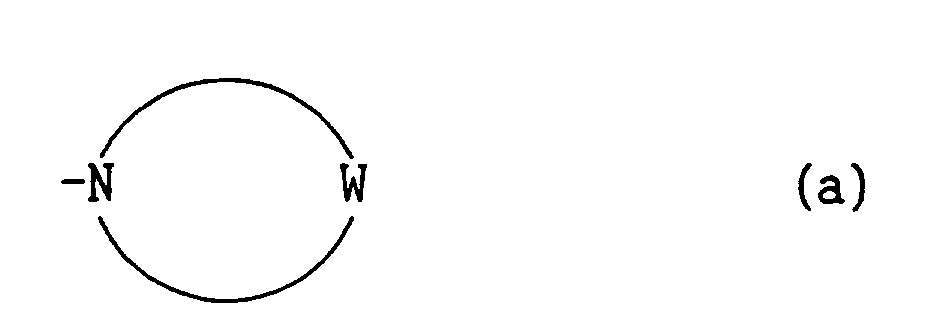
- In the above definitions and the present specification, the optionally substituted aryl represented by Ar is phenyl, 1-naphthyl, 2-naphthyl and the like, which may have, on its aromatic ring, 1 to 3 substituents selected from the group of halogen, alkyl having 1 to 4 carbon atoms, alkoxy having 1 to 4 carbon atoms, trifluoromethyl, nitro, amino, cyano and hydroxy. The optionally substituted heteroaryl is pyridyl (e.g., 2-pyridyl, 3-pyridyl and 4-pyridyl), quinolyl (e.g., 2-quinolyl and 3-quinolyl), indolyl (e.g., 2-indolyl and 3-indolyl), thienyl (e.g., 2-thienyl and 3-thienyl), furyl (e.g., 2-furyl and 3-furyl), benzofuranyl (e.g., 2-benzofuranyl and 3-benzofuranyl), 1H-benzoimidazol-2-yl, 2-benzothiazolyl and the like, which may have, on its ring, 1 to 3 substituents selected from the group of halogen, alkyl having 1 to 4 carbon atoms, alkoxy having 1 to 4 carbon atoms, trifluoromethyl, nitro, amino, cyano and hydroxy. Ar is aryl having substituent at the 5-position, with particular preference given to phenyl.
- The benzene, thiophene or pyridine as the cyclic A denotes the following, with particular preference given to benzene.

The alkyl is that having 1 to 20 carbon atoms, such as methyl, ethyl, propyl, isopropyl, butyl, isobutyl, tert-butyl, pentyl, isopentyl, tert-pentyl, hexyl, octyl, 2-ethylhexyl, 1,1,3,3-tetramethylbutyl, nonyl, decyl, dodecyl, tetradecyl, octadecyl and icosyl, with preference given to alkyl having 1 to 4 carbon atoms and particular preference given to methyl. - The cycloalkyl is that having 3 to 8 carbon atoms such as cyclopropyl, cyclobutyl, cyclopentyl, cyclohexyl, cycloheptyl and cyclooctyl, with preference given to cyclohexyl.
- The cycloalkylalkyl is the above-mentioned alkyl substituted by cycloalkyl having 3 to 8 carbon atoms, and is exemplified by cyclopropylmethyl, cyclobutylmethyl, cyclopentylmethyl, cyclohexylmethyl, cycloheptylmethyl, cyclooctylmethyl, 2-cyclopentylethyl, 2-cyclohexylethyl and 3-cyclohexylpropyl.
- The aralkyl is benzyl, 1-phenylethyl, 2-phenylethyl, 3-phenylpropyl, 4-phenylbutyl, 1-naphthylmethyl, 2-naphthylmethyl, diphenylmethyl and the like, which may have, on its aromatic ring, 1 to 3 substituents selected from the group of halogen, alkyl having 1 to 4 carbon atoms, alkoxy having 1 to 4 carbon atoms, trifluoromethyl, nitro, amino, cyano and hydroxy, with preference given to benzyl.
- The alkoxy is that having 1 to 20 carbon atoms such as methoxy, ethoxy, propoxy, isopropoxy, butoxy, isobutoxy, tert-butoxy, pentyloxy, hexyloxy, octyloxy, decyloxy, dodecyloxy, octadecyloxy and icosyloxy, with preference given to alkoxy having 1 to 4 carbon atoms. Particularly preferred is methoxy.
- The alkylamino is that having 1 to 8 carbon atoms such as methylamino, ethylamino, propylamino, isopropylamino, butylamino, isobutylamino, tert-butylamino, pentylamino, isopentylamino, hexylamino, heptylamino and octylamino, with preference given to alkylamino having 1 to 4 carbon atoms.
- The halogen is chlorine, bromine, fluorine or iodine.
- The optionally substituted aryl is phenyl or naphthyl, and may have 1 to 3 substituents selected from halogen, alkyl having 1 to 4 carbon atoms, alkoxy having 1 to 4 carbon atoms, trifluoromethyl, nitro, amino, cyano and hydroxy. The aryl at R⁷ may have a substituent on its ring, such as carboxyalkyl (e.g., carboxymethyl, 2-carboxyethyl, 1-carboxyethyl, 1-carboxypropyl and 1-carboxybutyl, with preference given to carboxymethyl), alkoxycarbonylalkyl (e.g., methoxycarbonylmethyl, ethoxycarbonylmethyl, 2-methoxycarbonylethyl, 1-methoxycarbonylethyl, 1-methoxycarbonylpropyl and 1-methoxycarbonylbutyl, with preference given to methoxycarbonylmethyl) and 1H-tetrazol-5-yl. Preferred aryl is phenyl. Aryl at R⁷ is preferably phenyl substituted by, for example, methyl, methoxy, halogen, carboxymethyl or 1H-tetrazol-5-yl.
- The optionally substituted heteroaryl is, for example, pyridyl (e.g., 2-pyridyl, 3-pyridyl and 4-pyridyl), quinolyl (e.g., 2-quinolyl and 3-quinolyl), indolyl (e.g., 2-indolyl and 3-indolyl), thienyl (e.g., 2-thienyl and 3-thienyl), furyl (e.g., 2-furyl and 3-furyl), benzofuranyl (e.g., 2-benzofuranyl and 3-benzofuranyl), 1H-benzimidazol-2-yl or 2-benzothiazolyl, which may be substituted by 1 to 3 substituents selected from halogen, alkyl having 1 to 4 carbon atoms, alkoxy having 1 to 4 carbon atoms, trifluoromethyl, nitro, amino, cyano and hydroxy.
- The heteroaryl at R⁶, R⁷ and R⁸ may have a substituent on its ring, such as carboxyalkyl (e.g., carboxymethyl, 2-carboxyethyl, 1-carboxyethyl, 1-carboxypropyl and 1-carboxybutyl) and alkoxycarbonylalkyl (e.g., methoxycarbonylmethyl, ethoxycarbonylmethyl, 2-methoxycarbonylethyl, 1-methoxycarbonylethyl, 1-methoxycarbonylpropyl and 1-methoxycarbonylbutyl), and heteroaryl at R⁶ is preferably indolyl (e.g., 2-indolyl and 3-indolyl). The heteroaryl at R⁷ is preferably pyridyl or pyridyl substituted by methyl or methoxy.
- The arylamino is, for example, phenylamino or naphthylamino, and may have 1 to 3 substituents selected from halogen, alkyl having 1 to 4 carbon atoms, alkoxy having 1 to 4 carbon atoms, trifluoromethyl, nitro, amino, cyano and hydroxy, with preference given to phenylamino.
- The aralkylamino is, for example, benzylamino, 2-phenylethylamino, 3-phenylpropylamino or 4-phenylbutylamino, and may have 1 to 3 substituents selected from halogen, alkyl having 1 to 4 carbon atoms, alkoxy having 1 to 4 carbon atoms, trifluoromethyl, nitro, amino, cyano and hydroxy.
- The amino protected by a protecting group is, for example, phthalimide, benzyloxycarbonylamino, tert-butoxycarbonylamino or triphenylmethylamino.
- The alkenyl is that having 2 to 8 carbon atoms, such as vinyl, 1-propenyl, 2-propenyl, 2-pentenyl, 3-hexenyl and 6-octenyl.
- When R⁵, R⁶, R⁹ or R¹¹ is hydroxy, the compound of the formula (I) has a carboxyl group. The present invention embraces carboxylate which is easily hydrolyzed in the body and becomes free carboxylic acid or its salt, such as alkanoyloxyalkyl ester (e.g., acetoxymethyl, pivaloyloxymethyl, 1-acetoxyethyl and 1-pivaloyloxyethyl), alkoxycarbonyloxyalkyl ester (e.g., ethoxycarbonyloxymethyl and 1-ethoxycarbonyloxyethyl), ester (e.g., phthalidyl and dimethoxyphthalidyl), carbamoylalkyl ester (e.g., carbamoylmethyl, 2-carbamoylethyl, N-methylcarbamoylmethyl, N,N-dimethylcarbamoylmethyl and N,N-diethylcarbamoylmethyl), alkoxyalkyl ester (e.g., methoxymethyl and methoxyethyl) and 5-methyl-1,3-dioxolen-2-on-4-ylmethyl ester.
- The cyclic amino represented by the formula (a) at R⁹ is, for example, 1-pyrrolidinyl, piperidino, morpholino, 1-piperazinyl or 1-piperazinyl substituted by alkyl having 1 to 4 carbon atoms, acyl (e.g., acetyl, propionyl and benzoyl) or benzyl, at the 4-position.
- With respect to the substituents for aryl, aralkyl, heteroaryl, aryl ring or heteroaryl ring, halogen means chlorine, fluorine, bromine or iodine, alkyl having 1 to 4 carbon atoms means methyl, ethyl, propyl, isopropyl, butyl, isobutyl or tert-butyl, with preference given to methyl, and alkoxy having 1 to 4 carbon atoms means methoxy, ethoxy, propoxy, isopropoxy, butoxy, isobutoxy and tert-butoxy, with preference given to methoxy.
- The preferable compounds of the formula (I) are:
(+)-N-(1-methyl-2-oxo-5-phenyl-2,3-dihydro-1H-1-benzazepin-3-yl)-2-indolecarboxamide,
(+)-N-(1-ethoxycarbonylmethyl-2-oxo-5-phenyl-2,3-dihydro-1H-1-benzazepin-3-yl)-2-indolecarboxamide,
(+)-N-(1-(2'-methylphenacyl)-2-oxo-5-phenyl-2,3-dihydro-1H-1-benzazepin-3-yl)-2-indolecarboxamide,
(+)-N-(1-tert-butoxycarbonylmethyl-2-oxo-5-phenyl-2,3-dihydro-1H-1-benzazepin-3-yl)-2-indolecarboxamide,
(+)-N-(1-isopropoxycarbonylmethyl-2-oxo-5-phenyl-2,3-dihydro-1H-1-benzazepin-3-yl)-2-indolecarboxamide,
(+)-N-(1-tert-butylaminocarbonylmethyl-2-oxo-5-phenyl-2,3-dihydro-1H-1-benzazepin-3-yl)-2-indolecarboxamide,
(+)-N-(1-diethylaminocarbonylmethyl-2-oxo-5-phenyl-2,3-dihydro-1H-1-benzazepin-3-yl)-2-indolecarboxamide, and
(+)-N-(2-oxo-5-phenyl-1-(pyrrolidin-1-ylcarbonylmethyl)-2,3-dihydro-1H-1-benzazepin-3-yl)-2-indolecarboxamide, and these compounds show particularly strong affinity for CCK-A receptor. - The following compounds of the formula (I) are also preferred.
(-)-1-(1-ethoxycarbonylmethyl-2-oxo-5-phenyl-2,3-dihydro-1H-1-benzazepin-3-yl)-3-(3-methylphenyl)urea,
(-)-1-(1-ethoxycarbonylmethyl-2-oxo-5-phenyl-2,3-dihydro-1H-1-benzazepin-3-yl)-3-(4-methylphenyl)urea,
(-)-1-(1-ethoxycarbonylmethyl-2-oxo-5-phenyl-2,3-dihydro-1H-1-benzazepin-3-yl)-3-(3-methoxyphenyl)urea,
(-)-1-(1-(2'-methylphenacyl)-2-oxo-5-phenyl-2,3-dihydro-1H-1-benzazepin-3-yl)-3-(4-methylphenyl)urea,
(-)-1-(1-(2'-methylphenacyl)-2-oxo-5-phenyl-2,3-dihydro-1H-1-benzazepin-3-yl)-3-(2-methylphenyl)urea,
(-)-1-(4-methoxyphenyl)-3-(1-(2'-methylphenacyl)-2-oxo-5-phenyl-2,3-dihydro-1H-1-benzazepin-3-yl)urea,
(-)-1-(2-chlorophenyl)-3-(1-(2'-methylphenacyl)-2-oxo-5-phenyl-2,3-dihydro-1H-1-benzazepin-3-yl)urea,
(-)-1-(3-carboxymethylphenyl)-3-(1-(2'-methylphenacyl)-2-oxo-5-phenyl-2,3-dihydro-1H-1-benzazepin-3-yl)urea,
(-)-1-(3-carboxymethylphenyl)-3-(1-ethoxycarbonylmethyl-2-oxo-5-phenyl-2,3-dihydro-1H-1-benzazepin-3-yl)urea,
(-)-1-(1-tert-butoxycarbonylmethyl-2-oxo-5-phenyl-2,3-dihydro-1H-1-benzazepin-3-yl)-3-(3-methylphenyl)urea,
(-)-1-(3-methylphenyl)-3-(2-oxo-5-phenyl-1-isopropoxycarbonylmethyl-2,3-dihydro-1H-1-benzazepin-3-yl)urea,
(-)-1-(1-tert-butylaminocarbonylmethyl-2-oxo-5-phenyl-2,3-dihydro-1H-1-benzazepin-3-yl)-3-(3-methylphenyl)urea,
(-)-1-(3-methylphenyl)-3-(2-oxo-5-phenyl-1-(pyrrolidin-1-ylcarbonylmethyl)-2,3-dihydro-1H-1-benzazepin-3-yl)urea,
(-)-1-(2-methylpyridin-6-yl)-3-(2-oxo-5-phenyl-1-(pyrrolidin-1-ylcarbonylmethyl)-2,3-dihydro-1H-1-benzazepin-3-yl)urea,
(-)-1-(2-methoxypyridin-5-yl)-3-(2-oxo-5-phenyl-1-(pyrrolidin-1-ylcarbonylmethyl)-2,3-dihydro-1H-1-benzazepin-3-yl)urea,
(-)-1-(1-diethylaminocarbonylmethyl-2-oxo-5-phenyl-2,3-dihydro-1H-1-benzazepin-3-yl)-3-(3-methylphenyl)urea,
(-)-1-(1-diethylaminocarbonylmethyl-2-oxo-5-phenyl-2,3-dihydro-1H-1-benzazepin-3-yl)-3-(3-(1H-tetrazol-5-yl)phenyl)urea,
(-)-1-(1-diethylaminocarbonylmethyl-2-oxo-5-phenyl-2,3-dihydro-1H-1-benzazepin-3-yl)-3-(4-(1H-tetrazol-5-yl)phenyl)urea, and
(-)-1-(2-oxo-5-phenyl-1-(pyrrolidin-1-ylcarbonylmethyl)-2,3-dihydro-1H-1-benzazepin-3-yl)-3-(3-(1H-tetrazol-5-yl)phenyl)urea.
These compounds have particularly strong affinity for CCK-B receptor. - The pharmaceutically acceptable salts of the compound of the formula (I) include addition salts with inorganic acid or organic acid, and salts with inorganic base, organic base or amino acid, which are preferably substantially nontoxic in view of the object of the present invention.
- The compounds of the present invention can be prepared, for example, by the following method.
- A compound which can be produced according to the method described in J. Med. Chem., vol. 14, p 40 (1971) and is represented by the formula

wherein each symbol is as defined above, is converted to a compound (III) by a method known in the field, which comprises introducing the compound (II) into a 3-halogen derivative (e.g., 3-chloro compound) by a treatment with phosphorus pentachloride and then hydrogenation, subjecting the obtained derivative to a treatment with phthalimide salt (e.g., potassium phthalimide), metal azide and the like, and reduction and hydrolysis as necessary, whereby a 3-aminoazepine compound of the formula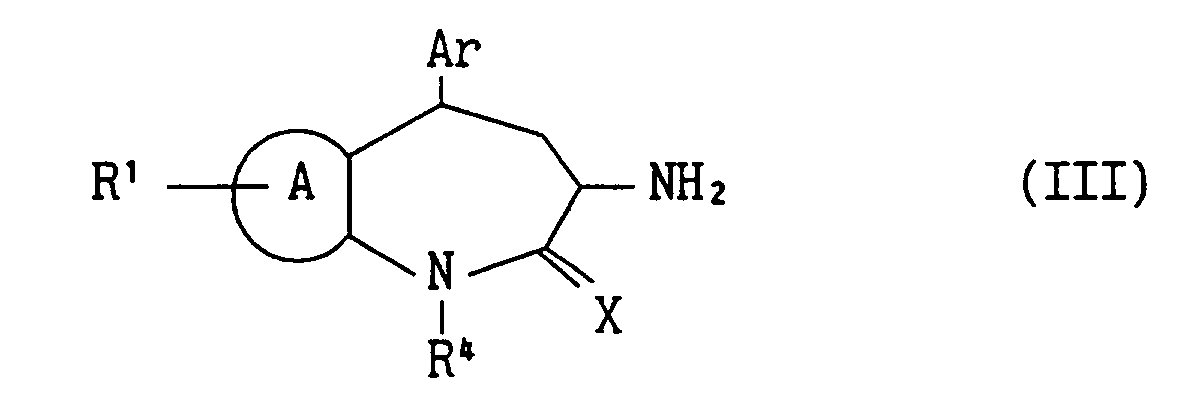
wherein each symbol is as defined above, can be obtained. - The compound of the formula (III) is protected with a suitable amino protecting group such as phthaloyl, benzyloxycarbonyl, tert-butyloxycarbonyl and triphenylmethyl) to give a compound of the formula

wherein R¹² is a conventional protecting group of amino group, such as phthaloyl, benzyloxycarbonyl, tert-butoxycarbonyl and triphenylmethyl, and other symbols are as defined above. - A compound of the formula

wherein each symbol is as defined above, can be obtained according to the method described in Japanese Patent Unexamined Publication No. 250354/1989). - The compound of the formula (IV) or (V) is treated with a suitable halogenating agent, for example, by treating with halogen such as chlorine and bromine, or a halogenating agent such as NBS (N-bromosuccinimide) and NCS (N-chlorosuccinimide), in an inert solvent such as carbon tetrachloride. Where necessary, the treatment can be conducted in the presence of AIBN (azobisisobutyronitrile) or under irradiation of light. The obtained compound is subsequently treated under the basic conditions as necessary, for example, by treating in an inert solvent such as toluene and tetrahydrofuran using an organic base such as DBU (1,8-diazabicyclo[5.4.0]undeca-7-ene), potassium tert-butoxide, sodium methylate and sodium ethylate, at room temperature or under heating, or by the use of an aqueous solution of alkali such as sodium hydroxide and potassium hydroxide. Alternatively, the compound is heated. Then, the obtained compound is subjected to the elimination of the protecting group under suitable conditions to give a compound of the formula
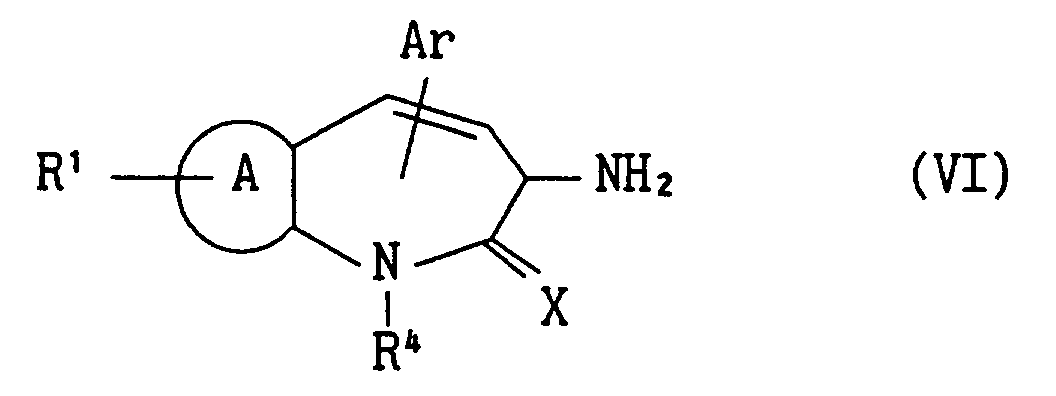
wherein each symbol is as defined above. - The compound of the present invention can be also obtained by treating the compound of the formula (III), (IV), (V) or (VI) by one or two from the following methods in combination.
- The compound is reacted with a compound of the formula
R¹³-Z (VII)
wherein R¹³ is alkyl, aralkyl, a group of the formula
-(CH₂)l'C(=Y)-R⁶
wherein l' is an integer of 1-6 and other symbols are as defined above, or a group of the formula
-(CH₂)m'S(O)n-R⁸
wherein m' is an integer of 1-6 and other symbols are as defined above, and Z is a group capable of leaving, such as halogen, methanesulfonyloxy and toluenesulfonyloxy. - The reaction proceeds in an inert solvent in the presence of a tertiary base such as triethylamine, pyridine and N,N-dimethylaniline, or an alkali such as sodium hydrogencarbonate, sodium carbonate, potassium carbonate, sodium hydroxide, potassium hydroxide, sodium hydride, sodium methoxide, sodium ethoxide, potassium tert-butoxide and lithium diisopropylamide, under cooling, at room temperature or under heating. Examples of the inert solvent include benzene, toluene, xylene, methanol, ethanol, ethyl ether, dioxane, tetrahydrofuran, chloroform, dichloromethane, dichloroethane, hexamethylphosphoric amide, diethylene glycol, dimethylformamide and mixed solvent thereof.
- The compound is reacted with an iso(thio)cyanate of the formula
R⁷-NCY (VIII)
wherein each symbol is as defined above. - The reaction proceeds in a suitable solvent which does not inhibit the instant reaction. Examples of the solvent include organic solvents such as tetrahydrofuran, diethyl ether, diisopropyl ether, dioxane, dichloromethane, chloroform, ethyl acetate, benzene, toluene, xylene, dimethylformamide and dimethylacetamide. While the temperature of condensation varies depending on the reagent and solvent to be used, it is generally preferred to be between -20°C and the boiling point of the solvent.
- The compound is reacted with a carboxylic acid of the formula
R⁶-COOH (IX)
wherein R⁶ is as defined above, or a reactive derivative thereof. The reaction substantially belongs to amidation and the following amidation method and peptide synthesis known per se can be applied. - (1) When the compound of the formula (IX) is a free carboxylic acid, the reaction is carried out in an inert solvent in the presence of a condensing agent such as dicyclohexylcarbodiimide, titanium tetrachloride, phosphorus halide (e.g., phosphorus chloride and phosphorus oxychloride), diethyl chlorophosphite, o-phenylene chlorophosphite and ethyl dichlorophosphite, under cooling, at room temperature or under heating. The compound of the formula (III), (IV), (V) or (VI) may be previously reacted with a halogenated phosphorus in an inert solvent and condensed with the compound of the formula (IX). For example, when the halogenated phosphorus is phosphorus trichloride, about 1/2 mol of phosphorus trichloride is reacted with the compound of the formula (III), (IV), (V) or (VI), in an inert solvent in the presence of a tertiary base such as triethylamine, pyridine and N,N-dimethylaniline, under cooling or at room temperature, and then the obtained compound is reacted with the compound of the formula (IX) at room temperature or under heating, preferably under heating with reflux.
- (2) When an acid halide (e.g., acid chloride and acid bromide) is used as a reactive derivative of the compound of the formula (IX), the reaction is carried out in an inert solvent in the presence of a tertiary base such as triethylamine, pyridine and N,N-dimethylaniline, under cooling or at room temperature, or in the presence of an alkali such as sodium hydroxide and potassium hydroxide, under cooling in water or at room temperature.
- (3) When an acid azide is used as a reactive derivative of the compound of the formula (IX), the reaction is carried out in the presence of an alkali such as sodium hydroxide and potassium hydroxide, under cooling in water or at room temperature.
- (4) When an ester such as methyl ester, ethyl ester, p-nitrophenyl ester and p-chlorophenyl ester is used as a reactive derivative of the compound of the formula (IX), the reaction is carried out in an inert solvent (or excess amount of the compound of the formula (III), (IV), (V) or (VI) used may act as a solvent) at room temperature or under heating, preferably under heating with reflux.
- (5) When an asymmetric acid anhydride or a mixed acid anhydride such as alkyl-carbonic acid mixed acid anhydride, alkyl-phosphoric acid mixed acid anhydride, alkyl-phosphorous acid mixed acid anhydride and sulfuric acid mixed acid anhydride is used as a reactive derivative of the compound of the formula (IX), the reaction is carried out in an inert solvent in the presence of a tertiary base such as triethylamine, pyridine and N,N-dimethylaniline, under cooling, at room temperature or under heating.
- (6) When an active amide such as acid imidazolide, acid pyrrolidide and 2,4-dimethylpyrazolide is used as a reactive derivative of the compound of the formula (IX), the reaction is carried out in an inert solvent at room temperature or under heating.
- Examples of the inert solvent to be used in the aforementioned respective condensation reactions include benzene, toluene, xylene, methanol, ethanol, ethyl ether, dioxane, tetrahydrofuran, chloroform, dichloromethane, dichloroethane, hexamethylphosphoric amide, diethylene glycol, dimethylformamide and mixed solvent thereof, which is appropriately selected according to the kind of the reactive derivative.
- A compound of the formula (I) wherein R⁴ and X are bonded to each other to form a group of the formula -C(R¹⁰)=N-N= is obtained by reacting a compound of the formula (I) wherein X is oxygen and R⁴ is hydrogen, namely, the compound of the formula

wherein each symbol is as defined above, with a thionating reagent to give a compound of the formula
wherein each symbol is as defined above, and reacting this compound of the formula (XI) with a compound of the formula
R¹⁰CONHNH₂ (XII)
wherein R¹⁰ is as defined above; or by reacting a compound of the formula (XI) with a hydrazine hydrate to give a compound of the formula
wherein each symbol is as defined above, and reacting this compound with a compound of the formula
R¹⁰COOH (XIV)
wherein R¹⁰ is as defined above, or a reactive derivative thereof, or a compound of the formula
R¹⁰C(OR¹⁴)₃ (XV)
wherein R¹⁴ is alkyl such as methyl and ethyl and R¹⁰ is as defined above. - In the above-mentioned methods, examples of the thionating reagent include phosphorus pentasulfide and Lawesson's reagent [2,4-bis(4-methoxyphenyl)-1,3,2,4-dithiadiphosphetane-2,4-disulfide], and examples of the reactive derivative of the compound of the formula (XIV) include acid halide, acid anhydride, mixed acid anhydride, C₁-C₅ alkyl ester and benzyl ester.
- The reaction between the compound of the formula (X) and the thionating reagent generally proceeds in a solvent inert to the reaction, such as benzene, toluene, xylene, tetrahydrofuran, chloroform, dioxane and mixed solvent thereof, at 30-100°C for 30 minutes to 5 hours.
- The reaction between the compound of the formula (XI) and the compound of the formula (XII) generally proceeds in a solvent inert to the reaction, such as benzene, toluene, xylene, tetrahydrofuran, dioxane and mixed solvent thereof, in the presence of an organic acid such as acetic acid and propionic acid, inorganic acid such as hydrochloric acid and sulfuric acid or silica gel, at room temperature to the refluxing temperature of the solvent used, for 30 minutes to 5 hours. The reaction between the compound of the formula (XI) and the hydrazine hydrate generally proceeds in a solvent inert to the reaction, such as methanol, ethanol, propanol, isopropyl alcohol and butanol, at 0-40°C for 5 minutes to about 3 hours.
- The reaction between the compound of the formula (XIII) and the compound of the formula (XIV) or a reactive derivative thereof or a compound of the formula (XV) proceeds in a solvent inert to the reaction, such as benzene, toluene, xylene, tetrahydrofuran, dioxane and mixed solvent thereof, in the presence of an organic acid such as acetic acid and propionic acid, inorganic acid such as hydrochloric acid and sulfuric acid or silica gel, at room temperature to the refluxing temperature of the solvent used, for 30 minutes to 6 hours.
- A more preferable production method includes the following steps. A compound of the formula

wherein each symbol is as defined above, which can be obtained according to the process described in J. Med. Chem., vol. 14, p 40 (1971), is converted to a 3-halogen derivative according to the process of Method 1, and reacted with a phthalimide salt (e.g., potassium phthalimide) in a solvent inert to the reaction, such as dimethylformamide, toluene, xylene, benzene and mixed solvent thereof, at room temperature to the refluxing temperature of the solvent used, for 1 to 24 hours to give a compound of the formula
wherein each symbol is as defined above. The compound of the formula (XVII) is reacted with a compound of the formula
R⁴-Z (XVIII)
wherein each symbol is as defined above, to give a compound of the formula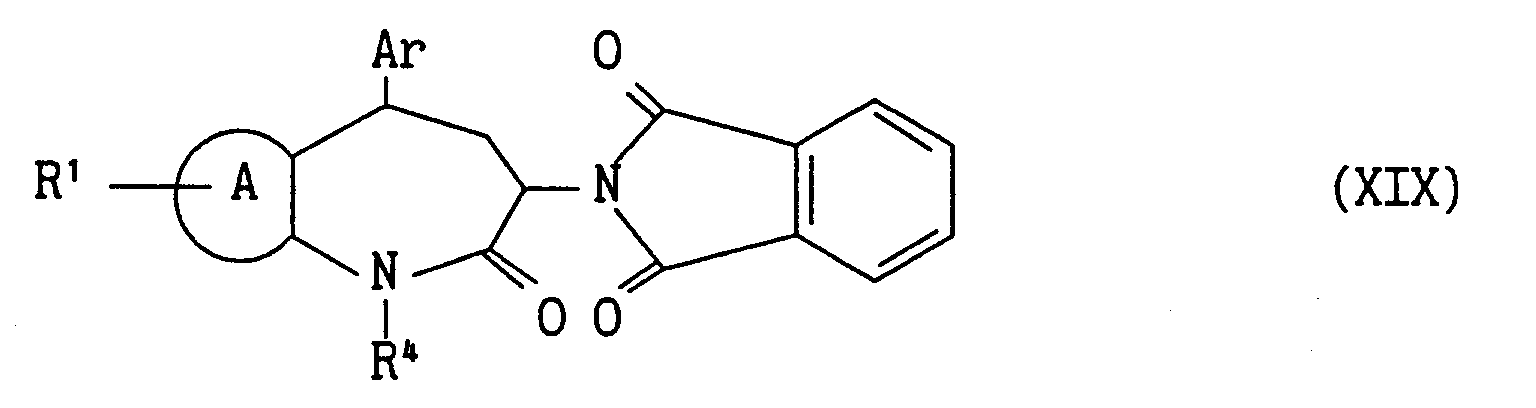
wherein each symbol is as defined above, and this compound is treated according to the process of Method 4, and then according to one or two from Method 5, Method 6 and Method 7 to give a compound of the formula (I). - The reaction between the compound of the formula (XVII) and the compound of the formula (XVIII) is carried out in an inert solvent in the presence of a tertiary base such as triethylamine, pyridine and N,N-dimethylaniline, or an alkali such as sodium hydrogencarbonate, sodium carbonate, potassium carbonate, sodium hydroxide, potassium hydroxide, sodium hydride, sodium methoxide, sodium ethoxide, potassium tert-butoxide and lithium diisopropylamide, under cooling, at room temperature or under heating. Examples of the inert solvent include benzene, toluene, xylene, methanol, ethanol, ethyl ether, dioxane, tetrahydrofuran, chloroform, dichloromethane, dichloroethane, hexamethylphosphoric amide, diethylene glycol, dimethylformamide and mixed solvent thereof.
- The compound of the formula (I) wherein R⁴ is represented by the formula
-(CH₂)pCOR⁹
wherein p is 0 or an integer of 1-6 and R⁹ is hydroxy, namely, the compound of the formula
wherein each symbol is as defined above, can be easily produced by subjecting the compound of the formula (I) wherein R⁴ is represented by the formula
-(CH₂)pCOR⁹
wherein p is 0 or an integer of 1-6 and R⁹ is alkoxy, to hydrolysis known in the pertinent field. - The compound of the formula (I) wherein R⁴ is represented by the formula
-(CH₂)pCOR⁹
wherein p is 0 or an integer of 1-6 and R⁹ is amino, alkylamino, arylamino, aralkylamino, or a cyclic amino of the formula (a) can be produced by condensing the compound of the formula (XX) with an amine of the formula
R⁹-H (XXI)
wherein R⁹ is as defined above, or a reactive derivative thereof. The reaction substantially belongs to amidation and the following amidation method and peptide synthesis known per se can be applied. - (1) When the compound of the formula (XX) is a free carboxylic acid, the reaction is carried out in an inert solvent in the presence of a condensing agent such as dicyclohexylcarbodiimide, titanium tetrachloride, phosphorus halide (e.g., phosphorus chloride and phosphorus oxychloride), diethyl chlorophosphite, o-phenylene chlorophosphite and ethyl dichlorophosphite, under cooling, at room temperature or under heating.
- (2) When an acid halide (e.g., acid chloride and acid bromide) is used as a reactive derivative of the compound of the formula (XX), the reaction is carried out in an inert solvent in the presence of a tertiary base such as triethylamine, pyridine and N,N-dimethylaniline, under cooling or at room temperature, or in the presence of an alkali such as sodium hydroxide and potassium hydroxide under cooling in water or at room temperature.
- (3) When an acid azide is used as a reactive derivative of the compound of the formula (XX), the reaction is carried out in the presence of an alkali such as sodium hydroxide and potassium hydroxide under cooling in water or at room temperature.
- (4) When an ester such as methyl ester, ethyl ester, p-nitrophenyl ester and p-chlorophenyl ester is used as a reactive derivative of the compound of the formula (XX), the reaction is carried out in an inert solvent, at room temperature or under heating, preferably under heating with reflux.
- (5) When an asymmetric acid anhydride or a mixed acid anhydride such as alkyl-carbonic acid mixed acid anhydride, alkyl-phosphoric acid mixed acid anhydride, alkyl-phosphorous acid mixed acid anhydride and sulfuric acid mixed acid anhydride is used as a reactive derivative of the compound of the formula (XX), the reaction is carried out in an inert solvent in the presence of a tertiary base such as triethylamine, pyridine and N,N-dimethylaniline, under cooling or under heating.
- (6) When an active amide such as acid imidazolide, acid pyrrolidide and 2,4-dimethylpyrazolide is used as a reactive derivative of the compound of the formula (XX), the reaction is carried out in an inert solvent at room temperature or under heating.
- Examples of the inert solvent to be used in the aforementioned respective condensation reactions include benzene, toluene, xylene, methanol, ethanol, ethyl ether, dioxane, tetrahydrofuran, chloroform, dichloromethane, dichloroethane, hexamethylphosphoric amide, diethylene glycol, dimethylformamide and mixed solvent thereof, which is appropriately selected according to the kind of the reactive derivative.
- The compound of the formula (I) thus obtained can be separated and purified from the reaction mixture by a method known per se, such as recrystallization and column chromatography.
- The compound of the formula (I) can be converted to a salt by treating with an inorganic acid such as hydrochloric acid, hydrobromic acid, sulfuric acid, phosphoric acid and nitric acid, organic acid such as acetic acid, propionic acid, succinic acid, glycolic acid, lactic acid, malic acid, tartaric acid, citric acid, ascorbic acid, maleic acid, fumaric acid, methanesulfonic acid, toluenesulfonic acid and benzenesulfonic acid, inorganic base such as sodium hydroxide, potassium hydroxide, calcium hydroxide, magnesium hydroxide, zinc hydroxide and ammonium hydroxide, organic base such as methylamine, diethylamine, triethylamine, dicyclohexylamine, triethanolamine, ethylenediamine, trishydroxymethylaminomethane, quinine, guanidine and cinchonine, or amino acid such as lysine, ornithine, arginine and alanine, according to a conventional method.
- When the compound of the present invention has a chiral carbon atom, the compound is generally obtained as a racemate. The racemate can be resolved into optical isomers by a conventional method. It can be also resolved by liquid chromatography using an optically active column. Alternatively, it may be converted to a diastereomer by condensing with an optically active compound, isolated into an optically active derivative by fractional recrystallization or column chromatography using suitable solvent, and subjected to hydrolysis. Such optical isomers can be also produced by using an optically active starting material. Respective diastereomers can be purified by fractional crystallization or chromatography.
- The pharmacological action of the compound (I) is determined as in the following.
- The whole pancreas was removed from a male rat. The fat tissues were removed and the pancreas was homogenized (Brinkman Polytron PT20) in 50 mM Tris hydrochloric acid (pH 7.5). The homogenate was filtered through a nylon cloth (120 mesh) and centrifuged at 50,000 × g for 12 minutes. The obtained sediment was homogenized in Tris buffer as in the above and centrifuged. The sediment was suspended in a buffer for binding assay [50 mM Tris-HCl (pH 7.2) containing 5 mM magnesium chloride, 5 mM dithiothreitol, 2 mg/ml bovine serum albumin, 0.1 mg/ml bacitracin and 0.14 mg/ml trypsin inhibitor (soybean)] and used as a receptor source.
- For binding assay, 50 µl of a buffer (for total binding), unlabeled CCK-8 sulfate (for nonspecific binding) having a final concentration of 1 5M or a test compound (for determining inhibition of ¹²⁵I-CCK binding) and 50 µl of ¹²⁵I-CCK-8 (63-67 TBq/mmol, 40,000-50,000 cpm) were added to a membrane suspension (450 µl, containing 100 µg protein). The reaction mixture was incubated at 20°C for 30 minutes, filtered by suction through a glass fiber filter (Whatman GF/B), and immediately thereafter washed 3 times with ice-cooled Tris buffer (2.5 ml). The radioactive concentration on the filter was measured.
- In the case of the central nervous system, cerebral cortex from rat was prepared and suspended in a buffer, pH 6.5, containing 5 mM magnesium chloride, 1 mM EGTA [ethylene glycol bis(2-aminoethylether)tetraacetic acid], 360 mM sodium chloride, 15 mM potassium chloride, 20 mM HEPES (N-2-hydroxyethylpiperazine-N'-2-ethanesulfonic acid) and 0.25 mg/ml bacitracin. For binding assay, 50 µl of a buffer (for total binding), unlabeled CCK-8 sulfate (for nonspecific binding) having a final concentration of 1 µM or a test compound (for determining inhibition of ¹²⁵I-CCK binding) and 50 µl of ¹²⁵I-CCK-8 (63-67 TBq/mmol, 40,000 - 50,000 cpm) were added to a membrane suspension (450 µl, containing 100 µg protein). The reaction mixture was incubated at 20°C for 30 minutes, filtered by suction through a glass fiber filter (Whatman GF/B), and immediately thereafter washed 3 times with ice-cooled Tris buffer (2.5 ml). The radioactive concentration on the filter was measured.
- The effects of the test compound with regard to the CCK receptor binding in Experimental Examples 1 and 2 were evaluated by determining an inhibition ratio by the following formula, which shows the concentration (IC₅₀, nM) inhibiting 50% of the specific binding. The results are shown in Table 1.

Table 1 test compounds binding affinity (Ki,nM) selectivity (A/B) CCK-A CCK-B Example 36 4.7 >1000 <0.0047 Example 46 100 0.87 110 Example 48 210 2.1 100 Example 52 110 0.92 120 Example 66 310 2.5 124 Example 64 200 1.1 180 Example 68 150 1.1 140 Example 74 290 2.4 120 Example 81 42 >1000 <0.042 L-365260 390 19 21 - The comparison compound L-365260 is (R)-N-(2,3-dihydro-1-methyl-2-oxo-5-phenyl-1H-1,4-benzodiazepin-3-yl)-N'-(3-methylphenyl)urea which is disclosed in US Patent No. 4,820,834.
- As is evident from the results shown in Table 1, the compounds of Example 36 and Example 81 showed strong, selective affinity for CCK-A receptor and the other compounds showed strong, selective affinity for CCK-B receptor.
- Gastrin mucosal membrane obtained from guinea pig was immersed in a buffer, pH 7.4, containing 130 mM sodium chloride, 12 mM sodium bicarbonate, 3 mM sodium dihydrogenphosphate, 3 mM disodium hydrogenphosphate, 3 mM dipotassium hydrogenphosphate, 2 mM magnesium sulfate, 1 mM calcium chloride, 5 mM glucose, 4 mM L-glutamine and 25 mM HEPES, and incubated at 37°C for 40 minutes. The gastrin gland was released from this tissue and filtered through 200 mesh nylon. The filtered gastrin gland was centrifuged at 270 g for 5 minutes and washed twice by resuspension and centrifugation. For binding assay, 50 µl of a buffer (for total binding), unlabeled CCK-8 sulfate (for nonspecific binding) having a final concentration of 1 µM or a test compound (for determining inhibition of ¹²⁵I-CCK binding) and 50 µl of ¹²⁵I-CCK-8 (63-67 TBq/mmol, 40,000 - 50,000 cpm) were added to a membrane suspension (450 µl, containing 100 µg protein). The reaction mixture was incubated at 20°C for 30 minutes, filtered by suction through a glass fiber filter (Whatman G/FB), and immediately thereafter washed 3 times with ice-cooled Tris buffer (2.5 ml). The radioactive concentration on the filter was measured.
- The test compound was administered to the test animals and the animals were killed by decapitation after a predetermined time. The brain was removed and the membrane specimens were prepared, and the receptor binding performance was measured according to Experimental Example 2. Inhibition of ex vivo CCK receptor binding performance was calculated based on the level of specific binding in the group administered with solvent as 100%.
- Male Lister hooded rats were used as 5 pairs per group. The test included administration of the test compound, placing a pair (two rats) of rats from different home cages in a test apparatus under 1200 lux illumination, videotaping their behavior for 10 minutes and analyzing the behavior. The indices of the behavior analyzed were the total time (SI time) of smelling and tail chasing between the rats which are called social interaction, and the number of times the rats crossed the line drawn on the apparatus floor. The former was used as the index of the anxiety condition of the animals and the latter that of locomotor activity.
- Wistar rats deprived of water for 48 hours were used. After the administration of the test compound, the rats were placed in the test apparatus, and the number of electric shock applied along with the water-drinking behavior for 3 minutes was recorded.
- SD male and female rats weighing 200-300 g (supplied by Seiwa Test Animals Corp.) were used. The test compound was administered intravenously or orally and blood samples were taken with the lapse of time from orbital vein layer while the animals were under light anesthetization with ether. The drug concentration in plasma was measured by the HPLC method. The BA value (F value) after the oral administration was calculated from the following formula.

- SD male rats weighing 200-300 g (supplied by Seiwa Test Animals Corp.) were used. The rats were fixed on the dorsal position under anesthetization with urethane, cannulated at the left femoral vein and intravenously administered at a constant rate. When the concentration in plasma reached a stationary stage, the rats were decapitated and the brain and blood were respectively taken. The drug concentration in brain and plasma was measured by the HPLC method. The Kp value at the stationary stage was calculated from the following formula.

- Male ddY mice were used at 10 per group. The compounds of Example 36 and Example 46 were intraperitoneally administered by 300 mg/kg and the mice were monitored for 5 days. No death case was found with regard to the both compounds.
- As described supra, the compound of the present invention showed strong affinity for CCK receptors and is useful as a highly safe pharmaceutical agent. Of the compounds of the present invention, those having 2-indolcarboxamide at the 3-position showed particularly strong affinity for CCK-A receptor and those having ureido at the 3-position showed particularly strong affinity for CCK-B receptor. The compounds of the present invention characteristically have superior dissolution property, high intracerebral transition, extremely high bioavailability and superior duration of effects.
- The compound of the present invention and acid addition salts thereof can be used as a pharmaceutical composition as they are or on admixing with carriers and excipients known per se, such as lactose, starch, sucrose and magnesium stearate. The administration route may be either oral or parenteral. The composition for oral administration may be solid or liquid. Typical dosage form includes, for example, tablet, pill, granule, powder, capsule, syrup, emulsion and suspension. The composition for parenteral administration includes, for example, injection, suppository, inhalant and percutaneous absorber, and examples of injection include subcutaneous injection, intradermic injection and intramuscular injection. Such injections can be prepared by a method known per se, that is, by suspending or emulsifying these compounds in a sterile aqueous solution (e.g., physiological saline and isotonic solution) or oily liquid (e.g., sesame oil and soybean oil) conventionally used for injections. Where necessary, a suitable suspending agent (e.g., sodium carboxymethylcellulose and nonionic surfactant), solubilizer (e.g., benzyl benzoate and benzyl alcohol) and the like may be also used. While the dose varies depending on administration target, administration route, symptom and the like, it is generally 0.1-500 mg, preferably 0.1-100 mg daily for an adult.
- The present invention is described in detail by way of Examples. It is needless to say that the present invention is not limited to these Examples. In the Examples to follow, the melting point noted was measured in the capillary, and nuclear magnetic resonance (NMR) was recorded using tetramethylsilan as an internal standard.
- 5-Phenyl-2,3,4,5-tetrahydro-1H-1-benzazepin-2-one (2.0 g) synthesized according to J. Med. Chem., vol. 14, p 40 (1971) and phosphorus pentachloride (5.3 g) in xylene (35 ml) are heated to 75°C, and the mixture is stirred for 3 hours. The solvent is distilled away, water (10 ml) is added, and the mixture is extracted with ethyl acetate (100 ml). After drying over anhydrous magnesium sulfate, the residue is concentrated under reduced pressure and purified by silica gel column chromatography (developing solvent: hexane : ethyl acetate = 5 : 1) to give 3,3-dichloro-5-phenyl-2,3,4,5-tetrahydro-1H-1-benzazepin-2-one (0.85 g), melting point 222-224°C (dec.).
- 3,3-Dichloro-5-phenyl-2,3,4,5-tetrahydro-1H-1-benzazepin-2-one (0.85 g), sodium acetate (0.57 g), sodium hydrophosphite (0.32 g) and 10% palladium-carbon (0.10 g) in acetic acid (50 ml) are stirred for 3 hours. The reaction mixture is filtered and the filtrate is concentrated, added with water (10 ml) and the mixture is extracted with ethyl acetate (100 ml). The extract is washed with aqueous sodium hydrogencarbonate solution, dried over anhydrous magnesium sulfate and concentrated under reduced pressure. Purification by silica gel column chromatography (developing solvent: hexane : ethyl acetate = 2 : 1) gave 3-chloro-5-phenyl-2,3,4,5-tetrahydro-1H-1-benzazepin-2-one (0.11 g), melting point 162-163°C (dec.).
- 3-Chloro-5-phenyl-2,3,4,5-tetrahydro-1H-1-benzazepin-2-one (0.14 g) and potassium phthalimide (0.11 g) in dimethylformamide (3 ml) is heated to 50°C and stirred for 24 hours. Water (5 ml) is added and the mixture is extracted with ethyl acetate (50 ml). After drying over anhydrous magnesium sulfate, the residue is concentrated under reduced pressure. The resulting crystals are collected by filtration to give 3-phthaloylamino-5-phenyl-2,3,4,5-tetrahydro-1H-1-benzazepin-2-one (0.03 g), melting point 237°C (dec.).
- 3-Phthaloylamino-5-phenyl-2,3,4,5-tetrahydro-1H-1-benzazepin-2-one (4.4 g), sodium hydride (60% oil mixture, 0.55 g) and methyl iodide (1.72 ml) in dimethylformamide (50 ml) are stirred under ice-cooling for one hour. The reaction mixture is poured in ice water and extracted with ethyl acetate (100 ml). After drying over anhydrous magnesium sulfate, the residue is concentrated under reduced pressure and crystallized from a mixed solvent of ethyl acetate - hexane. The crystals are collected by filtration to give 1-methyl-3-phthaloylamino-5-phenyl-2,3,4,5-tetrahydro-1H-1-benzazepin-2-one (2.4 g), melting point 205-209°C.
- 1-Methyl-3-phthaloylamino-5-phenyl-2,3,4,5-tetrahydro-1H-1-benzazepin-2-one (0.37 g), N-bromosuccinimide (0.38 g) and azobisisobutyronitrile (0.01 g) in carbon tetrachloride (25 ml) are stirred for one hour under irradiation of white light. The reaction mixture is filtered and the filtrate is concentrated. Water (10 ml) is added and the mixture is extracted with chloroform (100 ml). After drying over anhydrous magnesium sulfate, the residue is concentrated under reduced pressure. Purification by silica gel column chromatography (developing solvent: hexane : ethyl acetate = 2 : 1) gave 1-methyl-3-phthaloylamino-5-phenyl-2,3-dihydro-1H-1-benzazepin-2-one (0.37 g).
¹H-NMR(CDCl₃); 2.39(3/2H,s), 3.48(3/2H,s), 4.97(1/2H,d), 5.17(1/2H,d), 6.83(1/2H,d), 7.00(1/2H,d) - 1-Methyl-3-phthaloylamino-5-phenyl-2,3-dihydro-1H-1-benzazepin-2-one (0.37 g) and hydrazine·monohydrate (0.23 ml) in methanol (40 ml) are refluxed for one hour. Water (10 ml) is added, methanol is distilled away under reduced pressure and the residue is extracted with chloroform (100 ml). After drying over anhydrous magnesium sulfate, the residue is concentrated under reduced pressure. Purification by silica gel column chromatography (developing solvent: chloroform : methanol = 20 : 1) gave 3-amino-1-methyl-5-phenyl-2,3-dihydro-1H-1-benzazepin-2-one (0.11 g).
¹H-NMR(CDCl₃); 1.94(2H,s), 3.48(3H,s), 3.63(1H,d), 5.94(1H,d) - 3-Amino-1-methyl-5-phenyl-2,3-dihydro-1H-1-benzazepin-2-one (0.11 g) and m-tolylisocyanate (0.05 ml) in benzene (5 ml) are stirred for one hour. The resulting crystals are collected by filtration to give 0.12 g of crystals. The crystals are recrystallized from ethyl acetate to give 1-(1-methyl-2-oxo-2,3-dihydro-1H-1-benzazepin-3-yl)-3-(3-methylphenyl)urea, melting point 226-227°C.
- 3-Amino-4-phenyl-2,3,4,5-tetrahydro-1H-1-benzazepin-2-one (3.0 g) which can be prepared by the method described in Japanese Patent Unexamined Publication No. 25354/1989 is dissolved in a mixed solvent of dioxane - water (2 : 1). 1N Aqueous sodium hydroxide solution (40 ml) and di-tert-butyl dicarbonate (3 g) are added, and the mixture is stirred for 2 hours. 10% Aqueous citric acid solution is added to the reaction mixture to adjust same to pH 3 and the mixture is extracted with ethyl acetate (500 ml). After drying over anhydrous magnesium sulfate, the residue is concentrated under reduced pressure. The concentrated residue is dissolved in dimethylformamide (50 ml), and sodium hydride (60% oil mixture, 0.48 g) is added. The mixture is stirred at room temperature for 0.5 hour. Methyl iodide (1.0 ml) is added and the mixture is stirred for 7 hours. The reaction mixture is concentrated, added with water (10 ml) and extracted with ethyl acetate (100 ml). After drying over anhydrous magnesium sulfate, the residue is concentrated under reduced pressure, and a mixed solvent of diisopropyl ether - hexane is added to the residue for crystallization. The crystals are collected by filtration to give 3-tert-butoxycarbonylamino-1-methyl-4-phenyl-2,3,4,5-tetrahydro-1H-1-benzazepin-2-one (3.2 g), melting point 195-197°C.
- 3-tert-Butoxycarbonylamino-1-methyl-4-phenyl-2,3,4,5-tetrahydro-1H-1-benzazepin-2-one (2.0 g) is mixed with carbon tetrachloride (100 ml), and N-bromosuccinimide (1.1 g) and azobisisobutyronitrile (0.03 g) are added. The mixture is stirred for 1.5 hours under irradiation of white light. The reaction mixture is filtered and the filtrate is concentrated. Water (10 ml) is added and the mixture is extracted with chloroform (100 ml). After drying over anhydrous magnesium sulfate, the residue is concentrated under reduced pressure and purified by silica gel column chromatography (developing solvent: hexane : ethyl acetate = 4 : 1) to give 4-bromo-3-tert-butoxycarbonylamino-1-methyl-4-phenyl-2,3,4,5-tetrahydro-1H-1-benzazepin-2-one (0.22 g) [¹H-NMR(CDCl₃); 1.36(9H,s), 3.50(3H,s), 3.63(1H,d,J=14Hz), 3.85(1H,d,J=14Hz), 4.96(1H,d,J=10Hz), 5.70(1H,d,J=10Hz), 6.57(1H), 6.98(1H), 7.2-7.4(5H), 7.50-7.53(2H)] and 5-bromo-3-tert-butoxycarbonylamino-1-methyl-4-phenyl-2,3,4,5-tetrahydro-1H-1-benzazepin-2-one (1.2 g) [¹H-NMR(CDCl₃); 1.14(9H,s), 3.48(3H,s), 3.72(1H,d,J=12Hz), 4.71(1H,dd,J=9Hz,12Hz), 5.24(1H,d,J=9Hz)].
- 4-Bromo-3-tert-butoxycarbonylamino-1-methyl-4-phenyl-2,3,4,5-tetrahydro-1H-1-benzazepin-2-one (200 mg) is dissolved in toluene (20 ml). 1,8-Diazabicyclo[5.4.0]undeca-7-ene (0.08 ml) is added and the mixture is refluxed for 2 hours. Water (5 ml) is added and the mixture is extracted with ethyl acetate (50 ml). After washing with aqueous citric acid solution and water, the residue is dried over anhydrous magnesium sulfate. The residue is concentrated under reduced pressure and purified by silica gel column chromatography (developing solvent: hexane : ethyl acetate = 4 : 1) to give 3-tert-butoxycarbonylamino-1-methyl-4-phenyl-2,3-dihydro-1H-1-benzazepin-2-one (100 mg).
¹H-NMR(CDCl₃); 1.22(9H,s), 3.47(3H,s), 4.63(1H,dd,J=7Hz,2Hz), 5.90(1H,d,J=7Hz), 6.74(1H,d,J=2Hz), 7.2-7.4(9H) - To 3-tert-butoxycarbonylamino-1-methyl-4-phenyl-2,3-dihydro-1H-1-benzazepin-2-one (50 mg) is added trifluoroacetic acid (1.0 ml) and the mixture is stood for 0.5 hour, followed by concentration under reduced pressure. Diisopropyl ether is added to the residue for crystallization. The crystals are collected by filtration to give 3-amino-1-methyl-4-phenyl-2,3-dihydro-1H-1-benzazepin-2-one. trifluoroacetate (50 mg), melting point 190-193°C.
- To a solution of 3-amino-1-methyl-4-phenyl-2,3-dihydro-1H-1-benzazepin-2-one · trifluoroacetate (40 mg), dichloromethane (1.0 ml) and triethylamine (0.03 ml) is added m-tolylisocyanate (0.02 ml), and the mixture is stirred at room temperature for 3 hours. Water (5 ml) is added and the mixture is extracted with chloroform (50 ml). After drying over anhydrous magnesium sulfate, the residue is concentrated under reduced pressure. Diisopropyl ether is added to the residue for crystallization. The crystals are recrystallized from ethyl acetate to give 1-(1-methyl-2-oxo-4-phenyl-2,3-dihydro-1H-1-benzazepin-3-yl)-3-(3-methylphenyl)urea (20 mg), melting point 247-248°C.
- 5-Bromo-3-tert-butoxycarbonylamino-1-methyl-4-phenyl-2,3,4,5-tetrahydro-1H-1-benzazepin-2-one (450 mg) is dissolved in tetrahydrofuran (10 ml), and potassium tert-butoxide (150 mg) is added. The mixture is stirred for 3 hours. Water (10 ml) is added and the mixture is extracted with ethyl acetate (100 ml). After washing with aqueous citric acid solution and water, the residue is dried over anhydrous magnesium sulfate. The residue is concentrated under reduced pressure and purified by silica gel column chromatography (developing solvent: hexane : ethyl acetate = 3 : 1) to give 3-tert-butoxycarbonylamino-1-methyl-4-phenyl-2,3-dihydro-1H-1-benzazepin-2-one (290 mg).
¹H-NMR(CDCl₃); 1.22(9H,s), 3.47(3H,s), 4.63(1H,dd,J=2Hz,7Hz), 5.90(1H,d,J=7Hz), 6.74(1H,d,J=2Hz), 7.2-7.4(9H) - 3-tert-Butoxycarbonylamino-1-ethoxycarbonylmethyl-4-phenyl-2,3,4,5-tetrahydro-1H-1-benzazepin-2-one (0.44 g) is mixed with carbon tetrachloride (10 ml). N-Bromosuccinimide (0.19 g) and azobisisobutyronitrile (0.01 g) are added, and the mixture is stirred for 0.5 hour under irradiation of white light. The reaction mixture is filtered and the filtrate is concentrated. Water (5 ml) is added and the mixture is extracted with chloroform (50 ml). After drying over anhydrous magnesium sulfate, the residue is concentrated under reduced pressure and the residue is purified by silica gel column chromatography (developing solvent: hexane : ethyl acetate = 4 : 1) to give 4-bromo-3-tert-butoxycarbonylamino-1-ethoxycarbonylmethyl-4-phenyl-2,3,4,5-tetrahydro-1H-1-benzazepin-2-one (240 mg) [¹H-NMR(CDCl₃); 1.26(3H,t,J=7Hz), 1.36(9H,s), 3.63(1H,d,J=14Hz), 4.19(2H,q,J=7Hz), 4.34(1H,d,J=17Hz), 4.47(1H,d,J=14Hz), 5.01(1H,d,J=10Hz), 5.03(1H,d,J=17Hz), 5.69(1H,d,J=10Hz), 6.59(1H,d,J=7Hz), 7.00(1H,dd,J=1Hz,8Hz), 7.2-7.5(5H), 7.51(2H,dd,J=2Hz,7Hz)
¹H-NMR(CDCl₃); 1.24(3H,t,J=7Hz), 1.35(9H,s), 3.39(1H,d,J=15Hz), 4.18(2H,q,J=7Hz), 4.26(1H,d,J=17Hz), 4.52(1H,d,J=15Hz), 4.77(1H,d,J=10Hz), 4.84(1H,d,J=10Hz), 5.06(1H,d,J=17Hz), 7.2-7.5(7H), 7.87(2H,d,J=7Hz), (note: mixture of diastereomers)] and 5-bromo-3-tert-butoxycarbonylamino-1-ethoxycarbonylmethyl-4-phenyl-2,3,4,5-tetrahydro-1H-1-benzazepin-2-one (140 mg) [¹H-NMR(CDCl₃); 1.14(9H,s), 1.34(3H,t,J=7Hz), 3.69(1H,d,J=12Hz), 3.82(1H,d,J=17Hz), 4.31(2H,q,J=7Hz), 4.79(1H,dd,J=9Hz,12Hz), 5.12(1H,d,J=17Hz), 5.17(1H,s), 5.26(1H,d,J=9Hz), 7.1-7.5(9H)]. - 4-Bromo-3-tert-butoxycarbonylamino-1-ethoxycarbonylmethyl-4-phenyl-2,3,4,5-tetrahydro-1H-1-benzazepin-2-one (140 mg) is dissolved in toluene (20 ml). 1,8-Diazabicyclo[5.4.0]undeca-7-ene (0.05 ml) is added and the mixture is refluxed for 2 hours. Water (5 ml) is added and the mixture is extracted with ethyl acetate (50 ml). After washing with aqueous citric acid solution and water, the residue is concentrated under reduced pressure and the residue is purified by silica gel column chromatography (developing solvent: hexane : ethyl acetate = 4 : 1) to give 3-tert-butoxycarbonylamino-1-ethoxycarbonylmethyl-4-phenyl-2,3-dihydro-1H-1-benzazepin-2-one (100 mg).
¹H-NMR(CDCl₃); 1.23(9H,s), 1.24(3H,t,J=7Hz), 4.21(2H,q,J=7Hz), 4.50(1H,d,J=17Hz), 4.63(1H,d,J=17Hz), 4.75(1H,dd,J=2Hz,7Hz), 5.83(1H,d,J=7Hz), 6.78(1H,d,J=2Hz), 7.2-7.4(9H) - To 3-tert-butoxycarbonylamino-1-ethoxycarbonylmethyl-4-phenyl-2,3-dihydro-1H-1-benzazepin-2-one (120 mg) is added trifluoroacetic acid (2.0 ml). The mixture is stood for 0.5 hour and concentrated under reduced pressure. Diisopropyl ether is added to the residue for crystallization. The crystals are collected by filtration to give 3-amino-1-ethoxycarbonylmethyl-4-phenyl-2,3-dihydro-1H-1-benzazepin-2-one trifluoroacetate (120 mg), melting point 190-193°C.
- To a solution of 3-amino-1-ethoxycarbonylmethyl-4-phenyl-2,3-dihydro-1H-1-benzazepin-2-one trifluoroacetate (120 mg), dichloromethane (1.0 ml) and triethylamine (0.11 ml) is added m-tolylisocyanate (0.06 ml), and the mixture is stirred at room temperature for 11 hours. Ethyl acetate is added to the reaction mixture for crystallization. The crystals are collected by filtration to give 1-(1-ethoxycarbonylmethyl-2-oxo-4-phenyl-2,3-dihydro-1H-1-benzazepin-3-yl)-3-(3-methylphenyl)urea (100 mg), melting point 234-236°C.
- 3-Amino-1-methyl-5-phenyl-2,3-dihydro-1H-1-benzazepin-2-one (37.7 g) is dissolved in isopropyl alcohol (250 ml). D-(+)-Dibenzoyltartaric acid (20.1 g) is dissolved in water (250 ml). The both mixtures are mixed under heating. The mixture is stood at room temperature for one day and the resulting crystals are collected by filtration to give 3-amino-1-methyl-5-phenyl-2,3-dihydro-1H-1-benzazepin-2-one. D-(+)-dibenzoyltartrate (9.0 g), melting point 166-169°C (dec.). The filtrate is concentrated under reduced pressure, added with 5% aqueous potassium carbonate solution to make same alkaline and extracted with chloroform (500 ml). After washing with water, the residue is dried over anhydrous magnesium sulfate and concentrated under reduced pressure. The concentration residue is dissolved in isopropyl alcohol (250 ml). L-(-)-Dibenzoyltartaric acid (20.1 g) is dissolved in water (250 ml). The both mixtures are mixed under heating. The mixture is stood at room temperature for one day and the resulting crystals are collected by filtration. The crystals are recrystallized from a mixed solvent of isopropyl alcohol (370 ml) and water (370 ml) to give 3-amino-1-methyl-5-phenyl-2,3-dihydro-1H-1-benzazepin-2-one D-(+)-dibenzoyltartrate (12.0 g), melting point 170-171°C (dec.).
- 3-Amino-1-methyl-5-phenyl-2,3-dihydro-1H-1-benzazepin-2-one D-(+)-dibenzoyltartrate instead of 3-amino-1-methyl-5-phenyl-2,3-dihydro-1H-1-benzazepin-2-one of Example 7 is made alkaline with 5% aqueous potassium carbonate solution. The mixture is extracted with ethyl acetate and concentrated to give 3-amino-1-methyl-5-phenyl-2,3-dihydro-1H-1-benzazepin-2-one, from which (-)-1-(1-methyl-2-oxo-5-phenyl-2,3-dihydro-1H-1-benzazepin-3-yl)-3-(3-methylphenyl)urea is obtained.
¹H-NMR(CDCl₃); 2.30(3H,s), 3.49(3H,s), 4.72(1H,d), 6.00(1H,d), 6.7-7.6(15H,m), [α]D=-80.0(CHCl₃,c=0.5) - 3-Amino-1-methyl-5-phenyl-2,3-dihydro-1H-1-benzazepin-2-one L-(-)-dibenzoyltartrate instead of 3-amino-1-methyl-5-phenyl-2,3-dihydro-1H-1-benzazepin-2-one of Example 7 is made alkaline with 5% aqueous potassium carbonate solution. The mixture is extracted with ethyl acetate and concentrated to give 3-amino-1-methyl-5-phenyl-2,3-dihydro-1H-1-benzazepin-2-one, from which (+)-1-(1-methyl-2-oxo-5-phenyl-2,3-dihydro-1H-1-benzazepin-3-yl)-3-(3- methylphenyl)urea is obtained.
¹H-NMR(CDCl₃); 2.30(3H,s), 3.49(3H,s), 4.72(1H,d), 6.00(1H,d), 6.7-7.6(15H,m), [α]D=+90.2(CHCl₃,c=0.5) - In the same manner as in Example 19, (-)-1-(1-methyl-2-oxo-5-phenyl-2,3-dihydro-1H-1-benzazepin-3-yl)-3-(4-methylphenyl)urea is obtained.
¹H-NMR(CDCl₃); 2.29(3H,s), 3.50(3H,s), 4.70(1H,d), 6.00(1H,d), 6.7-7.5(15H,m), [α]D=-78.9(CHCl₃,c=0.5) - In the same manner as in Example 20, (+)-1-(1-methyl-2-oxo-5-phenyl-2,3-dihydro-1H-1-benzazepin-3-yl)-3-(4-methylphenyl)urea is obtained.
¹H-NMR(CDCl₃); 2.29(3H,s), 3.50(3H,s), 4.70(1H,d), 6.00(1H,d), 6.7-7.5(15H,m), [α]D=+94.9(CHCl₃,c=0.5) - In the same manner as in Example 19, (-)-1-(1-methyl-2-oxo-5-phenyl-2,3-dihydro-1H-1-benzazepin-3-yl)-3-(2-methylphenyl)urea is obtained.
¹H-NMR(CDCl₃); 2.30(3H,s), 3.45(3H,s), 4.65(1H,d), 5.97(1H,d), 6.6-7.5(15H,m), [α]D=-58.1(CHCl₃,c=1.0) - In the same manner as in Example 20, (+)-1-(1-methyl-2-oxo-5-phenyl-2,3-dihydro-1H-1-benzazepin-3-yl)-3-(2-methylphenyl)urea is obtained.
¹H-NMR(CDCl₃); 2.30(3H,s), 3.45(3H,s), 4.65(1H,d), 5.97(1H,d), 6.6-7.5(15H,m), [α]D=+66.9(CHCl₃,c=1.0) - In the same manner as in Example 19, (-)-1-(4-methoxyphenyl)-3-(1-methyl-2-oxo-5-phenyl-2,3-dihydro-1H-1-benzazepin-3-yl)urea is obtained.
¹H-NMR(CDCl₃); 3.46(3H,s), 3.78(3H,s), 4.68(1H,d), 6.00(1H,d), 6.7-7.5(15H,m), [α]D=-67.2(CHCl₃,c=0.5) - In the same manner as in Example 20, (+)-1-(4-methoxyphenyl)-3-(1-methyl-2-oxo-5-phenyl-2,3-dihydro-1H-1-benzazepin-3-yl)urea is obtained.
¹H-NMR(CDCl₃); 3.46(3H,s), 3.78(3H,s), 4.68(1H,d), 6.00(1H,d), 6.7-7.5(15H,m), [α]D=+75.4(CHCl₃,c=0.5) - In the same manner as in Example 19, (-)-1-(3-ethoxyphenyl)-3-(1-methyl-2-oxo-5-phenyl-2,3-dihydro-1H-1-benzazepin-3-yl)urea is obtained.
¹H-NMR(CDCl₃); 3.49(3H,s), 3.77(3H,s), 4.71(1H,d), 6.01(1H,d), 6.5-7.5(15H,m), [α]D=-83.1(CHCl₃,c=0.5) - In the same manner as in Example 20, (+)-1-(3-methoxyphenyl)-3-(1-methyl-2-oxo-5-phenyl-2,3-dihydro-1H-1-benzazepin-3-yl)urea is obtained.
¹H-NMR(CDCl₃); 3.49(3H,s), 3.77(3H,s), 4.71(1H,d), 6.01(1H,d), 6.5-7.5(15H,m), [α]D=+77.5(CHCl₃,c=0.5) - In the same manner as in Example 19, (-)-1-(3-chlorophenyl)-3-(1-methyl-2-oxo-5-phenyl-2,3-dihydro-1H-1-benzazepin-3-yl)urea is obtained.
¹H-NMR(CDCl₃); 3.51(3H,s), 4.73(1H,d), 5.99(1H,d), 6.8-7.5(15H,m), [α]D=-80.3(CHCl₃,c=0.5) - In the same manner as in Example 20, (+)-1-(3-chlorophenyl)-3-(1-methyl-2-oxo-5-phenyl-2,3-dihydro-1H-1-benzazepin-3-yl)urea is obtained.
¹H-NMR(CDCl₃); 3.51(3H,s), 4.73(1H,d), 5.99(1H,d), 6.8-7.5(15H,m), [α]D=+76.6(CHCl₃,c=0.5) - 3-Amino-1-methyl-5-phenyl-2,3-dihydro-1H-1-benzazepin-2-one (0.27 g) prepared in the same manner as in Example 19 is dissolved in tetrahydrofuran (10 ml). Carbodiimidazole (0.23 g) is added and the mixture is stirred at room temperature for one hour. Methyl 3-aminophenylacetate (0.19 g) dissolved in toluene (20 ml) is added and the reaction mixture is heated. After distilling away about 20 ml of the solvent, the mixture is refluxed for 3 hours. The reaction mixture is concentrated under reduced pressure. Water (5 ml) is added to the residue and extracted with ethyl acetate (50 ml). After washing with 0.5N hydrochloric acid and water, the residue is dried over anhydrous magnesium sulfate. The residue is concentrated under reduced pressure and the residue is purified by silica gel column chromatography (developing solvent: chloroform) to give (-)-1-(3-methoxycarbonylmethylphenyl)-3-(1-methyl-2-oxo-5-phenyl-2,3-dihydro-1H-1-benzazepin-3-yl)urea (0.15 g).
¹H-NMR(CDCl₃); 3.50(3H,s), 3.58(2H,s), 3.68(3H,s), 4.71(1H,d), 6.00(1H,d), 6.6-7.5(15H,m), [α]D=-80.4(CHCl₃,c=0.2) - In the same manner as in Example 31 and using 3-amino-1-methyl-5-phenyl-2,3-dihydro-1H-1-benzazepin-2-one prepared in the same manner as in Example 20, (+)-1-(3-methoxycarbonylmethylphenyl)-3-(1-methyl-2-oxo-5-phenyl-2,3-dihydro-1H-1-benzazepin-3-yl)urea is obtained.
¹H-NMR(CDCl₃); 3.50(3H,s), 3.58(2H,s), 3.68(3H,s), 4.71(1H,d), 6.00(1H,d), 6.6-7.5(15H,m), [α]D=+77.6(CHCl₃,c=0.2) - (-)-1-(3-Methoxycarbonylmethylphenyl)-3-(1-methyl-2-oxo-5-phenyl-2,3-dihydro-1H-1-benzazepin-3-yl)urea (0.39 g) is dissolved in water, tetrahydrofuran and dioxane (3 : 4 : 3). 1N Aqueous sodium hydroxide solution (1 ml) is added and the mixture is stirred at room temperature for 1.5 hours. 1N Hydrochloric acid (1.5 ml) is added and the organic solvent is distilled away under reduced pressure. The residue is extracted with ethyl acetate (50 ml). After washing with water, the residue is dried over anhydrous magnesium sulfate and concentrated under reduced pressure to give (-)-1-(3-carboxymethylphenyl)-3-(1-methyl-2-oxo-5-phenyl-2,3-dihydro-1H-1-benzazepin-3-yl)urea (0.25 g).
¹H-NMR(CDCl₃); 3.42(3H,s), 3.58(2H,s), 4.65(1H,d), 5.98(1H,d), 6.7-7.7(16H,m), [α]D=-80.0(CHCl₃,c=1.0) - In the same manner as in Example 33 and using (+)-1-(3-methoxycarbonylmethylphenyl)-3-(1-methyl-2-oxo-2,3-dihydro-1H-1-benzazepin-3-yl)urea instead of (-)-1-(3-methoxycarbonylmethylphenyl)-3-(1-methyl-2-oxo-5-phenyl-2,3-dihydro-1H-1-benzazepin-3-yl)urea, (+)-1-(3-carboxymethylphenyl)-3-(1-methyl-2-oxo-5-phenyl-2,3-dihydro-1H-1-benzazepin-3-yl)urea is obtained.
¹H-NMR(CDCl₃); 3.42(3H,s), 3.58(2H,s), 4.65(1H,d), 5.98(1H,d), 6.7-7.7(16H,m), [α]D=+95.1(CHCl₃,c=1.0) - 3-Amino-1-methyl-5-phenyl-2,3-dihydro-1H-1-benzazepin-2-one (0.15 g) prepared in the same manner as in Example 19 and indole-2-carboxylic acid (92 mg) are dissolved in dimethylformamide (5 ml). 1-Hydroxybenzothiazole (92 mg) and 1-(3-dimethylaminopropyl)-3-ethylcarbodiimide hydrochloride (120 mg) are added, and the mixture is stirred at room temperature for one hour. Water (5 ml) is added to the reaction mixture and the mixture is extracted with ethyl acetate (50 ml). After washing with water, the residue is dried over anhydrous magnesium sulfate, concentrated under reduced pressure and purified by silica gel column chromatography (developing solvent: ethyl acetate : hexane = 1 : 2) to give (-)-N-(1-methyl-2-oxo-5-phenyl-2,3-dihydro-1H-1-benzazepin-3-yl)-2-indolecarboxamide (0.14 g).
¹H-NMR(CDCl₃); 3.53(3H,s), 4.84(1H,dd), 6.07(1H,d), 7.1-7.5(14H,m), 7.69(1H,d), 7.88(1H,d), [α]D=-117.1(CHCl₃,c=0.5) - In the same manner as in Example 35 and using 3-amino-1-methyl-5-phenyl-2,3-dihydro-1H-1-benzazepin-2-one prepared in the same manner as in Example 20, (+)-N-(1-methyl-2-oxo-5-phenyl-2,3-dihydro-1H-1-benzazepin-3-yl)-2-indolecarboxamide is obtained.
¹H-NMR(CDCl₃); 3.53(3H,s), 4.84(1H,dd), 6.07(1H,d), 7.1-7.5(14H,m), 7.69(1H,d), 7.88(1H,d), [α]D=+126.0(CHCl₃,c=0.5) - In the same manner as in Example 4 and using ethyl bromoacetate instead of methyl iodide, 1-ethoxycarbonylmethyl-3-phthaloylamino-5-phenyl-2,3,4,5-tetrahydro-1H-1-benzazepin-2-one is obtained.
¹H-NMR(CDCl₃); 1.23(3H,t), 2.04(2H,brs), 3.7-3.8(1H,m), 4.1-4.3(2H,m), 4.52(1H,d), 4.63(1H,d), 5.94(1H,d), 7.1-7.5(9H,m) - In the same manner as in Example 5 and using 1-ethoxycarbonylmethyl-3-phthaloylamino-5-phenyl-2,3,4,5-tetrahydro-1H-1-benzazepin-2-one instead of 1-methyl-3-phthaloylamino-5-phenyl-2,3,4,5-tetrahydro-1H-1-benzazepin-2-one, 1-ethoxycarbonylmethyl-3-phthaloylamino-5-phenyl-2,3-dihydro-1H-1-benzazepin-2-one is obtained.
¹H-NMR(CDCl₃); 1.20(3H,t), 4.16(2H,q), 4.56(2H,s), 5.24(1H,d), 6.77(1H,d), 7.0-8.0(13H,m) - In the same manner as in Example 6 and using 1-ethoxycarbonylmethyl-3-phthaloylamino-5-phenyl-2,3-dihydro-1H-1-benzazepin-2-one instead of 1-methyl-3-phthaloylamino-5-phenyl-2,3-dihydro-1H-1-benzazepin-2-one, 3-amino-1-ethoxycarbonylmethyl-5-phenyl-2,3-dihydro-1H-1-benzazepin-2-one is obtained.
¹H-NMR(CDCl₃); 1.23(3H,t), 2.04(2H,brs), 3.7-3.8(1H,m), 4.1-4.3(2H,m), 4.52(1H,d), 4.62(1H,d), 5.94(1H,d), 7.1-7.5(9H,m) - 3-Amino-1-ethoxycarbonylmethyl-5-phenyl-2,3-dihydro-1H-1-benzazepin-2-one (5.43 g) and N-tert-butoxycarbonyl-L-phenylalanine (4.5 g) are dissolved in dimethylformamide (50 ml). 1-Hydroxybenzothiazole (2.3 g) and 1-(3-dimethylaminopropyl)-3-ethylcarbodiimide hydrochloride (3.3 g) are added, and the mixture is stirred at room temperature for 2 hours. 5% Aqueous citric acid solution (25 ml) is added to the reaction mixture and the mixture is extracted with ethyl acetate. After washing with water, the residue is dried over anhydrous magnesium sulfate, concentrated under reduced pressure and purified by silica gel column chromatography (developing solvent: chloroform) to give 1-ethoxycarbonylmethyl-3-(N-tert-butoxycarbonyl-L-phenylalanyl)amino-2-oxo-5-phenyl-2,3-dihydro-1H-1-benzazepine (8.8 g).
¹H-NMR(CDCl₃); 1.1-1.3(3H,m), 1.41(9/2H,s), 1.42(9/2H,s), 3.0-3.2(2H,m), 4.1-4.3(2H,m), 4.4-4.7(4H,m), 4.98(1H,br), 5.61(1/2H,d), 5.80(1/2H,d), 7.1-7.5(15H,m) - 1-Ethoxycarbonylmethyl-3-(N-tert-butoxycarbonyl-L-phenylalanyl)amino-2-oxo-5-phenyl-2,3-dihydro-1H-1-benzazepine (8.8 g) is dissolved in ethyl acetate, and hydrogen chloride gas is blown in for 2 hours while stirring the mixture at room temperature. The reaction mixture is concentrated under reduced pressure and 5% aqueous potassium carbonate solution is added to make the mixture alkaline. The mixture is extracted with ethyl acetate. After washing with water, the residue is dried over anhydrous magnesium sulfate, concentrated under reduced pressure and purified by silica gel column chromatography (developing solvent: chloroform) to give 1-ethoxycarbonylmethyl-2-oxo-5-phenyl-3-(L-phenylalanyl)-2,3-dihydro-1H-1-benzazepine (3.0 g) eluted first.
¹H-NMR(CDCl₃); 1.20(3H,t), 1.59(2H,br), 2.72(1H,dd), 3.29(1H,dd), 3.7-3.8(1H,m), 4.1-4.3(2H,m), 4.54(1H,d), 4.62(1H,d), 4.74(1H,dd), 5.85(1H,d), 7.2-7.5(14H,m), 8.47(1H,d)
Then, 1-ethoxycarbonylmethyl-2-oxo-5-phenyl-3-(L-phenylalanyl)amino-2,3-dihydro-1H-1-benzazepine (3.2 g) eluted later is obtained.
¹H-NMR(CDCl₃); 1.20(3H,t), 1.57(2H,br), 2.86(1H,dd), 3.26(1H,dd), 3.7-3.8(1H,m), 4.1-4.3(2H,m), 4.54(1H,d), 4.61(1H,d), 4.77(1H,dd), 5.82(1H,d), 7.2-7.5(14H,m), 8.59(1H,d) - 1-Ethoxycarbonylmethyl-2-oxo-5-phenyl-3-(L-phenylalanyl)amino-2,3-dihydro-1H-1-benzazepine (3.0 g) eluted first in Example 41 is dissolved in dichloromethane (30 ml). Phenylthioisocyanate (0.8 ml) is added and the mixture is stirred at room temperature for 2 hours. The reaction mixture is concentrated under reduced pressure and purified by silica gel column chromatography (developing solvent: chloroform) to give 1-ethoxycarbonylmethyl-2-oxo-5-phenyl-3-(N-phenylaminothiocarbonyl-L-phenylalanyl)amino-2,3-dihydro-1H-1-benzazepine (3.8 g).
¹H-NMR(CDCl₃); 1.19(3H,t), 3.11(1H,dd), 3.39(1H,dd), 4.1-4.3(2H,m), 4.5-4.7(3H,m), 5.33(1H,dd), 5.58(1H,d), 6.79(1H,d), 7.0-7.5(20H,m), 7.88(1H,s) - In the same manner as in Example 41 and using 1-ethoxycarbonylmethyl-2-oxo-5-phenyl-3-(L-phenylalanyl)amino-2,3-dihydro-1H-1-benzazepine eluted later in Example 41, instead of 1-ethoxycarbonylmethyl-2-oxo-5-phenyl-3-(L-phenylalanyl)amino-2,3-dihydro-1H-1-benzazepine eluted first in Example 41, 1-ethoxycarbonylmethyl-2-oxo-5-phenyl-3-(N-phenylaminothiocarbonyl-L-phenylalanyl)amino-2,3-dihydro-1H-1-benzazepine, which is an optical isomer of the compound obtained in Example 42, is obtained.
¹H-NMR(CDCl₃); 1.21(3H,t), 3.23(2H,d), 4.1-4.3(2H,m), 4.5-4.7(3H,m), 5.35(1H,dd), 5.84(1H,d), 6.68(1H,d), 7.0-7.5(20H,m), 7.84(1H,s) - 1-Ethoxycarbonylmethyl-2-oxo-5-phenyl-3-(N-phenylaminothiocarbonyl-L-phenylalanyl)amino-2,3-dihydro-1H-1-benzazepine (3.8 g) obtained in Example 42 is dissolved in trifluoroacetic acid (40 ml), and the mixture is refluxed under heating for 8 hours. The reaction mixture is concentrated under reduced pressure and purified by silica gel column chromatography (developing solvent: chloroform : methanol = 20 : 1) to give 3-amino-1-ethoxycarbonylmethyl-5-phenyl-2,3-dihydro-1H-1-benzazepin-2-one (1.6 g).
¹H-NMR(CDCl₃); 1.23(3H,t), 2.04(2H,brs), 3.7-3.8(1H,m), 4.1-4.3(2H,m), 4.52(1H,d), 4.62(1H,d), 5.94(1H,d), 7.1-7.5(9H,m) - In the same manner as in Example 44 and using 1-ethoxycarbonylmethyl-2-oxo-5-phenyl-3-(N-phenylaminothiocarbonyl-L-phenylalanyl)amino-2,3-dihydro-1H-1-benzazepine obtained in Example 43, instead of 1-ethoxycarbonylmethyl-2-oxo-5-phenyl-3-(N-phenylaminothiocarbonyl-L-phenylalanyl)amino-2,3-dihydro-1H-1-benzazepine obtained in Example 42, 3-amino-1-ethoxycarbonylmethyl-5-phenyl-2,3-dihydro-1H-1-benzazepin-2-one is obtained.
¹H-NMR(CDCl₃); 1.23(3H,t), 2.04(2H,brs), 3.7-3.8(1H,m), 4.1-4.3(2H,m), 4.52(1H,d), 4.62(1H,d), 5.94(1H,d), 7.1-7.5(9H,m) - Using 3-amino-1-ethoxycarbonylmethyl-5-phenyl-2,3-dihydro-1H-1-benzazepin-2-one obtained in Example 45, instead of 3-amino-1-methyl-5-phenyl-2,3-dihydro-1H-1-benzazepin-2-one of Example 7, (-)-1-(1-ethoxycarbonylmethyl-2-oxo-5-phenyl-2,3-dihydro-1H-1-benzazepin-3-yl)-3-(3-methylphenyl)urea is obtained.
¹H-NMR(CDCl₃); 1.14(3H,t), 2.29(3H,s), 4.1-4.3(2H,m), 4.53(1H,d), 4.64(1H,d), 4.79(1H,dd), 6.00(1H,d), 6.6-7.5(15H,m), [α]D=-74.3(CHCl₃,c=0.5) - Using 3-amino-1-ethoxycarbonylmethyl-5-phenyl-2,3-dihydro-1H-1-benzazepin-2-one obtained in Example 44, instead of 3-amino-1-methyl-5-phenyl-2,3-dihydro-1H-1-benzazepin-2-one of Example 7, (+)-1-(1-ethoxycarbonylmethyl-2-oxo-5-phenyl-2,3-dihydro-1H-1-benzazepin-3-yl)-3-(3-methylphenyl)urea is obtained.
¹H-NMR(CDCl₃); 1.14(3H,t), 2.29(3H,s), 4.1-4.3(2H,m), 4.53(1H,d), 4.64(1H,d), 4.79(1H,dd), 6.00(1H,d), 6.6-7.5(15H,m), [α]D=+75.0(CHCl₃,c=0.5) - In the same manner as in Example 46, (-)-1-(1-ethoxycarbonylmethyl-2-oxo-5-phenyl-2,3-dihydro-1H-1-benzazepin-3-yl)-3-(4- methylphenyl)urea is obtained.
¹H-NMR(CDCl₃); 1.17(3H,t), 2.29(3H,s), 4.1-4.3(2H,m), 4.54(1H,d), 4.63(1H,d), 4.78(1H,d), 5.99(1H,d), 6.7-7.4(15H,m), [α]D=-68.5(CHCl₃,c=0.5) - In the same manner as in Example 47, (+)-1-(1-ethoxycarbonylmethyl-2-oxo-5-phenyl-2,3-dihydro-1H-1-benzazepin-3-yl)-3-(4-methylphenyl)urea is obtained.
¹H-NMR(CDCl₃); 1.17(3H,t), 2.29(3H,s), 4.1-4.3(2H,m), 4.54(1H,d), 4.63(1H,d), 4.78(1H,d), 5.99(1H,d), 6.7-7.4(15H,m), [α]D=+71.0(CHCl₃,c=0.5) - In the same manner as in Example 46, (-)-1-(1-ethoxycarbonylmethyl-2-oxo-5-phenyl-2,3-dihydro-1H-1-benzazepin-3-yl)-3-(2-methylphenyl)urea is obtained.
¹H-NMR(CDCl₃); 1.14(3H,t), 2.28(3H,s), 4.1-4.3(2H,m), 4.50(1H,d), 4.61(1H,d), 4.77(1H,d), 5.96(1H,d), 7.0-7.6(14H,m), [α]D=-52.0(CHCl₃,c=0.5) - In the same manner as in Example 47, (+)-1-(1-ethoxycarbonylmethyl-2-oxo-5-phenyl-2,3-dihydro-1H-1-benzazepin-3-yl)-3-(2-methylphenyl)urea is obtained.
¹H-NMR(CDCl₃); 1.14(3H,t), 2.28(3H,s), 4.1-4.3(2H,m), 4.50(1H,d), 4.61(1H,d), 4.77(1H,d), 5.96(1H,d), 7.0-7.6(14H,m), [α]D=+54.9(CHCl₃,c=0.5) - In the same manner as in Example 46, (-)-1-(1-ethoxycarbonylmethyl-2-oxo-5-phenyl-2,3-dihydro-1H-1-benzazepin-3-yl)-3-(3-methoxyphenyl)urea is obtained.
¹H-NMR(CDCl₃); 1.18(3H,t), 3.76(3H,s), 4.1-4.3(2H,m), 4.54(1H,d), 4.64(1H,d), 4.7-4.9(1H,m), 5.99(1H,d), 6.6-7.4(15H,m), [α]D=68.1(CHCl₃,c=0.5) - In the same manner as in Example 47, (+)-1-(1-ethoxycarbonylmethyl-2-oxo-5-phenyl-2,3-dihydro-1H-1-benzazepin-3-yl)-3-(3-methoxyphenyl)urea is obtained.
¹H-NMR(CDCl₃); 1.18(3H,t), 3.76(3H,s), 4.1-4.3(2H,m), 4.54(1H,d), 4.64(1H,d), 4.7-4.9(1H,m), 5.99(1H,d), 6.6-7.4(15H,m), [α]D=+80.5(CHCl₃,c=0.5) - In the same manner as in Example 46, (-)-1-(3-chlorophenyl)-3-(1-ethoxycarbonylmethyl-2-oxo-5-phenyl-2,3-dihydro-1H-1-benzazepin-3-yl)urea is obtained.
¹H-NMR(CDCl₃); 1.17(3H,t), 4.1-4.3(2H,m), 4.62(2H,d), 4.7-4.9(1H,m), 5.97(1H,d), 6.7-7.5(15H,m), [α]D=-68.3(CHCl₃,c=0.5) - In the same manner as in Example 47, (+)-1-(3-chlorophenyl)-3-(1-ethoxycarbonylmethyl-2-oxo-5-phenyl-2,3-dihydro-1H-1-benzazepin-3-yl)urea is obtained.
¹H-NMR(CDCl₃); 1.17(3H,t), 4.1-4.3(2H,m), 4.62(2H,d), 4.7-4.9(1H,m), 5.97(1H,d), 6.7-7.5(15H,m), [α]D=+70.8(CHCl₃,c=0.5) - In the same manner as in Example 35 and using 3-amino-1-ethoxycarbonylmethyl-5-phenyl-2,3-dihydro-1H-1-benzazepin-2-one obtained in Example 45, instead of 3-amino-1-methyl-5-phenyl-2,3-dihydro-1H-1-benzazepin-2-one, (-)-N-(1-ethoxycarbonylmethyl-2-oxo-5-phenyl-2,3-dihydro-1H-1-benzazepin-3-yl)-2-indolecarboxamide is obtained.
¹H-NMR(CDCl₃); 1.23(3H,t), 4.1-4.3(2H,m), 4.64(2H,s), 4.96(1H,dd), 6.06(1H,d), 7.1-7.9(15H,m), 9.37(1H,s), [α]D=-40.8(CHCl₃,c=0.5) - In the same manner as in Example 56 and using 3-amino-1-ethoxycarbonylmethyl-5-phenyl-2,3-dihydro-1H-1-benzazepin-2-one obtained in Example 44, (+)-N-(1-ethoxycarbonylmethyl-2-oxo-5-phenyl-2,3-dihydro-1H-1-benzazepin-3-yl)-2-indolecarboxamide is obtained.
¹H-NMR(CDCl₃); 1.23(3H,t), 4.1-4.3(2H,m), 4.64(2H,s), 4.96(1H,dd), 6.06(1H,d), 7.1-7.9(15H,m), 9.37(1H,s), [α]D=+64.3(CHCl₃,c=0.5) - In the same manner as in Example 4 and using 2'-methylphenacyl bromide instead of methyl iodide, 1-(2'-methylphenacyl)-3-phthaloylamino-5-phenyl-2,3,4,5-tetrahydro-1H-1-benzazepin-2-one is obtained.
¹H-NMR(CDCl₃); 2.4(3H,s), 2.5-2.9(1H,m), 3.6-4.0(1H,m), 4.8-5.6(4H,m), 6.6-7.9(17H,m) - In the same manner as in Example 5 and using 1-(2'-methylphenacyl)-3-phthaloylamino-5-phenyl-2,3,4,5-tetrahydro-1H-1-benzazepin-2-one instead of 1-methyl-3-phthaloylamino-5-phenyl-2,3,4,5-tetrahydro-1H-1-benzazepin-2-one, 1-(2'-methylphenacyl)-3-phthaloylamino-5-phenyl-2,3-dihydro-1H-1-benzazepin-2-one is obtained.
¹H-NMR(CDCl₃); 2.4(3H,s), 4.8-5.6(3H,m), 6.6-8.0(18H,m) - In the same manner as in Example 6 and using 1-(2'-methylphenacyl)-3-phthaloylamino-5-phenyl-2,3-dihydro-1H-1-benzazepin-2-one instead of 1-methyl-3-phthaloylamino-5-phenyl-2,3-dihydro-1H-1-benzazepin-2-one, 3-amino-1-(2'-methylphenacyl)-5-phenyl-2,3-dihydro-1H-1-benzazepin-2-one is obtained.
¹H-NMR(CDCl₃); 2.26(2H,br), 2.49(3H,s), 3.79(1H,d), 5.06(1H,d), 5.26(1H,d), 5.93(1H,d), 7.0-7.7(13H,m) - 3-Amino-1-(2'-methylphenacyl)-5-phenyl-2,3-dihydro-1H-1-benzazepin-2-one (19.4 g) and L-(+)-mandelic acid (6.9 g) are dissolved in toluene (245 ml) under heating. The mixture is left standing at room temperature for one day. The resulting crystals are collected by filtration to give 3-amino-1-(2'-methylphenacyl)-5-phenyl-2,3-dihydro-1H-1-benzazepin-2-one L-(+)-mandelate (9.0 g), melting point 135-136°C (dec.). The filtrate is concentrated under reduced pressure. 5% Aqueous potassium carbonate solution is added to make the mixture alkaline, and the mixture is extracted with chloroform (500 ml). After washing with water, the residue is dried over anhydrous magnesium sulfate, and concentrated under reduced pressure. The concentration residue and D-(-)-mandelic acid (5.2 g) are dissolved in toluene (186 ml). The mixture is left standing at room temperature for one day. The resulting crystals are collected by filtration to give 3-amino-1-(2'-methylphenacyl)-5-phenyl-2,3-dihydro-1H-1-benzazepin-2-one D-(-)-mandelate (2.0 g), melting point 134-135°C (dec.).
- 3-Amino-1-(2'-methylphenacyl)-5-phenyl-2,3-dihydro-1H-1-benzazepin-2-one D-(-)-mandelate is made alkaline with 5% aqueous potassium carbonate solution. The mixture is extracted with ethyl acetate and concentrated to give 3-amino-1-(2'-methylphenacyl)-5-phenyl-2,3-dihydro-1H-1-benzazepin-2-one. The obtained compound is used instead of 3-amino-1-methyl-5-phenyl-2,3-dihydro-1H-1-benzazepin-2-one of Example 7 to give (-)-1-(1-(2'-methylphenacyl)-2-oxo-5-phenyl-2,3-dihydro-1H-1-benzazepin-3-yl)-3-(3-methylphenyl)urea.
¹H-NMR(CDCl₃); 2.28(3H,s), 2.45(3H,s), 4.81(1H,d), 5.16(1H,d), 5.21(1H,d), 6.0(1H,d), 6.56(1H,br), 6.85(1H,d), 7.0-7.4(15H,m), 7.63(1H,d), [α]D=35.2(CHCl₃,c=0.5) - 3-Amino-1-(2'-methylphenacyl)-5-phenyl-2,3-dihydro-1H-1-benzazepin-2-one L-(+)-mandelate is made alkaline with 5% aqueous potassium carbonate solution. The mixture is extracted with ethyl acetate and concentrated to give 3-amino-1-(2'-methylphenacyl)-5-phenyl-2,3-dihydro-1H-1-benzazepin-2-one. The obtained compound is used instead of 3-amino-1-methyl-5-phenyl-2,3-dihydro-1H-1-benzazepin-2-one of Example 7 to give (+)-1-(1-(2'-methylphenacyl)-2-oxo-5-phenyl-2,3-dihydro-1H-1-benzazepin-3-yl)-3-(3-methylphenyl)urea.
¹H-NMR(CDCl₃); 2.28(3H,s), 2.45(3H,s), 4.81(1H,d), 5.16(1H,d), 5.21(1H,d), 6.0(1H,d), 6.56(1H,br), 6.85(1H,d), 7.0-7.4(15H,m), 7.63(1H,d), [α]D=+30.7(CHCl₃,c=0.5) - In the same manner as in Example 62, (-)-1-(1-(2'-methylphenacyl)-2-oxo-5-phenyl-2,3-dihydro-1H-1-benzazepin-3-yl)-3-(4-methylphenyl)urea is obtained.
¹H-NMR(CDCl₃); 2.28(3H,s), 2.44(3H,s), 4.81(1H,d), 5.14(1H,d), 5.21(1H,d), 5.99(1H,d), 6.74(1H,brs), 7.0-7.7(18H,m), [α]D=-27.2(CHCl₃,c=0.5) - In the same manner as in Example 63, (+)-1-(1-(2'-methylphenacyl)-2-oxo-5-phenyl-2,3-dihydro-1H-1-benzazepin-3-yl)-3-(4-methylphenyl)urea is obtained.
¹H-NMR(CDCl₃); 2.28(3H,s), 2.44(3H,s), 4.81(1H,d), 5.14(1H,d), 5.21(1H,d), 5.99(1H,d), 6.74(1H,brs), 7.0-7.7(18H,m), [α]D=+31.1(CHCl₃,c=0.5) - In the same manner as in Example 62, (-)-1-(1-(2'-methylphenacyl)-2-oxo-5-phenyl-2,3-dihydro-1H-1-benzazepin-3-yl)-3-(2-methylphenyl)urea is obtained.
¹H-NMR(CDCl₃); 2.26(3H,s), 2.41(3H,s), 4.79(1H,d), 5.11(1H,d), 5.20(1H,d), 5.97(1H,d), 6.54(1H,brs), 7.0-7.7(18H,m), [α]D=-19.4(CHCl₃,c=1.0) - In the same manner as in Example 63, (+)-1-(1-(2'-methylphenacyl)-2-oxo-5-phenyl-2,3-dihydro-1H-1-benzazepin-3-yl)-3-(2-methylphenyl)urea is obtained.
¹H-NMR(CDCl₃); 2.26(3H,s), 2.41(3H,s), 4.79(1H,d), 5.11(1H,d), 5.20(1H,d), 5.97(1H,d), 6.54(1H,brs), 7.0-7.7(18H,m), [α]D=+22.3(CHCl₃,c=1.0) - In the same manner as in Example 62, (-)-1-(4-methoxyphenyl)-3-(1-(2'-methylphenacyl)-2-oxo-5-phenyl-2,3-dihydro-1H-1-benzazepin-3- yl)urea is obtained.
¹H-NMR(CDCl₃); 2.24(3H,s), 3.75(3H,s), 4.80(1H,dd), 5.12(1H,d), 5.20(1H,d), 5.98(1H,d), 6.53(1H,d), 6.7-7.4(17H,m), 7.61(1H,d), [α]D=-19.2(CHCl₃,c=0.5) - In the same manner as in Example 63, (+)-1-(4-methoxyphenyl)-3-(1-(2'-methylphenacyl)-2-oxo-5-phenyl-2,3-dihydro-1H-1-benzazepin-3-yl)urea is obtained.
¹H-NMR(CDCl₃); 2.42(3H,s), 3.75(3H,s), 4.80(1H,dd), 5.12(1H,d), 5.20(1H,d), 5.98(1H,d), 6.53(1H,d), 6.7-7.4(17H,m), 7.61(1H,d), [α]D=+21.2(CHCl₃,c=0.5) - In the same manner as in Example 62, (-)-1-(3-methoxyphenyl)-3-(1-(2'-methylphenacyl)-2-oxo-5-phenyl-2,3-dihydro-1H-1-benzazepin-3-yl)urea is obtained.
¹H-NMR(CDCl₃); 2.43(3H,s), 3.73(3H,s), 4.83(1H,dd), 5.18(2H,s), 6.00(1H,d), 6.5-7.7(19H,m), [α]D=-29.8(CHCl₃,c=0.5) - In the same manner as in Example 63, (+)-1-(3-methoxyphenyl)-3-(1-(2'-methylphenacyl)-2-oxo-5-phenyl-2,3-dihydro-1H-1-benzaaepin-3-yl)urea is obtained.
¹H-NMR(CDCl₃); 2.43(3H,s), 3.73(3H,s), 4.83(1H,dd), 5.18(2H,s), 6.00(1H,d), 6.5-7.7(19H,m), [α]D=+27.0(CHCl₃,c=0.5) - In the same manner as in Example 62, (-)-1-(3-chlorophenyl)-3-(1-(2'-methylphenacyl)-2-oxo-5-phenyl-2,3-dihydro-1H-1-benzazepin-3-yl)urea is obtained.
¹H-NMR(CDCl₃); 2.46(3H,s), 4.85(1H,m), 5.97(1H,d), 6.8-7.7(19H,m), [α]D=-18.5(CHCl₃,c=0.5) - In the same manner as in Example 63, (+)-1-(3-chlorophenyl)-3-(1-(2'-methylphenacyl)-2-oxo-5-phenyl-2,3-dihydro-1H-1-benzazepin-3- yl)urea is obtained.
¹H-NMR(CDCl₃); 2.46(3H,s), 4.85(1H,m), 5.97(1H,d), 6.8-7.7(19H,m), [α]D=+19.9(CHCl₃,c=0.5) - In the same manner as in Example 62, (-)-1-(2-chlorophenyl)-3-(1-(2'-methylphenacyl)-2-oxo-5-phenyl-2,3-dihydro-1H-1-benzazepin-3-yl)urea is obtained.
¹H-NMR(CDCl₃); 2.47(3H,s), 4.80(1H,t), 5.20(2H,s), 6.03(1H,d), 6.58(1H,d), 6.8-7.4(16H,m), 7.66(1H,dd), 8.11(1H,dd), [α]D=-40.4(CHCl₃,c=0.5) - In the same manner as in Example 63, (+)-1-(2-chlorophenyl)-3-(1-(2'-methylphenacyl)-2-oxo-5-phenyl-2,3-dihydro-1H-1-benzazepin-3-yl)urea is obtained.
¹H-NMR(CDCl₃); 2.47(3H,s), 4.80(1H,t), 5.20(2H,s), 6.03(1H,d), 6.58(1H,d), 6.8-7.4(16H,m), 7.66(1H,dd), 8.11(1H,dd), [α]D=+35.3(CHCl₃,c=0.5) - In the same manner as in Example 31 and using 3-amino-1-(2'-methylphenacyl)-5-phenyl-2,3-dihydro-1H-1-benzazepin-2-one prepared in the same manner as in Example 62 and methyl 3-aminophenylacetate, (-)-1-(3-methoxycarbonylmethylphenyl)-3-(1-(2'-methylphenacyl)-2-oxo-5-phenyl-2,3-dihydro-1H-1-benzazepin-3-yl)urea is obtained.
¹H-NMR(CDCl₃); 2.45(3H,s), 3.55(2H,s), 3.66(3H,s), 4.80(1H,d), 5.16(1H,d), 5.24(1H,d), 6.70(1H,br), 6.93(1H,d), 6.98(1H,br), 7.1-7.4(15H,m), 7.64(1H,d), [α]D=-25.0(CHCl₃,c=0.5) - In the same manner as in Example 31 and using 3-amino-1-(2'-methylphenacyl)-5-phenyl-2,3-dihydro-1H-1-benzazepin-2-one prepared in the same manner as in Example 63 and methyl 3-aminophenylacetate, (+)-1-(3-methoxycarbonylmethylphenyl)-3-(1-(2'-methylphenacyl)-2-oxo-5-phenyl-2,3-dihydro-1H-1-benzazepin-3-yl)urea is obtained.
¹H-NMR(CDCl₃); 2.45(3H,s), 3.55(2H,s), 3.66(3H,s), 4.80(1H,d), 5.16(1H,d), 5.24(1H,d), 6.70(1H,br), 6.93(1H,d), 6.98(1H,br), 7.1-7.4(15H,m), 7.64(1H,d), [α]D=+22.2(CHCl₃,c=0.5) - In the same manner as in Example 33 and using (-)-1-(3-methoxycarbonylmethylphenyl)-3-(1-(2'-methylphenacyl)-2-oxo-5-phenyl-2,3-dihydro-1H-1-benzazepin-3-yl)urea, (-)-1-(3-carboxymethylphenyl)-3-(1-(2'-methylphenacyl)-2-oxo-5-phenyl-2,3-dihydro-1H-1-benzazepin-3-yl)urea is obtained.
¹H-NMR(CDCl₃); 2.44(3H,s), 3.59(2H,s), 4.81(1H,d), 5.12(1H,d), 5.23(1H,d), 5.99(1H,d), 6.8-7.8(19H,m), [α]D=-38.0(CHCl₃,c=1.0) - In the same manner as in Example 33 and using (+)-1-(3-methoxycarbonylmethylphenyl)-3-(1-(2'-methylphenacyl)-2-oxo-5-phenyl-2,3-dihydro-1H-1-benzazepin-3-yl)urea, (+)-1-(3-carboxymethylphenyl)-3-(1-(2'-methylphenacyl)-2-oxo-5-phenyl-2,3-dihydro-1H-1-benzazepin-3-yl)urea is obtained.
¹H-NMR(CDCl₃); 2.44(3H,s), 3.59(2H,s), 4.81(1H,d), 5.12(1H,d), 5.23(1H,d), 5.99(1H,d), 6.8-7.8(19H,m), [α]D=+31.4(CHCl₃,c=1.0) - In the same manner as in Example 35 and using 3-amino-1-(2'-methylphenacyl)-5-phenyl-2,3-dihydro-1H-1-benzazepin-2-one prepared in the same manner as in Example 62, (-)-N-(1-(2'-methylphenacyl)-2-oxo-5-phenyl-2,3-dihydro-1H-1-benzazepin-3-yl)-2-indolecarboxamide (0.14 g) is obtained.
¹H-NMR(CDCl₃); 2.50(3H,s), 4.98(1H,d), 5.18(1H,d), 5.27(1H,d), 6.06(1H,d), 7.00-7.72(20H,m), [α]D=-36.2(CHCl₃,c=0.5) - In the same manner as in Example 35 and using 3-amino-1-(2'-methylphenacyl)-5-phenyl-2,3-dihydro-1H-1-benzazepin-2-one prepared in the same manner as in Example 63, (+)-N-(1-(2'-methylphenacyl)-2-oxo-5-phenyl-2,3-dihydro-1H-1-benzazepin-3-yl)-2-indole carboxamide is obtained.
¹H-NMR(CDCl₃); 2.50(3H,s), 4.98(1H,d), 5.18(1H,d), 5.27(1H,d), 6.06(1H,d), 7.00-7.72(20H,m), [α]D=+49.4(CHCl₃,c=0.5) - In the same manner as in Example 37, 3-phthaloylamino-5-phenyl-1-isopropoxycarbonylmethyl-2,3,4,5-tetrahydro-1H-1-benzazepin-2-one is obtained.
- In the same manner as in Example 38, 3-phthaloylamino-5-phenyl-1-isopropoxycarbonylmethyl-2,3-dihydro-1H-1-benzazepin-2-one is obtained.
- In the same manner as in Example 39, 3-amino-5-phenyl-1-isopropoxycarbonylmethyl-2,3-dihydro-1H-1-benzazepin-2-one is obtained.
- In the same manner as in Example 46, 1-(3-methylphenyl)-3-(2-oxo-5-phenyl-1-isopropoxycarbonylmethyl-2,3-dihydro-1H-1-benzazepin-3-yl)urea is obtained.
- In the same manner as in Example 48, 1-(4-methylphenyl)-3-(2-oxo-5-phenyl-1-isopropoxycarbonylmethyl-2,3-dihydro-1H-1-benzazepin-3-yl)urea is obtained.
- In the same manner as in Example 50, 1-(2-methylphenyl)-3-(2-oxo-5-phenyl-1-isopropoxycarbonylmethyl-2,3-dihydro-1H-1-benzazepin-3-yl)urea is obtained.
- In the same manner as in Example 52, 1-(2-methoxyphenyl)-3-(2-oxo-5-phenyl-1-isopropoxycarbonylmethyl-2,3-dihydro-1H-1-benzazepln-3-yl)urea is obtained.
- In the same manner as in Example 88, 1-(3-methoxyphenyl)-3-(2-oxo-5-phenyl-1-isopropoxycarbonylmethyl-2,3-dihydro-1H-1- benzazepin-3-yl)urea is obtained.
- In the same manner as in Example 88, 1-(4-methoxyphenyl)-3-(2-oxo-5-phenyl-1-isopropoxycarbonylmethyl-2,3-dihydro-1H-1-benzazepin-3-yl)urea is obtained.
- In the same manner as in Example 54, 1-(3-chlorophenyl)-3-(2-oxo-5-phenyl-1-isopropoxycarbonylmethyl-2,3-dihydro-1H-1-benzazepin-3-yl)urea is obtained.
- In the same manner as in Example 91, 1-(2-chlorophenyl)-3-(2-oxo-5-phenyl-1-isopropoxycarbonylmethyl-2,3-dihydro-1H-1-benzazepin-3-yl)urea is obtained.
- In the same manner as in Example 91, 1-(4-chlorophenyl)-3-(2-oxo-5-phenyl-1-isopropoxycarbonylmethyl-2,3-dihydro-1H-1-benzazepin-3-yl)urea is obtained.
- In the same manner as in Example 37, 1-tert-butoxycarbonylmethyl-3-phthaloylamino-5-phenyl-2,3,4,5-tetrahydro-1H-1-benzazepin-2-one is obtained.
¹H-NMR(CDCl₃); 1.45(9H,s), 2.55-2.75(1H,m), 3.70-3.85(1H,m), 4.35(1H,d), 4.70(1H,d), 4.90-5.15(2H,m), 6.70-7.50(9H,m), 7.64-7.90(4H,m) - In the same manner as in Example 38, 1-tert-butoxycarbonylmethyl-3-phthaloylamino-5-phenyl-2,3-dihydro-1H-1-benzazepin-2-one is obtained.
¹H-NMR(CDCl₃); 1.41(9H,s), 4.37(1H,d), 4.54(1H,d), 5.25(1H,d), 6.82(1H,d), 7.10-7.50(9H,m), 7.65-7.95(4H,m) - In the same manner as in Example 39, 3-amino-1-tert-butoxycarbonylmethyl-5-phenyl-2,3-dihydro-1H-1-benzazepin-2-one is obtained.
¹H-NMR(CDCl₃); 1.47(9H,s), 2.04(2H,brs), 3.72(1H,d), 4.32(1H,d), 4.57(1H,d), 5.93(1H,d), 7.00-7.60(9H,m) - In the same manner as in Example 46, 1-(1-tert-butoxycarbonylmethyl-2-oxo-5-phenyl-2,3-dihydro-1H-1-benzazepin-3-yl)-3-(3-methylphenyl)urea is obtained.
¹H-NMR(CDCl₃); 1.41(9H,s), 2.29(3H,s), 4.48(2H,s), 4.7-4.8(1H,m), 6.02(1H,d), 6.50-6.65(1H,br), 6.8-7.45(14H,m) - In the same manner as in Example 48, 1-(1-tert-butoxycarbonylmethyl-2-oxo-5-phenyl-2,3-dihydro-1H-1-benzazepin-3-yl)-3-(4-methylphenyl)urea is obtained.
- In the same manner as in Example 50, 1-(1-tert-butoxycarbonylmethyl-2-oxo-5-phenyl-2,3-dihydro-1H-1-benzazepin-3-yl)-3-(2-methylphenyl)urea is obtained.
- In the same manner as in Example 52, 1-(1-tert-butoxycarbonylmethyl-2-oxo-5-phenyl-2,3-dihydro-1H-1-benzazepin-3-yl)-3-(2-methoxyphenyl)urea is obtained.
- In the same manner as in Example 88, 1-(1-tert-butoxycarbonylmethyl-2-oxo-5-phenyl-2,3-dihydro-1H-1-benzazepin-3-yl)-3-(3-methoxyphenyl)urea is obtained.
- In the same manner as in Example 88, 1-(1-tert-butoxycarbonylmethyl-2-oxo-5-phenyl-2,3-dihydro-1H-1-benzazepin-3-yl)-3-(4-methoxyphenyl)urea is obtained.
- In the same manner as in Example 54, 1-(1-tert-butoxycarbonylmethyl-2-oxo-5-phenyl-2,3-dihydro-1H-1-benzazepin-3-yl)-3-(3- chlorophenyl)urea is obtained.
- In the same manner as in Example 91, 1-(1-tert-butoxycarbonylmethyl-2-oxo-5-phenyl-2,3-dihydro-1H-1-benzazepin-3-yl)-3-(2-chlorophenyl)urea is obtained.
- In the same manner as in Example 91, 1-(1-tert-butoxycarbonylmethyl-2-oxo-5-phenyl-2,3-dihydro-1H-1-benzazepin-3-yl)-3-(4-chlorophenyl)urea is obtained.
- In the same manner as in Example 31, 1-(3-methoxycarbonyl-methylphenyl)-3-(2-oxo-5-phenyl-1-isopropoxycarbonylmethyl-2,3-dihydro-1H-1-benzazepin-3-yl)urea is obtained.
- In the same manner as in Example 31, 1-(1-tert-butoxycarbonylmethyl-2-oxo-5-phenyl-2,3-dihydro-1H-1-benzazepin-3-yl)-3-(3-methoxycarbonylmethylphenyl)urea is obtained.
- In the same manner as in Example 35, N-(2-oxo-5-phenyl-1-isopropoxycarbonylmethyl-2,3-dihydro-1H-1-benzazepin-3-yl)-2-indolecarboxamide is obtained.
- In the same manner as in Example 35, N-(1-tert-butoxycarbonylmethyl-2-oxo-5-phenyl-2,3-dihydro-1H-1-benzazepin-3-yl)-2-indolecarboxamide is obtained.
- In the same manner as in Example 37, 1-tert-butylaminocarbonylmethyl-3-phthaloylamino-5-phenyl-2,3,4,5-tetrahydro-1H-1-benzazepin-2-one is obtained.
¹H-NMR(CDCl₃); 1.34(9H,s), 2.60-2.80(1H,m), 3.75-3.94(1H,m), 4.18(1H,d), 4.65(1H,d), 4.60-4.75(1H,m), 4.90-5.10(1H,m), 6.70-7.50(10H,m), 7.70-7.90(4H,m) - In the same manner as in Example 38, 1-tert-butylaminocarbonylmethyl-3-phthaloylamino-5-phenyl-2,3-dihydro-1H-1-benzazepin-2-one is obtained.
- In the same manner as in Example 39, 3-amino-1-tert-butylaminocarbonylmethyl-5-phenyl-2,3-dihydro-1H-1-benzazepin-2-one is obtained.
- In the same manner as in Example 46, 1-(1-tert-butylaminocarbonylmethyl-2-oxo-5-phenyl-2,3-dihydro-1H-1-benzazepin-3-yl)-3-(3-methylphenyl)urea is obtained.
- In the same manner as in Example 48, 1-(1-tert-butylaminocarbonylmethyl-2-oxo-5-phenyl-2,3-dihydro-1H-1-benzazepin-3-yl)-3-(4-methylphenyl)urea is obtained.
- In the same manner as in Example 50, 1-(1-tert-butylaminocarbonylmethyl-2-oxo-5-phenyl-2,3-dihydro-1H-1-benzazepin-3-yl)-3-(2-methylphenyl)urea is obtained.
- In the same manner as in Example 52, 1-(1-tert-butylaminocarbonylmethyl-2-oxo-5-phenyl-2,3-dihydro-1H-1-benzazepin-3-yl)-3-(2-methoxyphenyl)urea is obtained.
- In the same manner as in Example 88, 1-(1-tert-butylaminocarbonylmethyl-2-oxo-5-phenyl-2,3-dihydro-1H-1-benzazepin-3-yl)-3-(3-methoxyphenyl)urea is obtained.
- In the same manner as in Example 88, 1-(1-tert-butylaminocarbonylmethyl-2-oxo-5-phenyl-2,3-dihydro-1H-1-benzazepin-3-yl)-3-(4-methoxyphenyl)urea is obtained.
- In the same manner as in Example 54, 1-(1-tert-butylaminocarbonylmethyl-2-oxo-5-phenyl-2,3-dihydro-1H-1-benzazepin-3-yl)-3- (3-chlorophenyl)urea is obtained.
- In the same manner as in Example 91, 1-(1-tert-butylaminocarbonylmethyl-2-oxo-5-phenyl-2,3-dihydro-1H-1-benzazepin-3-yl)-3-(2-chlorophenyl)urea is obtained.
- In the same manner as in Example 91, 1-(1-tert-butylaminocarbonylmethyl-2-oxo-5-phenyl-2,3-dihydro-1H-1-benzazepin-3-yl)-3-(4-chlorophenyl)urea is obtained.
- In the same manner as in Example 31, 1-(1-tert-butylaminocarbonylmethyl-2-oxo-5-phenyl-2,3-dihydro-1H-1-benzazepin-3-yl)-3-(3-methoxycarbonylmethylphenyl)urea is obtained.
- In the same manner as in Example 35, N-(1-tert-butylaminocarbonylmethyl-2-oxo-5-phenyl-2,3-dihydro-1H-1-benzazepin-3-yl)-2-indolecarboxamide is obtained.
- In the same manner as in Example 37, 1-diethylaminocarbonylmethyl-3-phthaloylamino-5-phenyl-2,3,4,5-tetrahydro-1H-1-benzazepin2-one is obtained.
- In the same manner as in Example 38, 1-diethylaminocarbonyl-methyl-3-phthaloylamino-5-phenyl-2,3-dihydro-1H-1-benzazepin-2-one is obtained.
- In the same manner as in Example 39, 1-diethylaminocarbonylmethyl-3-amino-5-phenyl-2,3-dihydro-1H-1-benzazepin-2-one is obtained.
- In the same manner as in Example 46, 1-(1-diethylaminocarbonylmethyl-2-oxo-5-phenyl-2,3-dihydro-1H-1-benzazepin-3-yl)-3-(3- methylphenyl)urea is obtained.
- In the same manner as in Example 48, 1-(1-diethylaminocarbonylmethyl-2-oxo-5-phenyl-2,3-dihydro-1H-1-benzazepin-3-yl)-3-(4-methylphenyl)urea is obtained.
- In the same manner as in Example 50, 1-(1-diethylaminocarbonylmethyl-2-oxo-5-phenyl-2,3-dihydro-1H-1-benzazepin-3-yl)-3-(2-methylphenyl)urea is obtained.
- In the same manner as in Example 52, 1-(1-diethylaminocarbonylmethyl-2-oxo-5-phenyl-2,3-dihydro-1H-1-benzazepin-3-yl)-3-(2-methoxyphenyl)urea is obtained.
- In the same manner as in Example 88, 1-(1-diethylaminocarbonylmethyl-2-oxo-5-phenyl-2,3-dihydro-1H-1-benzazepin-3-yl)-3-(3-methoxyphenyl)urea is obtained.
- In the same manner as in Example 88, 1-(1-diethylaminocarbonylmethyl-2-oxo-5-phenyl-2,3-dihydro-1H-1-benzazepin-3-yl)-3-(4-methoxyphenyl)urea is obtained.
- In the same manner as in Example 54, 1-(1-diethylaminocarbonylmethyl-2-oxo-5-phenyl-2,3-dihydro-1H-1-benzazepin-3-yl)-3-(3-chlorophenyl)urea is obtained.
- In the same manner as in Example 91, 1-(1-diethylaminocarbonylmethyl-2-oxo-5-phenyl-2,3-dihydro-1H-1-benzazepin-3-yl)-3-(2-chlorophenyl)urea is obtained.
- In the same manner as in Example 91, 1-(1-diethylaminocarbonylmethyl-2-oxo-5-phenyl-2,3-dihydro-1H-1-benzazepin-3-yl)-3-(4-chlorophenyl)urea is obtained.
- In the same manner as in Example 31, 1-(1-diethylaminocarbonylmethyl-2-oxo-5-phenyl-2,3-dihydro-1H-1-benzazepin-3-yl)-3-(3-methoxycarbonylmethylphenyl)urea is obtained.
- In the same manner as in Example 35, N-(1-diethylaminocarbonylmethyl-2-oxo-5-phenyl-2,3-dihydro-1H-1-benzazepin-3-yl)-2-indolecarboxamide is obtained.
- In the same manner as in Example 37, 1-(pyrrolidin-1-ylcarbonylmethyl)-3-phthaloylamino-5-phenyl-2,3,4,5-tetrahydro-1H-1-benzazepin-2-one is obtained.
- In the same manner as in Example 38, 1-(pyrrolidin-1-ylcarbonylmethyl)-3-phthaloylamino-5-phenyl-2,3-dihydro-1H-1-benzazepin-2-one is obtained.
- In the same manner as in Example 39, 3-amino-5-phenyl-1-(pyrrolidin-1-ylcarbonylmethyl)-2,3-dihydro-1H-1-benzazepin-2-one is obtained.
- In the same manner as in Example 46, 1-(3-methylphenyl)-3-(2-oxo-5-phenyl-1-(pyrrolidin-1-ylcarbonylmethyl)-2,3-dihydro-1H-1-benzazepin-3-yl)urea is obtained.
- In the same manner as in Example 48, 1-(4-methylphenyl)-3-(2-oxo-5-phenyl-1-(pyrrolidin-1-ylcarbonylmethyl)-2,3-dihydro-1H-1-benzazepin-3-yl)urea is obtained.
- In the same manner as in Example 50, 1-(2-methylphenyl)-3-(2-oxo-5-phenyl-1-(pyrrolidin-1-ylcarbonylmethyl)-2,3-dihydro-1H-1-benzazepin-3-yl)urea is obtained.
- In the same manner as in Example 52, 1-(2-methoxyphenyl)-3-(2-oxo-5-phenyl-1-(pyrrolidin-1-ylcarbonylmethyl)-2,3-dihydro-1H-1-benzazepin-3-yl)urea is obtained.
- In the same manner as in Example 88, 1-(3-methoxyphenyl)-3-(2-oxo-5-phenyl-1-(pyrrolidin-1-ylcarbonylmethyl)-2,3-dihydro-1H-1-benzazepin-3-yl)urea is obtained.
- In the same manner as in Example 88, 1-(4-methoxyphenyl)-3-(2-oxo-5-phenyl-1-(pyrrolidin-1-ylcarbonylmethyl)-2,3-dihydro-1H-1-benzazepin-3-yl)urea is obtained.
- In the same manner as in Example 54, 1-(3-chlorophenyl)-3-(2-oxo-5-phenyl-1-(pyrrolidin-1-ylcarbonylmethyl)-2,3-dihydro-1H-1-benzazepin-3-yl)urea is obtained.
- In the same manner as in Example 91, 1-(2-chlorophenyl)-3-(2-oxo-5-phenyl-1-(pyrrolidin-1-ylcarbonylmethyl)-2,3-dihydro-1H-1-benzazepin-3-yl)urea is obtained.
- In the same manner as in Example 91, 1-(4-chlorophenyl)-3-(2-oxo-5-phenyl-1-(pyrrolidin-1-ylcarbonylmethyl)-2,3-dihydro-1H-1-benzazepin-3-yl)urea is obtained.
- In the same manner as in Example 31, 1-(3-methoxycarbonyl-methylphenyl)-3-(2-oxo-5-phenyl-1-(pyrrolidin-1-ylcarbonylmethyl)-2,3-dihydro-1H-1-benzazepin-3-yl)urea is obtained.
- In the same manner as in Example 35, N-(1-(pyrrolidin-1-ylcarbonylmethyl)-2-oxo-5-phenyl-2,3-dihydro-1H-1-benzazepin-3-yl)-2-indolecarboxamide is obtained.
- From 3-amino-1-tert-butoxycarbonylmethyl-5-phenyl-2,3-dihydro-1H-1-benzazepin-2-one obtained in Example 96, two kinds of optically active compounds are obtained by high performance liquid chromatography (column: ULTRON ES-OVM, solvent: 1/15M potassium dihydrogenphosphate aqueous solution, 1/15M disodium hydrogenphosphate aqueous solution, acetonitrile).
- In the same manner as in Example 35 and using 3-amino-1-tert-butoxycarbonylmethyl-5-phenyl-2,3-dihydro-1H-1-benzazepin-2-one eluted first in Example 152, (+)-N-(1-tert-butoxycarbonylmethyl-2-oxo-5-phenyl-2,3-dihydro-1H-1-benzazepin-3-yl)-2-indolecarboxamide is obtained.
- In the same manner as in Example 152, two kinds of optically active compounds of 3-amino-5-phenyl-1-isopropoxycarbonylmethyl-2,3-dihydro-1H-1-benzazepin-2-one are obtained.
- In the same manner as in Example 35 and using 3-amino-5-phenyl-1-isopropoxycarbonylmethyl-2,3-dihydro-1H-1-benzazepin-2-one eluted first in Example 154, (+)-N-(1-isopropoxycarbonylmethyl-2-oxo-5-phenyl-2,3-dihydro-1H-1-benzazepin-3-yl)-2-indolecarboxamide is obtained.
- In the same manner as in Example 152, two kinds of optically active compounds of 3-amino-1-tert-butylaminocarbonylmethyl-5-phenyl-2,3-dihydro-1H-1-benzazepin-2-one are obtained.
- In the same manner as in Example 35 and using 3-amino-1-tert-butylaminocarbonylmethyl-5-phenyl-2,3-dihydro-1H-1-benzazepin-2-one eluted first in Example 156, (+)-N-(1-tert-butylaminocarbonylmethyl-2-oxo-5-phenyl-2,3-dihydro-1H-1-benzazepin-3-yl)-2-indolecarboxamide is obtained.
- In the same manner as in Example 152, two kinds of optically active compounds of 3-amino-1-diethylaminocarbonylmethyl-5-phenyl-2,3-dihydro-1H-1-benzazepin-2-one are obtained.
- In the same manner as in Example 35 and using 3-amino-1-diethylaminocarbonylmethyl-5-phenyl-2,3-dihydro-1H-1-benzazepin-2-one eluted first in Example 158, (+)-N-(1-diethylaminocarbonylmethyl-2-oxo-5-phenyl-2,3-dihydro-1H-1-benzazepin-3-yl)-2-indolecarboxamide is obtained.
- In the same manner as in Example 152, two kinds of optically active compounds of 3-amino-5-phenyl-1-(pyrrolidin-1-ylcarbonylmethyl)-2,3-dihydro-1H-1-benzazepin-2-one are obtained.
- In the same manner as in Example 35 and using 3-amino-5-phenyl-1-(pyrrolidin-1-ylcarbonylmethyl)-2,3-dihydro-1H-1-benzazepin-2-one eluted first in Example 160, (+)-N-(2-oxo-5-phenyl-1-(pyrrolidin-1-ylcarbonylmethyl)-2,3-dihydro-1H-1-benzazepin-3-yl)-2-indolecarboxamide is obtained.
- In the same manner as in Example 31 and using 3-amino-1-ethoxycarbonylmethyl-5-phenyl-2,3-dihydro-1H-1-benzazepin-2-one obtained in Example 45 and tert-butyl 3-aminophenylacetate, (-)-1-(3-tert-butoxycarbonylmethylphenyl)-3-(1-ethoxycarbonylmethyl-2-oxo-5-phenyl-2,3-dihydro-1H-1-benzazepin-3-yl)urea is obtained.
- (-)-1-(3-tert-Butoxycarbonylmethylphenyl)-3-(1-ethoxycarbonylmethyl-2-oxo-5-phenyl-2,3-dihydro-1H-1-benzazepin-3-yl)urea is dissolved in trifluoroacetic acid. The mixture is stirred for 8 hours and concentrated under reduced pressure to give (-)-1-(3-carboxymethylphenyl)-3-(1-ethoxycarbonylmethyl-2-oxo-5-phenyl-2,3-dihydro-1H-1-benzazepin-3-yl)urea.
- In the same manner as in Example 46 and using 3-amino-1-tert-butoxycarbonylmethyl-5-phenyl-2,3-dihydro-1H-1-benzazepin-2-one eluted later in Example 152, (-)-1-(1-tert-butoxycarbonylmethyl-2 oxo-5-phenyl-2,3-dihydro-1H-1-benzazepin-3-yl)-3-(3-methylphenyl)urea is obtained.
- In the same manner as in Example 46, 3-amino-5-phenyl-1-isopropoxycarbonylmethyl-2,3-dihydro-1H-1-benzazepin-2-one eluted later in Example 154, (-)-1-(3-methylphenyl)-3-(2-oxo-5-phenyl-1-isopropoxycarbonylmethyl-2,3-dihydro-1H-1-benzazepin-3-yl)urea is obtained.
- In the same manner as in Example 46 and using 3-amino-1-tert-butylaminocarbonylmethyl-5-phenyl-2,3-dihydro-1H-1-benzazepin-2-one eluted later in Example 156, (-)-1-(1-tert-butylaminocarbonylmethyl-2-oxo-5-phenyl-2,3-dihydro-1H-1-benzazepin-3-yl)-3-(3-methylphenyl)urea is obtained.
- In the same manner as in Example 46 and using 3-amino-5-phenyl-1-(pyrrolidin-1-ylcarbonylmethyl)-2,3-dihydro-1H-1-benzazepin-2-one eluted later in Example 160, (-)-1-(3-methylphenyl)-3-(2-oxo-5-phenyl-1-(pyrrolidin-1-ylcarbonylmethyl)-2,3-dihydro-1H-1-benzazepin-3-yl)urea is obtained.
- In the same manner as in Example 31 and using 3-amino-5-phenyl-1-(pyrrolidin-1-ylcarbonylmethyl)-2,3-dihydro-1H-1-benzazepin-2-one eluted later in Example 160, (-)-1-(2-methylpyridin-6-yl)-3-(2-oxo-5-phenyl-1-(pyrrolidin-1-ylcarbonylmethyl)-2,3-dihydro-1H-1-benzazepin-3-yl)urea is obtained.
- In the same manner as in Example 168, (-)-1-(2-methoxypyridin-5-yl)-3-(2-oxo-5-phenyl-1-(pyrrolidin-1-ylcarbonylmethyl)-2,3-dihydro-1H-1-benzazepin-3-yl)urea is obtained.
- In the same manner as in Example 46 and using 3-amino-1-diethylaminocarbonylmethyl-5-phenyl-2,3-dihydro-1H-1-benzazepin-2-one eluted later in Example 158, (-)-1-(1-diethylaminocarbonylmethyl-2-oxo-5-phenyl-2,3-dihydro-1H-1-benzazepin-3-yl)-3-(3-methylphenyl)urea is obtained.
- In the same manner as in Example 31 and using 3-amino-1-diethylaminocarbonylmethyl-5-phenyl-2,3-dihydro-1H-1-benzazepin-2-one eluted later in Example 158 and 3-amino-(1H-tetrazol-5-yl)-benzene which can be prepared by the method described in Japanese Patent Unexamined Publication No. 87838/1994, (-)-1-(1-diethylaminocarbonylmethyl-2-oxo-5-phenyl-2,3-dihydro-1H-1-benzazepin-3-yl)-3-(3-(1H-tetrazol-5-yl)phenyl)urea is obtained.
- In the same manner as in Example 171, (-)-1-(1-diethylaminocarbonylmethyl-2-oxo-5-phenyl-2,3-dihydro-1H-1-benzazepin-3-yl)-3-(4-(1H-tetrazol-5-yl)phenyl)urea is obtained.
- In the same manner as in Example 172 and using 3-amino-5-phenyl-1-(pyrrolidin-1-ylcarbonylmethyl)-2,3-dihydro-1H-1-benzazepin-2-one eluted later in Example 160, (-)-1-(2-oxo-5-phenyl-1-(pyrrolidin-1-ylcarbonylmethyl)-2,3-dihydro-1H-1-benzazepin-3-yl)-3-(3-(1H-tetrazol-5-yl)phenyl)urea is obtained.
- In the same manner as in these Examples, the compounds shown in the following Tables are obtained.

No. R¹ R⁴ R¹⁵ configuration 201 H CH₃ 2-CH₃ S 202 H CH₃ 3-CH₃ S 203 H CH₃ 4-CH₃ S 204 H CH₃ 4-OCH₃ S 205 H CH₃ 3-CH₂COOH S 206 H CH₃ 2-CH₃ R 207 H CH₃ 3-CH₃ R 208 H CH₃ 4-CH₃ R 209 H CH₃ 4-OCH₃ R 210 H CH₃ 3-CH₂COOH R 


No. R¹ R⁴ R¹⁵ configuration 221 CH₃ CH₃ 2-CH₃ S 222 CH₃ CH₃ 3-CH₃ S 223 CH₃ CH₃ 4-CH₃ S 224 CH₃ CH₃ 4-OCH₃ S 225 CH₃ CH₃ 3-CH₂COOH S 226 CH₃ CH₃ 2-CH₃ R 227 CH₃ CH₃ 3-CH₃ R 228 CH₃ CH₃ 4-CH₃ R 229 CH₃ CH₃ 4-OCH₃ R 230 CH₃ CH₃ 3-CH₂COOH R 


No. R¹ R⁴ R¹⁵ configuration 241 CH₃ CH₃ 2-CH₃ S 242 CH₃ CH₃ 3-CH₃ S 243 CH₃ CH₃ 4-CH₃ S 244 CH₃ CH₃ 4-OCH₃ S 245 CH₃ CH₃ 3-CH₂COOH S 246 CH₃ CH₃ 2-CH₃ R 247 CH₃ CH₃ 3-CH₃ R 248 CH₃ CH₃ 4-CH₃ R 249 CH₃ CH₃ 4-OCH₃ R 250 CH₃ CH₃ 3-CH₂COOH R 


- The compound of Example 46 (0.5 part), lactose (25 parts), crystalline cellulose (35 parts) and corn starch (3 parts) were thoroughly admixed, and kneaded well with a binder prepared from corn starch (2 parts). The kneaded substance was passed through a 16 mesh sieve, dried in an oven at 50°C and passed through a 24 mesh sieve. The thus obtained kneaded powder, corn starch (8 parts), crystalline cellulose (11 parts) and talc (9 parts) were thoroughly mixed and compressed to give tablets containing 0.5 mg of the effective ingredient per tablet.
- The compound of Example 46 (1.0 mg) and sodium chloride (9.0 mg) were dissolved in water for injection and filtered to remove pyrogen. The filtrate was moved aseptically into ampoules, sterilized and melt-sealed to give an injection containing 1.0 mg of the effective ingredient.
- The compound of the present invention has superior cholecystokinin antagonistic action and gastrin antagonistic action, and shows strong and long-lasting pancreatic enzyme inhibitory action and gastric acid secretion inhibitory action. Hence, the compound is useful as a therapeutic agent acting on the central and peripheral nerves, in particular, as a therapeutic agent for various central nervous diseases such as anxiety, depression and schizofrenia, or as an agent for the prophylaxis and treatment of pancreatic disorders and gastrointestinal ulcers. In addition, the compound of the present invention is expected to have anti-demantia action based on the cholecystokinin antagonistic action and is useful as an antidementia.
Claims (10)
- A 3-aminoazepine compound of the formula
 Ar is an optionally substituted aryl or an optionally substituted heteroaryl;ring A is a benzene, a thiophene or a pyridine;R¹ is a hydrogen, an alkyl, a cycloalkyl, a cycloalkylalkyl, an aralkyl, a hydroxy, an alkoxy, an amino, an alkylamino, a halogen or a group of the formula
-(CH₂)kCOR⁵
wherein k is 0 or an integer of 1-6 and R⁵ is hydrogen, alkyl, cycloalkyl, cycloalkylalkyl, optionally substituted aryl, optionally substituted heteroaryl, aralkyl, hydroxy, alkoxy, amino, alkylamino, arylamino or aralkylamino;R² and R³ are the same or different and each is a hydrogen, alkyl, cycloalkyl, cycloalkylalkyl, aralkyl, a group of the formula
-(CH₂)lC(=Y)-R⁶
wherein l is 0 or an integer of 1-6, Y is oxygen atom or sulfur atom, R⁶ is hydrogen, alkyl, cycloalkyl, cycloalkylalkyl, optionally substituted aryl, optionally substituted heteroaryl, aralkyl, hydroxy, alkoxy or amino, a group of the formula
-C(=Y)-NH-R⁷
wherein Y is oxygen atom or sulfur atom, R⁷ is alkyl, cycloalkyl, cycloalkylalkyl, optionally substituted aryl, optionally substituted heteroaryl or aralkyl; or a group of the formula
-(CH₂)mS(O)n-R⁸
wherein m is 0 or an integer of 1-6, n is 0, 1 or 2 and R⁸ is alkyl, cycloalkyl, cycloalkylalkyl, optionally substituted aryl, optionally substituted heteroaryl, aralkyl, hydroxy, alkoxy, amino, alkylamino, arylamino or aralkylamino, or -N(R²)(R³) may be an amino group protected by a protecting group;R⁴ is a hydrogen, an alkyl, a cycloalkyl, a cycloalkylalkyl, an alkenyl, an aralkyl or a group of the formula
-(CH₂)pCOR⁹
wherein p is 0 or an integer of 1-6 and R⁹ is hydrogen, alkyl, cycloalkyl, cycloalkylalkyl, optionally substituted aryl, optionally substituted heteroaryl, aralkyl, hydroxy, alkoxy, amino, alkylamino, arylamino, aralkylamino, or a cyclic amino of the formula X is an oxygen atom or a sulfur atom, or R⁴ and X are bonded to each other to form a group of the formula -C(R¹⁰)=N-N= where R¹⁰ is hydrogen, alkyl, alkenyl, cycloalkyl, cycloalkylalkyl, adamantyl, aryl, aralkyl or a group of the formulaan optically active compound thereof or a pharmaceutically acceptable salt thereof.
-(CH₂)qCOR¹¹
wherein q is 0 or an integer of 1-6 and R¹¹ is hydrogen, alkyl, cycloalkyl, cycloalkylalkyl, aryl, heteroaryl, aralkyl, hydroxy, alkoxy, amino, alkylamino, arylamino or aralkylamino, - The 3-aminoazepine compound of Claim 1, wherein the compound of the formula (I) is the compound of the formula

an optically active compound thereof or a pharmaceutically acceptable salt thereof. - The 3-aminoazepine compound of Claim 1, wherein the compound of the formula (I) is the compound of the formula

an optically active compound thereof or a pharmaceutically acceptable salt thereof. - The 3-aminoazepine compound of Claim 1, wherein the compound of the formula (I) is the compound of the formula
 Ar is an optionally substituted phenyl;R¹ is a hydrogen or an alkyl;R³ is a group of the formula
-(CH₂)lC(=Y)-R⁶
wherein l is 0 or an integer of 1-6, Y is oxygen atom or sulfur atom, R⁶ is hydrogen, alkyl, cycloalkyl, cycloalkylalkyl, optionally substituted aryl, optionally substituted heteroaryl, aralkyl, hydroxy, alkoxy or amino, or a group of the formula
-C(=Y)-NH-R⁷
wherein Y is oxygen atom or sulfur atom, R⁷ is alkyl, cycloalkyl, cycloalkylalkyl, optionally substituted aryl, optionally substituted heteroaryl or aralkyl;R⁴ is a hydrogen, an alkyl or a group of the formula
-(CH₂)pCOR⁹
wherein p is an integer of 1-6 and R⁹ is alkyl, cycloalkyl, cycloalkylalkyl, optionally substituted aryl, optionally substituted heteroaryl, aralkyl, hydroxy, alkoxy, amino, alkylamino, arylamino, aralkylamino, or a cyclic amino of the formula X is an oxygen atom, or R⁴ and X are bonded to each other to form a group of the formula: -C(R¹⁰)=N-N= where R¹⁰ is alkyl or cycloalkyl,an optically active compound thereof or a pharmaceutically acceptable salt thereof.
 - The 3-aminoazepine compound of Claim 1, wherein the compound of the formula (I) is the compound of the formula
 Ar is an optionally substituted phenyl,R¹ is a hydrogen or an alkyl;R³ is a group of the formula
-(CH₂)lC(=Y)-R⁶
wherein l is 0, Y is oxygen atom, R⁶ is hydrogen, alkyl, cycloalkyl, cycloalkylalkyl, optionally substituted aryl, optionally substituted heteroaryl, aralkyl, hydroxy, alkoxy or amino, or a group of the formula
-C(=Y)-NH-R⁷
wherein Y is oxygen atom, R⁷ is alkyl, cycloalkyl, cycloalkylalkyl, optionally substituted aryl, optionally substituted heteroaryl or aralkyl; andR⁴ is an alkyl or a group of the formulaan optically active compound thereof or a pharmaceutically acceptable salt thereof.
-(CH₂)pCOR⁹
wherein p is 1 and R⁹ is optionally substituted aryl, optionally substituted heteroaryl, hydroxy, alkoxy, amino, alkylamino, arylamino, aralkylamino, or a cyclic amino of the formula
- The 3-aminoazepine compound of Claim 1, wherein the compound of the formula (I) is the compound of the formula
 Ar is an optionally substituted phenyl;R¹ is a hydrogen;R⁷ is an optionally substituted aryl or an optionally substituted heteroaryl; andR⁴ is a group of the formulaan optically active compound thereof or a pharmaceutically acceptable salt thereof.
-(CH₂)pCOR⁹
wherein p is 1 and R⁹ is optionally substituted aryl, hydroxy, alkoxy, alkylamino, or a cyclic amino of the formula
- The compound of Claim 1, wherein the compound of the formula (I) is a compound selected from the group consisting of:
(+)-N-(1-methyl-2-oxo-5-phenyl-2,3-dihydro-1H-1-benzazepin-3-yl)-2-indolecarboxamide,
(+)-N-(1-ethoxycarbonylmethyl-2-oxo-5-phenyl-2,3-dihydro-1H-1-benzazepin-3-yl)-2-indolecarboxamide,
(+)-N-(1-(2'-methylphenacyl)-2-oxo-5-phenyl-2,3-dihydro-1H-1-benzazepin-3-yl)-2-indolecarboxamide,
(+)-N-(1-tert-butoxycarbonylmethyl-2-oxo-5-phenyl-2,3-dihydro-1H-1-benzazepin-3-yl)-2-indolecarboxamide,
(+)-N-(1-isopropoxycarbonylmethyl-2-oxo-5-phenyl-2,3-dihydro-1H-1-benzazepin-3-yl)-2-indolecarboxamide,
(+)-N-(1-tert-butylaminocarbonylmethyl-2-oxo-5-phenyl-2,3-dihydro-1H-1-benzazepin-3-yl)-2-indolecarboxamide,
(+)-N-(1-diethylaminocarbonylmethyl-2-oxo-5-phenyl-2,3-dihydro-1H-1-benzazepin-3-yl)-2-indolecarboxamide, and
(+)-N-(2-oxo-5-phenyl-1-(pyrrolidin-1-ylcarbonylmethyl)-2,3-dihydro-1H-1-benzazepin-3-yl)-2-indolecarboxamide, or a pharmaceutically acceptable salt thereof. - The compound of Claim 1, wherein the compound of the formula (I) is a compound selected from the group consisting of:
(-)-1-(1-ethoxycarbonylmethyl-2-oxo-5-phenyl-2,3-dihydro-1H-1-benzazepin-3-yl)-3-(3-methylphenyl)urea,
(-)-1-(1-ethoxycarbonylmethyl-2-oxo-5-phenyl-2,3-dihydro-1H-1-benzazepin-3-yl)-3-(4-methylphenyl)urea,
(-)-1-(1-ethoxycarbonylmethyl-2-oxo-5-phenyl-2,3-dihydro-1H-1-benzazepin-3-yl)-3-(3-methoxyphenyl)urea,
(-)-1-(1-(2'-methylphenacyl)-2-oxo-5-phenyl-2,3-dihydro-1H-1-benzazepin-3-yl)-3-(4-methylphenyl)urea,
(-)-1-(1-(2'-methylphenacyl)-2-oxo-5-phenyl-2,3-dihydro-1H-1-benzazepin-3-yl)-3-(2-methylphenyl)urea,
(-)-1-(4-methoxyphenyl)-3-(1-(2'-methylphenacyl)-2-oxo-5-phenyl-2,3-dihydro-1H-1-benzazepin-3-yl)urea,
(-)-1-(2-chlorophenyl)-3-(1-(2'-methylphenacyl)-2-oxo-5-phenyl-2,3-dihydro-1H-1-benzazepin-3-yl)urea,
(-)-1-(3-carboxymethylphenyl)-3-(1-(2'-methylphenacyl)-2-oxo-5-phenyl-2,3-dihydro-1H-1-benzazepin-3-yl)urea,
(-)-1-(3-carboxymethylphenyl)-3-(1-ethoxycarbonylmethyl-2-oxo-5-phenyl-2,3-dihydro-1H-1-benzazepin-3-yl)urea,
(-)-1-(1-tert-butoxycarbonylmethyl-2-oxo-5-phenyl-2,3-dihydro-1H-1-benzazepin-3-yl)-3-(3-methylphenyl)urea,
(-)-1-(3-methylphenyl)-3-(2-oxo-5-phenyl-1-isopropoxycarbonylmethyl-2,3-dihydro-1H-1-benzazepin-3-yl)urea,
(-)-1-(1-tert-butylaminocarbonylmethyl-2-oxo-5-phenyl-2,3-dihydro-1H-1-benzazepin-3-yl)-3-(3-methylphenyl)urea,
(-)-1-(3-methylphenyl)-3-(2-oxo-5-phenyl-1-(pyrrolidin-1-ylcarbonylmethyl)-2,3-dihydro-1H-1-benzazepin-3-yl)urea,
(-)-1-(2-methylpyridin-6-yl)-3-(2-oxo-5-phenyl-1-(pyrrolidin-1-ylcarbonylmethyl)-2,3-dihydro-1H-1-benzazepin-3-yl)urea,
(-)-1-(2-methoxypyridin-5-yl)-3-(2-oxo-5-phenyl-1-(pyrrolidin-1-ylcarbonylmethyl)-2,3-dihydro-1H-1-benzazepin-3-yl)urea,
(-)-1-(1-diethylaminocarbonylmethyl-2-oxo-5-phenyl-2,3-dihydro-1H-1-benzazepin-3-yl)-3-(3-methylphenyl)urea,
(-)-1-(1-diethylaminocarbonylmethyl-2-oxo-5-phenyl-2,3-dihydro-1H-1-benzazepin-3-yl)-3-(3-(1H-tetrazol-5-yl)phenyl)urea,
(-)-1-(1-diethylaminocarbonylmethyl-2-oxo-5-phenyl-2,3-dihydro-1H-1-benzazepin-3-yl)-3-(4-(1H-tetrazol-5-yl)phenyl)urea, and
(-)-1-(2-oxo-5-phenyl-1-(pyrrolidin-1-ylcarbonylmethyl)-2,3-dihydro-1H-1-benzazepin-3-yl)-3-(3-(1H-tetrazol-5-yl)phenyl)urea, or a pharmaceutically acceptable salt thereof. - A pharmaceutical composition comprising the compound of Claim 1 and a carrier for pharmaceuticals.
- A cholecystokinin antagonist comprising the compound of Claim 1.
Applications Claiming Priority (3)
| Application Number | Priority Date | Filing Date | Title |
|---|---|---|---|
| JP13531293 | 1993-05-13 | ||
| JP135312/93 | 1993-05-13 | ||
| PCT/JP1994/000774 WO1994026718A1 (en) | 1993-05-13 | 1994-05-13 | 3-aminoazepine compound and pharmaceutical use thereof |
Publications (2)
| Publication Number | Publication Date |
|---|---|
| EP0703222A4 EP0703222A4 (en) | 1996-01-18 |
| EP0703222A1 true EP0703222A1 (en) | 1996-03-27 |
Family
ID=15148795
Family Applications (1)
| Application Number | Title | Priority Date | Filing Date |
|---|---|---|---|
| EP94914613A Withdrawn EP0703222A1 (en) | 1993-05-13 | 1994-05-13 | 3-aminoazepine compound and pharmaceutical use thereof |
Country Status (4)
| Country | Link |
|---|---|
| EP (1) | EP0703222A1 (en) |
| KR (1) | KR960702444A (en) |
| CA (1) | CA2162715A1 (en) |
| WO (1) | WO1994026718A1 (en) |
Cited By (23)
| Publication number | Priority date | Publication date | Assignee | Title |
|---|---|---|---|---|
| EP0730581A4 (en) * | 1993-11-22 | 1997-02-05 | Merck & Co Inc | 3-ACYLAMINOBENZAZEPINES |
| WO2014026997A1 (en) | 2012-08-16 | 2014-02-20 | Bayer Pharma Aktiengesellschaft | 2,3-benzodiazepines |
| WO2014128111A1 (en) | 2013-02-22 | 2014-08-28 | Bayer Pharma Aktiengesellschaft | 4-substituted pyrrolo- and pyrazolo-diazepines |
| WO2014128070A1 (en) | 2013-02-22 | 2014-08-28 | Bayer Pharma Aktiengesellschaft | Pyrrolo- and pyrazolo-triazolodiazepines as bet-protein inhibitors for treating hyperproliferative diseases |
| WO2014128067A1 (en) | 2013-02-19 | 2014-08-28 | Bayer Pharma Aktiengesellschaft | Bicyclo 2,3-benzodiazepines and spirocyclically substituted 2,3-benzodiazepines |
| US9815850B2 (en) | 2016-02-05 | 2017-11-14 | Denali Therapeutics Inc. | Compounds, compositions and methods |
| WO2019094920A1 (en) * | 2017-11-13 | 2019-05-16 | Enanta Pharmaceuticals, Inc. | Azepin-2-one derivatives as rsv inhibitors |
| US10358441B2 (en) | 2017-02-16 | 2019-07-23 | Enanta Pharmaceuticals, Inc. | Processes for the preparation of benzodiazepine derivatives |
| US10501422B2 (en) | 2017-11-13 | 2019-12-10 | Enanta Pharmaceuticals, Inc. | Processes for the resolution of benzodiazepin-2-one and benzoazepin-2-one derivatives |
| US10570153B2 (en) | 2015-07-22 | 2020-02-25 | Enanta Pharmaceuticals, Inc. | Benzodiazepine derivatives as RSV inhibitors |
| US10752598B2 (en) | 2017-06-07 | 2020-08-25 | Enanta Pharmaceuticals, Inc. | Aryldiazepine derivatives as RSV inhibitors |
| US10759816B2 (en) | 2016-01-15 | 2020-09-01 | Enanta Pharmaceuticals, Inc. | Heterocyclic compounds as RSV inhibitors |
| US10851115B2 (en) | 2017-06-30 | 2020-12-01 | Enanta Pharmaceuticals, Inc. | Heterocyclic compounds as RSV inhibitors |
| US10881666B2 (en) | 2017-09-29 | 2021-01-05 | Enanta Pharmaceuticals, Inc. | Combination pharmaceutical agents as RSV inhibitors |
| US10975094B2 (en) | 2018-04-11 | 2021-04-13 | Enanta Pharmaceuticals, Inc. | Heterocyclic compounds as RSV inhibitors |
| US11072618B2 (en) | 2016-12-09 | 2021-07-27 | Denali Therapeutics Inc. | Compounds, compositions and methods |
| US11091501B2 (en) | 2017-06-30 | 2021-08-17 | Enanta Pharmaceuticals, Inc. | Heterocyclic compounds as RSV inhibitors |
| US11179400B2 (en) | 2019-04-09 | 2021-11-23 | Enanta Pharmaceuticals, Inc. | Heterocyclic compounds as RSV inhibitors |
| US11254664B2 (en) | 2019-03-18 | 2022-02-22 | Enanta Pharmaceuticals, Inc. | Benzodiazepine derivatives as RSV inhibitors |
| US11420976B2 (en) | 2020-01-24 | 2022-08-23 | Enanta Pharmaceuticals, Inc. | Heterocyclic compounds as anti-viral agents |
| US11505558B1 (en) | 2019-10-04 | 2022-11-22 | Enanta Pharmaceuticals, Inc. | Antiviral heterocyclic compounds |
| US11572367B2 (en) | 2019-10-04 | 2023-02-07 | Enanta Pharmaceuticals, Inc. | Antiviral heterocyclic compounds |
| US11999750B2 (en) | 2022-01-12 | 2024-06-04 | Denali Therapeutics Inc. | Crystalline forms of (S)-5-benzyl-N-(5-methyl-4-oxo-2,3,4,5-tetrahydropyrido [3,2-B][1,4]oxazepin-3-yl)-4H-1,2,4-triazole-3-carboxamide |
Families Citing this family (6)
| Publication number | Priority date | Publication date | Assignee | Title |
|---|---|---|---|---|
| US7968708B2 (en) | 2006-12-06 | 2011-06-28 | The Research Foundation Of State University Of New York | Azepans and methods for making and using same |
| EP2900672B1 (en) | 2012-09-28 | 2017-02-22 | Bayer Pharma Aktiengesellschaft | Bet-protein inhibitory 5-aryl-triazolo-azepines |
| WO2022010882A1 (en) | 2020-07-07 | 2022-01-13 | Enanta Pharmaceuticals, Inc, | Dihydroquinoxaline and dihydropyridopyrazine derivatives as rsv inhibitors |
| US11945824B2 (en) | 2020-10-19 | 2024-04-02 | Enanta Pharmaceuticals, Inc. | Heterocyclic compounds as anti-viral agents |
| US12612412B2 (en) | 2021-02-26 | 2026-04-28 | Enanta Pharmaceuticals, Inc. | Antiviral heterocyclic compounds |
| WO2023211997A1 (en) | 2022-04-27 | 2023-11-02 | Enanta Pharmaceuticals, Inc. | Antiviral compounds |
Family Cites Families (9)
| Publication number | Priority date | Publication date | Assignee | Title |
|---|---|---|---|---|
| CA1266647A (en) * | 1984-06-26 | 1990-03-13 | William H. Parsons | Benzofused lactams useful as antihypertensive agents and as cholecystokinin antagonists |
| EP0368175A1 (en) * | 1988-11-06 | 1990-05-16 | Boehringer Ingelheim Kg | 3S,7S-3-(Morpholinocarbonyl)-5-(2-chlorphenyl)-7,10-dimethyl-3,4-dihydro-2H,7H-cyclopenta[4,5]thieno[3,2-f][1,2,4]triazolo[4,3-a][1,4]diazepine. |
| JP2953045B2 (en) * | 1989-12-01 | 1999-09-27 | 吉富製薬株式会社 | Thienodiazepine compounds |
| US5206234A (en) * | 1990-10-22 | 1993-04-27 | Merck & Co., Inc. | Benzolactam analogs as antagonists of cck |
| US5206235A (en) * | 1991-03-20 | 1993-04-27 | Merck & Co., Inc. | Benzo-fused lactams that promote the release of growth hormone |
| US5317017A (en) * | 1992-09-30 | 1994-05-31 | Merck & Co., Inc. | N-biphenyl-3-amido substituted benzolactams stimulate growth hormone release |
| JPH06128257A (en) * | 1992-10-13 | 1994-05-10 | Yoshitomi Pharmaceut Ind Ltd | Pyridodiazepine compounds |
| AU6909194A (en) * | 1993-05-14 | 1994-12-12 | Board Of Regents, The University Of Texas System | Preparation of n-cyanodithioimino-carbonates and 3-mercapto-5-amino-1h-1,2,4-triazole |
| CA2176019A1 (en) * | 1993-11-22 | 1995-06-01 | John J. Baldwin | 3-acylaminobenzazepines |
-
1994
- 1994-05-13 EP EP94914613A patent/EP0703222A1/en not_active Withdrawn
- 1994-05-13 CA CA002162715A patent/CA2162715A1/en not_active Abandoned
- 1994-05-13 WO PCT/JP1994/000774 patent/WO1994026718A1/en not_active Ceased
- 1994-05-13 KR KR1019950704997A patent/KR960702444A/en not_active Withdrawn
Cited By (36)
| Publication number | Priority date | Publication date | Assignee | Title |
|---|---|---|---|---|
| EP0730581A4 (en) * | 1993-11-22 | 1997-02-05 | Merck & Co Inc | 3-ACYLAMINOBENZAZEPINES |
| WO2014026997A1 (en) | 2012-08-16 | 2014-02-20 | Bayer Pharma Aktiengesellschaft | 2,3-benzodiazepines |
| WO2014128067A1 (en) | 2013-02-19 | 2014-08-28 | Bayer Pharma Aktiengesellschaft | Bicyclo 2,3-benzodiazepines and spirocyclically substituted 2,3-benzodiazepines |
| WO2014128111A1 (en) | 2013-02-22 | 2014-08-28 | Bayer Pharma Aktiengesellschaft | 4-substituted pyrrolo- and pyrazolo-diazepines |
| WO2014128070A1 (en) | 2013-02-22 | 2014-08-28 | Bayer Pharma Aktiengesellschaft | Pyrrolo- and pyrazolo-triazolodiazepines as bet-protein inhibitors for treating hyperproliferative diseases |
| US10570153B2 (en) | 2015-07-22 | 2020-02-25 | Enanta Pharmaceuticals, Inc. | Benzodiazepine derivatives as RSV inhibitors |
| US10865215B2 (en) | 2015-07-22 | 2020-12-15 | Enanta Pharmaceuticals, Inc. | Benzodiazepine derivatives as RSV inhibitors |
| US11390631B1 (en) | 2015-07-22 | 2022-07-19 | Enanta Pharmaceuticals, Inc. | Benzodiazepine derivatives as RSV inhibitors |
| US10759816B2 (en) | 2016-01-15 | 2020-09-01 | Enanta Pharmaceuticals, Inc. | Heterocyclic compounds as RSV inhibitors |
| US9815850B2 (en) | 2016-02-05 | 2017-11-14 | Denali Therapeutics Inc. | Compounds, compositions and methods |
| US10604535B2 (en) | 2016-02-05 | 2020-03-31 | Denali Therapeutics Inc. | Compounds, compositions and methods |
| US12358928B2 (en) | 2016-02-05 | 2025-07-15 | Denali Therapeutics Inc. | Compounds, compositions and methods |
| US10131676B2 (en) | 2016-02-05 | 2018-11-20 | Denali Therapeutics Inc. | Compounds, compositions and methods |
| US9896458B2 (en) | 2016-02-05 | 2018-02-20 | Denali Therapeutics Inc. | Compounds, compositions and methods |
| US12180211B2 (en) | 2016-12-09 | 2024-12-31 | Denali Therapeutics Inc. | Compounds, compositions and methods |
| US11072618B2 (en) | 2016-12-09 | 2021-07-27 | Denali Therapeutics Inc. | Compounds, compositions and methods |
| US10358441B2 (en) | 2017-02-16 | 2019-07-23 | Enanta Pharmaceuticals, Inc. | Processes for the preparation of benzodiazepine derivatives |
| US10906895B2 (en) | 2017-02-16 | 2021-02-02 | Enanta Pharmaceuticals, Inc. | Processes for the preparation of benzodiazepine derivatives |
| US10752598B2 (en) | 2017-06-07 | 2020-08-25 | Enanta Pharmaceuticals, Inc. | Aryldiazepine derivatives as RSV inhibitors |
| US10851115B2 (en) | 2017-06-30 | 2020-12-01 | Enanta Pharmaceuticals, Inc. | Heterocyclic compounds as RSV inhibitors |
| US11091501B2 (en) | 2017-06-30 | 2021-08-17 | Enanta Pharmaceuticals, Inc. | Heterocyclic compounds as RSV inhibitors |
| US10881666B2 (en) | 2017-09-29 | 2021-01-05 | Enanta Pharmaceuticals, Inc. | Combination pharmaceutical agents as RSV inhibitors |
| US12268694B2 (en) | 2017-09-29 | 2025-04-08 | Enanta Pharmaceuticals, Inc. | Combination pharmaceutical agents as RSV inhibitors |
| US10501422B2 (en) | 2017-11-13 | 2019-12-10 | Enanta Pharmaceuticals, Inc. | Processes for the resolution of benzodiazepin-2-one and benzoazepin-2-one derivatives |
| US10647711B2 (en) | 2017-11-13 | 2020-05-12 | Enanta Pharmaceuticals, Inc. | Azepin-2-one derivatives as RSV inhibitors |
| WO2019094920A1 (en) * | 2017-11-13 | 2019-05-16 | Enanta Pharmaceuticals, Inc. | Azepin-2-one derivatives as rsv inhibitors |
| US10975094B2 (en) | 2018-04-11 | 2021-04-13 | Enanta Pharmaceuticals, Inc. | Heterocyclic compounds as RSV inhibitors |
| US11254664B2 (en) | 2019-03-18 | 2022-02-22 | Enanta Pharmaceuticals, Inc. | Benzodiazepine derivatives as RSV inhibitors |
| US11912695B2 (en) | 2019-03-18 | 2024-02-27 | Enanta Pharmaceuticals, Inc. | Benzodiazepine derivatives as RSV inhibitors |
| US11179400B2 (en) | 2019-04-09 | 2021-11-23 | Enanta Pharmaceuticals, Inc. | Heterocyclic compounds as RSV inhibitors |
| US11572367B2 (en) | 2019-10-04 | 2023-02-07 | Enanta Pharmaceuticals, Inc. | Antiviral heterocyclic compounds |
| US12006326B2 (en) | 2019-10-04 | 2024-06-11 | Enanta Pharmaceuticals, Inc. | Antiviral heterocyclic compounds |
| US11505558B1 (en) | 2019-10-04 | 2022-11-22 | Enanta Pharmaceuticals, Inc. | Antiviral heterocyclic compounds |
| US12509470B2 (en) | 2019-10-04 | 2025-12-30 | Enanta Pharmaceuticals, Inc. | Antiviral heterocyclic compounds |
| US11420976B2 (en) | 2020-01-24 | 2022-08-23 | Enanta Pharmaceuticals, Inc. | Heterocyclic compounds as anti-viral agents |
| US11999750B2 (en) | 2022-01-12 | 2024-06-04 | Denali Therapeutics Inc. | Crystalline forms of (S)-5-benzyl-N-(5-methyl-4-oxo-2,3,4,5-tetrahydropyrido [3,2-B][1,4]oxazepin-3-yl)-4H-1,2,4-triazole-3-carboxamide |
Also Published As
| Publication number | Publication date |
|---|---|
| CA2162715A1 (en) | 1994-11-24 |
| KR960702444A (en) | 1996-04-27 |
| WO1994026718A1 (en) | 1994-11-24 |
| EP0703222A4 (en) | 1996-01-18 |
Similar Documents
| Publication | Publication Date | Title |
|---|---|---|
| EP0703222A1 (en) | 3-aminoazepine compound and pharmaceutical use thereof | |
| US4880938A (en) | Amino acid analogs | |
| RU2059637C1 (en) | Heterocyclic derivatives of substituted 2-acylamino-5-thiazoles, methods of their synthesis, derivative of substituted 2-aminothiazole, derivatives of 2-amino-4-phenylthiazole | |
| DE69310475T2 (en) | Benzocondensed lactams | |
| AU758160B2 (en) | Novel amide derivatives | |
| US5410049A (en) | Benzodiazepine derivatives, compositions containing them and their use in therapy | |
| US5055464A (en) | Benzolactam compounds and pharmaceutical uses thereof | |
| EP1093372A1 (en) | CYCLIC AMINO ACID COMPOUNDS, PHARMACEUTICAL COMPOSITIONS COMPRISING SAME, AND METHODS FOR INHIBITING $g(b)-AMYLOID PEPTIDE RELEASE AND/OR ITS SYNTHESIS BY USE OF SUCH COMPOUNDS | |
| JPH03279374A (en) | Substituted acylaminothiazole in heterocyclic ring | |
| JPH09508620A (en) | Bicyclic fibrinogen antagonist | |
| TW200803847A (en) | Heterocyclic aspartyl protease inhibitors | |
| JPH0228181A (en) | Thienodiazepine compound | |
| JPH10511929A (en) | Acylaminoacetamide derivatives having agonist activity for CCK-A receptor | |
| JPH05255279A (en) | Cholecystokinin antagonist | |
| EP1089981A1 (en) | Compounds for inhibiting beta-amyloid peptide release and/or its synthesis. | |
| JPH08505120A (en) | Benzodiazepine derivative | |
| JPH10504293A (en) | New N-substituted naphtho condensed lactam | |
| JP2001515919A (en) | Peptides containing arginine mimetics for treating bone metabolic disorders, their preparation and drugs containing these compounds | |
| US5218115A (en) | Cholecystokinin antagonists | |
| JPH0680649A (en) | Cholecystokinin antagonist | |
| JPH08277270A (en) | Azepinone compounds useful for suppressing ACE and NEP | |
| WO1993002078A1 (en) | Benzodiazepine derivatives, compositions containing them and their use in therapy | |
| JPH0688989B2 (en) | Acylaminooxo- or hydroxy-substituted alkylaminothiazines and thiazepines | |
| JPH09509957A (en) | Quinoline derivatives as immunomodulators | |
| JP2953045B2 (en) | Thienodiazepine compounds |
Legal Events
| Date | Code | Title | Description |
|---|---|---|---|
| A4 | Supplementary search report drawn up and despatched | ||
| AK | Designated contracting states |
Kind code of ref document: A4 Designated state(s): AT BE CH DE DK ES FR GB GR IE IT LI LU MC NL PT SE |
|
| PUAI | Public reference made under article 153(3) epc to a published international application that has entered the european phase |
Free format text: ORIGINAL CODE: 0009012 |
|
| 17P | Request for examination filed |
Effective date: 19951117 |
|
| AK | Designated contracting states |
Kind code of ref document: A1 Designated state(s): AT BE CH DE DK ES FR GB GR IE IT LI LU MC NL PT SE |
|
| STAA | Information on the status of an ep patent application or granted ep patent |
Free format text: STATUS: THE APPLICATION IS DEEMED TO BE WITHDRAWN |
|
| 18D | Application deemed to be withdrawn |
Effective date: 19981201 |
|
| RIN1 | Information on inventor provided before grant (corrected) |
Inventor name: YASUMATSU, HIROSHI,YOSHITIOMI PHARM. IND., LTD. Inventor name: KITAJIMA, HIROSHI,C/O YOSHITOMI PHARM. IND., LTD. Inventor name: MURAKAMI, SHU, C/O YOSHITOMI PHARM. IND., LTD. Inventor name: TOMOZANE,HIDEO, |