EP0707796A1 - Granular solid coolant inserter - Google Patents
Granular solid coolant inserter Download PDFInfo
- Publication number
- EP0707796A1 EP0707796A1 EP95307413A EP95307413A EP0707796A1 EP 0707796 A1 EP0707796 A1 EP 0707796A1 EP 95307413 A EP95307413 A EP 95307413A EP 95307413 A EP95307413 A EP 95307413A EP 0707796 A1 EP0707796 A1 EP 0707796A1
- Authority
- EP
- European Patent Office
- Prior art keywords
- carcass
- chamber
- solid coolant
- charge
- insertion tool
- Prior art date
- Legal status (The legal status is an assumption and is not a legal conclusion. Google has not performed a legal analysis and makes no representation as to the accuracy of the status listed.)
- Ceased
Links
- 239000007787 solid Substances 0.000 title claims abstract description 106
- 239000002826 coolant Substances 0.000 title claims abstract description 90
- 238000003780 insertion Methods 0.000 claims abstract description 64
- 230000037431 insertion Effects 0.000 claims abstract description 64
- 210000003205 muscle Anatomy 0.000 claims abstract description 41
- 238000000034 method Methods 0.000 claims abstract description 31
- 239000010868 animal carcass Substances 0.000 claims abstract description 14
- CURLTUGMZLYLDI-UHFFFAOYSA-N Carbon dioxide Chemical compound O=C=O CURLTUGMZLYLDI-UHFFFAOYSA-N 0.000 claims description 38
- 239000012530 fluid Substances 0.000 claims description 32
- 239000000463 material Substances 0.000 claims description 23
- 229910002092 carbon dioxide Inorganic materials 0.000 claims description 12
- 239000001569 carbon dioxide Substances 0.000 claims description 12
- 230000008859 change Effects 0.000 claims description 4
- 230000009471 action Effects 0.000 claims description 3
- 238000005057 refrigeration Methods 0.000 claims description 3
- 238000004891 communication Methods 0.000 claims description 2
- 230000037361 pathway Effects 0.000 claims description 2
- 230000000694 effects Effects 0.000 claims 2
- 230000000977 initiatory effect Effects 0.000 claims 1
- 239000011343 solid material Substances 0.000 claims 1
- 230000001960 triggered effect Effects 0.000 claims 1
- 239000008187 granular material Substances 0.000 abstract description 16
- 235000013372 meat Nutrition 0.000 abstract description 12
- 230000008569 process Effects 0.000 abstract description 5
- 238000011161 development Methods 0.000 abstract description 4
- 235000011089 carbon dioxide Nutrition 0.000 description 14
- 238000013459 approach Methods 0.000 description 5
- XLYOFNOQVPJJNP-UHFFFAOYSA-N water Substances O XLYOFNOQVPJJNP-UHFFFAOYSA-N 0.000 description 4
- 235000015278 beef Nutrition 0.000 description 3
- 230000006870 function Effects 0.000 description 3
- 235000015277 pork Nutrition 0.000 description 3
- 238000012545 processing Methods 0.000 description 3
- 230000009467 reduction Effects 0.000 description 3
- 210000003813 thumb Anatomy 0.000 description 3
- 208000011092 Hand injury Diseases 0.000 description 2
- 238000010276 construction Methods 0.000 description 2
- 238000002386 leaching Methods 0.000 description 2
- 210000003141 lower extremity Anatomy 0.000 description 2
- 239000012528 membrane Substances 0.000 description 2
- 235000015097 nutrients Nutrition 0.000 description 2
- 239000002245 particle Substances 0.000 description 2
- 239000008188 pellet Substances 0.000 description 2
- 239000003507 refrigerant Substances 0.000 description 2
- 238000005507 spraying Methods 0.000 description 2
- 229910001220 stainless steel Inorganic materials 0.000 description 2
- 239000010935 stainless steel Substances 0.000 description 2
- 241000288147 Meleagris gallopavo Species 0.000 description 1
- 240000007594 Oryza sativa Species 0.000 description 1
- 235000007164 Oryza sativa Nutrition 0.000 description 1
- 239000004809 Teflon Substances 0.000 description 1
- 229920006362 Teflon® Polymers 0.000 description 1
- 238000010521 absorption reaction Methods 0.000 description 1
- 230000008901 benefit Effects 0.000 description 1
- 230000015572 biosynthetic process Effects 0.000 description 1
- 210000000481 breast Anatomy 0.000 description 1
- 230000003750 conditioning effect Effects 0.000 description 1
- 230000006378 damage Effects 0.000 description 1
- 230000007812 deficiency Effects 0.000 description 1
- 230000001419 dependent effect Effects 0.000 description 1
- 230000000994 depressogenic effect Effects 0.000 description 1
- 208000028659 discharge Diseases 0.000 description 1
- 230000008014 freezing Effects 0.000 description 1
- 238000007710 freezing Methods 0.000 description 1
- 230000005484 gravity Effects 0.000 description 1
- 239000012212 insulator Substances 0.000 description 1
- 239000007788 liquid Substances 0.000 description 1
- 235000013622 meat product Nutrition 0.000 description 1
- 230000007246 mechanism Effects 0.000 description 1
- 239000002184 metal Substances 0.000 description 1
- 238000012986 modification Methods 0.000 description 1
- 230000004048 modification Effects 0.000 description 1
- 229920000642 polymer Polymers 0.000 description 1
- 244000144977 poultry Species 0.000 description 1
- 238000003825 pressing Methods 0.000 description 1
- 235000020995 raw meat Nutrition 0.000 description 1
- 238000011946 reduction process Methods 0.000 description 1
- 230000003252 repetitive effect Effects 0.000 description 1
- 235000009566 rice Nutrition 0.000 description 1
- 239000011435 rock Substances 0.000 description 1
- 238000003307 slaughter Methods 0.000 description 1
- 230000000087 stabilizing effect Effects 0.000 description 1
- 230000007704 transition Effects 0.000 description 1
- 210000000689 upper leg Anatomy 0.000 description 1
- 239000002699 waste material Substances 0.000 description 1
Images


Classifications
-
- A—HUMAN NECESSITIES
- A22—BUTCHERING; MEAT TREATMENT; PROCESSING POULTRY OR FISH
- A22B—SLAUGHTERING
- A22B5/00—Accessories for use during or after slaughtering
- A22B5/0076—Chilling or lowering the temperature of carcasses
-
- A—HUMAN NECESSITIES
- A23—FOODS OR FOODSTUFFS; TREATMENT THEREOF, NOT COVERED BY OTHER CLASSES
- A23B—PRESERVATION OF FOODS, FOODSTUFFS OR NON-ALCOHOLIC BEVERAGES; CHEMICAL RIPENING OF FRUIT OR VEGETABLES
- A23B4/00—Preservation of meat, sausages, fish or fish products
- A23B4/06—Freezing; Subsequent thawing; Cooling
-
- A—HUMAN NECESSITIES
- A23—FOODS OR FOODSTUFFS; TREATMENT THEREOF, NOT COVERED BY OTHER CLASSES
- A23B—PRESERVATION OF FOODS, FOODSTUFFS OR NON-ALCOHOLIC BEVERAGES; CHEMICAL RIPENING OF FRUIT OR VEGETABLES
- A23B4/00—Preservation of meat, sausages, fish or fish products
- A23B4/06—Freezing; Subsequent thawing; Cooling
- A23B4/08—Freezing; Subsequent thawing; Cooling with addition of chemicals or treatment with chemicals before or during cooling, e.g. in the form of an ice coating or frozen block
- A23B4/09—Freezing; Subsequent thawing; Cooling with addition of chemicals or treatment with chemicals before or during cooling, e.g. in the form of an ice coating or frozen block with direct contact between the food and the chemical, e.g. liquid N2, at cryogenic temperature
Definitions
- the present invention generally relates to an inserter tool useful in processing of raw meat, especially during the early stages of slaughtering operations. More particularly, the invention relates to a tool and method for inserting a quantity of granular solid coolant or solid carbon dioxide into a pocket area of a carcass in order to reduce the temperature of this carcass area from the inside and outwardly toward its external surface to thereby substantially reduce the development of pale, soft and exudative conditions within the meat of the carcass.
- the tool includes a spear blade to access the pocket area and an assembly which automatically moves the granular solid coolant into the pocket area.
- a thick portion of a carcass such as the ham portion of a hog carcass, is slit such that an incision is made in order to form a pocket area in the carcass.
- a quantity of solid carbon dioxide or dry ice is then inserted into the pocket, and the pocket is allowed to close.
- the solid carbon dioxide sublimes, at which time the temperature throughout the ham portion is thus reduced to levels at which pale, soft and exudative (PSE) muscle development is significantly controlled.
- PSE pale, soft and exudative
- That patent describes slitting so as to open or form the pocket and then inserting dry ice into the thus formed pocket. No particular mechanism or specific tool for achieving these functions is disclosed. It will be appreciated that hand slitting or manual slashing of these insertion pockets with a knife on a repetitive basis is tedious and can require the skill of an artisan, which can be a requirement that is difficult to fill in the context of a high-volume meat processing facility. In addition, manual slashing operations are susceptible to inadvertent variations in slash location and/or length; for example, often the slashes inadvertently do not coincide with at least a portion of the seam between muscles causing portions of these muscles to be severed and thus wasted, which adds an objectionable amount of cost to the product.
- the present invention is a tool and method for inserting granular solid coolant material such as solid carbon dioxide or dry ice into a muscle area of an animal carcass or portion of an animal carcass.
- the insertion tool slits a proper sized opening and then quickly and positively places the coolant material into a carcass pocket that is thus accessed.
- a spear blade at the leading end of the tool.
- a chamber for receiving and holding the coolant material is positioned behind the spear blade.
- an actuator on the tool is activated as a result of the spearing process.
- the actuator causes a ram arrangement or the like to close off the chamber and then to move the granular solid coolant material out of the chamber in order to deposit the coolant material generally along the spear blade and into the proper position within the carcass cavity.
- Another object of the present invention is to provide an improved means for piercing an animal carcass or the like and for inserting granular solid "frozen" material into a pocket accessed or formed during the piercing operation.
- Another object of this invention is to provide an improved hand-held tool which, after thrusting action by the operator, forms a slit in a carcass wall and automatically and substantially immediately inserts solid coolant material through the slit opening and into the carcass.
- Another object of the present invention is to provide improved PSE treatment wherein the pocket is pierced to the same size and the same depth during each operation and from carcass to carcass.
- Another object of this invention is to provide an improved insertion tool which forms a slit in a carcass wall that is consistently and uniformly sized to receive and pass therethrough solid dry ice granules, the opening being neither excessively large so as to negatively impact on the meat nor too small so as to make insertion difficult and raise possible safety concerns.
- Another object of the present invention is to provide an improved insertion tool which facilitates piercing through the approximate center of the muscle of the carcass so as to eliminate the need to coincide substantially fully with the seam between the muscles, yet avoiding severance of portions of the muscles, such as in the form of ribbons of muscle which represents waste, thereby avoiding an increase in the cost of the product.
- Another object of the present invention is to provide an insertion approach in conjunction with a process for reducing PSE in meats, which insertion approach can be carried out by operators without requiring artisan skills and while improving the consistency of the operation.
- Another object of this invention is to provide an improved insertion tool and method which accesses carcass pockets through a uniform piercing procedure and which inserts solid frozen material into the carcass in a manner that is uniform in depth, position, angle and timing.
- Another object of this invention is to provide an insertion means that forms a pocket in a carcass which is substantially uniform in height, depth, length, shape and pocket geometry in general.
- Another object of the present invention is to provide an improved insertion tool and method which exhibit enhanced safety attributes.
- Another object of this invention is to provide a tool for inserting solid granular dry ice into a carcass which facilitates insertion of accurate and readily adjustable weights of dry ice and reduces cost when compared with dry ice bars.
- Another object of this invention is to provide an improved apparatus and method for inserting solid frozen materials including solid carbon dioxide in the form of solid granules, pellets, rice, as well as other solid granular materials, which will rapidly lower the temperature of the carcass from the inside out for treating muscles including hams, pork loins, turkey breasts, beef muscles and the like.
- Another object of the present invention is to reduce the work in loading multiple charges of dry ice when compared with loading multiple dry ice bars.
- the tool assembly of the present invention is particularly well-adapted to be used on a carcass processing line for administering a solid coolant as part of a conditioning procedure which includes rapidly lowering the temperature within the inside of and throughout the muscle area treated. This procedure is accomplished so that the onset of pale, soft and exudative characteristics is substantially prevented. Further details in the regard are found in U.S. Patent No. 5,085,615.
- freshly killed carcasses are initially processed in a generally conventional manner, typically being suspended from an overhead trolley system of a generally known construction.
- the carcasses are usually placed within a cooler or chilling room, after which the carcasses are processed further in the usual and customary manner into finished meat products such as hams, pork muscle, turkey muscle, beef muscle and other cuts of meat.
- the invention is practiced as soon as possible after stun and before or immediately after carcasses are placed in a cooler thereby chilling the carcasses from the inside and outside simultaneously.
- the tool assembly of the present invention is instrumental in the formation of a pocket within one or more locations of each carcass and the insertion of a solid refrigerant within that pocket.
- the solid refrigerant is important in carrying out the inside-out chilling which is described in further detail in said U.S. Patent No. 5,085,615.
- the pocket area formed or accessed by use of the insertion tool is formed by piercing the carcass so as to form an incision proximate to the femur and at the hind leg muscle area of each carcass which, for example, is being processed for preparing hams.
- a pocket area is thereby formed within the hind leg portion of the carcass, which pocket area will tend to close while the carcass is suspended.
- the pocket area is opened, the solid coolant is inserted therewithin by the tool, after which the pocket area will naturally close while the PSE treatment is initiated.
- the solid coolant is to exhibit a high thermal absorption value at temperatures at which animal carcasses are processed.
- the preferred solid coolant or solid frozen material charge is solid carbon dioxide or dry ice.
- the granular solid coolant may take the form of multiple, small bars or cubes, or a plurality of particles, such as a charge of solid coolant pellets, and/or so-called ricesized particles.
- granular solid coolants other than solid carbon dioxide may be used and, if contact of such coolants with the meat is undesirable, these coolants may be enclosed in a package, vessel or envelope to isolate same from contact with the meat.
- Suitable solid coolants of this type include those which undergo a change in phase, including coolants that are liquid at conventional refrigeration temperatures and that are solid when at a temperature suitable for use in connection with this invention.
- a conventional refrigeration temperature as used herein refers to those below room temperature and not colder than the freezing point of a carcass, typically about 32° F (0°C).
- solid coolants are granular materials which do not undergo a change of phase while within the carcass. Included in this regard are cryogenically cooled metal granules, for example stainless steel balls. Solid coolants of these types are advantageous because of their ability to be reused.
- the insertion tool embodiment illustrated in Figs. 1 through 5 includes a thin spear blade 11 attached to a body or frame 12 having a chamber or compartment 13.
- a granular solid coolant charge is positioned within the compartment 13 for delivery by the tool upon its actuation.
- the illustrated solid coolant takes the form of granules 14 of solid carbon dioxide or dry ice.
- a ram assembly 15 provides the impetus for movement of the granules 14 or the like out of the compartment 13 and into a pocket 16 of a carcass 17 (Fig. 4).
- An actuator assembly, generally designated as 18, activates the ram assembly 15 to move the solid coolant charge from out of the chamber or compartment and into the carcass pocket 16.
- Blade 11 is made of a thin, rigid material, and it is secured to the body or frame 12 of the tool. Because of its frequent engagement with meat, stainless steel is the preferred material out of which the thin spear blade is made. Blade 11 is preferably substantially flat and may include a beveled leading edge or cutting edge 19. Its severing width "W" is selected so as to form a slit within the carcass that is properly sized to permit easy passage of the solid coolant through the slit while it is held open by the tool.
- This slit length can be tightly controlled and can be kept so small as to minimize opening a pocket that is excessively large and which could expose large surfaces of meat unprotected by a membrane, resulting in leaching of nutrients or other intercellular components by water spraying and incomplete drainage of sprayed water from the carcass.
- a typical width W for the ham portion of a hog carcass is approximately 3 inches (approximately 76.2 mm), typically between about 2.75 inches and about 3.8 inches (about 69.9 mm and about 96.5 mm).
- the leading or cutting edge 19 is adjacent to, and typically terminates at, a shank portion 53.
- the shank portion 53 which is behind the leading edge 19, is necessarily narrower than the severing width "W" to enable an opener 51 (discussed in greater detail hereinafter) to easily open up the slit which had just been formed by the piercing action of the cutting edge 19 to facilitate insertion of the solid coolant into the carcass.
- the blade shank width should be no wider than about two inches (about 50.8 mm) for hams.
- a hopper 22 is associated with and generally adjacent to the compartment 13.
- a plurality of solid coolant granules which can be considered to be comprised of a plurality of charges, designated with phantom lines as 14A, 14B, 14C, 14D, 14E, 14F, are shown in phantom positioned within the hopper 11 in Fig. 2.
- the actuator assembly 18 is activated to retract a pusher 31 and to also open a chamber slide 61, thereby allowing the next charge 14A of granules to drop out of the hopper 22 and into the chamber 13.
- the solid coolant charges 14B, 14C, 14D, 14E, 14F which remain within the hopper 22 drop down so that the next granular solid coolant charge 14B is in position for moving into the chamber after the charge 14A has been inserted into the carcass cavity.
- a handle or hand grip 23 will be grasped by the operator in order to hold the tool during use.
- a thermal insulator and a polymer pad may be included in order to help protect the operator's hand.
- the particular version of the insertion tool which is illustrated in these drawings can easily be used for either right-hand or left-hand operation.
- the hopper can then be easily filed with the other hand, such as by scooping multiple charges of solid coolant granules from a supply and dropping them into the hopper 22.
- An automated filling arrangement can also be used such as one which augers the granules into position.
- An arm cuff assembly 57 can assist in stabilizing the tool during use.
- Ram assembly 15 preferably includes two double-acting cylinders 26, 27 of generally known construction, with one having a larger fluid capacity than the other.
- a suitable larger cylinder 26 is a Bimba® Model No. 1710-DXNR, and a suitable smaller cylinder 27 is a Bimba® 045-DP.
- the illustrated cylinders are operated by compressed air supplied by properly sized tubing.
- the tubing includes a rear fluid line 28 and a front fluid line 29. Each line is connected to both cylinders at Tees 24, 25.
- Cylinder 26 is also equipped with a pusher 31, preferably made of a polymeric material, for operatively moving or engaging the solid coolant which is within the compartment or chamber 13 at any given time after loading.
- a pusher 31 preferably made of a polymeric material, for operatively moving or engaging the solid coolant which is within the compartment or chamber 13 at any given time after loading.
- pressurization of the rear portion of the cylinder 26 and depressurization of the front portion of the cylinder will force the pusher 31 outwardly from the cylinder (to the left in Fig. 2) as shown in phantom.
- Cylinder 27 is secured to the chamber slide or door 61, such as through a bracket 30, for operatively opening and closing the upper portion of the chamber 13.
- pressurization of the front portion of the cylinder 27 and depressurization of its rear portion will retract the cylinder and slide open the chamber slide 61 to allow a charge of solid coolant granules to fall into an empty chamber 13.
- a slide channel 21 is provided in the illustrated embodiment to guide chamber slide door 61 during its operation.
- cylinder 26 is of substantially greater fluid capacity than is cylinder 27 in order to supply more energy when it functions and also to automatically time the respective movements of the pusher 31 and the chamber slide door 61. More particularly, it is important that the chamber slide door 61 be closed before the pusher 31 moves the solid coolant charge out of the chamber 13.
- this timing is automatically achieved by selecting the relative sizes of the cylinders 26 and 27 such that the volume and pressure of pressurized fluid which fully extends the smaller cylinder 27 does not substantially extend the larger cylinder 26.
- Actuator assembly 18 includes a housing 32 within which a rod 33 is slidably mounted.
- a plurality of O-rings 34 may be provided as seals and also to insure that adequate friction is imparted onto the rod 33 so that the rod 33 remains where it had been positioned until it is positively acted upon.
- a bumper 35 is located at one end of the rod 33.
- a receptor block 36 is positioned at the other end of the rod 33.
- House air or the like is supplied to the actuator 18 by way of an air connector 37. In the illustrated actuator, house air enters same through center port 38 (Fig. 5).
- Rear fluid line 28 communicates with a rear port 39
- front fluid line 29 communicates with a front port 40.
- Channels are positioned along the rod 33 in order to provide pressurized air communication between center port 38 and either of rear port 39 or front port 40.
- channels 41 permit pressurized house air passing through central port 38 to enter rear port 39, rear fluid line 28 and thus the rear portion of the double-acting cylinders 26, 27.
- front port 40 is open to exhaust, such as through a vent 42, which preferably directs exhaust air away from the carcass, as well as away from the operator.
- cylinder 27 having the lower fluid demand of the cylinders, first closes the chamber slide door 61, and immediately thereafter the cylinder 26 extends the pusher 39 outwardly and into the chamber 13.
- a corresponding flow path occurs between center port 38 and front port 40, with exhaust being through a suitable vent 43, when the actuator bumper 35 extends to the right (as viewed in Fig. 5).
- the operator returns the actuator assembly 18 to the position shown in Fig. 5 by simply pushing on the receptor block 36 such as with the operator's thumb. This extends the bumper 35 and retracts the cylinders to their "ready" positions to begin the process of inserting the spear and a granular solid coolant charge into a carcass.
- the larger cylinder 26 is made to retract the pusher 31 before the smaller cylinder 27 retracts the slide 61 by means of an alternate restricted flow path (not shown) from the rear of the cylinder 27 into the Tee 24.
- An opener gate 51 assists in ensuring proper insertion of the solid coolant charge into the carcass pocket 16.
- the opener gate 51 cooperates with the spear blade 11 and with chamber side walls 48, 49 to provide a guide tunnel function to substantially prevent any solid coolant granules from falling out before entering the carcass and also any possible hang-ups on the lip or entry surfaces of the carcass pocket during initial insertion.
- the blade shank 53, opener gate 51 and side walls 48, 49 cooperate to form the tunnel pathway, and some or all of these components may be coated with a non-stick material such as Teflon.
- a suitable torsion spring 52 mounted with a bushing 47 engages the opener gate 51 in order to close the gate when the tool is in its "ready” mode. This helps to prevent early discharge of solid coolant from the compartment.
- Gate 51 when closed, typically rests proximate to the tapering edges 45, 46 of the walls 48, 49.
- a counterbalance system adapter 55 and quick-disconnect air coupler 56 can be included in order to facilitate easily connecting or disconnecting the insertion tool from a counterbalancing device (not shown). Coupler 56 permits the operator to uncouple the fluid driving source, such as house air, and the counterbalancing device in one motion. Connection allows for ingress of pressurized fluid to and through air connection 37 and main fluid line 44.
- the counterbalancing device ergonomically enhances the handling of the insertion tool.
- load levelers which counterbalance the weight of the tool by the use of a tension adjustable unit.
- a suitable load leveler is available from Aero-Motive Sales, of Kalamazoo, Michigan, an especially suitable load leveler for this particular tool being identified by Catalog No. 15 FLRC.
- the operator will grasp the inserter tool by its hand grip 23 and orient it generally horizontally, such as shown in Fig. 2.
- the device at this stage will be in the cocked or ready position such as shown in Fig. 1 and Fig. 2.
- a solid coolant charge 14 drops into the compartment or chamber 13, by way of the hopper 22 by retracting the slide door 61 while the pusher 31 is also retracted.
- these two cylinder retractions occur when the operator moves the actuator rod 33 to its ready position by pressing a thumb onto the receptor 36.
- the insertion tool is then ready for operation.
- the actuator assembly first causes the double-acting cylinder 27 to extend and close the slide door 61 and then causes the cylinder 26 to extend toward the carcass in the operational leading direction. This causes the solid coolant charge in the chamber 13 to begin to move out of the chamber, at which time the leading portion of the solid coolant charge engages the opener gate or ramp 51 as shown in Fig. 2 and Fig. 4.
- This opener gate spreads the slit which had been made by the spear blade to thereby facilitate entry of the solid coolant charge into the carcass cavity. A sufficiently large gap is thus opened at the mouth of the incision.
- the solid coolant charge is pushed totally out of the compartment by the pusher 31 and slides between the flat spear blade 11 and the opened gate or ramp 51 so as to provide a smooth transition through the slit and into the carcass cavity.
- the dosing volume can be adjusted by varying the retraction depth of piston 31.
- the stroke length of the double-acting cylinder is in excess of that needed to insert the solid coolant charge fully into the pocket.
- This additional stroke length effectively automatically removes the insertion tool without any substantial possibility of dragging any portion of the solid coolant charge out of place. This is because the additional stroke causes the ram assembly to push against the fully inserted solid coolant charge in order to rapidly push or recoil the insertion tool and its spear blade out of the pocket while the pusher 31 holds the solid coolant charge generally in place within the cavity.
- the actuator tool is in its deployed or "spent" condition.
- the actuator assembly is retracted as shown in Fig. 5, and the double-acting cylinders are extended (as generally shown in Fig. 4).
- the operator pushes on the receptor block 36 which operates the actuator assembly to retract the pusher 31 and the chamber slide door 61 to their respective locations as shown in Fig. 1.
- the actuator tool is thus cocked or put into its "ready” condition, and gravitational force moves another solid coolant charge into the chamber. At this time, the operator is free to replenish the hopper with coolant as needed or desired.
- This tool is substantially the same as that of the embodiment of Figs. 1 through 5 except for actuator assembly 118 and associated components.
- House air or other pressurized fluid enters through connector 137 to provide input to the actuator assembly 118 through pilot fluid line 44A.
- a pilot air activated system of a type generally known in the art is utilized.
- a thumb trigger 162 is pushed and rocks into engagement with receptor block 136 in order to extend the bumper 135 to its "ready" position. This causes pressurized fluid to flow through pilot air line 44A, actuator 118 and pilot air line 129A to the pilot port of a four-way valve 163.
- pressurized fluid passes through the main fluid line 44 to the four-way valve 163, and front fluid line 129 is pressurized such that cylinders 26, 27 are retracted as shown in Fig. 6.
- the bumper 135 engages a carcass during the spearing and inserting operation as generally described herein, the bumper 135 is depressed, and the actuator assembly 118 interrupts the fluid pressure through line 129A to the pilot port of the valve 163. This directs the pressurized fluid into the rear fluid line 128 to extend the cylinders 26, 27 in the manner described herein.
Landscapes
- Life Sciences & Earth Sciences (AREA)
- Engineering & Computer Science (AREA)
- Chemical & Material Sciences (AREA)
- Food Science & Technology (AREA)
- Wood Science & Technology (AREA)
- Zoology (AREA)
- Polymers & Plastics (AREA)
- Chemical Kinetics & Catalysis (AREA)
- General Chemical & Material Sciences (AREA)
- Thermotherapy And Cooling Therapy Devices (AREA)
Abstract
Description
- The present invention generally relates to an inserter tool useful in processing of raw meat, especially during the early stages of slaughtering operations. More particularly, the invention relates to a tool and method for inserting a quantity of granular solid coolant or solid carbon dioxide into a pocket area of a carcass in order to reduce the temperature of this carcass area from the inside and outwardly toward its external surface to thereby substantially reduce the development of pale, soft and exudative conditions within the meat of the carcass. The tool includes a spear blade to access the pocket area and an assembly which automatically moves the granular solid coolant into the pocket area.
- U.S. Patent No. 5,085,615, incorporated by reference hereinto, describes reducing the development of pale, soft and exudative muscle in pork and the like by chilling the carcass area to be treated from the inside out. By this approach, a thick portion of a carcass, such as the ham portion of a hog carcass, is slit such that an incision is made in order to form a pocket area in the carcass. A quantity of solid carbon dioxide or dry ice is then inserted into the pocket, and the pocket is allowed to close. The solid carbon dioxide sublimes, at which time the temperature throughout the ham portion is thus reduced to levels at which pale, soft and exudative (PSE) muscle development is significantly controlled.
- That patent describes slitting so as to open or form the pocket and then inserting dry ice into the thus formed pocket. No particular mechanism or specific tool for achieving these functions is disclosed. It will be appreciated that hand slitting or manual slashing of these insertion pockets with a knife on a repetitive basis is tedious and can require the skill of an artisan, which can be a requirement that is difficult to fill in the context of a high-volume meat processing facility. In addition, manual slashing operations are susceptible to inadvertent variations in slash location and/or length; for example, often the slashes inadvertently do not coincide with at least a portion of the seam between muscles causing portions of these muscles to be severed and thus wasted, which adds an objectionable amount of cost to the product. Furthermore, height, depth, length, angle and shape of the carcass pocket are each dependent on the slashing stroke executed by the person opening each pocket, which leads to a wide variation in pocket geometry. This causes variations in the PSE reduction process, which is a process that is to be reasonably well-controlled in order to maintain consistent PSE reduction from carcass to carcass. Often, manually opened pockets are excessively large and expose large surfaces of meat unprotected by a membrane, resulting in leaching of nutrients, such as during water spraying in the cooler, as well as incomplete drainage of the sprayed water from the carcass. However, unless the pockets are slashed so as to be excessively large, manual insertion of the solid carbon dioxide material is more difficult and can be accompanied by a certain risk of hand injury.
- Even when the pockets are uniformly cut, and putting aside the difficulties of manual insertion of the solid carbon dioxide materials, it is very difficult to achieve uniform insertion of the solid coolant or dry ice materials. The positioning may vary from carcass pocket to carcass pocket, for example, dry ice bar insertions can be at different respective angles and even different insertion depths. These variables can also lead to further variations in the extent and effectiveness of PSE reduction. In addition, when the source of solid carbon dioxide is in the form of dry ice bars, typically it has been found to be necessary to cut a bevel on the leading end of the bar so as to facilitate its insertion into the slashed carcass pocket and lessen the risk of hand injuries.
- Accordingly, there has developed a need for an approach which eliminates or significantly reduces these deficiencies. Especially important is an approach which will increase consistency in opening of the pocket and in accurately positioning the solid coolant and which will enhance the safety aspects of the PSE reduction procedure.
- In summary, the present invention is a tool and method for inserting granular solid coolant material such as solid carbon dioxide or dry ice into a muscle area of an animal carcass or portion of an animal carcass. The insertion tool slits a proper sized opening and then quickly and positively places the coolant material into a carcass pocket that is thus accessed. Included is a spear blade at the leading end of the tool. A chamber for receiving and holding the coolant material is positioned behind the spear blade. When the spear blade is inserted into the muscle area, it forms a slit of the proper size, and an actuator on the tool is activated as a result of the spearing process. The actuator causes a ram arrangement or the like to close off the chamber and then to move the granular solid coolant material out of the chamber in order to deposit the coolant material generally along the spear blade and into the proper position within the carcass cavity.
- It is accordingly a general object of the present invention to provide a tool and method for inserting temperature-lowering material into a meat body.
- Another object of the present invention is to provide an improved means for piercing an animal carcass or the like and for inserting granular solid "frozen" material into a pocket accessed or formed during the piercing operation.
- Another object of this invention is to provide an improved hand-held tool which, after thrusting action by the operator, forms a slit in a carcass wall and automatically and substantially immediately inserts solid coolant material through the slit opening and into the carcass.
- Another object of the present invention is to provide improved PSE treatment wherein the pocket is pierced to the same size and the same depth during each operation and from carcass to carcass.
- Another object of this invention is to provide an improved insertion tool which forms a slit in a carcass wall that is consistently and uniformly sized to receive and pass therethrough solid dry ice granules, the opening being neither excessively large so as to negatively impact on the meat nor too small so as to make insertion difficult and raise possible safety concerns.
- Another object of the present invention is to provide an improved insertion tool which facilitates piercing through the approximate center of the muscle of the carcass so as to eliminate the need to coincide substantially fully with the seam between the muscles, yet avoiding severance of portions of the muscles, such as in the form of ribbons of muscle which represents waste, thereby avoiding an increase in the cost of the product.
- Another object of the present invention is to provide an insertion approach in conjunction with a process for reducing PSE in meats, which insertion approach can be carried out by operators without requiring artisan skills and while improving the consistency of the operation.
- Another object of this invention is to provide an improved insertion tool and method which accesses carcass pockets through a uniform piercing procedure and which inserts solid frozen material into the carcass in a manner that is uniform in depth, position, angle and timing.
- Another object of this invention is to provide an insertion means that forms a pocket in a carcass which is substantially uniform in height, depth, length, shape and pocket geometry in general.
- Another object of the present invention is to provide an improved insertion tool and method which exhibit enhanced safety attributes.
- Another object of this invention is to provide a tool for inserting solid granular dry ice into a carcass which facilitates insertion of accurate and readily adjustable weights of dry ice and reduces cost when compared with dry ice bars.
- Another object of this invention is to provide an improved apparatus and method for inserting solid frozen materials including solid carbon dioxide in the form of solid granules, pellets, rice, as well as other solid granular materials, which will rapidly lower the temperature of the carcass from the inside out for treating muscles including hams, pork loins, turkey breasts, beef muscles and the like.
- Another object of the present invention is to reduce the work in loading multiple charges of dry ice when compared with loading multiple dry ice bars.
- These and other objects, features and advantages of the present invention will be clearly understood through a consideration of the following description.
- In the course of this description, reference will be made to the attached drawings, wherein:
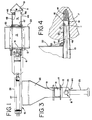
- Fig. 1 is a top plan view of an embodiment of the insertion tool in accordance with the invention;
- Fig. 2 is an elevational view, partially broken away, from one side of the tool shown in Fig. 1;
- Fig. 3 is a front elevational view of the tool;
- Fig. 4 is a detailed elevational view, partially broken away, showing a step of the insertion procedure;
- Fig. 5 is a partial longitudinal sectional view through an actuator assembly which can be incorporated within the illustrated tool;
- Fig. 6 is an elevational view of an alternative embodiment of a tool for facilitating insertion in accordance with this invention; and
- Fig. 7 is a detailed elevational view of the embodiment shown in Fig. 6.
- The tool assembly of the present invention is particularly well-adapted to be used on a carcass processing line for administering a solid coolant as part of a conditioning procedure which includes rapidly lowering the temperature within the inside of and throughout the muscle area treated. This procedure is accomplished so that the onset of pale, soft and exudative characteristics is substantially prevented. Further details in the regard are found in U.S. Patent No. 5,085,615.
- In this procedure for substantially preventing PSE characteristics, freshly killed carcasses are initially processed in a generally conventional manner, typically being suspended from an overhead trolley system of a generally known construction. At this time, the carcasses are usually placed within a cooler or chilling room, after which the carcasses are processed further in the usual and customary manner into finished meat products such as hams, pork muscle, turkey muscle, beef muscle and other cuts of meat. The invention is practiced as soon as possible after stun and before or immediately after carcasses are placed in a cooler thereby chilling the carcasses from the inside and outside simultaneously.
- The tool assembly of the present invention is instrumental in the formation of a pocket within one or more locations of each carcass and the insertion of a solid refrigerant within that pocket. The solid refrigerant is important in carrying out the inside-out chilling which is described in further detail in said U.S. Patent No. 5,085,615. The pocket area formed or accessed by use of the insertion tool is formed by piercing the carcass so as to form an incision proximate to the femur and at the hind leg muscle area of each carcass which, for example, is being processed for preparing hams. A pocket area is thereby formed within the hind leg portion of the carcass, which pocket area will tend to close while the carcass is suspended. When the pocket area is opened, the solid coolant is inserted therewithin by the tool, after which the pocket area will naturally close while the PSE treatment is initiated.
- The solid coolant is to exhibit a high thermal absorption value at temperatures at which animal carcasses are processed. The preferred solid coolant or solid frozen material charge is solid carbon dioxide or dry ice. The granular solid coolant may take the form of multiple, small bars or cubes, or a plurality of particles, such as a charge of solid coolant pellets, and/or so-called ricesized particles.
- It also should be understood that granular solid coolants other than solid carbon dioxide may be used and, if contact of such coolants with the meat is undesirable, these coolants may be enclosed in a package, vessel or envelope to isolate same from contact with the meat. Suitable solid coolants of this type include those which undergo a change in phase, including coolants that are liquid at conventional refrigeration temperatures and that are solid when at a temperature suitable for use in connection with this invention. A conventional refrigeration temperature as used herein refers to those below room temperature and not colder than the freezing point of a carcass, typically about 32° F (0°C). Also suitable as solid coolants are granular materials which do not undergo a change of phase while within the carcass. Included in this regard are cryogenically cooled metal granules, for example stainless steel balls. Solid coolants of these types are advantageous because of their ability to be reused.
- The insertion tool embodiment illustrated in Figs. 1 through 5 includes a
thin spear blade 11 attached to a body orframe 12 having a chamber orcompartment 13. A granular solid coolant charge is positioned within thecompartment 13 for delivery by the tool upon its actuation. The illustrated solid coolant takes the form ofgranules 14 of solid carbon dioxide or dry ice. Aram assembly 15 provides the impetus for movement of thegranules 14 or the like out of thecompartment 13 and into apocket 16 of a carcass 17 (Fig. 4). An actuator assembly, generally designated as 18, activates theram assembly 15 to move the solid coolant charge from out of the chamber or compartment and into thecarcass pocket 16. -
Blade 11 is made of a thin, rigid material, and it is secured to the body orframe 12 of the tool. Because of its frequent engagement with meat, stainless steel is the preferred material out of which the thin spear blade is made.Blade 11 is preferably substantially flat and may include a beveled leading edge or cuttingedge 19. Its severing width "W" is selected so as to form a slit within the carcass that is properly sized to permit easy passage of the solid coolant through the slit while it is held open by the tool. This slit length can be tightly controlled and can be kept so small as to minimize opening a pocket that is excessively large and which could expose large surfaces of meat unprotected by a membrane, resulting in leaching of nutrients or other intercellular components by water spraying and incomplete drainage of sprayed water from the carcass. In part because of the relatively small slit formed by thespear blade 11, it is easier for the operator to pierce through the approximate center of the muscle, thereby avoiding the severing of muscle and resultant product damage and/or loss. A typical width W for the ham portion of a hog carcass is approximately 3 inches (approximately 76.2 mm), typically between about 2.75 inches and about 3.8 inches (about 69.9 mm and about 96.5 mm). These spear widths are typical for an average sized hog carcass and the range would be extended when used for treating beef or poultry carcasses, for example. - With further reference to the
spear blade 11, its leading or cuttingedge 19 is adjacent to, and typically terminates at, ashank portion 53. Theshank portion 53, which is behind the leadingedge 19, is necessarily narrower than the severing width "W" to enable an opener 51 (discussed in greater detail hereinafter) to easily open up the slit which had just been formed by the piercing action of thecutting edge 19 to facilitate insertion of the solid coolant into the carcass. Typically, the blade shank width should be no wider than about two inches (about 50.8 mm) for hams. - A
hopper 22 is associated with and generally adjacent to thecompartment 13. A plurality of solid coolant granules, which can be considered to be comprised of a plurality of charges, designated with phantom lines as 14A, 14B, 14C, 14D, 14E, 14F, are shown in phantom positioned within thehopper 11 in Fig. 2. In use, after a charge of solid coolant granules has been displaced from the chamber orcompartment 13 by operation of the insertion tool, theactuator assembly 18 is activated to retract apusher 31 and to also open achamber slide 61, thereby allowing thenext charge 14A of granules to drop out of thehopper 22 and into thechamber 13. By the force of gravity, thesolid coolant charges hopper 22 drop down so that the next granularsolid coolant charge 14B is in position for moving into the chamber after thecharge 14A has been inserted into the carcass cavity. - It will be appreciated that a handle or
hand grip 23 will be grasped by the operator in order to hold the tool during use. A thermal insulator and a polymer pad (not shown) may be included in order to help protect the operator's hand. The particular version of the insertion tool which is illustrated in these drawings can easily be used for either right-hand or left-hand operation. The hopper can then be easily filed with the other hand, such as by scooping multiple charges of solid coolant granules from a supply and dropping them into thehopper 22. An automated filling arrangement can also be used such as one which augers the granules into position. Anarm cuff assembly 57 can assist in stabilizing the tool during use. -
Ram assembly 15 preferably includes two double-actingcylinders larger cylinder 26 is a Bimba® Model No. 1710-DXNR, and a suitablesmaller cylinder 27 is a Bimba® 045-DP. The illustrated cylinders are operated by compressed air supplied by properly sized tubing. The tubing includes arear fluid line 28 and afront fluid line 29. Each line is connected to both cylinders atTees -
Cylinder 26 is also equipped with apusher 31, preferably made of a polymeric material, for operatively moving or engaging the solid coolant which is within the compartment orchamber 13 at any given time after loading. In operation, pressurization of the rear portion of thecylinder 26 and depressurization of the front portion of the cylinder will force thepusher 31 outwardly from the cylinder (to the left in Fig. 2) as shown in phantom. - Pressurization of the front portion of
cylinder 26 by flow of pressurized air or other fluid into and through thefront fluid line 29 and depressurization of the rear portion of thecylinder 26 will cause the cylinder to retract thepusher 31 to move to the "ready" position that is shown in Fig. 2. -
Cylinder 27 is secured to the chamber slide ordoor 61, such as through abracket 30, for operatively opening and closing the upper portion of thechamber 13. In operation, pressurization of the front portion of thecylinder 27 and depressurization of its rear portion will retract the cylinder and slide open thechamber slide 61 to allow a charge of solid coolant granules to fall into anempty chamber 13. Pressurization of the rear portion ofcylinder 27 by flow of pressurized air or other fluid into and through therear fluid line 28 and depressurization of the front portion of thecylinder 27 will cause the cylinder to extend and thus close thechamber slide door 61 to prevent additional solid coolant granules from dropping into thechamber 13 while also providing a top wall for the chamber which facilitates egress of the charge out of the chamber. Aslide channel 21 is provided in the illustrated embodiment to guidechamber slide door 61 during its operation. - In an important aspect of the illustrated arrangement,
cylinder 26 is of substantially greater fluid capacity than iscylinder 27 in order to supply more energy when it functions and also to automatically time the respective movements of thepusher 31 and thechamber slide door 61. More particularly, it is important that thechamber slide door 61 be closed before thepusher 31 moves the solid coolant charge out of thechamber 13. By the illustrated arrangement, this timing is automatically achieved by selecting the relative sizes of thecylinders smaller cylinder 27 does not substantially extend thelarger cylinder 26. - This operation of the double-acting
cylinders actuator valve 18. Details of an embodiment of this actuator assembly are shown in Fig. 5.Actuator assembly 18 includes ahousing 32 within which arod 33 is slidably mounted. A plurality of O-rings 34 may be provided as seals and also to insure that adequate friction is imparted onto therod 33 so that therod 33 remains where it had been positioned until it is positively acted upon. Abumper 35 is located at one end of therod 33. Preferably, areceptor block 36 is positioned at the other end of therod 33. House air or the like is supplied to theactuator 18 by way of anair connector 37. In the illustrated actuator, house air enters same through center port 38 (Fig. 5).Rear fluid line 28 communicates with arear port 39, andfront fluid line 29 communicates with afront port 40. Channels are positioned along therod 33 in order to provide pressurized air communication betweencenter port 38 and either ofrear port 39 orfront port 40. In the position shown in Fig. 5, channels 41 permit pressurized house air passing throughcentral port 38 to enterrear port 39,rear fluid line 28 and thus the rear portion of the double-actingcylinders front port 40 is open to exhaust, such as through avent 42, which preferably directs exhaust air away from the carcass, as well as away from the operator. When this position is attained,cylinder 27, having the lower fluid demand of the cylinders, first closes thechamber slide door 61, and immediately thereafter thecylinder 26 extends thepusher 39 outwardly and into thechamber 13. A corresponding flow path occurs betweencenter port 38 andfront port 40, with exhaust being through a suitable vent 43, when theactuator bumper 35 extends to the right (as viewed in Fig. 5). - The operator returns the
actuator assembly 18 to the position shown in Fig. 5 by simply pushing on thereceptor block 36 such as with the operator's thumb. This extends thebumper 35 and retracts the cylinders to their "ready" positions to begin the process of inserting the spear and a granular solid coolant charge into a carcass. As the cylinders retract, thelarger cylinder 26 is made to retract thepusher 31 before thesmaller cylinder 27 retracts theslide 61 by means of an alternate restricted flow path (not shown) from the rear of thecylinder 27 into theTee 24. - An
opener gate 51 assists in ensuring proper insertion of the solid coolant charge into thecarcass pocket 16. When opened as generally shown in Fig. 4, theopener gate 51 cooperates with thespear blade 11 and withchamber side walls blade shank 53,opener gate 51 andside walls suitable torsion spring 52 mounted with abushing 47 engages theopener gate 51 in order to close the gate when the tool is in its "ready" mode. This helps to prevent early discharge of solid coolant from the compartment.Gate 51, when closed, typically rests proximate to the tapering edges 45, 46 of thewalls - A
counterbalance system adapter 55 and quick-disconnect air coupler 56 can be included in order to facilitate easily connecting or disconnecting the insertion tool from a counterbalancing device (not shown).Coupler 56 permits the operator to uncouple the fluid driving source, such as house air, and the counterbalancing device in one motion. Connection allows for ingress of pressurized fluid to and throughair connection 37 andmain fluid line 44. The counterbalancing device ergonomically enhances the handling of the insertion tool. These devices are generally referred to as load levelers which counterbalance the weight of the tool by the use of a tension adjustable unit. A suitable load leveler is available from Aero-Motive Sales, of Kalamazoo, Michigan, an especially suitable load leveler for this particular tool being identified by Catalog No. 15 FLRC. - In operation, the operator will grasp the inserter tool by its
hand grip 23 and orient it generally horizontally, such as shown in Fig. 2. The device at this stage will be in the cocked or ready position such as shown in Fig. 1 and Fig. 2. In the illustrated method, asolid coolant charge 14 drops into the compartment orchamber 13, by way of thehopper 22 by retracting theslide door 61 while thepusher 31 is also retracted. As described previously, these two cylinder retractions occur when the operator moves theactuator rod 33 to its ready position by pressing a thumb onto thereceptor 36. The insertion tool is then ready for operation. - The operator locates the
flat spear blade 11 at the proper location on the carcass and pushes the spear into the muscle in order to access and/or form the carcass pocket. Once the pocket is thus opened, thebumper 35 engages the outside surface of the carcass to push therod 33 of the actuator assembly away from the carcass and toward the operator. By a suitable valving operation as discussed herein, the actuator assembly first causes the double-actingcylinder 27 to extend and close theslide door 61 and then causes thecylinder 26 to extend toward the carcass in the operational leading direction. This causes the solid coolant charge in thechamber 13 to begin to move out of the chamber, at which time the leading portion of the solid coolant charge engages the opener gate or ramp 51 as shown in Fig. 2 and Fig. 4. This opener gate spreads the slit which had been made by the spear blade to thereby facilitate entry of the solid coolant charge into the carcass cavity. A sufficiently large gap is thus opened at the mouth of the incision. The solid coolant charge is pushed totally out of the compartment by thepusher 31 and slides between theflat spear blade 11 and the opened gate or ramp 51 so as to provide a smooth transition through the slit and into the carcass cavity. The dosing volume can be adjusted by varying the retraction depth ofpiston 31. - In the preferred embodiment, the stroke length of the double-acting cylinder is in excess of that needed to insert the solid coolant charge fully into the pocket. This additional stroke length effectively automatically removes the insertion tool without any substantial possibility of dragging any portion of the solid coolant charge out of place. This is because the additional stroke causes the ram assembly to push against the fully inserted solid coolant charge in order to rapidly push or recoil the insertion tool and its spear blade out of the pocket while the
pusher 31 holds the solid coolant charge generally in place within the cavity. - At this stage, the actuator tool is in its deployed or "spent" condition. The actuator assembly is retracted as shown in Fig. 5, and the double-acting cylinders are extended (as generally shown in Fig. 4). In order to clear the way for another solid coolant charge to enter the
compartment 13, the operator pushes on thereceptor block 36 which operates the actuator assembly to retract thepusher 31 and thechamber slide door 61 to their respective locations as shown in Fig. 1. The actuator tool is thus cocked or put into its "ready" condition, and gravitational force moves another solid coolant charge into the chamber. At this time, the operator is free to replenish the hopper with coolant as needed or desired. - With reference to the embodiment illustrated in Figs. 6 and 7, this is an alternative embodiment for facilitating insertion of a solid coolant charge according to the invention. This tool is substantially the same as that of the embodiment of Figs. 1 through 5 except for
actuator assembly 118 and associated components. House air or other pressurized fluid enters throughconnector 137 to provide input to theactuator assembly 118 throughpilot fluid line 44A. A pilot air activated system of a type generally known in the art is utilized. Athumb trigger 162 is pushed and rocks into engagement withreceptor block 136 in order to extend thebumper 135 to its "ready" position. This causes pressurized fluid to flow throughpilot air line 44A,actuator 118 andpilot air line 129A to the pilot port of a four-way valve 163. At this state of the pilot air system, pressurized fluid passes through themain fluid line 44 to the four-way valve 163, and frontfluid line 129 is pressurized such thatcylinders bumper 135 engages a carcass during the spearing and inserting operation as generally described herein, thebumper 135 is depressed, and theactuator assembly 118 interrupts the fluid pressure throughline 129A to the pilot port of thevalve 163. This directs the pressurized fluid into therear fluid line 128 to extend thecylinders - It will be understood that the embodiments of the present invention which have been described are illustrative of some of the applications of the principles of the present invention. Numerous modifications may be made by those skilled in the art without departing from the true spirit and scope of the invention.
Claims (33)
- A tool for inserting a granular solid coolant charge (14) into a carcass muscle area of an animal carcass (17) or portion thereof, the insertion tool comprising:a chamber (13) for receiving and holding a charge (14) of granular solid coolant;a door (61) selectively opening and closing a wall portion of said chamber (13);a spear blade (11) rigidly positioned with respect to a leading end portion of said chamber (13);a thruster (23) for moving the insertion tool into the carcass muscle area to thereby insert the spear blade (11) into the muscle area, form a slit in the muscle area and access a carcass pocket (16) within the animal carcass (17) or portion thereof;an actuator assembly (18; 118) that is triggered by the action of said spear blade (11) being inserted into the carcass muscle area; anda ram assembly (15) in operative communication with said actuator assembly (18; 118), which ram assembly (15) closes said door (61) and moves the solid coolant charge (14) from out of the chamber (13) and into the carcass pocket (16) in response to actuation thereof by said actuator assembly (18; 118).
- An insertion tool according to claim 1, further including an opener gate assembly mounted generally adjacent to said leading end portion of said chamber (13), which opener gate assembly includes a gate member (51) that is engaged by the solid coolant charge (14) as same exits the chamber (13) to thereby move the gate member (51) within the slit in the carcass muscle area.
- An insertion tool according to claim 2, wherein the gate member (51) of said opener gate assembly has a predetermined length that engages the slit in the carcass muscle area and assists in opening the slit so as to facilitate passage of the solid coolant charge (14) through the slit and into the carcass pocket (16).
- An insertion tool according to claim 2 or claim 3, wherein said gate member (51) is swingably mounted and is moved by the solid coolant charge (14) from a generally closed position to a position generally parallel to said shear blade (11).
- An insertion tool according to any one of claims 1 to 4, wherein said spear blade (11) has a cutting leading edge portion (19) having a selected width (W) that pierces a slit of a desired width and a narrower shank portion (53) which facilitates opening of said slit in the carcass muscle area by said opening gate (51).
- An insertion tool according to claim 5, wherein said cutting leading edge portion (19) has a selected width (W) for piercing a slit of a predetermined width substantially equal to the width of said solid coolant charge (14).
- An insertion tool according to any one of claims 1 to 6, wherein the spear blade (11) is substantially flat and is in general alignment with a bottom wall of said chamber (13).
- An insertion tool according to any one of claims 1 to 6, further including side walls (48, 49) defining sides of said chamber (13), wherein the spear blade (11) is substantially flat and is generally parallel to a bottom wall of said chamber (13), and wherein said side walls (48, 49), spear blade (11) and said gate (51), when open, combine to provide a feed tunnel pathway for the solid coolant charge (14) through the opened slit and into the carcass pocket (16).
- An insertion tool according to any one of claims 1 to 8, wherein the actuator assembly (18; 118) includes a movable member (35; 135) which is moved by engagement between the actuator assembly (18; 118) and the animal carcass (17) or portion thereof, which movable member (35; 135) actuates the ram assembly (15) so as to extend a pusher (31) thereof into and through said chamber (13).
- An insertion tool according to any one of claims 1 to 9, wherein said ram assembly (15) is rigidly positioned with respect to an end of said chamber (13) that is opposite to said spear blade (11), and said ram assembly (15) includes a pusher component (31) which, upon actuation of the ram assembly (15), passes into and through said chamber (13).
- An insertion tool according to any one of claims 1 to 10, wherein said actuator assembly (18; 118) includes a fluid operating valve assembly which directs pressurized fluid from a source thereof to said ram assembly (15), said spear blade (11) having a cutting edge (19), said actuator assembly (18; 118) having a bumper (35; 135) that is positioned generally adjacent to said spear blade (11) and behind the cutting edge (29) thereof, and said bumper (35; 135) engages the animal carcass (19) or portion thereof upon insertion of the spear blade (11) thereinto in order to activate the valve assembly so that the pressurized fluid effects movement of a rod of the ram assembly (15) to thereby automatically eject the solid coolant charge (14) out of the chamber (13) and into the carcass pocket (16).
- An insertion tool according to any one of claims 1 to 11, wherein said actuator assembly (18) includes a valve assembly having a slidable rod (33) mounted within a housing (32) having multiple ports (38, 39, 40), said rod (33) having channels (41) for selectively communicating two of said ports (38, 39, 40) with each other while communicating a third one of said ports (38, 39, 40) to an exhaust vent (42), whereby pressurized fluid is transmitted from a pressurized fluid source to one end of said ram assembly (15) while exhausting fluid from an opposite end of said ram assembly (15).
- An insertion tool according to any one of claims 1 to 11, wherein said actuator assembly (118) includes a pilot air system which directs pressurized air from a source thereof to said ram assembly (15), said spear blade (11) having a cutting edge (19), said actuator assembly (118) having a bumper (135) that is positioned behind the cutting edge (19) of the spear blade (11), and said bumper (135) engages the animal carcass (17) or portion thereof upon insertion of the spear blade (11) thereinto to activate the pilot air system to automatically eject the solid coolant charge (14) out of the chamber (13) and into the carcass pocket (16).
- An insertion tool according to any one of claims 1 to 13, wherein the solid coolant is a material having a high thermal absorptive value, said material being within an envelope suitable for contact with the carcass muscle area.
- An insertion tool according to any one of claims 1 to 13, wherein the solid coolant is a solid material which does not undergo a phase change while within the carcass muscle area and which is at a temperature below refrigeration temperature when initially inserted into the carcass muscle area.
- An insertion tool according to any one of claims 1 to 15, further including a hopper (22) for holding a plurality of said solid granular coolant charges (14A to 14G) and selectively supplying same to and into said chamber (13).
- An insertion tool according to any one of claims 1 to 16, wherein said thruster includes a grip member (23) for manually grasping the insertion tool.
- An insertion tool according to any one of claims 1 to 17, wherein said ram assembly (15) includes two cylinder devices (26, 27), one said cylinder device (26) operatively engaging a pusher (31) that engages and moves the granular solid coolant charge (14) substantially out of the chamber (13), and the other said cylinder device (27) operatively engaging said door (61) of the chamber (13).
- An insertion tool according to claim 18, wherein a single actuator assembly (18; 118) operates said cylinder devices (26, 27) such that said other cylinder device (27) extends to substantially close said door (61) before said one cylinder device (26) extends to move the granular solid coolant charge (14) substantially out of the chamber (13).
- An insertion tool according to claim 18 or claim 19, wherein said other cylinder device (27) has a pressurized fluid capacity less than that of said one cylinder device (26).
- An insertion tool according to any one of claims 1 to 20, wherein said ram assembly (15) adjusts the volume of the charge of granular solid coolant (14) by varying the depth to which the ram assembly (15) retracts to thereby vary the volume of the chamber (13).
- A method for inserting a charge of granular solid coolant (14) into a carcass muscle area of an animal carcass (17) or portion thereof, said method comprising the steps of:providing an insertion tool having a chamber (13) for receiving and holding a charge of granular solid coolant (14), a door (61) to the chamber (13), a spear blade (11) positioned forwardly of the chamber (13), a ram assembly (15), and an actuator (18; 118) for the ram assembly (15);loading at least one charge (14) of granular solid coolant into the chamber (13) of the insertion tool;inserting the spear blade (11) into a carcass muscle area of an animal carcass (17) or portion thereof in order to thereby access a pocket area (16) within the carcass muscle area;continuing with said inserting step, including automatically actuating the ram assembly (15);said step of automatically actuating the ram assembly (15) effecting a step of moving the granular solid coolant charge (14) out of the chamber (13) and into the pocket (16) of the carcass muscle area; andwithdrawing the insertion tool from the pocket (16) of the carcass muscle area while leaving the granular solid coolant charge (14) in place within the pocket (16).
- A method according to claim 22, wherein said inserting step includes guiding the granular solid coolant charge (14) out of the chamber (13) and into the pocket (16) of the carcass muscle area, said guiding step including sliding the granular solid coolant charge (14) along the spear blade (11).
- A method according to claim 22 or claim 23, wherein said inserting step includes guiding the granular solid coolant charge (14) out of the chamber (13) and into the pocket (16) of the carcass area, said guiding step including sliding the granular solid coolant charge (14) along the spear blade (11) and along an opener wall (51) that selectively provides a surface between the compartment (13) and the pocket (16).
- A method according to claim 24, wherein said guiding step includes positioning the spear blade (11) and the opener wall (51) so as to be generally parallel to each other during the time that the granular solid coolant charge (14) passes between the chamber (13) and the pocket (16).
- A method according to any one of claims 22 to 25, wherein said automatic actuating step includes engaging a bumper (35; 135) with the animal carcass (17) or portion thereof so as to automatically activate the ram assembly (15) to effect said inserting step.
- A method according to any one of claims 22 to 26, wherein said inserting step is preceded by manually grasping a grip portion (23) of the insertion tool.
- A method according to any one of claims 11 to 27, wherein said step of automatically actuating the ram assembly (15) develops a ram assembly stroke length that is in excess of a stroke length required to move the granular solid coolant charge (14) fully into the carcass pocket (16) so as to automatically initiate said withdrawing step.
- A method according to any one of claims 22 to 28, wherein said charge of solid coolant (14) includes granular solid carbon dioxide.
- A method according to any one of claims 22 to 28, wherein said charge of granular solid coolant (14) includes a material having a high thermal absorptive value, which material is encased within an envelope made of a material suitable for contact with the carcass muscle area.
- A method according to any one of claims 22 to 28, wherein said charge of granular solid coolant (14) is at a temperature below room temperature when initially inserted into the carcass muscle area and does not undergo a phase change while within the carcass muscle area.
- A method according to any one of claims 22 to 31, wherein said loading step includes opening the door (61) to the chamber (13) to permit a charge of granular solid coolant (14) to enter the chamber from a hopper (22).
- A method according to claim 32, wherein said step of automatically actuating the ram assembly (15) includes first initiating closing of the door (61) to the chamber (13), followed by said step of moving the granular solid coolant charge (14) out of the chamber (13).
Applications Claiming Priority (2)
| Application Number | Priority Date | Filing Date | Title |
|---|---|---|---|
| US326417 | 1994-10-20 | ||
| US08/326,417 US5453044A (en) | 1994-02-28 | 1994-10-20 | Granular solid coolant inserter |
Publications (1)
| Publication Number | Publication Date |
|---|---|
| EP0707796A1 true EP0707796A1 (en) | 1996-04-24 |
Family
ID=23272109
Family Applications (1)
| Application Number | Title | Priority Date | Filing Date |
|---|---|---|---|
| EP95307413A Ceased EP0707796A1 (en) | 1994-10-20 | 1995-10-18 | Granular solid coolant inserter |
Country Status (3)
| Country | Link |
|---|---|
| US (1) | US5453044A (en) |
| EP (1) | EP0707796A1 (en) |
| CA (1) | CA2160331A1 (en) |
Cited By (5)
| Publication number | Priority date | Publication date | Assignee | Title |
|---|---|---|---|---|
| DE102019007438B3 (en) * | 2019-10-25 | 2020-12-24 | DamTech bvda | Device for introducing dry ice pellets into fresh meat |
| WO2021078891A1 (en) | 2019-10-25 | 2021-04-29 | Messer Group Gmbh | Device and method for producing and transporting dry ice pellets |
| WO2022084250A1 (en) | 2020-10-23 | 2022-04-28 | Messer Group Gmbh | Device and method for processing pieces of meat using dry ice pellets |
| EP4349178A1 (en) | 2022-10-07 | 2024-04-10 | Messer SE & Co. KGaA | Device and method for introducing carbon dioxide snow into fresh meat |
| WO2025209756A1 (en) | 2024-04-02 | 2025-10-09 | Messer Se & Co. Kgaa | Device and method for introducing carbon dioxide into fresh meat |
Families Citing this family (5)
| Publication number | Priority date | Publication date | Assignee | Title |
|---|---|---|---|---|
| NL9301700A (en) * | 1993-02-08 | 1994-09-01 | Erwin Herman Gerardus Heurman | Plug for occluding the esophagus of a slaughtered animal and device for positioning it. |
| US5624307A (en) * | 1995-05-15 | 1997-04-29 | Swift-Eckrich, Inc. | Method for reducing fecal leakage and contamination during meat processing |
| US5733185A (en) * | 1996-02-28 | 1998-03-31 | Swift-Eckrich, Inc. | Method for reducing fecal leakage and contamination during meat processing |
| US7681494B2 (en) * | 2001-06-26 | 2010-03-23 | Ronco Acquisition Corporation | Device to inject foods with solid objects |
| US6578470B2 (en) | 2001-06-26 | 2003-06-17 | Alan L. Backus | Food injection device |
Citations (6)
| Publication number | Priority date | Publication date | Assignee | Title |
|---|---|---|---|---|
| US3498797A (en) * | 1965-11-12 | 1970-03-03 | Air Reduction | Method of purging a socket cavity of a meat animal carcass |
| US4594253A (en) * | 1984-03-21 | 1986-06-10 | Maurice Fradin | Method for mincing and prepackaging minced meat under controlled atmosphere and temperature |
| US4864923A (en) * | 1988-06-24 | 1989-09-12 | H. J. Langen & Sons Limited | Apparatus for cooling pieces of meat |
| US5085615A (en) | 1991-02-19 | 1992-02-04 | Oscar Mayer Foods Corporation | Reducing the development of pale, soft and exudative pork |
| RU1833147C (en) * | 1991-03-14 | 1993-08-07 | ИБлюИЦ`ЬЧЦЛъВЦјГгВЕИИЦЕ@Цє}ЕјЛИЕИЛЕ@ЬЧЛТОБјИЦМ@ФЕзБИЛТЛ | Method and apparatus for cooling dressed carcasses |
| US5413526A (en) * | 1994-02-28 | 1995-05-09 | Oscar Mayer Foods Corporation | Solid coolant inserter |
Family Cites Families (33)
| Publication number | Priority date | Publication date | Assignee | Title |
|---|---|---|---|---|
| US1377023A (en) * | 1920-06-29 | 1921-05-03 | Bernard S Nelson | Lubricating device |
| US1837592A (en) * | 1928-05-09 | 1931-12-22 | George H Roberts | Dispensing machine |
| US1883829A (en) * | 1930-08-02 | 1932-10-18 | George H Roberts | Dispensing device |
| US2784682A (en) * | 1955-12-15 | 1957-03-12 | Herbert C Clevenger | Apparatus for filling sandwich buns |
| US3113530A (en) * | 1962-02-12 | 1963-12-10 | Lyle A Vestermark | Apparatus for filling buns with an edible product |
| US3535998A (en) * | 1968-03-29 | 1970-10-27 | Abe Vincent Cummings | Food treating apparatus |
| US3583336A (en) * | 1969-04-09 | 1971-06-08 | Del Boy S R L Soc | Apparatus for automatically stuffing bakery products |
| US3817248A (en) * | 1972-11-06 | 1974-06-18 | Alza Corp | Self powered device for delivering beneficial agent |
| US3863556A (en) * | 1973-08-20 | 1975-02-04 | Townsend Engineering Co | Machine for injecting fluids into meat products |
| US3932155A (en) * | 1974-11-13 | 1976-01-13 | Airco, Inc. | Method for producing carbon dioxide snow |
| US3999691A (en) * | 1975-07-16 | 1976-12-28 | Doom Lewis G | Cake filler |
| US4065830A (en) * | 1976-05-19 | 1978-01-03 | Ludwig Pfatischer | Larding utensil |
| US4144913A (en) * | 1977-01-26 | 1979-03-20 | Nordson Corporation | Hot melt adhesive dispensing system of the hand held gun type |
| US4142000A (en) * | 1977-04-20 | 1979-02-27 | Townsend Engineering Company | Method and means for injecting fluids into meat products |
| US4177810A (en) * | 1977-12-23 | 1979-12-11 | Damon Corporation | Pneumatic injection apparatus |
| US4178660A (en) * | 1978-03-27 | 1979-12-18 | Olney Alvin A | Method and apparatus for introducing and distributing food additives in meats |
| US4211160A (en) * | 1978-06-05 | 1980-07-08 | Bieser Dennis W D | Method and apparatus for internally seasoning meat prior to cooking |
| US4220669A (en) * | 1978-10-02 | 1980-09-02 | Townsend Engineering Company | Method and means for injecting fluids into meat products |
| US4230732A (en) * | 1979-01-24 | 1980-10-28 | Airco, Inc. | Methods of chilling poultry |
| US4292889A (en) * | 1979-05-25 | 1981-10-06 | Townsend Engineering Company | Method and means for injecting fluids into meat products |
| US4254151A (en) * | 1980-01-07 | 1981-03-03 | Townsend Engineering Company | Method for injecting fluids into meat products |
| US4361150A (en) * | 1980-04-07 | 1982-11-30 | Voss Joseph A | Extruded plastic hygienic applicator |
| US4414885A (en) * | 1982-06-29 | 1983-11-15 | Kelly Harry C | Flavor injector |
| US4516578A (en) * | 1982-09-30 | 1985-05-14 | Luther Shuffield | Rectal device and method of inserting same |
| US4758227A (en) * | 1983-09-24 | 1988-07-19 | Morf Inc. | Bird injection system |
| US4799921A (en) * | 1984-08-20 | 1989-01-24 | Johnson Ronald F | Method for implanting retainers and implants in cattle |
| JPS61158750A (en) * | 1984-12-31 | 1986-07-18 | Rheon Autom Mach Co Ltd | Method for injecting viscous fluid into bread or cake |
| JPS61199743A (en) * | 1985-03-02 | 1986-09-04 | レオン自動機株式会社 | Method and apparatus for metering and injecting food material |
| EP0403623B1 (en) * | 1988-12-19 | 1993-08-04 | Georges Aubert | Device for the automatic evisceration of slaughtered animal carcasses |
| US4928592A (en) * | 1989-05-15 | 1990-05-29 | Continental Baking Company | Dual injection cake filler apparatus |
| DK484689A (en) * | 1989-09-29 | 1991-03-30 | Slagteriernes Forskningsinst | PROCEDURE FOR SELECTION OR TREATMENT OF INSERT FROM PIG BODY |
| US5120267A (en) * | 1990-11-28 | 1992-06-09 | Oscar Mayer Foods Corp. | Method for reducing fecal leakage and contamination during meat and poultry processing |
| US5176645A (en) * | 1991-05-01 | 1993-01-05 | Diana Corporation | Pneumatic, modular device for dispensing medication to animals |
-
1994
- 1994-10-20 US US08/326,417 patent/US5453044A/en not_active Expired - Fee Related
-
1995
- 1995-10-11 CA CA002160331A patent/CA2160331A1/en not_active Abandoned
- 1995-10-18 EP EP95307413A patent/EP0707796A1/en not_active Ceased
Patent Citations (6)
| Publication number | Priority date | Publication date | Assignee | Title |
|---|---|---|---|---|
| US3498797A (en) * | 1965-11-12 | 1970-03-03 | Air Reduction | Method of purging a socket cavity of a meat animal carcass |
| US4594253A (en) * | 1984-03-21 | 1986-06-10 | Maurice Fradin | Method for mincing and prepackaging minced meat under controlled atmosphere and temperature |
| US4864923A (en) * | 1988-06-24 | 1989-09-12 | H. J. Langen & Sons Limited | Apparatus for cooling pieces of meat |
| US5085615A (en) | 1991-02-19 | 1992-02-04 | Oscar Mayer Foods Corporation | Reducing the development of pale, soft and exudative pork |
| RU1833147C (en) * | 1991-03-14 | 1993-08-07 | ИБлюИЦ`ЬЧЦЛъВЦјГгВЕИИЦЕ@Цє}ЕјЛИЕИЛЕ@ЬЧЛТОБјИЦМ@ФЕзБИЛТЛ | Method and apparatus for cooling dressed carcasses |
| US5413526A (en) * | 1994-02-28 | 1995-05-09 | Oscar Mayer Foods Corporation | Solid coolant inserter |
Non-Patent Citations (1)
| Title |
|---|
| DATABASE WPI Week 9510, Derwent World Patents Index; AN 95-073302 * |
Cited By (9)
| Publication number | Priority date | Publication date | Assignee | Title |
|---|---|---|---|---|
| DE102019007438B3 (en) * | 2019-10-25 | 2020-12-24 | DamTech bvda | Device for introducing dry ice pellets into fresh meat |
| WO2021078883A1 (en) | 2019-10-25 | 2021-04-29 | Messer Group Gmbh | Apparatus for introducing dry ice pellets into fresh meat |
| WO2021078891A1 (en) | 2019-10-25 | 2021-04-29 | Messer Group Gmbh | Device and method for producing and transporting dry ice pellets |
| CN115209741A (en) * | 2019-10-25 | 2022-10-18 | 梅塞尔集团有限公司 | Device for injecting dry ice particles into fresh meat |
| WO2022084250A1 (en) | 2020-10-23 | 2022-04-28 | Messer Group Gmbh | Device and method for processing pieces of meat using dry ice pellets |
| DE102020006507A1 (en) | 2020-10-23 | 2022-04-28 | Messer Se & Co. Kgaa | Device and method for treating pieces of meat with dry ice pellets |
| EP4349178A1 (en) | 2022-10-07 | 2024-04-10 | Messer SE & Co. KGaA | Device and method for introducing carbon dioxide snow into fresh meat |
| DE102022125954A1 (en) | 2022-10-07 | 2024-04-18 | Messer Se & Co. Kgaa | Device and method for introducing carbon dioxide snow into fresh meat |
| WO2025209756A1 (en) | 2024-04-02 | 2025-10-09 | Messer Se & Co. Kgaa | Device and method for introducing carbon dioxide into fresh meat |
Also Published As
| Publication number | Publication date |
|---|---|
| CA2160331A1 (en) | 1996-04-21 |
| US5453044A (en) | 1995-09-26 |
Similar Documents
| Publication | Publication Date | Title |
|---|---|---|
| US5453044A (en) | Granular solid coolant inserter | |
| EP0917823B1 (en) | Humane fish killing method and apparatus | |
| US5090940A (en) | Drummette deboner | |
| JP5057407B2 (en) | Deboning method and apparatus for livestock carcass for meat | |
| EP0479447A1 (en) | Method and apparatus for injecting suspended meat solids into meat | |
| US3750231A (en) | Poultry processing improvement | |
| DE68908167T2 (en) | DEVICE FOR AUTOMATICALLY HUMPING ANIMAL BODIES AFTER SLAUGHTER. | |
| US5413526A (en) | Solid coolant inserter | |
| US3445931A (en) | Cutlery dressing tool | |
| EP1581060B1 (en) | A fish stunning apparatus | |
| JPWO2009139031A1 (en) | Mounting method and apparatus for meat with bone, and operation program for mounting | |
| US6354933B1 (en) | Meat deboning apparatus and method | |
| US4157003A (en) | Machine for a continuous commercially packing of slaughtered fowl | |
| EP0057189B1 (en) | Apparatus for removing the contents of flexible or collapsible containers | |
| WO1998044805A1 (en) | Method and apparatus for killing and bleeding fish | |
| US3950820A (en) | Poultry cutter | |
| US20050274088A1 (en) | Clipping packaging apparatus and methods | |
| EP2813146B1 (en) | Device for slaughtering fish | |
| EP0822751B1 (en) | Tool, knife, and method for automatic cutting along spinous processes in a carcass or part of a carcass | |
| SE544338C2 (en) | A portioning device and a method for packaging of food products | |
| AU2010229463B2 (en) | A method and device for automatic removal of animal carcass knuckle tips | |
| US5178577A (en) | Shellfish shucking machine | |
| EP0212579B2 (en) | Device for cutting up the breasts of carcasses, in particular of cattle or hogs | |
| AU633050B2 (en) | A method and means for opening animal carcasses | |
| CA1271663A (en) | Method and apparatus for meat processing |
Legal Events
| Date | Code | Title | Description |
|---|---|---|---|
| PUAI | Public reference made under article 153(3) epc to a published international application that has entered the european phase |
Free format text: ORIGINAL CODE: 0009012 |
|
| AK | Designated contracting states |
Kind code of ref document: A1 Designated state(s): AT BE CH DE DK ES FR GB GR IE IT LI LU MC NL PT SE |
|
| AX | Request for extension of the european patent |
Free format text: LT PAYMENT 951030;LV PAYMENT 951030;SI PAYMENT 951030 |
|
| RAX | Requested extension states of the european patent have changed |
Free format text: LT PAYMENT 951030;LV PAYMENT 951030;SI PAYMENT 951030 |
|
| RAP1 | Party data changed (applicant data changed or rights of an application transferred) |
Owner name: KRAFT FOODS, INC. |
|
| 17P | Request for examination filed |
Effective date: 19960628 |
|
| 17Q | First examination report despatched |
Effective date: 19960807 |
|
| GRAG | Despatch of communication of intention to grant |
Free format text: ORIGINAL CODE: EPIDOS AGRA |
|
| STAA | Information on the status of an ep patent application or granted ep patent |
Free format text: STATUS: THE APPLICATION HAS BEEN REFUSED |
|
| 18R | Application refused |
Effective date: 19970808 |