EP0708486A2 - Semiconductor field effect transistor with large substrate contact region - Google Patents
Semiconductor field effect transistor with large substrate contact region Download PDFInfo
- Publication number
- EP0708486A2 EP0708486A2 EP95116348A EP95116348A EP0708486A2 EP 0708486 A2 EP0708486 A2 EP 0708486A2 EP 95116348 A EP95116348 A EP 95116348A EP 95116348 A EP95116348 A EP 95116348A EP 0708486 A2 EP0708486 A2 EP 0708486A2
- Authority
- EP
- European Patent Office
- Prior art keywords
- region
- semiconductor substrate
- conductivity type
- substrate
- drain
- Prior art date
- Legal status (The legal status is an assumption and is not a legal conclusion. Google has not performed a legal analysis and makes no representation as to the accuracy of the status listed.)
- Granted
Links
Images



Classifications
-
- H—ELECTRICITY
- H10—SEMICONDUCTOR DEVICES; ELECTRIC SOLID-STATE DEVICES NOT OTHERWISE PROVIDED FOR
- H10D—INORGANIC ELECTRIC SEMICONDUCTOR DEVICES
- H10D84/00—Integrated devices formed in or on semiconductor substrates that comprise only semiconducting layers, e.g. on Si wafers or on GaAs-on-Si wafers
-
- H—ELECTRICITY
- H10—SEMICONDUCTOR DEVICES; ELECTRIC SOLID-STATE DEVICES NOT OTHERWISE PROVIDED FOR
- H10D—INORGANIC ELECTRIC SEMICONDUCTOR DEVICES
- H10D64/00—Electrodes of devices having potential barriers
- H10D64/20—Electrodes characterised by their shapes, relative sizes or dispositions
- H10D64/23—Electrodes carrying the current to be rectified, amplified, oscillated or switched, e.g. sources, drains, anodes or cathodes
- H10D64/251—Source or drain electrodes for field-effect devices
- H10D64/257—Source or drain electrodes for field-effect devices for lateral devices wherein the source or drain electrodes are characterised by top-view geometrical layouts, e.g. interdigitated, semi-circular, annular or L-shaped electrodes
-
- H—ELECTRICITY
- H10—SEMICONDUCTOR DEVICES; ELECTRIC SOLID-STATE DEVICES NOT OTHERWISE PROVIDED FOR
- H10D—INORGANIC ELECTRIC SEMICONDUCTOR DEVICES
- H10D62/00—Semiconductor bodies, or regions thereof, of devices having potential barriers
- H10D62/10—Shapes, relative sizes or dispositions of the regions of the semiconductor bodies; Shapes of the semiconductor bodies
- H10D62/102—Constructional design considerations for preventing surface leakage or controlling electric field concentration
- H10D62/112—Constructional design considerations for preventing surface leakage or controlling electric field concentration for preventing surface leakage due to surface inversion layers, e.g. by using channel stoppers
-
- H—ELECTRICITY
- H10—SEMICONDUCTOR DEVICES; ELECTRIC SOLID-STATE DEVICES NOT OTHERWISE PROVIDED FOR
- H10D—INORGANIC ELECTRIC SEMICONDUCTOR DEVICES
- H10D62/00—Semiconductor bodies, or regions thereof, of devices having potential barriers
- H10D62/10—Shapes, relative sizes or dispositions of the regions of the semiconductor bodies; Shapes of the semiconductor bodies
- H10D62/17—Semiconductor regions connected to electrodes not carrying current to be rectified, amplified or switched, e.g. channel regions
- H10D62/351—Substrate regions of field-effect devices
- H10D62/357—Substrate regions of field-effect devices of FETs
- H10D62/364—Substrate regions of field-effect devices of FETs of IGFETs
-
- H—ELECTRICITY
- H10—SEMICONDUCTOR DEVICES; ELECTRIC SOLID-STATE DEVICES NOT OTHERWISE PROVIDED FOR
- H10D—INORGANIC ELECTRIC SEMICONDUCTOR DEVICES
- H10D62/00—Semiconductor bodies, or regions thereof, of devices having potential barriers
- H10D62/10—Shapes, relative sizes or dispositions of the regions of the semiconductor bodies; Shapes of the semiconductor bodies
- H10D62/17—Semiconductor regions connected to electrodes not carrying current to be rectified, amplified or switched, e.g. channel regions
- H10D62/351—Substrate regions of field-effect devices
- H10D62/357—Substrate regions of field-effect devices of FETs
- H10D62/364—Substrate regions of field-effect devices of FETs of IGFETs
- H10D62/378—Contact regions to the substrate regions
-
- H—ELECTRICITY
- H10—SEMICONDUCTOR DEVICES; ELECTRIC SOLID-STATE DEVICES NOT OTHERWISE PROVIDED FOR
- H10D—INORGANIC ELECTRIC SEMICONDUCTOR DEVICES
- H10D89/00—Aspects of integrated devices not covered by groups H10D84/00 - H10D88/00
Definitions
- the present invention relates to a metal oxide semiconductor (MOS)-type semiconductor device, and more particularly, to a low substrate noise MOS-type semiconductor device.
- MOS metal oxide semiconductor
- the noise from the digital circuits via the power supply lines to the analog circuits can be reduced by providing individual power supply lines for the digital circuits and the analog circuits, an approach which has been broadly used.
- the noise, so called substrate noise, from the digital circuits via the substrate to the analog circuits is generated from a 1-bit output delta-sigma modulator or a charge pump circuit of a phase locked loop (PLL) circuit.
- PLL phase locked loop
- CMOS device if an N-channel MOS transistor is formed in a P-type semiconductor substrate, a P-channel MOS transistor is formed in an N-type well.
- the back gate of the N-channel MOS transistor is the substrate, and the back gate of the P-channel Mos transistor is the well. Since the well is separated from the substrate by a PN junction therebetween and an analog power supply voltage is applied to the well, the P-channel MOS transistor hardly suffers from the substrate noise. Conversely, the N-channel MOS transistor suffers directly from the substrate noise.
- an impurity diffusion region i.e., a substrate contact region, of the same conductivity type as the substrate having a higher impurity concentration than the substrate is formed in the substrate to surround a transistor area. Also, the substrate contact region is connected to a definite power supply voltage line. Thus, the voltage in the substrate around the transistor area is brought close to the voltage at the power supply voltage line, thus reducing the substrate noise. This will be explained later in detail.
- the devices have become increased in size, thus increasing the substrate noise and reducing the impedance of noise sources, so that the power supply line connected to the substrate contact region per se suffers from the substrate noise. Also, this power supply line serves as a noise source for other transistor areas. Further, since individual power supply voltages are applied to the source region and the substrate contact region, noises superimposed onto the power supply voltages are added to a current of the transistor as a noise current.
- the width of the substrate contact region is so reduced that the resistance of the substrate contact region and its neighborhood is increased.
- the resistance between the back gate and the substrate contact region is not so small as the resistance between the back gate and the substrate, and accordingly, the substrate noise can be reduced by the substrate contact region to only about 1/2.
- a channel stopper region is provided to surround the substrate contact region, to thus avoid the creation of a parasitic MOS transistor.
- the substrate contact region serves as a low impedance for noise transmitted via the channel stopper, the substrate noise cannot be further suppressed.
- a substrate contact region of a conductivity type the same as that of the semiconductor substrate is formed adjacent to the source region, and is wider than the source region and the drain region.
- Fig. 1 and Fig. 2 is a cross-sectional view of Fig. 1.
- a relatively thick field silicon oxide layer 2 having a P+-type channel stopper 2a therebeneath is formed on a P ⁇ -type monocrystalline silicon substrate 1 to partition an active area A1 and a field area A2 to isolate the active area A1 from other active areas. Also, a transistor area T is defined within the active area A1.
- N+-type impurity diffusion regions 3-1 to 3-5 ara formed within the substrate 1.
- the regions 3-2 and 3-4 serve as drain regions
- the regions 3-1, 3-3 and 3-5 serve as source regions.
- drain electrodes 4-1 and 4-2 which form a multi-finger type drain configuration.
- source electrodes 5-1, 5-2 and 5-3 which form a multi-finger type source configuration.
- gate electrodes 6-1, 6-2, 6-3, 6-4 and 6-5 which form a multi-finger configuration.
- P+-type substrate contact regions 7-1 and 7-2 are provided in the semiconductor substrate 1 to surround the transistor area T, i.e., the N+-type impurity regions 3-1 to 3-5.
- reference numerals 8-1 and 8-2 designate power supply lines for applying a definite voltage to the substrate contact regions 7-1 and 7-2.
- reference numeral 9 designates an insulating layer made of silicon oxide.
- the power supply lines 8-1 and 8-2 connected to the substrate contact regions 7-1 and 7-2 per se suffer from the substrate noise. Also, this power supply lines 8-1 and 8-2 serve as noise sources for other transistor areas. Further, since individual power supply voltages are applied to the sources regions 3-1, 3-3 and 3-5 and the substrate contact regions 7-1 and 7-2, noises superimposed onto the power supply voltages are added to a current of the transistor as a noise current.
- the width of the substrate contact region is so reduced that the resistance of the substrate contact regions 7-1 and 7-2 and its neighborhood is increased.
- the resistance (R1 + R2) between the back gate and the substrate contact region 8-1 (8-2) is not as small as the resistance (R0 + R2) between the back gate and the substrate.
- the resistance (R1 + R2) is larger than hundreds of ⁇ , and the resistance (R0 + R2) is hundreds of ⁇ .
- Figs. 3 and 4 illustrate an embodiment of the present invention. Note that Fig. 4 is a cross-sectional view taken along the line IV-IV of Fig. 3.
- each of the transistor areas T1 and T2 includes one drain region 3-2 (3-4) connected to the drain electrodes 4-1 (4-2), two source regions 3-1 and 3-3 (3-3' and 3-5), and two gate electrodes 6-1 and 6-2 (6-3 and 6-4).
- P+-type substrate contact regions 7'-1, 7'-2 and 7'-3 are provided on sides of the transistor areas T1 and T2, i.e., adjacent to the source regions 3-1, 3-3, 3-3' and 3-5.
- the substrate contact regions 7'-1, 7'-2 and 7'-3 are wider than the substrate contact regions 7-1 and 7-2 of Fig. 2.
- the width of each of the substrate contact regions 7'-1, 7'-2 and 7'-3 is larger than half of intervals thereof.
- the substrate contact regions 7'-1, 7'-2 and 7'-3 are electrically connected to the source regions 3-1, 3-3 (3-3') and 3-5, respectively, by source electrodes 5'-1, 5'-2 and 5'-3.
- the resistance (R1' + R2) between the back gate and the substrate contact region 7'-1 (7'-2, 7'-3) can be reduced.
- the resistance R1' can be reduced by about one tenth of the resistance R1 of Fig. 2.
- the power supply noise mainly depends upon the source noise, thus reducing a load of design.
- an N+-type impurity region 10 is provided to surround the transistor areas T1 and T2.
- the N+-type impurity region 10 is deeper than the drain source regions 3-1, 3-3, 3-3' and 3-5 and the drain regions 3-2 and 3-4.
- the N+-type impurity region 10 is in a floating state; however, the N +-type impurity region 10 can be connected to a definite power supply line via an electrode 11 as illustrated in Fig. 5. Therefore, the N+-type impurity region 10 serves as a high impedance as indicated by R3 for low frequency (less than hundreds of kHz) noise transmitted via the channel stopper 2a, the substrate noise can be further reduced.
- the resistance between a back gate and the substrate contact regions can be reduced, and accordingly, the substrate noise can be reduced.
Landscapes
- Insulated Gate Type Field-Effect Transistor (AREA)
- Metal-Oxide And Bipolar Metal-Oxide Semiconductor Integrated Circuits (AREA)
- Element Separation (AREA)
Abstract
Description
- The present invention relates to a metal oxide semiconductor (MOS)-type semiconductor device, and more particularly, to a low substrate noise MOS-type semiconductor device.
- In a complementary MOS analog/digital hybrid large scale integrated (LSI) device, digital circuits where voltages are fully swung and analog circuits where a very small voltage less than some mV is significant are mixed. Therefore, noise easily penetrates from the digital circuits via power supply lines and a substrate to the analog circuits.
- The noise from the digital circuits via the power supply lines to the analog circuits can be reduced by providing individual power supply lines for the digital circuits and the analog circuits, an approach which has been broadly used.
- On the other hand, the noise, so called substrate noise, from the digital circuits via the substrate to the analog circuits is generated from a 1-bit output delta-sigma modulator or a charge pump circuit of a phase locked loop (PLL) circuit. In a CMOS device, if an N-channel MOS transistor is formed in a P-type semiconductor substrate, a P-channel MOS transistor is formed in an N-type well. In this case, the back gate of the N-channel MOS transistor is the substrate, and the back gate of the P-channel Mos transistor is the well. Since the well is separated from the substrate by a PN junction therebetween and an analog power supply voltage is applied to the well, the P-channel MOS transistor hardly suffers from the substrate noise. Conversely, the N-channel MOS transistor suffers directly from the substrate noise.
- In a prior art semiconductor device, in order to suppress the substrate noise, an impurity diffusion region, i.e., a substrate contact region, of the same conductivity type as the substrate having a higher impurity concentration than the substrate is formed in the substrate to surround a transistor area. Also, the substrate contact region is connected to a definite power supply voltage line. Thus, the voltage in the substrate around the transistor area is brought close to the voltage at the power supply voltage line, thus reducing the substrate noise. This will be explained later in detail.
- In the above-described prior art semiconductor device, however, the devices have become increased in size, thus increasing the substrate noise and reducing the impedance of noise sources, so that the power supply line connected to the substrate contact region per se suffers from the substrate noise. Also, this power supply line serves as a noise source for other transistor areas. Further, since individual power supply voltages are applied to the source region and the substrate contact region, noises superimposed onto the power supply voltages are added to a current of the transistor as a noise current.
- Also, in the prior art semiconductor device, in order to increase the integration, the width of the substrate contact region is so reduced that the resistance of the substrate contact region and its neighborhood is increased. As a result, the resistance between the back gate and the substrate contact region is not so small as the resistance between the back gate and the substrate, and accordingly, the substrate noise can be reduced by the substrate contact region to only about 1/2.
- Further, usually, a channel stopper region is provided to surround the substrate contact region, to thus avoid the creation of a parasitic MOS transistor. However, since the substrate contact region serves as a low impedance for noise transmitted via the channel stopper, the substrate noise cannot be further suppressed.
- It is an object of the present invention to reduce the substrate noise in a MOS-type semiconductor device.
- According to the present invention, in a MOS-type semiconductor device having a semiconductor substrate, a drain region, a source region, and a gate electrode between the drain region and the source region, a substrate contact region of a conductivity type the same as that of the semiconductor substrate is formed adjacent to the source region, and is wider than the source region and the drain region.
- The present invention will be more clearly understood from the description as set forth below, in comparison with the prior art, with reference to the accompanying drawings, wherein:
- Fig. 1 is a layout diagram illustrating a prior art semiconductor device;
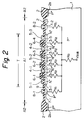
- Fig. 2 is a cross-sectional view taken along the line II-II of Fig. 1;
- Fig. 3 is a layout diagram illustrating an embodiment of the semiconductor device according to the present invention;
- Fig. 4 is a cross-sectional view taken along the line IV-IV of Fig. 3; and
- Fig. 5 is a cross-sectional view illustrating a modification of Fig. 4.
- Before the description of the preferred embodiment, a prior art semiconductor device will be explained with reference to Fig. 1 and Fig. 2 which is a cross-sectional view of Fig. 1.
- In Figs. 1 and 2, a relatively thick field
silicon oxide layer 2 having a P⁺-type channel stopper 2a therebeneath is formed on a P⁻-typemonocrystalline silicon substrate 1 to partition an active area A1 and a field area A2 to isolate the active area A1 from other active areas. Also, a transistor area T is defined within the active area A1. - In the transistor area T, N⁺-type impurity diffusion regions 3-1 to 3-5 ara formed within the
substrate 1. In this case, the regions 3-2 and 3-4 serve as drain regions, and the regions 3-1, 3-3 and 3-5 serve as source regions. Provided on the drain regions 3-2 and 3-4 are drain electrodes 4-1 and 4-2 which form a multi-finger type drain configuration. Also, provided on the source regions 3-1, 3-3 and 3-5 are source electrodes 5-1, 5-2 and 5-3 which form a multi-finger type source configuration. Further, provided between the drain regions 3-2 and 3-4 and the source regions 3-1, 3-3 and 3-5 are gate electrodes 6-1, 6-2, 6-3, 6-4 and 6-5 which form a multi-finger configuration. - Also, P⁺-type substrate contact regions 7-1 and 7-2 are provided in the
semiconductor substrate 1 to surround the transistor area T, i.e., the N⁺-type impurity regions 3-1 to 3-5. Also, reference numerals 8-1 and 8-2 designate power supply lines for applying a definite voltage to the substrate contact regions 7-1 and 7-2. Further,reference numeral 9 designates an insulating layer made of silicon oxide. - In the semiconductor device as illustrated in Figs. 1 and 2, however, when the device is increased in size, so as to increase the substrate noise and reduce the impedance of noise sources, the power supply lines 8-1 and 8-2 connected to the substrate contact regions 7-1 and 7-2 per se suffer from the substrate noise. Also, this power supply lines 8-1 and 8-2 serve as noise sources for other transistor areas. Further, since individual power supply voltages are applied to the sources regions 3-1, 3-3 and 3-5 and the substrate contact regions 7-1 and 7-2, noises superimposed onto the power supply voltages are added to a current of the transistor as a noise current.
- Also, in Figs. 1 and 2, in order to increase the integration, the width of the substrate contact region is so reduced that the resistance of the substrate contact regions 7-1 and 7-2 and its neighborhood is increased. As a result, the resistance (R₁ + R₂) between the back gate and the substrate contact region 8-1 (8-2) is not as small as the resistance (R₀ + R₂) between the back gate and the substrate. For example, the resistance (R₁ + R₂) is larger than hundreds of Ω, and the resistance (R₀ + R₂) is hundreds of Ω. In this case, if the resistance R₀ is approximately half of the resistance R₁, the substrate noise at the back gate can be represented by

- Further, usually, the channel stopper region 2a is provided to surround the substrate contact regions 7-1 and 7-2, to thus avoid the creation of a parasitic MOS transistor. However, since the substrate contact regions 7-1 and 7-2 serve as a low impedance for noise transmitted via the channel stopper 2a, the substrate noise cannot be further suppressed.
- Figs. 3 and 4 illustrate an embodiment of the present invention. Note that Fig. 4 is a cross-sectional view taken along the line IV-IV of Fig. 3.
- In Figs. 3 and 4, two transistor areas T1 and T2 which are symmetrical to each other are provided, and each of the transistor areas T1 and T2 is divided into two portions which are symmetrical to each other. That is, each of the transistor areas T1 and T2 includes one drain region 3-2 (3-4) connected to the drain electrodes 4-1 (4-2), two source regions 3-1 and 3-3 (3-3' and 3-5), and two gate electrodes 6-1 and 6-2 (6-3 and 6-4).
- Also, P⁺-type substrate contact regions 7'-1, 7'-2 and 7'-3 are provided on sides of the transistor areas T1 and T2, i.e., adjacent to the source regions 3-1, 3-3, 3-3' and 3-5. The substrate contact regions 7'-1, 7'-2 and 7'-3 are wider than the substrate contact regions 7-1 and 7-2 of Fig. 2. For example, the width of each of the substrate contact regions 7'-1, 7'-2 and 7'-3 is larger than half of intervals thereof. Further, the substrate contact regions 7'-1, 7'-2 and 7'-3 are electrically connected to the source regions 3-1, 3-3 (3-3') and 3-5, respectively, by source electrodes 5'-1, 5'-2 and 5'-3.
- Thus, the resistance (R₁' + R₂) between the back gate and the substrate contact region 7'-1 (7'-2, 7'-3) can be reduced. For example, the resistance R₁' can be reduced by about one tenth of the resistance R₁ of Fig. 2. In this case,

- Also, in Figs. 3 and 4, an N⁺-
type impurity region 10 is provided to surround the transistor areas T1 and T2. The N⁺-type impurity region 10 is deeper than the drain source regions 3-1, 3-3, 3-3' and 3-5 and the drain regions 3-2 and 3-4. In this case, the N⁺-type impurity region 10 is in a floating state; however, the N ⁺-type impurity region 10 can be connected to a definite power supply line via an electrode 11 as illustrated in Fig. 5. Therefore, the N⁺-type impurity region 10 serves as a high impedance as indicated by R₃ for low frequency (less than hundreds of kHz) noise transmitted via the channel stopper 2a, the substrate noise can be further reduced. - Although the above-described embodiment describes an N-channel MOS transistor, it goes without saying that the present invention can be applied to a P-channel MOS transistor.
- As explained hereinbefore, according to the present invention, since wider substrate contact regions are provided, the resistance between a back gate and the substrate contact regions can be reduced, and accordingly, the substrate noise can be reduced.
Claims (16)
- A semiconductor device comprising:
a semiconductor substrate (1) of a first conductivity type;
a drain region (3-2, 3-4) of a second conductivity type opposite to said first conductivity type, formed in said semiconductor substrate;
a source region (3-1, 3-3, 3-3', 3-5) of said second conductivity type, formed in said semiconductor substrate;
a gate electrode (6-1 ∼ 6-4), formed over said semiconductor substrate between said drain region and said source region;
a substrate contact region (7'-1 ∼ 7'-3) of said first conductivity type having a higher impurity concentration than said semiconductor substrate, said substrate contact region being formed in said semiconductor substrate adjacent to said source region;
a source electrode (5'-1 ∼ 5'-3) formed on said source region; and
a drain electrode (4-1, 4-3) formed on said drain region,
said substrate contact region being wider than said drain region and said source region. - A device as set forth in claim 1, wherein said source electrode is electrically connected to said substrate contact region.
- A device as set forth in claim 1, further comprising an impurity diffusion region (10) of said second conductivity type, being formed in said semiconductor substrate and surrounding said source region, said drain region and said substrate contact region.
- A device as set forth in claim 3, wherein said impurity diffusion region is deeper than said source region, said drain region and said substrate contact region.
- A device as set forth in claim 3, wherein said impurity diffusion region is connected to a definite power supply voltage line (11), so that a reverse bias voltage is applied between said impurity diffusion region and said semiconductor substrate.
- A device as set forth in claim 3, wherein said impurity diffusion region is in a floating state.
- A device as set forth in claim 3, further comprising a channel stopper region (2a) of said first conductivity type, being formed in said semiconductor substrate and surrounding said impurity diffusion region.
- A semiconductor device comprising:
a semiconductor substrate (1) of a first conductivity type;
a drain region (3-2, 3-4) of a second conductivity type opposite to said first conductivity type, formed in said semiconductor substrate;
a source region (3-1, 3-3, 3-3', 3-5) of said second conductivity type, formed in said semiconductor substrate;
a gate electrode (6-1 ∼ 6-4), formed over said semiconductor substrate between said drain region and said source region;
a source electrode (5'-1 ∼ 5'-3) formed on said source region;
a drain electrode (4-1, 4-3) formed on said drain region; and
an impurity diffusion region (10) of said second conductivity type, being formed in said semiconductor substrate and surrounding said source region, said drain region and said substrate contact region. - A semiconductor device having a plurality of transistor areas for one MOS transistor, comprising:
a semiconductor substrate (1) of a first conductivity type;
a plurality of drain regions (3-2, 3-4) of a second conductivity type opposite to said first conductivity type, each of said drain regions being formed in one of said transistor areas of said semiconductor substrate;
a plurality of source region pairs (3-1, 3-3, 3-3', 3-5) of said second conductivity type, each of said source region pairs being formed in one of said transistor areas of said semiconductor substrate and surrounding a respective one of said drain regions;
a plurality of gate electrode pairs (6-1, 6-2, 6-3, 6-4) each of said gate electrode pairs being formed over one of said transistor areas of said semiconductor substrate between a respective one of said drain regions and a respective one of said source region pairs;
a plurality of substrate contact regions (7'-1, 7'-2, 7'-3) of said first conductivity type having a higher impurity concentration than said semiconductor substrate, said substrate contact regions being formed in said semiconductor substrate adjacent to regions of said source region pairs,
a source electrode (5'-1, 5'-2, 5'-3) formed on said source region pairs; and
a drain electrode (4-1, 4-2) formed on said drain regions,
the width of each of said substrate contact regions being larger than half of intervals of said substrate contact regions. - A device as set forth in claim 9, wherein said source electrode is connected to said substrate contact regions. said source region pairs and said substrate contact regions.
- A device as set forth in claim 9, further comprising an impurity diffusion region (10) of said second conductivity type, being formed in said semiconductor substrate and surrounding said transistor areas.
- A device as set forth in claim 11, wherein said impurity diffusion region is deeper than said drain regions.
- A device as set forth in claim 11, wherein said impurity diffusion region is connected to a definite power supply voltage line (11), so that a reverse bias voltage is applied between said impurity diffusion region and said semiconductor substrate.
- A device as set forth in claim 11, wherein said impurity diffusion region is in a floating state.
- A device as set forth in claim 11, further comprising a channel stopper region (2a) of said first conductivity type, being formed in said semiconductor substrate and surrounding said impurity diffusion region.
- A semiconductor device having a plurality transistor areas for one MOS transistor, comprising:
a semiconductor substrate (1) of a first conductivity type;
a plurality of drain regions (3-2, 3-4) of a second conductivity type opposite to said first conductivity type, each of said drain regions being formed in one of said transistor areas of said semiconductor substrate;
a plurality of source region pairs (3-1, 3-3, 3-3', 3-5) of said second conductivity type, each of said source region pairs being formed in one of said transistor areas of said semiconductor substrate and surrounding a respective one of said drain regions;
a plurality of gate electrode pairs (6-1, 6-3, 6-3, 6-4), each of said gate electrode pairs being formed over one of said transistor areas of said semiconductor substrate between a respective one of said drain regions and a respective one of said source region pairs;
a plurality of substrate contact regions (7'-1, 7'-2, 7'-3) of said first conductivity type having a higher impurity concentration than said semiconductor substrate, said substrate contact regions being formed in said semiconductor substrate adjacent to regions of said source region pairs,
a source electrode (5'-1, 5'-2, 5'-3) formed on said source region pairs;
a drain electrode (4-1, 4-2) formed on said drain regions; and
an impurity diffusion region (10) of said second conductivity type, being formed in said semiconductor substrate and surrounding said transistor areas.
Applications Claiming Priority (3)
| Application Number | Priority Date | Filing Date | Title |
|---|---|---|---|
| JP25085394 | 1994-10-17 | ||
| JP250853/94 | 1994-10-17 | ||
| JP6250853A JPH08115985A (en) | 1994-10-17 | 1994-10-17 | Low noise semiconductor integrated circuit |
Publications (3)
| Publication Number | Publication Date |
|---|---|
| EP0708486A2 true EP0708486A2 (en) | 1996-04-24 |
| EP0708486A3 EP0708486A3 (en) | 1997-07-02 |
| EP0708486B1 EP0708486B1 (en) | 2001-09-12 |
Family
ID=17213986
Family Applications (1)
| Application Number | Title | Priority Date | Filing Date |
|---|---|---|---|
| EP95116348A Expired - Lifetime EP0708486B1 (en) | 1994-10-17 | 1995-10-17 | Semiconductor field effect transistor with large substrate contact region |
Country Status (5)
| Country | Link |
|---|---|
| US (1) | US5559356A (en) |
| EP (1) | EP0708486B1 (en) |
| JP (1) | JPH08115985A (en) |
| KR (1) | KR100196734B1 (en) |
| DE (1) | DE69522634T2 (en) |
Families Citing this family (7)
| Publication number | Priority date | Publication date | Assignee | Title |
|---|---|---|---|---|
| JPH09199607A (en) * | 1996-01-18 | 1997-07-31 | Nec Corp | CMOS semiconductor device |
| US6507235B1 (en) * | 1996-06-18 | 2003-01-14 | Micron Technology, Inc. | Local substrate pumping in integrated circuits |
| JP2003017704A (en) | 2001-06-29 | 2003-01-17 | Denso Corp | Semiconductor device |
| JP2006228942A (en) * | 2005-02-17 | 2006-08-31 | Nec Electronics Corp | Semiconductor device |
| JP2008233123A (en) * | 2007-03-16 | 2008-10-02 | Sony Corp | Display device |
| WO2017173322A1 (en) * | 2016-03-31 | 2017-10-05 | Skyworks Solutions, Inc. | Body contacts for field-effect transistors |
| US20230223403A1 (en) * | 2020-06-08 | 2023-07-13 | Rohm Co., Ltd. | Semiconductor device and electronic apparatus |
Family Cites Families (11)
| Publication number | Priority date | Publication date | Assignee | Title |
|---|---|---|---|---|
| JPS60140862A (en) * | 1983-12-28 | 1985-07-25 | Nec Corp | Semiconductor memory device |
| JPS61148862A (en) * | 1984-12-22 | 1986-07-07 | Agency Of Ind Science & Technol | Semiconductor device |
| JPS61179563A (en) * | 1985-02-04 | 1986-08-12 | Toshiba Corp | Complementary type integrated circuit device |
| JPS62105525A (en) * | 1985-11-01 | 1987-05-16 | Hitachi Ltd | Semiconductor integrator circuit device |
| NL8701251A (en) * | 1987-05-26 | 1988-12-16 | Philips Nv | SEMICONDUCTOR DEVICE AND METHOD OF MANUFACTURE THEREOF |
| JP2926969B2 (en) * | 1990-04-26 | 1999-07-28 | 富士電機株式会社 | Semiconductor device having MIS type field effect transistor |
| KR950009893B1 (en) * | 1990-06-28 | 1995-09-01 | 미쓰비시 뎅끼 가부시끼가이샤 | Semiconductor memory device |
| JP2609753B2 (en) * | 1990-10-17 | 1997-05-14 | 株式会社東芝 | Semiconductor device |
| DE69329543T2 (en) * | 1992-12-09 | 2001-05-31 | Compaq Computer Corp., Houston | Manufacture of a field effect transistor with an integrated Schottky clamping diode |
| US5451799A (en) * | 1992-12-28 | 1995-09-19 | Matsushita Electric Industrial Co., Ltd. | MOS transistor for protection against electrostatic discharge |
| JP2850736B2 (en) * | 1992-12-28 | 1999-01-27 | 松下電器産業株式会社 | Semiconductor device |
-
1994
- 1994-10-17 JP JP6250853A patent/JPH08115985A/en active Pending
-
1995
- 1995-10-16 US US08/543,285 patent/US5559356A/en not_active Expired - Lifetime
- 1995-10-17 EP EP95116348A patent/EP0708486B1/en not_active Expired - Lifetime
- 1995-10-17 KR KR1019950035840A patent/KR100196734B1/en not_active Expired - Fee Related
- 1995-10-17 DE DE69522634T patent/DE69522634T2/en not_active Expired - Fee Related
Non-Patent Citations (1)
| Title |
|---|
| None |
Also Published As
| Publication number | Publication date |
|---|---|
| EP0708486A3 (en) | 1997-07-02 |
| KR960015896A (en) | 1996-05-22 |
| EP0708486B1 (en) | 2001-09-12 |
| JPH08115985A (en) | 1996-05-07 |
| KR100196734B1 (en) | 1999-06-15 |
| DE69522634T2 (en) | 2002-07-04 |
| US5559356A (en) | 1996-09-24 |
| DE69522634D1 (en) | 2001-10-18 |
Similar Documents
| Publication | Publication Date | Title |
|---|---|---|
| US20070194383A1 (en) | Semiconductor device | |
| KR20010015835A (en) | Semiconductor device | |
| JP2004501501A (en) | Decoupling capacitors for thin gate oxides | |
| HK79493A (en) | Integrated circuit of the complementary technique having a substrate bias generator | |
| US4219828A (en) | Multidrain metal-oxide-semiconductor field-effect | |
| JP2954854B2 (en) | Integrated circuit chip | |
| JPS61111576A (en) | Semiconductor device | |
| US7816212B2 (en) | Method of high voltage operation of a field effect transistor | |
| US6570435B1 (en) | Integrated circuit with current limited charge pump and method | |
| EP0708486A2 (en) | Semiconductor field effect transistor with large substrate contact region | |
| US4476479A (en) | Semiconductor device with operating voltage coupling region | |
| HK59996A (en) | Integrated circuit with anti-''latch-up'' circuit obtained using complementary mos circuit technology | |
| JP2825038B2 (en) | Semiconductor device | |
| JPH03248554A (en) | Cmos semiconductor integrated circuit device | |
| JPS63158866A (en) | Complementary semiconductor device | |
| JPH03276757A (en) | Semiconductor device | |
| US4952998A (en) | Integrated circuit with complementary MOS transistors | |
| JPS5931864B2 (en) | Complementary insulated gate semiconductor circuit | |
| JPH0219979B2 (en) | ||
| JPH088359B2 (en) | Semiconductor device | |
| JPH0334454A (en) | Circuit for latch-up sensitivity reduction in complementary MOS technology | |
| JP2701853B2 (en) | MIS type semiconductor device | |
| RU2192691C2 (en) | Complementary semiconductor device | |
| JPS63200560A (en) | CMOS type semiconductor device | |
| JPS6156431A (en) | High voltage semiconductor integrated circuit |
Legal Events
| Date | Code | Title | Description |
|---|---|---|---|
| PUAI | Public reference made under article 153(3) epc to a published international application that has entered the european phase |
Free format text: ORIGINAL CODE: 0009012 |
|
| AK | Designated contracting states |
Kind code of ref document: A2 Designated state(s): DE FR GB NL |
|
| PUAL | Search report despatched |
Free format text: ORIGINAL CODE: 0009013 |
|
| AK | Designated contracting states |
Kind code of ref document: A3 Designated state(s): DE FR GB NL |
|
| 17P | Request for examination filed |
Effective date: 19971105 |
|
| 17Q | First examination report despatched |
Effective date: 19980210 |
|
| GRAG | Despatch of communication of intention to grant |
Free format text: ORIGINAL CODE: EPIDOS AGRA |
|
| GRAG | Despatch of communication of intention to grant |
Free format text: ORIGINAL CODE: EPIDOS AGRA |
|
| GRAH | Despatch of communication of intention to grant a patent |
Free format text: ORIGINAL CODE: EPIDOS IGRA |
|
| GRAH | Despatch of communication of intention to grant a patent |
Free format text: ORIGINAL CODE: EPIDOS IGRA |
|
| GRAA | (expected) grant |
Free format text: ORIGINAL CODE: 0009210 |
|
| AK | Designated contracting states |
Kind code of ref document: B1 Designated state(s): DE FR GB NL |
|
| REF | Corresponds to: |
Ref document number: 69522634 Country of ref document: DE Date of ref document: 20011018 |
|
| PGFP | Annual fee paid to national office [announced via postgrant information from national office to epo] |
Ref country code: NL Payment date: 20011031 Year of fee payment: 7 |
|
| REG | Reference to a national code |
Ref country code: GB Ref legal event code: IF02 |
|
| ET | Fr: translation filed | ||
| PLBE | No opposition filed within time limit |
Free format text: ORIGINAL CODE: 0009261 |
|
| STAA | Information on the status of an ep patent application or granted ep patent |
Free format text: STATUS: NO OPPOSITION FILED WITHIN TIME LIMIT |
|
| 26N | No opposition filed | ||
| REG | Reference to a national code |
Ref country code: GB Ref legal event code: 732E |
|
| PG25 | Lapsed in a contracting state [announced via postgrant information from national office to epo] |
Ref country code: NL Free format text: LAPSE BECAUSE OF NON-PAYMENT OF DUE FEES Effective date: 20030501 |
|
| NLV4 | Nl: lapsed or anulled due to non-payment of the annual fee |
Effective date: 20030501 |
|
| REG | Reference to a national code |
Ref country code: FR Ref legal event code: TP |
|
| PGFP | Annual fee paid to national office [announced via postgrant information from national office to epo] |
Ref country code: DE Payment date: 20081014 Year of fee payment: 14 |
|
| PGFP | Annual fee paid to national office [announced via postgrant information from national office to epo] |
Ref country code: GB Payment date: 20081015 Year of fee payment: 14 |
|
| PG25 | Lapsed in a contracting state [announced via postgrant information from national office to epo] |
Ref country code: DE Free format text: LAPSE BECAUSE OF NON-PAYMENT OF DUE FEES Effective date: 20100501 |
|
| REG | Reference to a national code |
Ref country code: FR Ref legal event code: CD |
|
| PG25 | Lapsed in a contracting state [announced via postgrant information from national office to epo] |
Ref country code: GB Free format text: LAPSE BECAUSE OF NON-PAYMENT OF DUE FEES Effective date: 20091017 |
|
| PGFP | Annual fee paid to national office [announced via postgrant information from national office to epo] |
Ref country code: FR Payment date: 20141008 Year of fee payment: 20 |