EP0709462A2 - Rapid and efficient regeneration of transgenic plants - Google Patents
Rapid and efficient regeneration of transgenic plants Download PDFInfo
- Publication number
- EP0709462A2 EP0709462A2 EP95870117A EP95870117A EP0709462A2 EP 0709462 A2 EP0709462 A2 EP 0709462A2 EP 95870117 A EP95870117 A EP 95870117A EP 95870117 A EP95870117 A EP 95870117A EP 0709462 A2 EP0709462 A2 EP 0709462A2
- Authority
- EP
- European Patent Office
- Prior art keywords
- medium
- plants
- tissue
- regenerable
- regenerable tissue
- Prior art date
- Legal status (The legal status is an assumption and is not a legal conclusion. Google has not performed a legal analysis and makes no representation as to the accuracy of the status listed.)
- Granted
Links
Classifications
-
- C—CHEMISTRY; METALLURGY
- C12—BIOCHEMISTRY; BEER; SPIRITS; WINE; VINEGAR; MICROBIOLOGY; ENZYMOLOGY; MUTATION OR GENETIC ENGINEERING
- C12N—MICROORGANISMS OR ENZYMES; COMPOSITIONS THEREOF; PROPAGATING, PRESERVING, OR MAINTAINING MICROORGANISMS; MUTATION OR GENETIC ENGINEERING; CULTURE MEDIA
- C12N15/00—Mutation or genetic engineering; DNA or RNA concerning genetic engineering, vectors, e.g. plasmids, or their isolation, preparation or purification; Use of hosts therefor
- C12N15/09—Recombinant DNA-technology
- C12N15/63—Introduction of foreign genetic material using vectors; Vectors; Use of hosts therefor; Regulation of expression
- C12N15/79—Vectors or expression systems specially adapted for eukaryotic hosts
- C12N15/82—Vectors or expression systems specially adapted for eukaryotic hosts for plant cells, e.g. plant artificial chromosomes (PACs)
- C12N15/8201—Methods for introducing genetic material into plant cells, e.g. DNA, RNA, stable or transient incorporation, tissue culture methods adapted for transformation
-
- C—CHEMISTRY; METALLURGY
- C12—BIOCHEMISTRY; BEER; SPIRITS; WINE; VINEGAR; MICROBIOLOGY; ENZYMOLOGY; MUTATION OR GENETIC ENGINEERING
- C12N—MICROORGANISMS OR ENZYMES; COMPOSITIONS THEREOF; PROPAGATING, PRESERVING, OR MAINTAINING MICROORGANISMS; MUTATION OR GENETIC ENGINEERING; CULTURE MEDIA
- C12N15/00—Mutation or genetic engineering; DNA or RNA concerning genetic engineering, vectors, e.g. plasmids, or their isolation, preparation or purification; Use of hosts therefor
- C12N15/09—Recombinant DNA-technology
- C12N15/63—Introduction of foreign genetic material using vectors; Vectors; Use of hosts therefor; Regulation of expression
- C12N15/79—Vectors or expression systems specially adapted for eukaryotic hosts
- C12N15/82—Vectors or expression systems specially adapted for eukaryotic hosts for plant cells, e.g. plant artificial chromosomes (PACs)
- C12N15/8201—Methods for introducing genetic material into plant cells, e.g. DNA, RNA, stable or transient incorporation, tissue culture methods adapted for transformation
- C12N15/8206—Methods for introducing genetic material into plant cells, e.g. DNA, RNA, stable or transient incorporation, tissue culture methods adapted for transformation by physical or chemical, i.e. non-biological, means, e.g. electroporation, PEG mediated
- C12N15/8207—Methods for introducing genetic material into plant cells, e.g. DNA, RNA, stable or transient incorporation, tissue culture methods adapted for transformation by physical or chemical, i.e. non-biological, means, e.g. electroporation, PEG mediated by mechanical means, e.g. microinjection, particle bombardment, silicon whiskers
-
- C—CHEMISTRY; METALLURGY
- C12—BIOCHEMISTRY; BEER; SPIRITS; WINE; VINEGAR; MICROBIOLOGY; ENZYMOLOGY; MUTATION OR GENETIC ENGINEERING
- C12N—MICROORGANISMS OR ENZYMES; COMPOSITIONS THEREOF; PROPAGATING, PRESERVING, OR MAINTAINING MICROORGANISMS; MUTATION OR GENETIC ENGINEERING; CULTURE MEDIA
- C12N15/00—Mutation or genetic engineering; DNA or RNA concerning genetic engineering, vectors, e.g. plasmids, or their isolation, preparation or purification; Use of hosts therefor
- C12N15/09—Recombinant DNA-technology
- C12N15/63—Introduction of foreign genetic material using vectors; Vectors; Use of hosts therefor; Regulation of expression
- C12N15/79—Vectors or expression systems specially adapted for eukaryotic hosts
- C12N15/82—Vectors or expression systems specially adapted for eukaryotic hosts for plant cells, e.g. plant artificial chromosomes (PACs)
- C12N15/8201—Methods for introducing genetic material into plant cells, e.g. DNA, RNA, stable or transient incorporation, tissue culture methods adapted for transformation
- C12N15/8209—Selection, visualisation of transformants, reporter constructs, e.g. antibiotic resistance markers
Definitions
- the present invention relates to genetically engineered plants.
- it relates to a method for regenerating plant cells which have been transformed.
- the protoplast methods have been widely used in rice, where DNA is delivered to the protoplasts through liposomes, PEG, and electroporation. While a large number of transgenic plants have been recovered in several laboratories (Shimamoto et al., (1989); Datta et al., Bio/Technology, 8 , 736-740, (1990)), the protoplast methods require the establishment of long-term embryogenic suspension cultures. Some regenerants from protoplasts are infertile and phenotypically abnormal due to the long-term suspension culture (Davey et al., J. of Exp. Botany, 42 , 1129-1169, (1991); Rhodes et al., Science, 240 , 204-207, (1988)).
- the microprojectile-mediated DNA delivery method may use immature embryos or immature embryo derived calli as target tissues.
- Transgenic plants have been recovered from the microprojectile bombardment method in maize, oat, barley and wheat (Gordon-Kamm et al., Plant Cell, 2 , 603-618, (1990); Somers et al., Bio/Technology, 10 , 1589-1594, (1992); Wan et al., Plant Physiol., 104 , 37-48 (1994); Vasil et al. (1992)).
- the microprojectile bombardment method generally takes 10 to 15 months to obtain transgenic plants (Gordon-Kamm et al., (1990); Vasil et al. (1992)). Even with the more recent improvements in transformation methods using immature embryos as target tissues, it still requires 4 to 6 months to recover transgenic plants (Weeks et al., Plant Physiol., 102 , 1077-1084, (1993); Vasil et al., (1992); Vasil et. al., Bio/Technology, 11 , 1153-1158 (1993); Becker et al., Plant J., 5 , 299-307, (1994).
- the present invention provides a rapid and efficient transformation and regeneration system.
- the present invention is particularly useful with the transformation and regeneration of wheat plants. Plants regenerated from this system are phenotypically normal and fully fertile. The transgenes are transmitted to R1 progeny in a Mendelian fashion.
- the present invention provides a rapid and efficient regeneration system for monocot crop transformation using proliferated immature embryos as target tissues.
- the new system takes less than two months to obtain transgenic plants. Transformation frequencies by the new system are 5 to 100 times higher than the current methods used in other laboratories.
- This new system can be used with a variety of selectable marker systems, including selection using herbicides, such as glyphosate and bialaphos, as well as antibiotics such as kanamycin. '
- the present invention provides a method for regenerating a transformed monocotyledonous plant to contain foreign DNA comprising the steps of:
- the present invention can be used with any plant species. It is particularly useful for monocot species. More particularly, it is useful in plant species which cannot remain in a callus state for long periods of time without losing the ability to regenerate.
- One particularly useful species in the present invention is wheat.
- the present invention when applied to wheat, has the advantage of being genotype independent. That is, it can be used with any type of wheat variety, including both winter and spring wheat. It can be used to produce transgenic wheat plants from spring cultivars, such as, for example, Bobwhite and Marshall as well as winter cultivars, such as, for example, Neeley.
- the present invention is used to introduce foreign DNA into regenerable plant tissue. Any type of foreign DNA can be inserted into the plant species using the method of the present invention. Generally, “foreign DNA” can be defined to include any type of DNA which is inserted into a plant cell from outside the plant cell. Methods for inserting DNA into plant cells are generally well known, such as a bombardment using a device described in U.S. Patent No. 5,179,022.
- the type of DNA included in the foreign DNA can include DNA which already is present in the plant cell, DNA from another plant, DNA from a different organism, or a DNA generated externally, such as a DNA sequence containing an antisense message of a plant gene, or a DNA sequence encoding a synthetic version of a gene where the nucleotide sequence has been modified.
- the foreign DNA contains a DNA sequence which can function in a regenerable plant tissue as a selection device.
- DNA can include a gene which would function in a regenerable plant tissue to produce a compound which would confer upon the plant tissue resistance to an otherwise toxic compound.
- These genes are well known in the art and can confer resistance to compounds such as antibiotics like kanamycin (Dekeyser et al., Plant Physiol., 90 , 217-223, (1989)), and herbicides like glyphosate (Della-Cioppa et al., Bio/Technology, 5 , 579-584 (1987)) and bialaphos (Vasil et al., (1992)).
- Other selection devices can be used within the scope of the present invention.
- the first step in the present invention is to isolate regenerable tissue from a plant.
- Any regenerable plant tissue can be used in accordance with the present invention.
- Regenerable plant tissue generally refers to tissue which after insertion of foreign DNA can be regenerated into a differentiated plant.
- tissues can include calli and/or embryoids from anthers (Zhou and Konzak, Crop Sci., 29 , 817-821 (1989)), microspores (Ziauddin et al., Plant Cell Rep., 11 , 489-493 (1992)), inflorescences (Barcelo et al., Plant Journal, 5 , 583-592, (1994)) and leaf tissues (Conger et al., Plant Cell Reports, 6 , 345-347, (1987)).
- an immature embryo from a plant is used as a starting material.
- Immature embryos can be produced using known method described in the art. For instance, the production of wheat immature embryos is described by Weeks et al., (1993) and Vasil et al., (1993).
- the regenerable plant tissues are calli.
- the preferred calli are embryogenic calli.
- Embryogenic calli are produced from immature embryos. These calli can be produced by isolating and culturing immature embryos on a nutrient media with carbohydrate and plant growth regulators.
- the elimination of embryo axis as descrbed by Nehra et al., Plant J., 5 , 285-297, (1994) is not necessary.
- Callus producing medium are well known in the art and any culture medium or preparation method can be used.
- a wheat immature embryo is cultured for 1 day up to one month, preferably for 4 to 7 days, on a modified MS medium comprising about 40 g/l maltose and about 2 mg/l 2,4-D.
- the 2,4 D can be replaced by a combination of 0.5 mg/l 2,4-D and 2.2 mg/l picloram.
- the medium is solidified by 2 g/l GELRITE or 4g/l low melting agarose.
- the second step of the method is introducing the foreign DNA into the plant tissue.
- This process is also referred to herein as "transformation.” Any method can be used to insert the foreign DNA into the regenerable plant tissue. Such methods include bombardment (Weeks et al., (1993); Vasil et al., (1992)), Agrobacterium transformation (Chan et al., Plant Molecular Biology, 22 , 491-506, (1993)), electroporation of regenerable tissues (Shillito et. al., Bio-Technology, 3 , 1099-1103, (1985)) and protoplast-facilitated gene delivery (Shimamoto et al., (1989); Datta et al., (1990)).
- the regenerable tissue is transformed using the bombardment method.
- a callus tissue most preferably an embryogenic callus.
- this callus can be grown for a short period of time prior to regeneration or selection or, in accordance with a preferred embodiment of the invention, can immediately be subjected to both regeneration and selection conditions. With other transformation methods, this period may or may not be desirable, depending upon the selection method used.
- the regenerable tissue is grown for a short period after bombardment.
- the medium used for this growth period preferably does not contain any selection device or any medium capable of producing shoots.
- the use of a growth period depends upon the selection device used. Some selection devices benefit from the use of larger or older callus tissue before selection is applied.
- This growth period can be any period of time, but generally ranges from about 1 day to about one month. However, in the preferred embodiment of the invention, this growth period should be short, if one is used at all, and generally no more than about three weeks, preferably no more than about two weeks and most preferably no more than about one week and specifically from about 1 to about 7 days after bombardment. A growth period is not required in the present invention.
- the regenerable plant tissue can be subjected during this period after bombardment to a short period of selection prior to exposure of the regenerable tissue to a medium capable of producing shoots.
- Any selection compounds can be used during this period consistent with the selectable DNA sequence inserted into the regenerable tissue.
- Such compounds include paromomycin, glyphosate and bialaphos.
- this period can range from about 1 day to about two weeks. More preferably, this period will range from about 1 to 7 days.
- regenerable plant tissue After transformation, the regenerable plant tissue is placed in a medium capable of producing shoots from the regenerable tissue where the medium further contains a compound used to select regenerable tissue containing the selectable DNA sequences.
- regenerable plant tissue is generally subjected first to an extended period of selection prior to exposure of the regenerable tissue to a medium capable of producing shoots.
- the medium used in this step can be any medium which permits the formation of shoots from the regenerable tissue.
- a shoot-producing compound is added to the medium.
- These shoot-producing compounds are well known in the art (Murashige and Skoog, Physiol. Plant, 15 , 473-497, (1962); Kasha et al., Gene Manipulation in Plant Improvement II, 213-239, (1990)).
- Such compounds include weak plant growth regulators and include IAA, IBA, and BA at low concentrations (Becker et al., (1994); Vasil et al., (1992)).
- a medium free of a plant growth regulator can be used to induce shoot formation (Weeks et al., (1993)).
- the medium comprises a modified MS medium with 0.2 mg/l 2,4-D (Murashige and Skoog, (1962); Wan and Lemaux, (1994)).
- the regenerable plant tissue is generally placed in this medium as quickly as possible in the present invention after transformation. Generally, this can range from about 1 day to about three weeks, but preferably from about 1 day to about two weeks. Most preferably the tissue is transferred to this medium from about one week to about two weeks after transformation. In most instance, the transfer will occcur between about 5 and about 11 days.
- the compound used to select regenerable tissue containing the selectable DNA sequences can be any of a variety of well known selection compounds, such as antibiotics and herbicides.
- Preferred compounds can include kanamycin (Dekeyser et al., (1989)), glyphosate (Della-Coppa et al., (1987)) and bialaphos (Vasil et al., (1992); Weeks et al., (1993)).
- This medium can further contain a compound used to select regenerable tissue containing the selectable DNA sequences. Transfer to this medium occurs when sufficient shoots have developed, as generally known in the art. This occurs, for wheat, within 25 to 40 days after transformation.
- the medium capable of producing roots can be any root-producing medium. These mediums are well known in the art (Weeks et al., (1993); Vasil et al., (1992)).
- One preferred root- producing medium is a modified MS medium without any plant growth regulator (Murashige and Skoog, (1962); Zhou et al., Plant Cell Tissue and Organ Culture, 30 , 78-83, (1992)).
- the plants can then be transferred to soil and grown following methods known in the art to produce seeds.
- Another advantage of the present invention it that the current biolistic bombardment methods require 4 to 6 months to obtain transgenic plants (Becker et al., (1994); Vasil et al., (1992), (1993); Weeks et al., (1993)).
- the bombarded regenerable tissues of these prior art methods were subcultured on selection media for 2 to 3 months or longer to allow callus proliferation.
- the rapid regeneration method described herein requires less than 2 months to obtain transgenic plants.
- the rapid regeneration system described herein also usually produce uniform, non-chimeric transformants.
- embryogenic callus sectors are usually small at the stage of regeneration. Therefore, only a single shoot is regenerated from each callus sector.
- Histochemical analysis for stable GUS activity showed that leaf segments from different parts of the transgenic plants were generally uniform in GUS expression. Progeny analysis also indicates that most of the transgenic plants segregated at 3:1 ratios between tolerant and sensitive plants as a single dominant gene.
- Immature embryo culture A spring wheat Triticum aestivum cv. Bobwhite was used throughout this study. Stock plants were grown in an environmentally controlled growth chamber with 16-h photoperiod at 800 ⁇ mol m ⁇ s ⁇ 1 provided by high-intensity discharge (HID) Sylvania lights (GTE Products Corp., Manchester, NH. 03103). The day/night temperatures were 18/16 °C. Immature caryopses were collected from the plants 14-d after anthesis.
- HID high-intensity discharge
- Immature embryos (“IE") were dissected and cultured on a modified MS medium (Murashige and Skoog salts, Gibco BRL) supplemented with 40 g/l maltose, 0.5 mg/l 2,4-D, and 2.2 mg/l picloram (CM4). The immature embryos were cultured at 26 °C in the dark.
- pMON19305 contains the uidA gene whereas pMON19328 carries the glyphosate-tolerant CP4 and GOX genes.
- CP4 is a bacterial 5-enolpyruvylshikimate-3-phosphate synthase (EPSPS) gene which expresses an enzyme highly resistant to glyphosate.
- EPSPS 5-enolpyruvylshikimate-3-phosphate synthase
- the glyphosate oxidoreductase is a bacterial gene which degrades glyphosate into aminomethyl phosphonic acid. All genes were driven by the maize ubiquitin Ubil promoter (Christensen et al., (1992)). Each plate was bombarded twice with a PDS 1000 powder gun. High levels of transient GUS expression were observed for every bombardment in every experiment, indicating that the DNA delivery method was very efficient.
- CM4 medium (Table 1) for a 1-week delay of selection .
- two embryos from each bombarded plate were sampled for transient GUS assays.
- the embryos were transferred to an CM4 medium containing 4 mM glyphosate.
- the embryos were transferred to regeneration media containing 0.1 mM glyphosate (Protocol 1).
- the bombarded embryos were directly transferred to the regeneration medium one to two weeks after bombardment (Protocol 2).
- Plants obtained from the regeneration media were transferred to a rooting medium containing 0.02 mM glyphosate.
- Tolerant plants were transferred to soil and grown in an environmentally controlled growth chamber as described. Two weeks later, the plants were sprayed with 8 oz/a ROUNDUP® (active ingredient glyphosate, Monsanto).
- ROUNDUP® active ingredient glyphosate, Monsanto
- Transformation and selection Transformation method for the bar gene was essentially the same as the CP4 and GOX genes. Immature embryos were bombarded with the pAHC25, which carries the bar and uidA genes. Both genes were driven by the Ubiq1 promoter.
- the bar gene encodes phosphinothricin acetyltransferase (PAT) that acetylates phosphinothricin, the active ingredient of the non-selective herbicide Basta® (Hoechst AG).
- PAT phosphinothricin acetyltransferase
- Hoechst AG phosphinothricin acetyltransferase
- the bombarded embryos were transferred to the MMS2 medium with 4 mg/l bialaphos one day after the bombardment (Protocol 3).
- Basta® spray A sample of 20 bialaphos-tolerant plants were transferred to soil and sprayed with 1% Basta® (200 g/l glufosinate, Hoechst AG). Control plants showed necrosis and browning 3-d after the spraying. The damaged leaves turned yellow and dried later on. Ten of the 20 bialaphos tolerant plants did not show any necrotic lessions after the spraying.
- Immature embryo culture A spring wheat Triticum aestivum cv. Bobwhite was used throughout this study. Stock plants were grown in an environmentally controlled growth chamber with 16-h photo period at 800 ⁇ mol m ⁇ s ⁇ 1 provided by high-intensity discharge (HID) Sylvania (GTE Corp.). The day/night temperatures were 18/16 °C. Immature caryopses were collected from the plants 13 or 14-d after anthesis and cultured on a modified MS medium (Murashige and Skoog salts, Gibco BRL) supplemented with 40 g/l maltose, 0.5 mg/l 2,4-D, and 2.2 mg/l picloram (CM4). The immature embryos were cultured at 26 °C in the dark.
- HID high-intensity discharge
- pMON19476 contains the enhanced 35S promoter from CaMV (Odell et al, 1985, Kay et al.
- pMON19468 carries the uidA (which encodes Beta-glucuronidase (GUS) from Escherichia coli (Jefferson et al 1986) and the NOS terminator. Both the nptII and GUS gene were driven by the 35S promoter (Odell et al, 1985, Kay et al. 1987). Each plate was bombarded twice with a PDS 1000 powder gun as described in detail by Klein et al 1987. High levels of transient GUS expression (an average of 84 spots per embryo) were observed, indicating that the DNA delivery method was very efficient.
- the bombarded embryos were directly transferred to the regeneration medium one to two weeks after bombardment (Protocol 5).
- Plants obtained from the regeneration media were transferred to a rooting medium containing no selective agent (Table 9). Plants were scored for GUS by histochemical analysis. Positive plants and some negative plants (controls) were transferred to soil and grown in an environmentally controlled growth chamber as described.
Landscapes
- Health & Medical Sciences (AREA)
- Life Sciences & Earth Sciences (AREA)
- Genetics & Genomics (AREA)
- Engineering & Computer Science (AREA)
- Biomedical Technology (AREA)
- Biotechnology (AREA)
- Bioinformatics & Cheminformatics (AREA)
- Organic Chemistry (AREA)
- Chemical & Material Sciences (AREA)
- Zoology (AREA)
- General Engineering & Computer Science (AREA)
- Wood Science & Technology (AREA)
- Molecular Biology (AREA)
- Microbiology (AREA)
- Plant Pathology (AREA)
- Biophysics (AREA)
- Physics & Mathematics (AREA)
- Biochemistry (AREA)
- General Health & Medical Sciences (AREA)
- Cell Biology (AREA)
- Breeding Of Plants And Reproduction By Means Of Culturing (AREA)
- Compounds Of Unknown Constitution (AREA)
- Agricultural Chemicals And Associated Chemicals (AREA)
Abstract
Description
- The present invention relates to genetically engineered plants. In particular it relates to a method for regenerating plant cells which have been transformed.
- During the past decade, it has become possible to transfer genes from a wide range of organisms to crop plants by recombinant DNA technology. This advance has provided enormous opportunities to improve plant resistance to pests, diseases and herbicides, and to modify biosynthetic processes to change the quality of plant products (Knutson et al., PNAS, USA 89, 2624-2628, (1992); Piorier et al., Science, 256, 520-523, (1992); Vasil et al., Bio/ Technology, 10, 667-674, (1992)). However, the availability of an efficient transformation method to introduce foreign DNA has been a substantial barrier for most monocot species, including maize, rice, oat, barley, and particularly wheat.
- Two alternative transformation methods are currently used for monocot species: direct DNA transfer into isolated protoplasts and microprojectile-mediated DNA delivery (Shimamoto et al., Nature, 338, 274-276, (1989); Fromm et al., Bio/Technology, 8, 833-839, (1990)).
- The protoplast methods have been widely used in rice, where DNA is delivered to the protoplasts through liposomes, PEG, and electroporation. While a large number of transgenic plants have been recovered in several laboratories (Shimamoto et al., (1989); Datta et al., Bio/Technology, 8, 736-740, (1990)), the protoplast methods require the establishment of long-term embryogenic suspension cultures. Some regenerants from protoplasts are infertile and phenotypically abnormal due to the long-term suspension culture (Davey et al., J. of Exp. Botany, 42, 1129-1169, (1991); Rhodes et al., Science, 240, 204-207, (1988)).
- The microprojectile-mediated DNA delivery method may use immature embryos or immature embryo derived calli as target tissues. Transgenic plants have been recovered from the microprojectile bombardment method in maize, oat, barley and wheat (Gordon-Kamm et al., Plant Cell, 2, 603-618, (1990); Somers et al., Bio/Technology, 10, 1589-1594, (1992); Wan et al., Plant Physiol., 104, 37-48 (1994); Vasil et al. (1992)).
- The microprojectile bombardment method generally takes 10 to 15 months to obtain transgenic plants (Gordon-Kamm et al., (1990); Vasil et al. (1992)). Even with the more recent improvements in transformation methods using immature embryos as target tissues, it still requires 4 to 6 months to recover transgenic plants (Weeks et al., Plant Physiol., 102, 1077-1084, (1993); Vasil et al., (1992); Vasil et. al., Bio/Technology, 11, 1153-1158 (1993); Becker et al., Plant J., 5, 299-307, (1994). Moreover, these methods suffer frequently from a loss in fertility in the recovered plants (Vasil et al., (1993); Becker et al., (1994)). Furthermore, the transformation frequency by these methods is very low, about one event from every thousand bombarded embryos. This transformation efficiency is too low for genetic studies and for commercial applications.
- Thus, there is a need not only for a more rapid method of regenerating transformed plant tissue, there is also a need for a method that retains fertility in the resulting plants and produces a higher transformation efficiency.
- The present invention provides a rapid and efficient transformation and regeneration system. The present invention is particularly useful with the transformation and regeneration of wheat plants. Plants regenerated from this system are phenotypically normal and fully fertile. The transgenes are transmitted to R₁ progeny in a Mendelian fashion.
- In a preferred embodiment, the present invention provides a rapid and efficient regeneration system for monocot crop transformation using proliferated immature embryos as target tissues. The new system takes less than two months to obtain transgenic plants. Transformation frequencies by the new system are 5 to 100 times higher than the current methods used in other laboratories. This new system can be used with a variety of selectable marker systems, including selection using herbicides, such as glyphosate and bialaphos, as well as antibiotics such as kanamycin. '
- The present invention provides a method for regenerating a transformed monocotyledonous plant to contain foreign DNA comprising the steps of:
- a) isolating regenerable tissue from the plant;
- b) inserting into the regenerable tissue the foreign DNA where the foreign DNA comprises a selectable DNA sequence, where the sequence can function in a regenerable tissue as a selection device;
- c) between about one day to about three weeks after step b) placing the regenerable tissue from step b) in a medium capable of producing shoots from the tissue where the medium further contains a compound used to select regenerable tissue containing the selectable DNA sequences; and
- d) after at least one shoot has formed from step c), transferring the shoot to a second medium capable of producing roots from the shoot.
- The present invention can be used with any plant species. It is particularly useful for monocot species. More particularly, it is useful in plant species which cannot remain in a callus state for long periods of time without losing the ability to regenerate. One particularly useful species in the present invention is wheat.
- The present invention, when applied to wheat, has the advantage of being genotype independent. That is, it can be used with any type of wheat variety, including both winter and spring wheat. It can be used to produce transgenic wheat plants from spring cultivars, such as, for example, Bobwhite and Marshall as well as winter cultivars, such as, for example, Neeley.
- The present invention is used to introduce foreign DNA into regenerable plant tissue. Any type of foreign DNA can be inserted into the plant species using the method of the present invention. Generally, "foreign DNA" can be defined to include any type of DNA which is inserted into a plant cell from outside the plant cell. Methods for inserting DNA into plant cells are generally well known, such as a bombardment using a device described in U.S. Patent No. 5,179,022.
- The type of DNA included in the foreign DNA can include DNA which already is present in the plant cell, DNA from another plant, DNA from a different organism, or a DNA generated externally, such as a DNA sequence containing an antisense message of a plant gene, or a DNA sequence encoding a synthetic version of a gene where the nucleotide sequence has been modified.
- In one preferred embodiment, the foreign DNA contains a DNA sequence which can function in a regenerable plant tissue as a selection device. Such DNA can include a gene which would function in a regenerable plant tissue to produce a compound which would confer upon the plant tissue resistance to an otherwise toxic compound. These genes are well known in the art and can confer resistance to compounds such as antibiotics like kanamycin (Dekeyser et al., Plant Physiol., 90, 217-223, (1989)), and herbicides like glyphosate (Della-Cioppa et al., Bio/Technology, 5, 579-584 (1987)) and bialaphos (Vasil et al., (1992)). Other selection devices can be used within the scope of the present invention.
- The first step in the present invention is to isolate regenerable tissue from a plant. Any regenerable plant tissue can be used in accordance with the present invention. Regenerable plant tissue generally refers to tissue which after insertion of foreign DNA can be regenerated into a differentiated plant. For example such tissues can include calli and/or embryoids from anthers (Zhou and Konzak, Crop Sci., 29, 817-821 (1989)), microspores (Ziauddin et al., Plant Cell Rep., 11, 489-493 (1992)), inflorescences (Barcelo et al., Plant Journal, 5, 583-592, (1994)) and leaf tissues (Conger et al., Plant Cell Reports, 6, 345-347, (1987)).
- In one embodiment of the present invention, an immature embryo from a plant is used as a starting material. Immature embryos can be produced using known method described in the art. For instance, the production of wheat immature embryos is described by Weeks et al., (1993) and Vasil et al., (1993).
- In another preferred embodiment of the present invention, the regenerable plant tissues are calli. The preferred calli are embryogenic calli. Embryogenic calli are produced from immature embryos. These calli can be produced by isolating and culturing immature embryos on a nutrient media with carbohydrate and plant growth regulators. In the preferred embodiment of the present invention, when producing embryogenic calli from wheat, the elimination of embryo axis as descrbed by Nehra et al., Plant J., 5, 285-297, (1994) is not necessary.
- Callus producing medium are well known in the art and any culture medium or preparation method can be used. In the preferred embodiment, where wheat calli are prepared, a wheat immature embryo is cultured for 1 day up to one month, preferably for 4 to 7 days, on a modified MS medium comprising about 40 g/l maltose and about 2 mg/l 2,4-D. In another embodiment, the 2,4 D can be replaced by a combination of 0.5 mg/l 2,4-D and 2.2 mg/l picloram. The medium is solidified by 2 g/l GELRITE or 4g/l low melting agarose.
- Once the regenerable plant tissue is isolated, the second step of the method is introducing the foreign DNA into the plant tissue. This process is also referred to herein as "transformation." Any method can be used to insert the foreign DNA into the regenerable plant tissue. Such methods include bombardment (Weeks et al., (1993); Vasil et al., (1992)), Agrobacterium transformation (Chan et al., Plant Molecular Biology, 22, 491-506, (1993)), electroporation of regenerable tissues (Shillito et. al., Bio-Technology, 3, 1099-1103, (1985)) and protoplast-facilitated gene delivery (Shimamoto et al., (1989); Datta et al., (1990)).
- In a preferred embodiment, the regenerable tissue is transformed using the bombardment method. In this embodiment, it is also preferred that a callus tissue, most preferably an embryogenic callus, is used. After bombardment, this callus can be grown for a short period of time prior to regeneration or selection or, in accordance with a preferred embodiment of the invention, can immediately be subjected to both regeneration and selection conditions. With other transformation methods, this period may or may not be desirable, depending upon the selection method used.
- In one embodiment of the invention, the regenerable tissue is grown for a short period after bombardment. The medium used for this growth period preferably does not contain any selection device or any medium capable of producing shoots. The use of a growth period depends upon the selection device used. Some selection devices benefit from the use of larger or older callus tissue before selection is applied. This growth period can be any period of time, but generally ranges from about 1 day to about one month. However, in the preferred embodiment of the invention, this growth period should be short, if one is used at all, and generally no more than about three weeks, preferably no more than about two weeks and most preferably no more than about one week and specifically from about 1 to about 7 days after bombardment. A growth period is not required in the present invention.
- In another embodiment of the invention, the regenerable plant tissue can be subjected during this period after bombardment to a short period of selection prior to exposure of the regenerable tissue to a medium capable of producing shoots. Any selection compounds can be used during this period consistent with the selectable DNA sequence inserted into the regenerable tissue. Such compounds include paromomycin, glyphosate and bialaphos.
- While this selection period prior to regeneration is not required under the claimed invention, if used, this period can range from about 1 day to about two weeks. More preferably, this period will range from about 1 to 7 days.
- After transformation, the regenerable plant tissue is placed in a medium capable of producing shoots from the regenerable tissue where the medium further contains a compound used to select regenerable tissue containing the selectable DNA sequences. This is in contrast to the prior art where regenerable plant tissue is generally subjected first to an extended period of selection prior to exposure of the regenerable tissue to a medium capable of producing shoots.
- The medium used in this step can be any medium which permits the formation of shoots from the regenerable tissue. In one embodiment, a shoot-producing compound is added to the medium. These shoot-producing compounds are well known in the art (Murashige and Skoog, Physiol. Plant, 15, 473-497, (1962); Kasha et al., Gene Manipulation in Plant Improvement II, 213-239, (1990)). Such compounds include weak plant growth regulators and include IAA, IBA, and BA at low concentrations (Becker et al., (1994); Vasil et al., (1992)). In another embodiment of the invention, a medium free of a plant growth regulator can be used to induce shoot formation (Weeks et al., (1993)).
- In a preferred embodiment, where an embryogenic wheat calli is to be regenerated, the medium comprises a modified MS medium with 0.2 mg/l 2,4-D (Murashige and Skoog, (1962); Wan and Lemaux, (1994)).
- The regenerable plant tissue is generally placed in this medium as quickly as possible in the present invention after transformation. Generally, this can range from about 1 day to about three weeks, but preferably from about 1 day to about two weeks. Most preferably the tissue is transferred to this medium from about one week to about two weeks after transformation. In most instance, the transfer will occcur between about 5 and about 11 days.
- The compound used to select regenerable tissue containing the selectable DNA sequences can be any of a variety of well known selection compounds, such as antibiotics and herbicides. Preferred compounds can include kanamycin (Dekeyser et al., (1989)), glyphosate (Della-Coppa et al., (1987)) and bialaphos (Vasil et al., (1992); Weeks et al., (1993)).
- The availability of alternative selection agents is an important requirement for commercial application of agriculture biotechnology. The use of kanamycin has been less successful for cereal crops because of the high endogenous level of tolerance (Dekeyser et al., (1989)). Bialaphos has been widely used as a selection agent in cereal crop transformation (Weeks et al., (1993); Vasil et al., (1993); Becker et al., (1994); Nehra et al., (1994); Wan and Lemaux (1993)). However, it could potentially be a disaster to exclusively use genes encoding bialaphos resistance as a selectable marker in all transformation experiments. Other selectable markers are needed and our results demonstrate that the herein described rapid regeneration system works well with different selection agents.
- After shoots have formed the shoots are transferred to a second medium capable of producing roots from said shoots. This medium can further contain a compound used to select regenerable tissue containing the selectable DNA sequences. Transfer to this medium occurs when sufficient shoots have developed, as generally known in the art. This occurs, for wheat, within 25 to 40 days after transformation.
- The medium capable of producing roots can be any root-producing medium. These mediums are well known in the art (Weeks et al., (1993); Vasil et al., (1992)). One preferred root- producing medium is a modified MS medium without any plant growth regulator (Murashige and Skoog, (1962); Zhou et al., Plant Cell Tissue and Organ Culture, 30, 78-83, (1992)).
- Once roots have been formed, the plants can then be transferred to soil and grown following methods known in the art to produce seeds.
- One advantage of the above described transformation and regeneration method is that plants obtained from this process are generally fertile. The loss of fertility among transgenic plants using prior art methods is believed to be attributed to the long-term cultures before and after the transformation treatments rather than the act of transformation per se.
- Another advantage of the present invention it that the current biolistic bombardment methods require 4 to 6 months to obtain transgenic plants (Becker et al., (1994); Vasil et al., (1992), (1993); Weeks et al., (1993)). The bombarded regenerable tissues of these prior art methods were subcultured on selection media for 2 to 3 months or longer to allow callus proliferation. By reducing the time of the callus proliferation culture, the rapid regeneration method described herein requires less than 2 months to obtain transgenic plants.
- Use of the present method also caused transformed tissues to regenerate much fast. The regenerants were also more vigorous and healthier both in culture and in soil.
- The rapid regeneration system described herein also usually produce uniform, non-chimeric transformants. With the rapid regeneration method, embryogenic callus sectors are usually small at the stage of regeneration. Therefore, only a single shoot is regenerated from each callus sector. Histochemical analysis for stable GUS activity showed that leaf segments from different parts of the transgenic plants were generally uniform in GUS expression. Progeny analysis also indicates that most of the transgenic plants segregated at 3:1 ratios between tolerant and sensitive plants as a single dominant gene.
- The following examples describe specific embodiments of the invention. Media used are described in Table 9. The examples are provided to better elucidate the practice of the present invention and should not be interpreted in any way to limit the scope of the present invention. Those skilled in the art will recognize that various modifications, additions, etc. can be made to the methods described herein while not departing from the spirit and scope of the present invention.
- 1. Immature embryo culture A spring wheat Triticum aestivum cv. Bobwhite was used throughout this study. Stock plants were grown in an environmentally controlled growth chamber with 16-h photoperiod at 800 µmol m⁻s⁻¹ provided by high-intensity discharge (HID) Sylvania lights (GTE Products Corp., Manchester, NH. 03103). The day/night temperatures were 18/16 °C. Immature caryopses were collected from the plants 14-d after anthesis. Immature embryos ("IE") were dissected and cultured on a modified MS medium (Murashige and Skoog salts, Gibco BRL) supplemented with 40 g/l maltose, 0.5 mg/l 2,4-D, and 2.2 mg/l picloram (CM4). The immature embryos were cultured at 26 °C in the dark.
- 2. DNA delivery Five days after the initiation of culture, immature embryos were transferred to an osmoticum treatment medium 4-h prior to bombardment. The osmoticum medium was the same CM4 with 0.35 M mannitol. Thirty to 40 embryos were placed in the center of each plate, and the embryos were bombarded with a mixture of pMON19305 and pMON19328 at an 1:1 ratio. pMON19305 contains the uidA gene whereas pMON19328 carries the glyphosate-tolerant CP4 and GOX genes. CP4 is a bacterial 5-enolpyruvylshikimate-3-phosphate synthase (EPSPS) gene which expresses an enzyme highly resistant to glyphosate. The glyphosate oxidoreductase (GOX) is a bacterial gene which degrades glyphosate into aminomethyl phosphonic acid. All genes were driven by the maize ubiquitin Ubil promoter (Christensen et al., (1992)). Each plate was bombarded twice with a PDS 1000 powder gun. High levels of transient GUS expression were observed for every bombardment in every experiment, indicating that the DNA delivery method was very efficient.
- 3. Regeneration of glyphosate-tolerant plants After a 16-h post-bombardment treatment on the 0.35 M mannitol medium, the bombarded embryos were transferred to the CM4 medium (Table 1) for a 1-week delay of selection . At this stage, two embryos from each bombarded plate were sampled for transient GUS assays. After a one or two-week delay, the embryos were transferred to an CM4 medium containing 4 mM glyphosate. After one to two weeks of callus proliferation culture on this selection medium, the embryos were transferred to regeneration media containing 0.1 mM glyphosate (Protocol 1). In some cases, the bombarded embryos were directly transferred to the regeneration medium one to two weeks after bombardment (Protocol 2). Shoots obtained from the regeneration media were transferred to a rooting medium containing 0.02 mM glyphosate. Tolerant plants were transferred to soil and grown in an environmentally controlled growth chamber as described. Two weeks later, the plants were sprayed with 8 oz/a ROUNDUP® (active ingredient glyphosate, Monsanto).


Table 1. Glyphosate-tolerant plants recovered from different selection regeneration regimes by the rapid regeneration method. Treatment Expt/Trt# # I.E. # events #GUS pos. 1 wk delay, direct regen. 37-2 300 3 2 42-2 350 3 3 43-2 400 5 5 2 wk delay, direct regen. 37-3 300 1 1 42-3 350 3 2 43-3 400 7 3 1 wk delay/1 wk callusing 43-4 400 11 11 1 wk delay/2 wk callusing 42-4 175 3 3 Total 2675 36 (1.3%) Expt: experiment; Trt: treatment; I.E.: immature embryos; GUS: β-glucuronidase. Table 2. A summary of glyphosate tolerant plants produced from the old and the rapid regeneration methods. Methods # Expt # I.E. # events Freq. Months Old 14 13,000 6 0.05% 4.5 Rapid 3 2,675 36 1.3% 2.0 Expt: experiment; Trt: treatment; I.E.: immature embryos; Freq.: frequency. - 4. Enzyme assay of CP4 and GOX Transformed Plants Crude proteins were extracted from fresh leaves of transgenic plants following a BioRad method. CP4 and GOX proteins were probed by antibodies, and calculated as percentages of total proteins. The transgenic plants contained 0.007-0.160% and 0.004-0.062% GOX, which were equivalent to a previously confirmed transgenic plant (Table 3). Five transgenic plants had no CP4 expression. Glyphosate tolerance of these plants was probably conferred by the GOX gene.
Table 3. Stable GUS expression and percent CP4 and GOX protein contents of glyphosate tolerant plants. Transgenic lines Stable GUS % CP4 % GOX 42-2-02 + 0.079 0.014 42-3-01 + 0.017 0.009 42-3-02 - 0.009 0.051 42-4-01 + 0.160 0.017 42-4-02 + - 0.007 42-4-03 + 0.106 0.022 43-2-01 + 0.079 0.038 43-2-02 + 0.037 0.017 43-2-03 + 0.017 0.018 43-2-05 + 0.028 0.028 43-3-01 + 0.030 0.017 43-3-02 - 0.007 0.004 43-3-03 - 0.008 0.004 43-3-04 + - 0.011 43-3-05 - - 0.020 43-3-06 + 0.007 0.004 43-3-07 - - 0.045 43-3-08 - - 0.027 43-4-01 + 0.070 0.062 43-4-02 + 0.022 0.012 43-4-03 + 0.019 0.042 43-4-04 + 0.151 0.035 43-4-05 + 0.034 0.044 43-4-06 + 0.076 0.028 43-4-11 + 0.016 0.017 Bobwhite 0.001 0.001 16-5(CK+) 0.028 0.011 - 5. Progeny analysis ofglyphosate-tolerant plants Immature embryos from the glyphosate-tolerant plants were isolated 20-d after anthesis and cultured on a germination medium (MMS medium without plant growth regulator) with 0.02 mM glyphosate. Germinated and non-germinated embryos were separated and recorded 10 day after the culture and the data were analyzed by X test for 3:1 segregation (Table 4). X test indicated that the transgene segregated at a 3:1 ratio as expected. The tolerant plants were then transplanted to soil and sprayed with 8 oz/a ROUNDUP®. Individuals germinated on the selection media were also tolerant to the spray.
Table 4. Germination test of embryos from glyphosate tolerant R₀ plants. Transgenic lines %CP4 protein %GOX protein Germination test Tolerant Sensitive 3:1 prob. 93-42-2-2 0.079 0.014 31 11 >0.9 93-43-2-1 0.079 0.038 27 26 <0.01 93-43-2-3 0.017 0.018 48 9 >0.1 93-43-2-5 0.028 0.028 33 17 >0.1 93-43-4-1 0.070 0.062 24 10 >0.1 93-43-4-2 0.022 0.012 6 32 <0.01 93-43-4-3 0.019 0.042 39 13 >0.9 93-43-4-4 0.151 0.035 9 29 <0.01 93-43-4-5 0.034 0.044 52 6 <0.01 Bobwhite (control) 0 45 - 1. Transformation and selection Transformation method for the bar gene was essentially the same as the CP4 and GOX genes. Immature embryos were bombarded with the pAHC25, which carries the bar and uidA genes. Both genes were driven by the Ubiq1 promoter. The bar gene encodes phosphinothricin acetyltransferase (PAT) that acetylates phosphinothricin, the active ingredient of the non-selective herbicide Basta® (Hoechst AG). The bombarded embryos were transferred to the MMS2 medium with 4 mg/l bialaphos one day after the bombardment (Protocol 3).
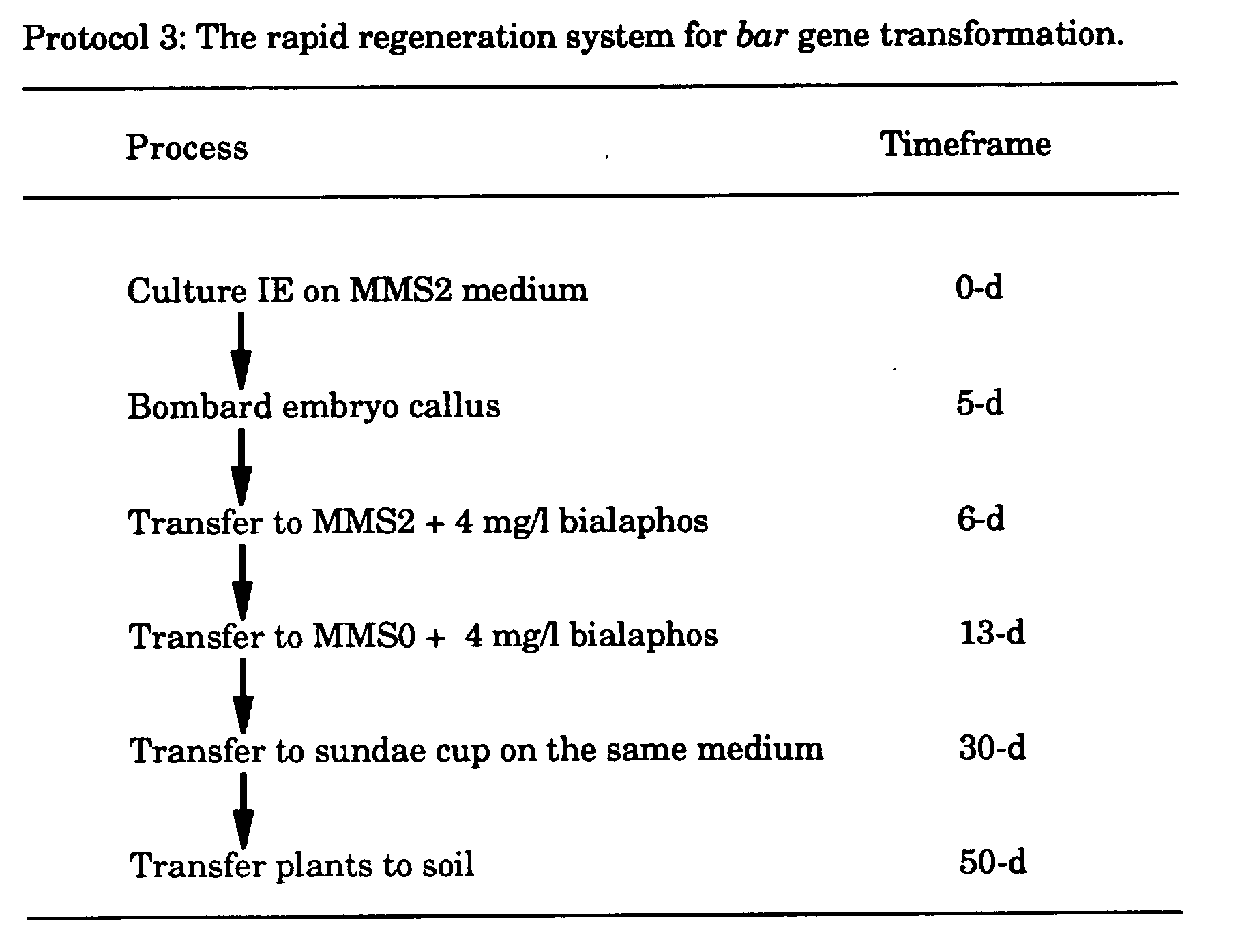
- 2. Regeneration of bialaphos-tolerant plants Following a one to two week callus proliferation on the MMS2 medium, the embryos were transferred to an MMS0 regeneration medium with 4 mg/l bialaphos. Shoots and plants from the regeneration medium were transferred to sundae cups with the same medium for rooting. Bialaphos tolerant plants were recovered and transferred to soil within two months. From a total of 828 bombarded embryos in the three experiments, 566 embryos produced bialaphos-tolerant plants (Table 5). About 15% of the embryos produced single plant, 20% of them with 2 plants, 40% with 3 plants, and 25% with 4 or more plants. Each embryo was counted as a single transformation event regardless the number of plants recovered. One third (190 out of 566) of the transformation events were GUS positive. GUS activity often varied among individual events, from completely dark blue to blue stripes in vascular tissues or blue dots randomly scattered on the leaves. Transformation frequency with bialaphos selection was much higher than glyphosate under our experimental conditions, and 10 to 100-fold higher than those previously reported for wheat and barley (Vasil et al. 1992, 1993; Weeks et al. 1993; Nehra et al. 1994; Wan and Lemaux 1993).
Table 5. Bialaphos-tolerant plants recovered by the rapid regeneration system. Expt-Trt#* Time of callusing No. Of embryo Bialaphos tolerant GUS positive No. % No. % Expt 44-3 2wks 269 212 78.8 63 29.7 Expt 46-3 1 wk 192 146 76.0 52 35.6 Expt 46-4 2 wks 187 119 63.6 42 35.3 Expt 48-3 1 wk 90 59 65.6 22 37.3 Expt 48-4 2 wks 90 43 47.8 17 39.5 Expt: experiment; Trt: treatment; GUS: β-glucuronidase. - 3. Basta® spray A sample of 20 bialaphos-tolerant plants were transferred to soil and sprayed with 1% Basta® (200 g/l glufosinate, Hoechst AG). Control plants showed necrosis and browning 3-d after the spraying. The damaged leaves turned yellow and dried later on. Ten of the 20 bialaphos tolerant plants did not show any necrotic lessions after the spraying.
- 4. PAT assay The Basta® tolerant plants were analyzed for PAT activity following the method of De Block et al. (EMBO J, 6, 2513-2518, 1987). All Basta® tolerant plants were PAT positive, whereas no PAT activity was observed in Bobwhite control plants (Table 6).
- 5. Germination test and progeny analysis The Basta® tolerant plants grew normally and set seeds. Immature embryos from the plants were cultured on a germination medium with 2 mg/l bialaphos. Immature embryos from Bobwhite control plants could not germinate on the bialaphos selection medium, whereas embryos from the Basta® tolerant plants segregated into tolerant and sensitive ones. Two of the ten plants showed 3:1 segregation ratios as expected. Five had less than 3:1 segregation whereas the other three did not produce any tolerant embryos (Table 6). It is unknown at this stage what has caused the unexpected segregation. It could be due to the small size of samples or due to gene silence. Nevertheless, the production of bialaphos tolerant plants demonstrated that the rapid regeneration system is independent of selectable markers or any gene of interest.
Table 6. Germination test for bialaphos tolerant R₀ plants recovered from the rapid regeneration system. Germination test Transgenics GUS PAT Tolerant Sensitive 3:1 prob. 44-3-01 - + 0 30 na 44-3-02 - + 28 8 .5-.75 44-3-03 + + 21 15 <.05 44-3-06 + + 18 8 .25-.50 44-3-07 - + 14 15 <.01 46-3-01 + + 0 40 na 46-3-02 + + 11 31 <.01 46-3-05 + + 0 48 na 46-3-06 + + 4 32 <.01 46-3-07 - + 14 27 <.01 Bobwhite (CK) - - 0 40 na GUS: β-glucuronidase; PAT: phosphinothricin acetyltransferase. - The rapid transformation regeneration system also was demonstrated with paromomycin selection for the nptII gene.
- 1. Immature embryo culture A spring wheat Triticum aestivum cv. Bobwhite was used throughout this study. Stock plants were grown in an environmentally controlled growth chamber with 16-h photo period at 800 µmol m⁻s⁻¹ provided by high-intensity discharge (HID) Sylvania (GTE Corp.). The day/night temperatures were 18/16 °C. Immature caryopses were collected from the plants 13 or 14-d after anthesis and cultured on a modified MS medium (Murashige and Skoog salts, Gibco BRL) supplemented with 40 g/l maltose, 0.5 mg/l 2,4-D, and 2.2 mg/l picloram (CM4). The immature embryos were cultured at 26 °C in the dark.
- 2. DNA delivery Five days after the initiation of culture, immature embryos were transferred to an osmoticum treatment medium 4-h prior to bombardment. The osmoticum medium was the same CM4 with 0.35 M mannitol or 0.125 M mannitol and 0.125 M raffinose. Approximately 40 embryos were placed in the center of each plate, and the embryos were bombarded with a mixture of pMON19476 and pMON19468 at an 1:1 ratio. pMON19476 contains the enhanced 35S promoter from CaMV (Odell et al, 1985, Kay et al. 1987), the NPTII gene (Fraley et al 1983), and the NOS terminator from the nopaline synthase gene (Fraley et al. 1983). pMON19468 carries the uidA (which encodes Beta-glucuronidase (GUS) from Escherichia coli (Jefferson et al 1986) and the NOS terminator. Both the nptII and GUS gene were driven by the 35S promoter (Odell et al, 1985, Kay et al. 1987). Each plate was bombarded twice with a PDS 1000 powder gun as described in detail by Klein et al 1987. High levels of transient GUS expression (an average of 84 spots per embryo) were observed, indicating that the DNA delivery method was very efficient.
- 3. Regeneration of paromomycin-tolerant plants After a 18-h post-bombardment treatment on the 0.35 M mannitol medium or a combination of 0.125 M mannitol and 0.125 M raffinose medium, the bombarded embryos were transferred to the CM4 medium (Table 9) for a 6 or 7 day delay of selection . At this stage, two embryos from each bombarded plate were sampled for transient GUS assays. After a 6 or 7 day delay, the embryos were transferred to a CM4 medium containing 100, 200, or 300 mg/l paromomycin for callus proliferation. Another set of embryos were transferred directly to regeneration medium containing 100 or 200mg/l paromomycin (Protocol 4). In some cases, the bombarded embryos were directly transferred to the regeneration medium one to two weeks after bombardment (Protocol 5). Shoots obtained from the regeneration media were transferred to a rooting medium containing no selective agent (Table 9). Plants were scored for GUS by histochemical analysis. Positive plants and some negative plants (controls) were transferred to soil and grown in an environmentally controlled growth chamber as described.
- 4. Progeny analysis of paromomycin-tolerant plants. Immature embryos from the paromomycin-tolerant plants were isolated 20-d after anthesis and cultured on a germination medium (MMS0 medium without plant growth regulator) with 100 mg/l paromomycin. Germinated and non-germinated embryos were separated and recorded 10 day after the culture and the data was analyzed by X test for 3:1 segregation (Table 8). X test indicated that the transgene did not segregate at a 3:1 ratio as expected.


Table 7. Paromomycin selected plants recovered from different selection regeneration regimes by the rapid regeneration method. Treatment Delay Before Selection Time on Callusing Paro Conc mg/l Expt/Trt# #IE #Plants #gus+ 7d 3 week 100 88-02 400 30 4 7d 3 week 200 88-03 400 37 3 7d 3 week 300 88-04 369 35 2 5d 0 100 91-01 162 52 6 5d 0 200 91-02 161 38 3 5d 1 week 100 91-05 365 29 1 5d 2 week 100 91-07 364 23 4 5d 3 week 100 91-09 364 21 4 Total 2585 265 27 Table 8. Paromomycin germination assay on R₁ progeny from plants transformed with the nptII gene. Transgenic lines* Scorable Marker Germination assay #Tolerant #Sensitive 3:1 prob 88-04-01-01 Gus (+) 30 50 <0.01 88-04-02-01 Gus (-) 26 54 <0.01 88-24-06-02 Gus (+) 36 44 <0.01 88-14-04-02 Anthro (+) 37 43 <0.01 88-35-01-01 Anthro (+) 18 14 <0.01 Control BW none 0 80 NA *Plants transformed with either:
pMON19476 (E35S/HSP70/NPTII) + pMON19468 (E35S/HSP70/GUS) or pMON19476 (E35S/HSP70/NPTII) + BC17 anthocyanin)Table 9. Tissue Culture Media used for wheat callus development, and regeneration of plant cells. Medium Name MS* Carbohydrate per liter pH Additional Components mg/l CM4 + 40g maltose 5.8 500 glutamine 750 MgCl 100 casein hydrolysate 0.5 2,4-D 2.2 picloram MMSZR/IAA + 40g maltose 5.8 500 glutamine 750 MgCl 100 casein hydrolysate 5 Zeatin riboside 1 IAA MMS2 + 40g maltose 5.8 2 2,4-D MMS.2 + 40g maltose 5.8 0.2 2,4-D MMSO + 20g sucrose or 40g maltose 5.8 * Basal MS medium described in (Zhou et al. 1993)
2g/l gelrite used for all media except paromomycin selection medium which contains 4 g/l agarose. - The above examples demonstrate the transformation method using three selection devices. One skilled in the art would recognize that this method can be applied to many selection systems and that the invention is not limited to these examples but only limited by the attached claims.
Claims (18)
- A method for regenerating transformed monocotyledonous plants to contain foreign DNA comprising the steps of:a) isolating regenerable tissue from said plants;b) inserting into said regenerable tissue said foreign DNA where said foreign DNA comprises a selectable DNA sequence, where said sequence can function in a regenerable tissue as a selection device;c) between about one day to about three weeks after step b) placing said regenerable tissue from step b) in a medium capable of producing shoots from said tissue where said medium further contains a compound used to select regenerable tissue containing said selectable DNA sequences; andd) after at least one shoot has formed from step c), transferring said shoot to a second medium capable of producing roots from said shoot.
- The method of claim 1 where said regenerable tissue is moved to the medium of step c) between from about one day to about two weeks after step b).
- The method of claim 1 where said regenerable tissue is moved to the medium of step c) between from about five days to about eleven days after step b).
- The method of claim 1 where said selectable DNA sequence expresses an enzyme which will confer resistance to at least one of the group consisting of kanamycin and paromomycin to said plant cell.
- The method of claim 1 where said selectable DNA sequence expresses an enzyme which will confer resistance to glyphosate to said plant cell.
- The method of claim 1 where said selectable DNA sequence expresses an enzyme which will confer resistance to bialaphos to said plant cell.
- A method for regenerating transformed wheat plants to contain foreign DNA comprising the steps of:a) isolating regenerable tissue from said plants;b) inserting into said regenerable tissue said foreign DNA where said foreign DNA comprises a selectable DNA sequence, where said sequence can function in a regenerable tissue as a selection device;c) between about one day to about three weeks after step b) placing said regenerable tissue from step b) in a medium capable of producing shoots from said tissue where said medium further contains a compound used to select regenerable tissue containing said selectable DNA sequences; andd) after at least one shoot has formed from step c), transferring said shoot to a second medium capable of producing roots from said shoot.
- The method of claim 7 where said regenerable tissue is moved to the medium of step c) between from about one day to about two weeks after step b).
- The method of claim 7 where said regenerable tissue is moved to the medium of step c) between from about five days to about eleven days after step b).
- The method of claim 7 where said selectable DNA sequence expresses an enzyme which will confer resistance to at least one of the group consisting of kanamycin and paromomycin to said plant cell.
- The method of claim 7 where said selectable DNA sequence expresses an enzyme which will confer resistance to glyphosate to said plant cell.
- The method of claim 7 where said selectable DNA sequence expresses an enzyme which will confer resistance to bialaphos to said plant cell.
- A method for regenerating transformed wheat plants to contain foreign DNA comprising the steps of:a) isolating embryogenic calli from said plants;b) inserting into said calli said foreign DNA where said foreign DNA comprises a selectable DNA sequence, where said sequence can function in a regenerable tissue as a selection device;c) between about one day to about three weeks after step b) placing said regenerable tissue from step b) in a medium capable of producing shoots from said tissue where said medium further contains a compound used to select regenerable tissue containing said selectable DNA sequences; andd) after at least one shoot has formed from step c), transferring said shoot to a second medium capable of producing roots from said shoot.
- The method of claim 13 where said regenerable tissue is moved to the medium of step c) between from about one day to about two weeks after step b).
- The method of claim 13 where said regenerable tissue is moved to the medium of step c) between from about five days to about eleven days after step b).
- The method of claim 13 where said selectable DNA sequence expresses an enzyme which will confer resistance to at least one of the group consisting of kanamycin and paromomycin to said plant cell.
- The method of claim 13 where said selectable DNA sequence expresses an enzyme which will confer resistance to glyphosate to said plant cell.
- The method of claim 13 where said selectable DNA sequence expresses an enzyme which will confer resistance to bialaphos to said plant cell.
Applications Claiming Priority (2)
| Application Number | Priority Date | Filing Date | Title |
|---|---|---|---|
| US329742 | 1994-10-26 | ||
| US08/329,742 US5631152A (en) | 1994-10-26 | 1994-10-26 | Rapid and efficient regeneration of transgenic plants |
Publications (3)
| Publication Number | Publication Date |
|---|---|
| EP0709462A2 true EP0709462A2 (en) | 1996-05-01 |
| EP0709462A3 EP0709462A3 (en) | 1997-01-02 |
| EP0709462B1 EP0709462B1 (en) | 2006-10-04 |
Family
ID=23286807
Family Applications (1)
| Application Number | Title | Priority Date | Filing Date |
|---|---|---|---|
| EP95870117A Expired - Lifetime EP0709462B1 (en) | 1994-10-26 | 1995-10-25 | Rapid and efficient regeneration of transgenic plants |
Country Status (7)
| Country | Link |
|---|---|
| US (2) | US5631152A (en) |
| EP (1) | EP0709462B1 (en) |
| AT (1) | ATE341634T1 (en) |
| CA (1) | CA2161387C (en) |
| DE (1) | DE69535251T2 (en) |
| ES (1) | ES2274515T3 (en) |
| PT (1) | PT709462E (en) |
Cited By (16)
| Publication number | Priority date | Publication date | Assignee | Title |
|---|---|---|---|---|
| WO1997048814A3 (en) * | 1996-06-21 | 1998-03-19 | Monsanto Co | Methods for the production of stably-transformed, fertile wheat employing agrobacterium-mediated transformation and compositions derived therefrom |
| WO1998020144A3 (en) * | 1996-11-07 | 1998-07-16 | Zeneca Ltd | Herbicide resistant plants |
| WO1999027116A3 (en) * | 1997-11-20 | 1999-08-12 | Yeda Res & Dev | Dna molecules conferring dalapon-resistance to plants and plants transformed thereby |
| WO1999051759A1 (en) * | 1998-04-06 | 1999-10-14 | Monsanto Company | Particle mediated transformation of soybean with glyphosate selection |
| US6369298B1 (en) | 1997-04-30 | 2002-04-09 | Pioneer Hi-Bred International, Inc. | Agrobacterium mediated transformation of sorghum |
| US7057087B2 (en) | 2002-07-26 | 2006-06-06 | Board Of Control Of Michigan Technological University | Application of aspen MADS-box genes to alter reproduction and development in trees |
| EP1925672A1 (en) | 2001-06-22 | 2008-05-28 | Syngeta Participations AG | Abiotic stress responsive polynucleotides and polypeptides |
| WO2008112970A2 (en) | 2007-03-14 | 2008-09-18 | Pioneer Hi-Bred International, Inc. | Dominant gene suppression transgenes and methods of using same |
| EP2141239A1 (en) | 2003-12-16 | 2010-01-06 | Pioneer Hi-Bred International, Inc. | Dominant gene suppression transgenes and methods of using same |
| EP2159289A2 (en) | 2005-06-23 | 2010-03-03 | BASF Plant Science GmbH | Improved methods for the production of stably transformed plants |
| EP2290084A2 (en) | 2003-06-30 | 2011-03-02 | Commonwealth Scientific and Industrial Research Organization | Wheat with altered branching enzyme activity and starch and starch containing products derived therefrom |
| EP3205668A1 (en) | 2016-02-15 | 2017-08-16 | Brendan Patrick Purcell | Method for biofabricating composite material |
| US11214844B2 (en) | 2017-11-13 | 2022-01-04 | Modern Meadow, Inc. | Biofabricated leather articles having zonal properties |
| US11352497B2 (en) | 2019-01-17 | 2022-06-07 | Modern Meadow, Inc. | Layered collagen materials and methods of making the same |
| US11913166B2 (en) | 2015-09-21 | 2024-02-27 | Modern Meadow, Inc. | Fiber reinforced tissue composites |
| US12600862B2 (en) | 2020-05-01 | 2026-04-14 | Modern Meadow, Inc. | Protein polyurethane alloys and layered materials including the same |
Families Citing this family (142)
| Publication number | Priority date | Publication date | Assignee | Title |
|---|---|---|---|---|
| AU7968098A (en) * | 1997-06-11 | 1998-12-30 | United States Of America, As Represented By The Secretary Of Agriculture, The | Transformation of wheat with the cyanamide hydratase gene |
| PL197872B1 (en) | 1997-10-31 | 2008-05-30 | Syngenta Participations Ag | Sugar beet plant expressing cp4 / epsps enzyme activity and its progeny, transgenic sugar beet plant seeds expressing cp4 / epsps enzyme activity and a method of producing transgenic plants |
| JPH11174541A (en) * | 1997-12-08 | 1999-07-02 | Canon Inc | Electronic flash device |
| CA2340286C (en) | 1998-08-19 | 2015-07-14 | Monsanto Company | Plant expression vector comprising a 5' non-translated leader sequence from a wheat chlorophyll a/b-binding protein gene |
| CN101353658A (en) | 1999-12-16 | 2009-01-28 | 孟山都技术有限公司 | Novel Plant Expression Constructs |
| CA2407396C (en) * | 2000-04-28 | 2013-12-31 | Basf Aktiengesellschaft | Use of the maize x112 mutant ahas 2 gene and imidazolinone herbicides for selection of transgenic monocots |
| US6552250B1 (en) | 2000-06-14 | 2003-04-22 | Her Majesty The Queen In Right Of Canada As Represented By The Minister Of Agriculture And Agri-Food | Diacylglycerol O-acyltransferase |
| US6995016B2 (en) | 2000-08-17 | 2006-02-07 | Her Majesty The Queen In Right Of Canada, As Represented By The Minister Of Agriculture And Agri-Food | Process for inducing direct somatic embryogenesis in immature scutella cells of pooideae, and rapidly regenerating fertile plants |
| EP1197550A3 (en) * | 2000-08-25 | 2002-11-20 | Pfizer Products Inc. | Methods and compositions for diagnosing and treating disorders involving angiogenesis |
| US6635451B2 (en) * | 2001-01-25 | 2003-10-21 | Abbott Laboratories | Desaturase genes and uses thereof |
| HU230318B1 (en) * | 2001-02-05 | 2016-01-28 | The University Of South Carolina | Sustained totipotent culture of arundo donax |
| EP1950305A1 (en) | 2001-05-09 | 2008-07-30 | Monsanto Technology, LLC | Tyr a genes and uses thereof |
| BRPI0209536B1 (en) | 2001-05-09 | 2016-05-10 | Monsanto Technology Llc | DNA construct encoding adenylate transporter in plants and method for producing seeded plant having increased level of tocopherol |
| IL158885A0 (en) * | 2001-05-30 | 2004-05-12 | Chromos Molecular Systems Inc | Plant artificial chromosomes, uses thereof and methods of preparing plant artificial chromosomes |
| US7294759B2 (en) * | 2001-06-29 | 2007-11-13 | E. I. Du Pont De Nemours And Company | Alteration of oil traits in plants |
| US7288694B2 (en) | 2001-07-06 | 2007-10-30 | Monsanto Technology Llc | Methods for enhancing segregation of transgenes in plants and compositions thereof |
| US8212109B2 (en) | 2001-07-19 | 2012-07-03 | Monsanto Technology Llc | Method for the production of transgenic plants |
| US7211656B2 (en) * | 2002-01-30 | 2007-05-01 | Abbott Laboratories | Desaturase genes, enzymes encoded thereby, and uses thereof |
| US7534934B2 (en) * | 2002-02-20 | 2009-05-19 | J.R. Simplot Company | Precise breeding |
| AU2003219806B8 (en) * | 2002-02-20 | 2011-01-27 | J.R. Simplot Company | Precise breeding |
| ES2420929T3 (en) | 2002-07-18 | 2013-08-27 | Monsanto Technology Llc | Procedures for using artificial polynucleotides and their compositions to reduce transgene silencing |
| EP1723488A4 (en) * | 2004-01-21 | 2008-04-23 | Omega Genetics Llc | Glyphosate tolerant plants and methods of making and using the same |
| AR047598A1 (en) | 2004-02-10 | 2006-01-25 | Monsanto Technology Llc | TRANSGENIZED CORN SEED WITH GREATER AMINO ACID CONTENT |
| ES2368721T5 (en) | 2004-03-10 | 2021-05-06 | Monsanto Technology Llc | Herbicidal compositions containing N-phosphonomethylglycine and an auxin herbicide |
| US20060041961A1 (en) | 2004-03-25 | 2006-02-23 | Abad Mark S | Genes and uses for pant improvement |
| ES2547381T3 (en) | 2004-04-09 | 2015-10-05 | Monsanto Technology, Llc | Compositions and procedures for controlling insect infestations in plants |
| US20060075522A1 (en) | 2004-07-31 | 2006-04-06 | Jaclyn Cleveland | Genes and uses for plant improvement |
| US7456270B2 (en) * | 2004-09-01 | 2008-11-25 | Abbott Laboratories | Δ6-desaturase genes and uses thereof |
| US20060200878A1 (en) | 2004-12-21 | 2006-09-07 | Linda Lutfiyya | Recombinant DNA constructs and methods for controlling gene expression |
| EP1827079A4 (en) | 2004-12-21 | 2012-04-11 | Monsanto Technology Llc | TRANSGENIC PLANTS HAVING SUPERIOR AGRONOMIC CHARACTERS |
| US8314290B2 (en) | 2004-12-21 | 2012-11-20 | Monsanto Technology Llc | Temporal regulation of gene expression by MicroRNAs |
| ES2459369T3 (en) | 2004-12-21 | 2014-05-09 | Monsanto Technology Llc | Transgenic plants with enhanced agronomic traits |
| WO2006073727A2 (en) | 2004-12-21 | 2006-07-13 | Monsanto Technology, Llc | Recombinant dna constructs and methods for controlling gene expression |
| WO2006076423A2 (en) | 2005-01-12 | 2006-07-20 | Monsanto Technology, Llc | Genes and uses for plant improvement |
| EP1882392A4 (en) | 2005-05-10 | 2009-07-01 | Monsanto Technology Llc | Genes and uses for plant improvement |
| WO2007047016A2 (en) | 2005-10-13 | 2007-04-26 | Monsanto Technology, Llc | Methods for producing hybrid seed |
| WO2007078280A2 (en) | 2005-12-21 | 2007-07-12 | Monsanto Technology, Llc | Transgenic plants with enhanced agronomic traits |
| CN101421406B (en) | 2006-02-13 | 2016-08-31 | 孟山都技术有限公司 | For producing nucleic acid construct and the method that the seed oil of change forms |
| WO2008021543A2 (en) | 2006-08-17 | 2008-02-21 | Monsanto Technology, Llc | Transgenic plants with enhanced agronomic traits |
| WO2008027592A2 (en) | 2006-08-31 | 2008-03-06 | Monsanto Technology, Llc | Phased small rnas |
| CN101802215A (en) | 2006-10-12 | 2010-08-11 | 孟山都技术有限公司 | Plant microRNAs and methods of use thereof |
| EP2115141A4 (en) | 2007-02-20 | 2010-08-04 | Monsanto Technology Llc | INVERTEBRA MICRO-RNA |
| BRPI0721649B8 (en) | 2007-05-07 | 2021-11-23 | Univ South Carolina | Methods of producing and maintaining a totipotent embryogenic cell culture from a monocot plant, of establishing a plant-microbe association, and of producing an elite plant line |
| EP2147109B1 (en) | 2007-05-24 | 2014-03-19 | E. I. Du Pont de Nemours and Company | Dgat genes from yarrowia lipolytica for increased seed storage lipid production and altered fatty acid profiles in soybean |
| ES2716864T3 (en) | 2007-06-06 | 2019-06-17 | Monsanto Technology Llc | Genes and applications for plant improvement |
| EP2175714A4 (en) | 2007-07-10 | 2011-01-26 | Monsanto Technology Llc | TRANSGENIC PLANTS WITH ENHANCED AGRONOMIC CHARACTERISTICS |
| US20120124697A1 (en) | 2007-08-29 | 2012-05-17 | E.I.Du Pont De Nemours And Company | Plants with altered root architecture, related constructs and methods involving genes encoding nucleoside diphosphatase kinase (ndk) polypeptides and homologs thereof |
| US8097712B2 (en) | 2007-11-07 | 2012-01-17 | Beelogics Inc. | Compositions for conferring tolerance to viral disease in social insects, and the use thereof |
| EP2617831A3 (en) | 2007-11-20 | 2013-08-07 | E. I. du Pont de Nemours and Company | Plants with altered root architecture, related constructs and methods involving genes encoding leucine rich repeat kinase (llrk) polypeptides and homologs thereof |
| EP2257628A4 (en) | 2008-03-04 | 2011-11-02 | Univ Washington State | COMPOSITIONS AND METHODS FOR THE DIFFERENTIAL REGULATION OF FATTY ACID UNSATURATION IN MEMBRANE LIPIDS AND SEED OIL |
| SI2262896T1 (en) | 2008-04-07 | 2014-05-30 | Monsanto Technology Llc | Plant regulatory elements and uses thereof |
| BRPI0911501A2 (en) | 2008-04-29 | 2015-07-28 | Monsanto Technology Llc | Genes and uses for plant breeding. |
| EP2620502A3 (en) | 2008-05-23 | 2013-09-25 | E. I. du Pont de Nemours and Company | DGAT genes from oleaginous organisms for increased seed storage lipid production and altered fatty acid profiles in oilseed plants |
| EP2297310A2 (en) | 2008-05-23 | 2011-03-23 | E. I. du Pont de Nemours and Company | Novel dgat genes for increased seed storage lipid production and altered fatty acid profiles in oilseed plants |
| WO2010002984A1 (en) | 2008-07-01 | 2010-01-07 | Monsanto Technology, Llc | Recombinant dna constructs and methods for modulating expression of a target gene |
| US8338665B2 (en) | 2008-07-16 | 2012-12-25 | Monsanto Technology Llc | Methods and vectors for producing transgenic plants |
| WO2010042510A1 (en) * | 2008-10-06 | 2010-04-15 | Abbott Laboratires | Delta-8 desaturase genes, enzymes encoded thereby and uses thereof |
| US20110258735A1 (en) | 2008-12-22 | 2011-10-20 | Marie Coffin | Genes and uses for plant enhancement |
| US7868688B2 (en) * | 2008-12-30 | 2011-01-11 | Cosmic Circuits Private Limited | Leakage independent very low bandwith current filter |
| US8507754B2 (en) | 2009-01-31 | 2013-08-13 | University Of North Texas | Engineering lipids in vegetative tissues of plants |
| US20120277117A1 (en) | 2009-02-27 | 2012-11-01 | Adel Zayed | Hydroponic apparatus and methods of use |
| US8334426B1 (en) | 2009-06-04 | 2012-12-18 | Pioneer Hi Bred International Inc | Method for obtaining transformed maize plants |
| US20120047603A1 (en) | 2009-06-09 | 2012-02-23 | Allen Stephen M | Drought tolerant plants and related constructs and methods involving genes encoding fatty acid desaturase family polypeptides |
| US8188335B2 (en) | 2009-07-17 | 2012-05-29 | Abbott Laboratories | Δ9-elongase for production of polyunsaturated fatty acid-enriched oils |
| US20120142532A1 (en) | 2009-08-10 | 2012-06-07 | Monsanto Technology Llc | Low volatility auxin herbicide formulations |
| US8962584B2 (en) | 2009-10-14 | 2015-02-24 | Yissum Research Development Company Of The Hebrew University Of Jerusalem, Ltd. | Compositions for controlling Varroa mites in bees |
| AU2010333827A1 (en) | 2009-12-24 | 2012-06-28 | E. I. Du Pont De Nemours And Company | Plant membrane bound O-acyl transferase (MBOAT) family protein sequences and their uses for altering fatty acid compositions |
| BR112012019582B1 (en) | 2010-01-14 | 2021-09-21 | Monsanto Technology Llc | DNA MOLECULE COMPRISING PLANT REGULATORY ELEMENTS |
| EP2531603A2 (en) | 2010-02-02 | 2012-12-12 | E.I. Du Pont De Nemours And Company | Plants with altered root architecture, related constructs and methods involving genes encoding lectin protein kinase (lpk) polypeptides and homologs thereof |
| KR101982126B1 (en) | 2010-03-08 | 2019-05-27 | 몬산토 테크놀로지 엘엘씨 | Polynucleotide Molecules for Gene Regulation in Plants |
| US8816153B2 (en) | 2010-08-27 | 2014-08-26 | Monsanto Technology Llc | Recombinant DNA constructs employing site-specific recombination |
| US10829828B2 (en) | 2011-09-13 | 2020-11-10 | Monsanto Technology Llc | Methods and compositions for weed control |
| BR112014005958A2 (en) | 2011-09-13 | 2020-10-13 | Monsanto Technology Llc | agricultural chemical methods and compositions for plant control, method of reducing expression of an accase gene in a plant, microbial expression cassette, method for making a polynucleotide, method of identifying polynucleotides useful in modulating expression of the accase gene and herbicidal composition |
| US9840715B1 (en) | 2011-09-13 | 2017-12-12 | Monsanto Technology Llc | Methods and compositions for delaying senescence and improving disease tolerance and yield in plants |
| CA2848685A1 (en) | 2011-09-13 | 2013-03-21 | Monsanto Technology Llc | Methods and compositions for weed control comprising topical application of a glutamine synthetase polynucleotide |
| EP3434780A1 (en) | 2011-09-13 | 2019-01-30 | Monsanto Technology LLC | Methods and compositions for weed control |
| US10806146B2 (en) | 2011-09-13 | 2020-10-20 | Monsanto Technology Llc | Methods and compositions for weed control |
| US10760086B2 (en) | 2011-09-13 | 2020-09-01 | Monsanto Technology Llc | Methods and compositions for weed control |
| BR112014005975A8 (en) | 2011-09-13 | 2017-09-12 | Monsanto Technology Llc | PLANT CONTROL METHOD, METHOD OF REDUCING EXPRESSION OF A PDS GENE IN A PLANT, MICROBIAL EXPRESSION CASSETTE, METHOD OF MAKING A POLYNUCLEOTIDE, METHOD OF IDENTIFICATION OF POLYNUCLEOTIDES, AND COMPOSITIONS FOR WEED CONTROL |
| US9920326B1 (en) | 2011-09-14 | 2018-03-20 | Monsanto Technology Llc | Methods and compositions for increasing invertase activity in plants |
| BR122019001001B1 (en) | 2011-10-26 | 2019-08-27 | Monsanto Technology Llc | auxin herbicidal salts, herbicidal application mixture comprising them for use in the elimination and growth control of unwanted plants, as well as methods of controlling unwanted plants and plants susceptible to auxin herbicide |
| CA2860220C (en) | 2011-12-22 | 2021-07-13 | E. I. Du Pont De Nemours And Company | Use of the soybean or medicago truncatula sucrose synthase promoter to increase plant seed oil content |
| SG11201405841RA (en) | 2012-03-26 | 2014-10-30 | Pronutria Inc | Nutritive fragments, proteins and methods |
| CN104619843B (en) | 2012-05-24 | 2020-03-06 | A.B.种子有限公司 | Compositions and methods for silencing gene expression |
| UY34845A (en) | 2012-06-04 | 2014-01-31 | Monsanto Technology Llc | ? WATER CONCENTRATED HERBICIDE COMPOSITIONS CONTAINING GLIFOSATE SALTS AND DICAMBA SALTS |
| BR112015008706A2 (en) | 2012-10-18 | 2018-02-06 | Monsanto Technology Llc | methods and compositions for plant pest control |
| WO2014084884A1 (en) | 2012-11-28 | 2014-06-05 | Monsanto Technology Llc | Transgenic plants with enhanced traits |
| US10253325B2 (en) | 2012-12-19 | 2019-04-09 | Boston Medical Center Corporation | Methods for elevating fat/oil content in plants |
| UY35251A (en) | 2013-01-01 | 2014-07-31 | Seeds Ltd Ab | ISOLATED DsRNA MOLECULES AND METHODS TO USE THEM TO SILENCE DIANA OF INTEREST MOLECULES |
| US10683505B2 (en) | 2013-01-01 | 2020-06-16 | Monsanto Technology Llc | Methods of introducing dsRNA to plant seeds for modulating gene expression |
| US10000767B2 (en) | 2013-01-28 | 2018-06-19 | Monsanto Technology Llc | Methods and compositions for plant pest control |
| AU2014223496B2 (en) | 2013-02-27 | 2017-11-30 | Monsanto Technology Llc | Glyphosate composition for dicamba tank mixtures with improved volatility |
| AU2014248958A1 (en) | 2013-03-13 | 2015-10-01 | Monsanto Technology Llc | Methods and compositions for weed control |
| CA2905027A1 (en) | 2013-03-13 | 2014-10-09 | Monsanto Technology Llc | Methods and compositions for weed control |
| US20140283211A1 (en) | 2013-03-14 | 2014-09-18 | Monsanto Technology Llc | Methods and Compositions for Plant Pest Control |
| US10568328B2 (en) | 2013-03-15 | 2020-02-25 | Monsanto Technology Llc | Methods and compositions for weed control |
| MX359191B (en) | 2013-07-19 | 2018-09-18 | Monsanto Technology Llc | Compositions and methods for controlling leptinotarsa. |
| US9850496B2 (en) | 2013-07-19 | 2017-12-26 | Monsanto Technology Llc | Compositions and methods for controlling Leptinotarsa |
| WO2015054106A1 (en) | 2013-10-07 | 2015-04-16 | Monsanto Technology Llc | Transgenic plants with enhanced traits |
| AR098295A1 (en) | 2013-11-04 | 2016-05-26 | Monsanto Technology Llc | COMPOSITIONS AND METHODS TO CONTROL INFESTATIONS OF PESTS AND PARASITES OF THE ARTHROPODS |
| UA119253C2 (en) | 2013-12-10 | 2019-05-27 | Біолоджикс, Інк. | METHOD FOR VARROA TREATMENT AND VEGETABLES |
| AU2015206585A1 (en) | 2014-01-15 | 2016-07-21 | Monsanto Technology Llc | Methods and compositions for weed control using EPSPS polynucleotides |
| EP3420809A1 (en) | 2014-04-01 | 2019-01-02 | Monsanto Technology LLC | Compositions and methods for controlling insect pests |
| US10988764B2 (en) | 2014-06-23 | 2021-04-27 | Monsanto Technology Llc | Compositions and methods for regulating gene expression via RNA interference |
| EP3161138A4 (en) | 2014-06-25 | 2017-12-06 | Monsanto Technology LLC | Methods and compositions for delivering nucleic acids to plant cells and regulating gene expression |
| CN114009454A (en) | 2014-07-29 | 2022-02-08 | 孟山都技术公司 | Compositions and methods for controlling insect pests |
| RU2723049C2 (en) | 2015-01-22 | 2020-06-08 | Монсанто Текнолоджи Ллс | Compositions and methods for controlling leptinotarsa |
| US10883103B2 (en) | 2015-06-02 | 2021-01-05 | Monsanto Technology Llc | Compositions and methods for delivery of a polynucleotide into a plant |
| US10655136B2 (en) | 2015-06-03 | 2020-05-19 | Monsanto Technology Llc | Methods and compositions for introducing nucleic acids into plants |
| US10781456B2 (en) | 2015-06-23 | 2020-09-22 | MAX-PLANCK-Gesellschaft zur Förderung der Wissenschaften e.V. | Carbon-neutral and carbon-positive photorespiration bypass routes supporting higher photosynthetic rate and yield |
| WO2017059341A1 (en) | 2015-10-02 | 2017-04-06 | Monsanto Technology Llc | Recombinant maize b chromosome sequence and uses thereof |
| WO2017074547A1 (en) | 2015-10-30 | 2017-05-04 | Pioneer Hi-Bred International, Inc. | Methods and compositions for rapid plant transformation |
| WO2018005491A1 (en) | 2016-06-28 | 2018-01-04 | Monsanto Technology Llc | Methods and compositions for use in genome modification in plants |
| UY40585A (en) | 2016-08-17 | 2024-01-15 | Monsanto Technology Llc | METHODS, COMPOSITIONS AND PLANTS BY MANIPULATING GIBBERELLIN METABOLISM TO INCREASE CROPS YIELD |
| WO2018052919A1 (en) | 2016-09-14 | 2018-03-22 | Monsanto Technology Llc | Methods and compositions for genome editing via haploid induction |
| EP3518656A4 (en) | 2016-09-30 | 2020-09-30 | Monsanto Technology LLC | METHOD OF SELECTING TARGETS FOR SITE-SPECIFIC GENOME MODIFICATION IN PLANTS |
| CN110213961A (en) | 2016-12-22 | 2019-09-06 | 孟山都技术公司 | Crop based on genome editor is engineered and produces plant of short stem |
| CA3008850A1 (en) | 2017-06-29 | 2018-12-29 | Modern Meadow, Inc. | Yeast strains and methods for producing collagen |
| WO2019084148A1 (en) | 2017-10-25 | 2019-05-02 | Monsanto Technology Llc | Targeted endonuclease activity of the rna-guided endonuclease casx in eukaryotes |
| EP3752621A4 (en) | 2018-02-15 | 2021-12-01 | Monsanto Technology LLC | COMPOSITIONS AND METHODS FOR IMPROVING CROP YIELD BY STACKING CHARACTERS |
| MX2020008563A (en) | 2018-02-15 | 2021-01-08 | Monsanto Technology Llc | IMPROVED METHODS FOR THE PRODUCTION OF HYBRID CORN SEEDS. |
| WO2019161151A1 (en) | 2018-02-15 | 2019-08-22 | Monsanto Technology Llc | Compositions and methods for improving crop yields through trait stacking |
| AU2019275110B2 (en) | 2018-05-24 | 2025-10-16 | Monsanto Technology Llc | Genome editing in plants |
| US12274205B2 (en) | 2018-12-12 | 2025-04-15 | Monsanto Technology Llc | Delayed harvest of short stature corn plants |
| EP4219700A1 (en) | 2019-03-07 | 2023-08-02 | The Regents of the University of California | Crispr-cas effector polypeptides and methods of use thereof |
| EP4768574A2 (en) | 2019-05-29 | 2026-07-01 | Monsanto Technology LLC | METHODS AND COMPOSITIONS FOR THE PRODUCTION OF DOMINANT ALLELS USING GENOMEDITATION |
| EP3975694A1 (en) | 2019-05-29 | 2022-04-06 | Altria Client Services LLC | Compositions and methods for producing tobacco plants and products having reduced or eliminated suckers |
| US11827893B2 (en) | 2019-10-10 | 2023-11-28 | Altria Client Services Llc | Pale yellow locus and its applications in tobacco |
| US12359212B2 (en) | 2019-11-22 | 2025-07-15 | Mozza Foods, Inc. | Recombinant micelle and method of in vivo assembly |
| US11326176B2 (en) | 2019-11-22 | 2022-05-10 | Mozza Foods, Inc. | Recombinant micelle and method of in vivo assembly |
| WO2022056139A1 (en) | 2020-09-10 | 2022-03-17 | Monsanto Technology Llc | Increasing gene editing and site-directed integration events utilizing meiotic and germline promoters |
| US20220159905A1 (en) | 2020-11-23 | 2022-05-26 | Monsanto Technology Llc | Management of corn through semi-dwarf systems |
| EP4288448A1 (en) | 2021-02-03 | 2023-12-13 | Altria Client Services LLC | Terpene production in plants |
| US12577624B2 (en) | 2021-11-02 | 2026-03-17 | Monsanto Technology Llc | Transgenic corn event ZM_BCS216090 and methods for detection and uses thereof |
| WO2023230433A1 (en) | 2022-05-23 | 2023-11-30 | Altria Client Services Llc | Methods and compositions for regulating alkaloids in tobacco field |
| CN119948047A (en) | 2022-08-05 | 2025-05-06 | 奥驰亚客户服务有限公司 | Methods and compositions for regulating alkaloids in tobacco |
| WO2024155597A1 (en) | 2023-01-17 | 2024-07-25 | Inscripta, Inc. | Methods and compositions of co-expression of t7rna polymerase and inhibitory rna aptamers |
| EP4442817A1 (en) | 2023-04-04 | 2024-10-09 | Max-Planck-Gesellschaft zur Förderung der Wissenschaften e.V. | Paclitaxel (taxol) biosynthesis pathway |
| WO2025075911A1 (en) | 2023-10-02 | 2025-04-10 | Inscripta, Inc. | Engineered gpp synthases |
| WO2025080632A1 (en) | 2023-10-11 | 2025-04-17 | Altria Client Services Llc | Compositions and methods to alter alkaloids in tobacco |
| US20260117236A1 (en) | 2024-01-05 | 2026-04-30 | Altria Client Services Llc | Methods and compositions for modulating trichome density and flavor molecule secretion |
| WO2026148246A1 (en) | 2025-01-06 | 2026-07-09 | University Of Virginia Patent Foundation | Modified tobacco plants with altered trichome characteristics and related methods |
Family Cites Families (13)
| Publication number | Priority date | Publication date | Assignee | Title |
|---|---|---|---|---|
| US5569597A (en) * | 1985-05-13 | 1996-10-29 | Ciba Geigy Corp. | Methods of inserting viral DNA into plant material |
| US5004863B2 (en) * | 1986-12-03 | 2000-10-17 | Agracetus | Genetic engineering of cotton plants and lines |
| ES2097746T3 (en) * | 1988-03-08 | 1997-04-16 | Ciba Geigy Ag | REGENERATION OF GRASS PLANTS OF THE POOIDEAE SUBFAMILY BASED ON PROTOPLASTS. |
| US5990387A (en) * | 1988-06-10 | 1999-11-23 | Pioneer Hi-Bred International, Inc. | Stable transformation of plant cells |
| US5550318A (en) * | 1990-04-17 | 1996-08-27 | Dekalb Genetics Corporation | Methods and compositions for the production of stably transformed, fertile monocot plants and cells thereof |
| US5484956A (en) * | 1990-01-22 | 1996-01-16 | Dekalb Genetics Corporation | Fertile transgenic Zea mays plant comprising heterologous DNA encoding Bacillus thuringiensis endotoxin |
| US5767367A (en) * | 1990-06-23 | 1998-06-16 | Hoechst Aktiengesellschaft | Zea mays (L.) with capability of long term, highly efficient plant regeneration including fertile transgenic maize plants having a heterologous gene, and their preparation |
| JPH04111998A (en) * | 1990-08-29 | 1992-04-13 | Komatsu Ltd | Hydraulic press slide drive method |
| JP3234598B2 (en) * | 1990-11-23 | 2001-12-04 | プラント・ジエネテイツク・システムズ・エヌ・ベー | Transformation method of monocotyledonous plant |
| WO1993004178A1 (en) * | 1991-08-23 | 1993-03-04 | University Of Florida | A novel method for the production of transgenic plants |
| UA48104C2 (en) * | 1991-10-04 | 2002-08-15 | Новартіс Аг | Dna fragment including sequence that codes an insecticide protein with optimization for corn, dna fragment providing directed preferable for the stem core expression of the structural gene of the plant related to it, dna fragment providing specific for the pollen expression of related to it structural gene in the plant, recombinant dna molecule, method for obtaining a coding sequence of the insecticide protein optimized for corn, method of corn plants protection at least against one pest insect |
| US5610042A (en) * | 1991-10-07 | 1997-03-11 | Ciba-Geigy Corporation | Methods for stable transformation of wheat |
| DK0604662T3 (en) * | 1992-07-07 | 2008-10-20 | Japan Tobacco Inc | Method of Transforming Monocotyledon |
-
1994
- 1994-10-26 US US08/329,742 patent/US5631152A/en not_active Expired - Lifetime
-
1995
- 1995-10-25 DE DE69535251T patent/DE69535251T2/en not_active Expired - Lifetime
- 1995-10-25 EP EP95870117A patent/EP0709462B1/en not_active Expired - Lifetime
- 1995-10-25 CA CA002161387A patent/CA2161387C/en not_active Expired - Lifetime
- 1995-10-25 AT AT95870117T patent/ATE341634T1/en active
- 1995-10-25 ES ES95870117T patent/ES2274515T3/en not_active Expired - Lifetime
- 1995-10-25 PT PT95870117T patent/PT709462E/en unknown
-
1997
- 1997-02-10 US US08/795,233 patent/US6153812A/en not_active Expired - Lifetime
Cited By (34)
| Publication number | Priority date | Publication date | Assignee | Title |
|---|---|---|---|---|
| AU738153B2 (en) * | 1996-06-21 | 2001-09-13 | Monsanto Technology Llc | Methods for the production of stably-transformed, fertile wheat employing agrobacterium-mediated transformation and compositions derived therefrom |
| AU738153C (en) * | 1996-06-21 | 2004-07-01 | Monsanto Technology Llc | Methods for the production of stably-transformed, fertile wheat employing agrobacterium-mediated transformation and compositions derived therefrom |
| US7026528B2 (en) | 1996-06-21 | 2006-04-11 | Monsanto Technology Llc | Methods for the production of stably-transformed, fertile wheat employing agrobacterium-mediated transformation and compositions derived therefrom |
| WO1997048814A3 (en) * | 1996-06-21 | 1998-03-19 | Monsanto Co | Methods for the production of stably-transformed, fertile wheat employing agrobacterium-mediated transformation and compositions derived therefrom |
| WO1998020144A3 (en) * | 1996-11-07 | 1998-07-16 | Zeneca Ltd | Herbicide resistant plants |
| US6369298B1 (en) | 1997-04-30 | 2002-04-09 | Pioneer Hi-Bred International, Inc. | Agrobacterium mediated transformation of sorghum |
| WO1999027116A3 (en) * | 1997-11-20 | 1999-08-12 | Yeda Res & Dev | Dna molecules conferring dalapon-resistance to plants and plants transformed thereby |
| WO1999051759A1 (en) * | 1998-04-06 | 1999-10-14 | Monsanto Company | Particle mediated transformation of soybean with glyphosate selection |
| EP1728871A3 (en) * | 1998-04-06 | 2006-12-13 | Monsanto Technology, LLC | Particle mediated transformation of soyabean with glyphosate selection |
| EP1925672A1 (en) | 2001-06-22 | 2008-05-28 | Syngeta Participations AG | Abiotic stress responsive polynucleotides and polypeptides |
| US7057087B2 (en) | 2002-07-26 | 2006-06-06 | Board Of Control Of Michigan Technological University | Application of aspen MADS-box genes to alter reproduction and development in trees |
| EP2290084A2 (en) | 2003-06-30 | 2011-03-02 | Commonwealth Scientific and Industrial Research Organization | Wheat with altered branching enzyme activity and starch and starch containing products derived therefrom |
| EP2141239A1 (en) | 2003-12-16 | 2010-01-06 | Pioneer Hi-Bred International, Inc. | Dominant gene suppression transgenes and methods of using same |
| EP2159289A2 (en) | 2005-06-23 | 2010-03-03 | BASF Plant Science GmbH | Improved methods for the production of stably transformed plants |
| US7994399B2 (en) | 2005-06-23 | 2011-08-09 | Basf Plant Science Gmbh | Methods for the production of stably transformed, fertile Zea mays plants |
| WO2008112970A2 (en) | 2007-03-14 | 2008-09-18 | Pioneer Hi-Bred International, Inc. | Dominant gene suppression transgenes and methods of using same |
| US11913166B2 (en) | 2015-09-21 | 2024-02-27 | Modern Meadow, Inc. | Fiber reinforced tissue composites |
| EP3205668A1 (en) | 2016-02-15 | 2017-08-16 | Brendan Patrick Purcell | Method for biofabricating composite material |
| US11286354B2 (en) | 2016-02-15 | 2022-03-29 | Modern Meadow, Inc. | Method for making a biofabricated material containing collagen fibrils |
| EP3205669A1 (en) | 2016-02-15 | 2017-08-16 | Brendan Patrick Purcell | Composite biofabricated material |
| US10301440B2 (en) | 2016-02-15 | 2019-05-28 | Modern Meadow, Inc. | Biofabricated material containing collagen fibrils |
| US10370504B2 (en) | 2016-02-15 | 2019-08-06 | Modern Meadow, Inc. | Method for making a biofabricated material containing collagen fibrils |
| US10370505B2 (en) | 2016-02-15 | 2019-08-06 | Modern Meadow, Inc. | Method for making biofabricated composite |
| US10519285B2 (en) | 2016-02-15 | 2019-12-31 | Modern Meadow, Inc. | Method for biofabricating composite material |
| US11001679B2 (en) | 2016-02-15 | 2021-05-11 | Modern Meadow, Inc. | Biofabricated material containing collagen fibrils |
| EP3205667A1 (en) | 2016-02-15 | 2017-08-16 | Brendan Patrick Purcell | Biofabricated material containing collagen fibrils |
| EP3205666A1 (en) | 2016-02-15 | 2017-08-16 | Brendan Patrick Purcell | Method for making a biofabricated material containing collagen fibrils |
| US11542374B2 (en) | 2016-02-15 | 2023-01-03 | Modern Meadow, Inc. | Composite biofabricated material |
| US11525042B2 (en) | 2016-02-15 | 2022-12-13 | Modern Meadow, Inc. | Composite biofabricated material |
| US11530304B2 (en) | 2016-02-15 | 2022-12-20 | Modern Meadow, Inc. | Biofabricated material containing collagen fibrils |
| US11214844B2 (en) | 2017-11-13 | 2022-01-04 | Modern Meadow, Inc. | Biofabricated leather articles having zonal properties |
| US11352497B2 (en) | 2019-01-17 | 2022-06-07 | Modern Meadow, Inc. | Layered collagen materials and methods of making the same |
| US12595366B2 (en) | 2019-01-17 | 2026-04-07 | Modern Meadow, Inc. | Layered collagen materials and methods of making the same |
| US12600862B2 (en) | 2020-05-01 | 2026-04-14 | Modern Meadow, Inc. | Protein polyurethane alloys and layered materials including the same |
Also Published As
| Publication number | Publication date |
|---|---|
| PT709462E (en) | 2007-01-31 |
| US5631152A (en) | 1997-05-20 |
| US6153812A (en) | 2000-11-28 |
| EP0709462B1 (en) | 2006-10-04 |
| ATE341634T1 (en) | 2006-10-15 |
| CA2161387C (en) | 2007-03-13 |
| DE69535251T2 (en) | 2007-05-10 |
| DE69535251D1 (en) | 2006-11-16 |
| ES2274515T3 (en) | 2007-05-16 |
| CA2161387A1 (en) | 1996-04-27 |
| EP0709462A3 (en) | 1997-01-02 |
Similar Documents
| Publication | Publication Date | Title |
|---|---|---|
| EP0709462B1 (en) | Rapid and efficient regeneration of transgenic plants | |
| US5405765A (en) | Method for the production of transgenic wheat plants | |
| US10253322B2 (en) | Method for the production of transgenic plants | |
| EP0885298B1 (en) | Plastid transformation in arabidopsis thaliana | |
| US6919494B2 (en) | Methods for tissue culturing and transforming elite inbreds of Zea mays L. | |
| US6258999B1 (en) | Stable transformation of plant cells | |
| US20020073445A1 (en) | Methods for stable transformation of plants | |
| WO1997048814A2 (en) | Methods for the production of stably-transformed, fertile wheat employing agrobacterium-mediated transformation and compositions derived therefrom | |
| CA2320008C (en) | Brassica transformation via microprojectile bombardment | |
| US7238862B2 (en) | Efficiency Agrobacterium-mediated wheat transformation method | |
| KR20010006474A (en) | Selection Marker | |
| US7045357B2 (en) | Efficiency agrobacterium-mediated plant transformation method | |
| US20030115641A1 (en) | Transformation of plants by electroporation of cultured explants | |
| US7285700B2 (en) | Plastid directed DNA constructs comprising chimeric plastid targeting regions, vectors containing same and methods of use thereof | |
| US20050144665A1 (en) | Recombinase mediated gene traps | |
| MXPA01005858A (en) | An improved efficiency agrobacterium |
Legal Events
| Date | Code | Title | Description |
|---|---|---|---|
| PUAI | Public reference made under article 153(3) epc to a published international application that has entered the european phase |
Free format text: ORIGINAL CODE: 0009012 |
|
| AK | Designated contracting states |
Kind code of ref document: A2 Designated state(s): AT BE CH DE DK ES FR GB GR IE IT LI LU MC NL PT SE |
|
| PUAL | Search report despatched |
Free format text: ORIGINAL CODE: 0009013 |
|
| AK | Designated contracting states |
Kind code of ref document: A3 Designated state(s): AT BE CH DE DK ES FR GB GR IE IT LI LU MC NL PT SE |
|
| 17P | Request for examination filed |
Effective date: 19970702 |
|
| RAP1 | Party data changed (applicant data changed or rights of an application transferred) |
Owner name: MONSANTO TECHNOLOGY LLC |
|
| 17Q | First examination report despatched |
Effective date: 20010917 |
|
| GRAP | Despatch of communication of intention to grant a patent |
Free format text: ORIGINAL CODE: EPIDOSNIGR1 |
|
| GRAS | Grant fee paid |
Free format text: ORIGINAL CODE: EPIDOSNIGR3 |
|
| GRAA | (expected) grant |
Free format text: ORIGINAL CODE: 0009210 |
|
| AK | Designated contracting states |
Kind code of ref document: B1 Designated state(s): AT BE CH DE DK ES FR GB GR IE IT LI LU MC NL PT SE |
|
| REG | Reference to a national code |
Ref country code: GB Ref legal event code: FG4D |
|
| PG25 | Lapsed in a contracting state [announced via postgrant information from national office to epo] |
Ref country code: MC Free format text: LAPSE BECAUSE OF NON-PAYMENT OF DUE FEES Effective date: 20061031 |
|
| REG | Reference to a national code |
Ref country code: CH Ref legal event code: EP |
|
| REG | Reference to a national code |
Ref country code: IE Ref legal event code: FG4D |
|
| REF | Corresponds to: |
Ref document number: 69535251 Country of ref document: DE Date of ref document: 20061116 Kind code of ref document: P |
|
| PG25 | Lapsed in a contracting state [announced via postgrant information from national office to epo] |
Ref country code: SE Free format text: LAPSE BECAUSE OF FAILURE TO SUBMIT A TRANSLATION OF THE DESCRIPTION OR TO PAY THE FEE WITHIN THE PRESCRIBED TIME-LIMIT Effective date: 20070104 Ref country code: DK Free format text: LAPSE BECAUSE OF FAILURE TO SUBMIT A TRANSLATION OF THE DESCRIPTION OR TO PAY THE FEE WITHIN THE PRESCRIBED TIME-LIMIT Effective date: 20070104 |
|
| REG | Reference to a national code |
Ref country code: CH Ref legal event code: NV Representative=s name: A. BRAUN, BRAUN, HERITIER, ESCHMANN AG PATENTANWAE |
|
| REG | Reference to a national code |
Ref country code: PT Ref legal event code: SC4A Free format text: AVAILABILITY OF NATIONAL TRANSLATION Effective date: 20061122 |
|
| ET | Fr: translation filed | ||
| REG | Reference to a national code |
Ref country code: ES Ref legal event code: FG2A Ref document number: 2274515 Country of ref document: ES Kind code of ref document: T3 |
|
| PLBE | No opposition filed within time limit |
Free format text: ORIGINAL CODE: 0009261 |
|
| STAA | Information on the status of an ep patent application or granted ep patent |
Free format text: STATUS: NO OPPOSITION FILED WITHIN TIME LIMIT |
|
| 26N | No opposition filed |
Effective date: 20070705 |
|
| PG25 | Lapsed in a contracting state [announced via postgrant information from national office to epo] |
Ref country code: GR Free format text: LAPSE BECAUSE OF FAILURE TO SUBMIT A TRANSLATION OF THE DESCRIPTION OR TO PAY THE FEE WITHIN THE PRESCRIBED TIME-LIMIT Effective date: 20070105 |
|
| REG | Reference to a national code |
Ref country code: CH Ref legal event code: PFA Owner name: MONSANTO TECHNOLOGY LLC Free format text: MONSANTO TECHNOLOGY LLC#800 NORTH LINDBERGH BOULEVARD#ST. LOUIS, MISSOURI 63167 (US) -TRANSFER TO- MONSANTO TECHNOLOGY LLC#800 NORTH LINDBERGH BOULEVARD#ST. LOUIS, MISSOURI 63167 (US) |
|
| PG25 | Lapsed in a contracting state [announced via postgrant information from national office to epo] |
Ref country code: LU Free format text: LAPSE BECAUSE OF NON-PAYMENT OF DUE FEES Effective date: 20061025 |
|
| REG | Reference to a national code |
Ref country code: CH Ref legal event code: PCAR Free format text: NEW ADDRESS: HOLBEINSTRASSE 36-38, 4051 BASEL (CH) |
|
| PGFP | Annual fee paid to national office [announced via postgrant information from national office to epo] |
Ref country code: IE Payment date: 20141027 Year of fee payment: 20 Ref country code: GB Payment date: 20141027 Year of fee payment: 20 Ref country code: FR Payment date: 20141017 Year of fee payment: 20 Ref country code: ES Payment date: 20141027 Year of fee payment: 20 Ref country code: CH Payment date: 20141027 Year of fee payment: 20 Ref country code: DE Payment date: 20141029 Year of fee payment: 20 |
|
| PGFP | Annual fee paid to national office [announced via postgrant information from national office to epo] |
Ref country code: AT Payment date: 20141002 Year of fee payment: 20 Ref country code: NL Payment date: 20141026 Year of fee payment: 20 Ref country code: PT Payment date: 20141003 Year of fee payment: 20 |
|
| PGFP | Annual fee paid to national office [announced via postgrant information from national office to epo] |
Ref country code: IT Payment date: 20141027 Year of fee payment: 20 |
|
| PGFP | Annual fee paid to national office [announced via postgrant information from national office to epo] |
Ref country code: BE Payment date: 20141027 Year of fee payment: 20 |
|
| REG | Reference to a national code |
Ref country code: DE Ref legal event code: R071 Ref document number: 69535251 Country of ref document: DE |
|
| REG | Reference to a national code |
Ref country code: NL Ref legal event code: MK Effective date: 20151024 |
|
| REG | Reference to a national code |
Ref country code: CH Ref legal event code: PL |
|
| REG | Reference to a national code |
Ref country code: PT Ref legal event code: MM4A Free format text: MAXIMUM VALIDITY LIMIT REACHED Effective date: 20151025 |
|
| REG | Reference to a national code |
Ref country code: GB Ref legal event code: PE20 Expiry date: 20151024 |
|
| REG | Reference to a national code |
Ref country code: IE Ref legal event code: MK9A |
|
| REG | Reference to a national code |
Ref country code: AT Ref legal event code: MK07 Ref document number: 341634 Country of ref document: AT Kind code of ref document: T Effective date: 20151025 |
|
| PG25 | Lapsed in a contracting state [announced via postgrant information from national office to epo] |
Ref country code: IE Free format text: LAPSE BECAUSE OF EXPIRATION OF PROTECTION Effective date: 20151025 Ref country code: GB Free format text: LAPSE BECAUSE OF EXPIRATION OF PROTECTION Effective date: 20151024 |
|
| REG | Reference to a national code |
Ref country code: ES Ref legal event code: FD2A Effective date: 20160201 |
|
| PG25 | Lapsed in a contracting state [announced via postgrant information from national office to epo] |
Ref country code: PT Free format text: LAPSE BECAUSE OF EXPIRATION OF PROTECTION Effective date: 20151103 |
|
| PG25 | Lapsed in a contracting state [announced via postgrant information from national office to epo] |
Ref country code: ES Free format text: LAPSE BECAUSE OF EXPIRATION OF PROTECTION Effective date: 20151026 |