EP0710097B1 - Articles absorbants possedant des elements de couverture des sous-vetements a longueur fixe enveloppant automatiquement les cotes des sous-vetements - Google Patents
Articles absorbants possedant des elements de couverture des sous-vetements a longueur fixe enveloppant automatiquement les cotes des sous-vetements Download PDFInfo
- Publication number
- EP0710097B1 EP0710097B1 EP94922674A EP94922674A EP0710097B1 EP 0710097 B1 EP0710097 B1 EP 0710097B1 EP 94922674 A EP94922674 A EP 94922674A EP 94922674 A EP94922674 A EP 94922674A EP 0710097 B1 EP0710097 B1 EP 0710097B1
- Authority
- EP
- European Patent Office
- Prior art keywords
- side wrapping
- wrapping elements
- region
- absorbent article
- regions
- Prior art date
- Legal status (The legal status is an assumption and is not a legal conclusion. Google has not performed a legal analysis and makes no representation as to the accuracy of the status listed.)
- Revoked
Links
Images




Classifications
-
- A—HUMAN NECESSITIES
- A61—MEDICAL OR VETERINARY SCIENCE; HYGIENE
- A61F—FILTERS IMPLANTABLE INTO BLOOD VESSELS; PROSTHESES; DEVICES PROVIDING PATENCY TO, OR PREVENTING COLLAPSING OF, TUBULAR STRUCTURES OF THE BODY, e.g. STENTS; ORTHOPAEDIC, NURSING OR CONTRACEPTIVE DEVICES; FOMENTATION; TREATMENT OR PROTECTION OF EYES OR EARS; BANDAGES, DRESSINGS OR ABSORBENT PADS; FIRST-AID KITS
- A61F13/00—Bandages or dressings; Absorbent pads
- A61F13/15—Absorbent pads, e.g. sanitary towels, swabs or tampons for external or internal application to the body; Supporting or fastening means therefor; Tampon applicators
- A61F13/45—Absorbent pads, e.g. sanitary towels, swabs or tampons for external or internal application to the body; Supporting or fastening means therefor; Tampon applicators characterised by the shape
- A61F13/47—Sanitary towels, incontinence pads or napkins
- A61F13/476—Sanitary towels, incontinence pads or napkins characterised by encircling the crotch region of the undergarment, e.g. with flaps
-
- A—HUMAN NECESSITIES
- A61—MEDICAL OR VETERINARY SCIENCE; HYGIENE
- A61F—FILTERS IMPLANTABLE INTO BLOOD VESSELS; PROSTHESES; DEVICES PROVIDING PATENCY TO, OR PREVENTING COLLAPSING OF, TUBULAR STRUCTURES OF THE BODY, e.g. STENTS; ORTHOPAEDIC, NURSING OR CONTRACEPTIVE DEVICES; FOMENTATION; TREATMENT OR PROTECTION OF EYES OR EARS; BANDAGES, DRESSINGS OR ABSORBENT PADS; FIRST-AID KITS
- A61F13/00—Bandages or dressings; Absorbent pads
- A61F13/15—Absorbent pads, e.g. sanitary towels, swabs or tampons for external or internal application to the body; Supporting or fastening means therefor; Tampon applicators
- A61F13/45—Absorbent pads, e.g. sanitary towels, swabs or tampons for external or internal application to the body; Supporting or fastening means therefor; Tampon applicators characterised by the shape
- A61F13/47—Sanitary towels, incontinence pads or napkins
- A61F13/475—Sanitary towels, incontinence pads or napkins characterised by edge leakage prevention means
- A61F13/4751—Sanitary towels, incontinence pads or napkins characterised by edge leakage prevention means the means preventing fluid flow in a transversal direction
-
- A—HUMAN NECESSITIES
- A61—MEDICAL OR VETERINARY SCIENCE; HYGIENE
- A61F—FILTERS IMPLANTABLE INTO BLOOD VESSELS; PROSTHESES; DEVICES PROVIDING PATENCY TO, OR PREVENTING COLLAPSING OF, TUBULAR STRUCTURES OF THE BODY, e.g. STENTS; ORTHOPAEDIC, NURSING OR CONTRACEPTIVE DEVICES; FOMENTATION; TREATMENT OR PROTECTION OF EYES OR EARS; BANDAGES, DRESSINGS OR ABSORBENT PADS; FIRST-AID KITS
- A61F13/00—Bandages or dressings; Absorbent pads
- A61F13/15—Absorbent pads, e.g. sanitary towels, swabs or tampons for external or internal application to the body; Supporting or fastening means therefor; Tampon applicators
- A61F13/51—Absorbent pads, e.g. sanitary towels, swabs or tampons for external or internal application to the body; Supporting or fastening means therefor; Tampon applicators characterised by the outer layers of the pads
- A61F13/515—Absorbent pads, e.g. sanitary towels, swabs or tampons for external or internal application to the body; Supporting or fastening means therefor; Tampon applicators characterised by the outer layers of the pads characterised by the interconnection of the topsheet and the backsheet
-
- A—HUMAN NECESSITIES
- A61—MEDICAL OR VETERINARY SCIENCE; HYGIENE
- A61F—FILTERS IMPLANTABLE INTO BLOOD VESSELS; PROSTHESES; DEVICES PROVIDING PATENCY TO, OR PREVENTING COLLAPSING OF, TUBULAR STRUCTURES OF THE BODY, e.g. STENTS; ORTHOPAEDIC, NURSING OR CONTRACEPTIVE DEVICES; FOMENTATION; TREATMENT OR PROTECTION OF EYES OR EARS; BANDAGES, DRESSINGS OR ABSORBENT PADS; FIRST-AID KITS
- A61F13/00—Bandages or dressings; Absorbent pads
- A61F13/15—Absorbent pads, e.g. sanitary towels, swabs or tampons for external or internal application to the body; Supporting or fastening means therefor; Tampon applicators
- A61F13/45—Absorbent pads, e.g. sanitary towels, swabs or tampons for external or internal application to the body; Supporting or fastening means therefor; Tampon applicators characterised by the shape
- A61F13/47—Sanitary towels, incontinence pads or napkins
- A61F13/475—Sanitary towels, incontinence pads or napkins characterised by edge leakage prevention means
-
- A—HUMAN NECESSITIES
- A61—MEDICAL OR VETERINARY SCIENCE; HYGIENE
- A61F—FILTERS IMPLANTABLE INTO BLOOD VESSELS; PROSTHESES; DEVICES PROVIDING PATENCY TO, OR PREVENTING COLLAPSING OF, TUBULAR STRUCTURES OF THE BODY, e.g. STENTS; ORTHOPAEDIC, NURSING OR CONTRACEPTIVE DEVICES; FOMENTATION; TREATMENT OR PROTECTION OF EYES OR EARS; BANDAGES, DRESSINGS OR ABSORBENT PADS; FIRST-AID KITS
- A61F13/00—Bandages or dressings; Absorbent pads
- A61F13/15—Absorbent pads, e.g. sanitary towels, swabs or tampons for external or internal application to the body; Supporting or fastening means therefor; Tampon applicators
- A61F13/51—Absorbent pads, e.g. sanitary towels, swabs or tampons for external or internal application to the body; Supporting or fastening means therefor; Tampon applicators characterised by the outer layers of the pads
- A61F13/514—Backsheet, i.e. the impermeable cover or layer furthest from the skin
- A61F13/51401—Backsheet, i.e. the impermeable cover or layer furthest from the skin characterised by the material
- A61F2013/51409—Backsheet, i.e. the impermeable cover or layer furthest from the skin characterised by the material being a film
- A61F2013/51429—Backsheet, i.e. the impermeable cover or layer furthest from the skin characterised by the material being a film being elastomeric or stretchable sheet
Definitions
- the present invention relates to absorbent articles such as sanitary napkins, panty liners, and incontinence pads. More particularly, the present invention relates to sanitary napkins that have fixed length undergarment covering components (or "side wrapping elements") that automatically wrap the sides of a wearer's undergarments when the undergarments are pulled up which provide a alternative to conventional side flaps.
- Absorbent articles such as sanitary napkins, pantiliners, and incontinence pads are devices that are typically worn in the crotch region of a undergarment. These devices are designed to absorb and retain liquid and other discharges from the human body and to prevent body and clothing soiling.
- Sanitary napkins are a type of absorbent article worn by women in a pair of panties that is normally positioned between the wearer's legs, adjacent to the perineal area of the body.
- Sanitary napkins both with and without side flaps (or wings) are disclosed in the literature and are available in the marketplace.
- the flaps extend laterally from a central absorbent means and are intended to be folded around the edges of the wearer's panties in the crotch region.
- the flaps are provided with an attachment means for either affixing the flaps to the underside of the wearer's panties or to the opposing flap.
- the flaps are particularly effective for preventing exudates from soiling the edges of the wearer's panties.
- Patent 3,397,697 entitled “Disposable Sanitary Shield For Undergarments", which issued to Rickard on August 20, 1968; and, U.S. Patent 2,787,271, entitled “Sanitary Napkin”, which issued to Clark on April 2, 1957.
- sanitary napkins having flaps are commonly viewed as providing better protection against soiling as compared to sanitary napkins without flaps
- some women who generally prefer a sanitary napkin with flaps occasionally prefer a sanitary napkin without flaps. Therefore, there is a need for a sanitary napkin which provides an alternative to sanitary napkins having conventional side flaps while still providing the protection of side flaps.
- EP-A-331 018 discloses sanitary napkins having side flaps which are tensioned in longitudinal direction typically by the addition of an elastic material without providing automatical wrapping.
- EP-A-337 438 discloses a sanitary napkin having biased hinges to connect side flaps. The flaps have to be unfolded prior to application of the napkin.
- U.S. Patent 4,911,701 issued to Mavinkurve discloses a sanitary napkin having elastic strands for providing a greater convex shape to the body-facing portion of the central absorbent and for enabling adhesive-free placement of the flaps of a winged napkin embodiment into a pair of panties.
- the sanitary napkin described in the Mavinkurve patent still appears to require the user to manipulate the flaps (by first flipping the flaps upward and then placing the flaps in her panties and flipping the flaps back down) since the flaps appear to be pre-disposed to be in a downward folded condition.
- the Mavinkurve patent also requires that individual elastic strands be attached in a contracted condition to the central absorbent portion of the napkin and/or to its wings or flaps.
- the napkins described in the Mavinkurve patent can, therefore, be difficult and expensive to manufacture.
- U.S. Patent 4,940,462 issued to Satefano discloses a sanitary napkin with longitudinally expandable flaps. The flaps are designed to fold over the exterior of the wearer's panty and then to longitudinally expand to conform with the contour of the panties.
- the Saplino patent appears to require conventional adhesive fasteners to retain the flaps in place on the underside of the wearer's panties.
- an object of the present invention to provide an absorbent article, such as a sanitary napkin, that is able to provide coverage to the wearer's panties to reduce side soiling (i.e., staining of the edges of the panty crotch) without the use of conventional flaps.
- an absorbent article such as a sanitary napkin
- the present invention provides an absorbent article, such as a sanitary napkin.
- the sanitary napkin of the present invention has undergarment covering components (or “side wrapping elements") that automatically wrap the sides of a wearer's undergarments when the undergarments are pulled up.
- the sanitary napkin of the present invention provides coverage to the wearer's panties to reduce side soiling (i.e., staining of the edges of the panty crotch) without the use of conventional flaps which must be manually positioned into their in-use condition.
- the sanitary napkin has a longitudinal dimension extending in a longitudinal direction and a transverse dimension extending in a transverse direction.
- the sanitary napkin comprises a main body portion and a pair of side wrapping elements.
- the main body portion comprises a liquid pervious topsheet, a liquid impervious backsheet joined to the topsheet, and an absorbent core positioned between the topsheet and the backsheet.
- the side wrapping elements comprise a pair of flexible elements that are joined to the main body portion and extend laterally outward beyond the longitudinal side edges of the main body portion to their distal edges. The side wrapping elements are pre-disposed to fold around the edges of the crotch region of the wearer's undergarments.
- the side wrapping elements have a fixed length distal edge that provides the side wrapping elements with a hoop-like structure that resists extension and that facilitates automatic flipping or wrapping of the side wrapping elements around the edges of the wearer's undergarment when the undergarment is pulled into its in-use condition.
- This automatic flipping action is facilitated when the main body portion of the sanitary napkin is placed in a wearer's panties and the main body portion assumes an upwardly arched configuration along its longitudinal centerline when the panties are pulled into contact with the wearer's body.
- the side wrapping elements comprise a first region and a second region that have different flexibilities.
- the first region preferably comprises a plurality of spaced apart softened, flexible portions of the side wrapping elements that are preferably extensible primarily in the transverse direction and are disposed laterally inward of the second region.
- the second region is less soft, less flexible, and preferably less extensible than the first region and is disposed along at least a portion of the distal edges of the side wrapping elements.
- the second region of the side wrapping elements maintains a line of tension along the distal edges of the side wrapping element that facilitates the automatic flipping of the side wrapping element around the side edges of the wearer's undergarment when the undergarment is pulled into its in-use condition.
- the side wrapping elements comprise a first region that is extensible primarily in the transverse direction and a less extensible second region that is disposed between portions of the first region.
- the side wrapping elements are free of elastic strands.
- the side wrapping elements in this second preferred embodiment can comprise a web material having a network of strainable regions formed therein.
- the less extensible second region maintains the side wrapping elements in tension when said first region is extended laterally outward to facilitate automatic flipping of the side wrapping elements around the side edges of the wearer's undergarment as the undergarment is raised into position.
- the side wrapping elements comprise a plurality of spaced apart regions or components that are gathered longitudinally inward along the distal edges of the side wrapping elements and joined together.
- the longitudinal gathering inward of the regions or components maintains a line of tension along the distal edges of the side wrapping element that facilitates automatic flipping of the side wrapping element around the side edges of the wearer's undergarment when the undergarment is pulled into its in-use condition.
- the sanitary napkin of the present invention provides an alternative to sanitary napkins having conventional side flaps for several reasons.
- the side wrapping elements do not extend far enough outward beyond the side edges of the wearer's panties to cause any inconvenience to the wearer.
- the sanitary napkin requires no action on the part of the wearer in order to fold the side wrapping elements under their panties or to attach the same to their panties.
- the side wrapping elements therefore, stay in place well enough to cover the sides edges of the wearer's panties without affixing them underneath the wearer's panties.
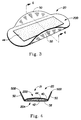
- FIGS. 1-5 show one preferred embodiment of a disposable absorbent article of the present invention, sanitary napkin 20.
- the present invention relates to absorbent articles such as sanitary napkins that have a main body portion 21 and undergarment covering components (or "side wrapping elements") 50 that automatically wrap the sides of the wearer's panties when the wearer places the sanitary napkin in her panties and pulls her panties up.
- the sanitary napkin 20 has two surfaces, a liquid pervious body-contacting surface or "body surface” 20A that is intended to be worn adjacent to the body of the wearer and a liquid impervious garment surface 20B.
- the sanitary napkin 20 is shown in FIG. 1 as viewed from its garment surface 20B.
- the body surface 20A of the sanitary napkin 20 is intended to be placed adjacent to the wearer's body when the sanitary napkin 20 is worn.
- the sanitary napkin 20 has two centerlines, a longitudinal centerline L and a transverse centerline T.
- transverse or “lateral” used herein, are interchangeable, and refer to a line, axis, or direction which lies within the plane of the sanitary napkin 20 that is generally perpendicular to the longitudinal direction.
- FIG. 1 shows that the main body portion 21 of the sanitary napkin 20 comprises the portion of the sanitary napkin without the side wrapping elements.
- the main body portion 21 has two spaced apart longitudinal edges 22, two spaced apart transverse or end edges (or “ends") 24, which together form the periphery 26 of the main body portion of the sanitary napkin 20.
- the main body portion also has two end regions, which are designated first end region 28 and second end region 30.
- a central region 32 is disposed between the end regions 28 and 30.
- the end regions 28 and 30 extend outwardly from the edges of the central region 32 about 1/8 to about 1/3 of the length of the main body portion.
- U.S. Patent 4,690,680 issued to Higgins on September 1, 1987, the disclosure of which is incorporated herein by reference.
- the main body portion of the sanitary napkin 20 can be of any thickness, including relatively thick, relatively thin, or even very thin.
- the embodiment of the sanitary napkin 20 shown in Figures 1-5 of the drawings is intended to be an example of a relatively thin sanitary napkin, preferably an "ultra-thin" sanitary napkin as described in U.S. Patents 4,950,264 and 5,009,653, both issued to Osborn.
- the sanitary napkin 20 shown should preferably also be relatively flexible, so that it is comfortable for the wearer. It should be understood that the sanitary napkin shown is merely one preferred embodiment, and that the present invention is not limited to absorbent articles of the type or having the specific configurations shown in the drawings.
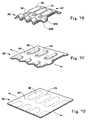
- FIG. 4 shows the individual components of the main body portion 21 of the sanitary napkin 20 of the present invention.
- the main body portion 21 generally comprises at least three primary components. These include a liquid pervious topsheet 38, a liquid impervious backsheet 40, and an absorbent core 42 positioned between the topsheet 38 and the backsheet 40. There are occasions, however, when one or more of these components, such as the backsheet, can comprise part of the side wrapping elements described herein.
- the topsheet, the backsheet, and the absorbent core may be assembled in a variety of configurations known in the art (including so called “sandwich” products and "tube” products).
- the main body portion 21 of the sanitary napkin may also be comprised of one or more extensible components such as those sanitary napkins, and the like described in PCT Publication Nos. WO 93/01785 and 93/01786, both published February 4, 1993.
- the sanitary napkin 20 as shown in FIG. 4, is assembled in a sandwich construction in which the topsheet 38 and the backsheet 40 have length and width dimensions generally larger than those of the absorbent core 42.
- the topsheet 38 and the backsheet 40 extend beyond the edges of the absorbent core 42 to form portions of the periphery 26.
- the sanitary napkin 20 of the present invention comprises a pair of side wrapping elements 50 joined to the main body portion 21 that extend from proximal edges 52 laterally outward beyond the longitudinal side edges 22 of the main body portion 21 to their distal edges 54.
- joind encompasses configurations in which an element is directly secured to another element by affixing the element directly to the other element; configurations in which the element is indirectly secured to the other element by affixing the element to intermediate member(s) which in turn are affixed to the other element; and configurations in which one element is integral with another element, i.e., one element is essentially part of the other element.
- the side wrapping elements 50 can be of any suitable size and shape.
- the side wrapping elements 50 can be as large as any of the flaps described in the patents set out in the Background of the Invention, which are hereby incorporated by reference herein.
- the distal edges 54 of the side wrapping elements preferably extend outward beyond the longitudinal side edges 22 of the main body portion 21, a distance of less than one-half the width of the main body portion so that they do not extend far enough outward beyond the side edges of the wearer's panties to cause any inconvenience to the wearer.
- the side wrapping elements 50 of the present invention preferably have the dimensions set forth for the panty covering components in the aforementioned PCT Patent Application WO 94/02096 and WO 95/07675 filed in the names of Lavash, et al. and Mansfield, et al.,.
- the side wrapping elements 50 can be made from any of the materials suitable for use in the construction of the main body portion 21 of the sanitary napkin.
- the side wrapping elements can comprise absorbent materials if the side wrapping elements are suitably sealed to prevent wicking of exudates from their distal edges 54.
- the materials comprising the side wrapping elements are substantially non-absorbent.
- the side wrapping elements 50 preferably have a resistance to edge compression so that they will fold rather than crumple when placed in a wearer's panties and subjected to the forces associated with wearing the sanitary napkin.
- the term "resistance to edge compression” refers to how substantial the material that comprises the side wrapping elements 50 is. Specifically, edge compression refers to the tendency of the side wrapping elements 50 to buckle when the side wrapping elements are extended to form a planar extension and forces are applied to the distal edge 54 of the side wrapping element by a plate oriented perpendicular to the plane of the side wrapping elements 50.
- This property is important because if the side wrapping elements 50 are insubstantial, they will bunch up when forces are applied to the side wrapping elements by the wearer's panty elastics or by the wearer's thighs during wear.
- the side wrapping elements 50 should, of course, not be so stiff that they are uncomfortable to the wearer.
- the side wrapping elements 50 are provided with first regions 50A comprising softened, flexible and preferably extensible regions (or “portions") of the side wrapping elements 50 and a second region (or “distal edge portion") 50B that is less soft, less flexible (i.e., stiffer), and preferably less extensible than the first regions 50A.
- the side wrapping elements 50 are pre-disposed to fold around the side edges of the crotch region of the wearer's undergarments.
- the second region 50B of the side wrapping elements 50 maintains a line of tension along the distal edges 54 of the side wrapping elements 50 that facilitates automatic flipping of the side wrapping elements 50 around the side edges of the wearer's undergarment when the undergarment is raised into position.
- the first and second regions 50A and 50B of the side wrapping elements can have many possible shapes and arrangements.
- the first region 50A may comprise a single region, or a plurality of regions or portions of the side wrapping elements. If the first region 50A comprises a plurality of portions of the side wrapping elements, these portions of the side wrapping elements may be interconnected or they may be spaced apart. Regardless of the arrangement and shape used, the first regions 50A are preferably positioned inboard of the distal edges 54 of the side wrapping elements.
- the first regions 50A are preferably far enough inboard of the distal edges 54 of the side wrapping elements that the side wrapping elements 50 each have a second region 50B that comprises a band of substantially inextensible, unsoftened material that is disposed along at least a portion of, and preferably along all of the distal edge 54 of the side wrapping elements. This allows the distal edges 54 of the side wrapping elements to function in effect like a hoop that retains a constant length which assists the side wrapping elements 50 in automatically wrapping around the edges of the wearer's panty crotch.
- This automatic wrapping action is facilitated when the main body portion of the sanitary napkin is placed in a wearer's panties and the main body portion assumes an upwardly arched configuration along its longitudinal centerline when the panties are pulled into contact with the wearer's body.
- the arching of the main body portion places tension on the distal edges 54 of the side wrapping elements 50. This causes the side wrapping elements 50 to fold under the panties since the side wrapping elements will tend to assume a configuration that is closest to a straight line (between the ends of the arching main body portion) when they are under tension.
- the first regions 50A comprise a plurality of spaced apart triangularly-shaped regions of the side wrapping elements 50 that are softened and provided with increased flexibility.
- the first regions 50A are oriented so that the apex (that is, the narrowest portion) of the triangularly-shaped areas is closest to the proximal edges 52 of the side wrapping elements, and the bases (or widest portions) of the triangularly-shaped areas are closer to the distal edges 54 of the side wrapping elements. This allows for greater reduction of the stresses in the side wrapping elements near the distal edges of the side wrapping elements. The reduction of stresses is, thus, at those locations where the stresses are the greatest when the side wrapping elements 50 are folded around the crotch region of a panty.
- the side wrapping elements 50 can be provided with first and second regions 50A and 50B in a non-limiting number of different manners.
- the side wrapping elements 50 may, for example, comprise a substantially inextensible material that is provided with mechanically softened or extensible regions inboard of the distal edges 54 of the side wrapping elements for the first regions 50A.
- the mechanically softened or extensible regions can be created in any suitable manner, including but not limited to mechanically straining, corrugating, "ring rolling", heating and deforming, subjecting to compression between mating plates, and the like.
- the different regions of the side wrapping elements can be provided by forming the side wrapping elements 50 out of materials having different properties.
- the side wrapping elements 50 can be comprised of a laminate of an extensible material and a inextensible material.
- the inextensible material can be provided in the configuration of the side wrapping elements 50, but have holes cut out where the first regions 50A are to be located, which is then laminated to the extensible material.
- the side wrapping elements 50 can comprise a generally extensible material that has a strip of inextensible material attached along or wrapped around the portion of the extensible material that will form the distal edge 54 of the side wrapping element.
- the embodiment shown in FIGS. 1-5 has first regions 50A that are preferably either formed by ring rolling (or pre-corrugating) or by forming a strainable network in five separate regions of each of the side wrapping elements 50.
- the first regions 50A preferably have corrugations or deformations with ridges (or fold lines) 58 that are generally oriented in the longitudinal direction.
- the side wrapping element 50 may fold through a large number of combinations of these longitudinally-oriented ridges or fold lines. This allows the side wrapping elements 50 to accommodate panties having different sizes and shapes.
- Suitable methods for ring rolling are described in U.S. Patent 4,107,364 issued to Sisson on August 15, 1978, U.S. Patent 4,834,741 issued to Sabee on May 30, 1989, U.S.
- Patent 5,143,679 issued to Gerald M. Weber, et al. on September 1, 1992
- U.S. Patent 5,156,793 issued to Kenneth B. Buell, et al. on October 20, 1992
- U.S. Patent 5,167,897 issued to Gerald M. Weber, et al. on December 1, 1992.
- the formation of a strainable network into a web material is described below in conjunction with the embodiments shown in FIGS. 6-8.
- the first regions 50A in this embodiment are preferably extensible in a direction perpendicular to the fold lines 58 of the corrugations or deformations.
- the first regions 50A are preferably primarily extensible in the transverse direction.
- the phrase "primarily extensible in the transverse direction" means that the first regions 50A are preferably more extensible in the transverse direction than in the longitudinal direction.
- the first regions 50A can also be primarily extensible in the longitudinal direction, or in any direction between the longitudinal direction and the transverse direction. If there is more than one first region 50A, the extensibility of different first regions 50A can all be in the same direction. Alternatively, one or more of the first regions 50A may have an extensibility in a different direction.
- the garment surface 20B of the sanitary napkin 20 may include, and preferably does include, fasteners for attaching the sanitary napkin to the wearer's undergarments.
- Figure 2 shows the central pad fastener 44 which is adapted to secure the main body portion 21 of the sanitary napkin to the crotch region of an undergarment.
- Fasteners comprising adhesives have been found to work well for this purpose, with pressure sensitive adhesives being preferred.
- the adhesive is typically covered with a removable cover strip or release liner 46 in order to keep the adhesive from sticking to a surface other than the crotch portion of the panty prior to use. Suitable release liners are described in the U.S. Patent 4,917,697.
- the sanitary napkin 20 of the present invention is used by removing any release liner and thereafter placing the sanitary napkin 20 in a panty so that the adhesive (or other fastener) 44 contacts the inside surface of the crotch region of the panty and maintains the sanitary napkin in position within the panty during use.
- the side wrapping elements 50 automatically wrap around the sides of the wearer's panties when the main body portion 21 of the sanitary napkin is placed in a wearer's panties and the main body portion assumes an upwardly arched configuration along its longitudinal centerline as shown in FIG. 5 when the panties are pulled into contact with the wearer's body.
- FIG. 5A shows that the side wrapping elements 50 are preferably capable of assuming three distinct positions when the sanitary napkin 20 is placed in a wearer's undergarments U during wear. These comprise: (a) a first stable position in which the side wrapping elements 50 extend generally outward from the main body portion 21; (b) an unstable position in which they are partially folded toward the garment-facing side of the main body portion; and, (c) a second stable position in which said side wrapping elements form an acute angle with the garment-facing side of said main body portion.
- the first stable position can be a position such as that designated position (1) in which the side wrapping elements 50 extend straight out from the sides of the main body portion 21. That is, the side wrapping elements form an angle of 180° with a plane, P, which passes through a section of the main body portion taken along the transverse centerline of the sanitary napkin. (It is understood, however, that the main body portion, per se, will typically be in a curved or folded overall configuration, rather than planar configuration.)
- the side wrapping elements 50 may have a first stable position such as that designated position (1A) where the side wrapping elements 50 initially form an obtuse angle (A) relative to the plane, P, of the section of the main body portion taken along the transverse centerline.
- the side wrapping elements 50 may form an obtuse angle with respect to the plane of the main body portion in their first stable position.
- forces F are applied to the side wrapping elements 50 in the direction of the arrows in FIG. 5A (such as by the wearer's thighs W)
- the side wrapping elements 50 move to an unstable position (2).
- the side wrapping elements 50 are typically in an unstable position at all locations between positions (1A) and (3).
- An unstable position may, for example, be approximately at a 90° fold angle relative to the plane P.
- the side wrapping elements 50 preferably then have a tendency to flip to their second stable position, position (3).
- the side wrapping elements 50 fold more toward the garment-facing side of the main body portion, and preferably form an acute angle with the garment-facing side of the main body portion.
- the side wrapping elements 50 will typically fold smoothly through the three positions referred to herein so that the precise place where one position ends and another begins may blend into one another.
- FIG. 5A is primarily presented for purposes of illustration of the concepts referred to herein. The present invention is, therefore, not intended to be limited to absorbent articles having side wrapping elements 50 that assume the exact positions shown in FIG. 5A.
- the operation of the side wrapping elements 50 is distinguishable in several respects from that of conventional side flaps. Placing a sanitary napkin having conventional flaps in a pair of panties and pulling up the panties will not consistently provide the automatic sustained wraparound feature of the present invention. There are several reasons for this. Conventional flaps do not have a distal edge that is maintained in tension that facilitates automatic flipping of such flaps around the side edges of a wearer's undergarment when the undergarment is pulled into its in-use condition. Conventional flaps are also not provided with resistance to edge compression so that they will tend to crumple in use, particularly when the wearer's thighs exert compressive forces on the flaps.
- Conventional flaps also do not retain a high degree of their fold, so that in cases where conventional flaps do wrap around the panties, they will not consistently stay wrapped.
- the upward arching of the main body portion tends to increase tension in the distal edge, thereby locking the pad in its in-use condition.
- conventionally-sized flaps will have excess flap material that hangs down underneath the panties during wear. This material can move around excessively underneath the panties.
- the side wrapping elements of the present invention on the other hand, have a span that is ideally just wide enough to wrap around the elastic-containing edges of the panties, but no wider, avoiding the problems associated with excess flap material.
- the sanitary napkin 20 of the present invention can be provided with still other features to assist in positioning the side wrapping elements 50 in the wearer's panties.
- the side wrapping elements 50 shown in FIGS. 1-5 are initially folded toward the garment-facing side 20B of the sanitary napkin and over the top of the release paper 46 that protects the securement adhesive 44 on the back of the sanitary napkin.
- FIG. 2 shows that if the side wrapping elements 50 and the release paper 46 are properly sized in relation to one another, stripping away the release paper 46 can serve to automatically unfold the side wrapping elements 50 from the back of the sanitary napkin and cause the side wrapping elements 50 to project generally outwardly in the desired orientation for installation of the sanitary napkin in the undergarment.
- 3 and 4 show that when the release paper 44 is removed, there will be a tendency for the side wrapping elements 50 to automatically return part of the way to their original folded over condition because the material comprising the side wrapping elements 50 will retain memory of the original folded over condition due to the residual stresses resulting from the folding.
- the sanitary napkin is then placed into the wearer's panties and the panties are pulled into the desired wearing position. Pulling the panties up against the wearer's body will force the main body portion 21 of the sanitary napkin into an arc. This will cause the inextensible perimeter of the side wrapping elements to experience tension and will cause the side wrapping elements 50 to collapse around the panty crotch.
- sanitary napkin in an individual wrapper can be tri-folded and placed in an individual package so that it can be kept clean while it is carried by the user in her purse. If the sanitary napkin is tri-folded inwardly over the backsheet, this will make the side wrapping elements 50 pre-disposed to fold toward the backsheet when they are removed from the package and placed in the wearer's undergarment.
- the folding of the sanitary napkin might be used to bias the side wrapping elements 50 into a configuration that would make its final position easier to achieve without any conscious act on the part of the user. It should also be understood that this feature and the preceding additional feature can be employed in conjunction with any of the other embodiments described below.
- FIGS. 6 and 7 show a second preferred embodiment of a sanitary napkin 20 of the present invention.
- the side wrapping elements 50 comprise a first region 50A that is distributed throughout the entirety of the side wrapping elements 50.
- the side wrapping elements 50 are primarily extensible in the transverse direction (shown by the arrows).
- the side wrapping elements 50 also comprise less extensible second regions 50B.
- the second regions 50B are disposed throughout and between portions of the first region 50A.
- the less extensible second regions 50B maintain the side wrapping elements 50 in tension when the first region 50A of the side wrapping element 50 is extended laterally outward. This facilitates the flipping of the side wrapping elements around the side edges of the wearer's undergarment.
- the side wrapping elements 50 shown in FIGS. 6 and 7 preferably comprise a web material 60 having a network 62 of strainable regions formed therein that exhibits an elastic-like behavior in the direction of elongation without the use of added elastic materials.
- This web material may be referred to herein as a "strainable web material" for brevity.
- the strainable web material 60 comprises a laminate of an extensible nonwoven material, an apertured formed film, and a polyethylene film backsheet material.
- the extensible nonwoven material should be oriented so that its extensibility is in the lateral direction.
- the apertured formed film is preferably an apertured film known as DRI-WEAVE which is used as a topsheet on sanitary napkins manufactured by the Procter & Gamble Company, Cincinnati, Ohio under U.S. Patents 4,342,314 issued to Radel, et al. and 4,463,045 issued to Ahr, et al.
- the polyethylene backsheet material can be an ordinary backsheet material, and preferably has a caliper of about 1 mil.
- FIGS. 7A and 7B are enlarged views of a web material with a strainable network therein such as that shown in FIGS. 6 and 7.
- FIGS. 7A and 7B are simplified in that they illustrate the concept of the strainable network in one of the components of the laminate, the film backsheet material.
- the web material 60 will be described accordingly in FIGS. 7A and 7B, although it is understood that in the embodiment shown in FIGS. 6 and 7, the web material comprises two additional components.
- the strainable web material 60 is shown in FIGS. 7A and 7B in its substantially untensioned condition.
- the strainable web material 60 has a longitudinal centerline, L 1 , and a lateral centerline, T 1 .
- the lateral centerline, T 1 is generally perpendicular to the longitudinal centerline, L 1 .
- FIGS. 7A and 7B show that the strainable web material 60 includes a strainable network 62 of at least two distinct and dissimilar regions.
- strainable network refers to an interconnected and interrelated group of regions which are able to be extended to some useful degree in a predetermined direction. The two distinct regions provide the strainable web material 60 with a first elastic-like, relatively low resistive force stage and a second relatively high resistive force stage.
- the strainable network 62 described herein is formed into the web material.
- the term “formed” refers to the creation of a desired structure or geometry upon the web material that will substantially retain the desired structure or geometry when it is not subjected to any externally applied elongations or forces. Suitable methods for forming a strainable network described herein into a material include, but are not limited to embossing by mating plates or rolls, thermoforming, high pressure hydraulic forming, or casting.
- FIGS. 7A and 7B show that the two distinct regions of the strainable network 62 include at least a first region 64 and a second region 66.
- the first region 64 will exhibit resistive forces in response to an applied axial elongation before a substantial portion of the second region 66 develops significant resistive forces to the applied elongation.
- the second region 66 has a surface-pathlength which is greater than that of the first region 64. The surface-pathlengths are measured substantially parallel to the predetermined axis while the material is in an untensioned condition.
- the second region 66 includes one or more deformations 74 which extend beyond the plane of the first region 64.
- the first and second regions each have a first surface and an opposing second surface. In the preferred embodiment shown in FIGS.
- the strainable network 62 includes a plurality of first regions 64 and a plurality of second regions 66.
- the first regions 64 are substantially planar regions. That is, the material within the first region 64 is in substantially the same condition before and after the formation step undergone by strainable web material.
- the second regions 66 include a plurality of continuous, interconnected, deformations 74 which extends alternately beyond the plane of both the first and second surfaces (64A and 64B, respectively) of the first region 64. In other embodiments, the deformations 74 may extend beyond the plane of only one of either the first or the second surfaces of the first region.
- the first regions 64 have a first axis 68 and a second axis 69, wherein the first axis 68 is preferably longer than the second axis 69.
- the first axis 68 of the first region 64 is substantially parallel to the longitudinal axis, L 1 , of the strainable web material 60 while the second axis 69 is substantially parallel to the transverse axis, T 1 , of the strainable web material 60.
- the second regions 66 also have a first axis 70 and a second axis 71.
- the first axis 70 of the second region 66 is substantially parallel to the longitudinal axis L 1 of the strainable web material 60, while the second axis 71 is substantially parallel to the transverse axis T 1 of the strainable web material 60.
- the first regions 64 and the second regions 66 are substantially linear, extending continuously in a direction substantially parallel to the longitudinal axis L 1 of the strainable web material.
- the longitudinal centerline L 1 of the strainable web material 60 is generally aligned with the transverse centerline of the sanitary napkin 20. In other embodiments, however, the longitudinal centerline L 1 of the web material can be oriented in other directions, depending on the direction of extensibility desired.
- the strainable web material 60 preferably comprises at least one component which is a formed polymeric film.
- the strainable web material 60 can be made of a base film material that has a relatively low extensibility under the forces the sanitary napkin is normally subjected to when worn. When formed into the strainable web material as described 60 herein, however, the base material will be extensible under the forces the sanitary napkin is normally subjected to when worn.
- the strainable web material 60 is preferably comprised substantially of linear low density polyethylene (LLDPE).
- the strainable web material 60 may also be comprised of other polyolefins such as polyethylenes, including low density polyethylene (LDPE), ultra low density polyethylene (ULDPE), high density polyethylene (HDPE), or polypropylene and blends thereof with the above and other materials.
- polyethylenes including low density polyethylene (LDPE), ultra low density polyethylene (ULDPE), high density polyethylene (HDPE), or polypropylene and blends thereof with the above and other materials.
- suitable polymeric materials which may also be used include, but are not limited to polyester, polyurethanes, compostable or biodegradable polymers, heat shrink polymers, thermoplastic elastomers, and breathable polymeric structures.
- FIGS. 7B, C and D show the manner in which the strainable web material 60 exhibits at least two significantly different stages of controlled resistive force to elongation when subjected to an applied elongation in a direction parallel to a predetermined axis.
- the strainable web material 60 exhibits first resistive forces to the applied elongation (which develop between the stage shown in FIG. 7B and the stage shown in FIG. 7C). The first resistive forces occur until the elongation of the web is sufficient to cause a substantial portion of the second region 66, to enter the plane of applied elongation, as shown in FIG. 7C. After the strainable web material 60 reaches the stage shown in Fig.
- the web material when used in the side wrapping elements 50 of the present invention, the web material will be within the first stage of resistance to elongation so the various portions of the strainable web material 60 will only extend to the stage shown in FIG. 7C and adjust so as to relax back to the stage shown in FIG. 7B.
- the depth and number of deformations 74 in the strainable web material 60 can be varied to control the applied force or elongation required to extend the web material used in the side wrapping elements 50.
- the deformations 74 are formed by two rigid plates having outer dimension of 127 mm by 304.8 mm by 19.04 mm (5.0" by 12" by 0.75").
- On one surface of each plate are a series of meshing teeth which are substantially triangular in cross section and measure 0.030" at their bases and taper to a vertex with a radius of 0.2032 mm (0.008") at the top.
- the centerlines of the teeth are spaced evenly and at 0.762 mm (0.030”) increments.
- a series of grooves are cut which are parallel to each other and perpendicular to the evenly spaced teeth. These grooves measure 0.7874 mm (0.031") wide and are continuous over the entire length of the plate, and are spaced at a distance of 6.35 mm (0.25") on center. These grooves correspond to the undeformed regions of the deformed web of material.
- the preferred web material is placed between the plates in a hydraulic press having platens larger than the plates to evenly distribute pressure. The plates are compressed under a load of at least 1816 kg (4,000 pounds). The formed web material is then removed from between the plates.
- the available stretch or elongation is increased if for a given number of deformations, the height or degree of deformation imparted on the deformations is increased. Similarly, the available stretch or elongation is increased if for a given height or degree of deformation, the number or frequency of deformations is increased.
- FIGS. 6 and 7 uses controlled stresses in the different regions of the strainable web material 60 to cause the side wrapping elements 50 to curl around to enclose the edges of the panty. This is desirable, as it may offer performance like a conventional wing but without wing or flap adhesives.
- FIG. 7E shows one configuration the side wrapping element 50 might take. However, the stress which causes this curling to occur may also cause the side wrapping element 50 to occasionally curl too much (as shown by the side wrapping element 50' in FIG. 7E) and slip away from the panty, losing coverage of the edges of the panty. Therefore, the side wrapping elements 50 must also resist the tendency to curl excessively. This may be controlled by the stiffness of the materials forming the side wrapping elements 50. One way to control the stiffness of the side wrapping elements 50 to prevent curling is to add a reinforcing element such as a scrim 82 to the side wrapping elements 50.
- a reinforcing element such as a scrim 82
- FIG. 8 shows an alternative embodiment of the sanitary napkin shown in FIGS. 6 and 7.
- the sanitary napkin shown in FIG. 8 has a strainable network 62 formed into only a portion of the area of its side wrapping element.
- the strainable network 62 is formed so that a portion of the side wrapping element 50 along the distal edge 54 of the side wrapping element is not "formed".
- the embodiment shown in FIG. 8 has the advantage of increasing the tension along the distal edge 54 of the side wrapping element 50 to facilitate the automatic folding of the side wrapping elements 50 when the undergarment is pulled into its use condition. This may also make the distal edge 54 stiffer, reducing the tendency for the side wrapping element 50 to curl under the wearer's undergarment.
- FIGS. 9 and 10 show a third basic embodiment of the sanitary napkin of the present invention.
- the embodiment shown in FIGS. 9 and 10 has side wrapping elements 50 that comprise a plurality of spaced apart regions or components that are gathered longitudinally inward along the distal edges 54 of the side wrapping elements 50 as shown in FIG. 9 and joined together.
- the spaced apart regions or components are shown in FIGS. 9 and 10 as comprising separate overlapping side wrapping element components 90A, 90B, and 90C.
- the side wrapping element components 90A, 90B, and 90C are gathered longitudinally inward along the distal edges 54 of the side wrapping elements 50 as shown in FIG. 9 and joined together by two seams 92 as shown in FIG. 10.
- This embodiment eliminates any bunching or puckering that would ordinarily be associated with gathering such structures using elastic strands.
- the regions of components of the side wrapping elements 50 that are gathered can be separate components that are non-overlapping, or they can merely be different regions of a single component side wrapping element.
- the regions or components of the side wrapping elements 50 can be gathered inward either before or after the side wrapping elements 50 are joined to the main body portion 21 of the sanitary napkin. Gathering of the side wrapping elements 50 may, however, be somewhat easier to accomplish before the side wrapping elements are joined to the main body portion 21 when the side wrapping elements 50 are in the form of a continuous web.
- the gathering inward of the regions or components 90A, B and C of the side wrapping elements 50 maintains a line of tension along the distal edges 54 of the side wrapping elements 50.
- This line of tension facilitates the flipping of the side wrapping elements 50 under the wearer's undergarment.
- This flipping action is further facilitated when the main body portion 21 of the sanitary napkin is placed in a wearer's panties and the main body portion 21 assumes a curved configuration when the panties are pulled up into contact with the wearer's body.
- the spaced apart regions or components of the side wrapping elements can be gathered longitudinally inward along the proximal edges 52 of the side wrapping elements to create a different effect.
- the side wrapping elements are preferably mirror images of each other, and are symmetrical about the longitudinal centerline.
- the shape and location of the side wrapping elements described herein are those of a preferred embodiment, and other embodiments are also possible.
- the side wrapping elements 50 are shown as extending from each longitudinal edges of the main body portion, in other alternative embodiments, there may only be one side wrapping element extending from one of the edges of the main body portion.
- the side wrapping elements 50 may be offset along the longitudinal centerline more towards one end edge of the main body portion than the other.
- the side wrapping elements 50 may be separate elements that are joined underneath to the main body portion 21 of the sanitary napkin inboard of the longitudinal side edges 22 of the main body portion.
- the side wrapping elements 50 in such a case, may be otherwise unattached to the garment-facing side of the main body portion 21 of the sanitary napkin 20 between the points of attachment and the longitudinal side edges 22 of the main body portion.
- the present invention is also applicable to other types of absorbent articles worn in the crotch region of an undergarment such as pantiliners and incontinence articles.
- panty liner or “pantiliner” refer to absorbent articles that are less bulky than sanitary napkins which are generally worn by women between their menstrual periods.
- suitable absorbent articles in the form of pantiliners that can be provided with the side wrapping elements described herein are disclosed in U.S. Patent 4,738,676 entitled “Pantiliner” issued to Osborn on April 19, 1988.
- incontinence article refers to pads, undergarments (pads held in place by a suspension system of same type, such as a belt, or the like), inserts for absorbent articles, capacity boosters for absorbent articles, briefs, bed pads, and the like, regardless of whether they are worn by adults or other incontinent persons.
- suitable incontinence articles that can be provided with the side wrapping elements described herein are disclosed in U.S. Patent 5,300,054 issued to Feist, et al. on April 5, 1994 and U.S. Patent 5,304,161 issued to Noel, et al. April 19, 1994.
Landscapes
- Health & Medical Sciences (AREA)
- Epidemiology (AREA)
- General Health & Medical Sciences (AREA)
- Public Health (AREA)
- Engineering & Computer Science (AREA)
- Biomedical Technology (AREA)
- Heart & Thoracic Surgery (AREA)
- Vascular Medicine (AREA)
- Life Sciences & Earth Sciences (AREA)
- Animal Behavior & Ethology (AREA)
- Veterinary Medicine (AREA)
- Fluid Mechanics (AREA)
- Physics & Mathematics (AREA)
- Absorbent Articles And Supports Therefor (AREA)
- Orthopedics, Nursing, And Contraception (AREA)
- Undergarments, Swaddling Clothes, Handkerchiefs Or Underwear Materials (AREA)
- Basic Packing Technique (AREA)
- Auxiliary Devices For And Details Of Packaging Control (AREA)
- Solid-Sorbent Or Filter-Aiding Compositions (AREA)
- Materials For Medical Uses (AREA)
Claims (21)
- Article absorbant (20) destiné à être porté dans une partie d'entrejambe d'un sous-vêtement, ledit article absorbant (20) ayant une dimension longitudinale s'étendant dans une direction longitudinale (L) et une dimension transversale s'étendant dans une direction transversale (T), ledit article absorbant (20) comprenant:une partie de corps principal (21) comprenant une âme absorbante (42), ladite partie de corps principal (21) ayant une face tournée vers le corps (20A), une face tournée vers le vêtement (20B) et une paire de bords latéraux longitudinaux (22); etune paire d'éléments de recouvrement latéraux (50) réunis à ladite partie de corps principal et s'étendant latéralement vers l'extérieur, au-delà des bords latéraux longitudinaux de ladite partie de corps principal vers les bords distaux (54), caractérisé en ce que lesdits éléments de recouvrement latéraux (50) sont prédisposés de manière à s'enrouler autour d'un bord de la partie d'entrejambes du sous-vêtement de l'utilisateur lorsque la partie de corps principal (21) est placée dans une configuration arquée vers le haut, lesdits éléments de recouvrement latéraux (50) comprenant une première partie (5OA) qui est exempte de torons élastiques et qui est principalement extensible dans la direction transversale (T) et une seconde partie moins extensible (50B), disposée latéralement vers l'extérieur par rapport à ladite première partie (50A) qui maintient lesdits éléments de recouvrement latéraux (50) à l'état tendu lorsque ladite première partie (50A) est étendue latéralement vers l'extérieur.
- Article absorbant (20) selon la revendication 1, dans lequel lesdits éléments de recouvrement latéraux (50) sont capables de prendre (a) une première position stable dans laquelle ils s'étendent généralement vers l'extérieur à partir de ladite partie de corps principal (21); (b) une position instable lorsqu'ils sont partiellement repliés vers la face tournée vers le vêtement (20B) de la partie de corps principal (21); et (c) une seconde position stable dans laquelle lesdits éléments de recouvrement latéraux (50) forment un angle aigu avec la face tournée vers le vêtement (20B) de ladite partie de corps principal (21).
- Article absorbant (20) selon la revendication 1, dans lequel des sections de ladite partie moins extensible sont également disposées entre des sections de ladite première partie (50A).
- Article absorbant (20) selon la revendication 3, dans lequel lesdits éléments de recouvrement latéraux (50) comportent un matériau en bande (60) ayant un réseau (62) de zones distinctes susceptible de se déformer qui présente au moins deux degrés de forces de résistance contrôlées en réponse à un allongement axial appliqué le long d'au moins un axe prédéterminé lorsqu'il est soumis à l'allongement axial appliqué dans une direction parallèle audit axe prédéterminé, lesdites zones distinctes comprenant au moins une première zone (64) et une seconde zone (66), ladite première zone (64) ayant une longueur de parcours en surface qui est inférieure à celle de ladite seconde zone (66) lorsqu'elle est mesurée parallèlement audit axe prédéterminé alors que ledit matériau en bande (60) est dans une condition relâchée.
- Article absorbant (20) selon la revendication 4, dans lequel ladite bande (60) comporte un axe longitudinal (L1) aligné avec la ligne médiane transversale (T) de l'article absorbant (20) et ledit réseau (62) dudit matériau en bande (60) comporte une partie formée d'un matériau de support, et ladite première zone (64) dudit réseau (62) comporte une pluralité de zones sensiblement planes, linéaires qui sont alignées avec l'axe longitudinal (L1) dudit matériau en bande (60) et lesdites secondes zones (66) comportent une pluralité de déformations qui sont orientées sensiblement perpendiculairement audit axe longitudinal (L1) dudit matériau en bande (60).
- Article absorbant (20) selon la revendication 5, dans lequel certaines parties au moins dudit matériau en bande (60) sont renforcées pour empêcher l'enroulement du bord distal (54) desdits éléments de recouvrement latéraux (50).
- Article absorbant (20) selon la revendication 6, dans lequel lesdites parties desdits éléments de recouvrement latéraux (50) sont renforcées à l'aide d'une mousseline.
- Article absorbant (20) selon la revendication 1, dans lequel ladite première partie (50A) comporte une partie souple, adoucie dudit élément de recouvrement latéral (50) et ladite seconde partie (50B) est moins douce et moins souple que ladite première partie (50A).
- Article absorbant (20) selon la revendication 8, dans lequel ladite seconde partie (50B) est disposée le long du bord distal tout entier (54) dudit élément de recouvrement latéral (50).
- Article absorbant (20) selon la revendication 8, dans lequel ladite seconde partie (50B) est sensiblement non extensible.
- Article absorbant (20) selon la revendication 8, dans lequel ladite première partie (50A) comporte une pluralité de zones espacées, adoucies, souples.
- Article absorbant (20) selon la revendication 8, dans lequel ladite première partie (50A) est extensible et ladite extensibilité est principalement dirigée dans la direction transversale (T).
- Article absorbant (20) selon la revendication 12, dans lequel lesdites premières parties (50A) ont une dimension mesurée dans la direction longitudinale (L), près du bord distal (54) desdits éléments de recouvrement latéraux (50), et une dimension mesurée au niveau de la partie desdits éléments de recouvrement latéraux (50) près du bord proximal (52) desdits éléments de recouvrement latéraux (50), et ladite dimension mesurée près du bord distal (54) desdits éléments de recouvrement latéraux (50) est plus bande que la dimension adjacente au bord proximal (52) desdits éléments de recouvrement latéraux (50).
- Article absorbant (20) selon la revendication 13, dans lequel lesdites premières parties (50A) desdits éléments de recouvrement latéraux (50) sont de forme triangulaire.
- Article absorbant (20) selon la revendication 8, dans lequel lesdites preimières parties (50A) desdits éléments de recouvrement latéraux (50) comportent un matériau choisi dans le groupe constitué des matériaux suivants: un matériau extensible: un matériau mécaniquement modifié: un matériau tendu, un matériau nervuré; un matériau roulé en anneau; un matériau déformé de façon permanente; et un matériau chauffé et étiré.
- Article absorbant (20) selon la revendication 1, dans lequel au moins l'un desdits éléments de recouvrement latéraux (50) comporte une pluralité de zones qui sont rassemblées longitudinalement vers l'intérieur le long de l'un desdits bords distaux ou proximaux (52, 54) et réunies ensemble dans une condition rassemblée.
- Article absorbant (20) selon la revendication 16, dans lequel lesdites zones sont rassemblées vers l'intérieur le long du bord distal (54) de l'élément de recouvrement latéral (50).
- Article absorbant (20) selon la revendication 16, dans lequel lesdites zones sont rassemblées vers l'intérieur le long du bord proximal (52) de l'élément de recouvrement latéral (50).
- Article absorbant (20) selon la revendication 16, dans lequel les zones dudit élément de recouvrement latéral (50) comportent des sections faisant partie intégrante d'une structure unitaire.
- Article absorbant (20) selon la revendication 16, dans lequel les zones dudit élément de recouvrement latéral (50) comportent des composants séparés de l'élément de recouvrement latéral.
- Article absorbant (20) selon la revendication 20, dans lequel lesdits composants séparés dudit élément de recouvrement latéral sont réunis ensemble par un soudage.
Applications Claiming Priority (5)
| Application Number | Priority Date | Filing Date | Title |
|---|---|---|---|
| US08/096,121 US5584829A (en) | 1991-05-21 | 1993-07-22 | Absorbent articles having panty covering components that naturally wrap the sides of panties |
| US96121 | 1993-07-22 | ||
| US124180 | 1993-09-17 | ||
| US12418093A | 1993-09-20 | 1993-09-20 | |
| PCT/US1994/008255 WO1995003023A2 (fr) | 1993-07-22 | 1994-07-22 | Articles absorbants possedant des elements de couverture des sous-vetements a longueur fixe enveloppant automatiquement les cotes des sous-vetements |
Publications (2)
| Publication Number | Publication Date |
|---|---|
| EP0710097A1 EP0710097A1 (fr) | 1996-05-08 |
| EP0710097B1 true EP0710097B1 (fr) | 1998-01-28 |
Family
ID=26791157
Family Applications (4)
| Application Number | Title | Priority Date | Filing Date |
|---|---|---|---|
| EP94922644A Expired - Lifetime EP0774942B1 (fr) | 1993-07-22 | 1994-07-20 | Articles absorbants munis de parties depassantes couvrant les sous-vetements et en enveloppant automatiquement les cotes |
| EP94922675A Expired - Lifetime EP0710098B1 (fr) | 1993-07-22 | 1994-07-22 | Articles absorbants possedant des elements de couverture des sous-vetements predisposes pour envelopper automatiquement les cotes des sous-vetements |
| EP94922674A Revoked EP0710097B1 (fr) | 1993-07-22 | 1994-07-22 | Articles absorbants possedant des elements de couverture des sous-vetements a longueur fixe enveloppant automatiquement les cotes des sous-vetements |
| EP94924495A Revoked EP0710099B1 (fr) | 1993-07-22 | 1994-07-22 | Articles arborbants comportant des elements a zones d'extensibilite recouvrant le sous-vetement |
Family Applications Before (2)
| Application Number | Title | Priority Date | Filing Date |
|---|---|---|---|
| EP94922644A Expired - Lifetime EP0774942B1 (fr) | 1993-07-22 | 1994-07-20 | Articles absorbants munis de parties depassantes couvrant les sous-vetements et en enveloppant automatiquement les cotes |
| EP94922675A Expired - Lifetime EP0710098B1 (fr) | 1993-07-22 | 1994-07-22 | Articles absorbants possedant des elements de couverture des sous-vetements predisposes pour envelopper automatiquement les cotes des sous-vetements |
Family Applications After (1)
| Application Number | Title | Priority Date | Filing Date |
|---|---|---|---|
| EP94924495A Revoked EP0710099B1 (fr) | 1993-07-22 | 1994-07-22 | Articles arborbants comportant des elements a zones d'extensibilite recouvrant le sous-vetement |
Country Status (20)
| Country | Link |
|---|---|
| EP (4) | EP0774942B1 (fr) |
| JP (4) | JP3902648B2 (fr) |
| KR (4) | KR100342900B1 (fr) |
| CN (1) | CN100387211C (fr) |
| AT (4) | ATE178779T1 (fr) |
| AU (6) | AU694914B2 (fr) |
| BR (1) | BR9407132A (fr) |
| CA (5) | CA2167376C (fr) |
| CZ (1) | CZ286882B6 (fr) |
| DE (4) | DE69417927T2 (fr) |
| DK (2) | DK0710097T3 (fr) |
| ES (4) | ES2129655T3 (fr) |
| FI (1) | FI960274L (fr) |
| GR (1) | GR3026561T3 (fr) |
| HK (1) | HK1008730A1 (fr) |
| HU (1) | HU222805B1 (fr) |
| NO (1) | NO960234L (fr) |
| NZ (2) | NZ329709A (fr) |
| SG (1) | SG54228A1 (fr) |
| WO (4) | WO1995003022A2 (fr) |
Families Citing this family (21)
| Publication number | Priority date | Publication date | Assignee | Title |
|---|---|---|---|---|
| US6358234B1 (en) | 1990-01-23 | 2002-03-19 | The Procter & Gamble Company | Absorbent article having deformed hinge and zones of extensibility |
| US5891121A (en) * | 1992-07-23 | 1999-04-06 | The Procter & Gamble Company | Absorbent articles having undergarment covering components especially suited for folding around the edges of an undergarment |
| US5676652A (en) * | 1992-07-23 | 1997-10-14 | The Procter & Gamble Company | Absorbent articles having undergarment covering components with mechanical fasteners having improved tactile properties |
| AU731602B2 (en) * | 1993-09-20 | 2001-04-05 | Procter & Gamble Company, The | Absorbent articles having undergarment covering components with patterned regions of extensibility |
| DE69508390T2 (de) * | 1994-04-15 | 1999-08-26 | The Procter & Gamble Co. | Flügel für saugfähige produkte |
| WO1996023472A1 (fr) * | 1995-02-03 | 1996-08-08 | The Procter & Gamble Company | Articles absorbants comportant des extensions laterales |
| AU753369B2 (en) * | 1995-07-17 | 2002-10-17 | Procter & Gamble Company, The | Absorbent articles having undergarment covering components with mechanical fasteners having improved tactile properties |
| AR015240A1 (es) * | 1998-03-05 | 2001-04-18 | Mcneil Ppc Inc | Articulo absorbente para absorber exudados del cuerpo, el cual esta adaptado para ser usado en una porcion de entrepierna de la prenda intima de un usuario |
| AU6548398A (en) * | 1998-03-10 | 1999-09-27 | Procter & Gamble Company, The | Absorbent article with extensible flaps comprising microporous film |
| JP4509379B2 (ja) * | 1998-03-10 | 2010-07-21 | ザ プロクター アンド ギャンブル カンパニー | 微孔質フィルムを備えた吸収体 |
| US6428523B1 (en) | 2000-08-30 | 2002-08-06 | Johnson & Johnson Industria E Comercio Ltda | Sanitary napkin |
| BR0105724B1 (pt) | 2001-11-26 | 2010-11-30 | absorvente higiênico. | |
| JP4312113B2 (ja) | 2004-07-09 | 2009-08-12 | ユニ・チャーム株式会社 | 生理用ナプキン |
| JP5060813B2 (ja) * | 2007-03-30 | 2012-10-31 | ユニ・チャーム株式会社 | 吸収性物品 |
| JP5242211B2 (ja) * | 2008-03-26 | 2013-07-24 | 大王製紙株式会社 | 吸収性物品 |
| JP5685421B2 (ja) * | 2010-11-19 | 2015-03-18 | 花王株式会社 | 吸収性物品 |
| JP2012157641A (ja) * | 2011-02-02 | 2012-08-23 | Unicharm Corp | 吸収性物品 |
| WO2012105463A1 (fr) * | 2011-02-01 | 2012-08-09 | Unicharm Corporation | Article absorbant |
| JP5481522B2 (ja) * | 2012-05-09 | 2014-04-23 | ユニ・チャーム株式会社 | 吸収性物品の製造方法 |
| WO2016209914A1 (fr) * | 2015-06-24 | 2016-12-29 | Kimberly-Clark Worldwide, Inc. | Article absorbant avec fixation mécanique à un vêtement |
| CN106618874B (zh) * | 2015-10-31 | 2021-08-03 | 金王(苏州工业园区)卫生用品有限公司 | 防侧漏吸收制品 |
Family Cites Families (14)
| Publication number | Priority date | Publication date | Assignee | Title |
|---|---|---|---|---|
| DE2938360A1 (de) * | 1978-09-28 | 1980-04-10 | Colgate Palmolive Co | Saugfaehige vorlage |
| US4752349A (en) * | 1986-02-28 | 1988-06-21 | The Procter & Gamble Company | Disposable absorbent product having resilient scalloped edge, and method of making the product |
| US4900320C1 (en) * | 1986-06-16 | 2001-07-03 | Mcneil Ppc Inc | Sanitary napkin with panty gathering flaps |
| US5181563A (en) * | 1987-03-16 | 1993-01-26 | Mcneil-Ppc, Inc. | Anatomically shaped absorbent pad |
| US4940462A (en) * | 1988-02-26 | 1990-07-10 | Mcneil-Ppc, Inc. | Sanitary napkin with expandable flaps |
| US5009653A (en) * | 1988-03-31 | 1991-04-23 | The Procter & Gamble Company | Thin, flexible sanitary napkin |
| US4917697A (en) * | 1988-03-31 | 1990-04-17 | The Procter & Gamble Company | Sanitary napkins having flaps and stress relief means |
| US5125918A (en) * | 1988-04-14 | 1992-06-30 | Mcneil-Ppc, Inc. | Sanitary napkin having an attachment system comprising biased hinges |
| CA2019282C (fr) * | 1990-03-12 | 2001-02-20 | Thomas Peter Van Iten | Article absorbant muni d'un fermoir et methode pour fixer ledit article sur un vetement |
| JP2889348B2 (ja) * | 1990-06-07 | 1999-05-10 | 花王株式会社 | 吸収性物品 |
| NZ238723A (en) * | 1990-07-06 | 1994-04-27 | Mcneil Ppc Inc | Sanitary pad; bendable means change shape of pad |
| FR2675687B1 (fr) * | 1991-04-29 | 1998-10-23 | Kaysersberg Sa | Serviette periodique a soufflets lateraux. |
| MA22660A1 (fr) * | 1991-10-01 | 1993-04-01 | Procter & Gamble | Article absorbant comportant des rabats et des zones d'extensibilite differentielle . |
| US5234422A (en) * | 1991-12-20 | 1993-08-10 | The Procter & Gamble Company | Elasticized sanitary napkin |
-
1994
- 1994-07-20 KR KR1019960700331A patent/KR100342900B1/ko not_active Expired - Fee Related
- 1994-07-20 DE DE69417927T patent/DE69417927T2/de not_active Expired - Fee Related
- 1994-07-20 WO PCT/US1994/008187 patent/WO1995003022A2/fr not_active Ceased
- 1994-07-20 ES ES94922644T patent/ES2129655T3/es not_active Expired - Lifetime
- 1994-07-20 EP EP94922644A patent/EP0774942B1/fr not_active Expired - Lifetime
- 1994-07-20 AU AU73683/94A patent/AU694914B2/en not_active Ceased
- 1994-07-20 CA CA002167376A patent/CA2167376C/fr not_active Expired - Fee Related
- 1994-07-20 AT AT94922644T patent/ATE178779T1/de active
- 1994-07-20 JP JP50529095A patent/JP3902648B2/ja not_active Expired - Fee Related
- 1994-07-22 DE DE69415674T patent/DE69415674T2/de not_active Expired - Fee Related
- 1994-07-22 JP JP7505319A patent/JPH09500558A/ja not_active Ceased
- 1994-07-22 JP JP50539595A patent/JP3280983B2/ja not_active Expired - Fee Related
- 1994-07-22 CN CNB941934683A patent/CN100387211C/zh not_active Expired - Lifetime
- 1994-07-22 HK HK98109495A patent/HK1008730A1/en not_active IP Right Cessation
- 1994-07-22 CA CA002167271A patent/CA2167271C/fr not_active Expired - Fee Related
- 1994-07-22 DK DK94922674.0T patent/DK0710097T3/da active
- 1994-07-22 CA CA002167273A patent/CA2167273C/fr not_active Expired - Fee Related
- 1994-07-22 KR KR1019960700293A patent/KR960703549A/ko not_active Ceased
- 1994-07-22 ES ES94922675T patent/ES2125469T3/es not_active Expired - Lifetime
- 1994-07-22 DE DE69408325T patent/DE69408325T2/de not_active Revoked
- 1994-07-22 EP EP94922675A patent/EP0710098B1/fr not_active Expired - Lifetime
- 1994-07-22 ES ES94922674T patent/ES2111943T3/es not_active Expired - Lifetime
- 1994-07-22 AT AT94922674T patent/ATE162704T1/de not_active IP Right Cessation
- 1994-07-22 CZ CZ1996181A patent/CZ286882B6/cs not_active IP Right Cessation
- 1994-07-22 DK DK94924495T patent/DK0710099T3/da active
- 1994-07-22 AU AU74749/94A patent/AU7474994A/en not_active Abandoned
- 1994-07-22 KR KR1019960700294A patent/KR960703550A/ko not_active Ceased
- 1994-07-22 WO PCT/US1994/008256 patent/WO1995003024A2/fr not_active Ceased
- 1994-07-22 HU HU9600125A patent/HU222805B1/hu active IP Right Grant
- 1994-07-22 NZ NZ329709A patent/NZ329709A/en unknown
- 1994-07-22 NZ NZ271188A patent/NZ271188A/en unknown
- 1994-07-22 AU AU73704/94A patent/AU7370494A/en not_active Abandoned
- 1994-07-22 ES ES94924495T patent/ES2121222T3/es not_active Expired - Lifetime
- 1994-07-22 KR KR1019960700295A patent/KR100344066B1/ko not_active Expired - Fee Related
- 1994-07-22 CA CA002239906A patent/CA2239906C/fr not_active Expired - Fee Related
- 1994-07-22 AT AT94922675T patent/ATE175098T1/de not_active IP Right Cessation
- 1994-07-22 EP EP94922674A patent/EP0710097B1/fr not_active Revoked
- 1994-07-22 BR BR9407132A patent/BR9407132A/pt not_active IP Right Cessation
- 1994-07-22 AT AT94924495T patent/ATE171059T1/de not_active IP Right Cessation
- 1994-07-22 DE DE69413403T patent/DE69413403T2/de not_active Revoked
- 1994-07-22 AU AU73703/94A patent/AU695288B2/en not_active Ceased
- 1994-07-22 JP JP7505320A patent/JPH09500559A/ja active Pending
- 1994-07-22 WO PCT/US1994/008419 patent/WO1995003025A2/fr not_active Ceased
- 1994-07-22 SG SG1996005205A patent/SG54228A1/en unknown
- 1994-07-22 EP EP94924495A patent/EP0710099B1/fr not_active Revoked
- 1994-07-22 CA CA002167272A patent/CA2167272C/fr not_active Expired - Fee Related
- 1994-07-22 FI FI960274A patent/FI960274L/fi unknown
- 1994-07-22 WO PCT/US1994/008255 patent/WO1995003023A2/fr not_active Ceased
-
1996
- 1996-01-19 NO NO960234A patent/NO960234L/no unknown
-
1998
- 1998-04-07 GR GR980400750T patent/GR3026561T3/el unknown
- 1998-07-01 AU AU73986/98A patent/AU7398698A/en not_active Abandoned
- 1998-07-15 AU AU77326/98A patent/AU707592B2/en not_active Ceased
Also Published As
Similar Documents
| Publication | Publication Date | Title |
|---|---|---|
| EP0710097B1 (fr) | Articles absorbants possedant des elements de couverture des sous-vetements a longueur fixe enveloppant automatiquement les cotes des sous-vetements | |
| EP0833597B1 (fr) | Articles absorbants comportant des elements recouvrant un sous-vetement specialement concus pour se replier sur les bords de ce dernier | |
| EP0720463B1 (fr) | Articles absorbants dotes d'elements de recouvrement de sous-vetements presentant des regions configurees d'extension | |
| AU724087B2 (en) | Absorbent article having flaps with step configuration and zones of extensibility | |
| EP0836462B2 (fr) | Article absorbant a parties extensibles et articulees | |
| HK1008730B (en) | Absorbent articles having fixed length undergarment covering components that automatically wrap the sides of undergarments | |
| AU727928B2 (en) | Absorbent articles having pleated undergarment covering components | |
| AU696596B2 (en) | Absorbent articles having panty covering components comprising extensible web materials which exhibit elastic-like behavior | |
| AU731602B2 (en) | Absorbent articles having undergarment covering components with patterned regions of extensibility | |
| HK1012977B (en) | Absorbent articles having undergarment covering components with patterned regions of extensibility | |
| HK1009742B (en) | Absorbent articles having undergarment covering components especially suited for folding around the edges of an undergarment | |
| MXPA97010464A (en) | Absorbent articles which have interior clothing components especially suitable to bend around the edges of an interior clothing | |
| HK1010479B (en) | Absorbent article with extensible and articulating portions | |
| HK1012917B (en) | Absorbent articles having panty covering components comprising extensible web materials which exhibit elastic-like behavior |
Legal Events
| Date | Code | Title | Description |
|---|---|---|---|
| PUAI | Public reference made under article 153(3) epc to a published international application that has entered the european phase |
Free format text: ORIGINAL CODE: 0009012 |
|
| 17P | Request for examination filed |
Effective date: 19960124 |
|
| AK | Designated contracting states |
Kind code of ref document: A1 Designated state(s): AT BE CH DE DK ES FR GB GR IE IT LI LU NL PT SE |
|
| 17Q | First examination report despatched |
Effective date: 19960529 |
|
| GRAG | Despatch of communication of intention to grant |
Free format text: ORIGINAL CODE: EPIDOS AGRA |
|
| GRAG | Despatch of communication of intention to grant |
Free format text: ORIGINAL CODE: EPIDOS AGRA |
|
| GRAH | Despatch of communication of intention to grant a patent |
Free format text: ORIGINAL CODE: EPIDOS IGRA |
|
| GRAH | Despatch of communication of intention to grant a patent |
Free format text: ORIGINAL CODE: EPIDOS IGRA |
|
| GRAA | (expected) grant |
Free format text: ORIGINAL CODE: 0009210 |
|
| AK | Designated contracting states |
Kind code of ref document: B1 Designated state(s): AT BE CH DE DK ES FR GB GR IE IT LI LU NL PT SE |
|
| REF | Corresponds to: |
Ref document number: 162704 Country of ref document: AT Date of ref document: 19980215 Kind code of ref document: T |
|
| REG | Reference to a national code |
Ref country code: CH Ref legal event code: EP |
|
| REG | Reference to a national code |
Ref country code: CH Ref legal event code: NV Representative=s name: RITSCHER & SEIFERT PATENTANWAELTE VSP |
|
| REF | Corresponds to: |
Ref document number: 69408325 Country of ref document: DE Date of ref document: 19980305 |
|
| ET | Fr: translation filed | ||
| REG | Reference to a national code |
Ref country code: DK Ref legal event code: T3 Ref country code: ES Ref legal event code: FG2A Ref document number: 2111943 Country of ref document: ES Kind code of ref document: T3 |
|
| ITF | It: translation for a ep patent filed | ||
| REG | Reference to a national code |
Ref country code: IE Ref legal event code: FG4D Free format text: 78710 |
|
| REG | Reference to a national code |
Ref country code: PT Ref legal event code: SC4A Free format text: AVAILABILITY OF NATIONAL TRANSLATION Effective date: 19980422 |
|
| PLBQ | Unpublished change to opponent data |
Free format text: ORIGINAL CODE: EPIDOS OPPO |
|
| PLBI | Opposition filed |
Free format text: ORIGINAL CODE: 0009260 |
|
| PLBF | Reply of patent proprietor to notice(s) of opposition |
Free format text: ORIGINAL CODE: EPIDOS OBSO |
|
| 26 | Opposition filed |
Opponent name: KIMBERLY-CLARK WORLDWIDE, INC. Effective date: 19981026 Opponent name: SCA HYGIENE PRODUCTS AB Effective date: 19981026 |
|
| NLR1 | Nl: opposition has been filed with the epo |
Opponent name: KIMBERLY-CLARK WORLDWIDE, INC. Opponent name: SCA HYGIENE PRODUCTS AB |
|
| PLBF | Reply of patent proprietor to notice(s) of opposition |
Free format text: ORIGINAL CODE: EPIDOS OBSO |
|
| PLBF | Reply of patent proprietor to notice(s) of opposition |
Free format text: ORIGINAL CODE: EPIDOS OBSO |
|
| PGFP | Annual fee paid to national office [announced via postgrant information from national office to epo] |
Ref country code: GB Payment date: 20000614 Year of fee payment: 7 Ref country code: DK Payment date: 20000614 Year of fee payment: 7 Ref country code: AT Payment date: 20000614 Year of fee payment: 7 |
|
| PGFP | Annual fee paid to national office [announced via postgrant information from national office to epo] |
Ref country code: NL Payment date: 20000620 Year of fee payment: 7 |
|
| PGFP | Annual fee paid to national office [announced via postgrant information from national office to epo] |
Ref country code: SE Payment date: 20000706 Year of fee payment: 7 |
|
| PGFP | Annual fee paid to national office [announced via postgrant information from national office to epo] |
Ref country code: FR Payment date: 20000707 Year of fee payment: 7 |
|
| PGFP | Annual fee paid to national office [announced via postgrant information from national office to epo] |
Ref country code: PT Payment date: 20000711 Year of fee payment: 7 |
|
| PGFP | Annual fee paid to national office [announced via postgrant information from national office to epo] |
Ref country code: ES Payment date: 20000713 Year of fee payment: 7 |
|
| PGFP | Annual fee paid to national office [announced via postgrant information from national office to epo] |
Ref country code: DE Payment date: 20000727 Year of fee payment: 7 |
|
| PGFP | Annual fee paid to national office [announced via postgrant information from national office to epo] |
Ref country code: LU Payment date: 20000803 Year of fee payment: 7 |
|
| PGFP | Annual fee paid to national office [announced via postgrant information from national office to epo] |
Ref country code: BE Payment date: 20000814 Year of fee payment: 7 |
|
| PGFP | Annual fee paid to national office [announced via postgrant information from national office to epo] |
Ref country code: CH Payment date: 20001013 Year of fee payment: 7 |
|
| RDAH | Patent revoked |
Free format text: ORIGINAL CODE: EPIDOS REVO |
|
| RDAG | Patent revoked |
Free format text: ORIGINAL CODE: 0009271 |
|
| STAA | Information on the status of an ep patent application or granted ep patent |
Free format text: STATUS: PATENT REVOKED |
|
| REG | Reference to a national code |
Ref country code: CH Ref legal event code: PL |
|
| 27W | Patent revoked |
Effective date: 20001019 |
|
| GBPR | Gb: patent revoked under art. 102 of the ep convention designating the uk as contracting state |
Free format text: 20001019 |
|
| NLR2 | Nl: decision of opposition | ||
| PGFP | Annual fee paid to national office [announced via postgrant information from national office to epo] |
Ref country code: IE Payment date: 20010720 Year of fee payment: 8 |
|
| PGFP | Annual fee paid to national office [announced via postgrant information from national office to epo] |
Ref country code: GR Payment date: 20010725 Year of fee payment: 8 |
|
| PLAB | Opposition data, opponent's data or that of the opponent's representative modified |
Free format text: ORIGINAL CODE: 0009299OPPO |