EP0710670A1 - A method of modifying starch - Google Patents
A method of modifying starch Download PDFInfo
- Publication number
- EP0710670A1 EP0710670A1 EP94830524A EP94830524A EP0710670A1 EP 0710670 A1 EP0710670 A1 EP 0710670A1 EP 94830524 A EP94830524 A EP 94830524A EP 94830524 A EP94830524 A EP 94830524A EP 0710670 A1 EP0710670 A1 EP 0710670A1
- Authority
- EP
- European Patent Office
- Prior art keywords
- starch
- turbo
- reactor
- flow
- modification
- Prior art date
- Legal status (The legal status is an assumption and is not a legal conclusion. Google has not performed a legal analysis and makes no representation as to the accuracy of the status listed.)
- Granted
Links
- 229920002472 Starch Polymers 0.000 title claims abstract description 50
- 235000019698 starch Nutrition 0.000 title claims abstract description 50
- 239000008107 starch Substances 0.000 title claims abstract description 50
- 238000000034 method Methods 0.000 title claims abstract description 25
- 239000003795 chemical substances by application Substances 0.000 claims abstract description 25
- 238000012986 modification Methods 0.000 claims abstract description 15
- 239000012530 fluid Substances 0.000 claims abstract description 9
- 230000004048 modification Effects 0.000 claims abstract description 6
- 238000006011 modification reaction Methods 0.000 claims abstract description 5
- 239000002245 particle Substances 0.000 claims description 10
- 238000007385 chemical modification Methods 0.000 claims description 9
- VEXZGXHMUGYJMC-UHFFFAOYSA-N Hydrochloric acid Chemical compound Cl VEXZGXHMUGYJMC-UHFFFAOYSA-N 0.000 claims description 8
- 239000002253 acid Substances 0.000 claims description 8
- 239000000843 powder Substances 0.000 claims description 7
- 239000007864 aqueous solution Substances 0.000 claims description 6
- -1 C1−4 alkyl sulphates Chemical class 0.000 claims description 5
- 238000010438 heat treatment Methods 0.000 claims description 5
- 150000007513 acids Chemical class 0.000 claims description 4
- 238000001816 cooling Methods 0.000 claims description 4
- 239000007795 chemical reaction product Substances 0.000 claims description 3
- 239000012467 final product Substances 0.000 claims description 3
- 239000000126 substance Substances 0.000 claims description 3
- 125000004178 (C1-C4) alkyl group Chemical group 0.000 claims description 2
- 125000000204 (C2-C4) acyl group Chemical group 0.000 claims description 2
- YGYAWVDWMABLBF-UHFFFAOYSA-N Phosgene Chemical compound ClC(Cl)=O YGYAWVDWMABLBF-UHFFFAOYSA-N 0.000 claims description 2
- 230000010933 acylation Effects 0.000 claims description 2
- 238000005917 acylation reaction Methods 0.000 claims description 2
- 230000029936 alkylation Effects 0.000 claims description 2
- 238000005804 alkylation reaction Methods 0.000 claims description 2
- 150000008064 anhydrides Chemical class 0.000 claims description 2
- 239000003153 chemical reaction reagent Substances 0.000 abstract description 3
- 229920000881 Modified starch Polymers 0.000 description 8
- 239000004368 Modified starch Substances 0.000 description 7
- 235000019426 modified starch Nutrition 0.000 description 4
- HEMHJVSKTPXQMS-UHFFFAOYSA-M Sodium hydroxide Chemical compound [OH-].[Na+] HEMHJVSKTPXQMS-UHFFFAOYSA-M 0.000 description 3
- 238000004519 manufacturing process Methods 0.000 description 3
- 239000000047 product Substances 0.000 description 3
- 230000001105 regulatory effect Effects 0.000 description 3
- 229920002261 Corn starch Polymers 0.000 description 2
- IAYPIBMASNFSPL-UHFFFAOYSA-N Ethylene oxide Chemical compound C1CO1 IAYPIBMASNFSPL-UHFFFAOYSA-N 0.000 description 2
- 235000019759 Maize starch Nutrition 0.000 description 2
- 238000006243 chemical reaction Methods 0.000 description 2
- 230000032050 esterification Effects 0.000 description 2
- 238000005886 esterification reaction Methods 0.000 description 2
- 238000006266 etherification reaction Methods 0.000 description 2
- 230000003301 hydrolyzing effect Effects 0.000 description 2
- 238000002715 modification method Methods 0.000 description 2
- 238000004513 sizing Methods 0.000 description 2
- 238000006467 substitution reaction Methods 0.000 description 2
- 239000004753 textile Substances 0.000 description 2
- 238000011282 treatment Methods 0.000 description 2
- OWEGMIWEEQEYGQ-UHFFFAOYSA-N 100676-05-9 Natural products OC1C(O)C(O)C(CO)OC1OCC1C(O)C(O)C(O)C(OC2C(OC(O)C(O)C2O)CO)O1 OWEGMIWEEQEYGQ-UHFFFAOYSA-N 0.000 description 1
- 229920001353 Dextrin Polymers 0.000 description 1
- 239000004375 Dextrin Substances 0.000 description 1
- WQZGKKKJIJFFOK-GASJEMHNSA-N Glucose Natural products OC[C@H]1OC(O)[C@H](O)[C@@H](O)[C@@H]1O WQZGKKKJIJFFOK-GASJEMHNSA-N 0.000 description 1
- GUBGYTABKSRVRQ-PICCSMPSSA-N Maltose Natural products O[C@@H]1[C@@H](O)[C@H](O)[C@@H](CO)O[C@@H]1O[C@@H]1[C@@H](CO)OC(O)[C@H](O)[C@H]1O GUBGYTABKSRVRQ-PICCSMPSSA-N 0.000 description 1
- GOOHAUXETOMSMM-UHFFFAOYSA-N Propylene oxide Chemical compound CC1CO1 GOOHAUXETOMSMM-UHFFFAOYSA-N 0.000 description 1
- MKRNVBXERAPZOP-UHFFFAOYSA-N Starch acetate Chemical compound O1C(CO)C(OC)C(O)C(O)C1OCC1C(OC2C(C(O)C(OC)C(CO)O2)OC(C)=O)C(O)C(O)C(OC2C(OC(C)C(O)C2O)CO)O1 MKRNVBXERAPZOP-UHFFFAOYSA-N 0.000 description 1
- 230000021736 acetylation Effects 0.000 description 1
- 238000006640 acetylation reaction Methods 0.000 description 1
- 238000005903 acid hydrolysis reaction Methods 0.000 description 1
- 230000002411 adverse Effects 0.000 description 1
- 239000012736 aqueous medium Substances 0.000 description 1
- WQZGKKKJIJFFOK-VFUOTHLCSA-N beta-D-glucose Chemical compound OC[C@H]1O[C@@H](O)[C@H](O)[C@@H](O)[C@@H]1O WQZGKKKJIJFFOK-VFUOTHLCSA-N 0.000 description 1
- GUBGYTABKSRVRQ-QUYVBRFLSA-N beta-maltose Chemical compound OC[C@H]1O[C@H](O[C@H]2[C@H](O)[C@@H](O)[C@H](O)O[C@@H]2CO)[C@H](O)[C@@H](O)[C@@H]1O GUBGYTABKSRVRQ-QUYVBRFLSA-N 0.000 description 1
- 125000000484 butyl group Chemical group [H]C([*])([H])C([H])([H])C([H])([H])C([H])([H])[H] 0.000 description 1
- 230000021523 carboxylation Effects 0.000 description 1
- 238000006473 carboxylation reaction Methods 0.000 description 1
- 125000002057 carboxymethyl group Chemical group [H]OC(=O)C([H])([H])[*] 0.000 description 1
- 150000001875 compounds Chemical class 0.000 description 1
- 239000012809 cooling fluid Substances 0.000 description 1
- 235000019425 dextrin Nutrition 0.000 description 1
- 238000001035 drying Methods 0.000 description 1
- 230000000694 effects Effects 0.000 description 1
- 150000002148 esters Chemical class 0.000 description 1
- 150000002170 ethers Chemical class 0.000 description 1
- 125000001495 ethyl group Chemical group [H]C([H])([H])C([H])([H])* 0.000 description 1
- 235000013305 food Nutrition 0.000 description 1
- 239000003349 gelling agent Substances 0.000 description 1
- 239000008103 glucose Substances 0.000 description 1
- 239000007788 liquid Substances 0.000 description 1
- 239000002609 medium Substances 0.000 description 1
- 125000002496 methyl group Chemical group [H]C([H])([H])* 0.000 description 1
- 125000001436 propyl group Chemical group [H]C([*])([H])C([H])([H])C([H])([H])[H] 0.000 description 1
- 239000002994 raw material Substances 0.000 description 1
- 239000002562 thickening agent Substances 0.000 description 1
- XLYOFNOQVPJJNP-UHFFFAOYSA-N water Substances O XLYOFNOQVPJJNP-UHFFFAOYSA-N 0.000 description 1
Images
Classifications
-
- C—CHEMISTRY; METALLURGY
- C08—ORGANIC MACROMOLECULAR COMPOUNDS; THEIR PREPARATION OR CHEMICAL WORKING-UP; COMPOSITIONS BASED THEREON
- C08B—POLYSACCHARIDES; DERIVATIVES THEREOF
- C08B30/00—Preparation of starch, degraded or non-chemically modified starch, amylose, or amylopectin
- C08B30/12—Degraded, destructured or non-chemically modified starch, e.g. mechanically, enzymatically or by irradiation; Bleaching of starch
- C08B30/16—Apparatus therefor
-
- C—CHEMISTRY; METALLURGY
- C08—ORGANIC MACROMOLECULAR COMPOUNDS; THEIR PREPARATION OR CHEMICAL WORKING-UP; COMPOSITIONS BASED THEREON
- C08B—POLYSACCHARIDES; DERIVATIVES THEREOF
- C08B31/00—Preparation of derivatives of starch
Definitions
- the present invention relates, in general, to a method for the continuous chemical modification of starch.
- the methods of the prior art for the chemical modification of starch on an industrial scale are generally based on batch processing of starch in an aqueous solution or in the presence of a large quantity of water.
- the technical problem upon which the present invention is based is that of providing a method for the chemical modification of starch which avoids the problems listed above with reference to the methods of the prior art.
- starch-modification agents are available in a liquid state, they may be supplied to the turbo-reactor as they are since, as soon as they are admitted thereto, the bladed rotor effectively nebulizes and centrifuges them, consequently ensuring that they are introduced into the thin, tubular, fluid layer of starch particles in a highly dispersed state.
- the reagents, (starch powder and agents for the chemical modification thereof) are no longer "dispersed” in an aqueous medium, but in an aeriform (or gaseous) medium of which the humidity is very low.
- the modification reaction achieved according to the method of the invention leads to the production, with a yield of practically 100%, of a reaction product (modified starch) which is constituted by a dry powder having a moisture content no greater than 25% by weight and does not involve the production of any aqueous refluent as occurred, on the other hand, with the methods of the prior art.
- the method of the invention advantageously enables all of the starch-modification reactions currently known to be carried out.
- the method of the invention when used to hydrolyse starch, can be carried out with the use, as the starch-modification agent, of an aqueous solution of a strong acid which is nebulized mechanically upon admission to the turbo-reactor.
- the strong acid used is preferably hydrochloric acid.
- the method of the invention may advantageously be carried out with the use, as the starch-modification agent, of an alkylation agent selected from the group comprising C1 ⁇ 4 alkyl halides, C1 ⁇ 4 alkyl sulphates, halo-C2 ⁇ 4-alkanoic acids, C2 ⁇ 4 alkylene epoxides.
- an alkylation agent selected from the group comprising C1 ⁇ 4 alkyl halides, C1 ⁇ 4 alkyl sulphates, halo-C2 ⁇ 4-alkanoic acids, C2 ⁇ 4 alkylene epoxides.
- Acylation agents such as those selected from the group comprising C2 ⁇ 4 acyl halides, anhydrides of C2 ⁇ 4 alkanoic acids and phosgene may effectively be used in the method of the invention.
- the cylindrical, tubular body of the turbo-reactor will have one or more jackets through which a heating or cooling fluid is intended to flow.
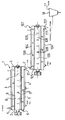
- equipment used for the chemical starch-modification method of the invention comprises a turbo-reactor constituted essentially by a cylindrical, tubular body 1, closed at its opposite ends by end plates 2, 3 and having a coaxial heating (or cooling) jacket 4 through which a fluid, for example, diathermic oil, is intended to flow to keep the internal wall of the body 1 at a predetermined temperature.
- a fluid for example, diathermic oil
- the tubular body 1 has openings 5, 6 for the admission of the starch to be modified chemically and of the modification agents used, respectively, as well as an opening 7 for the outlet of the chemically modified starch.
- a bladed rotor 8 is supported for rotation in the tubular body 1, its blades 9 being disposed in a helical arrangement and being oriented for centrifuging and simultaneously trasporting towards the outlet the reagents and the reaction products respectively.
- a motor M is provided for driving the bladed rotor at speeds which may vary from 300 to 1500 revolutions/minute.
- the outlet opening 7 of the turbo-reactor communicates, by means of a duct 11, with the inlet opening 105 of a turbo-drier which is not described in detail since it has a structure just like that of the turbo-reactor mentioned above.
- the components of the turbo-drier which are similar to those of the turbo-reactor are indicated by the same reference numerals increased by 100.
- a continuous flow of maize starch in powder form was supplied at a flow rate of 120 kg/h to the turbo-reactor 1 in which the bladed rotor 8 was rotated at a speed of 700 revolutions/minute and in which the internal wall was kept at a regulated temperature of about 50°. 25 kg/h of a 0.63% aqueous solution of hydrochloric acid was simultaneously supplied continuously through the opening 6.
- This acid-modified starch was supplied continuously to the turbo-drier 13 together with a flow of hot air at a temperature of 160°C having the same direction of flow as the acid-modified starch.
- the wall temperature in the turbo-drier 13 was regulated to a value of 120°C, whilst the speed of rotation of the bladed rotor was kept constantly at 900 revolutions/minute.
- the wall temperature was regulated at a value of about 50°C, whilst the speed of rotation of the bladed rotor was kept constantly at 600 revolutions/minute.
- the oxyethylated starch was supplied continuously to the turbo-drier 13 where it was treated in the experimental conditions used in Example 1.
- oxyethylated starch with a relative moisture content of 11% was obtained and was sent continuously through the duct 17 to a cyclone separator 18.
- Example 2 The method of Example 2 was repeated with the use of propylene oxide instead of ethylene oxide, all of the experimental conditions being kept unchanged.
- oxypropyl starch was obtained with quantitative yields, having a degree of substitution of 0.1 and a relative moisture content of 25%.
- the oxypropyl starch was dried in the turbo-drier in the experimental conditions used in the previous examples, giving a final product having a relative moisture content of 11%.
Landscapes
- Chemical & Material Sciences (AREA)
- Life Sciences & Earth Sciences (AREA)
- Engineering & Computer Science (AREA)
- Biochemistry (AREA)
- Materials Engineering (AREA)
- Health & Medical Sciences (AREA)
- Chemical Kinetics & Catalysis (AREA)
- Medicinal Chemistry (AREA)
- Polymers & Plastics (AREA)
- Organic Chemistry (AREA)
- Crystallography & Structural Chemistry (AREA)
- Polysaccharides And Polysaccharide Derivatives (AREA)
Abstract
Description
- The present invention relates, in general, to a method for the continuous chemical modification of starch.
- The great interest shown by many branches of industry in the availability of raw materials based on modified starches, and consequently in methods for the chemical modification of starch which can be carried out on an industrial scale, is well known.
- Thus, for example, it is known that the textile and paper industries have a particular interest in hydrolytic treatments of starch to produce starch sizing of a suitably low viscosity.
- It is also known that suitable hydrolytic treatment of starch, again on an industrial scale, can produce dextrin, maltose and glucose, which have other important technical uses.
- Further chemical modifications of starch which are of industrial interest are esterification and etherification reactions which give rise to products such as starch acetate, starch hydroxyethylate, starch hydroxypropylate and other simple or mixed ethers and esters. As is well known, these products are widely used in the food industry as gelling or thickening agents, in the textile industry as sizing, and in the paper industry for improving printability, surface strength and the solvent-resistance of paper.
- The methods of the prior art for the chemical modification of starch on an industrial scale are generally based on batch processing of starch in an aqueous solution or in the presence of a large quantity of water.
- In fact, according to the prevalent teaching of the prior art, this is the only method in which optimal contact between the hydroxylic groups of the starch and the agents used for its chemical modification can be achieved in an industrially advantageous and valuable manner.
- However, although, on the one hand the aforementioned technical teaching enables a chemically modified and industrially acceptable starch to be produced, on the other hand, it has the recognized disadvantage of producing enormous quantities of aqueous refluent, the disposal of which results in a considerable burden on production and running costs.
- Moreover, the methods of the prior art have to be carried out discontinuously (in batches) which, as is well known, has an adverse effect on their control and on the overall economy of the method.
- The technical problem upon which the present invention is based is that of providing a method for the chemical modification of starch which avoids the problems listed above with reference to the methods of the prior art.
- This problem is solved, according to the invention, by a method for the continuous chemical modification of starch, characterized in that it comprises the steps of:
- supplying a continuous flow of starch in powder form having a moisture content of between 9 and 25% into a turbo-reactor comprising a cylindrical, tubular body with a horizontal axis, having openings for the admission of agents and for the outlet of the final product, a bladed rotor supported for rotation in the cylindrical, tubular body, in which it is rotated at speeds within the range of from 300 to 1500 revolutions/minute, so as to disperse the continuous flow of starch into a flow of starch particles and, possibly a heating or cooling jacket for bringing the internal wall of the tubular body to a predetermined temperature,
- supplying at least one continuous, substantially aeriform flow of at least one starch-modification agent into the turbo-reactor, with the same direction of flow as the starch flow,
- centrifuging the starch particles and the modification agent against the internal wall of the turbo-reactor, forming a thin, tubular, dynamic, highly turbulent, fluid layer in which the starch particles and the modification agent are kept mechanically in intimate contact by the blades of the bladed rotor, and
- reacting the starch and the agent in the thin layer whilst it advances substantially in contact with the internal wall towards the opening of the turbo-reactor.
- If one or more of the starch-modification agents are available in a liquid state, they may be supplied to the turbo-reactor as they are since, as soon as they are admitted thereto, the bladed rotor effectively nebulizes and centrifuges them, consequently ensuring that they are introduced into the thin, tubular, fluid layer of starch particles in a highly dispersed state.
- The extreme turbulence which is maintained mechanically in the fluid layer by the bladed rotor prevents the very small drops of starch-modification agent from coalescing, favouring the completion of the desired reaction.
- In fact, in connection with the completion of the starch-modification reaction, it should be noted that, according to the present invention, the reagents, (starch powder and agents for the chemical modification thereof) are no longer "dispersed" in an aqueous medium, but in an aeriform (or gaseous) medium of which the humidity is very low. The modification reaction achieved according to the method of the invention leads to the production, with a yield of practically 100%, of a reaction product (modified starch) which is constituted by a dry powder having a moisture content no greater than 25% by weight and does not involve the production of any aqueous refluent as occurred, on the other hand, with the methods of the prior art.
- The method of the invention advantageously enables all of the starch-modification reactions currently known to be carried out. In particular, it is possible to carry out acid hydrolysis of starch to various degrees, acetylation, etherification to produce valuable compounds such as methyl, ethyl, propyl, butyl starch, carboxymethyl starch, carboxyethyl starch, oxyethyl starch, oxypropyl starch, esterification, carboxylation by phosgenation, and the like.
- In particular, when used to hydrolyse starch, the method of the invention can be carried out with the use, as the starch-modification agent, of an aqueous solution of a strong acid which is nebulized mechanically upon admission to the turbo-reactor.
- The strong acid used is preferably hydrochloric acid.
- The method of the invention may advantageously be carried out with the use, as the starch-modification agent, of an alkylation agent selected from the group comprising C₁₋₄ alkyl halides, C₁₋₄ alkyl sulphates, halo-C₂₋₄-alkanoic acids, C₂₋₄ alkylene epoxides.
- Acylation agents such as those selected from the group comprising C₂₋₄ acyl halides, anhydrides of C₂₋₄ alkanoic acids and phosgene may effectively be used in the method of the invention.
- If one of the aforementioned reactions requires the supply of heat (or the removal of heat) this can be achieved by the suitable heating (or cooling) of the internal wall of the turbo-reactor along which the thin, tubular, fluid layer of starch particles moves. For this purpose, the cylindrical, tubular body of the turbo-reactor will have one or more jackets through which a heating or cooling fluid is intended to flow.
- The advantages and characteristics of the invention will become clearer from the following description of some examples of the implementation of the chemical starch-modification method, given below with reference to equipment shown schematically in the single appended drawing, which is provided purely by way of indication.
- With reference to the drawing, equipment used for the chemical starch-modification method of the invention comprises a turbo-reactor constituted essentially by a cylindrical, tubular body 1, closed at its opposite ends by end plates 2, 3 and having a coaxial heating (or cooling)
jacket 4 through which a fluid, for example, diathermic oil, is intended to flow to keep the internal wall of the body 1 at a predetermined temperature. - The tubular body 1 has
openings 5, 6 for the admission of the starch to be modified chemically and of the modification agents used, respectively, as well as an opening 7 for the outlet of the chemically modified starch. - A bladed rotor 8 is supported for rotation in the tubular body 1, its blades 9 being disposed in a helical arrangement and being oriented for centrifuging and simultaneously trasporting towards the outlet the reagents and the reaction products respectively.
- A motor M is provided for driving the bladed rotor at speeds which may vary from 300 to 1500 revolutions/minute.
- If the product (modified starch) discharged from the turbo-reactor requires further drying, the outlet opening 7 of the turbo-reactor communicates, by means of a duct 11, with the inlet opening 105 of a turbo-drier which is not described in detail since it has a structure just like that of the turbo-reactor mentioned above. The components of the turbo-drier which are similar to those of the turbo-reactor are indicated by the same reference numerals increased by 100.
- A continuous flow of maize starch in powder form was supplied at a flow rate of 120 kg/h to the turbo-reactor 1 in which the bladed rotor 8 was rotated at a speed of 700 revolutions/minute and in which the internal wall was kept at a regulated temperature of about 50°. 25 kg/h of a 0.63% aqueous solution of hydrochloric acid was simultaneously supplied continuously through the opening 6.
- Immediately upon admission to the turbo-reactor 1, the flow of starch powder was dispersed mechanically into starch particles which were immediately centrifuged against the internal wall of the turbo-reactor where they formed a thin, tubular and dynamic, fluid layer. At the same time, the aqueous solution of hydrochloric acid was mechanically nebulized finely by the blades of the rotor 8 which also immediately centrifuged the very small drops produced. These were thus introduced into the thin, tubular, fluid layer of starch particles with which they could "interact".
- After a period of about 30 seconds spent in the turbo-reactor, an acid-modified starch which had a moisture content of 25% was discharged continuously from the opening 7.
- This acid-modified starch was supplied continuously to the turbo-drier 13 together with a flow of hot air at a temperature of 160°C having the same direction of flow as the acid-modified starch.
- The wall temperature in the turbo-drier 13 was regulated to a value of 120°C, whilst the speed of rotation of the bladed rotor was kept constantly at 900 revolutions/minute.
- After 5 minutes spent in the turbo-drier, acid-modified starch having a relative moisture content of 11% was discharged continuously therefrom.
- With the use of the equipment described schematically above and following the method of the invention, maize starch in powder form was supplied continuously into the turbo-reactor 1 through the inlet opening 5 at a flow rate of 120 kg/h. At the same time a 6.9% aqueous solution of NaOH was supplied continuously with the same direction of flow, at a flow rate of 2.5 kg/h, through the opening 6. Ethylene oxide was supplied to the same turbo-reactor 1 about half-way along the latter, with a flow rate of 95 kg/h, equal to 0.254 m³/h.
- The wall temperature was regulated at a value of about 50°C, whilst the speed of rotation of the bladed rotor was kept constantly at 600 revolutions/minute.
- After about 30 seconds spent in the turbo-reactor, oxyethylated starch with a degree of substitution of 0.1 was discharged continuously through the opening 7.
- The oxyethylated starch was supplied continuously to the turbo-drier 13 where it was treated in the experimental conditions used in Example 1.
- At the output of the turbo-drier, oxyethylated starch with a relative moisture content of 11% was obtained and was sent continuously through the duct 17 to a
cyclone separator 18. - The method of Example 2 was repeated with the use of propylene oxide instead of ethylene oxide, all of the experimental conditions being kept unchanged.
- At the output of the turbo-reactor, oxypropyl starch was obtained with quantitative yields, having a degree of substitution of 0.1 and a relative moisture content of 25%. The oxypropyl starch was dried in the turbo-drier in the experimental conditions used in the previous examples, giving a final product having a relative moisture content of 11%.
Claims (6)
- A method for the continuous chemical modification of starch, characterized in that it comprises the steps of:- supplying a continuous flow of starch in powder form having a moisture content of between 9 and 25% into a turbo-reactor comprising a cylindrical, tubular body with a horizontal axis, having openings for the admission of agents and for the outlet of the final product, a bladed rotor supported for rotation in the cylindrical, tubular body, in which it is rotated at speeds within the range of from 300 to 1500 revolutions/minute, so as to disperse the continuous flow of starch into a flow of starch particles and, possibly a heating or cooling jacket for bringing the internal wall of the tubular body to a predetermined temperature,- supplying at least one continuous, substantially aeriform flow of at least one starch-modification agent into the turbo-reactor with the same direction of flow as the starch flow,- centrifuging the starch particles and the modification agent against the internal wall of the turbo-reactor forming a thin, tubular, dynamic, highly turbulent, fluid layer in which the starch particles and the modification agent are kept mechanically in intimate contact by the blades of the bladed rotor, and- reacting the starch and the agent in the thin layer whilst it advances substantially in contact with the internal wall towards the outlet opening of the turbo-reactor.
- A method according to Claim 1, characterized in that the chemical starch-modification reaction product which is discharged from the turbo-reactor is subsequently dried in a turbo-drier.
- A method according to any one of Claims 1 and 2, characterized in that the at least one starch-modification agent is constituted by an aqueous solution of a strong acid which is nebulized mechanically upon admission to the turbo-reactor.
- A method according to Claim 3, characterized in that the strong acid is hydrochloric acid.
- A method according to any one of Claims 1 and 2, characterized in that the at least one starch-modification agent is constituted by an alkylation agent selected from the group comprising C₁₋₄ alkyl halides, C₁₋₄ alkyl sulphates, halo-C₁₋₄-alkanoic acids, and C₂₋₄ alkylene epoxides.
- A method according to any one of Claims 1 and 2, characterized in that the at least one starch-modification agent is constituted by an acylation agent selected from the group comprising C₂₋₄ acyl halides, anhydrides of C₂₋₄ alkanoic acids, and phosgene.
Priority Applications (3)
| Application Number | Priority Date | Filing Date | Title |
|---|---|---|---|
| EP19940830524 EP0710670B1 (en) | 1994-11-03 | 1994-11-03 | A method of modifying starch |
| DE1994624942 DE69424942T2 (en) | 1994-11-03 | 1994-11-03 | Process for modifying starch |
| ES94830524T ES2149251T3 (en) | 1994-11-03 | 1994-11-03 | METHOD FOR THE MODIFICATION OF STARCH. |
Applications Claiming Priority (1)
| Application Number | Priority Date | Filing Date | Title |
|---|---|---|---|
| EP19940830524 EP0710670B1 (en) | 1994-11-03 | 1994-11-03 | A method of modifying starch |
Publications (2)
| Publication Number | Publication Date |
|---|---|
| EP0710670A1 true EP0710670A1 (en) | 1996-05-08 |
| EP0710670B1 EP0710670B1 (en) | 2000-06-14 |
Family
ID=8218571
Family Applications (1)
| Application Number | Title | Priority Date | Filing Date |
|---|---|---|---|
| EP19940830524 Expired - Lifetime EP0710670B1 (en) | 1994-11-03 | 1994-11-03 | A method of modifying starch |
Country Status (3)
| Country | Link |
|---|---|
| EP (1) | EP0710670B1 (en) |
| DE (1) | DE69424942T2 (en) |
| ES (1) | ES2149251T3 (en) |
Cited By (25)
| Publication number | Priority date | Publication date | Assignee | Title |
|---|---|---|---|---|
| WO1998058985A1 (en) * | 1997-06-23 | 1998-12-30 | Vomm Impianti E Processi S.R.L. | A method of producing synthetic rubbers |
| EP0896004A1 (en) * | 1997-07-28 | 1999-02-10 | Societe Des Produits Nestle S.A. | Modified starch |
| EP1050543A1 (en) * | 1999-05-03 | 2000-11-08 | Roquette Frˬres | Process for transforming amylaceous products in dry state |
| US6146493A (en) * | 1996-10-10 | 2000-11-14 | Vomm Chemipharma S.R.L. | Method for the concentration of liquid mixtures |
| EP1072578A1 (en) * | 1999-07-30 | 2001-01-31 | VOMM CHEMIPHARMA S.r.l. | A method for crystallizing polyols and sugars |
| US6469161B1 (en) | 1997-09-12 | 2002-10-22 | Roquette Freres | Chemical fluidification process and conversion process of starchy materials, and new cationic starchy materials |
| US6482267B1 (en) | 1999-10-22 | 2002-11-19 | Roquette Freres | Process for the conversion of starchy substances in the dry phase |
| WO2003079808A1 (en) * | 2002-03-25 | 2003-10-02 | Mars Incorporated | Protein-containing food product and method of preparing same |
| US6630586B1 (en) * | 1998-12-04 | 2003-10-07 | Roquette Freres | Branched maltodextrins and method of preparing them |
| AT413698B (en) * | 2002-09-27 | 2006-05-15 | Suedzucker Ag | MIXING DEVICE AND COVERING DEVICE, USE THEREOF AND METHOD FOR MODIFYING AND DERIVATING CARBOHYDRATES |
| WO2007071776A1 (en) * | 2005-12-22 | 2007-06-28 | Cargill, Incorporated | Process for starch modification |
| WO2007071774A1 (en) * | 2005-12-22 | 2007-06-28 | Cargill, Incorporated | Process for modification of biopolymers |
| EP1847621A1 (en) * | 2006-04-21 | 2007-10-24 | Vomm Impianti e Processi S.P.A. | Process and plant for the production of fermentable sugars from cellulose material |
| RU2390528C2 (en) * | 2003-11-13 | 2010-05-27 | Серестар Холдинг Б.В. | Method of modifying starch or starch derivatives |
| WO2013072638A2 (en) | 2011-11-18 | 2013-05-23 | Roquette Freres | Partially soluble dextrins of high molecular weight |
| US9187573B2 (en) | 2007-07-26 | 2015-11-17 | Cargill, Incorporated | Process for modifying starches |
| WO2016165975A1 (en) * | 2015-04-16 | 2016-10-20 | Ambiente E Nutrizione S.R.L. | Process for continuously carrying out enzymatic reactions on an organic substrate |
| US10006714B2 (en) | 2007-08-07 | 2018-06-26 | Mars, Incorporated | Apparatus for drying a material |
| EP1964969B1 (en) | 2007-02-27 | 2018-07-11 | Cargill, Incorporated | Coating compositions |
| IT201700073160A1 (en) * | 2017-06-29 | 2018-12-29 | Ambiente E Nutrizione Srl | Process for the production of thermally modified starch |
| DE102019135219A1 (en) | 2018-12-28 | 2020-07-02 | Corn Products Development Inc. | Thermally inhibited starch and manufacturing process |
| US10980254B2 (en) | 2011-05-18 | 2021-04-20 | Mars, Incorporated | Edible animal chews |
| WO2023023048A1 (en) | 2021-08-20 | 2023-02-23 | Corn Products Development, Inc. | De-flavored pea protein concentrates and methods of manufacture |
| US11653687B2 (en) | 2017-09-12 | 2023-05-23 | Corn Products Development, Inc. | Thermally inhibited waxy cassava starch |
| US12501904B2 (en) | 2017-03-06 | 2025-12-23 | Corn Products Development, Inc. | Method of preparing thermally inhibited grain |
Citations (4)
| Publication number | Priority date | Publication date | Assignee | Title |
|---|---|---|---|---|
| US3114656A (en) * | 1959-09-30 | 1963-12-17 | Corn Products Co | Method of treating finely divided material with a gas |
| US3527606A (en) * | 1968-03-21 | 1970-09-08 | American Maize Prod Co | Method of modifying starch |
| US4216310A (en) * | 1979-04-19 | 1980-08-05 | National Starch And Chemical Corporation | Continuous process for phosphorylating starch |
| EP0538653A1 (en) * | 1991-10-25 | 1993-04-28 | VOMM IMPIANTI E PROCESSI S.r.L. | A machine for processing material in general by centrifuging and thermal treatment |
-
1994
- 1994-11-03 EP EP19940830524 patent/EP0710670B1/en not_active Expired - Lifetime
- 1994-11-03 DE DE1994624942 patent/DE69424942T2/en not_active Expired - Lifetime
- 1994-11-03 ES ES94830524T patent/ES2149251T3/en not_active Expired - Lifetime
Patent Citations (4)
| Publication number | Priority date | Publication date | Assignee | Title |
|---|---|---|---|---|
| US3114656A (en) * | 1959-09-30 | 1963-12-17 | Corn Products Co | Method of treating finely divided material with a gas |
| US3527606A (en) * | 1968-03-21 | 1970-09-08 | American Maize Prod Co | Method of modifying starch |
| US4216310A (en) * | 1979-04-19 | 1980-08-05 | National Starch And Chemical Corporation | Continuous process for phosphorylating starch |
| EP0538653A1 (en) * | 1991-10-25 | 1993-04-28 | VOMM IMPIANTI E PROCESSI S.r.L. | A machine for processing material in general by centrifuging and thermal treatment |
Non-Patent Citations (1)
| Title |
|---|
| G.E.H. JOOSTEN ET AL.: "Some Aspects of the Continuous Production of Low-Acetylated Potato Starch", STARKE., vol. 34, no. 12, 1 December 1984 (1984-12-01), WEINHEIM DE, pages 402 - 405 * |
Cited By (52)
| Publication number | Priority date | Publication date | Assignee | Title |
|---|---|---|---|---|
| US6837969B1 (en) | 1996-10-10 | 2005-01-04 | Vomm Chemipharma S.R.L. | Method for the concentration of liquid mixtures |
| US6146493A (en) * | 1996-10-10 | 2000-11-14 | Vomm Chemipharma S.R.L. | Method for the concentration of liquid mixtures |
| WO1998058985A1 (en) * | 1997-06-23 | 1998-12-30 | Vomm Impianti E Processi S.R.L. | A method of producing synthetic rubbers |
| EP0896004A1 (en) * | 1997-07-28 | 1999-02-10 | Societe Des Produits Nestle S.A. | Modified starch |
| US5989350A (en) * | 1997-07-28 | 1999-11-23 | Nestec S.A. | Modified starch |
| US6469161B1 (en) | 1997-09-12 | 2002-10-22 | Roquette Freres | Chemical fluidification process and conversion process of starchy materials, and new cationic starchy materials |
| US6630586B1 (en) * | 1998-12-04 | 2003-10-07 | Roquette Freres | Branched maltodextrins and method of preparing them |
| US6531592B1 (en) | 1999-05-03 | 2003-03-11 | Roquette Freres | Process for modifying starchy materials in the dry phase |
| FR2793249A1 (en) * | 1999-05-03 | 2000-11-10 | Roquette Freres | PROCESS FOR THE CONVERSION OF AMYLACEOUS MATERIALS INTO A DRY PHASE |
| EP1050543A1 (en) * | 1999-05-03 | 2000-11-08 | Roquette Frˬres | Process for transforming amylaceous products in dry state |
| US6416585B1 (en) | 1999-07-30 | 2002-07-09 | Vomm Chemipharma S.R.L. | Method for crystallizing polyols and sugars |
| EP1072578A1 (en) * | 1999-07-30 | 2001-01-31 | VOMM CHEMIPHARMA S.r.l. | A method for crystallizing polyols and sugars |
| US6482267B1 (en) | 1999-10-22 | 2002-11-19 | Roquette Freres | Process for the conversion of starchy substances in the dry phase |
| WO2003079808A1 (en) * | 2002-03-25 | 2003-10-02 | Mars Incorporated | Protein-containing food product and method of preparing same |
| US7838057B2 (en) | 2002-03-25 | 2010-11-23 | Mars Incorporated | Protein-containing food product and method of preparing same |
| AU2003216874B2 (en) * | 2002-03-25 | 2010-03-25 | Mars, Incorporated | Protein-containing food product and method of preparing same |
| AT413698B (en) * | 2002-09-27 | 2006-05-15 | Suedzucker Ag | MIXING DEVICE AND COVERING DEVICE, USE THEREOF AND METHOD FOR MODIFYING AND DERIVATING CARBOHYDRATES |
| RU2390528C2 (en) * | 2003-11-13 | 2010-05-27 | Серестар Холдинг Б.В. | Method of modifying starch or starch derivatives |
| EP2787009A1 (en) | 2003-11-13 | 2014-10-08 | Cerestar Holding B.V. | Method for modifying starch or starch derivaties |
| US8552178B2 (en) | 2005-12-22 | 2013-10-08 | Cargill, Incorporated | Process for modification of biopolymers |
| EP2298818A1 (en) | 2005-12-22 | 2011-03-23 | Cargill, Incorporated | Modification of Biopolymers |
| US8076473B2 (en) | 2005-12-22 | 2011-12-13 | Cargill, Incorporated | Process for starch modification |
| EP2174959A1 (en) * | 2005-12-22 | 2010-04-14 | Cargill, Incorporated | Etherified thinned starch |
| WO2007071774A1 (en) * | 2005-12-22 | 2007-06-28 | Cargill, Incorporated | Process for modification of biopolymers |
| WO2007071776A1 (en) * | 2005-12-22 | 2007-06-28 | Cargill, Incorporated | Process for starch modification |
| EP1847621A1 (en) * | 2006-04-21 | 2007-10-24 | Vomm Impianti e Processi S.P.A. | Process and plant for the production of fermentable sugars from cellulose material |
| EP1964969B1 (en) | 2007-02-27 | 2018-07-11 | Cargill, Incorporated | Coating compositions |
| US9187573B2 (en) | 2007-07-26 | 2015-11-17 | Cargill, Incorporated | Process for modifying starches |
| US10006714B2 (en) | 2007-08-07 | 2018-06-26 | Mars, Incorporated | Apparatus for drying a material |
| US10113794B2 (en) | 2007-08-07 | 2018-10-30 | Mars, Incorporated | Method for drying a material |
| US10980254B2 (en) | 2011-05-18 | 2021-04-20 | Mars, Incorporated | Edible animal chews |
| WO2013072638A2 (en) | 2011-11-18 | 2013-05-23 | Roquette Freres | Partially soluble dextrins of high molecular weight |
| JP2015502999A (en) * | 2011-11-18 | 2015-01-29 | ロケット・フルーレ | Coating color based on high molecular weight partially soluble dextrin |
| WO2013072639A1 (en) | 2011-11-18 | 2013-05-23 | Roquette Freres | Coating slips based on partially soluble dextrins of high molecular weight |
| US10323158B2 (en) | 2011-11-18 | 2019-06-18 | Roquettes Freres | Coating slips based on partially soluble dextrins of high molecular weight |
| US10370553B2 (en) | 2011-11-18 | 2019-08-06 | Roquette Freres | Partially soluble dextrins of high molecular weight |
| WO2016165975A1 (en) * | 2015-04-16 | 2016-10-20 | Ambiente E Nutrizione S.R.L. | Process for continuously carrying out enzymatic reactions on an organic substrate |
| US12501904B2 (en) | 2017-03-06 | 2025-12-23 | Corn Products Development, Inc. | Method of preparing thermally inhibited grain |
| US20190002593A1 (en) * | 2017-06-29 | 2019-01-03 | Ambiente E Nutrizione S.R.L. | Process for the production of thermally modified starch |
| US10676540B2 (en) * | 2017-06-29 | 2020-06-09 | Ambiente E Nutrizione S.R.L. | Process for the production of thermally modified starch |
| IT201700073160A1 (en) * | 2017-06-29 | 2018-12-29 | Ambiente E Nutrizione Srl | Process for the production of thermally modified starch |
| CN109206527A (en) * | 2017-06-29 | 2019-01-15 | 安宾特营养食品有限责任公司 | The method for producing heat modification starch |
| EP3421502A1 (en) * | 2017-06-29 | 2019-01-02 | Ambiente e Nutrizione S.r.l. | Process for the production of thermally modified starch |
| US11653687B2 (en) | 2017-09-12 | 2023-05-23 | Corn Products Development, Inc. | Thermally inhibited waxy cassava starch |
| WO2020139997A1 (en) | 2018-12-28 | 2020-07-02 | Corn Products Development, Inc | Thermally inhibited starch and process for making |
| GB2595101A (en) * | 2018-12-28 | 2021-11-17 | Corn Products Dev Inc | Thermally inhibited starch and process for making |
| US11180575B2 (en) | 2018-12-28 | 2021-11-23 | Corn Products Development, Inc. | Thermally inhibited starch and process for making |
| DE112019005995T5 (en) | 2018-12-28 | 2021-11-11 | Corn Products Development, Inc | Thermally inhibited starch and method of manufacture |
| EP4234587A2 (en) | 2018-12-28 | 2023-08-30 | Corn Products Development, Inc. | Thermally inhibited starch and process for making |
| DE102019135219B4 (en) | 2018-12-28 | 2024-01-04 | Corn Products Development Inc. | Process for producing a dry, thermally inhibited starch |
| DE102019135219A1 (en) | 2018-12-28 | 2020-07-02 | Corn Products Development Inc. | Thermally inhibited starch and manufacturing process |
| WO2023023048A1 (en) | 2021-08-20 | 2023-02-23 | Corn Products Development, Inc. | De-flavored pea protein concentrates and methods of manufacture |
Also Published As
| Publication number | Publication date |
|---|---|
| DE69424942D1 (en) | 2000-07-20 |
| DE69424942T2 (en) | 2001-01-18 |
| EP0710670B1 (en) | 2000-06-14 |
| ES2149251T3 (en) | 2000-11-01 |
Similar Documents
| Publication | Publication Date | Title |
|---|---|---|
| EP0710670A1 (en) | A method of modifying starch | |
| US4549892A (en) | Process for producing hollow, bilayered silicate microspheres | |
| CA1117107A (en) | Chemical-mechanical starch conversion | |
| KR101132073B1 (en) | Method for modifying starch or starch derivatives | |
| EP0951482B1 (en) | Process for the preparation of a starch ester | |
| US4021927A (en) | Process for fluidization | |
| US5164030A (en) | Continuous process for the separation of solutions and suspensions | |
| CA1139608A (en) | Process for producing a gasified fusible sugar composition | |
| JPS593200B2 (en) | Ryuudou Kahou | |
| CA2217906C (en) | Method for the concentration of liquid mixtures | |
| EP1813604B1 (en) | A process for drying melamine | |
| US7868166B2 (en) | Continuous process for the production and/or workup of polysaccharide derivatives | |
| EP0780510B1 (en) | A process for the production of cellulose | |
| US3531465A (en) | Preparation of organic derivatives from decausticized xanthates | |
| CN213943132U (en) | Polyurethane resin reation kettle | |
| CN218795901U (en) | Calcination hot alkali lye recovery processing device | |
| US3842071A (en) | Method for the preparation of starch phosphate esters | |
| US1774205A (en) | Process and apparatus for producing dispersions | |
| SU979362A1 (en) | Process for producing cellulose esters | |
| SU1214662A1 (en) | Method of producing alkylxanthates of alkaline metals | |
| JPS6240308B2 (en) | ||
| CN2420280Y (en) | Production equipment for sodium diacetate | |
| SU1281516A1 (en) | Method of drying ammonium bifluoride | |
| SU1224331A1 (en) | Method of drying food solutions | |
| CA1190440A (en) | Hollow microsphere with inner and outer, insoluble silicate shell portions |
Legal Events
| Date | Code | Title | Description |
|---|---|---|---|
| PUAI | Public reference made under article 153(3) epc to a published international application that has entered the european phase |
Free format text: ORIGINAL CODE: 0009012 |
|
| AK | Designated contracting states |
Kind code of ref document: A1 Designated state(s): BE CH DE DK ES FR GB LI NL PT |
|
| AX | Request for extension of the european patent |
Free format text: LT;SI |
|
| RAX | Requested extension states of the european patent have changed |
Free format text: LT;SI |
|
| RBV | Designated contracting states (corrected) |
Designated state(s): BE CH DE DK ES FR GB LI NL PT |
|
| 17P | Request for examination filed |
Effective date: 19960924 |
|
| 17Q | First examination report despatched |
Effective date: 19970626 |
|
| GRAG | Despatch of communication of intention to grant |
Free format text: ORIGINAL CODE: EPIDOS AGRA |
|
| RAP1 | Party data changed (applicant data changed or rights of an application transferred) |
Owner name: VOMM IMPIANTI E PROCESSI S.R.L. |
|
| GRAG | Despatch of communication of intention to grant |
Free format text: ORIGINAL CODE: EPIDOS AGRA |
|
| GRAH | Despatch of communication of intention to grant a patent |
Free format text: ORIGINAL CODE: EPIDOS IGRA |
|
| GRAH | Despatch of communication of intention to grant a patent |
Free format text: ORIGINAL CODE: EPIDOS IGRA |
|
| GRAA | (expected) grant |
Free format text: ORIGINAL CODE: 0009210 |
|
| AK | Designated contracting states |
Kind code of ref document: B1 Designated state(s): BE CH DE DK ES FR GB LI NL PT |
|
| PG25 | Lapsed in a contracting state [announced via postgrant information from national office to epo] |
Ref country code: LI Free format text: LAPSE BECAUSE OF FAILURE TO SUBMIT A TRANSLATION OF THE DESCRIPTION OR TO PAY THE FEE WITHIN THE PRESCRIBED TIME-LIMIT Effective date: 20000614 Ref country code: CH Free format text: LAPSE BECAUSE OF FAILURE TO SUBMIT A TRANSLATION OF THE DESCRIPTION OR TO PAY THE FEE WITHIN THE PRESCRIBED TIME-LIMIT Effective date: 20000614 |
|
| REG | Reference to a national code |
Ref country code: CH Ref legal event code: EP |
|
| REF | Corresponds to: |
Ref document number: 69424942 Country of ref document: DE Date of ref document: 20000720 |
|
| PG25 | Lapsed in a contracting state [announced via postgrant information from national office to epo] |
Ref country code: PT Free format text: LAPSE BECAUSE OF FAILURE TO SUBMIT A TRANSLATION OF THE DESCRIPTION OR TO PAY THE FEE WITHIN THE PRESCRIBED TIME-LIMIT Effective date: 20000914 Ref country code: DK Free format text: LAPSE BECAUSE OF FAILURE TO SUBMIT A TRANSLATION OF THE DESCRIPTION OR TO PAY THE FEE WITHIN THE PRESCRIBED TIME-LIMIT Effective date: 20000914 |
|
| ET | Fr: translation filed | ||
| REG | Reference to a national code |
Ref country code: ES Ref legal event code: FG2A Ref document number: 2149251 Country of ref document: ES Kind code of ref document: T3 |
|
| REG | Reference to a national code |
Ref country code: CH Ref legal event code: PL |
|
| PLBE | No opposition filed within time limit |
Free format text: ORIGINAL CODE: 0009261 |
|
| STAA | Information on the status of an ep patent application or granted ep patent |
Free format text: STATUS: NO OPPOSITION FILED WITHIN TIME LIMIT |
|
| 26N | No opposition filed | ||
| REG | Reference to a national code |
Ref country code: GB Ref legal event code: IF02 |
|
| PGFP | Annual fee paid to national office [announced via postgrant information from national office to epo] |
Ref country code: BE Payment date: 20131022 Year of fee payment: 20 Ref country code: FR Payment date: 20131121 Year of fee payment: 20 Ref country code: DE Payment date: 20131022 Year of fee payment: 20 Ref country code: GB Payment date: 20131025 Year of fee payment: 20 |
|
| PGFP | Annual fee paid to national office [announced via postgrant information from national office to epo] |
Ref country code: ES Payment date: 20131107 Year of fee payment: 20 Ref country code: NL Payment date: 20131023 Year of fee payment: 20 |
|
| REG | Reference to a national code |
Ref country code: DE Ref legal event code: R071 Ref document number: 69424942 Country of ref document: DE |
|
| REG | Reference to a national code |
Ref country code: NL Ref legal event code: V4 Effective date: 20141103 |
|
| REG | Reference to a national code |
Ref country code: GB Ref legal event code: PE20 Expiry date: 20141102 |
|
| PG25 | Lapsed in a contracting state [announced via postgrant information from national office to epo] |
Ref country code: GB Free format text: LAPSE BECAUSE OF EXPIRATION OF PROTECTION Effective date: 20141102 |
|
| REG | Reference to a national code |
Ref country code: ES Ref legal event code: FD2A Effective date: 20150327 |
|
| PG25 | Lapsed in a contracting state [announced via postgrant information from national office to epo] |
Ref country code: ES Free format text: LAPSE BECAUSE OF EXPIRATION OF PROTECTION Effective date: 20141104 |