EP0712873A2 - Hydrophilic acrylic resins and waterborne coating composition containing same - Google Patents
Hydrophilic acrylic resins and waterborne coating composition containing same Download PDFInfo
- Publication number
- EP0712873A2 EP0712873A2 EP95118156A EP95118156A EP0712873A2 EP 0712873 A2 EP0712873 A2 EP 0712873A2 EP 95118156 A EP95118156 A EP 95118156A EP 95118156 A EP95118156 A EP 95118156A EP 0712873 A2 EP0712873 A2 EP 0712873A2
- Authority
- EP
- European Patent Office
- Prior art keywords
- parts
- acrylic copolymer
- monomer
- hydrophilic acrylic
- mixture
- Prior art date
- Legal status (The legal status is an assumption and is not a legal conclusion. Google has not performed a legal analysis and makes no representation as to the accuracy of the status listed.)
- Granted
Links
Classifications
-
- C—CHEMISTRY; METALLURGY
- C08—ORGANIC MACROMOLECULAR COMPOUNDS; THEIR PREPARATION OR CHEMICAL WORKING-UP; COMPOSITIONS BASED THEREON
- C08F—MACROMOLECULAR COMPOUNDS OBTAINED BY REACTIONS ONLY INVOLVING CARBON-TO-CARBON UNSATURATED BONDS
- C08F220/00—Copolymers of compounds having one or more unsaturated aliphatic radicals, each having only one carbon-to-carbon double bond, and only one being terminated by only one carboxyl radical or a salt, anhydride ester, amide, imide or nitrile thereof
- C08F220/02—Monocarboxylic acids having less than ten carbon atoms; Derivatives thereof
- C08F220/10—Esters
- C08F220/26—Esters containing oxygen in addition to the carboxy oxygen
- C08F220/28—Esters containing oxygen in addition to the carboxy oxygen containing no aromatic rings in the alcohol moiety
-
- C—CHEMISTRY; METALLURGY
- C08—ORGANIC MACROMOLECULAR COMPOUNDS; THEIR PREPARATION OR CHEMICAL WORKING-UP; COMPOSITIONS BASED THEREON
- C08F—MACROMOLECULAR COMPOUNDS OBTAINED BY REACTIONS ONLY INVOLVING CARBON-TO-CARBON UNSATURATED BONDS
- C08F220/00—Copolymers of compounds having one or more unsaturated aliphatic radicals, each having only one carbon-to-carbon double bond, and only one being terminated by only one carboxyl radical or a salt, anhydride ester, amide, imide or nitrile thereof
- C08F220/02—Monocarboxylic acids having less than ten carbon atoms; Derivatives thereof
- C08F220/10—Esters
- C08F220/26—Esters containing oxygen in addition to the carboxy oxygen
- C08F220/28—Esters containing oxygen in addition to the carboxy oxygen containing no aromatic rings in the alcohol moiety
- C08F220/283—Esters containing oxygen in addition to the carboxy oxygen containing no aromatic rings in the alcohol moiety and containing one or more carboxylic moiety in the chain, e.g. acetoacetoxyethyl(meth)acrylate
-
- C—CHEMISTRY; METALLURGY
- C08—ORGANIC MACROMOLECULAR COMPOUNDS; THEIR PREPARATION OR CHEMICAL WORKING-UP; COMPOSITIONS BASED THEREON
- C08G—MACROMOLECULAR COMPOUNDS OBTAINED OTHERWISE THAN BY REACTIONS ONLY INVOLVING UNSATURATED CARBON-TO-CARBON BONDS
- C08G18/00—Polymeric products of isocyanates or isothiocyanates
- C08G18/06—Polymeric products of isocyanates or isothiocyanates with compounds having active hydrogen
- C08G18/08—Processes
- C08G18/0804—Manufacture of polymers containing ionic or ionogenic groups
- C08G18/0819—Manufacture of polymers containing ionic or ionogenic groups containing anionic or anionogenic groups
- C08G18/0823—Manufacture of polymers containing ionic or ionogenic groups containing anionic or anionogenic groups containing carboxylate salt groups or groups forming them
-
- C—CHEMISTRY; METALLURGY
- C08—ORGANIC MACROMOLECULAR COMPOUNDS; THEIR PREPARATION OR CHEMICAL WORKING-UP; COMPOSITIONS BASED THEREON
- C08G—MACROMOLECULAR COMPOUNDS OBTAINED OTHERWISE THAN BY REACTIONS ONLY INVOLVING UNSATURATED CARBON-TO-CARBON BONDS
- C08G18/00—Polymeric products of isocyanates or isothiocyanates
- C08G18/06—Polymeric products of isocyanates or isothiocyanates with compounds having active hydrogen
- C08G18/28—Polymeric products of isocyanates or isothiocyanates with compounds having active hydrogen characterised by the compounds used containing active hydrogen
- C08G18/40—High-molecular-weight compounds
- C08G18/62—Polymers of compounds having carbon-to-carbon double bonds
- C08G18/6216—Polymers of alpha-beta ethylenically unsaturated carboxylic acids or of derivatives thereof
- C08G18/622—Polymers of esters of alpha-beta ethylenically unsaturated carboxylic acids
- C08G18/6225—Polymers of esters of acrylic or methacrylic acid
- C08G18/6229—Polymers of hydroxy groups containing esters of acrylic or methacrylic acid with aliphatic polyalcohols
- C08G18/6233—Polymers of hydroxy groups containing esters of acrylic or methacrylic acid with aliphatic polyalcohols the monomers or polymers being esterified with carboxylic acids or lactones
-
- C—CHEMISTRY; METALLURGY
- C08—ORGANIC MACROMOLECULAR COMPOUNDS; THEIR PREPARATION OR CHEMICAL WORKING-UP; COMPOSITIONS BASED THEREON
- C08G—MACROMOLECULAR COMPOUNDS OBTAINED OTHERWISE THAN BY REACTIONS ONLY INVOLVING UNSATURATED CARBON-TO-CARBON BONDS
- C08G18/00—Polymeric products of isocyanates or isothiocyanates
- C08G18/06—Polymeric products of isocyanates or isothiocyanates with compounds having active hydrogen
- C08G18/28—Polymeric products of isocyanates or isothiocyanates with compounds having active hydrogen characterised by the compounds used containing active hydrogen
- C08G18/40—High-molecular-weight compounds
- C08G18/62—Polymers of compounds having carbon-to-carbon double bonds
- C08G18/6216—Polymers of alpha-beta ethylenically unsaturated carboxylic acids or of derivatives thereof
- C08G18/625—Polymers of alpha-beta ethylenically unsaturated carboxylic acids; hydrolyzed polymers of esters of these acids
- C08G18/6254—Polymers of alpha-beta ethylenically unsaturated carboxylic acids and of esters of these acids containing hydroxy groups
-
- C—CHEMISTRY; METALLURGY
- C09—DYES; PAINTS; POLISHES; NATURAL RESINS; ADHESIVES; COMPOSITIONS NOT OTHERWISE PROVIDED FOR; APPLICATIONS OF MATERIALS NOT OTHERWISE PROVIDED FOR
- C09D—COATING COMPOSITIONS, e.g. PAINTS, VARNISHES OR LACQUERS; FILLING PASTES; CHEMICAL PAINT OR INK REMOVERS; INKS; CORRECTING FLUIDS; WOODSTAINS; PASTES OR SOLIDS FOR COLOURING OR PRINTING; USE OF MATERIALS THEREFOR
- C09D133/00—Coating compositions based on homopolymers or copolymers of compounds having one or more unsaturated aliphatic radicals, each having only one carbon-to-carbon double bond, and at least one being terminated by only one carboxyl radical, or of salts, anhydrides, esters, amides, imides, or nitriles thereof; Coating compositions based on derivatives of such polymers
- C09D133/04—Homopolymers or copolymers of esters
- C09D133/06—Homopolymers or copolymers of esters of esters containing only carbon, hydrogen and oxygen, the oxygen atom being present only as part of the carboxyl radical
- C09D133/062—Copolymers with monomers not covered by C09D133/06
- C09D133/066—Copolymers with monomers not covered by C09D133/06 containing -OH groups
Definitions
- This invention relates to a hydrophilic acrylic resin. It also relates to a coating composition containing the hydrophilic acrylic resin.
- the vehicle resin For use in thermosetting, waterborne paint formulations, the vehicle resin must have a functional group such as hydroxyl as a crosslinking site thereof and also an acid group such as carboxylic or sulfonic acid group to render the resin water-soluble.
- the hydroxyl group may be introduced to the resin by copolymerizing a hydroxyl group-containing monomer such as 2-hydroxyethyl acrylate or methacrylate.
- the resins thus produced are not fully satisfactory in their reactivity with a crosslinker such as melamine resins or blocked polyisocyanates because the crossling site thereof is not remotely spaced apart from the resin backbone chain formed of recurring carbon-to-carbon linkages and the curing with a crosslinker requires a relatively high temperature.
- a crosslinker such as melamine resins or blocked polyisocyanates because the crossling site thereof is not remotely spaced apart from the resin backbone chain formed of recurring carbon-to-carbon linkages and the curing with a crosslinker requires a relatively high temperature.
- JP-A-61/181877 discloses coating compositions containing an acrylic resin produced by copolymerizing an adduct of 2-hydroxyethyl (meth)acrylate with ⁇ - caprolactone known as PLACCEL FA and FM series with conventional monomers.
- This acrylic resin exhibits improved reactivity with the crosslinker and improved flexibility or low temperature-impact strength of the cured films. This is because the crosslinking site is farther spaced apart from the resin backbone by an ester linkage formed by the ring-opening reaction of ⁇ -caprolactone.
- the above lactone-modified monomers are not compatible with an acid group-containing monomer necessary for rendering the resin water-soluble because the ester linkage is liable to hydrolysis and the copolymers containing the lactone-modified monomer and the acid group-containing monomer are not stable upon storage in an aqueous medium.
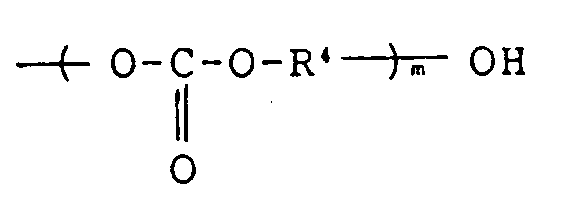
- the present invention provides a hydrophilic acrylic copolymer having a hydroxyl number of from 20 to 300, an acid number of from 10 to 100 and a number average molecular weight of from 1,000 to 50,000, said copoymer containing in the molecule (a) a plurality of pendant groups each terminated with a group of the formula: wherein R4 is a C2-C8 alkylene bridge, and m is an integer of from 1 to 6; and (b) a plurality of acid group-terminated pendant groups.
- the above acrylic copolymer may be prepared by copolymering a monomer mixture of
- the present invention provides a hydrophilic acrylic copolymer having a hydroxyl number of from 20 to 300, an acid number of from 10 to 100 and a number average molecular weight of from 1,000 to 50,000, said copolymer containing in the molecule
- the acrylic copolymer just mentioned as above may be prepared by copolymering a monomer mixture of
- the present invention provides a waterborne, thermosetting coating composition
- a waterborne, thermosetting coating composition comprising the hydrophilic acrylic copolymer of the present invention and crosslinker dispersed in an aqueous medium containing a neutralizing base.
- the characteristic feature of the hydrophilic acrylic copolymer of the present invention resides in that it contains a plurality of pendant groups each terminated with a hydroxyalkyl carbonate group of the formula I: wherein R4 and m are as defined. This is particularly advantageous because each of the hydroxyl groups becoming a crosslinking site are spaced apart from the polymer backbone chain by a chemically stable alkylene carbonate linkage and, therefore, the copolymer is not liable to hydrolysis when formulated in a waterborne coating composition.
- the hydrophilic acrylic copolymer of the present invention is prepared by copolymerizing a monomer mixture of
- the acrylic monomer having a hydroxyalkyl carbonate group of the formula II may be produced as disclosed in EP-A-0600417 by reacting a cyclic alkylenecarbonate with a hydroxylalkyl (meth)acrylate such as 2-hydroxyethyl methacrylate, 3-hydroxypropyl (meth)acrylate or 4-hydroxybutyl (meth)acrylate, or an adduct of hydroxyalkyl (meth)acrylate with a lactone such as addcuts of 2-hydroxyethyl (meth)acrylate with ⁇ -caprolactone sold by Daicel Chemical Industries, Ltd. under the name of PLACCEL FA and FM series.
- a hydroxylalkyl (meth)acrylate such as 2-hydroxyethyl methacrylate, 3-hydroxypropyl (meth)acrylate or 4-hydroxybutyl (meth)acrylate
- an adduct of hydroxyalkyl (meth)acrylate with a lactone such as addcuts of 2-hydroxy
- the reaction may be caried at a temperature from room temperature to 180 °C , preferably from room temperature to 80°C in the presence of a catalyst.
- a catalyst preferably from room temperature to 80°C.
- a preferred example of the cyclic carbonate is 5,5-dimethyl-1,3-dioxan-2-one otherwise called neopentyl glycol carobonate.
- carboxylic acid monomers are acrylic, methacrylic, crotic or isocrotic acid.
- Half esters of a dicarboxylic acid having an ethylenic unsaturation such as maleic, fumaric or itaconic acid with a low molecular weight aliphatic alcohol such as methanol, ethanol, n- or isopropanol, n-, iso- or t-butanol, methylcellosolve, ethylcellosolve, acetol, allyl alcohol or propargyl alcohol, and half amides of such unsaturated dicarboxylic acids such as itaconic acid monoanilide may also be used.
- sulfonic acid monomers include p-vinylbenzenesulfonic acid and 2-acryloylaminopropanesulfonic acid.
- acrylamides and methacrylamides include, acrylamide, methacrylamide, N,N-dimethylacrylamide, N,N-dimethylmethacrylamide, N,N-dibutylacrylamide, N,N-dibutylmethacrylamide, N,N-dioctylacrylamide, N,N-dioctylmethacrylamide, N-butylacrylamide, N-butylmethacrylamide, N-octylacrylamide or N-octylmethacrylamide.
- Copolymerization of these amide monomers improves the workability and also facilitates the pH control of the hydrophilic acrylic resin of the present invention.
- the monomer mixture may optionally contain a small proportion of monomers such as 2-hydroxyethyl (meth)acrylate, 3-hydroxypropyl (meth)acrylate, 4-hydroxybutyl (meth)acrylate, or an adduct thereof with ⁇ -caprolactone to introduce hydroxyl groups into the resin.
- monomers such as 2-hydroxyethyl (meth)acrylate, 3-hydroxypropyl (meth)acrylate, 4-hydroxybutyl (meth)acrylate, or an adduct thereof with ⁇ -caprolactone to introduce hydroxyl groups into the resin.
- Examples of other comonomers include styrene, ⁇ -methylstyrene, acrylic esters such as methyl acrylate, ethyl acrylate, butyl acrylate or 2-ethylhexyl acrylate, and methacrylic esters such as methyl methacrylate, ethyl methacrylate, butyl methacrylate, 2-ethylhexyl methacrylate or lauryl methacrylate.
- the proportion of hydroxyl group-containing monomers is from 10 to 60 %, preferably from 15 to 40 % by weight of the entire monomer mixture. With proportions less than this range the resin will not exhibit a curability sufficient to give a cured film having satisfactory water resistant and weatherability properties. Conversely, with proportions greater than the above range the resin will only give a cured film which is too rigid and brittle.
- the proprotion of acid group-containing monomers is from 3 to 15 %, preferably from 5 to 13 % by weight of the entire monomer mixture. With proportions less than this range the resin will be poorly soluble in water and conversely greater proportions will result in decreased water resistance properties.
- the proportion of amide monomers is from 5 to 40 %, preferably from 10 to 25 % by weight of the entire monomer mixture. Within this range various advantages as stated above may be expected.
- the balance of the monomer mixture is occupied with a comonomer or comonomers other than monomers having a functional group as identified above.
- the monomer mixture may be polymerized using conventional solution polymerization methods.
- the polymerization is preferably carried out in a solvent such as ethoxypropanol or ⁇ -butyrolactone at a temperature from 80 °C to 140 °C in the presence of a polymerization initiator such as benzoyl peroxide, t-butyl hydroperoxide, t-butylperoxy 2-ethylhexanoate, cumene hydroperoxide or azobisisobutyronitrile.
- a solvent such as ethoxypropanol or ⁇ -butyrolactone
- a polymerization initiator such as benzoyl peroxide, t-butyl hydroperoxide, t-butylperoxy 2-ethylhexanoate, cumene hydroperoxide or azobisisobutyronitrile.
- the hydrophilic acrylic resin may also be produced by copolymerizing a hydroxyalkyl (meth)acrylate or its lactone adduct with other requisite monomers and then reacting the resulting copolymer with a cyclic carbonate such as 5,5-dimethyl-1,3-dioxan-2-one.
- the hydrophilic acrylic resin of the present invention should have an acid number of from 10 to 100, preferably from 30 to 80, and a hydroxyl number of from 20 to 300, preferably from 50 to 200 to impart the resin with optimum levels of water-solubility and curability as discussed before in connection with the proportions of acid group-bearing monomers and hydroxyl group-bearing monomers.
- the resin should also have a number average molecular weight of from 1,000 to 50,000, preferably from 1,500 to 30,000. This is because resins of low molecular weights result in decrease in strength properties of cured films and because excessively high molecular weights decrease the spray workability of the coating composition of the present invention.
- the hydrophilic acrylic resin of the present invention is solubilized in water by neutralizing at least a portion of acid groups thereof with an amine such as mono-, di- or trimethylamine, mono-, di- or triethylamine, diisopropylamine, mono- or diethanolamine, or dimethylethanolamine.
- an amine such as mono-, di- or trimethylamine, mono-, di- or triethylamine, diisopropylamine, mono- or diethanolamine, or dimethylethanolamine.
- the hydrophilic acrylic resin of the present invention is dissolved or dispersed in an aqueous medium containing a neutralizing base together with a crosslinker to prepare a thermosetting, waterborne coating composition.
- the crosslinker may be an aminoplast resin or a blocked polyisocyanate.
- aminoplast resins include di-, tri-, tetra-, penta- or hexamethylolmelamine; ethers thereof with a lower alkanol such as methanol, ethanol, propanol, isopropanol, butanol or isobutyl alcohol; ureaformaldehyde condensation products; and co-condensation product of melamine and urea with formaldehyde.
- Blocked polyisocyanates are prepared by reacting an organic polyisocyanate with a blocking agent as is well-known in the art.
- polyisocyanates include aliphatic or cycloaliphatic polyisocyanates such as trimethylenediisocyanate, hexamethylenediisocyanate(HMDI), isophoronediisocyanate(IPDI), dimers, trimers or trimethylolpropane adducts of these diisocyanates; and aromatic polyisocyanates such as phenylenediisocyanate, tolylenediisocyanate (TDI), naphthylenediisocyanate, diphenylmethanediisocyanate (MDI), triphenylmethanetriisocyanate, dimer or trimer of TDI.
- blocking agents include alcohols such as methanol or ethanol; secondary amines such as diethanolamine, lactams such as caprolactam; and oximes such as methyl ethyl ketoxime.
- Melamine resins are preferable including commercially available hydrophilic or hydrophobic melamine resins sold under the name of CYMEL 303, CYMEL 325 and CYMEL 1156 by American Cyanamid Company, YUBAN 20N, YUBAN 20SB and YUBAN 129 sold by Mitsui Toatsu Chemicals, Inc.; and SUMIMAL M-50W, SUMIMAL M-4ON and SUMIMAL M-30W sold by Sumitomo Chemical Company Limited.
- the ratio of the acrylic resin to the crosslinker in the coating composition is generally from 90:10 to 50:50, preferably from 80:20 to 60:40 by weight as solids.
- the waterborne coating composition of the present invention may contain, in addition to water, an organic solvent.
- organic solvents include alcohols such as methanol, ethanol, isopropanol, ethoxyethanol, ethoxypropanol or methoxypropanol; esters such as methyl acetate, ethyl acetate or butyl acetate; lactones such as ⁇ -butyrolactone; hydrocarbons such as toluene or xylene; ethers such as dibutyl ether or ethylene glycol diethyl ether; and amides such N-methylpyrrolidone.
- the coating composition may contain other conventional additives such as inorganic, organic or metallic pigments e.g. aluminum flakes, UV absorbers, antifoaming agents, surface smoothers and the like.
- a flask equipped with a stirrer, condenser, thermometer, nitrogen gas tube and drip funnel was charged with 500 parts of 2-ethoxypropanol and heated to 100°C.
- AIBN azobisisobutyronitrile
- the aqueous varnish was diluted with deionized water to a Ford cup #4 viscosity of 20 seconds, and stored at 40°C for 10 days.
- the storage stability of the varnish was evaluated by measuring the viscosity before and after storage. The results are shown in Table 1 below.
- a waterborne coating composition was prepared by mixing 100 parts of the above varnish and 70 parts of YUBAN 20SB (melamine resin sold by Mitsui Toatsu Chemicals, Inc.) and diluting with deionized water to a Ford cup #4 viscosity of 20 seconds.
- This coating composition was applied on a tinplate, baked at 140 °C for 20 minutes and tested for curability.
- the coating composition was also tested for storage stability under the same conditions as before. The results are also shown in Table 1.
- Example 1 the procedure of Example 1 was followed to prepare an aqueous resin varnish and a waterborne coating composition using various materials shown therein.
- Table 1 The results of storage stability and curability tests carried out under the same conditios as in Example 1 are shown in Table 1.
- Example 8 was repeated except that 600 parts of PLACCEL FM 1 (2-hydroxyethyl methacrylate-caprolactone adduct sold by Daicel Chemical Industries, Ltd.) were replaced for 600 parts of Macromonomer B. Acid number 45, OH number 138, and Mn 7,000.
- the aqueous varnish was diluted with deionized water to a Ford cup #4 viscosity of 20 seconds, and stored at 40°C for 10 days.
- the storage stability of the varnish was evaluated by measuring the viscosity before and after storage. The results are shown in Table 2 below.
- a waterborne coating composition was prepared by mixing 100 parts of the above varnish and 70 parts of YUBAN 20SB (melamine resin sold by Mitsui Toatsu Chemicals, Inc.) and diluting with deionized water to a Ford cup #4 viscosity of 20 seconds.
- This coating composition was applied on a tinplate, baked at 140 °C for 20 minutes and tested for curability.
- the coating composition was also tested for storage stability under the same conditions as before. The results are also shown in Table 2.
- Example 9 the procedure of Example 9 was followed to prepare an aqueous resin varnish and a waterborne coating composition using various materials shown therein.
- Table 2 The results of storage stability and curability tests carried out under the same conditions as in Example 9 are shown in Table 2.
Landscapes
- Chemical & Material Sciences (AREA)
- Organic Chemistry (AREA)
- Health & Medical Sciences (AREA)
- Chemical Kinetics & Catalysis (AREA)
- Medicinal Chemistry (AREA)
- Polymers & Plastics (AREA)
- Engineering & Computer Science (AREA)
- Manufacturing & Machinery (AREA)
- Life Sciences & Earth Sciences (AREA)
- Materials Engineering (AREA)
- Wood Science & Technology (AREA)
- Addition Polymer Or Copolymer, Post-Treatments, Or Chemical Modifications (AREA)
- Paints Or Removers (AREA)
Abstract
Description
- This invention relates to a hydrophilic acrylic resin. It also relates to a coating composition containing the hydrophilic acrylic resin.
- Much interest has been placed today on waterborne paint free from the emission of VOC for energy saving and environmental reasons. For use in thermosetting, waterborne paint formulations, the vehicle resin must have a functional group such as hydroxyl as a crosslinking site thereof and also an acid group such as carboxylic or sulfonic acid group to render the resin water-soluble. In case of acrylic resins, the hydroxyl group may be introduced to the resin by copolymerizing a hydroxyl group-containing monomer such as 2-hydroxyethyl acrylate or methacrylate. The resins thus produced, however, are not fully satisfactory in their reactivity with a crosslinker such as melamine resins or blocked polyisocyanates because the crossling site thereof is not remotely spaced apart from the resin backbone chain formed of recurring carbon-to-carbon linkages and the curing with a crosslinker requires a relatively high temperature.
- JP-A-61/181877 discloses coating compositions containing an acrylic resin produced by copolymerizing an adduct of 2-hydroxyethyl (meth)acrylate with ε - caprolactone known as PLACCEL FA and FM series with conventional monomers. This acrylic resin exhibits improved reactivity with the crosslinker and improved flexibility or low temperature-impact strength of the cured films. This is because the crosslinking site is farther spaced apart from the resin backbone by an ester linkage formed by the ring-opening reaction of ε -caprolactone. However, the above lactone-modified monomers are not compatible with an acid group-containing monomer necessary for rendering the resin water-soluble because the ester linkage is liable to hydrolysis and the copolymers containing the lactone-modified monomer and the acid group-containing monomer are not stable upon storage in an aqueous medium.
- A need exists, therefore, for a hydrophilic acrylic resin which eliminates or ameliorates the above disadvantages when formulated in waterborne coating compositions as a vehicle resin thereof.
- In the first aspect, the present invention provides a hydrophilic acrylic copolymer having a hydroxyl number of from 20 to 300, an acid number of from 10 to 100 and a number average molecular weight of from 1,000 to 50,000, said copoymer containing in the molecule (a) a plurality of pendant groups each terminated with a group of the formula:

wherein R⁴ is a C₂-C₈ alkylene bridge, and m is an integer of from 1 to 6; and (b) a plurality of acid group-terminated pendant groups. - The above acrylic copolymer may be prepared by copolymering a monomer mixture of
- (a) 10 to 60 % by weight of the mixture of an acrylic monomer of the formula II:

- (b) 3 to 15 % by weight of the mixture of an ethylenically unsaturated monomer having an acid group; and
- (c) the balance of the mixture of an ethylenically unsaturate monomer other than monomers (a) and (b).
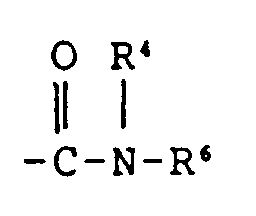
- In the second aspect, the present invention provides a hydrophilic acrylic copolymer having a hydroxyl number of from 20 to 300, an acid number of from 10 to 100 and a number average molecular weight of from 1,000 to 50,000, said copolymer containing in the molecule
- (a) a plurality of pendant groups each terminate with a group of the formula:

- (b) a plurality of acid group-terminated pendant groups; and
- (c) a plurality of pendant groups each terminated with an amide group of the formula:

- The acrylic copolymer just mentioned as above may be prepared by copolymering a monomer mixture of
- (a) 10 to 60 % by weight of the mixture of an acrylic monomer of the formula II:

- (b) 3 to 15 % by weight of the mixture of an ethylenically unsaturate monomer having an acid group;
- (c) 5 to 40 % by weight of the mixture of a monomer of the formula IV:

- (d) the balance of the mixture of an ethylenically unsaturated monomer other than monomers (a), (b) and (c).
- In the third aspect, the present invention provides a waterborne, thermosetting coating composition comprising the hydrophilic acrylic copolymer of the present invention and crosslinker dispersed in an aqueous medium containing a neutralizing base.
- The characteristic feature of the hydrophilic acrylic copolymer of the present invention resides in that it contains a plurality of pendant groups each terminated with a hydroxyalkyl carbonate group of the formula I:

wherein R⁴ and m are as defined. This is particularly advantageous because each of the hydroxyl groups becoming a crosslinking site are spaced apart from the polymer backbone chain by a chemically stable alkylene carbonate linkage and, therefore, the copolymer is not liable to hydrolysis when formulated in a waterborne coating composition. - The hydrophilic acrylic copolymer of the present invention is prepared by copolymerizing a monomer mixture of
- (a) an acrylic monomer of the formula II:

- (b) an ethylenically unsaturated monomer having an acid group; and
- (c) an ethylenically unsaturated monomer other than monomers (a) and (b). The monomer mixture may optionally contain (d) an acrylamide or methacrylamide monomer of the formula:

- The acrylic monomer having a hydroxyalkyl carbonate group of the formula II may be produced as disclosed in EP-A-0600417 by reacting a cyclic alkylenecarbonate with a hydroxylalkyl (meth)acrylate such as 2-hydroxyethyl methacrylate, 3-hydroxypropyl (meth)acrylate or 4-hydroxybutyl (meth)acrylate, or an adduct of hydroxyalkyl (meth)acrylate with a lactone such as addcuts of 2-hydroxyethyl (meth)acrylate with ε -caprolactone sold by Daicel Chemical Industries, Ltd. under the name of PLACCEL FA and FM series. The reaction may be caried at a temperature from room temperature to 180 °C , preferably from room temperature to 80°C in the presence of a catalyst. A preferred example of the cyclic carbonate is 5,5-dimethyl-1,3-dioxan-2-one otherwise called neopentyl glycol carobonate.
- Typical examples of carboxylic acid monomers are acrylic, methacrylic, crotic or isocrotic acid. Half esters of a dicarboxylic acid having an ethylenic unsaturation such as maleic, fumaric or itaconic acid with a low molecular weight aliphatic alcohol such as methanol, ethanol, n- or isopropanol, n-, iso- or t-butanol, methylcellosolve, ethylcellosolve, acetol, allyl alcohol or propargyl alcohol, and half amides of such unsaturated dicarboxylic acids such as itaconic acid monoanilide may also be used. Examples of sulfonic acid monomers include p-vinylbenzenesulfonic acid and 2-acryloylaminopropanesulfonic acid.
- Examples of acrylamides and methacrylamides include, acrylamide, methacrylamide, N,N-dimethylacrylamide, N,N-dimethylmethacrylamide, N,N-dibutylacrylamide, N,N-dibutylmethacrylamide, N,N-dioctylacrylamide, N,N-dioctylmethacrylamide, N-butylacrylamide, N-butylmethacrylamide, N-octylacrylamide or N-octylmethacrylamide. Copolymerization of these amide monomers improves the workability and also facilitates the pH control of the hydrophilic acrylic resin of the present invention.
- The monomer mixture may optionally contain a small proportion of monomers such as 2-hydroxyethyl (meth)acrylate, 3-hydroxypropyl (meth)acrylate, 4-hydroxybutyl (meth)acrylate, or an adduct thereof with ε -caprolactone to introduce hydroxyl groups into the resin. Examples of other comonomers include styrene, α -methylstyrene, acrylic esters such as methyl acrylate, ethyl acrylate, butyl acrylate or 2-ethylhexyl acrylate, and methacrylic esters such as methyl methacrylate, ethyl methacrylate, butyl methacrylate, 2-ethylhexyl methacrylate or lauryl methacrylate.
- The proportion of hydroxyl group-containing monomers is from 10 to 60 %, preferably from 15 to 40 % by weight of the entire monomer mixture. With proportions less than this range the resin will not exhibit a curability sufficient to give a cured film having satisfactory water resistant and weatherability properties. Conversely, with proportions greater than the above range the resin will only give a cured film which is too rigid and brittle.
- The proprotion of acid group-containing monomers is from 3 to 15 %, preferably from 5 to 13 % by weight of the entire monomer mixture. With proportions less than this range the resin will be poorly soluble in water and conversely greater proportions will result in decreased water resistance properties.
- The proportion of amide monomers, if present, is from 5 to 40 %, preferably from 10 to 25 % by weight of the entire monomer mixture. Within this range various advantages as stated above may be expected. The balance of the monomer mixture is occupied with a comonomer or comonomers other than monomers having a functional group as identified above.
- The monomer mixture may be polymerized using conventional solution polymerization methods. For example, the polymerization is preferably carried out in a solvent such as ethoxypropanol or γ -butyrolactone at a temperature from 80 °C to 140 °C in the presence of a polymerization initiator such as benzoyl peroxide, t-butyl hydroperoxide, t-butylperoxy 2-ethylhexanoate, cumene hydroperoxide or azobisisobutyronitrile.
- The hydrophilic acrylic resin may also be produced by copolymerizing a hydroxyalkyl (meth)acrylate or its lactone adduct with other requisite monomers and then reacting the resulting copolymer with a cyclic carbonate such as 5,5-dimethyl-1,3-dioxan-2-one.
- For use as a vehicle resin of waterborne coating compositions, the hydrophilic acrylic resin of the present invention should have an acid number of from 10 to 100, preferably from 30 to 80, and a hydroxyl number of from 20 to 300, preferably from 50 to 200 to impart the resin with optimum levels of water-solubility and curability as discussed before in connection with the proportions of acid group-bearing monomers and hydroxyl group-bearing monomers. The resin should also have a number average molecular weight of from 1,000 to 50,000, preferably from 1,500 to 30,000. This is because resins of low molecular weights result in decrease in strength properties of cured films and because excessively high molecular weights decrease the spray workability of the coating composition of the present invention.
- The hydrophilic acrylic resin of the present invention is solubilized in water by neutralizing at least a portion of acid groups thereof with an amine such as mono-, di- or trimethylamine, mono-, di- or triethylamine, diisopropylamine, mono- or diethanolamine, or dimethylethanolamine.
- The hydrophilic acrylic resin of the present invention is dissolved or dispersed in an aqueous medium containing a neutralizing base together with a crosslinker to prepare a thermosetting, waterborne coating composition. The crosslinker may be an aminoplast resin or a blocked polyisocyanate. Examples of aminoplast resins include di-, tri-, tetra-, penta- or hexamethylolmelamine; ethers thereof with a lower alkanol such as methanol, ethanol, propanol, isopropanol, butanol or isobutyl alcohol; ureaformaldehyde condensation products; and co-condensation product of melamine and urea with formaldehyde. Blocked polyisocyanates are prepared by reacting an organic polyisocyanate with a blocking agent as is well-known in the art. Examples of polyisocyanates include aliphatic or cycloaliphatic polyisocyanates such as trimethylenediisocyanate, hexamethylenediisocyanate(HMDI), isophoronediisocyanate(IPDI), dimers, trimers or trimethylolpropane adducts of these diisocyanates; and aromatic polyisocyanates such as phenylenediisocyanate, tolylenediisocyanate (TDI), naphthylenediisocyanate, diphenylmethanediisocyanate (MDI), triphenylmethanetriisocyanate, dimer or trimer of TDI. Examples of blocking agents include alcohols such as methanol or ethanol; secondary amines such as diethanolamine, lactams such as caprolactam; and oximes such as methyl ethyl ketoxime. Melamine resins are preferable including commercially available hydrophilic or hydrophobic melamine resins sold under the name of CYMEL 303, CYMEL 325 and CYMEL 1156 by American Cyanamid Company, YUBAN 20N, YUBAN 20SB and YUBAN 129 sold by Mitsui Toatsu Chemicals, Inc.; and SUMIMAL M-50W, SUMIMAL M-4ON and SUMIMAL M-30W sold by Sumitomo Chemical Company Limited. The ratio of the acrylic resin to the crosslinker in the coating composition is generally from 90:10 to 50:50, preferably from 80:20 to 60:40 by weight as solids.
- The waterborne coating composition of the present invention may contain, in addition to water, an organic solvent. Examples of organic solvents include alcohols such as methanol, ethanol, isopropanol, ethoxyethanol, ethoxypropanol or methoxypropanol; esters such as methyl acetate, ethyl acetate or butyl acetate; lactones such as γ -butyrolactone; hydrocarbons such as toluene or xylene; ethers such as dibutyl ether or ethylene glycol diethyl ether; and amides such N-methylpyrrolidone. The coating composition may contain other conventional additives such as inorganic, organic or metallic pigments e.g. aluminum flakes, UV absorbers, antifoaming agents, surface smoothers and the like.
- The following examples are given for illustrative purposes only. All parts and percents therein are by weight unless otherwise specified.
- A mixture of 2.88g (0.02 mol.) of 4-hydroxybutyl acrylate and 2.6g (0.02 mol.) of 5,5-dimethyl-1,3-dioxan-2-one was heated to make a solution. To this was added 0.038g (0.2 mmol.) of p-toluenesulfonic acid monohydrate. The mixture was heated at 40°C for 60 minutes with stirring. Thereafter the reaction mixture was cooled, filtered to remove solid matters and evaporated in vacuo to remove unreacted reactants.
¹H-NMR δ 0.8 (s, 6H, -C (CH₃)₂, 3.1 (s, 2H, -C(CH₃)₂ -CH₂-OH), 3.8 (OCOOCH₂C (CH₃)₂ -) IR; ν 3450cm ⁻¹ (OH), 1745cm ⁻¹ (O-CO-O), 1720cm⁻¹ (COO) - A mixture of 2.6g (0.02 mol.) of 2-hydroxyethyl methacrylate and 2.6g (0.02 mol.) of 5,5-dimethyl-1,3-dioxan-2-one was heated to make a solution. To this was added 0.038g (0.02 mmol.) of p-toluenesulfonic acid monohydrate. The mixture was heated at 40°C for 60 minutes with stirring. Thereafter the reaction mixture was cooled, filtered to remove solid matters and evaporated in vacuo to remove unreacted reactants.
¹H-NMR δ 0 .8 (s, 6H, -C (CH₃ )₂, 3.1 (s, 2H, -C(CH₃ )₂ -CH₂-OH), 3.8 (OCOOCH₂C (CH₃ )₂ -) IR; ν 3450cm ⁻¹ (OH), 1745cm ⁻¹ (O-CO-O), 1720cm⁻¹ (COO) - A mixture of 2.88g (0.02 mol.) of 4-hydroxybutyl acrylate and 5.2g (0.04 mol.) of 5,5-dimethyl-1,3-dioxan-2-one was heated to make a solution. To this was added 0.93g of AMBERLIST 15. The mixture was heated at 40 °C for 200 minutes with stirring. After the reaction, the mixture was cooled, filtered to remove solid matters and evaporated in vacuo to remove unreacted reactants.
¹H-NMR δ 0 .8 (s, 6H, -C (CH₃ )₂, 3.1 (s, 2H, -C(CH₃ )₂ -CH₂-OH), 3.8 (OCOOCH₂C (CH₃ )₂ -) IR; ν 3450cm ⁻¹ (OH), 1745cm ⁻¹ (O-CO-O), 1720cm⁻¹ (COO) - A flask equipped with a stirrer, condenser, thermometer, nitrogen gas tube and drip funnel was charged with 500 parts of 2-ethoxypropanol and heated to 100°C. To this was added dropwise a mixture of 50 parts of styrene, 50 parts of methyl methacrylate, 200 parts of Macromonomer A, 120 parts of 2-ethylhexyl methacrylate, 380 parts of n-butyl acrylate, 40 parts of acrylic acid and 30 parts of azobisisobutyronitrile (AIBN) over 3 hours, followed by stirring at the same temperature for 30 minutes. Then a solution of 3 parts of t-butylperoxy 2-ethylhexanoate (TBPEH) in 50 parts of butyl acetate was added dropwise over 0.5 hours, followed by standing for 1.5 hours at 100 °C . Then the reaction mixture was evaporated in vacuo to remove 220 parts of solvent, and dissolved in a mixture of 99 parts of dimethylethanolamine and 570 parts of deionized water whereupon an aqueous varnish of acrylic resin having an acid number of 37 as solids, and a hydroxyl number of 49 as solids, and a number average molecular weight of 9500 (GPC method) was obtained.
- The aqueous varnish was diluted with deionized water to a Ford cup #4 viscosity of 20 seconds, and stored at 40°C for 10 days. The storage stability of the varnish was evaluated by measuring the viscosity before and after storage. The results are shown in Table 1 below.
- A waterborne coating composition was prepared by mixing 100 parts of the above varnish and 70 parts of YUBAN 20SB (melamine resin sold by Mitsui Toatsu Chemicals, Inc.) and diluting with deionized water to a Ford cup #4 viscosity of 20 seconds.
- This coating composition was applied on a tinplate, baked at 140 °C for 20 minutes and tested for curability. The coating composition was also tested for storage stability under the same conditions as before. The results are also shown in Table 1.
- In the following Examples, the procedure of Example 1 was followed to prepare an aqueous resin varnish and a waterborne coating composition using various materials shown therein. The results of storage stability and curability tests carried out under the same conditios as in Example 1 are shown in Table 1.
-
Solvent 2-Ethoxypropanol 500 parts Monomer mixture Macromonomer A 280 parts Monomethyl itaconate 80 parts Methyl methacrylate 200 parts Butyl acrylate 200 parts 2-Ethylhexyl methacrylate 200 parts Initiator AIBN (1st stage) 30 parts TBPEH (2nd stage) 3 parts Solvent removed 220 parts Neutralizer Dimethylethanolamine 100 parts Deionized water 570 parts Varnish properties Appearance clear Acid number 30 OH number 55 Mn 11000 -
Solvent 2-Ethoxypropanol 500 parts Monomer mixture Macromonomer B 280 parts Monomethyl itaconate 120 parts Styrene 100 parts Methyl methacrylate 100 parts Butyl acrylate 120 parts 2-Ethylhexyl methacrylate 240 parts Initiator AIBN (1st stage) 30 parts TBPEH (2nd stage) 3 parts Solvent removed 220 parts Neutralizer Dimethylethanolamine 100 parts Deionized water 570 parts Varnish properties Appearance clear Acid number 30 OH number 63 Mn 11000 -
Solvent 2-Ethoxypropanol 500 parts Monomer mixture Macromonomer C 280 parts Monobutyl maleate 35 parts Styrene 50 parts Methyl methacrylate 190 parts Butyl acrylate 100 parts 2-Ethylhexyl methacrylate 180 parts Initiator AIBN (1st stage) 30 parts TBPEH (2nd stage) 3 parts Solvent removed 220 parts Neutralizer Dimethylethanolamine 70 parts Deionized water 570 parts Varnish properties Appearance clear Acid number 13 OH number 51 Mn 12000 -
Solvent 2-Ethoxypropanol 500 parts Monomer mixture Macromonomer A 500 parts Methacrylic acid 30 parts Monobutyl maleate 60 parts Styrene 50 parts Methyl methacrylate 175 parts Butyl acrylate 125 parts 2-Ethylhexyl methacrylate 160 parts Initiator AIBN (1st stage) 20 parts TBPEH (2nd stage) 3 parts Solvent removed 220 parts Neutralizer Dimethylethanolamine 80 parts Deionized water 570 parts Varnish properties Appearance clear Acid number 39 OH number 82 Mn 17000 -
Solvent Ethylene glycol monobutyl ether 500 parts Monomer mixture Macromonomer A 400 parts Methacrylic acid 30 parts Monobutyl maleate 100 parts Styrene 50 parts Methyl methacrylate 150 parts Butyl acrylate 150 parts 2-Ethylhexyl methacrylate 120 parts Initiator AIBN (1st stage) 20 parts TBPEH (2nd stage) 3 parts Solvent removed 220 parts Neutralizer Dimethylethanolamine 100 parts Deionized water 570 parts Varnish properties Appearance clear Acid number 39 OH number 82 Mn 18000 -
Solvent Ethylene glycol monobutyl ether 500 parts Monomer mixture Macromonomer C 360 parts Methacrylic acid 20 parts Monomethyl itaconate 100 parts Styrene 160 parts Methyl methacrylate 50 parts Butyl acrylate 150 parts 2-Ethylhexyl methacrylate 160 parts Initiator AIBN (1st stage) 50 parts TBPEH (2nd stage) 3 parts Solvent removed 300 parts Neutralizer Triethylamine 80 parts Deionized water 650 parts Varnish properties Appearance clear Acid number 52 OH number 50 Mn 7000 -
Solvent Ethylene glycol monobutyl ether 500 parts Monomer mixture Macromonomer B 600 parts Methacrylic acid 20 parts Monobutyl itaconate 100 parts Styrene 70 parts Butyl acrylate 150 parts 2-Ethylhexyl methacrylate 60 parts Initiator TBPEH (1st stage) 50 parts TBPEH (2nd stage) 3 parts Solvent removed 300 parts Neutralizer Triethylamine 80 parts Deionized water 650 parts Varnish properties Appearance clear Acid number 45 OH number 129 Mn 8000 - Example 8 was repeated except that 600 parts of PLACCEL FM 1 (2-hydroxyethyl methacrylate-caprolactone adduct sold by Daicel Chemical Industries, Ltd.) were replaced for 600 parts of Macromonomer B. Acid number 45, OH number 138, and Mn 7,000.
- Example 1 was repeated except that 280 parts of PLACCEL FM 1 were replaced for 280 parts of Macromonomer A. Acid number 30, OH number 62, and Mn 11,000.
Table 1 Test item Example Comp. EX 1 2 3 4 5 6 7 8 1 2 Varnish viscosity : Before storage, seconds 20 20 20 20 20 20 20 20 20 20 After storage, seconds 22 22 21 21 23 21 22 21 35 40 Coating composition viscosity : Before storage, seconds 20 20 20 20 20 20 20 20 20 20 After storage, seconds 22 22 21 22 23 22 23 21 38 41 Curability * G G G G G G G G G G * Determined in terms of pencil hardness and solvent resistance in xylene rubbing test. G=good. - A flask equipped with a stirrer, condenser, thermometer, nitrogen gas tube and drip funnel was charged with 500 parts of 2-ethoxypropanol and heated to 100°C. To this was added dropwise the following monomer and initiator mixture over 3 hours followed by stirring for 30 minutes.
Styrene 25 parts Methyl methacrylate 25 parts Macromonomer A 400 parts 2-Ethylhexyl methacrylate 70 parts Butyl acrylate 280 parts Monobutyl maleate (in methanol) 100 parts Acrylamide (in methanol) 100 parts Methanol 300 parts AIBN 30 parts - Then a solution of 3 parts of TBPEH in 50 parts of butyl acetate was added dropwise over 30 minutes, followed by maintaining the mixture at 100°C for 1.5 hours while distilling off 300 parts of methanol. Then the reaction mixture was evaporated in vacuo to remove 220 parts of solvent, and dissolved in a mixture of 100 parts of dimethylethanolamine and 570 parts of deionized water whereupon an aqueous varnish of acrylic resin having an acid number of 33 as solids, and a hydroxyl number of 82 as solids, and a number average molecular weight of 12,000 (GPC method) was obtained.
- The aqueous varnish was diluted with deionized water to a Ford cup #4 viscosity of 20 seconds, and stored at 40°C for 10 days. The storage stability of the varnish was evaluated by measuring the viscosity before and after storage. The results are shown in Table 2 below.
- A waterborne coating composition was prepared by mixing 100 parts of the above varnish and 70 parts of YUBAN 20SB (melamine resin sold by Mitsui Toatsu Chemicals, Inc.) and diluting with deionized water to a Ford cup #4 viscosity of 20 seconds.
- This coating composition was applied on a tinplate, baked at 140 °C for 20 minutes and tested for curability. The coating composition was also tested for storage stability under the same conditions as before. The results are also shown in Table 2.
- In the following Examples, the procedure of Example 9 was followed to prepare an aqueous resin varnish and a waterborne coating composition using various materials shown therein. The results of storage stability and curability tests carried out under the same conditions as in Example 9 are shown in Table 2.
-
Solvent 2-Ethoxypropanol 500 parts Monomer mixture Macromonomer A 280 parts Monomethyl itaconate 80 parts Acrylamide 100 parts Methyl methacrylate 200 parts Butyl acrylate 200 parts 2-Ethylhexyl methacrylate 200 parts Methanol 300 parts Initiator AIBN (1st stage) 30 parts TBPEH (2nd stage) 3 parts Methanol removed 300 parts Solvent removed 220 parts Neutralizer Dimethylethanolamine 100 parts Deionized water 570 parts Varnish properties Appearance clear Acid number 31 OH number 57 % Amide monomer 10 Mn 12,000 -
Solvent 2-Ethoxypropanol 500 parts Monomer mixture Macromonomer B 280 parts Monomethyl itaconate 120 parts Acrylamide 100 parts Styrene 100 parts Methyl methacrylate 100 parts Butyl acrylate 120 parts 2-Ethylhexyl methacrylate 240 parts Methanol 500 parts Initiator AIBN (1st stage) 30 parts TBPEH (2nd stage) 3 parts Methanol removed 500 parts Solvent removed 220 parts Neutralizer Dimethylethanolamine 100 parts Deionized water 570 parts Varnish properties Appearance clear Acid number 49 OH number 63 % Amide monomer 10 Mn 12,000 -
Solvent 2-Ethoxypropanol 500 parts Monomer mixture Macromonomer C 280 parts Monobutyl maleate 35 parts Acrylamide 120 parts Styrene 50 parts Methyl methacrylate 190 parts Butyl acrylate 100 parts 2-Ethylhexyl methacrylate 180 parts Methanol 300 parts Initiator AIBN (1st stage) 30 parts TBPEH (2nd stage) 3 parts Methanol removed 300 parts Solvent removed 220 parts Neutralizer Dimethylethanolamine 70 parts Deionized water 570 parts Varnish properties Appearance clear Acid number 13 OH number 51 % Amide monomer 14 Mn 11,000 -
Solvent 2-Ethoxypropanol 500 parts Monomer mixture Macromonomer A 500 parts Methacrylic acid 30 parts Monobutyl maleate 60 parts Acrylamide 125 parts Styrene 50 parts Methyl methacrylate 175 parts Butyl acrylate 125 parts 2-Ethylhexyl methacrylate 160 parts Methanol 300 parts Initiator AIBN (1st stage) 20 parts TBPEH (2nd stage) 3 parts Methanol removed 300 parts Solvent removed 220 parts Neutralizer Dimethylethanolamine 80 parts Deionized water 570 parts Varnish properties Appearance clear Acid number 40 OH number 80 % Amide monomer 14 Mn 18,000 -
Solvent Ethylene glycol monobutyl ether 500 parts Monomer mixture Macromonomer A 400 parts Methacrylic acid 30 parts Monobutyl maleate 100 parts t-Butyl acrylamide 150 parts Styrene 50 parts Methyl methacrylate 150 parts Butyl acrylate 150 parts 2-Ethylhexyl methacrylate 120 parts Methanol 400 parts Initiator AIBN (1st stage) 20 parts TBPEH (2nd stage) 3 parts Methanol removed 400 parts Solvent removed 220 parts Neutralizer Dimethylethanolamine 100 parts Deionized water 570 parts Varnish properties Appearance clear Acid number 52 OH number 82 % Amide monomer 15 Mn 17,000 -
Solvent Ethylene glycol monobutyl ether 500 parts Monomer mixture Macromonomer C 360 parts Methacrylic acid 20 parts Monomethyl itaconate 100 parts Methacyrlamide 100 parts Styrene 160 parts Methyl methacrylate 50 parts Butyl acrylate 150 parts 2-Ethylhexyl methacrylate 160 parts Methanol 500 parts Initiator TBPEH (1st stage) 50 parts TBPEH (2nd stage) 3 parts Methanol removed 500 parts Solvent removed 300 parts Neutralizer Triethylamine 80 parts Deionized water 650 parts Varnish properties Appearance clear Acid number 52 OH number 50 % Amide monomer 10 Mn 8,000 -
Solvent Ethylene glycol monobutyl ether 500 parts Monomer mixture Macromonomer B 600 parts Methacrylic acid 20 parts Mononutyl itaconate 100 parts Acrylamide 200 parts Styrene 70 parts Butyl acrylate 150 parts 2-Ethylhexyl methacrylate 60 parts Methanol 500 parts Initiator TBPEH (1st stage) 50 parts TBPEH (2nd stage) 3 parts Methanol removed 500 parts Solvent removed 300 parts Neutralizer Triethylamine 80 parts Deionized water 650 parts Varnish properties Appearance clear Acid number 43 OH number 131 % Amide monomer 20 Mn 8,000 -
Solvent Ethylene glycol monobutyl ether 500 parts Monomer mixture Macromonomer A 510 parts Methacrylic acid 30 parts N,N-dimethylaminoethyl monoitaconate 100 parts Methacrylamide 150 parts Methyl methacrylate 100 parts Butyl acrylate 50 parts 2-Ethylhexyl methacrylate 60 parts Methanol 500 parts Initiator TBPEH (1st stage) 40 parts TBPEH (2nd stage) 3 parts Methanol removed 500 parts Solvent removed 300 parts Neutralizer Triethylamine 60 parts Deionized water 570 parts Varnish properties Appearance clear Acid number 45 OH number 104 % Amide monomer 15 Mn 10,000 -
Solvent Ethylene glycol monobutyl ether 500 parts Monomer mixture Macromonomer A 320 parts Methacrylic acid 20 parts Itaconic acid monoanilide 100 parts Acrylamide 200 parts Styrene 50 parts Methyl methacrylate 90 parts Butyl acrylate 100 parts 2-Ethylhexyl methacrylate 120 parts Methanol 500 parts Initiator TBPEH (1st stage) 20 parts TBPEH (2nd stage) 3 parts Methanol removed 500 parts Solvent removed 220 parts Neutralizer Triethylamine 80 parts Deionized water 570 parts Varnish properties Appearance clear Acid number 38 OH number 66 % Amide monomer 30 Mn 19,000 - Example 11 was repeated except that 280 parts of PLACCL FM1 were replaced for 280 parts of Macromonomer B. Acid number 49, OH number 67, % amide monomer 10 %, and Mn=12,000.
-
Solvent 2-Ethoxypropanol 500 parts Monomer mixture PLACCEL FM1 600 parts Methacrylic acid 20 parts Monomethyl itaconate 100 parts Acrylamide 200 parts Methyl methacrylate 100 parts Butyl acrylate 100 parts 2-Ethylhexyl methacrylate 160 parts Methanol 500 parts Initiator TBPEH (1st stage) 50 parts TBPEH (2nd stage) 3 parts Methanol removed 500 parts Solvent removed 220 parts Neutralizer Dimethylethanolamine 100 parts Deionized water 570 parts Varnish properties Appearance clear Acid number 41 OH number 108 % Amide monomer 16 Mn 8,000 Table 2 Test item Example 9 10 11 12 13 14 15 16 17 18 Varnish viscosity : Before storage, seconds 20 20 20 20 20 20 20 20 20 20 After storage, seconds 22 22 21 21 23 21 22 21 21 21 Coating composition viscosity : Before storage, seconds 20 20 20 20 20 20 20 20 20 20 After storage, seconds 21 22 21 22 22 22 22 21 22 21 Curability * G G G G G G G G G G Test item Comparative Ex. 3 4 Varnish viscosity : Before storage, seconds 20 20 After storage, seconds 35 40 Coating composition viscosity: Before storage, seconds 20 20 After storage, seconds 37 38 Curability * G G * Determined in terms of pencil hardness and solvent resistance in xylene rubbing test. G=good.
Claims (23)
- A hydrophilic acrylic copolymer having a hydroxyl number of from 20 to 300, an acid number of from 10 to 100 and a number average molecular weight of from 1,000 to 50,000, said copolymer bearing in the molecule (a) a plurality of pendant groups each terminated with a unit of the formula:

- The hydrophilic acrylic copolymer according to claim 1, wherein said hydroxyl number, said acid number and said molecular weight are from 50 to 200, from 30 to 80 and from 1,500 to 30,000, respectively.
- The hydrophilic acrylic copolymer according to claim 1 produced by copolymerizing a mixture of:(a) 10 to 60 % by weight of the mixture of an acrylic monomer of the formula:
 (b) 3 to 15 % by weight of the mixture of an ethylenically unsaturated monomer having an acid group; and(c) the balance of the mixture of an ethylenically unsaturated monomer other than monomers (a) and (b).
 - The hydrophilic acrylic copolymer according to claim 3, wherein said acrylic monomer (a) is an addition reaction product of a hydroxy-C₂-C₈-alkyl methacrylate with a cyclic C₂-C₈-alkylcarbonate.
- The hydrophilic acrylic copolymer according to claim 4, wherein said cyclic alkylcarbonate is 5,5-dimethyl-1,3-dioxan-2-one.
- The hydrophilic acrylic copolymer according to claim 3, wherein said acrylic monomer (a) is an addition reaction product of 2-hydroxyethyl (meth)acrylate-ε -caprolactone adduct with a cyclic C₂-C₈-alkylcarbonate.
- The hydrophilic acrylic copolymer according to claim 6, wherein said cyclic alkylcarbonate is 5,5-dimethyl-1,3-dioxan-2-one.
- The hydrophilic acrylic copolymer according to claim 3, wherein said acid group-containing monomer (b) is an polymerizable alkenenoic acid, or a half ester or amide of an ethylenically unsaturated dicarboxylic acid.
- The hydrophilic acrylic copolymer having a hydroxyl number of from 20 to 300, an acid number of from 10 to 100 and a number average molecular weight of from 1,000 to 50,000, said copolymer bearing in the molecule (a) a plurality of pendant groups each terminated with a unit of the formula:
- The hydrophilic acrylic copolymer according to claim 9, wherein said hydroxyl number, said acid number and said molecular weight are from 50 to 200, from 30 to 80 and from 1,500 to 30,000, respectively.
- The hydrophilic acrylic copolymer according to claim 9 produced by copolymerizing a mixture of:(a) 10 to 60 % by weight of the mixture of an acrylic monomer of the formula:
 (b) 3 to 15 % by weight of the mixture of an ethylenically unsaturated monomer having an acid group;(c) 5 to 40 % by weight of the mixture of a monomer of the formula:
 (d) the balance of the mixture of an ethylenically unsaturated monomer other than monomers (a), (b) and (c).
 - The hydrophilic acrylic copolymer according to claim 11, wherein said acrylic monomer (a) is an addition reaction product of a hydroxy-C₂-C₈ -alkyl methacrylate with a cyclic C₂-C₈-alkylcarbonate.
- The hydrophilic acrylic copolymer according to claim 12, wherein said cyclic alkylcarbonate is 5,5-dimethyl-1,3-dioxan-2-one.
- The hydrophilic acrylic copolymer according to claim 10, wherein said acrylic monomer (a) is an addition reaction product of 2-hydroxyethyl (meth)acrylate-ε - caprolactone adduct with a cyclic C₂-C₈-alkylcarbonate.
- The hydrophilic acrylic copolymer according to claim 14, wherein said cyclic alkylcarbonate is 5,5-dimethyl-1,3-dioxan-2-one.
- The hydrophilic acrylic copolymer according to claim 10, wherein said acid group-containing monomer (b) is an polymerizable alkenenoic acid, or a half ester or amide of an ethylenically unsaturated dicarboxylic acid.
- The hydrophilic acrylic copolymer according to claim 10, wherein said monomer (c) is (meth)acrylamide, N-monoalkyl or N,N-dialkyl derivative thereof.
- A thermosetting waterborne coating composition comprising the hydrophilic acrylic copolymer of claim 1 and a crosslinker dispersed in an aqueous medium containing a neutralizing base.
- The coating composition according to claim 18, wherein said crosslinker is a melamine resin.
- The coating composition according to claim 18, wherein said crosslinker is a blocked polyisocyanate.
- A thermosetting waterborne coating composition comprising the hydrophilic acrylic copolymer of claim 9 and a crosslinker dispersed in an aqueous medium containing a neutralizing base.
- The coating composition according to claim 21 wherein said crosslinker is a melamine resin.
- The coating composition according to claim 21, wherein said crosslinker is a blocked polyisocyanate.
Applications Claiming Priority (2)
| Application Number | Priority Date | Filing Date | Title |
|---|---|---|---|
| JP6309770A JPH08143628A (en) | 1994-11-18 | 1994-11-18 | Hydrophilic acrylic resin composition for coating |
| JP309770/94 | 1994-11-18 |
Publications (3)
| Publication Number | Publication Date |
|---|---|
| EP0712873A2 true EP0712873A2 (en) | 1996-05-22 |
| EP0712873A3 EP0712873A3 (en) | 1996-11-06 |
| EP0712873B1 EP0712873B1 (en) | 1999-02-03 |
Family
ID=17997057
Family Applications (1)
| Application Number | Title | Priority Date | Filing Date |
|---|---|---|---|
| EP95118156A Expired - Lifetime EP0712873B1 (en) | 1994-11-18 | 1995-11-17 | Hydrophilic acrylic resins and waterborne coating composition containing same |
Country Status (4)
| Country | Link |
|---|---|
| EP (1) | EP0712873B1 (en) |
| JP (1) | JPH08143628A (en) |
| KR (1) | KR960017809A (en) |
| DE (1) | DE69507677D1 (en) |
Cited By (2)
| Publication number | Priority date | Publication date | Assignee | Title |
|---|---|---|---|---|
| US6433131B1 (en) | 2000-02-29 | 2002-08-13 | Shell Oil Company | High gloss acrylic coatings with improved impact resistance cured with melamine |
| WO2005066226A1 (en) * | 2003-12-24 | 2005-07-21 | Bayer Materialscience Ag | Solvent-poor, oh-functional dispersions |
Families Citing this family (1)
| Publication number | Priority date | Publication date | Assignee | Title |
|---|---|---|---|---|
| KR100343554B1 (en) * | 2000-05-24 | 2002-07-20 | 미림화학공업주식회사 | Composite of Hydrophile Resin |
Citations (1)
| Publication number | Priority date | Publication date | Assignee | Title |
|---|---|---|---|---|
| JPS61181877A (en) | 1985-02-06 | 1986-08-14 | Nippon Paint Co Ltd | Thermosetting metallic paint composition |
Family Cites Families (1)
| Publication number | Priority date | Publication date | Assignee | Title |
|---|---|---|---|---|
| DE3934543A1 (en) * | 1989-10-17 | 1991-04-18 | Bayer Ag | PERFLUORALKYL GROUPS CONTAINING COPOLYMERISATE / II |
-
1994
- 1994-11-18 JP JP6309770A patent/JPH08143628A/en active Pending
-
1995
- 1995-11-17 DE DE69507677T patent/DE69507677D1/en not_active Expired - Lifetime
- 1995-11-17 EP EP95118156A patent/EP0712873B1/en not_active Expired - Lifetime
- 1995-11-18 KR KR1019950042082A patent/KR960017809A/en not_active Withdrawn
Patent Citations (1)
| Publication number | Priority date | Publication date | Assignee | Title |
|---|---|---|---|---|
| JPS61181877A (en) | 1985-02-06 | 1986-08-14 | Nippon Paint Co Ltd | Thermosetting metallic paint composition |
Cited By (2)
| Publication number | Priority date | Publication date | Assignee | Title |
|---|---|---|---|---|
| US6433131B1 (en) | 2000-02-29 | 2002-08-13 | Shell Oil Company | High gloss acrylic coatings with improved impact resistance cured with melamine |
| WO2005066226A1 (en) * | 2003-12-24 | 2005-07-21 | Bayer Materialscience Ag | Solvent-poor, oh-functional dispersions |
Also Published As
| Publication number | Publication date |
|---|---|
| JPH08143628A (en) | 1996-06-04 |
| EP0712873B1 (en) | 1999-02-03 |
| KR960017809A (en) | 1996-06-17 |
| EP0712873A3 (en) | 1996-11-06 |
| DE69507677D1 (en) | 1999-03-18 |
Similar Documents
| Publication | Publication Date | Title |
|---|---|---|
| US5569705A (en) | Aqueous dispersion of polyurethane resins, the production thereof and polyurethane macromers suitable for this purpose, as well as their use in aqueous coating agents | |
| EP1153094B1 (en) | Substrate covered by several coating layers | |
| EP0391166B2 (en) | Chip resistant coatings and methods for application | |
| GB2247632A (en) | Two-layer coatings | |
| US6652971B1 (en) | Hydroxy-functional (meth)acrylic copolymers and coating composition | |
| SE437667B (en) | DETAILS COVERED WITH A CURRENT HEART COMPOSITION, AND A CURRENT HEART COMPOSITION | |
| US6884845B2 (en) | Low temperature curable, two-component, waterborne film-forming composition | |
| JP2004534895A (en) | Coating composition containing isocyanate-functional non-aqueous dispersion polymer | |
| US5965272A (en) | Color-plus-clear composite coating compositions containing alkoxysilane functional polymers | |
| EP1042402B1 (en) | Curable film-forming compositions | |
| US6881786B2 (en) | One-component, waterborne film-forming composition | |
| EP0676423A1 (en) | Polymer | |
| KR960014552B1 (en) | Method for preparing hydroxyl group-containing polymer by polymerizing alpha, beta-ethylenically unsaturated acid and epoxy compound | |
| EP0770101B1 (en) | Catalytic compositions and coatings made therefrom | |
| EP1454934B1 (en) | Two-component coating compositions | |
| EP0712873B1 (en) | Hydrophilic acrylic resins and waterborne coating composition containing same | |
| EP0973816B1 (en) | Aqueous coating composition | |
| US4508879A (en) | Crosslinkable composition of matter III | |
| JP3072201B2 (en) | Resin composition for paint | |
| US4748211A (en) | Hydroxyl functional graft copolymers | |
| KR20010043696A (en) | Polyacrylics Containing Pendant Acetoacetonate Moieties | |
| US5409994A (en) | Automotive top coating composition | |
| US4988766A (en) | Polymers prepared by polymerizing alpha, beta-ethylenically unsaturated acids and epoxy compounds and crosslinked products therefrom | |
| EP0484540B1 (en) | Automotive topcoating composition | |
| US4801653A (en) | Coating compositions prepared from hydroxyl functional graft copolymers |
Legal Events
| Date | Code | Title | Description |
|---|---|---|---|
| PUAI | Public reference made under article 153(3) epc to a published international application that has entered the european phase |
Free format text: ORIGINAL CODE: 0009012 |
|
| AK | Designated contracting states |
Kind code of ref document: A2 Designated state(s): DE GB SE |
|
| PUAL | Search report despatched |
Free format text: ORIGINAL CODE: 0009013 |
|
| AK | Designated contracting states |
Kind code of ref document: A3 Designated state(s): DE GB SE |
|
| 17P | Request for examination filed |
Effective date: 19961024 |
|
| 17Q | First examination report despatched |
Effective date: 19970829 |
|
| GRAG | Despatch of communication of intention to grant |
Free format text: ORIGINAL CODE: EPIDOS AGRA |
|
| GRAG | Despatch of communication of intention to grant |
Free format text: ORIGINAL CODE: EPIDOS AGRA |
|
| GRAG | Despatch of communication of intention to grant |
Free format text: ORIGINAL CODE: EPIDOS AGRA |
|
| GRAH | Despatch of communication of intention to grant a patent |
Free format text: ORIGINAL CODE: EPIDOS IGRA |
|
| GRAH | Despatch of communication of intention to grant a patent |
Free format text: ORIGINAL CODE: EPIDOS IGRA |
|
| GRAA | (expected) grant |
Free format text: ORIGINAL CODE: 0009210 |
|
| AK | Designated contracting states |
Kind code of ref document: B1 Designated state(s): DE GB SE |
|
| PG25 | Lapsed in a contracting state [announced via postgrant information from national office to epo] |
Ref country code: SE Free format text: THE PATENT HAS BEEN ANNULLED BY A DECISION OF A NATIONAL AUTHORITY Effective date: 19990203 |
|
| REF | Corresponds to: |
Ref document number: 69507677 Country of ref document: DE Date of ref document: 19990318 |
|
| PG25 | Lapsed in a contracting state [announced via postgrant information from national office to epo] |
Ref country code: DE Free format text: LAPSE BECAUSE OF FAILURE TO SUBMIT A TRANSLATION OF THE DESCRIPTION OR TO PAY THE FEE WITHIN THE PRESCRIBED TIME-LIMIT Effective date: 19990504 |
|
| PLBE | No opposition filed within time limit |
Free format text: ORIGINAL CODE: 0009261 |
|
| STAA | Information on the status of an ep patent application or granted ep patent |
Free format text: STATUS: NO OPPOSITION FILED WITHIN TIME LIMIT |
|
| 26N | No opposition filed | ||
| REG | Reference to a national code |
Ref country code: GB Ref legal event code: IF02 |
|
| PGFP | Annual fee paid to national office [announced via postgrant information from national office to epo] |
Ref country code: GB Payment date: 20021113 Year of fee payment: 8 |
|
| PG25 | Lapsed in a contracting state [announced via postgrant information from national office to epo] |
Ref country code: GB Free format text: LAPSE BECAUSE OF NON-PAYMENT OF DUE FEES Effective date: 20031117 |
|
| GBPC | Gb: european patent ceased through non-payment of renewal fee |
Effective date: 20031117 |