EP0719849A1 - A liquid crystal composition and display device - Google Patents
A liquid crystal composition and display device Download PDFInfo
- Publication number
- EP0719849A1 EP0719849A1 EP95120063A EP95120063A EP0719849A1 EP 0719849 A1 EP0719849 A1 EP 0719849A1 EP 95120063 A EP95120063 A EP 95120063A EP 95120063 A EP95120063 A EP 95120063A EP 0719849 A1 EP0719849 A1 EP 0719849A1
- Authority
- EP
- European Patent Office
- Prior art keywords
- liquid crystal
- composition
- carbon atoms
- group
- crystal composition
- Prior art date
- Legal status (The legal status is an assumption and is not a legal conclusion. Google has not performed a legal analysis and makes no representation as to the accuracy of the status listed.)
- Granted
Links
- 239000000203 mixture Substances 0.000 title claims abstract description 190
- 239000004973 liquid crystal related substance Substances 0.000 title claims description 81
- 125000000217 alkyl group Chemical group 0.000 claims abstract description 32
- 125000001140 1,4-phenylene group Chemical group [H]C1=C([H])C([*:2])=C([H])C([H])=C1[*:1] 0.000 claims abstract description 18
- 125000005407 trans-1,4-cyclohexylene group Chemical group [H]C1([H])C([H])([H])[C@]([H])([*:2])C([H])([H])C([H])([H])[C@@]1([H])[*:1] 0.000 claims abstract description 17
- 125000003342 alkenyl group Chemical group 0.000 claims abstract description 14
- 125000001570 methylene group Chemical group [H]C([H])([*:1])[*:2] 0.000 claims abstract description 11
- 125000003545 alkoxy group Chemical group 0.000 claims abstract description 9
- 229910052739 hydrogen Inorganic materials 0.000 claims abstract description 7
- 125000004849 alkoxymethyl group Chemical group 0.000 claims abstract description 6
- 150000001875 compounds Chemical class 0.000 claims description 62
- 125000004432 carbon atom Chemical group C* 0.000 claims description 41
- 125000004430 oxygen atom Chemical group O* 0.000 claims description 10
- 125000004435 hydrogen atom Chemical group [H]* 0.000 claims description 2
- 239000000463 material Substances 0.000 abstract description 9
- 125000000008 (C1-C10) alkyl group Chemical group 0.000 abstract 3
- 125000006374 C2-C10 alkenyl group Chemical group 0.000 abstract 1
- 230000003287 optical effect Effects 0.000 description 24
- 230000000052 comparative effect Effects 0.000 description 9
- OKTJSMMVPCPJKN-UHFFFAOYSA-N Carbon Chemical compound [C] OKTJSMMVPCPJKN-UHFFFAOYSA-N 0.000 description 3
- 229910052799 carbon Inorganic materials 0.000 description 3
- 230000000694 effects Effects 0.000 description 3
- 101100132433 Arabidopsis thaliana VIII-1 gene Proteins 0.000 description 2
- 101100459319 Arabidopsis thaliana VIII-2 gene Proteins 0.000 description 2
- 239000004988 Nematic liquid crystal Substances 0.000 description 2
- 229920000642 polymer Polymers 0.000 description 2
- 239000000758 substrate Substances 0.000 description 2
- 238000002834 transmittance Methods 0.000 description 2
- 239000000654 additive Substances 0.000 description 1
- 230000000996 additive effect Effects 0.000 description 1
- 150000004056 anthraquinones Chemical class 0.000 description 1
- -1 azomethines Chemical group 0.000 description 1
- 125000005337 azoxy group Chemical group [N+]([O-])(=N*)* 0.000 description 1
- 239000004815 dispersion polymer Substances 0.000 description 1
- 239000002019 doping agent Substances 0.000 description 1
- 230000002349 favourable effect Effects 0.000 description 1
- 238000010438 heat treatment Methods 0.000 description 1
- 238000000034 method Methods 0.000 description 1
- 125000005504 styryl group Chemical group 0.000 description 1
- 150000004905 tetrazines Chemical class 0.000 description 1
- 230000007704 transition Effects 0.000 description 1
Classifications
-
- C—CHEMISTRY; METALLURGY
- C09—DYES; PAINTS; POLISHES; NATURAL RESINS; ADHESIVES; COMPOSITIONS NOT OTHERWISE PROVIDED FOR; APPLICATIONS OF MATERIALS NOT OTHERWISE PROVIDED FOR
- C09K—MATERIALS FOR MISCELLANEOUS APPLICATIONS, NOT PROVIDED FOR ELSEWHERE
- C09K19/00—Liquid crystal materials
- C09K19/04—Liquid crystal materials characterised by the chemical structure of the liquid crystal components, e.g. by a specific unit
- C09K19/42—Mixtures of liquid crystal compounds covered by two or more of the preceding groups C09K19/06 - C09K19/40
-
- C—CHEMISTRY; METALLURGY
- C09—DYES; PAINTS; POLISHES; NATURAL RESINS; ADHESIVES; COMPOSITIONS NOT OTHERWISE PROVIDED FOR; APPLICATIONS OF MATERIALS NOT OTHERWISE PROVIDED FOR
- C09K—MATERIALS FOR MISCELLANEOUS APPLICATIONS, NOT PROVIDED FOR ELSEWHERE
- C09K19/00—Liquid crystal materials
- C09K19/04—Liquid crystal materials characterised by the chemical structure of the liquid crystal components, e.g. by a specific unit
- C09K19/06—Non-steroidal liquid crystal compounds
- C09K19/08—Non-steroidal liquid crystal compounds containing at least two non-condensed rings
- C09K19/30—Non-steroidal liquid crystal compounds containing at least two non-condensed rings containing saturated or unsaturated non-aromatic rings, e.g. cyclohexane rings
- C09K19/3001—Cyclohexane rings
-
- C—CHEMISTRY; METALLURGY
- C09—DYES; PAINTS; POLISHES; NATURAL RESINS; ADHESIVES; COMPOSITIONS NOT OTHERWISE PROVIDED FOR; APPLICATIONS OF MATERIALS NOT OTHERWISE PROVIDED FOR
- C09K—MATERIALS FOR MISCELLANEOUS APPLICATIONS, NOT PROVIDED FOR ELSEWHERE
- C09K19/00—Liquid crystal materials
- C09K19/04—Liquid crystal materials characterised by the chemical structure of the liquid crystal components, e.g. by a specific unit
- C09K19/42—Mixtures of liquid crystal compounds covered by two or more of the preceding groups C09K19/06 - C09K19/40
- C09K19/46—Mixtures of liquid crystal compounds covered by two or more of the preceding groups C09K19/06 - C09K19/40 containing esters
Definitions
- the present invention relates to a nematic liquid crystal composition and to a liquid crystal display device employing the same. More specifically, the present invention relates to a liquid crystal composition for TN and STN display modes and to a display device using this composition.
- a liquid crystal material of a high ⁇ n value is employed in the display device, the response time ⁇ of the device can be extremely reduced as mentioned above. Accordingly, it is also desirable for a liquid crystal material for the STN display mode to have a suitably high ⁇ n and a low viscosity.
- Japanese patent application laid-open No. 60-51778 discloses in its example 1 a liquid crystal composition containing a compound of general formula (I-b) of the present invention, however, the present problem is not solved by this composition which exhibits a low ⁇ n and a comparatively low viscosity.
- Japanese patent application laid-open No. 5-500680 discloses a liquid crystal composition containing compounds of present formulas (I-a) and (I-b), however, there is no description on the characteristics therein which are the object of the present invention.
- various LC compositions as described above and the like have been made, it is the present status that there is continuously made an attempt for improving a LC composition having characteristics desired in their use applications.
- An object of the present invention is to provide a liquid crystal composition for TN and STN display modes provided with such various characteristics as mentioned above, including a comparatively high ⁇ n and a low viscosity to satisfy rapid electro-optical response particularly.
- the present invention in the first aspect resides in,
- the present invention in the second aspect resides in, a liquid crystal display device comprising a liquid crystal composition as defined in any one item of the above items (1) to (10).
- Compounds of the first component expressed by formulas (I-a) through (I-c) are compounds having a positive dielectric anisotropy.
- a compound of formula (I-a) is used with primary aims of reducing a viscosity of a resulting composition and/or of adjusting a ⁇ n thereof.
- Compounds of formulas (I-b) and (I-c) are used with primary aims of expanding a nematic range of a resulting composition and/or of adjusting a ⁇ n thereof.
- Those compounds of the first component perform an important function in the present invention to satisfy particularly a rapid electro-optical response in providing a LC composition having a low viscosity and a suitably high ⁇ n value.
- R represents an alkyl group or an alkenyl group and R' represents an alkandiyl group or an alkendiyl group, each having a carbon number as defined in the former description.
- those compounds of the present second component particularly preferred are those expressed by each of formulas (II-a-1), (II-a-2), (II-a-3), (II-a-4), (II-a-5), (II-a-6), (II-a-7), (II-a-8), (II-a-9), (II-b-1), (II-b-2), (II-c-1), (II-c-4), (II-c-5), (II-c-6), (II-c-7), (II-c-10) and (II-c-11).
- Compounds of the second components expressed by each of formulas (II-a) through (II-c) have a particularly large positive dielectric anisotropy and are used with a purpose of reducing a threshold voltage of a resulting compostion. They are also used with a purpose of improving a steepness characteristics of a transmittance vs. applied voltage curve in a LC display device employing the composition.
- R and R' represent independently an alkyl or alkenyl group each having a carbon number as defined in the former description.
- Compounds expressed by formula (III) or formula (IV) have a negative or weak positive dielectric anisotropy.
- Compounds of formula (III) are used in the present invetion with primary aims of reducing a viscosity of a resulting composition and/or of adjusting a ⁇ n value thereof.
- Compounds of formula (IV) are used with primary aims of enlarging a nematic range of a resulting composition and/or of adjusting a ⁇ n value thereof.
- R represents an alkyl or alkenyl group having a carbon number as defined in the former description.
- compounds of the fourth component expressed by formula (V) those expressed by formula (V-1), formula (V-2) or formula (V-3) are particularly preferred.
- compounds of the fourth component expressed by formula (VI) particularly preferred are those expressed by each of formulas (VI-1), (VI-5), (VI-6), (VI-9), (VI-10), (VI-11), (VI-13), (VI-14), (VI-15), (VI-16), (VI-17) and (VI-18).
- Compounds of formulas (V) and (VI) have a large positive dielectric anisotropy, and are used with a purpose of reducing a threshold voltage of a resulting composition. They are also used with a purpose of adjusting a ⁇ n value of the composition or of expanding a nematic range thereof.
- Preferable compounds for the fifth component expressed by formula (VII) or formula (VIII) are exemplified by the following formulas. Those compounds of formulas (VII) and (VIII) have a negative or weak positive dielectric anisotropy.
- Compounds of formula (VII) are used in the present invention with primary aims of adjusting a viscosity and/or a ⁇ n of a resulting composition.
- Compounds of formula (VIII) are used with aims of expanding a nematic range of a resulting composition and/or of adjusting a ⁇ n value thereof.
- a mixing proportion of the first component expressed by formulas (I-a) through (I-c) is preferably 3-40% by weight based upon the total weight of the composition, and is more preferably 5-30% by weight based thereupon.
- the mixing proportion of the first component is less than 3% by weight, the primary object of a large ⁇ n value and a low viscosity is often unattainable.
- the mixing proportion of the first component exceeds 40% by weight, a threshold voltage of the resulting composition often increases to be undesirable.
- a mixing proportion of the second component expressed by formulas (II-a) through (II-c) is preferably 10-70% by weight based upon the total weight of the composition, and is more preferably 12-60% by weight based thereupon.
- the mixing proportion of the second compornent is less than 10% by weight of the resulting composition, the threshold voltage of the composition often increases.
- the mixing proportion of the second component exceeds 70% by weight, a large ⁇ n and a low viscosity of the resulting composition is often unattainable.
- a mixing proportion of the third component expressed by formula (III) or formula (IV) is preferably 5-60% by weight of the resulting composition, and is more preferably 9-55% by weight based thereupon.
- the mixing proportion of the second component is less than 5% by weight, an effect of a low viscosity and/or expansion of a nematic range in the resulting composition is often unattainable.
- a mixing proportion of more than 60% by weight may very often increase the threshold voltage of the resulting composition.
- a mixing proportion of compounds of formulas (V) and (VI) as the fourth component is preferably 50% by weight or less based uopn the total weight of the resulting composition.
- a more preferable mixing proportion of these compounds as the fourth component is 45% by weight or less based thereupon. When the mixing proportion exceeds 50% by weight, a viscosity of the composition often increases.
- a mixing proportion of compounds of formulas (VII) and (VIII) as the fourth component is preferably 50% by weight or less based upon the total weight of the resulting composition.
- a more preferable mixing proportion of these compounds as the fourth component is 40% by weight or less based thereupon.
- the mixing proportion of the fourth component exceeds 50% by weight, a viscosity of the resulting composition often increases to be unfavorable.
- a mixing proportion of each of the fourth and fifth components is 40% or less and the total mixing proportion of the fourth and fifth components is 50% or less based upon the total weight of the resulting composition.
- the sum of the mixing proportions of the fourth and fifth components exceeds 50% by weight, a viscosity of the resulting composition may often increase.
- the sum of their mixing proportions is preferably 45% or less based upon the total weight of the resulting composition.
- the present composition may contain following other compounds than those of the above-mentioned formulas (I-a) through (VIII), for various purposes such as adjusting a threshold voltage, a nematic range, a ⁇ n, a dielectric anisotropy, or a viscosity, of the resulting composition, in a suitable amount whereby the object of the present invention may be maintained.
- R and R' represent an alkyl group of 1 to 12 carbon atoms.
- the LC composition of the present invention may be prepared by a method which is per se conventional. Normally, the present composition is prepared by mixing various component compounds together followed by heating them to produce a uniform mixture.
- the present composition may be modified by addition of a suitable compound to be improved to fulfill an intended purpose.
- a suitable compound is known by a person skilled in the art to be disclosed precisely in literatures or the like.
- To the present composition is generally added a chiral dopant which induce a helical structure in the molecules to adjust a twist angle thereof in order to prevent a reverse twist of the LC molecules in display cells.
- composition of the present invention may be used in a guest and host mode display device by addition of dichroic dyestuffs such as merocyanines, styryl derivatives, azo compounds, azomethines, azoxy compounds, quinophthalones, anthraquinones, tetrazine derivatives, etc.
- dichroic dyestuffs such as merocyanines, styryl derivatives, azo compounds, azomethines, azoxy compounds, quinophthalones, anthraquinones, tetrazine derivatives, etc.
- liquid crystal composition of the present invention for NCAP prepared by micro-encapsulating nematic liquid crystals, or for polymer-dispersion type display device (PDLCD) including as a typical example of polymer net-work liquid crystal display device (PNLCD) having three-dimensional, reticulated polymers formed in liquid crystals.
- PLCD polymer net-work liquid crystal display device
- present liquid crystal composition as a LC material for electrically controlled birefringence (ECB) mode display and a dynamic scattering (DS) mode display.
- EBC electrically controlled birefringence
- DS dynamic scattering
- compositions are expressed in per cent by weight.
- a liquid crystal composition cosisting of was prepared.
- a clearing point (T NI ) of the composition was 52.1 °C.
- a viscosity ( ⁇ 20 ), a dielectric anisotropy ( ⁇ ), and a threshold voltage (V th ) each at 20 °C, of the composition were 22.2 mPa ⁇ s, 10.5, and 1.43 V., respectively, and an optical anisotropy ( ⁇ n) at 25 °C of the composition was 0.130.
- a liquid crystal composition consisting of was prepared.
- a clearing point of the composition was 73.3 °C.
- a viscosity, a dielectric anisotropy, and a threshold voltage each at 20 °C, of the composition were 15.7 mPa ⁇ s, 7.0, and 1.96 V., respectively, and an optical anisotropy at 25 °C of the composition was 0.139. Comparing these properties with those of the composition in comparative example, ⁇ n is larger and a viscosity is lower in example 1 than those in comparative example.
- a liquid crystal composition consisting of was prepared.
- a clearing point of the composition was 94.0 °C.
- a viscosity, a dielectric anisotropy, and a threshold voltage each at 20 °C, of the composition were 19.0 mPa ⁇ s, 5.0, and 2.38 V., respectively, and an optical anisotropy at 25 °C of the composition was 0.146. Comparing these properties with those of the composition in comparative example, ⁇ n is larger and a viscosity is lower in example 2 than those in comparative example.
- a liquid crystal composition consisting of was prepared.
- a clearing point of the composition was 98.8 °C.
- a viscosity, a dielectric anisotropy, and a threshold voltage each at 20 °C, of the composition were 15.8 mPav ⁇ s, 11.9, and 1.77 V., respectively, and an optical anisotropy at 25 °C of the composition was 0.132. Comparing these properties with those of the composition in comparative example, ⁇ n is larger and a viscosity is lower in example 3 than those in comparative example.
- a liquid crystal composition consisting of was prepared.
- a clearing point of the composition was 89.8 °C.
- a viscosity, a dielectric anisotropy, and a threshold voltage each at 20 °C, of the composition were 21.4 mPa ⁇ s, 8.6, and 2.03 V., respectively, and an optical anisotropy at 25 °C of the composition was 0.136.
- a liquid crystal composition consisting of was prepared.
- a clearing point of the composition was 71.9 °C.
- a viscosity, a dielectric anisotropy, and a threshold voltage each at 20 °C, of the composition were 14.8 mPa ⁇ s, 7.5, and 1.82 V., respectively, and an optical anisotropy at 25 °C of the composition was 0.131.
- a liquid crystal composition consisting of was prepared.
- a clearing point of the composition was 89.0 °C.
- a viscosity, a dielectric anisotropy, and a threshold voltage each at 20 °C, of the composition were 20.8 mPa ⁇ s, 6.4, and 2.04 V., respectively, and an optical anisotropy at 25 °C of the composition was 0.154.
- a liquid crystal composition consisting of was prepared.
- a clearing point of the composition was 84.4 °C.
- a viscosity, a dielectric anisotropy, and a threshold voltage each at 20 °C, of the composition were 17.5 mPa ⁇ s, 5.4, and 2.18 V., respectively, and an optical anisotropy at 25 °C of the composition was 0.162.
- a liquid crystal composition consisting of was prepared.
- a clearing point of the composition was 93.6 °C.
- a viscosity, a dielectric anisotropy, and a threshold voltage each at 20 °C, of the composition were 21.2 mPa ⁇ s, 9.2, and 1.90 V., respectively, and an optical anisotropy at 25 °C of the composition was 0.156.
- a liquid crystal composition consisting of was prepared.
- a clearing point of the composition was 102.0°C.
- a viscosity, a dielectric anisotropy, and a threshold voltage each at 20 °C, of the composition were 21.4 mPa ⁇ s, 6.5, and 2.17 V., respectively, and an optical anisotropy at 25 °C of the composition was 0.151.
- a liquid crystal composition consisting of was prepared.
- a clearing point of the composition was 80.7 °C.
- a viscosity, a dielectric anisotropy, and a threshold voltage each at 20 °C, of the composition were 21.9 mPa ⁇ s, 9.1, and 1.72 V., respectively, and an optical anisotropy at 25 °C of the composition was 0.167.
- a liquid crystal composition consisting of was prepared.
- a clearing point of the composition was 83.7 °C.
- a viscosity, a dielectric anisotropy, and a threshold voltage each at 20 °C, of the composition were 20.4 mPa ⁇ s, 7.1, and 1.78 V., respectively, and an optical anisotropy at 25 °C of the composition was 0.132.
- a liquid crystal composition consisting of was prepared.
- a clearing point of the composition was 76.8 °C.
- a viscosity, a dielectric anisotropy, and a threshold voltage each at 20 °C, of the composition were 17.3 mPa ⁇ s, 6.9, and 1.75 V., respectively, and an optical anisotropy at 25 °C of the composition was 0.133.
- a liquid crystal composition consisting of was prepared.
- a clearing point of the composition was 89.4 °C.
- a viscosity, a dielectric anisotropy, and a threshold voltage each at 20 °C, of the composition were 20.6 mPa ⁇ s, 5.2, and 2.24 V., respectively, and an optical anisotropy at 25 °C of the composition was 0.145.
- a liquid crystal composition consisting of was prepared.
- a clearing point of the composition was 84.2 °C.
- a viscosity, a dielectric anisotropy, and a threshold voltage each at 20 °C, of the composition were 21.8 mPa ⁇ s, 7.7, and 1.80 V., respectively, and an optical anisotropy at 25 °C of the composition was 0.137.
- a liquid crystal composition consisting of was prepared.
- a clearing point of the composition was 58.4 °C.
- a viscosity, a dielectric anisotropy, and a threshold voltage each at 20 °C, of the composition were 21.8 mPa ⁇ s, 5.8, and 1.53 V., respectively, and an optical anisotropy at 25 °C of the composition was 0.132.
- a liquid crystal composition consisting of was prepared.
- a clearing point of the composition was 62.3 °C.
- a viscosity, a dielectric anisotropy, and a threshold voltage each at 20 °C, of the composition were 21.0 mPa ⁇ s, 11.3, and 1.29 V., respectively, and an optical anisotropy at 25 °C of the composition was 0.131.
- a liquid crystal composition consisting of was prepared.
- a clearing point of the composition was 86.6 °C.
- a viscosity, a dielectric anisotropy, and a threshold voltage each at 20 °C, of the composition were 21.6 mPa ⁇ s, 5.6, and 1.15 V., respectively, and an optical anisotropy at 25 °C of the composition was 0.133.
- a liquid crystal composition consisting of was prepared.
- a clearing point of the composition was 67.0 °C.
- a viscosity, a dielectric anisotropy, and a threshold voltage each at 20 °C, of the composition were 22.0 mPa ⁇ s, 6.0, and 1.68 V., respectively, and an optical anisotropy at 25 °C of the composition was 0.132.
- a liquid crystal composition consisting of was prepared.
- a clearing point of the composition was 119.5°C.
- a viscosity, a dielectric anisotropy, and a threshold voltage each at 20 °C, of the composition were 22.0 mPa ⁇ s, 10.7, and 2.01 V., respectively, and an optical anisotropy at 25 °C of the composition was 0.144.
- a liquid crystal composition consisting of was prepared.
- a clearing point of the composition was 99.7 °C.
- a viscosity, a dielectric anisotropy, and a threshold voltage each at 20 °C, of the composition were 21.1 mPa ⁇ s, 9.6, and 2.05 V., respectively, and an optical anisotropy at 25 °C of the composition was 0.133.
- a liquid crystal composition consisting of was prepared.
- a clearing point of the composition was 92.6 °C.
- a viscosity, a dielectric anisotropy, and a threshold voltage each at 20 °C, of the composition were 20.2 mPa ⁇ s, 6.3, and 2.06 V., respectively, and an optical anisotropy at 25 °C of the composition was 0.132.
- the present invention reveals to provide a liquid crystal composition having a suitably high ⁇ n value and a low viscosity. This means that the composition satisfies various characteristics including particularly a quick electro-optical response which characteristics are required for a LC material for TN and STN display modes.
Landscapes
- Chemical & Material Sciences (AREA)
- Crystallography & Structural Chemistry (AREA)
- Engineering & Computer Science (AREA)
- Materials Engineering (AREA)
- Organic Chemistry (AREA)
- Liquid Crystal Substances (AREA)
Abstract

R3-(B)-Z2-(C)-R4 (III)

wherein R1 is C1-10 alkyl; R2, R3, R4 and R5 are C1-10 alkyl or C2-10 alkenyl in which alkyl and alkenyl groups one or two non-adjacent methylenes may be replaced by -O-; R6 is C1-10 alkyl, alkoxy or alkoxymethyl; Z1 and Z3 are -CH2CH2-, -COO- or a single bond; Z2 is -C≡C-, -COO-, -CH2CH2- or a single bond; Z4 is -C≡C-, -COO- or a single bond; Q1 is H or F; A2, B, C and E are trans-1,4-cyclohexylene or 1,4-phenylene; D is trans-1,4-cyclohexylene or 1,4-phenylene in which H(s) at 2- or 3-position may be replaced by F(s); and l is 0 or 1.
Description
- The present invention relates to a nematic liquid crystal composition and to a liquid crystal display device employing the same. More specifically, the present invention relates to a liquid crystal composition for TN and STN display modes and to a display device using this composition.
- As a theme for recent problems in the development of a liquid crystal display device (LCD), rapid electro-optical response of the device is strongly desired in order that it can afford to display a moving image. Various attempts have been made for rapid response in various liquid crystal display modes.
- For example, in the TN display mode wherein liquid crystal molecules are aligned to be twisted by 90 degrees between a pair of substrates, it is required as G. Bauer reported in Cryst. Liq., 63, 45 (1981) that a product value (Δn·d) of an optical anisotropy (Δn) of the liquid crystal material placed in the cell and a cell thickness (d)µm should be defined to a certain value, e.g., Δn·d=0.5, Δn·d=1.0, etc., in order to prevent an occurence of infringement stripes in the display surface.
- It follows the Bauer's report, that an employment of a liquid crystal material of high Δn value can reduce the d value. When the d value is reduced, then response speed (1/τ) may be extremely improved because the response time (τ) is proportional to a square of cell thickness (d) and also to a viscosity (η) of the liquid crystal material. Thus, it is favorable for a liquid crystal composition for those LCD to have a suitably high Δn value and also a low viscosity.
- Further, in a supertwisted nematic (STN) display mode wherein liquid crystal molecules are aligned to be twisted by a certain angle between 180-270 degrees on the inner surfaces of the pair of substrates, it is desired as T.J. Scheffer et al. proposed in Appl. Phys. Lett., 45, (10), 1021 (1984) that the liquid crystal material should exhibit sharpness of voltage-transmittance curve, a high nematic-isotropic phase transition temperature (N-I point), low viscosity, etc. Since the STN display mode makes use of an interference color caused by birefringence effect, an optical path length (Δn·d) of the double reflaxed light is adjusted to a certain value, e.g. Δn·d=0.85, etc. Therefore, when a liquid crystal material of a high Δn value is employed in the display device, the response time τ of the device can be extremely reduced as mentioned above.
Accordingly, it is also desirable for a liquid crystal material for the STN display mode to have a suitably high Δn and a low viscosity. - Japanese patent application laid-open No. 60-51778 discloses in its example 1 a liquid crystal composition containing a compound of general formula (I-b) of the present invention, however, the present problem is not solved by this composition which exhibits a low Δn and a comparatively low viscosity. Further, Japanese patent application laid-open No. 5-500680 discloses a liquid crystal composition containing compounds of present formulas (I-a) and (I-b), however, there is no description on the characteristics therein which are the object of the present invention. Although various LC compositions as described above and the like have been made, it is the present status that there is continuously made an attempt for improving a LC composition having characteristics desired in their use applications.
- An object of the present invention is to provide a liquid crystal composition for TN and STN display modes provided with such various characteristics as mentioned above, including a comparatively high Δn and a low viscosity to satisfy rapid electro-optical response particularly.
- The present invention in the first aspect resides in,
- (1) A liquid crystal composition comprising:
a first component consisting of at least one member selected from the group of compounds expressed by general formula (I-a), (I-b) or (I-c):

a second component consisting of at least one member selected from the group of compounds expressed by general formula (II-a), (II-b) or (II-c):
a third component consisting of at least one member selected from the group of compounds expressed by general formula (III) or (IV):
R3―(B)―Z2―(C)―R4 (III)

An embodiment of the present invention resides in, - (2) A liquid crystal composition as defined in item (1), wherein mixing proportions of the first, second and third components are 3-40%, 10-70% and 5-60%, respectively, based upon the total weight of the composition.
Another embodiment of the present invention resides in, - (3) A liquid crystal composition as defined in item (1) or item (2), further comprising a fourth component consisting of at least one member selected from the group of compounds expressed by general formula (V) or (VI):

Another embodiment of the present invention resides in, - (4) A liquid crystal composition as defined in item (3), wherein mixing proportions of the first, second, third and fourth components are 3-40%, 10-70%, 5-60% and up to 50%, respectively, based upon the total weight of the composition.
Still another embodiment of the present invention resides in the following item (5) or item (6). - (5) A liquid crystal composition as defined in item (1) or item (2), further comprising a fourth component consisting of at least one member selected from the group of compounds expressed by general formula (VII) or (VIII):

- (6) A liquid crystal composition as defined in item (5), wherein mixing proportins of the first, second, third and fourth components are 3-40%, 10-70%, 5-60% and up to 50%, respectively, based upon the total weight of the composition.
A still further embodiment of the present invention resides in any of the following items (7) to (10). - (7) A liquid crystal composition as defined in item (3) or item (4), further comprising a fifth component consisting of at least one member selected from the group of compounds expressed by general formula (VII) or (VIII):

- (8) A liquid crystal composition as defined in item (7), wherein mixing proportions of the first, second, third, fourth and fifth components are 3-40%, 10-70%, 5-60%, up to 40% and up to 40%, respectively, based upon the total weight of the composition, with a proviso that a subtotal mixing proportion of the fourth and fifth components is 50% or less based upon the total weight of the composition.
- (9) A liquid crystal composition according any one of above items (1) to (8), wherein, in the formula (III), R3 and R4 each independently represent an alkyl group or an alkoxy group each of 1 to 10 carbon atoms or an alkoxymethyl group of 2-10 carbon atoms; and Z2 represents -C≡C-, -COO- or a single bond.
- (10) A liquid crystal composition according to any one item of above items (1) to (9), wherein, in the formula (IV), R5 represents an alkyl group of 1 to 10 carbon atoms; and R6 represents an alkyl group or an alkoxy group each of 1 to 10 carbon atoms.
- The present invention in the second aspect resides in, a liquid crystal display device comprising a liquid crystal composition as defined in any one item of the above items (1) to (10).
- Compounds consisting each component of the present composition will be mentioned below.
- Compounds of the first component expressed by formulas (I-a) through (I-c) are compounds having a positive dielectric anisotropy. A compound of formula (I-a) is used with primary aims of reducing a viscosity of a resulting composition and/or of adjusting a Δn thereof. Compounds of formulas (I-b) and (I-c) are used with primary aims of expanding a nematic range of a resulting composition and/or of adjusting a Δn thereof. Those compounds of the first component perform an important function in the present invention to satisfy particularly a rapid electro-optical response in providing a LC composition having a low viscosity and a suitably high Δn value.
- As preferable compounds for the second component expressed by formulas (II-a) through (II-c), compounds expressed by each of the following formulas are mentioned.


In these formulas R represents an alkyl group or an alkenyl group and R' represents an alkandiyl group or an alkendiyl group, each having a carbon number as defined in the former description. - Amongst those compounds of the present second component, particularly preferred are those expressed by each of formulas (II-a-1), (II-a-2), (II-a-3), (II-a-4), (II-a-5), (II-a-6), (II-a-7), (II-a-8), (II-a-9), (II-b-1), (II-b-2), (II-c-1), (II-c-4), (II-c-5), (II-c-6), (II-c-7), (II-c-10) and (II-c-11).
- Compounds of the second components expressed by each of formulas (II-a) through (II-c) have a particularly large positive dielectric anisotropy and are used with a purpose of reducing a threshold voltage of a resulting compostion. They are also used with a purpose of improving a steepness characteristics of a transmittance vs. applied voltage curve in a LC display device employing the composition.
- As preferable compounds of the third components expressed by formula (III) or formula (IV), those expressed by each of the following formulas are mentioned.


In each of those formulas, R and R' represent independently an alkyl or alkenyl group each having a carbon number as defined in the former description. - Among the compounds expressed by formula (III), particularly preferred are those expressed by each of formulas (III-1), (III-2), (III-4), (III-6), (III-7), (III-8), (III-13) and (III-14). Among the compounds expressed by formula (IV), particularly preferred are those expressed by each of formulas (IV-1), (IV-2), (IV-5), (IV-9) and (IV-10).
- Compounds expressed by formula (III) or formula (IV) have a negative or weak positive dielectric anisotropy. Compounds of formula (III) are used in the present invetion with primary aims of reducing a viscosity of a resulting composition and/or of adjusting a Δn value thereof. Compounds of formula (IV) are used with primary aims of enlarging a nematic range of a resulting composition and/or of adjusting a Δn value thereof.
- As compounds of the fourth component expressed by formula (V) or formula (VI), those expressed by the following formulas are preferably used.


In each of those formulas, R represents an alkyl or alkenyl group having a carbon number as defined in the former description. - Among those compounds of the fourth component expressed by formula (V), those expressed by formula (V-1), formula (V-2) or formula (V-3) are particularly preferred. As compounds of the fourth component expressed by formula (VI), particularly preferred are those expressed by each of formulas (VI-1), (VI-5), (VI-6), (VI-9), (VI-10), (VI-11), (VI-13), (VI-14), (VI-15), (VI-16), (VI-17) and (VI-18).
- Compounds of formulas (V) and (VI) have a large positive dielectric anisotropy, and are used with a purpose of reducing a threshold voltage of a resulting composition. They are also used with a purpose of adjusting a Δn value of the composition or of expanding a nematic range thereof.
- Preferable compounds for the fifth component expressed by formula (VII) or formula (VIII) are exemplified by the following formulas.
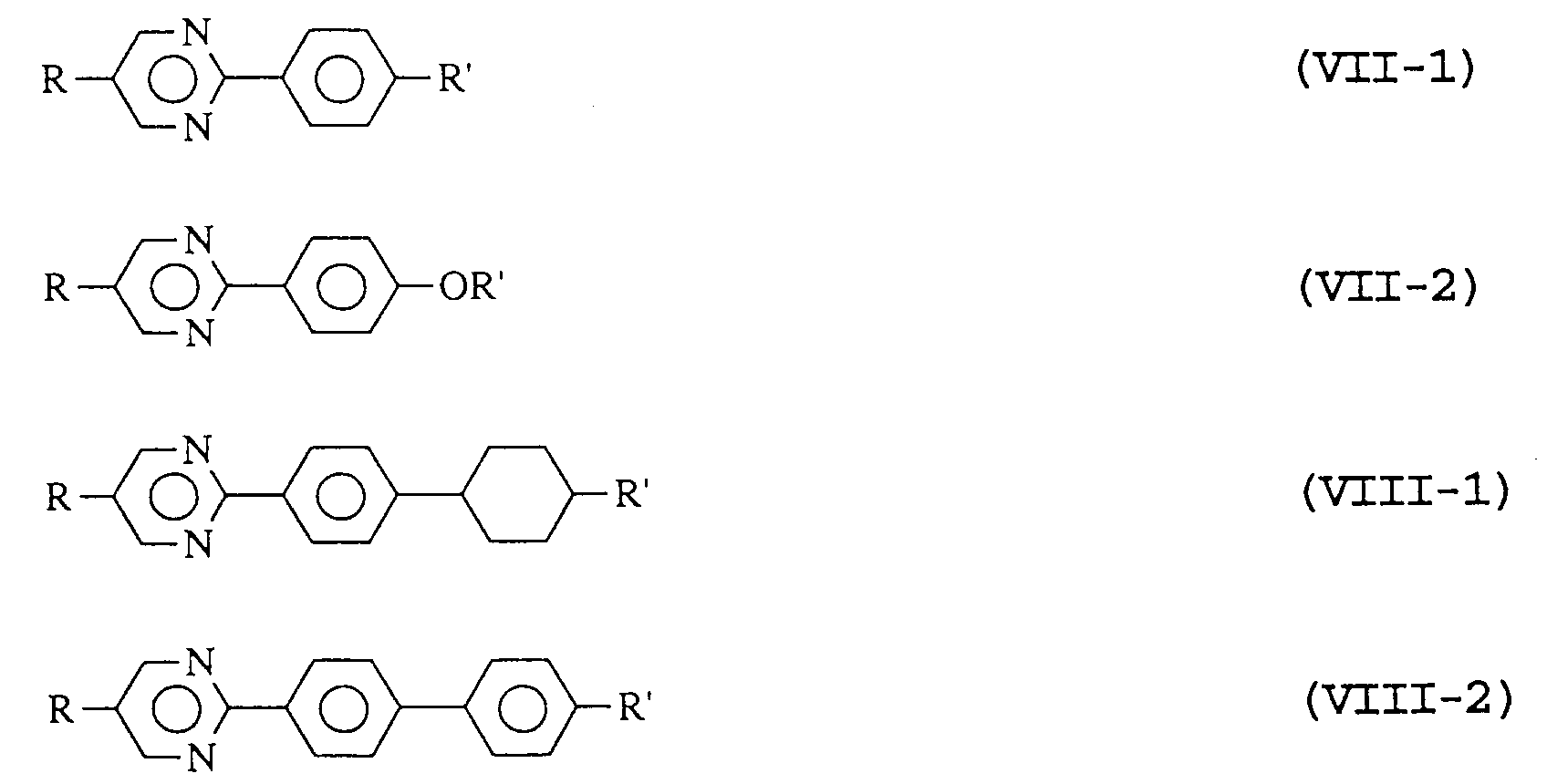
Those compounds of formulas (VII) and (VIII) have a negative or weak positive dielectric anisotropy. Compounds of formula (VII) are used in the present invention with primary aims of adjusting a viscosity and/or a Δn of a resulting composition. Compounds of formula (VIII) are used with aims of expanding a nematic range of a resulting composition and/or of adjusting a Δn value thereof. - A mixing proportion of the first component expressed by formulas (I-a) through (I-c) is preferably 3-40% by weight based upon the total weight of the composition, and is more preferably 5-30% by weight based thereupon. When the mixing proportion of the first component is less than 3% by weight, the primary object of a large Δn value and a low viscosity is often unattainable. When the mixing proportion of the first component exceeds 40% by weight, a threshold voltage of the resulting composition often increases to be undesirable.
- A mixing proportion of the second component expressed by formulas (II-a) through (II-c) is preferably 10-70% by weight based upon the total weight of the composition, and is more preferably 12-60% by weight based thereupon. When the mixing proportion of the second compornent is less than 10% by weight of the resulting composition, the threshold voltage of the composition often increases. When the mixing proportion of the second component exceeds 70% by weight, a large Δn and a low viscosity of the resulting composition is often unattainable.
- A mixing proportion of the third component expressed by formula (III) or formula (IV) is preferably 5-60% by weight of the resulting composition, and is more preferably 9-55% by weight based thereupon. When the mixing proportion of the second component is less than 5% by weight, an effect of a low viscosity and/or expansion of a nematic range in the resulting composition is often unattainable. A mixing proportion of more than 60% by weight may very often increase the threshold voltage of the resulting composition.
- A mixing proportion of compounds of formulas (V) and (VI) as the fourth component is preferably 50% by weight or less based uopn the total weight of the resulting composition. A more preferable mixing proportion of these compounds as the fourth component is 45% by weight or less based thereupon. When the mixing proportion exceeds 50% by weight, a viscosity of the composition often increases.
- A mixing proportion of compounds of formulas (VII) and (VIII) as the fourth component is preferably 50% by weight or less based upon the total weight of the resulting composition. A more preferable mixing proportion of these compounds as the fourth component is 40% by weight or less based thereupon. When the the mixing proportion of the fourth component exceeds 50% by weight, a viscosity of the resulting composition often increases to be unfavorable.
- When compounds of formulas (V) and/or (VI) are employed as the fourth component and compounds of formulas (VII) and/or (VIII) are employed as the fifth component together in the present invention, a mixing proportion of each of the fourth and fifth components is 40% or less and the total mixing proportion of the fourth and fifth components is 50% or less based upon the total weight of the resulting composition. When the sum of the mixing proportions of the fourth and fifth components exceeds 50% by weight, a viscosity of the resulting composition may often increase. Thus, in case of employing the fourth and fifth components together in the present invention the sum of their mixing proportions is preferably 45% or less based upon the total weight of the resulting composition.
- According to purposes of a LC display device employing the LC composition of the present invention, the present composition may contain following other compounds than those of the above-mentioned formulas (I-a) through (VIII), for various purposes such as adjusting a threshold voltage, a nematic range, a Δn, a dielectric anisotropy, or a viscosity, of the resulting composition, in a suitable amount whereby the object of the present invention may be maintained.


In these formulas, R and R' represent an alkyl group of 1 to 12 carbon atoms. - The LC composition of the present invention may be prepared by a method which is per se conventional. Normally, the present composition is prepared by mixing various component compounds together followed by heating them to produce a uniform mixture.
- Further, the present composition may be modified by addition of a suitable compound to be improved to fulfill an intended purpose. Such an additive compound is known by a person skilled in the art to be disclosed precisely in literatures or the like. To the present composition is generally added a chiral dopant which induce a helical structure in the molecules to adjust a twist angle thereof in order to prevent a reverse twist of the LC molecules in display cells.
- Furthermore, the composition of the present invention may be used in a guest and host mode display device by addition of dichroic dyestuffs such as merocyanines, styryl derivatives, azo compounds, azomethines, azoxy compounds, quinophthalones, anthraquinones, tetrazine derivatives, etc.
- It is also possible to use the liquid crystal composition of the present invention for NCAP prepared by micro-encapsulating nematic liquid crystals, or for polymer-dispersion type display device (PDLCD) including as a typical example of polymer net-work liquid crystal display device (PNLCD) having three-dimensional, reticulated polymers formed in liquid crystals. Besides, it is possible to use the present liquid crystal composition as a LC material for electrically controlled birefringence (ECB) mode display and a dynamic scattering (DS) mode display.
- More preferable embodiments of the present invention are shown in the following items (a) through (e).
- (a) A liquid crystal composition comprising the first, second and third components, the first component consisting of at least one compound selected from the group of compounds expressed by the above-mentioned formula (I-a), (I-b) or (I-c), the second component consisting of at least one compound selected from the group of compounds expressed by the above-mentioned formula (II-a-1), (II-a-2), (II-a-3), (II-a-4), (II-a-5), (II-a-6), (II-a-7), (II-a-8), (II-a-9), (II-b-1), (II-b-2), (II-c-1), (II-c-4), (II-c-5), (II-c-6), (II-c-7), (II-c-10) or (II-c-11), the third component consisting of at least one compound selected from the group of compounds expressed by the above-mentioned formula (III-1), (III-2), (III-4), (III-6), (III-7), (III-8), (III-13), (III-14), (IV-1), (IV-2), (IV-5), (IV-9) or (IV-10), mixing proportions of the first, second and third components being 5-30%, 12-60% and 9-55%, respectively, based upon the total weight of the composition.
- (b) A liquid crystal composition according to item (a), further comprising the fourth component consisting of at least one compound selected from the group of compounds expressed by the above-mentioned formula (V-1), (V-2), (v-3), (VI-1), (VI-5), (VI-6), (VI-9), (VI-10), (VI-11), (VI-12), (VI-13), (VI-14), (VI-15), (VI-16), (VI-17) or (VI-18), a mixing proportion of the fourth component being at most 45% based upon the total weight of the composition.
- (c) A liquid crystal composition according to item (a), further comprising the fourth component consisting of at least one compound selected from the group of compounds expressed by the above-mentioned formula (VII-1), (VII-2), (VIII-1) or (VIII-2), a mixing proportion of the fourth component being at most 40% based upon the total weight of the composition.
- (d) A liquid crystal composition according to item (a), further comprising the fourth and fifth components, the fourth component consisting of at least one compound selected from the group of compounds expressed by the above-mentioned formula (V-1), (V-2), (v-3), (VI-1), (VI-5), (VI-6), (VI-9), (VI-10), (VI-11), (VI-12), (VI-13), (VI-14), (VI-15), (VI-16), (VI-17) or (VI-18), the fifth component consisting of at least one compound selected from the group of compounds expressed by the above-mentioned formula (VII-1), (VII-2), (VIII-1) or (VIII-2), mixing proportions of the fourth and fifth components each being at most 40% based upon the total weight of the composition and subtotal of these mixing proportions being at most 45% based upon the total weight of the composition.
- (e) A liquid crystal display device comprising a liquid crystal composition as defined by any one of the above items (a) through (d).
- The present invention will be described by examples and comparative examples below, but the invention is not construed to be limited to the examples. In these examples, the compositions are expressed in per cent by weight.
- A liquid crystal composition cosisting of
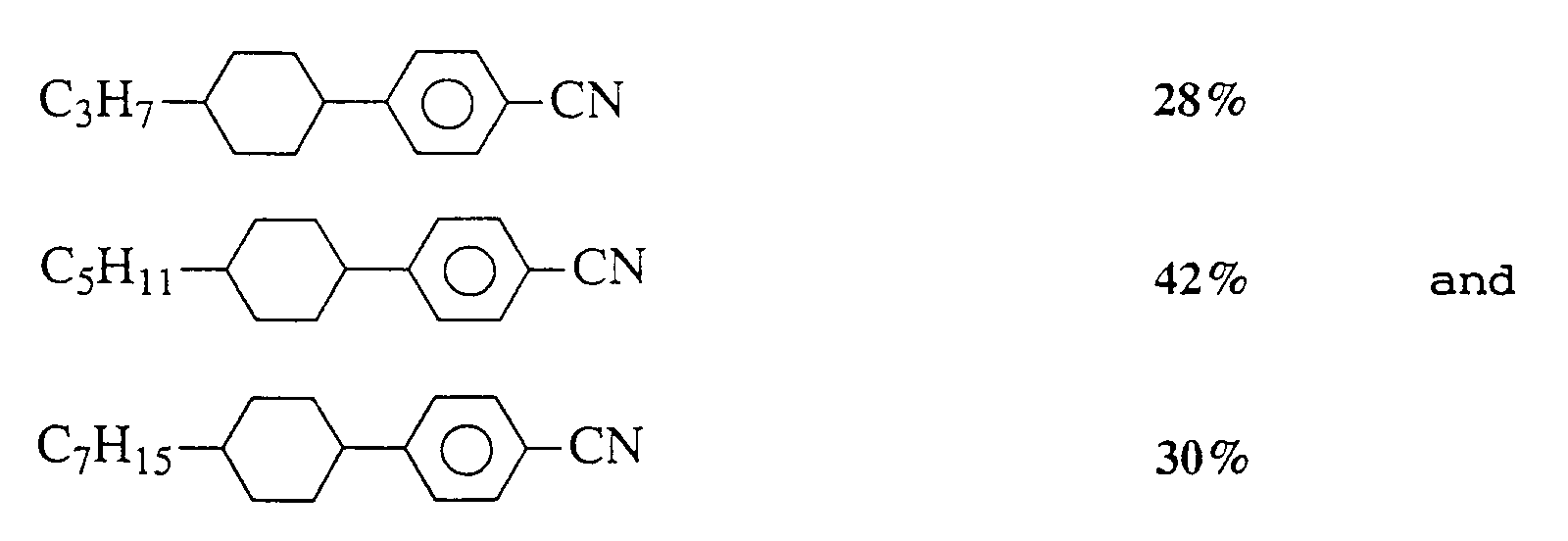
was prepared. A clearing point (TNI) of the composition was 52.1 °C. A viscosity (η20), a dielectric anisotropy (Δ∈), and a threshold voltage (Vth) each at 20 °C, of the composition were 22.2 mPa·s, 10.5, and 1.43 V., respectively, and an optical anisotropy (Δn) at 25 °C of the composition was 0.130. - A liquid crystal composition consisting of


was prepared. A clearing point of the composition was 73.3 °C. A viscosity, a dielectric anisotropy, and a threshold voltage each at 20 °C, of the composition were 15.7 mPa·s, 7.0, and 1.96 V., respectively, and an optical anisotropy at 25 °C of the composition was 0.139. Comparing these properties with those of the composition in comparative example, Δn is larger and a viscosity is lower in example 1 than those in comparative example. - A liquid crystal composition consisting of


was prepared. A clearing point of the composition was 94.0 °C. A viscosity, a dielectric anisotropy, and a threshold voltage each at 20 °C, of the composition were 19.0 mPa·s, 5.0, and 2.38 V., respectively, and an optical anisotropy at 25 °C of the composition was 0.146. Comparing these properties with those of the composition in comparative example, Δn is larger and a viscosity is lower in example 2 than those in comparative example. - A liquid crystal composition consisting of


was prepared. A clearing point of the composition was 98.8 °C. A viscosity, a dielectric anisotropy, and a threshold voltage each at 20 °C, of the composition were 15.8 mPav·s, 11.9, and 1.77 V., respectively, and an optical anisotropy at 25 °C of the composition was 0.132. Comparing these properties with those of the composition in comparative example, Δn is larger and a viscosity is lower in example 3 than those in comparative example. - A liquid crystal composition consisting of
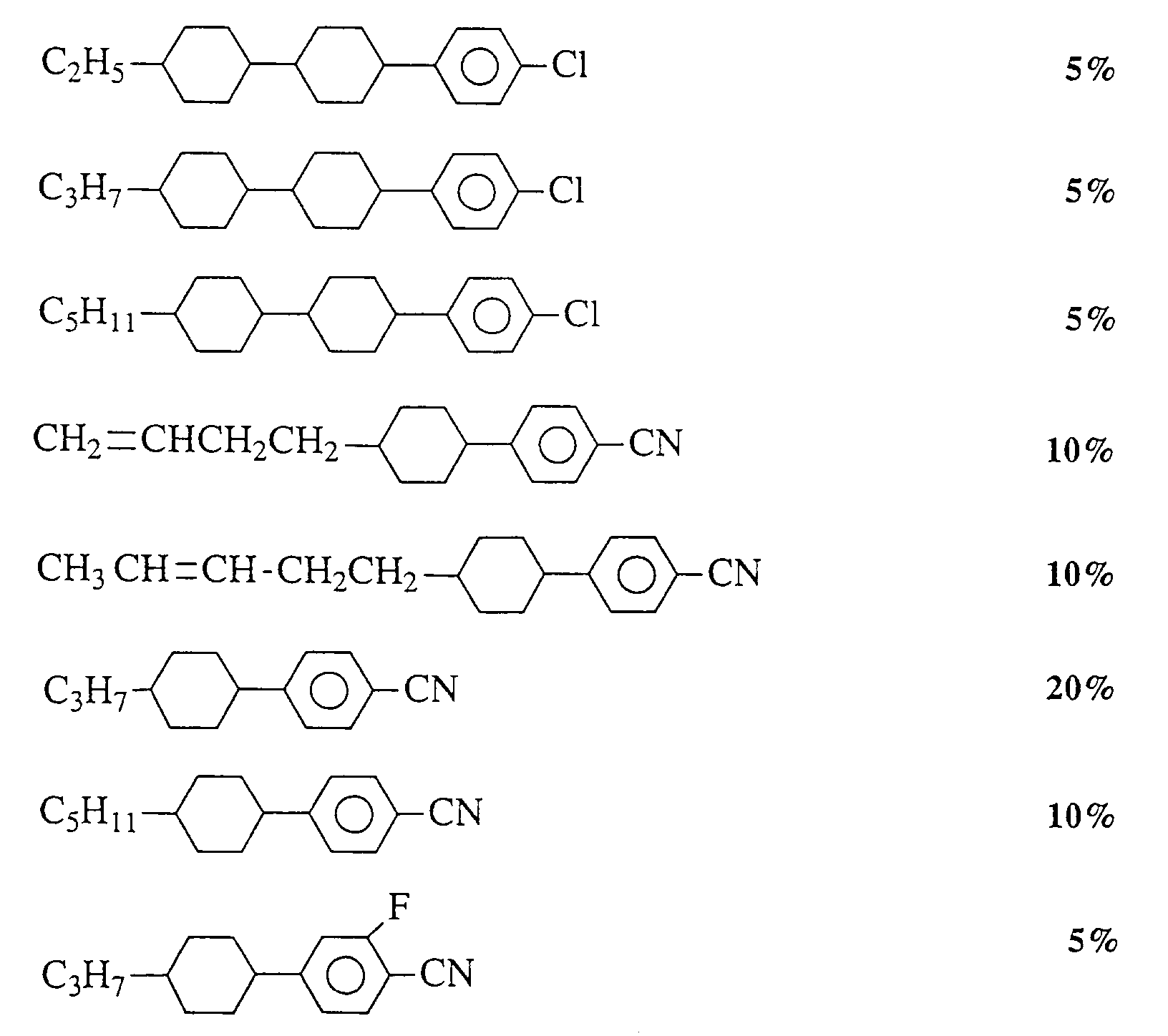

was prepared. A clearing point of the composition was 89.8 °C. A viscosity, a dielectric anisotropy, and a threshold voltage each at 20 °C, of the composition were 21.4 mPa·s, 8.6, and 2.03 V., respectively, and an optical anisotropy at 25 °C of the composition was 0.136. - A liquid crystal composition consisting of

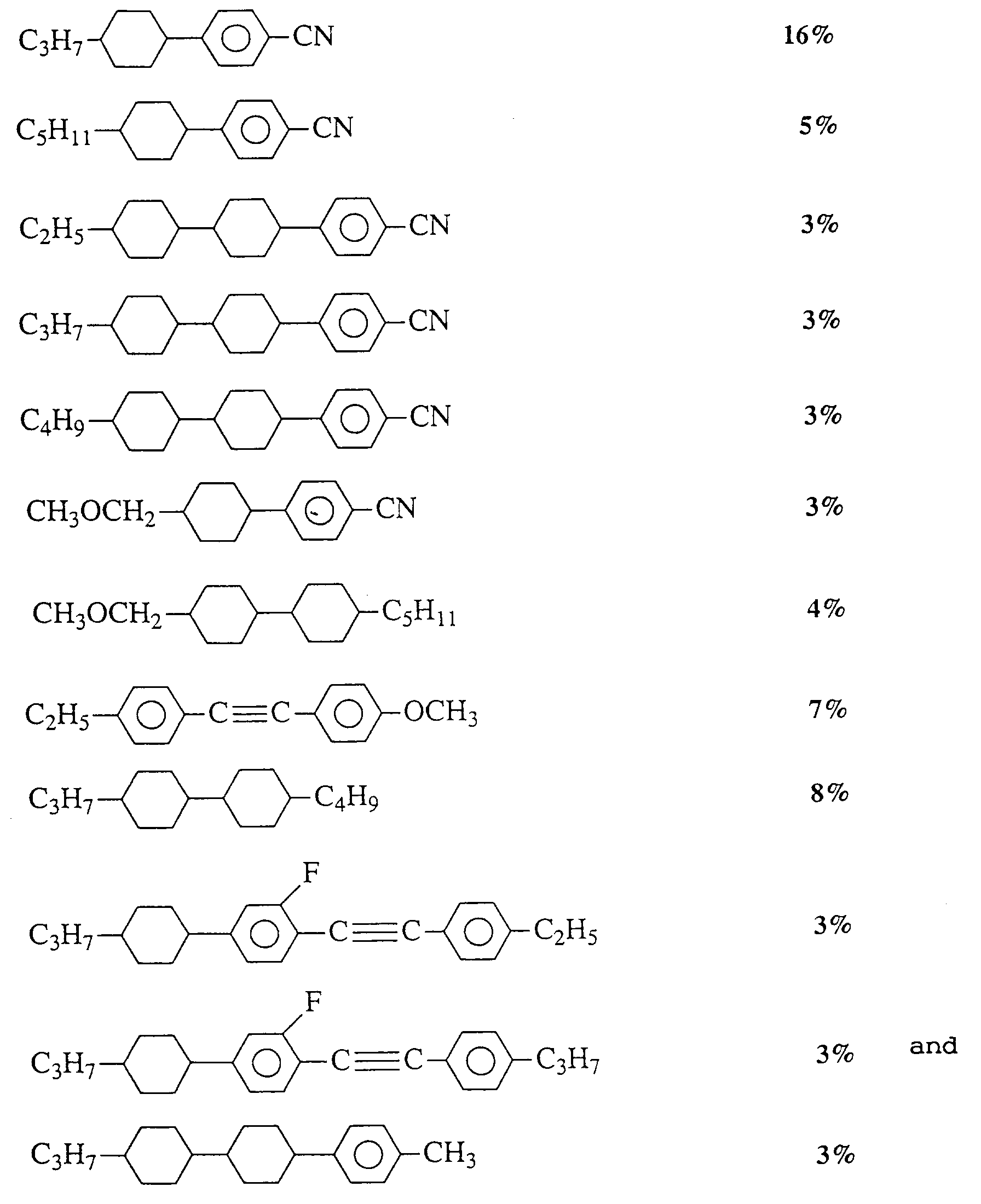
was prepared. A clearing point of the composition was 71.9 °C. A viscosity, a dielectric anisotropy, and a threshold voltage each at 20 °C, of the composition were 14.8 mPa·s, 7.5, and 1.82 V., respectively, and an optical anisotropy at 25 °C of the composition was 0.131. - A liquid crystal composition consisting of


was prepared. A clearing point of the composition was 89.0 °C. A viscosity, a dielectric anisotropy, and a threshold voltage each at 20 °C, of the composition were 20.8 mPa·s, 6.4, and 2.04 V., respectively, and an optical anisotropy at 25 °C of the composition was 0.154. - A liquid crystal composition consisting of


was prepared. A clearing point of the composition was 84.4 °C. A viscosity, a dielectric anisotropy, and a threshold voltage each at 20 °C, of the composition were 17.5 mPa·s, 5.4, and 2.18 V., respectively, and an optical anisotropy at 25 °C of the composition was 0.162. - A liquid crystal composition consisting of


was prepared. A clearing point of the composition was 93.6 °C. A viscosity, a dielectric anisotropy, and a threshold voltage each at 20 °C, of the composition were 21.2 mPa·s, 9.2, and 1.90 V., respectively, and an optical anisotropy at 25 °C of the composition was 0.156. - A liquid crystal composition consisting of


was prepared. A clearing point of the composition was 102.0°C. A viscosity, a dielectric anisotropy, and a threshold voltage each at 20 °C, of the composition were 21.4 mPa·s, 6.5, and 2.17 V., respectively, and an optical anisotropy at 25 °C of the composition was 0.151. - A liquid crystal composition consisting of


was prepared. A clearing point of the composition was 80.7 °C. A viscosity, a dielectric anisotropy, and a threshold voltage each at 20 °C, of the composition were 21.9 mPa·s, 9.1, and 1.72 V., respectively, and an optical anisotropy at 25 °C of the composition was 0.167. - A liquid crystal composition consisting of


was prepared. A clearing point of the composition was 83.7 °C. A viscosity, a dielectric anisotropy, and a threshold voltage each at 20 °C, of the composition were 20.4 mPa·s, 7.1, and 1.78 V., respectively, and an optical anisotropy at 25 °C of the composition was 0.132. - A liquid crystal composition consisting of
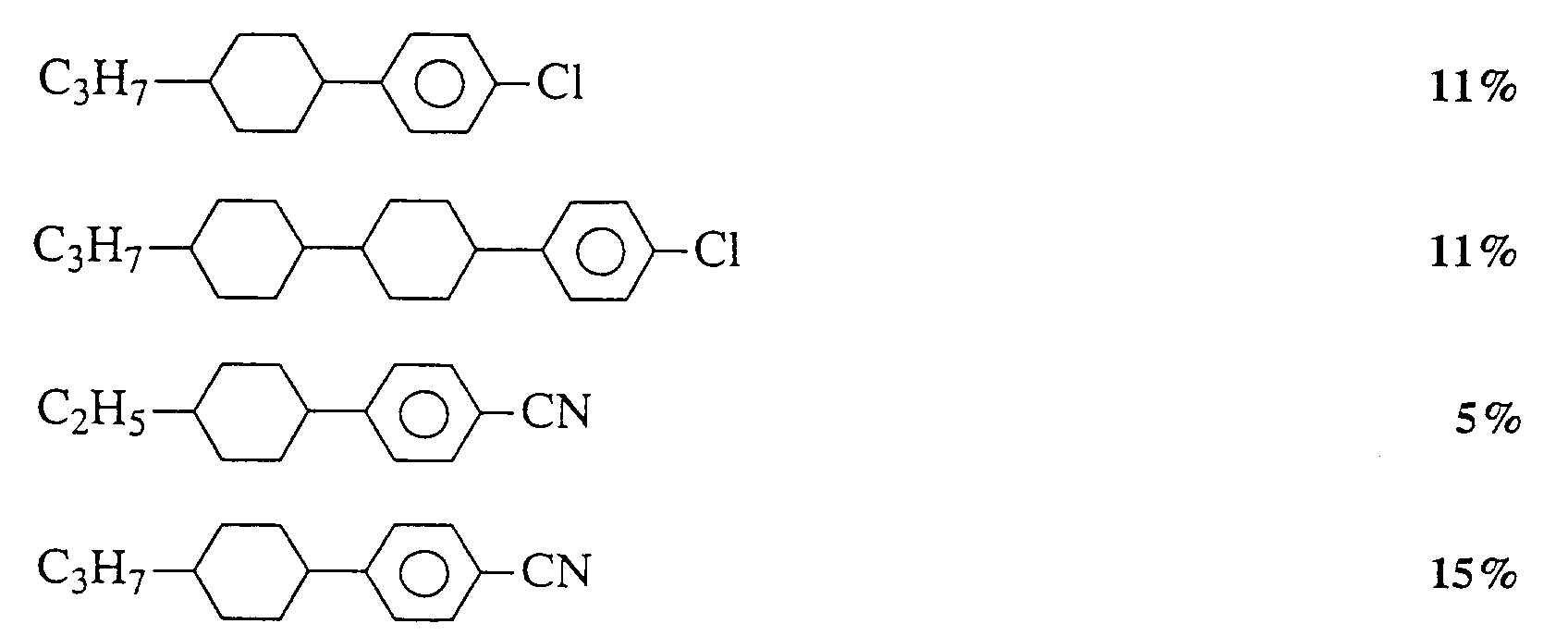
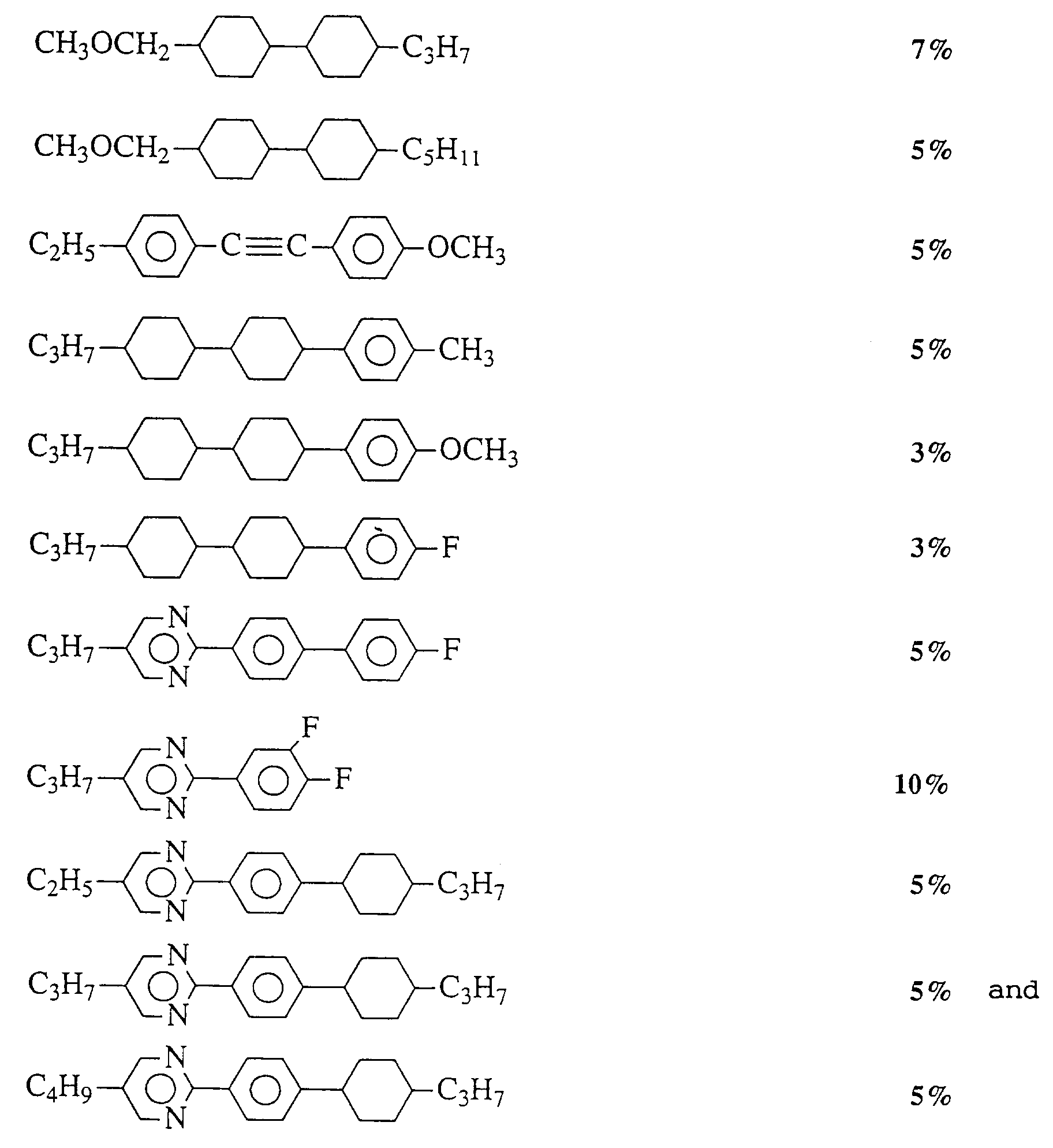
was prepared. A clearing point of the composition was 76.8 °C. A viscosity, a dielectric anisotropy, and a threshold voltage each at 20 °C, of the composition were 17.3 mPa·s, 6.9, and 1.75 V., respectively, and an optical anisotropy at 25 °C of the composition was 0.133. - A liquid crystal composition consisting of


was prepared. A clearing point of the composition was 89.4 °C. A viscosity, a dielectric anisotropy, and a threshold voltage each at 20 °C, of the composition were 20.6 mPa·s, 5.2, and 2.24 V., respectively, and an optical anisotropy at 25 °C of the composition was 0.145. - A liquid crystal composition consisting of


was prepared. A clearing point of the composition was 84.2 °C. A viscosity, a dielectric anisotropy, and a threshold voltage each at 20 °C, of the composition were 21.8 mPa·s, 7.7, and 1.80 V., respectively, and an optical anisotropy at 25 °C of the composition was 0.137. - A liquid crystal composition consisting of
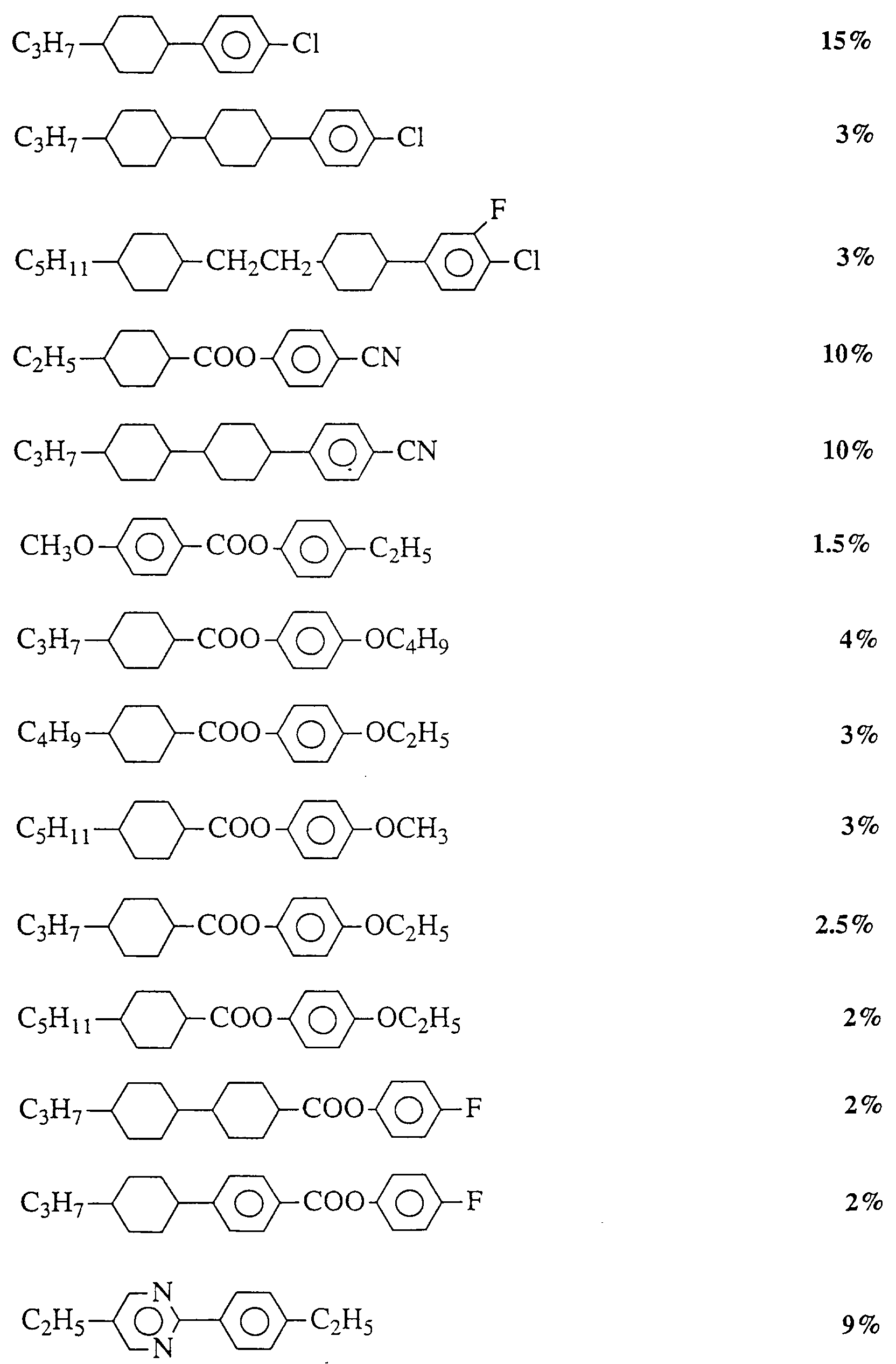

was prepared. A clearing point of the composition was 58.4 °C. A viscosity, a dielectric anisotropy, and a threshold voltage each at 20 °C, of the composition were 21.8 mPa·s, 5.8, and 1.53 V., respectively, and an optical anisotropy at 25 °C of the composition was 0.132. - A liquid crystal composition consisting of


was prepared. A clearing point of the composition was 62.3 °C. A viscosity, a dielectric anisotropy, and a threshold voltage each at 20 °C, of the composition were 21.0 mPa·s, 11.3, and 1.29 V., respectively, and an optical anisotropy at 25 °C of the composition was 0.131. - A liquid crystal composition consisting of


was prepared. A clearing point of the composition was 86.6 °C. A viscosity, a dielectric anisotropy, and a threshold voltage each at 20 °C, of the composition were 21.6 mPa·s, 5.6, and 1.15 V., respectively, and an optical anisotropy at 25 °C of the composition was 0.133. - A liquid crystal composition consisting of


was prepared. A clearing point of the composition was 67.0 °C. A viscosity, a dielectric anisotropy, and a threshold voltage each at 20 °C, of the composition were 22.0 mPa·s, 6.0, and 1.68 V., respectively, and an optical anisotropy at 25 °C of the composition was 0.132. - A liquid crystal composition consisting of


was prepared. A clearing point of the composition was 119.5°C. A viscosity, a dielectric anisotropy, and a threshold voltage each at 20 °C, of the composition were 22.0 mPa·s, 10.7, and 2.01 V., respectively, and an optical anisotropy at 25 °C of the composition was 0.144. - A liquid crystal composition consisting of


was prepared. A clearing point of the composition was 99.7 °C. A viscosity, a dielectric anisotropy, and a threshold voltage each at 20 °C, of the composition were 21.1 mPa·s, 9.6, and 2.05 V., respectively, and an optical anisotropy at 25 °C of the composition was 0.133. - A liquid crystal composition consisting of


was prepared. A clearing point of the composition was 92.6 °C. A viscosity, a dielectric anisotropy, and a threshold voltage each at 20 °C, of the composition were 20.2 mPa·s, 6.3, and 2.06 V., respectively, and an optical anisotropy at 25 °C of the composition was 0.132. - As shown in the above examples and comparative example, the present invention reveals to provide a liquid crystal composition having a suitably high Δn value and a low viscosity. This means that the composition satisfies various characteristics including particularly a quick electro-optical response which characteristics are required for a LC material for TN and STN display modes.
Claims (15)
- A liquid crystal composition comprising:
a first component consisting of at least one member selected from the group of compounds expressed by general formula (I-a), (I-b) or (I-c):
a second component consisting of at least one member selected from the group of compounds expressed by general formula (II-a), (II-b) or (II-c):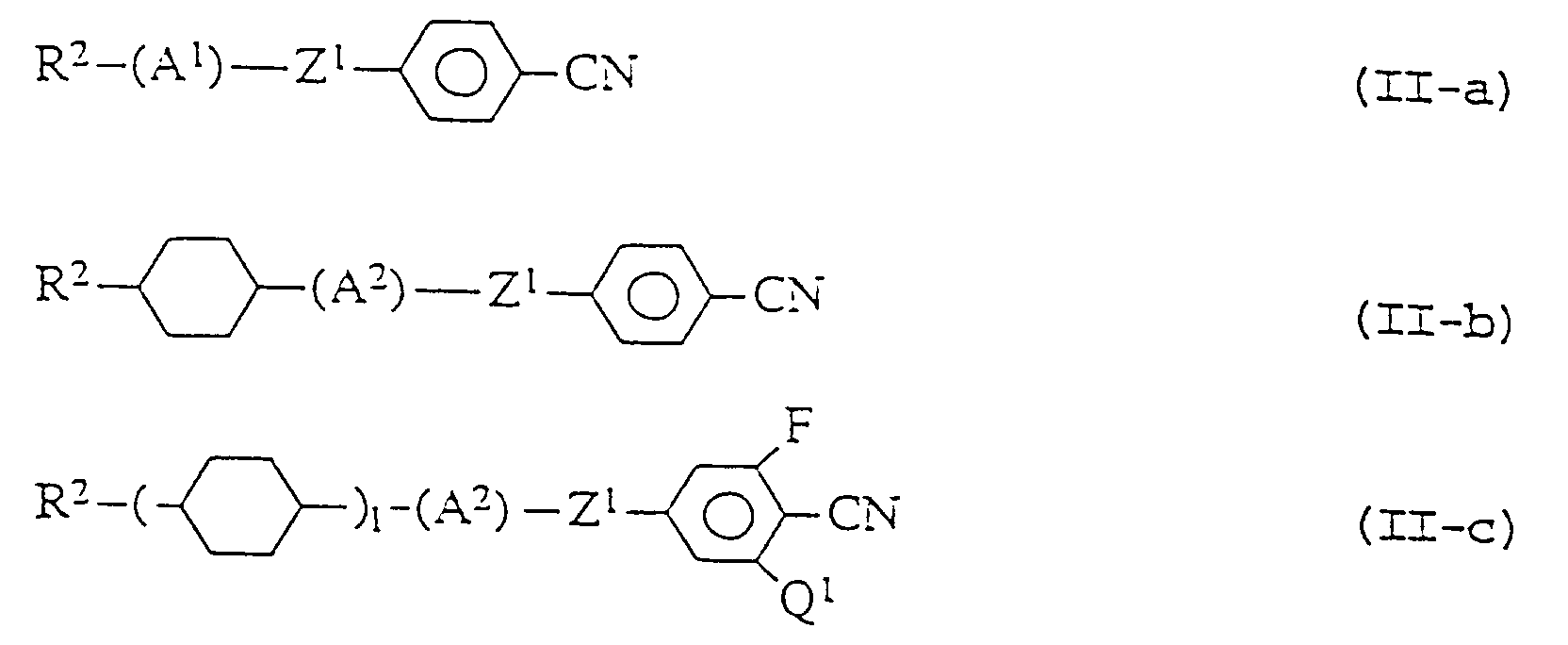
a third component consisting of at least one member selected from the group of compounds expressed by general formula (III) or (IV):
R3―(B)―Z2―(C)―R4 (III)

- A liquid crystal composition according to claim 1, wherein mixing proportions of said first, second and third components are 3-40%, 10-70% and 5-60%, respectively, based upon the total weight of said composition.
- A liquid crystal composition according to claim 1, further comprising a fourth component consisting of at least one member selected from the group of compounds expressed by general formula (V) or (VI):

- A liquid crystal composition according to claim 3, wherein mixing proportions of said first, second, third and fourth components are 3-40%, 10-70%, 5-60% and up to 50%, respectively, based upon the total weight of said composition.
- A liquid crystal composition according to claim 1, further comprising a fourth component consisting of at least one member selected from the group of compounds expressed by general formula (VII) or (VIII):

- A liquid crystal composition according to claim 5, wherein mixing proportins of said first, second, third and fourth components are 3-40%, 10-70%, 5-60% and up to 50%, respectively, based upon the total weight of said composition.
- A liquid crystal composition according to claim 3, further comprising a fifth component consisting of at least one member selected from the group of compounds expressed by general formula (VII) or (VIII):

- A liquid crystal composition according to claim 7, wherein mixing proportions of said first, second, third, fourth and fifth components are 3-40%, 10-70%, 5-60%, up to 40% and up to 40%, respectively, based upon the total weight of said composition, with a proviso that a subtotal mixing proportion of said fourth and fifth components is 50% or less based upon the total weight of said composition.
- A liquid crystal composition according any one claim of claims 1 to 8, wherein, in said formula (III), R3 and R4 each independently represent an alkyl group or an alkoxy group each of 1 to 10 carbon atoms or an alkoxymethyl group of 2-10 carbon atoms; and Z2 represents -C≡C-, -COO- or a single bond.
- A liquid crystal composition according to any one claim of claims 1 to 8, wherein, in said formula (IV), R5 represents an alkyl group of 1 to 10 carbon atoms; and R6 represents an alkyl group or an alkoxy group each of 1 to 10 carbon atoms.
- A liquid crystal composition according to claim 3, wherein, in said formula (III), R3 and R4 each independently represent an alkyl group or an alkoxy group each of 1 to 10 carbon atoms or an alkoxymethyl group of 2 to 10 carbon atoms; and Z2 represents -C≡C-, -COO- or a single bond, and in said formula (IV), R5 represents an alkyl group of 1 to 10 carbon atoms; and R6 represents an alkyl group or an alkoxy group each of 1 to 10 carbon atoms.
- A liquid crystal display device comprising a liquid crystal composition as defined in any claim of claims 1 to 8.
- A liquid crystal display device comprising a liquid crystal composition as defined in claim 9.
- A liquid crystal display device comprising a liquid crystal composition as defined in claim 10.
- A liquid crystal display device comprising a liquid crystal composition as defined in claim 11.
Applications Claiming Priority (3)
| Application Number | Priority Date | Filing Date | Title |
|---|---|---|---|
| JP338713/94 | 1994-12-28 | ||
| JP33871394 | 1994-12-28 | ||
| JP33871394 | 1994-12-28 |
Publications (2)
| Publication Number | Publication Date |
|---|---|
| EP0719849A1 true EP0719849A1 (en) | 1996-07-03 |
| EP0719849B1 EP0719849B1 (en) | 2000-08-23 |
Family
ID=18320766
Family Applications (1)
| Application Number | Title | Priority Date | Filing Date |
|---|---|---|---|
| EP95120063A Expired - Lifetime EP0719849B1 (en) | 1994-12-28 | 1995-12-19 | A liquid crystal composition and display device |
Country Status (3)
| Country | Link |
|---|---|
| US (1) | US5683624A (en) |
| EP (1) | EP0719849B1 (en) |
| DE (1) | DE69518498T2 (en) |
Cited By (2)
| Publication number | Priority date | Publication date | Assignee | Title |
|---|---|---|---|---|
| EP1201727A1 (en) * | 2000-10-27 | 2002-05-02 | MERCK PATENT GmbH | Liquid crystalline medium and electro-optic liquid crystal display |
| DE19528104B4 (en) * | 1995-08-01 | 2008-05-15 | Merck Patent Gmbh | Electro-optical liquid crystal medium |
Families Citing this family (5)
| Publication number | Priority date | Publication date | Assignee | Title |
|---|---|---|---|---|
| TW297047B (en) * | 1995-02-09 | 1997-02-01 | Chisso Corp | |
| US6033598A (en) * | 1995-11-10 | 2000-03-07 | Mitsubishi Chemical Corporation | Liquid-crystal composition and liquid-crystal display element |
| US6416826B1 (en) * | 1998-08-18 | 2002-07-09 | Minolta Co., Ltd. | Liquid crystal display element |
| JP4989815B2 (en) * | 1998-09-12 | 2012-08-01 | メルク パテント ゲゼルシャフト ミット ベシュレンクテル ハフツング | Liquid crystal medium and liquid crystal display containing the same |
| CN113072956B (en) * | 2020-01-03 | 2023-03-31 | 北京八亿时空液晶科技股份有限公司 | High-contrast negative liquid crystal composition containing phenprobucol and application thereof |
Citations (3)
| Publication number | Priority date | Publication date | Assignee | Title |
|---|---|---|---|---|
| EP0411511A2 (en) * | 1989-07-31 | 1991-02-06 | Sharp Kabushiki Kaisha | Supertwisted nematic liquid crystal display device |
| WO1991002779A1 (en) * | 1989-08-26 | 1991-03-07 | MERCK Patent Gesellschaft mit beschränkter Haftung | Liquid crystalline medium |
| EP0460434A2 (en) * | 1990-06-08 | 1991-12-11 | MERCK PATENT GmbH | Liquid crystal medium |
Family Cites Families (6)
| Publication number | Priority date | Publication date | Assignee | Title |
|---|---|---|---|---|
| US5516454A (en) * | 1989-07-13 | 1996-05-14 | Merck Patent Gesellschaft Mit Beschrankter Haftung | Supertwist liquid crystal display |
| DE4027315A1 (en) * | 1989-08-30 | 1991-03-07 | Merck Patent Gmbh | HALOGENATED BENZENE DERIVATIVES AND LIQUID CRYSTALLINE MEDIUM |
| JPH05506059A (en) * | 1991-02-20 | 1993-09-02 | メルク パテント ゲゼルシャフト ミット ベシュレンクテル ハフトング | Nematic liquid crystal composition |
| US5534187A (en) * | 1994-03-29 | 1996-07-09 | Chisso Corporation | Liquid crystalline compound and liquid crystal composition |
| DE69506773T2 (en) * | 1994-05-06 | 1999-06-02 | Chisso Corp., Osaka | Liquid crystal composition |
| JP3579728B2 (en) * | 1994-06-23 | 2004-10-20 | チッソ株式会社 | Liquid crystal composition and liquid crystal display device |
-
1995
- 1995-12-15 US US08/573,141 patent/US5683624A/en not_active Expired - Fee Related
- 1995-12-19 DE DE69518498T patent/DE69518498T2/en not_active Expired - Fee Related
- 1995-12-19 EP EP95120063A patent/EP0719849B1/en not_active Expired - Lifetime
Patent Citations (3)
| Publication number | Priority date | Publication date | Assignee | Title |
|---|---|---|---|---|
| EP0411511A2 (en) * | 1989-07-31 | 1991-02-06 | Sharp Kabushiki Kaisha | Supertwisted nematic liquid crystal display device |
| WO1991002779A1 (en) * | 1989-08-26 | 1991-03-07 | MERCK Patent Gesellschaft mit beschränkter Haftung | Liquid crystalline medium |
| EP0460434A2 (en) * | 1990-06-08 | 1991-12-11 | MERCK PATENT GmbH | Liquid crystal medium |
Cited By (2)
| Publication number | Priority date | Publication date | Assignee | Title |
|---|---|---|---|---|
| DE19528104B4 (en) * | 1995-08-01 | 2008-05-15 | Merck Patent Gmbh | Electro-optical liquid crystal medium |
| EP1201727A1 (en) * | 2000-10-27 | 2002-05-02 | MERCK PATENT GmbH | Liquid crystalline medium and electro-optic liquid crystal display |
Also Published As
| Publication number | Publication date |
|---|---|
| DE69518498T2 (en) | 2001-04-19 |
| US5683624A (en) | 1997-11-04 |
| EP0719849B1 (en) | 2000-08-23 |
| DE69518498D1 (en) | 2000-09-28 |
Similar Documents
| Publication | Publication Date | Title |
|---|---|---|
| JP3579727B2 (en) | Liquid crystal composition | |
| US5560865A (en) | Liquid crystal composition | |
| JPS63502596A (en) | liquid crystal display element | |
| JP3605648B2 (en) | Liquid crystal composition and liquid crystal display device | |
| HK77692A (en) | Liquid crystal phase | |
| EP0719849B1 (en) | A liquid crystal composition and display device | |
| JPS63502599A (en) | electro-optic display element | |
| US4654421A (en) | 4-substituted phenyl crotyl ether derivative | |
| DE69723154T2 (en) | Liquid crystal composition, its use and liquid crystal display element | |
| US5534189A (en) | Liquid crystal composition | |
| US4917818A (en) | Nematic liquid crystal composition | |
| US5776366A (en) | Liquid crystal composition and electro-optic display device | |
| DE69603760T2 (en) | Liquid crystal composition and liquid crystal display element | |
| DE69713742T2 (en) | LIQUID CRYSTAL COMPOSITION AND LIQUID CRYSTAL DISPLAY ELEMENT | |
| JP4206525B2 (en) | Liquid crystal composition and liquid crystal display element | |
| JP3568320B2 (en) | Liquid crystal composition and liquid crystal display device | |
| JPH08231957A (en) | Liquid crystal composition and liquid crystal display element | |
| US5258135A (en) | Liquid crystal composition and liquid crystal display using said composition | |
| JPH08302354A (en) | Liquid crystal composition and liquid crystal display element | |
| DE69802975T2 (en) | Liquid crystal composition and liquid crystal display device | |
| US5171472A (en) | Phenylcyclohexyldioxane derivatives having an ether bond for electro-optical displays | |
| JPH0959637A (en) | Liquid crystal composition and liquid crystal display element | |
| JPH0873853A (en) | Liquid crystal composition an liquid crystal display element | |
| HK1005873B (en) | Phenylcyclohexyldioxane derivatives having an ether bond for electro-optical displays | |
| JPH0959634A (en) | Liquid crystal composition and liquid crystal display device |
Legal Events
| Date | Code | Title | Description |
|---|---|---|---|
| PUAI | Public reference made under article 153(3) epc to a published international application that has entered the european phase |
Free format text: ORIGINAL CODE: 0009012 |
|
| AK | Designated contracting states |
Kind code of ref document: A1 Designated state(s): DE FR GB |
|
| 17P | Request for examination filed |
Effective date: 19961113 |
|
| 17Q | First examination report despatched |
Effective date: 19980818 |
|
| GRAG | Despatch of communication of intention to grant |
Free format text: ORIGINAL CODE: EPIDOS AGRA |
|
| GRAG | Despatch of communication of intention to grant |
Free format text: ORIGINAL CODE: EPIDOS AGRA |
|
| GRAG | Despatch of communication of intention to grant |
Free format text: ORIGINAL CODE: EPIDOS AGRA |
|
| GRAH | Despatch of communication of intention to grant a patent |
Free format text: ORIGINAL CODE: EPIDOS IGRA |
|
| GRAH | Despatch of communication of intention to grant a patent |
Free format text: ORIGINAL CODE: EPIDOS IGRA |
|
| GRAA | (expected) grant |
Free format text: ORIGINAL CODE: 0009210 |
|
| AK | Designated contracting states |
Kind code of ref document: B1 Designated state(s): DE FR GB |
|
| REF | Corresponds to: |
Ref document number: 69518498 Country of ref document: DE Date of ref document: 20000928 |
|
| ET | Fr: translation filed | ||
| PLBE | No opposition filed within time limit |
Free format text: ORIGINAL CODE: 0009261 |
|
| STAA | Information on the status of an ep patent application or granted ep patent |
Free format text: STATUS: NO OPPOSITION FILED WITHIN TIME LIMIT |
|
| 26N | No opposition filed | ||
| PGFP | Annual fee paid to national office [announced via postgrant information from national office to epo] |
Ref country code: FR Payment date: 20011212 Year of fee payment: 7 |
|
| PGFP | Annual fee paid to national office [announced via postgrant information from national office to epo] |
Ref country code: GB Payment date: 20011219 Year of fee payment: 7 |
|
| REG | Reference to a national code |
Ref country code: GB Ref legal event code: IF02 |
|
| PG25 | Lapsed in a contracting state [announced via postgrant information from national office to epo] |
Ref country code: GB Free format text: LAPSE BECAUSE OF NON-PAYMENT OF DUE FEES Effective date: 20021219 |
|
| GBPC | Gb: european patent ceased through non-payment of renewal fee |
Effective date: 20021219 |
|
| PG25 | Lapsed in a contracting state [announced via postgrant information from national office to epo] |
Ref country code: FR Free format text: LAPSE BECAUSE OF NON-PAYMENT OF DUE FEES Effective date: 20030901 |
|
| REG | Reference to a national code |
Ref country code: FR Ref legal event code: ST |
|
| PGFP | Annual fee paid to national office [announced via postgrant information from national office to epo] |
Ref country code: DE Payment date: 20041216 Year of fee payment: 10 |
|
| PG25 | Lapsed in a contracting state [announced via postgrant information from national office to epo] |
Ref country code: DE Free format text: LAPSE BECAUSE OF NON-PAYMENT OF DUE FEES Effective date: 20060701 |