EP0720992A1 - Tetrafluoroethylene thermoprocessable copolymers - Google Patents
Tetrafluoroethylene thermoprocessable copolymers Download PDFInfo
- Publication number
- EP0720992A1 EP0720992A1 EP95120726A EP95120726A EP0720992A1 EP 0720992 A1 EP0720992 A1 EP 0720992A1 EP 95120726 A EP95120726 A EP 95120726A EP 95120726 A EP95120726 A EP 95120726A EP 0720992 A1 EP0720992 A1 EP 0720992A1
- Authority
- EP
- European Patent Office
- Prior art keywords
- tfe
- formula
- moles
- copolymers
- equal
- Prior art date
- Legal status (The legal status is an assumption and is not a legal conclusion. Google has not performed a legal analysis and makes no representation as to the accuracy of the status listed.)
- Granted
Links
Classifications
-
- C—CHEMISTRY; METALLURGY
- C08—ORGANIC MACROMOLECULAR COMPOUNDS; THEIR PREPARATION OR CHEMICAL WORKING-UP; COMPOSITIONS BASED THEREON
- C08F—MACROMOLECULAR COMPOUNDS OBTAINED BY REACTIONS ONLY INVOLVING CARBON-TO-CARBON UNSATURATED BONDS
- C08F214/00—Copolymers of compounds having one or more unsaturated aliphatic radicals, each having only one carbon-to-carbon double bond, and at least one being terminated by a halogen
- C08F214/18—Monomers containing fluorine
- C08F214/26—Tetrafluoroethene
- C08F214/262—Tetrafluoroethene with fluorinated vinyl ethers
Definitions
- the present invention relates to tetrafluoroethylene thermoprocessable copolymers. More particularly, the present invention relates to tetrafluoroethylene thermoprocessable copolymers with a fluorodioxole having improved mechanical properties, in particular at high temperatures, combined with superior optical properties.
- PTFE polytetrafluoroethylene
- TFE thermoprocessable copolymers are those wherein TFE is copolymerized with a perfluoroalkylvinylether (PAVE), and in particular with perfluoropropylvinylether (PPVE) (see for instance US patent 3,635,926 ). Such copolymers allow to obtain a satisfactory balance between mechanical properties and processability with PPVE amounts around 2-3% by moles.
- PAVE perfluoroalkylvinylether
- PPVE perfluoropropylvinylether
- Fluorinated dioxols of various types are known, having general formula: wherein Y 1 , Y 2 are -H, -F or -Cl: Y 3 , Y 4 are -F or -CF 3 (see for instance US patents 3,865,845, EP 76,581, EP 80,187, EP 95,077, EP 73,087).
- Such compounds can be used for preparing homopolymers of copolymers with other fluorinated monomers.
- both amorphous and crystalline copolymers are described and prepared between the above mentioned dioxols and TFE (see for isntance EP Patents 73,087, EP 95,077, US 4,558.141 ).
- crystalline copolymers are moreover prepared from TFE and 2,2,4-trifluoro-5-trifluoromethoxy-1,3-dioxol, the latter being present in amounts equal to 1.1% and 3.3% by moles respectively.
- the copolymerization process was carried out in solution in oganic solvent (CCl 2 FCF 2 Cl).
- the copolymers thus obtained have shown a very high melting viscosity, with a Melt Flow Index value unmeasurable and therefore not thermoprocessable. No characterization was supplied as regards the optical properties of such copolymers.
- the fluorodioxols of the present invention determine, with the same amount introduced, a more marked fall of the second melting temperature surprisingly combined with a maintenance of the tensile properties and of resistance to brittle fracture at high temperatures.
- the reactivity of the fluorodioxols of the present invention is so high that there is no need of complex processes for recovering the monomer.
- thermoprocessable copolymers comprising:
- R f is preferably -CF 3 , -C 2 F 5 , or -C 3 F 7 .
- the dioxols of formula (II) are known compounds; they can be prepared for instance according to EP Patent application 460,946 . Also fluoroxycompounds R f -OF are known products. CF 3 OF can be prepared, for instance, according to what described by G.H.Cady and K.B.Kellogg in J. Am. Chem. Soc. 70 , 3986, 1948, the higher homologues by the process described in US Patent 4,827,024 .
- a further process for preparing fluorodioxols of formula (I) when Z is -F comprises reacting at a temperature comprised between 50° and 150°C a dioxolane of formula: optionally in admixture with a dioxolane of formula: wherein R f is defined as above, with KOH in the solid state, with consequent dehydrochlorination and formation of fluorodioxol.
- the dioxolane (VI) can be obtained by reacting R f OF with trichloroethylene so as to obtain the R f O-CHCl-CFCl 2 compound, which is then dechlorinated with powdered zinc in organic solution.
- the dioxolane (VII), in admixture with the dioxolane (VI), can be prepared as follows.
- fluorodioxols (I) can utilize, similarly to the processes already shown, the dichloroethylene or trichloroethylene, which are reacted with hypofluorites of formula: R f -OF and CX 1 X 2 (OF) 2 , so as to obtain, by alternating reactions of dechlorination and dehydrochlorination, the various reaction intermediates described above.
- the copolymers of the present invention show a melting viscosity such as to make them thermoprocessable according to conventional techniques, with measurable Melt Flow Index (MFI) values.
- MFI Melt Flow Index
- measured according to standard ASTM D 1238 is generally comprised between 0.5 and 50 g/10', preferably between 1 and 30 g/10'.
- copolymers of the present invention can be prepared according to known techniques, by copolymerization of the corresponding monomers, in suspension in organic medium or in aqueous emulsion, in the presence of a suitable radicalic initiator, at a temperature comprised between 0° and 150°C, preferably between 20° and 100°C.
- the reaction pressure is generally comprised between 0.5 and 100 bar, preferably between 5 and 40 bar.
- radicalic initiators can be used in particular: inorganic peroxides soluble in water, such as for instance persulphates and ammonium or alkaline metals perphosphates, in particular ammonium or potassium persulphate; organic or inorganic redox systems, such as ammonium persulphate/sodium sulphite, hydrogen peroxide/aminoiminomethansulphinic acid; bis-acylperoxides of formula (R f -CO-O) 2 , wherein R f is a (per)haloalkyl C 1 -C 10 , or a perfluoropolyoxyalkylenic group, such as for instance bis(perfluoropropionyl)peroxide; dialkylperoxides of formula (R f -O) 2 , wherein R f is a perhaloalkyl C 1 -C 10 , such as for instance diterbutylperoxide (DTBP); etc.
- the reaction medium is formed by an organic phase, to which water is usually added to favour the dispersion of the heat developing during the reaction.
- organic phase halogenated hydrocarbons, in particular hydrogen(chloro)fluorocarbons and chlorofluorocarbons; fluoropolyopxyalkylenes; etc., can be employed.
- R f is a (per)fluoroalkylic chain C 5 -C 16 or a (per)fluoropolyoxyalkylenic chain
- X - is -COO - or -SO 3 -
- M + is selected from: H + , NH 4 + , an alkaline metal ion.
- ammonium and/or sodium perfluoro-octanoate; (per)fluoropolyoxyyalkylene terminated with one or more carboxylic groups, etc. can be mentioned.
- the process object of the present invention can be advantageously carried out in the presence of perfluoropolyoxyalkylenes emulsions or microemulsions, according to US patents 4,789,717 and 4,864,006 , or also of fluoropolyoxyalkylenes microemulsions having hydrogenated end groups and/or hydrogenated repeating units, according to EP patent application 625,526 .
- suitable chain transfer agents are added to the reaction system, such as: hydrogen, hydrocarbons; optionally containing halogens, for instance methane, ethane, chloroform, methylenechloride, etc.; esters, ethers or aliphatic alcohols, for instance methanol, ethanol, diethylmalonate, etc.
- the transfer agent is sent into the reactor at the beginning of the reaction, or continuously on in discrete amounts in the course of the polymerization.
- the amount of the chain transfer agent utilized can range within rather wide limits, depending on the molecular weight desired, of the effectiveness of the transfer agent itself and of the reaction temperature.
- TTD 2,2,4-trifluoro-5-trifluoromethoxy-1,3-dioxol
- the autoclave was brought to the working temperature of 75°C and then 0.24 absolute bar of ethane were loaded, acting as chain transfer agent.
- the autoclave was then brought to the working pression of 21 absolute bar by feeding a TFE/TTD gaseous mixture in molar ratio 54,55/l.
- the gaseous phase analyzed by gaschromatograph, showed the following composition (% by moles): 97.9% of TFE, 2.1% of TTD.
- the initiatopr was then fed, consisting in a solution of potassium persulphate (KPS) having concentration equal to 0.00315 moles/l, with a flow rate of 88 ml/hour.
- KPS potassium persulphate
- the working pressure was kept constant by continuously feeding the reaction mixture TFE/TTD having the composition indicated above.
- the reaction was stopped after 1560 g of TFE/TTD mixture were fed.
- the gaseous phase present in the autoclave had at the end of the reaction the following composition (% by moles): 98.2% of TFE, 1.8% of TTD.
- the emulsion was discharged and coagulated by addition of a 65% by weight HNO 3 aqueous solution.
- the resulting polymer was separated, washed with demineralized water and dried.
- the polymer was characterized as reported in Table 1.
- the composition of the polymer was determined by mass balance.
- the second melting temperature (T 2m ) was determined by scanning differential calorimetry (DSC), the Melt Flow Index according to standard ASTM D-1238-52T, with a 5 kg load.
- optical properties that is, haze and transmittance were measured according to standard ASTM D 1003.
- the mechanical properties were measured at 23° and 250°C, according to standard ASTM D 1708, with stretching rate of 50 mm/min, on samples having a thickness of 1.58 ⁇ 0.08 nn, compression molded according to standard ASTM D 3307-81. The reported values are the average of 3 measurements.
- Example 1 was repeated under the same conditions, except for the amount of ethane fed before beginning the reaction, which was equal to 0.52 absolute bar.
- the characteristics of the obtained polymer are reported in Table 1. Creep measurements were moreover carried out thereon, according to ASTM D 2990, on samples molded by compression and pretreated at 200°C for 48 hours, by tensile stress at 275°C with a strength of 1.6 MPa. The results are as well reported in Table 1.
- Example 1 was repeated under the same conditions, except for the amount of ethane fed before beginning the reaction, which was equal to 0.57 absolute bar.
- the characteristics of the obtained polymer are reported in Table 1.
- the autoclave was then brought to the working pression of 21 absolute bar by feeding a gaseous mixture between TFE and 2,2,4,5-tetrafluoro-1,3-dioxol (PD), having the formula with molar ratio TFE/PD equal to 54.55/l.
- PD 2,2,4,5-tetrafluoro-1,3-dioxol
- the gaseous phase analyzed by gaschromatograph, showed the following composition (% by moles): 98.2% of TFE, 1.8% of PD.
- KPS potassium persulphate
- the working pressure was kept constant by continuously feeding the reaction mixture TFE/PD having the composition indicated above.
- the reaction was stopped after 780 g of TFE/PD mixture were fed.
- the gaseous phase at the end of the reaction had the following composition (% by moles): 99.1% of TFE, 0.9% of PD.
- the obtained polymer was characterized as reported in Table 1.
- the autoclave was then brought to the working pression of 21 absolute bar by feeding a gaseous mixture TFE/PPVE with molar ratio equal to 54,55/l.
- the gaseous phase analyzed by gaschromatograph, showed the following composition (% by moles): 94.52% of TFE, 5.2% of PPVE.
- KPS potassium persulphate
- the working pressure was kept constant by continuously feeding the reaction mixture TFE/PPVE having the composition indicated above. The reaction was stopped after 1560 g of TFE/PPVE mixture were fed.
- the gaseous phase at the end of the reaction had the following composition (% by moles): 94.3% of TFE, 5.7% of PPVE.
- the emulsion was discharged and coagulated by addition of a 65% by weight aqueous solution of HNO 3 .
- the polymer was characterized as reported in Table 1. Hot creep measurements were carried out on said product as reported above. The results are as well reported in Table 1.
- Example 1 was repeated under the same conditions, except for the initial amount of TTD, equal to 0.6 g/l H 2 O, and for the molar ratio of the fed TFE/TTD mixture, equal to 61.5/l.
- the characteristics of the obtained polymer are reported in Table 2.
- Example 4 was repeated under the same conditions, except for the amount of ethane fed before beginning the reaction, which was equal to 0.15 absolute bar.
- the characteristics of the obtained polymer are reported in Table 2.
- TABLE 2 EXAMPLE 6 7 ( *) Polymer composition (% by mole) TFE 98.4 TFE 98.2 TTD 1.6 PPVE 1.8 MFI (g/10') 4 4 T 2m (°C) 308 308 Mechanical properties at 23°C Elastic modulus (MPa) 530 530 Yield point (MPa) 15.2 14.0 Stress at break (MPa) 31.9 31.8 Elongation at break (%) 342 360 Mechanical properties at 250 °C Elastic modulus (MPa) 32 33 Yield point (MPa) 2.4 2.0 Stress at break (MPa) 8.8 9.8 Elongation at break (%) 342 535 (*) comparative
- Example 1 was repeated but by using an amount of TTD of 0.427 g/l (H 2 O).
- the molar ratio in the feeding gaseous mixture between TFE/TTD was 60.73/1.
- the amount of ethane introduced was 0.375 bar.
- Example 1 was repeated but with the following differences: the ethane amount was 0.336 bar.
- Example 11 was repeated but by using PD and a molar ratio TFE/PD of 45.91/1; and the ethane amount was 0.619 bar.
Landscapes
- Chemical & Material Sciences (AREA)
- Health & Medical Sciences (AREA)
- Chemical Kinetics & Catalysis (AREA)
- Medicinal Chemistry (AREA)
- Polymers & Plastics (AREA)
- Organic Chemistry (AREA)
- Addition Polymer Or Copolymer, Post-Treatments, Or Chemical Modifications (AREA)
- Organic Low-Molecular-Weight Compounds And Preparation Thereof (AREA)
Abstract
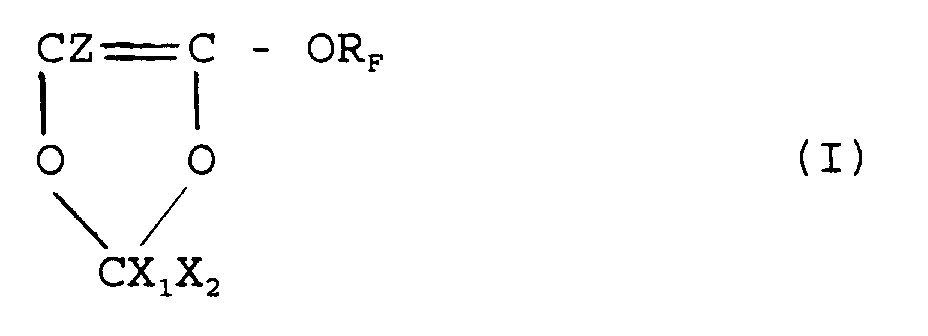
- (A) from 0.1 to 15% by moles of a fluorodioxol of formula:
- (B) from 0 to 12% by moles of a perfluorinated monomer selected from hexafluoropropene (HFP) and perfluoropropylvinylether (PPVE), or their mixtures;
- (C) TFE forming the remaining part to 100%;
Description
- The present invention relates to tetrafluoroethylene thermoprocessable copolymers. More particularly, the present invention relates to tetrafluoroethylene thermoprocessable copolymers with a fluorodioxole having improved mechanical properties, in particular at high temperatures, combined with superior optical properties.
- It is known that polytetrafluoroethylene (PTFE) shows a very high melting viscosity, whereby it cannot be worked according to the techniques usually employed for thermoprocessable polymers (extrusion, molding, injection, etc.).
- To obviate this drawback it is known to copolymerize tetrafluoroethylene (TFE) with hexafluoropropene (HFP) (see for instance US patent 2,946,763). In order to succeed in combining acceptable mechanical properties with a melting low viscosity and therefore with good processability, it is necessary to introduce high HFP amounts, generally around 7-11% by moles. However, so high amounts of HFP cause a significant fall in the second melting temperature and consequently a clear worsening of properties at high temperature, in particular tensile and creep properties. Therefore the continuous working temperature falls from values of about 260°C for PTFE to about 200°C for TFE/HFP copolymers.
- Other TFE thermoprocessable copolymers are those wherein TFE is copolymerized with a perfluoroalkylvinylether (PAVE), and in particular with perfluoropropylvinylether (PPVE) (see for instance US patent 3,635,926). Such copolymers allow to obtain a satisfactory balance between mechanical properties and processability with PPVE amounts around 2-3% by moles.
- Finally to try to obviate the drawbacks described above for the TFE/HFP copolymers, terpolymers have been suggested wherein TFE is copolymerized with 4-12% by weight of HFP and 0.5-3% by weight of PPVE (see US Patent 4,029,868).
- Even though the employment of PPVE has substantially raised the TFE thermoprocessable copolymers properties, in particular with reference to the maximum working temperature and to the processability, thus greatly enlarging the application field, it is however felt the need from one hand to further broaden the properties range and from the other hand to make easier the conditions of the copolymers synthesis. It is indeed known that PPVE shows poor reactivity and needs complex processes of recovering of the unconverted monomer (see for instance GB patent 1,514,700).
- Fluorinated dioxols of various types are known, having general formula:

wherein Y1, Y2 are -H, -F or -Cl: Y3, Y4 are -F or -CF3 (see for instance US patents 3,865,845, EP 76,581, EP 80,187, EP 95,077, EP 73,087). Such compounds can be used for preparing homopolymers of copolymers with other fluorinated monomers. In particular both amorphous and crystalline copolymers are described and prepared between the above mentioned dioxols and TFE (see for isntance EP Patents 73,087, EP 95,077, US 4,558.141). - In European patent application No. 94109782.6 in the name of the Applicant new fluorodioxols of formula:
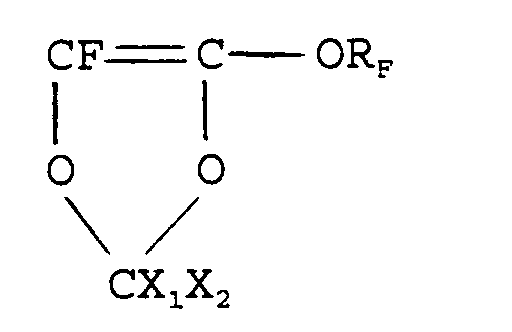
are described, wherein RF is a perfluoroalkyl having from 1 to 5 carbon atoms; X1 and X2, equal to or different from each other, are -F or -CF3. Such dioxols can be used for preparing homopolymers and copolymers with other fluorinated monomers. In particular TFE thermoprocessable terpolymers are described wherein TFE is copolymerized with a fluorodioxol of formula (I) and with perfluoromethylvinylether. In examples 9 and 10 crystalline copolymers are moreover prepared from TFE and 2,2,4-trifluoro-5-trifluoromethoxy-1,3-dioxol, the latter being present in amounts equal to 1.1% and 3.3% by moles respectively. The copolymerization process was carried out in solution in oganic solvent (CCl2FCF2Cl). The copolymers thus obtained have shown a very high melting viscosity, with a Melt Flow Index value unmeasurable and therefore not thermoprocessable. No characterization was supplied as regards the optical properties of such copolymers. - The Applicant has now surprisingly found that the copolymerization of a fluorodioxol as hereinunder defined by TFE, optionally in association with HFP and/or a perfluoroalkylvinylether, for instance perfluoropropylvinylether and perfluoromethylvinylether, allows to obtain TFE thermoprocessable polymers with improved mechanical properties, in particular at high temperatures. Such properties are combined with superior optical properties, as shown by radiation transmission measurements (transmittance and haze). This combination of properties results unexpectedly higher than the one obtainable with known modifying comonomers, in particular with respect to the known fluorodioxols.
- The fluorodioxols of the present invention determine, with the same amount introduced, a more marked fall of the second melting temperature surprisingly combined with a maintenance of the tensile properties and of resistance to brittle fracture at high temperatures.
- Conversely, experiments carried out by the Applicant have unexpectedly shown that the fluorodioxols of the present invention have a higher modifying power than the known fluorodioxols of the prior art, and this allows to prepare copolymers having a lower content of modifying comonomer, which, the second melting temperature being equal, show superior engineering properties, in particular yield stress and improved heat creep values.
- The reactivity of the fluorodioxols of the present invention is so high that there is no need of complex processes for recovering the monomer.
- Subject matter of the present invention are therefore tetrafluoroethylene (TFE) thermoprocessable copolymers comprising:
- (A) from 0.1 to 15%, preferably from 0.5 to 9%, by moles of a fluorodioxol of formula

- (B) from 0 to 15%, preferably from 0 to 10% by moles of a perfluorinated monomer selected from hexafluoropropene (HFP) and perfluoroalkylvinylethers of formula CF2=CF-OR'f, wherein R'f is a perfluoroalkyl C2-C4, or their blends;
- (c) TFE, forming the remaining part to 100%;
- Preferably, in formula (I) X1, X2 and Z are -F, Rf is preferably -CF3, -C2F5, or -C3F7. Fluorodioxols of formula (I) wherein Rf is -CF3 or -C2F5 and X1, X2 and Z are -F, are particularly preferred.
- Among the perfluoroalkylvinylethers of formula CF2=CF-OR'f, perfluoropropylvinylether (PPVE) is particularly preferred.
- The fluorodioxols of formula (I) are described in European patent application No. 94109782.6 in the name of the Applicant, the content of which is herein incorporated by reference. In case Z is -F, they can be prepared by the following process, comprising:
- (a) to react at a temperature comprised between -140° and +60°C (preferably between 110° and -20°C) a dioxol of formula:


- (b) to dehalogenate the dioxolane (III) according to known techniques, by reacting it with a metal in an aprotic dipolar solvent.
- The dioxols of formula (II) are known compounds; they can be prepared for instance according to EP Patent application 460,946. Also fluoroxycompounds Rf-OF are known products. CF3OF can be prepared, for instance, according to what described by G.H.Cady and K.B.Kellogg in J. Am. Chem. Soc. 70, 3986, 1948, the higher homologues by the process described in US Patent 4,827,024.
- An alternative process to the preceding one for preparing fluorodioxols of formula (I) wherein Z is -F, described in European patent application No. 94109782.6 as well, comprises:
- (a) to react, at a temperature comprised between -140° and +60°C (preferably between -110° and -20°C), an olefin of formula:
RfO-CCl = CFCl (IV)
wherein Rf is defined as above, with a bis-fluoroxy-compound having the formula:
CX1X2(OF)2 (V),
thus obtaining the dioxolane of formula (III); - (b) to dehalogenate the dioxolane (III) as described above.
- The olefin (IV) can be obtained by reacting CCl2=CCl2 with RfOF so as to obtain the compound Rf-OCCl2-CFCl2, which, by dechlorination reaction with powdered zinc in organic solvent, supplies the olefin (IV).
- A further process for preparing fluorodioxols of formula (I) when Z is -F, described in European patent application No. 94109782.6 as well, comprises reacting at a temperature comprised between 50° and 150°C a dioxolane of formula:

optionally in admixture with a dioxolane of formula:
wherein Rf is defined as above, with KOH in the solid state, with consequent dehydrochlorination and formation of fluorodioxol. - The dioxolane (VI) can be obtained by reacting RfOF with trichloroethylene so as to obtain the RfO-CHCl-CFCl2 compound, which is then dechlorinated with powdered zinc in organic solution. The olefin of formula Rf-OCH=CFCl is thus obtained, which is finally reacted with CX1X2(OF)2, as described above for the olefin (IV), obtaining the dioxolane (VI).
- The dioxolane (VII), in admixture with the dioxolane (VI), can be prepared as follows. The olefin CHCl=CHCl is reacted with CX1X2(OF)2, obtaining the dioxolane having the formula:
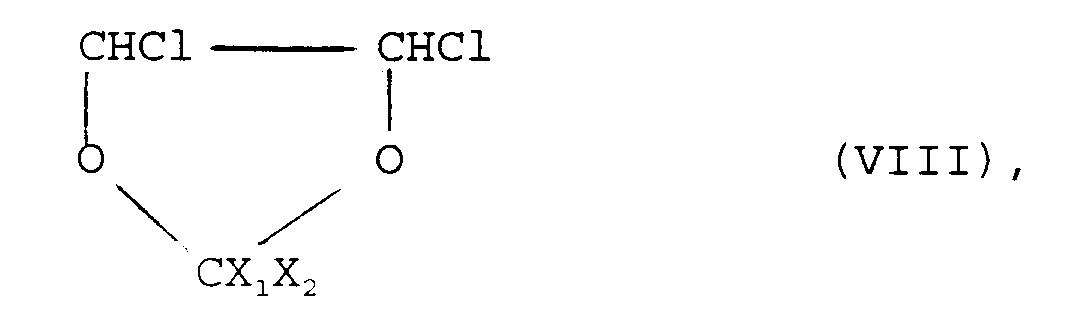
which, by dehydrohalogenation with solid KOH, gives the dioxol of formula:
This is at last reacted with RfOF, thus obtaining a mixture of the dioxolanes (VI) and (VII). - The synthesis of fluorodioxols (I) can utilize, similarly to the processes already shown, the dichloroethylene or trichloroethylene, which are reacted with hypofluorites of formula:
Rf-OF and CX1X2(OF)2,
so as to obtain, by alternating reactions of dechlorination and dehydrochlorination, the various reaction intermediates described above. - Similarly to what described above for Z = -F, when Z is -Cl or -H, the fluorodioxols of formula (I) can be prepared according to the following method. 1,1-dichloroethylene CH2=CCl2 is reacted with hypochlorite RfOCl and the reaction product is dehydrochlorinated as described above, so that the olefin of formula Rf-OCCl=CHCl is obtained.
This last is reacted with CX1X2(OF)2, as described above for the olefin (IV), obtaining the dioxolane having the formula:
The dioxolane (X) can be dehydrochlorinated with solid KOH by supplying the fluorodioxol (I) with Z = -Cl, or it can be dechlorinated with powdered Zn in organic solvent to give the fluorodioxol (I) with X = -H. - The copolymers of the present invention show a melting viscosity such as to make them thermoprocessable according to conventional techniques, with measurable Melt Flow Index (MFI) values. In particular MFI, measured according to standard ASTM D 1238, is generally comprised between 0.5 and 50 g/10', preferably between 1 and 30 g/10'.
- The copolymers of the present invention can be prepared according to known techniques, by copolymerization of the corresponding monomers, in suspension in organic medium or in aqueous emulsion, in the presence of a suitable radicalic initiator, at a temperature comprised between 0° and 150°C, preferably between 20° and 100°C. The reaction pressure is generally comprised between 0.5 and 100 bar, preferably between 5 and 40 bar.
- Among the various radicalic initiators can be used in particular: inorganic peroxides soluble in water, such as for instance persulphates and ammonium or alkaline metals perphosphates, in particular ammonium or potassium persulphate; organic or inorganic redox systems, such as ammonium persulphate/sodium sulphite, hydrogen peroxide/aminoiminomethansulphinic acid; bis-acylperoxides of formula (Rf-CO-O)2, wherein Rf is a (per)haloalkyl C1-C10, or a perfluoropolyoxyalkylenic group, such as for instance bis(perfluoropropionyl)peroxide; dialkylperoxides of formula (Rf-O)2, wherein Rf is a perhaloalkyl C1-C10, such as for instance diterbutylperoxide (DTBP); etc.
- In case of copolymerization in suspension, the reaction medium is formed by an organic phase, to which water is usually added to favour the dispersion of the heat developing during the reaction. As organic phase, halogenated hydrocarbons, in particular hydrogen(chloro)fluorocarbons and chlorofluorocarbons; fluoropolyopxyalkylenes; etc., can be employed.
- In case of the (co)polymerization in aqueous emulsion, the presence of a suitable surfactant is required. The most commonly used are fluorinated surfactants of formula:
Rf-X--M+
wherein Rf is a (per)fluoroalkylic chain C5-C16 or a (per)fluoropolyoxyalkylenic chain, X- is -COO- or -SO3 -, M+ is selected from: H+, NH4 +, an alkaline metal ion. Among them, ammonium and/or sodium perfluoro-octanoate; (per)fluoropolyoxyyalkylene terminated with one or more carboxylic groups, etc. can be mentioned. - The process object of the present invention can be advantageously carried out in the presence of perfluoropolyoxyalkylenes emulsions or microemulsions, according to US patents 4,789,717 and 4,864,006, or also of fluoropolyoxyalkylenes microemulsions having hydrogenated end groups and/or hydrogenated repeating units, according to EP patent application 625,526.
- In order to check the molecular weight of the final product, and therefore the melting viscosity, suitable chain transfer agents are added to the reaction system, such as: hydrogen, hydrocarbons; optionally containing halogens, for instance methane, ethane, chloroform, methylenechloride, etc.; esters, ethers or aliphatic alcohols, for instance methanol, ethanol, diethylmalonate, etc. The transfer agent is sent into the reactor at the beginning of the reaction, or continuously on in discrete amounts in the course of the polymerization. The amount of the chain transfer agent utilized can range within rather wide limits, depending on the molecular weight desired, of the effectiveness of the transfer agent itself and of the reaction temperature.
- Some examples of the present invention are reported hereinafter, whose purpose is merely illustrative and not limitative of the invention itself.
- A 5 l AISI 316 steel chromated autoclave, equipped with a stirrer working at 650 rpm was evacauted and 3.0 l of demineralized water, and 2,2,4-trifluoro-5-trifluoromethoxy-1,3-dioxol (TTD), having the formula

are introduced therein in amounts equal to 0.67 g/l H2O. A microemulsion of perfluoropolyoxyalkylenes was then added, obtained according to Example 1 of US 4,864,006, in such amounts as to obtain a concentration of perfluoropolyoxyalkylenic surfactant equal to 2.0 g/l H2O. The autoclave was brought to the working temperature of 75°C and then 0.24 absolute bar of ethane were loaded, acting as chain transfer agent. The autoclave was then brought to the working pression of 21 absolute bar by feeding a TFE/TTD gaseous mixture in molar ratio 54,55/l. Before beginning the reaction, the gaseous phase, analyzed by gaschromatograph, showed the following composition (% by moles): 97.9% of TFE, 2.1% of TTD. By means of a metering pump the initiatopr was then fed, consisting in a solution of potassium persulphate (KPS) having concentration equal to 0.00315 moles/l, with a flow rate of 88 ml/hour. During the reaction, the working pressure was kept constant by continuously feeding the reaction mixture TFE/TTD having the composition indicated above. The reaction was stopped after 1560 g of TFE/TTD mixture were fed. The gaseous phase present in the autoclave had at the end of the reaction the following composition (% by moles): 98.2% of TFE, 1.8% of TTD. After the reactor was cooled at room temperature, the emulsion was discharged and coagulated by addition of a 65% by weight HNO3 aqueous solution. The resulting polymer was separated, washed with demineralized water and dried. The polymer was characterized as reported in Table 1. - The composition of the polymer was determined by mass balance. The second melting temperature (T2m) was determined by scanning differential calorimetry (DSC), the Melt Flow Index according to standard ASTM D-1238-52T, with a 5 kg load.
- The optical properties, that is, haze and transmittance were measured according to standard ASTM D 1003.
- The mechanical properties were measured at 23° and 250°C, according to standard ASTM D 1708, with stretching rate of 50 mm/min, on samples having a thickness of 1.58 ± 0.08 nn, compression molded according to standard ASTM D 3307-81. The reported values are the average of 3 measurements.
- Example 1 was repeated under the same conditions, except for the amount of ethane fed before beginning the reaction, which was equal to 0.52 absolute bar. The characteristics of the obtained polymer are reported in Table 1. Creep measurements were moreover carried out thereon, according to ASTM D 2990, on samples molded by compression and pretreated at 200°C for 48 hours, by tensile stress at 275°C with a strength of 1.6 MPa. The results are as well reported in Table 1.
- Example 1 was repeated under the same conditions, except for the amount of ethane fed before beginning the reaction, which was equal to 0.57 absolute bar. The characteristics of the obtained polymer are reported in Table 1.
- In the same autoclave of Example 1, 3.0 l of demineralized water and a microemulsion of perfluoropolyoxyalkylenes obtained according to Example 1 of USP 4,864,006, in such amount as to obtain a concentration of perfluoropolyoxyalkylenic surfactant equal to 2.0 g/l H2O, were introduced, after evacuation. The autoclave was brought to the working temperature of 75°C and then 0.57 absolute bar of ethane were loaded, acting as chain transfer agent. The autoclave was then brought to the working pression of 21 absolute bar by feeding a gaseous mixture between TFE and 2,2,4,5-tetrafluoro-1,3-dioxol (PD), having the formula

with molar ratio TFE/PD equal to 54.55/l. Before beginning the reaction, the gaseous phase, analyzed by gaschromatograph, showed the following composition (% by moles): 98.2% of TFE, 1.8% of PD. By means of a metering pump the initiator was then fed, formed by a solution of potassium persulphate (KPS) having concentraion equal to 0.00315 moles/l, with a 88 ml/hour flow. During the reaction, the working pressure was kept constant by continuously feeding the reaction mixture TFE/PD having the composition indicated above. The reaction was stopped after 780 g of TFE/PD mixture were fed. The gaseous phase at the end of the reaction had the following composition (% by moles): 99.1% of TFE, 0.9% of PD. The obtained polymer was characterized as reported in Table 1. - In the same autoclave of Example 1, , 3.0 l of demineralized water and perfluoropropylvinylether (PPVE) in an amount equal to 3.67 g/l H2O were introduced, after evacuation. A microemulsion of perfluoropolyoxyalkylenes obtained according to Example 1 of USP 4,868,006, was then added, in such an amount to obtain a concentration of perfluoropolyoxyalkylenic surfactant equal to 2.0 g/l H2O. The autoclave was brought to the working temperature of 75°C and then loaded with 0.35 absolute bar of ethane, acting as chain transfer agent. The autoclave was then brought to the working pression of 21 absolute bar by feeding a gaseous mixture TFE/PPVE with molar ratio equal to 54,55/l. Before beginning the reaction, the gaseous phase, analyzed by gaschromatograph, showed the following composition (% by moles): 94.52% of TFE, 5.2% of PPVE. By means of a metering pump the initiatopr was then fed, consisting in a solution of potassium persulphate (KPS) having concentration equal to 0.00315 moles/l, with a flow of 88 ml/hour. During the reaction, the working pressure was kept constant by continuously feeding the reaction mixture TFE/PPVE having the composition indicated above. The reaction was stopped after 1560 g of TFE/PPVE mixture were fed. The gaseous phase at the end of the reaction had the following composition (% by moles): 94.3% of TFE, 5.7% of PPVE. After the reactor was cooled at room temperature, the emulsion was discharged and coagulated by addition of a 65% by weight aqueous solution of HNO3. The polymer was characterized as reported in Table 1.
Hot creep measurements were carried out on said product as reported above. The results are as well reported in Table 1.TABLE 1 EXAMPLE 1 2 3 4(*) 5(*) Polymer composition (% by mole) TFE 98.2 TFE 98.2 TFE 98.2 TFE 98.2 TFE 98.2 TTD 1.8 TTD 1.8 TTD 1.8 PD 1.8 PPVE 1.8 MFI (g/10') 4 13 19 4 13 T2m (°C) 304.5 305.4 306.0 306.5 308.3 Haze Transmittance 41 39 45 50 37 87 90 90 84 88 Mechanical properties at 23°C Elastic modulus (MPa) 517 525 563 494 563 Yield point (MPa) 14.8 15.2 15.4 13.7 14.7 Stress at break (MPa) 32.3 26.2 23.3 22.5 28.6 Elongation at break (%) 336 323 306 302 378 Mechanical properties at 250°C Elastic modulus (MPa) 28 26 32 29 36 Yield point (MPa) 2.15 2.2 2.3 2.1 2.3 Stress at break (MPa) 6.4 5.9 5.1 3.9 7.5 Elongation at break (%) 334 369 308 255 539 Mechanical properties at 275°C Elastic modulus (MPa) 24 26 --- 26 Yield point (MPa) 1.75 1.8 1.75 Stress at break (MPa) 4.2 3.9 5.2 Elongation at break (%) 401 379 535 Creep at 275°C and 1.3 MPa Elongation at 15 min (%) --- 5.4 --- --- 5.8 Elongation at 60 min (%) 9.0 10.0 Elongation at 48 hours (%) 21.0 25.5 (*) comparative - Example 1 was repeated under the same conditions, except for the initial amount of TTD, equal to 0.6 g/l H2O, and for the molar ratio of the fed TFE/TTD mixture, equal to 61.5/l. The characteristics of the obtained polymer are reported in Table 2.
- Example 4 was repeated under the same conditions, except for the amount of ethane fed before beginning the reaction, which was equal to 0.15 absolute bar. The characteristics of the obtained polymer are reported in Table 2.
TABLE 2 EXAMPLE 6 7( *) Polymer composition (% by mole) TFE 98.4 TFE 98.2 TTD 1.6 PPVE 1.8 MFI (g/10') 4 4 T2m (°C) 308 308 Mechanical properties at 23°C Elastic modulus (MPa) 530 530 Yield point (MPa) 15.2 14.0 Stress at break (MPa) 31.9 31.8 Elongation at break (%) 342 360 Mechanical properties at 250 °C Elastic modulus (MPa) 32 33 Yield point (MPa) 2.4 2.0 Stress at break (MPa) 8.8 9.8 Elongation at break (%) 342 535 (*) comparative - Example 1 was repeated but by using an amount of TTD of 0.427 g/l (H2O).
- The molar ratio in the feeding gaseous mixture between TFE/TTD was 60.73/1.
- The amount of ethane introduced was 0.375 bar.
- The characteristics of the polymer so obtained are reported in Table 3 and can be compared with the data of Example 4.
- Example 4 was repeated but with the following differences:
- the molar ratio in the gaseous feeding mixtures TFE/PD was 45.95/1;
- the ethane amount was 0.627 bar.
- The data on the characterization of the polymer are reported in Table 3 and can be compared with Example 2.
- Example 4 was repeated but with the following differences:
- the molar ratio in the gaseous feeding mixtures TFE/PD was 45.95/1;
- the ethane amount was 0.64 bar.
- The data on the characterization of the polymer are reported in Table 3 and can be compared with Example 3.
- Example 1 was repeated but with the following differences:
the ethane amount was 0.336 bar. - The data on the characterization of the polymer are reported in Table 3.
- Example 11 was repeated but by using PD and a molar ratio TFE/PD of 45.91/1; and the ethane amount was 0.619 bar.
- The data on the characterization of the polymer are reported in Table 3 and can be compared with Example 11.
TABLE 3 EXAMPLE 8 9(*) 10(*) 11 12(*) Polymer composition (% by mole) TFE 98.38 TFE 97.87 TFE 97.87 TFE 98.2 TFE 97.87 TTD 1.62 PD 2.13 PD 2.13 TTD 1.8 PD 2.13 MFI (g/10') 4.3 11 17 8.5 8 T2m (°C) 306.1 305.6 306.0 305.3 305.7 Haze Transmittance 36 57 - 41 51 84 82 - 83 85 Mechanical properties at 23°C Elastic modulus (MPa) 570 560 --- 570 590 Yield point (MPa) 15.8 14.6 16 14.6 Stress at break (MPa) 28.9 15.5 29 18.1 Elongation at break (%) 330 170 344 250 Mechanical properties at 250°C Elastic modulus (MPa) 34 39 --- 33 37 Yield point (MPa) 3.9 - 3.9 - Stress at break (MPa) 6.94 2.3 6.3 2.7 Elongation at break (%) 364 82 371 19 Mechanical properties at 275°C Elastic modulus (MPa) --- 25 --- --- --- Yield point (MPa) - Stress at break (MPa) 1.4 Elongation at break (%) 9 Creep at 275°C and 1.3 MPa Elongation at 15 min (%) --- Immediate break under stress A compressed moulded plaque was not possible to obtain --- --- Elongation at 60 min (%) Elongation at 48 hours (%) (*) comparative
Claims (9)
- Tetrafluoroethylene (TFE) thermoprocessable copolymers, comprising:(A) from 0.1 to 15% by moles of a fluorodioxol of formulawherein RF is a perfluoroalkyl having from 1 to 5 carbon atoms; X1 and X2, equal to or different from each other, are -F or -CF3; Z is selected from -F, -H, -Cl.
 (B) from 0 to 15% by moles of a perfluorinated monomer selected from hexafluoropropene (HFP) and a perfluoropropylvinylether of formula CF2=CF-OR'f wherein R'f is a perfluoroalkyl C2-C4 or their mixtures;(C) TFE forming the remaining part to 100%;
with the proviso that the total amount of the monomers (a) and (b) is lower than or equal to 20% by moles. - Copolymers according to claim 1, wherein the pefluoroalkylvinylether is perfluoropropylvinylether.
- Copolymers according to anyone of the preceding claims, wherein the fluorodioxol of formula (I) is present in an amount comprised between 0.5 and 9% by moles.
- Copolymers according to anyone of the preceding claims, wherein the perfluorinated monomer (b) is present in amounts comprised between 0 and 10% by moles.
- Copolymers according to anyone of the preceding claims, wherein the total amount of the monomers (a) and (b) is lower than or equal to 12% by moles.
- Copolymers according to anyone of the preceding claims, wherein in the formula (I) of the monomer (a) X1 and X2 are both -F.
- Copolymers according to anyone of the preceding claims, wherein in the formula (I) of monomer (a) Rf is selected from -CF3, -CF5, and -C3F7.
- Copolymers according to anyone of the preceding claims, having a melting viscosity such as to obtain Melt Flow Index (MFI) values, measured according to standard ASTM D 1238-52T, comprised between 0.5 and 50 g/10'.
- Copolymes according to claim 8, wherein the Melt Flow Index (MFI) value is comprised between 1 and 30 g/10'.
Applications Claiming Priority (2)
| Application Number | Priority Date | Filing Date | Title |
|---|---|---|---|
| ITMI950012A IT1272863B (en) | 1995-01-04 | 1995-01-04 | THERMOPROCESSABLE COPOLYMERS OF TETRAFLUOROETHYLENE |
| ITMI950012 | 1995-01-04 |
Publications (2)
| Publication Number | Publication Date |
|---|---|
| EP0720992A1 true EP0720992A1 (en) | 1996-07-10 |
| EP0720992B1 EP0720992B1 (en) | 1999-05-06 |
Family
ID=11370132
Family Applications (1)
| Application Number | Title | Priority Date | Filing Date |
|---|---|---|---|
| EP95120726A Expired - Lifetime EP0720992B1 (en) | 1995-01-04 | 1995-12-29 | Tetrafluoroethylene thermoprocessable copolymers |
Country Status (9)
| Country | Link |
|---|---|
| US (1) | US6066707A (en) |
| EP (1) | EP0720992B1 (en) |
| JP (1) | JP3719749B2 (en) |
| AT (1) | ATE179722T1 (en) |
| DE (1) | DE69509489T2 (en) |
| ES (1) | ES2132510T3 (en) |
| IT (1) | IT1272863B (en) |
| RU (1) | RU2154650C2 (en) |
| TW (1) | TW426692B (en) |
Cited By (5)
| Publication number | Priority date | Publication date | Assignee | Title |
|---|---|---|---|---|
| EP0803557A1 (en) * | 1996-04-24 | 1997-10-29 | AUSIMONT S.p.A. | Amorphous perfluoropolymers |
| US6184270B1 (en) | 1998-09-21 | 2001-02-06 | Eric J. Beckman | Production of power formulations |
| WO2004104057A1 (en) * | 2003-05-14 | 2004-12-02 | E.I. Dupont De Nemours And Company | High melt flow fluoropolymer |
| US7122609B2 (en) * | 2003-05-14 | 2006-10-17 | E. I. Du Pont De Nemours And Company | High melt flow fluoropolymer |
| US7126056B2 (en) * | 2003-05-14 | 2006-10-24 | E. I. Du Pont De Nemours And Company | High melt flow fluoropolymer |
Families Citing this family (16)
| Publication number | Priority date | Publication date | Assignee | Title |
|---|---|---|---|---|
| US6531559B1 (en) | 1998-08-06 | 2003-03-11 | Eidgenössische Technische Hochschule Zürich | Melt-processible poly (tetrafluoroethylene) |
| US7276287B2 (en) * | 2003-12-17 | 2007-10-02 | Eidgenössische Technische Hochschule Zürich | Melt-processible poly(tetrafluoroethylene) |
| US6737165B1 (en) * | 1998-08-06 | 2004-05-18 | Omlidon Technologies Llc | Melt-processible poly(tetrafluoroethylene) |
| ITMI991514A1 (en) | 1999-07-09 | 2001-01-09 | Ausimont Spa | CO THERMOPROCESSABLE PERHALOGENATED POLYMERS OF CHLOROTRIFLUOROETILENE |
| KR100538500B1 (en) * | 1999-08-30 | 2005-12-23 | 신에쓰 가가꾸 고교 가부시끼가이샤 | Polymers, Resist Compositions and Patterning Process |
| JP4261802B2 (en) * | 2000-04-28 | 2009-04-30 | 株式会社ルネサステクノロジ | IC card |
| IT1318596B1 (en) * | 2000-06-23 | 2003-08-27 | Ausimont Spa | THERMOPROCESSABLE TFE COPOLYMERS. |
| IT1318595B1 (en) * | 2000-06-23 | 2003-08-27 | Ausimont Spa | THERMOPROCESSABLE TETRAFLUOROETHYLENE COPOLYMER MICROSPHERES. |
| ITMI20011614A1 (en) * | 2001-07-26 | 2003-01-26 | Ausimont Spa | PURIFICATION PROCESS OF THERMOPROCESSABLE TETRAFLUOROETHYLENE COPOLYMERS |
| CA2413607A1 (en) * | 2002-12-05 | 2004-06-05 | Bayer Inc. | Process for the preparation of low molecular weight hydrogenated nitrile rubber |
| ITMI20030773A1 (en) * | 2003-04-15 | 2004-10-16 | Solvay Solexis Spa | AMORPHOUS PERFLUORATED POLYMERS. |
| ITMI20030774A1 (en) * | 2003-04-15 | 2004-10-16 | Solvay Solexis Spa | FLUORINATED POLYMERS. |
| DE602004029519D1 (en) | 2003-12-01 | 2010-11-18 | Japan Science & Tech Agency | Process for the preparation of fluorinated compositions and polymers |
| RU2378291C2 (en) * | 2004-08-04 | 2010-01-10 | Асахи Гласс Компани, Лимитед | Elastic fluorocopolymer, mixture thereof and crosslinked rubber |
| US9988476B2 (en) | 2012-12-05 | 2018-06-05 | Solvay Specialty Polymers Italy S.P.A. | Melt-processable perfluoropolymers having improved thermal and mechanical properties after heating treatment |
| JP6974777B2 (en) | 2019-08-26 | 2021-12-01 | ダイキン工業株式会社 | Parts for non-aqueous electrolyte batteries |
Citations (2)
| Publication number | Priority date | Publication date | Assignee | Title |
|---|---|---|---|---|
| EP0111343A1 (en) * | 1982-12-13 | 1984-06-20 | E.I. Du Pont De Nemours And Company | Modified granular polytetrafluoroethylene |
| EP0633257A1 (en) * | 1993-07-05 | 1995-01-11 | AUSIMONT S.p.A. | Perfluorodioxoles, the preparation process thereof, and homopolymers and copolymers obtained therefrom |
Family Cites Families (18)
| Publication number | Priority date | Publication date | Assignee | Title |
|---|---|---|---|---|
| NL110421C (en) * | 1957-03-29 | |||
| US3635926A (en) * | 1969-10-27 | 1972-01-18 | Du Pont | Aqueous process for making improved tetrafluoroethylene / fluoroalkyl perfluorovinyl ether copolymers |
| US3865845A (en) * | 1971-02-24 | 1975-02-11 | Paul Raphael Resnick | Fluorinated dioxoles |
| US4029868A (en) * | 1976-03-10 | 1977-06-14 | E. I. Du Pont De Nemours And Company | Tetrafluoroethylene terpolymers |
| US4042634A (en) * | 1976-03-15 | 1977-08-16 | E. I. Du Pont De Nemours And Company | Fluorocarbon separation process |
| JPS5838707A (en) * | 1981-08-20 | 1983-03-07 | イ−・アイ・デユポン・デ・ニモアス・アンド・カンパニ− | Amorphous copolymer of perfluoro-2,2-dimethyl- 1,3-dioxol |
| US4429143A (en) * | 1981-09-28 | 1984-01-31 | E. I. Du Pont De Nemours & Co. | Cyclic monomers derived from trifluoropyruvate esters |
| US4558141A (en) * | 1981-11-19 | 1985-12-10 | E. I. Du Pont De Nemours And Company | Perfluorodioxole and its polymers |
| US4399264A (en) * | 1981-11-19 | 1983-08-16 | E. I. Du Pont De Nemours & Co. | Perfluorodioxole and its polymers |
| US4431786A (en) * | 1982-05-06 | 1984-02-14 | E. I. Du Pont De Nemours And Company | Novel fluorodioxoles and fluorodioxole polymers |
| IT1184149B (en) * | 1985-03-11 | 1987-10-22 | Montefluos Spa | PROCESS FOR THE PREPARATION OF FLUOROSSI-ALO-COMPOSTI |
| IT1189092B (en) * | 1986-04-29 | 1988-01-28 | Ausimont Spa | POLYMERIZATION PROCESS IN WATER DISPERSION OF FLUORINATED MONOMERS |
| IT1204903B (en) * | 1986-06-26 | 1989-03-10 | Ausimont Spa | POLYMERIZATION PROCESS IN WATER DISPERSION OF FLORATED MONOMERS |
| JPH0649359Y2 (en) * | 1990-06-05 | 1994-12-14 | 株式会社スタッフ | Facsimile toys |
| IT1249208B (en) * | 1990-06-07 | 1995-02-20 | Ausimont Srl | PROCESS FOR THE PREPARATION OF HALOGENATED 1,3-DIOSSOLANS AND NEW PRODUCTS OBTAINED |
| IT1265067B1 (en) * | 1993-05-18 | 1996-10-30 | Ausimont Spa | PROCESS OF (CO) POLYMERIZATION IN WATER EMULSION OF FLUORINATED OLEFINIC MONOMERS |
| IT1269517B (en) * | 1994-05-19 | 1997-04-01 | Ausimont Spa | FLUORINATED POLYMERS AND COPOLYMERS CONTAINING CYCLIC STRUCTURES |
| IT1272861B (en) * | 1995-01-04 | 1997-07-01 | Ausimont Spa | COPOLYMERS OF ETHYLENE WITH TETRAFLUOROETHYLENE AND / OR CHLOROTRIFLUOROETHYLENE, WITH IMPROVED MECHANICAL PROPERTIES AT HIGH TEMPERATURES |
-
1995
- 1995-01-04 IT ITMI950012A patent/IT1272863B/en active IP Right Grant
- 1995-12-28 TW TW084114071A patent/TW426692B/en not_active IP Right Cessation
- 1995-12-28 JP JP34319095A patent/JP3719749B2/en not_active Expired - Lifetime
- 1995-12-29 EP EP95120726A patent/EP0720992B1/en not_active Expired - Lifetime
- 1995-12-29 AT AT95120726T patent/ATE179722T1/en not_active IP Right Cessation
- 1995-12-29 DE DE69509489T patent/DE69509489T2/en not_active Expired - Lifetime
- 1995-12-29 ES ES95120726T patent/ES2132510T3/en not_active Expired - Lifetime
-
1996
- 1996-01-03 RU RU96100244/04A patent/RU2154650C2/en not_active IP Right Cessation
-
1997
- 1997-05-23 US US08/862,331 patent/US6066707A/en not_active Expired - Lifetime
Patent Citations (2)
| Publication number | Priority date | Publication date | Assignee | Title |
|---|---|---|---|---|
| EP0111343A1 (en) * | 1982-12-13 | 1984-06-20 | E.I. Du Pont De Nemours And Company | Modified granular polytetrafluoroethylene |
| EP0633257A1 (en) * | 1993-07-05 | 1995-01-11 | AUSIMONT S.p.A. | Perfluorodioxoles, the preparation process thereof, and homopolymers and copolymers obtained therefrom |
Cited By (10)
| Publication number | Priority date | Publication date | Assignee | Title |
|---|---|---|---|---|
| EP0803557A1 (en) * | 1996-04-24 | 1997-10-29 | AUSIMONT S.p.A. | Amorphous perfluoropolymers |
| US5883177A (en) * | 1996-04-24 | 1999-03-16 | Ausimont S.P.A. | Amorphous perfluoropolymers |
| US6184270B1 (en) | 1998-09-21 | 2001-02-06 | Eric J. Beckman | Production of power formulations |
| WO2004104057A1 (en) * | 2003-05-14 | 2004-12-02 | E.I. Dupont De Nemours And Company | High melt flow fluoropolymer |
| US7122609B2 (en) * | 2003-05-14 | 2006-10-17 | E. I. Du Pont De Nemours And Company | High melt flow fluoropolymer |
| US7126056B2 (en) * | 2003-05-14 | 2006-10-24 | E. I. Du Pont De Nemours And Company | High melt flow fluoropolymer |
| US7435786B2 (en) * | 2003-05-14 | 2008-10-14 | E.I. Du Pont De Nemours And Company | High melt flow fluoropolymer |
| US8076431B2 (en) * | 2003-05-14 | 2011-12-13 | E.I. Du Pont De Nemours And Company | High melt flow fluoropolymer |
| US20120058256A1 (en) * | 2003-05-14 | 2012-03-08 | E.I. Du Pont De Nemours And Company | High Melt Flow Fluoropolymer |
| US8674042B2 (en) * | 2003-05-14 | 2014-03-18 | E I Du Pont De Nemours And Company | High melt flow fluoropolymer |
Also Published As
| Publication number | Publication date |
|---|---|
| US6066707A (en) | 2000-05-23 |
| TW426692B (en) | 2001-03-21 |
| DE69509489D1 (en) | 1999-06-10 |
| ATE179722T1 (en) | 1999-05-15 |
| JP3719749B2 (en) | 2005-11-24 |
| RU2154650C2 (en) | 2000-08-20 |
| JPH08231646A (en) | 1996-09-10 |
| IT1272863B (en) | 1997-07-01 |
| DE69509489T2 (en) | 1999-09-02 |
| EP0720992B1 (en) | 1999-05-06 |
| ITMI950012A0 (en) | 1995-01-04 |
| ITMI950012A1 (en) | 1996-07-04 |
| ES2132510T3 (en) | 1999-08-16 |
Similar Documents
| Publication | Publication Date | Title |
|---|---|---|
| US6066707A (en) | Tetrafluoroethylene thermoprocessable copolymers | |
| US5571932A (en) | Perfluorodioxoles, the preparation process thereof, and homopolymers and copolymers obtained therefrom | |
| EP0633274B1 (en) | Thermoprocessable copolymers of tetrafluoroethylene | |
| EP2058341B1 (en) | Process for producing melt-moldable tetrafluoroethylene copolymer | |
| KR100791504B1 (en) | Fluorovinyl ether and polymers obtained therefrom | |
| EP1141047B1 (en) | Fluoromonomer polymerization | |
| EP0720991B1 (en) | Copolymers of ethylene and tetrafluoroethylene and/or chlorotrifluoroethylene having improved mechanical properties at high temperatures | |
| KR101342912B1 (en) | Fluoroelastomers | |
| US6677414B2 (en) | Aqueous emulsion polymerization process for the manufacturing of fluoropolymers | |
| EP0818490A2 (en) | Process for the suspension polymerization of fluroethylenes | |
| EP1244715B1 (en) | Aqueous emulsion polymerization process for the manufacturing of fluoropolymers | |
| EP0964010B1 (en) | Chlorotrifluoroethylene copolymers | |
| KR101378422B1 (en) | Fluoroelastomers | |
| EP1067145B1 (en) | Perhalogenated thermoplastic (co) polymers of chlorotrifluoroethylene | |
| CA2123693C (en) | New thermoplastic fluorocopolymers and the fluoromonomers used for their preparation | |
| US20070100100A1 (en) | Fluorovinyl ethers and polymers obtainable therefrom |
Legal Events
| Date | Code | Title | Description |
|---|---|---|---|
| PUAI | Public reference made under article 153(3) epc to a published international application that has entered the european phase |
Free format text: ORIGINAL CODE: 0009012 |
|
| AK | Designated contracting states |
Kind code of ref document: A1 Designated state(s): AT BE CH DE DK ES FR GB GR IE IT LI NL PT SE |
|
| 17P | Request for examination filed |
Effective date: 19961218 |
|
| 17Q | First examination report despatched |
Effective date: 19970312 |
|
| GRAG | Despatch of communication of intention to grant |
Free format text: ORIGINAL CODE: EPIDOS AGRA |
|
| GRAG | Despatch of communication of intention to grant |
Free format text: ORIGINAL CODE: EPIDOS AGRA |
|
| GRAH | Despatch of communication of intention to grant a patent |
Free format text: ORIGINAL CODE: EPIDOS IGRA |
|
| GRAH | Despatch of communication of intention to grant a patent |
Free format text: ORIGINAL CODE: EPIDOS IGRA |
|
| GRAA | (expected) grant |
Free format text: ORIGINAL CODE: 0009210 |
|
| AK | Designated contracting states |
Kind code of ref document: B1 Designated state(s): AT BE CH DE DK ES FR GB GR IE IT LI NL PT SE |
|
| PG25 | Lapsed in a contracting state [announced via postgrant information from national office to epo] |
Ref country code: NL Free format text: LAPSE BECAUSE OF FAILURE TO SUBMIT A TRANSLATION OF THE DESCRIPTION OR TO PAY THE FEE WITHIN THE PRESCRIBED TIME-LIMIT Effective date: 19990506 Ref country code: GR Free format text: LAPSE BECAUSE OF NON-PAYMENT OF DUE FEES Effective date: 19990506 Ref country code: AT Free format text: LAPSE BECAUSE OF FAILURE TO SUBMIT A TRANSLATION OF THE DESCRIPTION OR TO PAY THE FEE WITHIN THE PRESCRIBED TIME-LIMIT Effective date: 19990506 |
|
| REF | Corresponds to: |
Ref document number: 179722 Country of ref document: AT Date of ref document: 19990515 Kind code of ref document: T |
|
| REG | Reference to a national code |
Ref country code: CH Ref legal event code: NV Representative=s name: KEMIA S.A. Ref country code: CH Ref legal event code: EP |
|
| ET | Fr: translation filed | ||
| REF | Corresponds to: |
Ref document number: 69509489 Country of ref document: DE Date of ref document: 19990610 |
|
| REG | Reference to a national code |
Ref country code: IE Ref legal event code: FG4D |
|
| PG25 | Lapsed in a contracting state [announced via postgrant information from national office to epo] |
Ref country code: PT Free format text: LAPSE BECAUSE OF FAILURE TO SUBMIT A TRANSLATION OF THE DESCRIPTION OR TO PAY THE FEE WITHIN THE PRESCRIBED TIME-LIMIT Effective date: 19990806 Ref country code: DK Free format text: LAPSE BECAUSE OF FAILURE TO SUBMIT A TRANSLATION OF THE DESCRIPTION OR TO PAY THE FEE WITHIN THE PRESCRIBED TIME-LIMIT Effective date: 19990806 |
|
| REG | Reference to a national code |
Ref country code: ES Ref legal event code: FG2A Ref document number: 2132510 Country of ref document: ES Kind code of ref document: T3 |
|
| PG25 | Lapsed in a contracting state [announced via postgrant information from national office to epo] |
Ref country code: IE Free format text: LAPSE BECAUSE OF NON-PAYMENT OF DUE FEES Effective date: 19991229 |
|
| PLBE | No opposition filed within time limit |
Free format text: ORIGINAL CODE: 0009261 |
|
| STAA | Information on the status of an ep patent application or granted ep patent |
Free format text: STATUS: NO OPPOSITION FILED WITHIN TIME LIMIT |
|
| 26N | No opposition filed | ||
| REG | Reference to a national code |
Ref country code: IE Ref legal event code: MM4A |
|
| REG | Reference to a national code |
Ref country code: GB Ref legal event code: IF02 |
|
| REG | Reference to a national code |
Ref country code: CH Ref legal event code: PFA Owner name: AUSIMONT S.P.A. Free format text: AUSIMONT S.P.A.#31 FORO BUONAPARTE#I-20121 MILANO (IT) -TRANSFER TO- AUSIMONT S.P.A.#31 FORO BUONAPARTE#I-20121 MILANO (IT) |
|
| PGFP | Annual fee paid to national office [announced via postgrant information from national office to epo] |
Ref country code: CH Payment date: 20081230 Year of fee payment: 14 |
|
| PGFP | Annual fee paid to national office [announced via postgrant information from national office to epo] |
Ref country code: SE Payment date: 20081205 Year of fee payment: 14 Ref country code: BE Payment date: 20081117 Year of fee payment: 14 |
|
| PGFP | Annual fee paid to national office [announced via postgrant information from national office to epo] |
Ref country code: ES Payment date: 20090113 Year of fee payment: 14 |
|
| BERE | Be: lapsed |
Owner name: *AUSIMONT S.P.A. Effective date: 20091231 |
|
| EUG | Se: european patent has lapsed | ||
| REG | Reference to a national code |
Ref country code: CH Ref legal event code: PL |
|
| PG25 | Lapsed in a contracting state [announced via postgrant information from national office to epo] |
Ref country code: LI Free format text: LAPSE BECAUSE OF NON-PAYMENT OF DUE FEES Effective date: 20091231 Ref country code: CH Free format text: LAPSE BECAUSE OF NON-PAYMENT OF DUE FEES Effective date: 20091231 Ref country code: BE Free format text: LAPSE BECAUSE OF NON-PAYMENT OF DUE FEES Effective date: 20091231 |
|
| REG | Reference to a national code |
Ref country code: ES Ref legal event code: FD2A Effective date: 20110325 |
|
| PGFP | Annual fee paid to national office [announced via postgrant information from national office to epo] |
Ref country code: IT Payment date: 20101119 Year of fee payment: 16 |
|
| PG25 | Lapsed in a contracting state [announced via postgrant information from national office to epo] |
Ref country code: SE Free format text: LAPSE BECAUSE OF NON-PAYMENT OF DUE FEES Effective date: 20091230 |
|
| PG25 | Lapsed in a contracting state [announced via postgrant information from national office to epo] |
Ref country code: ES Free format text: LAPSE BECAUSE OF NON-PAYMENT OF DUE FEES Effective date: 20110314 |
|
| PG25 | Lapsed in a contracting state [announced via postgrant information from national office to epo] |
Ref country code: ES Free format text: LAPSE BECAUSE OF NON-PAYMENT OF DUE FEES Effective date: 20091230 |
|
| PGFP | Annual fee paid to national office [announced via postgrant information from national office to epo] |
Ref country code: FR Payment date: 20111219 Year of fee payment: 17 |
|
| REG | Reference to a national code |
Ref country code: FR Ref legal event code: ST Effective date: 20130830 |
|
| PG25 | Lapsed in a contracting state [announced via postgrant information from national office to epo] |
Ref country code: FR Free format text: LAPSE BECAUSE OF NON-PAYMENT OF DUE FEES Effective date: 20130102 |
|
| PG25 | Lapsed in a contracting state [announced via postgrant information from national office to epo] |
Ref country code: IT Free format text: LAPSE BECAUSE OF NON-PAYMENT OF DUE FEES Effective date: 20121229 |
|
| PGFP | Annual fee paid to national office [announced via postgrant information from national office to epo] |
Ref country code: GB Payment date: 20141224 Year of fee payment: 20 |
|
| PGFP | Annual fee paid to national office [announced via postgrant information from national office to epo] |
Ref country code: DE Payment date: 20141223 Year of fee payment: 20 |
|
| REG | Reference to a national code |
Ref country code: DE Ref legal event code: R071 Ref document number: 69509489 Country of ref document: DE |
|
| REG | Reference to a national code |
Ref country code: GB Ref legal event code: PE20 Expiry date: 20151228 |
|
| PG25 | Lapsed in a contracting state [announced via postgrant information from national office to epo] |
Ref country code: GB Free format text: LAPSE BECAUSE OF EXPIRATION OF PROTECTION Effective date: 20151228 |