EP0725784B1 - DIBENZ[b,e]OXEPINDERIVATE, VERFAHREN ZU IHRER HERSTELLUNG UND DIESE ENTHALTENDE ARZNEIMITTEL - Google Patents
DIBENZ[b,e]OXEPINDERIVATE, VERFAHREN ZU IHRER HERSTELLUNG UND DIESE ENTHALTENDE ARZNEIMITTEL Download PDFInfo
- Publication number
- EP0725784B1 EP0725784B1 EP94931541A EP94931541A EP0725784B1 EP 0725784 B1 EP0725784 B1 EP 0725784B1 EP 94931541 A EP94931541 A EP 94931541A EP 94931541 A EP94931541 A EP 94931541A EP 0725784 B1 EP0725784 B1 EP 0725784B1
- Authority
- EP
- European Patent Office
- Prior art keywords
- alkyl
- group
- represents hydrogen
- hydrogen
- alkenyl
- Prior art date
- Legal status (The legal status is an assumption and is not a legal conclusion. Google has not performed a legal analysis and makes no representation as to the accuracy of the status listed.)
- Expired - Lifetime
Links
- 0 COc(cc1)cc(COc2c3cc(*)c(O*)c2*)c1C3=O Chemical compound COc(cc1)cc(COc2c3cc(*)c(O*)c2*)c1C3=O 0.000 description 2
Classifications
-
- C—CHEMISTRY; METALLURGY
- C07—ORGANIC CHEMISTRY
- C07D—HETEROCYCLIC COMPOUNDS
- C07D493/00—Heterocyclic compounds containing oxygen atoms as the only ring hetero atoms in the condensed system
- C07D493/02—Heterocyclic compounds containing oxygen atoms as the only ring hetero atoms in the condensed system in which the condensed system contains two hetero rings
- C07D493/04—Ortho-condensed systems
-
- C—CHEMISTRY; METALLURGY
- C07—ORGANIC CHEMISTRY
- C07D—HETEROCYCLIC COMPOUNDS
- C07D313/00—Heterocyclic compounds containing rings of more than six members having one oxygen atom as the only ring hetero atom
- C07D313/02—Seven-membered rings
- C07D313/06—Seven-membered rings condensed with carbocyclic rings or ring systems
- C07D313/10—Seven-membered rings condensed with carbocyclic rings or ring systems condensed with two six-membered rings
- C07D313/12—[b,e]-condensed
Definitions
- EP, A, 0 436 025 discloses dibenz [b, e] oxepine derivatives with anti-inflammatory, anti-inflammatory and analgesic effects.
- the present invention relates to new dibenz [b, e] oxepine derivatives, processes for their preparation and medicaments which contain these compounds.
- the compounds of the formula I have valuable pharmacological properties, in particular they can inhibit the activity of phospholipases. They are therefore suitable for the treatment of acute and chronic, allergic, non-allergic and traumatic and inflammatory diseases, such as rheumatic arthritis, osteoarthritis, ulcerative colitis, acute pancreatitis, contact dermatitis, inflammatory and allergic respiratory diseases, septic shock, allergic shock, serum disease, autoimmune diseases, graft -versus-host reactions, host-versus-graft diseases, ischemic or thrombotic diseases, for example coronary infarction or cerebral infarction.
- acute and chronic, allergic, non-allergic and traumatic and inflammatory diseases such as rheumatic arthritis, osteoarthritis, ulcerative colitis, acute pancreatitis, contact dermatitis, inflammatory and allergic respiratory diseases, septic shock, allergic shock, serum disease, autoimmune diseases, graft -versus-host reactions, host-versus-graft diseases, ischemic or thrombotic diseases, for example coronary
- Alkyl radicals in the alkyl, alkoxy and alkanoyl groups mentioned can be straight-chain or branched.
- Preferred radicals are the methyl, ethyl, propyl, isopropyl, n-butyl, isobutyl, tert-butyl, n-pentyl and 3-pentyl radical.
- Alkylene radicals can be straight-chain or branched.
- Preferred radicals are 1,2-ethylene, 1,3-propylene, 1,2-propylene and 1,4-butylene.
- the invention relates in particular to all substances which have any possible combination of the substituents mentioned in the examples.
- the process according to the invention for the preparation of the compounds of the formula I is characterized in that a compound of the general formula II in which Q has the abovementioned meaning and one of the two radicals X 1 and Z 1 denotes acetyl whereas the other represents hydrogen, C 1 - to C 6 -alkyl or C 2 to C 6 alkenyl, is reacted with an oxalic acid derivative such as Diethyl oxalate under the action of a base such as an alkali alcoholate and cyclized or a compound of general formula III in which Q has the meaning given above and one of the two radicals X 2 and Z 2 is hydrogen, while the other is hydrogen, C 1 - to C 6 -alkyl or C 2 - to C 6 -alkenyl, with a halofumaric acid derivative such as, for example Dimethyl bromofumarate is reacted and cyclized under the action of a base such as, for example, an alkali metal alcoholate and then,
- the reaction of compounds of the formulas II and III is advantageously carried out in a basic medium, for example a lower alcohol such as methanol, ethanol or isopropanol in the presence of an alkali alcoholate.
- the subsequent cyclization is carried out, for example, in the presence of an acid such as sulfuric acid, polyphosphoric acid, polyphosphoric acid ester or alcoholic hydrochloric acid.
- an acid such as sulfuric acid, polyphosphoric acid, polyphosphoric acid ester or alcoholic hydrochloric acid.
- a conversion of a radical Q into another radical Q defined by the claim takes place, for example, by reacting a compound of the formula I in which Q is hydroxyl with an alkylating agent, for example an alkyl halide which is optionally substituted.
- an alkylating agent for example an alkyl halide which is optionally substituted.
- an alkoxy group representing Q can be converted into a hydroxy group, for example by cleaving a methoxy group with boron tribromide.
- a saponification of an alkoxycarbonyl group contained in Q or Y and Z or Y and X can produce a carboxyl group and an esterification of a carboxyl group can produce an alkoxycarbonyl group.
- X is an alkenyl radical, this can, if desired, be converted into an alkyl radical by hydrogenation.
- the starting compounds II and III are substances known from the literature or can be prepared analogously to processes known from the literature.
- salts come in particular alkali, alkaline earth and ammonium salts and optionally salts with non-toxic inorganic or organic acids, such as.
- the salts are obtained in the usual manner, for. B. by neutralizing the compounds of formula I with the appropriate alkalis or acids.
- the compounds of general formula I are mixed in a manner known per se with suitable pharmaceutical carriers, flavoring, flavoring and coloring agents and shaped, for example, as tablets or dragées or with the addition of appropriate auxiliaries in water or oil, such as, for. B. olive oil, suspended or dissolved.
- the substances of the general formula I can be administered orally and parenterally in liquid or solid form.
- Water is preferably used as the injection medium, which is the stabilizing agent customary for injection solutions.
- Such additives are e.g. B. tartrate or borate buffer, ethanol, dimethyl sulfoxide, complexing agents (such as ethylenediaminetetraacetic acid), High molecular weight polymers (such as liquid polyethylene oxide) for viscosity regulation or polyethylene derivatives of sorbitan hydrides.
- Solid carriers are e.g. B. Strength. Lactose, mannitol, methyl cellulose, talc, finely divided silica. higher molecular weight polymers (such as polyethylene glycols).
- Preparations suitable for oral administration can, if desired, contain flavorings and sweeteners.
- the substances I according to the invention can also be used in the form of powders and ointments. You will z. B. mixed with powdered, physiologically compatible diluents or conventional ointment bases.
- the dose administered depends on the age, health and weight of the recipient, the extent of the disease, the type of additional treatments that may be carried out at the same time, the frequency of the treatments and the type of effect desired.
- the daily dose of the active compound is usually 0.1 to 50 mg / kg body weight. Usually 0.5 to 40 and preferably 1.0 to 20 mg / kg / day are effective in one or more applications per day to achieve the desired results.
- the table contains the percentage in vitro inhibition of this enzyme by the exemplary compounds of Examples 2 a), 2 c) and 4 a).
- the enzyme was inhibited in a dose-dependent manner, 78.61 and 49% inhibition having already been achieved with 10 ⁇ g / ml.
- Example 2 a) Example 4 a) Indomethacin 100 ⁇ g / ml nb nb nb 52 10 ⁇ g / ml 78 61 49 10th 1 ⁇ g / ml 73 52 17th 0 0.1 ⁇ g / ml 12th 28 16 nb Average values from 3 experiments (double determinations), nb not determined
Landscapes
- Chemical & Material Sciences (AREA)
- Organic Chemistry (AREA)
- Pharmaceuticals Containing Other Organic And Inorganic Compounds (AREA)
- Organic Low-Molecular-Weight Compounds And Preparation Thereof (AREA)
- Pyrane Compounds (AREA)
- Acyclic And Carbocyclic Compounds In Medicinal Compositions (AREA)
- Epoxy Compounds (AREA)
- Heterocyclic Carbon Compounds Containing A Hetero Ring Having Oxygen Or Sulfur (AREA)
Description
- EP,A,0 436 025 offenbart Dibenz[b,e]oxepinderivate mit antiphlogistischen, entzündungshemmenden und analgetischen Wirkungen. Gegenstand der vorliegenden Erfindung sind neue Dibenz[b,e]oxepinderivate, Verfahren zu deren Herstellung und Arzneimittel, die diese Verbindungen enthalten.
- Die Erfindung betrifft Dibenz[b,e]oxepinderivate der allgemeinen Formel I

- Q
- Wasserstoff, eine Hydroxygruppe oder eine C1- bis C8-Alkoxygruppe, die gewünschtenfalls mit Carboxyl oder C1- bis C6-Alkoxycarbonyl substituiert sein kann, bedeutet und entweder
- Y und Z
- gemeinsam eine Gruppe

- X
- für Wasserstoff, C1- bis C6-Alkyl oder C2- bis C6-Alkenyl steht oder
- Y und X
- gemeinsam eine Gruppe

- Z
- für Wasserstoff, C1- bis C6-Alkyl oder C1- bis C6-Alkanoyl steht, wobei
- R
- Wasserstoff oder einen C1 - bis C6-Alkylrest bedeutet,
- Die Verbindungen der Formel I weisen wertvolle pharmakologische Eigenschaften auf, insbesondere können sie die Aktivität von Phospholipasen hemmen. Sie eignen sich daher zur Behandlung akuter und chronischer, allergischer, nichtallergischer und traumatischer und entzündlicher Erkrankungen, wie beispielsweise rheumatische Arthritis, Osteoarthritis, ulcerative Colitis, akute Pankreatitis, Kontaktdermatitis, entzündliche und allergische Atemwegserkrankungen, septischer Schock, allergischer Schock, Serumkrankheit, Autoimmunerkrankungen, graft-versus-host-Reaktionen, host-versus-graft-Erkrankungen, ischämische oder thrombotische Erkrankungen, beispielsweise Coronarinfarkt oder Cerebralinfarkt.
- Alkylreste in den genannten Gruppen Alkyl, Alkoxy und Alkanoyl können geradkettig oder verzweigt sein. Bevorzugte Reste sind der Methyl-, Ethyl-, Propyl-, Isopropyl-, n-Butyl-, Isobutyl-, tert.-Butyl-, n-Pentyl- und 3-Pentylrest.
- Alkylenreste können geradkettig oder verzweigt sein. Bevorzugte Reste sind, 1,2-Ethylen, 1,3-Propylen, 1,2-Propylen und 1,4-Butylen.
- Außer den in den Beispielen genannten Verbindungen sind Gegenstand der Erfindung insbesondere alle Substanzen, die jede mögliche Kombination der in den Beispielen genannten Substituenten aufweisen.
- Das erfindungsgemäße Verfahren zur Herstellung der Verbindungen der Formel I ist dadurch gekennzeichnet, daß man in an sich bekannter Weise eine Verbindung der allgemeinen Formel II

eine Verbindung der allgemeinen Formel III
- Die Umsetzung von Verbindungen der Formeln II und III erfolgt zweckmäßig in basischem Medium, beispielsweise einem niederen Alkohol wie Methanol, Ethanol oder Isopropanol in Gegenwart eines Alkalialkoholats. Die anschließende Cyclisierung wird beispielsweise in Gegenwart einer Säure wie Schwefelsäure, Polyphosphorsäure, Polyphosphorsäureester oder alkoholische Chlorwasserstoffsäure durchgeführt. Für den Fall, daß Y und X gemeinsam einen Alkylenrest bilden, lassen sich die geeigneten Verbindungen der Formel II ohne Einwirkung eines Oxalsäurederivats säurekatalysiert direkt in die entsprechenden Verbindungen der Formel I überführen.
- Eine Umwandlung eines Restes Q in einen anderen, durch den Anspruch definierten Rest Q erfolgt beispielsweise durch Umsetzung einer Verbindungen der Formel I, in der Q für Hydroxyl steht, mit einem Alkylierungsmittel wie beispielsweise einem gewünschtenfalls substituierten Alkylhalogenid.
- Eine für Q stehende Alkoxygruppe kann gewünschtenfalls in eine Hydroxygruppe überführt werden, beispielsweise durch Spaltung einer Methoxygruppe mit Bortribromid.
- Durch Verseifung einer in Q oder Y und Z oder Y und X enthaltenen Alkoxycarbonylgruppe kann eine Carboxylgruppe erzeugt werden, durch Veresterung einer Carboxylgruppe eine Alkoxycarbonylgruppe.
- Steht für X ein Alkenylrest, so kann dieser gewünschtenfalls durch Hydrierung in einen Alkylrest überführt werden.
- Die Ausgangsverbindungen II und III sind literaturbekannte Substanzen oder können in Analogie zu literaturbekannten Verfahren hergestellt werden.
- Als pharmakologisch verträgliche Salze kommen insbesondere Alkali-, Erdalkali- und Ammoniumsalze sowie gegebenenfalls Salze mit nichttoxischen anorganischen oder organischen Säuren, wie z. B. Salzsäure, Schwefelsäure, Phosphorsäure, Bromwasserstoffsäure, Essigsäure, Milchsäure, Zitronensäure, Äpfelsäure, Benzoesäure, Salicylsäure, Malonsäure, Maleinsäure, Bemsteinsäure oder Diaminocapronsäure in Frage.
- Die Salze erhält man in üblicher Weise z. B. durch Neutralisation der Verbindungen der Formel I mit den entsprechenden Laugen oder Säuren.
- Zur Herstellung von Arzneimitteln werden die Verbindungen der allgemeinen Formel I in an sich bekannter Weise mit geeigneten pharmazeutischen Trägersubstanzen, Aroma-, Geschmacks- und Farbstoffen gemischt und beispielsweise als Tabletten oder Dragees ausgeformt oder unter Zugabe entsprechender Hilfsstoffe in Wasser oder Öl, wie z. B. Olivenöl, suspendiert oder gelöst.
- Die Substanzen der allgemeinen Formel I können in flüssiger oder fester Form oral und parenteral appliziert werden. Als Injektionsmedium kommt vorzugsweise Wasser zur Anwendung, welches die bei Injektionslösungen üblichen Stabilisierungsmittel. Lösungsvermittler und/oder Puffer enthält. Derartige Zusätze sind z. B. Tartrat- oder Borat-Puffer, Ethanol, Dimethylsulfoxid, Komplexbildner (wie Ethylendiamintetraessigsäure), hochmolekulare Polymere (wie flüssiges Polyethylenoxid) zur Viskositätsregulierung oder Polyethylen-Derivate von Sorbitanhydriden.
- Feste Trägerstoffe sind z. B. Stärke. Lactose, Mannit, Methylcellulose, Talkum, hochdisperse Kieselsäure. höhermolekulare Polymere (wie Polyethylenglykole).
- Für die orale Applikation geeignete Zubereitungen können gewünschtenfalls Geschmacks- und Süßstoffe enthalten. Für die äußerliche Anwendung können die erfindungsgemäßen Substanzen I auch in Form von Pudern und Salben verwendet werden. Sie werden dazu z. B. mit pulverförmigen, physiologisch verträglichen Verdünnungsmitteln bzw. üblichen Salbengrundlagen vermischt. Die verabreichte Dosis hängt vom Alter, der Gesundheit und dem Gewicht des Empfängers, dem Ausmaß der Krankheit, der Art gleichzeitiger gegebenenfalls durchgeführter weiterer Behandlungen, der Häufigkeit der Behandlungen und der Art der gewünschten Wirkung ab. Üblicherweise beträgt die tägliche Dosis der aktiven Verbindung 0.1 bis 50 mg/kg Körpergewicht. Normalerweise sind 0.5 bis 40 und vorzugsweise 1.0 bis 20 mg/kg/Tag in einer oder mehreren Anwendungen pro Tag wirksam, um die gewünschten Resultate zu erhalten.
- Außer den in den Beispielen genannten Substanzen sind im Sinne der Erfindung die folgenden Verbindungen bevorzugt:
- 1. 2-Carboxymethoxy-7. 13-dihydro-5H- 10,12-dioxa-benzo[4,5]cyclohepta[1,2-b]naphthalin-5,7-dion-9-carbonsäure-dinatrium
- 2. 7,12-Dihydro-5-propyl-1H-4, 13-dioxabenzo[4,5]cyclohepta[1,2-a]naphthalin-1,7-dion-3-carbonsäureethylester
- 3. 11-Allyl-7, 13-dihydro-2-hydroxy-5H-10,12-dioxa-benzo[4,5]cydohepta[1,2-b]naphthalin-5,7-dion-9-carbonsäureethylester
- 4. 11-Allyl-7,13-dihydro-2-ethoxycarbonylmethoxy-5H-10,12-dioxabenzo[4,5]cyclohepta[1,2-b]naphthalin-5,7-dion-9-carbonsäureethylester
- 5. 11-Allyl-7, 13-dihydro-2-octyloxy-5H-10,12-dioxa-benzo[4,5]cydohepta[1,2-b]naphtahlin-5,7-dion-9-carbonsäureethylester
- Zu einer Lösung von 4.14 g (180 mmol) Natrium in 250 ml Ethanol fügt man 8.04 g (30 mmol)4-Acetyl-6, 11-dihydro-3-hydroxy-dibenz[b,e]oxepin-11-on, erwärmt 10 min zum Rückfluß, kühlt auf Raumtemperatur, versetzt mit 14.6 g (100 mmol) Diethyloxalat, erwärmt 90 min zum Rückfluß, läßt abkühlen und filtriert. Der Niederschlag wir in 100 ml Ethanol aufgenommen, die Suspension mit Chlorwasserstoff gesättigt und anschließend 1 h auf 50°C erwärmt. Nach Abkühlung gießt man auf Eis und filtriert. Es verbleiben 7.8 g Titelverbindung (74 % d. Th.) vom Schmp. 178-180°C (aus Ethanol).
- In analoger Weise wie in Beispiel 1 beschrieben erhält man:


- Eine Mischung aus 3.7 g (10 mmol) Verbindung des Beispiels 2 c, 50 ml Dimethylformamid, 1.4 g Kaliumcarbonat und 1.75 ml 1-Bromoctan wird 6 h auf 80°C erwärmt, anschließend filtriert und das Filtrat eingeengt. Man nimmt in Ethylacetat auf und chromatographiert an Kieselgel (Elutionsmittel Ethylacetat : Isohexan 1:1). Nach Verreiben mit Ether verbleiben 2.4 g Titelverbindung (50 % d. Th.) vom Schmp. 103-105°C.
- In analoger Weise wie in Beispiel 3 beschrieben erhält man:
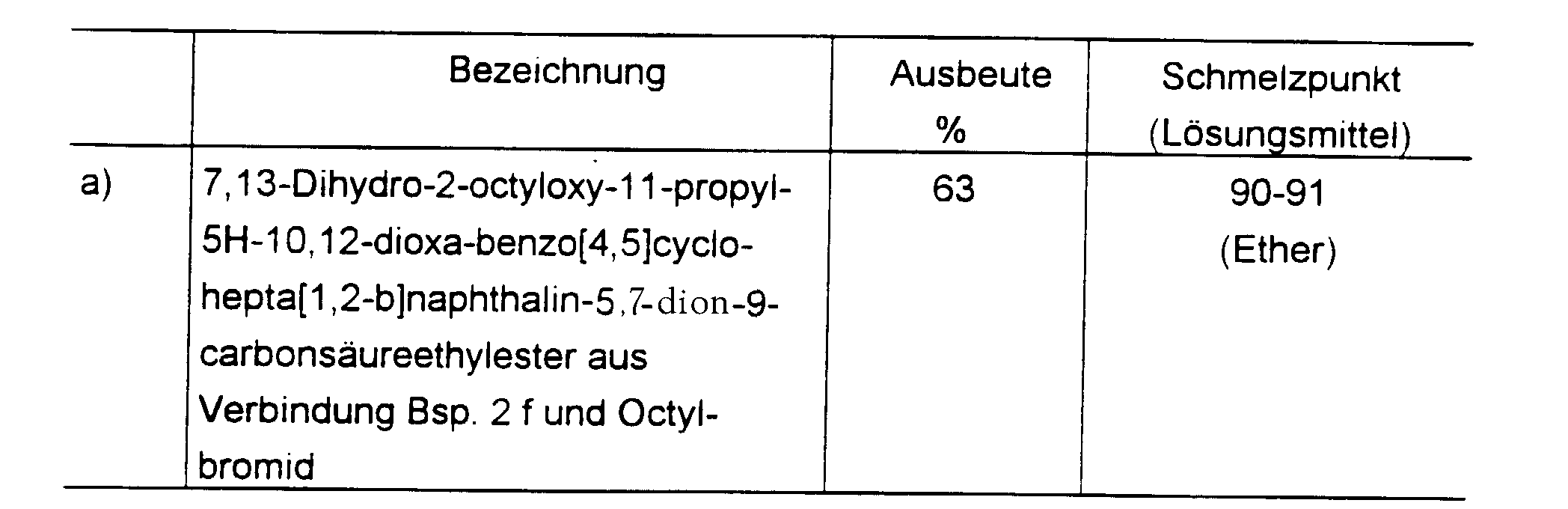
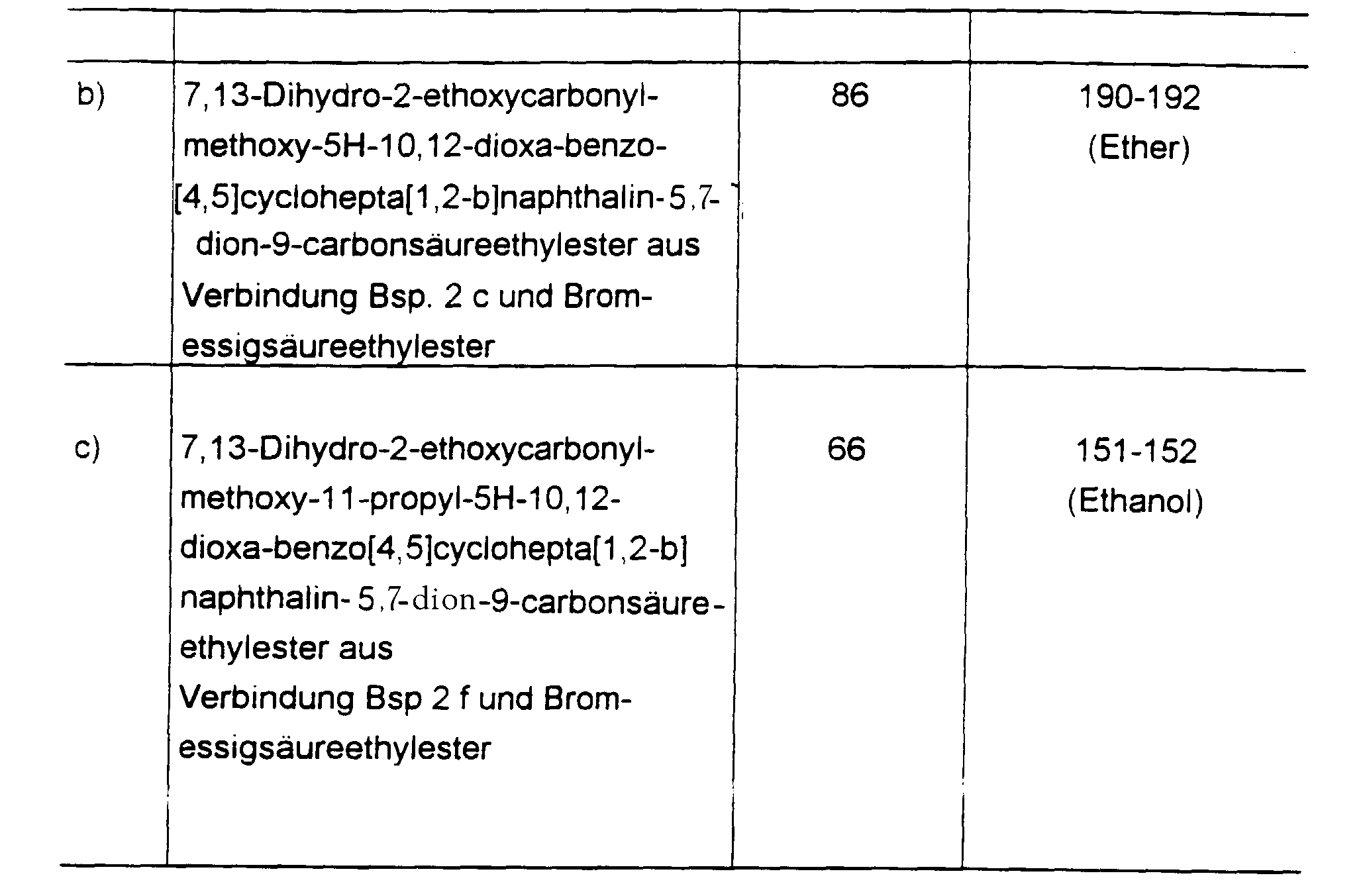
- Zu einer Lösung von 6.65 g (19 mmol) Verbindung des Beispiels 2 b in 150 ml Ethanol gibt man 19 ml N Natronlauge und 30 ml Wasser. erwärmt 30 min auf 70°C, läßt abkühlen und filtriert den Niederschlag ab. Man erhält 5.2 g Titelverbindung (80 % d. Th.) vom Zersetzungspunkt oberhalb 290°C.
- In analoger Weise wie in Beispiel 5 beschrieben erhält man:
Bezeichnung Ausbeute % Schmelzpunkt (Lösungsmittel) a) 7,13-Dihydro-2-hydroxy-5H-10,12-dioxa-benzo[4,5]cyclohepta[1,2-b]naphthalin-5,7-dion-9-carbonsäure-natrium aus Verb. Bsp. 2 c 67 über 280 (Wasser) b) 7,13-Dihydro-2-octyloxy-5H-10,12-dioxa-benzo[4,5]cyclohepta[1,2-b]naphthalin-5,7-dion-9-carbonsäure-natrium aus Verb. Bsp. 3 88 über 280 (Wasser) c) 7,13-Dihydro-2-ethoxycarbonylmethoxy-5H-10,12-dioxabenzo[4,5]cyclohepta[1,2-b]naphthalin-5,7-dion-9-carbonsäure-natrium aus Verb. Bsp. 4 b 56 über 280 (Wasser) d) 7,13-Dihydro-2-methoxy-5H-10,12-dioxa-benzo[4,5]cyclohepta[1,2-b]naphthalin-5,7-dion-9-carbonsäure-natrium aus Verb. Bsp. 2 i 47 über 280 (Wasser) e) 7,12-Dihydro-1H-4,13-dioxa-benzo[4,5]cyclohepta[1,2-a]naphthalin-1,7-dion-3-carbonsäure-natrium aus Verb. Bsp. 1 75 über 280 (Wasser) f) 7,12-Dihydro-10-methoxy-1H-4,13-dioxa-benzo-[4,5]cyclohepta[1,2-a]naphthalin-1,7-dion-3-carbonsäure-natrium aus Verb. Bsp. 2 j 52 über 280 (Wasser) - Zu einer Mischung aus 9.2. g Phosphorpentoxid und 6 ml Ethanol gibt man bei 100°C 3.9 g (11 mmol) 2-Acetyl-4-allyl-6,11-dihydro-3-hydroxy-8-methoxydibenz[b,e]oxepin-11-on, erhitzt 30 min auf 140°C, gießt auf Eis und filtriert. Nach Chromatographie an Kieselgel (Elutionsmittel: Ethylacetat : Isohexan 1:1) isoliert man 0.9 g Titelverbindung (23 % d. Th.) vom Schmp. 159 - 160°C (aus Ether).
- Als Nebenprodukt kann 5-Acetyl-7,12-dihydro-10-methoxy-1H-4,13-dioxabenzo[4,5]cyclohepta[1,2-a]napthalin-7-on nachgewiesen werden.
- Als typischer Repräsentant einer PLA2 wurde die humane rekombinante Typ-II-PLA2 (= synoviale PLA2) zur Testung eingesetzt.
- Die Tabelle enthält die prozentuale in-vitro Hemmung dieses Enzyms durch die beispielhaften Verbindungen der Beispiele 2 a), 2 c) und 4 a). Das Enzym wurde dosisabhängig gehemmt, wobei mit 10µg/ml schon 78,61 und 49 % Hemmung erreicht wurde.
- Demgegenüber sieht man in der Tabelle, daß Indometacin das Enzym zwar auch hemmte, jedoch nur mit maximal 52 % bei der höchsten Konzentration von 100 µg/ml. Hierin dokumentiert sich die Überlegenheit der neuen sPLA2-lnhibitoren gegenüber einem Cyclooxygenasehemmer.
Tabelle: Hemmung der sPLA2-Enzymaktivität durch tetracyclische Dibenzoxepinderivate und Indometacin Substanzen Konzentrationen Bsp. 2 c) Bsp. 2 a) Bsp. 4 a) Indometacin 100 µg/ml n.b. n.b. n.b. 52 10 µg/ml 78 61 49 10 1 µg/ml 73 52 17 0 0,1 µg/ml 12 28 16 n.b. Mittelwerte aus 3 Versuchen (Doppelbestimmungen), n.b. = nicht bestimmt
Claims (4)
- Dibenz[b,e]oxepin-Derivate der Formel I
 Q Wasserstoff, eine Hydroxygruppe oder eine C1 - bis C8-Alkoxygruppe, die gewünschtenfalls mit Carboxyl oder C1- bis C6-Alkoxycarbonyl substituiert sein kann, bedeutet und entwederY und Z gemeinsam eine Gruppe
 X für Wasserstoff, C1- bis C6-Alkyl oder C2- bis C6-Alkenyl steht oderY und X gemeinsam eine Gruppe
 Z für Wasserstoff, C1- bis C6-Alkyl oder C1- bis C6-Alkanoyl steht, wobeiR Wasserstoff oder einen C1- bis C6-Alkylrest bedeutet,sowie deren physiologisch verträgliche Salze.
 - Verfahren zur Herstellung von Dibenz[b,e]oxepin-Derivaten der Formel I,
 Q Wasserstoff, eine Hydroxygruppe oder eine C1 - bis C8-Alkoxygruppe, die gewünschtenfalls mit Carboxyl oder C1- bis C6-Alkoxycarbonyl substituiert sein kann, bedeutet und entwederY und Z gemeinsam eine Gruppe
 X für Wasserstoff, C1- bis C6-Alkyl oder C2- bis C6-Alkenyl steht oderY und X gemeinsam eine Gruppe
 Z für Wasserstoff, C1- bis C6-Alkyl oder C1- bis C6-Alkanoyl steht, wobeiR Wasserstoff oder einen C1- bis C6-Alkylrest bedeutet,sowie deren physiologisch verträgliche Salze,
dadurch gekennzeichnet, daß man in an sich bekannter Weisea) eine Verbindung der Formel II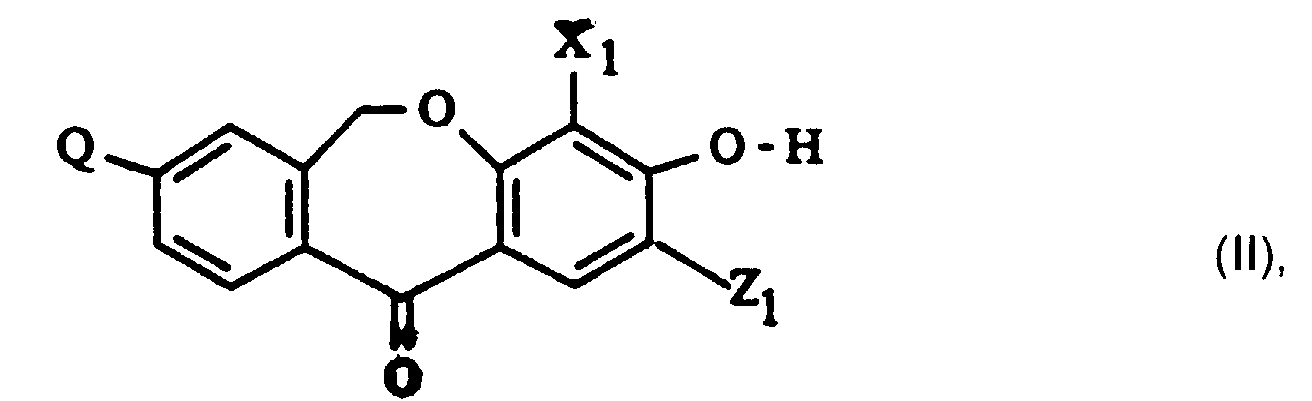
oderb) eine Verbindung der Formel III
und anschließend gewünschtenfalls einen oder mehrere der Reste Q, R, X und Z in einen anderen, durch die Definition gegebenen Rest umwandelt und/oder in ein physiologisch verträgliches Salz überführt. - Arzneimittel, enthaltend mindestens eine Verbindung gemäß Anspruch 1 neben üblichen Träger- und Hilfsstoffen.
- Verwendung von Verbindungen gemäß Anspruch 1 zur Herstellung von Arzneimitteln zur Behandlung akuter und chronischer, allergischer, nichtallergischer und traumatischer und entzündlicher Erkrankungen.
Applications Claiming Priority (3)
| Application Number | Priority Date | Filing Date | Title |
|---|---|---|---|
| DE4336491A DE4336491A1 (de) | 1993-10-26 | 1993-10-26 | Dibenz(b,e)oxepin-Derivate, Verfahren zu ihrer Herstellung und diese enthaltende Arzneimittel |
| DE4336491 | 1993-10-26 | ||
| PCT/EP1994/003479 WO1995011906A1 (de) | 1993-10-26 | 1994-10-22 | DIBENZ[b, e]OXEPINDERIVATE, VERFAHREN ZU IHRER HERSTELLUNG UND DIESE ENTHALTENDE ARZNEIMITTEL |
Publications (2)
| Publication Number | Publication Date |
|---|---|
| EP0725784A1 EP0725784A1 (de) | 1996-08-14 |
| EP0725784B1 true EP0725784B1 (de) | 1997-08-27 |
Family
ID=6501047
Family Applications (1)
| Application Number | Title | Priority Date | Filing Date |
|---|---|---|---|
| EP94931541A Expired - Lifetime EP0725784B1 (de) | 1993-10-26 | 1994-10-22 | DIBENZ[b,e]OXEPINDERIVATE, VERFAHREN ZU IHRER HERSTELLUNG UND DIESE ENTHALTENDE ARZNEIMITTEL |
Country Status (17)
| Country | Link |
|---|---|
| US (1) | US5696155A (de) |
| EP (1) | EP0725784B1 (de) |
| JP (1) | JPH09504282A (de) |
| KR (1) | KR960705829A (de) |
| AT (1) | ATE157364T1 (de) |
| AU (1) | AU678638B2 (de) |
| CA (1) | CA2175070A1 (de) |
| DE (2) | DE4336491A1 (de) |
| ES (1) | ES2109019T3 (de) |
| FI (1) | FI961780A7 (de) |
| HU (1) | HU219226B (de) |
| IL (1) | IL111412A (de) |
| NO (1) | NO961657L (de) |
| NZ (1) | NZ275100A (de) |
| TW (1) | TW293009B (de) |
| WO (1) | WO1995011906A1 (de) |
| ZA (1) | ZA948366B (de) |
Families Citing this family (1)
| Publication number | Priority date | Publication date | Assignee | Title |
|---|---|---|---|---|
| CA2301586A1 (en) * | 1997-08-28 | 1999-03-04 | William Louis Macias | Method for treatment of non-rheumatoid arthritis |
Family Cites Families (1)
| Publication number | Priority date | Publication date | Assignee | Title |
|---|---|---|---|---|
| WO1990003373A1 (fr) * | 1988-09-20 | 1990-04-05 | Hisamitsu Pharmaceutical Co., Inc. | NOUVEAUX DERIVES DE DIBENZ[b,e]OXEPINE |
-
1993
- 1993-10-26 DE DE4336491A patent/DE4336491A1/de not_active Withdrawn
-
1994
- 1994-10-20 TW TW083109728A patent/TW293009B/zh active
- 1994-10-22 EP EP94931541A patent/EP0725784B1/de not_active Expired - Lifetime
- 1994-10-22 AT AT94931541T patent/ATE157364T1/de not_active IP Right Cessation
- 1994-10-22 NZ NZ275100A patent/NZ275100A/en unknown
- 1994-10-22 DE DE59403892T patent/DE59403892D1/de not_active Expired - Fee Related
- 1994-10-22 US US08/632,473 patent/US5696155A/en not_active Expired - Fee Related
- 1994-10-22 FI FI961780A patent/FI961780A7/fi unknown
- 1994-10-22 KR KR1019960702136A patent/KR960705829A/ko not_active Abandoned
- 1994-10-22 CA CA002175070A patent/CA2175070A1/en not_active Abandoned
- 1994-10-22 JP JP7512395A patent/JPH09504282A/ja active Pending
- 1994-10-22 WO PCT/EP1994/003479 patent/WO1995011906A1/de not_active Ceased
- 1994-10-22 HU HU9601088A patent/HU219226B/hu not_active IP Right Cessation
- 1994-10-22 AU AU80594/94A patent/AU678638B2/en not_active Ceased
- 1994-10-22 ES ES94931541T patent/ES2109019T3/es not_active Expired - Lifetime
- 1994-10-25 ZA ZA948366A patent/ZA948366B/xx unknown
- 1994-10-26 IL IL11141294A patent/IL111412A/en not_active IP Right Cessation
-
1996
- 1996-04-25 NO NO961657A patent/NO961657L/no not_active Application Discontinuation
Also Published As
| Publication number | Publication date |
|---|---|
| AU678638B2 (en) | 1997-06-05 |
| US5696155A (en) | 1997-12-09 |
| IL111412A0 (en) | 1994-12-29 |
| NZ275100A (en) | 1998-03-25 |
| DE4336491A1 (de) | 1995-07-13 |
| ATE157364T1 (de) | 1997-09-15 |
| NO961657D0 (no) | 1996-04-25 |
| FI961780L (fi) | 1996-06-25 |
| CA2175070A1 (en) | 1995-05-04 |
| JPH09504282A (ja) | 1997-04-28 |
| AU8059494A (en) | 1995-05-22 |
| FI961780A0 (fi) | 1996-04-25 |
| TW293009B (de) | 1996-12-11 |
| NO961657L (no) | 1996-06-25 |
| WO1995011906A1 (de) | 1995-05-04 |
| ZA948366B (en) | 1995-06-26 |
| HU219226B (en) | 2001-03-28 |
| ES2109019T3 (es) | 1998-01-01 |
| EP0725784A1 (de) | 1996-08-14 |
| DE59403892D1 (de) | 1997-10-02 |
| IL111412A (en) | 1998-10-30 |
| FI961780A7 (fi) | 1996-06-25 |
| HU9601088D0 (en) | 1996-06-28 |
| KR960705829A (ko) | 1996-11-08 |
| HUT74071A (en) | 1996-10-28 |
Similar Documents
| Publication | Publication Date | Title |
|---|---|---|
| EP0287907B1 (de) | Pyrazolo[3,4-d]pyrimidine, Verfahren zu ihrer Herstellung und Verwendung als Arzneimittel | |
| EP0708766B1 (de) | Verwendung von cumarinen als pla 2-inhibitoren, neue cumarine, verfahren zu ihrer herstellung und arzneimittel | |
| EP0434057B1 (de) | Indolocarbazol-Derivate, Verfahren zu deren Herstellung und deren Verwendung | |
| DE69808099T2 (de) | Substituierte 6-alkylphenanthridine | |
| DE2437487A1 (de) | 7-methoxy-6-thia-tetracycline und verfahren zu ihrer herstellung | |
| CH651563A5 (de) | Hydroxyimino-oktahydro-indolo(2,3-a)chinolizin-derivate sowie verfahren zu ihrer herstellung. | |
| EP0064255B1 (de) | Benzopyranylether, Verfahren zu deren Herstellung sowie diese Verbindungen enthaltende Arzneimittel und Zwischenprodukte | |
| EP0725784B1 (de) | DIBENZ[b,e]OXEPINDERIVATE, VERFAHREN ZU IHRER HERSTELLUNG UND DIESE ENTHALTENDE ARZNEIMITTEL | |
| DE3532279A1 (de) | 1,4-benzoxathiin-derivate | |
| DE2617955A1 (de) | Neue l-substituierte -aroyl-4-hydroxypiperidine, verfahren zu ihrer herstellung und sie enthaltende arzneimittel | |
| DE2459629C3 (de) | Pyrimidinoaminoäthylergolin-Derivate, Verfahren zu ihrer Herstellung und pharmazeutisches Mittel | |
| DE2951912C2 (de) | ||
| EP0088986B1 (de) | Bicyclische Phenolether, Verfahren zu deren Herstellung sowie diese Verbindungen enthaltende Arzneimittel | |
| DE2601473A1 (de) | 2,3-dihydroergoline und verfahren zu ihrer herstellung | |
| EP0003558A1 (de) | 9-(3-Piperidinopropyl)-purin-Derivate, Verfahren zu deren Herstellung, deren Verwendung sowie diese Verbindungen enthaltende Arzneimittel | |
| DE2427272A1 (de) | 1-(2-(beta-naphthyloxy)-aethyl)-3-methyl -pyrazolon-(5), verfahren sowie verwendung als antithrombotikum | |
| EP0000471A1 (de) | Neue Kortikoide, Verfahren zu ihrer Herstellung und diese enthaltende pharmazeutische Präparate | |
| DE3107764A1 (de) | N-imidazolyl-derivate von 1-chroman, verfahren zu ihrer herstellung und sie enthaltende pharmazeutische mittel | |
| US4158061A (en) | 2,9-Dioxatricyclo[4,3,1,03,7 ] decane derivatives, processes for their preparation and pharmaceutical compositions thereof | |
| DE2922159A1 (de) | Neue xanthin-derivate, verfahren zu ihrer herstellung und diese verbindungen enthaltende arzneimittel | |
| EP0601002B1 (de) | Bicyclische sulfone, verfahren zu ihrer herstellung und diese enthaltende arzneimittel | |
| EP0643712B1 (de) | Spiro-oxetane, verfahren zu ihrer herstellung und arzneimittel | |
| DE3013346A1 (de) | Dibenz(de,g)isochinolin-derivate, verfahren zu deren herstellung, diese enthaltende arzneimittel sowie deren verwendung bei der bekaempfung von erkrankungen des zentralen nervensystems | |
| DE2215999A1 (de) | Nitroimidazolyl-triazolo-pyridazine und verfahren zu ihrer herstellung | |
| DE2530005B2 (de) | 6,11-dihydrodibenzo eckige klammer auf b,e eckige klammer zu thiepin-derivate und deren salze, verfahren zu ihrer herstellung und diese substanzen enthaltende pharmazeutische zubereitungen |
Legal Events
| Date | Code | Title | Description |
|---|---|---|---|
| PUAI | Public reference made under article 153(3) epc to a published international application that has entered the european phase |
Free format text: ORIGINAL CODE: 0009012 |
|
| 17P | Request for examination filed |
Effective date: 19960528 |
|
| AK | Designated contracting states |
Kind code of ref document: A1 Designated state(s): AT BE CH DE DK ES FR GB GR IE IT LI LU NL PT SE |
|
| GRAG | Despatch of communication of intention to grant |
Free format text: ORIGINAL CODE: EPIDOS AGRA |
|
| 17Q | First examination report despatched |
Effective date: 19960903 |
|
| GRAH | Despatch of communication of intention to grant a patent |
Free format text: ORIGINAL CODE: EPIDOS IGRA |
|
| GRAH | Despatch of communication of intention to grant a patent |
Free format text: ORIGINAL CODE: EPIDOS IGRA |
|
| GRAA | (expected) grant |
Free format text: ORIGINAL CODE: 0009210 |
|
| AK | Designated contracting states |
Kind code of ref document: B1 Designated state(s): AT BE CH DE DK ES FR GB GR IE IT LI LU NL PT SE |
|
| PG25 | Lapsed in a contracting state [announced via postgrant information from national office to epo] |
Ref country code: NL Free format text: LAPSE BECAUSE OF FAILURE TO SUBMIT A TRANSLATION OF THE DESCRIPTION OR TO PAY THE FEE WITHIN THE PRESCRIBED TIME-LIMIT Effective date: 19970827 Ref country code: GR Free format text: LAPSE BECAUSE OF FAILURE TO SUBMIT A TRANSLATION OF THE DESCRIPTION OR TO PAY THE FEE WITHIN THE PRESCRIBED TIME-LIMIT Effective date: 19970827 Ref country code: DK Free format text: LAPSE BECAUSE OF NON-PAYMENT OF DUE FEES Effective date: 19970827 |
|
| REF | Corresponds to: |
Ref document number: 157364 Country of ref document: AT Date of ref document: 19970915 Kind code of ref document: T |
|
| REG | Reference to a national code |
Ref country code: CH Ref legal event code: EP |
|
| REF | Corresponds to: |
Ref document number: 59403892 Country of ref document: DE Date of ref document: 19971002 |
|
| REG | Reference to a national code |
Ref country code: CH Ref legal event code: NV Representative=s name: A. BRAUN, BRAUN, HERITIER, ESCHMANN AG PATENTANWAE |
|
| PG25 | Lapsed in a contracting state [announced via postgrant information from national office to epo] |
Ref country code: LU Free format text: LAPSE BECAUSE OF NON-PAYMENT OF DUE FEES Effective date: 19971031 Ref country code: BE Free format text: LAPSE BECAUSE OF NON-PAYMENT OF DUE FEES Effective date: 19971031 |
|
| ITF | It: translation for a ep patent filed | ||
| ET | Fr: translation filed | ||
| PG25 | Lapsed in a contracting state [announced via postgrant information from national office to epo] |
Ref country code: SE Effective date: 19971127 Ref country code: PT Effective date: 19971127 |
|
| GBT | Gb: translation of ep patent filed (gb section 77(6)(a)/1977) |
Effective date: 19971106 |
|
| REG | Reference to a national code |
Ref country code: ES Ref legal event code: FG2A Ref document number: 2109019 Country of ref document: ES Kind code of ref document: T3 |
|
| NLV1 | Nl: lapsed or annulled due to failure to fulfill the requirements of art. 29p and 29m of the patents act | ||
| BERE | Be: lapsed |
Owner name: BOEHRINGER MANNHEIM G.M.B.H. Effective date: 19971031 |
|
| REG | Reference to a national code |
Ref country code: IE Ref legal event code: FD4D Ref document number: 76105 Country of ref document: IE |
|
| PLBE | No opposition filed within time limit |
Free format text: ORIGINAL CODE: 0009261 |
|
| STAA | Information on the status of an ep patent application or granted ep patent |
Free format text: STATUS: NO OPPOSITION FILED WITHIN TIME LIMIT |
|
| 26N | No opposition filed | ||
| PGFP | Annual fee paid to national office [announced via postgrant information from national office to epo] |
Ref country code: FR Payment date: 20011010 Year of fee payment: 8 |
|
| PGFP | Annual fee paid to national office [announced via postgrant information from national office to epo] |
Ref country code: AT Payment date: 20011011 Year of fee payment: 8 |
|
| PGFP | Annual fee paid to national office [announced via postgrant information from national office to epo] |
Ref country code: GB Payment date: 20011024 Year of fee payment: 8 |
|
| PGFP | Annual fee paid to national office [announced via postgrant information from national office to epo] |
Ref country code: ES Payment date: 20011025 Year of fee payment: 8 |
|
| PGFP | Annual fee paid to national office [announced via postgrant information from national office to epo] |
Ref country code: DE Payment date: 20011105 Year of fee payment: 8 |
|
| PGFP | Annual fee paid to national office [announced via postgrant information from national office to epo] |
Ref country code: CH Payment date: 20011114 Year of fee payment: 8 |
|
| REG | Reference to a national code |
Ref country code: GB Ref legal event code: IF02 |
|
| PG25 | Lapsed in a contracting state [announced via postgrant information from national office to epo] |
Ref country code: GB Free format text: LAPSE BECAUSE OF NON-PAYMENT OF DUE FEES Effective date: 20021022 Ref country code: AT Free format text: LAPSE BECAUSE OF NON-PAYMENT OF DUE FEES Effective date: 20021022 |
|
| PG25 | Lapsed in a contracting state [announced via postgrant information from national office to epo] |
Ref country code: ES Free format text: LAPSE BECAUSE OF NON-PAYMENT OF DUE FEES Effective date: 20021023 |
|
| PG25 | Lapsed in a contracting state [announced via postgrant information from national office to epo] |
Ref country code: LI Free format text: LAPSE BECAUSE OF NON-PAYMENT OF DUE FEES Effective date: 20021031 Ref country code: CH Free format text: LAPSE BECAUSE OF NON-PAYMENT OF DUE FEES Effective date: 20021031 |
|
| PG25 | Lapsed in a contracting state [announced via postgrant information from national office to epo] |
Ref country code: DE Free format text: LAPSE BECAUSE OF NON-PAYMENT OF DUE FEES Effective date: 20030501 |
|
| GBPC | Gb: european patent ceased through non-payment of renewal fee |
Effective date: 20021022 |
|
| REG | Reference to a national code |
Ref country code: CH Ref legal event code: PL |
|
| PG25 | Lapsed in a contracting state [announced via postgrant information from national office to epo] |
Ref country code: FR Free format text: LAPSE BECAUSE OF NON-PAYMENT OF DUE FEES Effective date: 20030630 |
|
| REG | Reference to a national code |
Ref country code: FR Ref legal event code: ST |
|
| REG | Reference to a national code |
Ref country code: ES Ref legal event code: FD2A Effective date: 20031112 |
|
| PG25 | Lapsed in a contracting state [announced via postgrant information from national office to epo] |
Ref country code: IT Free format text: LAPSE BECAUSE OF NON-PAYMENT OF DUE FEES Effective date: 20051022 |