EP0728739A1 - Composés bi-aromatiques dérivés d'amide, compositions pharmaceutiques et cosmétiques les contenant et utilisations - Google Patents
Composés bi-aromatiques dérivés d'amide, compositions pharmaceutiques et cosmétiques les contenant et utilisations Download PDFInfo
- Publication number
- EP0728739A1 EP0728739A1 EP96400251A EP96400251A EP0728739A1 EP 0728739 A1 EP0728739 A1 EP 0728739A1 EP 96400251 A EP96400251 A EP 96400251A EP 96400251 A EP96400251 A EP 96400251A EP 0728739 A1 EP0728739 A1 EP 0728739A1
- Authority
- EP
- European Patent Office
- Prior art keywords
- radical
- tetrahydro
- tetramethyl
- naphthyl
- acetamido
- Prior art date
- Legal status (The legal status is an assumption and is not a legal conclusion. Google has not performed a legal analysis and makes no representation as to the accuracy of the status listed.)
- Granted
Links
- 239000000203 mixture Substances 0.000 title claims description 47
- 239000002537 cosmetic Substances 0.000 title claims description 11
- 150000001408 amides Chemical class 0.000 title claims description 5
- 150000003839 salts Chemical class 0.000 claims abstract description 12
- 125000005843 halogen group Chemical group 0.000 claims abstract description 9
- 230000003287 optical effect Effects 0.000 claims abstract description 7
- 125000003118 aryl group Chemical group 0.000 claims abstract description 6
- 150000005840 aryl radicals Chemical class 0.000 claims abstract description 5
- 125000000623 heterocyclic group Chemical group 0.000 claims abstract description 4
- 229910052760 oxygen Inorganic materials 0.000 claims abstract description 3
- 229910052717 sulfur Inorganic materials 0.000 claims abstract description 3
- -1 alkyl radical Chemical class 0.000 claims description 157
- WPYMKLBDIGXBTP-UHFFFAOYSA-N benzoic acid Chemical compound OC(=O)C1=CC=CC=C1 WPYMKLBDIGXBTP-UHFFFAOYSA-N 0.000 claims description 137
- 150000003254 radicals Chemical group 0.000 claims description 97
- 125000000738 acetamido group Chemical group [H]C([H])([H])C(=O)N([H])[*] 0.000 claims description 92
- 150000001875 compounds Chemical class 0.000 claims description 66
- 239000005711 Benzoic acid Substances 0.000 claims description 53
- 235000010233 benzoic acid Nutrition 0.000 claims description 53
- 125000004435 hydrogen atom Chemical group [H]* 0.000 claims description 19
- 125000004432 carbon atom Chemical group C* 0.000 claims description 13
- 125000002496 methyl group Chemical group [H]C([H])([H])* 0.000 claims description 10
- 229920001577 copolymer Chemical class 0.000 claims description 9
- 108090000765 processed proteins & peptides Proteins 0.000 claims description 8
- 239000003814 drug Substances 0.000 claims description 7
- 235000001014 amino acid Nutrition 0.000 claims description 5
- 150000001413 amino acids Chemical class 0.000 claims description 5
- 125000002887 hydroxy group Chemical group [H]O* 0.000 claims description 5
- DHMQDGOQFOQNFH-UHFFFAOYSA-N Glycine Chemical compound NCC(O)=O DHMQDGOQFOQNFH-UHFFFAOYSA-N 0.000 claims description 4
- 229910052784 alkaline earth metal Inorganic materials 0.000 claims description 4
- 125000001797 benzyl group Chemical group [H]C1=C([H])C([H])=C(C([H])=C1[H])C([H])([H])* 0.000 claims description 4
- 125000001495 ethyl group Chemical group [H]C([H])([H])C([H])([H])* 0.000 claims description 4
- 125000000449 nitro group Chemical group [O-][N+](*)=O 0.000 claims description 4
- 125000003107 substituted aryl group Chemical group 0.000 claims description 4
- 125000000999 tert-butyl group Chemical group [H]C([H])([H])C(*)(C([H])([H])[H])C([H])([H])[H] 0.000 claims description 4
- 150000001412 amines Chemical class 0.000 claims description 3
- 125000001449 isopropyl group Chemical group [H]C([H])([H])C([H])(*)C([H])([H])[H] 0.000 claims description 3
- 239000008194 pharmaceutical composition Substances 0.000 claims description 3
- 230000000241 respiratory effect Effects 0.000 claims description 3
- 125000000954 2-hydroxyethyl group Chemical group [H]C([*])([H])C([H])([H])O[H] 0.000 claims description 2
- WKBOTKDWSSQWDR-UHFFFAOYSA-N Bromine atom Chemical compound [Br] WKBOTKDWSSQWDR-UHFFFAOYSA-N 0.000 claims description 2
- WQZGKKKJIJFFOK-QTVWNMPRSA-N D-mannopyranose Chemical compound OC[C@H]1OC(O)[C@@H](O)[C@@H](O)[C@@H]1O WQZGKKKJIJFFOK-QTVWNMPRSA-N 0.000 claims description 2
- MYMOFIZGZYHOMD-UHFFFAOYSA-N Dioxygen Chemical compound O=O MYMOFIZGZYHOMD-UHFFFAOYSA-N 0.000 claims description 2
- 108010016626 Dipeptides Proteins 0.000 claims description 2
- SNRUBQQJIBEYMU-UHFFFAOYSA-N Dodecane Natural products CCCCCCCCCCCC SNRUBQQJIBEYMU-UHFFFAOYSA-N 0.000 claims description 2
- IAJILQKETJEXLJ-UHFFFAOYSA-N Galacturonsaeure Natural products O=CC(O)C(O)C(O)C(O)C(O)=O IAJILQKETJEXLJ-UHFFFAOYSA-N 0.000 claims description 2
- WQZGKKKJIJFFOK-GASJEMHNSA-N Glucose Natural products OC[C@H]1OC(O)[C@H](O)[C@@H](O)[C@@H]1O WQZGKKKJIJFFOK-GASJEMHNSA-N 0.000 claims description 2
- 239000004471 Glycine Substances 0.000 claims description 2
- CKLJMWTZIZZHCS-REOHCLBHSA-N L-aspartic acid Chemical compound OC(=O)[C@@H](N)CC(O)=O CKLJMWTZIZZHCS-REOHCLBHSA-N 0.000 claims description 2
- KDXKERNSBIXSRK-YFKPBYRVSA-N L-lysine Chemical compound NCCCC[C@H](N)C(O)=O KDXKERNSBIXSRK-YFKPBYRVSA-N 0.000 claims description 2
- KDXKERNSBIXSRK-UHFFFAOYSA-N Lysine Natural products NCCCCC(N)C(O)=O KDXKERNSBIXSRK-UHFFFAOYSA-N 0.000 claims description 2
- 239000004472 Lysine Substances 0.000 claims description 2
- HCHKCACWOHOZIP-UHFFFAOYSA-N Zinc Chemical compound [Zn] HCHKCACWOHOZIP-UHFFFAOYSA-N 0.000 claims description 2
- CIUQDSCDWFSTQR-UHFFFAOYSA-N [C]1=CC=CC=C1 Chemical compound [C]1=CC=CC=C1 CIUQDSCDWFSTQR-UHFFFAOYSA-N 0.000 claims description 2
- IAJILQKETJEXLJ-QTBDOELSSA-N aldehydo-D-glucuronic acid Chemical compound O=C[C@H](O)[C@@H](O)[C@H](O)[C@H](O)C(O)=O IAJILQKETJEXLJ-QTBDOELSSA-N 0.000 claims description 2
- 239000003513 alkali Substances 0.000 claims description 2
- 150000001342 alkaline earth metals Chemical class 0.000 claims description 2
- RMRFFCXPLWYOOY-UHFFFAOYSA-N allyl radical Chemical compound [CH2]C=C RMRFFCXPLWYOOY-UHFFFAOYSA-N 0.000 claims description 2
- WQZGKKKJIJFFOK-PHYPRBDBSA-N alpha-D-galactose Chemical compound OC[C@H]1O[C@H](O)[C@H](O)[C@@H](O)[C@H]1O WQZGKKKJIJFFOK-PHYPRBDBSA-N 0.000 claims description 2
- 125000000539 amino acid group Chemical group 0.000 claims description 2
- 235000003704 aspartic acid Nutrition 0.000 claims description 2
- WQZGKKKJIJFFOK-VFUOTHLCSA-N beta-D-glucose Chemical compound OC[C@H]1O[C@@H](O)[C@H](O)[C@@H](O)[C@@H]1O WQZGKKKJIJFFOK-VFUOTHLCSA-N 0.000 claims description 2
- OQFSQFPPLPISGP-UHFFFAOYSA-N beta-carboxyaspartic acid Natural products OC(=O)C(N)C(C(O)=O)C(O)=O OQFSQFPPLPISGP-UHFFFAOYSA-N 0.000 claims description 2
- 125000000484 butyl group Chemical group [H]C([*])([H])C([H])([H])C([H])([H])C([H])([H])[H] 0.000 claims description 2
- 239000000460 chlorine Substances 0.000 claims description 2
- 229910052801 chlorine Inorganic materials 0.000 claims description 2
- 125000003438 dodecyl group Chemical group [H]C([H])([H])C([H])([H])C([H])([H])C([H])([H])C([H])([H])C([H])([H])C([H])([H])C([H])([H])C([H])([H])C([H])([H])C([H])([H])C([H])([H])* 0.000 claims description 2
- 239000003937 drug carrier Substances 0.000 claims description 2
- 229910052731 fluorine Inorganic materials 0.000 claims description 2
- 239000011737 fluorine Substances 0.000 claims description 2
- 229930182830 galactose Natural products 0.000 claims description 2
- 239000008103 glucose Substances 0.000 claims description 2
- 229940097043 glucuronic acid Drugs 0.000 claims description 2
- 239000001301 oxygen Substances 0.000 claims description 2
- 125000000913 palmityl group Chemical group [H]C([*])([H])C([H])([H])C([H])([H])C([H])([H])C([H])([H])C([H])([H])C([H])([H])C([H])([H])C([H])([H])C([H])([H])C([H])([H])C([H])([H])C([H])([H])C([H])([H])C([H])([H])C([H])([H])[H] 0.000 claims description 2
- WXZMFSXDPGVJKK-UHFFFAOYSA-N pentaerythritol Chemical compound OCC(CO)(CO)CO WXZMFSXDPGVJKK-UHFFFAOYSA-N 0.000 claims description 2
- 125000001436 propyl group Chemical group [H]C([*])([H])C([H])([H])C([H])([H])[H] 0.000 claims description 2
- 125000004434 sulfur atom Chemical group 0.000 claims description 2
- 229910052725 zinc Inorganic materials 0.000 claims description 2
- 239000011701 zinc Substances 0.000 claims description 2
- 208000025747 Rheumatic disease Diseases 0.000 claims 2
- 230000002526 effect on cardiovascular system Effects 0.000 claims 2
- 230000000552 rheumatic effect Effects 0.000 claims 2
- ZAMOUSCENKQFHK-UHFFFAOYSA-N Chlorine atom Chemical compound [Cl] ZAMOUSCENKQFHK-UHFFFAOYSA-N 0.000 claims 1
- PXGOKWXKJXAPGV-UHFFFAOYSA-N Fluorine Chemical compound FF PXGOKWXKJXAPGV-UHFFFAOYSA-N 0.000 claims 1
- GDTBXPJZTBHREO-UHFFFAOYSA-N bromine Substances BrBr GDTBXPJZTBHREO-UHFFFAOYSA-N 0.000 claims 1
- 229910052794 bromium Inorganic materials 0.000 claims 1
- 238000004519 manufacturing process Methods 0.000 claims 1
- 125000004079 stearyl group Chemical group [H]C([*])([H])C([H])([H])C([H])([H])C([H])([H])C([H])([H])C([H])([H])C([H])([H])C([H])([H])C([H])([H])C([H])([H])C([H])([H])C([H])([H])C([H])([H])C([H])([H])C([H])([H])C([H])([H])C([H])([H])C([H])([H])[H] 0.000 claims 1
- 125000000217 alkyl group Chemical group 0.000 abstract 6
- 101100134927 Gallus gallus COR8 gene Proteins 0.000 abstract 2
- 125000003342 alkenyl group Chemical group 0.000 abstract 1
- YMWUJEATGCHHMB-UHFFFAOYSA-N Dichloromethane Chemical compound ClCCl YMWUJEATGCHHMB-UHFFFAOYSA-N 0.000 description 73
- VYPSYNLAJGMNEJ-UHFFFAOYSA-N Silicium dioxide Chemical compound O=[Si]=O VYPSYNLAJGMNEJ-UHFFFAOYSA-N 0.000 description 45
- RTZKZFJDLAIYFH-UHFFFAOYSA-N Diethyl ether Chemical compound CCOCC RTZKZFJDLAIYFH-UHFFFAOYSA-N 0.000 description 32
- 239000002253 acid Substances 0.000 description 30
- LYJHVEDILOKZCG-UHFFFAOYSA-N Allyl benzoate Chemical compound C=CCOC(=O)C1=CC=CC=C1 LYJHVEDILOKZCG-UHFFFAOYSA-N 0.000 description 27
- 239000000377 silicon dioxide Substances 0.000 description 22
- 230000008018 melting Effects 0.000 description 21
- 238000002844 melting Methods 0.000 description 21
- 238000006243 chemical reaction Methods 0.000 description 19
- CSNNHWWHGAXBCP-UHFFFAOYSA-L Magnesium sulfate Chemical compound [Mg+2].[O-][S+2]([O-])([O-])[O-] CSNNHWWHGAXBCP-UHFFFAOYSA-L 0.000 description 18
- 238000004587 chromatography analysis Methods 0.000 description 18
- XLYOFNOQVPJJNP-UHFFFAOYSA-N water Chemical compound O XLYOFNOQVPJJNP-UHFFFAOYSA-N 0.000 description 15
- LFQSCWFLJHTTHZ-UHFFFAOYSA-N Ethanol Chemical compound CCO LFQSCWFLJHTTHZ-UHFFFAOYSA-N 0.000 description 14
- IMNFDUFMRHMDMM-UHFFFAOYSA-N N-Heptane Chemical compound CCCCCCC IMNFDUFMRHMDMM-UHFFFAOYSA-N 0.000 description 14
- 239000002904 solvent Substances 0.000 description 14
- 208000037265 diseases, disorders, signs and symptoms Diseases 0.000 description 12
- VLKZOEOYAKHREP-UHFFFAOYSA-N n-Hexane Chemical compound CCCCCC VLKZOEOYAKHREP-UHFFFAOYSA-N 0.000 description 12
- 125000003903 2-propenyl group Chemical group [H]C([*])([H])C([H])=C([H])[H] 0.000 description 11
- HEMHJVSKTPXQMS-UHFFFAOYSA-M sodium hydroxide Inorganic materials [OH-].[Na+] HEMHJVSKTPXQMS-UHFFFAOYSA-M 0.000 description 11
- 239000012074 organic phase Substances 0.000 description 10
- 238000000746 purification Methods 0.000 description 10
- 239000012429 reaction media Substances 0.000 description 10
- OKKJLVBELUTLKV-UHFFFAOYSA-N Methanol Chemical compound OC OKKJLVBELUTLKV-UHFFFAOYSA-N 0.000 description 9
- 229910052943 magnesium sulfate Inorganic materials 0.000 description 9
- 235000019341 magnesium sulphate Nutrition 0.000 description 9
- VEXZGXHMUGYJMC-UHFFFAOYSA-N Hydrochloric acid Chemical compound Cl VEXZGXHMUGYJMC-UHFFFAOYSA-N 0.000 description 8
- 239000012230 colorless oil Substances 0.000 description 8
- 208000035475 disorder Diseases 0.000 description 8
- 239000003921 oil Substances 0.000 description 8
- NGNBDVOYPDDBFK-UHFFFAOYSA-N 2-[2,4-di(pentan-2-yl)phenoxy]acetyl chloride Chemical compound CCCC(C)C1=CC=C(OCC(Cl)=O)C(C(C)CCC)=C1 NGNBDVOYPDDBFK-UHFFFAOYSA-N 0.000 description 7
- 208000002874 Acne Vulgaris Diseases 0.000 description 7
- KDLHZDBZIXYQEI-UHFFFAOYSA-N Palladium Chemical compound [Pd] KDLHZDBZIXYQEI-UHFFFAOYSA-N 0.000 description 7
- 206010000496 acne Diseases 0.000 description 7
- 239000003795 chemical substances by application Substances 0.000 description 7
- 150000002148 esters Chemical group 0.000 description 7
- 235000019441 ethanol Nutrition 0.000 description 7
- 239000000243 solution Substances 0.000 description 7
- 230000000699 topical effect Effects 0.000 description 7
- ZWEHNKRNPOVVGH-UHFFFAOYSA-N 2-Butanone Chemical compound CCC(C)=O ZWEHNKRNPOVVGH-UHFFFAOYSA-N 0.000 description 6
- QDTVGDHZIDYETA-UHFFFAOYSA-N 2-oxo-2-(5,5,8,8-tetramethyl-6,7-dihydronaphthalen-2-yl)acetic acid Chemical compound OC(=O)C(=O)C1=CC=C2C(C)(C)CCC(C)(C)C2=C1 QDTVGDHZIDYETA-UHFFFAOYSA-N 0.000 description 6
- IJGRMHOSHXDMSA-UHFFFAOYSA-N Atomic nitrogen Chemical compound N#N IJGRMHOSHXDMSA-UHFFFAOYSA-N 0.000 description 6
- QPJVMBTYPHYUOC-UHFFFAOYSA-N Methyl benzoate Natural products COC(=O)C1=CC=CC=C1 QPJVMBTYPHYUOC-UHFFFAOYSA-N 0.000 description 6
- YNAVUWVOSKDBBP-UHFFFAOYSA-N Morpholine Chemical compound C1COCCN1 YNAVUWVOSKDBBP-UHFFFAOYSA-N 0.000 description 6
- 241001080024 Telles Species 0.000 description 6
- ZMANZCXQSJIPKH-UHFFFAOYSA-N Triethylamine Chemical compound CCN(CC)CC ZMANZCXQSJIPKH-UHFFFAOYSA-N 0.000 description 6
- 238000001704 evaporation Methods 0.000 description 6
- 230000008020 evaporation Effects 0.000 description 6
- 239000000047 product Substances 0.000 description 6
- 210000003491 skin Anatomy 0.000 description 6
- FYSNRJHAOHDILO-UHFFFAOYSA-N thionyl chloride Chemical compound ClS(Cl)=O FYSNRJHAOHDILO-UHFFFAOYSA-N 0.000 description 6
- PEDCQBHIVMGVHV-UHFFFAOYSA-N Glycerine Chemical compound OCC(O)CO PEDCQBHIVMGVHV-UHFFFAOYSA-N 0.000 description 5
- 229940095102 methyl benzoate Drugs 0.000 description 5
- 239000002674 ointment Substances 0.000 description 5
- PAYRUJLWNCNPSJ-UHFFFAOYSA-N Aniline Chemical compound NC1=CC=CC=C1 PAYRUJLWNCNPSJ-UHFFFAOYSA-N 0.000 description 4
- 206010003645 Atopy Diseases 0.000 description 4
- XBPCUCUWBYBCDP-UHFFFAOYSA-N Dicyclohexylamine Chemical compound C1CCCCC1NC1CCCCC1 XBPCUCUWBYBCDP-UHFFFAOYSA-N 0.000 description 4
- 230000032683 aging Effects 0.000 description 4
- 230000004069 differentiation Effects 0.000 description 4
- 201000010099 disease Diseases 0.000 description 4
- 230000000694 effects Effects 0.000 description 4
- NFHFRUOZVGFOOS-UHFFFAOYSA-N palladium;triphenylphosphane Chemical compound [Pd].C1=CC=CC=C1P(C=1C=CC=CC=1)C1=CC=CC=C1.C1=CC=CC=C1P(C=1C=CC=CC=1)C1=CC=CC=C1.C1=CC=CC=C1P(C=1C=CC=CC=1)C1=CC=CC=C1.C1=CC=CC=C1P(C=1C=CC=CC=1)C1=CC=CC=C1 NFHFRUOZVGFOOS-UHFFFAOYSA-N 0.000 description 4
- 230000035755 proliferation Effects 0.000 description 4
- GVJHHUAWPYXKBD-IEOSBIPESA-N α-tocopherol Chemical compound OC1=C(C)C(C)=C2O[C@@](CCC[C@H](C)CCC[C@H](C)CCCC(C)C)(C)CCC2=C1C GVJHHUAWPYXKBD-IEOSBIPESA-N 0.000 description 4
- RYHBNJHYFVUHQT-UHFFFAOYSA-N 1,4-Dioxane Chemical compound C1COCCO1 RYHBNJHYFVUHQT-UHFFFAOYSA-N 0.000 description 3
- 206010003694 Atrophy Diseases 0.000 description 3
- OKTJSMMVPCPJKN-UHFFFAOYSA-N Carbon Chemical compound [C] OKTJSMMVPCPJKN-UHFFFAOYSA-N 0.000 description 3
- IAZDPXIOMUYVGZ-UHFFFAOYSA-N Dimethylsulphoxide Chemical compound CS(C)=O IAZDPXIOMUYVGZ-UHFFFAOYSA-N 0.000 description 3
- 102000004310 Ion Channels Human genes 0.000 description 3
- WMFOQBRAJBCJND-UHFFFAOYSA-M Lithium hydroxide Chemical compound [Li+].[OH-] WMFOQBRAJBCJND-UHFFFAOYSA-M 0.000 description 3
- DNIAPMSPPWPWGF-UHFFFAOYSA-N Propylene glycol Chemical compound CC(O)CO DNIAPMSPPWPWGF-UHFFFAOYSA-N 0.000 description 3
- YXFVVABEGXRONW-UHFFFAOYSA-N Toluene Chemical compound CC1=CC=CC=C1 YXFVVABEGXRONW-UHFFFAOYSA-N 0.000 description 3
- XSQUKJJJFZCRTK-UHFFFAOYSA-N Urea Chemical compound NC(N)=O XSQUKJJJFZCRTK-UHFFFAOYSA-N 0.000 description 3
- 239000000654 additive Substances 0.000 description 3
- 230000001476 alcoholic effect Effects 0.000 description 3
- 150000001280 alpha hydroxy acids Chemical group 0.000 description 3
- 150000004716 alpha keto acids Chemical class 0.000 description 3
- 125000004429 atom Chemical group 0.000 description 3
- 230000015572 biosynthetic process Effects 0.000 description 3
- 239000003054 catalyst Substances 0.000 description 3
- 239000003246 corticosteroid Substances 0.000 description 3
- 229960001334 corticosteroids Drugs 0.000 description 3
- 230000002500 effect on skin Effects 0.000 description 3
- 229940082150 encore Drugs 0.000 description 3
- 230000003780 keratinization Effects 0.000 description 3
- 150000002632 lipids Chemical class 0.000 description 3
- 239000006210 lotion Substances 0.000 description 3
- 235000010270 methyl p-hydroxybenzoate Nutrition 0.000 description 3
- 239000004292 methyl p-hydroxybenzoate Substances 0.000 description 3
- LXCFILQKKLGQFO-UHFFFAOYSA-N methylparaben Chemical compound COC(=O)C1=CC=C(O)C=C1 LXCFILQKKLGQFO-UHFFFAOYSA-N 0.000 description 3
- 229960002216 methylparaben Drugs 0.000 description 3
- 239000004005 microsphere Substances 0.000 description 3
- 239000002077 nanosphere Substances 0.000 description 3
- 229910052757 nitrogen Inorganic materials 0.000 description 3
- 230000002265 prevention Effects 0.000 description 3
- 239000000725 suspension Substances 0.000 description 3
- 238000003786 synthesis reaction Methods 0.000 description 3
- 238000012360 testing method Methods 0.000 description 3
- 230000003612 virological effect Effects 0.000 description 3
- 235000019166 vitamin D Nutrition 0.000 description 3
- 239000011710 vitamin D Substances 0.000 description 3
- VBICKXHEKHSIBG-UHFFFAOYSA-N 1-monostearoylglycerol Chemical compound CCCCCCCCCCCCCCCCCC(=O)OCC(O)CO VBICKXHEKHSIBG-UHFFFAOYSA-N 0.000 description 2
- FIRPQROFHOWVAG-UHFFFAOYSA-N 2-(5,5,8,8-tetramethyl-6,7-dihydronaphthalen-2-yl)non-2-enoic acid Chemical compound CC1(C)CCC(C)(C)C=2C1=CC(C(C(O)=O)=CCCCCCC)=CC=2 FIRPQROFHOWVAG-UHFFFAOYSA-N 0.000 description 2
- AUNHUPNBHLSJNM-UHFFFAOYSA-N 2-oxo-2-(5,5,8,8-tetramethyl-6,7-dihydronaphthalen-2-yl)acetyl chloride Chemical compound ClC(=O)C(=O)C1=CC=C2C(C)(C)CCC(C)(C)C2=C1 AUNHUPNBHLSJNM-UHFFFAOYSA-N 0.000 description 2
- ZIMGGGWCDYVHOY-UHFFFAOYSA-N 3-hydroxy-2-imino-6-(1-piperidinyl)-4-pyrimidinamine Chemical compound N=C1N(O)C(N)=CC(N2CCCCC2)=N1 ZIMGGGWCDYVHOY-UHFFFAOYSA-N 0.000 description 2
- FJKROLUGYXJWQN-UHFFFAOYSA-N 4-hydroxybenzoic acid Chemical compound OC(=O)C1=CC=C(O)C=C1 FJKROLUGYXJWQN-UHFFFAOYSA-N 0.000 description 2
- MMXRRNUXCHUHOE-UHFFFAOYSA-N 7-bromoheptan-1-ol Chemical compound OCCCCCCCBr MMXRRNUXCHUHOE-UHFFFAOYSA-N 0.000 description 2
- ULGZDMOVFRHVEP-RWJQBGPGSA-N Erythromycin Chemical compound O([C@@H]1[C@@H](C)C(=O)O[C@@H]([C@@]([C@H](O)[C@@H](C)C(=O)[C@H](C)C[C@@](C)(O)[C@H](O[C@H]2[C@@H]([C@H](C[C@@H](C)O2)N(C)C)O)[C@H]1C)(C)O)CC)[C@H]1C[C@@](C)(OC)[C@@H](O)[C@H](C)O1 ULGZDMOVFRHVEP-RWJQBGPGSA-N 0.000 description 2
- QIGBRXMKCJKVMJ-UHFFFAOYSA-N Hydroquinone Chemical compound OC1=CC=C(O)C=C1 QIGBRXMKCJKVMJ-UHFFFAOYSA-N 0.000 description 2
- WTDHULULXKLSOZ-UHFFFAOYSA-N Hydroxylamine hydrochloride Chemical compound Cl.ON WTDHULULXKLSOZ-UHFFFAOYSA-N 0.000 description 2
- DGAQECJNVWCQMB-PUAWFVPOSA-M Ilexoside XXIX Chemical compound C[C@@H]1CC[C@@]2(CC[C@@]3(C(=CC[C@H]4[C@]3(CC[C@@H]5[C@@]4(CC[C@@H](C5(C)C)OS(=O)(=O)[O-])C)C)[C@@H]2[C@]1(C)O)C)C(=O)O[C@H]6[C@@H]([C@H]([C@@H]([C@H](O6)CO)O)O)O.[Na+] DGAQECJNVWCQMB-PUAWFVPOSA-M 0.000 description 2
- ZFMITUMMTDLWHR-UHFFFAOYSA-N Minoxidil Chemical compound NC1=[N+]([O-])C(N)=CC(N2CCCCC2)=N1 ZFMITUMMTDLWHR-UHFFFAOYSA-N 0.000 description 2
- 241000699666 Mus <mouse, genus> Species 0.000 description 2
- 208000001132 Osteoporosis Diseases 0.000 description 2
- 208000012641 Pigmentation disease Diseases 0.000 description 2
- 229920002565 Polyethylene Glycol 400 Polymers 0.000 description 2
- 201000004681 Psoriasis Diseases 0.000 description 2
- DTQVDTLACAAQTR-UHFFFAOYSA-N Trifluoroacetic acid Chemical compound OC(=O)C(F)(F)F DTQVDTLACAAQTR-UHFFFAOYSA-N 0.000 description 2
- 125000000746 allylic group Chemical group 0.000 description 2
- 229940087168 alpha tocopherol Drugs 0.000 description 2
- VSCWAEJMTAWNJL-UHFFFAOYSA-K aluminium trichloride Chemical compound Cl[Al](Cl)Cl VSCWAEJMTAWNJL-UHFFFAOYSA-K 0.000 description 2
- 208000010668 atopic eczema Diseases 0.000 description 2
- 210000004027 cell Anatomy 0.000 description 2
- 238000013270 controlled release Methods 0.000 description 2
- 239000006071 cream Substances 0.000 description 2
- GDLBFKVLRPITMI-UHFFFAOYSA-N diazoxide Chemical compound ClC1=CC=C2NC(C)=NS(=O)(=O)C2=C1 GDLBFKVLRPITMI-UHFFFAOYSA-N 0.000 description 2
- 229940079593 drug Drugs 0.000 description 2
- DQYBDCGIPTYXML-UHFFFAOYSA-N ethoxyethane;hydrate Chemical compound O.CCOCC DQYBDCGIPTYXML-UHFFFAOYSA-N 0.000 description 2
- 238000009472 formulation Methods 0.000 description 2
- 239000000499 gel Substances 0.000 description 2
- 235000011187 glycerol Nutrition 0.000 description 2
- 230000003659 hair regrowth Effects 0.000 description 2
- BXWNKGSJHAJOGX-UHFFFAOYSA-N hexadecan-1-ol Chemical compound CCCCCCCCCCCCCCCCO BXWNKGSJHAJOGX-UHFFFAOYSA-N 0.000 description 2
- 230000004968 inflammatory condition Effects 0.000 description 2
- 230000002757 inflammatory effect Effects 0.000 description 2
- 208000029443 keratinization disease Diseases 0.000 description 2
- DLEDOFVPSDKWEF-UHFFFAOYSA-N lithium butane Chemical compound [Li+].CCC[CH2-] DLEDOFVPSDKWEF-UHFFFAOYSA-N 0.000 description 2
- HQKMJHAJHXVSDF-UHFFFAOYSA-L magnesium stearate Chemical compound [Mg+2].CCCCCCCCCCCCCCCCCC([O-])=O.CCCCCCCCCCCCCCCCCC([O-])=O HQKMJHAJHXVSDF-UHFFFAOYSA-L 0.000 description 2
- 230000003211 malignant effect Effects 0.000 description 2
- LZXXNPOYQCLXRS-UHFFFAOYSA-N methyl 4-aminobenzoate Chemical compound COC(=O)C1=CC=C(N)C=C1 LZXXNPOYQCLXRS-UHFFFAOYSA-N 0.000 description 2
- 235000013336 milk Nutrition 0.000 description 2
- 210000004080 milk Anatomy 0.000 description 2
- 229960003632 minoxidil Drugs 0.000 description 2
- PSHKMPUSSFXUIA-UHFFFAOYSA-N n,n-dimethylpyridin-2-amine Chemical compound CN(C)C1=CC=CC=N1 PSHKMPUSSFXUIA-UHFFFAOYSA-N 0.000 description 2
- MZRVEZGGRBJDDB-UHFFFAOYSA-N n-Butyllithium Substances [Li]CCCC MZRVEZGGRBJDDB-UHFFFAOYSA-N 0.000 description 2
- 125000001624 naphthyl group Chemical group 0.000 description 2
- BDJRBEYXGGNYIS-UHFFFAOYSA-N nonanedioic acid Chemical compound OC(=O)CCCCCCCC(O)=O BDJRBEYXGGNYIS-UHFFFAOYSA-N 0.000 description 2
- 208000003154 papilloma Diseases 0.000 description 2
- 230000007170 pathology Effects 0.000 description 2
- 235000019271 petrolatum Nutrition 0.000 description 2
- 230000019612 pigmentation Effects 0.000 description 2
- BWHMMNNQKKPAPP-UHFFFAOYSA-L potassium carbonate Chemical compound [K+].[K+].[O-]C([O-])=O BWHMMNNQKKPAPP-UHFFFAOYSA-L 0.000 description 2
- 239000000843 powder Substances 0.000 description 2
- 235000010232 propyl p-hydroxybenzoate Nutrition 0.000 description 2
- 239000004405 propyl p-hydroxybenzoate Substances 0.000 description 2
- QELSKZZBTMNZEB-UHFFFAOYSA-N propylparaben Chemical compound CCCOC(=O)C1=CC=C(O)C=C1 QELSKZZBTMNZEB-UHFFFAOYSA-N 0.000 description 2
- 125000006239 protecting group Chemical group 0.000 description 2
- 102000005962 receptors Human genes 0.000 description 2
- 108020003175 receptors Proteins 0.000 description 2
- 238000010992 reflux Methods 0.000 description 2
- 230000008439 repair process Effects 0.000 description 2
- 238000011160 research Methods 0.000 description 2
- 150000004492 retinoid derivatives Chemical class 0.000 description 2
- 230000037390 scarring Effects 0.000 description 2
- 229920002545 silicone oil Polymers 0.000 description 2
- 201000010153 skin papilloma Diseases 0.000 description 2
- 230000009885 systemic effect Effects 0.000 description 2
- 239000003826 tablet Substances 0.000 description 2
- 208000001608 teratocarcinoma Diseases 0.000 description 2
- 229960000984 tocofersolan Drugs 0.000 description 2
- QAIPRVGONGVQAS-DUXPYHPUSA-N trans-caffeic acid Chemical compound OC(=O)\C=C\C1=CC=C(O)C(O)=C1 QAIPRVGONGVQAS-DUXPYHPUSA-N 0.000 description 2
- 230000007704 transition Effects 0.000 description 2
- 239000002076 α-tocopherol Substances 0.000 description 2
- 235000004835 α-tocopherol Nutrition 0.000 description 2
- ACEAELOMUCBPJP-UHFFFAOYSA-N (E)-3,4,5-trihydroxycinnamic acid Natural products OC(=O)C=CC1=CC(O)=C(O)C(O)=C1 ACEAELOMUCBPJP-UHFFFAOYSA-N 0.000 description 1
- WITFFSQTECIUTM-LGJNPRDNSA-N (e)-n-(4-hydroxyphenyl)-2-(5,5,8,8-tetramethyl-6,7-dihydronaphthalen-2-yl)undec-2-enamide Chemical compound C=1C=C(C(CCC2(C)C)(C)C)C2=CC=1C(=C/CCCCCCCC)\C(=O)NC1=CC=C(O)C=C1 WITFFSQTECIUTM-LGJNPRDNSA-N 0.000 description 1
- FRZROCCEGIEADW-UVHMKAGCSA-N (e)-n-[4-(hydroxymethyl)phenyl]-2-(5,5,8,8-tetramethyl-6,7-dihydronaphthalen-2-yl)undec-2-enamide Chemical compound C=1C=C(C(CCC2(C)C)(C)C)C2=CC=1C(=C/CCCCCCCC)\C(=O)NC1=CC=C(CO)C=C1 FRZROCCEGIEADW-UVHMKAGCSA-N 0.000 description 1
- CBPHUQIHJKGXHY-UHFFFAOYSA-N 1,2-dimethoxyethane;hydrochloride Chemical compound Cl.COCCOC CBPHUQIHJKGXHY-UHFFFAOYSA-N 0.000 description 1
- GMRQFYUYWCNGIN-ZVUFCXRFSA-N 1,25-dihydroxy vitamin D3 Chemical compound C1([C@@H]2CC[C@@H]([C@]2(CCC1)C)[C@@H](CCCC(C)(C)O)C)=CC=C1C[C@@H](O)C[C@H](O)C1=C GMRQFYUYWCNGIN-ZVUFCXRFSA-N 0.000 description 1
- AZQWKYJCGOJGHM-UHFFFAOYSA-N 1,4-benzoquinone Chemical compound O=C1C=CC(=O)C=C1 AZQWKYJCGOJGHM-UHFFFAOYSA-N 0.000 description 1
- LGZMUUBPTDRQQM-UHFFFAOYSA-N 10-Bromo-1-decanol Chemical compound OCCCCCCCCCCBr LGZMUUBPTDRQQM-UHFFFAOYSA-N 0.000 description 1
- MVNQARNWKPULQD-UHFFFAOYSA-N 2-(5,5,8,8-tetramethyl-6,7-dihydronaphthalen-2-yl)hexadec-2-enoic acid Chemical compound CC1(C)CCC(C)(C)C=2C1=CC(C(C(O)=O)=CCCCCCCCCCCCCC)=CC=2 MVNQARNWKPULQD-UHFFFAOYSA-N 0.000 description 1
- WGQVYTXPOFVGIC-UHFFFAOYSA-N 2-(5,5,8,8-tetramethyl-6,7-dihydronaphthalen-2-yl)non-2-enoyl chloride Chemical compound CC1(C)CCC(C)(C)C=2C1=CC(C(C(Cl)=O)=CCCCCCC)=CC=2 WGQVYTXPOFVGIC-UHFFFAOYSA-N 0.000 description 1
- OIALAIQRYISUEV-UHFFFAOYSA-N 2-[2-[2-[2-[2-[2-[2-[2-[2-[2-[2-[2-[2-[2-[2-[2-[2-[2-[2-[2-[2-[2-[2-[2-[2-[2-[2-[2-[2-[2-[2-[2-[2-[2-[2-[2-[2-[2-[2-[2-[2-[2-[2-[2-[2-[2-[2-[2-[2-(2-hydroxyethoxy)ethoxy]ethoxy]ethoxy]ethoxy]ethoxy]ethoxy]ethoxy]ethoxy]ethoxy]ethoxy]ethoxy]ethoxy]ethoxy]e Chemical compound CCCCCCCCCCCCCCCCCC(=O)OCCOCCOCCOCCOCCOCCOCCOCCOCCOCCOCCOCCOCCOCCOCCOCCOCCOCCOCCOCCOCCOCCOCCOCCOCCOCCOCCOCCOCCOCCOCCOCCOCCOCCOCCOCCOCCOCCOCCOCCOCCOCCOCCOCCOCCOCCOCCOCCOCCOCCO OIALAIQRYISUEV-UHFFFAOYSA-N 0.000 description 1
- PNCWHIAZZSDHPU-UHFFFAOYSA-N 2-benzylsulfanylethanamine Chemical compound NCCSCC1=CC=CC=C1 PNCWHIAZZSDHPU-UHFFFAOYSA-N 0.000 description 1
- 125000001622 2-naphthyl group Chemical group [H]C1=C([H])C([H])=C2C([H])=C(*)C([H])=C([H])C2=C1[H] 0.000 description 1
- KRTGJZMJJVEKRX-UHFFFAOYSA-N 2-phenylethan-1-yl Chemical group [CH2]CC1=CC=CC=C1 KRTGJZMJJVEKRX-UHFFFAOYSA-N 0.000 description 1
- RQFUZUMFPRMVDX-UHFFFAOYSA-N 3-Bromo-1-propanol Chemical compound OCCCBr RQFUZUMFPRMVDX-UHFFFAOYSA-N 0.000 description 1
- QOXOZONBQWIKDA-UHFFFAOYSA-N 3-hydroxypropyl Chemical compound [CH2]CCO QOXOZONBQWIKDA-UHFFFAOYSA-N 0.000 description 1
- QVDWWVXWMVFTCW-UHFFFAOYSA-N 4,5-diphenylimidazolidine Chemical compound N1CNC(C=2C=CC=CC=2)C1C1=CC=CC=C1 QVDWWVXWMVFTCW-UHFFFAOYSA-N 0.000 description 1
- FPRPMKARQDYERC-MNBJERMJSA-N 4-[[(z)-2-(5,5,8,8-tetramethyl-6,7-dihydronaphthalen-2-yl)hexadec-2-enoyl]amino]benzoic acid Chemical compound C=1C=C(C(CCC2(C)C)(C)C)C2=CC=1C(=C/CCCCCCCCCCCCC)/C(=O)NC1=CC=C(C(O)=O)C=C1 FPRPMKARQDYERC-MNBJERMJSA-N 0.000 description 1
- IYFVJYCVZXZEMR-MYKKPKGFSA-N 4-[[(z)-2-(5,5,8,8-tetramethyl-6,7-dihydronaphthalen-2-yl)non-2-enoyl]amino]benzoic acid Chemical compound C=1C=C(C(CCC2(C)C)(C)C)C2=CC=1C(=C/CCCCCC)/C(=O)NC1=CC=C(C(O)=O)C=C1 IYFVJYCVZXZEMR-MYKKPKGFSA-N 0.000 description 1
- HIQIXEFWDLTDED-UHFFFAOYSA-N 4-hydroxy-1-piperidin-4-ylpyrrolidin-2-one Chemical compound O=C1CC(O)CN1C1CCNCC1 HIQIXEFWDLTDED-UHFFFAOYSA-N 0.000 description 1
- 229940090248 4-hydroxybenzoic acid Drugs 0.000 description 1
- FCMCSZXRVWDVAW-UHFFFAOYSA-N 6-bromo-1-hexanol Chemical compound OCCCCCCBr FCMCSZXRVWDVAW-UHFFFAOYSA-N 0.000 description 1
- GMXIEASXPUEOTG-UHFFFAOYSA-N 8-bromooctan-1-ol Chemical compound OCCCCCCCCBr GMXIEASXPUEOTG-UHFFFAOYSA-N 0.000 description 1
- 229910002016 Aerosil® 200 Inorganic materials 0.000 description 1
- 201000004384 Alopecia Diseases 0.000 description 1
- 206010003210 Arteriosclerosis Diseases 0.000 description 1
- 239000004342 Benzoyl peroxide Substances 0.000 description 1
- OMPJBNCRMGITSC-UHFFFAOYSA-N Benzoylperoxide Chemical compound C=1C=CC=CC=1C(=O)OOC(=O)C1=CC=CC=C1 OMPJBNCRMGITSC-UHFFFAOYSA-N 0.000 description 1
- NLZUEZXRPGMBCV-UHFFFAOYSA-N Butylhydroxytoluene Chemical compound CC1=CC(C(C)(C)C)=C(O)C(C(C)(C)C)=C1 NLZUEZXRPGMBCV-UHFFFAOYSA-N 0.000 description 1
- DLTRZARURFBVSF-UHFFFAOYSA-N CCCCCCCCCCCCCC=C(C1=CC2=C(C=C1)C(CCC2(C)C)(C)C)C(=O)Cl Chemical compound CCCCCCCCCCCCCC=C(C1=CC2=C(C=C1)C(CCC2(C)C)(C)C)C(=O)Cl DLTRZARURFBVSF-UHFFFAOYSA-N 0.000 description 1
- RRSOLLXGYSOVMA-UHFFFAOYSA-N CCCCCCCCCCCCCCC(C=CC=C1)=C1P(C1=CC=CC=C1)C1=CC=CC=C1.Br Chemical compound CCCCCCCCCCCCCCC(C=CC=C1)=C1P(C1=CC=CC=C1)C1=CC=CC=C1.Br RRSOLLXGYSOVMA-UHFFFAOYSA-N 0.000 description 1
- 201000009030 Carcinoma Diseases 0.000 description 1
- VEXZGXHMUGYJMC-UHFFFAOYSA-M Chloride anion Chemical compound [Cl-] VEXZGXHMUGYJMC-UHFFFAOYSA-M 0.000 description 1
- KZBUYRJDOAKODT-UHFFFAOYSA-N Chlorine Chemical compound ClCl KZBUYRJDOAKODT-UHFFFAOYSA-N 0.000 description 1
- 208000027932 Collagen disease Diseases 0.000 description 1
- FBPFZTCFMRRESA-FSIIMWSLSA-N D-Glucitol Natural products OC[C@H](O)[C@H](O)[C@@H](O)[C@H](O)CO FBPFZTCFMRRESA-FSIIMWSLSA-N 0.000 description 1
- 201000004624 Dermatitis Diseases 0.000 description 1
- 206010012441 Dermatitis bullous Diseases 0.000 description 1
- 235000019739 Dicalciumphosphate Nutrition 0.000 description 1
- 206010013786 Dry skin Diseases 0.000 description 1
- 238000006546 Horner-Wadsworth-Emmons reaction Methods 0.000 description 1
- AVXURJPOCDRRFD-UHFFFAOYSA-N Hydroxylamine Chemical compound ON AVXURJPOCDRRFD-UHFFFAOYSA-N 0.000 description 1
- 206010020880 Hypertrophy Diseases 0.000 description 1
- 206010021197 Ichthyoses Diseases 0.000 description 1
- GUBGYTABKSRVRQ-QKKXKWKRSA-N Lactose Natural products OC[C@H]1O[C@@H](O[C@H]2[C@H](O)[C@@H](O)C(O)O[C@@H]2CO)[C@H](O)[C@@H](O)[C@H]1O GUBGYTABKSRVRQ-QKKXKWKRSA-N 0.000 description 1
- 239000004166 Lanolin Substances 0.000 description 1
- FYYHWMGAXLPEAU-UHFFFAOYSA-N Magnesium Chemical compound [Mg] FYYHWMGAXLPEAU-UHFFFAOYSA-N 0.000 description 1
- OFOBLEOULBTSOW-UHFFFAOYSA-L Malonate Chemical compound [O-]C(=O)CC([O-])=O OFOBLEOULBTSOW-UHFFFAOYSA-L 0.000 description 1
- FNJSWIPFHMKRAT-UHFFFAOYSA-N Monomethyl phthalate Chemical compound COC(=O)C1=CC=CC=C1C(O)=O FNJSWIPFHMKRAT-UHFFFAOYSA-N 0.000 description 1
- 241000699670 Mus sp. Species 0.000 description 1
- 229930193140 Neomycin Natural products 0.000 description 1
- 206010028980 Neoplasm Diseases 0.000 description 1
- 102000052812 Ornithine decarboxylases Human genes 0.000 description 1
- 108700005126 Ornithine decarboxylases Proteins 0.000 description 1
- 206010033554 Palmoplantar keratoderma Diseases 0.000 description 1
- CXOFVDLJLONNDW-UHFFFAOYSA-N Phenytoin Chemical compound N1C(=O)NC(=O)C1(C=1C=CC=CC=1)C1=CC=CC=C1 CXOFVDLJLONNDW-UHFFFAOYSA-N 0.000 description 1
- 239000002202 Polyethylene glycol Substances 0.000 description 1
- ZLMJMSJWJFRBEC-UHFFFAOYSA-N Potassium Chemical compound [K] ZLMJMSJWJFRBEC-UHFFFAOYSA-N 0.000 description 1
- 208000006994 Precancerous Conditions Diseases 0.000 description 1
- 201000001263 Psoriatic Arthritis Diseases 0.000 description 1
- 208000036824 Psoriatic arthropathy Diseases 0.000 description 1
- 241001303601 Rosacea Species 0.000 description 1
- GBFLZEXEOZUWRN-VKHMYHEASA-N S-carboxymethyl-L-cysteine Chemical compound OC(=O)[C@@H](N)CSCC(O)=O GBFLZEXEOZUWRN-VKHMYHEASA-N 0.000 description 1
- 206010039792 Seborrhoea Diseases 0.000 description 1
- 206010040799 Skin atrophy Diseases 0.000 description 1
- 206010040925 Skin striae Diseases 0.000 description 1
- CDBYLPFSWZWCQE-UHFFFAOYSA-L Sodium Carbonate Chemical compound [Na+].[Na+].[O-]C([O-])=O CDBYLPFSWZWCQE-UHFFFAOYSA-L 0.000 description 1
- 229920002472 Starch Polymers 0.000 description 1
- 208000031439 Striae Distensae Diseases 0.000 description 1
- QAOWNCQODCNURD-UHFFFAOYSA-L Sulfate Chemical compound [O-]S([O-])(=O)=O QAOWNCQODCNURD-UHFFFAOYSA-L 0.000 description 1
- NINIDFKCEFEMDL-UHFFFAOYSA-N Sulfur Chemical compound [S] NINIDFKCEFEMDL-UHFFFAOYSA-N 0.000 description 1
- OUUQCZGPVNCOIJ-UHFFFAOYSA-M Superoxide Chemical compound [O-][O] OUUQCZGPVNCOIJ-UHFFFAOYSA-M 0.000 description 1
- 239000004098 Tetracycline Substances 0.000 description 1
- 235000018936 Vitellaria paradoxa Nutrition 0.000 description 1
- 241001135917 Vitellaria paradoxa Species 0.000 description 1
- YUDRVAHLXDBKSR-UHFFFAOYSA-N [CH]1CCCCC1 Chemical compound [CH]1CCCCC1 YUDRVAHLXDBKSR-UHFFFAOYSA-N 0.000 description 1
- 150000007513 acids Chemical class 0.000 description 1
- 208000009621 actinic keratosis Diseases 0.000 description 1
- 239000000556 agonist Substances 0.000 description 1
- 150000001298 alcohols Chemical class 0.000 description 1
- OENHQHLEOONYIE-UKMVMLAPSA-N all-trans beta-carotene Natural products CC=1CCCC(C)(C)C=1/C=C/C(/C)=C/C=C/C(/C)=C/C=C/C=C(C)C=CC=C(C)C=CC1=C(C)CCCC1(C)C OENHQHLEOONYIE-UKMVMLAPSA-N 0.000 description 1
- 231100000360 alopecia Toxicity 0.000 description 1
- 230000003042 antagnostic effect Effects 0.000 description 1
- NUZWLKWWNNJHPT-UHFFFAOYSA-N anthralin Chemical compound C1C2=CC=CC(O)=C2C(=O)C2=C1C=CC=C2O NUZWLKWWNNJHPT-UHFFFAOYSA-N 0.000 description 1
- 239000000058 anti acne agent Substances 0.000 description 1
- 239000003242 anti bacterial agent Substances 0.000 description 1
- 230000002682 anti-psoriatic effect Effects 0.000 description 1
- 229940124340 antiacne agent Drugs 0.000 description 1
- 229940088710 antibiotic agent Drugs 0.000 description 1
- 239000003429 antifungal agent Substances 0.000 description 1
- 229940121375 antifungal agent Drugs 0.000 description 1
- 239000003963 antioxidant agent Substances 0.000 description 1
- 235000006708 antioxidants Nutrition 0.000 description 1
- 239000008346 aqueous phase Substances 0.000 description 1
- 208000011775 arteriosclerosis disease Diseases 0.000 description 1
- 206010003246 arthritis Diseases 0.000 description 1
- 235000010323 ascorbic acid Nutrition 0.000 description 1
- 125000003289 ascorbyl group Chemical class [H]O[C@@]([H])(C([H])([H])O*)[C@@]1([H])OC(=O)C(O*)=C1O* 0.000 description 1
- 230000037444 atrophy Effects 0.000 description 1
- 229960002255 azelaic acid Drugs 0.000 description 1
- 239000002585 base Substances 0.000 description 1
- 235000013871 bee wax Nutrition 0.000 description 1
- 239000012166 beeswax Substances 0.000 description 1
- 235000019400 benzoyl peroxide Nutrition 0.000 description 1
- AGEZXYOZHKGVCM-UHFFFAOYSA-N benzyl bromide Chemical compound BrCC1=CC=CC=C1 AGEZXYOZHKGVCM-UHFFFAOYSA-N 0.000 description 1
- 235000013734 beta-carotene Nutrition 0.000 description 1
- TUPZEYHYWIEDIH-WAIFQNFQSA-N beta-carotene Natural products CC(=C/C=C/C=C(C)/C=C/C=C(C)/C=C/C1=C(C)CCCC1(C)C)C=CC=C(/C)C=CC2=CCCCC2(C)C TUPZEYHYWIEDIH-WAIFQNFQSA-N 0.000 description 1
- 239000011648 beta-carotene Substances 0.000 description 1
- 229960002747 betacarotene Drugs 0.000 description 1
- 239000000090 biomarker Substances 0.000 description 1
- 230000037396 body weight Effects 0.000 description 1
- CZBZUDVBLSSABA-UHFFFAOYSA-N butylated hydroxyanisole Chemical compound COC1=CC=C(O)C(C(C)(C)C)=C1.COC1=CC=C(O)C=C1C(C)(C)C CZBZUDVBLSSABA-UHFFFAOYSA-N 0.000 description 1
- 229940074360 caffeic acid Drugs 0.000 description 1
- 235000004883 caffeic acid Nutrition 0.000 description 1
- 239000001506 calcium phosphate Substances 0.000 description 1
- 239000002775 capsule Substances 0.000 description 1
- 239000004202 carbamide Substances 0.000 description 1
- 229910052799 carbon Inorganic materials 0.000 description 1
- 150000001732 carboxylic acid derivatives Chemical group 0.000 description 1
- 210000000748 cardiovascular system Anatomy 0.000 description 1
- 235000021466 carotenoid Nutrition 0.000 description 1
- 150000001747 carotenoids Chemical class 0.000 description 1
- 230000024245 cell differentiation Effects 0.000 description 1
- 230000004663 cell proliferation Effects 0.000 description 1
- 229960000541 cetyl alcohol Drugs 0.000 description 1
- 239000002738 chelating agent Substances 0.000 description 1
- QAIPRVGONGVQAS-UHFFFAOYSA-N cis-caffeic acid Natural products OC(=O)C=CC1=CC=C(O)C(O)=C1 QAIPRVGONGVQAS-UHFFFAOYSA-N 0.000 description 1
- KDLRVYVGXIQJDK-AWPVFWJPSA-N clindamycin Chemical compound CN1C[C@H](CCC)C[C@H]1C(=O)N[C@H]([C@H](C)Cl)[C@@H]1[C@H](O)[C@H](O)[C@@H](O)[C@@H](SC)O1 KDLRVYVGXIQJDK-AWPVFWJPSA-N 0.000 description 1
- 229960002227 clindamycin Drugs 0.000 description 1
- 210000002808 connective tissue Anatomy 0.000 description 1
- WZHCOOQXZCIUNC-UHFFFAOYSA-N cyclandelate Chemical compound C1C(C)(C)CC(C)CC1OC(=O)C(O)C1=CC=CC=C1 WZHCOOQXZCIUNC-UHFFFAOYSA-N 0.000 description 1
- 125000001559 cyclopropyl group Chemical group [H]C1([H])C([H])([H])C1([H])* 0.000 description 1
- 238000006264 debenzylation reaction Methods 0.000 description 1
- 239000007854 depigmenting agent Substances 0.000 description 1
- 229960004042 diazoxide Drugs 0.000 description 1
- NEFBYIFKOOEVPA-UHFFFAOYSA-K dicalcium phosphate Chemical compound [Ca+2].[Ca+2].[O-]P([O-])([O-])=O NEFBYIFKOOEVPA-UHFFFAOYSA-K 0.000 description 1
- 229940038472 dicalcium phosphate Drugs 0.000 description 1
- 229910000390 dicalcium phosphate Inorganic materials 0.000 description 1
- PDQYDAMNFMHSJS-UHFFFAOYSA-N diethyl propanedioate;sodium Chemical compound [Na].CCOC(=O)CC(=O)OCC PDQYDAMNFMHSJS-UHFFFAOYSA-N 0.000 description 1
- 229960002311 dithranol Drugs 0.000 description 1
- 239000008298 dragée Substances 0.000 description 1
- 230000037336 dry skin Effects 0.000 description 1
- 239000003974 emollient agent Substances 0.000 description 1
- 239000003995 emulsifying agent Substances 0.000 description 1
- 230000001804 emulsifying effect Effects 0.000 description 1
- 239000000839 emulsion Substances 0.000 description 1
- 201000004306 epidermodysplasia verruciformis Diseases 0.000 description 1
- 208000010932 epithelial neoplasm Diseases 0.000 description 1
- 229960003276 erythromycin Drugs 0.000 description 1
- OWZFULPEVHKEKS-UHFFFAOYSA-N ethyl 2-chloro-2-oxoacetate Chemical compound CCOC(=O)C(Cl)=O OWZFULPEVHKEKS-UHFFFAOYSA-N 0.000 description 1
- KUVAGZIKVFMRKD-UHFFFAOYSA-N ethyl 2-oxo-2-(5,5,8,8-tetramethyl-6,7-dihydronaphthalen-2-yl)acetate Chemical compound CC1(C)CCC(C)(C)C=2C1=CC(C(=O)C(=O)OCC)=CC=2 KUVAGZIKVFMRKD-UHFFFAOYSA-N 0.000 description 1
- XBPOBCXHALHJFP-UHFFFAOYSA-N ethyl 4-bromobutanoate Chemical compound CCOC(=O)CCCBr XBPOBCXHALHJFP-UHFFFAOYSA-N 0.000 description 1
- DXBULVYHTICWKT-UHFFFAOYSA-N ethyl 6-bromohexanoate Chemical compound CCOC(=O)CCCCCBr DXBULVYHTICWKT-UHFFFAOYSA-N 0.000 description 1
- UBTQVPMVWAEGAC-UHFFFAOYSA-N ethyl 8-bromooctanoate Chemical compound CCOC(=O)CCCCCCCBr UBTQVPMVWAEGAC-UHFFFAOYSA-N 0.000 description 1
- 239000003889 eye drop Substances 0.000 description 1
- 229940012356 eye drops Drugs 0.000 description 1
- 239000000706 filtrate Substances 0.000 description 1
- 239000012530 fluid Substances 0.000 description 1
- 125000001153 fluoro group Chemical group F* 0.000 description 1
- 208000009197 gingival hypertrophy Diseases 0.000 description 1
- YQEMORVAKMFKLG-UHFFFAOYSA-N glycerine monostearate Natural products CCCCCCCCCCCCCCCCCC(=O)OC(CO)CO YQEMORVAKMFKLG-UHFFFAOYSA-N 0.000 description 1
- SVUQHVRAGMNPLW-UHFFFAOYSA-N glycerol monostearate Natural products CCCCCCCCCCCCCCCCC(=O)OCC(O)CO SVUQHVRAGMNPLW-UHFFFAOYSA-N 0.000 description 1
- 239000008187 granular material Substances 0.000 description 1
- WCZSOHSGMBVYFW-UHFFFAOYSA-M heptyl(triphenyl)phosphanium;bromide Chemical compound [Br-].C=1C=CC=CC=1[P+](C=1C=CC=CC=1)(CCCCCCC)C1=CC=CC=C1 WCZSOHSGMBVYFW-UHFFFAOYSA-M 0.000 description 1
- 230000000887 hydrating effect Effects 0.000 description 1
- 239000000017 hydrogel Substances 0.000 description 1
- 239000001257 hydrogen Substances 0.000 description 1
- 229910052739 hydrogen Inorganic materials 0.000 description 1
- 238000005984 hydrogenation reaction Methods 0.000 description 1
- 239000008309 hydrophilic cream Substances 0.000 description 1
- 230000002209 hydrophobic effect Effects 0.000 description 1
- 229960004337 hydroquinone Drugs 0.000 description 1
- 201000006122 hypervitaminosis A Diseases 0.000 description 1
- 206010021198 ichthyosis Diseases 0.000 description 1
- 230000001900 immune effect Effects 0.000 description 1
- 230000006698 induction Effects 0.000 description 1
- 238000001802 infusion Methods 0.000 description 1
- 230000005764 inhibitory process Effects 0.000 description 1
- 239000007924 injection Substances 0.000 description 1
- 238000002347 injection Methods 0.000 description 1
- 230000001678 irradiating effect Effects 0.000 description 1
- 210000002510 keratinocyte Anatomy 0.000 description 1
- BEJNERDRQOWKJM-UHFFFAOYSA-N kojic acid Chemical compound OCC1=CC(=O)C(O)=CO1 BEJNERDRQOWKJM-UHFFFAOYSA-N 0.000 description 1
- 229960004705 kojic acid Drugs 0.000 description 1
- WZNJWVWKTVETCG-UHFFFAOYSA-N kojic acid Natural products OC(=O)C(N)CN1C=CC(=O)C(O)=C1 WZNJWVWKTVETCG-UHFFFAOYSA-N 0.000 description 1
- 239000008101 lactose Substances 0.000 description 1
- 235000019388 lanolin Nutrition 0.000 description 1
- 229940039717 lanolin Drugs 0.000 description 1
- 208000002741 leukoplakia Diseases 0.000 description 1
- 239000008308 lipophilic cream Substances 0.000 description 1
- 239000007788 liquid Substances 0.000 description 1
- 239000011777 magnesium Substances 0.000 description 1
- 229910052749 magnesium Inorganic materials 0.000 description 1
- 235000019359 magnesium stearate Nutrition 0.000 description 1
- 229910052751 metal Inorganic materials 0.000 description 1
- 239000002184 metal Substances 0.000 description 1
- 238000000034 method Methods 0.000 description 1
- 239000008267 milk Substances 0.000 description 1
- 230000004048 modification Effects 0.000 description 1
- 238000012986 modification Methods 0.000 description 1
- 239000003607 modifier Substances 0.000 description 1
- 210000004400 mucous membrane Anatomy 0.000 description 1
- 229960004927 neomycin Drugs 0.000 description 1
- 208000015122 neurodegenerative disease Diseases 0.000 description 1
- 239000000041 non-steroidal anti-inflammatory agent Substances 0.000 description 1
- 229940021182 non-steroidal anti-inflammatory drug Drugs 0.000 description 1
- 125000002347 octyl group Chemical group [H]C([*])([H])C([H])([H])C([H])([H])C([H])([H])C([H])([H])C([H])([H])C([H])([H])C([H])([H])[H] 0.000 description 1
- 229940100692 oral suspension Drugs 0.000 description 1
- 230000003204 osmotic effect Effects 0.000 description 1
- 229910052763 palladium Inorganic materials 0.000 description 1
- KDLHZDBZIXYQEI-VENIDDJXSA-N palladium-100 Chemical compound [100Pd] KDLHZDBZIXYQEI-VENIDDJXSA-N 0.000 description 1
- 201000008743 palmoplantar keratosis Diseases 0.000 description 1
- 208000029211 papillomatosis Diseases 0.000 description 1
- 229960002036 phenytoin Drugs 0.000 description 1
- UEZVMMHDMIWARA-UHFFFAOYSA-M phosphonate Chemical compound [O-]P(=O)=O UEZVMMHDMIWARA-UHFFFAOYSA-M 0.000 description 1
- 229920001223 polyethylene glycol Polymers 0.000 description 1
- 229920000642 polymer Polymers 0.000 description 1
- 239000011591 potassium Substances 0.000 description 1
- 229910052700 potassium Inorganic materials 0.000 description 1
- 229910000027 potassium carbonate Inorganic materials 0.000 description 1
- 239000003755 preservative agent Substances 0.000 description 1
- 230000008569 process Effects 0.000 description 1
- 230000001737 promoting effect Effects 0.000 description 1
- RCLUGZNGGNESST-UHFFFAOYSA-N prop-2-enyl 4-aminobenzoate Chemical compound NC1=CC=C(C(=O)OCC=C)C=C1 RCLUGZNGGNESST-UHFFFAOYSA-N 0.000 description 1
- 239000008213 purified water Substances 0.000 description 1
- NPCOQXAVBJJZBQ-UHFFFAOYSA-N reduced coenzyme Q9 Natural products COC1=C(O)C(C)=C(CC=C(C)CCC=C(C)CCC=C(C)CCC=C(C)CCC=C(C)CCC=C(C)CCC=C(C)CCC=C(C)CCC=C(C)C)C(O)=C1OC NPCOQXAVBJJZBQ-UHFFFAOYSA-N 0.000 description 1
- 201000004700 rosacea Diseases 0.000 description 1
- CVHZOJJKTDOEJC-UHFFFAOYSA-N saccharin Chemical compound C1=CC=C2C(=O)NS(=O)(=O)C2=C1 CVHZOJJKTDOEJC-UHFFFAOYSA-N 0.000 description 1
- 238000007127 saponification reaction Methods 0.000 description 1
- 208000012672 seasonal affective disease Diseases 0.000 description 1
- 208000008742 seborrheic dermatitis Diseases 0.000 description 1
- 150000003335 secondary amines Chemical class 0.000 description 1
- 239000002453 shampoo Substances 0.000 description 1
- 229940057910 shea butter Drugs 0.000 description 1
- 208000017520 skin disease Diseases 0.000 description 1
- 239000000344 soap Substances 0.000 description 1
- 150000003385 sodium Chemical class 0.000 description 1
- 239000011734 sodium Substances 0.000 description 1
- 229910052708 sodium Inorganic materials 0.000 description 1
- 239000000600 sorbitol Substances 0.000 description 1
- 239000007921 spray Substances 0.000 description 1
- 239000003381 stabilizer Substances 0.000 description 1
- 239000008107 starch Substances 0.000 description 1
- 235000019698 starch Nutrition 0.000 description 1
- 239000003270 steroid hormone Substances 0.000 description 1
- 150000003431 steroids Chemical class 0.000 description 1
- 229910021653 sulphate ion Inorganic materials 0.000 description 1
- 239000006188 syrup Substances 0.000 description 1
- 235000020357 syrup Nutrition 0.000 description 1
- 239000000454 talc Substances 0.000 description 1
- 229910052623 talc Inorganic materials 0.000 description 1
- 235000019364 tetracycline Nutrition 0.000 description 1
- 150000003522 tetracyclines Chemical class 0.000 description 1
- 229940040944 tetracyclines Drugs 0.000 description 1
- 230000001225 therapeutic effect Effects 0.000 description 1
- 239000005495 thyroid hormone Substances 0.000 description 1
- 229940036555 thyroid hormone Drugs 0.000 description 1
- 229910052723 transition metal Inorganic materials 0.000 description 1
- 150000003624 transition metals Chemical class 0.000 description 1
- AALUTIYNYXEFNT-UHFFFAOYSA-N trimethylsilane hydroiodide Chemical compound C[SiH](C)C.I AALUTIYNYXEFNT-UHFFFAOYSA-N 0.000 description 1
- 229940040064 ubiquinol Drugs 0.000 description 1
- QNTNKSLOFHEFPK-UPTCCGCDSA-N ubiquinol-10 Chemical compound COC1=C(O)C(C)=C(C\C=C(/C)CC\C=C(/C)CC\C=C(/C)CC\C=C(/C)CC\C=C(/C)CC\C=C(/C)CC\C=C(/C)CC\C=C(/C)CC\C=C(/C)CCC=C(C)C)C(O)=C1OC QNTNKSLOFHEFPK-UPTCCGCDSA-N 0.000 description 1
- MECHNRXZTMCUDQ-RKHKHRCZSA-N vitamin D2 Chemical class C1(/[C@@H]2CC[C@@H]([C@]2(CCC1)C)[C@H](C)/C=C/[C@H](C)C(C)C)=C\C=C1\C[C@@H](O)CCC1=C MECHNRXZTMCUDQ-RKHKHRCZSA-N 0.000 description 1
- 239000001993 wax Substances 0.000 description 1
- 239000000080 wetting agent Substances 0.000 description 1
- 239000003871 white petrolatum Substances 0.000 description 1
- OENHQHLEOONYIE-JLTXGRSLSA-N β-Carotene Chemical compound CC=1CCCC(C)(C)C=1\C=C\C(\C)=C\C=C\C(\C)=C\C=C\C=C(/C)\C=C\C=C(/C)\C=C\C1=C(C)CCCC1(C)C OENHQHLEOONYIE-JLTXGRSLSA-N 0.000 description 1
Images

Classifications
-
- C—CHEMISTRY; METALLURGY
- C07—ORGANIC CHEMISTRY
- C07C—ACYCLIC OR CARBOCYCLIC COMPOUNDS
- C07C251/00—Compounds containing nitrogen atoms doubly-bound to a carbon skeleton
- C07C251/32—Oximes
- C07C251/50—Oximes having oxygen atoms of oxyimino groups bound to carbon atoms of substituted hydrocarbon radicals
- C07C251/60—Oximes having oxygen atoms of oxyimino groups bound to carbon atoms of substituted hydrocarbon radicals of hydrocarbon radicals substituted by carboxyl groups
-
- A—HUMAN NECESSITIES
- A61—MEDICAL OR VETERINARY SCIENCE; HYGIENE
- A61K—PREPARATIONS FOR MEDICAL, DENTAL OR TOILETRY PURPOSES
- A61K8/00—Cosmetics or similar toiletry preparations
- A61K8/18—Cosmetics or similar toiletry preparations characterised by the composition
- A61K8/30—Cosmetics or similar toiletry preparations characterised by the composition containing organic compounds
- A61K8/40—Cosmetics or similar toiletry preparations characterised by the composition containing organic compounds containing nitrogen
- A61K8/42—Amides
-
- A—HUMAN NECESSITIES
- A61—MEDICAL OR VETERINARY SCIENCE; HYGIENE
- A61K—PREPARATIONS FOR MEDICAL, DENTAL OR TOILETRY PURPOSES
- A61K8/00—Cosmetics or similar toiletry preparations
- A61K8/18—Cosmetics or similar toiletry preparations characterised by the composition
- A61K8/30—Cosmetics or similar toiletry preparations characterised by the composition containing organic compounds
- A61K8/40—Cosmetics or similar toiletry preparations characterised by the composition containing organic compounds containing nitrogen
- A61K8/44—Aminocarboxylic acids or derivatives thereof, e.g. aminocarboxylic acids containing sulfur; Salts; Esters or N-acylated derivatives thereof
-
- A—HUMAN NECESSITIES
- A61—MEDICAL OR VETERINARY SCIENCE; HYGIENE
- A61K—PREPARATIONS FOR MEDICAL, DENTAL OR TOILETRY PURPOSES
- A61K8/00—Cosmetics or similar toiletry preparations
- A61K8/18—Cosmetics or similar toiletry preparations characterised by the composition
- A61K8/30—Cosmetics or similar toiletry preparations characterised by the composition containing organic compounds
- A61K8/40—Cosmetics or similar toiletry preparations characterised by the composition containing organic compounds containing nitrogen
- A61K8/44—Aminocarboxylic acids or derivatives thereof, e.g. aminocarboxylic acids containing sulfur; Salts; Esters or N-acylated derivatives thereof
- A61K8/445—Aminocarboxylic acids or derivatives thereof, e.g. aminocarboxylic acids containing sulfur; Salts; Esters or N-acylated derivatives thereof aromatic, i.e. the carboxylic acid directly linked to the aromatic ring
-
- A—HUMAN NECESSITIES
- A61—MEDICAL OR VETERINARY SCIENCE; HYGIENE
- A61K—PREPARATIONS FOR MEDICAL, DENTAL OR TOILETRY PURPOSES
- A61K8/00—Cosmetics or similar toiletry preparations
- A61K8/18—Cosmetics or similar toiletry preparations characterised by the composition
- A61K8/30—Cosmetics or similar toiletry preparations characterised by the composition containing organic compounds
- A61K8/49—Cosmetics or similar toiletry preparations characterised by the composition containing organic compounds containing heterocyclic compounds
- A61K8/4906—Cosmetics or similar toiletry preparations characterised by the composition containing organic compounds containing heterocyclic compounds with one nitrogen as the only hetero atom
- A61K8/4926—Cosmetics or similar toiletry preparations characterised by the composition containing organic compounds containing heterocyclic compounds with one nitrogen as the only hetero atom having six membered rings
-
- A—HUMAN NECESSITIES
- A61—MEDICAL OR VETERINARY SCIENCE; HYGIENE
- A61K—PREPARATIONS FOR MEDICAL, DENTAL OR TOILETRY PURPOSES
- A61K8/00—Cosmetics or similar toiletry preparations
- A61K8/18—Cosmetics or similar toiletry preparations characterised by the composition
- A61K8/30—Cosmetics or similar toiletry preparations characterised by the composition containing organic compounds
- A61K8/49—Cosmetics or similar toiletry preparations characterised by the composition containing organic compounds containing heterocyclic compounds
- A61K8/4973—Cosmetics or similar toiletry preparations characterised by the composition containing organic compounds containing heterocyclic compounds with oxygen as the only hetero atom
-
- A—HUMAN NECESSITIES
- A61—MEDICAL OR VETERINARY SCIENCE; HYGIENE
- A61K—PREPARATIONS FOR MEDICAL, DENTAL OR TOILETRY PURPOSES
- A61K8/00—Cosmetics or similar toiletry preparations
- A61K8/18—Cosmetics or similar toiletry preparations characterised by the composition
- A61K8/30—Cosmetics or similar toiletry preparations characterised by the composition containing organic compounds
- A61K8/49—Cosmetics or similar toiletry preparations characterised by the composition containing organic compounds containing heterocyclic compounds
- A61K8/4986—Cosmetics or similar toiletry preparations characterised by the composition containing organic compounds containing heterocyclic compounds with sulfur as the only hetero atom
-
- A—HUMAN NECESSITIES
- A61—MEDICAL OR VETERINARY SCIENCE; HYGIENE
- A61K—PREPARATIONS FOR MEDICAL, DENTAL OR TOILETRY PURPOSES
- A61K8/00—Cosmetics or similar toiletry preparations
- A61K8/18—Cosmetics or similar toiletry preparations characterised by the composition
- A61K8/30—Cosmetics or similar toiletry preparations characterised by the composition containing organic compounds
- A61K8/67—Vitamins
- A61K8/671—Vitamin A; Derivatives thereof, e.g. ester of vitamin A acid, ester of retinol, retinol, retinal
-
- A—HUMAN NECESSITIES
- A61—MEDICAL OR VETERINARY SCIENCE; HYGIENE
- A61P—SPECIFIC THERAPEUTIC ACTIVITY OF CHEMICAL COMPOUNDS OR MEDICINAL PREPARATIONS
- A61P17/00—Drugs for dermatological disorders
-
- A—HUMAN NECESSITIES
- A61—MEDICAL OR VETERINARY SCIENCE; HYGIENE
- A61P—SPECIFIC THERAPEUTIC ACTIVITY OF CHEMICAL COMPOUNDS OR MEDICINAL PREPARATIONS
- A61P27/00—Drugs for disorders of the senses
-
- A—HUMAN NECESSITIES
- A61—MEDICAL OR VETERINARY SCIENCE; HYGIENE
- A61P—SPECIFIC THERAPEUTIC ACTIVITY OF CHEMICAL COMPOUNDS OR MEDICINAL PREPARATIONS
- A61P27/00—Drugs for disorders of the senses
- A61P27/02—Ophthalmic agents
-
- A—HUMAN NECESSITIES
- A61—MEDICAL OR VETERINARY SCIENCE; HYGIENE
- A61P—SPECIFIC THERAPEUTIC ACTIVITY OF CHEMICAL COMPOUNDS OR MEDICINAL PREPARATIONS
- A61P27/00—Drugs for disorders of the senses
- A61P27/02—Ophthalmic agents
- A61P27/14—Decongestants or antiallergics
-
- A—HUMAN NECESSITIES
- A61—MEDICAL OR VETERINARY SCIENCE; HYGIENE
- A61P—SPECIFIC THERAPEUTIC ACTIVITY OF CHEMICAL COMPOUNDS OR MEDICINAL PREPARATIONS
- A61P29/00—Non-central analgesic, antipyretic or antiinflammatory agents, e.g. antirheumatic agents; Non-steroidal antiinflammatory drugs [NSAID]
-
- A—HUMAN NECESSITIES
- A61—MEDICAL OR VETERINARY SCIENCE; HYGIENE
- A61P—SPECIFIC THERAPEUTIC ACTIVITY OF CHEMICAL COMPOUNDS OR MEDICINAL PREPARATIONS
- A61P35/00—Antineoplastic agents
-
- A—HUMAN NECESSITIES
- A61—MEDICAL OR VETERINARY SCIENCE; HYGIENE
- A61P—SPECIFIC THERAPEUTIC ACTIVITY OF CHEMICAL COMPOUNDS OR MEDICINAL PREPARATIONS
- A61P37/00—Drugs for immunological or allergic disorders
- A61P37/08—Antiallergic agents
-
- A—HUMAN NECESSITIES
- A61—MEDICAL OR VETERINARY SCIENCE; HYGIENE
- A61P—SPECIFIC THERAPEUTIC ACTIVITY OF CHEMICAL COMPOUNDS OR MEDICINAL PREPARATIONS
- A61P43/00—Drugs for specific purposes, not provided for in groups A61P1/00-A61P41/00
-
- A—HUMAN NECESSITIES
- A61—MEDICAL OR VETERINARY SCIENCE; HYGIENE
- A61P—SPECIFIC THERAPEUTIC ACTIVITY OF CHEMICAL COMPOUNDS OR MEDICINAL PREPARATIONS
- A61P9/00—Drugs for disorders of the cardiovascular system
-
- A—HUMAN NECESSITIES
- A61—MEDICAL OR VETERINARY SCIENCE; HYGIENE
- A61P—SPECIFIC THERAPEUTIC ACTIVITY OF CHEMICAL COMPOUNDS OR MEDICINAL PREPARATIONS
- A61P9/00—Drugs for disorders of the cardiovascular system
- A61P9/10—Drugs for disorders of the cardiovascular system for treating ischaemic or atherosclerotic diseases, e.g. antianginal drugs, coronary vasodilators, drugs for myocardial infarction, retinopathy, cerebrovascula insufficiency, renal arteriosclerosis
-
- A—HUMAN NECESSITIES
- A61—MEDICAL OR VETERINARY SCIENCE; HYGIENE
- A61Q—SPECIFIC USE OF COSMETICS OR SIMILAR TOILETRY PREPARATIONS
- A61Q19/00—Preparations for care of the skin
-
- A—HUMAN NECESSITIES
- A61—MEDICAL OR VETERINARY SCIENCE; HYGIENE
- A61Q—SPECIFIC USE OF COSMETICS OR SIMILAR TOILETRY PREPARATIONS
- A61Q5/00—Preparations for care of the hair
-
- C—CHEMISTRY; METALLURGY
- C07—ORGANIC CHEMISTRY
- C07C—ACYCLIC OR CARBOCYCLIC COMPOUNDS
- C07C233/00—Carboxylic acid amides
- C07C233/01—Carboxylic acid amides having carbon atoms of carboxamide groups bound to hydrogen atoms or to acyclic carbon atoms
- C07C233/45—Carboxylic acid amides having carbon atoms of carboxamide groups bound to hydrogen atoms or to acyclic carbon atoms having the nitrogen atom of at least one of the carboxamide groups bound to a carbon atom of a hydrocarbon radical substituted by carboxyl groups
- C07C233/53—Carboxylic acid amides having carbon atoms of carboxamide groups bound to hydrogen atoms or to acyclic carbon atoms having the nitrogen atom of at least one of the carboxamide groups bound to a carbon atom of a hydrocarbon radical substituted by carboxyl groups with the substituted hydrocarbon radical bound to the nitrogen atom of the carboxamide group by a carbon atom of a six-membered aromatic ring
- C07C233/55—Carboxylic acid amides having carbon atoms of carboxamide groups bound to hydrogen atoms or to acyclic carbon atoms having the nitrogen atom of at least one of the carboxamide groups bound to a carbon atom of a hydrocarbon radical substituted by carboxyl groups with the substituted hydrocarbon radical bound to the nitrogen atom of the carboxamide group by a carbon atom of a six-membered aromatic ring having the carbon atom of the carboxamide group bound to a carbon atom of an unsaturated carbon skeleton
-
- C—CHEMISTRY; METALLURGY
- C07—ORGANIC CHEMISTRY
- C07C—ACYCLIC OR CARBOCYCLIC COMPOUNDS
- C07C251/00—Compounds containing nitrogen atoms doubly-bound to a carbon skeleton
- C07C251/32—Oximes
- C07C251/34—Oximes with oxygen atoms of oxyimino groups bound to hydrogen atoms or to carbon atoms of unsubstituted hydrocarbon radicals
- C07C251/48—Oximes with oxygen atoms of oxyimino groups bound to hydrogen atoms or to carbon atoms of unsubstituted hydrocarbon radicals with the carbon atom of at least one of the oxyimino groups bound to a carbon atom of a six-membered aromatic ring
-
- C—CHEMISTRY; METALLURGY
- C07—ORGANIC CHEMISTRY
- C07C—ACYCLIC OR CARBOCYCLIC COMPOUNDS
- C07C251/00—Compounds containing nitrogen atoms doubly-bound to a carbon skeleton
- C07C251/32—Oximes
- C07C251/50—Oximes having oxygen atoms of oxyimino groups bound to carbon atoms of substituted hydrocarbon radicals
- C07C251/54—Oximes having oxygen atoms of oxyimino groups bound to carbon atoms of substituted hydrocarbon radicals of hydrocarbon radicals substituted by singly-bound oxygen atoms
-
- C—CHEMISTRY; METALLURGY
- C07—ORGANIC CHEMISTRY
- C07C—ACYCLIC OR CARBOCYCLIC COMPOUNDS
- C07C2602/00—Systems containing two condensed rings
- C07C2602/02—Systems containing two condensed rings the rings having only two atoms in common
- C07C2602/04—One of the condensed rings being a six-membered aromatic ring
- C07C2602/10—One of the condensed rings being a six-membered aromatic ring the other ring being six-membered, e.g. tetraline
Definitions
- the invention relates, as new and useful industrial products, to bi-aromatic compounds derived from amide. It also relates to the use of these new compounds in pharmaceutical compositions intended for use in human or veterinary medicine, or even in cosmetic compositions.
- the compounds according to the invention have a marked activity in the fields of cell differentiation and proliferation, and find applications more particularly in the topical and systemic treatment of dermatological conditions linked to a disorder of keratinization, dermatological conditions (or others) with an inflammatory and / or immunoallergic component, and dermal or epidermal proliferations, whether benign or malignant.
- These compounds can also be used in the treatment of degenerative diseases of the connective tissue, to fight against aging of the skin, whether photoinduced or chronological, and to treat scarring disorders. They also find an application in the ophthalmological field, in particular in the treatment of corneopathies.
- the compounds according to the invention can also find an interesting application in the treatment of osteoporosis, or in the treatment of viral diseases, as well as in the treatment of any condition associated with hypervitaminosis A. In general, they may finally find application in the treatment of any disease which is associated with a modification of the expression of receptors belonging to the superfamily of receptors for steroid and thyroid hormones.
- the compounds according to the invention can also be used in cosmetic compositions for body and hair hygiene.
- lower alkyl radical is understood to mean a radical having from 1 to 6 carbon atoms, preferably the methyl, ethyl, isopropyl, butyl, tert-butyl and hexyl radicals.
- linear or branched alkyl radical having from 1 to 20 carbon atoms means in particular the methyl, ethyl, propyl, 2-ethyl-hexyl, octyl, dodecyl, hexadecyl and octadecyl radicals.
- monohydroxyalkyl radical is meant a radical preferably having 2 or 3 carbon atoms, in particular a 2-hydroxyethyl, 2-hydroxypropyl or 3-hydroxypropyl radical.
- polyhydroxyalkyl radical means a radical preferably containing from 3 to 6 carbon atoms and from 2 to 5 hydroxyl groups such as the 2,3-dihydroxypropyl, 2,3,4-trihydroxybutyl, 2,3,4,5 radicals. -tetrahydroxypentyle or the rest of pentaerythritol.
- aryl radical preferably means a phenyl radical optionally substituted by at least one halogen atom, a hydroxyl or a nitro function.
- aralkyl radical preferably means the benzyl or phenethyl radical optionally substituted with at least one halogen atom, a hydroxyl or a nitro function.
- alkenyl radical is meant a radical preferably containing from 1 to 5 carbon atoms and having one or more ethylenic unsaturations, such as more particularly the allyl radical.
- sugar residue is meant a residue derived in particular from glucose, galactose or mannose, or alternatively from glucuronic acid.
- amino acid residue is understood to mean in particular a residue deriving from lysine, glycine or aspartic acid, and the term “peptide residue” means more particularly a residue of dipeptide or tripeptide resulting from the combination of amino acids .
- C3 or C6 cycloaliphatic radical mention may more particularly be made of the cyclopropyl or cyclohexyl radical.
- heterocycle preferably means a piperidino, morpholino, pyrrolidino or piperazino radical, optionally substituted in position 4 by a C 1 -C 6 alkyl radical or a mono or polyhydroxyalkyl radical as defined above.
- R 4 and R 5 represent a halogen atom, it is preferably a fluorine, chlorine and bromine atom.
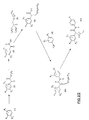
- the present invention also relates to the processes for preparing the compounds of formula (I) above according to the reaction schemes given in FIGS. 1 and 2.
- the derivatives of formula (la) can be prepared by a sequence of reactions Figure 1 first comprising a Friedel and Crafts type reaction between an aromatic derivative of formula (1) and ethoxalyl chloride in the presence of an acid of Lewis such as AlCl 3 then saponification of the ester function in the presence of a base, such as sodium or lithium hydroxide in an alcoholic solvent or THF.
- the derivative of formula (3) thus obtained is coupled with aniline of formula (4) either through the acid chloride or in the presence of dicyclohexylamine and dimethylaminopyridine in a solvent such as THF or dichloromethane.
- the compound of formula (6) is obtained which is then alkylated with a halogenated derivative of formula (7), preferably iodinated or brominated, either by means of its sodium derivative in DMF, or in the presence of carbon.
- a halogenated derivative of formula (7) preferably iodinated or brominated, either by means of its sodium derivative in DMF, or in the presence of carbon.
- a solvent such as methyl ethyl ketone.
- the derivatives of formula (lb) can be prepared by a series of Figure 2 reactions involving a Horner-Emmons type reaction between the glyoxylic derivative of formula (3) and a phosphonate of formula (8).
- the derivative of formula (9) thus obtained is then coupled with the aniline of formula (4) either via the acid chloride or in the presence of dicyclohexylamine and dimethylaminopyridine in a solvent such as THF or dichloromethane.
- the derivatives of formula l (c) can be obtained from the derivative of formula l (b) by hydrogenation with a catalyst such as Palladium on carbon in a solvent such as dioxane or ethyl alcohol.
- a subject of the present invention is also, as a medicament, the compounds of formula (I) as defined above.
- these compounds may exhibit either an agonist activity in the test for differentiation of mouse embryonic teratocarcinoma (F9) cells (Cancer Research 43 , p. 5268, 1983) and / or in the inhibition test ornithine decarboxylase after induction by TPA in mice (Cancer Research 38 , p. 793-801, 1978), or on the contrary, an antagonistic activity with respect to the expression of one or more biological markers in the differentiation test of mouse embryonic teratocarcinoma (F9) cells (Skin pharmacol., 3, pp 156-267, 1990) and / or on the differentiation of human keratinocytes in vitri (Anal. Biochem., 192, pp 232 -236, 1991).
- F9 mouse embryonic teratocarcinoma
- the compounds according to the invention can be advantageously used in combination with other compounds with retinoid activity, with vitamins D or their derivatives, with corticosteroids, with anti-free radicals , ⁇ -hydroxy or ⁇ -keto acids or their derivatives, or alternatively with ion channel blockers.
- vitamins D or their derivatives is meant, for example, the derivatives of vitamin D 2 or D 3 and in particular 1,25-dihydroxyvitamin D 3 .
- anti-free radicals is meant, for example, ⁇ -tocopherol, Super Oxide Dismutate, Ubiquinol or certain metal chelators.
- ⁇ -hydroxy or ⁇ -keto acids or their derivatives is meant for example lactic, malic, citric, glycolic, mandelic, tartaric, glyceric or ascorbic acids or their salts, amides or esters.
- ion channel blockers is meant, for example, Minoxidil (2,4-diamino-6-piperidino-pyrimidine-3-oxide) and its derivatives.
- the present invention also relates to medicinal compositions containing at least one compound of formula (I) as defined above, one of its optical or geometric isomers or one of its salts.
- the present invention therefore therefore relates to a new medicinal composition intended in particular for the treatment of the aforementioned conditions, and which is characterized in that it comprises, in a pharmaceutically acceptable carrier and compatible with the mode of administration chosen for the latter, at least one compound of formula (I), one of its optical or geometric isomers or one of its salts.
- the administration of the compounds according to the invention can be carried out by enteral, parenteral, topical or ocular route.
- the drugs may be in the form of tablets, capsules, dragees, syrups, suspensions, solutions, powders, granules, emulsions, microspheres or nanospheres or lipid or polymeric vesicles allowing controlled release.
- the compositions may be in the form of solutions or suspensions for infusion or for injection.
- the compounds according to the invention are generally administered at a daily dose of approximately 0.01 mg / kg to 100 mg / kg in body weight, and this at the rate of 3 doses.
- the pharmaceutical compositions based on compounds according to the invention are more particularly intended for the treatment of the skin and mucous membranes and can then be in the form of ointments, creams, milks, ointments, powders, soaked swabs, solutions, gels, sprays, lotions or suspensions. They can also be in the form of microspheres or nanospheres or lipid or polymeric vesicles or of polymeric patches and of hydrogels allowing controlled release.
- These topical compositions can moreover be presented either in anhydrous form or in an aqueous form, depending on the clinical indication.
- compositions for topical or ocular use contain at least one compound of formula (I) as defined above, or one of its optical or geometric isomers or one of its salts, at a concentration preferably between 0.001% and 5% by weight relative to the total weight of the composition.
- the compounds of formula (I) according to the invention also find application in the cosmetic field, in particular in body and hair hygiene and in particular for the treatment of skin prone to acne, for hair regrowth, anti- fall, to fight against the oily appearance of the skin or hair, in protection against the harmful aspects of the sun or in the treatment of physiologically dry skin, to prevent and / or to fight against photoinduced or chronological aging.
- the compounds according to the invention can moreover be advantageously used in combination with other compounds with activity of retinoid type, with vitamins D or their derivatives, with corticosteroids, with anti-free radicals, ⁇ -hydroxy or ⁇ -keto acids or their derivatives, or alternatively with ion channel blockers, all of these different products being as defined above.
- the present invention therefore also relates to a cosmetic composition which is characterized in that it comprises, in a cosmetically acceptable support and suitable for topical application, at least one compound of formula (I) as defined above or the one of its optical or geometric isomers or one of its salts, this cosmetic composition possibly being in the form of a cream, a milk, a lotion, a gel, microspheres or nanospheres or lipid or polymer vesicles, soap or shampoo.
- the concentration of compound of formula (I) in the cosmetic compositions according to the invention is advantageously between 0.001% and 3% by weight relative to the whole of the composition.
- the medicinal and cosmetic compositions according to the invention may also contain inert additives or even pharmacodynamically or cosmetically active additives or combinations of these additives, and in particular: wetting agents; depigmenting agents such as hydroquinone, azelaic acid, caffeic acid or kojic acid; emollients; hydrating agents such as glycerol, PEG 400, thiamorpholinone, and its derivatives or even urea; antiseborrhoeic or anti-acne agents, such as S-carboxymethylcysteine, S-benzyl-cysteamine, their salts or their derivatives, or benzoyl peroxide; antibiotics such as erythromycin and its esters, neomycin, clindamycin and its esters, tetracyclines; antifungal agents such as ketokonazole or polymethylene-4,5-isothiazolidones-3; agents promoting hair regrowth, such as Minoxidil (2,4-
- compositions according to the invention may also contain flavor-enhancing agents, preserving agents such as esters of parahydroxybenzoic acid, stabilizing agents, humidity-regulating agents, pH-regulating agents, agents osmotic pressure modifiers, emulsifying agents, UV-A and UV-B filters, antioxidants, such as ⁇ -tocopherol, butylhydroxyanisole or butylhydroxytoluene.
- reaction medium is evaporated to dryness, taken up in water, acidified to pH 1, extracted with ethyl ether, the organic phase is decanted, washed with water, dried over magnesium sulphate, evaporated.
- the residue obtained is purified by chromatography on a column of silica eluted with ethyl ether, 2 g (65.5%) of syn -4- [ ⁇ -hydroxyhexyloxyimino- (5,6,7,8-) acid are collected. tetrahydro-5,5,8,8-tetramethyl-2-naphthyl) acetamido] benzoic with a melting point of 183-6 ° C.
Landscapes
- Health & Medical Sciences (AREA)
- Life Sciences & Earth Sciences (AREA)
- Organic Chemistry (AREA)
- Chemical & Material Sciences (AREA)
- Veterinary Medicine (AREA)
- Public Health (AREA)
- General Health & Medical Sciences (AREA)
- Animal Behavior & Ethology (AREA)
- Epidemiology (AREA)
- Birds (AREA)
- General Chemical & Material Sciences (AREA)
- Nuclear Medicine, Radiotherapy & Molecular Imaging (AREA)
- Medicinal Chemistry (AREA)
- Chemical Kinetics & Catalysis (AREA)
- Pharmacology & Pharmacy (AREA)
- Engineering & Computer Science (AREA)
- Bioinformatics & Cheminformatics (AREA)
- Dermatology (AREA)
- Cardiology (AREA)
- Ophthalmology & Optometry (AREA)
- Heart & Thoracic Surgery (AREA)
- Urology & Nephrology (AREA)
- Vascular Medicine (AREA)
- Pain & Pain Management (AREA)
- Rheumatology (AREA)
- Pulmonology (AREA)
- Immunology (AREA)
- Acyclic And Carbocyclic Compounds In Medicinal Compositions (AREA)
- Pharmaceuticals Containing Other Organic And Inorganic Compounds (AREA)
- Organic Low-Molecular-Weight Compounds And Preparation Thereof (AREA)
- Cosmetics (AREA)
Abstract
Description
- L'invention concerne, à titre de produits industriels nouveaux et utiles, des composés bi-aromatiques dérivés d'amide. Elle concerne également l'utilisation de ces nouveaux composés dans des compositions pharmaceutiques destinées à un usage en médecine humaine ou vétérinaire, ou bien encore dans des compositions cosmétiques.
- Les composés selon l'invention ont une activité marquée dans les domaines de la différenciation et de la prolifération cellulaire, et trouvent des applications plus particulièrement dans le traitement topique et systémique des affections dermatologiques liées à un désordre de la kératinisation, des affections dermatologiques (ou autres) à composante inflammatoire et/ou immunoallergique, et des proliférations dermiques ou épidermiques qu'elles soient bénignes ou malignes. Ces composés peuvent en outre être utilisés dans le traitement des maladies de dégénérescence du tissu conjonctif, pour lutter contre le vieillissement de la peau, qu'il soit photoinduit ou chronologique, et traiter les troubles de la cicatrisation. Ils trouvent par ailleurs une application dans le domaine ophtalmologique, notamment dans le traitement des cornéopathies. Les composés selon l'invention peuvent par ailleurs trouver une application intéressante dans le traitement de l'ostéoporose, ou dans le traitement des maladies virales, ainsi que dans le traitement de tout état associé à une hypervitaminose A. D'une manière générale, ils peuvent enfin trouver une application dans le traitement de toute maladie qui est associée à une modification de l'expression des récepteurs appartenant à la superfamille des récepteurs des hormones stéroïdiennes et thyroïdiennes.
- On peut également utiliser les composés selon l'invention dans des compositions cosmétiques pour l'hygiène corporelle et capillaire.
- Les composés selon l'invention peuvent être représentés par la formule générale (I) suivante :

- * Ar représente un radical choisi parmi les radicaux de formules (a)-(e) suivantes:
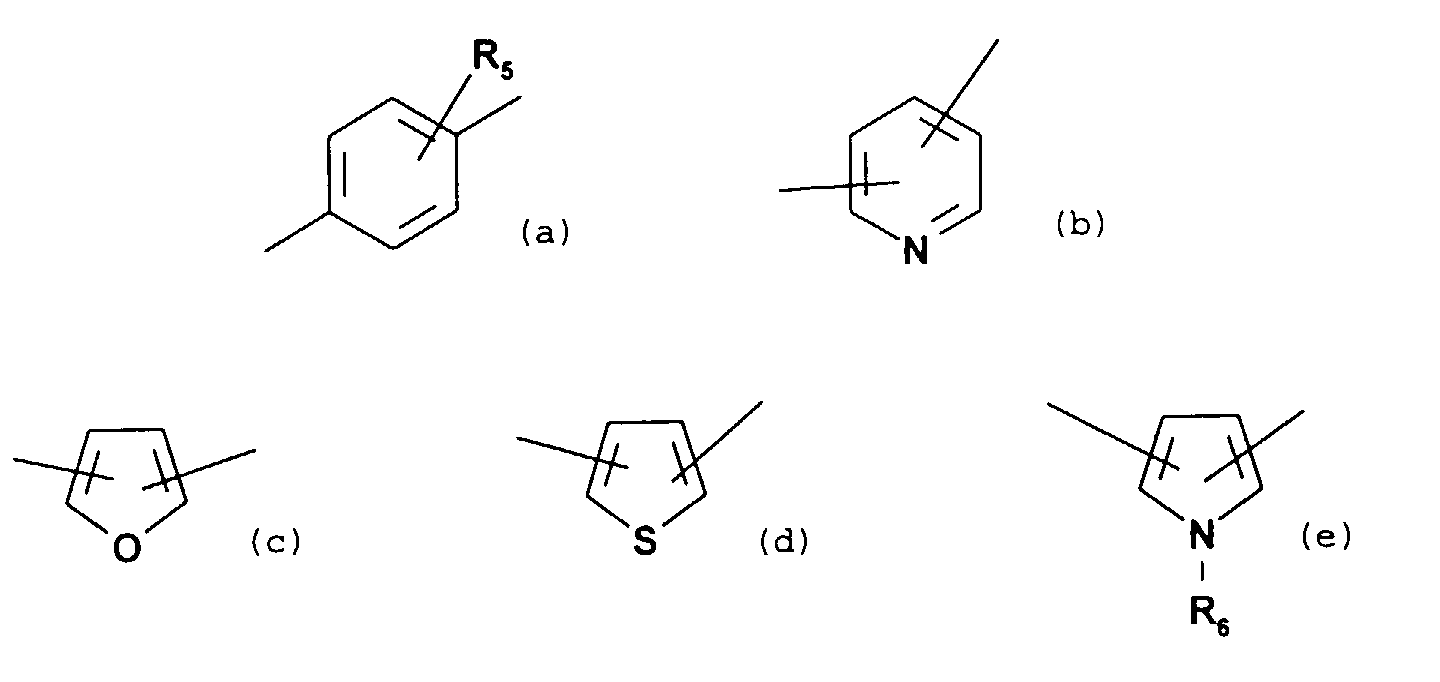
- * Z représente -CO-NR7-,
- * R1 représente :
- (i) un radical -CH3
- (ii) un radical -CH2-O-R6
- (iii) un radical -O-R6
- (iv) un radical -CO-R8,
- (v) un radical -S(O)tR9
- * soit X et Y peuvent être pris séparement :
- X représente un atome d'hydrogène ou un radical alkyle inférieur,
- Y représente un radical de formule -(CH2)n-CH3 ou de formule -(CH2)n-R10
- * soit X et Y peuvent être pris ensemble :
- X et Y forment un radical unique à double liaison choisi parmi les radicaux de formules :
- =N-O-(CH2)n-R10
- =CH-(CH2)m-R10
- =N-O-(CH2)2-O-CH2-CH3
- =N-O-CH2-O-CH2-CH2-O-CH3
- =CH-(CH2)m-CH3
- R10, m et n ayant les significations données ci-après,
- X et Y forment un radical unique à double liaison choisi parmi les radicaux de formules :
- * R2 et R3, pris séparément, représentent un atome d'hydrogène, un radical alkyle linéaire ou ramifié ayant de 1 à 20 atomes de carbone, un radical -OR6 ou un radical -SR6, R6 ayant la signification donnée ci-après, étant entendu que R2 et R3 ne peuvent pas être simultanément un atome d'hydrogène, un radical -OR6 ou un radical -SR6, ou R2 et R3, pris ensemble, forment avec le cycle aromatique adjacent un cycle à 5 ou 6 chainons éventuellement substitué par des groupes méthyle et/ou éventuellement interrompu par un atome d'oxygène ou de soufre ou par un radical -SO- ou SO2-,
- * R4 représente un atome d'hydrogène, un atome d'halogène, un radical alkyle inférieur ou un radical -OR6, R6 ayant la signification donnée ci-après,
étant entendu que dans tout ce qui précède :- R5 a la même signification que R4,
- R6 représente un atome d'hydrogène, un radical alkyle linéaire ou ramifié ayant de 1 à 20 atomes de carbone ou un radical -CO-R11, R11 ayant la signification donnée ci-après,
- R7 représente un atome d'hydrogène ou un radical alkyle inférieur,
- R8 représente :
- (a) un atome d'hydrogène
- (b) un radical alkyle inférieur
- (c) un radical de formule :

- (d) un radical -OR12, R12 ayant la signification donnée ci-après,
- R9 et R11, identiques ou différents, représentent un radical alkyle inférieur,
- R10 représente :
- (i) un radical -OR6
- (ii) un radical -CO-R8
- (iii) un radical de formule
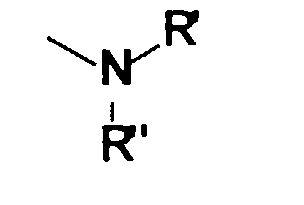
- (iv) un radical aryle, éventuellement substitué,
- (v) un radical hétérocycle,
- (vi) un radical cycloaliphatique en C3 ou C6,
- R12 représente un atome d'hydrogène, un radical alkyle linéaire ou ramifié ayant de 1 à 20 atomes de carbone, un radical alkényle, un radical mono ou polyhydroxyalkyle, un radical aryle ou aralkyle éventuellement substitué ou un reste de sucre ou un reste d'aminoacide ou de peptide,
- R' et R", identiques ou différents, représentent un atome d'hydrogène, un radical alkyle inférieur, un radical mono ou polyhydroxyalkyle, un radical aryle éventuellement substitué ou un reste d'aminoacide ou de peptide ou de sucre ou encore, pris ensemble, forment un hétérocycle,
- m est un nombre entier de 1 à 20,
- n est un nombre entier de 2 à 20,
- t est un nombre entier égal à 0,1 ou 2,
- L'invention vise également les sels des composés de formule (I) ci-dessus dans le cas où R1 représente une fonction acide carboxylique, ainsi que les isomères optiques et géométriques desdits composés. Lorsque les composés selon l'invention se présentent sous forme de sels, il s'agit de préférence de sels d'un métal alcalin ou alcalino-terreux, ou encore de zinc ou d'une amine organique.
- Selon la présente invention, on entend par radical alkyle inférieur un radical ayant de 1 à 6 atomes de carbone, de préférence les radicaux méthyle, éthyle, isopropyle, butyle, tertiobutyle et hexyle.
- Par radical alkyle linéaire ou ramifié ayant de 1 à 20 atomes de carbone, on entend notamment les radicaux méthyle, éthyle, propyle, 2-éthyl-hexyle, octyle, dodécyle, hexadécyle et octadécyl.
- Par radical monohydroxyalkyle, on entend un radical ayant de préférence 2 ou 3 atomes de carbone, notamment un radical 2-hydroxyéthyle, 2-hydroxypropyle ou 3-hydroxypropyle.
- Par radical polyhydroxyalkyle, on entend un radical contenant de préférence de 3 à 6 atomes de carbone et de 2 à 5 groupes hydroxyles tels que les radicaux 2,3-dihydroxypropyle, 2,3,4-trihydroxybutyle, 2,3,4,5-tétrahydroxypentyle ou le reste du pentaérythritol.
- Par radical aryle, on entend de préférence un radical phényle éventuellement substitué par au moins un atome d'halogène, un hydroxyle ou une fonction nitro.
- Par radical aralkyle, on entend de préférence le radical benzyle ou phénéthyle éventuellement substitué par au moins un atome d'halogène, un hydroxyle ou une fonction nitro.
- Par radical alkényle, on entend un radical contenant de préférence de 1 à 5 atomes de carbone et présentant une ou plusieurs insaturations éthyléniques, tel que plus particulièrement le radical allyle.
- Par reste de sucre, on entend un reste dérivant notamment de glucose, de galactose ou de mannose, ou bien encore de l'acide glucuronique.
- Par reste d'aminoacide, on entend notamment un reste dérivant de la lysine, de la glycine ou de l'acide aspartique, et par reste de peptide on entend plus particulièrement un reste de dipeptide ou de tripeptide résultant de la combinaison d'acides aminés.
- Par radical cycloaliphatique en C3 ou C6, on peut citer plus particulèrement le radical cyclopropyle ou cyclohexyle.
- Par hétérocycle enfin, on entend de préférence un radical pipéridino, morpholino, pyrrolidino ou pipérazino, éventuellement substitué en position 4 par un radical alkyle en C1-C6 ou mono ou polyhydroxyalkyle tels que définis ci-dessus.
- Lorsque R4 et R5 représente un atome d'halogène, celui-ci est de préférence un atome de fluore, de chlore et de brome.
- Parmi les composés de formule (I) ci-dessus rentrant dans le cadre de la présente invention, on peut notamment citer les suivants :
- Acide anti-4-[α-hydroxyhexylimino-(5,6,7,8-tétrahydro-5,5,8,8-tétraméthyl-2-naphtyl)acétamido]benzoïque
- Acide syn-4-[α-hydroxyhexylimino-(5,6,7,8-tétrahydro-5,5,8,8-tétraméthyl-2-naphtyl)acétamido]benzoïque
- Acide syn-4-[α-méthoxycarbonylpentylimino-(5,6,7,8-tétrahydro-5,5,8,8-tétraméthyl-2-naphtyl)acétamido]benzoïque
- Acide syn-4-[α-hydroxyoctyloxyimino-(5,6,7,8-tétrahydro-5,5,8,8-tétraméthyl-2-naphtyl)acétamido]benzoïque.
- Acide trans-4-[α-hydroxyoctyloxyimino-(5,6,7,8-tétrahydro-5,5,8,8-tétraméthyl-2-naphtyl)acétamido]benzoïque.
- Acide syn-4-[α-hydroxyheptyloxyimino-(5,6,7,8-tétrahydro-5,5,8,8-tétraméthyl-2-naphtyl)acétamido]benzoïque.
- Acide trans-4-[α-hydroxyheptyloxyimino-(5,6,7,8-tétrahydro-5,5,8,8-tétraméthyl-2-naphtyl)acétamido]benzoïque.
- Acide syn-4-[α-hydroxypropyloxyimino-(5,6,7,8-tétrahydro-5,5,8,8-tétraméthyl-2-naphtyl)acétamido]benzoïque.
- Acide trans-4-[α-hydroxypropyloxyimino-(5,6,7,8-tétrahydro-5,5,8,8-tétraméthyl-2-naphtyl)acétamido]benzoïque.
- Acide syn-4-[α-éthoxycarbonylpropyloxyimino-(5,6,7,8-tétrahydro-5,5,8,8-tétraméthyl-2-naphtyl)acétamido]benzoïque.
- Acide syn-4-[α-hydroxydecyloxyimino-(5,6,7,8-tétrahydro-5,5,8,8-tétraméthyl-2-naphtyl)acétamido]benzoïque.
- Acide syn-4-[α-hydroxynonyloxyimino-(5,6,7,8-tétrahydro-5,5,8,8-tétraméthyl-2-naphtyl)acétamido]benzoïque.
- Acide syn-4-[α-benzyloxyimino-(5,6,7,8-tétrahydro-5,5,8,8-tétraméthyl-2-naphtyl)acétamido]benzoïque.
- Acide syn-4-[α-methoxyethoxymethoxyimino-(5,6,7,8-tétrahydro-5,5,8,8-tétraméthyl-2-naphtyl)acétamido]benzoïque.
- syn-4-[α-éthoxycarbonylpropyloxyimino-(5,6,7,8-tétrahydro-5,5,8,8-tétraméthyl-2-naphtyl)acétamido]benzoate d'allyle.
- Acide (E)-4-[2-(5,6,7,8-tétrahydro-5,5,8,8-tétraméthyl-2-naphtyl)-2-nonenamido]benzoïque.
- Acide (Z)-4-[2-(5,6,7,8-tétrahydro-5,5,8,8-tétraméthyl-2-naphtyl)-2-nonenamido]benzoïque.
- Acide (E)-4-[2-(5,6,7,8-tétrahydro-5,5,8,8-tétraméthyl-2-naphtyl)-2-undecenamido]benzoïque.
- (E)-4-[2-(5,6,7,8-tétrahydro-5,5,8,8-tétraméthyl-2-naphtyl)-2-undecenamido]phénylcarboxamide.
- (E)-4-[2-(5,6,7,8-tétrahydro-5,5,8,8-tétraméthyl-2-naphtyl)-2-undecenamido]benzèneméthanol.
- (E)-4-[2-(5,6,7,8-tétrahydro-5,5,8,8-tétraméthyl-2-naphtyl)-2-undecenamido]phénol.
- Acide (Z)-4-[2-(5,6,7,8-tétrahydro-5,5,8,8-tétraméthyl-2-naphtyl)-2-undecenamido]benzoïque.
- Acide(E)-4-[2-(5,6,7,8-tétrahydro-5,5,8,8-tétraméthyl-2-naphtyl)-2-hexadecenamido]benzoïque.
- Acide (Z)-4-[2-(5,6,7,8-tétrahydro-5,5,8,8-tétraméthyl-2-naphtyl)-2-hexadecenamido]benzoïque.
- Selon la présente invention, les composés de formule (I) plus particulièrement préférés sont ceux pour lesquels R1 représente le radical -COR8, X et Y pris ensemble forment un radical choisi parmi les radicaux de formules suivantes :
- =N-O-(CH2)n-R10
- =CH-(CH2)m-R10
- =N-O-(CH2)2-O-CH2-CH3
- =N-O-CH2-O-CH2-CH2-O-CH3
- =CH-(CH2)m-CH3,
- La présente invention a également pour objet les procédés de préparation des composés de formule (I) ci-dessus selon les schémas réactionnels donnés aux Figures 1 et 2.
- Les dérivés de formule (la) peuvent être préparés par une suite de réactions Figure 1 comprenant tout d'abord une réaction de type Friedel et Crafts entre un dérivé aromatique de formule (1) et le chlorure d'éthoxalyle en présence d'un acide de Lewis tel AlCl3 puis saponification de la fonction ester en présence d'une base , telle l'hydroxyde de sodium ou de lithium dans un solvant alcoolique ou le THF.Le dérivé de formule (3) ainsi obtenu est couplé avec l'aniline de formule (4) soit par l'intermédiaire du chlorure d'acide ou en présence de dicyclohexylamine et de diméthylaminopyridine dans un solvant tel le THF ou le dichlorométhane.Par réaction du composé de formule (5) avec l'hydroxylamine dans un solvant alcoolique tel l'alcool éthylique on obtient le composé de formule (6) qui est ensuite alkylé par un dérivé halogéné de formule (7) de préférence iodé ou bromé soit par l'intermédiaire de son dérivé sodé dans le DMF, soit en présence de carbonate de potassium dans un solvant tel la méthyléthylcétone.
- Les dérivés de formule (lb) peuvent être préparés par une suite de réactions Figure 2 mettant en jeu une réaction de type Horner-Emmons entre le dérivé glyoxylique de formule (3) et un phosphonate de formule (8). Le dérivé de formule (9) ainsi obtenu est ensuite couplé avec l'aniline de formule (4) soit par l'intermédiaire du chlorure d'acide ou en présence de dicyclohexylamine et de diméthylaminopyridine dans un solvant tel le THF ou le dichlorométhane.
- Les dérivés de formule l(c) peuvent être obtenus à partir du dérivé de formule l(b) par hydrogénation avec un catalyseur tel le Palladium sur charbon dans un solvant tel le dioxanne ou l'alcool éthylique.
- Lorsque R1 représente le radical -COOH, les composés sont préférentiellement préparés en protégeant R1 par un groupe protecteur de type allylique, benzylique ou tert-butylique.Le passage à la forme libre peut être éffectué:
- dans le cas d'un groupe protecteur allylique, au moyen d'un catalyseur tel que certains complexes de métaux de transition par exemple le tétrakis(triphénylphosphine)Palladium(0) en présence d'une amine secondaire telle la morpholine ou du sel de sodium du malonate de diéthyle.
- dans le cas d'un groupe protecteur benzylique, par débenzylation en présence d'hydrogène, au moyen d'un catalyseur tel le palladium sur charbon dans un solvant alcoolique tel l'alcool éthylique ou dans le dioxanne.
- dans le cas d'un groupe protecteur tert-butylique au moyen d'iodure de triméthylsilane ou d'acide trifluoroacétique dans un solvant tel que le dichlorométhane.
- La présente invention a également pour objet à titre de médicament les composés de formule (I) telle que définie ci-dessus.
- Selon la nature des radicaux retenus, ces composés pourront présenter soit une activité agoniste dans le test de différenciation des cellules (F9) de tératocarcinome embryonnaire de souris (Cancer Research 43, p. 5268, 1983) et/ou dans le test d'inhibition de l'ornithine décarboxylase après induction par le TPA chez la souris (Cancer Research 38, p. 793-801, 1978), soit au contraire, une activité antagoniste vis-à-vis de l'expression d'un ou plusieurs marqueurs biologiques dans le test de différenciation des cellules (F9) de tératocarcinome embryonnaire de souris (Skin pharmacol., 3, pp 156-267, 1990) et/ou sur la différenciation des kératinocytes humains in vitri (Anal. Biochem., 192, pp 232-236, 1991).
- Les composés selon l'invention conviennent particulièrement bien dans les domaines de traitement suivants :
- 1) pour traiter les affections dermatologiques liées à un désordre de la kératinisation portant sur la différenciation et sur la prolifération notamment pour traiter les acnées vulgaires, comédoniennes, polymorphes, rosacées, les acnées nodulokystiques, conglobata, les acnées séniles, les acnées secondaires telles que l'acnée solaire, médicamenteuse ou professionnelle,
- 2) pour traiter d'autres types de troubles de la kératinisation, notamment les ichtyoses, les états ichtyosiformes, la maladie de Darrier, les kératodermies palmoplantaires, les leucoplasies et les états leucoplasiformes, le lichen cutané ou muqueux (buccal),
- 3) pour traiter d'autres affections dermatologiques liées à un trouble de la kératinisation avec une composante inflammatoire et/ou immuno-allergique et notamment toutes les formes de psoriasis qu'il soit cutané, muqueux ou unguéal, et même le rhumatisme psoriatique, ou encore l'atopie cutanée, telle que l'eczéma ou l'atopie respiratoire ou encore l'hypertrophie gingivale ; les composés peuvent également être utilisés dans certaines affections inflammatoires ne présentant pas de trouble de la kératinisation,
- 4) pour traiter toutes les proliférations dermiques ou épidermiques qu'elles soient bénignes ou malignes, qu'elles soient ou non d'origine virale telles que verrues vulgaires, les verrues planes et l'épidermodysplasie verruciforme, les papillomatoses orales ou florides et les proliférations pouvant être induites par les ultra-violets notamment dans le cas des épithélioma baso et spinocellulaires,
- 5) pour traiter d'autres désordres dermatologiques tels que les dermatoses bulleuses et les maladies du collagène,
- 6) pour traiter certains troubles ophtalmologiques, notamment les cornéopathies,
- 7) pour réparer ou lutter contre le vieillissement de la peau, qu'il soit photo-induit ou chronologique ou pour réduire les pigmentations et les kératoses actiniques, ou toutes pathologies associées au vieillissement chronologique ou actinique,
- 8) pour prévenir ou guérir les stigmates de l'atrophie épidermique et/ou dermique induite par les corticostéroïdes locaux ou systémiques, ou toute autre forme d'atrophie cutanée,
- 9) pour prévenir ou traiter les troubles de la cicatrisation ou pour prévenir ou pour réparer les vergetures,
- 10) pour lutter contre les troubles de la fonction sébacée tels que l'hyperséborrhée de l'acnée ou la séborrhée simple,
- 11) dans le traitement ou la prévention des états cancéreux ou précancéreux,
- 12) dans le traitement d'affections inflammatoires telles que l'arthrite,
- 13) dans le traitement de toute affection d'origine virale au niveau cutané ou général,
- 14) dans la prévention ou le traitement de l'alopécie,
- 15) dans le traitement d'affections dermatologiques ou générales à composante immunologique,
- 16) dans le traitement d'affections du système cardiovasculaire telles que l'artériosclérose,
- 17) dans le traitement ou la prévention de l'ostéoporose,
- 18) dans le traitement des dépressions saisonnières.
- Dans les domaines thérapeutiques mentionnés ci-dessus, les composés selon l'invention peuvent être avantageusement employés en combinaison avec d'autres composés à activité de type rétinoïde, avec les vitamines D ou leurs dérivés, avec des corticostéroïdes, avec des anti-radicaux libres, des α-hydroxy ou α-céto acides ou leurs dérivés, ou bien encore avec des bloqueurs de canaux ioniques. Par vitamines D ou leurs dérivés, on entend par exemple les dérivés de la vitamine D2 ou D3 et en particulier la 1,25-dihydroxyvitamine D3. Par anti-radicaux libres, on entend par exemple l'α-tocophérol, la Super Oxyde Dismutate, l'Ubiquinol ou certains chélatants de métaux. Par α-hydroxy ou α-céto acides ou leurs dérivés, on entend par exemple les acides lactique, malique, citrique, glycolique, mandélique, tartrique, glycérique ou ascorbique ou leurs sels, amides ou esters. Enfin, par bloqueurs de canaux ioniques, on entend par exemple le Minoxidil (2,4-diamino-6-pipéridino-pyrimidine-3-oxyde) et ses dérivés.
- La présente invention a également pour objet des compositions médicamenteuses contenant au moins un composé de formule (I) telle que définie ci-dessus, l'un de ses isomères optiques ou géométriques ou un de ses sels.
- La présente invention a donc ainsi pour objet une nouvelle composition médicamenteuse destinée notamment au traitement des affections susmentionnées, et qui est caractérisée par le fait qu'elle comprend, dans un support pharmaceutiquement acceptable et compatible avec le mode d'administration retenu pour cette dernière, au moins un composé de formule (I), l'un de ses isomères optiques ou géométriques ou un de ses sels.
- L'administration des composés selon l'invention peut être effectuée par voie entérale, parentérale, topique ou oculaire.
- Par voie entérale, les médicaments peuvent se présenter sous forme de comprimés, de gélules, de dragées, de sirops, de suspensions, de solutions, de poudres, de granulés, d'émulsions, de microsphères ou de nanosphères ou de vésicules lipidiques ou polymériques permettant une libération contrôlée. Par voie parentérale, les compositions peuvent se présenter sous forme de solutions ou de suspensions pour perfusion ou pour injection.
- Les composés selon l'invention sont généralement administrés à une dose journalière d'environ 0,01 mg/kg à 100 mg/Kg en poids corporel, et ceci à raison de à 3 prises.
- Par voie topique, les compositions pharmaceutiques à base de composés selon l'invention sont plus particulièrement destinées au traitement de la peau et des muqueuses et peuvent alors se présenter sous forme d'onguents, de crêmes, de laits, de pommades, de poudres, de tampons imbibés, de solutions, de gels, de sprays, de lotions ou de suspensions. Elles peuvent également se présenter sous forme de microsphères ou nanosphères ou vésicules lipidiques ou polymériques ou de patches polymériques et d'hydrogels permettant une libération contrôlée. Ces compositions par voie topique peuvent par ailleurs se présenter soit sous forme anhydre, soit sous une forme aqueuse, selon l'indication clinique.
- Par voie oculaire, ce sont principalement des collyres.
- Ces compositions à usage topique ou oculaire contiennent au moins un composé de formule (I) telle que définie ci-dessus, ou l'un de ses isomères optiques ou géométriques ou encore l'un de ses sels, à une concentration de préférence comprise entre 0,001% et 5% en poids par rapport au poids total de la composition.
- Les composés de formule (I) selon l'invention trouvent également une application dans le domaine cosmétique, en particulier dans l'hygiène corporelle et capillaire et notamment pour le traitement des peaux à tendance acnéique, pour la repousse des cheveux, l'anti-chute, pour lutter contre l'aspect gras de la peau ou des cheveux, dans la protection contre les aspects néfastes du soleil ou dans le traitement des peaux physiologiquement sèches, pour prévenir et/ou pour lutter contre le vieillissement photo-induit ou chronologique.
- Dans le domaine cosmétique, les composés selon l'invention peuvent par ailleurs être avantageusement employés en combinaison avec d'autres composés à activité de type rétinoïde, avec les vitamines D ou leurs dérivés, avec des corticostéroïdes, avec des anti-radicaux libres, des α-hydroxy ou α-céto acides ou leurs dérivés, ou bien encore avec des bloqueurs de canaux ioniques, tous ces différents produits étant tels que définis ci-avant.
- La présente invention vise donc également une composition cosmétique qui est caractérisée par le fait qu'elle comprend, dans un support cosmétiquement acceptable et convenant à une application topique, au moins un composé de formule (I) telle que définie ci-dessus ou l'un de ses isomères optiques ou géométriques ou l'un de ses sels, cette composition cosmétique pouvant notamment se présenter sous la forme d'une crème, d'un lait, d'une lotion, d'un gel, de microsphères ou nanosphères ou vésicules lipidiques ou polymériques, d'un savon ou d'un shampooing.
- La concentration en composé de formule (I) dans les compositions cosmétiques selon l'invention est avantageusement comprise entre 0,001% et 3% en poids par rapport à l'ensemble de la composition.
- Les compositions médicamenteuses et cosmétiques selon l'invention peuvent en outre contenir des additifs inertes ou même pharmacodynamiquement ou cosmétiquement actifs ou des combinaisons de ces additifs, et notamment : des agents mouillants; des agents dépigmentants tels que l'hydroquinone, l'acide azélaïque, l'acide caféïque ou l'acide kojique; des émollients; des agents hydratants comme le glycérol, le PEG 400, la thiamorpholinone, et ses dérivés ou bien encore l'urée; des agents antiséborrhéiques ou antiacnéiques, tels que la S-carboxyméthylcystéine, la S-benzyl-cystéamine, leurs sels ou leurs dérivés, ou le péroxyde de benzoyle; des antibiotiques comme l'érythromycine et ses esters, la néomycine, la clindamycine et ses esters, les tétracyclines; des agents antifongiques tels que le kétokonazole ou les polyméthylène-4,5 isothiazolidones-3; des agents favorisant la repousse des cheveux, comme le Minoxidil (2,4-diamino-6-pipéridino-pyrimidine-3-oxyde) et ses dérivés, le Diazoxide (7-chloro 3-méthyl 1,2,4-benzothiadiazine 1,1-dioxyde) et le Phénytoïn (5,4-diphénylimidazolidine 2,4-dione); des agents anti-inflammatoires non stéroïdiens; des caroténoïdes et, notamment, le β-carotène; des agents anti-psoriatiques tels que l'anthraline et ses dérivés; et enfin les acides eicosa-5,8,11,14-tétraynoïque et eicosa-5,8,11-trynoïque, leurs esters et amides.
- Les compositions selon l'invention peuvent également contenir des agents d'amélioration de la saveur, des agents conservateurs tels que les esters de l'acide parahydroxybenzoïque, les agents stabilisants, des agents régulateurs d'humidité, des agents régulateurs de pH, des agents modificateurs de pression osmotique, des agents émulsionnants, des filtres UV-A et UV-B, des antioxydants, tels que l'α-tocophérol, le butylhydroxyanisole ou le butylhydroxytoluène.
- On va maintenant donner, à titre d'illustration et sans aucun caractère limitatif, plusieurs exemples d'obtention de composés actifs de formule (I) selon l'invention, ainsi que diverses formulations concrètes à base de tels composés.
-
- (a) 5,6,7,8-tétrahydro-5,5,8,8-tétraméthyl-2-naphtylglyoxylate d'éthyle.
Dans un tricol, on introduit 14,5 g (0,109 mole) de chlorure d'aluminium, 100 ml de dichlorométhane et ajoute goutte à goutte un mélange de 11,7 g (62 mmoles) de 5,6,7,8-tétrahydro-5,5,8,8-tétraméthyl-2-naphtalène et de 8 ml (71 mmoles) de chlorure d'étoxalyle dans 100 ml de dichlorométhane et agite à température ambiante pendant une heure. On verse le milieu réactionnel dans la glace, extrait avec de l'éther éthylique, décante la phase organique, sèche sur sulfate de magnésium, évapore. Le résidu obtenu est purifié par chromatographie sur colonne de silice élué avec un mélange de dichlorométhane et d'hexane (30-70). Après évaporation des solvants, on recueille 16,5 g (93%) de l'ester attendu sous forme d'une huile légèrement jaune. - (b) Acide 5,6,7,8-tétrahydro-5,5,8,8-tétraméthyl-2-naphtylglyoxylique.
Dans un ballon, on introduit 16 g (55,6 mmoles) de 5,6,7,8-tétrahydro-5,5,8,8-tétraméthyl-2-naphtylglyoxylate d'éthyle et 50 ml d'alcool éthylique. On ajoute une solution de 2,5 g (58,5 mmoles) d'hydroxyde de sodium dans 50 ml d'eau et chauffe à reflux pendant une heure. On évapore à sec le milieu réactionnel, reprend par l'eau et l'éther éthylique, décante la phase aqueuse, acidifie à pH 1 avec de l'acide chlorhydrique concentré, extrait avec de l'éther éthylique, décante la phase organique, sèche sur sulfate de magnésium, évapore. On recueille 14 g (97%) d'acide 5,6,7,8-tétrahydro-5,5,8,8-tétraméthyl-2-naphtylglyoxylique, sous forme d'une huile incolore. - (c) Chlorure de 5,6,7,8-tétrahydro-5,5,8,8-tétraméthyl-2-naphtylglyoxyloyle.
Dans un ballon, on introduit 2,6 g (10 mmoles) d'acide 5,6,7,8-tétrahydro-5,5,8,8-tétraméthyl-2-naphtylglyoxylique dans 50 ml de dichlorométhane, ajoute 2 ml (10 mmoles) de dicyclohexylamine et agite à température ambiante pendant une heure. On ajoute ensuite goutte à goutte 800 µl (10 mmoles) de chlorure de thionyle et agite à température ambiante pendant une heure. On évapore à sec, reprend par l'éther éthylique, filtre le sel de dicyclohexylamine et évapore. On obtient 2,8 g (100%) de chlorure d'acide brut, qui est utilisé tel quel pour la suite de la synthèse. - (d) 4-(5,6,7,8-tétrahydro-5,5,8,8-tétraméthyl-2-naphtoylcarboxamido)benzoate d'allyle.
Dans un ballon, on introduit 3,6 g (20 mmoles) de 4-aminobenzoate d'allyle 2,8 ml (20 mmoles) de triéthylamine et 50 ml de THF. On ajoute goutte à goutte une solution de 5,6 g (20 mmoles) de chlorure de 5,6,7,8-tétrahydro-5,5,8,8-tétraméthyl-2-naphtylglyoxyloyle dans 50 ml de THF et agite à température ambiante pendant quatre heures. On verse le milieu réactionnel dans l'eau, extrait avec de l'éther éthylique, décante la phase organique, sèche sur sulfate de magnésium, évapore. Le résidu obtenu est purifié par chromatographie sur colonne de silice élué avec un mélange de dichlorométhane et d'hexane (40-60). Après évaporation des solvants, on recueille 2 g (46%) de l'ester allylique attendu sous forme d'une huile légèrement jaune. - (e) 4-[α-hydroxyimino-(5,6,7,8-tétrahydro-5,5,8,8-tétraméthyl-2-naphtyl)acétamido]benzoate d'allyle.
Dans un ballon, on introduit 1,7 g (4 mmoles) de 4-(5,6,7,8-tétrahydro-5,5,8,8-tétraméthyl-2-naphtoylcarboxamido)benzoate d'allyle 1,1 g (16 mmoles) de chlorhydrate d'hydroxylamine et 50 ml d'éthanol. On ajoute goutte à goutte 16 ml de NaOH (1N) et chauffe à reflux pendant 4 heures. On évapore le milieu réactionnel à sec, reprend le résidu dans l'eau, extrait avec de l'éther éthylique, décante la phase organique, sèche sur sulfate de magnésium, évapore. Le résidu obtenu est chromatographié sur colonne de silice, élué avec un mélange de dichlorométhane et d'éther éthylique (98-2). Après évaporation des solvants, on obtient 1,6 g (94%) du produit attendu de point de fusion 176-7°C. - (f) syn-4-[α-hydroxyhexyloxyimino-(5,6,7,8-tétrahydro-5,5,8,8-tétraméthyl-2-naphtyl)acétamido]benzoate d'allyle.
Dans un ballon, on introduit 3,25 g (7,5 mmoles) de 4-[α-hydroxyimino-(5,6,7,8-tétrahydro-5,5,8,8-tétraméthyl-2-naphtyl)acétamido]benzoate d'allyle 1 g (7,5 mmoles) de carbonate de potassium et 100 ml de méthyléthylcétone. On ajoute 1 ml (7,5 mmoles) de 6-bromohexanol et chauffe à reflux pendant 24 heures. On filtre le milieu réactionnel, évapore à sec le filtrat, reprend par l'eau et l'éther éthylique, décante la phase organique, sèche sur sulfate de magnésium, évapore. Le résidu obtenu est purifié par chromatographie sur colonne de silice élué avec du dichlorométhane. On recueille ainsi 3,3 g (82%) du produit attendu sous forme d'une huile jaune. - Dans un tricol et sous courant d'azote, on introduit 3,3 g (6,2 mmoles)de syn-4-[α-hydroxyhexyloxyimino-(5,6,7,8-tétrahydro-5,5,8,8-tétraméthyl-2-naphtyl) acétamido]benzoate d'allyle, 230 mg (0,2 mmole) de tétrakis(triphénylphosphine) palladium(0), et 100 ml de THF. On ajoute ensuite goutte à goutte 2,7 ml (31 mmoles) de morpholine et agite à température ambiante pendant 2 heures. On évapore le milieu réactionnel à sec, reprend par l'eau, acidifie à pH 1, extrait avec de l'éther éthylique, décante la phase organique, lave à l'eau, sèche sur sulfate de magnésium, évapore. Le résidu obtenu est purifié par chromatographie sur colonne de silice élué avec de l'éther éthylique, on recueille 2 g (65,5%) d'acide syn-4-[α-hydroxyhexyloxyimino-(5,6,7,8-tétrahydro-5,5,8,8-tétraméthyl-2-naphtyl)acétamido]benzoïque de point de fusion 183-6°C.
- Dans un réacteur photochimique, on introduit 800 mg (1,7 mmoles) d'acide syn-4-[α-hydroxyhexyloxyimino-(5,6,7,8-tétrahydro-5,8,8,8-tétraméthyl-2-naphtyl)acétamido]benzoïque, 600 ml de méthanol et agite 48 heures à température ambiante en irradiant (lampe Hanovia moyenne pression, sans filtre). On évapore le milieu réactionnel, et purifie le résidu obtenu par chromatographie sur colonne de silice élué avec un mélange de dichlorométhane et de méthanol (98-2). Après évaporation des solvants, on recueille 470 mg (59%) d'acide anti 4-[α-hydroxyhexyloxyimino-(5,6,7,8-tétrahydro-5,5,8,8-tétraméthyl-2-naphtyl)acétamido] benzoïque de point de fusion 178-81°C.
- De manière analogue à l'exemple 1(f) par réaction de 3,25 g (7,5 mmoles) de 4-[α-hydroxyimino-(5,6,7,8-tétrahydro-5,5,8,8-tétraméthyl-2-naphtyl)acétamido]benzoate d'allyle avec 1,3 ml (7,5 mmoles) de 6-bromohexanoate d'éthyle, on obtient 1,7 g (39,5%) de syn-4-[α-éthoxycarbonylpentyloxyimino-(5,6,7,8-tétrahydro-5,5,8,8-tétraméthyl-2-naphtyl)acétamido]benzoate d'allyle sous forme d'une huile légèrement jaune.
- De manière analogue à l'exemple 2 à partir de 1,7 g (3 mmoles) de syn-4-[α-méthoxycarbonylpentyloxyimino-(5,6,7,8-tétrahydro-5,5,8,8-tétraméthyl-2-naphtyl)acétamido]benzoate d'allyle, on obtient 1,1 g (70%) d'acide syn-4-[α-éthoxycarbonylpentyloxyimino-(5,6,7,8-tétrahydro-5,5,8,8-tétraméthyl-2-naphtyl)acétamido]benzoïque de point de fusion 152-4°C.
-
- (a) syn-4-[α-hydroxyoctyloxyimino-(5,6,7,8-tétrahydro-5,5,8,8-tétraméthyl-2-naphtyl)acétamido]benzoate d'allyle.
De manière analogue à l'exemple 1(f) par réaction de 2,2 g (5 mmoles) de 4-[α-hydroxyimino-(5,6,7,8-tétrahydro-5,5,8,8-tétraméthyl-2-naphtyl)acétamido] benzoate d'allyle avec 870 µl (5 mmoles) de 8-bromo-1-octanol, on recueille après purification par chromatographie sur colonne de silice élué avec du dichlorométhane 2 g (70%) de l'ester allylique attendu sous forme d'une huile incolore. - (b) acide syn-4-[α-hydroxyoctyloxyimino-(5,6,7,8-tétrahydro-5,5,8,8-tétraméthyl-2-naphtyl)acétamido]benzoïque.
De manière analogue à l'exemple 2, à partir de 2 g (3,5 mmoles) de syn-4-[α-hydroxyoctyloxyimino-(5,6,7,8-tétrahydro-5,5,8,8-tétraméthyl-2-naphtyl)acétamido] benzoate d'allyle on obtient 1,3 g (70%) de l'acide attendu de point de fusion 102-4°C. - De manière analogue à l'exemple 3 à partir de 900 mg (1,7 mmole) d'acide syn-4-[α-hydroxyoctyloxyimino-(5,6,7,8-tétrahydro-5,5,8,8-tétraméthyl-2-naphtyl) acétamido]benzoïque, on obtient 390 mg (43%) de l'acide trans attendu de point de fusion 98-100°C.
-
- (a) syn-4-[α-hydroxyheptyloxyimino-(5,6,7,8-tétrahydro-5,5,8,8-tétraméthyl-2-naphtyl)acétamido]benzoate d'allyle.
De manière analogue à l'exemple 1(f) par réaction de 2,2 g (5 mmoles) de 4-[α-hydroxyimino-(5,6,7,8-tétrahydro-5,5,8,8-tétraméthyl-2-naphtyl)acétamido] benzoate d'allyle avec 780 µl (5 mmoles) de 7-bromo-1-heptanol, on recueille après purification par chromatographie sur colonne de silice élué avec du dichlorométhane 1,7 g (61%) de l'ester allylique attendu sous forme d'une huile incolore. - (b) acide syn-4-[α-hydroxyheptyloxyimino-(5,6,7,8-tétrahydro-5,5,8,8-tétraméthyl-2-naphtyl)acétamido]benzoïque.
De manière analogue à l'exemple 2, à partir de 1,7 g (3,1 mmoles) de syn-4-[α-hydroxyheptyloxyimino-(5,6,7,8-tétrahydro-5,5,8,8-tétraméthyl-2-naphtyl)acétamido] benzoate d'allyle on obtient 1,3 g (82%) de l'acide attendu de point de fusion 145-55°C. - De manière analogue à l'exemple 3 à partir de 900 mg (1,77 mmole) d'acide syn-4-[α-hydroxyheptyloxyimino-(5,6,7,8-tétrahydro-5,5,8,8-tétraméthyl-2-naphtyl) acétamido]benzoïque, on obtient 350 mg (39%) de l'acide trans attendu de point de fusion 118-23°C.
- Dans un ballon, on introduit 1,3 g (2,4 mmoles) d'acide syn-4-[α-éthoxy carbonylpentyloxyimino-(5,6,7,8-tétrahydro-5,5,8,8-tétraméthyl-2-naphtyl)acétamido] benzoïque 30 ml de THF et ajoute 6 ml d'une solution de soude méthanolique 2N. On agite à température ambiante pendant trois heures, évapore à sec, reprend le résidu par l'eau, acidifie à pH 1 avec de l'acide chlorhydrique, extrait avec de l'éther éthylique. On décante la phase organique, sèche sur sulfate de magnésium, évapore. Ler résidu obtenu est purifié par chromatographie sur colonne de silice élué avec un mélange de dichlorométhane et d'éther éthylique (95-5). Après évaporation des solvants, on recueille 1,1 g (89%) de l'acide attendu de point de fusion 162-3°C.
-
- (a) 4-[α-hydroxypropyloxyimino-(5,6,7,8-tétrahydro-5,5,8,8-tétraméthyl-2-naphtyl)acétamido]benzoate d'allyle.
De manière analogue à l'exemple 1(f) par réaction de 3,4 g (7,8 mmoles) de 4-[α-hydroxyimino-(5,6,7,8-tétrahydro-5,5,8,8-tétraméthyl-2-naphtyl)acétamido] benzoate d'allyle avec 710 µl (7,8 mmoles) de 3-bromo-1-propanol, on recueille après purification par chromatographie sur colonne de silice élué avec du dichlorométhane 1,4 g (36%) de l'ester allylique syn et 710 mg (18%) de l'ester allylique trans. - (b) acide trans-4-[α-hydroxypropyloxyimino-(5,6,7,8-tétrahydro-5,5,8,8-tétraméthyl-2-naphtyl)acétamido]benzoïque.
De manière analogue à l'exemple 2, à partir de 710 mg (1,4 mmole) de trans-4-[α-hydroxypropyloxyimino-(5,6,7,8-tétrahydro-5,5,8,8-tétraméthyl-2-naphtyl) acétamido] benzoate d'allyle on obtient 220 mg (35%) de l'acide attendu de point de fusion 209-11°C. - De manière analogue à l'exemple 2, à partir de 1,4 g (2,8 mmoles) de syn-4-[α-hydroxypropyloxyimino-(5,6,7,8-tétrahydro-5,5,8,8-tétraméthyl-2-naphtyl) acétamido] benzoate d'allyle on obtient 750 mg (58%) de l'acide attendu de point de fusion 198-204°C.
-
- (a) syn-4-[α-éthoxycarbonylpropyloxyimino-(5,6,7,8-tétrahydro-5,5,8,8-tétraméthyl-2-naphtyl)acétamido]benzoate d'allyle.
De manière analogue à l'exemple 1(f) par réaction de 4 g (9,2 mmoles) de 4-[α-hydroxyimino-(5,6 7,8-tétrahydro-5,5,8,8-tétraméthyl-2-naphtyl)acétamido] benzoate d'allyle avec 1,8 g (9,2 mmoles) de 4-bromobutanoate d'éthyle on recueille après purification par chromatographie sur colonne de silice élué avec un mélange de dichlorométhane et d'heptane (50-50) 1,3 g (26%) de l'ester allylique attendu sous forme d'une huile incolore. - (b) acide syn-4-[α-éthoxycarbonylpropyloxyimino-(5,6,7,8-tétrahydro-5,5,8,8-tétraméthyl-2-naphtyl)acétamido]benzoïque.
De manière analogue à l'exemple 2, à partir de 1,4 g (2,5 mmoles) de syn-4-[α-éthoxycarbonylpropyloxyimino-(5,6,7,8-tétrahydro-5,5,8,8-tétraméthyl-2-naphtyl)acétamido] benzoate d'allyle on obtient 180 mg (14%) de l'acide attendu de point de fusion 120-1°C. -
- (a) syn-4-[α-hydroxydecyloxyimino-(5,6,7,8-tétrahydro-5,5,8,8-tétraméthyl-2-naphtyl)acétamido]benzoate d'allyle.
De manière analogue à l'exemple 1(f) par réaction de 2,2 g (5 mmoles) de 4-[α-hydroxyimino-(5,6,7,8-tétrahydro-5,5,8,8-tétraméthyl-2-naphtyl)acétamido] benzoate d'allyle avec 995 µl (5 mmoles) de 10-bromo-1-décanol, on recueille après purification par chromatographie sur colonne de silice élué avec du dichlorométhane 1 g (35%) de l'ester allylique attendu sous forme d'une huile incolore. - (b) acide syn-4-[α-hydroxydecyloxyimino-(5,6,7,8-tétrahydro-5,5,8,8-tétraméthyl-2-naphtyl)acétamido]benzoïque.
De manière analogue à l'exemple 2, à partir de 1 g (1,7 mmole) de syn-4-[α-hydroxydecyloxyimino-(5,6,7,8-tétrahydro-5,5,8,8-tétraméthyl-2-naphtyl)acétamido] benzoate d'allyle on obtient 400 mg (50%) de l'acide attendu de point de fusion 145-6°C. -
- (a) syn-4-[α-hydroxynonyloxyimino-(5,6,7,8-tétrahydro-5,5,8,8-tétraméthyl-2-naphtyl)acétamido]benzoate d'allyle.
De manière analogue à l'exemple 1(f) par réaction de 2,2 g (5 mmoles) de 4-[α-hydroxyimino-(5,6,7,8-tétrahydro-5,5,8,8-tétraméthyl-2-naphtyl)acétamido] benzoate d'allyle avec 780 µl (5 mmoles) de 7-bromo-1-heptanol, on recueille après purification par chromatographie sur colonne de silice élué avec du dichlorométhane 1,7 g (61%) de l'ester allylique attendu sous forme d'une huile incolore. - (b) acide syn-4-[α-hydroxynonyloxyimino-(5,6,7,8-tétrahydro-5,5,8,8-tétraméthyl-2-naphtyl)acétamido]benzoïque.
De manière analogue à l'exemple 2, à partir de 1,,3 g (2,2 mmoles) de syn-4-[α-hydroxynonyloxyimino-(5,6,7,8-tétrahydro-5,5,8,8-tétraméthyl-2-naphtyl) acétamido] benzoate d'allyle on obtient 600 mg (50%) de l'acide attendu de point de fusion 155-6°C. -
- (a) syn-4-[α-benzyloxyimino-(5,6,7,8-tétrahydro-5,5,8,8-tétraméthyl-2-naphtyl)acétamido]benzoate d'allyle.
De manière analogue à l'exemple 1(f) par réaction de 2,2 g (5 mmoles) de 4-[α-hydroxyimino-(5,6,7,8-tétrahydro-5,5,8,8-tétraméthyl-2-naphtyl)acétamido] benzoate d'allyle avec 600 µl (5 mmoles) de bromure de benzyle, on recueille après purification par chromatographie sur colonne de silice élué un mélange de dichlorométhane et d'heptane (60-40) 2,6 g (98%) de l'ester allylique attendu sous forme d'une huile incolore. - (b) acide syn-4-[α-benzyloxyimino-(5,6,7,8-tétrahydro-5,5,8,8-tétraméthyl-2-naphtyl)acétamido]benzoïque.
De manière analogue à l'exemple 2, à partir de 2,6 g (5 mmoles) de syn-4-[α-benzyloxyimino-(5,6,7,8-tétrahydro-5,5,8,8-tétraméthyl-2-naphtyl)acétamido] benzoate d'allyle on obtient 1,7 g (71%) de l'acide attendu de point de fusion 223-5°C. -
- (a) syn-4-[α-methoxyethoxymethoxyimino-(5,6,7,8-tétrahydro-5,5,8,8-tétraméthyl-2-naphtyl)acétamido]benzoate d'allyle.
De manière analogue à l'exemple 1(f) par réaction de 3,3 g (7,6 mmoles) de 4-[α-hydroxyimino-(5,6,7,8-tétrahydro-5,5,8,8-tétraméthyl-2-naphtyl)acétamido] benzoate d'allyle avec 870 µl (7,6 mmoles) de chlorure de méthoxyethoxyméthane on recueille après purification par chromatographie sur colonne de silice élué avec un mélange de dichlorométhane et d'heptane (70-30) 1,2 g (30%) de l'ester allylique attendu sous forme d'une huile marron. - (b) acide syn-4-[α-methoxyethoxymethoxyimino-5,6,7,8-tétrahydro-5,5,8,8-tétraméthyl-2-naphtyl)acétamido]benzoïque.
De manière analogue à l'exemple 2, à partir de 1,1 g (2,1 mmoles) de syn-4-[α-methoxyethoxymethoxyimino-(5,6,7,8-tétrahydro-5,5,8,8-tétraméthyl-2-naphtyl)acétamido] benzoate d'allyle on obtient 780 mg (77%) de l'acide attendu de point de fusion 113-15°C. - De manière analogue à l'exemple 1(f) par réaction de 3,9 g (9 mmoles) de 4-[α-hydroxyimino-(5,6,7,8-tétrahydro-5,5,8,8-tétraméthyl-2-naphtyl)acétamido] benzoate d'allyle avec 2,8 g (9 mmoles) de 8-bromooctanoate d'éthyle, on recueille après purification par chromatographie sur colonne de silice élué avec du dichlorométhane 2,4 g (50%) de l'ester allylique attendu sous forme d'une huile incolore.
-
- (a) acide 2-(5,6,7,8-tétrahydro-5,5,8,8-tétraméthyl-2-naphtyl)-2-nonenoïque.
Dans un tricol et sous courant d'azote, on introduit 1 g (3,8 mmoles) d'acide 5,6,7,8-tétrahydro-5,5,8,8-tétraméthyl-2-naphtylglyoxylique et 10 ml de DMSO. On ajoute goutte à goutte 2,37 ml de n-BuLi (1,6 M dans l'hexane) et agite à température ambiante 15'. On ajoute ensuite 2 g (4,5 mmoles) de bromure de n-heptyltriphénylphosphine et additionne goutte à goutte 2,85 ml (4,5 mmoles) de n-BuLi (1,6 M dans l'hexane) et agite à température ambiante pendant une heure. On verse le milieu réactionnel dans l'eau, ajuste à pH 1 avec de l'acide chlorhydrique, extrait avec de l'éther éthylique, décante la phase organique, sèche sur sulfate de magnésium, évapore.Le résidu obtenu est purifié par chromatographie sur colonne de silice élué avec un mélange d'éther éthylique et d'heptane (40-60). On recueille après évaporation des solvants 380 mg (28%) du produit attendu sous forme d'une huile. - (b) Chlorure de 2-(5,6,7,8-tétrahydro-5,5,8,8-tétraméthyl-2-naphtyl)-2-nonenoyle.
Dans un ballon on introduit 1,7 g (5 mmoles) d'acide 2-(5,6,7,8-tétrahydro-5,5,8,8-tétraméthyl-2-naphtyl)-2-nonenoïque 20 ml de toluène et 73µl de DMF. On chauffe à 50°C et ajoute 714 µl (6 mmoles) de chlorure de thionyle et agite à cette température pendant une heure. On évapore à sec et utilisera le chlorure d'acide brut pour la suite de la synthese. - (c) (Z) et (E) -4-[2-(5,6,7,8-tétrahydro-5,5,8,8-tétraméthyl-2-naphtyl)-2-nonenamido]benzoate de méthyle.
Dans un tricol et sous courant d'azote on introduit 830 mg (5,5 mmoles) de 4-aminobenzoate de méthyle 20 ml de THF et 612 µl (6 mmoles) de triéthylamine. On ajoute goutte à goutte le chlorure d'acide préparé précedemment dissous dans 10 ml de THF et agite à température ambiante pendant huit heures. On verse le milieu réactionnel dans l'eau, extrait avec de l'éther éthylique, décante la phase organique, sèche sur sulfate de magnésium, évapore. On recueille un mélange des deux isomères géométriques que l'on sépare par chromatographie sur colonne de silice élué avec un mélange de dichlorométhane et d'heptane (65-35).
On recueille:- 1 g (42%) de (Z)-4-[2-(5,6,7,8-tétrahydro-5,5,8,8-tétraméthyl-2-naphtyl)-2-nonenamido]benzoate de méthyle de point de fusion 129-30°C.
- 400 mg (18%) de (E) 4-[2-(5,6,7,8-tétrahydro-5,5,8,8-tétraméthyl-2-naphtyl)-2-nonenamido]benzoate de méthyle de point de fusion 86-7°C.
- (d) acide (Z)-4-[2-(5,6,7,8-tétrahydro-5,5,8,8-tétraméthyl-2-naphtyl)-2-nonenamido]benzoïque.
Dans un ballon on introduit 700 mg (1,47 mmole) de (Z) -4-[2-(5,6,7,8-tétrahydro-5,5,8,8-tétraméthyl-2-naphtyl)-2-nonenamido]benzoate de méthyle 25 ml de méthanol et 1,2 ml (14,7 mmoles) d'une solution d'hydroxyde de sodium à 35%. On agite à température ambiante pendant 12 heures, verse le milieu réactionnel dans l'eau, acidifie à pH 1 avec de l'acide chlorhydrique (37%), extrait avec de l'éther éthylique, décante la phase organique, sèche sur sulfate de magnésium, évapore. Le résidu est trituré dans l'heptane, filtré, séché. On recueille 555 mg (82%) d'acide (Z)-4-[2-(5,6,7,8-tétrahydro-5,5,8,8-tétraméthyl-2-naphtyl)-2-nonenamido]benzoïque de point de fusion 183-4°C. -
- (a) acide 2-(5,6,7,8-tétrahydro-5,5,8,8-tétraméthyl-2-naphtyl)-2-hexadecenoïque.
De manière analogue à l'exemple 19(a) par réaction de 9,65 g (37,1 mmoles) d'acide 5,6,7,8-tétrahydro-5,5,8,8-tétraméthyl-2-naphtylglyoxylique avec 24 g (44,5 mmoles) de bromure de tétradecyltriphénylphosphine, on obtient après purification sur colonne de silice élué avec du dichlorométhane 4,53 g (28%) du produit attendu sous forme d'une huile qui cristallise lentement point de fusion 59-60°C. - (b) chlorure de 2-(5,6,7,8-tétrahydro-5,5,8,8-tétraméthyl-2-naphtyl)-2-hexadecenoyle.
De manière analogue à l'exemple 19 (b) par réaction de 2 g (4,5 mmoles) d'acide 2-(5,6,7,8-tétrahydro-5,5,8,8-tétraméthyl-2-naphtyl)-2-hexadecenoïque avec 648 µl (5,4 mmoles) de chlorure de thionyle, on obtient le chlorure d'acide qui sera utilisé brut pour la suite de la synthèse. - (c) (Z)4-[2-(5,6,7,8-tétrahydro-5,5,8,8-tétraméthyl-2-naphtyl)-2-hexadecenamido] benzoate de méthyle.
De manière analogue à l'exemple 19 (c) par réaction du chlorure d'acide obtenu précedemment avec 755 mg (5 mmoles) de 4-aminobenzoate de méthyle, on obtient après chromatographie sur colonne de silice élué avec un mélange de dichlorométhane et d'heptane (50-50) 1,16 g (42%) de (Z)-4-[2-(5,6,7,8-tétrahydro-5,5,8,8-tétraméthyl-2-naphtyl)-2-hexadecenamido]benzoate de méthyle de point de fusion 93-4°C. - (d) acide (Z)4-[2-(5,6,7,8-tétrahydro-5,5,8,8-tétraméthyl-2-naphtyl)-2-hexadecenamido]benzoïque.
De manière analogue à l'exemple 19 (d) à partir de 503 mg (0,9 mmole) de (Z)-4-[2-(5,6,7,8-tétrahydro-5,5,8,8-tétraméthyl-2-naphtyl)-2-hexadecenamido] benzoate de méthyle, on obtient 435 mg (89%) d'acide (Z)-4-[2-(5,6,7,8-tétrahydro-5,5,8,8-tétraméthyl-2-naphyl)-2-hexadecenamido]benzoïque de point de fusion 164-5°C. - Dans cet exemple, on a illustré diverses formulations concrètes à base des composés selon l'invention.
-
- (a) Comprimé de 0,2 g
- Composé préparé à l'exemple 3 0,001 g
- Amidon 0,114 g
- Phosphate bicalcique 0,020 g
- Silice 0,020 g
- Lactose 0,030 g
- Talc 0,010 g
- Stéarate de magnésium 0,005 g
- (b) Suspension buvable en ampoules de 5 ml
- Composé préparé à l'exemple 4 0,001 g
- Glycérine 0,500 g
- Sorbitol à 70% 0,500 g
- Saccharinate de sodium 0,010 g
- Parahydroxybenzoate de méthyle 0,040 g
- Arome qs
- Eau purifiée qsp 5 ml
-
- (a) Onguent
- Composé de l'exemple 3 0,020 g
- Myristate d'isopropyle 81,700 g
- Huile de vaseline fluide 9,100 g
- Silice ("Aérosil 200" vendue par DEGUSSA) 9,180 g
- (b) Onguent
- Composé de l'exemple 5 0,300 g
- Vaseline blanche codex 100 g
- (c) Crème Eau-dans-Huile non ionique
- Composé de l'exemple 4 0,100 g
- Mélange d'alcools de lanoline émulsifs, de cires et d'huiles ("Eucerine anhydre" vendu par BDF) 39,900 g
- Parahydroxybenzoate de méthyle 0,075 g
- Parahydroxybenzoate de propyle 0,075 g
- Eau déminéralisée stérile qsp 100 g
- (d) Lotion
- Composé de l'exemple 5 0,100 g
- Polyéthylène glycol (PEG 400) 69,900 g
- Ethanol à 95% 30,000 g
- (e) Onguent hydrophobe
- Composé de l'exemple 2 0,300 g
- Mirystate d'isopropyle 36,400 g
- Huile de silicone ("Rhodorsil 47 V 300" vendu par RHONE-POULENC) 36,400 g
- Cire d'abeille 13,600 g
- Huile de silicone ("Abil 300.000 cst" vendu par GOLDSCHMIDT) 100g
- (f) Crème Huile-dans-Eau non ionique
- Composé de l'exemple 3 1,000 g
- Alcool cétylique 4,000 g
- Monostéarate de glycérole 2,500 g
- Stéarate de PEG 50 2,500 g
- Beurre de karité 9,200 g
- Propylène glycol 2,000 g
- Parahydroxybenzoate de méthyle 0,075 g
- Parahydroxybenzoate de propyle 0,075 g
- Eau déminéralisée stérile 100 g
Claims (24)
- Composés bi-aromatiques dérivés d'amide, caractérisés par le fait qu'ils répondent à la formule générale (I) suivante :
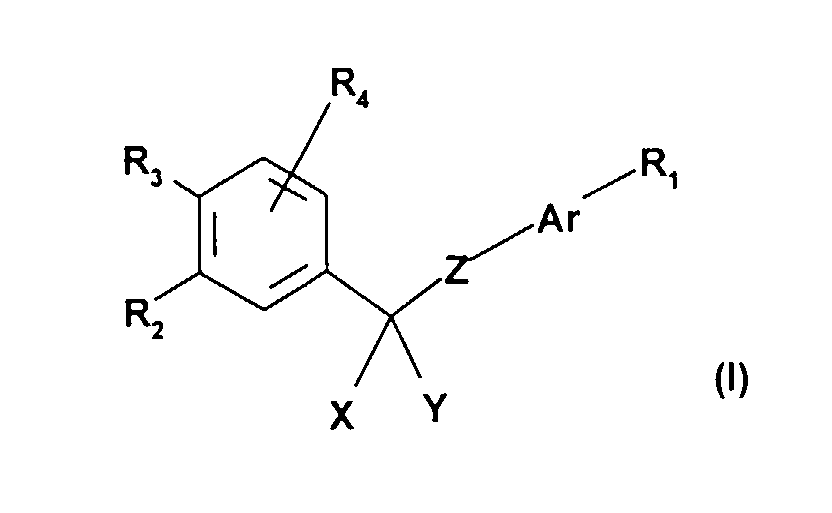 * Ar représente un radical choisi parmi les radicaux de formules (a)-(e) suivantes:
 * Z représente -CO-NR7-,* R1 représente :(i) un radical -CH3(ii) un radical -CH2-O-R6(iii) un radical -O-R6(iv) un radical -CO-R8,(v) un radical -S(O)tR9R6, R8, R9 et t ayant les significations données ci-après,* soit X et Y peuvent être pris séparement :X représente un atome d'hydrogène ou un radical alkyle inférieur,Y représente un radical de formule -(CH2)n-CH3 ou de formule -(CH2)n-R10* soit X et Y peuvent être pris ensemble :
X et Y forment un radical unique à double liaison choisi parmi les radicaux de formules :- =N-O-(CH2)n-R10- =CH-(CH2)m-R10- =N-O-(CH2)2-O-CH2-CH3- =N-O-CH2-O-CH2-CH2-O-CH3- =CH-(CH2)m-CH3R10, m et n ayant les significations données ci-après,* R2 et R3, pris séparément, représentent un atome d'hydrogène, un radical alkyle linéaire ou ramifié ayant de 1 à 20 atomes de carbone, un radical -OR6 ou un radical -SR6, R6 ayant la signification donnée ci-après, étant entendu que R2 et R3 ne peuvent pas être simultanément un atome d'hydrogène, un radical -OR6 ou un radical -SR6, ou R2 et R3, pris ensemble, forment avec le cycle aromatique adjacent un cycle à 5 ou 6 chainons éventuellement substitué par des groupes méthyle et/ou éventuellement interrompu par un atome d'oxygène ou de soufre ou par un radical -SO- ou SO2-,* R4 représente un atome d'hydrogène, un atome d'halogène, un radical alkyle inférieur ou un radical -OR6, R6 ayant la signification donnée ci-après,
étant entendu que dans tout ce qui précède :- R5 a la même signification que R4,- R6 représente un atome d'hydrogène, un radical alkyle linéaire ou ramifié ayant de 1 à 20 atomes de carbone ou un radical -CO-R11, R11 ayant la signification donnée ci-après,- R7 représente un atome d'hydrogène ou un radical alkyle inférieur,- R8 représente :(a) un atome d'hydrogène(b) un radical alkyle inférieur(c) un radical de formule :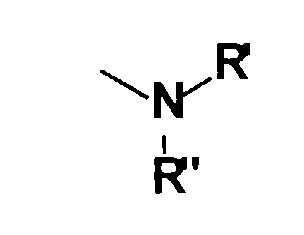 (d) un radical -OR12, R12 ayant la signification donnée ci-après,- R9 et R11, identiques ou différents, représentent un radical alkyle inférieur,- R10 représente :(i) un radical -OR6(ii) un radical -CO-R8(iii) un radical de formule
 (iv) un radical aryle, éventuellement substitué,(v) un radical hétérocycle,(vi) un radical cycloaliphatique en C3 ou C6,- R12 représente un atome d'hydrogène, un radical alkyle linéaire ou ramifié ayant de 1 à 20 atomes de carbone, un radical alkényle, un radical mono ou polyhydroxyalkyle, un radical aryle ou aralkyle éventuellement substitué ou un reste de sucre ou un reste d'aminoacide ou de peptide,- R' et R", identiques ou différents, représentent un atome d'hydrogène, un radical alkyle inférieur, un radical mono ou polyhydroxyalkyle, un radical aryle éventuellement substitué ou un reste d'aminoacide ou de peptide ou de sucre ou encore, pris ensemble, forment un hétérocycle,- m est un nombre entier de 1 à 20,- n est un nombre entier de 2 à 20,- t est un nombre entier égal à 0,1 ou 2,ainsi que leurs sels, et leurs isomères optiques et géométriques.
 - Composés selon la revendication 1, caractérisés en ce qu'ils se présentent sous forme de sels d'un métal alcalin ou alcalino-terreux, ou encore de zinc ou d'une amine organique.
- Composés selon l'une des revendications 1 ou 2, caractérisés en ce que les radicaux alkyles inférieurs sont choisis dans le groupe constitué par les radicaux méthyle, éthyle, isopropyle, butyle, tertiobutyle et hexyle.
- Composés selon l'une quelconque des revendications précédentes, caractérisés en ce que les radicaux alkyles linéaires ou ramifiés ayant de 1 à 15 atomes de carbone sont choisis dans le groupe constitué par les radicaux méthyle, éthyle, propyle, 2-éthyl-hexyle, octyle, dodécyle, hexadécyle et octadécyl.
- Composés selon l'une quelconque des revendications précédentes, caractérisés en ce que les radicaux monohydroxyalkyles sont choisis dans le groupe constitué par les radicaux 2-hydroxyéthyle, 2-hydroxypropyle ou 3-hydroxypropyle.
- Composés selon l'une quelconque des revendications précédentes, caractérisés en ce que les radicaux polyhydroxyalkyles sont choisis dans le groupe constitué par les radicaux 2,3-dihydroxypropyle, 2,3,4-trihydroxybutyle, 2,3,4,5-tétrahydroxypentyle ou le reste du pentaérythritol.
- Composés selon l'une quelconque des revendications précédentes, caractérisés en ce que le radical aryle est un radical phényle éventuellement substitué par au moins un atome d'halogène, un hydroxyle ou une fonction nitro.
- Composés selon l'une quelconque des revendications précédentes, caractérisés en ce que les radicaux aralkyles sont choisis dans le groupe constitué par les radicauxl benzyle ou phénéthyle éventuellement substitués par au moins un atome d'halogène, un hydroxyle ou une fonction nitro.
- Composés selon l'une quelconque des revendications précédentes, caractérisés en ce que les radicaux alkényles sont choisis dans le groupe constitué par les radicaux contenant de 1 à 5 atomes de carbone et présentant une ou plusieurs insaturations éthyléniques, en particulier le radical allyle.
- Composés selon l'une quelconque des revendications précédentes, caractérisés en ce que les restes de sucre sont choisis dans le groupe constitué par les restes de glucose, de galactose, de mannose ou d'acide glucuronique.
- Composés selon l'une quelconque des revendications précédentes, caractérisés en ce que les restes d'aminoacide sont choisis dans le groupe constitué par les restes dérivant de la lysine, de la glycine ou de l'acide aspartique.
- Composés selon l'une quelconque des revendications précédentes, caractérisés en ce que les restes de peptides sont choisis dans le groupe constitué par les restes de dipeptides ou de tripeptides.
- Composés selon l'une quelconque des revendications précédentes, caractérisés en ce que les radicaux hétérocycliques sont choisis dans le groupe constitué par les radicaux pipéridino, morpholino, pyrrolidino ou pipérazino, éventuellement substitués en position 4 par un radical alkyle en C1-C6 ou mono ou polyhydroxyalkyle.
- Composés selon l'une quelconque des revendications précédentes, caractérisés en ce que les atomes d'halogènes sont choisis dans le groupe constitué par le fluor, le chlore et le brome.
- Composés selon la revendication 1, caractérisés par le fait qu'ils sont pris dans le groupe constitué par:- Acide anti-4-[α-hydroxyhexylimino-(5,6,7,8-tétrahydro-5,5,8,8-tétraméthyl-2-naphtyl)acétamido]benzoïque- Acide syn-4-[α-hydroxyhexylimino-(5,6,7,8-tétrahydro-5,5,8,8-tétraméthyl-2-naphtyl)acétamido]benzoïque- Acide syn-4-[α-méthoxycarbonylpentylimino-(5,6,7,8-tétrahydro-5,5,8,8-tétraméthyl-2-naphtyl)acétamido]benzoïque- Acide syn-4-[α-hydroxyoctyloxyimino-(5,6,7,8-tétrahydro-5,5,8,8-tétraméthyl-2-naphtyl)acétamido]benzoïque.- Acide trans-4-[α-hydroxyoctyloxyimino-(5,6,7,8-tétrahydro-5,5,8,8-tétraméthyl-2-naphtyl)acétamido]benzoïque.- Acide syn-4-[α-hydroxyheptyloxyimino-(5,6,7,8-tétrahydro-5,5,8,8-tétraméthyl-2-naphtyl)acétamido]benzoïque.- Acide trans-4-[α-hydroxyheptyloxyimino-(5,6,7,8-tétrahydro-5,5,8,8-tétraméthyl-2-naphtyl)acétamido]benzoïque.- Acide syn-4-[α-hydroxypropyloxyimino-(5,6,7,8-tétrahydro-5,5,8,8-tétraméthyl-2-naphtyl)acétamido]benzoïque.- Acide trans-4-[α-hydroxypropyloxyimino-(5,6,7,8-tétrahydro-5,5,8,8-tétraméthyl-2-naphtyl)acétamido]benzoïque.- Acide syn-4-[α-éthoxycarbonylpropyloxyimino-(5,6,7,8-tétrahydro-5,5,8,8-tétraméthyl-2-naphtyl)acétamido]benzoïque.- Acide syn-4-[α-hydroxydecyloxyimino-(5,6,7,8-tétrahydro-5,5,8,8-tétraméthyl-2-naphtyl)acétamido]benzoïque.- Acide syn-4-[α-hydroxynonyloxyimino-(5,6,7,8-tétrahydro-5,5,8,8-tétraméthyl-2-naphtyl)acétamido]benzoïque.- Acide syn-4-[α-benzyloxyimino-(5,6,7,8-tétrahydro-5,5,8,8-tétraméthyl-2-naphtyl)acétamido]benzoïque.- Acide syn-4-[α-methoxyethoxymethoxyimino-(5,6,7,8-tétrahydro-5,5,8,8-tétraméthyl-2-naphtyl)acétamido]benzoïque.- syn-4-[α-éthoxycarbonylpropyloxyimino-(5,6,7,8-tétrahydro-5,5,8,8-tétraméthyl-2-naphtyl)acétamido]benzoate d'allyle.- Acide (E)-4-[2-(5,6,7,8-tétrahydro-5,5,8,8-tétraméthyl-2-naphtyl)-2-nonenamido]benzoïque.- Acide (Z)-4-[2-(5,6,7,8-tétrahydro-5,5,8,8-tétraméthyl-2-naphtyl)-2-nonenamido]benzoïque.- Acide (E)-4-[2-(5,6,7,8-tétrahydro-5,5,8,8-tétraméthyl-2-naphyl)-2-undecenamido]benzoïque.- (E)4-[2-(5,6,7,8-tétrahydro-5,5,8,8-tétraméthyl-2-naphtyl)-2-undecenamido]phénylcarboxamide.- (E)-4-[2-(5,6,7,8-tétrahydro-5,5,8,8-tétraméthyl-2-naphtyl)-2-undecenamido]benzèneméthanol.- (E)-4-[2-(5,6,7,8-tétrahydro-5,5,8,8-tétraméthyl-2-naphtyl)-2-undecenamido]phénol.- Acide (Z)-4-[2-(5,6,7,8-tétrahydro-5,5,8,8-tétraméthyl-2-naphtyl)-2-undecenamido]benzoïque.- Acide(E)-4-[2-(5,6,7,8-tétrahydro-5,5,8,8-tétraméthyl-2-naphtyl)-2-hexadecenamido]benzoïque.- Acide (Z)-4-[2-(5,6,7,8-tétrahydro-5,5,8,8-tétraméthyl-2-naphtyl)-2-hexadecenamido]benzoïque.
- Composés selon la revendication 1, caractérisés en ce que les composés de formule (I) sont ceux pour lesquels R1 représente le radical -COR8, X et Y pris ensemble forment un radical choisi parmi les radicaux de formules suivantes :- =N-O-(CH2)n-R10- =CH-(CH2)m-R10- =N-O-(CH2)2-O-CH2-CH3- =N-O-CH2-O-CH2-CH2-O-CH3- =CH-(CH2)m-CH3,R8, R10, m et n ayant les significations données dans la revendication 1.
- Composés selon l'une quelconque des revendications précédentes pour une utilisation comme médicament.
- Composés selon la revendication 17 pour une utilisation comme médicament destiné au traitement des affections dermatologiques, rhumatismales, respiratoires, cardiovasculires et ophtalmologiques.
- Utilisation de l'un au moins des composés définis aux revendications 1 à 16 pour la fabrication d'un médicament destiné au traitement des affections dermatologiques, rhumatismales, respiratoires, cardiovasculires et ophtalmologiques.
- Composition pharmaceutique, caractérisée par le fait qu'elle comprend, dans un support pharmaceutiquement acceptable, au moins un des composés tels que définis à l'une quelconque des revendications 1 à 16.
- Composition selon la revendication 20, caractérisée en ce que la concentration en composé(s) selon l'une des revendication 1 à 16 est comprise entre 0,001 % et 5 % en poids par rapport à l'ensemble de la composition.
- Composition cosmétique, caractérisée par le fait qu'elle comprend, dans un support cosmétiquement acceptable, au moins un des composés tels que définis à l'une quelconque des revendications 1 à 16.
- Composition selon la revendication 22, caractérisée en ce que la concentration en composé(s) selon l'une des revendications 1 à 16 est comprise entre 0,001 % et 3 % en poids par rapport à l'ensemble de la composition.
- Utilisation d'une composition cosmétique telle que définie à l'une des revendications 22 ou 23 pour l'hygiène corporelle ou capillaire.
Applications Claiming Priority (2)
| Application Number | Priority Date | Filing Date | Title |
|---|---|---|---|
| FR9502133A FR2730995B1 (fr) | 1995-02-23 | 1995-02-23 | Composes bi-aromatiques derives d'amide, compositions pharmaceutiques et cosmetiques les contenant et utilisations |
| FR9502133 | 1995-02-23 |
Publications (2)
| Publication Number | Publication Date |
|---|---|
| EP0728739A1 true EP0728739A1 (fr) | 1996-08-28 |
| EP0728739B1 EP0728739B1 (fr) | 1997-11-05 |
Family
ID=9476452
Family Applications (1)
| Application Number | Title | Priority Date | Filing Date |
|---|---|---|---|
| EP96400251A Expired - Lifetime EP0728739B1 (fr) | 1995-02-23 | 1996-02-06 | Composés bi-aromatiques dérivés d'amide, compositions pharmaceutiques et cosmétiques les contenant et utilisations |
Country Status (15)
| Country | Link |
|---|---|
| US (2) | US5935585A (fr) |
| EP (1) | EP0728739B1 (fr) |
| JP (1) | JP2957123B2 (fr) |
| AR (1) | AR001354A1 (fr) |
| AT (1) | ATE159931T1 (fr) |
| AU (1) | AU680162B2 (fr) |
| BR (1) | BR9600612A (fr) |
| CA (1) | CA2170065C (fr) |
| DE (1) | DE69600093T2 (fr) |
| DK (1) | DK0728739T3 (fr) |
| ES (1) | ES2113220T3 (fr) |
| FR (1) | FR2730995B1 (fr) |
| GR (1) | GR3025778T3 (fr) |
| NZ (1) | NZ286016A (fr) |
| ZA (1) | ZA961147B (fr) |
Cited By (4)
| Publication number | Priority date | Publication date | Assignee | Title |
|---|---|---|---|---|
| FR2801305A1 (fr) * | 1999-11-24 | 2001-05-25 | Galderma Res & Dev | Analogues de la vitamine d |
| WO2009156675A2 (fr) | 2008-05-30 | 2009-12-30 | Galderma Research & Development | Nouvelles compositions dépigmentantes sous forme d'une composition anhydre sans vaseline et sans élastomère comprenant un dérivé phénolique solubilisé et un rétinoïde |
| EP2460561A1 (fr) | 2006-12-21 | 2012-06-06 | Galderma Research & Development | Emulsion comprenant au moins un retinoide et du péroxyde de benzoyle |
| EP2460562A1 (fr) | 2006-12-21 | 2012-06-06 | Galderma Research & Development | Gel creme comprenant au moins un retinoide et du péroxyde de benzoyle |
Families Citing this family (10)
| Publication number | Priority date | Publication date | Assignee | Title |
|---|---|---|---|---|
| US6867203B2 (en) | 1998-12-29 | 2005-03-15 | Abbott Laboratories | Cell adhesion-inhibiting antiinflammatory and immune-suppressive compounds |
| US20030124174A1 (en) * | 2001-10-25 | 2003-07-03 | Endo Pharmaceuticals, Inc | Method for treating non-neuropathic pain |
| US7148211B2 (en) * | 2002-09-18 | 2006-12-12 | Genzyme Corporation | Formulation for lipophilic agents |
| US20040053895A1 (en) * | 2002-09-18 | 2004-03-18 | Bone Care International, Inc. | Multi-use vessels for vitamin D formulations |
| US20040058895A1 (en) * | 2002-09-18 | 2004-03-25 | Bone Care International, Inc. | Multi-use vessels for vitamin D formulations |
| GB0229653D0 (en) * | 2002-12-20 | 2003-01-22 | Cambridge Display Tech Ltd | Electrical connection of optoelectronic devices |
| US10321784B2 (en) * | 2009-07-10 | 2019-06-18 | Tsann Kuen (Zhangzhou) Enterprise Co., Ltd. | Grill device |
| EP3623371A1 (fr) | 2014-12-16 | 2020-03-18 | Axovant Sciences GmbH | Composés amide de quinuclidine à substituants géminal en tant qu'agonistes des récepteurs nicotiniques de l'acétylcholine 7 |
| CA2988968A1 (fr) | 2015-06-10 | 2016-12-15 | Forum Pharmaceuticals, Inc. | Composes d'aminobenzisoxazole en tant qu'agonistes des recepteurs de l'acetylcholine ?7-nicotinique |
| WO2017027600A1 (fr) | 2015-08-12 | 2017-02-16 | Forum Pharmaceuticals, Inc. | Composés d'aminobenzisoxazole à substitution géminale utilisés en tant qu'agonistes de récepteurs de l'acétylcholine α7-nicotinique |
Citations (4)
| Publication number | Priority date | Publication date | Assignee | Title |
|---|---|---|---|---|
| EP0227431A1 (fr) * | 1985-12-17 | 1987-07-01 | Beecham Group Plc | Amides hétérocycliques |
| WO1992006948A1 (fr) * | 1990-10-12 | 1992-04-30 | Centre International De Recherches Dermatologiques Galderma (Cird Galderma) | Composes bi-aromatiques et leur utilisation en medecine humaine et veterinaire et en cosmetique |
| EP0514264A1 (fr) * | 1991-05-13 | 1992-11-19 | Centre International De Recherches Dermatologiques Galderma, ( Cird Galderma) | Composés bi-aromatiques dérivés d'un motif salicylique, leur procédé de préparation et leur utilisation en médecine humaine et vétérinaire ainsi qu'en cosmétique |
| EP0661260A1 (fr) * | 1993-12-15 | 1995-07-05 | Centre International De Recherches Dermatologiques Galderma, ( Cird Galderma) | Nouveaux composés bi-aromatiques dérivés d'amide, compositions pharmaceutiques et cosmétiques les contenant et utilisations |
Family Cites Families (3)
| Publication number | Priority date | Publication date | Assignee | Title |
|---|---|---|---|---|
| US4536346A (en) * | 1983-05-06 | 1985-08-20 | American Cyanamid Company | Aralkanamidophenyl compounds |
| JPS61140556A (ja) * | 1984-12-11 | 1986-06-27 | Sumitomo Seiyaku Kk | 新規なアリ−ル酢酸アニリド誘導体 |
| DE3668450D1 (de) * | 1985-03-14 | 1990-03-01 | Smithkline Dauelsberg | 5-aminosalicylsaeurederivate von nicht-steroidalen entzuendungshemmenden sauren. |
-
1995
- 1995-02-23 FR FR9502133A patent/FR2730995B1/fr not_active Expired - Fee Related
-
1996
- 1996-02-06 DE DE69600093T patent/DE69600093T2/de not_active Expired - Fee Related
- 1996-02-06 EP EP96400251A patent/EP0728739B1/fr not_active Expired - Lifetime
- 1996-02-06 AT AT96400251T patent/ATE159931T1/de not_active IP Right Cessation
- 1996-02-06 ES ES96400251T patent/ES2113220T3/es not_active Expired - Lifetime
- 1996-02-06 DK DK96400251.3T patent/DK0728739T3/da active
- 1996-02-12 AU AU44447/96A patent/AU680162B2/en not_active Ceased
- 1996-02-13 ZA ZA961147A patent/ZA961147B/xx unknown
- 1996-02-19 NZ NZ286016A patent/NZ286016A/en unknown
- 1996-02-22 CA CA002170065A patent/CA2170065C/fr not_active Expired - Fee Related
- 1996-02-22 AR AR33549396A patent/AR001354A1/es unknown
- 1996-02-22 JP JP8035257A patent/JP2957123B2/ja not_active Expired - Fee Related
- 1996-02-23 BR BR9600612A patent/BR9600612A/pt not_active IP Right Cessation
- 1996-02-23 US US08/605,960 patent/US5935585A/en not_active Expired - Fee Related
-
1997
- 1997-12-24 GR GR970403429T patent/GR3025778T3/el unknown
-
1999
- 1999-02-09 US US09/246,715 patent/US6171603B1/en not_active Expired - Fee Related
Patent Citations (4)
| Publication number | Priority date | Publication date | Assignee | Title |
|---|---|---|---|---|
| EP0227431A1 (fr) * | 1985-12-17 | 1987-07-01 | Beecham Group Plc | Amides hétérocycliques |
| WO1992006948A1 (fr) * | 1990-10-12 | 1992-04-30 | Centre International De Recherches Dermatologiques Galderma (Cird Galderma) | Composes bi-aromatiques et leur utilisation en medecine humaine et veterinaire et en cosmetique |
| EP0514264A1 (fr) * | 1991-05-13 | 1992-11-19 | Centre International De Recherches Dermatologiques Galderma, ( Cird Galderma) | Composés bi-aromatiques dérivés d'un motif salicylique, leur procédé de préparation et leur utilisation en médecine humaine et vétérinaire ainsi qu'en cosmétique |
| EP0661260A1 (fr) * | 1993-12-15 | 1995-07-05 | Centre International De Recherches Dermatologiques Galderma, ( Cird Galderma) | Nouveaux composés bi-aromatiques dérivés d'amide, compositions pharmaceutiques et cosmétiques les contenant et utilisations |
Cited By (7)
| Publication number | Priority date | Publication date | Assignee | Title |
|---|---|---|---|---|
| FR2801305A1 (fr) * | 1999-11-24 | 2001-05-25 | Galderma Res & Dev | Analogues de la vitamine d |
| WO2001038303A3 (fr) * | 1999-11-24 | 2002-01-17 | Galderma Res & Dev | Analogues de la vitamine d |
| US6831106B1 (en) | 1999-11-24 | 2004-12-14 | Galderma Research & Development, S.N.C. | Vitamin D analogues |
| EP2460561A1 (fr) | 2006-12-21 | 2012-06-06 | Galderma Research & Development | Emulsion comprenant au moins un retinoide et du péroxyde de benzoyle |
| EP2460562A1 (fr) | 2006-12-21 | 2012-06-06 | Galderma Research & Development | Gel creme comprenant au moins un retinoide et du péroxyde de benzoyle |
| EP3025763A1 (fr) | 2006-12-21 | 2016-06-01 | Galderma Research & Development | Gel creme comprenant au moins un retinoide et du peroxyde de benzoyle |
| WO2009156675A2 (fr) | 2008-05-30 | 2009-12-30 | Galderma Research & Development | Nouvelles compositions dépigmentantes sous forme d'une composition anhydre sans vaseline et sans élastomère comprenant un dérivé phénolique solubilisé et un rétinoïde |
Also Published As
| Publication number | Publication date |
|---|---|
| AU4444796A (en) | 1996-09-26 |
| FR2730995A1 (fr) | 1996-08-30 |
| ZA961147B (en) | 1996-08-23 |
| DK0728739T3 (da) | 1998-03-30 |
| GR3025778T3 (en) | 1998-03-31 |
| JP2957123B2 (ja) | 1999-10-04 |
| DE69600093T2 (de) | 1998-03-05 |
| US5935585A (en) | 1999-08-10 |
| AU680162B2 (en) | 1997-07-17 |
| EP0728739B1 (fr) | 1997-11-05 |
| ATE159931T1 (de) | 1997-11-15 |
| NZ286016A (en) | 1997-10-24 |
| US6171603B1 (en) | 2001-01-09 |
| FR2730995B1 (fr) | 1997-04-04 |
| ES2113220T3 (es) | 1998-04-16 |
| DE69600093D1 (de) | 1997-12-11 |
| CA2170065C (fr) | 2001-02-13 |
| AR001354A1 (es) | 1997-10-22 |
| JPH08291122A (ja) | 1996-11-05 |
| CA2170065A1 (fr) | 1996-08-24 |
| BR9600612A (pt) | 1997-12-30 |
Similar Documents
| Publication | Publication Date | Title |
|---|---|---|
| EP0661258B1 (fr) | Nouveaux composés propynyl bi-aromatiques, compositions pharmaceutiques et cosmétiques les contenant et utilisations | |
| EP0776885B1 (fr) | Composés biaromatiques portant un groupement adamantyl en ortho, compositions pharmaceutiques et cosmétiques les contenant et utilisations | |
| EP0850909B1 (fr) | Composés stilbéniques à groupement adamantyl, compositions les contenant et utilisations | |
| EP0679628B1 (fr) | Composés polyéniques, compositions pharmaceutiques et cosmétiques les contenant et utilisations | |
| EP0514269B1 (fr) | Nouveaux composés aromatiques dérivés d'imine, leur procédé de préparation et leur utilisation en médecine humaine et vétérinaire ainsi qu'en cosmétique | |
| FR2733684A1 (fr) | Utilisation de retinoides dans une composition cosmetique ou pour la fabrication d'une composition pharmaceutique | |
| CA2191790C (fr) | Composes biaromatiques portant un groupement adamantyl en para, compositions pharmaceutiques et cosmetiques les contenant et utilisations de ces compositions | |
| EP0679630B1 (fr) | Composés bicycliques-aromatiques, compositions pharmaceutiques et cosmétiques les contenant et utilisations | |
| EP0679631B1 (fr) | Composés bi-aromatiques acétylénés à groupement adamantyle, compositions pharmaceutiques et cosmétiques les contenant et utilisations | |
| EP0661260B1 (fr) | Nouveaux composés bi-aromatiques dérivés d'amide, compositions pharmaceutiques et cosmétiques les contenant et utilisations | |
| EP0722928B1 (fr) | Composés bicycliques-aromatiques à forte activité biologique, compositions pharmaceutiques et cosmétiques les contenant et utilisations | |
| FR2746101A1 (fr) | Composes bicycliques-aromatiques | |
| EP0728739B1 (fr) | Composés bi-aromatiques dérivés d'amide, compositions pharmaceutiques et cosmétiques les contenant et utilisations | |
| EP0732328B1 (fr) | Composés hétérocycliques aromatiques, compositions pharmaceutiques et cosmétiques les contenant et utilisations | |
| EP0832057B1 (fr) | Composes propynyl ou dienyl biaromatiques | |
| EP0658553B1 (fr) | Composés aromatiques polycycliques, compositions pharmaceutiques et cosmétiques les contenant et utilisations | |
| FR2676439A1 (fr) | Nouveaux composes bi-aromatiques derives d'un motif salicylique, leur procede de preparation et leur utilisation en medecine humaine et veterinaire ainsi qu'en cosmetique. | |
| FR2764604A1 (fr) | Composes bi-aromatiques relies par un radical propynylene ou allenylene et compositions pharmaceutiques et cosmetiques les contenant | |
| FR2650824A1 (fr) | Thioesters bi-aromatiques, leur procede de preparation et leur utilisation en medecine humaine ou veterinaire et en cosmetique |
Legal Events
| Date | Code | Title | Description |
|---|---|---|---|
| PUAI | Public reference made under article 153(3) epc to a published international application that has entered the european phase |
Free format text: ORIGINAL CODE: 0009012 |
|
| AK | Designated contracting states |
Kind code of ref document: A1 Designated state(s): AT BE CH DE DK ES FR GB GR IE IT LI LU MC NL PT SE |
|
| 17P | Request for examination filed |
Effective date: 19960812 |
|
| 17Q | First examination report despatched |
Effective date: 19961204 |
|
| GRAG | Despatch of communication of intention to grant |
Free format text: ORIGINAL CODE: EPIDOS AGRA |
|
| GRAG | Despatch of communication of intention to grant |
Free format text: ORIGINAL CODE: EPIDOS AGRA |
|
| GRAH | Despatch of communication of intention to grant a patent |
Free format text: ORIGINAL CODE: EPIDOS IGRA |
|
| GRAH | Despatch of communication of intention to grant a patent |
Free format text: ORIGINAL CODE: EPIDOS IGRA |
|
| GRAA | (expected) grant |
Free format text: ORIGINAL CODE: 0009210 |
|
| AK | Designated contracting states |
Kind code of ref document: B1 Designated state(s): AT BE CH DE DK ES FR GB GR IE IT LI LU MC NL PT SE |
|
| REF | Corresponds to: |
Ref document number: 159931 Country of ref document: AT Date of ref document: 19971115 Kind code of ref document: T |
|
| ITF | It: translation for a ep patent filed | ||
| REG | Reference to a national code |
Ref country code: CH Ref legal event code: EP |
|
| GBT | Gb: translation of ep patent filed (gb section 77(6)(a)/1977) |
Effective date: 19971118 |
|
| REF | Corresponds to: |
Ref document number: 69600093 Country of ref document: DE Date of ref document: 19971211 |
|
| REG | Reference to a national code |
Ref country code: IE Ref legal event code: FG4D Free format text: 77324 |
|
| REG | Reference to a national code |
Ref country code: DK Ref legal event code: T3 |
|
| REG | Reference to a national code |
Ref country code: ES Ref legal event code: FG2A Ref document number: 2113220 Country of ref document: ES Kind code of ref document: T3 |
|
| REG | Reference to a national code |
Ref country code: PT Ref legal event code: SC4A Free format text: AVAILABILITY OF NATIONAL TRANSLATION Effective date: 19980108 |
|
| PLBE | No opposition filed within time limit |
Free format text: ORIGINAL CODE: 0009261 |
|
| STAA | Information on the status of an ep patent application or granted ep patent |
Free format text: STATUS: NO OPPOSITION FILED WITHIN TIME LIMIT |
|
| 26N | No opposition filed | ||
| REG | Reference to a national code |
Ref country code: GB Ref legal event code: IF02 |
|
| PGFP | Annual fee paid to national office [announced via postgrant information from national office to epo] |
Ref country code: IE Payment date: 20070213 Year of fee payment: 12 Ref country code: AT Payment date: 20070213 Year of fee payment: 12 |
|
| PGFP | Annual fee paid to national office [announced via postgrant information from national office to epo] |
Ref country code: DK Payment date: 20070215 Year of fee payment: 12 |
|
| PGFP | Annual fee paid to national office [announced via postgrant information from national office to epo] |
Ref country code: ES Payment date: 20070327 Year of fee payment: 12 |
|
| PGFP | Annual fee paid to national office [announced via postgrant information from national office to epo] |
Ref country code: CH Payment date: 20080129 Year of fee payment: 13 |
|
| PGFP | Annual fee paid to national office [announced via postgrant information from national office to epo] |
Ref country code: IT Payment date: 20080226 Year of fee payment: 13 Ref country code: SE Payment date: 20080219 Year of fee payment: 13 Ref country code: PT Payment date: 20080122 Year of fee payment: 13 Ref country code: NL Payment date: 20080203 Year of fee payment: 13 Ref country code: MC Payment date: 20080128 Year of fee payment: 13 Ref country code: LU Payment date: 20080226 Year of fee payment: 13 Ref country code: GB Payment date: 20080206 Year of fee payment: 13 Ref country code: DE Payment date: 20080131 Year of fee payment: 13 |
|
| PGFP | Annual fee paid to national office [announced via postgrant information from national office to epo] |
Ref country code: FR Payment date: 20080208 Year of fee payment: 13 |
|
| REG | Reference to a national code |
Ref country code: DK Ref legal event code: EBP |
|
| PGFP | Annual fee paid to national office [announced via postgrant information from national office to epo] |
Ref country code: BE Payment date: 20080417 Year of fee payment: 13 |
|
| REG | Reference to a national code |
Ref country code: IE Ref legal event code: MM4A |
|
| PG25 | Lapsed in a contracting state [announced via postgrant information from national office to epo] |
Ref country code: AT Free format text: LAPSE BECAUSE OF NON-PAYMENT OF DUE FEES Effective date: 20080206 |
|
| PG25 | Lapsed in a contracting state [announced via postgrant information from national office to epo] |
Ref country code: IE Free format text: LAPSE BECAUSE OF NON-PAYMENT OF DUE FEES Effective date: 20080206 Ref country code: DK Free format text: LAPSE BECAUSE OF NON-PAYMENT OF DUE FEES Effective date: 20080229 |
|
| PGFP | Annual fee paid to national office [announced via postgrant information from national office to epo] |
Ref country code: GR Payment date: 20080116 Year of fee payment: 13 |
|
| REG | Reference to a national code |
Ref country code: ES Ref legal event code: FD2A Effective date: 20080207 |
|
| PG25 | Lapsed in a contracting state [announced via postgrant information from national office to epo] |
Ref country code: ES Free format text: LAPSE BECAUSE OF NON-PAYMENT OF DUE FEES Effective date: 20080207 |
|
| REG | Reference to a national code |
Ref country code: PT Ref legal event code: MM4A Free format text: LAPSE DUE TO NON-PAYMENT OF FEES Effective date: 20090806 |
|
| BERE | Be: lapsed |
Owner name: CENTRE INTERNATIONAL DE RECHERCHES DERMATOLOGIQUES Effective date: 20090228 |
|
| PG25 | Lapsed in a contracting state [announced via postgrant information from national office to epo] |
Ref country code: MC Free format text: LAPSE BECAUSE OF NON-PAYMENT OF DUE FEES Effective date: 20090228 |
|
| REG | Reference to a national code |
Ref country code: CH Ref legal event code: PL |
|
| EUG | Se: european patent has lapsed | ||
| GBPC | Gb: european patent ceased through non-payment of renewal fee |
Effective date: 20090206 |
|
| PG25 | Lapsed in a contracting state [announced via postgrant information from national office to epo] |
Ref country code: PT Free format text: LAPSE BECAUSE OF NON-PAYMENT OF DUE FEES Effective date: 20090806 Ref country code: LI Free format text: LAPSE BECAUSE OF NON-PAYMENT OF DUE FEES Effective date: 20090228 Ref country code: CH Free format text: LAPSE BECAUSE OF NON-PAYMENT OF DUE FEES Effective date: 20090228 |
|
| NLV4 | Nl: lapsed or anulled due to non-payment of the annual fee |
Effective date: 20090901 |
|
| REG | Reference to a national code |
Ref country code: FR Ref legal event code: ST Effective date: 20091030 |
|
| PG25 | Lapsed in a contracting state [announced via postgrant information from national office to epo] |
Ref country code: NL Free format text: LAPSE BECAUSE OF NON-PAYMENT OF DUE FEES Effective date: 20090901 |
|
| PG25 | Lapsed in a contracting state [announced via postgrant information from national office to epo] |
Ref country code: DE Free format text: LAPSE BECAUSE OF NON-PAYMENT OF DUE FEES Effective date: 20090901 |
|
| PG25 | Lapsed in a contracting state [announced via postgrant information from national office to epo] |
Ref country code: GR Free format text: LAPSE BECAUSE OF NON-PAYMENT OF DUE FEES Effective date: 20090902 Ref country code: BE Free format text: LAPSE BECAUSE OF NON-PAYMENT OF DUE FEES Effective date: 20090228 |
|
| PG25 | Lapsed in a contracting state [announced via postgrant information from national office to epo] |
Ref country code: GB Free format text: LAPSE BECAUSE OF NON-PAYMENT OF DUE FEES Effective date: 20090206 Ref country code: FR Free format text: LAPSE BECAUSE OF NON-PAYMENT OF DUE FEES Effective date: 20090302 |
|
| PG25 | Lapsed in a contracting state [announced via postgrant information from national office to epo] |
Ref country code: IT Free format text: LAPSE BECAUSE OF NON-PAYMENT OF DUE FEES Effective date: 20090206 |
|
| PG25 | Lapsed in a contracting state [announced via postgrant information from national office to epo] |
Ref country code: LU Free format text: LAPSE BECAUSE OF NON-PAYMENT OF DUE FEES Effective date: 20090206 |
|
| PG25 | Lapsed in a contracting state [announced via postgrant information from national office to epo] |
Ref country code: SE Free format text: LAPSE BECAUSE OF NON-PAYMENT OF DUE FEES Effective date: 20090207 |