EP0728747A1 - Imidazole derivative, pharmaceutically acceptable salt thereof, process of manufacture therefor, and anti-ulcer drug including such derivative or salt - Google Patents
Imidazole derivative, pharmaceutically acceptable salt thereof, process of manufacture therefor, and anti-ulcer drug including such derivative or salt Download PDFInfo
- Publication number
- EP0728747A1 EP0728747A1 EP96301159A EP96301159A EP0728747A1 EP 0728747 A1 EP0728747 A1 EP 0728747A1 EP 96301159 A EP96301159 A EP 96301159A EP 96301159 A EP96301159 A EP 96301159A EP 0728747 A1 EP0728747 A1 EP 0728747A1
- Authority
- EP
- European Patent Office
- Prior art keywords
- group
- represented
- hydrogen atom
- lower alkyl
- represent
- Prior art date
- Legal status (The legal status is an assumption and is not a legal conclusion. Google has not performed a legal analysis and makes no representation as to the accuracy of the status listed.)
- Withdrawn
Links
- 150000002460 imidazoles Chemical class 0.000 title claims abstract description 67
- 238000000034 method Methods 0.000 title claims description 50
- 150000003839 salts Chemical class 0.000 title claims description 47
- 239000003699 antiulcer agent Substances 0.000 title claims description 17
- 238000004519 manufacturing process Methods 0.000 title 1
- 125000000217 alkyl group Chemical group 0.000 claims abstract description 95
- 125000004435 hydrogen atom Chemical group [H]* 0.000 claims abstract description 67
- 125000005843 halogen group Chemical group 0.000 claims abstract description 50
- 125000003545 alkoxy group Chemical group 0.000 claims abstract description 37
- 125000003710 aryl alkyl group Chemical group 0.000 claims abstract description 35
- 125000003118 aryl group Chemical group 0.000 claims abstract description 30
- 125000005129 aryl carbonyl group Chemical group 0.000 claims abstract description 29
- 125000002252 acyl group Chemical group 0.000 claims abstract description 28
- 125000001997 phenyl group Chemical group [H]C1=C([H])C([H])=C(*)C([H])=C1[H] 0.000 claims abstract description 28
- 125000002887 hydroxy group Chemical group [H]O* 0.000 claims abstract description 26
- 125000003342 alkenyl group Chemical group 0.000 claims abstract description 22
- 125000001118 alkylidene group Chemical group 0.000 claims abstract description 20
- 125000002947 alkylene group Chemical group 0.000 claims abstract description 19
- 125000000449 nitro group Chemical group [O-][N+](*)=O 0.000 claims abstract description 19
- QJGQUHMNIGDVPM-UHFFFAOYSA-N nitrogen group Chemical group [N] QJGQUHMNIGDVPM-UHFFFAOYSA-N 0.000 claims abstract description 16
- 125000001589 carboacyl group Chemical group 0.000 claims abstract description 12
- 229910052717 sulfur Inorganic materials 0.000 claims abstract description 10
- 125000004434 sulfur atom Chemical group 0.000 claims abstract description 10
- 125000004430 oxygen atom Chemical group O* 0.000 claims abstract description 9
- 125000005108 alkenylthio group Chemical group 0.000 claims abstract description 6
- 125000004414 alkyl thio group Chemical group 0.000 claims abstract description 6
- 125000004659 aryl alkyl thio group Chemical group 0.000 claims abstract description 4
- 229910052760 oxygen Inorganic materials 0.000 claims abstract description 4
- 239000001301 oxygen Substances 0.000 claims abstract description 4
- 150000001875 compounds Chemical class 0.000 claims description 189
- -1 cinnamylidene group Chemical group 0.000 claims description 68
- 125000001424 substituent group Chemical group 0.000 claims description 66
- 125000004432 carbon atom Chemical group C* 0.000 claims description 60
- 238000006243 chemical reaction Methods 0.000 claims description 51
- 239000002253 acid Substances 0.000 claims description 33
- 150000004820 halides Chemical class 0.000 claims description 10
- 150000008065 acid anhydrides Chemical class 0.000 claims description 8
- 125000000649 benzylidene group Chemical group [H]C(=[*])C1=C([H])C([H])=C([H])C([H])=C1[H] 0.000 claims description 7
- 125000003396 thiol group Chemical group [H]S* 0.000 claims description 6
- UGWULZWUXSCWPX-UHFFFAOYSA-N 2-sulfanylideneimidazolidin-4-one Chemical class O=C1CNC(=S)N1 UGWULZWUXSCWPX-UHFFFAOYSA-N 0.000 claims description 5
- 150000001350 alkyl halides Chemical class 0.000 claims description 5
- 229910052799 carbon Inorganic materials 0.000 claims description 5
- DNPNXLYNSXZPGM-UHFFFAOYSA-N 4-sulfanylideneimidazolidin-2-one Chemical class O=C1NCC(=S)N1 DNPNXLYNSXZPGM-UHFFFAOYSA-N 0.000 claims description 4
- MYMOFIZGZYHOMD-UHFFFAOYSA-N Dioxygen Chemical compound O=O MYMOFIZGZYHOMD-UHFFFAOYSA-N 0.000 claims description 3
- 125000000490 cinnamyl group Chemical group C(C=CC1=CC=CC=C1)* 0.000 claims description 3
- 125000003884 phenylalkyl group Chemical group 0.000 claims description 2
- 125000004076 pyridyl group Chemical group 0.000 claims description 2
- 125000005493 quinolyl group Chemical group 0.000 claims description 2
- 150000001721 carbon Chemical group 0.000 claims 2
- OKTJSMMVPCPJKN-UHFFFAOYSA-N Carbon Chemical compound [C] OKTJSMMVPCPJKN-UHFFFAOYSA-N 0.000 claims 1
- 229910052739 hydrogen Inorganic materials 0.000 abstract description 5
- UFHFLCQGNIYNRP-UHFFFAOYSA-N Hydrogen Chemical compound [H][H] UFHFLCQGNIYNRP-UHFFFAOYSA-N 0.000 abstract 1
- 239000001257 hydrogen Substances 0.000 abstract 1
- PXQLVRUNWNTZOS-UHFFFAOYSA-N sulfanyl Chemical group [SH] PXQLVRUNWNTZOS-UHFFFAOYSA-N 0.000 abstract 1
- HEDRZPFGACZZDS-MICDWDOJSA-N Trichloro(2H)methane Chemical compound [2H]C(Cl)(Cl)Cl HEDRZPFGACZZDS-MICDWDOJSA-N 0.000 description 146
- 238000005160 1H NMR spectroscopy Methods 0.000 description 106
- 125000002496 methyl group Chemical group [H]C([H])([H])* 0.000 description 75
- 238000002844 melting Methods 0.000 description 71
- 230000008018 melting Effects 0.000 description 71
- OKKJLVBELUTLKV-UHFFFAOYSA-N Methanol Chemical compound OC OKKJLVBELUTLKV-UHFFFAOYSA-N 0.000 description 61
- LFQSCWFLJHTTHZ-UHFFFAOYSA-N Ethanol Chemical compound CCO LFQSCWFLJHTTHZ-UHFFFAOYSA-N 0.000 description 42
- 238000004458 analytical method Methods 0.000 description 37
- RTZKZFJDLAIYFH-UHFFFAOYSA-N Diethyl ether Chemical compound CCOCC RTZKZFJDLAIYFH-UHFFFAOYSA-N 0.000 description 36
- 238000002360 preparation method Methods 0.000 description 32
- IAZDPXIOMUYVGZ-WFGJKAKNSA-N Dimethyl sulfoxide Chemical compound [2H]C([2H])([2H])S(=O)C([2H])([2H])[2H] IAZDPXIOMUYVGZ-WFGJKAKNSA-N 0.000 description 30
- CSNNHWWHGAXBCP-UHFFFAOYSA-L Magnesium sulfate Chemical compound [Mg+2].[O-][S+2]([O-])([O-])[O-] CSNNHWWHGAXBCP-UHFFFAOYSA-L 0.000 description 30
- 241000700159 Rattus Species 0.000 description 28
- 239000003814 drug Substances 0.000 description 26
- 229940079593 drug Drugs 0.000 description 25
- 239000000243 solution Substances 0.000 description 25
- HEMHJVSKTPXQMS-UHFFFAOYSA-M Sodium hydroxide Chemical compound [OH-].[Na+] HEMHJVSKTPXQMS-UHFFFAOYSA-M 0.000 description 24
- 239000013078 crystal Substances 0.000 description 24
- 239000011541 reaction mixture Substances 0.000 description 23
- ZMXDDKWLCZADIW-UHFFFAOYSA-N N,N-Dimethylformamide Chemical compound CN(C)C=O ZMXDDKWLCZADIW-UHFFFAOYSA-N 0.000 description 21
- XEKOWRVHYACXOJ-UHFFFAOYSA-N Ethyl acetate Chemical compound CCOC(C)=O XEKOWRVHYACXOJ-UHFFFAOYSA-N 0.000 description 18
- WQDUMFSSJAZKTM-UHFFFAOYSA-N Sodium methoxide Chemical compound [Na+].[O-]C WQDUMFSSJAZKTM-UHFFFAOYSA-N 0.000 description 18
- QTBSBXVTEAMEQO-UHFFFAOYSA-N Acetic acid Chemical compound CC(O)=O QTBSBXVTEAMEQO-UHFFFAOYSA-N 0.000 description 15
- WEVYAHXRMPXWCK-UHFFFAOYSA-N Acetonitrile Chemical compound CC#N WEVYAHXRMPXWCK-UHFFFAOYSA-N 0.000 description 15
- 229910052943 magnesium sulfate Inorganic materials 0.000 description 15
- HEDRZPFGACZZDS-UHFFFAOYSA-N Chloroform Chemical compound ClC(Cl)Cl HEDRZPFGACZZDS-UHFFFAOYSA-N 0.000 description 14
- 230000002401 inhibitory effect Effects 0.000 description 14
- XLYOFNOQVPJJNP-UHFFFAOYSA-N water Substances O XLYOFNOQVPJJNP-UHFFFAOYSA-N 0.000 description 14
- 208000025865 Ulcer Diseases 0.000 description 13
- 230000000694 effects Effects 0.000 description 13
- 231100000397 ulcer Toxicity 0.000 description 13
- NLEGOBBGDOATPO-UHFFFAOYSA-N 5,5-dimethylimidazolidine-2,4-dithione Chemical compound CC1(C)NC(=S)NC1=S NLEGOBBGDOATPO-UHFFFAOYSA-N 0.000 description 12
- IAZDPXIOMUYVGZ-UHFFFAOYSA-N Dimethylsulphoxide Chemical compound CS(C)=O IAZDPXIOMUYVGZ-UHFFFAOYSA-N 0.000 description 12
- JUJWROOIHBZHMG-UHFFFAOYSA-N Pyridine Chemical compound C1=CC=NC=C1 JUJWROOIHBZHMG-UHFFFAOYSA-N 0.000 description 12
- UIIMBOGNXHQVGW-UHFFFAOYSA-M Sodium bicarbonate Chemical compound [Na+].OC([O-])=O UIIMBOGNXHQVGW-UHFFFAOYSA-M 0.000 description 12
- ZMANZCXQSJIPKH-UHFFFAOYSA-N Triethylamine Chemical compound CCN(CC)CC ZMANZCXQSJIPKH-UHFFFAOYSA-N 0.000 description 12
- 239000000203 mixture Substances 0.000 description 12
- BWHMMNNQKKPAPP-UHFFFAOYSA-L potassium carbonate Chemical compound [K+].[K+].[O-]C([O-])=O BWHMMNNQKKPAPP-UHFFFAOYSA-L 0.000 description 12
- 239000006188 syrup Substances 0.000 description 12
- 235000020357 syrup Nutrition 0.000 description 12
- 0 C*S*(NC)=N[C@](C)(C1O[C@]1C)I Chemical compound C*S*(NC)=N[C@](C)(C1O[C@]1C)I 0.000 description 11
- VEXZGXHMUGYJMC-UHFFFAOYSA-N Hydrochloric acid Chemical compound Cl VEXZGXHMUGYJMC-UHFFFAOYSA-N 0.000 description 11
- 238000004440 column chromatography Methods 0.000 description 10
- UHOVQNZJYSORNB-UHFFFAOYSA-N Benzene Chemical compound C1=CC=CC=C1 UHOVQNZJYSORNB-UHFFFAOYSA-N 0.000 description 9
- VYPSYNLAJGMNEJ-UHFFFAOYSA-N Silicium dioxide Chemical compound O=[Si]=O VYPSYNLAJGMNEJ-UHFFFAOYSA-N 0.000 description 9
- YXFVVABEGXRONW-UHFFFAOYSA-N Toluene Chemical compound CC1=CC=CC=C1 YXFVVABEGXRONW-UHFFFAOYSA-N 0.000 description 9
- NDGRHDGMNRMJOP-UHFFFAOYSA-N [2-(chloromethyl)phenyl]-dimethylazanium;chloride Chemical compound Cl.CN(C)C1=CC=CC=C1CCl NDGRHDGMNRMJOP-UHFFFAOYSA-N 0.000 description 9
- 239000002904 solvent Substances 0.000 description 9
- CDBYLPFSWZWCQE-UHFFFAOYSA-L Sodium Carbonate Chemical compound [Na+].[Na+].[O-]C([O-])=O CDBYLPFSWZWCQE-UHFFFAOYSA-L 0.000 description 8
- 239000007864 aqueous solution Substances 0.000 description 8
- 230000001681 protective effect Effects 0.000 description 8
- IQTJTANZZWMYKV-UHFFFAOYSA-N 2-[[2-(dimethylamino)phenyl]methylsulfanyl]-4,4-dimethyl-1h-imidazole-5-thione Chemical compound CN(C)C1=CC=CC=C1CSC1=NC(C)(C)C(=S)N1 IQTJTANZZWMYKV-UHFFFAOYSA-N 0.000 description 7
- VHYFNPMBLIVWCW-UHFFFAOYSA-N 4-Dimethylaminopyridine Chemical compound CN(C)C1=CC=NC=C1 VHYFNPMBLIVWCW-UHFFFAOYSA-N 0.000 description 7
- 208000007107 Stomach Ulcer Diseases 0.000 description 7
- 229960004132 diethyl ether Drugs 0.000 description 7
- 229940079865 intestinal antiinfectives imidazole derivative Drugs 0.000 description 7
- 230000001737 promoting effect Effects 0.000 description 7
- 239000000741 silica gel Substances 0.000 description 7
- 229910002027 silica gel Inorganic materials 0.000 description 7
- VZCYOOQTPOCHFL-UHFFFAOYSA-N trans-butenedioic acid Natural products OC(=O)C=CC(O)=O VZCYOOQTPOCHFL-UHFFFAOYSA-N 0.000 description 7
- XLLUAIVRBDICIK-UHFFFAOYSA-N 2-[[2-(dimethylamino)phenyl]methylsulfanyl]-4,4-dimethyl-1h-imidazol-5-one Chemical compound CN(C)C1=CC=CC=C1CSC1=NC(=O)C(C)(C)N1 XLLUAIVRBDICIK-UHFFFAOYSA-N 0.000 description 6
- YMWUJEATGCHHMB-UHFFFAOYSA-N Dichloromethane Chemical compound ClCCl YMWUJEATGCHHMB-UHFFFAOYSA-N 0.000 description 6
- WSFSSNUMVMOOMR-UHFFFAOYSA-N Formaldehyde Chemical compound O=C WSFSSNUMVMOOMR-UHFFFAOYSA-N 0.000 description 6
- JGFZNNIVVJXRND-UHFFFAOYSA-N N,N-Diisopropylethylamine (DIPEA) Chemical compound CCN(C(C)C)C(C)C JGFZNNIVVJXRND-UHFFFAOYSA-N 0.000 description 6
- WYURNTSHIVDZCO-UHFFFAOYSA-N Tetrahydrofuran Chemical compound C1CCOC1 WYURNTSHIVDZCO-UHFFFAOYSA-N 0.000 description 6
- 229960000583 acetic acid Drugs 0.000 description 6
- KRKNYBCHXYNGOX-UHFFFAOYSA-N citric acid Chemical compound OC(=O)CC(O)(C(O)=O)CC(O)=O KRKNYBCHXYNGOX-UHFFFAOYSA-N 0.000 description 6
- ZKQFHRVKCYFVCN-UHFFFAOYSA-N ethoxyethane;hexane Chemical compound CCOCC.CCCCCC ZKQFHRVKCYFVCN-UHFFFAOYSA-N 0.000 description 6
- 229910000027 potassium carbonate Inorganic materials 0.000 description 6
- UMJSCPRVCHMLSP-UHFFFAOYSA-N pyridine Natural products COC1=CC=CN=C1 UMJSCPRVCHMLSP-UHFFFAOYSA-N 0.000 description 6
- 229910000030 sodium bicarbonate Inorganic materials 0.000 description 6
- 239000007858 starting material Substances 0.000 description 6
- 210000002784 stomach Anatomy 0.000 description 6
- 239000004215 Carbon black (E152) Substances 0.000 description 5
- 230000000767 anti-ulcer Effects 0.000 description 5
- 229930195733 hydrocarbon Natural products 0.000 description 5
- 239000003208 petroleum Substances 0.000 description 5
- 238000001953 recrystallisation Methods 0.000 description 5
- IWGYIKDTKLPETC-UHFFFAOYSA-N 2-[[2-[[2-(dimethylamino)phenyl]methylsulfanyl]-5,5-dimethylimidazol-4-yl]sulfanylmethyl]-n,n-dimethylaniline Chemical compound CN(C)C1=CC=CC=C1CSC1=NC(C)(C)C(SCC=2C(=CC=CC=2)N(C)C)=N1 IWGYIKDTKLPETC-UHFFFAOYSA-N 0.000 description 4
- OOZLHAOGZJWXCU-UHFFFAOYSA-N 3-[[2-[[3-(dimethylamino)phenyl]methylsulfanyl]-5,5-dimethylimidazol-4-yl]sulfanylmethyl]-n,n-dimethylaniline Chemical compound CN(C)C1=CC=CC(CSC=2N=C(SCC=3C=C(C=CC=3)N(C)C)C(C)(C)N=2)=C1 OOZLHAOGZJWXCU-UHFFFAOYSA-N 0.000 description 4
- 229920002261 Corn starch Polymers 0.000 description 4
- VZCYOOQTPOCHFL-OWOJBTEDSA-N Fumaric acid Chemical compound OC(=O)\C=C\C(O)=O VZCYOOQTPOCHFL-OWOJBTEDSA-N 0.000 description 4
- AFVFQIVMOAPDHO-UHFFFAOYSA-N Methanesulfonic acid Chemical compound CS(O)(=O)=O AFVFQIVMOAPDHO-UHFFFAOYSA-N 0.000 description 4
- NBIIXXVUZAFLBC-UHFFFAOYSA-N Phosphoric acid Chemical compound OP(O)(O)=O NBIIXXVUZAFLBC-UHFFFAOYSA-N 0.000 description 4
- QAOWNCQODCNURD-UHFFFAOYSA-N Sulfuric acid Chemical compound OS(O)(=O)=O QAOWNCQODCNURD-UHFFFAOYSA-N 0.000 description 4
- 239000007810 chemical reaction solvent Substances 0.000 description 4
- 239000008120 corn starch Substances 0.000 description 4
- 201000005917 gastric ulcer Diseases 0.000 description 4
- 231100000636 lethal dose Toxicity 0.000 description 4
- HQKMJHAJHXVSDF-UHFFFAOYSA-L magnesium stearate Chemical compound [Mg+2].CCCCCCCCCCCCCCCCCC([O-])=O.CCCCCCCCCCCCCCCCCC([O-])=O HQKMJHAJHXVSDF-UHFFFAOYSA-L 0.000 description 4
- 235000019341 magnesium sulphate Nutrition 0.000 description 4
- VZCYOOQTPOCHFL-UPHRSURJSA-N maleic acid Chemical compound OC(=O)\C=C/C(O)=O VZCYOOQTPOCHFL-UPHRSURJSA-N 0.000 description 4
- 125000000956 methoxy group Chemical group [H]C([H])([H])O* 0.000 description 4
- 229910052757 nitrogen Inorganic materials 0.000 description 4
- 229910000029 sodium carbonate Inorganic materials 0.000 description 4
- JOXIMZWYDAKGHI-UHFFFAOYSA-N toluene-4-sulfonic acid Chemical compound CC1=CC=C(S(O)(=O)=O)C=C1 JOXIMZWYDAKGHI-UHFFFAOYSA-N 0.000 description 4
- GETQZCLCWQTVFV-UHFFFAOYSA-N trimethylamine Chemical compound CN(C)C GETQZCLCWQTVFV-UHFFFAOYSA-N 0.000 description 4
- RYHBNJHYFVUHQT-UHFFFAOYSA-N 1,4-Dioxane Chemical compound C1COCCO1 RYHBNJHYFVUHQT-UHFFFAOYSA-N 0.000 description 3
- DDIQLVNZMHNCIY-UHFFFAOYSA-N 2-[(2-benzylsulfanyl-5,5-dimethylimidazol-4-yl)sulfanylmethyl]-n,n-dimethylaniline Chemical compound CN(C)C1=CC=CC=C1CSC1=NC(SCC=2C=CC=CC=2)=NC1(C)C DDIQLVNZMHNCIY-UHFFFAOYSA-N 0.000 description 3
- INTQBTNXSMCMAL-UHFFFAOYSA-N 4,4-dimethyl-2-(pyridin-2-ylmethylsulfanyl)-1h-imidazole-5-thione Chemical compound S=C1C(C)(C)NC(SCC=2N=CC=CC=2)=N1 INTQBTNXSMCMAL-UHFFFAOYSA-N 0.000 description 3
- YLENROJTSQZOLR-UHFFFAOYSA-N 4,4-dimethyl-5-(quinolin-2-ylmethylsulfanyl)imidazolidine-2-thione Chemical compound CC1(C)NC(=S)NC1SCC1=CC=C(C=CC=C2)C2=N1 YLENROJTSQZOLR-UHFFFAOYSA-N 0.000 description 3
- NPBWXKDLBDVVIQ-UHFFFAOYSA-N 4-[[2-(dimethylamino)phenyl]methylsulfanyl]-5,5-dimethyl-1h-imidazol-2-one Chemical compound CN(C)C1=CC=CC=C1CSC1=NC(=O)NC1(C)C NPBWXKDLBDVVIQ-UHFFFAOYSA-N 0.000 description 3
- AVPCHRWSTWXGAX-UHFFFAOYSA-N 5-[[3-(dimethylamino)phenyl]methylsulfanyl]-4,4-dimethylimidazolidine-2-thione Chemical compound CN(C)C1=CC=CC(CSC2C(NC(=S)N2)(C)C)=C1 AVPCHRWSTWXGAX-UHFFFAOYSA-N 0.000 description 3
- CSCPPACGZOOCGX-UHFFFAOYSA-N Acetone Chemical compound CC(C)=O CSCPPACGZOOCGX-UHFFFAOYSA-N 0.000 description 3
- GUBGYTABKSRVRQ-QKKXKWKRSA-N Lactose Natural products OC[C@H]1O[C@@H](O[C@H]2[C@H](O)[C@@H](O)C(O)O[C@@H]2CO)[C@H](O)[C@@H](O)[C@H]1O GUBGYTABKSRVRQ-QKKXKWKRSA-N 0.000 description 3
- 208000008469 Peptic Ulcer Diseases 0.000 description 3
- OFOBLEOULBTSOW-UHFFFAOYSA-N Propanedioic acid Natural products OC(=O)CC(O)=O OFOBLEOULBTSOW-UHFFFAOYSA-N 0.000 description 3
- 125000001797 benzyl group Chemical group [H]C1=C([H])C([H])=C(C([H])=C1[H])C([H])([H])* 0.000 description 3
- 239000012267 brine Substances 0.000 description 3
- 125000004177 diethyl group Chemical group [H]C([H])([H])C([H])([H])* 0.000 description 3
- 238000000921 elemental analysis Methods 0.000 description 3
- 239000012362 glacial acetic acid Substances 0.000 description 3
- 239000008187 granular material Substances 0.000 description 3
- 125000001449 isopropyl group Chemical group [H]C([H])([H])C([H])(*)C([H])([H])[H] 0.000 description 3
- 239000008101 lactose Substances 0.000 description 3
- 239000011976 maleic acid Substances 0.000 description 3
- 210000004877 mucosa Anatomy 0.000 description 3
- 239000000843 powder Substances 0.000 description 3
- 239000002244 precipitate Substances 0.000 description 3
- 235000017557 sodium bicarbonate Nutrition 0.000 description 3
- HPALAKNZSZLMCH-UHFFFAOYSA-M sodium;chloride;hydrate Chemical compound O.[Na+].[Cl-] HPALAKNZSZLMCH-UHFFFAOYSA-M 0.000 description 3
- 239000000126 substance Substances 0.000 description 3
- 208000024891 symptom Diseases 0.000 description 3
- YLQBMQCUIZJEEH-UHFFFAOYSA-N tetrahydrofuran Natural products C=1C=COC=1 YLQBMQCUIZJEEH-UHFFFAOYSA-N 0.000 description 3
- GVQHARAIAGBBHS-UHFFFAOYSA-N 1-acetyl-2-[[2-(dimethylamino)phenyl]methylsulfanyl]-5,5-dimethylimidazol-4-one Chemical compound CN(C)C1=CC=CC=C1CSC1=NC(=O)C(C)(C)N1C(C)=O GVQHARAIAGBBHS-UHFFFAOYSA-N 0.000 description 2
- JPMRGPPMXHGKRO-UHFFFAOYSA-N 2-(chloromethyl)pyridine hydrochloride Chemical compound Cl.ClCC1=CC=CC=N1 JPMRGPPMXHGKRO-UHFFFAOYSA-N 0.000 description 2
- FLLKSRBLAXNXQX-UHFFFAOYSA-N 2-(pyridin-2-ylmethylsulfanyl)-1,4-dihydroimidazol-5-one Chemical compound O=C1CNC(SCC=2N=CC=CC=2)=N1 FLLKSRBLAXNXQX-UHFFFAOYSA-N 0.000 description 2
- VOPPJJANJSDJLH-UHFFFAOYSA-N 2-[(2-aminophenyl)methylsulfanyl]-4,4-dimethyl-1h-imidazole-5-thione Chemical compound S=C1C(C)(C)NC(SCC=2C(=CC=CC=2)N)=N1 VOPPJJANJSDJLH-UHFFFAOYSA-N 0.000 description 2
- ULVXIDRBSXJACD-UHFFFAOYSA-N 2-[(4-methoxy-3,5-dimethylpyridin-2-yl)methylsulfanyl]-1,4-dihydroimidazol-5-one Chemical compound COC1=C(C)C=NC(CSC=2NCC(=O)N=2)=C1C ULVXIDRBSXJACD-UHFFFAOYSA-N 0.000 description 2
- XUQVJMQVZAIPQL-UHFFFAOYSA-N 2-[(5-benzylsulfanyl-4,4-dimethylimidazol-2-yl)sulfanylmethyl]-n,n-dimethylaniline Chemical compound CN(C)C1=CC=CC=C1CSC1=NC(C)(C)C(SCC=2C=CC=CC=2)=N1 XUQVJMQVZAIPQL-UHFFFAOYSA-N 0.000 description 2
- KBBQBSXOGLGXMV-UHFFFAOYSA-N 2-[[2-(dimethylamino)-3-methylphenyl]methylsulfanyl]-4,4-dimethyl-1h-imidazole-5-thione Chemical compound CN(C)C1=C(C)C=CC=C1CSC1=NC(=S)C(C)(C)N1 KBBQBSXOGLGXMV-UHFFFAOYSA-N 0.000 description 2
- UDCIUBQBOOJSIB-UHFFFAOYSA-N 2-[[2-(dimethylamino)-4-fluorophenyl]methylsulfanyl]-4,4-dimethyl-1h-imidazole-5-thione Chemical compound CN(C)C1=CC(F)=CC=C1CSC1=NC(=S)C(C)(C)N1 UDCIUBQBOOJSIB-UHFFFAOYSA-N 0.000 description 2
- YUQOQZQCQVLJFB-UHFFFAOYSA-N 2-[[2-(dimethylamino)-5-methoxyphenyl]methylsulfanyl]-4,4-dimethyl-1h-imidazole-5-thione Chemical compound COC1=CC=C(N(C)C)C(CSC=2NC(C)(C)C(=S)N=2)=C1 YUQOQZQCQVLJFB-UHFFFAOYSA-N 0.000 description 2
- QUTPWTQZKSCJFT-UHFFFAOYSA-N 2-[[2-(dimethylamino)-5-methylphenyl]methylsulfanyl]-4,4-dimethyl-1h-imidazole-5-thione Chemical compound CN(C)C1=CC=C(C)C=C1CSC1=NC(=S)C(C)(C)N1 QUTPWTQZKSCJFT-UHFFFAOYSA-N 0.000 description 2
- ZYRLTZCQDBCYGK-UHFFFAOYSA-N 2-[[2-(dimethylamino)phenyl]methylsulfanyl]-1,4-dihydroimidazol-5-one Chemical compound CN(C)C1=CC=CC=C1CSC1=NC(=O)CN1 ZYRLTZCQDBCYGK-UHFFFAOYSA-N 0.000 description 2
- ZVRQTCLDCSDTPS-UHFFFAOYSA-N 2-[[2-(dimethylamino)phenyl]methylsulfanyl]-3,5,5-trimethylimidazole-4-thione Chemical compound CN(C)C1=CC=CC=C1CSC1=NC(C)(C)C(=S)N1C ZVRQTCLDCSDTPS-UHFFFAOYSA-N 0.000 description 2
- QYZWIEXYIUTYIU-UHFFFAOYSA-N 2-[[2-(dimethylamino)phenyl]methylsulfanyl]-4,4-diethyl-1h-imidazol-5-one Chemical compound O=C1C(CC)(CC)NC(SCC=2C(=CC=CC=2)N(C)C)=N1 QYZWIEXYIUTYIU-UHFFFAOYSA-N 0.000 description 2
- VBIDCWMINZUOLK-UHFFFAOYSA-N 2-[[2-(dimethylamino)phenyl]methylsulfanyl]-4,4-diethyl-1h-imidazole-5-thione Chemical compound S=C1C(CC)(CC)NC(SCC=2C(=CC=CC=2)N(C)C)=N1 VBIDCWMINZUOLK-UHFFFAOYSA-N 0.000 description 2
- XYTVEMAPEQPFTF-UHFFFAOYSA-N 2-[[2-(dimethylamino)phenyl]methylsulfanyl]-4,4-dipropyl-1h-imidazol-5-one Chemical compound O=C1C(CCC)(CCC)NC(SCC=2C(=CC=CC=2)N(C)C)=N1 XYTVEMAPEQPFTF-UHFFFAOYSA-N 0.000 description 2
- RCCWCMPSZZFTBP-UHFFFAOYSA-N 2-[[2-(dimethylamino)phenyl]methylsulfanyl]-4-ethyl-4-methyl-1h-imidazol-5-one Chemical compound O=C1C(CC)(C)NC(SCC=2C(=CC=CC=2)N(C)C)=N1 RCCWCMPSZZFTBP-UHFFFAOYSA-N 0.000 description 2
- FBIAIZRGGDWCJI-UHFFFAOYSA-N 2-[[2-(dimethylamino)phenyl]methylsulfanyl]-4-ethyl-4-methyl-1h-imidazole-5-thione Chemical compound S=C1C(CC)(C)NC(SCC=2C(=CC=CC=2)N(C)C)=N1 FBIAIZRGGDWCJI-UHFFFAOYSA-N 0.000 description 2
- QNXCHXIEEIIYKH-UHFFFAOYSA-N 2-[[2-(dimethylamino)phenyl]methylsulfanyl]-4-ethyl-4-phenyl-1h-imidazol-5-one Chemical compound N=1C(=O)C(CC)(C=2C=CC=CC=2)NC=1SCC1=CC=CC=C1N(C)C QNXCHXIEEIIYKH-UHFFFAOYSA-N 0.000 description 2
- DETWPTYDKPVUSS-UHFFFAOYSA-N 2-[[2-(dimethylamino)phenyl]methylsulfanyl]-4-methyl-1,4-dihydroimidazol-5-one Chemical compound O=C1C(C)NC(SCC=2C(=CC=CC=2)N(C)C)=N1 DETWPTYDKPVUSS-UHFFFAOYSA-N 0.000 description 2
- TYBVCMMNPXKRID-UHFFFAOYSA-N 2-[[2-(dimethylamino)phenyl]methylsulfanyl]-4-methyl-4-(2-methylpropyl)-1h-imidazol-5-one Chemical compound O=C1C(CC(C)C)(C)NC(SCC=2C(=CC=CC=2)N(C)C)=N1 TYBVCMMNPXKRID-UHFFFAOYSA-N 0.000 description 2
- KLTLXCXWWNOFCY-UHFFFAOYSA-N 2-[[2-(dimethylamino)phenyl]methylsulfanyl]-4-methyl-4-phenyl-1h-imidazol-5-one Chemical compound CN(C)C1=CC=CC=C1CSC1=NC(=O)C(C)(C=2C=CC=CC=2)N1 KLTLXCXWWNOFCY-UHFFFAOYSA-N 0.000 description 2
- WCFHKPJZTPLZSQ-UHFFFAOYSA-N 2-[[2-(dimethylamino)phenyl]methylsulfanyl]-4-methyl-4-phenyl-1h-imidazole-5-thione Chemical compound CN(C)C1=CC=CC=C1CSC1=NC(=S)C(C)(C=2C=CC=CC=2)N1 WCFHKPJZTPLZSQ-UHFFFAOYSA-N 0.000 description 2
- ZJDSZRKXCVKJTE-UHFFFAOYSA-N 2-[[3-(dimethylamino)phenyl]methylsulfanyl]-4,4-dimethyl-1h-imidazole-5-thione Chemical compound CN(C)C1=CC=CC(CSC=2NC(C)(C)C(=S)N=2)=C1 ZJDSZRKXCVKJTE-UHFFFAOYSA-N 0.000 description 2
- KZLQXPKWIAIHKO-UHFFFAOYSA-N 2-[[4,4-dimethyl-5-(pyridin-2-ylmethylsulfanyl)imidazol-2-yl]sulfanylmethyl]pyridine Chemical compound N1=C(SCC=2N=CC=CC=2)C(C)(C)N=C1SCC1=CC=CC=N1 KZLQXPKWIAIHKO-UHFFFAOYSA-N 0.000 description 2
- ZTGDFPZOGUTQJF-UHFFFAOYSA-N 2-[[4,4-dimethyl-5-(quinolin-2-ylmethylsulfanyl)imidazol-2-yl]sulfanylmethyl]quinoline Chemical compound C1=CC=CC2=NC(CSC3=NC(SCC=4N=C5C=CC=CC5=CC=4)=NC3(C)C)=CC=C21 ZTGDFPZOGUTQJF-UHFFFAOYSA-N 0.000 description 2
- AGGFAGBCOIQHES-UHFFFAOYSA-N 2-[[4-chloro-2-(dimethylamino)phenyl]methylsulfanyl]-4,4-dimethyl-1h-imidazole-5-thione Chemical compound CN(C)C1=CC(Cl)=CC=C1CSC1=NC(=S)C(C)(C)N1 AGGFAGBCOIQHES-UHFFFAOYSA-N 0.000 description 2
- IFPQJQKIZPEGKU-UHFFFAOYSA-N 2-[[5-chloro-2-(dimethylamino)phenyl]methylsulfanyl]-4,4-dimethyl-1h-imidazole-5-thione Chemical compound CN(C)C1=CC=C(Cl)C=C1CSC1=NC(=S)C(C)(C)N1 IFPQJQKIZPEGKU-UHFFFAOYSA-N 0.000 description 2
- OTYZGNOKSWGEKP-UHFFFAOYSA-N 2-benzylsulfanyl-4,4-dimethyl-1h-imidazole-5-thione Chemical compound S=C1C(C)(C)NC(SCC=2C=CC=CC=2)=N1 OTYZGNOKSWGEKP-UHFFFAOYSA-N 0.000 description 2
- LLVZIOLOBGBRGF-UHFFFAOYSA-N 3-(chloromethyl)-n,n-dimethylaniline;hydrochloride Chemical compound Cl.CN(C)C1=CC=CC(CCl)=C1 LLVZIOLOBGBRGF-UHFFFAOYSA-N 0.000 description 2
- BMYNFMYTOJXKLE-UHFFFAOYSA-N 3-azaniumyl-2-hydroxypropanoate Chemical compound NCC(O)C(O)=O BMYNFMYTOJXKLE-UHFFFAOYSA-N 0.000 description 2
- NTEUZPWCGBWHIJ-UHFFFAOYSA-N 4,4-dimethyl-2-(pyridin-2-ylmethylsulfanyl)-1h-imidazol-5-one Chemical compound O=C1C(C)(C)NC(SCC=2N=CC=CC=2)=N1 NTEUZPWCGBWHIJ-UHFFFAOYSA-N 0.000 description 2
- GGIHXTRXYFKWNR-UHFFFAOYSA-N 4,4-dipropyl-2-(pyridin-2-ylmethylsulfanyl)-1h-imidazol-5-one Chemical compound O=C1C(CCC)(CCC)NC(SCC=2N=CC=CC=2)=N1 GGIHXTRXYFKWNR-UHFFFAOYSA-N 0.000 description 2
- BETPZZKDJYRAAX-UHFFFAOYSA-N 4-[[2-(dimethylamino)phenyl]methylsulfanyl]-1,5,5-trimethylimidazol-2-one Chemical compound CN(C)C1=CC=CC=C1CSC1=NC(=O)N(C)C1(C)C BETPZZKDJYRAAX-UHFFFAOYSA-N 0.000 description 2
- UHHLAWYGNRNDTD-UHFFFAOYSA-N 4-[[2-(dimethylamino)phenyl]methylsulfanyl]-5-ethyl-5-methyl-1h-imidazol-2-one Chemical compound CCC1(C)NC(=O)N=C1SCC1=CC=CC=C1N(C)C UHHLAWYGNRNDTD-UHFFFAOYSA-N 0.000 description 2
- RCSZSGVXWYBEAU-UHFFFAOYSA-N 4-benzyl-2-(pyridin-2-ylmethylsulfanyl)-1,4-dihydroimidazol-5-one Chemical compound O=C1N=C(SCC=2N=CC=CC=2)NC1CC1=CC=CC=C1 RCSZSGVXWYBEAU-UHFFFAOYSA-N 0.000 description 2
- MQCYKAXPUMEOIT-UHFFFAOYSA-N 4-butyl-2-[[2-(dimethylamino)phenyl]methylsulfanyl]-4-ethyl-1h-imidazol-5-one Chemical compound O=C1C(CCCC)(CC)NC(SCC=2C(=CC=CC=2)N(C)C)=N1 MQCYKAXPUMEOIT-UHFFFAOYSA-N 0.000 description 2
- PDMUAIKPCFYHFD-UHFFFAOYSA-N 4-butyl-4-ethyl-2-(pyridin-2-ylmethylsulfanyl)-1h-imidazol-5-one Chemical compound O=C1C(CCCC)(CC)NC(SCC=2N=CC=CC=2)=N1 PDMUAIKPCFYHFD-UHFFFAOYSA-N 0.000 description 2
- PNZKPKRCRVZCJM-UHFFFAOYSA-N 4-ethyl-4-phenyl-2-(pyridin-2-ylmethylsulfanyl)-1h-imidazol-5-one Chemical compound N=1C(=O)C(CC)(C=2C=CC=CC=2)NC=1SCC1=CC=CC=N1 PNZKPKRCRVZCJM-UHFFFAOYSA-N 0.000 description 2
- FJKROLUGYXJWQN-UHFFFAOYSA-N 4-hydroxybenzoic acid Chemical compound OC(=O)C1=CC=C(O)C=C1 FJKROLUGYXJWQN-UHFFFAOYSA-N 0.000 description 2
- AVGZOWNXGOOOSD-UHFFFAOYSA-N 4-methyl-2-(pyridin-2-ylmethylsulfanyl)-1,4-dihydroimidazol-5-one Chemical compound O=C1C(C)NC(SCC=2N=CC=CC=2)=N1 AVGZOWNXGOOOSD-UHFFFAOYSA-N 0.000 description 2
- VBEFKUYZMGLXIQ-UHFFFAOYSA-N 4-methyl-4-(2-methylpropyl)-2-(pyridin-2-ylmethylsulfanyl)-1h-imidazol-5-one Chemical compound O=C1C(CC(C)C)(C)NC(SCC=2N=CC=CC=2)=N1 VBEFKUYZMGLXIQ-UHFFFAOYSA-N 0.000 description 2
- BTNKAWJMDXFMMP-UHFFFAOYSA-N 4-methyl-4-phenyl-2-(pyridin-2-ylmethylsulfanyl)-1h-imidazol-5-one Chemical compound N=1C(=O)C(C)(C=2C=CC=CC=2)NC=1SCC1=CC=CC=N1 BTNKAWJMDXFMMP-UHFFFAOYSA-N 0.000 description 2
- MGEKZWKUQBOMJF-UHFFFAOYSA-N 8-[[4,4-dimethyl-5-(quinolin-8-ylmethylsulfanyl)imidazol-2-yl]sulfanylmethyl]quinoline Chemical compound C1=CN=C2C(CSC3=NC(SCC=4C5=NC=CC=C5C=CC=4)=NC3(C)C)=CC=CC2=C1 MGEKZWKUQBOMJF-UHFFFAOYSA-N 0.000 description 2
- VTYYLEPIZMXCLO-UHFFFAOYSA-L Calcium carbonate Chemical compound [Ca+2].[O-]C([O-])=O VTYYLEPIZMXCLO-UHFFFAOYSA-L 0.000 description 2
- FEWJPZIEWOKRBE-JCYAYHJZSA-N Dextrotartaric acid Chemical compound OC(=O)[C@H](O)[C@@H](O)C(O)=O FEWJPZIEWOKRBE-JCYAYHJZSA-N 0.000 description 2
- 108010010803 Gelatin Proteins 0.000 description 2
- DHMQDGOQFOQNFH-UHFFFAOYSA-N Glycine Chemical compound NCC(O)=O DHMQDGOQFOQNFH-UHFFFAOYSA-N 0.000 description 2
- 229940122236 Histamine receptor antagonist Drugs 0.000 description 2
- 229920002153 Hydroxypropyl cellulose Polymers 0.000 description 2
- 231100000111 LD50 Toxicity 0.000 description 2
- 241000699670 Mus sp. Species 0.000 description 2
- KEAYESYHFKHZAL-UHFFFAOYSA-N Sodium Chemical compound [Na] KEAYESYHFKHZAL-UHFFFAOYSA-N 0.000 description 2
- KDYFGRWQOYBRFD-UHFFFAOYSA-N Succinic acid Natural products OC(=O)CCC(O)=O KDYFGRWQOYBRFD-UHFFFAOYSA-N 0.000 description 2
- FEWJPZIEWOKRBE-UHFFFAOYSA-N Tartaric acid Natural products [H+].[H+].[O-]C(=O)C(O)C(O)C([O-])=O FEWJPZIEWOKRBE-UHFFFAOYSA-N 0.000 description 2
- 229910000147 aluminium phosphate Inorganic materials 0.000 description 2
- 230000002421 anti-septic effect Effects 0.000 description 2
- 229940064004 antiseptic throat preparations Drugs 0.000 description 2
- 150000001491 aromatic compounds Chemical class 0.000 description 2
- AGEZXYOZHKGVCM-UHFFFAOYSA-N benzyl bromide Chemical compound BrCC1=CC=CC=C1 AGEZXYOZHKGVCM-UHFFFAOYSA-N 0.000 description 2
- 239000011230 binding agent Substances 0.000 description 2
- KDYFGRWQOYBRFD-NUQCWPJISA-N butanedioic acid Chemical compound O[14C](=O)CC[14C](O)=O KDYFGRWQOYBRFD-NUQCWPJISA-N 0.000 description 2
- 239000002775 capsule Substances 0.000 description 2
- 238000002425 crystallisation Methods 0.000 description 2
- 230000008025 crystallization Effects 0.000 description 2
- 125000001495 ethyl group Chemical group [H]C([H])([H])C([H])([H])* 0.000 description 2
- 238000002474 experimental method Methods 0.000 description 2
- 239000001530 fumaric acid Substances 0.000 description 2
- 239000008273 gelatin Substances 0.000 description 2
- 229920000159 gelatin Polymers 0.000 description 2
- 235000019322 gelatine Nutrition 0.000 description 2
- 235000011852 gelatine desserts Nutrition 0.000 description 2
- 229940093915 gynecological organic acid Drugs 0.000 description 2
- 230000035876 healing Effects 0.000 description 2
- 239000001863 hydroxypropyl cellulose Substances 0.000 description 2
- 235000010977 hydroxypropyl cellulose Nutrition 0.000 description 2
- 230000001939 inductive effect Effects 0.000 description 2
- INQOMBQAUSQDDS-UHFFFAOYSA-N iodomethane Chemical compound IC INQOMBQAUSQDDS-UHFFFAOYSA-N 0.000 description 2
- 125000000959 isobutyl group Chemical group [H]C([H])([H])C([H])(C([H])([H])[H])C([H])([H])* 0.000 description 2
- 239000000314 lubricant Substances 0.000 description 2
- 235000019359 magnesium stearate Nutrition 0.000 description 2
- 229940098779 methanesulfonic acid Drugs 0.000 description 2
- 239000002480 mineral oil Substances 0.000 description 2
- 235000010446 mineral oil Nutrition 0.000 description 2
- 150000007522 mineralic acids Chemical class 0.000 description 2
- VLKZOEOYAKHREP-UHFFFAOYSA-N n-Hexane Chemical compound CCCCCC VLKZOEOYAKHREP-UHFFFAOYSA-N 0.000 description 2
- 150000007524 organic acids Chemical class 0.000 description 2
- 235000005985 organic acids Nutrition 0.000 description 2
- WEXRUCMBJFQVBZ-UHFFFAOYSA-N pentobarbital Chemical compound CCCC(C)C1(CC)C(=O)NC(=O)NC1=O WEXRUCMBJFQVBZ-UHFFFAOYSA-N 0.000 description 2
- 239000001267 polyvinylpyrrolidone Substances 0.000 description 2
- 229920000036 polyvinylpyrrolidone Polymers 0.000 description 2
- 235000013855 polyvinylpyrrolidone Nutrition 0.000 description 2
- 125000001436 propyl group Chemical group [H]C([*])([H])C([H])([H])C([H])([H])[H] 0.000 description 2
- 239000000612 proton pump inhibitor Substances 0.000 description 2
- 229940126409 proton pump inhibitor Drugs 0.000 description 2
- 238000010992 reflux Methods 0.000 description 2
- 239000012312 sodium hydride Substances 0.000 description 2
- 229910000104 sodium hydride Inorganic materials 0.000 description 2
- 239000011975 tartaric acid Substances 0.000 description 2
- 235000002906 tartaric acid Nutrition 0.000 description 2
- 150000003512 tertiary amines Chemical class 0.000 description 2
- 231100000419 toxicity Toxicity 0.000 description 2
- 230000001988 toxicity Effects 0.000 description 2
- 239000000080 wetting agent Substances 0.000 description 2
- DJAHKBBSJCDSOZ-AJLBTXRUSA-N (5z,9e,13e)-6,10,14,18-tetramethylnonadeca-5,9,13,17-tetraen-2-one;(5e,9e,13e)-6,10,14,18-tetramethylnonadeca-5,9,13,17-tetraen-2-one Chemical compound CC(C)=CCC\C(C)=C\CC\C(C)=C\CC\C(C)=C/CCC(C)=O.CC(C)=CCC\C(C)=C\CC\C(C)=C\CC\C(C)=C\CCC(C)=O DJAHKBBSJCDSOZ-AJLBTXRUSA-N 0.000 description 1
- XSVGUDPPZAAYFE-UHFFFAOYSA-N 1-acetyl-2-[[2-(dimethylamino)phenyl]methylsulfanyl]-5,5-diethylimidazol-4-one Chemical compound O=C1C(CC)(CC)N(C(C)=O)C(SCC=2C(=CC=CC=2)N(C)C)=N1 XSVGUDPPZAAYFE-UHFFFAOYSA-N 0.000 description 1
- RUVORONMXOCLSL-UHFFFAOYSA-N 1-acetyl-2-[[2-(dimethylamino)phenyl]methylsulfanyl]-5-ethyl-5-methylimidazol-4-one Chemical compound O=C1C(CC)(C)N(C(C)=O)C(SCC=2C(=CC=CC=2)N(C)C)=N1 RUVORONMXOCLSL-UHFFFAOYSA-N 0.000 description 1
- ZHPXBLHVAYKOLP-UHFFFAOYSA-N 1-acetyl-5-ethyl-5-methyl-2-sulfanylideneimidazolidin-4-one Chemical compound CCC1(C)N(C(C)=O)C(=S)NC1=O ZHPXBLHVAYKOLP-UHFFFAOYSA-N 0.000 description 1
- LCJDHJOUOJSJGS-UHFFFAOYSA-N 2-(chloromethyl)-4-methoxy-3,5-dimethylpyridin-1-ium;chloride Chemical compound Cl.COC1=C(C)C=NC(CCl)=C1C LCJDHJOUOJSJGS-UHFFFAOYSA-N 0.000 description 1
- WDETYCRYUBGKCE-UHFFFAOYSA-N 2-(chloromethyl)quinolin-1-ium;chloride Chemical compound Cl.C1=CC=CC2=NC(CCl)=CC=C21 WDETYCRYUBGKCE-UHFFFAOYSA-N 0.000 description 1
- RMOOKBKFDOZECM-UHFFFAOYSA-N 2-[[2-(dimethylamino)-4-nitrophenyl]methylsulfanyl]-4,4-dimethyl-1h-imidazole-5-thione Chemical compound CN(C)C1=CC([N+]([O-])=O)=CC=C1CSC1=NC(=S)C(C)(C)N1 RMOOKBKFDOZECM-UHFFFAOYSA-N 0.000 description 1
- WBWNKGCSWQVPIC-UHFFFAOYSA-N 2-[[2-(dimethylamino)-5-hydroxyphenyl]methylsulfanyl]-4,4-dimethyl-1h-imidazole-5-thione Chemical compound CN(C)C1=CC=C(O)C=C1CSC1=NC(=S)C(C)(C)N1 WBWNKGCSWQVPIC-UHFFFAOYSA-N 0.000 description 1
- INKJEZYGQZYJFG-UHFFFAOYSA-N 2-[[2-(dimethylamino)-5-nitrophenyl]methylsulfanyl]-4,4-dimethyl-1h-imidazole-5-thione Chemical compound CN(C)C1=CC=C([N+]([O-])=O)C=C1CSC1=NC(=S)C(C)(C)N1 INKJEZYGQZYJFG-UHFFFAOYSA-N 0.000 description 1
- RSIPTWZWOHRLAF-UHFFFAOYSA-N 2-[[2-(dimethylamino)-6-methylphenyl]methylsulfanyl]-4,4-dimethyl-1h-imidazole-5-thione Chemical compound CN(C)C1=CC=CC(C)=C1CSC1=NC(=S)C(C)(C)N1 RSIPTWZWOHRLAF-UHFFFAOYSA-N 0.000 description 1
- DACORAQEYTZFQU-UHFFFAOYSA-N 2-[[2-(dimethylamino)phenyl]methylsulfanyl]-3,5,5-trimethylimidazol-4-one Chemical compound CN(C)C1=CC=CC=C1CSC1=NC(C)(C)C(=O)N1C DACORAQEYTZFQU-UHFFFAOYSA-N 0.000 description 1
- HGKIQGSDRVXTQQ-UHFFFAOYSA-N 2-[[2-(dimethylamino)phenyl]methylsulfanyl]-4,4-dimethyl-1h-imidazol-5-one;hydrochloride Chemical compound Cl.CN(C)C1=CC=CC=C1CSC1=NC(=O)C(C)(C)N1 HGKIQGSDRVXTQQ-UHFFFAOYSA-N 0.000 description 1
- FTIOZIDBDXBTKO-UHFFFAOYSA-N 2-[[2-[[2-(dimethylamino)-3-methylphenyl]methylsulfanyl]-5,5-dimethylimidazol-4-yl]sulfanylmethyl]-n,n,6-trimethylaniline Chemical compound CN(C)C1=C(C)C=CC=C1CSC1=NC(C)(C)C(SCC=2C(=C(C)C=CC=2)N(C)C)=N1 FTIOZIDBDXBTKO-UHFFFAOYSA-N 0.000 description 1
- QVGHFPMNNCGVAU-UHFFFAOYSA-N 2-[[2-[[2-(dimethylamino)-4-fluorophenyl]methylsulfanyl]-5,5-dimethylimidazol-4-yl]sulfanylmethyl]-5-fluoro-n,n-dimethylaniline Chemical compound CN(C)C1=CC(F)=CC=C1CSC1=NC(C)(C)C(SCC=2C(=CC(F)=CC=2)N(C)C)=N1 QVGHFPMNNCGVAU-UHFFFAOYSA-N 0.000 description 1
- HCCHVADTTWVCRL-UHFFFAOYSA-N 2-[[2-[[2-(dimethylamino)-4-nitrophenyl]methylsulfanyl]-5,5-dimethylimidazol-4-yl]sulfanylmethyl]-n,n-dimethyl-5-nitroaniline Chemical compound CN(C)C1=CC([N+]([O-])=O)=CC=C1CSC1=NC(C)(C)C(SCC=2C(=CC(=CC=2)[N+]([O-])=O)N(C)C)=N1 HCCHVADTTWVCRL-UHFFFAOYSA-N 0.000 description 1
- KLDBWLAVWHEXTO-UHFFFAOYSA-N 2-[[2-[[2-(dimethylamino)-5-methoxyphenyl]methylsulfanyl]-5,5-dimethylimidazol-4-yl]sulfanylmethyl]-4-methoxy-n,n-dimethylaniline Chemical compound COC1=CC=C(N(C)C)C(CSC=2N=C(SCC=3C(=CC=C(OC)C=3)N(C)C)C(C)(C)N=2)=C1 KLDBWLAVWHEXTO-UHFFFAOYSA-N 0.000 description 1
- JRUAHXLZJWQLJO-UHFFFAOYSA-N 2-[[2-[[2-(dimethylamino)-5-methylphenyl]methylsulfanyl]-5,5-dimethylimidazol-4-yl]sulfanylmethyl]-n,n,4-trimethylaniline Chemical compound CN(C)C1=CC=C(C)C=C1CSC1=NC(C)(C)C(SCC=2C(=CC=C(C)C=2)N(C)C)=N1 JRUAHXLZJWQLJO-UHFFFAOYSA-N 0.000 description 1
- QNIDWFFMTPAFKA-UHFFFAOYSA-N 2-[[2-[[2-(dimethylamino)-5-nitrophenyl]methylsulfanyl]-5,5-dimethylimidazol-4-yl]sulfanylmethyl]-n,n-dimethyl-4-nitroaniline Chemical compound CN(C)C1=CC=C([N+]([O-])=O)C=C1CSC1=NC(C)(C)C(SCC=2C(=CC=C(C=2)[N+]([O-])=O)N(C)C)=N1 QNIDWFFMTPAFKA-UHFFFAOYSA-N 0.000 description 1
- GTOPBOCDHOMJQJ-UHFFFAOYSA-N 2-[[2-[[2-(dimethylamino)phenyl]methylsulfanyl]-5,5-diethylimidazol-4-yl]sulfanylmethyl]-n,n-dimethylaniline Chemical compound N1=C(SCC=2C(=CC=CC=2)N(C)C)C(CC)(CC)N=C1SCC1=CC=CC=C1N(C)C GTOPBOCDHOMJQJ-UHFFFAOYSA-N 0.000 description 1
- MSZKOUCHUZQZJV-UHFFFAOYSA-N 2-[[2-[[2-(dimethylamino)phenyl]methylsulfanyl]-5-ethyl-5-methylimidazol-4-yl]sulfanylmethyl]-n,n-dimethylaniline Chemical compound N1=C(SCC=2C(=CC=CC=2)N(C)C)C(CC)(C)N=C1SCC1=CC=CC=C1N(C)C MSZKOUCHUZQZJV-UHFFFAOYSA-N 0.000 description 1
- OEEZIWOKSWXRBA-UHFFFAOYSA-N 2-[[2-[[2-(dimethylamino)phenyl]methylsulfanyl]-5-methyl-5-phenylimidazol-4-yl]sulfanylmethyl]-n,n-dimethylaniline Chemical compound CN(C)C1=CC=CC=C1CSC1=NC(C)(C=2C=CC=CC=2)C(SCC=2C(=CC=CC=2)N(C)C)=N1 OEEZIWOKSWXRBA-UHFFFAOYSA-N 0.000 description 1
- ISBPVAHQUMWKDW-UHFFFAOYSA-N 2-[[5,5-dimethyl-2-[[2-(methylamino)phenyl]methylsulfanyl]imidazol-4-yl]sulfanylmethyl]-n-methylaniline Chemical compound CNC1=CC=CC=C1CSC1=NC(C)(C)C(SCC=2C(=CC=CC=2)NC)=N1 ISBPVAHQUMWKDW-UHFFFAOYSA-N 0.000 description 1
- 125000004105 2-pyridyl group Chemical group N1=C([*])C([H])=C([H])C([H])=C1[H] 0.000 description 1
- CAAMSDWKXXPUJR-UHFFFAOYSA-N 3,5-dihydro-4H-imidazol-4-one Chemical compound O=C1CNC=N1 CAAMSDWKXXPUJR-UHFFFAOYSA-N 0.000 description 1
- 125000003349 3-pyridyl group Chemical group N1=C([H])C([*])=C([H])C([H])=C1[H] 0.000 description 1
- HNZZVNWORUPWPM-UHFFFAOYSA-N 4,4-dimethyl-2-[[2-(methylamino)phenyl]methylsulfanyl]-1h-imidazole-5-thione Chemical compound CNC1=CC=CC=C1CSC1=NC(=S)C(C)(C)N1 HNZZVNWORUPWPM-UHFFFAOYSA-N 0.000 description 1
- BLKSQCFBGPNMHH-UHFFFAOYSA-N 4,4-dimethyl-5-sulfanylideneimidazolidin-2-one Chemical compound CC1(C)NC(=O)NC1=S BLKSQCFBGPNMHH-UHFFFAOYSA-N 0.000 description 1
- QURMDFQFVQAUQF-UHFFFAOYSA-N 4,4-diphenyl-2-(pyridin-2-ylmethylsulfanyl)-1h-imidazol-5-one Chemical compound O=C1N=C(SCC=2N=CC=CC=2)NC1(C=1C=CC=CC=1)C1=CC=CC=C1 QURMDFQFVQAUQF-UHFFFAOYSA-N 0.000 description 1
- VORNGBNHDONIJP-UHFFFAOYSA-N 4-(chloromethyl)-n,n-dimethylaniline;hydrochloride Chemical compound Cl.CN(C)C1=CC=C(CCl)C=C1 VORNGBNHDONIJP-UHFFFAOYSA-N 0.000 description 1
- JTOREBBZGKYIMX-UHFFFAOYSA-N 4-(dimethylamino)-3-[[2-[[2-(dimethylamino)-5-hydroxyphenyl]methylsulfanyl]-5,5-dimethylimidazol-4-yl]sulfanylmethyl]phenol Chemical compound CN(C)C1=CC=C(O)C=C1CSC1=NC(C)(C)C(SCC=2C(=CC=C(O)C=2)N(C)C)=N1 JTOREBBZGKYIMX-UHFFFAOYSA-N 0.000 description 1
- SPVLKCXTMHUJDW-UHFFFAOYSA-N 4-[[2-[[4-(dimethylamino)phenyl]methylsulfanyl]-5,5-dimethylimidazol-4-yl]sulfanylmethyl]-n,n-dimethylaniline Chemical compound C1=CC(N(C)C)=CC=C1CSC1=NC(C)(C)C(SCC=2C=CC(=CC=2)N(C)C)=N1 SPVLKCXTMHUJDW-UHFFFAOYSA-N 0.000 description 1
- JQTHWBRWNMMWFP-UHFFFAOYSA-N 4-benzyl-2-[[2-(dimethylamino)phenyl]methylsulfanyl]-1,4-dihydroimidazol-5-one Chemical compound CN(C)C1=CC=CC=C1CSC(N1)=NC(=O)C1CC1=CC=CC=C1 JQTHWBRWNMMWFP-UHFFFAOYSA-N 0.000 description 1
- JQZXUEKVKDOBQG-UHFFFAOYSA-N 4-chloro-2-[[2-[[5-chloro-2-(dimethylamino)phenyl]methylsulfanyl]-5,5-dimethylimidazol-4-yl]sulfanylmethyl]-n,n-dimethylaniline Chemical compound CN(C)C1=CC=C(Cl)C=C1CSC1=NC(C)(C)C(SCC=2C(=CC=C(Cl)C=2)N(C)C)=N1 JQZXUEKVKDOBQG-UHFFFAOYSA-N 0.000 description 1
- HMYWZHOIHLAJTH-UHFFFAOYSA-N 4-ethyl-4-methyl-5-sulfanylideneimidazolidin-2-one Chemical compound CCC1(C)NC(=O)NC1=S HMYWZHOIHLAJTH-UHFFFAOYSA-N 0.000 description 1
- 229940090248 4-hydroxybenzoic acid Drugs 0.000 description 1
- 125000003143 4-hydroxybenzyl group Chemical group [H]C([*])([H])C1=C([H])C([H])=C(O[H])C([H])=C1[H] 0.000 description 1
- 125000000339 4-pyridyl group Chemical group N1=C([H])C([H])=C([*])C([H])=C1[H] 0.000 description 1
- QSAASNVWPNBKDI-UHFFFAOYSA-N 5,5-dimethyl-2-sulfanylideneimidazolidin-4-one Chemical compound CC1(C)NC(=S)NC1=O QSAASNVWPNBKDI-UHFFFAOYSA-N 0.000 description 1
- YYDIBUISGKWHQL-UHFFFAOYSA-N 5-[[2-(dimethylamino)phenyl]methylsulfanyl]-4,4-dimethylimidazolidine-2-thione Chemical compound CN(C)C1=CC=CC=C1CSC1C(C)(C)NC(=S)N1 YYDIBUISGKWHQL-UHFFFAOYSA-N 0.000 description 1
- XBQHMMVJCXUNEN-UHFFFAOYSA-N 5-chloro-2-[[2-[[4-chloro-2-(dimethylamino)phenyl]methylsulfanyl]-5,5-dimethylimidazol-4-yl]sulfanylmethyl]-n,n-dimethylaniline Chemical compound CN(C)C1=CC(Cl)=CC=C1CSC1=NC(C)(C)C(SCC=2C(=CC(Cl)=CC=2)N(C)C)=N1 XBQHMMVJCXUNEN-UHFFFAOYSA-N 0.000 description 1
- SUBDBMMJDZJVOS-UHFFFAOYSA-N 5-methoxy-2-{[(4-methoxy-3,5-dimethylpyridin-2-yl)methyl]sulfinyl}-1H-benzimidazole Chemical compound N=1C2=CC(OC)=CC=C2NC=1S(=O)CC1=NC=C(C)C(OC)=C1C SUBDBMMJDZJVOS-UHFFFAOYSA-N 0.000 description 1
- IAAUGSYGHOFWEW-UHFFFAOYSA-N 8-(bromomethyl)quinoline Chemical compound C1=CN=C2C(CBr)=CC=CC2=C1 IAAUGSYGHOFWEW-UHFFFAOYSA-N 0.000 description 1
- 244000215068 Acacia senegal Species 0.000 description 1
- 206010002091 Anaesthesia Diseases 0.000 description 1
- 241000416162 Astragalus gummifer Species 0.000 description 1
- 241000894006 Bacteria Species 0.000 description 1
- 229920002134 Carboxymethyl cellulose Polymers 0.000 description 1
- 239000004471 Glycine Substances 0.000 description 1
- 229920000084 Gum arabic Polymers 0.000 description 1
- 239000004354 Hydroxyethyl cellulose Substances 0.000 description 1
- 229920000663 Hydroxyethyl cellulose Polymers 0.000 description 1
- 206010060377 Hypergastrinaemia Diseases 0.000 description 1
- 241001465754 Metazoa Species 0.000 description 1
- 241000699666 Mus <mouse, genus> Species 0.000 description 1
- 150000004008 N-nitroso compounds Chemical class 0.000 description 1
- 102000057297 Pepsin A Human genes 0.000 description 1
- 108090000284 Pepsin A Proteins 0.000 description 1
- 239000002202 Polyethylene glycol Substances 0.000 description 1
- QAOWNCQODCNURD-UHFFFAOYSA-L Sulfate Chemical compound [O-]S([O-])(=O)=O QAOWNCQODCNURD-UHFFFAOYSA-L 0.000 description 1
- 229920001615 Tragacanth Polymers 0.000 description 1
- 241001433070 Xiphoides Species 0.000 description 1
- 210000001015 abdomen Anatomy 0.000 description 1
- 230000003187 abdominal effect Effects 0.000 description 1
- 239000000205 acacia gum Substances 0.000 description 1
- 235000010489 acacia gum Nutrition 0.000 description 1
- 125000002777 acetyl group Chemical group [H]C([H])([H])C(*)=O 0.000 description 1
- 150000007513 acids Chemical class 0.000 description 1
- 230000010933 acylation Effects 0.000 description 1
- 238000005917 acylation reaction Methods 0.000 description 1
- 239000000654 additive Substances 0.000 description 1
- 239000000362 adenosine triphosphatase inhibitor Substances 0.000 description 1
- 150000001339 alkali metal compounds Chemical class 0.000 description 1
- 230000029936 alkylation Effects 0.000 description 1
- 238000005804 alkylation reaction Methods 0.000 description 1
- CEGOLXSVJUTHNZ-UHFFFAOYSA-K aluminium tristearate Chemical compound [Al+3].CCCCCCCCCCCCCCCCCC([O-])=O.CCCCCCCCCCCCCCCCCC([O-])=O.CCCCCCCCCCCCCCCCCC([O-])=O CEGOLXSVJUTHNZ-UHFFFAOYSA-K 0.000 description 1
- 229940063655 aluminum stearate Drugs 0.000 description 1
- 230000037005 anaesthesia Effects 0.000 description 1
- 125000003435 aroyl group Chemical group 0.000 description 1
- 125000003236 benzoyl group Chemical group [H]C1=C([H])C([H])=C(C([H])=C1[H])C(*)=O 0.000 description 1
- 230000017531 blood circulation Effects 0.000 description 1
- 125000000484 butyl group Chemical group [H]C([*])([H])C([H])([H])C([H])([H])C([H])([H])[H] 0.000 description 1
- 229910000019 calcium carbonate Inorganic materials 0.000 description 1
- 239000001506 calcium phosphate Substances 0.000 description 1
- 229910000389 calcium phosphate Inorganic materials 0.000 description 1
- 235000011010 calcium phosphates Nutrition 0.000 description 1
- 239000001768 carboxy methyl cellulose Substances 0.000 description 1
- 235000010948 carboxy methyl cellulose Nutrition 0.000 description 1
- 239000008112 carboxymethyl-cellulose Substances 0.000 description 1
- 229940105329 carboxymethylcellulose Drugs 0.000 description 1
- 229940084030 carboxymethylcellulose calcium Drugs 0.000 description 1
- 239000001913 cellulose Substances 0.000 description 1
- 229920002678 cellulose Polymers 0.000 description 1
- FHRSHSOEWXUORL-HDJSIYSDSA-N cetraxate Chemical compound C1C[C@@H](C[NH3+])CC[C@@H]1C(=O)OC1=CC=C(CCC([O-])=O)C=C1 FHRSHSOEWXUORL-HDJSIYSDSA-N 0.000 description 1
- 229950009533 cetraxate Drugs 0.000 description 1
- WORJEOGGNQDSOE-UHFFFAOYSA-N chloroform;methanol Chemical compound OC.ClC(Cl)Cl WORJEOGGNQDSOE-UHFFFAOYSA-N 0.000 description 1
- 238000004587 chromatography analysis Methods 0.000 description 1
- AQIXAKUUQRKLND-UHFFFAOYSA-N cimetidine Chemical compound N#C/N=C(/NC)NCCSCC=1N=CNC=1C AQIXAKUUQRKLND-UHFFFAOYSA-N 0.000 description 1
- 229960001380 cimetidine Drugs 0.000 description 1
- 239000003086 colorant Substances 0.000 description 1
- 238000000354 decomposition reaction Methods 0.000 description 1
- NPOMSUOUAZCMBL-UHFFFAOYSA-N dichloromethane;ethoxyethane Chemical compound ClCCl.CCOCC NPOMSUOUAZCMBL-UHFFFAOYSA-N 0.000 description 1
- 230000008034 disappearance Effects 0.000 description 1
- 208000000718 duodenal ulcer Diseases 0.000 description 1
- 239000008157 edible vegetable oil Substances 0.000 description 1
- 239000003995 emulsifying agent Substances 0.000 description 1
- BEFDCLMNVWHSGT-UHFFFAOYSA-N ethenylcyclopentane Chemical compound C=CC1CCCC1 BEFDCLMNVWHSGT-UHFFFAOYSA-N 0.000 description 1
- 125000000219 ethylidene group Chemical group [H]C(=[*])C([H])([H])[H] 0.000 description 1
- 125000004705 ethylthio group Chemical group C(C)S* 0.000 description 1
- 230000001747 exhibiting effect Effects 0.000 description 1
- 239000007789 gas Substances 0.000 description 1
- 210000004211 gastric acid Anatomy 0.000 description 1
- 210000001156 gastric mucosa Anatomy 0.000 description 1
- 239000000499 gel Substances 0.000 description 1
- 239000007903 gelatin capsule Substances 0.000 description 1
- 125000004836 hexamethylene group Chemical group [H]C([H])([*:2])C([H])([H])C([H])([H])C([H])([H])C([H])([H])C([H])([H])[*:1] 0.000 description 1
- IXCSERBJSXMMFS-UHFFFAOYSA-N hydrogen chloride Substances Cl.Cl IXCSERBJSXMMFS-UHFFFAOYSA-N 0.000 description 1
- 229910000041 hydrogen chloride Inorganic materials 0.000 description 1
- 235000019447 hydroxyethyl cellulose Nutrition 0.000 description 1
- OHOJRYNNXNLLOK-UHFFFAOYSA-N imidazolidine-2,4-dithione Chemical compound S=C1CNC(=S)N1 OHOJRYNNXNLLOK-UHFFFAOYSA-N 0.000 description 1
- 125000002883 imidazolyl group Chemical group 0.000 description 1
- 238000007654 immersion Methods 0.000 description 1
- 238000002347 injection Methods 0.000 description 1
- 239000007924 injection Substances 0.000 description 1
- 125000000654 isopropylidene group Chemical group C(C)(C)=* 0.000 description 1
- 229940080428 lactose 200 mg Drugs 0.000 description 1
- 239000007788 liquid Substances 0.000 description 1
- 150000002689 maleic acids Chemical class 0.000 description 1
- 229910052751 metal Inorganic materials 0.000 description 1
- 239000002184 metal Substances 0.000 description 1
- 150000002736 metal compounds Chemical class 0.000 description 1
- 229920000609 methyl cellulose Polymers 0.000 description 1
- 239000001923 methylcellulose Substances 0.000 description 1
- 235000010981 methylcellulose Nutrition 0.000 description 1
- 125000000325 methylidene group Chemical group [H]C([H])=* 0.000 description 1
- 125000002816 methylsulfanyl group Chemical group [H]C([H])([H])S[*] 0.000 description 1
- 230000004682 mucosal barrier function Effects 0.000 description 1
- 229960000381 omeprazole Drugs 0.000 description 1
- 125000004817 pentamethylene group Chemical group [H]C([H])([*:2])C([H])([H])C([H])([H])C([H])([H])C([H])([H])[*:1] 0.000 description 1
- 229960001412 pentobarbital Drugs 0.000 description 1
- 229940111202 pepsin Drugs 0.000 description 1
- 229920001223 polyethylene glycol Polymers 0.000 description 1
- 239000000244 polyoxyethylene sorbitan monooleate Substances 0.000 description 1
- 235000010482 polyoxyethylene sorbitan monooleate Nutrition 0.000 description 1
- 229920000053 polysorbate 80 Polymers 0.000 description 1
- 229940068968 polysorbate 80 Drugs 0.000 description 1
- 229920001592 potato starch Polymers 0.000 description 1
- 230000035755 proliferation Effects 0.000 description 1
- VMXUWOKSQNHOCA-LCYFTJDESA-N ranitidine Chemical compound [O-][N+](=O)/C=C(/NC)NCCSCC1=CC=C(CN(C)C)O1 VMXUWOKSQNHOCA-LCYFTJDESA-N 0.000 description 1
- 229960000620 ranitidine Drugs 0.000 description 1
- 239000013049 sediment Substances 0.000 description 1
- 239000000377 silicon dioxide Substances 0.000 description 1
- GFWRVVCDTLRWPK-KPKJPENVSA-N sofalcone Chemical compound C1=CC(OCC=C(C)C)=CC=C1\C=C\C(=O)C1=CC=C(OCC=C(C)C)C=C1OCC(O)=O GFWRVVCDTLRWPK-KPKJPENVSA-N 0.000 description 1
- 229950004782 sofalcone Drugs 0.000 description 1
- 239000004334 sorbic acid Substances 0.000 description 1
- 229940075582 sorbic acid Drugs 0.000 description 1
- 235000010199 sorbic acid Nutrition 0.000 description 1
- 238000003756 stirring Methods 0.000 description 1
- 239000000725 suspension Substances 0.000 description 1
- 239000003826 tablet Substances 0.000 description 1
- 239000000454 talc Substances 0.000 description 1
- 229910052623 talc Inorganic materials 0.000 description 1
- 229950006156 teprenone Drugs 0.000 description 1
- 125000000383 tetramethylene group Chemical group [H]C([H])([*:1])C([H])([H])C([H])([H])C([H])([H])[*:2] 0.000 description 1
- 231100000041 toxicology testing Toxicity 0.000 description 1
- 239000000196 tragacanth Substances 0.000 description 1
- 235000010487 tragacanth Nutrition 0.000 description 1
- 229940116362 tragacanth Drugs 0.000 description 1
- QORWJWZARLRLPR-UHFFFAOYSA-H tricalcium bis(phosphate) Chemical compound [Ca+2].[Ca+2].[Ca+2].[O-]P([O-])([O-])=O.[O-]P([O-])([O-])=O QORWJWZARLRLPR-UHFFFAOYSA-H 0.000 description 1
- 125000003258 trimethylene group Chemical group [H]C([H])([*:2])C([H])([H])C([H])([H])[*:1] 0.000 description 1
- 210000002417 xiphoid bone Anatomy 0.000 description 1
Classifications
-
- C—CHEMISTRY; METALLURGY
- C07—ORGANIC CHEMISTRY
- C07D—HETEROCYCLIC COMPOUNDS
- C07D401/00—Heterocyclic compounds containing two or more hetero rings, having nitrogen atoms as the only ring hetero atoms, at least one ring being a six-membered ring with only one nitrogen atom
- C07D401/02—Heterocyclic compounds containing two or more hetero rings, having nitrogen atoms as the only ring hetero atoms, at least one ring being a six-membered ring with only one nitrogen atom containing two hetero rings
- C07D401/12—Heterocyclic compounds containing two or more hetero rings, having nitrogen atoms as the only ring hetero atoms, at least one ring being a six-membered ring with only one nitrogen atom containing two hetero rings linked by a chain containing hetero atoms as chain links
-
- A—HUMAN NECESSITIES
- A61—MEDICAL OR VETERINARY SCIENCE; HYGIENE
- A61P—SPECIFIC THERAPEUTIC ACTIVITY OF CHEMICAL COMPOUNDS OR MEDICINAL PREPARATIONS
- A61P1/00—Drugs for disorders of the alimentary tract or the digestive system
- A61P1/04—Drugs for disorders of the alimentary tract or the digestive system for ulcers, gastritis or reflux esophagitis, e.g. antacids, inhibitors of acid secretion, mucosal protectants
-
- C—CHEMISTRY; METALLURGY
- C07—ORGANIC CHEMISTRY
- C07D—HETEROCYCLIC COMPOUNDS
- C07D233/00—Heterocyclic compounds containing 1,3-diazole or hydrogenated 1,3-diazole rings, not condensed with other rings
- C07D233/54—Heterocyclic compounds containing 1,3-diazole or hydrogenated 1,3-diazole rings, not condensed with other rings having two double bonds between ring members or between ring members and non-ring members
- C07D233/66—Heterocyclic compounds containing 1,3-diazole or hydrogenated 1,3-diazole rings, not condensed with other rings having two double bonds between ring members or between ring members and non-ring members with hetero atoms or with carbon atoms having three bonds to hetero atoms with at the most one bond to halogen, e.g. ester or nitrile radicals, directly attached to ring carbon atoms
- C07D233/84—Sulfur atoms
-
- C—CHEMISTRY; METALLURGY
- C07—ORGANIC CHEMISTRY
- C07D—HETEROCYCLIC COMPOUNDS
- C07D233/00—Heterocyclic compounds containing 1,3-diazole or hydrogenated 1,3-diazole rings, not condensed with other rings
- C07D233/54—Heterocyclic compounds containing 1,3-diazole or hydrogenated 1,3-diazole rings, not condensed with other rings having two double bonds between ring members or between ring members and non-ring members
- C07D233/66—Heterocyclic compounds containing 1,3-diazole or hydrogenated 1,3-diazole rings, not condensed with other rings having two double bonds between ring members or between ring members and non-ring members with hetero atoms or with carbon atoms having three bonds to hetero atoms with at the most one bond to halogen, e.g. ester or nitrile radicals, directly attached to ring carbon atoms
- C07D233/86—Oxygen and sulfur atoms, e.g. thiohydantoin
-
- C—CHEMISTRY; METALLURGY
- C07—ORGANIC CHEMISTRY
- C07D—HETEROCYCLIC COMPOUNDS
- C07D401/00—Heterocyclic compounds containing two or more hetero rings, having nitrogen atoms as the only ring hetero atoms, at least one ring being a six-membered ring with only one nitrogen atom
- C07D401/14—Heterocyclic compounds containing two or more hetero rings, having nitrogen atoms as the only ring hetero atoms, at least one ring being a six-membered ring with only one nitrogen atom containing three or more hetero rings
Definitions
- the present invention relates to novel imidazole derivatives, salts thereof pharmaceutically acceptable as a drug, a process suitable for producing the same, and an anti-ulcer drug including such an imidazole derivative or salt.
- H 2 -histamine receptor antagonists such as Cimetidine (Smith Kline & French Laboratories, United Kingdom) and Ranitidine (Glaxo, United Kingdom), and H + /K + adenosine triphosphatase inhibitors (proton pump inhibitors) such as Omeprazole (Hesle, Sweden).
- H 2 -histamine receptor antagonists such as Cimetidine (Smith Kline & French Laboratories, United Kingdom) and Ranitidine (Glaxo, United Kingdom
- H + /K + adenosine triphosphatase inhibitors proton pump inhibitors
- Omeprazole Hesle, Sweden
- the H 2 -histamine receptor antagonists provide an excellent effect to improve the symptoms of ulcer, but are likely to induce a recurrence of ulcer by a rebound of a dose thereof, undesirably requiring a continuous dosage thereof for a long period time.
- the proton pump inhibitors is characterized by a relatively long effect, but has some potential drawbacks due to its tendency to cause anacidity in the stomach, for instance, proliferation of bacteria and an increase of N-nitroso compounds produced in the stomach, leading to clinically undesirable hypergastrinemia.
- the anti-ulcer drugs currently available have the problems indicated above.
- the known aggressive factor inhibiting drugs and protective factor promoting drugs both suffer from unsatisfactory effects.
- there is a strong desire to develop an anti-ulcer drug which exhibits excellent effects of not only inhibiting the aggressive factors but also promoting the protective factors and which has a high degree of safety.
- an imidazole derivative or a pharmaceutically acceptable salt thereof which is represented by one of the following formulas (44-1) through (44-4),
- R 1 and R 2 represent a same one or respective different ones of a hydrogen atom, an alkyl group having 1-7 carbon atoms and a phenyl group that may be a substituent group, or cooperate to represent one of an alkylidene group having 2-5 carbon atoms, a benzylidene or cinnamylidene group that may have a substituent group, and an alkylene group having 2-6 carbon atoms
- R 3 represents one of a hydrogen atom, an alkyl group having 1-7 carbon atoms, an alkanoyl group having 2-5 carbon atoms, an arylcarbonyl group, and a benzyl or cinnamyl group that may have a substituent group
- at least one of A and B represents one of a group represented by the above-identified formula (45), while the other of said A and B represents one of an oxygen atom, a sulfur atom, a hydroxyl group
- R 4 in the formula (45) represents one of an alkyl group having 1-4 carbon atoms, an alkoxy group, a pyridyl or quinolyl group that may be substituted by a phenyl or phenylalkyl group that may have a substituent group, and a group represented by the formula (46), while R 5 and R 6 in the formula (46) represent a same one or respective different ones of a hydrogen atom, an alkyl group having 1-5 carbon atoms, an alkenyl group having 1-5 carbon atoms, an alkanoyl group of 1-5 carbon atoms or aroyl group that may be substituted by a halogen atom.
- R 7 in the formula (46) represents one of a hydrogen atom, a hydroxyl group, a halogen atom, an alkyl group having 1-5 carbon atoms, an alkoxy group having 1-5 carbon atoms and a nitro group.
- the imidazole derivative or pharmaceutically acceptable salt thereof is represented by one of the following formulas (47-1), (47-2) and (47-3), wherein R 1 and R 2 represent a same or respective ones of a hydrogen atom, an alkyl group having 1-7 carbon atoms, and a phenyl group that may have a substituent group, or cooperate to represent one of an alkylidene group having 2-5 carbon atoms, a benzylidene or cinnamylidene group that may have a substituent group, and an alkylene group having 2-6 carbon atoms, while R 5 and R 6 representing a same one or respective different ones of a hydrogen atom, an alkyl group having 1-5 carbon atoms, an alkenyl group having 1-5 carbon atoms, an alkanoyl group of 1-5 carbon atoms or arylcarbonyl group that may be substituted by a halogen atom.
- R 7 represents one of a hydrogen atom, a
- the imidazole derivative or pharmaceutically acceptable salt thereof which is represented by the following formula (48), wherein R 1 and R 2 represent a same or respective ones of a hydrogen atom, an alkyl group having 1-7 carbon atoms, and a phenyl group that may have a substituent group, or cooperate to represent one of an alkylidene group having 2-5 carbon atoms, a benzylidene or cinnamylidene group that may have a substituent group, and an alkylene group having 2-6 carbon atoms, while R 5 , R 6 , R 8 and R 9 represent a same one or respective different ones of a hydrogen atom, an alkyl group having 1-5 carbon atoms, an alkenyl group having 1-5 carbon atoms, an alkanoyl group of 1-5 carbon atoms or arylcarbonyl group that may be substituted by a halogen atom, R 7 and R 10 representing one of a hydrogen atom, a
- the imidazole derivative of the present invention as described above may be produced also according to the present invention, as described below.
- the imidazole derivative which is represented by the following formula (49) is produced by effecting a reaction of a 2-thiohydantoin derivative represented by one of the following -formulas (50-1), (50-2) and (50-3) with a compound represented by the following formula (51), and the pharmaceutically acceptable salt is produced by adding at least one acid as needed to the imidazole derivative, R 4 -(CH 2 ) m -X (51)
- an imidazole derivative which is represented by one of the following formulas (52-1), (52-2) and (52-3) and a pharmaceutically acceptable salt thereof, is produced by effecting a reaction of a 2-thiohydantoin derivative represented by one of the following formulas (53-1) through (53-5) with a compound represented by the above-identified formula (51), and the pharmaceutically acceptable salt is produced by adding at least one acid as needed to the imidazole derivative, wherein R 1 , R 2 and R 4 are the same as in the first advantageous process described above.
- the imidazole derivative which is represented by one of the following formula (54) is produced by effecting a reaction of a compound represented by one of the above-identified formulas (52-1) through (52-3) with at least one of alkyl halide, aralkyl halide, acid halide and acid anhydride, and the pharmaceutically acceptable salt is produced by adding at least one acid as needed to the imidazole derivative, wherein R 1 , R 2 , R 3 and R 4 are the same as in the first advantageous process described above.
- the imidazole derivative which is represented by the above-identified formula (54) is produced by effecting a reaction of a compound represented by one of the following formulas (55-1) and (55-2) with a compound represented by the above-identified formula (51), and the pharmaceutically acceptable salt is produced by adding at least one acid as needed to the imidazole derivative, wherein R 1 , R 2 and R 3 are the same as in the first advantageous process.
- the imidazole derivative which is represented by one of -the following formulas (56-1), (56-2), (56-3), (57-1), (57-2) and (58) is produced by effecting a reaction of a 2,4-thiohydantoin derivative represented by one of the following formulas (59-1) through (59-5) with a compound represented by the above-identified formula (51), and the pharmaceutically acceptable salt is produced by adding at least one acid as needed to the imidazole derivative, wherein R 1 , R 2 , R 4 and m are the same as in the first advantageous process described above.
- the imidazole derivative which is represented by one of the following formulas (60) and (61) is produced by effecting a reaction of a compound represented by one of the above-identified formulas (56-1), (56-2), (56-3), (57-1) and (57-2) with a compound represented by the following formula (62), and the pharmaceutically acceptable salt is produced by adding at least one acid as needed to the imidazole derivative, R 11 -X (62) wherein R 11 represents one of an alkyl group having 1-7 carbon atoms, an alkenyl group having 3-5 carbon atoms, an aralkyl group that may have a substituent group, and a R 12 -(CH 2 ) n - group, and R 12 represents a nitrogen-containing aromatic ring that may be substituted by one of a hydrogen atom, a lower alkyl group, a lower alkoxy group and a lower alkanoyl group, or the phenyl group represented by the above formula
- the imidazole derivative which is represented by one of the following formulas (64-1) and (64-2) is produced by effecting a reaction of a 4-thiohydantoin derivative represented by one of the following formulas (65-1) through (65-5) with a compound represented by the above-identified formula (51), and the pharmaceutically acceptable salt is produced by adding at least one acid as needed to the imidazole derivative, wherein R 1 , R 2 , R 4 and m are the same as in the first advantageous process described above.
- the imidazole derivative which is represented by the following formula (66) is produced by effecting a reaction of a compound represented by one of the above-identified formulas (64-1) and (64-2) with at least one of alkyl halide, aralkyl halide, acid halide and acid anhydride, and said pharmaceutically acceptable salt is produced by adding at least one acid as needed to said imidazole derivative, wherein R 1 , R 2 , R 3 , R R 4 and m are the same as in the first advantageous process described above.
- alkyl groups or alkyl group portions of their substituents in the structural formulas (44) through (66) indicated above may be either linear or branched.
- an anti-ulcer drug including as an effective component a novel imidazole derivative or pharmaceutically acceptable salt thereof, which derivative is represented by the above formula (46), for example.
- R 1 and R 2 represent the same or respective different ones of a hydrogen atom, a linear or branched lower alkyl group, a phenyl group, a benzyl group and a p-hydroxybenzyl group, for example.
- the lower alkyl group may be a methyl group, an ethyl group, a propyl group, a butyl group, an isopropyl group or an isobutyl group.
- R 1 and R 2 cooperate to represent one of a methylidene group, an ethylidene group, a propylidene group, -an isopropylidene group, a benzylidene group, a cinnamylidene group, a trimethylene group, a tetramethylene group, a pentamethylene group and a hexamethylene group.
- R 3 may be selected from among a hydrogen atom, a linear or branched lower alkyl group, a benzyl group, a cinnamyl group, an acetyl group and a benzoyl group,
- the lower alkyl group may be selected from among methyl, ethyl, propyl, butyl isopropyl and isobutyl groups.
- At least one of A and B represent a group represented by the above-formula (45), while the other of A and B represents one of an oxygen atom, a sulfur atom, a hydroxyl group , a mercapto group, a methylthio group, an ethylthio group, a propylthio group, a butylthio group, an isopropylthio group, an isobutylthio group, an allylthio group, a benzylthio group, a cinnamylthio group, and a group represented by the above formula (45).
- R 4 in the above formula (45) may represent one of a 2-dimethylaminophenyl group, a 3-dimethylaminophenyl group, a 4-dimethylaminophenyl group, a 2-dimethylamino-4-fluorophenyl group, a 2-dimethylamino-5-fluorophenyl group, a 2-dimethylamino-3-chlorophenyl group, a 2-dimethylamino-4-chlorophenyl group, a 2-dimethylamono-5-chlorophenyl group, a 2-dimethylamino-6-chlorophenyl group, a 2-dimethylamino-5-bromophenyl group, a 2-dimethylamino-3-methylphenyl group, a 2-dimethylamino-4-methylphenyl group, a 2-dimethylamino-5-methylphenyl group, a 2-dimethylamino-6-methylphenyl
- Examples of the imidazole derivative represented by the above formulas (44-1) through (44-4) include the following:
- salts that are phramaceutically acceptable as drugs may be obtained.
- the acid used for this purpose may be selected from among: inorganic acids, such as hydrochloric acid, hydrobromic acid, phosphoric acid and sulfuric acid; and organic acids, such as acetic acid, citric acid, succinic acid, tartaric acid, fumaric acid, maleic acid, methane sulfonic acid and p-toluenesulfonic acid.
- a desired compound (III) is obtained by the reaction (a) between compounds (I) and (II), while a desired compound (V) is obtained by the reaction (b) between the compound (II) and a compound (IV).
- a compound (VI) is obtained by the reaction (c) between the compound (V) and alkyl halide, aralkyl halide, acid halide or acid anhydride.
- the compound (VI) may be obtained also by the reaction (d) between a compound (VII) and the compound (II).
- a compound (IX) is obtained by the reaction (e) between a compound (VIII) and the compound (II).
- the reaction (f) of the thus obtained compound (IX) with alkyl, aralkyl or acid halide or acid anhydride produces a compound (X).
- the compounds (I), (IV), (VII) and (VIII) as starting materials used for the reactions (a), (b), (d) and (e) are generally commercially available, or may be prepared by processes described in: Yakugaku Zasshi, Vol. 8, pp30, 1960; Yakugaku Zasshi, vol. 18, p37, 1970; Journal of Americal Chemical Society (J. Am. Chem. Soc.), Vol. 33, pp1973, 1911; Chemische Berichte, Vol. 95, pp2885, 1962; Journal of Chemical Society, pp396, 1959; and Bulletin de la describes Chemique de France, pp228, 1949.
- the compound (II) used in the above reactions (a), (b), (d) and (e) may take the form of a salt, and is generally used in an equivalent amount of 1-5, preferably 1-1.5.
- Those reactions (a), (b), (d) and (e) may take place in the presence of an acid receptor, which may be selected from the group consisting of: alkaline metal compounds such as sodium hydrogencarbonate, sodium carbonate, potassium carbonate, sodium hydroxide and sodium methoxide; and organic tertiary amines such as pyridine, trimethylamine, triethylamine, diisopropylethylamine, and 4-dimethylaminopyridine.
- alkaline metal compounds such as sodium hydrogencarbonate, sodium carbonate, potassium carbonate, sodium hydroxide and sodium methoxide
- organic tertiary amines such as pyridine, trimethylamine, triethylamine, diisopropylethylamine, and 4-dimethylaminopyridine.
- Such acid receptor is used in an equivalent amount of 1-6 with respect to the compound (I), (IV), (VII) or (VIII).
- the reactions are generally effected at a temperature within a range between -30°C and 150°C, preferably between 0°C and 120°C, and more preferably 0°C and 80°C.
- a solvent for the reactions may be selected from the group consisting of: alkanols such as methanol and ethanol; hydrocarbon halides such as dichloromethane and chloroform; aromatic compounds such as benzene, toluene and pyridine; acetonitrile; dimethylformamide; and dimethylsulfoxide.
- aklyl halide or aralkyl halide is generally used in an equivalent amount of 1-10 with respect to the compound (V) or (IX).
- the reaction may take place in the presence of an acid receptor.
- the acid receptor may be selected from the group consisting of: sodium hydrogencarbonate; sodium carbonate; potassium carbonate; sodium hydroxide; triethylamine; diisopropylethylamine; and 4-dimethylaminopyridine.
- the reaction solvent may be selected from among tetrahydrofuran, dioxane, acetonitrile, dimethylformamide, dimethylsulfoxide and hydrocarbon halide.
- the reaction temperature is generally within a range of 0-80°C.
- an equivalent amount of 1-100 of acid anhydride or 1-10 of acid halide is generally used with respect to the compound (V) or (IX).
- acid anhydride it may be dissolved in a suitable solvent.
- pyridine is generally used as the solvent.
- acid halide the reaction may take place in the presence of an acid receptor, which may be generally selected from among sodium carbonate, potassium carbonate, sodium hydroxide, triethylamine, diisopylethylamine, and 4-dimethylaminopridine.
- the reaction solvent may be selected from among tetrahydrofuran, dioxane, acetonitrile, dimethylformamide, dimethylsulfoxide, hydrocarbon halide, benzene, toluene and pyridine.
- the reaction temperature is generally within a range of 0-150°C.
- R 11 represents one of an alkyl group having 1-7 carbon atoms, an alkenyl group having 3-5 carbon atoms, an aralkyl group that may have a substituent group, and a R 12 -(CH 2 ) n - group, where R 12 represents a nitrogen-containing aromatic ring that may be substituted by one of a hydrogen atom, a lower aklyl group, a lower alkoxy group and a lowr alkanoyl group, or represents a phenyl group represented by the above formula (46), and "n" represents an integer of 1-4.
- compounds (XII), (XIII) and (XIV) are obtained by a reaction (g) between a compound (XI) and the compound (II).
- the compound (II) may take the form of a salt, and is generally used in an equivalent amount of 1-5, preferably 1-1.5 with respect to the compound (XI).
- the compound (II) is used preferably in an equivalent amount of 1-1.5, more preferably 1-1.1.
- the compound (II) is used preferably in an equivalent amount of 2-5, more preferably 2-3 with respect to the compound (XI).
- the reaction temperature is generally held within a range between -30°C and 150°C, preferably between -20°C and 120°C, more preferably -20°C and 80°C.
- the reaction solvent may be selected from among: alkanols such as methanol and ethanol; hydrocarbon halides such as dichloromethane and chloroform; aromatic compounds such as benzene, toluene and pyridine; acetonitrile; dimethylformamide; and dimethylsulfoxide.
- the compound (XI) used as a starting material in the reaction (g) may be prepared in various known processes, for example, processes as described in: Chemische Berichte, Vol. 95, pp2885, 1962; Acta Chimica Academiae Scientiarum Hungaricae, Vol. 51, pp95, 1967; Acta Chimica Academiae Scientiarum Hungaricae, Vol. 50, pp303, 1966; Journal of Chemical Society, pp354, 1950.
- a compound (XVI) is obtained by a reaction (h) between the compound (XII) obtained by the reaction (g) and a compound (XV). Further, a compound (XVII) is obtained by a reaction (i) between the compound (XIII) obtained by the reaction (g) and a compound (XV).
- the compound (XV) is used generally in an equivalent amount of 1-5, preferably 1-2, with respect to the compound (XII) or (XIII).
- the reaction solvent may be selected from among tetrahydrofuran, dioxane, acetonitrile, dimethylformamide, dimethylsulfoxide, and hydrocarbon halides.
- the reaction temperature is in a range of 0-80°C.
- the reactions (g) through (i) may take place in the presence of an acid receptor, which may be selected from the group consisting of: alkali metal compounds such as sodium hydrogencarbonate, sodium carbonate, potassium carbonate, sodium hydroxide and sodium methoxide; and organic tertiary amines such as pyridine, trimethylamine, triethylamine, diisopropylethylamine, and 4-dimethylaminopyridine.
- alkali metal compounds such as sodium hydrogencarbonate, sodium carbonate, potassium carbonate, sodium hydroxide and sodium methoxide
- organic tertiary amines such as pyridine, trimethylamine, triethylamine, diisopropylethylamine, and 4-dimethylaminopyridine.
- the thus purified imdazole derivatives may be processed into salts pharmaceutically acceptable as drugs, by inducing a reaction of the imidazole derivatives with suitable acids, for example, inorganic acids such as hydrochloric acid, hydrobromic acid, phosphoric acid and sulfuric acid, or organic acids such as acetic acid, citric acid, succinic acid, tartaric acid, fumaric acid, maleic acid, methane sulfonic acid and p-toluenesulfonic acid.
- suitable acids for example, inorganic acids such as hydrochloric acid, hydrobromic acid, phosphoric acid and sulfuric acid, or organic acids such as acetic acid, citric acid, succinic acid, tartaric acid, fumaric acid, maleic acid, methane sulfonic acid and p-toluenesulfonic acid.
- the compounds (I), (IV), (V), (VII), (VIII), (IX), (XI), (XII) and (XIII) produced by the reactions according to the above formulas (67) and (68) contain tautomers.
- the reactions of these tautomers to obtain the desired starting compounds or final compounds are effected in substantially the same manner as described above in detail. These reactions are considered to be a part of the process of producing the imidazole derivatives according to the principle of the present invention.
- Those tautomers are illustrated in the following formulas (69) through (77).
- the formulas (69-1), (69-2) and (69-3) indicate the tautomers of the compound (I).
- the formulas (70-1) through (70-5) indicate the tautomers of the compound (IV).
- the formulas (71-1) through (71-3) indicate the tautomers of the compound (V).
- the formulas (72-1) and (72-2) indicate the tautomers of the compound (VII).
- the formulas (73-1) through (73-5) indicate the tautomers of the compound (VIII).
- the formulas (74-1) and (74-2) indicate the tautomers of the compound (IX).
- the formulas (75-1) through (75-5) indicate the tautomers of the compound (XI).
- the formulas (76-1) through (76-3) indicate the tautomers of the compound (XII), and the formulas (77-1) and (77-2) indicate the tautomers of the
- the tautomers of the imidazole derivatives produced according to this invention have respective stable structures.
- X-ray crystal structure analysis of 2-(2-dimethylaminobenzylthio)-5,5-dimethylimidazolin-4-thione which was prepared in Example 39 (which will be described) by the above-explained reaction (g) took the form of 2-(2-dimethylaminobenzylthio)-4,4-dimethyl-2-imidazolin-5-thione in its crystalline state.
- novel imidazole derivatives according to the present invention may act as an effective component of an anti-ulcer drug also according to the present invention.
- the anti-ulcer drug is formulated in an ordinary process.
- the anti-ulcer drug according to the present invention contains, as an effective component, an imidazole derivative of the present invention or a pharmaceutically acceptable salt thereof, and also contains suitable additives as needed, such as a binder, an excipien or vehicle, a lubricant, an emulsifier, a disintegrater, a wetting agent, an antiseptics, and a coloring agent, which are used for pharmaceuticals in general.
- the binder may be selected from among gum arabic, polyvinylpyrrolidone, sorbit, tragacanth and gelatin.
- the excipien may be selected from among lactose, sugar- sorbit, Corn starch, calcium phosphate and glycine.
- the lubricant may be selected from among magnesium stearate, talc, polyethylene glycol and silica.
- the disintegrator may be selected from among carboxymethyl cellulose calcium and Potato starch.
- the wetting agent may be selected from among methyl cellulose, aluminum stearate gel, carboxymethyl cellulose, gelatin, hydroxyethyl cellulose, hydrogenated edible oil and sorbit syrup.
- the antiseptics may be sorbic acid or p-hydroxybenzoic acid.
- the anti-ulcer drug of the present invention may take various known forms such as tablets, powder, granule, capsules, solution, and parenternal injection.
- the dose of the anti-ulcer drug should be suitably adjusted depending upon the age, weight and ulcer symptom of the patient and the type of administration of the drug.
- a suitable dose of the anti-ulcer drug for an ordinary adult per day is such that the amount of the imidazole derivative or its parmaceutically acceptable salt as the effective component of the drug is about 1-1000mg.
- the AcOEt layer was successively washed with 50mL of water and 50mL of brine, dried over magnasium sulfate (MgSO 4 ), and concentrated in vacuo.
- the yield of the compound was 1.2g with a yield ratio of 62.4%, and its melting point was 113-115°C.
- Hydrogen chloride gas was introduced to a cold solution of 0.27g of 2-(2-dimethylaminobenzylthio)-5,5-dimethylamidazoline-4-one in 30mL of diethyl ether while the solution was stirred. The precipitate was filtered, and washed with diethyl ether to give the desired compound in the form of a powder. The yield of this compound was 0.25g with a yield ratio of 81.8%, and the melting point was 113-114°C.
- Example 33 2.27 g of 2-dimethylaminobenzylchloride hydrochloride and 2.0 g of 1-N-acetyl-5-ethyl-5-methyl-2-thiohydantoin were reacted following the procedure of Example 33.
- the desired compound was obtained in the form of needle-like crystal.
- the yield of this compound was 1.37g with a yield ratio of 41.1%, and the melting point was 83-85°C.
- Example 36 2.3g of 2-dimethylaminobenzylchloride hydrochloride and 1.5 g of 5-ethyl-5-methyl-4-thiohydantoin were reacted following the procedure used in Example 36. Crystallization from diethyl ether-n-hexane gave the desired compound in the form of a needle-like crystal. The yield of this compound was 1.9g with a yield ratio of 68.6%, and the melting point was 111-113°C.
- the rats were classified into groups each consisting of five rats, such that all the groups have substantially the same average weight.
- the compounds of the Examples indicated in TABLE 1 were orally administered as specimen drugs to the rats, with a dose of 10mg/kg.
- the rats were then kept in stress cages, and were given a stress by immersing the cages in a water bath kept at a substnatially constant temperature of 23 ⁇ 1°C, such that the water level was at the height of the xiphoid of the rats.
- the specimen rats were sacrificed by ether, and the mucosa of the stomach of each rat was semi-fixed with 2% formalin. The longitudinal length of the damaged area of the stomach mucosa was measured. A sum of the measured length values of the rats of each group was calculated as an ulcer index. An anti-ulcer or ulcer inhibitory percent (%) was calculated as ⁇ 1 - (ulcer index of each group of specimen rats)/(ulcer index of non-specimen group) ⁇ x 100. The ulcer inhibitory percent values corresponding to the individual specimen drugs are indicated in TABLE 1.
- mice Male SD rats of 7-week age were fasted for 24 hours, with a fast of water beginning in early morning of the day when the experiments were performed.
- the rats were classified into groups each consisting of five rats, such that all the groups have substantially the same average weight.
- the compounds of the Examples indicated in TABLE 2 were orally administered as specimen drugs to the rats, with a dose of 30mg/kg.
- 1mL of 98% ethanol containing 200mM of hydrochloric acid was orally administered to each specimen rat.
- the specimen rats were sacrificed by ether, and the mucosa of the stomach of each rat was semi-fixed with 2% formalin.
- a male Donryu rat of 7-week age was subjected to abdominal incision to expose the stomach, with pentobarbital used as an anesthesia.
- a metal ring having an inside diameter of 10mm 200 ⁇ L of glacial acetic acid was applied for contact with a serosa-side part of a boundary area between the antrum and the corpus body.
- the abdomen of the specimen rat subjected to the glacial acetic acid was closed by an operation, and the rat was then fed in a normal way.
- the compound obtained in Example 16 was orally administered as a specimen drug to the specimen rat two times a day (at 9:00 a.m.
- Example 39 The compound prepared in Example 39, that is, 2-(2-dimethylaminobenzylthio)-5,5-dimethylimidazoline-4-thione was used as the specimen drug.
- This compound was suspended in a 2% solution of polysorbate 80, and the suspension was administered to each specimen mouse, with different doses. The specimen mice were observed for two weeks after the administration. On the basis of the death percent, lethal dose (LD 50 ) which causes a 50% death was obtained as an index indicative of the single dose toxicity.
- LD 50 lethal dose
- the obtained median lethal dose LD 50 (oral administration) was 2000mg/kg or more. It was thus confirmed that the median lethal dose LD 50 (oral administration) of the compound according to the present invention was sufficiently large, indicating a low degree of toxicity or a high degree of safety.
- anti-ulcer drugs which are prepared from the compounds according to the present invention, in various known manners, in various forms which include those illustrated below.
- each tablet 200mg contains the following components: Effective component (Compound in each Example) 30mg Lactose 103mg Corn starch 50mg Magnesium stearate 2mg Hydroxypropyl cellulose 15mg
- each gelatin capsule contains the following components: Effective component (Compound in each Example) 30mg Lactose 200mg Corn starch 70mg Polyvinylpyrrolidone 5mg Crystalline cellulose 35mg
- the drug is prepared in an ordinary manner such that 1g of granule contains the following components: Effective component (Compound in each Example) 100mg Lactose 550mg Corn starch 300mg Hydroxypropyl cellulose 50mg
- the imidazole derivative as represented by the above formulas (44) is a novel compound which is effective to cure or remedy gastric ulcers, being capable of exhibiting excellent anti-ulcer effects of inhibiting or suppressing the aggressive factors and promoting or intensifying the protective factors.
- the novel compound having excellent anti-ulcer effects as indicated above can be advantageously produced.
- the present compound having such excellent anti-ulcer effects may be used as an effective component of an anti-ulcer drug effective to cure the gastric ulcers.
Landscapes
- Organic Chemistry (AREA)
- Chemical & Material Sciences (AREA)
- Health & Medical Sciences (AREA)
- Nuclear Medicine, Radiotherapy & Molecular Imaging (AREA)
- Life Sciences & Earth Sciences (AREA)
- Chemical Kinetics & Catalysis (AREA)
- General Chemical & Material Sciences (AREA)
- Medicinal Chemistry (AREA)
- Engineering & Computer Science (AREA)
- Pharmacology & Pharmacy (AREA)
- Bioinformatics & Cheminformatics (AREA)
- Animal Behavior & Ethology (AREA)
- General Health & Medical Sciences (AREA)
- Public Health (AREA)
- Veterinary Medicine (AREA)
- Pharmaceuticals Containing Other Organic And Inorganic Compounds (AREA)
- Plural Heterocyclic Compounds (AREA)
Abstract
An imidazole derivative represented by one of formulas (1), wherein R1, R2 represents hydrogen atom, lower alkyl, aryl, aralkyl group, or R1 and R2 cooperate to represent alkylene, alkylidene, arylalkylidene group, R3 representing hydrogen atom, lower alkyl or alkanoyl group, or aralkyl or arylcarbonyl group, wherein at least one of A and B represents a group represented by formula (2), wherein m represents an integer 1-4, R4 representing nitrogen-containing aromatic ring that may be substituted by lower alkyl, alkoxy or alkanoyl group, or phenyl group represented by formula (3), R5, R6 representing hydrogen atom, lower alkyl or alkenyl group, or lower alkanoyl or arylcarbonyl group which may be substituted by a halogen atom, R7 representing hydrogen or halogen atom, hydroxyl or nitro group, or lower alkyl or alkoxy group, wherein the other of A and B represents oxygen or sulfur atom, hydroxyl, mercapto, alkylthio, alkenylthio or aralkylthio group, or group represented by the formula (2),

(2) -S-(CH2)m-R4
(2) -S-(CH2)m-R4
Description
- The present invention relates to novel imidazole derivatives, salts thereof pharmaceutically acceptable as a drug, a process suitable for producing the same, and an anti-ulcer drug including such an imidazole derivative or salt.
- It is generally known that peptic ulcers such as gastric ulcer and duodenal ulcer are induced by imbalance between aggressive factors such as gastric acid and pepsin, and protective factors such as mucous, mucosal barrier and mucosal blood flow. Conventionally, therefore, various drugs for remedy of gastric ulcers have been used for inhibiting or suppressing the aggressive factors and/or promoting or intensifying the protective factors.
- Typical examples of the aggressive factor inhibiting drugs that have been used are H2-histamine receptor antagonists such as Cimetidine (Smith Kline & French Laboratories, United Kingdom) and Ranitidine (Glaxo, United Kingdom), and H+/K+ adenosine triphosphatase inhibitors (proton pump inhibitors) such as Omeprazole (Hesle, Sweden). However, such drugs have various problems, and do not exhibit a sufficient effect.
- Described in detail, the H2-histamine receptor antagonists provide an excellent effect to improve the symptoms of ulcer, but are likely to induce a recurrence of ulcer by a rebound of a dose thereof, undesirably requiring a continuous dosage thereof for a long period time. The proton pump inhibitors, on the other hand, is characterized by a relatively long effect, but has some potential drawbacks due to its tendency to cause anacidity in the stomach, for instance, proliferation of bacteria and an increase of N-nitroso compounds produced in the stomach, leading to clinically undesirable hypergastrinemia.
- As the protective factor promoting drugs, there are known cetraxate, sofalcone and teprenone. However, these drugs are not satisfactory in their effects per dose, and their effects to improve the ulcer symptoms tend to be small. Therefore, their application is limited to concurrent use with the aggressive factor inhibiting drugs.
- Thus, the anti-ulcer drugs currently available have the problems indicated above. The known aggressive factor inhibiting drugs and protective factor promoting drugs both suffer from unsatisfactory effects. In view of this prior art situation, there is a strong desire to develop an anti-ulcer drug which exhibits excellent effects of not only inhibiting the aggressive factors but also promoting the protective factors and which has a high degree of safety.
- As a result of extensive research and study by the present inventors in an effort to solve the prior art problems, the inventors have found that some of compounds having an imidazole structure exhibit effects of inhibiting the aggressive factors and promoting the protective factors and have improved safety.
- According to a first aspect of the present invention, there is provided an imidazole derivative or a pharmaceutically acceptable salt thereof, which is represented by one of the following formulas (44-1) through (44-4),
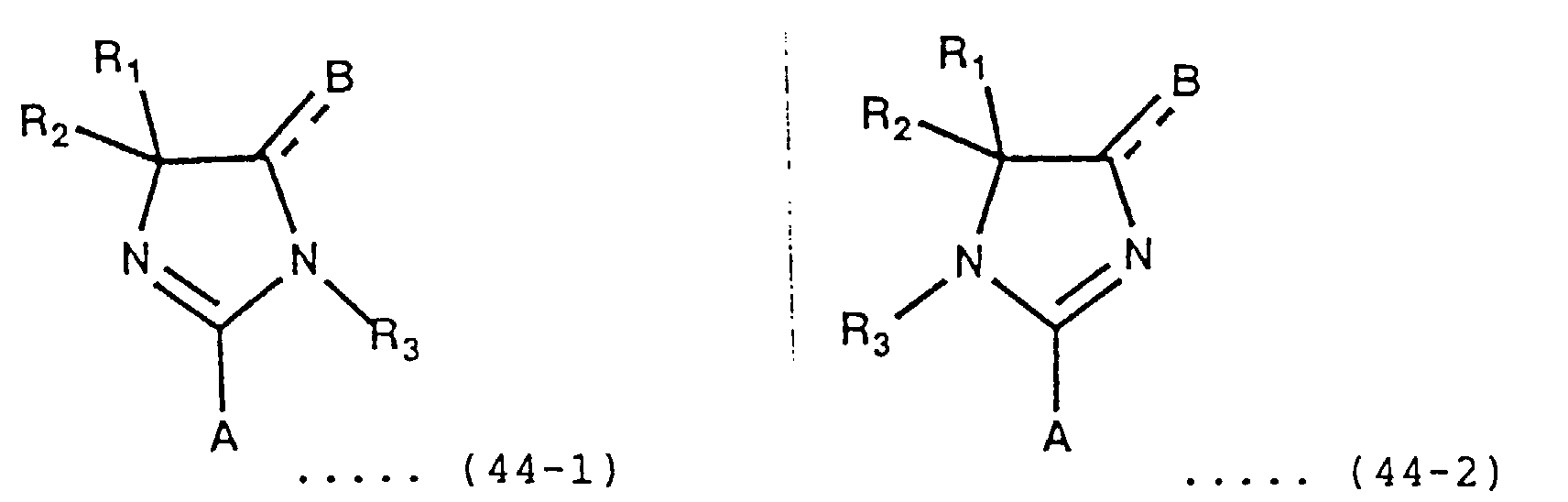
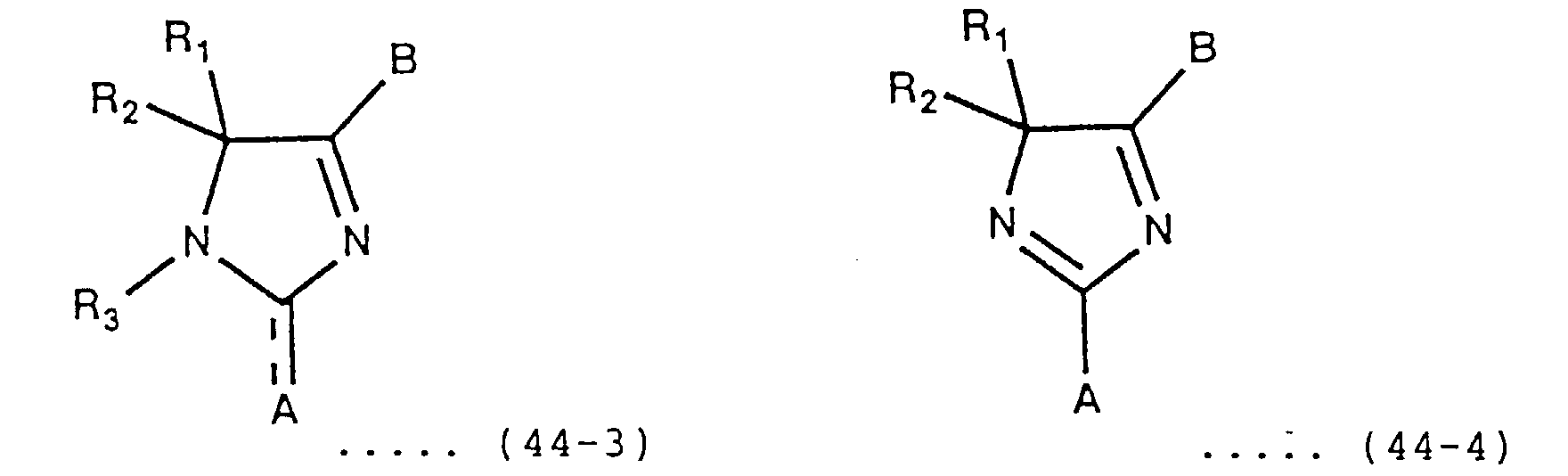
- wherein R1 and R2 represent a same one or respective different ones of a hydrogen atom, a lower alkyl group, an aryl group that may have a substituent group, and an aralkyl group, or cooperate to represent one of an alkylene group, an alkylidene group and an arylalkylidene group that may have a substituent group, while R3 represents one of a hydrogen atom, a lower alkyl group, an aralkyl group that may have a substituent group, a lower alkanoyl group and an arylcarbonyl group,
- and wherein at least one of A and B represents a group represented by the following formula (45),
-S-(CH2)m-R4 (45)
- wherein m represents one of integers "1" through "4", and R4 represents a nitrogen-containing aromatic ring that may be substituted by one of a lower alkyl group, a lower alkoxy group and a lower alkanoyl group, or a phenyl group represented by the following formula (46),

- wherein R5 and R6 represent a same one or respective different ones of a hydrogen atom, a lower alkyl group, a lower alkenyl group, and a lower alkanoyl or arylcarbonyl group which may be substituted by a halogen atom, while R7 represents one of a hydrogen atom, a halogen atom, a hydroxyl group, a lower alkyl group, a lower alkoxy group and a nitro group,
- and wherein the other of A and B represents one of an oxygen atom, a sulfur atom, a hydroxyl group, a mercapto group, a group represented by the formula (45), an alkylthio group that may have a substituent group, alkenylthio group, and an aralkylthio group, and broken line in the formulas (44-1), (44-2) and (44-3) represents a bond effective only when an appropriate one of A and B represents the oxygen or sulfur atom.
- According to one preferred form of the above first aspect of this invention, R1 and R2 represent a same one or respective different ones of a hydrogen atom, an alkyl group having 1-7 carbon atoms and a phenyl group that may be a substituent group, or cooperate to represent one of an alkylidene group having 2-5 carbon atoms, a benzylidene or cinnamylidene group that may have a substituent group, and an alkylene group having 2-6 carbon atoms, and R3 represents one of a hydrogen atom, an alkyl group having 1-7 carbon atoms, an alkanoyl group having 2-5 carbon atoms, an arylcarbonyl group, and a benzyl or cinnamyl group that may have a substituent group,
and wherein at least one of A and B represents one of a group represented by the above-identified formula (45), while the other of said A and B represents one of an oxygen atom, a sulfur atom, a hydroxyl group, a mercapto group, an alkylthio group having 1-7 carbon atoms, an alkenylthio group, a benzylthio group that may have a substituent group, a cinnamylthio group, and a group represented by the formula (45). R4 in the formula (45) represents one of an alkyl group having 1-4 carbon atoms, an alkoxy group, a pyridyl or quinolyl group that may be substituted by a phenyl or phenylalkyl group that may have a substituent group, and a group represented by the formula (46), while R5 and R6 in the formula (46) represent a same one or respective different ones of a hydrogen atom, an alkyl group having 1-5 carbon atoms, an alkenyl group having 1-5 carbon atoms, an alkanoyl group of 1-5 carbon atoms or aroyl group that may be substituted by a halogen atom. R7 in the formula (46) represents one of a hydrogen atom, a hydroxyl group, a halogen atom, an alkyl group having 1-5 carbon atoms, an alkoxy group having 1-5 carbon atoms and a nitro group. - According to a second aspect of this invention, the imidazole derivative or pharmaceutically acceptable salt thereof is represented by one of the following formulas (47-1), (47-2) and (47-3),


- According to a third aspect of this present invention the imidazole derivative or pharmaceutically acceptable salt thereof, which is represented by the following formula (48),

- The imidazole derivative of the present invention as described above may be produced also according to the present invention, as described below.
- In a first advantageous process according to a fourth aspect of this invention, the imidazole derivative which is represented by the following formula (49) is produced by effecting a reaction of a 2-thiohydantoin derivative represented by one of the following -formulas (50-1), (50-2) and (50-3) with a compound represented by the following formula (51), and the pharmaceutically acceptable salt is produced by adding at least one acid as needed to the imidazole derivative,


R4-(CH2)m-X (51)
- wherein m represents one of integers "1" through "4", and R1 and R2 represent a same one or respective different ones of a hydrogen atom, a lower alkyl group, an aryl group that may have a substituent group, and an aralkyl group, or cooperate to represent one of an alkylene group, an alkylidene group or an arylalkylidene group that may have a substituent group, while R3 represents one of a lower alkyl group, an aralkyl group that may have a substituent group, a lower alkanoyl group and an arylcarbonyl group,
- and wherein R4 represents a nitrogen-containing aromatic ring that may be substituted by one of a lower alkyl group, an aralkyl group that may have a substituent group, a lower alkoxy group and a lower alkanoyl group, or a phenyl group represented by the above formula (46), and X represents a halogen atom.
- In a second advantageous process according to a fifth preferred aspect of this invention, an imidazole derivative which is represented by one of the following formulas (52-1), (52-2) and (52-3) and a pharmaceutically acceptable salt thereof, is produced by effecting a reaction of a 2-thiohydantoin derivative represented by one of the following formulas (53-1) through (53-5) with a compound represented by the above-identified formula (51), and the pharmaceutically acceptable salt is produced by adding at least one acid as needed to the imidazole derivative,


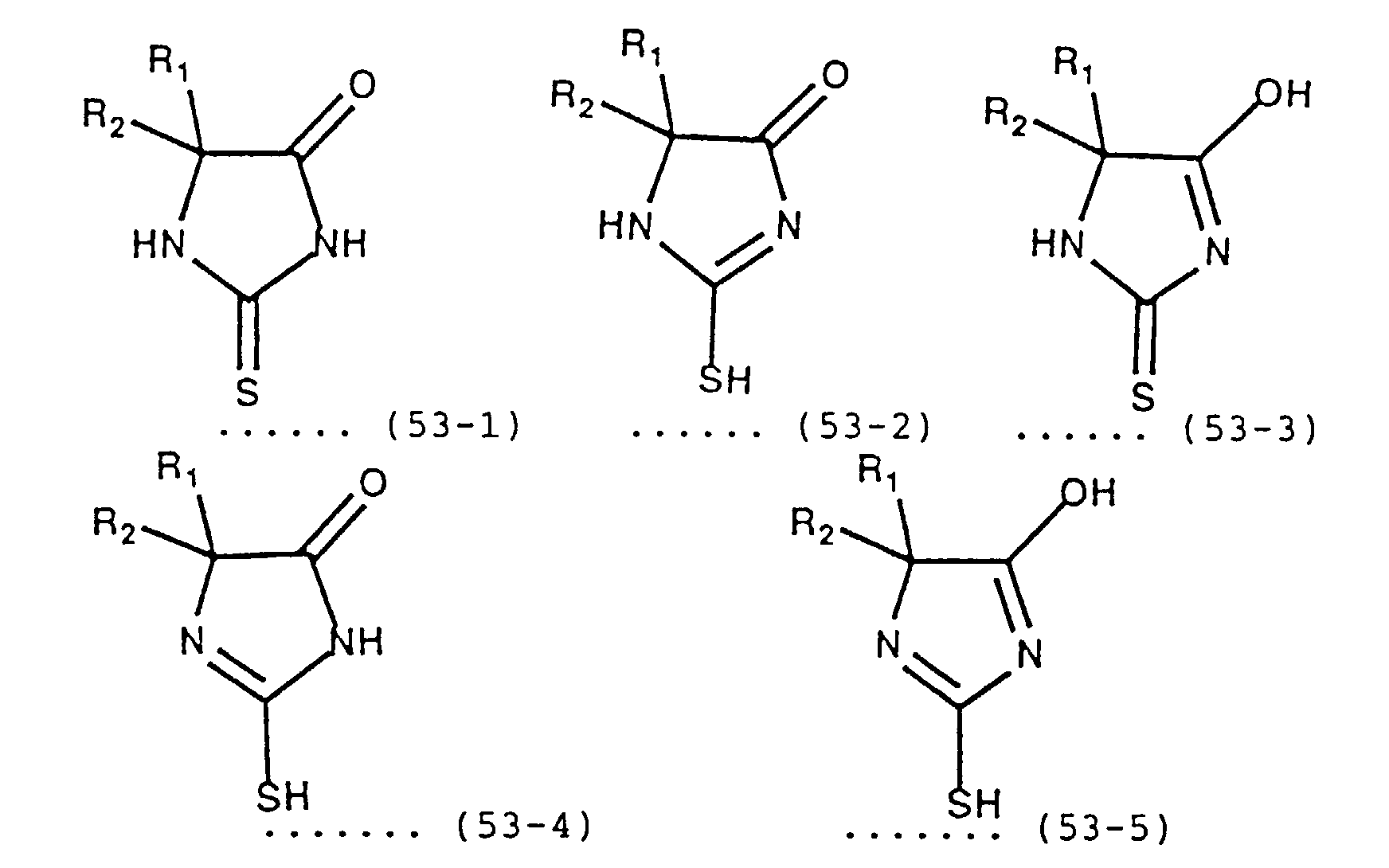
- In a third advantageous process according to a sixth aspect of the invention, the imidazole derivative which is represented by one of the following formula (54) is produced by effecting a reaction of a compound represented by one of the above-identified formulas (52-1) through (52-3) with at least one of alkyl halide, aralkyl halide, acid halide and acid anhydride, and the pharmaceutically acceptable salt is produced by adding at least one acid as needed to the imidazole derivative,

- In a fourth advantageous process according to a seventh aspect of this invention, the imidazole derivative which is represented by the above-identified formula (54) is produced by effecting a reaction of a compound represented by one of the following formulas (55-1) and (55-2) with a compound represented by the above-identified formula (51), and the pharmaceutically acceptable salt is produced by adding at least one acid as needed to the imidazole derivative,
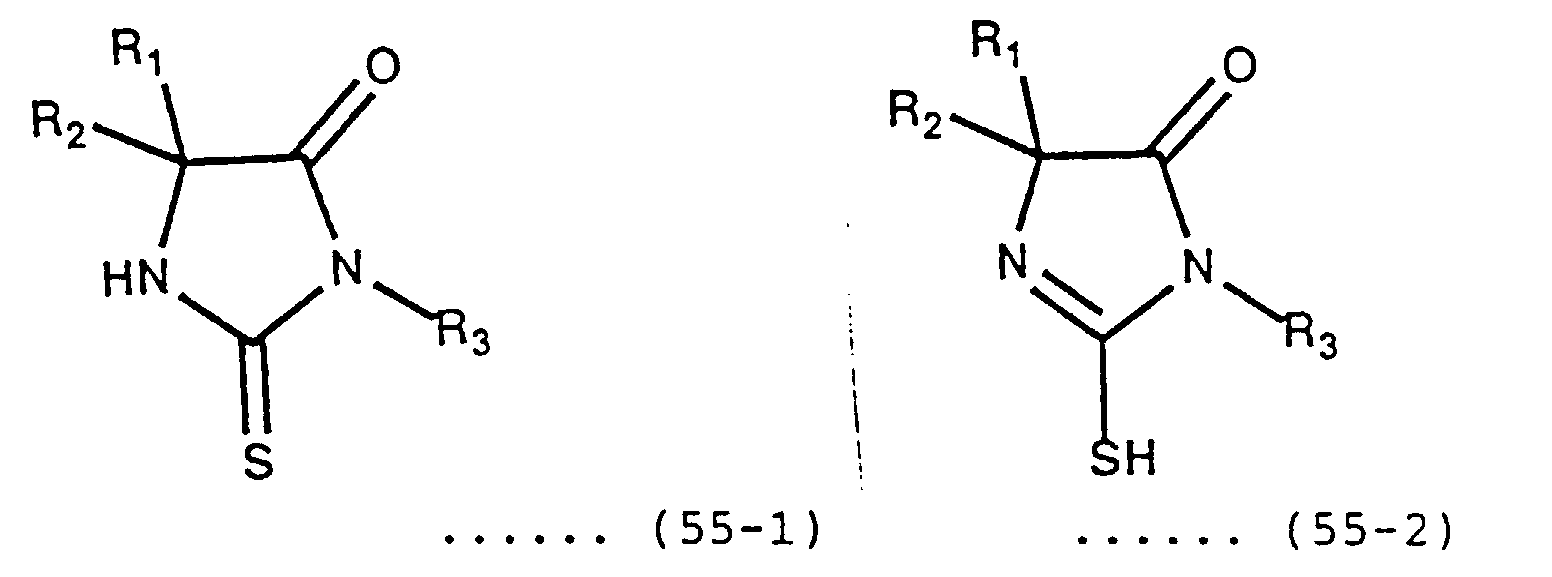
- In a fifth advantageous process according to an eighth aspect of the present invention, the imidazole derivative which is represented by one of -the following formulas (56-1), (56-2), (56-3), (57-1), (57-2) and (58) is produced by effecting a reaction of a 2,4-thiohydantoin derivative represented by one of the following formulas (59-1) through (59-5) with a compound represented by the above-identified formula (51), and the pharmaceutically acceptable salt is produced by adding at least one acid as needed to the imidazole derivative,


- In a fifth advantageous process according to one preferred form of the eighth aspect of the invention, "m" is equal to "1", and R4 is a phenyl group represented by the formula (46).
- In a sixth advantageous process according to a ninth aspect of this invention, the imidazole derivative which is represented by one of the following formulas (60) and (61) is produced by effecting a reaction of a compound represented by one of the above-identified formulas (56-1), (56-2), (56-3), (57-1) and (57-2) with a compound represented by the following formula (62), and the pharmaceutically acceptable salt is produced by adding at least one acid as needed to the imidazole derivative,

R11-X (62)
wherein R11 represents one of an alkyl group having 1-7 carbon atoms, an alkenyl group having 3-5 carbon atoms, an aralkyl group that may have a substituent group, and a R12-(CH2)n- group, and R12 represents a nitrogen-containing aromatic ring that may be substituted by one of a hydrogen atom, a lower alkyl group, a lower alkoxy group and a lower alkanoyl group, or the phenyl group represented by the above formula (46). "X" represents a halogen atom. - In a sixth advantageous process according to the above ninth aspect of the invention, wherein "m" is equal to "1", and R4 is the phenyl group represented by the above-identified formula (46), while R11 is a group represented the following formula (63),

- In a seventh advantageous process according to a tenth aspect of the invention, the imidazole derivative which is represented by one of the following formulas (64-1) and (64-2) is produced by effecting a reaction of a 4-thiohydantoin derivative represented by one of the following formulas (65-1) through (65-5) with a compound represented by the above-identified formula (51), and the pharmaceutically acceptable salt is produced by adding at least one acid as needed to the imidazole derivative,


- In an eighth advantageous process according to the eleventh aspect of the present invention, the imidazole derivative which is represented by the following formula (66) is produced by effecting a reaction of a compound represented by one of the above-identified formulas (64-1) and (64-2) with at least one of alkyl halide, aralkyl halide, acid halide and acid anhydride, and said pharmaceutically acceptable salt is produced by adding at least one acid as needed to said imidazole derivative,

- It is noted that the alkyl groups or alkyl group portions of their substituents in the structural formulas (44) through (66) indicated above may be either linear or branched.
- According to a twelfth aspect of this invention, there is provided an anti-ulcer drug including as an effective component a novel imidazole derivative or pharmaceutically acceptable salt thereof, which derivative is represented by the above formula (46), for example.
- In the formulas (44-1) through (44-4), R1 and R2 represent the same or respective different ones of a hydrogen atom, a linear or branched lower alkyl group, a phenyl group, a benzyl group and a p-hydroxybenzyl group, for example. The lower alkyl group may be a methyl group, an ethyl group, a propyl group, a butyl group, an isopropyl group or an isobutyl group. Alternatively, R1 and R2 cooperate to represent one of a methylidene group, an ethylidene group, a propylidene group, -an isopropylidene group, a benzylidene group, a cinnamylidene group, a trimethylene group, a tetramethylene group, a pentamethylene group and a hexamethylene group.
- R3 may be selected from among a hydrogen atom, a linear or branched lower alkyl group, a benzyl group, a cinnamyl group, an acetyl group and a benzoyl group, The lower alkyl group may be selected from among methyl, ethyl, propyl, butyl isopropyl and isobutyl groups.
- In the formulas (44), at least one of A and B represent a group represented by the above-formula (45), while the other of A and B represents one of an oxygen atom, a sulfur atom, a hydroxyl group , a mercapto group, a methylthio group, an ethylthio group, a propylthio group, a butylthio group, an isopropylthio group, an isobutylthio group, an allylthio group, a benzylthio group, a cinnamylthio group, and a group represented by the above formula (45).
- R4 in the above formula (45) may represent one of a 2-dimethylaminophenyl group, a 3-dimethylaminophenyl group, a 4-dimethylaminophenyl group, a 2-dimethylamino-4-fluorophenyl group, a 2-dimethylamino-5-fluorophenyl group, a 2-dimethylamino-3-chlorophenyl group, a 2-dimethylamino-4-chlorophenyl group, a 2-dimethylamono-5-chlorophenyl group, a 2-dimethylamino-6-chlorophenyl group, a 2-dimethylamino-5-bromophenyl group, a 2-dimethylamino-3-methylphenyl group, a 2-dimethylamino-4-methylphenyl group, a 2-dimethylamino-5-methylphenyl group, a 2-dimethylamino-6-methylphenyl group, a 2-dimethylamino-4-nitrophenyl group, a 2-dimethylamino-5-nitrophenyl group, a 5-hydroxy-2-dimethylaminophenyl group, a 2-dimethylamoni-3-methoxylphenyl group, a 2-dimethylamino-5-methoxyphenyl group, a 2-dimethylamino-4,5-dimethoxylphenyl group, a 2-N-ethyl-N-methylaminophenyl group, a 3-N-ethyl-N-methylaminophenyl group, a 4-N-ethyl-N-methylaminophenyl group, a 2-diethylaminophenyl group, a 3-diethylaminophenyl group, a 4-diethylaminophenyl group, a 2-N-isobutyl-N-methylaminophenyl group, a 3-N-isobutyl-N-methylaminophenyl group, a 4-N-isobutyl-N-methylaminophenyl group, a 2-N-trifluoroethyl-N-methylaminophenyl group, a 2-N-aryl-N-methylaminophenyl group, a 2-methylaminophenyl group, a 3-methylaminophenyl group, a 4-methylaminophenyl group, a 2-N-trifluoroethylaminophenyl group, a 2-aminophenyl group, a 3-aminophenyl group, a 4-aminophenyl group, a 2-N-acetylaminophenyl group, a 3-N-acetylaminophenyl group, a 4-N-acetylaminophenyl group, a 2-N-formyl-N-methylaminophenyl group, a 2-N-formylaminophenyl group, a 2-N-trifluoroacetylaminophenyl group, a 3-N-trifluoroacetylaminophenyl group, a 4-N-trifluoroacetylaminophenyl group, a 2-pyridyl group, a 3-pyridyl group, a 4-pyridyl group, a 4-methoxy-2-pyridyl group, a 3,5-dimethyl-2-pyridyl group, a 3,4,5-trimethyl-2-pyridyl group, a 4-methoxy-5-methyl-2-pyridyl group, a 4-methoxy-3,5-dimethyl-2-pyridyl group, a 2-quinolinyl group and a 8-quinolinyl group.
- Examples of the imidazole derivative represented by the above formulas (44-1) through (44-4) include the following:
- (1) 2-(2-pyridylmethylthio)imidazolin-4-one
- (2) 2-(2-dimethylaminobenzylthio)imidazolin-4-one
- (3) 2-(4-methoxy-3,5-dimethyl-2-pyridylmethylthio)-5-trans-benzylideneimidazolin-4-one
- (4) 2-(4-methoxy-3,5-dimethyl-2-pyridylmethylthio) imidazolin-4-one
- (5) 2-(2-pyridylmethylthio)-5-trans-benzylideneimidazolin-4-one
- (6) 2-(2-pyridylmethylthio)-5-trans-methylideneimidazolin-4-one
- (7) 2-(2-dimethylaminobenzylthio)-5-trans-benzylideneimidazolin-4-one
- (8) 2-(2-dimethylaminobenzylthio)-trans-methylideneimidazolin-4-one
- (9) 2-(4-methoxy-3,5-dimethyl-2-pyridylmethylthio)-5-trans-methylideneimidazolin-4-one
- (10) 2-(2-N-isobutyl-N-methylaminobenzylthio)imidazolin-4 one
- (11) 2-(2-pyridylmethylthio)-5,5-diphenylimdazoline-4-one
- (12) DL-2-(2-pyridylmethylthio)-5-benzylimidazolin-4-one
- (13) DL-2-(2-dimethylaminobenzylthio)-5-benzylimdazoline-4-one
- (14) 2-(2-pyridylmethylthio)-5,5-dimethylimidazolin-4-one
- (15) 2-(2-dimethylaminobenzylthio)-5,5-dimethylimidazolin-4-one
- (16) 2-(2-N-isobutyl-N-methylaminobenzylthio)-5,5-dimethylimidazolin-4-one
- (17) DL-2-(2-dimethylaminobenzylthio)-5-methylimidazolin-4-one
- (18) DL-2-(2-pyridylmethylthio)-5-methylimidazolin-4-one
- (19) 2-(2-pyridylmethylthio)-5-phenyl-5-methylimidazolin-4-one
- (20) 2-(2-dimethylaminobenzylthio)-5-phenyl-5-methylimidazolin-4-one
- (21) 2-(2-dimethylaminobenzylthio)-5-ethyl-5-methylimidazolin-4-one
- (22) 2-(2-pyridylmethylthio)-5,5-dipropylimidazolin-4-one
- (23) 2-(2-dimethylaminobenzylthio)-5,5-dipropylimidazolin-4-one
- (24) 2-(2-pyridylmethylthio)-5-phenyl-5-ethylimidazolin-4-one
- (25) 2-(2-dimethylaminobenzylthio)-5-phenyl-5-ethylimidazolin-4-one
- (26) 2-(2-dimethylaminobenzylthio)-5,5-diethylimidazolin-4-one
- (27) 2-(2-dimethylaminobenzylthio)-5-butyl-5-ethylimidazolin-4-one
- (28) 2-(2-dimethylaminobenzylthio)-5-isobutyl-5-methylimidazolin-4-one
- (29) 2-(2-pyridylmethylthio)-5-butyl-5-ethylimidazolin-4-one
- (30) 2-(2-pyridylmethylthio)-5-isobutyl-5-methylimidazolin-4-one
- (31) 1-N-acetyl-2-(2-dimethylaminobenzylthio)-5,5-dimethyl-2-imidazolin-4-one
- (32) 1-N-acetyl-2-(2-dimethylaminobenzylthio)-5,5-diethyl-2-imidazolin-4-one
- (33) 1-N-acetyl-2-(2-dimethylaminobenzylthio)-4,4-dimethyl-2-imidazolin-4-one
- (34) 2-(2-dimethylaminobenzylthio)-5,5-dimethylimidazolin-4-thione
- (35) 2-(2-dimethylaminobenzylthio)-5,5-diethylimidazolin-4-thione
- (36) 2,4-bis-(2-dimethylaminobenzylthio)-5,5-diethyl-5H-imidazole
- (37) 2-(2-dimethylaminobenzylthio)-5-phenyl-5-methylimidazolin-4-thione
- (38) 2,4-bis(2-dimethylaminobenzylthio)-5-phenyl-5-methyl-5H-imidazole
- (39) 2-(2-dimethylaminobenzylthio)-5-ethyl-5-methylimidazolin-4-thione
- (40) 2,4-bis(2-dimethylaminobenzylthio)-5-ethyl-5-methyl-5H-imidazole
- (41) 4-benzylthio-2-(2-dimethylaminobenzylthio)-5,5-dimethyl-5H-imidazole
- (42) 4-(2-dimethylaminobenzylthio)-5,5-dimethyl-3-imidazolin-2-one
- (43) 4-(2-dimethylaminobenzylthio)-5-ethyl-5-methyl-3-imidazolin-2-one
- (44) 2-benzylthio-4-(2-dimethylaminobenzylthio)-5,5-dimethyl-5H-imidazole
- (45) 2,4-bis(2-dimethylaminobenzylthio)-5,5-dimethyl-5H-imidazole
- (46) 2-(2-N-isobutyl-N-methylaminobenzylthio)-5,5-dimethylimidazolin-4-thione
- (47) 2,4-bis(2-N-isobutyl-N-methylaminobenzylthio)-5,5-dimethyl-5H-imidazole
- (48) 2,4-bis(2-pyridylmethylthio)-5,5-dimethyl-5H-imidazole
- (50) 4-(2-N-acetylaminobenzylthio)-5,5-dimethylimidazolin-2-thione
- (51) 2,4-bis(2-N-acetylaminobenzylthio)-5,5-dimethyl-5H-imidazole
- (52) 2-(2-N-formyl-N-methylaminobenzylthio)-5,5-dimethylimidazolin-4-thione
- (53) 4-(2-quinolinylmethylthio)-5,5-dimethylimidazolin-2-thione
- (54) 2-(8-quinolinylmethylthio)-5,5-dimethylimidazolin-2-thione
- (55) 1-N-methyl-4-(2-dimethylaminobenzylthio)-5,5-dimethyl-3-imidazolin-2-one
- (56) 4-(2-dimethylaminobenzylthio)-5,5-dimethylimidazolin-2-thione
- (57) 2-(3-dimethylaminobenzylthio)-5,5-dimethylimidazolin-4-thione
- (58) 4-(3-dimethylaminobenzylthio)-5,5-dimethylimidazolin-2-thione
- (59) 2,4-bis(8-quinolinylmethylthio)-5,5-dimethyl-5H-imidazole
- (60) 2,4-bis (3-dimethylaminobenzylthio)-5,5-dimethyl-5H-imidazole
- (61) 2-(2-N-benzoylaminobenzylthio)-5,5-dimethylimidazolin-4-thione
- (62) 4-(2-N-benzoylaminobenzylthio)-5.5-dimethylimidazolin-2-thione
- (63) 2,4-bis(2-N-benzoylaminobenzylthio)-5,5-dimethyl-5H-imidazole
- (64) 2-(2-N-ethyl-N-methylaminobenzylthio)-5,5-dimethylimidazolin-4-thione
- (65) 2,4-bis(2-N-ethyl-N-methylaminobenzylthio)-5,5-dimethyl-5H-imidazole
- (66) 2-(2-pyridylmethylthio)-5,5-dimethylimidazolin-4-thione
- (67) 2,4-bis(2-quinolinylmethylthio)-5,5-dimethyl-5H-imidazole
- (68) 1-N-methyl-2-(2-dimethylaminobenzylthio)-4,4-dimethyl-2-imidazolin-5-thione
- (69) 2-(2-N-trifluoroacetylaminobenzylthio)-5,5-dimethylimidazolin-4-thione
- (70) 2-4-bis(2-N-trifluoroacetylaminobenzylthio)-5,5-dimethyl-5H-imidazole
- (71) 2-(2-aminobenzylthio)-5,5-dimethylimidazolin-4-thione
- (72) 2-(2-N-methylaminobenzylthio)-5,5-dimethylimidazolin-4-thione
- (73) 2-(2-dimethylamino-5-methylbenzylthio)-5,5-dimethylimidazolin-4-thione
- (74) 2,4-bis(2-dimethylamino-5-methylbenzylthio)-5,5-dimethyl-5H-imidazole
- (75) 2-(2-dimethylamino-3-methylbenzylthio)-5,5-dimethylimidazolin-4-thione
- (76) 2,4-bis(2-dimethylamino-3-methylbenzylthio)-5,5-dimethyl-5H-imidazole
- (77) 2-(2-dimethylamino-5-hydroxybenzylthio)-5,5-dimethylimidazolin-4-thione
- (78) 2,4-bis(2-dimethylamino-5-hydroxybenzylthio)-5,5-dimethyl-5H-imidazole
- (79) 2-(2-N-trifluoroacetyl-N-methylaminobenzylthio)-5,5-dimethylimidazolin-4-thione
- (80) 2,4-bis(2-N-trifluoroacetyl-N-methylaminobenzylthio)-5,5-dimethyl-5H-imidazole
- (81) 2-(5-chloro-2-dimethylaminobenzylthio)-5,5-dimethylimidazolin-4-thione
- (82) 2,4-bis(5-chloro-2-dimethylaminobenzylthio)-5,5-dimethyl-5H-imidazole
- (83) 2-(4-chloro-2-dimethylaminobenzylthio)-5,5-dimethylimidazolin-4-thione
- (84) 2,4-bis(4-chloro-2-dimethylaminobenzylthio)-5,5-dimethyl-5H-imidazole
- (85) 2-(2-dimethylamino-5-methoxybenzylthio)-5,5-dimethylimidazolin-4-thione
- (86) 2,4-bis(2-dimethylamino-5-methoxybenzylthio)-5,5-dimethyl-5H-imidazole
- (87) 2-(2-methylaminobenzylthio)-5,5-dimethylimidazolin-4-thione
- (88) 2,4-bis(2-methylaminobenzylthio)-5,5-dimethyl-5H-imidazole
- (89) 2-(2-dimethylamino-4-fluorobenzylthio)-5,5-dimethylimidazolin-4-thione
- (90) 2,4-bis(2-dimethylamino-4-fluorobenzylthio)-5,5-dimethyl-5H-imidazole
- (91) 2-(2-dimethylamino-4-nitrobenzylthio)-5,5-dimethylimidazolin-4-thione
- (92) 2,4-bis(2-dimethylamino-4-nitrobenzylthio)-5,5-dimethyl-5H-imidazole
- (93) 2-(2-dimethylamino-5-nitrobenzylthio)-5,5-dimethylimidazolin-4-thione
- (94) 2,4-bis(2-dimethylamino-5-nitrobenzylthio)-5,5-dimethyl-5H-imidazole
- (95) 2-[2-N-(2,2,2-trifluoroethyl)-N-methylaminobenzylthio]-5,5-dimethylimidazolin-4-thione
- (96) 2,4-bis[2-N-(2,2,2-trifluoroethyl)-N-methylaminobenzylthio]-5,5-dimethyl-5H-imidazole
- (97) 2-(2-N-aryl-N-methylaminobenzylthio)-5,5-dimethylimidazolin-4-thione
- (98) 2-[2-N-(2,2,2-trifluoroethyl)aminobenzylthio]-5,5-dimethylimidazolin-4-thione
- (99) 2,4-bis[2-N-(2,2,2-trifluoriethyl)aminobenzylthio]-5,5-dimethyl-5H-imidazole
- (100) 2-(2-N-formylaminobenzylthio)-5,5-dimethylimidazolin-4-thione
- (101) 2-(2-N-acetylaminobenzylthio)-5,5-dimethylimidazolin-4-thione
- By inducing a reaction of the imidazole derivatives as described above with a suitable acid, salts that are phramaceutically acceptable as drugs may be obtained. For example, the acid used for this purpose may be selected from among: inorganic acids, such as hydrochloric acid, hydrobromic acid, phosphoric acid and sulfuric acid; and organic acids, such as acetic acid, citric acid, succinic acid, tartaric acid, fumaric acid, maleic acid, methane sulfonic acid and p-toluenesulfonic acid.
- Compounds which are represented by the above formulas (44) and in which A or B is an oxygen atom may be prepared according to reactions (a) through (f) as indicated in the following formula (67) wherein R1, R2, R 3, R4 and m are the same as in the above formulas (44) through (46), and X represents a halogen atom.
- Described in detail, a desired compound (III) is obtained by the reaction (a) between compounds (I) and (II), while a desired compound (V) is obtained by the reaction (b) between the compound (II) and a compound (IV). A compound (VI) is obtained by the reaction (c) between the compound (V) and alkyl halide, aralkyl halide, acid halide or acid anhydride. The compound (VI) may be obtained also by the reaction (d) between a compound (VII) and the compound (II).
- Further, a compound (IX) is obtained by the reaction (e) between a compound (VIII) and the compound (II). Like the reaction (c), the reaction (f) of the thus obtained compound (IX) with alkyl, aralkyl or acid halide or acid anhydride produces a compound (X).

- Explained more specifically, the compounds (I), (IV), (VII) and (VIII) as starting materials used for the reactions (a), (b), (d) and (e) are generally commercially available, or may be prepared by processes described in: Yakugaku Zasshi, Vol. 8, pp30, 1960; Yakugaku Zasshi, vol. 18, p37, 1970; Journal of Americal Chemical Society (J. Am. Chem. Soc.), Vol. 33, pp1973, 1911; Chemische Berichte, Vol. 95, pp2885, 1962; Journal of Chemical Society, pp396, 1959; and Bulletin de la Société Chemique de France, pp228, 1949.
- The compound (II) used in the above reactions (a), (b), (d) and (e) may take the form of a salt, and is generally used in an equivalent amount of 1-5, preferably 1-1.5.
- Those reactions (a), (b), (d) and (e) may take place in the presence of an acid receptor, which may be selected from the group consisting of: alkaline metal compounds such as sodium hydrogencarbonate, sodium carbonate, potassium carbonate, sodium hydroxide and sodium methoxide; and organic tertiary amines such as pyridine, trimethylamine, triethylamine, diisopropylethylamine, and 4-dimethylaminopyridine. Such acid receptor is used in an equivalent amount of 1-6 with respect to the compound (I), (IV), (VII) or (VIII).
- The reactions are generally effected at a temperature within a range between -30°C and 150°C, preferably between 0°C and 120°C, and more preferably 0°C and 80°C. A solvent for the reactions may be selected from the group consisting of: alkanols such as methanol and ethanol; hydrocarbon halides such as dichloromethane and chloroform; aromatic compounds such as benzene, toluene and pyridine; acetonitrile; dimethylformamide; and dimethylsulfoxide.
- Where alkylation is effected in the reaction (c) or (f), aklyl halide or aralkyl halide is generally used in an equivalent amount of 1-10 with respect to the compound (V) or (IX). The reaction may take place in the presence of an acid receptor. In this case, the acid receptor may be selected from the group consisting of: sodium hydrogencarbonate; sodium carbonate; potassium carbonate; sodium hydroxide; triethylamine; diisopropylethylamine; and 4-dimethylaminopyridine. The reaction solvent may be selected from among tetrahydrofuran, dioxane, acetonitrile, dimethylformamide, dimethylsulfoxide and hydrocarbon halide. The reaction temperature is generally within a range of 0-80°C.
- Where acylation is effected in the reaction (c) or (f), on the other hand, an equivalent amount of 1-100 of acid anhydride or 1-10 of acid halide is generally used with respect to the compound (V) or (IX). Where acid anhydride is used, it may be dissolved in a suitable solvent. In this case, pyridine is generally used as the solvent. Where acid halide is used, the reaction may take place in the presence of an acid receptor, which may be generally selected from among sodium carbonate, potassium carbonate, sodium hydroxide, triethylamine, diisopylethylamine, and 4-dimethylaminopridine. The reaction solvent may be selected from among tetrahydrofuran, dioxane, acetonitrile, dimethylformamide, dimethylsulfoxide, hydrocarbon halide, benzene, toluene and pyridine. The reaction temperature is generally within a range of 0-150°C.
- Compounds which are represented by the above formulas (44) and in which none of A and B is an oxygen atom may be prepared in a process according to the following formula (68).
- In the above formula (68), m, R1, R2, R3 and R4 are the same as in the above formulas (44) through (46), and X represents a halogen atom. R11 represents one of an alkyl group having 1-7 carbon atoms, an alkenyl group having 3-5 carbon atoms, an aralkyl group that may have a substituent group, and a R12-(CH2)n- group, where R12 represents a nitrogen-containing aromatic ring that may be substituted by one of a hydrogen atom, a lower aklyl group, a lower alkoxy group and a lowr alkanoyl group, or represents a phenyl group represented by the above formula (46), and "n" represents an integer of 1-4.

- In the process according to the above formula (68), compounds (XII), (XIII) and (XIV) are obtained by a reaction (g) between a compound (XI) and the compound (II). In the reaction (g), the compound (II) may take the form of a salt, and is generally used in an equivalent amount of 1-5, preferably 1-1.5 with respect to the compound (XI). For obtaining primarily the compound (XII) or (XIII), the compound (II) is used preferably in an equivalent amount of 1-1.5, more preferably 1-1.1. For obtaining primarily the compound (XIV), the compound (II) is used preferably in an equivalent amount of 2-5, more preferably 2-3 with respect to the compound (XI). The reaction temperature is generally held within a range between -30°C and 150°C, preferably between -20°C and 120°C, more preferably -20°C and 80°C. The reaction solvent may be selected from among: alkanols such as methanol and ethanol; hydrocarbon halides such as dichloromethane and chloroform; aromatic compounds such as benzene, toluene and pyridine; acetonitrile; dimethylformamide; and dimethylsulfoxide.
- The compound (XI) used as a starting material in the reaction (g) may be prepared in various known processes, for example, processes as described in: Chemische Berichte, Vol. 95, pp2885, 1962; Acta Chimica Academiae Scientiarum Hungaricae, Vol. 51, pp95, 1967; Acta Chimica Academiae Scientiarum Hungaricae, Vol. 50, pp303, 1966; Journal of Chemical Society, pp354, 1950.
- A compound (XVI) is obtained by a reaction (h) between the compound (XII) obtained by the reaction (g) and a compound (XV). Further, a compound (XVII) is obtained by a reaction (i) between the compound (XIII) obtained by the reaction (g) and a compound (XV). The compound (XV) is used generally in an equivalent amount of 1-5, preferably 1-2, with respect to the compound (XII) or (XIII). The reaction solvent may be selected from among tetrahydrofuran, dioxane, acetonitrile, dimethylformamide, dimethylsulfoxide, and hydrocarbon halides. The reaction temperature is in a range of 0-80°C.
- The reactions (g) through (i) may take place in the presence of an acid receptor, which may be selected from the group consisting of: alkali metal compounds such as sodium hydrogencarbonate, sodium carbonate, potassium carbonate, sodium hydroxide and sodium methoxide; and organic tertiary amines such as pyridine, trimethylamine, triethylamine, diisopropylethylamine, and 4-dimethylaminopyridine.
- While the processes of producing the novel imidazole derivatives according to the present invention have been described above, these derivatives are extracted and purified by crystallization or column chromatography from the reaction mixtures.
- The thus purified imdazole derivatives may be processed into salts pharmaceutically acceptable as drugs, by inducing a reaction of the imidazole derivatives with suitable acids, for example, inorganic acids such as hydrochloric acid, hydrobromic acid, phosphoric acid and sulfuric acid, or organic acids such as acetic acid, citric acid, succinic acid, tartaric acid, fumaric acid, maleic acid, methane sulfonic acid and p-toluenesulfonic acid.
- The compounds (I), (IV), (V), (VII), (VIII), (IX), (XI), (XII) and (XIII) produced by the reactions according to the above formulas (67) and (68) contain tautomers. The reactions of these tautomers to obtain the desired starting compounds or final compounds are effected in substantially the same manner as described above in detail. These reactions are considered to be a part of the process of producing the imidazole derivatives according to the principle of the present invention.
- Those tautomers are illustrated in the following formulas (69) through (77). The formulas (69-1), (69-2) and (69-3) indicate the tautomers of the compound (I). The formulas (70-1) through (70-5) indicate the tautomers of the compound (IV). The formulas (71-1) through (71-3) indicate the tautomers of the compound (V). The formulas (72-1) and (72-2) indicate the tautomers of the compound (VII). The formulas (73-1) through (73-5) indicate the tautomers of the compound (VIII). The formulas (74-1) and (74-2) indicate the tautomers of the compound (IX). The formulas (75-1) through (75-5) indicate the tautomers of the compound (XI). The formulas (76-1) through (76-3) indicate the tautomers of the compound (XII), and the formulas (77-1) and (77-2) indicate the tautomers of the compound (XIII).


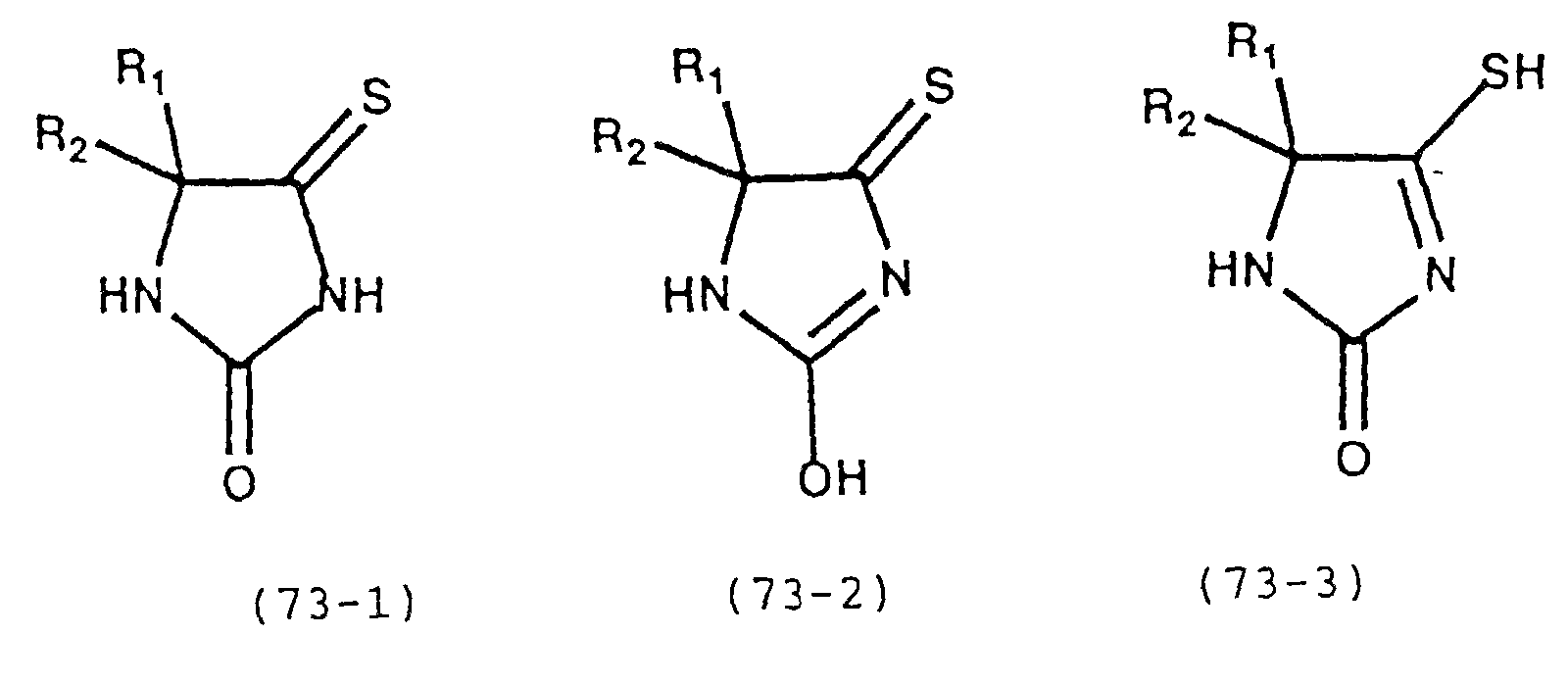
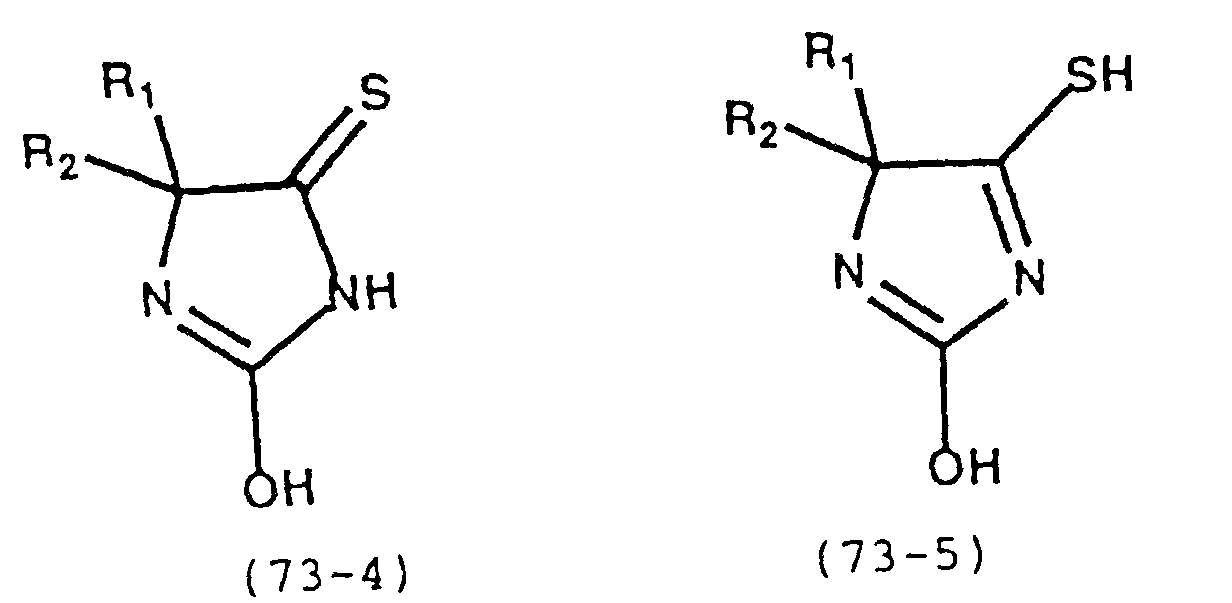

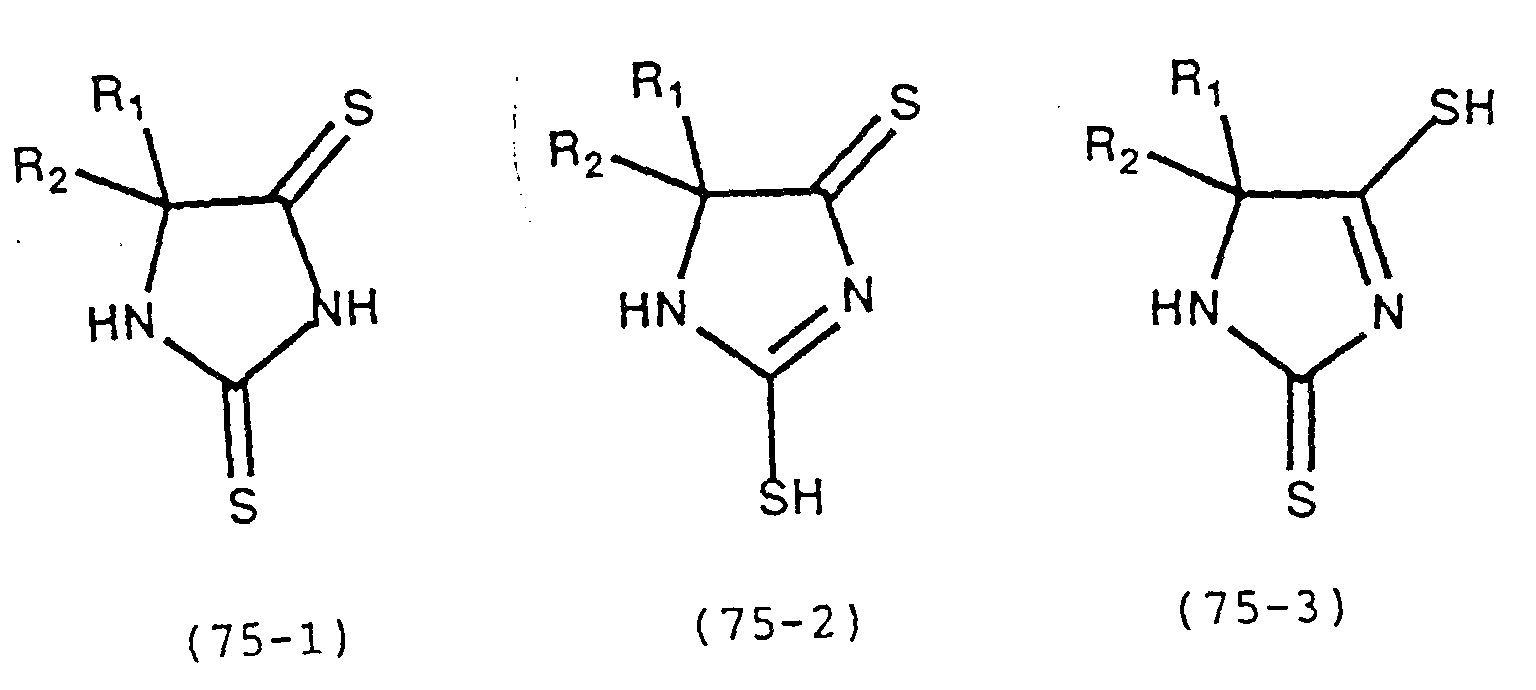


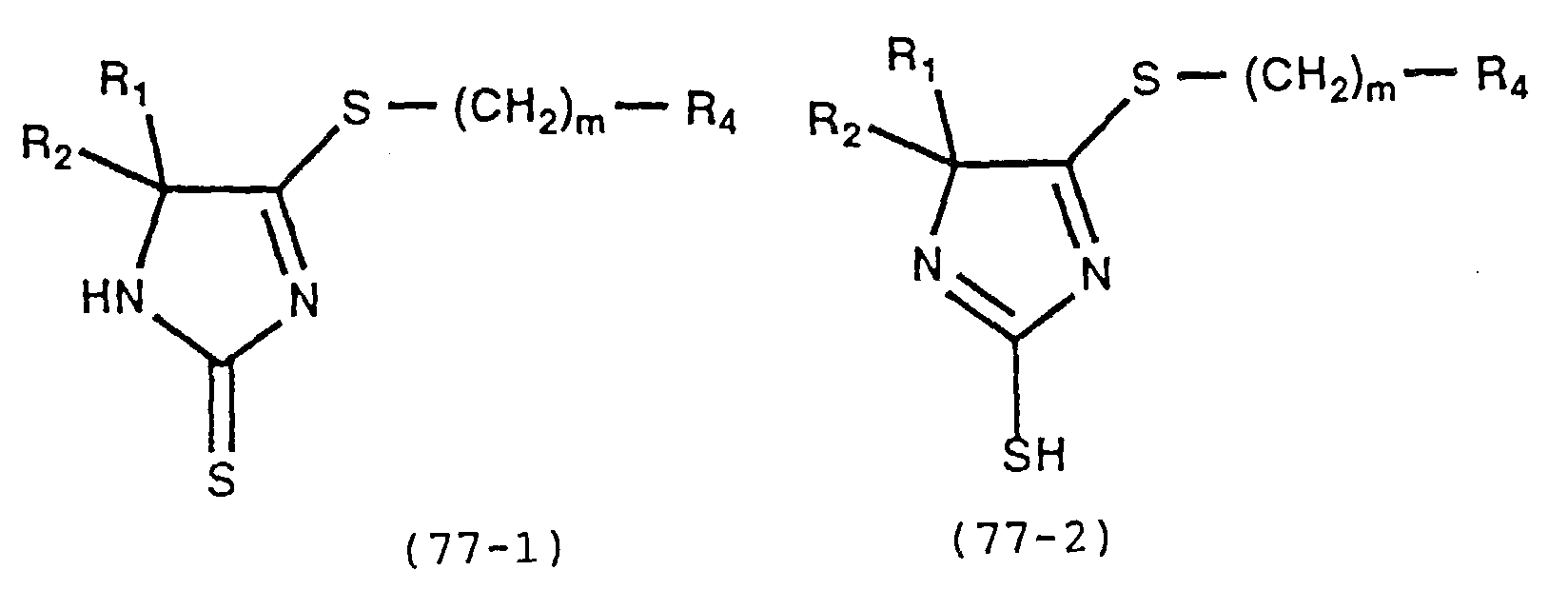
- The tautomers of the imidazole derivatives produced according to this invention have respective stable structures. For example, X-ray crystal structure analysis of 2-(2-dimethylaminobenzylthio)-5,5-dimethylimidazolin-4-thione which was prepared in Example 39 (which will be described) by the above-explained reaction (g) took the form of 2-(2-dimethylaminobenzylthio)-4,4-dimethyl-2-imidazolin-5-thione in its crystalline state.
- The compounds represented by the above formulas (44) according to the present invention, and their salts which are pharmaceutically acceptable as drugs have effects to inhibit or suppress the aggressive factors for peptic ulcers and promote or intensify the protective factors for the peptic ulcers. Thus, the novel imidazole derivatives according to the present invention may act as an effective component of an anti-ulcer drug also according to the present invention. The anti-ulcer drug is formulated in an ordinary process.
- Described in detail, the anti-ulcer drug according to the present invention contains, as an effective component, an imidazole derivative of the present invention or a pharmaceutically acceptable salt thereof, and also contains suitable additives as needed, such as a binder, an excipien or vehicle, a lubricant, an emulsifier, a disintegrater, a wetting agent, an antiseptics, and a coloring agent, which are used for pharmaceuticals in general. The binder may be selected from among gum arabic, polyvinylpyrrolidone, sorbit, tragacanth and gelatin. The excipien may be selected from among lactose, sugar- sorbit, Corn starch, calcium phosphate and glycine. The lubricant may be selected from among magnesium stearate, talc, polyethylene glycol and silica. The disintegrator may be selected from among carboxymethyl cellulose calcium and Potato starch. The wetting agent may be selected from among methyl cellulose, aluminum stearate gel, carboxymethyl cellulose, gelatin, hydroxyethyl cellulose, hydrogenated edible oil and sorbit syrup. The antiseptics may be sorbic acid or p-hydroxybenzoic acid.
- The anti-ulcer drug of the present invention may take various known forms such as tablets, powder, granule, capsules, solution, and parenternal injection. The dose of the anti-ulcer drug should be suitably adjusted depending upon the age, weight and ulcer symptom of the patient and the type of administration of the drug. In the case of oral adminstration, a suitable dose of the anti-ulcer drug for an ordinary adult per day is such that the amount of the imidazole derivative or its parmaceutically acceptable salt as the effective component of the drug is about 1-1000mg.
- There will now be described some examples of the present invention to further clarify the concept of this invention. It is to be understood that the present invention is not limited to the details of these examples.
- Initially, 1g of 2-thiohydantoin and 2.5g of sodium methylate were dissolved in 50mL of methanol (MeoH), and 1.5g of 2-chloromethylpyridine hydrochloride was added to the solution. The reaction mixture was stirred under reflux for one and a half hour and concentrated in vacuo. To the residue, there was added 50mL of chloroform (CHCl3), and the mixture was washed with 50mL of water. Then, the CHCL3 layer was dried over magnesium sulfate (MgSO4) and concentrated in vacuo. The residue was purified by column chromatography [using a developing solvent consisting of CHCl3: MeOH = 50:1 (volume ratio, v/v)]. Recrystallization from diethylether gave the desired compound in the form of a needle-like crystal. The yield of this compound was 1.2g with a yield ratio of 67.2%, and its melting point was 105-107°C.
- A result of a 1H-NMR analysis of this compound is as follows:
1H-NMR (CDCl3, δ, ppm, TMS)
4.13(2H, s, C-CH2-N), 4.45 (2H, s, -CH2-Ar), 7.13∼8.73 (4H, m, Ar) - Initially, 1.7g of 5-trans-benzylidene-2-thiohydantoin and 1.9g of sodiummethylate were dissolved in 50mL of methanol (MeOH), and 2.lg of 2-chloromethyl-4-methoxy-3,5-dimethylpyridine hydrochloride was added to the solution. The reaction mixture was stirred for hour under reflux and concentrated in vacuo. To the thus obtained residue, there was added 100mL of water. The precipitate was then filtered and crystallized from MeOH-CHCl3 to give the desired compound in the form of needle-like crystal. The yield of this compound was 1.75g, with a yield ratio of 59.5%, and its melting point was 239-242°C.
- A result of a 1H-NMR analysis of the compound is as follows:
1H-NMR (CDCl3 + DMSO-d6, δ, ppm, TMS)
2.23, 2.35 (6H, each s, Ar -CH3 x 2), 3.77 (3H, s, -OCH3), 4.74 (2H, s, -CH2-Ar), 6.76 (1H, s, = CH-Ar), 7.36∼8.34 (6H, m, Ar) - In the following Examples 3-15, desired compounds were prepared using appropriate starting compounds, in the same manner as in Example 1. The yield ratio, melting point and 1H-NMR analysis result of each of these compounds are indicated below.
- Yield ratio: 70.0% Melting point: 157∼160°C
1H-NMR (CDCl3 + DMSO-d6, δ, ppm, TMS)
2.24 (3H, s, Ar-CH3), 2.27 (3H, s, Ar-CH3), 3.72 (3H, s, -OCH3), 4.05 (2H, s, C-CH2-N), 4.62 (2H, s, -CH2-Ar), 8.24 (1H, s, Ar) - Yield ratio: 64.5% Melting point: ∼207°C (decomposition)
1H-NMR (CDCl3 + DMSO-d6, δ, ppm, TMS)
4.72, (2H, s, -CH2 -Ar), 6.80 (1H, s, = CH-Ar), 7.29∼8.72 (9H, m, Ar) - Yield ratio: 64.3% Melting point: 163∼165°C
1H-NMR (CDCl3 + DMSO-d6, δ, ppm, TMS)
2.04 (3H, d, = CH-CH 3), 4.61 (2H, s, -CH2-Ar),
6.01∼6.38 (1H, q, = CH-CH3), 7.19∼8.68 (4H, s, Ar) - Yield ratio: 52.0% Melting point: 204∼206°C
1H-NMR (CDCl3 + DMSO-d6, δ, ppm, TMS)
2.08 (3H, d, = CH-CH3), 2.26 (3H, s, -Ar-CH3), 2.36 (3H, s, Ar-CH3), 3.79 (3H, s, -OCH3), 4.58 (2H, s, -CH2-Ar), 6.01∼6.37 (1H, q, = CH-CH3), 8.17 (1H, s, Ar) - Yield ratio: 73.9% Melting point: 177∼179°C
1H-NMR (CDCl3 δ, ppm, TMS)
4.59 (2H, s, -CH2-Ar), 7.18∼8.62 (14H, m, Ar) - Yield ratio: 67.4% Melting point 108∼109°C
1H-NMR (CDCl3 δ, ppm, TMS)
1.38 (6H, s, -CH3 x 2), 4.41 (2H, s, CH2-Ar), 7.13∼8.87 (4H, m, Ar) - Yield ratio: 51.4% Melting point: 96∼99°C
1H-NMR (CDCl3 + DMSO-d6, δ, ppm, TMS)
1.43 (3H, d, -CH3), 4.12 (1H, q, -CH-), 4.43 (2H, s, -CH2-Ar), 7.13∼8.72 (4H, m, Ar) - Yield ratio: 48.9% Melting point: 128∼130°C
1H-NMR (CDCl3 + DMSO-d6, δ, ppm, TMS)
2.60∼3.33 (2H, m, -CH2-Ar), 3.93∼4.43 (3H, m, CH2-Ar + C-CH-N), 7.00∼8.63 (9H, m, Ar) - Yield ratio: 47.1% Melting point: 143∼144°C
1H-NMR (CDCl3, δ, ppm, TMS)
1.66 (3H, s, -CH3), 4.49 (2H, s, -CH2-Ar), 7.25∼8.66 (9H, m, Ar) - Yield ratio: 48.9% Melting point: 128∼130°C
1H-NMR (CDCl3 + DMSO-d6, δ, ppm, TMS)
0.82 (3H, s, -CH2-CH 3), 0.92 (3H, s, -CH2-CH 3), 1.15∼1.89 (8H, m, -CH 2- x 4), 4.37 (2H, s, -CH2-Ar), 7.15∼8.59 (4H, m, Ar) - Yield ratio: 45.7% Melting point: 126∼129°C
1H-NMR (CDCl3, δ, ppm, TMS)
0.89 (3H, t, -CH2-CH 3), 1.48 (2H, q, -CH 2-CH3), 4.43 (2H, s, -CH2-Ar), 7.16∼8.63 (9H, m, Ar) - Yield ratio: 56.3% Melting point: (syrup state)
1H-NMR (CDCl3, δ, ppm, TMS)
0.55∼0.86 (6H, m, -CH2-CH 3 x 2), 0.98∼1.76 (8H, m, -CH2- x 4), 4.41 (2H, s, -CH2-Ar), 7.11∼8.63 (4H, m, Ar) - Yield ratio: 41.2% Melting point: 96∼99°C
1H-NMR (CDCl3, δ, ppm, TMS)
0.82∼1.36 (9H, m, -CH3 x 3), 1.69∼1.79 (3H, m, -CH 2-CH-), 4.39 (2H, s, -CH2-Ar), 7.19∼8.62 (4H, m, Ar) - Initially, 1g of 5,5-dimethyl-2-thiohydantoin was dissoved in 20mL of dimethylsulfoxide, and 1.7g of 2-dimethylaminobenzylchloride hydrochloride was added to the solution. The reaction mixture was stirred at the room temperature for one hour, and poured into 50mL of water. The pH value of the solution was adjusted to 7-8 with diluted aqueous solution of 2N sodium hydroxide (NaOH). A precipitated sediment was extracted from the liquid, two times, using 50mL of ethyl acetate (AcOEt). The AcOEt layer was successively washed with 50mL of water and 50mL of brine, dried over magnasium sulfate (MgSO4), and concentrated in vacuo. The thus obtained residue was purified by column chromatography [developing solvent = CHCl3:MeOH = 20:1 (volume ratio, v/v)]. Recrystallized from diethyl ether gave the desired compound in the form of needle-like crystal. The yield of the compound was 1.2g with a yield ratio of 62.4%, and its melting point was 113-115°C.
- A result of 1H-MNR analysis of the compound is as follows:
1H-NMR (CDCl3, δ, ppm, TMS)
1.37 (6H, s, -CH3 x 2), 2.70 {6H, s, -N(CH3)2}, 4.46 (2H, s, -CH2-Ar), 6.93∼7.60 (4H, m, Ar), 9.87 (1H, br. s, disappearance by addition of D2O -NH) - In the following Examples 16-30, desired compounds were prepared using appropriate starting compounds, in the same manner as in Example 16. The yield ratio, melting point and 1H-NMR analysis result of each of these compounds are indicated below.
- Yield ratio: 48.1.% Melting point: 114∼116°C
1H-NMR (CDCl3, δ, ppm, TMS)
2.78 {6H, s, -N(CH3)2}, 4.08 (2H, s, -CH2-N),
4.31 (2H, s, -CH2-Ar), 7.07∼7.56 (4H, m, Ar) - Yield ratio: 68.6.% Melting point: 165∼167°C
1H-NMR (CDCl3 + DMSO-d6, δ, ppm, TMS)
2.67 {6H, s, -N(CH3)2}, 4.67 (2H, s, C-CH2-Ar),
6.77 (1H, s, =CH-Ar), 7.17∼8.35 (9H, m, Ar) - Yield ratio: 56.8.% Melting point: 97∼98°C
1H-NMR (CDCl3, δ, ppm, TMS)
2.09 (3H, d, =CH-CH 3), 2.79 {6H, s, -N(CH3)2},
4.47 (2H, s, -CH2-Ar), 6.37 (1H, q, = CH-CH3),
7.02∼.64 (4H, m, Ar) - Yield ratio: 36.9.% Melting point: (syrup state)
1H-NMR (CDCl3, δ, ppm, TMS)
0.96 (6H, d, -CH3 x 2), 1.79∼2.13 (1H, m, -CH-), 2.59∼2.68 {5H, m, -N(CH3)CH2-}, 4.12 (2H, s, C-CH2-N), 4.47 (2H, s, -CH2-Ar), 7.01∼7.63 (4H, m, Ar) - Yield ratio: 39.1.% Melting point: ∼107°C
1H-NMR (CDCl3, δ, ppm, TMS)
0.96 {6H, d, -CH(CH 3)2}, 1.36 (6H, s, -CH3 x 2), 1.72∼2.13 {1H, m, -CH(CH3)2}, 2.58∼2.67 {5H, m, -N(CH3)CH2-}, 4.49 (2H, s, -CH2-Ar), 6.86∼7.66 (4H, m, Ar) - Yield ratio: 44.0.% Melting point: 100∼102°C
1H-NMR (CDCl3 + DMSO-d6, δ, ppm, TMS)
1.61 (3H, d, -CH3), 2.69 {6H, s, -N(CH3)2}, 3.96 (1H, q, C-CH-N), 4.49 (2H, s, -CH2-Ar), 6.86∼7.66 (4H, m, Ar) - Yield ratio: 70.8.% Melting point: 124∼126.5°C
1H-NMR (CDCl3, δ, ppm, TMS)
2.47 {6H, s, -N(CH3)2}, 2.68∼3.37 (2H, m, -CH2-Ar), 3.93∼4.30 (3H, m, -CH 2-Ar + C-CH-N), 6.90∼7.43 (9H, m, Ar) - Yield ratio: 48.4.% Melting point: (amorphous)
1H-NMR (CDCl3, δ, ppm, TMS)
1.58 (3H, s, -CH3), 2.63 {6H, s, -N(CH3)2}, 4.41 (2H, s, -CH2-Ar), 7.16∼7.76 (9H, m, Ar) - Yield ratio: 57.9.% Melting point: 78∼81°C
1H-NMR (CDCl3, δ, ppm, TMS)
0.71 (3H, t, -CH2-CH 3), 1.32 (3H, s, -CH3), 1.74 (2H, q, -CH 2-CH3), 2.73 {6H, s, -N(CH3)2}, 4.36 (2H, s, -CH2-Ar), 6.88∼7.53 (4H, m, Ar) - Yield ratio: 36.6.% Melting point: 109∼110°C
1H-NMR (CDCl3, δ, ppm, TMS)
0.80 (3H, s, -CH2-CH 3), 0.96 (3H, s, -CH2-CH 3), 1.29∼1.92 (8H, m, -CH2- x 4), 2.74 {6H, s, -N(CH3)2}, 4.37 (2H, s, -CH2-Ar), 7.25∼7.57 (4H, m, Ar) - Yield ratio: 43.8.% Melting point: 104∼107°C
1H-NMR (CDCl3, δ, ppm, TMS)
0.77 (3H, t, -CH2-CH 3), 1.93 (2H, q, -CH2-CH 3), 2.72 {6H, s, -N(CH3)2}, 4.40 (2H, s, -CH2-Ar), 6.93∼7.47 (9H, m, Ar) - Yield ratio: 48.2.% Melting point: 98∼100°C
1H-NMR (CDCl3, δ, ppm, TMS)
0.70 (6H, t, -CH2-CH 3 x 2), 1.75 (4H, q, -CH 2-CH3 x2), 2.71 {6H, s, -N(CH3)2}, 4.38 (2H, s, -CH2-Ar), 6.91∼7.51 (4H, m, Ar) - Yield ratio: 43.8.% Melting point: (syrup state)
1H-NMR (CDCl3, δ, ppm, TMS)
0.71 (6H, m, -CH2-CH 3 x 2), 1.04∼1.78 (8H, m, -CH2- x 4), 2.73 {6H, s, -N(CH3)2}, 4.37 (2H, s, -CH2-Ar), 7.13∼7.66 (4H, m, Ar) - Yield ratio: 72.0.% Melting point: (syrup state)
1H-NMR (CDCl3, δ, ppm, TMS)
0.85∼1.32 (9H, m, -CH3 x 3), 1.67∼1.81 (3H, m, -CH 2-CH-), 2.72 {6H, s, -N(CH3)2}, 4.42 (2H, s, -CH2-Ar), 7.19∼7.62 (4H, m, Ar) - Initially, 1.5g of 2-(2-dimethylaminobenzylthio)-5,5-dimethylimidazoline-4-one which was obtained in Example 16 was dissolved in 50mL of acetone, and 0.63g of maleic acid was added to the solution. The solution was stirred for 20 minutes at the toom temperature, and concentrated in vacuo. The thus obtained residue was crystallized from EtOH-petroleum-ether to give the desired compound, namely, mono maleate of 2-(2-dimethylaminobenzylthio)-5,5-dimethylimidazoline-4-one, in the form of needle-like crystal. The yield of this compound was 1.6g with a yield ratio of 75.2%, and its melting point was not higher than 105°C.
- A result of an elemental analysis of the compound is as follows:
Elemental analysis: C14H19N3OS·C4H4O4·1/4H2O Calculated values: C:54.33%, H:5.95%, N:10.56% Measured values: C:54.46%, H:5.76%, N:10.55% - Hydrogen chloride gas was introduced to a cold solution of 0.27g of 2-(2-dimethylaminobenzylthio)-5,5-dimethylamidazoline-4-one in 30mL of diethyl ether while the solution was stirred. The precipitate was filtered, and washed with diethyl ether to give the desired compound in the form of a powder. The yield of this compound was 0.25g with a yield ratio of 81.8%, and the melting point was 113-114°C.
- A result of an elemental analysis of the compound is as follows:
Element analysis: C14H19N3OS·2HCl·H2O Calculated values: C:45.65%, H:6.29%, N:11.41% Measured values: C:45.62%, H:6.19%, N:11.59% - Initially, 4.18g of 2-dimethylaminobenzylchloride hydrochloride was added to a solution of 3.43g of 1-N-acetyl-5,5-dimethyl-2-thiohyndydantoin in 50mL of N,N-dimethylsulfoxide. The reaction mixture was stirred for one hour at the room temperature and poured into 100mL of water. The pH of the solution was adjusted to 7-8 with a diluted aqueous solution of NaOH and extracted. The precipitate was extracted with 100mL of ethyl acetate (AcOEt). The thus obtained AcOET layer was successively washed two times with 100mL of water and 100mL of brine, dried over magnesium sulfate (MgSO4), and concentrated in vacuo. The thus obtained residue was purified by column chromatography (using CHCL3 as a developing solvent). Recrystallized from diethyl ether-n-hexane gave the desired compound in the form of needle-like crystal. The yield of this compound was 3.4g with a yield ratio of 57.6%, and the melting point was 99-100°C.
- A result of a 1H-NMR analysis of the compound is as follows:
1H-NMR (CDCl3, δ, ppm, TMS)
2.41 (6H, s, -CH3 x 2), 2.50 (3H, s, -COCH3), 2.68 {6H, s, -N(CH3)2}, 4.43 (2H, s, -CH2-Ar), 6.87∼7.67 (4H, m, Ar) - In the present Example, 2.27 g of 2-dimethylaminobenzylchloride hydrochloride and 2.0 g of 1-N-acetyl-5-ethyl-5-methyl-2-thiohydantoin were reacted following the procedure of Example 33. The desired compound was obtained in the form of needle-like crystal. The yield of this compound was 1.37g with a yield ratio of 41.1%, and the melting point was 83-85°C.
- A result of a 1H-NMR analysis of this compound is as follows:
1H-NMR (CDCl3, δ, ppm, TMS)
0.71 (3H, t, -CH2-CH 3), 1.58 (3H, s, -CH3), 2.07 (2H, q, -CH 2-CH3), 2.33 (3H, s, -COCH3), 2.67{6H, s, -N(CH3)2}, 4.46 (2H, s, -CH2-Ar), 6.88∼7.68 (4H, m, Ar) - To a solution of 0.5g of 2-(2-dimethylaminobenzylthio)-5,5-dimethylimidazoline-4-one in 20mL of N,N-dimethylformamide, there was added 60% sodium hydride in 0.09g of mineral oil at -10°C. After the mixture was stirred for 15 minutes, lmL of methyl iodide was added to the mixture, and the stirring was continued for one hour. To the reaction mixture, there were added 100mL of ethyl acetate (AcOEt) and 100mL of water. The AcOEt layer was separated. The separated AcOEt layer was washed three times with 50mL of brine, dried over magnesium sulfate (MgSO4), and concentrated in vacuo. The residue was purified by column chromatography (using CHCl3 as a deloveoping solvent), to give the desired compound in the form of a syrup. The yield of this compound was 0.41g with a yield ratio of 78.1%.
- A result of 1H-NMR analysis of the compound is as follows:
1H-NMR (CDCl3, δ, ppm, TMS)
1.40 (6H, s, -CH3 x 2), 2.77 {6H, s, -N(CH3)2}, 3.03 (3H, s, -NCH3), 4.57 (2H, s, -CH2-Ar), 6.87∼7.70 (4H, m, Ar) - Initially, 2.5g of 2-dimethylaminobenzylchloride hydrochloride was added to a solution of 1.5g of 5,5-dimethyl-4-thiohydantoin in 50mL of methanol (MeOH). The reaction mixture was stirred for two hours at the room temperature and concentrated in vacuo. To the residue, there was added 100mL of CHCl3. The residue was washed two times with 100mL of aqueous solution of NaHCO3, drived over MgSO4 and concentrated in vacuo. The residue purified by column chromatography [CHCl3:MeOH = 100:1 (v/v)]. Recrystallized from diethyl ether gave the desired compound in the form of needle-like crystal. The yield of this compound was 2g with a yield ratio of 69.1%, and the melting point was 160-162°C.
- A result of a 1H-NMR analysis of the compound is as follows:
1H-NMR (CDCl3, δ, ppm, TMS)
1.48 (6H, s, -CH3 x 2), 2.72 {6H, s, -N(CH3)2}, 4.67 (2H, s, -CH2-Ar), 6.96∼7.64 (4H, m, Ar) - Initially, 0.5g of 4-(2-dimethylaminobenzylthio)-5,5-dimethyl-3-imidazolin-2-one was reacted with 1mL of methyl iodide following the procedure used in Example 45. The desired compound was obtained in the form of a syrup. The yield of this compound was 0.43g with a yield ratio of 81.9%. A result of a 1H-NMR analysis of the compound is as follows:
1H-NMR (CDCl3, δ, ppm, TMS)
1.33 (6H, s, -CH3 x 2), 2.67 {6H, s, -N(CH3)2}, 2.88 (3H, s, -NCH3), 4.62 (2H, s, -CH2-Ar), 6.90∼7.48 (4H, m, Ar) - In the present Example, 2.3g of 2-dimethylaminobenzylchloride hydrochloride and 1.5 g of 5-ethyl-5-methyl-4-thiohydantoin were reacted following the procedure used in Example 36. Crystallization from diethyl ether-n-hexane gave the desired compound in the form of a needle-like crystal. The yield of this compound was 1.9g with a yield ratio of 68.6%, and the melting point was 111-113°C.
- A result of a 1H-NMR analysis of the compound is as follows:
1H-NMR (CDCl3, δ, ppm, TMS)
0.74 (3H, t, -CH2-CH 3), 1.45 (3H, s, -CH3), 1.83 (2H, q, -CH 2-CH3), 2.71 {6H, s, -N(CH3)2}, 4.69 (2H, s, -CH2-Ar), 6.91∼7.68 (4H, m, Ar) -
- (a) Initially, a solution of 9.lg of 2-dimethylaminobenzylchloride hydrochloride in 50mL of EtOH was added to a solution of 7g of 5,5-dimethyl-2,4-dithiohydantoin in 100mL of ethanol (EtOH). The reaction mixture was stirred for 1.5hour at the room temperature and concentrated in vacuo. To the residue, there was added 100mL of chloroform (CHCl3). The residue was then washed with an aqueous solution of potassium carbonate (CaCO3), drived over magnesium sulfate (MgSO4), and concentrated in valuo. The residue was chromatographed on a column of silica gel (CHCl3). From the earlier fractions, 2,4-bis(2-dimethylaminobenzylthio)-5,5-dimethyl-5H-imidazole was isolated as a syrup. The yield of this compound was 1.1g with a yield ratio of 5.9%.
A result of a 1H-NMR analysis of the compound is as follows:
1H-NMR (CDCl3, δ, ppm, TMS)
1.40 (6H, s, -CH3 x2), 2.70 {6H, s, -N(CH3)2}, 2.73 {6H, s, -N(CH3)2}, 4.57 (2H, s, -CH2-Ar), 4.63 (2H, s, -CH2-Ar), 6.80∼7.73 (8H, m, Ar)
From the later fractions, 2-(2-dimethylaminobenzylthio)-5,5-dimethylimidazoline-4-thione was isolated. Crystallized from diethyl ether-petroleum ether gave the desired compound in the form of as needle-like crystal. The yield of this compound was 6.lg with a yield ratio of 47.6%, and the melting point was 139-140°C.
A result of a 1H-NMR analysis of the compound is as follows:
1H-NMR (CDCl3, δ, ppm, TMS)
1.43 (6H, s, -CH3 x2), 2.87 {6H, s, -N(CH3)2}, 4.37 (2H, s, -CH2-Ar), 7.20∼7.57 (4H, m, Ar) - (b) Initially, llg of 2-dimethylaminobenzylchloride hydrochloride was added to a solution of 8g of 5,5-dimethyl-2,4-dithiohydantoin in 200mL of chloroform (CHCl3) at about 60°C. The reaction mixture was stirred for 30 minutes and washed with a aqueous solution of NaHCO3, drived over MgSO4, and concentrated in vacuo. The residue was treated following the procedure used for the compound (a). As a result, the desired compound of 2-(2-dimethylaminobenzylthio)-5,5-dimethylimidazolin-4-thione was isolated by colum chromatography. The yield of this compound was 9.lg with a yield ratio of 62.1%. Further, the desired compound of 2,4-bis (2-dimethylaminobenzylthio)-5,5-dimethyl-5H-imidazole was isolated. The yield of this compound was 1.2g with a yield ratio of 5.6%.
- In the following Examples 40-54, desired compounds were prepared from appropriate starting compounds, in the same manner as in Example 39. The yield ratio, melting point and 1H-NMR analysis result of each of these compounds are indicated below. It is noted that 2,4-bis substituents are quantitatively obtained with the equivalent amount of a halide is at least 2 with respect to dithiohydantoin. These examples will be described later.
- Yield ratio: 62.5% Melting point: 135∼136°C
1H-NMR (CDCl3, δ, ppm, TMS)
0.58 (6H, t, -CH2-CH 3 x2), 1.66∼2.05 (4H, m, -CH 2-CH3 x 2), 2.81 {6H, s, -N(CH3)2}, 4.31 (2H, s, -CH2-Ar), 7.00∼7.49 (4H, m, Ar) - Yield ratio: 56.9% Melting point: (amorphous)
1H-NMR (CDCl3, δ, ppm, TMS)
1.82 (3H, s, -CH3), 2.79 {6H, s, -N(CH3)2}, 4.30(2H, s, -CH2-Ar), 7.17∼7.49 (9H, m, Ar) - Yield ratio: 52.9% Melting point: 139∼141°C
1H-NMR (CDCl3, δ, ppm, TMS)
0.72 (3H, t, -CH2-CH 3), 1.39 (3H, s, -CH3), 1.86(2H, q, CH 2-CH3), 2.82 {6H, s, -N(CH3)2}, 4.32 (2H, s, -CH2-Ar), 7.17∼7.44 (4H, m, Ar) - Yield ratio: 38.2% Melting point: 128∼130°C
1H-NMR (CDCl3, δ, ppm, TMS)
0.97 {6H, d, -CH(CH 3)2}, 1.43 (6H, s, -CH3 x 2), 1.61∼2.02 {1H, m, -CH(CH3)2}, 2.62∼2.74 {5H, m, -N(CH3)CH2-}, 4.50(2H, s, -CH2-Ar), 7.06∼7.56 (4H, m, Ar) - Yield ratio: 51.3% Melting point: 84∼86°C
1H-NMR (CDCl3, δ, ppm, TMS)
1.34 (6H, s, -CH3 x 2), 5.04 (2H, s, -CH2-Ar), 7.39∼9.10 (6H, m, Ar) - Yield ratio: 1.0% Melting point: 168∼170°C
1H-NMR (CDCl3, δ, ppm, TMS)
1.43 (6H, s, -CH3 x 2), 2.91 {6H, s, -N(CH3)2}, 4.34 (2H, s, -CH2-Ar), 6.54∼7.29 (4H, m, Ar) - Yield ratio: 31.9% Melting point: 145∼146°C
1H-NMR (CDCl3, δ, ppm, TMS)
1.17 (3H, t, -CH2-CH 3), 1.42 (6H, s, -CH3 x 2), 2.84∼3.07 {5H, m, -N(CH3)CH2-}, 4.31 (2H, s, -CH2-Ar), 6.56∼7.31 (4H, m, Ar) - Yield ratio: 21.8% Melting point: 130∼131°C
1H-NMR (CDCl3, δ, ppm, TMS)
1.42 (6H, s, -CH3 x 2), 2.31 (3H, s, -Ar-CH3), 2.82 {6H, s, -N(CH3)2}, 4.25 (2H, s, -CH2-Ar), 7.12∼7.25 (3H, m, Ar) - Yield ratio: 14.3% Melting point: 113∼115°C
1H-NMR (CDCl3, δ, ppm, TMS)
1.46 (6H, s, -CH3 x 2), 2.33 (3H, s, Ar-CH3), 2.84 {6H, s, -N(CH3)2}, 4.41 (2H, s, -CH2-Ar), 6.91∼7.34 (3H, m, Ar) - Yield ratio: 19.9% Melting point: 143∼145°C
1H-NMR (CDCl3, δ, ppm, TMS)
1.43 (6H, s, -CH3 x 2), 2.39 (3H, s, Ar-CH3), 2.84 {6H, s, -N(CH3)2}, 4.35 (2H, s, -CH2-Ar), 6.93∼7.33 (3H, m, Ar) - Yield ratio: 27.1% Melting point: 145∼147°C
1H-NMR (CDCl3, δ, ppm, TMS)
1.44 (6H, s, -CH3 x 2), 2.77 {6H, s, -N(CH3)2}, 4.33 (2H, s, -CH2-Ar), 7.19∼7.50 (3H, m, Ar) - Yield ratio: 26.2% Melting point: 157∼159°C
1H-NMR (CDCl3, δ, ppm, TMS)
1.43 (6H, s, -CH3 x 2), 2.83 {6H, s, -N(CH3)2}, 4.33 (2H, s, -CH2-Ar), 7.19∼7.37 (3H, m, Ar) - Yield ratio: 14.6% Melting point: 102∼103°C
1H-NMR (CDCl3, δ, ppm, TMS)
1.42 (6H, s, -CH3 x 2), 2.80 {6H, s, -N(CH3)2}, 3.81 (3H, s, -OCH3), 4.27 (2H, s, -CH2-Ar), 6.77∼7.45 (3H, m, Ar) - Yield ratio: 18.9% Melting point: 133∼135°C
1H-NMR (CDCl3, δ, ppm, TMS)
1.41 (6H, s, -CH3 x 2), 2.80 {6H, s, -N(CH3)2}, 4.31 (2H, s, -CH2-Ar), 6.89∼7.51 (3H, m, Ar) - Yield ratio: 18.9% Melting point: 191∼192°C
1H-NMR (CDCl3 + DMSO-d6, δ, ppm, TMS)
1.40 (6H, s, -CH3 x 2), 3.40 (3H, s, -NCH3), 4.43 (2H, s, -CH2-Ar), 7.20∼7.83 (4H, m, Ar) - Initially, 2.7g of 2-chloromethylpyridine hydrochloride was added to a solution of 2.4g of 5,5-dimethyl-2,4-dithiohydantoin in 17mL of 2N aqueous solution of NaOH. The reaction mixture was stirred for one hour at the room temperature, and extracted with 100mL of chloroform (CHCl3). The CHCl 3 layer was dried over MgSO4 and concentrated in vacuo. The residue was purified by column chromatography (using CHCl3 as a developing solvent). As a result, 2-(2-pyridylmethylthio) was initially obtained. From the earlier fractions, the desired compound of 2-(2-pyridylmethylthio)-5,5-dimethylimidazolin-4-thione was isolated in the form of a syrup. The yield of this compound was 1.02g with a yield ratio of 27.1%.
- A result of a 1H-NMR analysis of the compound is as follows:
1H-NMR (CDCl3, δ, ppm, TMS)
1.47 (6H, s, -CH3 x 2), 4.48 (2H, s, -CH2-Ar), 7.15∼8.68 (4H, m, Ar) - From the latter fractions, the desired component of 2,4-bis(2-pyridylmethylthio)-5,5-dimethyl-5H-imidazole was isolated in the form of a syrup. The yield of this compound was 0.22g with a yield ratio of 4.29%.
- A result of a 1H-NMR analysis of the compound is as follows:
1H-NMR (CDCl3, δ, ppm, TMS)
1.34 (6H, s, -CH3 x 2), 4.54 (2H, s, -CH2-Ar), 4.57 (2H, s, -CH2-Ar), 7.07∼8.66 (8H, m, Ar) - Initially, 1.5g of 2-N-acetylaminobenzylchloride was added to a mixture of 1.5g of 5,5-dimethyl-2,4-dithiohydantoin and 1.3g of sodium methoxide in 30mL of methanol (MeOH). The reaction mixture was stirred at the room temperature for three hours, and concentrated in vacuo. To the residue, there was added 50mL of CHCl3, and the mixture was washed two times each with 50mL of water. The CHCl3 layer was drived over MgSO4 and concentrated-in vacuo. The residue was chromatographed on a column of silica gel (CHCL3. From the earlier fractions, the desired component of 2,4-bis(2-N-acetylaminobenzylthio)-5,5-dimethyl-5H-imidazole was isolated, which was crystallized from CHCl3-diethyl ether in the form of a needle-like crystal. The yield of this compound was 1.14g with a yield ratio of 46.0%, and the melting point was 87-88°C.
- A result of a 1H-NMR analysis of the compound is as follows:
1H-NMR (CDCl3, δ, ppm, TMS)
1.35 (6H, s, -CH3 x 2), 2.23 (3H, s, -COCH3), 2.30 (3H, s, -COCH3), 4.27 (2H, s, -CH2-Ar), 4.30 (2H, s, -CH2-Ar), 7.17∼7.93 (8H, m, Ar) - From the latter fractions, the desired component of 4-(2-N-acetylaminobenzylthio)-5,5-dimethylimidazolin-2-thione was isolated, which was crystallized from CH2Cl2-n-hexane in the form of a needle-like crystal. The yield of this compound was 0.43g with a yield ratio of 12.4%, and the melting point was 186-188°C.
- A result of a 1H-NMR analysis of this compound is as follows:
1H-NMR (CDCl3 + DMSO-d6, δ, ppm, TMS)
1.43 (6H, s, -CH3 x 2), 2.40 (3H, s, -COCH3), 4.13 (2H, s, -CH2-Ar), 7.17∼7.77 (4H, m, Ar) - Initially, 1.7g of 2-N-benzoylaminobenzylchloride was added to a mixture of lg of 5,5-dimethyl-2,4-dithiohydantoin and 0.4g of sodium methoxide in 30mL of MeOH. The reaction mixture was stirred at the room temperature for eight hours, and concentrated in vacuo. The residue was treated following the procedure used in Example 56, and chromatographed on a column of silica gel (CH2Cl2). Initially, 2,4-bis(2-N-benzoylaminobenzylthio)-5,5-dimethyl-5H-imidazole was eluted, and crystallized from CH2Cl2-n-hexane, in the form of a needle-like crystal. The yield of this compound was 0.58g with a yield ratio of 16.1%, and the melting point was 182-183°C.
- A result of a 1H-MNR analysis of the compound is as follows:
1H-NMR (CDCl3, δ, ppm, TMS)
1.07 (6H, s, -CH3 x 2), 4.23 (2H, s, -CH2-Ar), 4.33 (2H, s, -CH2-Ar), 7.20∼8.17 (18H, m, Ar) - Then, 2-(2-N-benzoylaminobenzylthio)-5,5-dimethylimidazolin-4-thione was eluted, and crystallized from CH2Cl2-diethyl ether, in the form of a needle-like crystal. The yield of this compound was 0.18g with a yield ratio of 7.8%, and the melting point was 174-175°C.
- A result of a 1H-NMR analysis of the compound is as follows:
1H-NMR (CDCl3, δ, ppm, TMS)
1.20 (6H, s, -CH3 x 2), 4.30 (2H, s, -CH2-Ar), 7.03∼8.20 (9H, m, Ar) - Finally, 4-(2-N-benzoylaminobenzylthio)-5,5-dimethyl-3-imidazolin-2-thione was eluted, and crystallized from CH2Cl2, in the form of a needle-like crystal. The yield of this compound was 0.22g with a yield ratio of 9.6%, and the melting point was 199-200°C. A result of a 1H-NMR analysis of the compound is as follows:
1H-NMR (CDCl3 + DMSO-d6, δ, ppm, TMS)
1.33 (6H, s, -CH3 x 2), 4.53 (2H, s, -CH2-Ar), 7.20∼8.43 (9H, m, Ar) - Initially, 3g of 2-N-trifluoroacetylaminobenzylchloride was added to a mixture of 2g of 5,5-dimethyl-2,4-dithiohydantoin and 0.8g of MeOH. The reaction mixture was stirred at the room temperature for eight hours, and concentrated in vacuo. The residue was treated following the procedure used in Example 56, and chromatographed on a column of silica gel (CH2Cl2). From the earlier fractions, 2,4-bis(2-N-trifluoroacetylaminobenzylthio)-5,5-dimethyl-5H-imidazole was isolated, which was crystallized from CH2Cl2-n-hexane, in the form of a needle-like crystal. The yield of this compound was 0.89g with a yield ratio of 13%. and the melting point was 73-74°C.
- A result of a 1H-NMR analysis of the compound is as follows:
1H-NMR (CDCl3, δ, ppm, TMS)
1.27 (6H, s, -CH3 x 2), 4.13 (2H, s, -CH2-Ar), 4.17 (2H, s, -CH2-Ar), 6.97∼7.70 (8H, m, Ar) - From the latter fractions, 2-(2-N-trifluoroacetylaminobenzylthio)-5,5-dimethylimidazolin-4-thione was isolated, which was crystallized from CH2Cl2-petroleum ether, in the form of a needle-like crystal. The yield of this compound was 0.96g with a yield ratio of 21.0%, and the melting point was 174-175°C.
- A result of a 1H-NMR analysis of this compound is as follows:
1H-NMR (CDCl3 + DMSO-d6, δ, ppm, TMS)
1.35 (6H, s, -CH3 x 2), 4.20 (2H, s, -CH2-Ar), 7.10∼7.80 (9H, m, Ar) - Initially, 1.2g of K2CO2 and 10mL of water were added to a solution of 1.0g of 2-(2-N-trifluoroacetylaminobenzylthio)-5,5-dimethylimidazoline-4-thione in 30mL of MeOH. The reaction mixture was stirred at the room temperature for two days, and extracted with 100mL of CHCl3. The CHCl3 layer was dried over MgSO4 and concentrated in vacuo. The residue was crystallized from CH2Cl2-petroleum ether to give the desired compound in the form of a needle-like crystal. The yield of this compound was 0.39g with a yield ratio of 53%, and the melting point was 103-104°C.
- A result of a 1H-NMR analysis of the compound is as follows:
1H-NMR (CDCl3 + DMSO-d6, δ, ppm, TMS)
1.40 (6H, s, -CH3 x 2), 4.37 (2H, s, -CH2-Ar), 6.53∼7.48 (4H, m, Ar) - Initially, 2.7g of 2-chloromethylquinoline hydrochloride was added to a mixture of 2g of 5,5-dimethyl-2,4-dithiohydantoin and 3.6 g of sodium methoxide in 100mL of MeOH. The reaction mixture was stirred at the room temperature for five hours, and concentrated in vacuo. The residue was treated following the procedure used in Example 56, and chromatographed on a column of silica gel (CHCl3). From the earlier fractions, 2,4-bis(2-quinolynylmethylthio)-5,5-dimethyl-5H-imidazole was isolated, which was crystallized from diethyl ether-petroleum ether, in the form of a needle-like crystal. The yield of this compound was 2.lg with a yield ratio of 38%, and the melting point was 105-107°C.
- A result of a 1H-NMR analysis of the compound is as follows:
1H-NMR (CDCl3, δ, ppm, TMS)
1.37 (6H, s, -CH3 x 2), 4.73 (4H, s, -CH2-Ar x 2), 7.23∼8.17 (12H, m, Ar) - From the latter fractions, 4-(2-quinolinylmethylthio)-5,5-dimethylimidazoline-2-thione was isolated, which was crystallized from diethyl ether-petroleum ether, in the form of a needle-like crystal. The yield of this compound was 1.8g with a yield ratio of 47.9%, and the melting point was 188∼189°C. A result of a 1H-NMR analysis of the compound is as follows:
1H-NMR (CDCl3, δ, ppm, TMS)
1.45 (6H, s, -CH3 x 2), 4.89 (2H, s, -CH2-Ar),
7.46∼8.42 (6H, m, Ar) - Initially, 2.94g of 3-dimethylaminobenzylchloride hydrochloride was added to a mixture of 1.6g of 5,5-dimethyl-2,4-dithiohydantoin and 1.3g of sodium methoxide in 50mL of methanol (MeOH). The reaction mixture was stirred at the room temperature for one hour, and concentrated in vacuo. The residue was treated following the procedure used in Example 56, and chromatographed on a column of silica gel (CHCl3). From the earlier fractions, 2,4-bis(3-dimethylaminobenzylthio)-5,5-dimethyl-5H-imidazole was isolated, in the form of a syrup. The yield of this compound was 0.31g with a yield ratio of 7.4%.
- A result of a 1H-NMR analysis of the compound is as follows:
1H-NMR (CDCl3, δ, ppm, TMS)
1.35 (6H, s, -CH3 x 2), 2.91 {12H, s, -N(CH3)2 x 2}, 4.28 (2H, s, -CH2-Ar), 4.30 (2H, s, -CH2-Ar), 6.53∼7.31 (8H, m, Ar) - From the latter fractions, 4-(3-dimethylaminobenzylthio)-5,5-dimethylimidazoline-2-thione was isolated, which was crystallized from diethyl ether-n-hexane, in the form of a needle-like crystal. The yield of this compound was 0.6g with a yield ratio of 20.5%, and the melting point was 178-179°C.
- A result of a 1H-NMR analysis of the compound is as follows:
1H-NMR (CDCl3, δ, ppm, TMS)
1.48 (6H, s, -CH3 x 2), 2.95 {6H, s, -N(CH3)2}, 4.52 (2H, s, -CH2-Ar), 6.56∼7.31 (4H, m, Ar) - Initially, 3g of 8-bromomethylquinoline was added to a solution of lg of 5,5-dimethyl-2,4-dithiohydantoin in 50mL of ethanol (EtOH). The reaction mixture was stirred at the room temperature for 1.5 hour, and concentrated in vacuo. To the residue, 100mL of CHCl3 was added. The mixture was washed with an aqueous solution of K2CO3, dried over MgSO4 and concentrated in vacuo. The residue was purified by column chromatograph (CHCl3). Recrystallization from diethyl ether gave the desired compound in the form of a needle-like crystal. The yield of this compound was 2.3g with a yield ratio of 83.3%, and the melting point was 101-104°C.
- A result of a 1H-NMR analysis of the compound is as follows:
1H-NMR (CDCl3, δ, ppm, TMS)
1.33 (6H, s, -CH3 x 2), 5.08 (2H, s, -CH2-Ar), 5.12 (2H, s, -CH2-Ar), 7.18∼9.04 (12H, m, Ar) - Initially, 3.lg of 3-dimethylaminobenzylchloride hydrochloride was added to a mixture of 0.8g of 5,5-dimethyl-2,4-dithiohydantoin and 1.34g of sodium methoxide in 50mL of methanol (MeOH). The reaction mixture was treated following the procedure used in Example 56, and purified by column chromatograph (CHCl3) to give the desired compound in the form of a syrup. The yield of this compound was 1.65g with a yield ratio of 82.9%.
- A comparison of this compound with the compound in Example 61 confirmed identical physical data such as identical 1H-NMR analysis data of these two compounds, which indicated that these two compounds are identical with each other.
- Initially, 3.2g of 4-dimethylaminobenzylchloride hydrochloride was added to a solution of 1g of 5,5-dimethyl-2,4-dithiohydantoin in 50mL of ethanol (EtOH). The reaction mixture was treated following the procedure used in Example 62, and purified by column chromatography (CHCl3). Recrystallization from diethyl ether-n-hexane gave the desired compound in the form of a needle-like crystal. The yield of this compound was 1.9g with a yield ratio of 71.2%, and the melting point was 91-92°C.
- A result of a 1H-NMR analysis of the compound is as follows:
1H-NMR (CDCl3, δ, ppm, TMS)
1.33 (6H, s, -CH3 x 2), 2.89 {12H, s, -N(CH3)2 x 2}, 4.34 (2H, s, -CH2-Ar), 4.36 (2H, s, -CH2-Ar), 6.91∼7.54 (8H, m, Ar) - To a solution of lg of 2-(2-dimethylaminobenzylthio)-5,5-dimethylimidazoline-4-one in 30mL of N,N-dimethylformamide. 60% sodium hydride in mineral oil (0.15g) was added at -10°C. After the mixture was stirred for 15 minutes, there was added 0.43mL of benzylbromide. The reaction mixture was treated following the procedure used in Example 35. The desired compound was obtained as in powder form. The yield of this compound was 0.98g with a yield ratio of 77.4%.
- A result of a 1H-NMR analysis of the compound is as follows:
1H-NMR (CDCl3, δ, ppm, TMS)
1.37 (6H, s, -CH3 x 2), 2.73 {6H, s, -N(CH3)2}, 4.47 (2H, s, -CH2-Ar), 4.60 (2H, s, -CH2-Ar), 6.93∼7.70 (9H, m, Ar) -
- (1) Initially, 1.91mL of benzylbromide was added to a solution of 1.6g of 5,5-dimethyl-2,4-dithiohydantoin in 50mL of ethanol (EtOH). The reaction mixture was stirred at the room temperature for one hour, and concentrated in vacuo. The residue was treated following the procedure used in Example 62, and purified by column chromatography (CHCl3). Recrystallization from diethyl ether-n-hexane gave 2-benzylthio-5,5-dimethylimidazolin-4-thione in the form of a needle-like cystal. The yield of this compound was 0.87g with a yield ratio of 34.8%, and the melting point was 133-134°C.
A result of a 1H-NMR analysis of the compound is as follows:
1H-NMR (CDCl3, δ, ppm, TMS)
1.40 (6H, s, -CH3 x 2), 4.58 (2H, s, -CH2-Ar), 7.23∼7.73 (5H, m, Ar) - (2) Initially, 0.65g of 2-dimethylaminobenzylchloride hydrochloride was added to a solution of 0.7g of 2-benzylthio-5,5-dimethylimidazoline-4-thione in 20mL of ethanol (EtOH). The reaction mixture was stirred at the room temperature for one hour, and concentrated in vacuo. The residue was treated following the procedure used in Example 62, and purified by column chromatography (CHCl3). Recrystallization from diethyl ether-n-hexane gave 2-benzylthio-4-(2-dimethylaminobenzylthio)-5,5-dimethyl-5H-imidazole in the form of a needle-like crystal. The yield of this compound was 0.75g with a yield ratio of 72.2%, and the melting point was 91-92°C.
- A result of a 1H-NMR analysis of the compound is as follows:
1H-NMR (CDCl3, δ, ppm, TMS)
1.36 (6H, s, -CH3 x 2), 2.69 {6H, s, -N(CH3)2}, 4.41 (2H, s, -CH2-Ar), 4.61 (2H, s, -CH2-Ar), 6.87∼7.58 (9H, m, Ar) - Initially, 5g of 2-dimethylaminobenzylchloride hydrochloride was added to a solution of 4g of 3,5,6-trimethyl-2,4-dithiohydantoin in 150mL of chloroform (CHCl3) at 60°C. The reaction mixture stirred for 15 minutes and washed with an aqueous solution of NaHCO3, dried over MGSO4 and concentrated in vacuo. The residue was chromatographed on a column of silica gel [(ethyl acetate:n-hexane = 1:50 (v/v)]. After removal of the solvent, the desired compound was crystallized. The yield of this compound was 5.32g with a yield ratio of 75.4%, and the melting point was 76-78°C.
- A result of a 1H-NMR analysis of the compound is as follows:
1H-NMR (CDCl3, δ, ppm, TMS)
1.43 (6H, s, -CH3 x 2), 2.70 {6H, s, -N(CH3)2}, 3.33 (3H, s, N-CH3), 4.60 (2H, s, -CH2-Ar), 7.00∼7.70 (4H, m, Ar) - Male 7-week SD rats were fasted for 24 hours, with a fast of water beginning in early morning of the day when the experiments were performed. The rats were classified into groups each consisting of five rats, such that all the groups have substantially the same average weight. Before giving a stress to the rats, the compounds of the Examples indicated in TABLE 1 were orally administered as specimen drugs to the rats, with a dose of 10mg/kg. The rats were then kept in stress cages, and were given a stress by immersing the cages in a water bath kept at a substnatially constant temperature of 23±1°C, such that the water level was at the height of the xiphoid of the rats. Seven hours later, the specimen rats were sacrificed by ether, and the mucosa of the stomach of each rat was semi-fixed with 2% formalin. The longitudinal length of the damaged area of the stomach mucosa was measured. A sum of the measured length values of the rats of each group was calculated as an ulcer index. An anti-ulcer or ulcer inhibitory percent (%) was calculated as {1 - (ulcer index of each group of specimen rats)/(ulcer index of non-specimen group)} x 100. The ulcer inhibitory percent values corresponding to the individual specimen drugs are indicated in TABLE 1.
TABLE 1 Drug (Examples) Dose (mg/kg) Inhibitory Percent (%) 4 10 63.3 5 10 23.3 13 10 46.3 16 10 82.4 18 10 34.1 22 10 48.9 28 10 73.8 35 10 30.6 44 10 28.8 - Male SD rats of 7-week age were fasted for 24 hours, with a fast of water beginning in early morning of the day when the experiments were performed. The rats were classified into groups each consisting of five rats, such that all the groups have substantially the same average weight. Before giving hydrochloric acid·ethanol to the rats, the compounds of the Examples indicated in TABLE 2 were orally administered as specimen drugs to the rats, with a dose of 30mg/kg. Thirty minutes later, 1mL of 98% ethanol containing 200mM of hydrochloric acid was orally administered to each specimen rat. One hour later, the specimen rats were sacrificed by ether, and the mucosa of the stomach of each rat was semi-fixed with 2% formalin. The longitudinal length of the damaged area of the gastric mucosa was measured, and the anti-ulcer percent values of the individual specimen drugs were calculated on the basis of the sum of the measured length values of each group of the specimen rats, in the same manner as in Example 68. The calculated ulcer inhibitory percent values are indicated in TABLE 2.
TABLE 2 Drug (Examples) Dose (mg/kg) Inhibitory Percent (%) 1 30 71.9 8 30 93.0 9 30 94.9 18 30 37.4 21 30 99.6 23 30 83.6 29 30 69.5 34 30 52.0 41 30 74.5 - A male Donryu rat of 7-week age was subjected to abdominal incision to expose the stomach, with pentobarbital used as an anesthesia. Using a metal ring having an inside diameter of 10mm, 200µL of glacial acetic acid was applied for contact with a serosa-side part of a boundary area between the antrum and the corpus body. The abdomen of the specimen rat subjected to the glacial acetic acid was closed by an operation, and the rat was then fed in a normal way. The compound obtained in Example 16 was orally administered as a specimen drug to the specimen rat two times a day (at 9:00 a.m. and 5:00 p.m.), each time with a dose of 50mg/kg, beginning on the day following the day on which the glacial acetic acid was applied to the rat. The oral administration continued for 10 consecutive days, with a total of 20 administrations. On the day following the last day of administration, the specimen rat was sacrificed with ether, and the ulcer portion of each rat was fixed with formalin. The surface area of the ulcer portion was measured. The healing percent (%) calculated on the basis of the measured surface area was 28.9%.
- It will be understood from the results of the tests in Examples 68-70 that the compounds according to the present invetnion exhibited excellent effects of promoting the curing of ulcers.
- Ten male ddY mice (each having a weight of 22-28g) were used as specimen animal in a cage kept at a substnatially constant temperature of 23±1°C and under a substantially constant humidity of 55±5%. The compound prepared in Example 39, that is, 2-(2-dimethylaminobenzylthio)-5,5-dimethylimidazoline-4-thione was used as the specimen drug. This compound was suspended in a 2% solution of polysorbate 80, and the suspension was administered to each specimen mouse, with different doses. The specimen mice were observed for two weeks after the administration. On the basis of the death percent, lethal dose (LD50) which causes a 50% death was obtained as an index indicative of the single dose toxicity. The obtained median lethal dose LD50 (oral administration) was 2000mg/kg or more. It was thus confirmed that the median lethal dose LD50 (oral administration) of the compound according to the present invention was sufficiently large, indicating a low degree of toxicity or a high degree of safety.
- Referring to the following Examples, there will be illustrated some examples of anti-ulcer drugs, which are prepared from the compounds according to the present invention, in various known manners, in various forms which include those illustrated below.
- The drug is prepared in an ordinary manner such that each tablet (200mg) contains the following components:
Effective component (Compound in each Example) 30mg Lactose 103mg Corn starch 50mg Magnesium stearate 2mg Hydroxypropyl cellulose 15mg - The drug is prepared in an ordinary manner such that each gelatin capsule (340mg) contains the following components:
Effective component (Compound in each Example) 30mg Lactose 200mg Corn starch 70mg Polyvinylpyrrolidone 5mg Crystalline cellulose 35mg - The drug is prepared in an ordinary manner such that 1g of granule contains the following components:
Effective component (Compound in each Example) 100mg Lactose 550mg Corn starch 300mg Hydroxypropyl cellulose 50mg - It will be understood that the imidazole derivative as represented by the above formulas (44) is a novel compound which is effective to cure or remedy gastric ulcers, being capable of exhibiting excellent anti-ulcer effects of inhibiting or suppressing the aggressive factors and promoting or intensifying the protective factors. According to the process of producing the imidazole derivative, the novel compound having excellent anti-ulcer effects as indicated above can be advantageously produced. The present compound having such excellent anti-ulcer effects may be used as an effective component of an anti-ulcer drug effective to cure the gastric ulcers.
Claims (15)
- An imidazole derivative or pharmaceutically acceptable salt thereof, which is represented by one of the following formulas (1-1) through (1-4),

 wherein R1 and R2 represent a same one or respective different ones of a hydrogen atom, a lower alkyl group, an aryl group that may have a substituent group, and an aralkyl group, or cooperate to represent one of an alkylene group, an alkylidene group and an arylalkylidene group that may have a substituent group, while R3 represents one of a hydrogen atom, a lower alkyl group, an aralkyl group that may have a substituent group, a lower alkanoyl group and an arylcarbonyl group,and wherein at least one of A and B represents a group represented by the following formula (2),
-S-(CH2)m-R4 (2)
wherein m represents one of integers "1" through "4", and R4 represents a nitrogen-containing aromatic ring that may be substituted by one of a lower alkyl group, a lower alkoxy group and a lower alkanoyl group, or a phenyl group represented by the following formula (3), wherein R5 and R6 represent a same one or respective different ones of a hydrogen atom, a lower alkyl group, a lower alkenyl group, and a lower alkanoyl or arylcarbonyl group which may be substituted by a halogen atom, while R7 represents one of a hydrogen atom, a halogen atom, a hydroxyl group, a lower alkyl group, a lower alkoxy group and a nitro group,and wherein the other of A and B represents one of an oxygen atom, a sulfur atom, a hydroxyl group, a mercapto group, a group represented by said formula (2), an alkylthio group that may have a substituent group, alkenylthio group, and an aralkylthio group, and broken line in said formulas (1-1), (1-2) and (1-3) represents a bond effective only when an appropriate one of A and B represents the oxygen or sulfur atom.
 - An imidazole derivative or pharmaceutically acceptable salt thereof according to claim 1, wherein R1 and R2 represent a same one or respective different ones of a hydrogen atom, an alkyl group having 1-7 carbon atomps and a phenyl group that may be a substituent group, or cooperate to represent one of an alkylidene group having 2-5 carbon atoms, a benzylidene or cinnamylidene group that may have a substituent group, and an alkylene group having 2-6 carbon atoms, R3 representing one of a hydrogen atom, an alkyl group having 1-7 carbon atoms, an alkanoyl group having 2-5 carbon atoms, an arylcarbonyl group, and a bezyl or cinnamyl group that may have a subsituent group,
and wherein at least one of A and B represents one of a group represented by said formula (2), while the other of said A and B represents one of an oxygen atom, a sulfur atom, a hydroxyl group, a mercapto group, an alkylthio group having 1-7 carbon atoms, an alkenylthio group, a benzylthio group that may have a substituent group, a cinnamylthio group, and a group represented by said formula (2), R4 in said formula (2) representing one of an alkyl group having 1-4 carbon atoms, an alkoxy group having 1-4 carbon atoms, a pyridyl or quinolyl group that may be substituted by a phenylalkyl group that may have a substituent group, and a group represented by said formula (3), R5 and R6 in said formula (3) representing a same one or respective different ones of a hydrogen atom, an alkyl group having 1-5 carbon atoms, an alkenyl group having 1-5 carbon atoms, an alkanoyl group of 1-5 carbon atoms or arylcarbonyl group that may be substituted by a halogen atom, R7 representing one of a hydrogen atom, a hydroxyl group, a halogen atom, an alkyl group having 1-5 carbon atoms, an alkoxy group having 1-5 carbon atoms and a nitro group. - An imidazole derivative or pharmaceutically acceptable salt thereof, which is represented by one of the following formulas (4-1), (4-2) and (4-3),


- An imidazole derivative or pharmaceutically acceptable salt thereof, which is represented by the following formula (5),

- A process of producing an imidazole derivative or pharmaceutically acceptable salt thereof, wherein said imidazole derivative which is represented by the following formula (6) is produced by effecting a reaction of a 2-thiohydantoin derivative represented by one of the following formulas (7-1), (7-2) and (7-3) with a compound represented by the following formula (8), and said pharmaceutically acceptable salt is produced by adding at least one acid as needed to said imidazole derivative,
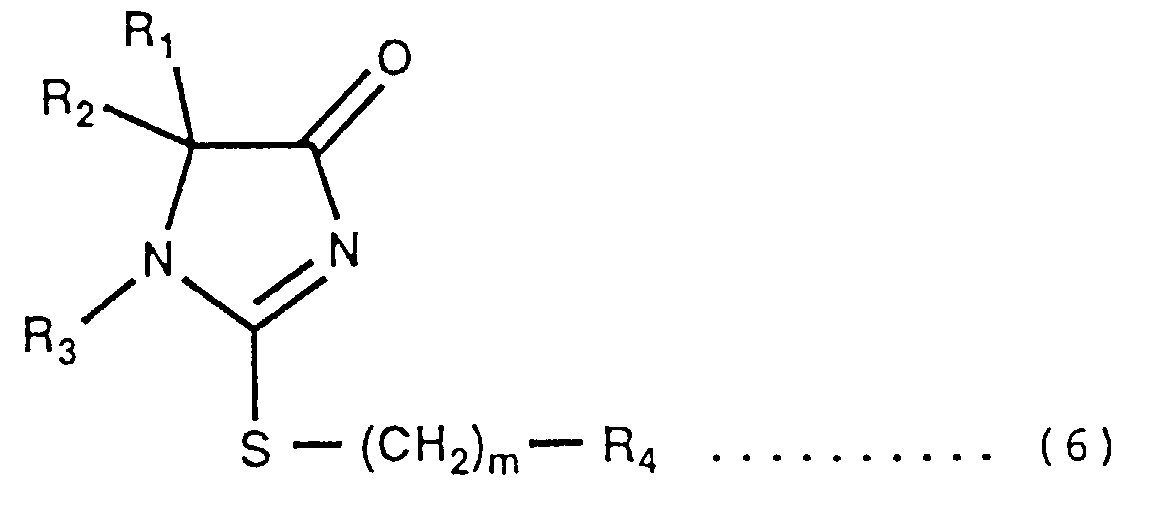

R4-(CH2)m-X (8)
wherein m represents one of integers "1" through "4", and R1 and R2 represent a same one or respective different ones of a hydrogen atom, a lower alkyl group, an aryl group that may have a substituent group, and an aralkyl group, or cooperate to represent one of an alkylene group, an alkylidene group or an arylalkylidene group that may have a substituent group, while R3 represents one of a lower alkyl group, an aralkyl group that may have a substituent group, a lower aklanoyl group and an arylcarbonyl group,and wherein R4 represents a nitrogen-containing aromatic ring that may be substituted by one of a lower alkyl group, an aralkyl group that may have a substituent group, a lower alkoxy group and a lower alkanoyl group, or a phenyl group represented by the following formula (9), wherein R5 and R6 represent a same one or respective different ones of a hydrogen atom, a lower alkyl group, a lower alkenyl group, and a lower alkanoyl or arylcarbonyl group which may be substituted by a halogen atom, while R7 represents one of a hydrogen atom, a halogen atom, a hydroxyl group, a lower alkyl group, a lower alkoxy group and a nitro group, X representing a halogen atom.
 - A process of producing an imidazole derivative or pharmaceutically acceptable salt thereof, wherein said imidazole derivative which is represented by one of the following formulas (10-1), (10-2) and (10-3) is produced by effecting a reaction of a 2-thiohydantoin derivative represented by one of the following formulas (11-1) through (11-5) with a compound represented by the following formula (12), and said pharmaceutically acceptable salt is produced by adding at least one acid as needed to said imidazole derivative,


R4-(CH2)m-X (12)
wherein m represents one of integers "1" through "4", and R1 and R2 represent a same one or respective different ones of a hydrogen atom, a lower alkyl group, an aryl group that may have a substituent group, and an aralkyl group, or cooperate to represent one of an alkylene group-, an alkylidene group or an arylalkylidene group that may have a substituent group,and wherein R4 represents a nitrogen-containing aromatic ring that may be substituted by one of a lower alkyl group, an aralkyl group that may have a substituent group, a lower alkoxy group and a lower alkanoyl group, or a phenyl group represented by the following formula (13), wherein R5 and R6 represent a same one or respective different ones of a hydrogen atom, a lower alkyl group, a lower alkenyl group, and a lower alkanoyl or arylcarbonyl group which may be substituted by a halogen atom, while R7 represents one of a hydrogen atom, a halogen atom, a hydroxyl group, a lower alkyl group, a lower alkoxy group and a nitro group, X representing a halogen atom.
 - A process of producing an imidazole derivative or pharmaceutically acceptable salt thereof, wherein said imidazole derivative which is represented by one of the following formula (14) is produced by effecting a reaction of a compound represented by one of the following formulas (15-1) through (15-3) with at least one of alkyl halide, aralkyl halide, acid halide and acid anhydride, and said pharmaceutically acceptable salt is produced by adding at least one acid as needed to said imidazole derivative,


 wherein m represents one of integers "1" through "4", and R1 and R2 represent a same one or respective different ones of a hydrogen atom, a lower alkyl group, an aryl group that may have a substituent group, and an aralkyl group, or cooperate to represent one of an alkylene group, an alkylidene group or an arylalkylidene group that may have a substituent group, while R3 represents one of a lower alkyl group, an aralkyl group that may have a substituent group, a lower aklanoyl group and an arylcarbonyl group,and wherein R4 represents a nitrogen-containing aromatic ring that may be substituted by one of a lower alkyl group, an aralkyl group that may have a substituent group, a lower alkoxy group and a lower alkanoyl group, or a phenyl group represented by the following formula (16),
 wherein R5 and R6 represent a same one or respective different ones of a hydrogen atom, a lower alkyl group, a lower alkenyl group, and a lower alkanoyl or arylcarbonyl group which may be substituted by a halogen atom, while R7 represents one of a hydrogen atom, a halogen atom, a hydroxyl group, a lower alkyl group, a lower alkoxy group and a nitro group, X representing a halogen atom.
 - A process of producing an imidazole derivative or pharmaceutically acceptable salt thereof, wherein said imidazole derivative which is represented by the following formula (17) is produced by effecting a reaction of a compound represented by one of the following formulas (18-1) and (18-2) with a compound represented by the following formula (19), and said pharmaceutically acceptable salt is produced by adding at least one acid as needed to said imidazole derivative,


R4-(CH2)m-X (19)
wherein m represents one of integers "1" through "4", and R1 and R2 represent a same one or respective diferent ones of a hydrogen atom, a lower alkyl group, an aryl group that may have a substituent group, and an aralkyl group, or cooperate to represent one of an alkylene group, an alkylidene group or an arylalkylidene group that may have a substituent group, while R3 represents one of a lower alkyl group, an aralkyl group that may have a substituent group, a lower aklanoyl group and an arylcarbonyl group,and wherein R4 represents a nitrogen-containing aromatic ring that may be substituted by one of a lower alkyl group, an aralkyl group that may have a substituent group, a lower alkoxy group and a lower alkanoyl group, or a phenyl group represented by the following formula (20), wherein R5 and R6 represent a same one or respective different ones of a hydrogen atom, a lower alkyl group, a lower alkenyl group, and a lower alkanoyl or arylcarbonyl group which may be substituted by a halogen atom, while R7 represents one of a hydrogen atom, a halogen atom, a hydroxyl group, a lower alkyl group, a lower alkoxy group and a nitro group, X representing a halogen atom.
 - A process of producing an imidazole derivative or pharmaceutically acceptable salt thereof, wherein said imidazole derivative which is represented by one of the following formulas (21-1), (21-2), (21-3), (22-1), (22-2) and (23) is produced by effecting a reaction of a 2,4-thiohydantoin derivative represented by one of the following formulas (24-1) through (24-5) with a compound represented by the following formula (25), and said pharmaceutically acceptable salt is produced by adding at least one acid as needed to said imidazole derivative,


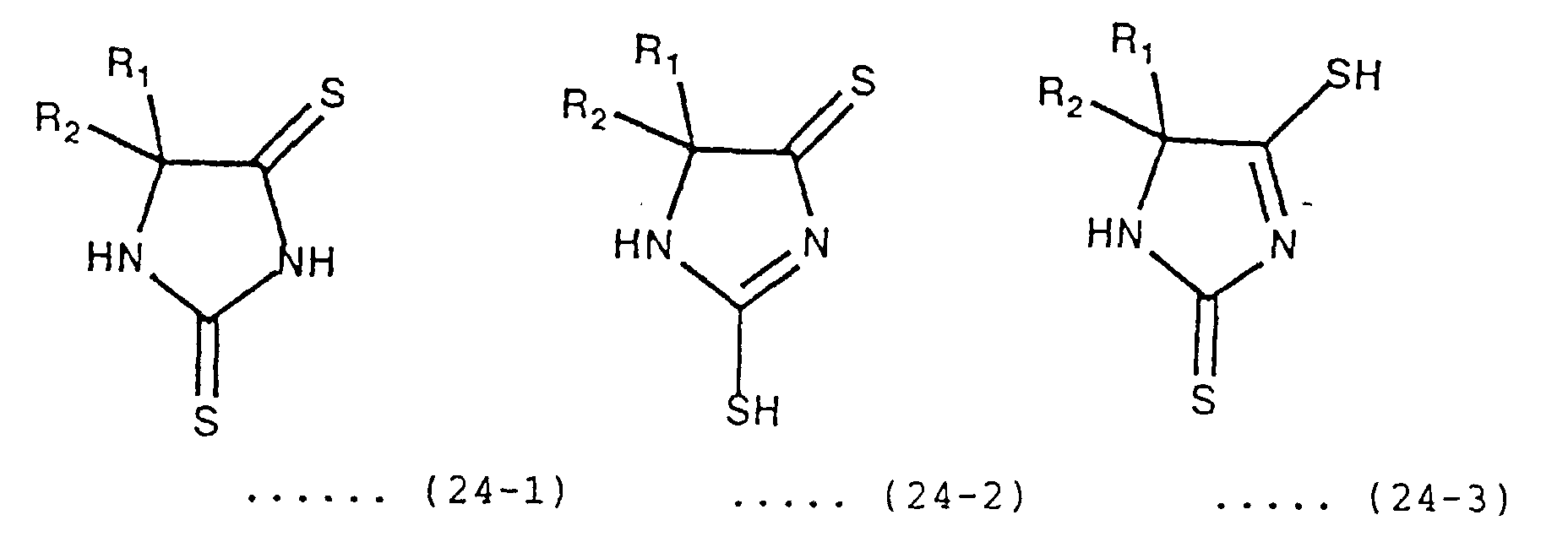

R4-(CH2)m-X (25)
wherein m represents one of integers "1" through "4", and R1 and R2 represent a same one or respective diferent ones of a hydrogen atom, a lower alkyl group, an aryl group that may have a substituent group, and an aralkyl group, or cooperate to represent one of an alkylene group, an alkylidene group or an aryl alkylidene group that may have a substituent group,and wherein R4 represents a nitrogen-containing aromatic ring that may be substituted by one of a lower alkyl group, an aralkyl group that may have a substituent group, a lower alkoxy group and a lower alkanoyl group, or a phenyl group represented by the following formula (26), wherein R5 and R6 represent a same one or respective different ones of a hydrogen atom, a lower alkyl group, a lower alkenyl group, and a lower alkanoyl or arylcarbonyl group which may be substituted by a halogen atom, while R7 represents one of a hydrogen atom, a halogen atom, a hydroxyl group, a lower alkyl group, a lower alkoxy group and a nitro group, X representing a halogen atom.
 - A process according to claim 9, wherein m is equal to "1", and R4 is a phenyl group represented by said formula (26), said imidazole derivative or said salt being represented by one of said formulas (21-1), (21-2), (21-3), (22-1) and (22-2).
- A process of producing an imidazole derivative or pharmaceutically acceptable salt thereof, wherein said imidazole derivative which is represented by one of the following formulas (27) and (28) is produced by effecting a reaction of a compound represented by one of the following formulas (29-1), (29-2), (29-3), (30-1) and (30-2) with a compound represented by the following formula (31), and said pharmaceutically acceptable salt is produced by adding at least one acid as needed to said imidazole derivative,


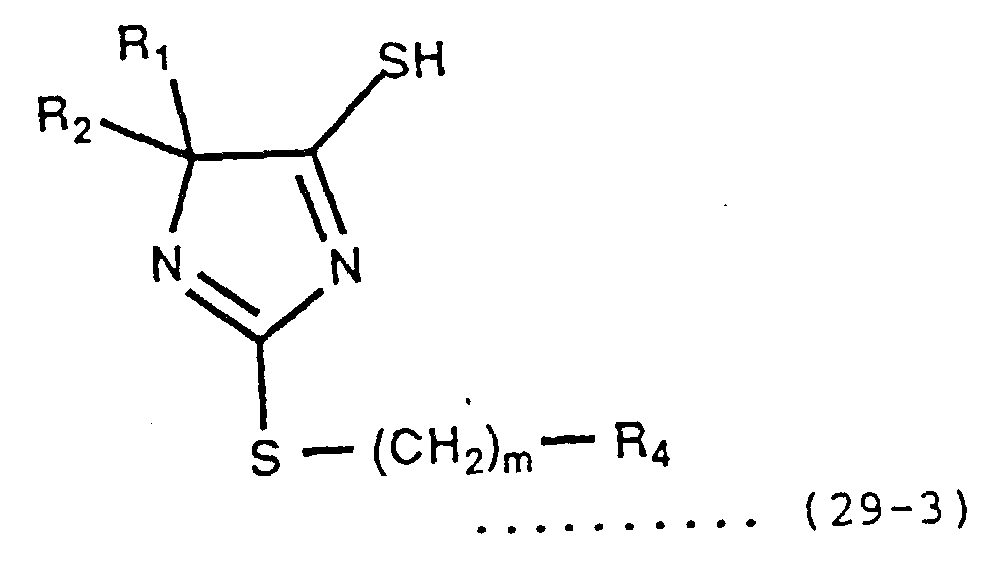

R11-X (31)
wherein each of m and n represents one of integers "1" through "4", and R1 and R2 represent a same one or respective different ones of a hydrogen atom, a lower alkyl group, an aryl group that may have a substituent group, and an aralkyl group, or cooperate to represent one of an alkylene group, an alkylidene group or an arylalkylidene group that may have a substituent group,and wherein R4 represents a nitrogen-containing aromatic ring that may be substituted by one of a lower alkyl group, an aralkyl group that may have a substituent group, a lower alkoxy group and a lower alkanoyl group, or a phenyl group represented by the following formula (32),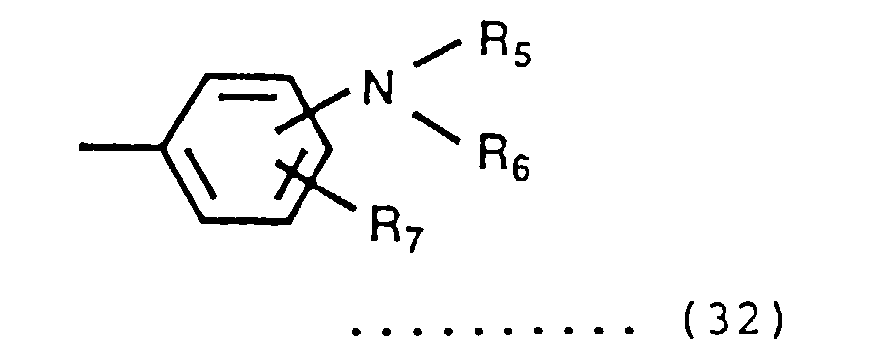 wherein R5 and R6 represent a same one or respective different ones of a hydrogen atom, a lower alkyl group, a lower alkenyl group, and a lower alkanoyl or arylcarbonyl group which may be substituted by a halogen atom, while R7 represents one of a hydrogen atom, a halogen atom, a hydroxyl group, a lower alkyl group, a lower alkoxy group and a nitro group, R11 representing one of an alkyl group having 1-7 carbon atoms, an alkenyl group having 3-5 carbon atoms, an aralkyl group that may have a substituent group, and a R12-(CH2)n- group, wherein R12 represents a nitrogen-containing aromatic ring that may be substituted by one of a hydrogen atom, a lower alkyl group, a lower alkoxy group and a lower alkanoyl group, or said phenyl group represented by said formula (30), X representing a halogen atom.
 - A process according to claim 11, wherein m is equal to "1", and R4 is said phenyl group represented by said formula (32), while R11 is a group represented the following formula (33),

- A process of producing an imidazole derivative or pharmaceutically acceptable salt thereof, wherein said imidazole derivative which is represented by one of the following formulas (34-1) and (34-2) is produced by effecting a reaction of a 4-thiohydantoin derivative represented by one of the following formulas (35-1) through (35-5) with a compound represented by the following formula (36), and said pharmaceutically acceptable salt is produced by adding at least one acid as needed to said imidazole derivative,


R4-(CH2)m-X (36)
wherein m represents one of integers "1" through "4", and R1 and R2 represent a same one or respective different ones of a hydrogen atom, a lower alkyl group, an aryl group that may have a substituent group, and an aralkyl group, or cooperate to represent one of an alkylene group, an alkylidene group or an arylalkylidene group that may have a substituent group,and wherein R4 represents a nitrogen-containing aromatic ring that may be substituted by one of a lower alkyl group, an aralkyl group that may have a substituent group, a lower alkoxy group and a lower alkanoyl group, or a phenyl group represented by the following formula (37), wherein R5 and R6 represent a same one or respective different ones of a hydrogen atom, a lower alkyl group, a lower alkenyl group, and a lower alkanoyl or arylcarbonyl group which may be substituted by a halogen atom, while R7 represents one of a hydrogen atom, a halogen atom, a hydroxyl group, a lower alkyl group, a lower alkoxy group and a nitro group, X representing a halogen atom.
 - A process of producing an imidazole derivative or pharmaceutically acceptable salt thereof, wherein said imidazole derivative which is represented by one of the following formula (38) is produced by effecting a reaction of a compound represented by one of the following formulas (39-1) and (39-2) with at least one of alkyl halide, aralkyl halide, acid halide and acid anhydride, and said pharmaceutically acceptable salt is produced by adding at least one acid as needed to said imidazole derivative,

 wherein m represents one of integers "1" through "4", and R1 and R2 represent a same one or respective different ones of a hydrogen atom, a lower alkyl group, an aryl group that may have a substituent group, and an aralkyl group, or cooperate to represent one of an alkylene group, an alkylidene group or an arylalkylidene group that may have a substituent group, while R3 represents one of a lower alkyl group, an aralkyl group that may have a substituent group, a lower aklanoyl group and an arylcarbonyl group,and wherein R4 represents a nitrogen-containing aromatic ring that may be substituted by one of a lower alkyl group, an aralkyl group that may have a substituent group, a lower alkoxy group and a lower alkanoyl group, or a phenyl group represented by the following formula (40),
 wherein R5 and R6 represent a same one or respective different ones of a hydrogen atom, a lower alkyl group, a lower alkenyl group, and a lower alkanoyl or arylcarbonyl group which may be substituted by a halogen atom, while R7 represents one of a hydrogen atom, a halogen atom, a hydroxyl group, a lower alkyl group, a lower alkoxy group and a nitro group, X representing a halogen atom.
 - An anti-ulcer drug including as an effective component an imidazole derivative or pharmaceutically acceptable salt thereof, said imidazole derivative or said salt being represented by one of the following formulas (41-1) through (41-4),
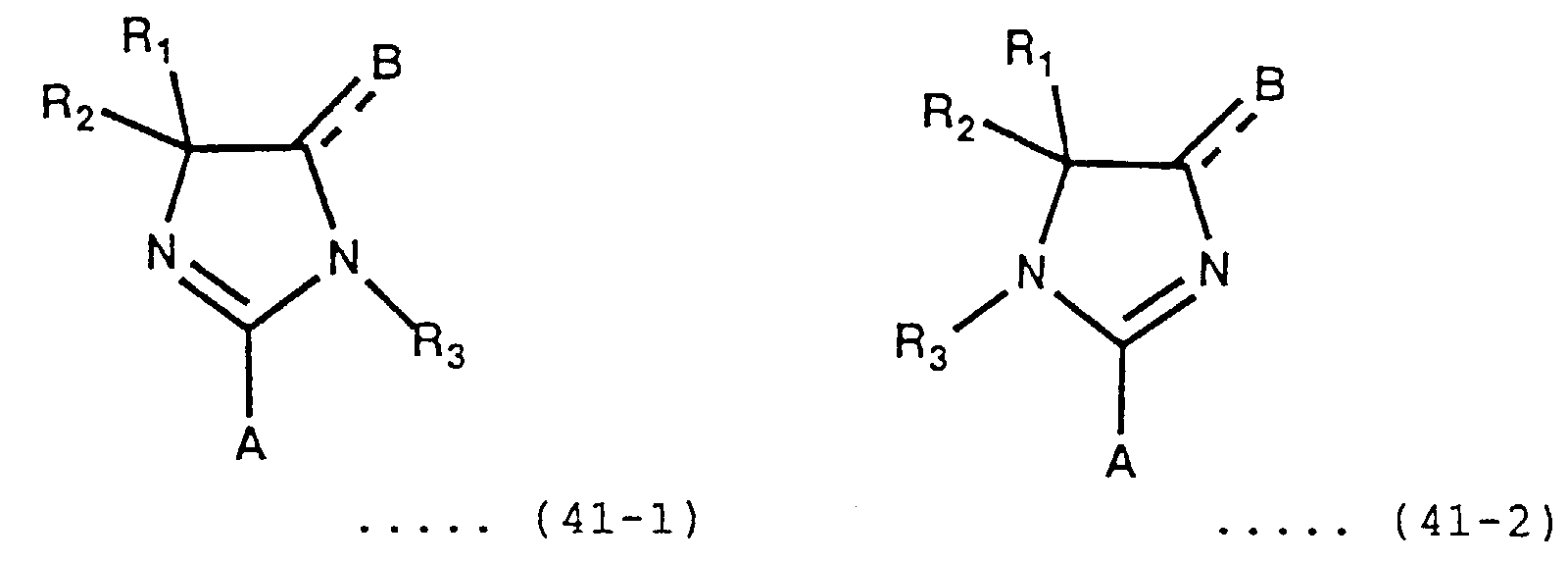
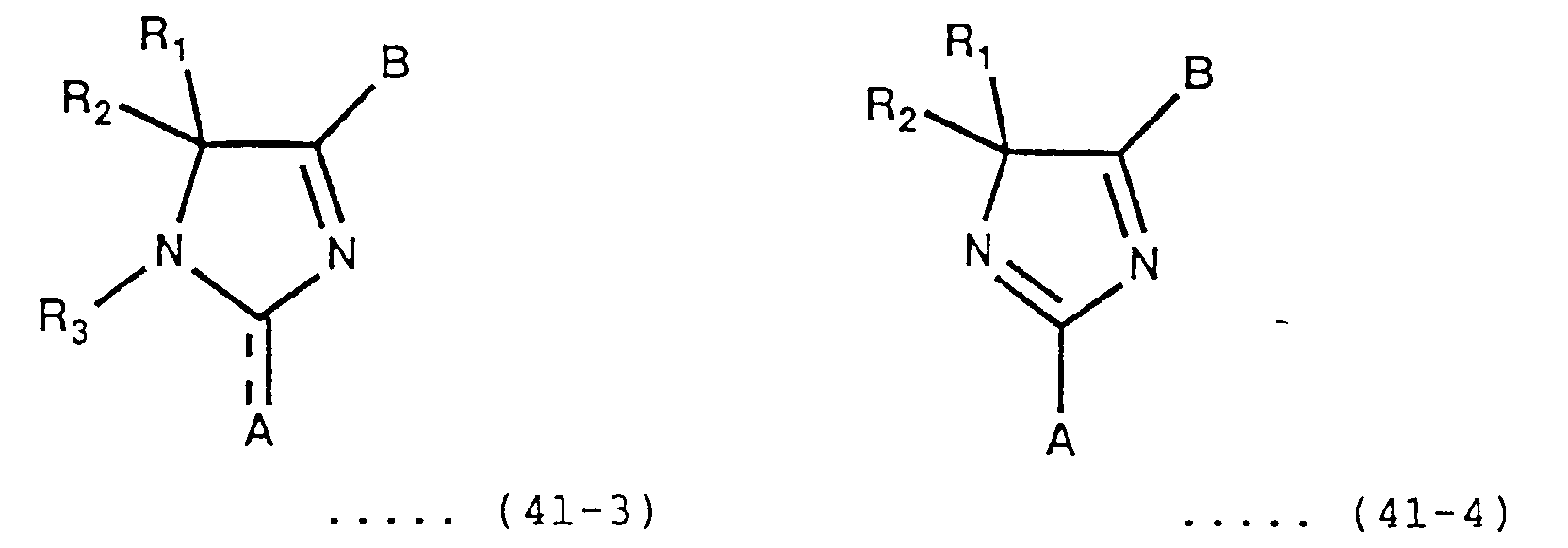 wherein R1 and R2 represent a same one or respective different ones of a hydrogen atom, a lower alkyl group, an aryl group that may have a substituent group, and an aralkyl group, or cooperate to represent one of an alkylene group, an alkylidene group or an arylalkylidene group that may have a substituent group, while R3 represents one of a hydrogen atom, a lower alkyl group, an aralkyl group that may have a substituent group, a lower aklanoyl group and an arylcarbonyl group,and wherein at least one of A and B represents a group represented by the following formula (42),
-S-(CH2)m-R4 (42)
wherein m represents one of integers "1" through "4", and R4 represents a nitrogen-containing aromatic ring that may be substituted by one of a lower alkyl group, a lower alkoxy group and a lower alkanoyl group, or a phenyl group represented by the following formula (43), wherein R5 and R6 represent a same one or respective different ones of a hydrogen atom, a lower alkyl group, a lower alkenyl group, and a lower alkanoyl or arylcarbonyl group which may be substituted by a halogen atom, while R7 represents one of a hydrogen atom, a halogen atom, a hydroxyl group, a lower alkyl group, a lower alkoxy group and a nitro group,and wherein the other of A and B represents one of an oxygen atom, a sulfur atom, a hydroxyl group, a mercapto group, a group represented by said formula (42), an alkylthio group, alkenylthio group, and an aralkylthio group that may have a substituent group, and broken line in said formulas (41-1), (41-2) and (41-3) represents a bond effective only when an appropriate one of A and B represents the oxygen or sulfur atom.
Applications Claiming Priority (2)
| Application Number | Priority Date | Filing Date | Title |
|---|---|---|---|
| JP7032700A JP3015702B2 (en) | 1995-02-21 | 1995-02-21 | Imidazole derivatives, their pharmaceutically acceptable acid addition salts, their production, and antiulcer agents containing them as active ingredients |
| JP32700/95 | 1995-02-21 |
Publications (1)
| Publication Number | Publication Date |
|---|---|
| EP0728747A1 true EP0728747A1 (en) | 1996-08-28 |
Family
ID=12366136
Family Applications (1)
| Application Number | Title | Priority Date | Filing Date |
|---|---|---|---|
| EP96301159A Withdrawn EP0728747A1 (en) | 1995-02-21 | 1996-02-21 | Imidazole derivative, pharmaceutically acceptable salt thereof, process of manufacture therefor, and anti-ulcer drug including such derivative or salt |
Country Status (3)
| Country | Link |
|---|---|
| US (1) | US5733922A (en) |
| EP (1) | EP0728747A1 (en) |
| JP (1) | JP3015702B2 (en) |
Cited By (4)
| Publication number | Priority date | Publication date | Assignee | Title |
|---|---|---|---|---|
| WO2002078699A1 (en) * | 2001-03-29 | 2002-10-10 | Smithkline Beecham Corporation | Compounds and methods |
| US6602831B2 (en) | 2001-01-24 | 2003-08-05 | Rohm And Haas Company | Oil-soluble additives for lubricating oils |
| US6734149B2 (en) | 2001-01-24 | 2004-05-11 | Rohm And Haas Company | Combination of additives for lubricating oils |
| FR2919608A1 (en) * | 2007-08-01 | 2009-02-06 | Univ Rennes 1 Etablissement Pu | IMIDAZOLON DERIVATIVES, PREPARATION METHOD AND BIOLOGICAL APPLICATIONS |
Citations (1)
| Publication number | Priority date | Publication date | Assignee | Title |
|---|---|---|---|---|
| EP0354788A1 (en) * | 1988-08-10 | 1990-02-14 | Nippon Chemiphar Co., Ltd. | Novel imidazole derivatives |
Family Cites Families (1)
| Publication number | Priority date | Publication date | Assignee | Title |
|---|---|---|---|---|
| SE7804231L (en) * | 1978-04-14 | 1979-10-15 | Haessle Ab | Gastric acid secretion |
-
1995
- 1995-02-21 JP JP7032700A patent/JP3015702B2/en not_active Expired - Lifetime
-
1996
- 1996-02-20 US US08/603,232 patent/US5733922A/en not_active Expired - Fee Related
- 1996-02-21 EP EP96301159A patent/EP0728747A1/en not_active Withdrawn
Patent Citations (1)
| Publication number | Priority date | Publication date | Assignee | Title |
|---|---|---|---|---|
| EP0354788A1 (en) * | 1988-08-10 | 1990-02-14 | Nippon Chemiphar Co., Ltd. | Novel imidazole derivatives |
Cited By (6)
| Publication number | Priority date | Publication date | Assignee | Title |
|---|---|---|---|---|
| US6602831B2 (en) | 2001-01-24 | 2003-08-05 | Rohm And Haas Company | Oil-soluble additives for lubricating oils |
| US6734149B2 (en) | 2001-01-24 | 2004-05-11 | Rohm And Haas Company | Combination of additives for lubricating oils |
| WO2002078699A1 (en) * | 2001-03-29 | 2002-10-10 | Smithkline Beecham Corporation | Compounds and methods |
| FR2919608A1 (en) * | 2007-08-01 | 2009-02-06 | Univ Rennes 1 Etablissement Pu | IMIDAZOLON DERIVATIVES, PREPARATION METHOD AND BIOLOGICAL APPLICATIONS |
| WO2009050352A3 (en) * | 2007-08-01 | 2009-07-23 | Univ Rennes | Imidazolone derivatives, preparation method thereof and biological use of same |
| US8563588B2 (en) | 2007-08-01 | 2013-10-22 | Universite De Rennes 1 | Imidazolone derivatives, method for the preparation thereof and biological applications |
Also Published As
| Publication number | Publication date |
|---|---|
| JPH08225537A (en) | 1996-09-03 |
| JP3015702B2 (en) | 2000-03-06 |
| US5733922A (en) | 1998-03-31 |
Similar Documents
| Publication | Publication Date | Title |
|---|---|---|
| US5231101A (en) | Benzo[5,6]cyclohepta[1,2-B]pyridine derivatives and antiallergic agents comprising same | |
| EP0268989B1 (en) | Imidazopyridine compounds and processes for preparation thereof | |
| KR100626605B1 (en) | Novel pyridazine derivatives and medicines using the same | |
| EP0040696B1 (en) | Aminothiadiazoles as gastric secretion inhibitors | |
| EP0116769B1 (en) | Dihydropyridines | |
| US4820710A (en) | Benzimidazole derivatives and pharmaceutical compositions containing them | |
| US4388308A (en) | N6 -[(2-Hydroxypropyl)aryl]adenosines | |
| EP0067436A2 (en) | Diamino isothiazole -1-oxides and -1,1-dioxides as gastric secretion inhibitors | |
| US4247551A (en) | N-Pyrrolyl-pyridazineamines and their use as antihypertensive agents | |
| EP0728747A1 (en) | Imidazole derivative, pharmaceutically acceptable salt thereof, process of manufacture therefor, and anti-ulcer drug including such derivative or salt | |
| KR840001615B1 (en) | Process for preparing 4-substituted pyridines | |
| US4535084A (en) | Certain 4-(2-hydroxyethylthiomethyl)pyridines and derivatives thereof having immunoregulatory activity | |
| US4490533A (en) | Aminoalkyl pyridine derivatives | |
| US4578392A (en) | Pyrazolo[1,5-a]pyridine derivatives and anti-allergic compositions containing them | |
| EP0306185A1 (en) | Tricyclic fused pyrimidine derivatives their production and use | |
| FR2522000A1 (en) | NOVEL THIOPYRANNOPYRIMIDINES, PARTICULARLY USEFUL AS HYPOGLYCEMIC AGENTS, AND THEIR MANUFACTURE | |
| US4873238A (en) | 2-Pyridinecarbothioamides and pharmaceutical compositions comprising the same | |
| Shafik et al. | Synthesis of novel 2-[2-(substituted amino) phenethyl]-1H-benzimidazoles; 3, 4-dihydro and 1, 2, 3, 4,-tetrahydropyrimido [1, 6-a]-benzimidazoles as potential antiulcer agents | |
| US4734411A (en) | Pyrrolizidine compounds, salts thereof, process for the preparation of same and pharmaceutical agents comprising same | |
| US4958023A (en) | 2-pyridinecarbothioamides, processes for preparation thereof and pharmaceutical compositions comprising the same | |
| CZ357190A3 (en) | Dihydropyrimidothiazine derivatives, process of their preparation and pharmaceutical compositions containing thereof | |
| US4224331A (en) | Derivatives of 2-pyridylthiourea and pharmaceutical compositions | |
| US4886821A (en) | 2-pyridinecarbothioamides and pharmaceutical compositions comprising the same useful as anti ulcer agents | |
| CS228942B2 (en) | Method of preparing new 1-furyl-3,4-dihydroisoquinolines | |
| US4495193A (en) | Imidazole compounds which reduce gastric acid secretion |
Legal Events
| Date | Code | Title | Description |
|---|---|---|---|
| PUAI | Public reference made under article 153(3) epc to a published international application that has entered the european phase |
Free format text: ORIGINAL CODE: 0009012 |
|
| 17P | Request for examination filed |
Effective date: 19960311 |
|
| AK | Designated contracting states |
Kind code of ref document: A1 Designated state(s): DE FR GB IT |
|
| 17Q | First examination report despatched |
Effective date: 19990930 |
|
| STAA | Information on the status of an ep patent application or granted ep patent |
Free format text: STATUS: THE APPLICATION IS DEEMED TO BE WITHDRAWN |
|
| 18D | Application deemed to be withdrawn |
Effective date: 20000211 |