EP0735949B1 - A press pad - Google Patents
A press pad Download PDFInfo
- Publication number
- EP0735949B1 EP0735949B1 EP19950933546 EP95933546A EP0735949B1 EP 0735949 B1 EP0735949 B1 EP 0735949B1 EP 19950933546 EP19950933546 EP 19950933546 EP 95933546 A EP95933546 A EP 95933546A EP 0735949 B1 EP0735949 B1 EP 0735949B1
- Authority
- EP
- European Patent Office
- Prior art keywords
- silicone
- press pad
- wire
- weft
- press
- Prior art date
- Legal status (The legal status is an assumption and is not a legal conclusion. Google has not performed a legal analysis and makes no representation as to the accuracy of the status listed.)
- Expired - Lifetime
Links
- 229920001296 polysiloxane Polymers 0.000 claims abstract description 33
- RYGMFSIKBFXOCR-UHFFFAOYSA-N Copper Chemical compound [Cu] RYGMFSIKBFXOCR-UHFFFAOYSA-N 0.000 claims abstract description 29
- 229920002379 silicone rubber Polymers 0.000 claims abstract description 23
- 229920003235 aromatic polyamide Polymers 0.000 claims abstract description 14
- 239000004760 aramid Substances 0.000 claims abstract description 13
- 229910052802 copper Inorganic materials 0.000 claims abstract description 12
- 239000010949 copper Substances 0.000 claims abstract description 12
- 229910001220 stainless steel Inorganic materials 0.000 claims abstract description 11
- 229910000881 Cu alloy Inorganic materials 0.000 claims abstract description 10
- 239000002759 woven fabric Substances 0.000 claims abstract description 10
- 230000005484 gravity Effects 0.000 claims abstract description 8
- 239000010935 stainless steel Substances 0.000 claims abstract description 8
- 229920000728 polyester Polymers 0.000 claims abstract description 4
- 229910052751 metal Inorganic materials 0.000 claims description 37
- 239000002184 metal Substances 0.000 claims description 37
- XEEYBQQBJWHFJM-UHFFFAOYSA-N Iron Chemical compound [Fe] XEEYBQQBJWHFJM-UHFFFAOYSA-N 0.000 claims description 4
- 239000007787 solid Substances 0.000 claims description 4
- 229910052793 cadmium Inorganic materials 0.000 claims description 3
- BDOSMKKIYDKNTQ-UHFFFAOYSA-N cadmium atom Chemical compound [Cd] BDOSMKKIYDKNTQ-UHFFFAOYSA-N 0.000 claims description 3
- QCWXUUIWCKQGHC-UHFFFAOYSA-N Zirconium Chemical compound [Zr] QCWXUUIWCKQGHC-UHFFFAOYSA-N 0.000 claims description 2
- 229910052742 iron Inorganic materials 0.000 claims description 2
- 229910052726 zirconium Inorganic materials 0.000 claims description 2
- 238000010030 laminating Methods 0.000 abstract description 3
- 238000010586 diagram Methods 0.000 description 6
- PXHVJJICTQNCMI-UHFFFAOYSA-N Nickel Chemical compound [Ni] PXHVJJICTQNCMI-UHFFFAOYSA-N 0.000 description 4
- 238000004519 manufacturing process Methods 0.000 description 4
- 239000000463 material Substances 0.000 description 4
- 229910052755 nonmetal Inorganic materials 0.000 description 3
- 229910001369 Brass Inorganic materials 0.000 description 2
- -1 aluminium Chemical class 0.000 description 2
- 238000005452 bending Methods 0.000 description 2
- 230000005540 biological transmission Effects 0.000 description 2
- 239000010951 brass Substances 0.000 description 2
- 230000006835 compression Effects 0.000 description 2
- 238000007906 compression Methods 0.000 description 2
- 230000001419 dependent effect Effects 0.000 description 2
- 238000009429 electrical wiring Methods 0.000 description 2
- 239000003365 glass fiber Substances 0.000 description 2
- 210000000569 greater omentum Anatomy 0.000 description 2
- 150000002739 metals Chemical class 0.000 description 2
- 229910052759 nickel Inorganic materials 0.000 description 2
- 239000004753 textile Substances 0.000 description 2
- 238000009941 weaving Methods 0.000 description 2
- 241000531908 Aramides Species 0.000 description 1
- OKTJSMMVPCPJKN-UHFFFAOYSA-N Carbon Chemical compound [C] OKTJSMMVPCPJKN-UHFFFAOYSA-N 0.000 description 1
- 229910000925 Cd alloy Inorganic materials 0.000 description 1
- 229920000271 Kevlar® Polymers 0.000 description 1
- 229920000914 Metallic fiber Polymers 0.000 description 1
- 229920000784 Nomex Polymers 0.000 description 1
- ISWSIDIOOBJBQZ-UHFFFAOYSA-N Phenol Chemical compound OC1=CC=CC=C1 ISWSIDIOOBJBQZ-UHFFFAOYSA-N 0.000 description 1
- 239000004696 Poly ether ether ketone Substances 0.000 description 1
- 239000004642 Polyimide Substances 0.000 description 1
- 229920000491 Polyphenylsulfone Polymers 0.000 description 1
- 229910045601 alloy Inorganic materials 0.000 description 1
- 239000000956 alloy Substances 0.000 description 1
- 229910052782 aluminium Inorganic materials 0.000 description 1
- 239000004411 aluminium Substances 0.000 description 1
- XAGFODPZIPBFFR-UHFFFAOYSA-N aluminium Chemical compound [Al] XAGFODPZIPBFFR-UHFFFAOYSA-N 0.000 description 1
- 230000001668 ameliorated effect Effects 0.000 description 1
- 230000003466 anti-cipated effect Effects 0.000 description 1
- 239000010425 asbestos Substances 0.000 description 1
- PLZFHNWCKKPCMI-UHFFFAOYSA-N cadmium copper Chemical compound [Cu].[Cd] PLZFHNWCKKPCMI-UHFFFAOYSA-N 0.000 description 1
- 229910052799 carbon Inorganic materials 0.000 description 1
- 239000004020 conductor Substances 0.000 description 1
- 230000000694 effects Effects 0.000 description 1
- 229920001971 elastomer Polymers 0.000 description 1
- 239000000806 elastomer Substances 0.000 description 1
- 239000004744 fabric Substances 0.000 description 1
- 229910001385 heavy metal Inorganic materials 0.000 description 1
- 238000005470 impregnation Methods 0.000 description 1
- 239000004761 kevlar Substances 0.000 description 1
- 239000004763 nomex Substances 0.000 description 1
- 150000002843 nonmetals Chemical class 0.000 description 1
- 239000004745 nonwoven fabric Substances 0.000 description 1
- 229920006122 polyamide resin Polymers 0.000 description 1
- 229920002530 polyetherether ketone Polymers 0.000 description 1
- 229920001721 polyimide Polymers 0.000 description 1
- 229910052895 riebeckite Inorganic materials 0.000 description 1
- 229920002050 silicone resin Polymers 0.000 description 1
- 239000004945 silicone rubber Substances 0.000 description 1
- 208000024891 symptom Diseases 0.000 description 1
- 229920002994 synthetic fiber Polymers 0.000 description 1
- 229920005992 thermoplastic resin Polymers 0.000 description 1
Images

Classifications
-
- B—PERFORMING OPERATIONS; TRANSPORTING
- B32—LAYERED PRODUCTS
- B32B—LAYERED PRODUCTS, i.e. PRODUCTS BUILT-UP OF STRATA OF FLAT OR NON-FLAT, e.g. CELLULAR OR HONEYCOMB, FORM
- B32B37/00—Methods or apparatus for laminating, e.g. by curing or by ultrasonic bonding
- B32B37/14—Methods or apparatus for laminating, e.g. by curing or by ultrasonic bonding characterised by the properties of the layers
- B32B37/26—Methods or apparatus for laminating, e.g. by curing or by ultrasonic bonding characterised by the properties of the layers with at least one layer which influences the bonding during the lamination process, e.g. release layers or pressure equalising layers
-
- B—PERFORMING OPERATIONS; TRANSPORTING
- B30—PRESSES
- B30B—PRESSES IN GENERAL
- B30B15/00—Details of, or accessories for, presses; Auxiliary measures in connection with pressing
- B30B15/06—Platens or press rams
- B30B15/061—Cushion plates
-
- D—TEXTILES; PAPER
- D03—WEAVING
- D03D—WOVEN FABRICS; METHODS OF WEAVING; LOOMS
- D03D1/00—Woven fabrics designed to make specified articles
-
- D—TEXTILES; PAPER
- D03—WEAVING
- D03D—WOVEN FABRICS; METHODS OF WEAVING; LOOMS
- D03D13/00—Woven fabrics characterised by the special disposition of the warp or weft threads, e.g. with curved weft threads, with discontinuous warp threads, with diagonal warp or weft
- D03D13/004—Woven fabrics characterised by the special disposition of the warp or weft threads, e.g. with curved weft threads, with discontinuous warp threads, with diagonal warp or weft with weave pattern being non-standard or providing special effects
-
- D—TEXTILES; PAPER
- D03—WEAVING
- D03D—WOVEN FABRICS; METHODS OF WEAVING; LOOMS
- D03D13/00—Woven fabrics characterised by the special disposition of the warp or weft threads, e.g. with curved weft threads, with discontinuous warp threads, with diagonal warp or weft
- D03D13/008—Woven fabrics characterised by the special disposition of the warp or weft threads, e.g. with curved weft threads, with discontinuous warp threads, with diagonal warp or weft characterised by weave density or surface weight
-
- D—TEXTILES; PAPER
- D03—WEAVING
- D03D—WOVEN FABRICS; METHODS OF WEAVING; LOOMS
- D03D15/00—Woven fabrics characterised by the material, structure or properties of the fibres, filaments, yarns, threads or other warp or weft elements used
-
- D—TEXTILES; PAPER
- D03—WEAVING
- D03D—WOVEN FABRICS; METHODS OF WEAVING; LOOMS
- D03D15/00—Woven fabrics characterised by the material, structure or properties of the fibres, filaments, yarns, threads or other warp or weft elements used
- D03D15/20—Woven fabrics characterised by the material, structure or properties of the fibres, filaments, yarns, threads or other warp or weft elements used characterised by the material of the fibres or filaments constituting the yarns or threads
- D03D15/242—Woven fabrics characterised by the material, structure or properties of the fibres, filaments, yarns, threads or other warp or weft elements used characterised by the material of the fibres or filaments constituting the yarns or threads inorganic, e.g. basalt
- D03D15/25—Metal
-
- D—TEXTILES; PAPER
- D03—WEAVING
- D03D—WOVEN FABRICS; METHODS OF WEAVING; LOOMS
- D03D15/00—Woven fabrics characterised by the material, structure or properties of the fibres, filaments, yarns, threads or other warp or weft elements used
- D03D15/20—Woven fabrics characterised by the material, structure or properties of the fibres, filaments, yarns, threads or other warp or weft elements used characterised by the material of the fibres or filaments constituting the yarns or threads
- D03D15/283—Woven fabrics characterised by the material, structure or properties of the fibres, filaments, yarns, threads or other warp or weft elements used characterised by the material of the fibres or filaments constituting the yarns or threads synthetic polymer-based, e.g. polyamide or polyester fibres
-
- D—TEXTILES; PAPER
- D03—WEAVING
- D03D—WOVEN FABRICS; METHODS OF WEAVING; LOOMS
- D03D15/00—Woven fabrics characterised by the material, structure or properties of the fibres, filaments, yarns, threads or other warp or weft elements used
- D03D15/40—Woven fabrics characterised by the material, structure or properties of the fibres, filaments, yarns, threads or other warp or weft elements used characterised by the structure of the yarns or threads
-
- D—TEXTILES; PAPER
- D03—WEAVING
- D03D—WOVEN FABRICS; METHODS OF WEAVING; LOOMS
- D03D15/00—Woven fabrics characterised by the material, structure or properties of the fibres, filaments, yarns, threads or other warp or weft elements used
- D03D15/50—Woven fabrics characterised by the material, structure or properties of the fibres, filaments, yarns, threads or other warp or weft elements used characterised by the properties of the yarns or threads
- D03D15/56—Woven fabrics characterised by the material, structure or properties of the fibres, filaments, yarns, threads or other warp or weft elements used characterised by the properties of the yarns or threads elastic
-
- D—TEXTILES; PAPER
- D03—WEAVING
- D03D—WOVEN FABRICS; METHODS OF WEAVING; LOOMS
- D03D15/00—Woven fabrics characterised by the material, structure or properties of the fibres, filaments, yarns, threads or other warp or weft elements used
- D03D15/50—Woven fabrics characterised by the material, structure or properties of the fibres, filaments, yarns, threads or other warp or weft elements used characterised by the properties of the yarns or threads
- D03D15/573—Tensile strength
-
- D—TEXTILES; PAPER
- D10—INDEXING SCHEME ASSOCIATED WITH SUBLASSES OF SECTION D, RELATING TO TEXTILES
- D10B—INDEXING SCHEME ASSOCIATED WITH SUBLASSES OF SECTION D, RELATING TO TEXTILES
- D10B2101/00—Inorganic fibres
- D10B2101/20—Metallic fibres
-
- D—TEXTILES; PAPER
- D10—INDEXING SCHEME ASSOCIATED WITH SUBLASSES OF SECTION D, RELATING TO TEXTILES
- D10B—INDEXING SCHEME ASSOCIATED WITH SUBLASSES OF SECTION D, RELATING TO TEXTILES
- D10B2331/00—Fibres made from polymers obtained otherwise than by reactions only involving carbon-to-carbon unsaturated bonds, e.g. polycondensation products
- D10B2331/02—Fibres made from polymers obtained otherwise than by reactions only involving carbon-to-carbon unsaturated bonds, e.g. polycondensation products polyamides
- D10B2331/021—Fibres made from polymers obtained otherwise than by reactions only involving carbon-to-carbon unsaturated bonds, e.g. polycondensation products polyamides aromatic polyamides, e.g. aramides
-
- H—ELECTRICITY
- H05—ELECTRIC TECHNIQUES NOT OTHERWISE PROVIDED FOR
- H05K—PRINTED CIRCUITS; CASINGS OR CONSTRUCTIONAL DETAILS OF ELECTRIC APPARATUS; MANUFACTURE OF ASSEMBLAGES OF ELECTRICAL COMPONENTS
- H05K3/00—Apparatus or processes for manufacturing printed circuits
- H05K3/02—Apparatus or processes for manufacturing printed circuits in which the conductive material is applied to the surface of the insulating support and is thereafter removed from such areas of the surface which are not intended for current conducting or shielding
- H05K3/022—Processes for manufacturing precursors of printed circuits, i.e. copper-clad substrates
-
- Y—GENERAL TAGGING OF NEW TECHNOLOGICAL DEVELOPMENTS; GENERAL TAGGING OF CROSS-SECTIONAL TECHNOLOGIES SPANNING OVER SEVERAL SECTIONS OF THE IPC; TECHNICAL SUBJECTS COVERED BY FORMER USPC CROSS-REFERENCE ART COLLECTIONS [XRACs] AND DIGESTS
- Y10—TECHNICAL SUBJECTS COVERED BY FORMER USPC
- Y10T—TECHNICAL SUBJECTS COVERED BY FORMER US CLASSIFICATION
- Y10T442/00—Fabric [woven, knitted, or nonwoven textile or cloth, etc.]
- Y10T442/30—Woven fabric [i.e., woven strand or strip material]
- Y10T442/3382—Including a free metal or alloy constituent
- Y10T442/339—Metal or metal-coated strand
Definitions
- the present invention relates to a press pad for use in a laminating press for the production of laminate sheets, such as decorative laminates and printed circuit boards, using low pressure and high pressure single daylight and multi daylight presses.
- a laminate sheet 1 to be pressed between two platens 2 of the press is located between two metal caul plates 3 and two press pads 4.
- the press pads 4 are each located between one of the caul plates 3 and one of the platens 2.
- the press pads 4 are usually a little larger than the dimensions of the platen 2 to allow for clamping.
- the purpose of the press pads 4 is to compensate for density variations in the laminate sheet 1 and thereby ensure that an equal pressure is applied to all parts of the sheet 1.
- the press pads 4 compensate for any unevenness in the surfaces of the platens 2 of the press itself and any flexure or bowing of the platens 2 when under pressure. Again, this assists in the production of a flat even density laminate.
- the capacity a press pad has to re-form itself after each pressing is an important characteristic to ensure a reasonable working life and to avoid unnecessary downtime of a press whilst the press pads are replaced.
- a conventional press pad is a densely woven combination of high temperature resistant non-asbestos yarns and metal wire.
- the metal wire is included to give good heat transmission through the pad to the laminate sheet.
- the non-metal yarn is required to give the pad the springiness and resilience required to enable the pad to relax after each pressing operation.
- the relative proportion of the two types of material is a consideration when devising a press pad for a particular purpose. Usually a compromise must be reached between the heat transference and the resilience required in each case.
- the metal wires used are typically copper of brass wire whereas the temperature resistant yarns are usually made from aromatic polyamide fibres such as those manufactured and marketed by Du Pont Inc under the trade marks KEVLAR and NOMEX. Whilst metal wires can be woven per se, it is also common for metal strands to be wrapped around heat resistant yarns and for heat resistant yarns to be wrapped around metal strands. Metal wires may also be sheathed with textile fibres.
- a conventional press pad for use in a high pressure daylight press is described in EP 0 493 630 A1.
- the press pad is made from a woven textile of aromatic polyamide and metal threads.
- EP 0 488 071 A2 Another press pad is described in EP 0 488 071 A2. This also is made from a combination of heat resistant organic fibres, such as aramide fibres, phenol fibres, polyetheretherketone fibres, and polyphenylsulfone fibres, and heat resistant inorganic fibres such as carbon fibres, glass fibres and metallic fibres.
- heat resistant organic fibres such as aramide fibres, phenol fibres, polyetheretherketone fibres, and polyphenylsulfone fibres
- heat resistant inorganic fibres such as carbon fibres, glass fibres and metallic fibres.
- JP,A,62 234696 and JP,A,62 234698 are disclosed press pads comprising plates, sheets, woven fabrics and non-woven fabrics of thermoplastic resin such as polyamide resin, polyimide resion, polyfluororesin and silicone resin used alone or in combination.
- thermoplastic resin such as polyamide resin, polyimide resion, polyfluororesin and silicone resin used alone or in combination.
- FR,A,2 239 340 discloses a pad wherein glass fibre threads are impregnated with a synthetic material which may comprise a silicone rubber. The impregnation is accomplished by covering the warp or weft threads, or by impregnating the pad after weaving, or both. However, this pad has been specifically designed to have a low coefficient of thermal expansion.
- a press pad for use in a laminate press comprising a woven fabric of heat resistant strands including metal wire and characterised in that a substantial proportion of at least one of the warp and the weft comprises a silicone elastomer.
- a silicone elastomer in a press pad provides a high degree of springiness and resistance to compressive loads which means that the springiness and resilience of the pad is not solely dependent on its weave structure.
- a press pad according to the invention can be used for a longer period than a similarly woven conventional pad before losing its compensating ability.
- format changes in the laminate sheets being pressed can be more readily accommodated.
- the silicone elastomer preferably has a specific gravity within the range of 1.1 g/cm 3 to 1.4 g/cm 3 inclusive. More particularly, however, the silicone elastomer advantageously has a specific gravity of 1.20 ⁇ 0.02 g/cm 3 . Silicone elastomers within this latter range exhibit the best qualities for this application, combining the properties of a long working life, high tear strength and a good resilience to compression.
- At least one of the warp and the weft comprises silicone covered metal wire.
- at least one of the warp and the weft comprises substantially solid silicone strands.
- the wall thickness of the silicone of the silicone covered wire is at least 0.2 mm, and the overall outside diameter of the silicone covered wire is at least 1.0 mm.
- the silicone covered wire comprises a stranded or braided copper wire wherein the diameter of each wire strand is at least 0.05 mm.
- the silicone covered wire comprises a stranded wire made up from at least 7 wire strands.
- the other of the warp and the weft from that which comprises the silicone elastomer comprises strands of a copper alloy.
- a press pad for use in a laminate press comprises a densely woven fabric which is made of materials that are heat resistant to at least 220°C. A substantial proportion of at least either the weft or the warp or both are strands comprising a silicone elastomer. The rest of the warp and weft not made of this material is made substantially of metal, either in the form of wire, which can be stranded or otherwise, or as a wrapping for a heat resistant yarn such as an aromatic polyamide yarn.
- the weft comprises a silicone covered wire, such as copper wire.
- a suitable silicone covered wire may be a silicone covered nickel plated copper wire.
- the weft could comprise solid silicone strands.
- silicone elastomer used is important in order to secure the host properties for the performance of the press pad made therefrom.
- Silicone elastomers with a specific gravity within the range of 1.1 g/cm 3 to 1.4 g/cm 3 inclusive can be used but in order to secure the best properties wherein it is neither sufficiently springy under compression nor too brittle, the silicone elastomer preferably has a specific gravity of 1.20 ⁇ 0.02 g/cm 3 with a hardness of 70 ⁇ 5 IRHD.
- it is preferably a high tear strength elastomer, for example with a minimum tear strength of 15 kN per metre and a minimum tensile strength of 6MPa.
- Such a silicone elastomer is cut-resistant and capable of operating continuously at working temperatures of up to 220°C. In addition, it is capable of withstanding and recovering from pressures in the range 20 kg per cm 2 to 120 kg per cm 2 for a pressing time in the range of 15 seconds to 120 minutes as can be found in laminate presses of various types.
- the wall thickness of the silicone is preferably at least 0.2 mm and the overall outside diameter of the silicone covered wire is at least 1.0 mm.
- Stranded or braided wire can also be used wherein the wire preferably comprises at least 7 wire strands.
- Such silicone covered wire can be made in a conventional manner, preferably by being extruded over either a solid metal wire or d stranded metal wire.
- the copper wire can be plated to prevent oxidisation of the copper.
- a suitable silicone covered wire may be a silicone, covered nickel plated copper wire such as is commonly used for electrical wiring.
- the wire may comprise stainless steel wire to overcome any problems associated with metal fatigue.
- multi-stranded copper wire which exhibits a high reversed bending strength and therefore has a lower susceptibility to metal fatigue and a greater flexibility than the conventional copper wire used for electrical wiring.
- up to 102 strands of copper wire each of at least 0.05 mm can be covered with silicone as previously described to produce a wire of similar exterior dimensions to those previously described.
- a silicone covered multi-stranded copper wire with up to 66 strands of copper wire, each of at least 0.07 could be used.
- soft annealed copper wire is conventionally used in press pads because it is ductile and easily made into strands suitable for weaving, and it is a good heat conductor.
- Other metals such as aluminium, and alloys such as brass, may also be used. Whilst such metal strands can also be used in a press pad according to the present invention, it has been found that in view of the high degree of compensation present in the press pad, wherein the metal strands in the pad are repeatedly flattened out during pressing and sprung back to regain their former position by the natural springiness of the silicone elastomer after each pressing operation, the metal strands can in time exhibit the symptoms of metal fatigue. Soft annealed copper is susceptible in this regard.
- Such copper alloys wherein the proportion of the second metal is small in comparison to the whole for example copper cadmium alloys wherein the proportion of cadmium is approximately 1 % of the whole, exhibit a higher reversed bending strength than soft annealed copper without significantly compromising the heat conductive properties of the metal and therefore the pad.
- the compensation ability of the pad is therefore ameliorated by the additional springiness of the copper alloy when compared with the relative maleability of soft annealed copper.
- Non-metal strands such as aromatic polyamide yarns or polyester yarns, may also be used to form the warp strands.
- metal strands such as copper or stainless steel strands may be wrapped with an aromatic polyamide yarn in a conventional manner.
- Stainless steel strands may also be used to braid the exterior of silicone covered copper wire which may be used in the weft to improve its resistance to metal fatigue. Such braided strands could also be used in the warp of the weave.
- the warp comprises substantially the silicone elastomer and the weft to comprise substantially metal strands or other heat resistant yarns.
- the weft threads A each comprise a silicone covered stranded copper wire as is described above, which may be braided with stainless steel wire if appropriate for the application.
- the warp threads B preferably comprise one of stainless steel wires, copper wires, copper wires wrapped with an aromatic polyamide yarn in a conventional manner, aromatic polyamide yarn, or polyester yarn.
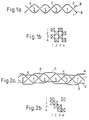
- weave cross-sections and the weave diagrams illustrating these examples are shown in a conventional manner.
- the weave cross-sections comprising Figs. 1a to 3a
- the weft which is shown in cross section with the warp interweaving therebetween.
- the "vertical" lines represent the warp and the "horizontal" lines represent the weft; at each intersection between the warp and the weft a filled-in or crossed square indicates that the warp is placed above the weft whereas a blank square indicates that the weft is above the warp.
- the weave diagrams show at least one round of weave.
- This weave is shown in Figs. 1a and 1b and comprises a single ply plain weave.
- the characteristics of this weave are as follows.
- Twill weaves have the advantage of providing a highly flexible press cushion with a smoother surface than other weaves. This is advantageous in some applications.
Landscapes
- Engineering & Computer Science (AREA)
- Textile Engineering (AREA)
- Chemical & Material Sciences (AREA)
- Inorganic Chemistry (AREA)
- Mechanical Engineering (AREA)
- Woven Fabrics (AREA)
- Press Drives And Press Lines (AREA)
- Presses And Accessory Devices Thereof (AREA)
- Wire Bonding (AREA)
- Laminated Bodies (AREA)
- Casting Or Compression Moulding Of Plastics Or The Like (AREA)
- Production Of Multi-Layered Print Wiring Board (AREA)
- Sliding-Contact Bearings (AREA)
- Bipolar Transistors (AREA)
- Liquid Crystal (AREA)
- Mechanical Treatment Of Semiconductor (AREA)
Abstract
Description
- The present invention relates to a press pad for use in a laminating press for the production of laminate sheets, such as decorative laminates and printed circuit boards, using low pressure and high pressure single daylight and multi daylight presses.
- As shown in Fig. 4 of the drawings appended hereto, in a single daylight laminating press, a
laminate sheet 1 to be pressed between twoplatens 2 of the press is located between twometal caul plates 3 and twopress pads 4. Thepress pads 4 are each located between one of thecaul plates 3 and one of theplatens 2. Thepress pads 4 are usually a little larger than the dimensions of theplaten 2 to allow for clamping. - The purpose of the
press pads 4 is to compensate for density variations in thelaminate sheet 1 and thereby ensure that an equal pressure is applied to all parts of thesheet 1. In addition, thepress pads 4 compensate for any unevenness in the surfaces of theplatens 2 of the press itself and any flexure or bowing of theplatens 2 when under pressure. Again, this assists in the production of a flat even density laminate. Thus, it is important for a press pad to be resilient and have a natural springiness to permit it to compensate for the aforementioned density variations and the surface unevenness of the press platens but also to allow it to relax after each pressing operation and recover its form to enable it to be used again. The capacity a press pad has to re-form itself after each pressing is an important characteristic to ensure a reasonable working life and to avoid unnecessary downtime of a press whilst the press pads are replaced. - However, because the purpose of the press is to apply heat to the laminate sheet whilst it is under pressure, it is important that the press pad also conducts the heat supplied by the press platens to the laminate sheet. Working temperatures for such presses are usually in a range up to 220°C.
- Typically, therefore, a conventional press pad is a densely woven combination of high temperature resistant non-asbestos yarns and metal wire. The metal wire is included to give good heat transmission through the pad to the laminate sheet. In contrast, the non-metal yarn is required to give the pad the springiness and resilience required to enable the pad to relax after each pressing operation. The relative proportion of the two types of material is a consideration when devising a press pad for a particular purpose. Usually a compromise must be reached between the heat transference and the resilience required in each case.
- The metal wires used are typically copper of brass wire whereas the temperature resistant yarns are usually made from aromatic polyamide fibres such as those manufactured and marketed by Du Pont Inc under the trade marks KEVLAR and NOMEX. Whilst metal wires can be woven per se, it is also common for metal strands to be wrapped around heat resistant yarns and for heat resistant yarns to be wrapped around metal strands. Metal wires may also be sheathed with textile fibres.
- A conventional press pad for use in a high pressure daylight press is described in EP 0 493 630 A1. Here, the press pad is made from a woven textile of aromatic polyamide and metal threads.
- Another press pad is described in EP 0 488 071 A2. This also is made from a combination of heat resistant organic fibres, such as aramide fibres, phenol fibres, polyetheretherketone fibres, and polyphenylsulfone fibres, and heat resistant inorganic fibres such as carbon fibres, glass fibres and metallic fibres.
- One of the problems encountered with these conventional press pads is that in use, the metal threads eventually flatten the weave structure to such an extent that the press pad is unable to relax after each pressing operation and the pad loses its resilience and springiness. In contrast, pads are known which do not comprise metal threads but these suffer from the disadvantage that their heat transmission properties are poor. Examples of such pads are as follows.
- In JP,A,62 234696 and JP,A,62 234698 are disclosed press pads comprising plates, sheets, woven fabrics and non-woven fabrics of thermoplastic resin such as polyamide resin, polyimide resion, polyfluororesin and silicone resin used alone or in combination.
- FR,A,2 239 340 discloses a pad wherein glass fibre threads are impregnated with a synthetic material which may comprise a silicone rubber. The impregnation is accomplished by covering the warp or weft threads, or by impregnating the pad after weaving, or both. However, this pad has been specifically designed to have a low coefficient of thermal expansion.
- Whilst the springiness of these last two types of pad may be high, their low thermal conductivity means that they act in use as a heat brake and therefore reduce the power of the press.
- Another problem with conventional press pads is that once a pad has been used for pressing a particular size and format of laminate sheet, it is generally not possible to use the pad again with sheets of a larger size or different format without leaving marks on the subsequently pressed sheets.
- It is an object of the invention to provide a press pad which has a greater resilience and springiness over conventional pads and for a longer period without compromising the heat conduction capability of the pad. In addition, it is an object of the present invention to provide a press pad which mitigates the effect of format changes in the laminate sheets being pressed.
- According to the present invention there is provided a press pad for use in a laminate press comprising a woven fabric of heat resistant strands including metal wire and characterised in that a substantial proportion of at least one of the warp and the weft comprises a silicone elastomer.
- The advantage of using a silicone elastomer in a press pad is that it provides a high degree of springiness and resistance to compressive loads which means that the springiness and resilience of the pad is not solely dependent on its weave structure. Thus, a press pad according to the invention can be used for a longer period than a similarly woven conventional pad before losing its compensating ability. In addition, format changes in the laminate sheets being pressed can be more readily accommodated.
- In addition, it is also anticipated that if the silicone in the press pad is cut by the metal wires which are also present in the pad, the springiness of the pad will not be significantly affected. This is in contrast to conventional pads wherein the metal wires can cut the other non-metal yarns, to the detriment of the springiness of the pad.
- The silicone elastomer preferably has a specific gravity within the range of 1.1 g/cm3 to 1.4 g/cm3 inclusive. More particularly, however, the silicone elastomer advantageously has a specific gravity of 1.20 ± 0.02 g/cm3. Silicone elastomers within this latter range exhibit the best qualities for this application, combining the properties of a long working life, high tear strength and a good resilience to compression.
- Preferably, at least one of the warp and the weft comprises silicone covered metal wire. Alternatively, at least one of the warp and the weft comprises substantially solid silicone strands.
- Preferably also, the wall thickness of the silicone of the silicone covered wire is at least 0.2 mm, and the overall outside diameter of the silicone covered wire is at least 1.0 mm.
- Preferably also, the silicone covered wire comprises a stranded or braided copper wire wherein the diameter of each wire strand is at least 0.05 mm.
- Preferably also, the silicone covered wire comprises a stranded wire made up from at least 7 wire strands.
- Preferably also, the other of the warp and the weft from that which comprises the silicone elastomer, comprises strands of a copper alloy.
- The present invention will now be described by way of example with reference to the accompanying drawings, in which:-
- Figs. 1a to 3a are cross-sections of three examples of weaves for use in the manufacture of press pads according to the invention;
- Figs. 1b to 3b are weave pattern diagrams for the weaves shown in Figs. 1a to 6a respectively; and
- Fig. 4 is a diagram showing the conventional arrangement of a laminate sheet and press pads in a single daylight press.
- A press pad for use in a laminate press comprises a densely woven fabric which is made of materials that are heat resistant to at least 220°C. A substantial proportion of at least either the weft or the warp or both are strands comprising a silicone elastomer. The rest of the warp and weft not made of this material is made substantially of metal, either in the form of wire, which can be stranded or otherwise, or as a wrapping for a heat resistant yarn such as an aromatic polyamide yarn.
- Preferably, the weft comprises a silicone covered wire, such as copper wire. For example, a suitable silicone covered wire may be a silicone covered nickel plated copper wire. However, it is also envisaged that the weft could comprise solid silicone strands.
- The type of silicone elastomer used is important in order to secure the host properties for the performance of the press pad made therefrom. Silicone elastomers with a specific gravity within the range of 1.1 g/cm3 to 1.4 g/cm3 inclusive can be used but in order to secure the best properties wherein it is neither sufficiently springy under compression nor too brittle, the silicone elastomer preferably has a specific gravity of 1.20 ± 0.02 g/cm3 with a hardness of 70 ± 5 IRHD. In addition it is preferably a high tear strength elastomer, for example with a minimum tear strength of 15 kN per metre and a minimum tensile strength of 6MPa. Such a silicone elastomer is cut-resistant and capable of operating continuously at working temperatures of up to 220°C. In addition, it is capable of withstanding and recovering from pressures in the range 20 kg per cm2 to 120 kg per cm2 for a pressing time in the range of 15 seconds to 120 minutes as can be found in laminate presses of various types.
- If silicone covered wire is used in the weft, the wall thickness of the silicone is preferably at least 0.2 mm and the overall outside diameter of the silicone covered wire is at least 1.0 mm. Stranded or braided wire can also be used wherein the wire preferably comprises at least 7 wire strands.
- Such silicone covered wire can be made in a conventional manner, preferably by being extruded over either a solid metal wire or d stranded metal wire. In addition, if silicone covered copper wire is used, the copper wire can be plated to prevent oxidisation of the copper. For example, as indicated above a suitable silicone covered wire may be a silicone, covered nickel plated copper wire such as is commonly used for electrical wiring. Alternatively, for the reason mentioned below, the wire may comprise stainless steel wire to overcome any problems associated with metal fatigue.
- However, these problems may also be overcome by using multi-stranded copper wire which exhibits a high reversed bending strength and therefore has a lower susceptibility to metal fatigue and a greater flexibility than the conventional copper wire used for electrical wiring. Here, for example, up to 102 strands of copper wire, each of at least 0.05 mm can be covered with silicone as previously described to produce a wire of similar exterior dimensions to those previously described. Alternatively, for example, a silicone covered multi-stranded copper wire with up to 66 strands of copper wire, each of at least 0.07 could be used.
- With regard to the warp strands of the pad, soft annealed copper wire is conventionally used in press pads because it is ductile and easily made into strands suitable for weaving, and it is a good heat conductor. Other metals such as aluminium, and alloys such as brass, may also be used. Whilst such metal strands can also be used in a press pad according to the present invention, it has been found that in view of the high degree of compensation present in the press pad, wherein the metal strands in the pad are repeatedly flattened out during pressing and sprung back to regain their former position by the natural springiness of the silicone elastomer after each pressing operation, the metal strands can in time exhibit the symptoms of metal fatigue. Soft annealed copper is susceptible in this regard. Hence, it is envisaged that, dependent on the particular application of the press pad, other metals which exhibit a better resistance to metal fatigue may be used either wholly or in part to form the warp strands of the pad. For example, stainless steel strands or copper alloys may be used, in particular alloys of copper with a heavy metal such as cadmium and zirconium, or with iron.
- Such copper alloys wherein the proportion of the second metal is small in comparison to the whole, for example copper cadmium alloys wherein the proportion of cadmium is approximately 1 % of the whole, exhibit a higher reversed bending strength than soft annealed copper without significantly compromising the heat conductive properties of the metal and therefore the pad. The compensation ability of the pad is therefore ameliorated by the additional springiness of the copper alloy when compared with the relative maleability of soft annealed copper.
- Non-metal strands, such as aromatic polyamide yarns or polyester yarns, may also be used to form the warp strands. In addition, metal strands such as copper or stainless steel strands may be wrapped with an aromatic polyamide yarn in a conventional manner.
- Stainless steel strands may also be used to braid the exterior of silicone covered copper wire which may be used in the weft to improve its resistance to metal fatigue. Such braided strands could also be used in the warp of the weave.
- It will be appreciated that although the types of strands used in the warp and in the weft have been differentiated as described above, it is possible for the warp to comprise substantially the silicone elastomer and the weft to comprise substantially metal strands or other heat resistant yarns.
- Three examples of weaves suitable for use in the manufacture of a press pad will now be described with reference to the drawings. However, it will be appreciated that many other types of weave could be used.
- The selection of one particular press pad over another depends largely on the type of pressing operation in which the pad is to be used. In all the given examples, the weft threads A each comprise a silicone covered stranded copper wire as is described above, which may be braided with stainless steel wire if appropriate for the application. The warp threads B preferably comprise one of stainless steel wires, copper wires, copper wires wrapped with an aromatic polyamide yarn in a conventional manner, aromatic polyamide yarn, or polyester yarn.
- The weave cross-sections and the weave diagrams illustrating these examples are shown in a conventional manner. In the weave cross-sections comprising Figs. 1a to 3a, it is the weft which is shown in cross section with the warp interweaving therebetween. In the weave diagrams comprising Figs. 1b to 3b, the "vertical" lines represent the warp and the "horizontal" lines represent the weft; at each intersection between the warp and the weft a filled-in or crossed square indicates that the warp is placed above the weft whereas a blank square indicates that the weft is above the warp. In all cases, the weave diagrams show at least one round of weave.
- This weave is shown in Figs. 1a and 1b and comprises a single ply plain weave. The characteristics of this weave are as follows.
- Number of warp threads per decimetre
- 45 to 65
- Number of weft threads per decimetre
- 30 to 47
- Weight of woven fabric (g/m2)
- 2000 to 5000
- Thickness of woven fabric (mm)
- 1.5 to 2.5
- Single ply simple twill weaver ore shown in Figs. 2a and 3a with their corresponding weave diagrams in Figs. 2b and 3b. Here, the warp strands pass over and under more than one weft strand it a time. In a 2/2 twill weave, as shown in Figs. 2a and 2b the warp threads B pass alternatively under and over two weft threads A and the woven fabric has the same amount of warp material on the both faces of the fabric, which thus presents the same appearance on both sides. Likewise, in a 3/3 twill weave, as shown in Figs. 3a and 3b the warp strands B pass alternatively under and over three weft strands A.
- Twill weaves have the advantage of providing a highly flexible press cushion with a smoother surface than other weaves. This is advantageous in some applications.
- The characteristics of both the 2/2 and 3/3 twill weaves are as follows.
- Number of warp threads per decimetre
- 60 to 75
- Number of weft threads per decimetre
- 30 to 55
- Weight of woven fabric (g/m2)
- 2000 to 5000
- Thickness of woven fabric (mm)
- 2.0 to 3.0
Claims (14)
- A press pad for use in a laminate press comprising a woven fabric of heat resistant strands including metal strands and characterised in that a substantial proportion of at least one of the warp (B) and the weft (A) comprises a silicone elastomer.
- A press pad as claimed in Claim 1, characterised in that the silicone elastomer has a specific gravity within the range of 1.1 g/cm3 to 1.4 g/cm3 inclusive.
- A press pad as claimed in Claim 1 or Claim 2, characterised in that the silicone elastomer has a specific gravity of 1.20 ± 0.02 g/cm3.
- A press pad as claimed in Claim 2 or Claim 3, characterised in that the silicone elastomer has a minimum tear strength of 15 kN per metre and a minimum tensile strength of 6MPa.
- A press pad as claimed in any one of claims 1 to 4, characterised in that at least one of the warp (B) and the weft (A) comprises substantially solid silicone strands.
- A press pad as claimed in any one of Claims 1 to 4, characterised in that at least one of the warp (B) and the weft (A) comprises silicone covered metal wire.
- A press pad as claimed in Claim 6, characterised in that the wall thickness of the silicone of the silicone covered wire is at least 0.2 mm, and the overall outside diameter of the silicone covered wire is at least 1.0 mm.
- A press pad as claimed in Claim 6 or Claim 7, characterised in that the silicone covered metal wire comprises a stranded or braided copper wire wherein the diameter of each wire strand is at least 0.05 mm.
- A press pad as claimed in any one of Claims 6 to 8, characterised in that the silicone covered metal wire comprises a stranded wire made up from at least 7 wire strands.
- A press pad as claimed in any one of Claims 6 to 9, characterised in that the exterior of the silicone covered metal wire is covered by braided stainless steel wire.
- A press pad as claimed in any one of Claims 1 to 10, characterised in that the other of the warp (B) and the weft (A) from that which comprises the silicone elastomer, comprises strands of a copper alloy.
- A press pad as claimed in Claim 11, characterised in that the copper alloy comprises an alloy of copper with at least one of cadmium, zirconium, and iron.
- A press pad as claimed in any one of Claims 1 to 4, characterised in that the weft (A) comprises strands which comprise a silicone elastomer and in that the warp (B) comprises at least one of stainless steel wires, copper wires, copper alloy wires, copper wires wrapped with an aromatic polyamide yarn, stainless steel wires wrapped with an aromatic polyamide yarn, aromatic polyamide yarn, and polyester yarn.
- A press pad as claimed in Claim 13. characterised in that the weft (A) comprises silicone covered copper wire.
Applications Claiming Priority (3)
| Application Number | Priority Date | Filing Date | Title |
|---|---|---|---|
| GB9421573 | 1994-10-26 | ||
| GB9421573A GB9421573D0 (en) | 1994-10-26 | 1994-10-26 | A press pad |
| PCT/GB1995/002421 WO1996013376A1 (en) | 1994-10-26 | 1995-10-13 | A press pad |
Publications (2)
| Publication Number | Publication Date |
|---|---|
| EP0735949A1 EP0735949A1 (en) | 1996-10-09 |
| EP0735949B1 true EP0735949B1 (en) | 1997-11-26 |
Family
ID=10763429
Family Applications (1)
| Application Number | Title | Priority Date | Filing Date |
|---|---|---|---|
| EP19950933546 Expired - Lifetime EP0735949B1 (en) | 1994-10-26 | 1995-10-13 | A press pad |
Country Status (10)
| Country | Link |
|---|---|
| US (1) | US5855733A (en) |
| EP (1) | EP0735949B1 (en) |
| JP (1) | JP3680218B2 (en) |
| AT (1) | ATE160531T1 (en) |
| DE (2) | DE69501110T2 (en) |
| DK (1) | DK0735949T3 (en) |
| ES (1) | ES2112066T3 (en) |
| GB (1) | GB9421573D0 (en) |
| GR (1) | GR3025945T3 (en) |
| WO (1) | WO1996013376A1 (en) |
Cited By (12)
| Publication number | Priority date | Publication date | Assignee | Title |
|---|---|---|---|---|
| DE10337403B3 (en) * | 2003-08-13 | 2004-12-16 | Rheinische Filztuchfabrik Gmbh | Press cushion for single- and multi-stage high and low pressure presses, for the production of fiberboards and chipboards, has metal warp filaments and polymer weft filaments with gas pockets |
| DE202010001226U1 (en) | 2010-01-20 | 2011-05-26 | Helmbach GmbH & Co. KG, 52353 | press pad |
| DE202012004628U1 (en) | 2012-05-04 | 2012-06-15 | Rolf Espe | High temperature resistant pressure compensating fabric for use in hydraulic single or multi-floor heating presses, endless double-belt heating presses and shaped heating presses. |
| DE202012004859U1 (en) | 2012-05-16 | 2012-06-27 | Rolf Espe | Press pads for use in hydraulic single or multi-floor heating presses with fiber materials that have a negative linear thermal expansion coefficient |
| DE102012207174A1 (en) | 2012-04-30 | 2013-10-31 | Bundesdruckerei Gmbh | Device e.g. two-stage laminating press for laminating structure e.g. plastic film tape, has first bracket that is set at one side of pressing elements, and is provided to clamp press pad using elastic restoring force |
| EP2756947A1 (en) | 2013-01-16 | 2014-07-23 | Hueck Rheinische GmbH | Pressure pads for a single or multi-platen press |
| US20140310844A1 (en) * | 2013-04-17 | 2014-10-23 | Patti Jo Lockwood | Silicone loop potholder method and apparatus |
| DE202015006923U1 (en) | 2015-10-02 | 2015-10-16 | Rolf Espe | Press pad for use in hydraulic single or multi-floor heating presses |
| DE202016000367U1 (en) | 2016-01-20 | 2016-02-05 | Rolf Espe | Press pad for single and multi-day presses whose silicone elastomer padding layer is applied in a 3D printing process. |
| DE202017003632U1 (en) | 2017-07-11 | 2017-10-20 | Rolf Espe | Pressure compensation fabric, in particular press pads for the equipment of hydraulic single and Mehretagenheizpressen, consisting of a fabric with elastic weft and / or warp threads |
| US10072720B2 (en) | 2014-12-18 | 2018-09-11 | Itt Manufacturing Enterprises Llc | Knitted elastomeric vibratory damping apparatus |
| DE202022002690U1 (en) | 2022-12-30 | 2024-01-04 | Hueck Rheinische Gmbh | Press pad can be used universally and fixed in hydraulic multi-daylight presses with heating and cooling |
Families Citing this family (38)
| Publication number | Priority date | Publication date | Assignee | Title |
|---|---|---|---|---|
| DE9418984U1 (en) * | 1994-11-25 | 1995-01-26 | Rheinische Filztuchfabrik GmbH, 52222 Stolberg | Press pad for high and low pressure presses |
| DE29619737U1 (en) * | 1996-11-13 | 1997-01-09 | Rheinische Filztuchfabrik GmbH, 52222 Stolberg | Press pad with a textile yarn |
| DE19700371C1 (en) * | 1997-01-08 | 1998-04-30 | Rheinische Filztuchfabrik Gmbh | Pressure pad for heated laminating press |
| DE19709644A1 (en) * | 1997-03-08 | 1998-09-10 | Rheinische Filztuchfabrik Gmbh | Pressure equalization pad for heating and recooling presses |
| DE29721494U1 (en) * | 1997-12-05 | 1998-02-19 | Thomas Josef Heimbach GmbH & Co., 52353 Düren | Press pad |
| DE29721495U1 (en) * | 1997-12-05 | 1998-02-19 | Thomas Josef Heimbach GmbH & Co., 52353 Düren | Press pad |
| GB9814133D0 (en) * | 1998-07-01 | 1998-08-26 | Marathon Belting Ltd | Improvements to press pads |
| ATE270612T1 (en) | 1999-03-03 | 2004-07-15 | Heimbach Gmbh Thomas Josef | PRESS PAD |
| DE59900537D1 (en) * | 1999-03-03 | 2002-01-24 | Heimbach Gmbh Thomas Josef | press pad |
| US6737370B2 (en) * | 2000-03-21 | 2004-05-18 | Rheinische Filztuchfabrik Gmbh | Press pad containing fluoroelastomer or fluorosilicone elastomer priority claim |
| GB0008613D0 (en) * | 2000-04-08 | 2000-05-31 | Marathon Belting Ltd | Improvements to press pads |
| DE10034374A1 (en) * | 2000-07-14 | 2002-01-31 | Eumuco Maschinenfabrik Gmbh | Production of press cushions useful in the manufacture of wood-based boards comprises impregnating a metal fabric with a viscosity-adjusted silicone containing metal powder |
| US20020189754A1 (en) * | 2001-04-30 | 2002-12-19 | Hill David A. | System and method for forming wood products |
| DE20115945U1 (en) * | 2001-09-27 | 2001-12-13 | Thomas Josef Heimbach GmbH & Co., 52353 Düren | Press pad |
| AUPR898601A0 (en) * | 2001-11-20 | 2001-12-13 | Depco-Trh Pty Ltd | Improved pressplate for laminate production |
| DE10218719A1 (en) * | 2002-02-07 | 2003-09-04 | Heraeus Gmbh W C | Press stamp for a laminating press |
| ES2242461B1 (en) * | 2002-06-26 | 2006-08-01 | Gamesa Desarrollos Aeronauticos, S.A. | ATTACK EDGE FOR WING TIP FIN AND METHOD OF FORMATION OF THE SAME. |
| EP1386723B1 (en) * | 2002-07-31 | 2008-07-30 | RHEINISCHE FILZTUCHFABRIK GmbH | Press pad |
| WO2004096534A1 (en) * | 2003-04-30 | 2004-11-11 | Marathon Belting Limited | Improvements to press pads |
| DE10352754B3 (en) * | 2003-11-12 | 2005-06-30 | Bachmann Kunststoff Technologien Gmbh | Hot-pressing device with a press plate and at least one elastic coating |
| US7160413B2 (en) * | 2004-01-09 | 2007-01-09 | Mipox International Corporation | Layered support and method for laminating CMP pads |
| US20070084566A1 (en) * | 2005-10-12 | 2007-04-19 | Shingo Seki | Press-bonding apparatus and press-bonding method |
| DE202005016935U1 (en) * | 2005-10-28 | 2006-01-26 | Espe, Rolf | Pressure compensation fabric for hydraulic heating press systems |
| GB0608677D0 (en) * | 2006-05-03 | 2006-06-14 | Marathon Belting Ltd | Improvements to press pads |
| US8312645B2 (en) | 2006-05-25 | 2012-11-20 | Nike, Inc. | Material elements incorporating tensile strands |
| DE202007006849U1 (en) | 2007-05-10 | 2008-06-26 | Heimbach Gmbh & Co. Kg | Press pad with edge reinforcement |
| DE102007061245A1 (en) * | 2007-12-19 | 2009-06-25 | Multivac Sepp Haggenmüller Gmbh & Co. Kg | Device and method for sealing packages |
| US8001999B2 (en) * | 2008-09-05 | 2011-08-23 | Olive Tree Financial Group, L.L.C. | Energy weapon protection fabric |
| DE102010036539B4 (en) | 2010-07-21 | 2013-04-11 | Hueck Rheinische Gmbh | Press pad for a hydraulic press |
| GB2493738B (en) * | 2011-08-17 | 2014-06-11 | Marathon Belting Ltd | Improvements to press pads |
| DE202012005265U1 (en) | 2012-05-26 | 2012-06-27 | Rolf Espe | Press pad for single and multi-day heating presses with heat-conducting contact closing threads in warp and / or weft direction |
| CN102981289B (en) * | 2012-11-08 | 2015-03-04 | 京东方科技集团股份有限公司 | Pressure device |
| KR101734117B1 (en) * | 2014-09-30 | 2017-05-12 | 주식회사 프라이즈 | Method for manufacturing book cover using press and book cover manufactured by method thereof |
| DE202017003635U1 (en) | 2017-07-11 | 2017-08-22 | Rolf Espe | Press pads with higher thermal conductivity and improved recovery properties for the coating of wood-based panels in hydraulic single and multi-floor heating presses |
| DE102018133542A1 (en) * | 2018-12-21 | 2020-06-25 | Hueck Rheinische Gmbh | Press pad and process for its manufacture |
| DE202019000828U1 (en) | 2019-02-20 | 2020-02-24 | Rolf Espe | Press pad with high spring action on a metallic basis for coating wood-based panels and manufacturing plastic panels in hydraulic single and multi-day heating presses. |
| DE102019107005A1 (en) | 2019-03-19 | 2020-09-24 | Hueck Rheinische Gmbh | Press pad for use in single- or multi-daylight heating presses |
| CN116601005B (en) * | 2020-12-25 | 2026-03-13 | 株式会社Nbc纱网技术 | screen printing |
Family Cites Families (15)
| Publication number | Priority date | Publication date | Assignee | Title |
|---|---|---|---|---|
| US3472289A (en) * | 1966-11-10 | 1969-10-14 | Brunswick Corp | Heater fabric |
| US3646749A (en) * | 1969-12-24 | 1972-03-07 | King Seeley Thermos Co | Machine-washable metallized fibrous article and method of making same |
| US3949129A (en) * | 1970-05-28 | 1976-04-06 | Hubbard Albert L | Elastomer coated fabric |
| US3723220A (en) * | 1970-12-01 | 1973-03-27 | Exxon Research Engineering Co | High-pressure laminates with deeply embossed surface |
| DE2319593B2 (en) * | 1973-04-18 | 1976-09-23 | Becker & van Hüllen Niederrheinische Maschinenfabrik, 4150 Krefeld | PRESS PAD FOR HEATING PLATE PRESSES |
| DE2338749A1 (en) * | 1973-07-31 | 1975-02-13 | Becker & Van Huellen | FLEXIBLE TRANSPORT AND PRESS PAD FOR THE PRODUCTION OF WOOD-BASED PANELS |
| DE2627442A1 (en) * | 1976-06-18 | 1977-12-29 | Becker & Van Huellen | Heating plate press contg. press pad - of synthetic and/or inorganic random fibre web coated with silicone rubber |
| DE2650642A1 (en) * | 1976-11-05 | 1978-05-18 | Ver Seidenwebereien Ag | Air and heat permeable pressure compensation mat - has aromatic polyamide fibre system combined with rubber to form mats |
| EP0235582A3 (en) * | 1986-02-27 | 1989-03-29 | Hewlett-Packard Company | Bonded press pad |
| JPS62234698A (en) * | 1986-04-02 | 1987-10-14 | Matsushita Electric Works Ltd | Cushion material for molding press |
| JPS62234696A (en) * | 1986-04-02 | 1987-10-14 | Matsushita Electric Works Ltd | Cushion material for molding press |
| US4922969A (en) * | 1988-09-22 | 1990-05-08 | Hitco | Multi-layer woven fabric having varying material composition through its thickness |
| JPH0817880B2 (en) * | 1990-11-28 | 1996-02-28 | 帝人株式会社 | Press cushion material |
| ATE122963T1 (en) * | 1990-12-31 | 1995-06-15 | Rheinische Filztuchfabrik Gmbh | PRESS PAD FOR HIGH PRESSURE PRESSES. |
| DE9418984U1 (en) * | 1994-11-25 | 1995-01-26 | Rheinische Filztuchfabrik GmbH, 52222 Stolberg | Press pad for high and low pressure presses |
-
1994
- 1994-10-26 GB GB9421573A patent/GB9421573D0/en active Pending
-
1995
- 1995-10-13 AT AT95933546T patent/ATE160531T1/en not_active IP Right Cessation
- 1995-10-13 US US08/652,540 patent/US5855733A/en not_active Expired - Lifetime
- 1995-10-13 DK DK95933546T patent/DK0735949T3/en active
- 1995-10-13 DE DE69501110T patent/DE69501110T2/en not_active Expired - Lifetime
- 1995-10-13 ES ES95933546T patent/ES2112066T3/en not_active Expired - Lifetime
- 1995-10-13 WO PCT/GB1995/002421 patent/WO1996013376A1/en not_active Ceased
- 1995-10-13 JP JP51437496A patent/JP3680218B2/en not_active Expired - Fee Related
- 1995-10-13 DE DE29518204U patent/DE29518204U1/en not_active Ceased
- 1995-10-13 EP EP19950933546 patent/EP0735949B1/en not_active Expired - Lifetime
-
1998
- 1998-01-16 GR GR980400115T patent/GR3025945T3/en unknown
Cited By (17)
| Publication number | Priority date | Publication date | Assignee | Title |
|---|---|---|---|---|
| DE10337403B3 (en) * | 2003-08-13 | 2004-12-16 | Rheinische Filztuchfabrik Gmbh | Press cushion for single- and multi-stage high and low pressure presses, for the production of fiberboards and chipboards, has metal warp filaments and polymer weft filaments with gas pockets |
| DE202010001226U1 (en) | 2010-01-20 | 2011-05-26 | Helmbach GmbH & Co. KG, 52353 | press pad |
| EP2347894A2 (en) | 2010-01-20 | 2011-07-27 | Heimbach GmbH & Co. KG | Pressure pad |
| DE102012207174A1 (en) | 2012-04-30 | 2013-10-31 | Bundesdruckerei Gmbh | Device e.g. two-stage laminating press for laminating structure e.g. plastic film tape, has first bracket that is set at one side of pressing elements, and is provided to clamp press pad using elastic restoring force |
| DE102012207174B4 (en) * | 2012-04-30 | 2014-08-28 | Bundesdruckerei Gmbh | Apparatus for laminating lamination, method of mounting a press pad in the apparatus and method of detecting a crack in the press pad |
| DE202012004628U1 (en) | 2012-05-04 | 2012-06-15 | Rolf Espe | High temperature resistant pressure compensating fabric for use in hydraulic single or multi-floor heating presses, endless double-belt heating presses and shaped heating presses. |
| DE202012004859U1 (en) | 2012-05-16 | 2012-06-27 | Rolf Espe | Press pads for use in hydraulic single or multi-floor heating presses with fiber materials that have a negative linear thermal expansion coefficient |
| EP2664450A2 (en) | 2012-05-16 | 2013-11-20 | Hueck Rheinische GmbH | Pressure pad and high-temperature resistant elastomer thread |
| DE102013100433A1 (en) | 2013-01-16 | 2014-07-31 | Hueck Rheinische Gmbh | Press pad for a single or multi-floor heating press |
| EP2756947A1 (en) | 2013-01-16 | 2014-07-23 | Hueck Rheinische GmbH | Pressure pads for a single or multi-platen press |
| US20140310844A1 (en) * | 2013-04-17 | 2014-10-23 | Patti Jo Lockwood | Silicone loop potholder method and apparatus |
| US10072720B2 (en) | 2014-12-18 | 2018-09-11 | Itt Manufacturing Enterprises Llc | Knitted elastomeric vibratory damping apparatus |
| DE202015006923U1 (en) | 2015-10-02 | 2015-10-16 | Rolf Espe | Press pad for use in hydraulic single or multi-floor heating presses |
| DE202016000367U1 (en) | 2016-01-20 | 2016-02-05 | Rolf Espe | Press pad for single and multi-day presses whose silicone elastomer padding layer is applied in a 3D printing process. |
| US12005667B2 (en) | 2016-01-20 | 2024-06-11 | Hueck Rheinische Gmbh | Press pad for a hydraulic heat press, and method for producing it |
| DE202017003632U1 (en) | 2017-07-11 | 2017-10-20 | Rolf Espe | Pressure compensation fabric, in particular press pads for the equipment of hydraulic single and Mehretagenheizpressen, consisting of a fabric with elastic weft and / or warp threads |
| DE202022002690U1 (en) | 2022-12-30 | 2024-01-04 | Hueck Rheinische Gmbh | Press pad can be used universally and fixed in hydraulic multi-daylight presses with heating and cooling |
Also Published As
| Publication number | Publication date |
|---|---|
| DE29518204U1 (en) | 1996-05-09 |
| US5855733A (en) | 1999-01-05 |
| DE69501110T2 (en) | 1998-03-19 |
| GR3025945T3 (en) | 1998-04-30 |
| JP3680218B2 (en) | 2005-08-10 |
| ES2112066T3 (en) | 1998-03-16 |
| DE69501110D1 (en) | 1998-01-08 |
| EP0735949A1 (en) | 1996-10-09 |
| JPH09507794A (en) | 1997-08-12 |
| WO1996013376A1 (en) | 1996-05-09 |
| ATE160531T1 (en) | 1997-12-15 |
| GB9421573D0 (en) | 1994-12-14 |
| DK0735949T3 (en) | 1998-08-10 |
Similar Documents
| Publication | Publication Date | Title |
|---|---|---|
| EP0735949B1 (en) | A press pad | |
| US7892990B2 (en) | Press pads | |
| CN100439089C (en) | Pressure pad | |
| KR950002100B1 (en) | Press pad for high pressure press | |
| EP0488071B1 (en) | Press-cushion sheet | |
| CA2163146C (en) | Press pads for high-pressure and low-pressure presses | |
| CZ2000669A3 (en) | Pressing pad | |
| EP1091845A1 (en) | Press pads | |
| EP2744645B1 (en) | Improvements to press pads | |
| WO2004096534A1 (en) | Improvements to press pads | |
| WO2002026480A1 (en) | Press pad | |
| WO2004054788A1 (en) | Knitted press pad | |
| US20040038610A1 (en) | Press pads | |
| JPH0592509A (en) | Laminated sheet and production of the same | |
| JPH05185554A (en) | Production of laminated sheet | |
| JPH05185553A (en) | Production of laminated sheet |
Legal Events
| Date | Code | Title | Description |
|---|---|---|---|
| PUAI | Public reference made under article 153(3) epc to a published international application that has entered the european phase |
Free format text: ORIGINAL CODE: 0009012 |
|
| 17P | Request for examination filed |
Effective date: 19960617 |
|
| AK | Designated contracting states |
Kind code of ref document: A1 Designated state(s): AT BE CH DE DK ES FR GB GR IE IT LI LU MC NL PT SE |
|
| GRAG | Despatch of communication of intention to grant |
Free format text: ORIGINAL CODE: EPIDOS AGRA |
|
| GRAG | Despatch of communication of intention to grant |
Free format text: ORIGINAL CODE: EPIDOS AGRA |
|
| GRAH | Despatch of communication of intention to grant a patent |
Free format text: ORIGINAL CODE: EPIDOS IGRA |
|
| GRAH | Despatch of communication of intention to grant a patent |
Free format text: ORIGINAL CODE: EPIDOS IGRA |
|
| RAP1 | Party data changed (applicant data changed or rights of an application transferred) |
Owner name: MARATHON BELTING LIMITED |
|
| 17Q | First examination report despatched |
Effective date: 19970716 |
|
| GRAA | (expected) grant |
Free format text: ORIGINAL CODE: 0009210 |
|
| AK | Designated contracting states |
Kind code of ref document: B1 Designated state(s): AT BE CH DE DK ES FR GB GR IE IT LI LU MC NL PT SE |
|
| REF | Corresponds to: |
Ref document number: 160531 Country of ref document: AT Date of ref document: 19971215 Kind code of ref document: T |
|
| RIN1 | Information on inventor provided before grant (corrected) |
Inventor name: PAYNE, JOHN, LYNN Inventor name: BOYES, PETER Inventor name: DOUGLAS, MELVYN |
|
| REG | Reference to a national code |
Ref country code: CH Ref legal event code: EP |
|
| REF | Corresponds to: |
Ref document number: 69501110 Country of ref document: DE Date of ref document: 19980108 |
|
| REG | Reference to a national code |
Ref country code: CH Ref legal event code: NV Representative=s name: R. A. EGLI & CO. PATENTANWAELTE |
|
| ITF | It: translation for a ep patent filed | ||
| ET | Fr: translation filed | ||
| REG | Reference to a national code |
Ref country code: ES Ref legal event code: FG2A Ref document number: 2112066 Country of ref document: ES Kind code of ref document: T3 |
|
| REG | Reference to a national code |
Ref country code: PT Ref legal event code: SC4A Free format text: AVAILABILITY OF NATIONAL TRANSLATION Effective date: 19980108 |
|
| REG | Reference to a national code |
Ref country code: DK Ref legal event code: T3 |
|
| PLAV | Examination of admissibility of opposition |
Free format text: ORIGINAL CODE: EPIDOS OPEX |
|
| PLBQ | Unpublished change to opponent data |
Free format text: ORIGINAL CODE: EPIDOS OPPO |
|
| PLBI | Opposition filed |
Free format text: ORIGINAL CODE: 0009260 |
|
| PLBQ | Unpublished change to opponent data |
Free format text: ORIGINAL CODE: EPIDOS OPPO |
|
| PLAV | Examination of admissibility of opposition |
Free format text: ORIGINAL CODE: EPIDOS OPEX |
|
| PLBI | Opposition filed |
Free format text: ORIGINAL CODE: 0009260 |
|
| PLBF | Reply of patent proprietor to notice(s) of opposition |
Free format text: ORIGINAL CODE: EPIDOS OBSO |
|
| 26 | Opposition filed |
Opponent name: RHEINISCHE FILZTUCHFABRIK GMBH Effective date: 19980812 |
|
| 26 | Opposition filed |
Opponent name: THOMAS JOSEF HEIMBACH GMBH & CO. Effective date: 19980820 Opponent name: RHEINISCHE FILZTUCHFABRIK GMBH Effective date: 19980812 |
|
| NLR1 | Nl: opposition has been filed with the epo |
Opponent name: THOMAS JOSEF HEIMBACH GMBH & CO. Opponent name: RHEINISCHE FILZTUCHFABRIK GMBH |
|
| PLBF | Reply of patent proprietor to notice(s) of opposition |
Free format text: ORIGINAL CODE: EPIDOS OBSO |
|
| PLBQ | Unpublished change to opponent data |
Free format text: ORIGINAL CODE: EPIDOS OPPO |
|
| PLAB | Opposition data, opponent's data or that of the opponent's representative modified |
Free format text: ORIGINAL CODE: 0009299OPPO |
|
| R26 | Opposition filed (corrected) |
Opponent name: RHEINISCHE FILZTUCHFABRIK GMBH * 980820 THOMAS JO Effective date: 19980812 |
|
| NLR1 | Nl: opposition has been filed with the epo |
Opponent name: THOMAS JOSEF HEIMBACH GMBH & CO. Opponent name: RHEINISCHE FILZTUCHFABRIK GMBH |
|
| PLBO | Opposition rejected |
Free format text: ORIGINAL CODE: EPIDOS REJO |
|
| APAC | Appeal dossier modified |
Free format text: ORIGINAL CODE: EPIDOS NOAPO |
|
| APAE | Appeal reference modified |
Free format text: ORIGINAL CODE: EPIDOS REFNO |
|
| APAC | Appeal dossier modified |
Free format text: ORIGINAL CODE: EPIDOS NOAPO |
|
| APAE | Appeal reference modified |
Free format text: ORIGINAL CODE: EPIDOS REFNO |
|
| REG | Reference to a national code |
Ref country code: GB Ref legal event code: IF02 |
|
| APAC | Appeal dossier modified |
Free format text: ORIGINAL CODE: EPIDOS NOAPO |
|
| APAC | Appeal dossier modified |
Free format text: ORIGINAL CODE: EPIDOS NOAPO |
|
| PLBN | Opposition rejected |
Free format text: ORIGINAL CODE: 0009273 |
|
| STAA | Information on the status of an ep patent application or granted ep patent |
Free format text: STATUS: OPPOSITION REJECTED |
|
| 27O | Opposition rejected |
Effective date: 20000329 |
|
| NLR2 | Nl: decision of opposition | ||
| APAH | Appeal reference modified |
Free format text: ORIGINAL CODE: EPIDOSCREFNO |
|
| PGFP | Annual fee paid to national office [announced via postgrant information from national office to epo] |
Ref country code: NL Payment date: 20071029 Year of fee payment: 13 Ref country code: MC Payment date: 20071016 Year of fee payment: 13 Ref country code: LU Payment date: 20071016 Year of fee payment: 13 Ref country code: DK Payment date: 20071015 Year of fee payment: 13 |
|
| PGFP | Annual fee paid to national office [announced via postgrant information from national office to epo] |
Ref country code: AT Payment date: 20071015 Year of fee payment: 13 |
|
| PGFP | Annual fee paid to national office [announced via postgrant information from national office to epo] |
Ref country code: SE Payment date: 20071029 Year of fee payment: 13 |
|
| PGFP | Annual fee paid to national office [announced via postgrant information from national office to epo] |
Ref country code: CH Payment date: 20080125 Year of fee payment: 13 |
|
| PLAB | Opposition data, opponent's data or that of the opponent's representative modified |
Free format text: ORIGINAL CODE: 0009299OPPO |
|
| PLAB | Opposition data, opponent's data or that of the opponent's representative modified |
Free format text: ORIGINAL CODE: 0009299OPPO |
|
| PG25 | Lapsed in a contracting state [announced via postgrant information from national office to epo] |
Ref country code: MC Free format text: LAPSE BECAUSE OF NON-PAYMENT OF DUE FEES Effective date: 20081031 |
|
| REG | Reference to a national code |
Ref country code: CH Ref legal event code: PL |
|
| REG | Reference to a national code |
Ref country code: DK Ref legal event code: EBP |
|
| EUG | Se: european patent has lapsed | ||
| NLV4 | Nl: lapsed or anulled due to non-payment of the annual fee |
Effective date: 20090501 |
|
| REG | Reference to a national code |
Ref country code: IE Ref legal event code: MM4A |
|
| PG25 | Lapsed in a contracting state [announced via postgrant information from national office to epo] |
Ref country code: NL Free format text: LAPSE BECAUSE OF NON-PAYMENT OF DUE FEES Effective date: 20090501 |
|
| PG25 | Lapsed in a contracting state [announced via postgrant information from national office to epo] |
Ref country code: AT Free format text: LAPSE BECAUSE OF NON-PAYMENT OF DUE FEES Effective date: 20081013 |
|
| PGFP | Annual fee paid to national office [announced via postgrant information from national office to epo] |
Ref country code: IE Payment date: 20071009 Year of fee payment: 13 |
|
| PG25 | Lapsed in a contracting state [announced via postgrant information from national office to epo] |
Ref country code: LI Free format text: LAPSE BECAUSE OF NON-PAYMENT OF DUE FEES Effective date: 20081031 Ref country code: IE Free format text: LAPSE BECAUSE OF NON-PAYMENT OF DUE FEES Effective date: 20081013 Ref country code: DK Free format text: LAPSE BECAUSE OF NON-PAYMENT OF DUE FEES Effective date: 20081031 Ref country code: CH Free format text: LAPSE BECAUSE OF NON-PAYMENT OF DUE FEES Effective date: 20081031 |
|
| PG25 | Lapsed in a contracting state [announced via postgrant information from national office to epo] |
Ref country code: LU Free format text: LAPSE BECAUSE OF NON-PAYMENT OF DUE FEES Effective date: 20081013 |
|
| PG25 | Lapsed in a contracting state [announced via postgrant information from national office to epo] |
Ref country code: SE Free format text: LAPSE BECAUSE OF NON-PAYMENT OF DUE FEES Effective date: 20081014 |
|
| PGFP | Annual fee paid to national office [announced via postgrant information from national office to epo] |
Ref country code: GR Payment date: 20120927 Year of fee payment: 18 |
|
| PGFP | Annual fee paid to national office [announced via postgrant information from national office to epo] |
Ref country code: FR Payment date: 20121019 Year of fee payment: 18 Ref country code: BE Payment date: 20120927 Year of fee payment: 18 Ref country code: PT Payment date: 20120413 Year of fee payment: 18 |
|
| PGFP | Annual fee paid to national office [announced via postgrant information from national office to epo] |
Ref country code: IT Payment date: 20121005 Year of fee payment: 18 Ref country code: ES Payment date: 20121009 Year of fee payment: 18 |
|
| REG | Reference to a national code |
Ref country code: PT Ref legal event code: MM4A Free format text: LAPSE DUE TO NON-PAYMENT OF FEES Effective date: 20140414 |
|
| BERE | Be: lapsed |
Owner name: *MARATHON BELTING LTD Effective date: 20131031 |
|
| PGFP | Annual fee paid to national office [announced via postgrant information from national office to epo] |
Ref country code: DE Payment date: 20131230 Year of fee payment: 19 |
|
| REG | Reference to a national code |
Ref country code: GR Ref legal event code: ML Ref document number: 980400115 Country of ref document: GR Effective date: 20140505 |
|
| REG | Reference to a national code |
Ref country code: FR Ref legal event code: ST Effective date: 20140630 |
|
| PG25 | Lapsed in a contracting state [announced via postgrant information from national office to epo] |
Ref country code: IT Free format text: LAPSE BECAUSE OF NON-PAYMENT OF DUE FEES Effective date: 20131013 Ref country code: FR Free format text: LAPSE BECAUSE OF NON-PAYMENT OF DUE FEES Effective date: 20131031 Ref country code: GR Free format text: LAPSE BECAUSE OF NON-PAYMENT OF DUE FEES Effective date: 20140505 Ref country code: PT Free format text: LAPSE BECAUSE OF NON-PAYMENT OF DUE FEES Effective date: 20140414 |
|
| PG25 | Lapsed in a contracting state [announced via postgrant information from national office to epo] |
Ref country code: BE Free format text: LAPSE BECAUSE OF NON-PAYMENT OF DUE FEES Effective date: 20131031 |
|
| REG | Reference to a national code |
Ref country code: ES Ref legal event code: FD2A Effective date: 20141107 |
|
| PGFP | Annual fee paid to national office [announced via postgrant information from national office to epo] |
Ref country code: GB Payment date: 20140916 Year of fee payment: 20 |
|
| PG25 | Lapsed in a contracting state [announced via postgrant information from national office to epo] |
Ref country code: ES Free format text: LAPSE BECAUSE OF NON-PAYMENT OF DUE FEES Effective date: 20131014 |
|
| REG | Reference to a national code |
Ref country code: DE Ref legal event code: R119 Ref document number: 69501110 Country of ref document: DE |
|
| PG25 | Lapsed in a contracting state [announced via postgrant information from national office to epo] |
Ref country code: DE Free format text: LAPSE BECAUSE OF NON-PAYMENT OF DUE FEES Effective date: 20150501 |
|
| REG | Reference to a national code |
Ref country code: GB Ref legal event code: PE20 Expiry date: 20151012 |
|
| PG25 | Lapsed in a contracting state [announced via postgrant information from national office to epo] |
Ref country code: GB Free format text: LAPSE BECAUSE OF EXPIRATION OF PROTECTION Effective date: 20151012 |