EP0736590A2 - Additives for organic liquids - Google Patents
Additives for organic liquids Download PDFInfo
- Publication number
- EP0736590A2 EP0736590A2 EP96201711A EP96201711A EP0736590A2 EP 0736590 A2 EP0736590 A2 EP 0736590A2 EP 96201711 A EP96201711 A EP 96201711A EP 96201711 A EP96201711 A EP 96201711A EP 0736590 A2 EP0736590 A2 EP 0736590A2
- Authority
- EP
- European Patent Office
- Prior art keywords
- group
- preferred
- hydrocarbyl
- polyamine
- groups
- Prior art date
- Legal status (The legal status is an assumption and is not a legal conclusion. Google has not performed a legal analysis and makes no representation as to the accuracy of the status listed.)
- Withdrawn
Links
Classifications
-
- C—CHEMISTRY; METALLURGY
- C10—PETROLEUM, GAS OR COKE INDUSTRIES; TECHNICAL GASES CONTAINING CARBON MONOXIDE; FUELS; LUBRICANTS; PEAT
- C10L—FUELS NOT OTHERWISE PROVIDED FOR; NATURAL GAS; SYNTHETIC NATURAL GAS OBTAINED BY PROCESSES NOT COVERED BY SUBCLASSES C10G OR C10K; LIQUIFIED PETROLEUM GAS; USE OF ADDITIVES TO FUELS OR FIRES; FIRE-LIGHTERS
- C10L10/00—Use of additives to fuels or fires for particular purposes
- C10L10/02—Use of additives to fuels or fires for particular purposes for reducing smoke development
-
- C—CHEMISTRY; METALLURGY
- C10—PETROLEUM, GAS OR COKE INDUSTRIES; TECHNICAL GASES CONTAINING CARBON MONOXIDE; FUELS; LUBRICANTS; PEAT
- C10L—FUELS NOT OTHERWISE PROVIDED FOR; NATURAL GAS; SYNTHETIC NATURAL GAS OBTAINED BY PROCESSES NOT COVERED BY SUBCLASSES C10G OR C10K; LIQUIFIED PETROLEUM GAS; USE OF ADDITIVES TO FUELS OR FIRES; FIRE-LIGHTERS
- C10L1/00—Liquid carbonaceous fuels
- C10L1/10—Liquid carbonaceous fuels containing additives
- C10L1/14—Organic compounds
- C10L1/22—Organic compounds containing nitrogen
-
- B—PERFORMING OPERATIONS; TRANSPORTING
- B01—PHYSICAL OR CHEMICAL PROCESSES OR APPARATUS IN GENERAL
- B01D—SEPARATION
- B01D19/00—Degasification of liquids
- B01D19/02—Foam dispersion or prevention
- B01D19/04—Foam dispersion or prevention by addition of chemical substances
-
- B—PERFORMING OPERATIONS; TRANSPORTING
- B01—PHYSICAL OR CHEMICAL PROCESSES OR APPARATUS IN GENERAL
- B01D—SEPARATION
- B01D19/00—Degasification of liquids
- B01D19/02—Foam dispersion or prevention
- B01D19/04—Foam dispersion or prevention by addition of chemical substances
- B01D19/0404—Foam dispersion or prevention by addition of chemical substances characterised by the nature of the chemical substance
- B01D19/0413—Foam dispersion or prevention by addition of chemical substances characterised by the nature of the chemical substance compounds containing N-atoms
-
- C—CHEMISTRY; METALLURGY
- C10—PETROLEUM, GAS OR COKE INDUSTRIES; TECHNICAL GASES CONTAINING CARBON MONOXIDE; FUELS; LUBRICANTS; PEAT
- C10L—FUELS NOT OTHERWISE PROVIDED FOR; NATURAL GAS; SYNTHETIC NATURAL GAS OBTAINED BY PROCESSES NOT COVERED BY SUBCLASSES C10G OR C10K; LIQUIFIED PETROLEUM GAS; USE OF ADDITIVES TO FUELS OR FIRES; FIRE-LIGHTERS
- C10L1/00—Liquid carbonaceous fuels
- C10L1/10—Liquid carbonaceous fuels containing additives
- C10L1/14—Organic compounds
- C10L1/143—Organic compounds mixtures of organic macromolecular compounds with organic non-macromolecular compounds
-
- C—CHEMISTRY; METALLURGY
- C10—PETROLEUM, GAS OR COKE INDUSTRIES; TECHNICAL GASES CONTAINING CARBON MONOXIDE; FUELS; LUBRICANTS; PEAT
- C10L—FUELS NOT OTHERWISE PROVIDED FOR; NATURAL GAS; SYNTHETIC NATURAL GAS OBTAINED BY PROCESSES NOT COVERED BY SUBCLASSES C10G OR C10K; LIQUIFIED PETROLEUM GAS; USE OF ADDITIVES TO FUELS OR FIRES; FIRE-LIGHTERS
- C10L1/00—Liquid carbonaceous fuels
- C10L1/10—Liquid carbonaceous fuels containing additives
- C10L1/14—Organic compounds
- C10L1/22—Organic compounds containing nitrogen
- C10L1/222—Organic compounds containing nitrogen containing at least one carbon-to-nitrogen single bond
- C10L1/224—Amides; Imides carboxylic acid amides, imides
-
- C—CHEMISTRY; METALLURGY
- C10—PETROLEUM, GAS OR COKE INDUSTRIES; TECHNICAL GASES CONTAINING CARBON MONOXIDE; FUELS; LUBRICANTS; PEAT
- C10L—FUELS NOT OTHERWISE PROVIDED FOR; NATURAL GAS; SYNTHETIC NATURAL GAS OBTAINED BY PROCESSES NOT COVERED BY SUBCLASSES C10G OR C10K; LIQUIFIED PETROLEUM GAS; USE OF ADDITIVES TO FUELS OR FIRES; FIRE-LIGHTERS
- C10L10/00—Use of additives to fuels or fires for particular purposes
- C10L10/14—Use of additives to fuels or fires for particular purposes for improving low temperature properties
-
- C—CHEMISTRY; METALLURGY
- C10—PETROLEUM, GAS OR COKE INDUSTRIES; TECHNICAL GASES CONTAINING CARBON MONOXIDE; FUELS; LUBRICANTS; PEAT
- C10L—FUELS NOT OTHERWISE PROVIDED FOR; NATURAL GAS; SYNTHETIC NATURAL GAS OBTAINED BY PROCESSES NOT COVERED BY SUBCLASSES C10G OR C10K; LIQUIFIED PETROLEUM GAS; USE OF ADDITIVES TO FUELS OR FIRES; FIRE-LIGHTERS
- C10L1/00—Liquid carbonaceous fuels
- C10L1/10—Liquid carbonaceous fuels containing additives
- C10L1/14—Organic compounds
- C10L1/16—Hydrocarbons
- C10L1/1616—Hydrocarbons fractions, e.g. lubricants, solvents, naphta, bitumen, tars, terpentine
-
- C—CHEMISTRY; METALLURGY
- C10—PETROLEUM, GAS OR COKE INDUSTRIES; TECHNICAL GASES CONTAINING CARBON MONOXIDE; FUELS; LUBRICANTS; PEAT
- C10L—FUELS NOT OTHERWISE PROVIDED FOR; NATURAL GAS; SYNTHETIC NATURAL GAS OBTAINED BY PROCESSES NOT COVERED BY SUBCLASSES C10G OR C10K; LIQUIFIED PETROLEUM GAS; USE OF ADDITIVES TO FUELS OR FIRES; FIRE-LIGHTERS
- C10L1/00—Liquid carbonaceous fuels
- C10L1/10—Liquid carbonaceous fuels containing additives
- C10L1/14—Organic compounds
- C10L1/16—Hydrocarbons
- C10L1/1625—Hydrocarbons macromolecular compounds
- C10L1/1633—Hydrocarbons macromolecular compounds homo- or copolymers obtained by reactions only involving carbon-to carbon unsaturated bonds
- C10L1/1641—Hydrocarbons macromolecular compounds homo- or copolymers obtained by reactions only involving carbon-to carbon unsaturated bonds from compounds containing aliphatic monomers
-
- C—CHEMISTRY; METALLURGY
- C10—PETROLEUM, GAS OR COKE INDUSTRIES; TECHNICAL GASES CONTAINING CARBON MONOXIDE; FUELS; LUBRICANTS; PEAT
- C10L—FUELS NOT OTHERWISE PROVIDED FOR; NATURAL GAS; SYNTHETIC NATURAL GAS OBTAINED BY PROCESSES NOT COVERED BY SUBCLASSES C10G OR C10K; LIQUIFIED PETROLEUM GAS; USE OF ADDITIVES TO FUELS OR FIRES; FIRE-LIGHTERS
- C10L1/00—Liquid carbonaceous fuels
- C10L1/10—Liquid carbonaceous fuels containing additives
- C10L1/14—Organic compounds
- C10L1/16—Hydrocarbons
- C10L1/1625—Hydrocarbons macromolecular compounds
- C10L1/1633—Hydrocarbons macromolecular compounds homo- or copolymers obtained by reactions only involving carbon-to carbon unsaturated bonds
- C10L1/165—Hydrocarbons macromolecular compounds homo- or copolymers obtained by reactions only involving carbon-to carbon unsaturated bonds from compounds containing aromatic monomers
-
- C—CHEMISTRY; METALLURGY
- C10—PETROLEUM, GAS OR COKE INDUSTRIES; TECHNICAL GASES CONTAINING CARBON MONOXIDE; FUELS; LUBRICANTS; PEAT
- C10L—FUELS NOT OTHERWISE PROVIDED FOR; NATURAL GAS; SYNTHETIC NATURAL GAS OBTAINED BY PROCESSES NOT COVERED BY SUBCLASSES C10G OR C10K; LIQUIFIED PETROLEUM GAS; USE OF ADDITIVES TO FUELS OR FIRES; FIRE-LIGHTERS
- C10L1/00—Liquid carbonaceous fuels
- C10L1/10—Liquid carbonaceous fuels containing additives
- C10L1/14—Organic compounds
- C10L1/16—Hydrocarbons
- C10L1/1625—Hydrocarbons macromolecular compounds
- C10L1/1633—Hydrocarbons macromolecular compounds homo- or copolymers obtained by reactions only involving carbon-to carbon unsaturated bonds
- C10L1/1658—Hydrocarbons macromolecular compounds homo- or copolymers obtained by reactions only involving carbon-to carbon unsaturated bonds from compounds containing conjugated dienes
-
- C—CHEMISTRY; METALLURGY
- C10—PETROLEUM, GAS OR COKE INDUSTRIES; TECHNICAL GASES CONTAINING CARBON MONOXIDE; FUELS; LUBRICANTS; PEAT
- C10L—FUELS NOT OTHERWISE PROVIDED FOR; NATURAL GAS; SYNTHETIC NATURAL GAS OBTAINED BY PROCESSES NOT COVERED BY SUBCLASSES C10G OR C10K; LIQUIFIED PETROLEUM GAS; USE OF ADDITIVES TO FUELS OR FIRES; FIRE-LIGHTERS
- C10L1/00—Liquid carbonaceous fuels
- C10L1/10—Liquid carbonaceous fuels containing additives
- C10L1/14—Organic compounds
- C10L1/16—Hydrocarbons
- C10L1/1625—Hydrocarbons macromolecular compounds
- C10L1/1633—Hydrocarbons macromolecular compounds homo- or copolymers obtained by reactions only involving carbon-to carbon unsaturated bonds
- C10L1/1666—Hydrocarbons macromolecular compounds homo- or copolymers obtained by reactions only involving carbon-to carbon unsaturated bonds from compounds containing non-conjugated dienes
-
- C—CHEMISTRY; METALLURGY
- C10—PETROLEUM, GAS OR COKE INDUSTRIES; TECHNICAL GASES CONTAINING CARBON MONOXIDE; FUELS; LUBRICANTS; PEAT
- C10L—FUELS NOT OTHERWISE PROVIDED FOR; NATURAL GAS; SYNTHETIC NATURAL GAS OBTAINED BY PROCESSES NOT COVERED BY SUBCLASSES C10G OR C10K; LIQUIFIED PETROLEUM GAS; USE OF ADDITIVES TO FUELS OR FIRES; FIRE-LIGHTERS
- C10L1/00—Liquid carbonaceous fuels
- C10L1/10—Liquid carbonaceous fuels containing additives
- C10L1/14—Organic compounds
- C10L1/16—Hydrocarbons
- C10L1/1625—Hydrocarbons macromolecular compounds
- C10L1/1683—Hydrocarbons macromolecular compounds obtained otherwise than by reactions only involving carbon to carbon unsaturated bonds
-
- C—CHEMISTRY; METALLURGY
- C10—PETROLEUM, GAS OR COKE INDUSTRIES; TECHNICAL GASES CONTAINING CARBON MONOXIDE; FUELS; LUBRICANTS; PEAT
- C10L—FUELS NOT OTHERWISE PROVIDED FOR; NATURAL GAS; SYNTHETIC NATURAL GAS OBTAINED BY PROCESSES NOT COVERED BY SUBCLASSES C10G OR C10K; LIQUIFIED PETROLEUM GAS; USE OF ADDITIVES TO FUELS OR FIRES; FIRE-LIGHTERS
- C10L1/00—Liquid carbonaceous fuels
- C10L1/10—Liquid carbonaceous fuels containing additives
- C10L1/14—Organic compounds
- C10L1/16—Hydrocarbons
- C10L1/1691—Hydrocarbons petroleum waxes, mineral waxes; paraffines; alkylation products; Friedel-Crafts condensation products; petroleum resins; modified waxes (oxidised)
-
- C—CHEMISTRY; METALLURGY
- C10—PETROLEUM, GAS OR COKE INDUSTRIES; TECHNICAL GASES CONTAINING CARBON MONOXIDE; FUELS; LUBRICANTS; PEAT
- C10L—FUELS NOT OTHERWISE PROVIDED FOR; NATURAL GAS; SYNTHETIC NATURAL GAS OBTAINED BY PROCESSES NOT COVERED BY SUBCLASSES C10G OR C10K; LIQUIFIED PETROLEUM GAS; USE OF ADDITIVES TO FUELS OR FIRES; FIRE-LIGHTERS
- C10L1/00—Liquid carbonaceous fuels
- C10L1/10—Liquid carbonaceous fuels containing additives
- C10L1/14—Organic compounds
- C10L1/18—Organic compounds containing oxygen
- C10L1/182—Organic compounds containing oxygen containing hydroxy groups; Salts thereof
- C10L1/1822—Organic compounds containing oxygen containing hydroxy groups; Salts thereof hydroxy group directly attached to (cyclo)aliphatic carbon atoms
- C10L1/1824—Organic compounds containing oxygen containing hydroxy groups; Salts thereof hydroxy group directly attached to (cyclo)aliphatic carbon atoms mono-hydroxy
-
- C—CHEMISTRY; METALLURGY
- C10—PETROLEUM, GAS OR COKE INDUSTRIES; TECHNICAL GASES CONTAINING CARBON MONOXIDE; FUELS; LUBRICANTS; PEAT
- C10L—FUELS NOT OTHERWISE PROVIDED FOR; NATURAL GAS; SYNTHETIC NATURAL GAS OBTAINED BY PROCESSES NOT COVERED BY SUBCLASSES C10G OR C10K; LIQUIFIED PETROLEUM GAS; USE OF ADDITIVES TO FUELS OR FIRES; FIRE-LIGHTERS
- C10L1/00—Liquid carbonaceous fuels
- C10L1/10—Liquid carbonaceous fuels containing additives
- C10L1/14—Organic compounds
- C10L1/18—Organic compounds containing oxygen
- C10L1/185—Ethers; Acetals; Ketals; Aldehydes; Ketones
- C10L1/1852—Ethers; Acetals; Ketals; Orthoesters
-
- C—CHEMISTRY; METALLURGY
- C10—PETROLEUM, GAS OR COKE INDUSTRIES; TECHNICAL GASES CONTAINING CARBON MONOXIDE; FUELS; LUBRICANTS; PEAT
- C10L—FUELS NOT OTHERWISE PROVIDED FOR; NATURAL GAS; SYNTHETIC NATURAL GAS OBTAINED BY PROCESSES NOT COVERED BY SUBCLASSES C10G OR C10K; LIQUIFIED PETROLEUM GAS; USE OF ADDITIVES TO FUELS OR FIRES; FIRE-LIGHTERS
- C10L1/00—Liquid carbonaceous fuels
- C10L1/10—Liquid carbonaceous fuels containing additives
- C10L1/14—Organic compounds
- C10L1/18—Organic compounds containing oxygen
- C10L1/188—Carboxylic acids; metal salts thereof
-
- C—CHEMISTRY; METALLURGY
- C10—PETROLEUM, GAS OR COKE INDUSTRIES; TECHNICAL GASES CONTAINING CARBON MONOXIDE; FUELS; LUBRICANTS; PEAT
- C10L—FUELS NOT OTHERWISE PROVIDED FOR; NATURAL GAS; SYNTHETIC NATURAL GAS OBTAINED BY PROCESSES NOT COVERED BY SUBCLASSES C10G OR C10K; LIQUIFIED PETROLEUM GAS; USE OF ADDITIVES TO FUELS OR FIRES; FIRE-LIGHTERS
- C10L1/00—Liquid carbonaceous fuels
- C10L1/10—Liquid carbonaceous fuels containing additives
- C10L1/14—Organic compounds
- C10L1/18—Organic compounds containing oxygen
- C10L1/188—Carboxylic acids; metal salts thereof
- C10L1/1881—Carboxylic acids; metal salts thereof carboxylic group attached to an aliphatic carbon atom
-
- C—CHEMISTRY; METALLURGY
- C10—PETROLEUM, GAS OR COKE INDUSTRIES; TECHNICAL GASES CONTAINING CARBON MONOXIDE; FUELS; LUBRICANTS; PEAT
- C10L—FUELS NOT OTHERWISE PROVIDED FOR; NATURAL GAS; SYNTHETIC NATURAL GAS OBTAINED BY PROCESSES NOT COVERED BY SUBCLASSES C10G OR C10K; LIQUIFIED PETROLEUM GAS; USE OF ADDITIVES TO FUELS OR FIRES; FIRE-LIGHTERS
- C10L1/00—Liquid carbonaceous fuels
- C10L1/10—Liquid carbonaceous fuels containing additives
- C10L1/14—Organic compounds
- C10L1/18—Organic compounds containing oxygen
- C10L1/188—Carboxylic acids; metal salts thereof
- C10L1/1881—Carboxylic acids; metal salts thereof carboxylic group attached to an aliphatic carbon atom
- C10L1/1883—Carboxylic acids; metal salts thereof carboxylic group attached to an aliphatic carbon atom polycarboxylic acid
-
- C—CHEMISTRY; METALLURGY
- C10—PETROLEUM, GAS OR COKE INDUSTRIES; TECHNICAL GASES CONTAINING CARBON MONOXIDE; FUELS; LUBRICANTS; PEAT
- C10L—FUELS NOT OTHERWISE PROVIDED FOR; NATURAL GAS; SYNTHETIC NATURAL GAS OBTAINED BY PROCESSES NOT COVERED BY SUBCLASSES C10G OR C10K; LIQUIFIED PETROLEUM GAS; USE OF ADDITIVES TO FUELS OR FIRES; FIRE-LIGHTERS
- C10L1/00—Liquid carbonaceous fuels
- C10L1/10—Liquid carbonaceous fuels containing additives
- C10L1/14—Organic compounds
- C10L1/18—Organic compounds containing oxygen
- C10L1/188—Carboxylic acids; metal salts thereof
- C10L1/189—Carboxylic acids; metal salts thereof having at least one carboxyl group bound to an aromatic carbon atom
-
- C—CHEMISTRY; METALLURGY
- C10—PETROLEUM, GAS OR COKE INDUSTRIES; TECHNICAL GASES CONTAINING CARBON MONOXIDE; FUELS; LUBRICANTS; PEAT
- C10L—FUELS NOT OTHERWISE PROVIDED FOR; NATURAL GAS; SYNTHETIC NATURAL GAS OBTAINED BY PROCESSES NOT COVERED BY SUBCLASSES C10G OR C10K; LIQUIFIED PETROLEUM GAS; USE OF ADDITIVES TO FUELS OR FIRES; FIRE-LIGHTERS
- C10L1/00—Liquid carbonaceous fuels
- C10L1/10—Liquid carbonaceous fuels containing additives
- C10L1/14—Organic compounds
- C10L1/18—Organic compounds containing oxygen
- C10L1/188—Carboxylic acids; metal salts thereof
- C10L1/189—Carboxylic acids; metal salts thereof having at least one carboxyl group bound to an aromatic carbon atom
- C10L1/1895—Carboxylic acids; metal salts thereof having at least one carboxyl group bound to an aromatic carbon atom polycarboxylic acid
-
- C—CHEMISTRY; METALLURGY
- C10—PETROLEUM, GAS OR COKE INDUSTRIES; TECHNICAL GASES CONTAINING CARBON MONOXIDE; FUELS; LUBRICANTS; PEAT
- C10L—FUELS NOT OTHERWISE PROVIDED FOR; NATURAL GAS; SYNTHETIC NATURAL GAS OBTAINED BY PROCESSES NOT COVERED BY SUBCLASSES C10G OR C10K; LIQUIFIED PETROLEUM GAS; USE OF ADDITIVES TO FUELS OR FIRES; FIRE-LIGHTERS
- C10L1/00—Liquid carbonaceous fuels
- C10L1/10—Liquid carbonaceous fuels containing additives
- C10L1/14—Organic compounds
- C10L1/18—Organic compounds containing oxygen
- C10L1/19—Esters ester radical containing compounds; ester ethers; carbonic acid esters
- C10L1/1905—Esters ester radical containing compounds; ester ethers; carbonic acid esters of di- or polycarboxylic acids
-
- C—CHEMISTRY; METALLURGY
- C10—PETROLEUM, GAS OR COKE INDUSTRIES; TECHNICAL GASES CONTAINING CARBON MONOXIDE; FUELS; LUBRICANTS; PEAT
- C10L—FUELS NOT OTHERWISE PROVIDED FOR; NATURAL GAS; SYNTHETIC NATURAL GAS OBTAINED BY PROCESSES NOT COVERED BY SUBCLASSES C10G OR C10K; LIQUIFIED PETROLEUM GAS; USE OF ADDITIVES TO FUELS OR FIRES; FIRE-LIGHTERS
- C10L1/00—Liquid carbonaceous fuels
- C10L1/10—Liquid carbonaceous fuels containing additives
- C10L1/14—Organic compounds
- C10L1/18—Organic compounds containing oxygen
- C10L1/192—Macromolecular compounds
- C10L1/195—Macromolecular compounds obtained by reactions involving only carbon-to-carbon unsaturated bonds
- C10L1/1955—Macromolecular compounds obtained by reactions involving only carbon-to-carbon unsaturated bonds homo- or copolymers of compounds having one or more unsaturated aliphatic radicals each having one carbon bond to carbon double bond, and at least one being terminated by an alcohol, ether, aldehyde, ketonic, ketal, acetal radical
-
- C—CHEMISTRY; METALLURGY
- C10—PETROLEUM, GAS OR COKE INDUSTRIES; TECHNICAL GASES CONTAINING CARBON MONOXIDE; FUELS; LUBRICANTS; PEAT
- C10L—FUELS NOT OTHERWISE PROVIDED FOR; NATURAL GAS; SYNTHETIC NATURAL GAS OBTAINED BY PROCESSES NOT COVERED BY SUBCLASSES C10G OR C10K; LIQUIFIED PETROLEUM GAS; USE OF ADDITIVES TO FUELS OR FIRES; FIRE-LIGHTERS
- C10L1/00—Liquid carbonaceous fuels
- C10L1/10—Liquid carbonaceous fuels containing additives
- C10L1/14—Organic compounds
- C10L1/18—Organic compounds containing oxygen
- C10L1/192—Macromolecular compounds
- C10L1/195—Macromolecular compounds obtained by reactions involving only carbon-to-carbon unsaturated bonds
- C10L1/196—Macromolecular compounds obtained by reactions involving only carbon-to-carbon unsaturated bonds derived from monomers containing a carbon-to-carbon unsaturated bond and a carboxyl group or salts, anhydrides or esters thereof homo- or copolymers of compounds having one or more unsaturated aliphatic radicals each having one carbon bond to carbon double bond, and at least one being terminated by a carboxyl radical or of salts, anhydrides or esters thereof
- C10L1/1963—Macromolecular compounds obtained by reactions involving only carbon-to-carbon unsaturated bonds derived from monomers containing a carbon-to-carbon unsaturated bond and a carboxyl group or salts, anhydrides or esters thereof homo- or copolymers of compounds having one or more unsaturated aliphatic radicals each having one carbon bond to carbon double bond, and at least one being terminated by a carboxyl radical or of salts, anhydrides or esters thereof mono-carboxylic
-
- C—CHEMISTRY; METALLURGY
- C10—PETROLEUM, GAS OR COKE INDUSTRIES; TECHNICAL GASES CONTAINING CARBON MONOXIDE; FUELS; LUBRICANTS; PEAT
- C10L—FUELS NOT OTHERWISE PROVIDED FOR; NATURAL GAS; SYNTHETIC NATURAL GAS OBTAINED BY PROCESSES NOT COVERED BY SUBCLASSES C10G OR C10K; LIQUIFIED PETROLEUM GAS; USE OF ADDITIVES TO FUELS OR FIRES; FIRE-LIGHTERS
- C10L1/00—Liquid carbonaceous fuels
- C10L1/10—Liquid carbonaceous fuels containing additives
- C10L1/14—Organic compounds
- C10L1/18—Organic compounds containing oxygen
- C10L1/192—Macromolecular compounds
- C10L1/195—Macromolecular compounds obtained by reactions involving only carbon-to-carbon unsaturated bonds
- C10L1/196—Macromolecular compounds obtained by reactions involving only carbon-to-carbon unsaturated bonds derived from monomers containing a carbon-to-carbon unsaturated bond and a carboxyl group or salts, anhydrides or esters thereof homo- or copolymers of compounds having one or more unsaturated aliphatic radicals each having one carbon bond to carbon double bond, and at least one being terminated by a carboxyl radical or of salts, anhydrides or esters thereof
- C10L1/1966—Macromolecular compounds obtained by reactions involving only carbon-to-carbon unsaturated bonds derived from monomers containing a carbon-to-carbon unsaturated bond and a carboxyl group or salts, anhydrides or esters thereof homo- or copolymers of compounds having one or more unsaturated aliphatic radicals each having one carbon bond to carbon double bond, and at least one being terminated by a carboxyl radical or of salts, anhydrides or esters thereof poly-carboxylic
-
- C—CHEMISTRY; METALLURGY
- C10—PETROLEUM, GAS OR COKE INDUSTRIES; TECHNICAL GASES CONTAINING CARBON MONOXIDE; FUELS; LUBRICANTS; PEAT
- C10L—FUELS NOT OTHERWISE PROVIDED FOR; NATURAL GAS; SYNTHETIC NATURAL GAS OBTAINED BY PROCESSES NOT COVERED BY SUBCLASSES C10G OR C10K; LIQUIFIED PETROLEUM GAS; USE OF ADDITIVES TO FUELS OR FIRES; FIRE-LIGHTERS
- C10L1/00—Liquid carbonaceous fuels
- C10L1/10—Liquid carbonaceous fuels containing additives
- C10L1/14—Organic compounds
- C10L1/18—Organic compounds containing oxygen
- C10L1/192—Macromolecular compounds
- C10L1/195—Macromolecular compounds obtained by reactions involving only carbon-to-carbon unsaturated bonds
- C10L1/197—Macromolecular compounds obtained by reactions involving only carbon-to-carbon unsaturated bonds derived from monomers containing a carbon-to-carbon unsaturated bond and an acyloxy group of a saturated carboxylic or carbonic acid
- C10L1/1973—Macromolecular compounds obtained by reactions involving only carbon-to-carbon unsaturated bonds derived from monomers containing a carbon-to-carbon unsaturated bond and an acyloxy group of a saturated carboxylic or carbonic acid mono-carboxylic
-
- C—CHEMISTRY; METALLURGY
- C10—PETROLEUM, GAS OR COKE INDUSTRIES; TECHNICAL GASES CONTAINING CARBON MONOXIDE; FUELS; LUBRICANTS; PEAT
- C10L—FUELS NOT OTHERWISE PROVIDED FOR; NATURAL GAS; SYNTHETIC NATURAL GAS OBTAINED BY PROCESSES NOT COVERED BY SUBCLASSES C10G OR C10K; LIQUIFIED PETROLEUM GAS; USE OF ADDITIVES TO FUELS OR FIRES; FIRE-LIGHTERS
- C10L1/00—Liquid carbonaceous fuels
- C10L1/10—Liquid carbonaceous fuels containing additives
- C10L1/14—Organic compounds
- C10L1/18—Organic compounds containing oxygen
- C10L1/192—Macromolecular compounds
- C10L1/198—Macromolecular compounds obtained otherwise than by reactions involving only carbon-to-carbon unsaturated bonds homo- or copolymers of compounds having one or more unsaturated aliphatic radicals, each having only one carbon to carbon double bond, and at least one being terminated by an acyloxy radical of a saturated carboxylic acid, of carbonic acid
- C10L1/1985—Macromolecular compounds obtained otherwise than by reactions involving only carbon-to-carbon unsaturated bonds homo- or copolymers of compounds having one or more unsaturated aliphatic radicals, each having only one carbon to carbon double bond, and at least one being terminated by an acyloxy radical of a saturated carboxylic acid, of carbonic acid polyethers, e.g. di- polygylcols and derivatives; ethers - esters
-
- C—CHEMISTRY; METALLURGY
- C10—PETROLEUM, GAS OR COKE INDUSTRIES; TECHNICAL GASES CONTAINING CARBON MONOXIDE; FUELS; LUBRICANTS; PEAT
- C10L—FUELS NOT OTHERWISE PROVIDED FOR; NATURAL GAS; SYNTHETIC NATURAL GAS OBTAINED BY PROCESSES NOT COVERED BY SUBCLASSES C10G OR C10K; LIQUIFIED PETROLEUM GAS; USE OF ADDITIVES TO FUELS OR FIRES; FIRE-LIGHTERS
- C10L1/00—Liquid carbonaceous fuels
- C10L1/10—Liquid carbonaceous fuels containing additives
- C10L1/14—Organic compounds
- C10L1/22—Organic compounds containing nitrogen
- C10L1/221—Organic compounds containing nitrogen compounds of uncertain formula; reaction products where mixtures of compounds are obtained
-
- C—CHEMISTRY; METALLURGY
- C10—PETROLEUM, GAS OR COKE INDUSTRIES; TECHNICAL GASES CONTAINING CARBON MONOXIDE; FUELS; LUBRICANTS; PEAT
- C10L—FUELS NOT OTHERWISE PROVIDED FOR; NATURAL GAS; SYNTHETIC NATURAL GAS OBTAINED BY PROCESSES NOT COVERED BY SUBCLASSES C10G OR C10K; LIQUIFIED PETROLEUM GAS; USE OF ADDITIVES TO FUELS OR FIRES; FIRE-LIGHTERS
- C10L1/00—Liquid carbonaceous fuels
- C10L1/10—Liquid carbonaceous fuels containing additives
- C10L1/14—Organic compounds
- C10L1/22—Organic compounds containing nitrogen
- C10L1/222—Organic compounds containing nitrogen containing at least one carbon-to-nitrogen single bond
- C10L1/2222—(cyclo)aliphatic amines; polyamines (no macromolecular substituent 30C); quaternair ammonium compounds; carbamates
-
- C—CHEMISTRY; METALLURGY
- C10—PETROLEUM, GAS OR COKE INDUSTRIES; TECHNICAL GASES CONTAINING CARBON MONOXIDE; FUELS; LUBRICANTS; PEAT
- C10L—FUELS NOT OTHERWISE PROVIDED FOR; NATURAL GAS; SYNTHETIC NATURAL GAS OBTAINED BY PROCESSES NOT COVERED BY SUBCLASSES C10G OR C10K; LIQUIFIED PETROLEUM GAS; USE OF ADDITIVES TO FUELS OR FIRES; FIRE-LIGHTERS
- C10L1/00—Liquid carbonaceous fuels
- C10L1/10—Liquid carbonaceous fuels containing additives
- C10L1/14—Organic compounds
- C10L1/22—Organic compounds containing nitrogen
- C10L1/222—Organic compounds containing nitrogen containing at least one carbon-to-nitrogen single bond
- C10L1/2222—(cyclo)aliphatic amines; polyamines (no macromolecular substituent 30C); quaternair ammonium compounds; carbamates
- C10L1/2225—(cyclo)aliphatic amines; polyamines (no macromolecular substituent 30C); quaternair ammonium compounds; carbamates hydroxy containing
-
- C—CHEMISTRY; METALLURGY
- C10—PETROLEUM, GAS OR COKE INDUSTRIES; TECHNICAL GASES CONTAINING CARBON MONOXIDE; FUELS; LUBRICANTS; PEAT
- C10L—FUELS NOT OTHERWISE PROVIDED FOR; NATURAL GAS; SYNTHETIC NATURAL GAS OBTAINED BY PROCESSES NOT COVERED BY SUBCLASSES C10G OR C10K; LIQUIFIED PETROLEUM GAS; USE OF ADDITIVES TO FUELS OR FIRES; FIRE-LIGHTERS
- C10L1/00—Liquid carbonaceous fuels
- C10L1/10—Liquid carbonaceous fuels containing additives
- C10L1/14—Organic compounds
- C10L1/22—Organic compounds containing nitrogen
- C10L1/232—Organic compounds containing nitrogen containing nitrogen in a heterocyclic ring
-
- C—CHEMISTRY; METALLURGY
- C10—PETROLEUM, GAS OR COKE INDUSTRIES; TECHNICAL GASES CONTAINING CARBON MONOXIDE; FUELS; LUBRICANTS; PEAT
- C10L—FUELS NOT OTHERWISE PROVIDED FOR; NATURAL GAS; SYNTHETIC NATURAL GAS OBTAINED BY PROCESSES NOT COVERED BY SUBCLASSES C10G OR C10K; LIQUIFIED PETROLEUM GAS; USE OF ADDITIVES TO FUELS OR FIRES; FIRE-LIGHTERS
- C10L1/00—Liquid carbonaceous fuels
- C10L1/10—Liquid carbonaceous fuels containing additives
- C10L1/14—Organic compounds
- C10L1/22—Organic compounds containing nitrogen
- C10L1/234—Macromolecular compounds
- C10L1/236—Macromolecular compounds obtained by reactions involving only carbon-to-carbon unsaturated bonds derivatives thereof
- C10L1/2364—Macromolecular compounds obtained by reactions involving only carbon-to-carbon unsaturated bonds derivatives thereof homo- or copolymers derived from unsaturated compounds containing amide and/or imide groups
-
- C—CHEMISTRY; METALLURGY
- C10—PETROLEUM, GAS OR COKE INDUSTRIES; TECHNICAL GASES CONTAINING CARBON MONOXIDE; FUELS; LUBRICANTS; PEAT
- C10L—FUELS NOT OTHERWISE PROVIDED FOR; NATURAL GAS; SYNTHETIC NATURAL GAS OBTAINED BY PROCESSES NOT COVERED BY SUBCLASSES C10G OR C10K; LIQUIFIED PETROLEUM GAS; USE OF ADDITIVES TO FUELS OR FIRES; FIRE-LIGHTERS
- C10L1/00—Liquid carbonaceous fuels
- C10L1/10—Liquid carbonaceous fuels containing additives
- C10L1/14—Organic compounds
- C10L1/22—Organic compounds containing nitrogen
- C10L1/234—Macromolecular compounds
- C10L1/236—Macromolecular compounds obtained by reactions involving only carbon-to-carbon unsaturated bonds derivatives thereof
- C10L1/2366—Macromolecular compounds obtained by reactions involving only carbon-to-carbon unsaturated bonds derivatives thereof homo- or copolymers derived from unsaturated compounds containing amine groups
-
- C—CHEMISTRY; METALLURGY
- C10—PETROLEUM, GAS OR COKE INDUSTRIES; TECHNICAL GASES CONTAINING CARBON MONOXIDE; FUELS; LUBRICANTS; PEAT
- C10L—FUELS NOT OTHERWISE PROVIDED FOR; NATURAL GAS; SYNTHETIC NATURAL GAS OBTAINED BY PROCESSES NOT COVERED BY SUBCLASSES C10G OR C10K; LIQUIFIED PETROLEUM GAS; USE OF ADDITIVES TO FUELS OR FIRES; FIRE-LIGHTERS
- C10L1/00—Liquid carbonaceous fuels
- C10L1/10—Liquid carbonaceous fuels containing additives
- C10L1/14—Organic compounds
- C10L1/22—Organic compounds containing nitrogen
- C10L1/234—Macromolecular compounds
- C10L1/236—Macromolecular compounds obtained by reactions involving only carbon-to-carbon unsaturated bonds derivatives thereof
- C10L1/2368—Macromolecular compounds obtained by reactions involving only carbon-to-carbon unsaturated bonds derivatives thereof homo- or copolymers derived from unsaturated compounds containing heterocyclic compounds containing nitrogen in the ring
-
- C—CHEMISTRY; METALLURGY
- C10—PETROLEUM, GAS OR COKE INDUSTRIES; TECHNICAL GASES CONTAINING CARBON MONOXIDE; FUELS; LUBRICANTS; PEAT
- C10L—FUELS NOT OTHERWISE PROVIDED FOR; NATURAL GAS; SYNTHETIC NATURAL GAS OBTAINED BY PROCESSES NOT COVERED BY SUBCLASSES C10G OR C10K; LIQUIFIED PETROLEUM GAS; USE OF ADDITIVES TO FUELS OR FIRES; FIRE-LIGHTERS
- C10L1/00—Liquid carbonaceous fuels
- C10L1/10—Liquid carbonaceous fuels containing additives
- C10L1/14—Organic compounds
- C10L1/22—Organic compounds containing nitrogen
- C10L1/234—Macromolecular compounds
- C10L1/238—Macromolecular compounds obtained otherwise than by reactions involving only carbon-to-carbon unsaturated bonds
-
- C—CHEMISTRY; METALLURGY
- C10—PETROLEUM, GAS OR COKE INDUSTRIES; TECHNICAL GASES CONTAINING CARBON MONOXIDE; FUELS; LUBRICANTS; PEAT
- C10L—FUELS NOT OTHERWISE PROVIDED FOR; NATURAL GAS; SYNTHETIC NATURAL GAS OBTAINED BY PROCESSES NOT COVERED BY SUBCLASSES C10G OR C10K; LIQUIFIED PETROLEUM GAS; USE OF ADDITIVES TO FUELS OR FIRES; FIRE-LIGHTERS
- C10L1/00—Liquid carbonaceous fuels
- C10L1/10—Liquid carbonaceous fuels containing additives
- C10L1/14—Organic compounds
- C10L1/22—Organic compounds containing nitrogen
- C10L1/234—Macromolecular compounds
- C10L1/238—Macromolecular compounds obtained otherwise than by reactions involving only carbon-to-carbon unsaturated bonds
- C10L1/2383—Polyamines or polyimines, or derivatives thereof (poly)amines and imines; derivatives thereof (substituted by a macromolecular group containing 30C)
-
- C—CHEMISTRY; METALLURGY
- C10—PETROLEUM, GAS OR COKE INDUSTRIES; TECHNICAL GASES CONTAINING CARBON MONOXIDE; FUELS; LUBRICANTS; PEAT
- C10L—FUELS NOT OTHERWISE PROVIDED FOR; NATURAL GAS; SYNTHETIC NATURAL GAS OBTAINED BY PROCESSES NOT COVERED BY SUBCLASSES C10G OR C10K; LIQUIFIED PETROLEUM GAS; USE OF ADDITIVES TO FUELS OR FIRES; FIRE-LIGHTERS
- C10L1/00—Liquid carbonaceous fuels
- C10L1/10—Liquid carbonaceous fuels containing additives
- C10L1/14—Organic compounds
- C10L1/22—Organic compounds containing nitrogen
- C10L1/234—Macromolecular compounds
- C10L1/238—Macromolecular compounds obtained otherwise than by reactions involving only carbon-to-carbon unsaturated bonds
- C10L1/2383—Polyamines or polyimines, or derivatives thereof (poly)amines and imines; derivatives thereof (substituted by a macromolecular group containing 30C)
- C10L1/2387—Polyoxyalkyleneamines (poly)oxyalkylene amines and derivatives thereof (substituted by a macromolecular group containing 30C)
-
- C—CHEMISTRY; METALLURGY
- C10—PETROLEUM, GAS OR COKE INDUSTRIES; TECHNICAL GASES CONTAINING CARBON MONOXIDE; FUELS; LUBRICANTS; PEAT
- C10L—FUELS NOT OTHERWISE PROVIDED FOR; NATURAL GAS; SYNTHETIC NATURAL GAS OBTAINED BY PROCESSES NOT COVERED BY SUBCLASSES C10G OR C10K; LIQUIFIED PETROLEUM GAS; USE OF ADDITIVES TO FUELS OR FIRES; FIRE-LIGHTERS
- C10L1/00—Liquid carbonaceous fuels
- C10L1/10—Liquid carbonaceous fuels containing additives
- C10L1/14—Organic compounds
- C10L1/24—Organic compounds containing sulfur, selenium and/or tellurium
- C10L1/2406—Organic compounds containing sulfur, selenium and/or tellurium mercaptans; hydrocarbon sulfides
- C10L1/2412—Organic compounds containing sulfur, selenium and/or tellurium mercaptans; hydrocarbon sulfides sulfur bond to an aromatic radical
-
- C—CHEMISTRY; METALLURGY
- C10—PETROLEUM, GAS OR COKE INDUSTRIES; TECHNICAL GASES CONTAINING CARBON MONOXIDE; FUELS; LUBRICANTS; PEAT
- C10L—FUELS NOT OTHERWISE PROVIDED FOR; NATURAL GAS; SYNTHETIC NATURAL GAS OBTAINED BY PROCESSES NOT COVERED BY SUBCLASSES C10G OR C10K; LIQUIFIED PETROLEUM GAS; USE OF ADDITIVES TO FUELS OR FIRES; FIRE-LIGHTERS
- C10L1/00—Liquid carbonaceous fuels
- C10L1/10—Liquid carbonaceous fuels containing additives
- C10L1/14—Organic compounds
- C10L1/24—Organic compounds containing sulfur, selenium and/or tellurium
- C10L1/2431—Organic compounds containing sulfur, selenium and/or tellurium sulfur bond to oxygen, e.g. sulfones, sulfoxides
- C10L1/2437—Sulfonic acids; Derivatives thereof, e.g. sulfonamides, sulfosuccinic acid esters
-
- C—CHEMISTRY; METALLURGY
- C10—PETROLEUM, GAS OR COKE INDUSTRIES; TECHNICAL GASES CONTAINING CARBON MONOXIDE; FUELS; LUBRICANTS; PEAT
- C10L—FUELS NOT OTHERWISE PROVIDED FOR; NATURAL GAS; SYNTHETIC NATURAL GAS OBTAINED BY PROCESSES NOT COVERED BY SUBCLASSES C10G OR C10K; LIQUIFIED PETROLEUM GAS; USE OF ADDITIVES TO FUELS OR FIRES; FIRE-LIGHTERS
- C10L1/00—Liquid carbonaceous fuels
- C10L1/10—Liquid carbonaceous fuels containing additives
- C10L1/14—Organic compounds
- C10L1/24—Organic compounds containing sulfur, selenium and/or tellurium
- C10L1/2443—Organic compounds containing sulfur, selenium and/or tellurium heterocyclic compounds
-
- C—CHEMISTRY; METALLURGY
- C10—PETROLEUM, GAS OR COKE INDUSTRIES; TECHNICAL GASES CONTAINING CARBON MONOXIDE; FUELS; LUBRICANTS; PEAT
- C10L—FUELS NOT OTHERWISE PROVIDED FOR; NATURAL GAS; SYNTHETIC NATURAL GAS OBTAINED BY PROCESSES NOT COVERED BY SUBCLASSES C10G OR C10K; LIQUIFIED PETROLEUM GAS; USE OF ADDITIVES TO FUELS OR FIRES; FIRE-LIGHTERS
- C10L1/00—Liquid carbonaceous fuels
- C10L1/10—Liquid carbonaceous fuels containing additives
- C10L1/14—Organic compounds
- C10L1/24—Organic compounds containing sulfur, selenium and/or tellurium
- C10L1/2443—Organic compounds containing sulfur, selenium and/or tellurium heterocyclic compounds
- C10L1/245—Organic compounds containing sulfur, selenium and/or tellurium heterocyclic compounds only sulfur as hetero atom
-
- C—CHEMISTRY; METALLURGY
- C10—PETROLEUM, GAS OR COKE INDUSTRIES; TECHNICAL GASES CONTAINING CARBON MONOXIDE; FUELS; LUBRICANTS; PEAT
- C10L—FUELS NOT OTHERWISE PROVIDED FOR; NATURAL GAS; SYNTHETIC NATURAL GAS OBTAINED BY PROCESSES NOT COVERED BY SUBCLASSES C10G OR C10K; LIQUIFIED PETROLEUM GAS; USE OF ADDITIVES TO FUELS OR FIRES; FIRE-LIGHTERS
- C10L1/00—Liquid carbonaceous fuels
- C10L1/10—Liquid carbonaceous fuels containing additives
- C10L1/14—Organic compounds
- C10L1/30—Organic compounds compounds not mentioned before (complexes)
- C10L1/305—Organic compounds compounds not mentioned before (complexes) organo-metallic compounds (containing a metal to carbon bond)
-
- C—CHEMISTRY; METALLURGY
- C10—PETROLEUM, GAS OR COKE INDUSTRIES; TECHNICAL GASES CONTAINING CARBON MONOXIDE; FUELS; LUBRICANTS; PEAT
- C10L—FUELS NOT OTHERWISE PROVIDED FOR; NATURAL GAS; SYNTHETIC NATURAL GAS OBTAINED BY PROCESSES NOT COVERED BY SUBCLASSES C10G OR C10K; LIQUIFIED PETROLEUM GAS; USE OF ADDITIVES TO FUELS OR FIRES; FIRE-LIGHTERS
- C10L1/00—Liquid carbonaceous fuels
- C10L1/10—Liquid carbonaceous fuels containing additives
- C10L1/14—Organic compounds
- C10L1/30—Organic compounds compounds not mentioned before (complexes)
- C10L1/305—Organic compounds compounds not mentioned before (complexes) organo-metallic compounds (containing a metal to carbon bond)
- C10L1/306—Organic compounds compounds not mentioned before (complexes) organo-metallic compounds (containing a metal to carbon bond) organo Pb compounds
Definitions
- This invention concerns additives useful as suppressors or inhibitors of the foaming tendencies of organic liquids.
- the foaming tendency of an organic liquid can be a major constraint to industrial usefulness. Foaming may render a liquid unsuitable as a solvent or diluent for chemical processes involving agitation. Foaming can further interfere with the pumping efficiency of such liquids, and the resulting foam may obscure the dials of flow gauges, making accurate measures of volume difficult.
- foaming is particularly important in the distribution of organic liquids such as liquid petroleum products, especially fuels and lubricants.
- Such liquids typically pass through a distribution network, involving pumping through pipelines, or a series of storage tanks.
- foaming can substantially increase the pumping times of large quantities of liquid.
- severe foaming can lead to the overflow of excessive foam from tanks during filling, resulting in wastage and the hazard of spilt liquid.
- additives which impart a reduced foaming tendency to the liquids in question.
- additives are known in the art, examples being organo-silicon copolymers, or derivatives of such polymers.
- organo-silicon copolymers or derivatives of such polymers.
- examples of these are the siloxane-polyoxyalkylene block copolymers described in United States Patent No 3,233,986, which consist of one or more siloxane blocks attached to one or more oxyalkylene blocks, a major proportion of which is composed of oxyethylene and/or oxypropylene groups.
- organo-silicon polymers have proved effective in reducing the foaming tendencies of a variety of organic liquids.
- Other classes of organo-silicon polymers, including fluorinated derivatives are also known, and have been used for their foam-reducing properties.
- organo-silicon materials as additives to suppress or inhibit foaming has created problems.
- their application to organic liquids subject to subsequent combustion leads to the concommitant combustion of the organo-silicon polymer, resulting in the production of silicon oxides such as silicon dioxide.
- Silicon oxides generated by combustion take the form of finely-divided solid matter, and thus contribute to the quantity of particulate matter emitted from the combustion zone. This contribution to the emitted particulate matter is of particular concern in applications under legislative pressure to reduce emission levels, especially particulate emissions.
- the combustion of petroleum products, especially of fuels and lubricants is under increasing legislative scrutiny.
- particles of silicon oxides may, by poisoning the catalyst surface, interfere with the action of catalyst systems employed to reduce the emissions of particulate and other products of incomplete combustion.
- the effectiveness of particulate traps, which function by filtering out particulate matter may also be reduced, the silicon oxide particles plugging the fine pores through which exhaust gases pass.
- compositions corresponding to the above reaction products have been described in the art.
- Such compositions include the automotive fuel dispersants described in UK Patent No 1,124,611 being the products of reaction between a polyalkylene polyamine and a hydrocarbyl-substituted succinic acid (or functional derivative thereof), having as a substituent a substantially aliphatic hydrocarbon group containing 30-200 carbon atoms.
- the hydrocarbyl substituent is preferably derived from a C 2 -C 5 olefin polymer.
- UK 1,124,611 further describes the constitution of the reaction product as complex, being a likely mixture of amide, diamide and imide products.
- Hydrocarbyl-substituted succinamide and succinimide fuel dispersants are further described in numerous references, for example EP-A-147,240.
- EP-A-240,255 describes anti-fouling agents suitable for use in gasoline fuels, said agents having the formula wherein R 1 is C 2 -C 4 ,
- anti-fouling agents are described to be particularly effective in controlling deposit build-up in fuel injection systems.
- US Patent No 3,772,359 describes polyamides of a polyalkylene polyamine and an iso-fatty acid or mixture of an iso-fatty acid and a straight-chain fatty acid.
- the polyamides are further reacted with a mixture of an aldehyde and an alkyl hydroxy aromatic compound to form a product useful as a lubricant additive.
- For such polyamides to form a suitable starting material for this further reaction they require at least one free basic nitrogen atom, i.e. a nitrogen possessing a replaceable hydrogen atom.
- US Patent No 4,394,135 describes products of reaction between phenylstearic acid or isostearic acid and a polyamine of the formula NH 2 -(C n H 2n NH) x -C n H 2n -NH 2 wherein n is from 2 to 4 and x is 1 to 9.
- the polyamine reactant is employed in an amount sufficient to give a product in which every basic nitrogen atom has been acylated.
- Such reaction products are further said to impart improved detergency to liquid hydrocarbon fuels.
- FR-A-1,584,938 describes amides containing at least one unreacted amino group, obtained by the reaction of di, tri and polyamines with higher carboxylic acids. Such products are useful during the refining of petroleum fractions, aiding the separation of water present initially as residual water haze.
- US Patent No 3,502,713 describes surface active compounds having low foaming tendencies, being the reaction products of an aromatic carboxylic acid with a dibasic acid and a diacylatable material. Such compounds are described as effective in a variety of aqueous systems.
- this invention provides the fully-acylated product of reaction between
- the invention provides a liquid composition comprising a major proportion of an organic liquid, and a minor proportion of an additive comprising the fully-acylated product of reaction of the first aspect of the invention.
- the invention provides the use, for suppression or inhibition of the foaming tendencies of an organic liquid, of the fully-acylated product of the first aspect of the invention.
- hydrocarbyl refers to a group having a carbon atom directly attached to the rest of the molecule and having a hydrocarbon or predominantly hydrocarbon character.
- hydrocarbon groups including aliphatic (e.g. alkyl or alkenyl), alicyclic (e.g. cycloalkyl or cycloalkenyl), aromatic, aliphatic and alicyclic-substituted aromatic, and aromatic-substituted aliphatic and alicyclic groups.
- Aliphatic groups are advantageously saturated.
- Unsubstituted hydrocarbyl groups are preferred; however, if desired such groups may carry further hydrocarbyl groups as substituents.
- Such groups may also contain non-hydrocarbon substituents provided their presence does not alter the predominantly hydrocarbon character of the group, examples include keto, halo, hydroxy, nitro, cyano, alkoxy and hydroxyalkyl. If the hydrocarbyl group is substituted, a single (mono) substituent is preferred. Examples of substituted hydrocarbyl groups include 2-hydroxyethyl, 3-hydroxypropyl, 4-hydroxybutyl, 2-ketopropyl, ethoxyethyl, and propoxypropyl. The groups may also or alternatively contain atoms other than carbon in a chain or ring otherwise composed of carbon atoms. Suitable hetero atoms include, for example, nitrogen, sulfur, and, preferably oxygen.
- each hydrocarbyl group contains at most 10, preferably at most 8, more preferably at most 6 and most preferably at most 4, carbon atoms.
- the carboxylic acylating agents useful as reactant (b) according to the first aspect contain one carboxylic acylating group, and a hydrocarbyl group sufficient to impart hydrocarbon solubility to the molecule.
- Suitable carboxylic acylating groups include carboxylic acid groups and derivatives thereof possessing a leaving group, i.e. a group capable of being displaced during reaction. Examples of such carboxylic derivatives include esters, anhydrides and acyl halides including acyl chlorides, acyl bromides and acyl iodides, although other carboxylic derivatives known in the art as acylating agents may be used to equal effect.
- These monocarboxylic acylating agents are of the formula (II): where R represents a hydrocarbyl group, and where X represents a leaving group.
- Such preferred agents include fatty acid compositions, such as naturally-occurring fatty acids and derivatives of same. Preferably, such fatty acids or derivatives contain from 8 to 40, more preferably 10 to 30, even more preferably 12 to 24, and most preferably 12 to 18 carbon atoms.
- R is preferably straight or branched-chain alkyl or alkenyl, and most preferred straight chain alkyl.
- Most preferred fatty acids include those selected from the group comprising lauric, myristic, palmitic, stearic, oleic and elaidic acids, stearic and oleic acids being most preferred.
- the preferred fatty acid compositions useful in this invention may also comprise mixtures of fatty acids, having average carbon number within the preferred ranges hereinbefore described.
- Such specifically-preferred mixtures include mixtures of the above fatty acids, and naturally-originating mixtures such as coco-fatty acid fraction and cekanoic acid (a mixture of iso-C 13 fatty acids). Mixtures of naturally-originating fatty acids with the other fatty acids described above are also preferred.
- the products according to this invention may be of mixed composition, where the polyamine selected as (a) contains more than one primary or secondary amino-group.
- the product may comprise a mixture of simple amides, di- and higher poly-amides, imides and/or amidine reaction products where the nature of reactants (a) and (b) and the ratio in which they are combined permits such reactions to take place.
- Their definition in terms of reaction products thus describes most conveniently the range of possible compositions obtained in accordance with the use of this invention.
- Reaction conditions suitable for generating the above reaction products are for example known in the art for promoting the acylation of polyamines.
- the reaction may be carried out by mixing the reactants (a) and (b), optionally in the presence of a mutual co-solvent, and heating the mixture sufficiently to cause reaction to occur, without raising the temperature above the decomposition temperature of the reactants or product.
- reactant (a) may be heated to reaction temperature and reactant (b) added over an extended period. Suitable temperatures are typically between 100° and 300°C, the exact temperature being determined by the nature of the selected reactants. Examples of the preparation of products according to the use of this invention are found in US 4,394,135, and EP 147,240, to which further attention is directed.
- the degree of acylation of polyamine (a) is generally dictated by the number of primary and/or secondary nitrogens present within the polyamine, i.e. the number of possible acylation sites, the proportions in which reactants (a) and (b) are mixed, and the time allowed for reaction.
- the product is formed by the complete acylation of the polyamine by the carboxylic acylating agent.
- the term 'full' acylation is used to defined reactions where every amino-group on the polyamine has undergone a condensation reaction upon addition of acylating agent (b).
- each polyamine amino group will react to evolve one equivalent of water, irrespective of the exact nature of the condensation reaction which occurs with the acylating agent (b).
- the polyamine reactant is a terminal N-substituted or terminal N,N'-disubstituted polyamine of the formula (III) where A, B and C are each alkylene groups containing up to 10, preferably at most 8, more preferably at most 6 and most preferably at most 4, carbon atoms.
- these polyamine reactants include terminal N-substituted or terminal N,N'-disubstituted derivatives of simple diamines such as ethylene diamine, propylene diamine, butylene diamine and pentylene diamine, and terminal N-substituted or terminal N,N'-disubstituted derivatives of polyalkylene polyamines such as diethylene triamine, triethylene diamine, tetraethylene pentamine, pentaethylene hexamine, di(methylethylene)triamine, dibutylene triamine, tributylene tetramine and dipentylene hexamine.
- simple diamines such as ethylene diamine, propylene diamine, butylene diamine and pentylene diamine
- polyalkylene polyamines such as diethylene triamine, triethylene diamine, tetraethylene pentamine, pentaethylene hexamine, di(methylethylene)triamine, dibutylene triamine, tributylene tetramine
- R 1 and R 2 of the polyamine reactant each independently represent hydrogen or an aliphatic hydrocarbyl group.
- This aliphatic hydrocarbyl group is preferably a straight or branched chain alkyl, oxyalkyl or hydroxyalkyl group. Most preferably, it is a hydroxyalkyl group, for example a 2-hydroxyethyl group.
- alkylene groups substituting A, B and C may optionally be substituted by one or more hydrocarbyl groups as hereinbefore described.
- A, B and C are alkylene groups containing 1 to 3 carbon atoms, optionally substituted by one or more alkyl, alkenyl, alkoxyl or hydroxyalkyl groups with hydroxyalkyl groups being most preferred.
- the polyamine reactant may comprise a mixture of polyamines, each component being a polyamine having the aforesaid general formula.
- polyamines each component being a polyamine having the aforesaid general formula.
- those comprising terminal N-substituted or terminal N,N'-disubstituted alkylene diamines, and terminal N-substituted or terminal N,N'-disubstituted polyalkylene polyamines are preferred, such amines being optionally substituted by one or more hydrocarbyl groups.
- More preferred are mixtures comprising alkylene diamines and polyalkylene polyamines wherein said alkylene groups contain 1-3 carbon atoms, optionally substituted by one or more alkyl, alkenyl, alkoxy or hydroxyalkyl groups.
- the polyamine reactant may also comprise a mixture of polyamines of the formula (I) in combination with a mixture of polyamines of the formula (III), where a polyamine of the formula (I) is represented by wherein A, B and C are as defined above and each represents a hydrocarbyl group, and x and y are integers whose sum is in the range from 0 to 10.
- the sum of x and y is in the range from 1 to 10. More advantageously, the sum of x and y is not more than 8, preferably not more than 6, more preferably not more than 4 and most preferably not more than 2.
- the polyamine is an alkylene diamine or polyalkylene polyamine of the above formula where A, B and C are each alkylene groups containing up to 10, preferably at most 8, more preferably at most 6 and most preferably at most 4 carbon atoms.
- the preferred polyamine (I) reactants include simple diamines for example ethylene diamine, propylene diamine, butylene diamine and pentylene diamine; polyalkylene polyamines for example diethylene triamine, triethylene diamine, tetraethylene pentamine, pentaethylene hexamine, di(methylethylene)triamine, dibutylene triamine, tributylene tetramine and dipentylene hexamine.
- the polyamine reactant (I) may comprise a mixture of polyamines, each component being a polyamine having the aforesaid general formula (I). Of such mixtures, those comprising alkylene diamines and polyalkylene polyamines are preferred, such amines being optionally substituted by one or more hydrocarbyl groups. More preferred are mixtures comprising alkylene diamines and polyalkylene polyamines wherein said alkylene groups contain 1-3 carbon atoms.
- the organic liquids of the second and third aspects of the invention are liquid hydrocarbon fuels, for example petroleum-derived fuels such as gasoline, kerosene, or distillate fuel oil.
- petroleum-derived fuels such as gasoline, kerosene, or distillate fuel oil.
- distillate fuel oils especially middle distillate fuel oils, are preferred.
- middle distillate fuel oils generally boil within the range of from 110°C to 500°C, e.g. 150° to 400°C.
- the fuel oil may comprise atmospheric distillate or vacuum distillate, or cracked gas oil or a blend in any proportion of straight run and thermally and/or catalytically cracked distillates.
- the most common middle distillate fuels are jet fuels, diesel fuels, heating oils and heavy fuel oils.
- the heating oil may be straight atmospheric distillate, or it may contain minor amounts, e.g. up to 35 wt%, or vacuum gas oil or cracked gas oils or of both.
- Vegetable-based fuel oils are also suitable, for example rape seed oil or ester derivatives of rape seed oil, especially rape seed oil methyl and ethyl esters.
- Such vegetable-based fuels are preferably used alone or blended with petroleum-derived fuel oils.
- blends of oxygenates such as alcohols, diols and/or ethers with petroleum-derived fuel oils may be advantageously used.
- liquid hydrocarbon fuels preferred in accordance with the second and third aspects of the invention may further contain any of the additives customarily present in such liquids, or known from the literature.
- the fuel is a gasoline fuel
- it may contain anti-knock additives such as tetraetliyl lead or cyclopentadienyl-manganese tricarbonyl compounds, or derivatives.
- the gasoline may contain one or more dispersant or detergent additives, for example the hydrocarbyl-substituted amines well-known in the art.
- plasticiser esters for example adipates and mixtures thereof, scavengers, anti-oxidants, ignition improvers, metal deactivators, metallic salts useful as valve recession inhibitors, for example sodium salts of alkyl benzene sulphonic acids, and oxygenates such as alcohols and ethers.
- the fuel may contain one or more low temperature flow-improving additives known in the art.
- the one or more aforementioned low temperature flow improving additives may be selected from the group comprising:
- Comb polymers are polymers in which hydrocarbyl groups are pendant from a polymer backbone and are discussed in "Comb-Like Polymers. Structure and Properties", N. A. Platé and V. P. Shibaev, J. Poly. Sci. Macromolecular Revs., 8, p 117 to 253 (1974).
- the comb polymer is a homopolymer having side chains containing at least 6, and preferably at least 10, carbon atoms or a copolymer having at least 25 and preferably at least 40, more preferably at least 50, molar per cent of the units having side chains containing at least 6, and preferably at least 10, carbon atoms.
- the comb polymer may contain units derived from other monomers if desired or required. It is within the scope of the invention to include two or more different comb copolymers.
- These comb polymers may be copolymers of maleic anhydride or fumaric acid and another ethylenically unsaturated monomer, e.g. an ⁇ -olefin or an unsaturated ester, for example, vinyl acetate. It is preferred but not essential that equimolar amounts of the comonomers be used although molar proportions in the range of 2 to 1 and 1 to 2 are suitable.
- olefins that may be copolymerized with e.g. maleic anhydride, include 1-decene, 1-dodecene, 1-tetradecene, 1-hexadecene, and 1-octadecene.
- the copolymer may be esterified by any suitable technique and although preferred it is not essential that the maleic anhydride or fumaric acid be at least 50% esterified.
- examples of alcohols which may be used include n-decan-1-ol, n-dodecan-1-ol, n-tetradecan-1-ol, n-hexadecan-1-ol, and n-octadecan-1-ol.
- the alcohols may also include up to one methyl branch per chain, for example, 1-methylpentadecan-1-ol, 2-methyltridecan-1-ol.
- the alcohol may be a mixture of normal and single methyl branched alcohols.
- R 12 refers to the average number of carbon atoms in the alkyl group; if alcohols that contain a branch at the 1 or 2 positions are used R 12 refers to the straight chain backbone segment of the alcohol.
- These comb polymers may especially be fumarate or itaconate polymers and copolymers such for example as those described in European Patent Applications 153176, 153177 and 225688, and WO 91/16407.
- Particularly preferred fumarate comb polymers are copolymers of alkyl fumarates and vinyl acetate, in which the alkyl groups have from 12 to 20 carbon atoms, more especially polymers in which the alkyl groups have 14 carbon atoms or in which the alkyl groups are a mixture of C 14 /C 16 alkyl groups, made, for example, by solution copolymerising an equimolar mixture of fumaric acid and vinyl acetate and reacting the resulting copolymer with the alcohol or mixture of alcohols, which are preferably straight chain alcohols.
- the mixture it is advantageously a 1:1 by weight mixture of normal C 14 and C 16 alcohols.
- mixtures of the C 14 ester with the mixed C 14 /C 16 ester may advantageously be used.
- the ratio of C 14 to C 14 /C 16 is advantageously in the range of from 1:1 to 4:1, preferably 2:1 to 7:2, and most preferably about 3:1, by weight.
- the particularly preferred fumarate comb polymers may, for example, have a number average molecular weight in the range of 1,000 to 100,000, preferably 1,000 to 30,000, as measured by Vapour Phase Osmometry (VPO).
- comb polymers are the polymers and copolymers of ⁇ -olefins and esterified copolymers of styrene and maleic anhydride, and esterified copolymers of styrene and fumaric acid; mixtures of two or more comb polymers may be used in accordance with the invention and, as indicated above, such use may be advantageous.
- Examples are polyoxyalkylene esters, ethers, ester/ethers and mixtures thereof, particularly those containing at least one, preferably at least two C 10 to C 30 linear saturated alkyl groups and a polyoxyalkylene glycol group of molecular weight up to 5,000 preferably 200 to 5,000, the alkyl group in said polyoxyalkylene glycol containing from 1 to 4 carbon atoms.
- These materials form the subject of European Patent Publication 0 061 895 A2.
- Other such additives are described in United States Patent 4 491 455.
- esters, ethers or ester/ethers which may be used may be structurally depicted by the formula R 3 -0(A)-0-R 4 where R 3 and R 4 are the same or different and may be
- suitable glycols are substantially linear polyethylene glycols (PEG) and polypropylene glycols (PPG) having a molecular weight of about 100 to 5,000, preferably about 200 to 2,000.
- Esters are preferred and fatty acids containing from 10-30 carbon atoms are useful for reacting with the glycols to form the ester additives, it being preferred to use a C 18 -C 24 fatty acid, especially behenic acid.
- the esters may also be prepared by esterifying polyethoxylated fatty acids or polyethoxylated alcohols.
- Polyoxyalkylene diesters, diethers, ether/esters and mixtures thereof are suitable as additives, diesters being preferred for use in narrow boiling distillates when minor amounts of monoethers and monoesters (which are often formed in the manufacturing process) may also be present. It is important for additive performance that a major amount of the dialkyl compound is present.
- stearic or behenic diesters of polyethylene glycol, polypropylene glycol or polyethylene/polypropylene glycol mixtures are preferred.
- polyoxyalkylene compounds are those described in Japanese Patent Publication Nos 2-51477 and 3-34790 (both Sanyo), and the esterified alkoxylated amines described in EP-A-117,108 and EP-A-326,356 (both Nippon Oil and Fats).
- Ethylene copolymer flow improvers have a polymethylene backbone divided into segments by oxyhydrocarbon side chains, i.e. ethylene unsaturated ester copolymer flow improvers.
- the unsaturated monomers copolymerisable with ethylene to form the copolymers include unsaturated mono and diesters of the general formula:
- the monomer when R 6 and R 7 are hydrogen and R 5 is -OOCR 8 , includes vinyl alcohol esters of C 1 to C 29 , preferably C 1 to C 5 , monocarboxylic acids, and preferably C 2 to C 29 , more preferably C 1 to C 5 monocarboxylic acids, most preferably C 2 to C 5 monocarboxylic acids.
- vinyl esters which may be copolymerised with ethylene include vinyl acetate, vinyl propionate and vinyl butyrate or isobutyrate, vinyl acetate and vinyl propionate being preferred.
- the copolymers contain from 5 to 40 wt % of the vinyl ester, more preferably from 10 to 35 wt % vinyl ester [change to molar].
- copolymers may also be in the form of mixtures of two copolymers such as those described in US Patent 3,961,916.
- number average molecular weight, as measured by vapour phase osmometry, of the copolymer is 1,000 to 10,000, more preferably 1,000 to 5,000.
- the copolymers may be derived from additional comonomers, e.g. they may be terpolymers or tetrapolymers or higher polymers, for example where the additional comonomer is isobutylene or dissobutylene.
- Such copolymers may also be made by transesterification, or by hydrolysis and re-esterification, of an ethylene unsaturated ester copolymer to give a different ethylene unsaturated ester copolymer.
- ethylene vinyl hexanoate and ethylene vinyl octanoate copolymers may be made in this way, e.g. from an ethylene vinyl acetate copolymer.
- the oil-soluble polar nitrogen compound is either ionic or non-ionic and is capable of acting as a wax crystal growth inhibitor in fuels. It comprises for example one or more of the compounds (a) to (c) as follows:
- polycyclic assemblies examples include
- Each hydrocarbyl group constituting R 13 and R 14 in the invention may for example be an alkyl or alkylene group or a mono- or poly-alkoxyalkyl group.
- each hydrocarbyl group is a straight chain alkyl group.
- the number of carbon atoms in each hydrocarbyl group is preferably 16 to 40, more preferably 16 to 24.
- the cyclic system is substituted with two only substituents of the general formula (I) and that A is a methylene group.
- salts of the chemical compounds are the acetate and the hydrochloride.
- the compounds may conveniently be made by reducing the corresponding amide which may be made by reacting a secondary amine with the appropriate acid chloride;
- polymers such as described in GB-A-2,121,807, FR-A-2,592,387 and DE-A-3,941,561; and also esters of telemer acid and alkanoloamines such as described in US-A-4,639,256; a long chain epoxide/amine reaction product which may optionally be further related with a polycarboxylic acid; and the reaction product of an amine containing a branched carboxylic acid ester, an epoxide and a mono-carboxylic acid polyester such as described in US-A-4,631,071.
- These polymers may be made directly from ethylenically unsaturated monomers or indirectly by hydrogenating the polymer made from monomers such as isoprene, butadiene.
- Preferred hydrocarbon polymers are copolymers of ethylene and at least one ⁇ -olefin, having a number average molecular weight of at least 30,000.
- the ⁇ -olefin has at most 20 carbon atoms.
- Examples of such olefins are propylene, 1-butene, isobutene, n-octene-1, isooctene-1, n-decene-1, and n-dodecene-1.
- the copolymer may also comprise small amounts, e.g. up to 10% by weight of other copolymerizable monomers, for example olefins other than ⁇ -olefins, and non-conjugated dienes.
- the preferred copolymer is an ethylene-propylene copolymer. It is within the scope of the invention to include two or more different ethylene- ⁇ -olefin copolymers of this type.
- the number average molecular weight of the ethylene- ⁇ -olefin copolymer is, as indicated above, at least 30,000, as measured by gel permeation chromatography (GPC) relative to polystyrene standards, advantageously at least 60,000 and preferably at least 80,000. Functionally no upper limit arises but difficulties of mixing result from increased viscosity at molecular weights above about 150,000, and preferred molecular weight ranges are from 60,000 and 80,000 to 120,000.
- GPC gel permeation chromatography
- the copolymer has a molar ethylene content between 50 and 85 per cent. More advantageously, the ethylene content is within the range of from 57 to 80%, and preferably it is in the range from 58 to 73%; more preferably from 62 to 71 %, and most preferably 65 to 70%.
- Preferred ethylene- ⁇ -olefin copolymers are ethylene-propylene copolymers with a molar ethylene content of from 62 to 71 % and a number average molecular weight in the range 60,000 to 120,000, especially preferred copolymers are ethylene-propylene copolymers with an ethylene content of from 62 to 71% and a molecular weight from 80,000 to 100,000.
- the copolymers may be prepared by any of the methods known in the art, for example using a Ziegier type catalyst.
- the polymers are substantially amorphous, since highly crystalline polymers are relatively insoluble in fuel oil at low temperatures.
- the additive composition may also comprise a further ethylene- ⁇ -olefin copolymer, advantageously with a number average molecular weight of at most 7500, advantageously from 1,000 to 6,000, and preferably from 2,000 to 5,000, as measured by vapour phase osmometry.
- ⁇ -olefins are as given above, or styrene, with propylene again being preferred.
- the ethylene content is from 60 to 77 molar per cent although for ethylene-propylene copolymers up to 86 molar per cent by weight ethylene may be employed with advantage.
- hydrocarbon polymers examples are described in WO-A-9 111 488.
- the aromatic part is conveniently an aromatic hydrocarbon which may be unsubstituted or substituted with, for example, non-hydrocarbon substituents. Such aromatic hydrocarbon preferably contains a maximum of these substituent groups and/or three condensed rings, and is preferably naphthalene.
- the hydrocarbyl part is a hydrogen and carbon containing part connected to the rest of the molecule by a carbon atom. It may be saturated or unsaturated, and straight or branched, and may contain one or more hetero-atoms provided they do not substantially affect the hydrocarbyl nature of the part.
- the hydrocarbyl part is an alkyl part, conveniently having more than 8 carbon atoms.
- the molecular weight of such condensates may, for example, be in the range of 2,000 to 200,000 such as 2,000 to 20,000, preferably 2,000 to 8,000.
- Examples are known in the art, primarily as lube oil pour depressants and as dewaxing aids as mentioned hereinbefore, they may, for example, be made by condensing a halogenated wax with an aromatic hydrocarbon. More specifically, the condensation may be a Friedel-Crafts condensation where the halogenated wax contains 15 to 60, e.g. 16 to 50, carbon atoms, has a melting point of about 200 to 400°C and has been chlorinated to 5 to 25 wt% chlorine, e.g. 10 to 18 wt%.
- Another way of making similar condensates may be from olefins and the aromatic hydrocarbons.
- Multicomponent additive systems may be used and the ratios of additives to be used will depend on the fuel to be treated.
- Middle distillate fuel oils may contain one or more other additives.
- Particularly noteworthy additives are the ashless dispersants which are described in numerous patent specifications, such as EP-A-0 482 253. Further examples include macrocyclic ashless dispersants, cetane improvers, polymers of monoolefins, metallic-based combustion improvers such as ferrocene, corrosion inhibitors, anti-oxidants, reodorants, and antiwear additives.
- the quantity of reaction product in the liquid is usually in excess of 0.00005% (weight of additive per weight of organic liquid).
- the maximum quantity employed does not appear to be critical, appearing in practice to be governed by economics and choice. However, particularly suitable quantities lie in the range of 0.00005% to 5.0% weight of product per weight of organic liquid. More preferably, the product may be employed in the range 0.0001 % to 0.5%, more preferably still 0.0005% to 0.1%, and most preferably 0.0005% to 0.01 % weight per weight of fuel.
- the reaction products may be introduced into the organic liquids in the form of a concentrate.
- the product(s) may be dissolved in a solvent at a concentration within wide limits according to the needs and restrictions of the specific application, for example from 1:90, such as 10:80, per cent (weight:weight).
- suitable solvents are hydrocarbons or oxygen-containing hydrocarbons such as kerosene, aromatic naphthas, and mineral lubricating oils.
- co-additives such as those earlier described may be present, depending upon the organic liquid to be treated and the demands of each circumstance.
- Oleic acid (282 g; 1.0 moles) was dissolved in toluene (250 mls).
- Diethylene triamine (DETA) (34.3 g; 0.33 moles) was dissolved in toluene (100 mls), the slight stoichiometric excess of oleic acid being used to ensure subsequent acylation of every amino group.
- the amine solution was added slowly to the stirred solution of the acid over one hour. During this addition there was an exotherm and the reaction temperature increased by 13°C.
- the product obtained was a waxy solid.
- the IR spectrum of the product showed no trace of oleic acid (peak at 1711 wavenumbers). There were, however, peaks at 1.665 and 1590 wavenumbers consistent with the formation of secondary and tertiary amide groups, i.e. that acylation had been essentially full.
- the first figure in a given column indicates foam collapse time in diesel fuel V, the second figure the time in diesel fuel W. All figures are the average of two tests.
- the character '-' indicates an untested combination of fuel and reaction product.
- the additives of this invention are thus effective as inhibitors of the foaming tendencies of organic liquids, particularly petroleum fuels.
- their silicon-free composition precludes the formation and emission of particles of silicon oxides upon combustion; moreover, the absence of other ash-producing elements ensures that their contribution to particulate emissions will be negligible.
Landscapes
- Chemical & Material Sciences (AREA)
- Oil, Petroleum & Natural Gas (AREA)
- Organic Chemistry (AREA)
- Chemical Kinetics & Catalysis (AREA)
- Engineering & Computer Science (AREA)
- General Chemical & Material Sciences (AREA)
- Dispersion Chemistry (AREA)
- Health & Medical Sciences (AREA)
- Toxicology (AREA)
- Combustion & Propulsion (AREA)
- Liquid Carbonaceous Fuels (AREA)
- Lubricants (AREA)
- Organic Low-Molecular-Weight Compounds And Preparation Thereof (AREA)
- Separation Using Semi-Permeable Membranes (AREA)
Abstract
Description
- This application is a divisional of European Patent Application No. 93920793.2 filed on 21st September 1993.
- This invention concerns additives useful as suppressors or inhibitors of the foaming tendencies of organic liquids.
- The foaming tendency of an organic liquid can be a major constraint to industrial usefulness. Foaming may render a liquid unsuitable as a solvent or diluent for chemical processes involving agitation. Foaming can further interfere with the pumping efficiency of such liquids, and the resulting foam may obscure the dials of flow gauges, making accurate measures of volume difficult.
- The problem of foaming is particularly important in the distribution of organic liquids such as liquid petroleum products, especially fuels and lubricants. Such liquids typically pass through a distribution network, involving pumping through pipelines, or a series of storage tanks. In such distribution systems, foaming can substantially increase the pumping times of large quantities of liquid. In addition, severe foaming can lead to the overflow of excessive foam from tanks during filling, resulting in wastage and the hazard of spilt liquid.
- The problem of foaming of organic liquids has been addressed by the use of additives which impart a reduced foaming tendency to the liquids in question. Such additives are known in the art, examples being organo-silicon copolymers, or derivatives of such polymers. Examples of these are the siloxane-polyoxyalkylene block copolymers described in United States Patent No 3,233,986, which consist of one or more siloxane blocks attached to one or more oxyalkylene blocks, a major proportion of which is composed of oxyethylene and/or oxypropylene groups. Such organo-silicon polymers have proved effective in reducing the foaming tendencies of a variety of organic liquids. Other classes of organo-silicon polymers, including fluorinated derivatives are also known, and have been used for their foam-reducing properties.
- However, in certain organic liquids, the use of such organo-silicon materials as additives to suppress or inhibit foaming has created problems. In particular, their application to organic liquids subject to subsequent combustion leads to the concommitant combustion of the organo-silicon polymer, resulting in the production of silicon oxides such as silicon dioxide. Silicon oxides generated by combustion take the form of finely-divided solid matter, and thus contribute to the quantity of particulate matter emitted from the combustion zone. This contribution to the emitted particulate matter is of particular concern in applications under legislative pressure to reduce emission levels, especially particulate emissions. In particular, the combustion of petroleum products, especially of fuels and lubricants, is under increasing legislative scrutiny.
- In addition, particles of silicon oxides may, by poisoning the catalyst surface, interfere with the action of catalyst systems employed to reduce the emissions of particulate and other products of incomplete combustion. The effectiveness of particulate traps, which function by filtering out particulate matter may also be reduced, the silicon oxide particles plugging the fine pores through which exhaust gases pass.
- Thus there exists a need for materials, useful as suppressors or inhibitors of the foaming tendencies of organic liquids, which do not give rise to silicon oxides upon combustion. Further, there exists a need for said materials to be capable of combustion to gaseous products, such that their contribution to the quantity of particulate matter generated by combustion will be negligible.
- It has now surprisingly been found that certain known and novel ashless additives, being obtainable by the reaction between
- (a) a certain polyamine possessing at least one primary or secondary amino-group, and
- (b) a carboxylic acylating agent
- Compositions corresponding to the above reaction products have been described in the art. Such compositions include the automotive fuel dispersants described in UK Patent No 1,124,611 being the products of reaction between a polyalkylene polyamine and a hydrocarbyl-substituted succinic acid (or functional derivative thereof), having as a substituent a substantially aliphatic hydrocarbon group containing 30-200 carbon atoms. The hydrocarbyl substituent is preferably derived from a C2-C5 olefin polymer. UK 1,124,611 further describes the constitution of the reaction product as complex, being a likely mixture of amide, diamide and imide products. Hydrocarbyl-substituted succinamide and succinimide fuel dispersants are further described in numerous references, for example EP-A-147,240.
- EP-A-240,255 describes anti-fouling agents suitable for use in gasoline fuels, said agents having the formula
- R2 is hydrogen or

- R3 is hydrogen, alkyl, aryl, alkaryl or aralkyl; and
- n is an integer of 1 to 5.
- These anti-fouling agents are described to be particularly effective in controlling deposit build-up in fuel injection systems.
- US Patent No 3,772,359 describes polyamides of a polyalkylene polyamine and an iso-fatty acid or mixture of an iso-fatty acid and a straight-chain fatty acid. The polyamides are further reacted with a mixture of an aldehyde and an alkyl hydroxy aromatic compound to form a product useful as a lubricant additive. For such polyamides to form a suitable starting material for this further reaction, they require at least one free basic nitrogen atom, i.e. a nitrogen possessing a replaceable hydrogen atom.
- US Patent No 4,394,135 describes products of reaction between phenylstearic acid or isostearic acid and a polyamine of the formula
NH2-(CnH2nNH)x-CnH2n-NH2
wherein n is from 2 to 4 and x is 1 to 9. The polyamine reactant is employed in an amount sufficient to give a product in which every basic nitrogen atom has been acylated. Such reaction products are further said to impart improved detergency to liquid hydrocarbon fuels. - FR-A-1,584,938 describes amides containing at least one unreacted amino group, obtained by the reaction of di, tri and polyamines with higher carboxylic acids. Such products are useful during the refining of petroleum fractions, aiding the separation of water present initially as residual water haze.
- US Patent No 3,502,713 describes surface active compounds having low foaming tendencies, being the reaction products of an aromatic carboxylic acid with a dibasic acid and a diacylatable material. Such compounds are described as effective in a variety of aqueous systems.
- US Patent No 3,259,586 describes derivatives of N-substituted polyalkylene polyamines, useful as foam inhibitors in a variety of media, including mineral oil. The N-substituted nature of the polyamine is said to impart unusual properties to its derivatives, which include acylates. However, such polyamines are derived from unsubstituted polyalkylene polyamines via a multi-step reaction pathway, placing economic constraints on their industrial application. There exists a continuing need for compositions which inhibit foams in organic media and are more cost effective to produce industrially.
- In a first aspect, this invention provides the fully-acylated product of reaction between
- (a) a polyamine of the formula (III)

- (b) a monocarboxylic acylating agent of the formula (II)

- In a second aspect, the invention provides a liquid composition comprising a major proportion of an organic liquid, and a minor proportion of an additive comprising the fully-acylated product of reaction of the first aspect of the invention.
- In a third aspect, the invention provides the use, for suppression or inhibition of the foaming tendencies of an organic liquid, of the fully-acylated product of the first aspect of the invention.
- As used in this specification the term "hydrocarbyl" refers to a group having a carbon atom directly attached to the rest of the molecule and having a hydrocarbon or predominantly hydrocarbon character. Among these, there may be mentioned hydrocarbon groups, including aliphatic (e.g. alkyl or alkenyl), alicyclic (e.g. cycloalkyl or cycloalkenyl), aromatic, aliphatic and alicyclic-substituted aromatic, and aromatic-substituted aliphatic and alicyclic groups. Aliphatic groups are advantageously saturated. Unsubstituted hydrocarbyl groups are preferred; however, if desired such groups may carry further hydrocarbyl groups as substituents. Such groups may also contain non-hydrocarbon substituents provided their presence does not alter the predominantly hydrocarbon character of the group, examples include keto, halo, hydroxy, nitro, cyano, alkoxy and hydroxyalkyl. If the hydrocarbyl group is substituted, a single (mono) substituent is preferred. Examples of substituted hydrocarbyl groups include 2-hydroxyethyl, 3-hydroxypropyl, 4-hydroxybutyl, 2-ketopropyl, ethoxyethyl, and propoxypropyl. The groups may also or alternatively contain atoms other than carbon in a chain or ring otherwise composed of carbon atoms. Suitable hetero atoms include, for example, nitrogen, sulfur, and, preferably oxygen. Advantageously, each hydrocarbyl group contains at most 10, preferably at most 8, more preferably at most 6 and most preferably at most 4, carbon atoms.
- The carboxylic acylating agents useful as reactant (b) according to the first aspect contain one carboxylic acylating group, and a hydrocarbyl group sufficient to impart hydrocarbon solubility to the molecule. Suitable carboxylic acylating groups include carboxylic acid groups and derivatives thereof possessing a leaving group, i.e. a group capable of being displaced during reaction. Examples of such carboxylic derivatives include esters, anhydrides and acyl halides including acyl chlorides, acyl bromides and acyl iodides, although other carboxylic derivatives known in the art as acylating agents may be used to equal effect.
- These monocarboxylic acylating agents are of the formula (II):

- The preferred fatty acid compositions useful in this invention may also comprise mixtures of fatty acids, having average carbon number within the preferred ranges hereinbefore described. Such specifically-preferred mixtures include mixtures of the above fatty acids, and naturally-originating mixtures such as coco-fatty acid fraction and cekanoic acid (a mixture of iso-C13 fatty acids). Mixtures of naturally-originating fatty acids with the other fatty acids described above are also preferred.
- The products according to this invention may be of mixed composition, where the polyamine selected as (a) contains more than one primary or secondary amino-group. Thus, the product may comprise a mixture of simple amides, di- and higher poly-amides, imides and/or amidine reaction products where the nature of reactants (a) and (b) and the ratio in which they are combined permits such reactions to take place. Their definition in terms of reaction products thus describes most conveniently the range of possible compositions obtained in accordance with the use of this invention.
- Reaction conditions suitable for generating the above reaction products are for example known in the art for promoting the acylation of polyamines. Thus, the reaction may be carried out by mixing the reactants (a) and (b), optionally in the presence of a mutual co-solvent, and heating the mixture sufficiently to cause reaction to occur, without raising the temperature above the decomposition temperature of the reactants or product. Alternatively, reactant (a) may be heated to reaction temperature and reactant (b) added over an extended period. Suitable temperatures are typically between 100° and 300°C, the exact temperature being determined by the nature of the selected reactants. Examples of the preparation of products according to the use of this invention are found in US 4,394,135, and EP 147,240, to which further attention is directed.
- The degree of acylation of polyamine (a) is generally dictated by the number of primary and/or secondary nitrogens present within the polyamine, i.e. the number of possible acylation sites, the proportions in which reactants (a) and (b) are mixed, and the time allowed for reaction. In accordance with the invention, the product is formed by the complete acylation of the polyamine by the carboxylic acylating agent. Within this specification, the term 'full' acylation is used to defined reactions where every amino-group on the polyamine has undergone a condensation reaction upon addition of acylating agent (b). Thus, under "full" acrylation each polyamine amino group will react to evolve one equivalent of water, irrespective of the exact nature of the condensation reaction which occurs with the acylating agent (b).
- In preferred embodiment of the first, second and third aspects, the polyamine reactant is a terminal N-substituted or terminal N,N'-disubstituted polyamine of the formula (III) where A, B and C are each alkylene groups containing up to 10, preferably at most 8, more preferably at most 6 and most preferably at most 4, carbon atoms. Thus these polyamine reactants include terminal N-substituted or terminal N,N'-disubstituted derivatives of simple diamines such as ethylene diamine, propylene diamine, butylene diamine and pentylene diamine, and terminal N-substituted or terminal N,N'-disubstituted derivatives of polyalkylene polyamines such as diethylene triamine, triethylene diamine, tetraethylene pentamine, pentaethylene hexamine, di(methylethylene)triamine, dibutylene triamine, tributylene tetramine and dipentylene hexamine.
- In a more highly preferred embodiment of the first, second and third aspects of the invention, R1 and R2 of the polyamine reactant each independently represent hydrogen or an aliphatic hydrocarbyl group.
- This aliphatic hydrocarbyl group is preferably a straight or branched chain alkyl, oxyalkyl or hydroxyalkyl group. Most preferably, it is a hydroxyalkyl group, for example a 2-hydroxyethyl group.
- Particularly preferred amines according the first, second and third aspects of those in which one of R1 and R2 is hydrogen. Also advantageously, the sum of x and y in the polyamine is not more than 8, preferably not more than 6, more preferably not more than 4 and most preferably not more than 2.
- The alkylene groups substituting A, B and C may optionally be substituted by one or more hydrocarbyl groups as hereinbefore described. In a more highly preferred embodiment A, B and C are alkylene groups containing 1 to 3 carbon atoms, optionally substituted by one or more alkyl, alkenyl, alkoxyl or hydroxyalkyl groups with hydroxyalkyl groups being most preferred.
- The polyamine reactant may comprise a mixture of polyamines, each component being a polyamine having the aforesaid general formula. Of such mixtures, those comprising terminal N-substituted or terminal N,N'-disubstituted alkylene diamines, and terminal N-substituted or terminal N,N'-disubstituted polyalkylene polyamines are preferred, such amines being optionally substituted by one or more hydrocarbyl groups. More preferred are mixtures comprising alkylene diamines and polyalkylene polyamines wherein said alkylene groups contain 1-3 carbon atoms, optionally substituted by one or more alkyl, alkenyl, alkoxy or hydroxyalkyl groups.
- The polyamine reactant may also comprise a mixture of polyamines of the formula (I) in combination with a mixture of polyamines of the formula (III), where a polyamine of the formula (I) is represented by

- Preferably, in (I) the sum of x and y is in the range from 1 to 10. More advantageously, the sum of x and y is not more than 8, preferably not more than 6, more preferably not more than 4 and most preferably not more than 2.
- In a more preferred embodiment of (I), the polyamine is an alkylene diamine or polyalkylene polyamine of the above formula where A, B and C are each alkylene groups containing up to 10, preferably at most 8, more preferably at most 6 and most preferably at most 4 carbon atoms. Thus the preferred polyamine (I) reactants include simple diamines for example ethylene diamine, propylene diamine, butylene diamine and pentylene diamine; polyalkylene polyamines for example diethylene triamine, triethylene diamine, tetraethylene pentamine, pentaethylene hexamine, di(methylethylene)triamine, dibutylene triamine, tributylene tetramine and dipentylene hexamine.
- The polyamine reactant (I) may comprise a mixture of polyamines, each component being a polyamine having the aforesaid general formula (I). Of such mixtures, those comprising alkylene diamines and polyalkylene polyamines are preferred, such amines being optionally substituted by one or more hydrocarbyl groups. More preferred are mixtures comprising alkylene diamines and polyalkylene polyamines wherein said alkylene groups contain 1-3 carbon atoms.
- The organic liquids of the second and third aspects of the invention are liquid hydrocarbon fuels, for example petroleum-derived fuels such as gasoline, kerosene, or distillate fuel oil. Of such fuels, distillate fuel oils, especially middle distillate fuel oils, are preferred.
- Such middle distillate fuel oils generally boil within the range of from 110°C to 500°C, e.g. 150° to 400°C. The fuel oil may comprise atmospheric distillate or vacuum distillate, or cracked gas oil or a blend in any proportion of straight run and thermally and/or catalytically cracked distillates. The most common middle distillate fuels are jet fuels, diesel fuels, heating oils and heavy fuel oils. The heating oil may be straight atmospheric distillate, or it may contain minor amounts, e.g. up to 35 wt%, or vacuum gas oil or cracked gas oils or of both.
- Vegetable-based fuel oils are also suitable, for example rape seed oil or ester derivatives of rape seed oil, especially rape seed oil methyl and ethyl esters. Such vegetable-based fuels are preferably used alone or blended with petroleum-derived fuel oils. Similarly, blends of oxygenates such as alcohols, diols and/or ethers with petroleum-derived fuel oils may be advantageously used.
- The liquid hydrocarbon fuels preferred in accordance with the second and third aspects of the invention may further contain any of the additives customarily present in such liquids, or known from the literature. For example, where the fuel is a gasoline fuel, it may contain anti-knock additives such as tetraetliyl lead or cyclopentadienyl-manganese tricarbonyl compounds, or derivatives. Further, the gasoline may contain one or more dispersant or detergent additives, for example the hydrocarbyl-substituted amines well-known in the art. Other additives commonly present include plasticiser esters, for example adipates and mixtures thereof, scavengers, anti-oxidants, ignition improvers, metal deactivators, metallic salts useful as valve recession inhibitors, for example sodium salts of alkyl benzene sulphonic acids, and oxygenates such as alcohols and ethers.
- Where the fuel is a middle distillate fuel oil, the fuel may contain one or more low temperature flow-improving additives known in the art.
- The one or more aforementioned low temperature flow improving additives may be selected from the group comprising:
- (i) a comb polymer,
- (ii) a polyoxyalkylene ester, ether, ester/ether or a mixture thereof,
- (iii) an ethylene/unsaturated ester copolymer,
- (iv) a polar, organic, nitrogen-containing wax crystal growth inhibitor,
- (v) a hydrocarbon polymer,
- (vi) sulphur carboxy compounds, and
- (vii) hydrocarbylated aromatics.
- Such low temperature flow improvers will now be discussed in more detail.
- Comb polymers are polymers in which hydrocarbyl groups are pendant from a polymer backbone and are discussed in "Comb-Like Polymers. Structure and Properties", N. A. Platé and V. P. Shibaev, J. Poly. Sci. Macromolecular Revs., 8, p 117 to 253 (1974).
- Advantageously, the comb polymer is a homopolymer having side chains containing at least 6, and preferably at least 10, carbon atoms or a copolymer having at least 25 and preferably at least 40, more preferably at least 50, molar per cent of the units having side chains containing at least 6, and preferably at least 10, carbon atoms.
- As examples of preferred comb polymers there may be mentioned those of the general formula

- D =
- R11, COOR11, OCOR11, R12COOR11 or OR11
- E =
- H, CH3, D or R12
- G =
- H or D
- J =
- H, R12, R12COOR11, or an aryl or heterocyclic group
- K =
- H, COOR12, OCOR12, OR12, or COOH
- L =
- H, R12, COOR12, OCOR12, or aryl
- R11 ≥
- C10 hydrocarbyl
- R12 ≥
- C1 hydrocarbyl
- The comb polymer may contain units derived from other monomers if desired or required. It is within the scope of the invention to include two or more different comb copolymers.
- These comb polymers may be copolymers of maleic anhydride or fumaric acid and another ethylenically unsaturated monomer, e.g. an α-olefin or an unsaturated ester, for example, vinyl acetate. It is preferred but not essential that equimolar amounts of the comonomers be used although molar proportions in the range of 2 to 1 and 1 to 2 are suitable. Examples of olefins that may be copolymerized with e.g. maleic anhydride, include 1-decene, 1-dodecene, 1-tetradecene, 1-hexadecene, and 1-octadecene.
- The copolymer may be esterified by any suitable technique and although preferred it is not essential that the maleic anhydride or fumaric acid be at least 50% esterified. Examples of alcohols which may be used include n-decan-1-ol, n-dodecan-1-ol, n-tetradecan-1-ol, n-hexadecan-1-ol, and n-octadecan-1-ol. The alcohols may also include up to one methyl branch per chain, for example, 1-methylpentadecan-1-ol, 2-methyltridecan-1-ol. The alcohol may be a mixture of normal and single methyl branched alcohols. It is preferred to use pure alcohols rather than the commercially available alcohol mixtures but if mixtures are used the R12 refers to the average number of carbon atoms in the alkyl group; if alcohols that contain a branch at the 1 or 2 positions are used R12 refers to the straight chain backbone segment of the alcohol.
- These comb polymers may especially be fumarate or itaconate polymers and copolymers such for example as those described in European Patent Applications 153176, 153177 and 225688, and WO 91/16407.
- Particularly preferred fumarate comb polymers are copolymers of alkyl fumarates and vinyl acetate, in which the alkyl groups have from 12 to 20 carbon atoms, more especially polymers in which the alkyl groups have 14 carbon atoms or in which the alkyl groups are a mixture of C14/C16 alkyl groups, made, for example, by solution copolymerising an equimolar mixture of fumaric acid and vinyl acetate and reacting the resulting copolymer with the alcohol or mixture of alcohols, which are preferably straight chain alcohols. When the mixture is used it is advantageously a 1:1 by weight mixture of normal C14 and C16 alcohols. Furthermore, mixtures of the C14 ester with the mixed C14/C16 ester may advantageously be used. In such mixtures, the ratio of C14 to C14/C16 is advantageously in the range of from 1:1 to 4:1, preferably 2:1 to 7:2, and most preferably about 3:1, by weight. The particularly preferred fumarate comb polymers may, for example, have a number average molecular weight in the range of 1,000 to 100,000, preferably 1,000 to 30,000, as measured by Vapour Phase Osmometry (VPO).
- Other suitable comb polymers are the polymers and copolymers of α-olefins and esterified copolymers of styrene and maleic anhydride, and esterified copolymers of styrene and fumaric acid; mixtures of two or more comb polymers may be used in accordance with the invention and, as indicated above, such use may be advantageous.
- Examples are polyoxyalkylene esters, ethers, ester/ethers and mixtures thereof, particularly those containing at least one, preferably at least two C10 to C30 linear saturated alkyl groups and a polyoxyalkylene glycol group of molecular weight up to 5,000 preferably 200 to 5,000, the alkyl group in said polyoxyalkylene glycol containing from 1 to 4 carbon atoms. These materials form the subject of European Patent Publication 0 061 895 A2. Other such additives are described in United States Patent 4 491 455.
- The preferred esters, ethers or ester/ethers which may be used may be structurally depicted by the formula
R3-0(A)-0-R4
where R3 and R4 are the same or different and may be - (a) n-alkyl

- (b)

- (c)

- (d)

- Examples of suitable glycols are substantially linear polyethylene glycols (PEG) and polypropylene glycols (PPG) having a molecular weight of about 100 to 5,000, preferably about 200 to 2,000. Esters are preferred and fatty acids containing from 10-30 carbon atoms are useful for reacting with the glycols to form the ester additives, it being preferred to use a C18-C24 fatty acid, especially behenic acid. The esters may also be prepared by esterifying polyethoxylated fatty acids or polyethoxylated alcohols.
- Polyoxyalkylene diesters, diethers, ether/esters and mixtures thereof are suitable as additives, diesters being preferred for use in narrow boiling distillates when minor amounts of monoethers and monoesters (which are often formed in the manufacturing process) may also be present. It is important for additive performance that a major amount of the dialkyl compound is present. In particular, stearic or behenic diesters of polyethylene glycol, polypropylene glycol or polyethylene/polypropylene glycol mixtures are preferred.
- Other examples of polyoxyalkylene compounds are those described in Japanese Patent Publication Nos 2-51477 and 3-34790 (both Sanyo), and the esterified alkoxylated amines described in EP-A-117,108 and EP-A-326,356 (both Nippon Oil and Fats).
- Ethylene copolymer flow improvers have a polymethylene backbone divided into segments by oxyhydrocarbon side chains, i.e. ethylene unsaturated ester copolymer flow improvers. The unsaturated monomers copolymerisable with ethylene to form the copolymers include unsaturated mono and diesters of the general formula:

- wherein R5 represents hydrogen or a methyl group;
- R6 represents a -OOCR8 or -COOR8 group wherein R8 represents hydrogen or a C1 to C28, preferably C1 to C16, more preferably a C1 to C8, straight or branched chain alkyl group, provided that R8 does not represent hydrogen when R6 represents -COOR8; and
- R7 is hydrogen or -COOR8.
- The monomer, when R6 and R7 are hydrogen and R5 is -OOCR8, includes vinyl alcohol esters of C1 to C29, preferably C1 to C5, monocarboxylic acids, and preferably C2 to C29, more preferably C1 to C5 monocarboxylic acids, most preferably C2 to C5 monocarboxylic acids. Examples of vinyl esters which may be copolymerised with ethylene include vinyl acetate, vinyl propionate and vinyl butyrate or isobutyrate, vinyl acetate and vinyl propionate being preferred. Preferably, the copolymers contain from 5 to 40 wt % of the vinyl ester, more preferably from 10 to 35 wt % vinyl ester [change to molar]. They may also be in the form of mixtures of two copolymers such as those described in US Patent 3,961,916. Preferably, number average molecular weight, as measured by vapour phase osmometry, of the copolymer is 1,000 to 10,000, more preferably 1,000 to 5,000. If desired, the copolymers may be derived from additional comonomers, e.g. they may be terpolymers or tetrapolymers or higher polymers, for example where the additional comonomer is isobutylene or dissobutylene.
- Such copolymers may also be made by transesterification, or by hydrolysis and re-esterification, of an ethylene unsaturated ester copolymer to give a different ethylene unsaturated ester copolymer. For example, ethylene vinyl hexanoate and ethylene vinyl octanoate copolymers may be made in this way, e.g. from an ethylene vinyl acetate copolymer.
- The oil-soluble polar nitrogen compound is either ionic or non-ionic and is capable of acting as a wax crystal growth inhibitor in fuels. It comprises for example one or more of the compounds (a) to (c) as follows:
- (a) An amine salt and/or amide formed by reacting at least one molar proportion of a hydrocarbyl substituted amine with a molar proportion of a hydrocarbyl acid having 1 to 4 carboxylic acid groups or its anhydride.
Ester/amides may be used containing 30 to 300, preferably 50 to 150 total carbon atoms. These nitrogen compounds are described in US Patent 4 211 534. Suitable amines are usually long chain C12-C40 primary, secondary, tertiary or quaternary amines or mixtures thereof but shorter chain amines may be used provided the resulting nitrogen compound is oil soluble and therefore normally contains about 30 to 300 total carbon atoms. The nitrogen compound preferably contains at least one straight chain C8 to C40, preferably C14 to C24 alkyl segment.
Suitable amines include primary, secondary, tertiary or quaternary, but preferably are secondary. Tertiary and quaternary amines can only form amine salts. Examples of amines include tetradecyl amine, cocoamine, and hydrogenated tallow amine. Examples of secondary amines include dioctacedyl amine and methyl-behenyl amine. Amine mixtures are also suitable such as those derived from natural materials. A preferred amine is a secondary hydrogenated tallow amine of the formula HNR9R10 wherein R9 and R10 are alkyl groups derived from hydrogenated tallow fat composed of approximately 4% C14, 31% C16, 59% C18.
Examples of suitable carboxylic acids and their anhydrides for preparing the nitrogen compounds include cyclohexane, 1,2 dicarboxylic acid, cyclohexene 1,2 dicarboxylic acid, cyclopentane 1,2 dicarboxylic acid and naphthalene dicarboxylic acid, and 1,4-dicarboxylic acids including dialkyl spirobislactone. Generally, these acids have about 5-13 carbon atoms in the cyclic moiety. Preferred acids useful in the present invention are benzene dicarboxylic acids such as phthalic acid, isophthalic acid, and terephthalic acid. Phthalic acid or its anhydride is particularly preferred. The particularly preferred compound is the amide-amine salt formed by reacting 1 molar portion of phthalic anhydride with 2 molar portions of dihydrogenated tallow amine. Another preferred compound is the diamide formed by dehydrating this amide-amine salt.
Other examples are long chain alkyl or alkylene substituted dicarboxylic acid derivatives such as amine salts of monoamides of substituted succinic acids, examples of which are known in the art and described in US-A 4,147,520, for example. Suitable amines may be those described above.
Other examples are condensates such as described in EP-A-327,423. - (b) A chemical compound comprising or including a cyclic ring system, the compound carrying at least two substituents of the general formula (I) below on the ring system
-A-NR13R14 (I)
where A is an aliphatic hydrocarbyl group that is optionally interrupted by one or more hetero atoms and that is straight chain or branched, and R13 and R14 are the same or different and each is independently a hydrocarbyl group containing 9 to 40 carbon atoms optionally interrupted by one or more hetero atoms, the substituents being the same or different and the compound optionally being in the form of a salt thereof;
Preferably, A has from 1 to 20 carbon atoms and is preferably a methylene or polymethylene group.
Examples of substituted hydrocarbyl groups include 2-hdroxyethyl, 3-hydroxypropyl, 4-hydroxybutyl, 2-ketopropyl, ethoxyethyl, and propoxypropyl. The groups may also or alternatively contain atoms other than carbon in a chain or ring otherwise composed of carbon atoms. Suitable hetero atoms include, for example, nitrogen, sulphur, and, preferably, oxygen.
The cyclic ring system may include homocyclic, heterocyclic, or fused polycyclic assemblies, or a system where two or more such cyclic assemblies are joined to one another and in which the cyclic assemblies may be the same or different. Where there are two or more such cyclic assemblies, the substituents of the general formula (I) may be on the same or different assemblies, preferably on the same assembly. Preferably, the or each cyclic assembly is aromatic, more preferably a benzene ring. Most preferably, the cyclic ring system is a single benzene ring when it is preferred that the substituents are in the ortho or meta positions, which benzene ring may be optionally further substituted.
The ring atoms in the cyclic assembly or assemblies are preferably carbon atoms but may for example include one or more ring N, S or O atom, in which case or cases the compound is a heterocyclic compound. -
- (i) condensed benzene structures such as naphthalene, anthracene, phenanthrene, and pyrene;
- (ii) condensed ring structures where none of or not all of the rings are benzene such as azulene, indene, hydroindene, fluorene, and diphenylene oxide;
- (iii) rings joined "end-on" such as diphenyl;
- (iv) heterocyclic compounds such as quinoline, indole, 2:3 dihydroindole, benzofuran, coumarin, isocoumarin, benzothiophen, carbazole and thiodiphenylamine;
- (v) non-aromatic or partially saturated ring systems such as decalin (i.e. decahydronaphthalene), α-pinene, cardinene, and bornylene; and
- (vi) three-dimensional structures such as norbornene, bicycloheptane (i.e. norbornane), bicyclooctane, and bicyclooctene.
- Each hydrocarbyl group constituting R13 and R14 in the invention (Formula I) may for example be an alkyl or alkylene group or a mono- or poly-alkoxyalkyl group. Preferably, each hydrocarbyl group is a straight chain alkyl group. The number of carbon atoms in each hydrocarbyl group is preferably 16 to 40, more preferably 16 to 24.
- Also, it is preferred that the cyclic system is substituted with two only substituents of the general formula (I) and that A is a methylene group.
- Examples of salts of the chemical compounds are the acetate and the hydrochloride.
- The compounds may conveniently be made by reducing the corresponding amide which may be made by reacting a secondary amine with the appropriate acid chloride; and
- (c) A condensate of long chain primary or secondary amine with a carboxylic acid-containing polymer.
- Specific examples include polymers such as described in GB-A-2,121,807, FR-A-2,592,387 and DE-A-3,941,561; and also esters of telemer acid and alkanoloamines such as described in US-A-4,639,256; a long chain epoxide/amine reaction product which may optionally be further related with a polycarboxylic acid; and the reaction product of an amine containing a branched carboxylic acid ester, an epoxide and a mono-carboxylic acid polyester such as described in US-A-4,631,071.
- Examples are those represented by the following general formula

- T =
- H or R15
- U =
- H, T or aryl
- R15 =
- C1-C30 hydrocarbyl
- These polymers may be made directly from ethylenically unsaturated monomers or indirectly by hydrogenating the polymer made from monomers such as isoprene, butadiene.
- Preferred hydrocarbon polymers are copolymers of ethylene and at least one α-olefin, having a number average molecular weight of at least 30,000. Preferably the α-olefin has at most 20 carbon atoms. Examples of such olefins are propylene, 1-butene, isobutene, n-octene-1, isooctene-1, n-decene-1, and n-dodecene-1. The copolymer may also comprise small amounts, e.g. up to 10% by weight of other copolymerizable monomers, for example olefins other than α-olefins, and non-conjugated dienes. The preferred copolymer is an ethylene-propylene copolymer. It is within the scope of the invention to include two or more different ethylene-α-olefin copolymers of this type.
- The number average molecular weight of the ethylene-α-olefin copolymer is, as indicated above, at least 30,000, as measured by gel permeation chromatography (GPC) relative to polystyrene standards, advantageously at least 60,000 and preferably at least 80,000. Functionally no upper limit arises but difficulties of mixing result from increased viscosity at molecular weights above about 150,000, and preferred molecular weight ranges are from 60,000 and 80,000 to 120,000.
- Advantageously, the copolymer has a molar ethylene content between 50 and 85 per cent. More advantageously, the ethylene content is within the range of from 57 to 80%, and preferably it is in the range from 58 to 73%; more preferably from 62 to 71 %, and most preferably 65 to 70%.
- Preferred ethylene-α-olefin copolymers are ethylene-propylene copolymers with a molar ethylene content of from 62 to 71 % and a number average molecular weight in the range 60,000 to 120,000, especially preferred copolymers are ethylene-propylene copolymers with an ethylene content of from 62 to 71% and a molecular weight from 80,000 to 100,000.
- The copolymers may be prepared by any of the methods known in the art, for example using a Ziegier type catalyst. Advantageously, the polymers are substantially amorphous, since highly crystalline polymers are relatively insoluble in fuel oil at low temperatures.
- The additive composition may also comprise a further ethylene-α-olefin copolymer, advantageously with a number average molecular weight of at most 7500, advantageously from 1,000 to 6,000, and preferably from 2,000 to 5,000, as measured by vapour phase osmometry. Appropriate α-olefins are as given above, or styrene, with propylene again being preferred. Advantageously the ethylene content is from 60 to 77 molar per cent although for ethylene-propylene copolymers up to 86 molar per cent by weight ethylene may be employed with advantage.
- Examples are those described in EP-A-0,261,957 which describes the use of compounds of the general formula

-

- SO3(-)(+)H2NR18R17, -SO3(-)(+)H3NR17,
- SO2NR18R17 or -SO3R17;
- X-R16 is -Y-R17 or -CONR18R16,
-

- R19-COOR16, -NR18COR16,
- R19OR16, -R19OCOR16, -R19,R16,
-

- z(-) is SO3 (-) or -CO2 (-);
-
- R16 and R17 are alkyl, alkoxyalkyl or polyalkoxyalkyl containing at least 10 carbon atoms in the main chain;
- R18 is hydrocarbyl and each R18 may be the same or different and R19 is absent or is C1 to C5 alkylene and in

- These materials are condensates comprising aromatic and hydrocarbyl parts. The aromatic part is conveniently an aromatic hydrocarbon which may be unsubstituted or substituted with, for example, non-hydrocarbon substituents. Such aromatic hydrocarbon preferably contains a maximum of these substituent groups and/or three condensed rings, and is preferably naphthalene. The hydrocarbyl part is a hydrogen and carbon containing part connected to the rest of the molecule by a carbon atom. It may be saturated or unsaturated, and straight or branched, and may contain one or more hetero-atoms provided they do not substantially affect the hydrocarbyl nature of the part. Preferably the hydrocarbyl part is an alkyl part, conveniently having more than 8 carbon atoms. The molecular weight of such condensates may, for example, be in the range of 2,000 to 200,000 such as 2,000 to 20,000, preferably 2,000 to 8,000. Examples are known in the art, primarily as lube oil pour depressants and as dewaxing aids as mentioned hereinbefore, they may, for example, be made by condensing a halogenated wax with an aromatic hydrocarbon. More specifically, the condensation may be a Friedel-Crafts condensation where the halogenated wax contains 15 to 60, e.g. 16 to 50, carbon atoms, has a melting point of about 200 to 400°C and has been chlorinated to 5 to 25 wt% chlorine, e.g. 10 to 18 wt%. Another way of making similar condensates may be from olefins and the aromatic hydrocarbons.
- Multicomponent additive systems may be used and the ratios of additives to be used will depend on the fuel to be treated.
- Middle distillate fuel oils may contain one or more other additives. Particularly noteworthy additives are the ashless dispersants which are described in numerous patent specifications, such as EP-A-0 482 253. Further examples include macrocyclic ashless dispersants, cetane improvers, polymers of monoolefins, metallic-based combustion improvers such as ferrocene, corrosion inhibitors, anti-oxidants, reodorants, and antiwear additives.
- In accordance with all use and liquid composition aspects, the quantity of reaction product in the liquid is usually in excess of 0.00005% (weight of additive per weight of organic liquid).
- The maximum quantity employed does not appear to be critical, appearing in practice to be governed by economics and choice. However, particularly suitable quantities lie in the range of 0.00005% to 5.0% weight of product per weight of organic liquid. More preferably, the product may be employed in the range 0.0001 % to 0.5%, more preferably still 0.0005% to 0.1%, and most preferably 0.0005% to 0.01 % weight per weight of fuel.
- The reaction products may be introduced into the organic liquids in the form of a concentrate. In such a concentrate, the product(s) may be dissolved in a solvent at a concentration within wide limits according to the needs and restrictions of the specific application, for example from 1:90, such as 10:80, per cent (weight:weight). Examples of suitable solvents are hydrocarbons or oxygen-containing hydrocarbons such as kerosene, aromatic naphthas, and mineral lubricating oils. Optionally, co-additives such as those earlier described may be present, depending upon the organic liquid to be treated and the demands of each circumstance.
- The various aspects of the invention will now be illustrated by way of example only as follows.
- Oleic acid (282 g; 1.0 moles) was dissolved in toluene (250 mls). Diethylene triamine (DETA) (34.3 g; 0.33 moles) was dissolved in toluene (100 mls), the slight stoichiometric excess of oleic acid being used to ensure subsequent acylation of every amino group. The amine solution was added slowly to the stirred solution of the acid over one hour. During this addition there was an exotherm and the reaction temperature increased by 13°C. When the addition of the amine was complete, the reaction mixture was heated to reflux for 7 hours and 45 minutes. During the reflux water (17 mls; theory = 18 mls) was collected in a Dean & Stark trap. At the end of the reflux the toluene was removed by distilling the reaction mixture to a pot temperature of 150°C. Final traces of solvent were removed from the product by applying a vacuum of 500 mm Hg.
- The product obtained was a waxy solid. The IR spectrum of the product showed no trace of oleic acid (peak at 1711 wavenumbers). There were, however, peaks at 1.665 and 1590 wavenumbers consistent with the formation of secondary and tertiary amide groups, i.e. that acylation had been essentially full.
- Reaction conditions analogous to those used for the synthesis of Example 1 were employed to generate products according to the invention, as illustrated in Table III below

- In each example, one mole of polyamine was reacted with slightly in excess of two moles of acylating agent.
- Examples 12-14 were tested for their effects on the foaming tendencies of organic liquids.
- In the following Experiments the procedure used to assess foaming tendency involved the hand-shaking of 100 ml of test liquid in a previously cleaned and dried 4 oz bottle, the bottle then being placed in normal attitude on a stationary, flat surface. The subsequent length of time (in seconds) over which the foam generated by shaking collapsed sufficiently to reveal a clear area of liquid surface was recorded as a measure of foaming tendency, longer foam collapse times indicating greater foam stability.
- For the purposes of this experiment, two conventional European diesel fuels showing a pronounced tendency to foam were selected as suitable organic liquids. Each diesel fuel possessed the following characteristics:
-
Test Description Method/Designation Result PAAR Density D4052/IP365 0.8399 KV 40C D445/IP71 2.825 Cloud Point IP219/D2500 (auto) -6°C Pour Point D97/IP15 -27°C Sulphur % wt XRF RD/86/10 0.20 Distillation: Vol % Off Temp. °C by D86/IP123 method IBP 148 5 194 10 209 20 229 30 248 40 263 50 275 60 286 70 298 80 312 90 331 95 345 FBP 367 - A conventional European diesel fuel of similar characteristics to fuel V.
- Previously-exemplified reaction products were added to samples of each test fuel, foam collapse times after 30 seconds of shaking being measured in accordance with the prescribed method and shown in Table IV below.
-
Table IV Additive Example No Foam Collapse Time (s) of Test Fuel @ given additive treat-rate 0 0.001% (w/w) 0.002% (w/w) 0.003%(w/w) Base Fuel V 32 - - - W 53 - - - 12 26 - 10 - - - 14 24 - 17 - - - - For each reaction product, the first figure in a given column indicates foam collapse time in diesel fuel V, the second figure the time in diesel fuel W. All figures are the average of two tests. The character '-' indicates an untested combination of fuel and reaction product.
- The additives of this invention are thus effective as inhibitors of the foaming tendencies of organic liquids, particularly petroleum fuels. In addition, their silicon-free composition precludes the formation and emission of particles of silicon oxides upon combustion; moreover, the absence of other ash-producing elements ensures that their contribution to particulate emissions will be negligible.
Claims (5)
- A fully-acylated product of reaction between:(a) a polyamine of the formula (III)
 (b) a monocarboxylic acylating agent of the formula (II)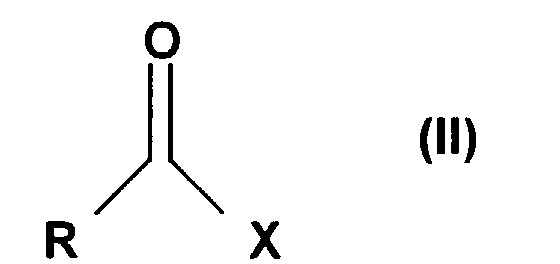
- The product according to claim 1 wherein R1 and R2 each independently represent hydrogen or an aliphatic hydrocarbyl group.
- The product according to claim 2 wherein the aliphatic hydrocarbyl group is a straight or branched chain alkyl, oxyalkyl or hydroxyalkyl group.
- A liquid composition comprising a major proportion of an organic liquid, and a minor proportion of an additive comprising the product of any of claims 1 to 3.
- The use, for suppression of inhibition of the foaming tendencies of an organic liquid, of the product of any of claims 1 to 3.
Applications Claiming Priority (3)
| Application Number | Priority Date | Filing Date | Title |
|---|---|---|---|
| GB929219962A GB9219962D0 (en) | 1992-09-22 | 1992-09-22 | Additives for organic liquids |
| GB9219962 | 1992-09-22 | ||
| EP93920793A EP0663000B1 (en) | 1992-09-22 | 1993-09-21 | Additives for organic liquids |
Related Parent Applications (2)
| Application Number | Title | Priority Date | Filing Date |
|---|---|---|---|
| EP93920793A Division EP0663000B1 (en) | 1992-09-22 | 1993-09-21 | Additives for organic liquids |
| EP93920793.2 Division | 1993-09-21 |
Publications (2)
| Publication Number | Publication Date |
|---|---|
| EP0736590A2 true EP0736590A2 (en) | 1996-10-09 |
| EP0736590A3 EP0736590A3 (en) | 1996-11-13 |
Family
ID=10722264
Family Applications (2)
| Application Number | Title | Priority Date | Filing Date |
|---|---|---|---|
| EP96201711A Withdrawn EP0736590A3 (en) | 1992-09-22 | 1993-09-21 | Additives for organic liquids |
| EP93920793A Expired - Lifetime EP0663000B1 (en) | 1992-09-22 | 1993-09-21 | Additives for organic liquids |
Family Applications After (1)
| Application Number | Title | Priority Date | Filing Date |
|---|---|---|---|
| EP93920793A Expired - Lifetime EP0663000B1 (en) | 1992-09-22 | 1993-09-21 | Additives for organic liquids |
Country Status (10)
| Country | Link |
|---|---|
| EP (2) | EP0736590A3 (en) |
| JP (1) | JPH08501582A (en) |
| KR (1) | KR100277244B1 (en) |
| AT (1) | ATE147428T1 (en) |
| AU (1) | AU4818593A (en) |
| CA (1) | CA2145168A1 (en) |
| DE (1) | DE69307331T2 (en) |
| GB (1) | GB9219962D0 (en) |
| RU (1) | RU95115238A (en) |
| WO (1) | WO1994006894A1 (en) |
Cited By (46)
| Publication number | Priority date | Publication date | Assignee | Title |
|---|---|---|---|---|
| WO2010073233A2 (en) | 2008-12-23 | 2010-07-01 | Total Raffinage Marketing | Diesel fuel for a diesel engine with high carbon from renewable sources and oxygen contents |
| WO2011001352A1 (en) | 2009-07-03 | 2011-01-06 | Total Raffinage Marketing | Ethylene/vinyl acetate/unsaturated esters terpolymer as an additive for improving the resistance to cold of liquid hydrocarbons such as middle distillates and fuels |
| WO2012085865A1 (en) | 2010-12-23 | 2012-06-28 | Total Raffinage Marketing | Modified alkyl-phenol-aldehyde resins, use thereof as additives for improving the properties of liquid hydrocarbon fuels in cold conditions |
| WO2012107454A1 (en) | 2011-02-08 | 2012-08-16 | Total Raffinage Marketing | Liquid compositions for marking liquid hydrocarbon-based fuels and combustibles, fuels and combustibles containing the same and process for detecting the markers |
| WO2013120985A1 (en) | 2012-02-17 | 2013-08-22 | Total Raffinage Marketing | Additives for improving the resistance to wear and to lacquering of diesel or biodiesel fuels |
| WO2013189868A1 (en) | 2012-06-19 | 2013-12-27 | Total Marketing Services | Additive compositions and use thereof for improving the cold properties of fuels and combustibles |
| WO2014029770A1 (en) | 2012-08-22 | 2014-02-27 | Total Marketing Services | Additives that improve the wear resistance and lacquering resistance of diesel or biodiesel fuels |
| WO2014096323A1 (en) | 2012-12-21 | 2014-06-26 | Total Marketing Services | Gelled hydrocarbon-based fuel composition and process for preparing such a composition |
| WO2014096326A1 (en) | 2012-12-21 | 2014-06-26 | Total Marketing Services | Use of a viscosifying compound for improving the storage stability of a liquid hydrocarbonated fuel |
| WO2014173844A1 (en) | 2013-04-25 | 2014-10-30 | Total Marketing Services | Additive for improving the oxidation-stability and/or storage-stability of liquid hydrocarbon fuels or oxidizers |
| US9102767B2 (en) | 2009-03-25 | 2015-08-11 | Total Raffinage Marketing | Low molecular weight (meth)acrylic polymers, free of sulphur-containing, metallic and halogenated compounds and with low residual monomer content, method for preparing the same and uses thereof |
| WO2015181013A1 (en) | 2014-05-28 | 2015-12-03 | Total Marketing Services | Gelled composition of liquid hydrocarbon fuel and method for preparing such a composition |
| EP3056526A1 (en) | 2015-02-11 | 2016-08-17 | Total Marketing Services | Block copolymers and use thereof for improving the cold properties of fuels |
| EP3056527A1 (en) | 2015-02-11 | 2016-08-17 | Total Marketing Services | Block copolymers and use thereof for improving the cold properties of fuels |
| EP3144059A1 (en) | 2015-09-16 | 2017-03-22 | Total Marketing Services | Method for preparing microcapsules by double emulsion |
| WO2018015667A1 (en) | 2016-07-21 | 2018-01-25 | Total Marketing Services | Use of copolymers to improve the properties of fuels when cold |
| WO2018015666A1 (en) | 2016-07-21 | 2018-01-25 | Total Marketing Services | Copolymer suitable for use as a detergent additive for fuel |
| WO2018015665A1 (en) | 2016-07-21 | 2018-01-25 | Total Marketing Services | Copolymer and use thereof as a detergent additive for fuel |
| WO2018015664A1 (en) | 2016-07-21 | 2018-01-25 | Total Marketing Services | Copolymer and use thereof as detergent additive for fuel |
| WO2018033684A1 (en) | 2016-08-18 | 2018-02-22 | Total Marketing Services | Method for manufacturing a lubricity additive for fuel having a low sulfur content |
| WO2019068845A1 (en) | 2017-10-06 | 2019-04-11 | Total Marketing Services | Combination of additives for fuel |
| WO2019069010A1 (en) | 2017-10-02 | 2019-04-11 | Total Marketing Services | Composition of additives for fuel |
| US10280380B2 (en) | 2014-02-24 | 2019-05-07 | Total Marketing Services | Composition of additives and high-performance fuel comprising such a composition |
| WO2019091950A1 (en) | 2017-11-10 | 2019-05-16 | Total Marketing Services | Novel copolymer and use thereof as a fuel additive |
| WO2019121485A1 (en) | 2017-12-21 | 2019-06-27 | Total Marketing Services | Use of crosslinked polymers for lowering the cold filter plugging point of fuels |
| WO2019229331A1 (en) | 2018-05-29 | 2019-12-05 | Total Marketing Services | Fuel composition and method for operating an internal combustion engine |
| US10533144B2 (en) | 2014-02-24 | 2020-01-14 | Total Marketing Services | Composition of additives and high-performance fuel comprising such a composition |
| WO2020016508A1 (en) | 2018-07-16 | 2020-01-23 | Total Marketing Services | Novel sugar amide fuel additives |
| WO2020043619A1 (en) | 2018-08-28 | 2020-03-05 | Total Marketing Services | Composition of additives, comprising at least one copolymer, one cold-flow improver and one anti-settling additive |
| WO2020043618A1 (en) | 2018-08-28 | 2020-03-05 | Total Marketing Services | Use of specific copolymers for improving the cold properties of fuels or combustibles |
| WO2020083837A1 (en) | 2018-10-24 | 2020-04-30 | Total Marketing Services | Combination of additives for fuel |
| WO2020109568A1 (en) | 2018-11-30 | 2020-06-04 | Total Marketing Services | Quaternary fatty amidoamine compound for use as an additive for fuel |
| WO2020141126A1 (en) | 2019-01-04 | 2020-07-09 | Total Marketing Services | Use of specific copolymers for lowering the cold filter plugging point of fuels |
| WO2020156940A1 (en) | 2019-01-31 | 2020-08-06 | Total Marketing Services | Fuel composition based on paraffinic hydrocarbons |
| WO2020156941A1 (en) | 2019-01-31 | 2020-08-06 | Total Marketing Services | Use of a paraffinic hydrocarbon-based fuel composition for cleaning the internal parts of diesel engines |
| FR3101882A1 (en) | 2019-10-14 | 2021-04-16 | Total Marketing Services | Use of particular cationic polymers as fuel and fuel additives |
| FR3103493A1 (en) | 2019-11-25 | 2021-05-28 | Total Marketing Services | Fuel lubricant additive |
| WO2021105321A1 (en) | 2019-11-29 | 2021-06-03 | Total Marketing Services | Use of diols as detergent additives |
| FR3103812A1 (en) | 2019-11-29 | 2021-06-04 | Total Marketing Services | Use of alkyl phenol compounds as detergency additives |
| WO2021240116A1 (en) | 2020-05-29 | 2021-12-02 | Totalenergies Marketing Services | Additive composition for motor fuel |
| WO2022023636A1 (en) | 2020-07-31 | 2022-02-03 | Totalenergies Marketing Services | Use of copolymers having a specific molar mass distribution for lowering the cold filter plugging point of fuels |
| FR3125298A1 (en) | 2021-07-19 | 2023-01-20 | Totalenergies Marketing Services | Use of an additive composition to reduce emissions from diesel vehicles |
| WO2024141746A1 (en) | 2022-12-30 | 2024-07-04 | Totalenergies Onetech | Fuel additive composition comprising at least one secondary arylamine and at least one nitroxide |
| WO2024184488A1 (en) | 2023-03-08 | 2024-09-12 | Totalenergies Onetech | Additives for fuels and fuels comprising the additive |
| WO2025027131A1 (en) | 2023-08-01 | 2025-02-06 | Totalenergies Onetech | Additive composition based on at least partially re-refined lubricating oils |
| FR3163952A1 (en) | 2024-06-27 | 2026-01-02 | Totalenergies Onetech | MARINE FUEL COMPOSITE COMPRISING TIRE OIL AND A RENEWABLE SOURCE COMPONENT |
Families Citing this family (8)
| Publication number | Priority date | Publication date | Assignee | Title |
|---|---|---|---|---|
| GB9303924D0 (en) * | 1993-02-26 | 1993-04-14 | Exxon Chemical Patents Inc | Oil additives and compositions |
| GB9315205D0 (en) * | 1993-07-22 | 1993-09-08 | Exxon Chemical Patents Inc | Additives and fuel compositions |
| GB9410820D0 (en) * | 1994-05-31 | 1994-07-20 | Exxon Chemical Patents Inc | Oil additives and compositions |
| US5876667A (en) * | 1996-01-11 | 1999-03-02 | Medtronic, Inc. | Blood heat exchange system employing micro-conduit |
| GB9610363D0 (en) * | 1996-05-17 | 1996-07-24 | Ethyl Petroleum Additives Ltd | Fuel additives and compositions |
| EP1091085A1 (en) * | 1999-10-09 | 2001-04-11 | Cognis Deutschland GmbH, Dep. Intellectual Properties | Asphaltene inhibitors |
| DE10127245A1 (en) * | 2001-06-05 | 2002-12-12 | Basf Ag | Oil-in-water dispersion, useful as a defoaming agent, has an oil phase containing an amide compound having at least one reactive group comprising an alcoholic OH-group and amine NH- or NH2 groups. |
| CN1856562B (en) * | 2003-09-03 | 2010-06-23 | 国际壳牌研究有限公司 | Fuel composition, method for producing same and use thereof |
Family Cites Families (11)
| Publication number | Priority date | Publication date | Assignee | Title |
|---|---|---|---|---|
| US3127354A (en) * | 1964-03-31 | The polyamine | ||
| GB658494A (en) * | 1949-11-28 | 1951-10-10 | Shell Refining & Marketing Co | Processes for preventing foaming and compositions therefor |
| US2805135A (en) * | 1954-08-25 | 1957-09-03 | Eastman Kodak Co | Stabilized hydrocarbon fuel oil compositions and stabilizaers therefor |
| US3259578A (en) * | 1960-08-04 | 1966-07-05 | Petrolite Corp | Lubricating compositions |
| FR1416295A (en) * | 1963-12-05 | 1965-10-29 | Armour & Co | Motor fuels |
| US3313736A (en) * | 1966-03-04 | 1967-04-11 | Petrolite Corp | Inhibiting foam |
| DE1645705A1 (en) * | 1967-10-13 | 1970-07-16 | Basf Ag | Agent for clearing hydrocarbon mixtures |
| US3894849A (en) * | 1973-11-29 | 1975-07-15 | Du Pont | Gasoline |
| DE3049553A1 (en) * | 1980-12-31 | 1982-07-29 | Basf Ag, 6700 Ludwigshafen | PETROLEUM DISTILLATES WITH IMPROVED COLD BEHAVIOR |
| US5084197A (en) * | 1990-09-21 | 1992-01-28 | The Lubrizol Corporation | Antiemulsion/antifoam agent for use in oils |
| US5192336A (en) * | 1991-12-04 | 1993-03-09 | Nalco Chemical Company | Anti-foam diesel fuel |
-
1992
- 1992-09-22 GB GB929219962A patent/GB9219962D0/en active Pending
-
1993
- 1993-09-21 RU RU95115238/04A patent/RU95115238A/en unknown
- 1993-09-21 AT AT93920793T patent/ATE147428T1/en not_active IP Right Cessation
- 1993-09-21 EP EP96201711A patent/EP0736590A3/en not_active Withdrawn
- 1993-09-21 CA CA002145168A patent/CA2145168A1/en not_active Abandoned
- 1993-09-21 EP EP93920793A patent/EP0663000B1/en not_active Expired - Lifetime
- 1993-09-21 WO PCT/EP1993/002560 patent/WO1994006894A1/en not_active Ceased
- 1993-09-21 AU AU48185/93A patent/AU4818593A/en not_active Abandoned
- 1993-09-21 KR KR1019950701104A patent/KR100277244B1/en not_active Expired - Fee Related
- 1993-09-21 JP JP6507810A patent/JPH08501582A/en active Pending
- 1993-09-21 DE DE69307331T patent/DE69307331T2/en not_active Expired - Fee Related
Cited By (65)
| Publication number | Priority date | Publication date | Assignee | Title |
|---|---|---|---|---|
| WO2010073233A2 (en) | 2008-12-23 | 2010-07-01 | Total Raffinage Marketing | Diesel fuel for a diesel engine with high carbon from renewable sources and oxygen contents |
| US9102767B2 (en) | 2009-03-25 | 2015-08-11 | Total Raffinage Marketing | Low molecular weight (meth)acrylic polymers, free of sulphur-containing, metallic and halogenated compounds and with low residual monomer content, method for preparing the same and uses thereof |
| WO2011001352A1 (en) | 2009-07-03 | 2011-01-06 | Total Raffinage Marketing | Ethylene/vinyl acetate/unsaturated esters terpolymer as an additive for improving the resistance to cold of liquid hydrocarbons such as middle distillates and fuels |
| WO2012085865A1 (en) | 2010-12-23 | 2012-06-28 | Total Raffinage Marketing | Modified alkyl-phenol-aldehyde resins, use thereof as additives for improving the properties of liquid hydrocarbon fuels in cold conditions |
| WO2012107454A1 (en) | 2011-02-08 | 2012-08-16 | Total Raffinage Marketing | Liquid compositions for marking liquid hydrocarbon-based fuels and combustibles, fuels and combustibles containing the same and process for detecting the markers |
| US10167435B2 (en) | 2011-02-08 | 2019-01-01 | Total Marketing Services | Liquid compositions for marking liquid hydrocarbon motor fuels and other fuels, motor fuels and other fuels containing them and process for detecting the markers |
| WO2013120985A1 (en) | 2012-02-17 | 2013-08-22 | Total Raffinage Marketing | Additives for improving the resistance to wear and to lacquering of diesel or biodiesel fuels |
| WO2013189868A1 (en) | 2012-06-19 | 2013-12-27 | Total Marketing Services | Additive compositions and use thereof for improving the cold properties of fuels and combustibles |
| WO2014029770A1 (en) | 2012-08-22 | 2014-02-27 | Total Marketing Services | Additives that improve the wear resistance and lacquering resistance of diesel or biodiesel fuels |
| WO2014096323A1 (en) | 2012-12-21 | 2014-06-26 | Total Marketing Services | Gelled hydrocarbon-based fuel composition and process for preparing such a composition |
| WO2014096326A1 (en) | 2012-12-21 | 2014-06-26 | Total Marketing Services | Use of a viscosifying compound for improving the storage stability of a liquid hydrocarbonated fuel |
| US9663736B2 (en) | 2013-04-25 | 2017-05-30 | Total Marketing Services | Additive for improving the oxidation and/or storage stability of motor fuels or liquid hydrocarbon-containing fuels |
| WO2014173844A1 (en) | 2013-04-25 | 2014-10-30 | Total Marketing Services | Additive for improving the oxidation-stability and/or storage-stability of liquid hydrocarbon fuels or oxidizers |
| US10533144B2 (en) | 2014-02-24 | 2020-01-14 | Total Marketing Services | Composition of additives and high-performance fuel comprising such a composition |
| US10280380B2 (en) | 2014-02-24 | 2019-05-07 | Total Marketing Services | Composition of additives and high-performance fuel comprising such a composition |
| WO2015181013A1 (en) | 2014-05-28 | 2015-12-03 | Total Marketing Services | Gelled composition of liquid hydrocarbon fuel and method for preparing such a composition |
| EP3056527A1 (en) | 2015-02-11 | 2016-08-17 | Total Marketing Services | Block copolymers and use thereof for improving the cold properties of fuels |
| EP3056526A1 (en) | 2015-02-11 | 2016-08-17 | Total Marketing Services | Block copolymers and use thereof for improving the cold properties of fuels |
| EP3144059A1 (en) | 2015-09-16 | 2017-03-22 | Total Marketing Services | Method for preparing microcapsules by double emulsion |
| WO2017046344A1 (en) | 2015-09-16 | 2017-03-23 | Total Marketing Services | Method for preparing microcapsules by double emulsion |
| WO2018015667A1 (en) | 2016-07-21 | 2018-01-25 | Total Marketing Services | Use of copolymers to improve the properties of fuels when cold |
| WO2018015664A1 (en) | 2016-07-21 | 2018-01-25 | Total Marketing Services | Copolymer and use thereof as detergent additive for fuel |
| WO2018015665A1 (en) | 2016-07-21 | 2018-01-25 | Total Marketing Services | Copolymer and use thereof as a detergent additive for fuel |
| WO2018015666A1 (en) | 2016-07-21 | 2018-01-25 | Total Marketing Services | Copolymer suitable for use as a detergent additive for fuel |
| US10767128B2 (en) | 2016-07-21 | 2020-09-08 | Total Marketing Services | Copolymer suitable for use as a detergent additive for fuel |
| WO2018033684A1 (en) | 2016-08-18 | 2018-02-22 | Total Marketing Services | Method for manufacturing a lubricity additive for fuel having a low sulfur content |
| WO2019069010A1 (en) | 2017-10-02 | 2019-04-11 | Total Marketing Services | Composition of additives for fuel |
| WO2019068845A1 (en) | 2017-10-06 | 2019-04-11 | Total Marketing Services | Combination of additives for fuel |
| WO2019091950A1 (en) | 2017-11-10 | 2019-05-16 | Total Marketing Services | Novel copolymer and use thereof as a fuel additive |
| WO2019121485A1 (en) | 2017-12-21 | 2019-06-27 | Total Marketing Services | Use of crosslinked polymers for lowering the cold filter plugging point of fuels |
| WO2019229331A1 (en) | 2018-05-29 | 2019-12-05 | Total Marketing Services | Fuel composition and method for operating an internal combustion engine |
| WO2020016508A1 (en) | 2018-07-16 | 2020-01-23 | Total Marketing Services | Novel sugar amide fuel additives |
| WO2020043618A1 (en) | 2018-08-28 | 2020-03-05 | Total Marketing Services | Use of specific copolymers for improving the cold properties of fuels or combustibles |
| WO2020043619A1 (en) | 2018-08-28 | 2020-03-05 | Total Marketing Services | Composition of additives, comprising at least one copolymer, one cold-flow improver and one anti-settling additive |
| FR3085384A1 (en) | 2018-08-28 | 2020-03-06 | Total Marketing Services | USE OF SPECIFIC COPOLYMERS FOR IMPROVING THE COLD PROPERTIES OF FUELS OR FUELS |
| WO2020083837A1 (en) | 2018-10-24 | 2020-04-30 | Total Marketing Services | Combination of additives for fuel |
| FR3087788A1 (en) | 2018-10-24 | 2020-05-01 | Total Marketing Services | ASSOCIATION OF FUEL ADDITIVES |
| WO2020109568A1 (en) | 2018-11-30 | 2020-06-04 | Total Marketing Services | Quaternary fatty amidoamine compound for use as an additive for fuel |
| WO2020141126A1 (en) | 2019-01-04 | 2020-07-09 | Total Marketing Services | Use of specific copolymers for lowering the cold filter plugging point of fuels |
| FR3091539A1 (en) | 2019-01-04 | 2020-07-10 | Total Marketing Services | Use of specific copolymers to lower the limit filterability temperature of fuels or combustibles |
| WO2020156940A1 (en) | 2019-01-31 | 2020-08-06 | Total Marketing Services | Fuel composition based on paraffinic hydrocarbons |
| FR3092334A1 (en) | 2019-01-31 | 2020-08-07 | Total Marketing Services | Use of a fuel composition based on paraffinic hydrocarbons to clean the internal parts of diesel engines |
| FR3092333A1 (en) | 2019-01-31 | 2020-08-07 | Total Marketing Services | Fuel composition based on paraffinic hydrocarbons |
| WO2020156941A1 (en) | 2019-01-31 | 2020-08-06 | Total Marketing Services | Use of a paraffinic hydrocarbon-based fuel composition for cleaning the internal parts of diesel engines |
| FR3101882A1 (en) | 2019-10-14 | 2021-04-16 | Total Marketing Services | Use of particular cationic polymers as fuel and fuel additives |
| WO2021074006A1 (en) | 2019-10-14 | 2021-04-22 | Total Marketing Services | Use of particular cationic polymers as cold-resistant additives for fuels |
| FR3103493A1 (en) | 2019-11-25 | 2021-05-28 | Total Marketing Services | Fuel lubricant additive |
| WO2021105024A1 (en) | 2019-11-25 | 2021-06-03 | Total Marketing Services | Fuel lubricity additive |
| FR3103815A1 (en) | 2019-11-29 | 2021-06-04 | Total Marketing Services | Use of diols as detergency additives |
| FR3103812A1 (en) | 2019-11-29 | 2021-06-04 | Total Marketing Services | Use of alkyl phenol compounds as detergency additives |
| WO2021105321A1 (en) | 2019-11-29 | 2021-06-03 | Total Marketing Services | Use of diols as detergent additives |
| US12091622B2 (en) | 2020-05-29 | 2024-09-17 | Totalenergies Onetech | Additive composition for motor fuel |
| WO2021240116A1 (en) | 2020-05-29 | 2021-12-02 | Totalenergies Marketing Services | Additive composition for motor fuel |
| FR3110913A1 (en) | 2020-05-29 | 2021-12-03 | Total Marketing Services | Engine fuel additive composition |
| WO2022023636A1 (en) | 2020-07-31 | 2022-02-03 | Totalenergies Marketing Services | Use of copolymers having a specific molar mass distribution for lowering the cold filter plugging point of fuels |
| FR3113063A1 (en) | 2020-07-31 | 2022-02-04 | Total Marketing Services | Use of copolymers with specific molar mass distribution for lowering the filterability limit temperature of fuels or fuels |
| FR3125298A1 (en) | 2021-07-19 | 2023-01-20 | Totalenergies Marketing Services | Use of an additive composition to reduce emissions from diesel vehicles |
| WO2023002108A1 (en) | 2021-07-19 | 2023-01-26 | Totalenergies Onetech | Use of a composition of additives for reducing diesel vehicle emissions |
| WO2024141746A1 (en) | 2022-12-30 | 2024-07-04 | Totalenergies Onetech | Fuel additive composition comprising at least one secondary arylamine and at least one nitroxide |
| FR3144623A1 (en) | 2022-12-30 | 2024-07-05 | Totalenergies Onetech | Fuel additive composition comprising at least one secondary arylamine and at least one nitroxide |
| WO2024184488A1 (en) | 2023-03-08 | 2024-09-12 | Totalenergies Onetech | Additives for fuels and fuels comprising the additive |
| FR3146480A1 (en) | 2023-03-08 | 2024-09-13 | Totalenergies Onetech | FUEL ADDITIVES AND FUELS COMPRISING SAID ADDITIVE |
| WO2025027131A1 (en) | 2023-08-01 | 2025-02-06 | Totalenergies Onetech | Additive composition based on at least partially re-refined lubricating oils |
| FR3151857A1 (en) | 2023-08-01 | 2025-02-07 | Totalenergies Onetech | COMPOSITION OF ADDITIVES BASED ON AT LEAST PARTLY RE-REFINED LUBRICATING OILS |
| FR3163952A1 (en) | 2024-06-27 | 2026-01-02 | Totalenergies Onetech | MARINE FUEL COMPOSITE COMPRISING TIRE OIL AND A RENEWABLE SOURCE COMPONENT |
Also Published As
| Publication number | Publication date |
|---|---|
| EP0663000A1 (en) | 1995-07-19 |
| DE69307331D1 (en) | 1997-02-20 |
| JPH08501582A (en) | 1996-02-20 |
| AU4818593A (en) | 1994-04-12 |
| WO1994006894A1 (en) | 1994-03-31 |
| CA2145168A1 (en) | 1994-03-31 |
| KR950703629A (en) | 1995-09-20 |
| DE69307331T2 (en) | 1997-04-24 |
| GB9219962D0 (en) | 1992-11-04 |
| ATE147428T1 (en) | 1997-01-15 |
| EP0663000B1 (en) | 1997-01-08 |
| KR100277244B1 (en) | 2001-03-02 |
| RU95115238A (en) | 1997-01-10 |
| EP0736590A3 (en) | 1996-11-13 |
Similar Documents
| Publication | Publication Date | Title |
|---|---|---|
| EP0663000B1 (en) | Additives for organic liquids | |
| CA2167672C (en) | Additives and fuel compositions | |
| US5772705A (en) | Fuel oil compositions | |
| EP0629231B1 (en) | Additives for oils | |
| EP0839174A1 (en) | Additives and fuel oil compositions | |
| EP0713519B1 (en) | Middle distillate fuel oil compositions | |
| US6554876B1 (en) | Oil compositions | |
| US6251146B1 (en) | Fuel oil composition containing mixture of wax additives | |
| CA2189157C (en) | Oil additives and compositions | |
| US5833721A (en) | Additive for hydrocarbon oils | |
| RU2107088C1 (en) | Additive for crude oil, lubricating oil or liquid fuel, composition based on crude oil, lubricating oil or liquid fuel, and additive concentrate | |
| WO1994017159A1 (en) | Oil and fuel oil compositions | |
| US6187065B1 (en) | Additives and oil compositions | |
| EP0973850B1 (en) | Esters and improved oil compositions | |
| CA2499890C (en) | Additives and fuel compositions | |
| WO1998027184A1 (en) | Distillate fuels with polyalkylene glycol diacid derivatives as flow improvers | |
| WO1996022344A1 (en) | Fuel oil compositions |
Legal Events
| Date | Code | Title | Description |
|---|---|---|---|
| PUAI | Public reference made under article 153(3) epc to a published international application that has entered the european phase |
Free format text: ORIGINAL CODE: 0009012 |
|
| PUAL | Search report despatched |
Free format text: ORIGINAL CODE: 0009013 |
|
| 17P | Request for examination filed |
Effective date: 19960621 |
|
| AC | Divisional application: reference to earlier application |
Ref document number: 663000 Country of ref document: EP |
|
| AK | Designated contracting states |
Kind code of ref document: A2 Designated state(s): AT DE FR GB IT NL SE |
|
| AK | Designated contracting states |
Kind code of ref document: A3 Designated state(s): AT DE FR GB IT NL SE |
|
| RIN1 | Information on inventor provided before grant (corrected) |
Inventor name: SMITH, ANTHONY KITSON Inventor name: CAPROTTI, RINALDO |
|
| 17Q | First examination report despatched |
Effective date: 19981215 |
|
| RAP1 | Party data changed (applicant data changed or rights of an application transferred) |
Owner name: INFINEUM USA L.P. |
|
| GRAG | Despatch of communication of intention to grant |
Free format text: ORIGINAL CODE: EPIDOS AGRA |
|
| GRAG | Despatch of communication of intention to grant |
Free format text: ORIGINAL CODE: EPIDOS AGRA |
|
| GRAG | Despatch of communication of intention to grant |
Free format text: ORIGINAL CODE: EPIDOS AGRA |
|
| GRAH | Despatch of communication of intention to grant a patent |
Free format text: ORIGINAL CODE: EPIDOS IGRA |
|
| GRAG | Despatch of communication of intention to grant |
Free format text: ORIGINAL CODE: EPIDOS AGRA |
|
| STAA | Information on the status of an ep patent application or granted ep patent |
Free format text: STATUS: THE APPLICATION IS DEEMED TO BE WITHDRAWN |
|
| 18D | Application deemed to be withdrawn |
Effective date: 20010519 |