EP0737767A1 - Tricot jacquard obtenu sur un métier circulaire à mailles cueillies - Google Patents
Tricot jacquard obtenu sur un métier circulaire à mailles cueillies Download PDFInfo
- Publication number
- EP0737767A1 EP0737767A1 EP95420259A EP95420259A EP0737767A1 EP 0737767 A1 EP0737767 A1 EP 0737767A1 EP 95420259 A EP95420259 A EP 95420259A EP 95420259 A EP95420259 A EP 95420259A EP 0737767 A1 EP0737767 A1 EP 0737767A1
- Authority
- EP
- European Patent Office
- Prior art keywords
- jacquard
- stitches
- density
- row
- needles
- Prior art date
- Legal status (The legal status is an assumption and is not a legal conclusion. Google has not performed a legal analysis and makes no representation as to the accuracy of the status listed.)
- Granted
Links
- 238000009940 knitting Methods 0.000 title claims description 14
- 239000004744 fabric Substances 0.000 title description 5
- 239000003086 colorant Substances 0.000 abstract description 5
- 238000010586 diagram Methods 0.000 description 2
- 239000000463 material Substances 0.000 description 1
- 230000033764 rhythmic process Effects 0.000 description 1
- 238000009958 sewing Methods 0.000 description 1
Images


Classifications
-
- D—TEXTILES; PAPER
- D04—BRAIDING; LACE-MAKING; KNITTING; TRIMMINGS; NON-WOVEN FABRICS
- D04B—KNITTING
- D04B1/00—Weft knitting processes for the production of fabrics or articles not dependent on the use of particular machines; Fabrics or articles defined by such processes
- D04B1/10—Patterned fabrics or articles
- D04B1/12—Patterned fabrics or articles characterised by thread material
- D04B1/126—Patterned fabrics or articles characterised by thread material with colour pattern, e.g. intarsia fabrics
-
- D—TEXTILES; PAPER
- D10—INDEXING SCHEME ASSOCIATED WITH SUBLASSES OF SECTION D, RELATING TO TEXTILES
- D10B—INDEXING SCHEME ASSOCIATED WITH SUBLASSES OF SECTION D, RELATING TO TEXTILES
- D10B2505/00—Industrial
- D10B2505/08—Upholstery, mattresses
Definitions
- the present invention relates to an improvement made to Jacquard knits made on a circular loom with double-picked plaited mesh usable in particular as materials for covering seats, walls, etc., in particular in the sector of interior vehicle trim.
- It relates more particularly to a new type of knitting obtained on a circular knitting machine, double needle bed.
- Such knitting looms consist essentially of a horizontal plate and a vertical cylinder, one of these elements, in general the cylinder (also designated vertical needle bed), which makes it possible to select the needles according to a predetermined rhythm depending on the drawings we want to make.
- the horizontal needle bed or tray has a combined cam track as for Interloc looms, capable of selecting the needles so that each row of the reverse side, made with the thread forming the right side, is obtained on two successive falls. Consequently, when we make a three-color Jacquard, each row of knitting is carried out by making a selection of the drawing with the cylinder, so that all the needles work to make a row of knitting which is therefore made from three falls, while the reverse which is knitted on the needles of the tray has a structure such that each row formed with the same threads as those forming the design is produced on two successive falls, which therefore results in a density of this backing 1, 5 times that of the place.
- each row is made from four scraps, the reverse made with the needles of the tray being always performed on two successive scraps, which leads, in such a case, to a density of rows of stitches on the wrong side double that obtained on the right side.
- the new Jacquard knit three or four colors according to the invention is characterized in that the knitting weave for producing the reverse side is destructured compared to a conventional weave.
- the destructuring is obtained by planing the loom two needles out of four, thus making it possible to divide by two the number of columns of stitches on this face and therefore by two the density of stitches.
- the weave of the plate is made by selecting in staggered rows one needle out of four, making it possible to halve the number of rows, therefore also the mesh density by two.
- Such a staggered selection of needles can be obtained by making the armor of the plate on four cam tracks. It could also be envisaged to carry out such a selection by means of a Jacquard system associated with the tray.
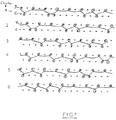
- Figures 1 and 2 illustrate the structure of a classic three and four color Jacquard knit.
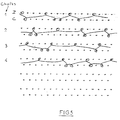
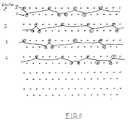
- Figures 3, 4, 5 and 6 illustrate four Jacquard knits produced in accordance with the invention, Figures 3 and 4 corresponding to a three-color Jacquard knitted fabric and Figures 5 and 6 to a four-color Jacquard knitted fabric.
- the needles are selected so that the falls (1,2,3) give a row, and the falls (4,5,6) a second row.
- the density of the reverse side is 1.5 times that of the front side.
- Figures 3 and 4 illustrate the structure of a three-color Jacquard knit obtained according to the invention.
- the falls (1) and (2) give a first row, (3) and (4) a second row, (5) and (6) a third row.
- Such an article has, compared to that illustrated in FIG. 1, a density in column of meshes divided by two.
- FIG. 4 illustrates the rebalancing of a knitted fabric by destructuring by knitting on the plate with four cam paths or by Jacquard selection.
- the armor ratio is twelve falls, four rows on the cylinder forming the Jacquard face side corresponding to only three rows on the plate.
- FIG. 5 illustrates a four-color Jacquard knit produced in accordance with the invention, the destructuring on the reverse side being obtained by knitting on the plate on four cam paths or by Jacquard selection.
- the falls (1,2,3 and 4) give a row to the cylinder and also a row to the plate, the mesh density therefore being identical on the wrong side and the place.
- FIG. 6 illustrates, for its part, the production of a four-color Jacquard, the destructuring of the reverse side of which is obtained by planing the plate out of one needle out of two.
- the falls (1,2,3,4) give a row to the cylinder
- the falls (1) and (2) give a first row to the plate
Landscapes
- Engineering & Computer Science (AREA)
- Textile Engineering (AREA)
- Knitting Of Fabric (AREA)
- Knitting Machines (AREA)
- Outer Garments And Coats (AREA)
- Looms (AREA)
Abstract
Description
- La présente invention a trait à un perfectionnement apporté aux tricots Jacquard réalisés sur un métier circulaire à mailles cueillies double fonture utilisables notamment comme matériaux de revêtement de sièges, parois ..., notamment dans le secteur du garnissage de l'intérieur de véhicules.
- Elle a trait plus particulièrement à un nouveau type de tricot obtenu sur un métier à tricoter circulaire, double fonture.
- De tels métiers à tricoter se composent essentiellement d'un plateau horizontal et d'un cylindre vertical, l'un de ces éléments, en général le cylindre (désigné également fonture verticale), qui permet de sélectionner les aiguilles selon un rythme prédéterminé fonction des dessins que l'on souhaite réaliser.
- La fonture horizontale ou plateau a un chemin de cames combiné comme pour les métiers Interloc, capable de sélectionner les aiguilles de telle sorte que chaque rangée de la face envers, réalisée avec le fil formant la face endroit, soit obtenue sur deux chutes successives. Par suite, lorsque l'on réalise un Jacquard trois couleurs, chaque rangée de tricot est réalisée en effectuant une sélection du dessin au cylindre, de telle sorte que toutes les aiguilles travaillent pour réaliser une rangée de tricot qui est donc faite à partir de trois chutes, alors que l'envers qui est tricoté sur les aiguilles du plateau a une structure telle que chaque rangée formée avec les mêmes fils que ceux formant le dessin est réalisée sur deux chutes successives, ce qui entraîne donc une densité de cet envers 1,5 fois celle de l'endroit.
- Dans le cas de Jacquard quatre couleurs, chaque rangée est réalisée à partir de quatre chutes, l'envers réalisé avec les aiguilles du plateau étant toujours réalisé sur deux chutes successives, ce qui conduit, dans un tel cas, à une densité de rangées de mailles sur l'envers double de celle obtenue sur l'endroit.
- Cette densité plus importante sur l'envers que sur l'endroit, pose un certain nombre de problèmes, notamment en ce qui concerne la tenue du tricot lors de sa confection, chaque maille de la face envers étant plus petite donc plus fragile, et augmente les risques de probabilité que lors de la couture, l'aiguille détériore une maille.
- Or on a trouvé, et c'est ce qui fait l'objet de la présente invention, qu'il était possible de réaliser des tricots Jacquards trois ou quatre couleurs, qui permettent de résoudre ce problème, l'article obtenu présentant la même densité de mailles sur l'envers par rapport à l'endroit dans le cas d'un Jacquard quatre couleurs et, dans le Jacquard trois couleurs, une densité égale à 0,75 fois celle de l'endroit.
- D'une manière générale, le nouveau tricot Jacquard trois ou quatre couleurs conforme à l'invention, se caractérise en ce que l'armure de tricotage pour réaliser la face envers est destructurée par rapport à une armure conventionnelle.
- Selon une première forme de réalisation, la destructuration est obtenue en déjaugeant le métier deux aiguilles sur quatre, permettant ainsi de diviser par deux le nombre de colonnes de mailles sur cette face et donc par deux la densité de mailles.
- Selon une autre forme de réalisation, l'armure du plateau est réalisée en sélectionnant en quinconce une aiguille sur quatre, permettant de diviser par deux le nombre de rangées, donc également la densité de mailles par deux.
- Une telle sélection en quinconce des aiguilles peut être obtenue en réalisant l'armure du plateau sur quatre chemins de cames. Il pourrait également être envisagé de réaliser une telle sélection au moyen d'un système Jacquard associé au plateau.
- L'invention et les avantages qu'elle apporte seront cependant mieux compris grâce aux exemples de réalisation donnés ci-après à titre indicatif mais non limitatif, exemples illustrés par les schémas annexés qui sont des représentations graphiques conventionnelles de tricot Jacquard double fonture, le cylindre étant référencé (C) et le plateau (P).
- Dans ces schémas, les figures 1 et 2 illustrent la structure d'un tricot Jacquard trois et quatre couleurs classiques.
- Les figures 3, 4, 5 et 6 illustrent quatre tricots Jacquard réalisés conformément à l'invention, les figures 3 et 4 correspondant à un tricot Jacquard trois couleurs et les figures 5 et 6 à un tricot Jacquard quatre couleurs.
- En se reportant aux figures 1 et 2, on constate que pour réaliser un Jacquard conventionnel trois ou quatre couleurs, que le travail des fils est le suivant.
- Au cylindre, pour réaliser le dessin, les aiguilles sont sélectionnées de telle sorte que les chutes (1,2,3) donnent une rangée, et les chutes (4,5,6) une seconde rangée.
- Sur la face envers, réalisée avec les aiguilles du plateau, on constate que les chutes (1) et (2) donneraient une rangée, (3) et (4) une seconde rangée, (5) et (6) une troisième rangée.
- En conséquence, la densité de la face envers est une fois et demi supérieure à celle de la face avant.
- Conformément à l'invention, il est possible d'obtenir un rééquilibrage des faces endroit et envers,soit en pratiquant une destructuration par déjaugeage au plateau d'une aiguille sur deux (figures 3 et 6), soit en réalisant le tricotage au plateau avec seulement quatre chemins de cames ou par sélection Jacquard (figures 4 et 5).
- Les figures 3 et 4 illustrent la structure d'un tricot Jacquard trois couleurs obtenu conformément à l'invention.
- Dans la forme de réalisation illustrée à la figure 3, on constate que les chutes (1,2,3) donnent une rangée au cylindre et les chutes (4,5,6) une seconde rangée.
- En ce qui concerne l'envers réalisé au plateau, les chutes (1) et (2) donnent une première rangée, (3) et (4) une seconde rangée, (5) et (6) une troisième rangée.
- Un tel article présente, par rapport à celui illustré à la figure 1, une densité en colonne de mailles divisée par deux.
- La figure 4 illustre le rééquilibrage d'un tricot par destructuration par tricotage au plateau avec quatre chemins de cames ou par sélection Jacquard.
- Dans un tel cas, le rapport d'armure est de douze chutes, quatre rangées au cylindre formant la face endroit Jacquard correpondant à seulement trois rangées au plateau.
- La figure 5 illustre un tricot Jacquard quatre couleurs réalisé conformément à l'invention, la destructuration à la face envers étant obtenue par tricotage au plateau sur quatre chemins de cames ou par sélection Jacquard.
- Dans un tel cas, les chutes (1,2,3 et 4) donnent une rangée au cylindre et également une rangée au plateau, la densité de mailles étant donc identique sur l'envers et l'endroit.
- La figure 6 illustre quant à elle la réalisation d'un Jacquard quatre couleurs dont la destructuration de la face envers est obtenue par déjaugeage du plateau d'une aiguille sur deux. Dans un tel cas, les chutes (1,2,3,4) donnent une rangée au cylindre, les chutes (1) et (2) donnant quant à elles une première rangée au plateau et les chutes (3) et (4) une seconde rangée.
- Dans un tel cas, on a bien deux rangées de tricot sur la face envers correspondant à une seule rangée au cylindre, mais la densité de cette face envers est cependant identique à l'exemple précédent compte tenu du fait que le nombre de colonnes de mailles est divisé par deux.
Claims (5)
- Tricot Jacquard trois ou quatre couleurs obtenu sur un métier circulaire à mailles cueillies, caractérisé en ce que l'armure de tricotage pour réaliser la face envers est destructurée par rapport à une armure conventionnelle.
- Tricot Jacquard selon la revendication 1, caractérisé en ce que la destructuration de la face envers est obtenue en déjaugeant le métier deux aiguilles sur quatre, divisant ainsi par deux le nombre de colonnes de mailles sur cette face et donc également par deux la densité de mailles.
- Tricot Jacquard selon la revendication 1, caractérisé en ce que l'armure du plateau est réalisée en sélectionnant en quinconce une aiguille sur quatre, entraînant une division par deux du nombre de rangées sur la face envers et en conséquence une densité de mailles par deux.
- Tricot Jacquard selon la revendication 3, caractérisé en ce que la sélection en quinconce des aiguilles est réalisée sur quatre chemins de cames.
- Tricot Jacquard selon la revendication 3, caractérisé en ce que la sélection en quinconce des aiguilles pour réaliser l'armure du plateau est obtenue par l'intermédiaire d'un système Jacquard.
Applications Claiming Priority (2)
| Application Number | Priority Date | Filing Date | Title |
|---|---|---|---|
| FR9504614A FR2732983B1 (fr) | 1995-04-11 | 1995-04-11 | Tricot jacquard obtenu sur un metier circulaire a mailles cueillies |
| FR9504614 | 1995-04-11 |
Publications (2)
| Publication Number | Publication Date |
|---|---|
| EP0737767A1 true EP0737767A1 (fr) | 1996-10-16 |
| EP0737767B1 EP0737767B1 (fr) | 2000-01-26 |
Family
ID=9478206
Family Applications (1)
| Application Number | Title | Priority Date | Filing Date |
|---|---|---|---|
| EP95420259A Expired - Lifetime EP0737767B1 (fr) | 1995-04-11 | 1995-09-19 | Tricot jacquard obtenu sur un métier circulaire à mailles cueillies |
Country Status (6)
| Country | Link |
|---|---|
| EP (1) | EP0737767B1 (fr) |
| AT (1) | ATE189276T1 (fr) |
| DE (1) | DE69514784T2 (fr) |
| ES (1) | ES2141907T3 (fr) |
| FR (1) | FR2732983B1 (fr) |
| PT (1) | PT737767E (fr) |
Cited By (4)
| Publication number | Priority date | Publication date | Assignee | Title |
|---|---|---|---|---|
| EP1975294A1 (fr) * | 2007-03-27 | 2008-10-01 | Lava BVBA | Procédé pour tricoter un tissu à double jersey sur un jacquard double, machine à tricoter circulaire à double jersey et tissu à tricoter à double jersey tricoté à la suite d'un tel procédé |
| RU2378426C1 (ru) * | 2008-11-21 | 2010-01-10 | Государственное образовательное учреждение высшего профессионального образования "Московский государственный текстильный университет имени А.Н. Косыгина" | Способ выработки двойного жаккардового трикотажа с многоцветными односторонними узорными эффектами на трикотажных машинах с интерлочной расстановкой игл |
| RU2378424C1 (ru) * | 2008-11-21 | 2010-01-10 | Государственное образовательное учреждение высшего профессионального образования "Московский государственный текстильный университет имени А.Н. Косыгина" | Способ выработки двойного пресс-жаккардового трикотажа |
| EP3441510A1 (fr) | 2017-08-11 | 2019-02-13 | Terrot GmbH | Procédé de production d'un tricot double sur une machine à tricoter circulaire à double jersey |
Citations (3)
| Publication number | Priority date | Publication date | Assignee | Title |
|---|---|---|---|---|
| US3808843A (en) * | 1972-05-01 | 1974-05-07 | Phillip Fibers Corp | Double knit fabric |
| FR2536428A1 (fr) * | 1982-11-19 | 1984-05-25 | Barraud Roland | Tricot jacquard sur fond jersey et son procede de fabrication sur metier a tricoter |
| GB2263485A (en) * | 1992-01-16 | 1993-07-28 | Gen Motors Corp | Knitted structure |
-
1995
- 1995-04-11 FR FR9504614A patent/FR2732983B1/fr not_active Expired - Fee Related
- 1995-09-19 AT AT95420259T patent/ATE189276T1/de not_active IP Right Cessation
- 1995-09-19 EP EP95420259A patent/EP0737767B1/fr not_active Expired - Lifetime
- 1995-09-19 DE DE69514784T patent/DE69514784T2/de not_active Expired - Fee Related
- 1995-09-19 PT PT95420259T patent/PT737767E/pt unknown
- 1995-09-19 ES ES95420259T patent/ES2141907T3/es not_active Expired - Lifetime
Patent Citations (3)
| Publication number | Priority date | Publication date | Assignee | Title |
|---|---|---|---|---|
| US3808843A (en) * | 1972-05-01 | 1974-05-07 | Phillip Fibers Corp | Double knit fabric |
| FR2536428A1 (fr) * | 1982-11-19 | 1984-05-25 | Barraud Roland | Tricot jacquard sur fond jersey et son procede de fabrication sur metier a tricoter |
| GB2263485A (en) * | 1992-01-16 | 1993-07-28 | Gen Motors Corp | Knitted structure |
Cited By (5)
| Publication number | Priority date | Publication date | Assignee | Title |
|---|---|---|---|---|
| EP1975294A1 (fr) * | 2007-03-27 | 2008-10-01 | Lava BVBA | Procédé pour tricoter un tissu à double jersey sur un jacquard double, machine à tricoter circulaire à double jersey et tissu à tricoter à double jersey tricoté à la suite d'un tel procédé |
| US7536879B2 (en) | 2007-03-27 | 2009-05-26 | Lava Bvba | Method for knitting a double jersey knit fabric on a double jacquard, double jersey circular knitting machine and double jersey knit fabric knitted by such a method |
| RU2378426C1 (ru) * | 2008-11-21 | 2010-01-10 | Государственное образовательное учреждение высшего профессионального образования "Московский государственный текстильный университет имени А.Н. Косыгина" | Способ выработки двойного жаккардового трикотажа с многоцветными односторонними узорными эффектами на трикотажных машинах с интерлочной расстановкой игл |
| RU2378424C1 (ru) * | 2008-11-21 | 2010-01-10 | Государственное образовательное учреждение высшего профессионального образования "Московский государственный текстильный университет имени А.Н. Косыгина" | Способ выработки двойного пресс-жаккардового трикотажа |
| EP3441510A1 (fr) | 2017-08-11 | 2019-02-13 | Terrot GmbH | Procédé de production d'un tricot double sur une machine à tricoter circulaire à double jersey |
Also Published As
| Publication number | Publication date |
|---|---|
| DE69514784T2 (de) | 2000-06-21 |
| EP0737767B1 (fr) | 2000-01-26 |
| ES2141907T3 (es) | 2000-04-01 |
| FR2732983A1 (fr) | 1996-10-18 |
| PT737767E (pt) | 2000-07-31 |
| FR2732983B1 (fr) | 1997-05-09 |
| ATE189276T1 (de) | 2000-02-15 |
| DE69514784D1 (de) | 2000-03-02 |
Similar Documents
| Publication | Publication Date | Title |
|---|---|---|
| US6199410B1 (en) | Double face warp knit fabric with two-side effect | |
| FR2774703A1 (fr) | Tissu de draperie, son procede de fabrication et ses utilisations | |
| US4888964A (en) | Pleated knit fabric | |
| US5542269A (en) | Warp knitted fabric with ribbed satin-like back | |
| US4125001A (en) | Multi-gauge knit fabric with inlay | |
| USRE30638E (en) | Multi-gauge knit fabric with fleece inlay yarn | |
| EP0737767B1 (fr) | Tricot jacquard obtenu sur un métier circulaire à mailles cueillies | |
| CN102534977A (zh) | 编织物的编织方法及编织物 | |
| US5619869A (en) | Warp knitted textile fabric with pattern of pleated fabric sections | |
| EP0909847B1 (fr) | Tricot réversible à mailles cueillies et procédé pour son obtention | |
| WO2003042442A1 (fr) | Tricot jacquard realise sur un metier a mailles cueillies | |
| EP0286461A1 (fr) | Tricotage de velours sur métier chaîne-pol et tricot obtenu | |
| JPH1161608A (ja) | カットパイルとループパイル共存経編地の製法 | |
| SU1645315A1 (ru) | Двойной кулирный трикотаж | |
| JPS584106B2 (ja) | 二面式パイル地の編成方法 | |
| US3094856A (en) | Knitted stocking top | |
| JPS6119748B2 (fr) | ||
| FR2616160A1 (fr) | Tricot velours uni obtenu sur un metier circulaire a mailles cueillies | |
| SU1208111A1 (ru) | Одинарный основов заный трикотаж | |
| JP2817348B2 (ja) | 多色のシングルジャカードよこ編地 | |
| SU1715898A1 (ru) | Кулирный плюшевый трикотаж | |
| FR2724949A1 (fr) | Procede de tricotage d'un vetement et le vetement obtenu | |
| JPH03227438A (ja) | ジャカード柄入りカットパイル経編地の製造方法 | |
| JPS61207660A (ja) | パイル織物の製法 | |
| RU2361023C1 (ru) | Способ получения основовязаного одинарного жаккардово-плюшевого неполного трикотажа с петельным ворсом, образующим рисунок |
Legal Events
| Date | Code | Title | Description |
|---|---|---|---|
| PUAI | Public reference made under article 153(3) epc to a published international application that has entered the european phase |
Free format text: ORIGINAL CODE: 0009012 |
|
| AK | Designated contracting states |
Kind code of ref document: A1 Designated state(s): AT BE DE ES FR GB IE IT PT SE |
|
| 17P | Request for examination filed |
Effective date: 19970405 |
|
| 17Q | First examination report despatched |
Effective date: 19981001 |
|
| GRAG | Despatch of communication of intention to grant |
Free format text: ORIGINAL CODE: EPIDOS AGRA |
|
| GRAG | Despatch of communication of intention to grant |
Free format text: ORIGINAL CODE: EPIDOS AGRA |
|
| GRAH | Despatch of communication of intention to grant a patent |
Free format text: ORIGINAL CODE: EPIDOS IGRA |
|
| GRAH | Despatch of communication of intention to grant a patent |
Free format text: ORIGINAL CODE: EPIDOS IGRA |
|
| GRAA | (expected) grant |
Free format text: ORIGINAL CODE: 0009210 |
|
| AK | Designated contracting states |
Kind code of ref document: B1 Designated state(s): AT BE DE ES FR GB IE IT PT SE |
|
| PG25 | Lapsed in a contracting state [announced via postgrant information from national office to epo] |
Ref country code: SE Free format text: THE PATENT HAS BEEN ANNULLED BY A DECISION OF A NATIONAL AUTHORITY Effective date: 20000126 |
|
| REF | Corresponds to: |
Ref document number: 189276 Country of ref document: AT Date of ref document: 20000215 Kind code of ref document: T |
|
| REF | Corresponds to: |
Ref document number: 69514784 Country of ref document: DE Date of ref document: 20000302 |
|
| REG | Reference to a national code |
Ref country code: IE Ref legal event code: FG4D Free format text: FRENCH |
|
| REG | Reference to a national code |
Ref country code: ES Ref legal event code: FG2A Ref document number: 2141907 Country of ref document: ES Kind code of ref document: T3 |
|
| ITF | It: translation for a ep patent filed | ||
| GBT | Gb: translation of ep patent filed (gb section 77(6)(a)/1977) |
Effective date: 20000320 |
|
| REG | Reference to a national code |
Ref country code: PT Ref legal event code: SC4A Free format text: AVAILABILITY OF NATIONAL TRANSLATION Effective date: 20000420 |
|
| PLBE | No opposition filed within time limit |
Free format text: ORIGINAL CODE: 0009261 |
|
| STAA | Information on the status of an ep patent application or granted ep patent |
Free format text: STATUS: NO OPPOSITION FILED WITHIN TIME LIMIT |
|
| 26N | No opposition filed | ||
| PG25 | Lapsed in a contracting state [announced via postgrant information from national office to epo] |
Ref country code: IE Free format text: LAPSE BECAUSE OF NON-PAYMENT OF DUE FEES Effective date: 20010309 |
|
| REG | Reference to a national code |
Ref country code: IE Ref legal event code: FD4D |
|
| REG | Reference to a national code |
Ref country code: GB Ref legal event code: IF02 |
|
| PGFP | Annual fee paid to national office [announced via postgrant information from national office to epo] |
Ref country code: DE Payment date: 20070910 Year of fee payment: 13 |
|
| PGFP | Annual fee paid to national office [announced via postgrant information from national office to epo] |
Ref country code: ES Payment date: 20070920 Year of fee payment: 13 |
|
| PGFP | Annual fee paid to national office [announced via postgrant information from national office to epo] |
Ref country code: AT Payment date: 20070820 Year of fee payment: 13 |
|
| PGFP | Annual fee paid to national office [announced via postgrant information from national office to epo] |
Ref country code: GB Payment date: 20070914 Year of fee payment: 13 |
|
| PGFP | Annual fee paid to national office [announced via postgrant information from national office to epo] |
Ref country code: IT Payment date: 20070915 Year of fee payment: 13 Ref country code: BE Payment date: 20070924 Year of fee payment: 13 |
|
| PGFP | Annual fee paid to national office [announced via postgrant information from national office to epo] |
Ref country code: FR Payment date: 20070928 Year of fee payment: 13 |
|
| REG | Reference to a national code |
Ref country code: PT Ref legal event code: MM4A Free format text: LAPSE DUE TO NON-PAYMENT OF FEES Effective date: 20090319 |
|
| BERE | Be: lapsed |
Owner name: TEXTILES ET PLASTIQUES *CHOMARAT Effective date: 20080930 |
|
| GBPC | Gb: european patent ceased through non-payment of renewal fee |
Effective date: 20080919 |
|
| PG25 | Lapsed in a contracting state [announced via postgrant information from national office to epo] |
Ref country code: PT Free format text: LAPSE BECAUSE OF NON-PAYMENT OF DUE FEES Effective date: 20090319 |
|
| REG | Reference to a national code |
Ref country code: FR Ref legal event code: ST Effective date: 20090529 |
|
| PG25 | Lapsed in a contracting state [announced via postgrant information from national office to epo] |
Ref country code: BE Free format text: LAPSE BECAUSE OF NON-PAYMENT OF DUE FEES Effective date: 20080930 |
|
| PG25 | Lapsed in a contracting state [announced via postgrant information from national office to epo] |
Ref country code: IT Free format text: LAPSE BECAUSE OF NON-PAYMENT OF DUE FEES Effective date: 20080919 Ref country code: DE Free format text: LAPSE BECAUSE OF NON-PAYMENT OF DUE FEES Effective date: 20090401 Ref country code: AT Free format text: LAPSE BECAUSE OF NON-PAYMENT OF DUE FEES Effective date: 20080919 |
|
| PG25 | Lapsed in a contracting state [announced via postgrant information from national office to epo] |
Ref country code: FR Free format text: LAPSE BECAUSE OF NON-PAYMENT OF DUE FEES Effective date: 20080930 |
|
| REG | Reference to a national code |
Ref country code: ES Ref legal event code: FD2A Effective date: 20080920 |
|
| PG25 | Lapsed in a contracting state [announced via postgrant information from national office to epo] |
Ref country code: GB Free format text: LAPSE BECAUSE OF NON-PAYMENT OF DUE FEES Effective date: 20080919 |
|
| PGFP | Annual fee paid to national office [announced via postgrant information from national office to epo] |
Ref country code: PT Payment date: 20070820 Year of fee payment: 13 |
|
| PG25 | Lapsed in a contracting state [announced via postgrant information from national office to epo] |
Ref country code: ES Free format text: LAPSE BECAUSE OF NON-PAYMENT OF DUE FEES Effective date: 20080920 |