EP0759443A2 - Hydroxy-substituted monolactones useful as intermediates for preparing lubricating oil and fuel additives - Google Patents
Hydroxy-substituted monolactones useful as intermediates for preparing lubricating oil and fuel additives Download PDFInfo
- Publication number
- EP0759443A2 EP0759443A2 EP96306063A EP96306063A EP0759443A2 EP 0759443 A2 EP0759443 A2 EP 0759443A2 EP 96306063 A EP96306063 A EP 96306063A EP 96306063 A EP96306063 A EP 96306063A EP 0759443 A2 EP0759443 A2 EP 0759443A2
- Authority
- EP
- European Patent Office
- Prior art keywords
- compound
- carbon atoms
- group
- olefins
- independently
- Prior art date
- Legal status (The legal status is an assumption and is not a legal conclusion. Google has not performed a legal analysis and makes no representation as to the accuracy of the status listed.)
- Granted
Links
- 0 CC1*C(C2)C2CC1 Chemical compound CC1*C(C2)C2CC1 0.000 description 3
Classifications
-
- C—CHEMISTRY; METALLURGY
- C10—PETROLEUM, GAS OR COKE INDUSTRIES; TECHNICAL GASES CONTAINING CARBON MONOXIDE; FUELS; LUBRICANTS; PEAT
- C10M—LUBRICATING COMPOSITIONS; USE OF CHEMICAL SUBSTANCES EITHER ALONE OR AS LUBRICATING INGREDIENTS IN A LUBRICATING COMPOSITION
- C10M129/00—Lubricating compositions characterised by the additive being an organic non-macromolecular compound containing oxygen
- C10M129/86—Lubricating compositions characterised by the additive being an organic non-macromolecular compound containing oxygen having a carbon chain of 30 or more atoms
- C10M129/95—Esters
-
- C—CHEMISTRY; METALLURGY
- C08—ORGANIC MACROMOLECULAR COMPOUNDS; THEIR PREPARATION OR CHEMICAL WORKING-UP; COMPOSITIONS BASED THEREON
- C08F—MACROMOLECULAR COMPOUNDS OBTAINED BY REACTIONS ONLY INVOLVING CARBON-TO-CARBON UNSATURATED BONDS
- C08F8/00—Chemical modification by after-treatment
- C08F8/14—Esterification
- C08F8/16—Lactonisation
-
- C—CHEMISTRY; METALLURGY
- C10—PETROLEUM, GAS OR COKE INDUSTRIES; TECHNICAL GASES CONTAINING CARBON MONOXIDE; FUELS; LUBRICANTS; PEAT
- C10L—FUELS NOT OTHERWISE PROVIDED FOR; NATURAL GAS; SYNTHETIC NATURAL GAS OBTAINED BY PROCESSES NOT COVERED BY SUBCLASSES C10G OR C10K; LIQUIFIED PETROLEUM GAS; USE OF ADDITIVES TO FUELS OR FIRES; FIRE-LIGHTERS
- C10L1/00—Liquid carbonaceous fuels
- C10L1/10—Liquid carbonaceous fuels containing additives
- C10L1/14—Organic compounds
- C10L1/143—Organic compounds mixtures of organic macromolecular compounds with organic non-macromolecular compounds
-
- C—CHEMISTRY; METALLURGY
- C10—PETROLEUM, GAS OR COKE INDUSTRIES; TECHNICAL GASES CONTAINING CARBON MONOXIDE; FUELS; LUBRICANTS; PEAT
- C10L—FUELS NOT OTHERWISE PROVIDED FOR; NATURAL GAS; SYNTHETIC NATURAL GAS OBTAINED BY PROCESSES NOT COVERED BY SUBCLASSES C10G OR C10K; LIQUIFIED PETROLEUM GAS; USE OF ADDITIVES TO FUELS OR FIRES; FIRE-LIGHTERS
- C10L1/00—Liquid carbonaceous fuels
- C10L1/10—Liquid carbonaceous fuels containing additives
- C10L1/14—Organic compounds
- C10L1/18—Organic compounds containing oxygen
- C10L1/185—Ethers; Acetals; Ketals; Aldehydes; Ketones
- C10L1/1852—Ethers; Acetals; Ketals; Orthoesters
- C10L1/1855—Cyclic ethers, e.g. epoxides, lactides, lactones
-
- C—CHEMISTRY; METALLURGY
- C10—PETROLEUM, GAS OR COKE INDUSTRIES; TECHNICAL GASES CONTAINING CARBON MONOXIDE; FUELS; LUBRICANTS; PEAT
- C10L—FUELS NOT OTHERWISE PROVIDED FOR; NATURAL GAS; SYNTHETIC NATURAL GAS OBTAINED BY PROCESSES NOT COVERED BY SUBCLASSES C10G OR C10K; LIQUIFIED PETROLEUM GAS; USE OF ADDITIVES TO FUELS OR FIRES; FIRE-LIGHTERS
- C10L1/00—Liquid carbonaceous fuels
- C10L1/10—Liquid carbonaceous fuels containing additives
- C10L1/14—Organic compounds
- C10L1/18—Organic compounds containing oxygen
- C10L1/192—Macromolecular compounds
- C10L1/198—Macromolecular compounds obtained otherwise than by reactions involving only carbon-to-carbon unsaturated bonds homo- or copolymers of compounds having one or more unsaturated aliphatic radicals, each having only one carbon to carbon double bond, and at least one being terminated by an acyloxy radical of a saturated carboxylic acid, of carbonic acid
-
- C—CHEMISTRY; METALLURGY
- C10—PETROLEUM, GAS OR COKE INDUSTRIES; TECHNICAL GASES CONTAINING CARBON MONOXIDE; FUELS; LUBRICANTS; PEAT
- C10M—LUBRICATING COMPOSITIONS; USE OF CHEMICAL SUBSTANCES EITHER ALONE OR AS LUBRICATING INGREDIENTS IN A LUBRICATING COMPOSITION
- C10M129/00—Lubricating compositions characterised by the additive being an organic non-macromolecular compound containing oxygen
- C10M129/86—Lubricating compositions characterised by the additive being an organic non-macromolecular compound containing oxygen having a carbon chain of 30 or more atoms
- C10M129/92—Carboxylic acids
- C10M129/93—Carboxylic acids having carboxyl groups bound to acyclic or cycloaliphatic carbon atoms
-
- C—CHEMISTRY; METALLURGY
- C10—PETROLEUM, GAS OR COKE INDUSTRIES; TECHNICAL GASES CONTAINING CARBON MONOXIDE; FUELS; LUBRICANTS; PEAT
- C10L—FUELS NOT OTHERWISE PROVIDED FOR; NATURAL GAS; SYNTHETIC NATURAL GAS OBTAINED BY PROCESSES NOT COVERED BY SUBCLASSES C10G OR C10K; LIQUIFIED PETROLEUM GAS; USE OF ADDITIVES TO FUELS OR FIRES; FIRE-LIGHTERS
- C10L1/00—Liquid carbonaceous fuels
- C10L1/10—Liquid carbonaceous fuels containing additives
- C10L1/14—Organic compounds
- C10L1/18—Organic compounds containing oxygen
- C10L1/188—Carboxylic acids; metal salts thereof
- C10L1/1881—Carboxylic acids; metal salts thereof carboxylic group attached to an aliphatic carbon atom
-
- C—CHEMISTRY; METALLURGY
- C10—PETROLEUM, GAS OR COKE INDUSTRIES; TECHNICAL GASES CONTAINING CARBON MONOXIDE; FUELS; LUBRICANTS; PEAT
- C10L—FUELS NOT OTHERWISE PROVIDED FOR; NATURAL GAS; SYNTHETIC NATURAL GAS OBTAINED BY PROCESSES NOT COVERED BY SUBCLASSES C10G OR C10K; LIQUIFIED PETROLEUM GAS; USE OF ADDITIVES TO FUELS OR FIRES; FIRE-LIGHTERS
- C10L1/00—Liquid carbonaceous fuels
- C10L1/10—Liquid carbonaceous fuels containing additives
- C10L1/14—Organic compounds
- C10L1/18—Organic compounds containing oxygen
- C10L1/19—Esters ester radical containing compounds; ester ethers; carbonic acid esters
-
- C—CHEMISTRY; METALLURGY
- C10—PETROLEUM, GAS OR COKE INDUSTRIES; TECHNICAL GASES CONTAINING CARBON MONOXIDE; FUELS; LUBRICANTS; PEAT
- C10L—FUELS NOT OTHERWISE PROVIDED FOR; NATURAL GAS; SYNTHETIC NATURAL GAS OBTAINED BY PROCESSES NOT COVERED BY SUBCLASSES C10G OR C10K; LIQUIFIED PETROLEUM GAS; USE OF ADDITIVES TO FUELS OR FIRES; FIRE-LIGHTERS
- C10L1/00—Liquid carbonaceous fuels
- C10L1/10—Liquid carbonaceous fuels containing additives
- C10L1/14—Organic compounds
- C10L1/22—Organic compounds containing nitrogen
- C10L1/222—Organic compounds containing nitrogen containing at least one carbon-to-nitrogen single bond
-
- C—CHEMISTRY; METALLURGY
- C10—PETROLEUM, GAS OR COKE INDUSTRIES; TECHNICAL GASES CONTAINING CARBON MONOXIDE; FUELS; LUBRICANTS; PEAT
- C10L—FUELS NOT OTHERWISE PROVIDED FOR; NATURAL GAS; SYNTHETIC NATURAL GAS OBTAINED BY PROCESSES NOT COVERED BY SUBCLASSES C10G OR C10K; LIQUIFIED PETROLEUM GAS; USE OF ADDITIVES TO FUELS OR FIRES; FIRE-LIGHTERS
- C10L1/00—Liquid carbonaceous fuels
- C10L1/10—Liquid carbonaceous fuels containing additives
- C10L1/14—Organic compounds
- C10L1/22—Organic compounds containing nitrogen
- C10L1/228—Organic compounds containing nitrogen containing at least one carbon-to-nitrogen double bond, e.g. guanidines, hydrazones, semicarbazones, imines; containing at least one carbon-to-nitrogen triple bond, e.g. nitriles
- C10L1/2286—Organic compounds containing nitrogen containing at least one carbon-to-nitrogen double bond, e.g. guanidines, hydrazones, semicarbazones, imines; containing at least one carbon-to-nitrogen triple bond, e.g. nitriles containing one or more carbon to nitrogen triple bonds, e.g. nitriles
-
- C—CHEMISTRY; METALLURGY
- C10—PETROLEUM, GAS OR COKE INDUSTRIES; TECHNICAL GASES CONTAINING CARBON MONOXIDE; FUELS; LUBRICANTS; PEAT
- C10L—FUELS NOT OTHERWISE PROVIDED FOR; NATURAL GAS; SYNTHETIC NATURAL GAS OBTAINED BY PROCESSES NOT COVERED BY SUBCLASSES C10G OR C10K; LIQUIFIED PETROLEUM GAS; USE OF ADDITIVES TO FUELS OR FIRES; FIRE-LIGHTERS
- C10L1/00—Liquid carbonaceous fuels
- C10L1/10—Liquid carbonaceous fuels containing additives
- C10L1/14—Organic compounds
- C10L1/22—Organic compounds containing nitrogen
- C10L1/23—Organic compounds containing nitrogen containing at least one nitrogen-to-oxygen bond, e.g. nitro-compounds, nitrates, nitrites
- C10L1/231—Organic compounds containing nitrogen containing at least one nitrogen-to-oxygen bond, e.g. nitro-compounds, nitrates, nitrites nitro compounds; nitrates; nitrites
-
- C—CHEMISTRY; METALLURGY
- C10—PETROLEUM, GAS OR COKE INDUSTRIES; TECHNICAL GASES CONTAINING CARBON MONOXIDE; FUELS; LUBRICANTS; PEAT
- C10L—FUELS NOT OTHERWISE PROVIDED FOR; NATURAL GAS; SYNTHETIC NATURAL GAS OBTAINED BY PROCESSES NOT COVERED BY SUBCLASSES C10G OR C10K; LIQUIFIED PETROLEUM GAS; USE OF ADDITIVES TO FUELS OR FIRES; FIRE-LIGHTERS
- C10L1/00—Liquid carbonaceous fuels
- C10L1/10—Liquid carbonaceous fuels containing additives
- C10L1/14—Organic compounds
- C10L1/22—Organic compounds containing nitrogen
- C10L1/234—Macromolecular compounds
- C10L1/238—Macromolecular compounds obtained otherwise than by reactions involving only carbon-to-carbon unsaturated bonds
-
- C—CHEMISTRY; METALLURGY
- C10—PETROLEUM, GAS OR COKE INDUSTRIES; TECHNICAL GASES CONTAINING CARBON MONOXIDE; FUELS; LUBRICANTS; PEAT
- C10L—FUELS NOT OTHERWISE PROVIDED FOR; NATURAL GAS; SYNTHETIC NATURAL GAS OBTAINED BY PROCESSES NOT COVERED BY SUBCLASSES C10G OR C10K; LIQUIFIED PETROLEUM GAS; USE OF ADDITIVES TO FUELS OR FIRES; FIRE-LIGHTERS
- C10L1/00—Liquid carbonaceous fuels
- C10L1/10—Liquid carbonaceous fuels containing additives
- C10L1/14—Organic compounds
- C10L1/24—Organic compounds containing sulfur, selenium and/or tellurium
- C10L1/2406—Organic compounds containing sulfur, selenium and/or tellurium mercaptans; hydrocarbon sulfides
- C10L1/2418—Organic compounds containing sulfur, selenium and/or tellurium mercaptans; hydrocarbon sulfides containing a carboxylic substituted; derivatives thereof, e.g. esters
-
- C—CHEMISTRY; METALLURGY
- C10—PETROLEUM, GAS OR COKE INDUSTRIES; TECHNICAL GASES CONTAINING CARBON MONOXIDE; FUELS; LUBRICANTS; PEAT
- C10L—FUELS NOT OTHERWISE PROVIDED FOR; NATURAL GAS; SYNTHETIC NATURAL GAS OBTAINED BY PROCESSES NOT COVERED BY SUBCLASSES C10G OR C10K; LIQUIFIED PETROLEUM GAS; USE OF ADDITIVES TO FUELS OR FIRES; FIRE-LIGHTERS
- C10L1/00—Liquid carbonaceous fuels
- C10L1/10—Liquid carbonaceous fuels containing additives
- C10L1/14—Organic compounds
- C10L1/24—Organic compounds containing sulfur, selenium and/or tellurium
- C10L1/2462—Organic compounds containing sulfur, selenium and/or tellurium macromolecular compounds
- C10L1/2475—Organic compounds containing sulfur, selenium and/or tellurium macromolecular compounds obtained otherwise than by reactions only involving unsaturated carbon to carbon bonds
-
- C—CHEMISTRY; METALLURGY
- C10—PETROLEUM, GAS OR COKE INDUSTRIES; TECHNICAL GASES CONTAINING CARBON MONOXIDE; FUELS; LUBRICANTS; PEAT
- C10M—LUBRICATING COMPOSITIONS; USE OF CHEMICAL SUBSTANCES EITHER ALONE OR AS LUBRICATING INGREDIENTS IN A LUBRICATING COMPOSITION
- C10M2207/00—Organic non-macromolecular hydrocarbon compounds containing hydrogen, carbon and oxygen as ingredients in lubricant compositions
- C10M2207/10—Carboxylix acids; Neutral salts thereof
- C10M2207/12—Carboxylix acids; Neutral salts thereof having carboxyl groups bound to acyclic or cycloaliphatic carbon atoms
- C10M2207/121—Carboxylix acids; Neutral salts thereof having carboxyl groups bound to acyclic or cycloaliphatic carbon atoms having hydrocarbon chains of seven or less carbon atoms
-
- C—CHEMISTRY; METALLURGY
- C10—PETROLEUM, GAS OR COKE INDUSTRIES; TECHNICAL GASES CONTAINING CARBON MONOXIDE; FUELS; LUBRICANTS; PEAT
- C10M—LUBRICATING COMPOSITIONS; USE OF CHEMICAL SUBSTANCES EITHER ALONE OR AS LUBRICATING INGREDIENTS IN A LUBRICATING COMPOSITION
- C10M2207/00—Organic non-macromolecular hydrocarbon compounds containing hydrogen, carbon and oxygen as ingredients in lubricant compositions
- C10M2207/10—Carboxylix acids; Neutral salts thereof
- C10M2207/12—Carboxylix acids; Neutral salts thereof having carboxyl groups bound to acyclic or cycloaliphatic carbon atoms
- C10M2207/121—Carboxylix acids; Neutral salts thereof having carboxyl groups bound to acyclic or cycloaliphatic carbon atoms having hydrocarbon chains of seven or less carbon atoms
- C10M2207/122—Carboxylix acids; Neutral salts thereof having carboxyl groups bound to acyclic or cycloaliphatic carbon atoms having hydrocarbon chains of seven or less carbon atoms monocarboxylic
-
- C—CHEMISTRY; METALLURGY
- C10—PETROLEUM, GAS OR COKE INDUSTRIES; TECHNICAL GASES CONTAINING CARBON MONOXIDE; FUELS; LUBRICANTS; PEAT
- C10M—LUBRICATING COMPOSITIONS; USE OF CHEMICAL SUBSTANCES EITHER ALONE OR AS LUBRICATING INGREDIENTS IN A LUBRICATING COMPOSITION
- C10M2207/00—Organic non-macromolecular hydrocarbon compounds containing hydrogen, carbon and oxygen as ingredients in lubricant compositions
- C10M2207/10—Carboxylix acids; Neutral salts thereof
- C10M2207/12—Carboxylix acids; Neutral salts thereof having carboxyl groups bound to acyclic or cycloaliphatic carbon atoms
- C10M2207/121—Carboxylix acids; Neutral salts thereof having carboxyl groups bound to acyclic or cycloaliphatic carbon atoms having hydrocarbon chains of seven or less carbon atoms
- C10M2207/124—Carboxylix acids; Neutral salts thereof having carboxyl groups bound to acyclic or cycloaliphatic carbon atoms having hydrocarbon chains of seven or less carbon atoms containing hydroxy groups; Ethers thereof
-
- C—CHEMISTRY; METALLURGY
- C10—PETROLEUM, GAS OR COKE INDUSTRIES; TECHNICAL GASES CONTAINING CARBON MONOXIDE; FUELS; LUBRICANTS; PEAT
- C10M—LUBRICATING COMPOSITIONS; USE OF CHEMICAL SUBSTANCES EITHER ALONE OR AS LUBRICATING INGREDIENTS IN A LUBRICATING COMPOSITION
- C10M2207/00—Organic non-macromolecular hydrocarbon compounds containing hydrogen, carbon and oxygen as ingredients in lubricant compositions
- C10M2207/28—Esters
- C10M2207/281—Esters of (cyclo)aliphatic monocarboxylic acids
-
- C—CHEMISTRY; METALLURGY
- C10—PETROLEUM, GAS OR COKE INDUSTRIES; TECHNICAL GASES CONTAINING CARBON MONOXIDE; FUELS; LUBRICANTS; PEAT
- C10M—LUBRICATING COMPOSITIONS; USE OF CHEMICAL SUBSTANCES EITHER ALONE OR AS LUBRICATING INGREDIENTS IN A LUBRICATING COMPOSITION
- C10M2207/00—Organic non-macromolecular hydrocarbon compounds containing hydrogen, carbon and oxygen as ingredients in lubricant compositions
- C10M2207/28—Esters
- C10M2207/282—Esters of (cyclo)aliphatic oolycarboxylic acids
-
- C—CHEMISTRY; METALLURGY
- C10—PETROLEUM, GAS OR COKE INDUSTRIES; TECHNICAL GASES CONTAINING CARBON MONOXIDE; FUELS; LUBRICANTS; PEAT
- C10M—LUBRICATING COMPOSITIONS; USE OF CHEMICAL SUBSTANCES EITHER ALONE OR AS LUBRICATING INGREDIENTS IN A LUBRICATING COMPOSITION
- C10M2207/00—Organic non-macromolecular hydrocarbon compounds containing hydrogen, carbon and oxygen as ingredients in lubricant compositions
- C10M2207/28—Esters
- C10M2207/283—Esters of polyhydroxy compounds
-
- C—CHEMISTRY; METALLURGY
- C10—PETROLEUM, GAS OR COKE INDUSTRIES; TECHNICAL GASES CONTAINING CARBON MONOXIDE; FUELS; LUBRICANTS; PEAT
- C10M—LUBRICATING COMPOSITIONS; USE OF CHEMICAL SUBSTANCES EITHER ALONE OR AS LUBRICATING INGREDIENTS IN A LUBRICATING COMPOSITION
- C10M2207/00—Organic non-macromolecular hydrocarbon compounds containing hydrogen, carbon and oxygen as ingredients in lubricant compositions
- C10M2207/28—Esters
- C10M2207/286—Esters of polymerised unsaturated acids
-
- C—CHEMISTRY; METALLURGY
- C10—PETROLEUM, GAS OR COKE INDUSTRIES; TECHNICAL GASES CONTAINING CARBON MONOXIDE; FUELS; LUBRICANTS; PEAT
- C10M—LUBRICATING COMPOSITIONS; USE OF CHEMICAL SUBSTANCES EITHER ALONE OR AS LUBRICATING INGREDIENTS IN A LUBRICATING COMPOSITION
- C10M2207/00—Organic non-macromolecular hydrocarbon compounds containing hydrogen, carbon and oxygen as ingredients in lubricant compositions
- C10M2207/28—Esters
- C10M2207/287—Partial esters
- C10M2207/289—Partial esters containing free hydroxy groups
Definitions
- This invention relates to hydroxyl group containing lactone compounds which are useful particularly, but not exclusively, as intermediates for the preparation of low chlorine containing additives for lubricating oils and normally liquid fuels and a process for preparing the compounds.
- additives are used to improve lubricating oil and fuel compositions.
- Such additives include, but are certainly not limited to dispersants and detergents of the ashless and ash-containing variety, oxidation inhibitors, antiwear additives, friction modifiers, and the like.
- Such materials are well known in the art and are described in many publications, for example, Smalheer, et al, "Lubricant Additives”, Lezius-Hiles Co., Cleveland, OH, USA (1767); M.W. Ranney, Ed., "Lubricant Additives", Noyes Data Corp., Park Ridge, NJ, USA (1773); M.J.
- Gergel et al "Lubrication Theory and Practice” Publication 774-320-57R3 of the Lubrizol Corp., Wickliffe, OH, USA (1774); and in numerous United States patents, for example Chamberlin, III, US 4,326,772, Schroeck et al, US 4,704,401, and Ripple et al, US 4,781,602. Many such additives are frequently derived from carboxylic reactants, for example, acids, esters, anhydrides, lactones, and others.
- carboxylic compounds used as intermediates for preparing lubricating oil additives include alkyl-and alkenyl substituted succinic acids and anhydrides, polyolefin substituted carboxylic acids, aromatic acids, such as salicylic acids, and others.
- Illustrative carboxylic compounds are described in Meinhardt, et al, US 4,234,435; Norman et al, US 3,172,872; LeSuer et al, US 3,454,607, and Rense, US 3,215,707.
- the present invention provides hydroxy substituted monolactones which meet this requirement.
- the present invention provides a compound of the general formula
- the present invention provides products prepared by this process.
- hydrocarbon means that the group being described has predominantly hydrocarbon character within the context of this invention.
- the groups are purely hydrocarbon in nature, that is they are essentially free of atoms other than carbon and hydrogen.
- oil soluble or dispersible is used.
- oil soluble or dispersible is meant that an amount needed to provide the desired level of activity or performance can be incorporated by being dissolved, dispersed or suspended in an oil of lubricating viscosity. Usually, this means that at least about 0.001 % by weight of the material can be incorporated in a lubricating oil.
- hydroxy-containing lactones and a process for preparing low chlorine or chlorine free compositions useful as intermediates for preparing low chlorine or chlorine free additives for lubricating oil and fuel compositions.
- Each of R 1 and R 2 is independently H or a hydrocarbon based group. In one particular embodiment, each of R 1 and R 2 is independently H or a lower alkyl group provided that at least one is lower alkyl. In another preferred embodiment, one of R 1 and R 2 is H and the other is a lower alkyl group. As used herein, the expression “lower alkyl” refers to alkyl groups containing from 1 to 7 carbon atoms.
- each of R 1 and R 2 is H.
- R 3 is H or hydrocarbyl. These hydrocarbyl groups are preferably aliphatic, that is, alkyl or alkenyl, more preferably alkyl, even more preferably, lower alkyl. Especially preferred is where R 3 is H or methyl, most preferably, H.
- R 4 is a divalent hydrocarbylene group. This group may be aliphatic or aromatic, but is preferably aliphatic. Preferably, R 4 is an alkylene group containing from 1 to about 10 carbon atoms, more preferably from 1 to about 3 carbon atoms. The 'n' is 0 or 1; that is, in one embodiment, R 4 is present and in another embodiment, R 4 is absent. More preferably, R 4 is absent.
- R 5 is H or hydrocarbyl.
- R 5 is hydrocarbyl, it is preferably an aliphatic group, preferably a group containing from 1 to about 30 carbon atoms, more preferably from 8 to about 18 carbon atoms.
- R 5 is lower alkyl, wherein "lower alkyl" is defined hereinabove. Most preferably, R 5 is H.
- R 6 , R 7 and R 8 When at least one of R 6 , R 7 and R 8 is a hydrocarbyl group, it may contain from 7 to about 5,000 carbon atoms. Preferably, such groups are aliphatic groups. In one preferred embodiment, R 6 is an aliphatic group containing from about 10 to about 300 carbon atoms. In another preferred embodiment, R 6 contains from 30 to about 100 carbon atoms and may be derived from homopolymerized and interpolymerized C 2-18 olefins.
- At least one of R 7 and R 8 is an aliphatic group containing from 10 to about 300 carbon atoms.
- at least one of R 7 and R 8 contains from about 30 to about 100 carbon atoms and may be derived from homopolymerized and interpolymerized C 2-18 olefins.
- the polymerized olefins are preferably 1-olefins, preferably ethylene, propylene, butenes, isobutylene and mixtures thereof.
- Polymerized olefins are preferably referred to herein as polyolefins.
- At least one of R 7 and R 8 is an aliphatic group containing from 8 to about 24 carbon atoms. In another preferred embodiment at least one R 7 and R 8 is an aliphatic group containing 12 to about 50 carbon atoms. Within this preferred embodiment, most preferably one of R 7 and R 8 is H and the other is the aliphatic group.
- R 6 is an aliphatic group containing from about 8 to about 150 carbon atoms
- R 5 is H
- n is 0
- R 3 is H.
- the present invention also provides a process comprising reacting, preferably in the presence of an acidic catalyst, (A) at least one olefinic compound and (B) at least one carboxylic reactant wherein (A) and (B) are defined in greater detail hereinbelow.
- the process may be conducted in the presence of an azeotroping solvent.
- azeotroping solvents include toluene, xylene, cyclohexane, etc. Cyclohexane is preferred.
- an azeotroping solvent is used, the mode of combining reactants does not appear to have any effect.
- the process of this invention is preferably conducted in the presence of an acidic catalyst.
- Acid catalysts such as organic sulfonic acids, for example, paratoluene sulfonic acid and methane sulfonic acid, heteropolyacids, the complex acids of heavy metals (e.g., Mo, W, Sn, V, Zr, etc.) with phosphoric acids (e.g., phosphomolybdic acid), and mineral acids, for example, H 2 SO 4 and phosphoric acid, are preferred.
- the amount of catalyst used is preferably generally small, ranging from about 0.01 mole % to about 10 mole %, more preferably from about 0.1 mole % to about 2 mole %, based on moles of olefinic reactant.
- R 1 and R 2 is, independently, hydrogen or a hydrocarbon based group
- R 6 , R 7 and R 8 is, independently, hydrogen or a hydrocarbon based group provided that at least one is a hydrocarbon based group containing at least 7 carbon atoms.
- any compound containing an olefinic bond may be used provided it meets the general requirements set forth hereinabove for (III) and does not contain any functional groups (e.g., primary or secondary amines) that would interfere with the carboxylic reactant (B).
- Useful olefinic compounds may be terminal olefins, i.e., olefins having a or internal olefins.
- Useful olefinic compounds may have more than one olefinic bond, i.e., they may be dienes, trienes, etc. Preferably they are mono-olefinic. Examples include linear ⁇ -olefins, cis- or trans- disubstituted olefins, trisubstituted olefins and tetrasubstituted olefins.
- Aromatic double bonds are not considered to be olefinic double bonds within the context of this invention.
- polyolefin defines a polymer derived from olefins.
- preferred compounds are those that are purely hydrocarbon, i.e., those substantially free of non-hydrocarbon groups, or they may contain one or more non-hydrocarbon groups as discussed in greater detail herein.
- the olefinic compounds are substantially hydrocarbon, that is, each R group in (III) is H or contains essentially carbon and hydrogen.
- each of R 1 , R 2 , R 7 and R 8 is hydrogen and R 6 is a hydrocarbon group containing from 7 to about 5,000 carbon atoms, more often from about 30 up to about 200 carbon atoms, preferably from about 50 up to about 100 carbon atoms.
- each of R 1 and R 2 is hydrogen
- R 6 is H or a lower alkyl group
- the group (CH(R 7 )(R 8 )) is a hydrocarbyl group containing from 7 to about 5,000 carbon atoms, more preferably from about 30 up to about 200 carbon atoms, even more preferably from 50 up to about 100 carbon atoms.
- one or more of the R groups present in (III) is an organic radical which is not purely hydrocarbon.
- Such groups may contain or may be groups such as carboxylic acid, ester, amide, salt, including ammonium, amine and metal salts, cyano, hydroxy, thiol, tertiary amino, nitro, alkali metal mercapto and the like.
- olefinic compounds (III) containing such groups are methyl oleate, oleic acid, 2-dodecenedioic acid, octene diol, linoleic acid and esters thereof, and the like.
- the hydrocarbyl groups are aliphatic groups.
- the olefinic compound may be derived from homopolymerized and interpolymerized C 2-18 mono- and di-olefins, preferably 1-olefins.
- the olefins contain from 2 to about 5 carbon atoms, preferably 3 or 4 carbon atoms. Examples of such olefins are ethylene, propylene, butene-1, isobutylene, butadiene, isoprene, 1-hexene, 1-octene, etc.
- R groups can, however, be derived from other sources, such as monomeric high molecular weight alkenes (e.g. 1-tetracontene), aliphatic petroleum fractions, particularly paraffin waxes and cracked analogs thereof, white oils, synthetic alkenes such as those produced by the Ziegler-Natta process (e.g., poly-(ethylene) greases) and other sources known to those skilled in the art. Any unsaturation in the R groups may be reduced by hydrogenation according to procedures known in the art, provided at least one olefinic group remains as described for (III).
- monomeric high molecular weight alkenes e.g. 1-tetracontene
- aliphatic petroleum fractions particularly paraffin waxes and cracked analogs thereof
- white oils white oils
- synthetic alkenes such as those produced by the Ziegler-Natta process
- Any unsaturation in the R groups may be reduced by hydrogenation according to procedures known in the art, provided at least one olefinic group remains as described for (
- At least one R is derived from polybutene, that is, polymers of C 4 olefins, including 1-butene, 2-butene and isobutylene. Those derived from isobutylene, i.e., polyisobutylenes, are especially preferred..
- R is derived from polypropylene.
- R is derived from ethylene-alpha olefin polymers, particularly ethylene-propylene-diene polymers. Molecular weights of such polymers may vary over a wide range, but especially preferred are those having number average molecular weights (M n ) ranging from about 300 to about 20,000, preferably 700 to about 5000.
- the olefin is an ethylene-propylene-diene copolymer having M n ranging from about 900 to about 2500.
- M n ranging from about 900 to about 2500.
- Trilene® polymers marketed by the Uniroyal Company, Middlebury, CT, USA.
- a preferred source of hydrocarbyl groups R are polybutenes obtained by polymerization of a C 4 refinery stream having a butene content of 35 to 75 weight percent and isobutylene content of 15 to 60 weight percent in the presence of a Lewis acid catalyst such as aluminum trichloride or boron trifluoride. These polybutenes contain predominantly (greater than 80% of total repeating units) isobutylene repeating units of the configuration These polybutenes are typically monoolefinic, that is they contain but one olefinic bond per molecule.
- the olefinic compound may be a polyolefin comprising a mixture of isomers wherein from about 50 percent to about 65 percent are tri-substituted olefins wherein one substituent contains from 2 to about 500 carbon atoms, preferably from about 30 to about 200 carbon atoms, more preferably from about 50 to about 100 carbon atoms, preferably aliphatic carbon atoms, and the other two substituents are lower alkyl.
- the olefin when it is a tri-substituted olefin, it preferably comprises a mixture of cis- and trans- 1-lower alkyl, 1-(aliphatic hydrocarbyl containing from 30 to about 100 carbon atoms), 2-lower alkyl ethene and 1,1-di-lower alkyl, 2-(aliphatic hydrocarbyl containing from 30 to about 100 carbon atoms) ethene.
- the polybutene is substantially monoolefinic, comprising at least about 30 mole %, preferably at least about 50 mole % vinylidene groups, more preferably at least about 70 mole % vinylidene groups.
- Such materials and methods for preparing them are described in U.S. Patents 5,286,823 and 5,408,018, which are expressly incorporated herein by reference. They are commercially available, for example under the tradenames Ultravis (BP Chemicals) and Glissopal (BASF).
- olefins of a wide variety of type and of molecular weight are useful for preparing the compounds of this invention.
- Preferred olefins are usually substantially hydrocarbon and have number average molecular weight ranging from about 100 to about 70,000, more preferably from about 200 to about 7,000, even more preferably from about 1,300 to about 5,000, preferably from about 400 to about 3,000.
- olefin reactants (A) used in the processes of this invention can be accomplished by using techniques known to those skilled in the art. These techniques include general qualitative analysis by infrared and determinations of average molecular weight, e.g., M n , number average molecular weight, etc. employing vapor phase osmometry (VPO) and gel permeation chromatography (GPC). Structural details can be elucidated employing proton and carbon 13 (C 13 ) nuclear magnetic resonance (NMR) techniques. NMR is useful for determining substitution characteristics about olefinic bonds, and provides some details regarding the nature of the substituents.
- VPO vapor phase osmometry
- GPC gel permeation chromatography
- substituents about the olefinic bonds can be obtained by cleaving the substituents from the olefin by, for example, ozonolysis, then analyzing the cleaved products, also by NMR, GPC, VPO, and by infra-red analysis and other techniques known to the skilled person.
- the carboxylic reactant is at least one member selected from a compound of the general formula R 3 C(O)(R 4 ) n C(O)OR 5 (IV) and a compound of the general formula wherein each of R 3 , R 5 and R 9 is independently H or a hydrocarbyl group, R 4 is a divalent hydrocarbylene group, and n is 0 or 1.
- R 3 , R 5 and R 9 are independently H or a hydrocarbyl group, R 4 is a divalent hydrocarbylene group, and n is 0 or 1.
- R 9 is H or hydrocarbyl, preferably H or lower alkyl.
- carboxylic reactants (B) are glyoxylic acid, and other omega-oxoalkanoic acids, keto alkanoic acids such as pyruvic acid, levulinic acid, ketovaleric acids, ketobutyric acids and numerous others.
- carboxylic reactants (B) are glyoxylic acid, and other omega-oxoalkanoic acids, keto alkanoic acids such as pyruvic acid, levulinic acid, ketovaleric acids, ketobutyric acids and numerous others.
- keto alkanoic acids such as pyruvic acid, levulinic acid, ketovaleric acids, ketobutyric acids and numerous others.
- Preferred compounds of formula (V) are those that will lead to preferred compounds of formula (I).
- Reactant (B) may be a compound of the formula wherein each of R 3 and R 5 is independently H or alkyl. Such compounds arise when the carbonyl reactant is hydrated. Glyoxylic acid monohydrate is a representative example.
- the process of this invention may be conducted at temperatures ranging from ambient up to the lower decomposition temperature of any of the reactants, preferably from about 60°C to about 220°C, more preferably from about 120°C to about 180°C, even more preferably up to about 160°C.
- the process employs from about 0.6 moles (B) per mole of (A) to 1.5 moles (B) per equivalent of (A), preferably from about 0.8 moles (B) per mole of (A) to about 1.2 moles (B) per equivalent of (A), more preferably from about 0.95 moles (B) per mole of (A) to about 1.05 moles (B) per equivalent of (A).
- a reactor is charged with 3000 parts of a polyisobutene having a number average molecular weight of about 1000 and which contains about 80 mole % terminal vinylidene groups and 6 parts 70% aqueous methansulfonic acid.
- the materials are heated to 160°C under N 2 followed by addition of 577.2 parts 50% aqueous glyoxylic acid over 4 hours while maintaining 155-160°C. Water is removed and is collected in a Dean-Stark trap.
- the reaction is held at 160°C for 5 hours, cooled to 140°C and filtered with a diatomaceous earth filter aid.
- a reactor is charged with 300 parts of polyisobutene having a number average molecular weight of about 1000 and containing about 70 mole % of terminal vinylidene groups, 44 parts 50% aqueous glyoxylic acid and 100 parts cyclohexane.
- the materials are heated to reflux (75°C) under N 2 and the water is azeotropically removed, collecting 22 parts water.
- the reactor is equipped for vacuum distillation and is stripped to 120°C at 10 mm Hg. Infrared analysis of residue shows vilylidene olefin remains.
- To the reactor are charged 22 parts additional 50% aqueous glyoxylic acid and 100 parts cyclohexane, heated to reflux (75°C) while azeotropically removing 11 parts water.
- the materials are stripped to 120°C at 10 mm Hg and filtered using a diatomaceous earth filter aid.
- the filtrate shows 18% unreacted polyisobutene (TLC-FID) and sapon
- a reactor equipped with a stirrer, thermowell, Dean-Stark trap with condenser and sub-surface N 2 inlet is charged with 500 parts polyisobutylene having a number average molecular weight of about 1000 and containing about 70 mole % of terminal vinylidene groups and 80 parts 50% aqueous glyoxylic acid.
- the materials are heated to 160°C and are held at 160°C for 6 hours while removing H 2 O maintaining a slow N 2 purge.
- the materials are diluted with 143 parts of mineral oil, reheated to 100°C and filtered through a diatomaceous earth filter aid.
- a reactor equipped as in Example 4 is charged with 400 parts polyisobutylene having a number average molecular weight of about 1000 and containing less than 10 mole % of terminal vinylidene groups, 100 parts cyclohexane, and 4 parts methane sulfonic acid.
- the materials are heated to reflux and 27 parts 50% aqueous glyoxylic acid are added over 0.5 hour.
- the materials are held at reflux for 1 hour while azeotropically removing water.
- An additional 27 parts 50% aqueous glyoxylic acid are added over 0.5 hour.
- the materials are held at reflux for 4 hours while azeotropically removing water.
- the materials are then heated to 150°C by removing distillate and the materials are held at 150°C for 1 hour. At this point the materials contain by analysis (TLC-FID) 19% unreacted polyisobutylene.
- the materials are filtered through a diatomaceous earth filter aid.
- a reactor equipped as in Example 4 is charged with 1000 parts polyisobutylene having a number average molecular weight of about 1000, 207.2 parts 50% aqueous glyoxylic acid, 5 parts 70% aqueous methane sulfonic acid, 0.1 parts silicone antifoam agent and 300 parts cyclohexane.
- Example 2 The procedure of Example 2 is repeated replacing the glyoxylic acid with an equivalent amount of pyruvic acid.
- Example 4 The procedure of Example 4 is repeated replacing glyoxylic acid with an equivalent amount of levulinic acid.
Landscapes
- Chemical & Material Sciences (AREA)
- Oil, Petroleum & Natural Gas (AREA)
- Chemical Kinetics & Catalysis (AREA)
- General Chemical & Material Sciences (AREA)
- Organic Chemistry (AREA)
- Engineering & Computer Science (AREA)
- Health & Medical Sciences (AREA)
- Emergency Medicine (AREA)
- Medicinal Chemistry (AREA)
- Polymers & Plastics (AREA)
- Organic Low-Molecular-Weight Compounds And Preparation Thereof (AREA)
- Liquid Carbonaceous Fuels (AREA)
- Lubricants (AREA)
- Addition Polymer Or Copolymer, Post-Treatments, Or Chemical Modifications (AREA)
- Furan Compounds (AREA)
- Pyrane Compounds (AREA)
- Low-Molecular Organic Synthesis Reactions Using Catalysts (AREA)
Abstract
Description
- This invention relates to hydroxyl group containing lactone compounds which are useful particularly, but not exclusively, as intermediates for the preparation of low chlorine containing additives for lubricating oils and normally liquid fuels and a process for preparing the compounds.
- Numerous types of additives are used to improve lubricating oil and fuel compositions. Such additives include, but are certainly not limited to dispersants and detergents of the ashless and ash-containing variety, oxidation inhibitors, antiwear additives, friction modifiers, and the like. Such materials are well known in the art and are described in many publications, for example, Smalheer, et al, "Lubricant Additives", Lezius-Hiles Co., Cleveland, OH, USA (1767); M.W. Ranney, Ed., "Lubricant Additives", Noyes Data Corp., Park Ridge, NJ, USA (1773); M.J. Satriana, Ed., "Synthetic Oils and Lubricant Additives, Advances since 1777, Noyes Data Corp., Park Ridge NJ, USA (1782), W.C. Gergel, "Lubricant Additive Chemistry", Publication 674-320-65R1 of the Lubrizol Corp., Wickliffe, OH, USA (1774); and W.C. Gergel et al, "Lubrication Theory and Practice" Publication 774-320-57R3 of the Lubrizol Corp., Wickliffe, OH, USA (1774); and in numerous United States patents, for example Chamberlin, III, US 4,326,772, Schroeck et al, US 4,704,401, and Ripple et al, US 4,781,602. Many such additives are frequently derived from carboxylic reactants, for example, acids, esters, anhydrides, lactones, and others. Specific examples of commonly used carboxylic compounds used as intermediates for preparing lubricating oil additives include alkyl-and alkenyl substituted succinic acids and anhydrides, polyolefin substituted carboxylic acids, aromatic acids, such as salicylic acids, and others. Illustrative carboxylic compounds are described in Meinhardt, et al, US 4,234,435; Norman et al, US 3,172,872; LeSuer et al, US 3,454,607, and Rense, US 3,215,707.
- Many carboxylic intermediates used in the preparation of lubricating oil additives contain chlorine. While the amount of chlorine present is often only a very small amount of the total weight of the intermediate, the chlorine frequently is carried over into the carboxylic derivative which is desired as an additive. For a variety of reasons, including environmental reasons, the industry has been making efforts to reduce or to eliminate chlorine from additives designed for use as lubricant or fuel additives.
- Accordingly, it is desirable to provide low chlorine or chlorine free intermediates which can be used to prepare low chlorine or chlorine free derivatives for use in lubricants and fuels.
- The present invention provides hydroxy substituted monolactones which meet this requirement.
- B.B. Snider and J.W. van Straten, J. Org. Chem., 44, 3567-3571 (1777) describe certain products prepared by the reaction of methyl glyoxylate with several butenes and cyclohexenes. K. Mikami and M. Shimizu, Chem. Rev., 72, 1021-1050 (1772) describe carbonyl-ene reactions, including glyoxylate-ene reactions. D. Savostianov (communicated by P.Pascal), C.R. Acad. Sc. Paris, 263, (605-7) (1766) relates to preparation of some α-hydroxylactones via the action of glyoxylic acid on olefins. M. Kerfanto et. al., C.R. Acad. Sc. Paris, 264, (232-5) (1767) relates to condensation reactions of α-α-di-(N-morpholino)-acetic acid and glyoxylic acid with olefins. B.B. Jarvis et al, Synthesis, 1079-82 (1990) relates to reactions of oxocarboxylic acids with olefins under acidic conditions to give α-hydroxy butyrolactones.
- According to one aspect, the present invention provides a compound of the general formula

- each of R1 and R2 is independently H or a hydrocarbon based group,
- R3 is H or hydrocarbyl;
- R4 is a divalent hydrocarbylene group;
- n = 0 or 1;
- y = 0 or 1;
- wherein X is a divalent hydrocarbyl group selected from
〉C(R6)(C(R5)(R7)(R8)) when y = 0, and
〉C(R7)(R8) when y = 1
- R5 is H or hydrocarbyl; and
- each of R6, R7 and R8 is independently H or a hydrocarbon based group, provided that at least one of R1, R2, R6, R7 and R8 is a hydrocarbon based group containing at least 7 carbon atoms.
- In another aspect of this invention, there is provided a process for reacting, preferably in the presence of an acidic catalyst,
- (A) at least one olefinic compound of the general formula
(R1)(R2) C=C(R6)(CH(R7)(R8)) (III)
wherein each of R1 and R2 is, independently, hydrogen or a hydrocarbon based group and each of R6, R7 and R8 is, independently, hydrogen or a hydrocarbon based group provided that at least one is a hydrocarbon based group containing at least 7 carbon atoms: and - (B) at least one carboxylic reactant selected from a compound of the general formula
R3C(O)(R4)aC(O)OR5 (IV)
and a compound of the general formula
- According to a further aspect, the present invention provides products prepared by this process.
- Various preferred features and embodiments of the present invention will now be described by way of non-limiting example.
- As used herein, the terms "hydrocarbon", "hydrocarbyl" or "hydrocarbon based" mean that the group being described has predominantly hydrocarbon character within the context of this invention. These include groups that are purely hydrocarbon in nature, that is, they contain only carbon and hydrogen. They may also include groups containing substituents or atoms which do not alter the predominantly hydrocarbon character of the group. Such substituents may include halo-, alkoxy-, nitro-, etc. These groups also may contain hetero atoms. Suitable hetero atoms will be apparent to those skilled in the art and include, for example, sulfur, nitrogen and oxygen. Therefore, while remaining predominantly hydrocarbon in character within the context of this invention, these groups may contain atoms other than carbon present in a chain or ring otherwise composed of carbon atoms.
- In general, no more than about three non-hydrocarbon substituents or hetero atoms, and preferably no more than one, will be present for every 10 carbon atoms in the hydrocarbon, hydrocarbyl or hydrocarbon based groups. Most preferably, the groups are purely hydrocarbon in nature, that is they are essentially free of atoms other than carbon and hydrogen.
- Throughout the specification and claims the expression oil soluble or dispersible is used. By oil soluble or dispersible is meant that an amount needed to provide the desired level of activity or performance can be incorporated by being dissolved, dispersed or suspended in an oil of lubricating viscosity. Usually, this means that at least about 0.001 % by weight of the material can be incorporated in a lubricating oil. For a further discussion of the terms oil soluble and dispersible, particularly "stably dispersible", see US Patent 4,320,017 which is expressly incorporated herein by reference for relevant teachings in this regard.
- As noted hereinabove, provided by this invention are certain hydroxy-containing lactones and a process for preparing low chlorine or chlorine free compositions useful as intermediates for preparing low chlorine or chlorine free additives for lubricating oil and fuel compositions.
- In one embodiment, this invention provides a compound of the general formula

〉C(R6)(C(R5)(R7)(R8)) when y = 0, and
〉C(R7)(R8) when y = 1
- Each of R1 and R2 is independently H or a hydrocarbon based group. In one particular embodiment, each of R1 and R2 is independently H or a lower alkyl group provided that at least one is lower alkyl. In another preferred embodiment, one of R1 and R2 is H and the other is a lower alkyl group. As used herein, the expression "lower alkyl" refers to alkyl groups containing from 1 to 7 carbon atoms.
- Examples include methyl, ethyl and the various isomers of propyl, butyl, pentyl, hexyl and heptyl. In one especially preferred embodiment, each of R1 and R2 is H.
- R3 is H or hydrocarbyl. These hydrocarbyl groups are preferably aliphatic, that is, alkyl or alkenyl, more preferably alkyl, even more preferably, lower alkyl. Especially preferred is where R3 is H or methyl, most preferably, H.
- R4 is a divalent hydrocarbylene group. This group may be aliphatic or aromatic, but is preferably aliphatic. Preferably, R4 is an alkylene group containing from 1 to about 10 carbon atoms, more preferably from 1 to about 3 carbon atoms. The 'n' is 0 or 1; that is, in one embodiment, R4 is present and in another embodiment, R4 is absent. More preferably, R4 is absent.
- R5 is H or hydrocarbyl. When R5 is hydrocarbyl, it is preferably an aliphatic group, preferably a group containing from 1 to about 30 carbon atoms, more preferably from 8 to about 18 carbon atoms. In another preferred embodiment, R5 is lower alkyl, wherein "lower alkyl" is defined hereinabove. Most preferably, R5 is H.
- When at least one of R6, R7 and R8 is a hydrocarbyl group, it may contain from 7 to about 5,000 carbon atoms. Preferably, such groups are aliphatic groups. In one preferred embodiment, R6 is an aliphatic group containing from about 10 to about 300 carbon atoms. In another preferred embodiment, R6 contains from 30 to about 100 carbon atoms and may be derived from homopolymerized and interpolymerized C2-18 olefins.
- In a further preferred embodiment, at least one of R7 and R8 is an aliphatic group containing from 10 to about 300 carbon atoms. Preferably, at least one of R7 and R8 contains from about 30 to about 100 carbon atoms and may be derived from homopolymerized and interpolymerized C2-18 olefins. The polymerized olefins are preferably 1-olefins, preferably ethylene, propylene, butenes, isobutylene and mixtures thereof. Polymerized olefins are preferably referred to herein as polyolefins.
- In yet another preferred embodiment at least one of R7 and R8 is an aliphatic group containing from 8 to about 24 carbon atoms. In another preferred embodiment at least one R7 and R8 is an aliphatic group containing 12 to about 50 carbon atoms. Within this preferred embodiment, most preferably one of R7 and R8 is H and the other is the aliphatic group.
- In one preferred embodiment, each of R1, R2 and R3 is independently hydrogen or a lower alkyl or alkenyl group. In one especially preferred embodiment, each of R1, R2 and R3 is hydrogen and each of y and n = 0.
- In another preferred embodiment, R6 is an aliphatic group containing from about 8 to about 150 carbon atoms, R5 is H, n is 0 and R3 is H.
- The present invention also provides a process comprising reacting, preferably in the presence of an acidic catalyst, (A) at least one olefinic compound and (B) at least one carboxylic reactant wherein (A) and (B) are defined in greater detail hereinbelow.
- While all of the reactants may be present at the same time, it has been found that improvements in yield and purity of product are attained when the carboxylic reactant (B) is added, either portionwise or continuously, over an extended period of time, preferably up to about 10 hours, more preferably from 1 hour up to about 6 hours, from about 24 hours being especially preferred.
- Preferably the process may be conducted in the presence of an azeotroping solvent. Well known azeotroping solvents include toluene, xylene, cyclohexane, etc. Cyclohexane is preferred. When an azeotroping solvent is used, the mode of combining reactants does not appear to have any effect.
- The process of this invention is preferably conducted in the presence of an acidic catalyst. Acid catalysts, such as organic sulfonic acids, for example, paratoluene sulfonic acid and methane sulfonic acid, heteropolyacids, the complex acids of heavy metals (e.g., Mo, W, Sn, V, Zr, etc.) with phosphoric acids (e.g., phosphomolybdic acid), and mineral acids, for example, H2SO4 and phosphoric acid, are preferred. The amount of catalyst used is preferably generally small, ranging from about 0.01 mole % to about 10 mole %, more preferably from about 0.1 mole % to about 2 mole %, based on moles of olefinic reactant.
- The olefinic compound employed as a reactant in the process of this invention has the general formula
(R1)(R2) C=C(R6)(CH(R7)(R8)) (III)
wherein each of R1 and R2 is, independently, hydrogen or a hydrocarbon based group and each of R6, R7 and R8 is, independently, hydrogen or a hydrocarbon based group provided that at least one is a hydrocarbon based group containing at least 7 carbon atoms. These olefinic compounds are diverse in nature. - Virtually any compound containing an olefinic bond may be used provided it meets the general requirements set forth hereinabove for (III) and does not contain any functional groups (e.g., primary or secondary amines) that would interfere with the carboxylic reactant (B). Useful olefinic compounds may be terminal olefins, i.e., olefins having a
- When (A) is a mono-olefin, one mole of (A) contains one equivalent of C=C; when (A) is a di-olefin, one mole of (A) contains 2 equivalents of C=C bonds; when (A) is a tri-olefin, one mole of (A) contains 3 equivalents of C=C bonds, and so forth.
- Aromatic double bonds are not considered to be olefinic double bonds within the context of this invention.
- As used herein, the expression "polyolefin" defines a polymer derived from olefins. The expression "polyolefinic" refers to a compound containing more than one C=C bond.
- Among preferred compounds are those that are purely hydrocarbon, i.e., those substantially free of non-hydrocarbon groups, or they may contain one or more non-hydrocarbon groups as discussed in greater detail herein.
- In one preferred embodiment, the olefinic compounds are substantially hydrocarbon, that is, each R group in (III) is H or contains essentially carbon and hydrogen. In one preferred aspect within this embodiment, each of R1, R2, R7 and R8 is hydrogen and R6 is a hydrocarbon group containing from 7 to about 5,000 carbon atoms, more often from about 30 up to about 200 carbon atoms, preferably from about 50 up to about 100 carbon atoms. In another preferred aspect of this embodiment, each of R1 and R2 is hydrogen, R6 is H or a lower alkyl group and the group (CH(R7)(R8)) is a hydrocarbyl group containing from 7 to about 5,000 carbon atoms, more preferably from about 30 up to about 200 carbon atoms, even more preferably from 50 up to about 100 carbon atoms.
- In another preferred embodiment, one or more of the R groups present in (III) is an organic radical which is not purely hydrocarbon. Such groups may contain or may be groups such as carboxylic acid, ester, amide, salt, including ammonium, amine and metal salts, cyano, hydroxy, thiol, tertiary amino, nitro, alkali metal mercapto and the like. Illustrative of olefinic compounds (III) containing such groups are methyl oleate, oleic acid, 2-dodecenedioic acid, octene diol, linoleic acid and esters thereof, and the like.
- Preferably, the hydrocarbyl groups are aliphatic groups. In one preferred embodiment, when an R group is an aliphatic group containing a total of from about 30 to about 100 carbon atoms, the olefinic compound may be derived from homopolymerized and interpolymerized C2-18 mono- and di-olefins, preferably 1-olefins. In a preferred embodiment, the olefins contain from 2 to about 5 carbon atoms, preferably 3 or 4 carbon atoms. Examples of such olefins are ethylene, propylene, butene-1, isobutylene, butadiene, isoprene, 1-hexene, 1-octene, etc. R groups can, however, be derived from other sources, such as monomeric high molecular weight alkenes (e.g. 1-tetracontene), aliphatic petroleum fractions, particularly paraffin waxes and cracked analogs thereof, white oils, synthetic alkenes such as those produced by the Ziegler-Natta process (e.g., poly-(ethylene) greases) and other sources known to those skilled in the art. Any unsaturation in the R groups may be reduced by hydrogenation according to procedures known in the art, provided at least one olefinic group remains as described for (III).
- In one preferred embodiment, at least one R is derived from polybutene, that is, polymers of C4 olefins, including 1-butene, 2-butene and isobutylene. Those derived from isobutylene, i.e., polyisobutylenes, are especially preferred.. In another preferred embodiment, R is derived from polypropylene. In another preferred embodiment, R is derived from ethylene-alpha olefin polymers, particularly ethylene-propylene-diene polymers. Molecular weights of such polymers may vary over a wide range, but especially preferred are those having number average molecular weights (Mn) ranging from about 300 to about 20,000, preferably 700 to about 5000. In one preferred embodiment, the olefin is an ethylene-propylene-diene copolymer having Mn ranging from about 900 to about 2500. An example of such materials are the Trilene® polymers marketed by the Uniroyal Company, Middlebury, CT, USA.
- A preferred source of hydrocarbyl groups R are polybutenes obtained by polymerization of a C4 refinery stream having a butene content of 35 to 75 weight percent and isobutylene content of 15 to 60 weight percent in the presence of a Lewis acid catalyst such as aluminum trichloride or boron trifluoride. These polybutenes contain predominantly (greater than 80% of total repeating units) isobutylene repeating units of the configuration

- The olefinic compound may be a polyolefin comprising a mixture of isomers wherein from about 50 percent to about 65 percent are tri-substituted olefins wherein one substituent contains from 2 to about 500 carbon atoms, preferably from about 30 to about 200 carbon atoms, more preferably from about 50 to about 100 carbon atoms, preferably aliphatic carbon atoms, and the other two substituents are lower alkyl.
- When the olefin is a tri-substituted olefin, it preferably comprises a mixture of cis- and trans- 1-lower alkyl, 1-(aliphatic hydrocarbyl containing from 30 to about 100 carbon atoms), 2-lower alkyl ethene and 1,1-di-lower alkyl, 2-(aliphatic hydrocarbyl containing from 30 to about 100 carbon atoms) ethene.
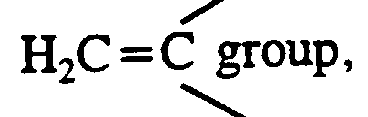
- In one preferred embodiment, the monoolefinic groups are predominantly vinylidene groups, i.e., groups of the formula
CH2 = C〈
preferably those of the formula
- In one preferred embodiment the polybutene is substantially monoolefinic, comprising at least about 30 mole %, preferably at least about 50 mole % vinylidene groups, more preferably at least about 70 mole % vinylidene groups. Such materials and methods for preparing them are described in U.S. Patents 5,286,823 and 5,408,018, which are expressly incorporated herein by reference. They are commercially available, for example under the tradenames Ultravis (BP Chemicals) and Glissopal (BASF).
- As is apparent from the foregoing, olefins of a wide variety of type and of molecular weight are useful for preparing the compounds of this invention. Preferred olefins are usually substantially hydrocarbon and have number average molecular weight ranging from about 100 to about 70,000, more preferably from about 200 to about 7,000, even more preferably from about 1,300 to about 5,000, preferably from about 400 to about 3,000.
- Specific characterization of olefin reactants (A) used in the processes of this invention can be accomplished by using techniques known to those skilled in the art. These techniques include general qualitative analysis by infrared and determinations of average molecular weight, e.g., Mn, number average molecular weight, etc. employing vapor phase osmometry (VPO) and gel permeation chromatography (GPC). Structural details can be elucidated employing proton and carbon 13 (C13) nuclear magnetic resonance (NMR) techniques. NMR is useful for determining substitution characteristics about olefinic bonds, and provides some details regarding the nature of the substituents. More specific details regarding substituents about the olefinic bonds can be obtained by cleaving the substituents from the olefin by, for example, ozonolysis, then analyzing the cleaved products, also by NMR, GPC, VPO, and by infra-red analysis and other techniques known to the skilled person.
- The carboxylic reactant is at least one member selected from a compound of the general formula
R3C(O)(R4)n C(O)OR5 (IV)
and a compound of the general formula
- Examples of carboxylic reactants (B) are glyoxylic acid, and other omega-oxoalkanoic acids, keto alkanoic acids such as pyruvic acid, levulinic acid, ketovaleric acids, ketobutyric acids and numerous others. The skilled worker, having the disclosure before him, will readily recognize the appropriate compound of formula (V) to employ as a reactant to generate a given intermediate. Preferred compounds of formula (V) are those that will lead to preferred compounds of formula (I).
- Reactant (B) may be a compound of the formula

- From the foregoing, it is apparent that the various 'R' groups in the product (I) correspond to or may be derived from corresponding groups in the olefinic and carboxylic reactants.
- The process of this invention may be conducted at temperatures ranging from ambient up to the lower decomposition temperature of any of the reactants, preferably from about 60°C to about 220°C, more preferably from about 120°C to about 180°C, even more preferably up to about 160°C. The process employs from about 0.6 moles (B) per mole of (A) to 1.5 moles (B) per equivalent of (A), preferably from about 0.8 moles (B) per mole of (A) to about 1.2 moles (B) per equivalent of (A), more preferably from about 0.95 moles (B) per mole of (A) to about 1.05 moles (B) per equivalent of (A).
- The following examples are intended to illustrate several compositions of this invention as well as means for preparing same. Unless indicated otherwise all parts are parts by weight. It is to be understood that these examples are intended to illustrate several compositions and procedures of the invention and are not intended to limit the scope of the invention.
- A reactor is charged with 3000 parts of a polyisobutene having a number average molecular weight of about 1000 and which contains about 80 mole % terminal vinylidene groups and 6 parts 70% aqueous methansulfonic acid. The materials are heated to 160°C under N2 followed by addition of 577.2 parts 50% aqueous glyoxylic acid over 4 hours while maintaining 155-160°C. Water is removed and is collected in a Dean-Stark trap. The reaction is held at 160°C for 5 hours, cooled to 140°C and filtered with a diatomaceous earth filter aid. The filtrate has total acid no. (ASTM Procedure D-974) = 34.7 and saponification no. (ASTM Procedure D-74) = 53.2Mn (Gel permeation chromatography (GPC)) = 1476 and Mw (GPC) = 3067; unreacted polyisobutene (Thin layer chromatography-Flame ionization detector (TLC-FID)) = 8.6%.
- A reactor is charged with 300 parts of polyisobutene having a number average molecular weight of about 1000 and containing about 70 mole % of terminal vinylidene groups, 44 parts 50% aqueous glyoxylic acid and 100 parts cyclohexane. The materials are heated to reflux (75°C) under N2 and the water is azeotropically removed, collecting 22 parts water. The reactor is equipped for vacuum distillation and is stripped to 120°C at 10 mm Hg. Infrared analysis of residue shows vilylidene olefin remains. To the reactor are charged 22 parts additional 50% aqueous glyoxylic acid and 100 parts cyclohexane, heated to reflux (75°C) while azeotropically removing 11 parts water. The materials are stripped to 120°C at 10 mm Hg and filtered using a diatomaceous earth filter aid. The filtrate shows 18% unreacted polyisobutene (TLC-FID) and saponification No. = 61.7.
- One mole (based on total C=C content) of C18-24 alpha olefin and 1.2 moles glyoxylic acid monohydrate are reacted in the presence of 2 mole % 70% aqueous methane sulfonic acid under a N2 blanket at 120° C for four hours, removing water. The reaction product is dried by heating to 130° C for 1 hour, aqueous distillate being collected in a Dean-Stark trap. The residue is filtered employing a diatomaceous earth filter aid.
- A reactor equipped with a stirrer, thermowell, Dean-Stark trap with condenser and sub-surface N2 inlet is charged with 500 parts polyisobutylene having a number average molecular weight of about 1000 and containing about 70 mole % of terminal vinylidene groups and 80 parts 50% aqueous glyoxylic acid. The materials are heated to 160°C and are held at 160°C for 6 hours while removing H2O maintaining a slow N2 purge. The materials are diluted with 143 parts of mineral oil, reheated to 100°C and filtered through a diatomaceous earth filter aid.
- A reactor equipped as in Example 4 is charged with 400 parts polyisobutylene having a number average molecular weight of about 1000 and containing less than 10 mole % of terminal vinylidene groups, 100 parts cyclohexane, and 4 parts methane sulfonic acid. The materials are heated to reflux and 27 parts 50% aqueous glyoxylic acid are added over 0.5 hour. The materials are held at reflux for 1 hour while azeotropically removing water. An additional 27 parts 50% aqueous glyoxylic acid are added over 0.5 hour. The materials are held at reflux for 4 hours while azeotropically removing water. The materials are then heated to 150°C by removing distillate and the materials are held at 150°C for 1 hour. At this point the materials contain by analysis (TLC-FID) 19% unreacted polyisobutylene. The materials are filtered through a diatomaceous earth filter aid. The filtrate has saponification no. = 50.1.
- A reactor equipped as in Example 4 is charged with 1000 parts polyisobutylene having a number average molecular weight of about 1000, 207.2 parts 50% aqueous glyoxylic acid, 5 parts 70% aqueous methane sulfonic acid, 0.1 parts silicone antifoam agent and 300 parts cyclohexane. The reaction is heated to 105°C under N2 and is held there for 6 hours, under N2, collecting water. The temperature is increased to 110°C and held for 4 hours, collecting water. Cyclohexane is removed by heating at 110°C for 2 hours. Strip to 120°C at 25 mm Hg for 2 hours then filter with a diatomaceous earth filter aid. Filtrate shows 15.3% unreacted polyisobutylene (TLC-FID). Saponification no. = 58.4.
- The procedure of Example 2 is repeated replacing the glyoxylic acid with an equivalent amount of pyruvic acid.
- The procedure of Example 4 is repeated replacing glyoxylic acid with an equivalent amount of levulinic acid.
- While the invention has been explained in relation to its preferred embodiments, it is to be understood that various modifications thereof will become apparent to those skilled in the art upon reading the specification. Therefore, it is to be understood that the invention disclosed herein is intended to cover such modifications that fall within the scope of the appended claims.
Claims (19)
- A compound of the general formula
 wherein n = 0 or 1; y = 0 or 1;wherein X is a divalent hydrocarbyl group selected from
〉C(R6)(C(R5)(R7)(R8)) when y = 0, and
〉C(R7)(R8) when y = 1
wherein each of R1 and R2 is independently H or a hydrocarbon based group;R3 is H or hydrocarbyl;R4 is a divalent hydrocarbylene group;R5 is H or hydrocarbyl;each of R6, R7 and R8 is independently H or a hydrocarbon based group, provided that at least one of R1, R2, R6, R7 and R8 is a hydrocarbon based group containing at least 7 carbon atoms. - The compound of claim 1 wherein each of R1, R2 and R3 is independently H or a lower alkyl or alkenyl group, wherein R4 is an alkylene group containing from 1 to about 3 carbon atoms, and at least one of R6, R7 and R8 is a hydrocarbyl group containing from about 7 to about 5000 carbon atoms.
- The compound of claim 1 or claim 2 wherein each of R1, R2, and R3 is H and n = zero.
- The compound of any preceding claim wherein X has the formula
〉C(R7)(R8)-
- The compound of any one of claims 1 to 3 wherein X has the formula
〉C(R6)(C(R5)(R7)(R8))
- The compound of any preceding claim wherein R6 contains from 30 to about 100 carbon atoms and is derived from a polymer selected from homopolymerized and interpolymerized C2-10 olefins.
- The compound of any preceding claim wherein at least one of R7 and R8 contains from about 30 to about 100 carbon atoms and is derived from a polymer selected from homopolymerized and interpolymerized C2-10 olefins.
- The compound of claim 6 or claim 7 wherein the olefins are 1-olefins selected from ethylene, propylene, butenes, isobutylene and mixtures thereof.
- The compound of any one of claims 1 to 4 wherein at least one of R6, R7 and R8 is an aliphatic group containing from 8 to about 24 carbon atoms.
- The compound of any one of claims 1 to 4 wherein at least one of R6, R7 and R8 contains from 12 to about 50 carbon atoms.
- A process comprising reacting, optionally in the presence of an acidic catalyst selected from organic sulfonic acids, heteropolyacids, and mineral acids, and optionally in the presence of an azeotroping solvent, (A) at least one olefinic compound of the general formula
(R1)(R2) C=C(R6)(CH(R7)(R8))
wherein each of R1 and R2 is, independently, hydrogen or a hydrocarbon based group and each of R6, R7 and R8 is, independently, hydrogen or a hydrocarbon based group provided that at least one is hydrocarbon based group containing at least 7 carbon atoms; and
(B) at least one carboxylic reactant selected from a compound of the general formula
R3C(O)(R4)mC(O)OR5 (IV)
and a compound of the general formula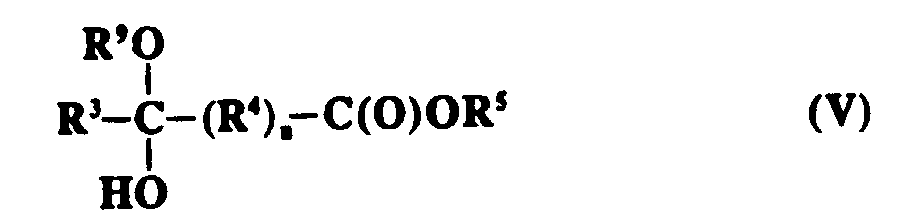
- The process of claim 11 wherein the at least one reactant (B) is selected from glyoxylic acid and a compound of the formula

- The process of claim 11 or claim 12 wherein each of R1 and R2 is hydrogen and R6 is H or a lower alkyl group, the group (CH(R7)(R8)) is a hydrocarbyl group containing from 7 to about 5000 carbon atoms, and the olefin has Mn ranging from about 100 to about 70,000.
- The process of any one of claims 11 to 13 wherein the group (CH(R7)(R8)) is an aliphatic group containing from about 30 to about 200 carbon atoms and the olefinic compound is derived from homopolymerized and interopolymerized C2-10 olefins having Mn ranging from about 400 to about 3000.
- The process of any one of claims 11 to 14 wherein the olefinic compound is a polyolefin comprising a mixture of isomers, at least about 50% by weight of the mixture comprising isomers of the formula
H2C = C(R6)(CH(R7)(R8))
wherein R6 is H or lower alkyl. - The process of any one of claims 11 to 15 wherein the olefinic compound is a polyolefin comprising a mixture of isomers wherein from about 50% to 65% are trisubstituted olefins wherein one substituent contains from 2 to about 5000 carbon atoms and the other two substituents are lower alkyl.
- The process of claim 15 or claim 16 wherein the polyolefin is a polybutene.
- The process of any one of claims 11 to 17 wherein the carboxylic reactant (B) is added over a period from 1 to 10 hours.
- The compound prepared by the process of any one of claims 11-18.
Applications Claiming Priority (2)
| Application Number | Priority Date | Filing Date | Title |
|---|---|---|---|
| US08/518,069 US6020500A (en) | 1995-08-22 | 1995-08-22 | Hydroxy-substituted monolactones useful as intermediates for preparing lubricating oil and fuel additives |
| US518069 | 1995-08-22 |
Publications (3)
| Publication Number | Publication Date |
|---|---|
| EP0759443A2 true EP0759443A2 (en) | 1997-02-26 |
| EP0759443A3 EP0759443A3 (en) | 1998-01-07 |
| EP0759443B1 EP0759443B1 (en) | 2001-12-19 |
Family
ID=24062415
Family Applications (1)
| Application Number | Title | Priority Date | Filing Date |
|---|---|---|---|
| EP96306063A Expired - Lifetime EP0759443B1 (en) | 1995-08-22 | 1996-08-20 | Hydroxy-substituted monolactones useful as intermediates for preparing lubricating oil and fuel additives |
Country Status (9)
| Country | Link |
|---|---|
| US (2) | US6020500A (en) |
| EP (1) | EP0759443B1 (en) |
| JP (1) | JPH09132789A (en) |
| AU (1) | AU714506B2 (en) |
| CA (1) | CA2183610A1 (en) |
| DE (1) | DE69618109T2 (en) |
| ES (1) | ES2170207T3 (en) |
| MX (1) | MX9603536A (en) |
| SG (1) | SG64397A1 (en) |
Cited By (8)
| Publication number | Priority date | Publication date | Assignee | Title |
|---|---|---|---|---|
| EP0882745A1 (en) * | 1997-06-05 | 1998-12-09 | The Lubrizol Corporation | Intermediates useful for preparing dispersant-viscosity improvers for lubricating oils |
| US5912213A (en) * | 1997-06-05 | 1999-06-15 | The Lubrizol Corporation | Substituted carboxylic acylating agent compositions and derivatives thereof for use in lubricants and fuels |
| EP0882113A4 (en) * | 1996-08-08 | 1999-08-18 | Lubrizol Corp | Process for preparing compositions useful as intermediates for preparing lubricating oil and fuel additives and derivatives thereof |
| US6030929A (en) * | 1998-07-27 | 2000-02-29 | The Lubrizol Corporation | Mixed carboxylic compositions and derivatives and use as lubricating oil and fuel additives |
| WO2000077132A1 (en) * | 1999-06-10 | 2000-12-21 | The Lubrizol Corporation | Lubricating oil additives |
| WO2000077131A1 (en) * | 1999-06-10 | 2000-12-21 | The Lubrizol Corporation | Lubricating oil additives |
| US6211122B1 (en) | 1998-07-27 | 2001-04-03 | The Lubrizol Corporation | Carboxylic compositions and derivatives thereof and use as lubricating oil and fuel additives |
| US6288013B1 (en) | 1997-12-03 | 2001-09-11 | The Lubrizol Corporation | Nitrogen containing dispersant-viscosity improvers |
Families Citing this family (45)
| Publication number | Priority date | Publication date | Assignee | Title |
|---|---|---|---|---|
| US6860241B2 (en) | 1999-06-16 | 2005-03-01 | Dober Chemical Corp. | Fuel filter including slow release additive |
| EP1294776A2 (en) * | 2000-05-18 | 2003-03-26 | The Lubrizol Corporation | Process for reacting large hydrophobic molecules with small hydrophilic molecules |
| US20030122104A1 (en) * | 2001-02-12 | 2003-07-03 | Dober Chemical Corporation | Liquid replacement systems |
| GB2396311B (en) * | 2001-08-24 | 2005-11-30 | Dober Chemical Corp | Controlled release of additives in cooling systems |
| US7938277B2 (en) * | 2001-08-24 | 2011-05-10 | Dober Chemical Corporation | Controlled release of microbiocides |
| US6835218B1 (en) | 2001-08-24 | 2004-12-28 | Dober Chemical Corp. | Fuel additive compositions |
| DE10297145T5 (en) * | 2001-08-24 | 2004-07-22 | Dober Chemical Corporation, Midlothian | Controlled release of additives in fluid systems |
| US6827750B2 (en) | 2001-08-24 | 2004-12-07 | Dober Chemical Corp | Controlled release additives in fuel systems |
| US7001531B2 (en) | 2001-08-24 | 2006-02-21 | Dober Chemical Corp. | Sustained release coolant additive composition |
| JP5561933B2 (en) | 2005-06-16 | 2014-07-30 | ザ ルブリゾル コーポレイション | Quaternary ammonium salt detergent for use in fuel |
| JP4766115B2 (en) * | 2006-08-24 | 2011-09-07 | ダイキン工業株式会社 | Residue removing liquid after semiconductor dry process and residue removing method using the same |
| US7563368B2 (en) | 2006-12-12 | 2009-07-21 | Cummins Filtration Ip Inc. | Filtration device with releasable additive |
| US20090093384A1 (en) | 2007-10-03 | 2009-04-09 | The Lubrizol Corporation | Lubricants That Decrease Micropitting for Industrial Gears |
| US20090304868A1 (en) * | 2008-05-27 | 2009-12-10 | Dober Chemical Corporation | Controlled release cooling additive composition |
| US8702995B2 (en) * | 2008-05-27 | 2014-04-22 | Dober Chemical Corp. | Controlled release of microbiocides |
| US8591747B2 (en) | 2008-05-27 | 2013-11-26 | Dober Chemical Corp. | Devices and methods for controlled release of additive compositions |
| US7883638B2 (en) | 2008-05-27 | 2011-02-08 | Dober Chemical Corporation | Controlled release cooling additive compositions |
| CN106753620A (en) | 2008-10-10 | 2017-05-31 | 路博润公司 | Reduce the additive that metal is mixed into fuel |
| EP2514807B2 (en) | 2009-05-15 | 2020-11-18 | The Lubrizol Corporation | Quaternary ammonium amide salts |
| US9944878B2 (en) | 2009-11-10 | 2018-04-17 | The Lubrizol Corporation | Lubricant system clean-up compositions and methods thereof |
| SG10201703401VA (en) | 2010-05-18 | 2017-06-29 | Lubrizol Corp | Compositions that provide detergency |
| CN102906235A (en) | 2010-05-25 | 2013-01-30 | 卢布里佐尔公司 | Method of providing power gain in an engine |
| WO2011159742A1 (en) | 2010-06-15 | 2011-12-22 | The Lubrizol Corporation | Methods of removing deposits in oil and gas applications |
| FR2969654B1 (en) | 2010-12-22 | 2013-02-08 | Rhodia Operations | FUEL ADDITIVE COMPOSITION BASED ON IRON PARTICLE DISPERSION AND DETERGENT |
| KR20140045441A (en) | 2011-05-26 | 2014-04-16 | 더루우브리졸코오포레이션 | Stabilized blends containing friction modifiers |
| JP5964414B2 (en) | 2011-05-26 | 2016-08-03 | ザ ルブリゾル コーポレイションThe Lubrizol Corporation | Stabilized blends containing friction modifiers |
| WO2012162219A1 (en) | 2011-05-26 | 2012-11-29 | The Lubrizol Corporation | Stabilized blends containing friction modifiers |
| US20140107000A1 (en) | 2011-05-26 | 2014-04-17 | The Lubrizol Corporation | Stabilized blends containing antioxidants |
| EP2723837B1 (en) | 2011-06-21 | 2021-10-27 | The Lubrizol Corporation | Lubricating compositions containing salts of hydrocarbyl substituted acylating agents |
| CA2849633A1 (en) | 2011-09-23 | 2013-03-28 | The Lubrizol Corporation | Quaternary ammonium salts in heating oils |
| JP2015532356A (en) | 2012-10-23 | 2015-11-09 | ザ ルブリゾル コーポレイションThe Lubrizol Corporation | Diesel detergent without low molecular weight penalty |
| WO2014137800A1 (en) | 2013-03-07 | 2014-09-12 | The Lubrizol Corporation | Ion tolerant corrosion inhibitors and inhibitor combinations for fuels |
| BR112015029689A2 (en) | 2013-05-28 | 2017-07-25 | Lubrizol Corp | asphaltene inhibition |
| EP3149128A1 (en) | 2014-05-30 | 2017-04-05 | The Lubrizol Corporation | Branched amine containing quaternary ammonium salts |
| JP2017522403A (en) | 2014-05-30 | 2017-08-10 | ザ ルブリゾル コーポレイションThe Lubrizol Corporation | Low molecular weight amide / ester containing quaternary ammonium salt |
| SG11201609883PA (en) | 2014-05-30 | 2016-12-29 | Lubrizol Corp | Imidazole containing quaternary ammonium salts |
| CN106661472A (en) | 2014-05-30 | 2017-05-10 | 路博润公司 | High molecular weight amide/ester containing quaternary ammonium salts |
| SG11201609849WA (en) | 2014-05-30 | 2016-12-29 | Lubrizol Corp | Coupled quaternary ammonium salts |
| US20170107441A1 (en) | 2014-05-30 | 2017-04-20 | The Lubrizol Corporation | Epoxide quaternized quaternary ammonium salts |
| EP3374440B1 (en) | 2015-11-09 | 2023-06-21 | The Lubrizol Corporation | Coating composition comprising quaternary amine additives and its use |
| AU2016362476B2 (en) | 2015-12-02 | 2020-07-30 | The Lubrizol Corporation | Ultra-low molecular weight amide/ester containing quaternary ammonium salts having short hydrocarbon tails |
| PE20190852A1 (en) | 2016-10-17 | 2019-06-18 | Lubrizol Corp | ACID EMULSIFIED TECHNOLOGY FOR CONTINUOUS MIXED EMULSIFIED ACID SYSTEMS |
| AU2018230607B2 (en) | 2017-03-06 | 2023-09-21 | The Lubrizol Corporation | Amine salts for use in gasoline engines |
| US11124720B2 (en) | 2017-03-06 | 2021-09-21 | The Lubrizol Corporation | Fuel additives |
| CN114729276B (en) | 2019-11-22 | 2024-09-06 | 路博润公司 | Fuel additive composition for gasoline direct injection engines |
Family Cites Families (21)
| Publication number | Priority date | Publication date | Assignee | Title |
|---|---|---|---|---|
| DE1248643B (en) * | 1959-03-30 | 1967-08-31 | The Lubrizol Corporation, Cleveland, Ohio (V. St. A.) | Process for the preparation of oil-soluble aylated amines |
| US3215707A (en) * | 1960-06-07 | 1965-11-02 | Lubrizol Corp | Lubricant |
| US3248187A (en) * | 1961-12-22 | 1966-04-26 | Exxon Research Engineering Co | Alkenyl dicarboxylic acid lactones, their method of preparation and utility |
| GB1037985A (en) * | 1963-02-19 | 1966-08-03 | Cheuron Res Company | Alkylbutyrolactone-ª-acetic acids |
| US3454607A (en) * | 1969-02-10 | 1969-07-08 | Lubrizol Corp | High molecular weight carboxylic compositions |
| DE2103686C3 (en) * | 1971-01-27 | 1980-05-22 | Basf Ag, 6700 Ludwigshafen | Process for the preparation of α-hydroxy-γ-lactones |
| JPS58142901A (en) * | 1982-02-19 | 1983-08-25 | Nippon Zeon Co Ltd | Modification method of rubber |
| EP0099478B1 (en) * | 1982-06-29 | 1986-02-26 | Nippon Zeon Co., Ltd. | Method for modifying rubbers |
| US4545607A (en) * | 1982-09-23 | 1985-10-08 | Leon Yulkowski | Door construction |
| JPS59118721A (en) * | 1982-12-25 | 1984-07-09 | Nippon Zeon Co Ltd | Process for addition reaction of unsaturated compound |
| US4412031A (en) * | 1983-02-18 | 1983-10-25 | Nippon Zeon Co., Ltd. | Modified rubber composition employing a compound containing a carboxyl and an aldehyde group |
| JPH0651726B2 (en) * | 1985-03-29 | 1994-07-06 | 日本ゼオン株式会社 | Rubber modification method |
| JPH0788369B2 (en) * | 1986-11-27 | 1995-09-27 | 味の素株式会社 | Butyrolactone derivative, production method thereof and use thereof |
| US5011947A (en) * | 1988-08-25 | 1991-04-30 | Bristol-Myers | Antihypercholesterolemic alkylene compounds |
| US5646098A (en) * | 1990-07-23 | 1997-07-08 | Exxon Chemical Patents Inc | Carbonyl containing compounds and their derivatives as multi-functional fuel and lube additives |
| WO1992005202A1 (en) * | 1990-09-26 | 1992-04-02 | Nippon Zeon Co., Ltd. | Colored fine spherical grain, production thereof, and use thereof |
| AT398579B (en) * | 1992-07-06 | 1994-12-27 | Chemie Linz Gmbh | ENZYMATIC METHOD FOR SEPARATING RACEMIC MIXTURES FROM DELTA VALEROLACTONES |
| DE69403541T2 (en) * | 1993-02-05 | 1997-09-25 | Teijin Ltd | Lactone compound and process for its preparation |
| US5393780A (en) * | 1993-03-26 | 1995-02-28 | Fujirebio Inc. | 4-fluorobiphenyl derivatives |
| KR940021505A (en) * | 1993-03-26 | 1994-10-19 | 후꾸야마 마사루 | 4-fluorobiphenyl derivative |
| US5409820A (en) * | 1993-08-06 | 1995-04-25 | Apotex, Inc. | Process for the production of lovastatin using Coniothyrium fuckelii |
-
1995
- 1995-08-22 US US08/518,069 patent/US6020500A/en not_active Expired - Fee Related
-
1996
- 1996-08-15 SG SG1996010469A patent/SG64397A1/en unknown
- 1996-08-15 JP JP8215818A patent/JPH09132789A/en not_active Withdrawn
- 1996-08-19 AU AU62159/96A patent/AU714506B2/en not_active Ceased
- 1996-08-19 CA CA002183610A patent/CA2183610A1/en not_active Abandoned
- 1996-08-20 DE DE69618109T patent/DE69618109T2/en not_active Expired - Fee Related
- 1996-08-20 ES ES96306063T patent/ES2170207T3/en not_active Expired - Lifetime
- 1996-08-20 EP EP96306063A patent/EP0759443B1/en not_active Expired - Lifetime
- 1996-08-21 MX MX9603536A patent/MX9603536A/en not_active IP Right Cessation
-
1999
- 1999-01-19 US US09/232,975 patent/US6114547A/en not_active Expired - Fee Related
Cited By (14)
| Publication number | Priority date | Publication date | Assignee | Title |
|---|---|---|---|---|
| EP0882113A4 (en) * | 1996-08-08 | 1999-08-18 | Lubrizol Corp | Process for preparing compositions useful as intermediates for preparing lubricating oil and fuel additives and derivatives thereof |
| US6147036A (en) * | 1996-08-08 | 2000-11-14 | The Lubrizol Corporation | Process for preparing compositions useful as intermediates for preparing lubricating oil and fuel additives and derivatives thereof |
| EP0882783A3 (en) * | 1997-06-05 | 2000-01-19 | The Lubrizol Corporation | Substituted carboxylic acylating agent compositions and derivatives thereof for use in lubricants and fuels |
| EP0882745A1 (en) * | 1997-06-05 | 1998-12-09 | The Lubrizol Corporation | Intermediates useful for preparing dispersant-viscosity improvers for lubricating oils |
| US6117941A (en) * | 1997-06-05 | 2000-09-12 | The Lubrizol Corporation | Intermediates useful for preparing dispersant-viscosity improvers for lubricating oils |
| US5912213A (en) * | 1997-06-05 | 1999-06-15 | The Lubrizol Corporation | Substituted carboxylic acylating agent compositions and derivatives thereof for use in lubricants and fuels |
| AU745384B2 (en) * | 1997-06-05 | 2002-03-21 | Lubrizol Corporation, The | Intermediates useful for preparing dispersant-viscosity improvers for lubricating oils |
| US6288013B1 (en) | 1997-12-03 | 2001-09-11 | The Lubrizol Corporation | Nitrogen containing dispersant-viscosity improvers |
| US6492306B2 (en) | 1997-12-03 | 2002-12-10 | The Lubrizol Corporation | Nitrogen containing dispersant-viscosity improvers |
| US6030929A (en) * | 1998-07-27 | 2000-02-29 | The Lubrizol Corporation | Mixed carboxylic compositions and derivatives and use as lubricating oil and fuel additives |
| US6211122B1 (en) | 1998-07-27 | 2001-04-03 | The Lubrizol Corporation | Carboxylic compositions and derivatives thereof and use as lubricating oil and fuel additives |
| WO2000077132A1 (en) * | 1999-06-10 | 2000-12-21 | The Lubrizol Corporation | Lubricating oil additives |
| WO2000077131A1 (en) * | 1999-06-10 | 2000-12-21 | The Lubrizol Corporation | Lubricating oil additives |
| US6258761B1 (en) | 1999-06-10 | 2001-07-10 | The Lubrizol Corporation | Lubricating oil additives |
Also Published As
| Publication number | Publication date |
|---|---|
| US6020500A (en) | 2000-02-01 |
| ES2170207T3 (en) | 2002-08-01 |
| DE69618109D1 (en) | 2002-01-31 |
| AU6215996A (en) | 1997-02-27 |
| MX9603536A (en) | 1997-03-29 |
| AU714506B2 (en) | 2000-01-06 |
| US6114547A (en) | 2000-09-05 |
| SG64397A1 (en) | 1999-04-27 |
| DE69618109T2 (en) | 2002-06-20 |
| EP0759443B1 (en) | 2001-12-19 |
| CA2183610A1 (en) | 1997-02-23 |
| JPH09132789A (en) | 1997-05-20 |
| EP0759443A3 (en) | 1998-01-07 |
Similar Documents
| Publication | Publication Date | Title |
|---|---|---|
| US6114547A (en) | Hydroxy-substituted monolactones and use thereof as intermediates for preparing lubricating oil and fuel additives | |
| EP0759435B1 (en) | Process for preparing compositions useful as intermediates for preparing lubricating oil and fuel additives | |
| US5777142A (en) | Unsaturated hydroxycarboxylic compounds useful as intermediates for preparing lubricant and fuel additives | |
| US6207839B1 (en) | Process for preparing compositions useful as intermediates for preparing lubricating oil and fuel additives | |
| DE69720195T2 (en) | PRODUCTION PROCESS FOR COMPOSITIONS SUITABLE AS INTERMEDIATE PRODUCTS IN THE PRODUCTION OF LUBRICANTS AND FUEL ADDITIVES AND THEIR DERIVATIVES | |
| US5851966A (en) | Reaction products of substituted carboxylic acylating agents and carboxylic reactants for use in fuels and lubricants | |
| EP0802255B1 (en) | Hydroxy-group containing acylated nitrogen compositions useful as additives for lubricating oil and fuel compositions | |
| GB1592766A (en) | Lactone oxazolines useful as oleaginous additives | |
| CA2197105A1 (en) | Process for preparing polyalkenyl substituted mono-and dicarboxylic acidproducing materials | |
| US4292184A (en) | Thio-bis-(hydrocarbon-bisoxazolines) as oleaginous additives for lubricants and fuels | |
| US3734865A (en) | Substituted gamma-butyrolactones,amine derivatives thereof and organic fluids containing same | |
| EP0016660B1 (en) | Thio-bis-(hydrocarbon-bisoxazolines) and analogs, process for their preparation and their use as oleaginous additives | |
| JPH09111270A (en) | Polyolefin-substituted dicarboxylic acid or anhydrous ester derivative | |
| JPH01172409A (en) | Polymer amide for multifunctional enhancer |
Legal Events
| Date | Code | Title | Description |
|---|---|---|---|
| PUAI | Public reference made under article 153(3) epc to a published international application that has entered the european phase |
Free format text: ORIGINAL CODE: 0009012 |
|
| AK | Designated contracting states |
Kind code of ref document: A2 Designated state(s): BE DE ES FR GB IT NL SE |
|
| PUAL | Search report despatched |
Free format text: ORIGINAL CODE: 0009013 |
|
| AK | Designated contracting states |
Kind code of ref document: A3 Designated state(s): BE DE ES FR GB IT NL SE |
|
| 17P | Request for examination filed |
Effective date: 19980624 |
|
| 17Q | First examination report despatched |
Effective date: 19980901 |
|
| GRAG | Despatch of communication of intention to grant |
Free format text: ORIGINAL CODE: EPIDOS AGRA |
|
| GRAG | Despatch of communication of intention to grant |
Free format text: ORIGINAL CODE: EPIDOS AGRA |
|
| GRAG | Despatch of communication of intention to grant |
Free format text: ORIGINAL CODE: EPIDOS AGRA |
|
| GRAH | Despatch of communication of intention to grant a patent |
Free format text: ORIGINAL CODE: EPIDOS IGRA |
|
| GRAH | Despatch of communication of intention to grant a patent |
Free format text: ORIGINAL CODE: EPIDOS IGRA |
|
| GRAA | (expected) grant |
Free format text: ORIGINAL CODE: 0009210 |
|
| AK | Designated contracting states |
Kind code of ref document: B1 Designated state(s): BE DE ES FR GB IT NL SE |
|
| REG | Reference to a national code |
Ref country code: GB Ref legal event code: IF02 |
|
| REF | Corresponds to: |
Ref document number: 69618109 Country of ref document: DE Date of ref document: 20020131 |
|
| PG25 | Lapsed in a contracting state [announced via postgrant information from national office to epo] |
Ref country code: SE Free format text: LAPSE BECAUSE OF FAILURE TO SUBMIT A TRANSLATION OF THE DESCRIPTION OR TO PAY THE FEE WITHIN THE PRESCRIBED TIME-LIMIT Effective date: 20020319 |
|
| ET | Fr: translation filed | ||
| REG | Reference to a national code |
Ref country code: ES Ref legal event code: FG2A Ref document number: 2170207 Country of ref document: ES Kind code of ref document: T3 |
|
| PG25 | Lapsed in a contracting state [announced via postgrant information from national office to epo] |
Ref country code: BE Free format text: LAPSE BECAUSE OF NON-PAYMENT OF DUE FEES Effective date: 20020831 |
|
| PLBE | No opposition filed within time limit |
Free format text: ORIGINAL CODE: 0009261 |
|
| STAA | Information on the status of an ep patent application or granted ep patent |
Free format text: STATUS: NO OPPOSITION FILED WITHIN TIME LIMIT |
|
| 26N | No opposition filed | ||
| BERE | Be: lapsed |
Owner name: THE *LUBRIZOL CORP. Effective date: 20020831 |
|
| PGFP | Annual fee paid to national office [announced via postgrant information from national office to epo] |
Ref country code: GB Payment date: 20040811 Year of fee payment: 9 |
|
| PGFP | Annual fee paid to national office [announced via postgrant information from national office to epo] |
Ref country code: FR Payment date: 20040819 Year of fee payment: 9 |
|
| PGFP | Annual fee paid to national office [announced via postgrant information from national office to epo] |
Ref country code: ES Payment date: 20040907 Year of fee payment: 9 |
|
| PGFP | Annual fee paid to national office [announced via postgrant information from national office to epo] |
Ref country code: NL Payment date: 20050729 Year of fee payment: 10 |
|
| PG25 | Lapsed in a contracting state [announced via postgrant information from national office to epo] |
Ref country code: IT Free format text: LAPSE BECAUSE OF NON-PAYMENT OF DUE FEES;WARNING: LAPSES OF ITALIAN PATENTS WITH EFFECTIVE DATE BEFORE 2007 MAY HAVE OCCURRED AT ANY TIME BEFORE 2007. THE CORRECT EFFECTIVE DATE MAY BE DIFFERENT FROM THE ONE RECORDED. Effective date: 20050820 Ref country code: GB Free format text: LAPSE BECAUSE OF NON-PAYMENT OF DUE FEES Effective date: 20050820 |
|
| PG25 | Lapsed in a contracting state [announced via postgrant information from national office to epo] |
Ref country code: ES Free format text: LAPSE BECAUSE OF NON-PAYMENT OF DUE FEES Effective date: 20050822 |
|
| PGFP | Annual fee paid to national office [announced via postgrant information from national office to epo] |
Ref country code: DE Payment date: 20050930 Year of fee payment: 10 |
|
| GBPC | Gb: european patent ceased through non-payment of renewal fee |
Effective date: 20050820 |
|
| PG25 | Lapsed in a contracting state [announced via postgrant information from national office to epo] |
Ref country code: FR Free format text: LAPSE BECAUSE OF NON-PAYMENT OF DUE FEES Effective date: 20060428 |
|
| REG | Reference to a national code |
Ref country code: FR Ref legal event code: ST Effective date: 20060428 |
|
| REG | Reference to a national code |
Ref country code: ES Ref legal event code: FD2A Effective date: 20050822 |
|
| PG25 | Lapsed in a contracting state [announced via postgrant information from national office to epo] |
Ref country code: NL Free format text: LAPSE BECAUSE OF NON-PAYMENT OF DUE FEES Effective date: 20070301 Ref country code: DE Free format text: LAPSE BECAUSE OF NON-PAYMENT OF DUE FEES Effective date: 20070301 |
|
| NLV4 | Nl: lapsed or anulled due to non-payment of the annual fee |
Effective date: 20070301 |