EP0765818A1 - Adhesive tape - Google Patents
Adhesive tape Download PDFInfo
- Publication number
- EP0765818A1 EP0765818A1 EP96306946A EP96306946A EP0765818A1 EP 0765818 A1 EP0765818 A1 EP 0765818A1 EP 96306946 A EP96306946 A EP 96306946A EP 96306946 A EP96306946 A EP 96306946A EP 0765818 A1 EP0765818 A1 EP 0765818A1
- Authority
- EP
- European Patent Office
- Prior art keywords
- packaging material
- tear tape
- film
- layer
- melting point
- Prior art date
- Legal status (The legal status is an assumption and is not a legal conclusion. Google has not performed a legal analysis and makes no representation as to the accuracy of the status listed.)
- Granted
Links
- 239000002390 adhesive tape Substances 0.000 title 1
- 239000005022 packaging material Substances 0.000 claims abstract description 94
- 239000000463 material Substances 0.000 claims abstract description 35
- 238000007789 sealing Methods 0.000 claims description 32
- -1 polyethylene- Polymers 0.000 claims description 30
- 238000002844 melting Methods 0.000 claims description 29
- 230000008018 melting Effects 0.000 claims description 29
- 238000000576 coating method Methods 0.000 claims description 20
- 239000011248 coating agent Substances 0.000 claims description 19
- 238000000034 method Methods 0.000 claims description 17
- VGGSQFUCUMXWEO-UHFFFAOYSA-N Ethene Chemical compound C=C VGGSQFUCUMXWEO-UHFFFAOYSA-N 0.000 claims description 14
- 229920001684 low density polyethylene Polymers 0.000 claims description 13
- 239000004702 low-density polyethylene Substances 0.000 claims description 13
- 229920002647 polyamide Polymers 0.000 claims description 13
- 239000004698 Polyethylene Substances 0.000 claims description 12
- 229920001328 Polyvinylidene chloride Polymers 0.000 claims description 12
- 239000005033 polyvinylidene chloride Substances 0.000 claims description 12
- 239000004831 Hot glue Substances 0.000 claims description 11
- 239000004952 Polyamide Substances 0.000 claims description 11
- 229920003023 plastic Polymers 0.000 claims description 11
- 239000004033 plastic Substances 0.000 claims description 11
- 229920000573 polyethylene Polymers 0.000 claims description 11
- 229920000139 polyethylene terephthalate Polymers 0.000 claims description 9
- 229920001169 thermoplastic Polymers 0.000 claims description 9
- 239000001993 wax Substances 0.000 claims description 7
- 239000004820 Pressure-sensitive adhesive Substances 0.000 claims description 6
- 229920001577 copolymer Polymers 0.000 claims description 6
- 239000005038 ethylene vinyl acetate Substances 0.000 claims description 6
- 239000000758 substrate Substances 0.000 claims description 6
- 229920001200 poly(ethylene-vinyl acetate) Polymers 0.000 claims description 4
- 239000005026 oriented polypropylene Substances 0.000 claims description 3
- 229920000728 polyester Polymers 0.000 claims description 3
- 239000005977 Ethylene Substances 0.000 claims description 2
- 230000003213 activating effect Effects 0.000 claims description 2
- 235000019504 cigarettes Nutrition 0.000 abstract description 4
- 235000013305 food Nutrition 0.000 abstract description 4
- 235000013351 cheese Nutrition 0.000 description 9
- 239000004743 Polypropylene Substances 0.000 description 7
- 238000010438 heat treatment Methods 0.000 description 7
- 239000005020 polyethylene terephthalate Substances 0.000 description 7
- 229920001155 polypropylene Polymers 0.000 description 6
- 241000894006 Bacteria Species 0.000 description 4
- CURLTUGMZLYLDI-UHFFFAOYSA-N Carbon dioxide Chemical compound O=C=O CURLTUGMZLYLDI-UHFFFAOYSA-N 0.000 description 4
- 238000001125 extrusion Methods 0.000 description 4
- 238000007765 extrusion coating Methods 0.000 description 4
- 239000012943 hotmelt Substances 0.000 description 4
- 235000013372 meat Nutrition 0.000 description 4
- 239000004416 thermosoftening plastic Substances 0.000 description 4
- 238000012546 transfer Methods 0.000 description 4
- 229910000831 Steel Inorganic materials 0.000 description 3
- 235000015241 bacon Nutrition 0.000 description 3
- 230000001419 dependent effect Effects 0.000 description 3
- 238000007757 hot melt coating Methods 0.000 description 3
- 239000010959 steel Substances 0.000 description 3
- 238000012360 testing method Methods 0.000 description 3
- 230000015572 biosynthetic process Effects 0.000 description 2
- 229910002092 carbon dioxide Inorganic materials 0.000 description 2
- 239000001569 carbon dioxide Substances 0.000 description 2
- 239000006185 dispersion Substances 0.000 description 2
- 230000000694 effects Effects 0.000 description 2
- 239000012785 packaging film Substances 0.000 description 2
- 229920006280 packaging film Polymers 0.000 description 2
- 238000004806 packaging method and process Methods 0.000 description 2
- 230000001737 promoting effect Effects 0.000 description 2
- 241001553178 Arachis glabrata Species 0.000 description 1
- 239000004677 Nylon Substances 0.000 description 1
- 230000004888 barrier function Effects 0.000 description 1
- 238000006073 displacement reaction Methods 0.000 description 1
- 230000005611 electricity Effects 0.000 description 1
- 238000002474 experimental method Methods 0.000 description 1
- 238000007654 immersion Methods 0.000 description 1
- 238000010030 laminating Methods 0.000 description 1
- 238000012423 maintenance Methods 0.000 description 1
- 239000000155 melt Substances 0.000 description 1
- 238000007760 metering rod coating Methods 0.000 description 1
- 229920001778 nylon Polymers 0.000 description 1
- 238000012856 packing Methods 0.000 description 1
- 235000020232 peanut Nutrition 0.000 description 1
- 229920000642 polymer Polymers 0.000 description 1
- 229920002379 silicone rubber Polymers 0.000 description 1
- 239000000243 solution Substances 0.000 description 1
- 229910001220 stainless steel Inorganic materials 0.000 description 1
- 239000010935 stainless steel Substances 0.000 description 1
- XLYOFNOQVPJJNP-UHFFFAOYSA-N water Substances O XLYOFNOQVPJJNP-UHFFFAOYSA-N 0.000 description 1
- 238000003466 welding Methods 0.000 description 1
Images




Classifications
-
- B—PERFORMING OPERATIONS; TRANSPORTING
- B32—LAYERED PRODUCTS
- B32B—LAYERED PRODUCTS, i.e. PRODUCTS BUILT-UP OF STRATA OF FLAT OR NON-FLAT, e.g. CELLULAR OR HONEYCOMB, FORM
- B32B27/00—Layered products comprising a layer of synthetic resin
- B32B27/06—Layered products comprising a layer of synthetic resin as the main or only constituent of a layer, which is next to another layer of the same or of a different material
- B32B27/08—Layered products comprising a layer of synthetic resin as the main or only constituent of a layer, which is next to another layer of the same or of a different material of synthetic resin
-
- B—PERFORMING OPERATIONS; TRANSPORTING
- B31—MAKING ARTICLES OF PAPER, CARDBOARD OR MATERIAL WORKED IN A MANNER ANALOGOUS TO PAPER; WORKING PAPER, CARDBOARD OR MATERIAL WORKED IN A MANNER ANALOGOUS TO PAPER
- B31C—MAKING WOUND ARTICLES, e.g. WOUND TUBES, OF PAPER, CARDBOARD OR MATERIAL WORKED IN A MANNER ANALOGOUS TO PAPER
- B31C1/00—Making tubes or pipes by feeding at right angles to the winding mandrel centre line
-
- B—PERFORMING OPERATIONS; TRANSPORTING
- B29—WORKING OF PLASTICS; WORKING OF SUBSTANCES IN A PLASTIC STATE IN GENERAL
- B29C—SHAPING OR JOINING OF PLASTICS; SHAPING OF MATERIAL IN A PLASTIC STATE, NOT OTHERWISE PROVIDED FOR; AFTER-TREATMENT OF THE SHAPED PRODUCTS, e.g. REPAIRING
- B29C59/00—Surface shaping of articles, e.g. embossing; Apparatus therefor
- B29C59/007—Forming single grooves or ribs, e.g. tear lines, weak spots
-
- B—PERFORMING OPERATIONS; TRANSPORTING
- B29—WORKING OF PLASTICS; WORKING OF SUBSTANCES IN A PLASTIC STATE IN GENERAL
- B29C—SHAPING OR JOINING OF PLASTICS; SHAPING OF MATERIAL IN A PLASTIC STATE, NOT OTHERWISE PROVIDED FOR; AFTER-TREATMENT OF THE SHAPED PRODUCTS, e.g. REPAIRING
- B29C65/00—Joining or sealing of preformed parts, e.g. welding of plastics materials; Apparatus therefor
- B29C65/48—Joining or sealing of preformed parts, e.g. welding of plastics materials; Apparatus therefor using adhesives, i.e. using supplementary joining material; solvent bonding
- B29C65/50—Joining or sealing of preformed parts, e.g. welding of plastics materials; Apparatus therefor using adhesives, i.e. using supplementary joining material; solvent bonding using adhesive tape, e.g. thermoplastic tape; using threads or the like
-
- B—PERFORMING OPERATIONS; TRANSPORTING
- B32—LAYERED PRODUCTS
- B32B—LAYERED PRODUCTS, i.e. PRODUCTS BUILT-UP OF STRATA OF FLAT OR NON-FLAT, e.g. CELLULAR OR HONEYCOMB, FORM
- B32B27/00—Layered products comprising a layer of synthetic resin
- B32B27/30—Layered products comprising a layer of synthetic resin comprising vinyl (co)polymers; comprising acrylic (co)polymers
- B32B27/304—Layered products comprising a layer of synthetic resin comprising vinyl (co)polymers; comprising acrylic (co)polymers comprising vinyl halide (co)polymers, e.g. PVC, PVDC, PVF, PVDF
-
- B—PERFORMING OPERATIONS; TRANSPORTING
- B32—LAYERED PRODUCTS
- B32B—LAYERED PRODUCTS, i.e. PRODUCTS BUILT-UP OF STRATA OF FLAT OR NON-FLAT, e.g. CELLULAR OR HONEYCOMB, FORM
- B32B27/00—Layered products comprising a layer of synthetic resin
- B32B27/30—Layered products comprising a layer of synthetic resin comprising vinyl (co)polymers; comprising acrylic (co)polymers
- B32B27/306—Layered products comprising a layer of synthetic resin comprising vinyl (co)polymers; comprising acrylic (co)polymers comprising vinyl acetate or vinyl alcohol (co)polymers
-
- B—PERFORMING OPERATIONS; TRANSPORTING
- B32—LAYERED PRODUCTS
- B32B—LAYERED PRODUCTS, i.e. PRODUCTS BUILT-UP OF STRATA OF FLAT OR NON-FLAT, e.g. CELLULAR OR HONEYCOMB, FORM
- B32B27/00—Layered products comprising a layer of synthetic resin
- B32B27/32—Layered products comprising a layer of synthetic resin comprising polyolefins
-
- B—PERFORMING OPERATIONS; TRANSPORTING
- B32—LAYERED PRODUCTS
- B32B—LAYERED PRODUCTS, i.e. PRODUCTS BUILT-UP OF STRATA OF FLAT OR NON-FLAT, e.g. CELLULAR OR HONEYCOMB, FORM
- B32B27/00—Layered products comprising a layer of synthetic resin
- B32B27/34—Layered products comprising a layer of synthetic resin comprising polyamides
-
- B—PERFORMING OPERATIONS; TRANSPORTING
- B32—LAYERED PRODUCTS
- B32B—LAYERED PRODUCTS, i.e. PRODUCTS BUILT-UP OF STRATA OF FLAT OR NON-FLAT, e.g. CELLULAR OR HONEYCOMB, FORM
- B32B27/00—Layered products comprising a layer of synthetic resin
- B32B27/36—Layered products comprising a layer of synthetic resin comprising polyesters
-
- B—PERFORMING OPERATIONS; TRANSPORTING
- B32—LAYERED PRODUCTS
- B32B—LAYERED PRODUCTS, i.e. PRODUCTS BUILT-UP OF STRATA OF FLAT OR NON-FLAT, e.g. CELLULAR OR HONEYCOMB, FORM
- B32B7/00—Layered products characterised by the relation between layers; Layered products characterised by the relative orientation of features between layers, or by the relative values of a measurable parameter between layers, i.e. products comprising layers having different physical, chemical or physicochemical properties; Layered products characterised by the interconnection of layers
- B32B7/02—Physical, chemical or physicochemical properties
- B32B7/027—Thermal properties
-
- B—PERFORMING OPERATIONS; TRANSPORTING
- B65—CONVEYING; PACKING; STORING; HANDLING THIN OR FILAMENTARY MATERIAL
- B65D—CONTAINERS FOR STORAGE OR TRANSPORT OF ARTICLES OR MATERIALS, e.g. BAGS, BARRELS, BOTTLES, BOXES, CANS, CARTONS, CRATES, DRUMS, JARS, TANKS, HOPPERS, FORWARDING CONTAINERS; ACCESSORIES, CLOSURES, OR FITTINGS THEREFOR; PACKAGING ELEMENTS; PACKAGES
- B65D75/00—Packages comprising articles or materials partially or wholly enclosed in strips, sheets, blanks, tubes or webs of flexible sheet material, e.g. in folded wrappers
- B65D75/52—Details
- B65D75/58—Opening or contents-removing devices added or incorporated during package manufacture
- B65D75/66—Inserted or applied tearing-strings or like flexible elements
- B65D75/68—Inserted or applied tearing-strings or like flexible elements extending through wrapper closure or between wrapper layers
-
- C—CHEMISTRY; METALLURGY
- C09—DYES; PAINTS; POLISHES; NATURAL RESINS; ADHESIVES; COMPOSITIONS NOT OTHERWISE PROVIDED FOR; APPLICATIONS OF MATERIALS NOT OTHERWISE PROVIDED FOR
- C09J—ADHESIVES; NON-MECHANICAL ASPECTS OF ADHESIVE PROCESSES IN GENERAL; ADHESIVE PROCESSES NOT PROVIDED FOR ELSEWHERE; USE OF MATERIALS AS ADHESIVES
- C09J7/00—Adhesives in the form of films or foils
- C09J7/20—Adhesives in the form of films or foils characterised by their carriers
- C09J7/22—Plastics; Metallised plastics
-
- C—CHEMISTRY; METALLURGY
- C09—DYES; PAINTS; POLISHES; NATURAL RESINS; ADHESIVES; COMPOSITIONS NOT OTHERWISE PROVIDED FOR; APPLICATIONS OF MATERIALS NOT OTHERWISE PROVIDED FOR
- C09J—ADHESIVES; NON-MECHANICAL ASPECTS OF ADHESIVE PROCESSES IN GENERAL; ADHESIVE PROCESSES NOT PROVIDED FOR ELSEWHERE; USE OF MATERIALS AS ADHESIVES
- C09J7/00—Adhesives in the form of films or foils
- C09J7/30—Adhesives in the form of films or foils characterised by the adhesive composition
- C09J7/35—Heat-activated
-
- B—PERFORMING OPERATIONS; TRANSPORTING
- B32—LAYERED PRODUCTS
- B32B—LAYERED PRODUCTS, i.e. PRODUCTS BUILT-UP OF STRATA OF FLAT OR NON-FLAT, e.g. CELLULAR OR HONEYCOMB, FORM
- B32B2307/00—Properties of the layers or laminate
- B32B2307/50—Properties of the layers or laminate having particular mechanical properties
- B32B2307/514—Oriented
- B32B2307/516—Oriented mono-axially
-
- Y—GENERAL TAGGING OF NEW TECHNOLOGICAL DEVELOPMENTS; GENERAL TAGGING OF CROSS-SECTIONAL TECHNOLOGIES SPANNING OVER SEVERAL SECTIONS OF THE IPC; TECHNICAL SUBJECTS COVERED BY FORMER USPC CROSS-REFERENCE ART COLLECTIONS [XRACs] AND DIGESTS
- Y10—TECHNICAL SUBJECTS COVERED BY FORMER USPC
- Y10S—TECHNICAL SUBJECTS COVERED BY FORMER USPC CROSS-REFERENCE ART COLLECTIONS [XRACs] AND DIGESTS
- Y10S428/00—Stock material or miscellaneous articles
- Y10S428/91—Product with molecular orientation
-
- Y—GENERAL TAGGING OF NEW TECHNOLOGICAL DEVELOPMENTS; GENERAL TAGGING OF CROSS-SECTIONAL TECHNOLOGIES SPANNING OVER SEVERAL SECTIONS OF THE IPC; TECHNICAL SUBJECTS COVERED BY FORMER USPC CROSS-REFERENCE ART COLLECTIONS [XRACs] AND DIGESTS
- Y10—TECHNICAL SUBJECTS COVERED BY FORMER USPC
- Y10T—TECHNICAL SUBJECTS COVERED BY FORMER US CLASSIFICATION
- Y10T428/00—Stock material or miscellaneous articles
- Y10T428/14—Layer or component removable to expose adhesive
- Y10T428/149—Sectional layer removable
-
- Y—GENERAL TAGGING OF NEW TECHNOLOGICAL DEVELOPMENTS; GENERAL TAGGING OF CROSS-SECTIONAL TECHNOLOGIES SPANNING OVER SEVERAL SECTIONS OF THE IPC; TECHNICAL SUBJECTS COVERED BY FORMER USPC CROSS-REFERENCE ART COLLECTIONS [XRACs] AND DIGESTS
- Y10—TECHNICAL SUBJECTS COVERED BY FORMER USPC
- Y10T—TECHNICAL SUBJECTS COVERED BY FORMER US CLASSIFICATION
- Y10T428/00—Stock material or miscellaneous articles
- Y10T428/15—Sheet, web, or layer weakened to permit separation through thickness
-
- Y—GENERAL TAGGING OF NEW TECHNOLOGICAL DEVELOPMENTS; GENERAL TAGGING OF CROSS-SECTIONAL TECHNOLOGIES SPANNING OVER SEVERAL SECTIONS OF THE IPC; TECHNICAL SUBJECTS COVERED BY FORMER USPC CROSS-REFERENCE ART COLLECTIONS [XRACs] AND DIGESTS
- Y10—TECHNICAL SUBJECTS COVERED BY FORMER USPC
- Y10T—TECHNICAL SUBJECTS COVERED BY FORMER US CLASSIFICATION
- Y10T428/00—Stock material or miscellaneous articles
- Y10T428/24—Structurally defined web or sheet [e.g., overall dimension, etc.]
- Y10T428/24777—Edge feature
-
- Y—GENERAL TAGGING OF NEW TECHNOLOGICAL DEVELOPMENTS; GENERAL TAGGING OF CROSS-SECTIONAL TECHNOLOGIES SPANNING OVER SEVERAL SECTIONS OF THE IPC; TECHNICAL SUBJECTS COVERED BY FORMER USPC CROSS-REFERENCE ART COLLECTIONS [XRACs] AND DIGESTS
- Y10—TECHNICAL SUBJECTS COVERED BY FORMER USPC
- Y10T—TECHNICAL SUBJECTS COVERED BY FORMER US CLASSIFICATION
- Y10T428/00—Stock material or miscellaneous articles
- Y10T428/24—Structurally defined web or sheet [e.g., overall dimension, etc.]
- Y10T428/24777—Edge feature
- Y10T428/24793—Comprising discontinuous or differential impregnation or bond
-
- Y—GENERAL TAGGING OF NEW TECHNOLOGICAL DEVELOPMENTS; GENERAL TAGGING OF CROSS-SECTIONAL TECHNOLOGIES SPANNING OVER SEVERAL SECTIONS OF THE IPC; TECHNICAL SUBJECTS COVERED BY FORMER USPC CROSS-REFERENCE ART COLLECTIONS [XRACs] AND DIGESTS
- Y10—TECHNICAL SUBJECTS COVERED BY FORMER USPC
- Y10T—TECHNICAL SUBJECTS COVERED BY FORMER US CLASSIFICATION
- Y10T428/00—Stock material or miscellaneous articles
- Y10T428/28—Web or sheet containing structurally defined element or component and having an adhesive outermost layer
- Y10T428/2839—Web or sheet containing structurally defined element or component and having an adhesive outermost layer with release or antistick coating
Definitions
- This invention relates to tapes and is concerned with tear tapes for hermetically sealed packages and more particularly, but not exclusively, packages based on flow wrap or vacuum wrapping methods as used in, for example, the coffee, cold meat, pre-packed cheese, and cigarette industries.
- tear tapes are effective in opening various types of consumer packaging, especially those formed from packaging material using non-hermetic wrapping techniques such as roll wrapping and standard envelope wrapping.
- traditional tear tapes based on uncoated films, wax coated films, single surface hot melt coated films or those that use pressure sensitive adhesive/release coatings are unsuitable for hermetically sealed packages since their presence significantly reduces the efficiency of the end seals thereby allowing ingress of air, moisture and/or bacteria which, in the case of packaging for food products such as cheese, will reduce shelf life.
- the tear tape is adhered to the packaging material by means of the pressure sensitive adhesive and the packaging material is then suitably wrapped around the product to be packaged.
- the packaging material is overlapped to form a tube including a side seal
- the product is inserted into the tube
- the tube is then closed by forming the end seals with the tear tape sandwiched between the layers of packaging material joined to form the end seals.
- the end seal efficiency is reduced where the packaging material and the non-coated film surface are in contact.
- gaps are also formed at both edges of the tear tape due to the physical size of the tear tape sandwiched between layers of the packaging material at the end seals.
- packaging material suitable for forming a hermetically sealed package and a tear tape attached thereto which tear tape includes (i) a surface capable of sealing to the packaging material under the conditions required for sealing together portions of the packaging material to form the end seals of the package and (ii) a surface bonded to the packaging material and formed of a component which flows under said conditions.
- the tear tape includes a substrate formed from an oriented base film of thermoplastic plastics material.
- One surface of the base film may carry a layer of plastics material capable of sealing to the packaging material under the conditions required for sealing together portions of the packaging material to form the end seals of the package (hereinafter referred to as the sealing layer).
- the plastics material has a lower softening or melting point than the melting point of the tear tape base film and the packaging material and it may be applied to the substrate by, for example, co-extrusion.
- the other surface of the tear tape base film may be coated with a layer of, for example, a hot melt adhesive which bonds the tear tape to the packaging material along the whole length of the package and which flows, under the conditions required to seal the packaging material together when forming the end seals of the package, to seal the tear tape at the end seals (hereinafter referred to as the bonding layer).
- a hot melt adhesive which bonds the tear tape to the packaging material along the whole length of the package and which flows, under the conditions required to seal the packaging material together when forming the end seals of the package, to seal the tear tape at the end seals
- the tear tape is produced in the form of traverse wound reels containing from for example 3000 - 120,000 metres of tape 1.5 - 15mm wide.
- the bonding layer for example, the hot melt adhesive surface of the tear tape is applied to the inside surface of the packaging material by the application of heat or heat and pressure across the whole length of the packaging material including that portion of the material intended to form the hermetic seal at the end of the package.
- the packaging material is then folded and overlapped to form the side seal of the package, the product is inserted, and the end seals are formed to encapsulate the product and, as a result, the sealing layer is adhered to the packaging material portion forming the end seals of the package.
- the hermetic seal of the package is maintained by the action of the hot melt adhesive (the bonding layer) flowing around the tear tape edges when the end seal is formed by heat and pressure.
- Hot melt adhesive transfer from the film surface to the tape edges eliminates gaps in the seal which would otherwise enable the ingress of air, moisture or bacteria.
- the flowing action of the hot melt adhesive and the seal integrity are ensured by appropriately controlling the following factors: tear tape base film thickness, hot melt adhesive viscosity, hot melt adhesive coating weight, and the temperature and pressure of the sealing jaws needed to seal together the portions of the packaging material when forming the end seal of the package.
- the nature of the packaging material is dependent on the nature of the product to be packaged but generally the packaging material will be based on polyethylene, polyethylene terephthalate or polyamide. Typical examples are, for cooked meats an LDPE/PVDC/LDPE multi-layer material or a PVDC coated PET (15 microns)/LDPE material; for peanuts a metallised PET (12.5 microns)/LDPE (50 microns) material; for bacon a cast polyamide (Nylon) (20 microns)/LDPE (50 microns) material; and, for cheese, a cast polyamide (50 microns)/LDPE (70 microns) material.
- LDPE is low density polyethylene
- PVDC polyvinylidene chloride
- PET polyethylene terephthalate. All these packaging films are designed to provide gas and moisture barriers.
- tear tape for use in the aforementioned combination, which tear tape comprises:
- tear tape for use in the aforementioned combination, which tear tape comprises:
- a hermetically sealed package 1 formed from packaging material.
- the packaging material has a tear tape 2 adhered thereto prior to being wrapped around the product to be packaged by, for example, a flow wrapping or vacuum wrapping technique.
- the packaging material, with the tear tape 2 attached thereto is folded and sealed longitudinally by heat and pressure to form a tube enveloping the product (not shown) with the tear tape 2 extending longitudinally along the whole length of the tube.
- the ends of the tube are then sealed by heat and pressure to form end seals 3 (Fig. 3) comprising joined portions 8,9 of packaging material between which the tear tape 2 is sandwiched.
- the tear tape 2 which may be plain or printed to indicate its presence or to act as a promotional aid, is applied to the packaging material in-line as the package is formed around the product such that the surface of the tear tape including the bonding layer adheres across the full length of the package.
- the surface of the tear tape including the sealing layer is adhered to the package at both end seals 3 only as a consequence of the heat and pressure used to create the end seals.
- a pair of slits 4 may be provided at the end seals 3 to form a tab around the tear tape 2. In some cases, it may be sufficient to provide a single slit 4 located on that side of the tear tape 2 most remote from the tube edge. Instead of providing one or more slits 4, the tear tape may be positioned on or close to the edge of the package such that tear propagation from the seal serration is easy.
- Figure 2 illustrates the tear tape 2. It is flexible and strong and has a breaking strength greater than the tear resistance of the packaging material, otherwise breaking of the tear tape would occur in the opening operation.
- the tear tape comprises a substrate in the form of a base film 5 having, for example, a thickness of from 20 to 60 microns and a width of from 1 to 20mm. Preferably the thickness is from 25 - 40 microns and the width is from 1.5 to 15mm.
- the tear tape is produced by forming a wide base film carrying the sealing layer and the bonding layer and then slitting the film to obtain tear tape of the desired width.
- the base film 5 is formed from plastics material oriented so as to improve the cross tear resistance and to enable thinner tapes to be produced. Any monoaxially or biaxially orientated thermoplastics material may be used as the base film, provided that it is sufficiently dimensionally stable in the cross direction to facilitate accurate slitting of sheets of the material to form the substrate. It is particularly preferred for the thermoplastic plastics material to be formed from monoaxially orientated polypropylene, orientated polyethylene or orientated polyester.
- the sealing layer 6 On one surface of the base film 5, is the sealing layer 6 of plastics material to provide polymeric compatibility between the base film 5 and the inner surface 21 of the packaging material portion 8 at the end seals 3. This compatibility ensures that a good hermetic seal is maintained between the sealing layer 6 and the inner surface 21 when the end seal 3 is formed by pressure, thermal, ultrasonic or Radio Frequency welding.
- the width of the sealing layer 6 is equal to the base film width and the thickness is from 10 to 20 microns.
- Any thermoplastics material compatible with inner surface 21 may be used to form the layer 6 provided that its softening or melting point is lower than the melting point of the base film 5.
- thermoplastic polymers such as polyethylene, ethylene vinyl acetate copolymer, polyvinylidene chloride, polyamides and waxes are suitable for the layer 6 and may be applied to the base film 5 by any suitable coating technique such as co-extrusion or extrusion coating. It is particularly preferred for the layer 6 to be of oriented polyethylene and to be applied to the base film 5 using coextrusion.
- bonding layer 7 of plastics material.
- the purpose of the layer 7 is twofold. Its prime purpose is to provide a bond between the base film 5 and the inner surface 22 of the packaging material portion 9 across the whole package length and at each end seal 3 in order to ensure efficient opening.
- the bonding layer also ensures that a hermetic seal is maintained around the tear tape at each end seal 3. Maintenance of a good hermetic seal around the tear tape is achieved by a portion of the bonding layer 7 flowing from its original position on the surface of the base film 5 to the edges of the base film under the pressure and temperature required for sealing the packaging material portions at the package ends.
- the degree of flow during the package sealing operation is governed by the softening or melting point and viscosity of the material of bonding layer 7.
- a softening point of from 70 to 120°C (Ring and Ball) and a viscosity of from 500 to 4000 centipoise at 160°C (Brookfield Viscometer, Spindle No.9, 5 r.p.m.) are preferred. It is further preferred that a plastics material possessing a softening point of from 90 - 115°C and a viscosity of from 800 - 2000 centipoise at 160°C is used.
- the flowing action of layer 7 ensures that all gaps in the end seals 3 that would otherwise cause ingress of air, moisture or bacteria, are eliminated.
- the width of bonding layer 7 may be less than that of the base film 5 and may have a coating weight of from 5 to 50 grams per square metre. Preferably an overall coating is used whereby the width is equal to the base film width and the coating weight is from 15 to 35 gsm. Any thermoplastics material may be used to form this layer providing its softening or melting point is lower than the melting point of the base film 5 and equal to or lower than the softening or melting point of the material of layer 6.
- thermoplastic polymers such as polyethylene, ethylene vinyl acetate copolymer, polyvinylidene chloride, polyamides and waxes are suitable for this application and may be applied using any suitable coating technique such as co-extrusion, extrusion coating, coating from solution or dispersion using reverse gravure, 2 roll reverse coating or Meyer bar coating. It is particularly preferred for the layer 7 to be formed of ethylene vinyl acetate copolymer and for it to be coated onto the base film 5 using traditional hot melt coating or extrusion coating techniques.
- Figure 3 illustrates a cross sectional view of the package and tear tape.
- the bonding layer 7 of the tear tape has previously been adhered to packaging material portion 9 and packaging material portions 8 and 9 are brought together and sealed using heat and pressure to form side and end seals in a manner typical of flow wrapping and vacuum wrapping techniques.
- Typical packaging materials are as described above.
- the gaps normally present between a conventional tear tape and the portions 8 and 9 of the packaging material at the end seals are filled by plastics material originating from the bonding layer 7, originally on the surface of the tear tape base film, as a consequence of the conditions necessary to weld the end seals 3.
- a portion of material from sealing layer 6 may also transfer from its original position on the base film surface to the edges of the tear tape but it is preferred that the majority of polymer transfer originates from the material of bonding layer 7.
- the tear tape includes a substrate in the form of a base film 5' having, for example a thickness of from 20 to 60 microns and a width of 1 to 20mm, preferably a thickness of from 25 - 40 microns and a width of from 1.5 to 15mm.
- the plastics material of the base film 5' is orientated polyethylene.
- the plastics material of the base film 5' seals to the inner surface (21) of the packaging material to facilitate a hermetic seal between the tear tape and said surface at the end seal 3 during exposure to the temperature and pressure needed to form the end seals of the package.
- no separate sealing layer 6 is provided.
- the purpose of the bonding layer 7 is the same as that described above.
- the width of layer 7 may be less than that of the base film 5 and the layer may have a coating weight of from 20 to 100 grams per square metre.
- an overall coating is used whereby the width is equal to the base film width and the coating weight is from 20 to 50 gsm.
- Any thermoplastics material may be used to form the layer 7 provided its softening or melting point is lower than the melting point of the base film.
- the layer 7 is preferred for the layer 7 to be of ethylene vinyl acetate copolymer coated onto the base film using traditional hot melt coating or extrusion coating techniques. Alternately in the case where the film, is untreated and possesses a low surface tension, the layer 7 may be of a pressure sensitive adhesive (cold seal, hot melt, solution, dispersion or high energy curing).
- FIG. 5 this illustrates diagrammatically, the use of the packaging material and tear tape in a flow wrapping process for forming packages of products.
- the Figure shows a tear tape dispenser 31 for applying the tear tape to moving filmic packaging material under controlled tension.
- the dispenser 31 is similar to that described in our European Patent No.0121371 and comprises motorised reel 32 carrying a continuous length of tear tape 33 in accordance with the present invention.
- the dispenser includes a pair of relatively moveable arms 34 and 35 carrying rollers 36 around which the tear tape passes. The relative displacement of the arms 34 and 35 is dependent on the tension in the tape (which is dependent on the tension in the packaging material) and controls the speed of rotation of the reel 32.
- the tear tape 33 and the packaging material 37 are brought together around roller 38 such that the bonding layer (not shown) of the tear tape is adjacent to the packaging material and then fed around further rollers 39 so that they move past a heating means 40 in such a way that they are spaced from the heating means 40 by a gap 41.
- the heating means 40 may be in the form of an infra-red lamp or an electrical wire, wound and shrouded, element so as to produce radiant heat energy.
- the heating means 40 may utilise hot air transferred from a remote heat source by convection or mechanically forced heated gas or air.
- the heating means 40 is controlled such that, when the wrapping process is in a dwell situation, the heating effect is cut off in order to ensure that no heat damage occurs. This heat control can be effected by interfacing with a control signal from the wrapping machinery or by sensing the cessation of motion of the packaging material.
- the heat from the heating means 40 activates the bonding layer of the tear tape so that the tear tape becomes adhered to the packaging material 37.
- the packaging material 37, having the tear tape 33 adhered thereto is brought adjacent to a moving line of products 42 to be packaged and is overlapped and sealed longitudinally (by a means not shown) so as to form a tube 43 having a side seal (not shown) into which tube the products 42 are inserted.
- An end seal 44 is then produced, at either side of each product, by the application of heat and pressure using sealing and cutting jaws 45.
- Each end seal includes tear tape 33 sandwiched between portions of packaging material 37 yet the resultant package remains air tight as previously described.
- the bonding layer of the tear tape 33 is activated by contacting the tear tape with a heated plate.
- the plate comprises a stainless steel sheet 51 of thickness 1.2mm to which is bonded a proprietary silicon rubber coated etched film heater mat 52.
- the tear tape 33 leaving the dispenser 31 passes around an adjustable guide roller 50 and is brought into contact with packaging material 37 at roller 38 so that the bonding layer (not shown) of the tear tape is adjacent packaging material 37. Thereafter the packing material 37 and tear tape 33 are transported over the free surface of the heated plate.
- the free surface of the heated plate has a convex camber (with respect to the path of packaging material 37) so that the bonding layer of the tear tape 33 is urged against the packaging material 37 adjacent thereto during its passage over the heated plate.
- the bonding layer of the tear tape melts as the tear tape and packaging material pass over the heater mat 52 so that the tear tape and packaging material become bonded together.
- the heater mat 52 is located under the steel sheet 51 at a location which allows maximum heat transfer at the zone where the tear tape 33 is to be bonded to the packaging material 37.
- the heat, from the heater mat 52 is efficiently dissipated, by the steel sheet 51, to the remaining surface of the heated plate so that the packaging material does not become distorted as a consequence of unnecessary heat influence.
- Sandwiched between the heater mat 52 and steel sheet 51 is a proprietary temperature sensing thermocouple 54 operably connected, by connections 55, to a self-tuning logic temperature controller 56 which, in turn, is connected to a mains supply of electricity by connections 57.
- the heater pad 52 is heated electrically via connections 58 from the temperature controller 56 in accordance with a logic input received from the wrapping machine via connections 59.
- the temperature of the heater mat 52 is controlled to a set point by controller 56 and alarm set points are provided so that the heater plate temperature is maintained below the melting point of the packaging material.
- the temperature of the heater mat 52 is ramped proportionally to the speed of movement of the packaging material 37. When the packaging material travels at higher speeds, upper set points are accessed to increase the temperature of the mat 52 to transmit more heat energy to the tear tape 33 and packaging material 37.
- the heater plate supports the full width of the packaging material 37 so that it retains its integrity and is not distorted by heat. Also, by applying the heat in a zone extending over a part only of the width of the packaging material 37, greater accuracy of heat control is obtained.
- the combination passes over roller 53 and is brought adjacent to the moving line of products 42 to produce packages of the same in a manner similar to that described with reference to Figure 5.
- a film of monoaxially oriented polypropylene having a melting point of 176°C and a thickness of about 35 microns was formed in a conventional manner and coextruded with a 10 - 15 micron thick layer of polyethylene possessing a melting point of 115°C.
- the polypropylene surface of this structure was then printed with an opening instruction using a rotogravure printing process.
- the printed surface was then extrusion coated with a synthetic hot melt adhesive based on ethylene vinyl acetate copolymer at a coating weight of 25 grams per square metre to form a bonding layer on the structure.
- the bonding layer possessed a softening point of 97°C (Ring and Ball) and a viscosity of 1,100 centipoise at 160°C (Brookfield Viscometer, Spindle No.9, 5 r.p.m.).
- the structure was then slit longitudinally in the direction of the polypropylene orientation so as to provide a plurality of tear tapes of 4mm wide having a sealing layer at one surface and a bonding layer at the opposite surface.
- the tapes were then traverse wound onto centres of internal diameter 152mm and width 178mm to provide reels carrying continuous lengths of tape of about 25,000 metres long.
- the tear tape was subsequently applied to an untreated polyethylene packaging film in a flow wrapping machine to produce a plurality of hermetically sealed packages, each containing a food product and including a tear tape through the entire package length including the end seals.
- the action of the temperature and pressure on the tear tape during the formation of the end seals caused a portion of the hot melt adhesive of the bonding layer to flow from its original position on one surface of the tear tape to the tear tape edges. This eliminated gaps in the seal and hence the ingress of air, moisture and bacteria.
- the polyethylene sealing surface of the tear tape became bonded to the packaging material at the end seals to maintain the integrity of the seal. Shelf life of the food product was maintained.
- the tear tape of the invention is particularly suitable for opening hermetically sealed packs of foodstuffs such as cheese, bacon and cold meats, whilst allowing pack freshness to be maintained, it may also be used for opening the filmic packaging material conventionally provided around other products such as packets and cartons of cigarettes.
- the tear tape In the case where the tear tape is used for cigarettes, it will generally be of a width of from 4 to 6mm in order to facilitate printing the tape for, for example, promotional purposes.
- Example 1 The tear tape of Example 1 was applied to packaging material formed by laminating together a 20 ⁇ thick polyamide film and a 50 ⁇ thick polyethylene film. The combination was then used to form packages each containing 330g of cheese in accordance with Figures 6 and 7 using a Haysenn Flow wrapping machine operating at 60 packages per minute.
- the end seals 44 of the packages were achieved by applying a temperature of from 110 to 120°C using a 10mm flat sealing and cutting jaw at a pressure of 4-5 bars and a dwell time of 3-4 seconds. Before each cheese product was inserted into the tube 43, the tube was flushed with carbon dioxide.
- the cheese packages were stored for 4 days in a freezer to allow the packaging material to tighten around the cheese as a consequence of the carbon dioxide being absorbed into the cheese surface.
- Example 1 Tape Conventional PP Tape Seal Integrity - 0.6 bar vacuum 0% Leaks 0% Leaks Seal Integrity - 1.1 bar vacuum 0% Leaks 10% Leaks Seal Examination Tape incorporated into seal. No identifiable gaps Tape incorporated into seal. Gap seen across tape width at top surface of 5 ⁇ .
- Example 1 The tear tape of Example 1 was applied to packaging material in the form of a 65 ⁇ PET/PE film. The combination was then used to form packages each consisting of 8 rashers of back bacon in accordance with Figures 6 and 7 using a Multi-Vac M860 Vacuum Sealing Line incorporating primary vacuum only and operating at 8 cycles per minute. The end seals were achieved at 120°C and 1000 mbar vacuum was used. The integrity of the seals was examined in the manner described in Example 2 but using different immersion periods. Packages which would leak when subjected to this test would allow ingress of air. The experiment was repeated using a tear tape similar to that of Example 1 but of width 2mm only and also using conventional hot melt polypropylene tear tape of widths 2mm and 4mm. The results are shown in following Table 2.
- the package incorporating the tape of Example 1 still contained meat that appeared satisfactory whereas the packages incorporating the conventional tape had lost all vacuum and the contents had deteriorated in quality.
- Both 2mm and 4mm tapes behaved in a similar manner.
Landscapes
- Engineering & Computer Science (AREA)
- Mechanical Engineering (AREA)
- Chemical & Material Sciences (AREA)
- Organic Chemistry (AREA)
- Physics & Mathematics (AREA)
- Thermal Sciences (AREA)
- Wrappers (AREA)
- Packages (AREA)
- Laminated Bodies (AREA)
- Adhesive Tapes (AREA)
- Packaging Of Annular Or Rod-Shaped Articles, Wearing Apparel, Cassettes, Or The Like (AREA)
- Cable Accessories (AREA)
- Manufacturing Of Electric Cables (AREA)
- Adhesives Or Adhesive Processes (AREA)
- Organic Insulating Materials (AREA)
Abstract
Description
- This invention relates to tapes and is concerned with tear tapes for hermetically sealed packages and more particularly, but not exclusively, packages based on flow wrap or vacuum wrapping methods as used in, for example, the coffee, cold meat, pre-packed cheese, and cigarette industries.
- It is well known that tear tapes are effective in opening various types of consumer packaging, especially those formed from packaging material using non-hermetic wrapping techniques such as roll wrapping and standard envelope wrapping. However, traditional tear tapes based on uncoated films, wax coated films, single surface hot melt coated films or those that use pressure sensitive adhesive/release coatings are unsuitable for hermetically sealed packages since their presence significantly reduces the efficiency of the end seals thereby allowing ingress of air, moisture and/or bacteria which, in the case of packaging for food products such as cheese, will reduce shelf life.
- For example, with tear tapes incorporating a pressure sensitive adhesive coating and a release coating an opposite surfaces of a film, the tear tape is adhered to the packaging material by means of the pressure sensitive adhesive and the packaging material is then suitably wrapped around the product to be packaged. In a flow wrapping process, the packaging material is overlapped to form a tube including a side seal, the product is inserted into the tube, the tube is then closed by forming the end seals with the tear tape sandwiched between the layers of packaging material joined to form the end seals. As a consequence of the presence of the release coating on the tear tape, the end seal efficiency is significantly reduced. Similarly, in the case of tear tapes based on a film coated on one surface only with a hot melt coating, the end seal efficiency is reduced where the packaging material and the non-coated film surface are in contact. In both cases, gaps are also formed at both edges of the tear tape due to the physical size of the tear tape sandwiched between layers of the packaging material at the end seals.
- It is an object of the present invention to provide a tear tape which, in addition to facilitating the opening of a hermetically sealed package, will also maintain the seal integrity when integrated into the package.
- According to one aspect of the present invention there is provided, in combination, packaging material suitable for forming a hermetically sealed package and a tear tape attached thereto, which tear tape includes (i) a surface capable of sealing to the packaging material under the conditions required for sealing together portions of the packaging material to form the end seals of the package and (ii) a surface bonded to the packaging material and formed of a component which flows under said conditions.
- In a particularly preferred embodiment, the tear tape includes a substrate formed from an oriented base film of thermoplastic plastics material. One surface of the base film may carry a layer of plastics material capable of sealing to the packaging material under the conditions required for sealing together portions of the packaging material to form the end seals of the package (hereinafter referred to as the sealing layer). The plastics material has a lower softening or melting point than the melting point of the tear tape base film and the packaging material and it may be applied to the substrate by, for example, co-extrusion. The other surface of the tear tape base film may be coated with a layer of, for example, a hot melt adhesive which bonds the tear tape to the packaging material along the whole length of the package and which flows, under the conditions required to seal the packaging material together when forming the end seals of the package, to seal the tear tape at the end seals (hereinafter referred to as the bonding layer).
- Preferably, the tear tape is produced in the form of traverse wound reels containing from for example 3000 - 120,000 metres of tape 1.5 - 15mm wide. In use, the bonding layer, for example, the hot melt adhesive surface of the tear tape is applied to the inside surface of the packaging material by the application of heat or heat and pressure across the whole length of the packaging material including that portion of the material intended to form the hermetic seal at the end of the package. The packaging material is then folded and overlapped to form the side seal of the package, the product is inserted, and the end seals are formed to encapsulate the product and, as a result, the sealing layer is adhered to the packaging material portion forming the end seals of the package. The hermetic seal of the package is maintained by the action of the hot melt adhesive (the bonding layer) flowing around the tear tape edges when the end seal is formed by heat and pressure. Hot melt adhesive transfer from the film surface to the tape edges eliminates gaps in the seal which would otherwise enable the ingress of air, moisture or bacteria. The flowing action of the hot melt adhesive and the seal integrity are ensured by appropriately controlling the following factors: tear tape base film thickness, hot melt adhesive viscosity, hot melt adhesive coating weight, and the temperature and pressure of the sealing jaws needed to seal together the portions of the packaging material when forming the end seal of the package.
- The nature of the packaging material is dependent on the nature of the product to be packaged but generally the packaging material will be based on polyethylene, polyethylene terephthalate or polyamide. Typical examples are, for cooked meats an LDPE/PVDC/LDPE multi-layer material or a PVDC coated PET (15 microns)/LDPE material; for peanuts a metallised PET (12.5 microns)/LDPE (50 microns) material; for bacon a cast polyamide (Nylon) (20 microns)/LDPE (50 microns) material; and, for cheese, a cast polyamide (50 microns)/LDPE (70 microns) material. LDPE is low density polyethylene, PVDC is polyvinylidene chloride, and PET is polyethylene terephthalate. All these packaging films are designed to provide gas and moisture barriers.
- According to another aspect of the present invention there is provided a tear tape for use in the aforementioned combination, which tear tape comprises:-
- (i) a film having a thickness of from 20 to 60 microns and a width of from 1 to 20mm and formed of oriented polypropylene or oriented polyester (polyethylene terephthalate),
- (ii) a sealing layer of thickness of from 5 to 40 microns provided on one surface of the film to enable the tear tape to be sealed to polyethylene-, polyethylene terephthalate-, or polyamide-based filmic packaging material, said sealing layer having a softening or melting point which is less than the melting point of the film and being formed from polyethylene, ethylene/vinyl acetate copolymer, polyvinylidene chloride, polyamide or wax, and
- (iii) a bonding layer provided on the opposite surface of the film at a coating weight of from 5 to 50 gram per square metre, said bonding layer having a softening or melting point which is less than the melting point of the film, less than or equal to the softening point or melting point of the sealing layer, and is from 70 to 120°C (Ring and Ball), having a viscosity of from 500 to 4000 centipoises at 160°C (Brookfield, Spindle No.9, 5 r.p.m.), and being formed of polyethylene, ethylene/vinyl acetate copolymer, polyvinylidene chloride, polyamide or wax.
- According to a further aspect of the present invention there is provided a tear tape for use in the aforementioned combination, which tear tape comprises:
- (i) a film having a thickness of from 20 to 60 microns and a width of from 1 to 20mm and formed from oriented polyethylene, and
- (ii) a bonding layer provided on a surface of the film at a coating weight of from 20 to 100 grams per square metre, said bonding layer having a softening or melting point which is less than the melting point of the film and is from 70°C to 120°C (Ring and Ball), having a viscosity of from 500 to 4000 centipoises at 160°C (Brookfield Spindle No.9, 5 r.p.m.), and being formed of ethylene/vinyl acetate copolymer or, in the case where the film is untreated and possesses a low surface tension, a pressure sensitive adhesive.
- According to a still further aspect of the present invention there is provided method of forming a package for a product which comprises
- (i) providing a tear tape as hereinbefore defined,
- (ii) attaching packaging material and tear tape together to form a combination as hereinbefore defined by heat activating the bonding layer of the tear tape and bringing the bonding layer into contact with the packaging material
- (iii) overlapping the packaging material to form a tube including a side seal,
- (iv) inserting the product in the tube, and
- (v) closing the tube by forming end seals wherein the tear tape is sandwiched between layers of packaging material at the end seals.
- For a better understanding of the present invention and to show how the same may be carried into effect, reference will now be made, by way of example, to the accompanying drawings, in which:-
- Fig. 1 is a plan view of a package formed from packaging material having a tear tape according to the present invention,
- Fig. 2 is a cross sectional view of the tear tape of the package of Fig. 1 on an enlarged scale,
- Fig. 3 is a cross sectional view through an end seal of the package of Fig. 1 along the line III - III and on an enlarged scale,
- Fig. 4 is a cross-section through another embodiment of a tear tape in accordance with the present invention,
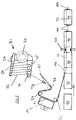
- Fig. 5 is a schematic representation of one embodiment of a flow wrapping process using the packaging material and tear tape of the present invention,
- Fig. 6 is a schematic representation of another embodiment of a flow wrapping process using the packaging material and tear tape of the present invention, and
- Fig. 7 is a schematic representation of a part of the embodiment of Figure 6.
- Referring to Figure 1, there is shown a hermetically sealed package 1, formed from packaging material. The packaging material has a
tear tape 2 adhered thereto prior to being wrapped around the product to be packaged by, for example, a flow wrapping or vacuum wrapping technique. Thus, for example, the packaging material, with thetear tape 2 attached thereto, is folded and sealed longitudinally by heat and pressure to form a tube enveloping the product (not shown) with thetear tape 2 extending longitudinally along the whole length of the tube. The ends of the tube are then sealed by heat and pressure to form end seals 3 (Fig. 3) comprising joinedportions 8,9 of packaging material between which thetear tape 2 is sandwiched. Thetear tape 2, which may be plain or printed to indicate its presence or to act as a promotional aid, is applied to the packaging material in-line as the package is formed around the product such that the surface of the tear tape including the bonding layer adheres across the full length of the package. The surface of the tear tape including the sealing layer is adhered to the package at bothend seals 3 only as a consequence of the heat and pressure used to create the end seals. To facilitate easy access to the package, a pair ofslits 4 may be provided at theend seals 3 to form a tab around thetear tape 2. In some cases, it may be sufficient to provide asingle slit 4 located on that side of thetear tape 2 most remote from the tube edge. Instead of providing one ormore slits 4, the tear tape may be positioned on or close to the edge of the package such that tear propagation from the seal serration is easy. - Figure 2 illustrates the
tear tape 2. It is flexible and strong and has a breaking strength greater than the tear resistance of the packaging material, otherwise breaking of the tear tape would occur in the opening operation. The tear tape comprises a substrate in the form of abase film 5 having, for example, a thickness of from 20 to 60 microns and a width of from 1 to 20mm. Preferably the thickness is from 25 - 40 microns and the width is from 1.5 to 15mm. - Generally, the tear tape is produced by forming a wide base film carrying the sealing layer and the bonding layer and then slitting the film to obtain tear tape of the desired width.
- The
base film 5 is formed from plastics material oriented so as to improve the cross tear resistance and to enable thinner tapes to be produced. Any monoaxially or biaxially orientated thermoplastics material may be used as the base film, provided that it is sufficiently dimensionally stable in the cross direction to facilitate accurate slitting of sheets of the material to form the substrate. It is particularly preferred for the thermoplastic plastics material to be formed from monoaxially orientated polypropylene, orientated polyethylene or orientated polyester. - On one surface of the
base film 5, is the sealinglayer 6 of plastics material to provide polymeric compatibility between thebase film 5 and theinner surface 21 of the packaging material portion 8 at theend seals 3. This compatibility ensures that a good hermetic seal is maintained between the sealinglayer 6 and theinner surface 21 when theend seal 3 is formed by pressure, thermal, ultrasonic or Radio Frequency welding. - Typically, the width of the
sealing layer 6 is equal to the base film width and the thickness is from 10 to 20 microns. Any thermoplastics material compatible withinner surface 21 may be used to form thelayer 6 provided that its softening or melting point is lower than the melting point of thebase film 5. Typically, thermoplastic polymers such as polyethylene, ethylene vinyl acetate copolymer, polyvinylidene chloride, polyamides and waxes are suitable for thelayer 6 and may be applied to thebase film 5 by any suitable coating technique such as co-extrusion or extrusion coating. It is particularly preferred for thelayer 6 to be of oriented polyethylene and to be applied to thebase film 5 using coextrusion. - Applied onto the other surface of the
base film 5 is bondinglayer 7 of plastics material. The purpose of thelayer 7 is twofold. Its prime purpose is to provide a bond between thebase film 5 and theinner surface 22 of thepackaging material portion 9 across the whole package length and at eachend seal 3 in order to ensure efficient opening. In addition, the bonding layer also ensures that a hermetic seal is maintained around the tear tape at eachend seal 3. Maintenance of a good hermetic seal around the tear tape is achieved by a portion of thebonding layer 7 flowing from its original position on the surface of thebase film 5 to the edges of the base film under the pressure and temperature required for sealing the packaging material portions at the package ends. The degree of flow during the package sealing operation is governed by the softening or melting point and viscosity of the material ofbonding layer 7. A softening point of from 70 to 120°C (Ring and Ball) and a viscosity of from 500 to 4000 centipoise at 160°C (Brookfield Viscometer, Spindle No.9, 5 r.p.m.) are preferred. It is further preferred that a plastics material possessing a softening point of from 90 - 115°C and a viscosity of from 800 - 2000 centipoise at 160°C is used. The flowing action oflayer 7 ensures that all gaps in the end seals 3 that would otherwise cause ingress of air, moisture or bacteria, are eliminated. - The width of
bonding layer 7 may be less than that of thebase film 5 and may have a coating weight of from 5 to 50 grams per square metre. Preferably an overall coating is used whereby the width is equal to the base film width and the coating weight is from 15 to 35 gsm. Any thermoplastics material may be used to form this layer providing its softening or melting point is lower than the melting point of thebase film 5 and equal to or lower than the softening or melting point of the material oflayer 6. Typically, thermoplastic polymers such as polyethylene, ethylene vinyl acetate copolymer, polyvinylidene chloride, polyamides and waxes are suitable for this application and may be applied using any suitable coating technique such as co-extrusion, extrusion coating, coating from solution or dispersion using reverse gravure, 2 roll reverse coating or Meyer bar coating. It is particularly preferred for thelayer 7 to be formed of ethylene vinyl acetate copolymer and for it to be coated onto thebase film 5 using traditional hot melt coating or extrusion coating techniques. - Figure 3 illustrates a cross sectional view of the package and tear tape. The
bonding layer 7 of the tear tape has previously been adhered topackaging material portion 9 andpackaging material portions 8 and 9 are brought together and sealed using heat and pressure to form side and end seals in a manner typical of flow wrapping and vacuum wrapping techniques. Typical packaging materials are as described above. As can be seen from Fig. 3, the gaps normally present between a conventional tear tape and theportions 8 and 9 of the packaging material at the end seals are filled by plastics material originating from thebonding layer 7, originally on the surface of the tear tape base film, as a consequence of the conditions necessary to weld the end seals 3. A portion of material from sealinglayer 6 may also transfer from its original position on the base film surface to the edges of the tear tape but it is preferred that the majority of polymer transfer originates from the material ofbonding layer 7. - Referring now to Figure 4, there is shown an alternative tear tape in accordance with the present invention. Parts corresponding to parts of Figures 1 to 3 are denoted by like reference numerals. As before the tear tape includes a substrate in the form of a base film 5' having, for example a thickness of from 20 to 60 microns and a width of 1 to 20mm, preferably a thickness of from 25 - 40 microns and a width of from 1.5 to 15mm. The plastics material of the base film 5' is orientated polyethylene. However, in this case the plastics material of the base film 5' seals to the inner surface (21) of the packaging material to facilitate a hermetic seal between the tear tape and said surface at the
end seal 3 during exposure to the temperature and pressure needed to form the end seals of the package. Thus noseparate sealing layer 6 is provided. The purpose of thebonding layer 7 is the same as that described above. The width oflayer 7 may be less than that of thebase film 5 and the layer may have a coating weight of from 20 to 100 grams per square metre. Preferably an overall coating is used whereby the width is equal to the base film width and the coating weight is from 20 to 50 gsm. Any thermoplastics material may be used to form thelayer 7 provided its softening or melting point is lower than the melting point of the base film. It is preferred for thelayer 7 to be of ethylene vinyl acetate copolymer coated onto the base film using traditional hot melt coating or extrusion coating techniques. Alternately in the case where the film, is untreated and possesses a low surface tension, thelayer 7 may be of a pressure sensitive adhesive (cold seal, hot melt, solution, dispersion or high energy curing). - Referring now to Figure 5, this illustrates diagrammatically, the use of the packaging material and tear tape in a flow wrapping process for forming packages of products.
- The Figure shows a
tear tape dispenser 31 for applying the tear tape to moving filmic packaging material under controlled tension. Thedispenser 31 is similar to that described in our European Patent No.0121371 and comprises motorisedreel 32 carrying a continuous length oftear tape 33 in accordance with the present invention. The dispenser includes a pair of relativelymoveable arms rollers 36 around which the tear tape passes. The relative displacement of thearms reel 32. - The
tear tape 33 and thepackaging material 37 are brought together aroundroller 38 such that the bonding layer (not shown) of the tear tape is adjacent to the packaging material and then fed aroundfurther rollers 39 so that they move past a heating means 40 in such a way that they are spaced from the heating means 40 by a gap 41. The heating means 40 may be in the form of an infra-red lamp or an electrical wire, wound and shrouded, element so as to produce radiant heat energy. Alternatively, the heating means 40 may utilise hot air transferred from a remote heat source by convection or mechanically forced heated gas or air. Preferably the heating means 40 is controlled such that, when the wrapping process is in a dwell situation, the heating effect is cut off in order to ensure that no heat damage occurs. This heat control can be effected by interfacing with a control signal from the wrapping machinery or by sensing the cessation of motion of the packaging material. - The heat from the heating means 40 activates the bonding layer of the tear tape so that the tear tape becomes adhered to the
packaging material 37. Thereafter thepackaging material 37, having thetear tape 33 adhered thereto is brought adjacent to a moving line ofproducts 42 to be packaged and is overlapped and sealed longitudinally (by a means not shown) so as to form atube 43 having a side seal (not shown) into which tube theproducts 42 are inserted. Anend seal 44 is then produced, at either side of each product, by the application of heat and pressure using sealing and cuttingjaws 45. Each end seal includestear tape 33 sandwiched between portions ofpackaging material 37 yet the resultant package remains air tight as previously described. - Referring now to Figures 6 & 7, parts corresponding to parts of Figure 5 are denoted by like reference numerals.
- In this case, the bonding layer of the
tear tape 33 is activated by contacting the tear tape with a heated plate. The plate comprises astainless steel sheet 51 of thickness 1.2mm to which is bonded a proprietary silicon rubber coated etchedfilm heater mat 52. Thetear tape 33 leaving thedispenser 31 passes around an adjustable guide roller 50 and is brought into contact withpackaging material 37 atroller 38 so that the bonding layer (not shown) of the tear tape isadjacent packaging material 37. Thereafter the packingmaterial 37 and teartape 33 are transported over the free surface of the heated plate. The free surface of the heated plate has a convex camber (with respect to the path of packaging material 37) so that the bonding layer of thetear tape 33 is urged against thepackaging material 37 adjacent thereto during its passage over the heated plate. The bonding layer of the tear tape melts as the tear tape and packaging material pass over theheater mat 52 so that the tear tape and packaging material become bonded together. Theheater mat 52 is located under thesteel sheet 51 at a location which allows maximum heat transfer at the zone where thetear tape 33 is to be bonded to thepackaging material 37. The heat, from theheater mat 52, is efficiently dissipated, by thesteel sheet 51, to the remaining surface of the heated plate so that the packaging material does not become distorted as a consequence of unnecessary heat influence. Sandwiched between theheater mat 52 andsteel sheet 51 is a proprietarytemperature sensing thermocouple 54 operably connected, byconnections 55, to a self-tuninglogic temperature controller 56 which, in turn, is connected to a mains supply of electricity byconnections 57. Theheater pad 52 is heated electrically viaconnections 58 from thetemperature controller 56 in accordance with a logic input received from the wrapping machine viaconnections 59. - The temperature of the
heater mat 52 is controlled to a set point bycontroller 56 and alarm set points are provided so that the heater plate temperature is maintained below the melting point of the packaging material. The temperature of theheater mat 52 is ramped proportionally to the speed of movement of thepackaging material 37. When the packaging material travels at higher speeds, upper set points are accessed to increase the temperature of themat 52 to transmit more heat energy to thetear tape 33 andpackaging material 37. - As will be apparent from the foregoing, the heater plate supports the full width of the
packaging material 37 so that it retains its integrity and is not distorted by heat. Also, by applying the heat in a zone extending over a part only of the width of thepackaging material 37, greater accuracy of heat control is obtained. - After the
tear tape 33 andpackaging material 37 have been bonded together, the combination passes overroller 53 and is brought adjacent to the moving line ofproducts 42 to produce packages of the same in a manner similar to that described with reference to Figure 5. - The following Examples illustrate the invention
- A film of monoaxially oriented polypropylene having a melting point of 176°C and a thickness of about 35 microns was formed in a conventional manner and coextruded with a 10 - 15 micron thick layer of polyethylene possessing a melting point of 115°C. In this way, there was obtained a structure comprising a polypropylene surface and a sealing layer constituted by the polyethylene. The polypropylene surface of this structure was then printed with an opening instruction using a rotogravure printing process. The printed surface was then extrusion coated with a synthetic hot melt adhesive based on ethylene vinyl acetate copolymer at a coating weight of 25 grams per square metre to form a bonding layer on the structure. The bonding layer possessed a softening point of 97°C (Ring and Ball) and a viscosity of 1,100 centipoise at 160°C (Brookfield Viscometer, Spindle No.9, 5 r.p.m.).
- The structure was then slit longitudinally in the direction of the polypropylene orientation so as to provide a plurality of tear tapes of 4mm wide having a sealing layer at one surface and a bonding layer at the opposite surface. The tapes were then traverse wound onto centres of internal diameter 152mm and width 178mm to provide reels carrying continuous lengths of tape of about 25,000 metres long.
- The tear tape was subsequently applied to an untreated polyethylene packaging film in a flow wrapping machine to produce a plurality of hermetically sealed packages, each containing a food product and including a tear tape through the entire package length including the end seals. The action of the temperature and pressure on the tear tape during the formation of the end seals caused a portion of the hot melt adhesive of the bonding layer to flow from its original position on one surface of the tear tape to the tear tape edges. This eliminated gaps in the seal and hence the ingress of air, moisture and bacteria. Additionally, the polyethylene sealing surface of the tear tape became bonded to the packaging material at the end seals to maintain the integrity of the seal. Shelf life of the food product was maintained.
- Although the tear tape of the invention is particularly suitable for opening hermetically sealed packs of foodstuffs such as cheese, bacon and cold meats, whilst allowing pack freshness to be maintained, it may also be used for opening the filmic packaging material conventionally provided around other products such as packets and cartons of cigarettes. In the case where the tear tape is used for cigarettes, it will generally be of a width of from 4 to 6mm in order to facilitate printing the tape for, for example, promotional purposes.
- The tear tape of Example 1 was applied to packaging material formed by laminating together a 20µ thick polyamide film and a 50µ thick polyethylene film. The combination was then used to form packages each containing 330g of cheese in accordance with Figures 6 and 7 using a Haysenn Flow wrapping machine operating at 60 packages per minute. The end seals 44 of the packages were achieved by applying a temperature of from 110 to 120°C using a 10mm flat sealing and cutting jaw at a pressure of 4-5 bars and a dwell time of 3-4 seconds. Before each cheese product was inserted into the
tube 43, the tube was flushed with carbon dioxide. The cheese packages were stored for 4 days in a freezer to allow the packaging material to tighten around the cheese as a consequence of the carbon dioxide being absorbed into the cheese surface. Thereafter the packages were immersed in water in a standard pressure vessel connected to a vacuum generator to simulate an internal pressure. The vacuum was held for 2 minutes and the packages were monitored for bubble formation which is indicative of a poor seal. Also the seals were examined by inspecting a section using a scanning electron microscope (800 x magnification). The tests were carried out at a vacuum of 0.6 bar and at a vacuum of 1.1 bar. Also, the tests were repeated using conventional 4mm hot melt polypropylene tear tape for comparison. The results are shown in the following Table 1: -
TABLE 1 Example 1 Tape Conventional PP Tape Seal Integrity - 0.6 bar vacuum 0% Leaks 0% Leaks Seal Integrity - 1.1 bar vacuum 0% Leaks 10% Leaks Seal Examination Tape incorporated into seal. No identifiable gaps Tape incorporated into seal. Gap seen across tape width at top surface of 5µ. - The tear tape of Example 1 was applied to packaging material in the form of a 65µ PET/PE film. The combination was then used to form packages each consisting of 8 rashers of back bacon in accordance with Figures 6 and 7 using a Multi-Vac M860 Vacuum Sealing Line incorporating primary vacuum only and operating at 8 cycles per minute. The end seals were achieved at 120°C and 1000 mbar vacuum was used. The integrity of the seals was examined in the manner described in Example 2 but using different immersion periods. Packages which would leak when subjected to this test would allow ingress of air. The experiment was repeated using a tear tape similar to that of Example 1 but of width 2mm only and also using conventional hot melt polypropylene tear tape of widths 2mm and 4mm. The results are shown in following Table 2.
-
TABLE 2 Example 1 Tape Conventional PP Tape Day 0 - 1.1 bar Vacuum 0 % Leaks 5% Leaks Day 1 - 1.1 bar Vacuum 0% Leaks 10% Leaks Day 15 - 1.1 bar Vacuum 0% Leaks 100% Leaks Day 56 (Expiry date for contents) 0% Leaks 100% Leaks - At the end of the term the package incorporating the tape of Example 1 still contained meat that appeared satisfactory whereas the packages incorporating the conventional tape had lost all vacuum and the contents had deteriorated in quality.
- Both 2mm and 4mm tapes behaved in a similar manner.
Claims (10)
- In combination, packaging material (37) suitable for forming a hermetically sealed package and a tear tape (33) attached thereto, which tear tape includes (i) a surface (5') (6) capable of sealing to the packaging material under the conditions required for sealing together portions (8,9) of the packaging material to form end seals (3) (44) of the package and (ii) a surface (7) bonded to the packaging material and formed of a component which flows under said conditions.
- The combination of claim 1 wherein the tear tape includes a substrate formed from an oriented base film (5) of thermoplastic plastics material.
- The combination of claim 2 wherein (i) one surface of the base film carries a layer (6) of plastics material capable of sealing to the packaging material under the conditions required for sealing together portions of the packaging material to form the end seals of the package which plastics material has a lower softening or melting point than the melting point of the tear tape base film and the packaging material and (ii) another surface of the base film is coated with a layer (7) which bonds the tear tape to the packaging material along the whole length of the package and which flows under the conditions required to seal the packaging material together when forming the end seals.
- The combination of claim 3 wherein the layer coated on said another surface is a layer of hot melt adhesive.
- The combination of claim 4 wherein the hot melt adhesive is based on an ethylene vinyl acetate copolymer.
- The combination of any preceding claim wherein the packaging material is an LDPE/PVDC/LDPE multi-layer material, a PVDC coated PET/LDPE material; a metallised PET/LDPE material; or a cast polyamide/LDPE material.
- A tear tape for use in the combination of any preceding claim, which tear tape comprises:-(i) a film (5) having a thickness of from 20 to 60 microns and a width of from 1 to 20mm and formed of oriented polypropylene or oriented polyester,(ii) a sealing layer (6) of thickness of from 5 to 40 microns provided on one surface of the film to enable the tear tape to be sealed to polyethylene-, polyethylene terephthalate-, or polyamide-based filmic packaging material, said sealing layer having a softening or melting point which is less than the melting point of the film and being formed from polyethylene, ethylene/vinyl acetate copolymer, polyvinylidene chloride, polyamide or wax, and(iii) a bonding layer (7) provided on the opposite surface of the film at a coating weight of from 5 to 50 gram per square metre, said bonding layer having a softening or melting point which is less than the melting point of the film, less than or equal to the softening point or melting point of the sealing layer, and is from 70 to 120°C (Ring and Ball), having a viscosity of from 500 to 4000 centipoises at 160°C (Brookfield, Spindle No.9, 5 r.p.m.), and being formed of polyethylene, ethylene/vinyl acetate copolymer, polyvinylidene chloride, polyamide or wax.
- A tear tape for use in the combination of any one of claims 1 to 6, which tear tape comprises:(i) a film (5') having a thickness of from 20 to 60 microns and a width of from 1 to 20mm and formed from oriented polyethylene, and(ii) a bonding layer (7) provided on a surface of the film at a coating weight of from 20 to 100 grams per square metre, said bonding layer having a softening or melting point which is less than the melting point of the film and is from 70°C to 120°C (Ring and Ball), having a viscosity of from 500 to 4000 centipoises at 160°C (Brookfield Spindle No.9, 5 r.p.m.), and being formed of ethylene/vinyl acetate copolymer or, in the case where the film is untreated and possesses a low surface tension, a pressure sensitive adhesive.
- A method of forming a package for a product (42) which comprises(i) providing a tear tape as claimed in claim 7 or 8,(ii) attaching packaging material and the tear tape together by heat activating the bonding layer (7) of the tear tape and bringing the bonding layer into contact with the packaging material(iii) overlapping the packaging material to form a tube (43) including a side seal,(iv) inserting the product in the tube, and(v) closing the tube by forming end seals (3) using heat and pressure so that the tear tape is sandwiched between layers (8,9) of packaging material at the end seals.
- A method according to claim 9 wherein the bonding layer is activated and brought into contact with the packaging material by passing the tear tape and packaging material over a heated plate (51,52).
Applications Claiming Priority (4)
| Application Number | Priority Date | Filing Date | Title |
|---|---|---|---|
| GBGB9520015.0A GB9520015D0 (en) | 1995-09-28 | 1995-09-28 | Improvements in or relating to tear tapes |
| GB9520015 | 1995-09-28 | ||
| GB9609656 | 1996-05-09 | ||
| GBGB9609656.5A GB9609656D0 (en) | 1996-05-09 | 1996-05-09 | Improvements in or relating to tear tapes |
Publications (2)
| Publication Number | Publication Date |
|---|---|
| EP0765818A1 true EP0765818A1 (en) | 1997-04-02 |
| EP0765818B1 EP0765818B1 (en) | 2004-11-24 |
Family
ID=26307849
Family Applications (1)
| Application Number | Title | Priority Date | Filing Date |
|---|---|---|---|
| EP96306946A Expired - Lifetime EP0765818B1 (en) | 1995-09-28 | 1996-09-24 | Adhesive tape |
Country Status (14)
| Country | Link |
|---|---|
| US (1) | US6228458B1 (en) |
| EP (1) | EP0765818B1 (en) |
| JP (1) | JP3796304B2 (en) |
| KR (1) | KR970073944A (en) |
| AT (1) | ATE283212T1 (en) |
| BR (1) | BR9603922A (en) |
| CA (1) | CA2186666C (en) |
| DE (1) | DE69633895T2 (en) |
| DK (1) | DK0765818T3 (en) |
| ES (1) | ES2233958T3 (en) |
| HU (1) | HU218476B (en) |
| MY (1) | MY127457A (en) |
| PT (1) | PT765818E (en) |
| TR (1) | TR199600758A2 (en) |
Cited By (3)
| Publication number | Priority date | Publication date | Assignee | Title |
|---|---|---|---|---|
| EP1566346A1 (en) * | 2004-02-19 | 2005-08-24 | Wipak Walsrode GmbH & Co. KG | Tear strip and use of the same for making film packs |
| EP1733871A1 (en) * | 2005-06-15 | 2006-12-20 | Wipak Walsrode GmbH & Co. KG | Procedure for making durable goods in a plastic foil packing |
| US8584435B2 (en) | 2001-10-09 | 2013-11-19 | Filtrona United Kingdom Ltd. | Anti-counterfeit measures |
Families Citing this family (23)
| Publication number | Priority date | Publication date | Assignee | Title |
|---|---|---|---|---|
| US6416841B1 (en) * | 1997-12-10 | 2002-07-09 | Pechiney Emballage Flexible Europe | Tear tape for plastic packaging |
| PL347153A1 (en) * | 1998-10-06 | 2002-03-25 | Focke & Co | Cigarette package |
| US20040127340A1 (en) * | 2002-03-18 | 2004-07-01 | Celomat Etiquetas Especiales S.A. | Process for the manufacture of an easy open device for flow pack or similar packages with longitudinal seams, opening device obtained by said process, and package using it |
| CA2437290A1 (en) * | 2003-08-13 | 2005-02-13 | Sylvain Beaulieu | Pom pt one step with a cross directional ripping-strip |
| EP1508530A1 (en) * | 2003-08-18 | 2005-02-23 | Nestec S.A. | Flexible packaging and method of manufacture |
| US7334679B2 (en) * | 2004-03-15 | 2008-02-26 | Hollister Incorporated | Tear open package for hydrophilic-coated catheter |
| US20050220377A1 (en) * | 2004-04-03 | 2005-10-06 | John Hanus | Tear string opening system for flexible container |
| DE602005014643D1 (en) * | 2005-09-28 | 2009-07-09 | Kraft Foods R & D Inc | Method and machine for packaging a product, and packaging containing in particular coffee |
| AU2007257823B2 (en) * | 2006-06-08 | 2013-05-02 | Hollister Incorporated | Catheter product package and method of forming same |
| EP2060296B1 (en) * | 2007-11-19 | 2016-08-24 | Hollister Incorporated | Vapor hydrated catheter assembly and method of making same |
| EP2141085B1 (en) * | 2008-06-30 | 2013-08-07 | Nestec S.A. | Easy opening packaging for food products |
| RU2503603C2 (en) * | 2008-09-08 | 2014-01-10 | Лтс Ломанн Терапи-Зюстеме Аг | Inaccessible for opening by children individual package for transdermal therapeutic systems or dosage forms of film and plate type |
| US20120042883A1 (en) * | 2010-08-17 | 2012-02-23 | Internationl Oddities, Inc. | Composite Packaging System For Particulate Smokable Product |
| US20130333331A1 (en) * | 2011-03-21 | 2013-12-19 | Mukul Chandra Gope | Method of packing edibles |
| USD734165S1 (en) | 2013-03-14 | 2015-07-14 | Hollister, Inc. | Catheter package |
| EP2968832B1 (en) | 2013-03-14 | 2019-07-17 | Hollister Incorporated | Medical product package |
| EP2969827A1 (en) * | 2013-03-15 | 2016-01-20 | Altria Client Services LLC | Labeled container |
| GB201409459D0 (en) * | 2014-05-28 | 2014-07-09 | British American Tobacco Co | Smoking article pack |
| USD764943S1 (en) | 2014-06-04 | 2016-08-30 | Hollister Incorporated | Catheter package |
| USD746152S1 (en) | 2014-06-04 | 2015-12-29 | Hollister Incorporated | Catheter package |
| JP2019177905A (en) * | 2018-03-30 | 2019-10-17 | 株式会社サンエー化研 | Package for heat treatment |
| US12012270B2 (en) * | 2018-12-20 | 2024-06-18 | Conmed Corporation | Medical electrode tear strip |
| US12613512B2 (en) * | 2021-06-24 | 2026-04-28 | Anritsu Corporation | Production management system and non-transitory storage medium storing production management program |
Citations (4)
| Publication number | Priority date | Publication date | Assignee | Title |
|---|---|---|---|---|
| EP0042832A1 (en) * | 1980-06-19 | 1981-12-30 | Teich Aktiengesellschaft | Package |
| US4410575A (en) * | 1981-07-16 | 1983-10-18 | Hiraoka & Co., Ltd. | Lap welding method for textile fabrics |
| US4410582A (en) * | 1980-12-10 | 1983-10-18 | Toray Industries, Inc. | Multi-layered polyolefin laminated film |
| US4681797A (en) * | 1984-09-26 | 1987-07-21 | Cobelplast N.V.S.A. | Thermoformable, multi-layer plastic sheet having gas barrier properties |
Family Cites Families (11)
| Publication number | Priority date | Publication date | Assignee | Title |
|---|---|---|---|---|
| DE2323643A1 (en) | 1973-05-10 | 1974-11-28 | Union Deutsche Lebensmittelwer | Tear strip for film sachets - comprising plastic tape suspended between pack welds |
| EP0015063A1 (en) * | 1979-02-14 | 1980-09-03 | Imperial Chemical Industries Plc | Film tear-tape and packaging film having tear-tape adherent thereto |
| ATE34720T1 (en) | 1983-03-31 | 1988-06-15 | Payne Packaging Ltd | STRIPES. |
| NL8304020A (en) | 1983-11-22 | 1985-06-17 | Ind Verpakkings Mechanisatie T | METHOD AND APPARATUS FOR PACKING AN ARTICLE |
| DE3401218C3 (en) | 1984-01-14 | 1993-12-02 | Hoechst Ag | Process for producing a heat-sealable packaging film |
| FR2558802B1 (en) | 1984-02-01 | 1986-11-21 | Grellier Jean | NEW PACKING STRIP PACKAGING, AND APPARATUS FOR MANUFACTURING SAME |
| US4720011A (en) | 1986-09-30 | 1988-01-19 | E. I. Du Pont De Nemours And Company | Package having tearstrip opener |
| US5249676A (en) * | 1991-05-07 | 1993-10-05 | R. J. Reynolds Tobacco Company | Flavor burst structure and method of making the same |
| GB9222744D0 (en) | 1992-10-29 | 1992-12-09 | Carrs Paper Ltd | Wrapping elongate articles |
| JP3235227B2 (en) | 1992-10-30 | 2001-12-04 | ソニー株式会社 | Overlap film and lapping method using the overlap film |
| US5520868A (en) * | 1994-01-24 | 1996-05-28 | Kt Industries Inc. | Forming pressure sensitive adhesive tape |
-
1996
- 1996-09-20 MY MYPI96003897A patent/MY127457A/en unknown
- 1996-09-24 PT PT96306946T patent/PT765818E/en unknown
- 1996-09-24 DK DK96306946T patent/DK0765818T3/en active
- 1996-09-24 AT AT96306946T patent/ATE283212T1/en active
- 1996-09-24 EP EP96306946A patent/EP0765818B1/en not_active Expired - Lifetime
- 1996-09-24 ES ES96306946T patent/ES2233958T3/en not_active Expired - Lifetime
- 1996-09-24 DE DE69633895T patent/DE69633895T2/en not_active Expired - Lifetime
- 1996-09-25 KR KR1019960042542A patent/KR970073944A/en not_active Withdrawn
- 1996-09-26 TR TR96/00758A patent/TR199600758A2/en unknown
- 1996-09-27 HU HU9602654A patent/HU218476B/en unknown
- 1996-09-27 US US08/720,073 patent/US6228458B1/en not_active Expired - Lifetime
- 1996-09-27 CA CA002186666A patent/CA2186666C/en not_active Expired - Lifetime
- 1996-09-27 BR BR9603922A patent/BR9603922A/en not_active IP Right Cessation
- 1996-09-30 JP JP25875696A patent/JP3796304B2/en not_active Expired - Fee Related
Patent Citations (4)
| Publication number | Priority date | Publication date | Assignee | Title |
|---|---|---|---|---|
| EP0042832A1 (en) * | 1980-06-19 | 1981-12-30 | Teich Aktiengesellschaft | Package |
| US4410582A (en) * | 1980-12-10 | 1983-10-18 | Toray Industries, Inc. | Multi-layered polyolefin laminated film |
| US4410575A (en) * | 1981-07-16 | 1983-10-18 | Hiraoka & Co., Ltd. | Lap welding method for textile fabrics |
| US4681797A (en) * | 1984-09-26 | 1987-07-21 | Cobelplast N.V.S.A. | Thermoformable, multi-layer plastic sheet having gas barrier properties |
Cited By (3)
| Publication number | Priority date | Publication date | Assignee | Title |
|---|---|---|---|---|
| US8584435B2 (en) | 2001-10-09 | 2013-11-19 | Filtrona United Kingdom Ltd. | Anti-counterfeit measures |
| EP1566346A1 (en) * | 2004-02-19 | 2005-08-24 | Wipak Walsrode GmbH & Co. KG | Tear strip and use of the same for making film packs |
| EP1733871A1 (en) * | 2005-06-15 | 2006-12-20 | Wipak Walsrode GmbH & Co. KG | Procedure for making durable goods in a plastic foil packing |
Also Published As
| Publication number | Publication date |
|---|---|
| HUP9602654A3 (en) | 2000-03-28 |
| US6228458B1 (en) | 2001-05-08 |
| ATE283212T1 (en) | 2004-12-15 |
| CA2186666C (en) | 2007-09-18 |
| BR9603922A (en) | 1998-06-09 |
| TR199600758A2 (en) | 1997-04-22 |
| PT765818E (en) | 2005-04-29 |
| EP0765818B1 (en) | 2004-11-24 |
| HUP9602654A2 (en) | 1997-05-28 |
| MY127457A (en) | 2006-12-29 |
| DK0765818T3 (en) | 2005-04-04 |
| KR970073944A (en) | 1997-12-10 |
| DE69633895T2 (en) | 2006-03-02 |
| DE69633895D1 (en) | 2004-12-30 |
| HU218476B (en) | 2000-09-28 |
| HU9602654D0 (en) | 1996-11-28 |
| JPH09110073A (en) | 1997-04-28 |
| ES2233958T3 (en) | 2005-06-16 |
| CA2186666A1 (en) | 1997-03-29 |
| JP3796304B2 (en) | 2006-07-12 |
Similar Documents
| Publication | Publication Date | Title |
|---|---|---|
| EP0765818B1 (en) | Adhesive tape | |
| US3926311A (en) | Peel-seal containers | |
| EP1154892B1 (en) | Ultrasonic welding apparatus | |
| US20040112779A1 (en) | Tampon package and method for making same | |
| US5419795A (en) | High slip packaging film with trapped print | |
| PT868368E (en) | SHUTTER STRUCTURE FOR A CONTAINER | |
| US3663240A (en) | Package and method of making same | |
| US20040173492A1 (en) | Reclosable packages and method for forming, filling and sealing such packages | |
| WO2012121716A1 (en) | Gusseted bag with easy-open lap seal | |
| WO1995033621A1 (en) | Laminates for form-fill-seal packaging | |
| EP0729898B1 (en) | Film and pouch with patch of high elongation | |
| US8387348B2 (en) | Aseptic packaging system, packaging process and package with internal fitment | |
| EP1406817A1 (en) | Process for splicing a continuous strip of packets as well as the strip thus obtained | |
| WO2019036315A1 (en) | Pouch with integrated spout and reclosable feature for dispensing and associated methods | |
| AU2003289167B2 (en) | Laminate material, laminate material manufacturing method, laminate material heat-sealing method, and package container | |
| US8375686B2 (en) | Aseptic packaging system, packaging process and package with external fitment | |
| CN119095719A (en) | A method, device and component kit for producing packaging | |
| JPH09226843A (en) | Package, its manufacturing apparatus, and manufacturing method | |
| US20070128386A1 (en) | Laminate structure for sealing channel leakers | |
| JP2004224343A (en) | Strip tape and packaging container | |
| EP0445705A1 (en) | Method and apparatus for tightly wrapping an article with a synthetic film | |
| CA1157755A (en) | Method and apparatus for heat sealing | |
| JPH06247428A (en) | Packing method and device including freshness keeper bag with detecting agent | |
| JPH04294760A (en) | Packaged article | |
| CA2138913A1 (en) | Laminates for form-fill seal packaging |
Legal Events
| Date | Code | Title | Description |
|---|---|---|---|
| PUAI | Public reference made under article 153(3) epc to a published international application that has entered the european phase |
Free format text: ORIGINAL CODE: 0009012 |
|
| AK | Designated contracting states |
Kind code of ref document: A1 Designated state(s): AT BE CH DE DK ES FR GB GR IE IT LI NL PT SE |
|
| 17P | Request for examination filed |
Effective date: 19970506 |
|
| 17Q | First examination report despatched |
Effective date: 19980720 |
|
| GRAP | Despatch of communication of intention to grant a patent |
Free format text: ORIGINAL CODE: EPIDOSNIGR1 |
|
| GRAS | Grant fee paid |
Free format text: ORIGINAL CODE: EPIDOSNIGR3 |
|
| GRAA | (expected) grant |
Free format text: ORIGINAL CODE: 0009210 |
|
| AK | Designated contracting states |
Kind code of ref document: B1 Designated state(s): AT BE CH DE DK ES FR GB GR IE IT LI NL PT SE |
|
| REG | Reference to a national code |
Ref country code: GB Ref legal event code: FG4D |
|
| REG | Reference to a national code |
Ref country code: CH Ref legal event code: EP |
|
| REF | Corresponds to: |
Ref document number: 69633895 Country of ref document: DE Date of ref document: 20041230 Kind code of ref document: P |
|
| REG | Reference to a national code |
Ref country code: IE Ref legal event code: FG4D |
|
| REG | Reference to a national code |
Ref country code: SE Ref legal event code: TRGR |
|
| REG | Reference to a national code |
Ref country code: GR Ref legal event code: EP Ref document number: 20050400631 Country of ref document: GR |
|
| REG | Reference to a national code |
Ref country code: CH Ref legal event code: NV Representative=s name: R. A. EGLI & CO. PATENTANWAELTE |
|
| REG | Reference to a national code |
Ref country code: DK Ref legal event code: T3 |
|
| REG | Reference to a national code |
Ref country code: PT Ref legal event code: SC4A Free format text: AVAILABILITY OF NATIONAL TRANSLATION Effective date: 20050218 |
|
| REG | Reference to a national code |
Ref country code: ES Ref legal event code: FG2A Ref document number: 2233958 Country of ref document: ES Kind code of ref document: T3 |
|
| PLBI | Opposition filed |
Free format text: ORIGINAL CODE: 0009260 |
|
| PLAX | Notice of opposition and request to file observation + time limit sent |
Free format text: ORIGINAL CODE: EPIDOSNOBS2 |
|
| 26 | Opposition filed |
Opponent name: WIPAK WALSRODE GMBH & CO. KG Effective date: 20050824 |
|
| ET | Fr: translation filed | ||
| NLR1 | Nl: opposition has been filed with the epo |
Opponent name: WIPAK WALSRODE GMBH & CO. KG |
|
| PLAF | Information modified related to communication of a notice of opposition and request to file observations + time limit |
Free format text: ORIGINAL CODE: EPIDOSCOBS2 |
|
| PLAF | Information modified related to communication of a notice of opposition and request to file observations + time limit |
Free format text: ORIGINAL CODE: EPIDOSCOBS2 |
|
| PLAF | Information modified related to communication of a notice of opposition and request to file observations + time limit |
Free format text: ORIGINAL CODE: EPIDOSCOBS2 |
|
| PLBB | Reply of patent proprietor to notice(s) of opposition received |
Free format text: ORIGINAL CODE: EPIDOSNOBS3 |
|
| PLCK | Communication despatched that opposition was rejected |
Free format text: ORIGINAL CODE: EPIDOSNREJ1 |
|
| PLBN | Opposition rejected |
Free format text: ORIGINAL CODE: 0009273 |
|
| STAA | Information on the status of an ep patent application or granted ep patent |
Free format text: STATUS: OPPOSITION REJECTED |
|
| 27O | Opposition rejected |
Effective date: 20090910 |
|
| NLR2 | Nl: decision of opposition |
Effective date: 20090910 |
|
| REG | Reference to a national code |
Ref country code: PT Ref legal event code: PC4A Owner name: FILTRONA C & SP LIMITED, GB Effective date: 20110719 |
|
| REG | Reference to a national code |
Ref country code: CH Ref legal event code: PUE Owner name: FILTRONA C & SP LIMITED GILTWAY Free format text: P.P. PAYNE LTD#GILTWAY, GILTBROOK#NOTTINGHAM NG16 2GT (GB) -TRANSFER TO- FILTRONA C & SP LIMITED GILTWAY#GILTBROOK,#NOTTINGHAM NG16 2GT (GB) |
|
| REG | Reference to a national code |
Ref country code: FR Ref legal event code: TP Owner name: FILTRONA C & SP LIMITED, GB Effective date: 20110926 |
|
| REG | Reference to a national code |
Ref country code: NL Ref legal event code: SD Effective date: 20111027 |
|
| REG | Reference to a national code |
Ref country code: GB Ref legal event code: 732E Free format text: REGISTERED BETWEEN 20120105 AND 20120111 |
|
| REG | Reference to a national code |
Ref country code: DE Ref legal event code: R082 Ref document number: 69633895 Country of ref document: DE Representative=s name: HASELTINE LAKE LLP, DE Effective date: 20120322 Ref country code: DE Ref legal event code: R081 Ref document number: 69633895 Country of ref document: DE Owner name: FILTRONA C & SP LIMITED, GILTBROOK, GB Free format text: FORMER OWNER: P.P. PAYNE LTD., NOTTINGHAM, GB Effective date: 20120322 |
|
| REG | Reference to a national code |
Ref country code: FR Ref legal event code: PLFP Year of fee payment: 20 |
|
| PGFP | Annual fee paid to national office [announced via postgrant information from national office to epo] |
Ref country code: ES Payment date: 20150929 Year of fee payment: 20 Ref country code: CH Payment date: 20150923 Year of fee payment: 20 Ref country code: PT Payment date: 20150918 Year of fee payment: 20 Ref country code: IE Payment date: 20150918 Year of fee payment: 20 Ref country code: GB Payment date: 20150923 Year of fee payment: 20 |
|
| PGFP | Annual fee paid to national office [announced via postgrant information from national office to epo] |
Ref country code: FR Payment date: 20150925 Year of fee payment: 20 Ref country code: BE Payment date: 20150923 Year of fee payment: 20 Ref country code: AT Payment date: 20150923 Year of fee payment: 20 Ref country code: SE Payment date: 20150918 Year of fee payment: 20 Ref country code: GR Payment date: 20150925 Year of fee payment: 20 |
|
| PGFP | Annual fee paid to national office [announced via postgrant information from national office to epo] |
Ref country code: IT Payment date: 20150924 Year of fee payment: 20 Ref country code: DK Payment date: 20150930 Year of fee payment: 20 |
|
| PGFP | Annual fee paid to national office [announced via postgrant information from national office to epo] |
Ref country code: DE Payment date: 20150925 Year of fee payment: 20 |
|
| PGFP | Annual fee paid to national office [announced via postgrant information from national office to epo] |
Ref country code: NL Payment date: 20151005 Year of fee payment: 20 |
|
| REG | Reference to a national code |
Ref country code: DE Ref legal event code: R071 Ref document number: 69633895 Country of ref document: DE |
|
| REG | Reference to a national code |
Ref country code: DK Ref legal event code: EUP Effective date: 20160924 |
|
| REG | Reference to a national code |
Ref country code: NL Ref legal event code: MK Effective date: 20160923 |
|
| REG | Reference to a national code |
Ref country code: CH Ref legal event code: PL |
|
| REG | Reference to a national code |
Ref country code: GB Ref legal event code: PE20 Expiry date: 20160923 |
|
| PG25 | Lapsed in a contracting state [announced via postgrant information from national office to epo] |
Ref country code: GB Free format text: LAPSE BECAUSE OF EXPIRATION OF PROTECTION Effective date: 20160923 |
|
| REG | Reference to a national code |
Ref country code: SE Ref legal event code: EUG |
|
| REG | Reference to a national code |
Ref country code: IE Ref legal event code: MK9A |
|
| REG | Reference to a national code |
Ref country code: AT Ref legal event code: MK07 Ref document number: 283212 Country of ref document: AT Kind code of ref document: T Effective date: 20160924 |
|
| REG | Reference to a national code |
Ref country code: ES Ref legal event code: FD2A Effective date: 20170102 |
|
| PG25 | Lapsed in a contracting state [announced via postgrant information from national office to epo] |
Ref country code: IE Free format text: LAPSE BECAUSE OF EXPIRATION OF PROTECTION Effective date: 20160924 |
|
| REG | Reference to a national code |
Ref country code: GR Ref legal event code: MA Ref document number: 20050400631 Country of ref document: GR Effective date: 20160925 |
|
| PG25 | Lapsed in a contracting state [announced via postgrant information from national office to epo] |
Ref country code: PT Free format text: LAPSE BECAUSE OF EXPIRATION OF PROTECTION Effective date: 20161004 Ref country code: ES Free format text: LAPSE BECAUSE OF EXPIRATION OF PROTECTION Effective date: 20160925 |