EP0766328A1 - Matériau d'électrode graphitique pour accumulateur et procédé de sa fabrication - Google Patents
Matériau d'électrode graphitique pour accumulateur et procédé de sa fabrication Download PDFInfo
- Publication number
- EP0766328A1 EP0766328A1 EP96306980A EP96306980A EP0766328A1 EP 0766328 A1 EP0766328 A1 EP 0766328A1 EP 96306980 A EP96306980 A EP 96306980A EP 96306980 A EP96306980 A EP 96306980A EP 0766328 A1 EP0766328 A1 EP 0766328A1
- Authority
- EP
- European Patent Office
- Prior art keywords
- graphitic
- electrode
- secondary battery
- electrode material
- doping
- Prior art date
- Legal status (The legal status is an assumption and is not a legal conclusion. Google has not performed a legal analysis and makes no representation as to the accuracy of the status listed.)
- Withdrawn
Links
- 239000007772 electrode material Substances 0.000 title claims abstract description 27
- 238000000034 method Methods 0.000 title claims abstract description 27
- 230000008569 process Effects 0.000 title claims abstract description 16
- 238000004519 manufacturing process Methods 0.000 title description 5
- -1 polycyclic aromatic compound Chemical class 0.000 claims abstract description 18
- 239000011261 inert gas Substances 0.000 claims abstract description 13
- 230000002829 reductive effect Effects 0.000 claims abstract description 13
- 238000002441 X-ray diffraction Methods 0.000 claims abstract description 12
- 239000011968 lewis acid catalyst Substances 0.000 claims abstract description 10
- 230000000379 polymerizing effect Effects 0.000 claims abstract description 3
- 239000007833 carbon precursor Substances 0.000 claims description 19
- 239000003575 carbonaceous material Substances 0.000 claims description 15
- VSCWAEJMTAWNJL-UHFFFAOYSA-K aluminium trichloride Chemical compound Cl[Al](Cl)Cl VSCWAEJMTAWNJL-UHFFFAOYSA-K 0.000 claims description 10
- 239000000758 substrate Substances 0.000 claims description 10
- 239000011230 binding agent Substances 0.000 claims description 9
- 239000002131 composite material Substances 0.000 claims description 8
- 238000010438 heat treatment Methods 0.000 claims description 7
- MWPLVEDNUUSJAV-UHFFFAOYSA-N anthracene Chemical compound C1=CC=CC2=CC3=CC=CC=C3C=C21 MWPLVEDNUUSJAV-UHFFFAOYSA-N 0.000 claims description 4
- WTEOIRVLGSZEPR-UHFFFAOYSA-N boron trifluoride Chemical compound FB(F)F WTEOIRVLGSZEPR-UHFFFAOYSA-N 0.000 claims description 4
- 239000003792 electrolyte Substances 0.000 claims description 4
- BBEAQIROQSPTKN-UHFFFAOYSA-N pyrene Chemical compound C1=CC=C2C=CC3=CC=CC4=CC=C1C2=C43 BBEAQIROQSPTKN-UHFFFAOYSA-N 0.000 claims description 4
- JIAARYAFYJHUJI-UHFFFAOYSA-L zinc dichloride Chemical compound [Cl-].[Cl-].[Zn+2] JIAARYAFYJHUJI-UHFFFAOYSA-L 0.000 claims description 4
- LEMQFBIYMVUIIG-UHFFFAOYSA-N trifluoroborane;hydrofluoride Chemical compound F.FB(F)F LEMQFBIYMVUIIG-UHFFFAOYSA-N 0.000 claims description 3
- 229910015900 BF3 Inorganic materials 0.000 claims description 2
- GVEPBJHOBDJJJI-UHFFFAOYSA-N fluoranthrene Natural products C1=CC(C2=CC=CC=C22)=C3C2=CC=CC3=C1 GVEPBJHOBDJJJI-UHFFFAOYSA-N 0.000 claims description 2
- FBAFATDZDUQKNH-UHFFFAOYSA-M iron chloride Chemical compound [Cl-].[Fe] FBAFATDZDUQKNH-UHFFFAOYSA-M 0.000 claims description 2
- PUGUQINMNYINPK-UHFFFAOYSA-N tert-butyl 4-(2-chloroacetyl)piperazine-1-carboxylate Chemical compound CC(C)(C)OC(=O)N1CCN(C(=O)CCl)CC1 PUGUQINMNYINPK-UHFFFAOYSA-N 0.000 claims description 2
- HPGGPRDJHPYFRM-UHFFFAOYSA-J tin(iv) chloride Chemical compound Cl[Sn](Cl)(Cl)Cl HPGGPRDJHPYFRM-UHFFFAOYSA-J 0.000 claims description 2
- 239000011592 zinc chloride Substances 0.000 claims description 2
- 235000005074 zinc chloride Nutrition 0.000 claims description 2
- JJSIUBZZFXWGBE-UHFFFAOYSA-N acenaphthylene;1,2-dihydroacenaphthylene Chemical group C1=CC(CC2)=C3C2=CC=CC3=C1.C1=CC(C=C2)=C3C2=CC=CC3=C1 JJSIUBZZFXWGBE-UHFFFAOYSA-N 0.000 claims 1
- 239000000463 material Substances 0.000 abstract description 94
- 230000002427 irreversible effect Effects 0.000 abstract description 8
- 238000007600 charging Methods 0.000 abstract description 6
- 238000007599 discharging Methods 0.000 abstract description 5
- 229910052744 lithium Inorganic materials 0.000 description 27
- 238000005087 graphitization Methods 0.000 description 25
- WHXSMMKQMYFTQS-UHFFFAOYSA-N Lithium Chemical compound [Li] WHXSMMKQMYFTQS-UHFFFAOYSA-N 0.000 description 24
- OKTJSMMVPCPJKN-UHFFFAOYSA-N Carbon Chemical compound [C] OKTJSMMVPCPJKN-UHFFFAOYSA-N 0.000 description 20
- 239000013543 active substance Substances 0.000 description 18
- 239000002245 particle Substances 0.000 description 17
- 230000000052 comparative effect Effects 0.000 description 16
- XKRFYHLGVUSROY-UHFFFAOYSA-N Argon Chemical compound [Ar] XKRFYHLGVUSROY-UHFFFAOYSA-N 0.000 description 14
- 239000007789 gas Substances 0.000 description 14
- 229910002804 graphite Inorganic materials 0.000 description 13
- 239000010439 graphite Substances 0.000 description 13
- IJGRMHOSHXDMSA-UHFFFAOYSA-N Atomic nitrogen Chemical compound N#N IJGRMHOSHXDMSA-UHFFFAOYSA-N 0.000 description 10
- 229910001873 dinitrogen Inorganic materials 0.000 description 10
- 238000010298 pulverizing process Methods 0.000 description 9
- JUJWROOIHBZHMG-UHFFFAOYSA-N Pyridine Chemical compound C1=CC=NC=C1 JUJWROOIHBZHMG-UHFFFAOYSA-N 0.000 description 8
- SMWDFEZZVXVKRB-UHFFFAOYSA-N Quinoline Chemical compound N1=CC=CC2=CC=CC=C21 SMWDFEZZVXVKRB-UHFFFAOYSA-N 0.000 description 8
- 239000008151 electrolyte solution Substances 0.000 description 8
- 239000011295 pitch Substances 0.000 description 8
- 229910052786 argon Inorganic materials 0.000 description 7
- 239000011324 bead Substances 0.000 description 6
- 238000003763 carbonization Methods 0.000 description 6
- 239000003054 catalyst Substances 0.000 description 6
- 229910052751 metal Inorganic materials 0.000 description 6
- 239000002184 metal Substances 0.000 description 6
- 238000012719 thermal polymerization Methods 0.000 description 6
- 210000004027 cell Anatomy 0.000 description 5
- UFWIBTONFRDIAS-UHFFFAOYSA-N Naphthalene Chemical compound C1=CC=CC2=CC=CC=C21 UFWIBTONFRDIAS-UHFFFAOYSA-N 0.000 description 4
- 239000003125 aqueous solvent Substances 0.000 description 4
- 238000001354 calcination Methods 0.000 description 4
- 230000000694 effects Effects 0.000 description 4
- 239000010419 fine particle Substances 0.000 description 4
- 239000000203 mixture Substances 0.000 description 4
- 238000006116 polymerization reaction Methods 0.000 description 4
- UMJSCPRVCHMLSP-UHFFFAOYSA-N pyridine Natural products COC1=CC=CN=C1 UMJSCPRVCHMLSP-UHFFFAOYSA-N 0.000 description 4
- 238000010000 carbonizing Methods 0.000 description 3
- 238000012937 correction Methods 0.000 description 3
- 230000005484 gravity Effects 0.000 description 3
- 230000001590 oxidative effect Effects 0.000 description 3
- 239000011301 petroleum pitch Substances 0.000 description 3
- 239000007774 positive electrode material Substances 0.000 description 3
- 239000002243 precursor Substances 0.000 description 3
- 238000012360 testing method Methods 0.000 description 3
- DHKHKXVYLBGOIT-UHFFFAOYSA-N 1,1-Diethoxyethane Chemical compound CCOC(C)OCC DHKHKXVYLBGOIT-UHFFFAOYSA-N 0.000 description 2
- YEJRWHAVMIAJKC-UHFFFAOYSA-N 4-Butyrolactone Chemical compound O=C1CCCO1 YEJRWHAVMIAJKC-UHFFFAOYSA-N 0.000 description 2
- RYGMFSIKBFXOCR-UHFFFAOYSA-N Copper Chemical compound [Cu] RYGMFSIKBFXOCR-UHFFFAOYSA-N 0.000 description 2
- OIFBSDVPJOWBCH-UHFFFAOYSA-N Diethyl carbonate Chemical compound CCOC(=O)OCC OIFBSDVPJOWBCH-UHFFFAOYSA-N 0.000 description 2
- KMTRUDSVKNLOMY-UHFFFAOYSA-N Ethylene carbonate Chemical compound O=C1OCCO1 KMTRUDSVKNLOMY-UHFFFAOYSA-N 0.000 description 2
- XEEYBQQBJWHFJM-UHFFFAOYSA-N Iron Chemical compound [Fe] XEEYBQQBJWHFJM-UHFFFAOYSA-N 0.000 description 2
- 229910001290 LiPF6 Inorganic materials 0.000 description 2
- LRHPLDYGYMQRHN-UHFFFAOYSA-N N-Butanol Chemical compound CCCCO LRHPLDYGYMQRHN-UHFFFAOYSA-N 0.000 description 2
- SECXISVLQFMRJM-UHFFFAOYSA-N N-Methylpyrrolidone Chemical compound CN1CCCC1=O SECXISVLQFMRJM-UHFFFAOYSA-N 0.000 description 2
- PXHVJJICTQNCMI-UHFFFAOYSA-N Nickel Chemical compound [Ni] PXHVJJICTQNCMI-UHFFFAOYSA-N 0.000 description 2
- 239000002033 PVDF binder Substances 0.000 description 2
- 239000004698 Polyethylene Substances 0.000 description 2
- 239000004743 Polypropylene Substances 0.000 description 2
- XUIMIQQOPSSXEZ-UHFFFAOYSA-N Silicon Chemical compound [Si] XUIMIQQOPSSXEZ-UHFFFAOYSA-N 0.000 description 2
- WYURNTSHIVDZCO-UHFFFAOYSA-N Tetrahydrofuran Chemical compound C1CCOC1 WYURNTSHIVDZCO-UHFFFAOYSA-N 0.000 description 2
- 229910052799 carbon Inorganic materials 0.000 description 2
- 239000011300 coal pitch Substances 0.000 description 2
- 150000001875 compounds Chemical class 0.000 description 2
- 239000011889 copper foil Substances 0.000 description 2
- 238000000354 decomposition reaction Methods 0.000 description 2
- 230000005611 electricity Effects 0.000 description 2
- 239000003822 epoxy resin Substances 0.000 description 2
- 230000001747 exhibiting effect Effects 0.000 description 2
- 239000001307 helium Substances 0.000 description 2
- 229910052734 helium Inorganic materials 0.000 description 2
- SWQJXJOGLNCZEY-UHFFFAOYSA-N helium atom Chemical compound [He] SWQJXJOGLNCZEY-UHFFFAOYSA-N 0.000 description 2
- 238000009830 intercalation Methods 0.000 description 2
- 230000002687 intercalation Effects 0.000 description 2
- 239000004850 liquid epoxy resins (LERs) Substances 0.000 description 2
- AMXOYNBUYSYVKV-UHFFFAOYSA-M lithium bromide Chemical compound [Li+].[Br-] AMXOYNBUYSYVKV-UHFFFAOYSA-M 0.000 description 2
- KWGKDLIKAYFUFQ-UHFFFAOYSA-M lithium chloride Chemical compound [Li+].[Cl-] KWGKDLIKAYFUFQ-UHFFFAOYSA-M 0.000 description 2
- 229910021382 natural graphite Inorganic materials 0.000 description 2
- 239000007773 negative electrode material Substances 0.000 description 2
- 238000012856 packing Methods 0.000 description 2
- 238000006068 polycondensation reaction Methods 0.000 description 2
- 229920000647 polyepoxide Polymers 0.000 description 2
- 229920000573 polyethylene Polymers 0.000 description 2
- 229920000417 polynaphthalene Polymers 0.000 description 2
- 229920001155 polypropylene Polymers 0.000 description 2
- 229920002981 polyvinylidene fluoride Polymers 0.000 description 2
- 239000011148 porous material Substances 0.000 description 2
- 150000003839 salts Chemical class 0.000 description 2
- 239000011863 silicon-based powder Substances 0.000 description 2
- 239000002904 solvent Substances 0.000 description 2
- 229910001220 stainless steel Inorganic materials 0.000 description 2
- 239000010935 stainless steel Substances 0.000 description 2
- 239000000126 substance Substances 0.000 description 2
- XLYOFNOQVPJJNP-UHFFFAOYSA-N water Substances O XLYOFNOQVPJJNP-UHFFFAOYSA-N 0.000 description 2
- BQCIDUSAKPWEOX-UHFFFAOYSA-N 1,1-Difluoroethene Chemical compound FC(F)=C BQCIDUSAKPWEOX-UHFFFAOYSA-N 0.000 description 1
- WNXJIVFYUVYPPR-UHFFFAOYSA-N 1,3-dioxolane Chemical compound C1COCO1 WNXJIVFYUVYPPR-UHFFFAOYSA-N 0.000 description 1
- KXGFMDJXCMQABM-UHFFFAOYSA-N 2-methoxy-6-methylphenol Chemical compound [CH]OC1=CC=CC([CH])=C1O KXGFMDJXCMQABM-UHFFFAOYSA-N 0.000 description 1
- JWUJQDFVADABEY-UHFFFAOYSA-N 2-methyltetrahydrofuran Chemical compound CC1CCCO1 JWUJQDFVADABEY-UHFFFAOYSA-N 0.000 description 1
- 229910016523 CuKa Inorganic materials 0.000 description 1
- XTHFKEDIFFGKHM-UHFFFAOYSA-N Dimethoxyethane Chemical compound COCCOC XTHFKEDIFFGKHM-UHFFFAOYSA-N 0.000 description 1
- 229910015044 LiB Inorganic materials 0.000 description 1
- 229910000552 LiCF3SO3 Inorganic materials 0.000 description 1
- 229910032387 LiCoO2 Inorganic materials 0.000 description 1
- 229910013406 LiN(SO2CF3)2 Inorganic materials 0.000 description 1
- 229910003005 LiNiO2 Inorganic materials 0.000 description 1
- 229910000831 Steel Inorganic materials 0.000 description 1
- RTAQQCXQSZGOHL-UHFFFAOYSA-N Titanium Chemical compound [Ti] RTAQQCXQSZGOHL-UHFFFAOYSA-N 0.000 description 1
- 238000005299 abrasion Methods 0.000 description 1
- 238000010521 absorption reaction Methods 0.000 description 1
- HXGDTGSAIMULJN-UHFFFAOYSA-N acetnaphthylene Natural products C1=CC(C=C2)=C3C2=CC=CC3=C1 HXGDTGSAIMULJN-UHFFFAOYSA-N 0.000 description 1
- 230000002411 adverse Effects 0.000 description 1
- 125000000217 alkyl group Chemical group 0.000 description 1
- 229910052782 aluminium Inorganic materials 0.000 description 1
- XAGFODPZIPBFFR-UHFFFAOYSA-N aluminium Chemical compound [Al] XAGFODPZIPBFFR-UHFFFAOYSA-N 0.000 description 1
- 238000013459 approach Methods 0.000 description 1
- 238000009835 boiling Methods 0.000 description 1
- 150000004770 chalcogenides Chemical class 0.000 description 1
- 230000008859 change Effects 0.000 description 1
- 238000006243 chemical reaction Methods 0.000 description 1
- 239000003153 chemical reaction reagent Substances 0.000 description 1
- 239000011294 coal tar pitch Substances 0.000 description 1
- 238000010280 constant potential charging Methods 0.000 description 1
- 239000013256 coordination polymer Substances 0.000 description 1
- 239000013078 crystal Substances 0.000 description 1
- 210000001787 dendrite Anatomy 0.000 description 1
- IEJIGPNLZYLLBP-UHFFFAOYSA-N dimethyl carbonate Chemical compound COC(=O)OC IEJIGPNLZYLLBP-UHFFFAOYSA-N 0.000 description 1
- 238000007598 dipping method Methods 0.000 description 1
- 238000005265 energy consumption Methods 0.000 description 1
- 125000001495 ethyl group Chemical group [H]C([H])([H])C([H])([H])* 0.000 description 1
- 239000004744 fabric Substances 0.000 description 1
- 238000001914 filtration Methods 0.000 description 1
- 239000011888 foil Substances 0.000 description 1
- 238000009472 formulation Methods 0.000 description 1
- 239000007849 furan resin Substances 0.000 description 1
- 239000011316 heat-treated pitch Substances 0.000 description 1
- 150000002500 ions Chemical class 0.000 description 1
- 229910052742 iron Inorganic materials 0.000 description 1
- 229910001540 lithium hexafluoroarsenate(V) Inorganic materials 0.000 description 1
- MHCFAGZWMAWTNR-UHFFFAOYSA-M lithium perchlorate Chemical compound [Li+].[O-]Cl(=O)(=O)=O MHCFAGZWMAWTNR-UHFFFAOYSA-M 0.000 description 1
- 229910001486 lithium perchlorate Inorganic materials 0.000 description 1
- 229910002096 lithium permanganate Inorganic materials 0.000 description 1
- 229910001496 lithium tetrafluoroborate Inorganic materials 0.000 description 1
- QSZMZKBZAYQGRS-UHFFFAOYSA-N lithium;bis(trifluoromethylsulfonyl)azanide Chemical compound [Li+].FC(F)(F)S(=O)(=O)[N-]S(=O)(=O)C(F)(F)F QSZMZKBZAYQGRS-UHFFFAOYSA-N 0.000 description 1
- 238000005259 measurement Methods 0.000 description 1
- 125000002496 methyl group Chemical group [H]C([H])([H])* 0.000 description 1
- 239000011325 microbead Substances 0.000 description 1
- 238000002156 mixing Methods 0.000 description 1
- 239000011331 needle coke Substances 0.000 description 1
- 229910052759 nickel Inorganic materials 0.000 description 1
- 229910021470 non-graphitizable carbon Inorganic materials 0.000 description 1
- 230000003287 optical effect Effects 0.000 description 1
- 239000011368 organic material Substances 0.000 description 1
- 239000003960 organic solvent Substances 0.000 description 1
- 230000036961 partial effect Effects 0.000 description 1
- 229920001568 phenolic resin Polymers 0.000 description 1
- 239000005011 phenolic resin Substances 0.000 description 1
- 230000010287 polarization Effects 0.000 description 1
- 229920001343 polytetrafluoroethylene Polymers 0.000 description 1
- 239000004810 polytetrafluoroethylene Substances 0.000 description 1
- RUOJZAUFBMNUDX-UHFFFAOYSA-N propylene carbonate Chemical compound CC1COC(=O)O1 RUOJZAUFBMNUDX-UHFFFAOYSA-N 0.000 description 1
- 238000011084 recovery Methods 0.000 description 1
- 230000009467 reduction Effects 0.000 description 1
- 239000011347 resin Substances 0.000 description 1
- 229920005989 resin Polymers 0.000 description 1
- 230000004044 response Effects 0.000 description 1
- 239000011369 resultant mixture Substances 0.000 description 1
- 230000000717 retained effect Effects 0.000 description 1
- 230000002441 reversible effect Effects 0.000 description 1
- 238000000926 separation method Methods 0.000 description 1
- 229920002379 silicone rubber Polymers 0.000 description 1
- 239000004945 silicone rubber Substances 0.000 description 1
- 239000010959 steel Substances 0.000 description 1
- 238000003860 storage Methods 0.000 description 1
- HXJUTPCZVOIRIF-UHFFFAOYSA-N sulfolane Chemical compound O=S1(=O)CCCC1 HXJUTPCZVOIRIF-UHFFFAOYSA-N 0.000 description 1
- 239000011269 tar Substances 0.000 description 1
- YLQBMQCUIZJEEH-UHFFFAOYSA-N tetrahydrofuran Natural products C=1C=COC=1 YLQBMQCUIZJEEH-UHFFFAOYSA-N 0.000 description 1
- 239000010936 titanium Substances 0.000 description 1
- 229910052719 titanium Inorganic materials 0.000 description 1
- 238000005406 washing Methods 0.000 description 1
- 239000002699 waste material Substances 0.000 description 1
Images



Classifications
-
- H—ELECTRICITY
- H01—ELECTRIC ELEMENTS
- H01M—PROCESSES OR MEANS, e.g. BATTERIES, FOR THE DIRECT CONVERSION OF CHEMICAL ENERGY INTO ELECTRICAL ENERGY
- H01M4/00—Electrodes
- H01M4/02—Electrodes composed of, or comprising, active material
- H01M4/36—Selection of substances as active materials, active masses, active liquids
- H01M4/58—Selection of substances as active materials, active masses, active liquids of inorganic compounds other than oxides or hydroxides, e.g. sulfides, selenides, tellurides, halogenides or LiCoFy; of polyanionic structures, e.g. phosphates, silicates or borates
- H01M4/583—Carbonaceous material, e.g. graphite-intercalation compounds or CFx
- H01M4/587—Carbonaceous material, e.g. graphite-intercalation compounds or CFx for inserting or intercalating light metals
-
- C—CHEMISTRY; METALLURGY
- C01—INORGANIC CHEMISTRY
- C01B—NON-METALLIC ELEMENTS; COMPOUNDS THEREOF; METALLOIDS OR COMPOUNDS THEREOF NOT COVERED BY SUBCLASS C01C
- C01B32/00—Carbon; Compounds thereof
- C01B32/20—Graphite
- C01B32/205—Preparation
-
- C—CHEMISTRY; METALLURGY
- C04—CEMENTS; CONCRETE; ARTIFICIAL STONE; CERAMICS; REFRACTORIES
- C04B—LIME, MAGNESIA; SLAG; CEMENTS; COMPOSITIONS THEREOF, e.g. MORTARS, CONCRETE OR LIKE BUILDING MATERIALS; ARTIFICIAL STONE; CERAMICS; REFRACTORIES; TREATMENT OF NATURAL STONE
- C04B35/00—Shaped ceramic products characterised by their composition; Ceramics compositions; Processing powders of inorganic compounds preparatory to the manufacturing of ceramic products
- C04B35/515—Shaped ceramic products characterised by their composition; Ceramics compositions; Processing powders of inorganic compounds preparatory to the manufacturing of ceramic products based on non-oxide ceramics
- C04B35/52—Shaped ceramic products characterised by their composition; Ceramics compositions; Processing powders of inorganic compounds preparatory to the manufacturing of ceramic products based on non-oxide ceramics based on carbon, e.g. graphite
- C04B35/524—Shaped ceramic products characterised by their composition; Ceramics compositions; Processing powders of inorganic compounds preparatory to the manufacturing of ceramic products based on non-oxide ceramics based on carbon, e.g. graphite obtained from polymer precursors, e.g. glass-like carbon material
-
- D—TEXTILES; PAPER
- D01—NATURAL OR MAN-MADE THREADS OR FIBRES; SPINNING
- D01F—CHEMICAL FEATURES IN THE MANUFACTURE OF ARTIFICIAL FILAMENTS, THREADS, FIBRES, BRISTLES OR RIBBONS; APPARATUS SPECIALLY ADAPTED FOR THE MANUFACTURE OF CARBON FILAMENTS
- D01F9/00—Artificial filaments or the like of other substances; Manufacture thereof; Apparatus specially adapted for the manufacture of carbon filaments
- D01F9/08—Artificial filaments or the like of other substances; Manufacture thereof; Apparatus specially adapted for the manufacture of carbon filaments of inorganic material
- D01F9/12—Carbon filaments; Apparatus specially adapted for the manufacture thereof
- D01F9/14—Carbon filaments; Apparatus specially adapted for the manufacture thereof by decomposition of organic filaments
- D01F9/20—Carbon filaments; Apparatus specially adapted for the manufacture thereof by decomposition of organic filaments from polyaddition, polycondensation or polymerisation products
- D01F9/24—Carbon filaments; Apparatus specially adapted for the manufacture thereof by decomposition of organic filaments from polyaddition, polycondensation or polymerisation products from macromolecular compounds obtained otherwise than by reactions only involving carbon-to-carbon unsaturated bonds
-
- H—ELECTRICITY
- H01—ELECTRIC ELEMENTS
- H01M—PROCESSES OR MEANS, e.g. BATTERIES, FOR THE DIRECT CONVERSION OF CHEMICAL ENERGY INTO ELECTRICAL ENERGY
- H01M4/00—Electrodes
- H01M4/02—Electrodes composed of, or comprising, active material
- H01M4/13—Electrodes for accumulators with non-aqueous electrolyte, e.g. for lithium-accumulators; Processes of manufacture thereof
- H01M4/133—Electrodes based on carbonaceous material, e.g. graphite-intercalation compounds or CFx
-
- H—ELECTRICITY
- H01—ELECTRIC ELEMENTS
- H01M—PROCESSES OR MEANS, e.g. BATTERIES, FOR THE DIRECT CONVERSION OF CHEMICAL ENERGY INTO ELECTRICAL ENERGY
- H01M10/00—Secondary cells; Manufacture thereof
- H01M10/05—Accumulators with non-aqueous electrolyte
- H01M10/052—Li-accumulators
- H01M10/0525—Rocking-chair batteries, i.e. batteries with lithium insertion or intercalation in both electrodes; Lithium-ion batteries
-
- Y—GENERAL TAGGING OF NEW TECHNOLOGICAL DEVELOPMENTS; GENERAL TAGGING OF CROSS-SECTIONAL TECHNOLOGIES SPANNING OVER SEVERAL SECTIONS OF THE IPC; TECHNICAL SUBJECTS COVERED BY FORMER USPC CROSS-REFERENCE ART COLLECTIONS [XRACs] AND DIGESTS
- Y02—TECHNOLOGIES OR APPLICATIONS FOR MITIGATION OR ADAPTATION AGAINST CLIMATE CHANGE
- Y02E—REDUCTION OF GREENHOUSE GAS [GHG] EMISSIONS, RELATED TO ENERGY GENERATION, TRANSMISSION OR DISTRIBUTION
- Y02E60/00—Enabling technologies; Technologies with a potential or indirect contribution to GHG emissions mitigation
- Y02E60/10—Energy storage using batteries
Definitions
- the present invention relates to a graphitic material suitable as an electrode material for a non-aqueous solvent-type secondary battery, a process for producing such a graphitic electrode material, and electrode structure comprising such a graphitic electrode material, and a non-aqueous solvent-type secondary battery having such an electrode structure.
- JP-A Japanese Laid-Open Patent Application
- a negative electrode is formed by doping a carbonaceous material with lithium instead of using a lithium metal electrode, thereby to remove a liability of internal short circuit caused by the occurrence of dendrite and provide improved charge-discharge characteristic and storage stability.
- the carbonaceous negative electrode materials for non-aqueous solvent-type lithium secondary batteries are formed of graphite or a carbonaceous material obtained by carbonizing an organic material.
- an electrode material which can be doped and de-doped with i.e., can store and release
- active substance such as lithium
- a negative electrode of such a non-graphitizable carbonaceous material is also accompanied with difficulties such that an active substance doping the carbonaceous material is not completely de-doped (i.e., released) to leave and waste a substantial amount of active substance in the negative electrode, and the discharge potential is gradually lowered as the discharge quantity increases.
- a graphitic material may have a large true density comparable to the theoretical density (2.27 g/cm 3 ) of graphite and is advantageous in that it can be packed in a large quantity in a unit volume of negative electrode.
- a graphitic material having a higher crystallinity is generally said to have a large doping capacity, which approaches the theoretical doping capacity of a graphite intercalation compound.
- a graphitic material having a large crystallite size along c-axis L c(002) is caused to have an increased crystallite strain during repetition of doping and de-doping, thus being liable to cause crystal rupture.
- a secondary battery formed by using a graphitic material having a large L c(002) value and a developed graphite structure is liable to have an inferior charge-discharge cycle characteristic.
- a graphitic material having a large crystallite size along c-axis has a relatively small graphite plane edge surface area, so that the doping and de-doping are retarded thereby.
- a carbonized mesophase bead material having a (002)-plane spacing d 002 of at most 3.45 ⁇ , preferably 3.33 - 3.45 ⁇ , and a c-axis crystallite size of at least 300 ⁇ , preferably 300 - 800 ⁇ , obtained from pitch, is known to have a large active substance-doping capacity and provide an electrode material showing a large packing density, thus being an excellent electrode material for a non-aqueous solvent-type secondary battery.
- the carbonized mesophase bead material is produced by heat-treating petroleum pitch or coal pitch for 1 - 2 hours at 400 - 450 °C and treating the heat-treated pitch with pyridine or quinoline to recover mesophase beads, and calcining the mesophase beads at a temperature of 1500 - 3000 °C, particularly 2000 - 2500 °C, for 5 - 50 hours in an inert gas atmosphere.
- the production process includes the step of recovering the mesophase beads by using pyridine or quinoline, which step is complicated and requires expensive pyridine or quinoline.
- an object of the present invention is to provide a graphitic electrode material having a large true density and large lithium doping and de-doping capacities and also a small irreversible capacity which is a difference between the doping and de-doping capacities (i.e., a high active substance utilization rate), thus providing a secondary battery of a high energy density.
- Another object of the present invention is to provide a graphitic electrode material which is little liable to cause a decrease in capacity during quick charging and discharging and has an excellent charge-discharge cycle characteristic.
- Another object of the present invention is to provide a process for producing such a carbonaceous material.
- a further object of the present invention is to provide a secondary battery using such a graphitic electrode material.
- a graphitic electrode material for a non-aqueous solvent-type secondary battery characterized by having an average (002)-plane spacing d 002 of 0.336 - 0.345 nm, a crystallite size along c-axis L c(002) of 15 - 60 nm, and a lattice strain ⁇ of at most 2.0x10 -2 nm -1 as measured by X-ray diffraction method.
- a process for producing a graphitic electrode material for a non-aqueous solvent-type comprising the steps of: thermally polymerizing a condensed polycyclic aromatic compound in the presence of a Lewis acid catalyst to form a polymerizate, and heat-treating the polymerizate at 2100 - 2600 °C under a reduced pressure or in an inert gas atmosphere.
- a battery electrode structure comprising: an electroconductive substrate and a composite electrode layer disposed on at least one surface of the electroconductive substrate; the composite electrode layer comprising a carbonaceous material as described above in a particulate form, and a binder.
- a battery comprising a positive electrode, a negative electrode, and an electrolyte disposed between the positive and negative electrodes; at least one of the positive and negative electrodes comprising an electrode structure as described above.
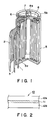
- Figure 1 is a partially exploded perspective view of a non-aqueous solvent-type secondary battery which can be constituted according to the invention.
- Figure 2 is a partial sectional view of an electrode structure adopted in the secondary battery.
- Figure 3 is a graph showing dedoping capacities at varying current densities of lithium secondary batteries including electrodes of different graphitic materials.
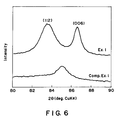
- Figures 4 - 7 show (002) x-ray diffraction patterns ( Figure 4), (004) x-ray diffraction patterns ( Figure 5), (112) and (006) x-ray diffraction patterns ( Figure 6) and 1/L c(00m) - m plots for calculating lattice strains ⁇ ( Figure 7) of graphitic materials of Example 1 and Comparative Example 1.
- the graphitic material according to the present invention has a moderately developed graphite structure and characterized by having an average (002)-plane spacing d 002 (hereinafter sometimes simply referred to as “d 002 ”) of 0.336 - 0.345 nm, a crystallite size along c-axis L c(002) (hereinafter sometimes simply referred to as "L c(002) ”) of 15 - 60 nm, and a lattice strain ⁇ of at most 2.0x10 -2 nm -1 as measured by X-ray diffraction method.
- d 002 average (002)-plane spacing d 002
- L c(002) crystallite size along c-axis
- a graphitic material having d 002 ⁇ 0.336 nm or L c(002 ) > 60 nm and having a highly developed graphite structure is used as an electrode material for a non-aqueous solvent-type secondary battery, the graphitic material is liable to be collapsed or the electrolytic solution is liable to be decomposed during repetition of doping and dedoping with the active substance (i.e., repetition of charging and discharging), thus exhibiting an inferior cycle characteristic.
- a carbonaceous material having d 002 > 0.345 nm and L c(002) ⁇ 15 nm and having an undeveloped graphite structure exhibits small capacities for doping and dedoping with an active substance (i.e., provides a secondary battery having small charge-discharge capacities) when used as an electrode material for a non-aqueous solvent-type secondary battery. It is preferred to use a graphitic material having d 002 of 0.337 - 0.342 nm and L c(002) of 20 - 50 nm.
- the graphitic material according to the present invention is characterized by a lattice strain ⁇ of at most 2.0x10 -2 nm -1 . Even if the above-mentioned d 002 and L c(002) requirements are satisfied, a graphitic material having a lattice strain ⁇ exceeding 2.0x10 -2 nm -1 does not readily provide an intercalation compound and exhibits a phenomenon that the mobility of an active substance between graphite layers is lowered because of a large graphite lattice strain. As a result, the battery performances are adversely affected such that the capacity for doping with an active substance, such as lithium, is lowered and the irreversible capacity is increased. It is preferred that the lattice strain ⁇ is at most 1.5x10 -2 nm -1 .
- the graphitic material according to the present invention may exhibit an optically anisotropic texture showing a flow texture when a buffed surface thereof is observed through a polarizing microscope.
- a graphitic material having a true density of at least 1.90 g/cm 3 , more preferably 2.00 - 2.25 g/cm 3 , more preferably 2.10 - 2.25 g/cm 3 .
- the graphitic material according to the present invention may for example be produced through a process as described below.
- One or more species of condensed polycyclic aromatic compounds are thermally polymerized in the presence of a Lewis acid catalyst to obtain a polymerizate, and the polymerizate is subjected to further polycondensation under heating at 350 - 700 °C in an inert gas atmosphere while removing low-boiling point components to obtain a carbon precursor having an optical flow texture.
- the carbon precursor is graphitized at 2100 - 2600 °C under a reduced pressure or in an inert gas atmosphere.
- condensed polycyclic aromatic compounds may include naphtharene, anthracene, acenaphthene, acenaphthylene, pyrene, and derivatives of these having one or more aliphatic substituents, e.g., lower alkyls, such as methyl and ethyl. Among these, naphthalene is most suitably used.
- Examples of the Lewis acid catalyst may include: aluminum chloride, boron trifluoride, aluminum bromide, tin chloride, iron chloride, zinc chloride, and hydrogen fluoride-boron trifluoride complex.
- aluminum chloride is most suitably used.
- a Lewis acid catalyst may be used in an amount of 5 - 50 wt. parts, preferably 8 - 20 wt. parts, per 100 wt. parts of a condensed polycyclic aromatic compound.
- the use of a Lewis acid catalyst in excess of 50 wt. parts does not substantially change the polymerization rate of the condensed polycyclic aromatic compound but makes difficult the removal of the catalyst from the polymerizate.
- the thermal polymerization may generally be performed at a temperature of at least 100 °C in a non-oxidizing gas atmosphere. Thermal polymerization below 100 °C is not desirable because of a small polymerization velocity.
- the non-oxidizing gas atmosphere is used for the thermal polymerization so as to prevent the polymerizate formed by thermal polymerization from being oxidized to result in a non-graphitizable carbon precursor.
- the non-oxidizing gas may be nitrogen gas, argon gas, helium gas or a mixture of these.
- the Lewis acid catalyst may be removed as desired from the polymerizate obtained by thermal polymerization of a condensed polycyclic aromatic compound.
- Aluminum chloride may be easily removed by washing with water or filtration.
- Hydrogen fluoride-boron trifluoride complex catalyst does not require the removal of the catalyst. Accordingly, these may be regarded as preferred catalysts.
- the polymerizate Prior to graphitization, the polymerizate may be heat-treated at 350 - 700 °C in an inert gas atmosphere to effect further polycondensation and remove light fractions, thereby providing a carbon precursor having an optically anisotropic texture, i.e., a so-called flow texture.
- the volatile content of the carbon precursor may be reduced to at most 15 %, preferably at most 10 %, further preferably at most 5 %. This is because fine particles of the carbon precursor formed by pulverization do not cause melt-sticking to each other during a subsequent calcination step, and the occurrence of decomposed gas and tar can be suppressed, so that the load in the carbonization (calcination) step can be reduced.
- the carbon precursor prepared in the above-described manner may be graphitized at 2100 - 2600 °C under a reduced pressure or in an inert gas atmosphere.
- the graphitization can be performed by continuously heating the carbon precursor to the graphitization temperature (2100 - 2600 °C) so as to effect the carbonization and the graphitization continuously. It is however preferred in many cases to once effect the carbonization (calcination) at a temperature of, e.g., 500 - 1500 °C lower than the graphitization temperature and then effect the graphitization, so as to facilitate the designing of the material and structure of the apparatus, the heating method, etc.
- the graphitic material after graphitization can be pulverized.
- a carbon precursor before carbonization can be pulverized much more easily with less damage, such as abrasion of a pulverizer, than carbonized or graphitized product, so that the pulverization before the carbonization is very advantageous.
- a secondary battery produced by using a powdery graphitic material prepared through pulverization before graphitization is less liable to cause the decomposition of an electrolytic solution during repetition of charging and discharging of the secondary battery than a secondary battery using a powdery graphitic material obtained by pulverization after graphitization. Also from this viewpoint, the pulverization before graphitization is preferred.
- the pulverization may desirably be performed to provide an average diameter of at most 100 ⁇ m, preferably 50 - 5 ⁇ m.
- the graphitization may be performed by retaining a graphite precursor (i.e., material to be graphitized) at a graphitization temperature of 2100 - 2600 °C for ca. 10 minutes to ca. 10 hours in an inert gas atmosphere or under a reduced pressure.
- the graphitization temperature refers to a maximum temperature to which the graphite precursor is subjected during the graphitization.
- the graphitization may be performed under a reduced pressure or in an inert gas atmosphere so as to prevent the reaction of the graphite precursor with the atmospheric gas during the graphitization.
- the inert gas may for example be argon gas or helium gas.
- the reduced pressure may preferably be given by an inert gas as described above.
- the graphitic material according to the present invention can also be produced by graphitizing petroleum pitch or coal pitch at 2600 - 2900 °C. In this case, however, such a higher graphitization temperature than in the above-described process is required so that the latitude of material selection for the graphitization apparatus is narrowed and the energy consumption is increased.
- the graphitic material according to the present invention has a micro-texture suitable for doping with an alkaline metal, such as lithium and is particularly suitably used as an electrode material for lithium secondary batteries constituting a negative electrode or a positive electrode of the batteries, as desired.
- an alkaline metal such as lithium
- the graphitic material may preferably be used as an electrode material for constituting a negative electrode of a non-aqueous solvent-type lithium secondary battery to be doped with lithium (ions) as an active substance of the negative electrode.
- Figure 1 is a partially exploded perspective view of a non-aqueous solvent-type lithium secondary battery as an embodiment of a non-aqueous solvent-type secondary battery according to the present invention.
- the secondary battery basically includes a laminate structure including a positive electrode 1, a negative electrode 2 and a separator 3 disposed between the positive and negative electrodes 1 and 2 and comprising a fine porous film of a polymeric material, such as polyethylene or polypropylene, impregnated with an electrolytic solution.
- the laminate structure is wound in a vortex shape to form an electricity-generating element which is housed within a metal casing 5 having a bottom constituting a negative electrode terminal 5a.
- the negative electrode 2 is electrically connected to the negative electrode terminal 5a, and the uppermost portion of the battery is constituted by disposing a gasket 6 and a safety valve 7 covered with a top plate 8 having a projection constituting a positive electrode terminal 8a electrically connected to the positive electrode. Further, the uppermost rim 5b of the casing 5 is crimped toward the inner side to form an entirely sealed cell structure enclosing the electricity-generating element.
- the positive electrode 1 or negative electrode 2 may be constituted by an electrode structure 10 having a sectional structure as partially shown in Figure 2.
- the electrode structure 10 includes an electroconductive substrate 11 comprising a foil or wire net of a metal, such as iron, stainless steel, steel, aluminum, nickel or titanium and having a thickness of, e.g., 5 - 100 ⁇ m, or 5 - 20 ⁇ m for a small-sized battery, and a composite electrode layer (12a, 12b) of, e.g., 10 - 1000 ⁇ m, preferably 10 - 200 ⁇ m, in thickness for a small-sized battery, on at least one surface, preferably on both surfaces as shown in Figure 2, of the electroconductive substrate 11.
- a metal such as iron, stainless steel, steel, aluminum, nickel or titanium
- a composite electrode layer (12a, 12b) of, e.g., 10 - 1000 ⁇ m, preferably 10 - 200 ⁇ m, in thickness for a small-sized battery, on at least one surface, preferably on both surfaces
- the composite electrode layers 12a and 12b are respectively a layer comprising a particulate graphitic material according to the present invention, an electroconductive material such as electroconductive carbon, optionally included, and a binder such as a vinylidene fluoride resin.
- the graphitic material may be optionally formed into fine particles having an average particle size of 5 - 100 ⁇ m and then mixed with a binder stable against a non-aqueous solvent, such as polyvinylidene fluoride, polytetrafluoroethylene or polyethylene, to be applied onto an electroconductive substrate 11, such as a circular or rectangular metal plate, to form, e.g., a 10 - 200 ⁇ m-thick layer.
- the binder may preferably be added in a proportion of 1 - 20 wt.
- the resultant electrode is liable to have too large an electric resistance and provide the battery with a large internal resistance.
- the amount of the binder is too small, the adhesion of the graphitic material particles with each other and with the electroconductive substrate 11 is liable to be insufficient.
- the above described formulation and values have been set forth with respect to production of a secondary battery of a relatively small capacity, whereas, for production of a secondary battery of a larger size, it is also possible to form the above-mentioned mixture of the graphitic material fine particles and the binder into a thicker shaped product, e.g., by press-forming, and electrically connect the shaped product to the electroconductive substrate.
- the graphitic material of the present invention can also be used as a positive electrode material for a non-aqueous solvent-type secondary battery by utilizing its good doping characteristic but may preferably be used as a negative electrode material of a non-aqueous solvent-type secondary battery, particularly for constituting a negative electrode to be doped with lithium as an active substance of a lithium secondary battery.
- the positive electrode material may comprise a complex metal chalcogenide, such as LiCoO 2 , LiNiO 2 or LiMnO 4 .
- a positive electrode material may be formed in combination with an appropriate binder and a carbonaceous material into a layer on an electroconductive substrate.
- the non-aqueous solvent-type electrolytic solution used in combination with the positive electrode and the negative electrode described above may generally be formed by dissolving an electrolyte in a non-aqueous solvent.
- the non-aqueous solvent may comprise one or two or more species of organic solvents, such as propylene carbonate, ethylene carbonate, dimethyl carbonate, diethyl carbonate, dimethoxyethane, diethoxyethane, ⁇ -butyrolactone, tetrahydrofuran, 2-methyl-tetrahydrofuran, sulfolane, and 1,3-dioxolane.
- Examples of the electrolyte may include LiClO 4 , LiPF 6 , LiBF 4 , LiCF 3 SO 3 , LiAsF 6 , LiCl, LiBr, LiB(C 6 H 5 ) 4 , LiN(SO 2 CF 3 ) 2 , alkaline metal salts, and tetralkylammonium salts.
- a secondary battery of the present invention may generally be formed by disposing the above-formed positive electrode 1 and negative electrode 2 opposite to each other, optionally with a liquid-permeable separator 3 composed of, e.g., unwoven cloth or other porous materials, disposed therebetween, and dipping the positive and negative electrode layers optionally together with a liquid-permeable separator in an electrolytic solution as described above ( Figure 1).
- a liquid-permeable separator 3 composed of, e.g., unwoven cloth or other porous materials
- the non-aqueous solvent-type secondary battery according to the present invention can basically have any other shape, such as those of a coin, a rectangular parallelepiped, or a paper or sheet.
- a graphitic material having a high density, large capacities for doping and dedoping with an active substance and a small irreversible capacity, which is a difference between the doping and dedoping capacities, e.g., through a process including the steps of carbonizing and graphitizing a condensed polycyclic aromatic compound to appropriately control the micro-texture of the graphitic material.
- the thus-obtained graphitic material according to the present invention exhibits excellent performances inclusive of quick chargeability and dischargeability, suitable as a graphitic electrode material for a non-aqueous solvent-type secondary battery of a high energy density.
- a condensed polycyclic aromatic compound is thermally polymerized in the presence of a Lewis acid catalyst and then graphitized at 2100 - 2600 °C. Accordingly, unlike a process for producing carbonized mesophase beads from pitch, it is unnecessary to include a step of separating mesophase microbeads or use an expensive reagent, such as pyridine or quinoline for the separation. Thus, the production process has been simplified, and it has become possible to omit a step of solvent recovery, etc.
- the parameters, d 002 , L c(002) , lattice strain ⁇ and true density characterizing graphitic materials, and the volatile content and softening point of a pitch, referred to herein are based on the measurement or test performed in the following manner. Further, some graphitic materials were observed through a polarizing microscope in a manner described below. [d 002 , L c(002) and ⁇ of graphitic material]
- the correction of a diffraction pattern is performed only with respect to corrections of K ⁇ 1 - K ⁇ 2 doublet according to the Rachinger's method and without correction with respect to the Lorentz's polarization factor, absorption factor, atomic scattering factor, etc.
- the peak position of the diffraction pattern is determined by the center of gravity method (i.e., a method wherein the position of a gravity center of diffraction lines is obtained to determine a peak position as a 2 ⁇ value corresponding to the gravity center) and calibrated by the diffraction peak of (111) plane of high-purity silicon powder as the standard substance.
- the d 002 value is calculated from the Bragg's formula shown below.
- L C(002) is calculated by the Scherrer's equation shown below based on a value ⁇ 1/2 which is a difference obtained by subtracting a half-width value of the (111) diffraction peak of high-purity silicon powder as the standard substance from the half-value width of the (002) diffraction peak of a sample carbonaceous material.
- L C(002) (k ⁇ )/( ⁇ 1/2 ⁇ cos ⁇ )
- Lattice strain ⁇ is determined in the following manner. The following formula is given as a relationship among a lattice strain ⁇ , L c(00m) and d 002 for a (00m) diffraction peak for a carbonaceous material (e.g., Mizushima "Tanso" No. 52, 9- (1968)). (Incidentally, the term “(001) diffraction peak” is generally used in literature but the alphabet “1” is very confusing with a numeral “1", so that the term (00m) diffraction peak is used herein).
- the true density of a carbonaceous material sample is measured by the butanol method prescribed in JIS R7212.
- the volatile content of a pitch sample is measured according to a method prescribed in JIS R7212 with the proviso that a sample is heated at 800 °C for 30 min.
- a Kohka-type flow tester (available from Shimadzu Seisakusho K.K.) is used.
- sample particles are softened to provide an increased packing ratio and a decrease in sample volume, but the volume decrease ceases above a certain temperature.
- the sample is melted to flow out through the nozzle at the cylinder bottom.
- the softening point of the sample is determined as the temperature at which the sample volume decrease ceases. Incidentally, it is possible that a sample having a high softening point does not flow out through the nozzle.
- a sample for the observation is prepared by (i) in case of a powdery graphitic material, adding about 10 wt. % of the graphitic material into liquid epoxy resin and, after sufficient mixing, charging the resultant mixture in a mold frame (in a diameter of 25 mm) of silicone rubber or (ii) in case of particle-shaped or block-shaped graphitic material, optionally formulating the graphitic material into particles of several millimeters in diameter and embedding several particles within liquid epoxy resin charged in the above-mentioned mold frame, respectively followed by curing the epoxy resin at 120 °C for 24 hours.
- the resultant cured epoxy resin is cut at an appropriate part thereof so as to expose the embedded graphitic material at the surface, followed by buffing for mirror finishing.
- the thus-prepared sample is observed through a polarizing microscope under cross nicols at a magnification of ca. 1000.
- naphthalene (reagent-grade, available from Kanto Kagaku K.K.) and AlCl 3 (catalyst) (reagent-grade, available from Kanto Kagaku K.K.) were placed in a three-necked flask equipped with a stirrer and subjected to polymerization at 210 °C for 60 hours. After the polymerization, the resultant polymerizate was washed with water and filtrated by using a filter (pore diameter: 0.2 ⁇ m) for catalyst removal to recover the polymerizate. The polymerizate was then heated at 400 °C for 15 min. at a reduced pressure of 2 kPa and under a nitrogen gas stream to remove light fractions.
- the thus-obtained pitch (which may be called “polynaphthalene pitch”) had a softening point of 195 °C a benzene-insoluble content of 42.9 %, an H/C atomic ratio of 0.64, and an average molecular weight of 1300.
- the pitch was heat-treated at 600 °C for 1 hour in a nitrogen gas stream and then pulverized to obtain carbon precursor particles having an average particle size (diameter) of ca. 25 ⁇ m.
- the carbon precursor particles were carbonized at 1000 °C for 1 hour in a nitrogen gas stream and then graphitized at 2400 °C for 1 hour in an argon gas stream to obtain a graphitic material.
- the graphitic material showed an optically anisotropic texture characterized as a flow texture.
- a graphitic material was prepared in the same manner as in Example 1 except that the graphitization temperature was changed to 2200 °C. As a result of the polarizing microscopic observation, the graphitic material showed an optically anisotropic texture characterized as a flow texture.
- the polynaphthalene pitch obtained in Example 1 was heat-treated at 600 °C for 1 hour in a nitrogen gas stream, then carbonized at 1000 °C for 1 hour in a nitrogen gas stream and then graphitized at 2400 °C for 1 hour in an argon gas stream, followed by pulverization to obtain a graphitic material in the form of particles having an average particle size of ca. 25 ⁇ m.
- the graphitic material showed an optically anisotropic texture characterized as a flow texture.
- a petroleum pitch having a softening point of 210 °C, a quinoline-insoluble content of 1 wt. % and an H/C atomic ratio of 0.63 was heat-treated at 600 °C for 1 hour in a nitrogen gas stream, and pulverized to obtain carbon precursor particles having an average particle size of ca. 25 ⁇ m.
- the carbon precursor particles were carbonized at 1000 °C for 1 hour in a nitrogen gas stream and graphitized at 2800 °C for 1 hour in an argon gas stream to obtain a graphitic material.
- the graphitic material showed an optically anisotropic texture characterized as a flow texture.
- Graphitic materials were prepared in the same manner as in Example 1 except that the graphitization temperature was changed to 2000 °C (Comparative Example 1) and 2800 °C (Comparative Example 2), respectively.
- Coal tar pitch was heat-treated at 600 °C for 1 hour in a nitrogen gas stream and pulverized to obtain carbon precursor particles having an average particle size of ca. 25 ⁇ m.
- the carbon precursor particles were carbonized at 1000 °C for 1 hour in a nitrogen gas stream and then graphitized at 2800 °C for 1 hour in an argon gas stream to obtain a graphitic material.
- Needle coke of ca. 25 ⁇ m in average diameter was graphitized at 2800 °C for 1 hour in an argon gas stream to obtain a graphitic material.
- the natural graphite showed a fixed carbon content of 97 %, an ash content of 2 %, a volatile content of 1 % and an average particle size of 7 pm.
- Figures 4 - 7 show (002) x-ray diffraction patterns ( Figure 4), (004) x-ray diffraction pattern ( Figure 5), (112) and (006) x-ray diffraction patterns ( Figure 6) and 1/L c(00m) - m plots for calculating lattice strains ⁇ ( Figure 7) of graphitic materials of Example 1 and Comparative Example 1, for example.
- the graphitic material of the present invention is generally suited for constituting a negative electrode of a non-aqueous solvent secondary battery.
- a graphitic material inclusive of a doping capacity (A) and a de-doping capacity (B) for a cell active substance and also an amount of the cell active substance remaining in the graphitic material without being dedoped ("irreversible capacity" (A-B)) without being affected by a fluctuation in performance of a counter electrode material
- a large excess amount of lithium metal showing a stable performance was used as a negative electrode, and each graphitic material prepared above was used to constitute a positive electrode, thereby forming a lithium secondary battery, of which the performances were evaluated.
- the positive electrode was prepared as follows. That is, 90 wt. parts of the graphitic material thus formulated in the form of fine particles and 10 wt. parts of polyvinylidene fluoride were mixed together with N-methyl-2-pyrrolidone to form a paste-like composite, which was then applied uniformly onto a copper foil. The composite, after being dried, was peeled off the copper foil and stamped into a 21 mm-dia. disk. The disk was then press-bonded onto a 21 mm-dia. circular shaped net of stainless steel to form a positive electrode containing about 40 mg of the graphitic material. On the other hand, a negative electrode was prepared by stamping a 1 mm-thick sheet of lithium metal into a 21 mm-dia. disk.
- the thus-prepared positive and negative electrodes were disposed opposite to each other with a porous polypropylene film as a separator disposed therebetween, and the resultant structure was dipped in an electrolytic solution comprising a 1:1 (by volume)-mixture solvent of ethylene carbonate and diethyl carbonate and LiPF 6 dissolved therein at a rate of 1 mol/liter, thereby forming a non-aqueous solvent-type lithium secondary battery.
- the graphitic material in the positive electrode was subjected to doping and dedoping of lithium to evaluate capacities therefor.
- the doping was effected by repeating a cycle including charging at a constant current density of 0.5 mA/cm 2 up to an electrode potential of 60 mV and a subsequent constant voltage charging up to a total current conduction time of 15 hours.
- the electricity thus flowed was divided by the weight of the graphitic material to provide a doping capacity (A) in terms of Ah/kg.
- A doping capacity
- a current was flowed in a reverse direction to dedope the lithium from the doped graphitic material.
- the de-doping was effected by constant-current discharging at a current density of 0.5 mA/cm 2 down to a terminal voltage of 1.0 V.
- the electricity thus flowed was divided by the weight of the graphitic material to provide a dedoping capacity (B) in terms of Ah/kg. Then, an irreversible capacity (non-dedoped capacity) (A-B) was calculated as a difference between the doping capacity (A) and the dedoping capacity (B).
- lithium secondary batteries prepared by using the graphitic materials obtained in Examples showed larger dedoping capacities and generally better discharge efficiencies than the batteries obtained by using the graphitic materials of Comparative Examples 1 - 5.
- the carbonaceous material prepared in Comparative Example 1 failed to show a (112) diffraction peak as a result of X-ray diffraction ( Figure 6), thus showing insufficient graphitization, and a secondary battery obtained by using the material showed a small doping capacity.
- the batteries obtained by using graphitic materials prepared in Comparative Examples 2 - 4 and natural graphite (Comparative Example 5) exhibited very large irreversible capacities. This is presumably because the graphitic materials have a developed graphite structure and have a large crystallite size to result in a high overvoltage when lithium is inserted between graphite layers, which promotes the decomposition of the electrolytic solution leading to an increase in irreversible capacity.
- Each battery was subjected to doping/dedoping at different current densities of 0.5 mA/cm 2 , 1 mA/cm 2 , and 2 mA/cm 2 .
- the doping was performed at a constant current density as prescribed above until the terminal voltage reached 60 mV and thereafter the doping was performed at a constant voltage of 60 mV.
- the doping was continued for periods prescribed for the respective current densities, i.e., 15 hours for a current density of 0.5 mA/cm 2 , 7.5 hours for 1 mA/cm 2 , and 3.75 hours for 2 mA/cm 2 .
- the dedoping was performed at a current density identical to that for the doping and completed when the terminal voltage reached 1.0 volt.
- Figure 3 shows the plots of dedoping capacities at varying current densities of the respective batteries measured in the above-described manner. As shown in Figure 3, the lithium secondary battery including a positive electrode of graphitic material obtained in Example 1 retained a high dedoping capacity even at a high current density.
Landscapes
- Chemical & Material Sciences (AREA)
- Engineering & Computer Science (AREA)
- Chemical Kinetics & Catalysis (AREA)
- General Chemical & Material Sciences (AREA)
- Inorganic Chemistry (AREA)
- Organic Chemistry (AREA)
- Electrochemistry (AREA)
- Ceramic Engineering (AREA)
- Materials Engineering (AREA)
- Textile Engineering (AREA)
- Manufacturing & Machinery (AREA)
- Structural Engineering (AREA)
- General Life Sciences & Earth Sciences (AREA)
- Geology (AREA)
- Life Sciences & Earth Sciences (AREA)
- Battery Electrode And Active Subsutance (AREA)
- Carbon And Carbon Compounds (AREA)
- Secondary Cells (AREA)
Applications Claiming Priority (2)
| Application Number | Priority Date | Filing Date | Title |
|---|---|---|---|
| JP273440/95 | 1995-09-26 | ||
| JP7273440A JPH0992284A (ja) | 1995-09-26 | 1995-09-26 | 二次電池電極用黒鉛質材料及びその製造方法並びに二次電池 |
Publications (1)
| Publication Number | Publication Date |
|---|---|
| EP0766328A1 true EP0766328A1 (fr) | 1997-04-02 |
Family
ID=17527948
Family Applications (1)
| Application Number | Title | Priority Date | Filing Date |
|---|---|---|---|
| EP96306980A Withdrawn EP0766328A1 (fr) | 1995-09-26 | 1996-09-25 | Matériau d'électrode graphitique pour accumulateur et procédé de sa fabrication |
Country Status (5)
| Country | Link |
|---|---|
| US (1) | US5721071A (fr) |
| EP (1) | EP0766328A1 (fr) |
| JP (1) | JPH0992284A (fr) |
| KR (1) | KR970018804A (fr) |
| CA (1) | CA2186442A1 (fr) |
Cited By (1)
| Publication number | Priority date | Publication date | Assignee | Title |
|---|---|---|---|---|
| EP1083618A4 (fr) * | 1998-05-20 | 2006-09-27 | Osaka Gas Co Ltd | Pile secondaire non aqueuse et son procede de controle |
Families Citing this family (12)
| Publication number | Priority date | Publication date | Assignee | Title |
|---|---|---|---|---|
| US6265110B1 (en) * | 1996-12-20 | 2001-07-24 | Danionics A/S | Lithium secondary battery with flake graphite negative electrode |
| JP3436033B2 (ja) * | 1996-12-27 | 2003-08-11 | ソニー株式会社 | 非水電解液二次電池 |
| JP4104187B2 (ja) * | 1997-02-06 | 2008-06-18 | 株式会社クレハ | 二次電池電極用炭素質材料 |
| EP0903799B1 (fr) * | 1997-09-19 | 2003-03-12 | Matsushita Electric Industrial Co., Ltd. | Batterie secondaire à électrolyte non-aqueux et son anode |
| EP0921582B1 (fr) * | 1997-11-19 | 2003-02-12 | Mitsubishi Gas Chemical Company, Inc. | Matériau carboné pour l'utilisation comme anode pour un accumulateur au lithium et procédé de préparation |
| KR100269923B1 (ko) * | 1998-03-10 | 2000-10-16 | 김순택 | 리튬 계열 이차 전지의 음극용 활물질의 제조 방법 |
| US6110622A (en) | 1998-07-22 | 2000-08-29 | Wilson Greatbatch Ltd. | Chemically machined current collector design |
| JP4892838B2 (ja) * | 2004-03-01 | 2012-03-07 | 三菱瓦斯化学株式会社 | 炭素化物の製造方法および該方法によって得られる炭素化物 |
| US20090035661A1 (en) | 2007-08-01 | 2009-02-05 | Jeffrey Swoyer | Synthesis of cathode active materials |
| US20090148377A1 (en) | 2007-12-11 | 2009-06-11 | Moshage Ralph E | Process For Producing Electrode Active Material For Lithium Ion Cell |
| CN118221111A (zh) * | 2022-12-21 | 2024-06-21 | 蔚来电池科技(安徽)有限公司 | 石墨复合材料及其制备方法和锂离子电池 |
| WO2026064291A1 (fr) * | 2024-09-17 | 2026-03-26 | ExxonMobil Technology and Engineering Company | Production de particules graphitiques à partir de brai de pétrole avec stabilisation au-dessus du point de ramollissement |
Citations (9)
| Publication number | Priority date | Publication date | Assignee | Title |
|---|---|---|---|---|
| EP0495613A2 (fr) * | 1991-01-14 | 1992-07-22 | Kabushiki Kaisha Toshiba | Batterie secondaire au lithium et un matériau en carbone utile à cet effet |
| EP0563988A1 (fr) * | 1992-04-02 | 1993-10-06 | Fuji Photo Film Co., Ltd. | Batterie secondaire non-aqueuse |
| EP0567658A1 (fr) * | 1991-11-20 | 1993-11-03 | Honda Giken Kogyo Kabushiki Kaisha | Materiau a base de carbone |
| JPH05314975A (ja) * | 1992-05-07 | 1993-11-26 | Mitsubishi Kasei Corp | 二次電池 |
| EP0593785A1 (fr) * | 1992-05-15 | 1994-04-27 | Yuasa Corporation | Accumulateur et procede pour sa fabrication |
| JPH06187972A (ja) * | 1992-12-16 | 1994-07-08 | Osaka Gas Co Ltd | 負極材の製造方法およびリチウム二次電池 |
| EP0624913A2 (fr) * | 1993-03-30 | 1994-11-17 | Sanyo Electric Co., Ltd. | Batterie secondaire au lithium |
| EP0634805A1 (fr) * | 1992-12-04 | 1995-01-18 | Sony Corporation | Element secondaire a electrolyte non aqueux |
| EP0646978A1 (fr) * | 1993-09-03 | 1995-04-05 | Kureha Kagaku Kogyo Kabushiki Kaisha | Matière carbonée pour électrode pour batterie secondaire et procédé pour sa production |
-
1995
- 1995-09-26 JP JP7273440A patent/JPH0992284A/ja active Pending
-
1996
- 1996-09-24 US US08/718,939 patent/US5721071A/en not_active Expired - Fee Related
- 1996-09-25 EP EP96306980A patent/EP0766328A1/fr not_active Withdrawn
- 1996-09-25 KR KR1019960042439A patent/KR970018804A/ko not_active Abandoned
- 1996-09-25 CA CA002186442A patent/CA2186442A1/fr not_active Abandoned
Patent Citations (9)
| Publication number | Priority date | Publication date | Assignee | Title |
|---|---|---|---|---|
| EP0495613A2 (fr) * | 1991-01-14 | 1992-07-22 | Kabushiki Kaisha Toshiba | Batterie secondaire au lithium et un matériau en carbone utile à cet effet |
| EP0567658A1 (fr) * | 1991-11-20 | 1993-11-03 | Honda Giken Kogyo Kabushiki Kaisha | Materiau a base de carbone |
| EP0563988A1 (fr) * | 1992-04-02 | 1993-10-06 | Fuji Photo Film Co., Ltd. | Batterie secondaire non-aqueuse |
| JPH05314975A (ja) * | 1992-05-07 | 1993-11-26 | Mitsubishi Kasei Corp | 二次電池 |
| EP0593785A1 (fr) * | 1992-05-15 | 1994-04-27 | Yuasa Corporation | Accumulateur et procede pour sa fabrication |
| EP0634805A1 (fr) * | 1992-12-04 | 1995-01-18 | Sony Corporation | Element secondaire a electrolyte non aqueux |
| JPH06187972A (ja) * | 1992-12-16 | 1994-07-08 | Osaka Gas Co Ltd | 負極材の製造方法およびリチウム二次電池 |
| EP0624913A2 (fr) * | 1993-03-30 | 1994-11-17 | Sanyo Electric Co., Ltd. | Batterie secondaire au lithium |
| EP0646978A1 (fr) * | 1993-09-03 | 1995-04-05 | Kureha Kagaku Kogyo Kabushiki Kaisha | Matière carbonée pour électrode pour batterie secondaire et procédé pour sa production |
Non-Patent Citations (2)
| Title |
|---|
| DATABASE WPI Section Ch Week 9401, Derwent World Patents Index; Class A85, AN 94-003097, XP002021515 * |
| DATABASE WPI Section Ch Week 9432, Derwent World Patents Index; Class A35, AN 94-258086, XP002021514 * |
Cited By (3)
| Publication number | Priority date | Publication date | Assignee | Title |
|---|---|---|---|---|
| EP1083618A4 (fr) * | 1998-05-20 | 2006-09-27 | Osaka Gas Co Ltd | Pile secondaire non aqueuse et son procede de controle |
| US7642001B2 (en) | 1998-05-20 | 2010-01-05 | Osaka Gas Company Limited | Non-aqueous secondary battery and its control method |
| US8110303B2 (en) | 1998-05-20 | 2012-02-07 | Kri Inc. | Non-aqueous secondary battery and its control method |
Also Published As
| Publication number | Publication date |
|---|---|
| KR970018804A (ko) | 1997-04-30 |
| CA2186442A1 (fr) | 1997-03-27 |
| US5721071A (en) | 1998-02-24 |
| JPH0992284A (ja) | 1997-04-04 |
Similar Documents
| Publication | Publication Date | Title |
|---|---|---|
| EP0613197B1 (fr) | Matière carbonée pour électrode pour batterie secondaire | |
| EP0700105B1 (fr) | Matériau d'électrode carboné pour une pile secondaire et procédé pour la production de celui-ci | |
| EP0646978B1 (fr) | Matière carbonée pour électrode pour batterie secondaire et procédé pour sa production | |
| EP0763865B1 (fr) | Accumulateur au lithium et matériau carboné utilisé dedans | |
| US7608366B2 (en) | Nonaqueous electrolytic secondary battery and method of producing anode material thereof | |
| CA2238286C (fr) | Materiau pour cathode de batterie secondaire au lithium, methode de fabrication associee et batterie seondaire au lithium utilisant ledit materiau | |
| US6106976A (en) | Secondary battery or cell with a non-aqueous electrolyte | |
| EP0573266A1 (fr) | Batterie secondaire au lithium et méthode de fabrication de matière carbonée pour électrode négative de batterie | |
| JP3436033B2 (ja) | 非水電解液二次電池 | |
| US20040151837A1 (en) | Material for negative electrode of lithium secondary battery, method for production thereof and lithium secondary battery using the same | |
| CA2156675C (fr) | Electrode carbonee pour batterie secondaire | |
| US5721071A (en) | Graphitic electrode material for secondary battery and process for production thereof | |
| JP4516845B2 (ja) | 非水電解質二次電池、及びこの非水電解二次電池に用いる正極の製造方法 | |
| JP3311104B2 (ja) | リチウム二次電池 | |
| JP3568563B2 (ja) | 二次電池電極用炭素質材料およびその製造法 | |
| JP4354723B2 (ja) | 黒鉛質粒子の製造方法 | |
| JPH06111818A (ja) | 非水電解液二次電池用炭素負極 | |
| JPH0589879A (ja) | リチウム二次電池 | |
| JP2637305B2 (ja) | リチウム二次電池 | |
| JPH10284081A (ja) | リチウムイオン二次電池 | |
| JP4421750B2 (ja) | 炭素材料の製造方法およびリチウムイオン二次電池 | |
| JP5001977B2 (ja) | 黒鉛質粒子、リチウムイオン二次電池およびその負極材料 | |
| JP2001006671A (ja) | リチウム二次電池のエージング処理方法 | |
| JPH10270080A (ja) | 非水電解液二次電池 | |
| JP3518543B2 (ja) | 二次電池の製造方法 |
Legal Events
| Date | Code | Title | Description |
|---|---|---|---|
| PUAI | Public reference made under article 153(3) epc to a published international application that has entered the european phase |
Free format text: ORIGINAL CODE: 0009012 |
|
| 17P | Request for examination filed |
Effective date: 19961015 |
|
| AK | Designated contracting states |
Kind code of ref document: A1 Designated state(s): DE FR GB NL |
|
| 17Q | First examination report despatched |
Effective date: 19980120 |
|
| STAA | Information on the status of an ep patent application or granted ep patent |
Free format text: STATUS: THE APPLICATION IS DEEMED TO BE WITHDRAWN |
|
| 18D | Application deemed to be withdrawn |
Effective date: 19980731 |