EP0767652B1 - Method for bonding non-amalgam restorative materials to dental surfaces - Google Patents
Method for bonding non-amalgam restorative materials to dental surfaces Download PDFInfo
- Publication number
- EP0767652B1 EP0767652B1 EP95924649A EP95924649A EP0767652B1 EP 0767652 B1 EP0767652 B1 EP 0767652B1 EP 95924649 A EP95924649 A EP 95924649A EP 95924649 A EP95924649 A EP 95924649A EP 0767652 B1 EP0767652 B1 EP 0767652B1
- Authority
- EP
- European Patent Office
- Prior art keywords
- dental
- dental surface
- adhesive
- applying
- restorative
- Prior art date
- Legal status (The legal status is an assumption and is not a legal conclusion. Google has not performed a legal analysis and makes no representation as to the accuracy of the status listed.)
- Expired - Lifetime
Links
Classifications
-
- A—HUMAN NECESSITIES
- A61—MEDICAL OR VETERINARY SCIENCE; HYGIENE
- A61K—PREPARATIONS FOR MEDICAL, DENTAL OR TOILETRY PURPOSES
- A61K6/00—Preparations for dentistry
- A61K6/40—Primers
-
- A—HUMAN NECESSITIES
- A61—MEDICAL OR VETERINARY SCIENCE; HYGIENE
- A61K—PREPARATIONS FOR MEDICAL, DENTAL OR TOILETRY PURPOSES
- A61K6/00—Preparations for dentistry
- A61K6/30—Compositions for temporarily or permanently fixing teeth or palates, e.g. primers for dental adhesives
-
- C—CHEMISTRY; METALLURGY
- C08—ORGANIC MACROMOLECULAR COMPOUNDS; THEIR PREPARATION OR CHEMICAL WORKING-UP; COMPOSITIONS BASED THEREON
- C08L—COMPOSITIONS OF MACROMOLECULAR COMPOUNDS
- C08L33/00—Compositions of homopolymers or copolymers of compounds having one or more unsaturated aliphatic radicals, each having only one carbon-to-carbon double bond, and only one being terminated by only one carboxyl radical, or of salts, anhydrides, esters, amides, imides or nitriles thereof; Compositions of derivatives of such polymers
- C08L33/04—Homopolymers or copolymers of esters
- C08L33/06—Homopolymers or copolymers of esters of esters containing only carbon, hydrogen and oxygen, which oxygen atoms are present only as part of the carboxyl radical
- C08L33/10—Homopolymers or copolymers of methacrylic acid esters
Definitions
- U.S. Patent No. 5,276,068 to Waknine discloses dental compositions useful for bonding dental surfaces, including enamel, dentin, porcelain and metallic surfaces, comprising polycarbonate dimethacrylate condensation products as a principle component, and a secondary monomer such as BIS-GMA or polyurethane dimethacrylate or the like as a second component, which is provided to impart strength to the dental composition.
- the surface can be pretreated by application of 3% H 2 O 2 , 17% EDTA, or 5% NaOCl in non-vital teeth followed by an alcohol or acetone solution of an alkali metal salt of benzenesulfinic acid with subsequent evaporation of the alcohol from the solution.
- the surface can be pretreated by first applying an alcohol or acetone solution of an alkali metal salt of benzenesulfinic acid and then applying an acetone solution of N-phenyl-glycine.
- the treated dentin surface is then coated with a resinous adhesive.
- the adhesive is then cured and an appropriate dental restorative material is applied.
- JP-A-601 23515 refers to a pretreatment agent composition for the treatment of a base surface used for the application of radical polymerization curable composition material. It comprises unsaturated carboxylic acids or their acid anhydrides, (meth)acrylic acid ester type monomer and at least one type of sulphur compound selected from the group consisting of organic sulphinic acids, their salts and thiol esters of the organic sulphinic acids.
- the present invention can be summarized as follows :
- the present invention offers distinct advantages to the dental patient for 5 receiving comparatively low cost and low trauma dental care.
- the dentist can perform repairs using a low cost material with which he or she is familar. These repairs can now be made with substantially less preparation than required previously.
- the present invention allows bonding of non-amalgam dental restorative materials to dental surfaces other than tooth structure that previously could not be repaired using these materials without complete removal of prior dental work.
- the present invention bonds non-amalgam dental restorative materials to previously placed amalgam, metal (such as in pins, posts, and bridgework), glass ionomers, porcelain, previously placed composite restorations, or other materials used in the oral environment.
- the area of the oral cavity to be worked on is prepared using conventional dental techniques.
- hard tissue e.g. enamel or dentin
- the non-amalgam dental restorative material is to be applied preferably is first cleaned using conventional methods (e.g., by abrading it with a bur), rinsed (e.g., using water) and dried (e.g., using air).
- the dental surface is etched with acid.
- An appropriate acid etch technique may be used to provide a surface receptive to bonding materials thereto.
- Acids for use in the acid etch step can be inorganic or organic acids, and if organic can be monomeric, oligomeric or polymeric.
- a precursor to the acid such as an acid anhydride, e.g., 4-Methacryloxyethyl Trimeilitate Anhydride (4-META), acid halide (including inorganic acid halides such as Lewis acids, e.g., ferric chloride, and organic acid halides), or ester can be used in place of the acid itself, e.g., to generate the desired acid in situ.
- Suitable acids include mineral acids, carboxylic acids, sulfonic acids, and phenols, with carboxylic acids, alkylsulfonic acids, arylsulfonic acids, and phosphonic acids being preferred.
- the acid has a pKa in water that is less than or equal to that of phenol.
- the pKa of the acid is between about -20 and about +10, more preferably between about -10 and about +5.
- Suitable inorganic acids include HBr, HCl, and HNO 3 .
- Suitable organic acids include acetic acid, ⁇ -chloropropionic acid, 2-acrylamido-2-methylpropane sulfonic acid, acrylic acid, benzenesulfonic acid, benzoic acid, bromoacetic acid, 10-camphorquinone-sulfonic acid, 10-camphorsulfonic acid, chloroacetic acid, citraconic acid, citric acid, dibromoacetic acid, dichloroacetic acid, di-HEMA ester of 1,2,4,5 benzenetetracarboxylic acid, 2,4-dinitrophenol, formic acid, fumaric acid, 2-hydroxy-4-methoxybenzophenone-5-sulfonic acid, maleic acid, methacrylic acid, 2-naphthalene sulfonic acid, nitric acid, oxalic acid, p-nitrophenol, phenol, phosphoric acid, phosphorous acid esters (
- the acid does not generate insoluble salts of calcium during the etch technique in an amount that would detrimentally affect adhesion to the oral surface. If the acid does generate insoluble calcium salts, the salts are preferably rinsed from the dental surface before subsequent steps are taken.
- the dental surface to be bonded is first exposed to about 0.01-0.2 ml of acid solution for a period of abou 5-60 seconds.
- Preferred etching solutions contain about 10% maleic acid or about 35% phosphoric acid.
- This acid may be applied with dropper sponge or brush.
- the acid solution may optionally be dried on the dental surface by, e.g. air. Preferably, no drying step is taken after acid etch.
- a treatment composition comprising an electron donor is applied to the etched dental surface.
- the donor has an E ox greater than zero and less than or equal to E ox (p-dimethoxybenzene).
- E ox (donor) is between about 0.5 and 1 volts vs. a saturated calomel electrode ("S.C.E.”).
- E ox (donor) values can be measured experimentally, or obtained from references such as N. L. Weinburg, Ed., Technique of Electroorganic Synthesis Part II Techniques of Chemistry , Vol. V (1975), and C. K. Mann and K. K. Barnes, Electrochemical Reactions in Nonaqueous Systems (1970).
- Preferred donors include ascorbic acid, metal complexed ascorbic acid, cobalt (II) chloride, ferrous chloride, ferrous sulfate, hydrazine, hydroxylamine, oxalic acid, thiourea, tertiary amines (such as N,N-bis-(2-hydroxyethyl)-p-toluidine, 4-(dimethylamino)-phenethyl alcohol and the like), and aromatic salts of a dithionite, thiosulfate, or sulfite anion.
- cobalt (II) chloride ferrous chloride
- ferrous sulfate ferrous sulfate
- hydrazine hydroxylamine
- oxalic acid thiourea
- tertiary amines such as N,N-bis-(2-hydroxyethyl)-p-toluidine, 4-(dimethylamino)-phenethyl alcohol and the
- a preferred electron donor is the aromatic sulfinate salt represented by the general formula wherein R 1 , R 2 , R 3 , R 4 and R 5 may be any atoms and/or groups as long as they are inert to the double bond of monomers. Examples are hydrogen, fluoro, chloro, bromo, iodo, methyl, ethyl, 2-chloroethyl, 2-bromo-2-chloroethyl, propyl, isopropyl, per-fluoropropyl, allyl, butyl, isobutyl, sec-butyl, tert-butyl, pentyl, isopentyl, neopentyl, tert-pentyl, cyclohexyl, phenyl and 4-bromophenyl.
- M n+ is a cation with mono-valency to 4-valency that can, as a counter ion for sulfinic acid anion, form the sulfinate.
- M n+ are alkali metal ions, such as Li + , Na + , K + , Rb + , and Cs + , alkaline earth metal ions, such as Be 2+ , Mg 2+ , Ca 2+ , Sr 2+ and Ba 2+ , transition metal ions such as Cr 2+ , Cr 3+ , Mn 2+ , Fe 2+ , Fe 3+ , Co 2+ , Co 3+ , Ni 2+ , Cu 2+ , Zn 2+ , Rh 3+ , Pd 2+ , Ag + , Cd 2+ , Ir 3+ , Ir 4+ , and Hg 2+ , and ammonium ions, such as NH 4 + , (CH 3 CH 2 ) 3 NH + ,
- Preferred counter ions among these ions are Li + , Na + , K + , Mg 2+ , and Ca 2+ , since sulfinates thereof have good stability when stored in monomers and have good solubility in the monomers.
- aromatic sulfinate salts include sodium benzenesulfinate and sodium toluenesulfinate.
- the treatment composition may comprise mixtures of more than one aromatic sulfinate salt.
- the electron donor is preferably provided in an appropriate solvent, such as water, acetone, lower alkyl alcohols (such as methanol, ethanol, propanol), and the like.
- an appropriate solvent such as water, acetone, lower alkyl alcohols (such as methanol, ethanol, propanol), and the like.
- the treatment composition containing the electron donor may comprise other adjuvants, such as polymerization catalysts, medicaments, fluoride compounds, indicators, dyes, wetting agents, buffering agents, thixotropes and the like.
- adjuvants such as polymerization catalysts, medicaments, fluoride compounds, indicators, dyes, wetting agents, buffering agents, thixotropes and the like.
- the treatment composition preferably comprises at least 0.1% by weight of electron donor, more preferably between 0.5 and 15, and most preferably between one and 10%.
- the treatment composition may be applied by any appropriate means, such as by dropper, sponge or brush. This composition is preferably allowed to reside on the etched surface for about 1-60 seconds.
- the treatment composition is optionally dried on the surface with air, or the solvent is allowed to evaporate.
- a priming solution containing a film-former is applied to the treated dental surface.
- a film-former is defined as a composition capable of forming a hardenable (e.g., polymerizable) continuous or semicontinuous film on the dental surface.
- the film-former used in the primer is preferably a water-dispersible substance or water-dispersible mixture of substances, such substance(s) being organic monomers, oligomers, polymers, or cosolvents.
- the film former contains at least one polymer prior to application to the treated dental surface.
- a "water-dispersible" film former has a water dispersibility or more preferably a water solubility (exclusive of any water that may be present in the film former) of at least about 5 weight percent.
- the film former can be mixed with water in all proportions. For brevity, dispersible and soluble will sometimes be referred to collectively as dispersible.
- solute a substance that forms a solution
- solvent substances that are called phases.
- colloidal dispersion is often called a solution. Since colloidal particles are larger than molecules it is strictly incorrect to call such dispersions solutions; however this term is widely used in the literature.
- dispersibility means the capability of a substance to form a dispersion, i.e., a two-phase system where one phase consists of finely divided particles (often in the colloidal size range) distributed throughout a bulk substance, the particles being the disperse or internal phase and the bulk substance the continuous or external phase.
- Preferred film formers contain one or more substances having a sufficient number of water-dispersing groups such as hydroxyl groups, carboxyl groups, sulfonic acid groups, cationic salts (e.g., ammonium, phosphonium or sulfonium groups), amide linkages or polyether linkages to render the film former water-dispersible.
- the film former prior to removal of any volatile components, preferably wets the dental surface and most preferably has a sufficiently low viscosity to enable it to flow into interstices that already exist in the dental surface or that are created therein by the action of the acid.
- the film former After removal of any volatile components, the film former preferably has a sufficiently high viscosity to enable it to resist displacement by dentinal fluids (in the case where the dental surface is dentin) or other extraneous liquids.
- the film former preferably contains one or more polymerizable substances. Addition polymerizable substances (e.g., vinyl compounds such as acrylates and methacrylates) are especially preferred.
- Suitable preferred polymer components in the film former include linear, branched or cyclic polymers formed prior to priming of the treated dental surface.
- a polymer is a chemical compound having at least two repeat units. They can be polymers of ethylenically unsaturated monomers or they can be polymeric compounds like polyester, polyamide, polyether, polyethyleneglycol, polyethyleneglycol dimethacalate and diacrylate, polysaccharide, cellulosic, polypropylene, polyacrylonitrile, polyurethane, poly(vinyl chloride), poly(methyl methacrylate), phenol-formaldehyde, melamineformaldehyde, and urea-formaldehyde. Mixtures of such polymers can be used if desired.
- Preferred polymers are the polymers of ethylenically unsaturated monomers. These polymers may be homo- or co-polymers and may contain hydrophilic or hydrophobic groups. The polymer may optionally contain acid groups, their salts, or their reactive derivative groups. Particularly preferred polymers contain reactive groups that further react (i.e., crosslink or copolymerize) with the other components of the film former or the dental adhesive. Addition polymerizable reactive groups (e.g., vinyl groups such as acrylates and methacrylates) are especially preferred. Polymers of ethylenically unsaturated monomers are often used in dental glass ionomer cements.
- polymers are especially useful in the present invention as they generally have good biocompatibility, are dispersible in water and have a suitable molecular weight.
- Particularly preferred polymers contain functional groups that have an affinity for hard tissue.
- groups include ⁇ -dicarbonyl groups and carboxylic acid groups.
- the polymer component of an ionomer cement is often a copolymer of acrylic acid and itaconic acid, although other monomers may be incorporated, and are herein referred to as polyalkenoic acids. See generally, Prosser et al., Developments in Ionic Polymers - 1. Chapter 5, Applied Science Publishers (London and New York, 1983). Recently such polymers have been further modified in the laboratory of the assignee of this invention by the incorporation of addition polymerizable reactive groups as mentioned above. Their preparation is described in U.S. Patent No. 5,130,347.
- Preferred polymeric compounds used in the primer have a weight average molecular weight prior to hardening of more than about 500, although preferably no greater than 2,000,000. More preferably, polymeric compounds for use in the primer have a weight average molecular weight prior to hardening of between about 1,000 and 1,000,000 evaluated against a polystyrene standard using gel permeation chromatography. Most preferably, polymeric compounds for use in the primer have a weight average molecular weight prior to hardening of between about 5,000 and 200,000.
- Suitable monomer components in the film former include 2-hydroxyethylacrylate, 2-hydroxyethylmethacrylate ("HEMA”), 2- and 3-hydroxypropylacrylate and methacrylate, 1,3- and 2,3-dihydroxypropylacrylate and methacrylate, 2-hydroxypropyl-1,3-diacrylate and dimethacrylate, 3-hydroxypropyl-1,2-diacrylate and dimethylacrylate, pentaetythritol diacrylate and dimethacrylate, acrylic acid, methacrylic acid, 2-trimethylammonium ethylmethacrylic chloride, 2-acrylamido-2-methylpropane-sulfonic acid, acrylamide, methacrylamide, 2-hydroxyethylacrylamide and methacrylamide, N,N-bis(2-hydroxyethyl)acrylamide and methacrylamide, N-alkyl-N-hydroxyethyl acrylamides and methacrylamides, 2- and 3-hydroxypropylacrylamide and meth
- water insoluble or sparingly water soluble components may also be incorporated in primers useful in the present invention.
- tetraethylene glycol dimethacrylate (“TEGDMA”)
- TEGDMA tetraethylene glycol dimethacrylate
- Bis-GMA diglycidyl ether of bisphenol A
- the film former preferably comprises one or more suitable cosolvents.
- the cosolvent(s) aid in wetting the dental surface (especially when the surface is hard tissue) and in solubilizing or dispersing the substances.
- Suitable cosolvents include water, alcohols such as methanol, ethanol, 1-propanol, 2-propanol, and 2-methyl-2-propanol, ketones such as acetone and methylethylketone, aldehydes such as formaldehyde, acetaldehyde, propionaldehyde, acrolein, glutaraldehyde and 2-hydroxy-adipaldehyde, amides such as acetamide and N,N-dimethylformamide, and other substances such as tetrahydrofuran and dimethyl sulfoxide.
- the film former preferably contains less than about 95 weight percent cosolvent, more preferably between about 15 and about 85 weight percent cosolvent.
- the primer preferably also is acidic. Acidity may be provided by incorporating an acid or acid precursor in the priming solution, or by providing the film-former with acidic functionality.
- the priming solution has a pH of less than 7.
- the acid may preferably be selected from the same acids recited above for use in the acid etch step.
- the priming solution may optionally contain other adjuvants such as polymerization catalysts, medicaments, fluoride compounds, indicators, dyes, wetting agents, buffering agents, thixotropes and the like.
- adjuvants such as polymerization catalysts, medicaments, fluoride compounds, indicators, dyes, wetting agents, buffering agents, thixotropes and the like.
- the priming solution is applied by appropriate means, such as a dropper, sponge or brush, and should be allowed to stand on the dental surface long enough to provide the desired degree of priming.
- the standing time will depend upon the film-former employed, the type of dental surface and the time available for carrying out the priming procedure. For priming dentin and enamel, standing times less than about 5 minutes, and preferably about 5 seconds to one minute provide very effective priming, although shorter or longer times can be used if desired.
- the priming solution is optionally hardened on the dental surface before subsequent steps are taken. Hardening may be achieved by allowing the priming solution to dry, or optionally polymerizing the film-former.
- the film-former may comprise polymerization catalysts such as those mentioned in columns 28 and 29 of U.S. Pat. No. 4,539,382 and described in more detail below.
- the priming solution may contain one or more suitable pltotopolymerization initiators that act as a source of free radicals when activated.
- suitable pltotopolymerization initiators that act as a source of free radicals when activated.
- Such initiators can be used alone or in combination with one or more accelerators and/or sensitizers.
- the photoinitator should be capable of promoting free radical crosslinking of the ethylenically unsaturated moiety on exposure to light of a suitable wavelength and intensity. Visible light photoinitiators are preferred.
- the photoinitiator frequently can be used alone, but typically it is used in combination with a suitable donor compound or a suitable accelerator (for example, amines, peroxides, phosphorus compounds, ketones and alpha-diketone compounds).
- Preferred visible light-induced initiators include camphorquinone (which typically is combined with a suitable hydrogen donor such as an amine), diaryliodonium simple or metal complex salts, chromophore-substituted halomethyl-s-triazines and halomethyl oxadiazoles.
- Particularly preferred visible light-induced photoinitiators include combinations of an alpha-diketone, e.g., camphorquinone, and a diaryliodonium salt, e.g., diphenyliodonium chloride, bromide, iodide or hexafluorophosphate, with or without additional hydrogen donors (such as sodium benzenesulfinate, amines and amine alcohols).
- Preferred ultraviolet light-induced polymerization initiators include ketones such as benzyl and benzoin, and acyloins and acyloin ethers.
- Preferred commercially available ultraviolet light-induced polymerization initiators include 2,2-dimethoxy-2-phenylacetophenone ("IRGACURE 651”) and benzoin methyl ether (2-methoxy-2-phenylacetophenone), both from Ciba-Geigy Corp.
- the photoinitiator should be present in an amount sufficient to provide the desired rate of photopolymerization. This amount will be dependent in part on the light source, the thickness of the layer to be exposed to radiant energy, and the extinction coefficient of the photoinitiator. Typically, the photoinitiator components will be present at a total weight of about 0.01 to about 5%, more preferably from about 0.1 to about 5%, based on the total weight of the composition.
- a chemically curable dental adhesive is applied to the primed dental surface.
- the chemically curable dental adhesive comprises polymerizable components in a formulation that, upon application to the surface to be bonded, initiates a cure reaction that will result in polymerization of the adhesive and bonding of restoratives to the dental surface. This cure reaction takes place without the need to expose the chemically curable dental adhesive to actinic light.
- the dental adhesive may additionally contain photoinitiators as described above to assist in curing the adhesive at exposed margins of the amalgam placement.
- chemically curable dental adhesives are provided in a two part format wherein one part contains one part of a reactive pair, and the other part the other half of the pair.
- the chemically curable dental adhesive may be provided in a one part formulation or three or more part formulation. Upon mixing, these components react, initiating a polymerization reaction.
- a preferred mode for initiation of the polymerization reaction of an ethylenically unsaturated moiety is the incorporation of an oxidizing agent and a reducing agent as a redox catalyst system to enable the dental adhesive to cure via a redox reaction.
- a redox catalyst system to enable the dental adhesive to cure via a redox reaction.
- the oxidizing agent should react with or otherwise cooperate with the reducing agent to produce free radicals capable of initiating polymerization of the ethylenically unsaturated moiety.
- the oxidizing agent and the reducing agent preferably are sufficiently shelf stable to permit their storage and use under typical dental conditions.
- the oxidizing agent and the reducing agent should also be present in an amount sufficient to permit an adequate free radical reaction rate. This can be evaluated by combining the ethylenically unsaturated moiety, the oxidizing agent and the reducing agent and observing whether or not a hardened mass is obtained.
- Suitable oxidizing agents include persulfates such as sodium, potassium, ammonium and alkyl ammonium persulfates, benzoyl peroxide, hydroperoxides such as cumene hydroperoxide, tert-butyl hydroperoxide, tert-amyl hydroperoxide and 2,5-dihydraperoxy-2,5-dimethylhexane, salts of cobalt (III) and iron (III), hydroxylamine, perboric acid and its salts, salts of a permanganate 5 anion, and combinations thereof. Hydrogen peroxide can also be used, although it may, in some instances, interfere with the photoinitiator, if one is present.
- the oxidizing agent may optionally be provided in an encapsulated form as described in U.S. Patent No. 5.154.762.
- Preferred reducing agents include ascorbic acid, metal complexed ascorbic acid, cobalt (II) chloride, ferrous chloride, ferrous sulfate, hydrazine, hydroxylamine, oxalic acid, thiourea, tertiary aromatic amines (such as N,N-bis-(2-hydroxyethyl)-p-toluidine, 4-(dimethylamino)-phenethyl alcohol and the like), and aromatic salts of a dithionite, thiosulfate, benzenesulfinate, or sulfite anion.
- cobalt (II) chloride ferrous chloride
- ferrous sulfate ferrous sulfate
- hydrazine hydroxylamine
- oxalic acid thiourea
- tertiary aromatic amines such as N,N-bis-(2-hydroxyethyl)-p-toluidine, 4-(dimethyl
- a preferred dental adhesive is obtained by combining (1) Bis-GMA with (2) a hydrophilic monomer such as HEMA, hydroxypropyl methacrylate, or methacrylic acid.
- Suitable monomers for use in the dental adhesive include the monomers described above as well as tetrahydrofurfuryl methacrylate, glyceryl-1,3-dimethacrylate, triethyleneglycol dimethacrylate, ethyl methacrylate, n-hexyl methacrylate, polyethyleneglycol dimethacrylate (“PEGDMA”), and 1,6-hexanediol dimethacrylate.
- the dental adhesive may contain polymers of the type described in the discussion of the priming solution above.
- the dental adhesive can also contain cosolvents of the type described above.
- the dental adhesive is copolymerizable with the residual film formed by the primer.
- the dental adhesive can contain conventional fillers, and can also contain adjuvants of the type described above.
- dental adhesives which can be employed in the present invention contain acrylate- or methacrylate-functional polymers and may also contain phosphorous compounds. In such dental adhesives either a single phosphorus compound or a mixture of phosphorus compounds can be used.
- free-radically polymerizable non-phosphorus-containing compounds can be mixed with the dental adhesive, for example, as a diluent to reduce viscosity or promote wetting.
- suitable free-radically polymerizable compounds include mono- or poly- (e.g., di-, tri- or tetra-functional) acrylates and methacrylates such as methyl acrylate, 2-hydroxyethyl acrylate, triethyleneglycol diacrylate, neopentylglycol diacrylate, hexamethyleneglycol diacrylate, trimethylolpropane triacrylate, pentaerythritol tetraacrylate, polyalkylene glycol mono- and di-acrylates, urethane mono- or poly-functional acrylates, Bisphenol A diacrylates, and the corresponding methacrylates of the above compounds, as well as acrylamides and methacrylamides, vinyl compounds, styrene compounds, and other olefinically unsaturated
- an adhesive is applied to the primed dental surface after initiation of the polymerization reaction in an amount effective to bond the restorative to the dental surface.
- the dental restorative is applied to the adhesive-coated dental surface.
- the restorative is prepared in the conventional manner for placement and applied to the adhesive coated surface before the dental adhesive is fully cured.
- the dental practitioner has sufficient working time after application of a redox curable dental adhesive in which to place the restorative before full curing of the adhesive. This working time varies depending on the redox curable dental adhesive used.
- Adhesion to dentin or enamel was evaluated as follows:
- teeth five bovine teeth unless otherwise noted
- the exposed portion of each tooth was ground flat and parallel to the acrylic disc using Grade 120 silicon carbide paper-backed abrasive mounted on a lapidary wheel, in order to expose the dentin or enamel.
- the teeth were continuously rinsed with water. Further grinding and polishing of the teeth was carried out by mounting Grade 320 silicon carbide paper-backed abrasive and then Grade 600 silicon carbide paper-backed abrasive on the lapidary wheel.
- the polished teeth were stored in distilled water, and used for testing within 2 hours after polishing. The polished teeth were removed from the water and dried using a stream of compressed air.
- Samples were prepared using the indicated techniques to bond previously prepared 5 mm diameter, 2 mm thick buttons of the indicated material.
- the sample is polished using a Grade 600 silicon carbide paper-backed abrasive mounted on a lapidary wheel, in order to obtain a shiny surface.
- the polished and dried metal or amalgam surface was sandblasted with aluminum oxide that has an average particle size of 50 microns until the metal or set amalgam surface had a uniform aluminum oxide surface.
- Porcelain is then silane treated using 3MTM ScotchbondTM Ceramic Primer. Luting cement from the 3MTM Indirect Porcelain System is then applied to all buttons before seating on the intended substrate. Excess luting cement is scraped away after application of pressure to seat the button.
- Adhesive strength was evaluated by mounting the acrylic disk in a holder clamped in the jaws of an "Instron" apparatus with the polished tooth surface oriented parallel to the direction of pull. A loop of wire (about 0.5 mm diameter) was placed around the restorative button adjacent to the polished tooth surface. The ends of the orthodontic wire were clamped in the pulling jaw of the Instron apparatus, thereby placing the bond in shear stress. The bond was strewed until it (or the dentin or button) failed, using a crosshead speed of 2 mm/min.
- the substrate to be tested e.g.., metals, porcelain, set amalgam; ten samples unless otherwise noted
- the exposed portion of each sample was polished flat and parallel to the acrylic disc using Grade 600 silicon carbide paper-backed abrasive mounted on a lapidary wheel, in order to obtain a shiny metal or amalgam surface.
- the surface was continuously rinsed with water.
- the polished metal or amalgam was removed from the water and dried using a stream of water and oil-free compressed air.
- the polished and dried metal or amalgam surface was sandblasted with aluminum oxide that has an average particle size of 50 microns until the metal or set amalgam surface had a uniform aluminum oxide surface. For a 5 mm diameter cross-section, this takes about 15 seconds.
- the sandblasted metal or amalgam was then sonicated in water for 5 minutes so loose alumina was removed.
- the samples were then removed from the water and dried using an oil and water-free stream of compressed air.
- the copolymer used in these examples is an ethylenically unsaturated acidic copolymer prepared like the precipitated dry polymer of EXAMPLE 11 of U.S. Patent No. 5,130,347.
- the adhesive used in all examples, except as otherwise noted, was a two part curable adhesive, wherein one part contained 0.25% CPQ, 0.38% DHEPT, 0.50% EDMAB, 61,79% BisGMA and 37.08% HEMA. The second part contained 2.1% BPO, 0.093% BHT, 61.13% BisGMA and 36.68% HEMA. Where commercially available products were tested, manufacturer's instructions were followed.
- etchants The effect of the selection of etchants in the present system was evaluated for bonding of cured restorative (Z100 restorative, commercially available from 3M) to dentin following the bond strength protocol as defined above.
- Various etchants were used in combination with a standard treatment composition, which was three percent sodium benzenesulfinate in ethanol, and a standard primer, which was 13.3% Copolymer/39.8% HEMA/46.9% water. Bond strengths are reported in Table I.
- This example shows that good bond strengths are achieved using an electron donor in the treatment solution when bonding precured composite buttons to dentin.
- This example shows that significant adhesion of a procured composite button to dentin is possible using a primer as described for the present method.
- the shear bond strength of the indicted adherends to dentin was evaluated using an experimental system of the present invention (etchant-35% phosphoric acid with water rinse, treatment composition- 3% sodium benzenesulfinate/ethanol, primer-13.3% Copolymer/39.8% HEMA/46.9% water).
- the adhesive contained 2.1% BPO, 0.093% BHT, 61.13% BisGMA and 36.68% HEMA. This system was compared to a commercially available dental adhesive system following the bond strength protocol as defined above.
- the non-precious metal contained 1.8% Beryllium, 4-6% molybdenum, 74-78% Nickel and 12-15% Chromium.
- the semi-precious metal contained 80% Palladium, 1.5% Silver and 2-5% Gold.
- the precious metal contained 62% Gold, 9% Copper, 25% Silver and 3% Palladium.
- the procured composite was Z100 (commercially available from 3M).
- the porcelain was Unitek Crystar Body porcelain.
- This example shows that the experimental system of the present invention achieves shear adhesive bond strengths of adherends to dentin that were at least equal to the bond strengths of commercial products.
- the present invention has advantage of being an easy to use self-curable adhesive system.
- the All-Bond 2 product requires multiple applications of a primer that must be mixed in the dental office.
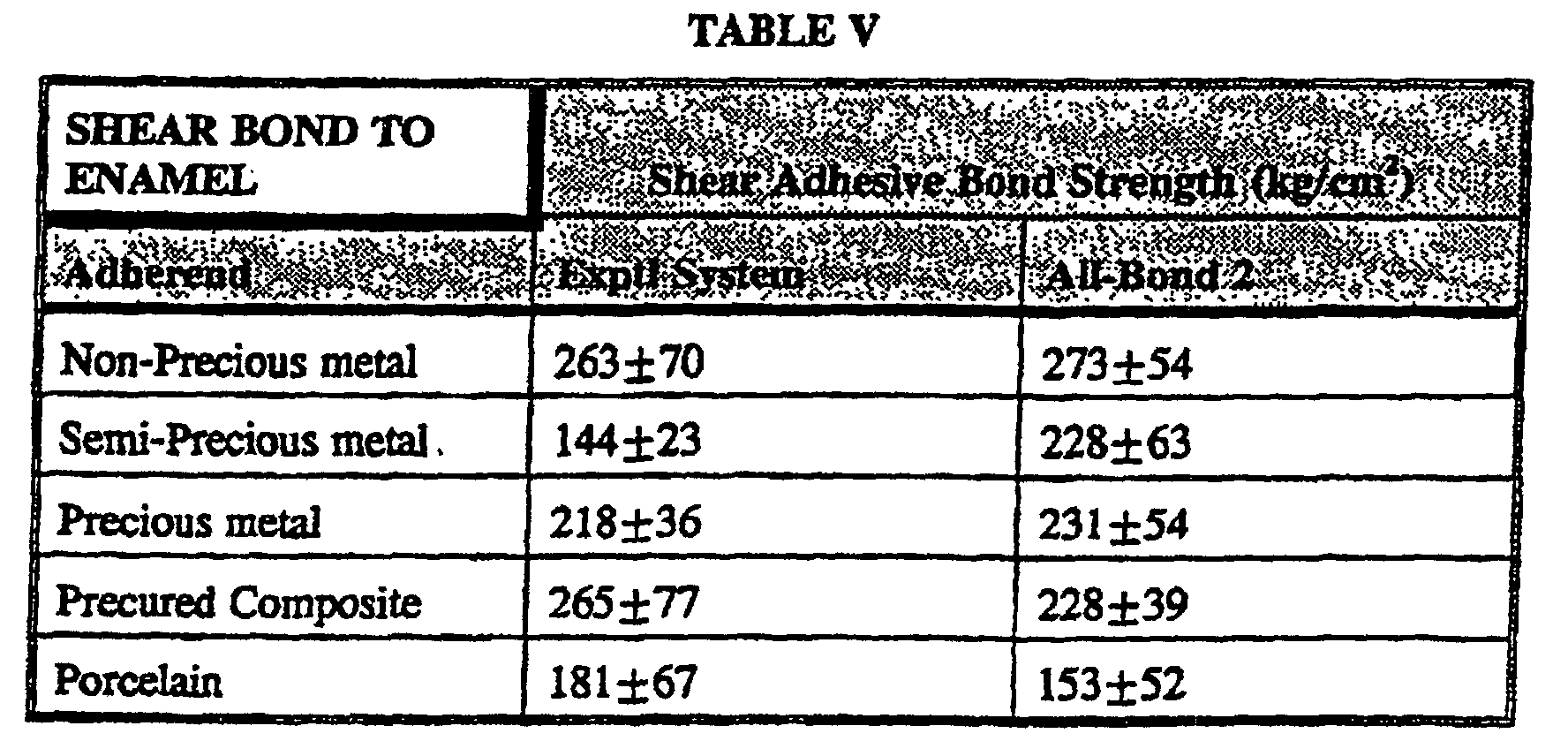
- the shear bond strength of the indicated adherends to enamel was 0 evaluated using an experimental system of the present invention (etchant-35% phosphoric acid with rinse, treatment composition-3% sodium benzenesulfinate/ethanol, primer-13.3% Copolymer/39.8% HEMA/46.9% water).
- the adhesive contained 2.1% BPO, 0.093% BHT, 61.13% BisGMA and 36.68% HEMA. This system was compared to a commercially available dental adhesive system following the bond strength protocol as defined above.
- the adherends were as described in Example 4.
- This example shows that the experimental system of the present invention achieves shear adhesive bond strengths of adherends to enamel that were at least equal to the bond strengths of commercial products.
- the present invention has advantage of being an easy to use self-curable adhesive system.
- the All-Bond 2 product requires multiple applications of a primer that must be mixed in the dental office.
- the shear bond strength of the indicated adherends to porcelain was evaluated using an experimental system of the present invention (etchant-35% phosphoric acid with rinse, treatment composition-3% sodium benzenesulfinate/ethanol, primer-13.3% Copolymer/39.8% HEMA/46.9% water).
- the adhesive contained 2.1% BPO, 0.093% BHT, 61.13% BisGMA and 36.68% HEMA.
- the adherends were as described in Example 4.
- This example shows that high shear bond smengths may be achieved using the present method when adhering various adherends to porcelain.
- the shear bond strength of the indicated adherends to previously cured composite was evaluated using an experimental system of the present invention (etchant-35% phosphoric acid with rinse, treatment composition-3% sodium benzenesulfinate/ethanol, primer-13.3% Copolymer/39.8% HEMA/46.9% water).
- the adhesive contained 2.1% BPO, 0.093% BHT, 61.13% BisGMA and 36.68% HEMA.
- the adherends were as described in Example 4.
- This example shows that high shear bond strengths may be achieved using the present method when adhering various adherends to composites.
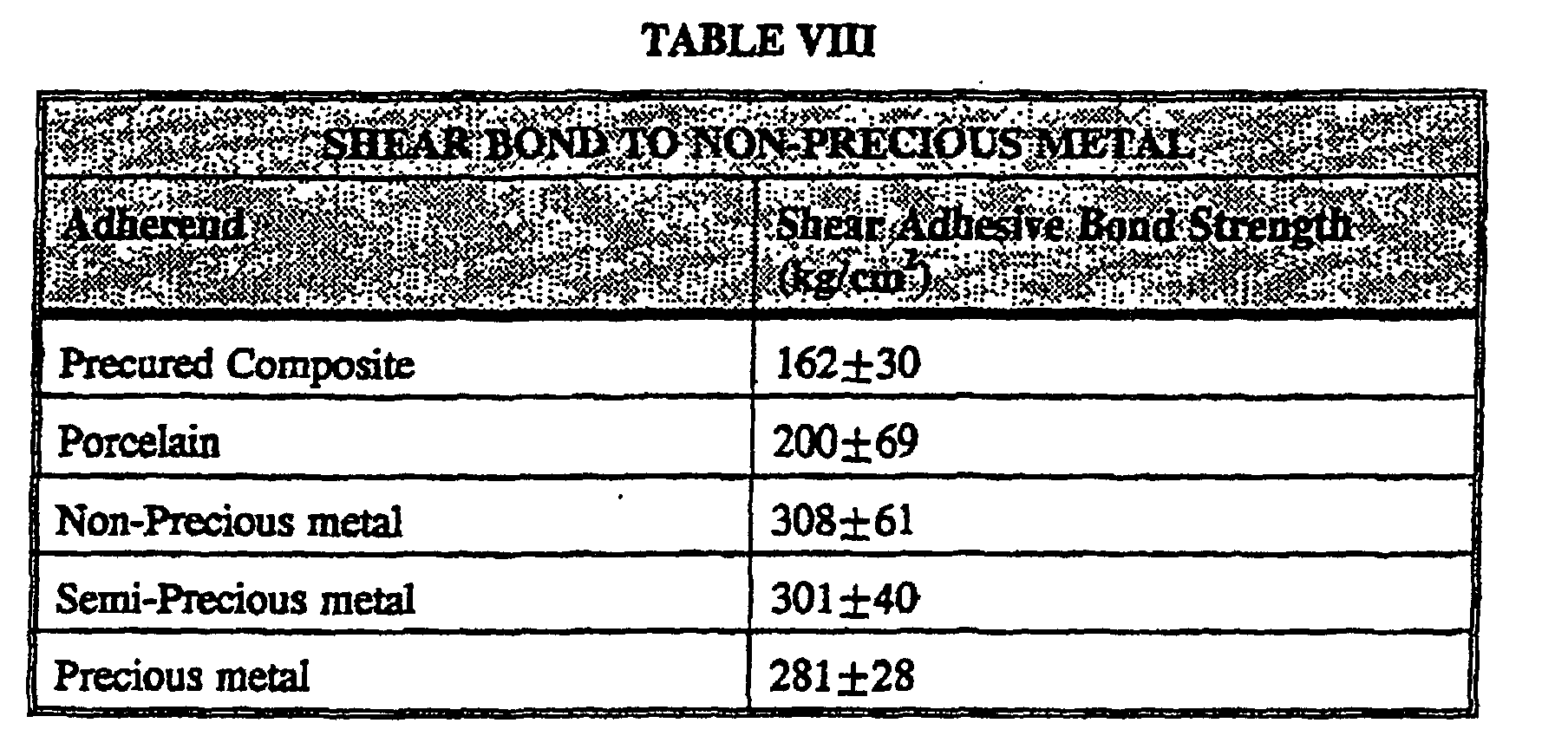
- the shear bond strength of the indicated adherends to non-precious metal was evaluated using an experimental system of the present invention (etchant-35% phosphoric acid with rinse, treatment composition-3% sodium benzenesulfinate/ethanol, primer-13.3% Copolymer/39.8% HEMA/46.9% water).
- the adhesive contained 2.1% BPO, 0.093% BHT, 61.13% BisGMA and 36.68% HEMA.
- the adherends were as described in Example 4.
- This example shows that high shear bond strengths may be achieved using the present method when adhering various adherends to non-precious metal.
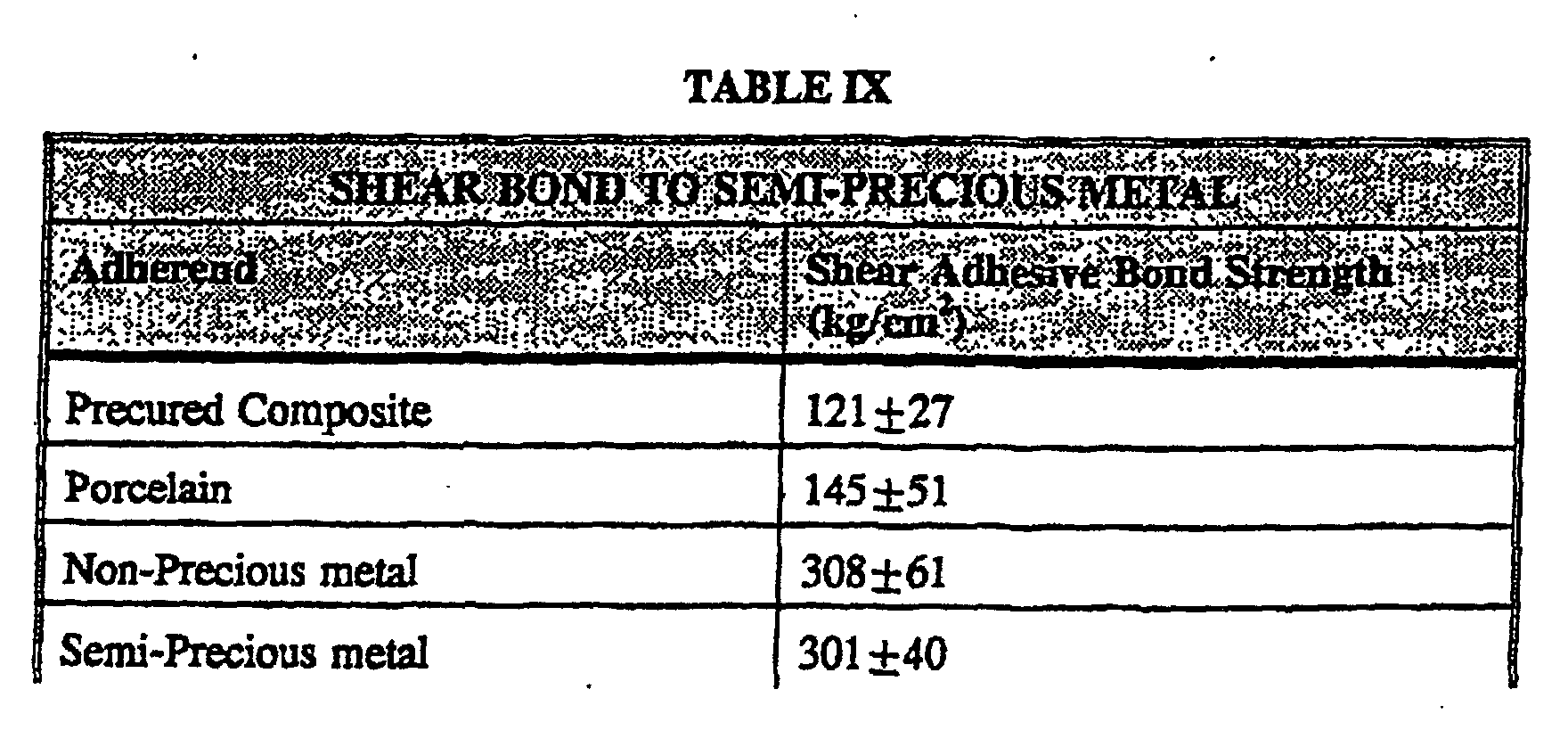
- the shear bond strength of the indicated adherends to semi-precious metal was evaluated using an experimental system of the present invention (etchant-35% phosphoric acid with rinse, treatment composition-3% sodium benzenesulfinate/ethanol, primer-13.3% Copolymer/39.8% HEMA/46.9% water).
- the adhesive contained 2.1% BPO, 0.093% BHT, 61.13% BisGMA and 36.68% HEMA.
- the adherends were as described in Example 4.
- This example shows that high shear bond strengths may be achieved using the present method when adhering various adherends to semi-precious metal.
- the shear bond strength of the indicated adherends to precious metal was evaluated using an experimental system of the present invention (etchant-35% phosphoric acid with rinse, treatment composition-3% sodium benzenesulfinate/ethanol, primer-13.3% Copolymer/39.8% HEMA/46.9% water).
- the adhesive contained 2.1% BPO, 0.093% BHT, 61.13% BisGMA and 36.68% HEMA.
- the adherends were as described in Example 4.
- This example shows that high shear bond strengths may be achieved using the present method when adhering various adherends to precious metal.
- the shear bond strength of the indicated adherends to set amalgam was evaluated using an experimental system of the present invention (etchant-35% phosphoric acid with rinse, treatment composition-3% sodium benzenesulfinate/ethanol, primer-13.3% Copolymer/39.8% HEMA/46.9% water).
- the adhesive contained 2.1% BPO, 0.093% BHT, 61.13% BisGMA and 36.68% HEMA.
- the adherends were as described in Example 4.
- the set amalgam was DisperalloyTM amalgam.
- This example shows that high shear bond strengths may be achieved using the present method when adhering various adherends to set amalgam.
- the shear bond strength of the indicated adherends to glass ionomer core was evaluated using an experimental system of the present invention (etchant-35% phosphoric acid with rinse, treatment composition-3% sodium benzenesulfinate/ethanol, primer-13.3% Copolymer/39.8% HEMA/46.9% water).
- the adhesive contained 2.1% BPO, 0.093% BHT, 61.13% BisGMA and 36.68% HEMA.
- the adherends were as described in Example 4.
- the glass ionomer core was 3MTM VitremerTM glass ionomer restorative/core buildup material.
- This example shows that high shear bond strengths may be achieved using the present method when adhering various adherends to glass ionomer core.
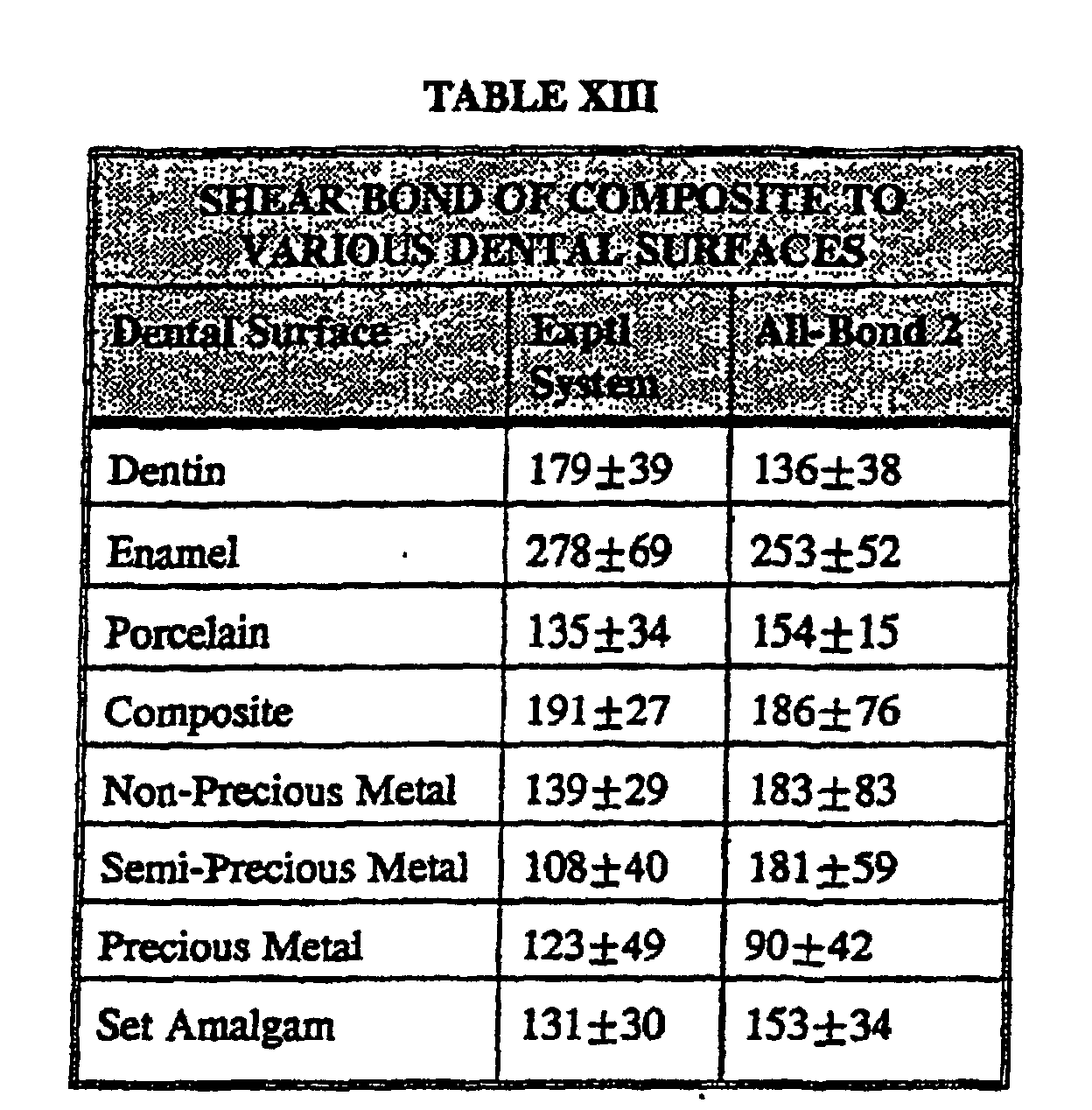
- the shear bond strength of a self-cure composite material (3MTMP-10TM Resin Bonded Ceramic restorative from 3M) to various dental surfaces was evaluated using an experimental system of the present invention (etchant-35% phosphoric acid with rinse, treatment composition-3% sodium benzenesulfinate/ethanol, primer-13.3% Copolymer/39.8% HEMA/46.9% water). This system was compared to a commercially available dental adhesive system following the bond strength protocol as defined above. The adherends were as described in Example 4.
- This example shows that high shear bond strengths may be achieved using the present method when adhering composite material to various dental surfaces.
- the set amalgam was DisperalloyTM amalgam.
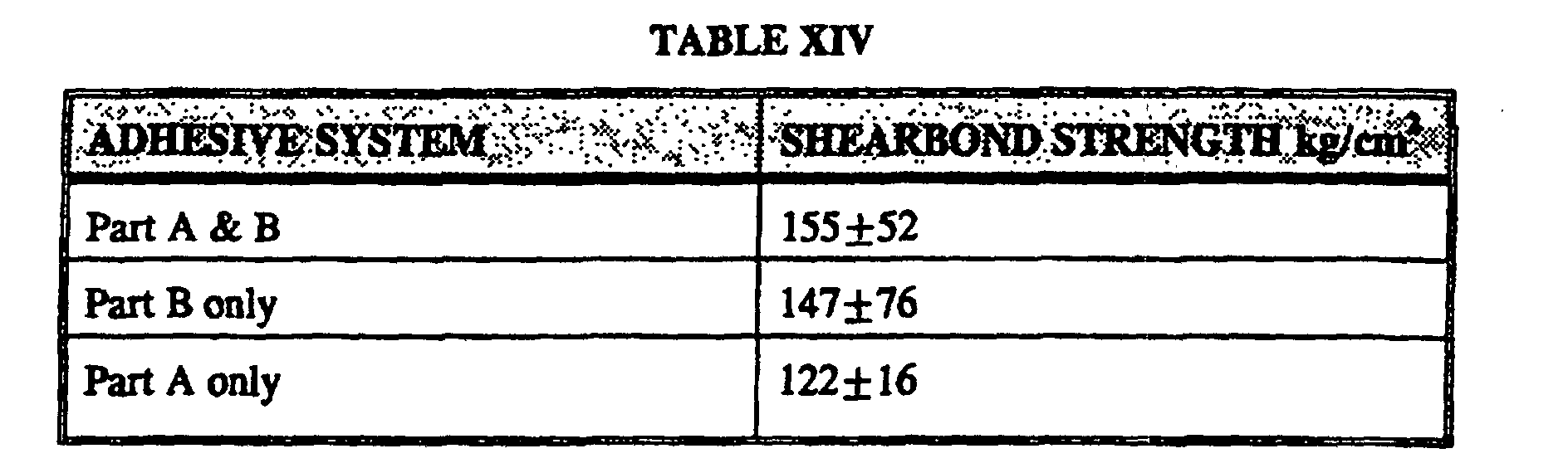
- adhesion of a precured composite button was carried out as in Example 4 with the following adhesive components:
- This example shows that high shear bond strengths may be achieved using the present method when adhering composite material to dentin using various combinations of adhesive components.
Landscapes
- Health & Medical Sciences (AREA)
- Oral & Maxillofacial Surgery (AREA)
- Public Health (AREA)
- Life Sciences & Earth Sciences (AREA)
- Animal Behavior & Ethology (AREA)
- General Health & Medical Sciences (AREA)
- Epidemiology (AREA)
- Veterinary Medicine (AREA)
- Dental Preparations (AREA)
- Chemical & Material Sciences (AREA)
- Chemical Kinetics & Catalysis (AREA)
- Medicinal Chemistry (AREA)
- Polymers & Plastics (AREA)
- Organic Chemistry (AREA)
Description

R1, R2, R3, R4 and R5 may be any atoms and/or groups as long as they are inert to the double bond of monomers. Examples are hydrogen, fluoro, chloro, bromo, iodo, methyl, ethyl, 2-chloroethyl, 2-bromo-2-chloroethyl, propyl, isopropyl, per-fluoropropyl, allyl, butyl, isobutyl, sec-butyl, tert-butyl, pentyl, isopentyl, neopentyl, tert-pentyl, cyclohexyl, phenyl and 4-bromophenyl.








Claims (14)
- Use of an acid, a treatment composition comprising an electron donor compound, a priming solution containing a film-former and a chemically curable dental adhesive for the preparation of a kit, whereby the components of the kit are to be administered in a method for adhering a non-amalgam dental restorative to a dental surface, said method comprising the steps of:wherein the treatment composition comprises an electron donor compound selected such that the dental restorative has a higher Adhesive Shear Bond Strength than provided by a like use without said electron donor compound.a) etching said dental surface with said acid,b) applying said treatment composition to said etched dental surface, thereby providing a treated dental surface,c) applying said priming solution to said treated dental surface, thereby providing a primed dental surface,d) applying said chemically curable dental adhesive to said primed dental surface, thereby providing an adhesive-coated dental surface, ande) applying a non-amalgam dental restorative to said adhesive-coated dental surface;
- Use of an acid for the preparation of an etching agent, whereby the etching agent is to be administered in a method for adhering a non-amalgam dental restorative to a dental surface, said method comprising the steps of:wherein the treatment composition comprises an electron donor compound selected such that the dental restorative has a higher Adhesive Shear Bond Strength than provided by a like use without said electron donor compound.a) etching said dental surface with said acid as an etching agent,b) applying a treatment composition comprising an electron donor compound to said etched dental surface, thereby providing a treated dental surface,c) applying a priming solution containing a film-former to said treated dental surface, thereby providing a primed dental surface,d) applying a chemically curable dental adhesive to said primed dental surface, thereby providing an adhesive-coated dental surface, ande) applying a non-amalgam dental restorative to said adhesive-coated dental surface;
- Use of an electron donor compound for the preparation of a treatment composition, whereby the treatment composition is to be administered in a method for adhering a non-amalgam dental restorative to a dental surface, said method comprising the steps of:wherein the treatment composition comprises an electron donor compound selected such that the dental restorative has a higher Adhesive Shear Bond Strength than provided by a like use without said electron donor compound.a) etching said dental surface with acid,b) applying said treatment composition comprising said electron donor compound to said etched dental surface, thereby providing a treated dental surface,c) applying a priming solution containing a film-former to said treated dental surface, thereby providing a primed dental surface,d) applying a chemically curable dental adhesive to said primed dental surface, thereby providing an adhesive-coated dental surface, ande) applying a non-amalgam dental restorative to said adhesive-coated dental surface;
- Use of a film-former for the preparation of a priming solution, whereby the priming solution is to be administered in a method for adhering a non-amalgam dental restorative to a dental surface, said method comprising the steps of:wherein the treatment composition comprises an electron donor compound selected such that the dental restorative has a higher Adhesive Shear Bond Strength than provided by a like use without said electron donor compound.a) etching said dental surface with acid,b) applying a treatment composition comprising an electron donor compound to said etched dental surface, thereby providing a treated dental surface,c) applying said priming solution containing said film-former to said treated dental surface, thereby providing a primed dental surface,d) applying a chemically curable dental adhesive to said primed dental surface, thereby providing an adhesive-coated dental surface, ande) applying a non-amalgam dental restorative to said adhesive-coated dental surface;
- Use of polymerizable components for the preparation of a chemically curable dental adhesive, whereby the dental adhesive is to be administered in a method for adhering a non-amalgam dental restorative to a dental surface, said method comprising the steps of:wherein the treatment composition comprises an electron donor compound selected such that the dental restorative has a higher Adhesive Shear Bond Strength than provided by a like use without said electron donor compound.a) etching said dental surface with acid,b) applying a treatment composition comprising an electron donor compound to said etched dental surface, thereby providing a treated dental surface,c) applying a priming solution containing a film-former to said treated dental surface, thereby providing a primed dental surface,d) applying said chemically curable dental adhesive to said primed dental surface, thereby providing an adhesive-coated dental surface, ande) applying a non-amalgam dental restorative to said adhesive-coated dental surface;
- The use according to any of the preceding claims, wherein said dental surface is hard tissue, porcelain, previously placed amalgam or metal.
- The use according to any of the preceding claims, wherein said treatment composition comprises sodium benzenesulfinate.
- The use according to claim 7, wherein said treatment composition comprises water.
- The use according to any of the preceding claims, wherein said priming solution comprises an acid having a pKa of less than about 10.
- The use according to any of the preceding claims, wherein said priming solution comprises HEMA.
- The use according to any of the preceding claims, wherein said priming solution comprises polyalkenoic acid copolymer.
- The use according to any of the preceding claims, wherein said chemically curable dental adhesive comprises a redox polymerisation initiator system.
- The use according to the preceding claims, wherein said restorative is a dental composite restorative.
- The use according to the preceding claims, wherein said adhered dental restorative exhibits a Shear Adhesive Strength to dentin greater than about 30 kg/cm2.
Applications Claiming Priority (3)
| Application Number | Priority Date | Filing Date | Title |
|---|---|---|---|
| US08/268,773 US5554030A (en) | 1994-06-30 | 1994-06-30 | Method for bonding non-amalgam restorative materials to dental surfaces |
| US268773 | 1994-06-30 | ||
| PCT/US1995/007914 WO1996000558A1 (en) | 1994-06-30 | 1995-06-21 | Method for bonding non-amalgam restorative materials to dental surfaces |
Publications (2)
| Publication Number | Publication Date |
|---|---|
| EP0767652A1 EP0767652A1 (en) | 1997-04-16 |
| EP0767652B1 true EP0767652B1 (en) | 2003-05-02 |
Family
ID=23024425
Family Applications (1)
| Application Number | Title | Priority Date | Filing Date |
|---|---|---|---|
| EP95924649A Expired - Lifetime EP0767652B1 (en) | 1994-06-30 | 1995-06-21 | Method for bonding non-amalgam restorative materials to dental surfaces |
Country Status (7)
| Country | Link |
|---|---|
| US (1) | US5554030A (en) |
| EP (1) | EP0767652B1 (en) |
| JP (1) | JP3547753B2 (en) |
| AU (1) | AU2907195A (en) |
| CA (1) | CA2192075C (en) |
| DE (1) | DE69530586T2 (en) |
| WO (1) | WO1996000558A1 (en) |
Families Citing this family (30)
| Publication number | Priority date | Publication date | Assignee | Title |
|---|---|---|---|---|
| US6387980B2 (en) | 1996-11-01 | 2002-05-14 | Dentsply Research & Development Corp. | Dental composition system and method |
| US5973022A (en) * | 1996-11-01 | 1999-10-26 | Dentsply Research & Development Corp. | Dental composition system and method |
| US6001897A (en) * | 1997-01-13 | 1999-12-14 | American Dental Association Health Foundation | Polymerizable conditioners for adhesive bonding to dentin and enamel |
| US5922786A (en) † | 1997-04-11 | 1999-07-13 | Minnesota Mining And Manufacturing Company | Dental primer composition |
| US6004390A (en) * | 1997-04-14 | 1999-12-21 | Dentsply Detrey Gmbh | Tooth surface treatment composition and methods |
| BR9808679A (en) * | 1997-04-16 | 2000-07-11 | Dentsply Int Inc | Adhesive dental composition, and process for bonding a non-amalgam dental restoration material to a dental surface |
| WO1999017585A1 (en) * | 1997-09-29 | 1999-04-08 | Cochlear Limited | Public alarm apparatus and method for cochlear implants |
| US6121344A (en) * | 1998-06-19 | 2000-09-19 | Kerr Corporation | Optimum particle sized hybrid composite |
| US6300390B1 (en) | 1998-06-09 | 2001-10-09 | Kerr Corporation | Dental restorative composite |
| US20050059753A1 (en) * | 1998-06-30 | 2005-03-17 | Junjie Sang | Method and composition for adhering to tooth structure |
| JP2000186010A (en) * | 1998-09-10 | 2000-07-04 | San Medical Kk | Dental adhesive set |
| US6224379B1 (en) | 1998-10-02 | 2001-05-01 | Trustees Of Tufts College | Method for shaping an adhesive material |
| US6342203B2 (en) | 1999-10-27 | 2002-01-29 | Dakota Dental Development, Inc. | Compositions for dentistry comprising an oil, to repair, restore, adhere to, or protect the surface of a tooth |
| US6342204B1 (en) | 1999-10-27 | 2002-01-29 | Dakota Dental Development, Inc | Flavored tooth conditioning compositions and methods for using the compositions to condition a tooth surface |
| US6620859B2 (en) | 2000-12-15 | 2003-09-16 | Dakota Dental Development, Inc. | Methods of preparing polymerizable dental compositions with improved taste or aroma, and that prevent oxygen-inhibited layer |
| US7173074B2 (en) * | 2001-12-29 | 2007-02-06 | 3M Innovative Properties Company | Composition containing a polymerizable reducing agent, kit, and method |
| JP4629339B2 (en) * | 2001-12-29 | 2011-02-09 | スリーエム イノベイティブ プロパティズ カンパニー | Compositions, kits and methods containing polymerizable reducing agents |
| US6729879B2 (en) | 2002-03-13 | 2004-05-04 | Ultradent Products, Inc. | Dental bonding methods for adhering amalgam restoratives to dental substrates |
| US6756417B2 (en) * | 2002-03-13 | 2004-06-29 | Ultradent Products, Inc. | Dental bonding compositions for adhering amalgam restoratives to dental substrates |
| DE10228540A1 (en) * | 2002-06-26 | 2004-01-22 | Ivoclar Vivadent Ag | Dental materials based on hydroxyalkylacrylamides |
| JP4485117B2 (en) * | 2002-06-27 | 2010-06-16 | 日東電工株式会社 | Protective peeling film |
| US20040206932A1 (en) * | 2002-12-30 | 2004-10-21 | Abuelyaman Ahmed S. | Compositions including polymerizable bisphosphonic acids and methods |
| US7632098B2 (en) * | 2003-08-12 | 2009-12-15 | 3M Innovative Properties Company | Self-adhesive dental compositions and methods |
| US8465284B2 (en) | 2004-07-08 | 2013-06-18 | 3M Innovative Properties Company | Dental methods, compositions, and kits including acid-sensitive dyes |
| EP1784155B1 (en) | 2004-08-11 | 2011-09-28 | 3M Innovative Properties Company | Self-adhesive compositions including a plurality of acidic compounds |
| JP2007169224A (en) * | 2005-12-22 | 2007-07-05 | Sun Medical Co Ltd | Tooth surface pre-treating material composition |
| KR101373087B1 (en) * | 2006-10-30 | 2014-03-11 | 산메디카루 가부시키가이샤 | Self-etching primer composition for dental use |
| JP5507256B2 (en) * | 2006-12-13 | 2014-05-28 | スリーエム イノベイティブ プロパティズ カンパニー | Method of using a dental composition having an acidic component and a photobleachable dye |
| EP1970041A1 (en) * | 2007-03-16 | 2008-09-17 | Ernst Mühlbauer GmbH & Co.KG | Kit for attaching dental restoration material to tooth substance |
| US10299887B2 (en) * | 2009-04-23 | 2019-05-28 | Nanova, Inc. | Atmospheric non-thermal gas plasma method for dental surface treatment |
Family Cites Families (43)
| Publication number | Priority date | Publication date | Assignee | Title |
|---|---|---|---|---|
| US3513123A (en) * | 1967-10-11 | 1970-05-19 | Dentsply Int Inc | Adhesive dental filling |
| US3574943A (en) * | 1969-03-10 | 1971-04-13 | Univ California | Dental cavity liner and method of restoring carious teeth |
| US3882600A (en) * | 1971-04-01 | 1975-05-13 | Richard W Plymale | Composition in method for treating teeth |
| US4001483A (en) * | 1974-10-22 | 1977-01-04 | Lee Jr Henry L | Dental sealant for amalgam restorations |
| US4064629A (en) * | 1976-01-26 | 1977-12-27 | The University Of Virginia | Cavity liner for dental restorations |
| GB1569021A (en) * | 1976-03-17 | 1980-06-11 | Kuraray Co | Adhesive cementing agents containing partial phosphonic orphosphonic acid esters |
| DE2739282C2 (en) * | 1976-08-31 | 1985-03-28 | Kuraray Co., Ltd., Kurashiki, Okayama | Use of a curing system consisting of a peroxide, a secondary or tertiary amine and an alkali or alkaline earth metal salt of an arylsulfinic acid for the production of an adhesive |
| JPS5330193A (en) * | 1976-08-31 | 1978-03-22 | Kuraray Co | Human body hard tissue adhesive compostion |
| JPS6019723B2 (en) * | 1978-01-27 | 1985-05-17 | 而至歯科工業株式会社 | dental composition |
| US4251565A (en) * | 1979-02-09 | 1981-02-17 | American Dental Association Health Foundation | Use of a polyfunctional surface-active comonomer and other agents to improve adhesion between a resin or composite material and a substrate |
| JPS57106688A (en) * | 1980-12-20 | 1982-07-02 | Lion Corp | 1-methacryloxyethane-1,1-diphosphonic acid |
| US4929746A (en) * | 1981-02-13 | 1990-05-29 | Minnesota Mining And Manufacturing Company | Dentin and enamel adhesive |
| CA1236844A (en) * | 1981-02-13 | 1988-05-17 | James E. Bunker | Dentin and enamel adhesives |
| US4669983A (en) * | 1981-02-13 | 1987-06-02 | Minnesota Mining And Manufacturing Company | Dentin and enamel adhesive |
| JPS57143372A (en) * | 1981-02-28 | 1982-09-04 | Sankin Kogyo Kk | Adhesive for human hard tissue |
| JPS57167364A (en) * | 1981-04-07 | 1982-10-15 | Sankin Kogyo Kk | Adhesive for hard tissue of human body |
| US4539382A (en) * | 1981-07-29 | 1985-09-03 | Kuraray Co., Ltd. | Adhesive composition |
| US4540722A (en) * | 1982-01-15 | 1985-09-10 | Minnesota Mining And Manufacturing Company | Dentin and enamel adhesive |
| JPS5996180A (en) * | 1982-11-24 | 1984-06-02 | Tokuyama Soda Co Ltd | dental adhesive |
| JPS59135272A (en) * | 1983-01-21 | 1984-08-03 | Kuraray Co Ltd | Adhesive |
| JPS59137404A (en) * | 1983-01-27 | 1984-08-07 | Kuraray Co Ltd | Dental adhesive |
| US4544467A (en) * | 1983-06-28 | 1985-10-01 | Minnesota Mining And Manufacturing Company | Light-curable dentin and enamel adhesive |
| JPS60123515A (en) * | 1983-12-09 | 1985-07-02 | Mitsui Petrochem Ind Ltd | Pretreating agent composition |
| FR2561521B3 (en) * | 1984-03-23 | 1986-05-30 | Castel Alain | INTERMEDIATE PRODUCT FOR IMPROVING THE FIXATION OF DENTAL AMALGAMS |
| US5276068A (en) * | 1985-03-29 | 1994-01-04 | Jeneric/Pentron, Inc. | Dental resin materials |
| DE3536076A1 (en) * | 1985-10-09 | 1987-04-09 | Muehlbauer Ernst Kg | POLYMERIZABLE CEMENT MIXTURES |
| AU590671B2 (en) * | 1986-02-28 | 1989-11-09 | Minnesota Mining And Manufacturing Company | One-part visible light-curable dentin and enamel adhesive |
| US4719149A (en) * | 1986-02-28 | 1988-01-12 | Minnesota Mining And Manufacturing Company | Method for priming hard tissue |
| JPS63175085A (en) * | 1987-01-14 | 1988-07-19 | Mitsubishi Rayon Co Ltd | dental adhesive composition |
| JPS63250310A (en) * | 1987-04-03 | 1988-10-18 | Mitsubishi Rayon Co Ltd | dental adhesive composition |
| JPS63290807A (en) * | 1987-05-21 | 1988-11-28 | G C Dental Ind Corp | Bonding of dentine to composite resin |
| US4880660A (en) * | 1987-08-28 | 1989-11-14 | Minnesota Mining And Manufacturing Company | Method for priming hard tissue |
| DE3821578A1 (en) * | 1988-06-25 | 1989-12-28 | Bayer Ag | LIQUID FOR CONDITIONING TOOTH OR BONE SUBSTANCE |
| JP2604472B2 (en) * | 1989-07-12 | 1997-04-30 | 株式会社クラレ | Polymerizable composition |
| DE59001245D1 (en) * | 1989-10-19 | 1993-05-27 | Heraeus Kulzer Gmbh | DENTAL ADHESIVE. |
| US5141436A (en) * | 1989-11-13 | 1992-08-25 | Scientific Pharmaceuticals, Inc. | Method of bonding article to teeth employing a light curable primer |
| JP2634276B2 (en) * | 1990-02-15 | 1997-07-23 | 株式会社松風 | Primer composition |
| US5290172A (en) * | 1991-11-06 | 1994-03-01 | Gc Corporation | Method for preparing a tooth surface for bonding |
| DK206591D0 (en) * | 1991-12-23 | 1991-12-23 | Lundbeck & Co As H | TREATMENT OF PSYCHOSIS |
| PL172401B1 (en) * | 1991-12-31 | 1997-09-30 | Minnesota Mining & Mfg | Composition for bonding or coating hard tissue |
| US5256447A (en) * | 1991-12-31 | 1993-10-26 | Minnesota Mining And Manufacturing Company | Adhesive composition and method |
| US5849813A (en) * | 1993-02-05 | 1998-12-15 | Minnesota Mining And Manufacturing Company | Oxidative pretreatment for improved adhesion |
| JP3465753B2 (en) * | 1993-12-28 | 2003-11-10 | 株式会社トクヤマ | Dental composition |
-
1994
- 1994-06-30 US US08/268,773 patent/US5554030A/en not_active Expired - Lifetime
-
1995
- 1995-06-21 DE DE69530586T patent/DE69530586T2/en not_active Expired - Lifetime
- 1995-06-21 AU AU29071/95A patent/AU2907195A/en not_active Abandoned
- 1995-06-21 JP JP50331496A patent/JP3547753B2/en not_active Expired - Fee Related
- 1995-06-21 CA CA002192075A patent/CA2192075C/en not_active Expired - Fee Related
- 1995-06-21 EP EP95924649A patent/EP0767652B1/en not_active Expired - Lifetime
- 1995-06-21 WO PCT/US1995/007914 patent/WO1996000558A1/en not_active Ceased
Also Published As
| Publication number | Publication date |
|---|---|
| DE69530586T2 (en) | 2004-02-26 |
| WO1996000558A1 (en) | 1996-01-11 |
| AU2907195A (en) | 1996-01-25 |
| EP0767652A1 (en) | 1997-04-16 |
| CA2192075C (en) | 2003-04-22 |
| US5554030A (en) | 1996-09-10 |
| JP2001520623A (en) | 2001-10-30 |
| CA2192075A1 (en) | 1996-01-11 |
| DE69530586D1 (en) | 2003-06-05 |
| JP3547753B2 (en) | 2004-07-28 |
Similar Documents
| Publication | Publication Date | Title |
|---|---|---|
| EP0767652B1 (en) | Method for bonding non-amalgam restorative materials to dental surfaces | |
| EP0767651B1 (en) | Method for bonding amalgam to dental surfaces | |
| US6482871B1 (en) | Method for adhering to hard tissue | |
| EP0234934B1 (en) | Method for priming hard tissue | |
| JP5577037B2 (en) | Packaged redox curable composition | |
| JP4406691B2 (en) | Dental primer composition | |
| US20230201083A1 (en) | Self-adhesive dental composite cement with good transparency based on acid-treated fillers | |
| EP2571479B1 (en) | Dental compositions | |
| JP5809974B2 (en) | Redox curable composition | |
| US7968618B2 (en) | One-component dental adhesive compositions and method of use | |
| CN101351182B (en) | Dental composition and the initiator system with polycyclic aromatic component | |
| EP0609902B1 (en) | Oxidative pretreatment for improved adhesion to dental amalgam | |
| EP0620722B1 (en) | Method for adhering to hard tissue | |
| EP0623017A1 (en) | Water-based amalgam adhesive | |
| JP2009522279A (en) | Dental composition with water scavenger | |
| JP3452592B2 (en) | Dental cement hardener |
Legal Events
| Date | Code | Title | Description |
|---|---|---|---|
| PUAI | Public reference made under article 153(3) epc to a published international application that has entered the european phase |
Free format text: ORIGINAL CODE: 0009012 |
|
| 17P | Request for examination filed |
Effective date: 19970109 |
|
| AK | Designated contracting states |
Kind code of ref document: A1 Designated state(s): DE FR GB IT |
|
| 17Q | First examination report despatched |
Effective date: 20000928 |
|
| GRAG | Despatch of communication of intention to grant |
Free format text: ORIGINAL CODE: EPIDOS AGRA |
|
| GRAG | Despatch of communication of intention to grant |
Free format text: ORIGINAL CODE: EPIDOS AGRA |
|
| GRAG | Despatch of communication of intention to grant |
Free format text: ORIGINAL CODE: EPIDOS AGRA |
|
| GRAH | Despatch of communication of intention to grant a patent |
Free format text: ORIGINAL CODE: EPIDOS IGRA |
|
| GRAH | Despatch of communication of intention to grant a patent |
Free format text: ORIGINAL CODE: EPIDOS IGRA |
|
| GRAA | (expected) grant |
Free format text: ORIGINAL CODE: 0009210 |
|
| AK | Designated contracting states |
Designated state(s): DE FR GB IT |
|
| REG | Reference to a national code |
Ref country code: GB Ref legal event code: FG4D |
|
| REF | Corresponds to: |
Ref document number: 69530586 Country of ref document: DE Date of ref document: 20030605 Kind code of ref document: P |
|
| ET | Fr: translation filed | ||
| PLBE | No opposition filed within time limit |
Free format text: ORIGINAL CODE: 0009261 |
|
| STAA | Information on the status of an ep patent application or granted ep patent |
Free format text: STATUS: NO OPPOSITION FILED WITHIN TIME LIMIT |
|
| 26N | No opposition filed |
Effective date: 20040203 |
|
| PG25 | Lapsed in a contracting state [announced via postgrant information from national office to epo] |
Ref country code: IT Free format text: LAPSE BECAUSE OF NON-PAYMENT OF DUE FEES;WARNING: LAPSES OF ITALIAN PATENTS WITH EFFECTIVE DATE BEFORE 2007 MAY HAVE OCCURRED AT ANY TIME BEFORE 2007. THE CORRECT EFFECTIVE DATE MAY BE DIFFERENT FROM THE ONE RECORDED. Effective date: 20050621 |
|
| PGFP | Annual fee paid to national office [announced via postgrant information from national office to epo] |
Ref country code: FR Payment date: 20100709 Year of fee payment: 16 |
|
| PGFP | Annual fee paid to national office [announced via postgrant information from national office to epo] |
Ref country code: GB Payment date: 20100616 Year of fee payment: 16 |
|
| GBPC | Gb: european patent ceased through non-payment of renewal fee |
Effective date: 20110621 |
|
| REG | Reference to a national code |
Ref country code: FR Ref legal event code: ST Effective date: 20120229 |
|
| PG25 | Lapsed in a contracting state [announced via postgrant information from national office to epo] |
Ref country code: FR Free format text: LAPSE BECAUSE OF NON-PAYMENT OF DUE FEES Effective date: 20110630 |
|
| PG25 | Lapsed in a contracting state [announced via postgrant information from national office to epo] |
Ref country code: GB Free format text: LAPSE BECAUSE OF NON-PAYMENT OF DUE FEES Effective date: 20110621 |
|
| PGFP | Annual fee paid to national office [announced via postgrant information from national office to epo] |
Ref country code: DE Payment date: 20120613 Year of fee payment: 18 |
|
| REG | Reference to a national code |
Ref country code: DE Ref legal event code: R119 Ref document number: 69530586 Country of ref document: DE Effective date: 20140101 |
|
| PG25 | Lapsed in a contracting state [announced via postgrant information from national office to epo] |
Ref country code: DE Free format text: LAPSE BECAUSE OF NON-PAYMENT OF DUE FEES Effective date: 20140101 |