EP0768313A2 - A surface treating agent for glass fiber substrates - Google Patents
A surface treating agent for glass fiber substrates Download PDFInfo
- Publication number
- EP0768313A2 EP0768313A2 EP96306623A EP96306623A EP0768313A2 EP 0768313 A2 EP0768313 A2 EP 0768313A2 EP 96306623 A EP96306623 A EP 96306623A EP 96306623 A EP96306623 A EP 96306623A EP 0768313 A2 EP0768313 A2 EP 0768313A2
- Authority
- EP
- European Patent Office
- Prior art keywords
- glass fiber
- surface treating
- group
- treating agent
- agent according
- Prior art date
- Legal status (The legal status is an assumption and is not a legal conclusion. Google has not performed a legal analysis and makes no representation as to the accuracy of the status listed.)
- Ceased
Links
Images
Classifications
-
- H—ELECTRICITY
- H05—ELECTRIC TECHNIQUES NOT OTHERWISE PROVIDED FOR
- H05K—PRINTED CIRCUITS; CASINGS OR CONSTRUCTIONAL DETAILS OF ELECTRIC APPARATUS; MANUFACTURE OF ASSEMBLAGES OF ELECTRICAL COMPONENTS
- H05K1/00—Printed circuits
- H05K1/02—Details
- H05K1/03—Use of materials for the substrate
- H05K1/0313—Organic insulating material
- H05K1/0353—Organic insulating material consisting of two or more materials, e.g. two or more polymers, polymer + filler, + reinforcement
- H05K1/0366—Organic insulating material consisting of two or more materials, e.g. two or more polymers, polymer + filler, + reinforcement reinforced, e.g. by fibres, fabrics
-
- C—CHEMISTRY; METALLURGY
- C03—GLASS; MINERAL OR SLAG WOOL
- C03C—CHEMICAL COMPOSITION OF GLASSES, GLAZES OR VITREOUS ENAMELS; SURFACE TREATMENT OF GLASS; SURFACE TREATMENT OF FIBRES OR FILAMENTS MADE FROM GLASS, MINERALS OR SLAGS; JOINING GLASS TO GLASS OR OTHER MATERIALS
- C03C25/00—Surface treatment of fibres or filaments made from glass, minerals or slags
- C03C25/10—Coating
- C03C25/24—Coatings containing organic materials
- C03C25/40—Organo-silicon compounds
-
- C—CHEMISTRY; METALLURGY
- C07—ORGANIC CHEMISTRY
- C07F—ACYCLIC, CARBOCYCLIC OR HETEROCYCLIC COMPOUNDS CONTAINING ELEMENTS OTHER THAN CARBON, HYDROGEN, HALOGEN, OXYGEN, NITROGEN, SULFUR, SELENIUM OR TELLURIUM
- C07F7/00—Compounds containing elements of Groups 4 or 14 of the Periodic Table
- C07F7/02—Silicon compounds
- C07F7/08—Compounds having one or more C—Si linkages
- C07F7/18—Compounds having one or more C—Si linkages as well as one or more C—O—Si linkages
- C07F7/1804—Compounds having Si-O-C linkages
-
- H—ELECTRICITY
- H05—ELECTRIC TECHNIQUES NOT OTHERWISE PROVIDED FOR
- H05K—PRINTED CIRCUITS; CASINGS OR CONSTRUCTIONAL DETAILS OF ELECTRIC APPARATUS; MANUFACTURE OF ASSEMBLAGES OF ELECTRICAL COMPONENTS
- H05K2201/00—Indexing scheme relating to printed circuits covered by H05K1/00
- H05K2201/02—Fillers; Particles; Fibers; Reinforcement materials
- H05K2201/0203—Fillers and particles
- H05K2201/0206—Materials
- H05K2201/0239—Coupling agent for particles
-
- Y—GENERAL TAGGING OF NEW TECHNOLOGICAL DEVELOPMENTS; GENERAL TAGGING OF CROSS-SECTIONAL TECHNOLOGIES SPANNING OVER SEVERAL SECTIONS OF THE IPC; TECHNICAL SUBJECTS COVERED BY FORMER USPC CROSS-REFERENCE ART COLLECTIONS [XRACs] AND DIGESTS
- Y10—TECHNICAL SUBJECTS COVERED BY FORMER USPC
- Y10T—TECHNICAL SUBJECTS COVERED BY FORMER US CLASSIFICATION
- Y10T428/00—Stock material or miscellaneous articles
- Y10T428/29—Coated or structually defined flake, particle, cell, strand, strand portion, rod, filament, macroscopic fiber or mass thereof
- Y10T428/2913—Rod, strand, filament or fiber
- Y10T428/2933—Coated or with bond, impregnation or core
- Y10T428/2962—Silane, silicone or siloxane in coating
Definitions
- This invention relates to treating agents, glass fiber substrates treated with such agents, and the use of such treated glass fiber substrates in molded, glass fiber reinforced resins that are suited to copper clad laminates, composite base materials, printed wiring boards such as mass lamination boards, and, in particular, multilayer printed wiring boards.
- thermosetting resins such as unsaturated polyester resins, epoxy resins, phenol resins, polyimide resins and polyamide resins
- molded glass fiber reinforced fibers that are obtained are used for various applications and are particularly suited for use as printed wiring boards.
- the glass fiber substrate is usually first subjected to surface treating with a silane coupling agent such as 3-aminopropyltrimethoxysilane 3-aminopropyltriethoxysilane, N-(2-aminoethyl) -3-aminopropyltrimethoxysilane, 3-anilinopropyltrimethoxysilane, 3-glycidoxypropyltrimethoxysilane, 2-(3,4-epoxycyclohexyl) ethyltrimethoxysilane, 3-methacryloxypropyltrimethoxysilane, hydrochlorides of trimethoxysilanes of the formula: as taught by JP-A 48-20609, hydrochlorides of trimethoxysilanes of the formula: as described in JP-A 5-47551, and hydrochlorides of trimethoxys
- a silane coupling agent such as 3-aminopropyltrimethoxysilane 3-amino
- glass fiber substrates that have been subjected to surface treating with these silane coupling agents still do not have sufficient capacity for impregnation with thermosetting resins and sufficient adhesiveness.
- solder treating by hand soldering, drag soldering, dip soldering, wave soldering or reflow soldering at 240 to 260°C, or are hot air treated at 300 to 400°C
- there are problems of exfoliation between the glass fibers in the glass fiber substrate i.e., measling and crazing; or exfoliation in the interior of the molded object between the glass fiber substrate and the thermosetting resin, i.e., delamination and exfoliation in the interior of the molded object accompanied by swelling in the surface, i.e., blistering.
- the inventors arrived at this invention as a result of intensive studies of the aforementioned problems.
- the objective of this invention is to provide molded glass fiber reinforced resins of superior solder heat resistance, prepregs for preparing these molded objects, glass fiber substrates of superior thermosetting resin impregnation capacity manufacturing these prepregs, and a surface treating agent for glass fiber substrates for preparing these substrates.
- the surface treating agents of this invention are characterized in that they comprise an organosilicon compound having the general formula a partially hydrolyzed condensate or a reaction mixture thereof, which is obtained by subjecting: 1) an alkoxysilane containing an amino group having the general formula: wherein, R 1 and R 2 are the same or different divalent hydrocarbon groups, R 3 is a monovalent hydrocarbon group, R 4 is an alkoxy group, n has a value of 0, 1 or 2 and a has a value of 0, 1 or 2, or a partially hydrolyzed condensate thereof, to 2) a dehydration condensation reaction with an aldehyde of general formula: R 5 -CHO (II) wherein, R 5 is a substituted or unsubstituted aryl group.
- organosilicon compound having the general formula a partially hydrolyzed condensate or a reaction mixture thereof which is obtained by subjecting: 1) an alkoxysilane containing an amino group having the general formula: wherein, R 1 and R
- the glass fiber substrate of this invention is further characterized in that it is subjected to surface treating by the aforementioned surface treating agent.
- the prepreg of this invention is further characterized in that the aforementioned substrate is impregnated with a thermosetting resin.
- the molded glass fiber reinforced resin of this invention is further characterized in that the aforementioned prepreg is thermoset.
- These surface treating agents are comprised of organosilicon compounds, partially hydrolyzed condensates, or reaction mixtures thereof, that are obtained by subjecting an alkoxysilane containing an amino group as indicated by general formula (I): or a partially hydrolyzed condensate thereof, to a dehydration condensation reaction with an aldehyde as indicated by general formula (II) : [R 5 CHO] by the following reaction:
- thermosetting resins for which reason there is good capacity for impregnation with and adhesiveness to the thermosetting resins and the molded glass fiber reinforced resins are also endowed with superior solder heat resistance.
- R 1 and R 2 which may be the same or different, can be, for example, alkylene groups such as methylene, ethylene, propylene, butylene, pentylene and hexylene; alkaryl or aralkyl groups such as methylphenylene, ethylphenylene, propylphenylene, phenylmethylene, phenylethylene and phenylpropylene groups; or dialkylarylene groups such as dimethylphenylene, methylethylphenylene, methylpropylphenylene, ethylmethylphenylene and diethylphenylene groups.
- alkylene groups such as methylene, ethylene, propylene, butylene, pentylene and hexylene
- alkaryl or aralkyl groups such as methylphenylene, ethylphenylene, propylphenylene, phenylmethylene, phenylethylene and phenylpropylene groups
- R 1 is preferred and it is more preferred for R 1 to be an ethylene group and R 2 to be a propylene group.
- R 3 in the formula is a monovalent hydrocarbon group, for example, an alkyl group such as methyl, ethyl, propyl, butyl, pentyl or a hexyl group; an aryl group such as phenyl, tolyl and xylyl; an alkenyl group such as a vinyl, allyl, butenyl or pentenyl and a hexenyl; or an aralkyl group such as benzyl or phenethyl. It is preferred for R 3 to be a methyl group.
- R 4 in the formula (1) is an alkoxy group, for example, a methoxy, ethoxy, propoxy, butoxy, pentoxy group, or a methoxyethoxy group. It is preferred for R 4 to be a methoxy group or an ethoxy group.
- n has a value of 0, 1 or 2, with 0 or 1 being particularly desirable.
- a has a value of 0, 1 or 2, with 0 being particularly desirable.
- the alkoxysilane containing an amino group as indicated by general formula (I) can be, for example, 3 aminopropyltrimethoxysilane, 3-aminopropylmethyldimethoxysilane, 3-aminopropyldimethylmethoxysilane, 3-aminopropyltriethoxysilane, 3-aminopropylmethyldiethoxysilane, N-(2-aminoethyl)-3-aminopropyltrimethoxysilane, N-(2-aminoethyl)-3-aminopropylmethyldimethoxysilane p-(trimethoxysilyl)aniline, N(m-aminophenyl)-3-aminopropyltrimethoxysilane, N-(6-aminohexyl)-3-aminopropyltrimethoxysilane and N- ⁇ N-(2-aminoethyl)-2-aminoethyl ⁇
- 3-aminopropyltrimethoxysilane 3-aminopropyltriethoxysilane and N-(2-aminoethyl)-3-amino-propyltrimethoxysilane are preferred.
- R 5 is a substituted or unsubstituted aryl group.
- the substituted group of this aryl group may be, for example, an alkenyl group such as vinyl or an alkenyl; an alkyl group such as methyl, ethyl, propyl or t-butyl; a halogen atom such as fluorine, chlorine or bromine; an alkoxy group such as methoxy, ethoxy or propoxy; a trifluoromethyl group; a nitro group; or a cyano group.
- R 5 may be selected from, for example, a phenyl group, a tolyl group, a xylyl group, a naphthyl group, an anthranyl group, a vinylphenyl group, a chlorophenyl group, a bromophenyl group, methoxyphenyl group, a nitrophenyl group, a cyanophenyl group or a trifluoromethylphenyl group. Phenyl and vinylphenyl groups are being preferred.
- the aldehydes represented by general formula (II) include, for example, benzaldehyde, tolualdehyde, vinylbenzaldehyde, 1-naphthaldehyde, 2-naphthaldehyde, anthracene-9-aldehyde, chlorobenzaldehyde, bromobenzaldehyde, trifluoromethylbenzaldenyde, nitrobenzaldehyde, cyanobenzaldehyde and anisaldehyde. Benzaldehyde and cyanobenzaldehyde are preferred.
- the surface treating agent is prepared by a dehydration condensation reaction between: 1) the alkoxysilane containing an amino group of general formula (I) or a partially hydrolyzed condensate thereof and 2) the aldehyde as incicated by general formula (II).
- a method of preparing this surface treating agent is a method, for example, in which the aforementioned alkoxysilane containing an amino group, or a partial hydrolysate thereof, and the aforementioned aldehyde are subjected to a dehydration condensation reaction in an inert gas atmosphere such as argon, helium or nitrogen at normal pressure and at room temperature to 150°C.
- the quantity of the aforementioned aldehyde relative to the aforementioned alkoxysilane containing an amino group, or the partially hydrolyzed condensate thereof, that is introduced in this reaction is from 0.1 to 10 moles per 1 mole of nitrogen atoms in the alkoxysilane containing an amino group or in the partially hydrolyzed condensate.
- the method for removing the water produced by this reaction may be, for example, a method in which a dehydrating agent is added to the reaction system, or a method in which the water is removed by azeotropic distillation using an organic solvent.
- the dehydration condensation reaction can be performed in the absence of a solvent.
- the reaction system can also be diluted with an organic solvent.
- Useful solvents include, for example, alcohol solvents such as methanol, ethanol, i-propanol and t-butanol; hydrocarbon solvents such as toluene, xylene, cyclohexene, n-hexene and n-heptane; halogenated hydrocarbon solvents such as chloroform, carbon tetrachloride and trichloroethylene; ether solvents such as ethyl ether, tetrahydrofuran and ethylene glycol diethyl ether; and ester alcohols such as ethyl acetate, butyl acetate and amyl acetate. These solvents can be used individually or in mixtures of two or more.
- the reaction mixture that is obtained may also be distilled and purified as required.
- the surface treating agent that is obtained in this way may be an identifiable organosilicon compound; it may be an organosilicon compound which has partially undergone hydrolysis and condensation; or it may be a reaction mixture comprised of organosilicon compounds, or partially hydrolyzed condensates thereof and unreacted raw materials.
- the fact that this organosilicon compound has partially undergone hydrolysis and condensation can be confirmed from the formation of bonds as indicated by the formula Si-O-Si and as indicated by the formula Si-OH by 29 Si-NMR spectrum analysis.
- the identifiable organosilicon compounds that are prepared include, for example, N-benzylidene-3-aminopropyltrimethoxysilane, N-benzylidene-3-aminopropyltriethoxysilane, N-(N'-benzylidene-2-aminoethyl)-3-aminopropyltrimethoxysilane, N-(p-vinylbenzylidene)-3-aminopropyltrimethoxysilane, N-(vinylbenzylidene)-3-aminopropyltriethoxysilane and N- ⁇ N'-(p-vinylbenzylidene)-2-aminoethyl ⁇ -3-aminopropyl-trimethoxysilane.
- Examples of the surface treating agents of this invention include these organosilicon compounds, partially hydrolyzed condensates of these organosilicon compounds, partially hydrolyzed condensates of these organosilicon compounds and of the raw material alkoxysilanes containing amino groups and combinations of mixtures of these organosilicon compounds.
- the glass fiber substrates of this invention are characterized in that they are subjected to a surface treating with the aforementioned surface treating agents.
- These substrates include, for example, E-glass, which is an inorganic alkali glass belonging to the category of lime-aluminoborosilicate glass; A-glass, which is a soda-lime glass, and, in addition, C-glass, L-glass, D-glass and S-glass. Of these, E-glass is preferred.
- the components of the substrate may be, for example, SiO 2 , CaO, Al 2 O 3 and B 2 O 3 .
- the substrate can be, glass cloth, glass mat, glass tape, glass paper, roving and roving cloth.
- Glass cloth and glass tape is obtained, for example, by interweaving yarns comprised of several hundred glass strands (filaments) of 5 to 15 ⁇ m as the warp threads and the woof threads by means of plain weaving, perforation plain weaving, twilling, satin weaving and leno weaving.
- Methods that are used in preparing this substrate include methods in which the substrate is immersed in the surface treating agent, or methods in which the surface treating agent is applied by spraying to the substrate. At this time, to remove the fiber sizing that is used in manufacturing the glass fiber substrate, the substrate should be subjected to heat cleaning in advance.
- the surface treating agent is generally used in combination with an organic solvent or water. For example, it may be used in concentrations of 0.01 to 5.0 wt %, and, preferably in concentrations of 0.1 to 2.0 wt %. When the surface treating agent is used as an aqueous solution, the use of an aqueous solution of acetic acid prepared to a Ph of 3 to 5 is desirable.
- the substrate is dried to eliminate the organic solvent or water contained in the surface treating agent. To achieve a sufficient surface treating of the substrate, it should be subjected to a heating treatment at 60 to 150°C.
- thermosetting resin may be phenol, xylene, urea, melamine, polyester, alkyd, epoxy, silicone, BT (bismaleimide-triazine), polyimide or polyamide.
- Other components for example, hardeners, hardening promoters, flame retardants and inorganic fillers, may also be compounded with these thermosetting resins.
- the methods are used for making the prepreg include methods in which the substrate is immersed in the thermosetting resin; the thermosetting resin is applied by spraying to the glass fiber substrate; the glass fiber substrate is impregnated with the thermosetting resin, after which the substrate is dried; and methods in which the impregnated thermosetting resin is hardened by heating until it is in a partially hardened state.
- the molded objects of this invention are characterized in that they are obtained by thermosetting the aforementioned prepregs.
- This molded object may be obtained by thermosetting the prepreg in a single layer, or it may be obtained by laminating and thermosetting the prepreg in multiple layers.
- copper foil may be placed on the surface.
- it is laminated and thermoset in a state in which the inner layer circuits are inserted into the prepreg.
- the method generally used to make this molded object is a method in which the aforementioned prepreg is laminated in a single layer, or multiple layers, and in which it is thermoset by heating and pressing.
- the pressure when the prepreg is heated and pressed is 5 to 100 kg/cm 2 .
- the molded glass fiber reinforced resin of this invention exhibits the properties of good impregnation capacity, and excellent adhesiveness of the thermosetting resins to the glass fiber substrates. For this reason, they can be used satisfactorily as printed wiring boards of superior solder heat resistance, and the printed wiring boards can also be laminated in thin layers.
- the molded fiber reinforced resins were made as follows.
- the glass fiber substrate was immersed in a thermosetting resin, after which the excess thermosetting resin was removed. Then, the prepreg was made by heating and hardening the substrate to a partially hardened state. Sixteen of these prepregs were laminated and copper foil of 35 ⁇ m in thickness was overlaid on the top and bottom. Stainless steel plates having a thickness of 2 mm were placed at the top and bottom and the material was thermoset for 1 hour at 130°C under a pressure of 40 kg/cm 2 , with a laminated glass reinforced resin plate of 4 mm in thickness having copper foil affixed to both faces.
- thermosetting resin in the glass fiber substrate The impregnation capacity of the thermosetting resin in the glass fiber substrate, and the solder heat resistance of the molded glass fiber reinforced resin were evaluated as follows.
- the impregnation capacity of the thermosetting resin in the glass fiber substrate was observed visually.
- impregnation capacity was good an evaluation of O was made;
- impregnation capacity was ordinary an evaluation of ⁇ was made, and
- impregnation capacity was poor an evaluation of x was made.
- the copper foil of the laminated glass fiber reinforced resin plate made by the aforementioned method was removed by etching, after which the external appearance was observed visually. When it appeared transparent, an evaluation of O was made; when there were white spots in place, an evaluation of ⁇ was made; and, when large numbers of white spots were seen, an evaluation of x was made.
- a soldering iron at 270°C was pressed for 10 seconds against a laminated plate having a good external appearance, after which the external appearance of the laminated plate was observed.
- O the external appearance of the laminated plate was observed.
- the solder heat resistance of the glass fiber reinforced resin was measured as follows.
- the copper foil of the laminated glass fiber reinforced resin plate made by the aforementioned method was removed by etching, after which two laminated plates having good external appearance were treated for 8 hours and 24 hours, respectively, at 121°C and 2.33 mPa (23 atmospheres) .
- these laminated plates were immersed for 20 seconds in a solder bath at 260°C and observations were made of the external appearance of these laminated plates. The proportion of the area in regions in which delamination or blistering had occurred (destroyed area) on these laminated plates was observed.
- a silane, 3-aminopropyltriethoxysilane (67.6 g) was introduced into a four-necked flask equipped with a thermometer, a stirrer and a cooler, after which a reaction was produced at room temperature as 32.4 g of benzaldehyde were added dropwise. Then, the water that was produced by the reaction was separated, after which the reaction mixture was heated, with a transparent liquid being obtained by distillation.
- this viscous liquid was an organosilicon compound of which the principal component was N-(N'-benzylidene-2-aminoethyl)-3-aminopropyltrimethoxysilane and a partially hydrolyzed condensate thereof.
- this viscous liquid was an organosilicon compound of which the principal component was N-vinylbenzylidene-3-aminopropyltriethoxysilane and a partially hydrolyzed condensate thereof.
- 60.0 g of methanol was added to this viscous liquid, with a methanol solution being prepared.
- This viscous liquid was an organosilicon compound of which the principal component was N-(N'-vinylbenzylidene-2-aminoethyl)-3-aminopropyltrimethoxysilane and a partially hydrolyzed condensate thereof.
- 60.0 g of methanol were added to this viscous liquid, with a methanol solution being prepared.
- Plain weave nonalkaline glass fiber cloth (EP18 as described in JIS R 3414) was first subjected to heat cleaning, after which it was immersed in Ph 4 aqueous solutions of acetic acid in which was compounded the surface treating agents for glass fiber substrates prepared in the Examples of Synthesis 1 through 4 in amounts of 0.5 wt %. Following this, the substrates were squeezed with a mangle and were then heated and dried for 7 minutes in an oven at 130°C, to prepare the surface treated glass substrates.
- the substrate was impregnated with this hardening epoxy resin, after which it was heated for 5 minutes at 150°C, by which means this hardening epoxy resin was converted to a partially hardened state and used to prepare a prepreg with a hardenable epoxy resin content of 40 wt %.
- a laminated glass fiber reinforced epoxy resin plate having copper foil attached to both faces was prepared using this prepreg.
- Table 1 shows the impregnation capacity of this hardenable epoxy resin with this glass fiber substrate and the solder heat resistance of the laminated glass fiber reinforced epoxy resin plate is also displayed.
- Plain weave nonalkaline glass fiber cloth (EP18 as described in JIS R 3414) was subjected to heat cleaning, after which it was immersed in Ph 4 aqueous solutions of acetic acid in which N-(N'-vinylbenzyl-2-aminoethyl)-3-aminopropyltrimethoxysilane hydrochloride was compounded in an amount of 0.5 wt %.
- the substrate was squeezed with a mangle and was then heated and dried for 7 minutes in an oven at 130°C, to prepare a glass fiber substrate that had been subjected to surface treating.
- the hardenable epoxy resin was made into a partially hardened state by heating for 5 minutes at 150°C in the same way as in Example 1 to prepare a prepreg with a hardenable epoxy resin content of 40 wt %.
- a laminated glass fiber reinforced epoxy resin plate having copper foil attached to both faces was prepared using this prepreg.
- Table 1 shows the impregnation capacity of this hardenable epoxy resin to the glass fiber substrate and the solder heat resistance of the laminated glass fiber reinforced epoxy resin plate is also reported.
- Plain weave nonalkaline glass fiber cloth (EP18 as described in JIS R 3414) was subjected to heat cleaning, after which it was immersed in Ph 4 aqueous solutions of acetic acid in which N-(N'-vinylbenzyl-2-aminoethyl)-3-aminopropyltrimethoxysilane was compounded in an amount of 0.5 wt %.
- the substrate was squeezed with a mangle and was then heated and dried for 7 minutes in an oven at 130°C, with a glass fiber substrate that had been subjected to surface treating being prepared.
- the hardenable epoxy resin was made into a partially hardened state by heating for 5 minutes at 150°C in the same way as in Example 1 to prepare a prepreg with a hardenable epoxy resin content of 40 wt %.
- a laminated glass fiber reinforced epoxy resin plate having copper foil attached to both faces was prepared using this prepreg.
- Table 1 shows the impregnation capacity of this hardenable epoxy resin with this glass fiber substrate and the solder heat resistance of the laminated glass fiber reinforced epoxy resin plate is also given.
- A Impregnation capacity of hardenable epoxy resin to the glass fiber substrate. External appearance of prepreg.
- B External appearance of the laminated glass fiber reinforced epoxy resin plate.
- C Occurrence of measling and blistering.
- D Solder heat resistance of the laminated glass fiber reinforced epoxy resin plate. Proportion of destroyed area after 8 hours of treatment.
- E Proportion of destroyed area after 24 hours of treatment.
- Molded glass fiber reinforced resins of this invention are characterized in that they are of superior solder heat resistance.
- the prepregs of this invention are also characterized in that they can be used to make these molded objects.
- the glass fiber substrates of this invention are characterized in that they exhibit superior impregnation capacity in thermal hardenable resins and that they can be used to make this kind of prepregs.
- the surface treating agents for class fiber materials of this invention are characterized in that they can be used to make this kind of glass fiber substrates.
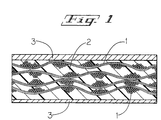
- Figure 1 is a cross-sectional view of the laminated glass fiber reinforced resin plate that was made in the examples. A portion of the glass fiber substrate is omitted in the figure.
- the number 1 is the glass fiber substrate, the number 2 is the hardened epoxy resin, and number 3 is the copper foil.
Landscapes
- Chemical & Material Sciences (AREA)
- Organic Chemistry (AREA)
- Life Sciences & Earth Sciences (AREA)
- Engineering & Computer Science (AREA)
- Geochemistry & Mineralogy (AREA)
- General Chemical & Material Sciences (AREA)
- Chemical Kinetics & Catalysis (AREA)
- Materials Engineering (AREA)
- General Life Sciences & Earth Sciences (AREA)
- Microelectronics & Electronic Packaging (AREA)
- Surface Treatment Of Glass Fibres Or Filaments (AREA)
- Treatments For Attaching Organic Compounds To Fibrous Goods (AREA)
- Reinforced Plastic Materials (AREA)
- Laminated Bodies (AREA)
- Compositions Of Macromolecular Compounds (AREA)
Abstract
Description
- This invention relates to treating agents, glass fiber substrates treated with such agents, and the use of such treated glass fiber substrates in molded, glass fiber reinforced resins that are suited to copper clad laminates, composite base materials, printed wiring boards such as mass lamination boards, and, in particular, multilayer printed wiring boards.
- After glass fiber substrates, such as glass cloth, glass tape, glass mats and glass paper, have been impregnated with thermosetting resins such as unsaturated polyester resins, epoxy resins, phenol resins, polyimide resins and polyamide resins, they are thermoset. The molded glass fiber reinforced fibers that are obtained are used for various applications and are particularly suited for use as printed wiring boards.
- To impregnate glass fiber substrates with thermosetting resins and to increase the adhesiveness of the resins to the substrates, the glass fiber substrate is usually first subjected to surface treating with a silane coupling agent such as 3-aminopropyltrimethoxysilane 3-aminopropyltriethoxysilane, N-(2-aminoethyl) -3-aminopropyltrimethoxysilane, 3-anilinopropyltrimethoxysilane, 3-glycidoxypropyltrimethoxysilane, 2-(3,4-epoxycyclohexyl) ethyltrimethoxysilane, 3-methacryloxypropyltrimethoxysilane, hydrochlorides of trimethoxysilanes of the formula:


- However, glass fiber substrates that have been subjected to surface treating with these silane coupling agents still do not have sufficient capacity for impregnation with thermosetting resins and sufficient adhesiveness. In particular, when molded glass fiber reinforced resins are used as printed wiring boards, and when these boards are subjected to solder treating by hand soldering, drag soldering, dip soldering, wave soldering or reflow soldering at 240 to 260°C, or are hot air treated at 300 to 400°C, there are problems of exfoliation between the glass fibers in the glass fiber substrate, i.e., measling and crazing; or exfoliation in the interior of the molded object between the glass fiber substrate and the thermosetting resin, i.e., delamination and exfoliation in the interior of the molded object accompanied by swelling in the surface, i.e., blistering.
- The inventors arrived at this invention as a result of intensive studies of the aforementioned problems.
- The objective of this invention is to provide molded glass fiber reinforced resins of superior solder heat resistance, prepregs for preparing these molded objects, glass fiber substrates of superior thermosetting resin impregnation capacity manufacturing these prepregs, and a surface treating agent for glass fiber substrates for preparing these substrates.
- The surface treating agents of this invention are characterized in that they comprise an organosilicon compound having the general formula


R5-CHO (II)
wherein, R5 is a substituted or unsubstituted aryl group. - The glass fiber substrate of this invention is further characterized in that it is subjected to surface treating by the aforementioned surface treating agent.
- The prepreg of this invention is further characterized in that the aforementioned substrate is impregnated with a thermosetting resin.
- The molded glass fiber reinforced resin of this invention is further characterized in that the aforementioned prepreg is thermoset.
- These surface treating agents are comprised of organosilicon compounds, partially hydrolyzed condensates, or reaction mixtures thereof, that are obtained by subjecting an alkoxysilane containing an amino group as indicated by general formula (I):


- A glass fiber substrate material that has been subjected to surface treating with this substance has superior affinity to thermosetting resins, for which reason there is good capacity for impregnation with and adhesiveness to the thermosetting resins and the molded glass fiber reinforced resins are also endowed with superior solder heat resistance.
- In the aforementioned formula (I), R1 and R2, which may be the same or different, can be, for example, alkylene groups such as methylene, ethylene, propylene, butylene, pentylene and hexylene; alkaryl or aralkyl groups such as methylphenylene, ethylphenylene, propylphenylene, phenylmethylene, phenylethylene and phenylpropylene groups; or dialkylarylene groups such as dimethylphenylene, methylethylphenylene, methylpropylphenylene, ethylmethylphenylene and diethylphenylene groups. Alkylene groups are preferred and it is more preferred for R1 to be an ethylene group and R2 to be a propylene group. R3 in the formula is a monovalent hydrocarbon group, for example, an alkyl group such as methyl, ethyl, propyl, butyl, pentyl or a hexyl group; an aryl group such as phenyl, tolyl and xylyl; an alkenyl group such as a vinyl, allyl, butenyl or pentenyl and a hexenyl; or an aralkyl group such as benzyl or phenethyl. It is preferred for R3 to be a methyl group. R4 in the formula (1) is an alkoxy group, for example, a methoxy, ethoxy, propoxy, butoxy, pentoxy group, or a methoxyethoxy group. It is preferred for R4 to be a methoxy group or an ethoxy group. n has a value of 0, 1 or 2, with 0 or 1 being particularly desirable. In the formula, a has a value of 0, 1 or 2, with 0 being particularly desirable.
- The alkoxysilane containing an amino group as indicated by general formula (I) can be, for example, 3 aminopropyltrimethoxysilane, 3-aminopropylmethyldimethoxysilane, 3-aminopropyldimethylmethoxysilane, 3-aminopropyltriethoxysilane, 3-aminopropylmethyldiethoxysilane, N-(2-aminoethyl)-3-aminopropyltrimethoxysilane, N-(2-aminoethyl)-3-aminopropylmethyldimethoxysilane p-(trimethoxysilyl)aniline, N(m-aminophenyl)-3-aminopropyltrimethoxysilane, N-(6-aminohexyl)-3-aminopropyltrimethoxysilane and N-{N-(2-aminoethyl)-2-aminoethyl} -3-aminopropylmethoxysilane. Of these, 3-aminopropyltrimethoxysilane, 3-aminopropyltriethoxysilane and N-(2-aminoethyl)-3-amino-propyltrimethoxysilane are preferred.
- In the general formula (II), R5 is a substituted or unsubstituted aryl group. The substituted group of this aryl group may be, for example, an alkenyl group such as vinyl or an alkenyl; an alkyl group such as methyl, ethyl, propyl or t-butyl; a halogen atom such as fluorine, chlorine or bromine; an alkoxy group such as methoxy, ethoxy or propoxy; a trifluoromethyl group; a nitro group; or a cyano group. R5 may be selected from, for example, a phenyl group, a tolyl group, a xylyl group, a naphthyl group, an anthranyl group, a vinylphenyl group, a chlorophenyl group, a bromophenyl group, methoxyphenyl group, a nitrophenyl group, a cyanophenyl group or a trifluoromethylphenyl group. Phenyl and vinylphenyl groups are being preferred.
- The aldehydes represented by general formula (II) include, for example, benzaldehyde, tolualdehyde, vinylbenzaldehyde, 1-naphthaldehyde, 2-naphthaldehyde, anthracene-9-aldehyde, chlorobenzaldehyde, bromobenzaldehyde, trifluoromethylbenzaldenyde, nitrobenzaldehyde, cyanobenzaldehyde and anisaldehyde. Benzaldehyde and cyanobenzaldehyde are preferred.
- The surface treating agent is prepared by a dehydration condensation reaction between: 1) the alkoxysilane containing an amino group of general formula (I) or a partially hydrolyzed condensate thereof and 2) the aldehyde as incicated by general formula (II). A method of preparing this surface treating agent is a method, for example, in which the aforementioned alkoxysilane containing an amino group, or a partial hydrolysate thereof, and the aforementioned aldehyde are subjected to a dehydration condensation reaction in an inert gas atmosphere such as argon, helium or nitrogen at normal pressure and at room temperature to 150°C. The quantity of the aforementioned aldehyde relative to the aforementioned alkoxysilane containing an amino group, or the partially hydrolyzed condensate thereof, that is introduced in this reaction is from 0.1 to 10 moles per 1 mole of nitrogen atoms in the alkoxysilane containing an amino group or in the partially hydrolyzed condensate. The method for removing the water produced by this reaction may be, for example, a method in which a dehydrating agent is added to the reaction system, or a method in which the water is removed by azeotropic distillation using an organic solvent.
- The dehydration condensation reaction can be performed in the absence of a solvent. However, the reaction system can also be diluted with an organic solvent. Useful solvents include, for example, alcohol solvents such as methanol, ethanol, i-propanol and t-butanol; hydrocarbon solvents such as toluene, xylene, cyclohexene, n-hexene and n-heptane; halogenated hydrocarbon solvents such as chloroform, carbon tetrachloride and trichloroethylene; ether solvents such as ethyl ether, tetrahydrofuran and ethylene glycol diethyl ether; and ester alcohols such as ethyl acetate, butyl acetate and amyl acetate. These solvents can be used individually or in mixtures of two or more.
- The progress of the dehydration condensation reaction confirmed from the formation of bonds as represented by the formula >C=N- by infrared spectrochemical analysis and 13C-NMR (nuclear magnecic resonance) spectrum analysis of the reaction mixture. The reaction mixture that is obtained may also be distilled and purified as required. The surface treating agent that is obtained in this way may be an identifiable organosilicon compound; it may be an organosilicon compound which has partially undergone hydrolysis and condensation; or it may be a reaction mixture comprised of organosilicon compounds, or partially hydrolyzed condensates thereof and unreacted raw materials. The fact that this organosilicon compound has partially undergone hydrolysis and condensation can be confirmed from the formation of bonds as indicated by the formula Si-O-Si and as indicated by the formula Si-OH by 29Si-NMR spectrum analysis.
- The identifiable organosilicon compounds that are prepared include, for example, N-benzylidene-3-aminopropyltrimethoxysilane, N-benzylidene-3-aminopropyltriethoxysilane, N-(N'-benzylidene-2-aminoethyl)-3-aminopropyltrimethoxysilane, N-(p-vinylbenzylidene)-3-aminopropyltrimethoxysilane, N-(vinylbenzylidene)-3-aminopropyltriethoxysilane and N-{N'-(p-vinylbenzylidene)-2-aminoethyl}-3-aminopropyl-trimethoxysilane. Examples of the surface treating agents of this invention include these organosilicon compounds, partially hydrolyzed condensates of these organosilicon compounds, partially hydrolyzed condensates of these organosilicon compounds and of the raw material alkoxysilanes containing amino groups and combinations of mixtures of these organosilicon compounds.
- The glass fiber substrates of this invention are characterized in that they are subjected to a surface treating with the aforementioned surface treating agents. These substrates include, for example, E-glass, which is an inorganic alkali glass belonging to the category of lime-aluminoborosilicate glass; A-glass, which is a soda-lime glass, and, in addition, C-glass, L-glass, D-glass and S-glass. Of these, E-glass is preferred. The components of the substrate may be, for example, SiO2, CaO, Al2O3 and B2O3. The substrate can be, glass cloth, glass mat, glass tape, glass paper, roving and roving cloth. Glass cloth and glass tape is obtained, for example, by interweaving yarns comprised of several hundred glass strands (filaments) of 5 to 15 µm as the warp threads and the woof threads by means of plain weaving, perforation plain weaving, twilling, satin weaving and leno weaving.
- Methods that are used in preparing this substrate include methods in which the substrate is immersed in the surface treating agent, or methods in which the surface treating agent is applied by spraying to the substrate. At this time, to remove the fiber sizing that is used in manufacturing the glass fiber substrate, the substrate should be subjected to heat cleaning in advance. The surface treating agent is generally used in combination with an organic solvent or water. For example, it may be used in concentrations of 0.01 to 5.0 wt %, and, preferably in concentrations of 0.1 to 2.0 wt %. When the surface treating agent is used as an aqueous solution, the use of an aqueous solution of acetic acid prepared to a Ph of 3 to 5 is desirable. In addition, the use of an alcohol containing 5 to 99 wt % of water, or of an aqueous solution of alcohol containing acetic acid is also desirable. After the surface treating agent has been affixed to the substrate, the substrate is dried to eliminate the organic solvent or water contained in the surface treating agent. To achieve a sufficient surface treating of the substrate, it should be subjected to a heating treatment at 60 to 150°C.
- The prepreg of this invention is characterized in that the aforementioned glass fiber substrate is impregnated with a thermosetting resin. This thermosetting resin may be phenol, xylene, urea, melamine, polyester, alkyd, epoxy, silicone, BT (bismaleimide-triazine), polyimide or polyamide. Other components, for example, hardeners, hardening promoters, flame retardants and inorganic fillers, may also be compounded with these thermosetting resins.
- The methods are used for making the prepreg include methods in which the substrate is immersed in the thermosetting resin; the thermosetting resin is applied by spraying to the glass fiber substrate; the glass fiber substrate is impregnated with the thermosetting resin, after which the substrate is dried; and methods in which the impregnated thermosetting resin is hardened by heating until it is in a partially hardened state.
- The molded objects of this invention are characterized in that they are obtained by thermosetting the aforementioned prepregs. This molded object may be obtained by thermosetting the prepreg in a single layer, or it may be obtained by laminating and thermosetting the prepreg in multiple layers. When the molded object is used as a printed wiring board, copper foil may be placed on the surface. When used for multilayer printed wiring boards, it is laminated and thermoset in a state in which the inner layer circuits are inserted into the prepreg.
- The method generally used to make this molded object is a method in which the aforementioned prepreg is laminated in a single layer, or multiple layers, and in which it is thermoset by heating and pressing. The pressure when the prepreg is heated and pressed is 5 to 100 kg/cm2.
- The molded glass fiber reinforced resin of this invention exhibits the properties of good impregnation capacity, and excellent adhesiveness of the thermosetting resins to the glass fiber substrates. For this reason, they can be used satisfactorily as printed wiring boards of superior solder heat resistance, and the printed wiring boards can also be laminated in thin layers.
- The molded fiber reinforced resins were made as follows.
- The glass fiber substrate was immersed in a thermosetting resin, after which the excess thermosetting resin was removed. Then, the prepreg was made by heating and hardening the substrate to a partially hardened state. Sixteen of these prepregs were laminated and copper foil of 35 µm in thickness was overlaid on the top and bottom. Stainless steel plates having a thickness of 2 mm were placed at the top and bottom and the material was thermoset for 1 hour at 130°C under a pressure of 40 kg/cm2, with a laminated glass reinforced resin plate of 4 mm in thickness having copper foil affixed to both faces.
- The impregnation capacity of the thermosetting resin in the glass fiber substrate, and the solder heat resistance of the molded glass fiber reinforced resin were evaluated as follows.
- The impregnation capacity of the thermosetting resin in the glass fiber substrate was observed visually. When impregnation capacity was good, an evaluation of O was made; when impregnation capacity was ordinary, an evaluation of δ was made, and when impregnation capacity was poor, an evaluation of x was made.
- The copper foil of the laminated glass fiber reinforced resin plate made by the aforementioned method was removed by etching, after which the external appearance was observed visually. When it appeared transparent, an evaluation of O was made; when there were white spots in place, an evaluation of δ was made; and, when large numbers of white spots were seen, an evaluation of x was made.
- A soldering iron at 270°C was pressed for 10 seconds against a laminated plate having a good external appearance, after which the external appearance of the laminated plate was observed. When measling or blistering did not occur, an evaluation of O was made; and, when measling or blistering occurred, an evaluation of x was made.
- The solder heat resistance of the glass fiber reinforced resin was measured as follows. The copper foil of the laminated glass fiber reinforced resin plate made by the aforementioned method was removed by etching, after which two laminated plates having good external appearance were treated for 8 hours and 24 hours, respectively, at 121°C and 2.33 mPa (23 atmospheres) . Following that, these laminated plates were immersed for 20 seconds in a solder bath at 260°C and observations were made of the external appearance of these laminated plates. The proportion of the area in regions in which delamination or blistering had occurred (destroyed area) on these laminated plates was observed.
- A silane, 3-aminopropyltriethoxysilane (67.6 g) was introduced into a four-necked flask equipped with a thermometer, a stirrer and a cooler, after which a reaction was produced at room temperature as 32.4 g of benzaldehyde were added dropwise. Then, the water that was produced by the reaction was separated, after which the reaction mixture was heated, with a transparent liquid being obtained by distillation. When the liquid was analyzed by infrared spectrochemical analysis (IR), 13C-nuclear magnetic resonance spectrum analysis (NMR) and 29Si-NMR, bonds as Indicated by the formula >C=N- were confirmed and this liquid was identified as N-benzylidene-3-aminopropyltriethoxysilane.
- A silane, N-(2-aminoethyl)-3-aminopropyltri-methoxysilane (67.7 g) was introduced into a four-necked flask equipped with a thermometer, a stirrer and a cooler and 32.3 g of benzaldehyde were then introduced at room temperature. Next, this mixture was stirred for 5 hours at 40°C, with a pale yellow transparent viscous liquid being prepared. When this liquid was analyzed by IR, 13C- and 29Si-NMR, bonds as indicated by the formula >C=N-, and bonds as indicated by the formula Si-O-Si, were confirmed. It was also confirmed that this viscous liquid was an organosilicon compound of which the principal component was N-(N'-benzylidene-2-aminoethyl)-3-aminopropyltrimethoxysilane and a partially hydrolyzed condensate thereof.
- A silane, 3-aminopropyltriethoxysilane (25 g) was introduced into a four-necked flask equipped with a thermometer, a stirrer and a cooler and 15.0 g of vinyl benzaldehyde were then introduced at room temperature. Following that, the mixture was stirred for 5 hours at 40°C, with a pale yellow transparent viscous liquid being prepared. When this liquid was analyzed by IR, 13C- and 29Si-NMR, bonds as indicated by the formula >C=N-, and bonds as indicated by the formula Si-O-Si, were confirmed. It was shown that this viscous liquid was an organosilicon compound of which the principal component was N-vinylbenzylidene-3-aminopropyltriethoxysilane and a partially hydrolyzed condensate thereof. Next, 60.0 g of methanol was added to this viscous liquid, with a methanol solution being prepared.
- A silane, N-(2-aminoethyl)-3-aminopropyltrimethoxysilane (25.1 g) was introduced into a four-necked flask equipped with a thermometer, a stirrer and a cooler and 14.9 g of vinyl benzaldehyde were then introduced at room temperature. Next, this mixture was stirred for 5 hours at 40°C, with a pale yellow transparent viscous liquid being prepared. When this liquid was analyzed by IR, 13C- and 29Si-NMR, bonds as indicated by the formula >C=N- and bonds as indicated by the formula Si-O-Si, were confirmed. This viscous liquid was an organosilicon compound of which the principal component was N-(N'-vinylbenzylidene-2-aminoethyl)-3-aminopropyltrimethoxysilane and a partially hydrolyzed condensate thereof. Next, 60.0 g of methanol were added to this viscous liquid, with a methanol solution being prepared.
- Plain weave nonalkaline glass fiber cloth (EP18 as described in JIS R 3414) was first subjected to heat cleaning, after which it was immersed in Ph 4 aqueous solutions of acetic acid in which was compounded the surface treating agents for glass fiber substrates prepared in the Examples of Synthesis 1 through 4 in amounts of 0.5 wt %. Following this, the substrates were squeezed with a mangle and were then heated and dried for 7 minutes in an oven at 130°C, to prepare the surface treated glass substrates.
- Then, a hardenable epoxy resin, comprised of 80 parts by weight of bisphenol A epoxy resin (epoxy equivalent = 480; Epikote™ 1001, a product manufactured by Yuka Shell Epoxy Company), 20 parts by weight of bisphenol A epoxy resin (epoxy equivalent = 190;
Epikote™ 828, 3 parts by weight of dicyandiamide, 0.2 part by weight of benzyl dimethylamine, 40 parts by weight of dimethylformamide and 40 parts by weight of methylethyl ketone, was prepared. The substrate was impregnated with this hardening epoxy resin, after which it was heated for 5 minutes at 150°C, by which means this hardening epoxy resin was converted to a partially hardened state and used to prepare a prepreg with a hardenable epoxy resin content of 40 wt %. - A laminated glass fiber reinforced epoxy resin plate having copper foil attached to both faces was prepared using this prepreg.
- Table 1 shows the impregnation capacity of this hardenable epoxy resin with this glass fiber substrate and the solder heat resistance of the laminated glass fiber reinforced epoxy resin plate is also displayed.
- Plain weave nonalkaline glass fiber cloth (EP18 as described in JIS R 3414) was subjected to heat cleaning, after which it was immersed in Ph 4 aqueous solutions of acetic acid in which N-(N'-vinylbenzyl-2-aminoethyl)-3-aminopropyltrimethoxysilane hydrochloride was compounded in an amount of 0.5 wt %. Following this, the substrate was squeezed with a mangle and was then heated and dried for 7 minutes in an oven at 130°C, to prepare a glass fiber substrate that had been subjected to surface treating.
- Then, using this substrate, the hardenable epoxy resin was made into a partially hardened state by heating for 5 minutes at 150°C in the same way as in Example 1 to prepare a prepreg with a hardenable epoxy resin content of 40 wt %.
- A laminated glass fiber reinforced epoxy resin plate having copper foil attached to both faces was prepared using this prepreg.
- Table 1 shows the impregnation capacity of this hardenable epoxy resin to the glass fiber substrate and the solder heat resistance of the laminated glass fiber reinforced epoxy resin plate is also reported.
- Plain weave nonalkaline glass fiber cloth (EP18 as described in JIS R 3414) was subjected to heat cleaning, after which it was immersed in Ph 4 aqueous solutions of acetic acid in which N-(N'-vinylbenzyl-2-aminoethyl)-3-aminopropyltrimethoxysilane was compounded in an amount of 0.5 wt %. Following this, the substrate was squeezed with a mangle and was then heated and dried for 7 minutes in an oven at 130°C, with a glass fiber substrate that had been subjected to surface treating being prepared.
- Using this substrate, the hardenable epoxy resin was made into a partially hardened state by heating for 5 minutes at 150°C in the same way as in Example 1 to prepare a prepreg with a hardenable epoxy resin content of 40 wt %.
- A laminated glass fiber reinforced epoxy resin plate having copper foil attached to both faces was prepared using this prepreg.
- Table 1 shows the impregnation capacity of this hardenable epoxy resin with this glass fiber substrate and the solder heat resistance of the laminated glass fiber reinforced epoxy resin plate is also given.
TABLE I PROPERTY A B C D E Invention Examples 1 O <1% 8% 2 O <1% 8% 3 O <1% 8% 4 O δ O <1% 8% Comparative Examples 1 δ δ x 6% 35% 2 O δ x 6% 33% A = Impregnation capacity of hardenable epoxy resin to the glass fiber substrate. External appearance of prepreg.
B = External appearance of the laminated glass fiber reinforced epoxy resin plate.
C = Occurrence of measling and blistering.
D = Solder heat resistance of the laminated glass fiber reinforced epoxy resin plate. Proportion of destroyed area after 8 hours of treatment.
E = Proportion of destroyed area after 24 hours of treatment. - Molded glass fiber reinforced resins of this invention are characterized in that they are of superior solder heat resistance. The prepregs of this invention are also characterized in that they can be used to make these molded objects. Moreover, the glass fiber substrates of this invention are characterized in that they exhibit superior impregnation capacity in thermal hardenable resins and that they can be used to make this kind of prepregs. Finally, the surface treating agents for class fiber materials of this invention are characterized in that they can be used to make this kind of glass fiber substrates.
- Figure 1 is a cross-sectional view of the laminated glass fiber reinforced resin plate that was made in the examples. A portion of the glass fiber substrate is omitted in the figure.
The number 1 is the glass fiber substrate, thenumber 2 is the hardened epoxy resin, andnumber 3 is the copper foil.
Claims (10)
- A surface treating agent for glass fiber substrates comprising an organosilicon compound selected from:(i)
 (ii) A hydrolyzate of (i),(iii) a condensate of (i),(iv) a mixture of (i) and (ii),(v) a mixture of (i) and (iii) and,(vi) a mixture of (i), (ii) and (iii),wherein, R1 and R2 are the same or different divalent hydrocarbon groups, R3 is a monovalent hydrocarbon group, R4 is an alkoxy group, R5 is a substituted or unsubstituted aryl group, n has a value of 0, 1 or 2 and a has a value of 0, 1 or 2.
 - A surface treating agent according to claim 1, wherein R1 represents an ethylene group and R2 represents a propylene group.
- A surface treating agent according to claims 1 or 2, wherein R3 represents a methyl group.
- A surface treating agent according to any of claims 1 to 3, wherein R4 represents a methoxy or an ethoxy group.
- A surface treating agent according to any of claims 1 to 4 wherein R5 represents a phenyl or vinyl phenyl group.
- A surface treating agent according to claim 1 which comprises 3-aminopropyltrimethoxysilane, 3-aminopropyltriethoxysilane or N- (2-aminoethyl) -3-aminopropyltrimethoxysilane.
- A surface treating agent according to any of claims 1 to 6, which comprises the organosilicon compound in combination with an organic solvent or water.
- A glass fiber substrate treated with a surface treating agent according to any of claims 1 to 7.
- A prepreg consisting of a glass fiber substrate as claimed in claim 8 impregnated with a thermosetting resin.
- A molded glass fiber reinforced resin obtainable by thermosetting the prepreg claimed in claim 9.
Applications Claiming Priority (2)
| Application Number | Priority Date | Filing Date | Title |
|---|---|---|---|
| JP26212495A JP3483999B2 (en) | 1995-09-14 | 1995-09-14 | Prepreg and glass fiber reinforced resin molding |
| JP262124/95 | 1995-09-14 |
Publications (2)
| Publication Number | Publication Date |
|---|---|
| EP0768313A2 true EP0768313A2 (en) | 1997-04-16 |
| EP0768313A3 EP0768313A3 (en) | 1998-04-29 |
Family
ID=17371389
Family Applications (1)
| Application Number | Title | Priority Date | Filing Date |
|---|---|---|---|
| EP96306623A Ceased EP0768313A3 (en) | 1995-09-14 | 1996-09-12 | A surface treating agent for glass fiber substrates |
Country Status (3)
| Country | Link |
|---|---|
| US (1) | US5698725A (en) |
| EP (1) | EP0768313A3 (en) |
| JP (1) | JP3483999B2 (en) |
Cited By (3)
| Publication number | Priority date | Publication date | Assignee | Title |
|---|---|---|---|---|
| WO2003044026A1 (en) * | 2001-11-16 | 2003-05-30 | General Electric Company | Process for the preparation of secondary and tertiary amino-functional silanes, iminoorganosilanes and/or imidoorganosilanes |
| WO2013186349A1 (en) * | 2012-06-15 | 2013-12-19 | Sika Technology Ag | Polymer containing silane groups |
| DE102013213655A1 (en) | 2013-07-12 | 2015-01-15 | Evonik Industries Ag | Curable silyl group-containing compositions with improved storage stability |
Families Citing this family (11)
| Publication number | Priority date | Publication date | Assignee | Title |
|---|---|---|---|---|
| FR2843967B1 (en) * | 2002-08-30 | 2004-11-26 | Hexcel Composites | NEW COMPOSITE PRODUCTS AND MOLDED ARTICLES OBTAINED FROM SAID PRODUCTS |
| US6818306B2 (en) * | 2002-09-27 | 2004-11-16 | The Boeing Company | Optically clear structural laminate |
| US9187361B2 (en) * | 2005-11-04 | 2015-11-17 | Ocv Intellectual Capital, Llc | Method of manufacturing S-glass fibers in a direct melt operation and products formed there from |
| US9656903B2 (en) | 2005-11-04 | 2017-05-23 | Ocv Intellectual Capital, Llc | Method of manufacturing high strength glass fibers in a direct melt operation and products formed there from |
| US8446734B2 (en) * | 2006-03-30 | 2013-05-21 | Kyocera Corporation | Circuit board and mounting structure |
| US8048815B2 (en) * | 2007-12-12 | 2011-11-01 | Kubota Research, Inc. | Composite article and method of manufacture |
| KR20150025245A (en) * | 2013-08-28 | 2015-03-10 | 삼성전기주식회사 | Copper clad laminate for printed circuit board and manufacturing method thereof |
| JP6598458B2 (en) * | 2014-12-23 | 2019-10-30 | ダウ・東レ株式会社 | Silane coupling agent composition, method for producing the same, epoxy resin composition, semiconductor sealing material, and semiconductor device |
| US10240012B2 (en) | 2015-08-11 | 2019-03-26 | University Of South Carolina | Thermoplastic/thermoset grafted composites |
| JP6540452B2 (en) * | 2015-10-27 | 2019-07-10 | 住友ベークライト株式会社 | Resin composition for circuit board, prepreg, metal-clad laminate, circuit board, and semiconductor package |
| EP4101878A4 (en) * | 2020-02-03 | 2024-02-28 | Toray Industries, Inc. | Molding material and fiber reinforced composite material |
Family Cites Families (12)
| Publication number | Priority date | Publication date | Assignee | Title |
|---|---|---|---|---|
| US3734763A (en) * | 1969-05-15 | 1973-05-22 | Dow Corning | Cationic unsaturated amine-functional silane coupling agents |
| US3700711A (en) * | 1971-08-16 | 1972-10-24 | Gen Electric | Silicone compounds containing hydrazone functional groups thereon |
| US3946060A (en) * | 1975-03-18 | 1976-03-23 | Richardson-Merrell Inc. | Acetylene derivatives |
| US4088668A (en) * | 1977-07-01 | 1978-05-09 | Merrell Toraude Et Compagnie | Acetylene derivatives |
| JPS6165891A (en) * | 1984-09-06 | 1986-04-04 | Asahi Shiyueebell Kk | Novel silane and its production |
| JPS6176494A (en) * | 1984-09-21 | 1986-04-18 | Tokuyama Soda Co Ltd | silatran compound |
| JPH0680067B2 (en) * | 1986-03-28 | 1994-10-12 | 株式会社トクヤマ | Cilatran compound |
| JPH03115335A (en) * | 1989-09-28 | 1991-05-16 | Shin Etsu Chem Co Ltd | Modifier for composition material |
| JP3235127B2 (en) * | 1991-08-16 | 2001-12-04 | ソニー株式会社 | Soft magnetic thin film |
| US5372840A (en) * | 1993-04-20 | 1994-12-13 | Dow Corning Corporation | Method for enhancing dielectric strength of cable using fluid having a high diffusion coefficient |
| JP3464541B2 (en) * | 1994-09-21 | 2003-11-10 | 東レ・ダウコーニング・シリコーン株式会社 | Molding resin composition and molded article thereof |
| JP3831437B2 (en) * | 1995-11-15 | 2006-10-11 | 東レ・ダウコーニング株式会社 | Silane coupling agent and method for producing the same |
-
1995
- 1995-09-14 JP JP26212495A patent/JP3483999B2/en not_active Expired - Lifetime
-
1996
- 1996-09-04 US US08/697,995 patent/US5698725A/en not_active Expired - Lifetime
- 1996-09-12 EP EP96306623A patent/EP0768313A3/en not_active Ceased
Cited By (3)
| Publication number | Priority date | Publication date | Assignee | Title |
|---|---|---|---|---|
| WO2003044026A1 (en) * | 2001-11-16 | 2003-05-30 | General Electric Company | Process for the preparation of secondary and tertiary amino-functional silanes, iminoorganosilanes and/or imidoorganosilanes |
| WO2013186349A1 (en) * | 2012-06-15 | 2013-12-19 | Sika Technology Ag | Polymer containing silane groups |
| DE102013213655A1 (en) | 2013-07-12 | 2015-01-15 | Evonik Industries Ag | Curable silyl group-containing compositions with improved storage stability |
Also Published As
| Publication number | Publication date |
|---|---|
| EP0768313A3 (en) | 1998-04-29 |
| US5698725A (en) | 1997-12-16 |
| JPH0978461A (en) | 1997-03-25 |
| JP3483999B2 (en) | 2004-01-06 |
Similar Documents
| Publication | Publication Date | Title |
|---|---|---|
| EP0768313A2 (en) | A surface treating agent for glass fiber substrates | |
| US5639555A (en) | Multilayer laminates | |
| EP0368279B1 (en) | Silane coupling agent and glass fiber product for laminates | |
| EP1197514B1 (en) | Incombustible resin composition, prepreg, laminated plate, metal-clad laminated plate, printed wiring board and multi-layer printed wiring board | |
| KR101747259B1 (en) | Surface modified silica by alkyl sulphonated tetrazole compound, preparing method thereof, and resin composition containing the same | |
| KR20230149333A (en) | Capped bisphenol polyether oligomers and compositions, methods of making and articles made therefrom | |
| US20230183477A1 (en) | Curable thermosetting composition including poly(arylene ether) copolymer | |
| CN102911502A (en) | Cyanate resin composition and prepregs, laminates and metal foil-clad laminates produced therefrom | |
| US20230227606A1 (en) | Poly(arylene ether) copolymer, method to prepare the same, and article derived therefrom | |
| JP3812986B2 (en) | Imidazole group-containing surface treatment agent and glass cloth | |
| US5126467A (en) | Modifier for composite materials | |
| JPH0834832A (en) | Thermosetting resin composition and copper-clad laminate | |
| JP2002234755A (en) | Surface treating agent for glass fiber base material, glass fiber base material, prepreg and glass fiber reinforced thermosetting resin molding | |
| EP0263895B1 (en) | Surface treatment composition for glass fibers, method of coating glass fibers with said composition, and method of preparing glass fiber reinforced polyepoxide products | |
| JP2577752B2 (en) | Novel water-soluble silane composition | |
| CN118475639A (en) | Capped poly (phenylene ether) s and curable thermoset compositions containing the same | |
| US4783222A (en) | Glass fiber reinforced polyepoxide products and method for producing same | |
| JP2009091330A (en) | Glass fiber substrate treated with silane compound and hydrolyzate thereof | |
| JP3047725B2 (en) | Composite material modifier and composite material | |
| JP4229509B2 (en) | Surface treatment agent for glass fiber | |
| US20250197542A1 (en) | Copolymers derived from dicyclopentadiene | |
| JPH09278882A (en) | Flame-retardant cyanate ester resin composition and copper-clad laminate | |
| JP2577753B2 (en) | Water-soluble silane composition | |
| JP3098766B2 (en) | New curable polyphenylene ether / epoxy resin composition | |
| EP4174110A1 (en) | Copolymer for cross-linkable networks |
Legal Events
| Date | Code | Title | Description |
|---|---|---|---|
| PUAI | Public reference made under article 153(3) epc to a published international application that has entered the european phase |
Free format text: ORIGINAL CODE: 0009012 |
|
| AK | Designated contracting states |
Kind code of ref document: A2 Designated state(s): DE FR GB |
|
| PUAL | Search report despatched |
Free format text: ORIGINAL CODE: 0009013 |
|
| AK | Designated contracting states |
Kind code of ref document: A3 Designated state(s): DE FR GB |
|
| 17P | Request for examination filed |
Effective date: 19980526 |
|
| 17Q | First examination report despatched |
Effective date: 20001222 |
|
| GRAG | Despatch of communication of intention to grant |
Free format text: ORIGINAL CODE: EPIDOS AGRA |
|
| STAA | Information on the status of an ep patent application or granted ep patent |
Free format text: STATUS: THE APPLICATION HAS BEEN REFUSED |
|
| 18R | Application refused |
Effective date: 20020128 |