EP0770661A1 - Lubricant for drilling mud - Google Patents
Lubricant for drilling mud Download PDFInfo
- Publication number
- EP0770661A1 EP0770661A1 EP96307766A EP96307766A EP0770661A1 EP 0770661 A1 EP0770661 A1 EP 0770661A1 EP 96307766 A EP96307766 A EP 96307766A EP 96307766 A EP96307766 A EP 96307766A EP 0770661 A1 EP0770661 A1 EP 0770661A1
- Authority
- EP
- European Patent Office
- Prior art keywords
- lubricant
- silicate
- ester
- potassium
- silicate composition
- Prior art date
- Legal status (The legal status is an assumption and is not a legal conclusion. Google has not performed a legal analysis and makes no representation as to the accuracy of the status listed.)
- Withdrawn
Links
- 239000000314 lubricant Substances 0.000 title claims abstract description 79
- 238000005553 drilling Methods 0.000 title claims abstract description 57
- XLYOFNOQVPJJNP-UHFFFAOYSA-N water Substances O XLYOFNOQVPJJNP-UHFFFAOYSA-N 0.000 claims abstract description 31
- BPQQTUXANYXVAA-UHFFFAOYSA-N Orthosilicate Chemical compound [O-][Si]([O-])([O-])[O-] BPQQTUXANYXVAA-UHFFFAOYSA-N 0.000 claims abstract description 25
- 150000002148 esters Chemical class 0.000 claims abstract description 23
- 235000019353 potassium silicate Nutrition 0.000 claims abstract description 15
- 239000004111 Potassium silicate Substances 0.000 claims abstract description 12
- 229910052913 potassium silicate Inorganic materials 0.000 claims abstract description 12
- NNHHDJVEYQHLHG-UHFFFAOYSA-N potassium silicate Chemical compound [K+].[K+].[O-][Si]([O-])=O NNHHDJVEYQHLHG-UHFFFAOYSA-N 0.000 claims abstract description 12
- 238000000034 method Methods 0.000 claims abstract description 11
- 230000008569 process Effects 0.000 claims abstract description 10
- QVGXLLKOCUKJST-UHFFFAOYSA-N atomic oxygen Chemical compound [O] QVGXLLKOCUKJST-UHFFFAOYSA-N 0.000 claims abstract description 7
- 229910052760 oxygen Inorganic materials 0.000 claims abstract description 7
- 239000001301 oxygen Substances 0.000 claims abstract description 7
- 239000007864 aqueous solution Substances 0.000 claims abstract description 3
- 238000007664 blowing Methods 0.000 claims abstract description 3
- 238000010438 heat treatment Methods 0.000 claims abstract description 3
- HEMHJVSKTPXQMS-UHFFFAOYSA-M Sodium hydroxide Chemical class [OH-].[Na+] HEMHJVSKTPXQMS-UHFFFAOYSA-M 0.000 claims description 22
- 239000000203 mixture Substances 0.000 claims description 22
- VYPSYNLAJGMNEJ-UHFFFAOYSA-N silicon dioxide Inorganic materials O=[Si]=O VYPSYNLAJGMNEJ-UHFFFAOYSA-N 0.000 claims description 10
- DGAQECJNVWCQMB-PUAWFVPOSA-M Ilexoside XXIX Chemical compound C[C@@H]1CC[C@@]2(CC[C@@]3(C(=CC[C@H]4[C@]3(CC[C@@H]5[C@@]4(CC[C@@H](C5(C)C)OS(=O)(=O)[O-])C)C)[C@@H]2[C@]1(C)O)C)C(=O)O[C@H]6[C@@H]([C@H]([C@@H]([C@H](O6)CO)O)O)O.[Na+] DGAQECJNVWCQMB-PUAWFVPOSA-M 0.000 claims description 9
- 239000011734 sodium Substances 0.000 claims description 9
- 235000011121 sodium hydroxide Nutrition 0.000 claims description 9
- 150000004760 silicates Chemical class 0.000 claims description 8
- LFQSCWFLJHTTHZ-UHFFFAOYSA-N Ethanol Chemical compound CCO LFQSCWFLJHTTHZ-UHFFFAOYSA-N 0.000 claims description 7
- TZCXTZWJZNENPQ-UHFFFAOYSA-L barium sulfate Chemical compound [Ba+2].[O-]S([O-])(=O)=O TZCXTZWJZNENPQ-UHFFFAOYSA-L 0.000 claims description 7
- -1 fatty acid ester Chemical class 0.000 claims description 7
- 229910052708 sodium Inorganic materials 0.000 claims description 7
- 229910052681 coesite Inorganic materials 0.000 claims description 6
- 229910052906 cristobalite Inorganic materials 0.000 claims description 6
- 235000014113 dietary fatty acids Nutrition 0.000 claims description 6
- 239000000194 fatty acid Substances 0.000 claims description 6
- 229930195729 fatty acid Natural products 0.000 claims description 6
- 229910052682 stishovite Inorganic materials 0.000 claims description 6
- 229910052905 tridymite Inorganic materials 0.000 claims description 6
- OKTJSMMVPCPJKN-UHFFFAOYSA-N Carbon Chemical group [C] OKTJSMMVPCPJKN-UHFFFAOYSA-N 0.000 claims description 5
- ZLMJMSJWJFRBEC-UHFFFAOYSA-N Potassium Chemical compound [K] ZLMJMSJWJFRBEC-UHFFFAOYSA-N 0.000 claims description 5
- 229910052601 baryte Inorganic materials 0.000 claims description 5
- 239000010428 baryte Substances 0.000 claims description 5
- 229920000642 polymer Polymers 0.000 claims description 5
- 229910052700 potassium Inorganic materials 0.000 claims description 5
- 239000011591 potassium Substances 0.000 claims description 5
- 229920002472 Starch Polymers 0.000 claims description 4
- 125000004432 carbon atom Chemical group C* 0.000 claims description 4
- 150000004665 fatty acids Chemical class 0.000 claims description 4
- 239000000377 silicon dioxide Substances 0.000 claims description 4
- 239000008107 starch Substances 0.000 claims description 4
- 235000019698 starch Nutrition 0.000 claims description 4
- 150000008044 alkali metal hydroxides Chemical class 0.000 claims description 3
- 239000003638 chemical reducing agent Substances 0.000 claims description 3
- 239000003795 chemical substances by application Substances 0.000 claims description 3
- 230000007062 hydrolysis Effects 0.000 claims description 3
- 238000006460 hydrolysis reaction Methods 0.000 claims description 3
- 229910044991 metal oxide Inorganic materials 0.000 claims description 3
- 150000004706 metal oxides Chemical class 0.000 claims description 3
- 238000006396 nitration reaction Methods 0.000 claims description 3
- 230000003647 oxidation Effects 0.000 claims description 3
- 238000007254 oxidation reaction Methods 0.000 claims description 3
- 235000011118 potassium hydroxide Nutrition 0.000 claims description 3
- 235000019351 sodium silicates Nutrition 0.000 claims description 3
- 239000012736 aqueous medium Substances 0.000 claims description 2
- 230000020477 pH reduction Effects 0.000 claims description 2
- 229910000272 alkali metal oxide Inorganic materials 0.000 claims 3
- CHWRSCGUEQEHOH-UHFFFAOYSA-N potassium oxide Chemical compound [O-2].[K+].[K+] CHWRSCGUEQEHOH-UHFFFAOYSA-N 0.000 claims 1
- 229910001950 potassium oxide Inorganic materials 0.000 claims 1
- 230000015572 biosynthetic process Effects 0.000 abstract description 7
- 238000005755 formation reaction Methods 0.000 abstract description 7
- 230000003019 stabilising effect Effects 0.000 abstract description 2
- 239000012530 fluid Substances 0.000 description 44
- 239000002585 base Substances 0.000 description 18
- 235000002639 sodium chloride Nutrition 0.000 description 11
- 239000003921 oil Substances 0.000 description 8
- 235000019198 oils Nutrition 0.000 description 8
- 239000000047 product Substances 0.000 description 8
- 230000032683 aging Effects 0.000 description 7
- 238000009472 formulation Methods 0.000 description 7
- 238000005098 hot rolling Methods 0.000 description 7
- WCUXLLCKKVVCTQ-UHFFFAOYSA-M Potassium chloride Chemical compound [Cl-].[K+] WCUXLLCKKVVCTQ-UHFFFAOYSA-M 0.000 description 6
- 239000004568 cement Substances 0.000 description 6
- 239000008186 active pharmaceutical agent Substances 0.000 description 5
- 230000000694 effects Effects 0.000 description 5
- 150000003839 salts Chemical class 0.000 description 5
- KWYUFKZDYYNOTN-UHFFFAOYSA-M Potassium hydroxide Chemical class [OH-].[K+] KWYUFKZDYYNOTN-UHFFFAOYSA-M 0.000 description 4
- 239000004115 Sodium Silicate Substances 0.000 description 4
- FAPWRFPIFSIZLT-UHFFFAOYSA-M Sodium chloride Chemical compound [Na+].[Cl-] FAPWRFPIFSIZLT-UHFFFAOYSA-M 0.000 description 4
- 238000011109 contamination Methods 0.000 description 4
- 229910052911 sodium silicate Inorganic materials 0.000 description 4
- 235000015076 Shorea robusta Nutrition 0.000 description 3
- 244000166071 Shorea robusta Species 0.000 description 3
- 229910000831 Steel Inorganic materials 0.000 description 3
- 230000002411 adverse Effects 0.000 description 3
- 229910052910 alkali metal silicate Inorganic materials 0.000 description 3
- 238000005520 cutting process Methods 0.000 description 3
- 239000000499 gel Substances 0.000 description 3
- 230000002401 inhibitory effect Effects 0.000 description 3
- 239000001103 potassium chloride Substances 0.000 description 3
- 235000011164 potassium chloride Nutrition 0.000 description 3
- 229920006395 saturated elastomer Polymers 0.000 description 3
- 239000011780 sodium chloride Substances 0.000 description 3
- 239000007787 solid Substances 0.000 description 3
- 239000010959 steel Substances 0.000 description 3
- WRIDQFICGBMAFQ-UHFFFAOYSA-N (E)-8-Octadecenoic acid Natural products CCCCCCCCCC=CCCCCCCC(O)=O WRIDQFICGBMAFQ-UHFFFAOYSA-N 0.000 description 2
- LQJBNNIYVWPHFW-UHFFFAOYSA-N 20:1omega9c fatty acid Natural products CCCCCCCCCCC=CCCCCCCCC(O)=O LQJBNNIYVWPHFW-UHFFFAOYSA-N 0.000 description 2
- QSBYPNXLFMSGKH-UHFFFAOYSA-N 9-Heptadecensaeure Natural products CCCCCCCC=CCCCCCCCC(O)=O QSBYPNXLFMSGKH-UHFFFAOYSA-N 0.000 description 2
- GJCOSYZMQJWQCA-UHFFFAOYSA-N 9H-xanthene Chemical compound C1=CC=C2CC3=CC=CC=C3OC2=C1 GJCOSYZMQJWQCA-UHFFFAOYSA-N 0.000 description 2
- UQSXHKLRYXJYBZ-UHFFFAOYSA-N Iron oxide Chemical compound [Fe]=O UQSXHKLRYXJYBZ-UHFFFAOYSA-N 0.000 description 2
- ZQPPMHVWECSIRJ-UHFFFAOYSA-N Oleic acid Natural products CCCCCCCCC=CCCCCCCCC(O)=O ZQPPMHVWECSIRJ-UHFFFAOYSA-N 0.000 description 2
- 239000005642 Oleic acid Substances 0.000 description 2
- 239000000654 additive Substances 0.000 description 2
- 230000008901 benefit Effects 0.000 description 2
- 239000012267 brine Substances 0.000 description 2
- 229910052799 carbon Inorganic materials 0.000 description 2
- 230000015556 catabolic process Effects 0.000 description 2
- 239000001913 cellulose Substances 0.000 description 2
- 229920002678 cellulose Polymers 0.000 description 2
- 238000006243 chemical reaction Methods 0.000 description 2
- 239000013065 commercial product Substances 0.000 description 2
- 239000000356 contaminant Substances 0.000 description 2
- 238000006731 degradation reaction Methods 0.000 description 2
- 239000006260 foam Substances 0.000 description 2
- QXJSBBXBKPUZAA-UHFFFAOYSA-N isooleic acid Natural products CCCCCCCC=CCCCCCCCCC(O)=O QXJSBBXBKPUZAA-UHFFFAOYSA-N 0.000 description 2
- ZQPPMHVWECSIRJ-KTKRTIGZSA-N oleic acid Chemical compound CCCCCCCC\C=C/CCCCCCCC(O)=O ZQPPMHVWECSIRJ-KTKRTIGZSA-N 0.000 description 2
- 230000002829 reductive effect Effects 0.000 description 2
- 230000000717 retained effect Effects 0.000 description 2
- VWDWKYIASSYTQR-UHFFFAOYSA-N sodium nitrate Chemical compound [Na+].[O-][N+]([O-])=O VWDWKYIASSYTQR-UHFFFAOYSA-N 0.000 description 2
- NTHWMYGWWRZVTN-UHFFFAOYSA-N sodium silicate Chemical compound [Na+].[Na+].[O-][Si]([O-])=O NTHWMYGWWRZVTN-UHFFFAOYSA-N 0.000 description 2
- HPALAKNZSZLMCH-UHFFFAOYSA-M sodium;chloride;hydrate Chemical compound O.[Na+].[Cl-] HPALAKNZSZLMCH-UHFFFAOYSA-M 0.000 description 2
- 239000000243 solution Substances 0.000 description 2
- UFTFJSFQGQCHQW-UHFFFAOYSA-N triformin Chemical compound O=COCC(OC=O)COC=O UFTFJSFQGQCHQW-UHFFFAOYSA-N 0.000 description 2
- 229920001285 xanthan gum Polymers 0.000 description 2
- YIWUKEYIRIRTPP-UHFFFAOYSA-N 2-ethylhexan-1-ol Chemical compound CCCCC(CC)CO YIWUKEYIRIRTPP-UHFFFAOYSA-N 0.000 description 1
- FOKDITTZHHDEHD-PFONDFGASA-N 2-ethylhexyl (z)-octadec-9-enoate Chemical compound CCCCCCCC\C=C/CCCCCCCC(=O)OCC(CC)CCCC FOKDITTZHHDEHD-PFONDFGASA-N 0.000 description 1
- BWDBEAQIHAEVLV-UHFFFAOYSA-N 6-methylheptan-1-ol Chemical compound CC(C)CCCCCO BWDBEAQIHAEVLV-UHFFFAOYSA-N 0.000 description 1
- SAUIGQBKPDQYHL-QXMHVHEDSA-N 6-methylheptyl (z)-octadec-9-enoate Chemical compound CCCCCCCC\C=C/CCCCCCCC(=O)OCCCCCC(C)C SAUIGQBKPDQYHL-QXMHVHEDSA-N 0.000 description 1
- FYYHWMGAXLPEAU-UHFFFAOYSA-N Magnesium Chemical compound [Mg] FYYHWMGAXLPEAU-UHFFFAOYSA-N 0.000 description 1
- 239000002253 acid Substances 0.000 description 1
- 230000000996 additive effect Effects 0.000 description 1
- 239000003513 alkali Substances 0.000 description 1
- 229910052783 alkali metal Inorganic materials 0.000 description 1
- 230000009286 beneficial effect Effects 0.000 description 1
- 159000000007 calcium salts Chemical class 0.000 description 1
- 210000004027 cell Anatomy 0.000 description 1
- 210000002421 cell wall Anatomy 0.000 description 1
- 238000001816 cooling Methods 0.000 description 1
- 239000013530 defoamer Substances 0.000 description 1
- 230000001627 detrimental effect Effects 0.000 description 1
- 239000006185 dispersion Substances 0.000 description 1
- 230000007613 environmental effect Effects 0.000 description 1
- 238000005187 foaming Methods 0.000 description 1
- 229910052949 galena Inorganic materials 0.000 description 1
- 239000007863 gel particle Substances 0.000 description 1
- 239000011019 hematite Substances 0.000 description 1
- 230000036571 hydration Effects 0.000 description 1
- 238000006703 hydration reaction Methods 0.000 description 1
- 230000002706 hydrostatic effect Effects 0.000 description 1
- 229940056932 lead sulfide Drugs 0.000 description 1
- 229910052981 lead sulfide Inorganic materials 0.000 description 1
- XCAUINMIESBTBL-UHFFFAOYSA-N lead(ii) sulfide Chemical compound [Pb]=S XCAUINMIESBTBL-UHFFFAOYSA-N 0.000 description 1
- 239000007788 liquid Substances 0.000 description 1
- 150000004668 long chain fatty acids Chemical class 0.000 description 1
- 231100000053 low toxicity Toxicity 0.000 description 1
- 229910052749 magnesium Inorganic materials 0.000 description 1
- 239000011777 magnesium Substances 0.000 description 1
- 239000000463 material Substances 0.000 description 1
- 229910001482 mixed metal silicate Inorganic materials 0.000 description 1
- 238000012986 modification Methods 0.000 description 1
- 230000004048 modification Effects 0.000 description 1
- 239000002245 particle Substances 0.000 description 1
- 235000011837 pasties Nutrition 0.000 description 1
- 239000004033 plastic Substances 0.000 description 1
- 238000006116 polymerization reaction Methods 0.000 description 1
- 239000012047 saturated solution Substances 0.000 description 1
- 238000007789 sealing Methods 0.000 description 1
- 239000000344 soap Substances 0.000 description 1
- 235000010344 sodium nitrate Nutrition 0.000 description 1
- 239000004317 sodium nitrate Substances 0.000 description 1
- 239000000126 substance Substances 0.000 description 1
- 230000008961 swelling Effects 0.000 description 1
- RYCLIXPGLDDLTM-UHFFFAOYSA-J tetrapotassium;phosphonato phosphate Chemical compound [K+].[K+].[K+].[K+].[O-]P([O-])(=O)OP([O-])([O-])=O RYCLIXPGLDDLTM-UHFFFAOYSA-J 0.000 description 1
- 150000003626 triacylglycerols Chemical class 0.000 description 1
- 235000015112 vegetable and seed oil Nutrition 0.000 description 1
- 239000008158 vegetable oil Substances 0.000 description 1
Images


Classifications
-
- C—CHEMISTRY; METALLURGY
- C09—DYES; PAINTS; POLISHES; NATURAL RESINS; ADHESIVES; COMPOSITIONS NOT OTHERWISE PROVIDED FOR; APPLICATIONS OF MATERIALS NOT OTHERWISE PROVIDED FOR
- C09K—MATERIALS FOR MISCELLANEOUS APPLICATIONS, NOT PROVIDED FOR ELSEWHERE
- C09K8/00—Compositions for drilling of boreholes or wells; Compositions for treating boreholes or wells, e.g. for completion or for remedial operations
- C09K8/02—Well-drilling compositions
- C09K8/04—Aqueous well-drilling compositions
- C09K8/14—Clay-containing compositions
- C09K8/18—Clay-containing compositions characterised by the organic compounds
- C09K8/22—Synthetic organic compounds
-
- C—CHEMISTRY; METALLURGY
- C09—DYES; PAINTS; POLISHES; NATURAL RESINS; ADHESIVES; COMPOSITIONS NOT OTHERWISE PROVIDED FOR; APPLICATIONS OF MATERIALS NOT OTHERWISE PROVIDED FOR
- C09K—MATERIALS FOR MISCELLANEOUS APPLICATIONS, NOT PROVIDED FOR ELSEWHERE
- C09K8/00—Compositions for drilling of boreholes or wells; Compositions for treating boreholes or wells, e.g. for completion or for remedial operations
- C09K8/02—Well-drilling compositions
- C09K8/04—Aqueous well-drilling compositions
- C09K8/14—Clay-containing compositions
- C09K8/145—Clay-containing compositions characterised by the composition of the clay
-
- C—CHEMISTRY; METALLURGY
- C09—DYES; PAINTS; POLISHES; NATURAL RESINS; ADHESIVES; COMPOSITIONS NOT OTHERWISE PROVIDED FOR; APPLICATIONS OF MATERIALS NOT OTHERWISE PROVIDED FOR
- C09K—MATERIALS FOR MISCELLANEOUS APPLICATIONS, NOT PROVIDED FOR ELSEWHERE
- C09K8/00—Compositions for drilling of boreholes or wells; Compositions for treating boreholes or wells, e.g. for completion or for remedial operations
- C09K8/02—Well-drilling compositions
- C09K8/04—Aqueous well-drilling compositions
- C09K8/14—Clay-containing compositions
- C09K8/16—Clay-containing compositions characterised by the inorganic compounds other than clay
-
- C—CHEMISTRY; METALLURGY
- C10—PETROLEUM, GAS OR COKE INDUSTRIES; TECHNICAL GASES CONTAINING CARBON MONOXIDE; FUELS; LUBRICANTS; PEAT
- C10M—LUBRICATING COMPOSITIONS; USE OF CHEMICAL SUBSTANCES EITHER ALONE OR AS LUBRICATING INGREDIENTS IN A LUBRICATING COMPOSITION
- C10M105/00—Lubricating compositions characterised by the base-material being a non-macromolecular organic compound
- C10M105/08—Lubricating compositions characterised by the base-material being a non-macromolecular organic compound containing oxygen
- C10M105/32—Esters
- C10M105/34—Esters of monocarboxylic acids
-
- C—CHEMISTRY; METALLURGY
- C09—DYES; PAINTS; POLISHES; NATURAL RESINS; ADHESIVES; COMPOSITIONS NOT OTHERWISE PROVIDED FOR; APPLICATIONS OF MATERIALS NOT OTHERWISE PROVIDED FOR
- C09K—MATERIALS FOR MISCELLANEOUS APPLICATIONS, NOT PROVIDED FOR ELSEWHERE
- C09K2208/00—Aspects relating to compositions of drilling or well treatment fluids
- C09K2208/34—Lubricant additives
-
- C—CHEMISTRY; METALLURGY
- C10—PETROLEUM, GAS OR COKE INDUSTRIES; TECHNICAL GASES CONTAINING CARBON MONOXIDE; FUELS; LUBRICANTS; PEAT
- C10M—LUBRICATING COMPOSITIONS; USE OF CHEMICAL SUBSTANCES EITHER ALONE OR AS LUBRICATING INGREDIENTS IN A LUBRICATING COMPOSITION
- C10M2207/00—Organic non-macromolecular hydrocarbon compounds containing hydrogen, carbon and oxygen as ingredients in lubricant compositions
- C10M2207/28—Esters
- C10M2207/281—Esters of (cyclo)aliphatic monocarboxylic acids
-
- C—CHEMISTRY; METALLURGY
- C10—PETROLEUM, GAS OR COKE INDUSTRIES; TECHNICAL GASES CONTAINING CARBON MONOXIDE; FUELS; LUBRICANTS; PEAT
- C10M—LUBRICATING COMPOSITIONS; USE OF CHEMICAL SUBSTANCES EITHER ALONE OR AS LUBRICATING INGREDIENTS IN A LUBRICATING COMPOSITION
- C10M2207/00—Organic non-macromolecular hydrocarbon compounds containing hydrogen, carbon and oxygen as ingredients in lubricant compositions
- C10M2207/28—Esters
- C10M2207/282—Esters of (cyclo)aliphatic oolycarboxylic acids
-
- C—CHEMISTRY; METALLURGY
- C10—PETROLEUM, GAS OR COKE INDUSTRIES; TECHNICAL GASES CONTAINING CARBON MONOXIDE; FUELS; LUBRICANTS; PEAT
- C10M—LUBRICATING COMPOSITIONS; USE OF CHEMICAL SUBSTANCES EITHER ALONE OR AS LUBRICATING INGREDIENTS IN A LUBRICATING COMPOSITION
- C10M2207/00—Organic non-macromolecular hydrocarbon compounds containing hydrogen, carbon and oxygen as ingredients in lubricant compositions
- C10M2207/28—Esters
- C10M2207/283—Esters of polyhydroxy compounds
-
- C—CHEMISTRY; METALLURGY
- C10—PETROLEUM, GAS OR COKE INDUSTRIES; TECHNICAL GASES CONTAINING CARBON MONOXIDE; FUELS; LUBRICANTS; PEAT
- C10M—LUBRICATING COMPOSITIONS; USE OF CHEMICAL SUBSTANCES EITHER ALONE OR AS LUBRICATING INGREDIENTS IN A LUBRICATING COMPOSITION
- C10M2207/00—Organic non-macromolecular hydrocarbon compounds containing hydrogen, carbon and oxygen as ingredients in lubricant compositions
- C10M2207/28—Esters
- C10M2207/286—Esters of polymerised unsaturated acids
Definitions
- This invention relates to water based drilling muds and additive components.
- Drilling fluid is conventionally circulated down the drill string and through ports provided in the drill bit and back to the surface through the annulus formed between the drill string and the wall of the well.
- the circulating drilling fluid performs numerous functions including removing the cuttings from the well, cooling the bit, and applying hydrostatic pressure upon the penetrated earth formation to control fluids contained under pressure therein.
- Drilling muds having either an oil base or a water base are commonly utilized as drilling fluids. These drilling muds are normally treated to provide desired density and rheological properties which make them particularly suitable for use in drilling wells. For example, drilling muds may be treated to increase the density by adding such materials as barium sulphate (barite), lead sulfide (galena) and iron oxide (haematite).
- barite barium sulphate
- galena lead sulfide
- haematite iron oxide
- modified triglycerides are effective lubricants in conventional water based drilling fluids.
- Drilling and Completion Fluids Various products based on esters including vegetable oils or oils of other natural origin which have been chemically modified to allow them to be water dispersible or soluble, are used in water based muds to reduce torque and drag and reduce wear arising from steel to steel friction particularly when drilling highly deviated and extended reach wells. These products have also been found to have environmental advantages in that they are readily biodegradable.
- lubricants are also adversely affected by alkaline contaminants in muds such as cement.
- silicate containing muds in particular those containing potassium silicate have not been used to specifically drill through and stabilise chalk formations.
- a lubricant suitable for use with water based drilling mud comprising an ester and being dispersible or soluble in water based drilling mud.
- the lubricant may be readily biodegradable with >60% aerobic biodegradability.
- the ester may be modified to be dispersible or soluble in water by blowing oxygen or air through it or by heating in the presence of oxygen or air. This process is known as the "blown oil” process.
- the ester may be modified by an oxidation or polymerisation process.
- the lubricant comprises an ester of a fatty acid and alcohol, at least one of which has branched carbon chains.
- the ester may be "sterically hindered" to hydrolysis in an aqueous medium.
- At least one of the fatty acid ester or the alcohol contains at least one unsaturated linkage.
- the fatty acid may suitably contain from 1 to 24 carbon atoms.
- the alcohol may suitably contain from 1 to 24 carbon atoms.
- the ester may be modified by an acidification process such as sulphonation, sulphation or nitration.
- the invention further provides a water based drilling mud comprising between 0.5 and 25% weight of the lubricant described herein.
- a silicate composition for use in drilling mud for drilling through and stabilising chalk comprising an aqueous solution of between 1% and 30% silicate by weight, wherein the silicate comprises at least potassium silicate.
- the invention further provides a drilling mud for use in drilling mud comprising a silicate comprising as described herein.
- the drilling mud further comprises alkali metal hydroxides such as sodium or potassium hydroxides.
- the silicates may comprise only potassium silicate.
- the silicates may comprise mixed sodium and potassium silicates.
- the K 2 O content may vary from 1 to 100% of total M 2 O.
- the drilling mud may further comprise viscosifiers.
- Suitable viscosifiers include clays or polymers.
- the drilling mud may further comprise fluid loss reducers such as polyanionic cellulose or starch.
- fluid loss reducers such as polyanionic cellulose or starch.
- the drilling mud may further comprise weighting agents such as barite or metal oxides.
- the drilling mud containing lubricant has lower torque and drag and there is reduced steel-steel friction whilst drilling with the mud.
- the lubricant is based on a biodegradable oil (ester) and is environmentally friendly (low toxicity).
- the lubricant reduces foaming tendency in the mud (defoamer) and is also able to stablise muds to high temperature.
- the lubricant is more stable to combination of temperature/high pH and is able to be used in muds for high temperature wells.
- the lubricant is more stable to contaminants such as magnesium and/or calcium salts and cement.
- the lubricant is particularly suitable for highly inhibitive "silicate muds".
- potassium silicate or mixed silicates which include potassium have a performance advantage over standard water based muds when drilling chalk formations.
- the competency of the wellbore will be increased when these fluids are used. A more in-gauge wellbore will be achieved.
- Cuttings of chalk will be larger and will be more easily removed from the circulating fluid.
- cementation of casing will be improved in holes drilled using this fluid, cement usage will be reduced in holes drilled using this fluid. Achieving inclination of the wellbore by directional drilling will be more effective in holes drilled using this fluid. Sealing of natural or induced fractures will be improved when using this fluid.
- Lubricant A based on a "sterically hindered" ester, Lubricant A modified to give water dispersibility or solubility in water based mud.
- the ester is derived preferably from a long chain fatty acid (carbon number C:1-24) and an alcohol (carbon number C:1-24) in which a degree of branching in either acid and/or alcohol carbon chains is present.
- the ester may be chemically modified by reaction of an unsaturated component of the carbon chains by oxidation, polymerization or other reaction with oxygen (so called “Blown” oil process) or acidising process (sulphonation, sulphation, nitration).
- the lubricity of the muds was tested on a Falex lubricity tester before and after ageing at 200°F for 16 hours (see Figures 3 & 4).
- the aged mud containing Lubricant B showed loss of performance at high load compared to Lubricant A which remained stable under these conditions.
- Lubricant A comprises a lightly “Blown” iso-octyl oleate (2-Ethylhexyl Oleate, an ester of 2-ethyhexanol and commercial oleic acid), a pale yellow liquid, density 0.91 and kinematic viscosity of 80mm 2 /sec at 20°C.
- the lubricant is readily biodegradable (Aerobic biodegradability >90% after 28 days, OECD 306)
- Lubricant C is a commercial ester based product.
- Drilling fluids containing these lubricants were tested according to API methods immediately on make-up and again after a laboratory ageing process designed to simulate downhole well conditions and consisting of a 16 hour hot rolling in a pressurised cell at 200°F.
- the drilling fluids were tested for rheology @ 120°F with a Fann Viscometer and their appearance noted. Fluid loss properties on the aged fluids were determined at ambient temperatures.
- Lubricity of the fluids was determined on a Falex pin and vee block lubricity tester (ASTM D2670-88). The fluids were tested at a steadily increasing applied load until film failure occurred. The lubricants effectiveness was assessed from two derived parameters; the (steady) coefficient of friction and film strength.
- Table 2 shows the rheological and fluid loss data obtained with each lubricant together with the appearance of the fluids.
- Table 3 gives the lubricity parameters for the fluids.
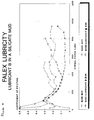
- Figure 1 shows the Falex lubricity before ageing and
- Figure 2 shows the lubricity after ageing.
- Lubricant C is an effective lubricant which as a minimal effect on drilling fluid properties when initially made-up. The lubricant effect is, however, lost after ageing and chemical changes are apparent which adversely affect the drilling fluid properties.
- Lubricant A on the other hand, remains an effective lubricant both before and after ageing at 200°F.
- the lubricant is readily biodegradable in standard tests but shows good stability in the drilling fluid.
- a lubricant with this combination of environmentally friendly characteristics together with stability is highly desirable and particularly beneficial for use in inhibitive water based mud systems. These offer an alternative to oil based systems, which are considered potentially detrimental to the environment.
- a conventional salt saturated drilling fluid was used: Table 4 Sodium Chloride Brine @ 9.5 ppg Caustic Soda 0.16 ppb PAC (SL) 1.0 ppb Starch 4.2 ppb Xanthan Polymer 1.11 ppb Lubricant 8 ppb
- Drilling fluids containing the above were subjected to standard API tests before and after hot rolling at 200°F. A further sample of each fluid was contaminated with 12.5 ppb cement and hot rolled. Falex lubricity was determined on each fluid.
- An initial formulation is made from the fresh or saline water containing the salts sodium chloride, or potassium chloride or sodium nitrate or tetrapotassium pyrophosphate or alkali metal formates or mixtures thereof. Concentrations of these salts range from nil to saturated solutions.
- alkali metal silicates in the concentration of up to 30% by weight.
- the alkali metal silicate may be added as solid or as a solution in water.
- silicates may be mixed sodium and potassium silicates or pure potassium silicate.
- the molar ratios of the component silicates ie sodium silicate and potassium silicate may vary within the overall blend but will fall within the above molar ratios.
- K 2 O conent as a percentage of total alkali will vary from 1-100%.
- Alkali metal hydroxides usually sodium hydroxide or potassium hydroxide are added to the formulation. Other products which supply a source of free hydroxide ions may also be used.
- Viscosifiers consisting of clays or polymers may or may not be added to the formulation but do not effect the basic performance of the invention.
- Fluid loss reducers of polymeric, starch or particulate composition may or may not be added to the formulation but do not effect the basic performance of the invention.
- Weighting agents such as barite or metal oxides may or may not be added to the formulation but do not effect the basic performance of the invention.
Landscapes
- Chemical & Material Sciences (AREA)
- Dispersion Chemistry (AREA)
- Organic Chemistry (AREA)
- General Life Sciences & Earth Sciences (AREA)
- Engineering & Computer Science (AREA)
- Materials Engineering (AREA)
- Life Sciences & Earth Sciences (AREA)
- Inorganic Chemistry (AREA)
- Health & Medical Sciences (AREA)
- Emergency Medicine (AREA)
- Chemical Kinetics & Catalysis (AREA)
- General Chemical & Material Sciences (AREA)
- Oil, Petroleum & Natural Gas (AREA)
- Lubricants (AREA)
Abstract
A lubricant suitable for use with water based drilling mud, the lubricant comprising an ester and being dispersible or soluble in water based drilling mud. The lubricant may comprise an ester which may be modified to be dispersible or soluble in water by blowing oxygen or air through it or by heating in the presence of oxygen or air eg; "blown oil" process.
In another aspect of the present invention there is provided a drilling mud comprising an aqueous solution of between 1 and 30 weight percent silicate wherein the silicate comprises at least potassium silicate and wherein the mud is capable of assisting drilling through and stabilising chalk formations.
Description
- This invention relates to water based drilling muds and additive components.
- In the drilling of a well into the earth, there is commonly employed a drill string having a drill bit connected to the lower end thereof. The drill string is rotated to rotate the drill bit and form a well or wellbore in the earth by cutting and breaking the earth formation which it contacts. Drilling fluid is conventionally circulated down the drill string and through ports provided in the drill bit and back to the surface through the annulus formed between the drill string and the wall of the well. The circulating drilling fluid performs numerous functions including removing the cuttings from the well, cooling the bit, and applying hydrostatic pressure upon the penetrated earth formation to control fluids contained under pressure therein.
- "Drilling muds" having either an oil base or a water base are commonly utilized as drilling fluids. These drilling muds are normally treated to provide desired density and rheological properties which make them particularly suitable for use in drilling wells. For example, drilling muds may be treated to increase the density by adding such materials as barium sulphate (barite), lead sulfide (galena) and iron oxide (haematite). As the search for oil now requires the drilling of extremely deep and highly, deviated/horizontal wells often located offshore, in the arctic or in difficult earth formations, increasing emphasis is being placed on improved specially designed formulations, to improve the lubricity and wear characteristics of water based muds.
- In this field it is already known that modified triglycerides are effective lubricants in conventional water based drilling fluids. (Ref: HCH Darley and G R Gray. Composition and Properties of Drilling and Completion Fluids). Various products based on esters including vegetable oils or oils of other natural origin which have been chemically modified to allow them to be water dispersible or soluble, are used in water based muds to reduce torque and drag and reduce wear arising from steel to steel friction particularly when drilling highly deviated and extended reach wells. These products have also been found to have environmental advantages in that they are readily biodegradable.
- This has the disadvantage that the above lubricants when used in water based muds with high alkalinity (high pH) quickly hydrolyse and become less effective. Soaps and other hydrolysis products are produced which adversely affect the other properties of the mud.
- These lubricants are also adversely affected by alkaline contaminants in muds such as cement.
- In this field it is also already known that the use of sodium, or potassium, or mixed alkali metal silicates provide a drilling mud with properties whereby the hydration, swelling, heaving and dispersion of shales and clays is inhibited. The addition of these products help to seal fractures in shales and sandstones and increases the pH of the drilling mud. Silicate additives to drilling muds have been used extensively since the 1930's in the sole application to drill "heaving shales".
- However, silicate containing muds, in particular those containing potassium silicate have not been used to specifically drill through and stabilise chalk formations.
- It is another object of the present invention to provide drilling mud which contains mixed metal silicates to improve drilling performance in chalk formations.
- It is another object of the invention to provide a high pH drilling mud with improved lubricity and wear characteristics.
- In one aspect of the present invention there is provided a lubricant suitable for use with water based drilling mud, the lubricant comprising an ester and being dispersible or soluble in water based drilling mud.
- The lubricant may be readily biodegradable with >60% aerobic biodegradability.
- The ester may be modified to be dispersible or soluble in water by blowing oxygen or air through it or by heating in the presence of oxygen or air. This process is known as the "blown oil" process.
- The ester may be modified by an oxidation or polymerisation process.
- Preferably the lubricant comprises an ester of a fatty acid and alcohol, at least one of which has branched carbon chains.
- The ester may be "sterically hindered" to hydrolysis in an aqueous medium.
- Preferably at least one of the fatty acid ester or the alcohol contains at least one unsaturated linkage.
- The fatty acid may suitably contain from 1 to 24 carbon atoms.
- The alcohol may suitably contain from 1 to 24 carbon atoms.
- The ester may be modified by an acidification process such as sulphonation, sulphation or nitration.
- The invention further provides a water based drilling mud comprising between 0.5 and 25% weight of the lubricant described herein.
- In another aspect of the present invention there is provided a silicate composition for use in drilling mud for drilling through and stabilising chalk comprising an aqueous solution of between 1% and 30% silicate by weight, wherein the silicate comprises at least potassium silicate.
- The invention further provides a drilling mud for use in drilling mud comprising a silicate comprising as described herein.
- Preferably the drilling mud further comprises alkali metal hydroxides such as sodium or potassium hydroxides.
- In one embodiment the silicates may comprise only potassium silicate.
- Alternatively, the silicates may comprise mixed sodium and potassium silicates.
- The molar ratios of the silicates may range from 0.5:1 SiO2 : M2O to 3.8:1 SiO2 : M2O wherein M = K (potassium) and may also include Na (sodium).
- The K2O content may vary from 1 to 100% of total M2O.
- Preferably the drilling mud may further comprise viscosifiers.
- Suitable viscosifiers include clays or polymers.
- Preferably the drilling mud may further comprise fluid loss reducers such as polyanionic cellulose or starch.
- The drilling mud may further comprise weighting agents such as barite or metal oxides.
- The drilling mud containing lubricant has lower torque and drag and there is reduced steel-steel friction whilst drilling with the mud. The lubricant is based on a biodegradable oil (ester) and is environmentally friendly (low toxicity).
- The lubricant reduces foaming tendency in the mud (defoamer) and is also able to stablise muds to high temperature.
- The lubricant is more stable to combination of temperature/high pH and is able to be used in muds for high temperature wells.
- The lubricant is more stable to contaminants such as magnesium and/or calcium salts and cement.
- The lubricant is particularly suitable for highly inhibitive "silicate muds".
- The use of potassium silicate or mixed silicates which include potassium have a performance advantage over standard water based muds when drilling chalk formations.
- The competency of the wellbore will be increased when these fluids are used. A more in-gauge wellbore will be achieved.
- Cuttings of chalk will be larger and will be more easily removed from the circulating fluid.
- Cementation of casing will be improved in holes drilled using this fluid, cement usage will be reduced in holes drilled using this fluid. Achieving inclination of the wellbore by directional drilling will be more effective in holes drilled using this fluid. Sealing of natural or induced fractures will be improved when using this fluid.
- While further modifications and improvements may be made without departing from the scope of this invention, the following is a description of one or more examples of the invention, with reference to the accompanying tables and figures wherein:
- Figure 1: Illustrates the comparison of lubricants in a salt saturated silicate drilling fluid (before hot rolling).
- Figure 2: Illustrates the comparison of lubricants in a salt saturated silicate drilling fluid (after hot rolling at 200 F).
- Figure 3: Illustrates Lubricant A in a Silicate mud.
- Figure 4: Illustrates Lubricant B in a Silicate mud.
- A lubricant based on a "sterically hindered" ester, Lubricant A modified to give water dispersibility or solubility in water based mud.
- The ester is derived preferably from a long chain fatty acid (carbon number C:1-24) and an alcohol (carbon number C:1-24) in which a degree of branching in either acid and/or alcohol carbon chains is present.
- The ester may be chemically modified by reaction of an unsaturated component of the carbon chains by oxidation, polymerization or other reaction with oxygen (so called "Blown" oil process) or acidising process (sulphonation, sulphation, nitration).
- A "blown" ester of iso-octyl alcohol and oleic acid (Lubricant A) having a viscosity of 80 cSt at 20°C has been tested in a high pH silicate mud (pH 11.7). The results have been compared with those for a product based on a triglyceride (Lubricant B), see Figure 4.
- The lubricity of the muds was tested on a Falex lubricity tester before and after ageing at 200°F for 16 hours (see Figures 3 & 4). The aged mud containing Lubricant B showed loss of performance at high load compared to Lubricant A which remained stable under these conditions.
- Comparison of stability and lubricity of new lubricant (lubricant A) with a commercial alternative.
- A highly inhibitive silicate water based drilling fluid was used for the tests with a high pH of approximately 11.5:
Table 1 Saturated Salt Brine (s.g 1.20) 0.8287 bbls Soda Ash 0.15 ppb Caustic Soda 0.15 ppb RAC (R) * 0.7 ppb PAC (SL) * 0.5 ppb Xanthan Polymer 0.75 ppb Sodium Silicate Solution 30 ppb Drilled Solids 10 ppb Barite 72 ppb Salt 6.1 ppb Lubricant 15 ppb *Polyanionic cellulose ppb: pounds per barrel
bbls: barrels - Lubricant A comprises a lightly "Blown" iso-octyl oleate (2-Ethylhexyl Oleate, an ester of 2-ethyhexanol and commercial oleic acid), a pale yellow liquid, density 0.91 and kinematic viscosity of 80mm2/sec at 20°C. The lubricant is readily biodegradable (Aerobic biodegradability >90% after 28 days, OECD 306)
- Lubricant C is a commercial ester based product.
- Drilling fluids containing these lubricants were tested according to API methods immediately on make-up and again after a laboratory ageing process designed to simulate downhole well conditions and consisting of a 16 hour hot rolling in a pressurised cell at 200°F.
- The drilling fluids were tested for rheology @ 120°F with a Fann Viscometer and their appearance noted. Fluid loss properties on the aged fluids were determined at ambient temperatures.
- Lubricity of the fluids was determined on a Falex pin and vee block lubricity tester (ASTM D2670-88). The fluids were tested at a steadily increasing applied load until film failure occurred. The lubricants effectiveness was assessed from two derived parameters; the (steady) coefficient of friction and film strength.
- Table 2 shows the rheological and fluid loss data obtained with each lubricant together with the appearance of the fluids. Table 3 gives the lubricity parameters for the fluids. Figure 1 shows the Falex lubricity before ageing and Figure 2 shows the lubricity after ageing.
- An effective lubricant is demonstrated by a lowering of the C.F. compared to the base fluid, typically to below 0.1 and a high film strength as typified by a high normal force prior to a sudden increase in C.F. Test results indicate Lubricant C is an effective lubricant which as a minimal effect on drilling fluid properties when initially made-up. The lubricant effect is, however, lost after ageing and chemical changes are apparent which adversely affect the drilling fluid properties. Lubricant A, on the other hand, remains an effective lubricant both before and after ageing at 200°F.
- Surprisingly, the lubricant is readily biodegradable in standard tests but shows good stability in the drilling fluid. A lubricant with this combination of environmentally friendly characteristics together with stability is highly desirable and particularly beneficial for use in inhibitive water based mud systems. These offer an alternative to oil based systems, which are considered potentially detrimental to the environment.
Table 2 Comparison of Lubricant Drilling Fluid Properties in a Silicate Drilling Fluid Base Fluid Base Fluid + Lubricant A Base Fluid + Lubricant C BHR AHR BHR AHR BHR AHR Fann Viscometer Speed 600 rpm 67 59 78 66 75 75 300 rpm 47 42 57 46 55 54 200 rpm 39 33 47 38 46 44 100 rpm 27 23 32 26 33 32 6 rpm 8 7 9 7 9 10 3 rpm 5 4 7 4 7 8 PV 20 17 21 20 20 21 YP 27 25 36 26 35 33 Gels 6/11 5/8 7/12 6/7 7/12 8/11 API Fluid Loss (mls) - 3.0 - 3.6 - 4.0 Foam 
Appearance X* pH 11.46 11.37 11.27 11.20 11.24 10.76 - Satisfactory,
x - unsatisfactory,
* - Pasty appearance with fatty deposits and surface crust
BHR - Before hot rolling
AHR - After hot rolling
PV - Plastic Viscosity (m.Pa.s)
YP - Yield Point (lb/100ft2)
Gels - (10s/10m)(lb/100 ft2)Table 3 Falex Lubricity Parameters Base Fluid Base + Lubricant A Base + Lubricant C BHR C.F. 0.180 0.075 0.040 Film Strength (lbs) 0 950 1211 AHR C.F. 0.170 0.075 0.210 Film Strength (lbs) 0 1050 0 - Tests in a conventional water based drilling fluid. The stability of the new lubricant on contamination of the fluid with cement.
- A conventional salt saturated drilling fluid was used:
Table 4 Sodium Chloride Brine @ 9.5 ppg Caustic Soda 0.16 ppb PAC (SL) 1.0 ppb Starch 4.2 ppb Xanthan Polymer 1.11 ppb Lubricant 8 ppb - Lubricant A is the new ester lubricant described above.
- Lubricant B is a commercial product based on a natural triglyceride oil.
- Drilling fluids containing the above were subjected to standard API tests before and after hot rolling at 200°F. A further sample of each fluid was contaminated with 12.5 ppb cement and hot rolled. Falex lubricity was determined on each fluid.
- The Tables 5, 6 and 7 show the results of the tests.
- Falex lubricity data and API test indicate that Lubricant A is comparable in performance to the commercial product in the base fluid before and after hot rolling. After contamination Lubricant A fluid remains stable and the product chemically virtually unchanged whereas Lubricant B has gelled and precipitated from the fluid.
Table 5 Comparison of Lubricants in a Conventional Salt Saturated Drilling Fluid Base Base + Lubricant A Base + Lubricant B BHR AHR BHR AHR BHR AHR Weight (ppg) 9.5 600 rpm 33 20 34 31 35 31 300 rpm 23 14 24 22 25 22 200 rpm 19 12 20 19 21 19 100 rpm 14 8 14 15 15 14 6 rpm 4 2 5 6 6 5 3 rpm 3 1 4 4 5 3 PV 10 6 10 9 10 9 YP 13 8 14 13 15 13 Gels 4/6 2/3 5/6 5/6 5/7 4/6 API (mls) - 19.0 - 22.5 - 17.5 Foam None Moderate None None None None Appearance - - - Good - Good ppg - pounds per gallon Table 6 Contamination of Drilling Fluids Containing Lubricant Base + Lubricant A Base + Lubricant B Cement Contamination Filtered easily through 40 mesh screen. No solids retained. No visible signs of degradation Gelled particles on cell wall would no pass easily through 40 mesh screen. Soft gel particles retained. Degradation of lubricant Rating 4/5 2 Rating
5 = Good
1 = PoorTable 7 Falex Lubricity Parameters Base Fluid Base + Lubricant A Base + Lubricant B BHR C.F. 0.24 0.05 0.05 Film Strength (lbs) 0 970 860 AHR C.F. 0.24 0.06 0.06 Film Strength (lbs) 0 970 980 - An initial formulation is made from the fresh or saline water containing the salts sodium chloride, or potassium chloride or sodium nitrate or tetrapotassium pyrophosphate or alkali metal formates or mixtures thereof. Concentrations of these salts range from nil to saturated solutions.
- To this water or brine is added alkali metal silicates in the concentration of up to 30% by weight. The alkali metal silicate may be added as solid or as a solution in water.
- These silicates may be mixed sodium and potassium silicates or pure potassium silicate.
The molar ratios of the individual silicates may vary from 0.5:1 Si02:M2O up to 3.8:1 SiO2.M2O where M=Na,K. The molar ratios of the component silicates ie sodium silicate and potassium silicate may vary within the overall blend but will fall within the above molar ratios. K2O conent as a percentage of total alkali will vary from 1-100%. - Alkali metal hydroxides usually sodium hydroxide or potassium hydroxide are added to the formulation. Other products which supply a source of free hydroxide ions may also be used.
-
a) Water 85-99% Potassium silicate 1-15%w/v Sodium hydroxide 0.5-5kg/m3 Potassium chloride 0-150kg/m3 b) Water 85-99% Mixed sodium/potassium silicate 1-15%w/v Sodium hydroxide 0.5-5kg/m3 Potassium chloride 0-320kg/m3 c) Water 85-99% Mixed sodium/potassium silicate 1-15%w/v Sodium hydroxide 0.5-5kg/m3 d) Water 85-99% Potassium silicate 1-15%w/v Sodium hydroxide 0.5-5.0kg/m3 - Viscosifiers consisting of clays or polymers may or may not be added to the formulation but do not effect the basic performance of the invention.
- Fluid loss reducers of polymeric, starch or particulate composition may or may not be added to the formulation but do not effect the basic performance of the invention.
- Weighting agents such as barite or metal oxides may or may not be added to the formulation but do not effect the basic performance of the invention.
Claims (20)
- A lubricant suitable for use with water based drilling mud, comprising an ester and being dispersible in water based drilling mud.
- A lubricant as claimed in Claim 1 which is biodegradable with >60% aerobic biodegradability.
- A lubricant as claimed in any previous claim wherein this ester may be modified to be dispersible or soluble in water by blowing oxygen or air through it or by heating in the presence of oxygen or air.
- A lubricant as claimed in any preceding claim comprising an ester of a fatty acid and an alcohol, at least one of which has branched carbon chain.
- A lubricant as claimed in Claim 4 where in at least one of the fatty acid ester or alcohol contains at least one unsaturated linkage.
- A lubricant as claimed in Claims 4 or 5 wherein the fatty acid contains from 1 to 24 carbon atoms.
- A lubricant as claimed in preceding claim where the alcohol contains from 1 to 24 carbon atoms.
- A lubricant as claimed in any preceding claim where the ester is "sterically hindered" to hydrolysis in an aqueous medium.
- A lubricant as claimed in any preceding claim wherein the ester is modified by an oxidation or polymerisation process.
- A lubricant as claimed in any preceding claim wherein the ester may be modified by an acidification process such as sulphonation, sulphation or nitration.
- A lubricant for use in a water based drilling mud comprising between 0.5 and 25 weight percent of the lubricant as described in any previous claim.
- A silicate composition comprising an aqueous solution of between 1% and 30% silicate by weight, wherein the silicate comprises at least potassium silicate.
- A silicate composition as claimed in Claim 12 further comprising alkali metal hydroxides such as potassium or sodium hydroxides.
- A silicate composition as claimed in Claim 12 or 13 comprising mixed sodium and potassium silicates.
- A silicate composition as claimed in Claims 12 to 14 wherein the molar ratios of the silicates may range from 0.5:1, Si02:M20 to 3.8:1 SiO2:M20, wherein M = K (potassium) or Na (sodium).
- A silicate composition as claimed in Claims 12 to 15 where the potassium oxide content may vary from 1 - 100% of total M20.
- The silicate composition as claimed in Claims 12 to 16 further comprising viscosifiers.
- A silicate composition as claimed in Claim 17 wherein the viscosifiers include clays and/or polymer.
- A silicate composition as claimed in Claims 12 to 18 further comprising fluid loss reducers such as polymeric starch or of particulate composition.
- A silicate composition as claimed in Claims 12 to 19 which further comprise weighting agents such as barite or metal oxide.
Applications Claiming Priority (4)
| Application Number | Priority Date | Filing Date | Title |
|---|---|---|---|
| GB9522063 | 1995-10-27 | ||
| GBGB9522063.8A GB9522063D0 (en) | 1995-10-27 | 1995-10-27 | Silicate additive |
| GBGB9522076.0A GB9522076D0 (en) | 1995-10-27 | 1995-10-27 | Lubricant |
| GB9522076 | 1995-10-27 |
Publications (1)
| Publication Number | Publication Date |
|---|---|
| EP0770661A1 true EP0770661A1 (en) | 1997-05-02 |
Family
ID=26308010
Family Applications (1)
| Application Number | Title | Priority Date | Filing Date |
|---|---|---|---|
| EP96307766A Withdrawn EP0770661A1 (en) | 1995-10-27 | 1996-10-28 | Lubricant for drilling mud |
Country Status (1)
| Country | Link |
|---|---|
| EP (1) | EP0770661A1 (en) |
Cited By (19)
| Publication number | Priority date | Publication date | Assignee | Title |
|---|---|---|---|---|
| WO1998022551A1 (en) * | 1996-11-18 | 1998-05-28 | Henkel Kommanditgesellschaft Auf Aktien | Use of selected fatty alcohols and their mixtures with carboxylic acid esters as lubricant components in water-based drilling fluid systems for soil exploration |
| WO2001081498A3 (en) * | 2000-04-19 | 2002-06-13 | Shell Int Research | Drilling mud |
| US6806235B1 (en) | 1998-11-17 | 2004-10-19 | Cognis Deutschland Gmbh & Co. Kg | Lubricants for drilling fluids |
| WO2008006065A1 (en) * | 2006-07-07 | 2008-01-10 | M-I Llc. | Improved high performance water-based drilling fluid |
| WO2008138957A3 (en) * | 2007-05-15 | 2009-01-15 | Shell Int Research | System for drilling a wellbore |
| WO2010020679A1 (en) * | 2008-08-22 | 2010-02-25 | M-I Swaco Norge As | High performance water based fluids |
| WO2010065634A3 (en) * | 2008-12-04 | 2010-08-12 | M-I L.L.C. | Lubricant for water-based muds and methods of use thereof |
| WO2010121027A3 (en) * | 2009-04-15 | 2011-01-20 | M-I L.L.C. | Lubricant for water-based muds and methods of use thereof |
| US8148305B2 (en) | 2007-09-14 | 2012-04-03 | Emery Oleochemicals Gmbh | Oligoglyercol fatty acid ester additives for water-based drilling fluids |
| US9580636B2 (en) | 2015-04-30 | 2017-02-28 | Chevron Phillips Chemical Company Lp | Secondary esters, methods of making, and uses thereof |
| WO2021021298A1 (en) * | 2019-07-29 | 2021-02-04 | Saudi Arabian Oil Company | Water-based drilling fluids that include lubricants |
| WO2021021229A1 (en) * | 2019-07-29 | 2021-02-04 | Saudi Arabian Oil Company | Water-based drilling fluids that include lubricants |
| WO2021091631A1 (en) * | 2019-11-04 | 2021-05-14 | Saudi Arabian Oil Company | Water-based drilling fluid compositions and methods for drilling subterranean wells |
| US11352545B2 (en) | 2020-08-12 | 2022-06-07 | Saudi Arabian Oil Company | Lost circulation material for reservoir section |
| US11359134B2 (en) | 2020-10-19 | 2022-06-14 | Saudi Arabian Oil Company | Treatment fluids and methods for recovering hydrocarbons from a subterranean formation |
| US11365337B2 (en) | 2019-07-29 | 2022-06-21 | Saudi Arabian Oil Company | Lubricants that include alkyl esters and fatty acids |
| US11365365B2 (en) | 2019-07-29 | 2022-06-21 | Saudi Arabian Oil Company | Lubricants that include alkyl esters and fatty acids |
| US11760919B2 (en) | 2020-07-07 | 2023-09-19 | Saudi Arabian Oil Company | Foams for hydrocarbon recovery, wells including such, and methods for use of such |
| US11840908B2 (en) | 2020-10-01 | 2023-12-12 | Saudi Arabian Oil Company | Acidizing fluid and method of improving hydrocarbon recovery using the same utilizing a surfactant consisting of an oil mixture |
Citations (8)
| Publication number | Priority date | Publication date | Assignee | Title |
|---|---|---|---|---|
| US2349585A (en) * | 1940-07-08 | 1944-05-23 | Pure Oil Co | Foam prevention |
| US3761410A (en) * | 1971-03-22 | 1973-09-25 | Nl Industries Inc | Composition and process for increasing the lubricity of water base drilling fluids |
| GB2077327A (en) * | 1980-06-02 | 1981-12-16 | Halliburton Co | Process for conditioning well fluid to reduce drag |
| GB2099412A (en) * | 1981-05-21 | 1982-12-08 | Halliburton Co | Rapidly dissolvable silicates and methods of using the same |
| US4517100A (en) * | 1983-02-07 | 1985-05-14 | Witco Chemical Corporation | Lubricating wellbore fluid and method of drilling |
| GB2283036A (en) * | 1993-10-22 | 1995-04-26 | Bp Chem Int Ltd | Drilling fluid |
| EP0713909A1 (en) * | 1994-11-22 | 1996-05-29 | Institut Français du Pétrole | Lubricating oil composition containing an ester, use thereof and well bore fluids containing the same |
| WO1996022245A1 (en) * | 1995-01-20 | 1996-07-25 | Brunner Mond & Company Limited | Silicate solutions |
-
1996
- 1996-10-28 EP EP96307766A patent/EP0770661A1/en not_active Withdrawn
Patent Citations (8)
| Publication number | Priority date | Publication date | Assignee | Title |
|---|---|---|---|---|
| US2349585A (en) * | 1940-07-08 | 1944-05-23 | Pure Oil Co | Foam prevention |
| US3761410A (en) * | 1971-03-22 | 1973-09-25 | Nl Industries Inc | Composition and process for increasing the lubricity of water base drilling fluids |
| GB2077327A (en) * | 1980-06-02 | 1981-12-16 | Halliburton Co | Process for conditioning well fluid to reduce drag |
| GB2099412A (en) * | 1981-05-21 | 1982-12-08 | Halliburton Co | Rapidly dissolvable silicates and methods of using the same |
| US4517100A (en) * | 1983-02-07 | 1985-05-14 | Witco Chemical Corporation | Lubricating wellbore fluid and method of drilling |
| GB2283036A (en) * | 1993-10-22 | 1995-04-26 | Bp Chem Int Ltd | Drilling fluid |
| EP0713909A1 (en) * | 1994-11-22 | 1996-05-29 | Institut Français du Pétrole | Lubricating oil composition containing an ester, use thereof and well bore fluids containing the same |
| WO1996022245A1 (en) * | 1995-01-20 | 1996-07-25 | Brunner Mond & Company Limited | Silicate solutions |
Cited By (32)
| Publication number | Priority date | Publication date | Assignee | Title |
|---|---|---|---|---|
| US6716799B1 (en) | 1996-11-18 | 2004-04-06 | Cognis Deutschland Gmbh & Co. Kg | Use of selected fatty alcohols and their mixtures with carboxylic acid esters as lubricant components in water-based drilling fluid systems for soil exploration |
| WO1998022551A1 (en) * | 1996-11-18 | 1998-05-28 | Henkel Kommanditgesellschaft Auf Aktien | Use of selected fatty alcohols and their mixtures with carboxylic acid esters as lubricant components in water-based drilling fluid systems for soil exploration |
| US6806235B1 (en) | 1998-11-17 | 2004-10-19 | Cognis Deutschland Gmbh & Co. Kg | Lubricants for drilling fluids |
| WO2001081498A3 (en) * | 2000-04-19 | 2002-06-13 | Shell Int Research | Drilling mud |
| US7320951B2 (en) | 2000-04-19 | 2008-01-22 | Shell Oil Company | Silica-based drilling mud comprising glycoside lubricants with amino-linked alkyl chains |
| EA015332B1 (en) * | 2006-07-07 | 2011-06-30 | Эм-Ай ЭлЭлСи. | Water-based drilling fluid |
| WO2008006065A1 (en) * | 2006-07-07 | 2008-01-10 | M-I Llc. | Improved high performance water-based drilling fluid |
| EP2038363A4 (en) * | 2006-07-07 | 2010-11-24 | Mi Llc | IMPROVED HIGH PERFORMANCE WATER-BASED DRILLING MUD |
| WO2008138957A3 (en) * | 2007-05-15 | 2009-01-15 | Shell Int Research | System for drilling a wellbore |
| GB2461471A (en) * | 2007-05-15 | 2010-01-06 | Shell Int Research | System for drilling a wellbore |
| GB2461471B (en) * | 2007-05-15 | 2012-02-15 | Shell Int Research | System for drilling a wellbore |
| US8148305B2 (en) | 2007-09-14 | 2012-04-03 | Emery Oleochemicals Gmbh | Oligoglyercol fatty acid ester additives for water-based drilling fluids |
| EP2703467A1 (en) * | 2008-08-22 | 2014-03-05 | Schlumberger Norge AS | High performance water based fluids |
| AU2009284102B2 (en) * | 2008-08-22 | 2013-02-28 | Schlumberger Norge As | High performance water based fluids |
| WO2010020679A1 (en) * | 2008-08-22 | 2010-02-25 | M-I Swaco Norge As | High performance water based fluids |
| WO2010065634A3 (en) * | 2008-12-04 | 2010-08-12 | M-I L.L.C. | Lubricant for water-based muds and methods of use thereof |
| WO2010121027A3 (en) * | 2009-04-15 | 2011-01-20 | M-I L.L.C. | Lubricant for water-based muds and methods of use thereof |
| US9580636B2 (en) | 2015-04-30 | 2017-02-28 | Chevron Phillips Chemical Company Lp | Secondary esters, methods of making, and uses thereof |
| US11365337B2 (en) | 2019-07-29 | 2022-06-21 | Saudi Arabian Oil Company | Lubricants that include alkyl esters and fatty acids |
| WO2021021298A1 (en) * | 2019-07-29 | 2021-02-04 | Saudi Arabian Oil Company | Water-based drilling fluids that include lubricants |
| US11542422B2 (en) | 2019-07-29 | 2023-01-03 | Saudi Arabian Oil Company | Water-based drilling fluids that include lubricants |
| US11365365B2 (en) | 2019-07-29 | 2022-06-21 | Saudi Arabian Oil Company | Lubricants that include alkyl esters and fatty acids |
| US11299661B2 (en) | 2019-07-29 | 2022-04-12 | Saudi Arabian Oil Company | Water-based drilling fluids that include lubricants |
| WO2021021229A1 (en) * | 2019-07-29 | 2021-02-04 | Saudi Arabian Oil Company | Water-based drilling fluids that include lubricants |
| US11286412B2 (en) | 2019-11-04 | 2022-03-29 | Saudi Arabian Oil Company | Water-based drilling fluid compositions and methods for drilling subterranean wells |
| US11441061B2 (en) | 2019-11-04 | 2022-09-13 | Saudi Arabian Oil Company | Water-based drilling fluid compositions and methods for drilling subterranean wells |
| WO2021091631A1 (en) * | 2019-11-04 | 2021-05-14 | Saudi Arabian Oil Company | Water-based drilling fluid compositions and methods for drilling subterranean wells |
| US11760919B2 (en) | 2020-07-07 | 2023-09-19 | Saudi Arabian Oil Company | Foams for hydrocarbon recovery, wells including such, and methods for use of such |
| US11352545B2 (en) | 2020-08-12 | 2022-06-07 | Saudi Arabian Oil Company | Lost circulation material for reservoir section |
| US11739249B2 (en) | 2020-08-12 | 2023-08-29 | Saudi Arabian Oil Company | Lost circulation material for reservoir section |
| US11840908B2 (en) | 2020-10-01 | 2023-12-12 | Saudi Arabian Oil Company | Acidizing fluid and method of improving hydrocarbon recovery using the same utilizing a surfactant consisting of an oil mixture |
| US11359134B2 (en) | 2020-10-19 | 2022-06-14 | Saudi Arabian Oil Company | Treatment fluids and methods for recovering hydrocarbons from a subterranean formation |
Similar Documents
| Publication | Publication Date | Title |
|---|---|---|
| EP0770661A1 (en) | Lubricant for drilling mud | |
| US11091682B2 (en) | Methods of using drilling fluid compositions with enhanced rheology | |
| EP0850287B1 (en) | Glycol based drilling fluid | |
| AU726193B2 (en) | Well servicing fluid for trenchless directional drilling | |
| CA2170569C (en) | Improved water-based drilling fluids for reduction of water adsorption and hydration of argillaceous rocks | |
| Fink | Water-based chemicals and technology for drilling, completion, and workover fluids | |
| US5869434A (en) | Free-flowing borehole servicing preparations containing linear α-olefins, more patricularly corresponding drilling fluids | |
| CA2657137C (en) | Improved high performance water-based drilling fluid | |
| CA2271286C (en) | Invert emulsion well drilling and servicing fluids | |
| WO2019175792A1 (en) | Drilling fluid system for controlling loss circulation | |
| EP2376589B1 (en) | Friction modifier for drilling fluids | |
| CN101501159A (en) | Improved high performance water-based drilling fluid | |
| US4264455A (en) | Drilling mud viscosifier | |
| US11124687B2 (en) | Synthesized lubricants for water-based drilling fluid systems | |
| US4554080A (en) | Aqueous drilling fluids containing alkenyl succinic anhydrides | |
| US11560508B2 (en) | Epoxidized fatty acid methyl ester as primary emulsifier for invert emulsion oil based mud | |
| EP0699729A1 (en) | Non-hydrocarbon invert emulsions for use in well drilling operations wherein the external phase comprises poly(1,4-oxybutylene)glycol | |
| WO1994012589A1 (en) | Drilling fluid | |
| CA3050427A1 (en) | Compositions and methods of making of shale inhibition fluids |
Legal Events
| Date | Code | Title | Description |
|---|---|---|---|
| PUAI | Public reference made under article 153(3) epc to a published international application that has entered the european phase |
Free format text: ORIGINAL CODE: 0009012 |
|
| AK | Designated contracting states |
Kind code of ref document: A1 Designated state(s): DE DK GB NL |
|
| 17P | Request for examination filed |
Effective date: 19970619 |
|
| 17Q | First examination report despatched |
Effective date: 19990909 |
|
| STAA | Information on the status of an ep patent application or granted ep patent |
Free format text: STATUS: THE APPLICATION IS DEEMED TO BE WITHDRAWN |
|
| 18D | Application deemed to be withdrawn |
Effective date: 20010501 |