EP0771591A1 - Wet agitating ball mill and method - Google Patents
Wet agitating ball mill and method Download PDFInfo
- Publication number
- EP0771591A1 EP0771591A1 EP96919997A EP96919997A EP0771591A1 EP 0771591 A1 EP0771591 A1 EP 0771591A1 EP 96919997 A EP96919997 A EP 96919997A EP 96919997 A EP96919997 A EP 96919997A EP 0771591 A1 EP0771591 A1 EP 0771591A1
- Authority
- EP
- European Patent Office
- Prior art keywords
- slurry
- stator
- medium
- mill
- discharge port
- Prior art date
- Legal status (The legal status is an assumption and is not a legal conclusion. Google has not performed a legal analysis and makes no representation as to the accuracy of the status listed.)
- Withdrawn
Links
Images




Classifications
-
- B—PERFORMING OPERATIONS; TRANSPORTING
- B02—CRUSHING, PULVERISING, OR DISINTEGRATING; PREPARATORY TREATMENT OF GRAIN FOR MILLING
- B02C—CRUSHING, PULVERISING, OR DISINTEGRATING IN GENERAL; MILLING GRAIN
- B02C13/00—Disintegrating by mills having rotary beater elements ; Hammer mills
- B02C13/26—Details
- B02C13/286—Feeding or discharge
-
- B—PERFORMING OPERATIONS; TRANSPORTING
- B02—CRUSHING, PULVERISING, OR DISINTEGRATING; PREPARATORY TREATMENT OF GRAIN FOR MILLING
- B02C—CRUSHING, PULVERISING, OR DISINTEGRATING IN GENERAL; MILLING GRAIN
- B02C17/00—Disintegrating by tumbling mills, i.e. mills having a container charged with the material to be disintegrated with or without special disintegrating members such as pebbles or balls
- B02C17/16—Mills in which a fixed container houses stirring means tumbling the charge
- B02C17/161—Arrangements for separating milling media and ground material
-
- B—PERFORMING OPERATIONS; TRANSPORTING
- B02—CRUSHING, PULVERISING, OR DISINTEGRATING; PREPARATORY TREATMENT OF GRAIN FOR MILLING
- B02C—CRUSHING, PULVERISING, OR DISINTEGRATING IN GENERAL; MILLING GRAIN
- B02C17/00—Disintegrating by tumbling mills, i.e. mills having a container charged with the material to be disintegrated with or without special disintegrating members such as pebbles or balls
- B02C17/16—Mills in which a fixed container houses stirring means tumbling the charge
Definitions
- the present invention relates to a wet agitating ball mill of friction grinding type, a grinding method by using this mill, and a method of recovering ground product.
- a wet agitating ball mill of friction grinding type is generally composed of a cylindrical enclosed type stator, a rotor of pin, disk or annular type disposed in the axial center of the stator and to be rotated and driven by the motor, and the mill is filled with medium such as zirconia, glass beads, titanium oxide, steel balls or zirconia silicate, and the raw slurry in a material tank is supplied into the mill through a material pump, and the rotor is rotated and driven to agitate and mix the medium and slurry, thereby grinding the slurry.
- the ground slurry is discharged out of the mill after separating the medium by the separator, and is returned into the material tank. This operation is repeated, and grinding is promoted.
- the mill When reaching a desired product particle size, the mill is stopped, and the slurry in the material tank is transferred and collected in a product tank. After stopping the mill, the product slurry left over in the mill remains in the mill, but if it is possible to solidify to disturb next operations, the inside of the mill was cleaned by feeding cleaning water while operating the mill, and the slurry diluted by cleaning water and discharged from the mill was discarded.
- the medium used in this type of mill were reduced in diameter as the product grain size became smaller according to the requests of customers, and it was not rare to use medium with diameter of about 0.1 mm.
- One of the problems that must be solved in the mill for such fine pulverizing is the separation technology for separating the medium efficiently from the slurry.
- the separator for separating medium from the slurry hitherto, the screen and slit machines were used, but in the former screen type, it is extremely difficult to drill innumerable holes smaller than the medium diameter, and if fabricated, the pressure loss is large, and clogging is likely to occur.
- a representative example is composed of a disk fixed on a stator, and a disk to be rotated as being fixed on the shaft and forming a slit not allowing medium to pass against the fixed disk by keeping a specific clearance to the fixed disk, and the medium is separated in the slit between the disks, and the slurry is discharged through the slit, but it is extremely difficult in manufacture to define the slit width at about 0.1 mm, and if manufactured, the medium are likely to be caught in the slit, and the disk is damaged easily. Still more, since the slit width is narrow, there is a limited in the slurry discharge amount, that is, the grinding treating capacity of slurry.
- Japanese Laid-open Patent 4-61635 discloses a separator having two disks disposed parallel at a specific interval on the shaft, and coupling the both disks by a spiral blade in an impeller form.
- This separator is designed to apply a centrifugal force to the medium and slurry, and scatter the medium having the greater specific gravity radially outward by making use of difference in specific gravity between the medium and slurry, while discharging the slurry of the smaller specific gravity from a discharge route around the shaft, and therefore since a same centrifugal force acts on the same diameter between the disks, the spacing of the disks can be widened and the treating capacity may be increased, and by widening the spacing of the disks, biting or clogging of medium in the disks can be avoided.
- the separation performance does not change in the time course, and a stable operation is realized for a long period, and the medium can be separated if the diameter is small, and micro medium can be used, and fine pulverizing is hence possible, but in spite of these benefits, on the other hand, the slurry discharged from the discharge route around the shaft has a kinetic energy given the rotation of the separator, that is, the action of centrifugal force, which means the kinetic energy is released wastefully, and unnecessary power is spent.
- This separator is usually made of metal, but considering contamination and wear resistance by metal, it is preferred to use ceramics. In the case of ceramics, it is extremely difficult to fabricate in one body. Manufacturing the disks and blade separately, they can be assembled by adhering with adhesive, but when the raw slurry is organic solvent, the adhesive may be fused to have adverse effects on the quality of product slurry, or the separator may be disassembled into individual parts.
- a screen is provided in the mill bottom, and after grinding, the product slurry remaining in the mill is discharged and recovered through the screen by injecting compressed air or compressed gas such as N 2 gas from above the mill.
- the product slurry remaining in the mill after grinding can be effectively recovered.
- various methods may be considered, including a method of rotating and driving the rotor during recovery to agitate in the mill so that the medium may not be collected near the screen, a method of recovering in a long time by decreasing the recovering speed (recovery amount per unit time), and a method of blowing compressed air or compressed gas such as N 2 gas from the opposite side of the screen to prevent clogging of screen by back wash, and when rotating and driving the rotor, it is desired to drive at lower speed than when grinding so as to save power required for rotating the rotor and keep low the temperature rise due to rotor rotation.
- the filling rate of medium in the mill is 80 to 90% when grinding.
- the relation between the power kWh required for obtaining 1 kg of product slurry and the medium filling rate in the mill is as shown in Fig. 9, in which the smallest power was required for obtaining product slurry of unit weight at medium filling rate of 80 to 90%. It means that most efficient grinding is achieved when the mill is operated at the medium filling rate of 80 to 90%.
- the separator may be of screen or slit mechanism, but the above impeller type separator is preferred owing to the reason mentioned above.
- the medium filling rate cannot be increased. That is, when loading medium into the mill stopping its operation, the filling capacity in the mill is about half, and when the level reaches the discharge route, medium escape from the discharge route. It is hence desired to install the mill vertically, and provide the separator in the upper part of the mill, and when the medium filling rate is set at 80 to 90%, as mentioned above, grinding is done most efficiently, and the separator can be positioned higher than the medium filling level, which is also effective to prevent the medium from being placed on the separator and discharged.
- the invention for achieving the third object relates to a wet agitating ball mill comprising a cylindrical separator, a feed port of slurry provided at one end of the stator, a discharge port of slurry provided at other end of the stator, a rotor of pin, disk or annular type for agitating and mixing the medium loaded in the stator and the slurry supplied from the feed port, and a separator of impeller type linked to the discharge port and rotating together with the rotor or rotating independently of the rotor to separate the medium and slurry by the action of centrifugal force and discharge the slurry from the discharge port, wherein the axial center of the shaft for rotating and driving the separator is a hollow discharge port communicating with the discharge port.
- the slurry from which medium is separated by the separator is discharged through the axial center of the shaft, but since the centrifugal force does not act on the axial center, the slurry is discharged in a state having no kinetic energy. That is, kinetic energy is not discharged wastefully, and wasteful power consumption is avoided.
- the mill of the invention may be lateral, but the vertical position is preferred because of the above reason, that is, to increase the medium filling rate, and the discharge port is provided at the mill upper end.
- the separator is also preferred to be installed higher than the medium filling level.
- the feed port is provided in the mill bottom.
- the feed port is composed of a valve seat, and a valve body of V-form, trapezoid or cone fitted elevatably to the valve seat and contacting linearly with the edge of the valve seat, and by forming an annular slit so as not to allow to pass medium between the edge of the valve seat and the valve body of V-form, trapezoid or cone, the raw slurry is fed but falling of medium can be prevented.
- the valve body it is possible to expand the slit to discharge medium, or by lowering the valve body, it is possible to close the slit and shut the mill tightly.
- the slit is formed of the valve body and edge of valve seat, coarse particles in the raw slurry hardly get in, and if getting in, they pass through upward or downward, and hardly clog.
- the vibrating means for vibrating the valve body includes mechanical means such as vibrator, and means of varying the pressure of compressed air acting on the piston which is integrated with the valve body, such as reciprocating compressor, and electromagnetic changeover valve for changing over suction and discharge of compressed air.
- the mill of the invention is further preferred to be provided with a screen for separating the medium and a take-out port of product slurry in the bottom as mentioned above, so that the product slurry remaining in the mill after grinding may be taken out.
- the invention for achieving the fourth object relates to a vertical type wet agitating ball mill comprising a cylindrical vertical stator, a feed port of product slurry provided in the bottom of the stator, a discharge port of slurry provided at the upper end of the stator, a shaft pivoted on the upper end of the stator and rotated and driven by driving means such as motor, a rotor of pin, disk or annular type fixed on the shaft for agitating and mixing the medium loaded in the stator and the slurry supplied from the feed port, a separator disposed near the discharge port for separating medium from the slurry, and a mechanical seal provided in the bearing unit for supporting the shaft at the stator upper end, wherein a taper notch expanding downward is formed at the lower side of an annular groove to which an O-ring contacting with the mating ring of the mechanical seal is fitted.
- the mechanical seal is provided in the axial center where the medium and slurry have almost no kinetic energy, and at the upper end of the stator above their liquid levels, so that invasion of medium or slurry between the mating ring of the mechanical seal and lower side of O-ring fitting groove can be substantially decreased.
- the mating ring follows up the seal ring smoothly, and the function of the mechanical seal is maintained.
- the lower side of the fitting groove to which the O-ring is fitted has a V-form section, and the entire structure is not thin wall, and the strength is not sacrificed, and the holding function of the O-ring is not spoiled.
- the invention for achieving the fifth object relates to a wet agitating ball mill comprising a cylindrical stator, a feed port of slurry provided at one end of the stator, a discharge port of slurry provided at other end of the stator, a rotor of pin, disk or annular type for agitating and mixing the medium loaded in the stator and the slurry supplied from the feed port, and a separator of impeller type linked to the discharge port and rotating together with the rotor or rotating independently of the rotor to separate the medium and slurry by the action of centrifugal force and discharge the slurry from the discharge port, wherein the separator is composed of two disks having a fitting groove of a blade in the confronting inner sides, a blade interposed between the disks by fitting to the fitting groove, and support means for supposing the disks having the blade placed therein from both sides, and in a preferred form, the support means is composed of a step of the shaft forming a stepped shaft, and cylindrical pressing means for
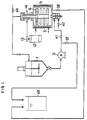
- Fig. 1 is a schematic diagram of raw slurry grinding process cycle having a wet agitating ball mill of the invention.
- Fig. 2 is a longitudinal sectional view for a wet agitating ball mill of the invention.
- Fig. 3 is a longitudinal sectional view of a feed port when feeding raw slurry.
- Fig. 5 is a longitudinal sectional view of the feed port when discharging medium.
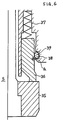
- Fig. 6 is an essential magnified longitudinal sectional view of mechanical seal used in a wet agitating ball mill.
- Fig. 7 is a longitudinal sectional view of other example of a wet agitating ball mill of the invention.
- Fig. 8 is a lateral sectional view of a separator of the wet agitating ball mill shown in Fig. 7.
- Fig. 9 is a diagram showing the relationship of medium filling rate and mill power basic unit.
- raw slurry discharged from a material tank 1 storing slurry by a material pump 2 is supplied into a vertical type wet agitating ball mill 3 of friction grinding type, and is agitated and ground together with medium in the mill 3, and is discharged through the axial center of a shaft 5 after separating the medium by a separator 4, and returns to the tank 1, so that it may be ground cyclically in this route.
- the mill 3 as specifically shown in Fig. 2, comprises a stator 7 of vertical cylindrical form including a jacket 6 for passing cooling water for cooling the mill, a shaft 5 pivoted rotatably above the stator at the axial center of the stator 7, having a mechanical seal as shown in Fig. 6 in the bearing unit, and forming a hollow discharge route 9 in the axial center of the upper side, a rotor 11 of pin or disk form projecting in the radial direction at the lower end of the shaft, a pulley 14 affixed above the shaft to be connected with belt to a pulley 13 of a motor 12 shown in Fig.
- a rotary joint 15 mounted at the opening end of the shaft upper end, a separator 5 for separating the medium affixed on the shaft 5 near the upper part in the stator 7, a feed port 16 of raw slurry provided opposite to the shaft end of the shaft 5 in the stator bottom, and a screen 18 for separating the medium, mounted on a grating shaped screen support 17 installed at a product slurry take-out port 19 provided at an eccentric position of the stator bottom.
- the separator 4 comprises a pair of disks 21 affixed at a specific spacing on the shaft 5, and a blade 22 for linking the both disks 21, thereby forming an impeller, and rotating together with the shaft 5, centrifugal force is applied to the medium and slurry having entered in between the disks, and the medium is scattered radially outward by the difference in specific gravity, while the slurry is discharged through the discharge route 9 at the axial center of the shaft 5.
- the feed port 16 of raw slurry comprises, as specifically shown in Fig. 3, a valve seat 24 formed in the stator bottom, a valve body 25 of inverted trapezoidal form elevatably fitting to the valve seat 24, a cylindrical body 26 with a bottom forming a guide port 27 of raw slurry, projecting downward from the stator bottom, a cylindrical body 28 with a bottom forming a guide port 29 of air, projecting downward from the cylindrical body 26, a piston 31 elevatably fitted to the cylindrical body 28, a rod 32 for linking the piston 31 and valve body 25, a spring 33 mounted on the piston in the cylindrical body 28 for pushing down the piston 31 to thrust the valve body 25 usually downward, and a nut 34 twisted into the rod end projecting from the cylindrical body 28 and mounted so as to be adjustable in position, and when the valve body 25 is pushed up by supply of raw slurry, an annular slit is formed against the valve seat 24, so that the raw slurry can be supplied into the mill, and the slit width can be adjusted by twisting or loosening
- the valve body 25 When feeding the material, the valve body 25 ascends by resisting the pressure in the mill and action of the spring 33 by the feed pressure of the raw slurry fed into the cylindrical body 26, and a slit is formed against the valve seat 24, but the feed pressure of the raw slurry is set so that the width of the slit formed by the supply of raw slurry may be slightly smaller than the maximum slit width defined by the nut 34, and therefore a certain allowance is kept between the nut 34 and cylindrical body 28.
- Coarse particles are contained in the raw slurry supplied into the mill through the slit formed between the valve seat 24 and valve body 25, and they may be predicted to be caught between the valve seat and valve body to clog, if clogged by biting, the feed pressure is raised so as to lift the valve body 25 once to the maximum limit to extend the slit width to maximum. As a result, caught coarse particles flow out and clogging is cleared. When clogging is cleared, the feed pressure is lower, and the valve body 25 descends.
- compressed air is supplied from a compressed air source (not shown) into the cylindrical body 28 from the guide port 29 through regulator 23 and electromagnetic changeover valve 30, and by changing over the electromagnetic changeover valve 30 by turning on and off repeatedly in a short period, compressed air is supplied intermittently, and the valve body 25 repeats vertical motion to ascend to the upper limit in a short period, so that biting can be cleared.
- a compressed air source not shown
- the vibration of the valve body 25 may be done always, or when lots of coarse particles are contained in the raw slurry, or the vibration may occur in cooperation when the feed pressure of raw slurry is raised due to clogging.
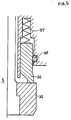
- a mating ring 36 at the stator side is press-fitted to a seal ring 35 fixed to the shaft 5 by the action of a spring 37, and sealing of the stator 7 and mating ring 36 is achieved by an O-ring 39 fitted in a fitting groove 38 at the stator side, and in Fig. 6, a taper notch 40 expanding downward is cut at the lower end of the O-ring fitting groove 38, and the length a of the minimum clearance portion between the lower side of the fitting groove 38 and mating ring 36 is narrower than in Fig. 5, thereby preventing invasion and solidification of medium and slurry, impedance of motion of the mating ring 36, and loss of sealing of the seal ring 35.
- the rotor 11 and separator 4 are fixed on the same shaft 5, but in other embodiment, they are fixed on different shafts disposed coaxially and are rotated and driven independently.
- the rotor and separator are mounted on the same shaft, only one driving device is needed and the structure is simple, and in the latter embodiment where the rotor and shaft are mounted on different shafts and are rotated and driven by individual driving devices, on the other hand, the rotor and separator can be rotated and driven at optimum rotating speeds, individually.
- a shaft 43 is a stepped shaft
- a separator 44 is inserted from the lower end of the shaft
- a spacer 45 and a rotor 46 of disk or pin form are inserted alternately
- a stopper 47 is fixed to the lower end of the shaft by a screw 48
- the separator 44, spacer 45, and rotor 46 are inserted into the shaft 43, they are fixed by pinching with the step 43a of the shaft 43 and the stopper 47, and the separator 44 comprises, as shown in Fig.
- the stator 7 in the ball mill 3 is filled with medium by 80 to 90% of the inner volume of the stator, the valves 58, 59 and 60 are closed, and valves 61 and 52 are opened, and first the motor 12 is driven, and then the material pump 2 is driven.
- the motor 12 is driven, the rotor 11 and separator 4 are rotated, and when the material pump 2 is driven, the raw slurry in the material tank 1 is sent into the guide port 27 of the feed port 16 at specific feed rate, and is supplied into the mill through the slit formed between the edge of the valve seat 24 and the valve body 25.
- the raw slurry and medium in the mill are agitated and mixed, and the slurry is ground, and by rotation of the separator 4, the medium and slurry having entered into the separator are separated by the difference in specific gravity, and the medium of greater specific gravity is scattered radially outward, while the slurry of the smaller specific gravity is discharged through the discharge route 9 formed in the axial center of the shaft 5, and is returned to the material tank 1.
- the motor 12 is driven prior to driving of the material pump 2 because medium is discharged when raw slurry is supplied before the separating action by the separator.
- the slurry returned to the material tank 1 is supplied again into the mill by the material pump 2, and repeats the same cycle and ground progressively.
- the particle size of the slurry is measured occasionally, and when reaching a desired particle size, once the material pump is stopped, and then the motor 12 is stopped to stop operation of the mill 3, thereby finishing the grinding process.
- the valves 58 and 59 are opened, and the valves 61 and 62 are closed, and the material pump and motor 12 are started again, and then the valve 60 is opened.
- the product slurry in the material tank 1 is discharged by the material pump 2, and is sent into a product tank 63, while the product slurry in the mill is agitated by rotation of the rotor 7, and is pushed out through the screen 18 by compressed air or N 2 gas passed through the valve 60 and discharge route 9, or fed into the mill from above the mill, and is sent into the product tank 63.
- the product slurry in the material tank and mill 3 is recovered in the product tank 63.
- rotation of the rotor 7 during product recovery is intended to prevent clogging in the screen 18 by mixing so that the medium may not sediment in the mill to be collected in the mill lower layer, and proper compressed air or N 2 gas for clearing clogging is introduced from the take-out port, and the screen 18 is back washed.
- Fig. 1 using a mill with the inside diameter of the stator 7 of 80 mm ⁇ , inner volume of 1 liter, diameter of separator 4 of 60 mm ⁇ , and interval of disks 21 of the separator 4 of 5 mm, the mill was filled with zirconia ZrO 2 (specific gravity 6.0) of particle size of 0.1 mm as medium by 50%, and slurry of calcium carbonate CaCO 3 with mean particle size of 6.6 ⁇ m and water was supplied from the material tank 1 into the feed port 16. The mill 3 was operated at constant rotor rotating speed (peripheral speed at the rotor leading end of 8 m/sec), and the slurry was ground cyclically.
- zirconia ZrO 2 specific gravity 6.0
Landscapes
- Engineering & Computer Science (AREA)
- Food Science & Technology (AREA)
- Crushing And Grinding (AREA)
- Crushing And Pulverization Processes (AREA)
Abstract
Description
- The present invention relates to a wet agitating ball mill of friction grinding type, a grinding method by using this mill, and a method of recovering ground product.
- A wet agitating ball mill of friction grinding type is generally composed of a cylindrical enclosed type stator, a rotor of pin, disk or annular type disposed in the axial center of the stator and to be rotated and driven by the motor, and the mill is filled with medium such as zirconia, glass beads, titanium oxide, steel balls or zirconia silicate, and the raw slurry in a material tank is supplied into the mill through a material pump, and the rotor is rotated and driven to agitate and mix the medium and slurry, thereby grinding the slurry. The ground slurry is discharged out of the mill after separating the medium by the separator, and is returned into the material tank. This operation is repeated, and grinding is promoted. When reaching a desired product particle size, the mill is stopped, and the slurry in the material tank is transferred and collected in a product tank. After stopping the mill, the product slurry left over in the mill remains in the mill, but if it is possible to solidify to disturb next operations, the inside of the mill was cleaned by feeding cleaning water while operating the mill, and the slurry diluted by cleaning water and discharged from the mill was discarded.
- The medium used in this type of mill were reduced in diameter as the product grain size became smaller according to the requests of customers, and it was not rare to use medium with diameter of about 0.1 mm. One of the problems that must be solved in the mill for such fine pulverizing is the separation technology for separating the medium efficiently from the slurry. As the separator for separating medium from the slurry, hitherto, the screen and slit machines were used, but in the former screen type, it is extremely difficult to drill innumerable holes smaller than the medium diameter, and if fabricated, the pressure loss is large, and clogging is likely to occur. In the latter slit mechanism, a representative example is composed of a disk fixed on a stator, and a disk to be rotated as being fixed on the shaft and forming a slit not allowing medium to pass against the fixed disk by keeping a specific clearance to the fixed disk, and the medium is separated in the slit between the disks, and the slurry is discharged through the slit, but it is extremely difficult in manufacture to define the slit width at about 0.1 mm, and if manufactured, the medium are likely to be caught in the slit, and the disk is damaged easily. Still more, since the slit width is narrow, there is a limited in the slurry discharge amount, that is, the grinding treating capacity of slurry.
- As a separator capable of solving these problems, Japanese Laid-open Patent 4-61635 discloses a separator having two disks disposed parallel at a specific interval on the shaft, and coupling the both disks by a spiral blade in an impeller form. This separator is designed to apply a centrifugal force to the medium and slurry, and scatter the medium having the greater specific gravity radially outward by making use of difference in specific gravity between the medium and slurry, while discharging the slurry of the smaller specific gravity from a discharge route around the shaft, and therefore since a same centrifugal force acts on the same diameter between the disks, the spacing of the disks can be widened and the treating capacity may be increased, and by widening the spacing of the disks, biting or clogging of medium in the disks can be avoided. Hence the separation performance does not change in the time course, and a stable operation is realized for a long period, and the medium can be separated if the diameter is small, and micro medium can be used, and fine pulverizing is hence possible, but in spite of these benefits, on the other hand, the slurry discharged from the discharge route around the shaft has a kinetic energy given the rotation of the separator, that is, the action of centrifugal force, which means the kinetic energy is released wastefully, and unnecessary power is spent.
- This separator is usually made of metal, but considering contamination and wear resistance by metal, it is preferred to use ceramics. In the case of ceramics, it is extremely difficult to fabricate in one body. Manufacturing the disks and blade separately, they can be assembled by adhering with adhesive, but when the raw slurry is organic solvent, the adhesive may be fused to have adverse effects on the quality of product slurry, or the separator may be disassembled into individual parts.
- Other problem occurring in the mill for fine pulverizing is inaction of mating ring or loss of function of mechanical seal, in the mechanical seal as shown in Fig. 5 provided for shaft sealing of the shaft bearing portion, as the slurry and medium get in and solidify in the clearance between the lower side of the fitting groove to which the O-ring is fitted and the mating ring.
- It is a first object of the invention to present a method of recovering product slurry remaining in the mill after grinding, and it is a second object to present a grinding method capable of grinding efficiently by a mill.
- It is a third object of the invention to lessen the power in operation in a mill using the separator of the above impeller type, and it is fourth object to avoid loss of function of mechanical seal by preventing clogging of medium and slurry that may impede the function of mating ring of mechanical seal. It is a fifth object to assemble easily the separator with disks and blades without using adhesive.
- In the invention for achieving the first purpose, a screen is provided in the mill bottom, and after grinding, the product slurry remaining in the mill is discharged and recovered through the screen by injecting compressed air or compressed gas such as N2 gas from above the mill.
- According to the method of the invention, the product slurry remaining in the mill after grinding can be effectively recovered.
- In the method of the invention, it is predicted that clogging may occur in the screen during recovery. To solve this problem, various methods may be considered, including a method of rotating and driving the rotor during recovery to agitate in the mill so that the medium may not be collected near the screen, a method of recovering in a long time by decreasing the recovering speed (recovery amount per unit time), and a method of blowing compressed air or compressed gas such as N2 gas from the opposite side of the screen to prevent clogging of screen by back wash, and when rotating and driving the rotor, it is desired to drive at lower speed than when grinding so as to save power required for rotating the rotor and keep low the temperature rise due to rotor rotation.
- In the invention for achieving the second object, the filling rate of medium in the mill is 80 to 90% when grinding.
- According to the experiment by the present inventors, the relation between the power kWh required for obtaining 1 kg of product slurry and the medium filling rate in the mill is as shown in Fig. 9, in which the smallest power was required for obtaining product slurry of unit weight at medium filling rate of 80 to 90%. It means that most efficient grinding is achieved when the mill is operated at the medium filling rate of 80 to 90%.
- In the mill according to the invention, the separator may be of screen or slit mechanism, but the above impeller type separator is preferred owing to the reason mentioned above. In this case, if the mill is lateral, the medium filling rate cannot be increased. That is, when loading medium into the mill stopping its operation, the filling capacity in the mill is about half, and when the level reaches the discharge route, medium escape from the discharge route. It is hence desired to install the mill vertically, and provide the separator in the upper part of the mill, and when the medium filling rate is set at 80 to 90%, as mentioned above, grinding is done most efficiently, and the separator can be positioned higher than the medium filling level, which is also effective to prevent the medium from being placed on the separator and discharged.
- The invention for achieving the third object relates to a wet agitating ball mill comprising a cylindrical separator, a feed port of slurry provided at one end of the stator, a discharge port of slurry provided at other end of the stator, a rotor of pin, disk or annular type for agitating and mixing the medium loaded in the stator and the slurry supplied from the feed port, and a separator of impeller type linked to the discharge port and rotating together with the rotor or rotating independently of the rotor to separate the medium and slurry by the action of centrifugal force and discharge the slurry from the discharge port, wherein the axial center of the shaft for rotating and driving the separator is a hollow discharge port communicating with the discharge port.
- According to the mill of the invention, the slurry from which medium is separated by the separator is discharged through the axial center of the shaft, but since the centrifugal force does not act on the axial center, the slurry is discharged in a state having no kinetic energy. That is, kinetic energy is not discharged wastefully, and wasteful power consumption is avoided.
- The mill of the invention may be lateral, but the vertical position is preferred because of the above reason, that is, to increase the medium filling rate, and the discharge port is provided at the mill upper end. The separator is also preferred to be installed higher than the medium filling level.
- When the discharge port is provided at the mill upper end, the feed port is provided in the mill bottom. In a preferred mode, the feed port is composed of a valve seat, and a valve body of V-form, trapezoid or cone fitted elevatably to the valve seat and contacting linearly with the edge of the valve seat, and by forming an annular slit so as not to allow to pass medium between the edge of the valve seat and the valve body of V-form, trapezoid or cone, the raw slurry is fed but falling of medium can be prevented. Moreover by lifting the valve body, it is possible to expand the slit to discharge medium, or by lowering the valve body, it is possible to close the slit and shut the mill tightly. Moreover, since the slit is formed of the valve body and edge of valve seat, coarse particles in the raw slurry hardly get in, and if getting in, they pass through upward or downward, and hardly clog.
- Moreover, by vibrating the valve body vertically by vibrating means, coarse particles caught in the slit may be drawn out of the slit, and biting itself occurs hardly. Still more, as shearing force is added to the raw slurry by vibration of valve body, the viscosity drops, thereby increasing the raw slurry passing amount into the slit, that is, the feed rate. The vibrating means for vibrating the valve body includes mechanical means such as vibrator, and means of varying the pressure of compressed air acting on the piston which is integrated with the valve body, such as reciprocating compressor, and electromagnetic changeover valve for changing over suction and discharge of compressed air.
- The mill of the invention is further preferred to be provided with a screen for separating the medium and a take-out port of product slurry in the bottom as mentioned above, so that the product slurry remaining in the mill after grinding may be taken out.
- The invention for achieving the fourth object relates to a vertical type wet agitating ball mill comprising a cylindrical vertical stator, a feed port of product slurry provided in the bottom of the stator, a discharge port of slurry provided at the upper end of the stator, a shaft pivoted on the upper end of the stator and rotated and driven by driving means such as motor, a rotor of pin, disk or annular type fixed on the shaft for agitating and mixing the medium loaded in the stator and the slurry supplied from the feed port, a separator disposed near the discharge port for separating medium from the slurry, and a mechanical seal provided in the bearing unit for supporting the shaft at the stator upper end, wherein a taper notch expanding downward is formed at the lower side of an annular groove to which an O-ring contacting with the mating ring of the mechanical seal is fitted.
- According to the mill of the invention, the mechanical seal is provided in the axial center where the medium and slurry have almost no kinetic energy, and at the upper end of the stator above their liquid levels, so that invasion of medium or slurry between the mating ring of the mechanical seal and lower side of O-ring fitting groove can be substantially decreased. Moreover, since the lower side of the annular groove to which the O-ring is fitted is expanded downward through the notch and the clearance is widened, clogging due to invasion and solidification of slurry or medium hardly occurs, the mating ring follows up the seal ring smoothly, and the function of the mechanical seal is maintained. Incidentally, the lower side of the fitting groove to which the O-ring is fitted has a V-form section, and the entire structure is not thin wall, and the strength is not sacrificed, and the holding function of the O-ring is not spoiled.
- The invention for achieving the fifth object relates to a wet agitating ball mill comprising a cylindrical stator, a feed port of slurry provided at one end of the stator, a discharge port of slurry provided at other end of the stator, a rotor of pin, disk or annular type for agitating and mixing the medium loaded in the stator and the slurry supplied from the feed port, and a separator of impeller type linked to the discharge port and rotating together with the rotor or rotating independently of the rotor to separate the medium and slurry by the action of centrifugal force and discharge the slurry from the discharge port, wherein the separator is composed of two disks having a fitting groove of a blade in the confronting inner sides, a blade interposed between the disks by fitting to the fitting groove, and support means for supposing the disks having the blade placed therein from both sides, and in a preferred form, the support means is composed of a step of the shaft forming a stepped shaft, and cylindrical pressing means for pressing the disks by fitting to the shaft, and the disks placing the blade therein is held and supported from both sides by the step of the shaft and pressing means.
- Fig. 1 is a schematic diagram of raw slurry grinding process cycle having a wet agitating ball mill of the invention.
- Fig. 2 is a longitudinal sectional view for a wet agitating ball mill of the invention.
- Fig. 3 is a longitudinal sectional view of a feed port when feeding raw slurry.
- Fig. 5 is a longitudinal sectional view of the feed port when discharging medium.
- Fig. 6 is an essential magnified longitudinal sectional view of mechanical seal used in a wet agitating ball mill.
- Fig. 7 is a longitudinal sectional view of other example of a wet agitating ball mill of the invention.
- Fig. 8 is a lateral sectional view of a separator of the wet agitating ball mill shown in Fig. 7.
- Fig. 9 is a diagram showing the relationship of medium filling rate and mill power basic unit.
- In Fig. 1, raw slurry discharged from a
material tank 1 storing slurry by amaterial pump 2 is supplied into a vertical type wet agitatingball mill 3 of friction grinding type, and is agitated and ground together with medium in themill 3, and is discharged through the axial center of ashaft 5 after separating the medium by aseparator 4, and returns to thetank 1, so that it may be ground cyclically in this route. - The
mill 3, as specifically shown in Fig. 2, comprises a stator 7 of vertical cylindrical form including a jacket 6 for passing cooling water for cooling the mill, ashaft 5 pivoted rotatably above the stator at the axial center of the stator 7, having a mechanical seal as shown in Fig. 6 in the bearing unit, and forming a hollow discharge route 9 in the axial center of the upper side, a rotor 11 of pin or disk form projecting in the radial direction at the lower end of the shaft, apulley 14 affixed above the shaft to be connected with belt to apulley 13 of amotor 12 shown in Fig. 1, arotary joint 15 mounted at the opening end of the shaft upper end, aseparator 5 for separating the medium affixed on theshaft 5 near the upper part in the stator 7, afeed port 16 of raw slurry provided opposite to the shaft end of theshaft 5 in the stator bottom, and ascreen 18 for separating the medium, mounted on a grating shapedscreen support 17 installed at a product slurry take-outport 19 provided at an eccentric position of the stator bottom. - The
separator 4 comprises a pair ofdisks 21 affixed at a specific spacing on theshaft 5, and a blade 22 for linking the bothdisks 21, thereby forming an impeller, and rotating together with theshaft 5, centrifugal force is applied to the medium and slurry having entered in between the disks, and the medium is scattered radially outward by the difference in specific gravity, while the slurry is discharged through the discharge route 9 at the axial center of theshaft 5. - The feed port 16 of raw slurry comprises, as specifically shown in Fig. 3, a valve seat 24 formed in the stator bottom, a valve body 25 of inverted trapezoidal form elevatably fitting to the valve seat 24, a cylindrical body 26 with a bottom forming a guide port 27 of raw slurry, projecting downward from the stator bottom, a cylindrical body 28 with a bottom forming a guide port 29 of air, projecting downward from the cylindrical body 26, a piston 31 elevatably fitted to the cylindrical body 28, a rod 32 for linking the piston 31 and valve body 25, a spring 33 mounted on the piston in the cylindrical body 28 for pushing down the piston 31 to thrust the valve body 25 usually downward, and a nut 34 twisted into the rod end projecting from the cylindrical body 28 and mounted so as to be adjustable in position, and when the valve body 25 is pushed up by supply of raw slurry, an annular slit is formed against the valve seat 24, so that the raw slurry can be supplied into the mill, and the slit width can be adjusted by twisting or loosening the nut 34, and when feeding the material, if the nut 35 hits against the cylindrical body 28 and is expanded to the maximum limit, the width is set so that medium cannot pass through. When feeding the material, the
valve body 25 ascends by resisting the pressure in the mill and action of thespring 33 by the feed pressure of the raw slurry fed into thecylindrical body 26, and a slit is formed against thevalve seat 24, but the feed pressure of the raw slurry is set so that the width of the slit formed by the supply of raw slurry may be slightly smaller than the maximum slit width defined by thenut 34, and therefore a certain allowance is kept between thenut 34 andcylindrical body 28. - Coarse particles are contained in the raw slurry supplied into the mill through the slit formed between the
valve seat 24 andvalve body 25, and they may be predicted to be caught between the valve seat and valve body to clog, if clogged by biting, the feed pressure is raised so as to lift thevalve body 25 once to the maximum limit to extend the slit width to maximum. As a result, caught coarse particles flow out and clogging is cleared. When clogging is cleared, the feed pressure is lower, and thevalve body 25 descends. - To clear clogging in the slit, moreover in the illustrated example, compressed air is supplied from a compressed air source (not shown) into the
cylindrical body 28 from theguide port 29 throughregulator 23 andelectromagnetic changeover valve 30, and by changing over theelectromagnetic changeover valve 30 by turning on and off repeatedly in a short period, compressed air is supplied intermittently, and thevalve body 25 repeats vertical motion to ascend to the upper limit in a short period, so that biting can be cleared. - The vibration of the
valve body 25 may be done always, or when lots of coarse particles are contained in the raw slurry, or the vibration may occur in cooperation when the feed pressure of raw slurry is raised due to clogging. - After grinding, when taking out the agitated medium together with the product slurry or after discharging the product slurry, as shown in Fig. 4, the mounting position of the
nut 34 is lowered. Then theelectromagnetic changeover valve 30 is changed over to ON position. As a result, the compressed air introduced from theguide port 29 causes to lift thevalve body 25 above the edge of thevalve seat 24. - In the mechanical seal, as specifically shown in Fig. 5 and Fig. 6, a
mating ring 36 at the stator side is press-fitted to aseal ring 35 fixed to theshaft 5 by the action of aspring 37, and sealing of the stator 7 andmating ring 36 is achieved by an O-ring 39 fitted in afitting groove 38 at the stator side, and in Fig. 6, a taper notch 40 expanding downward is cut at the lower end of the O-ringfitting groove 38, and the length a of the minimum clearance portion between the lower side of thefitting groove 38 andmating ring 36 is narrower than in Fig. 5, thereby preventing invasion and solidification of medium and slurry, impedance of motion of themating ring 36, and loss of sealing of theseal ring 35. - In this embodiment, the rotor 11 and
separator 4 are fixed on thesame shaft 5, but in other embodiment, they are fixed on different shafts disposed coaxially and are rotated and driven independently. In the above embodiment where the rotor and separator are mounted on the same shaft, only one driving device is needed and the structure is simple, and in the latter embodiment where the rotor and shaft are mounted on different shafts and are rotated and driven by individual driving devices, on the other hand, the rotor and separator can be rotated and driven at optimum rotating speeds, individually. - In the ball mill shown in Fig. 7, a
shaft 43 is a stepped shaft, aseparator 44 is inserted from the lower end of the shaft, aspacer 45 and arotor 46 of disk or pin form are inserted alternately, astopper 47 is fixed to the lower end of the shaft by ascrew 48, and after theseparator 44,spacer 45, androtor 46 are inserted into theshaft 43, they are fixed by pinching with thestep 43a of theshaft 43 and thestopper 47, and theseparator 44 comprises, as shown in Fig. 8, a pair ofdisks 52 forming bladefitting grooves 51 on the inside confronting sides, ablade 53 interposed between the disks and fitting in the bladefitting grooves 51, and an annular spacer 56 forming ahole 55 communicating with adischarge route 54, maintaining the bothdisks 52 at a specific spacing, thereby composing an impeller. - A grinding method of raw slurry by employing the apparatus shown in Fig. 1 is described below.
- The stator 7 in the
ball mill 3 is filled with medium by 80 to 90% of the inner volume of the stator, thevalves valves motor 12 is driven, and then thematerial pump 2 is driven. When themotor 12 is driven, the rotor 11 andseparator 4 are rotated, and when thematerial pump 2 is driven, the raw slurry in thematerial tank 1 is sent into theguide port 27 of thefeed port 16 at specific feed rate, and is supplied into the mill through the slit formed between the edge of thevalve seat 24 and thevalve body 25. - By rotation of the motor 11, the raw slurry and medium in the mill are agitated and mixed, and the slurry is ground, and by rotation of the
separator 4, the medium and slurry having entered into the separator are separated by the difference in specific gravity, and the medium of greater specific gravity is scattered radially outward, while the slurry of the smaller specific gravity is discharged through the discharge route 9 formed in the axial center of theshaft 5, and is returned to thematerial tank 1. - In this method, the
motor 12 is driven prior to driving of thematerial pump 2 because medium is discharged when raw slurry is supplied before the separating action by the separator. - The slurry returned to the
material tank 1 is supplied again into the mill by thematerial pump 2, and repeats the same cycle and ground progressively. When ground to a certain extent, the particle size of the slurry is measured occasionally, and when reaching a desired particle size, once the material pump is stopped, and then themotor 12 is stopped to stop operation of themill 3, thereby finishing the grinding process. Later, thevalves valves motor 12 are started again, and then thevalve 60 is opened. As a result, the product slurry in thematerial tank 1 is discharged by thematerial pump 2, and is sent into aproduct tank 63, while the product slurry in the mill is agitated by rotation of the rotor 7, and is pushed out through thescreen 18 by compressed air or N2 gas passed through thevalve 60 and discharge route 9, or fed into the mill from above the mill, and is sent into theproduct tank 63. In this way, the product slurry in the material tank andmill 3 is recovered in theproduct tank 63. Meanwhile, rotation of the rotor 7 during product recovery is intended to prevent clogging in thescreen 18 by mixing so that the medium may not sediment in the mill to be collected in the mill lower layer, and proper compressed air or N2 gas for clearing clogging is introduced from the take-out port, and thescreen 18 is back washed. - In Fig. 1, using a mill with the inside diameter of the stator 7 of 80 mm⌀, inner volume of 1 liter, diameter of
separator 4 of 60 mm⌀, and interval ofdisks 21 of theseparator 4 of 5 mm, the mill was filled with zirconia ZrO2 (specific gravity 6.0) of particle size of 0.1 mm as medium by 50%, and slurry of calcium carbonate CaCO3 with mean particle size of 6.6 µm and water was supplied from thematerial tank 1 into thefeed port 16. Themill 3 was operated at constant rotor rotating speed (peripheral speed at the rotor leading end of 8 m/sec), and the slurry was ground cyclically. When the mean diameter reached the target of 1.0 µm, the mill operation was stopped, and product slurry was obtained. The experiment was conducted by varying the medium filling rate from 50 to 95%, and from the required power kWh, the power basic unit for obtaining 1 kg of product slurry was determined. The result is shown in Fig. 9. As clear from Fig. 9, the power basic unit decreased at the medium filling rate of 80 to 90%, and the most efficient grinding was confirmed in this range.
Claims (11)
- A recovery method of product slurry in a method of grinding raw slurry by a wet agitating ball mill comprising a stator to be filled with medium, a rotor affixed to a shaft rotated and driven by a driving device such as motor, a feed port of raw slurry provided in the stator, a discharge port of slurry provided in the stator, and separator disposed near the discharge port for separating medium from the slurry, wherein a screen is provided in the mill bottom, and the product slurry remaining in the mill after grinding is discharged and recovered through the screen by feeding compressed gas from above the mill.
- A grinding method in a method of grinding raw slurry by a wet agitating ball mill comprising a stator to be filled with medium, a rotor affixed to a shaft rotated and driven by a driving device such as motor, a feed port of raw slurry provided in the stator, a discharge port of slurry provided in the stator, and separator disposed near the discharge port for separating medium from the slurry, wherein the stator is filled with medium by 80 to 90%.
- A grinding method of claim 2, wherein a vertical mill is used.
- A wet agitating ball mill comprising a cylindrical stator, a feed port of slurry provided at one end of the stator, a discharge port of slurry provided at other end of the stator, a rotor of pin, disk or annular type for agitating and mixing the medium loaded in the stator and the slurry supplied from the feed port, and a separator of impeller type linked to the discharge port and rotating together with the rotor or rotating independently of the rotor to separate the medium and slurry by the action of centrifugal force and discharge the slurry from the discharge port, wherein the axial center of the shaft for rotating and driving the separator is a hollow discharge port communicating with the discharge port.
- A wet agitating ball mill of claim 4, wherein it is a vertical type, and the discharge port is provided at the mill upper end.
- A wet agitating ball mill of claim 5, wherein the feed port is provided in the mill bottom, and is composed of a valve seat, and a valve body of V-form, trapezoid or cone fitted elevatably to the valve seat and contacting linearly with the edge of the valve seat.
- A wet agitating ball mill of claim 6, wherein the valve body is vibrated vertically by vibrating means.
- A wet agitating ball mill of claim 4, wherein a screen for separating medium and slurry and a slurry take-out port are provided in the bottom.
- A vertical type wet agitating ball mill comprising a cylindrical vertical stator, a feed port of product slurry provided in the bottom of the stator, a discharge port of slurry provided at the upper end of the stator, a shaft pivoted on the upper end of the stator and rotated and driven by driving means such as motor, a rotor of pin, disk or annular type fixed on the shaft for agitating and mixing the medium loaded in the stator and the slurry supplied from the feed port, a separator disposed near the discharge port for separating medium from the slurry, and a mechanical seal provided in the bearing unit for supporting the shaft at the stator upper end, wherein a taper notch expanding downward is formed at the lower side of an annular groove to which an O-ring contacting with the mating ring of the mechanical seal is fitted.
- A wet agitating ball mill comprising a stator to be filled with medium, a rotor affixed to a shaft rotated and driven by a driving device such as motor, a feed port of raw slurry provided in the stator, a discharge port of slurry provided in the stator, and separator disposed near the discharge port for separating medium from the slurry, wherein the separator is composed of two disks having a fitting groove of a blade in the confronting inner sides, a blade interposed between the disks by fitting to the fitting groove, and support means for supposing the disks having the blade placed therein from both sides.
- A wet agitating ball mill of claim 10, wherein the support means is composed of a step of the shaft forming a stepped shaft, and cylindrical pressing means for pressing the disks by fitting to the shaft.
Applications Claiming Priority (3)
| Application Number | Priority Date | Filing Date | Title |
|---|---|---|---|
| JP13965295 | 1995-06-06 | ||
| JP139652/95 | 1995-06-06 | ||
| PCT/JP1996/001452 WO1996039251A1 (en) | 1995-06-06 | 1996-05-27 | Wet agitating ball mill and method |
Publications (2)
| Publication Number | Publication Date |
|---|---|
| EP0771591A1 true EP0771591A1 (en) | 1997-05-07 |
| EP0771591A4 EP0771591A4 (en) | 2000-05-31 |
Family
ID=15250266
Family Applications (1)
| Application Number | Title | Priority Date | Filing Date |
|---|---|---|---|
| EP96919997A Withdrawn EP0771591A4 (en) | 1995-06-06 | 1996-05-27 | Wet agitating ball mill and method |
Country Status (5)
| Country | Link |
|---|---|
| US (1) | US5882246A (en) |
| EP (1) | EP0771591A4 (en) |
| JP (1) | JP3703148B2 (en) |
| KR (1) | KR100417748B1 (en) |
| WO (1) | WO1996039251A1 (en) |
Cited By (10)
| Publication number | Priority date | Publication date | Assignee | Title |
|---|---|---|---|---|
| WO2003004168A1 (en) * | 2001-07-04 | 2003-01-16 | Hera, Hydrogen Storage Systems, Inc. | Valve for discharging powders of a stirred ball mill |
| EP1232793A3 (en) * | 2001-02-16 | 2003-05-07 | HOSOKAWA ALPINE Aktiengesellschaft & Co. OHG | Wheat flours with increased water absorbing capacity and method and apparatus for making the same |
| EP1468739A1 (en) * | 2003-04-15 | 2004-10-20 | Willy A. Bachofen AG | Agitator ball mill |
| CN101890388A (en) * | 2009-07-06 | 2010-11-24 | 威利A.巴霍芬股份公司 | Stirring ball mill |
| EP2327479A1 (en) | 2009-11-25 | 2011-06-01 | Willy A. Bachofen AG | Stirring ball mill |
| WO2013109312A1 (en) * | 2012-01-19 | 2013-07-25 | Dow Global Technologies Llc | Article and method for venting a processing vessel |
| CN105833984A (en) * | 2016-06-07 | 2016-08-10 | 浙江艾领创矿业科技有限公司 | Ai sand mill free of screen classification |
| CN111085306A (en) * | 2019-12-31 | 2020-05-01 | 江阴鑫久机械制造有限公司 | Superfine wet grinding equipment |
| EP3840890B1 (en) | 2018-09-14 | 2023-06-21 | Vertical Power Mills Technology AG | Vertical ball mill, stator segment for a vertical ball mill and method for maintaining a vertical ball mill |
| CN117399172A (en) * | 2023-11-16 | 2024-01-16 | 安徽金安矿业有限公司 | Preparation method and equipment for ultrapure iron concentrate |
Families Citing this family (47)
| Publication number | Priority date | Publication date | Assignee | Title |
|---|---|---|---|---|
| US6019667A (en) * | 1998-05-26 | 2000-02-01 | Dow Corning Corporation | Method for grinding silicon metalloid |
| JP2000171931A (en) | 1998-09-30 | 2000-06-23 | Fuji Photo Film Co Ltd | Dispersed photographic solid micrograins, its manufacture, and silver halide photographic sensitive material containing it |
| KR19990073270A (en) * | 1999-06-29 | 1999-10-05 | 정상옥 | A ball mill |
| US20040026546A1 (en) | 2000-04-26 | 2004-02-12 | Czekai David A | Apparatus for sanitary wet milling |
| US7967816B2 (en) * | 2002-01-25 | 2011-06-28 | Medtronic, Inc. | Fluid-assisted electrosurgical instrument with shapeable electrode |
| TW531450B (en) * | 2002-08-26 | 2003-05-11 | Ind Tech Res Inst | Method and device for grinding fine particles |
| WO2004071666A1 (en) * | 2003-02-07 | 2004-08-26 | King Machine And Tool Co. | Improved disc mill assembly for pulverizing system |
| KR101256243B1 (en) | 2004-11-19 | 2013-04-17 | 미쓰비시 가가꾸 가부시키가이샤 | Coating liquid for undercoating layer formation, and electrophotographic photoreceptor having undercoating layer formed by coating of said coating liquid |
| WO2006112164A1 (en) * | 2005-04-01 | 2006-10-26 | Kotobuki Eng. & Mfg.Co., Ltd. | Material slurry processing device |
| JPWO2007108217A1 (en) * | 2006-03-20 | 2009-08-06 | 寿工業株式会社 | Nanoparticle dispersion manufacturing method, nanoparticle dispersion and nanoparticle dispersion manufacturing apparatus |
| EP2019338B1 (en) * | 2006-05-18 | 2013-07-03 | Mitsubishi Chemical Corporation | Electrophotographic photosensitive body, image forming device, and electrophotographic cartridge |
| CN101443708A (en) * | 2006-05-18 | 2009-05-27 | 三菱化学株式会社 | Coating liquid for forming undercoat layer, method for producing coating liquid for forming undercoat layer, electrophotographic photoreceptor, image forming apparatus, and electrophotographic cartridge |
| WO2007136007A1 (en) * | 2006-05-18 | 2007-11-29 | Mitsubishi Chemical Corporation | Coating liquid for forming photoreceptive layer, production method thereof, photoreceptor produced using the coating liquid, image forming apparatus using the photoreceptor, and electrophotographic cartridge using the photoreceptor |
| TW200805008A (en) * | 2006-05-18 | 2008-01-16 | Mitsubishi Chem Corp | Electrophotographic photosensitive body, image forming device, and electrophotographic cartridge |
| JP4985093B2 (en) * | 2006-05-18 | 2012-07-25 | 三菱化学株式会社 | Method for producing coating liquid for forming undercoat layer of electrophotographic photosensitive member, and coating liquid for forming undercoat layer produced using the same |
| WO2007136012A1 (en) * | 2006-05-18 | 2007-11-29 | Mitsubishi Chemical Corporation | Coating liquid for undercoating layer formation in electrophotographic photoreceptor, and process for producing the same |
| CN101449211B (en) | 2006-05-18 | 2012-03-07 | 三菱化学株式会社 | Electrophotographic photoreceptor, image forming device and electrophotographic cartridge |
| JP5070933B2 (en) * | 2006-05-18 | 2012-11-14 | 三菱化学株式会社 | Undercoat layer forming coating solution, undercoat layer forming coating solution manufacturing method, electrophotographic photosensitive member, image forming apparatus, and electrophotographic cartridge |
| US8394559B2 (en) | 2006-05-19 | 2013-03-12 | Mitsubishi Chemical Corporation | Coating liquid for forming undercoat layer, photoreceptor having undercoat layer formed of the coating liquid, image-forming apparatus including the photoreceptor, and electrophotographic cartridge including the photoreceptor |
| JP5067012B2 (en) * | 2006-05-19 | 2012-11-07 | 三菱化学株式会社 | Method for producing coating liquid for forming undercoat layer, electrophotographic photosensitive member, image forming apparatus, and electrophotographic cartridge |
| JP2008169233A (en) * | 2007-01-08 | 2008-07-24 | Kotobuki Kogyo Kk | Method for producing nano-particle dispersion, nano-particle dispersion, method for producing nano-composite material, nano-composite material and transparent container or transparent film |
| JP4991372B2 (en) | 2007-04-06 | 2012-08-01 | アシザワ・ファインテック株式会社 | Media stirring mill |
| JP5261002B2 (en) * | 2008-03-31 | 2013-08-14 | アシザワ・ファインテック株式会社 | Media mixing mill |
| KR101008572B1 (en) * | 2009-01-15 | 2011-01-17 | 나노인텍 주식회사 | Wet Grinding Disperser with Particulate Separator |
| PT2411141E (en) * | 2009-03-23 | 2014-04-10 | Välinge Photocatalytic Ab | Production of titania nanoparticle colloidal suspensions with maintained crystallinity by using a bead mill with micrometer sized beads |
| US8926406B2 (en) * | 2010-01-21 | 2015-01-06 | Accelabrator Technologies Llc | Surface applied abrasive cleaning apparatus and method |
| BR112013033402B1 (en) | 2011-07-05 | 2021-08-03 | Vãlinge Photocatalytic Ab | CONSTRUCTION PANEL AND METHOD FOR PRODUCING COATED WOOD PRODUCTS |
| US9573126B2 (en) | 2012-03-20 | 2017-02-21 | Valinge Photocatalytic Ab | Photocatalytic composition |
| AU2013364415B2 (en) | 2012-12-21 | 2017-08-24 | Valinge Photocatalytic Ab | A method for coating a building panel and a building panel |
| US9375750B2 (en) | 2012-12-21 | 2016-06-28 | Valinge Photocatalytic Ab | Method for coating a building panel and a building panel |
| US9333507B2 (en) | 2013-01-15 | 2016-05-10 | Knight Industrial Equipment Inc. | Automatic ball charging system for a ball mill assembly |
| KR20140115603A (en) * | 2013-03-21 | 2014-10-01 | 주식회사 엘지화학 | Containers for agitator |
| US9724655B2 (en) * | 2013-03-21 | 2017-08-08 | Lg Chem, Ltd. | Container for stirrer |
| EP3024642B1 (en) | 2013-07-26 | 2020-04-22 | Learjet Inc. | Composite material incorporating water ingress barrier |
| JP6211862B2 (en) * | 2013-09-18 | 2017-10-11 | エスアイアイ・セミコンダクタ株式会社 | Optical semiconductor device and manufacturing method thereof |
| US9945075B2 (en) | 2013-09-25 | 2018-04-17 | Valinge Photocatalytic Ab | Method of applying a photocatalytic dispersion |
| DE102013021757A1 (en) * | 2013-12-20 | 2015-06-25 | Netzsch Trockenmahltechnik Gmbh | Machine with floating rotor |
| FR3022804B1 (en) * | 2014-06-25 | 2016-07-15 | Roquette Freres | AGITATOR TREE FOR SHREDDER |
| US10045663B2 (en) * | 2014-11-13 | 2018-08-14 | Dongguan Fushiduo Electrics Co., Ltd. | Double-screen grinding mechanism and double-screen grinding juicer |
| CN109600995A (en) * | 2017-08-02 | 2019-04-09 | 广岛金属与机械株式会社 | The dispersing method and emulsion making process of particle in dispersion machine and slurry |
| CN111317050A (en) * | 2020-04-01 | 2020-06-23 | 苏州姑苏食品机械有限公司 | A heat preservation cylinder with ball milling function for food production |
| WO2022080028A1 (en) * | 2020-10-15 | 2022-04-21 | 株式会社広島メタル&マシナリー | Bead mill |
| JP2023124674A (en) * | 2022-02-25 | 2023-09-06 | 株式会社静岡プラント | Wet grinding system |
| CN114700881B (en) * | 2022-03-30 | 2023-02-03 | 深圳大华轴承有限公司 | Polishing device for inner ring of super-miniature bearing |
| CN116371543B (en) * | 2023-02-23 | 2023-12-15 | 阳新娲石水泥有限公司 | Portland cement production and processing equipment and method |
| CN117000378A (en) * | 2023-09-28 | 2023-11-07 | 新乡市嘉明科技有限公司 | Horizontal sand mill |
| CN117065872B (en) * | 2023-10-18 | 2023-12-12 | 烟台金丝猴食品科技有限公司 | Food raw material grinding device |
Family Cites Families (23)
| Publication number | Priority date | Publication date | Assignee | Title |
|---|---|---|---|---|
| DE1288890B (en) * | 1964-04-10 | 1969-02-06 | Draiswerke Gmbh | Method and device for the dry fine comminution of solids |
| US3486705A (en) * | 1964-10-30 | 1969-12-30 | Andrew Szegvari | Dispersing apparatus |
| CH566167A5 (en) * | 1973-09-28 | 1975-09-15 | Bicik Vladislav | |
| DE2626757C2 (en) * | 1975-07-09 | 1984-03-15 | Meyer AG Zuchwil, Zuchwil | Agitator mill, especially colloid mill |
| DE2836969C2 (en) * | 1978-08-24 | 1986-06-26 | Gebrüder Netzsch, Maschinenfabrik GmbH & Co, 8672 Selb | Device and method for separating grinding media and grinding stock in an agitator mill |
| DE3249928C3 (en) * | 1982-12-10 | 1995-06-29 | Buehler Ag Geb | Agitator mill |
| IT1163374B (en) * | 1983-05-17 | 1987-04-08 | Italiane Vernici Ind | MICROSPHERES MILL FOR DISPERSING A PIGMENT IN A FLUID VEHICLE |
| JPS60211633A (en) * | 1984-04-05 | 1985-10-24 | Hitachi Maxell Ltd | Manufacture of magnetic recording medium |
| JPH0640970B2 (en) * | 1986-10-31 | 1994-06-01 | コトブキ技研工業株式会社 | Crusher |
| JPH0677697B2 (en) * | 1988-10-06 | 1994-10-05 | 株式会社フジタ | Wet medium stirring mill and method for removing blockage thereof |
| JPH0746353Y2 (en) * | 1989-07-24 | 1995-10-25 | 利治 飯島 | Wet crusher |
| FR2650198B1 (en) * | 1989-07-26 | 1995-02-17 | Chauveau Jean Marie | PROCESS AND CRUSHER FOR THE MANUFACTURE OF A PRODUCT FORMED BY A SUSPENSION OF SOLID PARTICLES IN A FAT VEHICLE |
| JPH0461635A (en) * | 1990-06-27 | 1992-02-27 | Nec Corp | Semiconductor element for optical disk |
| JPH0461635U (en) * | 1990-10-03 | 1992-05-27 | ||
| US5199656A (en) * | 1990-10-15 | 1993-04-06 | Union Process, Inc. | Continuous wet grinding system |
| DE4128074C2 (en) * | 1991-08-23 | 1995-06-29 | Omya Gmbh | Agitator ball mill |
| SE469417B (en) * | 1991-12-20 | 1993-07-05 | Sala International Ab | SETTING AND DEVICE FOR FINAL PAINTING OF FOOD FILLER DAMAGES APPLICABLE MINERALS IN DRY CONDITION |
| DE4216939C2 (en) * | 1992-05-22 | 1995-01-26 | Kneisl Wendelin Dipl Ing Th | Agitator mill with dynamic grinding media separation |
| EP0627262B1 (en) * | 1993-06-01 | 1999-03-24 | Willy A. Bachofen AG | Continuously working agitator ball mill for fine and ultrafine milling of material |
| DE4432203A1 (en) * | 1994-09-09 | 1996-03-14 | Evv Vermoegensverwaltungs Gmbh | Agitator mill |
| DE9420964U1 (en) * | 1994-12-31 | 1995-03-23 | Omya GmbH, 50968 Köln | Agitator mill with separator to retain grinding beads |
| DE4447321C2 (en) * | 1994-12-31 | 1999-07-22 | Omya Gmbh | Agitator mill for wet comminution, with separator to retain grinding beads |
| US5620147A (en) * | 1995-10-04 | 1997-04-15 | Epworth Manufacturing Co., Inc. | Continuous media mill |
-
1996
- 1996-05-27 KR KR1019970700885A patent/KR100417748B1/en not_active Expired - Lifetime
- 1996-05-27 JP JP50030197A patent/JP3703148B2/en not_active Expired - Fee Related
- 1996-05-27 WO PCT/JP1996/001452 patent/WO1996039251A1/en not_active Ceased
- 1996-05-27 EP EP96919997A patent/EP0771591A4/en not_active Withdrawn
- 1996-05-27 US US08/793,271 patent/US5882246A/en not_active Expired - Lifetime
Cited By (17)
| Publication number | Priority date | Publication date | Assignee | Title |
|---|---|---|---|---|
| EP1232793A3 (en) * | 2001-02-16 | 2003-05-07 | HOSOKAWA ALPINE Aktiengesellschaft & Co. OHG | Wheat flours with increased water absorbing capacity and method and apparatus for making the same |
| WO2003004168A1 (en) * | 2001-07-04 | 2003-01-16 | Hera, Hydrogen Storage Systems, Inc. | Valve for discharging powders of a stirred ball mill |
| EP1468739A1 (en) * | 2003-04-15 | 2004-10-20 | Willy A. Bachofen AG | Agitator ball mill |
| US7014134B2 (en) | 2003-04-15 | 2006-03-21 | Willy A. Bachofen Ag | Stirred ball mill |
| US8118247B2 (en) | 2009-07-06 | 2012-02-21 | Willy A. Bachofen Ag | Agitator ball mill |
| EP2272591A1 (en) * | 2009-07-06 | 2011-01-12 | Willy A. Bachofen AG | Stirring ball mill |
| CN101890388A (en) * | 2009-07-06 | 2010-11-24 | 威利A.巴霍芬股份公司 | Stirring ball mill |
| CN101890388B (en) * | 2009-07-06 | 2013-02-13 | 威利A.巴霍芬股份公司 | Stirring ball mill |
| EP2327479A1 (en) | 2009-11-25 | 2011-06-01 | Willy A. Bachofen AG | Stirring ball mill |
| EP2327480A1 (en) | 2009-11-25 | 2011-06-01 | Willy A. Bachofen AG | Stirring ball mill |
| WO2013109312A1 (en) * | 2012-01-19 | 2013-07-25 | Dow Global Technologies Llc | Article and method for venting a processing vessel |
| CN104023816A (en) * | 2012-01-19 | 2014-09-03 | 陶氏环球技术有限责任公司 | Article and method for venting a processing vessel |
| CN104023816B (en) * | 2012-01-19 | 2016-09-07 | 陶氏环球技术有限责任公司 | For goods and the method for vessel delivery will be processed |
| CN105833984A (en) * | 2016-06-07 | 2016-08-10 | 浙江艾领创矿业科技有限公司 | Ai sand mill free of screen classification |
| EP3840890B1 (en) | 2018-09-14 | 2023-06-21 | Vertical Power Mills Technology AG | Vertical ball mill, stator segment for a vertical ball mill and method for maintaining a vertical ball mill |
| CN111085306A (en) * | 2019-12-31 | 2020-05-01 | 江阴鑫久机械制造有限公司 | Superfine wet grinding equipment |
| CN117399172A (en) * | 2023-11-16 | 2024-01-16 | 安徽金安矿业有限公司 | Preparation method and equipment for ultrapure iron concentrate |
Also Published As
| Publication number | Publication date |
|---|---|
| KR970704519A (en) | 1997-09-06 |
| WO1996039251A1 (en) | 1996-12-12 |
| JP3703148B2 (en) | 2005-10-05 |
| EP0771591A4 (en) | 2000-05-31 |
| KR100417748B1 (en) | 2004-05-31 |
| US5882246A (en) | 1999-03-16 |
Similar Documents
| Publication | Publication Date | Title |
|---|---|---|
| US5882246A (en) | Wet agitating ball mill and method | |
| JPWO1996039251A1 (en) | Wet stirred ball mill and method | |
| US11235336B2 (en) | Agitator ball mill and method for operating an agitator ball mill | |
| US4776522A (en) | Annular gap-type ball mill | |
| US6872280B2 (en) | Slurry collection device and method | |
| KR100927949B1 (en) | Basket mill | |
| US20210154799A1 (en) | Abrasive suspension jet cutting system having reduced system wear and process materials reclamation | |
| CN109093488B (en) | A kind of processing equipment of anti-clogging ball valve seat | |
| CN216419614U (en) | Novel horizontal sand mill | |
| KR940007520B1 (en) | Wet stirred ball mill | |
| CN222132083U (en) | Silicon carbide grinding system | |
| RU2343979C2 (en) | Spherical stirring mill | |
| JP2897951B2 (en) | Medium stirring type grinding method | |
| CN217856500U (en) | Cylinder screening stirring mill | |
| EP1072305A2 (en) | Medium dispersing apparatus | |
| CN218250681U (en) | High-speed stirring mill and grinding machine without grinding media | |
| EP1005396A1 (en) | Hutch chamber for jig | |
| JP3197206B2 (en) | Medium stirring and crushing machine | |
| WO2016056679A1 (en) | Fine ice making machine | |
| CN120940038B (en) | Intelligent sand mill and method based on zirconia bead processing | |
| CN112475223A (en) | Sand mixer for casting coke oven parts and application method thereof | |
| JP2003062475A (en) | Crushing method for solid material, manufacturing method of oxidized crushed material and apparatus therefor | |
| CN211838225U (en) | Vertical sand mill for grinding coating | |
| CN112475222A (en) | Coke oven part molding sand preparation device and use method thereof | |
| CN215744756U (en) | Be used for micron order diamond miropowder production grading plant that shakes soon |
Legal Events
| Date | Code | Title | Description |
|---|---|---|---|
| PUAI | Public reference made under article 153(3) epc to a published international application that has entered the european phase |
Free format text: ORIGINAL CODE: 0009012 |
|
| 17P | Request for examination filed |
Effective date: 19970303 |
|
| AK | Designated contracting states |
Kind code of ref document: A1 Designated state(s): CH DE FR GB IT LI |
|
| A4 | Supplementary search report drawn up and despatched |
Effective date: 20000414 |
|
| AK | Designated contracting states |
Kind code of ref document: A4 Designated state(s): CH DE FR GB IT LI |
|
| RIC1 | Information provided on ipc code assigned before grant |
Free format text: 7B 02C 13/286 A, 7B 02C 17/16 B, 7B 02C 17/18 B |
|
| 17Q | First examination report despatched |
Effective date: 20010205 |
|
| STAA | Information on the status of an ep patent application or granted ep patent |
Free format text: STATUS: THE APPLICATION IS DEEMED TO BE WITHDRAWN |
|
| 18D | Application deemed to be withdrawn |
Effective date: 20020108 |