EP0773512B1 - Méthode et appareil pour changer l'échelle d'images - Google Patents
Méthode et appareil pour changer l'échelle d'images Download PDFInfo
- Publication number
- EP0773512B1 EP0773512B1 EP96308045A EP96308045A EP0773512B1 EP 0773512 B1 EP0773512 B1 EP 0773512B1 EP 96308045 A EP96308045 A EP 96308045A EP 96308045 A EP96308045 A EP 96308045A EP 0773512 B1 EP0773512 B1 EP 0773512B1
- Authority
- EP
- European Patent Office
- Prior art keywords
- data
- buffer
- horizontal
- sampling buffer
- vertical
- Prior art date
- Legal status (The legal status is an assumption and is not a legal conclusion. Google has not performed a legal analysis and makes no representation as to the accuracy of the status listed.)
- Expired - Lifetime
Links
Images


Classifications
-
- G—PHYSICS
- G06—COMPUTING OR CALCULATING; COUNTING
- G06T—IMAGE DATA PROCESSING OR GENERATION, IN GENERAL
- G06T3/00—Geometric image transformations in the plane of the image
- G06T3/40—Scaling of whole images or parts thereof, e.g. expanding or contracting
- G06T3/403—Edge-driven scaling; Edge-based scaling
Definitions
- the invention relates to graphical resizing of images. More specifically, the invention relates to a method and system for backward mapping graphical data several bytes at a time.
- Resizing graphical data is generally well-known in the art.
- Two commonly used approaches are forward mapping and backward mapping.
- a forward map the algorithm asks: for each source pixel, where does it land in the destination image? Conversely, for a backward map, the question is for each destination pixel, where does it come from in the source image?
- a forward map requires arbitration between pixels landing in the same destination, while a backward map requires a certain amount of work for each pixel to determine which source image pixel or pixels it came from, and then it is never necessary to revisit that pixel again.
- Coefficients are selected by choosing a geometrical point that is the center of the destination pixel and establishing the function that maps points in the source to the destination, thereby generating a scaled translation where the destination is a linear function in x and y.
- the inverse of the function yields the point in the source from which the data comes. If the selected point is not the center of the source pixel, it is necessary to interpolate the source data to determine the relative distances between various source pixel centers and weight them accordingly.
- the filter coefficients are a function of subpixel position of a backward mapped destination point.
- Document D1 discloses a system for transforming images including a transposing memory, which changes the direction of the scan of the fields stored within it.
- the transposing memory produces a digital data stream representing a vertically scanned version of the input data.
- a plurality of buffers is dynamically created in the memory of the computer system.
- the created buffers are a horizontal sampling buffer and two vertical sampling buffers.
- the horizontal sampling buffer is filled with data from a plurality of rows from the source image. Such filling can be performed several bytes at a time.
- the horizontal sampling buffer is typically eight bytes wide and as long as the width of a source image row. Basically, a first source image row is placed in the horizontal sampling buffer eight bytes in row 0, then skip seven rows and put the next eight bytes in the buffer row 8, etc. until the entire source row is in the horizontal sampling buffer. The process is repeated for each successive source image row with an offset of one from its predecessor row until eight source rows are in the horizontal sampling buffer, e.g. the second source row is placed in buffer rows 1, 9, 17, etc. Thus, the vertical neighbors in the source image are vertical neighbors in the horizontal sampling buffer.
- the horizontal sampling buffers are composed of sub-buffers, each source constituting eight bytes of eight adjacent source image rows. Each sub-buffer is bytewise transposed to provide easy access to different channels of the image data. The transposition exposes the bands of a band interleaved format for easy processing.
- a filter is then applied to the transposed data with the result being stored in another buffer, either an intermediate buffer or vertical sampling buffer.
- another buffer either an intermediate buffer or vertical sampling buffer.
- the filtered data is then retransposed to assume its original configuration.
- the retransposed data is stored in a vertical sampling buffer previously created. The foregoing steps are repeated to fill a second vertical sampling buffer. Subsequently, throughout the processing of the source image, two vertical sampling buffers remain continuously filled to allow vertical filtering at high speed. By ping-ponging between the buffers, valid data for the vertical filtering is assured.
- the resized image can be output to the screen or stored in memory for latter processing.
- the ULTRASPARC of Sun Microsystems visual instruction set supports several instructions which facilitate processing using the method described.
- VIS visual instruction set
- eight bytes are read or written simultaneously.
- VIS allows operations with four byte operands.
- Certain instructions such as the fpmerge instruction allow simplified transposition over prior methods. By aligning the data in buffers, alignment edge condition issues can be addressed early in the resizing scheme to allow more efficient use of processing resources by eliminating checks and branches in inner loops.
- the system must know the format of the source and destination data, all format specific issues can be handled in an external loop. Since horizontal and vertical processing can be done separately, multi-threading in a multiprocessor environment is easily accomplished.
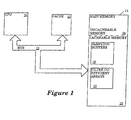
- Figure 1 is a block diagram of a computer system employing the invention.
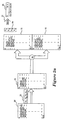
- Figure 2a is a block diagram of the buffering scheme in one embodiment of the invention.
- Figure 2b is a diagram showing the way buffers are filled in an embodiment of the invention.
- Figure 3a is a sample sub-buffer of the invention and its transpose in accordance with the invention.
- Figure 3b is a diagram of sub-buffer transposition in pans in accordance with one embodiment of the invention.
- Figure 3c is a transposition tree for half a sub-buffer in one embodiment of the invention.
- FIG. 1 shows a block diagram of a computer system for use in connection with the invention.
- CPU 10 is coupled by bus 12 to main memory 11 and cache memory 13.
- Main memory 11 is composed of cacheable memory 15 and uncacheable memory 14.
- Sampling buffers 16 of the instant invention reside in cacheable memory 15.
- Filter co-efficient arrays 17 also reside in cacheable memory 15. It is desirable that sampling buffers 16 be dynamically allocatable to increase flexibility of the system.
- Figure 2a shows the buffering scheme of the exemplary embodiment of the invention.
- a horizontal sampling buffer 20, 8 bytes wide and N rows long, is used to accept eight rows of image data from the source image.
- N is equal to the byte length of a source image row, which may be greater than or equal to the pixel length of the source image row.
- Alignment issues and edge conditions are dealt with as the data is moved from memory into the horizontal sampling buffer. Accommodation of edge conditions and alignment issues is explained more fully below.
- the data in the horizontal sampling buffer is transposed and placed to expose bands for processing. The transposition will also be explained more fully below.
- a horizontal filter 25 is applied to the transposed data in the horizontal sampling buffer with the result of the filtering being placed in an intermediate buffer 23, bytes wide and M rows long.
- M is equal to the length of a row in the destination image.
- the data in the intermediate buffer is retransposed into either a first vertical sampling buffer 21 or a second vertical sampling buffer 22. Controller 24 dictates which buffer receives the current data from intermediate buffer 23.
- a vertical filter 26 is applied to the data in the vertical sampling buffers 21,22.
- application of the vertical filter involves taking eight bytes from each relevant row in the vertical sampling buffer. Relevant rows are dictated by the filter width, e.g. a filter width of four results in four relevant rows. Parallel multiplications and additions are performed on this data to yield vertically sampled data, which may need to be converted as explained below.
- VIS provides fmu18x16 and fpadd16, which are ideal for use in the parallel multiplication and addition of this vertical filtering scheme.
- the backwards mapping scheme is such that as processing proceeds downward in the source image, it also proceeds strictly downward in the source image. Therefore, once the vertical filter 26 needs data beyond the second vertical sampling buffer 22, the data in the first sampling buffer 21 will never be revisited. Therefore, the first sampling buffer can be immediately refilled with new data. This assumes that the filter width is less than or equal to the number of destination rows in the buffer, in this example, eighL As the vertical filter 26 transitions through the second vertical sampling buffer 22, it re-enters the first vertical sampling buffer to process the new data. Once the vertical filter 26 has made the transition from the second sampling buffer back to the first vertical sampling buffer 21, the second vertical sampling buffer 22 can be refilled.
- controller 24 toggles the data directed from first to second sampling buffer 22 responsive to the transition of the vertical filter 26 from one buffer to the next.
- the controller 24 then ping-pongs between the vertical sampling buffers as needed data is no longer available. It will be understood by one of ordinary skill in the art that additional buffers could be used without departing from the scope or contemplation of the invention.
- converter 27 converts sixteen bit outputs of the vertical filter 26 to an eight bit entry for the Mbyte output row 28. Moreover, converter 27 clamps the extremes at 0 and 255.
- the fpack instruction fulfills this converting function.
- additional horizontal sampling can be performed simultaneously with the vertical sampling of previously horizontally sampled data. It is also within the scope and contemplation of this invention to provide additional intermediate buffers 23 so as not to create a bottleneck at the intermediate buffer 23. This arrangement is ideal for multi-threading as the workload can readily be distributed amongst multiple processors. Thus, as soon as the horizontal sampling buffer has been wholly sampled into the intermediate buffer, it can be refilled, and processing can begin again.
- Figure 2b shows an example source image 30 having eight rows, each of twenty-four bytes.
- Horizontal sampling buffer 20 is filled with, for example, the first eight bytes of row 31 going into row 0 of the horizontal sampling buffer 20, bytes 9 - 16 of row 31 going to row 8 of the horizontal sampling buffer 20, and bytes 17 - 24 going to row 16 of the horizontal sampling buffer 20.
- row 32 bytes 1 - 8 going to row I of the horizontal sampling buffer 20, bytes 9 - 16 going to row 9, and bytes 17 - 24 going to row 17.
- the remaining rows follow the same pattern. If the source image 30 were composed of additional rows, they would be processed on a subsequent filling of the horizontal sampling buffer 20. If the sample image 30 had rows of greater length, the length of the horizontal sampling buffer would be increased proportionally.
- the length of the horizontal sampling buffer is equal to the next multiple of 8 greater than or equal to the length of a source image line. For example, a source image having lines between 25 and 32 bytes would each result in a horizontal sampling buffer of 32 line length. Each iteration of processing of the horizontal sampling buffer processes 8 complete lines of the source image.
- Edge conditions are a well known concern in sizing algorithms. Basically stated, the problem is if you need a pixel to the left of the left most pixel, what do you do?
- edge conditions can be easily satisfied. For example, if we need two edge pixels, begin by placing the data at the third position of each row in the horizontal sampling buffer. Then entries in the first and second byte can be synthesized either with copies of the first data entered in the third byte or, for example, zero. Alignment is another issue that can be addressed early in the buffering scheme. Basically, there is no guarantee a source image row will begin aligned with a memory word. Thus, where the system retrieves multiple bytes, e.g.
- the first retrieval may include data not within the source image which the user does not want to buffer.
- VIS provides the instructions faligndata and alignaddr which used in conjunction allow the data to be taken from memory and easily aligned in the horizontal sampling buffer through use of an internal register, the graphics status register ("gsr"). For example, if a group of eight bytes r has five bytes of junk followed by three bytes of valid image data and another group s contains eight valid bytes, alignaddr (0,5) sets the gsr align bits to five. Subsequent use of the faligndata instruction on r and s will yield eight bytes of valid data.
- faligndata (r, s) and faligndata (s, t) will yield r 5-7 s 0-4 and S 5-7 t 1-4 , respectively.
- the faligndata instruction can be used to resolve destination alignment issues as with the source data.
- Transposition is performed within the horizontal sampling buffer 20 in eight row blocks, e.g. rows 0 - 7 are transposed, rows 8 - 15 are transposed, rows 16 - 23 are transposed in the example of Figure 2b.
- Figure 3a shows such a transposition.
- Such bytewise transposition exposes data band by band every time. For example, if in Figure 3a, RGB band interleaved format were present, 0, 3, and 6 would correspond to the red band 1, 4, and 7 to the green band, and 2 and 5 would correspond to the blue band.
- transposition is inefficient because every row of the output depends on every row of the input.
- Serendipitously, VIS includes a functionality where two 4-byte words can be merged to form a group of 8 (double word) bytes.
- FIG. 3c shows a transposition tree using the merge functionality to effect the transposition. As shown in Figure 3c, within an 8 x 8 segment, each word is merged with a word four rows distant. This is the effect of transposing an 8 x 8 block as two 4 x 8 blocks as shown in Figure 3b.
- the horizontal sampling buffer can be transposed in place using this method or the data can be initially placed in a pre-buffer and transposed into the horizontal sampling buffer 20. It is anticipated that future computer systems will support the functionality of the fpmerge instruction of the VIS. Accordingly, this method of transposition and image sizing is not intended to be limited to the ULTRASPARC® system.
- transposing the data in memory incurs a performance penalty because (1) care must be taken to avoid overwriting the source image data, and (2) because in memory, there is no assurance of proper alignment, e.g. the first word of a source row may begin at an arbitrary point in a memory word and there is no assurance that successive source rows will be aligned the same relative to a memory word.
- the above-described buffering scheme appropriately aligns the data so that each 8 x 8 block is aligned for transposition.
- the data is then transposed using the same transposition scheme into one of the vertical sampling buffers 21,22. It will be recognized by one of ordinary skill in the art that it is possible to transpose the data in place within the intermediate buffer 23. Accordingly, it would be possible to eliminate the intermediate buffer 23 entirely and transpose the data in place in one of the vertical sampling buffers 21,22.
- the filtering would begin with row 2 and step by 3 to fill the intermediate buffer. This results in an intermediate buffer having valid blue data and junk in the red and green data locations.
- a bit mask may be maintained for channel selection to prevent the junk from being written to the vertical sampling buffer. The mask should be at least eight bits long and an even multiple of the number of output channels. After each application, the mask is rotated by eight and applied to the next eight rows in the intermediate buffer.
- the frame buffer employed to output the image to the monitor may be of the format xbgr, while the source is in an rgb format.
- the bands are placed in the intermediate buffer such that the retransposition into the vertical sampling buffer will result in the desired ordering.
- red data will be moved from the first entry in the horizontal sampling buffer to the entry of the intermediate buffer which will be in the fourth slot of the vertical sampling buffer.
- a mask is used to mask out, e.g. the X rows of the vertical sampling buffer, which do not represent valid data from the source image.
- the VIS supports partial stores and edge instruction which are used in an exemplary embodiment to effect desired output formatting.
Landscapes
- Physics & Mathematics (AREA)
- General Physics & Mathematics (AREA)
- Engineering & Computer Science (AREA)
- Theoretical Computer Science (AREA)
- Image Processing (AREA)
Claims (16)
- Procédé de traitement d'images, comprenant la création d'une mémoire-tampon d'échantillonnage horizontal, caractérisé par :a) la création d'une première et d'une deuxième mémoire-tampon d'échantillonnage vertical ;b) le remplissage de la mémoire-tampon d'échantillonnage horizontal, dans un format à entrelacement de bandes, de données issues d'une pluralité de lignes d'une image source, de façon à ce que des lignes verticalement voisines dans l'image source soient voisines dans la mémoire-tampon d'échantillonnage horizontal ;c) la transposition des données pour exposer les données bande par bande ;d) l'application d'un filtre sur les données transposées, pour obtenir des données transposées à filtrage horizontal ;e) la retransposition des données transposées à filtrage horizontal pour donner des données à filtrage horizontal ;f) le stockage des données à filtrage horizontal dans la première mémoire-tampon d'échantillonnage vertical ;g) la répétition des étapes b)-e) avec une pluralité de lignes suivantes d'une image source pour donner des données suivantes à filtrage horizontal ;h) le stockage des données suivantes à filtrage horizontal dans la deuxième mémoire-tampon à filtrage vertical ; eti) le filtrage vertical des données à filtrage horizontal et des données suivantes à filtrage horizontal.
- Procédé selon la revendication 1, dans lequel l'étape de remplissage comprend les étapes de :garnissage de la mémoire-tampon d'échantillonnage horizontal pour tenir compte de conditions aux bords ; etalignement dans la mémoire-tampon d'échantillonnage horizontal de toute donnée non alignée dans la mémoire principale.
- Procédé selon la revendication 1 ou la revendication 2, dans lequel la mémoire-tampon d'échantillonnage horizontal présente une largeur de huit octets.
- Procédé selon la revendication 3, dans lequel la mémoire-tampon d'échantillonnage horizontal est remplie de huit octets à la fois, et chaque groupe successif de huit octets d'une ligne d'image source est décalé de huit lignes dans la mémoire-tampon d'échantillonnage horizontal.
- Procédé selon la revendication 4, dans lequel chaque ligne de huit octets est une sous-mémoire-tampon, et le nombre de sous-mémoires-tampons est égal au nombre d'octets dans une ligne d'image source divisé par huit.
- Procédé selon la revendication 5, dans lequel chaque sous-mémoire-tampon est transposée indépendamment de chacune des autres sous-mémoires-tampons.
- Procédé selon la revendication 1, dans lequel l'étape de retransposition des données comprend les étapes de :création d'une mémoire-tampon intermédiaire ;stockage des données transposées à filtrage horizontal dans la mémoire-tampon intermédiaire ; ettransposition de la mémoire-tampon intermédiaire en une mémoire-tampon d'échantillonnage vertical.
- Procédé selon l'une quelconque des revendications précédentes, dans lequel l'étape de remplissage est mise en oeuvre huit octets à la fois.
- Procédé selon l'une quelconque des revendications précédentes, dans lequel une largeur de filtre inférieure ou égale à huit est utilisée pour l'ensemble du filtrage.
- Système informatique, comprenant :caractérisé en ce que, durant le traitement horizontal :un processeur (10) ;une mémoire principale (11) ;un bus (12) couplant le processeur à la mémoire principale (12) ;une mémoire-tampon d'échantillonnage horizontal à dimensionnement dynamique (20) résidant dans la mémoire (11) apte à tamponner des données d'image durant le traitement horizontal ;la mémoire-tampon d'échantillonnage horizontal (20) est remplie de données, dans un format à entrelacement de bandes, issues d'une pluralité de lignes d'une image source, de façon à ce que des lignes de données verticalement voisines dans l'image source soient voisines dans la mémoire-tampon d'échantillonnage horizontal ;les données sont transposées pour exposer les données bande par bande ;un filtre horizontal (25) est appliqué sur les données transposées, pour obtenir des données transposées à filtrage horizontal ;les données transposées à filtrage horizontal sont retransposées pour donner des données à filtrage horizontal ; et en ce que :une paire de mémoires-tampons d'échantillonnage vertical à dimensionnement dynamique (21, 22) résident dans la mémoire pour tamponner de façon alternée les données retransposées à filtrage horizontal et pour effectuer le filtrage vertical desdites données à l'aide d'un filtre vertical (26).
- Système informatique selon la revendication 10, comprenant en outre une mémoire cache (13) couplée au processeur (10) et à la mémoire (11) par le bus (12), dans lequel la mémoire-tampon d'échantillonnage horizontal (20) et les mémoires-tampons d'échantillonnage vertical (21, 22) résident dans une partie (15) de la mémoire principale (11) susceptible d'être rangée en mémoire cache.
- Système informatique selon la revendication 11, dans lequel la mémoire-tampon d'échantillonnage horizontal (20) présente une largeur de huit octets et sa longueur est égale à la longueur d'une ligne d'image source, et les mémoires-tampons d'échantillonnage vertical (21, 22) présentent chacune une largeur de huit octets et une longueur égale à celle d'une ligne d'image de destination.
- Système informatique selon l'une quelconque des revendications 10 à 12, comprenant en outre une mémoire-tampon intermédiaire (23) résidant dans la mémoire (11) dont la dimension est égale à celle d'une mémoire-tampon d'échantillonnage vertical (21, 22).
- Système informatique selon l'une quelconque des revendications 10 à 13, dans lequel le processeur (10) supporte une fonction de fusion et une fonction de condensation.
- Système informatique selon l'une quelconque des revendications 10 à 14, dans lequel le processeur (10) exécute des opérations de lecture et d'écriture huit octets à la fois.
- Système informatique selon la revendication 15, dans lequel le processeur (10) exécute des opérations à l'aide d'opérandes de quatre octets.
Applications Claiming Priority (2)
| Application Number | Priority Date | Filing Date | Title |
|---|---|---|---|
| US08/554,858 US5867608A (en) | 1995-11-07 | 1995-11-07 | Method and apparatus for scaling images |
| US554858 | 1995-11-07 |
Publications (3)
| Publication Number | Publication Date |
|---|---|
| EP0773512A2 EP0773512A2 (fr) | 1997-05-14 |
| EP0773512A3 EP0773512A3 (fr) | 1997-12-10 |
| EP0773512B1 true EP0773512B1 (fr) | 2003-07-30 |
Family
ID=24214982
Family Applications (1)
| Application Number | Title | Priority Date | Filing Date |
|---|---|---|---|
| EP96308045A Expired - Lifetime EP0773512B1 (fr) | 1995-11-07 | 1996-11-06 | Méthode et appareil pour changer l'échelle d'images |
Country Status (5)
| Country | Link |
|---|---|
| US (1) | US5867608A (fr) |
| EP (1) | EP0773512B1 (fr) |
| CA (1) | CA2189620A1 (fr) |
| DE (1) | DE69629265T2 (fr) |
| SG (1) | SG75105A1 (fr) |
Families Citing this family (10)
| Publication number | Priority date | Publication date | Assignee | Title |
|---|---|---|---|---|
| US6290572B1 (en) | 2000-03-23 | 2001-09-18 | Micron Technology, Inc. | Devices and methods for in-situ control of mechanical or chemical-mechanical planarization of microelectronic-device substrate assemblies |
| US6690826B2 (en) | 2000-12-21 | 2004-02-10 | Micron Technology, Inc. | System and method for detecting text in mixed graphics data |
| US6993207B1 (en) * | 2001-10-05 | 2006-01-31 | Micron Technology, Inc. | Method and apparatus for electronic image processing |
| US6765622B2 (en) * | 2001-10-26 | 2004-07-20 | Koninklijke Philips Electronics N.V. | Line-buffer reuse in vertical pixel-processing arrangement |
| JP4519082B2 (ja) * | 2006-02-15 | 2010-08-04 | 株式会社ソニー・コンピュータエンタテインメント | 情報処理方法、動画サムネイル表示方法、復号化装置、および情報処理装置 |
| JP4706638B2 (ja) * | 2006-09-29 | 2011-06-22 | セイコーエプソン株式会社 | 表示装置、画像処理方法並びに電子機器 |
| JP4669482B2 (ja) * | 2006-09-29 | 2011-04-13 | セイコーエプソン株式会社 | 表示装置、画像処理方法並びに電子機器 |
| US8315479B1 (en) | 2008-02-26 | 2012-11-20 | Adobe Systems Incorporated | Slicing and scaling figures |
| US20110314253A1 (en) * | 2010-06-22 | 2011-12-22 | Jacob Yaakov Jeffrey Allan Alon | System, data structure, and method for transposing multi-dimensional data to switch between vertical and horizontal filters |
| KR102114233B1 (ko) | 2013-12-13 | 2020-05-25 | 삼성전자 주식회사 | 영상 처리 장치 |
Family Cites Families (10)
| Publication number | Priority date | Publication date | Assignee | Title |
|---|---|---|---|---|
| IT1071592B (it) * | 1977-03-09 | 1985-04-10 | Olivetti & Co Spa | Metodo ed apparecchiatura di registrazione in memoria e visualizzazione di immagini |
| DE3177299T4 (de) * | 1980-04-11 | 1994-05-26 | Ampex | Bildverarbeitungssystem für räumliche Bildtransformation. |
| ATE45258T1 (de) * | 1981-04-10 | 1989-08-15 | Ampex | Geraet zur raeumlichen transformation von bildern. |
| CA1252902A (fr) * | 1985-10-31 | 1989-04-18 | David R. Pruett | Methode amelioree de rotation d'images binaires |
| US4783834A (en) * | 1987-02-20 | 1988-11-08 | International Business Machines Corporation | System for creating transposed image data from a run end or run length representation of an image |
| US5020115A (en) * | 1989-07-10 | 1991-05-28 | Imnet Corporation | Methods and apparatus for dynamically scaling images |
| US5095374A (en) * | 1989-10-10 | 1992-03-10 | Unisys Corporation | Method and apparatus for lossless compression and decompression of image data |
| US5412483A (en) * | 1993-12-16 | 1995-05-02 | Xerox Corporation | Apparatus and method for managing storage of print-related information in a print file |
| US5487146A (en) * | 1994-03-08 | 1996-01-23 | Texas Instruments Incorporated | Plural memory access address generation employing guide table entries forming linked list |
| US5587742A (en) * | 1995-08-25 | 1996-12-24 | Panasonic Technologies, Inc. | Flexible parallel processing architecture for video resizing |
-
1995
- 1995-11-07 US US08/554,858 patent/US5867608A/en not_active Expired - Lifetime
-
1996
- 1996-11-04 SG SG1996011049A patent/SG75105A1/en unknown
- 1996-11-05 CA CA002189620A patent/CA2189620A1/fr not_active Abandoned
- 1996-11-06 DE DE69629265T patent/DE69629265T2/de not_active Expired - Fee Related
- 1996-11-06 EP EP96308045A patent/EP0773512B1/fr not_active Expired - Lifetime
Also Published As
| Publication number | Publication date |
|---|---|
| CA2189620A1 (fr) | 1997-05-08 |
| US5867608A (en) | 1999-02-02 |
| DE69629265D1 (de) | 2003-09-04 |
| DE69629265T2 (de) | 2004-05-27 |
| EP0773512A3 (fr) | 1997-12-10 |
| SG75105A1 (en) | 2000-09-19 |
| EP0773512A2 (fr) | 1997-05-14 |
Similar Documents
| Publication | Publication Date | Title |
|---|---|---|
| CA2102935C (fr) | Controleur d'echelle bidimensionnel | |
| US5485557A (en) | Image processing apparatus | |
| US5977994A (en) | Data resampler for data processing system for logically adjacent data samples | |
| EP0773512B1 (fr) | Méthode et appareil pour changer l'échelle d'images | |
| US5315699A (en) | Filtering operation method for very high-speed image processing system | |
| JPS62262188A (ja) | 画像処理装置 | |
| EP3101622B1 (fr) | Système d'acquisition d'image | |
| WO1990000780A1 (fr) | Appareil de filtrage et de reechantillonnage simultanes de donnees numeriques | |
| EP0775973B1 (fr) | Méthode et produit-programme informatique de transposition de données | |
| US20030179927A1 (en) | Image processing apparatus and image processing method | |
| US5745123A (en) | Method for resizing an image by a factor of two | |
| US6411334B1 (en) | Aspect ratio correction using digital filtering | |
| CN115374919B (zh) | 一种高效的神经网络前处理方法 | |
| KR100665485B1 (ko) | 디지털 신호 처리 장치 및 디지털 신호 처리 방법 | |
| EP0283927B1 (fr) | Adaptateur d'affichage | |
| US6788348B1 (en) | Method and system for processing digital images | |
| JP2737829B2 (ja) | イメージ・データの拡大変換方法及び装置 | |
| JPH04291681A (ja) | 超高速画像処理システムのフィルタリング処理方式 | |
| US8792749B2 (en) | Scaling device and method capable of controlling data flow quantity | |
| JPH11252353A (ja) | 画像補間方法および画像補間装置 | |
| JP2855136B2 (ja) | 画像編集機能を備えた情報処理装置 | |
| AU672970B2 (en) | A preprocessing pipeline for RTO graphics systems | |
| WO1999027455A1 (fr) | Reechantilloneur de donnees pour systeme de traitement de donnees | |
| JP2647379B2 (ja) | 画像処理装置 | |
| JPH01184589A (ja) | 図形クリツピング方法 |
Legal Events
| Date | Code | Title | Description |
|---|---|---|---|
| PUAI | Public reference made under article 153(3) epc to a published international application that has entered the european phase |
Free format text: ORIGINAL CODE: 0009012 |
|
| AK | Designated contracting states |
Kind code of ref document: A2 Designated state(s): DE FR GB |
|
| PUAL | Search report despatched |
Free format text: ORIGINAL CODE: 0009013 |
|
| AK | Designated contracting states |
Kind code of ref document: A3 Designated state(s): DE FR GB |
|
| 17P | Request for examination filed |
Effective date: 19980605 |
|
| 17Q | First examination report despatched |
Effective date: 20020213 |
|
| GRAH | Despatch of communication of intention to grant a patent |
Free format text: ORIGINAL CODE: EPIDOS IGRA |
|
| GRAH | Despatch of communication of intention to grant a patent |
Free format text: ORIGINAL CODE: EPIDOS IGRA |
|
| GRAA | (expected) grant |
Free format text: ORIGINAL CODE: 0009210 |
|
| AK | Designated contracting states |
Designated state(s): DE FR GB |
|
| REG | Reference to a national code |
Ref country code: GB Ref legal event code: FG4D |
|
| REF | Corresponds to: |
Ref document number: 69629265 Country of ref document: DE Date of ref document: 20030904 Kind code of ref document: P |
|
| PGFP | Annual fee paid to national office [announced via postgrant information from national office to epo] |
Ref country code: FR Payment date: 20031110 Year of fee payment: 8 |
|
| ET | Fr: translation filed | ||
| PLBE | No opposition filed within time limit |
Free format text: ORIGINAL CODE: 0009261 |
|
| STAA | Information on the status of an ep patent application or granted ep patent |
Free format text: STATUS: NO OPPOSITION FILED WITHIN TIME LIMIT |
|
| 26N | No opposition filed |
Effective date: 20040504 |
|
| PG25 | Lapsed in a contracting state [announced via postgrant information from national office to epo] |
Ref country code: FR Free format text: LAPSE BECAUSE OF NON-PAYMENT OF DUE FEES Effective date: 20050729 |
|
| REG | Reference to a national code |
Ref country code: FR Ref legal event code: ST |
|
| PGFP | Annual fee paid to national office [announced via postgrant information from national office to epo] |
Ref country code: DE Payment date: 20061102 Year of fee payment: 11 |
|
| PG25 | Lapsed in a contracting state [announced via postgrant information from national office to epo] |
Ref country code: DE Free format text: LAPSE BECAUSE OF NON-PAYMENT OF DUE FEES Effective date: 20080603 |
|
| PGFP | Annual fee paid to national office [announced via postgrant information from national office to epo] |
Ref country code: GB Payment date: 20151104 Year of fee payment: 20 |
|
| REG | Reference to a national code |
Ref country code: GB Ref legal event code: PE20 Expiry date: 20161105 |
|
| PG25 | Lapsed in a contracting state [announced via postgrant information from national office to epo] |
Ref country code: GB Free format text: LAPSE BECAUSE OF EXPIRATION OF PROTECTION Effective date: 20161105 |