EP0788943A2 - Automotive airbags containing eliminators of undesirable gases - Google Patents
Automotive airbags containing eliminators of undesirable gases Download PDFInfo
- Publication number
- EP0788943A2 EP0788943A2 EP96305697A EP96305697A EP0788943A2 EP 0788943 A2 EP0788943 A2 EP 0788943A2 EP 96305697 A EP96305697 A EP 96305697A EP 96305697 A EP96305697 A EP 96305697A EP 0788943 A2 EP0788943 A2 EP 0788943A2
- Authority
- EP
- European Patent Office
- Prior art keywords
- airbag
- gas
- gases
- eliminator
- undesirable
- Prior art date
- Legal status (The legal status is an assumption and is not a legal conclusion. Google has not performed a legal analysis and makes no representation as to the accuracy of the status listed.)
- Granted
Links
Images



Classifications
-
- B—PERFORMING OPERATIONS; TRANSPORTING
- B60—VEHICLES IN GENERAL
- B60R—VEHICLES, VEHICLE FITTINGS, OR VEHICLE PARTS, NOT OTHERWISE PROVIDED FOR
- B60R21/00—Arrangements or fittings on vehicles for protecting or preventing injuries to occupants or pedestrians in case of accidents or other traffic risks
- B60R21/02—Occupant safety arrangements or fittings, e.g. crash pads
- B60R21/16—Inflatable occupant restraints or confinements designed to inflate upon impact or impending impact, e.g. air bags
- B60R21/23—Inflatable members
- B60R21/235—Inflatable members characterised by their material
-
- B—PERFORMING OPERATIONS; TRANSPORTING
- B60—VEHICLES IN GENERAL
- B60R—VEHICLES, VEHICLE FITTINGS, OR VEHICLE PARTS, NOT OTHERWISE PROVIDED FOR
- B60R21/00—Arrangements or fittings on vehicles for protecting or preventing injuries to occupants or pedestrians in case of accidents or other traffic risks
- B60R21/02—Occupant safety arrangements or fittings, e.g. crash pads
- B60R21/16—Inflatable occupant restraints or confinements designed to inflate upon impact or impending impact, e.g. air bags
-
- B—PERFORMING OPERATIONS; TRANSPORTING
- B60—VEHICLES IN GENERAL
- B60R—VEHICLES, VEHICLE FITTINGS, OR VEHICLE PARTS, NOT OTHERWISE PROVIDED FOR
- B60R21/00—Arrangements or fittings on vehicles for protecting or preventing injuries to occupants or pedestrians in case of accidents or other traffic risks
- B60R21/02—Occupant safety arrangements or fittings, e.g. crash pads
- B60R21/16—Inflatable occupant restraints or confinements designed to inflate upon impact or impending impact, e.g. air bags
- B60R21/23—Inflatable members
- B60R21/239—Inflatable members characterised by their venting means
Definitions
- the present invention is directed to automotive airbags which contain material for removing any undesirable gases produced by combustion of pyrotechnic gas generants.
- a typical automotive airbag system consists of an airbag and a pyrotechnic inflator for producing the gases which inflate the airbag.
- Inflators are described, for example, in U.S. Patents Nos. 4,943,086, 5,221,109, and 5,241,920, the teachings of each of which are incorporated herein by reference.
- a remote sensor senses the force of a collision. The sensor is electrically connected to a squib in the inflator, and electrically generated heat in the squib ignites a small charge of pyrotechnic material in the squib. The pyrotechnic charge, in turn, produces heat that ignites a larger charge of ignitor composition.
- automotive airbags which contain material(s) for removing undesirable gases that are produced by combustion of a gas generant composition and/or other pyrotechnic compositions in the airbag inflator.
- the gas-removing material may be a catalyst for a reaction that converts an undesirable gas to innocuous products, an absorbent, or an adsorbent.
- FIG. 1 is a cut-away (diagrammatic) perspective view of an inflated airbag and associated inflation module, the airbag containing material for removing undesirable gases.
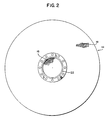
- FIG. 2 is a plan view of the rear side of an automotive airbag without vents.
- FIG. 3 is a plan view of the rear side of an automotive airbag having vents and pouches within the vents, the pouches containing material for removing undesirable gases.
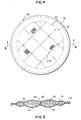
- FIG. 4 is an enlarged plan view of the vents and pouches of Fig 3.
- FIG 5. is a cross-sectional view of the pouches taken along line 5-5 of FIG. 4.
- FIG 6. is a view, similar to FIG 1, in which the material for removing undesirable gases is impregnated into loose sheets disposed within the airbag.
- Non-azide gas generant compositions to which the invention is primarily directed are those which contain the combinations of N plus O and/or N plus H, giving rise to NO x (especially NO and NO 2 ) and NH 3 combustion products.
- Such gas generant compositions commonly also contain carbon atoms, further giving rise to CO and HCN combustion products.
- the invention is applicable to inflators using azide as the gas generant material, as well, because pyrotechnics of the squib and/or ignitor material may produce undesirable gases upon combustion.
- the gas-removing material may be a catalyst, an absorbent or an adsorbent.
- a catalyst is a substance that accelerates or promotes a chemical reaction, in this case, a substance that promotes a reaction that converts undesirable gases to innocuous materials.
- An adsorbent is a substances that will hold other substances, e.g., undesirable gases, on its surface.
- An absorbent is a substance which allows molecules, e.g., molecules of undesirable gases, to penetrate its surface and become trapped.
- gas-eliminators catalysts, absorbents, and adsorbents will be collectively referred to as "gas-eliminators”.
- gas-eliminators may be desirably employed in the practice of the present invention, the gas-eliminators being selected according to the gas generant composition and the undesirable gases emitted thereby.
- suitable undesirable gas-removing substances include, but are by no means limited to:
- the amount of the undesirable gas-eliminator may vary significantly, depending upon the gas generant material in the inflator and the undesirable gases and relative amounts produced thereby, as well as upon the effectiveness of the eliminator(s) in removing the undesirable gases.
- the undesirable gas-eliminator may typically be present anywhere from about 1 to about 100 wt%, relative to the weight of the gas generant material in the inflator. Even when disposed within the airbag, the gases generated by combustion of the gas generant have a very limited dwell time within the airbag; thus, a significant excess of undesirable gas-eliminator is preferably employed, relative to the amount which would be required to remove undesirable gases from a generally static environment.
- FIG 1 illustrates an inflator/airbag assembly 10, with the inflator 12 represented as a cylindrical container and the airbag 14 shown as inflated.
- the airbag 14 includes a front fabric 16 and a rear fabric 18 sewn together so as to form an substantially enclosed region.
- tethers 20 formed of fabric extend internally from between the front and rear of the airbag to help define the configuration of the airbag during inflation, preventing the front fabric 16 from extending too far forward.
- Fig 2 is illustrated a non-vented bag 14.
- the front fabric 16 is typically treated or woven so as to be substantially gas-impermeable, while the rear fabric 18 is substantially porous and gas-permeable, whereby deflation is through the rear fabric 18.
- Both fabrics 16, 18 are typically formed of 6/6 nylon; however, the front fabric 16 is typically coated with a material that renders it substantially gas-impermeable or woven so as to be gas-impermeable.
- a ring or throat 22 formed of multiple layers of fabric and defining a rear fabric opening, provides for attachment of the airbag 14 to the inflator 12.
- the undesirable gas-eliminator illustrated as particulates 21 in FIG 1, may be merely packed loosely between the front and rear fabric, 16, 18 in powder or granular form. In fact, at the present time, this has proven to be the most effective deployment of gas eliminator.
- the powder or granules should be sufficiently small so as to provide a large surface area, but preferably are of a size larger than the pores of the porous fabric 16 and/or 18 so as to be retained within the airbag 14. While there is no significant consequence if some of the undesirable gas-eliminator is carried through the fabric 16 and/or 18 by the out-flowing gases, escape of such particulates tends to give the impression of smoke, and is therefore undesirable.
- vent openings 24 are illustrated, the openings 24 typically having a reinforced fabric area 26.
- the rear fabric 18' and the front fabric 16 are treated or woven in such a way as to be substantially gas-impermeable.
- the undesirable gas-eliminator cannot simply be loose between the front fabric 16 and the rear fabric 18', or it would all blow through the vent openings 24, creating a large amount of dust within the passenger compartment.
- a pouch 28 is disposed across each vent opening 24 and contains the undesirable gas-eliminator 34, as better seen in FIG 5.
- the pouch 28 is formed of two pieces of porous fabric 32 stitched to the reinforced fabric area 26 around the vent openings 24 and quilted with stitching 30 to maintain an even distribution of the undesirable gas-eliminator.
- the gases exiting the bag pass through the vent openings 24 where the undesirable gas-eliminator 34 within the pouches 28 removes undesirable gases.
- Another approach is to impregnate airbag fabric which the generant-produced gas will contact during is passage through the airbag.
- Such fabric may be, for example, the front fabric 16, the rear fabric 18, the fabric used to form the tethers 20, or the multi-layer fabric used to reinforce or protect the rear panel throat 22.
- Even loose sheets of fabric 38, as shown in FIG. 6 disposed within the airbag, (on the order of "dryer sheets" impregnated with fabric softener) may be impregnated with the undesirable gas-eliminator.
Landscapes
- Engineering & Computer Science (AREA)
- Mechanical Engineering (AREA)
- Air Bags (AREA)
Abstract
Description
- The present invention is directed to automotive airbags which contain material for removing any undesirable gases produced by combustion of pyrotechnic gas generants.
- Most present-day automotive airbag inflators use a gas generant based on sodium azide. This material has the advantage of producing, upon combustion, only nitrogen gas. On the other hand, sodium azide has significant toxicity, presenting disposal problems.
- Accordingly, there has been a desire to replace sodium azide with less toxic gas generant compositions. A number of such gas generant compositions have been described, for example in U.S. Patents Nos. 3,486,730, 5,084,118, and 5,035,757, the teachings of each of which are incorporated herein by reference. Unfortunately, most non-azide gas generant compositions include, in addition to nitrogen, oxygen and/or hydrogen and/or carbon. The combustions of such non-azide gas generant compositions produce large volumes of generally non-toxic gases; however, they also tend to produce small, but significant, levels of undesirable gases, such as NH3, NOx, CO, and HCN, each of which may be problematic in the range of 25 to 1000 ppm. In order to reduce or eliminate possible health effects, it is desirable to decrease the levels of these gases. When an airbag is deployed, it must rapidly inflate, e.g., in the range of between 30 and 100 milliseconds, and then rapidly deflate. During deflation, the gases are vented into the passenger compartment of a vehicle. The occupants of the vehicle may thus be exposed to these undesirable gases. The generation of trace, but nevertheless significant, levels of undesirable gases is an important factor in why non-azide gas generant compositions have not replaced azide formulations to a greater extent.
- A typical automotive airbag system consists of an airbag and a pyrotechnic inflator for producing the gases which inflate the airbag. Inflators, are described, for example, in U.S. Patents Nos. 4,943,086, 5,221,109, and 5,241,920, the teachings of each of which are incorporated herein by reference. In a typical airbag inflator deployment system, a remote sensor senses the force of a collision. The sensor is electrically connected to a squib in the inflator, and electrically generated heat in the squib ignites a small charge of pyrotechnic material in the squib. The pyrotechnic charge, in turn, produces heat that ignites a larger charge of ignitor composition. The heat from the ignitor composition then sets off a much larger charge of gas generant composition that produces a substantial volume of gas for inflating the airbag. It is also understood that there are variations of this typical system to which the present invention is applicable; for example, hybrid inflators which inflate airbags with a combination of pyrotechnic-generated gases and compressed gases, such as that described in U.S. Patent No. 5,290,060, the teachings of which are incorporated herein by reverence.
- In accordance with the present invention, automotive airbags are provided which contain material(s) for removing undesirable gases that are produced by combustion of a gas generant composition and/or other pyrotechnic compositions in the airbag inflator. The gas-removing material may be a catalyst for a reaction that converts an undesirable gas to innocuous products, an absorbent, or an adsorbent.
- FIG. 1 is a cut-away (diagrammatic) perspective view of an inflated airbag and associated inflation module, the airbag containing material for removing undesirable gases.
- FIG. 2 is a plan view of the rear side of an automotive airbag without vents.
- FIG. 3 is a plan view of the rear side of an automotive airbag having vents and pouches within the vents, the pouches containing material for removing undesirable gases.
- FIG. 4 is an enlarged plan view of the vents and pouches of Fig 3.
- FIG 5. is a cross-sectional view of the pouches taken along line 5-5 of FIG. 4.
- FIG 6. is a view, similar to FIG 1, in which the material for removing undesirable gases is impregnated into loose sheets disposed within the airbag.
- As undesirable gases are most problematic with non-azide gas generant compositions, the invention is primarily directed to removing undesirable gases produced by non-azide gas generant compositions. Non-azide gas generant compositions to which the invention is primarily directed are those which contain the combinations of N plus O and/or N plus H, giving rise to NOx (especially NO and NO2) and NH3 combustion products. Such gas generant compositions commonly also contain carbon atoms, further giving rise to CO and HCN combustion products. However, the invention is applicable to inflators using azide as the gas generant material, as well, because pyrotechnics of the squib and/or ignitor material may produce undesirable gases upon combustion.
- It has heretofore been proposed to include undesirable gas-removing materials inside the inflator. However, this approach has not proven to be sufficiently effective. It is likely, that the residence time in the inflator itself is so short that any undesirable gas-removing material does not have time to act effectively. In addition, very high temperatures within the inflator may reduce the effectiveness of such material. Herein, it is discovered that undesirable gas-removing materials are effective when disposed within the airbag itself so as to contact gaseous combustion products as the gases flow through the bag.
- The gas-removing material may be a catalyst, an absorbent or an adsorbent. A catalyst is a substance that accelerates or promotes a chemical reaction, in this case, a substance that promotes a reaction that converts undesirable gases to innocuous materials. An adsorbent is a substances that will hold other substances, e.g., undesirable gases, on its surface. An absorbent is a substance which allows molecules, e.g., molecules of undesirable gases, to penetrate its surface and become trapped. Hereinafter, catalysts, absorbents, and adsorbents will be collectively referred to as "gas-eliminators". Mixtures of such gas-eliminators may be desirably employed in the practice of the present invention, the gas-eliminators being selected according to the gas generant composition and the undesirable gases emitted thereby. Some suitable undesirable gas-removing substances include, but are by no means limited to:
- Sofnox® K - an absorbent for acidic gases, such as NOx and
CO, sold by Molecular Products, U.K. - Carbon Monoxide Catalyst - catalyzes oxidation of CO with O2
to produce CO2, sold by Molecular Products, U.K. - Ammonia Catalyst - reduces levels of ammonia, sold by Molecular Products, U.K.
- Sofnofil® - an adsorbent for NOx sold by Molecular Products, U.K.
- The amount of the undesirable gas-eliminator may vary significantly, depending upon the gas generant material in the inflator and the undesirable gases and relative amounts produced thereby, as well as upon the effectiveness of the eliminator(s) in removing the undesirable gases. Thus, on a weight basis, the undesirable gas-eliminator may typically be present anywhere from about 1 to about 100 wt%, relative to the weight of the gas generant material in the inflator. Even when disposed within the airbag, the gases generated by combustion of the gas generant have a very limited dwell time within the airbag; thus, a significant excess of undesirable gas-eliminator is preferably employed, relative to the amount which would be required to remove undesirable gases from a generally static environment.
- FIG 1 illustrates an inflator/
airbag assembly 10, with theinflator 12 represented as a cylindrical container and theairbag 14 shown as inflated. Theairbag 14 includes afront fabric 16 and arear fabric 18 sewn together so as to form an substantially enclosed region. In this airbag design,tethers 20 formed of fabric extend internally from between the front and rear of the airbag to help define the configuration of the airbag during inflation, preventing thefront fabric 16 from extending too far forward. - While the
airbag 14 must very rapidly inflate, it must also very rapidly deflate. In fact, theairbag 14 is deflating, even as it inflates. Deflation is most typically through the rear of the bag. In Fig 2 is illustrated anon-vented bag 14. In such anairbag 14, thefront fabric 16 is typically treated or woven so as to be substantially gas-impermeable, while therear fabric 18 is substantially porous and gas-permeable, whereby deflation is through therear fabric 18. Bothfabrics front fabric 16 is typically coated with a material that renders it substantially gas-impermeable or woven so as to be gas-impermeable. (Other designs may allow the use of gas-permeable fabric on the front panel of the airbag.) A ring orthroat 22, formed of multiple layers of fabric and defining a rear fabric opening, provides for attachment of theairbag 14 to theinflator 12. In such anairbag 14, the undesirable gas-eliminator, illustrated asparticulates 21 in FIG 1, may be merely packed loosely between the front and rear fabric, 16, 18 in powder or granular form. In fact, at the present time, this has proven to be the most effective deployment of gas eliminator. The powder or granules should be sufficiently small so as to provide a large surface area, but preferably are of a size larger than the pores of theporous fabric 16 and/or 18 so as to be retained within theairbag 14. While there is no significant consequence if some of the undesirable gas-eliminator is carried through thefabric 16 and/or 18 by the out-flowing gases, escape of such particulates tends to give the impression of smoke, and is therefore undesirable. - In the airbag 14' shown in FIG 3, two
vent openings 24 are illustrated, theopenings 24 typically having a reinforcedfabric area 26. In such an airbag 14', the rear fabric 18' and thefront fabric 16 are treated or woven in such a way as to be substantially gas-impermeable. In such an airbag 14', the undesirable gas-eliminator cannot simply be loose between thefront fabric 16 and the rear fabric 18', or it would all blow through thevent openings 24, creating a large amount of dust within the passenger compartment. In the illustrated airbag, apouch 28 is disposed across each vent opening 24 and contains the undesirable gas-eliminator 34, as better seen in FIG 5. As seen in FIGS 4 and 5, thepouch 28 is formed of two pieces ofporous fabric 32 stitched to the reinforcedfabric area 26 around thevent openings 24 and quilted with stitching 30 to maintain an even distribution of the undesirable gas-eliminator. The gases exiting the bag pass through thevent openings 24 where the undesirable gas-eliminator 34 within thepouches 28 removes undesirable gases. - Another approach is to impregnate airbag fabric which the generant-produced gas will contact during is passage through the airbag. Such fabric may be, for example, the
front fabric 16, therear fabric 18, the fabric used to form thetethers 20, or the multi-layer fabric used to reinforce or protect therear panel throat 22. Even loose sheets offabric 38, as shown in FIG. 6 disposed within the airbag, (on the order of "dryer sheets" impregnated with fabric softener) may be impregnated with the undesirable gas-eliminator. - The invention will now be described in greater detail by way of specific example.
- Twelve airbag/inflator assemblies were prepared, each inflator containing 61 grams of a gas generant formula of 5-aminotetrazole, cupric oxide, strontium nitrate and guanidine nitrate, such as described in U.S. Patent Application 08/207,922 filed 8 March 1994. Three each of the airbags (for triplicate runs) were filled with nothing (control), 30 grams Sofnox®, 30 grams Sofnofil®, and 30 grams Ammonia Catalyst. Undesirable gases, NO, NO2, CO, NH3, and HCN were measured. Results are in the table. Load is gas generant in grams. Undesirable Gas levels are in parts per million (ppm) by weight.
Inflator No. Configuration Load Cond. Temp. NO NO2 CO NH3 HCN 1 Baseline module 61 21°C 74.2 13.8 207.0 372.0 10.3 2 Baseline module 61 21°C 84.9 13.8 189.0 348.0 10.9 3 Baseline module 61 21°C 76.6 0.0 161.0 249.0 7.1 Average = 78.6 9.2 185.7 323.0 9.4 StDev = 5.6 8.0 23.2 65.2 2.1 4 SOFNOX catalyst in bag 61 21°C 33.2 0.0 71.9 121.0 1.8 5 SOFNOX catalyst in bag 61 21°C 92.6 0.0 192.0 265.0 5.8 6 SOFNOX catalyst in bag 61 21°C 88.4 0.0 191.0 251.0 6.5 Average = 71.4 0.0 151.6 212.3 4.7 StDev = 33.1 0.0 69.1 79.4 2.6 % Change= -9.1 -100.0 -18.3 -34.3 -9.1 7 SOFNOFIL catalyst in bag 61 21°C 41.0 0.0 185.0 338.0 5.7 8 SOFNOFIL catalyst in bag 61 21°C 62.8 6.9 183.0 342.0 6.7 9 SOFNOFIL catalyst in bag 61 21°C 34.8 2.3 163.0 318.0 3.0 Average = 46.2 3.1 177.0 332.7 5.1 StDev = 14.7 3.5 12.2 12.9 1.9 % Change= -41.2 -66.7 -4.7 3.0 -45.6 10 NH3 catalyst in bag 61 21°C 78.0 3.6 190.0 223.0 7.5 11 NH3 catalyst in bag 61 21°C 74.7 1.9 187.0 201.0 6.5 12 NH3 catalyst in bag 61 21°C 61.3 7.0 195.0 198.0 4.3 Average = 71.3 4.2 190.7 207.3 6.1 StDev = 8.8 2.6 4.0 13.7 1.6 % Change= -9.2 -54.7 2.7 -35.8 -35.2
Claims (11)
- An automotive airbag (14) containing a gas-eliminator or mixture of gas-eliminators (21, 34) for removing undesirable gases from a flow of gases through said airbag.
- An airbag according to claim 1 wherein said gas-eliminator (21) is selected from catalytic material, adsorbent material, absorbent material, and mixtures thereof.
- An airbag according to claim 1 or claim 2 which has a gas-permeable fabric or fabrics (18) through which gases pass to deflate said airbag, said gas-eliminator (21) being contained loosely within said airbag.
- An airbag (14') according to claim 1 or claim 2 which has a rear fabric (18') having vent openings (24) through which gases pass to deflate said airbag, said airbag having pouch means (28) containing said undesirable gas-eliminator disposed across said vent openings.
- An airbag (14) according to claim 1 or claim 2 which comprises fabric (16, 18, 20) impregnated with said gas-eliminator disposed so as to contact gases during their flow through said airbag.
- An airbag according to claim 5 wherein said impregnated fabric is in the form of loose sheets (38) disposed within said airbag.
- An airbag according to any preceding claim in combination with an inflator (12) containing a gas generant composition.
- A combination according to claim 7 wherein said gas-eliminator (21) contained within said airbag is present in an amount of between 1 and 100% by weight relative to said gas generant composition in said inflator.
- A combination according to claim 7 or claim 8 wherein said gas generant composition contains both nitrogen and oxygen atoms and/or both nitrogen and hydrogen atoms.
- A combination according to claim 9 wherein said gas generant composition further contains carbon atoms.
- A method of reducing undesirable gases in an automotive airbag/inflator assembly (10), wherein a gas generant composition is burned to produce airbag-inflating gases, including trace amounts of undesirable gases, comprising disposing a gas-eliminator or mixture of gas eliminators (21) within said airbag (14) so as to contact said airbag-inflating gases and remove undesirable gases therefrom.
Applications Claiming Priority (2)
| Application Number | Priority Date | Filing Date | Title |
|---|---|---|---|
| US08/515,842 US5685562A (en) | 1995-08-16 | 1995-08-16 | Automotive airbags containing eliminators of undesirable gases |
| US515842 | 1995-08-16 |
Publications (3)
| Publication Number | Publication Date |
|---|---|
| EP0788943A2 true EP0788943A2 (en) | 1997-08-13 |
| EP0788943A3 EP0788943A3 (en) | 1999-03-24 |
| EP0788943B1 EP0788943B1 (en) | 2005-06-15 |
Family
ID=24052987
Family Applications (1)
| Application Number | Title | Priority Date | Filing Date |
|---|---|---|---|
| EP96305697A Expired - Lifetime EP0788943B1 (en) | 1995-08-16 | 1996-08-01 | Automotive airbags containing eliminators of undesirable gases |
Country Status (4)
| Country | Link |
|---|---|
| US (1) | US5685562A (en) |
| EP (1) | EP0788943B1 (en) |
| JP (1) | JPH09104305A (en) |
| DE (1) | DE69634848D1 (en) |
Cited By (1)
| Publication number | Priority date | Publication date | Assignee | Title |
|---|---|---|---|---|
| EP1553071A3 (en) * | 2004-01-12 | 2013-04-24 | TRW Airbag Systems GmbH | Method of inflating an airbag and airbag module for use in this method |
Families Citing this family (9)
| Publication number | Priority date | Publication date | Assignee | Title |
|---|---|---|---|---|
| DE19625109C2 (en) * | 1996-06-17 | 1999-08-05 | Petri Ag | Airbag folding and method and device for airbag folding |
| DE29720461U1 (en) * | 1997-11-19 | 1998-02-26 | Trw Automotive Safety Sys Gmbh | Airbag with adjustable outlet cross-section |
| US6145872A (en) * | 1999-01-13 | 2000-11-14 | Autoliv Asp, Inc. | Airbag cushion attachment |
| US6189915B1 (en) | 1999-01-13 | 2001-02-20 | Autoliv Asp, Inc. | Airbag cushion attachment |
| DE19917392B4 (en) * | 1999-04-16 | 2007-11-08 | Thyssenkrupp Presta Steertec Gmbh | Bleed a power steering |
| US6123360A (en) * | 1999-07-06 | 2000-09-26 | Amin; Mukesh J. | Airbag system with inflator gas reactant surface |
| US20060202456A1 (en) * | 2005-03-09 | 2006-09-14 | Takata Restraint Systems, Inc. | Curtain airbag with deflation mechanism |
| DE602007011226D1 (en) * | 2006-02-27 | 2011-01-27 | Mazda Motor | AIRBAG DEVICE |
| GB2472071A (en) * | 2009-07-23 | 2011-01-26 | Ford Global Tech Llc | An airbag assembly |
Family Cites Families (18)
| Publication number | Priority date | Publication date | Assignee | Title |
|---|---|---|---|---|
| NO117727B (en) * | 1967-02-17 | 1969-09-15 | Dynamit Nobel Ag | |
| US4111458A (en) * | 1975-11-20 | 1978-09-05 | Honda Giken Kogyo Kabushiki Kaisha | Safety air cushion bag in automotive vehicles |
| JPH0281747A (en) * | 1988-09-19 | 1990-03-22 | Asahi Chem Ind Co Ltd | Air cushion |
| US5290060A (en) * | 1992-12-14 | 1994-03-01 | Morton International, Inc. | Hybrid gas generator for air bag inflatable restraint systems |
| DE69008723T2 (en) * | 1989-06-16 | 1994-12-15 | Gore & Ass | GAS PILLOW IMPACT PROTECTION DEVICE AND RELATED LAYER AND PROCESS FOR PRODUCING THIS LAYER. |
| US4943086A (en) * | 1989-06-30 | 1990-07-24 | Morton Thiokol, Inc. | Gas bag inflator with a two welded joint housing |
| FR2652322B1 (en) * | 1989-09-27 | 1991-11-22 | Livbag Snc | SHOCK ABSORBING DEVICE FOR OCCUPANTS OF A MOTOR VEHICLE AND USE OF THIS DEVICE. |
| JP2932666B2 (en) * | 1990-10-22 | 1999-08-09 | タカタ株式会社 | Airbag |
| US5084118A (en) * | 1990-10-23 | 1992-01-28 | Automotive Systems Laboratory, Inc. | Ignition composition for inflator gas generators |
| US5035757A (en) * | 1990-10-25 | 1991-07-30 | Automotive Systems Laboratory, Inc. | Azide-free gas generant composition with easily filterable combustion products |
| US5241910A (en) * | 1991-04-05 | 1993-09-07 | Morton International, Inc. | Universal squib connector for a gas generator |
| US5104466A (en) * | 1991-04-16 | 1992-04-14 | Morton International, Inc. | Nitrogen gas generator |
| JPH0516752A (en) * | 1991-07-05 | 1993-01-26 | Toray Ind Inc | Air bag |
| JPH05278546A (en) * | 1992-04-02 | 1993-10-26 | Toyo Tire & Rubber Co Ltd | Air bag ground fabric and air bag therewith |
| US5221109A (en) * | 1992-07-23 | 1993-06-22 | Morton International, Inc. | Airbag inflator having vents to terminate inflation |
| JPH07117616A (en) * | 1993-10-22 | 1995-05-09 | Nippon Seiko Kk | Airbag device |
| US5431103A (en) * | 1993-12-10 | 1995-07-11 | Morton International, Inc. | Gas generant compositions |
| US5584507A (en) * | 1994-10-31 | 1996-12-17 | Automotive Systems Laboratory, Inc. | Coated fabric for reducing toxicity of effluent gases produced by nonazide gas generants |
-
1995
- 1995-08-16 US US08/515,842 patent/US5685562A/en not_active Expired - Fee Related
-
1996
- 1996-08-01 EP EP96305697A patent/EP0788943B1/en not_active Expired - Lifetime
- 1996-08-01 DE DE69634848T patent/DE69634848D1/en not_active Expired - Lifetime
- 1996-08-16 JP JP8216413A patent/JPH09104305A/en active Pending
Cited By (1)
| Publication number | Priority date | Publication date | Assignee | Title |
|---|---|---|---|---|
| EP1553071A3 (en) * | 2004-01-12 | 2013-04-24 | TRW Airbag Systems GmbH | Method of inflating an airbag and airbag module for use in this method |
Also Published As
| Publication number | Publication date |
|---|---|
| EP0788943A3 (en) | 1999-03-24 |
| US5685562A (en) | 1997-11-11 |
| JPH09104305A (en) | 1997-04-22 |
| DE69634848D1 (en) | 2005-07-21 |
| EP0788943B1 (en) | 2005-06-15 |
Similar Documents
| Publication | Publication Date | Title |
|---|---|---|
| US5160163A (en) | Impact-absorbing device for occupants of a motor vehicle and use of this device | |
| US4370181A (en) | Pyrotechnic non-azide gas generants based on a non-hydrogen containing tetrazole compound | |
| EP0642956B1 (en) | Filtration in hybrid inflators | |
| US3797854A (en) | Crash restraint air generating inflation system | |
| US3731949A (en) | Flat bag made of tubular sections | |
| KR19990076654A (en) | Inflatable Seat Belt System | |
| US7192052B2 (en) | Inflation assembly with extended filling capability | |
| EP0788943B1 (en) | Automotive airbags containing eliminators of undesirable gases | |
| JP5123262B2 (en) | Device for inflating an inflatable device | |
| KR101154214B1 (en) | Alkali metal perchlorate-containing gas generants | |
| EP2129554A1 (en) | Ejection mitigation device | |
| CN101528642A (en) | Extrudable gas generant | |
| US5584507A (en) | Coated fabric for reducing toxicity of effluent gases produced by nonazide gas generants | |
| US5806886A (en) | Device for abating carbon monoxide in airbags | |
| EP2459501B1 (en) | Inflator assembly | |
| JPH09104305A5 (en) | ||
| US9046327B2 (en) | Gas generator | |
| WO1998012077A1 (en) | Apparatus for protecting a vehicle occupant | |
| EP0570098A2 (en) | Automotive air bag cushion | |
| EP0830991A1 (en) | Apparatus for protecting a vehicle occupant | |
| US6136111A (en) | Combustible composition for use in vehicle safety systems | |
| EP0737140B1 (en) | Coated fabric for use with nonazide gas generants | |
| JPH04212651A (en) | Air bag type rider protector | |
| JPH07117616A (en) | Airbag device | |
| JPH04287745A (en) | Air bag with auxiliary bag |
Legal Events
| Date | Code | Title | Description |
|---|---|---|---|
| PUAI | Public reference made under article 153(3) epc to a published international application that has entered the european phase |
Free format text: ORIGINAL CODE: 0009012 |
|
| AK | Designated contracting states |
Kind code of ref document: A2 Designated state(s): DE FR GB IT |
|
| 17P | Request for examination filed |
Effective date: 19970711 |
|
| PUAL | Search report despatched |
Free format text: ORIGINAL CODE: 0009013 |
|
| AK | Designated contracting states |
Kind code of ref document: A3 Designated state(s): DE FR GB IT |
|
| 17Q | First examination report despatched |
Effective date: 20020221 |
|
| GRAP | Despatch of communication of intention to grant a patent |
Free format text: ORIGINAL CODE: EPIDOSNIGR1 |
|
| GRAS | Grant fee paid |
Free format text: ORIGINAL CODE: EPIDOSNIGR3 |
|
| RAP1 | Party data changed (applicant data changed or rights of an application transferred) |
Owner name: AUTOLIV ASP, INC. |
|
| GRAA | (expected) grant |
Free format text: ORIGINAL CODE: 0009210 |
|
| AK | Designated contracting states |
Kind code of ref document: B1 Designated state(s): DE FR GB IT |
|
| PG25 | Lapsed in a contracting state [announced via postgrant information from national office to epo] |
Ref country code: IT Free format text: LAPSE BECAUSE OF FAILURE TO SUBMIT A TRANSLATION OF THE DESCRIPTION OR TO PAY THE FEE WITHIN THE PRE;WARNING: LAPSES OF ITALIAN PATENTS WITH EFFECTIVE DATE BEFORE 2007 MAY HAVE OCCURRED AT ANY TIME BEFORE 2007. THE CORRECT EFFECTIVE DATE MAY BE DIFFERENT FROM THE ONE RECORDED.SCRIBED TIME-LIMIT Effective date: 20050615 |
|
| REG | Reference to a national code |
Ref country code: GB Ref legal event code: FG4D |
|
| REF | Corresponds to: |
Ref document number: 69634848 Country of ref document: DE Date of ref document: 20050721 Kind code of ref document: P |
|
| PGFP | Annual fee paid to national office [announced via postgrant information from national office to epo] |
Ref country code: GB Payment date: 20050727 Year of fee payment: 10 |
|
| PGFP | Annual fee paid to national office [announced via postgrant information from national office to epo] |
Ref country code: FR Payment date: 20050817 Year of fee payment: 10 |
|
| PG25 | Lapsed in a contracting state [announced via postgrant information from national office to epo] |
Ref country code: DE Free format text: LAPSE BECAUSE OF FAILURE TO SUBMIT A TRANSLATION OF THE DESCRIPTION OR TO PAY THE FEE WITHIN THE PRESCRIBED TIME-LIMIT Effective date: 20050916 |
|
| PGFP | Annual fee paid to national office [announced via postgrant information from national office to epo] |
Ref country code: DE Payment date: 20050930 Year of fee payment: 10 |
|
| PLBE | No opposition filed within time limit |
Free format text: ORIGINAL CODE: 0009261 |
|
| STAA | Information on the status of an ep patent application or granted ep patent |
Free format text: STATUS: NO OPPOSITION FILED WITHIN TIME LIMIT |
|
| 26N | No opposition filed |
Effective date: 20060316 |
|
| EN | Fr: translation not filed | ||
| PG25 | Lapsed in a contracting state [announced via postgrant information from national office to epo] |
Ref country code: FR Free format text: LAPSE BECAUSE OF FAILURE TO SUBMIT A TRANSLATION OF THE DESCRIPTION OR TO PAY THE FEE WITHIN THE PRESCRIBED TIME-LIMIT Effective date: 20060811 |
|
| GBPC | Gb: european patent ceased through non-payment of renewal fee |
Effective date: 20060801 |
|
| PG25 | Lapsed in a contracting state [announced via postgrant information from national office to epo] |
Ref country code: GB Free format text: LAPSE BECAUSE OF NON-PAYMENT OF DUE FEES Effective date: 20060801 |