EP0790260B1 - Feste Katalysatorbestandteile für die Polymerisation - Google Patents
Feste Katalysatorbestandteile für die Polymerisation Download PDFInfo
- Publication number
- EP0790260B1 EP0790260B1 EP97300977A EP97300977A EP0790260B1 EP 0790260 B1 EP0790260 B1 EP 0790260B1 EP 97300977 A EP97300977 A EP 97300977A EP 97300977 A EP97300977 A EP 97300977A EP 0790260 B1 EP0790260 B1 EP 0790260B1
- Authority
- EP
- European Patent Office
- Prior art keywords
- compound
- solid
- polymerization
- component
- carrier component
- Prior art date
- Legal status (The legal status is an assumption and is not a legal conclusion. Google has not performed a legal analysis and makes no representation as to the accuracy of the status listed.)
- Expired - Lifetime
Links
Classifications
-
- C—CHEMISTRY; METALLURGY
- C08—ORGANIC MACROMOLECULAR COMPOUNDS; THEIR PREPARATION OR CHEMICAL WORKING-UP; COMPOSITIONS BASED THEREON
- C08F—MACROMOLECULAR COMPOUNDS OBTAINED BY REACTIONS ONLY INVOLVING CARBON-TO-CARBON UNSATURATED BONDS
- C08F10/00—Homopolymers and copolymers of unsaturated aliphatic hydrocarbons having only one carbon-to-carbon double bond
-
- B—PERFORMING OPERATIONS; TRANSPORTING
- B01—PHYSICAL OR CHEMICAL PROCESSES OR APPARATUS IN GENERAL
- B01J—CHEMICAL OR PHYSICAL PROCESSES, e.g. CATALYSIS OR COLLOID CHEMISTRY; THEIR RELEVANT APPARATUS
- B01J27/00—Catalysts comprising the elements or compounds of halogens, sulfur, selenium, tellurium, phosphorus or nitrogen; Catalysts comprising carbon compounds
- B01J27/06—Halogens; Compounds thereof
Definitions
- This invention relates to a solid catalyst component for olefin polymerization. More particularly, it is concerned with a solid catalyst component for olefin polymerization which can produce an olefin polymer with a high stereoregularity in a high yield of a polymer per unit of a solid catalyst component, a process for the production of the same and a process for the production of a polyolefin using the same.
- a solid catalyst component For producing a solid catalyst component, there has been suggested, for example , a process wherein magnesium chloride is dissolved in an ether compound such as tetrahydrofuran and the like and contacted with a titanium compound( Japanese Patent Kokai Application No. 151603/1982).Another known process is to contact a copulverized product of an ether compound such as tetrahydrofuran with a titanium compound ( Japanese Patent Kokai Application No. 89210/1986 ).
- the solid catalyst component obtained according to these processes is used for olefin polymerization, there have been presented the problems of an insufficient polymerization activity, a low stereoregularity of a polymer.
- the stereoregularity of the polymer may be improved by the use of process in which a solid catalyst component containing an electron donor such as a phthalic acid ester together with a silicon compound (Japanese Patent Kokai Application No.811/1983), is used and a process in which a solid catalyst component containing an electron donor such as a diether compound together with a silicon compound ( Japanese Patent Kokai Application No. 336503/1991 ) and others.
- a solid catalyst which may give an improved yield of a polymer per unit of a catalyst component and decrease a catalyst residue capable of producing an adverse influence such as deterioration of a polymer.
- a solid catalyst component for olefin polymerization which comprises:
- this invention relates to a process for the production of a solid catalyst component for olefin polymerization which comprises producing a solid catalyst component for olefin polymerization, which process comprises reacting a halogenated magnesium compound with a monoether compound (E) using an inert medium which does not dissolve a component represented by the general formula: MgX 2 .
- a process for the production of a polyolefin which comprises polymerizing at least one of olefins in the presence of a catalyst which comprises said solid catalyst component of the above first aspect, an organoaluminum compound and , if desired , an electron donative compound.
- Mg means a magnesium atom
- X is a halogen atom selected from the group consisting of fluorine, chlorine, bromine and iodine and may comprise one or more of the halogen atoms
- X's may be the same or different
- E is a monoether compound.
- the solid substance (a) having the general formula (I) corresponds to a solid complex composed of a magnesium halide compound and a monoether compound.
- magnesium halide compounds there may be mentioned , for example , magnesium fluoride, magnesium chloride, magnesium bromide, magnesium iodide.
- magnesium dichloride is preferable.
- the magnesium halide may also be prepared from a halogen-containing compound and a magnesium-containing compound.
- the solid substance (a) may be prepared according to a process wherein a magnesium halide compound is brought into contact with a monoether compound (represented by E ) or a process wherein a halogen-containing compound, a magnesium-containing compound and a monoether compound(E) are concurrently brought into contact to eventually obtain a final product as a solid state.
- R 2 - O - R 3 wherein R 1 is a divalent hydrocarbyl group and R 2 and R 3 are a monovalent hydrocarbyl group.
- R 1 , R 2 and R 3 there may be preferably mentioned a saturated aliphatic hydrocarbyl group having 10 or less carbon atoms and an aromatic hydrocarbyl group having 6 to 10 carbon atoms.
- Illustrative examples may include, for example , methyl, ethyl, propyl, butyl, hexyl, octyl, phenyl and tolyl.
- monoether compounds include, for example, methyl ether, ethyl ether, isopropyl ether, butyl ether, anisole, phenetole, guaiacol, tetrahyrofuran, tetrahydropyrane, 2-methyltetrahydrofuran, 2,2,5,5-tetramethylhydrofuran and tetrahydropyrane-2-methanol.
- Ethyl ether, butyl ether, tetrahydrofuran and tetrahydropyrane are more preferable.
- the monoether compounds may be used alone or in admixture with two or more.
- halogen-containing compounds include , for example , phosphorus chloride such as phosphorus trichloride, and phosphorus pentachloride, chlorine-containing alcohols such as 2,2,2-trichloroethanol, and halogen-containing hydrocarbons, fluorine, chlorine, bromine, iodine, hydrogen fluoride, hydrogen chloride, hydrogen bromide and hydrogen iodide.
- phosphorus chloride such as phosphorus trichloride
- phosphorus pentachloride chlorine-containing alcohols such as 2,2,2-trichloroethanol
- halogen-containing hydrocarbons fluorine, chlorine, bromine, iodine, hydrogen fluoride, hydrogen chloride, hydrogen bromide and hydrogen iodide.
- halogen-containing hydrocarbons are preferred.
- halogen-containing hydrocarbons include, for example, dichloromethane, chloroform, 1,1-dichloroethane, 1,1,1-trichloroethane, 1,2-dichloroethane, 1,2-dichloropropane, 1,3-dichloropropane, acrylic chloride, tert-butyl chloride, 1,1-dimethyl-propane, 1-methyl-1-chloro-1-ethylpropane, methyl bromide, 1,2-dibromoethane and methyl iodide, 1,2-Dichloroethane, 1,2-dichloropropane, acrylic chloride and tert-butyl chloride are preferable.
- magnesium-containing compounds include, for example, magnesium alkoxides such as magnesium ethoxide and magnesium isopropoxide, magnesium carboxylates such as magnesium laurate and magnesium stearate and alkyl magnesium such as butylethyl magnesium and metallic magnesium. These compounds may be used alone or in admixture with two or more.
- Metallic magnesium is preferable.
- Metallic magnesium may be used in a usual commercially available form and it may also be used in a powdery, ribbon or chip form.
- a charged amount of each component when a halogen-containing compound and a monoether compound (E) are contacted each other is as depicted below.
- An amount of the monoether compound (E) to be charged is in the range from 0.0001 to 100, more preferably from 0.001 to 10, in terms of a molar ratio to the magnesium atom included in the magnesium halide compound.
- a contact temperature is usually in the range from -80 to 200°C, preferably from -20 to 100°C.
- inert media include , for example, aliphatic hydrocarbons such as pentane, hexane, heptane, octane, decane, or aromatic hydrocarbons such as benzene, toluene, xylene and ethylbenzene.
- the excess monoether compound as referred to herein is meant to be a monoether compound which could not form a complex with a magnesium halide compound after contacting under the above conditions.
- a monoether compound which may be separated and removed from the solid substance (1) by treating with a medium which has a low affinity to the solid substance (a) thus produced as stated below and a high affinity to the monoether compound.
- the medium having a low affinity to the magnesium halide compound and a high affinity to the monoether compound include , for example the same aliphatic hydrocarbons as used for the above contacting medium such as pentane, hexane, heptane, octane and decane, or aromatic hydrocarbons such as benzene, toluene, xylene and ethylbenzene.
- a temperature to be applied in the treatment with an inert medium is in the range from -50 to 200°C, preferably from 0 to 50°C.
- n in the general formula (I) is in the range of from 0.01 to 4. If the n value is more than 4, it becomes difficult to maintain the solid state sufficient to achieve the effects of this invention.
- a molar ratio of the monoether compound (E) to one mole of magnesium atom in the solid substance (a) is determined by measuring contents of the monoether compound (E) and magnesium atom in said solid substance as disclosed below.
- An amount of the monoether compound (E) is determined by dissolving the solid substance in an alcohol and then subjecting to a gas chromatography, while an amount of magnesium atom is determined by dissolving the solid substance in dilute sulfuric acid and using an ICP emission analysis apparatus.
- a solid carrier component (A) is prepared by contacting the solid substance (a) obtained as described above with the electron donative compound (b) to replace a part or all of the monoether compound in said substance (a) by the electron donative compound (b)
- the electron donative compound (b) for replacement should be different to the compound E.
- the electron donative compound (b) has the following general formula: wherein R 10 , and R 11 , which may be the same or different, represent a hydrogen atom or a hydrocarbyl group optionally containing a hetero atom; R 12 and R 13 , which may be the same or different, represent a hydrocarbyl group optionally containing a hetero atom; and (D) may be a methylene group or a carbonyl group.
- the hydrocarbyl group optionally having hetero atoms may be illustrated , for example , by an aliphatic hydrocarbyl group having from 1 to 10 carbon atoms, an alicyclic hydrocarbyl group, a polycyclic hydrocarbyl group or a cyclic hydrocarbyl group containing hetero atoms.
- Specific examples of the hydrocarbyl groups include, for example, a methyl, ethyl, n-propyl, isopropyl, n-butyl, isobutyl, n-pentyl, isopentyl, cyclopentyl or cyclohexyl group.
- the electron donative compounds may include, for example , the following compounds:
- an amount of the electron donative compound (b) is in the range from 0.0001 to 100, more preferably from 0.001 to 10, in terms of a molar ratio to the magnesium atom included in the solid substance (a).
- a temperature when contacted is usually in the range from -80 to 200 °C, more preferably from 0 to 100 °C.
- an inert medium there may be mentioned, for example, aliphatic hydrocarbons such as pentane, hexane, heptane, octane or decane, or aromatic hydrocarbons such as benzene, toluene, xylene or ethylbenzene.
- aliphatic hydrocarbons such as pentane, hexane, heptane, octane or decane
- aromatic hydrocarbons such as benzene, toluene, xylene or ethylbenzene.
- a Lewis acid compound (c) may be also used together.
- Lewis acid compounds include, for example, phosphorus chloride compounds such as phosphorus trichloride and phosphorus pentachloride; silicon tetrachloride; titanium chloride compounds such as titanium trichloride and titanium tetrachloride; and organoaluminum compounds such as triethylaluminum, tripropylaluminum, tributylaluminum, triisobutylaminum, trihexylaluminum, trioctylaluminum, diethylaluminum hydride, diisobutylaluminum hydride, diethylaluminum chloride, diethylaluminum bromide and ethylaluminum sesquichloride.
- phosphorus chloride compounds such as phosphorus trichloride and phosphorus pentachloride
- silicon tetrachloride titanium chloride compounds such as titanium trichloride and titanium tetrachloride
- organoaluminum compounds
- a charged amount of the Lewis acid compound is usually in the range from 0.1 the 100, more preferably from 1 to 10. Thereafter, excess electron donor compound (b) and Lewis acid compound not incorporated into the solid carrier component are removed. This removal is usually performed by repeated washings with an inert medium.
- a molar ratio of the monoether compound (E) to the magnesium atom and a molar ratio of the electron donor compound (b) to the magnesium atom are as defined below, respectively:
- the present solid catalyst component for olefin polymerization is prepared by contacting the aforementioned solid carrier component (A) with the titanium compound (B).
- the titanium compound (B) is preferably used in the range from 0.1 to 1,000 moles to 1 mole of the magnesium atom included in the solid carrier component (A) particularly preferably in the range from 1 to 200 moles
- the electron donative compound (b) is preferably used in the range from 0.01 to 2 moles to 1 mole of the magnesium atom included in the solid substance (a), particularly preferably in the range from 0.1 to 1 moles.
- a temperature when contacted is usually from -70 to 250°C preferably in the range from 30 to 150°C
- titanium compounds which may be used in this invention, they may be illustrated by a titanium compound having the following formula (6) : Ti(OR) p X 4-p wherein R is a hydrocarbyl group, X is a halogen atom and p is 0 ⁇ p ⁇ 4.
- hydrocarbyl group R examples include , for example , a methyl, ethyl, propyl or butyl group.
- the halogen atom may be illustrated by fluorine, chlorine, bromine and iodine.
- titanium compounds include, for example, titanium tetrahalides such as titanium tetrachloride, titanium tetrabromide, and titanium tetraiodide, trihalogenated alkoxytitanium such as trichloromethoxy titanium, trichloroethoxy titanium, trichloro-n-butoxy titanium and tribromoisobutoxy titanium, dihalogenated dialkoxy titanium such as dichlorodimethoxy titanium, dichlorodiethoxy titanium, dichlorodi-n-butoxy titanium, and dibromodiisobutoxy titanium, monohalogenated alkoxy titanium such as chlorotrimethoxy titanium, chlorotriethoxy titanium, chlorotri-n-butoxy titanium, and bromotriisobutoxy titanium, and tetraalkoxy titanium such as tetramethoxy titanium, tetraethoxy titanium, tetra-n-butoxy titanium, tetraisobutoxy titanium and tetra(2-ethyl
- titanium tetrahalides are preferable, particularly titanium tetrachloride.
- the titanium compounds may be used alone or in admixture therewith. Alternatively, it may be used after diluted with a hydrocarbon or a halogenated hydrocarbon.
- a carrier may be used, in addition to the above components.
- the carrier there may be used, for example , Al 2 O 3 , SiO 2 , B 2 O 3 ,MgO, CaO, TiO 2 , ZnO, ZnO 2 , BaO, ThO and a resin such as a styrene-divinylbenzene copolymer.
- Al 2 O 3 , SiO 2 and a styrene-divinylbenzene copolymer are preferable.
- a ratio of halogen/titanium( in an atomic ratio ) is usually from 2 to 300, preferably from 20 to 100.
- the ratio of the electron donative compound/titanium (in a molar ratio) is usually from 0.05 to 50, preferably from 0.2 to 5.
- the ratio of magnesium/titanium( in an atomic ratio ) is usually from 5 to 200, preferably from 1 to 100.
- the catalyst system which may be used in this invention is a catalyst system which comprises a combination of the solid catalyst component (i) and the organoaluminum compound (ii) and, if desired, the electron donative compound (iii).
- organoaluminum compound (ii) which may be used in this invention are represented by the following formulae (8) to (11): AlR 18 R 19 R 20 R 21 R 22 Al - O - AlR 23 R 24
- R 18 , R 19 and R 20 may be the same or different and individually represent a hydrocarbyl group having at the most 12 carbon atoms or a hydrogen atom, at least one of them being the hydrocarbyl group.
- R 21 , R 22 , R 23 and R 24 may be the same or different and individually represent a hydrocarbyl group having at the most 12 carbon atoms.
- R 25 and R 26 individually represent a hydrocarbyl group having at the most 12 carbon atoms, and m is an integer of 1 or more.
- organoaluminum compounds of the formula (8) include , for example , a trialkyl aluminum such as triethyl aluminum, tripropyl aluminum, tributyl aluminum, triisobutyl aluminum, trihexyl aluminum, and trioctyl aluminum; an alkyl aluminum hydride such as diethylaluminum hydride or dibutylaluminum hydride; and an alkylaluminum halide such as diethylaluminum chloride, diethylaluminum bromide or ethylaluminum sesquichloride.
- a trialkyl aluminum such as triethyl aluminum, tripropyl aluminum, tributyl aluminum, triisobutyl aluminum, trihexyl aluminum, and trioctyl aluminum
- an alkyl aluminum hydride such as diethylaluminum hydride or dibutylaluminum hydride
- an alkylaluminum halide such as diethylalum
- organoaluminum compounds having the formula (9) typical examples thereof may include tetraethyldialumoxane and tetrabutyldialmoxane.
- the formulae (10) and (11) represent an alumoxane group and mean a polymer of aluminum compounds.
- R 25 and R 26 may include a methyl, ethyl, propyl, butyl or pentyl group, and a methyl or ethyl group is preferable.
- the value of m is preferably from 1 to 10.
- trialkylaluminum compounds are especially preferable.
- organoaluminum compounds may be used alone or in admixture therewith.
- the catalyst system which may be used in this invention comprises a solid catalyst component for olefin polymerization and an organoaluminum compound (ii) and , if necessary, an electron donative compound (iii).
- the electron donative compounds (iii) may include an organosilicon compound containing an alkoxy group, a nitrogen-containing compound, a phosphorus-containing compound and an oxygen-containing compound.
- organosilicon compounds containing an alkoxy group include, for example, tetramethoxy silane, tetraethoxy silane, tetrabutoxy silane, tetraisobutoxy silane, trimethylmethoxy silane, trimethylethoxy silane, triethylmethoxy silane, triethylethoxy silane, ethylisopropyldimethoxy silane, propylisopropyldimethoxy silane, diisopropyldimethoxy silane, diisobutyldimethoxy silane, isopropylisobutyldimethoxy silane, di(tert-butyl)dimethoxy silane, tert-butylmethyldimethoxy silane, tert-butylethyldimethoxy silane, tert-butylpropyldimethoxy silane, tert-butylisopropyldimethoxy silane,
- nitrogen-containing compounds include 2,6-substituted piperidines such as 2,6-diisopropylpiperidine, 2,6-diisopropyl-4-methylpiperidine and N-methyl-2,2,6,6-tetramethylpiperidine, 2,5-substituted azolidines such as 2,5-diisopropylazolidine and N-methyl-2,2,5,5-tetramethylazolidine, substituted methylenediamines such as N,N,N',N'-tetramethylmethylenediamine and N,N,N',N'-tetraethylmethylenediamine, and substituted imidazolines such as 1,3-dibenzylimidazoline and 1,3-dibenzyl-2-phenylimidazoline.
- piperidines such as 2,6-diisopropylpiperidine, 2,6-diisopropyl-4-methylpiperidine and N-methyl-2,2,6,6-tetramethylpipe
- phosphorus-containing compounds include phosphorous acid esters such as triethyl phosphite, tri-n-propyl phosphite, triisopropyl phosphite, tri-n-butyl phosphite, triisobutyl phosphite, diethyl-n-butyl phosphite and diethylphenyl phosphite.
- phosphorous acid esters such as triethyl phosphite, tri-n-propyl phosphite, triisopropyl phosphite, tri-n-butyl phosphite, triisobutyl phosphite, diethyl-n-butyl phosphite and diethylphenyl phosphite.
- oxygen-containing compounds include 2,6-substituted tetrahydrofurans such as 2,2,6,6-tetramethylhydrofuran, and 2,2,6,6-tetraethylhydrofuran, dimethoxymethanes such as 1,1-dimethoxy-2,3,4,5-tetrachlorocyclopentadiene, 9,9-dimethoxyfuruorene and diphenylmethoxymethane, and the diether compounds represented by the formula (2).
- 2,6-substituted tetrahydrofurans such as 2,2,6,6-tetramethylhydrofuran
- 2,2,6,6-tetraethylhydrofuran dimethoxymethanes such as 1,1-dimethoxy-2,3,4,5-tetrachlorocyclopentadiene, 9,9-dimethoxyfuruorene and diphenylmethoxymethane
- These electron donative compounds (iii) may used alone or in admixture therewith.
- the prepolymerization is carried out by the prepolymerization of the olefin onto the solid catalyst at an amount of the olefin of usually from 1 to 1,000g, preferably from 0.3 to 500g, particularly preferably from 1 to 200g, per 1g of said solid catalyst.
- a concentration of the solid catalyst for the prepolymerization is desirably in the range of from 0.0025 to 500g, preferably from 0.025 to 125g, particularly preferably from 0.25 to 50g per 1 liter of a solvent.
- An amount of the organoaluminum compound may be usually in such a level to produce the polymer at from 1 to 1,000g, preferably from 0.3 to 500g, per 1g of the solid catalyst.
- An amount of the organoaluminum compound per 1 mole of the titanium atom in the solid catalyst component may be usually from 0.1 to 300 moles, preferably from 0.1 to 100 moles, particularly preferably from 1 to 50 moles.
- the electron donative ccompound (iii) may be used if necessary.
- An amount of the electron donative compound (iii) per 1 mole of the titanium atom in the solid catalyst component may be usually from 0.1 to 50 moles, preferably from 0.5 to 30 moles, particularly preferably from 1 to 10 moles.
- the prepolymerization is carried out by adding an olefin and said catalyst component to a solvent.
- olefins having 2 ⁇ 20 carbon atoms such as ethylene, propylene, 1-butene, 1-pentene, 1-hexene, 4-methyl-1-pentene, 1-octene, 1-decene, 1-dodecene, 1-tetradecene, 1-hexadecene, 1-octadecene, 1-eicocene, cyclopentene, cycloheptene, norbornene, 5-methyl-2-norbornene, tetracyclododecene and 2-methyl-1,4,5,8-dimethano-1,2,3,4a,5,8,8a-octahydronaphthalene.
- the solvent which may be used in this case include, for example, aliphatic hydrocarbons such as pentane, hexane, heptane, octane, decane, dodecane, and kerosene, alicyclic hydrocarbons such as cyclopentane, cyclohexane and methylcyclopentane, aromatic hydrocarbons such as benzene, toluene, and xylene, halogenated hydrocarbons such as ethylene chloride and chlorobenzene, or a mixture thereof.
- aliphatic hydrocarbons may be particularly preferred.
- the prepolymerization may be carried out by using the olefin itself as a solvent or in the substantial absence of the solvent.
- Reaction temperature in the prepolymerization is usually in the range of from -20°C to +100°C, preferably from -20°C to +80°C, more preferably from 0°C to +40 °C.
- a molecular weight regulating substances such as hydrogen may be used.
- olefins having 2 ⁇ 20 carbon atoms such as ethylene, propylene, 1-butene, 1-pentene, 1-hexene, 4-methyl-1-pentene, 1-octene, 1-decene, 1-dodecene, 1-tetradecene, 1-hexadecene, 1-octadecene, 1-eicocene, cyclopentene, cycloheptene, norbornene, 5-methyl-2-norbornene, tetracyclododecene, and 2-methyl-1,4,5,8-dimethano-1,2,3,4a,5,8,8a-octahydronaphthalene.
- olefins may be homopolymerized or two or more thereof may be copolymerized. Alternatively, any combination of said olefins with the following monomers may be copolymerized.
- the monomer which may be used for copolymerization include, for example, the compounds having polyunsaturated bonds such as conjugated dienes or non-conjugated dienes, for example , aromatic vinyl compounds such as styrene and allylbenzene, alicyclic vinyl compounds such as vinylcyclohexane, and dienes such as 6-methyl-1,6-octadiene, 7-methyl-1,6-octadiene, 6-ethyl-1,6-octadiene, 6-propyl-1,6-octadiene, 6-butyl-1,6-octadiene, 6-methyl-1,6-nonadiene, 7-methyl-1,6-nonadiene, 6-ethyl-1,6-nonadiene
- the present polymerization may be carried in the solution polymerization mode, suspension polymerization mode and gas phase polymerization mode. It may be carried out according to any of batch-wise, discrete and continuous methods. Moreover, polymerization may be carried out by two or more separate steps under varied reaction conditions.
- said solvent may be used as a reaction solvent or a liquid olefin at reaction temperature may be also used.
- An amount of the solid catalyst component in the present polymerization may be usually in the range of usually from 0.001 to 1.5g, preferably from 0.001 to 0.25g, particularly preferably from 0.0025 to 0.05g per 1 liter of a polymerization volume.
- An amount of the organoaluminum compound per 1 mole of the titanium atom in the solid catalyst component may be usually from 1 to 2,000 moles, preferably from 5 to 500 moles.
- a molecular weight of the polymer thus obtained may be modified to produce a polymer having a high melt flow index.
- Polymerization temperature is set usually at from 20°C to 200°C, preferably from 50°C to 150°C, and polymerization pressure is set usually at atmospheric pressure to 100kg/cm 2 , preferably from 2 to 50kg/cm 2 .
- the olefin polymer thus prepared may be any of a homopolymer, a random copolymer and a block copolymer.
- Determination of the content of xylene insoluble in the polymer was carried out as stated below. After 2g of the polymer was dissolved in 200ml of xylene at 135°C, the resulting solution was cooled to 25°C and the polymer thus separated out was filtered. From the filtrate was distilled off the solvent by means of a rotary evaporator and after drying the residue was measured.
- a mole number of the monoether compound per 1 mole of the magnesium atom in the solid substance (a) was determined by measuring the contents of the monoether compound and magnesium atom in said solid substance as explained below. Thus, a content of the monoether compound was determined by dissolving the solid substance (a) in an alcohol and analyzing by a gas chromatography. If THF was used as the monoether compound, a solution of 0.1g of the solid substance in 2-ethylhexyl alcohol was analyzed by a gas chromatography to determine its content.
- the column used was Porapack QS( manufactured by Waters, an inner diameter 3mm x 2m ).
- a content of magnesium atom was determined by dissolving the solid substance in dilute sulfuric acid and using ICP emission analysis apparatus (manufactured by Nippon Jarrell-ash Co.,Ltd.).
- Contents of the electron donor compound (b) in the solid carrier component (A) and the catalyst were determined by dissolving said solid carrier component (A) or the catalyst in dilute sulfuric acid, extracting an organic layer with hexane and using a gas chromatography.
- the column used was TC-1 ( manufactured by GL Science, CP-Sil 5CB).
- Amounts of the magnesium atom and titanium atom were determined by analyzing a water layer by ICP emission analysis apparatus (manufactured by Nippon Jarrell-ash Co.,Ltd.).
- a portion of the product was sampled and dried up for analysis of components.
- An amount of the tetrahydrofuran in the solid carrier component (A) was below the detection limit of the gas chromatography.
- a mole number of the ethyl 2-tert-butyl-3-ethoxypropionate per 1 mole of the magnesium atom in the solid carrier component (A) was 0.25.
- An amount of the titanium atom in the catalyst was 2.1% by weight, while an amount of the ethyl 2-tert-butyl-3-ethoxypropionate was 11% by weight.
- a portion of the product was sampled and dried up for analysis of components.
- An amount of the tetrahydrofuran in the solid carrier component (A) was below the detection limit of the gas chromatography.
- a mole number of the ethyl 2-tert-butyl-3-ethoxypropionate per 1 mole of the magnesium atom in the solid carrier component (A) was 0.22.
- An amount of the titanium atom in the catalyst was 1.9% by weight, while an amount of the ethyl 2-tert-butyl-3-ethoxypropionate was 10% by weight.
- the polymerization was carried out in the same manner as described in Example 1.
- a portion of the product was sampled and dried up for analysis of components.
- An amount of the tetrahydrofuran in the solid carrier component (A) was below the detection limit of the gas chromatography.
- a mole number of the ethyl 2-isopropyl-2-isopentyl-3-propionate per 1 mole of the magnesium atom in the solid carrier component (A) was 0.18.
- An amount of the titanium atom in the catalyst was 2.2% by weight, while an amount of the ethyl 2-isopropyl-2-isopentyl-3-propionate was 12% by weight.
- the polymerization was carried out in the same manner as described in Example 1.
- An amount of the titanium atom in the catalyst was 1.9% by weight, while an amount of the 2-isopropyl-2-isopentyl 1,3-dimethoxypropane was 12.1% by weight.
- the polymerization was carried out in the same manner as described in Example 1.
- a portion of the product was sampled and dried up for analysis of components.
- An amount of the tetrahydrofuran in the solid carrier component (A) was below the detection limit of the gas chromatography.
- a mole number of the 2,2-diisobutyl-1.3-dimethoxypropane per 1 mole of the magnesium atom in the solid carrier component (A) was 0.14.
- An amount of the titanium atom in the catalyst was 2.2% by weight, while an amount of the 2,2-diisobutyl-1,3-dimethoxypropane was 8.4% by weight.
- the polymerization was carried out in the same manner as described in Example 1.
- An amount of the tetrahydrofuran in the solid carrier component (A) was below the detection limit of the gas chromatography.
- a mole number of the ethyl 2-tert-butyl-3-ethoxypropionate per 1 mole of the magnesium atom in the solid carrier component (A) was 0.30.
- a mixture of the said solid carrier component with 20ml of toluene and 20 ml of titanium tetrachloride was stirred at 110°C for 2 hours.
- the solid product thus obtained was filtered off at 90°C and washed with hexane at room temperature to afford a solid catalyst component.
- An amount of the titanium atom in the catalyst was 2.1% by weight, while an amount of the ethyl 2-tert-butyl-3-ethoxypropionate was 13,4% by weight.
- the polymerization was carried out in the same manner as described in Example 1.
- An amount of the tetrahydrofuran in the solid carrier component (A) was below the detection limit of the gas chromatography.
- a mole number of the ethyl 2-tert-butyl-3-ethoxypropionate per 1 mole of the magnesium atom in the solid carrier component (A) was 0.27.
- An amount of the titanium atom in the catalyst was 1.8% by weight, while an amount of the ethyl 2-tert-butyl-3-ethoxypropionate was 12.2% by weight.
- the polymerization was carried out in the same manner as described in Example 1.
- a portion of the product was sampled and dried up for analysis of components.
- An amount of the tetrahydrofuran in the solid carrier component (A) was below the detection limit of the gas chromatography.
- a mole number of the ethyl 2-tert-butyl-3-ethoxypropionate per 1 mole of the magnesium atom in the solid carrier component (A) was 0.08.
- An amount of the titanium atom in the catalyst was 1.9% by weight, while an amount of the ethyl 2-tert-butyl-3-ethoxypropionate was 9.6% by weight.
- the polymerization was carried out in the same manner as described in Example 1.
- An amount of the titanium atom in the catalyst was 1.6% by weight, while an amount of the 2,2-diisobutyl-1,3-dimethoxypropane was 12.2% by weight.
- the polymerization was carried out in the same manner as described in Example 1.
- the solid substance (a) was prepared in the same manner as described in Example 1 except that 34ml of tetrahydropyrane was used as an ether compound instead of the tetrahydrofuran. A mole number of the tetrahydrofuran per 1 mole of the magnesium atom in the solid substance (a) was 1.6.
- the solid carrier component (A) was prepared in the same manner as described in Example 1.
- An amount of the titanium atom in the catalyst was 2.0% by weight, while an amount of the ethyl 2-tert-butyl-3-ethoxypropionate was 13.0% by weight.
- the polymerization was carried out in the same manner as described in Example 1.
- the solid substance (a) was prepared in the same manner as described in Example 1 except that 42ml of butyl ether was used as an ether compound instead of the tetrahydrofuran. A mole number of the butyl ether per 1 mole of the magnesium atom in the solid substance (a) was 2.2.
- the solid carrier component (A) was prepared in the same manner as described in Example 1.
- An amount of the titanium atom in the catalyst was 2.2% by weight, while an amount of the ethyl 2-tert-butyl-3-ethoxypropionate was 12.7% by weight.
- the polymerization was carried out in the same manner as described in Example 1.
- the solid substance (a) was prepared in the same manner as described in Example 1 except that 42ml of diethyl ether was used as an ether compound instead of the tetrahydrofuran. A mole number of the butyl ether per 1 mole of the magnesium atom in the solid substance (a) was 1.8.
- the solid carrier component (A) was prepared in the same manner as described in Example 1.
- An amount of the diethyl ether in the solid carrier component (A) was below the detection limit.
- a mole number of the ethyl 2-tert-butyl-3-ethoxypropionate per 1 mole of the magnesium atom in the solid carrier component (A) was 0.11.
- An amount of the titanium atom in the catalyst was 1.9% by weight, while an amount of the ethyl 2-tert-butyl-3-ethoxypropionate was 11.4% by weight.
- the polymerization was carried out in the same manner as described in Example 1.
- the solid substance (a) was prepared in the same manner as described in Example 1 except that 17ml of tert-butyl chloride was used as a halogenated compound instead of the 1,2-dichloroethane. A mole number of the butyl ether per 1 mole of the magnesium atom in the solid substance (a) was 1.7.
- the solid carrier component (A) was prepared in the same manner as described in Example 1.
- An amount of the titanium atom in the catalyst was 2.0% by weight, while an amount of the ethyl 2-tert-butyl-3-ethoxypropionate was 12.1% by weight.
- the polymerization was carried out in the same manner as described in Example 1.
- the solid substance (a) was prepared in the same manner as described in Example 1 except that 17ml of tert-butyl chloride was used as a halogenated compound instead of the 1,2-dichloroethane. A mole number of the butyl ether per 1 mole of the magnesium atom in the diethyl ether was 1.7.
- An amount of the 2,2-diisobutyl-1,3-dimethoxypropane in the solid carrier component (A) was below the detection limit of the gas chromatography.
- a mole number of the 2,2-diisobutyl-1,3-dimethoxypropane per 1 mole of the magnesium atom in the solid carrier component (A) was 0.11.
- An amount of the titanium atom in the catalyst was 2.1% by weight, while an amount of the 2,2-diisobutyl-1,3-dimethoxypropane was 12,1% by weight.
- the polymerization was carried out in the same manner as described in Example 1.
- An amount of the 2,2-diisobutyl-1,3-dimethoxypropane in the solid carrier component (A) was below the detection limit of the gas chromatography.
- a mole number of the 2,2-diisobutyl-1,3-dimethoxypropane per 1 mole of the magnesium atom in the solid carrier component (A) was 0.11.
- An amount of titanium atom in the catalyst was 2.2% by weight, while an amount of the 2,2-diisobutyl-1,3-dimethoxypropane was 8.7% by weight.
- the polymerization was carried out in the same manner as described in Example 1.
- the substanoe was prepared in the same manner as described in Example 1.
- the component was prepared in the same manner as described in Example 1.
- An amount of the titanium atom in the catalyst was 3.8% by weight, while an amount of the ethyl 2-tert-butyl-3-ethoxypropionate was 13% by weight.
- the polymerization was carried out in the same manner as described in Example 1.
- an olefin polymer having a high stereoregularity can be prepared in a high yield of a polymer per unit of a solid catalyst component by replacing at least a portion of a monoether compound in a solid halogenated magnesium-monoether complex previously formed from a monoether compound.
Landscapes
- Chemical & Material Sciences (AREA)
- Chemical Kinetics & Catalysis (AREA)
- Organic Chemistry (AREA)
- Health & Medical Sciences (AREA)
- Medicinal Chemistry (AREA)
- Polymers & Plastics (AREA)
- Engineering & Computer Science (AREA)
- Materials Engineering (AREA)
- Transition And Organic Metals Composition Catalysts For Addition Polymerization (AREA)
Claims (7)
- Feste Katalysatorkomponente für die Olefinpolymerisation, welche umfasst:(A) eine feste Trägersubstanz, umfassend(a) eine durch die nachfolgende allgemeine Formel(b) eine von der Monoetherverbindung E verschiedene Elektronendonorverbindung ersetzt ist, welche durch die allgemeine Formel:wiedergegeben ist, wobei:
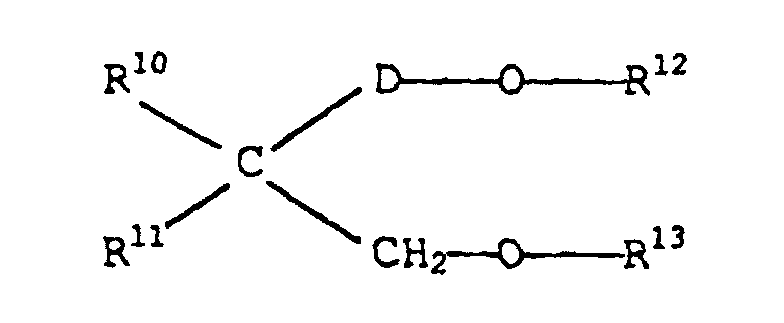 R10 und R11, welche gleich oder voneinander verschieden sein können, ein Wasserstoffatom oder eine Kohlenwasserstoffgruppe, welche wahlweise ein Heteroatom enthält, repräsentieren;R12 und R13, welche gleich oder voneinander verschieden sein können, eine Kohlenwasserstoffgruppe, welche wahlweise ein Heteroatom enthält, repräsentieren; und(D) eine Methylengruppe oder eine Carbonylgruppe sein kann; sowie(B) eine Titanverbindung.
 - Feste Katalysatorkomponente für die Olefinpolymerisation, welche herstellbar ist, indem eine halogenierte Magnesiumverbindung mit einer Monoetherverbindung (E) unter Verwendung eines inerten Mediums, welches eine durch die allgemeine Formel:wiedergegeben wird, wobei eine feste Trägerkomponente gebildet wird, welche die obige allgemeine Formel aufweist, wobei mindestens ein Teil der Verbindung E durch die Elektronendonorverbindung (b) ersetzt ist, und die feste Trägerkomponente anschließend mit einer Titanverbindung in Berührung gebracht wird, wobei X, E, D, n, R10, R11, R12 und R13 die im Anspruch 1 angegebenen Bedeutungen aufweisen.

- Feste Katalysatorkomponente für die Olefinpolymerisation gemäß Anspruch 1 oder 2, wobei die Elektronendonorverbindung Ethyl-2-tert.-butyl-3-ethoxypropionat, Ethyl-2-isopropyl-2-isopentyl-3-ethoxypropionat, 2-Isopropyl-2-isopentyl-1,3-dimethoxypropan oder 2,2-Diisobutyl-1,3-dimethoxypropan ist.
- Feste Katalysatorkomponente für die Olefinpolymerisation gemäß irgendeinem der vorherigen Ansprüche, wobei die feste Trägerkomponente (A) weiterhin eine Lewissäureverbindung (C) umfasst.
- Verfahren zur Herstellung einer festen Katalysatorkomponente für die Olefinpolymerisation, welches umfasst, dass eine halogenierte Magnesiumverbindung mit einer Monoetherverbindung (E) unter Verwendung eines inerten Mediums, welches eine durch die allgemeine Formel:wiedergegeben wird, wobei eine feste Trägerkomponente gebildet wird, welche die obige allgemeine Formel aufweist, wobei mindestens ein Teil der Verbindung E durch die Elektronendonorverbindung (b) ersetzt ist, und die feste Trägerkomponente anschließend mit einer Titanverbindung in Berührung gebracht wird, wobei X, E, D, n, R10, R11, R12 und R13 die im Anspruch 1 angegebenen Bedeutungen aufweisen.

- Verfahren zur Herstellung einer festen Katalysatorkomponente für die Olefinpolymerisation gemäß Anspruch 5, wobei die Behandlung der festen Substanz mit der Elektronendonorverbindung (b) in Gegenwart einer Lewissäurekomponente durchgeführt wird.
- Verfahren zur Herstellung eines Polyolefins, welches umfasst, dass mindestens ein Olefin in Gegenwart eines Katalysators polymerisiert wird, welcher die feste Katalysatorkomponente für die Olefinpolymerisation, wie sie in einem der Ansprüche 1 bis 4 beansprucht wird oder nach dem Verfahren gemäß Anspruch 5 oder 6 hergestellt wurde, sowie eine Organoaluminiumverbindung umfasst.
Applications Claiming Priority (3)
| Application Number | Priority Date | Filing Date | Title |
|---|---|---|---|
| JP2880196 | 1996-02-16 | ||
| JP08028801A JP3143057B2 (ja) | 1996-02-16 | 1996-02-16 | オレフィン重合用固体触媒成分、その製造法およびポリオレフィンの製造法 |
| JP28801/96 | 1996-02-16 |
Publications (2)
| Publication Number | Publication Date |
|---|---|
| EP0790260A1 EP0790260A1 (de) | 1997-08-20 |
| EP0790260B1 true EP0790260B1 (de) | 2002-11-06 |
Family
ID=12258538
Family Applications (1)
| Application Number | Title | Priority Date | Filing Date |
|---|---|---|---|
| EP97300977A Expired - Lifetime EP0790260B1 (de) | 1996-02-16 | 1997-02-14 | Feste Katalysatorbestandteile für die Polymerisation |
Country Status (6)
| Country | Link |
|---|---|
| US (1) | US5902765A (de) |
| EP (1) | EP0790260B1 (de) |
| JP (1) | JP3143057B2 (de) |
| KR (1) | KR100455513B1 (de) |
| CA (1) | CA2197610A1 (de) |
| DE (1) | DE69716791T2 (de) |
Families Citing this family (26)
| Publication number | Priority date | Publication date | Assignee | Title |
|---|---|---|---|---|
| US6693058B1 (en) * | 1997-01-28 | 2004-02-17 | Fina Technology, Inc. | Ziegler-natta catalyst for narrow to broad MWD of polyoefins, method of making, method of using, and polyolefins made therewith |
| DE10039868C2 (de) * | 2000-08-16 | 2003-03-06 | Brose Fahrzeugteile | Verstelleinrichtung und Verfahren zur Betätigung einer Sitzverstellung, eines Fensterhebers oder eines Schiebedachs eines Kraftfahrzeugs |
| ES2418804T3 (es) * | 2001-06-13 | 2013-08-16 | Basell Poliolefine Italia S.P.A. | Componentes y catalizadores para la (co)polimerización de olefinas |
| KR100530797B1 (ko) * | 2004-01-28 | 2005-11-23 | 삼성토탈 주식회사 | 올레핀 중합용 고체 티타늄 촉매의 제조 방법 |
| US7256151B2 (en) * | 2004-05-31 | 2007-08-14 | Sumitomo Chemical Company Limited | Solid catalyst component for α-olefin polymerization, process for producing catalyst therefor, and process for producing α-olefin polymer |
| EP1916264A1 (de) * | 2006-10-23 | 2008-04-30 | Total Petrochemicals Research Feluy | Verfahren zur Herstellung von Polypropylene mit einem niedrigen Aschegehalt. |
| JP5689232B2 (ja) * | 2009-03-24 | 2015-03-25 | 三井化学株式会社 | 固体状チタン触媒成分、オレフィン重合用触媒およびオレフィンの重合方法 |
| US7790819B1 (en) | 2009-04-13 | 2010-09-07 | Formosa Plastics Corporation, U.S.A. | Bicyclic organosilicon compounds as electron donors for polyolefin catalysts |
| US7619049B1 (en) | 2009-04-13 | 2009-11-17 | Formosa Plastics Corporation, U.S.A. | Cyclic organosilicon compounds as electron donors for polyolefin catalysts |
| US9815918B2 (en) | 2012-03-19 | 2017-11-14 | Formosa Plastics Corporation, U.S.A. | Catalyst component for high activity and high stereoselectivity in olefin polymerization |
| US8575283B1 (en) | 2012-06-28 | 2013-11-05 | Formosa Plastics Corporation, U.S.A. | Heterocyclic organic compounds as electron donors for polyolefin catalysts |
| US9593184B2 (en) | 2014-10-28 | 2017-03-14 | Formosa Plastics Corporation, Usa | Oxalic acid diamides as modifiers for polyolefin catalysts |
| US9777084B2 (en) | 2016-02-19 | 2017-10-03 | Formosa Plastics Corporation, Usa | Catalyst system for olefin polymerization and method for producing olefin polymer |
| US11427660B2 (en) | 2016-08-17 | 2022-08-30 | Formosa Plastics Corporation, Usa | Organosilicon compounds as electron donors for olefin polymerization catalysts and methods of making and using same |
| US9815920B1 (en) | 2016-10-14 | 2017-11-14 | Formosa Plastics Corporation, Usa | Olefin polymerization catalyst components and process for the production of olefin polymers therewith |
| US10124324B1 (en) | 2017-05-09 | 2018-11-13 | Formosa Plastics Corporation, Usa | Olefin polymerization catalyst components and process for the production of olefin polymers therewith |
| US10822438B2 (en) | 2017-05-09 | 2020-11-03 | Formosa Plastics Corporation | Catalyst system for enhanced stereo-specificity of olefin polymerization and method for producing olefin polymer |
| CN115975075B (zh) * | 2021-10-15 | 2024-09-17 | 中国石油化工股份有限公司 | 一种用于烯烃聚合的催化剂组分及催化剂和应用 |
| CN115445667B (zh) * | 2022-09-22 | 2023-12-22 | 中化泉州石化有限公司 | 一种乙烯齐聚用催化剂及其应用 |
| US20250066513A1 (en) | 2023-08-23 | 2025-02-27 | Formosa Plastics Corporation, U.S.A. | Catalyst System For Enhanced Stereo-Specificity Of Olefin Polymerization |
| US20250066514A1 (en) | 2023-08-24 | 2025-02-27 | Formosa Plastics Corporation, U.S.A. | Catalysts component and process for the production of polypropylene having high melt flow rate with high isotacticity |
| US20250109218A1 (en) | 2023-09-29 | 2025-04-03 | Formosa Plastics Corporation, U.S.A. | Method for preparing catalyst component for polymerization of polyolefin without the use of internal electron donors |
| US20250115687A1 (en) | 2023-10-06 | 2025-04-10 | Formosa Plastics Corporation, U.S.A. | Production method for solid catalyst component for polymerizing olefins, and catalyst for polymerizaing olefins |
| US20250115686A1 (en) | 2023-10-09 | 2025-04-10 | Formosa Plastics Corporation, U.S.A. | Olefin polymerization catalyst components containing silane and process for the production of polypropylene having high isotacticity at high melt flow rate |
| US20250297039A1 (en) | 2024-03-19 | 2025-09-25 | Formosa Plastics Corporation, U.S.A. | Olefin polymerization catalyst components containing diglycidylester components and its use for the production of polypropylene having high isotacticity at high melt flow rate |
| WO2026063967A1 (en) | 2024-09-19 | 2026-03-26 | Formosa Plastics Corporation, Usa | Olefin polymerization ziegler-natta catalyst components and process for the production of olefin polymers therewith |
Family Cites Families (12)
| Publication number | Priority date | Publication date | Assignee | Title |
|---|---|---|---|---|
| US4293673A (en) * | 1978-12-28 | 1981-10-06 | Union Carbide Corporation | Spheroidal polymerization catalyst, process for preparing, and use for ethylene polymerization |
| US4384984A (en) | 1981-09-30 | 1983-05-24 | Stauffer Chemical Company | Titanium catalyst for polymerizing olefins |
| FR2529209A1 (fr) * | 1982-06-24 | 1983-12-30 | Bp Chimie Sa | Catalyseurs pour la polymerisation et la copolymerisation du propylene et procedes de polymerisation utilisant ces catalyseurs |
| JPS5959708A (ja) * | 1982-09-30 | 1984-04-05 | Toyo Soda Mfg Co Ltd | 軟質プロピレン重合体の製造方法 |
| GB8521431D0 (en) * | 1985-08-28 | 1985-10-02 | Shell Int Research | Spherical magnesium alkoxide particles |
| IT1227258B (it) * | 1988-09-30 | 1991-03-28 | Himont Inc | Componenti e catalizzatori per la polimerizzazione di olefine |
| FR2651234B1 (fr) * | 1989-08-29 | 1993-03-12 | Bp Chem Int Ltd | Procede de fabrication en phase gazeuse de copolymeres du propylene a l'aide d'un systeme catalytique de haute activite. |
| FR2669915B1 (fr) * | 1990-11-29 | 1993-01-29 | Atochem | Particules de chlorure de magnesium a structure polyedre, composante catalytique supportee sur ces particules, procedes de fabrication de ces produits et des polyolefines obtenues a partir de cette composante catalytique. |
| FR2691142B1 (fr) * | 1992-05-15 | 1994-09-16 | Atochem Elf Sa | Procédé d'activation de support à base de chlorure de magnésium par un monoéther cyclique. |
| EP0598609B1 (de) * | 1992-11-18 | 1997-04-23 | Mitsui Petrochemical Industries, Ltd. | Katalysator für Olefinpolymerisation und Verfahren für Olefinpolymerisation unter Anwendung desselben |
| IT1264679B1 (it) * | 1993-07-07 | 1996-10-04 | Spherilene Srl | Catalizzatori per la (co)polimerizzazione di etilene |
| FR2728181B1 (fr) * | 1994-12-16 | 1997-01-31 | Appryl Snc | Composante catalytique pour la polymerisation des olefines, son procede de fabrication, et procede de polymerisation des olefines en presence de ladite composante catalytique |
-
1996
- 1996-02-16 JP JP08028801A patent/JP3143057B2/ja not_active Expired - Fee Related
-
1997
- 1997-02-14 EP EP97300977A patent/EP0790260B1/de not_active Expired - Lifetime
- 1997-02-14 US US08/799,231 patent/US5902765A/en not_active Expired - Fee Related
- 1997-02-14 DE DE69716791T patent/DE69716791T2/de not_active Expired - Fee Related
- 1997-02-14 CA CA002197610A patent/CA2197610A1/en not_active Abandoned
- 1997-02-15 KR KR1019970004575A patent/KR100455513B1/ko not_active Expired - Fee Related
Also Published As
| Publication number | Publication date |
|---|---|
| JPH09221513A (ja) | 1997-08-26 |
| KR100455513B1 (ko) | 2005-04-06 |
| KR970061355A (ko) | 1997-09-12 |
| CA2197610A1 (en) | 1997-08-17 |
| DE69716791T2 (de) | 2003-07-17 |
| JP3143057B2 (ja) | 2001-03-07 |
| EP0790260A1 (de) | 1997-08-20 |
| US5902765A (en) | 1999-05-11 |
| DE69716791D1 (de) | 2002-12-12 |
Similar Documents
| Publication | Publication Date | Title |
|---|---|---|
| EP0790260B1 (de) | Feste Katalysatorbestandteile für die Polymerisation | |
| US9353197B2 (en) | Catalyst component for olefin polymerization and preparation method thereof | |
| KR940008348B1 (ko) | 올레핀 중합체의 제조방법 | |
| US6870022B2 (en) | Process for producing α-olefin polymer | |
| EP0383346B1 (de) | Katalysator, Verfahren zur Herstellung desselben und Olefinpolymerisationsverfahren unter Anwendung desselben | |
| EP3798241A1 (de) | Katalysatorbestandteil zur olefinpolymerisation, herstellungsverfahren dafür und katalysator damit | |
| US4304892A (en) | Olefin polymerization catalyst | |
| JPH0725820B2 (ja) | プロピレンの重合方法 | |
| JPS6368648A (ja) | 結晶性ポリプロピレン樹脂組成物及びその製造方法 | |
| CN106543310A (zh) | 一种烯烃聚合催化剂体系及其应用 | |
| CN119143903B (zh) | 一种用于烯烃聚合的催化剂组分及催化剂和其应用 | |
| JP3279352B2 (ja) | α−オレフィンの重合方法 | |
| JP3496999B2 (ja) | オレフィン重合用固体触媒成分の製造方法 | |
| JPH1087730A (ja) | プロピレン系重合体 | |
| JP3017817B2 (ja) | エチレン重合体の製造法 | |
| JP2025088291A (ja) | オレフィン類重合用触媒、オレフィン類重合用触媒の製造方法及びオレフィン類重合体の製造方法 | |
| JPH0680101B2 (ja) | プロピレンのブロツク共重合体の製造方法 | |
| JPH01263139A (ja) | ポリプロピレン樹脂組成物 | |
| KR800000343B1 (ko) | 에틸렌의 중합법(重合法) | |
| JPH0713107B2 (ja) | プロピレンの重合方法 | |
| JPS62135509A (ja) | プロピレンのブロツク共重合体の製造方法 | |
| JPH11292914A (ja) | α−オレフィンの重合方法 | |
| JPH0713104B2 (ja) | プロピレンの重合方法 | |
| JPH0625341A (ja) | α−オレフィンの重合方法 | |
| JP2004107362A (ja) | オレフィン用重合触媒およびオレフィン重合体 |
Legal Events
| Date | Code | Title | Description |
|---|---|---|---|
| PUAI | Public reference made under article 153(3) epc to a published international application that has entered the european phase |
Free format text: ORIGINAL CODE: 0009012 |
|
| AK | Designated contracting states |
Kind code of ref document: A1 Designated state(s): DE FR GB IT |
|
| 17P | Request for examination filed |
Effective date: 19970920 |
|
| 17Q | First examination report despatched |
Effective date: 19980122 |
|
| GRAG | Despatch of communication of intention to grant |
Free format text: ORIGINAL CODE: EPIDOS AGRA |
|
| GRAG | Despatch of communication of intention to grant |
Free format text: ORIGINAL CODE: EPIDOS AGRA |
|
| GRAG | Despatch of communication of intention to grant |
Free format text: ORIGINAL CODE: EPIDOS AGRA |
|
| GRAH | Despatch of communication of intention to grant a patent |
Free format text: ORIGINAL CODE: EPIDOS IGRA |
|
| RIN1 | Information on inventor provided before grant (corrected) |
Inventor name: INAZAWA, SHINTAROU Inventor name: FUSHIMI, MASAKI Inventor name: KURODA, YASUSHI Inventor name: TAKAHASHI, HIROTOSHI |
|
| GRAH | Despatch of communication of intention to grant a patent |
Free format text: ORIGINAL CODE: EPIDOS IGRA |
|
| GRAA | (expected) grant |
Free format text: ORIGINAL CODE: 0009210 |
|
| AK | Designated contracting states |
Kind code of ref document: B1 Designated state(s): DE FR GB IT |
|
| REG | Reference to a national code |
Ref country code: GB Ref legal event code: FG4D |
|
| REF | Corresponds to: |
Ref document number: 69716791 Country of ref document: DE Date of ref document: 20021212 |
|
| ET | Fr: translation filed | ||
| PLBE | No opposition filed within time limit |
Free format text: ORIGINAL CODE: 0009261 |
|
| STAA | Information on the status of an ep patent application or granted ep patent |
Free format text: STATUS: NO OPPOSITION FILED WITHIN TIME LIMIT |
|
| 26N | No opposition filed |
Effective date: 20030807 |
|
| PGFP | Annual fee paid to national office [announced via postgrant information from national office to epo] |
Ref country code: DE Payment date: 20090129 Year of fee payment: 13 |
|
| PGFP | Annual fee paid to national office [announced via postgrant information from national office to epo] |
Ref country code: GB Payment date: 20090126 Year of fee payment: 13 |
|
| PGFP | Annual fee paid to national office [announced via postgrant information from national office to epo] |
Ref country code: IT Payment date: 20090212 Year of fee payment: 13 |
|
| PGFP | Annual fee paid to national office [announced via postgrant information from national office to epo] |
Ref country code: FR Payment date: 20090223 Year of fee payment: 13 |
|
| GBPC | Gb: european patent ceased through non-payment of renewal fee |
Effective date: 20100214 |
|
| REG | Reference to a national code |
Ref country code: FR Ref legal event code: ST Effective date: 20101029 |
|
| PG25 | Lapsed in a contracting state [announced via postgrant information from national office to epo] |
Ref country code: FR Free format text: LAPSE BECAUSE OF NON-PAYMENT OF DUE FEES Effective date: 20100301 |
|
| PG25 | Lapsed in a contracting state [announced via postgrant information from national office to epo] |
Ref country code: DE Free format text: LAPSE BECAUSE OF NON-PAYMENT OF DUE FEES Effective date: 20100901 |
|
| PG25 | Lapsed in a contracting state [announced via postgrant information from national office to epo] |
Ref country code: IT Free format text: LAPSE BECAUSE OF NON-PAYMENT OF DUE FEES Effective date: 20100214 Ref country code: GB Free format text: LAPSE BECAUSE OF NON-PAYMENT OF DUE FEES Effective date: 20100214 |