EP0793142B1 - Photolabor mit Einrichtung zum automatischen Sortieren der Filme nach Kriterien, die von den Filmen gelesen werden - Google Patents
Photolabor mit Einrichtung zum automatischen Sortieren der Filme nach Kriterien, die von den Filmen gelesen werden Download PDFInfo
- Publication number
- EP0793142B1 EP0793142B1 EP97103230A EP97103230A EP0793142B1 EP 0793142 B1 EP0793142 B1 EP 0793142B1 EP 97103230 A EP97103230 A EP 97103230A EP 97103230 A EP97103230 A EP 97103230A EP 0793142 B1 EP0793142 B1 EP 0793142B1
- Authority
- EP
- European Patent Office
- Prior art keywords
- film
- printing
- photographic
- photographic processing
- station
- Prior art date
- Legal status (The legal status is an assumption and is not a legal conclusion. Google has not performed a legal analysis and makes no representation as to the accuracy of the status listed.)
- Expired - Lifetime
Links
Images






Classifications
-
- G—PHYSICS
- G03—PHOTOGRAPHY; CINEMATOGRAPHY; ANALOGOUS TECHNIQUES USING WAVES OTHER THAN OPTICAL WAVES; ELECTROGRAPHY; HOLOGRAPHY
- G03D—APPARATUS FOR PROCESSING EXPOSED PHOTOGRAPHIC MATERIALS; ACCESSORIES THEREFOR
- G03D15/00—Apparatus for treating processed material
- G03D15/001—Counting; Classifying; Marking
- G03D15/005—Order systems, e.g. printsorter
-
- G—PHYSICS
- G03—PHOTOGRAPHY; CINEMATOGRAPHY; ANALOGOUS TECHNIQUES USING WAVES OTHER THAN OPTICAL WAVES; ELECTROGRAPHY; HOLOGRAPHY
- G03D—APPARATUS FOR PROCESSING EXPOSED PHOTOGRAPHIC MATERIALS; ACCESSORIES THEREFOR
- G03D13/00—Processing apparatus or accessories therefor, not covered by groups G11B3/00 - G11B11/00
- G03D13/003—Film feed or extraction in development apparatus
Definitions
- the present invention relates to a photographic processing system for effecting a photographic processing operation based on photographic processing information read from a photographic film adapted for image recording according to claims 1 to 5.
- the invention relates also to a method of collating an oder for use with the photographic processing system according to claims 6 to 10.
- a photographic processing system of the above-noted type is known from e.g. Japanese laid-open patent gazette Hei. 7-244365. According to this system, development information is recorded in a photographic film in the course of a developing operation thereof. Then, when this film is printed, whether this is a first printing or a second or reprinting, printing exposure of the film is controlled based on the development information recorded in the film so as to obtain a uniform printing effect.
- Japanese laid-open patent gazette Hei. 6-95349 proposed another photographic printing system designed for facilitating developing and printing services.
- this system there are used, in combination, a photographic film having a transparent magnetic recording layer and a film wrapping envelope having a magnetic recording layer.
- a shop attendant by using a customer-order managing machine specially adapted therefor, records, in both the recording layers, information for collation in the form of e.g. an ID code or the like.
- an automatic packing device installed adjacent an exit of the photographic processing system effects automatic collating operation of the recorded information so as to pack the film into its corresponding wrapping envelope.
- the system is intended to simplify the series of photographic processing service from the consumer's order to the shipping of the ordered product from the photographic processing laboratory back to the agent and subsequently to the consumer.
- US 5 207 332 A discloses an apparatus for classifying photographic film cartridges according to customer information read from the film for subsequent processing.
- US 5 124 742 A discloses to read customer's order information from a sheet and to record these data in a magnetic layer of the photographic film to be processed, where it is later on read for sorting and processing the films accordingly.
- a primary object of the present invention is to provide an improved photographic processing system adapted for such ID code or any other processing information provided in the film and/or its container (e.g. the film and print wrapping envelope) which system does not reduce the efficiency of the developing and printing operations at a photographic processing laboratory.
- a photographic processing system comprises all features of claim 10.
- the reading means reads the processing information recorded in this undeveloped film and then the sorter station sorts the film according to the information read.
- the conveying device directly conveys this film to one of the developing devices set to a particular developing condition suited for this film.
- the system repeats the above reading and sorting steps for a plurality of films so as to sort out a predetermined number of films to be developed in the same condition as the first film. Then, the system effects developing operations on these films at one time in the form of a batch processing, thereby to avoid frequent setting of the developing device. More specifically, in the case of developing operation, the essential factor be be considered in sorting is the film length. This is because the developing device is generally designed so as to develop at one time a plurality of film strips which are spliced to each other at the leading ends thereof. Then, if a plurality of films of different lengths were developed together as one group, this would cause significant degree of deviation in necessary estimation of e.g. consumption or fatigue of the developing liquid.
- the photographic processing apparatus is a printing device(s), i.e. in the case of a printing operation of developed films
- the system also effects a similar sorting operation of the film.
- a single printing device in order to minimize the frequency of the troublesome changing operations of the printing paper, it is desirable for a single printing device to be able to receive in succession a plurality of films to be printed in a same printing size, i.e. one type of processing information recorded therein.
- each single film may be immediately conveyed to a suitable printing device.
- the efficiency of the printing operations may be significantly improved if a plurality of films to be printed in a same print size are batch-processed.
- the film length or the print size is cited as an example of the processing condition.
- the processing condition may also be a processing speed, an exposure-correction amount, type of printing paper quality or the like.
- the photographic processing system further comprises a host computer capable of storing an ID code and the processing information of the film in correlation with each other, the host computer being connected with the respective components of the system so as to control the respective components in accordance with the ID code and the processing information for processing the film. This feature leads to the possibility of an unmanned operation of the photographic processing laboratory.
- the first reading means reads printing information of a re-ordered print film
- the first sorter station sorts the re-ordered print film according to the printing information. More particularly, the sorter station effects sorting between a film to be printed in a full size and a film to be printed in a panoramic size, for instance. Then, each film thus sorted is conveyed to a printing device suited for its printing information. Namely, the plurality of printing devices are set to different printing conditions from each other to cope with different printing information. So that, a same printing device effects printing of films having common printing information. Accordingly, a same printing device is capable of printing both a simultaneous print film and a re-ordered print film.
- the conveying passage for the simultaneous-print films and the conveying passage for the re-ordered print films are combined into one common conveying passage. Then, through this efficient common use of the conveying passage, the operational efficiency of the entire system may be improved. Further, as the distinguishing means (e.g. a bar code) for distinguishing the position of each film on the conveying passage, it is readily possible to distinguish to which particular printing device the film on the conveying passage should be conveyed.
- the distinguishing means e.g. a bar code
- the system further comprises a host computer capable of causing a re-ordered print film and a simultaneous-print film having common printing information to a same one of the printing devices.
- each film may be automatically conveyed to a suitable conveying device.
- the film may be provided with an ID code, and the host computer may be adapted to be capable of storing the ID code and the printing information of the film in correlation with each other.
- the first reading means reads the printing information from an information medium storing therein at least either consumer information or re-order information.
- this information medium is an order slip (or 'slip book' as will be described later) issued at a service agent. Namely, if a shop attendant had to manually read and manage the consumer information and the re-order information recorded in the order slip, he/she would find significant trouble in doing this in case the agent handles a large number of customer i.e. consumer orders, and the number of steps needed for properly managing such information too would be considerable. Then, by providing such information in the form of electrically recorded data and reading them by the reading means, the information managing steps may be advantageously reduced. It is preferred especially that these data be managed by the host computer described above.
- the system further comprises a film magazine for handling the films described above.
- a film magazine for handling the films described above.
- the processing laboratory generally receives, from the service agent, this film in the form of a plurality of film strips cut into the length of 4 or 6 frames that are stored within a film sheet holder. That is, one order amount or length of film consists of a plurality of such film strips. Hence, consideration should be made in order to facilitate handling of such film strips.
- the system preferably includes the film magazine capable of storing at least one order amount of re-ordered print film rolled therein. Then, by using this film magazine, the re-ordered print film is conveyed to the printing device.
- the simultaneous-print film is conveyed to the printing device by using the film magazine described above.
- the film magazine may be used alternatively for storing films having common printing information to be conveyed to the printing device.
- the operational efficiency of the entire system may be improved and also the designing of the entire system may be facilitated.
- the 'film' as used herein is understood to refer not only to a film not stored in the film magazine but also to a film stored in the magazine.
- a photographic processing system is adapted for handling two kinds of films and film containers corresponding thereto, i.e. a film 1a stored in a patrone 2a as the well-known film container and a film 1b stored in a cartridge 2b as a newly standardized film container 2 in accordance with the APS ( A dvanced P hotograph S ystem).
- APS A dvanced P hotograph S ystem
- the term: 'patrone 2a' or 'cartridge 2b' may refer not only to the container per se but also to the film 1a or 1b contained therein.
- a receiving station 3 for handling receptions of the patrone 2a or cartridge 2b and a laboratory slip (to be detailed later) sent from a service agent 500 functions as an input section in this photographic processing system.
- a receiving station 3 an ID code provided to the patrone 2a or cartridge 2b and photographic processing information provided to the laboratory slip are read and these pieces of information are correlated to each other to be transmitted to a host computer 200 from which the information may be freely searched and retrieved.
- the patrone 2a or cartridge 2b is conveyed to a first sorter station 4, where the patrone 2a and the cartridge 2b are sorted from each other. Then, the sorted patrone 2a or cartridge 2b is caused to stay, until its development, at a first stock station 5 installed immediately before a developing station 6. When given a command for initiating development, the patrones 2a or cartridges 2b staying at the first stock station 5 are conveyed one after another to the developing station 6 to be developed therein. At a second sorter station 7, the developed film 1a or 1b is sorted according to the printing condition included in the photographic processing information to a suitable conveying line.
- the developed film 1a or 1b sorted in the above manner is then exposed at a printing station 8 to have its images printed on printing papers.
- a film 1 having processing information concerning development alone is caused to bypass the printing station.
- the film 1a, 1b and its prints produced at the printing station 8 are packed together into a wrapping envelope by means of a packing device installed at a shipping station 9 which functions as an output section of this photographic processing system.
- the conveying operations of the film 1a, 1b, the patrone 2a or cartridge 2b and the prints are mostly effected by means of a conveying device 100 which is illustrated schematically only in the form of a plurality of conveying lines.
- the control operations of the respective stations and the conveying device of the photographic processing system as well as monitoring operations of the films 1a, 1b being printed are effected by the host computer 200.
- a consumer brings a film container 2 containing an exposed film 1, i.e. patrone 2a or a catridge 2b to a service agent 500 of a photographic processing laboratory 400 and orders simultaneous development and printing of the film
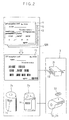
- the agent 500 keeps this film container 2 with the film therein and issues a three-sheet order slip book as illustrated in Fig. 2.
- This slip book consists of a customer's duplicate slip 11 to be handed to the consumer, an agent's confirmation slip 12 to be kept at the agent 500 and a laboratory slip 13 to be sent to the processing laboratory 400 together with the film 1a, 1b.
- the conventionally well-known film 1a is stored in the patrone 2a.
- the film is cut into a plurality of film strips each including a predetermined number of frames and these strips together with their prints are placed into an envelope to be returned to the consumer.
- the cartridge film according to the recently standardized APS system, after the development and printing, the cartridge 2b containing the developed film 1b is returned to the consumer.
- the above-described order slip book includes such photographic processing information as 'presence/absence of order for simultaneous development and printing', 'film length', 'print size' and so on recorded in the form of a plurality of bar codes.
- the book further includes entries in which such customer or customer information as the name, address, telephone number of the customer are to be entered.
- a number label 14 bearing a numeral corresponding to a serial number of the order slip book is affixed to the patrone 2a or cartridge 2b as an ID code between the service agent 500 and the processing laboratory 400.
- the laboratory slip 13 of the order slip book and the film container 2, i.e. the patrone 2a or cartridge 2b, are sent to the processing laboratory, where the reception operations are effected at the receiving section 3.
- the above-described photographic processing information recorded in the laboratory slip 13 is read by a bar-code reader 31 and transmitted to the host computer 200 of the photographic processing system installed in the processing laboratory.
- a bar-code label 33 bearing an ID code is issued by a bar-code label issuing machine 32 and affixed to the corresponding film container 2.
- the ID code of this bar-code label is also transmitted to the host computer 200, in which the code is correlated with the corresponding photographic processing information described above, such that the host computer 200 may obtain the photographic processing information given to each film 1 introduced into this photographic processing system.
- the film container 2 having the ID bar-code label 33 affixed thereto is introduced to a first processing-conveying line 101 of the processing system.
- the first sorter station 4 is provided which sorts the film containers 2 into either a cartridge 2b or patrone 2a to be conveyed to a cartridge processing line 102 or patrone processing line 103, respectively.
- the cartridge 2b or patrone 2a is further sorted in accordance with the development condition included in the photographic processing information provided uniquely thereto.
- the cartridge processing line 102 includes first and second cartridge developing devices 61, 62 which are set to different developing conditions from each other, and the patrone processing line 103 includes first and second developing devices 63, 64 which are set to different developing conditions from each other.
- the bar-code label 33 affixed to the film container 2 conveyed in the line is read. So that, based on the type of the container confirmed by the ID code, the development processing conditions such as the film length or the like, this film container 2 is selectively conveyed to one developing line including a developing device suitable for the particular development processing conditions.
- the stock station 5 For each processing station 102 or 103, there is provided the stock station 5 immediately before the developing station 6. At this stock station 5, the film container 2 is caused to stay until the time of its development comes.
- the cartridge 2b is stocked in a cartridge case capable of storing a plurality of cartridges 2b therein.
- the patrone 2a is stocked in a patrone case capable of storing a plurality of patrones 2a therein.
- the cartridge case may be attached to a film charging portion of a first cartridge developing device 61 or of a second cartridge developing device 62.
- the patrone case may be attached to a film charging portion of a first patrone developing device 63 or of a second patrone developing device 64.
- the emptied case is detached from the film charging portion and a new case is attached thereto. This case replacement is done automatically. Further, the emptied case is returned to e.g. the stock station 5. In this manner, it is possible to avoid unnecessary increase in the number of cases needed.
- the returning operation of the case is effected manually by the operator or automatically by a belt conveyer.
- the stock amount of the films 1 is monitored by a monitor device. This is done for preventing a certain developing device from being charged with too many films 1.
- a monitor device there may be provided a monitor video camera installed at the stock station 5 and a monitoring unit connected with the camera and controlled by the host computer 200. With these, the operational efficiency of the entire system may be improved.
- the developing process effected by the first or second cartridge developing device 61, 62 is well-known, and therefore will not be detailed herein.
- a lid of the cartridge 2b drawn out of the cartridge case is opened and the film 1b is drawn therethrough to be sent to the cartridge developing device 61 or 62.
- two film rolls 1b drawn from two cartridges 2b are connected at their leading ends to a common leader.
- the spliced films 1b are conveyed through processing tanks installed within the cartridge developing device 61 or 62, whereby the films are developed.
- the developed films 1b are disconnected from the leader and then stored into the same corresponding respective cartridges 2b as before.
- the ID code attached to the cartridge 2b and the ID data recorded in a magnetic recording band provided in the film according to the APS standard are utilized.
- the developed film may be stored in a film magazine to be described later, rather than in the cartridge 2b.
- the cartridge 2b into which the film 1b has been taken up again is conveyed to the second sorter station 7.
- the host computer 200 collates between the ID code of the bar-code label 33 affixed to the cartridge 2b and the corresponding photographic processing information stored in this computer 200, the cartridge 2b is sorted into either one of two groups in accordance with the condition of printing, which is the next processing step. Namely, cartridges 2b having common printing conditions are stored in a same cartridge case. So that, the cartridges which are grouped according to the printing conditions are conveyed to the corresponding cartridge printing device 81 or 82.
- the cartridge case may be designed to be attachable also to a film charging portion of the cartridge printing device 81 or 82. Further, the replacing operation and returning operation of the cartridge may be effected in the same manner as described above.
- the emptied cartridge case is returned from the cartridge printing device 81 or 82 to the cartridge developing device 61 or 62 by means of the belt conveyer.
- the developing process by the first and second patrone developing devices 63, 64 is similar to that by the cartridge developing devices.
- the films 1a drawn out of the patrones 2a are charged one after another to the patrone developing device. And, in this, two film rolls 1a drawn out of two patrones 2a are connected to a common leader, and with this common leader at their ends, the films thus spliced are conveyed through the processing tanks of the patrone developing device, whereby the films are developed.
- the patrone emptied of its film is not to be re-used generally.
- the film magazine 300 capable of storing a plurality of films therein. And, a plurality of film magazines 300 are provided.
- the second sorter station 7 functions so that the films 1a having same or common condition of printing which is the next photographic processing step are stored into a same film magazine 300.
- the film 1a drawn out of the patrone 1a does not have, in itself, any special region or means for recording the ID code or the like. Therefore, when the film 1a is drawn out of the patrone 2a, it is necessary to affix the bar-code label 33 indicating the ID code to the leading end of this film 1a.
- the bar-code label 33 has a double-layered construction including two label sheets, i.e. an upper label sheet 33a and a base label sheet 33b, bearing the same bar code and placed one on the other.
- the film 1a is drawn out of the patrone 2a, the upper label sheet 33a is removed from the base label sheet 33b, and the removed upper label sheet 33a is then affixed to the leading end of the film 1b.
- the patrone 2a as the film container 2 is disposed of at the initial stage of the developing process, it is still possible thereafter to collate this film 1a and the corresponding photographic processing information stored at the host computer 200.
- the film 1a developed by the first patrone developing device 63 or second developing device 64 is sorted according to the printing condition such as the printing paper size included in the photographic processing information, so that the film is conveyed to the film magazine 300 for storing a plurality of films having the same printing condition as this film.
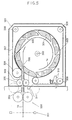
- Fig. 5 shows the general overall construction of this film magazine 300.
- the film magazine 300 essentially consists of a case 301 forming the general outer appearance of the magazine, a drum 303 rotatable about a rotation axis 302 located at the center of the drum, and a roller mechanism 305 for transporting the film 1a in and out of the drum 300.
- An outer peripheral wall portion 304 of the drum 303 defines total 8 (eight) slits 306 disposed equi-distantly from each other and extending axially of the drum.
- the side walls of the drum 303 are eliminated from the figure for better understanding of the figure. Through each one of these slits 306, the film 1a is introduced to the inside, i.e. the inner storage space, of the drum 303 and discharged therefrom when demanded.
- this endless belt 307 includes a plurality of rollers 308, one of which is adapted to receive the driving power from the processing station when the film magazine 300 is attached to the system.
- the endless belt 307 is placed in contact with not the entire outer peripheral wall 304 of the drum 303. Rather, the belt 307 is locally detached from the outer peripheral wall 307 at an entrance/exit for the film 1a to the slits 306. This non-contacting portion of the belt 307 relative to the outer peripheral wall 304 provides an entrance/exit for the film 1a to the inside of the drum 303. Also, at this portion, the belt retention of the film end is released, so that this portion provides also an exit opening for the film 1a from the inside of the drum 303. As may be apparent from Fig. 5, an access passage for the film 1a to and from the drum 303 is formed by guide plates 309.
- the film magazine 300 further includes a rotation restricting arm 310 for preventing inadvertent rotation of the drum 303 during transport of the film magazine 300, and an angular position detecting means 311 for detecting an angular position of the drum 303.
- a rotation restricting arm 310 for preventing inadvertent rotation of the drum 303 during transport of the film magazine 300
- an angular position detecting means 311 for detecting an angular position of the drum 303.
- this angular position detecting means 311 any of various known types of positions sensor systems may be employed. For instance, there may be provided, in combination, a magnetic member attached to the outer peripheral wall 304 in the vicinity of the slit 306 and a magnetic sensor disposed in opposition to the magnetic member.
- the power necessary for conveying the films 1a in and out of the film magazine 300 and for rotatably driving the drum 303 is available from the respective processing station to which the film magazine 300 is attached.
- numeral 350 denotes conveyer rollers provided in the station for conveying the film 1a to and from the magazine 300.
- the roller mechanism 350 becomes operatively connected with such unillustrated power transmitting device as an output gear or pulley of the processing station when the magazine 300 is attached to this station so as to obtain the necessary power therefrom.
- the terms: 'leading end of the film' and 'trailing end of the film' are used for the sake of convenience.
- leading end of the film refers to the portion of the film which is first discharged from the station i.e. the portion of the film 1a which is to be first introduced into the film magazine 300 and also that the trailing end of the film refers to the opposite end of the film which is to be last fed from the processing station.
- the film magazine 300 is attached to the predetermined attaching position of the station (the condition illustrated in Fig. 6a). With this attachment, the rotation restricting arm 310 of the film magazine 300 is pivoted to release the restriction of rotation of the drum 303. And, the angular position detecting means 311 detects whether the angular position of the drum 303s is presently located at the position allowing insertion of the film 1a or not. Then, based on this detection, if the drum 303 is not located at the predetermined position allowing film insertion, the drum 303 is driven to rotate clockwise in the same figure. When the magnetic sensor 311a detects the position of a detection target 311b, i.e.
- a conveying operation of the film 1a is started (the condition illustrated in Fig. 6c), and the leading end of the film 1a is introduced into the slit 306 of the drum 303 (the condition illustrated in Fig. 6d). From the above condition, the conveying operation of the film 1a is continued, until a film sensor 351 is rendered into a non-detecting condition and then a predetermined time period has lapsed, as illustrated in Fig. 6e. Namely, at the moment of detecting absence of the trailing end of the film, there still remains a significant distance between the trailing end of the film 1a and the slit 306 of the drum 303, thus it is still difficult for the retaining mechanism to retain the film. For this reason, the drum continues to rotate to take up the remaining length of the film therein, and when the length has eventually become suitable for the retention by the film retaining mechanism, the activation of the conveyer roller 350 and the roller mechanism is stopped.
- the drum 303 is rotated. And, this rotation of the drum 303 is stopped when the angular position detecting means 311 detects the predetermined position of the drum 303 allowing film insertion. At this stop position, the endless belt 307 retains the film 1a and the drum 303 is ready for receiving a next film 1a.
- the conveyer roller 350 and the roller mechanism 305 are activated again to convey the next film 1a (the condition illustrated in Fig. 7g).
- the film 1a is conveyed into the drum and the trailing end of this film 1a is conveyed across the position of the film sensor 351 (the condition of Fig. 7h).
- the conveying devices are stopped.
- the drum 303 is again rotated clockwise. This rotation of the drum 303 is continued until the angular position detecting means 311 detects the predetermined position of the drum allowing film insertion (the condition of Fig. 7i).
- films 1a having same printing condition are stored in the same film magazine 300 and this magazine 300 is conveyed to the printing station 8.
- Fig. 8a for better visual understanding, only three of the total eight films 1a stored in the film magazine 300 are shown.
- Fig. 8a it is assumed that the film 1a located in the middle of the three films is the one inserted first.
- the drum 303 is rotated clockwise by an amount corresponding to two angular pitches of the slits 306.
- Fig. 8b shows a condition when the drum 303 has been rotated from the condition of Fig. 8a by one pitch amount of the slits 306.
- the trailing end of the target film 1a is not yet located between the guide plates 309.
- the drum 303 is rotated further to a condition of Fig. 8c.
- the trailing end of the film 1a is located away from the roller mechanism 305, so that the drum 303 is then rotated counter-clockwise to a condition of Fig. 8d.
- This angular displacement of the drum corresponds to one pitch of the slits 306.
- the trailing end of the film 1a is caused to pass between the guide plates 309 to reach the roller mechanism 305 eventually.
- the film 1a may be discharged from the film magazine 300. Then, when the leading end of the film 1a passes the film sensor 351, the system becomes ready for discharging a next film 1a.
- the pluralitya of films 1a may be discharged one after another in the same order as charging order thereof.
- the discharging operation may be effected also by a first-in-last-out method.
- any desired film 1a may be discharged in a random order from the magazine 300.
- the conveying line between the second sorter station 7 and the printing station 8 is an endless conveyer line capable also of functioning as stock means for the cartridge case or film magazine 300.
- a separate stock station may be provided. Namely, the cartridge case or the film magazine 300 is caused to stay on this endlessly moving conveyer line until the printing device to which the cartridge case or the film magazine has been assigned becomes ready for processing the films stored therein.
- a monitor device using a video camera similar to the one described in connection with the stock station 5, is provided.
- the printing station 8 includes the first and second cartridge printing devices 81, 82 for printing images of the film 1b stored in the cartridge 2b on to printing papers. These two printing devices 81, 82 are set to different printing conditions, e.g. different print size conditions from each other, so that each cartridge printing device 81 or 82 selectively receives cartridges 2b storing films 1b suited to the particular common printing condition thereof. From the received cartridge 2b, the film 1b is again withdrawn and its ID code is read, thereby to obtain its photographic processing information, i.e. printing information, of this film 1b such as the number of prints. Thus, it is also possible to provide the cartridge printing device 81, 82 with an instruction concerning the number of prints, for example. After completion of the printing operation, the film 1b is again stored into the cartridge 2b and sent to the shipping station 9 together with the printed printing papers, i.e. its prints.
- the printing station 8 also includes the first and second patrone printing devices 83, 84 for printing images of the film 1a drawn out of the film magazine 300 on to printing papers.
- These two patrone printing devices 83, 84 too are set to different printing conditions, e.g. different print size conditions from each other, so that each patrone printing device 83 or 84 selectively receives the film magazine 300 storing films 1a suited to the particular printing condition thereof. From the received film magazine 300, the films 1a are drawn one after another and the ID code of each film is read, thereby to obtain its photographic processing information of this film 1a such as the number of prints.
- the emptied film magazine 300 from which the films 1a have been all withdrawn is detached from the film charging portion inside the patrone printing device 83 or 84, and then a new film magazine 300 is attached to the charging portion.
- This replacing operation of the film magazines 300 is effected automatically.
- the emptied film magazine 300 is returned to its original processing position, namely, to the patrone developing device 63 or 64. With this, it is possible to avoid unnecessary increase of the number of needed film magazines 300.
- the above returning operation is effected manually by an operator or automatically by using a belt conveyer.
- the film 1a is cut into a plurality of film strips, each strip including a predetermined number of frames, e.g. six frames, and these film strips are sent to the shipping station 9 together with their prints produced at the printing station 8.
- the film 1a or the cartridge 2b together with its prints is put into the envelope assigned for each customer and sent back to the service agent 500.
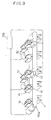
- Fig. 9 illustrates a condition when the patrones 2a sorted at the first stage in the first sorter station 4 are sorted between a first patrone stock device 51 and a second patrone stock device 52 provided in the first stock station 5.
- a belt conveyer 100a for conveying the sorted patrones 2a mounts thereon a plurality of pocket members 41 each capable of accommodating one patrone 2a therein.
- the belt conveyer 100 a is provided as an endless loop.
- the opposed side ends and the upper end of the pocket member 41 are opened for allowing insertion of the patrone 2a from either side or upper side.
- a bar code 42 indicating an ID code for identifying each pocket member 41.
- the host computer 200 stores information concerning whether a certain patrone 2a having a certain ID code is stored in a pocket member 41 having a certain ID code or not.
- the belt conveyer 100a is connected with the first patrone stock device 51 and the second patrone stock device 52.
- a bar code 42 of a pocket member 41 having reached this connecting region is read by a bar-code reader 43 and its information is inputted to the host computer 200.
- the host computer 200 determines whether to dismount the patrone 2a accommodated in this pocket member 41 at this connecting region or not. If the dismounting is necessary, a feeder which is illustrated only schematically by an arrow in the figure is used for shifting the patrone 2a into a similar pocket member provided to the first patrone stock device 51 adjacent thereto.
- the above-described construction is just a sample construction of the system comprising the combination of the conveying device and the sorter device. It is understood that the present invention is not limited to this particular construction.
- the re-ordered print film was not referred to.
- the problem to be attended to by the present invention is because the operational efficiency of the system will deteriorate if the simultaneous-print film and the re-ordered print film are processed by entirely independent processing lines. Specifically, provided processing lines are provided entirely independently of each other, if the processing amount of the simultaneous-print films exceeds that of the re-ordered films, the availability factor of the printing device(s) assigned for re-ordered print films will be necessarily reduced.
- the 're-order' means a consumer's order for reprinting of a developed film which was previously developed and returned once to the consumer.
- the same processing operation is effected except for the developing operation.
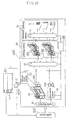
- Fig. 10 graphically illustrates a flow in which a film is supplied via the service agent 500 to the processing laboratory where a photographic processing system 400 is installed.
- the photographic processing system and the processing laboratory will be considered as equivalents and both denoted with the common reference numeral 400.
- the service agent 500 receives a consumer's order for either simultaneous development and printing of an undeveloped film 1a or reprinting (or printing) of a developed film 1b.
- the developed film 1b is provided usually in the form of a plurality of film strips 1c each including a predetermined number of frames such as six frames or a single film roll stored in the cartridge 2b.
- the system is to handle two type of films 1 and film containers 2.
- patrone 2a and cartridge 2b may refer to not only the patrone or cartridge, i.e. the container 2, per se but also the film 1 contained therein.
- this order slip book consists of the customer's duplicate slip 11 to be handed to the consumer, the agent's confirmation slip 12 to be kept at the agent 500 and the laboratory slip 13 to be sent to the processing laboratory 400 together with the film 1.
- Fig. 11 shows an order slip book issued in the case of an order for reprinting.
- the book bears such photographic processing information in the form of a number of bar codes as 'frame number', 'number of prints', 'print size', 'type of printing paper' and so on which items are selected by the customer.
- the book further includes entries in which such customer information items as name, address and telephone number and also the name of the service agent are to be entered.
- the laboratory slip 13 includes an agent ID bar code 16 indicating an ID code identifying the service agent 500.
- Fig. 12 shows an order book issued in the case of an order for simultaneous development and printing.
- This order book includes such photographic processing information items in the form of a number of bar codes as 'necessity/non-necessity of simultaneous development and printing', 'film length', 'print size' and so on, which items are selected by the consumer.
- this order slip book is same is that for the reprinting order.
- a bar-code label 33 is affixed to each of the laboratory slip 13 and the film 1b which indicates the ID code for allowing collation between this order book and the film 1b kept from the consumer. More particularly, if the agent receives and keeps the film in the form of the plurality of film strips 1c, the bar-code label 33 is affixed to the leading one of the plurality of film strips. On the other hand, if the agent receives the film stored in the cartridge 2b, the label 33 is affixed to the cartridge 2b.
- the bar-code label 33 is affixed.
- This bar-code label 33 to be affixed to the film container 2, as will be detailed later, has a double-layered sheet construction which allows repeated adhesion, for the following reason. Namely, in the photographic processing in the processing factory 400, the film 1 is withdrawn from the film container 2, and at this stage, the bar-code label needs to be re-affixed to this withdrawn film 1.
- the laboratory slip 13 and the film 1 even when separated from each other, may be collated with each other, with reference to the ID code. Therefore, when the film 1 is sent from the service agent 500 to the processing laboratory 400, the laboratory slip 13 and the film 1 may be sent separately from each other.
- the receiving operations are effected at the receiving station 20, as described hereinbefore.
- the photographic processing information recorded in the laboratory slip 13 in the form of a plurality of bar codes, the agent-name indicating bar code 14 and also the ID code of the bar-code labels 33 are read by a slip bar-code reader 21 and inputted to the host computer 200 in the photographic processing system installed in the processing laboratory 400.
- the bar-code label 33 affixed to the film strip 1c too is read by a film bar-code reader 22.
- its bar-code label 33 is read by a cartridge bar-code reader 23.
- These pieces of information inputted to the host computer 200 in the above-described manners are all stored therein in correlation with the ID code, so that the information may be uniquely correlated with the film container 2 and e.g. the film strips 1c by means of the ID code of the bar-code labels 33 affixed to the film container 2 and the film strip 1c. Accordingly, in the subsequent operations, the host computer 200 may grasp the photographic processing information of each film 1 being processed in this photographic processing system.
- the slip bar-code reader 21 is used for reading the information recorded in the laboratory slip 13 and the bar-code label 33 affixed to the film container 2.
- the other operations are substantially the same as those effected in the above-described case of re-ordered print film, except that the film bar-code reader 22 is not used in this case.
- the bar-code label 33 to be affixed to the film container 2 may be provided as the double-layered construction shown in Fig. 14.
- this double-layered label 33 includes a base 33b having an adhesive layer on the back side thereof and a bar-code indicating portion 33a including on its back side an re-adhesive type adhesive layer and indicating the ID code.
- the bar-code indicating portion 33a affixed together with the base portion 33b to the film container 2 at the service agent 500 is removed from the base portion 33b when the film 1a is withdrawn from the container 2, and then affixed to the leading end of the withdrawn film 1a.
- this film 1a withdrawn from the film container 2 may be collated anytime with the processing information inputted to the host computer 200 via the ID code of the re-affixed bar-code indicating portion 33a.
- the developed film 1b i.e. the film strips 1c
- the first sorter station 40 Upon completion of the receiving operation of the re-ordered print film, the developed film 1b (i.e. the film strips 1c) is set to the first sorter station 40, in which this film 1b is sorted into a certain group according to the printing condition information such as the print size read from the laboratory slip 13.
- the printing condition information such as the print size read from the laboratory slip 13.
- the printing condition comprises two kinds of print size, i.e. the full size and the panoramic size. Needless to say, the printing condition is not limited thereto.
- the film 1b is conveyed through the conveyer roller 24, the movable guide 27, the roller mechanism 305 and the guide plates 309 to be inserted into the film magazine 300.
- the construction of this film magazine 300 is identical to the magazine described in the first embodiment.
- the film 1b is conveyed through the conveyer roller 24, the movable guide 27, the stationary guide 28, the roller mechanism 305 and the guide plates 309 to be inserted into the film magazine 300.
- the movable guide 27 is movable between a position denoted with a solid line and a further position denoted with an alternate long and short dashed line in Fig. 13, and the position switching of the movable guide 27 is controlled by the host computer 200.
- the stationary guide 28 is provided for adjusting a length of the conveying passage of the film 1b.
- the film magazine 300 Upon completion of the insertion of the one order amount of film 1b, the film magazine 300 is set to a conveying device 50 to be described later.
- the film 1b stored in this cartridge 2b is withdrawn therefrom and then stored in the film magazine 300 and conveyed to the conveying device 50.
- the film as stored within the cartridge 2b may be directly sent to the conveying device 50.
- the bar-code label 33 is re-affixed to the film 1a. And, this un-developed film 1a is conveyed to the developing station 30, where there is effected a developing operation which per se is well-known. In this system, however, if there is any developing condition uniquely provided to the un-developed film 1a, the information concerning this condition is transmitted from the host computer 200 to the developing station 30.
- the developed film 1b is set to the second sorter station 34.
- the construction of this second sorter station 34 is substantially identical to that of the first sorter station 40. Accordingly, the construction of the second sorter station 34 too will be described with reference to Fig. 13.
- the bar codes of the bar-code label 33 re-affixed to the film 1b are read by the film bar-code reader 22.
- the host computer 200 searches a printing condition corresponding thereto and causes this film 1b to be inserted into a corresponding film magazine 300 in the same manner as the case of the re-ordered print film. Then, this film magazine 300 is charged to the conveying device 50.
- the cartridge 2b is re-usable, as described hereinbefore.
- this developed film 1b may be again stored into the cartridge 2b and then charged to the conveying device 50.
- the patrone 2a the patrone 2a emptied of its film 1 is not to be re-used in general. Accordingly, the film magazine 300 is always used in the case of the patrone 2a.
- the film container 2 and the film 1 are separated from each other.
- the upper sheet 33a removed from the base sheet 33b of the double-layered bar-code label 33 is affixed to the leading end of this film 1 withdrawn from the container 2. With this, it is possible to collate the film 1 and its photographic processing information stored in the host computer 200.
- Fig. 15 illustrates a condition when the film magazines 300 sorted in the first sorter station 40 and the second sorter station 34 are being sorted to either the first stock device 55 and the second stock device 56.
- the first stock device 55 is used for stocking film magazines 300 to be fed to the first printing device 65 assigned for the full-size printing.
- the second stock device 56 is used for stocking other film magazines 300 to be fed to the second printing device 66 assigned for the panoramic-size printing.
- a belt conveyer 57 for conveying the film magazines 300 mounts thereon a plurality of pocket members 58 each capable of accommodating one film magazine 300.
- the opposed side ends and the upper end of the pocket member 58 are opened for allowing insertion of the film magazine 300 from either side or upper side.
- each pocket member 58 there is attached a bar code 53 indicating an ID code for identifying each pocket member 58.
- the host computer 200 stores information concerning whether a film magazine having a certain ID code is stored in a pocket member 58 having a certain ID code or not.
- the belt conveyer 57 is connected with the first stock device 55 and the second stock device 56.
- a bar code 53 of a pocket member 58 having reached this connecting region is read by a bar-code reader 54 and its information is inputted to the host computer 200.
- the host computer 200 determines whether to dismount the film magazine 300 accommodated in this pocket member 58 at this connecting region or not. If the dismounting is necessary, a feeder which is illustrated only schematically by an arrow in the figure is used for moving the film magazine 300 into a similar pocket member provided to the first stock device 55.
- this conveying device 50 is adapted for the film magazines 300 storing the re-ordered print films 1b and the further film magazines 300 storing the simultaneous print films 1b in a mixed state.
- the film magazine 300 used herein is identical to that described in the first embodiment.
- the developed film 1b used herein may be either in the form of film strips cut into the length of e.g. six frames or an uncut one order amount of film. Accordingly, the film magazine 300 is capable of storing either one order amount of film 1b or a plurality of order amount of films 1b.
- the processes of inserting the film 1 into the film magazine and of discharging the former from the later are same as those described with reference to Figs. 6 through 8.
- the two printing devices i.e. the first printing device 65 for the full-size printing and the second printing device 66 for the panoramic-size printing.
- the present invention is not limited to this particular construction. Instead, more than three printing devices may be provided.
- film magazines 300 storing the films 1b suited to its particular printing condition is fed. From the fed film magazine 300, the film 1b is withdrawn again and its ID code is read and the photographic processing information such as the number of prints is retrieved from the host computer 200. Then, it is possible to provide the printing device 65, 66 with an instruction concerning the number of prints.
- Each of these printing devices 65, 66 is capable of receiving and processing the re-ordered print films 1b and the simultaneous print films 1b in a mixed state as long as their printing conditions match each other. And, in such a mixed state too, as the necessary printing information of the film 1b is obtained from its ID code and managed by the host computer 200, no inconvenience occurs.
- the full-size print and the panoramic-size printing conditions are cited as examples of the printing conditions.
- Other examples of printing conditions are the type of printing paper quality (glossy paper, silky paper and so on) and the width of the printing paper.
- the print size there are such sizes commonly referred to as 'E', 'L', '2E', '2L' and so on. Needless to say, these plural kinds of printing conditions may be used in a variety of combinations.
- the film 1 and its prints are set to an automatic packing station 70.
- the film magazine 300 becomes unnecessary after completion of the printing operation, the film magazine 300 is returned to the sorter station 34, 40 for re-use.
- the re-ordered print film 1 is stored in the film sheet holder 35 again and conveyed together with its prints, by the conveying device 71, to the shipping station 72.
- the construction of this conveying device 71 may be generally identical to that of the conveying device 50 shown in Fig. 15.
- the simultaneous print film 1 is cut into a plurality of film strips of a predetermined length having six frames for instance. Then, these strips are stored in the film sheet holder 35 and then conveyed together with its prints, by the conveying device 71, to the shipping station 72. Further, in the case of the cartridge 2b, the film 1 is stored again into the cartridge 2b.
- the prints and the films 1b are placed into the wrapping envelopes and sorted out for each service agent 500. After this sorting, the prints and the film 1b are shipped to the service agent 500.
- the above-described inserting operation of the film strips 1c into the film sheet holder 35 and the insertion operation of the film sheet holder 35 into the envelope may be effected either after or before the prints and the film 1b are mounted on the conveying device 71.
Landscapes
- Physics & Mathematics (AREA)
- General Physics & Mathematics (AREA)
- Photographic Developing Apparatuses (AREA)
- Photographic Processing Devices Using Wet Methods (AREA)
Claims (10)
- Fotographisches Verarbeitungssystem mit:dadurch gekennzeichnet,einer Empfangsstation zum Empfangen eines fotographischen Films und zum Ausstatten des Films mit einem ID-Code;Mitteln zum Lesen von Verarbeitungsinformationen des Films, wobei die Verarbeitungsinformationen Filmentwicklungsdaten und fotografische Abziehdaten aufweisen;einer fotographischen Verarbeitungsvorrichtung, die fähig ist, einen fotographischen Verarbeitungsvorgang gemäß den Verarbeitungsinformationen durchzuführen; undeinem Host-Computer zum Speichern des ID-Codes des fotographischen Films und der Verarbeitungsinformationen in Wechselbeziehung zueinander;dass die fotographische Verarbeitungsvorrichtung (400) eine Mehrzahl von Filmentwicklungsvorrichtungen (61, 62, 63, 64) aufweist und eine Mehrzahl von fotographischen Abziehvorrichtungen (81, 82, 83, 84); unddass die fotographische Verarbeitungsvorrichtung (400) weiter aufweist:eine erste Sortierstation (4, 40) zum Sortieren des Films in eine geeigneste der Filmentwicklungsvorrichtungen (61, 62, 63, 64) gemäß Steuerungsinformationen des Host-Computers (200);eine zweite Sortierstation (7, 34) zum Sortieren des entwickelten Films in eine geeigneste der fotographischen Abziehvorrichtungen (81, 82, 83, 84) gemäß den Steuerungsinformationen des Host-Computers (200);eine Fördervorrichtung (100) zum Befördern des an der ersten Sortierstation (4, 40) sortierten Films zu der geeignesten der Filmentwicklungsvorrichtungen (61, 62, 63, 64) und zum Befördern des an der zweiten Sortierstation (7, 34) sortierten Films zu der geeignesten der fotographischen Abziehvorrichtungen (81, 82, 83, 84).
- Fotographisches Verarbeitungssystem gemäß Anspruch 1,
weiter dadurch gekennzeichnet, dass der Host-Computer (200) die Fördervorrichtung (100) steuert, so dass die Fördervorrichtung (100) den Film durch eine der fotographischen Abziehvorrichtungen (81, 82, 83, 84) durchlaufen lässt, sogar, wenn dieser Film nicht abgezogen werden muss. - Fotographisches Verarbeitungssystem gemäß Anspruch 2,
weiter dadurch gekennzeichnet, dass, wenn der Film, der nicht abgezogen werden muss, eine der fotographischen Abziehvorrichtungen (81, 82, 83, 84) durchläuft, die Vorrichtung zumindest einen Blind-Abzug erzeugt, der von einem normalen Abzug unterscheidbar ist. - Fotographisches Verarbeitungssystem gemäß Anspruch 3,
weiter dadurch gekennzeichnet, dass der Blind-Abzug ein Leer-Abzug ist. - Fotographisches Verarbeitungssystem gemäß zumindest einem der vorhergehenden Ansprüche,
weiter dadurch gekennzeichnet, dass die erste Sortierstation (4, 40), den empfangenen Film gemäß einer Filmlänge sortiert und dass die Fördervorrichtung (100) derart funktioniert, dass jeder Filmentwicklungsvorrichtung (61, 62, 63, 64) eine Anzahl von Filmen mit einer gemeinsamen Filmlänge zugeführt wird. - Fotographisches Verarbeitungsverfahren, das die Schritte aufweist:gekennzeichnet durch,- a) Lesen der Verarbeitungsinformationen eines fotographischen Films;- b) Sortieren des Films gemäß den Entwicklungsdaten, die in den Verarbeitungsinformationen enthalten sind;- c) Fördern des sortierten Films in eine Filmentwicklungsvorrichtung;- d) Entwickeln des Films gemäß den Entwicklungsdaten;e) erneutes Sortieren des Films gemäß den Abziehdaten; die in den Verarbeitungsinformationen enthalten sind;f) Fördern des sortierten Films zu einer fotographischen Abziehvorrichtung; undg) Abziehen des Films gemäß den Abziehdaten.
- Fotographisches Verarbeitungsverfahren gemäß Anspruch 6,
wobei Schritt b) den Film in eine geeigneste einer Mehrzahl von Filmentwicklungsvorrichtungen sortiert und Schritt c) den Film zu der ausgewählten Filmentwicklungsvorrichtung fördert. - Fotographisches Verarbeitungsverfahren gemäß zumindest einem der vorhergehenden Ansprüche 6 oder 7,
weiter dadurch charakterisiert,
dass Schritt e) den Film in eine geeigneste einer Mehrzahl von fotographischen Abziehvorrichtungen sortiert und Schritt f) den Film zu der ausgewählten Abziehvorrichtung befördert. - Fotographisches Verarbeitungsverfahren gemäß zumindest einem der vorhergehenden Ansprüche 6 bis 8,
weiter aufweisend die Schritte:
- h) Befördern des Films durch eine der fotographischen Abziehvorrichtungen, sogar, wenn dieser Film kein Abziehen benötigt und Herstellen zumindest eines Blind-Abzugs, der von einem normalen Abzug unterscheidbar ist und speziell ein Leer-Abzug ist. - Fotographisches Verarbeitungsverfahren gemäß zumindest einem der vorhergehenden Ansprüche 6 bis 9,
weiter dadurch gekennzeichnet, dass die Filmlänge als die Entwicklungsbezugsgröße zum Sortieren des Films betrachtet wird, so dass der Schritt c) der Entwicklungsvorrichtung einer Anzahl von Filmen mit einer gemeinsamen Filmlänge zuführt.
Applications Claiming Priority (9)
| Application Number | Priority Date | Filing Date | Title |
|---|---|---|---|
| JP4393596 | 1996-03-01 | ||
| JP43935/96 | 1996-03-01 | ||
| JP4393596A JPH09236878A (ja) | 1996-03-01 | 1996-03-01 | 写真処理システム |
| JP8058773A JPH09251201A (ja) | 1996-03-15 | 1996-03-15 | 写真処理システム |
| JP5877396 | 1996-03-15 | ||
| JP58773/96 | 1996-03-15 | ||
| JP8611896A JPH09274260A (ja) | 1996-04-09 | 1996-04-09 | 写真処理のための注文照合システム |
| JP86118/96 | 1996-04-09 | ||
| JP8611896 | 1996-04-09 |
Publications (2)
| Publication Number | Publication Date |
|---|---|
| EP0793142A1 EP0793142A1 (de) | 1997-09-03 |
| EP0793142B1 true EP0793142B1 (de) | 2001-09-12 |
Family
ID=27291728
Family Applications (1)
| Application Number | Title | Priority Date | Filing Date |
|---|---|---|---|
| EP97103230A Expired - Lifetime EP0793142B1 (de) | 1996-03-01 | 1997-02-27 | Photolabor mit Einrichtung zum automatischen Sortieren der Filme nach Kriterien, die von den Filmen gelesen werden |
Country Status (3)
| Country | Link |
|---|---|
| US (1) | US5886774A (de) |
| EP (1) | EP0793142B1 (de) |
| DE (1) | DE69706583T2 (de) |
Families Citing this family (13)
| Publication number | Priority date | Publication date | Assignee | Title |
|---|---|---|---|---|
| JPH1195331A (ja) * | 1997-09-24 | 1999-04-09 | Noritsu Koki Co Ltd | 写真処理システム |
| IT1305669B1 (it) * | 1998-03-19 | 2001-05-15 | G P E Srl | Dispositivo di controllo del funzionamento di macchine stampatricie sviluppatrici di fotografie |
| JP2000066309A (ja) * | 1998-06-10 | 2000-03-03 | Fuji Photo Film Co Ltd | 写真プリントシステム及び写真プリント方法 |
| US6157436A (en) * | 1998-08-31 | 2000-12-05 | Eastman Kodak Company | Image printing |
| DE59802804D1 (de) * | 1998-09-14 | 2002-02-28 | Gretag Imaging Ag | Filmpatronenladevorrichtung und damit versehene Filmbühne |
| US6274283B1 (en) * | 1999-06-02 | 2001-08-14 | Fuji Photo Film Co., Ltd. | Image processing method and image processing device |
| US6636837B1 (en) * | 2000-01-27 | 2003-10-21 | Eastman Kodak Company | Method and apparatus for ordering photofinishing goods and/or services |
| EP1137247A3 (de) * | 2000-01-28 | 2002-10-09 | Eastman Kodak Company | Digitales Fotobehandlungssystem |
| JP2002023278A (ja) * | 2000-07-07 | 2002-01-23 | Fuji Photo Film Co Ltd | 画像形成装置及び画像形成方法 |
| US6583852B2 (en) * | 2000-09-21 | 2003-06-24 | Shutterfly, Inc. | Apparatus, architecture and method for high-speed printing |
| JP2004170843A (ja) * | 2002-11-22 | 2004-06-17 | Konica Minolta Holdings Inc | プリント注文票、情報記録装置及びプリントシステム |
| US20050207433A1 (en) * | 2004-01-09 | 2005-09-22 | Camelot Technology Associates Ltd. | Video communication systems and methods |
| JP4830599B2 (ja) * | 2005-07-12 | 2011-12-07 | セイコーエプソン株式会社 | 印刷システム、印刷装置、印刷データ生成装置およびプログラム、切断指示データ生成装置およびプログラム、印刷プログラム、および印刷方法 |
Family Cites Families (8)
| Publication number | Priority date | Publication date | Assignee | Title |
|---|---|---|---|---|
| US4186837A (en) * | 1978-12-27 | 1980-02-05 | Mystic Color Lab, Inc. | Automated film cartridge and mailer sorting and correlating apparatus |
| DK494583A (da) * | 1982-10-29 | 1984-04-30 | Kreuzlingen Photocolor | Apparatur til sortering af gennemloebende beholdere med fotografiske film, isaer farvefilmkassetter, samt fremgangsmaade ved drift af dette |
| US4974096A (en) * | 1988-10-07 | 1990-11-27 | Eastman Kodak Company | Photofinishing process with film-to-video printer using dedicated magnetic tracks on film |
| US5159385A (en) * | 1990-07-11 | 1992-10-27 | Fuji Photo Film Co., Ltd. | Total photofinishing laboratory system |
| JP2695978B2 (ja) * | 1990-09-14 | 1998-01-14 | 富士写真フイルム株式会社 | 写真処理方法及びシステム |
| JP2685344B2 (ja) * | 1990-10-04 | 1997-12-03 | 富士写真フイルム株式会社 | 写真フイルム仕分け装置 |
| JP2661826B2 (ja) * | 1991-10-30 | 1997-10-08 | 富士写真フイルム株式会社 | フィルム接合機 |
| EP0628852B1 (de) * | 1993-06-03 | 2003-03-26 | Noritsu Koki Co., Ltd. | Bildabzugsvorrichtung |
-
1997
- 1997-02-27 EP EP97103230A patent/EP0793142B1/de not_active Expired - Lifetime
- 1997-02-27 US US08/806,738 patent/US5886774A/en not_active Expired - Fee Related
- 1997-02-27 DE DE69706583T patent/DE69706583T2/de not_active Expired - Fee Related
Also Published As
| Publication number | Publication date |
|---|---|
| DE69706583T2 (de) | 2002-07-11 |
| EP0793142A1 (de) | 1997-09-03 |
| DE69706583D1 (de) | 2001-10-18 |
| US5886774A (en) | 1999-03-23 |
Similar Documents
| Publication | Publication Date | Title |
|---|---|---|
| US5159385A (en) | Total photofinishing laboratory system | |
| US5264683A (en) | Method of collating photographic prints with photographic film | |
| US4115981A (en) | Apparatus for assembling and packing photographic prints with associated developed films | |
| EP0793142B1 (de) | Photolabor mit Einrichtung zum automatischen Sortieren der Filme nach Kriterien, die von den Filmen gelesen werden | |
| US5896293A (en) | Method of managing information exchanged between production information supervisory computer and line supervisory computers for production of photo film cartridge | |
| US5745219A (en) | Method and apparatus for the efficient batch printing of photographic paper | |
| EP1122599A1 (de) | Behandlungssystem | |
| US6226071B1 (en) | Photographic processing system | |
| US5426481A (en) | Order finishing | |
| US4870257A (en) | Method and apparatus for packaging processed film | |
| EP0890877B1 (de) | Negativfilm mit Identifikationsnummer und photographischer Printer | |
| JP2991345B2 (ja) | 写真照合方法及び装置 | |
| EP0828180B1 (de) | Behandlungsgerät für photographische Filme | |
| JP2604891B2 (ja) | 写真作成装置 | |
| US7072022B2 (en) | Automatic processing of photographs in a photographic laboratory | |
| US5989791A (en) | Photographic printing method | |
| JP2604889B2 (ja) | 写真作成装置 | |
| JPH09251201A (ja) | 写真処理システム | |
| JP3570532B2 (ja) | 写真処理システム | |
| JP2650230B2 (ja) | 写真照合装置及び写真照合装填装置 | |
| JPH11102032A (ja) | 写真プリント方法 | |
| JPH0950083A (ja) | 写真処理システム | |
| JPH09101614A (ja) | 写真処理システム | |
| JPH09236878A (ja) | 写真処理システム | |
| JPH09101613A (ja) | 自動ラボ処理方法及び自動ラボ処理システム |
Legal Events
| Date | Code | Title | Description |
|---|---|---|---|
| PUAI | Public reference made under article 153(3) epc to a published international application that has entered the european phase |
Free format text: ORIGINAL CODE: 0009012 |
|
| 17P | Request for examination filed |
Effective date: 19970228 |
|
| AK | Designated contracting states |
Kind code of ref document: A1 Designated state(s): DE FR GB IT |
|
| 17Q | First examination report despatched |
Effective date: 19980707 |
|
| GRAG | Despatch of communication of intention to grant |
Free format text: ORIGINAL CODE: EPIDOS AGRA |
|
| GRAG | Despatch of communication of intention to grant |
Free format text: ORIGINAL CODE: EPIDOS AGRA |
|
| GRAH | Despatch of communication of intention to grant a patent |
Free format text: ORIGINAL CODE: EPIDOS IGRA |
|
| GRAH | Despatch of communication of intention to grant a patent |
Free format text: ORIGINAL CODE: EPIDOS IGRA |
|
| GRAA | (expected) grant |
Free format text: ORIGINAL CODE: 0009210 |
|
| AK | Designated contracting states |
Kind code of ref document: B1 Designated state(s): DE FR GB IT |
|
| PG25 | Lapsed in a contracting state [announced via postgrant information from national office to epo] |
Ref country code: IT Free format text: LAPSE BECAUSE OF FAILURE TO SUBMIT A TRANSLATION OF THE DESCRIPTION OR TO PAY THE FEE WITHIN THE PRESCRIBED TIME-LIMIT;WARNING: LAPSES OF ITALIAN PATENTS WITH EFFECTIVE DATE BEFORE 2007 MAY HAVE OCCURRED AT ANY TIME BEFORE 2007. THE CORRECT EFFECTIVE DATE MAY BE DIFFERENT FROM THE ONE RECORDED. Effective date: 20010912 |
|
| REF | Corresponds to: |
Ref document number: 69706583 Country of ref document: DE Date of ref document: 20011018 |
|
| REG | Reference to a national code |
Ref country code: GB Ref legal event code: IF02 |
|
| ET | Fr: translation filed | ||
| PGFP | Annual fee paid to national office [announced via postgrant information from national office to epo] |
Ref country code: FR Payment date: 20020212 Year of fee payment: 6 |
|
| PGFP | Annual fee paid to national office [announced via postgrant information from national office to epo] |
Ref country code: GB Payment date: 20020227 Year of fee payment: 6 |
|
| PGFP | Annual fee paid to national office [announced via postgrant information from national office to epo] |
Ref country code: DE Payment date: 20020313 Year of fee payment: 6 |
|
| PLBE | No opposition filed within time limit |
Free format text: ORIGINAL CODE: 0009261 |
|
| STAA | Information on the status of an ep patent application or granted ep patent |
Free format text: STATUS: NO OPPOSITION FILED WITHIN TIME LIMIT |
|
| 26N | No opposition filed | ||
| PG25 | Lapsed in a contracting state [announced via postgrant information from national office to epo] |
Ref country code: GB Free format text: LAPSE BECAUSE OF NON-PAYMENT OF DUE FEES Effective date: 20030227 |
|
| PG25 | Lapsed in a contracting state [announced via postgrant information from national office to epo] |
Ref country code: DE Free format text: LAPSE BECAUSE OF NON-PAYMENT OF DUE FEES Effective date: 20030902 |
|
| GBPC | Gb: european patent ceased through non-payment of renewal fee | ||
| PG25 | Lapsed in a contracting state [announced via postgrant information from national office to epo] |
Ref country code: FR Free format text: LAPSE BECAUSE OF NON-PAYMENT OF DUE FEES Effective date: 20031031 |
|
| REG | Reference to a national code |
Ref country code: FR Ref legal event code: ST |