EP0797324B1 - Verbessertes Kombinationsstereokodierverfahren mit zeitlicher Hüllkurvenformgebung - Google Patents
Verbessertes Kombinationsstereokodierverfahren mit zeitlicher Hüllkurvenformgebung Download PDFInfo
- Publication number
- EP0797324B1 EP0797324B1 EP97301677A EP97301677A EP0797324B1 EP 0797324 B1 EP0797324 B1 EP 0797324B1 EP 97301677 A EP97301677 A EP 97301677A EP 97301677 A EP97301677 A EP 97301677A EP 0797324 B1 EP0797324 B1 EP 0797324B1
- Authority
- EP
- European Patent Office
- Prior art keywords
- signal
- spectral component
- prediction
- signals
- channel
- Prior art date
- Legal status (The legal status is an assumption and is not a legal conclusion. Google has not performed a legal analysis and makes no representation as to the accuracy of the status listed.)
- Expired - Lifetime
Links
- 238000000034 method Methods 0.000 title claims description 68
- 238000007493 shaping process Methods 0.000 title description 10
- 230000002123 temporal effect Effects 0.000 title description 7
- 230000003595 spectral effect Effects 0.000 claims description 133
- 230000005236 sound signal Effects 0.000 claims description 21
- 238000013139 quantization Methods 0.000 claims description 17
- 239000004065 semiconductor Substances 0.000 claims description 2
- 238000000354 decomposition reaction Methods 0.000 claims 4
- 238000001914 filtration Methods 0.000 description 23
- 230000008569 process Effects 0.000 description 21
- 238000012545 processing Methods 0.000 description 17
- 238000001228 spectrum Methods 0.000 description 12
- 230000015572 biosynthetic process Effects 0.000 description 11
- 230000000873 masking effect Effects 0.000 description 11
- 238000003786 synthesis reaction Methods 0.000 description 11
- 230000000694 effects Effects 0.000 description 8
- 230000002087 whitening effect Effects 0.000 description 7
- 230000005540 biological transmission Effects 0.000 description 6
- 238000006243 chemical reaction Methods 0.000 description 4
- 238000013459 approach Methods 0.000 description 3
- 230000008901 benefit Effects 0.000 description 3
- 230000001419 dependent effect Effects 0.000 description 3
- 230000036962 time dependent Effects 0.000 description 3
- 230000003247 decreasing effect Effects 0.000 description 2
- 230000006866 deterioration Effects 0.000 description 2
- 230000007246 mechanism Effects 0.000 description 2
- 101000969688 Homo sapiens Macrophage-expressed gene 1 protein Proteins 0.000 description 1
- 102100021285 Macrophage-expressed gene 1 protein Human genes 0.000 description 1
- 230000003044 adaptive effect Effects 0.000 description 1
- 238000010420 art technique Methods 0.000 description 1
- 230000002238 attenuated effect Effects 0.000 description 1
- 238000005311 autocorrelation function Methods 0.000 description 1
- 238000004364 calculation method Methods 0.000 description 1
- 230000006835 compression Effects 0.000 description 1
- 238000007906 compression Methods 0.000 description 1
- 238000007796 conventional method Methods 0.000 description 1
- 230000001934 delay Effects 0.000 description 1
- 230000002708 enhancing effect Effects 0.000 description 1
- 210000002768 hair cell Anatomy 0.000 description 1
- 238000010348 incorporation Methods 0.000 description 1
- 230000008520 organization Effects 0.000 description 1
- 230000036961 partial effect Effects 0.000 description 1
- 230000002829 reductive effect Effects 0.000 description 1
- 238000000547 structure data Methods 0.000 description 1
- 230000001052 transient effect Effects 0.000 description 1
Images



Classifications
-
- H—ELECTRICITY
- H04—ELECTRIC COMMUNICATION TECHNIQUE
- H04H—BROADCAST COMMUNICATION
- H04H20/00—Arrangements for broadcast or for distribution combined with broadcast
- H04H20/86—Arrangements characterised by the broadcast information itself
- H04H20/88—Stereophonic broadcast systems
-
- H—ELECTRICITY
- H04—ELECTRIC COMMUNICATION TECHNIQUE
- H04B—TRANSMISSION
- H04B1/00—Details of transmission systems, not covered by a single one of groups H04B3/00 - H04B13/00; Details of transmission systems not characterised by the medium used for transmission
- H04B1/66—Details of transmission systems, not covered by a single one of groups H04B3/00 - H04B13/00; Details of transmission systems not characterised by the medium used for transmission for reducing bandwidth of signals; for improving efficiency of transmission
- H04B1/665—Details of transmission systems, not covered by a single one of groups H04B3/00 - H04B13/00; Details of transmission systems not characterised by the medium used for transmission for reducing bandwidth of signals; for improving efficiency of transmission using psychoacoustic properties of the ear, e.g. masking effect
-
- G—PHYSICS
- G10—MUSICAL INSTRUMENTS; ACOUSTICS
- G10L—SPEECH ANALYSIS TECHNIQUES OR SPEECH SYNTHESIS; SPEECH RECOGNITION; SPEECH OR VOICE PROCESSING TECHNIQUES; SPEECH OR AUDIO CODING OR DECODING
- G10L25/00—Speech or voice analysis techniques not restricted to a single one of groups G10L15/00 - G10L21/00
- G10L25/03—Speech or voice analysis techniques not restricted to a single one of groups G10L15/00 - G10L21/00 characterised by the type of extracted parameters
- G10L25/12—Speech or voice analysis techniques not restricted to a single one of groups G10L15/00 - G10L21/00 characterised by the type of extracted parameters the extracted parameters being prediction coefficients
Definitions
- the present invention relates to the field of audio signal coding and more specifically to an improved method and apparatus for performing joint stereo coding of multi-channel audio signals.
- the spectrum of the quantization noise can be shaped according to the shape of the signal's noise masking threshold. In this way, the noise which results from the coding process can be "hidden" under the coded signal and, thus, perceptually transparent quality can be achieved at high compression rates.
- Perceptual coding techniques for monophonic signals have been successfully extended to the coding of two-channel or multichannel stereophonic signals.
- so-called "joint stereo” coding techniques have been introduced which perform joint signal processing on the input signals, rather than performing separate ( i.e., independent) coding processes for each input signal.
- the words “stereo” and “stereophonic” refer to the use of two or more individual audio channels.
- joint stereo coding techniques There are at least two advantages to the use of joint stereo coding techniques.
- the use of joint stereo coding methods provide for the ability to account for binaural psychoacoustic effects.
- the required bit rate for the coding of stereophonic signals may be reduced significantly below the bit rate required to perform separate and independent encodings for each channel.
- M/S stereo coding the two most commonly used joint stereo coding techniques are known as "Mid/Side” (M/S) stereo coding and "intensity" stereo coding.
- M/S stereo coding the two most commonly used joint stereo coding techniques.
- the structure and operation of a coder based on M/S stereo coding is described, for example, in U.S. Patent No. 5,285,498 ( see above).
- U.S. Patent No. 5,285,498 see above.
- binaural masking effects can be advantageously accounted for and in addition, a certain amount of signal-dependent gain may be achieved.
- the intensity stereo method provides a higher potential for bit saving.
- this method exploits the limitations of the human auditory system at high frequencies (e.g., frequencies above 4 kHz), by transmitting only one set of spectral coefficients for all jointly coded channel signals, thereby achieving a significant savings in data rate.
- Coders based on the intensity stereo principle have been described in numerous references including European Patent Application 0 497 413 A by R. Veldhuis et al., filed on January 24, 1992 and published on August 5, 1992, and (using different terminology) PCT patent application WO 92/12607 by M. Davis et al., filed on January 8, 1992 and published on July 23, 1992.
- the drawbacks of prior art techniques are overcome by a method and apparatus for performing joint stereo coding of multi-channel audio signals using intensity stereo coding techniques.
- predictive filtering techniques are applied to the spectral coefficient data, thereby preserving the fine time structure of the output signal of each channel, while maintaining the benefit of the high bit rate savings offered by intensity stereo coding.
- a method for enhancing the perceived stereo image of intensity stereo encoded/decoded signals is provided by applying the following processing steps in an encoder for two-channel stereophonic signals:
- a decoder for joint stereo encoded signals corresponding to the above-described illustrative encoder and in accordance with another illustrative embodiment of the present invention, carries out the following processing steps:
- the incorporation of a predictive filtering process into the encoder and decoder in accordance with certain illustrative embodiments of the present invention advantageously enhances the quality of the intensity stereo encoded/decoded signal by overcoming the limitation of prior art schemes whereby identical fine envelope structures are produced in all intensity stereo decoded channel signals.
- the illustrative encoding method overcomes the drawbacks of prior techniques by effectively extending the filterbank with the predictive filtering stage, such that the envelope information common over frequency is extracted as filter coefficients, and is, for the most part, stripped from the residual signal.
- a linear prediction is carried out on its corresponding spectral coefficient data, wherein the linear prediction is performed over frequency .
- predictive coding is applied to spectral domain data, the relations known for classical predictions are valid with the time and frequency domains interchanged.
- the prediction error signal ideally has a "flat" (square of the) envelope, as opposed to having a "flat” power spectrum (a “pre-whitening” filter effect).
- the fine temporal structure information for each channel signal is contained in its prediction filter coefficients.
- the carrier signal used for intensity stereo coding will also have a flat envelope, since it is generated by forming linear combinations of the (filtered) channel signals.
- each channel signal is re-scaled according to the transmitted scaling information, and the inverse filtering process is applied to the spectral coefficients.
- the inverse "pre-whitening" process is performed on the envelope of each decoded channel signal, effectively re-introducing the envelope information into the spectral coefficients. Since this is done individually for each channel, the extended encoding/decoding system is capable of reproducing different individual fine envelope structures for each channel signal. Note that, in effect, using a combination of filterbank and linear prediction in frequency is equivalent to using an adaptive filterbank matched to the envelope of the input signal. Since the process of envelope shaping a signal can be performed either for the entire spectrum of the signal or for only part thereof, this time-domain envelope control can be advantageously applied in any necessary frequency-dependent fashion.
- the bitstream which is, for example, by the illustrative encoder described above (and described in further detail below with reference to Figs. 2, 3 and 7) may be advantageously stored on a storage medium such as a Compact Disc or a Digital Audio Tape, or stored in a semiconductor memory device.
- a storage medium such as a Compact Disc or a Digital Audio Tape, or stored in a semiconductor memory device.
- Such a storage medium may then be "read back" to supply the bitstream for subsequent decoding by, for example, the illustrative decoder described above (and described in further detail below with reference to Figs. 5, 6 and 8).
- a substantial quantity of audio data e.g., music
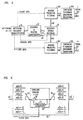
- Fig. 1 shows a prior art perceptual encoder for two-channel stereophonic signals in which conventional intensity stereo coding techniques are employed.
- the encoder of Fig. 1 operates as follows:
- Fig. 2 shows an encoder for two-channel stereophonic signals in accordance with an illustrative embodiment of the present invention.
- the operation of the illustrative encoder of Fig. 2 is similar to that of the prior art encoder shown in Fig. 1, except that, for each channel, a predictive filtering stage is introduced between the corresponding analysis filterbank and the intensity stereo encoding module. That is, predictive filters 16l and 16r are applied to the outputs of analysis filterbanks 12l and 12r, respectively.
- the spectral values, yl(b,0..,n-1) and yr(b,0...n-1), are replaced by the output values of the predictive filtering process, yl'(b,0...n-1) and yr'(b,0...n-1), respectively, before being provided to intensity stereo encoding module 13.
- Fig. 3 shows an illustrative implementation of the predictive filters of the illustrative encoder of Fig. 2.
- a linear prediction is performed across frequency (as opposed, for example, to predictive coding which is performed across time, such as is employed by subband-ADPCM coders).
- rotating switch operates to bring spectral values y(b,0...n-1) into a serial order prior to processing, and the resulting output values y'(b.0...n-1) are provided in parallel thereafter by "rotating switch” 46.
- the resultant output values. y'(b.0...n-1), are computed from the input values, y(b,0...n-1), by subtracting (with use of subtractor 48) the predicted value (predicted by predictor 47) from the input values, so that only the prediction error signal is passed on.
- the combination of predictor 47 and subtractor 48 labelled in the figure as envelope pre-whitening filter 44, functions to equalize the temporal shape of the corresponding time signal.
- the process performed by predictive filters 161 and 16r of the illustrative encoder of Fig. 2 can be performed either for the entire spectrum ( i.e., for all spectral coefficients), or, alternatively, for only a portion of the spectrum ( i.e., a subset of the spectral coefficients).
- different predictor filters e.g., different predictors 47 as shown in Fig. 3 can be used for different portions of the signal spectrum. In this manner, the above-described method for time-domain envelope control can be applied in any necessary frequency-dependent fashion.
- bitstream advantageously includes certain additional side information.
- one field of such information might indicate the use of predictive filtering and if applicable, the number of different prediction filters. If predictive filtering is used, additional fields in the bitstream may be transmitted for each prediction filter indicating the target frequency range of the respective filter and its filter coefficients.
- predictive filters 161 and 16r provide the necessary information to bitstream encoder/multiplexer 17 for inclusion in the transmitted bitstream.
- Fig. 7 shows a flow chart of a method of encoding two-channel stereophonic signals in accordance with an illustrative embodiment of the present invention.
- the illustrative example shown in this flow chart implements certain relevant portions of the illustrative encoder of Fig. 2.
- the flow chart shows the front-end portion of the encoder for a single one of the channels, including the envelope pre-whitening process using a single prediction filter. This pre-whitening process is carried out after the calculation of the spectral values by the analysis filterbank, as shown in step 61 of the figure.
- the order of the prediction filter is set and the target frequency range is defined (step 62).
- These parameters may illustratively be set to a filter order of 15 and a target frequency range comprising the entire frequency range that will be coded using intensity stereo coding (e.g., from 4 kHz to 20 kHz).
- intensity stereo coding e.g., from 4 kHz to 20 kHz.
- the scheme is advantageously configured to provide one set of individual fine temporal structure data for each audio channel.
- the prediction filter is determined by using the range of spectral coefficients matching the target frequency range, and by applying a conventional method for predictive coding as is well known, for example, in the context of Differential Pulse Code Modulation (DPCM) coders.
- DPCM Differential Pulse Code Modulation
- the autocorrelation function of the coefficients may be calculated and used in a conventional Levinson-Durbin recursion algorithm, well known to those skilled in the art.
- the predictor filter coefficients, the corresponding reflection coefficients ("PARCOR" coefficients), and the expected prediction gain are known.
- the predictive filtering procedure of steps 65 through 67 is used.
- the prediction filter coefficients are quantized (in step 65) as required for transmission to the decoder as part of the side information.
- the prediction filter is applied to the range of spectral coefficients matching the target frequency range where the quantized filter coefficients are used. For all further processing, therefore, the spectral coefficients are replaced by the output of the filtering process.
- a field of the bitstream to be transmitted is set to indicate the use of predictive filtering ("prediction flag" on).
- the target frequency range, the order of the prediction filter, and information describing its filter coefficients are also included in the bitstream.
- step 68 sets a field in the bitstream to indicate that no predictive filtering has been used ("prediction flag" off).
- Fig. 4 shows a prior art decoder for joint stereo coded signals, corresponding to the prior art encoder of Fig. 1, in which conventional intensity stereo coding techniques are employed. Specifically, the decoder of Fig. 4 performs the following steps:
- Fig. 5 shows a decoder for joint stereo coded signals, corresponding to the illustrative encoder of Fig. 2, in accordance with an illustrative embodiment of the present invention.
- the operation of the illustrative decoder of Fig. 5 is similar to that of the prior art decoder shown in Fig. 4, except that, for each channel, an inverse predictive filtering stage is introduced between the intensity stereo decoding and the corresponding synthesis filterbanks. That is, inverse predictive filters 261 and 26r are inserted prior to synthesis filterbanks 241 and 24r, respectively.
- the spectral values, yql() and yqr(), as generated by intensity stereo decoding module 23, are replaced by the output values of the corresponding inverse predictive filtering processes, yql'() and yqr'(), respectively, before being provided to their corresponding synthesis filterbanks (synthesis filterbanks 24l and 24r).
- Fig. 6 shows an illustrative implementation of the inverse predictive filters of the illustrative decoder of Fig. 5. Specifically, within the inverse predictive filters, a linear filtering operation is performed across (as opposed to performing predictive coding across time as in subband-ADPCM coders). In a similar manner to that shown in the prediction filter implementation of Fig. 3, "rotating switch" 33 of Fig. 6 is used to bring the spectral values yq(b,0 ... n-1) into a serial order prior to processing, and "rotating switch” 36 of the figure is used to bring the resulting output values yq'(b,0 ... n-1) into a parallel order thereafter.
- the output values, yq'(b.0 ... n-1), are computed from the input values, yq(b,0 ... n-1), by applying the inverse of the envelope pre-whitening filter used in the corresponding encoder.
- the output values are computed from the input values by adding (with use of adder 38) the predicted values (predicted by predictor 37) to the input values as shown.
- the combination of predictor 37 and adder 38 labelled in the figure as envelope shaping filter 34, functions to re-introduce the temporal shape of the original time signal.
- the above-described filtering process can be performed either for the entire spectrum ( i.e., for all spectral coefficients), or for only a portion of the spectrum ( i.e., a subset of the spectral coefficients).
- different predictor filters e.g., different predictors 37 as shown in Fig. 6
- Fig. 8 shows a flow chart of a method of decoding joint stereo coded signals, corresponding to the illustrative encoding method shown in Fig. 7, in accordance with an illustrative embodiment of the present invention.
- the illustrative example shown in this flow chart implements certain relevant portions of the illustrative decoder of Fig. 5.
- the flow chart shows the back-end portion of the decoder for a single one of the channels, including the envelope shaping process using a single (inverse) prediction filter.
- the processing which is performed by the decoder prior to those steps shown in the flow chart of Fig. 8 comprises conventional steps performed in prior art decoders (such as those carried out by the decoder of Fig.
- bitstream decoder/demultiplexer 25 of the illustrative decoder of Fig. 5 replaces conventional bitstream decoder/demultiplexer 21 of the prior art decoder of Fig. 4, so that the additional side information provided by the encoder (e.g., "L Filter Data” and "R Filter Data”) may be advantageously decoded and provided to inverse predictive filters 26l and 26r.
- the data from the bitstream which signals the use of predictive filtering is checked (by decision 72). If the data indicates that predictive filtering was performed in the encoder (i.e., the "prediction flag" is on), then the extended decoding process of steps 73 and 74 is carried out. Specifically, the target frequency range of the prediction filtering, the order of the pre-whitening (prediction) filter, and information describing the coefficients of the filter are retrieved from the (previously decoded) side information (step 73). Then, the inverse (decoder) prediction filter (i.e., the envelope shaping filter) is applied to the range of spectral coefficients matching the target frequency range (step 74). In either case ( i.e. , whether predictive filtering was performed or not), the decoder processing completes by running the synthesis filterbank (for each channel) from the spectral coefficients (as processed by the envelope shaping filter, if applicable), as shown in step 75.
- the synthesis filterbank for each channel
- the spectral coefficients as processed
- a straightforward envelope shaping effect can be achieved for certain conventional block transforms including the Discrete Fourier Transform (DFT) or the Discrete Cosine Transform (DCT), both well-known to those of ordinary skill in the art.
- DFT Discrete Fourier Transform
- DCT Discrete Cosine Transform
- a perceptual coder in accordance with the present invention uses a critically subsampled filterbank with overlapping windows -- e.g., a conventional Modified Discrete Cosine Transform or another conventional filterbank based on Time Domain Aliasing Cancellation (TDAC) -- the resultant envelope shaping effect is subject to the time domain aliasing effects inherent in the filterbank.
- TDAC Time Domain Aliasing Cancellation
- the final filterbank output is obtained by applying a synthesis window to the output of each inverse transform and performing an overlap-add of these data segments, the undesired aliased components are attenuated depending on the synthesis window used.
- An appropriate strategy in the encoder can, for example, adaptively select a window with a low degree of overlap for critical signals, thereby providing improved frequency selectivity. The implementation details of such a strategy will be obvious to those skilled in the art.
Landscapes
- Engineering & Computer Science (AREA)
- Signal Processing (AREA)
- Computer Networks & Wireless Communication (AREA)
- Compression, Expansion, Code Conversion, And Decoders (AREA)
Claims (20)
- Verfahren zum Kombinationsstereokodieren eines Mehrkanal-Audiosignals, um ein kodiertes Signal zu erzeugen, wobei das Verfahren die folgenden Schritte aufweist:(a) Ausführen einer Spektralzerlegung eines ersten Audiokanalsignals in eine Mehrzahl an ersten Spektralkomponentensignalen;(b) Erzeugen eines ersten Prädiktionssignals, das eine Vorhersage eines der ersten Spektralkomponentensignale darstellt, wobei die Vorhersage auf einem oder mehreren weiteren der ersten Spektralkomponentensignale beruht;(c) Vergleichen des ersten Prädiktionssignals mit jenem einen der ersten Spektralkomponentensignale, um ein erstes Prädiktionsfehlersignal zu erzeugen;(d) Ausführen einer Spektralzerlegung eines zweiten Audiokanalsignals in eine Mehrzahl an zweiten Spektralkomponentensignalen;(e) Kombinationsstereokodieren jenes einen der ersten Spektralkomponentensignale sowie eines der zweiten Spektralkomponentensignale, um ein kombinationskodiertes Spektralkomponentensignal zu erzeugen, wobei die Kodierung auf dem ersten Prädiktionsfehlersignal beruht; und(f) Erzeugen des kodierten Signals auf der Grundlage des kombinationskodierten Spektralkomponentensignals.
- Verfahren nach Anspruch 1, welches außerdem die folgenden Schritte aufweist:und wobei der Schritt des Kombinationsstereokodierens jenes einen der ersten Spektralkomponentensignale sowie jenes einen der zweiten Spektralkomponentensignale außerdem auf dem zweiten Prädiktionsfehlersignal beruht.(g) Erzeugen eines zweiten Prädiktionssignals, das eine Vorhersage jenes einen der zweiten Spektralkomponentensignale darstellt, wobei die Vorhersage auf einem oder mehreren weiteren der zweiten Spektralkomponentensignale beruht; und(h) Vergleichen des zweiten Prädiktionssignals mit jenem einen der zweiten Spektralkomponentensignale, um ein zweites Prädiktionsfehlersignal zu erzeugen;
- Verfahren nach Anspruch 1, wobei der Schritt des Kombinationsstereokodierens jenes einen der ersten Spektralkomponentensignale sowie jenes einen der zweiten Spektralkomponentensignale das Intensitätsstereokodieren jenes einen der ersten Spektralkomponentensignale sowie jenes einen der zweiten Spektralkomponentensignale umfasst.
- Verfahren nach Anspruch 1, wobei der Schritt des Erzeugens des kodierten Signals auf der Grundlage des kombinationskodierten Spektralkomponentensignals das Quantisieren des kombinationskodierten Spektralkomponentensignals umfasst.
- Verfahren nach Anspruch 4, wobei die Quantisierung des kombinationskodierten Spektralkomponentensignals auf einem Wahrnehmungsmodell beruht.
- Verfahren nach einem der vorhergehenden Ansprüche, das weiterhin den Schritt des Speicherns des kodierten Signals auf einem Speichermedium umfasst.
- Verfahren nach Anspruch 6, wobei das Speichermedium eine Compact Disc umfasst.
- Verfahren nach Anspruch 6, wobei das Speichermedium ein Digitaltonband umfasst.
- Verfahren nach Anspruch 6, wobei das Speichermedium einen Halbleiterspeicher umfasst.
- Verfahren zum Dekodieren eines kodierten Signals, um ein rekonstruiertes Mehrkanal-Audiosignal zu erzeugen, wobei das kodierte Signal eine Kombinationsstereokodierung eines ursprünglichen Mehrkanal-Audiosignals umfasst, und wobei das Verfahren die folgenden Schritte aufweist:(a) Kombinationsstereodekodieren des kodierten Signals, um eine Mehrzahl an dekodierten Kanalsignalen zu erzeugen, wobei jedes dekodierte Kanalsignal eine Mehrzahl an dekodierten Spektralkomponenten-Prädiktionsfehlersignalen umfasst;(b) Erzeugen eines ersten Spektralkomponentensignals auf der Grundlage eines oder mehrerer dieser Spektralkomponenten-Prädiktionsfehlersignale, die in einem ersten der dekodierten Kanalsignale inbegriffen sind;(c) Erzeugen eines ersten Prädiktionssignals, das eine Vorhersage eines zweiten Spektralkomponentensignals darstellt, wobei die Vorhersage auf dem ersten Spektralkomponentensignal beruht;(d) Erzeugen des zweiten Spektralkomponentensignals auf der Grundlage des ersten Prädiktionssignals sowie eines oder mehrerer der Spektralkomponenten-Prädiktionsfehlersignale, die in dem ersten der dekodierten Kanalsignale inbegriffen sind; und(e) Erzeugen eines ersten Kanals des rekonstruierten Mehrkanal-Audiosignals auf der Grundlage der ersten und zweiten Spektralkomponentensignale.
- Verfahren nach Anspruch 10, welches außerdem die folgenden Schritte aufweist:(f) Erzeugen eines dritten Spektralkomponentensignals auf der Grundlage eines oder mehrerer der Spektralkomponenten-Prädiktionsfehlersignale, die in einem zweiten der dekodierten Kanalsignale inbegriffen sind;(g) Erzeugen eines zweiten Prädiktionssignals, das eine Vorhersage eines vierten Spektralkomponentensignals darstellt, wobei die Vorhersage auf dem dritten Spektralkomponentensignal beruht;(h) Erzeugen des vierten Spektralkomponentensignals auf der Grundlage des zweiten Prädiktionssignals sowie eines oder mehrerer der Spektralkomponenten-Prädiktionsfehlersignale, die in dem zweiten der dekodierten Kanalsignale inbegriffen sind; und(i) Erzeugen eines zweiten Kanals des rekonstruierten Mehrkanal-Audiosignals auf der Grundlage der dritten und vierten Spektralkomponentensignale.
- Verfahren nach Anspruch 10, wobei der Schritt des Kombinationsstereodekodierens des kodierten Signals das Intensitätsstereodekodieren des kodierten Signals umfasst.
- Kodierer zum Kombinationsstereokodieren eines Mehrkanal-Audiosignals, um ein kodiertes Signal zu erzeugen, wobei der Kodierer Folgendes aufweist:(a) eine erste Filterbank (121, 12r), die eine Spektralzerlegung eines ersten Audiokanalsignals in eine Mehrzahl an ersten Spektralkomponentensignalen ausführt;(b) einen ersten Prädiktionsfilter (161, 16r, 47), der ein erstes Prädiktionssignal erzeugt, welches eine Vorhersage eines der ersten Spektralkomponentensignale darstellt, wobei der Prädiktionsfilter auf eines oder mehrere weitere der ersten Spektralkomponentensignale anspricht;(c) einen ersten Vergleicher (48), der das erste Prädiktionssignal mit jenem einen der ersten Spektralkomponentensignale vergleicht, um ein erstes Prädiktionsfehlersignal zu erzeugen;(d) eine zweite Filterbank (121, 12r), die eine Spektralzerlegung eines zweiten Audiokanalsignals in eine Mehrzahl an zweiten Spektralkomponentensignalen ausführt;(e) einen Kombinationsstereokodierer (13), der das Kombinationsstereokodieren jenes einen der ersten Spektralkomponentensignale sowie eines der zweiten Spektralkomponentensignale ausführt, um ein kombinationskodiertes Spektralkomponentensignal zu erzeugen, wobei die Kodierung auf dem ersten Prädiktionsfehlersignal beruht; und(f) einen Kodierer (14), der das kodierte Signal auf der Grundlage des kombinationskodierten Spektralkomponentensignals erzeugt.
- Kodierer nach Anspruch 13, welcher außerdem Folgendes umfasst:und wobei der Kombinationsstereokodierer das Kombinationsstereokodieren außerdem auf der Grundlage des zweiten Prädiktionsfehlersignals ausführt.(g) einen zweiten Prädiktionsfilter (161, 16r, 47), der ein zweites Prädiktionssignal erzeugt, welches eine Vorhersage jenes einen der zweiten Spektralkomponentensignale darstellt, wobei die Vorhersage auf einem oder mehreren weiteren der zweiten Spektralkomponentensignale beruht; und(h) einen zweiten Vergleicher (48), der das zweite Prädiktionssignal mit jenem einen der zweiten Spektralkomponentensignale vergleicht, um ein zweites Prädiktionsfehlersignal zu erzeugen;
- Kodierer nach Anspruch 13, wobei der Kombinationsstereokodierer einen Intensitätsstereokodierer umfasst, welcher das Intensitätsstereokodieren jenes einen der ersten Spektralkomponentensignale sowie jenes einen der zweiten Spektralkomponentensignale ausführt.
- Kodierer nach Anspruch 13, wobei der Kodierer, der das kodierte Signal auf der Grundlage des kombinationskodierten Spektralkomponentensignals erzeugt, einen Quantisierer umfasst, der das kombinationskodierte Spektralkomponentensignal quantisiert.
- Kodierer nach Anspruch 16, wobei der Quantisierer auf einem Wahrnehmungsmodell beruht.
- Dekodierer zum Dekodieren eines kodierten Signals, um ein rekonstruiertes Mehrkanal-Audiosignal zu erzeugen, wobei das kodierte Signal ein Kombinationsstereokodieren eines ursprünglichen Mehrkanal-Audiosignals umfasst, und wobei das Verfahren Folgendes aufweist:(a) einen Kombinationsstereodekodierer (23), der das Kombinationsstereodekodieren der kodierten Signale ausführt, um eine Mehrzahl an dekodierten Kanalsignalen zu erzeugen, wobei jedes dekodierte Kanalsignal eine Mehrzahl an dekodierten Spektralkomponenten-Prädiktionsfehlersignalen umfasst;(b) Mittel zum Erzeugen eines ersten Spektralkomponentensignals auf der Grundlage eines oder mehrerer der Spektralkomponenten-Prädiktionsfehlersignale, die in einem ersten der dekodierten Kanalsignale inbegriffen sind;(c) einen ersten Prädiktionsfilter (261, 26r), der ein erstes Prädiktionssignal erzeugt, das eine Vorhersage eines zweiten Spektralkomponentensignals darstellt, wobei die Vorhersage auf dem ersten Spektralkomponentensignal beruht;(d) Mittel zum Erzeugen des zweiten Spektralkomponentensignals auf der Grundlage des ersten Prädiktionssignals sowie eines oder mehrerer der Spektralkomponenten-Prädiktionsfehlersignale, die in dem ersten der dekodierten Kanalsignale inbegriffen sind; und(e) eine erste Filterbank (241, 24r), die einen ersten Kanal des rekonstruierten Mehrkanal-Audiosignals auf der Grundlage der ersten und zweiten Spektralkomponentensignale erzeugt.
- Dekodierer nach Anspruch 18, welcher außerdem Folgendes umfasst:(f) Mittel zum Erzeugen eines dritten Spektralkomponentensignals auf der Grundlage eines oder mehrerer der Spektralkomponenten-Prädiktionsfehlersignale, die in einem zweiten der dekodierten Kanalsignale inbegriffen sind; .(g) einen zweiten Prädiktionsfilter, welcher ein zweites Prädiktionssignal erzeugt, das eine Vorhersage eines vierten Spektralkomponentensignals darstellt, wobei die Vorhersage auf dem dritten Spektralkomponentensignal beruht;(h) Mittel zum Erzeugen des vierten Spektralkomponentensignals auf der Grundlage des zweiten Prädiktionssignals sowie eines oder mehrerer der Spektralkomponenten-Prädiktionsfehlersignale, die in dem zweiten der dekodierten Kanalsignale inbegriffen sind; und(i) eine zweite Filterbank, die einen zweiten Kanal des rekonstruierten Mehrkanal-Audiosignals auf der Grundlage der dritten und vierten Spektralkomponentensignale erzeugt.
- Dekodierer nach Anspruch 18, wobei der Kombinationsstereodekodierer einen Intensitätsstereodekodierer umfasst, welcher das Intensitätsstereodekodieren des kodierten Signals ausführt.
Applications Claiming Priority (2)
| Application Number | Priority Date | Filing Date | Title |
|---|---|---|---|
| US08/621,762 US5812971A (en) | 1996-03-22 | 1996-03-22 | Enhanced joint stereo coding method using temporal envelope shaping |
| US621762 | 1996-03-22 |
Publications (3)
| Publication Number | Publication Date |
|---|---|
| EP0797324A2 EP0797324A2 (de) | 1997-09-24 |
| EP0797324A3 EP0797324A3 (de) | 2004-01-14 |
| EP0797324B1 true EP0797324B1 (de) | 2004-11-24 |
Family
ID=24491531
Family Applications (1)
| Application Number | Title | Priority Date | Filing Date |
|---|---|---|---|
| EP97301677A Expired - Lifetime EP0797324B1 (de) | 1996-03-22 | 1997-03-12 | Verbessertes Kombinationsstereokodierverfahren mit zeitlicher Hüllkurvenformgebung |
Country Status (5)
| Country | Link |
|---|---|
| US (1) | US5812971A (de) |
| EP (1) | EP0797324B1 (de) |
| JP (1) | JP3316159B2 (de) |
| CA (1) | CA2197128C (de) |
| DE (1) | DE69731677T2 (de) |
Cited By (4)
| Publication number | Priority date | Publication date | Assignee | Title |
|---|---|---|---|---|
| DE102006055737A1 (de) * | 2006-11-25 | 2008-05-29 | Deutsche Telekom Ag | Verfahren zur skalierbaren Codierung von Stereo-Signalen |
| US7447629B2 (en) | 2002-07-12 | 2008-11-04 | Koninklijke Philips Electronics N.V. | Audio coding |
| CN102388417A (zh) * | 2009-03-17 | 2012-03-21 | 杜比国际公司 | 基于自适应地可选择的左/右或中央/侧边立体声编码和参数立体声编码的组合的高级立体声编码 |
| RU2740074C1 (ru) * | 2017-11-10 | 2021-01-11 | Фраунхофер-Гезелльшафт Цур Фердерунг Дер Ангевандтен Форшунг Е.Ф. | Временное формирование шума |
Families Citing this family (112)
| Publication number | Priority date | Publication date | Assignee | Title |
|---|---|---|---|---|
| DE19628293C1 (de) * | 1996-07-12 | 1997-12-11 | Fraunhofer Ges Forschung | Codieren und Decodieren von Audiosignalen unter Verwendung von Intensity-Stereo und Prädiktion |
| JP2891193B2 (ja) * | 1996-08-16 | 1999-05-17 | 日本電気株式会社 | 広帯域音声スペクトル係数量子化装置 |
| CN1179348C (zh) * | 1996-11-07 | 2004-12-08 | 皇家菲利浦电子有限公司 | 比特流信号的数据处理 |
| US5913191A (en) * | 1997-10-17 | 1999-06-15 | Dolby Laboratories Licensing Corporation | Frame-based audio coding with additional filterbank to suppress aliasing artifacts at frame boundaries |
| WO1999033194A1 (en) * | 1997-12-19 | 1999-07-01 | Sgs-Thomson Microelectronics Asia Pacific (Pte) Ltd. | Method and apparatus for phase estimation in a transform coder for high quality audio |
| US6591241B1 (en) * | 1997-12-27 | 2003-07-08 | Stmicroelectronics Asia Pacific Pte Limited | Selecting a coupling scheme for each subband for estimation of coupling parameters in a transform coder for high quality audio |
| SE519552C2 (sv) | 1998-09-30 | 2003-03-11 | Ericsson Telefon Ab L M | Flerkanalig signalkodning och -avkodning |
| US6463410B1 (en) * | 1998-10-13 | 2002-10-08 | Victor Company Of Japan, Ltd. | Audio signal processing apparatus |
| KR100717251B1 (ko) * | 1999-07-20 | 2007-05-15 | 코닌클리케 필립스 일렉트로닉스 엔.브이. | 스테레오 신호와 데이터 신호를 보유한 기록매체 |
| EP1087557A3 (de) * | 1999-09-22 | 2005-01-19 | Matsushita Electric Industrial Co., Ltd. | Vorrichtung für die Übertragung von digitalen Tondaten bzw. Empfangsvorrichtung für den Empfang dieser digitalen Tondaten |
| DE19947877C2 (de) * | 1999-10-05 | 2001-09-13 | Fraunhofer Ges Forschung | Verfahren und Vorrichtung zum Einbringen von Informationen in einen Datenstrom sowie Verfahren und Vorrichtung zum Codieren eines Audiosignals |
| US7742927B2 (en) * | 2000-04-18 | 2010-06-22 | France Telecom | Spectral enhancing method and device |
| RU2161868C1 (ru) * | 2000-05-12 | 2001-01-10 | Федеральное государственное унитарное предприятие Научно-исследовательский институт радио Государственного комитета РФ по связи и информатизации | Способ трансляции стереофонического сигнала |
| DE60132853D1 (de) * | 2000-07-07 | 2008-04-03 | Nokia Siemens Networks Oy | Verfahren und Vorrichtung für die perzeptuelle Tonkodierung von einem mehrkanal Tonsignal mit Verwendung der kaskadierten diskreten Cosinustransformation oder der modifizierten diskreten Cosinustransformation |
| SE0004163D0 (sv) * | 2000-11-14 | 2000-11-14 | Coding Technologies Sweden Ab | Enhancing perceptual performance of high frequency reconstruction coding methods by adaptive filtering |
| JP4618873B2 (ja) * | 2000-11-24 | 2011-01-26 | パナソニック株式会社 | オーディオ信号符号化方法、オーディオ信号符号化装置、音楽配信方法、および、音楽配信システム |
| FR2821475B1 (fr) * | 2001-02-23 | 2003-05-09 | France Telecom | Procede et dispositif de reconstruction spectrale de signaux a plusieurs voies, notamment de signaux stereophoniques |
| US7292901B2 (en) * | 2002-06-24 | 2007-11-06 | Agere Systems Inc. | Hybrid multi-channel/cue coding/decoding of audio signals |
| US7116787B2 (en) * | 2001-05-04 | 2006-10-03 | Agere Systems Inc. | Perceptual synthesis of auditory scenes |
| US20030035553A1 (en) * | 2001-08-10 | 2003-02-20 | Frank Baumgarte | Backwards-compatible perceptual coding of spatial cues |
| US7583805B2 (en) * | 2004-02-12 | 2009-09-01 | Agere Systems Inc. | Late reverberation-based synthesis of auditory scenes |
| US7644003B2 (en) * | 2001-05-04 | 2010-01-05 | Agere Systems Inc. | Cue-based audio coding/decoding |
| US6934676B2 (en) * | 2001-05-11 | 2005-08-23 | Nokia Mobile Phones Ltd. | Method and system for inter-channel signal redundancy removal in perceptual audio coding |
| US7002618B2 (en) * | 2001-06-01 | 2006-02-21 | Stereographics Corporation | Plano-stereoscopic DVD movie |
| US6934677B2 (en) * | 2001-12-14 | 2005-08-23 | Microsoft Corporation | Quantization matrices based on critical band pattern information for digital audio wherein quantization bands differ from critical bands |
| US7240001B2 (en) * | 2001-12-14 | 2007-07-03 | Microsoft Corporation | Quality improvement techniques in an audio encoder |
| US6751587B2 (en) * | 2002-01-04 | 2004-06-15 | Broadcom Corporation | Efficient excitation quantization in noise feedback coding with general noise shaping |
| US7206740B2 (en) * | 2002-01-04 | 2007-04-17 | Broadcom Corporation | Efficient excitation quantization in noise feedback coding with general noise shaping |
| RU2316154C2 (ru) * | 2002-04-10 | 2008-01-27 | Конинклейке Филипс Электроникс Н.В. | Кодирование стереофонических сигналов |
| US7275036B2 (en) * | 2002-04-18 | 2007-09-25 | Fraunhofer-Gesellschaft Zur Foerderung Der Angewandten Forschung E.V. | Apparatus and method for coding a time-discrete audio signal to obtain coded audio data and for decoding coded audio data |
| CN1647156B (zh) * | 2002-04-22 | 2010-05-26 | 皇家飞利浦电子股份有限公司 | 参数编码方法、参数编码器、用于提供音频信号的设备、解码方法、解码器、用于提供解码后的多声道音频信号的设备 |
| ATE543178T1 (de) | 2002-09-04 | 2012-02-15 | Microsoft Corp | Entropische kodierung mittels anpassung des kodierungsmodus zwischen niveau- und lauflängenniveau-modus |
| US7502743B2 (en) | 2002-09-04 | 2009-03-10 | Microsoft Corporation | Multi-channel audio encoding and decoding with multi-channel transform selection |
| US7299190B2 (en) * | 2002-09-04 | 2007-11-20 | Microsoft Corporation | Quantization and inverse quantization for audio |
| JP4676140B2 (ja) * | 2002-09-04 | 2011-04-27 | マイクロソフト コーポレーション | オーディオの量子化および逆量子化 |
| KR100501930B1 (ko) * | 2002-11-29 | 2005-07-18 | 삼성전자주식회사 | 적은 계산량으로 고주파수 성분을 복원하는 오디오 디코딩방법 및 장치 |
| JP2006521577A (ja) * | 2003-03-24 | 2006-09-21 | コーニンクレッカ フィリップス エレクトロニクス エヌ ヴィ | マルチチャネル信号を表す主信号と副信号の符号化 |
| US7318035B2 (en) * | 2003-05-08 | 2008-01-08 | Dolby Laboratories Licensing Corporation | Audio coding systems and methods using spectral component coupling and spectral component regeneration |
| US7447317B2 (en) | 2003-10-02 | 2008-11-04 | Fraunhofer-Gesellschaft Zur Foerderung Der Angewandten Forschung E.V | Compatible multi-channel coding/decoding by weighting the downmix channel |
| US7809579B2 (en) * | 2003-12-19 | 2010-10-05 | Telefonaktiebolaget Lm Ericsson (Publ) | Fidelity-optimized variable frame length encoding |
| US7725324B2 (en) * | 2003-12-19 | 2010-05-25 | Telefonaktiebolaget Lm Ericsson (Publ) | Constrained filter encoding of polyphonic signals |
| SE527670C2 (sv) * | 2003-12-19 | 2006-05-09 | Ericsson Telefon Ab L M | Naturtrogenhetsoptimerad kodning med variabel ramlängd |
| US7460990B2 (en) | 2004-01-23 | 2008-12-02 | Microsoft Corporation | Efficient coding of digital media spectral data using wide-sense perceptual similarity |
| DE102004009954B4 (de) * | 2004-03-01 | 2005-12-15 | Fraunhofer-Gesellschaft zur Förderung der angewandten Forschung e.V. | Vorrichtung und Verfahren zum Verarbeiten eines Multikanalsignals |
| US7805313B2 (en) * | 2004-03-04 | 2010-09-28 | Agere Systems Inc. | Frequency-based coding of channels in parametric multi-channel coding systems |
| US7653255B2 (en) | 2004-06-02 | 2010-01-26 | Adobe Systems Incorporated | Image region of interest encoding |
| EP1761915B1 (de) * | 2004-06-21 | 2008-12-03 | Koninklijke Philips Electronics N.V. | Verfahren und vorrichtung zum kodieren und dekodieren von mehrkanaltonsignalen |
| US8793125B2 (en) * | 2004-07-14 | 2014-07-29 | Koninklijke Philips Electronics N.V. | Method and device for decorrelation and upmixing of audio channels |
| JP4898673B2 (ja) * | 2004-07-14 | 2012-03-21 | コーニンクレッカ フィリップス エレクトロニクス エヌ ヴィ | 方法、装置、エンコーダ装置、デコーダ装置及びオーディオシステム |
| TWI393121B (zh) * | 2004-08-25 | 2013-04-11 | 杜比實驗室特許公司 | 處理一組n個聲音信號之方法與裝置及與其相關聯之電腦程式 |
| AU2012205170B2 (en) * | 2004-08-25 | 2015-05-14 | Dolby Laboratories Licensing Corporation | Temporal Envelope Shaping for Spatial Audio Coding using Frequency Domain Weiner Filtering |
| TWI393120B (zh) | 2004-08-25 | 2013-04-11 | Dolby Lab Licensing Corp | 用於音訊信號編碼及解碼之方法和系統、音訊信號編碼器、音訊信號解碼器、攜帶有位元流之電腦可讀取媒體、及儲存於電腦可讀取媒體上的電腦程式 |
| CN101010725A (zh) | 2004-08-26 | 2007-08-01 | 松下电器产业株式会社 | 多信道信号编码装置以及多信道信号解码装置 |
| US7895034B2 (en) * | 2004-09-17 | 2011-02-22 | Digital Rise Technology Co., Ltd. | Audio encoding system |
| US7639886B1 (en) | 2004-10-04 | 2009-12-29 | Adobe Systems Incorporated | Determining scalar quantizers for a signal based on a target distortion |
| US8204261B2 (en) * | 2004-10-20 | 2012-06-19 | Fraunhofer-Gesellschaft Zur Foerderung Der Angewandten Forschung E.V. | Diffuse sound shaping for BCC schemes and the like |
| US7720230B2 (en) * | 2004-10-20 | 2010-05-18 | Agere Systems, Inc. | Individual channel shaping for BCC schemes and the like |
| EP1817767B1 (de) * | 2004-11-30 | 2015-11-11 | Agere Systems Inc. | Parametrische raumtonkodierung mit objektbasierten nebeninformationen |
| US7787631B2 (en) * | 2004-11-30 | 2010-08-31 | Agere Systems Inc. | Parametric coding of spatial audio with cues based on transmitted channels |
| JP5017121B2 (ja) | 2004-11-30 | 2012-09-05 | アギア システムズ インコーポレーテッド | 外部的に供給されるダウンミックスとの空間オーディオのパラメトリック・コーディングの同期化 |
| US7903824B2 (en) * | 2005-01-10 | 2011-03-08 | Agere Systems Inc. | Compact side information for parametric coding of spatial audio |
| EP1691348A1 (de) * | 2005-02-14 | 2006-08-16 | Ecole Polytechnique Federale De Lausanne | Parametrische kombinierte Kodierung von Audio-Quellen |
| JP4809370B2 (ja) * | 2005-02-23 | 2011-11-09 | テレフオンアクチーボラゲット エル エム エリクソン(パブル) | マルチチャネル音声符号化における適応ビット割り当て |
| US9626973B2 (en) * | 2005-02-23 | 2017-04-18 | Telefonaktiebolaget L M Ericsson (Publ) | Adaptive bit allocation for multi-channel audio encoding |
| DE102005010057A1 (de) * | 2005-03-04 | 2006-09-07 | Fraunhofer-Gesellschaft zur Förderung der angewandten Forschung e.V. | Vorrichtung und Verfahren zum Erzeugen eines codierten Stereo-Signals eines Audiostücks oder Audiodatenstroms |
| KR100818268B1 (ko) * | 2005-04-14 | 2008-04-02 | 삼성전자주식회사 | 오디오 데이터 부호화 및 복호화 장치와 방법 |
| DE602006004959D1 (de) * | 2005-04-15 | 2009-03-12 | Dolby Sweden Ab | Zeitliche hüllkurvenformgebung von entkorrelierten signalen |
| US7983922B2 (en) * | 2005-04-15 | 2011-07-19 | Fraunhofer-Gesellschaft Zur Foerderung Der Angewandten Forschung E.V. | Apparatus and method for generating multi-channel synthesizer control signal and apparatus and method for multi-channel synthesizing |
| CA2610430C (en) * | 2005-06-03 | 2016-02-23 | Dolby Laboratories Licensing Corporation | Channel reconfiguration with side information |
| US7599840B2 (en) | 2005-07-15 | 2009-10-06 | Microsoft Corporation | Selectively using multiple entropy models in adaptive coding and decoding |
| US7539612B2 (en) * | 2005-07-15 | 2009-05-26 | Microsoft Corporation | Coding and decoding scale factor information |
| US7693709B2 (en) * | 2005-07-15 | 2010-04-06 | Microsoft Corporation | Reordering coefficients for waveform coding or decoding |
| US7933337B2 (en) * | 2005-08-12 | 2011-04-26 | Microsoft Corporation | Prediction of transform coefficients for image compression |
| US7565018B2 (en) * | 2005-08-12 | 2009-07-21 | Microsoft Corporation | Adaptive coding and decoding of wide-range coefficients |
| CN101427307B (zh) * | 2005-09-27 | 2012-03-07 | Lg电子株式会社 | 编码/解码多声道音频信号的方法和装置 |
| US8090587B2 (en) * | 2005-09-27 | 2012-01-03 | Lg Electronics Inc. | Method and apparatus for encoding/decoding multi-channel audio signal |
| US7974713B2 (en) * | 2005-10-12 | 2011-07-05 | Fraunhofer-Gesellschaft Zur Foerderung Der Angewandten Forschung E.V. | Temporal and spatial shaping of multi-channel audio signals |
| US7831434B2 (en) * | 2006-01-20 | 2010-11-09 | Microsoft Corporation | Complex-transform channel coding with extended-band frequency coding |
| US7953604B2 (en) * | 2006-01-20 | 2011-05-31 | Microsoft Corporation | Shape and scale parameters for extended-band frequency coding |
| US8190425B2 (en) * | 2006-01-20 | 2012-05-29 | Microsoft Corporation | Complex cross-correlation parameters for multi-channel audio |
| US7590523B2 (en) * | 2006-03-20 | 2009-09-15 | Mindspeed Technologies, Inc. | Speech post-processing using MDCT coefficients |
| KR100754937B1 (ko) * | 2006-03-30 | 2007-09-03 | 인하대학교 산학협력단 | Ofdm/fdd 시스템에서 적응전송을 지원하기 위한 다단계 채널예측장치 및 방법 |
| US20090276210A1 (en) * | 2006-03-31 | 2009-11-05 | Panasonic Corporation | Stereo audio encoding apparatus, stereo audio decoding apparatus, and method thereof |
| KR100718416B1 (ko) | 2006-06-28 | 2007-05-14 | 주식회사 대우일렉트로닉스 | 예측필터를 이용한 채널간 스테레오 오디오 코딩 방법 |
| US7797155B2 (en) * | 2006-07-26 | 2010-09-14 | Ittiam Systems (P) Ltd. | System and method for measurement of perceivable quantization noise in perceptual audio coders |
| CN101169934B (zh) * | 2006-10-24 | 2011-05-11 | 华为技术有限公司 | 时域听觉阈值加权滤波器的构造方法和设备、编解码器 |
| US8184710B2 (en) | 2007-02-21 | 2012-05-22 | Microsoft Corporation | Adaptive truncation of transform coefficient data in a transform-based digital media codec |
| JP5355387B2 (ja) | 2007-03-30 | 2013-11-27 | パナソニック株式会社 | 符号化装置および符号化方法 |
| US7761290B2 (en) | 2007-06-15 | 2010-07-20 | Microsoft Corporation | Flexible frequency and time partitioning in perceptual transform coding of audio |
| US8046214B2 (en) * | 2007-06-22 | 2011-10-25 | Microsoft Corporation | Low complexity decoder for complex transform coding of multi-channel sound |
| US7885819B2 (en) | 2007-06-29 | 2011-02-08 | Microsoft Corporation | Bitstream syntax for multi-process audio decoding |
| US8249883B2 (en) | 2007-10-26 | 2012-08-21 | Microsoft Corporation | Channel extension coding for multi-channel source |
| EP2209114B1 (de) * | 2007-10-31 | 2014-05-14 | Panasonic Corporation | Vorrichtung/Verfahren zur Sprachkodierung/Sprachdekodierung |
| WO2009057329A1 (ja) | 2007-11-01 | 2009-05-07 | Panasonic Corporation | 符号化装置、復号装置およびこれらの方法 |
| US8179974B2 (en) | 2008-05-02 | 2012-05-15 | Microsoft Corporation | Multi-level representation of reordered transform coefficients |
| MX2011000375A (es) * | 2008-07-11 | 2011-05-19 | Fraunhofer Ges Forschung | Codificador y decodificador de audio para codificar y decodificar tramas de una señal de audio muestreada. |
| KR101546793B1 (ko) | 2008-07-14 | 2015-08-28 | 삼성전자주식회사 | 오디오 신호의 부호화/복호화 방법 및 장치 |
| US8406307B2 (en) | 2008-08-22 | 2013-03-26 | Microsoft Corporation | Entropy coding/decoding of hierarchically organized data |
| US20120072207A1 (en) * | 2009-06-02 | 2012-03-22 | Panasonic Corporation | Down-mixing device, encoder, and method therefor |
| US20100324915A1 (en) * | 2009-06-23 | 2010-12-23 | Electronic And Telecommunications Research Institute | Encoding and decoding apparatuses for high quality multi-channel audio codec |
| CA2992917C (en) | 2010-04-09 | 2020-05-26 | Dolby International Ab | Mdct-based complex prediction stereo coding |
| WO2012158705A1 (en) * | 2011-05-19 | 2012-11-22 | Dolby Laboratories Licensing Corporation | Adaptive audio processing based on forensic detection of media processing history |
| US8401863B1 (en) * | 2012-04-25 | 2013-03-19 | Dolby Laboratories Licensing Corporation | Audio encoding and decoding with conditional quantizers |
| EP3067886A1 (de) | 2015-03-09 | 2016-09-14 | Fraunhofer-Gesellschaft zur Förderung der angewandten Forschung e.V. | Audiocodierer zur codierung eines mehrkanalsignals und audiodecodierer zur decodierung eines codierten audiosignals |
| EP3483882A1 (de) | 2017-11-10 | 2019-05-15 | Fraunhofer-Gesellschaft zur Förderung der angewandten Forschung e.V. | Steuerung der bandbreite in codierern und/oder decodierern |
| WO2019091576A1 (en) | 2017-11-10 | 2019-05-16 | Fraunhofer-Gesellschaft zur Förderung der angewandten Forschung e.V. | Audio encoders, audio decoders, methods and computer programs adapting an encoding and decoding of least significant bits |
| EP3483883A1 (de) | 2017-11-10 | 2019-05-15 | Fraunhofer-Gesellschaft zur Förderung der angewandten Forschung e.V. | Audiokodierung und -dekodierung mit selektiver nachfilterung |
| EP3483886A1 (de) | 2017-11-10 | 2019-05-15 | Fraunhofer-Gesellschaft zur Förderung der angewandten Forschung e.V. | Auswahl einer grundfrequenz |
| EP3483884A1 (de) | 2017-11-10 | 2019-05-15 | Fraunhofer-Gesellschaft zur Förderung der angewandten Forschung e.V. | Signalfiltrierung |
| EP3483879A1 (de) | 2017-11-10 | 2019-05-15 | Fraunhofer-Gesellschaft zur Förderung der angewandten Forschung e.V. | Analyse-/synthese-fensterfunktion für modulierte geläppte transformation |
| EP3483878A1 (de) | 2017-11-10 | 2019-05-15 | Fraunhofer-Gesellschaft zur Förderung der angewandten Forschung e.V. | Audiodecoder mit auswahlfunktion für unterschiedliche verlustmaskierungswerkzeuge |
| WO2019091573A1 (en) | 2017-11-10 | 2019-05-16 | Fraunhofer-Gesellschaft zur Förderung der angewandten Forschung e.V. | Apparatus and method for encoding and decoding an audio signal using downsampling or interpolation of scale parameters |
Family Cites Families (11)
| Publication number | Priority date | Publication date | Assignee | Title |
|---|---|---|---|---|
| SE457402B (sv) * | 1987-02-20 | 1988-12-19 | Harald Brusewitz | Foerfarande och anordning foer kodning och avkodning av bildinformation |
| US4875095A (en) * | 1987-06-30 | 1989-10-17 | Kokusai Denshin Denwa Kabushiki Kaisha | Noise-shaping predictive coding system |
| US4943855A (en) * | 1988-07-22 | 1990-07-24 | At&T Bell Laboratories | Progressive sub-band image coding system |
| US5341457A (en) * | 1988-12-30 | 1994-08-23 | At&T Bell Laboratories | Perceptual coding of audio signals |
| EP0520068B1 (de) * | 1991-01-08 | 1996-05-15 | Dolby Laboratories Licensing Corporation | Kodierer/dekodierer für mehrdimensionale schallfelder |
| NL9100173A (nl) * | 1991-02-01 | 1992-09-01 | Philips Nv | Subbandkodeerinrichting, en een zender voorzien van de kodeerinrichting. |
| US5285498A (en) * | 1992-03-02 | 1994-02-08 | At&T Bell Laboratories | Method and apparatus for coding audio signals based on perceptual model |
| JP2693893B2 (ja) * | 1992-03-30 | 1997-12-24 | 松下電器産業株式会社 | ステレオ音声符号化方法 |
| DE4320990B4 (de) * | 1993-06-05 | 2004-04-29 | Robert Bosch Gmbh | Verfahren zur Redundanzreduktion |
| DE4331376C1 (de) * | 1993-09-15 | 1994-11-10 | Fraunhofer Ges Forschung | Verfahren zum Bestimmen der zu wählenden Codierungsart für die Codierung von wenigstens zwei Signalen |
| DE4409368A1 (de) * | 1994-03-18 | 1995-09-21 | Fraunhofer Ges Forschung | Verfahren zum Codieren mehrerer Audiosignale |
-
1996
- 1996-03-22 US US08/621,762 patent/US5812971A/en not_active Expired - Lifetime
-
1997
- 1997-02-10 CA CA002197128A patent/CA2197128C/en not_active Expired - Lifetime
- 1997-03-12 DE DE69731677T patent/DE69731677T2/de not_active Expired - Lifetime
- 1997-03-12 EP EP97301677A patent/EP0797324B1/de not_active Expired - Lifetime
- 1997-03-18 JP JP06405297A patent/JP3316159B2/ja not_active Expired - Lifetime
Cited By (12)
| Publication number | Priority date | Publication date | Assignee | Title |
|---|---|---|---|---|
| US7447629B2 (en) | 2002-07-12 | 2008-11-04 | Koninklijke Philips Electronics N.V. | Audio coding |
| DE102006055737A1 (de) * | 2006-11-25 | 2008-05-29 | Deutsche Telekom Ag | Verfahren zur skalierbaren Codierung von Stereo-Signalen |
| CN102388417A (zh) * | 2009-03-17 | 2012-03-21 | 杜比国际公司 | 基于自适应地可选择的左/右或中央/侧边立体声编码和参数立体声编码的组合的高级立体声编码 |
| CN102388417B (zh) * | 2009-03-17 | 2015-10-21 | 杜比国际公司 | 基于自适应地可选择的左/右或中央/侧边立体声编码和参数立体声编码的组合的高级立体声编码 |
| US10297259B2 (en) | 2009-03-17 | 2019-05-21 | Dolby International Ab | Advanced stereo coding based on a combination of adaptively selectable left/right or mid/side stereo coding and of parametric stereo coding |
| US12308033B1 (en) | 2009-03-17 | 2025-05-20 | Dolby International Ab | Advanced stereo coding based on a combination of adaptively selectable left/right or mid/side stereo coding and of parametric stereo coding |
| US12327566B2 (en) | 2009-03-17 | 2025-06-10 | Dolby International Ab | Advanced stereo coding based on a combination of adaptively selectable left/right or mid/side stereo coding and of parametric stereo coding |
| US12327565B1 (en) | 2009-03-17 | 2025-06-10 | Dolby International Ab | Advanced stereo coding based on a combination of adaptively selectable left/right or mid/side stereo coding and of parametric stereo coding |
| US12334082B2 (en) | 2009-03-17 | 2025-06-17 | Dolby International Ab | Advanced stereo coding based on a combination of adaptively selectable left/right or mid/side stereo coding and of parametric stereo coding |
| US12354612B2 (en) | 2009-03-17 | 2025-07-08 | Dolby International Ab | Advanced stereo coding based on a combination of adaptively selectable left/right or mid/side stereo coding and of parametric stereo coding |
| RU2740074C1 (ru) * | 2017-11-10 | 2021-01-11 | Фраунхофер-Гезелльшафт Цур Фердерунг Дер Ангевандтен Форшунг Е.Ф. | Временное формирование шума |
| US11127408B2 (en) | 2017-11-10 | 2021-09-21 | Fraunhofer—Gesellschaft zur F rderung der angewandten Forschung e.V. | Temporal noise shaping |
Also Published As
| Publication number | Publication date |
|---|---|
| CA2197128C (en) | 2000-04-11 |
| DE69731677D1 (de) | 2004-12-30 |
| US5812971A (en) | 1998-09-22 |
| EP0797324A3 (de) | 2004-01-14 |
| DE69731677T2 (de) | 2005-12-15 |
| JPH1051313A (ja) | 1998-02-20 |
| EP0797324A2 (de) | 1997-09-24 |
| JP3316159B2 (ja) | 2002-08-19 |
| CA2197128A1 (en) | 1997-09-23 |
Similar Documents
| Publication | Publication Date | Title |
|---|---|---|
| EP0797324B1 (de) | Verbessertes Kombinationsstereokodierverfahren mit zeitlicher Hüllkurvenformgebung | |
| EP0785631B1 (de) | Formung des erkennbaren Rauschsignals in der Zeitdomäne mittels LPC-Voraussage im Frequenzraum | |
| KR100346066B1 (ko) | 오디오신호 코딩방법 | |
| US5488665A (en) | Multi-channel perceptual audio compression system with encoding mode switching among matrixed channels | |
| JP3258424B2 (ja) | 知覚モデルに基づく音声信号符号化方法とその装置 | |
| KR100947013B1 (ko) | 멀티채널 오디오 신호의 시간적 및 공간적 정형 | |
| RU2730469C2 (ru) | Усовершенствованное стереофоническое кодирование на основе комбинации адаптивно выбираемого левого/правого или среднего/побочного стереофонического кодирования и параметрического стереофонического кодирования | |
| CA2301663C (en) | A method and a device for coding audio signals and a method and a device for decoding a bit stream | |
| JP2923406B2 (ja) | オーディオ信号処理方法 | |
| KR970007663B1 (ko) | 신호 양자화 장치 및 방법 | |
| KR101449434B1 (ko) | 복수의 가변장 부호 테이블을 이용한 멀티 채널 오디오를부호화/복호화하는 방법 및 장치 | |
| US6061649A (en) | Signal encoding method and apparatus, signal decoding method and apparatus and signal transmission apparatus | |
| US5581654A (en) | Method and apparatus for information encoding and decoding | |
| JP2019506633A (ja) | 改良されたミッド/サイド決定を持つ包括的なildを持つmdct m/sステレオのための装置および方法 | |
| US7725324B2 (en) | Constrained filter encoding of polyphonic signals | |
| EP1175030B1 (de) | Verfahren und Vorrichtung für die perzeptuelle Tonkodierung von einem mehrkanal Tonsignal mit Verwendung der kaskadierten diskreten Cosinustransformation oder der modifizierten diskreten Cosinustransformation | |
| US5758316A (en) | Methods and apparatus for information encoding and decoding based upon tonal components of plural channels | |
| RU2798024C1 (ru) | Устройство повышающего микширования звука, выполненное с возможностью работы в режиме с предсказанием или в режиме без предсказания | |
| EP1639580B1 (de) | Kodierung von Mehrkanalsignalen | |
| Noll | Digital audio for multimedia | |
| Quackenbush | MPEG Digital Audio Coding Standards |
Legal Events
| Date | Code | Title | Description |
|---|---|---|---|
| PUAI | Public reference made under article 153(3) epc to a published international application that has entered the european phase |
Free format text: ORIGINAL CODE: 0009012 |
|
| AK | Designated contracting states |
Kind code of ref document: A2 Designated state(s): DE FR GB |
|
| 17P | Request for examination filed |
Effective date: 20030811 |
|
| PUAL | Search report despatched |
Free format text: ORIGINAL CODE: 0009013 |
|
| AK | Designated contracting states |
Kind code of ref document: A3 Designated state(s): DE FR GB |
|
| GRAP | Despatch of communication of intention to grant a patent |
Free format text: ORIGINAL CODE: EPIDOSNIGR1 |
|
| GRAS | Grant fee paid |
Free format text: ORIGINAL CODE: EPIDOSNIGR3 |
|
| GRAA | (expected) grant |
Free format text: ORIGINAL CODE: 0009210 |
|
| AK | Designated contracting states |
Kind code of ref document: B1 Designated state(s): DE FR GB |
|
| REG | Reference to a national code |
Ref country code: GB Ref legal event code: FG4D |
|
| REF | Corresponds to: |
Ref document number: 69731677 Country of ref document: DE Date of ref document: 20041230 Kind code of ref document: P |
|
| PLBE | No opposition filed within time limit |
Free format text: ORIGINAL CODE: 0009261 |
|
| STAA | Information on the status of an ep patent application or granted ep patent |
Free format text: STATUS: NO OPPOSITION FILED WITHIN TIME LIMIT |
|
| ET | Fr: translation filed | ||
| 26N | No opposition filed |
Effective date: 20050825 |
|
| REG | Reference to a national code |
Ref country code: GB Ref legal event code: 732E Free format text: REGISTERED BETWEEN 20131121 AND 20131127 |
|
| REG | Reference to a national code |
Ref country code: FR Ref legal event code: CD Owner name: ALCATEL-LUCENT USA INC. Effective date: 20131122 |
|
| REG | Reference to a national code |
Ref country code: FR Ref legal event code: GC Effective date: 20140410 |
|
| REG | Reference to a national code |
Ref country code: FR Ref legal event code: RG Effective date: 20141015 |
|
| REG | Reference to a national code |
Ref country code: FR Ref legal event code: PLFP Year of fee payment: 19 |
|
| PGFP | Annual fee paid to national office [announced via postgrant information from national office to epo] |
Ref country code: DE Payment date: 20150320 Year of fee payment: 19 |
|
| PGFP | Annual fee paid to national office [announced via postgrant information from national office to epo] |
Ref country code: GB Payment date: 20150319 Year of fee payment: 19 Ref country code: FR Payment date: 20150319 Year of fee payment: 19 |
|
| REG | Reference to a national code |
Ref country code: DE Ref legal event code: R119 Ref document number: 69731677 Country of ref document: DE |
|
| GBPC | Gb: european patent ceased through non-payment of renewal fee |
Effective date: 20160312 |
|
| REG | Reference to a national code |
Ref country code: FR Ref legal event code: ST Effective date: 20161130 |
|
| PG25 | Lapsed in a contracting state [announced via postgrant information from national office to epo] |
Ref country code: FR Free format text: LAPSE BECAUSE OF NON-PAYMENT OF DUE FEES Effective date: 20160331 Ref country code: DE Free format text: LAPSE BECAUSE OF NON-PAYMENT OF DUE FEES Effective date: 20161001 Ref country code: GB Free format text: LAPSE BECAUSE OF NON-PAYMENT OF DUE FEES Effective date: 20160312 |