EP0799860A2 - Method for enhancing longevity of a surface drying oil on a silicone composition modified by incorporation of zinc oxide - Google Patents
Method for enhancing longevity of a surface drying oil on a silicone composition modified by incorporation of zinc oxide Download PDFInfo
- Publication number
- EP0799860A2 EP0799860A2 EP97302275A EP97302275A EP0799860A2 EP 0799860 A2 EP0799860 A2 EP 0799860A2 EP 97302275 A EP97302275 A EP 97302275A EP 97302275 A EP97302275 A EP 97302275A EP 0799860 A2 EP0799860 A2 EP 0799860A2
- Authority
- EP
- European Patent Office
- Prior art keywords
- drying oil
- zinc oxide
- silicone composition
- parts
- accordance
- Prior art date
- Legal status (The legal status is an assumption and is not a legal conclusion. Google has not performed a legal analysis and makes no representation as to the accuracy of the status listed.)
- Granted
Links
- 239000000203 mixture Substances 0.000 title claims abstract description 122
- XLOMVQKBTHCTTD-UHFFFAOYSA-N Zinc monoxide Chemical compound [Zn]=O XLOMVQKBTHCTTD-UHFFFAOYSA-N 0.000 title claims abstract description 60
- 238000001035 drying Methods 0.000 title claims abstract description 44
- 239000011787 zinc oxide Substances 0.000 title claims abstract description 30
- 229920001296 polysiloxane Polymers 0.000 title claims abstract description 21
- 238000000034 method Methods 0.000 title claims abstract description 18
- 230000002708 enhancing effect Effects 0.000 title abstract 2
- 238000010348 incorporation Methods 0.000 title 1
- 239000003921 oil Substances 0.000 claims description 44
- 239000000945 filler Substances 0.000 claims description 18
- 239000004971 Cross linker Substances 0.000 claims description 16
- 229920000642 polymer Polymers 0.000 claims description 15
- 239000003054 catalyst Substances 0.000 claims description 12
- 239000002383 tung oil Substances 0.000 claims description 12
- 239000003431 cross linking reagent Substances 0.000 claims description 11
- 239000010410 layer Substances 0.000 claims description 11
- 239000002344 surface layer Substances 0.000 claims description 9
- RTAQQCXQSZGOHL-UHFFFAOYSA-N Titanium Chemical compound [Ti] RTAQQCXQSZGOHL-UHFFFAOYSA-N 0.000 claims description 6
- 230000002378 acidificating effect Effects 0.000 claims description 6
- 150000001875 compounds Chemical class 0.000 claims description 6
- 125000001181 organosilyl group Chemical group [SiH3]* 0.000 claims description 3
- 239000012974 tin catalyst Substances 0.000 claims description 3
- 150000001298 alcohols Chemical class 0.000 claims 1
- 125000001153 fluoro group Chemical group F* 0.000 claims 1
- 230000005855 radiation Effects 0.000 claims 1
- -1 siloxane units Chemical group 0.000 description 40
- 235000019198 oils Nutrition 0.000 description 38
- 229920002631 room-temperature vulcanizate silicone Polymers 0.000 description 30
- NBVXSUQYWXRMNV-UHFFFAOYSA-N fluoromethane Chemical compound FC NBVXSUQYWXRMNV-UHFFFAOYSA-N 0.000 description 25
- LFQSCWFLJHTTHZ-UHFFFAOYSA-N Ethanol Chemical compound CCO LFQSCWFLJHTTHZ-UHFFFAOYSA-N 0.000 description 22
- BLRPTPMANUNPDV-UHFFFAOYSA-N Silane Chemical compound [SiH4] BLRPTPMANUNPDV-UHFFFAOYSA-N 0.000 description 22
- 229910000077 silane Inorganic materials 0.000 description 22
- VTYYLEPIZMXCLO-UHFFFAOYSA-L Calcium carbonate Chemical compound [Ca+2].[O-]C([O-])=O VTYYLEPIZMXCLO-UHFFFAOYSA-L 0.000 description 19
- 239000007795 chemical reaction product Substances 0.000 description 10
- 238000009472 formulation Methods 0.000 description 10
- 229910000019 calcium carbonate Inorganic materials 0.000 description 9
- 239000003795 chemical substances by application Substances 0.000 description 9
- 239000004615 ingredient Substances 0.000 description 9
- 239000011541 reaction mixture Substances 0.000 description 8
- VYPSYNLAJGMNEJ-UHFFFAOYSA-N Silicium dioxide Chemical group O=[Si]=O VYPSYNLAJGMNEJ-UHFFFAOYSA-N 0.000 description 7
- 229920001971 elastomer Polymers 0.000 description 5
- 239000000806 elastomer Substances 0.000 description 5
- 238000003860 storage Methods 0.000 description 5
- 239000004215 Carbon black (E152) Substances 0.000 description 4
- 229930195733 hydrocarbon Natural products 0.000 description 4
- 125000002887 hydroxy group Chemical group [H]O* 0.000 description 4
- 239000000463 material Substances 0.000 description 4
- 239000000565 sealant Substances 0.000 description 4
- 239000000758 substrate Substances 0.000 description 4
- 239000004970 Chain extender Substances 0.000 description 3
- UKLDJPRMSDWDSL-UHFFFAOYSA-L [dibutyl(dodecanoyloxy)stannyl] dodecanoate Chemical compound CCCCCCCCCCCC(=O)O[Sn](CCCC)(CCCC)OC(=O)CCCCCCCCCCC UKLDJPRMSDWDSL-UHFFFAOYSA-L 0.000 description 3
- 125000003545 alkoxy group Chemical group 0.000 description 3
- 125000003368 amide group Chemical group 0.000 description 3
- 238000009435 building construction Methods 0.000 description 3
- 239000012975 dibutyltin dilaurate Substances 0.000 description 3
- KPUWHANPEXNPJT-UHFFFAOYSA-N disiloxane Chemical class [SiH3]O[SiH3] KPUWHANPEXNPJT-UHFFFAOYSA-N 0.000 description 3
- 239000000428 dust Substances 0.000 description 3
- BPMXEJSBTONLLG-UHFFFAOYSA-N n-[[acetyl(methyl)amino]-prop-1-enylsilyl]-n-methylacetamide Chemical compound CC=C[SiH](N(C)C(C)=O)N(C)C(C)=O BPMXEJSBTONLLG-UHFFFAOYSA-N 0.000 description 3
- 230000003647 oxidation Effects 0.000 description 3
- 238000007254 oxidation reaction Methods 0.000 description 3
- 239000000047 product Substances 0.000 description 3
- 239000012763 reinforcing filler Substances 0.000 description 3
- 241000894007 species Species 0.000 description 3
- KAKZBPTYRLMSJV-UHFFFAOYSA-N Butadiene Chemical compound C=CC=C KAKZBPTYRLMSJV-UHFFFAOYSA-N 0.000 description 2
- UQSXHKLRYXJYBZ-UHFFFAOYSA-N Iron oxide Chemical compound [Fe]=O UQSXHKLRYXJYBZ-UHFFFAOYSA-N 0.000 description 2
- GWEVSGVZZGPLCZ-UHFFFAOYSA-N Titan oxide Chemical compound O=[Ti]=O GWEVSGVZZGPLCZ-UHFFFAOYSA-N 0.000 description 2
- 125000002344 aminooxy group Chemical group [H]N([H])O[*] 0.000 description 2
- WNQIDJBLGCRIPM-UHFFFAOYSA-N aminooxysilicon Chemical compound NO[Si] WNQIDJBLGCRIPM-UHFFFAOYSA-N 0.000 description 2
- 238000013459 approach Methods 0.000 description 2
- 239000004566 building material Substances 0.000 description 2
- 238000010276 construction Methods 0.000 description 2
- 239000004205 dimethyl polysiloxane Substances 0.000 description 2
- 239000012535 impurity Substances 0.000 description 2
- 239000000944 linseed oil Substances 0.000 description 2
- 235000021388 linseed oil Nutrition 0.000 description 2
- 238000004519 manufacturing process Methods 0.000 description 2
- ARYZCSRUUPFYMY-UHFFFAOYSA-N methoxysilane Chemical compound CO[SiH3] ARYZCSRUUPFYMY-UHFFFAOYSA-N 0.000 description 2
- BFXIKLCIZHOAAZ-UHFFFAOYSA-N methyltrimethoxysilane Chemical compound CO[Si](C)(OC)OC BFXIKLCIZHOAAZ-UHFFFAOYSA-N 0.000 description 2
- 238000013508 migration Methods 0.000 description 2
- 230000005012 migration Effects 0.000 description 2
- 238000005065 mining Methods 0.000 description 2
- 239000002245 particle Substances 0.000 description 2
- 230000000704 physical effect Effects 0.000 description 2
- 239000000049 pigment Substances 0.000 description 2
- 229920000435 poly(dimethylsiloxane) Polymers 0.000 description 2
- 150000004756 silanes Chemical class 0.000 description 2
- 239000000377 silicon dioxide Substances 0.000 description 2
- 239000004590 silicone sealant Substances 0.000 description 2
- 238000012360 testing method Methods 0.000 description 2
- ZQZCOBSUOFHDEE-UHFFFAOYSA-N tetrapropyl silicate Chemical compound CCCO[Si](OCCC)(OCCC)OCCC ZQZCOBSUOFHDEE-UHFFFAOYSA-N 0.000 description 2
- HEXHLHNCJVXPNU-UHFFFAOYSA-N 2-(trimethoxysilylmethyl)butane-1,4-diamine Chemical compound CO[Si](OC)(OC)CC(CN)CCN HEXHLHNCJVXPNU-UHFFFAOYSA-N 0.000 description 1
- 125000000094 2-phenylethyl group Chemical group [H]C1=C([H])C([H])=C(C([H])=C1[H])C([H])([H])C([H])([H])* 0.000 description 1
- 125000003903 2-propenyl group Chemical group [H]C([*])([H])C([H])=C([H])[H] 0.000 description 1
- JJUBFBTUBACDHW-UHFFFAOYSA-N 3,3,4,4,5,5,6,6,7,7,8,8,9,9,10,10,10-heptadecafluoro-1-decanol Chemical compound OCCC(F)(F)C(F)(F)C(F)(F)C(F)(F)C(F)(F)C(F)(F)C(F)(F)C(F)(F)F JJUBFBTUBACDHW-UHFFFAOYSA-N 0.000 description 1
- BSYMPCRWQOXXNN-UHFFFAOYSA-N C[Si](OC=CC(C)=C)(OC=CC(C)=C)OC=CC(C)=C Chemical compound C[Si](OC=CC(C)=C)(OC=CC(C)=C)OC=CC(C)=C BSYMPCRWQOXXNN-UHFFFAOYSA-N 0.000 description 1
- 240000001689 Cyanthillium cinereum Species 0.000 description 1
- 229910014571 C—O—Si Inorganic materials 0.000 description 1
- 239000005909 Kieselgur Substances 0.000 description 1
- 239000004698 Polyethylene Substances 0.000 description 1
- 229910020485 SiO4/2 Chemical group 0.000 description 1
- 235000021355 Stearic acid Nutrition 0.000 description 1
- ATJFFYVFTNAWJD-UHFFFAOYSA-N Tin Chemical compound [Sn] ATJFFYVFTNAWJD-UHFFFAOYSA-N 0.000 description 1
- ISKQADXMHQSTHK-UHFFFAOYSA-N [4-(aminomethyl)phenyl]methanamine Chemical compound NCC1=CC=C(CN)C=C1 ISKQADXMHQSTHK-UHFFFAOYSA-N 0.000 description 1
- 238000009825 accumulation Methods 0.000 description 1
- 239000000654 additive Substances 0.000 description 1
- 230000002411 adverse Effects 0.000 description 1
- 125000003277 amino group Chemical group 0.000 description 1
- 150000005840 aryl radicals Chemical class 0.000 description 1
- 239000012298 atmosphere Substances 0.000 description 1
- 239000011230 binding agent Substances 0.000 description 1
- 230000015572 biosynthetic process Effects 0.000 description 1
- YHWCPXVTRSHPNY-UHFFFAOYSA-N butan-1-olate;titanium(4+) Chemical compound [Ti+4].CCCC[O-].CCCC[O-].CCCC[O-].CCCC[O-] YHWCPXVTRSHPNY-UHFFFAOYSA-N 0.000 description 1
- 239000006229 carbon black Substances 0.000 description 1
- 150000001735 carboxylic acids Chemical class 0.000 description 1
- 239000004359 castor oil Substances 0.000 description 1
- 235000019438 castor oil Nutrition 0.000 description 1
- 238000004140 cleaning Methods 0.000 description 1
- 229910052681 coesite Inorganic materials 0.000 description 1
- 229910052906 cristobalite Inorganic materials 0.000 description 1
- 125000000113 cyclohexyl group Chemical group [H]C1([H])C([H])([H])C([H])([H])C([H])(*)C([H])([H])C1([H])[H] 0.000 description 1
- 230000002542 deteriorative effect Effects 0.000 description 1
- MNFGEHQPOWJJBH-UHFFFAOYSA-N diethoxy-methyl-phenylsilane Chemical compound CCO[Si](C)(OCC)C1=CC=CC=C1 MNFGEHQPOWJJBH-UHFFFAOYSA-N 0.000 description 1
- 230000000694 effects Effects 0.000 description 1
- NKSJNEHGWDZZQF-UHFFFAOYSA-N ethenyl(trimethoxy)silane Chemical compound CO[Si](OC)(OC)C=C NKSJNEHGWDZZQF-UHFFFAOYSA-N 0.000 description 1
- 125000001495 ethyl group Chemical group [H]C([H])([H])C([H])([H])* 0.000 description 1
- 238000011156 evaluation Methods 0.000 description 1
- 238000001704 evaporation Methods 0.000 description 1
- 230000008020 evaporation Effects 0.000 description 1
- 229910021485 fumed silica Inorganic materials 0.000 description 1
- ZEMPKEQAKRGZGQ-XOQCFJPHSA-N glycerol triricinoleate Natural products CCCCCC[C@@H](O)CC=CCCCCCCCC(=O)OC[C@@H](COC(=O)CCCCCCCC=CC[C@@H](O)CCCCCC)OC(=O)CCCCCCCC=CC[C@H](O)CCCCCC ZEMPKEQAKRGZGQ-XOQCFJPHSA-N 0.000 description 1
- 230000007062 hydrolysis Effects 0.000 description 1
- 238000006460 hydrolysis reaction Methods 0.000 description 1
- 238000007689 inspection Methods 0.000 description 1
- FPYJFEHAWHCUMM-UHFFFAOYSA-N maleic anhydride Chemical compound O=C1OC(=O)C=C1 FPYJFEHAWHCUMM-UHFFFAOYSA-N 0.000 description 1
- 239000011159 matrix material Substances 0.000 description 1
- 229910052751 metal Inorganic materials 0.000 description 1
- 239000002184 metal Substances 0.000 description 1
- 125000002496 methyl group Chemical group [H]C([H])([H])* 0.000 description 1
- FFKXFCAPBKXDBS-UHFFFAOYSA-N n-[bis(diethylamino)-ethylsilyl]-n-ethylethanamine Chemical compound CCN(CC)[Si](CC)(N(CC)CC)N(CC)CC FFKXFCAPBKXDBS-UHFFFAOYSA-N 0.000 description 1
- HXTZZFBBMWUFFG-UHFFFAOYSA-N n-[bis[acetyl(methyl)amino]-methylsilyl]-n-methylacetamide Chemical compound CC(=O)N(C)[Si](C)(N(C)C(C)=O)N(C)C(C)=O HXTZZFBBMWUFFG-UHFFFAOYSA-N 0.000 description 1
- UTVIFRALDCOELJ-UHFFFAOYSA-N n-[bis[cyclohexyl(methyl)amino]-ethenylsilyl]-n-methylcyclohexanamine Chemical compound C1CCCCC1N(C)[Si](C=C)(N(C)C1CCCCC1)N(C)C1CCCCC1 UTVIFRALDCOELJ-UHFFFAOYSA-N 0.000 description 1
- SWPKJPABFYFDNT-UHFFFAOYSA-N n-butyl-n-[(dibutylamino)-dimethylsilyl]butan-1-amine Chemical compound CCCCN(CCCC)[Si](C)(C)N(CCCC)CCCC SWPKJPABFYFDNT-UHFFFAOYSA-N 0.000 description 1
- QIQXTHQIDYTFRH-UHFFFAOYSA-N octadecanoic acid Chemical compound CCCCCCCCCCCCCCCCCC(O)=O QIQXTHQIDYTFRH-UHFFFAOYSA-N 0.000 description 1
- OQCDKBAXFALNLD-UHFFFAOYSA-N octadecanoic acid Natural products CCCCCCCC(C)CCCCCCCCC(O)=O OQCDKBAXFALNLD-UHFFFAOYSA-N 0.000 description 1
- 125000001997 phenyl group Chemical group [H]C1=C([H])C([H])=C(*)C([H])=C1[H] 0.000 description 1
- 229920000573 polyethylene Polymers 0.000 description 1
- 229940088417 precipitated calcium carbonate Drugs 0.000 description 1
- 230000002028 premature Effects 0.000 description 1
- 125000002924 primary amino group Chemical group [H]N([H])* 0.000 description 1
- HKJYVRJHDIPMQB-UHFFFAOYSA-N propan-1-olate;titanium(4+) Chemical compound CCCO[Ti](OCCC)(OCCC)OCCC HKJYVRJHDIPMQB-UHFFFAOYSA-N 0.000 description 1
- 125000001436 propyl group Chemical group [H]C([*])([H])C([H])([H])C([H])([H])[H] 0.000 description 1
- 239000010453 quartz Substances 0.000 description 1
- 150000003254 radicals Chemical class 0.000 description 1
- 229920005989 resin Polymers 0.000 description 1
- 239000011347 resin Substances 0.000 description 1
- 150000003839 salts Chemical class 0.000 description 1
- SCPYDCQAZCOKTP-UHFFFAOYSA-N silanol Chemical compound [SiH3]O SCPYDCQAZCOKTP-UHFFFAOYSA-N 0.000 description 1
- 229910052710 silicon Inorganic materials 0.000 description 1
- 239000010703 silicon Substances 0.000 description 1
- 239000007787 solid Substances 0.000 description 1
- 239000008117 stearic acid Substances 0.000 description 1
- 229910052682 stishovite Inorganic materials 0.000 description 1
- 239000004094 surface-active agent Substances 0.000 description 1
- TXEYQDLBPFQVAA-UHFFFAOYSA-N tetrafluoromethane Chemical group FC(F)(F)F TXEYQDLBPFQVAA-UHFFFAOYSA-N 0.000 description 1
- 239000004408 titanium dioxide Substances 0.000 description 1
- 125000003944 tolyl group Chemical group 0.000 description 1
- 229910052905 tridymite Inorganic materials 0.000 description 1
- CPUDPFPXCZDNGI-UHFFFAOYSA-N triethoxy(methyl)silane Chemical compound CCO[Si](C)(OCC)OCC CPUDPFPXCZDNGI-UHFFFAOYSA-N 0.000 description 1
- JLGNHOJUQFHYEZ-UHFFFAOYSA-N trimethoxy(3,3,3-trifluoropropyl)silane Chemical compound CO[Si](OC)(OC)CCC(F)(F)F JLGNHOJUQFHYEZ-UHFFFAOYSA-N 0.000 description 1
- 125000000391 vinyl group Chemical group [H]C([*])=C([H])[H] 0.000 description 1
- 229920002554 vinyl polymer Polymers 0.000 description 1
Classifications
-
- C—CHEMISTRY; METALLURGY
- C08—ORGANIC MACROMOLECULAR COMPOUNDS; THEIR PREPARATION OR CHEMICAL WORKING-UP; COMPOSITIONS BASED THEREON
- C08K—Use of inorganic or non-macromolecular organic substances as compounding ingredients
- C08K5/00—Use of organic ingredients
- C08K5/36—Sulfur-, selenium-, or tellurium-containing compounds
- C08K5/43—Compounds containing sulfur bound to nitrogen
- C08K5/435—Sulfonamides
-
- C—CHEMISTRY; METALLURGY
- C08—ORGANIC MACROMOLECULAR COMPOUNDS; THEIR PREPARATION OR CHEMICAL WORKING-UP; COMPOSITIONS BASED THEREON
- C08J—WORKING-UP; GENERAL PROCESSES OF COMPOUNDING; AFTER-TREATMENT NOT COVERED BY SUBCLASSES C08B, C08C, C08F, C08G or C08H
- C08J7/00—Chemical treatment or coating of shaped articles made of macromolecular substances
- C08J7/12—Chemical modification
-
- C—CHEMISTRY; METALLURGY
- C08—ORGANIC MACROMOLECULAR COMPOUNDS; THEIR PREPARATION OR CHEMICAL WORKING-UP; COMPOSITIONS BASED THEREON
- C08K—Use of inorganic or non-macromolecular organic substances as compounding ingredients
- C08K3/00—Use of inorganic substances as compounding ingredients
- C08K3/18—Oxygen-containing compounds, e.g. metal carbonyls
- C08K3/20—Oxides; Hydroxides
- C08K3/22—Oxides; Hydroxides of metals
-
- C—CHEMISTRY; METALLURGY
- C08—ORGANIC MACROMOLECULAR COMPOUNDS; THEIR PREPARATION OR CHEMICAL WORKING-UP; COMPOSITIONS BASED THEREON
- C08K—Use of inorganic or non-macromolecular organic substances as compounding ingredients
- C08K5/00—Use of organic ingredients
- C08K5/04—Oxygen-containing compounds
- C08K5/05—Alcohols; Metal alcoholates
-
- C—CHEMISTRY; METALLURGY
- C08—ORGANIC MACROMOLECULAR COMPOUNDS; THEIR PREPARATION OR CHEMICAL WORKING-UP; COMPOSITIONS BASED THEREON
- C08L—COMPOSITIONS OF MACROMOLECULAR COMPOUNDS
- C08L83/00—Compositions of macromolecular compounds obtained by reactions forming in the main chain of the macromolecule a linkage containing silicon with or without sulfur, nitrogen, oxygen or carbon only; Compositions of derivatives of such polymers
- C08L83/04—Polysiloxanes
-
- C—CHEMISTRY; METALLURGY
- C08—ORGANIC MACROMOLECULAR COMPOUNDS; THEIR PREPARATION OR CHEMICAL WORKING-UP; COMPOSITIONS BASED THEREON
- C08L—COMPOSITIONS OF MACROMOLECULAR COMPOUNDS
- C08L91/00—Compositions of oils, fats or waxes; Compositions of derivatives thereof
- C08L91/005—Drying oils
-
- C—CHEMISTRY; METALLURGY
- C08—ORGANIC MACROMOLECULAR COMPOUNDS; THEIR PREPARATION OR CHEMICAL WORKING-UP; COMPOSITIONS BASED THEREON
- C08K—Use of inorganic or non-macromolecular organic substances as compounding ingredients
- C08K3/00—Use of inorganic substances as compounding ingredients
- C08K3/18—Oxygen-containing compounds, e.g. metal carbonyls
- C08K3/20—Oxides; Hydroxides
- C08K3/22—Oxides; Hydroxides of metals
- C08K2003/2296—Oxides; Hydroxides of metals of zinc
Definitions
- This invention introduces a method for increasing the longevity of surface drying oil on a room temperature vulcanizable (RTV) silicone composition.
- Silicone compositions which cure to produce elastomers at room temperature are widely used as sealants and caulking materials because they have a unique property profile for building construction. These properties include excellent weatherability, resistance to heat, low temperature flexibility, ease of application and rapid cure in place.
- cured silicone compositions over time often become dirty or stain surrounding substrates adjacent to them. This creates an unattractive appearance and cleaning the cured composition and the stain on the adjacent building materials is expensive and the results are often unsatisfactory. Therefore, the need of the construction industry is to develope a silicone composition which does not become dirty or stain adjacent building materials. Many methods have been proposed to eliminate these problems encountered with the use of RTV silicone sealants in construction.
- This invention is a method of increasing the longevity of a drying oil layer on an air exposed surface of a cured silicone composition comprising
- the method of this invention provides RTV silicone compositions which cure to provide a cured composition with at least one air exposed surface which has a drying oil layer on it.
- This longevity of the drying oil layer is increased by the presence of particulate zinc oxide in our RTV silicone composition when an amount of at least 2 parts by weight, per 100 parts by weight of the polymer is present in the curable RTV silicone composition.
- zinc oxide is present in amounts from 2 to 15 parts by weight, more preferably from 3 to 10 parts by weight, per 100 parts by weight of polymer.
- the RTV silicone composition herein comprises those curable compositions known in the art where the hydrolysis of the hydrolyzable (condensable) group produces a non-acidic leaving compound.
- these compositions are termed non-acidic, RTV silicone compositions and comprise a polymer having condensable silyl end groups, a moisture sensitive crosslinking agent, a filler, drying oil and, optionally, a curing catalyst for the composition.
- Representative polymers include polydiorganosiloxanes having condensable end groups and primarily made up of diorganosiloxane units (R' 2 SiO), but small amounts of other siloxane units may be present, such as monoorganosilsesquioxane units (SiO 2 units) which provide branching and triorganosiloxy units which provide termination of the polymer chains.
- R' is a monovalent hydrocarbon radical or a halogenated monovalent hydrocarbon radical.
- Examples of monovalent hydrocarbon radicals are alkyl radical such as methyl, ethyl, propyl and n-octyl; alkenyl radicals such as vinyl and allyl; aryl radicals such as phenyl or tolyl; cycloalkyl radicals such as cyclohexyl; and aralkyl radicals such as 2-phenylethyl.
- Examples of halogenated monovalent hydrocarbon radicals are perfluoroalkylethyl radicals such as 3,3,3-trifluoropropyl and gamma-chloropropyl.
- the useful end groups of these polymers are hydroxyl groups or hydrolyzable groups such as silicon-bonded alkoxy, ketoximo, amino, amido, aminoxy and alkenoxy.
- Polydiorganosiloxanes which contain these hydrolyzable groups generally have chain terminating siloxane units of the formula -Si(R') y (X) (y-3) in which R' is as defined above.
- X is a hydrolyzable group and y is 1, 2 or 3.
- the moisture sensitive crosslinking agent contains at least two hydrolyzable groups per molecule, preferably more than two hydrolyzable groups per molecule.
- the hydrolyzable groups are those where the leaving groups are non-acidic.
- this crosslinker has two or more hydrolyzable groups per molecule.
- These crosslinkers are silanes or partially hydrolyzed products thereof. Examples of silicon-bonded hydrolyzable groups on these crosslinkers are alkoxy, ketoximo, amido, amino, aminoxy and alkenoxy. Specific examples of alkoxy groups are methoxy, ethoxy, n-propoxy, isopropoxy and methoxyethoxy.
- Suitable ketoximo groups are dimethylketoximo, methylethylketoximo, methylpropylketoximo, methylbutylketoximo and diethylketoximo.
- Examples of amino groups are N,N-diethylamino, N-ethylamino, N-propylamino, N,N-methylcyclohexylamino, N-butylamino and N-cyclohexylamino.
- Akenyloxy groups are propenoxy, isopropenoxy and butenoxy.
- Some examples of amido groups are N-methylacetamido, N-ethylacetamido, N-butylacetylamido and N-methylbenzamido.
- Typical aminoxy groups are N,N-dimethylaminoxy, N,N-methylethylaminoxy and N,N-diethylaminoxy.
- crosslinkers are methyltrimethoxysilane, methyltriethoxysilane, vinyltrimethoxysilane, methylphenyldiethoxysilane, 3,3,3-trifluoropropyltrimethoxysilane, methyltri(methylethylketoximo)silane, vinyltri(methylethylketoximo)silane, ethyltri(N,N-diethylamino)silane, dimethyldi(N,N-dibutylamino)silane, vinyltri(N-methyl-N-cyclo-hexylamino)silane, methyltri(N-methylacetamido) silane, methylvinyldi (N-methylacetamido) silane, methyltri(isoprenoxy)silane, n-propylorthosilicate and ethylpolysilicate.
- the crosslinker is used in conventional amounts for making curable silicone compositions that cure at room temperature.
- the amounts used will vary depending upon the particular crosslinking agent chosen and the desired properties of the cured elastomer.
- this crosslinker is present in amounts of from 0.5 to 15 parts by weight, per 100 parts by weight of the polymer.
- a mixture of polydiorganosiloxane and crosslinker will usually cure at room temperature when exposed to moisture. However, sometimes this time period is too slow for practical applications and it is often desirable to accelerate the cure rate and to reduce the cure time. In these situations, a catalyst is used.
- These catalysts include metal salts of carboxylic acids, such as dibutyl tin dilaurate, dibutyl tin diacetate and tin 2-ethylhexoate; or organotitanates such as tetrabutyl titanate, tetra-n-propyl titanate, diisopropoxy-di(ethoxyacetoacetyl) titanate and bis(acetylacetonyl)diisopropyl titanate.
- carboxylic acids such as dibutyl tin dilaurate, dibutyl tin diacetate and tin 2-ethylhexoate
- organotitanates such as tetrabutyl titanate, tetra-n-propyl titanate, diisopropoxy-di(ethoxyacetoacetyl) titanate and bis(acetylacetonyl)diisopropyl titanate.
- the filler is a reinforcing filler such as fumed silica, precipitated silica, calcium carbonate, carbon black and siloxane resins comprised of trimethylsiloxy units and SiO 4/2 units. These reinforcing fillers have surfaces which are treated or untreated, as is known in the art.
- the filler can also be an extending filler such as calcium carbonate, quartz, diatomaceous earth (also considered a semi-reinforcing filler), iron oxide and titanium dioxide. Other filler or pigments are optionally added for the purpose of imparting color to the sealant.
- the RTV silicone compositions of the present method contain a drying oil, which includes the natural drying oils, such as tung oil, linseed oil, vernonia oil and oiticica oil; or modified drying oils such as boiled linseed oil and dehydrated castor oil.
- Tung oil and oiticica oil are preferred because they provide the broadest utility with different kinds of RTV silicone compositions and give the most improved results.
- An effective amount of drying oil is from 0.5 to 10 parts by weight and the preferred amount is from 0.5 to 4 parts by weight, per 100 parts by weight of polymer.
- ingredients which are conventionally used in formulating RTV silicone compositions are used in our invention; as long as they do not interfere with the drying oil surface layer or its longevity. These ingredients include non-slump agents and additives to provide mildew resistance.
- non-acidic, RTV silicone compositions useful in our invention are commercially available or are prepared by methods known in the art. A number of these compositions are described herein.
- drying oil and particulate zinc oxide are added to these known compositions.
- a preferred method is to combine the polymer with the crosslinking agent and curing catalyst, if used; then filler, zinc oxide and finally the drying oil are added.
- the drying oil often has a tendency to separate from the remaining ingredients of our curable silicone composition during storage. Therefore, it is preferred to combine drying oil with the rest of the ingredients shortly before it is exposed to an air atmosphere for curing.
- the polymer, crosslinking agent, filler, curing catalyst and zinc oxide are mixed and stored in one storage container and the drying oil is stored in a second storage container. Thereafter, the contents of the two containers are mixed shortly before applying the claimed composition to a substrate, such as applying as a sealant or caulking material and then exposing it to atmospheric moisture to allow it to vulcanize.
- a substrate such as applying as a sealant or caulking material and then exposing it to atmospheric moisture to allow it to vulcanize.
- Non-acidic, RTV silicone compositions that are available commercially can be used herein and the particulate zinc oxide is readily blended with them and then followed by adding the drying oil.
- Cured silicone elastomeric surfaces are known to have glossy to highly glossy surfaces. Over a period of time, these surfaces become dull and have a velvet appearance, i.e. a dull surface or finish, also known as a matte finish (mat finish). As the cured surface of the composition becomes dull, the drying oil layer is forming on the air exposed surface and oxidation is taking place.
- a preferred method of this invention mixes the particulate zinc oxide with an RTV silicone composition obtained by mixing a hydroxyl endblocked polydiorganosiloxane, a filler and the moisture sensitive crosslinking agent, (a ketoximo-silicon crosslinker having at least three silicon-bonded ketoximo groups per molecule).
- a suitable ketoximosilicon crosslinker is a mixture of ketoximosilanes and alkoxyketoximosilanes. One such mixture comprises methyltri(methylethylketoximo)silane, methyldi(methylethylketoximo)methoxysilane and methyldimethoxy(methylethylketoximo)silane.
- Another ketoximosilane mixture comprises a mixture of tetraketoximosilane, ethoxytri(methylethylketoximo)silane, diethoxydi(methylethylketoximo)silane and triethoxy(methylethylketoximo)silane.
- the latter mixture is known in the art, for example, from U.S. Patents 4,657,967 and 4,973,623 which teach ketoximosilane mixtures and RTV silicone compositions incorporating such mixtures.
- our RTV silicone compositions made from these ketoximosilane mixtures, preferably contain a catalyst, such as a tin catalyst like dibutyl tin dilaurate or a titanate catalyst such as diisopropoxy di(ethoxyacetoacetyl)titanate.
- a catalyst such as a tin catalyst like dibutyl tin dilaurate or a titanate catalyst such as diisopropoxy di(ethoxyacetoacetyl)titanate.
- our curable RTV silicone compositions contain particulate zinc oxide and drying oils.
- the preferred drying oil is tung oil and the preferred filler is calcium carbonate.
- Another preferred composition of this invention mixes particulate zinc oxide with an RTV silicone composition obtained by mixing a hydroxyl endblocked polydiorganosiloxane, an aminoxysilicon crosslinker and, as a chain extender, a diorganodi(amido)silane such as methylvinyldi(N-methylacetamido)silane.
- RTV silicone compositions are known from U.S. Patents 3,817,909 and 3,996,184,which also show the combination of aminoxysilicon crosslinkers and amidosilane chain extenders.
- the chain extender is typically used to make low modulus silicone compositions useful in the building construction industry. These compositions are prepared without the use of a catalyst. Calcium carbonate is a useful filler for such compositions.
- the preferred compositions are those to which particulate zinc oxide and drying oil have been added. Tung oil is the preferred drying oil.
- a two package composition in which a first package comprises a hydroxyl endblocked polydiorganosiloxane, filler and, optionally, drying oil and a second package comprises the moisture sensitive crosslinking agent.
- the second package may also contain filler and a curing catalyst for the curable RTV silicone composition. If drying oil is not present in the first package, it may be contained in a third package as a part of a three package composition.
- the particulate zinc oxide of this invention is readily added to any package.
- the moisture sensitive crosslinking agent is an alkoxysilicon crosslinker, such as n-propyl orthosilicate or ethylpolysilicate and a tin catalyst is used.
- alkoxysilicon crosslinker such as n-propyl orthosilicate or ethylpolysilicate
- a tin catalyst is used.
- the drying oil is tung oil.
- a composition which uses an alkoxysilicon compound as the moisture sensitive crosslinker may contain all the ingredients in just one package. Storage stable compositions are obtained when a titanate catalyst is used as the curing catalyst; and the ratio of alkoxysilicon compound to the endgroups of the polydiorganosiloxane are such that there is at least one alkoxysilicon molecule per polydiorganosiloxane endgroup.
- Suitable one package RTV silicone compositions comprising alkoxysilicon crosslinkers are described in U.S. Patents 3,161,614, 3,175,993, 3,334,067 and 4,871,827. In these methods, our drying oils are preferably stored in a separate container or storage compartment from the remainder of the one package RTV silicone composition. Then, the particulate zinc oxide and the drying oil are mixed with the RTV silicone composition shortly before it is intended for use.
- the preferred drying oil is tung oil.
- RTV silicone composition is one which contains a siloxaphobic agent in addition to the drying oil, such as U.S. Patent 5,357,025.
- the siloxaphobic agent is a material providing a siloxaphobic surface layer to the cured composition.
- Siloxaphobic agents are a fluorocarbon alcohol, a reaction product of a fluorocarbon alcohol and a hydrolyzable silane or a mixture of fluorocarbon alcohol and the reaction product of fluorocarbon alcohol and hydrolyzable silane.
- the fluorocarbon alcohol contains at least one fluorocarbon group of the formula C x F (2x+1) - where x has an average value of at least 6.
- fluorocarbon alcohols which have x of less than 6 did not prevent migration of siloxane species to the surface of the curred composition.
- the fluorocarbon alcohols are those with fluorocarbon groups in which x has an average value of from 6 to 20.
- the fluorocarbon alcohols are commercially available and are illustrated by the following formulae where g has a value of from 6 to 20.
- Commercial mixtures are sold in which g has an average of 7 and contain species in which g ranges from 6 to 10 inclusive.
- FC-10TM which is sold by Minnesota Mining and Manufacturing Company (3M)TM, Minneapolis, Minnesota.
- FC-170CTM which is a fluorocarbon alcohol having the formula
- FC-171TM which is a fluorocarbon alcohol and has the following average formula
- Other commercially available fluorocarbon alcohols include C 8 F 17 CH 2 CH 2 OH and C x F (2x+1) CH 2 CH 2 O(CH 2 CH 2 O) f H where x is from 6 to 16 and f is a positive integer.
- the siloxaphobic agent is preferably a reaction product of a fluorocarbon alcohol and a hydrolyzable silane. These agents are siloxaphobic reaction product mixtures which are made by mixing at least 0.01 mole of fluorocarbon alcohol with one mole of hydrolyzable silane under conditions which exclude moisture.
- fluorocarbon alcohol is used per mole of hydrolyzable silane.
- Fluorocarbon alcohols can be used by themselves but some are solid at room temperature and handling or mixing with other ingredients is not fully acceptable.
- the fluorocarbon alcohols are described above and the hydrolyzable silanes are those also given above as the crosslinking agent. The resulting mixture is heated until some of the fluorocarbon alcohol reacts with the hydrolyzable silane and forms a C-O-Si bond.
- the resulting reaction mixture is unreacted hydrolyzable silane, unreacted fluorocarbon alcohol and a reaction product of fluorocarbon alcohol and hydrolyzable silane in which at least one Y group is replaced by the fluorocarbon alcohol, as illustrated by the following equation
- These siloxaphobic reaction product mixtures contain from >0% to 100% reaction product of fluorocarbon alcohol and silane. These mixtures provide the preferred siloxaphobic agents, especially when the reaction product of fluorocarbon alcohol and silane is ⁇ 50% of the siloxaphobic reaction mixture.
- a preferred siloxaphobic reaction mixture is one in which the fluorocarbon alcohol has the formula wherein x has an average value of at least 6, the hydrolyzable silane has the formula and the reaction product of the fluorocarbon alcohol and the hydrolyzable silane comprises a compound of the formula wherein x has an average value of at least 6.
- This siloxaphobic reaction mixture is preferred because the siloxaphobic surface layer is rapidly formed during cure of the elastomeric polyorganosiloxane composition and because the surface resists the accumulation of dirt or stain when the cured elastomer is vulnerable to dirt and dust.
- the siloxaphobic reaction mixture through some unknown mechanism more readily forms a siloxaphobic surface layer than the use of unreacted fluorocarbon alcohol, i.e. the fluorocarbon alcohol is merely mixed with the other composition ingredients.
- the siloxaphobic surface layer is regenerated over the useful life of the cured silicone composition.
- the siloxaphobic reaction mixture acts as a reservoir and continually renews the siloxaphobic surface layer as it becomes depleted with age.
- the siloxaphobic surface layer also provides a cured composition which retards color formation on the surface and adjacent surrounding areas which may be exposed to weather.
- the siloxaphobic surface layer also keeps the properties of the cured elastomer from changing with age because siloxane ingredients are not readily lost by migration or evaporation, but are properly maintained within the cured silicone matrix.
- the siloxaphobic reaction mixture does not adversely effect the curing properties of the sealant or caulking material; and the adhesion to various substrates, particularly those used in building construction, are superior.
- the siloxaphobic reaction mixture is used in small amounts; yet provides useful properties over long periods of time. The amounts are such that the fluorocarbon group is present in the composition in amounts of from 0.1 to 7 inclusive weight percent, based on the weight of the composition, and preferably from 1 to 3 weight percent.
- part or parts refers to parts by weight and all viscosities were measured at 25°C.
- An RTV silicone composition was prepared by mixing under conditions which protected against ingress of moisture.
- stearic acid-treated precipitated calcium carbonate filler having an average particle diameter of 0.04 micrometer and 1 part of a polymer of 2,5-furandione with 1,3-butadiene were added and stirred for 5 minutes under 74.29 kPa of vacuum.
- the resulting mixture was identified as a base composition and six such base mixtures were prepared.
- One of the base compositions was considered a control formulation and 1.75 part of tung oil was added and stirred under 74.29 kPa of vacuum.
- 2, 4, 6, 8 and 10 parts of particulate zinc oxide having an average particle diameter of 0.12 micrometers, were added to each respectively and each was then stirred for 5 minutes under 74.29 kPa of vacuum.
- To each composition prepared 1.75 parts of tung oil were added and stirred one minute under 74.29 kPa of vacuum.
- Each resulting formulation was then packaged in SemcoTM tubes, made by Courtlands Aerospace, California and centrifuged to eliminate any entrained air.
- Samples of each of the 6 formulations were cast as 5.08 by 5.08 cm slabs of 0.254 cm thickness on polyethylene sheets and allowed to cure for 14 days at 21°C and 50% relative humidity. After cure, each of the sheets had developed a matte finish which was indicative of a tung oil modified silicone sealant surface.
- Test panels containing the 6 formulations were placed in a QUVTM accelerated weathering chamber, using a QUVTM A 340 light source, with a cycle of 8 hours ultraviolet radiation exposure at 70°C., followed by 4 hours of condensing humidity at 50°C. These evaluations were done in accordance with ASTM D 4587-86.
- the QUVTM chamber was from Q-Panel Corp., Cleveland, Ohio.
- the cured physical properties were not functionally effected by the presence of the particulate zinc oxide as shown by comparing the control to those of our claimed formulations containing zinc oxide.
Landscapes
- Chemical & Material Sciences (AREA)
- Health & Medical Sciences (AREA)
- Chemical Kinetics & Catalysis (AREA)
- Medicinal Chemistry (AREA)
- Polymers & Plastics (AREA)
- Organic Chemistry (AREA)
- Oil, Petroleum & Natural Gas (AREA)
- General Chemical & Material Sciences (AREA)
- Compositions Of Macromolecular Compounds (AREA)
- Pigments, Carbon Blacks, Or Wood Stains (AREA)
- Processes Of Treating Macromolecular Substances (AREA)
- Sealing Material Composition (AREA)
Abstract
Description
- This invention introduces a method for increasing the longevity of surface drying oil on a room temperature vulcanizable (RTV) silicone composition.
- Silicone compositions which cure to produce elastomers at room temperature are widely used as sealants and caulking materials because they have a unique property profile for building construction. These properties include excellent weatherability, resistance to heat, low temperature flexibility, ease of application and rapid cure in place. However, cured silicone compositions over time often become dirty or stain surrounding substrates adjacent to them. This creates an unattractive appearance and cleaning the cured composition and the stain on the adjacent building materials is expensive and the results are often unsatisfactory. Therefore, the need of the construction industry is to develope a silicone composition which does not become dirty or stain adjacent building materials. Many methods have been proposed to eliminate these problems encountered with the use of RTV silicone sealants in construction.
- Approaches to overcoming these problems are the use of surfactants as described by U.S. Patents 4,460,740 and 4,695,603; or by JP-As 56-76453 and 56-76452.
- An especially successful approach to these problems is described in U.S. Patent 5,357,025 which describes the use of a siloxaphobic agent that contains at least one perfluorocarbon group per molecule. This group has the general formula CxF(2x+1) - where x has an average value of at least 6. Using this siloxaphobic agent in combination with a drying oil results in a particularly useful silicone composition. We have found that when RTV silicone compositions containing drying oil were used, the surface of the cured silicone composition has a drying oil oxidation product layer which gradually disappeared and reduced its effectiveness for remaining clean. It is therefore desirable to increase the effectiveness of the drying oil oxidation product layer to resist dirt or dust pick-up for longer periods of time.
- This invention is a method of increasing the longevity of a drying oil layer on an air exposed surface of a cured silicone composition comprising
- (A) mixing particulate zinc oxide into a non-acidic, room temperature vulcanizable silicone composition comprising a drying oil, a polymer with moisture condensable silyl end groups, a moisture sensitive crosslinking agent and a filler, where the zinc oxide is added in an amount of at least 2 parts by weight per 100 parts by weight of the polymer, and
- (B) exposing the resulting mixture of (A) to atmospheric moisture producing said composition where said air exposed surface maintains said drying oil layer for a longer time period than if zinc oxide was not added.
- The method of this invention provides RTV silicone compositions which cure to provide a cured composition with at least one air exposed surface which has a drying oil layer on it. This longevity of the drying oil layer is increased by the presence of particulate zinc oxide in our RTV silicone composition when an amount of at least 2 parts by weight, per 100 parts by weight of the polymer is present in the curable RTV silicone composition. Preferably, zinc oxide is present in amounts from 2 to 15 parts by weight, more preferably from 3 to 10 parts by weight, per 100 parts by weight of polymer.
- The RTV silicone composition herein comprises those curable compositions known in the art where the hydrolysis of the hydrolyzable (condensable) group produces a non-acidic leaving compound. For this application, these compositions are termed non-acidic, RTV silicone compositions and comprise a polymer having condensable silyl end groups, a moisture sensitive crosslinking agent, a filler, drying oil and, optionally, a curing catalyst for the composition.
- Representative polymers include polydiorganosiloxanes having condensable end groups and primarily made up of diorganosiloxane units (R'2SiO), but small amounts of other siloxane units may be present, such as monoorganosilsesquioxane units (SiO2 units) which provide branching and triorganosiloxy units which provide termination of the polymer chains. R' is a monovalent hydrocarbon radical or a halogenated monovalent hydrocarbon radical. Examples of monovalent hydrocarbon radicals are alkyl radical such as methyl, ethyl, propyl and n-octyl; alkenyl radicals such as vinyl and allyl; aryl radicals such as phenyl or tolyl; cycloalkyl radicals such as cyclohexyl; and aralkyl radicals such as 2-phenylethyl. Examples of halogenated monovalent hydrocarbon radicals are perfluoroalkylethyl radicals such as 3,3,3-trifluoropropyl and gamma-chloropropyl. The useful end groups of these polymers are hydroxyl groups or hydrolyzable groups such as silicon-bonded alkoxy, ketoximo, amino, amido, aminoxy and alkenoxy. Polydiorganosiloxanes which contain these hydrolyzable groups generally have chain terminating siloxane units of the formula -Si(R')y(X) (y-3) in which R' is as defined above. X is a hydrolyzable group and y is 1, 2 or 3.
- The moisture sensitive crosslinking agent contains at least two hydrolyzable groups per molecule, preferably more than two hydrolyzable groups per molecule. The hydrolyzable groups are those where the leaving groups are non-acidic. When the polydiorganosiloxane contains more than two hydrolyzable groups per molecule, this crosslinker has two or more hydrolyzable groups per molecule. These crosslinkers are silanes or partially hydrolyzed products thereof. Examples of silicon-bonded hydrolyzable groups on these crosslinkers are alkoxy, ketoximo, amido, amino, aminoxy and alkenoxy. Specific examples of alkoxy groups are methoxy, ethoxy, n-propoxy, isopropoxy and methoxyethoxy. Suitable ketoximo groups are dimethylketoximo, methylethylketoximo, methylpropylketoximo, methylbutylketoximo and diethylketoximo. Examples of amino groups are N,N-diethylamino, N-ethylamino, N-propylamino, N,N-methylcyclohexylamino, N-butylamino and N-cyclohexylamino. Akenyloxy groups are propenoxy, isopropenoxy and butenoxy. Some examples of amido groups are N-methylacetamido, N-ethylacetamido, N-butylacetylamido and N-methylbenzamido. Typical aminoxy groups are N,N-dimethylaminoxy, N,N-methylethylaminoxy and N,N-diethylaminoxy.
- Examples of crosslinkers are methyltrimethoxysilane, methyltriethoxysilane, vinyltrimethoxysilane, methylphenyldiethoxysilane, 3,3,3-trifluoropropyltrimethoxysilane, methyltri(methylethylketoximo)silane, vinyltri(methylethylketoximo)silane, ethyltri(N,N-diethylamino)silane, dimethyldi(N,N-dibutylamino)silane, vinyltri(N-methyl-N-cyclo-hexylamino)silane, methyltri(N-methylacetamido) silane, methylvinyldi (N-methylacetamido) silane, methyltri(isoprenoxy)silane, n-propylorthosilicate and ethylpolysilicate.
- The crosslinker is used in conventional amounts for making curable silicone compositions that cure at room temperature. The amounts used will vary depending upon the particular crosslinking agent chosen and the desired properties of the cured elastomer. Usually, this crosslinker is present in amounts of from 0.5 to 15 parts by weight, per 100 parts by weight of the polymer.
- A mixture of polydiorganosiloxane and crosslinker will usually cure at room temperature when exposed to moisture. However, sometimes this time period is too slow for practical applications and it is often desirable to accelerate the cure rate and to reduce the cure time. In these situations, a catalyst is used. These catalysts include metal salts of carboxylic acids, such as dibutyl tin dilaurate, dibutyl tin diacetate and tin 2-ethylhexoate; or organotitanates such as tetrabutyl titanate, tetra-n-propyl titanate, diisopropoxy-di(ethoxyacetoacetyl) titanate and bis(acetylacetonyl)diisopropyl titanate.
- For our RTV silicone compositions to have desirable properties, they also need to contain a filler. One or more fillers can be used. The filler is a reinforcing filler such as fumed silica, precipitated silica, calcium carbonate, carbon black and siloxane resins comprised of trimethylsiloxy units and SiO4/2 units. These reinforcing fillers have surfaces which are treated or untreated, as is known in the art. The filler can also be an extending filler such as calcium carbonate, quartz, diatomaceous earth (also considered a semi-reinforcing filler), iron oxide and titanium dioxide. Other filler or pigments are optionally added for the purpose of imparting color to the sealant.
- The RTV silicone compositions of the present method contain a drying oil, which includes the natural drying oils, such as tung oil, linseed oil, vernonia oil and oiticica oil; or modified drying oils such as boiled linseed oil and dehydrated castor oil. Tung oil and oiticica oil are preferred because they provide the broadest utility with different kinds of RTV silicone compositions and give the most improved results. An effective amount of drying oil is from 0.5 to 10 parts by weight and the preferred amount is from 0.5 to 4 parts by weight, per 100 parts by weight of polymer.
- Other ingredients which are conventionally used in formulating RTV silicone compositions are used in our invention; as long as they do not interfere with the drying oil surface layer or its longevity. These ingredients include non-slump agents and additives to provide mildew resistance.
- The non-acidic, RTV silicone compositions useful in our invention are commercially available or are prepared by methods known in the art. A number of these compositions are described herein. For this invention, drying oil and particulate zinc oxide are added to these known compositions. A preferred method is to combine the polymer with the crosslinking agent and curing catalyst, if used; then filler, zinc oxide and finally the drying oil are added. The drying oil often has a tendency to separate from the remaining ingredients of our curable silicone composition during storage. Therefore, it is preferred to combine drying oil with the rest of the ingredients shortly before it is exposed to an air atmosphere for curing. When our silicone composition is to be stored, the polymer, crosslinking agent, filler, curing catalyst and zinc oxide are mixed and stored in one storage container and the drying oil is stored in a second storage container. Thereafter, the contents of the two containers are mixed shortly before applying the claimed composition to a substrate, such as applying as a sealant or caulking material and then exposing it to atmospheric moisture to allow it to vulcanize. Non-acidic, RTV silicone compositions that are available commercially can be used herein and the particulate zinc oxide is readily blended with them and then followed by adding the drying oil.
- After application of our composition to a substrate, it is exposed to moisture, such as atmospheric moisture, until a cured elastomer with a modified surface is obtained. Different RTV silicone compositions will cure at different rates; however, one can easily estimate the cure time by checking the surface to see if it is tacky. If upon lightly touching the surface with a finger, a tackiness is observed, the surface has not yet reached the cured state. Contrastingly, if no tack is observed, the surface is considered as cured. Usually, the surface reaches the cured state in a few hours to one day to avoid dust and dirt from contacting and adhering to the surface.
- Cured silicone elastomeric surfaces are known to have glossy to highly glossy surfaces. Over a period of time, these surfaces become dull and have a velvet appearance, i.e. a dull surface or finish, also known as a matte finish (mat finish). As the cured surface of the composition becomes dull, the drying oil layer is forming on the air exposed surface and oxidation is taking place.
- A preferred method of this invention mixes the particulate zinc oxide with an RTV silicone composition obtained by mixing a hydroxyl endblocked polydiorganosiloxane, a filler and the moisture sensitive crosslinking agent, (a ketoximo-silicon crosslinker having at least three silicon-bonded ketoximo groups per molecule). A suitable ketoximosilicon crosslinker is a mixture of ketoximosilanes and alkoxyketoximosilanes. One such mixture comprises methyltri(methylethylketoximo)silane, methyldi(methylethylketoximo)methoxysilane and methyldimethoxy(methylethylketoximo)silane. Another ketoximosilane mixture comprises a mixture of tetraketoximosilane, ethoxytri(methylethylketoximo)silane, diethoxydi(methylethylketoximo)silane and triethoxy(methylethylketoximo)silane. The latter mixture is known in the art, for example, from U.S. Patents 4,657,967 and 4,973,623 which teach ketoximosilane mixtures and RTV silicone compositions incorporating such mixtures. Our RTV silicone compositions, made from these ketoximosilane mixtures, preferably contain a catalyst, such as a tin catalyst like dibutyl tin dilaurate or a titanate catalyst such as diisopropoxy di(ethoxyacetoacetyl)titanate. Also, our curable RTV silicone compositions contain particulate zinc oxide and drying oils. The preferred drying oil is tung oil and the preferred filler is calcium carbonate.
- Another preferred composition of this invention mixes particulate zinc oxide with an RTV silicone composition obtained by mixing a hydroxyl endblocked polydiorganosiloxane, an aminoxysilicon crosslinker and, as a chain extender, a diorganodi(amido)silane such as methylvinyldi(N-methylacetamido)silane. Similar RTV silicone compositions are known from U.S. Patents 3,817,909 and 3,996,184,which also show the combination of aminoxysilicon crosslinkers and amidosilane chain extenders. The chain extender is typically used to make low modulus silicone compositions useful in the building construction industry. These compositions are prepared without the use of a catalyst. Calcium carbonate is a useful filler for such compositions. The preferred compositions are those to which particulate zinc oxide and drying oil have been added. Tung oil is the preferred drying oil.
- Also preferred herein is a two package composition, in which a first package comprises a hydroxyl endblocked polydiorganosiloxane, filler and, optionally, drying oil and a second package comprises the moisture sensitive crosslinking agent. The second package may also contain filler and a curing catalyst for the curable RTV silicone composition. If drying oil is not present in the first package, it may be contained in a third package as a part of a three package composition. The particulate zinc oxide of this invention is readily added to any package. One specific RTV silicone composition of this kind, is where the moisture sensitive crosslinking agent is an alkoxysilicon crosslinker, such as n-propyl orthosilicate or ethylpolysilicate and a tin catalyst is used. Such compositions are well known in the art. Preferably, the drying oil is tung oil. These compositions are also stored in separate packages, as above, to prevent premature curing if all the ingredients are mixed for too long a time period before use of the composition.
- A composition which uses an alkoxysilicon compound as the moisture sensitive crosslinker may contain all the ingredients in just one package. Storage stable compositions are obtained when a titanate catalyst is used as the curing catalyst; and the ratio of alkoxysilicon compound to the endgroups of the polydiorganosiloxane are such that there is at least one alkoxysilicon molecule per polydiorganosiloxane endgroup. Suitable one package RTV silicone compositions comprising alkoxysilicon crosslinkers are described in U.S. Patents 3,161,614, 3,175,993, 3,334,067 and 4,871,827. In these methods, our drying oils are preferably stored in a separate container or storage compartment from the remainder of the one package RTV silicone composition. Then, the particulate zinc oxide and the drying oil are mixed with the RTV silicone composition shortly before it is intended for use. The preferred drying oil is tung oil.
- Another preferred RTV silicone composition is one which contains a siloxaphobic agent in addition to the drying oil, such as U.S. Patent 5,357,025. The siloxaphobic agent is a material providing a siloxaphobic surface layer to the cured composition. Siloxaphobic agents are a fluorocarbon alcohol, a reaction product of a fluorocarbon alcohol and a hydrolyzable silane or a mixture of fluorocarbon alcohol and the reaction product of fluorocarbon alcohol and hydrolyzable silane. The fluorocarbon alcohol contains at least one fluorocarbon group of the formula CxF(2x+1)- where x has an average value of at least 6. We have found that fluorocarbon alcohols which have x of less than 6 did not prevent migration of siloxane species to the surface of the curred composition. Preferably, the fluorocarbon alcohols are those with fluorocarbon groups in which x has an average value of from 6 to 20. The fluorocarbon alcohols are commercially available and are illustrated by the following formulae


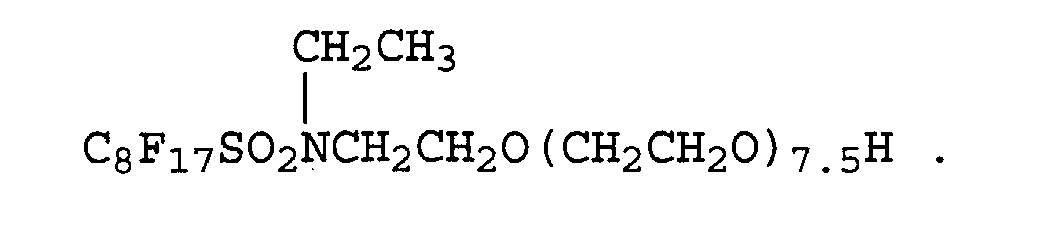
- The resulting reaction mixture is unreacted hydrolyzable silane, unreacted fluorocarbon alcohol and a reaction product of fluorocarbon alcohol and hydrolyzable silane in which at least one Y group is replaced by the fluorocarbon alcohol, as illustrated by the following equation


- The siloxaphobic reaction mixture through some unknown mechanism more readily forms a siloxaphobic surface layer than the use of unreacted fluorocarbon alcohol, i.e. the fluorocarbon alcohol is merely mixed with the other composition ingredients. The siloxaphobic surface layer is regenerated over the useful life of the cured silicone composition. The siloxaphobic reaction mixture acts as a reservoir and continually renews the siloxaphobic surface layer as it becomes depleted with age. The siloxaphobic surface layer also provides a cured composition which retards color formation on the surface and adjacent surrounding areas which may be exposed to weather. The siloxaphobic surface layer also keeps the properties of the cured elastomer from changing with age because siloxane ingredients are not readily lost by migration or evaporation, but are properly maintained within the cured silicone matrix. The siloxaphobic reaction mixture does not adversely effect the curing properties of the sealant or caulking material; and the adhesion to various substrates, particularly those used in building construction, are superior. The siloxaphobic reaction mixture is used in small amounts; yet provides useful properties over long periods of time. The amounts are such that the fluorocarbon group is present in the composition in amounts of from 0.1 to 7 inclusive weight percent, based on the weight of the composition, and preferably from 1 to 3 weight percent.
- The following examples are presented for illustrative purposes and are demonstrative of the present invention which is properly delineated in the claims. In the examples, part or parts refers to parts by weight and all viscosities were measured at 25°C.
- An RTV silicone composition was prepared by mixing under conditions which protected against ingress of moisture. In a mixer, 100 parts of a silanol endblocked polydimethylsiloxane having a viscosity of 50 Pa·s and 1 part of a ketoximosilane mixture of 72 weight percent of methyltri(methylethylketoximo)silane, 21 weight percent of methyldi(methylethylketoximo)methoxysilane, 0.5 weight percent of methyldimethoxy(methylethylketoximo)silane and 6.5 weight percent of impurities, were mixed for one minute under 74.29 kPa of vacuum and allowed to stand for 30 minutes. Then, 1 part of methylvinyldi(N-methylacetamido)silane was added and stirred for one minute under 74.29 kPa of vacuum. To the resulting mixture, 12 parts of a mixture of 2.5 parts of the above ketoximosilane mixture, 2.4 parts of a fluorocarbon alcohol (FC-10™), 0.4 part of betaaminoethyl-gamma-aminopropyltrimethoxysilane, 0.4 part of gamma-glycidoxypropyltimethoxysilane, 0.07 part of dibutyl tin dilaurate, 4 parts of methyltrimethoxysilane, 1 part of diisopropoxy di(ethoxyacetoacetyl) titanate, 1.1 parts of the reaction product of the FC-10™ fluorocarbon alcohol and the ketoximosilane mixture having the formula


- Next, 60 parts of stearic acid-treated precipitated calcium carbonate filler, having an average particle diameter of 0.04 micrometer and 1 part of a polymer of 2,5-furandione with 1,3-butadiene were added and stirred for 5 minutes under 74.29 kPa of vacuum. The resulting mixture was identified as a base composition and six such base mixtures were prepared. One of the base compositions was considered a control formulation and 1.75 part of tung oil was added and stirred under 74.29 kPa of vacuum. To five other base compositions, 2, 4, 6, 8 and 10 parts of particulate zinc oxide, having an average particle diameter of 0.12 micrometers, were added to each respectively and each was then stirred for 5 minutes under 74.29 kPa of vacuum. To each composition prepared, 1.75 parts of tung oil were added and stirred one minute under 74.29 kPa of vacuum.
- Each resulting formulation was then packaged in Semco™ tubes, made by Courtlands Aerospace, California and centrifuged to eliminate any entrained air. Samples of each of the 6 formulations were cast as 5.08 by 5.08 cm slabs of 0.254 cm thickness on polyethylene sheets and allowed to cure for 14 days at 21°C and 50% relative humidity. After cure, each of the sheets had developed a matte finish which was indicative of a tung oil modified silicone sealant surface. Test panels containing the 6 formulations were placed in a QUV™ accelerated weathering chamber, using a QUV™ A 340 light source, with a cycle of 8 hours ultraviolet radiation exposure at 70°C., followed by 4 hours of condensing humidity at 50°C. These evaluations were done in accordance with ASTM D 4587-86. The QUV™ chamber was from Q-Panel Corp., Cleveland, Ohio.
- After 650 hours in this chamber, inspection of the surface of the control formulation showed that the tung oil surface was deteriorating because the matte finish was disappearing, whereas the surfaces of those formulations containing particulate zinc oxide of the present invention showed no signs of loss of surface tung oil layer, because the matte finish remained equivalent to the matte finish initially observed. These results prove that particulate zinc oxide in an RTV silicone formulation unexpectedly increases the longevity of the the drying oil on its exposed surface.
- Six RTV silicone compositions were prepared as described above, except the combined amount of calcium carbonate filler and particulate zinc oxide was kept constant at 60 parts per 100 parts of polydimethylsiloxane, e.g. the control composition = 60 parts calcium carbonate; the composition containing 2 parts zinc oxide had 58 parts of calcium carbonate, the composition containing 4 parts zinc oxide had 56 parts of calcium carbonate; and the like. The combined parts of zinc oxide and calcium carbonate were kept constant to avoid any potential variations of physical properties due to change of the pigment to binder ratio. Each of these formulations were tested for durometer using the Shore A scale by ASTM D 2240 and also tested according to ASTM D 412, for tensile strength at break, reported in kPa (kilopascals), the elongation at break reported in percent and 100% modulus also reported in kPa. The results of these tests are reported in the Table.
TABLE AMOUNT OF ZINC OXIDE IN FORMULATION, in parts PROPERTY 0 2 4 6 8 10 DUROMETER 19 20 18 20 19 19 TENSILE AT BREAK, kPa 1880 1820 1660 2030 1770 2010 ELONGATION, % 1004 1087 1045 1192 1069 1169 100% MODULUS, kPa 260 230 230 230 230 230 - The cured physical properties were not functionally effected by the presence of the particulate zinc oxide as shown by comparing the control to those of our claimed formulations containing zinc oxide.
Claims (7)
- A method of increasing the longevity of a drying oil layer on an air exposed surface of a cured silicone composition comprising:(A) mixing particulate zinc oxide into a non-acidic room temperature curable silicone composition comprising a drying oil, a polymer with moisture condensable silyl end groups, a moisture sensitive crosslinking agent and a filler where the zinc oxide is added in an amount of at least 2 parts by weight, per 100 parts by weight of the polymer;(B) exposing the resulting mixture of (A) to atmospheric moisture to produce a cured composition having a drying oil layer on an air exposed surface where said surface maintains the drying oil layer for a longer time period than if zinc oxide was not added.
- The method in accordance with claim 1 in which the room temperature curable silicone composition further comprises a fluorinated compound.
- The method in accordance with claim 2 in which the fluorinated compound is a fluorinated alcohol having at least 13 fluorine atoms per molecule.
- The method in accordance with any of claims 1-3 in which the drying oil is tung oil.
- The method in accordance with claim 1 in which the silicon-crosslinker is a ketoximosilicon crosslinker having at least three silicon-bonded ketoximo groups per molecule.
- The method in accordance with claim 1 in which the room temperature vulcanizable silicone composition further comprises a titanate catalyst or a tin catalyst.
- The cured silicone composition obtainable by any of the methods of claims 1-6 having an air exposed drying oil surface layer which is maintained for long periods of time when the air exposure includes exposure to ultraviolet radiation.
Applications Claiming Priority (2)
| Application Number | Priority Date | Filing Date | Title |
|---|---|---|---|
| US08/628,170 US5733960A (en) | 1996-04-04 | 1996-04-04 | Enhanced longevity of surface drying oil on a sealant modified by incorporation of zinc oxide |
| US628170 | 1996-04-04 |
Publications (3)
| Publication Number | Publication Date |
|---|---|
| EP0799860A2 true EP0799860A2 (en) | 1997-10-08 |
| EP0799860A3 EP0799860A3 (en) | 1998-06-03 |
| EP0799860B1 EP0799860B1 (en) | 1999-10-13 |
Family
ID=24517767
Family Applications (1)
| Application Number | Title | Priority Date | Filing Date |
|---|---|---|---|
| EP97302275A Expired - Lifetime EP0799860B1 (en) | 1996-04-04 | 1997-04-02 | Method for enhancing longevity of a surface drying oil on a silicone composition modified by incorporation of zinc oxide |
Country Status (6)
| Country | Link |
|---|---|
| US (1) | US5733960A (en) |
| EP (1) | EP0799860B1 (en) |
| JP (1) | JPH1036689A (en) |
| KR (1) | KR970070112A (en) |
| AU (1) | AU710137B2 (en) |
| DE (1) | DE69700611T2 (en) |
Cited By (2)
| Publication number | Priority date | Publication date | Assignee | Title |
|---|---|---|---|---|
| WO2001042365A1 (en) * | 1999-12-10 | 2001-06-14 | General Electric Company | Room temperature curable silicone sealant |
| CN102093720A (en) * | 2010-09-14 | 2011-06-15 | 抚顺哥俩好化学有限公司 | Ketoxime type room temperature vulcanized silicone rubber with long storage period and preparation method thereof |
Families Citing this family (13)
| Publication number | Priority date | Publication date | Assignee | Title |
|---|---|---|---|---|
| US6268300B1 (en) * | 1998-12-22 | 2001-07-31 | Dow Corning Corporation | Textile coating compositions |
| PL1620491T3 (en) * | 2003-04-03 | 2007-10-31 | Dow Corning | Moisture curable organosiloxane compositions |
| EP1894975A1 (en) * | 2006-08-30 | 2008-03-05 | Sika Technology AG | Silicone composition |
| US7939615B2 (en) * | 2007-03-07 | 2011-05-10 | Saint-Gobain Performance Plastics Corporation | Articles containing silicone compositions and methods of making such articles |
| US7993754B2 (en) * | 2007-03-27 | 2011-08-09 | Momentive Performance Materials Inc. | Architectural unit possessing rapid deep-section cure silicone rubber component |
| US8217107B2 (en) * | 2007-03-27 | 2012-07-10 | Momentive Performance Materials Inc. | Rapid deep-section cure silicone compositions |
| SI2225310T1 (en) * | 2007-12-28 | 2018-09-28 | Nitrochemie Aschau Gmbh | Room temperature vulcanizable polymers |
| JP2013194063A (en) * | 2012-03-15 | 2013-09-30 | Aica Kogyo Co Ltd | Room temperature-curable polyorganosiloxane composition |
| EP2641935A1 (en) * | 2012-03-19 | 2013-09-25 | Sika Technology AG | Composition based on silane terminated polymers |
| CN103772994B (en) * | 2013-12-20 | 2016-12-07 | 浙江新安化工集团股份有限公司 | One is non-emits oil type rubber composition |
| US9586751B1 (en) | 2014-01-03 | 2017-03-07 | Swift Maintenance Products, Inc. | Dispensing systems and uses for sealant compositions |
| DE102015105661B4 (en) * | 2015-04-14 | 2022-04-28 | OSRAM Opto Semiconductors Gesellschaft mit beschränkter Haftung | Optoelectronic device with a mixture comprising a silicone and a fluoro-organic additive |
| US20170182512A1 (en) | 2015-12-28 | 2017-06-29 | Swift IP, LLC | Method of applying and using viscous liquid rubber composition |
Family Cites Families (7)
| Publication number | Priority date | Publication date | Assignee | Title |
|---|---|---|---|---|
| JPS5676453A (en) * | 1979-11-27 | 1981-06-24 | Toshiba Silicone Co Ltd | Room temperature curable polyorganosiloxane composition |
| JPS5676452A (en) * | 1979-11-27 | 1981-06-24 | Toshiba Silicone Co Ltd | Stain preventing method |
| JPS6044346B2 (en) * | 1982-03-26 | 1985-10-03 | 信越化学工業株式会社 | How to prevent contamination of the sealing part or its surroundings |
| JPS60258260A (en) * | 1984-06-01 | 1985-12-20 | Shin Etsu Chem Co Ltd | Room temperature curing silicone rubber composition |
| US5264603A (en) * | 1992-08-25 | 1993-11-23 | Dow Corning Corporation | Polydimethylsiloxanes for modulus reduction and method for their preparation |
| TW252146B (en) * | 1992-08-25 | 1995-07-21 | Dow Corning | |
| US5338574A (en) * | 1993-03-30 | 1994-08-16 | Dow Corning Corporation | Method for producing a painted silicone elastomer |
-
1996
- 1996-04-04 US US08/628,170 patent/US5733960A/en not_active Expired - Fee Related
-
1997
- 1997-04-02 DE DE69700611T patent/DE69700611T2/en not_active Expired - Fee Related
- 1997-04-02 AU AU16697/97A patent/AU710137B2/en not_active Ceased
- 1997-04-02 EP EP97302275A patent/EP0799860B1/en not_active Expired - Lifetime
- 1997-04-04 KR KR1019970012451A patent/KR970070112A/en not_active Withdrawn
- 1997-04-04 JP JP9086461A patent/JPH1036689A/en not_active Withdrawn
Cited By (3)
| Publication number | Priority date | Publication date | Assignee | Title |
|---|---|---|---|---|
| WO2001042365A1 (en) * | 1999-12-10 | 2001-06-14 | General Electric Company | Room temperature curable silicone sealant |
| CN102093720A (en) * | 2010-09-14 | 2011-06-15 | 抚顺哥俩好化学有限公司 | Ketoxime type room temperature vulcanized silicone rubber with long storage period and preparation method thereof |
| CN102093720B (en) * | 2010-09-14 | 2013-01-09 | 抚顺哥俩好化学有限公司 | Ketoxime type room temperature vulcanized silicone rubber with long storage period and preparation method thereof |
Also Published As
| Publication number | Publication date |
|---|---|
| AU1669797A (en) | 1997-10-09 |
| KR970070112A (en) | 1997-11-07 |
| US5733960A (en) | 1998-03-31 |
| JPH1036689A (en) | 1998-02-10 |
| EP0799860A3 (en) | 1998-06-03 |
| EP0799860B1 (en) | 1999-10-13 |
| DE69700611T2 (en) | 2000-12-07 |
| AU710137B2 (en) | 1999-09-16 |
| DE69700611D1 (en) | 1999-11-18 |
Similar Documents
| Publication | Publication Date | Title |
|---|---|---|
| EP0618257B1 (en) | Method for producing a painted silicone elastomer | |
| AU697745B2 (en) | Room temperature vulcanizable silicone compositions employing phenyl sub stituted tris-functional ketoxime silanes | |
| EP1167455B1 (en) | Room temperature rapid-curable silicone composition | |
| EP1620491B1 (en) | Moisture curable organosiloxane compositions | |
| AU2008231295B2 (en) | Rapid deep-section cure silicone compositions | |
| EP0799860B1 (en) | Method for enhancing longevity of a surface drying oil on a silicone composition modified by incorporation of zinc oxide | |
| US6254811B1 (en) | Organopolysilozane compositions crosslinkable with elimination of alcohols to give elastomer | |
| US5112885A (en) | Room temperature vulcanizable silicon rubber composition | |
| US5973023A (en) | Sealants containing fungicides exhibiting less chromophoric development upon exposure to UV by the incorporation of zinc oxide | |
| EP0586184B1 (en) | Polydimethylsiloxanes for modulus reduction and method for their preparation | |
| US20020091220A1 (en) | Room temperature curable organopolysiloxane compositions | |
| JP2784045B2 (en) | Room temperature curable silicone rubber composition | |
| US5356954A (en) | Method for preparing an electrically conductive organosiloxane composition | |
| JPH1036670A5 (en) | ||
| JPH0457850A (en) | Room-temperature-curable composition | |
| JPH06157910A (en) | Room temperature curable polyorganosiloxane composition | |
| JP2005162974A (en) | Room temperature curable organopolysiloxane composition | |
| JP5545924B2 (en) | Room temperature curable polyorganosiloxane composition | |
| JP4137235B2 (en) | Low specific gravity polyorganosiloxane composition | |
| EP0106363A2 (en) | Water resistant room temperature vulcanizable polyorganosiloxane compositions and method for preparing same | |
| JP4183940B2 (en) | Room temperature curable polyorganosiloxane composition | |
| JP4070858B2 (en) | Low specific gravity polyorganosiloxane composition | |
| JPH0211659A (en) | Sealing composition | |
| CA2164566A1 (en) | Method of reducing hot hydrocarbon oil swell of filled silicone sealant gaskets | |
| JP4884601B2 (en) | Room temperature curable polyorganosiloxane composition |
Legal Events
| Date | Code | Title | Description |
|---|---|---|---|
| PUAI | Public reference made under article 153(3) epc to a published international application that has entered the european phase |
Free format text: ORIGINAL CODE: 0009012 |
|
| AK | Designated contracting states |
Kind code of ref document: A2 Designated state(s): BE DE FR GB IT |
|
| PUAL | Search report despatched |
Free format text: ORIGINAL CODE: 0009013 |
|
| AK | Designated contracting states |
Kind code of ref document: A3 Designated state(s): BE DE FR GB IT |
|
| 17P | Request for examination filed |
Effective date: 19980708 |
|
| GRAG | Despatch of communication of intention to grant |
Free format text: ORIGINAL CODE: EPIDOS AGRA |
|
| GRAG | Despatch of communication of intention to grant |
Free format text: ORIGINAL CODE: EPIDOS AGRA |
|
| GRAH | Despatch of communication of intention to grant a patent |
Free format text: ORIGINAL CODE: EPIDOS IGRA |
|
| 17Q | First examination report despatched |
Effective date: 19990305 |
|
| GRAH | Despatch of communication of intention to grant a patent |
Free format text: ORIGINAL CODE: EPIDOS IGRA |
|
| GRAA | (expected) grant |
Free format text: ORIGINAL CODE: 0009210 |
|
| AK | Designated contracting states |
Kind code of ref document: B1 Designated state(s): BE DE FR GB IT |
|
| REF | Corresponds to: |
Ref document number: 69700611 Country of ref document: DE Date of ref document: 19991118 |
|
| ITF | It: translation for a ep patent filed | ||
| ET | Fr: translation filed | ||
| PLBE | No opposition filed within time limit |
Free format text: ORIGINAL CODE: 0009261 |
|
| STAA | Information on the status of an ep patent application or granted ep patent |
Free format text: STATUS: NO OPPOSITION FILED WITHIN TIME LIMIT |
|
| 26N | No opposition filed | ||
| PGFP | Annual fee paid to national office [announced via postgrant information from national office to epo] |
Ref country code: GB Payment date: 20010312 Year of fee payment: 5 Ref country code: FR Payment date: 20010312 Year of fee payment: 5 Ref country code: DE Payment date: 20010312 Year of fee payment: 5 |
|
| PGFP | Annual fee paid to national office [announced via postgrant information from national office to epo] |
Ref country code: BE Payment date: 20010417 Year of fee payment: 5 |
|
| REG | Reference to a national code |
Ref country code: GB Ref legal event code: IF02 |
|
| PG25 | Lapsed in a contracting state [announced via postgrant information from national office to epo] |
Ref country code: GB Free format text: LAPSE BECAUSE OF NON-PAYMENT OF DUE FEES Effective date: 20020402 |
|
| PG25 | Lapsed in a contracting state [announced via postgrant information from national office to epo] |
Ref country code: BE Free format text: LAPSE BECAUSE OF NON-PAYMENT OF DUE FEES Effective date: 20020430 |
|
| PG25 | Lapsed in a contracting state [announced via postgrant information from national office to epo] |
Ref country code: DE Free format text: LAPSE BECAUSE OF NON-PAYMENT OF DUE FEES Effective date: 20021101 |
|
| GBPC | Gb: european patent ceased through non-payment of renewal fee |
Effective date: 20020402 |
|
| PG25 | Lapsed in a contracting state [announced via postgrant information from national office to epo] |
Ref country code: FR Free format text: LAPSE BECAUSE OF NON-PAYMENT OF DUE FEES Effective date: 20021231 |
|
| REG | Reference to a national code |
Ref country code: FR Ref legal event code: ST |
|
| PG25 | Lapsed in a contracting state [announced via postgrant information from national office to epo] |
Ref country code: IT Free format text: LAPSE BECAUSE OF NON-PAYMENT OF DUE FEES;WARNING: LAPSES OF ITALIAN PATENTS WITH EFFECTIVE DATE BEFORE 2007 MAY HAVE OCCURRED AT ANY TIME BEFORE 2007. THE CORRECT EFFECTIVE DATE MAY BE DIFFERENT FROM THE ONE RECORDED. Effective date: 20050402 |