EP0800399B1 - Traitement therapeutique combine des pathologies hyperproliferatives - Google Patents
Traitement therapeutique combine des pathologies hyperproliferatives Download PDFInfo
- Publication number
- EP0800399B1 EP0800399B1 EP96901387A EP96901387A EP0800399B1 EP 0800399 B1 EP0800399 B1 EP 0800399B1 EP 96901387 A EP96901387 A EP 96901387A EP 96901387 A EP96901387 A EP 96901387A EP 0800399 B1 EP0800399 B1 EP 0800399B1
- Authority
- EP
- European Patent Office
- Prior art keywords
- combination according
- nucleic acid
- hydroxy
- cells
- benzoyloxy
- Prior art date
- Legal status (The legal status is an assumption and is not a legal conclusion. Google has not performed a legal analysis and makes no representation as to the accuracy of the status listed.)
- Expired - Lifetime
Links
Images


Classifications
-
- A—HUMAN NECESSITIES
- A61—MEDICAL OR VETERINARY SCIENCE; HYGIENE
- A61K—PREPARATIONS FOR MEDICAL, DENTAL OR TOILETRY PURPOSES
- A61K31/00—Medicinal preparations containing organic active ingredients
- A61K31/70—Carbohydrates; Sugars; Derivatives thereof
-
- A—HUMAN NECESSITIES
- A61—MEDICAL OR VETERINARY SCIENCE; HYGIENE
- A61K—PREPARATIONS FOR MEDICAL, DENTAL OR TOILETRY PURPOSES
- A61K33/00—Medicinal preparations containing inorganic active ingredients
- A61K33/24—Heavy metals; Compounds thereof
- A61K33/243—Platinum; Compounds thereof
-
- A—HUMAN NECESSITIES
- A61—MEDICAL OR VETERINARY SCIENCE; HYGIENE
- A61K—PREPARATIONS FOR MEDICAL, DENTAL OR TOILETRY PURPOSES
- A61K38/00—Medicinal preparations containing peptides
- A61K38/16—Peptides having more than 20 amino acids; Gastrins; Somatostatins; Melanotropins; Derivatives thereof
- A61K38/17—Peptides having more than 20 amino acids; Gastrins; Somatostatins; Melanotropins; Derivatives thereof from animals; from humans
- A61K38/19—Cytokines; Lymphokines; Interferons
- A61K38/191—Tumor necrosis factors [TNF], e.g. lymphotoxin [LT], i.e. TNF-beta
-
- A—HUMAN NECESSITIES
- A61—MEDICAL OR VETERINARY SCIENCE; HYGIENE
- A61P—SPECIFIC THERAPEUTIC ACTIVITY OF CHEMICAL COMPOUNDS OR MEDICINAL PREPARATIONS
- A61P35/00—Antineoplastic agents
-
- A—HUMAN NECESSITIES
- A61—MEDICAL OR VETERINARY SCIENCE; HYGIENE
- A61P—SPECIFIC THERAPEUTIC ACTIVITY OF CHEMICAL COMPOUNDS OR MEDICINAL PREPARATIONS
- A61P35/00—Antineoplastic agents
- A61P35/02—Antineoplastic agents specific for leukemia
-
- A—HUMAN NECESSITIES
- A61—MEDICAL OR VETERINARY SCIENCE; HYGIENE
- A61P—SPECIFIC THERAPEUTIC ACTIVITY OF CHEMICAL COMPOUNDS OR MEDICINAL PREPARATIONS
- A61P43/00—Drugs for specific purposes, not provided for in groups A61P1/00-A61P41/00
-
- A—HUMAN NECESSITIES
- A61—MEDICAL OR VETERINARY SCIENCE; HYGIENE
- A61P—SPECIFIC THERAPEUTIC ACTIVITY OF CHEMICAL COMPOUNDS OR MEDICINAL PREPARATIONS
- A61P9/00—Drugs for disorders of the cardiovascular system
- A61P9/10—Drugs for disorders of the cardiovascular system for treating ischaemic or atherosclerotic diseases, e.g. antianginal drugs, coronary vasodilators, drugs for myocardial infarction, retinopathy, cerebrovascula insufficiency, renal arteriosclerosis
Definitions
- the present invention relates to the field of therapy for hyperproliferative pathologies. It relates more particularly to a new mode of treatment of hyperproliferative pathologies based on the combined use of two types of therapeutic agents. More specifically, the present invention relates to a new mode of treatment of hyperproliferative pathologies based on the combined use of genes blocking oncogenic cellular signaling pathways and chemotherapy and or radiotherapy agents.
- the combined treatments according to the present invention have particularly effective effects for the destruction of hyperproliferation cells, at relatively low doses.
- the present invention thus provides a new method of treatment of hyperproliferative pathologies (cancers, restenosis, etc.) which is particularly effective and with limited side effects.
- Radiotherapy and chemotherapy certainly have a very favorable impact on the development of cancers.
- an acute problem in the treatment of cancers is the insensitivity of certain primary tumors and / or the appearance of resistant tumor cells, after a first cycle of effective treatments, both by radio and by chemotherapy.
- Numerous studies have attempted to elucidate the molecular mechanisms which can be at the origin of these events. In general, work has focused on how chemotherapeutic agents enter cells and how they react with their cell targets (Chin et al., Adv.Cancer Res.
- the mode of treatment according to the invention is based essentially on the combined use of two types of therapeutic agents: genes blocking oncogenic cell signaling pathways and chemotherapy and / or radiotherapy agents.
- the present invention in fact stems from the demonstration of a particularly important synergistic effect linked to the combined use of these two types of agents.
- a first object of the present invention therefore relates to a drug combination of one or more nucleic acids at least partially inhibiting oncogenic cell signaling pathways, and of an anticancer therapeutic agent, for simultaneous, separate or spread over time use. the treatment of hyperproliferative pathologies.
- the invention essentially rests on the demonstration of a synergistic effect between the product of certain genes and the anticancer therapy agents. This combined use produces more powerful effects, at lower doses of agents.
- This invention therefore provides a means for the treatment of particularly advantageous hyperproliferative pathologies.
- the two components of the combined treatment of the present invention can be used simultaneously, separately or spread out over time.
- the two agents are incubated in the cells or administered to the patient simultaneously.
- the two agents can be packaged separately and then mixed extemporaneously before being administered together. More commonly, they are administered simultaneously but separately.
- the administration views of the two agents may be different.
- the two agents are administered spaced over time.
- the nucleic acid used in the context of the present invention can be a deoxyribonucleic acid (DNA) or a ribonucleic acid (RNA).
- DNA deoxyribonucleic acid
- RNA ribonucleic acid
- DNA it may be a complementary DNA (cDNA), genomic DNA (gDNA), a hybrid sequence or a synthetic or semi-synthetic sequence.
- cDNA complementary DNA
- gDNA genomic DNA
- hybrid sequence a synthetic or semi-synthetic sequence
- It can also be a chemically modified nucleic acid, for example to increase its resistance to nucleases, its penetration or its cellular targeting, its therapeutic efficacy, etc.
- These nucleic acids can be of human, animal, plant, bacterial, viral, synthetic, etc. origin. They can be obtained by any technique known to those skilled in the art. trade, and in particular by screening of banks, by chemical synthesis, or again by mixed methods including chemical modification or enzymatic sequence obtained by screening libraries. As indicated below, they
- the nucleic acid is a DNA or an RNA coding for a polypeptide or a protein at least partially inhibiting oncogenic cellular signaling pathways.
- the polypeptide or the protein are chosen from the dominant negatives, the ScFvs and the tumor suppressors.
- the dominant negative is made up of the N-terminal region of the GAP protein, of the Gbr3-3 protein or of mutants of the Ets proteins.
- ScFv it is preferably a ScFv directed against a mutated ras protein or against the GAP factor.
- the tumor suppressor protein is advantageously p53, Rb, waf1, p21, DCC or MTS.
- the nucleic acid is DNA encoding an RNA inhibiting at at least partially oncogenic cell signaling pathways. More particularly, RNA is an RNA complementary to an acid target nucleic acid capable of blocking its transcription and / or translation (Antisense RNA); a ribozyme or a ligand RNA. A preferred example is an anti-sense anti-Kiras RNA.
- the nucleic acid is an antisense oligonucleotide, possibly chemically modified. It can be in particular oligonucleotides whose phosphodiester backbone has been modified chemically, such as for example phosphonate oligonucleotides, phosphotriesters, phosphoramidates and phosphorothioates which are described, for example, in patent application WO94 / 08003. he can also be alpha oligonucleotides, or oligonucleotides conjugated to agents such as acrylating compounds.
- the nucleic acid is incorporated into a vector.
- the vector used can be of chemical origin (liposome, nanoparticle, peptide complex, cationic lipids, etc.) viral (retrovirus, Adenovirus, herpes virus, AAV, vaccinia virus, etc.) or plasmid.
- the nucleic acid used in the present invention can be formulated for topical, oral, parenteral, intranasal, intravenous, intramuscular, subcutaneous, intraocular, transdermal, etc.
- the nucleic acid is used in a injectable form. It can therefore be mixed with any vehicle pharmaceutically acceptable for an injectable formulation, especially for direct injection at the site to be treated.
- nucleic acid can be adapted according to different parameters, and in particular according to the gene, the vector, the mode of administration used, the pathology concerned or the duration of treatment sought.
- the anticancer therapeutic agent used for the implementation of the present invention can be any agent currently used by those skilled in the art in chemotherapy or radiotherapy.
- it may be cis-platinum, taxoid, etoposide, TNF, adriamycin, camptotecin, from a mitotic spindle poison (vincaalcalo ⁇ des, navelleine, etc), X-rays, UV, etc. Results particularly interesting were obtained using as an agent chemotherapy a taxoid.
- the Chemotherapeutic Agent anticancer is administered according to conventional routes. Generally it is administered parenterally.
- both agents can be used simultaneous, separate or spread over time.
- the acid nucleic acid is administered first and then when the nucleic acid can be expressed by or cells, the anticancer therapeutic agent is administered.
- a particularly preferred mode of implementing the The present invention relates to a drug combination of one or several tumor suppressor genes and a taxoid, for a simultaneous, separate or spread over time for the treatment of hyperproliferative pathologies.
- the suppressor gene codes for the wild form of the p53 protein or for waf1 protein (p21.)
- the present invention thus provides a particularly effective method for the destruction of hyperproliferative cells. It can be used in vitro or ex vivo, by incubating cells simultaneously or spread over time in the presence of the nucleic acid (s) and chemotherapy agents.
- the subject of the invention is also a method of destroying hyperproliferative cells comprising bringing said cells or a part of them into contact with a nucleic acid and a chemotherapy agent as defined above.
- the present invention is advantageously used in vivo for the destruction of cells in hyperproliferation (ie in abnormal proliferation). It is thus applicable to the destruction of tumor cells or smooth muscle cells of the vascular wall (restenosis). It is particularly suitable for the treatment of cancers in which an activated oncogene is involved.
- colon adenocarcinomas thyroid cancer, lung carcinoma, myeloid leukemia, colorectal cancer, breast cancer, lung cancer, gastric cancer, cancer esophagus, B lymphomas, ovarian cancers, bladder cancers, glioblastomas, etc.
- antisense nucleic acids are nucleic acid sequences capable of selectively hybridizing with cell-target messenger RNAs, to inhibit their translation into protein. These nucleic acids form, with the target mRNA, locally, double-stranded regions, of RNA / mRNA type or even DNA / mRNA, by interaction of conventional Watson-Crick type.
- oligonucleotides can be, for example, synthetic oligonucleotides, of small size, complementary to cellular mRNAs, and which are introduced into the target cells. Such oligonucleotides have for example been described in patent No. EP 92 574. They may also be DNA sequences whose expression in the target cell generates RNAs complementary to cellular mRNAs. Such sequences have for example been described in patent No. EP 140,308. More recently, a new type of nucleic acid capable of regulating the expression of target genes has been identified. These nucleic acids do not hybridize with cellular mRNAs, but directly with double-stranded genomic DNA.
- nucleic acids are capable of interacting specifically in the large groove of the DNA double helix to locally form triple helices, leading to inhibition of transcription of target genes. .
- These nucleic acids selectively recognize the DNA double helix at the level of oligopurine.oligopyrimidine sequences, that is to say at the level of regions having an oligopuric sequence on one strand and an oligopyrimidic sequence on the complementary strand, and form therein. locally a triple helix.
- the bases of the third strand (the oligonucleotide) form hydrogen bonds (Hoogsteen or reverse Hoogsteen bonds) with the purines of the Watson-Crick base pairs.
- the antisense nucleic acids according to the present invention can be DNA sequences coding for antisense RNAs or for ribozymes.
- the antisense RNAs thus produced can interact with a mRNA or a target genomic DNA and form with it double or triple helices. They can also be antisense sequences (oligonucleotides), optionally chemically modified, capable of interacting directly with the target gene or RNA.
- the antisense according to the invention are directed against oncogenes or specific regions of activated oncogenes, in particular the ras oncogene.
- RNA ligands are small oligoribonucleotides, very specific and very refined for a given target, in particular protein.
- the preparation and identification of such RNA ligands has been described in particular in application WO91 / 19813.
- a dominant negative is a polypeptide antagonist of an oncogenic signaling pathway. This antagonism occurs when the polypeptide is positioned in contact with a key element of oncogenic signaling and enters into competition with the polypeptide naturally used in the cell for this signaling.
- the antagonistic polypeptide used is very often a mime of the natural polypeptide but devoid of the domains allowing the oncogenic signal to propagate through it.
- Example 1 of the present application now shows that an overexpression of the GAP domain (170-702) induces apoptosis of human cells, so-called no small cell lung carcinoma (H460).
- Example 2 further shows that the apoptotic effect induced by the GAP construct (170-702) is very greatly increased by the addition to the culture medium of human tumor cells of products such as cis-platinum, camptotecin. or taxotere at concentrations of these products which have no effect on cell viability.
- Example 1 of the present application also describes the activity of the grb3-3 gene in H460 cells.
- the sequence and the presumed function of Grb3-3 were described in Science 1994.
- Example 2 also shows that the apoptotic effect induced by the transfer of the Grb3-3 gene is very greatly increased by the addition to the culture medium.
- human tumor cells from products such as cis-platinum, camptotecin or taxotere at concentrations of these products which have no effect on cell viability.
- ScFv are molecules with binding properties comparable to that of an antibody, active intracellularly. These are more particularly molecules consisting of a peptide corresponding to the binding site of the variable region of the light chain of an antibody linked by a peptide linker to a peptide corresponding to the binding site of the variable region of the chain heavy with an antibody.
- the Applicant has shown that such ScFvs can be produced in vivo by gene transfer (see application WO 94/29446). More particularly, this application shows that it is possible to neutralize oncogenic proteins by expressing ScFv in different cellular compartments.
- a nucleic acid is used allowing the intracellular production of an ScFv neutralizing the transforming power of ras proteins, in combination with a chemotherapy agent.
- a chemotherapy agent e.g., a chemotherapy agent for a nucleic acid.
- Such an association produces significant synergistic effects (see example 2).
- the tumor suppressor genes which can be used in the context of the present invention, there may be mentioned more particularly the genes p53, p21, Rb, rap1A, DDC, WAF and MTS. More particularly, the p53, Rb or Waf genes are used.
- the p53 gene codes for a 53 kDa nuclear protein.
- the mutated deletion and / or mutation form of this gene is involved in the development of most human cancers (Baker et al., Science 244 (1989) 217). Its mutated forms are also capable of cooperating with ras oncogenes to transform murine fibroblasts.
- the wild-type gene encoding native p53 inhibits the formation of foci of transformation in fibroblasts of rodents transfected with various combinations of oncogenes.
- the p53 protein may itself be a transcription factor and stimulate the expression of other tumor suppressor genes.
- an effect of p53 on the proliferation of vascular smooth muscle cells has been demonstrated recently (Epstein et al. Science 151 (1994)).
- the Rb gene determines the synthesis of a nuclear phosphoprotein of approximately 927 amino acids (Friend et al., Nature 323 (1986) 643) whose function is to suppress the division of cells by making them enter the quiescence phase.
- Inactivated forms of the Rb gene have been implicated in various tumors, and in particular in retinoblastomas or in mesenchymal cancers such as osteosarcomas. Reintroduction of this gene into tumor cells where it was inactivated produces a return to normal state and a loss of tumorigenicity (Huang et al., Science 242 (1988) 1563). Recently, it has been shown that the normal Rb protein, but not its mutated forms, suppresses the expression of the proto-oncogene c-fos, a gene essential for cell proliferation.
- the WAF and MTS genes and their antitumor properties have been described in the literature (Cell 75 (1993) 817; Science 264 (1994) 436).
- Example 3 demonstrates an effective type of association between a taxol derivative and the p53 gene.
- Taxol induces apoptosis in different tumor cell lines in culture (Proceedings of the American Association for cancer Research Vol 35, march 1994, Bhalla et al p306, Seiter et al p314, Saunders et al p317).
- p53 triggers apoptosis in different cell types.
- particular clones of H460 cells resistant to the effect of p53 have been cultured in the presence of increasing doses of taxotere.
- Example 3 clearly demonstrates that cells die as a result of taxotere treatment at completely ineffective concentrations on cells not expressing wild-type p53.
- Waf 1 Wild-type p53 Activated Fragment Cell, 75,817, 1993
- p21 Natural-type p53 Activated Fragment Cell, 75,817, 1993
- Waf 1 appears in cells which are stopped in G1 phase or in apoptosis following an overexpression of wild-type p53 but not in cells which are stopped in G1 or in apoptosis independently of p 53 (Cancer Res, 54, 1169, 1994).
- Waf 1 decreases the growth of tumor cells as effectively as wild-type p53.
- the combined use of a Waf 1 gene and taxol derivatives also induces a synergistic effect on the destruction of hyperproliferative cells.
- taxol docetaxel or paclitaxel.
- the nucleic acid can be injected as it is at the site to be treated, or incubated directly with the cells to be destroyed or treated. It has in fact been described that naked nucleic acids can penetrate cells without any particular vector. Nevertheless, it is preferred in the context of the present invention to use an administration vector, making it possible to improve (i) the efficiency of cell penetration, (ii) targeting (iii) extra- and intracellular stability.
- Different types of vectors can be used. They can be viral or non-viral vectors.
- viral vectors are based on natural properties virus transfection. It is thus possible to use adenoviruses, herpes viruses, retroviruses and more recently adeno associated viruses. These vectors are particularly effective in terms of transfection.
- adenoviruses As regards more particularly adenoviruses, different serotypes, whose structure and properties vary somewhat, have been characterized. Among these serotypes, it is preferred to use in the context of present invention human adenoviruses type 2 or 5 (Ad 2 or Ad 5) or adenoviruses of animal origin (see application WO94 / 26914).
- adenoviruses of animal origin include adenoviruses of canine, bovine, murine origin, (example: Mav1, Beard et al., Virology 75 (1990) 81), ovine, porcine, avian or even simian (example: after-sales service).
- the adenovirus of animal origin is a canine adenovirus, more preferably a CAV2 adenovirus [Manhattan strain or A26 / 61 (ATCC VR-800) by example].
- adenovirus of human or canine or mixed origin is a canine adenovirus, more preferably a CAV2 adenovirus [Manhattan strain or A26 / 61 (ATCC VR-800) by example.
- adenovirus of human or canine or mixed origin is preferably, in the context of the invention.
- the defective adenoviruses of the invention comprise the ITRs, a sequence allowing the encapsidation and the nucleic acid of interest.
- the E1 region at least is non-functional.
- the viral gene considered can be made non-functional by any technique known to a person skilled in the art, and in particular by total suppression, substitution, partial deletion, or addition of one or more bases in the gene or genes considered. Such modifications can be obtained in vitro (on isolated DNA) or in situ, for example, by means of genetic engineering techniques, or by treatment with mutagenic agents. Other regions can also be modified (E2, E3, E4, L1-L5, etc.).
- the defective recombinant adenoviruses according to the invention can be prepared by any technique known to a person skilled in the art (Levrero et al., Gene 101 (1991) 195, EP 185 573; Graham, EMBO J. 3 (1984) 2917). In particular, they can be prepared by homologous recombination between an adenovirus and a plasmid carrying, inter alia, the DNA sequence of interest. Homologous recombination occurs after co-transfection of said adenovirus and plasmid in an appropriate cell line.
- the cell line used must preferably (i) be transformable by said elements, and (ii), contain the sequences capable of complementing the part of the genome of the defective adenovirus, preferably in integrated form to avoid the risks of recombination.
- a line By way of example of a line, mention may be made of the human embryonic kidney line 293 (Graham et al., J. Gen. Virol. 36 (1977) 59) which contains, in particular, integrated into its genome, the left part of the genome an Ad5 adenovirus (12%).
- Strategies for constructing vectors derived from adenoviruses have also been described in applications No. WO 94/26914 and FR 93 08596. Then, the adenoviruses which have multiplied are recovered and purified according to conventional techniques of molecular biology, as illustrated in the examples.
- AAV adeno-associated viruses
- the defective recombinant AAVs according to the invention can be prepared by co-transfection, in a cell line infected with a human helper virus (for example an adenovirus), of a plasmid containing the nucleic sequence of interest bordered by two inverted repeat regions (ITR) from AAV, and a plasmid carrying the packaging genes (rep and cap genes) from AAV.
- a human helper virus for example an adenovirus
- ITR inverted repeat regions
- rep and cap genes packaging genes
- retroviruses are integrative viruses, selectively infecting dividing cells. They therefore constitute vectors of interest for cancer applications.
- the genome of retroviruses essentially comprises two LTRs, an encapsidation sequence and three coding regions (gag, pol and env).
- the gag, pol and env genes are generally deleted, in whole or in part, and replaced by a heterologous nucleic acid sequence of interest.
- retroviruses can be produced from different types of retroviruses such as in particular MoMuLV ("murine moloney leukemia virus”; also designated MoMLV), MSV ("murine moloney sarcoma virus”), HaSV ("harvey sarcoma virus”) ; SNV ("spleen necrosis virus”); RSV ("rous sarcoma virus”) or the Friend virus.
- MoMuLV murine moloney leukemia virus
- MSV murine moloney sarcoma virus
- HaSV human moloney sarcoma virus
- SNV spleen necrosis virus
- RSV rous sarcoma virus
- Friend virus Friend virus
- the packaging lines are therefore capable of expressing the gag, pol and env genes.
- packaging lines have been described in the prior art, and in particular the line PA317 (US4,861,719); the PsiCRIP line (WO90 / 02806) and the GP + envAm-12 line (WO89 / 07150).
- the recombinant retroviruses may include modifications at the level of the LTRs to suppress transcriptional activity, as well as extended packaging sequences, comprising a part of the gag gene (Bender et al., J. Virol. 61 (1987) 1639). The recombinant retroviruses produced are then purified by conventional techniques.
- adenovirus or a retrovirus defective recombinant indeed have properties particularly interesting for the transfer of genes into cells tumor.
- the vector according to the invention can also be a non-viral agent capable of promoting the transfer and expression of nucleic acids in eukaryotic cells.
- Chemical or biochemical vectors represent an interesting alternative to natural viruses, in particular for reasons of convenience, safety and also by the absence of theoretical limit as regards the size of the DNA to be transfected.
- These synthetic vectors have two main functions, to compact the nucleic acid to be transfected and to promote its cellular fixation as well as its passage through the plasma membrane and, where appropriate, the two nuclear membranes.
- the non-viral vectors all have polycationic charges.
- polymers polylysine type cationics polylysine type cationics, (LKLK) n, (LKKL) n, immine polyethylene and DEAE dextran or the cationic lipids or lipofectants are the more advantageous. They have the property of condensing DNA and promote its association with the cell membrane. Among these the latter, mention may be made of lipopolyamines (lipofectamine, transfectam, etc.) and different cationic or neutral lipids (DOTMA, DOGS, DOPE, etc.).
- lipopolyamines lipofectamine, transfectam, etc.
- DOTMA cationic or neutral lipids
- a preferred administration protocol comprises first the nucleic acid, then the therapeutic agent.
- the administration of the transgene is repeated in order to obtain maximum expression in a maximum of dividing cells (for example 5 days in a row) and the treatment with chemotherapy is then administered.
- the nucleic acid (s) are administered in contact with the lesion, either by direct intra-tumor injection into multiple sites of the lesion, or in contact with the atheromatous lesion by means of a pad adapted to this type of intervention.
- the chemotherapy agent is administered according to current clinical protocols.
- the H460 cells grown in RPMI 1640 medium containing 10% fetal calf serum, are transfected with the cDNAs coding for the GAP domain [170-702] or for the Grb3-3 protein in association with a gene conferring on positively transfected cells resistance to geneticin ( Neo ).
- These cDNAs placed in plasmids and whose expression is under the control of viral promoters (pSV 2 - GAP [170-702], pSV2- Grb3-3 and pSV2 -Neo ), are introduced into H460 cells at using lipofectAMINE as a transfecting agent.
- the H460 / Neo R cells (resistant to the presence of 400 ⁇ g / ml of geneticin in the culture medium) are selected and quantified 15-20 days after transfection.
- the results of a representative experiment for quantifying the number of Neo R colonies under the different transfection conditions are summarized in FIG. 1 (pSV 2 -Oli: control plasmid having no cDNA of interest and thus allowing control of the efficiency of genetic selection).
- the H460 cells, transfected as indicated in Example 1, are subjected during genecitin selection to treatment for several days at different concentrations of taxotere, cis-platinum or camptotecin.
- the H460 / Neo R cells and resistant to chemotherapy agents are quantified as described in Example 1.
- the sensitivity to taxotere ( A ), cis-platinum ( B ) or camptotecin ( C ) of the transfected H460 cells with pSV 2 - Neo ( ⁇ ), pSV2- Neo + pSV2- GAP [170-702] ( ⁇ ), or pSV2- Neo + pSV2- Grb3-3 ( ⁇ ) is represented relative to the cells transfected in an identical manner but in absence treatment with chemotherapeutic agents.
- the results of a representative experiment to quantify the number of colonies after the various treatments indicated are summarized in Figure 2.
- the H460 cells are transfected with the cDNA coding for the wild-type p53 protein (p53 WT ) placed in the plasmid pcDNA3 under the control of the CMV promoter.
- the pcDNA3 plasmid also contains the Neo gene placed under the control of the SV 40 promoter.
- Cells transfected with pcDNA3 or pcDNA3-p53 WT are selected and isolated as indicated in example 1. In cells transfected with pcDNA3-p53 WT and resistant to geneticin, the presence of p53 is checked by Western blot at l using specific antibodies.
Landscapes
- Health & Medical Sciences (AREA)
- Life Sciences & Earth Sciences (AREA)
- General Health & Medical Sciences (AREA)
- Chemical & Material Sciences (AREA)
- Medicinal Chemistry (AREA)
- Veterinary Medicine (AREA)
- Public Health (AREA)
- Pharmacology & Pharmacy (AREA)
- Animal Behavior & Ethology (AREA)
- Epidemiology (AREA)
- Bioinformatics & Cheminformatics (AREA)
- Engineering & Computer Science (AREA)
- General Chemical & Material Sciences (AREA)
- Nuclear Medicine, Radiotherapy & Molecular Imaging (AREA)
- Chemical Kinetics & Catalysis (AREA)
- Organic Chemistry (AREA)
- Zoology (AREA)
- Gastroenterology & Hepatology (AREA)
- Inorganic Chemistry (AREA)
- Molecular Biology (AREA)
- Proteomics, Peptides & Aminoacids (AREA)
- Immunology (AREA)
- Hematology (AREA)
- Oncology (AREA)
- Heart & Thoracic Surgery (AREA)
- Urology & Nephrology (AREA)
- Cardiology (AREA)
- Vascular Medicine (AREA)
- Medicines That Contain Protein Lipid Enzymes And Other Medicines (AREA)
- Pharmaceuticals Containing Other Organic And Inorganic Compounds (AREA)
- Medicines Containing Material From Animals Or Micro-Organisms (AREA)
- Medicinal Preparation (AREA)
- Acyclic And Carbocyclic Compounds In Medicinal Compositions (AREA)
Description
Plus spécifiquement, la présente invention concerne un nouveau mode de traitement des pathologies hyperprolifératives basé sur l'utilisation combinée de gènes bloquant des voies de signalisation cellulaires oncogéniques et d'agents de chimiothérapie et ou de radiothérapie. Les traitements combinés selon la présente invention ont des effets particulièrement efficaces pour la destruction des cellules en hyperprolifération, à des doses relativement faibles. La présente invention fournit ainsi une nouvelle méthode de traitement des pathologies hyperprolifératives (cancers, resténose, etc) particulièrement efficace et avec des effets secondaires limités.
De nombreuses études ont tenté d'élucider les mécanismes moléculaires qui peuvent être à l'origine de ces évènements. D'une manière générale les travaux ont porté sur la manière dont les agents chimiothérapiques entraient dans les cellules et sur la manière dont ils réagissaient avec leurs cibles cellulaires (Chin et coll., Adv.Cancer Res. 60 (1993) 157-180; Chabner and Meyers in Cancer/ Principles and practices of Oncology, De Vita et al Eds., J.B.Lippencott Co. p. 349-395,1989). Par exemple, de forts niveaux d'expression du gene mdr1 peuvent limiter la concentration intracellulaire d'agents de chimiothérapie divers et pourraient contribuer à l'expression de la résistance multi-drogues. (Chin et coll, voir plus haut ).
Une élucidation plus complète des mécanismes de résistance à la chimiothérapie et à la radiothérapie passe par une meilleure connaissance des processus de mort cellulaire induits par ces agents. Puisque les radiations ionisantes et de nombreux agents anti-cancéreux induisent des domages dans l'ADN, l'effet de ces agents thérapeutiques a été attribué à leur pouvoir génotoxique. Cependant les domages cellulaires causés par ces agents ne permettent pas d'expliquer complètement leur activité thérapeutique (Chabner et Meyers voir plus haut). Ces dernières années, l'exploration et la compréhension des mécanismes de la mort programmée ou apoptose ont permis de reconsidérer les mécanismes par lesquels les cellules tumorales acquièrent ou perdent leur sensibilité aux agents cytotoxiques. De nombreux stimuli toxiques induisent l'apoptose même à des doses insuffisantes pour induire des disfonctionnements métaboliques. La capacité d'induire une réponse apoptotique dans les cellules tumorales pourrait déterminer l'efficacité du traitement.
Un premier objet de la présente invention concerne donc une association médicamenteuse d'un ou plusieurs acides nucléiques inhibant au moins partiellement des voies de signalisation cellulaires oncogéniques, et d'un agent thérapeutique anticancéreux, pour une utilisation simultanée, séparée ou étalée dans le temps pour le traitement des pathologies hyperprolifératives.
Comme indiqué ci-avant, l'invention repose essentiellement sur la mise en évidence d'un effet synergique entre le produit de certains gènes et les agents de thérapie anticancéreuse. Cette utilisation combinée produit des effets plus puissants, à des doses d'agents inférieures. Cette invention offre donc un moyen pour le traitement des pathologies hyperprolifératives particulièrement avantageux.
Comme indiqué plus loin, selon le gène et l'agent de chimio ou radiothérapie choisis, les deux composantes du traitement combiné de la présente invention peuvent être utilisées de manière simultanée, séparée ou étalée dans le temps. Dans le cas d'une utilisation simultanée, les deux agents sont incubés aux cellules ou administrés au patient simultanément. Selon ce mode de mise en oeuvre de la présente invention, les deux agents peuvent être conditionnés séparément puis mélangés extemporanément avant d'être administrés ensemble. Plus communément, ils sont administrés simultanément mais de manière séparée. En particulier, les vois d'administrations des deux agents peuvent être différentes. Dans un autre mode de mise en oeuvre, les deux agents sont administrés de manière espacée dans le temps.
Les acides nucléiques utilisés dans le cadre de l'invention peuvent être de différents types. Il s'agit de manière préférentielle :
- d'acides nucléiques antisens,
- d'oligoribonucléotides capables de fixer directement des protéines cibles oncogéniques pour les neutraliser (ARN ligand),
- d'acides nucléiques codant pour des protéines à caractère dominant négatif capables de s'oligomériser, produisant ainsi un complexe inactif,
- d'acides nucléiques codant pour des anticorps intracellulaires (par exemple des fragments variables à chaíne unique issu d'un anticorps) dirigés contre une protéine oncogénique (ScFv).
- de gènes suppresseurs de tumeurs.
Encore plus préférentiellement, le dominant négatif est un constitué de la région N-terminale de la protéine GAP, de la protéine Gbr3-3 ou de mutants des protéines Ets. Concernant le ScFv, il s'agit préférentiellement d'un ScFv dirigé contre une protéine ras mutée ou contre le facteur GAP. La protéine suppresseur de tumeurs est avantageusement p53, Rb, waf1, p21, DCC ou MTS.
La présente invention est avantageusement utilisée in vivo pour la destruction de cellules en hyperprolifération (i.e. en prolifération anormale). Elle est ainsi applicable à la destruction des cellules tumorales ou des cellules de muscle lisse de la paroi vasculaire (resténose). Elle est tout particulièrement appropriée au traitement des cancers dans lesquels un oncogène activé est impliqué. A titre d'exemple, on peut citer les adénocarcinomes du colon, les cancers de la thyroïde, les carcinomes du poumon, les leucémies myéloïdes, les cancers colorectaux, les cancers du sein, les cancers du poumon, les cancers gastriques, les cancers de l'oesophage, les lymphômes B, les cancers ovariens, les cancers de la vessie, les glioblastomes, etc.
Les acides nucléiques antisens sont des séquences nucléiques capables de s'hybrider sélectivement avec des ARNs messager cellulaires-cible, pour inhiber leur traduction en protéine. Ces acides nucléiques forment avec l'ARNm-cible, de manière locale, des régions double-brin, de type ARN/ARNm ou même ADN/ARNm, par interaction de type Watson-Crick classique. Il peut s'agir par exemple d'oligonucléotides synthétiques, de petite taille, complémentaires d'ARNm cellulaires, et qui sont introduits dans les cellules-cible. De tels oligonucléotides ont par exemple été décrits dans le brevet n° EP 92 574. Il peut également s'agir de séquences d'ADN dont l'expression dans la cellule-cible génère des ARN complémentaires d'ARNm cellulaires. De telles séquences ont par exemple été décrites dans le brevet n° EP 140 308.
Plus récemment, un nouveau type d'acides nucléiques capables de réguler l'expression de gènes-cible a été mis en évidence. Ces acides nucléiques ne s'hybrident pas avec les ARNm cellulaires, mais directement avec l'ADN génomique en double-brin. Cette nouvelle approche repose sur la mise en évidence que certains acides nucléiques sont capables d'interagir spécifiquement dans le grand sillon de la double-hélice d'ADN pour former localement des triple-hélices, conduisant à une inhibition de la transcription de gènes-cible. Ces acides nucléiques reconnaissent sélectivement la double-hélice d'ADN au niveau de séquences oligopurine.oligopyrimidine, c'est-à-dire au niveau de régions possédant une séquence oligopurique sur un brin et une séquence oligopyrimidique sur le brin complémentaire, et y forment localement une triple-hélice. Les bases du troisième brin (l'oligonucléotide) forment des liaisons hydrogène (liaisons Hoogsteen ou Hoogsteen inverse) avec les purines des paires de bases Watson-Crick. De tels acides nucléiques ont notamment été décrits par Hélène dans Anti-Cancer drug design 6 (1991) 569.
Les acides nucléiques antisens selon la présente invention peuvent être des séquences d'ADN codant pour des ARN antisens ou pour des ribozymes. Les ARN antisens ainsi produits peuvent interagir avec un ARNm ou un ADN génomique cible et former avec celui-ci des doubles ou des triples hélices. Il peut également s'agir de séquences (oligonucléotides) antisens, éventuellement modifiés chimiquement, capables d'interagir directement avec le gène ou l'ARN cible.
Préférentiellement, les antisens selon l'invention sont dirigés contre des oncogènes ou des régions spécifiques d'oncogènes activés, en particulier l'oncogène ras.
Parmi les dominants négatifs préférés pour la mise en oeuvre de la présente invention, on peut citer les acides nucléiques codant pour le domaine NH2 terminal de la protéine GAP, pour la protéine Grb3-3 ou pour des formes mutées des protéines ETS.
Il a été démontré dans la demande de brevet WO94/03597 que la surexpression du domaine NH2 terminal de la protéine GAP-Ras pouvait spécifiquement bloquer la tumorigénicité de cellules transformées à la suite de l'expression d'un gène ras muté. L'exemple 1 de la présente demande montre maintenant qu'une surexpression du domaine GAP(170-702) induit une apoptose de cellules humaines, carcinome dit non à petites cellules du poumon (H460). L'exemple 2 montre de plus que l'effet apoptotique induit par la construction GAP (170-702 ) est très largement augmenté par l'ajout dans le milieu de culture des cellules tumorales humaines de produits tels que le cis-platine, la camptotécine ou le taxotère à des concentrations de ces produits qui sont sans effet sur la viabilité cellulaire.
L'exemple 1 de la présente demande décrit par ailleurs l'activité du gène grb3-3 dans les cellules H460. La séquence et la fonction présumée de Grb3-3 ont été decrites dans Science 1994. L'exemple 2 montre également que l'effet apoptotique induit par le transfert du gène Grb3-3 est très largement augmenté par l'ajout dans le milieu de culture des cellules tumorales humaines de produits tels que le cis-platine, la camptotécine ou le taxotère à des concentrations de ces produits qui sont sans effet sur la viabilité cellulaire.
Plus particulièrement, cette demande montre qu'il est possible de neutraliser des protéines oncogéniques en exprimant dans différents compartiments cellulaires des ScFv. Selon un mode de mise en oeuvre de la présente invention, on utilise un acide nucléique permettant la production intracellulaire d'un ScFv neutralisant le pouvoir transformant des protéines ras, en combinaison avec un agent de chimiothérapie. Une telle association produit des effets synergiques importants (Cf exemple 2).
Le gène p53 code pour une protéine nucléaire de 53 kDa. La forme mutée par délétion et/ou mutation de ce gène est impliquée dans le développement de la plupart des cancers humains (Baker et coll., Science 244 (1989) 217). Ses formes mutées sont également capables de coopérer avec les oncogènes ras pour transformer des fibroblastes murins. Le gène sauvage codant pour la p53 native inhibe en revanche la formation des foyers de transformation dans des fibroblastes de rongeurs transfectés avec diverses combinaisons d'oncogènes. Des données récentes soulignent que la protéine p53 pourrait être elle-même un facteur de transcription et stimuler l'expression d'autres gènes suppresseurs de tumeur. Par ailleurs, un effet de p53 sur la prolifération des cellules musculaires lisses vasculaires a été mis en évidence récemment (Epstein et al. Science 151 (1994)).
Le gène Rb détermine la synthèse d'une phosphoprotéine nucléaire de 927 acides aminés environ (Friend et coll., Nature 323 (1986) 643) dont la fonction est de réprimer la division des cellules en les faisant entrer en phase de quiescence. Des formes inactivées du gène Rb ont été mises en cause dans différentes tumeurs, et notamment dans les rétinoblastomes ou dans les cancers mésenchymateux comme les ostéosarcomes. La réintroduction de ce gène dans les cellules tumorales où il était inactivé produit un retour à l'état normal et une perte de la tumorigénicité (Huang et coll., Science 242 (1988) 1563). Récemment, il a été démontré que la protéine Rb normale, mais pas ses formes mutées, réprime l'expression du proto-oncogène c-fos, gène indispensable à la prolifération cellulaire.
Les gènes WAF et MTS et leurs propriétés antitumorales ont été décrits dans la littérature (Cell 75 (1993) 817; Science 264 (1994) 436).
Waf 1 (Wild-type p53 Activated Fragment Cell ,75,817, 1993) ou encore p21 ( Nature ,366,701,1993 ) est induit par la surexpression de p53 sauvage . Waf 1 apparait dans les cellules qui sont arrêtees en phase G1 ou en apoptose à la suite d'une surexpression de p53 sauvage mais pas dans les cellules qui sont arrêtées en G1 ou en apoptose d'une manière indépendante de p 53 ( Cancer Res, 54, 1169, 1994). Waf 1 diminue la croissance des cellules tumorales aussi efficacement que p53 sauvage. L'utilisation combinée d'un gène Waf 1 et de dérivés du taxol induit également un effet synergique sur la destruction des cellules hyperprolifératives.
Parmi ces agents, les taxoïdes constituent un mode de réalisation préféré. A cet égard, les taxoïdes qui peuvent plus particulièrement être utilisés dans le cadre de la présente invention sont ceux qui sont représentés par la formule générale :
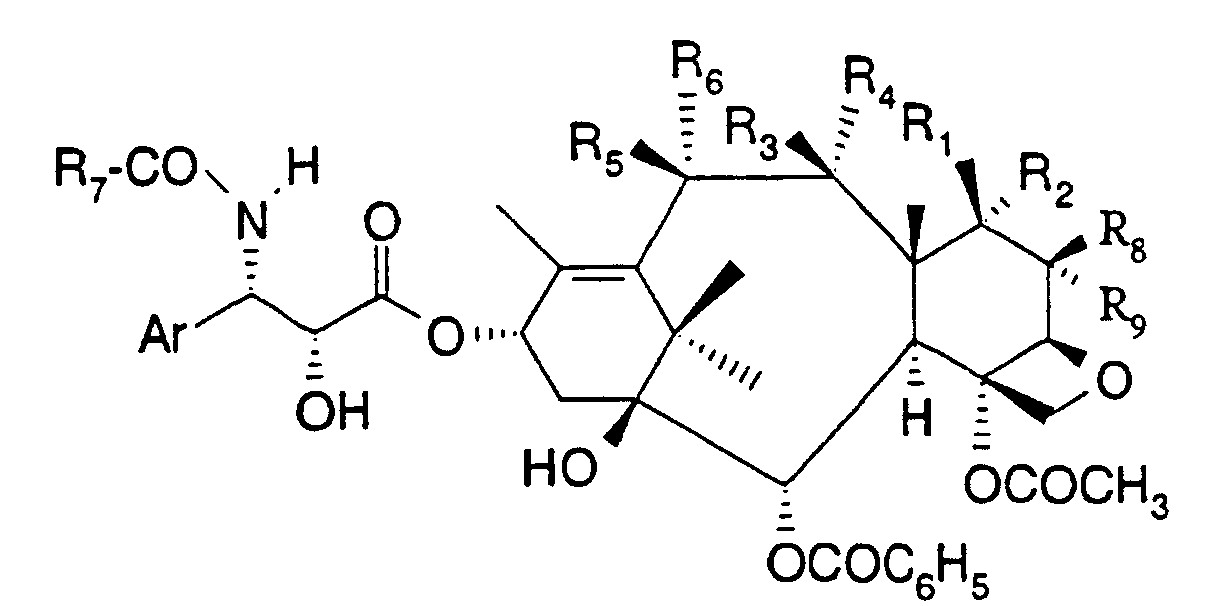
- les symboles R1 et R2 représentent chacun un atome d'hydrogène, ou bien un des radicaux R1 ou R2 représente un atome d'hydrogène, et l'autre représente un radical hydroxy, acyloxy ou acylcarbonyloxy, ou bien R2 représente un atome d'hydrogène et R1 forme avec l'atome de carbone du radical méthyle en α une liaison, de façon à former un cycle cyclopropane,
- l'un des symboles R3 ou R4 représente un atome d'hydrogène, et l'autre représente un radical hydroxy, ou bien R3 et R4 forment ensemble un radical carbonyle,
- les symboles R5 et R6 représentent chacun un atome d'hydrogène, ou bien un des symboles R5 ou R6 représente un atome d'hydrogène et l'autre représente un radical hydroxy, acyloxy, acylcarbonyloxy ou alcoxyméthylcarbonyloxy, ou bien R5 et R6 forment ensemble un radical carbonyle,
- les symboles R8 et R9 représentent chacun un atome d'hydrogène ou bien R1 et R8 forment ensemble une liaison,
- le symbole R7 représente un radical alcoxy, alcényloxy ou cycloalcoyloxy ou un radical phényle, et
- Ar représente un radical phényle éventuellement substitué par un ou plusieurs atomes ou radicaux, identiques ou différents, choisis parmi les atomes d'halogène et les radicaux alcoyles, alcoxy, dialcoylamino, acylamino, alcoxycarbonylamino ou trifluorométhyle, ou un radical hétérocyclique aromatique à 5 chaínons contenant un ou plusieurs hétéroatomes, identiques ou différents, choisis parmi les atomes d'azote, d'oxygène et de soufre,
Plus particulièrement intéressants sont les taxoïdes pour lesquels R2 représentant un atome d'hydrogène, R1 représente un atome d'hydrogène ou un rdical hydroxy ou bien R1 forme avec l'atome de carbone du radical méthyle en α une simple liaison, R3 et R4 forment ensemble un radical carbonyle, R5 représente un atome d'hydrogène et R6 représente un atome d'hydrogène ou un radical hydroxy, acétyloxy ou méthoxyacétyloxy ou bien R5 et R6 forment ensemble un radical carbonyle, R7 représente un radical t-butoxy ou un radical phényle.
Peuvent être particulièrement cités les produits suivants :
- t-butoxycarbonylamino-3' phényl-3' hydroxy-2' propionate-(2R,3S) d'acétoxy-4 benzoyloxy-2α époxy-5β,20 trihydroxy-1β,7β,10β oxo-9 taxène-11 yl-13α (docetaxel ou Taxotère®)
- benzoylamino-3' phényl-3' hydroxy-2' propionate-(2R,3S) de diacétoxy-4,10β benzoyloxy-2a époxy-5β,20 dihydroxy-1β,7β oxo-9 taxène-11 yl-13α (paclitaxel)
- t-butoxycarbonylamino-3' phényl-3' hydroxy-2' propionate-(2R,3S) d'acétoxy-4 benzoyloxy-2α époxy-5β,20 dihydroxy-1β,10β méthylène-7β,10β nor-19 oxo-9 taxène-11 yl-13α
- t-butoxycarbonylamino-3' phényl-3' hydroxy-2' propionate-(2R,3S) de diacétoxy-4,10β benzoyloxy-2α époxy-5β,20 hydroxy-1β méthylène-7β,10β nor-19 oxo-9 taxène-11 yl-13α
- t-butoxycarbonylamino-3' (fluoro-2 phényl)-3' hydroxy-2' propionate-(2R,3S) d'acétoxy-4 benzoyloxy-2α époxy-5β,20 trihydroxy-1β,7β,10β oxo-9 taxène-11yl-13α
- t-butoxycarbonylamino-3' (chloro-4 phényl)-3' hydroxy-2' propionate-(2R,3S) d'acétoxy-4 benzoyloxy-2α époxy-5β,20 trihydroxy-1β,7β,10β oxo-9 taxène-11 yl-13α
- t-butoxycarbonylamino-3' (méthoxy-4 phényl)-3' hydroxy-2' propionate-(2R,3S) d'acétoxy-4 benzoyloxy-2α époxy-5β,20 trihydroxy-1β,7β,10β oxo-9 taxène-11 yl-13α
- t-butoxycarbonylamino-3' (fluoro-4 phényl)-3' hydroxy-2' propionate-(2R,3S) d'acétoxy-4 benzoyloxy-2α époxy-5β,20 trihydroxy-1β,7β,10β oxo-9 taxène-11 yl-13α
- adamantyloxycarbonylamino-3' phényl-3' hydroxy-2' propionate-(2R,3S) d'acétoxy-4 benzoyloxy-2α époxy-5β,20 trihydroxy-1β,7β,10β oxo-9 taxène-11 yl-13α
- tert-pentyloxycarbonylamino-3' phényl-3' hydroxy-2' propionate-(2R,3S) d'acétoxy-4 benzoyloxy-2α époxy-5β,20 trihydroxy-1β,7β,10β oxo-9 taxène-11 yl-13α
- (méthyl-1 cyclohexyl)oxycarbonylamino-3' phényl-3' hydroxy-2' propionate-(2R,3S) d'acétoxy-4 benzoyloxy-2α époxy-5β,20 trihydroxy-1β,7β,10β oxo-9 taxène-11 yl-13α
- (méthyl-1 cyclopropyl)oxycarbonylamino-3' phényl-3' hydroxy-2' propionate-(2R,3S) d'acétoxy-4 benzoyloxy-2α époxy-5β,20 trihydroxy-1β,7β,10β oxo-9 taxène-11 yl-13α
- (méthyl-1 cyclopentyl)oxycarbonylamino-3' phényl-3' hydroxy-2' propionate-(2R,3S) d'acétoxy-4 benzoyloxy-2α époxy-5β,20 trihydroxy-1β,7β,10β oxo-9 taxène-11 yl-13α
- (diméthyl-1,1 propyne-2)yloxycarbonylamino-3' phényl-3' hydroxy-2' propionate-(2R,3S) d'acétoxy-4 benzoyloxy-2α époxy-5β,20 trihydroxy-1β,7β,10β oxo-9 taxène-11 yl-13α
- t-butoxycarbonylamino-3' phényl-3' hydroxy-2' propionate-(2R,3S) d'acétoxy-4 benzoyloxy-2α époxy-5β,20 tétrahydroxy-1β,7β,9β,10β taxène-11 yl-13α
- t-butoxycarbonylamino-3' phényl-3' hydroxy-2' propionate-(2R,3S) d'acétoxy-4 benzoyloxy-2α époxy-5β,20 dihydroxy-1β,7β oxo-9 taxène-11 yl-13α
- t-butoxycarbonylamino-3' (thiényl-2)-3' hydroxy-2' propionate-(2R,3S) d'acétoxy-4 benzoyloxy-2α époxy-5β,20 trihydroxy-1β,7β,10β oxo-9 taxène-11 yl-13α
- t-butoxycarbonylamino-3' (furyl-2)-3' hydroxy-2' propionate-(2R,3S) d'acétoxy-4 benzoyloxy-2α époxy-5β,20 trihydroxy-1β,7β,10β oxo-9 taxène-11 yl-13α
- t-butoxycarbonylamino-3' (thiényl-3)-3' hydroxy-2' propionate-(2R,3S) d'acétoxy-4 benzoyloxy-2α époxy-5β,20 trihydroxy-1β,7β,10β oxo-9 taxène-11 yl-13α
- t-butoxycarbonylamino-3' phényl-3' hydroxy-2' propionate-(2R,3S) d'acétoxy-4 benzoyloxy-2α époxy-5β,20 dihydroxy-1β,10β oxo-9 taxène-11 yl-13α
- t-butoxycarbonylamino-3' phényl-3' hydroxy-2' propionate-(2R,3S) d'acétoxy-4 benzoyloxy-2α époxy-5β,20 dihydroxy-1β,7β dioxo-9,10 taxène-11 yl-13α
- t-butoxycarbonylamino-3' phényl-3' hydroxy-2' propionate-(2R,3S) d'acétoxy-4 benzoyloxy-2α époxy-5β,20 hydroxy-1β oxo-9 taxène-11 yl-13α
Différents types de vecteurs peuvent être utilisés. Il peut s'agir de vecteurs viraux ou non viraux.
Les adénovirus recombinants défectifs selon l'invention peuvent être préparés par toute technique connue de l'homme du métier (Levrero et al., Gene 101 (1991) 195, EP 185 573; Graham, EMBO J. 3 (1984) 2917). En particulier, ils peuvent être préparés par recombinaison homologue entre un adénovirus et un plasmide portant entre autre la séquence d'ADN d'intérêt. La recombinaison homologue se produit après co-transfection desdits adénovirus et plasmide dans une lignée cellulaire appropriée. La lignée cellulaire utilisée doit de préférence (i) être transformable par lesdits éléments, et (ii), comporter les séquences capables de complémenter la partie du génome de l'adénovirus défectif, de préférence sous forme intégrée pour éviter les risques de recombinaison. A titre d'exemple de lignée, on peut mentionner la lignée de rein embryonnaire humain 293 (Graham et al., J. Gen. Virol. 36 (1977) 59) qui contient notamment, intégrée dans son génome, la partie gauche du génome d'un adénovirus Ad5 (12 %). Des stratégies de construction de vecteurs dérivés des adénovirus ont également été décrites dans les demandes n° WO 94/26914 et FR 93 08596.
Ensuite, les adénovirus qui se sont multipliés sont récupérés et purifiés selon les techniques classiques de biologie moléculaire, comme illustré dans les exemples.
Concernant les virus de l'herpès et les rétrovirus, la construction de vecteurs recombinants a été largement décrite dans la littérature : voir notamment Breakfield et al., New Biologist 3 (1991) 203; EP 453242, EP178220, Bernstein et al. Genet. Eng. 7 (1985) 235; McCormick, BioTechnology 3 (1985) 689, etc. En particulier, les rétrovirus sont des virus intégratifs, infectant sélectivement les cellules en division. Ils constituent donc des vecteurs d'intérêt pour des applications cancer. Le génome des rétrovirus comprend essentiellement deux LTR, une séquence d'encapsidation et trois régions codantes (gag, pol et env). Dans les vecteurs recombinants dérivés des rétrovirus, les gènes gag, pol et env sont généralement délétés, en tout ou en partie, et remplacés par une séquence d'acide nucléique hétérologue d'intérêt. Ces vecteurs peuvent être réalisés à partir de différents types de rétrovirus tels que notamment le MoMuLV ("murine moloney leukemia virus"; encore désigné MoMLV), le MSV ("murine moloney sarcoma virus"), le HaSV ("harvey sarcoma virus"); le SNV ("spleen necrosis virus"); le RSV ("rous sarcoma virus") ou encore le virus de Friend.
Pour construire des rétrovirus recombinants comportant une séquence d'intérêt, un plasmide comportant notamment les LTR, la séquence d'encapsidation et ladite séquence d'intérêt est généralement construit, puis utilisé pour transfecter une lignée cellulaire dite d'encapsidation, capable d'apporter en trans les fonctions rétrovirales déficientes dans le plasmide. Généralement, les lignées d'encapsidation sont donc capables d'exprimer les gènes gag, pol et env. De telles lignées d'encapsidation ont été décrites dans l'art antérieur, et notamment la lignée PA317 (US4,861,719); la lignée PsiCRIP (WO90/02806) et la lignée GP+envAm-12 (WO89/07150). Par ailleurs, les rétrovirus recombinants peuvent comporter des modifications au niveau des LTR pour supprimer l'activité transcriptionnelle, ainsi que des séquences d'encapsidation étendues, comportant une partie du gène gag (Bender et al., J. Virol. 61 (1987) 1639). Les rétrovirus recombinants produits sont ensuite purifiés par des techniques classiques.
Ces vecteurs synthétiques ont deux fonctions principales, compacter l'acide nucléique à transfecter et promouvoir sa fixation cellulaire ainsi que son passage à travers la membrane plasmique et, le cas échéant, les deux membranes nucléaires. Pour pallier à la nature polyanionique des acides nucléiques, les vecteurs non viraux possèdent tous des charges polycationiques.
Avantageusement, le ou les acides nucléiques sont administrés au contact de la lésion, soit par injection intra-tumorale directe dans des sites multiples de la lésion , soit au contact de la lésion athéromateuse par le moyen d'un coussinet adapté à ce type d'intervention . L'agent de chimiothérapie est administré selon les protocoles cliniques en vigueur .
Claims (22)
- Association médicamenteuse d'un ou plusieurs acides nucléiques inhibant au moins partiellement les voies de signalisation cellulaires oncogéniques, et d'un agent thérapeutique anticancéreux, pour une utilisation simultanée, séparée ou étalée dans le temps pour le traitement des pathologies hyperprolifératives.
- Association selon la revendication 1 caractérisée en ce que l'acide nucléique est un acide désoxyribonucléique (ADN) ou ribonucléique (ARN) codant pour un produit inhibant au moins partiellement les voies de signalisation cellulaires oncogéniques.
- Association selon la revendication 2 caractérisée en ce que l'acide nucléique est un ADN codant pour un ARN antisens.
- Association selon la revendication 2 caractérisée en ce que l'acide nucléique est un ADN codant pour un ARN ligand.
- Association selon la revendication 2 caractérisée en ce que l'acide nucléique est un ADN codant pour un dominant négatif.
- Association selon la revendication 2 caractérisée en ce que l'acide nucléique est un ADN codant pour un ScFv.
- Association selon la revendication 2 caractérisée en ce que l'acide nucléique est un ADN codant pour une protéine suppresseur de tumeurs.
- Association selon la revendication 1 caractérisée en ce que l'acide nucléique est un oligonucléotide antisens, éventuellement modifié chimiquement.
- Association selon l'une des revendications précédentes caractérisée en ce que l'acide nucléique est incorporé dans un vecteur.
- Association selon la revendication 9 caractérisée en ce que le vecteur est choisi parmi les liposome, nanoparticule, complexe peptidique, lipides cationiques et lipopolyamines.
- Association selon la revendication 9 caractérisée en ce que le vecteur est un vecteur viral dérivé des rétrovirus, adénovirus, virus de l'herpès, AAV, virus de la vaccine.
- Association selon l'une des revendications précédentes caractérisée en ce que l'acide nucléique est administré directement au niveau du site à traiter.
- Association selon la revendication 1 caractérisée en ce que l'agent thérapeutique anticancéreux est un agent chimiothérapeutique choisi parmi le cis-platine, les taxoïdes, l'étoposide, le TNF, l'adriamycine, la camptotécine, les vinca alcaloïdes et la navelleine.
- Association selon la revendication 13 caractérisée en ce que l'agent chimiothérapeutique anticancéreux est un taxoïde.
- Association selon la revendication 14 caractérisée en ce que l'agent chimiothérapeutique anticancéreux est choisi parmi le taxol, le docetaxel et le paclitaxel.
- Association selon l'une des revendications 13 à 15 caractérisée en ce que l'agent chimiothérapeutique anticancéreux est administré par voie parentérale.
- Association selon l'une des revendications précédentes caractérisée en ce que l'acide nucléique et l'agent chimiothérapeutique anticancéreux sont utilisés simultanément.
- Association selon l'une des revendications 1 à 16 caractérisée en ce que l'acide nucléique est administré avant l'agent chimiothérapeutique anticancéreux.
- Association médicamenteuse d'un ou plusieurs gènes suppresseurs de tumeurs et d'un taxoïde, pour une utilisation simultannée, séparée ou étalée dans le temps pour le traitement des pathologies hyperprolifératives.
- Association selon revendication 19 caractérisée en ce que le gène suppresseur code pour la forme sauvage de la protéine p53.
- Association selon revendication 19 caractérisée en ce que le gène suppresseur code pour la protéine waf1.
- Association entre la revendication 1 caractérisé en ce que l'agent thérapeutique anticancéreux est un agent de radiothérapie.
Applications Claiming Priority (3)
| Application Number | Priority Date | Filing Date | Title |
|---|---|---|---|
| FR9500436A FR2729295A1 (fr) | 1995-01-17 | 1995-01-17 | Traitement therapeutique combine des pathologies hyperproliferatives |
| FR9500436 | 1995-01-17 | ||
| PCT/FR1996/000056 WO1996022101A1 (fr) | 1995-01-17 | 1996-01-12 | Traitement therapeutique combine des pathologies hyperproliferatives |
Publications (2)
| Publication Number | Publication Date |
|---|---|
| EP0800399A1 EP0800399A1 (fr) | 1997-10-15 |
| EP0800399B1 true EP0800399B1 (fr) | 2002-08-14 |
Family
ID=9475169
Family Applications (1)
| Application Number | Title | Priority Date | Filing Date |
|---|---|---|---|
| EP96901387A Expired - Lifetime EP0800399B1 (fr) | 1995-01-17 | 1996-01-12 | Traitement therapeutique combine des pathologies hyperproliferatives |
Country Status (21)
| Country | Link |
|---|---|
| US (3) | US6262032B1 (fr) |
| EP (1) | EP0800399B1 (fr) |
| JP (3) | JP4580469B2 (fr) |
| KR (1) | KR100385266B1 (fr) |
| AT (1) | ATE222109T1 (fr) |
| AU (1) | AU716364B2 (fr) |
| BR (1) | BR9606969A (fr) |
| CA (1) | CA2209771C (fr) |
| CZ (1) | CZ298710B6 (fr) |
| DE (1) | DE69622989T2 (fr) |
| DK (1) | DK0800399T3 (fr) |
| ES (1) | ES2180729T3 (fr) |
| FI (1) | FI119911B (fr) |
| FR (1) | FR2729295A1 (fr) |
| HU (1) | HU229484B1 (fr) |
| MX (1) | MX9704490A (fr) |
| NO (1) | NO325418B1 (fr) |
| PT (1) | PT800399E (fr) |
| SI (1) | SI0800399T1 (fr) |
| SK (1) | SK283989B6 (fr) |
| WO (1) | WO1996022101A1 (fr) |
Families Citing this family (14)
| Publication number | Priority date | Publication date | Assignee | Title |
|---|---|---|---|---|
| US20030044396A1 (en) * | 1998-04-21 | 2003-03-06 | Elia James P. | Methods for treating diseases and increasing longevity |
| FR2729295A1 (fr) * | 1995-01-17 | 1996-07-19 | Rhone Poulenc Rorer Sa | Traitement therapeutique combine des pathologies hyperproliferatives |
| US7087582B1 (en) | 1995-09-26 | 2006-08-08 | Regents Of The University Of Michigan | Combination for site-specifically transforming cells in vivo comprising a double-balloon catheter and nucleic acid comprising a gene encoding P21 |
| US5744460A (en) * | 1996-03-07 | 1998-04-28 | Novartis Corporation | Combination for treatment of proliferative diseases |
| US20030060434A1 (en) * | 1997-02-18 | 2003-03-27 | Loretta Nielsen | Combined tumor suppressor gene therapy and chemotherapy in the treatment of neoplasms |
| US20030064949A1 (en) * | 1998-02-17 | 2003-04-03 | Loretta Nielsen | Combined tumor suppressor gene therapy and chemotherapy in the treatment of neoplasms |
| DE60203260T2 (de) * | 2001-01-16 | 2006-02-02 | Glaxo Group Ltd., Greenford | Pharmazeutische kombination, die ein 4-chinazolinamin und paclitaxel, carboplatin oder vinorelbin enthält, zur behandlung von krebs |
| BRPI0411485A (pt) * | 2003-06-30 | 2006-07-25 | Univ Lausanne | peptìdeo derivado de rasgap para matar seletivamente células cancerosas |
| CN1909927A (zh) * | 2003-12-24 | 2007-02-07 | 株式会社洛科摩基因 | 抑制癌的方法 |
| JPWO2005061007A1 (ja) * | 2003-12-24 | 2007-07-12 | 学校法人 聖マリアンナ医科大学 | 癌の抑制方法 |
| GB0406415D0 (en) * | 2004-03-22 | 2004-04-21 | Inst Of Cancer Res The | Materials and methods for treatment of cancer |
| US8124598B2 (en) | 2006-09-14 | 2012-02-28 | Sharon Sageman | 7-keto DHEA for psychiatric use |
| US20100111874A1 (en) * | 2007-03-19 | 2010-05-06 | University Of Medicine And Dentistry Of New Jresey | Method of cancer detection and treatment |
| US20100160274A1 (en) * | 2007-09-07 | 2010-06-24 | Sharon Sageman | 7-KETO DHEA for Psychiatric Use |
Family Cites Families (12)
| Publication number | Priority date | Publication date | Assignee | Title |
|---|---|---|---|---|
| WO1987005943A1 (fr) * | 1986-03-28 | 1987-10-08 | Board Of Trustees Of University Of Illinois | Compositions et procedes permettant d'obtenir des clones contenant des sequences d'adn associees a une resistance des cellules humaines a une multiplicite de medicaments |
| US5747469A (en) | 1991-03-06 | 1998-05-05 | Board Of Regents, The University Of Texas System | Methods and compositions comprising DNA damaging agents and p53 |
| US6410010B1 (en) | 1992-10-13 | 2002-06-25 | Board Of Regents, The University Of Texas System | Recombinant P53 adenovirus compositions |
| WO1993023014A1 (fr) * | 1992-05-20 | 1993-11-25 | Martin Daniel S | Combinaison de drogues chimiotherapeutiques |
| EP0642343B1 (fr) * | 1992-05-28 | 2000-08-30 | Xenova Limited | Acridine carboxamides pour le traitement des cancers |
| FR2694296B1 (fr) * | 1992-07-30 | 1994-09-02 | Rhone Poulenc Rorer Sa | Peptides inhibant l'activité des protéines ras, préparation et utilisation. |
| US6348352B1 (en) * | 1992-09-18 | 2002-02-19 | Canji, Inc. | Methods for selectively transducing pathologic mammalian cells using a tumor suppressor gene |
| FR2697752B1 (fr) * | 1992-11-10 | 1995-04-14 | Rhone Poulenc Rorer Sa | Compositions antitumorales contenant des dérivés du taxane. |
| TW442569B (en) | 1993-10-25 | 2001-06-23 | Canji Inc | Recombinant adenoviral vector |
| FR2729295A1 (fr) * | 1995-01-17 | 1996-07-19 | Rhone Poulenc Rorer Sa | Traitement therapeutique combine des pathologies hyperproliferatives |
| US5789244A (en) | 1996-01-08 | 1998-08-04 | Canji, Inc. | Compositions and methods for the treatment of cancer using recombinant viral vector delivery systems |
| US6054467A (en) | 1996-07-05 | 2000-04-25 | Sidney Kimmel Cancer Center | Down-regulation of DNA repair to enhance sensitivity to P53-mediated apoptosis |
-
1995
- 1995-01-17 FR FR9500436A patent/FR2729295A1/fr active Granted
-
1996
- 1996-01-12 AU AU45429/96A patent/AU716364B2/en not_active Expired
- 1996-01-12 PT PT96901387T patent/PT800399E/pt unknown
- 1996-01-12 MX MX9704490A patent/MX9704490A/es unknown
- 1996-01-12 JP JP52207896A patent/JP4580469B2/ja not_active Expired - Lifetime
- 1996-01-12 US US08/875,222 patent/US6262032B1/en not_active Expired - Lifetime
- 1996-01-12 WO PCT/FR1996/000056 patent/WO1996022101A1/fr not_active Ceased
- 1996-01-12 BR BR9606969A patent/BR9606969A/pt not_active Application Discontinuation
- 1996-01-12 HU HU9802423A patent/HU229484B1/hu unknown
- 1996-01-12 SK SK957-97A patent/SK283989B6/sk not_active IP Right Cessation
- 1996-01-12 DK DK96901387T patent/DK0800399T3/da active
- 1996-01-12 KR KR1019970704839A patent/KR100385266B1/ko not_active Expired - Lifetime
- 1996-01-12 DE DE69622989T patent/DE69622989T2/de not_active Expired - Lifetime
- 1996-01-12 AT AT96901387T patent/ATE222109T1/de not_active IP Right Cessation
- 1996-01-12 ES ES96901387T patent/ES2180729T3/es not_active Expired - Lifetime
- 1996-01-12 SI SI9630511T patent/SI0800399T1/xx unknown
- 1996-01-12 CZ CZ0226297A patent/CZ298710B6/cs not_active IP Right Cessation
- 1996-01-12 EP EP96901387A patent/EP0800399B1/fr not_active Expired - Lifetime
- 1996-01-12 CA CA2209771A patent/CA2209771C/fr not_active Expired - Lifetime
-
1997
- 1997-07-09 NO NO19973197A patent/NO325418B1/no not_active IP Right Cessation
- 1997-07-16 FI FI973023A patent/FI119911B/fi not_active IP Right Cessation
-
2001
- 2001-03-26 US US09/816,144 patent/US20010021395A1/en not_active Abandoned
-
2003
- 2003-04-14 US US10/412,684 patent/US7884082B2/en not_active Expired - Fee Related
-
2008
- 2008-01-09 JP JP2008001848A patent/JP2008133291A/ja not_active Withdrawn
-
2011
- 2011-09-22 JP JP2011206858A patent/JP5031921B2/ja not_active Expired - Lifetime
Also Published As
Similar Documents
| Publication | Publication Date | Title |
|---|---|---|
| EP0848720B1 (fr) | Antagonistes de l'activite oncogenique de la proteine mdm2, et leur utilisation dans le traitement des cancers | |
| JP5031921B2 (ja) | 過増殖症の併用療法 | |
| EP0674716B1 (fr) | Vecteurs retroviraux pour le traitement des tumeurs, et lignees cellulaires les contenant | |
| EP0839194B1 (fr) | Variants de la proteine p53 et utilisations therapeutiques | |
| WO1996010087A1 (fr) | Methode de traitement des cancers par regulation de l'activite des proteines ras | |
| EP0941252B1 (fr) | Fragments d'anticorps a chaine unique anti-p53 et utilisations | |
| FR2740344A1 (fr) | Application de la proteine gax au traitement de cancers | |
| JP2000514438A (ja) | Grb2またはCrk1へのリポソームアンチセンスオリゴデオキシヌクレオチド標的化による慢性骨髄性白血病細胞増殖の阻害 | |
| FR2734826A1 (fr) | Deltap62, ses variants, sequences nucleiques et leurs utilisations |
Legal Events
| Date | Code | Title | Description |
|---|---|---|---|
| PUAI | Public reference made under article 153(3) epc to a published international application that has entered the european phase |
Free format text: ORIGINAL CODE: 0009012 |
|
| 17P | Request for examination filed |
Effective date: 19970710 |
|
| AK | Designated contracting states |
Kind code of ref document: A1 Designated state(s): AT BE CH DE DK ES FR GB GR IE IT LI LU NL PT SE |
|
| AX | Request for extension of the european patent |
Free format text: SI PAYMENT 970806 |
|
| RAP3 | Party data changed (applicant data changed or rights of an application transferred) |
Owner name: AVENTIS PHARMA S.A. |
|
| 17Q | First examination report despatched |
Effective date: 20010516 |
|
| GRAG | Despatch of communication of intention to grant |
Free format text: ORIGINAL CODE: EPIDOS AGRA |
|
| RIC1 | Information provided on ipc code assigned before grant |
Free format text: 7A 61K 31/70 A, 7A 61K 33/24 B, 7A 61K 31/7105 B, 7A 61K 31/711 B, 7A 61P 35/00 B |
|
| GRAG | Despatch of communication of intention to grant |
Free format text: ORIGINAL CODE: EPIDOS AGRA |
|
| GRAH | Despatch of communication of intention to grant a patent |
Free format text: ORIGINAL CODE: EPIDOS IGRA |
|
| GRAH | Despatch of communication of intention to grant a patent |
Free format text: ORIGINAL CODE: EPIDOS IGRA |
|
| GRAA | (expected) grant |
Free format text: ORIGINAL CODE: 0009210 |
|
| AK | Designated contracting states |
Kind code of ref document: B1 Designated state(s): AT BE CH DE DK ES FR GB GR IE IT LI LU NL PT SE |
|
| AX | Request for extension of the european patent |
Free format text: SI PAYMENT 19970806 |
|
| REF | Corresponds to: |
Ref document number: 222109 Country of ref document: AT Date of ref document: 20020815 Kind code of ref document: T |
|
| REG | Reference to a national code |
Ref country code: GB Ref legal event code: FG4D Free format text: NOT ENGLISH |
|
| REG | Reference to a national code |
Ref country code: CH Ref legal event code: NV Representative=s name: KIRKER & CIE SA Ref country code: CH Ref legal event code: EP |
|
| REG | Reference to a national code |
Ref country code: IE Ref legal event code: FG4D Free format text: FRENCH |
|
| REF | Corresponds to: |
Ref document number: 69622989 Country of ref document: DE Date of ref document: 20020919 |
|
| REG | Reference to a national code |
Ref country code: GR Ref legal event code: EP Ref document number: 20020402594 Country of ref document: GR |
|
| GBT | Gb: translation of ep patent filed (gb section 77(6)(a)/1977) |
Effective date: 20021105 |
|
| REG | Reference to a national code |
Ref country code: DK Ref legal event code: T3 |
|
| REG | Reference to a national code |
Ref country code: PT Ref legal event code: SC4A Free format text: AVAILABILITY OF NATIONAL TRANSLATION Effective date: 20021112 |
|
| REG | Reference to a national code |
Ref country code: ES Ref legal event code: FG2A Ref document number: 2180729 Country of ref document: ES Kind code of ref document: T3 |
|
| PLBE | No opposition filed within time limit |
Free format text: ORIGINAL CODE: 0009261 |
|
| STAA | Information on the status of an ep patent application or granted ep patent |
Free format text: STATUS: NO OPPOSITION FILED WITHIN TIME LIMIT |
|
| 26N | No opposition filed |
Effective date: 20030515 |
|
| REG | Reference to a national code |
Ref country code: SI Ref legal event code: IF |
|
| PG25 | Lapsed in a contracting state [announced via postgrant information from national office to epo] |
Ref country code: IT Free format text: LAPSE BECAUSE OF NON-PAYMENT OF DUE FEES;WARNING: LAPSES OF ITALIAN PATENTS WITH EFFECTIVE DATE BEFORE 2007 MAY HAVE OCCURRED AT ANY TIME BEFORE 2007. THE CORRECT EFFECTIVE DATE MAY BE DIFFERENT FROM THE ONE RECORDED. Effective date: 20050112 |
|
| PGRI | Patent reinstated in contracting state [announced from national office to epo] |
Ref country code: IT Effective date: 20091201 |
|
| REG | Reference to a national code |
Ref country code: FR Ref legal event code: PLFP Year of fee payment: 20 |
|
| PGFP | Annual fee paid to national office [announced via postgrant information from national office to epo] |
Ref country code: GR Payment date: 20141211 Year of fee payment: 20 Ref country code: ES Payment date: 20141211 Year of fee payment: 20 |
|
| PGFP | Annual fee paid to national office [announced via postgrant information from national office to epo] |
Ref country code: LU Payment date: 20150105 Year of fee payment: 20 |
|
| PGFP | Annual fee paid to national office [announced via postgrant information from national office to epo] |
Ref country code: NL Payment date: 20150110 Year of fee payment: 20 |
|
| PGFP | Annual fee paid to national office [announced via postgrant information from national office to epo] |
Ref country code: IT Payment date: 20150115 Year of fee payment: 20 Ref country code: IE Payment date: 20150112 Year of fee payment: 20 Ref country code: DK Payment date: 20150112 Year of fee payment: 20 Ref country code: CH Payment date: 20150114 Year of fee payment: 20 Ref country code: DE Payment date: 20150106 Year of fee payment: 20 Ref country code: PT Payment date: 20150112 Year of fee payment: 20 |
|
| PGFP | Annual fee paid to national office [announced via postgrant information from national office to epo] |
Ref country code: SE Payment date: 20150113 Year of fee payment: 20 Ref country code: GB Payment date: 20150107 Year of fee payment: 20 Ref country code: AT Payment date: 20141222 Year of fee payment: 20 Ref country code: FR Payment date: 20150108 Year of fee payment: 20 |
|
| PGFP | Annual fee paid to national office [announced via postgrant information from national office to epo] |
Ref country code: BE Payment date: 20150112 Year of fee payment: 20 |
|
| REG | Reference to a national code |
Ref country code: DE Ref legal event code: R071 Ref document number: 69622989 Country of ref document: DE |
|
| REG | Reference to a national code |
Ref country code: NL Ref legal event code: MK Effective date: 20160111 |
|
| REG | Reference to a national code |
Ref country code: DK Ref legal event code: EUP Effective date: 20160112 |
|
| REG | Reference to a national code |
Ref country code: PT Ref legal event code: MM4A Free format text: MAXIMUM VALIDITY LIMIT REACHED Effective date: 20160112 |
|
| REG | Reference to a national code |
Ref country code: CH Ref legal event code: PL |
|
| REG | Reference to a national code |
Ref country code: GB Ref legal event code: PE20 Expiry date: 20160111 |
|
| REG | Reference to a national code |
Ref country code: IE Ref legal event code: MK9A |
|
| REG | Reference to a national code |
Ref country code: SE Ref legal event code: EUG |
|
| REG | Reference to a national code |
Ref country code: AT Ref legal event code: MK07 Ref document number: 222109 Country of ref document: AT Kind code of ref document: T Effective date: 20160112 |
|
| REG | Reference to a national code |
Ref country code: ES Ref legal event code: FD2A Effective date: 20160426 |
|
| PG25 | Lapsed in a contracting state [announced via postgrant information from national office to epo] |
Ref country code: GB Free format text: LAPSE BECAUSE OF EXPIRATION OF PROTECTION Effective date: 20160111 Ref country code: IE Free format text: LAPSE BECAUSE OF EXPIRATION OF PROTECTION Effective date: 20160112 |
|
| PG25 | Lapsed in a contracting state [announced via postgrant information from national office to epo] |
Ref country code: PT Free format text: LAPSE BECAUSE OF EXPIRATION OF PROTECTION Effective date: 20160119 |
|
| REG | Reference to a national code |
Ref country code: GR Ref legal event code: MA Ref document number: 20020402594 Country of ref document: GR Effective date: 20160113 |
|
| PG25 | Lapsed in a contracting state [announced via postgrant information from national office to epo] |
Ref country code: ES Free format text: LAPSE BECAUSE OF EXPIRATION OF PROTECTION Effective date: 20160113 |