EP0802186B1 - Phénylglycinolamides substituées par benzyloxy comme médicaments - Google Patents
Phénylglycinolamides substituées par benzyloxy comme médicaments Download PDFInfo
- Publication number
- EP0802186B1 EP0802186B1 EP97105721A EP97105721A EP0802186B1 EP 0802186 B1 EP0802186 B1 EP 0802186B1 EP 97105721 A EP97105721 A EP 97105721A EP 97105721 A EP97105721 A EP 97105721A EP 0802186 B1 EP0802186 B1 EP 0802186B1
- Authority
- EP
- European Patent Office
- Prior art keywords
- carbon atoms
- chain
- straight
- branched alkyl
- phenyl
- Prior art date
- Legal status (The legal status is an assumption and is not a legal conclusion. Google has not performed a legal analysis and makes no representation as to the accuracy of the status listed.)
- Expired - Lifetime
Links
- QOGZWZMLAKUGEW-UHFFFAOYSA-N C=C=C=C1CCCC1 Chemical compound C=C=C=C1CCCC1 QOGZWZMLAKUGEW-UHFFFAOYSA-N 0.000 description 1
- UHOVQNZJYSORNB-UHFFFAOYSA-N c1ccccc1 Chemical compound c1ccccc1 UHOVQNZJYSORNB-UHFFFAOYSA-N 0.000 description 1
Classifications
-
- C—CHEMISTRY; METALLURGY
- C07—ORGANIC CHEMISTRY
- C07D—HETEROCYCLIC COMPOUNDS
- C07D213/00—Heterocyclic compounds containing six-membered rings, not condensed with other rings, with one nitrogen atom as the only ring hetero atom and three or more double bonds between ring members or between ring members and non-ring members
- C07D213/02—Heterocyclic compounds containing six-membered rings, not condensed with other rings, with one nitrogen atom as the only ring hetero atom and three or more double bonds between ring members or between ring members and non-ring members having three double bonds between ring members or between ring members and non-ring members
- C07D213/04—Heterocyclic compounds containing six-membered rings, not condensed with other rings, with one nitrogen atom as the only ring hetero atom and three or more double bonds between ring members or between ring members and non-ring members having three double bonds between ring members or between ring members and non-ring members having no bond between the ring nitrogen atom and a non-ring member or having only hydrogen or carbon atoms directly attached to the ring nitrogen atom
- C07D213/24—Heterocyclic compounds containing six-membered rings, not condensed with other rings, with one nitrogen atom as the only ring hetero atom and three or more double bonds between ring members or between ring members and non-ring members having three double bonds between ring members or between ring members and non-ring members having no bond between the ring nitrogen atom and a non-ring member or having only hydrogen or carbon atoms directly attached to the ring nitrogen atom with substituted hydrocarbon radicals attached to ring carbon atoms
- C07D213/28—Radicals substituted by singly-bound oxygen or sulphur atoms
- C07D213/30—Oxygen atoms
-
- A—HUMAN NECESSITIES
- A61—MEDICAL OR VETERINARY SCIENCE; HYGIENE
- A61P—SPECIFIC THERAPEUTIC ACTIVITY OF CHEMICAL COMPOUNDS OR MEDICINAL PREPARATIONS
- A61P9/00—Drugs for disorders of the cardiovascular system
-
- A—HUMAN NECESSITIES
- A61—MEDICAL OR VETERINARY SCIENCE; HYGIENE
- A61P—SPECIFIC THERAPEUTIC ACTIVITY OF CHEMICAL COMPOUNDS OR MEDICINAL PREPARATIONS
- A61P9/00—Drugs for disorders of the cardiovascular system
- A61P9/10—Drugs for disorders of the cardiovascular system for treating ischaemic or atherosclerotic diseases, e.g. antianginal drugs, coronary vasodilators, drugs for myocardial infarction, retinopathy, cerebrovascula insufficiency, renal arteriosclerosis
-
- C—CHEMISTRY; METALLURGY
- C07—ORGANIC CHEMISTRY
- C07C—ACYCLIC OR CARBOCYCLIC COMPOUNDS
- C07C235/00—Carboxylic acid amides, the carbon skeleton of the acid part being further substituted by oxygen atoms
- C07C235/02—Carboxylic acid amides, the carbon skeleton of the acid part being further substituted by oxygen atoms having carbon atoms of carboxamide groups bound to acyclic carbon atoms and singly-bound oxygen atoms bound to the same carbon skeleton
- C07C235/32—Carboxylic acid amides, the carbon skeleton of the acid part being further substituted by oxygen atoms having carbon atoms of carboxamide groups bound to acyclic carbon atoms and singly-bound oxygen atoms bound to the same carbon skeleton the carbon skeleton containing six-membered aromatic rings
- C07C235/34—Carboxylic acid amides, the carbon skeleton of the acid part being further substituted by oxygen atoms having carbon atoms of carboxamide groups bound to acyclic carbon atoms and singly-bound oxygen atoms bound to the same carbon skeleton the carbon skeleton containing six-membered aromatic rings having the nitrogen atoms of the carboxamide groups bound to hydrogen atoms or to acyclic carbon atoms
-
- C—CHEMISTRY; METALLURGY
- C07—ORGANIC CHEMISTRY
- C07C—ACYCLIC OR CARBOCYCLIC COMPOUNDS
- C07C235/00—Carboxylic acid amides, the carbon skeleton of the acid part being further substituted by oxygen atoms
- C07C235/42—Carboxylic acid amides, the carbon skeleton of the acid part being further substituted by oxygen atoms having carbon atoms of carboxamide groups bound to carbon atoms of six-membered aromatic rings and singly-bound oxygen atoms bound to the same carbon skeleton
- C07C235/44—Carboxylic acid amides, the carbon skeleton of the acid part being further substituted by oxygen atoms having carbon atoms of carboxamide groups bound to carbon atoms of six-membered aromatic rings and singly-bound oxygen atoms bound to the same carbon skeleton with carbon atoms of carboxamide groups and singly-bound oxygen atoms bound to carbon atoms of the same non-condensed six-membered aromatic ring
- C07C235/54—Carboxylic acid amides, the carbon skeleton of the acid part being further substituted by oxygen atoms having carbon atoms of carboxamide groups bound to carbon atoms of six-membered aromatic rings and singly-bound oxygen atoms bound to the same carbon skeleton with carbon atoms of carboxamide groups and singly-bound oxygen atoms bound to carbon atoms of the same non-condensed six-membered aromatic ring having the nitrogen atom of at least one of the carboxamide groups bound to a carbon atom of a ring other than a six-membered aromatic ring
-
- C—CHEMISTRY; METALLURGY
- C07—ORGANIC CHEMISTRY
- C07C—ACYCLIC OR CARBOCYCLIC COMPOUNDS
- C07C235/00—Carboxylic acid amides, the carbon skeleton of the acid part being further substituted by oxygen atoms
- C07C235/42—Carboxylic acid amides, the carbon skeleton of the acid part being further substituted by oxygen atoms having carbon atoms of carboxamide groups bound to carbon atoms of six-membered aromatic rings and singly-bound oxygen atoms bound to the same carbon skeleton
- C07C235/44—Carboxylic acid amides, the carbon skeleton of the acid part being further substituted by oxygen atoms having carbon atoms of carboxamide groups bound to carbon atoms of six-membered aromatic rings and singly-bound oxygen atoms bound to the same carbon skeleton with carbon atoms of carboxamide groups and singly-bound oxygen atoms bound to carbon atoms of the same non-condensed six-membered aromatic ring
- C07C235/56—Carboxylic acid amides, the carbon skeleton of the acid part being further substituted by oxygen atoms having carbon atoms of carboxamide groups bound to carbon atoms of six-membered aromatic rings and singly-bound oxygen atoms bound to the same carbon skeleton with carbon atoms of carboxamide groups and singly-bound oxygen atoms bound to carbon atoms of the same non-condensed six-membered aromatic ring having the nitrogen atom of at least one of the carboxamide groups bound to a carbon atom of a six-membered aromatic ring
-
- C—CHEMISTRY; METALLURGY
- C07—ORGANIC CHEMISTRY
- C07D—HETEROCYCLIC COMPOUNDS
- C07D295/00—Heterocyclic compounds containing polymethylene-imine rings with at least five ring members, 3-azabicyclo [3.2.2] nonane, piperazine, morpholine or thiomorpholine rings, having only hydrogen atoms directly attached to the ring carbon atoms
- C07D295/16—Heterocyclic compounds containing polymethylene-imine rings with at least five ring members, 3-azabicyclo [3.2.2] nonane, piperazine, morpholine or thiomorpholine rings, having only hydrogen atoms directly attached to the ring carbon atoms acylated on ring nitrogen atoms
- C07D295/18—Heterocyclic compounds containing polymethylene-imine rings with at least five ring members, 3-azabicyclo [3.2.2] nonane, piperazine, morpholine or thiomorpholine rings, having only hydrogen atoms directly attached to the ring carbon atoms acylated on ring nitrogen atoms by radicals derived from carboxylic acids, or sulfur or nitrogen analogues thereof
- C07D295/182—Radicals derived from carboxylic acids
- C07D295/185—Radicals derived from carboxylic acids from aliphatic carboxylic acids
-
- C—CHEMISTRY; METALLURGY
- C07—ORGANIC CHEMISTRY
- C07C—ACYCLIC OR CARBOCYCLIC COMPOUNDS
- C07C2601/00—Systems containing only non-condensed rings
- C07C2601/06—Systems containing only non-condensed rings with a five-membered ring
- C07C2601/08—Systems containing only non-condensed rings with a five-membered ring the ring being saturated
-
- C—CHEMISTRY; METALLURGY
- C07—ORGANIC CHEMISTRY
- C07C—ACYCLIC OR CARBOCYCLIC COMPOUNDS
- C07C2601/00—Systems containing only non-condensed rings
- C07C2601/12—Systems containing only non-condensed rings with a six-membered ring
- C07C2601/14—The ring being saturated
-
- C—CHEMISTRY; METALLURGY
- C07—ORGANIC CHEMISTRY
- C07C—ACYCLIC OR CARBOCYCLIC COMPOUNDS
- C07C2601/00—Systems containing only non-condensed rings
- C07C2601/18—Systems containing only non-condensed rings with a ring being at least seven-membered
Definitions
- the present invention relates to benzyloxy-substituted phenylglycinolamides, Processes for their production and their use as pharmaceuticals, in particular as an anti-atherosclerotic drug.
- EP 0 344 519 discloses substituted 4- (quinolin-2-yl-methoxy) phenylacetic acid derivatives used in medicines as they are sensitive to lipoxygenase after oral administration Test models show a good effect.
- benzyloxy-substituted phenylglycinolamides according to the invention can also in the form of their salts.
- salts are included here called organic or inorganic bases or acids.
- physiologically acceptable salts prefers.
- Physiologically acceptable salts of the compounds according to the invention can salts of the substances according to the invention with mineral acids, carboxylic acids or be sulfonic acids.
- Physiologically acceptable salts of the compounds according to the invention can salts of the substances according to the invention with mineral acids, carboxylic acids or be sulfonic acids.
- particular preference is given to Salts with hydrochloric acid, Hydrobromic acid, sulfuric acid, phosphoric acid, methanesulfonic acid, Ethanesulfonic acid, toluenesulfonic acid, benzenesulfonic acid, naphthalenedisulfonic acid, Acetic acid, propionic acid, lactic acid, tartaric acid, citric acid, fumaric acid, Maleic acid or benzoic acid.
- Physiologically acceptable salts can also be metal or ammonium salts of the compounds according to the invention which have a free carboxyl group have.
- metal or ammonium salts which are derived from ammonia, or organic amines, such as ethylamine, di- or. Triethylamine, di- or. Triethanolamine, dicyclohexylamine, dimethylaminoethanol, arginine, lysine, Ethylenediamine or 2-phenylethylamine.
- the compounds according to the invention can exist in stereoisomeric forms either like image and mirror image (enantiomers), or which are not like image and Mirror image (diastereomers) behave, exist.
- the invention relates to both Enantiomers or diastereomers or their respective mixtures. This Mixtures of the enantiomers and diastereomers can be prepared in a known manner separate into the stereoisomerically uniform constituents.
- a 4- to 8-membered, saturated or partially unsaturated carbocycle (A) is in the context of the invention for a cyclobutene, cyclopentene, cyclohexene, Cycloheptene, cyclooctene, cyclopropyl, cyclobutyl, cyclopentyl, cyclohexyl or cycloheptyl residue. Cyclopentene, cyclohexene, cycloheptene, Cyclopentyl, cyclohexyl and cycloheptyl radical.
- a 5- to 6-membered aromatic heterocycle (A) is within the scope of the invention generally for example for thienyl, furyl, pyrimidyl or pyridyl. Pyridyl and thienyl are preferred.
- Inert organic solvents which are among the Do not change reaction conditions. These include ethers such as diethyl ether or tetrahydrofuran, halogenated hydrocarbons such as dichloromethane, trichloromethane, Tetrachloromethane, 1,2-dichloroethane, trichloroethane, tetrachloroethane, 1,2-dichloroethylene or trichlorethylene, hydrocarbons such as benzene, xylene, toluene, Hexane, cyclohexane, or petroleum fractions, nitromethane, dimethylformamide, Acetone, acetonitrile or hexamethylphosphoric triamide. It is also possible Use mixtures of solvents. Dichloromethane is particularly preferred, Tetrahydrofuran, acetone and dimethylformamide.
- bases are suitable as bases.
- bases preferably include alkali metal hydroxides such as sodium or potassium hydroxide, or alkali carbonates such as sodium or potassium carbonate, or alkali alcoholates such as sodium or potassium ethanolate, or sodium or Potassium methoxide, or organic amines such as triethylamine, picoline or N-methylpiperidine, or amides such as sodium amide or lithium diisopropylamide, or organometallic compounds such as butyllithium or phenyllithium.
- alkali metal hydroxides such as sodium or potassium hydroxide
- alkali carbonates such as sodium or potassium carbonate
- alkali alcoholates such as sodium or potassium ethanolate
- organic amines such as triethylamine, picoline or N-methylpiperidine
- amides such as sodium amide or lithium diisopropylamide
- organometallic compounds such as butyllithium or phenyllithium
- the base is used in an amount of from 0.6 mol to 5 mol, preferably from 0.7 mol to 2 mol, based on 1 mol of the compound of general formula (II) used.
- the reaction is generally in a temperature range from 0 ° C to 150 ° C, preferably from + 20 ° C to + 110 ° C.
- the reaction can be carried out at normal, elevated or reduced pressure (e.g. 0.5 to 5 bar). Generally one works at normal pressure.
- Bases are generally suitable for activating the carboxylic acid function and / or dehydration reagents such as diisopropylcarbodiimide, Dicyclohexylcarbodiimide or N- (3-dimethylaminopropyl) -N'-ethylcarbodiimide hydrochloride or carbonyl compounds such as carbonyldiimidazole or 1,2-oxazolium compounds such as 2-ethyl-5-phenyl-1,2-oxazolium-3-sulfonate or propanephosphonic anhydride or isobutyl chloroformate or benzotriazolyloxy tris (dimethylamino) phosphonium hexafluorophosphate or phosphoric acid diphenyl ester amide or methanesulfonic acid chloride, optionally in the presence of bases such as triethylamine or N-ethylmorpholine or N-methylpiperidine or dicyclohexylcarbodiimide
- the acid binding agents and dehydration reagents are generally in an amount of 0.5 to 3 mol, preferably 1 to 1.5 mol, based to 1 mol of the corresponding carboxylic acids.
- the compounds of the general formula (I) according to the invention do not have one predictable pharmacological spectrum of action.
- the proliferation of smooth muscle cells also plays a role in the occlusion of vessels a crucial role.
- the compounds of the invention are suitable to inhibit this proliferation and thus atherosclerotic processes to prevent.
- the compounds according to the invention are distinguished by a reduction in ApoB-100 associated lipoproteins (VLDL and its degradation products, e.g. LDL), ApoB-100, triglycerides and cholesterol. So own they are valuable pharmacological compounds which are superior to the prior art Characteristics.
- the compounds according to the invention have an effect initially in a decrease or complete inhibition of formation and / or the release of ApoB-100-associated lipoproteins from liver cells, which results in a lowering of the VLDL plasma level.
- This VLDL cut needs to lower the plasma levels of ApoB-100, LDL, triglycerides and accompanied by cholesterol; so there will be several at the same time of the above risk factors that are involved in vascular wall changes are.
- the compounds according to the invention can therefore be used for prevention and treatment of atherosclerosis, obesity, pancreatitis and constipation become.
- the test for the detection of inhibition of ApoB-100-associated release Liproproteins from liver cells were carried out in vitro with cultured liver cells, preferably with cells of the human line HepG2. These cells are made under standard conditions grown in medium for eukaryotic cell culture, preferred in RPMI 1640 with 10% fetal calf serum. Synthesize HepG2 cells and secrete ApoB-100-associated lipoprotein particles into the culture supernatant are basically similar in structure to the VLDL or LDL particles that are in the Plasma can be found.
- ApoB-100-associated particles are present in the supernatant of Hep-G2 cells, these can bind to the insolubilized Kan-anti-LDL-Ab, and an immune complex is formed which is bound to the plastic surface. Unbound proteins are removed by washing. The immune complex located on the plastic surface is detected with monoclonal antibodies which had been induced and purified against human LDL according to standard conditions. These antibodies were conjugated to the enzyme peroxidase. Peroxidase converts the colorless substrate TMB into a colored product in the presence of H 2 O 2 .
- the specific light adsorption at 450 nm is determined, which is a measure of the amount of ApoB-100-associated particles that had been secreted by the HepG2 cells into the culture supernatant.
- the compounds according to the invention inhibit the release of the ApoB-100-associated particles.
- the IC 50 value indicates the substance concentration at which the light adsorption is inhibited by 50% compared to the control (solvent control without substance).
- This detergent inhibits Lipoprotein lipase and thus leads to an increase in triglyceride levels due to a lack of catabolism of secreted VLDL particles.
- This increase in triglycerides can be used as a measure of the VLDL secretion rate.
- the animals are treated before and one and two hours after application of the Detergent was drawn by puncturing the retroorbital venous plexus. The Blood is kept for two hours at room temperature, then overnight at 4 ° C incubated to complete coagulation. After that, 5 minutes centrifuged at 10,000 g. The triglyceride concentration becomes in the serum thus obtained determined using a modified commercially available enzyme test (Merckotest® Triglyceride No. 14354).
- the substances that affect their triglyceride absorption in vivo Male Wistar rats with a body weight are to be examined administered between 170 and 230 g orally.
- the Animals divided into groups of 6 animals 18 hours before substance administration and then their food is withdrawn. Drinking water is suitable for the animals libitum available.
- the animals in the control groups receive an aqueous one Tragacanth suspension or a tragacanth suspension containing olive oil.
- the Tragacanth olive oil suspension is made with the Ultra-Turrax.
- the ones to be examined Substances are in an appropriate tragacanth olive oil suspension also with the Ultra-Turrax, directly before the substance application suspended.
- Each rat is pre-gavaged to determine basal Blood serum triglyceride content taken by puncturing the retroorbital venous plexus. Then the tragacanth suspension, the tragacanth olive oil suspensions without substance (control animals) or the substances suspended in a corresponding tragacanth olive oil suspension, the fasting animals with administered to a pharyngeal tube.
- the further blood withdrawals to determine the Postprandial serum triglyceride increases are usually 1, 2 and 3 hours after the pharyngeal tube application.
- the blood samples are centrifuged and, after collecting the serum, the Triglycerides photometrically with an EPOS analyzer 5060 (Eppendorf Manualbau, Netheler & Hinz GmbH, Hamburg). Determination of trigylcerides is carried out fully enzymatically with a commercially available UV test.
- the postprandial increase in serum triglycerides is determined by subtracting the triglyceride value each animal from its corresponding postprandial triglyceride concentrations (1, 2 and 3 hours after application) determined.
- the serum triglyceride course of the control animals which only received tragacanth is also calculated.
- the substance effect at each point in time (1, 2 or 3 hours) is determined as follows and stated in ⁇ % of the oil-contaminated control. ⁇ % increase in triglycerides ⁇ TG substance - ⁇ TG Tragacanth control ⁇ TG Oil pollution - ⁇ TG Tragacanth control x 100
- Substances that increase postprandial serum triglyceride, compared to that of the untreated control group, statistically significant Decrease (p ⁇ 0.05) by at least 30% are considered pharmacologically active viewed.
- VLDL secretion The effect of the test substances on VLDL secretion is also shown on the Rat examined.
- rats are given 500 mg / kg body weight Triton WR-1339 (2.5 mg / kg), dissolved in physiological saline, intravenously into the tail vein applied.
- Triton WR-1339 inhibits lipoprotein lipase and thus leads by inhibiting VLDL catabolism to an increase in triglyceride and Cholesterol level. These increases can be used as a measure of the VLDL secretion rate be used.
- the animals are treated before and one and two hours after application of the detergent Blood was taken by puncturing the retroorbital venous plexus.
- the blood is incubated for 1 h at room temperature and the serum by centrifugation won with 10,000 g for 20 s.
- the triglycerides using a commercially available coupled enzyme test (Sigma Diagnostics®, no. 339) determined photometrically at a wavelength of 540 nm. The measurement is done with the help of a coupled enzyme test (Boehringer Mannheim®, No. 1442350) at a wavelength of 546 nm.
- Samples with triglyceride or Cholesterol concentrations that exceed the measuring range of the methods are diluted with physiological saline. Determining the respective Serum concentrations are based on standard series measured in parallel. Test substances are taken orally, intravenously or immediately after the Triton injection applied subcutaneously.
- the invention also relates to the combination of benzyloxy-substituted Phenylglycinolamides of the general formula (I) with a glucosidase and / or amylase inhibitors for the treatment of familial hyperlipidaemia, the Obesity and diabetes mellitus.
- Glucosidase and / or amylase inhibitors within the scope of the invention are, for example, acarbose, adiposins, Voglibose, Miglitol, Emiglitate, MDL-25637, Camiglibose (MDL-73945), Tendamistate, AI-3688, Trestatin, Pradimicin-Q and Salbostatin.
- the new active ingredients can be introduced into the usual formulations in a known manner are transferred, such as tablets, coated tablets, pills, granules, aerosols, syrups, Emulsions, suspensions and solutions, using inert, non-toxic, pharmaceutically suitable carriers or solvents.
- the therapeutically active compound each in a concentration of about 0.5 up to 90% by weight of the total mixture, i.e. in amounts that are sufficient are in order to achieve the specified dosage range.
- the formulations are produced, for example, by stretching the active ingredients with solvents and / or carriers, optionally using emulsifiers and / or dispersants, e.g. in case of use of water as a diluent, optionally organic solvents as auxiliary solvents can be used.
- the application is carried out in the usual way, preferably orally or parenterally, in particular perlingually or intravenously.
- intravenous administration Amounts from about 0.001 to 1 mg / kg, preferably about 0.01 to 0.5 mg / kg Body weight for effective results, and oral Application, the dosage is about 0.01 to 20 mg / kg, preferably 0.1 to 10 mg / kg body weight.
Landscapes
- Chemical & Material Sciences (AREA)
- Organic Chemistry (AREA)
- Health & Medical Sciences (AREA)
- Engineering & Computer Science (AREA)
- Bioinformatics & Cheminformatics (AREA)
- Veterinary Medicine (AREA)
- Life Sciences & Earth Sciences (AREA)
- Cardiology (AREA)
- Heart & Thoracic Surgery (AREA)
- Chemical Kinetics & Catalysis (AREA)
- General Chemical & Material Sciences (AREA)
- Medicinal Chemistry (AREA)
- Nuclear Medicine, Radiotherapy & Molecular Imaging (AREA)
- Pharmacology & Pharmacy (AREA)
- Public Health (AREA)
- Animal Behavior & Ethology (AREA)
- General Health & Medical Sciences (AREA)
- Vascular Medicine (AREA)
- Urology & Nephrology (AREA)
- Acyclic And Carbocyclic Compounds In Medicinal Compositions (AREA)
- Organic Low-Molecular-Weight Compounds And Preparation Thereof (AREA)
- Pyridine Compounds (AREA)
- Pharmaceuticals Containing Other Organic And Inorganic Compounds (AREA)
- Quinoline Compounds (AREA)
Claims (11)
- Phénylglycinolamides à substituant benzyloxy, de formule générale (I) :dans laquelle

- A
- représente un carbocycle de 4 à 8 atomes, saturé ou
partiellement insaturé, ou
un groupe phényle, ou
un hétérocycle aromatique pentagonal ou hexagonal ayant jusqu'à 3 hétéroatomes de la série S, N et/ ou O,
les systèmes cycliques indiqués ci- dessus étant éventuellement substitués jusqu'à 5 fois identiques ou différentes par un groupe phényle, pyridyle, carboxyle, cyano, carboxyle, halogéno, nitro, hydroxy, par un groupe alkyle, alkoxy, alkoxycarbonyle, polyfluoralkyle ou polyfluoralkoxy, linéaire ou ramifié, ayant chacun jusqu'à 6 atomes de carbone, ou par un groupe de formule -SO2R5, -NR6R7 ou -CO-NR8R9,
où- R5
- est un groupe phényle ou un groupe alkyle linéaire ou ramifié ayant jusqu'à 3 atomes de carbone,
- R6, R7, R8 et R9
- sont identiques ou différents et représentent l'hydrogène ou un groupe alkyle linéaire ou ramifié ayant jusqu'à 10 atomes de carbone,
- R8 et/ ou R9
- représentent un groupe cycloalkyle ayant 3 à 6 atomes de carbone, ou représentent des groupes benzyle ou phényle qui sont substitués le cas échéant par un halogène, un groupe nitro, hydroxy ou par un groupe alkyle ou alkoxy linéaire ou ramifié ayant dans chaque cas jusqu'à 4 atomes de carbone,
- R8 et R9
- forment conjointement avec l'atome d'azote un hétérocycle pentagonal à heptagonal, saturé ou non saturé, qui peut éventuellement contenir un autre hétéroatome de la série S, N et/ ou O,
- X
- représente une liaison ou le groupe C=O
- D et E
- sont identiques ou différents et représentent l'hydrogène, un groupe cycloalkyle ayant 3 à 8 atomes de carbone, azido, hydroxy, halogéno, un groupe alkyle, alkoxy ou alcényle, linéaire ou ramifié, ayant dans chaque cas jusqu'à 6 atomes de carbone,
- R1
- est un groupe cycloalkyle de 3 à 8 atomes de carbone, ou représente un groupe alkyle linéaire ou ramifié ayant jusqu'à 10 atomes de carbone,
- R2
- est l'hydrogène ou un groupe alkyle linéaire ou ramifié ayant jusqu'à 4 atomes de carbone,
- R3
- représente l'hydrogène ou le groupe -CH2- OH,
- R4
- est un groupe phényle qui est substitué le cas échéant jusqu'à trois fois identiques ou différentes par un radical hydroxy, un halogène ou un radical alkyle linéaire ou ramifié, ayant jusqu'à 5 atomes de carbone,
- Phénylglycinolamides à substituant benzyloxy de formule suivant la revendication 1,
dans laquelle- A
- représente un groupe cyclopentyle, cyclohexyle,
cyclopentényle, cyclohexényle, ou un groupe pyridyle,
phényle ou furyle,
les noyaux indiqués ci- dessus étant éventuellement substitués jusqu'à 5 fois identiques ou différentes par un groupe phényle, pyridyle, du fluor, du chlore, du brome, un groupe cyano, nitro, hydroxy, carboxyle, par un groupe alkyle, alkoxy, alkoxycarbonyle, polyfluoralkyle ou polyfluoralkoxy, linéaire ou ramifié, ayant dans chaque cas jusqu'à 3 atomes de carbone, ou par un groupe de formule -SO2R5, -NR6R7 ou -CO-NR8R9,
où- R5
- est un groupe phényle, méthyle ou éthyle,
- R6, R7, R8 et R9
- sont identiques ou différents et représentent l'hydrogène ou un groupe alkyle linéaire ou ramifié ayant jusqu'à 8 atomes de carbone,
- R8 et/ ou R9
- représentent un groupe cyclopropyle, cyclopentyle ou cyclohexyle, ou représentent un groupe benzyle ou un groupe phényle qui sont substitués le cas échéant par du fluor, du chlore, du brome, un radical nitro, hydroxy, ou par un radical alkyle ou alkoxy linéaire ou ramifié ayant chacun jusqu'à 3 atomes de carbone,
- R8 et R9
- forment conjointement avec l'atome d'azote un noyau morpholinyle, pyrrolidinyle, pyridyle ou pipéridinyle,
- X
- représente une liaison ou le groupe C=O
- D et E
- sont identiques ou différents et représentent l'hydrogène, un groupe cyclopropyle, cyclopentyle, cyclohexyle, azido, hydroxy, du fluor, du chlore, du brome, un groupe alkyle, alkoxy ou alcényle, linéaire ou ramifié, ayant dans chaque cas jusqu'à 3 atomes de carbone,
- R1
- est un groupe cyclopropyle, cyclobutyle, cyclopentyle, cyclohexyle ou cycloheptyle, ou bien un groupe alkyle linéaire ou ramifié ayant jusqu'à 8 atomes de carbone,
- R2
- représente l'hydrogène ou un groupe alkyle linéaire ou ramifié ayant jusqu'à 3 atomes de carbone,
- R3
- représente l'hydrogène ou le groupe -CH2-OH,
- R4
- est un groupe phényle qui est substitué le cas échéant jusqu'à deux fois identiques ou différentes par un radical hydroxy, fluoro, chloro, bromo, ou par un radical alkyle linéaire ou ramifié ayant jusqu'à 4 atomes de carbone,
- Phénylglycinolamides à substituant benzyloxy de formule suivant la revendication 1,
dans laquelle- A
- représente un groupe cyclopentyle, cyclohexyle,
cyclopentényle, cyclohexényle, ou un groupe phényle
ou pyridyle,
les noyaux indiqués ci- dessus étant éventuellement substitués jusqu'à 3 fois identiques ou différentes par du fluor, du chlore, du brome, un groupe cyano, nitro, hydroxy, par un radical alkyle, alkoxy, alkoxycarbonyle linéaire ou ramifié, ayant dans chaque cas jusqu'à 3 atomes de carbone, un radical trifluorométhyle, trifluorométhoxy, carboxyle, ou par un groupe de formule -SO2R5, -NR6R7 ou -CO-NR8R9,
où- R5
- représente un groupe phényle ou méthyle,
- R6, R7, R8 et R9
- sont identiques ou différents et représentent l'hydrogène ou un groupe alkyle linéaire ou ramifié ayant jusqu'à 6 atomes de carbone,
- R8 et/ ou R9
- représentent des groupes cyclopropyle, cyclopentyle ou cyclohexyle, ou représentent un groupe benzyle ou un groupe phényle qui sont substitués le cas échéant par du fluor, du chlore, du brome, un radical nitro, hydroxy, méthyle ou méthoxy,
- R8 et R9
- forment conjointement avec l'atome d'azote un noyau morpholinyle, pyrrolidinyle ou pipéridinyle,
- X
- représente une liaison ou le groupe C=O
- D et E
- sont identiques ou différents et représentent l'hydrogène, le fluor, le chlore ou le brome,
- R1
- est un groupe cyclopropyle, cyclobutyle, cyclopentyle, cyclohexyle ou cycloheptyle, ou bien un groupe alkyle linéaire ou ramifié ayant jusqu'à 8 atomes de carbone,
- R2
- représente l'hydrogène,
- R3
- représente l'hydrogène ou le groupe -CH2-OH,
- R4
- est un groupe phényle qui est substitué le cas échéant jusqu'à deux fois identiques ou différentes par un radical hydroxy, fluoro, chloro, bromo, ou par un radical alkyle linéaire ou ramifié, ayant jusqu'à 3 atomes de carbone,
- Phénylglycinolamides à substituant benzyloxy de formule suivant la revendication 1,
dans laquelle- D et E
- représentent l'hydrogène,
- R1
- est un groupe cyclopentyle, cyclohexyle ou cycloheptyle.
- Phénylglycinolamides à substituant benzyloxy suivant les revendications 1 à 4, utilisés comme médicaments.
- Procédé de production de phénylglycinolamides à substituant benzyloxy suivant les revendications 1 à 4, caractérisé en ce que l'on fait réagir les acides carboxyliques de formule générale (II) :dans laquelle

A, D, E, X et R1 ont la définition indiquée,
éventuellement avec activation préalable de la fonction acide carboxylique,
avec des composés de formule générale (III) :dans laquelle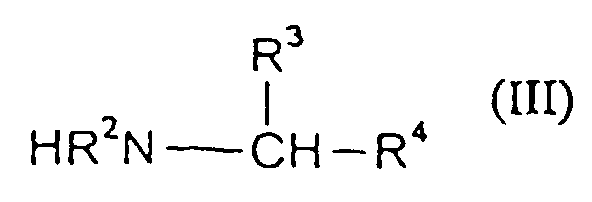
R2, R3 et R4 ont la définition indiquée ci- dessus,
éventuellement sous atmosphère de gaz protecteur, le cas échéant dans des solvants inertes, en présence d'une base et/ ou d'une substance auxiliaire. - Médicament contenant au moins un phénylglycinolamide à substituant benzyloxy suivant les revendications 1 à 4, ainsi qu'un auxiliaire de formulation acceptable du point de vue pharmacologique.
- Médicament suivant la revendication 7, destiné au traitement de l'athérosclérose.
- Utilisation de phénylglycinolamides à substituant benzyloxy suivant les revendications 1 à 4, pour la préparation de médicaments.
- Utilisation de phénylglycinolamides à substituant benzyloxy suivant les revendications 1 à 4, pour la préparation de médicaments destinés au traitement de l'athérosclérose.
- Utilisation de phénylglycinolamides à substituant benzyloxy suivant les revendications 1 à 4, pour la préparation de médicaments destinés au traitement de l'adiposité.
Applications Claiming Priority (2)
| Application Number | Priority Date | Filing Date | Title |
|---|---|---|---|
| DE19615263 | 1996-04-18 | ||
| DE19615263A DE19615263A1 (de) | 1996-04-18 | 1996-04-18 | Benzyloxy-substituierte Phenylglycinolamide |
Publications (2)
| Publication Number | Publication Date |
|---|---|
| EP0802186A1 EP0802186A1 (fr) | 1997-10-22 |
| EP0802186B1 true EP0802186B1 (fr) | 2000-11-29 |
Family
ID=7791599
Family Applications (1)
| Application Number | Title | Priority Date | Filing Date |
|---|---|---|---|
| EP97105721A Expired - Lifetime EP0802186B1 (fr) | 1996-04-18 | 1997-04-07 | Phénylglycinolamides substituées par benzyloxy comme médicaments |
Country Status (10)
| Country | Link |
|---|---|
| US (1) | US5750783A (fr) |
| EP (1) | EP0802186B1 (fr) |
| JP (1) | JPH1059915A (fr) |
| AT (1) | ATE197794T1 (fr) |
| CA (1) | CA2202704A1 (fr) |
| DE (2) | DE19615263A1 (fr) |
| DK (1) | DK0802186T3 (fr) |
| ES (1) | ES2153141T3 (fr) |
| GR (1) | GR3035371T3 (fr) |
| PT (1) | PT802186E (fr) |
Families Citing this family (9)
| Publication number | Priority date | Publication date | Assignee | Title |
|---|---|---|---|---|
| AU6315300A (en) * | 1999-07-26 | 2001-02-13 | Shionogi & Co., Ltd. | Benzene derivatives and immunopotentiating compositions or drug-sensitivity restoring agents containing the same |
| US7351858B2 (en) | 2002-06-20 | 2008-04-01 | Astrazeneca Ab | Ortho-substituted benzoic acid derivatives for the treatment of insulin resistance |
| SE0201937D0 (sv) * | 2002-06-20 | 2002-06-20 | Astrazeneca Ab | Therapeutic agents |
| PL375074A1 (en) * | 2002-06-20 | 2005-11-14 | Astrazeneca Ab | Ortho-substituted benzoic acid derivatives for the treatment of insulin resistance |
| AU2005230397B2 (en) * | 2004-04-09 | 2010-04-08 | Elanco Animal Health Ireland Limited | Intermittent dosing regimen for the treatment of overweight with MTP-inhibitors |
| DE102004019472A1 (de) * | 2004-04-22 | 2005-11-17 | Bayer Healthcare Ag | Phenylacetamide |
| JP2008542255A (ja) * | 2005-05-27 | 2008-11-27 | ファイザー・プロダクツ・インク | 肥満症の治療または体重減量の維持のためのカンナビノイド−1受容体アンタゴニストおよびミクロソームトリグリセリド輸送タンパク質阻害物質の併用 |
| WO2009067493A2 (fr) * | 2007-11-19 | 2009-05-28 | Envivo Pharmaceuticals, Inc. | Benzènes 1,3,5-trisubstitués pour le traitement de la maladie d'alzheimer et d'autres troubles |
| JP2011507909A (ja) | 2007-12-20 | 2011-03-10 | エンビボ ファーマシューティカルズ インコーポレイテッド | 四置換ベンゼン |
Family Cites Families (5)
| Publication number | Priority date | Publication date | Assignee | Title |
|---|---|---|---|---|
| JPS56108752A (en) * | 1980-01-28 | 1981-08-28 | Sumitomo Chem Co Ltd | N-substituted benzylphenylacetamide derivative, its preparation and herbicide containing the same as active constituent |
| DE3900261A1 (de) * | 1988-05-31 | 1989-12-07 | Bayer Ag | Substituierte 4-(chinolin-2-yl-methoxy) phenyl-essigsaeure-derivate |
| US5246965A (en) * | 1991-06-11 | 1993-09-21 | Ciba-Geigy | Arylethers, their manufacture and methods of treatment |
| CA2107196A1 (fr) * | 1992-09-29 | 1994-03-30 | Mitsubishi Chemical Corporation | Derives de carboxamide |
| DE4443891A1 (de) * | 1994-12-09 | 1996-06-13 | Bayer Ag | Heterocyclisch substituierte Oxy-phenyl-(phenyl)glycinolamide |
-
1996
- 1996-04-18 DE DE19615263A patent/DE19615263A1/de not_active Withdrawn
-
1997
- 1997-04-07 ES ES97105721T patent/ES2153141T3/es not_active Expired - Lifetime
- 1997-04-07 PT PT97105721T patent/PT802186E/pt unknown
- 1997-04-07 DK DK97105721T patent/DK0802186T3/da active
- 1997-04-07 DE DE59702677T patent/DE59702677D1/de not_active Expired - Fee Related
- 1997-04-07 EP EP97105721A patent/EP0802186B1/fr not_active Expired - Lifetime
- 1997-04-07 AT AT97105721T patent/ATE197794T1/de not_active IP Right Cessation
- 1997-04-10 US US08/833,824 patent/US5750783A/en not_active Expired - Fee Related
- 1997-04-10 JP JP9106822A patent/JPH1059915A/ja active Pending
- 1997-04-15 CA CA002202704A patent/CA2202704A1/fr not_active Abandoned
-
2001
- 2001-02-06 GR GR20010400198T patent/GR3035371T3/el not_active IP Right Cessation
Also Published As
| Publication number | Publication date |
|---|---|
| EP0802186A1 (fr) | 1997-10-22 |
| GR3035371T3 (en) | 2001-05-31 |
| CA2202704A1 (fr) | 1997-10-18 |
| JPH1059915A (ja) | 1998-03-03 |
| ATE197794T1 (de) | 2000-12-15 |
| DK0802186T3 (da) | 2000-12-27 |
| DE19615263A1 (de) | 1997-10-23 |
| ES2153141T3 (es) | 2001-02-16 |
| DE59702677D1 (de) | 2001-01-04 |
| PT802186E (pt) | 2001-04-30 |
| US5750783A (en) | 1998-05-12 |
Similar Documents
| Publication | Publication Date | Title |
|---|---|---|
| EP0802188B1 (fr) | Phénylglycinolamides reliées par un hétéro-atome ayant une activité antithérosclérotique | |
| EP0705831B1 (fr) | Dérivés de cycloalkano-indoles et -azaindoles | |
| EP0779279A1 (fr) | Hétérocycles bicycliques | |
| DE60025317T2 (de) | Herstellungsverfahren für (-)-(2R,4S)-4-Ä(3,5-bis-Trifluoromethyl-benzyl)-methoxycarbonylamino)-2-ethyl-6-trifluoromethyl-3,4-dihydro-2H-chinolin-1-carbonylsäureethylester | |
| DE69434020T2 (de) | Verfahren und zwischenprodukte für die herstellung von 5-[4-(benzisothiazol-3-yl)-piperazin-1-yl)ethyl]-6 chlor-1,3-dihydro-indol-2-one | |
| EP0764647A1 (fr) | Xanthines substitués | |
| EP0344519A1 (fr) | Acides (quinolyl-2-méthoxy)-4-phényl acétiques et leurs esters substitués | |
| EP0716082B1 (fr) | Oxy-phényl-(phényl)glycinolamides substitués avec un bicycle ayant une activité antiathérosclérotique | |
| DE3632329A1 (de) | Substituierte phenylsulfonamide | |
| DE3433327A1 (de) | 1-heteroaryl-4-((2,5-pyrrolidindion-1-yl)alkyl)piperazinderivate, verfahren zu deren herstellung und diese verbindungen enthaltende pharmazeutische mittel | |
| EP0802192A1 (fr) | Phénylglycinamides d'acides hétérocycliques substitués ayant une activité antiathéroschlérotique et procédé pour leur préparation | |
| EP0802186B1 (fr) | Phénylglycinolamides substituées par benzyloxy comme médicaments | |
| DE4443892A1 (de) | 4-(Chinolin-2-yl-methoxy)-phenyl-essigsäurederivate | |
| EP0799828A2 (fr) | Pyrimido [1,2-a] indoles | |
| EP0779276A1 (fr) | Dérivés de l'acide phénylacétique substitués par un indole | |
| CH650783A5 (de) | Carbostyrilderivate, verfahren zu deren herstellung und arzneimittel, welche diese enthalten. | |
| EP0765878A1 (fr) | Amides de l'acide aryl-, alkyl- et cycloalkyl-acétique hétérocyclique | |
| EP0802198A2 (fr) | Pyridazino-, pyrimido, pyrazino et triazolo-indoles | |
| DE4308788A1 (de) | Hetero-tricyclisch-substituierte Phenyl-cyclohexan-carbonsäurederivate | |
| DE19619950A1 (de) | Heterocyclisch-substituierte Phenylglycinolamide | |
| EP0753517A2 (fr) | Amides et sulfonamides de benzylamines substitués par des hétérocycles | |
| EP0802197A1 (fr) | Dérivés de phénylacétamide substitué par un hétéroclclyle tricyclique, leur préparation et leur utilisation comme antagonistes de l'angiotensine-II | |
| DE3120954A1 (de) | "kardiotonische aminophenylpyridinderivate und verfahren zu deren herstellung" | |
| DE19951022A1 (de) | Carbolinderivate | |
| DE4134755A1 (de) | Verwendung von teilweise bekannten substituierten tetrahydrothiophenen als arzneimittel, neue wirkstoffe und verfahren zu ihrer herstellung |
Legal Events
| Date | Code | Title | Description |
|---|---|---|---|
| PUAI | Public reference made under article 153(3) epc to a published international application that has entered the european phase |
Free format text: ORIGINAL CODE: 0009012 |
|
| AK | Designated contracting states |
Kind code of ref document: A1 Designated state(s): AT BE CH DE DK ES FI FR GB GR IE IT LI LU MC NL PT SE |
|
| 17P | Request for examination filed |
Effective date: 19980422 |
|
| 17Q | First examination report despatched |
Effective date: 19990114 |
|
| GRAG | Despatch of communication of intention to grant |
Free format text: ORIGINAL CODE: EPIDOS AGRA |
|
| GRAG | Despatch of communication of intention to grant |
Free format text: ORIGINAL CODE: EPIDOS AGRA |
|
| GRAG | Despatch of communication of intention to grant |
Free format text: ORIGINAL CODE: EPIDOS AGRA |
|
| GRAH | Despatch of communication of intention to grant a patent |
Free format text: ORIGINAL CODE: EPIDOS IGRA |
|
| GRAH | Despatch of communication of intention to grant a patent |
Free format text: ORIGINAL CODE: EPIDOS IGRA |
|
| GRAA | (expected) grant |
Free format text: ORIGINAL CODE: 0009210 |
|
| AK | Designated contracting states |
Kind code of ref document: B1 Designated state(s): AT BE CH DE DK ES FI FR GB GR IE IT LI LU MC NL PT SE |
|
| REF | Corresponds to: |
Ref document number: 197794 Country of ref document: AT Date of ref document: 20001215 Kind code of ref document: T |
|
| REG | Reference to a national code |
Ref country code: CH Ref legal event code: EP |
|
| REG | Reference to a national code |
Ref country code: CH Ref legal event code: NV Representative=s name: E. BLUM & CO. PATENTANWAELTE |
|
| REG | Reference to a national code |
Ref country code: DK Ref legal event code: T3 |
|
| REF | Corresponds to: |
Ref document number: 59702677 Country of ref document: DE Date of ref document: 20010104 |
|
| ITF | It: translation for a ep patent filed | ||
| ET | Fr: translation filed | ||
| GBT | Gb: translation of ep patent filed (gb section 77(6)(a)/1977) |
Effective date: 20010112 |
|
| REG | Reference to a national code |
Ref country code: ES Ref legal event code: FG2A Ref document number: 2153141 Country of ref document: ES Kind code of ref document: T3 |
|
| REG | Reference to a national code |
Ref country code: IE Ref legal event code: FG4D Free format text: GERMAN |
|
| PGFP | Annual fee paid to national office [announced via postgrant information from national office to epo] |
Ref country code: IE Payment date: 20010314 Year of fee payment: 5 |
|
| PGFP | Annual fee paid to national office [announced via postgrant information from national office to epo] |
Ref country code: SE Payment date: 20010315 Year of fee payment: 5 Ref country code: PT Payment date: 20010315 Year of fee payment: 5 Ref country code: MC Payment date: 20010315 Year of fee payment: 5 Ref country code: GR Payment date: 20010315 Year of fee payment: 5 |
|
| PGFP | Annual fee paid to national office [announced via postgrant information from national office to epo] |
Ref country code: DE Payment date: 20010317 Year of fee payment: 5 |
|
| PGFP | Annual fee paid to national office [announced via postgrant information from national office to epo] |
Ref country code: FR Payment date: 20010322 Year of fee payment: 5 |
|
| PGFP | Annual fee paid to national office [announced via postgrant information from national office to epo] |
Ref country code: CH Payment date: 20010330 Year of fee payment: 5 |
|
| PGFP | Annual fee paid to national office [announced via postgrant information from national office to epo] |
Ref country code: GB Payment date: 20010404 Year of fee payment: 5 |
|
| PGFP | Annual fee paid to national office [announced via postgrant information from national office to epo] |
Ref country code: ES Payment date: 20010409 Year of fee payment: 5 |
|
| PGFP | Annual fee paid to national office [announced via postgrant information from national office to epo] |
Ref country code: FI Payment date: 20010411 Year of fee payment: 5 |
|
| PGFP | Annual fee paid to national office [announced via postgrant information from national office to epo] |
Ref country code: LU Payment date: 20010419 Year of fee payment: 5 |
|
| PGFP | Annual fee paid to national office [announced via postgrant information from national office to epo] |
Ref country code: AT Payment date: 20010424 Year of fee payment: 5 |
|
| PGFP | Annual fee paid to national office [announced via postgrant information from national office to epo] |
Ref country code: BE Payment date: 20010425 Year of fee payment: 5 |
|
| PGFP | Annual fee paid to national office [announced via postgrant information from national office to epo] |
Ref country code: NL Payment date: 20010430 Year of fee payment: 5 Ref country code: DK Payment date: 20010430 Year of fee payment: 5 |
|
| REG | Reference to a national code |
Ref country code: PT Ref legal event code: SC4A Free format text: AVAILABILITY OF NATIONAL TRANSLATION Effective date: 20010118 |
|
| PLBE | No opposition filed within time limit |
Free format text: ORIGINAL CODE: 0009261 |
|
| STAA | Information on the status of an ep patent application or granted ep patent |
Free format text: STATUS: NO OPPOSITION FILED WITHIN TIME LIMIT |
|
| 26N | No opposition filed | ||
| REG | Reference to a national code |
Ref country code: GB Ref legal event code: IF02 |
|
| PG25 | Lapsed in a contracting state [announced via postgrant information from national office to epo] |
Ref country code: MC Free format text: LAPSE BECAUSE OF NON-PAYMENT OF DUE FEES Effective date: 20020407 Ref country code: LU Free format text: LAPSE BECAUSE OF NON-PAYMENT OF DUE FEES Effective date: 20020407 Ref country code: GB Free format text: LAPSE BECAUSE OF NON-PAYMENT OF DUE FEES Effective date: 20020407 Ref country code: FI Free format text: LAPSE BECAUSE OF NON-PAYMENT OF DUE FEES Effective date: 20020407 Ref country code: AT Free format text: LAPSE BECAUSE OF NON-PAYMENT OF DUE FEES Effective date: 20020407 |
|
| PG25 | Lapsed in a contracting state [announced via postgrant information from national office to epo] |
Ref country code: SE Free format text: LAPSE BECAUSE OF NON-PAYMENT OF DUE FEES Effective date: 20020408 Ref country code: IE Free format text: LAPSE BECAUSE OF NON-PAYMENT OF DUE FEES Effective date: 20020408 Ref country code: ES Free format text: LAPSE BECAUSE OF NON-PAYMENT OF DUE FEES Effective date: 20020408 |
|
| PG25 | Lapsed in a contracting state [announced via postgrant information from national office to epo] |
Ref country code: LI Free format text: LAPSE BECAUSE OF NON-PAYMENT OF DUE FEES Effective date: 20020430 Ref country code: DK Free format text: LAPSE BECAUSE OF NON-PAYMENT OF DUE FEES Effective date: 20020430 Ref country code: CH Free format text: LAPSE BECAUSE OF NON-PAYMENT OF DUE FEES Effective date: 20020430 Ref country code: BE Free format text: LAPSE BECAUSE OF NON-PAYMENT OF DUE FEES Effective date: 20020430 |
|
| PG25 | Lapsed in a contracting state [announced via postgrant information from national office to epo] |
Ref country code: PT Free format text: LAPSE BECAUSE OF NON-PAYMENT OF DUE FEES Effective date: 20021031 |
|
| PG25 | Lapsed in a contracting state [announced via postgrant information from national office to epo] |
Ref country code: NL Free format text: LAPSE BECAUSE OF NON-PAYMENT OF DUE FEES Effective date: 20021101 Ref country code: DE Free format text: LAPSE BECAUSE OF NON-PAYMENT OF DUE FEES Effective date: 20021101 |
|
| PG25 | Lapsed in a contracting state [announced via postgrant information from national office to epo] |
Ref country code: GR Free format text: LAPSE BECAUSE OF NON-PAYMENT OF DUE FEES Effective date: 20021105 |
|
| EUG | Se: european patent has lapsed |
Ref document number: 97105721.1 |
|
| GBPC | Gb: european patent ceased through non-payment of renewal fee |
Effective date: 20020407 |
|
| REG | Reference to a national code |
Ref country code: DK Ref legal event code: EBP |
|
| REG | Reference to a national code |
Ref country code: CH Ref legal event code: PL |
|
| PG25 | Lapsed in a contracting state [announced via postgrant information from national office to epo] |
Ref country code: FR Free format text: LAPSE BECAUSE OF NON-PAYMENT OF DUE FEES Effective date: 20021231 |
|
| NLV4 | Nl: lapsed or anulled due to non-payment of the annual fee |
Effective date: 20021101 |
|
| REG | Reference to a national code |
Ref country code: PT Ref legal event code: MM4A Free format text: LAPSE DUE TO NON-PAYMENT OF FEES Effective date: 20021031 |
|
| REG | Reference to a national code |
Ref country code: IE Ref legal event code: MM4A |
|
| REG | Reference to a national code |
Ref country code: FR Ref legal event code: ST |
|
| REG | Reference to a national code |
Ref country code: ES Ref legal event code: FD2A Effective date: 20030514 |
|
| PG25 | Lapsed in a contracting state [announced via postgrant information from national office to epo] |
Ref country code: IT Free format text: LAPSE BECAUSE OF NON-PAYMENT OF DUE FEES Effective date: 20050407 |