EP0810183A1 - Procédé pour traiter les courants d'eaux usées des usines de production de l'acrylonitrile - Google Patents
Procédé pour traiter les courants d'eaux usées des usines de production de l'acrylonitrile Download PDFInfo
- Publication number
- EP0810183A1 EP0810183A1 EP96303813A EP96303813A EP0810183A1 EP 0810183 A1 EP0810183 A1 EP 0810183A1 EP 96303813 A EP96303813 A EP 96303813A EP 96303813 A EP96303813 A EP 96303813A EP 0810183 A1 EP0810183 A1 EP 0810183A1
- Authority
- EP
- European Patent Office
- Prior art keywords
- catalyst
- stream
- wastewater
- ammonia
- organic compounds
- Prior art date
- Legal status (The legal status is an assumption and is not a legal conclusion. Google has not performed a legal analysis and makes no representation as to the accuracy of the status listed.)
- Withdrawn
Links
- 239000002351 wastewater Substances 0.000 title claims abstract description 57
- 238000000034 method Methods 0.000 title claims abstract description 36
- NLHHRLWOUZZQLW-UHFFFAOYSA-N Acrylonitrile Chemical compound C=CC#N NLHHRLWOUZZQLW-UHFFFAOYSA-N 0.000 title claims abstract description 29
- QGZKDVFQNNGYKY-UHFFFAOYSA-N Ammonia Chemical compound N QGZKDVFQNNGYKY-UHFFFAOYSA-N 0.000 claims abstract description 66
- 239000003054 catalyst Substances 0.000 claims abstract description 43
- CURLTUGMZLYLDI-UHFFFAOYSA-N Carbon dioxide Chemical compound O=C=O CURLTUGMZLYLDI-UHFFFAOYSA-N 0.000 claims abstract description 37
- 229910021529 ammonia Inorganic materials 0.000 claims abstract description 33
- IJGRMHOSHXDMSA-UHFFFAOYSA-N Atomic nitrogen Chemical compound N#N IJGRMHOSHXDMSA-UHFFFAOYSA-N 0.000 claims abstract description 28
- 229910002092 carbon dioxide Inorganic materials 0.000 claims abstract description 19
- 239000001569 carbon dioxide Substances 0.000 claims abstract description 18
- UFHFLCQGNIYNRP-UHFFFAOYSA-N Hydrogen Chemical compound [H][H] UFHFLCQGNIYNRP-UHFFFAOYSA-N 0.000 claims abstract description 16
- 239000000203 mixture Substances 0.000 claims abstract description 14
- 150000002894 organic compounds Chemical class 0.000 claims abstract description 10
- 239000012855 volatile organic compound Substances 0.000 claims abstract description 10
- 230000006378 damage Effects 0.000 claims abstract description 7
- XLYOFNOQVPJJNP-UHFFFAOYSA-N water Substances O XLYOFNOQVPJJNP-UHFFFAOYSA-N 0.000 claims description 20
- 229910001868 water Inorganic materials 0.000 claims description 17
- PXHVJJICTQNCMI-UHFFFAOYSA-N Nickel Chemical compound [Ni] PXHVJJICTQNCMI-UHFFFAOYSA-N 0.000 claims description 14
- 239000007788 liquid Substances 0.000 claims description 12
- 229910001873 dinitrogen Inorganic materials 0.000 claims description 11
- 229910052751 metal Inorganic materials 0.000 claims description 11
- 239000002184 metal Substances 0.000 claims description 11
- 229910052784 alkaline earth metal Inorganic materials 0.000 claims description 7
- BASFCYQUMIYNBI-UHFFFAOYSA-N platinum Chemical group [Pt] BASFCYQUMIYNBI-UHFFFAOYSA-N 0.000 claims description 7
- 150000001342 alkaline earth metals Chemical class 0.000 claims description 6
- 229910052783 alkali metal Inorganic materials 0.000 claims description 5
- 150000001340 alkali metals Chemical class 0.000 claims description 5
- XEEYBQQBJWHFJM-UHFFFAOYSA-N Iron Chemical group [Fe] XEEYBQQBJWHFJM-UHFFFAOYSA-N 0.000 claims description 4
- 229930195733 hydrocarbon Natural products 0.000 claims description 4
- 150000002430 hydrocarbons Chemical class 0.000 claims description 4
- ZCDOYSPFYFSLEW-UHFFFAOYSA-N chromate(2-) Chemical compound [O-][Cr]([O-])(=O)=O ZCDOYSPFYFSLEW-UHFFFAOYSA-N 0.000 claims description 3
- 238000001816 cooling Methods 0.000 claims description 3
- MEFBJEMVZONFCJ-UHFFFAOYSA-N molybdate Chemical compound [O-][Mo]([O-])(=O)=O MEFBJEMVZONFCJ-UHFFFAOYSA-N 0.000 claims description 3
- PBYZMCDFOULPGH-UHFFFAOYSA-N tungstate Chemical compound [O-][W]([O-])(=O)=O PBYZMCDFOULPGH-UHFFFAOYSA-N 0.000 claims description 3
- 239000004215 Carbon black (E152) Substances 0.000 claims description 2
- 159000000009 barium salts Chemical class 0.000 claims description 2
- 238000004519 manufacturing process Methods 0.000 claims 1
- 229910052739 hydrogen Inorganic materials 0.000 abstract description 8
- 239000001257 hydrogen Substances 0.000 abstract description 8
- 239000010815 organic waste Substances 0.000 abstract description 6
- JCXJVPUVTGWSNB-UHFFFAOYSA-N nitrogen dioxide Inorganic materials O=[N]=O JCXJVPUVTGWSNB-UHFFFAOYSA-N 0.000 abstract description 3
- 239000007789 gas Substances 0.000 description 14
- 239000000047 product Substances 0.000 description 12
- PNEYBMLMFCGWSK-UHFFFAOYSA-N aluminium oxide Inorganic materials [O-2].[O-2].[O-2].[Al+3].[Al+3] PNEYBMLMFCGWSK-UHFFFAOYSA-N 0.000 description 8
- 238000006243 chemical reaction Methods 0.000 description 8
- 229910052757 nitrogen Inorganic materials 0.000 description 8
- VYPSYNLAJGMNEJ-UHFFFAOYSA-N Silicium dioxide Chemical compound O=[Si]=O VYPSYNLAJGMNEJ-UHFFFAOYSA-N 0.000 description 7
- OKTJSMMVPCPJKN-UHFFFAOYSA-N Carbon Chemical compound [C] OKTJSMMVPCPJKN-UHFFFAOYSA-N 0.000 description 6
- 229910052799 carbon Inorganic materials 0.000 description 6
- 239000000463 material Substances 0.000 description 6
- 229910052759 nickel Inorganic materials 0.000 description 6
- QGZKDVFQNNGYKY-UHFFFAOYSA-O Ammonium Chemical compound [NH4+] QGZKDVFQNNGYKY-UHFFFAOYSA-O 0.000 description 5
- -1 aromatics Chemical class 0.000 description 4
- 230000003197 catalytic effect Effects 0.000 description 4
- 239000007795 chemical reaction product Substances 0.000 description 4
- 238000011068 loading method Methods 0.000 description 4
- 229910052760 oxygen Inorganic materials 0.000 description 4
- BWHMMNNQKKPAPP-UHFFFAOYSA-L potassium carbonate Chemical compound [K+].[K+].[O-]C([O-])=O BWHMMNNQKKPAPP-UHFFFAOYSA-L 0.000 description 4
- MCMNRKCIXSYSNV-UHFFFAOYSA-N ZrO2 Inorganic materials O=[Zr]=O MCMNRKCIXSYSNV-UHFFFAOYSA-N 0.000 description 3
- 238000004458 analytical method Methods 0.000 description 3
- QVGXLLKOCUKJST-UHFFFAOYSA-N atomic oxygen Chemical compound [O] QVGXLLKOCUKJST-UHFFFAOYSA-N 0.000 description 3
- 229910002091 carbon monoxide Inorganic materials 0.000 description 3
- 150000001875 compounds Chemical class 0.000 description 3
- 239000000470 constituent Substances 0.000 description 3
- 150000002431 hydrogen Chemical class 0.000 description 3
- 239000012535 impurity Substances 0.000 description 3
- 238000012986 modification Methods 0.000 description 3
- 230000004048 modification Effects 0.000 description 3
- 239000001301 oxygen Substances 0.000 description 3
- 239000000377 silicon dioxide Substances 0.000 description 3
- UGFAIRIUMAVXCW-UHFFFAOYSA-N Carbon monoxide Chemical compound [O+]#[C-] UGFAIRIUMAVXCW-UHFFFAOYSA-N 0.000 description 2
- BVKZGUZCCUSVTD-UHFFFAOYSA-L Carbonate Chemical compound [O-]C([O-])=O BVKZGUZCCUSVTD-UHFFFAOYSA-L 0.000 description 2
- CPLXHLVBOLITMK-UHFFFAOYSA-N Magnesium oxide Chemical compound [Mg]=O CPLXHLVBOLITMK-UHFFFAOYSA-N 0.000 description 2
- 229910002089 NOx Inorganic materials 0.000 description 2
- KDLHZDBZIXYQEI-UHFFFAOYSA-N Palladium Chemical compound [Pd] KDLHZDBZIXYQEI-UHFFFAOYSA-N 0.000 description 2
- JUJWROOIHBZHMG-UHFFFAOYSA-N Pyridine Chemical compound C1=CC=NC=C1 JUJWROOIHBZHMG-UHFFFAOYSA-N 0.000 description 2
- KJTLSVCANCCWHF-UHFFFAOYSA-N Ruthenium Chemical compound [Ru] KJTLSVCANCCWHF-UHFFFAOYSA-N 0.000 description 2
- GWEVSGVZZGPLCZ-UHFFFAOYSA-N Titan oxide Chemical compound O=[Ti]=O GWEVSGVZZGPLCZ-UHFFFAOYSA-N 0.000 description 2
- 239000003513 alkali Substances 0.000 description 2
- 229910052782 aluminium Inorganic materials 0.000 description 2
- XAGFODPZIPBFFR-UHFFFAOYSA-N aluminium Chemical compound [Al] XAGFODPZIPBFFR-UHFFFAOYSA-N 0.000 description 2
- 229910000323 aluminium silicate Inorganic materials 0.000 description 2
- 230000008029 eradication Effects 0.000 description 2
- XLYOFNOQVPJJNP-UHFFFAOYSA-M hydroxide Chemical compound [OH-] XLYOFNOQVPJJNP-UHFFFAOYSA-M 0.000 description 2
- 150000007524 organic acids Chemical class 0.000 description 2
- 229910000027 potassium carbonate Inorganic materials 0.000 description 2
- 238000000746 purification Methods 0.000 description 2
- 229910052707 ruthenium Inorganic materials 0.000 description 2
- 150000003839 salts Chemical class 0.000 description 2
- 239000000126 substance Substances 0.000 description 2
- 229920000742 Cotton Polymers 0.000 description 1
- GYCMBHHDWRMZGG-UHFFFAOYSA-N Methylacrylonitrile Chemical compound CC(=C)C#N GYCMBHHDWRMZGG-UHFFFAOYSA-N 0.000 description 1
- 229920002821 Modacrylic Polymers 0.000 description 1
- 229920000459 Nitrile rubber Polymers 0.000 description 1
- 229920001131 Pulp (paper) Polymers 0.000 description 1
- 229910052770 Uranium Inorganic materials 0.000 description 1
- NIXOWILDQLNWCW-UHFFFAOYSA-N acrylic acid group Chemical group C(C=C)(=O)O NIXOWILDQLNWCW-UHFFFAOYSA-N 0.000 description 1
- 229920001893 acrylonitrile styrene Polymers 0.000 description 1
- 150000001298 alcohols Chemical class 0.000 description 1
- 150000001299 aldehydes Chemical class 0.000 description 1
- 150000001408 amides Chemical class 0.000 description 1
- 239000003125 aqueous solvent Substances 0.000 description 1
- ITHZDDVSAWDQPZ-UHFFFAOYSA-L barium acetate Chemical compound [Ba+2].CC([O-])=O.CC([O-])=O ITHZDDVSAWDQPZ-UHFFFAOYSA-L 0.000 description 1
- 229910052797 bismuth Inorganic materials 0.000 description 1
- JCXGWMGPZLAOME-UHFFFAOYSA-N bismuth atom Chemical compound [Bi] JCXGWMGPZLAOME-UHFFFAOYSA-N 0.000 description 1
- 239000006227 byproduct Substances 0.000 description 1
- XFWJKVMFIVXPKK-UHFFFAOYSA-N calcium;oxido(oxo)alumane Chemical compound [Ca+2].[O-][Al]=O.[O-][Al]=O XFWJKVMFIVXPKK-UHFFFAOYSA-N 0.000 description 1
- 230000000711 cancerogenic effect Effects 0.000 description 1
- 231100000357 carcinogen Toxicity 0.000 description 1
- 239000003183 carcinogenic agent Substances 0.000 description 1
- 238000003889 chemical engineering Methods 0.000 description 1
- 229910017052 cobalt Inorganic materials 0.000 description 1
- 239000010941 cobalt Substances 0.000 description 1
- GUTLYIVDDKVIGB-UHFFFAOYSA-N cobalt atom Chemical compound [Co] GUTLYIVDDKVIGB-UHFFFAOYSA-N 0.000 description 1
- 239000000356 contaminant Substances 0.000 description 1
- 238000007278 cyanoethylation reaction Methods 0.000 description 1
- 230000001419 dependent effect Effects 0.000 description 1
- 238000010586 diagram Methods 0.000 description 1
- 239000003344 environmental pollutant Substances 0.000 description 1
- 239000000835 fiber Substances 0.000 description 1
- 239000012530 fluid Substances 0.000 description 1
- 239000000446 fuel Substances 0.000 description 1
- 150000002390 heteroarenes Chemical class 0.000 description 1
- 229910052809 inorganic oxide Inorganic materials 0.000 description 1
- 229910052741 iridium Inorganic materials 0.000 description 1
- GKOZUEZYRPOHIO-UHFFFAOYSA-N iridium atom Chemical compound [Ir] GKOZUEZYRPOHIO-UHFFFAOYSA-N 0.000 description 1
- 229910052742 iron Inorganic materials 0.000 description 1
- 239000007791 liquid phase Substances 0.000 description 1
- 239000000395 magnesium oxide Substances 0.000 description 1
- 150000002739 metals Chemical class 0.000 description 1
- 150000002825 nitriles Chemical class 0.000 description 1
- 235000005985 organic acids Nutrition 0.000 description 1
- 229910052762 osmium Inorganic materials 0.000 description 1
- SYQBFIAQOQZEGI-UHFFFAOYSA-N osmium atom Chemical compound [Os] SYQBFIAQOQZEGI-UHFFFAOYSA-N 0.000 description 1
- 229910052763 palladium Inorganic materials 0.000 description 1
- 239000002245 particle Substances 0.000 description 1
- 230000000704 physical effect Effects 0.000 description 1
- 229910052697 platinum Inorganic materials 0.000 description 1
- 231100000719 pollutant Toxicity 0.000 description 1
- SCUZVMOVTVSBLE-UHFFFAOYSA-N prop-2-enenitrile;styrene Chemical compound C=CC#N.C=CC1=CC=CC=C1 SCUZVMOVTVSBLE-UHFFFAOYSA-N 0.000 description 1
- QQONPFPTGQHPMA-UHFFFAOYSA-N propylene Natural products CC=C QQONPFPTGQHPMA-UHFFFAOYSA-N 0.000 description 1
- 125000004805 propylene group Chemical group [H]C([H])([H])C([H])([*:1])C([H])([H])[*:2] 0.000 description 1
- UMJSCPRVCHMLSP-UHFFFAOYSA-N pyridine Natural products COC1=CC=CN=C1 UMJSCPRVCHMLSP-UHFFFAOYSA-N 0.000 description 1
- 238000011084 recovery Methods 0.000 description 1
- 238000010992 reflux Methods 0.000 description 1
- 229910052703 rhodium Inorganic materials 0.000 description 1
- 239000010948 rhodium Substances 0.000 description 1
- MHOVAHRLVXNVSD-UHFFFAOYSA-N rhodium atom Chemical compound [Rh] MHOVAHRLVXNVSD-UHFFFAOYSA-N 0.000 description 1
- 239000002689 soil Substances 0.000 description 1
- 230000006641 stabilisation Effects 0.000 description 1
- 238000011105 stabilization Methods 0.000 description 1
- 229910001220 stainless steel Inorganic materials 0.000 description 1
- 239000010935 stainless steel Substances 0.000 description 1
- 231100000331 toxic Toxicity 0.000 description 1
- 230000002588 toxic effect Effects 0.000 description 1
- 238000010977 unit operation Methods 0.000 description 1
- JFALSRSLKYAFGM-UHFFFAOYSA-N uranium(0) Chemical compound [U] JFALSRSLKYAFGM-UHFFFAOYSA-N 0.000 description 1
- 239000012808 vapor phase Substances 0.000 description 1
- 238000009279 wet oxidation reaction Methods 0.000 description 1
Images
Classifications
-
- C—CHEMISTRY; METALLURGY
- C02—TREATMENT OF WATER, WASTE WATER, SEWAGE, OR SLUDGE
- C02F—TREATMENT OF WATER, WASTE WATER, SEWAGE, OR SLUDGE
- C02F1/00—Treatment of water, waste water, or sewage
- C02F1/72—Treatment of water, waste water, or sewage by oxidation
- C02F1/725—Treatment of water, waste water, or sewage by oxidation by catalytic oxidation
-
- C—CHEMISTRY; METALLURGY
- C02—TREATMENT OF WATER, WASTE WATER, SEWAGE, OR SLUDGE
- C02F—TREATMENT OF WATER, WASTE WATER, SEWAGE, OR SLUDGE
- C02F1/00—Treatment of water, waste water, or sewage
- C02F1/02—Treatment of water, waste water, or sewage by heating
- C02F1/04—Treatment of water, waste water, or sewage by heating by distillation or evaporation
-
- C—CHEMISTRY; METALLURGY
- C02—TREATMENT OF WATER, WASTE WATER, SEWAGE, OR SLUDGE
- C02F—TREATMENT OF WATER, WASTE WATER, SEWAGE, OR SLUDGE
- C02F2103/00—Nature of the water, waste water, sewage or sludge to be treated
- C02F2103/34—Nature of the water, waste water, sewage or sludge to be treated from industrial activities not provided for in groups C02F2103/12 - C02F2103/32
- C02F2103/36—Nature of the water, waste water, sewage or sludge to be treated from industrial activities not provided for in groups C02F2103/12 - C02F2103/32 from the manufacture of organic compounds
Definitions
- This invention relates to a process for the purification of acrylonitrile plant wastewater streams. More particularly, this invention relates to a catalytic process for the eradication of organics and ammonia from such wastewater streams.
- Acrylonitrile is one of the highest volume (top fifty) chemicals produced in the U.S. and the world. Nearly all acrylonitrile is produced from propylene, oxygen, and ammonia with either a bismuth phosphomolybdate or an uranium-based compound as catalyst. Acrylonitrile has many uses including for acrylic and modacrylic fibers, ABS and acrylonitrile-styrene copolymers, nitrile rubber, cyanoethylation of cotton and synthetic soil blocks (acrylonitrile polymerized in wood pulp). Acrylonitrile is toxic by inhalation and is a known carcinogen.
- Acrylonitrile plants generate a significant volume of wastewater containing organic compounds and ammonia.
- Methods for treating or disposing these streams include thermal or catalytic incineration, biotreatment, wet oxidation and reduction and deep welling.
- thermal or catalytic incineration Currently in the United States, much of the wastewater streams from acrylonitrile plants are disposed of by the deep welling of streams with low levels of contaminants and the incineration of streams with higher levels of impurities. While these disposal methods are believed to be sound and represent general industry practice, producers of acrylonitrile are studying alternative methods of wastewater handling which pose little or no impact on the environment.
- Biotreatement is often viewed as the future alternative form of treatment of acrylonitrile plant wastewater streams.
- biotreatment is a very expensive alternative and may not be able to satisfactorily remove all impurities from such streams.
- a goal of the instant invention is a process for the eradication of organic constituents and other impurities of acrylonitrile plant wastewater streams, which is more environmentally acceptable than deep welling or incineration and more economical than biotreatment.
- the invention is a process for the destruction of organic compounds and ammonia from wastewater, specifically wastewater from acrylonitrile plants, comprising contacting a volatilized wastewater stream in a reactor with a catalyst at an elevated temperature so as to convert the volatile organic components and ammonia in the stream to a mixture comprising hydrogen gas, nitrogen gas and carbon dioxide.
- the invention is a process for the destruction of organic wastes and ammonia from acrylonitrile plant wastewater streams, comprising
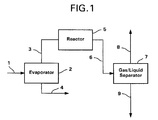
- the Figure is a process flow diagram illustrating a preferred embodiment of the instant invention wherein the water and volatile organic components of the wastewater stream are volatilized in an evaporator prior to being fed to the reactor.
- the invention is a process to eradicate organic compounds and ammonia from acrylonitrile plant wastewater streams by volatilizing said streams and then contacting in a reactor the volatilized streams with a catalyst so as to convert the volatile organic constituents and ammonia to a mixture comprising hydrogen, nitrogen and carbon dioxide.
- the reactor effluent comprising these reaction products and steam is then cooled to condense the steam and to separate and remove the gaseous reaction products.
- the resulting condensate is a purified aqueous stream substantially free of organic wastes and ammonia.
- Acrylonitrile plants generate a significant quantity of wastewater comprising organic products and by-products of the acrylonitrile process, which are suitable for treatment by the instant process.
- Such streams comprise one or more of the following constituents: nitriles, such as acrylonitrile and methacrylonitrile, aromatics, heteroaromatics, such as pyridine, amides, organic acids, aldehydes, alcohols and ammonia.
- the wastewater stream is volatilized prior to contacting the catalyst.
- the wastewater stream is volatilized to a vaporous stream comprising steam and the volatile components of the wastewater stream. These volatile components are typically the volatile organics present in the wastewater stream and ammonia.
- the wastewater may be volatilized in an evaporator (i.e. a vessel capable of receiving both the liquid and vapor phases of the wastewater wherein the liquid wastewater is volatilized using heat and or vacuum) or other unit operation prior to being fed to the reactor or the wastewater may be fed to the reactor as a liquid and be volatilized upon entry to the reactor, but prior to contacting the catalyst. If the wastewater is volatilized in an evaporator the non-volatile components of the wastewater stream are concentrated in the evaporator and then subsequently removed from the evaporator.
- the reactors may be fixed-bed, fluid bed, transfer-line or other mode of catalytic reactor.
- the reactors may be reformer type reactors consisting of multiple catalyst-containing tubes arranged in parallel which are heated up in a fixed furnace.
- the operating conditions employed in the reactors can vary appreciably. Any suitable conditions effective for selectively converting the ammonia and organic components of the wastewater stream to a mixture comprising nitrogen gas, hydrogen gas and carbon dioxide can be employed in the present invention.
- the reaction temperature will be in the range of from about 250°C to about 1000°C, more preferably in the range from about 350°C to about 800°C.
- the pressure can be in the range of from atmospheric to about 1000 psig. However, higher pressures can be employed.
- the steam to hydrocarbon weight ratio can be in the range of from about 5:1 to about 10,000:1.
- the liquid space velocity can be in the range of about 0.01 to about 1,000, preferably about 1 to about 100 volumes of wastewater per volume of catalyst per hour.
- single or multiple catalytic reactors may be used. Multiple reactors may be arranged in parallel or in series.
- Any suitable catalyst which is active for selectively converting the ammonia and the volatile organic compounds found in acrylonitrile plant wastewater streams to a mixture comprising predominantly hydrogen, carbon dioxide and nitrogen in the presence of steam can be employed in the practice of the invention.
- Typical catalyst includes (1) reduced nickel alumina-supported catalyst or (2) supported platinum group metal catalyst, both catalyst types optionally being promoted with an alkali metal or alkaline earth metal.
- the nickel catalyst used in the process is preferably a nickel-alumina catalyst containing from 5 to 90 weight percent nickel on a reduced basis and 0.5 to 10 weight percent alkali or alkaline earth metal.
- the values for weight percent are based on the total weight of the catalyst.
- alumina other natural or synthetic silica-containing material, such as kieselguhr, silica, silica-alumina, silica-zirconia, the natural or synthetic crystalline aluminosilicates, and the like, can be used.
- the alkali metal or alkaline earth metal can be applied to the catalyst as a hydroxide, carbonate, or other soluble salt. Potassium carbonate is a presently preferred alkaline material.
- the nickel component of the catalyst can be reduced and stabilized to prevent reaction with the oxygen in the air at any point subsequent to the addition of the nickel.
- Such reduction and stabilization permits the loading of the catalyst into the reactor and the use of the catalyst in the reaction without a reduction step.
- the platinum group metals for use in this invention can be ruthenium, rhodium, osmium, iridium, platinum, or palladium. Mixtures of such metals and/or their compounds can also be used. Ruthenium is a presently preferred platinum group metal.
- the platinum group metals can be incorporated into any of the known natural or synthetic refractory inorganic oxide materials known as supports such as alumina, silica, magnesia, zirconia, titania, silica-alumina, the natural or crystalline aluminosilicates, and the like.
- the amount of platinum group metal present in the catalyst composition can vary from 0.01 to 20 weight percent, preferably in amounts less than about 10 percent by weight.
- the amount of alkali metal or alkaline earth metal present in the catalyst can range from 0 to 10 weight percent.
- the alkali metal or alkaline earth metal can be applied as hydroxide, carbonate, or other soluble salt.
- the term "soluble" is intended to include either aqueous or non-aqueous solvents, although water is presently preferred. Potassium carbonate is the presently preferred alkali or alkaline earth compound.
- Another catalyst which can be employed in the process of the invention comprises a supported chromate, tungstate, or molybdate of the iron group metals, including iron, cobalt, and nickel, promoted with a barium salt of an organic acid such as barium acetate.
- the support for the catalyst comprises an aluminum-containing support material such as alumina or calcium aluminate.
- the catalyst will ordinarily contain from 1 to 10 weight percent of the iron group metal and from 5 to 25 weight percent of the chromate, tungstate, or molybdate, calculated as the oxide.
- the remainder of the catalyst is comprised of support material, such as alumina or other aluminum-containing material.
- the effluent stream from the reactor comprises water, nitrogen gas, hydrogen gas and carbon dioxide.
- the effluent stream is cooled to condense the water vapor and the gases are separated and removed in a gas/liquid separator. These off-gases can be recycled to the reactor, burned for fuel value or vented.
- the resulting aqueous stream is substantially free of organics and ammonia and is boiler quality feed water, which may be used for steam generation or other uses on site.
- acrylonitrile plant wastewater is fed via line 1 to the evaporator 2.
- water, ammonia and volatile organic components are volatilized and removed from the evaporator via line 3 and fed to the reactor 5.
- Non-volatile components are removed from the evaporator via line 4.
- the volatilized water, ammonia and organics are passed over a suitable catalyst at an elevated temperature.
- the ammonia and organics react to form nitrogen, hydrogen and carbon dioxide.
- reaction products and water vapor exit the reactor via line 6 and are fed to the gas/liquid separator 7.
- the reactor effluent is cooled to condense the water vapor which is removed from the separator via line 9.
- the gaseous reaction products exit the gas/liquid separator via line 8.
- the feedstock used in the Examples was wastewater from the recovery and purification section of an acrylonitrile plant. Three different wastewater streams were processed. Physical properties of each for the wastewater streams are given in Table 1.
- the wastewater feedstock was pumped downward through a stainless steel reactor tube containing commercial catalyst (United Catalyst C11-9-02, nominal composition 12% Ni and 88% refractory alumina support, 10-20 mesh particles). Reaction conditions were as shown in Table 2.
- the reactor effluent first passed through a heat-exchanger to condense steam and then the product mixture was sent to a gas/liquid separator where water was separated from the product gases. Product water was analyzed for pH, TOC, COD, volatile and semi-volatile organics,and ammonium ion.
- Example 1 a low TOC acrylonitrile plant wastewater stream was treated by the process of this invention at 500°C.
- the contained organic wastes were completely converted to hydrogen, carbon dioxide and nitrogen gases.
- Product condensate water was essentially free of organic carbon and contains a only very low level of ammonium ion.
- Example 2 demonstrated complete destruction of the organic wastes contained in an acrylonitrile plant wastewater stream having a substantially higher organic carbon loading.
- the contained organic waste products were completely converted to essentially hydrogen, nitrogen, and carbon dioxide gases.
- Product condensate water was free of organic carbon.
- the ammonium ion content of the product condensate water was higher due to the increased nitrogen loading of the feedstock wastewater.
- Example 3 shows the effectiveness of this process for purifying acrylonitrile process wastewaters having very high organic carbon and nitrogen loadings.
- the contained organic components were completely destroyed by conversion to essentially hydrogen, nitrogen, carbon dioxide, and carbon monoxide gases.
- the product gas was determined to be essentially free of NO x pollutants.
- Product condensate water was essentially free of organic carbon and had a very low ammonium ion content.
Landscapes
- Chemical & Material Sciences (AREA)
- Life Sciences & Earth Sciences (AREA)
- Hydrology & Water Resources (AREA)
- Engineering & Computer Science (AREA)
- Environmental & Geological Engineering (AREA)
- Water Supply & Treatment (AREA)
- Organic Chemistry (AREA)
- Chemical Kinetics & Catalysis (AREA)
- Organic Low-Molecular-Weight Compounds And Preparation Thereof (AREA)
Priority Applications (1)
| Application Number | Priority Date | Filing Date | Title |
|---|---|---|---|
| EP96303813A EP0810183A1 (fr) | 1996-05-29 | 1996-05-29 | Procédé pour traiter les courants d'eaux usées des usines de production de l'acrylonitrile |
Applications Claiming Priority (1)
| Application Number | Priority Date | Filing Date | Title |
|---|---|---|---|
| EP96303813A EP0810183A1 (fr) | 1996-05-29 | 1996-05-29 | Procédé pour traiter les courants d'eaux usées des usines de production de l'acrylonitrile |
Publications (1)
| Publication Number | Publication Date |
|---|---|
| EP0810183A1 true EP0810183A1 (fr) | 1997-12-03 |
Family
ID=8224955
Family Applications (1)
| Application Number | Title | Priority Date | Filing Date |
|---|---|---|---|
| EP96303813A Withdrawn EP0810183A1 (fr) | 1996-05-29 | 1996-05-29 | Procédé pour traiter les courants d'eaux usées des usines de production de l'acrylonitrile |
Country Status (1)
| Country | Link |
|---|---|
| EP (1) | EP0810183A1 (fr) |
Cited By (2)
| Publication number | Priority date | Publication date | Assignee | Title |
|---|---|---|---|---|
| ES2191537A1 (es) * | 2000-07-17 | 2003-09-01 | Mossert Loretto Simo Benavides | Instalacion de tratamiento de aguas residuales por evaporacion y oxidacion catalitica. |
| CN115321630A (zh) * | 2022-10-11 | 2022-11-11 | 浙江百能科技有限公司 | 煤炭分级利用废水零排放耦合制氢的方法和系统 |
Citations (2)
| Publication number | Priority date | Publication date | Assignee | Title |
|---|---|---|---|---|
| DE2425587A1 (de) * | 1973-05-28 | 1974-12-19 | Mitsui Toatsu Chemicals | Verfahren zur behandlung von abwasser |
| FR2347315A1 (fr) * | 1976-04-07 | 1977-11-04 | Erdoelchemie Gmbh | Procede pour eliminer les composes azotes d'eaux residuaires de la production de l'acrylonitrile |
-
1996
- 1996-05-29 EP EP96303813A patent/EP0810183A1/fr not_active Withdrawn
Patent Citations (2)
| Publication number | Priority date | Publication date | Assignee | Title |
|---|---|---|---|---|
| DE2425587A1 (de) * | 1973-05-28 | 1974-12-19 | Mitsui Toatsu Chemicals | Verfahren zur behandlung von abwasser |
| FR2347315A1 (fr) * | 1976-04-07 | 1977-11-04 | Erdoelchemie Gmbh | Procede pour eliminer les composes azotes d'eaux residuaires de la production de l'acrylonitrile |
Cited By (4)
| Publication number | Priority date | Publication date | Assignee | Title |
|---|---|---|---|---|
| ES2191537A1 (es) * | 2000-07-17 | 2003-09-01 | Mossert Loretto Simo Benavides | Instalacion de tratamiento de aguas residuales por evaporacion y oxidacion catalitica. |
| ES2191537B1 (es) * | 2000-07-17 | 2004-08-01 | Loreto Simone Benavides Mossert | Instalacion de tratamiento de aguas residuales por evaporacion y oxidacion catalitica. |
| CN115321630A (zh) * | 2022-10-11 | 2022-11-11 | 浙江百能科技有限公司 | 煤炭分级利用废水零排放耦合制氢的方法和系统 |
| CN115321630B (zh) * | 2022-10-11 | 2023-02-14 | 浙江百能科技有限公司 | 煤炭分级利用废水零排放耦合制氢的方法和系统 |
Similar Documents
| Publication | Publication Date | Title |
|---|---|---|
| US5562834A (en) | Waste concentration and destruction process | |
| US5205906A (en) | Process for the catalytic treatment of wastewater | |
| CN1055671C (zh) | 来自表氯醇生产的、含有有机物的废水的处理方法 | |
| EP0354656B1 (fr) | Procédé pour le traitement catalytique des eaux usées | |
| US4654149A (en) | Process for treating ammonium nitrate-containing waste water | |
| CZ278195A3 (en) | Process of treating waste water containing both organic and inorganic compounds, particularly waste water formed during preparation of epichlorhydrine | |
| US5635076A (en) | Treatment process for acrylonitrile plant wastewater streams | |
| US5891345A (en) | Treatment process for wastewater streams | |
| US6270739B1 (en) | Process for the removal of carbon dioxide from 3,4-epoxy-1-butene process recycle streams | |
| EP0641314A1 (fr) | Procede de purification d'acetonitrile. | |
| AU660332B2 (en) | Removal of thimerosal from waste streams | |
| US7252771B2 (en) | Method and device for decontaminating waters which are loaded with organic halogen compounds (halogenated hydrocarbons) | |
| US4059492A (en) | Process for the purification of waste from acrylonitrile production | |
| GB2043045A (en) | Process for treating ammonia- containing waste water | |
| EP0810183A1 (fr) | Procédé pour traiter les courants d'eaux usées des usines de production de l'acrylonitrile | |
| JP2000117272A (ja) | 廃水の処理方法 | |
| SU1447267A3 (ru) | Способ очистки газов от кислых примесей | |
| EP0730560A1 (fr) | Procede de traitement d'eaux usees contenant des composes organiques et inorganiques | |
| EP4347552B1 (fr) | Procédé de fabrication d'isophoronediamine | |
| CN1167089A (zh) | 丙烯腈工厂废水的处理方法 | |
| JP4703227B2 (ja) | 廃水の処理方法 | |
| MXPA96002020A (en) | Treatment process for wastewater streams of an acrilonitor plant | |
| JPH09314125A (ja) | アクリロニトリルプラント廃水流の処理方法 | |
| JPH11300374A (ja) | 排水の処理方法 | |
| US12371353B2 (en) | Elimination of formaldehyde in wastewater through oxidation treatment |
Legal Events
| Date | Code | Title | Description |
|---|---|---|---|
| PUAI | Public reference made under article 153(3) epc to a published international application that has entered the european phase |
Free format text: ORIGINAL CODE: 0009012 |
|
| AK | Designated contracting states |
Kind code of ref document: A1 Designated state(s): DE ES GB IT NL |
|
| 17P | Request for examination filed |
Effective date: 19980518 |
|
| STAA | Information on the status of an ep patent application or granted ep patent |
Free format text: STATUS: THE APPLICATION IS DEEMED TO BE WITHDRAWN |
|
| 18D | Application deemed to be withdrawn |
Effective date: 19991201 |