EP0813547B1 - Verfahren zur herstellung von neutralisierten polycarboxylaten auf polysaccharid-basis - Google Patents
Verfahren zur herstellung von neutralisierten polycarboxylaten auf polysaccharid-basis Download PDFInfo
- Publication number
- EP0813547B1 EP0813547B1 EP96905804A EP96905804A EP0813547B1 EP 0813547 B1 EP0813547 B1 EP 0813547B1 EP 96905804 A EP96905804 A EP 96905804A EP 96905804 A EP96905804 A EP 96905804A EP 0813547 B1 EP0813547 B1 EP 0813547B1
- Authority
- EP
- European Patent Office
- Prior art keywords
- oxidation
- solid
- polysaccharides
- polycarboxylic acid
- neutralizing agent
- Prior art date
- Legal status (The legal status is an assumption and is not a legal conclusion. Google has not performed a legal analysis and makes no representation as to the accuracy of the status listed.)
- Expired - Lifetime
Links
- 150000004676 glycans Chemical class 0.000 title claims abstract description 32
- 229920001282 polysaccharide Polymers 0.000 title claims abstract description 32
- 239000005017 polysaccharide Substances 0.000 title claims abstract description 32
- 238000004519 manufacturing process Methods 0.000 title claims description 8
- 229920005646 polycarboxylate Polymers 0.000 title description 14
- 238000000034 method Methods 0.000 claims abstract description 35
- MGWGWNFMUOTEHG-UHFFFAOYSA-N 4-(3,5-dimethylphenyl)-1,3-thiazol-2-amine Chemical compound CC1=CC(C)=CC(C=2N=C(N)SC=2)=C1 MGWGWNFMUOTEHG-UHFFFAOYSA-N 0.000 claims abstract description 26
- JCXJVPUVTGWSNB-UHFFFAOYSA-N nitrogen dioxide Inorganic materials O=[N]=O JCXJVPUVTGWSNB-UHFFFAOYSA-N 0.000 claims abstract description 26
- 239000007787 solid Substances 0.000 claims abstract description 22
- 239000002253 acid Substances 0.000 claims abstract description 21
- 239000003795 chemical substances by application Substances 0.000 claims abstract description 18
- 125000003178 carboxy group Chemical group [H]OC(*)=O 0.000 claims abstract description 14
- 230000003472 neutralizing effect Effects 0.000 claims abstract description 13
- WFPZPJSADLPSON-UHFFFAOYSA-N dinitrogen tetraoxide Chemical compound [O-][N+](=O)[N+]([O-])=O WFPZPJSADLPSON-UHFFFAOYSA-N 0.000 claims abstract description 12
- 125000000075 primary alcohol group Chemical group 0.000 claims abstract description 11
- 150000003839 salts Chemical class 0.000 claims abstract description 9
- 238000002156 mixing Methods 0.000 claims abstract description 8
- 125000002843 carboxylic acid group Chemical group 0.000 claims abstract description 4
- 238000007254 oxidation reaction Methods 0.000 claims description 49
- 230000003647 oxidation Effects 0.000 claims description 39
- 238000006243 chemical reaction Methods 0.000 claims description 22
- 229920002472 Starch Polymers 0.000 claims description 11
- 238000006386 neutralization reaction Methods 0.000 claims description 10
- 239000007789 gas Substances 0.000 claims description 9
- 239000000203 mixture Substances 0.000 claims description 9
- 239000008107 starch Substances 0.000 claims description 9
- 235000019698 starch Nutrition 0.000 claims description 9
- 239000010457 zeolite Substances 0.000 claims description 8
- HEMHJVSKTPXQMS-UHFFFAOYSA-M Sodium hydroxide Chemical compound [OH-].[Na+] HEMHJVSKTPXQMS-UHFFFAOYSA-M 0.000 claims description 6
- CDBYLPFSWZWCQE-UHFFFAOYSA-L Sodium Carbonate Chemical compound [Na+].[Na+].[O-]C([O-])=O CDBYLPFSWZWCQE-UHFFFAOYSA-L 0.000 claims description 4
- 229910021536 Zeolite Inorganic materials 0.000 claims description 4
- 239000002585 base Substances 0.000 claims description 4
- HNPSIPDUKPIQMN-UHFFFAOYSA-N dioxosilane;oxo(oxoalumanyloxy)alumane Chemical compound O=[Si]=O.O=[Al]O[Al]=O HNPSIPDUKPIQMN-UHFFFAOYSA-N 0.000 claims description 4
- 229920001592 potato starch Polymers 0.000 claims description 3
- 229920002261 Corn starch Polymers 0.000 claims description 2
- 240000003183 Manihot esculenta Species 0.000 claims description 2
- 235000016735 Manihot esculenta subsp esculenta Nutrition 0.000 claims description 2
- 150000008044 alkali metal hydroxides Chemical class 0.000 claims description 2
- 229910052910 alkali metal silicate Inorganic materials 0.000 claims description 2
- 239000008120 corn starch Substances 0.000 claims description 2
- 235000019353 potassium silicate Nutrition 0.000 claims description 2
- 238000005406 washing Methods 0.000 claims description 2
- 229940100445 wheat starch Drugs 0.000 claims description 2
- 229910052783 alkali metal Inorganic materials 0.000 claims 1
- 229910000288 alkali metal carbonate Inorganic materials 0.000 claims 1
- 150000008041 alkali metal carbonates Chemical class 0.000 claims 1
- 150000001340 alkali metals Chemical class 0.000 claims 1
- 229910000029 sodium carbonate Inorganic materials 0.000 claims 1
- GQPLMRYTRLFLPF-UHFFFAOYSA-N Nitrous Oxide Chemical compound [O-][N+]#N GQPLMRYTRLFLPF-UHFFFAOYSA-N 0.000 description 21
- QVGXLLKOCUKJST-UHFFFAOYSA-N atomic oxygen Chemical compound [O] QVGXLLKOCUKJST-UHFFFAOYSA-N 0.000 description 12
- 239000001301 oxygen Substances 0.000 description 12
- 229910052760 oxygen Inorganic materials 0.000 description 12
- 239000000047 product Substances 0.000 description 11
- 239000001272 nitrous oxide Substances 0.000 description 10
- 229920002678 cellulose Polymers 0.000 description 9
- 239000001913 cellulose Substances 0.000 description 9
- IJGRMHOSHXDMSA-UHFFFAOYSA-N Atomic nitrogen Chemical compound N#N IJGRMHOSHXDMSA-UHFFFAOYSA-N 0.000 description 8
- XLYOFNOQVPJJNP-UHFFFAOYSA-N water Substances O XLYOFNOQVPJJNP-UHFFFAOYSA-N 0.000 description 8
- 239000007800 oxidant agent Substances 0.000 description 6
- VYPSYNLAJGMNEJ-UHFFFAOYSA-N Silicium dioxide Chemical compound O=[Si]=O VYPSYNLAJGMNEJ-UHFFFAOYSA-N 0.000 description 5
- 239000012459 cleaning agent Substances 0.000 description 5
- TWNIBLMWSKIRAT-VFUOTHLCSA-N levoglucosan Chemical group O[C@@H]1[C@@H](O)[C@H](O)[C@H]2CO[C@@H]1O2 TWNIBLMWSKIRAT-VFUOTHLCSA-N 0.000 description 5
- 239000011261 inert gas Substances 0.000 description 4
- 229910052757 nitrogen Inorganic materials 0.000 description 4
- 239000000843 powder Substances 0.000 description 4
- 239000000243 solution Substances 0.000 description 4
- 230000015572 biosynthetic process Effects 0.000 description 3
- 239000003599 detergent Substances 0.000 description 3
- 238000010438 heat treatment Methods 0.000 description 3
- KHIWWQKSHDUIBK-UHFFFAOYSA-N periodic acid Chemical compound OI(=O)(=O)=O KHIWWQKSHDUIBK-UHFFFAOYSA-N 0.000 description 3
- 229910002012 Aerosil® Inorganic materials 0.000 description 2
- XKRFYHLGVUSROY-UHFFFAOYSA-N Argon Chemical compound [Ar] XKRFYHLGVUSROY-UHFFFAOYSA-N 0.000 description 2
- CURLTUGMZLYLDI-UHFFFAOYSA-N Carbon dioxide Chemical compound O=C=O CURLTUGMZLYLDI-UHFFFAOYSA-N 0.000 description 2
- MHAJPDPJQMAIIY-UHFFFAOYSA-N Hydrogen peroxide Chemical compound OO MHAJPDPJQMAIIY-UHFFFAOYSA-N 0.000 description 2
- 229910002651 NO3 Inorganic materials 0.000 description 2
- NHNBFGGVMKEFGY-UHFFFAOYSA-N Nitrate Chemical compound [O-][N+]([O-])=O NHNBFGGVMKEFGY-UHFFFAOYSA-N 0.000 description 2
- MWUXSHHQAYIFBG-UHFFFAOYSA-N Nitric oxide Chemical compound O=[N] MWUXSHHQAYIFBG-UHFFFAOYSA-N 0.000 description 2
- IOVCWXUNBOPUCH-UHFFFAOYSA-M Nitrite anion Chemical compound [O-]N=O IOVCWXUNBOPUCH-UHFFFAOYSA-M 0.000 description 2
- 239000004115 Sodium Silicate Substances 0.000 description 2
- 239000000654 additive Substances 0.000 description 2
- 239000003513 alkali Substances 0.000 description 2
- 229910052799 carbon Inorganic materials 0.000 description 2
- 238000001035 drying Methods 0.000 description 2
- ACKFDYCQCBEDNU-UHFFFAOYSA-J lead(2+);tetraacetate Chemical compound [Pb+2].CC([O-])=O.CC([O-])=O.CC([O-])=O.CC([O-])=O ACKFDYCQCBEDNU-UHFFFAOYSA-J 0.000 description 2
- 239000003960 organic solvent Substances 0.000 description 2
- 230000002035 prolonged effect Effects 0.000 description 2
- 229910052911 sodium silicate Inorganic materials 0.000 description 2
- NTHWMYGWWRZVTN-UHFFFAOYSA-N sodium silicate Chemical compound [Na+].[Na+].[O-][Si]([O-])=O NTHWMYGWWRZVTN-UHFFFAOYSA-N 0.000 description 2
- 239000013042 solid detergent Substances 0.000 description 2
- 238000010626 work up procedure Methods 0.000 description 2
- BVKZGUZCCUSVTD-UHFFFAOYSA-L Carbonate Chemical compound [O-]C([O-])=O BVKZGUZCCUSVTD-UHFFFAOYSA-L 0.000 description 1
- 229920001353 Dextrin Polymers 0.000 description 1
- 239000004375 Dextrin Substances 0.000 description 1
- 229920002085 Dialdehyde starch Polymers 0.000 description 1
- 229920001503 Glucan Polymers 0.000 description 1
- WQZGKKKJIJFFOK-GASJEMHNSA-N Glucose Natural products OC[C@H]1OC(O)[C@H](O)[C@@H](O)[C@@H]1O WQZGKKKJIJFFOK-GASJEMHNSA-N 0.000 description 1
- 229920002907 Guar gum Polymers 0.000 description 1
- 229920000161 Locust bean gum Polymers 0.000 description 1
- 241000220317 Rosa Species 0.000 description 1
- 239000005708 Sodium hypochlorite Substances 0.000 description 1
- 229910001854 alkali hydroxide Inorganic materials 0.000 description 1
- 239000007864 aqueous solution Substances 0.000 description 1
- 229910052786 argon Inorganic materials 0.000 description 1
- DKSMCEUSSQTGBK-UHFFFAOYSA-M bromite Inorganic materials [O-]Br=O DKSMCEUSSQTGBK-UHFFFAOYSA-M 0.000 description 1
- WUKWITHWXAAZEY-UHFFFAOYSA-L calcium difluoride Chemical compound [F-].[F-].[Ca+2] WUKWITHWXAAZEY-UHFFFAOYSA-L 0.000 description 1
- 229910001634 calcium fluoride Inorganic materials 0.000 description 1
- 239000001506 calcium phosphate Substances 0.000 description 1
- 229910000389 calcium phosphate Inorganic materials 0.000 description 1
- 235000011010 calcium phosphates Nutrition 0.000 description 1
- 150000001720 carbohydrates Chemical group 0.000 description 1
- 239000001569 carbon dioxide Substances 0.000 description 1
- 229910002092 carbon dioxide Inorganic materials 0.000 description 1
- 150000001734 carboxylic acid salts Chemical class 0.000 description 1
- 235000010980 cellulose Nutrition 0.000 description 1
- ITZXULOAYIAYNU-UHFFFAOYSA-N cerium(4+) Chemical class [Ce+4] ITZXULOAYIAYNU-UHFFFAOYSA-N 0.000 description 1
- 239000007795 chemical reaction product Substances 0.000 description 1
- 239000003153 chemical reaction reagent Substances 0.000 description 1
- 238000003776 cleavage reaction Methods 0.000 description 1
- 238000000354 decomposition reaction Methods 0.000 description 1
- 235000019425 dextrin Nutrition 0.000 description 1
- 239000000539 dimer Substances 0.000 description 1
- 230000000694 effects Effects 0.000 description 1
- 239000012530 fluid Substances 0.000 description 1
- 238000005243 fluidization Methods 0.000 description 1
- 239000008103 glucose Substances 0.000 description 1
- 235000010417 guar gum Nutrition 0.000 description 1
- 239000001307 helium Substances 0.000 description 1
- 229910052734 helium Inorganic materials 0.000 description 1
- SWQJXJOGLNCZEY-UHFFFAOYSA-N helium atom Chemical compound [He] SWQJXJOGLNCZEY-UHFFFAOYSA-N 0.000 description 1
- 125000002887 hydroxy group Chemical group [H]O* 0.000 description 1
- 238000002347 injection Methods 0.000 description 1
- 239000007924 injection Substances 0.000 description 1
- 229920002521 macromolecule Polymers 0.000 description 1
- 239000000395 magnesium oxide Substances 0.000 description 1
- CPLXHLVBOLITMK-UHFFFAOYSA-N magnesium oxide Inorganic materials [Mg]=O CPLXHLVBOLITMK-UHFFFAOYSA-N 0.000 description 1
- AXZKOIWUVFPNLO-UHFFFAOYSA-N magnesium;oxygen(2-) Chemical compound [O-2].[Mg+2] AXZKOIWUVFPNLO-UHFFFAOYSA-N 0.000 description 1
- 229910052756 noble gas Inorganic materials 0.000 description 1
- 150000002835 noble gases Chemical class 0.000 description 1
- 230000010355 oscillation Effects 0.000 description 1
- 230000001590 oxidative effect Effects 0.000 description 1
- 239000001254 oxidized starch Substances 0.000 description 1
- 235000013808 oxidized starch Nutrition 0.000 description 1
- 239000002245 particle Substances 0.000 description 1
- 238000002360 preparation method Methods 0.000 description 1
- 239000000376 reactant Substances 0.000 description 1
- 230000035484 reaction time Effects 0.000 description 1
- 230000007017 scission Effects 0.000 description 1
- 239000000741 silica gel Substances 0.000 description 1
- 229910002027 silica gel Inorganic materials 0.000 description 1
- 150000004760 silicates Chemical class 0.000 description 1
- 239000000377 silicon dioxide Substances 0.000 description 1
- 235000012239 silicon dioxide Nutrition 0.000 description 1
- SUKJFIGYRHOWBL-UHFFFAOYSA-N sodium hypochlorite Chemical compound [Na+].Cl[O-] SUKJFIGYRHOWBL-UHFFFAOYSA-N 0.000 description 1
- 238000001694 spray drying Methods 0.000 description 1
- 238000003860 storage Methods 0.000 description 1
- 239000000126 substance Substances 0.000 description 1
- 239000000758 substrate Substances 0.000 description 1
- 239000004753 textile Substances 0.000 description 1
- QORWJWZARLRLPR-UHFFFAOYSA-H tricalcium bis(phosphate) Chemical compound [Ca+2].[Ca+2].[Ca+2].[O-]P([O-])([O-])=O.[O-]P([O-])([O-])=O QORWJWZARLRLPR-UHFFFAOYSA-H 0.000 description 1
- 238000009489 vacuum treatment Methods 0.000 description 1
Classifications
-
- C—CHEMISTRY; METALLURGY
- C11—ANIMAL OR VEGETABLE OILS, FATS, FATTY SUBSTANCES OR WAXES; FATTY ACIDS THEREFROM; DETERGENTS; CANDLES
- C11D—DETERGENT COMPOSITIONS; USE OF SINGLE SUBSTANCES AS DETERGENTS; SOAP OR SOAP-MAKING; RESIN SOAPS; RECOVERY OF GLYCEROL
- C11D3/00—Other compounding ingredients of detergent compositions covered in group C11D1/00
- C11D3/16—Organic compounds
- C11D3/37—Polymers
- C11D3/3746—Macromolecular compounds obtained by reactions only involving carbon-to-carbon unsaturated bonds
- C11D3/3757—(Co)polymerised carboxylic acids, -anhydrides, -esters in solid and liquid compositions
-
- C—CHEMISTRY; METALLURGY
- C08—ORGANIC MACROMOLECULAR COMPOUNDS; THEIR PREPARATION OR CHEMICAL WORKING-UP; COMPOSITIONS BASED THEREON
- C08B—POLYSACCHARIDES; DERIVATIVES THEREOF
- C08B15/00—Preparation of other cellulose derivatives or modified cellulose, e.g. complexes
- C08B15/02—Oxycellulose; Hydrocellulose; Cellulosehydrate, e.g. microcrystalline cellulose
- C08B15/04—Carboxycellulose, e.g. prepared by oxidation with nitrogen dioxide
-
- C—CHEMISTRY; METALLURGY
- C08—ORGANIC MACROMOLECULAR COMPOUNDS; THEIR PREPARATION OR CHEMICAL WORKING-UP; COMPOSITIONS BASED THEREON
- C08B—POLYSACCHARIDES; DERIVATIVES THEREOF
- C08B31/00—Preparation of derivatives of starch
- C08B31/18—Oxidised starch
-
- C—CHEMISTRY; METALLURGY
- C11—ANIMAL OR VEGETABLE OILS, FATS, FATTY SUBSTANCES OR WAXES; FATTY ACIDS THEREFROM; DETERGENTS; CANDLES
- C11D—DETERGENT COMPOSITIONS; USE OF SINGLE SUBSTANCES AS DETERGENTS; SOAP OR SOAP-MAKING; RESIN SOAPS; RECOVERY OF GLYCEROL
- C11D3/00—Other compounding ingredients of detergent compositions covered in group C11D1/00
- C11D3/16—Organic compounds
- C11D3/20—Organic compounds containing oxygen
- C11D3/22—Carbohydrates or derivatives thereof
- C11D3/222—Natural or synthetic polysaccharides, e.g. cellulose, starch, gum, alginic acid or cyclodextrin
- C11D3/223—Natural or synthetic polysaccharides, e.g. cellulose, starch, gum, alginic acid or cyclodextrin oxidised
Definitions
- the invention relates to a simplified method for producing Polycarboxylates in their salt form through selective oxidation of polysaccharides with gaseous nitrogen dioxide and dry neutralization of the obtained oxidation product.
- oxidizing agents are for the Oxidation of polysaccharides, especially from glucose only constructed polyglucosans in use.
- polysaccharides especially from glucose only constructed polyglucosans in use.
- oxygen hydrogen peroxide
- sodium hypochlorite respectively -bromite
- periodic acid or periodate periodic acid or periodate
- lead (IV) acetate titanium dioxide
- cerium (IV) salts react very differently with the anhydroglucose units, cf. for example the Formula pictures in Houben-Weyl op. Cit. Page 2124.
- Periodates or lead (IV) acetate a C-C cleavage of the anhydroglucose rings the so-called 2,3-dialdehyde cellulose and analog are obtained from cellulose from starch dialdehyde starch.
- the oxidizer usually in equilibrium with nitrous oxide In the present case, it can be gaseous or dissolved in an inert organic Solvents are used, cf. Houben-Weyl op. page 2125 and the primary literature mentioned there in this context.
- Oxidations of the primary alcohol group of the anhydroglucose units Create carboxyl group. So is from the US patent US 2,472,590 the oxidation of starch with gaseous or in Water or dissolved in various organic solvents Known nitrogen dioxide.
- a polysaccharide selectively oxidized at C 6 is obtained in solid form.
- This sparingly water-soluble acid form is not well suited for direct use as a builder or builder component (cobuilder) in detergents or cleaning agents; it is generally preferred to use the oxidized polysaccharide in the form of a water-soluble salt, that is to say the neutralization product of the polycarboxylic acid obtained in the oxidation. It has previously been proposed to carry out this neutralization with aqueous base.
- aqueous solutions of the polycarboxylate which, if the polycarboxylate is required as a solid, make an energy-consuming drying step necessary.
- this can be the case in the manufacture of solid detergents or cleaning agents if an aqueous workup step for removing nitrate and nitrite is provided directly after the actual oxidation reaction and the further processing of the aqueous neutralized polycarboxylate solution in the context of spray drying processes.
- the formation of aqueous polycarboxylate solutions in the context of manufacturing processes for detergents and cleaning agents which involve the mixing of solid components is particularly disadvantageous, since in this case the removal of water from the polycarboxylate solution and the conversion of the dissolved polycarboxylate into a solid are inevitable.
- Object of the invention with which the outlined problems are solved is a process for the preparation of solid polycarboxylic acid salts from polysaccharides by oxidation with gaseous nitrogen dioxide / nitrous oxide converting at least part of the primary Alcohol groups of the polysaccharides in carboxyl groups and at least partial neutralization of the resulting carboxylic acid groups, which is characterized in that the solid polycarboxylic acid with a solid neutralizing agent mixed.
- the oxidation of the neutralization preceding the invention Polysaccharide is preferably carried out as in the German patent application P 44 26 443.7. This means that you have the reaction of the polysaccharide to be oxidized with nitrogen dioxide / nitrous oxide only so long that the desired degree of oxidation that is the degree of conversion of the primary alcohol groups into carboxyl groups, only to a maximum of 90%, preferably to 60% to 85% and in particular to 65% to 80% is reached.
- the complete achievement of the desired Degree of oxidation occurs only in the post-oxidation phase, that is when the nitrogen dioxide / nitrous oxide supply has ended and in comparison to the oxidation phase by at least 10 ° C, preferably 15 ° C to 80 ° C and in particular 20 ° C to 50 ° C elevated temperature. It is make sure that by raising the temperature there is an upper limit of 160 ° C is not exceeded if possible, since at higher temperatures increasingly decomposition was observed.
- the oxidation reaction to be stopped before full conversion is reached is preferably at temperatures from 30 ° C to 70 ° C, in particular from 40 ° C to 60 ° C.
- It can be oxygen, alone or in a mixture with gas which is inert under the reaction conditions, its addition once at the start of the reaction or several times, if desired continuously during the reaction. With the latter
- the oxidation reaction can or controlled depending on the pressure via the oxygen metering.
- the addition of oxygen is preferably controlled so that the reaction temperature remains in the range of 30 ° C to 70 ° C.
- non-reactive gases can include noble gases such as helium or argon and carbon dioxide, but especially nitrogen, nitrogen monoxide and nitrous oxide, but also any mixtures of such gases can be used.
- the oxygen content in the gas mixture is preferably in the range from 1% by volume to 30% by volume, in particular from 3% by volume to 10% by volume.
- a preferred embodiment of the method according to the invention includes the supply of oxygen by injecting air.
- Another preferred embodiment of the method is characterized in that that in the reaction system before the start of the oxidation reaction Pressure of less than 10 bar, in particular from 2 bar to 6 bar, at the Desired reaction temperature by injecting an inert gas is set and then oxygen or a mixture of Oxygen with an inert gas mentioned, several times, if desired continuously, is pressed on.
- the addition of nitrogen dioxide / nitrous oxide can be before or after the addition of oxygen or the beginning of the oxygen addition. It may be necessary be the reaction vessel after the initial injection of the inert gas to heat to the desired reaction temperature.
- the reaction temperature can usually without external heating can be held solely by the amount of oxygen added.
- its fluidizing agent is a gas containing nitrogen dioxide.
- Such an oxidation process is in the unpublished German patent application P 44 02 851.2.
- Under the fluidized bed should - without this Type of generation to be limited - the appearance to be understood which can be observed when stored on horizontal, perforated floors fine-grained bulk goods from below of gases, referred to as eddies, is flowed through.
- eddies fine-grained bulk goods from below of gases
- a useful reactor for the oxidation is also that disclosed in European patent EP 051 147 B1 (there Figure 1) Device in which a gas-flowed fluidized bed is in one Cylinder in which a shaft equipped with agitator arms rotates. It is also possible to use a reactor with a multi-stage fluidized bed, as in Beránek / Rose / Winterstein, "Fundamentals of fluidized bed technology", Krauskopf-Verlag, 1975, page 72. With one Continuous reaction is easily possible with the device.
- the fluidizing agent can flow through the Polysaccharides leave the reaction system and will according to the invention Replacement of the desired degree of oscillation by a vortex, that does not contain nitrogen dioxide / nitrous oxide. Is preferred this vortex is an inert gas described above.
- the nature of the one used Polysaccharides largely uncritical. The only requirements are that it contains carbohydrate units containing primary alcohol groups contains and is in a form that the intensive mixing with the gaseous oxidizing agent and preferably the formation of a Allows fluidized bed, especially in powder form.
- Native are possible Polyglucans, especially starch and / or cellulose, but also other polysaccharides, for example polygalactomannans such as guaran and carubin.
- the Polysaccharides can also be chemically or physically modified Form are used provided they still have oxidizable primary alcohol groups contain.
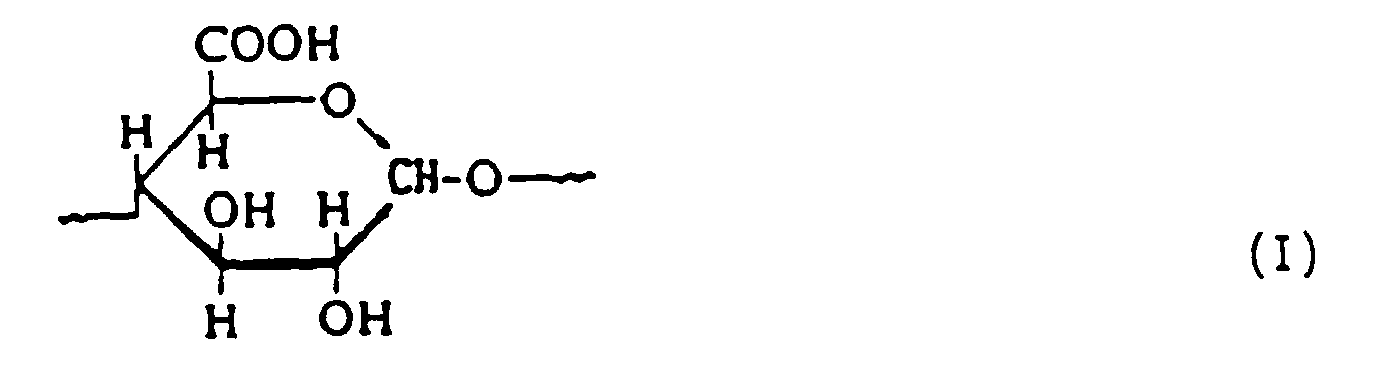
- the process according to the invention in particular using the polyglucans mentioned, is preferably carried out in its oxidation step over a period of time such that the oxidation product on average is at least .15 mol% from oxidized anhydroglucose units of the formula I exists, which corresponds to a carboxyl group content of at least 4 wt .-%.
- Polycarboxylates are obtained by a process according to the invention Polyglucan base, which the oxidized anhydroglucose units in particular of formula I preferably at least 25 mol%, in particular to contain at least 35 mol% in the molecule, with another advantage being none significant quantities of other oxidation secondary products are present.
- the upper limit the content of units according to formula I is 100 mol%, in particular at about 95 mole%.
- the polysaccharide to be oxidized tends to agglomerate and to form channels that are feared in fluidized bed technology
- its flow behavior can be increased by the addition of small amounts of, in particular, solid additives, for example magnesium oxide, calcium fluoride, calcium phosphate, finely divided zeolites or silica gel, in particular under the name Aerosil (R) owned silicon dioxide can be significantly improved.
- high effects are achieved when using low amounts of additives of preferably 0.1% by weight to 5% by weight, in particular 0.25% by weight to 1% by weight, based in each case on the polysaccharide to be oxidized .
- the polysaccharide used preferably contains not more than 15% by weight, in particular not more than 10% by weight, of water.
- At least part of the carboxyl groups of the oxidation product by treating with a basic in solid form Reagent neutralized, that is, from the acid to the salt form transferred.
- a basic in solid form Reagent neutralized that is, from the acid to the salt form transferred.
- the preferred Neutralizers include sodium hydroxide, sodium carbonate, dried basic water glasses and without the usual Wash step obtained, that is, basic zeolites, such as zeolite Na-A, X and / or P.
- the neutralizing agent is used in such amounts used that all carboxyl groups of the oxidation product in the Salt form are transferred.
- the neutralization step of the method according to the invention can be done in this way take place that directly after the oxidation or Post-oxidation in the fluidized bed reactor with the polycarboxylic acid obtained the solid, preferably powdered neutralizing agent swirled. If desired, it can be heated, preferably for removal the heat of neutralization is cooled.
- Suitable mixing units are both high-speed intensive mixers, for example the CB Recycler (R) and the ploughshare FM from Lödige, as well as roller compactors, for example the roller compactor, so-called Shugi (R) mixers, sold by Alexanderwerke (R) (Hosokawa-Micron (R) ) and gentle mixers, such as the mixer sold by Fima Forberg (R) and the Vrieco (R) mixer from Hosokawa-Micron (R) .
- CB Recycler CB Recycler
- ploughshare FM from Lödige
- roller compactors for example the roller compactor
- Shugi (R) mixers sold by Alexanderwerke (R) (Hosokawa-Micron (R) )
- gentle mixers such as the mixer sold by Fima Forberg (R) and the Vrieco (R) mixer from Hosokawa-Micron (R) .
- the polycarboxylates produced by the process according to the invention are preferred because of their builders or co-builder properties Manufacture of solid detergents or cleaning agents used. In such They are preferably used as co-builders in amounts of 0.5% by weight. up to 10% by weight, in particular 2% by weight to 7% by weight, based in each case on the Total weight of the agent, the inorganic builder as the main builder included, used.
- the zeolite-NaA as related for example described with textile detergents in German Patent DE 24 12 837 and / or layered silicates, as described in the European patent application EP 164 514 are described as the main builder and by the Polycarboxylic acid salts produced by the process according to the invention in quantitative ratios from 2: 1 to 5: 1 included.
- the composition of the laundry and / or cleaning agents can otherwise be part of known recipes can be chosen practically arbitrarily.
- Starch was oxidized in the apparatus used in Example 1 of German patent application P 44 26 443.7.
- Nitrogen at a rate sufficient to fluidize the starch was passed through the reactor and heated to 50 ° C.
- Nitrogen dioxide was passed through the fluidized bed from a temperature-controlled storage bottle. The gas quantities were set to 150 standard liters per hour using flow meters calibrated for air. After 4 hours, the supply of nitrogen dioxide was stopped and the reactor temperature was raised to 80 ° C. in the course of 30 minutes and held at this temperature for 30 minutes.
- a polycarboxylic acid P1 was obtained as a white, free-flowing powder with an acid number of 371.
- 110.6 g of this oxidized starch were mixed with 150 g of a freeze-dried zeolite Na-A (OH number 274) for 1 hour in a stirred fixed bed while passing nitrogen over it leave at 80 ° C.
- a powder was obtained which, when stirred into water, led to a temperature tint of + 6 ° C.
- the separate introduction of P1 and the zeolite into water led to a temperature increase of 14 ° C.
- Example 2 Analogously to Example 1, 62 g of a polycarboxylic acid P2 (acid number 380) were prepared by oxidation in a fluidized bed reactor. This was left in the fluidized bed reactor, 50 g of basic sodium silicate (Portil (R) A) with an OH number of 472 were added and swirled with P2 over a period of 10 minutes by passing nitrogen through. A homogeneous product was obtained which remained stable even after prolonged heating to 90 ° C.
- P2 acid number 380
- Example 2 was substituted for the sodium silicate with anhydrous sodium carbonate repeated. This also gave a homogeneous, after prolonged heating to 90 ° C unchanged stable product.
Landscapes
- Chemical & Material Sciences (AREA)
- Life Sciences & Earth Sciences (AREA)
- Chemical Kinetics & Catalysis (AREA)
- Engineering & Computer Science (AREA)
- Organic Chemistry (AREA)
- Health & Medical Sciences (AREA)
- Polymers & Plastics (AREA)
- Medicinal Chemistry (AREA)
- Materials Engineering (AREA)
- Biochemistry (AREA)
- Oil, Petroleum & Natural Gas (AREA)
- Wood Science & Technology (AREA)
- Molecular Biology (AREA)
- Emergency Medicine (AREA)
- Polysaccharides And Polysaccharide Derivatives (AREA)
- Detergent Compositions (AREA)
Description
Claims (11)
- Verfahren zur Herstellung von festen Polycarbonsäuresalzen aus Polysacchariden durch Oxidation mit gasförmigem Stickstoffdioxid/Distickstofftetroxid unter Umwandlung zumindest eines Teils der primären Alkoholgruppen der Polysaccharide in Carboxylgruppen und wenigstens anteilsweiser Neutralisation der entstehenden Carbonsäuregruppen, dadurch gekennzeichnet, daß man die feste Polycarbonsäure mit einem festen Neutralisationsmittel vermischt.
- Verfahren nach Anspruch 1, dadurch gekennzeichnet, daß man als Neutralisationsmittel feste, insbesondere pulverförmige Basen, insbesondere Alkalihydroxid, Alkalicarbonat, basisches Alkalisilkat und basisches Alkalialumosilikat sowie deren Mischungen, einsetzt.
- Verfahren nach Anspruch 1 oder 2, dadurch gekennzeichnet, daß man als Neutralisierungsmittel Natriumhydroxid, Natriumcarbonat, sprühgetrocknete basische Wassergläser und/oder unter Verzicht auf den üblichen Waschschritt gewonnene, das heißt basische Zeolithe, wie Zeolith Na-A, X und/oder P, einsetzt.
- Verfahren nach einem der Ansprüche 1 bis 3, dadurch gekennzeichnet, daß man das Neutralisationsmittel in solchen Mengen einsetzt, daß sämtliche Carboxylgruppen des Oxidationsproduktes in die Salzform überführt werden.
- Verfahren nach einem der Ansprüche 1 bis 4, dadurch gekennzeichnet, daß man im Oxidationsschritt die Zufuhr von Stickstoffdioxid/Distickstofftetroxid beendet, wenn der gewünschte Oxidationsgrad zu 60 % bis 85 %, insbesondere zu 65 % bis 80 % erreicht ist, und die Temperatur um mindestens 10 °C erhöht.
- Verfahren nach Anspruch 5, dadurch gekennzeichnet, daß man die Temperatur um 15 °C bis 80 °C, insbesondere um 20 °C bis 50 °C erhöht.
- Verfahren nach einem der Ansprüche 1 bis 6, dadurch gekennzeichnet, daß man mindestens 15 %, insbesondere 25 % bis 100 % der primären Alkoholgruppen der Polysaccharide in Carboxylgruppen umwandelt.
- Verfahren nach einem der Ansprüche 1 bis 7, dadurch gekennzeichnet, daß man den Oxidationsschritt in einer Wirbelschicht, deren Wirbelmittel ein Stickstoffdioxid-haltiges Gas ist, durchführt.
- Verfahren nach einem der Ansprüche 1 bis 8, dadurch gekennzeichnet, daß man als zu oxidierendes Polysaccharid Stärke, insbesondere Kartoffelstärke, Weizenstärke, Maisstärke und/oder Tapiokastärke, einsetzt.
- Verfahren nach einem der Ansprüche 1 bis 9, dadurch gekennzeichnet, daß man nach dem Oxidationsschritt die Polycarbonsäure und das feste, insbesondere pulverförmige Neutralisierungsmittel in ein geeignetes Mischaggregat überführt und dort reagieren läßt.
- Verfahren nach einem der Ansprüche 1 bis 9, dadurch gekennzeichnet, daß man den Oxidationsschritt in einem Wirbelschichtreaktor ausführt und direkt im Anschluß an den Oxidationsschritt im Wirbelschichtreaktor die erhaltene Polycarbonsäure mit dem festen, insbesondere pulverförmigen Neutralisierungsmittel verwirbelt.
Applications Claiming Priority (3)
| Application Number | Priority Date | Filing Date | Title |
|---|---|---|---|
| DE19507717A DE19507717A1 (de) | 1995-03-07 | 1995-03-07 | Verfahren zur Herstellung von neutralisierten Polycarboxylaten auf Polysaccharid-Basis |
| DE19507717 | 1995-03-07 | ||
| PCT/EP1996/000791 WO1996027618A1 (de) | 1995-03-07 | 1996-02-27 | Verfahren zur herstellung von neutralisierten polycarboxylaten auf polysaccharid-basis |
Publications (2)
| Publication Number | Publication Date |
|---|---|
| EP0813547A1 EP0813547A1 (de) | 1997-12-29 |
| EP0813547B1 true EP0813547B1 (de) | 1999-04-14 |
Family
ID=7755720
Family Applications (1)
| Application Number | Title | Priority Date | Filing Date |
|---|---|---|---|
| EP96905804A Expired - Lifetime EP0813547B1 (de) | 1995-03-07 | 1996-02-27 | Verfahren zur herstellung von neutralisierten polycarboxylaten auf polysaccharid-basis |
Country Status (7)
| Country | Link |
|---|---|
| US (1) | US5892027A (de) |
| EP (1) | EP0813547B1 (de) |
| JP (1) | JPH11501345A (de) |
| AT (1) | ATE178911T1 (de) |
| DE (2) | DE19507717A1 (de) |
| ES (1) | ES2131935T3 (de) |
| WO (1) | WO1996027618A1 (de) |
Families Citing this family (3)
| Publication number | Priority date | Publication date | Assignee | Title |
|---|---|---|---|---|
| DE19936613B4 (de) | 1999-08-04 | 2010-09-02 | Henkel Ag & Co. Kgaa | Verfahren zur Herstellung eines Waschmittels mit löslichem Buildersystem |
| CN1886427B (zh) | 2003-11-28 | 2012-05-23 | 伊士曼化工公司 | 纤维素共聚体和氧化方法 |
| US9376648B2 (en) * | 2008-04-07 | 2016-06-28 | The Procter & Gamble Company | Foam manipulation compositions containing fine particles |
Family Cites Families (13)
| Publication number | Priority date | Publication date | Assignee | Title |
|---|---|---|---|---|
| US2472590A (en) * | 1945-03-02 | 1949-06-07 | Eastman Kodak Co | Oxidation of starch with nitrogen dioxide |
| AT330930B (de) * | 1973-04-13 | 1976-07-26 | Henkel & Cie Gmbh | Verfahren zur herstellung von festen, schuttfahigen wasch- oder reinigungsmitteln mit einem gehalt an calcium bindenden substanzen |
| NO148854C (no) * | 1973-04-13 | 1985-05-29 | Henkel Kgaa | Pulverformet til kornet vaske- eller blekemiddelblanding, uten eller med redusert fosfatinnhold |
| DE2436843A1 (de) * | 1974-07-31 | 1976-02-12 | Akzo Gmbh | Stoffgemisch aus oxydationsprodukten von cellulose, hemicellulosen und lignin |
| JPS51149388A (en) * | 1975-06-17 | 1976-12-22 | Sumitomo Chem Co Ltd | A process for preparing the carboxylated pullulan |
| DE2843473A1 (de) * | 1978-10-05 | 1980-04-17 | Bayer Ag | Lactonmodifizierte esteroele |
| DE3041188A1 (de) * | 1980-11-03 | 1982-06-03 | Degussa Ag, 6000 Frankfurt | Vorrichtung zur oxidativen nachbehandlung von russ |
| DE3413571A1 (de) * | 1984-04-11 | 1985-10-24 | Hoechst Ag, 6230 Frankfurt | Verwendung von kristallinen schichtfoermigen natriumsilikaten zur wasserenthaertung und verfahren zur wasserenthaertung |
| US5069919A (en) * | 1990-08-08 | 1991-12-03 | Fmc Corporation | Process for bleaching/sanitizing food fiber |
| US5180398A (en) * | 1990-12-20 | 1993-01-19 | Johnson & Johnson Medical, Inc. | Cellulose oxidation by a perfluorinated hydrocarbon solution of nitrogen dioxide |
| DE4203923A1 (de) * | 1992-02-11 | 1993-08-12 | Henkel Kgaa | Verfahren zur herstellung von polycarboxylaten auf polysaccharid-basis |
| DE4402851A1 (de) * | 1994-01-31 | 1995-08-03 | Henkel Kgaa | Wirbelschicht-Oxidationsverfahren zur Herstellung von Polycarboxylaten auf Polysaccharid-Basis |
| DE4426443A1 (de) * | 1994-07-26 | 1996-02-01 | Henkel Kgaa | Verbessertes Verfahren zur Herstellung von Polycarboxylaten durch Oxidation von Polysacchariden |
-
1995
- 1995-03-07 DE DE19507717A patent/DE19507717A1/de not_active Withdrawn
-
1996
- 1996-02-27 WO PCT/EP1996/000791 patent/WO1996027618A1/de not_active Ceased
- 1996-02-27 AT AT96905804T patent/ATE178911T1/de not_active IP Right Cessation
- 1996-02-27 ES ES96905804T patent/ES2131935T3/es not_active Expired - Lifetime
- 1996-02-27 JP JP8526575A patent/JPH11501345A/ja active Pending
- 1996-02-27 EP EP96905804A patent/EP0813547B1/de not_active Expired - Lifetime
- 1996-02-27 DE DE59601667T patent/DE59601667D1/de not_active Expired - Fee Related
- 1996-02-27 US US08/913,071 patent/US5892027A/en not_active Expired - Fee Related
Also Published As
| Publication number | Publication date |
|---|---|
| ES2131935T3 (es) | 1999-08-01 |
| JPH11501345A (ja) | 1999-02-02 |
| DE19507717A1 (de) | 1996-09-12 |
| WO1996027618A1 (de) | 1996-09-12 |
| ATE178911T1 (de) | 1999-04-15 |
| DE59601667D1 (de) | 1999-05-20 |
| EP0813547A1 (de) | 1997-12-29 |
| US5892027A (en) | 1999-04-06 |
Similar Documents
| Publication | Publication Date | Title |
|---|---|---|
| EP0625992B1 (de) | Verfahren zur herstellung von polycarboxylaten auf polysaccharid-basis | |
| EP0742797B1 (de) | Wirbelschicht-oxidationsverfahren zur herstellung von polycarboxylaten auf polysaccharid-basis | |
| EP0703927B1 (de) | Herstellung von polycarboxylaten auf polysaccharid-basis | |
| EP1554315B1 (de) | Wasserlösliche eisen-kohlenhydrat-komplexe, deren herstellung und diese enthaltende arzneimittel | |
| DE602004002763T2 (de) | Verkapselte Partikel | |
| EP1423433B1 (de) | Verfahren zur herstellung niederviskoser celluloseether durch sauer-oxidativen abbau von gemahlenen und getrockneten celluloseethern | |
| DE1087738B (de) | Reinigungsmittel mit bleichender, oxydierender und desinfizierender Wirkung | |
| EP0656937A1 (de) | Geschirrspülmittel mit ausgewähltem builder-system. | |
| DE3712246A1 (de) | Verfahren zum herstellen modifizierter cyclodextrine | |
| DE69620864T2 (de) | Verbessertes Verfahren zur Oxidation von Zückern | |
| DE4213282A1 (de) | Verfahren zur Herstellung von Polyestern aus Citronensäure und Polyhydroxyverbindungen und ihre Verwendung | |
| EP0813547B1 (de) | Verfahren zur herstellung von neutralisierten polycarboxylaten auf polysaccharid-basis | |
| EP0815143B1 (de) | Verbessertes oxidationsverfahren zur herstellung von polycarboxylaten aus polysacchariden | |
| DE4426443A1 (de) | Verbessertes Verfahren zur Herstellung von Polycarboxylaten durch Oxidation von Polysacchariden | |
| DE2063273A1 (de) | Verfahren zur Herstellung von oxydierten Starkederivaten und deren Verwendung als Aufbaustoffe fur Detergentien | |
| DE2336108A1 (de) | Oxydationsmittel mit komplexierenden eigenschaften und diese verbindungen enthaltende waschmittelzusammensetzungen | |
| EP0623593A2 (de) | Verfahren zur Neutralisation der Säureform von anionischen Tensiden, danach erhaltene Agglomerate und Waschmittel | |
| DE2815400A1 (de) | Lagerfaehige, beim loesen in wasser eine loesung mit antimikrobieller wirkung ergebende mischung | |
| DE69613454T2 (de) | Glucuronylarabinarate, Verfahren zu ihrer Herstellung und Anwendungen dieser Produkte | |
| DE69508777T2 (de) | Silikatgranulate und verfahren zu deren herstellung | |
| DE2244554A1 (de) | Verfahren zur herstellung eines waschmittels | |
| DE2507862A1 (de) | Kristallines trinatriumcarboxymethyloxysuccinat.monohydrat, seine herstellung und verwendung in detergensformulierungen | |
| AT212262B (de) | Aktives Chlor enthaltendes Präparat | |
| DE19929981A1 (de) | Verfahren zur Herstellung compoundierter Stärke-Derivate | |
| DE2213955A1 (de) | Waschmittelrohstoffe |
Legal Events
| Date | Code | Title | Description |
|---|---|---|---|
| PUAI | Public reference made under article 153(3) epc to a published international application that has entered the european phase |
Free format text: ORIGINAL CODE: 0009012 |
|
| 17P | Request for examination filed |
Effective date: 19970830 |
|
| AK | Designated contracting states |
Kind code of ref document: A1 Designated state(s): AT BE DE ES FR GB IE IT NL |
|
| GRAG | Despatch of communication of intention to grant |
Free format text: ORIGINAL CODE: EPIDOS AGRA |
|
| 17Q | First examination report despatched |
Effective date: 19980402 |
|
| GRAG | Despatch of communication of intention to grant |
Free format text: ORIGINAL CODE: EPIDOS AGRA |
|
| GRAH | Despatch of communication of intention to grant a patent |
Free format text: ORIGINAL CODE: EPIDOS IGRA |
|
| GRAH | Despatch of communication of intention to grant a patent |
Free format text: ORIGINAL CODE: EPIDOS IGRA |
|
| GRAA | (expected) grant |
Free format text: ORIGINAL CODE: 0009210 |
|
| AK | Designated contracting states |
Kind code of ref document: B1 Designated state(s): AT BE DE ES FR GB IE IT NL |
|
| REF | Corresponds to: |
Ref document number: 178911 Country of ref document: AT Date of ref document: 19990415 Kind code of ref document: T |
|
| REG | Reference to a national code |
Ref country code: IE Ref legal event code: FG4D Free format text: GERMAN |
|
| REF | Corresponds to: |
Ref document number: 59601667 Country of ref document: DE Date of ref document: 19990520 |
|
| ET | Fr: translation filed | ||
| GBT | Gb: translation of ep patent filed (gb section 77(6)(a)/1977) |
Effective date: 19990629 |
|
| REG | Reference to a national code |
Ref country code: ES Ref legal event code: FG2A Ref document number: 2131935 Country of ref document: ES Kind code of ref document: T3 |
|
| PLBE | No opposition filed within time limit |
Free format text: ORIGINAL CODE: 0009261 |
|
| STAA | Information on the status of an ep patent application or granted ep patent |
Free format text: STATUS: NO OPPOSITION FILED WITHIN TIME LIMIT |
|
| 26N | No opposition filed | ||
| PGFP | Annual fee paid to national office [announced via postgrant information from national office to epo] |
Ref country code: ES Payment date: 20010131 Year of fee payment: 6 |
|
| PGFP | Annual fee paid to national office [announced via postgrant information from national office to epo] |
Ref country code: FR Payment date: 20010213 Year of fee payment: 6 Ref country code: AT Payment date: 20010213 Year of fee payment: 6 |
|
| PGFP | Annual fee paid to national office [announced via postgrant information from national office to epo] |
Ref country code: IE Payment date: 20010221 Year of fee payment: 6 Ref country code: GB Payment date: 20010221 Year of fee payment: 6 Ref country code: DE Payment date: 20010221 Year of fee payment: 6 |
|
| PGFP | Annual fee paid to national office [announced via postgrant information from national office to epo] |
Ref country code: NL Payment date: 20010228 Year of fee payment: 6 |
|
| PGFP | Annual fee paid to national office [announced via postgrant information from national office to epo] |
Ref country code: BE Payment date: 20010420 Year of fee payment: 6 |
|
| REG | Reference to a national code |
Ref country code: GB Ref legal event code: IF02 |
|
| PG25 | Lapsed in a contracting state [announced via postgrant information from national office to epo] |
Ref country code: IE Free format text: LAPSE BECAUSE OF NON-PAYMENT OF DUE FEES Effective date: 20020227 Ref country code: GB Free format text: LAPSE BECAUSE OF NON-PAYMENT OF DUE FEES Effective date: 20020227 Ref country code: AT Free format text: LAPSE BECAUSE OF NON-PAYMENT OF DUE FEES Effective date: 20020227 |
|
| PG25 | Lapsed in a contracting state [announced via postgrant information from national office to epo] |
Ref country code: ES Free format text: LAPSE BECAUSE OF NON-PAYMENT OF DUE FEES Effective date: 20020228 Ref country code: BE Free format text: LAPSE BECAUSE OF NON-PAYMENT OF DUE FEES Effective date: 20020228 |
|
| BERE | Be: lapsed |
Owner name: HENKEL K.G.A.A. Effective date: 20020228 |
|
| PG25 | Lapsed in a contracting state [announced via postgrant information from national office to epo] |
Ref country code: NL Free format text: LAPSE BECAUSE OF NON-PAYMENT OF DUE FEES Effective date: 20020901 |
|
| PG25 | Lapsed in a contracting state [announced via postgrant information from national office to epo] |
Ref country code: DE Free format text: LAPSE BECAUSE OF NON-PAYMENT OF DUE FEES Effective date: 20020903 |
|
| GBPC | Gb: european patent ceased through non-payment of renewal fee |
Effective date: 20020227 |
|
| PG25 | Lapsed in a contracting state [announced via postgrant information from national office to epo] |
Ref country code: FR Free format text: LAPSE BECAUSE OF NON-PAYMENT OF DUE FEES Effective date: 20021031 |
|
| NLV4 | Nl: lapsed or anulled due to non-payment of the annual fee |
Effective date: 20020901 |
|
| REG | Reference to a national code |
Ref country code: FR Ref legal event code: ST |
|
| REG | Reference to a national code |
Ref country code: IE Ref legal event code: MM4A |
|
| REG | Reference to a national code |
Ref country code: ES Ref legal event code: FD2A Effective date: 20031122 |
|
| PG25 | Lapsed in a contracting state [announced via postgrant information from national office to epo] |
Ref country code: IT Free format text: LAPSE BECAUSE OF NON-PAYMENT OF DUE FEES;WARNING: LAPSES OF ITALIAN PATENTS WITH EFFECTIVE DATE BEFORE 2007 MAY HAVE OCCURRED AT ANY TIME BEFORE 2007. THE CORRECT EFFECTIVE DATE MAY BE DIFFERENT FROM THE ONE RECORDED. Effective date: 20050227 |