EP0816572A2 - Quickly installed modular protection system - Google Patents
Quickly installed modular protection system Download PDFInfo
- Publication number
- EP0816572A2 EP0816572A2 EP97201973A EP97201973A EP0816572A2 EP 0816572 A2 EP0816572 A2 EP 0816572A2 EP 97201973 A EP97201973 A EP 97201973A EP 97201973 A EP97201973 A EP 97201973A EP 0816572 A2 EP0816572 A2 EP 0816572A2
- Authority
- EP
- European Patent Office
- Prior art keywords
- modular system
- walls
- elements
- cell
- longitudinal
- Prior art date
- Legal status (The legal status is an assumption and is not a legal conclusion. Google has not performed a legal analysis and makes no representation as to the accuracy of the status listed.)
- Withdrawn
Links
Images


Classifications
-
- E—FIXED CONSTRUCTIONS
- E02—HYDRAULIC ENGINEERING; FOUNDATIONS; SOIL SHIFTING
- E02B—HYDRAULIC ENGINEERING
- E02B3/00—Engineering works in connection with control or use of streams, rivers, coasts, or other marine sites; Sealings or joints for engineering works in general
- E02B3/04—Structures or apparatus for, or methods of, protecting banks, coasts, or harbours
- E02B3/10—Dams; Dykes; Sluice ways or other structures for dykes, dams, or the like
- E02B3/106—Temporary dykes
- E02B3/108—Temporary dykes with a filling, e.g. filled by water or sand
-
- E—FIXED CONSTRUCTIONS
- E02—HYDRAULIC ENGINEERING; FOUNDATIONS; SOIL SHIFTING
- E02B—HYDRAULIC ENGINEERING
- E02B3/00—Engineering works in connection with control or use of streams, rivers, coasts, or other marine sites; Sealings or joints for engineering works in general
- E02B3/04—Structures or apparatus for, or methods of, protecting banks, coasts, or harbours
- E02B3/12—Revetment of banks, dams, watercourses, or the like, e.g. the sea-floor
- E02B3/122—Flexible prefabricated covering elements, e.g. mats, strips
- E02B3/127—Flexible prefabricated covering elements, e.g. mats, strips bags filled at the side
-
- E—FIXED CONSTRUCTIONS
- E02—HYDRAULIC ENGINEERING; FOUNDATIONS; SOIL SHIFTING
- E02D—FOUNDATIONS; EXCAVATIONS; EMBANKMENTS; UNDERGROUND OR UNDERWATER STRUCTURES
- E02D29/00—Independent underground or underwater structures; Retaining walls
- E02D29/02—Retaining or protecting walls
- E02D29/0208—Gabions
Definitions
- This invention relates to a quickly installed modular protection system.
- mesh cages For a considerable time metal mesh cages have been used, these being filled with stones or blocks and connected together to form a stable barrier of the length necessary to contain the upstream soil. These mesh cages can be supplied already preformed and folded, so that they can be opened out and extended into their operational shape. This procedure requires time for opening the cages into box form and connecting them together.
- the same cage structures can also be used for forming fixed embankments or even for forming supplementary containment embankments or barriers in the case of natural calamities such as floods, overflowing of rivers and lakes etc.
- such cages are virtually useless, because in general there is insufficient time available for opening them and connecting them together in their operating position.
- such cages can only contain stones or rocks because other material such as sand or earth would be dragged out from the apertures of the mesh structure.
- mixed box structures consisting of an outer part in the form of a metal mesh cage of the aforesaid known type, and an inner lining part of flexible sheet material. This structure enables the cage to be filled not only with stones and blocks but also with sand and soil.
- a structure for the outer metal mesh part has also been proposed in the form of a bellows with transverse mesh separation walls, which enables a series of box shapes or cells already joined together to be set up and defined. In this manner, when the structure has been constructed it can be folded flat into a minimum containing space, ready for use. In reality, the lining sheet has to be arranged within, and fixed to, the metal mesh structure directly during its production, this resulting in a considerable time and cost increase.
- the object of the present invention is to provide a containment structure for inert materials of the aforesaid general type which overcomes all the stated technical drawbacks and problems.
- a quickly installed modular protection system comprising, when opened into its operating position, at least one upwardly open box-shaped cell or region for containing material and connectable to other cells or regions of similar shape, characterised in that said at least one cell comprises longitudinal and end walls formed of a material of high-strength textile type, is open at its base and comprises freely removable connection elements for said walls, there being further provided elements for stiffening and supporting said at least one cell when in its operating position.
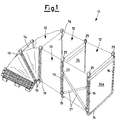
- Such a modular protection system 11 forms a containment structure when opened into its operational position, and consists of a plurality of modules formed from containment cells or regions 12.
- These containment cells or regions 12 are in the shape of a box which according to the invention is open both upperly and at its base.
- the cells or regions 12 are defined by longitudinal walls 13 and transverse walls 14, these latter if at the ends or in a single module becoming end walls 14a.
- said transverse walls 14 can be defined by filiform elements, tapes or belts, not shown.
- This multiple or single modular cell system is formed from a natural or synthetic material of textile type which in the first case defines the longitudinal lateral walls, the end walls and the intermediate transverse walls forming the cells.
- the natural-fibre textile material can be for example of jute or cotton
- the synthetic material is a fabric manufactured of PVC-coated polyester or of high-density polyethylene (HDPE) yarn stabilized against UV, or polypropylene (PP), or of fire-retardant synthetic material.
- HDPE high-density polyethylene
- PP polypropylene
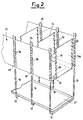
- each rib frame comprises a U-shaped base portion 15 and two uprights 16, connectable together.
- the connection is made for example by a split pin 17 which is inserted into holes provided in the base 15 and in the uprights 16 in a male-female connection region, to lock the parts together.
- the U-base 15 and the uprights 16 also act as elements for securing the longitudinal walls 13 and the transverse walls 14 or end walls 14a.
- a series of vertically aligned eyelets 18 preferably provided in a reinforcing strip 19.
- the eyelets 18 allow the insertion and passage of a complementary series of holed projections 20 laterally jutting from the transverse walls 14 or end walls 14a.
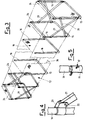
- these comprise a pair of struts 21, which are fixed to the uprights 16 by pegs or split pins 22 inserted through suitable holed seats or extensions 23 fixed to the uprights 16.
- a lower base element 27 can also be provided, to cooperate in maintaining the material within the modular system of the invention.
- This application is also suitable for particularly severe utilization conditions and where it is required to prevent any erosion of the filling material due to the presence of strong wind or a water level higher than the barrier height.
- the element 27 can also be used as a cover element in which case it can also be an additional cloth element, formed of the same material as the walls of the containment system, but can also be of any appropriate different material.
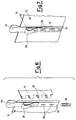
- the details of Figures 6 and 7 also show how the rib frames also act as support elements for the cell material, ie for the walls 13, 14 and 14a, when in their operational raised position during the loading of the filling material.
- a pocket 28 arranged to retain and to abut against the free upper end of the upright 16. This occurs when the filling material is inserted into the system or cells 12 and tends to drag the walls 13, 14 and 14a downwards. Provision of the pocket prevents this happening.
- the inert material containment structure of the present invention can be formed as stated in unit modules consisting of single cells connectable together, or in standard modules of a certain length, for example 10 m, and consisting of a certain number of cells 12.
- barriers can obviously be formed of a length variable at will.
- a number of cells 12 can be kept folded or closed by using blocking elements, such as belts 30 or other elements, not shown.
- a structure of any shape such as curved can be formed.
- the longitudinal walls can be opened to a greater or lesser extent and be locked in position by any appropriate element.
- Figure 8 shows how a long containment structure 11 can be shortened by simply bringing together rib-frame uprights 11 within a region 29 and locking them together by belts 30.
- Figure 9 shows how for example three modular systems 11 can be used to form a pyramid by positioning two at the base and one on top.
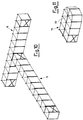
- Figure 10 shows how a T-shaped arrangement can be formed by two systems 11 positioned mutually perpendicular.
- Figure 11 shows how a system 11 can be curved about itself in an intermediate region and the rib frames of the curve be locked together by a belt 30.
- Figure 12 groups the rib frames together with the belt 30 but leaves the remaining parts of the structure at 90°.
- a succession of modules such as shown in Figure 1 are employed, by unfolding them rapidly. From its flatly folded position and form, the containment structure module is lifted and pulled lengthwise to widen out the various cell conformations defining the barrier or containment element. The elements of the rib frames are then located, after possibly positioning a base 27 between the rib frames and the folded edgings 26 of the walls.
- the fixing and locking elements 17, 22 are inserted after which the filling can take place with the chosen material, such as crushed stone, sand, rubble, etc.
- Figure 13 shows how a worn cell can be replaced or a cell added in at least one region of the longitudinal wall 13. This is achieved by emptying the cell 12 and then inserting an additional tubular element 31, also of textile type, to replace the worn wall by utilizing the support structure formed from the already existing rib frames.
- the particular conformation of the system according to the present invention also enables the containment system to be easily adapted to irregular ground. This is because the system base and the completed structure possess considerable flexibility, with the result that the system has a considerable capacity for adaptation to the ground.
- the structural system of the present invention can therefore be used to form a barrier, a bulkhead, an embankment or a civil or military protection arrangement of considerable functionality and of easy and quick installation or dismantling, and maintenance.
- the system of the present invention has the valuable and advantageous characteristic of being self-supporting.
Landscapes
- Engineering & Computer Science (AREA)
- General Engineering & Computer Science (AREA)
- Environmental & Geological Engineering (AREA)
- Civil Engineering (AREA)
- Structural Engineering (AREA)
- Ocean & Marine Engineering (AREA)
- Mechanical Engineering (AREA)
- General Life Sciences & Earth Sciences (AREA)
- Life Sciences & Earth Sciences (AREA)
- Mining & Mineral Resources (AREA)
- Paleontology (AREA)
- Tents Or Canopies (AREA)
- Connection Or Junction Boxes (AREA)
- Details Of Indoor Wiring (AREA)
- Switches Operated By Changes In Physical Conditions (AREA)
- Revetment (AREA)
Abstract
Description
Claims (17)
- A quickly installed modular protection system comprising, when opened into its operating position, at least one upwardly open box-shaped cell or region for containing material and connectable to other cells or regions of similar shape, characterised in that said at least one cell comprises longitudinal and end walls formed of a material of high-strength textile type, is open at its base and comprises freely removable connection elements for said walls, there being further provided elements for stiffening and supporting said at least one cell when in its operating position.
- A modular system as claimed in claim 1, characterised by further comprising transverse walls also positionable by means of said freely removable connection elements.
- A modular system as claimed in claim 1 or 2, characterised in that said material of textile type is PVC-coated polyester.
- A modular system as claimed in claim 1 or 2, characterised in that said material of textile type is synthetic material.
- A modular system as claimed in claim 4, characterised in that said synthetic textile material is of fire-retardant type.
- A modular system as claimed in claim 4, characterised in that said synthetic textile material is polyethylene or polypropylene.
- A modular system as claimed in claim 1 or 2, characterised in that said material of textile type is natural material.
- A modular system as claimed in claim 7, characterised in that said material of natural textile type is jute or cotton.
- A modular system as claimed in any one of the preceding claims, characterised by comprising a series of cells defined by two mutually facing longitudinal walls, and by transverse and end walls which are connected to the longitudinal walls by rib frames.
- A modular system as claimed in claim 1 or 2, characterised in that said connection elements consist of rib frames, which are inserted through holed projections laterally jutting from said end and transverse walls, after said holed projections have been passed through eyelets provided in said longitudinal walls, to form at least one cell.
- A modular system as claimed in claim 10, characterised in that said rib frames comprise a U-shaped base connectable on opposite sides to uprights by means of freely removable elements.
- A modular system as claimed in claim 11, characterised in that said freely removable elements are split pins.
- A modular system as claimed in claim 9, characterised in that in end cells of said system there are further provided freely removable crossed stiffening elements.
- A modular system as claimed in claim 1, characterised in that inwardly folded edgings extend from said longitudinal and end walls.
- A modular system as claimed in claim 1, characterised in that a base element is inserted between said longitudinal and end walls and said connection elements.
- A modular system as claimed in claim 14, characterised in that a base element is inserted between said inwardly folded edgings of said longitudinal and end walls and said connection elements.
- A modular system as claimed in claim 1, characterised in that an additional textile element of tubular type can be inserted in correspondence with at least one cell.
Applications Claiming Priority (2)
| Application Number | Priority Date | Filing Date | Title |
|---|---|---|---|
| IT96MI001364A IT1284463B1 (en) | 1996-07-03 | 1996-07-03 | QUICK INSTALLATION MODULAR PROTECTION SYSTEM |
| ITMI961364 | 1996-07-03 |
Publications (2)
| Publication Number | Publication Date |
|---|---|
| EP0816572A2 true EP0816572A2 (en) | 1998-01-07 |
| EP0816572A3 EP0816572A3 (en) | 1998-09-09 |
Family
ID=11374526
Family Applications (1)
| Application Number | Title | Priority Date | Filing Date |
|---|---|---|---|
| EP97201973A Withdrawn EP0816572A3 (en) | 1996-07-03 | 1997-07-01 | Quickly installed modular protection system |
Country Status (2)
| Country | Link |
|---|---|
| EP (1) | EP0816572A3 (en) |
| IT (1) | IT1284463B1 (en) |
Cited By (25)
| Publication number | Priority date | Publication date | Assignee | Title |
|---|---|---|---|---|
| WO2000014339A1 (en) * | 1998-09-03 | 2000-03-16 | Alethea Rosalind Melanie Hall | Method of constructing a wall element |
| WO2002008524A1 (en) | 2000-07-21 | 2002-01-31 | Westwind Levee Systems, Llc | Portable levee system and portable levee system bag |
| EP1355010A1 (en) * | 2002-04-17 | 2003-10-22 | N.V. Bekaert S.A. | Method for erecting a temporary flood wall construction |
| WO2004111351A1 (en) * | 2003-06-18 | 2004-12-23 | Lasar Srl | Polyvalent module for building wire gabion walls |
| WO2007060476A1 (en) * | 2005-11-24 | 2007-05-31 | Hesco Bastion Limited | Gabion |
| GB2445356A (en) * | 2007-01-02 | 2008-07-09 | Hesco Bastion Ltd | Gabion deployment system |
| GB2453711A (en) * | 2007-08-06 | 2009-04-22 | Hesco Bastion Ltd | A self erecting gabion |
| GB2455819A (en) * | 2007-12-17 | 2009-06-24 | Hesco Bastion Ltd | Gabion deployment container |
| WO2010029349A3 (en) * | 2008-09-12 | 2011-01-27 | Hesco Bastion Limited | Sight screen |
| US8083435B2 (en) | 2004-02-12 | 2011-12-27 | Hesco Bastion Limited | Apparatus for the creation of outer surfaces for structures |
| US8128320B2 (en) | 2005-11-24 | 2012-03-06 | Hesco Bastion Limited | Gabions |
| GB2485212A (en) * | 2010-11-05 | 2012-05-09 | Hesco Bastion Ltd | Gabion system |
| GB2498360A (en) * | 2012-01-11 | 2013-07-17 | Hesco Bastion Ltd | Gabion containment apparatus |
| GB2503739A (en) * | 2012-07-06 | 2014-01-08 | Hesco Bastion Ltd | Gabion containment apparatus |
| GB2503665A (en) * | 2012-07-02 | 2014-01-08 | Hesco Bastion Ltd | Gabion containment apparatus |
| US8721229B2 (en) | 2005-11-24 | 2014-05-13 | Hesco Bastion Limited | Gabions |
| ES2527569A1 (en) * | 2013-07-26 | 2015-01-26 | Alfonso CIPRÉS MÁRQUEZ | Flexible and detachable container |
| GB2517726A (en) * | 2013-08-29 | 2015-03-04 | Hesco Bastion Ltd | Flood defence barrier |
| WO2015047481A1 (en) * | 2013-09-25 | 2015-04-02 | Ardenx Llc | Freestanding force protection system |
| US20160017557A1 (en) * | 2011-02-01 | 2016-01-21 | Ameriglobe, Llc | Flood wall protection system |
| CN107780383A (en) * | 2016-08-31 | 2018-03-09 | 佛山市鹏洋商贸有限公司 | One kind flood control leader small dike |
| CN108316240A (en) * | 2018-03-22 | 2018-07-24 | 自贡市金土地科技有限公司 | A component that can quickly form a disaster relief levee |
| CN109371903A (en) * | 2018-10-24 | 2019-02-22 | 相城区黄桥宜智机电技术服务部 | A kind of flood control sub-embankment |
| CN113585173A (en) * | 2021-08-13 | 2021-11-02 | 山东乾元工程集团有限公司东营维修养护分公司 | Plug-in type dam breach plugging device and method |
| CN114561905A (en) * | 2021-12-30 | 2022-05-31 | 淮南东辰固废利用有限公司 | Coal mine white rock gangue cage wall and manufacturing method thereof |
Family Cites Families (5)
| Publication number | Priority date | Publication date | Assignee | Title |
|---|---|---|---|---|
| FR2521187A1 (en) * | 1982-02-09 | 1983-08-12 | Applic Realisa Tissus Indl | Fabrics, etc. for constructional use in retaining elements - having integral or attached pockets for holding reinforcing bars, etc. |
| FR2526127A1 (en) * | 1982-05-03 | 1983-11-04 | Applic Realisa Tissus Indl | Folded blank for rigid container - has corner ribs or housings for insertion of stiffening rods |
| US4530622A (en) * | 1982-12-23 | 1985-07-23 | P.L.G. Research Limited | Retaining fill in a geotechnical structure |
| ES2078965T3 (en) * | 1989-04-07 | 1996-01-01 | Hesco Bastion Ltd | IMPROVEMENTS INTRODUCED IN CONSTRUCTION AND SHORING BLOCKS. |
| IT1274366B (en) * | 1995-03-27 | 1997-07-17 | Valsella Meccanotecnica Spa | QUICK INSTALLATION PROTECTION SYSTEM |
-
1996
- 1996-07-03 IT IT96MI001364A patent/IT1284463B1/en active IP Right Grant
-
1997
- 1997-07-01 EP EP97201973A patent/EP0816572A3/en not_active Withdrawn
Cited By (54)
| Publication number | Priority date | Publication date | Assignee | Title |
|---|---|---|---|---|
| WO2000014339A1 (en) * | 1998-09-03 | 2000-03-16 | Alethea Rosalind Melanie Hall | Method of constructing a wall element |
| WO2002008524A1 (en) | 2000-07-21 | 2002-01-31 | Westwind Levee Systems, Llc | Portable levee system and portable levee system bag |
| EP2299003A3 (en) * | 2000-07-21 | 2012-03-28 | Westwind Levee Systems, LLC | Portable levee system and portable levee system bag |
| EP1355010A1 (en) * | 2002-04-17 | 2003-10-22 | N.V. Bekaert S.A. | Method for erecting a temporary flood wall construction |
| WO2004111351A1 (en) * | 2003-06-18 | 2004-12-23 | Lasar Srl | Polyvalent module for building wire gabion walls |
| US8083435B2 (en) | 2004-02-12 | 2011-12-27 | Hesco Bastion Limited | Apparatus for the creation of outer surfaces for structures |
| US8251610B2 (en) | 2004-02-12 | 2012-08-28 | Hesco Bastion Limited | Apparatus for the creation of outer surfaces for structures |
| US8777514B2 (en) | 2005-11-24 | 2014-07-15 | Hesco Bastion Limited | Gabion |
| US9493924B2 (en) | 2005-11-24 | 2016-11-15 | Hesco Bastion Limited | Gabion |
| US8721229B2 (en) | 2005-11-24 | 2014-05-13 | Hesco Bastion Limited | Gabions |
| EA013673B1 (en) * | 2005-11-24 | 2010-06-30 | Хеско Бэстион Лимитед | Gabion |
| US8454273B2 (en) | 2005-11-24 | 2013-06-04 | Hesco Bastion Limited | Gabions |
| AP2583A (en) * | 2005-11-24 | 2013-02-04 | Hesco Bastion Ltd | Gabion |
| US9534350B2 (en) | 2005-11-24 | 2017-01-03 | Hesco Bastion Limited | Gabions |
| US10202735B2 (en) | 2005-11-24 | 2019-02-12 | Hesco Bastion Limited | Gabions |
| WO2007060476A1 (en) * | 2005-11-24 | 2007-05-31 | Hesco Bastion Limited | Gabion |
| US8128320B2 (en) | 2005-11-24 | 2012-03-06 | Hesco Bastion Limited | Gabions |
| AP2530A (en) * | 2007-01-02 | 2012-12-10 | Hesco Bastion Ltd | Gabion deployment |
| AU2007341098B2 (en) * | 2007-01-02 | 2012-12-20 | Hesco Bastion Limited | Gabion deployment |
| CN101522995B (en) * | 2007-01-02 | 2011-07-06 | 海斯科堡垒有限公司 | Containers, gabions and gabion deployment systems |
| US7905685B2 (en) | 2007-01-02 | 2011-03-15 | Hesco Bastion Limited | Gabion deployment |
| GB2445356B (en) * | 2007-01-02 | 2011-05-04 | Hesco Bastion Ltd | Gabion deployment |
| US7896583B2 (en) | 2007-01-02 | 2011-03-01 | Hesco Bastion Limited | Gabion deployment |
| US7891913B2 (en) | 2007-01-02 | 2011-02-22 | Hesco Bastion Limited | Gabion deployment |
| GB2445356A (en) * | 2007-01-02 | 2008-07-09 | Hesco Bastion Ltd | Gabion deployment system |
| US7883297B2 (en) | 2007-01-02 | 2011-02-08 | Hesco Bastion Limited | Gabion deployment |
| WO2008081177A1 (en) * | 2007-01-02 | 2008-07-10 | Hesco Bastion Limited | Gabion deployment |
| US7708501B2 (en) | 2007-01-02 | 2010-05-04 | Hesco Bastion Limited | Gabion deployment |
| EA014180B1 (en) * | 2007-01-02 | 2010-10-29 | Хеско Бэстион Лимитед | Gabion development |
| US7789592B2 (en) | 2007-01-02 | 2010-09-07 | Hesco Bastion Limited | Gabion deployment |
| GB2453711A (en) * | 2007-08-06 | 2009-04-22 | Hesco Bastion Ltd | A self erecting gabion |
| GB2453711B (en) * | 2007-08-06 | 2012-01-11 | Hesco Bastion Ltd | Gabions |
| US8596926B2 (en) | 2007-08-06 | 2013-12-03 | Hesco Bastion Limited | Gabions |
| GB2455819A (en) * | 2007-12-17 | 2009-06-24 | Hesco Bastion Ltd | Gabion deployment container |
| WO2010029349A3 (en) * | 2008-09-12 | 2011-01-27 | Hesco Bastion Limited | Sight screen |
| WO2012059769A3 (en) * | 2010-11-05 | 2013-02-21 | Hesco Bastion Limited | Gabion system |
| GB2485212A (en) * | 2010-11-05 | 2012-05-09 | Hesco Bastion Ltd | Gabion system |
| US20160017557A1 (en) * | 2011-02-01 | 2016-01-21 | Ameriglobe, Llc | Flood wall protection system |
| GB2498360A (en) * | 2012-01-11 | 2013-07-17 | Hesco Bastion Ltd | Gabion containment apparatus |
| GB2503665A (en) * | 2012-07-02 | 2014-01-08 | Hesco Bastion Ltd | Gabion containment apparatus |
| GB2503739A (en) * | 2012-07-06 | 2014-01-08 | Hesco Bastion Ltd | Gabion containment apparatus |
| ES2527569A1 (en) * | 2013-07-26 | 2015-01-26 | Alfonso CIPRÉS MÁRQUEZ | Flexible and detachable container |
| GB2517828A (en) * | 2013-08-29 | 2015-03-04 | Hesco Bastion Ltd | Foldable barrier structure |
| GB2517726B (en) * | 2013-08-29 | 2016-02-03 | Hesco Bastion Ltd | Flood defence barrier |
| GB2517828B (en) * | 2013-08-29 | 2017-09-20 | Hesco Bastion Ltd | Foldable barrier structure |
| US9932716B2 (en) | 2013-08-29 | 2018-04-03 | Hesco Bastion Ltd. | Foldable barrier structure |
| US9970169B2 (en) | 2013-08-29 | 2018-05-15 | Hesco Bastion Ltd. | Flood defense barrier |
| GB2517726A (en) * | 2013-08-29 | 2015-03-04 | Hesco Bastion Ltd | Flood defence barrier |
| WO2015047481A1 (en) * | 2013-09-25 | 2015-04-02 | Ardenx Llc | Freestanding force protection system |
| CN107780383A (en) * | 2016-08-31 | 2018-03-09 | 佛山市鹏洋商贸有限公司 | One kind flood control leader small dike |
| CN108316240A (en) * | 2018-03-22 | 2018-07-24 | 自贡市金土地科技有限公司 | A component that can quickly form a disaster relief levee |
| CN109371903A (en) * | 2018-10-24 | 2019-02-22 | 相城区黄桥宜智机电技术服务部 | A kind of flood control sub-embankment |
| CN113585173A (en) * | 2021-08-13 | 2021-11-02 | 山东乾元工程集团有限公司东营维修养护分公司 | Plug-in type dam breach plugging device and method |
| CN114561905A (en) * | 2021-12-30 | 2022-05-31 | 淮南东辰固废利用有限公司 | Coal mine white rock gangue cage wall and manufacturing method thereof |
Also Published As
| Publication number | Publication date |
|---|---|
| ITMI961364A0 (en) | 1996-07-03 |
| EP0816572A3 (en) | 1998-09-09 |
| IT1284463B1 (en) | 1998-05-21 |
| ITMI961364A1 (en) | 1998-01-03 |
Similar Documents
| Publication | Publication Date | Title |
|---|---|---|
| EP0816572A2 (en) | Quickly installed modular protection system | |
| EP0735198A1 (en) | Quickly installed protection system | |
| US6783300B2 (en) | Water containment structure | |
| AU754055B2 (en) | Method of forming a support structure using strings or stays | |
| US3474626A (en) | Method and means for protecting beaches | |
| US9057168B1 (en) | Gabion erosion and sediment control device | |
| US20240271407A1 (en) | Temporary sediment retention assembly | |
| WO2006138603A2 (en) | Fine-grained fill reinforcing apparatus and method | |
| US9315961B2 (en) | Self-anchoring turf reinforcement mat and reusable sediment filtration mat | |
| AU9327998A (en) | Dike module | |
| CZ298297B6 (en) | Process for processing used pneumatic tyres to produce new products, products made thereby and their use | |
| EP0191793B1 (en) | Support band against the stone slide of the filling of a bank | |
| JP2003232023A (en) | Futon basket and retaining wall using it | |
| EP0952259B1 (en) | Device for preventing flood and erosion damage | |
| KR101898459B1 (en) | Vegetation gabion type recruitment using compound type sack | |
| JP6625327B2 (en) | Greening sandbag, method of forming greening sandbag using the same, method of retaining and greening | |
| KR102486882B1 (en) | Protection Wall capable of Connecting in Various Arrangement | |
| JPS58135210A (en) | Water-proof sheet | |
| JP2000054342A (en) | Gabion | |
| CN218322611U (en) | Earth and rock cage bag with non-woven fabric lining | |
| KR100994740B1 (en) | Vegetation net pad constructing on inclined plane or waterside and the method thereof | |
| RU165503U1 (en) | GEOMODULE | |
| GB1603510A (en) | Casing for a matress for lining or facing a land surface | |
| US20240271380A1 (en) | Improvements in and relating to ground stabilisation | |
| KR102490289B1 (en) | Mattress type planting mat and afforestation method using thereof |
Legal Events
| Date | Code | Title | Description |
|---|---|---|---|
| PUAI | Public reference made under article 153(3) epc to a published international application that has entered the european phase |
Free format text: ORIGINAL CODE: 0009012 |
|
| AK | Designated contracting states |
Kind code of ref document: A2 Designated state(s): AT BE CH DE DK ES FR GB IT LI NL |
|
| PUAL | Search report despatched |
Free format text: ORIGINAL CODE: 0009013 |
|
| AK | Designated contracting states |
Kind code of ref document: A3 Designated state(s): AT BE CH DE DK ES FI FR GB GR IE IT LI LU MC NL PT SE |
|
| 17P | Request for examination filed |
Effective date: 19990305 |
|
| AKX | Designation fees paid |
Free format text: AT BE CH DE DK ES FR GB IT LI NL |
|
| RBV | Designated contracting states (corrected) |
Designated state(s): AT BE CH DE DK ES FR GB IT LI NL |
|
| 17Q | First examination report despatched |
Effective date: 20000912 |
|
| STAA | Information on the status of an ep patent application or granted ep patent |
Free format text: STATUS: THE APPLICATION IS DEEMED TO BE WITHDRAWN |
|
| 18D | Application deemed to be withdrawn |
Effective date: 20010123 |