EP0818187A1 - Process for making contoured hydrocolloid-containing adhesive dressings - Google Patents
Process for making contoured hydrocolloid-containing adhesive dressings Download PDFInfo
- Publication number
- EP0818187A1 EP0818187A1 EP97111563A EP97111563A EP0818187A1 EP 0818187 A1 EP0818187 A1 EP 0818187A1 EP 97111563 A EP97111563 A EP 97111563A EP 97111563 A EP97111563 A EP 97111563A EP 0818187 A1 EP0818187 A1 EP 0818187A1
- Authority
- EP
- European Patent Office
- Prior art keywords
- layer
- stretchable
- backing
- contouring
- web
- Prior art date
- Legal status (The legal status is an assumption and is not a legal conclusion. Google has not performed a legal analysis and makes no representation as to the accuracy of the status listed.)
- Granted
Links
- 239000000853 adhesive Substances 0.000 title claims abstract description 53
- 230000001070 adhesive effect Effects 0.000 title claims abstract description 53
- 238000000034 method Methods 0.000 title claims abstract description 29
- 230000008569 process Effects 0.000 title claims abstract description 28
- 239000000416 hydrocolloid Substances 0.000 title claims abstract description 26
- 239000010410 layer Substances 0.000 claims abstract description 102
- 239000000463 material Substances 0.000 claims abstract description 63
- 238000005520 cutting process Methods 0.000 claims abstract description 45
- 238000010030 laminating Methods 0.000 claims abstract description 21
- 239000012790 adhesive layer Substances 0.000 claims abstract description 14
- 230000003014 reinforcing effect Effects 0.000 claims description 29
- 239000004745 nonwoven fabric Substances 0.000 claims description 3
- 238000003825 pressing Methods 0.000 claims description 3
- 239000003795 chemical substances by application Substances 0.000 claims description 2
- 239000002245 particle Substances 0.000 claims description 2
- 239000012779 reinforcing material Substances 0.000 claims 2
- 239000011248 coating agent Substances 0.000 claims 1
- 238000000576 coating method Methods 0.000 claims 1
- 238000000151 deposition Methods 0.000 claims 1
- 239000002904 solvent Substances 0.000 claims 1
- 239000004744 fabric Substances 0.000 abstract description 9
- 239000012467 final product Substances 0.000 abstract 1
- 239000010408 film Substances 0.000 description 14
- 239000000203 mixture Substances 0.000 description 6
- 229920001971 elastomer Polymers 0.000 description 4
- 238000003475 lamination Methods 0.000 description 4
- 230000004044 response Effects 0.000 description 4
- 238000006073 displacement reaction Methods 0.000 description 3
- 230000002093 peripheral effect Effects 0.000 description 3
- 229920000642 polymer Polymers 0.000 description 3
- PPBRXRYQALVLMV-UHFFFAOYSA-N Styrene Chemical compound C=CC1=CC=CC=C1 PPBRXRYQALVLMV-UHFFFAOYSA-N 0.000 description 2
- 230000009471 action Effects 0.000 description 2
- 239000011230 binding agent Substances 0.000 description 2
- 239000000806 elastomer Substances 0.000 description 2
- 238000010438 heat treatment Methods 0.000 description 2
- 238000000465 moulding Methods 0.000 description 2
- 229920000098 polyolefin Polymers 0.000 description 2
- 230000002787 reinforcement Effects 0.000 description 2
- 239000005060 rubber Substances 0.000 description 2
- 229920002379 silicone rubber Polymers 0.000 description 2
- 239000004945 silicone rubber Substances 0.000 description 2
- 239000007787 solid Substances 0.000 description 2
- 230000037303 wrinkles Effects 0.000 description 2
- NIXOWILDQLNWCW-UHFFFAOYSA-N Acrylic acid Chemical group OC(=O)C=C NIXOWILDQLNWCW-UHFFFAOYSA-N 0.000 description 1
- NLHHRLWOUZZQLW-UHFFFAOYSA-N Acrylonitrile Chemical compound C=CC#N NLHHRLWOUZZQLW-UHFFFAOYSA-N 0.000 description 1
- 229920002134 Carboxymethyl cellulose Polymers 0.000 description 1
- 108010010803 Gelatin Proteins 0.000 description 1
- 229920002907 Guar gum Polymers 0.000 description 1
- 244000043261 Hevea brasiliensis Species 0.000 description 1
- RRHGJUQNOFWUDK-UHFFFAOYSA-N Isoprene Chemical compound CC(=C)C=C RRHGJUQNOFWUDK-UHFFFAOYSA-N 0.000 description 1
- 239000004677 Nylon Substances 0.000 description 1
- 229920002614 Polyether block amide Polymers 0.000 description 1
- 239000004698 Polyethylene Substances 0.000 description 1
- 229920002367 Polyisobutene Polymers 0.000 description 1
- 239000004721 Polyphenylene oxide Substances 0.000 description 1
- 239000004372 Polyvinyl alcohol Substances 0.000 description 1
- 240000001058 Sterculia urens Species 0.000 description 1
- 235000015125 Sterculia urens Nutrition 0.000 description 1
- 238000009825 accumulation Methods 0.000 description 1
- 239000001768 carboxy methyl cellulose Substances 0.000 description 1
- 235000010948 carboxy methyl cellulose Nutrition 0.000 description 1
- 239000008112 carboxymethyl-cellulose Substances 0.000 description 1
- 229940096529 carboxypolymethylene Drugs 0.000 description 1
- 230000006835 compression Effects 0.000 description 1
- 238000007906 compression Methods 0.000 description 1
- 238000011437 continuous method Methods 0.000 description 1
- 238000010924 continuous production Methods 0.000 description 1
- 230000003292 diminished effect Effects 0.000 description 1
- 230000000694 effects Effects 0.000 description 1
- 239000000835 fiber Substances 0.000 description 1
- 229920000159 gelatin Polymers 0.000 description 1
- 239000008273 gelatin Substances 0.000 description 1
- 235000019322 gelatine Nutrition 0.000 description 1
- 235000011852 gelatine desserts Nutrition 0.000 description 1
- 239000000665 guar gum Substances 0.000 description 1
- 235000010417 guar gum Nutrition 0.000 description 1
- 229960002154 guar gum Drugs 0.000 description 1
- 229920000126 latex Polymers 0.000 description 1
- 230000007246 mechanism Effects 0.000 description 1
- 229920003052 natural elastomer Polymers 0.000 description 1
- 229920001194 natural rubber Polymers 0.000 description 1
- 229920001778 nylon Polymers 0.000 description 1
- 239000001814 pectin Substances 0.000 description 1
- 229920001277 pectin Polymers 0.000 description 1
- 235000010987 pectin Nutrition 0.000 description 1
- 229920000570 polyether Polymers 0.000 description 1
- -1 polyethylene Polymers 0.000 description 1
- 229920000573 polyethylene Polymers 0.000 description 1
- 229920001223 polyethylene glycol Polymers 0.000 description 1
- 229920001195 polyisoprene Polymers 0.000 description 1
- 229920001296 polysiloxane Polymers 0.000 description 1
- 229920002635 polyurethane Polymers 0.000 description 1
- 239000004814 polyurethane Substances 0.000 description 1
- 229920003225 polyurethane elastomer Polymers 0.000 description 1
- 229920002451 polyvinyl alcohol Polymers 0.000 description 1
- 230000002265 prevention Effects 0.000 description 1
- 230000001739 rebound effect Effects 0.000 description 1
- 238000011084 recovery Methods 0.000 description 1
- 239000011347 resin Substances 0.000 description 1
- 229920005989 resin Polymers 0.000 description 1
- 238000000807 solvent casting Methods 0.000 description 1
- 239000010409 thin film Substances 0.000 description 1
- 235000012431 wafers Nutrition 0.000 description 1
Images

Classifications
-
- A—HUMAN NECESSITIES
- A61—MEDICAL OR VETERINARY SCIENCE; HYGIENE
- A61F—FILTERS IMPLANTABLE INTO BLOOD VESSELS; PROSTHESES; DEVICES PROVIDING PATENCY TO, OR PREVENTING COLLAPSING OF, TUBULAR STRUCTURES OF THE BODY, e.g. STENTS; ORTHOPAEDIC, NURSING OR CONTRACEPTIVE DEVICES; FOMENTATION; TREATMENT OR PROTECTION OF EYES OR EARS; BANDAGES, DRESSINGS OR ABSORBENT PADS; FIRST-AID KITS
- A61F13/00—Bandages or dressings; Absorbent pads
- A61F13/02—Adhesive bandages or dressings
- A61F13/0276—Apparatus or processes for manufacturing adhesive dressings or bandages
-
- A—HUMAN NECESSITIES
- A61—MEDICAL OR VETERINARY SCIENCE; HYGIENE
- A61F—FILTERS IMPLANTABLE INTO BLOOD VESSELS; PROSTHESES; DEVICES PROVIDING PATENCY TO, OR PREVENTING COLLAPSING OF, TUBULAR STRUCTURES OF THE BODY, e.g. STENTS; ORTHOPAEDIC, NURSING OR CONTRACEPTIVE DEVICES; FOMENTATION; TREATMENT OR PROTECTION OF EYES OR EARS; BANDAGES, DRESSINGS OR ABSORBENT PADS; FIRST-AID KITS
- A61F13/00—Bandages or dressings; Absorbent pads
- A61F13/15—Absorbent pads, e.g. sanitary towels, swabs or tampons for external or internal application to the body; Supporting or fastening means therefor; Tampon applicators
- A61F13/15577—Apparatus or processes for manufacturing
- A61F13/15707—Mechanical treatment, e.g. notching, twisting, compressing, shaping
Definitions
- Jensen U.S. patent 5,133,821 and Samuelsen U.S. patent 4,867,748 disclose dressings having adhesive layers of hydrocolloid-containing materials with upper surfaces protected by covering layers, preferably of elastomeric film, and undersurfaces protected by removable release sheets.
- the Samuelsen patent suggests that such a contoured dressing may be made by a pressing and molding operation using blanks in which the three layers are pre-laminated together and, following the molding step, the blanks are then die cut in a conventional manner.
- the Jensen patent discloses a continuous method in which contoured dressings are produced by advancing webs of material through three successive operating stations.
- a strip of adhesive material containing hydrocolloids, and supported upon a release web is contoured between a pair of rollers.
- the upper contouring roller may be coated with a release agent to prevent it from sticking to the adhesive material but, in a preferred embodiment, a web of silicone-coated release paper is interposed between the contouring roller and the adhesive material.
- the release paper is sacrificial and is removed from the adhesive layer in a delaminating step following the contouring step.
- the adhesive surface of each partially-formed dressing is covered by a so-called adhesive carrier layer in a second laminating station, the adhesive carrier layer thereby taking the place of the removed paper layer used in the contouring step.
- the second laminate advances from the laminating station to a cutting station where the finished dressings are cut into final shape between a pair of cutting rollers.
- the Jensen patent does not elaborate on why it is important that the contouring, laminating and cutting steps be carried out in three successive stations and, in particular, why it is critical that contouring be completed before the adhesive carrier layer is applied to the exposed surface of the adhesive layer.
- the sequence is indeed important and that if the adhesive carrier layer (i.e., the backing layer) is a thin elastomeric film, it is not suitable for use as the release web in the contouring station for purposes of preventing the contouring roller from adhering to the adhesive layer.
- the prior art has emphasized the necessity of having successive stations for contouring, laminating, and cutting, with the complexities in equipment and timed operation that such a system inherently require.
- a main aspect of this invention therefore lies in the discovery, that, contrary to the teachings of the prior art, it is indeed possible to make contoured hydrocolloid wound dressings in an operation in which at least the contouring and cutting steps are combined, and preferably the laminating, contouring and cutting steps are combined, with such steps being performed simultaneously to produce a highly effective product in which a stretchable backing layer covers the contoured adhesive surface of the dressing without wrinkles and deformations.
- a further aspect of the invention lies in the discovery that such steps may be combined at a single operating station to produce a product free of wrinkles and deformations if the backing layer is restrained against stretching along the general plane of the product being formed, or the simultaneous processing steps are carried out in a manner to avoid such stretching, as the hydrocolloid-containing adhesive material is displaced to form the contoured product.
- Avoidance of stretching of the backing material in the plane of the dressing allows the contouring step to be combined with the cutting step and, preferably, with the laminating step, all at a single operating station.
- the steps taken to avoid such stretching of the backing layer during processing depend on factors such as the stretchability, recoverability and thickness of the backing material selected, the flowability and adhesiveness of the hydrocolloid-containing material, and the temperature at which the operation is performed.
- the backing layer must be able to resist stretching along the plane of the dressing (as exemplified by the plane of the flat release sheet or web) in response to shear forces exerted by the hydrocolloid-containing adhesive material as that material is forced to flow outwardly and/or inwardly under compression.
- the backing material is highly stretchable and would be incapable of resisting such stretching action in response to the outward/inward flow of the adhesive material in a contouring operation
- stretching of the backing layer may be prevented by removably attaching to it a flexible and substantially non-stretchable reinforcing layer.
- the stretchable backing layer is a film
- the reinforcing layer may also provide the surface on which the film was originally cast.
- Another aspect of the invention lies in the further discovery that the three operations -- laminating, contouring and cutting -- may be performed simultaneously by the same contouring, laminating and cutting dies.
- such dies are in the form of rollers, although it is possible that the contouring and cutting operations may be performed simultaneously at one station by a pair of reciprocating platens and the laminating operation performed either at the same station or immediately adjacent to it.
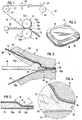
- Figure 1 is a diagramatic and schematic view depicting a preferred embodiment of the process of this invention.
- Figure 2 is a perspective view of a contoured dressing made by the process of Figure 1.
- Figure 3 is a fragmentary sectional view depicting the action that occurs between the upper and lower contouring/laminating/cutting rollers used in the process of this invention.
- Figure 4 is a still further enlarged sectional view of the area encircled in phantom in Figure 3.
- Figure 5 is an enlarged fragmentary sectional view of a contoured dressing made in accordance with the invention.
- Figure 6 is a diagramatic and schematic view depicting a second embodiment of the process of this invention.
- Figure 7 is an enlarged sectional view illustrating the contouring mold and anvil platen of the second embodiment in open condition.
- Figure 8 is a view similar to Figure 7 but showing the mold and platen in closed condition.
- a continuous strip 10 of soft, pliant, hydrocolloid-containing adhesive material is discharged from extruder 11 and enters the nip between upper and lower rollers 12 and 13.
- the rollers are power driven with the lower roller 13 serving as a rotating anvil having a substantially smooth outer surface 13a.
- the upper roller 12 functions as a contoured laminating, contouring and cutting die and has a developed surface defining recesses 12a with relatively deep central portions 12b and relatively shallow peripheral portions 12c.
- Cutting blades 12d surround the peripheral portions, with the length of the blades being sufficient to contact anvil roller 13 to perform a cutting operation as depicted in Figure 3.
- the upper roller 12 is shown to have three such recesses 12a; however, it is to be understood that a different number may be provided and that the shapes of the recesses (or, if desired, protrusions) may be varied depending on the particular contour of the dressing to be produced.
- FIG 1 depicts a contoured dressing 14 as it is released from the laminating/contouring/cutting station.
- a portion of such a dressing is illustrated in section in Figure 5 where it will be seen that the dressing has a hydrocolloid adhesive layer 15 derived from the extruded adhesive strip 10.
- the adhesive layer 15 has a relatively thick central body portion 15a and a thin peripheral flange portion 15b.
- a stretchable backing layer 16 of film or fabric covers the contoured surface of adhesive layer 15, and a removable reinforcing layer 17 of flexible but relatively stiff and non-stretchable material covers the backing layer 16.
- the underside of the dressing 14 is protected by a removable release sheet 18 of siliconized paper or other suitable material.
- FIG. 5 illustrates the dressing 14 with the reinforcing layer 17 removed, revealing the stretchable upper backing layer 16 and the edges of the adhesive layer 15 and release paper layer 18. It is to be understood that at the time the dressing is to be used, the planar release layer 18 is peeled away from the underside of the adhesive layer to expose the adhesive layer for contact with the skin over and about an attachment site.
- dressing is here used to refer to hydrocolloid-containing wound dressings as well as dressings more commonly referred to as hydrocolloid adhesive wafers or faceplates for ostomy appliances.
- dressings more commonly referred to as hydrocolloid adhesive wafers or faceplates for ostomy appliances.
- Adhesive material 15 may be of any of a variety of hydrocolloid-containing adhesive compositions well known in the art.
- such material comprises a tacky semi-solid binder in which particles of one or more hydrocolloids are dispersed.
- polyisobutylene is preferred as the binder
- other viscous semi-solid adhesive materials may be used such as, for example, styrene block polymer rubbers, silicone rubber, acrylonitrile rubber, polyurethane rubber and natural rubber (caoutchouc).
- hydrocolloid content is commonly a blend of hydrocolloids such as carboxymethylcellulose, pectin, guar gum and/or gelatin, but other hydrocolloids such as karaya, polyvinyl alcohol, carbowax and carboxypolymethylene have been disclosed in the literature and may be used.
- hydrocolloid-containing adhesive compositions and citations of other background materials relating thereto, reference may be had to co-owned U.S. patent 4,738,257.
- a suitable material for backing layer 16 is a thin film of a nylon/polyether block polymer elastomer (PEBAX resin from ATO, Philadelphia, Pennsylvania) but polyurethane or other polymers having similar properties may be used.
- PEBAX resin from ATO, Philadelphia, Pennsylvania
- An elastomeric film having a thickness within the range of about 0.5 to 1.5 mils is believed particularly suitable. Films of silicone rubber and latex rubber may also be effective.
- the backing layer may be an elastomeric or stretchable fabric, such as a non-woven fabric. Stretchable non-woven microporous fabrics composed of polyethylene fibers are known and may be used, for example, the microporous fabric marketed under the designation MF5260 by Freudenberg Nonwovens LP, Suite, England and other stretchable fabrics having similar properties are believed suitable.
- reinforcing layer 17 The purpose of reinforcing layer 17 is to restrain stretching of the backing layer 16 in planar directions in response to the flow of adhesive material (in the directions of arrows 26 and 27) during the contouring operation. If displacement of the adhesive material under pressure during contouring is accompanied by stretching of backing layer 16, then objectionable wrinkling and deformation of the backing layer is likely to occur and be present in the resulting dressings. It is at the interface between backing layer 16 and pliant adhesive layer 15 that the forces tending to stretch the backing layer are transmitted so that if such forces are insufficient to cause stretching of the backing layer in the absence of the reinforcing layer, then such reinforcement becomes unnecessary.
- reinforcing layer 17 may be omitted if the backing layer 16, although necessarily formed of stretchable material, does not stretch in planar directions (in response to displacement of adhesive material during contouring) either because of the composition or thickness of the backing layer or because the forces at the interfaceare insufficient to result in stretching of the backing layer by reason of factors such as the composition, temperature and/or flow characteristics of the adhesive material.
- reinforcing layer 17 is therefore optional in those instances where it is not required for purposes of preventing stretching of the backing layer 16 during a combined laminating/contouring/cutting operation as generally depicted in Figures 1 and 3.
- reinforcing layer 17 When used, reinforcing layer 17 must be flexible but nevertheless relatively stiff, especially when compared with the film or fabric backing layer 16.
- Layer 17 may be capable of being deformed or embossed, but an essential characteristic is that it must be substantially non-stretchable.
- a strong paper is believed particularly suitable, but other materials, such as flexible but substantially non- stretchable polymeric films, may also be used.
- the reinforcing layer 17 is most advantageously formed of sheet material on which the film has been deposited by conventional extruding or solvent-casting techniques.
- a polyolefin-coated paper for example, a polyolefin-coated paper from Schoeller Technical Papers, Pulaski, New York
- a substantially continuous supply of a reinforcing web 17 is provided from a supply roll (not shown) and is directed over guide roll 20 to extruder 21 ( Figure 1).
- the stretchable backing material 16 in the form of a thin layer is discharged by the extruder onto layer 17, and the two continue together as a combined backing web 22 about guide roller 23 to the laminating/contouring/cutting station where the combined web enters the nip between upper and lower rollers 12 and 13 along the upper surface of the extruded strip 10 of adhesive material.
- a web of release sheet material 24 from a supply roll enters the nip beneath the extruded strip 10. The extruded strip and the two webs merge together to form a laminate which is simultaneously contoured (and cut) between the rollers as determined by the surface of contouring roller 12.
- the viscous hydrocolloid- containing adhesive material should be maintained at a temperature that promotes the flow of such material under pressure. Such a result may be achieved by heating rollers 12 and 13.
- the temperature may vary depending on the composition of the adhesive material involved but, in general, temperatures within the range of about 120 to 220° F. are believe suitable.
- the strip 10 of adhesive material may be passed through a preheating zone in advance of rollers 12 and 13, although such preheating may be unnecessary if the distance between the rollers and the extruder is relatively short.
- the soft and heated adhesive material is not only deformable but compressible to at least a limited extent, release of compressive force as the materials pass through the nip tends to be accompanied by a slight expansion in the thickness of the dressing beyond the dimensions established by the spacing between the rollers.
- Substantial flow of adhesive material occurs as indicated by arrows 26 and 27 in Figures 3 and 4, and such flow imparts considerable force on the backing film or fabric 16.
- the reinforcing layer 17 when needed and used, resists such forces that would otherwise stretch, distort and displace the thin backing layer 16. If movement of the backing layer relative to the reinforcing layer were free to occur, noticable deformation and distortion would result and, especially if the backing layer were elastomeric as well as stretchable, wrinkling of the backing layer would also take place as the stretched elastomer at least partially recovers or retracts following the laminating/contouring/cutting steps. Unacceptable warping and distortion of the dressing in other respects could also result.
- a movable upper platen or die 30 carried by reciprocating mechanism 31 is located above stationary lower platen 32.
- the upper platen is recessed at 33 to serve as a contouring die and is provided with cutting edges 34.
- Lower platen 32 serves as a supporting anvil.
- both the upper and lower elements 30 and 32 are heated, or other means provided to insure that the adhesive material is properly heated at the contouring/cutting station.
- a strip of extruded hydrocolloid-containing adhesive material 10 is discharged from extruder 11 and enters the nip between upper and lower power-driven laminating rollers 35 and 36.
- Figure 6 and 7 depict the laminate as it enters the contouring/cutting station with die 30 in its raised or open position
- Figure 8 is a fragmentary view showing die 30 in its lowered position.
- the flow of heated adhesive material is again indicated by arrows 26 and 27 and is similar to that occurring in the process of the first embodiment.
- the advancement of a laminate at the contouring/cutting station must be intermittent because of the reciprocating operation of the upper die 30. Since the operation of the extruder 11 is continuous rather than intermittent, a conventional web accumulation bank 40, diagramatically shown in Figure 6, should be interposed between the rollers 35, 36 and the contouring/cutting station to take up slack that would otherwise develop in the web by reason of the non-continuous or interrupted movement of the laminate into and through the contouring/cutting station.
- FIG. 6-8 in which a lamination step occurs in advance of the contouring/cutting station, may also be utilized in a system that includes contouring and cutting rollers of the first embodiment in place of the platens of the second embodiment, but in such a case it is believed desirable for the adhesive strip and the release web to be brought together at the advance lamination station and later joined or laminated to the stretchable backing at the contouring/cutting station.
- contouring and cutting occurs simultaneously at the same station, whether by rollers 12, 13 or by platens 30, 32.
- proper registry or concentricity of contouring and cutting for each dressing is assured, thereby avoiding or greatly reducing wastage of expensive materials (especially hydrocolloid-containing adhesive materials) that is known to occur when such steps are performed successively at different stations and some proportion of the dressings so produced must be discarded because proper registry is lacking.
Landscapes
- Health & Medical Sciences (AREA)
- Engineering & Computer Science (AREA)
- Veterinary Medicine (AREA)
- Animal Behavior & Ethology (AREA)
- Public Health (AREA)
- Biomedical Technology (AREA)
- Heart & Thoracic Surgery (AREA)
- Vascular Medicine (AREA)
- Life Sciences & Earth Sciences (AREA)
- Manufacturing & Machinery (AREA)
- General Health & Medical Sciences (AREA)
- Epidemiology (AREA)
- Mechanical Engineering (AREA)
- Laminated Bodies (AREA)
- Orthopedics, Nursing, And Contraception (AREA)
- Materials For Medical Uses (AREA)
Abstract
Description
Claims (19)
- A process for making contoured dressings having a hydrocolloid-containing adhesive layer disposed between a stretchable backing layer and a planar release layer, comprising the steps of providing a substantially continuous adhesive strip of a soft, pliant adhesive material having at least one liquid-absorbing hydrocolloid material dispersed therein; providing a substantially continuous supply of a backing web comprising a layer of stretchable material; providing a substantially continuous supply of a release web; merging said backing web with said adhesive strip and said release web to form a laminate in which said backing web has its layer of stretchable material in contact with one side of said adhesive strip and said release web is in contact with the strip's opposite side and applying pressure to the laminate, without stretching said layer of stretchable material in planar directions, to contour the backing layer and adhesive material of said laminate; and simultaneously cutting the laminate as it is being contoured to form discrete dressings of predetermined size and shape.
- The process of Claim 1 in which said contouring and cutting steps are performed simultaneously at a single station between a pair of contouring and cutting rollers.
- The process of Claim 1 in which said contouring and cutting steps are performed simulanteously at a single station between a pair of platens shifted towards and away from each other.
- The process of Claim 1 in which said adhesive strip, said backing web, and said release web converge and are simultaneously laminated, contoured and cut at a single station between a pair of laminating, contouring and cutting rollers.
- The process of Claim 1 in which said stretchable layer of said backing web comprises an elastomeric film.
- The process of Claim 1 in which said stretchable layer is of non-woven material.
- The process of Claim 1 in which said backing web includes a reinforcing layer of flexible and substantially non-stretchable material removably attached to the surface of said stretchable layer facing away from said adhesive strip.
- The process of Claim 7 in which there is the further step of stripping said layer of reinforcing material away from the stretchable layer of each dressing after the dressings are contoured and cut.
- The process of Claim 7 in which said reinforcing layer comprises a stiff paper having a release coating on the side thereof facing said stretchable layer.
- A process for making contoured dressings having a hydrocolloid-containing adhesive layer disposed between a stretchable backing layer and a generally planar, substantially release layer, comprising the steps of forming a substantially continuous backing web comprising a backing layer of stretchable material reinforced by and removably attached to a flexible and substantially non-stretchable reinforcing layer; providing a substantially continuous adhesive strip of a soft, pliant adhesive material having liquid-absorbing hydrcolloid particles dispersed therein; providing a substantially continuous supply of a release web; merging said adhesive strip, said backing web, and said release web in a laminating step to form a laminate in which said backing web has its backing layer of stretchable material in contact with one side of said adhesive strip and said release web is in contact with the strip's opposite side; applying pressure to the laminate while the adhesive is in a heated state to contour the laminate while simultaneously cutting the laminate as it is contoured to form dressings of predetermined size and shape.
- The process of Claim 10 in which said step of forming said backing web comprises depositing said layer of stretchable material onto a surface of said reinforcing layer.
- The process of Claim 11 in which said stretchable material is solvent cast onto said reinforcing layer.
- The process of Claim 11 in which said layer of stretchable material is extruded onto said reinforcing layer.
- The process of Claim 11 in which said receiving surface of said reinforcing layer is pre-coated with a release agent.
- The process of Claim 10 in which said stretchable layer of said backing web comprises an elastomeric film.
- The process of Claim 10 in which said stretchable layer of said backing web is a non-woven fabric.
- The process of Claim 10 in which said laminating, contouring and cutting steps are performed simultaneously at a single operating station between a pair of laminating, contouring and cutting rollers.
- The process of Claim 10 in which said contouring and cutting steps are performed simultaneously at a single operating station between a pair of platens alternately shifted towards and away from each other.
- The process of Claim 10 in which there is the further step of stripping said layer of reinforcing material away from the stretchable backing layer of each dressing.
Applications Claiming Priority (2)
| Application Number | Priority Date | Filing Date | Title |
|---|---|---|---|
| US67822496A | 1996-07-11 | 1996-07-11 | |
| US678224 | 1996-07-11 |
Publications (2)
| Publication Number | Publication Date |
|---|---|
| EP0818187A1 true EP0818187A1 (en) | 1998-01-14 |
| EP0818187B1 EP0818187B1 (en) | 2001-09-26 |
Family
ID=24721917
Family Applications (1)
| Application Number | Title | Priority Date | Filing Date |
|---|---|---|---|
| EP19970111563 Expired - Lifetime EP0818187B1 (en) | 1996-07-11 | 1997-07-08 | Process for making contoured hydrocolloid-containing adhesive dressings |
Country Status (3)
| Country | Link |
|---|---|
| EP (1) | EP0818187B1 (en) |
| DE (1) | DE69706921T2 (en) |
| DK (1) | DK0818187T3 (en) |
Cited By (3)
| Publication number | Priority date | Publication date | Assignee | Title |
|---|---|---|---|---|
| WO2000018554A1 (en) * | 1998-09-25 | 2000-04-06 | Coloplast A/S | A method for producing a layered product |
| EP1033141A1 (en) * | 1999-03-02 | 2000-09-06 | Bristol-Myers Squibb Company | Hydrocolloid adhesive |
| CN116080087A (en) * | 2023-02-02 | 2023-05-09 | 威海威高优瑞生物材料有限公司 | Ostomy chassis pattern forming method and system, ostomy chassis and ostomy bag |
Families Citing this family (1)
| Publication number | Priority date | Publication date | Assignee | Title |
|---|---|---|---|---|
| CN105198236B (en) * | 2014-06-26 | 2019-04-02 | 日东电工株式会社 | Optical film continuous supply device and optical film continuous supply method |
Citations (4)
| Publication number | Priority date | Publication date | Assignee | Title |
|---|---|---|---|---|
| US4340557A (en) * | 1980-12-16 | 1982-07-20 | Ball Corporation | Method of making unfestooned plastic containers from polygonal blanks |
| US5074944A (en) * | 1988-05-27 | 1991-12-24 | Smith & Nephew United, Inc. | Method for manufacturing a layered article having a beveled edge |
| US5133821A (en) * | 1990-11-19 | 1992-07-28 | Jensen Ole R | Method for contouring hydrocolloid wound dressings |
| US5405486A (en) * | 1988-03-04 | 1995-04-11 | Noven Pharmaceuticals, Inc. | Apparatus for forming a transdermal drug device |
-
1997
- 1997-07-08 DK DK97111563T patent/DK0818187T3/en active
- 1997-07-08 DE DE1997606921 patent/DE69706921T2/en not_active Expired - Fee Related
- 1997-07-08 EP EP19970111563 patent/EP0818187B1/en not_active Expired - Lifetime
Patent Citations (5)
| Publication number | Priority date | Publication date | Assignee | Title |
|---|---|---|---|---|
| US4340557A (en) * | 1980-12-16 | 1982-07-20 | Ball Corporation | Method of making unfestooned plastic containers from polygonal blanks |
| US5405486A (en) * | 1988-03-04 | 1995-04-11 | Noven Pharmaceuticals, Inc. | Apparatus for forming a transdermal drug device |
| US5074944A (en) * | 1988-05-27 | 1991-12-24 | Smith & Nephew United, Inc. | Method for manufacturing a layered article having a beveled edge |
| US5133821A (en) * | 1990-11-19 | 1992-07-28 | Jensen Ole R | Method for contouring hydrocolloid wound dressings |
| EP0573708A1 (en) * | 1990-11-19 | 1993-12-15 | Hollister Incorporated | Method for contouring hydrocolloid wound dressings |
Cited By (4)
| Publication number | Priority date | Publication date | Assignee | Title |
|---|---|---|---|---|
| WO2000018554A1 (en) * | 1998-09-25 | 2000-04-06 | Coloplast A/S | A method for producing a layered product |
| US6726791B1 (en) | 1998-09-25 | 2004-04-27 | Coloplast A/S | Method for producing a layered product |
| EP1033141A1 (en) * | 1999-03-02 | 2000-09-06 | Bristol-Myers Squibb Company | Hydrocolloid adhesive |
| CN116080087A (en) * | 2023-02-02 | 2023-05-09 | 威海威高优瑞生物材料有限公司 | Ostomy chassis pattern forming method and system, ostomy chassis and ostomy bag |
Also Published As
| Publication number | Publication date |
|---|---|
| EP0818187B1 (en) | 2001-09-26 |
| DK0818187T3 (en) | 2001-12-17 |
| DE69706921T2 (en) | 2002-03-28 |
| DE69706921D1 (en) | 2001-10-31 |
Similar Documents
| Publication | Publication Date | Title |
|---|---|---|
| US5935363A (en) | Process for making contoured hydrocolloid-containing adhesive dressings | |
| JP4391828B2 (en) | Flexible convex adhesive wafer | |
| US5713128A (en) | Electrosurgical pad apparatus and method of manufacture | |
| EP0756854B2 (en) | Wafer having adhesive skin barrier layer | |
| US2862846A (en) | Method of making plastic strip adhesive bandages | |
| WO1998029241A3 (en) | Elastic laminated fabric material and method of making same | |
| EP0818187B1 (en) | Process for making contoured hydrocolloid-containing adhesive dressings | |
| JPH08501479A (en) | Transfer method for manufacturing transdermal therapeutic products | |
| US6309500B1 (en) | Method for manufacturing contoured and laminated materials | |
| JP3441601B2 (en) | Manufacturing method of composite sheet material | |
| CA2235861A1 (en) | Process for making contoured hydrocolloid-containing adhesive dressings | |
| JP2004229830A (en) | Rolled medical adhesive tape | |
| US20200138732A1 (en) | Adhesive Skin Patch with Support Liner and Manufacturing Method of the Same | |
| CN102458326B (en) | Roll-shaped medical adhesive tape and manufacturing method therefor | |
| KR102416487B1 (en) | Device for the manufacture of pharmaceutical patches | |
| US9827146B2 (en) | Manufacturing method for wound dressings | |
| JP3836558B2 (en) | Packaging material with mold release function | |
| JP2952180B2 (en) | Separator, packaging material or base material for adhesive tape | |
| JP4696257B2 (en) | Manufacturing method of powder seal piece of rotating shaft | |
| JPH0948405A (en) | Method for manufacturing individual package of sanitary napkin | |
| EP4678149A1 (en) | Improved wound dressings and integrated process for the manufacture of wound dressings | |
| JPH06145608A (en) | Production of foamed tacky adhesive sheet | |
| KR102769053B1 (en) | Medical patch using elastic pad | |
| JP4559649B2 (en) | Label continuum manufacturing method | |
| JP2000351727A (en) | Medicine for plaster and production apparatus therefore |
Legal Events
| Date | Code | Title | Description |
|---|---|---|---|
| PUAI | Public reference made under article 153(3) epc to a published international application that has entered the european phase |
Free format text: ORIGINAL CODE: 0009012 |
|
| AK | Designated contracting states |
Kind code of ref document: A1 Designated state(s): DE DK FR GB |
|
| 17P | Request for examination filed |
Effective date: 19980325 |
|
| AKX | Designation fees paid |
Free format text: DE DK FR GB |
|
| RBV | Designated contracting states (corrected) |
Designated state(s): DE DK FR GB |
|
| 17Q | First examination report despatched |
Effective date: 19990914 |
|
| GRAG | Despatch of communication of intention to grant |
Free format text: ORIGINAL CODE: EPIDOS AGRA |
|
| GRAG | Despatch of communication of intention to grant |
Free format text: ORIGINAL CODE: EPIDOS AGRA |
|
| GRAH | Despatch of communication of intention to grant a patent |
Free format text: ORIGINAL CODE: EPIDOS IGRA |
|
| GRAH | Despatch of communication of intention to grant a patent |
Free format text: ORIGINAL CODE: EPIDOS IGRA |
|
| GRAA | (expected) grant |
Free format text: ORIGINAL CODE: 0009210 |
|
| AK | Designated contracting states |
Kind code of ref document: B1 Designated state(s): DE DK FR GB |
|
| REF | Corresponds to: |
Ref document number: 69706921 Country of ref document: DE Date of ref document: 20011031 |
|
| REG | Reference to a national code |
Ref country code: GB Ref legal event code: IF02 |
|
| ET | Fr: translation filed | ||
| PLBE | No opposition filed within time limit |
Free format text: ORIGINAL CODE: 0009261 |
|
| STAA | Information on the status of an ep patent application or granted ep patent |
Free format text: STATUS: NO OPPOSITION FILED WITHIN TIME LIMIT |
|
| 26N | No opposition filed | ||
| PGFP | Annual fee paid to national office [announced via postgrant information from national office to epo] |
Ref country code: GB Payment date: 20040707 Year of fee payment: 8 |
|
| PGFP | Annual fee paid to national office [announced via postgrant information from national office to epo] |
Ref country code: FR Payment date: 20040708 Year of fee payment: 8 |
|
| PGFP | Annual fee paid to national office [announced via postgrant information from national office to epo] |
Ref country code: DK Payment date: 20040715 Year of fee payment: 8 Ref country code: DE Payment date: 20040715 Year of fee payment: 8 |
|
| PG25 | Lapsed in a contracting state [announced via postgrant information from national office to epo] |
Ref country code: GB Free format text: LAPSE BECAUSE OF NON-PAYMENT OF DUE FEES Effective date: 20050708 |
|
| PG25 | Lapsed in a contracting state [announced via postgrant information from national office to epo] |
Ref country code: DK Free format text: LAPSE BECAUSE OF NON-PAYMENT OF DUE FEES Effective date: 20050801 |
|
| PG25 | Lapsed in a contracting state [announced via postgrant information from national office to epo] |
Ref country code: DE Free format text: LAPSE BECAUSE OF NON-PAYMENT OF DUE FEES Effective date: 20060201 |
|
| GBPC | Gb: european patent ceased through non-payment of renewal fee |
Effective date: 20050708 |
|
| PG25 | Lapsed in a contracting state [announced via postgrant information from national office to epo] |
Ref country code: FR Free format text: LAPSE BECAUSE OF NON-PAYMENT OF DUE FEES Effective date: 20060331 |
|
| REG | Reference to a national code |
Ref country code: DK Ref legal event code: EBP |
|
| REG | Reference to a national code |
Ref country code: FR Ref legal event code: ST Effective date: 20060331 |