EP0821030A1 - Material of low friction coefficient and application of the material in the manufacture of skis and similar equipment and a method of producing the material of low friction coefficient - Google Patents
Material of low friction coefficient and application of the material in the manufacture of skis and similar equipment and a method of producing the material of low friction coefficient Download PDFInfo
- Publication number
- EP0821030A1 EP0821030A1 EP97108744A EP97108744A EP0821030A1 EP 0821030 A1 EP0821030 A1 EP 0821030A1 EP 97108744 A EP97108744 A EP 97108744A EP 97108744 A EP97108744 A EP 97108744A EP 0821030 A1 EP0821030 A1 EP 0821030A1
- Authority
- EP
- European Patent Office
- Prior art keywords
- friction
- polythene
- fluorographite
- coefficient
- presenting
- Prior art date
- Legal status (The legal status is an assumption and is not a legal conclusion. Google has not performed a legal analysis and makes no representation as to the accuracy of the status listed.)
- Withdrawn
Links
- 239000000463 material Substances 0.000 title claims abstract description 52
- 238000004519 manufacturing process Methods 0.000 title claims abstract description 8
- 238000000034 method Methods 0.000 title abstract description 6
- 229920000573 polyethylene Polymers 0.000 claims abstract description 29
- NBVXSUQYWXRMNV-UHFFFAOYSA-N fluoromethane Chemical compound FC NBVXSUQYWXRMNV-UHFFFAOYSA-N 0.000 claims abstract description 21
- 239000000203 mixture Substances 0.000 claims abstract description 11
- 230000008018 melting Effects 0.000 claims description 3
- 238000002844 melting Methods 0.000 claims description 3
- 239000002245 particle Substances 0.000 claims description 2
- 238000005245 sintering Methods 0.000 claims 1
- 238000007711 solidification Methods 0.000 claims 1
- 230000008023 solidification Effects 0.000 claims 1
- 230000003247 decreasing effect Effects 0.000 abstract 1
- OKTJSMMVPCPJKN-UHFFFAOYSA-N Carbon Chemical compound [C] OKTJSMMVPCPJKN-UHFFFAOYSA-N 0.000 description 14
- 229910002804 graphite Inorganic materials 0.000 description 11
- 239000010439 graphite Substances 0.000 description 11
- 239000000314 lubricant Substances 0.000 description 7
- 239000000126 substance Substances 0.000 description 5
- -1 polyethylene Polymers 0.000 description 4
- 239000007787 solid Substances 0.000 description 4
- 239000001993 wax Substances 0.000 description 4
- 239000012188 paraffin wax Substances 0.000 description 3
- YCKRFDGAMUMZLT-UHFFFAOYSA-N Fluorine atom Chemical compound [F] YCKRFDGAMUMZLT-UHFFFAOYSA-N 0.000 description 2
- 229910052799 carbon Inorganic materials 0.000 description 2
- 229910052731 fluorine Inorganic materials 0.000 description 2
- 239000011737 fluorine Substances 0.000 description 2
- 238000005470 impregnation Methods 0.000 description 2
- 239000002861 polymer material Substances 0.000 description 2
- 239000000843 powder Substances 0.000 description 2
- 230000003068 static effect Effects 0.000 description 2
- 239000004698 Polyethylene Substances 0.000 description 1
- 239000004743 Polypropylene Substances 0.000 description 1
- 229910000831 Steel Inorganic materials 0.000 description 1
- 239000004809 Teflon Substances 0.000 description 1
- 229920006362 Teflon® Polymers 0.000 description 1
- 238000005299 abrasion Methods 0.000 description 1
- 238000010521 absorption reaction Methods 0.000 description 1
- 230000007423 decrease Effects 0.000 description 1
- 238000010586 diagram Methods 0.000 description 1
- 230000000694 effects Effects 0.000 description 1
- 229920000840 ethylene tetrafluoroethylene copolymer Polymers 0.000 description 1
- 239000003925 fat Substances 0.000 description 1
- 238000004334 fluoridation Methods 0.000 description 1
- 229920002313 fluoropolymer Polymers 0.000 description 1
- 239000004811 fluoropolymer Substances 0.000 description 1
- 239000003365 glass fiber Substances 0.000 description 1
- 229910052961 molybdenite Inorganic materials 0.000 description 1
- CWQXQMHSOZUFJS-UHFFFAOYSA-N molybdenum disulfide Chemical compound S=[Mo]=S CWQXQMHSOZUFJS-UHFFFAOYSA-N 0.000 description 1
- 229910052982 molybdenum disulfide Inorganic materials 0.000 description 1
- 239000003921 oil Substances 0.000 description 1
- 230000003647 oxidation Effects 0.000 description 1
- 238000007254 oxidation reaction Methods 0.000 description 1
- 229920000642 polymer Polymers 0.000 description 1
- 229920006324 polyoxymethylene Polymers 0.000 description 1
- 229920001155 polypropylene Polymers 0.000 description 1
- 229920001296 polysiloxane Polymers 0.000 description 1
- 229920001343 polytetrafluoroethylene Polymers 0.000 description 1
- 239000004810 polytetrafluoroethylene Substances 0.000 description 1
- 229920005989 resin Polymers 0.000 description 1
- 239000011347 resin Substances 0.000 description 1
- 238000007790 scraping Methods 0.000 description 1
- 239000010959 steel Substances 0.000 description 1
Images
Classifications
-
- C—CHEMISTRY; METALLURGY
- C08—ORGANIC MACROMOLECULAR COMPOUNDS; THEIR PREPARATION OR CHEMICAL WORKING-UP; COMPOSITIONS BASED THEREON
- C08K—Use of inorganic or non-macromolecular organic substances as compounding ingredients
- C08K3/00—Use of inorganic substances as compounding ingredients
- C08K3/16—Halogen-containing compounds
-
- A—HUMAN NECESSITIES
- A63—SPORTS; GAMES; AMUSEMENTS
- A63C—SKATES; SKIS; ROLLER SKATES; DESIGN OR LAYOUT OF COURTS, RINKS OR THE LIKE
- A63C5/00—Skis or snowboards
- A63C5/04—Structure of the surface thereof
- A63C5/056—Materials for the running sole
-
- C—CHEMISTRY; METALLURGY
- C08—ORGANIC MACROMOLECULAR COMPOUNDS; THEIR PREPARATION OR CHEMICAL WORKING-UP; COMPOSITIONS BASED THEREON
- C08K—Use of inorganic or non-macromolecular organic substances as compounding ingredients
- C08K9/00—Use of pretreated ingredients
- C08K9/02—Ingredients treated with inorganic substances
Definitions
- the material used for ski soles is high density polythene (polyethylene) of high molecular weight.
- polythene on the other hand (notwithstanding the fact that its surface tension is 31 to 33 dynes/cm merely) stem from its high resistance against oxidation and from its mechanical characteristics such as its elasticity modulus, its great tensile strength, its high breaking load, all factors that increase with increasing molecular weight.
- the sole of a ski should be as smooth as possible and should consist of a material not eroded by icy snow in such a manner that the surface becomes corrugated (and thus causing higher friction forces) and presenting the lowest possible surface tension.
- ski waxes are composed predominantly of linear paraffins which owing to their chemical structure are partially soluble in the polythene. This solubility, however, decreases as the degree of polymerisation is increased, and in polythenes of high molecular weight the solubility of paraffins is practically nil.
- the mechanical proper should be the ones of the polythenes of high molecular weight where as the impregnation capacity of the ski soles by paraffin should be based essentially on an absorption of physical nature owed just to the porosity of the material.
- ski soles in use is the one obtained using polythene of high molecular weight with graphite.
- Graphite functions as a solid lubricant being a hard material but presenting a low surface tension and a low coefficient of friction.
- the static coefficient ( ⁇ ) of polythene on itself being of 0.2 and indeed is 0.12 for graphite on graphite.
- the addition of graphite to the polythene is aimed at:
- the goal of the present invention is achieved using a material of low friction coefficient presenting the characteristics of the claim 1, and respectively applying said material in the manufacture of gliding objects, according to the claim 8, and in particular to the manufacture of skis to be used on snow according to the claim 9. Furthermore the invention provides a method of producing the material according to the claim 9.
- Fluorographite is a solid lubricant obtained by direct fluoridation of graphite with elementary fluorine. Its coefficient of friction is 0.08 (compare the Japanese Patent 85/67593 dated April 17, 1985) as compared to 0.12 of the graphite.
- the fluorographite presents the lowest known surface tension of 12 to 13 dynes/cm owing to which forms the best solid lubricant in absolute terms.
- This substance furthermore has been incorporated in various polymer materials, alone or associated with graphite, MoS 2 , glass fibres, etc.
- the polymer materials employed thus far for lowering the coefficient of friction and to enhance the wear resistance are e.g.:
- fluorographite be incorporated in polythene, and particularly in polythene of high molecular weight, with the goal of e.g. lowering the coefficient of friction and to apply this material in producing gliding objects presenting a low coefficient of friction, such as e.g. ski soles and in all other sectors in which polythene of high molecular weight is applied normally.
- the examples 1, 2 and 3 show the influence on the coefficient of friction ⁇ in function of the ratios of percentages in the mixture. It stems from the examples that, as could be expected, a higher percentage of fluorographite results in a reduction of the value ⁇ .
Landscapes
- Chemical & Material Sciences (AREA)
- Health & Medical Sciences (AREA)
- Chemical Kinetics & Catalysis (AREA)
- Medicinal Chemistry (AREA)
- Polymers & Plastics (AREA)
- Organic Chemistry (AREA)
- Compositions Of Macromolecular Compounds (AREA)
- Manufacture Of Macromolecular Shaped Articles (AREA)
- Lubricants (AREA)
- Footwear And Its Accessory, Manufacturing Method And Apparatuses (AREA)
Abstract
The present invention concerns a new type of material presenting a low coefficient
of friction, a preferred application of which material is the manufacture
of skis and similar gliding objects, as well as a method of producing said material.
According to the invention the material is composed of a mixture of polythene,
preferentially polythene of high molecular weight, and of fluorographite.
If fluorographite is added to the polythene at percentages varying from 3% to
50% (weight), preferentially ranging from 10% to 30% (weight), decreasing
values of the coefficient of friction µ are obtained as the percentage of fluorographite
content is increased owing to which said material, endowed also
with the required characteristics of mechanical resistance, is ideally suited for
the manufacture of skis.
Description
According to the present state of the art the material used for ski soles is high
density polythene (polyethylene) of high molecular weight.
Other materials such as polypropylene, polymetacrylate, polytetrafluoroethylene
could be even more suitable as gliding materials owing to their low values
of surface tension and thus their low coefficient of friction. These materials,
however, present chemical and physical-chemical properties which for
the time being render these materials uninteresting to be used for soles of
skis.
The useful characteristics of polythene on the other hand (notwithstanding
the fact that its surface tension is 31 to 33 dynes/cm merely) stem from its
high resistance against oxidation and from its mechanical characteristics
such as its elasticity modulus, its great tensile strength, its high breaking load,
all factors that increase with increasing molecular weight.
Theoretically the sole of a ski should be as smooth as possible and should
consist of a material not eroded by icy snow in such a manner that the surface
becomes corrugated (and thus causing higher friction forces) and presenting
the lowest possible surface tension.
Thus today polythene of high molecular weight (U.H.M.W.) is chosen in order
to make use of a material presenting good mechanical properties and sufficient
hardness, and ski wax is resorted to in order to:
The usual ski waxes are composed predominantly of linear paraffins which
owing to their chemical structure are partially soluble in the polythene. This
solubility, however, decreases as the degree of polymerisation is increased,
and in polythenes of high molecular weight the solubility of paraffins is practically
nil.
Thus the use of polythenes of high molecular weight has been envisaged because
of their mechanical properties, but also increasing at the same time
their impregnation capacity in a mechanical manner influencing the porosity
of the material proper.
Essentially the question was dealt with in that the mechanical proper
should be the ones of the polythenes of high molecular weight where as the
impregnation capacity of the ski soles by paraffin should be based essentially
on an absorption of physical nature owed just to the porosity of the material.
Using porous ski soles of the type mentioned the advantage furthermore was
obtained that the sole proper could absorb particular ski waxes such the
"Cera F" (a perfluoridated paraffin) presenting a surface tension of 16 to 18
dynes/cm (as opposed to the 28 to 30 dynes/cm of a normal paraffin) and
which is not absolutely soluble in the polythene.
Another type of ski soles in use is the one obtained using polythene of high
molecular weight with graphite.
Graphite functions as a solid lubricant being a hard material but presenting a
low surface tension and a low coefficient of friction. The static coefficient (µ) of
polythene on itself being of 0.2 and indeed is 0.12 for graphite on graphite.
The addition of graphite to the polythene is aimed at:
- lowering the coefficient of friction of the ski sole which passes from a value of µ (static coefficient of friction) = 0.2 of the polythene to a value of µ=0.12 of the graphite;
- render the ski sole harder and more homogeneous also in its depth in order to render it less susceptible to abrasion, the same degree of gliding facility being maintained also after each scraping off of the corrugations which have formed during use;
- produce also non-porous ski soles which present better mechanical properties as graphite as such acts as a lubricant.
It thus is the goal of the present invention to further improve the gliding properties
of the material of the ski sole by lowering the coefficient of friction further,
in particular by obtaining a coefficient of friction of the material of less
than µ = 0.2 corresponding to the coefficient of friction of the best ski soles
known.
This goal as well as additional goals will be discussed in more detail in the
following with reference to examples of embodiments of the present invention,
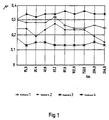
and to a table, and to the Fig. 1 respectively, showing a diagram of the
coefficient of friction µ of a certain number of samples of materials plotted
against the distance in km covered by skis produced using various materials
according to the present invention.
The goal of the present invention is achieved using a material of low friction
coefficient presenting the characteristics of the claim 1, and respectively applying
said material in the manufacture of gliding objects, according to the
claim 8, and in particular to the manufacture of skis to be used on snow according
to the claim 9. Furthermore the invention provides a method of producing
the material according to the claim 9.
Before various examples of embodiments of the present invention are described
in more detail some specifications are to be given concerning the
properties of the materials used in composing the inventive mixture.
Fluorographite is a solid lubricant obtained by direct fluoridation of graphite
with elementary fluorine. Its coefficient of friction is 0.08 (compare the Japanese
Patent 85/67593 dated April 17, 1985) as compared to 0.12 of the
graphite.
This is a particular kind of the fluorocarbons in general, obtained from other
types of carbon and can be considered as a carbon polymer in which between
the various layers of carbon atoms fluorine atoms are interspersed.
Also the different properties of the graphite subject to the process can influence
the coefficient of friction of the fluorographite obtained (compare e.g.
Japanese Patent 85/67594 dated April 17, 1985).
Its summary formula is (CF)n in which the molecular proportion F/C can vary
from 0.5 to 1.3, and more generally from 0.95 to 1.3.
Its colour varies from black to grey to white according to its fluorine contents.
Its real specific density varies from 2.5 to 2.8 g/cm3 whereas its apparent density
varies from 0.5 to 0.9 g/cm3 depending on the type of graphite initially
subject to the process.
The fluorographite presents the lowest known surface tension of 12 to 13
dynes/cm owing to which forms the best solid lubricant in absolute terms.
It is to be mentioned also that the use of fluorographite as a solid lubricant is
known as such since a long time.
It has been applied in many lubricants with fats, perfluoridated oils, teflon
powder, etc., (compare e.g. Japanese Patents 89/266.192 dated October 24,
1989; 84/149.996 dated August 28, 1984 and German Patent 1'594'392
dated April 26, 1973, etc.).
This substance furthermore has been incorporated in various polymer materials,
alone or associated with graphite, MoS2, glass fibres, etc.
The polymer materials employed thus far for lowering the coefficient of friction
and to enhance the wear resistance are e.g.:
- polyamidic resins (Japanese Patent 91/252'453 dated November 11, 1991);
- ethylene-tetrafluoroethylene copolymers (Russian Patent 899'597 dated January 23, 1982);
- epoxy-silicones (Russian Patent 1'031'993 dated July 30, 1983)
- fluoropolymers and polyacetals (Japanese Patent 87/54'753 dated March 10, 1987).
To this day, however, it has never been proposed that fluorographite be incorporated
in polythene, and particularly in polythene of high molecular
weight, with the goal of e.g. lowering the coefficient of friction and to apply
this material in producing gliding objects presenting a low coefficient of friction,
such as e.g. ski soles and in all other sectors in which polythene of high
molecular weight is applied normally.
Various examples are given in the following, demonstrating the effect on the
coefficient of friction µ obtained if fluorographite is mixed with the polythene.
The examples 1, 2 and 3 show the influence on the coefficient of friction µ in
function of the ratios of percentages in the mixture. It stems from the examples
that, as could be expected, a higher percentage of fluorographite results
in a reduction of the value µ.
The example 4 in which no fluorographite is applied serves as a point of reference
for better demonstrating of the important influence the addition of
fluorographite exerts on the coefficient of friction µ.
A mixture was prepared containing 10% (weight) of fluorographite in powder
form with R.M. (molecular proportion) F/C = 1.3 and with particle diameters
below 15 microns, and 90% (weight) of polythene of high molecular weight of
the type Hostalen GUR 4150.
Upon melting the blended material in a processing cycle, in which various
pressures ranging from 50 to 100 atmospheres and a maximum temperature
of 220°C were applied, cylinders of 250 mm diameter and of 150 mm length
were obtained. On this material, transformed into sheets, the coefficient of
friction was measured according to the ASTM D 3702 method using a steel
C40 as counter-surface material. The load and speed conditions were chosen
as follows:
- Load = 6 pounds corresponding to a specific pressure of 0.21 Mpa = 21 kg/cm2;
- Rotational speed = 1000 rpm corresponding to a linear speed of 1.41 m/s.
The coefficient of friction µ measured on the material in sheet form resulted
as µ =0.27.
Proceeding just as for example 1 and using the same input materials a mixture
was made containing 20% (weight) of fluorographite and 80% (weight)
of polythene.
The coefficient of friction µ measured on the material in sheet form resulted
as µ =0.22.
Proceeding just as for example 1 and using the same input materials a mixture
was made containing 30% (weight) of fluorographite and 70% (weight)
of polythene.
The coefficient of friction µ measured on the material in sheet form resulted
as µ=0.13.
Proceeding just as for example 1 but using only the polythene material Hostalen
GUR 41500 applied before.
The coefficient of friction µ measured on the material in sheet form resulted
as µ =0.35.
The average values of the dynamic coefficients of friction µ are listed in the
Table 1.
| Sample | µ | % of |
| 1 | 0.27 | 10% |
| 2 | 0.22 | 20% |
| 3 | 0.13 | 30% |
| 4 | 0.35 | 0% |
In the Figure 1 the behaviour of the samples over time is shown, the variation
of the coefficient of friction of the various mixtures tested being plotted against
the duration of use, or against the number of km covered on skis respectively.
In the Table 1, in which the coefficient µ is shown on the ordinate and the
number of km covered is shown on the abscissa, it can be seen that the coefficient
of friction remains essentially constant owing to the fact of course that
the good running or gliding properties of the material obtained are inherent
properties of the material itself in which the components are blended intimately
homogenised, as opposed to the situation if ski waxes are applied which,
notwithstanding the forces applied to make them penetrate the base material,
always remain substances applied superficially to the gliding surface.
Claims (11)
- Material presenting a low coefficient of friction consisting of a mixture of two components one of which is endowed with good mechanical properties and hardness whereas the second one is instrumental to lower the coefficient of friction,
characterized in that
the first component of the mixture consists of polythene whereas the second component consists of fluorographite. - Material according to the claim 1
characterized in that
the contents of fluorographite in the polythene ranges from 3% to 50% (weight) and preferentially ranges from 10% to 30% (weight). - Material according to the claim 1
characterized in that
the polythene used is a polythene of high molecular weight. - Material according to the claim 1
characterized in that
the fluorographite used presents a molecular proportion R.M. F/C ranging from 0.5 and 1.3 and preferentially ranging from 0.95 to 1.3. - Material according to the claim 1
characterized in that
the particle size of the fluorographite applied is below 100 microns and preferentially is below 15 microns. - Method of manufacturing the material presenting a low coefficient of friction according to one of the preceding claims 1 through 5,
characterized in that
the mixture of polythene and fluorographite is obtained by melting or sintering at high temperature and is processed, after solidification, to obtain surfaces presenting a coefficient of friction µ below 0.20. - Method of manufacturing according to the claim 6,
characterized in that
the melting of the mixture is effected in a processing cycle in which variations of pressure are provided from 50 to 100 atmospheres at a maximum temperature of 220°C. - Application of the material presenting a low coefficient of friction according to one of the claims 1 through 5 in the manufacture of gliding objects such as runners, gliding guides, etc., presenting a coefficient µ below 0.20.
- Application of the material according to claim 8,
characterized in that
the gliding objects are skis to be used on snow. - Application of the material according to claim 9,
characterized in that
the whole ski consists of the material. - Application of the material according to claim 9,
characterized in that
only the portion of the ski contacting the snow surface consists of the material.
Applications Claiming Priority (2)
| Application Number | Priority Date | Filing Date | Title |
|---|---|---|---|
| CH01848/96A CH690721A5 (en) | 1996-07-24 | 1996-07-24 | a low friction coefficient material and utilization of the material for the manufacture of skis and the like as well as a method of manufacturing a low friction coefficient material |
| CH1848/96 | 1996-07-24 |
Publications (1)
| Publication Number | Publication Date |
|---|---|
| EP0821030A1 true EP0821030A1 (en) | 1998-01-28 |
Family
ID=4220029
Family Applications (1)
| Application Number | Title | Priority Date | Filing Date |
|---|---|---|---|
| EP97108744A Withdrawn EP0821030A1 (en) | 1996-07-24 | 1997-06-02 | Material of low friction coefficient and application of the material in the manufacture of skis and similar equipment and a method of producing the material of low friction coefficient |
Country Status (6)
| Country | Link |
|---|---|
| US (1) | US6028136A (en) |
| EP (1) | EP0821030A1 (en) |
| JP (1) | JPH1067892A (en) |
| CA (1) | CA2211267A1 (en) |
| CH (1) | CH690721A5 (en) |
| NO (1) | NO973424L (en) |
Cited By (4)
| Publication number | Priority date | Publication date | Assignee | Title |
|---|---|---|---|---|
| EP0960905A1 (en) * | 1998-05-18 | 1999-12-01 | Ims Kunststoff Ag | Plastic ski-sole |
| AT409339B (en) * | 2000-02-02 | 2002-07-25 | Isosport Verbundbauteile | SKI COATING WITH DRY LUBE EFFECT |
| EP2527014A1 (en) | 2011-05-26 | 2012-11-28 | Head Technology GmbH | Ski sole |
| RU2535216C1 (en) * | 2013-11-01 | 2014-12-10 | Федеральное государственное бюджетное учреждение науки Институт проблем нефти и газа Сибирского отделения Российской академии наук | Antifrictional polymer composition with thermally expanded graphite |
Families Citing this family (3)
| Publication number | Priority date | Publication date | Assignee | Title |
|---|---|---|---|---|
| US6465398B1 (en) * | 2001-10-15 | 2002-10-15 | E. I. Du Pont De Nemours And Company | Lubricant composition for use in snow sliders |
| CN101348587B (en) * | 2008-09-01 | 2011-08-03 | 武汉理工大学 | Preparation method of ultra-high molecular weight polyethylene/graphite nanoplate composite material |
| EP3778813B1 (en) | 2018-05-21 | 2023-11-29 | Daikin Industries, Ltd. | Fluorocarbon, lubricant for use on ice and snow, and coating method |
Citations (5)
| Publication number | Priority date | Publication date | Assignee | Title |
|---|---|---|---|---|
| DE2825406A1 (en) * | 1977-06-10 | 1978-12-21 | Norsk Skiforsk | SKI TREAD MATERIAL AND METHOD OF MANUFACTURING IT |
| JPS59120423A (en) * | 1982-12-28 | 1984-07-12 | Nitto Electric Ind Co Ltd | Manufacture of slide sheet |
| WO1993015781A1 (en) * | 1992-02-10 | 1993-08-19 | Advanced Cardiovascular Systems, Inc. | Composite material having a lubricous surface for catheter use |
| JPH05247388A (en) * | 1992-03-06 | 1993-09-24 | Nitto Denko Corp | Paint composition |
| EP0621236A1 (en) * | 1992-11-06 | 1994-10-26 | Daikin Industries, Limited | Carbon fluoride particles, process for producing the same, and use thereof |
Family Cites Families (11)
| Publication number | Priority date | Publication date | Assignee | Title |
|---|---|---|---|---|
| GB1069089A (en) * | 1965-01-04 | 1967-05-17 | Daikin Kogyo Kabusiiiki Kaisha | Solid self-lubricating articles and a process for manufacturing them |
| DE1961487A1 (en) * | 1968-02-11 | 1970-07-09 | Semperit Ag | Multi-layer ski and process for its manufacture |
| US3674432A (en) * | 1969-10-20 | 1972-07-04 | R I Patents Inc | Superstoichiometric carbon monofluoride and methods for preparing stable carbon monofluorides of various stoichiometries |
| US4118532A (en) * | 1972-10-24 | 1978-10-03 | Homsy Charles A | Implantable material and method of preparing same |
| US3902732A (en) * | 1973-02-14 | 1975-09-02 | Jr Albert A Fosha | Advanced composition ski |
| US4321295A (en) * | 1977-12-23 | 1982-03-23 | Ramu International | Modified graphite and process for using same |
| EP0132879B1 (en) * | 1983-07-28 | 1990-02-07 | ENICHEM SYNTHESIS S.p.A. | Solid lubricant and process for preparing it |
| US4679814A (en) * | 1984-01-27 | 1987-07-14 | Tristar Sports Inc. | Randomly oriented reinforcing fibers in a snow ski |
| US4703075A (en) * | 1985-12-11 | 1987-10-27 | Ntn-Rulon Industries Co., Ltd. | Resinous compositions having lubricity |
| FR2624028B1 (en) * | 1987-12-04 | 1992-09-11 | Rossignol Sa | PROCESS FOR IMPROVING THE SLIDING PROPERTIES OF A HIGH DENSITY POLYETHYLENE SKI PAD, AND OF VERY HIGH MOLECULAR WEIGHT |
| IT1241402B (en) * | 1990-03-02 | 1994-01-14 | Enichem Sintesi | SLIDING AGENTS |
-
1996
- 1996-07-24 CH CH01848/96A patent/CH690721A5/en not_active IP Right Cessation
-
1997
- 1997-06-02 EP EP97108744A patent/EP0821030A1/en not_active Withdrawn
- 1997-07-22 JP JP9195389A patent/JPH1067892A/en active Pending
- 1997-07-22 US US08/898,117 patent/US6028136A/en not_active Expired - Fee Related
- 1997-07-23 CA CA002211267A patent/CA2211267A1/en not_active Abandoned
- 1997-07-24 NO NO973424A patent/NO973424L/en not_active Application Discontinuation
Patent Citations (5)
| Publication number | Priority date | Publication date | Assignee | Title |
|---|---|---|---|---|
| DE2825406A1 (en) * | 1977-06-10 | 1978-12-21 | Norsk Skiforsk | SKI TREAD MATERIAL AND METHOD OF MANUFACTURING IT |
| JPS59120423A (en) * | 1982-12-28 | 1984-07-12 | Nitto Electric Ind Co Ltd | Manufacture of slide sheet |
| WO1993015781A1 (en) * | 1992-02-10 | 1993-08-19 | Advanced Cardiovascular Systems, Inc. | Composite material having a lubricous surface for catheter use |
| JPH05247388A (en) * | 1992-03-06 | 1993-09-24 | Nitto Denko Corp | Paint composition |
| EP0621236A1 (en) * | 1992-11-06 | 1994-10-26 | Daikin Industries, Limited | Carbon fluoride particles, process for producing the same, and use thereof |
Non-Patent Citations (2)
| Title |
|---|
| DATABASE WPI Section Ch Week 8434, Derwent World Patents Index; Class A17, AN 84-209493, XP002046312 * |
| DATABASE WPI Section Ch Week 9343, Derwent World Patents Index; Class A18, AN 93-339924, XP002046311 * |
Cited By (5)
| Publication number | Priority date | Publication date | Assignee | Title |
|---|---|---|---|---|
| EP0960905A1 (en) * | 1998-05-18 | 1999-12-01 | Ims Kunststoff Ag | Plastic ski-sole |
| US6063739A (en) * | 1998-05-18 | 2000-05-16 | Ins Kunststoff Ag | Plastic ski coating |
| AT409339B (en) * | 2000-02-02 | 2002-07-25 | Isosport Verbundbauteile | SKI COATING WITH DRY LUBE EFFECT |
| EP2527014A1 (en) | 2011-05-26 | 2012-11-28 | Head Technology GmbH | Ski sole |
| RU2535216C1 (en) * | 2013-11-01 | 2014-12-10 | Федеральное государственное бюджетное учреждение науки Институт проблем нефти и газа Сибирского отделения Российской академии наук | Antifrictional polymer composition with thermally expanded graphite |
Also Published As
| Publication number | Publication date |
|---|---|
| NO973424D0 (en) | 1997-07-24 |
| NO973424L (en) | 1998-01-26 |
| CA2211267A1 (en) | 1998-01-24 |
| US6028136A (en) | 2000-02-22 |
| JPH1067892A (en) | 1998-03-10 |
| CH690721A5 (en) | 2000-12-29 |
Similar Documents
| Publication | Publication Date | Title |
|---|---|---|
| Kang et al. | Improvement of frictional properties and abrasive wear resistance of nylon/graphite composite by oil impregnation | |
| US4357249A (en) | Self-lubricating bearing and the like, and method of making same | |
| Stuart | Tribological studies of poly (ether ether ketone) blends | |
| US4645791A (en) | Environmentally durable elastomer composition with excellent low temperature dynamic properties | |
| Bagheri et al. | Effects of multi-functional surface-texturing on the ice friction and abrasion characteristics of hybrid composite materials for footwear | |
| Cenna et al. | Effects of graphite particle addition upon the abrasive wear of polymer surfaces | |
| US11485057B2 (en) | Methods of manufacturing a high friction composite material for footwear | |
| Hu | Tribological behaviour of modified polyacetal against MC nylon without lubrication | |
| US6028136A (en) | Polymeric composition containing fluorographite ski sole, and method of making ski sole | |
| JPH07102277A (en) | Dry and wet sliding member and method for manufacturing the same | |
| DE4137723C2 (en) | sintered bearings | |
| Bermúdez et al. | Friction and multiple scratch behavior of polymer+ monomer liquid crystal systems | |
| AT504217A1 (en) | SLIDE COVER FOR SKIER | |
| Neogi et al. | Role of PET in improving wear properties of PP in dry sliding condition | |
| EP3301139B1 (en) | Ski wax | |
| JPH06503255A (en) | Polyethylene-based ski paint | |
| Morioka et al. | Influence of viscoelasticity on friction coefficient of abrasive wear for filler-dispersed polyamide 6 | |
| EP0227557B1 (en) | Polyvalent, anti-back-sliding sole for a cross-country ski | |
| US4285168A (en) | Fiber lubricated bearings | |
| RU2106371C1 (en) | Composition for antifriction material | |
| SU1054381A1 (en) | Antifriction self-lubricating composition | |
| JP2001049285A (en) | Transparent lubricating coating and lubricant composition | |
| SU887589A1 (en) | Polymeric antifriction composition | |
| RU2197510C2 (en) | Modified wood for manufacture of friction parts | |
| SU1657786A1 (en) | Sintered antifriction material |
Legal Events
| Date | Code | Title | Description |
|---|---|---|---|
| PUAI | Public reference made under article 153(3) epc to a published international application that has entered the european phase |
Free format text: ORIGINAL CODE: 0009012 |
|
| AK | Designated contracting states |
Kind code of ref document: A1 Designated state(s): AT BE CH DE DK ES FI FR GB GR IE IT LI LU MC NL PT SE |
|
| 17P | Request for examination filed |
Effective date: 19980424 |
|
| RBV | Designated contracting states (corrected) |
Designated state(s): AT CH DE FI FR IT LI SE |
|
| 17Q | First examination report despatched |
Effective date: 20000707 |
|
| STAA | Information on the status of an ep patent application or granted ep patent |
Free format text: STATUS: THE APPLICATION IS DEEMED TO BE WITHDRAWN |
|
| 18D | Application deemed to be withdrawn |
Effective date: 20011009 |