EP0824845B1 - Process for controlling a programmable or program-controlled hearing aid for its in-situ fitting adjustment - Google Patents
Process for controlling a programmable or program-controlled hearing aid for its in-situ fitting adjustment Download PDFInfo
- Publication number
- EP0824845B1 EP0824845B1 EP95919994A EP95919994A EP0824845B1 EP 0824845 B1 EP0824845 B1 EP 0824845B1 EP 95919994 A EP95919994 A EP 95919994A EP 95919994 A EP95919994 A EP 95919994A EP 0824845 B1 EP0824845 B1 EP 0824845B1
- Authority
- EP
- European Patent Office
- Prior art keywords
- input
- output response
- gain
- hearing aid
- hearing
- Prior art date
- Legal status (The legal status is an assumption and is not a legal conclusion. Google has not performed a legal analysis and makes no representation as to the accuracy of the status listed.)
- Expired - Lifetime
Links
Images


Classifications
-
- H—ELECTRICITY
- H04—ELECTRIC COMMUNICATION TECHNIQUE
- H04R—LOUDSPEAKERS, MICROPHONES, GRAMOPHONE PICK-UPS OR LIKE ACOUSTIC ELECTROMECHANICAL TRANSDUCERS; ELECTRIC HEARING AIDS; PUBLIC ADDRESS SYSTEMS
- H04R25/00—Electric hearing aids
- H04R25/70—Adaptation of deaf aid to hearing loss, e.g. initial electronic fitting
-
- H—ELECTRICITY
- H04—ELECTRIC COMMUNICATION TECHNIQUE
- H04R—LOUDSPEAKERS, MICROPHONES, GRAMOPHONE PICK-UPS OR LIKE ACOUSTIC ELECTROMECHANICAL TRANSDUCERS; ELECTRIC HEARING AIDS; PUBLIC ADDRESS SYSTEMS
- H04R25/00—Electric hearing aids
- H04R25/45—Prevention of acoustic reaction, i.e. acoustic oscillatory feedback
- H04R25/453—Prevention of acoustic reaction, i.e. acoustic oscillatory feedback electronically
-
- H—ELECTRICITY
- H04—ELECTRIC COMMUNICATION TECHNIQUE
- H04R—LOUDSPEAKERS, MICROPHONES, GRAMOPHONE PICK-UPS OR LIKE ACOUSTIC ELECTROMECHANICAL TRANSDUCERS; ELECTRIC HEARING AIDS; PUBLIC ADDRESS SYSTEMS
- H04R2225/00—Details of deaf aids covered by H04R25/00, not provided for in any of its subgroups
- H04R2225/41—Detection or adaptation of hearing aid parameters or programs to listening situation, e.g. pub, forest
-
- H—ELECTRICITY
- H04—ELECTRIC COMMUNICATION TECHNIQUE
- H04R—LOUDSPEAKERS, MICROPHONES, GRAMOPHONE PICK-UPS OR LIKE ACOUSTIC ELECTROMECHANICAL TRANSDUCERS; ELECTRIC HEARING AIDS; PUBLIC ADDRESS SYSTEMS
- H04R2430/00—Signal processing covered by H04R, not provided for in its groups
- H04R2430/03—Synergistic effects of band splitting and sub-band processing
-
- H—ELECTRICITY
- H04—ELECTRIC COMMUNICATION TECHNIQUE
- H04R—LOUDSPEAKERS, MICROPHONES, GRAMOPHONE PICK-UPS OR LIKE ACOUSTIC ELECTROMECHANICAL TRANSDUCERS; ELECTRIC HEARING AIDS; PUBLIC ADDRESS SYSTEMS
- H04R2460/00—Details of hearing devices, i.e. of ear- or headphones covered by H04R1/10 or H04R5/033 but not provided for in any of their subgroups, or of hearing aids covered by H04R25/00 but not provided for in any of its subgroups
- H04R2460/15—Determination of the acoustic seal of ear moulds or ear tips of hearing devices
-
- H—ELECTRICITY
- H04—ELECTRIC COMMUNICATION TECHNIQUE
- H04R—LOUDSPEAKERS, MICROPHONES, GRAMOPHONE PICK-UPS OR LIKE ACOUSTIC ELECTROMECHANICAL TRANSDUCERS; ELECTRIC HEARING AIDS; PUBLIC ADDRESS SYSTEMS
- H04R25/00—Electric hearing aids
- H04R25/50—Customised settings for obtaining desired overall acoustical characteristics
- H04R25/505—Customised settings for obtaining desired overall acoustical characteristics using digital signal processing
-
- H—ELECTRICITY
- H04—ELECTRIC COMMUNICATION TECHNIQUE
- H04R—LOUDSPEAKERS, MICROPHONES, GRAMOPHONE PICK-UPS OR LIKE ACOUSTIC ELECTROMECHANICAL TRANSDUCERS; ELECTRIC HEARING AIDS; PUBLIC ADDRESS SYSTEMS
- H04R25/00—Electric hearing aids
- H04R25/65—Housing parts, e.g. shells, tips or moulds, or their manufacture
- H04R25/652—Ear tips; Ear moulds
Definitions
- the invention relates to a process for controlling a programmable or program-controllable hearing aid for in-situ adjustment of said hearing aid to the optimum gain in one or more frequency bands, with due consideration of any possible acoustical feedback, as per the preamble of claim 1.
- US-A 5.259.033 and its European counterpart EP 0 415 677 A2 disclose a hearing aid with an electric or electronic compensation for acoustic feedback.
- the hearing aid includes a controllable filter in an electrical feedback path, the characteristics of which are calculated and controlled to model the acoustic coupling between the earphone and the microphone of the hearing aid using a correlation method.
- a noise signal is injected into the electrical circuit of the hearing aid and is used for adapting the filter characteristics to accommodate changes in the acoustic coupling.
- the coefficients for controlling the filter characteristics are derived by a correlation circuit.
- WO-A-9005437 and US-A 4.185.168 are both further examples of automatic systems for reducing feedback problems, when they occur during normal operation.
- simply additional complex circuitry is used in the hearing aid and additional filters are required, which will effect the entire frequency band where and when they are activated.
- Many of the more modern hearing aids are capable of varying the gain in order to adjust to the actual sound environment and the actual hearing loss. This can be done in one or more frequency bands.
- the hearing aid should have high gain at weak sounds and zero or low gain at powerful sounds.
- Such types of hearing aids typically have high gain in quiet environments which in - creases the risk of acoustic feedback.
- the gain at which feedback occurs depends primarily on the quality and shape of the earmold.
- programmable, program-controllable or programmed hearing aids most of which could be reprogrammed for one or more frequency bands or channels by an external programming unit for one or more transmission characteristics and, mostly, adapted at the same time to the actual hearing loss of the wearer.
- HTL hearing threshold level
- a particular improvement of the invention consists in that by the continued or periodic monitoring of the hearing aid for continued feedback, by the control and comunication unit in combination with the programming unit, and by adjusting the maximum gain to a value smaller than the calculated maximum gain and by monitoring again for any remaining feedback and reducing the maximum gain until no further feedback is detected, it is possible to set the actual maximum gain to a value that is equal to the maximum gain that is possible without feedback, and to store the corresponding parameter set in the hearing aid as a final setting.
- the fitting process is terminated by storing the results in the programming unit as an indication of the poor quality of the earmold.
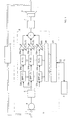
- a hearing instrument or wearable hearing aid 1 is shown and is connected to a programming unit 2 by means of a two-way communication link 3.
- the hearing aid 1 comprises f.i. a microphone 4, an A/D-converter 5, a digital signal processor 6, a D/A-converter 7 and a speaker 8.
- the signal processor 6 in its digital configuration could, f.i. consist of one channel or a number of channels, for one frequency range or for a number of frequency bands respectively.
- the entire hearing aid could also contain correspondingly designed analog circuits.
- the hearing aid is an ITE instrument to be inserted into the ear canal or a BTE instrument to be connected by means of a sound-conducting tubing with an earmold inserted into the ear canal, there is always the possibility of acoustical feedback.
- This feedback path is shown as an impedance/admittance 9.
- Figs. 2 to 6 will now be used to explain the approach taken for solving the problem as indicated above, namely to provide a simple process to measure the quality of an earmold during the automatic fitting process and to design a process to adjust the hearing aid with the actual limitations of the earmold.
- the invention provides a novel method to determine if the actual earmold has a sufficiently high quality of fitting inside the ear canal to match the actual hearing loss in one or more frequency bands.
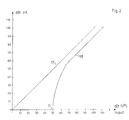
- Fig. 2 shows the normal hearing perception function 17 as the hearing level HL over the sound pressure level SPL and a typical impaired hearing function 18 of the recruitment type, starting at the hearing threshold 11.
- the curve 18 is the so called loudness contour.
- HTL hearing threshold
- Fig. 3 thus shows a theoretical ideal input/output response function 16 for the hearing loss of Fig. 2 and also a typical ideal response function 13 of a hearing aid of the type considered here.
- a constant low amplification level (gain) 13a is present, where the gain is represented in Fig. 3 by the distance between response curve 13 and the normal hearing perception function 10.
- a compression range 13b is presented below the upper kneepoint 14 and above a lower kneepoint 15 where the gain decreases from the lower kneepoint 15 to the upper kneepoint 14.
- an expansion range 13c is present in order to prevent the internal microphone noise from becoming audible.
- a control and communication unit 21 is provided which at a coupling point 22 is detachably connected to the programming unit 2 by the two-way communication link 3.
- the three channels of the digital signal processor 6 comprise band pass filters 23a, 23b and 23c, limiter stages 24a, 24b and 24c and controllable amplifier stages 25a, 25b and 25c.
- these three channels are shown here as an example only and the invention is not limited to these three channels.
- the digital signal processor 6 with its components 23, 24 and 25 may at one hand be controlled by the control and communication unit 21 by means of the control register 26. On the other hand the present status of the various components of the digital signal processor 6 is also represented in the control register 26 and its information may also be transferred to the communication and control unit 21 and the programming unit 2.
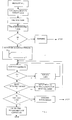
- the background noise is checked and supervised by the programming unit 2 and the control and communication unit 21 via the microphone 4 and the signal processor 6. In case the background noise is unacceptably high, i.e. approaching or surpassing a predefined low level, a decision circuit responds and issues a warning whereafter the operation is arrested.
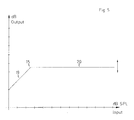
- control unit establishes the input/output response for the test procedure as shown in Fig. 5.
- control program by means of the control and communication unit checks for any possibly acoustic feedback that obviously will manifest itself by means of the microphone 4 and the digital signal processor 6. It has to be borne in mind that in case of more than one channel this check has to be carried out for each channel separately.
- the gain for all other channels has to be set to, e.g., Zero.
- the program control receives this information from units 6, 26 and 21, and reduces under program control the maximum gain up to the lower kneepoint 15 for a continued test for any possible feedback as monitored by the program control.
- the program control checks whether the reduced maximum gain is possibly too low considering the gain required for the particular hearing impairment, the hearing aid and the corresponding earmold. In that case the program control gives a warning that the quality of the earmold is insufficient for the intended use.
- this may be an indication that the earmold is not well matched to the earcanal and that the sound from the speaker 8 is leaking around the earmold to arrive at the microphone 4.
- This input/output response function will be represented by a corresponding set of control parameters or control values which will be stored in the hearing aid in its memory in order to control the transfer characteristic of said hearing instrument.
- the new fitting process provides for a number of possibilities for the in-situ fitting of a programmable or program-controlled hearing aid.
- the new process provides for an automatic ability to detect the occurrence of acoustic feedback in one or more frequency bands of a hearing instrument.
- information can be read out from the digital signal processor of the hearing aid by means of the control register 26 and into the programming control device connected at least temporarily to the hearing aid.
- the programming device after receiving this information may then establish or calculate the maximum gain at which the hearing aid will no longer exhibit an acoustical feedback.
- the results of such automatic tests could be stored in the programming device for future reference. In case the feedback is still present, even at very much reduced gain levels, this may be an indication that the quality of the ear mold is insufficient to sustain an adequate gain for the established hearing threshold level of the hearing impaired. Thereafter a new earmold would have to be designed and tested again.
- the operation of the hearing aid with the input/output response shown in Fig. 5 is testing the maximum gain portion of the initial input/output response, and this is one manner of achieving the end goal of the invention, i.e., to identify the frequency band and sound pressure level at which acoustic feedback occurs.
- control and communication unit 21 and the control register may also be part of microprocessor circuitry which also may comprise the required storage / memory facilities for storing control function/algorithms for performing the operations in accordance with the present invention and also communicating with the programming unit 2.
Landscapes
- Health & Medical Sciences (AREA)
- General Health & Medical Sciences (AREA)
- Neurosurgery (AREA)
- Otolaryngology (AREA)
- Physics & Mathematics (AREA)
- Engineering & Computer Science (AREA)
- Acoustics & Sound (AREA)
- Signal Processing (AREA)
- Tone Control, Compression And Expansion, Limiting Amplitude (AREA)
- Control Of Amplification And Gain Control (AREA)
- Selective Calling Equipment (AREA)
- Electrophonic Musical Instruments (AREA)
Abstract
Description
- Fig. 1
- shows schematically a hearing instrument including programming means;
- Fig. 2
- schematically a diagram of the hearing perception function and the impaired hearing function of the recruitment type;
- Fig. 3
- schematically an ideal input/output response of a hearing aid of the type used for the invention;
- Fig. 4
- schematically a flow diagram of the process in accordance with the invention;
- Fig. 5
- schematically an illustration of the input/output response used during the test procedure and
- Fig. 6
- shows schematically the resulting input/output response after the test procedure is completed.
Claims (9)
- A process for controlling a programmable or program controllable hearing aid (1) comprising a microphone (4) a controllable signal processor (6) for operating on one or more frequency bands, and a speaker (8) for in-situ fitting adjustment of said heating aid to an optimum gain function in one or more frequency bands, by establishing the hearing threshold level (HTL) of the wearer for one or more frequency bands determining a target input/output response function for the detected hearing loss and generating a corresponding parameter set for an ideal input/output response function (13) for the detected hearing loss under feedback-free conditions, characterized byA setting the control parameter set of the signal processor (6) initially to an input/output response function (13; 19, 20) with a maximum gain equal to the maximum gain (15) of the ideal input/output response function (13) having high gain at weak sounds and zero or low gain at powerful sounds andB operating the hearing aid in-situ in accordance with said initial input/output response function while monitoring said hearing aid for the occurrence of any acoustic feedback, andC if no noticeable feedback is detected setting said initial parameter set for said input/output response function into said hearing aid, andD if noticeable acoustic feedback is detected reducing the maximum gain (15, 15', 15'') over at least one of said frequency bands while leaving unchanged with respect to said initial parameter set the gain in any other frequency band, to thereby obtain an adjusted input/output response for at least said one frequency band.
- A process according to claim 1, further comprising repeating steps B-D until no noticeable acoustic feedback is detected and thereafter storing the parameter set of the last obtained version of said input/ output response into said hearing aid as said optimum input/output response.
- A process according to claim 1 wherein said monitoring and gain reducing steps are performed separately for each of plural frequency bands.
- A process according to claim 1, wherein said initial input/output response provides a predetermined gain for input sounds at a predetermined input sound level, and wherein said steps of operating said hearing-aid in accordance with said initial input/output response comprises operating said hearing aid in accordance with said hearing aid set to a test input/output response exhibiting said predetermined gain at said predetermined input sound level.
- A process according to claim 4, where said test input/output response provides a constant output level for input sounds above said predetermined input sound level.
- A process according to claim 4, where said test input/output response provides a constant gain for input sounds below said predetermined input sound level.
- A process according to claim 2, further comprising the step of:
E if after step D the gain is below a predetermined minimum level, terminating said process and storing an indicator of the results of said process as an indication of the quality of said earmold. - A process according to claim 1, further comprising the step of:
F prior to step B, monitoring an ambient noise level, and terminating said process if said ambient noise level exceeds a predetermined level. - A process according to claim 8, wherein step F is performed for each of plural frequency bands, and the process is terminated if the ambient noise in any of said plural frequency bands exceeds a respective predetermined level.
Applications Claiming Priority (1)
| Application Number | Priority Date | Filing Date | Title |
|---|---|---|---|
| PCT/EP1995/001649 WO1996035314A1 (en) | 1995-05-02 | 1995-05-02 | Process for controlling a programmable or program-controlled hearing aid for its in-situ fitting adjustment |
Publications (2)
| Publication Number | Publication Date |
|---|---|
| EP0824845A1 EP0824845A1 (en) | 1998-02-25 |
| EP0824845B1 true EP0824845B1 (en) | 1998-09-30 |
Family
ID=8166010
Family Applications (1)
| Application Number | Title | Priority Date | Filing Date |
|---|---|---|---|
| EP95919994A Expired - Lifetime EP0824845B1 (en) | 1995-05-02 | 1995-05-02 | Process for controlling a programmable or program-controlled hearing aid for its in-situ fitting adjustment |
Country Status (8)
| Country | Link |
|---|---|
| US (1) | US5991417A (en) |
| EP (1) | EP0824845B1 (en) |
| JP (1) | JP3398156B2 (en) |
| AT (1) | ATE171833T1 (en) |
| CA (1) | CA2215764C (en) |
| DE (1) | DE69505155T2 (en) |
| DK (1) | DK0824845T3 (en) |
| WO (1) | WO1996035314A1 (en) |
Cited By (2)
| Publication number | Priority date | Publication date | Assignee | Title |
|---|---|---|---|---|
| DE102006029194B4 (en) * | 2006-06-26 | 2010-04-15 | Siemens Audiologische Technik Gmbh | Device and method for increment control of an adaptive filter |
| WO2026013311A1 (en) | 2024-07-11 | 2026-01-15 | Widex A/S | Method of operating a hearing aid system and a hearing aid system |
Families Citing this family (56)
| Publication number | Priority date | Publication date | Assignee | Title |
|---|---|---|---|---|
| US6275596B1 (en) * | 1997-01-10 | 2001-08-14 | Gn Resound Corporation | Open ear canal hearing aid system |
| US6219427B1 (en) * | 1997-11-18 | 2001-04-17 | Gn Resound As | Feedback cancellation improvements |
| ATE218028T1 (en) | 1997-12-23 | 2002-06-15 | Widex As | DYNAMIC AUTOMATIC GAIN CONTROL IN A HEARING AID |
| US6876751B1 (en) | 1998-09-30 | 2005-04-05 | House Ear Institute | Band-limited adaptive feedback canceller for hearing aids |
| WO2000019605A2 (en) * | 1998-09-30 | 2000-04-06 | House Ear Institute | Band-limited adaptive feedback canceller for hearing aids |
| US20040151332A1 (en) * | 1998-10-07 | 2004-08-05 | Finn Danielsen | Feedback management for hearing aid |
| ATE518383T1 (en) * | 1998-10-07 | 2011-08-15 | Oticon As | FEEDBACK TREATMENT FOR A HEARING AID |
| US7366315B2 (en) | 1999-02-05 | 2008-04-29 | Hearworks Pty, Limited | Adaptive dynamic range optimization sound processor |
| EP1172020B1 (en) * | 1999-02-05 | 2006-09-06 | Hearworks Pty Ltd. | Adaptive dynamic range optimisation sound processor |
| EP1052881B1 (en) * | 1999-05-12 | 2010-10-20 | Siemens Audiologische Technik GmbH | Hearing aid with oscillation detector and method for detecting oscillations in a hearing aid |
| DE19922133C2 (en) * | 1999-05-12 | 2001-09-13 | Siemens Audiologische Technik | Hearing aid device with oscillation detector and method for determining oscillations in a hearing aid device |
| US6480610B1 (en) | 1999-09-21 | 2002-11-12 | Sonic Innovations, Inc. | Subband acoustic feedback cancellation in hearing aids |
| US6522988B1 (en) * | 2000-01-24 | 2003-02-18 | Audia Technology, Inc. | Method and system for on-line hearing examination using calibrated local machine |
| US6322521B1 (en) * | 2000-01-24 | 2001-11-27 | Audia Technology, Inc. | Method and system for on-line hearing examination and correction |
| ATE244979T1 (en) * | 2000-01-25 | 2003-07-15 | Widex As | A METHOD AND SYSTEM FOR GENERATING A CALIBRATED SOUND FIELD |
| KR100347595B1 (en) * | 2000-11-02 | 2002-08-07 | 심윤주 | method of automatically fitting hearing aids |
| US6687377B2 (en) * | 2000-12-20 | 2004-02-03 | Sonomax Hearing Healthcare Inc. | Method and apparatus for determining in situ the acoustic seal provided by an in-ear device |
| JP2004530310A (en) * | 2001-03-13 | 2004-09-30 | フォーナック アーゲー | Method of forming a removable mechanical and / or electrical connection, a hearing device and a hearing device system using the method |
| US20020191800A1 (en) * | 2001-04-19 | 2002-12-19 | Armstrong Stephen W. | In-situ transducer modeling in a digital hearing instrument |
| US20020172350A1 (en) * | 2001-05-15 | 2002-11-21 | Edwards Brent W. | Method for generating a final signal from a near-end signal and a far-end signal |
| DE60231042D1 (en) * | 2001-06-28 | 2009-03-19 | Oticon As | HEARING AIDS ADJUSTMENT |
| US20030007657A1 (en) | 2001-07-09 | 2003-01-09 | Topholm & Westermann Aps | Hearing aid with sudden sound alert |
| DE10152197B4 (en) * | 2001-10-23 | 2009-07-09 | Siemens Audiologische Technik Gmbh | Method for programming a hearing aid, programming device and remote control for the hearing aid |
| DE10159928A1 (en) * | 2001-12-06 | 2003-05-08 | Siemens Audiologische Technik | Preventing oscillations in hearing aid caused by feedback involves reducing gain for lower input signal levels if oscillations detected, reducing it to lesser extent or not at all for higher levels |
| EP1309225B1 (en) * | 2002-10-02 | 2014-04-16 | Phonak Ag | Method for determining the feedback threshold in a hearing aid |
| US7010135B2 (en) * | 2002-10-02 | 2006-03-07 | Phonak Ag | Method to determine a feedback threshold in a hearing device |
| US7536022B2 (en) * | 2002-10-02 | 2009-05-19 | Phonak Ag | Method to determine a feedback threshold in a hearing device |
| PL3016411T3 (en) | 2003-12-05 | 2018-07-31 | 3M Innovative Properties Company | Method and apparatus for objective assessment of in ear device acoustical performance |
| DK1721488T3 (en) * | 2004-03-03 | 2009-03-02 | Widex As | Hearing aid with adaptive feedback suppression system |
| US20060025876A1 (en) * | 2004-07-28 | 2006-02-02 | Yueh-Hua Hsu Huang | Digital audio frequency optimizer |
| DE102005008318B4 (en) † | 2005-02-23 | 2013-07-04 | Siemens Audiologische Technik Gmbh | Hearing aid with user-controlled automatic calibration |
| DE102005034647B3 (en) * | 2005-07-25 | 2007-02-22 | Siemens Audiologische Technik Gmbh | Hearing apparatus and method for setting a gain characteristic |
| EP1624719A3 (en) * | 2005-09-13 | 2006-04-12 | Phonak Ag | Method to determine a feedback threshold in a hearing device |
| US7933419B2 (en) * | 2005-10-05 | 2011-04-26 | Phonak Ag | In-situ-fitted hearing device |
| JP4770440B2 (en) * | 2005-12-13 | 2011-09-14 | ソニー株式会社 | Signal processing apparatus and signal processing method |
| US20070195963A1 (en) * | 2006-02-21 | 2007-08-23 | Nokia Corporation | Measuring ear biometrics for sound optimization |
| DE102006019694B3 (en) * | 2006-04-27 | 2007-10-18 | Siemens Audiologische Technik Gmbh | Hearing aid amplification adjusting method, involves determining maximum amplification or periodical maximum amplification curve in upper frequency range based on open-loop-gain- measurement |
| KR101356206B1 (en) * | 2007-02-01 | 2014-01-28 | 삼성전자주식회사 | Method and apparatus for reproducing audio having auto volume controlling function |
| WO2008095167A2 (en) | 2007-02-01 | 2008-08-07 | Personics Holdings Inc. | Method and device for audio recording |
| US8712067B2 (en) * | 2007-03-14 | 2014-04-29 | Able Planet Incorporated | System and method of improving audio signals for the hearing impaired |
| US11317202B2 (en) | 2007-04-13 | 2022-04-26 | Staton Techiya, Llc | Method and device for voice operated control |
| US11217237B2 (en) | 2008-04-14 | 2022-01-04 | Staton Techiya, Llc | Method and device for voice operated control |
| US8917892B2 (en) | 2007-04-19 | 2014-12-23 | Michael L. Poe | Automated real speech hearing instrument adjustment system |
| WO2008131342A1 (en) * | 2007-04-19 | 2008-10-30 | Medrx Hearing Systems, Inc. | Automated real speech hearing instrument adjustment system |
| US20110026746A1 (en) * | 2007-09-20 | 2011-02-03 | Phonak Ag | Method for determining of feedback threshold in a hearing device and a hearing device |
| DK2189006T3 (en) * | 2007-09-20 | 2011-10-17 | Phonak Ag | A method for determining the feedback threshold in a hearing aid |
| US9129291B2 (en) | 2008-09-22 | 2015-09-08 | Personics Holdings, Llc | Personalized sound management and method |
| CA2782646C (en) | 2009-12-09 | 2014-09-02 | Widex A/S | A method of processing a signal in a hearing aid, a method of fitting a hearing aid and a hearing aid |
| KR100974153B1 (en) * | 2010-02-10 | 2010-08-04 | 심윤주 | Method of automatically fitting hearing aid |
| WO2010049543A2 (en) * | 2010-02-19 | 2010-05-06 | Phonak Ag | Method for monitoring a fit of a hearing device as well as a hearing device |
| DE102011086728B4 (en) | 2011-11-21 | 2014-06-05 | Siemens Medical Instruments Pte. Ltd. | Hearing apparatus with a device for reducing a microphone noise and method for reducing a microphone noise |
| KR101363052B1 (en) * | 2013-04-17 | 2014-02-14 | 주식회사 엠비온 | Method of manufacturing wireless hearing aid using elastic attachment adhesive and wireless hearing aid manufactured using the same |
| WO2014179489A1 (en) * | 2013-05-01 | 2014-11-06 | Starkey Laboratories, Inc. | Adaptive feedback cancellation coefficients based on voltage |
| US10163453B2 (en) | 2014-10-24 | 2018-12-25 | Staton Techiya, Llc | Robust voice activity detector system for use with an earphone |
| DK3185586T3 (en) * | 2015-12-23 | 2020-06-22 | Gn Hearing As | HEARING WITH IMPROVED BACKUP REPRESSION |
| US11184713B2 (en) * | 2019-11-19 | 2021-11-23 | Sonova Ag | Systems and methods for adjusting a gain limit of a hearing device |
Family Cites Families (8)
| Publication number | Priority date | Publication date | Assignee | Title |
|---|---|---|---|---|
| US4185168A (en) * | 1976-05-04 | 1980-01-22 | Causey G Donald | Method and means for adaptively filtering near-stationary noise from an information bearing signal |
| US5225836A (en) * | 1988-03-23 | 1993-07-06 | Central Institute For The Deaf | Electronic filters, repeated signal charge conversion apparatus, hearing aids and methods |
| US5016280A (en) * | 1988-03-23 | 1991-05-14 | Central Institute For The Deaf | Electronic filters, hearing aids and methods |
| US5111419A (en) * | 1988-03-23 | 1992-05-05 | Central Institute For The Deaf | Electronic filters, signal conversion apparatus, hearing aids and methods |
| US4972487A (en) * | 1988-03-30 | 1990-11-20 | Diphon Development Ab | Auditory prosthesis with datalogging capability |
| US5027410A (en) * | 1988-11-10 | 1991-06-25 | Wisconsin Alumni Research Foundation | Adaptive, programmable signal processing and filtering for hearing aids |
| GB8919591D0 (en) * | 1989-08-30 | 1989-10-11 | Gn Davavox As | Hearing aid having compensation for acoustic feedback |
| US5130665A (en) * | 1991-02-14 | 1992-07-14 | Walden Richard L | Audio volume level control |
-
1995
- 1995-05-02 DK DK95919994T patent/DK0824845T3/en active
- 1995-05-02 CA CA002215764A patent/CA2215764C/en not_active Expired - Fee Related
- 1995-05-02 WO PCT/EP1995/001649 patent/WO1996035314A1/en not_active Ceased
- 1995-05-02 US US08/945,508 patent/US5991417A/en not_active Expired - Lifetime
- 1995-05-02 DE DE69505155T patent/DE69505155T2/en not_active Expired - Lifetime
- 1995-05-02 AT AT95919994T patent/ATE171833T1/en not_active IP Right Cessation
- 1995-05-02 JP JP53294996A patent/JP3398156B2/en not_active Expired - Fee Related
- 1995-05-02 EP EP95919994A patent/EP0824845B1/en not_active Expired - Lifetime
Cited By (3)
| Publication number | Priority date | Publication date | Assignee | Title |
|---|---|---|---|---|
| DE102006029194B4 (en) * | 2006-06-26 | 2010-04-15 | Siemens Audiologische Technik Gmbh | Device and method for increment control of an adaptive filter |
| US8611572B2 (en) | 2006-06-26 | 2013-12-17 | Siemens Audiologische Technik Gmbh | Device and method for controlling the step size of an adaptive filter |
| WO2026013311A1 (en) | 2024-07-11 | 2026-01-15 | Widex A/S | Method of operating a hearing aid system and a hearing aid system |
Also Published As
| Publication number | Publication date |
|---|---|
| DE69505155D1 (en) | 1998-11-05 |
| AU698105B2 (en) | 1998-10-22 |
| ATE171833T1 (en) | 1998-10-15 |
| WO1996035314A1 (en) | 1996-11-07 |
| CA2215764C (en) | 2000-04-04 |
| AU2561695A (en) | 1996-11-21 |
| DK0824845T3 (en) | 1999-06-21 |
| EP0824845A1 (en) | 1998-02-25 |
| US5991417A (en) | 1999-11-23 |
| DE69505155T2 (en) | 1999-04-15 |
| CA2215764A1 (en) | 1996-11-07 |
| JP3398156B2 (en) | 2003-04-21 |
| JPH11505077A (en) | 1999-05-11 |
Similar Documents
| Publication | Publication Date | Title |
|---|---|---|
| EP0824845B1 (en) | Process for controlling a programmable or program-controlled hearing aid for its in-situ fitting adjustment | |
| US7242778B2 (en) | Hearing instrument with self-diagnostics | |
| US8553917B2 (en) | Method for actively reducing occlusion comprising plausibility check and corresponding hearing apparatus | |
| EP1467596A2 (en) | System and method for transmitting audio signals via a serial data port in a hearing instrument | |
| US8494201B2 (en) | Hearing aid with occlusion suppression | |
| EP2434780B1 (en) | Hearing aid with occlusion suppression and subsonic energy control | |
| EP1346605A1 (en) | Method of automatically fitting hearing aid | |
| US8594353B2 (en) | Hearing aid with occlusion suppression and subsonic energy control | |
| CN112383870A (en) | Adaptive hearing parameter fitting method and device | |
| US20080253595A1 (en) | Method for adjusting a binaural hearing device system | |
| WO2012107100A1 (en) | Hearing aid with means for estimating the ear plug fitting | |
| WO2007144010A1 (en) | Method for monitoring a hearing device and hearing device with self-monitoring function | |
| US20060050911A1 (en) | Method to determine a feedback threshold in a hearing device | |
| CN104717592A (en) | Hearing device with fit recognition | |
| EP3808103A1 (en) | Method of testing microphone performance of a hearing aid system and a hearing aid system | |
| AU698105C (en) | Process for controlling a programmable or program-controlled hearing aid for its in-situ fitting adjustment | |
| US7123732B2 (en) | Process to adapt the signal amplification in a hearing device as well as a hearing device | |
| US7010135B2 (en) | Method to determine a feedback threshold in a hearing device | |
| US20210258701A1 (en) | Method of fitting a hearing aid system and a hearing aid system | |
| US20220333978A1 (en) | System and method for estimating an acoustic attenuation of a hearing protection device | |
| EP3707919B1 (en) | A hearing device adapted to perform a self-test and a method for testing a hearing device | |
| EP4489441A1 (en) | Method of estimating noise attenuation in a hearing device | |
| US8842862B2 (en) | Hearing aid device with user-controlled automatic adjusting means | |
| Smeds et al. | Threshold-based fitting methods for non-linear (WDRC) hearing instruments-comparison of acoustic characteristics | |
| US20240259741A1 (en) | Method for determining noise during a hearing test |
Legal Events
| Date | Code | Title | Description |
|---|---|---|---|
| PUAI | Public reference made under article 153(3) epc to a published international application that has entered the european phase |
Free format text: ORIGINAL CODE: 0009012 |
|
| GRAG | Despatch of communication of intention to grant |
Free format text: ORIGINAL CODE: EPIDOS AGRA |
|
| 17P | Request for examination filed |
Effective date: 19970825 |
|
| AK | Designated contracting states |
Kind code of ref document: A1 Designated state(s): AT CH DE DK GB IT LI NL SE |
|
| GRAG | Despatch of communication of intention to grant |
Free format text: ORIGINAL CODE: EPIDOS AGRA |
|
| GRAH | Despatch of communication of intention to grant a patent |
Free format text: ORIGINAL CODE: EPIDOS IGRA |
|
| GRAG | Despatch of communication of intention to grant |
Free format text: ORIGINAL CODE: EPIDOS AGRA |
|
| GRAH | Despatch of communication of intention to grant a patent |
Free format text: ORIGINAL CODE: EPIDOS IGRA |
|
| 17Q | First examination report despatched |
Effective date: 19980219 |
|
| GRAH | Despatch of communication of intention to grant a patent |
Free format text: ORIGINAL CODE: EPIDOS IGRA |
|
| GRAA | (expected) grant |
Free format text: ORIGINAL CODE: 0009210 |
|
| AK | Designated contracting states |
Kind code of ref document: B1 Designated state(s): AT CH DE DK GB IT LI NL SE |
|
| REF | Corresponds to: |
Ref document number: 171833 Country of ref document: AT Date of ref document: 19981015 Kind code of ref document: T |
|
| REG | Reference to a national code |
Ref country code: CH Ref legal event code: EP |
|
| REF | Corresponds to: |
Ref document number: 69505155 Country of ref document: DE Date of ref document: 19981105 |
|
| REG | Reference to a national code |
Ref country code: CH Ref legal event code: NV Representative=s name: PATENTANWAELTE SCHAAD, BALASS, MENZL & PARTNER AG |
|
| PG25 | Lapsed in a contracting state [announced via postgrant information from national office to epo] |
Ref country code: SE Free format text: LAPSE BECAUSE OF FAILURE TO SUBMIT A TRANSLATION OF THE DESCRIPTION OR TO PAY THE FEE WITHIN THE PRESCRIBED TIME-LIMIT Effective date: 19981231 |
|
| REG | Reference to a national code |
Ref country code: DK Ref legal event code: T3 |
|
| PLBE | No opposition filed within time limit |
Free format text: ORIGINAL CODE: 0009261 |
|
| STAA | Information on the status of an ep patent application or granted ep patent |
Free format text: STATUS: NO OPPOSITION FILED WITHIN TIME LIMIT |
|
| 26N | No opposition filed | ||
| REG | Reference to a national code |
Ref country code: GB Ref legal event code: IF02 |
|
| PGFP | Annual fee paid to national office [announced via postgrant information from national office to epo] |
Ref country code: AT Payment date: 20060511 Year of fee payment: 12 |
|
| PGFP | Annual fee paid to national office [announced via postgrant information from national office to epo] |
Ref country code: IT Payment date: 20070514 Year of fee payment: 13 |
|
| PG25 | Lapsed in a contracting state [announced via postgrant information from national office to epo] |
Ref country code: AT Free format text: LAPSE BECAUSE OF NON-PAYMENT OF DUE FEES Effective date: 20070502 |
|
| PG25 | Lapsed in a contracting state [announced via postgrant information from national office to epo] |
Ref country code: IT Free format text: LAPSE BECAUSE OF NON-PAYMENT OF DUE FEES Effective date: 20080502 |
|
| PGFP | Annual fee paid to national office [announced via postgrant information from national office to epo] |
Ref country code: CH Payment date: 20110512 Year of fee payment: 17 |
|
| PGFP | Annual fee paid to national office [announced via postgrant information from national office to epo] |
Ref country code: NL Payment date: 20110526 Year of fee payment: 17 Ref country code: DK Payment date: 20110512 Year of fee payment: 17 Ref country code: GB Payment date: 20110427 Year of fee payment: 17 |
|
| PGFP | Annual fee paid to national office [announced via postgrant information from national office to epo] |
Ref country code: DE Payment date: 20110427 Year of fee payment: 17 |
|
| REG | Reference to a national code |
Ref country code: DE Ref legal event code: R082 Ref document number: 69505155 Country of ref document: DE Representative=s name: BETTEN & RESCH, DE |
|
| REG | Reference to a national code |
Ref country code: DE Ref legal event code: R082 Ref document number: 69505155 Country of ref document: DE Representative=s name: BETTEN & RESCH PATENT- UND RECHTSANWAELTE PART, DE Effective date: 20120119 Ref country code: DE Ref legal event code: R082 Ref document number: 69505155 Country of ref document: DE Representative=s name: PATENTANWAELTE BETTEN & RESCH, DE Effective date: 20120119 Ref country code: DE Ref legal event code: R081 Ref document number: 69505155 Country of ref document: DE Owner name: WIDEX A/S, DK Free format text: FORMER OWNER: TOPHOLM & WESTERMANN APS, VAERLOESE, DK Effective date: 20120119 |
|
| REG | Reference to a national code |
Ref country code: NL Ref legal event code: V1 Effective date: 20121201 |
|
| REG | Reference to a national code |
Ref country code: CH Ref legal event code: PL |
|
| REG | Reference to a national code |
Ref country code: DK Ref legal event code: EBP |
|
| GBPC | Gb: european patent ceased through non-payment of renewal fee |
Effective date: 20120502 |
|
| PG25 | Lapsed in a contracting state [announced via postgrant information from national office to epo] |
Ref country code: LI Free format text: LAPSE BECAUSE OF NON-PAYMENT OF DUE FEES Effective date: 20120531 Ref country code: CH Free format text: LAPSE BECAUSE OF NON-PAYMENT OF DUE FEES Effective date: 20120531 |
|
| REG | Reference to a national code |
Ref country code: DE Ref legal event code: R119 Ref document number: 69505155 Country of ref document: DE Effective date: 20121201 |
|
| PG25 | Lapsed in a contracting state [announced via postgrant information from national office to epo] |
Ref country code: NL Free format text: LAPSE BECAUSE OF NON-PAYMENT OF DUE FEES Effective date: 20121201 |
|
| PG25 | Lapsed in a contracting state [announced via postgrant information from national office to epo] |
Ref country code: GB Free format text: LAPSE BECAUSE OF NON-PAYMENT OF DUE FEES Effective date: 20120502 Ref country code: DK Free format text: LAPSE BECAUSE OF NON-PAYMENT OF DUE FEES Effective date: 20120531 |
|
| PG25 | Lapsed in a contracting state [announced via postgrant information from national office to epo] |
Ref country code: DE Free format text: LAPSE BECAUSE OF NON-PAYMENT OF DUE FEES Effective date: 20121201 |