EP0831461A2 - Scheme for model adaptation in pattern recognition based on taylor expansion - Google Patents
Scheme for model adaptation in pattern recognition based on taylor expansion Download PDFInfo
- Publication number
- EP0831461A2 EP0831461A2 EP97116079A EP97116079A EP0831461A2 EP 0831461 A2 EP0831461 A2 EP 0831461A2 EP 97116079 A EP97116079 A EP 97116079A EP 97116079 A EP97116079 A EP 97116079A EP 0831461 A2 EP0831461 A2 EP 0831461A2
- Authority
- EP
- European Patent Office
- Prior art keywords
- condition
- model
- probabilistic
- initial
- recognition
- Prior art date
- Legal status (The legal status is an assumption and is not a legal conclusion. Google has not performed a legal analysis and makes no representation as to the accuracy of the status listed.)
- Granted
Links
Images


Classifications
-
- G—PHYSICS
- G10—MUSICAL INSTRUMENTS; ACOUSTICS
- G10L—SPEECH ANALYSIS TECHNIQUES OR SPEECH SYNTHESIS; SPEECH RECOGNITION; SPEECH OR VOICE PROCESSING TECHNIQUES; SPEECH OR AUDIO CODING OR DECODING
- G10L15/00—Speech recognition
- G10L15/06—Creation of reference templates; Training of speech recognition systems, e.g. adaptation to the characteristics of the speaker's voice
- G10L15/065—Adaptation
-
- G—PHYSICS
- G10—MUSICAL INSTRUMENTS; ACOUSTICS
- G10L—SPEECH ANALYSIS TECHNIQUES OR SPEECH SYNTHESIS; SPEECH RECOGNITION; SPEECH OR VOICE PROCESSING TECHNIQUES; SPEECH OR AUDIO CODING OR DECODING
- G10L15/00—Speech recognition
- G10L15/08—Speech classification or search
- G10L15/14—Speech classification or search using statistical models, e.g. Hidden Markov Models [HMMs]
- G10L15/142—Hidden Markov Models [HMMs]
- G10L15/144—Training of HMMs
-
- G—PHYSICS
- G10—MUSICAL INSTRUMENTS; ACOUSTICS
- G10L—SPEECH ANALYSIS TECHNIQUES OR SPEECH SYNTHESIS; SPEECH RECOGNITION; SPEECH OR VOICE PROCESSING TECHNIQUES; SPEECH OR AUDIO CODING OR DECODING
- G10L15/00—Speech recognition
- G10L15/06—Creation of reference templates; Training of speech recognition systems, e.g. adaptation to the characteristics of the speaker's voice
- G10L15/063—Training
- G10L2015/0635—Training updating or merging of old and new templates; Mean values; Weighting
Definitions
- the present invention relates to the pattern recognition that uses the Hidden Markov Model for expressing recognition targets such as speech, character, figure, etc., and more particularly, to a scheme for model adaptation which is aimed at correcting a mismatch of a model due to a difference between a condition at a time of model creation and a condition at a time of model use in form of recognition execution, and thereby improving the recognition performance.
- HMM Hidden Markov Model
- the input speech data is matched with the acoustic model (phoneme model, syllable model, word model, etc.) obtained from training speech data and the likelihood is determined so as to obtain the recognition result.
- a parameter of the model largely depend on conditions (background noise, channel distortion, speaker, vocal tract length, etc.) under which the training speech data are recorded. Consequently, when the speech recording condition is different from the condition at a time of actual recognition, there arises a mismatch between the input speech pattern and the model which in turn causes a lowering of the recognition rate.
- Such a lowering of the recognition rate due to a mismatch between the input speech data and the acoustic model can be prevented by re-creating the model by using the speech data recorded under the same condition as that at a time of actual recognition.
- the model based on the statistical method such as HMM requires an enormous amount of training speech data so that the processing requires a considerable time (such as 100 hours, for example). For this reason, there is a need for the adaptation technique that can adapt a mismatching model to a model that completely matches with the condition at a time of actual recognition, by using less amount of training data and less processing time.
- condition change there is a change of the background noise at a time of utterance.
- the recognition rate is lowered when the background noise at a time of model training speech data recording is different from the background noise at a time of actual recognition.
- the conventionally known techniques for adaptation of the model with respect to the background noise include the HMM composition schemes such as PMC (see M.J.F. Gales et al.: “An Improved Approach to the Hidden Markov Model Decomposition of Speech and Noise", Proc. of ICASSP92, pp. 233-236, 1992, for example) and NOVO (see F. Martin et al.: "Recognition of noisysy Speech by using the Composition of Hidden Markov Models", Proc. of Acoustic Society of Japan Autumn 1992, pp. 65-66, for example).
- the HMM composition scheme is an adaptation technique in which the HMM trained by using clean speeches without noise that were recorded in a soundproof room (which will be referred to as a clean speech HMM hereafter) is combined with the HMM trained by using only background noises at a time of recognition (which will be referred to as a noise HMM hereafter), so as to obtain the HMM that can match with the input speech by having the background noises at a time of recognition superposed therein.
- the use of the HMM composition scheme only requires the training of the noise HMM and the processing time for the model composition, so that it is possible to adapt the model by a relatively less time compared with a case of re-creating the model by using an enormous amount of speech data.
- the conventional speech recognition has been associated with the problem that it is difficult to adapt the model in real time according to continuously changing condition, because a rather long noise recording time (15 seconds, for example) is required for the purpose of obtaining the training data for the noise HMM and a rather long processing time (about 10 seconds) is required as the processing time for the model composition.
- a method of model adaptation in a pattern recognition in which a likelihood of an input vector with respect to each probabilistic model expressing features of each recognition category is calculated and a recognition category expressed by a probabilistic model with a highest likelihood among a plurality of prescribed probabilistic models is outputted as a recognition result, the method comprising the steps of: determining a change in a parameter expressing a condition of pattern recognition and probabilistic model training, between an initial condition at a time of acquiring training data used in obtaining a model parameter of each probabilistic model and a current condition at a time of actual recognition; and adapting the probabilistic models by obtaining a model parameter after a condition change by updating a model parameter before a condition change according to the change determined by the determining step, when the initial condition and the current condition are mismatching.
- a computer based apparatus for model adaptation in a pattern recognition in which a likelihood of an input vector with respect to each probabilistic model expressing features of each recognition category is calculated and a recognition category expressed by a probabilistic model with a highest likelihood among a plurality of prescribed probabilistic models is outputted as a recognition result
- the apparatus comprising: a change determination unit for determining a change in a parameter expressing a condition of pattern recognition and probabilistic model training, between an initial condition at a time of acquiring training data used in obtaining a model parameter of each probabilistic model and a current condition at a time of actual recognition; and an adaptation unit for adapting the probabilistic models by obtaining a model parameter after a condition change by updating a model parameter before a condition change according to the change determined by the change determination unit, when the initial condition and the current condition are mismatching.
- an article of manufacture comprising: a computer usable medium having computer readable program code means embodied therein for causing a computer to function as a model adaptation system in a pattern recognition in which a likelihood of an input vector with respect to each probabilistic model expressing features of each recognition category is calculated and a recognition category expressed by a probabilistic model with a highest likelihood among a plurality of prescribed probabilistic models is outputted as a recognition result
- the computer readable program code means including: first computer readable program code means for causing said computer to determine a change in a parameter expressing a condition of pattern recognition and probabilistic model training, between an initial condition at a time of acquiring training data used in obtaining a model parameter of each probabilistic model and a current condition at a time of actual recognition; and second computer readable program code means for causing said computer to adapt the probabilistic models by obtaining a model parameter after a condition change by updating a model parameter before a condition change according to the change determined by the first computer readable program code
- a pattern recognition apparatus comprising: an input unit for inputting input vectors; a parameter extraction unit for extracting a parameter expressing a condition of pattern recognition and probabilistic model training from each input vector; an initial condition probabilistic model creation and storage unit for creating and storing an initial condition probabilistic model from the parameter expressing the condition extracted from the input vector inputted under an initial condition at a time of acquiring training data; a reference probabilistic model storage unit for storing prescribed reference probabilistic models corresponding to a prescribed value of the parameter expressing the condition; an initial condition imposed probabilistic model creation and storage unit for creating and storing initial condition imposed probabilistic models from the initial condition probabilistic model and the reference probabilistic models; a Jacobian matrix calculation and storage unit for calculating and storing Jacobian matrices of a Taylor expansion expressing a change in a model parameter in terms of a change in the parameter expressing the condition, from the initial condition probabilistic model and the initial condition imposed probabilistic models; a difference calculation unit for calculating
- a speech recognition apparatus comprising: a speech input unit for inputting input noisy speech data; a noise extraction unit for extracting a noise data from each input noisy speech data; a noise spectral subtraction unit for obtaining over-estimation and under-estimation error components of the noise data by calculating an average spectrum from a partial or entire section of the noise data and subtracting the average spectrum from a spectrum of an entire section of the noise data; an initial noise model creation and storage unit for creating and storing an initial noise model from the over-estimation and under-estimation error components of the noise data which is obtained from the input noisy speech data inputted under an initial condition at a time of acquiring training data; a clean speech model storage unit for storing prescribed clean speech models; an initial noisy speech model creation and storage unit for creating and storing initial noisy speech models from the initial noise model and the clean speech models; a Jacobian matrix calculation and storage unit for calculating and storing Jacobian matrices of a Taylor expansion expressing a change
- a pattern recognition method comprising the steps of: inputting input vectors; extracting a parameter expressing a condition of pattern recognition and probabilistic model training from each input vector; creating and storing an initial condition probabilistic model from the parameter expressing the condition extracted from the input vector inputted under an initial condition at a time of acquiring training data; storing prescribed reference probabilistic models corresponding to a prescribed value of the parameter expressing the condition; creating and storing initial condition imposed probabilistic models from the initial condition probabilistic model and the reference probabilistic models; calculating and storing Jacobian matrices of a Taylor expansion expressing a change in a model parameter in terms of a change in the parameter expressing the condition, from the initial condition probabilistic model and the initial condition imposed probabilistic models; calculating a difference between the initial condition probabilistic model and an adaptation target condition probabilistic model obtained from the parameter expressing the condition which is extracted from the input vector inputted under a current condition at a time of actual recognition; calculating and storing adapted condition imposed
- a speech recognition method comprising the steps of: inputting input noisy speech data; extracting a noise data from each input noisy speech data; obtaining over-estimation and under-estimation error components of the noise data by calculating an average spectrum from a partial or entire section of the noise data and subtracting the average spectrum from a spectrum of an entire section of the noise data; creating and storing an initial noise model from the over-estimation and under-estimation error components of the noise data which is obtained from the input noisy speech data inputted under an initial condition at a time of acquiring training data; storing prescribed clean speech models; creating and storing initial noisy speech models from the initial noise model and the clean speech models; calculating and storing Jacobian matrices of a Taylor expansion expressing a change in a model parameter in terms of a change in the noise data, from the initial noise model and the initial noisy speech models; calculating a difference between the initial noise model and an adaptation target noise model obtained from the over-estimation and under-estim
- a method of model adaptation in a pattern recognition in which a likelihood of an input vector with respect to each probabilistic model expressing features of each recognition category is calculated and a recognition category expressed by a probabilistic model with a highest likelihood among a plurality of prescribed probabilistic models is outputted as a recognition result, the method comprising the steps of: (a) training an intial condition probabilistic model from a parameter expressing a condition of pattern recognition and probabilistic model training which is recorded at a time of model training; (b) obtaining an initial condition imposed probabilistic models from the initial condition probabilistic model and prescribed reference probabilistic models corresponding to a prescribed value of the parameter expressing the condition; (c) calculating and storing Jacobian matrices of a Taylor expansion expressing a change in a model parameter in terms of a change in the parameter expressing the condition, from the initial condition probabilistic model and the initial condition imposed probabilistic models; (d) training an adaptation target condition probabilistic model by using the parameter expressing the condition which is observed at
- a computer based apparatus for model adaptation in a pattern recognition in which a likelihood of an input vector with respect to each probabilistic model expressing features of each recognition category is calculated and a recognition category expressed by a probabilistic model with a highest likelihood among a plurality of prescribed probabilistic models is outputted as a recognition result
- the apparatus comprising: (a) a unit for training an intial condition probabilistic model from a parameter expressing a condition of pattern recognition and probabilistic model training which is recorded at a time of model training; (b) a unit for obtaining an initial condition imposed probabilistic models from the initial condition probabilistic model and prescribed reference probabilistic models corresponding to a prescribed value of the parameter expressing the condition; (c) a unit for calculating and storing Jacobian matrices of a Taylor expansion expressing a change in a model parameter in terms of a change in the parameter expressing the condition, from the initial condition probabilistic model and the initial condition imposed probabilistic models; (d) a unit for training an adaptation target
- an article of manufacture comprising: a computer usable medium having computer readable program code means embodied therein for causing a computer to function as a model adaptation system in a pattern recognition in which a likelihood of an input vector with respect to each probabilistic model expressing features of each recognition category is calculated and a recognition category expressed by a probabilistic model with a highest likelihood among a plurality of prescribed probabilistic models is outputted as a recognition result
- the computer readable program code means including: first a computer readable program code means for causing said computer to train an intial condition probabilistic model from a parameter expressing a condition of pattern recognition and probabilistic model training which is recorded at a time of model training; second computer readable program code means for causing said computer to obtain an initial condition imposed probabilistic models from the initial condition probabilistic model and prescribed reference probabilistic models corresponding to a prescribed value of the parameter expressing the condition; third computer readable program code means for causing said computer to calculate and store Jacobian matrices of a Taylor expansion
- the model adaptation scheme of the present invention is generally applicable to a type of pattern recognition processing in which a likelihood of an input vector with respect to each probabilistic model expressing features of each recognition category is calculated and a category expressed by a model with the highest likelihood is outputted as a recognition result.
- the model adaptation scheme of the present invention prevents the lowering of the recognition rate in such a pattern recognition in a case where a condition (such as background noises, for example) at a time of actual recognition is different from the initial condition at a time of initial model training.
- this is achieved in the model adaptation model of the present invention by calculating a change of the model parameter from a change (difference) between these two conditions in approximation using the Taylor expansion, updating a parameter of a reference model accordingly, creating a model that matches with the condition at a time of actual recognition accordingly, and carrying out the recognition by using this matching model.
- ⁇ y can be obtained in approximation by a multiplication of ⁇ x and the Jacobian matrix, without requiring a transformation of x into y.
- a change ⁇ y in the model parameter can be obtained in approximation by a small amount of calculation at high speed, by simply observing a change ⁇ x in the parameter expressing the condition, without requiring a complicated calculation for a non-linear mapping from x to y, regardless of whether a change in the parameter expressing the condition and a change in the model parameter are in a linear relationship or in a non-linear relationship.
- the power spectrum S R (expressed as a vector) of the speech to which the background noise is superposed (which will be referred to as the noisy speech hereafter) can be expressed as a sum of a clean speech power spectrum S S and a background noise power spectrum S N .
- S R S S + S N
- C R IDFT(log(exp(DFT(C S )) + exp(DFT(C N ))))
- DFT( ⁇ ), IDFT( ⁇ ), log( ⁇ ) and exp ( ⁇ ) denote the discrete Fourier transform, the inverse discrete Fourier transform, a logarithm transform and an exponential transform, respectively.
- the discrete Fourier transform is a linear transformation, but the logarithm transform and the exponential transform are non-linear transformations, so that the noisy speech cepstrum C R and the noise cepstrum C N has a non-linear relationship.
- J N ⁇ C R / ⁇ C N in the above equation (7)
- the partial differential terms contained in the above equation (8) can be calculated by using the relationships among domains as indicated in Fig. 2, as follows.
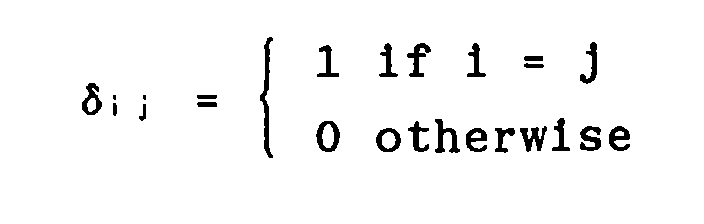
- [J N ] ij , F ij and F ij -1 are i-th row j-th column elements of the matrices J N , F and F -1 respectively
- S Nk and S Rk are k-th elements of the vectors S N and S R respectively.
- each element of the Jacobian matrix can be obtained from the noise spectrum S N , the noisy speech spectrum S R , and the transform matrices F and F -1 which are constants.
- the noise spectrum S N and the noisy speech spectrum S R can be obtained by transforming the noise cepstrum C N and the noisy speech cepstrum C R into the linear spectra, respectively. Consequently, the Jacobian matrix can be calculated in advance when the background noise at a time of model training is recorded.
- a mean vector C R ' of the adapted noisy speech HMMs can be calculated as follows.
- C R is a mean vector of the initial noisy speech HMMs
- C N is a mean vector of an output probability distribution of the HMM that is obtained from the background noise data before the noise change (which will be referred to as an initial noise HMM hereafter)
- C N ' is a mean vector of an output probability distribution of the HMM that is obtained from the background noise after the noise change (at a time of actual recognition) (which will be referred to as an adaptation target noise HMM hereafter).
- C R can be given by a mean vector of the noisy speech HMMs that are trained by the speech data to which the background noise before the noise change is superposed. It is also possible to use the noisy speech HMMs that are obtained by the HMM composition from the initial noise HMM and the clean speech HMMs without any background noise instead.
- the model adaptation scheme of the present invention as described above can be divided into a preliminary processing that can be carried out in advance before the noise change (a time of actual recognition), and an adaptation processing that can be carried out when the Namely, the processing for obtaining the initial noise HMM, the initial noisy speech HMMs, and the Jacobian matrices can be realized as the preliminary processing. Consequently, at a time of actual recognition, the adaptation of the acoustic model can be completed by a small amount of calculations for obtaining the adaptation target noise HMM and carrying out the matrix calculation of the above equation (10).
- Fig. 3 shows a configuration of a model adaptation apparatus in this first embodiment
- Fig. 4 shows a flow chart for the operation of this model adaptation apparatus of Fig. 3.
- the initial noise HMM is obtained from the background noise that is entered at a speech input unit 1 and extracted at a noise extraction unit 2 (step S1), and stored in an initial noise (HMM) memory unit 3.
- the initial noise HMM is composed with the clean speech HMMs stored in a clean speech HMM memory unit 4 by the HMM composition at an HMM composition unit 5 so as to calculate the initial noisy speech HMMs (step S2), and the calculated initial noisy speech HMMs are stored in an initial noisy speech HMM memory unit 6.
- the Jacobian matrices are calculated from the initial noise HMM and the initial noisy speech HMMs at a Jacobian matrix calculation unit 7, and stored in a Jacobian matrix memory unit 8 (step S3).
- a noise data is extracted at the noise extraction unit 2 from an input noisy speech (a recognition target speech) entered at the speech input unit 1 as the adaptation target noise HMM, and when there is a mismatch between the input noisy speech and the initial noisy speech HMMs, a difference between the adaptation target noise HMM and the initial noise HMM is obtained at a difference calculation unit 9 (step S4).
- a processing for updating the initial noisy speech HMMs based on the Taylor expansion using the obtained difference and the Jacobian matrices is carried out by a noisy speech HMM updating unit 10 so as to calculate the adapted noisy speech HMMs in approximation (step S5), and the obtained adapted noisy speech HMMs are stored in an adapted noisy speech HMM memory unit 11.
- the recognition processing of the input noisy speech is carried out at a speech recognition unit 12 by using the adapted noisy speech HMMs (step S6), and an obtained recognition result is outputted at a recognition result output unit 13.
- the preliminary processing of the steps S1, S2 and S3, that is, the calculation and storing of the initial noise HMM, the initial noisy speech HMMs and the Jacobian matrices is to be carried out only once initially, even when the background noise is changing at every occasion of the recognition, and the calculated values are to be stored in the respective memory units for subsequent use. Then, at a time of actual recognition, the subsequent adaptation processing and recognition processing of the steps S4, S5 and S6 that utilize these stored information alone are repeatedly executed.
- This second embodiment is directed to a case of the noise adaptation combined with the spectral subtraction (abbreviated hereafter as SS; see S.F. Boll: "Suppression of Acoustic Noise in Speech Using Spectral Subtraction", IEEE Trans. on ASSP, Vol. ASSP-27, No. 2, pp. 113-120, 1979, for example).
- SS is a noise removal method in which an average spectrum is calculated by using a partial or entire section of the recorded background noise, and the S/N ratio of the input data is improved by subtracting the calculated average spectrum from the input data spectrum.
- This SS requires a small amount of calculations because it only calls for the spectrum average calculation and the spectrum subtraction.
- Fig. 5 shows a configuration of a model adaptation apparatus in this second embodiment
- Fig. 6 shows a flow chart for the operation of this model adaptation apparatus of Fig. 5.
- This model adaptation apparatus of Fig. 5 differs from that of Fig. 3 in that a noise SS unit 14 and a noisy speech SS unit 15 are additionally provided at output sides of the noise extraction unit 2.
- the other elements of this model adaptation apparatus of Fig. 5 are substantially the same as the corresponding elements of Fig. 3 described above.
- the SS is carried out at the noise SS unit 14 by using a partial or entire section of the recorded background noise (the background noise recorded at a time of model training and the background noise at a time of actual recognition) by calculating the average spectrum and subtracting this average spectrum from the spectrum of the entire section of the recorded noise data, so as to obtain the over-estimation and under-estimation error components of the noise (steps S7 and S8).
- the initial noise HMM and the adaptation target noise HMM are created by using the obtained over-estimation and under-estimation error components of the noise as training data at the steps S1 and S4 respectively.
- the SS is also carried out at the noisy speech SS unit 15 in conjunction with the step S6 of the recognition processing (step S9), so that the speech recognition unit 12 carries out the recognition of the speech data obtained by the subtraction of the obtained over-estimation and under-estimation error components of the noise from the input noisy speech.
- This third embodiment is directed to a case of the noise adaptation using a plurality of Jacobian matrices obtained from a plurality of initial noises.
- the recognition rate resulting from the adaptation to the adaptation target noise depends on a choice of the initial noise.
- the adaptation target noise is an air-conditioner noise.
- the air-conditioner noise is a relatively stable noise, so that the effect of the adaptation according to the present invention can be enhanced by choosing a stable noise such as a noise that is mostly dominated by the sound of a fan of a computer as the initial noise, rather than choosing a non-stable noise such as a noise that contains the sounds of running cars and human voices at a street corner.
- the adaptation target noise is not necessarily known in advance so that it is difficult to prepare the best initial noise that can take the full advantage of the present invention.
- a plurality of initial noises of different types are prepared, and the best initial noise among these plurality of noises is selected at a time of the noise adaptation so as to constantly realize the noise adaptation with a high recognition rate regardless of a type of the adaptation target noise.
- the model adaptation apparatus has a configuration similar to that of Fig. 3 described above, except that the initial noise (HMM) memory unit 3 stores a plurality of initial noise HMMs for a plurality of initial noises and the initial noisy speech HMM memory unit 6 stores a plurality of sets of initial noisy speech HMMs corresponding to a plurality of initial noises while the Jacobian matrix memory unit 8 stores a plurality of sets of Jacobian matrices corresponding to a plurality of initial noises, and the noisy speech HMM updating unit 10 has a function for selecting the best initial noise.
- HMM initial noise
- the selection of the best initial noise can be realized as follows.
- the similarity of the adaptation target noise observed at a time of actual recognition and each stored initial noise is calculated.
- the calculation of the similarity can be realized, for example, by using the Euclidean distance between a mean vector of an output probability distribution of the initial noise HMM and a mean vector of an output probability distribution of the adaptation target noise HMM. More specifically, the Euclidean distance D(i) between a mean vector of an output probability distribution of the initial noise HMM and a mean vector of an output probability distribution of the adaptation target noise HMM can be calculated as follows.
- the Euclidean distances of the adaptation target noise HMM with respect to all the initial noise HMMs are calculated, and the initial noise HMM i min for which the calculated Euclidean distance is the smallest is selected as follows.
- the update of the noisy speech HMMs according to the present invention as described above is carried out by using the initial noise HMM selected in this manner and the corresponding Jacobian matrices, and then the recognition using the adapted noisy speech HMMs is carried out as described above.
- the recognition using the adapted noisy speech HMMs is carried out as described above.
- model adaptation according to the present invention for a case of dealing with a change of background noise has been described, but the model adaptation scheme of the present invention is equally applicable to various other cases.
- a parameter for expressing the channel distortion is the same cepstrum that also serves as the model parameter. Consequently, the differential coefficient in the Taylor expansion of the above equation (7) becomes 1 so that the calculation can be carried out very simply.
- model adaptation according to the present invention can be applied to a case of dealing with a change of vocal tract length.
- the model parameter can be adapted according to a change of the vocal tract length parameter according to the present invention as described above.
- Fig. 7 the processing procedure of the NOVO is as shown in Fig. 7, which comprises: the conversion of the clean speech HMMs into linear spectra using clean speech HMM inputs (step S11); the training of the adaptation target noise HMM using a noise observed at a time of actual recognition (step S12); the conversion of the adaptation target noise HMM into a linear spectrum (step S13); the calculation of linear spectra for the noisy speech HMMs by the linear spectrum composition (step S14); the conversion of the noisy speech HMMs into cepstrums (step S15); and the speech recognition processing using a recognition target speech (step S16).
- the evaluation data were names of 100 cities uttered by 13 different speakers, to which the exhibition hall noise is superposed by the computer processing.
- the adaptation was carried out by training the adaptation target noise HMM by using the exhibition hall noise data in a section immediately before the evaluation data.
- the S/N ratio with respect to the evaluation data was 10 dB for both the street corner noise and the exhibition hall noise.
- the recognition vocabulary contained 400 words.
- Fig. 8 shows the word recognition rate results obtained by the model adaptation scheme of the present invention and the three other conventional schemes described above with respect to various exhibition hall noise data lengths (that is, various noise observation times) used for the adaptation.
- the table 1 below shows a comparison of the processing amounts (CPU time) required for the adaptation processing in the model adaptation scheme of the present invention and the NOVO. Note here that the amount of calculations required for the acoustic processing and the noise training in the adaptation processing depends on the adapted noise data length so that the CPU time required for them is not included in the CPU time shown in the table 1 for both the model adaptation scheme of the present invention and the NOVO.
- Jacobian Adaptation NOVO Jacobian/NOVO Preliminary Processing 2,216 ms 4,416 ms 1/2 Adaptation Processing 149 ms 5,066 ms 1/34 (measured by Sun SPARCstation20)
- the NOVO shows the high performance when the adaptation data is sufficiently long (900 ms or longer in Fig. 8), but its performance was drastically lowered when the adaptation data is not sufficiently long.
- the higher performance than the NOVO was obtained for short adaptation data (800 ms or shorter in Fig. 8).
- the processing time required for the adaptation by the present invention was only 1/34 of that required by the NOVO.
- model adaptation scheme of the present invention is capable of realizing the adaptation by using shorter adaptation data and its adaptation processing is much faster.
- This feature implies that the model adaptation scheme of the present invention is suitable for the real time adaptation of the acoustic model to the changing background noise.
- Table 2 shows the word recognition rate results obtained by the model adaptation scheme of the present invention without using the SS (Jacobian adaptation) and the model adaptation scheme of the present invention using the SS (SS-Jacobian adaptation) in a case of using the exhibition hall noise data length of 50 ms for the adaptation.
- the Jacobian matrix is calculated and stored in advance from the initial condition probabilistic model and the initial condition imposed probabilistic model, the adaptation target condition probabilistic model is obtained by measuring the condition at a time of actual recognition, and the adapted condition imposed probabilistic model is calculated in approximation by updating the initial condition imposed probabilistic model using the Taylor expansion based on the Jacobian matrix and a difference between the adaptation target condition probabilistic model and the initial condition probabilistic model, so that it is possible to improve the recognition performance of the pattern recognition by carrying out the adaptation processing by only a small amount of calculations at high speed.
- whether or not there is a mismatch between the input noisy speech and the initial noisy speech HMMs can be judged in various manners. For example, it is possible to judge that there is a mismatch between the input noisy speech and the initial noisy speech HMMs when the noisy speech HMM updating unit judges that a difference between the adaptation target noise HMM and the initial noise HMM as obtained by the difference calculation unit 9 is significant. It is also possible to carry out the speech recognition by using the initial noisy speech HMMs first, and judge whether or not there is a mismatch betwen the input noisy speech and the initial noisy speech HMMs at the speech recognition unit 12 according to how low the resulting recongition rate is.
- the preliminary processing and the adaptation processing of the above embodiments as shown in Fig. 4 and Fig. 6 can be conveniently implemented in a form of a software package. It is also possible to implement all of the preliminary processing, the adaptation processing and the recognition processing of the above embodiments in a form of a software package.
- Such a software package can be a computer program product which employs a storage medium including stored computer code which is used to program a computer to perform the disclosed function and process of the present invention.
- the storage medium may include, but is not limited to, any type of conventional floppy disks, optical disks, CD-ROMs, magneto-optical disks, ROMs, RAMs, EPROMs, EEPROMs, magnetic or optical cards, or any other suitable media for storing electronic instructions.
Landscapes
- Engineering & Computer Science (AREA)
- Artificial Intelligence (AREA)
- Computational Linguistics (AREA)
- Health & Medical Sciences (AREA)
- Audiology, Speech & Language Pathology (AREA)
- Human Computer Interaction (AREA)
- Physics & Mathematics (AREA)
- Acoustics & Sound (AREA)
- Multimedia (AREA)
- Image Analysis (AREA)
- Machine Translation (AREA)
- Character Discrimination (AREA)
Abstract
Description

| Jacobian Adaptation | NOVO | Jacobian/NOVO | |
| Preliminary Processing | 2,216 ms | 4,416 ms | 1/2 |
| Adaptation Processing | 149 ms | 5,066 ms | 1/34 |
| (measured by Sun SPARCstation20) |
| Jacobian Adaptation | SS-Jacobian Adaptation |
| 73.2% | 79.6% |
Claims (32)
- A method of model adaptation in a pattern recognition in which a likelihood of an input vector with respect to each probabilistic model expressing features of each recognition category is calculated and a recognition category expressed by a probabilistic model with a highest likelihood among a plurality of prescribed probabilistic models is outputted as a recognition result, the method comprising the steps of:determining a change in a parameter expressing a condition of pattern recognition and probabilistic model training, between an initial condition at a time of acquiring training data used in obtaining a model parameter of each probabilistic model and a current condition at a time of actual recognition; andadapting the probabilistic models by obtaining a model parameter after a condition change by updating a model parameter before a condition change according to the change determined by the determining step, when the initial condition and the current condition are mismatching.
- The method of claim 1, wherein the adapting step obtains the model parameter after a condition change by using a Taylor expansion expressing a change in the model parameter in terms of a change in the parameter expressing the condition.
- The method of claim 2, wherein when the current condition continuously changes in time, the adapting step repeatedly adapts the probabilistic models to the current condition by using the Taylor expansion while sequentially setting the probabilistic models adapted to an immediately previous condition as initial probabilistic models.
- The method of claim 2, further comprising the step of calculating and storing Jacobian matrices of the Taylor expansion in advance, so that the adapting step obtains the model parameter after a condition change by using the Jacobian matrices as calculated and stored in advance.
- The method of claim 2, further comprising the step of storing more than one sets of probabilistic models in correspondence to various types of the condition;
wherein when the current condition changes in time, the adapting step selects one set of probabilistic model corresponding to a type of the condition that resembles the current condition most from said more than one sets of probabilistic models, and adapts the probabilistic models to the current condition by using the Taylor expansion while setting said one set of probabilistic models as initial probabilistic models. - The method of claim 5, further comprising the step of calculating and storing more than one sets of Jacobian matrices of the Taylor expansion in correspondence to said more than one sets of probabilistic models in advance, so that the adapting step obtains the model parameter after a condition change by using one set of Jacobian matrices as calculated and stored in advance which corresponds to said one set of probabilistic models.
- The method of claim 1, wherein the probabilistic models are hidden Markov models.
- The method of claim 1, wherein the input vector is a speech feature parameter of an input speech, and the condition is a background noise at a time of recording the input speech or a vocal tract length of a speaker who uttered the input speech.
- The method of claim 8, wherein the condition is the background noise and the method further comprises the steps of obtaining each probabilistic model before a condition change by composition of a probabilistic model of a clean speech without noise and a probabilistic model obtained from the background noise before a condition change.
- The method of claim 8, wherein the condition is the background noise, the parameter expressing the condition is a cepstrum parameter of a spectrum obtained by subtracting an average noise spectrum from a noise spectrum corresponding to the input speech, and the input vector is a cepstrum parameter of a speech signal obtained by subtracting the average noise spectrum from the input speech.
- A computer based apparatus for model adaptation in a pattern recognition in which a likelihood of an input vector with respect to each probabilistic model expressing features of each recognition category is calculated and a recognition category expressed by a probabilistic model with a highest likelihood among a plurality of prescribed probabilistic models is outputted as a recognition result, the apparatus comprising:a change determination unit for determining a change in a parameter expressing a condition of pattern recognition and probabilistic model training, between an initial condition at a time of acquiring training data used in obtaining a model parameter of each probabilistic model and a current condition at a time of actual recognition; andan adaptation unit for adapting the probabilistic models by obtaining a model parameter after a condition change by updating a model parameter before a condition change according to the change determined by the change determination unit, when the initial condition and the current condition are mismatching.
- The apparatus of claim 11, wherein the adaptation unit obtains the model parameter after a condition change by using a Taylor expansion expressing a change in the model parameter in terms of a change in the parameter expressing the condition.
- The apparatus of claim 12, wherein when the current condition continuously changes in time, the adaptation unit repeatedly adapts the probabilistic models to the current condition by using the Taylor expansion while sequentially setting the probabilistic models adapted to an immediately previous condition as initial probabilistic models.
- The apparatus of claim 12, further comprising a Jacobian matrix calculation and storage unit for calculating and storing Jacobian matrices of the Taylor expansion in advance, so that the adaptation unit obtains the model parameter after a condition change by using the Jacobian matrices as calculated and stored in advance.
- The apparatus of claim 12, further comprising a probabilistic model storage unit for storing more than one sets of probabilistic models in correspondence to various types of the condition;
wherein when the current condition changes in time, the adaptation unit selects one set of probabilistic model corresponding to a type of the condition that resembles the current condition most from said more than one sets of probabilistic models, and adapts the probabilistic models to the current condition by using the Taylor expansion while setting said one set of probabilistic models as initial probabilistic models. - The apparatus of claim 15, further comprising a Jacobian matrix calculation and storage unit for calculating and storing more than one sets of Jacobian matrices of the Taylor expansion in correspondence to said more than one sets of probabilistic models in advance, so that the adaptation unit obtains the model parameter after a condition change by using one set of Jacobian matrices as calculated and stored in advance which corresponds to said one set of probabilistic models.
- An article of manufacture, comprising:a computer usable medium having computer readable program code means embodied therein for causing a computer to function as a model adaptation system in a pattern recognition in which a likelihood of an input vector with respect to each probabilistic model expressing features of each recognition category is calculated and a recognition category expressed by a probabilistic model with a highest likelihood among a plurality of prescribed probabilistic models is outputted as a recognition result, the computer readable program code means including:first computer readable program code means for causing said computer to determine a change in a parameter expressing a condition of pattern recognition and probabilistic model training, between an initial condition at a time of acquiring training data used in obtaining a model parameter of each probabilistic model and a current condition at a time of actual recognition; andsecond computer readable program code means for causing said computer to adapt the probabilistic models by obtaining a model parameter after a condition change by updating a model parameter before a condition change according to the change determined by the first computer readable program code means, when the initial condition and the current condition are mismatching.
- The article of manufacture of claim 17, wherein the second computer readable program code means obtains the model parameter after a condition change by using a Taylor expansion expressing a change in the model parameter in terms of a change in the parameter expressing the condition.
- The article of manufacture of claim 18, wherein when the current condition changes in time, the second computer readable program code means repeatedly adapts the probabilistic models to the current condition by using the Taylor expansion while sequentially setting the probabilistic models adapted to an immediately previous condition as initial probabilistic models.
- The article of manufacture of claim 18, wherein the computer readable program code means further includes:third computer readable program code means for causing said computer to calculate and store Jacobian matrices of the Taylor expansion in advance, so that the second computer readable program code means obtains the model parameter after a condition change by using the Jacobian matrices as calculated and stored in advance.
- The article of manufacture of claim 18, wherein the computer readable program code means further includes:fourth computer readable program code means for causing said computer to store more than one sets of probabilistic models in correspondence to various types of the condition;
wherein when the current condition continuously changes in time, the second computer readable program code means selects one set of probabilistic model corresponding to a type of the condition that resembles the current condition most from said more than one sets of probabilistic models, and adapts the probabilistic models to the current condition by using the Taylor expansion while setting said one set of probabilistic models as initial probabilistic models. - The article of manufacture of claim 21, wherein the computer readable program code means further includes:fifth computer readable program code means for causing said computer to calculate and store more than one sets of Jacobian matrices of the Taylor expansion in correspondence to said more than one sets of probabilistic models in advance, so that the second computer readable program code means obtains the model parameter after a condition change by using one set of Jacobian matrix as calculated and stored in advance which corresponds to said one set of probabilistic models.
- A pattern recognition apparatus, comprising:an input unit for inputting input vectors;a parameter extraction unit for extracting a parameter expressing a condition of pattern recognition and probabilistic model training from each input vector;an initial condition probabilistic model creation and storage unit for creating and storing an initial condition probabilistic model from the parameter expressing the condition extracted from the input vector inputted under an initial condition at a time of acquiring training data;a reference probabilistic model storage unit for storing prescribed reference probabilistic models corresponding to a prescribed value of the parameter expressing the condition;an initial condition imposed probabilistic model creation and storage unit for creating and storing initial condition imposed probabilistic models from the initial condition probabilistic model and the reference probabilistic models;a Jacobian matrix calculation and storage unit for calculating and storing Jacobian matrices of a Taylor expansion expressing a change in a model parameter in terms of a change in the parameter expressing the condition, from the initial condition probabilistic model and the initial condition imposed probabilistic models;a difference calculation unit for calculating a difference between the initial condition probabilistic model and an adaptation target condition probabilistic model obtained from the parameter expressing the condition which is extracted from the input vector inputted under a current condition at a time of actual recognition;an adapted condition imposed probabilistic model calculation and storage unit for calculating and storing adapted condition imposed probabilistic models from the difference, the initial condition imposed probabilistic models, and the Jacobian matrices; anda pattern recognition unit for carrying out a pattern recognition by calculating a likelihood of each adapted condition imposed probabilistic model expressing features of each recognition category with respect to the input vector and outputting a recognition category expressed by an adapted condition imposed probabilistic model with a highest likelihood among the adapted condition imposed probabilistic models as a recognition result.
- A speech recognition apparatus, comprising:a speech input unit for inputting input noisy speech data;a noise extraction unit for extracting a noise data from each input noisy speech data;a noise spectral subtraction unit for obtaining over-estimation and under-estimation error components of the noise data by calculating an average spectrum from a partial or entire section of the noise data and subtracting the average spectrum from a spectrum of an entire section of the noise data;an initial noise model creation and storage unit for creating and storing an initial noise model from the over-estimation and under-estimation error components of the noise data which is obtained from the input noisy speech data inputted under an initial condition at a time of acquiring training data;a clean speech model storage unit for storing prescribed clean speech models;an initial noisy speech model creation and storage unit for creating and storing initial noisy speech models from the initial noise model and the clean speech models;a Jacobian matrix calculation and storage unit for calculating and storing Jacobian matrices of a Taylor expansion expressing a change in a model parameter in terms of a change in the noise data, from the initial noise model and the initial noisy speech models;a difference calculation unit for calculating a difference between the initial noise model and an adaptation target noise model obtained from the over-estimation and under-estimation error components of the noise data which is obtained from the input noisy speech data inputted under a current condition at a time of actual recognition;an adapted noisy speech model calculation and storage unit for calculating and storing adapted noisy speech models from the difference, the initial noisy speech models, and the Jacobian matrices;a noisy speech spectral subtraction unit for obtaining a noise subtracted speech data by calculating an average spectrum from a partial or entire section of the noise data which is obtained from the input noisy speech data inputted under a current condition at a time of actual recognition, and subtracting the average spectrum from a spectrum of an entire section of the input noisy speech data inputted under a current condition at a time of actual recognition; anda speech recognition unit for carrying out a speech recognition by calculating a likelihood of each adapted noisy speech model expressing features of each recognition category with respect to the noise subtracted speech data and outputting a recognition category expressed by an adapted noisy speech model with a highest likelihood among the adapted noisy speech models as a recognition result.
- A pattern recognition method, comprising the steps of:inputting input vectors;extracting a parameter expressing a condition of pattern recognition and probabilistic model training from each input vector;creating and storing an initial condition probabilistic model from the parameter expressing the condition extracted from the input vector inputted under an initial condition at a time of acquiring training data;storing prescribed reference probabilistic models corresponding to a prescribed value of the parameter expressing the condition;creating and storing initial condition imposed probabilistic models from the initial condition probabilistic model and the reference probabilistic models;calculating and storing Jacobian matrices of a Taylor expansion expressing a change in a model parameter in terms of a change in the parameter expressing the condition, from the initial condition probabilistic model and the initial condition imposed probabilistic models;calculating a difference between the initial condition probabilistic model and an adaptation target condition probabilistic model obtained from the parameter expressing the condition which is extracted from the input vector inputted under a current condition at a time of actual recognition;calculating and storing adapted condition imposed probabilistic models from the difference, the initial condition imposed probabilistic models, and the Jacobian matrices; andcarrying out a pattern recognition by calculating a likelihood of each adapted condition imposed probabilistic model expressing features of each recognition category with respect to the input vector and outputting a recognition category expressed by an adapted condition imposed probabilistic model with a highest likelihood among the adapted condition imposed probabilistic models as a recognition result.
- A speech recognition method, comprising the steps of:inputting input noisy speech data;extracting a noise data from each input noisy speech data;obtaining over-estimation and under-estimation error components of the noise data by calculating an average spectrum from a partial or entire section of the noise data and subtracting the average spectrum from a spectrum of an entire section of the noise data;creating and storing an initial noise model from the over-estimation and under-estimation error components of the noise data which is obtained from the input noisy speech data inputted under an initial condition at a time of acquiring training data;storing prescribed clean speech models;creating and storing initial noisy speech models from the initial noise model and the clean speech models;calculating and storing Jacobian matrices of a Taylor expansion expressing a change in a model parameter in terms of a change in the noise data, from the initial noise model and the initial noisy speech models;calculating a difference between the initial noise model and an adaptation target noise model obtained from the over-estimation and under-estimation error components of the noise data which is obtained from the input noisy speech data inputted under a current condition at a time of actual recognition;calculating and storing adapted noisy speech models from the difference, the initial noisy speech models, and the Jacobian matrices;obtaining a noise subtracted speech data by calculating an average spectrum from a partial or entire section of the noise data which is obtained from the input noisy speech data inputted under a current condition at a time of actual recognition, and subtracting the average spectrum from a spectrum of an entire section of the input noisy speech data inputted under a current condition at a time of actual recognition; andcarrying out a speech recognition by calculating a likelihood of each adapted noisy speech model expressing features of each recognition category with respect to the noise subtracted speech data and outputting a recognition category expressed by an adapted noisy speech model with a highest likelihood among the adapted noisy speech models as a recognition result.
- A method of model adaptation in a pattern recognition in which a likelihood of an input vector with respect to each probabilistic model expressing features of each recognition category is calculated and a recognition category expressed by a probabilistic model with a highest likelihood among a plurality of prescribed probabilistic models is outputted as a recognition result, the method comprising the steps of:(a) training an intial condition probabilistic model from a parameter expressing a condition of pattern recognition and probabilistic model training which is recorded at a time of model training;(b) obtaining an initial condition imposed probabilistic models from the initial condition probabilistic model and prescribed reference probabilistic models corresponding to a prescribed value of the parameter expressing the condition;(c) calculating and storing Jacobian matrices of a Taylor expansion expressing a change in a model parameter in terms of a change in the parameter expressing the condition, from the initial condition probabilistic model and the initial condition imposed probabilistic models;(d) training an adaptation target condition probabilistic model by using the parameter expressing the condition which is observed at a time of actual recognition; and(e) obtaining an adapted condition imposed probabilistic models by updating the initial condition imposed probabilistic models according to the Taylor expansion using the Jacobian matrices, when the initial condition probabilistic model and the adaptation target condition probabilistic model are mismatching.
- The method of claim 27, wherein a preliminary processing formed by the steps (a), (b) and (c) is carried out in advance, prior to an adaptation processing formed by the steps (d) and (e) which is carried out at a time of actual recognition.
- A computer based apparatus for model adaptation in a pattern recognition in which a likelihood of an input vector with respect to each probabilistic model expressing features of each recognition category is calculated and a recognition category expressed by a probabilistic model with a highest likelihood among a plurality of prescribed probabilistic models is outputted as a recognition result, the apparatus comprising:(a) a unit for training an intial condition probabilistic model from a parameter expressing a condition of pattern recognition and probabilistic model training which is recorded at a time of model training;(b) a unit for obtaining an initial condition imposed probabilistic models from the initial condition probabilistic model and prescribed reference probabilistic models corresponding to a prescribed value of the parameter expressing the condition;(c) a unit for calculating and storing Jacobian matrices of a Taylor expansion expressing a change in a model parameter in terms of a change in the parameter expressing the condition, from the initial condition probabilistic model and the initial condition imposed probabilistic models;(d) a unit for training an adaptation target condition probabilistic model by using the parameter expressing the condition which is observed at a time of actual recognition; and(e) a unit for obtaining an adapted condition imposed probabilistic models by updating the initial condition imposed probabilistic models according to the Taylor expansion using the Jacobian matrices, when the initial condition probabilistic model and the adaptation target condition probabilistic model are mismatching.
- The apparatus of claim 29, wherein the units (a), (b) and (c) carry out a preliminary processing realized by the units (a), (b) and (c) in advance, prior to an adaptation processing realized by the units (d) and (e) which is carried out at a time of actual recognition.
- An article of manufacture, comprising:a computer usable medium having computer readable program code means embodied therein for causing a computer to function as a model adaptation system in a pattern recognition in which a likelihood of an input vector with respect to each probabilistic model expressing features of each recognition category is calculated and a recognition category expressed by a probabilistic model with a highest likelihood among a plurality of prescribed probabilistic models is outputted as a recognition result, the computer readable program code means including:first a computer readable program code means for causing said computer to train an intial condition probabilistic model from a parameter expressing a condition of pattern recognition and probabilistic model training which is recorded at a time of model training;second computer readable program code means for causing said computer to obtain an initial condition imposed probabilistic models from the initial condition probabilistic model and prescribed reference probabilistic models corresponding to a prescribed value of the parameter expressing the condition;third computer readable program code means for causing said computer to calculate and store Jacobian matrices of a Taylor expansion expressing a change in a model parameter in terms of a change in the parameter expressing the condition, from the initial condition probabilistic model and the initial condition imposed probabilistic models;fourth computer readable program code means for causing said computer to train an adaptation target condition probabilistic model by using the parameter expressing the condition which is observed at a time of actual recognition; andfifth computer readable program code means for causing said computer to obtain an adapted condition imposed probabilistic models by updating the initial condition imposed probabilistic models according to the Taylor expansion using the Jacobian matrices, when the initial condition probabilistic model and the adaptation target condition probabilistic model are mismatching.
- The article of manufacture of claim 31, wherein a preliminary processing realized by the first, second and third computer readable program code means is carried out in advance, prior to an adaptation processing realized by the fourth and fifth computer readable program code means which is carried out at a time of actual recognition.
Applications Claiming Priority (3)
| Application Number | Priority Date | Filing Date | Title |
|---|---|---|---|
| JP250540/96 | 1996-09-20 | ||
| JP25054096 | 1996-09-20 | ||
| JP25054096 | 1996-09-20 |
Publications (3)
| Publication Number | Publication Date |
|---|---|
| EP0831461A2 true EP0831461A2 (en) | 1998-03-25 |
| EP0831461A3 EP0831461A3 (en) | 1998-11-18 |
| EP0831461B1 EP0831461B1 (en) | 2003-12-03 |
Family
ID=17209436
Family Applications (1)
| Application Number | Title | Priority Date | Filing Date |
|---|---|---|---|
| EP97116079A Expired - Lifetime EP0831461B1 (en) | 1996-09-20 | 1997-09-16 | Scheme for model adaptation in pattern recognition based on taylor expansion |
Country Status (3)
| Country | Link |
|---|---|
| US (1) | US6026359A (en) |
| EP (1) | EP0831461B1 (en) |
| DE (1) | DE69726526T2 (en) |
Cited By (5)
| Publication number | Priority date | Publication date | Assignee | Title |
|---|---|---|---|---|
| EP1148471A1 (en) * | 2000-04-18 | 2001-10-24 | Matsushita Electric Industrial Co., Ltd. | Method for noise adaptation in automatic speech recognition using transformed matrices |
| GB2375211A (en) * | 2001-05-02 | 2002-11-06 | Vox Generation Ltd | Adaptive learning in speech recognition |
| US6513004B1 (en) | 1999-11-24 | 2003-01-28 | Matsushita Electric Industrial Co., Ltd. | Optimized local feature extraction for automatic speech recognition |
| GB2464093A (en) * | 2008-09-29 | 2010-04-07 | Toshiba Res Europ Ltd | Adapting a speech recognition model |
| GB2482874A (en) * | 2010-08-16 | 2012-02-22 | Toshiba Res Europ Ltd | A speech processing system that applies speaker adaptation techniques into an environment mismatch function |
Families Citing this family (56)
| Publication number | Priority date | Publication date | Assignee | Title |
|---|---|---|---|---|
| US6169723B1 (en) * | 1997-07-02 | 2001-01-02 | Telefonaktiebolaget Lm Ericsson | Computationally efficient analysis and synthesis of real signals using discrete fourier transforms and inverse discrete fourier transforms |
| US6889185B1 (en) * | 1997-08-28 | 2005-05-03 | Texas Instruments Incorporated | Quantization of linear prediction coefficients using perceptual weighting |
| US6188982B1 (en) * | 1997-12-01 | 2001-02-13 | Industrial Technology Research Institute | On-line background noise adaptation of parallel model combination HMM with discriminative learning using weighted HMM for noisy speech recognition |
| US6377921B1 (en) * | 1998-06-26 | 2002-04-23 | International Business Machines Corporation | Identifying mismatches between assumed and actual pronunciations of words |
| US7016539B1 (en) | 1998-07-13 | 2006-03-21 | Cognex Corporation | Method for fast, robust, multi-dimensional pattern recognition |
| EP1185976B1 (en) * | 2000-02-25 | 2006-08-16 | Philips Electronics N.V. | Speech recognition device with reference transformation means |
| US6470314B1 (en) * | 2000-04-06 | 2002-10-22 | International Business Machines Corporation | Method and apparatus for rapid adapt via cumulative distribution function matching for continuous speech |
| FR2808917B1 (en) * | 2000-05-09 | 2003-12-12 | Thomson Csf | METHOD AND DEVICE FOR VOICE RECOGNITION IN FLUATING NOISE LEVEL ENVIRONMENTS |
| US20020099730A1 (en) * | 2000-05-12 | 2002-07-25 | Applied Psychology Research Limited | Automatic text classification system |
| JP2002073072A (en) * | 2000-08-31 | 2002-03-12 | Sony Corp | Model adaptation device and model adaptation method, recording medium, and pattern recognition device |
| JP2002091478A (en) * | 2000-09-18 | 2002-03-27 | Pioneer Electronic Corp | Speech recognition system |
| JP4297602B2 (en) * | 2000-09-18 | 2009-07-15 | パイオニア株式会社 | Speech recognition system |
| JP4169921B2 (en) * | 2000-09-29 | 2008-10-22 | パイオニア株式会社 | Speech recognition system |
| US6990446B1 (en) * | 2000-10-10 | 2006-01-24 | Microsoft Corporation | Method and apparatus using spectral addition for speaker recognition |
| US7457750B2 (en) * | 2000-10-13 | 2008-11-25 | At&T Corp. | Systems and methods for dynamic re-configurable speech recognition |
| US7451085B2 (en) * | 2000-10-13 | 2008-11-11 | At&T Intellectual Property Ii, L.P. | System and method for providing a compensated speech recognition model for speech recognition |
| US6876966B1 (en) * | 2000-10-16 | 2005-04-05 | Microsoft Corporation | Pattern recognition training method and apparatus using inserted noise followed by noise reduction |
| US7003455B1 (en) * | 2000-10-16 | 2006-02-21 | Microsoft Corporation | Method of noise reduction using correction and scaling vectors with partitioning of the acoustic space in the domain of noisy speech |
| EP1229516A1 (en) * | 2001-01-26 | 2002-08-07 | Telefonaktiebolaget L M Ericsson (Publ) | Method, device, terminal and system for the automatic recognition of distorted speech data |
| US6985858B2 (en) * | 2001-03-20 | 2006-01-10 | Microsoft Corporation | Method and apparatus for removing noise from feature vectors |
| US7065524B1 (en) * | 2001-03-30 | 2006-06-20 | Pharsight Corporation | Identification and correction of confounders in a statistical analysis |
| US6915259B2 (en) * | 2001-05-24 | 2005-07-05 | Matsushita Electric Industrial Co., Ltd. | Speaker and environment adaptation based on linear separation of variability sources |
| AUPR579301A0 (en) * | 2001-06-19 | 2001-07-12 | Syrinx Speech Systems Pty Limited | Neural network post-processor |
| US20030033143A1 (en) * | 2001-08-13 | 2003-02-13 | Hagai Aronowitz | Decreasing noise sensitivity in speech processing under adverse conditions |
| US7120580B2 (en) * | 2001-08-15 | 2006-10-10 | Sri International | Method and apparatus for recognizing speech in a noisy environment |
| US20030055645A1 (en) * | 2001-09-18 | 2003-03-20 | Meir Griniasty | Apparatus with speech recognition and method therefor |
| US7398208B2 (en) * | 2001-10-11 | 2008-07-08 | Siemens Atkiengesellschaft | Method for producing reference segments describing voice modules and method for modeling voice units of a spoken test model |
| US6950796B2 (en) * | 2001-11-05 | 2005-09-27 | Motorola, Inc. | Speech recognition by dynamical noise model adaptation |
| US7117148B2 (en) * | 2002-04-05 | 2006-10-03 | Microsoft Corporation | Method of noise reduction using correction vectors based on dynamic aspects of speech and noise normalization |
| JP4109063B2 (en) * | 2002-09-18 | 2008-06-25 | パイオニア株式会社 | Speech recognition apparatus and speech recognition method |
| US20040064314A1 (en) * | 2002-09-27 | 2004-04-01 | Aubert Nicolas De Saint | Methods and apparatus for speech end-point detection |
| JP4033299B2 (en) * | 2003-03-12 | 2008-01-16 | 株式会社エヌ・ティ・ティ・ドコモ | Noise model noise adaptation system, noise adaptation method, and speech recognition noise adaptation program |
| JP3836815B2 (en) * | 2003-05-21 | 2006-10-25 | インターナショナル・ビジネス・マシーンズ・コーポレーション | Speech recognition apparatus, speech recognition method, computer-executable program and storage medium for causing computer to execute speech recognition method |
| US8081820B2 (en) | 2003-07-22 | 2011-12-20 | Cognex Technology And Investment Corporation | Method for partitioning a pattern into optimized sub-patterns |
| US7190834B2 (en) * | 2003-07-22 | 2007-03-13 | Cognex Technology And Investment Corporation | Methods for finding and characterizing a deformed pattern in an image |
| JP4548646B2 (en) * | 2003-09-12 | 2010-09-22 | 株式会社エヌ・ティ・ティ・ドコモ | Noise model noise adaptation system, noise adaptation method, and speech recognition noise adaptation program |
| US7596494B2 (en) * | 2003-11-26 | 2009-09-29 | Microsoft Corporation | Method and apparatus for high resolution speech reconstruction |
| US7725314B2 (en) * | 2004-02-16 | 2010-05-25 | Microsoft Corporation | Method and apparatus for constructing a speech filter using estimates of clean speech and noise |
| US8437502B1 (en) | 2004-09-25 | 2013-05-07 | Cognex Technology And Investment Corporation | General pose refinement and tracking tool |
| US8175877B2 (en) * | 2005-02-02 | 2012-05-08 | At&T Intellectual Property Ii, L.P. | Method and apparatus for predicting word accuracy in automatic speech recognition systems |
| US20070129941A1 (en) * | 2005-12-01 | 2007-06-07 | Hitachi, Ltd. | Preprocessing system and method for reducing FRR in speaking recognition |
| US7877255B2 (en) * | 2006-03-31 | 2011-01-25 | Voice Signal Technologies, Inc. | Speech recognition using channel verification |
| US8103085B1 (en) | 2007-09-25 | 2012-01-24 | Cognex Corporation | System and method for detecting flaws in objects using machine vision |
| US8180637B2 (en) * | 2007-12-03 | 2012-05-15 | Microsoft Corporation | High performance HMM adaptation with joint compensation of additive and convolutive distortions |
| GB2458461A (en) * | 2008-03-17 | 2009-09-23 | Kai Yu | Spoken language learning system |
| US20090263010A1 (en) * | 2008-04-18 | 2009-10-22 | Microsoft Corporation | Adapting a parameterized classifier to an environment |
| US8214215B2 (en) * | 2008-09-24 | 2012-07-03 | Microsoft Corporation | Phase sensitive model adaptation for noisy speech recognition |
| US9009039B2 (en) * | 2009-06-12 | 2015-04-14 | Microsoft Technology Licensing, Llc | Noise adaptive training for speech recognition |
| US8880393B2 (en) * | 2012-01-27 | 2014-11-04 | Mitsubishi Electric Research Laboratories, Inc. | Indirect model-based speech enhancement |
| US9679224B2 (en) | 2013-06-28 | 2017-06-13 | Cognex Corporation | Semi-supervised method for training multiple pattern recognition and registration tool models |
| KR102167719B1 (en) * | 2014-12-08 | 2020-10-19 | 삼성전자주식회사 | Method and apparatus for training language model, method and apparatus for recognizing speech |
| CN104732972B (en) * | 2015-03-12 | 2018-02-27 | 广东外语外贸大学 | A kind of HMM Application on Voiceprint Recognition based on classified statistics is registered method and system |
| CN113066486B (en) * | 2021-03-25 | 2023-06-09 | 北京金山云网络技术有限公司 | Data identification method, device, electronic equipment and computer readable storage medium |
| CN115540202B (en) * | 2022-08-29 | 2026-03-24 | 南京信息工程大学 | A Fault Prediction Method for Air Conditioning Units Based on Multidimensional Taylor Networks |
| CN115904062B (en) * | 2022-10-27 | 2025-11-11 | 南京信息工程大学 | VR dizziness state detection and classification method based on multidimensional Taylor network |
| CN116013320B (en) * | 2022-11-22 | 2025-10-14 | 芜湖美的智能厨电制造有限公司 | Voiceprint recognition method, device, electronic device and computer-readable storage medium |
Family Cites Families (13)
| Publication number | Priority date | Publication date | Assignee | Title |
|---|---|---|---|---|
| US4905177A (en) * | 1988-01-19 | 1990-02-27 | Qualcomm, Inc. | High resolution phase to sine amplitude conversion |
| US5271088A (en) * | 1991-05-13 | 1993-12-14 | Itt Corporation | Automated sorting of voice messages through speaker spotting |
| US5450522A (en) * | 1991-08-19 | 1995-09-12 | U S West Advanced Technologies, Inc. | Auditory model for parametrization of speech |
| GB9223066D0 (en) * | 1992-11-04 | 1992-12-16 | Secr Defence | Children's speech training aid |
| IT1270919B (en) * | 1993-05-05 | 1997-05-16 | Cselt Centro Studi Lab Telecom | SYSTEM FOR THE RECOGNITION OF ISOLATED WORDS INDEPENDENT OF THE SPEAKER THROUGH NEURAL NETWORKS |
| US5465317A (en) * | 1993-05-18 | 1995-11-07 | International Business Machines Corporation | Speech recognition system with improved rejection of words and sounds not in the system vocabulary |
| US5487133A (en) * | 1993-07-01 | 1996-01-23 | Intel Corporation | Distance calculating neural network classifier chip and system |
| US5627939A (en) * | 1993-09-03 | 1997-05-06 | Microsoft Corporation | Speech recognition system and method employing data compression |
| AU3590795A (en) * | 1994-09-14 | 1996-03-29 | Apple Computer, Inc. | System and method for automatic subcharacter unit and lexicon generation for handwriting recognition |
| US5794198A (en) * | 1994-10-28 | 1998-08-11 | Nippon Telegraph And Telephone Corporation | Pattern recognition method |
| US5715367A (en) * | 1995-01-23 | 1998-02-03 | Dragon Systems, Inc. | Apparatuses and methods for developing and using models for speech recognition |
| US5721808A (en) * | 1995-03-06 | 1998-02-24 | Nippon Telegraph And Telephone Corporation | Method for the composition of noise-resistant hidden markov models for speech recognition and speech recognizer using the same |
| US5799276A (en) * | 1995-11-07 | 1998-08-25 | Accent Incorporated | Knowledge-based speech recognition system and methods having frame length computed based upon estimated pitch period of vocalic intervals |
-
1997
- 1997-09-15 US US08/929,879 patent/US6026359A/en not_active Expired - Lifetime
- 1997-09-16 EP EP97116079A patent/EP0831461B1/en not_active Expired - Lifetime
- 1997-09-16 DE DE69726526T patent/DE69726526T2/en not_active Expired - Lifetime
Cited By (8)
| Publication number | Priority date | Publication date | Assignee | Title |
|---|---|---|---|---|
| US6513004B1 (en) | 1999-11-24 | 2003-01-28 | Matsushita Electric Industrial Co., Ltd. | Optimized local feature extraction for automatic speech recognition |
| EP1148471A1 (en) * | 2000-04-18 | 2001-10-24 | Matsushita Electric Industrial Co., Ltd. | Method for noise adaptation in automatic speech recognition using transformed matrices |
| GB2375211A (en) * | 2001-05-02 | 2002-11-06 | Vox Generation Ltd | Adaptive learning in speech recognition |
| GB2464093A (en) * | 2008-09-29 | 2010-04-07 | Toshiba Res Europ Ltd | Adapting a speech recognition model |
| GB2464093B (en) * | 2008-09-29 | 2011-03-09 | Toshiba Res Europ Ltd | A speech recognition method |
| GB2482874A (en) * | 2010-08-16 | 2012-02-22 | Toshiba Res Europ Ltd | A speech processing system that applies speaker adaptation techniques into an environment mismatch function |
| GB2482874B (en) * | 2010-08-16 | 2013-06-12 | Toshiba Res Europ Ltd | A speech processing system and method |
| US8620655B2 (en) | 2010-08-16 | 2013-12-31 | Kabushiki Kaisha Toshiba | Speech processing system and method |
Also Published As
| Publication number | Publication date |
|---|---|
| EP0831461B1 (en) | 2003-12-03 |
| DE69726526D1 (en) | 2004-01-15 |
| DE69726526T2 (en) | 2004-10-14 |
| US6026359A (en) | 2000-02-15 |
| EP0831461A3 (en) | 1998-11-18 |
Similar Documents
| Publication | Publication Date | Title |
|---|---|---|
| EP0831461B1 (en) | Scheme for model adaptation in pattern recognition based on taylor expansion | |
| US7457745B2 (en) | Method and apparatus for fast on-line automatic speaker/environment adaptation for speech/speaker recognition in the presence of changing environments | |
| JP3457431B2 (en) | Signal identification method | |
| JP3933750B2 (en) | Speech recognition method and apparatus using continuous density Hidden Markov model | |
| CN101014997B (en) | Method and system for generating training data for an automatic speech recogniser | |
| US8024184B2 (en) | Speech recognition device, speech recognition method, computer-executable program for causing computer to execute recognition method, and storage medium | |
| US5459815A (en) | Speech recognition method using time-frequency masking mechanism | |
| US8417522B2 (en) | Speech recognition method | |
| US20030050780A1 (en) | Speaker and environment adaptation based on linear separation of variability sources | |
| US20020042712A1 (en) | Voice recognition system | |
| JPH0636156B2 (en) | Voice recognizer | |
| EP1511007A2 (en) | Vocal tract resonance tracking using a nonlinear predictor and a target-guided temporal constraint | |
| Buera et al. | Cepstral vector normalization based on stereo data for robust speech recognition | |
| JP3587966B2 (en) | Speech recognition method, apparatus and storage medium | |
| EP0688012B1 (en) | A speech recognizer | |
| CA2203649A1 (en) | Decision tree classifier designed using hidden markov models | |
| JPH10254473A (en) | Voice conversion method and voice conversion device | |
| Roucos et al. | A stochastic segment model for phoneme-based continuous speech recognition | |
| US6275799B1 (en) | Reference pattern learning system | |
| JP3250604B2 (en) | Voice recognition method and apparatus | |
| JPH1195786A (en) | Pattern recognition method and apparatus and recording medium storing pattern recognition program | |
| Young | Acoustic modelling for large vocabulary continuous speech recognition | |
| JP3035239B2 (en) | Speaker normalization device, speaker adaptation device, and speech recognition device | |
| Siohan et al. | Comparative experiments of several adaptation approaches to noisy speech recognition using stochastic trajectory models | |
| JP2003255980A (en) | Acoustic model creation method, speech recognition device and speech recognition method, speech recognition program, and program recording medium |
Legal Events
| Date | Code | Title | Description |
|---|---|---|---|
| PUAI | Public reference made under article 153(3) epc to a published international application that has entered the european phase |
Free format text: ORIGINAL CODE: 0009012 |
|
| 17P | Request for examination filed |
Effective date: 19970916 |
|
| AK | Designated contracting states |
Kind code of ref document: A2 Designated state(s): DE FR GB |
|
| PUAL | Search report despatched |
Free format text: ORIGINAL CODE: 0009013 |
|
| RHK1 | Main classification (correction) |
Ipc: G10L 7/06 |
|
| AK | Designated contracting states |
Kind code of ref document: A3 Designated state(s): AT BE CH DE DK ES FI FR GB GR IE IT LI LU MC NL PT SE |
|
| AKX | Designation fees paid |
Free format text: DE FR GB |
|
| 17Q | First examination report despatched |
Effective date: 20020606 |
|
| GRAH | Despatch of communication of intention to grant a patent |
Free format text: ORIGINAL CODE: EPIDOS IGRA |
|
| RIC1 | Information provided on ipc code assigned before grant |
Ipc: 7G 06K 9/68 B Ipc: 7G 10L 15/20 B Ipc: 7G 10L 15/14 A |
|
| GRAS | Grant fee paid |
Free format text: ORIGINAL CODE: EPIDOSNIGR3 |
|
| GRAA | (expected) grant |
Free format text: ORIGINAL CODE: 0009210 |
|
| AK | Designated contracting states |
Kind code of ref document: B1 Designated state(s): DE FR GB |
|
| REG | Reference to a national code |
Ref country code: GB Ref legal event code: FG4D |
|
| REF | Corresponds to: |
Ref document number: 69726526 Country of ref document: DE Date of ref document: 20040115 Kind code of ref document: P |
|
| ET | Fr: translation filed | ||
| PLBE | No opposition filed within time limit |
Free format text: ORIGINAL CODE: 0009261 |
|
| STAA | Information on the status of an ep patent application or granted ep patent |
Free format text: STATUS: NO OPPOSITION FILED WITHIN TIME LIMIT |
|
| 26N | No opposition filed |
Effective date: 20040906 |
|
| PGFP | Annual fee paid to national office [announced via postgrant information from national office to epo] |
Ref country code: GB Payment date: 20120808 Year of fee payment: 16 |
|
| PGFP | Annual fee paid to national office [announced via postgrant information from national office to epo] |
Ref country code: DE Payment date: 20120917 Year of fee payment: 16 Ref country code: FR Payment date: 20121004 Year of fee payment: 16 |
|
| GBPC | Gb: european patent ceased through non-payment of renewal fee |
Effective date: 20130916 |
|
| REG | Reference to a national code |
Ref country code: DE Ref legal event code: R119 Ref document number: 69726526 Country of ref document: DE Effective date: 20140401 |
|
| REG | Reference to a national code |
Ref country code: FR Ref legal event code: ST Effective date: 20140530 |
|
| PG25 | Lapsed in a contracting state [announced via postgrant information from national office to epo] |
Ref country code: GB Free format text: LAPSE BECAUSE OF NON-PAYMENT OF DUE FEES Effective date: 20130916 |
|
| PG25 | Lapsed in a contracting state [announced via postgrant information from national office to epo] |
Ref country code: FR Free format text: LAPSE BECAUSE OF NON-PAYMENT OF DUE FEES Effective date: 20130930 Ref country code: DE Free format text: LAPSE BECAUSE OF NON-PAYMENT OF DUE FEES Effective date: 20140401 |