EP0843056A2 - Articles avec joint à rainure et languette et procédé de fabrication d'un tel joint - Google Patents
Articles avec joint à rainure et languette et procédé de fabrication d'un tel joint Download PDFInfo
- Publication number
- EP0843056A2 EP0843056A2 EP97117421A EP97117421A EP0843056A2 EP 0843056 A2 EP0843056 A2 EP 0843056A2 EP 97117421 A EP97117421 A EP 97117421A EP 97117421 A EP97117421 A EP 97117421A EP 0843056 A2 EP0843056 A2 EP 0843056A2
- Authority
- EP
- European Patent Office
- Prior art keywords
- tongue
- groove
- article
- planar
- decorative
- Prior art date
- Legal status (The legal status is an assumption and is not a legal conclusion. Google has not performed a legal analysis and makes no representation as to the accuracy of the status listed.)
- Withdrawn
Links
- 238000004519 manufacturing process Methods 0.000 title claims abstract description 4
- 210000002105 tongue Anatomy 0.000 claims abstract description 127
- 239000003292 glue Substances 0.000 claims abstract description 41
- 238000005304 joining Methods 0.000 claims abstract description 23
- 230000001154 acute effect Effects 0.000 claims abstract description 12
- 238000000034 method Methods 0.000 claims description 5
- 239000007788 liquid Substances 0.000 claims description 4
- 239000000853 adhesive Substances 0.000 claims description 2
- 230000001070 adhesive effect Effects 0.000 claims description 2
- 239000000835 fiber Substances 0.000 claims description 2
- 238000009408 flooring Methods 0.000 abstract description 42
- 230000035515 penetration Effects 0.000 abstract description 5
- 239000000758 substrate Substances 0.000 description 19
- 238000005520 cutting process Methods 0.000 description 8
- 230000008961 swelling Effects 0.000 description 6
- XLYOFNOQVPJJNP-UHFFFAOYSA-N water Substances O XLYOFNOQVPJJNP-UHFFFAOYSA-N 0.000 description 6
- 239000002023 wood Substances 0.000 description 4
- 230000004888 barrier function Effects 0.000 description 3
- 230000000295 complement effect Effects 0.000 description 3
- 238000009434 installation Methods 0.000 description 3
- 230000009286 beneficial effect Effects 0.000 description 2
- 239000002245 particle Substances 0.000 description 2
- 239000002904 solvent Substances 0.000 description 2
- 239000000839 emulsion Substances 0.000 description 1
- 238000003780 insertion Methods 0.000 description 1
- 230000037431 insertion Effects 0.000 description 1
- 239000000463 material Substances 0.000 description 1
- 238000012986 modification Methods 0.000 description 1
- 230000004048 modification Effects 0.000 description 1
- 239000011120 plywood Substances 0.000 description 1
- 229920002689 polyvinyl acetate Polymers 0.000 description 1
- 239000011118 polyvinyl acetate Substances 0.000 description 1
Images




Classifications
-
- E—FIXED CONSTRUCTIONS
- E04—BUILDING
- E04F—FINISHING WORK ON BUILDINGS, e.g. STAIRS, FLOORS
- E04F15/00—Flooring
- E04F15/02—Flooring or floor layers composed of a number of similar elements
- E04F15/04—Flooring or floor layers composed of a number of similar elements only of wood or with a top layer of wood, e.g. with wooden or metal connecting members
-
- E—FIXED CONSTRUCTIONS
- E04—BUILDING
- E04F—FINISHING WORK ON BUILDINGS, e.g. STAIRS, FLOORS
- E04F2201/00—Joining sheets or plates or panels
- E04F2201/07—Joining sheets or plates or panels with connections using a special adhesive material
Definitions
- This invention relates to tongue and groove joints. These joints are particularly useful for joining pieces of laminate flooring. Glue in these joints resists penetration of moisture.
- laminate flooring generally includes a wear surface glued to a substrate.
- the wear surface generally is high-wear resistant decorative laminate.
- the substrate generally is fibre board or particle board.
- Each piece of laminate flooring generally has a groove along one end and one side suitable for joining with a tongue along one side or end of an adjacent piece of laminate flooring.
- Laminate flooring is assembled by placing glue in the groove and inserting the tongue of one piece into the groove of an adjacent piece.
- a substantially complementary fit of a tongue and groove results in difficulty in aligning the tongue and groove.
- the glue is absorbed into substrate, the substrate swells, causing the groove to tightly squeeze the tongue. This can make full insertion of the tongue into the groove extremely difficult.
- glue can be compressed in the groove by the tongue in a piston fashion. This can increase the difficulty in abutting the wear surfaces of adjacent laminate flooring pieces.
- laminate flooring manufacturers offer special tools for assembling pieces of laminate flooring.
- One such special tool is a hammering aid that has a flat surface and complementary tongue and groove engaging surfaces. When difficulty is encountered in abutting the wear surfaces of adjacent pieces, the hammering aid is placed along the edge of the laminate. The flat surface of the hammering aid is then struck with a hammer repeatedly to apply a force to the joint and force the tongue and groove together.
- Laminate flooring with tongue and groove joints are difficult to manufacture.
- the tight complementary fit between the tongue and groove requires attention to be paid to cutting tolerances for the widths of the tongue and groove.
- An interesting yet problematic phenomenon occurs during the process of cutting the tongues and grooves. The cutting process itself progressively dulls and wears the cutting blades. As the blades progressively wear, grooves of later cut articles are progressively narrower than grooves of earlier cut articles. Likewise, tongues of later cut articles are progressively wider than tongues of earlier cut articles. Unfortunately, at some point, the widths of the tongues and grooves are not within acceptable tolerances.
- An article of the present invention has a planar, decorative wear surface, a grooved edge and a tongued edge.
- the tongued edge has a tongue with a planar lower surface positioned an index distance from and parallel to the planar decorative surface.
- the grooved surface has a groove with a planar lower surface positioned the index distance from and parallel to the planar decorative surface.
- the upper surfaces of the tongue and groove are shaped and sized such that upon joining two pieces of the article by positioning the lower surfaces of the tongues and grooves together and moving the tongue of one piece into the groove of another piece, liquid glue placed in the groove will be squeezed out between the upper surfaces of the tongue and groove and upwardly between the tongued and grooved edge toward the decorative surfaces of the two pieces. This joint can be assembled without the use of special tools and the glue acts as a barrier to water damage to substrate of laminate flooring.
- the tongue has a beveled surface extending from the end surface to the upper surface of the tongue.
- the beveled surface can form an oblique angle to the upper surface of the tongue.
- a space for glue to be squeezed through is provided between the upper surfaces of tongues and grooves upon joining pieces of the article.
- a space for glue to be squeezed through is also provided between a planar surface above the tongue and a planar surface above the groove.
- the planar surface above the tongue forms a right angle to the decorative surface.
- the planar surface above the groove forms an acute angle to the decorative surface The acute angle can be about 82.5 to 87.5 degrees.
- a space is provided between a planar surface below the tongue and a planar surface below the groove.
- the planar surface below the tongue forms a right angle to the decorative surface.
- the planar surface below the groove forms an acute angle to the decorative surface.
- the acute angle can be about 82.5 to 87.5 degrees.
- tongue and groove joint of the present invention is described with reference to laminate flooring. However, the present invention is applicable to other articles that can be joined with tongue and groove joints.
- FIG. 1 A piece of laminate flooring 10 is shown on figure 1 with a rectangular tongue 26 on a planar tongued edge 25.
- FIG. 1 Another piece of laminate flooring 10 is shown on figure 1 with a rectangular groove 16 on a planar grooved edge 15.
- laminate flooring Additional features of laminate flooring are decorative laminate 11, substrate 13, and backer 14.
- the decorative laminate provides a wear surface 12.
- the tongue 26 and groove 16 are cut in the substrate. It is believed that particle board, fibreboard or plywood can be suitable substrates 13 for laminate flooring.
- a backer 14 is believed to be required when laminate flooring is to be installed on a flexible pad.
- the backer 14 provides dimensional stability to the laminate flooring and can be a moisture barrier. It is believed that a backer is not required for laminate flooring that will be glued to an existing floor.
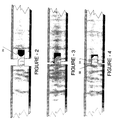
- the tongue 26 and groove 16 are shown on figure 1 as having planar lower surfaces, 28 and 18 respectively. These planar lower surfaces are parallel with and an indexing distance from planar wear surface 12. Abutment of the planar lower surface 28 of tongue 26 and the planar lower surface 18 of groove 16 during the joining of the tongue and groove, as shown on figures 2 through 4, causes indexing of wear surfaces 12 of pieces of laminate flooring 10.
- the tongue 26 and groove 16 are shown on figures 3 and 4 as having planar upper surfaces, 27 and 17 respectively. These planar upper surfaces are parallel and spaced apart. This space provides a flow path for glue to flow during the joining of the tongue and groove joint of this invention.
- planar tongued and grooved edges, 25 and 15 respectively, above and below the tongue 26 and groove 16 are shown on figure 4 as not being parallel.
- the planar tongued edge 25 is cut at a right angle (90 degrees) to the wear surface.
- the planar grooved edge 15 is cut at an acute angle (less than 90 degrees) to the wear surface. This provides a space above tongue 26 and groove 16 for glue 20 to flow to the wear surface 12 of laminate flooring 1 0. It is believed that this acute angle should be about 82.5 to 87.5 degrees. An acute angle above about 87.5 degrees will not provide sufficient space for viscous glue to flow to the wear surface 12. An acute angle of less than about 82.5 degrees will result in a larger space than required.
- Tongue 26 is shown as having a beveled surface 30 extending from its end surface 29 to its upper surface 27.
- the bevel is shown as cut at an oblique (45 degree) angle to the upper 27 and end 29 surfaces of the tongue 26.
- the beveled surface 30 can serve as a guide during the joining of tongue 26 and groove 16.
- Glue 20 is shown on figure 2 in the end 19 of groove 16. Glue 20, after curing, adheres the tongue and groove joint together and acts as a barrier against moisture penetration to the substrate 13.
- Commercially available wood glues are suitable to adhere the tongue and groove joint together.
- Franklin Titebond II Wood Glue which is available from Franklin International of Columbus, Ohio is believed to be suitable for joining laminate flooring.
- Franklin Titebond II Wood Glue is believed to be a polyvinyl acetate emulsion adhesive.
- tongue 26 applies pressure to liquid glue 20 in groove 16.
- Glue 20 flows past beveled edge 30 and through space 31 between the upper surface 27 of tongue 26 and the upper surface 17 of groove 16.
- the lower surfaces 28 of tongue 26 and the lower surface 18 of groove 16 are abutted, thereby providing an impediment to glue flowing between the lower surfaces 28 and 18 of the tongue and groove.
- the beveled surface 30, as shown of figure 4 reduces the length of the upper surface 27 of tongue 26 and the upper surface 17 of groove 16 as compared to the lengths of the surfaces of a rectangular tongue. This is believed to aid in glue 20 flowing, preferentially, between the upper surfaces of tongue 26 and groove 16 during the joining of pieces of laminate flooring 10.
- the abutment and length of the lower surfaces, 28 and 18 respectively, of tongue 26 and groove 16 is also believed to aid in glue 20 flowing, preferentially, between the upper surfaces of tongue 26 and groove 16 during the joining of pieces of laminate flooring 10.
- pressure created on the glue 20 during the joining of the tongue 26 and groove 16, as shown on figures 3 and 4 will be transmitted, in part, downwardly on upper surface 27 and beveled surface 30 of tongue 26. This pressure can also aid in glue 20 flowing, preferentially, between the upper surfaces of tongue 26 and groove 16 during the joining of pieces of laminate flooring 10.
- the curing of the glue 20 involves the loss of solvent, water in the case of Franklin Titebond II Wood Glue, to the substrate 13. Water causes swelling of the substrate. It is believed necessary to limit the volume of glue 20 that will cure by water or other solvent to the substrate 13. This is accomplished in the embodiment of this invention as shown on figures 1 - 4 by limiting the distance between (1) the end 19 of groove 16 and the end 29 of tongue 26, (2) the amount of the tongue that is cut off in making beveled surface 30, (3) the space 31 between the upper surface 27 of tongue 26 and the upper surface 17 of groove 16 and (4) the space 32 between planar tongued edge 25 and planar grooved edge 15 above tongue 26 and groove 16, respectively.
- Sufficient glue 20 should be placed in the end 19 of the groove 16 such that a portion of the glue will flow to the wear surface 12 as the tongue and groove joint of this invention is joined. Additional glue is not beneficial and increases the cleanup efforts.
- the dimensions of the features of laminate flooring are preferred dimensions for the embodiment shown.
- the tolerances are preferred tolerances for the embodiment shown.
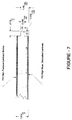
- Dimensions and tolerances are shown on figures 5 and 6 in inches.
- the tolerances for cutting the upper and lower surfaces of the tongue and groove are different. It is shown on figures 5 - 8 that the lower surfaces, 28 and 18 respectively, of the tongues and grooves are cut to be 0.2 ⁇ 0.0015 inches (5.08 ⁇ 0.0381 millimeters) from the wear surface 12.
- the upper surface 27 is cut for the tongue 26 to have a minimum width of 0.09 inches (2.286 millimeters) and to increase in width by up to 0.003 inches (0.0762 millimeters) during the cutting of the tongue.
- the upper surface 17 is cut for the groove to have a maximum width of 0.1 inches (2.54 millimeters) and to decrease in width by up to 0.003 inches (0.0762 millimeters) during the cutting of the groove. This provides a minimum space 31 between the upper surface 27 of tongue 26 and the upper surface 17 of groove 16 of 0.004 inches (0.1016 millimeters).
- tongue and groove of the present invention may be utilized in any application in which it is desired to have a tongue and groove joint, including but not limited to flooring in general, furniture, cabinets, countertops and wall panelling.
Landscapes
- Engineering & Computer Science (AREA)
- Architecture (AREA)
- Life Sciences & Earth Sciences (AREA)
- Wood Science & Technology (AREA)
- Civil Engineering (AREA)
- Structural Engineering (AREA)
- Floor Finish (AREA)
Applications Claiming Priority (2)
| Application Number | Priority Date | Filing Date | Title |
|---|---|---|---|
| US74869696A | 1996-11-13 | 1996-11-13 | |
| US748696 | 1996-11-13 |
Publications (2)
| Publication Number | Publication Date |
|---|---|
| EP0843056A2 true EP0843056A2 (fr) | 1998-05-20 |
| EP0843056A3 EP0843056A3 (fr) | 1998-10-07 |
Family
ID=25010542
Family Applications (1)
| Application Number | Title | Priority Date | Filing Date |
|---|---|---|---|
| EP97117421A Withdrawn EP0843056A3 (fr) | 1996-11-13 | 1997-10-08 | Articles avec joint à rainure et languette et procédé de fabrication d'un tel joint |
Country Status (5)
| Country | Link |
|---|---|
| EP (1) | EP0843056A3 (fr) |
| BR (1) | BR9705457A (fr) |
| CA (1) | CA2218237A1 (fr) |
| PL (1) | PL323076A1 (fr) |
| SG (1) | SG54579A1 (fr) |
Cited By (6)
| Publication number | Priority date | Publication date | Assignee | Title |
|---|---|---|---|---|
| EP1020504A1 (fr) * | 1999-01-18 | 2000-07-19 | Premark RWP Holdings, Inc. | Système et procédé pour l'amélioration de la résistance à l'eau des planchers laminés |
| CN103978526A (zh) * | 2014-05-20 | 2014-08-13 | 张绪如 | 拼装家具板 |
| CN106401133A (zh) * | 2016-11-22 | 2017-02-15 | 江苏欧圣木业有限公司 | 一种防水止滑结构的木塑强化地板及其生产方法 |
| CN108952065A (zh) * | 2018-09-18 | 2018-12-07 | 苏州市贝地龙新型材料有限公司 | 一种多功能健康木地板及其制备方法 |
| CN110883879A (zh) * | 2019-11-29 | 2020-03-17 | 湖南易红堂家具制造有限公司 | 一种家具生产用板材拼接的热压装置 |
| CN115030533A (zh) * | 2022-01-28 | 2022-09-09 | 宁夏华宇建设工程有限公司 | 一种绿色建筑施工工艺及绿色建筑装配式墙体 |
Families Citing this family (2)
| Publication number | Priority date | Publication date | Assignee | Title |
|---|---|---|---|---|
| KR20220066101A (ko) | 2019-09-24 | 2022-05-23 | 뵈린게 이노베이션 에이비이 | 빌딩 패널 |
| EP3798385A1 (fr) * | 2019-09-24 | 2021-03-31 | Välinge Innovation AB | Panneau de construction |
Family Cites Families (4)
| Publication number | Priority date | Publication date | Assignee | Title |
|---|---|---|---|---|
| US4123885A (en) * | 1976-04-30 | 1978-11-07 | Cyclops Corporation | Building panel joint |
| US5086599A (en) * | 1990-02-15 | 1992-02-11 | Structural Panels, Inc. | Building panel and method |
| US5448865A (en) * | 1993-08-20 | 1995-09-12 | Palmersten; Michael J. | Panel interlocking means with stiffener |
| DE4429205A1 (de) * | 1994-08-18 | 1996-02-22 | Claus Ebert | Parkettelement |
-
1997
- 1997-10-08 EP EP97117421A patent/EP0843056A3/fr not_active Withdrawn
- 1997-10-10 SG SG1997003705A patent/SG54579A1/en unknown
- 1997-10-14 CA CA 2218237 patent/CA2218237A1/fr not_active Abandoned
- 1997-11-10 BR BR9705457-7A patent/BR9705457A/pt not_active Application Discontinuation
- 1997-11-12 PL PL32307697A patent/PL323076A1/xx unknown
Cited By (7)
| Publication number | Priority date | Publication date | Assignee | Title |
|---|---|---|---|---|
| EP1020504A1 (fr) * | 1999-01-18 | 2000-07-19 | Premark RWP Holdings, Inc. | Système et procédé pour l'amélioration de la résistance à l'eau des planchers laminés |
| CN103978526A (zh) * | 2014-05-20 | 2014-08-13 | 张绪如 | 拼装家具板 |
| CN103978526B (zh) * | 2014-05-20 | 2016-03-09 | 张绪如 | 拼装家具板 |
| CN106401133A (zh) * | 2016-11-22 | 2017-02-15 | 江苏欧圣木业有限公司 | 一种防水止滑结构的木塑强化地板及其生产方法 |
| CN108952065A (zh) * | 2018-09-18 | 2018-12-07 | 苏州市贝地龙新型材料有限公司 | 一种多功能健康木地板及其制备方法 |
| CN110883879A (zh) * | 2019-11-29 | 2020-03-17 | 湖南易红堂家具制造有限公司 | 一种家具生产用板材拼接的热压装置 |
| CN115030533A (zh) * | 2022-01-28 | 2022-09-09 | 宁夏华宇建设工程有限公司 | 一种绿色建筑施工工艺及绿色建筑装配式墙体 |
Also Published As
| Publication number | Publication date |
|---|---|
| BR9705457A (pt) | 1999-09-28 |
| EP0843056A3 (fr) | 1998-10-07 |
| SG54579A1 (en) | 1998-11-16 |
| CA2218237A1 (fr) | 1998-05-13 |
| PL323076A1 (en) | 1998-05-25 |
Similar Documents
| Publication | Publication Date | Title |
|---|---|---|
| US5618602A (en) | Articles with tongue and groove joint and method of making such a joint | |
| US6230385B1 (en) | Molding affixed with wedged divider track | |
| JP4884647B2 (ja) | シール手段を持つフロアパネル | |
| EP2712518B1 (fr) | Élément composite | |
| KR100329988B1 (ko) | 연결시스템 | |
| JP4574613B2 (ja) | フローリングシステム及び設置方法 | |
| US8171692B2 (en) | Mechanical locking system for floor panels | |
| US7757452B2 (en) | Mechanical locking system for floorboards | |
| US7051486B2 (en) | Mechanical locking system for floating floor | |
| US20020108343A1 (en) | Building component structure, or building components | |
| CA2070905C (fr) | Joint de poutre-i | |
| MXPA04007056A (es) | Entarimado de interconexion, unidos, y un metodo de fabricacion. | |
| CN1328612A (zh) | 包括通过单独的组装型面而垂直连接的板形地板块的地板材料 | |
| KR20030014707A (ko) | 바닥 덮개 | |
| JP2001329681A (ja) | 板 材 | |
| EP0843056A2 (fr) | Articles avec joint à rainure et languette et procédé de fabrication d'un tel joint | |
| US6176637B1 (en) | Corner moulding and improved corner construction | |
| US20030205017A1 (en) | Joining system and method for floor boards and boards therefor | |
| JP4615091B2 (ja) | 板材 | |
| EP0839974A2 (fr) | Elément moulé fixé par rail diviseur cunéiforme | |
| HK1004233A (en) | Tongue and groove joint and method of making such a joint | |
| US6352382B1 (en) | Corner moulding and improved corner construction | |
| GB2026125A (en) | Joint forming | |
| JPH11131622A (ja) | 遮音性木質建築板 | |
| JPH1061150A (ja) | フロア材及びその施工方法 |
Legal Events
| Date | Code | Title | Description |
|---|---|---|---|
| PUAI | Public reference made under article 153(3) epc to a published international application that has entered the european phase |
Free format text: ORIGINAL CODE: 0009012 |
|
| AK | Designated contracting states |
Kind code of ref document: A2 Designated state(s): AT BE CH DE DK ES FI FR GB GR IE IT LI LU MC NL PT SE |
|
| AX | Request for extension of the european patent |
Free format text: AL PAYMENT 971008;LT PAYMENT 971008;LV PAYMENT 971008;RO PAYMENT 971008;SI PAYMENT 971008 |
|
| PUAL | Search report despatched |
Free format text: ORIGINAL CODE: 0009013 |
|
| AK | Designated contracting states |
Kind code of ref document: A3 Designated state(s): AT BE CH DE DK ES FI FR GB GR IE IT LI LU MC NL PT SE |
|
| AKX | Designation fees paid |
Free format text: AT BE CH DE DK ES FI FR GB GR IE IT LI LU MC NL PT SE |
|
| AXX | Extension fees paid |
Free format text: AL PAYMENT 19971008;LT PAYMENT 19971008;LV PAYMENT 19971008;RO PAYMENT 19971008;SI PAYMENT 19971008 |
|
| STAA | Information on the status of an ep patent application or granted ep patent |
Free format text: STATUS: THE APPLICATION IS DEEMED TO BE WITHDRAWN |
|
| 18D | Application deemed to be withdrawn |
Effective date: 19990408 |