EP0845301A1 - Procédé pour appliquer un lubrifiant - Google Patents
Procédé pour appliquer un lubrifiant Download PDFInfo
- Publication number
- EP0845301A1 EP0845301A1 EP97309345A EP97309345A EP0845301A1 EP 0845301 A1 EP0845301 A1 EP 0845301A1 EP 97309345 A EP97309345 A EP 97309345A EP 97309345 A EP97309345 A EP 97309345A EP 0845301 A1 EP0845301 A1 EP 0845301A1
- Authority
- EP
- European Patent Office
- Prior art keywords
- exposing
- container
- activated
- step comprises
- monolayer
- Prior art date
- Legal status (The legal status is an assumption and is not a legal conclusion. Google has not performed a legal analysis and makes no representation as to the accuracy of the status listed.)
- Withdrawn
Links
- 238000000034 method Methods 0.000 title claims abstract description 39
- 239000000314 lubricant Substances 0.000 title description 4
- 239000000463 material Substances 0.000 claims abstract description 20
- 239000002356 single layer Substances 0.000 claims abstract description 18
- 239000011253 protective coating Substances 0.000 claims abstract description 12
- XLYOFNOQVPJJNP-UHFFFAOYSA-N water Substances O XLYOFNOQVPJJNP-UHFFFAOYSA-N 0.000 claims abstract description 12
- 239000007788 liquid Substances 0.000 claims abstract description 8
- 239000005046 Chlorosilane Substances 0.000 claims abstract description 6
- KOPOQZFJUQMUML-UHFFFAOYSA-N chlorosilane Chemical compound Cl[SiH3] KOPOQZFJUQMUML-UHFFFAOYSA-N 0.000 claims abstract description 6
- XAGFODPZIPBFFR-UHFFFAOYSA-N aluminium Chemical compound [Al] XAGFODPZIPBFFR-UHFFFAOYSA-N 0.000 claims description 9
- 229910052782 aluminium Inorganic materials 0.000 claims description 9
- 238000004140 cleaning Methods 0.000 claims description 4
- QRPMCZNLJXJVSG-UHFFFAOYSA-N trichloro(1,1,2,2,3,3,4,4,5,5,6,6,7,7,8,8,9,9,10,10,10-henicosafluorodecyl)silane Chemical compound FC(F)(F)C(F)(F)C(F)(F)C(F)(F)C(F)(F)C(F)(F)C(F)(F)C(F)(F)C(F)(F)C(F)(F)[Si](Cl)(Cl)Cl QRPMCZNLJXJVSG-UHFFFAOYSA-N 0.000 claims description 3
- 125000000217 alkyl group Chemical group 0.000 claims description 2
- 238000010438 heat treatment Methods 0.000 claims 1
- 230000001681 protective effect Effects 0.000 claims 1
- 230000008569 process Effects 0.000 abstract description 13
- 125000002887 hydroxy group Chemical group [H]O* 0.000 abstract description 5
- YXFVVABEGXRONW-UHFFFAOYSA-N Toluene Chemical compound CC1=CC=CC=C1 YXFVVABEGXRONW-UHFFFAOYSA-N 0.000 description 9
- 238000013459 approach Methods 0.000 description 5
- 239000011248 coating agent Substances 0.000 description 5
- 238000000576 coating method Methods 0.000 description 5
- IJGRMHOSHXDMSA-UHFFFAOYSA-N Atomic nitrogen Chemical compound N#N IJGRMHOSHXDMSA-UHFFFAOYSA-N 0.000 description 4
- BLRPTPMANUNPDV-UHFFFAOYSA-N Silane Chemical group [SiH4] BLRPTPMANUNPDV-UHFFFAOYSA-N 0.000 description 4
- 230000008901 benefit Effects 0.000 description 4
- 230000008859 change Effects 0.000 description 4
- 238000006243 chemical reaction Methods 0.000 description 4
- 238000002474 experimental method Methods 0.000 description 4
- 229910000077 silane Inorganic materials 0.000 description 4
- 238000000151 deposition Methods 0.000 description 3
- 239000002904 solvent Substances 0.000 description 3
- CSCPPACGZOOCGX-UHFFFAOYSA-N Acetone Chemical compound CC(C)=O CSCPPACGZOOCGX-UHFFFAOYSA-N 0.000 description 2
- 230000008021 deposition Effects 0.000 description 2
- NZZFYRREKKOMAT-UHFFFAOYSA-N diiodomethane Chemical compound ICI NZZFYRREKKOMAT-UHFFFAOYSA-N 0.000 description 2
- 229910052757 nitrogen Inorganic materials 0.000 description 2
- 238000002360 preparation method Methods 0.000 description 2
- PXGOKWXKJXAPGV-UHFFFAOYSA-N Fluorine Chemical compound FF PXGOKWXKJXAPGV-UHFFFAOYSA-N 0.000 description 1
- XUIMIQQOPSSXEZ-UHFFFAOYSA-N Silicon Chemical group [Si] XUIMIQQOPSSXEZ-UHFFFAOYSA-N 0.000 description 1
- QAOWNCQODCNURD-UHFFFAOYSA-N Sulfuric acid Chemical compound OS(O)(=O)=O QAOWNCQODCNURD-UHFFFAOYSA-N 0.000 description 1
- 239000002253 acid Substances 0.000 description 1
- 238000003491 array Methods 0.000 description 1
- QVGXLLKOCUKJST-UHFFFAOYSA-N atomic oxygen Chemical compound [O] QVGXLLKOCUKJST-UHFFFAOYSA-N 0.000 description 1
- 239000006227 byproduct Substances 0.000 description 1
- 239000007795 chemical reaction product Substances 0.000 description 1
- 238000005229 chemical vapour deposition Methods 0.000 description 1
- IJYZBNLEGDTEBQ-UHFFFAOYSA-N chloro-(1,1,2,2,3,3,4,4,5,5,6,6,7,7,8,8,8-heptadecafluorooctyl)-bis(trifluoromethyl)silane Chemical compound FC(F)(F)C(F)(F)C(F)(F)C(F)(F)C(F)(F)C(F)(F)C(F)(F)C(F)(F)[Si](Cl)(C(F)(F)F)C(F)(F)F IJYZBNLEGDTEBQ-UHFFFAOYSA-N 0.000 description 1
- 238000011109 contamination Methods 0.000 description 1
- 238000004132 cross linking Methods 0.000 description 1
- 238000001035 drying Methods 0.000 description 1
- 230000007613 environmental effect Effects 0.000 description 1
- 239000012530 fluid Substances 0.000 description 1
- 229910052731 fluorine Inorganic materials 0.000 description 1
- 239000011737 fluorine Substances 0.000 description 1
- 239000010410 layer Substances 0.000 description 1
- 238000005259 measurement Methods 0.000 description 1
- 239000007800 oxidant agent Substances 0.000 description 1
- 239000001301 oxygen Substances 0.000 description 1
- 229910052760 oxygen Inorganic materials 0.000 description 1
- 239000002243 precursor Substances 0.000 description 1
- 239000005053 propyltrichlorosilane Substances 0.000 description 1
- 239000000376 reactant Substances 0.000 description 1
- 239000013557 residual solvent Substances 0.000 description 1
- 150000004756 silanes Chemical class 0.000 description 1
- 239000000344 soap Substances 0.000 description 1
- 238000010561 standard procedure Methods 0.000 description 1
- 239000000126 substance Substances 0.000 description 1
- 235000011149 sulphuric acid Nutrition 0.000 description 1
- 239000001117 sulphuric acid Substances 0.000 description 1
- 230000007704 transition Effects 0.000 description 1
- 238000011282 treatment Methods 0.000 description 1
- BNCXNUWGWUZTCN-UHFFFAOYSA-N trichloro(dodecyl)silane Chemical compound CCCCCCCCCCCC[Si](Cl)(Cl)Cl BNCXNUWGWUZTCN-UHFFFAOYSA-N 0.000 description 1
- PYJJCSYBSYXGQQ-UHFFFAOYSA-N trichloro(octadecyl)silane Chemical compound CCCCCCCCCCCCCCCCCC[Si](Cl)(Cl)Cl PYJJCSYBSYXGQQ-UHFFFAOYSA-N 0.000 description 1
- RCHUVCPBWWSUMC-UHFFFAOYSA-N trichloro(octyl)silane Chemical compound CCCCCCCC[Si](Cl)(Cl)Cl RCHUVCPBWWSUMC-UHFFFAOYSA-N 0.000 description 1
- DOEHJNBEOVLHGL-UHFFFAOYSA-N trichloro(propyl)silane Chemical compound CCC[Si](Cl)(Cl)Cl DOEHJNBEOVLHGL-UHFFFAOYSA-N 0.000 description 1
- PPDADIYYMSXQJK-UHFFFAOYSA-N trichlorosilicon Chemical group Cl[Si](Cl)Cl PPDADIYYMSXQJK-UHFFFAOYSA-N 0.000 description 1
- 238000007740 vapor deposition Methods 0.000 description 1
- 239000012808 vapor phase Substances 0.000 description 1
- 238000009736 wetting Methods 0.000 description 1
Images
Classifications
-
- B—PERFORMING OPERATIONS; TRANSPORTING
- B82—NANOTECHNOLOGY
- B82Y—SPECIFIC USES OR APPLICATIONS OF NANOSTRUCTURES; MEASUREMENT OR ANALYSIS OF NANOSTRUCTURES; MANUFACTURE OR TREATMENT OF NANOSTRUCTURES
- B82Y30/00—Nanotechnology for materials or surface science, e.g. nanocomposites
-
- C—CHEMISTRY; METALLURGY
- C23—COATING METALLIC MATERIAL; COATING MATERIAL WITH METALLIC MATERIAL; CHEMICAL SURFACE TREATMENT; DIFFUSION TREATMENT OF METALLIC MATERIAL; COATING BY VACUUM EVAPORATION, BY SPUTTERING, BY ION IMPLANTATION OR BY CHEMICAL VAPOUR DEPOSITION, IN GENERAL; INHIBITING CORROSION OF METALLIC MATERIAL OR INCRUSTATION IN GENERAL
- C23C—COATING METALLIC MATERIAL; COATING MATERIAL WITH METALLIC MATERIAL; SURFACE TREATMENT OF METALLIC MATERIAL BY DIFFUSION INTO THE SURFACE, BY CHEMICAL CONVERSION OR SUBSTITUTION; COATING BY VACUUM EVAPORATION, BY SPUTTERING, BY ION IMPLANTATION OR BY CHEMICAL VAPOUR DEPOSITION, IN GENERAL
- C23C26/00—Coating not provided for in groups C23C2/00 - C23C24/00
-
- B—PERFORMING OPERATIONS; TRANSPORTING
- B05—SPRAYING OR ATOMISING IN GENERAL; APPLYING FLUENT MATERIALS TO SURFACES, IN GENERAL
- B05D—PROCESSES FOR APPLYING FLUENT MATERIALS TO SURFACES, IN GENERAL
- B05D1/00—Processes for applying liquids or other fluent materials
- B05D1/18—Processes for applying liquids or other fluent materials performed by dipping
- B05D1/185—Processes for applying liquids or other fluent materials performed by dipping applying monomolecular layers
-
- B—PERFORMING OPERATIONS; TRANSPORTING
- B05—SPRAYING OR ATOMISING IN GENERAL; APPLYING FLUENT MATERIALS TO SURFACES, IN GENERAL
- B05D—PROCESSES FOR APPLYING FLUENT MATERIALS TO SURFACES, IN GENERAL
- B05D1/00—Processes for applying liquids or other fluent materials
- B05D1/60—Deposition of organic layers from vapour phase
-
- B—PERFORMING OPERATIONS; TRANSPORTING
- B82—NANOTECHNOLOGY
- B82Y—SPECIFIC USES OR APPLICATIONS OF NANOSTRUCTURES; MEASUREMENT OR ANALYSIS OF NANOSTRUCTURES; MANUFACTURE OR TREATMENT OF NANOSTRUCTURES
- B82Y40/00—Manufacture or treatment of nanostructures
Definitions
- This invention relates generally to the field of lubricants, and more particularly to a method for applying lubricants to micromachines.
- Micromechanical devices include familiar structures such as motors, wheels and gears, but are of the order of microns in size. They also include specialized mechanical structures such as accelerometers and spatial light modulators. Mechanical structures, regardless of size, typically suffer from friction and sticking between moving parts. The moving parts come into contact with other moving parts or with non-moving parts. The parts can be worn down by friction and sticking and the parts can stick together, preventing the machine from operating.
- the protectant may be a lubricant or other coating on the surfaces of the moving and non-moving parts.
- the coating or film must be extremely thin so that it does not interfere with the operation of the device. A thick film may cause the moving parts to be blocked or jammed.
- the film should preferably have high molecular weight to be robust, low surface energy to reduce adhesion and lower the coefficient of friction, and should bond to the surface. Therefore, the selection of materials becomes a challenge.
- PFDA perfluordecanoic acid
- micromechanical device protectants Another difficulty with micromechanical device protectants is methods of application.
- the small size and delicacy of the moving parts prevent use of standard techniques for applying protectants which can destroy the device with the pressure from the application.
- the monolayer in that patent was applied by chemical vapor deposition.
- a device with micromechanical structures was placed in an oven chamber with the PFDA.
- the PFDA formed a vapor that deposited upon activated surfaces of the micromechanical devices.
- the surfaces of the devices were activated by an oxygen/fluorine plasma.
- the protective coating is a monolayer of molecules that form a bond to the surface of the device and to each adjacent molecule, resulting in a robust and effective protective coating of high molecular weight.
- the monolayer is formed by either vapor or liquid deposition.
- the devices are cleaned in a UV/O 3 cleaning process and the surfaces of the device are exposed to a chlorosilane material causing a reaction that forms the coating.
- the devices are immersed in a solution of the material in a container, rinsed and removed from the container and then baked.
- the device is placed in a container with a small amount of the material in the container. After a time interval, the device is removed and baked.
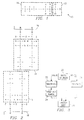
- FIG. 1 shows a chlorosilane species molecule used in one embodiment of the invention.
- This molecule 10 has a head group 12 which consists of a partially chlorinated silicon atom, and an alkyl-chain tail 14.
- the tail may or may not be fluorinated.
- Figure 3 shows two embodiments of a method for depositing the film. It can be deposited in either a liquid or vapor process. Regardless of which is used, the device preparation is the same and both involve exposing the device to the material to form the coating.
- a unique UV/O 3 cleaning step 20 is used to clean and prepare the surface for deposition.
- the step uses room air which is somewhat humid, leaving the device surface covered with water and/or hydroxyl species as well as removing any organic contamination.
- the exposure process in the liquid flow has two steps.
- the devices are immersed in a 1% (v/v) solution in toluene in a dry nitrogen filled glove bag for 30 seconds to 1 hour, at step 22.
- the devices are rinsed with fresh toluene and removed from the glove bag.
- step 26 they are placed in a vacuum oven for baking for a time interval that varies from 20 minutes to 1 hour. Experiments have shown that 30 minutes seems optimal.
- the baking step has several results. It removes any residual solvent and reaction products, removes any excess reactants, completes the reaction with the surface and completes the cross-linking between adjacent silane molecules.
- step 28 exposure is achieved at step 28 where the devices to be coated are placed in a container in a water free atmosphere, such as a nitrogen purged glove bag. A few drops of one of the above materials, for example, are then placed in the lid of the container and the lid placed on the container. The container remains at room temperature or is brought to an elevated temperature to speed the process. After a time interval the part is removed from the container and baked. The time interval for the part to remain in the container may vary from 20 minutes to 2 hours, with 40 minutes seeming optimal in experiments. The baking step 26 may be for times ranging from four to thirty minutes, with 30 minutes appearing optimal in experiments.
- the vapor deposition technique has advantages over the liquid. No solvent like toluene is used, lessening environmental concerns as well as eliminating the need to remove solvent from the devices. Additionally, the lack of a solvent means that no drying is required and collapse of the micromechanical device due to surface tension is eliminated.
- Films have been made using this technique from 1H, 1H, 2H, 2H, perfluorodecyltrichlorosilane; 1H, 1H, 2H, 2H, pefluorodecyldichloromethylsilane; 1H, 1H, 2H, 2H, perfluorooctylchlorodimethylsilane, octadecyltrichlorosilane, octyltrichlorosilane, propyltrichlorosilane, and dodecyltrichlorosilane.
- micromechanical devices were coated using the vapor phase technique.
- the devices used were micromechanical spatial light modulator arrays comprising individual mirror elements suspended on posts over addressing and landing electrodes. When the individual mirrors are addressed by the address electrodes, electrostatic forces cause them to move and touch down on the landing electrodes. When they receive new data, they are given a reset pulse voltage to lift them off of the landing electrode. In devices that have undergone this process, 90% of them worked without requiring any kind of reset. PFDA processed devices required the reset pulse and required higher voltages to move the mirrors. The use of these devices is only an example of the improvements caused by these films and is in no way intended to limit the use of these films to these types of structures.
- a Sessile Drop technique measured the surface energies of these films.
- a drop of liquid is placed on a plane surface and the angle between the side of the drop and the plane is measured.
- the quality of a monolayer can be estimated from these wetting measurements.
- the contact angles measured on the films ranged from 88 to 102 degrees with diiodomethane and up to 115 degrees with water. Additionally, these films seem to be very robust.
- This process differs from the current state of the art in several ways. Among those are the use of the surface preparation using UV/O 3 , the choice of a fluorinated precursor in some embodiments, and in the case of the vapor technique, a non-fluid based application.
Landscapes
- Chemical & Material Sciences (AREA)
- Engineering & Computer Science (AREA)
- Nanotechnology (AREA)
- Condensed Matter Physics & Semiconductors (AREA)
- Physics & Mathematics (AREA)
- General Physics & Mathematics (AREA)
- Materials Engineering (AREA)
- Crystallography & Structural Chemistry (AREA)
- Chemical Kinetics & Catalysis (AREA)
- Manufacturing & Machinery (AREA)
- Composite Materials (AREA)
- Mechanical Engineering (AREA)
- Metallurgy (AREA)
- Organic Chemistry (AREA)
- Physical Vapour Deposition (AREA)
- Micromachines (AREA)
- Lubricants (AREA)
Applications Claiming Priority (2)
| Application Number | Priority Date | Filing Date | Title |
|---|---|---|---|
| US3165796P | 1996-11-20 | 1996-11-20 | |
| US31657P | 1996-11-20 |
Publications (1)
| Publication Number | Publication Date |
|---|---|
| EP0845301A1 true EP0845301A1 (fr) | 1998-06-03 |
Family
ID=21860715
Family Applications (1)
| Application Number | Title | Priority Date | Filing Date |
|---|---|---|---|
| EP97309345A Withdrawn EP0845301A1 (fr) | 1996-11-20 | 1997-11-20 | Procédé pour appliquer un lubrifiant |
Country Status (3)
| Country | Link |
|---|---|
| EP (1) | EP0845301A1 (fr) |
| JP (1) | JPH10158670A (fr) |
| KR (1) | KR19980042570A (fr) |
Cited By (4)
| Publication number | Priority date | Publication date | Assignee | Title |
|---|---|---|---|---|
| US6300294B1 (en) | 1998-11-16 | 2001-10-09 | Texas Instruments Incorporated | Lubricant delivery for micromechanical devices |
| WO2001023101A3 (fr) * | 1999-09-27 | 2001-10-25 | Nanogate Gmbh | Procedes et matieres |
| WO2004033364A3 (fr) * | 2002-10-11 | 2004-10-28 | Univ Minnesota | Procedes de formation de revetements sur des dispositifs micro-electromecaniques |
| US7229694B2 (en) | 2002-05-25 | 2007-06-12 | Robert Bosch Gmbh | Micromechanical component and method for producing an anti-adhesive layer on a micromechanical component |
Families Citing this family (1)
| Publication number | Priority date | Publication date | Assignee | Title |
|---|---|---|---|---|
| DE102004037902A1 (de) * | 2004-08-05 | 2006-03-16 | Robert Bosch Gmbh | Verfahren zur Abscheidung einer Anti-Haftungsschicht |
Citations (7)
| Publication number | Priority date | Publication date | Assignee | Title |
|---|---|---|---|---|
| EP0498335A1 (fr) * | 1991-02-06 | 1992-08-12 | Matsushita Electric Industrial Co., Ltd. | Méthode pour fabriquer un film adsorbé chimiquement |
| EP0501298A2 (fr) * | 1991-02-27 | 1992-09-02 | Matsushita Electric Industrial Co., Ltd. | Dispositif autolubrifiant |
| EP0571896A2 (fr) * | 1992-05-27 | 1993-12-01 | Matsushita Electric Industrial Co., Ltd. | Procédé de fabrication d'un film absorbé chimiquement |
| FR2694369A1 (fr) * | 1992-07-29 | 1994-02-04 | Lyon Ecole Centrale | Procédé de lubrification d'une pièce mécanique de frottement. |
| EP0582131A1 (fr) * | 1992-07-29 | 1994-02-09 | Matsushita Electric Industrial Co., Ltd. | Film lubrifiant et méthode pour sa préparation |
| EP0582181A1 (fr) * | 1992-07-29 | 1994-02-09 | Matsushita Electric Industrial Co., Ltd. | Film lubrifiant et méthode pour sa préparation |
| WO1995000258A1 (fr) * | 1993-06-18 | 1995-01-05 | The Regents Of The University Of California | Procede d'application de lubrifiant en monocouche sur des instruments de micro-usinage |
-
1997
- 1997-11-19 KR KR1019970060986A patent/KR19980042570A/ko not_active Withdrawn
- 1997-11-19 JP JP9318618A patent/JPH10158670A/ja active Pending
- 1997-11-20 EP EP97309345A patent/EP0845301A1/fr not_active Withdrawn
Patent Citations (7)
| Publication number | Priority date | Publication date | Assignee | Title |
|---|---|---|---|---|
| EP0498335A1 (fr) * | 1991-02-06 | 1992-08-12 | Matsushita Electric Industrial Co., Ltd. | Méthode pour fabriquer un film adsorbé chimiquement |
| EP0501298A2 (fr) * | 1991-02-27 | 1992-09-02 | Matsushita Electric Industrial Co., Ltd. | Dispositif autolubrifiant |
| EP0571896A2 (fr) * | 1992-05-27 | 1993-12-01 | Matsushita Electric Industrial Co., Ltd. | Procédé de fabrication d'un film absorbé chimiquement |
| FR2694369A1 (fr) * | 1992-07-29 | 1994-02-04 | Lyon Ecole Centrale | Procédé de lubrification d'une pièce mécanique de frottement. |
| EP0582131A1 (fr) * | 1992-07-29 | 1994-02-09 | Matsushita Electric Industrial Co., Ltd. | Film lubrifiant et méthode pour sa préparation |
| EP0582181A1 (fr) * | 1992-07-29 | 1994-02-09 | Matsushita Electric Industrial Co., Ltd. | Film lubrifiant et méthode pour sa préparation |
| WO1995000258A1 (fr) * | 1993-06-18 | 1995-01-05 | The Regents Of The University Of California | Procede d'application de lubrifiant en monocouche sur des instruments de micro-usinage |
Non-Patent Citations (1)
| Title |
|---|
| SUZUKI M ET AL: "CHARACTERIZATION OF MONOLAYER AND BILAYER (POLYMER/MONOLAYER) STRUCTURES FOR THEIR USE AS A LUBRICANT", THIN SOLID FILMS, vol. 160, no. 1, + INDEX, June 1988 (1988-06-01), pages 453 - 462, XP000048218 * |
Cited By (5)
| Publication number | Priority date | Publication date | Assignee | Title |
|---|---|---|---|---|
| US6300294B1 (en) | 1998-11-16 | 2001-10-09 | Texas Instruments Incorporated | Lubricant delivery for micromechanical devices |
| WO2001023101A3 (fr) * | 1999-09-27 | 2001-10-25 | Nanogate Gmbh | Procedes et matieres |
| US7229694B2 (en) | 2002-05-25 | 2007-06-12 | Robert Bosch Gmbh | Micromechanical component and method for producing an anti-adhesive layer on a micromechanical component |
| DE10223359B4 (de) * | 2002-05-25 | 2011-08-11 | Robert Bosch GmbH, 70469 | Mikromechanisches Bauteil und Verfahren zur Herstellung einer Anti-Haftschicht auf einem mikromechanischen Bauteil |
| WO2004033364A3 (fr) * | 2002-10-11 | 2004-10-28 | Univ Minnesota | Procedes de formation de revetements sur des dispositifs micro-electromecaniques |
Also Published As
| Publication number | Publication date |
|---|---|
| KR19980042570A (ko) | 1998-08-17 |
| JPH10158670A (ja) | 1998-06-16 |
Similar Documents
| Publication | Publication Date | Title |
|---|---|---|
| US5411769A (en) | Method of producing micromechanical devices | |
| US8987029B2 (en) | Protective thin films for use during fabrication of semiconductors, MEMS, and microstructures | |
| US20020164879A1 (en) | Methods of forming microstructure devices | |
| JP4928940B2 (ja) | 酸化層により接着される多層コーティングの制御された気相堆積 | |
| US5602671A (en) | Low surface energy passivation layer for micromechanical devices | |
| US5476717A (en) | Material having antireflection, hydrophobic and abrasion resistance properties and process for depositing an antireflection, hydrophobic and abrasion resistant coating on a substrate | |
| Ashurst et al. | Vapor phase anti-stiction coatings for MEMS | |
| JP3743519B2 (ja) | シリコン−酸化物薄層の製造方法 | |
| EP0746013A3 (fr) | Méthode de nettoyage et traitement d'un dispositif micromécanique | |
| EP1416064B1 (fr) | Méthode de revêtement de dispositifs micro-électromécaniques | |
| US20080063790A1 (en) | Microelectronic Device with Anti-Stiction Coating | |
| US20050118742A1 (en) | Method for reducing the adhesive properties of MEMS and anti-adhesion-coated device | |
| EP0845301A1 (fr) | Procédé pour appliquer un lubrifiant | |
| JP3165672B2 (ja) | 撥水撥油性被膜を有する物品及びその製造方法 | |
| US20030161949A1 (en) | Vapor deposition of dihalodialklysilanes | |
| JP5359529B2 (ja) | 撥水性物品の製造方法及び撥水性物品 | |
| JPH04255343A (ja) | 撥水撥油コーティング膜及びその製造方法 | |
| EP0615147B1 (fr) | Dispositifs micromécanique à miroirs déformables (-DMD-) | |
| JPH11288929A (ja) | 被処理構造体の表面処理方法 | |
| JP2004002187A (ja) | 撥水撥油性被膜 | |
| DE10355038B4 (de) | Verfahren zur Beschichtung einer Oberfläche | |
| KR100534485B1 (ko) | 실란계 화합물을 이용한 표면 또는 몸체 미세가공 기술의점착 방지 방법 | |
| US20070052132A1 (en) | Method and system for cleaning molded items | |
| US20050106774A1 (en) | Surface processes in fabrications of microstructures | |
| KR100776129B1 (ko) | 미세 구조물의 점착 방지 방법 |
Legal Events
| Date | Code | Title | Description |
|---|---|---|---|
| PUAI | Public reference made under article 153(3) epc to a published international application that has entered the european phase |
Free format text: ORIGINAL CODE: 0009012 |
|
| AK | Designated contracting states |
Kind code of ref document: A1 Designated state(s): DE FR GB IT NL |
|
| AX | Request for extension of the european patent |
Free format text: AL;LT;LV;MK;RO;SI |
|
| 17P | Request for examination filed |
Effective date: 19981125 |
|
| AKX | Designation fees paid |
Free format text: DE FR GB IT NL |
|
| RBV | Designated contracting states (corrected) |
Designated state(s): DE FR GB IT NL |
|
| 17Q | First examination report despatched |
Effective date: 20021001 |
|
| GRAP | Despatch of communication of intention to grant a patent |
Free format text: ORIGINAL CODE: EPIDOSNIGR1 |
|
| GRAS | Grant fee paid |
Free format text: ORIGINAL CODE: EPIDOSNIGR3 |
|
| STAA | Information on the status of an ep patent application or granted ep patent |
Free format text: STATUS: THE APPLICATION IS DEEMED TO BE WITHDRAWN |
|
| 18D | Application deemed to be withdrawn |
Effective date: 20041224 |