EP0849823A1 - Scheibenantennensystem mit Impedanzanpassungsnetzwerk - Google Patents
Scheibenantennensystem mit Impedanzanpassungsnetzwerk Download PDFInfo
- Publication number
- EP0849823A1 EP0849823A1 EP97122352A EP97122352A EP0849823A1 EP 0849823 A1 EP0849823 A1 EP 0849823A1 EP 97122352 A EP97122352 A EP 97122352A EP 97122352 A EP97122352 A EP 97122352A EP 0849823 A1 EP0849823 A1 EP 0849823A1
- Authority
- EP
- European Patent Office
- Prior art keywords
- matching network
- impedance matching
- connector
- antenna element
- antenna
- Prior art date
- Legal status (The legal status is an assumption and is not a legal conclusion. Google has not performed a legal analysis and makes no representation as to the accuracy of the status listed.)
- Withdrawn
Links
- 239000011521 glass Substances 0.000 title claims abstract description 56
- 239000000758 substrate Substances 0.000 claims abstract description 35
- 239000011248 coating agent Substances 0.000 claims abstract description 27
- 238000000576 coating method Methods 0.000 claims abstract description 27
- 238000000034 method Methods 0.000 claims abstract description 8
- 239000000853 adhesive Substances 0.000 claims description 20
- 230000001070 adhesive effect Effects 0.000 claims description 20
- 239000012799 electrically-conductive coating Substances 0.000 claims description 2
- 238000004519 manufacturing process Methods 0.000 claims description 2
- 239000000565 sealant Substances 0.000 description 12
- 239000003990 capacitor Substances 0.000 description 10
- 230000000670 limiting effect Effects 0.000 description 9
- 230000003466 anti-cipated effect Effects 0.000 description 8
- 239000000463 material Substances 0.000 description 8
- 239000004593 Epoxy Substances 0.000 description 7
- 239000011229 interlayer Substances 0.000 description 7
- 239000000919 ceramic Substances 0.000 description 6
- 238000010438 heat treatment Methods 0.000 description 4
- 239000002184 metal Substances 0.000 description 4
- 229910052751 metal Inorganic materials 0.000 description 4
- 239000003973 paint Substances 0.000 description 4
- 230000002411 adverse Effects 0.000 description 3
- 230000008901 benefit Effects 0.000 description 3
- 239000006229 carbon black Substances 0.000 description 3
- 230000008878 coupling Effects 0.000 description 3
- 238000010168 coupling process Methods 0.000 description 3
- 238000005859 coupling reaction Methods 0.000 description 3
- 229920003023 plastic Polymers 0.000 description 3
- 239000004033 plastic Substances 0.000 description 3
- 229910000679 solder Inorganic materials 0.000 description 3
- BLRPTPMANUNPDV-UHFFFAOYSA-N Silane Chemical compound [SiH4] BLRPTPMANUNPDV-UHFFFAOYSA-N 0.000 description 2
- 230000004888 barrier function Effects 0.000 description 2
- 230000001413 cellular effect Effects 0.000 description 2
- 230000008859 change Effects 0.000 description 2
- 230000000694 effects Effects 0.000 description 2
- 238000009434 installation Methods 0.000 description 2
- 229920002037 poly(vinyl butyral) polymer Polymers 0.000 description 2
- 229920006267 polyester film Polymers 0.000 description 2
- 230000002829 reductive effect Effects 0.000 description 2
- 229910000077 silane Inorganic materials 0.000 description 2
- RYGMFSIKBFXOCR-UHFFFAOYSA-N Copper Chemical compound [Cu] RYGMFSIKBFXOCR-UHFFFAOYSA-N 0.000 description 1
- BQCADISMDOOEFD-UHFFFAOYSA-N Silver Chemical compound [Ag] BQCADISMDOOEFD-UHFFFAOYSA-N 0.000 description 1
- ATJFFYVFTNAWJD-UHFFFAOYSA-N Tin Chemical compound [Sn] ATJFFYVFTNAWJD-UHFFFAOYSA-N 0.000 description 1
- NIXOWILDQLNWCW-UHFFFAOYSA-N acrylic acid group Chemical group C(C=C)(=O)O NIXOWILDQLNWCW-UHFFFAOYSA-N 0.000 description 1
- 239000002390 adhesive tape Substances 0.000 description 1
- 230000003321 amplification Effects 0.000 description 1
- 238000005452 bending Methods 0.000 description 1
- 230000015556 catabolic process Effects 0.000 description 1
- 239000003086 colorant Substances 0.000 description 1
- 238000004590 computer program Methods 0.000 description 1
- 238000010276 construction Methods 0.000 description 1
- 238000006731 degradation reaction Methods 0.000 description 1
- 239000003822 epoxy resin Substances 0.000 description 1
- 238000001914 filtration Methods 0.000 description 1
- 239000011888 foil Substances 0.000 description 1
- 230000005484 gravity Effects 0.000 description 1
- 230000002452 interceptive effect Effects 0.000 description 1
- 238000002955 isolation Methods 0.000 description 1
- 239000005340 laminated glass Substances 0.000 description 1
- 238000003475 lamination Methods 0.000 description 1
- 238000003199 nucleic acid amplification method Methods 0.000 description 1
- 238000005457 optimization Methods 0.000 description 1
- 230000002093 peripheral effect Effects 0.000 description 1
- 229920000515 polycarbonate Polymers 0.000 description 1
- 239000004417 polycarbonate Substances 0.000 description 1
- 229920000647 polyepoxide Polymers 0.000 description 1
- 229920000642 polymer Polymers 0.000 description 1
- 230000008569 process Effects 0.000 description 1
- 239000011253 protective coating Substances 0.000 description 1
- 230000001681 protective effect Effects 0.000 description 1
- 229920005989 resin Polymers 0.000 description 1
- 239000011347 resin Substances 0.000 description 1
- 230000004044 response Effects 0.000 description 1
- 239000012812 sealant material Substances 0.000 description 1
- 238000007493 shaping process Methods 0.000 description 1
- 229910052709 silver Inorganic materials 0.000 description 1
- 239000004332 silver Substances 0.000 description 1
- 229920001169 thermoplastic Polymers 0.000 description 1
- 239000004416 thermosoftening plastic Substances 0.000 description 1
- -1 wires Substances 0.000 description 1
Images


Classifications
-
- B—PERFORMING OPERATIONS; TRANSPORTING
- B32—LAYERED PRODUCTS
- B32B—LAYERED PRODUCTS, i.e. PRODUCTS BUILT-UP OF STRATA OF FLAT OR NON-FLAT, e.g. CELLULAR OR HONEYCOMB, FORM
- B32B17/00—Layered products essentially comprising sheet glass, or glass, slag, or like fibres
- B32B17/06—Layered products essentially comprising sheet glass, or glass, slag, or like fibres comprising glass as the main or only constituent of a layer, next to another layer of a specific material
- B32B17/10—Layered products essentially comprising sheet glass, or glass, slag, or like fibres comprising glass as the main or only constituent of a layer, next to another layer of a specific material of synthetic resin
- B32B17/10005—Layered products essentially comprising sheet glass, or glass, slag, or like fibres comprising glass as the main or only constituent of a layer, next to another layer of a specific material of synthetic resin laminated safety glass or glazing
- B32B17/10009—Layered products essentially comprising sheet glass, or glass, slag, or like fibres comprising glass as the main or only constituent of a layer, next to another layer of a specific material of synthetic resin laminated safety glass or glazing characterized by the number, the constitution or treatment of glass sheets
- B32B17/10036—Layered products essentially comprising sheet glass, or glass, slag, or like fibres comprising glass as the main or only constituent of a layer, next to another layer of a specific material of synthetic resin laminated safety glass or glazing characterized by the number, the constitution or treatment of glass sheets comprising two outer glass sheets
-
- H—ELECTRICITY
- H01—ELECTRIC ELEMENTS
- H01Q—ANTENNAS, i.e. RADIO AERIALS
- H01Q1/00—Details of, or arrangements associated with, antennas
- H01Q1/27—Adaptation for use in or on movable bodies
- H01Q1/32—Adaptation for use in or on road or rail vehicles
-
- B—PERFORMING OPERATIONS; TRANSPORTING
- B32—LAYERED PRODUCTS
- B32B—LAYERED PRODUCTS, i.e. PRODUCTS BUILT-UP OF STRATA OF FLAT OR NON-FLAT, e.g. CELLULAR OR HONEYCOMB, FORM
- B32B17/00—Layered products essentially comprising sheet glass, or glass, slag, or like fibres
- B32B17/06—Layered products essentially comprising sheet glass, or glass, slag, or like fibres comprising glass as the main or only constituent of a layer, next to another layer of a specific material
- B32B17/10—Layered products essentially comprising sheet glass, or glass, slag, or like fibres comprising glass as the main or only constituent of a layer, next to another layer of a specific material of synthetic resin
- B32B17/10005—Layered products essentially comprising sheet glass, or glass, slag, or like fibres comprising glass as the main or only constituent of a layer, next to another layer of a specific material of synthetic resin laminated safety glass or glazing
- B32B17/1055—Layered products essentially comprising sheet glass, or glass, slag, or like fibres comprising glass as the main or only constituent of a layer, next to another layer of a specific material of synthetic resin laminated safety glass or glazing characterized by the resin layer, i.e. interlayer
- B32B17/10761—Layered products essentially comprising sheet glass, or glass, slag, or like fibres comprising glass as the main or only constituent of a layer, next to another layer of a specific material of synthetic resin laminated safety glass or glazing characterized by the resin layer, i.e. interlayer containing vinyl acetal
-
- H—ELECTRICITY
- H01—ELECTRIC ELEMENTS
- H01Q—ANTENNAS, i.e. RADIO AERIALS
- H01Q1/00—Details of, or arrangements associated with, antennas
- H01Q1/12—Supports; Mounting means
- H01Q1/1271—Supports; Mounting means for mounting on windscreens
Definitions
- the present invention relates to an antenna system, and in particular to a glass antenna system for a vehicle windshield having a connector with an integral impedance matching network to optimize the performance of the glass antenna.
- U.S. Patent No. 3,987,449 to DeAngelis et al. discloses a wire antenna laminated within a vehicle windshield.
- U.S. Patent No. 5,416,491 to Nishikawa et al. forms antenna elements on a window using electroconductive ceramic paints.
- U.S. Patent Nos. 4,768,037 and 4,849,766 to Inaba et al. and 5,355,144 to Walton et al. use a transparent electroconductive coating laminated between two glass plies to form the antenna.
- the impedance of the antenna is typically not well matched to the radio and the feedline.
- One way this issue has been addressed by antenna designers is to design the antenna to have a desired impedance, for example, as disclosed in U.S. Patent Nos. 5,083,135 and 5,528,314 to Nagy et al. Designing the antenna to a predetermined impedance improves the antenna performance but as discussed above, the impedance generally varies over the FM band based on frequency so that the antenna design may not be optimal over the entire FM frequency band.
- designing the antenna to have a predetermined impedance would require each antenna to be designed specifically for the particular type of radio and feedline in the particular antenna system as well as the vehicle into which the windshield is installed.
- the present invention provides a transparent antenna system with improved reception.
- the transparent antenna system includes a transparent substrate, at least one electroconductive antenna element positioned along a major surface of the substrate, wherein the antenna element provides an impedance which varies over a given frequency band, an impedance matching network secured to the substrate in a position such that the impedance matching network is electrically coupled to at least a portion of the antenna element, wherein the impedance matching network transforms the impedance of the antenna element to a desired impedance, and means to electrically interconnect the network to a feedline of an electromagnetic energy transmitting and/or receiving unit.
- the transparent substrate is a glass substrate
- the impedance matching network is part of a connector and is formed along a first major surface of a printed circuit board.
- the network is electrically connected to the opposing major surface of the board which includes an electroconductive coating.
- the connector is secured to the glass substrate in a position such that the impedance matching network is electrically coupled to the antenna element.
- the impedance matching network may be a passive or active impedance matching network.
- the glass antenna may be incorporated into a laminated windshield wherein the glass substrate is a first glass ply and further including a second glass ply secured to the first glass ply, with the antenna element positioned between the plies.
- the present invention also includes a connector for connecting an antenna to a feedline of an electromagnetic energy transmitting and/or receiving unit, wherein the connector includes an impedance matching network and means to connect said connector to said feedline of said unit.
- the impedance matching network is formed along a first major surface of a printed circuit board.
- the opposing major surface of the board includes an electrically conductive coating and the network is electrically connected to said coated side.
- the present invention also provides a method of manufacturing a transparent antenna system comprising the steps of positioning at least one electroconductive antenna element along a major surface of a rigid, transparent substrate, securing an impedance matching network to said substrate in a position such that said impedance matching network is electrically coupled to a portion of said antenna element, and electrically interconnecting the network to a feedline of an electromagnetic energy transmitting and/or receiving unit.
- the antenna element provides an impedance which varies over a given frequency band and impedance matching network transforms the impedance of the antenna element to a desired impedance.
- Figure 1 is a plan view of a laminated glass antenna with a connector positioned within a notch area along an edge of the laminate, wherein the connector incorporates features of the present invention.
- Figure 2 is an enlarged plan view of the connection area of the antenna illustrated in Figure 1 with a connector having an impedance matching network.
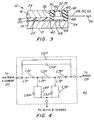
- Figure 3 is a view taken along line 3-3 of Figure 2.
- Figure 4 is an electrical schematic of a representative passive impedance matching network.
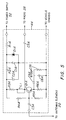
- Figure 5 is an electrical schematic of a representative active impedance matching network.
- Figure 6 is a view similar to Figure 3 illustrating another embodiment of the present invention.
- Figure 7 is a view similar to Figure 1 illustrating another embodiment of the present invention.
- the present invention provides a glass antenna system with improved reception and a method of producing the antenna system and is disclosed in combination with an antenna system incorporated into an automotive windshield.
- the present invention may be used in other transmitting and/or receiving antenna systems where it is important to match the impedance of the system components and optimize performance over a wide frequency band, e.g. cellular phone or television antenna systems.
- FIG 1 illustrates an antenna system 10 including a laminated vehicle windshield 12 formed by outer and inner glass plies 14 and 16, respectively, which are bonded together by a thermoplastic interlayer 18, preferably polyvinyl butyral.
- Plies 14 and 16 may be other transparent rigid materials, for example acrylic, polycarbonate, or the windshield 12 may include a combination of different transparent, rigid materials.
- Windshield 12 further includes at least one antenna element 20.
- the antenna element 20 is a transparent electroconductive coating applied on surface 22 of glass ply 14 in any manner well known in the art, and generally occupies the central portion of the windshield 12.
- the coating may be a single or multilayered metal containing coating, for example as disclosed in U.S. Patent Nos.
- antenna element 20 may have a configuration different from that shown in Figure 1.
- antenna element 20 may be T-shaped as disclosed in U.S. Patent No. 5,083,135 or may include multiple elements having various shapes as disclosed in U.S. Patent No. 5,528,514.
- the windshield 12 may further include a decorative border (not shown) bonded to the marginal edge portion of the windshield 12. This border is typically formed from a ceramic paint applied to surface 24 of inner ply 16.
- antenna element 20 may be a nontransparent electroconductive material, for example silver-containing ceramic paint, wires, metal foil, etc.
- antenna element 20 may include a combination of coating, wire and/or ceramic antenna elements.
- the antenna element does not have to be secured to a major surface of a rigid ply of a transparency. More specifically, the antenna element may be incorporated into a flexible ply. For example, and without limiting the present invention, an antenna wire or electroconductive coating may be positioned on or within an interlayer 18. It is also contemplated that the antenna element may be applied to a flexible substrate, such as a polyester film (PET), which in turn is incorporated into the interlayer 18, as disclosed in U.S. Patent No. 5,306,547 to Hood et al.
- PET polyester film
- antenna element 20 in this particular configuration is basically quadrilateral in shape and preferably spaced from the peripheral edge of the windshield 12.
- the exact shape and position of antenna element 20, as well as any additional antenna elements depends in part on the design of the vehicle into which the windshield 12 is installed, the angle of windshield installation, the coating resistivity, the type of signal to be transmitted or received and the desired performance of the antenna. These types of design considerations for a transparent glass antenna are discussed in U.S. Patent Nos. 4,768,037; 4,849,766 and 5,083,135.
- an antenna feed arrangement 26 provides a connection between the antenna element 20 and an electromagnetic energy transmitting and/or receiving unit 28 (shown only in Figure 1) via a feedline, e.g. a coaxial cable 30, which incorporates an impedance matching network into the antenna system 10, as will be discussed later in more detail.
- the antenna feed arrangement 26 includes a connector 32 secured to the windshield 12, as will be discussed later in more detail.
- Unit 28 may be a radio, cellular phone, television, global positioning system or any other type of system that uses antenna element 20 to transmit and/or receive signals.
- the connector 32 is positioned along the upper edge 34 of the windshield 12.
- connection arrangement between the connector 32 and antenna element 20 of feed arrangement 26 is configured such that the connector 32 is not laminated between plies 14 and 16. In this manner, the problem of entrapped air resulting from a connector being laminated within the windshield 12 is eliminated. More specifically, a notch area 36 is cut out of the inner ply 16 along the upper edge 34 of the windshield 12, as shown in Figures 1 to 3. In one particular embodiment of the connector arrangement, a corresponding section of the interlayer 18 is removed from the notch area 36. Connector 32 is adhered and electrically coupled to a portion of the antenna element 20 that extends into the notch area 36. The notch area 36 is filled with a sealant material 38 to further secure the connector 32 in place and seal the notch area 36, as will be discussed later in more detail.
- the antenna feed system 26 may include an extension 40 which extends the antenna element 20 into the notch area 36 and provides an arrangement whereby the connector 32 may be electrically coupled to the antenna element 20 through extension 40.
- extension 40 may or may not be an antenna element. It should be appreciated that when the present disclosure states that the connector or impedance matching network is electrically coupled to antenna element 20, the coupling may be directly to antenna element 20 or to element 20 through extension 40 as discussed above.
- the extension 40 may be made of the same material as antenna element 20.
- the antenna element 20 or extension 40 should not extend to the edge 34 of the windshield 12 at notch area 36 but rather terminate at least 1 mm from the edge 34 to ensure that the electroconductive antenna elements are completely sealed within the notch area 36 by sealant 38 to inhibit degradation of the antenna element 20 along edge 34.
- the impedance of the antenna component of the antenna system match that of the other system components in order to optimize the antenna system performance.
- this optimization is accomplished by incorporating an impedance matching network into the antenna system, and in particular the network is provided in the form of a printed circuit board that is incorporated into connector 32 of the feed arrangement 26 and secured directly to the windshield 12.
- the impedance matching network serves to couple all of the radio frequency energy generated by the antenna and make it available to the radio.
- the impedance matching network into the connector 32 that is secured to the antenna element 20 of windshield 12, there is negligible loss in the transfer of signal from the antenna to the impedance matching network.
- an impedance matching network provides additional advantages. Because the output impedance of the antenna is manipulated by the matching network, there is more flexibility in the design of the antenna elements of the overall system. More specifically, designing the antenna to have a desired impedance, e.g. a value that closely matches that of the radio 28 and coaxial cable 30, would no longer be required since the impedance matching network will perform the same function. Furthermore, the impedance matching network will provide better matching of the impedance over the entire FM frequency band so that there will be a more efficient power transfer from the antenna element 20 to the radio 28.
- a desired impedance e.g. a value that closely matches that of the radio 28 and coaxial cable 30
- the impedance matching network may be either a passive impedance matching network or an active impedance matching network.
- a passive impedance matching network is a circuit which uses a combination of electrical components, e.g. capacitors and inductors, to divide the FM signal into several wavelength bands and to change the impedance of each band to be closer to that of the radio 28 and coaxial cable 30.
- Figure 4 illustrates a representative passive impedance matching network 42 which uses inductors L1P through L5P and capacitors C1P through C5P to form a standard double PI network for the FM signal, wherein each leg can have inductance and/or capacitance.
- an additional inductor L6P and capacitor C6P are used to carry the AM signal around the network 42.
- the passive impedance matching network can only represent a compromise, although it provides a significantly better performance than an antenna system without such an impedance matching network.
- the electrical characteristics of the components of the passive impedance matching network 42 may vary based on the vehicle into which similarly designed antennas are installed because the impedance of the antenna system 10 is based in part on the vehicle body design.
- some of the electrical components of the passive impedance matching network 42 of the configuration shown in Figure 4 may not be required.
- Table 1 illustrates an example of a passive impedance matching network 42 of the configuration shown in Figure 4.
- the values of the electrical components were modeled using a computer program that takes measured antenna impedance at selected frequencies and uses an interactive process that varies the values of the components to achieve a desired match.
- An active impedance matching network is a circuit that incorporates an amplifier with a relatively high input impedance and a controlled output impedance.
- the output impedance is matched to a desired value, e.g. the impedance of the radio 28, to optimize the signal transfer to the radio 28.
- a passive and an active impedance matching network requires additional power to produce the required output impedance. It is anticipated that the power required for an active matching network is about 2mA from the 12 volt car power.
- the active impedance matching network transforms the impedance of the antenna component to a desired value, regardless of the radio frequency.
- Figure 5 illustrates a representative active impedance matching network 44.
- the basic circuit of active matching network 44 is a standard common emitter amplifier using a low noise and a low cost RF transistor Q1A.
- the signal from the antenna element 20 is coupled to capacitor C3A to ensure that the bias of the transistor is not effected by any DC leakage to the electroconductive coating forming antenna element 20.
- the transistor bias is generated by base resistors R4A and R5A and emitter resistor R6A.
- the frequency response and gain are primarily determined by the capacitor C4A and resistor R7A. To increase the gain of the network at FM frequencies, the value of R7A is reduced and conversely, to reduce the gain of the network at FM frequencies, the value of R7A is increased.
- capacitor C6A in this particular embodiment of the active network may be installed with values in the range of 10 to 220 picofarads.
- the value of C4A is increased.
- the network output is capacitively coupled to the radio 28 through capacitor C5A so that if the radio 28 is not capacitively coupled, it will short out the output. This also allows supplying the power required for the active impedance matching network 42 through the cable 30.
- Power to matching network 42 is provided through resistor R1A and zener diode D1A to protect against high peak voltages from the vehicle electrical system.
- Capacitor C1A provides noise filtering.
- Resistor R2A and capacitor C2A provide isolation at radio frequencies and resistor R3A is a transistor load.
- Inductor L1 may be used to provide additional gain.
- One advantage of using an active impedance matching network is that no change in components is required for different windshield antenna and/or vehicle designs because the output impedance is less sensitive to the antenna and vehicle design.
- the active impedance matching network will provide a predetermined output impedance over a wide variation in antenna component impedance. Therefore, there is more flexibility to the overall antenna system design.
- the active matching network may be used to improve the AM performance because of amplification of the signal, and further should provide better overall performance than the passive matching network, especially for antennas that have a wide impedance variation.
- Table 2 illustrates an example of an active impedance matching network 44 of the configuration shown in Figure 5.
- impedance matching networks 42 and 44 are representative networks that may be used and passive and active impedance matching networks having different types and number of components may also be used to match the transform the impedance of the antenna element 20 in a manner as discussed above.
- either type of matching network may be constructed on a printed circuit board with an area of about 0.5 square inches (3.23 sq. cm) and will require a connection to the antenna, a connection to the coaxial cable 30 and a ground connection, typically to the vehicle chassis.
- the active impedance matching network further requires a power connection which may come from a separate power connection or through the coaxial cable 30.
- the impedance matching network is incorporated into the connector 32 for the windshield 12.
- the matching network circuitry is formed on a circuit board 46 which further includes an output lead 48 that connects to the coaxial cable 30 and a ground lead 50 that is grounded to the vehicle body.
- the active impedance matching network further includes a lead 52 that connects the network to a power source 54, which preferably is the vehicle battery.
- Ground lead 50 will operate as a ground for the power source.
- leads 48, 50 and 52 may be wires, e.g. 20 gauge insulated copper wire, and the ends of wires may include additional connectors to connect the circuit board 46 to the proper input or output device.
- each wire may include a JASO pin 56 as illustrated in Figure 2, or some other well known type of end connector.
- the ends of the leads may be incorporated into a wiring harness (not shown) to provide for a single connection of the connector 32 to the antenna system 10.
- the circuit board 46 be positioned such that at least a portion of the board 46 overlays a portion of antenna element 20 or extension 40.
- the circuit board 46 is a double sided board with a first surface 58 with a metallic coating on at least a portion of surface 58 and the printed circuit on its opposing surface 60.
- metallic coating on surface 58 be a solder, e.g. a tin and lead solder.
- the electrical components of the matching network on board 46 are positioned within area 62, as indicated in Figure 2.
- the board 46 is secured within the notch 36 by an adhesive 64 applied along the surface 58.
- the adhesive 64 may be electrically conductive to provide a direct electrical connection between connector 32 and antenna element 20 or extension 40 or it may be electrically nonconductive so that the electrical connection is capacitive.
- the adhesive 64 may be applied to the surface 58 in any convenient manner, e.g. it may be sprayed on or be applied as a double sided tape.
- the adhesive 64 was 0.002 inch (0.05 mm) thick CD9082 electrically conductive, double sided tape available from Specialty Tapes, Racine, Wisconsin.
- the surface area of the circuit board 46 is based in part on the spacing between the surface 58 and the antenna element 20, i.e. the adhesive 64 thickness, and the type of materials used for the adhesive.
- Electrical connection between opposing surfaces 58 and 60 of board 46 may be made in any convenient manner, for example via an opening 66 which extends through the board 46 and electrically interconnects the opposing surfaces. If desired colorants may be added to the adhesive 64 to hide the connector 32 when viewed through the outer surface of the windshield 12.
- connector 32 is positioned such that the impedance matching network is electrically coupled to the antenna element 20 by overlaying and being secured to extension 40, it is anticipated that connector 32 may be positioned such that a portion of the connector 32 overlays and/or is secured directly to surface 22 of glass ply 14. It is further contemplated that the connector 32 may be positioned entirely on surface 22 of ply 14 and an additional lead element (not shown) electrically couple the impedance matching network to antenna element 20 or extension 40.
- the connector 32 is positioned within the notch 36 along edge 34 of the windshield 12.
- the notch 36 must be large enough to accommodate connector 32 as well as provide sufficient spacing between edge 68 of the connector 32 and edge 34 of the windshield 12 to ensure that the sealant 38 completely covers and seals connector 32 within the notch area 36 and provides a continuous moisture barrier along the windshield edge 34 and notch edge 70.
- the spacing between the connector edge 68 and windshield edge 34 should be at least 1 millimeter and preferably at least 3 millimeters.
- the connector 32 It is preferred to minimize the thickness of the board 46 and the size of the circuit components. This is particularly important where the connector 32 will positioned within a notch area 36 of the windshield 12 as discussed herein. More specifically, the connector 32 should have a total thickness of no greater than about 0.12 inches (3.05 mm) which is the depth of the notch area 36. In one embodiment of the invention, it is expected that the board 46 will be approximately 0.037 inches (0.75 mm) thick and include an adhesive 64 that is about 0.002 inches (0.051 mm) thick and further that the maximum height of the network components be about 0.063 inches (1.6 mm) for a total connector thickness of approximately 0.096 inches (2.44 mm).
- the notch area 36 is filled with a nonconductive sealant 38 to protect and further secure the connector 32 in place, to seal the portion of the antenna element 20 within notch area 36, and to seal the exposed edge 70 of the notch area 36 by forming a moisture barrier.
- a nonconductive sealant 38 it is preferred that the surface 72 of the sealant 38 along with surface 24 of the inner glass ply 16 to provide a smooth, hard uninterrupted surface along the surface 24 of inner ply 16 of the windshield 12 so as not to interfere with the windshield adhesive application and mounting system.
- the sealant 38 is preferably a room temperature curable material that may be injected into the notch 36 and provide a hard surface when cured, preferably a Shore A Hardness of at least about 85.
- the sealant should not adversely effect the materials forming the antenna element 20 or extension 40 in a manner that will electrically isolate the connector 32 from the antenna nor should it adversely affect the circuitry of the impedance matching network of connector 32.
- the network may be encased in a protective material prior to installation.
- the notch area 36 may be filled with Scotch-Weld DP-110 epoxy, available from 3M Company, St. Paul, Minnesota, which is a nonconductive room temperature curable, two-part epoxy.
- This particular sealant may be modified by adding silane, e.g. Dow Corning® Z-6040 silane available from Dow Corning, Midland, Michigan, to the epoxy resin component in an amount equal to approximately 0.2 to 8 wt.% of the resin, and preferably 0.5 to 2 wt.%, to improve bonding of the sealant to the glass.
- silane e.g. Dow Corning® Z-6040 silane available from Dow Corning, Midland, Michigan
- carbon black for example ArospereTM 11V carbon black available from J.M.
- Huber Corporation, Borger, Texas, may be added to "hide" the filled notch by providing a black appearance consistent with a black ceramic border (not shown) which is typically applied about the marginal edge portion of an automotive vehicle windshield 12.
- Carbon black may also be added to the accelerator component of the epoxy in an amount equal to approximately 1 to 1.5 wt.% of the accelerator. As applied, this sealant will set up in about 15 minutes so that it may be handled more easily. It should be appreciated that heating this particular epoxy sealant prior to and/or after application will reduce its cure time. When completely cured, it is expected that the epoxy will have a Shore A hardness of about 88.
- Plastilok® 421 epoxy which is a two-part flexible epoxy available from BF Goodrich, Adhesive Systems Division, Akron, Ohio, or W041696 T1 Black, a two-part structural adhesive available from Advanced Polymer Concepts, Germantown, Wisconsin, may also be used to seal notch 36.
- the impedance matching network was mounted on a circuit board
- the network components may be mounted on other types of substrates, such as but not limited to, a plastic substrate.
- the impedance matching network may be incorporated into an integrated circuit that is positioned and secured to the windshield 12 so that it is electrically coupled to antenna element 20 in a manner as discussed earlier with respect to the circuit board.
- the substrate may be eliminated and the impedance matching network components be mounted directly in the glass surface 22 and/or antenna element 20 or extension 40.
- the impedance matching network in such a form may be positioned within the notch area 36 and sealed in the manner discussed earlier.
- connector 32 with an impedance matching network as discussed above may be secured to the windshield 12 without using adhesive 64. More specifically, the connector may be soldered directly to glass surface 22 of outer ply 14 or to antenna element 20 or extension 40. It is further contemplated that the impedance matching network may secured to windshield 12 by mounting and electrically interconnecting the impedance matching network to a metal strip or connector clip of a type well known in the art and securing the strip or clip to ply 14, antenna element 20 or extension 40 in any convenient manner, e.g. solder or adhesive tape.
- the transparent electroconductive coating is applied to surface 24 of glass ply 14 in any manner well known in the art, using a mask to provide the desired antenna pattern.
- the entire surface 22 of ply 14 may be coated and thereafter selected portions of the coating removed to provide the desired antenna pattern.
- the edge of the coating be spaced from the edge of the glass sheet 14 to ensure that the coating is sealed within the windshield 12. It is further desirable to space the coating from the edge of sheet 14 a distance sufficient to avoid any capacitively coupling between the antenna coating and the metal frame of the vehicle which could adversely effect the performance of the antenna system.
- the coating was spaced a minimum of about 13 mm from the edge of sheet 14.
- ply 14 is combined with ply 16, which includes the cut-out area corresponding to notch area 36, and the two plies are shaped simultaneously using techniques well known in the art, for example gravity sag bending. If desired, plies 14 and 16 may be shaped individually and/or prior to applying the antenna element 20.
- the interlayer 18 is inserted between plies 14 and 16, with a cut out section in the interlayer 18 corresponding to the notch area 36. The entire assembly is then de-aired and laminated using techniques well known in the art to form a unitary structure. After lamination, the notch area 36 is wiped clean and connector 32 is secured to extension 40 by adhesive 64 within notch area 36.
- the connector 32 was spaced about 15 mm from the edge 34 of sheet 14
- the ends of leads 48 and 50 (and 52 for an active matching network) are then removed from the notch 36 and the notch is subsequently filled with a nonconductive sealant 38.
- the impedance matching networks disclosed herein may be used to form a capacitive connection to antenna element 20 within a laminate with a connector being secured to an outer major surface of the laminate, e.g. a connector 32 secured to surface 24 of inner ply 16 of windshield 12.
- a capacitive type connection in this type of arrangement is the required size of the connector.
- the effectiveness of the capacitive coupling depends on the size of the connector and the frequency of the signal. Relatively high frequencies, such as FM radio signals, require less area than lower frequencies, such as AM radio signals.
- a connector positioned along surface 24 of ply 16 must overlay approximately 20 square inches (129 square centimeters) of the antenna coating 20 to provide a connection equivalent to a direct electrical connection, based on the electrical characteristics of 0.090 inch (2.23 mm) thick glass ply 16 and 0.030 inch (0.76 mm) thick polyvinyl butyral interlayer 18 and an electroconductive coating 20 of approximately 3 to 4 ohms per square. It is believed that the size of the connector 32 may be reduced to approximately 1 to 5 square inches (6.54 to 32.26 sq./cm) and the matching network incorporated into the connector 32 be used to match the impedance and boost the AM signal.
- transparency 112 of system 110 includes antenna elements 120 secured to surface 124 of the transparency.
- Transparency 112 is a glass or plastic ply that may be the back or side window of a vehicle.
- Elements 120 may be a coating, wires and/or an electroconductive ceramic paint, as is well know in the art.
- Connector 132 which is similar in construction to connector 32 discussed earlier, may be secured to surface 124 such that it overlays a portion of the element 120.
- the connection between antenna elements 120 and connector 132 may be a direct or capacitive connection, depending on the type of adhesive used.
- the connector 132 may require a protective coating to protect the network components along the connector's printed circuit board. It should be appreciated that if the transparency 112 further includes a heating system (not shown) of a type well known in the art, and power for the heating system is supplied through the connector 132, the impedance matching network circuitry will require additional components to isolate the AC signal from the antenna from the DC current providing power to the heating system
- a transparent antenna system may be manufactured in a manner such that the antenna element is incorporated into a flexible ply and the connector is secured to the flexible ply such that its impedance matching network is electrically coupled to the antenna element.
- this flexible antenna system may then be combined with other plies.
- the flexible antenna may be secured to one or more rigid plies, such as glass or plastic, to form a laminate, or it may be positioned between two spaced apart glass sheets in an architectural glazing unit.
Landscapes
- Details Of Aerials (AREA)
- Input Circuits Of Receivers And Coupling Of Receivers And Audio Equipment (AREA)
- Networks Using Active Elements (AREA)
- Structure Of Receivers (AREA)
Applications Claiming Priority (2)
| Application Number | Priority Date | Filing Date | Title |
|---|---|---|---|
| US769359 | 1996-12-19 | ||
| US08/769,359 US5999134A (en) | 1996-12-19 | 1996-12-19 | Glass antenna system with an impedance matching network |
Publications (1)
| Publication Number | Publication Date |
|---|---|
| EP0849823A1 true EP0849823A1 (de) | 1998-06-24 |
Family
ID=25085212
Family Applications (1)
| Application Number | Title | Priority Date | Filing Date |
|---|---|---|---|
| EP97122352A Withdrawn EP0849823A1 (de) | 1996-12-19 | 1997-12-18 | Scheibenantennensystem mit Impedanzanpassungsnetzwerk |
Country Status (5)
| Country | Link |
|---|---|
| US (1) | US5999134A (de) |
| EP (1) | EP0849823A1 (de) |
| JP (2) | JPH10224137A (de) |
| KR (2) | KR100295001B1 (de) |
| CN (1) | CN1115741C (de) |
Cited By (9)
| Publication number | Priority date | Publication date | Assignee | Title |
|---|---|---|---|---|
| WO2000008708A1 (en) * | 1998-08-07 | 2000-02-17 | Ppg Industries Ohio, Inc. | Use of electrically conductive ceramic paints in antenna systems |
| DE19910318A1 (de) * | 1999-03-09 | 2000-09-28 | Kostal Leopold Gmbh & Co Kg | Optisch transparente Scheibe mit einer elektrisch leitfähigen Struktur sowie Verfahren zum Herstellen einer solchen |
| WO2002075844A1 (en) * | 2001-03-15 | 2002-09-26 | Nippon Sheet Glass Co., Ltd. | Grounding structure for vehicle glass antenna |
| WO2007076499A1 (en) * | 2005-12-29 | 2007-07-05 | Exatec, Llc | Antenna for plastic window panel |
| WO2008058855A1 (en) * | 2006-11-15 | 2008-05-22 | Pilkington Automotive Deutschland Gmbh | Antenna connector |
| FR2915321A1 (fr) * | 2007-04-19 | 2008-10-24 | Composants Electr Soc D | Antenne multibande comprenant un support dielectrique, un aerien et un circuit electronique portes par le support. |
| US7960854B2 (en) | 2006-11-15 | 2011-06-14 | Pilkington Automotive Deutschland Gmbh | Electrical connector configured to form coupling region in automotive glazing |
| WO2012000969A1 (fr) * | 2010-06-29 | 2012-01-05 | Agc Glass Europe | Panneau de vitrage comprenant une premiere feuille de verre, au moins un circuit electrique interne et un connecteur |
| WO2022136164A1 (de) | 2020-12-21 | 2022-06-30 | Saint-Gobain Glass France | Vorgefertigtes anschlusselement zur kontaktierung einer leitfähigen schicht auf einer scheibe |
Families Citing this family (38)
| Publication number | Priority date | Publication date | Assignee | Title |
|---|---|---|---|---|
| JPH09130124A (ja) * | 1995-08-28 | 1997-05-16 | Mazda Motor Corp | ガラスアンテナ、アンテナおよびその設定方法 |
| KR970054890A (ko) * | 1997-02-18 | 1997-07-31 | 자이단 호진 고쿠사이 초덴도 산교 기쥬츠 겐큐 센타 | 차량용 강제 포집형 무선 안테나 장치 |
| US6329886B1 (en) * | 1998-05-12 | 2001-12-11 | Nec Corporation | Impedance-matching method and circuit at different frequences |
| DE19823202C2 (de) * | 1998-05-25 | 2003-05-28 | Hirschmann Electronics Gmbh | Fahrzeug-Antenneneinrichtung |
| US6320558B1 (en) | 1999-07-08 | 2001-11-20 | The Ohio State University | On-glass impedance matching antenna connector |
| DE10002777C1 (de) | 2000-01-22 | 2001-08-09 | Saint Gobain Sekurit D Gmbh | Kontaktierung einer Scheibe mit elektrischen Funktionen |
| DE60138874D1 (de) * | 2000-02-11 | 2009-07-16 | Ppg Ind Ohio Inc | Fahrzeugantenne |
| US20020110693A1 (en) * | 2000-12-14 | 2002-08-15 | Richard David A. | Glazing unit and method of making the same |
| US6417811B1 (en) | 2001-03-30 | 2002-07-09 | Visteon Global Technologies, Inc. | In-glass antenna element matching |
| US7295154B2 (en) * | 2002-01-17 | 2007-11-13 | The Ohio State University | Vehicle obstacle warning radar |
| US6768467B2 (en) * | 2002-03-04 | 2004-07-27 | Mia-Com Inc. | Method of RF grounding glass mounted antennas to automotive metal frames |
| US6693597B2 (en) | 2002-04-23 | 2004-02-17 | The Ohio State University Research Foundation | Layout for automotive window antenna |
| US6860081B2 (en) * | 2002-12-04 | 2005-03-01 | The Ohio State University | Sidelobe controlled radio transmission region in metallic panel |
| US7196657B2 (en) * | 2003-01-31 | 2007-03-27 | The Ohio State University | Radar system using RF noise |
| DE10341199A1 (de) * | 2003-09-04 | 2005-04-07 | Hirschmann Electronics Gmbh & Co. Kg | Vorrichtung zum Empfangen von Signalen zur Steuerung einer Funktion in einem Fahrzeug |
| FR2884471B1 (fr) * | 2005-04-18 | 2007-07-20 | Plastic Omnium Cie | Piece de renfort pour vehicule automobile et utilisation d'une telle piece comme antenne |
| GB0622786D0 (en) * | 2006-11-15 | 2006-12-27 | Pilkington Automotive D Gmbh | Antennae |
| EP2107641A4 (de) * | 2007-01-25 | 2014-01-01 | Nippon Sheet Glass Co Ltd | Klemmenversiegelungsvorrichtung |
| US7847745B2 (en) * | 2007-11-20 | 2010-12-07 | Centre Luxembourgeois De Recherches Pour Le Verre Et La Ceramique S.A. (C.R.V.C.) | Windshield antenna and/or vehicle incorporating the same |
| DE102008024482B4 (de) * | 2008-05-21 | 2016-10-06 | Qualcomm Technologies, Inc. (N.D.Ges.D. Staates Delaware) | Schaltungsanordnung zur Impedanzanpassung, elektronisches Bauelement und Mobilfunkgerät |
| MY169622A (en) * | 2008-06-10 | 2019-04-23 | Mimos Berhad | An auto active antenna |
| US8810462B2 (en) * | 2010-01-13 | 2014-08-19 | Origin Gps Ltd. | Rigid elements embedded in a motor vehicle windshield |
| EP2400591A1 (de) * | 2010-06-14 | 2011-12-28 | Saint-Gobain Glass France | Antennenaufbau mit verbessertem Signal/Rauschverhältnis |
| US8466842B2 (en) * | 2010-10-22 | 2013-06-18 | Pittsburgh Glass Works, Llc | Window antenna |
| EP2649671B2 (de) | 2010-12-09 | 2019-10-16 | AGC Automotive Americas R & D, Inc. | Fensteranordnung mit einer transparenten schicht mit einem steckplatz für ein transparentes antennenelement |
| TW201342246A (zh) * | 2012-04-02 | 2013-10-16 | Nuvoton Technology Corp | 電子裝置 |
| US9425516B2 (en) | 2012-07-06 | 2016-08-23 | The Ohio State University | Compact dual band GNSS antenna design |
| US9484626B2 (en) * | 2013-06-10 | 2016-11-01 | Magna Mirrors Of America, Inc. | Vehicle door handle assembly with antenna circuit |
| US9428152B2 (en) * | 2014-09-05 | 2016-08-30 | Taylor Made Group, Llc | Upgradeable windshield assembly |
| US20170274832A1 (en) * | 2016-03-24 | 2017-09-28 | Nidec Elesys Corporation | Windshield including vehicle-mounted radar |
| US10522904B2 (en) * | 2018-05-09 | 2019-12-31 | GM Global Technology Operations LLC | Transparent pane assembly with integrated antenna system |
| DE102018215763A1 (de) * | 2018-09-17 | 2020-03-19 | Bayerische Motoren Werke Aktiengesellschaft | Rundfunk-Empfangseinrichtung eines Kraftfahrzeugs |
| US10903561B2 (en) * | 2019-04-18 | 2021-01-26 | Advanced Semiconductor Engineering, Inc. | Semiconductor device package and method of manufacturing the same |
| US12311637B2 (en) | 2022-11-04 | 2025-05-27 | Agc Automotive Americas Co. | Laminated glazing assembly including an antenna assembly |
| CN116470281A (zh) * | 2023-04-07 | 2023-07-21 | 上海移远通信技术股份有限公司 | 用于与天线连接的馈电转接装置 |
| WO2025095155A1 (ko) * | 2023-10-30 | 2025-05-08 | 엘지전자 주식회사 | 차량에 배치되는 유리기판 모듈 |
| WO2025095152A1 (ko) * | 2023-10-30 | 2025-05-08 | 엘지전자 주식회사 | 차량에 배치되는 유리기판 모듈 |
| KR102882520B1 (ko) | 2025-04-26 | 2025-11-06 | 주식회사 세종티앤에스 | 카운터 보링과 면취부 형성이 가능한 드릴링 머신용 드릴 |
Citations (4)
| Publication number | Priority date | Publication date | Assignee | Title |
|---|---|---|---|---|
| DE7220421U (de) * | 1972-05-31 | 1974-01-31 | Flachglas Ag | Kraftfahrzeugscheibe |
| EP0355424A2 (de) * | 1988-07-25 | 1990-02-28 | Asahi Glass Company Ltd. | Fensterscheibenantenne für ein Kraftfahrzeug |
| EP0613205A1 (de) * | 1993-02-22 | 1994-08-31 | Thomson-Csf | Glasscheibe mit einer eingebauten funkelektrischen Schaltung und Fahrzeug mit einer derartigen Glasscheibe |
| EP0720249A2 (de) * | 1994-12-27 | 1996-07-03 | Ppg Industries, Inc. | Glasantenne für Fahrzeugscheibe |
Family Cites Families (19)
| Publication number | Priority date | Publication date | Assignee | Title |
|---|---|---|---|---|
| US3655545A (en) * | 1968-02-28 | 1972-04-11 | Ppg Industries Inc | Post heating of sputtered metal oxide films |
| US3599214A (en) * | 1969-03-10 | 1971-08-10 | New Tronics Corp | Automobile windshield antenna |
| CA960759A (en) * | 1970-02-12 | 1975-01-07 | Shigenobu Esaki | Antenna for vehicle windows |
| US3962488A (en) * | 1974-08-09 | 1976-06-08 | Ppg Industries, Inc. | Electrically conductive coating |
| US3987449A (en) * | 1975-04-11 | 1976-10-19 | Ppg Industries, Inc. | Antenna windshield |
| GB2193846B (en) * | 1986-07-04 | 1990-04-18 | Central Glass Co Ltd | Vehicle window glass antenna using transparent conductive film |
| US4707700A (en) * | 1986-07-25 | 1987-11-17 | General Motors Corporation | Vehicle roof mounted slot antenna with lossy conductive material for low VSWR |
| GB2200498B (en) * | 1986-12-19 | 1990-07-18 | Central Glass Co Ltd | Vehicle window glass antenna using transparent conductive film |
| US4898789A (en) * | 1988-04-04 | 1990-02-06 | Ppg Industries, Inc. | Low emissivity film for automotive heat load reduction |
| GB9007979D0 (en) * | 1990-04-09 | 1990-06-06 | Panorama Antennas Ltd | Matching element for mobile antenna |
| US5083135A (en) * | 1990-11-13 | 1992-01-21 | General Motors Corporation | Transparent film antenna for a vehicle window |
| US5306547A (en) * | 1990-12-14 | 1994-04-26 | Southwall Technologies Inc. | Low transmission heat-reflective glazing materials |
| DE69221355T2 (de) * | 1991-03-26 | 1998-01-22 | Nippon Sheet Glass Co Ltd | Scheibenantennensystem für Kraftfahrzeug |
| JPH04298102A (ja) * | 1991-03-26 | 1992-10-21 | Nippon Sheet Glass Co Ltd | 自動車用ガラスアンテナ |
| US5416491A (en) * | 1992-01-31 | 1995-05-16 | Central Glass Company, Limited | Automotive window glass antenna |
| US5355144A (en) * | 1992-03-16 | 1994-10-11 | The Ohio State University | Transparent window antenna |
| US5564086A (en) * | 1993-11-29 | 1996-10-08 | Motorola, Inc. | Method and apparatus for enhancing an operating characteristic of a radio transmitter |
| US5528314A (en) * | 1995-05-22 | 1996-06-18 | General Motors Corporation | Transparent vehicle window antenna |
| US5748155A (en) * | 1995-09-13 | 1998-05-05 | Ppg Industries, Inc. | On-glass antenna and connector arrangement |
-
1996
- 1996-12-19 US US08/769,359 patent/US5999134A/en not_active Expired - Lifetime
-
1997
- 1997-12-18 CN CN97108727A patent/CN1115741C/zh not_active Expired - Fee Related
- 1997-12-18 EP EP97122352A patent/EP0849823A1/de not_active Withdrawn
- 1997-12-19 KR KR1019970071069A patent/KR100295001B1/ko not_active Expired - Fee Related
- 1997-12-19 JP JP9351063A patent/JPH10224137A/ja active Pending
-
2000
- 2000-08-28 KR KR1020000049998A patent/KR100335550B1/ko not_active Expired - Fee Related
-
2003
- 2003-08-11 JP JP2003291500A patent/JP2004048780A/ja active Pending
Patent Citations (4)
| Publication number | Priority date | Publication date | Assignee | Title |
|---|---|---|---|---|
| DE7220421U (de) * | 1972-05-31 | 1974-01-31 | Flachglas Ag | Kraftfahrzeugscheibe |
| EP0355424A2 (de) * | 1988-07-25 | 1990-02-28 | Asahi Glass Company Ltd. | Fensterscheibenantenne für ein Kraftfahrzeug |
| EP0613205A1 (de) * | 1993-02-22 | 1994-08-31 | Thomson-Csf | Glasscheibe mit einer eingebauten funkelektrischen Schaltung und Fahrzeug mit einer derartigen Glasscheibe |
| EP0720249A2 (de) * | 1994-12-27 | 1996-07-03 | Ppg Industries, Inc. | Glasantenne für Fahrzeugscheibe |
Cited By (15)
| Publication number | Priority date | Publication date | Assignee | Title |
|---|---|---|---|---|
| AU745949B2 (en) * | 1998-08-07 | 2002-04-11 | Ppg Industries Ohio, Inc. | Use of electrically conductive ceramic paints in antenna systems |
| WO2000008708A1 (en) * | 1998-08-07 | 2000-02-17 | Ppg Industries Ohio, Inc. | Use of electrically conductive ceramic paints in antenna systems |
| DE19910318A1 (de) * | 1999-03-09 | 2000-09-28 | Kostal Leopold Gmbh & Co Kg | Optisch transparente Scheibe mit einer elektrisch leitfähigen Struktur sowie Verfahren zum Herstellen einer solchen |
| DE19910318B4 (de) * | 1999-03-09 | 2004-06-03 | Leopold Kostal Gmbh & Co Kg | Optisch transparente Scheibe mit einer elektrisch leitfähigen Struktur, Verfahren zum Herstellen einer solchen sowie Verwendung der Scheibe und des Verfahrens |
| WO2002075844A1 (en) * | 2001-03-15 | 2002-09-26 | Nippon Sheet Glass Co., Ltd. | Grounding structure for vehicle glass antenna |
| US7612727B2 (en) | 2005-12-29 | 2009-11-03 | Exatec, Llc | Antenna for plastic window panel |
| WO2007076499A1 (en) * | 2005-12-29 | 2007-07-05 | Exatec, Llc | Antenna for plastic window panel |
| WO2008058855A1 (en) * | 2006-11-15 | 2008-05-22 | Pilkington Automotive Deutschland Gmbh | Antenna connector |
| US7960854B2 (en) | 2006-11-15 | 2011-06-14 | Pilkington Automotive Deutschland Gmbh | Electrical connector configured to form coupling region in automotive glazing |
| US8077100B2 (en) | 2006-11-15 | 2011-12-13 | Pilkington Automotive Deutschland Gmbh | Antenna connector |
| FR2915321A1 (fr) * | 2007-04-19 | 2008-10-24 | Composants Electr Soc D | Antenne multibande comprenant un support dielectrique, un aerien et un circuit electronique portes par le support. |
| WO2012000969A1 (fr) * | 2010-06-29 | 2012-01-05 | Agc Glass Europe | Panneau de vitrage comprenant une premiere feuille de verre, au moins un circuit electrique interne et un connecteur |
| BE1019392A3 (fr) * | 2010-06-29 | 2012-06-05 | Agc Glass Europe | Panneau de vitrage comprenant une premiere feuille de verre, au moins un circuit electrique interne et un connecteur. |
| WO2022136164A1 (de) | 2020-12-21 | 2022-06-30 | Saint-Gobain Glass France | Vorgefertigtes anschlusselement zur kontaktierung einer leitfähigen schicht auf einer scheibe |
| DE202021004223U1 (de) | 2020-12-21 | 2023-02-27 | Saint-Gobain Glass France | Vorgefertigtes Anschlusselement zur Kontaktierung einer leitfähigen Schicht auf einer Scheibe |
Also Published As
| Publication number | Publication date |
|---|---|
| KR19980064404A (ko) | 1998-10-07 |
| JPH10224137A (ja) | 1998-08-21 |
| KR100335550B1 (ko) | 2002-05-08 |
| CN1115741C (zh) | 2003-07-23 |
| JP2004048780A (ja) | 2004-02-12 |
| CN1203463A (zh) | 1998-12-30 |
| KR100295001B1 (ko) | 2001-07-12 |
| US5999134A (en) | 1999-12-07 |
Similar Documents
| Publication | Publication Date | Title |
|---|---|---|
| US5999134A (en) | Glass antenna system with an impedance matching network | |
| KR100626500B1 (ko) | 투명 안테나 및 그 제조 방법 | |
| US8563899B2 (en) | Heated vehicle window | |
| CA2163812C (en) | Vehicle glass antenna with multiple conductive coatings | |
| US6320276B1 (en) | Window with an aerial for motor vehicles | |
| EP0763869B1 (de) | Scheibenantenne und Verbinderanordnung | |
| US9564674B2 (en) | Window antenna connector with impedance matching | |
| US10522904B2 (en) | Transparent pane assembly with integrated antenna system | |
| US12356539B2 (en) | Laminated assembly comprising radio-frequency interface board | |
| JP3075633U (ja) | ガラスアンテナ | |
| EA046850B1 (ru) | Многослойная сборка, содержащая плату радиочастотного интерфейса | |
| MXPA00012110A (en) | On-glass antenna |
Legal Events
| Date | Code | Title | Description |
|---|---|---|---|
| PUAI | Public reference made under article 153(3) epc to a published international application that has entered the european phase |
Free format text: ORIGINAL CODE: 0009012 |
|
| AK | Designated contracting states |
Kind code of ref document: A1 Designated state(s): DE FR GB IT |
|
| AX | Request for extension of the european patent |
Free format text: AL;LT;LV;MK;RO;SI |
|
| 17P | Request for examination filed |
Effective date: 19981127 |
|
| AKX | Designation fees paid |
Free format text: DE FR GB IT |
|
| RBV | Designated contracting states (corrected) |
Designated state(s): DE FR GB IT |
|
| RAP1 | Party data changed (applicant data changed or rights of an application transferred) |
Owner name: PPG INDUSTRIES OHIO, INC. |
|
| 17Q | First examination report despatched |
Effective date: 19991130 |
|
| STAA | Information on the status of an ep patent application or granted ep patent |
Free format text: STATUS: THE APPLICATION HAS BEEN WITHDRAWN |
|
| 18W | Application withdrawn |
Effective date: 20040915 |