EP0853101A1 - Alkoxy-functional sealants with rapid development of green strength - Google Patents
Alkoxy-functional sealants with rapid development of green strength Download PDFInfo
- Publication number
- EP0853101A1 EP0853101A1 EP98100315A EP98100315A EP0853101A1 EP 0853101 A1 EP0853101 A1 EP 0853101A1 EP 98100315 A EP98100315 A EP 98100315A EP 98100315 A EP98100315 A EP 98100315A EP 0853101 A1 EP0853101 A1 EP 0853101A1
- Authority
- EP
- European Patent Office
- Prior art keywords
- methyl
- ethyl
- moles
- inclusive
- average value
- Prior art date
- Legal status (The legal status is an assumption and is not a legal conclusion. Google has not performed a legal analysis and makes no representation as to the accuracy of the status listed.)
- Granted
Links
- 239000000565 sealant Substances 0.000 title abstract description 50
- 238000011161 development Methods 0.000 title description 7
- 239000000203 mixture Substances 0.000 claims abstract description 112
- 239000003054 catalyst Substances 0.000 claims abstract description 59
- 239000010936 titanium Substances 0.000 claims abstract description 59
- RTAQQCXQSZGOHL-UHFFFAOYSA-N Titanium Chemical compound [Ti] RTAQQCXQSZGOHL-UHFFFAOYSA-N 0.000 claims abstract description 51
- 229910052719 titanium Inorganic materials 0.000 claims abstract description 51
- 239000000945 filler Substances 0.000 claims abstract description 49
- 229920000642 polymer Polymers 0.000 claims abstract description 48
- 125000003545 alkoxy group Chemical group 0.000 claims abstract description 34
- 125000004432 carbon atom Chemical group C* 0.000 claims abstract description 17
- 125000002496 methyl group Chemical group [H]C([H])([H])* 0.000 claims description 35
- VTYYLEPIZMXCLO-UHFFFAOYSA-L Calcium carbonate Chemical compound [Ca+2].[O-]C([O-])=O VTYYLEPIZMXCLO-UHFFFAOYSA-L 0.000 claims description 34
- 125000002887 hydroxy group Chemical group [H]O* 0.000 claims description 30
- 239000004615 ingredient Substances 0.000 claims description 27
- VYPSYNLAJGMNEJ-UHFFFAOYSA-N Silicium dioxide Chemical compound O=[Si]=O VYPSYNLAJGMNEJ-UHFFFAOYSA-N 0.000 claims description 24
- 125000001495 ethyl group Chemical group [H]C([H])([H])C([H])([H])* 0.000 claims description 24
- 125000000391 vinyl group Chemical group [H]C([*])=C([H])[H] 0.000 claims description 18
- 229920002554 vinyl polymer Chemical group 0.000 claims description 18
- XLYOFNOQVPJJNP-UHFFFAOYSA-N water Substances O XLYOFNOQVPJJNP-UHFFFAOYSA-N 0.000 claims description 18
- 239000004215 Carbon black (E152) Substances 0.000 claims description 15
- 229930195733 hydrocarbon Natural products 0.000 claims description 15
- 229910000019 calcium carbonate Inorganic materials 0.000 claims description 14
- 238000002156 mixing Methods 0.000 claims description 11
- 239000000377 silicon dioxide Substances 0.000 claims description 8
- 125000001931 aliphatic group Chemical group 0.000 claims description 7
- 125000001997 phenyl group Chemical group [H]C1=C([H])C([H])=C(*)C([H])=C1[H] 0.000 claims description 7
- BFXIKLCIZHOAAZ-UHFFFAOYSA-N methyltrimethoxysilane Chemical compound CO[Si](C)(OC)OC BFXIKLCIZHOAAZ-UHFFFAOYSA-N 0.000 claims description 6
- 230000003014 reinforcing effect Effects 0.000 claims description 6
- 125000001449 isopropyl group Chemical group [H]C([H])([H])C([H])(*)C([H])([H])[H] 0.000 claims description 5
- VGGSQFUCUMXWEO-UHFFFAOYSA-N Ethene Chemical compound C=C VGGSQFUCUMXWEO-UHFFFAOYSA-N 0.000 claims description 3
- 239000005977 Ethylene Substances 0.000 claims description 3
- XUIMIQQOPSSXEZ-UHFFFAOYSA-N Silicon Chemical compound [Si] XUIMIQQOPSSXEZ-UHFFFAOYSA-N 0.000 abstract description 16
- 229910052710 silicon Inorganic materials 0.000 abstract description 5
- 239000010703 silicon Substances 0.000 abstract description 4
- 230000015572 biosynthetic process Effects 0.000 abstract description 2
- -1 alkoxy silane Chemical compound 0.000 description 55
- 238000006243 chemical reaction Methods 0.000 description 14
- VXUYXOFXAQZZMF-UHFFFAOYSA-N titanium(IV) isopropoxide Chemical compound CC(C)O[Ti](OC(C)C)(OC(C)C)OC(C)C VXUYXOFXAQZZMF-UHFFFAOYSA-N 0.000 description 14
- 239000000463 material Substances 0.000 description 13
- 235000010216 calcium carbonate Nutrition 0.000 description 12
- 229910000077 silane Inorganic materials 0.000 description 11
- DKGAVHZHDRPRBM-UHFFFAOYSA-N Tert-Butanol Chemical compound CC(C)(C)O DKGAVHZHDRPRBM-UHFFFAOYSA-N 0.000 description 10
- 235000013870 dimethyl polysiloxane Nutrition 0.000 description 10
- 229920000435 poly(dimethylsiloxane) Polymers 0.000 description 10
- KFZMGEQAYNKOFK-UHFFFAOYSA-N Isopropanol Chemical compound CC(C)O KFZMGEQAYNKOFK-UHFFFAOYSA-N 0.000 description 9
- BLRPTPMANUNPDV-UHFFFAOYSA-N Silane Chemical compound [SiH4] BLRPTPMANUNPDV-UHFFFAOYSA-N 0.000 description 9
- 239000004590 silicone sealant Substances 0.000 description 9
- 150000003609 titanium compounds Chemical class 0.000 description 9
- 239000004971 Cross linker Substances 0.000 description 8
- 229920001971 elastomer Polymers 0.000 description 8
- 150000002430 hydrocarbons Chemical class 0.000 description 8
- 230000000052 comparative effect Effects 0.000 description 7
- 239000004205 dimethyl polysiloxane Substances 0.000 description 7
- 238000001125 extrusion Methods 0.000 description 7
- 229910052751 metal Inorganic materials 0.000 description 7
- 239000002184 metal Substances 0.000 description 7
- 150000003254 radicals Chemical class 0.000 description 7
- 238000003860 storage Methods 0.000 description 7
- POILWHVDKZOXJZ-ARJAWSKDSA-M (z)-4-oxopent-2-en-2-olate Chemical compound C\C([O-])=C\C(C)=O POILWHVDKZOXJZ-ARJAWSKDSA-M 0.000 description 6
- MSXVEPNJUHWQHW-UHFFFAOYSA-N 2-methylbutan-2-ol Chemical compound CCC(C)(C)O MSXVEPNJUHWQHW-UHFFFAOYSA-N 0.000 description 6
- QTBSBXVTEAMEQO-UHFFFAOYSA-N Acetic acid Chemical compound CC(O)=O QTBSBXVTEAMEQO-UHFFFAOYSA-N 0.000 description 6
- LFQSCWFLJHTTHZ-UHFFFAOYSA-N Ethanol Chemical compound CCO LFQSCWFLJHTTHZ-UHFFFAOYSA-N 0.000 description 6
- 150000001875 compounds Chemical class 0.000 description 6
- 238000002360 preparation method Methods 0.000 description 6
- 239000000047 product Substances 0.000 description 6
- 229920002631 room-temperature vulcanizate silicone Polymers 0.000 description 6
- LRHPLDYGYMQRHN-UHFFFAOYSA-N N-Butanol Chemical compound CCCCO LRHPLDYGYMQRHN-UHFFFAOYSA-N 0.000 description 5
- 239000002318 adhesion promoter Substances 0.000 description 5
- KPUWHANPEXNPJT-UHFFFAOYSA-N disiloxane Chemical class [SiH3]O[SiH3] KPUWHANPEXNPJT-UHFFFAOYSA-N 0.000 description 5
- 238000000034 method Methods 0.000 description 5
- UQSXHKLRYXJYBZ-UHFFFAOYSA-N Iron oxide Chemical compound [Fe]=O UQSXHKLRYXJYBZ-UHFFFAOYSA-N 0.000 description 4
- GWEVSGVZZGPLCZ-UHFFFAOYSA-N Titan oxide Chemical compound O=[Ti]=O GWEVSGVZZGPLCZ-UHFFFAOYSA-N 0.000 description 4
- 230000001965 increasing effect Effects 0.000 description 4
- 229910000765 intermetallic Inorganic materials 0.000 description 4
- QIQXTHQIDYTFRH-UHFFFAOYSA-N octadecanoic acid Chemical compound CCCCCCCCCCCCCCCCCC(O)=O QIQXTHQIDYTFRH-UHFFFAOYSA-N 0.000 description 4
- 125000001181 organosilyl group Chemical group [SiH3]* 0.000 description 4
- 239000004014 plasticizer Substances 0.000 description 4
- 125000003808 silyl group Chemical group [H][Si]([H])([H])[*] 0.000 description 4
- 125000000999 tert-butyl group Chemical group [H]C([H])([H])C(*)(C([H])([H])[H])C([H])([H])[H] 0.000 description 4
- 238000004383 yellowing Methods 0.000 description 4
- 235000021355 Stearic acid Nutrition 0.000 description 3
- 239000000654 additive Substances 0.000 description 3
- 238000009835 boiling Methods 0.000 description 3
- 239000003426 co-catalyst Substances 0.000 description 3
- 238000002845 discoloration Methods 0.000 description 3
- 125000001301 ethoxy group Chemical group [H]C([H])([H])C([H])([H])O* 0.000 description 3
- 229910021485 fumed silica Inorganic materials 0.000 description 3
- 125000004435 hydrogen atom Chemical group [H]* 0.000 description 3
- 230000007062 hydrolysis Effects 0.000 description 3
- 238000006460 hydrolysis reaction Methods 0.000 description 3
- 125000000956 methoxy group Chemical group [H]C([H])([H])O* 0.000 description 3
- OQCDKBAXFALNLD-UHFFFAOYSA-N octadecanoic acid Natural products CCCCCCCC(C)CCCCCCCCC(O)=O OQCDKBAXFALNLD-UHFFFAOYSA-N 0.000 description 3
- 125000000962 organic group Chemical group 0.000 description 3
- 229920001296 polysiloxane Polymers 0.000 description 3
- 239000010453 quartz Substances 0.000 description 3
- 238000000518 rheometry Methods 0.000 description 3
- 239000003381 stabilizer Substances 0.000 description 3
- 239000008117 stearic acid Substances 0.000 description 3
- 208000002197 Ehlers-Danlos syndrome Diseases 0.000 description 2
- VEXZGXHMUGYJMC-UHFFFAOYSA-N Hydrochloric acid Chemical compound Cl VEXZGXHMUGYJMC-UHFFFAOYSA-N 0.000 description 2
- 239000005909 Kieselgur Substances 0.000 description 2
- 230000000996 additive effect Effects 0.000 description 2
- 125000000217 alkyl group Chemical group 0.000 description 2
- 125000002947 alkylene group Chemical group 0.000 description 2
- 150000001412 amines Chemical class 0.000 description 2
- 230000000712 assembly Effects 0.000 description 2
- 238000000429 assembly Methods 0.000 description 2
- 125000004429 atom Chemical group 0.000 description 2
- TZCXTZWJZNENPQ-UHFFFAOYSA-L barium sulfate Chemical compound [Ba+2].[O-]S([O-])(=O)=O TZCXTZWJZNENPQ-UHFFFAOYSA-L 0.000 description 2
- 239000006229 carbon black Substances 0.000 description 2
- 239000002738 chelating agent Substances 0.000 description 2
- 238000006482 condensation reaction Methods 0.000 description 2
- 238000010276 construction Methods 0.000 description 2
- JJQZDUKDJDQPMQ-UHFFFAOYSA-N dimethoxy(dimethyl)silane Chemical compound CO[Si](C)(C)OC JJQZDUKDJDQPMQ-UHFFFAOYSA-N 0.000 description 2
- 239000000806 elastomer Substances 0.000 description 2
- XGZNHFPFJRZBBT-UHFFFAOYSA-N ethanol;titanium Chemical compound [Ti].CCO.CCO.CCO.CCO XGZNHFPFJRZBBT-UHFFFAOYSA-N 0.000 description 2
- FWDBOZPQNFPOLF-UHFFFAOYSA-N ethenyl(triethoxy)silane Chemical compound CCO[Si](OCC)(OCC)C=C FWDBOZPQNFPOLF-UHFFFAOYSA-N 0.000 description 2
- NKSJNEHGWDZZQF-UHFFFAOYSA-N ethenyl(trimethoxy)silane Chemical compound CO[Si](OC)(OC)C=C NKSJNEHGWDZZQF-UHFFFAOYSA-N 0.000 description 2
- 238000009472 formulation Methods 0.000 description 2
- 125000000524 functional group Chemical group 0.000 description 2
- FFUAGWLWBBFQJT-UHFFFAOYSA-N hexamethyldisilazane Chemical compound C[Si](C)(C)N[Si](C)(C)C FFUAGWLWBBFQJT-UHFFFAOYSA-N 0.000 description 2
- 230000003301 hydrolyzing effect Effects 0.000 description 2
- 125000003253 isopropoxy group Chemical group [H]C([H])([H])C([H])(O*)C([H])([H])[H] 0.000 description 2
- 238000004519 manufacturing process Methods 0.000 description 2
- ITNVWQNWHXEMNS-UHFFFAOYSA-N methanolate;titanium(4+) Chemical compound [Ti+4].[O-]C.[O-]C.[O-]C.[O-]C ITNVWQNWHXEMNS-UHFFFAOYSA-N 0.000 description 2
- 235000019645 odor Nutrition 0.000 description 2
- 125000004430 oxygen atom Chemical group O* 0.000 description 2
- 238000004806 packaging method and process Methods 0.000 description 2
- 239000002245 particle Substances 0.000 description 2
- 230000000737 periodic effect Effects 0.000 description 2
- 230000000704 physical effect Effects 0.000 description 2
- 239000000049 pigment Substances 0.000 description 2
- BASFCYQUMIYNBI-UHFFFAOYSA-N platinum Chemical compound [Pt] BASFCYQUMIYNBI-UHFFFAOYSA-N 0.000 description 2
- 229940088417 precipitated calcium carbonate Drugs 0.000 description 2
- 230000001737 promoting effect Effects 0.000 description 2
- 238000007789 sealing Methods 0.000 description 2
- 239000000758 substrate Substances 0.000 description 2
- 238000012360 testing method Methods 0.000 description 2
- 239000004408 titanium dioxide Substances 0.000 description 2
- JMXKSZRRTHPKDL-UHFFFAOYSA-N titanium(IV) ethoxide Substances [Ti+4].CC[O-].CC[O-].CC[O-].CC[O-] JMXKSZRRTHPKDL-UHFFFAOYSA-N 0.000 description 2
- CPUDPFPXCZDNGI-UHFFFAOYSA-N triethoxy(methyl)silane Chemical compound CCO[Si](C)(OCC)OCC CPUDPFPXCZDNGI-UHFFFAOYSA-N 0.000 description 2
- 125000000026 trimethylsilyl group Chemical group [H]C([H])([H])[Si]([*])(C([H])([H])[H])C([H])([H])[H] 0.000 description 2
- WYTZZXDRDKSJID-UHFFFAOYSA-N (3-aminopropyl)triethoxysilane Chemical compound CCO[Si](OCC)(OCC)CCCN WYTZZXDRDKSJID-UHFFFAOYSA-N 0.000 description 1
- 125000004814 1,1-dimethylethylene group Chemical group [H]C([H])([H])C([*:1])(C([H])([H])[H])C([H])([H])[*:2] 0.000 description 1
- 125000000094 2-phenylethyl group Chemical group [H]C1=C([H])C([H])=C(C([H])=C1[H])C([H])([H])C([H])([H])* 0.000 description 1
- OKTJSMMVPCPJKN-UHFFFAOYSA-N Carbon Chemical compound [C] OKTJSMMVPCPJKN-UHFFFAOYSA-N 0.000 description 1
- UFHFLCQGNIYNRP-UHFFFAOYSA-N Hydrogen Chemical compound [H][H] UFHFLCQGNIYNRP-UHFFFAOYSA-N 0.000 description 1
- 239000004890 Hydrophobing Agent Substances 0.000 description 1
- 229910003849 O-Si Inorganic materials 0.000 description 1
- 229910003872 O—Si Inorganic materials 0.000 description 1
- BOTDANWDWHJENH-UHFFFAOYSA-N Tetraethyl orthosilicate Chemical compound CCO[Si](OCC)(OCC)OCC BOTDANWDWHJENH-UHFFFAOYSA-N 0.000 description 1
- 230000006750 UV protection Effects 0.000 description 1
- ISKQADXMHQSTHK-UHFFFAOYSA-N [4-(aminomethyl)phenyl]methanamine Chemical compound NCC1=CC=C(CN)C=C1 ISKQADXMHQSTHK-UHFFFAOYSA-N 0.000 description 1
- UKLDJPRMSDWDSL-UHFFFAOYSA-L [dibutyl(dodecanoyloxy)stannyl] dodecanoate Chemical compound CCCCCCCCCCCC(=O)O[Sn](CCCC)(CCCC)OC(=O)CCCCCCCCCCC UKLDJPRMSDWDSL-UHFFFAOYSA-L 0.000 description 1
- BTHCBXJLLCHNMS-UHFFFAOYSA-N acetyloxysilicon Chemical compound CC(=O)O[Si] BTHCBXJLLCHNMS-UHFFFAOYSA-N 0.000 description 1
- 238000007259 addition reaction Methods 0.000 description 1
- 150000001298 alcohols Chemical class 0.000 description 1
- 125000003342 alkenyl group Chemical group 0.000 description 1
- 125000004183 alkoxy alkyl group Chemical group 0.000 description 1
- 229910052782 aluminium Inorganic materials 0.000 description 1
- XAGFODPZIPBFFR-UHFFFAOYSA-N aluminium Chemical compound [Al] XAGFODPZIPBFFR-UHFFFAOYSA-N 0.000 description 1
- WNROFYMDJYEPJX-UHFFFAOYSA-K aluminium hydroxide Chemical compound [OH-].[OH-].[OH-].[Al+3] WNROFYMDJYEPJX-UHFFFAOYSA-K 0.000 description 1
- PNEYBMLMFCGWSK-UHFFFAOYSA-N aluminium oxide Inorganic materials [O-2].[O-2].[O-2].[Al+3].[Al+3] PNEYBMLMFCGWSK-UHFFFAOYSA-N 0.000 description 1
- 125000003710 aryl alkyl group Chemical group 0.000 description 1
- 125000003118 aryl group Chemical group 0.000 description 1
- 125000001797 benzyl group Chemical group [H]C1=C([H])C([H])=C(C([H])=C1[H])C([H])([H])* 0.000 description 1
- YHWCPXVTRSHPNY-UHFFFAOYSA-N butan-1-olate;titanium(4+) Chemical compound [Ti+4].CCCC[O-].CCCC[O-].CCCC[O-].CCCC[O-] YHWCPXVTRSHPNY-UHFFFAOYSA-N 0.000 description 1
- 239000006227 byproduct Substances 0.000 description 1
- 150000001735 carboxylic acids Chemical class 0.000 description 1
- 239000013522 chelant Substances 0.000 description 1
- 239000007795 chemical reaction product Substances 0.000 description 1
- 239000003638 chemical reducing agent Substances 0.000 description 1
- 239000003795 chemical substances by application Substances 0.000 description 1
- 238000003776 cleavage reaction Methods 0.000 description 1
- 238000000576 coating method Methods 0.000 description 1
- 239000003086 colorant Substances 0.000 description 1
- 230000007797 corrosion Effects 0.000 description 1
- 238000005260 corrosion Methods 0.000 description 1
- 238000005336 cracking Methods 0.000 description 1
- 238000004132 cross linking Methods 0.000 description 1
- 239000003431 cross linking reagent Substances 0.000 description 1
- 125000000753 cycloalkyl group Chemical group 0.000 description 1
- 125000000113 cyclohexyl group Chemical group [H]C1([H])C([H])([H])C([H])([H])C([H])(*)C([H])([H])C1([H])[H] 0.000 description 1
- 230000007423 decrease Effects 0.000 description 1
- 239000012975 dibutyltin dilaurate Substances 0.000 description 1
- UWGJCHRFALXDAR-UHFFFAOYSA-N diethoxy-ethyl-methylsilane Chemical compound CCO[Si](C)(CC)OCC UWGJCHRFALXDAR-UHFFFAOYSA-N 0.000 description 1
- YYLGKUPAFFKGRQ-UHFFFAOYSA-N dimethyldiethoxysilane Chemical compound CCO[Si](C)(C)OCC YYLGKUPAFFKGRQ-UHFFFAOYSA-N 0.000 description 1
- 238000001035 drying Methods 0.000 description 1
- 230000002708 enhancing effect Effects 0.000 description 1
- ZLNAFSPCNATQPQ-UHFFFAOYSA-N ethenyl-dimethoxy-methylsilane Chemical compound CO[Si](C)(OC)C=C ZLNAFSPCNATQPQ-UHFFFAOYSA-N 0.000 description 1
- 229940093858 ethyl acetoacetate Drugs 0.000 description 1
- SBRXLTRZCJVAPH-UHFFFAOYSA-N ethyl(trimethoxy)silane Chemical compound CC[Si](OC)(OC)OC SBRXLTRZCJVAPH-UHFFFAOYSA-N 0.000 description 1
- 239000000417 fungicide Substances 0.000 description 1
- 239000011521 glass Substances 0.000 description 1
- 239000003292 glue Substances 0.000 description 1
- 229910002804 graphite Inorganic materials 0.000 description 1
- 239000010439 graphite Substances 0.000 description 1
- 125000004836 hexamethylene group Chemical group [H]C([H])([*:2])C([H])([H])C([H])([H])C([H])([H])C([H])([H])C([H])([H])[*:1] 0.000 description 1
- 239000001257 hydrogen Substances 0.000 description 1
- 229910052739 hydrogen Inorganic materials 0.000 description 1
- 238000006459 hydrosilylation reaction Methods 0.000 description 1
- 230000002452 interceptive effect Effects 0.000 description 1
- 238000011835 investigation Methods 0.000 description 1
- VQTUBCCKSQIDNK-UHFFFAOYSA-N iso-butene Natural products CC(C)=C VQTUBCCKSQIDNK-UHFFFAOYSA-N 0.000 description 1
- 125000000959 isobutyl group Chemical group [H]C([H])([H])C([H])(C([H])([H])[H])C([H])([H])* 0.000 description 1
- VQPKAMAVKYTPLB-UHFFFAOYSA-N lead;octanoic acid Chemical compound [Pb].CCCCCCCC(O)=O VQPKAMAVKYTPLB-UHFFFAOYSA-N 0.000 description 1
- 239000003446 ligand Substances 0.000 description 1
- 238000005259 measurement Methods 0.000 description 1
- 150000002736 metal compounds Chemical class 0.000 description 1
- 150000002739 metals Chemical class 0.000 description 1
- ARYZCSRUUPFYMY-UHFFFAOYSA-N methoxysilane Chemical compound CO[SiH3] ARYZCSRUUPFYMY-UHFFFAOYSA-N 0.000 description 1
- 238000010943 off-gassing Methods 0.000 description 1
- 229920000620 organic polymer Polymers 0.000 description 1
- 150000003961 organosilicon compounds Chemical class 0.000 description 1
- 125000005375 organosiloxane group Chemical group 0.000 description 1
- 125000000843 phenylene group Chemical group C1(=C(C=CC=C1)*)* 0.000 description 1
- 230000019612 pigmentation Effects 0.000 description 1
- 229920003023 plastic Polymers 0.000 description 1
- 239000004033 plastic Substances 0.000 description 1
- 229910052697 platinum Inorganic materials 0.000 description 1
- 150000003058 platinum compounds Chemical class 0.000 description 1
- 229920002959 polymer blend Polymers 0.000 description 1
- 229920000915 polyvinyl chloride Polymers 0.000 description 1
- 239000004800 polyvinyl chloride Substances 0.000 description 1
- 239000002244 precipitate Substances 0.000 description 1
- 150000003138 primary alcohols Chemical class 0.000 description 1
- HKJYVRJHDIPMQB-UHFFFAOYSA-N propan-1-olate;titanium(4+) Chemical compound CCCO[Ti](OCCC)(OCCC)OCCC HKJYVRJHDIPMQB-UHFFFAOYSA-N 0.000 description 1
- 125000001436 propyl group Chemical group [H]C([*])([H])C([H])([H])C([H])([H])[H] 0.000 description 1
- 239000012429 reaction media Substances 0.000 description 1
- 239000011541 reaction mixture Substances 0.000 description 1
- 238000011084 recovery Methods 0.000 description 1
- 239000006254 rheological additive Substances 0.000 description 1
- 150000003839 salts Chemical class 0.000 description 1
- 230000007017 scission Effects 0.000 description 1
- 150000003333 secondary alcohols Chemical class 0.000 description 1
- FZHAPNGMFPVSLP-UHFFFAOYSA-N silanamine Chemical compound [SiH3]N FZHAPNGMFPVSLP-UHFFFAOYSA-N 0.000 description 1
- 125000005372 silanol group Chemical group 0.000 description 1
- 239000000126 substance Substances 0.000 description 1
- 238000006467 substitution reaction Methods 0.000 description 1
- 125000004213 tert-butoxy group Chemical group [H]C([H])([H])C(O*)(C([H])([H])[H])C([H])([H])[H] 0.000 description 1
- 150000003509 tertiary alcohols Chemical class 0.000 description 1
- 238000010998 test method Methods 0.000 description 1
- 125000000383 tetramethylene group Chemical group [H]C([H])([*:1])C([H])([H])C([H])([H])C([H])([H])[*:2] 0.000 description 1
- KSBAEPSJVUENNK-UHFFFAOYSA-L tin(ii) 2-ethylhexanoate Chemical compound [Sn+2].CCCCC(CC)C([O-])=O.CCCCC(CC)C([O-])=O KSBAEPSJVUENNK-UHFFFAOYSA-L 0.000 description 1
- XJDNKRIXUMDJCW-UHFFFAOYSA-J titanium tetrachloride Chemical compound Cl[Ti](Cl)(Cl)Cl XJDNKRIXUMDJCW-UHFFFAOYSA-J 0.000 description 1
- 125000003944 tolyl group Chemical group 0.000 description 1
- DENFJSAFJTVPJR-UHFFFAOYSA-N triethoxy(ethyl)silane Chemical compound CCO[Si](CC)(OCC)OCC DENFJSAFJTVPJR-UHFFFAOYSA-N 0.000 description 1
- 125000005023 xylyl group Chemical group 0.000 description 1
Classifications
-
- C—CHEMISTRY; METALLURGY
- C09—DYES; PAINTS; POLISHES; NATURAL RESINS; ADHESIVES; COMPOSITIONS NOT OTHERWISE PROVIDED FOR; APPLICATIONS OF MATERIALS NOT OTHERWISE PROVIDED FOR
- C09K—MATERIALS FOR MISCELLANEOUS APPLICATIONS, NOT PROVIDED FOR ELSEWHERE
- C09K3/00—Materials not provided for elsewhere
- C09K3/10—Materials in mouldable or extrudable form for sealing or packing joints or covers
- C09K3/1006—Materials in mouldable or extrudable form for sealing or packing joints or covers characterised by the chemical nature of one of its constituents
- C09K3/1018—Macromolecular compounds having one or more carbon-to-silicon linkages
-
- C—CHEMISTRY; METALLURGY
- C08—ORGANIC MACROMOLECULAR COMPOUNDS; THEIR PREPARATION OR CHEMICAL WORKING-UP; COMPOSITIONS BASED THEREON
- C08K—Use of inorganic or non-macromolecular organic substances as compounding ingredients
- C08K5/00—Use of organic ingredients
- C08K5/04—Oxygen-containing compounds
- C08K5/05—Alcohols; Metal alcoholates
- C08K5/057—Metal alcoholates
-
- C—CHEMISTRY; METALLURGY
- C08—ORGANIC MACROMOLECULAR COMPOUNDS; THEIR PREPARATION OR CHEMICAL WORKING-UP; COMPOSITIONS BASED THEREON
- C08L—COMPOSITIONS OF MACROMOLECULAR COMPOUNDS
- C08L83/00—Compositions of macromolecular compounds obtained by reactions forming in the main chain of the macromolecule a linkage containing silicon with or without sulfur, nitrogen, oxygen or carbon only; Compositions of derivatives of such polymers
- C08L83/04—Polysiloxanes
-
- C—CHEMISTRY; METALLURGY
- C08—ORGANIC MACROMOLECULAR COMPOUNDS; THEIR PREPARATION OR CHEMICAL WORKING-UP; COMPOSITIONS BASED THEREON
- C08L—COMPOSITIONS OF MACROMOLECULAR COMPOUNDS
- C08L83/00—Compositions of macromolecular compounds obtained by reactions forming in the main chain of the macromolecule a linkage containing silicon with or without sulfur, nitrogen, oxygen or carbon only; Compositions of derivatives of such polymers
- C08L83/14—Compositions of macromolecular compounds obtained by reactions forming in the main chain of the macromolecule a linkage containing silicon with or without sulfur, nitrogen, oxygen or carbon only; Compositions of derivatives of such polymers in which at least two but not all the silicon atoms are connected by linkages other than oxygen atoms
-
- C—CHEMISTRY; METALLURGY
- C08—ORGANIC MACROMOLECULAR COMPOUNDS; THEIR PREPARATION OR CHEMICAL WORKING-UP; COMPOSITIONS BASED THEREON
- C08G—MACROMOLECULAR COMPOUNDS OBTAINED OTHERWISE THAN BY REACTIONS ONLY INVOLVING UNSATURATED CARBON-TO-CARBON BONDS
- C08G77/00—Macromolecular compounds obtained by reactions forming a linkage containing silicon with or without sulfur, nitrogen, oxygen or carbon in the main chain of the macromolecule
- C08G77/04—Polysiloxanes
- C08G77/14—Polysiloxanes containing silicon bound to oxygen-containing groups
- C08G77/18—Polysiloxanes containing silicon bound to oxygen-containing groups to alkoxy or aryloxy groups
-
- C—CHEMISTRY; METALLURGY
- C08—ORGANIC MACROMOLECULAR COMPOUNDS; THEIR PREPARATION OR CHEMICAL WORKING-UP; COMPOSITIONS BASED THEREON
- C08G—MACROMOLECULAR COMPOUNDS OBTAINED OTHERWISE THAN BY REACTIONS ONLY INVOLVING UNSATURATED CARBON-TO-CARBON BONDS
- C08G77/00—Macromolecular compounds obtained by reactions forming a linkage containing silicon with or without sulfur, nitrogen, oxygen or carbon in the main chain of the macromolecule
- C08G77/04—Polysiloxanes
- C08G77/20—Polysiloxanes containing silicon bound to unsaturated aliphatic groups
-
- C—CHEMISTRY; METALLURGY
- C08—ORGANIC MACROMOLECULAR COMPOUNDS; THEIR PREPARATION OR CHEMICAL WORKING-UP; COMPOSITIONS BASED THEREON
- C08G—MACROMOLECULAR COMPOUNDS OBTAINED OTHERWISE THAN BY REACTIONS ONLY INVOLVING UNSATURATED CARBON-TO-CARBON BONDS
- C08G77/00—Macromolecular compounds obtained by reactions forming a linkage containing silicon with or without sulfur, nitrogen, oxygen or carbon in the main chain of the macromolecule
- C08G77/04—Polysiloxanes
- C08G77/22—Polysiloxanes containing silicon bound to organic groups containing atoms other than carbon, hydrogen and oxygen
- C08G77/24—Polysiloxanes containing silicon bound to organic groups containing atoms other than carbon, hydrogen and oxygen halogen-containing groups
-
- C—CHEMISTRY; METALLURGY
- C08—ORGANIC MACROMOLECULAR COMPOUNDS; THEIR PREPARATION OR CHEMICAL WORKING-UP; COMPOSITIONS BASED THEREON
- C08G—MACROMOLECULAR COMPOUNDS OBTAINED OTHERWISE THAN BY REACTIONS ONLY INVOLVING UNSATURATED CARBON-TO-CARBON BONDS
- C08G77/00—Macromolecular compounds obtained by reactions forming a linkage containing silicon with or without sulfur, nitrogen, oxygen or carbon in the main chain of the macromolecule
- C08G77/70—Siloxanes defined by use of the MDTQ nomenclature
Definitions
- This invention relates to a moisture curable, room-temperature curable (RTV) composition containing silicon-bonded alkoxy functionality and a titanium catalyst.
- RTV room-temperature curable
- Organopolysiloxane compositions which cure to elastomeric materials at room temperature are well known. Such compositions are obtainable by mixing a polydiorganosiloxane having reactive groups, such as silanol groups, with a silane crosslinking agent for polydiorganosiloxane, for example, alkoxy silane, acetoxy silane, oximo silane or amino silane. These compositions are next cured by exposure to atmospheric moisture at room temperature, and depending upon the particular ingredients or amounts, are either stored in a container which protects said composition from moisture and are thereafter cured by moisture exposure (a one-package composition); or are stored in two or more containers which are subsequently mixed and cured immediately upon mixing (a two-package composition).
- a silane crosslinking agent for polydiorganosiloxane for example, alkoxy silane, acetoxy silane, oximo silane or amino silane.
- Moisture curable compositions are well known for their use as sealants. It is important that sealants are capable of curing in comparatively thick layers (sometimes call thick section), to provide an elastomeric body with a thickness of greater than two millimeters (mm). Many sealant compositions preferably cure to provide a seal within several hours, but not so quickly that the surface cannot be tooled to a desired configuration after application of the sealant composition. Among the desirable attributes for such compositions are: fast surface cure rate, good elasticity of the skin formed and lack of surface tackiness after curing for 24 hours. For some applications, it is desirable to have a clear, translucent or "water white” product which retains its translucency and lack of color during use.
- titanium compounds are apt to react with methoxysilane to form a white precipitate in compositions containing them and this problem gives a discoloration and further restricts the ability of the composition to cure.
- the generally preferred titanium compounds are those derived from primary or secondary alcohols, for example, isopropyl alcohol and n-butyl alcohol.
- these titanium compounds are often inadequate to promote a sufficiently rapid and/or deep section cure.
- a chelating agent such as acetylacetonate
- the acetylacetonate may also be mixed with the titanium compound or reacted with it to provide a complex.
- These acetylkacetonate containing materials inevitably lead to a cured silicone product which has a yellow tint.
- a solution to the yellowing problem has been sought for many years.
- EP-A 0 747 443 teaches that a restricted class of compounds, of an element having a valency of 4 and selected from Group IVB of the Periodic Table (for example titanium), will achieve the desired characteristics of speed of cure together with non-yellowing without the presence of an acetylacetonate accelerator-stabilizer. They also provide translucent, "water white” cured products.
- M represents a metal having a valence of 4 and is a metal selected from Group IVB of the Periodic Table
- a has an average value of from 0 to 1 inclusive
- b has an average value of from 3 to 4 inclusive
- a + b is 4.
- R" in said formula represents a monovalent, tertiary or branched-secondary aliphatic hydrocarbon group
- R' represents a monovalent linear aliphatic hydrocarbon group having from 1 to 6 inclusive carbon atoms.
- R" be a bulky structure, i.e. tertiary or branched-secondary to minimize the tendency of the metal atom, M, to oligomerize via oxo bridge formation between metal atoms.
- a four-coordinated metallic compound can be maintained therein as a stable species towards hydrolysis and condensation reactions under mild hydrolysis conditions. This permits the avoidance of acetylacetonate as a ligand to stabilize a titanium ester catalyst, and also avoid the yellowing discoloration, while enhancing the cure speed.
- the OR” group is derived from a tertiary or branched-secondary alcohol.
- Preferred R" are those represented by the general formula -CR 6 R 7 R 8 in which each R 6 , R 7 , and R 8 is a monovalent aliphatic hydrocarbon radical having from 1 to 6 inclusive carbon atoms per radical.
- the most preferred metallic compounds are those in which a is 0 and b is 4, and all the R" groups are tertiary aliphatic groups.
- a preferred group of metallic compounds therein are those represented by the general formula Ti(OR') a (OR") b where R" is -C(CH 3 ) 3 or -C(C 2 H 5 )(CH 3 ) 2 and R' is isopropyl.
- the above described metallic compounds are used in amount of from 0.2 to 10 parts by weight per 100 parts by weight of a polymeric material to be further described below.
- This polymeric material is typically represented by the general formula X-A-X where A may be any desired organic or siloxane molecular chain.
- A may be any desired organic or siloxane molecular chain.
- the preferred linear polymeric materials are linear with units in which s is 2.
- These preferred linear polydiorganosiloxane chains are represented by the general formula -(R 9 2 SiO) t - in which each R 9 represents methyl and t has a value of from 200 to 1500.
- X of the polymeric material is silyl groups which contain silicon-bonded hydroxyl or alkoxy groups. These silyl groups are illustrated by -Si(R 9 ) 2 OH, -SiR 9 (OR 10 ) 2 , -Si(OR 10 ) 3 , -Si(R 9 ) 2 (OR 10 ), and -Si(R 9 ) 2 -R 11 -Si(R 9 ) p (OR 10 ) (3-p) where R 9 is as defined above and preferably is methyl.
- R 11 is a divalent hydrocarbon radical which may be interrupted by one or more siloxane spacers having up to six silicon atoms;
- R 10 is an alkyl or alkoxyalkyl in which the alkyl radical has from 1 to 6 carbon atoms and p is 0, 1, or 2.
- EP-A 0 747 443 provides compositions which can also contain an alkoxysilane curative of the general formula R 9 (4-n) Si(OR 10 ) n in which R 9 and R 10 are defined above and n is 2, 3 or 4.
- the preferred alkoxysilanes are those in which R 9 is methyl, ethyl or vinyl.
- R 10 is methyl or ethyl and n is 3.
- Alkoxysilanes are thus illustrated by methyltrimethoxysilane, vinyltrimethoxysilane, methyltriethoxysilane and vinyltriethoxysilane.
- a sufficient amount of the alkoxysilane is employed to ensure adequate stability of the composition during storage and adequate composition crosslinking when it is exposed to atmospheric moisture.
- compositions of the previously mentioned application are those using the preferred catalyst materials (metallic compound) and containing no co-catalyst or chelating agent. These will expediently cure at an acceptably fast rate and will give cured translucent or water white elastomeric reaction products in thicknesses greater than 2 mm. If a more rapid cure is desired, a chelate, for example acetylacetonate, may also be added to the mixture. Acetylacetonate is used as an accelerator and/or stabilizer, but leads to yellowing of the product.
- compositions optionally contain other ingredients which are conventional to the formulation of silicone sealants.
- these optional ingredients are finely divided fillers, such as reinforcing or extending fillers, illustrated by high surface area fumed and precipitated silica, crushed quartz, diatomaceous earth, calcium carbonate, barium sulfate, iron oxide, titanium dioxide and carbon black.
- the amount of such fillers will depend on the properties desired in the elastomer-forming composition and the cured elastomer. Usually, the content of this composition will be within the range from 5 to 150 parts by weight per 100 parts by weight of the polymeric material.
- co-catalysts for increasing the rate of cure
- pigments plasticizers
- agents usually organosilicon compounds
- rheological additives for improving toolability and adhesion improving substances, for example, gamma-aminopropyltriethoxysilane.
- co-catalysts are known in the art and include the metal salts of carboxylic acids, for example, lead octoate or dibutyltin dilaurate, dibutyl tin diacetate, and stannous octoate.
- Ingredients used as a plasticizer or to reduce the modulus of the cured elastomer may include polydimethylsiloxane, having terminal trioganosiloxy units where the organo groups are methyl, vinyl or phenyl and combinations of these groups.
- the polydimethylsiloxanes used as plasticizers or modulus reducing agents normally have a viscosity of from 100 to 100,000 mPa ⁇ s measured at 25°C. and are used in amounts up to 80 parts by weight per 100 parts by weight of the polymeric material.
- compositions of EP-A 0 747 443 are prepared by mixing the ingredients in any order and by employing any suitable mixing equipment. Generally, it is preferred to add the metallic compound after mixing together the polymeric material and the curative silane. Optional ingredients may be incorporated at any stage of this mixing operation but are preferably added after the catalyst. After mixing, the compositions are stored under substantially anhydrous conditions, for example, in sealed containers until required for use. These compositions can be formulated as single part formulations which are stable in storage but cure on exposure to atmospheric moisture and may be employed as coatings, caulking materials and encapsulating materials. They are particularly suitable for sealing joints, cavities, and other spaces in articles and structures which are subject to relative movement. They are useful as glazing sealants and for sealing building structures. They have cured properties with a modulus sufficiently low for most industry standards and an elongation at break which is sufficiently high for most industry standards.
- compositions catalyzed by titanium compounds and liberating alcohols upon cure are considered to be less corrosive and they emit a more pleasant odor during the curing process than those off-gassing acetic acid, ketoximes or amines.
- alkoxy-functional silicone sealant compositions catalyzed with a titanium catalyst are known to be slow to cure. They are seldom found to have tack-free-times (TFT) of less than 20 minutes and they often have time-to-rubber (TTR) times of more than 30 minutes. Such properties clearly are not suitable to replace the previously used sealants in applications where manufacture requires rapid assembly, packaging and shipping.
- sealant compositions which will quickly develop green strength for the purpose of maintaining the manufactured assembly's integrity, are less corrosive, do not yellow or otherwise discolor, and are compatible with more of the materials used in the construction of assemblies.
- metallic compounds with bulky alkoxy groups to make RTV sealant compositions which cure fast and do not yellow
- a composition which rapidly develops green strength is one which exhibits a fast-forming, high-modulus skin of sufficient strength, such that elements of a construction are formed and maintain their desired configuration even if handled, packaged and shipped, after relatively short cure times and without showing permanent deformation.
- This invention relates to a composition
- a composition comprising the product obtainable by mixing (A) a polymer which contains per molecule an average of at least 1.2 (RO) (3-x) R 1 x Si- chain terminations where each R is methyl or ethyl, each R 1 is methyl, ethyl, vinyl, and x has an average value of from 0 to 1 inclusive; (B) a titanium catalyst of the average formula Ti(OR 2 ) (4-y) (OR 3 ) y where each R 2 is selected from a monovalent tertiary aliphatic hydrocarbon radical or a monovalent branched-secondary aliphatic hydrocarbon radical, each R 3 is a monovalent linear aliphatic hydrocarbon radical having from 1 to 6 carbon atoms per radical, y has an average value of from 0 to 1 inclusive; (C) a filler having a hydroxyl group content derived from hydroxyl groups selected from the group consisting of covalent-bonded hydroxyl radicals, adsorbed water
- the composition of this invention is an RTV sealant composition which comprises a polymer having at least 60 percent of the endgroups (chain terminations) with a silicon atom bearing at least two silicon-bonded alkoxy groups per endgroup; a crosslinker having at least two silicon-bonded alkoxy groups per molecule where the alkoxy is methoxy or ethoxy; a filler; a titanium catalyst for promoting room temperature cure of said composition where the titanium catalyst has an average formula Ti(OR 2 ) (4-y) (OR 3 ) y and the ingredients are present in amounts such that they meet defined molar ratios (I) and (II).
- Polymer (A) is represented by the general formula Y-B-Y where B is any desired organic or siloxane molecular chain, for example, a polyoxyalkylene chain or a polydiorganosiloxane chain which includes siloxane units R 9 s SiO (4-s)/2 in which R 9 represents an alkyl radical of from 1 to 6 inclusive carbon atoms per radical, phenyl, or a fluorinated alkyl radical, and s is 0, 1 or 2.
- the preferred polymers are polydiorganosiloxanes with siloxane units in which the average value of s is 2.
- These preferred polydiorganosiloxanes are represented by the general formula -(R 9 2 SiO) t - in which each R 9 represents methyl and t has a value of from 200 to 1500. At least 60 percent of the number of Y groups of the polymer is a silyl group which contains at least two silicon-bonded alkoxy groups. Those polymers that contain chain terminations other than those having silicon-bonded alkoxy groups are preferably triorganosilyl, such as trimethylsilyl, dimethylvinylsilyl, or methylphenylvinylsilyl units.
- silyl groups containing silicon-bonded alkoxy groups are illustrated by -SiR 1 (OR) 2 , -Si(OR) 3 and -Si(R 1 ) 2 -R 11 -Si(R 1 ) v (OR) (3-v) where R 1 is defined above and preferably is methyl, R 11 is a divalent hydrocarbon radical which may be interrupted by one or more siloxane spacers having up to six silicon atoms, R is methyl or ethyl and v is 0 or 1.
- the polydiorganosiloxanes of our RTV silicone sealant compositions are those polydiorganosiloxanes which have endgroups containing silicon atoms with at least two alkoxy groups per endgroup. These polydiorganosiloxanes include those in which the linkages between the silicon atoms of the polymer chain are oxygen atoms including the linkage to the chain terminating silyl unit. The polydiorganosiloxanes also include those polymers where the chain terminations contain at least one linkage of a divalent hydrocarbon radical between two silicon atoms. These polydiorganosiloxanes are well known in the art and further discussion is unnecessary.
- polydiorganosiloxanes can also be mixtures of polymers, for example, mixtures of the polydiorganosiloxanes having one endgroup as a triorganosiloxy unit, such as trimethylsiloxy or vinyl-dimethylsiloxy and the other endgroup being a silicon-bonded alkoxy containing unit, where in such mixtures there is an average per molecule of at least 1.2 alkoxy-containing silyl chain terminations. Preferably, there is an average of at least 1.5 alkoxy-containing silyl chain terminations per molecule. In these mixtures, 40 percent or less of the total endgroups are triorganosiloxy, and preferably less than 25 percent of the endgroups are triorganosiloxy. The preferred endgroups are trimethylsilyl or dimethylvinylsilyl and are preferably present in less than 25 percent of the total endgroups.
- the alkoxy groups are methoxy or ethoxy.
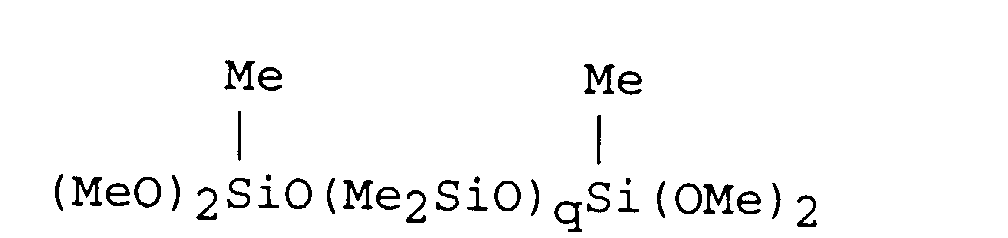
- the polydiorganosiloxanes having endgroups containing silicon atoms with at least two silicon-bonded alkoxy groups per silicon endgroup and where the silicon atoms of the polymer chain are linked by oxygen atoms are exemplified by the disclosure of U.S.
- Patent 3,161,614 are illustrated by the general average formula or by mixtures of the polydiorganosiloxanes of formula (I) and polydiorganosiloxanes of the following general average formula
- R is methyl or ethyl
- R 2 is methyl, ethyl, or vinyl
- R 9 is an alkyl radical of 1 to 6 inclusive carbon atoms, phenyl, or a fluorinated alkyl radical
- g has an average value of 2 to 3 inclusive
- f has an average value of at least 200.
- the preferred polydiorganosiloxanes of this kind are the polydimethylsiloxanes, and especially those with viscosities at 25°C. of from 5 to 150 Pa ⁇ s.
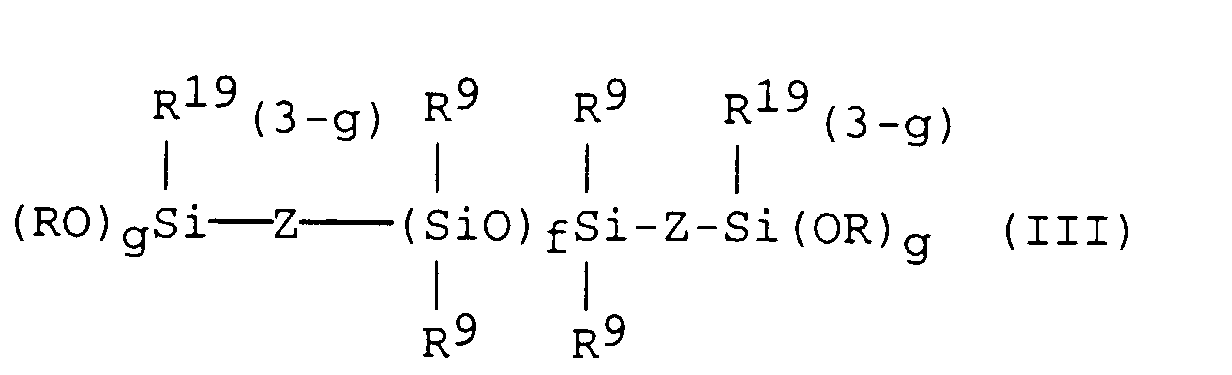
- the polydiorganosiloxanes of (A) with end segments containing linkages of divalent hydrocarbon radicals between some of the silicon atoms of the polymer chain include those described in U.S. Patents 3,175,993; 4,871,827 and 4,898,910 which show polydiorganosiloxanes having end segments with at least one divalent hydrocarbon radical linkage between polymer-chain silicon atoms and their methods of preparation.
- Such polydiorganosiloxanes are illustrated by the following general average formula where R, R 9 , g , and f are described above, R 19 is methyl, ethyl and Z is a divalent hydrocarbon radical or a combination of divalent hydrocarbon radicals and siloxane segments of 2 to 7 silicon atoms.
- the divalent hydrocarbon radicals are those having from 2 to 18 inclusive carbon atoms and are illustrated by ethylene, propylene, butylene, pentylene, and hexylene, preferably ethylene.
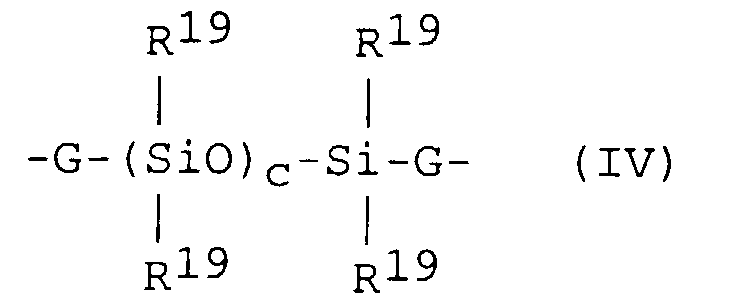
- the polydiorganosiloxanes with end segments containing divalent hydrocarbon linkages and divalent siloxane segments interrupting at least divalent hydrocarbon linkages between the polymer chain silicon atoms have end segments which, as Z, have the following general average formula where c has an average value of 1 to 6 inclusive, R 19 is defined above, and G is a divalent hydrocarbon radical free of aliphatic unsaturation of 2 to 18 carbon atoms.
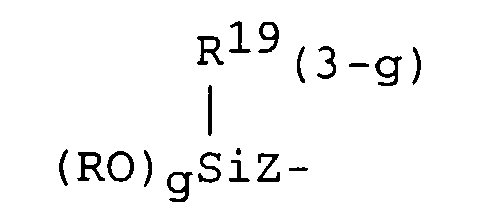
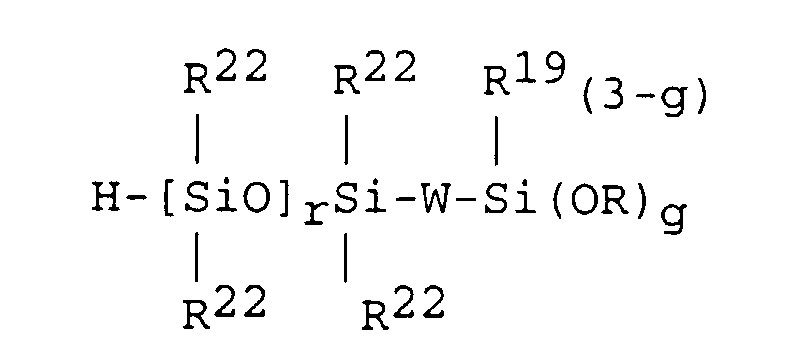
- polydiorganosiloxanes are prepared by reacting a hydrogen endblocked polydiorganosiloxane with a silane having an alkenyl radical in the presence of a hydrosilylation catalyst such as a platinum compound or complex or a polydiorganosiloxane having alkenyl endgroups, such as vinyl, are reacted, in the presence of a platinum catalyst, with an endcapping silicon-containing group which has silicon-bonded hydrogen atoms. If one uses a silane of the following general average formula one will make a polydiorganosiloxane as described by U.S.
- the preferred polydiorganosiloxanes of this kind are those described immediately above where the divalent hydrocarbon radical is ethylene and have a viscosity at 25°C. of 5 to 150 Pa ⁇ s.
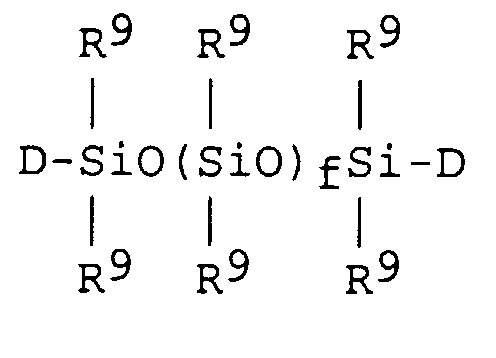
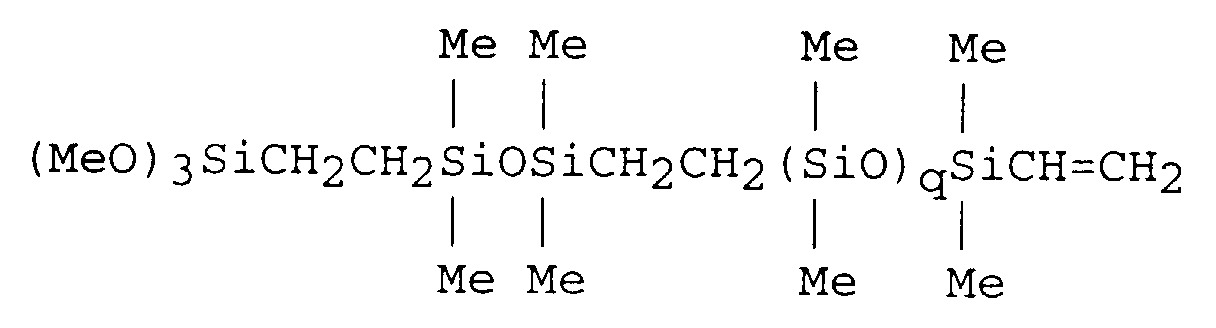
- U.S. Patent 4,898,910 describes useful polymers for our component (A) which have both vinyl containing endgroups and endgroups as described for the polymers of formula (III).
- Such polymers are mixtures of at least two kinds of polymers where one kind of polymer has alkoxy functional groups on both ends and another kind of polymer has alkoxy functional groups on one end and vinyl on the other end.
- These polymers are represented by the following general average formula: where R 9 methyl or ethyl, each D is selected from vinyl or a radical of the general average formula where each R 19 is methyl or ethyl and g has an average value of 2 to 3 inclusive.
- R 9 methyl or ethyl each D is selected from vinyl or a radical of the general average formula where each R 19 is methyl or ethyl and g has an average value of 2 to 3 inclusive.
- R 9 methyl or ethyl each D is selected from vinyl or a radical of the general average formula where each R 19 is methyl or e
- Polymer (A) includes organic polymers with polyalkoxy-functional silicon-containing chain terminations as described herein.
- One particular class of such polymers is the polyoxyalkylene, such as described by U.S. Patent 5,403,881, which shows the polyoxyalkylene polymers with polyalkoxysilyl endgroups.
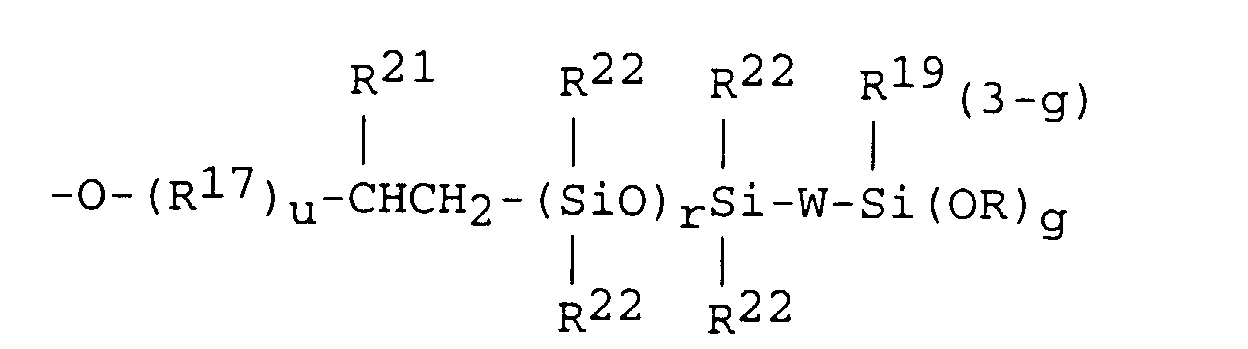
- These polymers are polyoxyalkylenes with a number average molecular weight of 500 to 16,000, whose main chain has units with the formula -R 18 O- in which R 18 is an alkylene group having 1 to 4 carbon atoms, and the chain termination segments have a general average formula in which R, R 19 and g are defined above, R 17 is a divalent hydrocarbon group, R 21 is hydrogen atom or a monovalent hydrocarbon group, R 22 is a monovalent hydrocarbon group, W is a divalent organic group, r is zero or a positive value, preferably r is a number with a value of at least 1, and u is 0 or 1.
- R 18 is a C 1 - C 4 alkylene group and is exemplified by methylene, ethylene, 1-methylethylene, 1-ethylethylene, and 1,1-dimethyl-ethylene.
- R 17 in the preceding formula is a divalent hydrocarbon group and is exemplified by methylene, ethylene, propylene, and butylene.
- R 21 is the hydrogen atom or a monovalent hydrocarbon group, and the latter is exemplified by alkyl groups such as methyl, ethyl, and propyl; cycloalkyl groups such as cyclohexyl; aryl groups such as phenyl, tolyl, and xylyl; and aralkyl groups such as benzyl or phenethyl.
- R 22 in each case is a monovalent hydrocarbon group as defined for R 21 .
- the group W in the preceding formula is a divalent organic group and is exemplified by methylene, ethylene, propylene, butylene, phenylene, and substituted phenylene.
- Titanium catalyst (B) has the average formula Ti(OR 2 ) (4-y) (OR 3 ) y where each R 2 is selected from a monovalent tertiary aliphatic hydrocarbon radical or a monovalent branched-secondary aliphatic hydrocarbon radical, each R 3 is a monovalent linear aliphatic hydrocarbon radical having from 1 to 6 carbon atoms per radical, y has an average value of from 0 to 1 inclusive.
- the titanium catalysts (B) useful for this invention, for the most part, are those described in EP-A 0 747 443. Preferably, there are several R 2 groups in each molecule.
- the OR 2 group is derived from a tertiary or branched-secondary alcohol, such as HOCH(CH 3 )CH 2 CH(CH 3 ) 2 .
- Preferred R 2 are those represented by the general formula -CR 6 R 7 R 8 in which each R 6 , R 7 , and R 8 is a monovalent aliphatic hydrocarbon radical having from 1 to 6 inclusive carbon atoms per radical.
- the most preferred titanium compounds are those in which y has an average value of from 0 to 1 inclusive, and all the R 2 groups are tertiary aliphatic groups.
- a preferred group of titanium catalysts are those represented by the general formula Ti(OR 2 ) 4-y (OR 3 ) y where R 2 is -C(CH 3 ) 3 or -C(C 2 H 5 )(CH 3 ) 2 and R 3 is isopropyl.
- the most preferred titanium catalysts are those in which R 2 is -C(CH 3 ) 3 or -C(CH 3 ) 2 (CH 2 CH 3 ) and y is zero.
- the titanium catalyst (B) is present in our RTV sealant composition in amounts such that molar ratio (I) is 0.9 to 5, preferably 1 to 2.5 and molar ratio (II) is 0.6 to 2, preferably 0.8 to 1.
- the moles of titanium catalyst present in the claimed RTV sealant composition is a significant factor for both molar ratios.
- Molar ratio (I) is the sum of the moles of titanium catalyst (B) plus the moles of the alkoxysilane (D) divided by the moles of hydroxyl group in (C).
- the molar ratio (II) is the moles of titanium catalyst (B) divided by the sum of the moles of alkoxysilane (D) plus the moles of silicon-bonded alkoxy unit chain terminations in (A).
- the amount of the titanium catalyst (B) is a significant factor in determining both molar ratios (I) and (II) because the moles of titanium catalyst appears in the numerator of both ratios. Therefore, increasing the amount of titanium catalyst increases the molar ratios if the other ingredients remain constant.
- titanium catalyst can be expensive, small amounts of the catalyst are desirable. Smaller amounts of titanium catalyst (B) are also preferred because the RTV sealant compositions of this invention have better hydrolytic stability. High amounts of titanium catalyst show poorer hydrolytic stability because at increased titanium catalyst concentrations, the amount of Ti-O-Si bonds increase and these bonds are susceptible to cleavage under wet conditions.
- molar ratio (I) and molar ratio (II) need to meet their defined parameters to have acceptable shelf-stability based on molar ratio (I), and rapid development of green strength based on molar ratio (II).
- shelf-stability means in-container stability.
- the uncured composition maintains its rheology during storage and when cured, the properties are essentially the same over the storage period, i.e. from time of manufacture to point of exposure to moisture and cure.
- the amount of titanium catalyst for curing our RTV sealant composition is often present such that there is from 0.1 to 5 weight percent based on the total weight of the claimed sealant composition.
- the titanium catalysts (B) are prepared by reacting tetrachlorotitanium or a tetraalkoxytitanium, such as tetraisopropoxytitanium, with a selected branched-secondary or tertiary alcohol, for example tertiary-butanol or tertiary-amyl alcohol. Such reactions by-produce hydrochloric acid or an alcohol, such as isopropanol, that are preferably removed from the reaction medium to obtain the desired titanium catalysts (B).
- the starting tetraalkoxytitanium is preferably selected to ensure easy removal of the by-produced alcohol by vacuum devolatilization.
- the by-produced alcohol will have a boiling point which permits its easy removal from the reaction mixture without interfering with the preparation of titanium catalyst (B).
- alkoxytitanates are suitable for use in the preparation of titanium catalyst (B) because of the closeness of the boiling points of the reacting alcohol and the by-produced alcohol.
- the boiling points of isopropanol (iPrOH), tertiary-butanol (t-BuOH), tertiary-amyl alcohol, and n-butanol are 82°C., 83°C., 102°C. and 118°C., respectively.
- Reaction of tertiary-amyl alcohol favorably replaces the alkoxy groups on tetra-isopropyltitanate (TiPT), tetra-ethyltitanate, and tetra-methyltitanate to produce tetra-tertiary-amyl titanate.
- TiPT tetra-isopropyltitanate
- tetra-ethyltitanate tetra-ethyltitanate
- tetra-methyltitanate to produce tetra-tertiary-amyl titanate.
- the replacement reaction is favored when reacting tertiary-butanol with tetra-methyltitanate to produce tetra-tertiary-butyltitanate, but not with the other alkoxytitanates.
- the reaction between tertiary-butanol and tetra-isopropyl titanate can be conveniently used to produce titanium catalysts (B) where all the isopropoxy groups (-OiPr) of the tetra-isopropyl titanate are not replaced by the tertiary-butoxy groups (-OtBu).
- the particular reaction may be illustrated as follows: TiPT + t-BuOH ⁇ Ti(OiPr) y (OtBu) (4-y) + iPrOH + t-BuOH where the value of y has an average of 0 to 1 inclusive and is preferably less than 0.85 to provide more desirable results, such as faster cure rates than those with higher y values.
- More preferred titanium catalysts (B) where both isopropoxy and tertiary-butoxy groups are present on the titanium atom are those which have a y value of less than 0.6.
- titanium catalysts for promoting the curing of the prior art alkoxy-containing RTV silicone sealant compositions are those as described by U.S. Patents 3,151,099; 3,161,614 and 3,175,993.
- Those titanium catalysts include tetraalkoxytitanates or chelated titanium compounds, examples of which include tetraethyl titanate, tetraisopropyl titanate, tetra-n-propyl titanate, tetrabutyl titanate, bis-acetylacetonyldiisopropyl titanate, 2,5-diisopropyl-bis-ethylacetoacetate titanium, and 1,3-dioxypropane-titanium-bis(ethylacetoacetate) where the latter is described in U.S. Patent 4,722,967.
- the titanium catalysts described by the above patents are not useful in the RTV sealant compositions of this invention.
- Our RTV sealant compositions also comprise a filler, (C), which is selected from those known to be useful in RTV sealants.
- These fillers include calcium carbonate, both ground, precipitated and colloidal calcium carbonates which are untreated or treated with stearate; crushed quartz; ground quartz; alumina; aluminum hydroxide; titanium dioxide; diatomaceous earth; reinforcing silicas such as fumed silicas, precipitated silicas and hydrophobed reinforcing silicas; iron oxide; carbon black; graphite and the like.
- the amount of filler is that amount of filler which provides the desired properties to the uncured composition, such as viscosity, thixotropy, pigmentation, UV protection and the like.
- the amount of filler used in our RTV sealant compositions also depends upon the cured physical properties desired such as tensile strength, elongation and durometer. This amount of filler is preferably from 5 to 50 weight percent based on the total weight of the RTV silicone sealant composition.
- the amount of filler allowable further depends upon hydroxyl content of the filler.
- the hydroxyl content is derived from hydroxyl groups covalently bonded to the filler and adsorbed water. Covalently bonded hydroxyl to be included in the hydroxyl content are those covalent hydroxyl groups which are available for reaction and that would exclude those which might be hidden within a filler particle and thus unavailable for reaction.
- the hydroxyl content also includes adsorbed water which is available for reaction. Absorbed water would also include associated water on the filler surface and water which becomes available from within the filler to be available for reaction.
- the amount of filler used is that amount needed to provide molar ratio (I) to be 0.9 to 5, and preferably 1 to 2.5.
- Molar ratio (I) is obtained by taking the sum of the moles of titanium catalyst (B) and the moles of alkoxysilane (D) and dividing by the moles of hydroxyl group in filler (C). The equation for the molar ratio (I) is shown above.
- a particular filler may only have adsorbed water available for reaction and may not have any covalently bonded hydroxyl groups available for reaction.
- many fillers have both the covalently bonded hydroxyl groups and adsorbed water available for reaction, for example untreated fumed silica filler.
- the hydroxyl content available for reaction is altered by drying the filler and/or pretreating the filler with hydrophobing agents which react with covalent-bonded hydroxyl groups and adsorbed water, such as hexamethyldisilazane and the like which are well known in the art.
- Calcium carbonate fillers are often treated with stearic acid to reduce the hydroxyl content. These treated fillers, such as the silicas and the calcium carbonates are available commercially.
- fillers which have a low hydroxyl content; however, practical considerations find that most fillers have some hydroxyl content and it is very expensive to eliminate all hydroxyl content. Therefore, from a practical standpoint, all fillers will have some available-for-reaction hydroxyl content.
- the use of fillers with low hydroxyl content can reduce the cost by minimizing the amount of titanium catalyst (B), as required to meet molar ratios (I) and (II) needed to provide the fast development of green strength, as observed by short times-to-rubber (TTR) times.
- TTR short times-to-rubber
- the amount of polymer (A) can also be reduced.
- RTV sealant compositions which have a molar ratio (I) of 0.9 to 5 exhibit shelf-stability.
- shelf-stability we mean that an RTV sealant composition when packaged will maintain its uncured properties during the expected storage period as observed when prepared and that the cured properties will be essentially the same when cured shortly after preparation as after a storage period.
- filler (C) is in the denominator of molar ratio (I)
- fillers with lower hydroxyl content permits the use of combinations of titanium catalyst (B) and alkoxysilane (D) at lower amounts in the claiemd RTV sealant composition to achieve essentially the same uncured, curing, and cured characteristics and properties, as at higher amounts of titanium catalyst (B) and alkoxysilane (D).
- the crosslinkers (D) for our RTV sealant compositions are alkoxysilanes which have at least two alkoxy groups per molecule wherein the alkoxy groups are either methoxy or ethoxy. These alkoxysilanes preferably contain three alkoxy groups per molecule, and are illustrate by methyltrimethoxysilane, methyltriethoxysilane, vinyltrimethoxysilane, vinyltriethoxysilane, ethyltrimethoxysilane, ethyltriethoxysilane and mixtures of these alkoxysilanes or their partial hydrolyzates.
- the alkoxysilanes are methyltrimethoxysilane or mixtures with other alkoxysilanes wherein methyltrimethoxysilane comprises a majority of the alkoxysilanes in the mixture.
- the crosslinker can also be one which has two silicon-bonded alkoxy groups per molecule, such as dimethyldimethoxysilane, methylvinyldimethoxysilane, dimethyldiethoxysilane and methylethyldiethoxysilane.
- the amount of alkoxysilane crosslinker is those amounts which do not take molar ratio (I) and molar ratio (II) outside the limits where molar ratio (I) is 0.9 to 5, preferably 1 to 2.5, and molar ratio (II) is 0.6 to 2, preferably 0.8 to 1.
- the weight percentages of crosslinker is often found to be in the range of from 0.1 to 10 weight percent based on the total weight of the RTV sealant composition, more preferred from 0.1 to 3 weight percent.
- Increasing the amount of alkoxysilane (D) decreases the rate of development of green strength and slows the cure rate.
- the use of less than 1.5 weight percent, based on the total weight of the composition exhibits desirable green strength development rates.
- RTV sealant compositions such as adhesion promoters, fungicides, colorants, pigments, plasticizers and the like, can be added as long as they do not interfere with the rapid development of green strength, cause discoloration of the uncured composition or cured product; deteriorate the curing properties; damage the cured physical properties; or reduce the effective bonding between the cured sealant and the substrates.
- organo-functional trialkoxysilanes are used as adhesion promoters and their amounts are such that the moles of organo-functional trialkoxysilane may be significant with respect to the moles of alkoxysilane crosslinker (D), it may be desirable to include the moles of such adhesion promoter as part of the moles of alkoxysilane in determining molar ratios (I) and (II).
- the RTV sealant compositions of this invention when the molar ratios I and II are met, rapidly develop green strength as observed by lap shear values after 30 minutes of curing of at least 2700 pascal (Pa), with preferred lap shears of at least 5400 Pa.
- the time-to-rubber (TTR) is also less than 10 minutes.
- part refers to part by weight or parts by weight (expressed as “pbw”) and all viscosities were measured at 25°C.
- Me represents methyl
- t-Bu represents tertiary-butyl
- iPr represents isopropyl.
- Aluminum panels measuring 2.54 cm x 7.62 cm were assembled into lap shear joints with a 2.54 cm overlap.
- the glue line thickness was 0.254 cm.
- Samples were allowed to cure for 30 minutes by exposure to atmospheric conditions which were 25°C. and 50 % relative humidity and then the green strength values were obtained. The values were obtained by using an InstronTM Tensile Tester at a pull rate of 1.27 cm per minute. The results were obtained in pound per square inch (psi) which was converted to pascals.
- the extrusion rate was determined by test procedure MIL-S-8802D on the uncured RTV silicone sealant composition by extruding it through a nozzle with a 0.3175 cm orifice using 620.5 kPa pressure and measuring the amount extruded in grams per minute (g/min).
- TRR TIME-TO-RUBBER
- the time-to-rubber is that time from the point of exposure of an RTV sealant composition to atmospheric conditions of 50% relative humidity and 25°C to the point where an elastic skin forms on the surface of the exposed composition.
- TTR time-to-rubber
- the RTV sealant compositions of Table I were made by mixing their ingredients under conditions to exclude moisture. The ingredients were mixed by first adding alkoxysilane and titanium catalyst to the polymer, adding filler, mixing and then drawing a vacuum to remove any by-produced alcohol. In Table I, the moles of groups and ingredients were based on 100 grams of the RTV sealant composition and appear in Table I in parenthesis below the weight parts. Molar ratios (I) and (II), as defined herein, are also shown in Table I. The prepared RTV sealant compositions were thereafter stored in containers sealed to prevent atmospheric moisture from entering. Testing was done after two days storage at 25°C. The extrusion rate in grams/minute (g/m) for each of the RTV sealant compositions was measured and are also shown Table I.
- Example 4 illustrates the usefulness of diorganodialkoxysilanes as a crosslinker.
- Comparative Examples 2, 3 and 5 each had a molar ratio (II) of less than 0.6 and exhibit unacceptable green strengths of less than 2700 Pa and unacceptable TTR of greater than 10 minutes. Comparative Examples 2 and 3 show that even if the amount of titanium catalyst resulted in molar ratio (I) being within the acceptable range of 0.9 to 5, but was characterized by not using the titanium catalyst of this invention, the green strength values and the TTR values were not acceptable. Also, molar ratio (II) for Comparative Examples 2 and 3 were zero and unacceptable since the titanium catalysts were not of the present invention.
- Example 6 showed the usefulness of silica per se as a filler and Example 7 showed the usefulness of ground calcium carbonate per se as a filler.
- Comparative Example 8 had a molar ratio (I) of less than 0.9 and also had an unacceptable extrusion rate of 5 g/min. Comparative Example 9 had a molar ratio (II) of less than 0.6, exhibited an unacceptable green strength of less than 2700 Pa and an unacceptable TTR of greater than 10 minutes. Comparative Example 10 showed that acceptable green strength values and TTR values were obtainable using a precipitated calcium carbonate alone.
- RTV sealant compositions were prepared and tested as described for Examples 1-5, except that the ingredients and their amounts are given in Table III. The results of this testing are also shown in Table III.
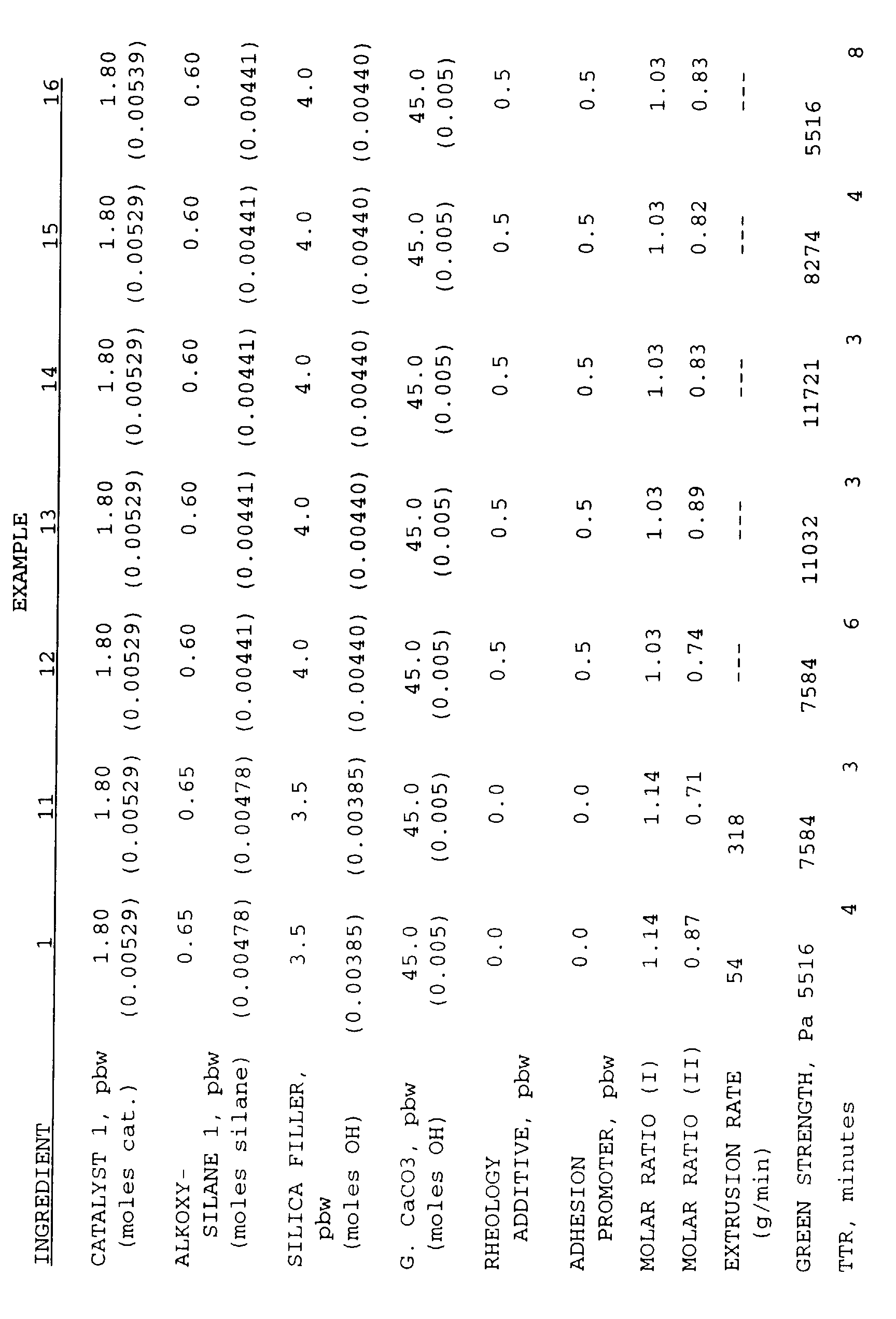
- Examples 1 and 11-16 illustrate that a variety of polymers with polyalkoxy-functional chain terminations resulted in RTV sealant compositions with acceptable green strength values and acceptable TTR values when molar ratio (I) had a value of 0.9 to 5 and molar ratio (II) had values of 0.6 to 2.
- RTV sealant compositions were prepared and tested in the same manner as Examples 1-5, the ingredients, their amounts and properties were then measured and are provided in Table IV.
- Examples 1 and 17-19 show that the addition of a rheology additive, an adhesion promoter or a combination of these additives provide acceptable green strength values and TTR values.
- RTV sealant compositions were prepared and tested in the same manner as Examples 1-5, the ingredients, their amounts and properties were then measured and are provided in Table V.
- Table V TES represents tetraethoxysilane.
- Comparative Examples 20 and 21 show that the substitution of tetraalkoxysilane for an alkyltrialkoxysilane resulted in a low value for green strength for Example 20 and produced both a low value for green strength and a long TTR value for Example 21. It was concluded that tetraalkoxysilanes were not useful in this invention.
Landscapes
- Chemical & Material Sciences (AREA)
- Organic Chemistry (AREA)
- Health & Medical Sciences (AREA)
- Chemical Kinetics & Catalysis (AREA)
- Medicinal Chemistry (AREA)
- Polymers & Plastics (AREA)
- Engineering & Computer Science (AREA)
- Materials Engineering (AREA)
- Compositions Of Macromolecular Compounds (AREA)
- Sealing Material Composition (AREA)
Abstract
Description








where g had an average value such that the viscosity was 20 Pa·s.
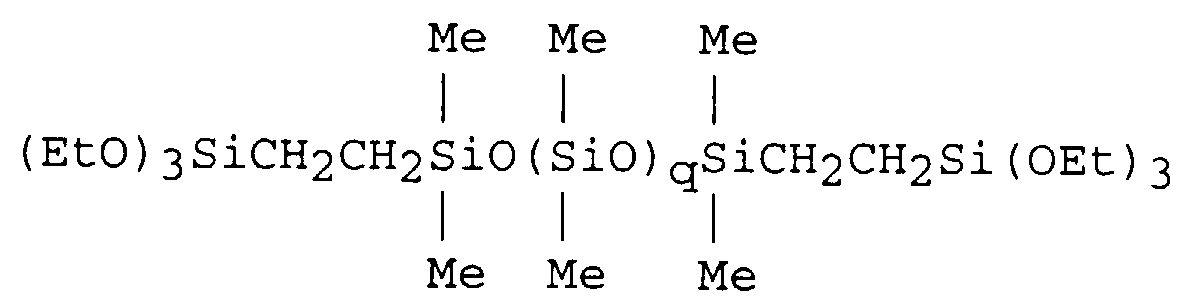
- Catalyst 1 = a mixture of titanium molecules having an average formula Ti(Ot-Bu)3.6(OiPr)0.4
- Catalyst 2 = Ti(OiPr)4
-

- Alkoxysilane 1 =
- methyltrimethoxysilane
- Alkoxysilane 2 =
- dimethyldimethoxysilane
- Silica Filler =
- fumed silica filler having a surface area of 150 m2/g and a water content of 1.0 weight percent
- G. CaCO3 =
- a ground calcium carbonate having an average particle size of 2-3 micrometers, surface treated with stearic acid and containing 0.1 weight percent adsorbed water
- ppt CaCO3 =
- a precipitated calcium carbonate having a surface area of 22 m2/g, surface treated with stearic acid and an adsorbed water content of 0.4 weight percent
| EXAMPLE | |||||
| INGREDIENT | 1 | 2 | 3 | 4 | 5 |
| POLYMER 1, pbw | 49.05 | 49.35 | 48.60 | 48.84 | 47.70 |
| (moles alkoxy Si end) | (0.00128) | (0.00129) | (0.00127) | (0.00127) | (0.00124) |
| CATALYST 1, pbw | 1.80 | 0.0 | 0.0 | 1.80 | 1.80 |
| (moles cat.) | (0.00529) | (0.0) | (0.0) | (0.00529) | (0.00529) |
| CATALYST 2, pbw | 0.0 | 1.50 | 0.0 | 0.0 | 0.0 |
| (moles cat.) | (0.0) | (0.00528) | (0.0) | (0.0) | (0.0) |
| CATALYST 3, pbw | 0.0 | 0.0 | 2.25 | 0.0 | 0.0 |
| (moles cat.) | (0.0) | (0.0) | (0.00531) | (0.0) | (0.0) |
| ALKOXYSILANE 1, pbw | 0.65 | 0.65 | 0.65 | 0.0 | 2.0 |
| (moles silane) | (0.00478) | (0.00478) | (0.00478) | (0.0) | (0.01470) |
| ALKOXYSILANE 2, pbw | 0.0 | 0.0 | 0.0 | 0.86 | 0.0 |
| (moles silane) | (0.0) | (0.0) | (0.0) | (0.00717) | (0.0) |
| SILICA FILLER, pbw | 3.5 | 3.5 | 3.5 | 3.5 | 3.5 |
| (moles OH) | (0.00385) | (0.00385) | (0.00385) | (0.00385) | (0.00385) |
| G. CaCO3, pbw | 45.0 | 45.0 | 45.0 | 45.0 | 45.0 |
| (moles OH) | (0.005) | (0.005) | (0.005) | (0.005) | (0.005) |
| MOLAR RATIO (I) | 1.14 | 1.14 | 1.14 | 1.41 | 2.26 |
| MOLAR RATIO (II) | 0.87 | 0.00 | 0.00 | 0.63 | 0.33 |
| EXTRUSION RATE (g/min) | 54 | 25 | 55 | 40 | 40 |
| GREEN STRENGTH, Pa | 5516 | 689 | 689 | 4137 | 1379 |
| TTR, minutes | 4 | 12 | 30 | 5 | 20 |


| EXAMPLE | ||||
| INGREDIENT | 1 | 17 | 18 | 19 |
| POLYMER 1, pbw | 49.05 | 48.55 | 48.55 | 48.05 |
| (moles alkoxy Si end) | (0.00128) | (0.00127) | (0.00127) | (0.00125) |
| CATALYST 1, pbw | 1.80 | 1.80 | 1.80 | 1.80 |
| (moles cat.) | (0.00529) | (0.00529) | (0.00529) | (0.00529) |
| ALKOXYSILANE 1, pbw | 0.65 | 0.65 | 0.65 | 0.65 |
| (moles silane) | (0.00478) | (0.00478) | (0.00478) | (0.00478) |
| SILICA FILLER, pbw | 3.5 | 3.5 | 3.5 | 3.5 |
| (moles OH) | (0.00385) | (0.00385) | (0.00385) | (0.00385) |
| G. CaCO3, pbw | 45.0 | 45.0 | 45.0 | 45.0 |
| (moles OH) | (0.005) | (0.005) | (0.005) | (0.005) |
| ppt. CaCO3, pbw | 0.0 | 0.0 | 0.0 | 0.0 |
| (moles OH) | (0.0) | (0.0) | (0.0) | (0.0) |
| RHEOLOGY ADDITIVE, pbw | 0.0 | 0.5 | 0.0 | 0.5 |
| ADHESION PROMOTER, pbw | 0.0 | 0.0 | 0.5 | 0.5 |
| MOLAR RATIO (I) | 1.14 | 1.14 | 1.14 | 1.14 |
| MOLAR RATIO (II) | 0.87 | 0.88 | 0.88 | 0.88 |
| EXTRUSION RATE (g/min) | 54 | 56 | 66 | 57 |
| GREEN STRENGTH, Pa | 5516 | 6895 | 4137 | 4137 |
| TTR, minutes | 4 | 4 | 5 | 7 |
| EXAMPLE | |||
| INGREDIENT | 1 | 20 | 21 |
| POLYMER 1, pbw | 49.05 | 48.70 | 48.40 |
| (moles alkoxy Si end) | (0.00128) | (0.00127) | (0.00126) |
| CATALYST 1, pbw | 1.80 | 1.80 | 1.80 |
| (moles cat.) | (0.00529) | (0.00529) | (0.00529) |
| TES, pbw | 0.65 | 1.00 | 1.30 |
| (moles silane) | (0.00478) | (0.00481) | (0.00625) |
| SILICA FILLER, pbw | 3.5 | 3.5 | 3.5 |
| (moles OH) | (0.00385) | (0.00385) | (0.00385) |
| G. CaCO3, pbw | 45.0 | 45.0 | 45.0 |
| (moles OH) | (0.005) | (0.005) | (0.005) |
| MOLAR RATIO (I) | 1.14 | 1.14 | 1.30 |
| MOLAR RATIO (II) | 0.87 | 0.87 | 0.70 |
| EXTRUSION RATE (g/min) | 54 | 41 | 65 |
| GREEN STRENGTH, Pa | 5516 | 1379 | 689 |
| TTR, minutes | 4 | 7 | 21 |
Claims (9)
- A composition comprising the product obtainable by mixing (A) a polymer which contains per molecule an average of at least 1.2 (RO)(3-x)R1 xSi- chain terminations where each R is methyl or ethyl, each R1 is methyl, ethyl, or vinyl, and x has an average value of from 0 to 1 inclusive; (B) a titanium catalyst of the average formula Ti(OR2) (4-y) (OR3)y where each R2 is selected from a monovalent tertiary aliphatic hydrocarbon radical or a monovalent branched-secondary aliphatic hydrocarbon radical, each R3 is a monovalent linear aliphatic hydrocarbon radical having from 1 to 6 carbon atoms inclusive per radical, y has an average value of from 0 to 1 inclusive; (C) a filler having a hydroxyl group content derived from hydroxyl groups selected from the group consisting of covalent-bonded hydroxyl radicals, adsorbed water, or both the covalent-bonded hydroxyl radicals and the adsorbed water; and (D) an alkoxysilane of the average formula R4 zSi(OR5)(4-z) in which each R4 is methyl, ethyl or vinyl, each R5 is methyl or ethyl, and z has an average value of from 1 to 2 inclusive, where each of ingredients (A), (B), (C), and (D) are present in amounts such that a molar ratio (I) is 0.9 to 5 and a molar ratio (II) is 0.6 to 2, where
- The composition according to claim 1 in which R2 is tertiary-butyl and R3 is isopropyl.
- The composition according to claim 1 in which the polymer of (A) is a polydiorganosiloxane of the general average formulawhere R is methyl or ethyl; R9 is methyl, ethyl, or phenyl; R19 is methyl or ethyl; g has an average value of 2 to 3 inclusive; f is at least 200; and Z is a divalent hydrocarbon radical free of aliphatic unsaturation of 2 to 18 carbon atoms or a divalent group of the general average formula
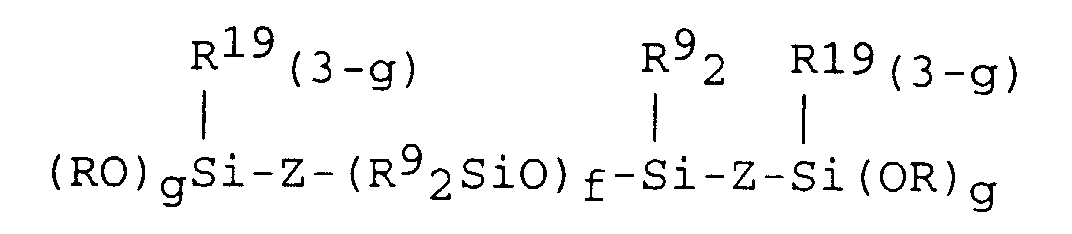 where R19 is defined above, G is a divalent hydrocarbon radical free of aliphatic unsaturation of 2 to 18 carbon atoms, and c has an average value from 1 to 6 inclusive.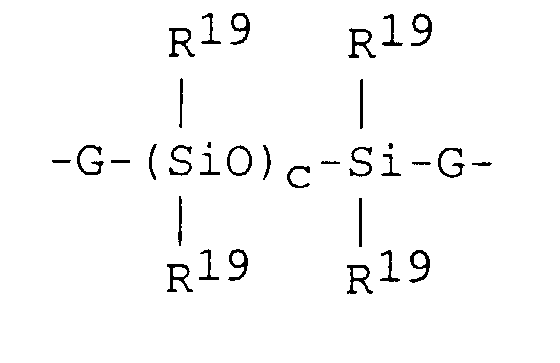
- The composition according to claim 1 in which the polymer of (A) is a polydiorganosiloxane of the general average formulaor a mixture of the polydiorganosiloxane of formula (I) and polydiorganosiloxanes of the following general average formula
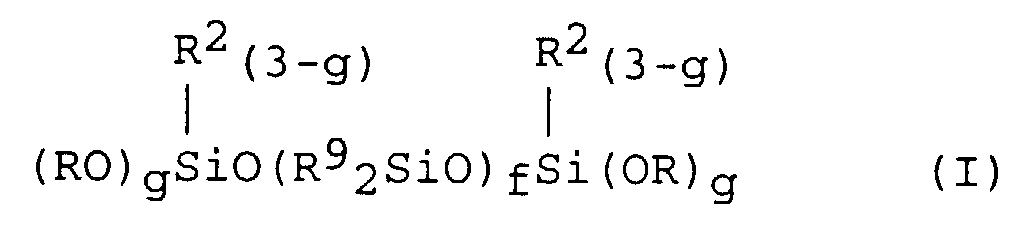 in which R is methyl or ethyl, R2 is methyl, ethyl, or vinyl; R9 is an alkyl radical of 1 to 6 inclusive carbon atoms, phenyl, or a fluorinated alkyl radical; g has an average value of 2 to 3 inclusive, f has an average value of at least 200.
- The composition according to claims 3 or 4 in which R is methyl, R9 is methyl, and (D) is methyltrimethoxysilane.
- The composition according to claim 5 in which Z is ethylene, R is methyl or ethyl, R9 is methyl, R19 is methyl, and g has an average value of 2 or 3.
- The composition according to claim 1 in which (C) is a reinforcing silica filler.
- The composition according to claim 1 in which (C) is calcium carbonate.
- The composition according to claim 1 in which (C) is a combination of reinforcing silica filler and ground calcium carbonate.
Applications Claiming Priority (4)
| Application Number | Priority Date | Filing Date | Title |
|---|---|---|---|
| US916165 | 1986-10-07 | ||
| US78134097A | 1997-01-10 | 1997-01-10 | |
| US781340 | 1997-01-10 | ||
| US08/916,165 US5840794A (en) | 1997-01-10 | 1997-08-21 | Alkoxy functional sealants with rapid development of green strength |
Publications (2)
| Publication Number | Publication Date |
|---|---|
| EP0853101A1 true EP0853101A1 (en) | 1998-07-15 |
| EP0853101B1 EP0853101B1 (en) | 2002-07-03 |
Family
ID=27119839
Family Applications (1)
| Application Number | Title | Priority Date | Filing Date |
|---|---|---|---|
| EP98100315A Expired - Lifetime EP0853101B1 (en) | 1997-01-10 | 1998-01-09 | Alkoxy-functional sealants with rapid development of green strength |
Country Status (4)
| Country | Link |
|---|---|
| US (1) | US5840794A (en) |
| EP (1) | EP0853101B1 (en) |
| JP (1) | JP4159643B2 (en) |
| DE (1) | DE69806277T2 (en) |
Cited By (15)
| Publication number | Priority date | Publication date | Assignee | Title |
|---|---|---|---|---|
| EP0934980A1 (en) * | 1997-09-26 | 1999-08-11 | Dow Corning S.A. | Organosiloxane compositions |
| EP0905194A3 (en) * | 1997-09-25 | 2000-02-02 | Dow Corning Corporation | Alkoxy-functional RTV compositions of increased green strength and storage stability |
| EP0926206A3 (en) * | 1997-12-23 | 2000-02-02 | Dow Corning Corporation | Fast curing alkoxy-functional RTV compositions |
| WO2000037565A1 (en) * | 1998-12-21 | 2000-06-29 | Dow Corning Corporation | Rtv silicone compositions with rapid development of green strength |
| WO2001029127A1 (en) * | 1999-10-20 | 2001-04-26 | Rhodia Chimie | Single-constituent polyorganosiloxane composition room temperature curable into non-yellowing elastomer in the presence of moisture |
| EP1013699A3 (en) * | 1998-12-21 | 2001-05-16 | Dow Corning Corporation | Polyorganosiloxanes having at least one organofunctional group with multiple hydrolyzable groups |
| FR2823505A1 (en) * | 2001-04-13 | 2002-10-18 | Rhodia Chimie Sa | Biocidal, single component polyorganosiloxane mastic, useful e.g. as sealant in moist environments, is stable in the absence of moisture but cures in presence of water to adherent, non-yellowing elastomer |
| EP1932887A1 (en) * | 2006-12-11 | 2008-06-18 | Shin-Etsu Chemical Co., Ltd. | Room temperature curable organopolysiloxane compositions |
| EP2280041A2 (en) | 2009-07-31 | 2011-02-02 | Wacker Chemie AG | Condensation-Crosslinking Silicone Materials |
| DE102009028142A1 (en) | 2009-07-31 | 2011-02-03 | Wacker Chemie Ag | At room temperature by condensation crosslinking silicone compositions |
| CN102875591A (en) * | 2012-09-25 | 2013-01-16 | 湖北新蓝天新材料股份有限公司 | Method for preparing tetra-tert-butyl orthotitanate composite |
| CN104525166A (en) * | 2014-12-05 | 2015-04-22 | 长沙罗斯科技有限公司 | Preparation method of transparent titanium complex |
| CN106459101A (en) * | 2014-05-30 | 2017-02-22 | 道康宁东丽株式会社 | Organic silicon compound, curable silicone composition, and semiconductor device |
| US10273335B2 (en) | 2014-06-26 | 2019-04-30 | Henkel Ag & Co. Kgaa | Titanium complexes as vulcanization catalysts |
| US10654987B2 (en) | 2015-12-17 | 2020-05-19 | Henkel Ag & Co. Kgaa | Titanium complexes as vulcanization catalysts |
Families Citing this family (36)
| Publication number | Priority date | Publication date | Assignee | Title |
|---|---|---|---|---|
| GB9721831D0 (en) * | 1997-10-15 | 1997-12-17 | Dow Corning Sa | A method for preparing alkoxysilethylene end-blocked polydiorganosiloxanes |
| US6107435A (en) * | 1998-06-26 | 2000-08-22 | Dow Corning Corporation | Silica filled RTV compositions having adhesion to glass and ceramic materials |
| JP4494543B2 (en) * | 1998-11-20 | 2010-06-30 | 東レ・ダウコーニング株式会社 | Room temperature curable silicone rubber composition |
| US6265518B1 (en) | 1998-12-21 | 2001-07-24 | Dow Corning Corporation | Organosilicon endcapper having one silicon-bonded hydrogen atom |
| US6303811B1 (en) | 1998-12-21 | 2001-10-16 | Dow Corning Corporation | Cyclic organosilicon endcapper having one aliphatic unsaturation |
| US6160150A (en) * | 1998-12-21 | 2000-12-12 | Dow Corning Corporation | Cyclic organosilicon endcapper having one silicon-bonded hydrogen atom |
| US6013753A (en) * | 1998-12-21 | 2000-01-11 | Dow Corning Corporation | Organosilicon endcapper having one aliphatic unsaturation |
| JP4554036B2 (en) * | 2000-06-30 | 2010-09-29 | 信越化学工業株式会社 | Room temperature fast-curing silicone composition |
| US6652978B2 (en) | 2001-05-07 | 2003-11-25 | Kion Corporation | Thermally stable, moisture curable polysilazanes and polysiloxazanes |
| JP3824071B2 (en) * | 2001-12-25 | 2006-09-20 | 信越化学工業株式会社 | Room temperature curable organopolysiloxane composition |
| JP4916877B2 (en) * | 2003-04-03 | 2012-04-18 | ダウ・コーニング・コーポレイション | Moisture curable organosiloxane composition |
| US20050192387A1 (en) * | 2004-03-01 | 2005-09-01 | Williams David A. | RTV silicone composition offering rapid bond strength |
| US20070244249A1 (en) * | 2006-04-06 | 2007-10-18 | General Electric Company | Two-part translucent silicone rubber-forming composition |
| JP2008231400A (en) * | 2007-02-20 | 2008-10-02 | Suzuka Fuji Xerox Co Ltd | Resin composition for optical element and curable resin composition |
| US20090194156A1 (en) * | 2008-02-01 | 2009-08-06 | Grommesh Robert C | Dual seal photovoltaic glazing assembly and method |
| US20090320921A1 (en) * | 2008-02-01 | 2009-12-31 | Grommesh Robert C | Photovoltaic Glazing Assembly and Method |
| ES2372355T3 (en) * | 2008-04-10 | 2012-01-19 | Cardinal Ig Company | GLASS SETS THAT INCLUDE PHOTOVOLTAIC ELEMENTS AND CORRESPONDING MANUFACTURING METHODS. |
| WO2009126186A1 (en) * | 2008-04-10 | 2009-10-15 | Cardinal Ig Company | Manufacturing of photovoltaic subassemblies |
| GB201103689D0 (en) | 2011-03-04 | 2011-04-20 | Dow Corning | Organosil oxane compositions |
| BR112015001337B1 (en) | 2012-08-10 | 2021-02-23 | Sika Technology Ag | silicone formulation of one or two components, use thereof, method to fill a space between two substrates, and arrangement comprising said formulation |
| US9567486B2 (en) * | 2012-08-31 | 2017-02-14 | Xerox Corporation | Imaging member for offset printing applications |
| US10066138B2 (en) * | 2013-12-27 | 2018-09-04 | Dow Corning Toray Co., Ltd. | Room-temperature-curable silicone rubber composition, the use thereof, and method for repairing electronic device |
| KR20170103877A (en) | 2015-01-28 | 2017-09-13 | 다우 코닝 코포레이션 | Elastomeric compositions and their applications |
| US12534576B2 (en) | 2015-01-28 | 2026-01-27 | Dow Silicones Corporation | Elastomeric compositions and their applications |
| GB201613397D0 (en) | 2016-08-03 | 2016-09-14 | Dow Corning | Cosmetic composition comprising silicone materials |
| GB201613412D0 (en) | 2016-08-03 | 2016-09-14 | Dow Corning | Elastomeric compositions and their applications |
| GB201613413D0 (en) * | 2016-08-03 | 2016-09-14 | Dow Corning | Elastomeric compositions and their applications |
| GB201613411D0 (en) * | 2016-08-03 | 2016-09-14 | Dow Corning | Elastomeric compositions and their applications |
| GB201613399D0 (en) | 2016-08-03 | 2016-09-14 | Dow Corning | Cosmetic composition comprising silicone materials |
| GB201613414D0 (en) | 2016-08-03 | 2016-09-14 | Dow Corning | Elastomeric compositions and their applications |
| EP3583155B1 (en) * | 2017-02-20 | 2024-05-08 | Dow Silicones Corporation | Room-temperature-curable silicone composition and electric/electronic apparatus |
| GB201707437D0 (en) | 2017-05-09 | 2017-06-21 | Dow Corning | Lamination adhesive compositions and their applications |
| GB201707439D0 (en) | 2017-05-09 | 2017-06-21 | Dow Corning | Lamination Process |
| EP3645607B1 (en) | 2017-06-26 | 2025-11-05 | Dow Silicones Corporation | Method for hydrosilylation of aliphatically unsaturated alkoxysilanes and hydrogen terminated organosiloxane oligomers to prepare alkoxysilyl terminated polymers useful for functionalizing polyorganosiloxanes using an iridium catalyst |
| EP3645608B1 (en) | 2017-06-26 | 2024-06-19 | Dow Silicones Corporation | Method for hydrosilylation of aliphatically unsaturated alkoxys i lan es and hydrogen terminated organosiloxane oligomers to prepare alkoxysilyl terminated polymers useful for functionalizing polyorganosiloxanes using a cobalt catalyst |
| WO2019005710A1 (en) | 2017-06-26 | 2019-01-03 | Dow Silicones Corporation | Method for hydrosilylation of aliphatically unsaturated alkoxysilanes and hydrogen terminated organosiloxane oligomers to prepare alkoxysilyl terminated polymers useful for functionalizing polyorganosiloxanes using a rhodium catalyst |
Citations (5)
| Publication number | Priority date | Publication date | Assignee | Title |
|---|---|---|---|---|
| US4871827A (en) * | 1986-03-03 | 1989-10-03 | Dow Corning Corporation | Method of improving shelf life of silicone elastomeric sealant |
| US5246980A (en) * | 1992-07-02 | 1993-09-21 | Dow Corning Corporation | Two-part, ultralow modulus silicone sealant |
| US5266631A (en) * | 1991-06-13 | 1993-11-30 | Shin-Etsu Chemical Co., Ltd. | Process of producing room temperature curable organopolysiloxane composition |
| EP0735101A2 (en) * | 1995-03-31 | 1996-10-02 | Dow Corning Toray Silicone Company Limited | Method for the preparation of one-package room-temperature-curable silicone elastomer compositions |
| EP0747443A2 (en) * | 1995-06-08 | 1996-12-11 | Dow Corning S.A. | Organosiloxane compositions |
Family Cites Families (9)
| Publication number | Priority date | Publication date | Assignee | Title |
|---|---|---|---|---|
| JPS6026510B2 (en) * | 1980-03-04 | 1985-06-24 | ト−レ・シリコ−ン株式会社 | Room temperature curable organopolysiloxane composition and method for producing the same |
| FR2531095B1 (en) * | 1982-07-30 | 1987-08-14 | Rhone Poulenc Spec Chim | SINGLE-COMPONENT ORGANOPOLYSILOXANIC COMPOSITIONS COMPRISING AS CROSSLINKERS OF SILANES WITH ACYLOXYL OR KETONIMINOXYL GROUPS AND CATALYZED BY ORGANIC TITANIUM DERIVATIVES |
| US4743474A (en) * | 1983-08-05 | 1988-05-10 | Dow Corning Corporation | Coating process and moisture-curable organopolysiloxane compositions therefor |
| US4681908A (en) * | 1983-11-09 | 1987-07-21 | Dow Corning Corporation | Hard organopolysiloxane release coating |
| US4585705A (en) * | 1983-11-09 | 1986-04-29 | Dow Corning Corporation | Hard organopolysiloxane release coating |
| US4525566A (en) * | 1984-03-02 | 1985-06-25 | Dow Corning Corporation | Coating method and silicone composition for PSA release coating |
| US4530882A (en) * | 1984-03-02 | 1985-07-23 | Dow Corning Corporation | Coating method and silicone composition for PSA release coating |
| US4888404A (en) * | 1986-03-03 | 1989-12-19 | Dow Corning Corporation | Method of improving shelf life of silicone elastomeric sealant |
| JPH04359058A (en) * | 1991-06-03 | 1992-12-11 | Shin Etsu Chem Co Ltd | Room temperature curing organopolysiloxane composition and its production |
-
1997
- 1997-08-21 US US08/916,165 patent/US5840794A/en not_active Expired - Lifetime
-
1998
- 1998-01-09 EP EP98100315A patent/EP0853101B1/en not_active Expired - Lifetime
- 1998-01-09 DE DE69806277T patent/DE69806277T2/en not_active Expired - Lifetime
- 1998-01-09 JP JP00274398A patent/JP4159643B2/en not_active Expired - Lifetime
Patent Citations (5)
| Publication number | Priority date | Publication date | Assignee | Title |
|---|---|---|---|---|
| US4871827A (en) * | 1986-03-03 | 1989-10-03 | Dow Corning Corporation | Method of improving shelf life of silicone elastomeric sealant |
| US5266631A (en) * | 1991-06-13 | 1993-11-30 | Shin-Etsu Chemical Co., Ltd. | Process of producing room temperature curable organopolysiloxane composition |
| US5246980A (en) * | 1992-07-02 | 1993-09-21 | Dow Corning Corporation | Two-part, ultralow modulus silicone sealant |
| EP0735101A2 (en) * | 1995-03-31 | 1996-10-02 | Dow Corning Toray Silicone Company Limited | Method for the preparation of one-package room-temperature-curable silicone elastomer compositions |
| EP0747443A2 (en) * | 1995-06-08 | 1996-12-11 | Dow Corning S.A. | Organosiloxane compositions |
Cited By (26)
| Publication number | Priority date | Publication date | Assignee | Title |
|---|---|---|---|---|
| EP0905194A3 (en) * | 1997-09-25 | 2000-02-02 | Dow Corning Corporation | Alkoxy-functional RTV compositions of increased green strength and storage stability |
| EP0934980A1 (en) * | 1997-09-26 | 1999-08-11 | Dow Corning S.A. | Organosiloxane compositions |
| EP0926206A3 (en) * | 1997-12-23 | 2000-02-02 | Dow Corning Corporation | Fast curing alkoxy-functional RTV compositions |
| WO2000037565A1 (en) * | 1998-12-21 | 2000-06-29 | Dow Corning Corporation | Rtv silicone compositions with rapid development of green strength |
| EP1013699A3 (en) * | 1998-12-21 | 2001-05-16 | Dow Corning Corporation | Polyorganosiloxanes having at least one organofunctional group with multiple hydrolyzable groups |
| WO2001029127A1 (en) * | 1999-10-20 | 2001-04-26 | Rhodia Chimie | Single-constituent polyorganosiloxane composition room temperature curable into non-yellowing elastomer in the presence of moisture |
| FR2800086A1 (en) * | 1999-10-20 | 2001-04-27 | Rhodia Chimie Sa | One-component silicone composition for production of non-yellowing adhesive elastomer contains moisture-crosslinkable polysiloxane, filler, catalyst, sterically-hindered amine and adhesion promoter |
| FR2823505A1 (en) * | 2001-04-13 | 2002-10-18 | Rhodia Chimie Sa | Biocidal, single component polyorganosiloxane mastic, useful e.g. as sealant in moist environments, is stable in the absence of moisture but cures in presence of water to adherent, non-yellowing elastomer |
| WO2002083778A1 (en) * | 2001-04-13 | 2002-10-24 | Rhodia Chimie | Single-component polyorganosiloxane composition (pos) which cross-links and hardens into a non-yellowing elastomer at room temperature and in the presence of water, and elastomer thus obtained |
| EP1932887A1 (en) * | 2006-12-11 | 2008-06-18 | Shin-Etsu Chemical Co., Ltd. | Room temperature curable organopolysiloxane compositions |
| DE102009028142A1 (en) | 2009-07-31 | 2011-02-03 | Wacker Chemie Ag | At room temperature by condensation crosslinking silicone compositions |
| EP2581406A1 (en) | 2009-07-31 | 2013-04-17 | Wacker Chemie AG | Condensation-crosslinking silicone materials |
| EP2280041A2 (en) | 2009-07-31 | 2011-02-02 | Wacker Chemie AG | Condensation-Crosslinking Silicone Materials |
| EP2290007A1 (en) | 2009-07-31 | 2011-03-02 | Wacker Chemie AG | Silicone materials which crosslink by condensation at room temperature |
| US8247513B2 (en) | 2009-07-31 | 2012-08-21 | Wacker Chemie Ag | Silicone materials which crosslink by condensation at room temperature |
| US8304505B2 (en) | 2009-07-31 | 2012-11-06 | Wacker Chemie Ag | Condensation-crosslinking silicone materials |
| DE102009028140A1 (en) | 2009-07-31 | 2011-02-03 | Wacker Chemie Ag | Condensation crosslinking silicone compositions |
| CN102875591A (en) * | 2012-09-25 | 2013-01-16 | 湖北新蓝天新材料股份有限公司 | Method for preparing tetra-tert-butyl orthotitanate composite |
| CN102875591B (en) * | 2012-09-25 | 2015-03-04 | 湖北新蓝天新材料股份有限公司 | Method for preparing tetra-tert-butyl orthotitanate composite |
| CN106459101A (en) * | 2014-05-30 | 2017-02-22 | 道康宁东丽株式会社 | Organic silicon compound, curable silicone composition, and semiconductor device |
| EP3153516A4 (en) * | 2014-05-30 | 2018-03-07 | Dow Corning Toray Co., Ltd. | Organic silicon compound, curable silicone composition, and semiconductor device |
| US10125242B2 (en) | 2014-05-30 | 2018-11-13 | Dow Corning Toray Co., Ltd. | Organosilicon compound, curable silicone composition, and semiconductor device |
| CN106459101B (en) * | 2014-05-30 | 2019-08-20 | 陶氏东丽株式会社 | Organo-silicon compound, curable silicone composition and semiconductor device |
| US10273335B2 (en) | 2014-06-26 | 2019-04-30 | Henkel Ag & Co. Kgaa | Titanium complexes as vulcanization catalysts |
| CN104525166A (en) * | 2014-12-05 | 2015-04-22 | 长沙罗斯科技有限公司 | Preparation method of transparent titanium complex |
| US10654987B2 (en) | 2015-12-17 | 2020-05-19 | Henkel Ag & Co. Kgaa | Titanium complexes as vulcanization catalysts |
Also Published As
| Publication number | Publication date |
|---|---|
| JP4159643B2 (en) | 2008-10-01 |
| DE69806277D1 (en) | 2002-08-08 |
| EP0853101B1 (en) | 2002-07-03 |
| JPH10212409A (en) | 1998-08-11 |
| DE69806277T2 (en) | 2003-02-06 |
| US5840794A (en) | 1998-11-24 |
Similar Documents
| Publication | Publication Date | Title |
|---|---|---|
| EP0853101B1 (en) | Alkoxy-functional sealants with rapid development of green strength | |
| KR101607631B1 (en) | Rapid deep-section cure silicone compositions | |
| CN100432153C (en) | Organic polysiloxane composition and use in low-modulus composition capable of crosslinking in green house | |
| CA1142680A (en) | Room temperature vulcanizable silicone rubber compositions with sag-control | |
| EP0747443B1 (en) | Method of sealing joints with moisture curable organosiloxane compositions | |
| KR101232698B1 (en) | Silicone materials which crosslink by condensation at room temperature | |
| US6753400B2 (en) | Room temperature curing organopolysiloxane composition | |
| US5948854A (en) | Alkoxy-functional RTV compositions with increased green strength and increased storage stability | |
| US6284860B1 (en) | Cross-linkable organopolysiloxane materials formed into elastomers by separating alcohols | |
| KR950005316B1 (en) | Room temperature organopolysiloxane composition | |
| EP1361254B1 (en) | Room temperature curable organopolysiloxane compositions | |
| AU2006225294B2 (en) | Room temperature-curable organopolysiloxane compositions | |
| US5340899A (en) | Method for the preparation of polydimethylsiloxanes having low reactivity endgroups and high reactivity endgroups wherein the polydimethylsiloxanes contain ethylene chain linkages | |
| JP7852672B2 (en) | Two-component room-temperature rapidly curing organopolysiloxane composition and article, and method for improving the deep curing properties of a two-component room-temperature curing organopolysiloxane composition. | |
| US5908909A (en) | Organosiloxane compositions | |
| KR100347296B1 (en) | Organopolysiloxane materials which can be cross-linked by cleaving alcohols into elastomers | |
| EP1302512B1 (en) | Non-staining silicone rubber compositions, their preparation and use | |
| US6303678B1 (en) | Storage-stable organopolysiloxane compositions which can be crosslinked to give elastomers with elimination of alcohols | |
| JP2023086691A (en) | Method for producing room-temperature-curable organopolysiloxane composition and room-temperature-curable organopolysiloxane composition | |
| EP1258508A2 (en) | Room temperature rapid curing organopolysiloxane composition | |
| CA2326605A1 (en) | Crosslinkable organopolysiloxane compositions | |
| EP0370643B1 (en) | Organopolysiloxane composition curable to an elastomer and use thereof | |
| KR20230016225A (en) | Crosslinkable substances based on organosilicon compounds | |
| US20250197637A1 (en) | Rtv-1 silicone adhesive with improved storage stability and pumpability | |
| KR20240115744A (en) | Method for producing room temperature curable organopolysiloxane composition and room temperature curable organopolysiloxane composition |
Legal Events
| Date | Code | Title | Description |
|---|---|---|---|
| PUAI | Public reference made under article 153(3) epc to a published international application that has entered the european phase |
Free format text: ORIGINAL CODE: 0009012 |
|
| AK | Designated contracting states |
Kind code of ref document: A1 Designated state(s): DE FR GB IT |
|
| AX | Request for extension of the european patent |
Free format text: AL;LT;LV;MK;RO;SI |
|
| 17P | Request for examination filed |
Effective date: 19980819 |
|
| AKX | Designation fees paid |
Free format text: DE FR GB IT |
|
| RBV | Designated contracting states (corrected) |
Designated state(s): DE FR GB IT |
|
| 17Q | First examination report despatched |
Effective date: 19991020 |
|
| GRAG | Despatch of communication of intention to grant |
Free format text: ORIGINAL CODE: EPIDOS AGRA |
|
| GRAG | Despatch of communication of intention to grant |
Free format text: ORIGINAL CODE: EPIDOS AGRA |
|
| GRAH | Despatch of communication of intention to grant a patent |
Free format text: ORIGINAL CODE: EPIDOS IGRA |
|
| GRAH | Despatch of communication of intention to grant a patent |
Free format text: ORIGINAL CODE: EPIDOS IGRA |
|
| GRAA | (expected) grant |
Free format text: ORIGINAL CODE: 0009210 |
|
| AK | Designated contracting states |
Kind code of ref document: B1 Designated state(s): DE FR GB IT |
|
| REF | Corresponds to: |
Ref document number: 69806277 Country of ref document: DE Date of ref document: 20020808 |
|
| ET | Fr: translation filed | ||
| PLBE | No opposition filed within time limit |
Free format text: ORIGINAL CODE: 0009261 |
|
| STAA | Information on the status of an ep patent application or granted ep patent |
Free format text: STATUS: NO OPPOSITION FILED WITHIN TIME LIMIT |
|
| 26N | No opposition filed |
Effective date: 20030404 |
|
| PGFP | Annual fee paid to national office [announced via postgrant information from national office to epo] |
Ref country code: IT Payment date: 20140113 Year of fee payment: 17 Ref country code: FR Payment date: 20140108 Year of fee payment: 17 |
|
| PGFP | Annual fee paid to national office [announced via postgrant information from national office to epo] |
Ref country code: GB Payment date: 20140108 Year of fee payment: 17 |
|
| GBPC | Gb: european patent ceased through non-payment of renewal fee |
Effective date: 20150109 |
|
| PG25 | Lapsed in a contracting state [announced via postgrant information from national office to epo] |
Ref country code: GB Free format text: LAPSE BECAUSE OF NON-PAYMENT OF DUE FEES Effective date: 20150109 |
|
| REG | Reference to a national code |
Ref country code: FR Ref legal event code: ST Effective date: 20150930 |
|
| PG25 | Lapsed in a contracting state [announced via postgrant information from national office to epo] |
Ref country code: FR Free format text: LAPSE BECAUSE OF NON-PAYMENT OF DUE FEES Effective date: 20150202 |
|
| PG25 | Lapsed in a contracting state [announced via postgrant information from national office to epo] |
Ref country code: IT Free format text: LAPSE BECAUSE OF NON-PAYMENT OF DUE FEES Effective date: 20150109 |
|
| PGFP | Annual fee paid to national office [announced via postgrant information from national office to epo] |
Ref country code: DE Payment date: 20170104 Year of fee payment: 20 |
|
| REG | Reference to a national code |
Ref country code: DE Ref legal event code: R071 Ref document number: 69806277 Country of ref document: DE |