EP0854160A2 - Improved clarity copolyester - Google Patents
Improved clarity copolyester Download PDFInfo
- Publication number
- EP0854160A2 EP0854160A2 EP98100816A EP98100816A EP0854160A2 EP 0854160 A2 EP0854160 A2 EP 0854160A2 EP 98100816 A EP98100816 A EP 98100816A EP 98100816 A EP98100816 A EP 98100816A EP 0854160 A2 EP0854160 A2 EP 0854160A2
- Authority
- EP
- European Patent Office
- Prior art keywords
- alkyl
- ppm
- hydrogen
- group
- substituted
- Prior art date
- Legal status (The legal status is an assumption and is not a legal conclusion. Google has not performed a legal analysis and makes no representation as to the accuracy of the status listed.)
- Granted
Links
Classifications
-
- C—CHEMISTRY; METALLURGY
- C08—ORGANIC MACROMOLECULAR COMPOUNDS; THEIR PREPARATION OR CHEMICAL WORKING-UP; COMPOSITIONS BASED THEREON
- C08G—MACROMOLECULAR COMPOUNDS OBTAINED OTHERWISE THAN BY REACTIONS ONLY INVOLVING UNSATURATED CARBON-TO-CARBON BONDS
- C08G63/00—Macromolecular compounds obtained by reactions forming a carboxylic ester link in the main chain of the macromolecule
- C08G63/68—Polyesters containing atoms other than carbon, hydrogen and oxygen
- C08G63/685—Polyesters containing atoms other than carbon, hydrogen and oxygen containing nitrogen
- C08G63/6854—Polyesters containing atoms other than carbon, hydrogen and oxygen containing nitrogen derived from polycarboxylic acids and polyhydroxy compounds
- C08G63/6856—Dicarboxylic acids and dihydroxy compounds
Definitions
- This invention relates to diethylene glycol modified poly(ethylene terephthalates) and, more particularly, to improved clarity compositions of such copolyesters and processes for their preparation.
- Poly(ethylene terephthalate), i.e. PET is commonly modified with other glycol components such as diethylene glycol (DEG) to produce varying properties in the copolyester compositions.
- DEG modified PET which typically has about 10 to 50 mol percent diethylene glycol in the diol residue component, has a low glass transition temperature making it useful as an adhesive or coating layer.
- Applications include coating paper board or metal such as for metal containers, plastic cards, destructive seals on food packages and the like.
- DEG modified PET has been used as a tie layer between various polymers and substrates and has been used as an adhesive layer for lidding stock onto polymer and paper board.
- DEG modified PET has also been blended with other copolyester such as PETG, which is a 1,4-cyclohexane dimethanol (CHDM) modified PET.
- PETG which is a 1,4-cyclohexane dimethanol (CHDM) modified PET.
- CHDM 1,4-cyclohexane dimethanol
- These copolyester blends are useful as shrink films to replace polyvinyl chloride.
- the copolyester blends have a thermal shrinkage behavior close to that of polyvinyl chloride.
- the amount of DEG modified PET that can be used in the copolyester blends has been limited because of a high level of yellow color in the DEG modified PET. Most shrink film applications require a clear colorless film with a minimal haze rating.
- the b* value for DEG modified PET would need to be about 10 or less.
- current technology does not exist to produce a DEG modified PET with such low b* values.
- U.S. Patent No. 5,372,864 and 5,384,377 to Weaver et al. disclose the use of a particular toner system comprising certain blue 1,4-bis(2,6-dialkylanilino) anthraquinone compounds and red anthraquinone or anthrapyridone compounds to impart a neutral to slightly blue hue to polyesters having a yellow appearance.
- the preferred polyesters disclosed and utilized in the examples are not DEG modified PET.
- the use of the toner systems disclosed in these patents for DEG modified PET does not produce a copolyester having a b* color value of about 10 or less.
- U.S. Patent No. 4,745,174 also discloses the use of toners to improve the apparent whiteness of polyesters. These toners, which are derivatives of dibenzoisoquinolinediones, are disclosed as being used with various polyesters. However, the examples do not include DEG modified PET. Accordingly, the improvement of b* values to about 10 or less are not disclosed.
- the copolyester composition has an inherent viscosity of about 0.4 to 1.2 dL/g and comprises 100 mol percent dicarboxylic acid residue component, 100 mol percent diol residue component, catalyst residues and color control agent residues.
- the dicarboxylic acid residue component comprises at least 75 mol percent of terephthalic acid residues.
- the diol residue component comprises 10 to 50 mol percent diethylene glycol residue and 50 to 90 mol percent ethylene glycol residue.
- the catalyst residues comprise 20 to 100 ppm manganese, 50 to 300 ppm antimony, 0 to 100 ppm titanium and 40 to 150 ppm phosphorus, based on the weight of the copolyester.
- the color control agent residues comprise organic or inorganic toners present in a sufficient amount to reduce the b* color value of the combination of components A, B, and C to less than 15 by the addition of component D.
- the color control agent residues comprise either (i) 40 to 100 ppm cobalt, (ii) 1.5 to 10 ppm of blue compounds of substituted 1,4-bis(2,6-dialylanilino) anthraquinones and 0.5 to 6 ppm of red compounds of anthraquinones and (iii) 0.5 to 10 ppm of 1-cyano-3H-dibenz[f,ij] isoquinoline-2,7-diones, all ppm based on the weight of the copolyester.
- a process for preparing the improved clarity copolyester comprises reacting the dicarboxylic acid and the diol residue components at temperatures sufficient to effect esterification or transesterification and polycondensing the reaction product in the presence of the catalyst residues and color control agent residues.
- An improved clarity copolyester of a diethylene glycol modified poly(ethylene terephthalate) having reduced yellowness is obtained by the combination of a color control agent and a novel catalyst system.
- the improved clarity copolyester of the present invention has a b* color value of less than 15, preferably less than 10.
- the b* color value is based on the CIELAB color scale using the following parameters: 1) D65 Illuminant, 2) 10 degree observer, 3) specular included and 4) large area view.
- the b* color value measures yellowness when plus and blueness when minus.
- the preferred device used to measure b* color value is a HunterLab Ultrascan Colorimeter available from Hunter Associates Laboratory.
- the b* color value is affected by sample form (i.e. pellet size and shape).
- sample form i.e. pellet size and shape
- conventional polyester Pellets of DEG modified PET are placed in a glass sample holder having a thickness of 2 cm with a black background. The color measurement is by reflectance.
- the pellets are approximately 2-3 mm in diameter, 2-3 mm in length and weigh 0.8 gms/50 pellets.
- the base color of the natural material prior to addition of toners needs to be below 19 as indicated from the data in Table I.
- commercial DEG modified PET such as EASTOBOND Copolyester 13163 with a b* color value of 25 is not capable of having the desired b* color value without modification to the base material.
- Efforts to obtain a b* color value of 20 or less in the base material by optimizing catalyst levels were unsuccessful.
- the catalyst used in producing the commercial DEG modified PET includes 40 to 100 ppm manganese, 20 to 100 ppm titanium, and 20 to 100 ppm phosphorous.
- Zeolite (trademark) 4A is also used as a nucleator.
- the improved clarity copolyester has a b* value of less than 15, preferably less than 10.
- the copolyester composition has an inherent viscosity of about 0.4 to 1.2 dL/g and comprises 100 mol percent dicarboxylic acid residue component, 100 mol percent diol residue component, catalyst residues and color control agent residues.
- the dicarboxylic acid residue component comprises at least 75 mol percent of terephthalic acid residues. Up to about 25 mol percent of the dicarboxylic acid residue component may consist of residues of one or more aliphatic, alicyclic, or aromatic dicarboxylic acids other than terephthalic acid. Examples of such other dicarboxylic acids include isophthalic acid, 1,4-cylcohexanedicarboxylic acid, 1,3-cyclohexane-dicarboxylic acid, succinic acid, glutaric acid, adipic acid, sebacic acid, 1,12-dodecanedioic acid, 2,6-naphthalene-dicarboxylic acid and the like.
- polyester preparation it is often preferable to use a functional acid derivative thereof such as the dimethyl, diethyl, or dipropyl ester of the dicarboxylic acid.
- a functional acid derivative thereof such as the dimethyl, diethyl, or dipropyl ester of the dicarboxylic acid.
- the anhydrides or acid halides of these acids may also be employed where practical.
- the diol residue component comprises 10 to 50 mol percent diethylene glycol residue and 50 to 90 mol percent ethylene glycol (EG) residue.
- the diethylene glycol residue ranges from 25 to 50 mol percent, more preferably 32 to 40 mol percent.
- the ethylene glycol residue ranges from 75 to 90 mol percent, more preferably 60 to 68 mol percent.
- the diol residue component may include up to 10 mol percent of conventional diols such as propylene glycol, 1,3-propanediol, 2,4-dimethyl-2-ethylhexane-1,3-diol, 2,2-dimethyl-1,3-propanediol, 2-ethyl-2-butyl-1,3-propanediol, 2-ethyl-2-isobutyl-1,3-propanediol, 1,3-butanediol, 1,4-butanediol, neopentyl glycol, 1,5-pentanediol, 1,6-hexanediol, 1,8-octanediol, 2,2,4-trimethyl-1,6-hexanediol, thiodiethanol, 1,2-cyclohexanedimethanol, 1,3-cyclohexanedimethanol, 2,2,4,4-tetra
- the novel catalyst system of the present invention comprises catalyst residues of 20 to 100 ppm manganese, 50 to 300 ppm antimony, 0 to 100 ppm titanium and 40 to 150 ppm phosphorus, based on the weight of the copolyester.
- the catalyst residues comprise 40 to 80 ppm manganese, 150 to 250 ppm antimony, 10 to 50 ppm titanium and 50 to 150 ppm phosphorus.
- the manganese is preferably used as a salt.
- suitable manganese salts are manganous benzoate tetrahydrate, manganese oxide, manganese acetate, manganese acetylacetonate, manganese succinate, manganese glycolate, manganese naphthalate and manganese salicyl salicylate.
- the antimony is preferably added in a soluble form, i.e. antimony glycolate.
- the antimony glycolate is made by reacting antimony oxide with ethylene glycol.
- the titanium is preferably added as titanium tetraalkoxide, e.g., titanium tetraisopropoxide, titanium tetraethoxide or titanium tetrabutoxide.
- the phosphorus is preferably added as a phosphate ester such as trialkyl phosphate and triphenyl phosphate or as phosphoric acid.
- the color control agent residues comprise either organic or inorganic toners which are compounds that neutralize the yellowness of the DEG modified PET made with the novel catalyst system to less than 15, preferably less than 10.
- the DEG modified PET made with the novel catalyst system has a b* color value of about 19.
- Cobalt the preferred inorganic toner, is present in an amount of 40 to 100 ppm cobalt, preferably 65 to 100 ppm, based on the weight of the copolyester.
- Cobalt is preferably added as a salt.
- suitable cobalt salts are cobaltous acetate tetrahydrate, cobaltous nitrate, cobaltous chloride, cobalt acetylacetonate, cobalt naphthanate and cobalt salicyl salicylate.
- the organic toners are either 1) blue compounds of substituted 1,4-bis(2,6-dialylanilino) anthraquinone(s) in combination with certain red compounds of anthraquinones as disclosed in U.S. Patent No. 5,372,864 or 2) 1-cyano-3H-dibenz[f,ij] isoquinoline-2,7-diones as disclosed in U.S. Patent No. 4,745,174.
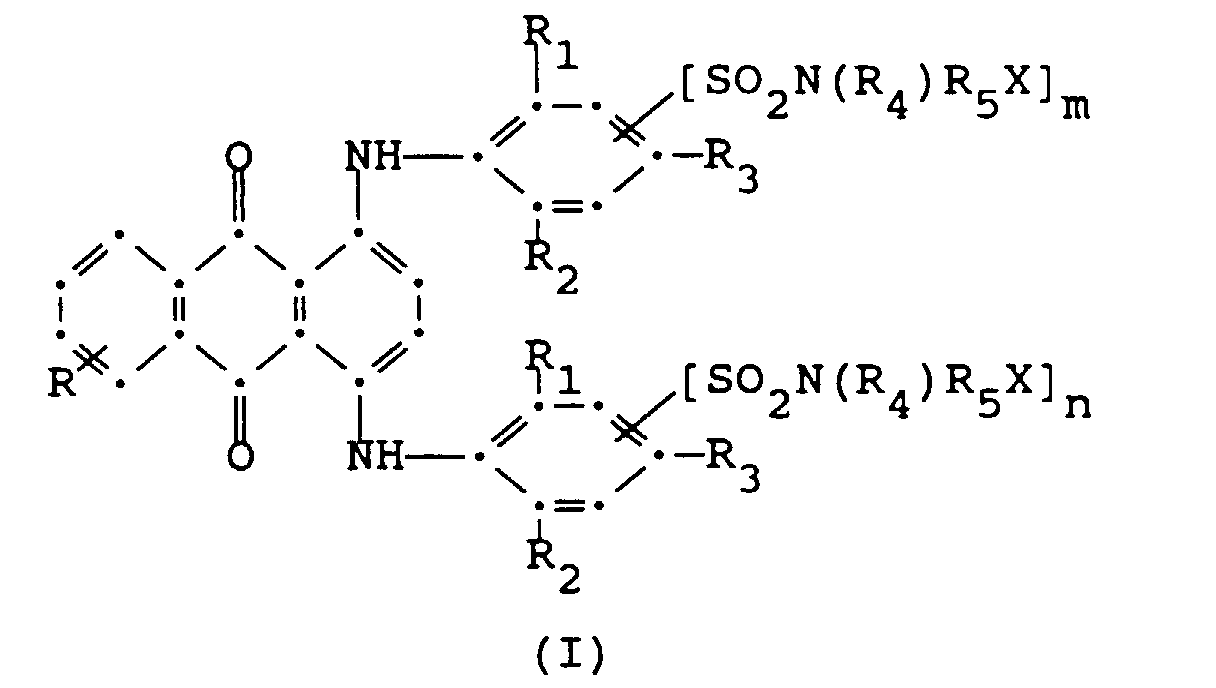
- the organic toner of the '864 patent comprises at least one blue substituted 1,4-bis(2,6-dialylanilino) anthraquinone(s) of the formula (I): wherein:
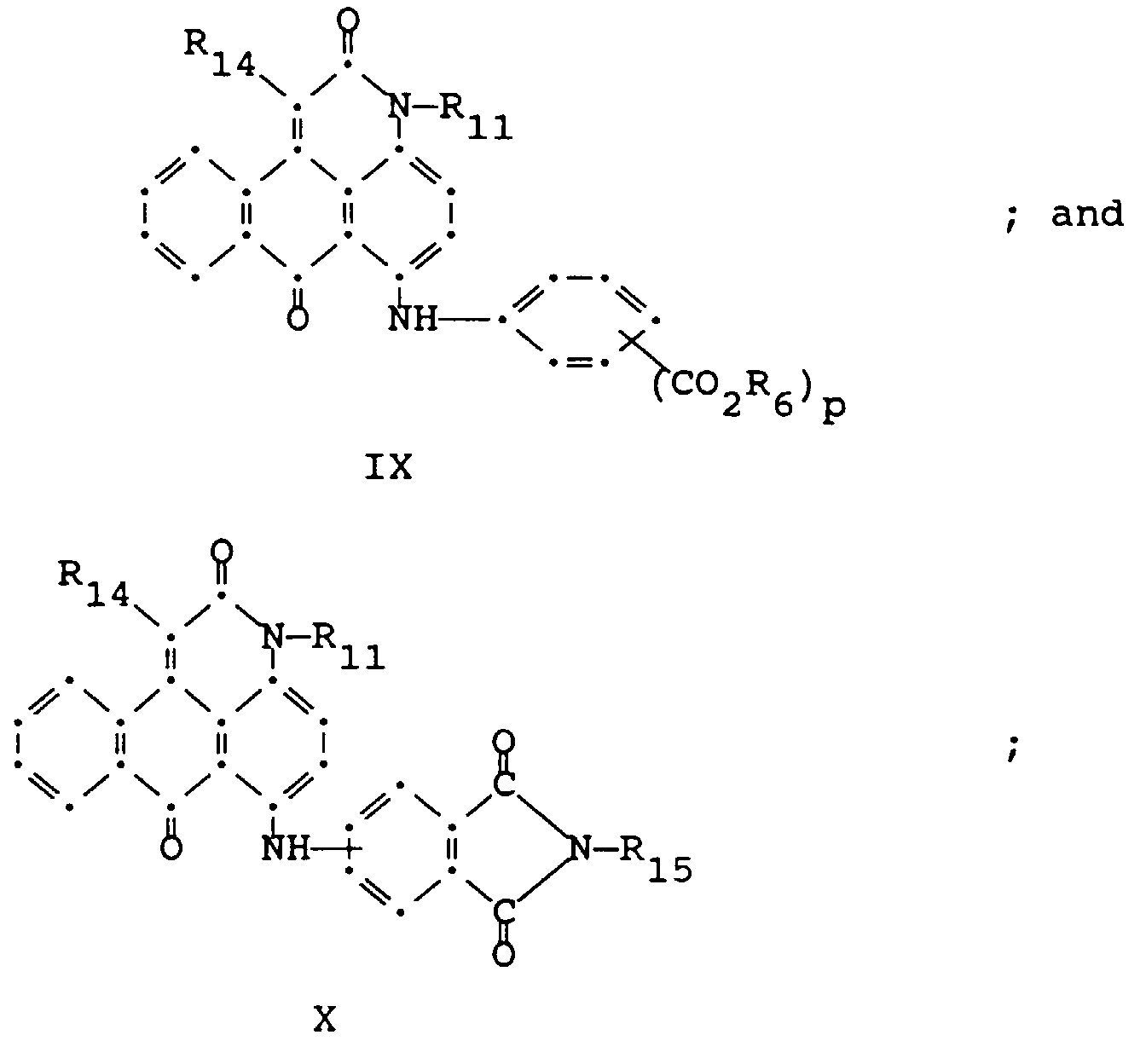
- red compounds of the organic toners of the '864 patent which may be blended with the blue compounds of formula I above, have the following structural formulae II - X: wherein:
- the organic toners of the '864 patent are present in amounts of 1.5 to 10 ppm for the blue compounds and 0.5 to 6 ppm for the red compounds, based on the weight of the copolyester.
- the preferred amount of the blue compounds is 2.8 to 7 ppm.
- the preferred amount of the red compounds is 0.8 to 4 ppm.
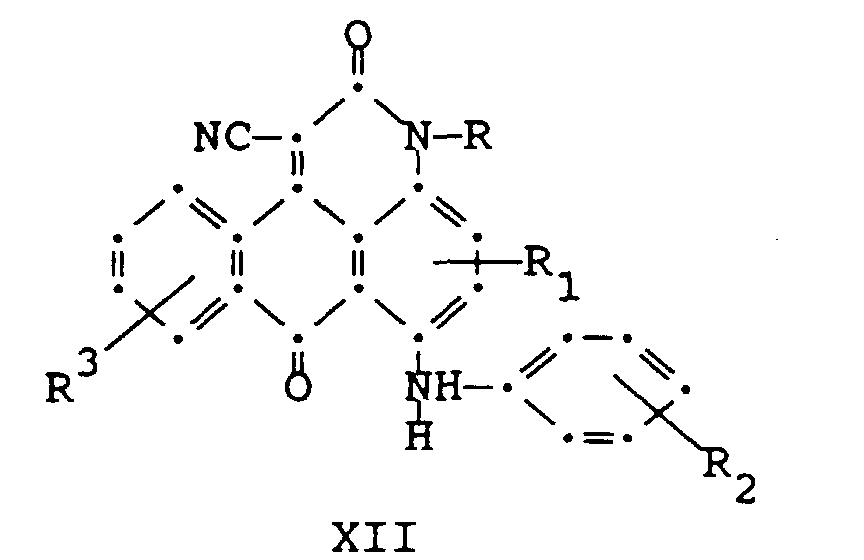
- organic toners of the '174 patent are substituted 1-cyano-3H-dibenzo [f,ij] isoquinoline-2,7-diones having the following structural formula wherein
- the preferred 1-cyano-3H-dibenzo [f,ij] isoquinoline-2,7 diones of the instant invention are those illustrated by the formula wherein R is methyl, R 1 is hydrogen, R 3 is hydrogen and R 2 is 4'-(2 hydroxyethyl).
- Another preferred toner of the instant invention is that compound wherein R is methyl, R 1 is hydrogen, R 3 is hydrogen and R 2 is 4'-(2-hydroxyethoxy).
- organic toners of Formula XI and XII are present in amounts of 0.5 to 10 ppm, preferably 1 to 5 ppm, based on the weight of the polyester.
- the polyesters of the present invention may be prepared according to conventional esterification/ transesterification processes wherein the terephthalic acid, or the ester-forming derivative thereof such as dimethyl terephthalate, optionally in combination with another dicarboxylic acid or ester-forming derivative thereof, is reacted with a mixture of ethylene and diethylene glycols in the presence of the novel catalyst system and the color control agent.
- the reaction mixture is then subjected to polycondensation conditions of increasing temperature and decreasing pressure to obtain a polyester.
- the first stage of the process is performed in the presence of the manganese, titanium and antimony compounds and the color control agent at ambient pressure to about 390 kPa (gage) (60 psig) and at temperatures in the range of about 160° to 240°C.
- the second stage of the process is carried out in the presence of the phosphorus compound at temperatures over the range of about 250° to 300°C, preferably not above about 280°C since the use of higher temperatures affects detrimentally the thermal stability of the polyester.
- the second stage typically occurs under reduced pressure of less than 0.665 kPa (5 mm Hg), preferably less than 0.133 kPa (1 mm Hg).
- the catalyst compounds may be added individually or in combination at the commencement of the process.
- the use of manganese and phosphorus compounds are added at different stages with the manganese in the first stage and phosphorus in the second stage.
- the titanium and antimony compounds may be added in either stage.
- the color control agent may be added at any stage in the process, but is typically added between the first and second stage.
- the DEG modified PET of the present invention may also be prepared by conventional continuous processes.
- high molecular weight polyesters are produced by continuously adding free dicarboxylic acid or its ester derivative and glycol to molten low molecular weight polyester resin, reacting them while continuously withdrawing low molecular weight resin; introducing the resin withdrawn into a polymerization apparatus; continuously polymerizing it to high molecular weight resin and withdrawing high molecular weight polyester resin from the polymerization apparatus.
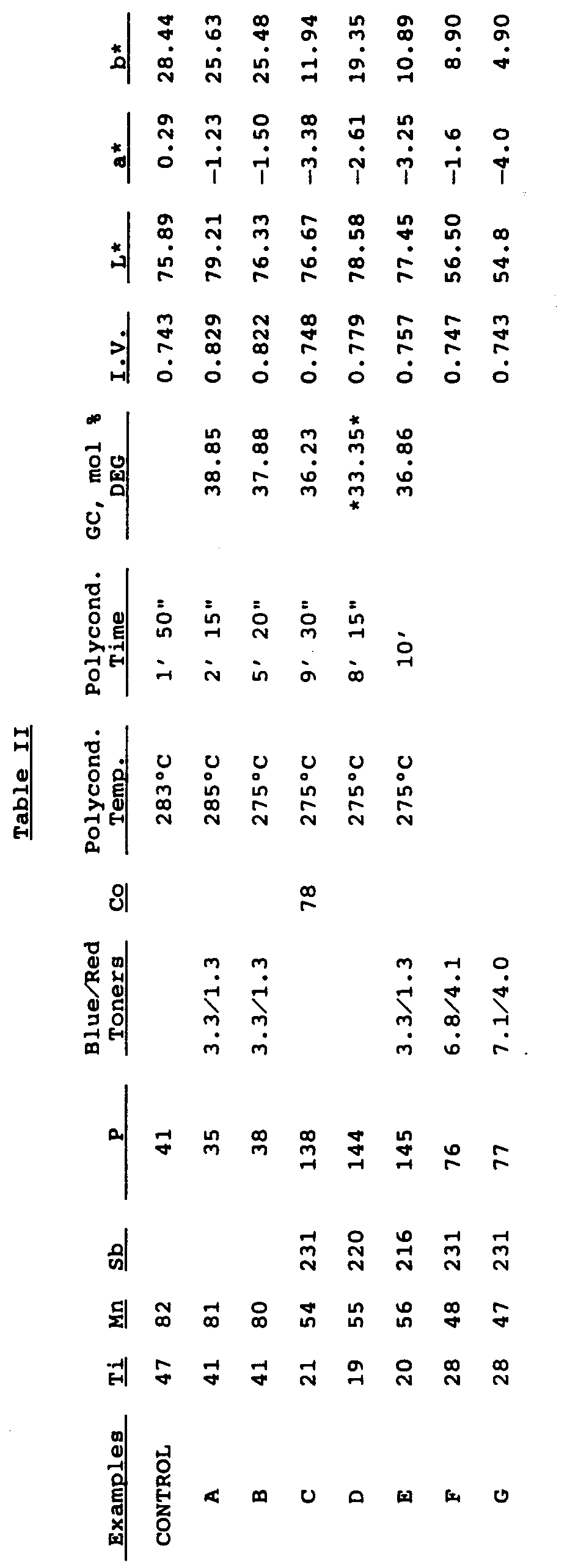
- a DEG modified PET 100 mol % PET, 37 mol % DEG and 63 mol % EG was prepared in the laboratory by placing 79g DMT (Dimethylterephthalate), 45.9g EG and 27.6g DEG into a 500 ml flask. Catalysts were as follows; 20 ppm Ti, 55 ppm Mn, and 230 ppm Sb. Co was added or a blue and red toner combination to help improve clarity, i.e. reduce yellowness. The mixture was heated in a molten metal bath to 210°C. The molten mixture released methanol as a result of the ester exchange process.
- the resulting low molecular weight resin was feed into a polymerization apparatus, R2, in which the resin was polymerized to an I.V. of approximately 0.2 dL/g.
- R2 was operated at 265°C.
- R3 was operated so that the temperature of tray 10, which is about the middle of the reactor, was 279°C. Increasing the temperature of R3 resulted in a strong increase in b* value, approximately 4 units.
- inherent viscosity refers to viscosity determinations made at 25°C using 0.25 gram of polymer per 100 mL of a solvent composed of 60 weight percent phenol and 40 weight percent tetrachloroethane.
- the improved clarity copolyesters of present invention provide diethylene glycol modified poly(ethylene terephthalates) suitable for use in shrink film applications as well as other applications requiring clear to neutral color materials.
- the novel catalyst system and the addition of the color control agent are incorporated into conventional processing techniques and do not alter the existing properties of the copolyester, thus making for easy substitution into existing applications.
Landscapes
- Chemical & Material Sciences (AREA)
- Health & Medical Sciences (AREA)
- Chemical Kinetics & Catalysis (AREA)
- Medicinal Chemistry (AREA)
- Polymers & Plastics (AREA)
- Organic Chemistry (AREA)
- Polyesters Or Polycarbonates (AREA)
- Compositions Of Macromolecular Compounds (AREA)
- Developing Agents For Electrophotography (AREA)
Abstract
Description
| b* of base polymer | b* of base polymer w/ toner | delta |
| 17 | 7 | 10 |
| 19 | 11 | 8 |
| 24 | 19 | 5 |
| 28 | 25 | 3 |



wherein one or more alkyl, alkoxy, aryl, aryloxy, alkylthio, arylthio or aralkyl groups may contain one or more reactive residues selected from the group consisting of carboxy, carbalkoxy, carbaryloxy, N-alkylcarbamoyloxy, carbamoyloxy, acyloxy, chlorocarbonyl, hydroxyl, cycloalkylcarbonyloxy, N-arylcarbamoyloxy and N,N-dialkylcarbamoyloxy, wherein said alkyl and aryl groups may further contain substituents such as alkoxy, acyloxy, halogen, cyano, hydroxy and acylamido.
Claims (10)
- An improved clarity copolyester composition having a b* value of less than 15, having an inherent viscosity of 0.4 to 1.2 dL/g and comprising:A. 100 mol percent dicarboxylic acid residue component comprising at least 75 mol percent of terephthalic acid residues;B. 100 mol percent diol residue component comprising 10 to 50 mol percent diethylene glycol residue and 50 to 90 mol percent ethylene glycol residue;C. catalyst residues comprising 20 to 100 ppm manganese, 50 to 300 ppm antimony, 0 to 100 ppm titanium and 40 to 150 ppm phosphorus, based on the weight of the copolyester; andD. color control agent residues comprising organic or inorganic toners present in a sufficient amount whereby the b* color value of the combination of components A, B, and C is reduced to less than 15 by the addition of component D.
- The improved clarity copolyester of claim 1 wherein the color control agent residues are selected from the group consisting of(i) 40 to 100 ppm cobalt;(ii) 1.5 to 10 ppm of a blue compound having the formula (I):wherein:
 R is selected from the group consisting of hydrogen, C1-C6 alkyl, halogen, carboxy, and C1-C6
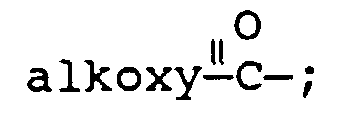 R1 and R2 are independently C1-C6-alkyl;R3 is selected from the group consisting of hydrogen, halogen, C1-C6-alkyl, substituted C1-C6 alkyl, hydroxy, C1-C6-alkoxy, substituted C1-C6-alkoxy, cyano, thiocyano,C1-C6-alkylthio, substituted C1-C6-alkylthio, C1-C6-alkylsulfonyl, substituted C1-C6-alkylsulfonyl, C1-C6-alkoxycarbonyl, carboxy, aryloxy, arylthio, arylsulfonyl, and SO2N(R4)R5X when m and/or n are zero;R4 is selected from the group consisting of hydrogen, C1-C6-alkyl, substituted C1-C6-alkyl, C3-C8-alkenyl, C3-C8-alkynyl, C3-C7-cycloalkyl and aryl;R5 is a linking group selected from the group consisting of C1-C8-alkylene, C1-C6-alkylene-Z-C1-C6-alkylene, arylene-C1-C6-alkylene, arylene-Z-C1-C6- alkylene, C3-C7-cycloalkylene, C1-C6-alkylene-cycloalkylene-C1-C6-alkylene, C1-C6-alkylene-arylene-C1-C6-alkylene, and C1-C6-alkylene-Z-arylene-Z-C1-C6-alkylene, whereinZ is selected from -0-, -S- or SO2; X is hydrogen or a polyester reactive group; and m and n are independently 0 or 1; with the proviso that at least one polyester reactive group is present and0.5 to 6 ppm of a red compound having the structural formulae II - X: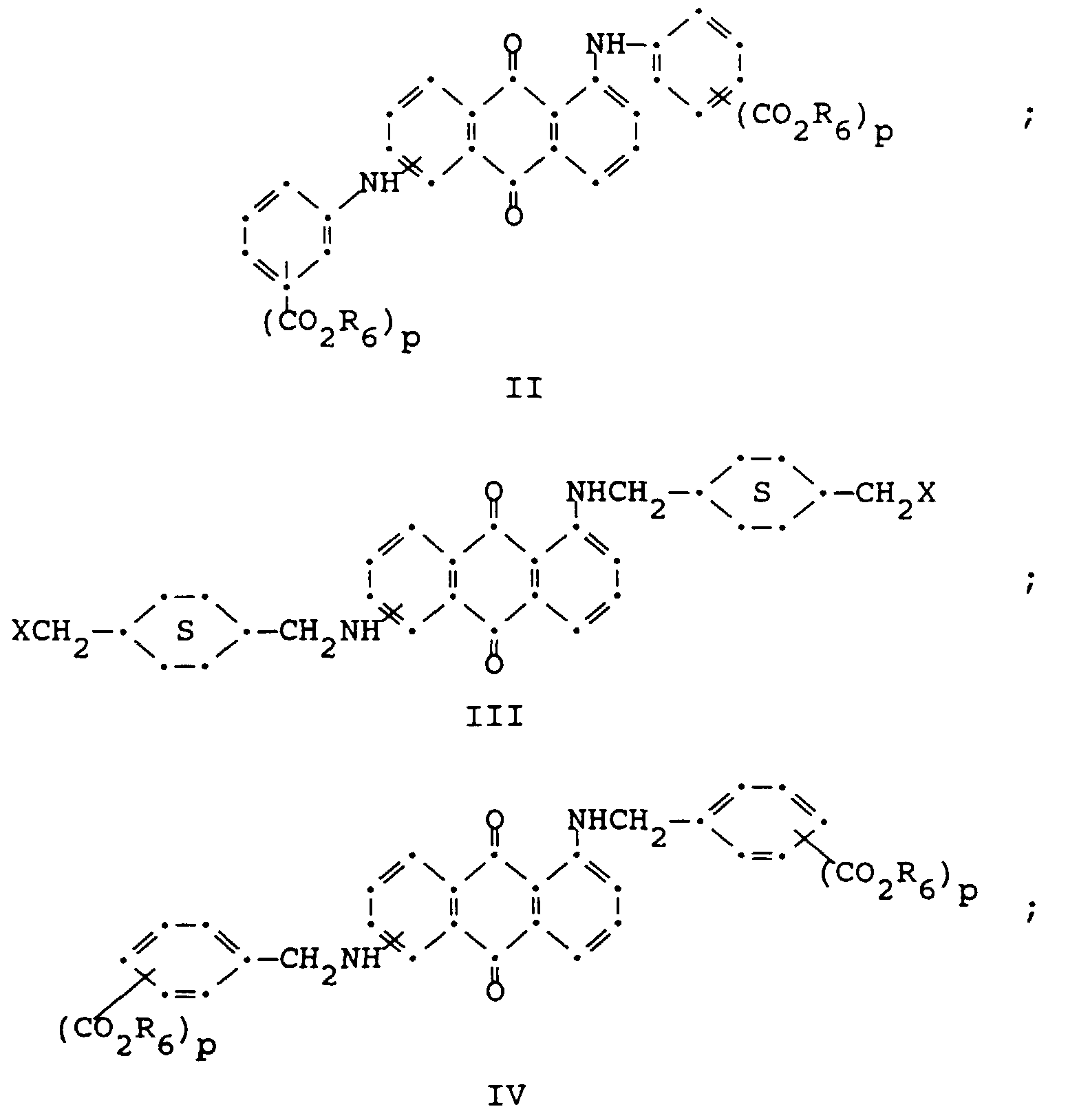
 wherein:
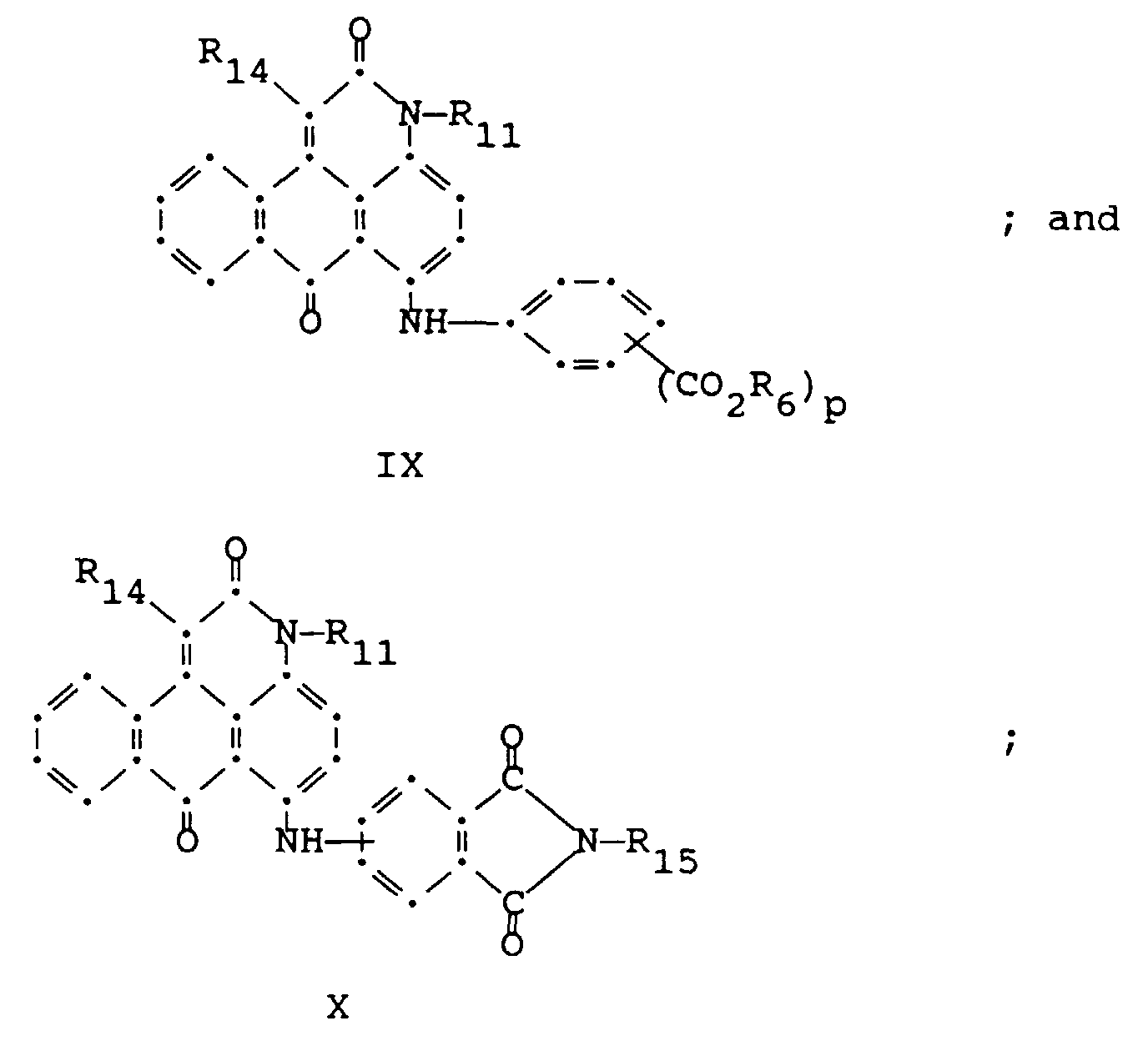 R6 is selected from the group consisting of hydrogen, C1-C6-alkyl, substituted C1-C6-alkyl, C3-C7-cycloalkyl or aryl;R7 is hydrogen or one to three groups selected from C1-C6-alkyl, substituted C1-C6 alkyl, C1-C6-alkanoylamino, halogen, hydroxy, C1-C6-alkyl C1-C6-alkoxy, C1-C6-alkylthio;R8 and R9 are the same or different and are selected from the group consisting of C1-C6-alkyl, substituted C1-C6-alkyl, C3-C7-cycloalkyl or aryl;R10 is selected from the group consisting of C1-C6-alkyl, C3-C7-cycloalkyl or aryl;R11 is selected from the group consisting of hydrogen, C1-C12-alkyl, substituted C1-C12-alkyl, C3-C7-cycloalkyl and aryl;R12 is hydrogen or one to three groups selected from the group consisting of C1-C6-alkyl, substituted C1-C6-alkyl, C1-C6-alkoxy, substituted C1-C6-alkoxy, C1-C6-alkylthio, substituted C1-C6-alkylthio, halogen, hydroxy, C1-C6-alkanoylamino, aroylamino, C1-C6-alkylsulfonylamino and arylsulfonylamino;R13 and R14 are selected from hydrogen, cyano or CO2R10;R15 is R4 or R5X as previously defined;L is -CO- or -SO2-; X is hydrogen or a polyester reactive group; m is 0 or l; p is 1 or 2; with the provisos that R13 is hydrogen when m is 0 and at least one polyester reactive group is present; and(iii) 0.5 to 10 ppm of a compound having the formula (XI):wherein
 with all weights in ppm based on the weight of the copolyester.R is hydrogen, cycloalkyl, allyl, alkyl, aralkyl, alkoxy-alkyl or cycloalkylalkylene;R1 is hydrogen, halogen, alkyl, alkoxy, aryloxy, alkylthio, or arylthio;R2 is hydrogen, halogen, alkyl, aryl, alkoxy, arylalkoxy, alkylthio, arylthio, carbalkoxy, carbaralkoxy, carboxy, sulfamoyl, alkylsulfamoyl, dialkylsulfamoyl, alkylarylsulfamoyl, cycloalkylsulfamoyl, arylsulfamoyl, carbamoyl, alkylcarbamoyl, dialkylcarbamoyl, alkylarylcarbamoyl, cycloalkylcarbamoyl, arylcarbamoyl, 2-pyrrolidono, acylamido or N-alkylacylamido;R3 is one or more residues selected from the group consisting of hydrogen, halogen, alkyl and alkoxy;x is an integer of 1 to 5;
wherein one or more alkyl, alkoxy, aryl, aryloxy, alkylthio, arylthio or aralkyl groups may contain one or more reactive residues selected from the group consisting of carboxy, carbalkoxy, carbaryloxy, N-alkylcarbamoyloxy, carbamoyloxy, acyloxy, chlorocarbonyl, hydroxyl, cycloalkylcarbonyloxy, N-arylcarbamoyloxy and N,N-dialkylcarbamoyloxy, wherein said alkyl and aryl groups may further contain substituents such as alkoxy, acyloxy, halogen, cyano, hydroxy and acylamido; - The copolyester composition of claim 1 having a b* value of less than 10.
- The copolyester composition of claim 1 wherein the diol residue component comprises 25 to 50 mol percent diethylene glycol residue and 75 to 90 mol percent ethylene glycol residue.
- The copolyester composition of claim 4 wherein the diethylene glycol residue is present in an amount of 32 to 40 mol percent and the ethylene glycol residue is present in an amount of 60 to 68 mol percent.
- The copolyester composition of claim 1 wherein the catalyst residues comprise 40 to 80 ppm manganese, 150 to 250 ppm antimony, 10 to 50 ppm titanium and 50 to 150 ppm phosphorus.
- The copolyester composition of claim 2 wherein the cobalt is present in an amount of 65 to 100 ppm.
- The copolyester composition of claim 2 wherein the blue compound is present in an amount of 2.8 to 7 ppm and the red compound is present in an amount of 0.8 to 4 ppm.
- A process for producing an improved clarity copolyester composition having a b* value of less than 15, an inherent viscosity of 0.4 to 1.0 dL/g, and having repeat units from a dicarboxylic acid residue component comprising repeat units from at least 75 mol percent of terephthalic acid residues and a diol residue component comprising repeat units from 10 to 50 mol percent diethylene glycol residue and 50 to 90 mol percent ethylene glycol residue, which comprises reacting the dicarboxylic acid and the diol residue components at temperatures sufficient to effect esterification or trans-esterification and polycondensing the reaction product in the presence of catalyst residues of 20 to 100 ppm manganese, 50 to 300 ppm antimony, 0 to 100 ppm titanium and 40 to 150 ppm phosphorus and color control agent residues selected from the group consisting of(i) 40 to 100 ppm cobalt;(ii) 1.5 to 10 ppm of a blue compound having the formula (I):wherein:
 R is selected from the group consisting of hydrogen, C1-C6 alkyl, halogen, carboxy, and C1-C6
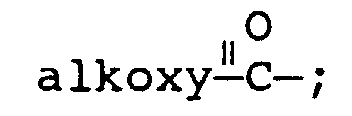 R1 and R2 are independently C1-C6-alkyl;R3 is selected from the group consisting of hydrogen, halogen, C1-C6-alkyl, substituted C1-C6 alkyl, hydroxy, C1-C6-alkoxy, substituted C1-C6-alkoxy, cyano, thiocyano,C1-C6-alkylthio, substituted C1-C6-alkylthio, C1-C6-alkylsulfonyl, substituted C1-C6-alkylsulfonyl, C1-C6-alkoxy-carbonyl, carboxy, aryloxy, arylthio, arylsulfonyl, and SO2N(R4)R5X when m and-or n are zero;R4 is selected from the group consisting of hydrogen, C1-C6-alkyl, substituted C1-C6-alkyl, C3-C8-alkenyl, C3-C8-alkynyl, C3-C7-cycloalkyl and aryl;R5 is a linking group selected from the group consisting of C1-C8-alkylene, C1-C6-alkylene-Z-C1-C6-alkylene, arylene-C1-C6-alkylene, arylene-Z-C1-C6- alkylene, C3-C7-cycloalkylene, C1-C6-alkylene-cycloalkylene-C1-C6-alkylene, C1-C6-alkylene-arylene-C1-C6-alkylene, and C1-C6-alkylene-Z-arylene-Z-C1-C6-alkylene, whereinZ is selected from -0-, -S- or SO2; X is hydrogen or a polyester reactive group; and m and n are independently 0 or 1; with the proviso that at least one polyester reactive group is present and
0.5 to 6 ppm of a red compound having the structural formulae II - X: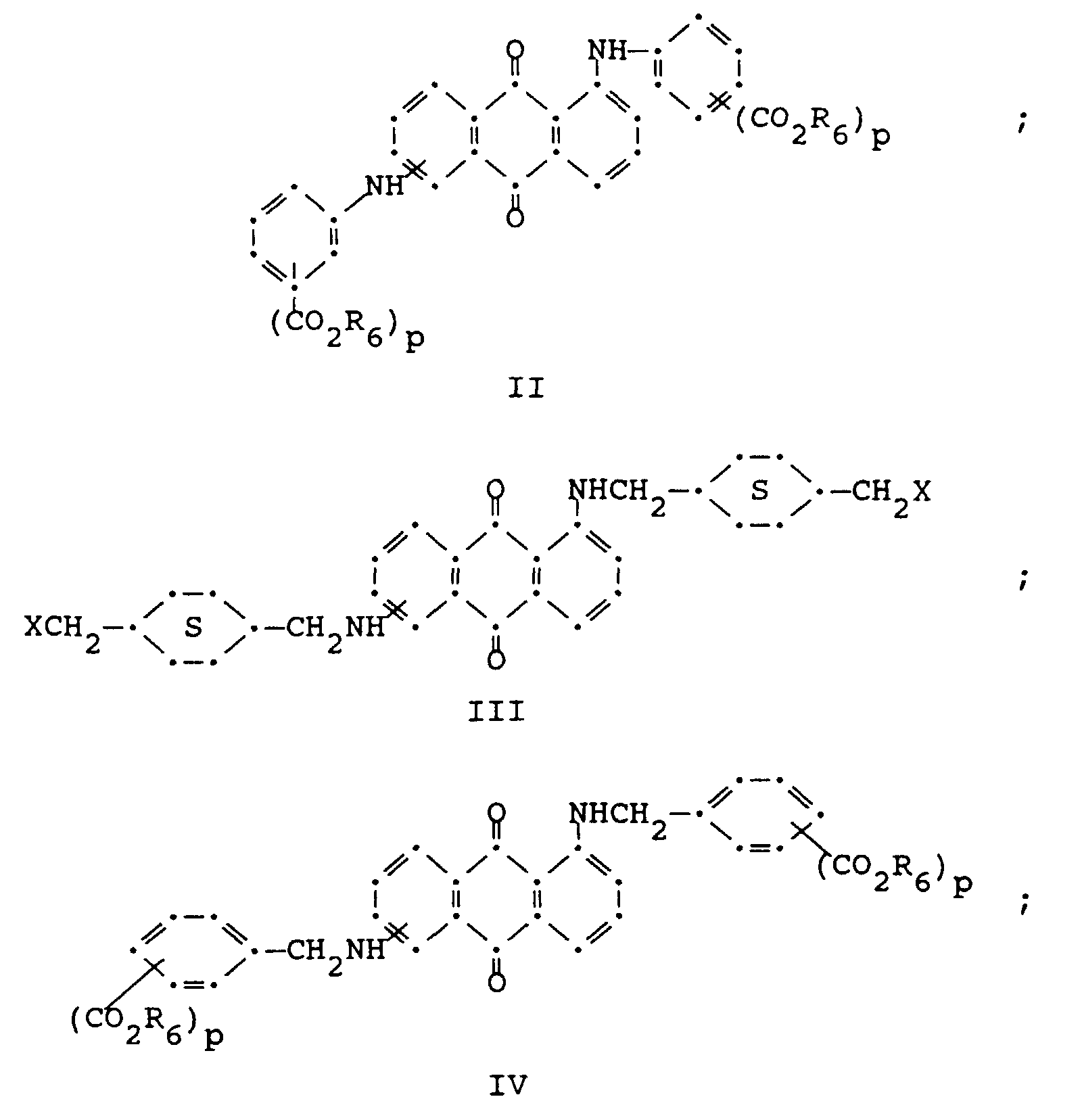
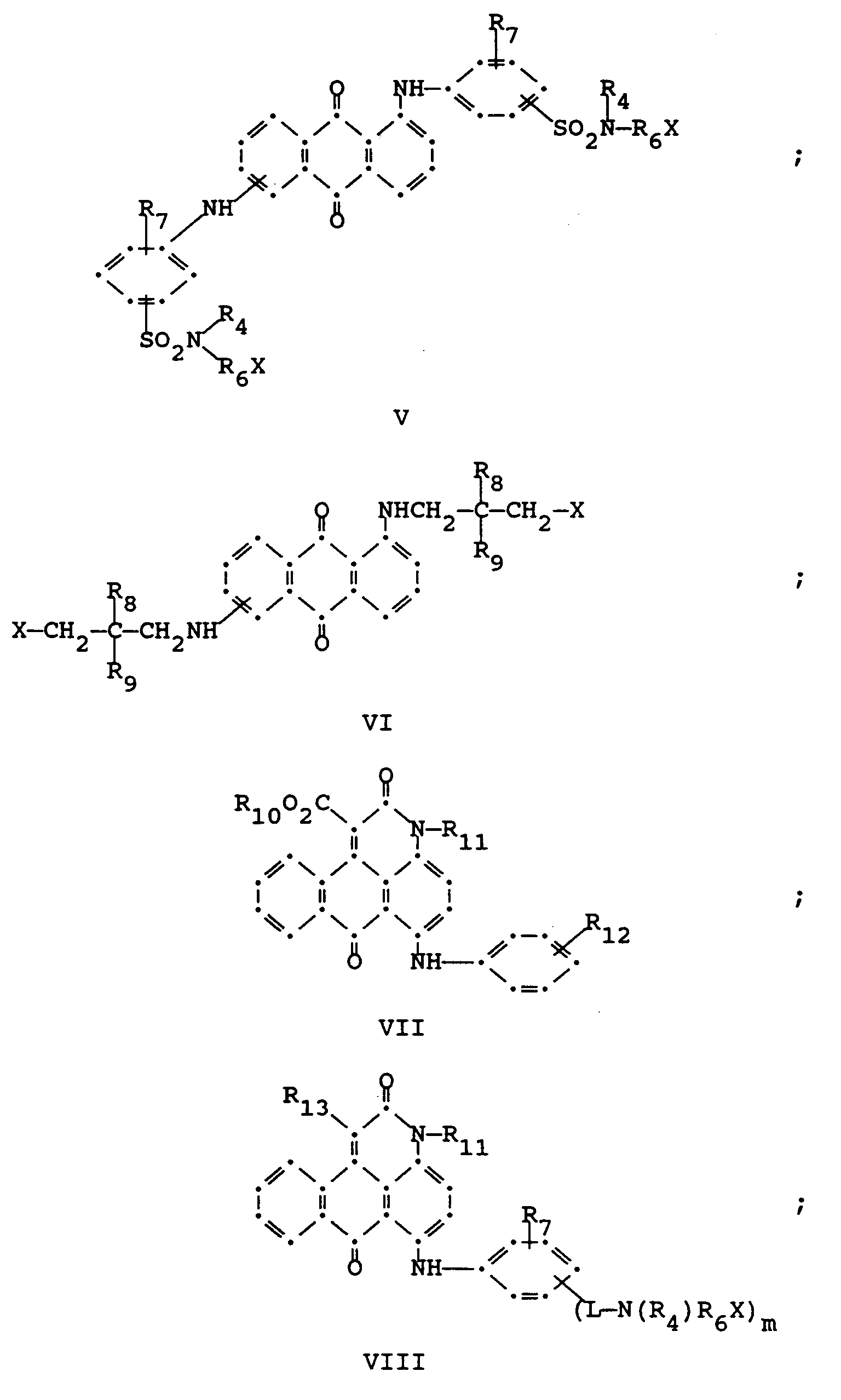 wherein:
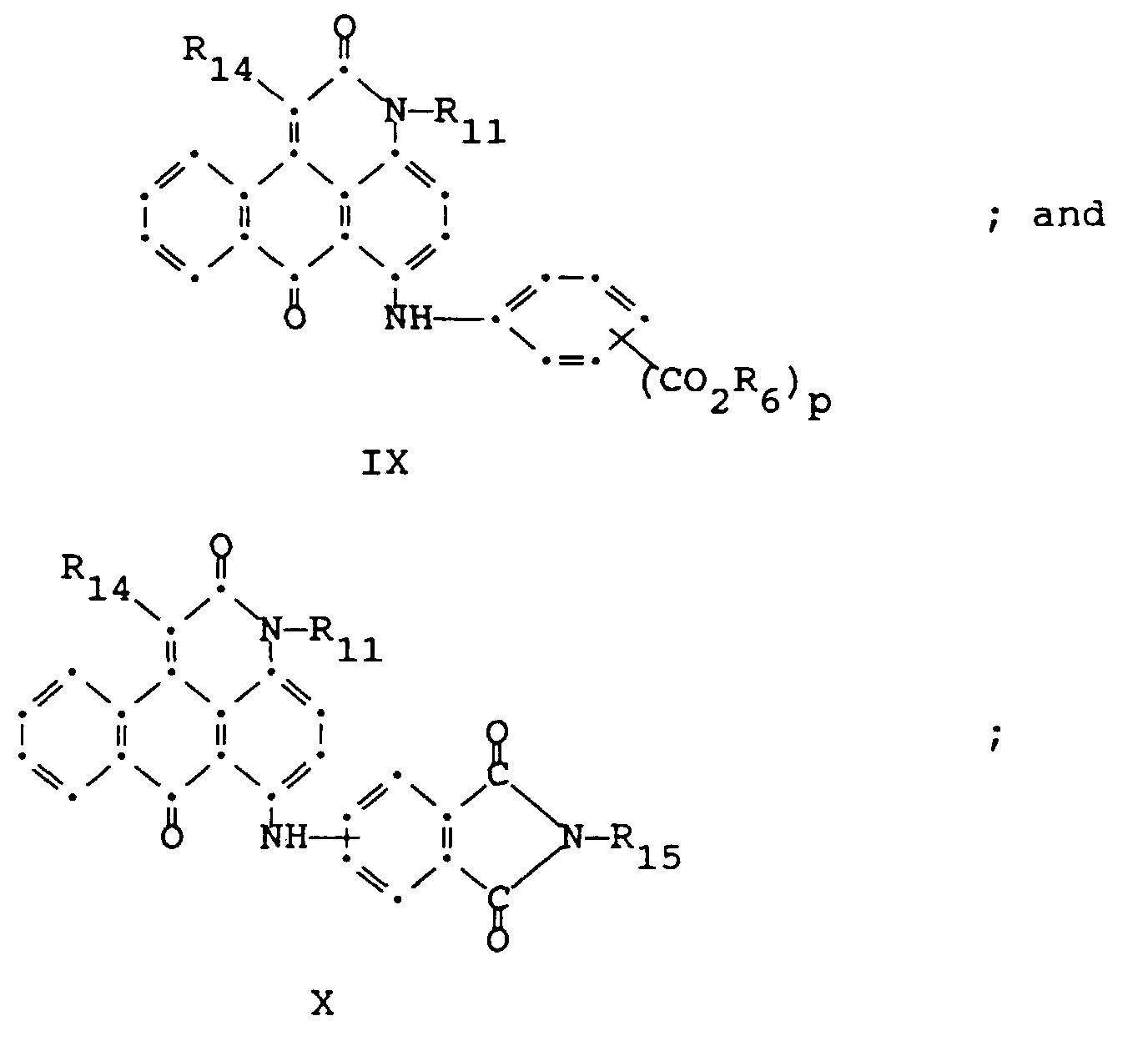 R6 is selected from the group consisting of hydrogen, C1-C6-alkyl, substituted C1-C6-alkyl, C3-C7-cycloalkyl or aryl;R7 is hydrogen or one to three groups selected from C1-C6-alkyl, substituted C1-C6 alkyl, C1-C6-alkanoylamino, halogen, hydroxy, C1-C6-alkyl C1-C6-alkoxy, C1-C6-alkylthio;R8 and R9 are the same or different and are selected from the group consisting of C1-C6-alkyl, substituted C1-C6-alkyl, C3-C7-cycloalkyl or aryl;R10 is selected from the group consisting of C1-C6-alkyl, C3-C7-cycloalkyl or aryl;R11 is selected from the group consisting of hydrogen, C1-C12-alkyl, substituted C1-C12-alkyl, C3-C7-cycloalkyl and aryl;R12 is hydrogen or one to three groups selected from the group consisting of C1-C6-alkyl, substituted C1-C6-alkyl, C1-C6-alkoxy, substituted C1-C6-alkoxy, C1-C6-alkylthio, substituted C1-C6-alkylthio, halogen, hydroxy, C1-C6-alkanoylamino, aroylamino, C1-C6-alkylsulfonylamino and arylsulfonylamino;R13 and R14 are selected from hydrogen, cyano or CO2R10;R15 is R4 or R5X as previously defined;L is -CO- or -SO2-; X is hydrogen or a polyester reactive group; m is 0 or 1; p is 1 or 2; with the provisos that R13 is hydrogen when m is 0 and at least one polyester reactive group is present; and(iii) 0.5 to 10 ppm of a compound having the formula (XI):wherein
 with all ppm weights based on the weight of the polyester.R is hydrogen, cycloalkyl, allyl, alkyl, aralkyl, alkoxy-alkyl or cycloalkylalkylene;R1 is hydrogen, halogen, alkyl, alkoxy, aryloxy, alkylthio, or arylthio;R2 is hydrogen, halogen, alkyl, aryl, alkoxy, arylalkoxy, alkylthio, arylthio, carbalkoxy, carbaralkoxy, carboxy, sulfamoyl, alkylsulfamoyl, dialkylsulfamoyl, alkylarylsulfamoyl, cycloalkylsulfamoyl, arylsulfamoyl, carbamoyl, alkylcarbamoyl, dialkylcarbamoyl, alkylarylcarbamoyl, cycloalkylcarbamoyl, arylcarbamoyl, 2-pyrrolidono, acylamido or N-alkylacylamido;R3 is one or more residues selected from the group consisting of hydrogen, halogen, alkyl and alkoxy;x is an integer of 1 to 5;
wherein one or more alkyl, alkoxy, aryl, aryloxy, alkylthio, arylthio or aralkyl groups may contain one or more reactive residues selected from the group consisting of carboxy, carbalkoxy, carbaryloxy, N-alkylcarbamoyloxy, carbamoyloxy, acyloxy, chlorocarbonyl, hydroxyl, cycloalkylcarbonyloxy, N-arylcarbamoyloxy and N,N-dialkylcarbamoyloxy, wherein said alkyl and aryl groups may further contain substituents such as alkoxy, acyloxy, halogen, cyano, hydroxy and acylamido. - An improved clarity copolyester produced according to the process of claim 9.
Applications Claiming Priority (2)
| Application Number | Priority Date | Filing Date | Title |
|---|---|---|---|
| US08/786,592 US5688899A (en) | 1997-01-21 | 1997-01-21 | Clarity copolyester |
| US786592 | 1997-01-21 |
Publications (3)
| Publication Number | Publication Date |
|---|---|
| EP0854160A2 true EP0854160A2 (en) | 1998-07-22 |
| EP0854160A3 EP0854160A3 (en) | 2000-10-18 |
| EP0854160B1 EP0854160B1 (en) | 2003-10-15 |
Family
ID=25139038
Family Applications (1)
| Application Number | Title | Priority Date | Filing Date |
|---|---|---|---|
| EP98100816A Expired - Lifetime EP0854160B1 (en) | 1997-01-21 | 1998-01-19 | Improved clarity copolyester |
Country Status (4)
| Country | Link |
|---|---|
| US (1) | US5688899A (en) |
| EP (1) | EP0854160B1 (en) |
| JP (1) | JPH10212399A (en) |
| DE (1) | DE69818878T2 (en) |
Cited By (1)
| Publication number | Priority date | Publication date | Assignee | Title |
|---|---|---|---|---|
| EP2159246A1 (en) | 2008-08-29 | 2010-03-03 | Lurgi Zimmer GmbH | Method for producing polymers with neutral colour tone |
Families Citing this family (29)
| Publication number | Priority date | Publication date | Assignee | Title |
|---|---|---|---|---|
| US6495656B1 (en) | 1990-11-30 | 2002-12-17 | Eastman Chemical Company | Copolyesters and fibrous materials formed therefrom |
| US5859116A (en) * | 1997-01-21 | 1999-01-12 | Eastman Chemical Company | Clarity and adjustable shrinkage of shrink films using miscible polyester blends |
| CN1146679C (en) * | 1997-08-28 | 2004-04-21 | 伊斯曼化学公司 | Modified Copolymer Binder Fiber |
| US6231976B1 (en) | 1997-08-28 | 2001-05-15 | Eastman Chemical Company | Copolyester binder fibers |
| CN1161505C (en) * | 1997-11-06 | 2004-08-11 | 伊斯曼化学公司 | copolyester binder fiber |
| KR19990065399A (en) * | 1998-01-13 | 1999-08-05 | 구광시 | Manufacturing method of polyester with excellent gloss |
| US6346070B1 (en) * | 1998-12-25 | 2002-02-12 | Mitsui Chemicals Inc | Catalyst for polyester production, process for producing polyester using the catalyst, polyester obtained by the process, and uses of the polyester |
| US7513947B2 (en) * | 2000-11-13 | 2009-04-07 | Ei Du Pont De Nemours And Company | Colored thermoplastic resin compositions for laser welding, specific neutral anthraquinone dyes as colorants therefor, and molded product therefrom |
| AU2007202839B2 (en) * | 2001-02-06 | 2009-06-18 | Mitsubishi Chemical Corporation | Polyester resin and method for production thereof |
| JP4393004B2 (en) * | 2001-02-06 | 2010-01-06 | 三菱化学株式会社 | Polyester resin |
| US6716898B2 (en) | 2001-05-18 | 2004-04-06 | Eastman Chemical Company | Amber polyester compositions for packaging food and beverages |
| ATE378382T1 (en) * | 2001-10-12 | 2007-11-15 | Milliken & Co | NEW POLYMERIC BLUE ANTHRACHINONE DERIVATIVE COLORS |
| US6528564B1 (en) * | 2001-10-12 | 2003-03-04 | Milliken & Company | Articles comprising novel polymeric blue anthraquinone-derivative colorants |
| TWI311995B (en) * | 2002-08-05 | 2009-07-11 | Mitsubishi Chemical Corporatio | Polyester resin and its production process |
| US6787589B2 (en) * | 2002-10-31 | 2004-09-07 | Eastman Chemical Company | Amber polyester compositions and container articles produced therefrom |
| DE60320035T2 (en) * | 2003-03-05 | 2009-05-14 | Eastman Chemical Co., Kingsport | POLYMER BLENDS |
| US20050277713A1 (en) * | 2003-03-05 | 2005-12-15 | Pearson Jason C | Polymer blends |
| US20050065247A1 (en) * | 2003-09-19 | 2005-03-24 | Carico Douglas Weldon | Liquid coating compositions having improved whiteness |
| US20050215426A1 (en) * | 2004-03-26 | 2005-09-29 | Putzig Donald E | Esterification catalyst and process therewith |
| US20050215425A1 (en) * | 2004-03-26 | 2005-09-29 | Clair Jerry D S | Esterification catalyst and process therewith |
| US7390869B2 (en) * | 2005-06-13 | 2008-06-24 | Eastman Chemical Company | Process for removing metal species in the presence of hydrogen and a porous material and polyester polymer containing reduced amounts of metal species |
| EP2508657B1 (en) * | 2009-12-04 | 2017-05-24 | Kuraray Co., Ltd. | Polyester fibers dyeable at ordinary pressure and process for producing same |
| JP5806019B2 (en) * | 2011-07-11 | 2015-11-10 | 帝人株式会社 | High heat-resistant crystalline polyester, method for producing the same, and film using the same |
| JP6005005B2 (en) * | 2013-07-23 | 2016-10-12 | 富士フイルム株式会社 | Biaxially stretched polyester film and method for producing the same |
| CN109563248B (en) * | 2016-08-18 | 2021-10-08 | 伊士曼化工公司 | Orientation and shrink films containing polyesters containing tetramethylcyclobutanediol and ethylene glycol |
| WO2018035335A1 (en) * | 2016-08-18 | 2018-02-22 | Eastman Chemical Company | Polyester compositions which comprise tetramethyl cyclobutanediol and ethylene glycol, with improved catalyst system |
| CN114729113B (en) * | 2019-10-08 | 2025-03-18 | 伊士曼化工公司 | Catalyst systems for crystallizable reactor-grade resins |
| US12522695B2 (en) | 2019-10-08 | 2026-01-13 | Eastman Chemical Company | Catalyst systems for crystallizable reactor grade resins with recycled content |
| US20230145146A1 (en) * | 2021-11-09 | 2023-05-11 | North Carolina State University | Polymer color analysis by transmission spectrophotometry using high refractive index composite liquids |
Family Cites Families (4)
| Publication number | Priority date | Publication date | Assignee | Title |
|---|---|---|---|---|
| US4352925A (en) * | 1980-11-17 | 1982-10-05 | Eastman Kodak Company | Heat resistant copolyester adhesives |
| US5372864A (en) * | 1993-09-03 | 1994-12-13 | Eastman Chemical Company | Toners for polyesters |
| AR000405A1 (en) * | 1995-03-27 | 1997-06-18 | Eastman Chem Co | Process to prepare polyesters |
| WO1997033749A1 (en) * | 1996-03-11 | 1997-09-18 | Eastman Chemical Company | Composite structure having a porous surface and a multilayer film laminated thereto |
-
1997
- 1997-01-21 US US08/786,592 patent/US5688899A/en not_active Expired - Lifetime
-
1998
- 1998-01-19 EP EP98100816A patent/EP0854160B1/en not_active Expired - Lifetime
- 1998-01-19 DE DE69818878T patent/DE69818878T2/en not_active Expired - Fee Related
- 1998-01-21 JP JP10009443A patent/JPH10212399A/en active Pending
Cited By (2)
| Publication number | Priority date | Publication date | Assignee | Title |
|---|---|---|---|---|
| EP2159246A1 (en) | 2008-08-29 | 2010-03-03 | Lurgi Zimmer GmbH | Method for producing polymers with neutral colour tone |
| DE102008044487A1 (en) | 2008-08-29 | 2010-03-04 | Lurgi Zimmer Gmbh | Process for the preparation of polymers with neutral color |
Also Published As
| Publication number | Publication date |
|---|---|
| EP0854160A3 (en) | 2000-10-18 |
| EP0854160B1 (en) | 2003-10-15 |
| US5688899A (en) | 1997-11-18 |
| DE69818878D1 (en) | 2003-11-20 |
| JPH10212399A (en) | 1998-08-11 |
| DE69818878T2 (en) | 2004-08-19 |
Similar Documents
| Publication | Publication Date | Title |
|---|---|---|
| EP0854160B1 (en) | Improved clarity copolyester | |
| US5340907A (en) | Copolyester of cyclohexanedimethanol and process for producing such polyester | |
| US5385773A (en) | Copolyester of cyclohexanenedimethanol and process for producing such polyester | |
| JP4571910B2 (en) | Ester-modified dicarboxylate polymer | |
| AU720667B2 (en) | Ethylene terephthalate/ethylene-2,6-naphthalene dicarboxylate copolymer for bottles | |
| US4501878A (en) | Process for the preparation of high molecular weight polyesters | |
| EP1185575B1 (en) | Low melt viscosity amorphous copolyesters with enhanced glass transition temperatures | |
| JP5989676B2 (en) | Polyester resin composition and method for producing the same | |
| KR101769560B1 (en) | Polyester resin copolymerized with lactic acid and isosorbide and preparing method thereof | |
| KR20110028696A (en) | Polyester resin copolymerized with isosorbide and 1,4-cyclohexanedimethanol and preparation method thereof | |
| EP1384740A1 (en) | Process for preparing copolyesters of terephthalic acid, ethylene glycol, and 1,4-cyclohexanedimethanol exhibiting a neutral hue, high clarity and increased brightness | |
| JPS5959721A (en) | High transparency polyterephthalates and copolymers of same and manufacture | |
| KR102675032B1 (en) | Polyester resin and preparation method of the same | |
| EP3255081A1 (en) | Copolyester resin, and method for producing same | |
| US3528946A (en) | Acetylacetonates as polycondensation catalysts in transesterification method of preparing polyesters | |
| KR20090041974A (en) | Highly transparent 1,4-cyclohexanedimethanol copolymer polyester resin with excellent color and preparation method thereof | |
| US5898060A (en) | Copolyester for molding a bottle | |
| US11518848B2 (en) | Polyester resin and preparation method of the same | |
| JP3115465B2 (en) | Polyester composition | |
| KR20230076609A (en) | Preparation method for copolyester resin | |
| EP3585827A1 (en) | Process for preparing poly(trimethylene furandicarboxylate) using zinc catalyst | |
| JP3639055B2 (en) | Polyester molded container | |
| US3522216A (en) | Preparation of polyesters with nickel,manganese,aluminum,or cadmium borate as polycondensation catalysts | |
| KR20060076626A (en) | Method for producing amorphous polyester using titanium compound as catalyst | |
| JP2000336158A (en) | Polyester composition |
Legal Events
| Date | Code | Title | Description |
|---|---|---|---|
| PUAI | Public reference made under article 153(3) epc to a published international application that has entered the european phase |
Free format text: ORIGINAL CODE: 0009012 |
|
| AK | Designated contracting states |
Kind code of ref document: A2 Designated state(s): DE FR GB IT |
|
| AX | Request for extension of the european patent |
Free format text: AL;LT;LV;MK;RO;SI |
|
| PUAL | Search report despatched |
Free format text: ORIGINAL CODE: 0009013 |
|
| AK | Designated contracting states |
Kind code of ref document: A3 Designated state(s): AT BE CH DE DK ES FI FR GB GR IE IT LI LU MC NL PT SE |
|
| AX | Request for extension of the european patent |
Free format text: AL;LT;LV;MK;RO;SI |
|
| 17P | Request for examination filed |
Effective date: 20010116 |
|
| AKX | Designation fees paid |
Free format text: DE FR GB IT |
|
| 17Q | First examination report despatched |
Effective date: 20010704 |
|
| GRAH | Despatch of communication of intention to grant a patent |
Free format text: ORIGINAL CODE: EPIDOS IGRA |
|
| GRAS | Grant fee paid |
Free format text: ORIGINAL CODE: EPIDOSNIGR3 |
|
| GRAA | (expected) grant |
Free format text: ORIGINAL CODE: 0009210 |
|
| AK | Designated contracting states |
Kind code of ref document: B1 Designated state(s): DE FR GB IT |
|
| REG | Reference to a national code |
Ref country code: GB Ref legal event code: FG4D |
|
| REF | Corresponds to: |
Ref document number: 69818878 Country of ref document: DE Date of ref document: 20031120 Kind code of ref document: P |
|
| ET | Fr: translation filed | ||
| PLBE | No opposition filed within time limit |
Free format text: ORIGINAL CODE: 0009261 |
|
| STAA | Information on the status of an ep patent application or granted ep patent |
Free format text: STATUS: NO OPPOSITION FILED WITHIN TIME LIMIT |
|
| 26N | No opposition filed |
Effective date: 20040716 |
|
| PGFP | Annual fee paid to national office [announced via postgrant information from national office to epo] |
Ref country code: DE Payment date: 20090130 Year of fee payment: 12 |
|
| PGFP | Annual fee paid to national office [announced via postgrant information from national office to epo] |
Ref country code: GB Payment date: 20081211 Year of fee payment: 12 |
|
| PGFP | Annual fee paid to national office [announced via postgrant information from national office to epo] |
Ref country code: IT Payment date: 20090114 Year of fee payment: 12 |
|
| PGFP | Annual fee paid to national office [announced via postgrant information from national office to epo] |
Ref country code: FR Payment date: 20090106 Year of fee payment: 12 |
|
| GBPC | Gb: european patent ceased through non-payment of renewal fee |
Effective date: 20100119 |
|
| REG | Reference to a national code |
Ref country code: FR Ref legal event code: ST Effective date: 20100930 |
|
| PG25 | Lapsed in a contracting state [announced via postgrant information from national office to epo] |
Ref country code: FR Free format text: LAPSE BECAUSE OF NON-PAYMENT OF DUE FEES Effective date: 20100201 |
|
| PG25 | Lapsed in a contracting state [announced via postgrant information from national office to epo] |
Ref country code: DE Free format text: LAPSE BECAUSE OF NON-PAYMENT OF DUE FEES Effective date: 20100803 |
|
| PG25 | Lapsed in a contracting state [announced via postgrant information from national office to epo] |
Ref country code: GB Free format text: LAPSE BECAUSE OF NON-PAYMENT OF DUE FEES Effective date: 20100119 |
|
| PG25 | Lapsed in a contracting state [announced via postgrant information from national office to epo] |
Ref country code: IT Free format text: LAPSE BECAUSE OF NON-PAYMENT OF DUE FEES Effective date: 20100119 |